Oxidized LDL Is Really Oxidized Linoleic Acid
Oxidized LDL is one of the most cited concepts in cardiovascular medicine. It is the central villain in the story of how cholesterol becomes dangerous. Oxidized LDL is the form of LDL that macrophages engulf, transforming into foam cells that form the necrotic core of atherosclerotic plaques. Every medical student learns it. Every cardiologist references it. It is treated as a settled piece of the cardiovascular disease story.
What almost nobody discusses and what the research makes increasingly clear is what specifically gets oxidized within LDL, and where that substance comes from.
The answer is linoleic acid. And accepting that answer forces a fundamental rethinking of what drives cardiovascular disease, what makes LDL dangerous, and what the correct dietary intervention actually is.
What’s Actually Inside LDL
LDL particles carry cholesterol, but they also carry a substantial fatty acid cargo. The primary polyunsaturated fatty acid in LDL, particularly in its cholesteryl ester fraction, is cholesteryl linoleate: cholesterol esterified to linoleic acid. This is the primary oxidizable substrate in the particle. When LDL oxidizes, what is being oxidized is, in the overwhelming majority of cases, the linoleic acid embedded within it.
The resulting products of oxidized linoleic acid are 9-HODE, 13-HODE, which are among a family of related oxidized linoleic acid metabolites or OXLAMs. It’s the oxidiation of linoleic acid in LDL that transform it from a relatively benign cholesterol transporter into the pro-inflammatory, foam-cell-generating engine that drives atherosclerosis. Once LDL becomes oxidized, it is no longer recognized by the normal LDL receptor. Instead, it is taken up by macrophage scavenger receptors, the machinery that is not subject to the feedback regulation of normal LDL receptors and that leads directly to foam cell formation and heart disease.
One note from the research puts it plainly: oxidized LDL should be renamed “oxidized linoleic acid within LDL.” The renaming would be scientifically accurate, and it would immediately clarify both the cause of the problem and what must change to solve it. If oxLDL is primarily oxidized LA within LDL, then the solution is not simply reducing LDL quantity, it is reducing the oxidizability of LDL by reducing the linoleic acid it carries, which can be done by reducing omega-6 seed oil intake.
Oxidized Linoleic Acid Arrives Before the Disease Does
The temporal relationship between oxidized LA metabolites and cardiovascular events is one of the most important and least-discussed findings in this literature. Elevated levels of oxidized linoleic acid metabolites (OXLAMS) such as 9-HODE and 13-HODE are detectable in the blood well before clinical symptoms of heart disease emerge.
This is a critical distinction. If these oxidized metabolites merely accumulated after disease developed, they would be markers of pathology, interesting biomarkers, but not causally informative. The fact that they appear before symptoms emerge suggests they are contributing causes, not passengers. The oxidative process driven by dietary LA is not a consequence of a diseased arterial wall. It is part of what creates one.
What the Dayton Study Actually Found
The Dayton study is routinely cited as evidence that replacing saturated fat with vegetable oil reduces cardiovascular risk, based on the cholesterol data. It is far less often cited for what the arterial tissue analysis found, which tells a very different story.
When researchers analyzed the fatty acid composition of atherosclerotic plaques in patients who had been randomized to either their usual diet or a vegetable-oil-substituted diet, they found that complicated aortic atheroma, the dangerous, rupture-prone plaques, contained significantly more linoleic acid in the vegetable oil group. Coronary atheroma showed the same pattern. Uncomplicated atheroma, stable plaques that are unlikely to rupture, did not show the same increased LA.
In other words, the plaques most likely to rupture and cause a fatal heart attack were specifically enriched in linoleic acid in the people eating what was supposed to be the heart-healthy diet. The stable, non-dangerous plaques were not affected in the same way. This is exactly what the oxidized-LA-drives-plaque-vulnerability hypothesis would predict. More dietary LA means more LA in LDL, which means more oxLDL, which means more macrophage infiltration and inflammatory cytokine secretion in plaques, which means thinner fibrous caps and greater rupture risk. The cholesterol numbers improved. The arteries got worse.
The African Green Monkey Experiment: Five Years of Evidence
If the Dayton tissue analysis is the most overlooked piece of human evidence in this literature, the African Green Monkey experiment is the most overlooked piece of animal evidence. Two groups of monkeys were fed either lard or safflower oil for five years, a period long enough to develop meaningful atherosclerosis and observe differences in its severity.
After five years, the safflower-fed monkeys on the high-PUFA, “heart-healthy” oil had developed about 3-times the fatty plaque of the lard-fed animals. If you read the title of the article, you would think that omega-6 fat decreased coronary artery atherosclerosis because the total percentage of the abdominal aorta surface with atherosclerotic lesions was slightly less on safflower oil versus lard (about 40% versus 50%) but the actual plaque itself was much more dangerous. Indeed, in the lard group the plaque was made up almost entirely of “fatty streaks”, which are not susceptible to rupture. In the monkeys consuming safflower oil, almost half of the lesions were “fatty plaques” the exact type of plaque that is likely to rupture and cause a heart attack.
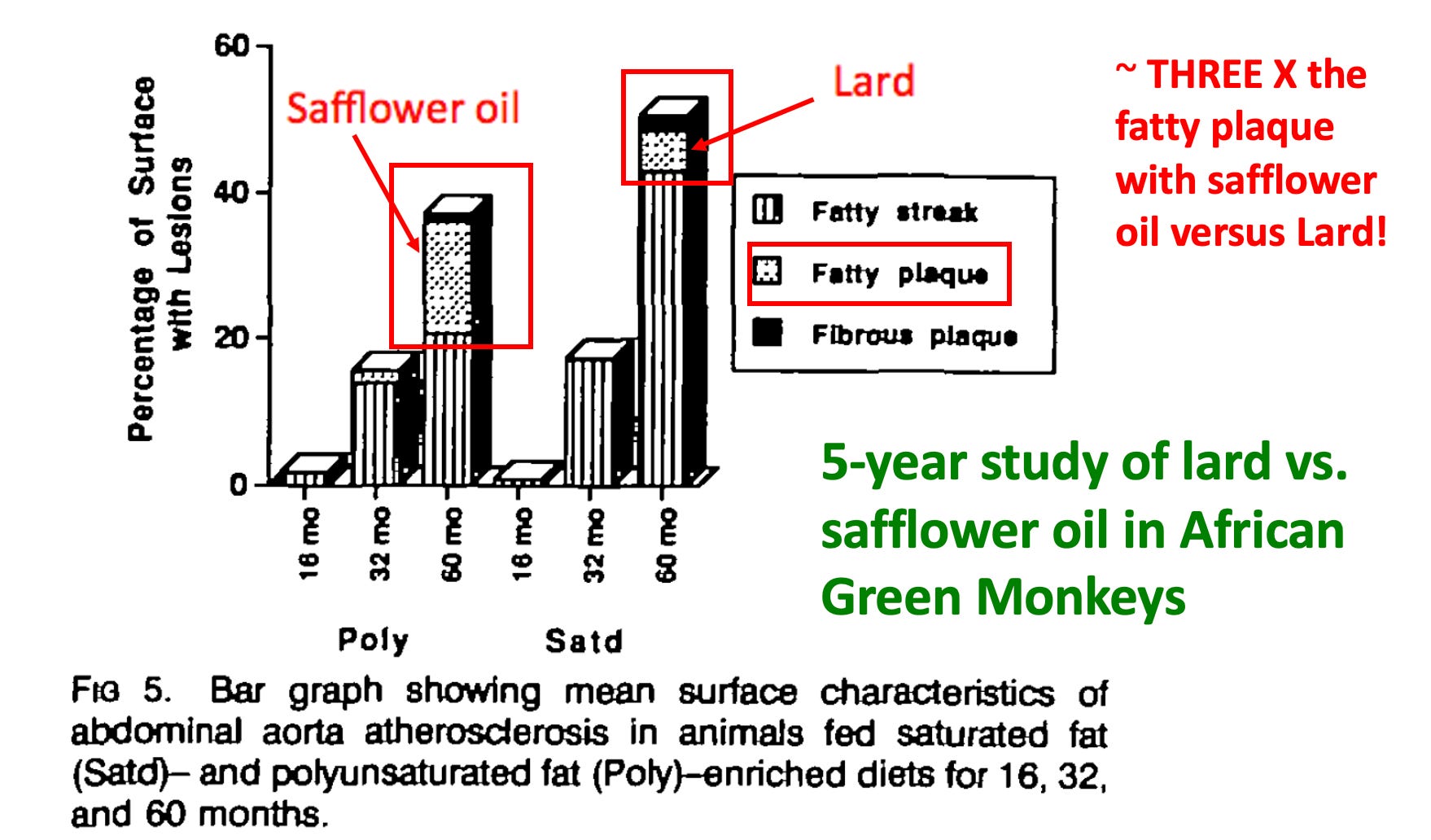
Lard. The fat that has been publicly maligned for decades, that was removed from restaurant fryers across America because of its presumed cardiovascular danger, produced a lower risk type of atherosclerosis. The explanation is the one this entire series of articles has been building toward: lard is low in linoleic acid and high in oxidation-resistant fats. Safflower oil is the opposite. The atherosclerotic outcome follows the linoleic acid content of the diet, not the saturated fat content.
Oxidizability Matters More Than Quantity
The conventional approach to cardiovascular risk management focuses on reducing LDL particle count or concentration. This is not entirely wrong at very high concentrations, LDL penetrates and is retained in the arterial intima in greater absolute quantities, which does increase risk. But the predictive relationship between LDL-C and cardiovascular events is weaker than most people realize, and it is weaker precisely because it ignores oxidizability.
What determines whether LDL becomes dangerous after it enters the arterial intima is how easily it oxidizes. And oxidizability is directly determined by the fatty acid composition of the particle. Saturated fatty acids have no double bonds, they are chemically stable and essentially immune to the lipid peroxidation that drives LDL oxidation. Oleic acid, the primary fat in olive oil, has one double bond and is relatively resistant. Linoleic acid, with two double bonds, is substantially more susceptible. The more LA that LDL carries, the more dangerous each particle is per unit of ApoB independent of how many particles there are.
This is why some people with high LDL have no arterial disease while others with moderate LDL develop severe atherosclerosis. The LA content of their LDL, and therefore its oxidizability, is a decisive variable that the standard lipid panel never measures. A person eating a diet rich in stable fats might have a relatively high LDL number but a particle that is extremely resistant to oxidation. A person eating a diet dominated by vegetable oils might have a lower LDL number but particles packed with LA that are substantially more dangerous per unit.
Adding antioxidants can partially compensate, think vitamin E, ubiquinol, and the polyphenols in extra virgin olive oil all protect LDL from oxidation to some degree. But there is a ceiling to this protection. When the amount of oxidizable substrate in LDL is extremely high, antioxidant defenses are overwhelmed. The solution cannot be to antioxidant-protect a diet soaked in linoleic acid. The substrate itself must be reduced.
The ApoB/ApoA-1 Ratio and Why It Matters
Total LDL cholesterol is, at best, a crude measure of cardiovascular risk. The metrics that turn out to be more predictive are ApoB or the protein marker present on every atherogenic particle, including LDL, VLDL, IDL, and Lp(a), and ApoA-1, the primary protein in HDL that marks the protective, reverse-cholesterol-transport particles. Their ratio reflects the balance between the particles driving plaque formation and the particles working against it.
High-LA diets worsen this ratio by lowering ApoA-1 without proportionally lowering ApoB. Even high-oleic sunflower oil, supposedly a safer variant engineered to reduce the LA content, has been found to lower ApoA-1 without lowering ApoB, actually worsening the ratio that predicts cardiovascular outcomes better than LDL-C. The ApoB/ApoA-1 ratio has consistently outperformed total cholesterol and LDL-C as a cardiovascular risk predictor in large prospective studies, which is precisely what you would expect if what matters is not the total amount of LDL but the balance between atherogenic and protective lipoproteins, a balance that dietary LA disrupts in the wrong direction even when total cholesterol falls.
Grass-Fed vs. Grain-Fed: The Animal Product Variable Nobody Discusses
The research presentations include detailed analysis of the fatty acid composition differences between grass-fed, grain-fed, and wild animal products and the findings reframe a great deal of the epidemiology that has been used to indict meat consumption.
Grain-fed cattle have more than twice the total fat within muscle fibers of grass-fed or game animals. Their saturated fat content is dramatically higher than that of wild game. The linoleic acid content is elevated in grain-fed animals compared to pasture-raised ones, though even grain-fed meat contains far less LA than extracted seed oils. Game animals contain approximately twice the ALA of grain-fed cattle and approximately 3.6 times the long-chain omega-3s of pasture-fed steer.
When epidemiological studies associate “red meat” consumption with cardiovascular disease or cancer, they are almost certainly capturing the effects of grain-fed, LA-elevated, omega-3-depleted industrial meat (frequently cooked in seed oils) rather than wild game or grass-fed beef that resembles what humans evolved eating. Conflating a three-ounce serving of venison with a three-ounce serving of grain-fed feedlot beef cooked in soybean oil is not a minor methodological nuance. It is the kind of categorical error that produces decades of misleading epidemiology and dietary guidance built on it.
Where I Land
Oxidized LDL is oxidized linoleic acid within LDL. That renaming matters because it immediately identifies the cause, the mechanism, and the intervention all at once. If the dangerous thing in cardiovascular disease is not LDL per se but oxidized cholesteryl linoleate within LDL, then:
The cause is dietary linoleic acid consumed in excess, which loads LDL particles with an easily oxidized substrate.
The mechanism is lipid peroxidation of that LA, generating OXLAMs that drive macrophage foam cell formation, plaque development, and plaque vulnerability.
The intervention is reducing dietary LA from seed oils, choosing fats that keep LDL resistant to oxidation, and increasing omega-3 intake to shift the composition of LDL particles away from LA and toward more stable fatty acids.
Statins reduce LDL quantity. They do not reduce LDL oxidizability. They treat the downstream marker while leaving the upstream cause, a food supply saturated with linoleic acid, entirely unchanged. That is not an argument against using statins in appropriate clinical situations. It is an argument for recognizing that the dietary intervention is not optional, and that optimizing a lipid panel while eating seed oils at every meal is a fundamentally incomplete strategy for preventing cardiovascular disease.