NP - LLPS in cells
Transcriptional condensates
(Lu, Corbett NatCom 2021 PMID: 33479198) In addition to its role in viral packaging, the N protein is dynamically localized to the viral RTC and is required for efficient viral RNA transcription11–15. Consistently, a recent pro-teomic study showed that SARS-CoV-2 N strongly interactswith cellular RNA processing machinery, including many stressgranule proteins and several RNA helicases, including DDX1,which has been reported to be involved in viral RNAsynthesis26,58. These data suggest that the N protein may form phase-separated condensates in cells to promote recruitment offactors that facilitate viral RNA synthesis.
NP - LLPS without specific CoV2 RNA
(Guseva Blackledge 2020 SciAdv PMID: 32270045) SARS-CoV N protein overexpressed in cells forms puncta that resemble biomolecular condensates (7). Similarly, in the SARS-CoV-2 virus, the N protein's domain organization and its involvement with phase-separated structures, such as stress granules (8, 9), suggest that N protein phase separates with the SARS-CoV-2 genome in infected cells. Phase separation of N can form membrane-less compartments that mediate viral packaging in host cells (10).
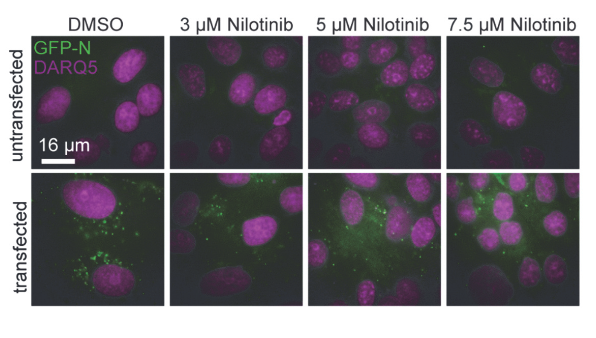
produced condensates already without viral RNA / it is a concentration dependent process!! maybe less with the RNA would be better.
(Iserman 2020 BioRxiv PMID: 32587965)
condensate correlates with expression level. N-protein signal was generally excluded from the nucleus. readily underwent fusion. recovered quickly following FRAP

NP LLPS with transfected vRNA
(Zhao Li NatCom 2021 pmid: 33837182) stable dox-incible H1299 cell line; but also poly(I:C) RNA ends up in the LLPS
Forming stress granules with G3BP1
(Lu, Corbett NatCom 2021 PMID: 33479198) In cells, N forms condensates that incorporate RNA and the stress granule core protein G3BP1, but not other known stress granule proteins, suggesting a role for N in suppressing G3BP1dependent innate immune responses.