NP - RNA phase separation (LLPS)
LLPS good to read
Ross - 2022 PMID: 35131265 - Phase separation by the SARS-CoV-2 nucleocapsid protein: Consensus and open questions
LLPS - intro
(Zhao Li NatCom 2021 pmid: 33837182) NP is the only CoV2 protein that can do LLPS
(Guseva Blackledge 2020 SciAdv PMID: 32270045) Phase separation has been shown to create membraneless organelles, including the nucleolus, centrosome, heterochromatin, stress granules, and P granules when networks of weak interactions drive the de-mixing of proteins from the surrounding environment (11, 12). Nucleic acids (RNA, DNA) are highly involved in the formation of biomolecular condensates because they can scaffold multivalent interactions (13-15). Nucleotide sequences without the ability to base pair (e.g. poly-G) are stimulated to phase separate by weak electrostatic interactions between the polycation and the phosphate backbone (13).
open questions
PMID: 35131265 / 2022 / Cascarina/Ross : Phase separation by the SARS-CoV-2 nucleocapsid protein: Consensus and open questions
NP - functions by LLPS
(Zhao Li NatCom 2021 pmid: 33837182) LLPS mediates the formation of stress granules (SGs) and P-bodies (PBs), which are critical for antiviral immunity by inhibiting viral mRNA translation and promoting RNA decay16–18,26,27.
LLPS was also thought to be critical in viral assembly, including respiratory syncytial viral (RSV)28, measles virus (MeV)29 and vesicular stomatitis virus (VSV)30.
NP features/domains that help LLPS
NP protein domains required for LLPS
What is the best substrate for LLPS: NP-LLPS - Substrates and conditions
(Guseva Blackledge 2020 SciAdv PMID: 32270045) - many of the characteristic domain features common in phase separating systems, - uneven electrostatic charge distribution - an RNA binding domain (RBD) - a dimerization domain - intrinsically disordered regions
RBD interacts nonspecifically with RNA and recognizes a nucleotide sequence in the 3’ end of the viral genome (16). Both the N- and C-termini are disordered and can potentially form higher order protein/protein interactions (17). These disordered regions are arginine- and lysine-rich (Figure 1B), which may facilitate additional interactions with the negatively-charged RNA backbone (18) and drive biomolecular condensation of RNA (19). The N protein also contains a serine/arginine-rich (SR) motif, which has been associated with phase separation in other ribonucleoproteins (16, 20), and a predicted prion-like domain (PLD) that can potentially trigger protein demixing (21).
Protein sequence that is required for LLPS function
(Zhao Li NatCom 2021 pmid: 33837182) NR203K/G204R exhibits a higher propensity to undergo LLPS and a greater effect on IFN inhibition.
Posttranslational modifications and N LLPS
PMID: 35874957 Phosphorylation of SR-domains of N protein inhibits its RNA binding and RNA-induced LLPS ^37.
N protein acetylation at Lys375 abrogates its LLPS with RNA and the N protein-mediated suppression of MAVS signaling. Targeting the dimerization domain of N protein by a peptide can disrupt the LLPS and then inhibit SARS-CoV-2 replication in vitro and in vivo ^44.
Conditions affecting LLPS
Temperature: in vitro phase separation - NP - Temperature and protein stability - conditions in lung and tissue
NP interaction with other proteins in LLPS
(Lu, Corbett NatCom 2021 PMID: 33479198) Three-component mixtures of N, M, and RNA assemble into condensates with distinct internal compartments or layers containing N + RNA or N + M, suggesting that M and RNA repel one another despite each interacting with N. This mutual exclusion often yields two-layered condensates with an internal N + RNA compartment surrounded by an outer layer of N + M.
RNA features affecting LLPS
PMID: 35871289 - dsRNA - Double-stranded RNA drives SARS-CoV-2 nucleocapsid protein to undergo phase separation at specific temperatures
NP - LLPS in cells
Phase separation and N-binding sites to RNA
(pmid: 32587965) N-binding map and shape analysis of 5'PS and other regions - use to design N-binding RNA's - NP - RNA binding sites
RNA sequences behave different in LLPS
(pmid: 32587965) The 5'-End generally drives N-protein condensation, whereas the Frameshifting-region solubilized condensates and promoted LLPS only within a narrow protein and RNA concentration range
(Guseva Blackledge 2020 SciAdv PMID: 32270045) N protein forms spherical assemblies with unstructured RNA, it forms mesh like-structures with viral RNA strands that contain secondary structure elements. Length and RNA structure determine droplet properties-
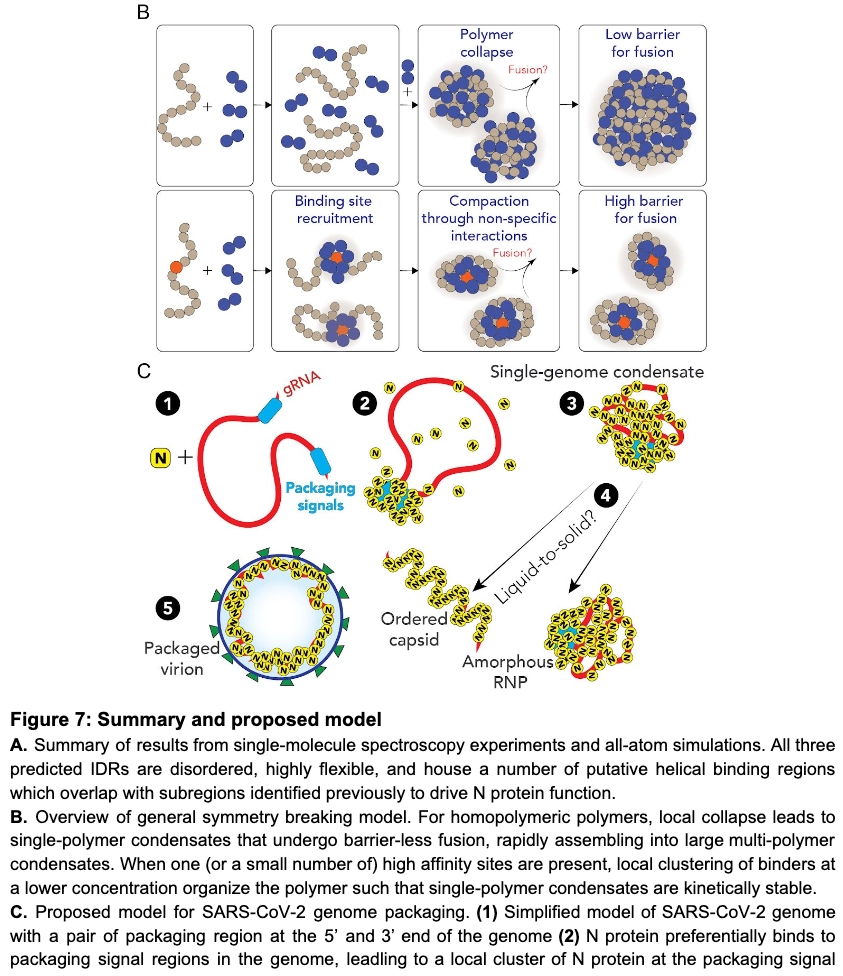
Phase separation - symmetry braking model for gRNA binding
(pmid: 32587965)
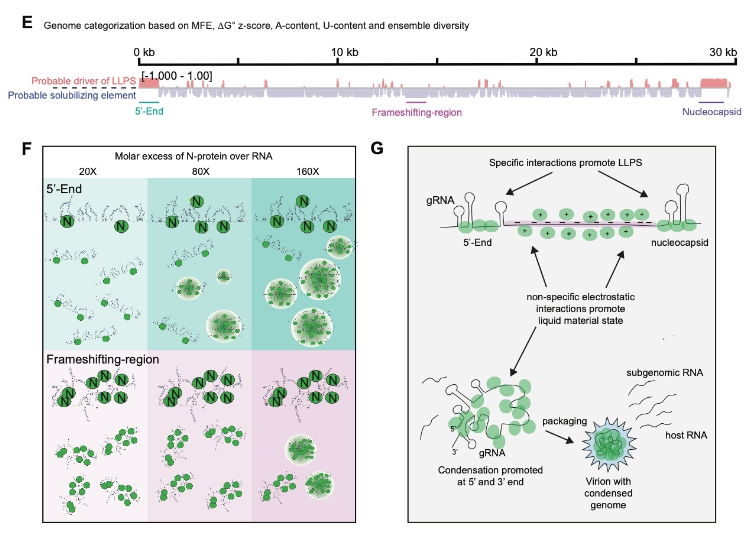
(pmid: 32587966) (pmid: 33782395)