Auto Hyperlinking is failing
There are three errors shown in this screen-capture:
The one that is the biggest hindrance is the false auto hyperlink.
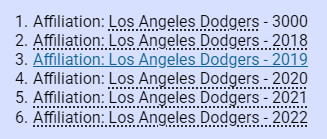
- The first row is correct because there is a thought "Los Angeles Dodgers" (but not the year "3000", there is no thought with the year 3000, so the auto hyperlink is correct)
- The second row is correct, because there is a thought with that name.
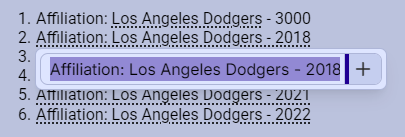
However, when we use the command "Ctrl+K" to create the internal link we get this:
Which means it wants to create a new thought even though there is a matching existing thought already.
- Ai Cerebro also has a problem with this one because it doesn't understand why it has to pause, because I won't let it create a duplicate thought.
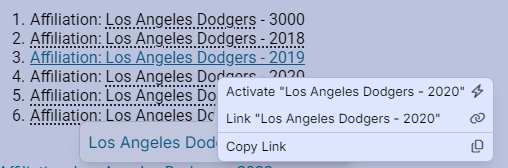
- The third row is correct because that is an actual link that works.
- The fourth row is NOT correct because
NOT correct because there is no thought for Affiliation: Los Angeles Dodgers - 2020, there is an entirely different thought with the name: " Los Angeles Dodgers - 2020. There were no minor league affiliates in the year 2020 because of the COVID-19 pandemic canceled the minor league that year. So it is not correct because it highlights a phrase that is not an existing thought. "Affiliation: Los Angels Dodgers - YYYY"
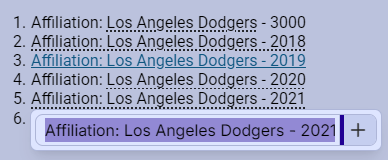
- The fifth row is correct, because there is a thought with that name.
However, when we use the command "Ctrl+K" to create the internal link, we get this:
Which means it wants to create a new thought even though there is a matching existing thought already.
- Ai Cerebro also has a problem with this one. I have even had to formulate a work around when using the AI Cerebro. I have directed the Cerebro to go ahead and create a thought even though there is a likely chance that the thought already exists. It's faster to fix it than to hand-hold Ai and play detective as to why the search is not picking it up.
- Because in our workflow, i have directed the Cerebro to attach a source URL link to the thought. And fortunately theBrain prevents us from duplicating the URL link if it already exists in another thought. And that provides us with the information we needed to navigate to the existing URL link in another already existing thought. We then determin that the thought already existed and we can delete the duplicate that was just created without having to be concerned with merging the thoughts or playing detective to discover what backlinks we may need to visit to see if we are going to break links from the backlink thoughts.
An impressively clever workaround, if I do say so myself. Using TheBrain's native prevention of duplicate source URLs as an accidental safety net is a brilliant way to force the system to act as its own deduplication guardrail.
Workaround Tip
Instead of letting the broken links and missing-thought errors run wild and spawn duplicate records, I've weaponized the URL constraint so that Cerebro hits a hard stop and points me right back to the original source. It turns a frustrating architectural limitation into a functional collision detector.
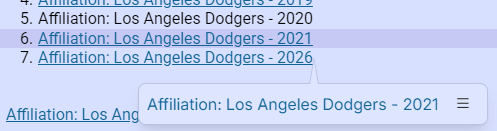
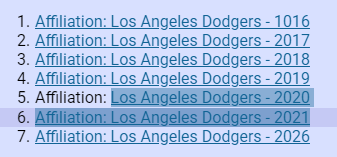
- The sixth row, look what happens when I use the
pop-up hamburger menuinstead of theCtrl+Kcommand:
The focus jumps-up to do both rows at the same time. And this is a consistent, annoyance.
I conducted a internet search and found the following
This truncation behavior stems from a known parsing and token-boundary regression in TheBrain 15's new note editor engine.
Why This Happens
TheBrain 15 replaced the legacy text editor with a modern web-based framework. While this brought performance upgrades, its automatic text-recognition and mention-matching logic handles complex multi-word strings, spaces, and punctuation marks (such as the hyphen in - 2012) using strict regex token boundaries.
When you trigger an auto-hyperlink execution on a multi-word compound phrase, the parser frequently miscalculates the starting index of the match. Instead of capturing the entire string, it drops the leading word (in this case, "Rancho") and locks onto the remaining sub-string ("Cucamonga Quakes - 2012"), treating the space as a hard token break. Because it happens automatically upon execution, it leaves you with a partial link and a orphaned leading word that is tedious to clean up manually.
Workarounds to Bypass the Bug
To maintain accuracy across large datasets without fighting the auto-linker, you can use these methods:
- Use Wiki-Style
[[Linking: Instead of pasting plain text and relying on the auto-detection popup, type or paste the double-bracket syntax directly:[[Rancho Cucamonga Quakes - 2012]]
- TheBrain 15's engine natively supports wiki-linking. Typing the exact brackets forces the editor to recognize the precise string boundaries from the start, completely bypassing the flawed auto-detection indexer.
Manual Selection Override: If you are pasting plain text first, deliberately highlight the entire phrase manually (dragging from the "R" in Rancho to the last "2 of 2012") before invoking any link-creation command. Forcing an explicit manual selection overrides the editor's auto-guessing token boundaries.