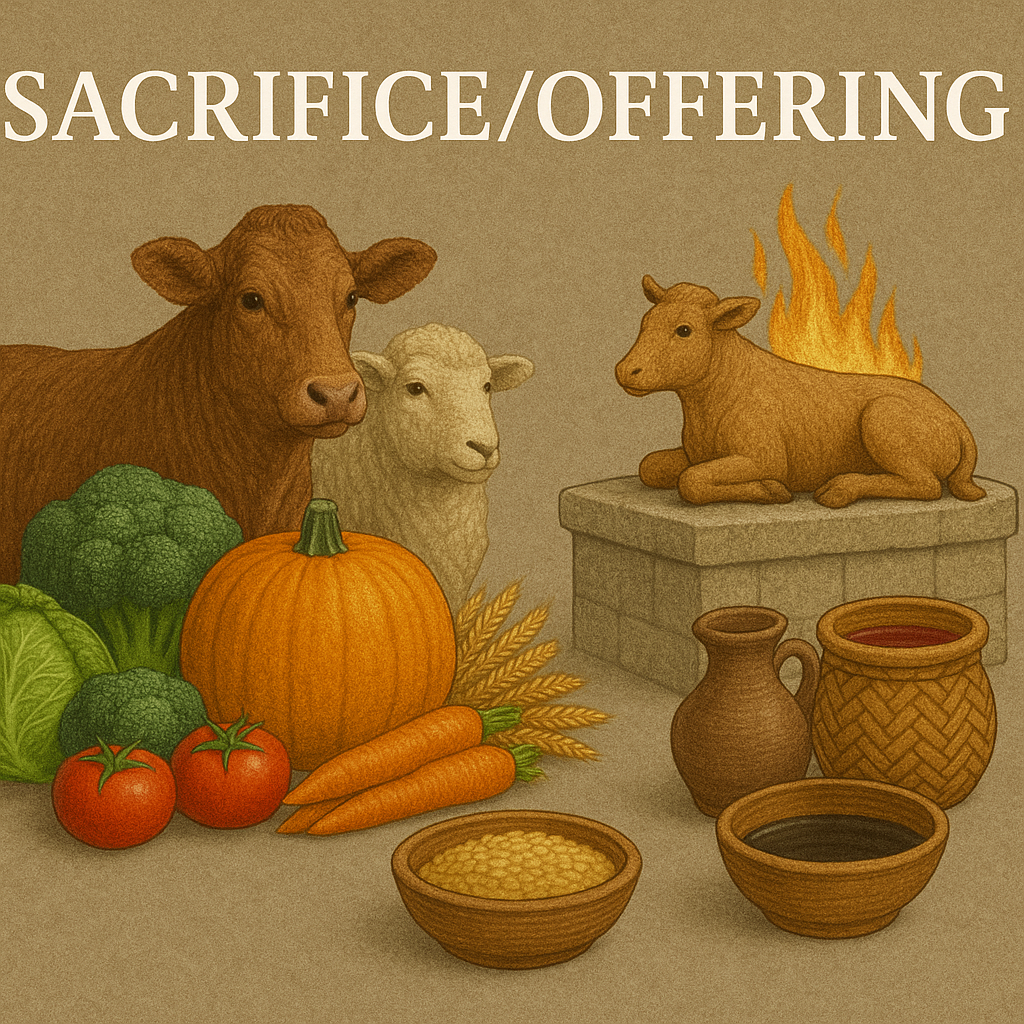
Offerings
In the Hebrew Bible, the primary word for "sacrifice" is קָרְבָּן (pronounced korban). It comes from the root קרב (karav), meaning "to draw near" or "to approach." The term korban reflects the idea of bringing an offering to draw closer to God, emphasizing the relational aspect of the act rather than just the act of killing or giving up something.
- Korban is used for various types of offerings in the Torah, including animal sacrifices, grain offerings, and other gifts brought to the sanctuary (e.g., Leviticus 1–7). It encompasses burnt offerings (olah), sin offerings (chatat), peace offerings (shelamim), and more.
- In Hebrew thought, a korban is about approaching God or restoring harmony (shalom) with Him, often through a physical gift that symbolizes devotion, atonement, or gratitude. It’s less about "sacrifice" in the sense of loss and more about an act of connection.
- Examples:
- Leviticus 1:2 (JPS Tanakh): “When any of you presents an offering [korban] to the Lord, you shall bring your offering of the cattle.” Offerings, detailed in Leviticus 1–7, reflect a system of worship centered on atonement, gratitude, and communion with God, each with distinct rituals and theological significance.
- Numbers 7:13: Describes various korbanot (plural) brought by tribal leaders for the dedication of the altar.
- In Leviticus 10 they brought an offering in worship that was not what God commanded - or was not in a way in which God had commanded - and were consumed by fire.
- Hebrews 10: ^26 ^If we deliberately keep on sinning after we have received the knowledge of the truth, no sacrifice for sins is left, ^27 ^but only a fearful expectation of judgment and of raging fire that will consume the enemies of God. ^28 ^Anyone who rejected the law of Moses died without mercy on the testimony of two or three witnesses. ^29 ^How much more severely do you think someone deserves to be punished who has trampled the Son of God underfoot, who has treated as an unholy thing the blood of the covenant that sanctified them, and who as insulted the Spirit of grace? ^30 ^For we know him who said, “It is mine to avenge; I will repay,”[d] and again, “The Lord will judge his people.”[e] ^31 ^It is a dreadful thing to fall into the hands of the living God.
- Matthew 5:23–24: “So if you are offering your gift [dōron] at the altar and there remember that your brother has something against you, leave your gift [dōron] there before the altar and go. First be reconciled to your brother, and then come and offer your gift [dōron].”
- Romans 12:1 Therefore, I urge you, brothers and sisters, in view of God’s mercy, to offer your bodies as a living sacrifice, holy and pleasing to God—this is your true and proper worship
Future Offerings
Offerings being restored at some point in the future Ezekiel 44- Ezekiel 45. Specifically mentions burnt offerings, fellowship offerings, gain offerings, freewill offerings. In Verses 19-20 guilt and sin offerings as well. https://www.biblegateway.com/passage/?search=Ezekiel%2044-45&version=TLV
Other Related Terms:
While korban is the most general term for sacrifice/offering, other Hebrew words are used for specific types or aspects of sacrificial acts. In the Hebrew Bible, several Hebrew words are translated as "sacrifice" in English, each with distinct nuances and contexts.
In Greek, dōron means "gift," "offering," or "present."
Zevach (זֶבַח)
- Meaning: Refers to a sacrificial offering, often involving the slaughter of an animal, typically for a communal or celebratory meal (e.g., peace offerings). It emphasizes the act of offering something to God, often with a sense of fellowship.
- Context: Used for offerings like the peace offering (leviticus 3) or general sacrifices (e.g., Exodus 20:24:24).
- Example: Psalm 4:5 – “Offer the sacrifices of righteousness (zivchei tzedek).”
Korban (קָרְבָּן)
- Meaning: Derived from the root karav ("to draw near"), it denotes an offering brought near to God, encompassing both animal and non-animal offerings (e.g., grain). It’s a general term for any sacrificial gift.
- Context: Used broadly in Leviticus and Numbers for various offerings, such as burnt offerings, sin offerings, or grain offerings (e.g., Leviticus 1:2).
- Example: Numbers 7:13 – “His offering (korban) was one silver plate.”
- Acts 24:17
Specific Offerings
Burnt Offering Olah (עֹלָה)
- Meaning: Literally "that which goes up," referring to a burnt offering wholly consumed by fire, symbolizing complete dedication to God. Derived from the root meaning "to ascend," referring to the smoke rising to God or the offering being wholly consumed.
- Context: Common in worship and atonement rituals (e.g., Leviticus 1:3–17).
- Key Points:
- Entire animal (typically cattle, sheep, goats, or birds) burned on the altar.
- Voluntary offering to atone for general sin or express devotion.
- Symbolizes complete surrender to God.
- Performed by priests, with specific rituals for laypeople, priests, or leaders.
- Example: Genesis 22:2 – Abraham is told to offer Isaac as an olah.
- Numbers 6:13 and Acts 21:26 - Paul provided offering
Grain Offering Minchah (מִנְחָה)
- Meaning: Originally a gift or tribute, it often refers to a grain or cereal offering, though sometimes used for offerings in general. It can also imply a non-blood sacrifice.
- Context: Frequently paired with other offerings (e.g., Leviticus 2:1–16).
- Key Points:
- Made of fine flour, oil, and frankincense; could be baked, cooked, or raw.
- Voluntary offering to honor God or express gratitude.
- Portion burned on the altar; remainder eaten by priests.
- No leaven or honey allowed; salt required as a symbol of covenant.
- Example: Leviticus 2:1 – “When anyone offers a grain offering (minchah) to the Lord.”
Peace Offering Shelem (שֶׁלֶם)
- Meaning: From the root for "peace" or "wholeness," indicating reconciliation or fellowship. Related to the peace or fellowship offering, emphasizing reconciliation or thanksgiving. Often translated as "peace offering."
- Context: Associated with communal meals and gratitude (e.g., Leviticus 3:1–17).
- Key Points:
- Animal sacrifice (cattle, sheep, or goats) with portions shared among offerer, priests, and God.
- Voluntary offering for thanksgiving, vows, or freewill gifts.
- Includes communal meal, emphasizing fellowship with God and others.
- Three subtypes: thanksgiving, votive, and freewill offerings.
- Example: Leviticus 7:11 – “This is the law of the sacrifice of peace offerings (shelem).”
Sin Offering Chatat (חַטָּאת)
- Meaning: From the root for sin or purification offering, used to atone for unintentional sins or ritual impurities.
- Context: Specific to atonement rituals (e.g., Leviticus 4:1–35).
- Key Points:
- Required for unintentional sins or ritual impurities by individuals, priests, or the community.
- Animal type (bull, goat, lamb, or birds) varies by status of the offerer.
- Blood sprinkled or smeared; some portions burned, others eaten or disposed of.
- Focuses on cleansing from sin and restoring relationship with God.
- Example: Leviticus 4:3 – “He shall bring a young bull as a sin offering (chatat).”
Guilt Offering Asham (אָשָׁם)
- Meaning: A guilt or reparation offering, often linked to restitution for specific wrongs, such as violating sacred things or unintentional sins requiring compensation.
- Context: Used in cases requiring reparative action (e.g., Leviticus 5:6–19).
- Key Points:
- Required for specific sins, like misusing holy things or wronging others, often with restitution.
- Typically a ram or equivalent value; includes blood and burning rituals.
- Focuses on making amends, both to God and affected parties.
- Closely related to sin offering but emphasizes compensation.
- Example: Leviticus 5:15 – “He shall bring his guilt offering (asham) to the Lord.”
Terumah (תְּרוּמָה)
- Meaning: A contribution or heave offering, often a portion of produce or goods dedicated to God or priests.
- Context: Used for offerings given to sustain the priesthood (e.g., Numbers 15:19–21).
- Example: Exodus 25:2 – “Take an offering (terumah) for Me.”
- terumah
- 2 Corinthians 9:4-6, 12-14 (Paul remained cermonially clean Acts 24:17-19)
- Romans 11:16
- maamadot
- pushke
- matanah - While both words can be translated as "gift," "matanah" has a broader, more general meaning, while "terumah" carries a more specialized and religious connotation, particularly within the context of Jewish tradition and the Torah
- terumah
Nesek (נֶסֶךְ)
- Meaning: A drink or libation offering, typically wine or oil poured out as part of a ritual.
- Context: Often accompanies other sacrifices (e.g., Numbers 15:5).
- Example: Numbers 28:7 – “Its drink offering (nesek) shall be one-fourth of a hin.”
Thoughts:
When you think of the Bible and the word sacrifice, what comes to mind?
Most likely it's something in line with the modern dictionary definition: an act of slaughtering an animal or person or surrendering a possession, a religious sacrifice.
So would it surprise to know there are several words translated as sacrifice, however the general over reaching idea is an offering or gift? Something given to bring about fellowship, reconciliation, or to express thanksgiving?
Kind of has a different feel to it doesn't it?