GILLESPIE 2
7/18
villain, poster? furies? redmap did systemic long term damage TP--> freedom cocks, suicide squad, unaccountable old white guys --> voter suppression, anti-abortion ...
age of trump
DALLAS PETRPOLEUM CLUB MTG CROW ROVE?
see main, over a dozen tags
see redmap
bgr tag
redmap promoted to primary ~ Moderation
see gerrymandering
obama will take on /holder
trms did several shows trying to raise red flag
-=-=
2x
Commentary & Analysis
June 15, 2023
Harlan Crow’s deep dark money connections
By Adam Rappaport and Meghan Faulkner
Harlan Crow is more than Supreme Court Justice Clarence Thomas’s secret patron—he’s also deeply intertwined with the shadowy world of Republican dark money. In fact, Crow personally took part in the creation of the post-Citizens United dark money system and secretly helped bankroll some of the new groups.
Crow’s political spending started long before Citizens United opened the floodgates for anonymous money in American elections in 2010. Between 1977 and 2009, Crow and his companies gave more than $2.4 million to federal candidates, parties, PACs, and other political entities. Since Citizens United, he’s spent $13.8 million on federal politics, bringing his lifetime total of spending reported to the FEC to more than $16 million. But that’s not all he did. While it is impossible to track Crow’s undisclosed political giving, public information demonstrates his longstanding ties to the biggest figures and groups in Republican dark money.
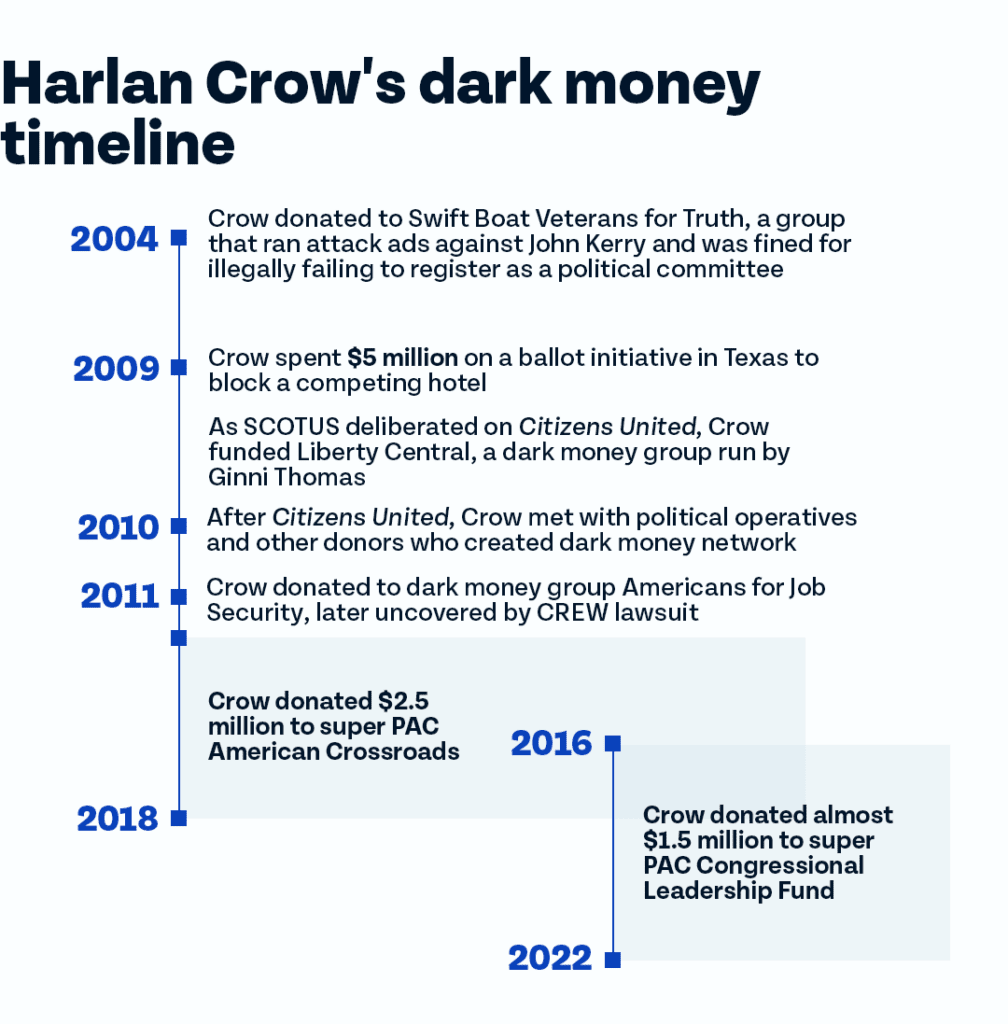
One of Crow’s first forays into large donations was by providing some of the initial financing of Swift Boat Veterans for Truth, an organization that spent millions running attack ads in 2004 against Democratic presidential candidate John Kerry and was later fined nearly $300,000 by the Federal Election Commission for failing to register as a political committee. Later, in 2009, Crow and his company spent more than $5 million on a failed ballot initiative in Dallas trying to block the city from building a city-owned convention center hotel which would have competed with Crow’s hotel.
Immediately after Citizens United, Crow took part in one of the first key events leading to the creation of the dark money system. As recounted by Kenneth Vogel in his book Big Money and separately by the Wall Street Journal, just weeks after the Supreme Court’s decision in January 2010, four leading Republican political figures set out to obtain the “seed funding” they needed to launch several post-Citizens United groups.
The four Republicans: consultant and former Bush White House aide Karl Rove, former RNC Chairman Ed Gillsepie, fundraiser Fred Malek, and former senator Norm Coleman, “laid out their blueprint for a sort of shadow party” to about “20 Republican plutocrats” at the Dallas Petroleum Club in early February 2010. They wanted funding for a network of what became some of the biggest players in outside political spending, including super PAC American Crossroads, which Rove explained would work to defeat then-President Obama and win Republican control of Congress, and dark money group the American Action Network.
Crow was one of the deep-pocketed billionaires who attended the fundraiser. Whether he gave that day or how much is not known. But after hearing Rove’s pitch, another Texas megadonor, Harold Simmons, proclaimed “I like this. I’m in for five [million].” Others followed suit.
Even as the Supreme Court was deliberating Citizens United, Crow reportedly provided the major funding for Liberty Central, another dark money group, this one with links to Justice Thomas. Liberty Central was a 501(c)(4) organization founded by Ginni Thomas in late 2009 that counted Federalist Society co-chair Leonard Leo as a board member. Ms. Thomas served as president through November 2010 and was paid a salary of more than $120,000. According to Politico, of the $550,000 in anonymous start-up funds the group received in 2009, $500,000 came from Crow, who also held an event for the group at his Dallas home a few months after it launched.
Liberty Central engaged in partisan politics during Ginni Thomas’s time in charge. The group acknowledged on its 2010 tax return that it spent a small amount of money on political activity, but as described in a 2012 IRS complaint filed by Common Cause, Liberty Central appeared to do far more than that, endorsing and supporting dozens of House and Senate candidates, conducting polling, and issuing scorecards of congressional candidates.
Asked later about his support of the group, Crow refused to even confirm his contribution, saying: “I disclose what I’m required by law to disclose, and I don’t disclose what I’m not required to disclose.”
“Crow has taken full advantage of the diminishing transparency laws around our politics.”
In 2011, Crow also made a contribution to another notorious dark money group called Americans for Job Security (AJS), which was uncovered by a CREW lawsuit and has not been previously reported. AJS spent more than $25 million in federal independent expenditures and electioneering communications in the 2010 and 2012 elections, making it one of the largest dark money groups at the time.
CREW filed an FEC complaint against the group in 2012, alleging that it should have registered as a political committee and disclosed its donors. After years of litigation, AJS settled the case, resulting in the first and largest release of dark money donors in the post-Citizens United era. The disclosure showed that Crow, through his company Crow Holdings, gave AJS $50,000 in May 2011.
How much more Crow has given to dark money groups over the years is unknown. He has, however, also donated huge amounts to super PACs closely associated with dark money groups, including several Rove and others pitched to him just after Citizens United. Between 2011 and 2018, Crow personally and through his companies gave $2.5 million to super PAC American Crossroads, which is closely related to dark money groups Crossroads GPS and One Nation. Crow also gave almost $1.5 million between 2016 and 2022 to the Congressional Leadership Fund, the super PAC sister of the American Action Network.
Crow’s secret political contributions and undisclosed gifts to Justice Thomas can be seen as two sides of the same coin, offering opportunities to exercise influence, while keeping the public in the dark about who is pulling the strings.
We do know that Crow has given extensively to politicians and political committees, thanks to reporting requirements, and that he has given significant gifts to Thomas, thanks to investigative reporting. But that spending is just what Crow and Thomas have been forced to disclose, and what came out against their will. In helping bankroll the Republican network of dark money groups following Citizens United, Crow has taken full advantage of the diminishing transparency laws around our politics—which Justice Thomas has been instrumental in dismantling. As a result, we will likely never know the true impact of Crow’s political spending on our government and our elections.
===
-=-=
proto-arabella? millionaires ~?
vogel politico says rove dark $ death star is ctr/mirror?
2010 tp wave origin? mirror?! this was ctr to BO win 2008?
http://www.politico.com/news/stories/0510/36841_Page3.html *Rove, GOP secretly plot vast network to reclaim power
By: Mike Allen and Kenneth P. Vogel May 6, 2010
The Republican Party’s best-connected political operatives have quietly built amassive fundraising, organizing and advertising machine based on the model assembled by Democrats early in the decade,and with the same ambitious goal — to recapture Congress and the White House.The new groups could give Republicans and their allies a powerful campaign apparatus separate from the Republican National Committee. Karl Rove, political architect of the Bush presidency, andEd Gillespie, former Republican Party chairman, are the most prominent forces behind what is, in effect, a network of five overlapping groups, three of which were started in the past few months.The operating assumption of Rove, Gillespie and the other organizers is that despite the historical dominance of Republican fundraising and organizing, the GOP has been outmaneuvered by Democrats and their allies in recent years, andit is time to strike back.“Where they have a chess piece on the board, we need a chess piece on the board,” said Gillespie, who is involved in all five groups in roles ranging from chairman to informal adviser. “Where they have a queen, we shouldn’t have three pawns.”The network, which doesn’t have a name,attempts to replicate the Democracy Alliance, an umbrella group — founded in 2005 and funded by George Sorosand other billionaires — and to borrow tactics from liberal groups established tohelp Democrats regain power after eight years of the Bush administration.Two organizers of the Republican groups even made pilgrimages earlier this year to pick the brain of John Podesta, the former Clinton White House chief of staff who, in 2003, founded the Center for American Progress and was a major proponent of Democrats developing the kind of infrastructure pioneered by Republicans.Rove, currently on a book tour, has provided “a laying-on of hands” for the groups — as one organizer put it — by encouraging major Republican donors to support them as part of the GOP’s path to revival. “Karl has always said: People call us a vast right-wing conspiracy, but we’re really a half-assed right-wing conspiracy,” he said. “Now, he wants to get more serious.”
While separate, the five entities are so closely related that three share an 11th-floor office near the White House.
The groups are: *American Crossroads * American Crossroads — designed to counter spending by labor and progressive groups, including the AFL-CIO, Service Employees International Unit and MoveOn.org — will focus on voter contact with the potential to move into ground game and turnout efforts. Organized under the tax code as a Section 527 organization, meaning it can spend directly on political activity, it’s set an ambitious budget of $52 million and says it’s already received commitments for $30 million of that.Its president and CEO is former top U.S. Chamber of Commerce executive Steven Law;its political director is veteran GOP operative Carl Forti. The chairman is Mike Duncan, former RNC chairman; the treasurer is Jo Ann Davidson, former RNC co-chairwoman; and the secretary is Jim Dyke, former RNC communications director. To try to avoid undercutting RNC Chairman Michael Steele, who has alienated some givers, Duncan tells prospective donors that the party structure is “an important part of winning” and that he is looking for people who “want to go above and beyond.”
*American Action Network * American Action Network, modeled on the Center for American Progress, will conduct polling in key races, and plans to put up TV advertising since it is allowed to engage in explicit political activity as a group organized under Section 501c(4) of the tax code. Former Sen. Norm Coleman of Minnesota is the CEO; Fred Malek, a longtime top GOP financier, is chairman; andRob Collins, a former top aide to House Minority Whip Eric Cantor, is president. Board members include former U.S. Sens. George Allen and Mel Martinez and former House Reps. Tom Reynolds, Jim Nussle and Vin Weber.
*American Action Forum * American Action Forum, a policy institute linked to the American Action Network,also will mirror CAP.Coleman is also chairman of this group, which as a501c(3) organization, is prohibited from directly endorsing or opposing candidates. Douglas Holtz-Eakin, a former Congressional Budget Office director and campaign adviser to Sen. John McCain, is the president. Board members includeformer Govs. Jeb Bush of Florida and Tom Ridge of Pennsylvania.
*Resurgent Republic * Resurgent Republic co-founded a year ago by Gillespie and Republican pollster Whit Ayres,says in its official description that it is“modeled on Democracy Corps,which has made important contributions to the public debate from the left and has proven to be a valuable resource for labor unions, environmentalists and liberal congressional leaders.” The group has released a series of polls and offers itself as a message-testing laboratory to help GOP lawmakers develop policies.
*TheRepublican State Leadership Committee* TheRepublican State Leadership Committee, whichfocuses on down-ballot races for statewide and legislative offices, raised $22 million in the last campaign cycle.Gillespie took over as chairman earlier this year.Its goal is to raise at least $50 million to $70 million to influence congressional elections this fall and to road-test an agenda for a future Republican House and, ultimately, a Republican president.
Colemanrecalled in an interview that he admired the left’s financial prowess so much that until recently, he gave potential donors copies of “The Argument,” a book by Matt Bai that chronicles progressives’ rising financial power. “This is what the left does — we need to do it on the right,” Coleman said he told people. Democrats say the new GOP network has the potential to tip Republicans back into the House majority, since the formal party structures will burn through money as they struggle to compete in a record number of House seats.
Maryland Rep. Chris Van Hollen, chairman of the Democratic Congressional Campaign Committee, said he is worried about the groups as a potential “conduit for a lot of special-interest money to flow into campaigns.” The Supreme Court ruling in Citizens United v. Federal Election Commission opened possibilities for groups like American Crossroads, American Action Network and others backed by corporations, unions or huge donors to be more aggressive in supporting or opposing candidates.Democrats in Congress are pushing legislation that would curtail its effects, but right now the decision is emboldening donors - particularly on the right - who had grown reluctant to open their wallets to outside groups, said Charlie Spies, a GOP campaign finance attorney on Resurgent Republic’s legal advisory board. ...
https://www.alternet.org/2019/12/the-decade-republicans-hijacked-our-democracy-via-the-gerrymander/
no lnx
The decade Republicans hijacked our democracy — via the gerrymander
Written by David Daley / Salon December 30, 2019
As this decade comes to a close, 59 million Americans live in a state where one or both chambers of the state legislature is controlled by the party that got fewer votes in the 2018 election.
In Wisconsin in 2018, voters elected a Democratic U.S. senator, defeated an incumbent Republican governor, picked Democrats for every statewide office, and favored Democratic candidates for the state assembly by more than 200,000 ballots. Republicans nevertheless controlled more than 63 percent of the seats.
We end the 2020s with voter purges in Ohio, Wisconsin and Georgia, with precinct closures weaponized to lower voter participation across the South, with Texas, Tennessee and Florida making it harder to register new voters. The ball drops on the 2010s with state legislatures in Florida, Michigan and Missouri willing to undo voting reforms approved by upwards of 60 percent of the people via initiative.
One of our final images of the U.S. House will be the floor debate over impeachment, with its dueling images of older, white men defending the president’s actions over Ukraine and younger members, largely women and people of color, insisting that no one, even a president, stand above the law.
White men make up a smaller slice of the American electorate with each election. Yet they maintain outsized power in Congress and state legislatures. A new decade dawns with a crisis of representation that threatens the integrity of representative democracy itself.
We’re in this mess, in many ways, because of gerrymandering. This was the decade that the gerrymander — perhaps the oldest political trick in the book — pushed American politics into a dangerous state of anti-majoritarianism, grounded in racial fear and identity politics, that may take at least another decade to overcome, assuming we ever do so.
It’s worth remembering how we got here. After all, the decade began with the likelihood that changing American demographics might push the nation in a very different direction.
As thousands celebrated America’s first black president in Chicago’s Grant Park on election night 2008, the smartest analysts on every network, left and right, watched Barack Obama defeat John McCain and wondered whether an increasingly diverse nation might render Republicans a minority party for decades.
Top Republican strategists had a different idea. The 2008 election might have been historic, they understood, but 2010 had the potential to be transformative. Every state legislative and congressional district in the nation would be redrawn after the 2010 census. State legislatures would draw most of the lines. If Obama and the Democrats suffered a difficult midterm election, as new presidents often do, Republicans could quickly change their fortunes, dominate redistricting, and draw themselves an enduring advantage, even in competitive states they’d lost in 2008, such as Wisconsin, North Carolina, Ohio, Pennsylvania and Michigan.
The GOP plan — known as REDMAP, or the Redistricting Majority Project — was headquartered at the Republican State Leadership Committee, led by former party chairmanEd Gillespie.It was announced on the op-ed page of the Wall Street Journal by no less than GOP mastermind Karl Rove.The RSLC’s key benefactors included Koch Industries, Walmart, Reynolds American and the U.S. Chamber of Commerce. The RSLC identified just over 100 state legislative races in crucial states, and drowned Democratic incumbents in waves of sophisticated negative advertisements in the final weeks of the 2010 race. (It helped that cocky Democrats snoozed on the importance of redistricting and barely put up any fight.) And when it came time to remap these states in 2011, using the most exacting voter data andsophisticated mapping technology ever deployedon redistricting, the political operations of new House Speaker John Boehner, Paul Ryan and many other establishment figures would play key roles.
It worked. In 2012, the first election held under these lines, Democratic U.S. House candidates won 1.4 million more votes than Republicans nationwide. Republicans held the chambers nevertheless, decisively, 234-201. In targeted swing states like Pennsylvania and Michigan, Democratic candidates would earn tens of thousands more votes, but the Republican-drawn districts packed and cracked those votes so precisely that the GOP would win 13 of the 18 seats from Pennsylvania and nine of 14 from Michigan. Democratic state legislative candidates would routinely win more votes in these states as well; Republicans would hold both chambers in Michigan, Ohio, North Carolina, Pennsylvania and Wisconsin regardless.
So yes, it worked. But it also contained the seeds of the party’s unraveling, placed a frustrated and impossible-to-please base in charge, and set the stage for an outsider to sweep up the pieces four years later.
But first, something else would happen in 2012: Barack Obama defeated Mitt Romney, and shaken Republicans realized they’d lost the popular vote in five out of six presidential elections, GOP leaders commissioned a warts-and-all diagnosis of the party’s brand. It wasn’t pretty. One-time Republican voters now described the party as “scary,” “out of touch,” “narrow-minded,” even “stuffy old men.”
Its authors named the report the Growth and Opportunity Project but it soon became known by everyone as something catchier and more urgent: the Republican autopsy. Among the causes of death? Republicans had “lost their way with younger voters.” Many minorities “think that Republicans do not like them or want them in the country.”
It recommended that the party modernize itself,learn how to persuade and appealto a wider variety of people, champion policies that make life better for working Americans rather than the rich, then head to communities Republicans had tended to avoid and make their case.“We need to campaign among Hispanic, black, Asian and gay Americans and demonstrate that we care about them, too,” the autopsy concluded.
When Donald Trump captured the GOP nomination in 2016, many Republicans bemoaned not following this advice from the autopsy and more, such as championing immigration reform and becoming genuinely welcoming and inclusive on social issues. But it was already too late. The autopsy itself had been dead on arrival, and long before Trump descended his gilded Manhattan escalator and joined the Republican race. It had already been smothered, unaware, by the very Republican establishment who commissioned the report.
REDMAP made it impossible.
The new districts drawn by Republicans made their districts older, whiter, and more conservative. These new districts — where the Republican primary was the only race that mattered — produced a different kind of congressman (and most of them were men), incentivized against compromise, insulated from the ballot box, interested in listening only to their base.
These members also didn’t much care for the Republican establishment in Washington. They would bring a much different tone and tenor to Congress. Boehner, now the House speaker, learned this right quick. In summer 2013, a first-term congressman from North Carolina’s 11th district wrote Boehner a letter, suggesting that the GOP look to defund Obamacare by threatening a government shutdown. Boehner knew it was folly. Democrats controlled the White House and the Senate. It was a strategy doomed to fail. Rove blasted it in the Wall Street Journal.
ButMark Meadows enlisted 79 other Republicans in this quest. His own district, previously a swing district that most recently produced a conservative Democrat, had been redrawn so that he captured it by more than 15 percentage points. It was 87 percent white.
In the New Yorker, Ryan Lizza and David Wasserman looked at the districts of the 80 signatories. They were, on average, 75 percent white and just 9 percent Latino, compared to an average district that’s 63 percent white and 17 percent Latino. In 2012, Obama won the national popular vote by 4 percentage points. In those districts, Romney won by an average of 23. The Republican members exceeded even that landslide margin: They won their seats by an average of 34 percentage points. As the nation changed, redistricting not only held back demographic change, but it turned back the clock and solidified conservative white power. As Lizza concluded, “these 80 members represent an America where the population is getting whiter, where there are few major cities, where Obama lost the last election in a landslide, and where the Republican Party is becoming more dominant and more popular. Meanwhile, in national politics, each of these trends is actually reversed.”
Boehner, given little choice, followed the “suicide caucus” over the cliff. Predictably, disaster ensued and he had to change course. And predictably, the “suicide caucus” saw no reason to compromise or change its own. This was just one of more than four dozen battles to repeal Obamacare in the House, none of which stood any greater likelihood of victory.Immigration reform, one of the only policy options the autopsy’s authors saw as crucial for the party’s future, stood no chance in this climate.
Neither did the GOP leadership. A year later,Meadowswould turn on Boehner, filing a parliamentary motion to “vacate the chair” that would ultimately lead to the speaker’s resignation.
The House had been set on a dangerous new course. REDMAP, like some Frankenstein’s monster, would not only devour Boehner, but thenew members empowered by these toxic, technology-driven gerrymanders wouldaccelerate all of the worst polarizing trends in our politics.The Freedom Caucus, legislators created and empowered by REDMAP, would run the House. Ryan, Boehner’s successor, would later step aside in frustration as well, proven ineffective despite GOP control of Congress and the White House. The autopsy wouldn’t be worth the paper it was printed on. The GOP establishment hoped that controlling redistricting would buy themselves time to set a new course. Instead, the party’s course, and our nation’s history, would beset by the new leaders that their gerrymandering rendered unbeatable and uncontrollable.
Did Boehner learn any lesson from his unholy creation? Well, earlier this month he and Ryan signed on as chairs of a Speakers Advisory Council generated to fundraise for the REDMAP creators’ 2020 redistricting strategy.
Here’s the thing: When you’re trying to ensure that the side with less support continues to hold power, when you’re trying to maintain control without talking to a changing nation, your tactics aren’t likely to end with redistricting. [MAX X DRIVESSYSOUT OF BALANCE --> UNINTENDED CONSEQ AND SYS FAIL?]
Indeed, efforts to make it harder for citizens to vote were among the very first actions by gerrymandered state legislatures,especially in Wisconsin and North Carolina, where a federal court found that those barriers were “surgically” crafted to target blacks. Gerrymandered legislatures can take such anti-democratic actions because the people’s representatives need not fear the judgement of the people. [no FEEDBACK] And after the U.S. Supreme Court [MOD] undid essential protections within the Voting Rights Act, in the 2013 case Shelby County v. Holder, states and other entities didn’t have to fear the courts, [DISABLE CHECKS AND BALANCE] either, when they wanted to change the rules around voting. Across much of the nation, but especially in the South, as well as in states with one-party control and newly gerrymandered legislatures, came aflood of voter ID bills, cutbacks in absentee and early voting, voter roll purges, precinct closures and more.
Gerrymandered legislatures felt free to ignore the will of the people. Other legislatures followed along. In Florida, for example, where 64 percent of voters approved a 2018 state constitutional amendment ending felony disenfranchisement, lawmakers added an additional burden instead — complete repayment of any fines and fees connected to the sentence or prison term — that many critics compared to a poll tax. Legislators also undermined a legal victory allowing campus sites to be used for early voting with a sneaky provision that requires something always at a premium on colleges: Easy parking.
Texas would make it a felony for anyone to cast an ineligible ballot, even by accident. Arizona looked to dial back early voting and expand voter ID requirements. Tennessee passed legislation that would make it put those who run voter registration drives in jeopardy of massive fines if they submitted too many incomplete applications. Indiana made it harder to sue in state court to extend voting hours, often necessary when machines malfunction or when lines are long.Legislatures in Missouri, Utah, Michigan and Idaho worked to unwind popular 2018 initiatives won by citizens demanding reforms politicians had refused to make.
And so we end this decade with the water in Flint still undrinkable, thanks to gerrymandering.
In 2011, Michigan’s GOP-controlled legislature dramatically expanded the state’s power to take over financially struggling municipalities and place them under the control of a state-appointed emergency manager. Angry voters toppled the law in a November 2012 ballot initiative, concluding that it gave the state too much power to usurp local control and run roughshod over elected officials. One month later, lawmakers ignored the public and reinstated the program.
Then, in 2014, the emergency manager appointed to run Flint changed the city’s water supply to the Flint River and decided against installing corrosion inhibitors to properly treat the water, saving an estimated $140 a day. It sparked a lead contamination crisis and an outbreak of Legionnaire’s disease that killed 12 people and sickened hundreds of children.
And so we end this decade with fetal heartbeat laws on the march in aggressively gerrymandered states like Ohio, Georgia and Alabama, that would enact abortion restrictions dramatically out of sync with the wishes of voters even in these red states.
And so we end this decade with a national consensus on gun controland putting an end to the horrifically numbing routine of mass shootings, but an anti-majoritarian and broken political system where large majorities are ever-stymied and unable, again and again, to translate the will of the people into action. The decade closes with consensus on climate change, but progress and agreements being rolled back.
We stand on the verge of the next redistricting cycle, which will begin in 2021, without the prospect of intervention from the federal courts, with the gerrymander wars headed south and the prospect of states using citizen population, rather than total population, to draw state legislative districts, all, again, with the goal of standing athwart demographic change and shouting “stop.”
These wars will be fought with Democrats, at last, fully awakened and focused on state legislatures. They’ll take place with dramatically more public awareness and media attention paid to the importance of structural voting issues that once made eyes glaze over. And they’ll be undertaken with solid majorities of Americans of all ideologies backing rules and reforms enshrine the best promises of our democracy.
But the damage that has done is severe and will be long-lasting. Forty years ago, when Raymond Donovan, the labor secretary under Ronald Reagan, was acquitted on fraud and larceny charges, he famously asked “Which office do I go to to get my reputation back.” We should all pose the same question about the way urgent issues went unaddressed during this bitter and polarized decade, stolen from us, in part, by the gerrymander.
It may require a generation to repair the damage to our civic fabric from this decade’s cynical and corrosive festival of partisan gerrymandering. It helped heightened and accelerated polarization, extremism and our dysfunctional politics. It’s incumbent on all of us to ensure it doesn’t get worse before it gets better. There may not be any battle in the next decade that’s more urgent.
David Daley, a former editor of Salon, is the author of the national bestseller “Ratf**ked: Why Your Vote Doesn’t Count” and the forthcoming “Unrigged: How Americans Fought Back, Slayed the Gerrymander and Reinvented Democracy.”
==
==
https://www.washingtonpost.com/local/virginia-politics/gillespie-took-partisan-map-making-to-a-new-level-try-turning-that-into-a-bumper-sticker/2017/10/31/03dd5b32-ba93-11e7-be94-fabb0f1e9ffb_story.html?utm_term=.cd0d2086a6a0
no lnx
ICHMOND — Republican Ed Gillespie has had to fend off some zingers — "Establishment Ed," "Enron Ed" — while running for governor of Virginia.
But "architect of gerrymandering"?
That one fell flat when Democrat Ralph Northam lobbed it at Gillespie this month during their final debate. The insult seemed obscure. And Gillespie brushed it off with an attempt at humor: "In my history books, it's Elbridge Gerry who came up with gerrymandering."
Gillespie did, in fact, take partisan mapmaking to a new level, but just try turning that into a bumper sticker.
While he is better known as the former chairman of the Republican National Committee, a Washington lobbyist and a counselor to President George W. Bush, Gillespie helped pull off a stunning political coup — one that gave Republicans unprecedented muscle to reshape the nation's congressional maps to their advantage.
[Right after President Barack Obama's 2008 win, Gillespie helped dispirited Republicans claw back into power one statehouse at a time.
Instead of asking donors for the big bucks needed to swing congressional races, they focused on legislative contests in certain states — those where Republicans needed to flip only a few seats to win control of the legislatures and the mapmaking that would occur after the 2010?Census.
Named "REDMAP," the project helped the GOP win control of 22 state legislatures in 2010, paving the way for GOP gains in Congress in 2012, even as Obama won reelection.
To some, it was a triumph, a bold and perfectly legal tactic deployed in plain sight of Democrats. To others, it was an affront to democracy, the root of the no-compromise politics that's left Washington gridlocked. Or some combination of both.
Liberal MSNBC host Rachel Maddow gushed over the "political genius" of the scheme, even as she lamented the fate of "blindsided Democrats" all across the country.
"Do you mind if I lock you in an airless vault before we leave here tonight and never let you out?" she joked in a 2015 interview with Chris Jankowski, the GOP strategist who led REDMAP with Gillespie.
VIEW GRAPHIC
Virginia general election guide
Jankowski, now chief consultant to the Republicans running for Virginia attorney general and lieutenant governor alongside Gillespie, laughed with Maddow and said it was a "team effort." Then he tipped his hat to one person by name: Gillespie.
[Republicans split over gerrymandering case headed to Supreme Court]
Their REDMAP project was efficient and effective.
"In early 2010, Gillespie and Jankowski took a PowerPoint presentation on the road," wrote David Daley, author of a book on REDMAP focused on the efforts of Gillespie, Jankowski and GOP strategist Karl Rove. "They met with Wall Street donors, oil magnates, hedge-funders, Washington lobbyists and trade associations — anyone open to an audacious, long-term play."
"Gillespie is the rainmaker, really," Daley said in an interview with The Post. "Goes off on a year-long fundraising tour and shakes the trees andcomes up with $30?million at least.?.?.?. 'You will save hundreds of millions if you fund this instead of everything else.'?"
The plan was no secret. Rove laid it out in a 2010 Wall Street Journal commentary sub-headlined: "He who controls redistricting can control Congress."
Gerrymandering is gaining new attention now, as the Supreme Court considers whether extreme partisan mapmaking is constitutional. Two lawsuits over Virginia's legislative maps are pending, one before a federal three-judge panel, the other before the state Supreme Court.
Former president Obama and his first attorney general, Eric H. Holder Jr., are leading Democrats' call for fairer maps. At an Oct.?19 rally for Northam in Richmond, Obama lamented how districts are drawn in a way that forces politicians to cater to extremes.
"Ralph wants to end the practice of gerrymandering so our districts are drawn in a nonpartisan way," Obama said. "We shouldn't have politicians choosing their voters;we should have voters choosing those who would serve them. That's one more difference between him and his opponent."
Holder, chairman of the National Democratic Redistricting Committee, stumped in Norfolk, Virginia Beach and Richmond on Saturday and Sunday for the Democratic ticket.
[Obama’s post-presidency political focus: Redistricting]
"During the last round of national redistricting, Ed Gillespie was the chief architect of a plan to lock in political power for Republicans and lock out the voice of the voters in Virginia and states around the country," Holder wrote in a statement to The Washington Post. "Gerrymandering is a threat to our democracy. It creates districts in which the electoral outcome is predetermined for one party, effectively diminishing the voting power of citizens and providing incentives for politicians to cater to the fringes of their parties."
The winner of the Nov.?7 governor's race will control, along with Virginia's currently GOP-led General Assembly, how the state's maps are drawn after the 2020?Census.
Holder's group has donated $950,000 to the Democratic Party of Virginia this year. Republicans say the giving shows that the Democrats are merely trying to play catch-up, not pushing for nonpartisan maps.
Even with renewed focus on gerrymandering, the issue still seems arcane to many voters.
"We, as voters, often don't understand the importance of redistricting and gerrymandering," Daley said. The book gets its title from a profane term for political sabotage. Its subtitle: "The true story behind the secret plan to steal America's democracy."
"It's a concept that put us all to sleep in civics class in high school," said Daley, former editor in chief at Salon. "But that's why the politicians have been able to exploit it — because it seems to us it's simply politics as usual, or it's boring, or it's inside baseball. It's none of those things. These district lines are the building blocks of our democracy. And when they get twisted in this way, it twists the very notion of republican democracy into something that is unrecognizable."
In response to questions about Gillespie's role in REDMAP, campaign spokesman David Abrams issued a statement: "Ed will closely assess proposals for reforms to Virginia's existing redistricting process. In his ten years in office, Lt.?Gov.?Northam has done nothing to eliminate partisan redistricting maps. In fact, he's voted to gerrymander his own district."
[Va. redistricting deal protects incumbents and punishes challengers, critics say]
Abrams is referring to Northam's vote in 2011 for a state Senate map that made his swing district more blue. It was drawn under a deal struck between leaders of the GOP-dominated House of Delegates and the state Senate, then under Democratic control. Republicans got to draw maps for the House, Democrats for the Senate.
"Ralph Northam has supported nonpartisan redistricting since his first campaign in 2007, and 2011 was an attempt at bipartisan compromise," said Christina Freundlich, a Northam spokeswoman. "Ed Gillespie literally called his project REDMAP. You can't get much more blunt about gerrymandering than that."
In a May interview with The Washington Post, Gillespie pushed back against the notion that REDMAP undermined democracy.
"We were very successful," Gillespie said. "And there was no doubt in 2010 we put a focus on state legislatures that would have a significant impact in the redistricting process. I think it was a smart plan. No secret about it.?.?.?. I'm proud of the work that we did there, and I'm proud of the work that state legislatures are doing. You know, we have, I think, now 69 of the 99 state legislative chambers are in Republican hands, including the state House and the state Senate in Virginia."
Jankowski declined to be interviewed.
Both parties have long histories of gerrymandering — an ignominious tradition that goes back to Virginia's first governor.
Patrick Henry drew the boundaries of Virginia's 5th Congressional District in an unsuccessful bid to keep James Madison out of the House, said Brian Cannon, executive director of the redistricting reform group OneVirginia2021.
Modern gerrymanderers have tools that could not have been imagined by Henry in 1788 or Gerry, the Massachusetts governor Gillespie invoked in the debate, who gave partisan mapmaking its name with the salamander-shaped district he ordered up in 1812. And certain advances arrived just in time for REDMAP, which mashed up data on voting, education, income, magazine subscriptions and even consumer purchases to guide mapmaking, Cannon said.
"Technology got really good, so they were able, with their gains, to exploit it better than anybody ever had before," Cannon said. "They know you vote in Republican primaries but also know you subscribe to Guns and Ammo and buy Crest."
Republicans first put the maps to the test in 2012. And they worked, despite Obama's reelection and Democratic victories in 69?percent of U.S. Senate elections that November. Despite the fact that Democrats won more than 1?million more votes than Republicans in House races around the country, the GOP scored a 33-seat majority in the 113th Congress.
The REDMAP group gave some of the credit to the quality of their candidates and other factors, but at the heart of it all were the maps tilted in their favor, strategists said.
"All components of a successful congressional race?.?.?. rest on the congressional district lines," the REDMAP website declared, "and this was an area where Republicans had an unquestioned advantage."
==
==
propubl:
In the November election, a million more Americans voted for Democrats seeking election to the U.S. House of Representatives than Republicans. But that popular vote advantage did not result in control of the chamber. Instead, despite getting fewer votes, Republicans have maintained a commanding control of the House. Such a disparity has happened only three times in the last century.
(Here’s a chart comparing 2010 and 2012.)
Analysts and others have identified redistricting as a key to the disparity. Republicans had a years-long strategy of winning state houses in order to control each state's once-a-decade redistricting process. (Confused about redistricting? Check out our song.)
Republican strategist Karl Rove laid out the approach in a Wall Street Journal column in early 2010 headlined "He who controls redistricting can control Congress."
The approach paid off. In 2010 state races, Republicans picked up 675 legislative seats, gaining complete control of 12 state legislatures. As a result, the GOP oversaw redrawing of lines for four times as many congressional districts as Democrats.
How did they dominate redistricting? A ProPublica investigation has found that the GOP relied on opaque nonprofits funded by dark money,supposedly nonpartisan campaign outfits, and millions in corporate donations to achieve Republican-friendly maps throughout the country. Two tobacco giants, Altria and Reynolds, each pitched inmore than $1 million to the main Republican redistricting group, as did Rove's super PAC, American Crossroads; Walmart and the pharmaceutical industry also contributed. Other donors, who gave to the nonprofits Republicans created, may never have to be disclosed.
While many observers have noted that mega-donors like Sheldon Adelson backed losing candidates, a close look at the Republicans' effort on redistricting suggests something else: The hundreds of millions spent this year on presidential TV ads may not have hit the mark, but the relatively modest sums funneled to redistricting paid off handsomely.
Where Democrats were in control, they drew gerrymandered maps just like Republicans. They also had their own secretive redistricting funding. (Last year, we detailedhow Democrats in California worked to undermine the state's attempt at non-partisan redistricting.) But Democrats got outspent 3-to-1 and did not prioritize winning state legislatures. They also faced a Republican surge in 2010.
Exactly how the Republican effort worked has been shrouded in mystery until now. But depositions and other documents in a little-noticed lawsuit in North Carolinaoffer an exceptionally detailed picture of Republicans' tactics.
Documents show that national Republican operatives, funded by dark money groups, drew the crucial lines which packed as many Democrats as possible into three congressional districts. The result: the state's congressional delegation flipped from 7-6 Democratic to 9-4 in favor of Republicans. The combination of party operatives, cash and secrecy also existed in other states, including Wisconsin, Ohio and Michigan.
Redistricting is supposed to protect the fundamental principle of one-person-one-vote. As demographics change, lines are shifted to make sure everyone is equally represented and to give communities a voice. In order for Republicans to win in North Carolina, they undermined the votes of Democrats, especially African-Americans. (Party leaders in North Carolina say they were simply complying with federal voting laws.)
The strategy began in the run-up to the 2010 elections. Republicans poured money into local races in North Carolina and elsewhere. It was an efficient approach. While congressional races routinely cost millions, a few thousand dollars can swing a campaign for a seat in the state legislature
The Republican effort to influence redistricting overall was spearheaded by a group called the Republican State Leadership Committee, which has existed since 2002. For most of that time, it was primarily a vehicle for donors like health care and tobacco companies to influence state legislatures, key battlegrounds for regulations that affect corporate America. Its focus changed in 2010 when Ed Gillespie, former counselor to President George W. Bush, was named chairman. His main project: redistricting.
Soon after Gillespie took over, the RSLC announced an effort to influence state races throughout the country, the Redistricting Majority Project, or REDMAP. Fundraising soared. The group raised $30 million in 2010, by far its best year. (Its Democratic counterpart raised roughly $10 million.)
The RSLC is organized as a type of political group that can take in unlimited corporate donations. It must disclose its contributors. But that doesn't mean it's always possible to trace the origins of the money.
Along with Walmart and tobacco companies, the RSLC's largest funders in 2010 were the Chamber of Commerce and American Justice Partnership, which gave a combined $6.5 million. Those two groups raise money from corporations and others but don't have to disclose their donors.
As the 2010 North Carolina legislative elections heated up, the RSLC jumped into local races. But the way they made contributions kept their involvement away from the attention of state voters. Rather than running campaign ads under its own name, the RSLC distributed money to a newly formed local nonprofit. The RSLC declined to comment.
The RSLC gave $1.25 million to its vehicle of choice Real Jobs NC. The group calls itself a "non-partisan organization that believes we need to return to a reliance on the free enterprise system that made our country great for real answers." It was started in 2010 and got a hefty $200,000 boost from dollar store magnate and Republican supporter Art Pope, although Pope denies his donation was related to redistricting or REDMAP.
Real Jobs NC produced ads and mailers slamming more than 20 state Democrats.
"Steve Goss … nice guy," intoned the voiceover in in North Carolina, attacking then-Democratic State Senator Goss. "Too bad he's voting with the Raleigh liberals over hometown conservatives."
Goss lost, and Democrats lost control of North Carolina's General Assembly for the first time in a century. The pattern repeated itself across the country.
"Twenty legislative bodies which were previously split or under Democratic control are now under Republican control," said a triumphant RSLC REDMAP post-electionanalysis, highlighting its spending in Wisconsin, Ohio, Pennsylvania and North Carolina, among other states.
The next step for Republicans was to draw district maps, which can be expensive. The maps require expertise, extensive data and sophisticated software. Skillful map drawers can make even the most partisan gerrymander look reasonable.
To fund the work, the Republican State Leadership Committee used its previously dormant nonprofit arm, the State Government Leadership Foundation. Such dark money groups are increasingly popular because they are allowed to keep secret the identity of their donors. Federal tax law permits them to do this as long as they pledge that politics is not their primary focus.
Flush with anonymous donors' cash, the Foundation paid $166,000 to hire the GOP's pre-eminent redistricting experts, according to tax documents. The team leader wasTom Hofeller, architect of Republican-friendly maps going back decades.
"Our team would be happy to assist in drawing proposed maps, interpreting data, or providing advice," wrote Chris Jankowski, the head of both the RSLC and State Government Leadership Foundation, in a http://www.propublica.org/documents/item/537408-hofeller-sglf-rslc-letter of introduction to North Carolina legislators. The letter was disclosed as part of the North Carolina lawsuit.
"We are engaged in a number of states and believe we are playing a meaningful role in helping draw fair and legal lines that will allow us to run competitive elections in 2012 and in future cycles," Jankowski added.
The same letter emphasized that the Republican redistricting push was being funded through its dark money nonprofit: "The entirety of this effort will be paid for using non-federal dollars through our 501c(4) organization."
Jankowski, representing both the RSLC and the Foundation, declined to comment.
Because Hofeller's team was paid with dark money and the redistricting process is so secretive, it is hard to know the full extent of its activities. In Wisconsin, the team provided technical assistance to an aide to Rep. Paul Ryan as he drew new districts that favored Republicans. In Missouri, Hofeller was the sole witness called by attorneys representing the Republican legislators who drew the maps there.
In the case of North Carolina, Hofeller made his first trip to Raleigh on Feb. 1, 2011, even before final state Census data had been released, the first of 10 trips that year.
From then on, two parallel redistricting processes unfolded in the state.
Through the spring and summer, legislators in charge of redistricting traveled the state holding public meetings at local colleges, soliciting comment and proposed maps from citizens — though the Republicans on the committee would not produce draft maps themselves.
"We are not here to answer questions. We are not here drawing maps," state Senate redistricting committee chairman Bob Rucho told the crowd at a hearing in Durham. "What we are here for is to basically hear your thoughts and dreams about redistricting."
But that input had little influence on the districts that were eventually drawn.
Instead, the real maps were being produced behind the scenes by a team that based its operations at Republican Party headquarters on Hillsborough Street in Raleigh. Armed with advanced mapping software, Hofeller and others crafted districts that would virtually guarantee big gains for the party.
Hofeller did not attend or read transcripts of any of the public meetings, according to his deposition. Hofeller did not respond to requests for comment.
A mysterious state dark money nonprofit that sprung up just in time for the process, called Fair and Legal Redistricting for North Carolina, hired a technician to operate the mapping workstation day-to-day, and another Republican mapping expert. The group did not respond to our requests for comment.
State-based nonprofits have been a vehicle for Republicans to funnel anonymous money into their map-drawing operations in a number of states, including self-proclaimed nonpartisan groups in Michigan and Minnesota.
Republican state legislators tasked with redistricting frequently visited and consulted with the mapping team, according to depositions.Even Art Pope, the most influentialconservative donor in the state, was appointed "co-counsel" to the legislative leadership and allowed in the room to give direct instructions to the technician.
"We worked together at the workstation," said Joel Raupe, the technical expert paid by Fair and Legal Redistricting, in a deposition. "He sat next to me."
Pope, who is a lawyer but does not actively practice, was made co-counsel to the state legislature, offering his services pro bono. Now, because he was technically a legal adviser to the state, he says any information about his involvement in the redistricting is privileged.
(The New Yorker had a sweeping profile of Pope last year, detailing how he has used his fortune to dominate North Carolina politics.)
North Carolina's Republican incumbents in Congress pushed for a so-called "10-3 map," the majority they hoped to win in the state's delegation.
Hofeller, the mapping expert, delivered. His maps kept most of the districts from being competitive — or even remotely winnable — for Democratic candidates.
A key part of the redistricting strategy was to push minority voters into three districts. Republicans insisted their maps were "fair and legal," necessary to conform to lawsprotecting minority voting rights, although according to a well-known voting rights attorney, the opposite is true.
But federal voting rights law "doesn't require a jurisdiction to pack blacks in districts," said Laughlin McDonald, director of the American Civil Liberties Union's Voting Rights Project. "If you tried to pack minority voters into a district, that would arguably be a violation."
In two of those districts, African-American incumbents been already been winning by large margins for years. Republicans' maps added yet more African-Americans to the districts, what's known in redistricting parlance as "packing." As Hofeller wrote in an email about one of the districts, the plan was to "incorporate all the significant concentrations of minority voters in the northeast into the first district."
A third district was 120-mile long, and sea monkey-shaped, connecting pockets of African-Americans from three different, distant cities. Republicans justified it on the basis of a common media market.
The maps were designed to "segregate African-American voters in three districts and concede those districts to the Democrats," says Bob Hall of Democracy North Carolina, a nonpartisan public interest group that joined the lawsuit against the new maps.
In 2012, Democrats won the three districts by more than 70 percent of the vote. Another effect: the surrounding districts were much more Republican.
Rucho and other Republican legislators had presented the maps as advantageous to Democrats. Indeed, registered Democrats actually outnumbered registered Republicans in seven additional districts beyond those that were clearly slated to be Democratic.
Emails show Republicans decided to make that fact a major talking point.
But the stat was misleading, as the Republicans' own data indicates. An internal analysis of one of Hofeller's later drafts (code name "Blue Horizon 3") obtained by ProPublica shows that those seven allegedly "competitive" districts would have been landslide wins for John McCain in 2008, and for Republican Senator Richard Burr in 2010.
The carefully drawn maps worked. In this year's elections, Democratic candidates for the U.S. House of Representatives in North Carolina won 50.6 percent of the total vote. But the state's House delegation now has nine Republicans and just four Democrats. One of the Democrats won by just a few hundred voters, despite the fact that his newly drawn district skewed heavily Republican and that his own home had been drawn out of it. North Carolina's delegation before the election had seven Democrats and six Republicans
In addition to his pay from national Republican groups, invoices show Hofeller billed North Carolina taxpayers $77,000 for his services.
The Republican maps are still under threat by suits filed by Democrats and the NAACP. The lawsuits are headed to the state Supreme Court. But a flood of contributions tied to the RSLC have lowered the risk of the maps' being overturned.
While judicial elections in North Carolina are nominally nonpartisan, it was common knowledge that Republicans held a 4-3 majority on the court. One of those Republican incumbents was facing a tough challenge in 2012, potentially throwing the whole redistricting result in jeopardy.
Justice Paul Newby was running for re-election against appellate judge Sam Ervin IV, grandson of the famous North Carolina senator who investigated Watergate. With a few weeks left until the November election, Newby was trailing Ervin.
But then, in the final stretch, Newby was the beneficiary of a flood of late spending that can be traced back to the Republican State Leadership Committee.
Once again the contributions were funneled through homegrown groups. With only a few weeks to go, the RSLC gave more than $1.1 million to a group called Justice for All NC. Campaign finance filings show Justice for All NC in turn gave nearly $1.5 million to a super PAC running pro-Newby ads, the NC Judicial Coalition.
Most of the money spent by the super PAC went to pay for hundreds of airings of a featuring lines like, "Paul Newby / Justice tough but fair / Paul Newby / Criminals best beware" set to infectious banjo music.
The spending didn't end there: and Pope's fingerprints were also on the race. Two dark money groups affiliated with Pope — the state-basedCivitas Action and Americans for Prosperity— spent another $300,000 on radio ads and mailers supporting Newby. Pope's company also gave to the RSLC in the run-up to this fall's elections.
Pope says he gave money to Americans for Prosperity for years before the judicial race even came up, and that he was not involved in the decision to run pro-Newby ads.
"I'm Republican, I support Republican groups," Pope said. "But just because you support something doesn't mean you're responsible for all they do."
It was an unusually large amount of outside spending for a judicial race. The outside pro-Newby groups had spent more on the race than the two campaigns combined.
In the end, Newby eked out a 52-48 victory, preserving the court's Republican majority.
When the groups contesting the maps called for Newby to recuse himself from redistricting litigation, lawyers for Republican legislators argued that because the campaign ads were paid for by "independent" groups, they did not jeopardize Newby's impartiality.
On Monday, the state Supreme Court rejected the motion for Newby to recuse himself.
"I've got no control over who contributes to an ad. I have no control over who endorses me," Newby — who did not respond to a request for comment — told a local TV station on the eve of the election. "You've got to put your blinders on like lady justice."
==