GP2 BAK
3 26 CAPT
===
see main and tag
MERRI OK
see GP RICO bak
see rico slapp ETP kelcey warren
donziger support
see timpone fake paper
BAK CAPT 3 26
===
odd no notes 9/16
---
---
o forgot abiut, // ~ ct loss?!
janata 2025
Greenpeace’s Sting Operation
In 2015, in order to highlight the negative aspects of the Paris Climate Agreement, Greenpeace — posing as representatives of a Middle Eastern oil and gas company and an Indonesian coal company — contacted Princeton University physics professor William Happer via email, requesting him to write a report on the benefits of increasing carbon emissions.
William Happer is a prominent U.S. climate change skeptic. He was an energy adviser to former President George H. W. Bush, chairman of the George C. Marshall Institute in the United States, and an adviser to Britain’s Global Warming Policy Foundation. He was invited to testify before a congressional hearing called by Republican presidential candidate and Senate Science Committee chairman Ted Cruz on “climate fanaticism.” For years, he has argued that increasing carbon emissions will ultimately benefit humanity.
Happer agreed to write the report for a fee, but he requested Greenpeace to make the payment not to him directly, but to the CO₂ Coalition — an organization founded in 2015 to shift debate away from fossil fuel criticism. Earlier, for testimony he gave at a Minnesota hearing on the effects of carbon dioxide, he had donated the $8,000 he received from the PBD Energy company to the CO₂ Coalition. In an email, he stated that his fee was $250 per hour, and for four days’ work, $8,000.
He also admitted that his report would likely not pass review in a peer-reviewed scientific journal. He wrote: “Icould submit the paper to a peer-reviewed journal, but publication might take a long time, and reviewers and editors might push for changes so that the message becomes that carbon dioxide is a pollutant and not beneficial to human society — which is not what I want to say, nor is it what your client wants.” As an alternative, he suggested using selected reviewers of their own choosing to approve it, although “purists” might object that the process would not qualify as genuine peer review.
Naomi Oreskes, a science historian at Harvard University and co-author of the book Merchants of Doubt — which examines climate change denial movements — told The Guardian: “Happer has been making this claim for about 20 years, that carbon dioxide is good for agriculture, and it has been proven false. Happer’s profile matches exactly the kind of people we wrote about in Merchants of Doubt.”
Alongside Happer, Greenpeace also contacted retired Pennsylvania State University sociologist Frank Clemente, asking him to prepare a report defending coal in response to a study on the high rate of premature deaths caused by coal pollution in Indonesia. He demanded $15,000 for an 8–10 page research paper and $6,000 for writing an opinion piece for a newspaper.
In both cases, the professors also discussed ways to obscure the fact that they were being paid for the reports. Clemente told The Guardian that he had worked as a consultant for many industries that improved people’s living standards. He said he was proud of his research and believed that clean coal technology was a pathway to reliable and affordable electricity, as well as a way to reduce global energy poverty and improve the environment. PBD Energy frequently cited his research to argue that expanding coal use in developing countries would help alleviate global poverty — a claim even the World Bank has rejected.
The Greenpeace sting operation revealed that it is possible to get professors from prestigious universities to write reports sowing doubt about climate change while concealing fossil fuel company sponsorship. Such reports, funded by various fossil fuel companies, are used to plant doubt in the public mind, influence public opinion on climate change, and block the possibility of strong measures to combat global warming.
Climate change deniers have repeatedly shifted their stance — at times claiming, “Climate change isn’t happening,” then saying, “It’s happening, but not because of human activity,” and later, “It’s happening, but there’s no need to worry.” Smearing scientists as corrupt, branding activists as anti-progress, calling journalists liars, launching personal attacks on experts, and tarnishing reputations by leaking emails — all are key tactics in the climate change denial playbook.
Protecting the Fossil Fuel Industry
---
gmail ccI 12 25
Plastic recycling has “largely failed” despite polluters’ claims otherwise, a new report from Greenpeace shows. The report adds to the growing evidence of petrochemical and oil companies’ deception around the viability of plastic recycling that the industry has used to avoid public scrutiny for fueling the plastic pollution crisis.
=-==
ymail steve d 9 25
The Amsterdam case is now a major lifeline for Greenpeace after the group was hit in March with an outrageous $669 million damages verdict following a rigged trial in North Dakota. That case was financed by Warren.
What happens in Amsterdam literally could determine if Greenpeace lives or dies.
---
ymail 8 25
A pro-corporate judge scheduled a hearing on August 20th on Trump friend Kelcy Warren’s “emergency motion” to force Greenpeace to drop the lawsuit it filed against Warren in Dutch courts. Greenpeace is fighting for survival after it was hit with a crushing $669 million verdict in March after a rigged jury trial in a pro-Trump county in North Dakota.
Let’s be clear: Warren's latest motion is preposterous.
No US judge has the power to order a judge in a foreign country to withdraw a lawsuit.
So why is Judge James Gion even scheduling a hearing?
It’s simple. We believe the entire proceeding is corrupt. Warren’s law firm, Gibson Dunn, has repeatedly been called out by courts around the world for engaging in unethical practices. That's probably why Warren hired them.
The Montana Supreme Court once found the firm engaged in “legal thuggery” on behalf of its corporate clients. This is also the same law firm that locked up for almost three years in retaliation for helping Amazon communities win the landmark Ecuador pollution case.
Warren’s latest move is right out of the Trump playbook – declare a fake “emergency” to grab more power over not only Greenpeace but the entire client movement.
We are not going to take Warren’s bullying. But we need your help.
A donor has agreed to match all donations up to $10,000 from now until the end of the week so we can ensure Judge Gion understands that the world is watching his every move.
We also will use our trial monitoring report – which our attorneys are writing right now – to galvanize millions of people including hundreds of legal scholars to help protect Greenpeace.
---
OMFG YMAIL 8 25
On behalf of Steven, we want to share a riveting piece of journalism on the sham trial that resulted in an astonishing $669 million verdict against Greenpeace in the courts of North Dakota.
Renowned environmental journalist Alleen Brown recently released a podcast on the trial called "SLAPP’d Episode 2: The Trial Begins." It is a rare and highly disturbing look at how a SLAPP harassment lawsuit from the fossil fuel industry works from the inside.
*Award-winning environmental journalist Alleen Brown of the "Drilled" podcast team.
The all-out legal assault on Greenpeace is eerily similar to what Steven experienced.
Oil billionaire and Trump friend Kelcy Warren used the same law firm to attack Greenpeace in North Dakota that Chevron used to target Steven after he helped win the landmark Ecuador pollution case. The nefarious activities of this law firm, Gibson Dunn, have been criticized by courts the world over.
They are now documented and exposed by Alleen.
Click here to listen to Alleen’s breathtaking reporting.

Alleen also included part of Steven’s story. Here is an excerpt:
*“Some of these trial monitors have run into Gibson Dunn and Crutcher before. Gibson Dunn represented Chevron in a notorious RICO case against an environmental lawyer named Steven Donziger.
It turns out, Steven is also in North Dakota. He's one of the people who organized the trial monitoring committee.
Steven is tough to catch outside the courtroom. He's constantly beelining it to his car to look at his phone and post updates on social media about what's happening inside the courtroom. I make arrangements to meet him for an interview at his hotel. For Steven, this case is personal.”*
Steven, Marty Garbus, and several prominent attorneys were on the ground in North Dakota to help protect Greenpeace. They are not done yet.
Our team will be in touch soon with updates on the Greenpeace monitoring project and another important initiative that Steven is about to announce.
Click here to listen to Alleen’s podcast episode today →
Thank you so much for the support!
The Free Donziger Team
---
ymail 6 25 donziger
Greenpeace recently was hit with an outrageous $669 million court verdict in North Dakota. The trial – which I attended with several prominent attorneys – was widely condemned as a SLAPP harassment case designed to silence the environmental movement.
The verdict could be a financial death sentence against Greenpeace – unless we stop it.
That’s why I’m reaching out for help.
This is the deal: the targeting of Greenpeace was financed by one of the most notorious fossil fuel oligarchs in the world. This man, Kelcy Warren, amassed a net worth of $7 billion by building a network of planet-destroying pipelines in every region of our country.
Warren’s company, Energy Transfer, is so awful that it was convicted of multiple acts of criminality in Pennsylvania because a pipeline leaked toxic waste into waterways. Warren is so hateful he once said all climate activists “should be removed from the gene pool.”
Luckily, there’s a viable plan to stop Warren’s vile attacks.
Greenpeace recently filed an innovative claim in the courts of Amsterdam against Warren’s company. The claim uses a new anti-SLAPP law in the European Union that allows activists to sue the corporations that abuse them.
The case in Amsterdam can turn the tables on Warren and force him to pay damages to Greenpeace rather than the other way around.
This would be a huge victory for the climate movement.
Before I get to what we are going to do about it, I want to tell you about another dirty trick Warren has up his sleeve.
Warren is pressuring the trial judge in North Dakota to require Greenpeace to post a $75 million bond just to appealthe $669 million verdict. If granted, this enormous “bond” is likely to be a financial death sentence.
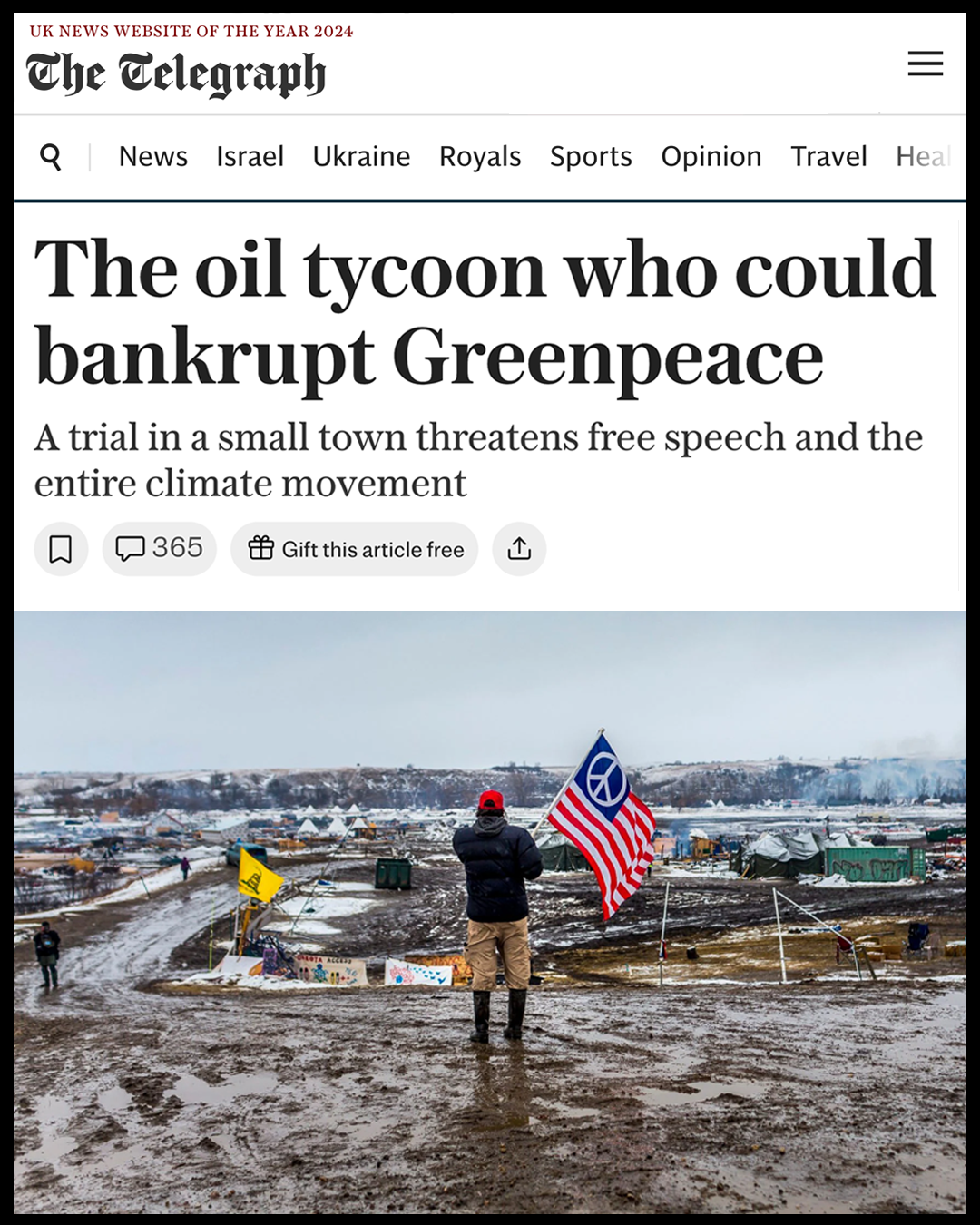
Warren went after Greenpeace after the group helped support the Indigenous-led protests at Standing Rock against the Dakota Access Pipeline.When 100,000 people turned up to block Warren from building his pipeline across Indigenous territory, he went ballistic.
Warren also personally donated at least $5 million to Trump for his two presidential campaigns. Trump then helped Warren get permits for his leaky pipeline.
The support of the public for this campaign is critical. Without it, we simply cannot do this work.
Our goal is to raise $20,000 before the end of the month. That means we have to raise approximately $12,000 in the next few days.
---
gp
An interview with Greenpeace International General Counsel Kristin Casper}:
Onward. Because we will not back down. We will not be silenced.
The fight against Energy Transfer’s SLAPP continues — and it is far from over. The stakes of this bullying lawsuit by the Texas-based Big Oil company behind the infamous Dakota Access Pipeline are too high to rest until justice is served. We will not back down, we will keep going, together.
The lawsuits filed by Energy Transfer (ET) against Greenpeace International (GPI) and two Greenpeace entities in the United States (Greenpeace Inc., and Greenpeace Fund) since 2017 are clear-cut examples of SLAPPs (Strategic Lawsuits Against Public Participation). Like all SLAPPs, ET’s lawsuits have been an attempt to bury nonprofits and activists in legal fees, push them towards bankruptcy, and ultimately silence dissent. Not only does Energy Transfer’s SLAPP attempt to erase the Indigenous leadership of the Standing Rock movement, but it poses a threat to free speech, basic expressions of solidarity, and peaceful protest.
The absurdUS$ 660 million jury verdict against Greenpeace entities in North Dakota made news, but this fight is bigger than the Greenpeace network. With the overwhelming support of allies all around the world, the defence against Energy Transfer’s bullying tactics will continue for as long as it takes to secure the freedoms we all need to deliver a green, just and peaceful future for all. After nearly a decade of defending these SLAPPs, the Greenpeace Legal departments are prepared to continue as long as it takes!
To get a better understanding of the legal process and next steps of how the jury verdict in North Dakota fits into the ongoing legal fight against Energy Transfer’s SLAPP, let’s ask a few questions to Greenpeace International’s General Counsel, Kristin Casper:
Is this fight over?
Kristin Casper:Absolutely not, this fight is far from over. Big Oil thinks they can bully us into silence, but we won’t be silenced.
In this fight with Energy Transfer, we know the facts are on our side.
The Greenpeace entities in the US have already announced an intention to appeal, in the event that the trial court does not itself overrule the jury’s verdict. Greenpeace International is weighing all legal options, including appeal, to challenge this wrongful SLAPP suit by Energy Transfer. We believe we have many and strong grounds for appeal based on how the trial was conducted.
At this moment, we are preparing legal filings that call for this North Dakota verdict to be overturned. Meanwhile, in Europe, Greenpeace International has already filed an anti-SLAPP lawsuit in Dutch court, to recover all damages and costs suffered as a result of ET’s back-to-back SLAPP lawsuits against us, and we are looking forward to seeing Energy Transfer in court.
This isn’t just a fight for Greenpeace defendants: it’s a fight about the protection of fundamental rights for everyone. We are committed to our values, such as nonviolence, independence, and promotion of solutions. We won’t back down from them. This is the kind of fight that we were made for.
Greenpeace needs your support against Big Oil’s attempt to silence us!
Were you surprised by the jury verdict?
KC:Anytime there is injustice, a feeling of shock and consternation follows, but so does a drive to correct a wrong. That said, we knew going into this trial that the deck was unjustly stacked against us. This case should have been thrown out long before it ever made its way to a jury trial, as a matter of law.
What happens in Morton County after the jury verdict?
KC:The trial court must decide whether to confirm, revise, or vacate the verdict. Generally, the decision can only be appealed once a final judgment by the trial court is entered.
Why was Morton County the wrong place for this case to be tried?
KC:The community in Morton County should not have had to bear the burden of this case. Every judge in this district recused themselves from presiding over the case. To fill the gap, the court had to bring in a judge from another district. The case should have been dismissed but if a trial were to happen at all, it should have been moved to another venue to ensure the fairness of the proceedings.
What are some of the most obvious grounds for an appeal?
KC:There are very strong grounds for appeal. There have been so many extremely prejudicial errors in these proceedings that the question is rather where we should start.
But just to name a few, here are some potential grounds for appeal, by way of example:
- The District Court’s lack of jurisdiction over Greenpeace International;
- The lack of evidence to support key findings;
- The exclusion of key evidence supporting the defense;
- The inclusion of irrelevant and prejudicial evidence; and
- Ongoing concerns about the fairness and impartiality of the jury and the denial of requests for a change in venue.
You can get a feel for our strong arguments by reading GPI’s motion for summary judgment, which was denied without any substantive reasoning.
Do Greenpeace entities really have to pay US$660 million?
KC: No. Nor could they. Greenpeace entities don’t have that kind of money. There is no scenario in which Energy Transfer gets paid this ridiculous amount.
But also, there are many legal steps between this verdict and even the potential enforcement of it, and justice and the facts are on our side. That’s why Greenpeace International has brought a suit against Energy Transfer in the Netherlands: showing that, as a result of their abusive lawsuits, it is actually Energy Transfer that owes Greenpeace International compensation.
We are prepared to take this fight every step of the way, and we are confident in our ability to correct the record and be made whole.
Why is Greenpeace International suing Energy Transfer in the Netherlands?
KC:Greenpeace International is suing Energy Transfer LP, Energy Transfer Operating, L.P. and Dakota Access LLC to recover all damages and costs it has suffered as a result of ET’s back-to-back SLAPP lawsuits demanding Greenpeace International and the Greenpeace entities in the United States pay hundreds of millions of dollars in damages. The first preliminary hearing in Greenpeace International’s anti-SLAPP suit against Energy Transfer is set for July 2, 2025.
How long might it take for the Dutch case and US appeal(s) to play out?
KC:We don’t know at this point. But in general, legal proceedings take a long time.
In the US, the appeal to the North Dakota Supreme Court may not even be the end of the legal proceedings. This legal battle with Energy Transfer has already been going on for upwards of eight years (since 2017), but however long it takes, is how long we will stay strong.
The goal of SLAPP suits is precisely that: to tie up resources, to wear us down, and pull us away from continuing to pursue our campaign goals: but unlike many smaller organisations and individuals that face such tactics, Greenpeace International is built to withstand this pressure: our campaigns are as big and bold and impactful as ever before.
Even while representatives from the Greenpeace parties were present in Mandan, North Dakota for the duration of the trial, the Greenpeace ship Rainbow Warrior was being welcomed back to the Marshall Islands to start a six-week mission around the Pacific nation to elevate calls for nuclear and climate justice; and support independent scientific research into the impacts of decades-long nuclear weapons testing by the US government. Forty years earlier, Greenpeace crew evacuated over 300 people from the Rongelap atoll to Mejatto island, after toxic nuclear fallout from the Castle Bravo test rendered their ancestral lands uninhabitable. Across decades and despite many setbacks, the work of the Greenpeace movement continues.
Do you expect to win?
KC:Our goal has always been bigger: our fight is for the hearts and minds of people to ensure the sustainability of life in all its diversity on this beautiful planet, and when it comes to that fight: we are in it to win it.
About the author
Chris Greenberg
Chris Greenberg is a Managing Editor for the Americas Communications Hub at Greenpeace International, based in Brooklyn, New York.
---
russel mok
greenpeace Goes to Trial in North Dakota to Defend Against Energy Transfer SLAPP Suit
:{:{By Editor Filed in Uncategorized February 13th, 2025}:
On February 24, 2025, Greenpeace USA is scheduled to go to trial in state court in Mandan, North Dakota. Greenpeace is being sued by Energy Transfer – the operator of the Dakota Access Pipeline – for nearly $300 million related to the 2016 protests at Standing Rock.
Deepa Padmanabha
The stakes are high, and not just for Greenpeace USA as an organization. This trial is testing out legal tactics that, if successful, could be widely applied against protesters, and indeed, anyone who speaks out or criticizes a deep-pocketed corporation.
The lawsuit filed against Greenpeace has been called a SLAPP suit – a Strategic Lawsuit Against Public Participation.
We rang up Deepa Padmanabha, a senior legal advisor to Greenpeace USA, to get some details on the lawsuit and upcoming trial.
What are the allegations of the lawsuit?
“Both sides have said this is likely the biggest case ever in the history of the North Dakota state courts,” Padmanabha toldCorporate Crime Reporterin an interview last week. “It’s three buckets of claims. The first bucket of claims are claims of defamation. Energy Transfer alleges that the Greenpeace entities made false statements. And those false statements caused damages. In the state case, we originally started out with over 80 statements that Energy Transfer alleged were defamatory. And now we are down to nine.”
“Those nine statements fall into three categories. The first category of statements are statements that we made that the Dakota Access Pipeline crosses Standing Rock Sioux tribal ancestral lands.”
“The second category are statements that Energy Transfer deliberately desecrated Standing Rock Sioux tribe cultural resources.”
“And the third category of statements are statements that we made that Energy Transfer and its contractors used excessive force against peaceful protestors.”
“The important thing to note here is that by the time Greenpeace entities made any of these statements that are at issue, these were statements that were already widely circulated in the public. Anybody familiar with the resistance at Standing Rock had heard these statements. These were not statements that Greenpeace invented.”
“Yet Energy Transfer is suing the Greenpeace entities for these statements.”
“That’s the first bucket of claims. The second bucket of claims are claims of tortious interference. They are related to defamation. Energy Transfer alleges that Greenpeace made these alleged false statements to financial institutions – institutions that were involved with financing the Dakota Access Pipeline. And the allegation is that based on those statements, the financial institutions took action that cost Energy Transfer hundreds of millions of dollars in damages – lost financing, financing costs from delays.”
“We know that many of these financial institutions had their own commitments. They did their own due diligence to understand what was happening with the Dakota Access Pipeline. In fact, no bank or financial institution made any decision based on a Greenpeace statement.”
“That’s the second bucket of claims. The third bucket of claims are on the ground claims such as trespass, conversion, and aiding and abetting. This is a bucket that is quite dangerous for the movement. These claims make it clear that Energy Transfer’s target is much bigger than Greenpeace. It really is an attack on our First Amendment rights.”
“What they are trying to do is create this idea of collective protest liability where if you have any involvement with, for example, training at a protest, you can be held accountable for anything that happens there by unknown people.”
“For example, if you are engaged in training in principles of non-violence, de-escalation, principles of safety, you can be held accountable for the actions of unknown protesters who, for example, destroy construction equipment. This idea is dangerous – that you can be held accountable for anything that happens by unknown people, especially at a time when we know that many protests are being infiltrated.”
“And you can imagine that this would have a serious chilling effect on anybody who wants to engage in protests. This idea that you can be held accountable for anything that happens is quite a dangerous one. It’s very clear that Energy Transfer – and the larger fossil fuel industry – is trying to send a message to everybody – watch out, you could be next.”
This lawsuit has been going on for eight years. Have there been any settlement talks?
“I can’t get into too much detail about that. But I will say that we are prepared to go to trial, and we are expecting to go to trial. It’s very important for us that no matter the outcome of this lawsuit, our decisions will be in line with our values and our principles and our commitments to our own indigenous peoples policies.”
There have been public reports about settlement talks in this lawsuit. And last year, Greenpeace settled with Shell Oil over another lawsuit. Did you work on that lawsuit?
“That was not Greenpeace USA. That was Greenpeace UK.”
Greenpeace UK agreed to pay something like $375,000 to settle that lawsuit. What are the odds this case will actually go to trial?
“As of now, we are fully prepared to go to trial. Trial is in three weeks. That’s where we are headed.”
Will you be in court at trial?
“Yes.”
You say this is a SLAPP suit. What is that?
“SLAPP stands for Strategic Lawsuit Against Public Participation. At their core, they are attacking First Amendment protected behavior. You look at the parties. It’s often activists, non-profit organizations, journalists, even concerned citizens who are speaking out about a matter of public concern.”
“In this instance, the concerns about the Dakota Access Pipeline, its routing and risks were absolutely a matter of public concern.”
“What is the nature of the activity targeted? Often the activity is First Amendment protected activity, such as free speech or non-violent protest. These lawsuits are often disguised as defamation lawsuits. That is very much the case here where many of the claims at issue are defamation claims.”
“The other issue is peaceful protest. Any involvement we had on the ground was 100 percent in line with our 50 plus year history of nonviolent direct action, bearing witness, and no property damage.”
“Another tell-tale sign of a SLAPP lawsuit is the power imbalance between the parties. To Energy Transfer, this lawsuit is just a drop in the bucket for them. But for Greenpeace, it represents a significant financial investment to put on this kind of defense.”
“Another tell-tale sign – the amount of damages. Energy Transfer is seeking $300 million. SLAPP suits have these huge damage claims to send a message. Even if they lack the evidence to support such a damage claim, which is absolutely the case here, just by making the allegation, it can have a chilling effect on anyone watching the case.”
“These corporations use the litigation process as punishment. This has been eight years. The first case was thrown out of federal court. But they kept the fight going.”
“When they filed the federal court action, they already had the green light to construct the Dakota Access Pipeline. It was constructed. So why would you still use the litigation process?”
“Because they know these kinds of lawsuits take years and years and years. You put a stress and burden on the powerful voice they are trying to shut down.”
“Even though it’s only the Greenpeace entities that have been served in this case, there have been a number of third party subpoenas. There have been wild attempts to draw in smaller groups and individuals into this lawsuit – not as named defendants, but to instill a sense of fear that they too are being watched.”
“As someone who has been involved in SLAPP lawsuits for a long time, this case hits every single aspect.”
The Wall Street Journal published an article last year titled – The Texas Billionaire Who Has Greenpeace USA on the Verge of Bankruptcy. That billionaire is Kelcy Warren. What did you make of that article?
“One of the most interesting points of that article was toward the end. The journalist wrote this: ‘The lawsuit poses its own risks for Warren. Some oil-and-gas investors expressed concerns about the claim, saying it makes the industry look vindictive and could result in a reinvigorated protest movement.’”
“Basically, some investors are concerned about a backlash. That is the truth. This lawsuit has galvanized the movement in a powerful way. Greenpeace is getting support from so many allies, allies we have never worked with before. They are now watching this case because they realize the implications this case could have.”
“There is what happens in court, but there is what happens outside the court. And corporations need to take the possible backlash into account. You could reinvigorate a movement. People have really come together to fight back against this kind of abuse of power.”
Were you able over the years to depose Energy Transfer executives, including the CEO Kelcy Warren?
“There were over 100 depositions in this case – Greenpeace employees, third parties, Energy Transfer contractors and Energy Transfer employees, including Kelcy Warren.”
Is the Kelcy Warren deposition public?
“I don’t know if that deposition is publicly available. There is quite a bit in this case that is subject to a protective order.”
Greenpeace wasn’t at the forefront of these protests. The native Americans groups were at the forefront of these protests.
“That is accurate. Greenpeace entities had limited involvement and that was intentional. This was not a Greenpeace campaign. This was a grassroots indigenous resistance. Greenpeace supported it by being an ally. Greenpeace supported the indigenous resistance in a very, very limited way.”
“Energy Transfer is trying to rewrite history. The first question I always get from people involved was – did Greenpeace have any involvement at Standing Rock? I had never heard about Greenpeace being involved. Greenpeace was really not involved.”
“Greenpeace was known for its big, bold campaigns. And that was not the case here.”
There were other major public interest groups who supported the resistance at Standing Rock. Why did Greenpeace get sued by Energy Transfer and not the other groups?
“Let’s go back to the first case that was dismissed, the RICO case. That was the second RICO case brought by the same law firm in back to back years. One of the lawyers made public statements and he was basically shopping this tactic around. There was this idea that civil RICO would be the new tactic used to go against advocacy groups.”
“Why Greenpeace? We are known for bearing witness, taking big, bold actions and not being intimidated. The idea was – if we can knock out Greenpeace, if we can scare them, then who else is going to step into their shoes? Who else will take on this level of risk?”
“We recognize that intention. And that also speaks to why we have been fighting the case the way we have been. We have been fighting this case for the movement. We know that the intent is to reach beyond the Greenpeace entities. And we take that fight seriously.”
---
---
NO LNX
A Quarter-Billion Dollars for Defamation: Inside Greenpeace’s Huge Loss
A pipeline company’s lawsuit against the environmental group could chill free speech, experts said. First Amendment issues are likely to figure prominently in an appeal.
:
:{:{Greenpeace representatives outside the courthouse in Mandan, N.D., where the jury ruled against the environmental organization this month.}:
By Karen Zraick
Karen Zraick covered the trial from the courtroom in Mandan, N.D.
March 31, 2025
When the environmental group Greenpeace lost a nearly $670 million verdict this month over its role in oil pipeline protests, a quarter-billion dollars of the damages were awarded not for the actual demonstrations, but for defaming the pipeline’s owner.
The costly verdict has raised alarm among activist organizations as well as some First Amendment experts, who said the lawsuit and damage awards could deter free speech far beyond the environmental movement.
The verdict “will send a chill down the spine of any nonprofit who wants to get involved in any political protest,” said David D. Cole, a professor at Georgetown Law and former national legal director of the American Civil Liberties Union. “If you’re the Sierra Club, or the N.A.A.C.P., or the N.R.A., or an anti-abortion group, you’re going to be very worried.”
The lawsuit, filed by Energy Transfer in 2019, accused Greenpeace of masterminding an “unlawful and violent scheme” to harm the company’s finances, employees and infrastructure and to block the construction of the Dakota Access Pipeline. Greenpeace countered that it had promoted peaceful protest and had played only a minor role in the demonstrations, which were led by the Standing Rock Sioux Tribe over concerns about its ancestral land and water supply.
A key part of Energy Transfer’s case relied on defamation claims. For example, the jury found that Greenpeace defamed the company by saying it had “damaged at least 380 sacred and cultural sites” during pipeline work, the first of nine statements found defamatory.
Greenpeace called Energy Transfer’s lawsuit an attempt to muzzle the company’s critics. “This case should alarm everyone, no matter their political inclinations,” said Sushma Raman, interim executive director of Greenpeace USA. “We should all be concerned about the future of the First Amendment.”
Greenpeace has said it will appeal to the Supreme Court in North Dakota, the state where the trial was held. Free-speech issues are widely expected to figure prominently in that filing.
But Greenpeace was not the only party invoking the First Amendment.
Upon leaving the courtroom, the lead lawyer for Energy Transfer, Trey Cox of Gibson, Dunn & Crutcher, called the verdict “a powerful affirmation” of the First Amendment. “Peaceful protest is an inherent American right,” he said. “However, violent and destructive protest is unlawful and unacceptable.”
Vicki Granado, a spokeswoman for Energy Transfer, described the verdict as “a win for all law-abiding Americans who understand the difference between the right to free speech and breaking the law.”
The clashing comments shine a light on a central tension in the debate: Where do you draw the line between peaceful protest and unlawful activity?
“If people are engaged in non-expressive conduct, like vandalism, like impeding roadways such that cars and passers-by can’t use those roadways, the First Amendment is not going to protect that,” said JT Morris, a senior supervising attorney at the Foundation for Individual Rights and Expression, a nonprofit that defends free speech across the ideological spectrum. “But peaceful protest, criticism of companies on matters of public concern, those are all protected.”
The verdict landed in the midst of a larger debate over the limits of free speech. President Trump has accused news outlets of defaming him, and he has been found liable for defamation himself. His administration has targeted law firms he perceives as enemies, as well as international students deemed too critical of Israel or of U.S. foreign policy. Conservatives have accused social media platforms of suppressing free speech and have vowed to stop what they call online censorship.
“There’s nothing in this particular political climate that’s shocking anymore,” said Jack Weinberg, who in the 1960s was a prominent free-speech activist and later worked for Greenpeace. (He’s also known for the phrase “Don’t trust anyone over 30,” although that’s not exactly how he said it.) “But it’s wrong,” he said of the verdict, “and it will have profound consequences.”
There has long been a high bar for defamation lawsuits in the United States.
The First Amendment protects free speech and the right to protest, and a landmark 1964 Supreme Court decision, New York Times v. Sullivan, strengthened those protections. To prevail in a defamation suit, a public figure must prove that the statement was false and was made with “actual malice,” meaning knowledge that the statement was false, or reckless disregard for its veracity.
Carl W. Tobias, a professor at the University of Richmond School of Law, said that ruling intentionally raised the bar to win a defamation suit. “It’s extreme,” he said. “It’s meant to be.”
Eugene Volokh, a senior fellow at the Hoover Institute at Stanford University, pointed to the history of that famous case. It concerned a 1960 ad in The Times that described police actions against civil rights demonstrators in Alabama as “an unprecedented wave of terror.”
A police official sued the paper and won. But the Supreme Court overturned the verdict. The court ruled that protecting such speech was necessary, even if it contained errors, in order to ensure robust public debate.
In a Greenpeace appeal, Mr. Volokh said, the evidence demonstrating whether Greenpeace’s statements were true or false would be crucial in evaluating the verdict, as would the question of whether Greenpeace’s statements were constitutionally protected expressions of opinion.
Other issues that loom: What was permitted to be entered into evidence in the first place, and whether the instructions to the jury were sufficient. Then, he said, if the statements are found to be clearly false, is there enough evidence to show that Greenpeace engaged in “reckless falsehood, acts of so-called actual malice?”
Any award for defamation chills free speech, Mr. Volokh added, whether against Greenpeace or against the Infowars host Alex Jones, who was found liable for more than $1 billion over his false statements about the murder of children at the Sandy Hook school shooting.
In the Greenpeace case, the nine statements found by the jury to be defamatory referred to Energy Transfer and its subsidiary Dakota Access. One statement said that Dakota Access personnel had “deliberately desecrated burial grounds.” Another said that protesters had been met with “extreme violence, such as the use of water cannons, pepper spray, concussion grenades, Tasers, LRADs (Long Range Acoustic Devices) and dogs, from local and national law enforcement, and Energy Transfer partners and their private security.”
Thumbnail of page 11
Read all nine statements found defamatory by a jury
They’re listed on page 11 of the verdict.
Read Document Page 11 of 33
Other statements were more general: “For months, the Standing Rock Sioux have been resisting the construction of a pipeline through their tribal land and waters that would carry oil from North Dakota’s fracking fields to Illinois.”
The protests unfolded over months, from mid-2016 to early 2017, attracting tens of thousands of people from around the world, and were widely documented by news crews and on social media.
Janet Alkire, chairwoman of the Standing Rock Sioux Tribe, argued that Greenpeace’s statements were true and not defamatory. “Energy Transfer’s false and self-serving narrative that Greenpeace manipulated Standing Rock into protesting DAPL is patronizing and disrespectful to our people,” she said in a statement, using an abbreviation for the Dakota Access Pipeline.
Image
Protesters against the Dakota Access Pipeline in 2016.Credit...Alyssa Schukar for The New York Times
She said that “scenes of guard dogs menacing tribal members” were publicly available “on the news and on the internet.”
Videos of the incidents in question weren’t shown at the trial. Everett Jack Jr. of the firm Davis, Wright Tremaine, the main lawyer for Greenpeace, declined to discuss why.
The 1,172-mile pipeline, priced at $3.7 billion when announced, has been operating since 2017. It carries crude oil from North Dakota to Illinois.
During the trial, some arguments hinged on whether the pipeline crossed Standing Rock’s land, or how to define tribal land. The pipeline is just outside the borders of the reservation but crosses what the tribe calls unceded land that it had never agreed to give up.
There was also debate about whether tribal burial grounds were harmed during construction. Experts working for the tribe found that was the case, but experts brought in by Energy Transfer did not.
Even if a statement was false, Mr. Cole said, a defendant cannot be held liable if they had a basis for believing it. He also predicted that the penalty would likely be reduced on appeal if not overturned.
Martin Garbus, a veteran First Amendment lawyer, led a delegation of lawyers to North Dakota to observe the trial. The lawyers have said that the jury was biased against the defendants and that the trial should have been moved to another county. He expressed concern that an appeal to the U.S. Supreme Court could be used to overturn Times v. Sullivan. He noted that Justice Clarence Thomas has called for the Supreme Court to reconsider that case.
But Mr. Cole, Mr. Tobias and other experts said they did not expect the court to reconsider Times v. Sullivan.
Greenpeace has said previously that the size of the damages could force the organization to shut down its U.S. operations.
The lawsuit named three Greenpeace entities, but it centered on the actions of Greenpeace Inc., based in Washington, which organizes campaigns and protests in the United States and was found liable for more than $400 million.
A second organization, Greenpeace Fund, a fund-raising arm, was found liable for about $130 million. A third group, Greenpeace International, based in Amsterdam, was found liable for the same amount. That group said its only involvement was signing a letter, along with several hundred other signatories, calling on banks to halt loans for the pipeline.
Earlier this year, Greenpeace International filed a countersuit in the Netherlands against Energy Transfer. That lawsuit was brought under a European Union directive designed to fight what are known as SLAPP suits, or strategic lawsuits against public participation — legal actions designed to stifle critics. (State law in North Dakota, where Energy Transfer brought its case against Greenpeace, doesn’t have anti-SLAPP provisions.)
The next hearing in the Netherlands case is in July.
Karen Zraick covers legal affairs for the Climate desk and the courtroom clashes playing out over climate and environmental policy. More about Karen Zraick
A version of this article appears in print on , Section A, Page 11 of the New York edition with the headline: Rising Fears for Free Speech After Greenpeace’s Defeat.
---
---
no lnx
Jury Orders Greenpeace to Pay Pipeline Company More Than $660 Million
The environmental group had said the lawsuit, over its role in a protest movement, could mean an end to its operations in the United States.
A crowd of 100 or more people walk along a dirt road, some carrying flags.
Demonstrators against the Dakota Access Pipeline near Cannon Ball, N.D., in 2016.Credit...Andrew Cullen/Reuters
By Karen Zraick
Reporting from Mandan, N.D.
March 19, 2025
A North Dakota jury on Wednesday awarded damages totaling more than $660 million to the Texas-based pipeline company Energy Transfer, which had sued Greenpeace over its role in protests nearly a decade ago against the Dakota Access Pipeline.
The verdict was a major blow to the environmental organization. Greenpeace had said that Energy Transfer’s claimed damages, in the range of $300 million, would be enough to put the group out of business in the United States. The jury on Wednesday awarded far more than that.
Greenpeace said it would appeal. The group has maintained that it played only a minor part in demonstrations led by the Standing Rock Sioux Tribe. It has portrayed the lawsuit as an attempt to stifle oil-industry critics.
The nine-person jury in the Morton County courthouse in Mandan, N.D., about 45 minutes north of where the protests took place, returned the verdict after roughly two days of deliberations.
It took about a half-hour simply to read out the long list of questions posed to the jurors, such as whether they found that Greenpeace had committed trespass, defamation and conspiracy, among other violations, and how much money they would award for each offense.
Afterward, outside the courthouse in Mandan, both sides invoked the right to free speech, but in very different ways.
“We should all be concerned about the attacks on our First Amendment, and lawsuits like this that really threaten our rights to peaceful protest and free speech,” said Deepa Padmanabha, a senior legal adviser for Greenpeace USA.
Just moments before, Trey Cox of the firm Gibson Dunn & Crutcher, the lead lawyer for Energy Transfer, had called the verdict “a powerful affirmation" of the First Amendment. “Peaceful protest is an inherent American right,” he said. “However, violent and destructive protest is unlawful and unacceptable.”
Earlier in the week, during closing arguments on Monday, Energy Transfer’s co-founder and board chairman, Kelcy Warren, an ally and donor to President Trump, had the last word for the plaintiffs when his lawyers played a recording of comments he made in a video deposition for the jurors. “We’ve got to stand up for ourselves,” Mr. Warren said, arguing that protesters had created “a total false narrative” about his company. “It was time to fight back.”
Energy Transfer is one of the largest pipeline companies in the country. The protests over its construction of the Dakota Access Pipeline drew national attention and thousands of people to months-long encampments in 2016 and 2017.
The demonstrators gathered on and around the Standing Rock Sioux Reservation, arguing that the pipeline cut through sacred land and could endanger the local water supply. The Standing Rock Sioux Tribe sued to stop the project, and members of other tribes, environmentalists and celebrities were among the many who flocked to the rural area, including two figures who are now members of Mr. Trump’s cabinet: Robert F. Kennedy Jr. and Tulsi Gabbard.
But the protests erupted into acts of vandalism and violence at times, alienating people in the surrounding community in the Bismarck-Mandan area.
Greenpeace has long argued that the lawsuit was a threat to First Amendment rights, brought by a deep-pocketed plaintiff and carrying dangerous implications for organizations that speak out about a broad range of issues. Greenpeace has called the lawsuit a strategic lawsuit against public participation, or SLAPP suit, the term for cases meant to hinder free speech by raising the risk of expensive legal battles. Many states have laws that make it difficult to pursue such cases, though not North Dakota.
Mr. Cox laced into Greenpeace during closing arguments on Monday. The company accused Greenpeace of funding and supporting attacks and protests that delayed the pipeline’s construction, raised costs and harmed Energy Transfer’s reputation.
Image
A large, blue-and-brown section of pipe is lifted from a pile of about a dozen similar sections of pipe as a person in a fluorescent vest and hard hat looks on.
Sections of pipe destined to become part of the Dakota Access Pipeline in 2015.Credit...Nati Harnik/Associated Press
Jurors, Mr. Cox said, would have the “privilege” of telling the group that its actions were “unacceptable to the American way.” He laid out costs incurred that tallied up to about $340 million and asked for punitive damages on top of that.
“Greenpeace took a small, disorganized, local issue and exploited it to shut down the Dakota Access Pipeline and promote its own selfish agenda,” he said. “They thought they’d never get caught.”
The 1,172-mile underground pipeline has been operating since 2017 but is awaiting final permits for a small section where it crosses federal territory underneath Lake Oahe on the Missouri River, near Standing Rock. The tribe is still trying to shut down the pipeline in a different lawsuit.
Lawyers for Greenpeace called the case against the group a “ridiculous” attempt to pin blame on it for everything that happened during months of raucous protests, including federal-government delays in issuing permits.
Three Greenpeace entities were named in the lawsuit: Greenpeace Inc., Greenpeace Fund and Greenpeace International. Greenpeace Inc. is the arm of the group that organizes public campaigns and protests. It is based in Washington, as is Greenpeace Fund, which raises money and awards grants.
The third entity named in the lawsuit, Greenpeace International, based in Amsterdam, is the coordinating body for 25 independent Greenpeace groups around the world.
It was principally the actions of Greenpeace Inc. that were at the heart of the trial, which began Feb. 24. They included training people in protest tactics, dispatching its “rolling sunlight” solar-panel truck to provide power, and offering funds and other supplies. Greenpeace International maintained that its only involvement was signing a letter to banks expressing opposition to the pipeline, a document that was signed by hundreds and that had been drafted by a Dutch organization. Greenpeace Fund said it had no involvement.
Image
Three activists stand next to a river holding yellow signs with bold black writing that read, in part, "Energy Transfer: Leave Greenpeace Alone!" The Eiffel Tower is prominent in the background.
Greenpeace activists in Paris protested Energy Transfer and its lawsuit on Feb. 20.Credit...Thibaud Moritz/Agence France-Presse — Getty Images
On Wednesday, the jurors found Greenpeace Inc. liable for the vast majority of the damages awarded, which came to more than $660 million, according to representatives for both Greenpeace and Energy Transfer. The damages cover dozens of figures that were read out in court for each defendant on each claim.
Separately, Greenpeace International this year had countersued Energy Transfer in the Netherlands, invoking a new European Union directive against SLAPP suits as well as Dutch law.
During closing arguments on Monday in North Dakota, Everett Jack Jr. of the firm Davis Wright Tremaine, the lead lawyer for the Greenpeace Inc., was a study in contrast with Mr. Cox. Both men wore dark suits and red ties to make their final arguments before the jury. But their demeanors were polar opposites.
Mr. Cox was energetic, indignant, even wheeling out a cart stacked with boxes of evidence during his rebuttal to argue that he had proved his case. Mr. Jack was calm and measured, recounting the chronology of how the protests developed to make the case that they had swelled well before Greenpeace got involved.
Given the months of disruptions caused locally by the protests, the jury pool in the area was widely expected to favor Energy Transfer.
Among the observers in the courtroom were a group of lawyers calling themselves the Trial Monitoring Committee who criticized the court for denying a Greenpeace petition to move the trial to the bigger city of Fargo, which was not as affected by the protests. The group included Martin Garbus, a prominent First Amendment lawyer, and Steven Donziger, who is well-known for his yearslong legal battle with Chevron over pollution in Ecuador.
After the verdict, Mr. Garbus called it “the worst First Amendment case decision I have ever seen” and expressed concern that an appeal that reached the Supreme Court could be used to overturn decades of precedent around free-speech protections.
The group also took issue with the number of jurors with ties to the oil industry or who had expressed negative views of protests during jury selection. But Suja A. Thomas, a law professor at the University of Illinois and an expert on juries, said the precedent in North Dakota courts was not to use “blanket disqualifications of jurors just because they might have some kind of interest,” whether it’s financial or based on experience or opinion.
Rather, the judge has to determine whether each individual juror can be impartial. “There can be interest; they have to determine whether the interest is significant enough such that the person cannot be fair,” Ms. Thomas said.
Natali Segovia is the executive director of Water Protector Legal Collective, an Indigenous-led legal and advocacy nonprofit group that grew out of the Standing Rock protests. Ms. Segovia, who is also a member of the trial monitoring group, said her organization was involved with about 800 criminal cases that resulted from the protests. The vast majority have been dismissed, she said.
What had gotten lost during the Greenpeace trial, she said, was the concern about water that had spurred so much protest. She said she saw a larger dynamic at play. “At its core, it’s a proxy war against Indigenous sovereignty using an international environmental organization,” she said.
Karen Zraick covers legal affairs for the Climate desk and the courtroom clashes playing out over climate and environmental policy. More about Karen Zraick
A version of this article appears in print on March 20, 2025, Section A, Page 21 of the New York edition with the headline: Protest Over Pipeline Will Cost Greenpeace Hundreds of Millions.
---
ymail donz 3 14 25
The First Amendment is under a shocking level of attack right now in the United States.
From the illegal arrest of a Columbia University student leader to the $300 million harassment lawsuit filed by the Energy Transfer pipeline company against Greenpeace, our right to free speech is under greater threat than ever before.
As you know, Steven has joined a group of prominent civil rights attorneys and citizens who traveled to North Dakota to monitor Energy Transfer’s SLAPP harassment lawsuit against the environmental group Greenpeace. The lawsuit is being funded by Trump ally and right-wing billionaire Kelcy Warren, who once said all activists “should be removed from the gene pool.”
*Warren’s lawsuit is actually a direct assault on Indigenous peoples, the climate movement, and free speech. Steven is out there helping to resist this unconstitutional weaponization of the law to silence activists.
We wanted to make sure you saw this firsthand update from Steven on the trial against Greenpeace in North Dakota:
*To be clear: the lawsuit against Greenpeace is rigged.
The lawsuit is not only an intimidation play to target the entire climate movement, it’s also a slap in the face to the Standing Rock Sioux and dozens of other Indigenous nations who led the historic protests against the company’s Dakota Access Pipeline in 2016.
Energy Transfer and Warren are attacking Greenpeace on the preposterous theory that the group is responsible for all “damages” related to construction delays of pipeline caused by the Indigenous-led protests, even though Greenpeace had virtually nothing to do with the protests.
Energy Transfer recently admitted to dozens of criminal violations of environmental laws in Pennsylvania. Credible reports in the North Dakota trial suggest up to 1 million gallons of drilling fluids have been discharged into waterways that millions of people rely on for their drinking water.
Evidence from Greenpeace also indicates the pipeline traverses Sioux ancestral lands and has desecrated sacred cultural sites, both in violation of the law. *Yet the pipeline is operating anyway, while Greenpeace faces bankruptcy.
This trial is being structured so Greenpeace loses; the jury clearly is not impartial, with the majority having ties to the fossil fuel industry and no Native American or person of color seated on the panel. This is part of the “dark art” of a corporate SLAPP s...
---
===
7 Things You Need to Know About ETP’s Lawsuit Against Greenpeace - Greenpeace USA
12 2017
Learn how an abusive lawsuit is part of a dangerous trend of companies trying to silence dissent.
Energy Transfer Partners (ETP) – the company behind the Dakota Access Pipeline – has filed a lawsuit against Greenpeace and others, in its latest attempt to silence advocacy work and attack the fundamental right to free speech.
In response to the powerful alliance of Indigenous communities and climate activists who stood in opposition to the Dakota Access pipeline at Standing Rock, ETP has filed this SLAPP lawsuit claiming nearly a billion dollars in damages. on behalf of Energy Transfer. Here’s what you need to know about the suit.
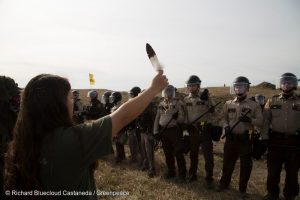
A phalanx of National Guard and police advance toward water protectors in Standing Rock.
1. What is a ‘SLAPP’ suit?
SLAPP stands for “Strategic Lawsuit Against Public Participation.” As the name implies, corporations, using this tactic are trying to shut down public participation. SLAPPs are generally filed without any kind of legal merit. The purpose of a SLAPP is to censor, intimidate, and silence critics by burdening them with legal claims and costs until they’re forced to abandon their criticism or opposition.
2. Why is ETP using a SLAPP?
ETP is SLAPPing its critics in an attempt to shut them up – or even better, to shut them down. ETP is suing Greenpeace for at least USD $900million. The corporation’s hope is that the prospect of having to pay this – or at least of spending a lot of time and legal costs on fighting the lawsuit – will intimidate Greenpeace and others into silence.
The goal of this suit is to silence opposition by misrepresenting what happened on the ground at Standing Rock — making outrageous and racist claims that big environmental organizations like Greenpeace orchestrated the Indigenous-led movement at Standing Rock.
3. This is a worrying trend
In 2016, Canadian company Resolute filed a SLAPP suit against Greenpeace, which was dismissed in full by a US federal judge. But the use of this dirty tactic by corporations is on the rise. As we face an upswing in a new global right-wing agenda, governments and corporations around the world are attempting to chip away at free speech. And it’s not just about environmental groups, either. The SLAPP suit is designed to send a loud message so that any activist or public-interest advocacy group that takes on giant corporations will have to think twice before standing up for what they believe in.
4. Who’s behind this suit
Just like the Resolute case, this one was filed by Michael Bowe. Bowe is also a member of Trump’s personal legal team, and part of the law firm Kasowitz Benson Torres – founded and run by Marc E. Kasowitz, Trump’s personal lawyer. The Times once described Kasowitz as “the Donald Trump of lawyering”. Bowe has publicly stated that he’s in conversations with other corporations considering filing their own SLAPPs against Greenpeace – suggesting this bullying and anti-democratic tactic is being shopped around to the highest bidder.
5. This is not a one-off.
There are many, many examples of SLAPP suits, here are a couple you may have heard of.
Earlier this year, coal magnate Bob Murray sued John Oliver after*Last Week Tonight*ran a segment on Coal – which prominently featured Murray. In the last 15 years, Murray and/or his company have also sued various other journalists.
The ACLU represented individuals in Uniontown, Alabama — a poor town predominantly made up of people of color — who were sued by Green Group Holdings for $30 million for standing up to a coal ash landfill in their town. The company revealed its motives when its lawyers approached the individuals in an attempt to cut a deal – if they agreed to give Green Group access to their electronic devices, access to their future social media postings, and extensive details about their group’s membership, advocacy and communications with other environmental groups.
Due to public outcry and the support of the ACLU, the residents reached a settlement in February and Green Group Holdings agreed to better environmental protections — but they shouldn’t have had to deal with this corporate bullying in the first place. There are hundreds of others across America and beyond who won’t be so lucky.
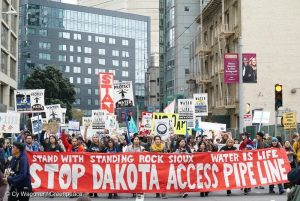
People march in support of the Standing Rock Nation at the Civic Center Plaza of San Francisco. The protest was one of many in a global day of action against the Dakota Access Pipeline (DAPL) calling on the U.S. Army Corps of Engineers to cancel the permit for the project.
6. They’re clutching at straws… [vid]
Just like in the, ETP is using the Racketeering Influenced and Corrupt Organizations Act (RICO) – a law which was originally created to prosecute the mafia – to claim treble damages and inflate the amount of money it is able to demand. In their lawsuit, ETP claims thatGreenpeace led a corrupt environmentalist enterprise that “cynically planted radical, violent eco-terrorists on the ground amongst the protesters, and directly funded their operations” – a baseless attempt to mislabel legal advocacy as criminal conduct through the use of these racketeering laws, and present constitutionally-protected free speech as defamatory. It’s as ridiculous as it sounds…
7. We can fight this
ETP and other corporate bullies are blatantly trying to stifle free speech and our right to peacefully protest. So let’s show them that that’s not going to happen: Refuse to be silent. Defend free speech. And let’s continue standing up for what is right.
You can take action against this SLAPP here and find more information about how you can fight back against SLAPPs generally.
===
https://www.desmog.com/2022/10/07/slapp-lawsuits-exxon-chemrisk-dapl-climate-change-raskin/
Emily Sanders
In 2018, Krystal Two Bulls received notice that she was being sued for criminal conspiracy.
Two Bulls, who is Oglala Lakota and North Cheyenne, has been organizing for environmental justice for much of her life. She was raised on the North Cheyenne Indian Reservation of Lame Deer, Montana, part of a community that had resisted coal developments for nearly 40 years. In 2016, she helped defeat Arch Coal’s plans to build a massive strip mining operation on the reservation’s border. The project would’ve been one of the largest coal mines in the United States.
Later that same year, Two Bulls received an urgent call for assistance from land and water protectors at Standing Rock, North Dakota, who were working to oppose the construction of the Dakota Access pipeline, which transports crude oil from North Dakota to Illinois.
When Two Bulls arrived, the conflict between protestors and local police was escalating. Her auntie, Dr. Sara Jumping Eagle, had recently been arrested after standing in the path of a bulldozer set to dig up human remains at an ancestral burial site. Two Bulls spent three-and-a-half months supporting and sustaining the camp — handling basic logistics like providing protestors with food, warm clothing, and other necessities — all in the face of violence by state police. She then helped to launch the No DAPL Solidarity Campaign, a global movement to back the Indigenous opposition to the pipeline.
It wasn’t until a year after camp was shut down that Two Bulls, who came to North Dakota on her own dime and left in debt, found out she was being sued for millions of dollars by the pipeline developer, Energy Transfer Partners. The charges were brought under the Racketeering Influenced Corrupt Practices (RICO) Act,a law originally designed to prosecute the mafia. The company claimed that through her “calls to action,” including a statement on Greenpeace’s website asking “all people from around the world to take action” and “come stand with us” against the Dakota Access pipeline, Two Bulls and others had conspired to interfere with Energy Transfer’s business operations and engaged in organized crime. The individuals and groups’ opposition, the company claimed, was defamatory and cost key investments in its pipeline.
In 2017, The Intercept reported on documents leaked from former personnel at an international security firm, TigerSwan, revealing that Energy Transfer had paid the firm to use military-style surveillance and infiltration tactics to gather information that could be deployed in a RICO lawsuit against the anti-pipeline activists.
Two Bulls is just one of many victims of the fossil fuel industry’s use of SLAPPs— strategic lawsuits against public participation — to silence and intimidate its critics. A report released last month by legal advocacy nonprofit EarthRights International identified 152 instances of legal and judicial harassment by fossil fuel corporations to suppress dissent in the United States over the past 10 years, including 93 SLAPP lawsuits.
Just this week, a California oil industry trade association paid nearly $650,000 in fees to the city of Los Angeles and several environmental advocacy groups the company had targeted in court for years following the city’s implementation of new environmental safety requirements for drilling applicants. After declaring bankruptcy, the California Independent Petroleum Association was allowed to pay only a fraction of a judgment initially awarded to the city and groups by a trial court that ruled the lawsuit was a SLAPP.
“With the strengthening of our movements, the revelation of how long the fossil fuel industry has been aware of how their practices impact and contribute to climate change, and the rise of legal cases against oil and gas corporations, these companies are becoming more desperate to silence the voices of their critics,” said Deepa Padmanabha, deputy general counsel at Greenpeace USA.
A wide range of concerned groups, from community organizers to members of Congress, are taking up the fight against SLAPPs. Last month, the House Oversight Subcommittee on Civil Rights and Civil Liberties held a hearing to expose the fossil fuel industry’s use of SLAPPs and its backing of bills to criminalize protest. The committee’s witnesses, including Padmanabha and others, explained that corporations were using these tactics to suppress activists’ ability to freely voice dissent.
The day after the hearing, Rep. Jamie Raskin (D-MD), the subcommittee chairman, introduced the SLAPP Protection Act of 2022 — the first federal legislation that would “establish a procedure to dismiss, punish, and deter strategic lawsuits against public participation.” Advocates say the bill could create a sorely needed protection for individuals and community groups who speak out against fossil fuel infrastructure, and an important safeguard for free speech at large.
According to EarthRights International, the proposed legislation would provide a federal mechanism for SLAPP suits to be quickly identified and dismissed while balancing the rights of plaintiffs and defendants. The bill would also force those bringing SLAPP suits to pay their opponents’ legal fees if the lawsuit is proven to have abusive intent.
Advocacy organizations are also tackling the issue. EarthRights is a member of the Protect the Protest coalition, an initiative created in response to the rise of SLAPP suits. “If a corporation can sue a nonprofit organization out of business for criticizing its activities, then that’s extremely dangerous,” Kirk Herbertson, senior policy advisor at EarthRights International, said.
About a year after Energy Transfer filed its lawsuit against Two Bulls and others, a district court judge in North Dakota dismissed the case, denying the RICO claims with prejudice — meaning the company could not refile those claims.
RICO claims, which can triple the amount of damages sought in a SLAPP suit, can be financially devastating — even for a larger, well-resourced organization like Greenpeace USA,which was named in the original suit. While Energy Transfer’s RICO claims against the organization have been dismissed, the pipeline company filed a second lawsuit in North Dakota state court, which is scheduled for trial in June 2023. In its current case, which also names Two Bulls as a defendant, Energy Transfer argues that Greenpeace USA conspired with others to defame, trespass, and interfere with business relationships, among many other charges.
Energy Transfer did not respond to a request for comment.
“Companies are becoming more desperate to silence the voices of their critics”– Deepa Padmanabha
Fighting these lawsuits not only takes vast amounts of money, but also time and energy. Padmanabha said that since mid-2016, her career has been almost entirely dedicated to advocating against corporate lawfare — corporations’ use of the legal system to attack opponents — preventing her from engaging more in the dire work needed to prevent climate catastrophe.
“The next decade is so critical in our fight against climate change. And if we didn’t have to deal with these lawsuits, we would really be putting every penny and every minute we have into fighting the existential threat of climate change,” Padmanabha said, adding that they are also intended to intimidate and deter individuals and lesser-resourced, smaller groups from speaking out.
Karen Savage was working in Massachusetts as a middle-school math teacher when she got hit with a SLAPP suit. In 2013, she and another environmental activist, Cherri Foytlin, wrote an unpaid article for the Huffington Post about a so-called independent study fromscientific consulting firm ChemRisk. The study had claimed that there was no connection between chemicals released during the BP Deepwater Horizon oil spill and the serious health problems reported by cleanup workers and coastal residents in its aftermath.
As their reporting revealed, ChemRisk — a company with a long history of working with polluters, including defendant PG&E in the infamous Erin Brockovich case — produced “science” on behalf of BP that the oil major could use to defend itself from liability in court.
After the article was published, the Huffington Post received an immediate request from the company to retract it, which they forwarded on to Cherri Foytlin. (In a note on her Facebook page, Foytlin told ChemRisk to “kiss my derriere.”)
Foytlin’s Facebook post, along with many other social media posts from the two writers, appeared in a defamation suit filed against them by ChemRisk in New York state. The company claimed their article contained falsehoods — though, according to Savage, ChemRisk couldn’t explain what those falsehoods were — and that as long as it was kept online, the article would “continue to do substantial harm to ChemRisk’s reputation.”
“Basically what they wanted to do was shut us up,” Savage told me. “It was an intimidation tactic.”
With pro-bono representation, Savage and Foytlin were able to get the suit dismissed in New York. Within two weeks, the company refiled in Massachusetts, where Savage lived. At one point, she said, the company’s lawyers even attempted to serve her in her classroom while she was teaching.
Cardno ChemRisk, the parent company of ChemRisk, did not respond to a request for comment.
The case was eventually dismissed under the state’s anti-SLAPP laws, and ChemRisk was forced to pay Savage and Foytlin’s attorney’s fees. Savage said she believes that ChemRisk never sued them in Louisiana, where Foytlin lived, because of the three states, Louisiana’s anti-SLAPP laws were the strongest, and the suit would’ve been dismissed faster and with greater consequences for the company.
That tactic of searching for the most favorable court, called forum shopping, is something Raskin’s anti-SLAPP statute would address by creating a standard applicable across the United States. At present, 32 states and the District of Columbia have anti-SLAPP laws, yet they have varying degrees of efficacy. And while the fate of a federal bill could depend on the outcome of midterm elections, most state anti-SLAPP laws have passed with bipartisan support.
Savage — who has since become a journalist and haswritten for DeSmog about being arrested by pipeline security while reporting — said she hopes Raskin’s bill would help put an end to this tactic. “If you know the truth, and you’ve got factual backup, and someone comes at you, you can’t back down on that,” Savage said. “The whole reason they’re coming at you is because they also know that you have the truth.”
While the fossil fuel industry works to stamp out the speech of environmental advocates on the one hand, it is now arguing that its climate denial is protected speech on the other. At the same time that Raskin held his hearing into the fossil fuel industry’s assault on the First Amendment, the House Natural Resources Oversight and Investigations Subcommittee held a separate hearing to examine how public relations firms market climate disinformation and delay action on behalf of Big Oil. In that hearing, chaired by Rep. Katie Porter (D-CA), Republicans and their witness argued that the committee was attacking the corporations’ right to free speech.
“Taken together, the two [hearings] are a perfect illustration of the industry’s First Amendment strategy: expand free speech for corporations, curb it for citizens,” Amy Westervelt recently wrote in The Intercept. The fossil fuel industry, she explained, has been developing the argument that its public statements on climate policy are protected speech since the late 1960s, all while working to expand the right of corporations to buy influence over politics behind the scenes.
In a paradoxical twist, fossil fuel companies are even attempting to wield existing anti-SLAPP laws to shield themselves from legal accountability. After a Massachusetts court ruled that Attorney General Maura Healey’s climate fraud lawsuit against Exxon could proceed in state court, the oil giant told the state’s supreme court that the case was actually a conspiracy to silence Exxon’s views on climate policy in violation of the state’s anti-SLAPP statute.But so far, the idea that Exxon’s fraud is protected free speech has not gone over well with judges.
“We have seen that the industry is trying to build up this argument around a conspiracy against them, and it’s coming up in things like anti-SLAPP motions in courts. But they have continued to fail in that effort so far,” Herbertson of EarthRights International said. Raskin’s newly proposed federal legislation, he said, is clearly and explicitly designed to be used by real peopleand organizations that have been victim to SLAPP suits,and will be harder for corporations to use in their own defense.
But if you ask Padmanabha of Greenpeace, the industry’s tactics are on thin ice. “There is this recognition and an increasing awareness that speech should not be bought,” she said. “And I think that the [Oversight Civil Rights and Civil Liberties] hearing and the bill that followed it are really just emblematic examples of how these attempts to control the narrative are crumbling.”
Emily Sanders writes ExxonKnews, a newsletter covering climate accountability and the oil and gas industry. She is editorial lead at the Center for Climate Integrity, and is based in New York City. This piece was co-published by DeSmog and ExxonKnews, a project of the Center for Climate Integrity.
===
https://www.greenpeace.org/usa/fighting-climate-chaos/climate-deniers/koch-industries/dr-willie-soon-a-career-fueled-by-big-oil-and-coal/
===
an 822
A fledgling international effort to protect the world's oceans from further damage is "on the brink of failure," and the governments of wealthy countries are primarily to blame, Greenpeace International warned Thursday.
Diplomats gathered at the United Nations headquarters in New York City are nearing the end of the fifth and final round of negotiations on a much-needed pact to protect biodiversity in the "high seas"—a global commons comprising the two-thirds of the ocean that lie outside the jurisdiction of any single country and where legally binding regulations are virtually nonexistent.
Conservationists have long hoped that the ongoing summit—described by some as the "last chance" to forge a robust global ocean treaty—would lead to the establishment of "Marine Protected Areas" and rules mandating environmental assessments prior to deep-sea mining and other industrial activities.
But a handful of mostly rich countries—including the United States, Canada, and members of the so-called High Ambition Coalition on Biodiversity Beyond National Jurisdiction—have derailed progress made on the text byprioritizing "hypothetical future profits" that could bederived from extracting marine genetic resourcesover protecting aquatic species, according to Greenpeace.
"The oceans sustain all life on Earth, but the greed of a few countries means this round of talks for a U.N. ocean treaty are now set to fail," Laura Meller of Greenpeace's Protect the Oceans campaign said Thursday in a statement. "The High Ambition Coalition has utterly failed. They should be the No Ambition Coalition."
Members of the coalition have "obsessed over their hypothetical future profits, undermining all the other progress made at these talks," said Meller. "Unless ministers urgently pick up the phone today to their counterparts and hammer out a deal, this treaty process will fail."
The health of the world's oceans, which cover roughly 70% of the Earth and are indispensible to life on the planet, has been rapidly deteriorating as a result of unmitigated greenhouse gas emissions, surging plastic pollution, and overexploitation.
The high ambition coalition pledged earlier this year to finalize a treaty in 2022 that would protect 30% of the world's oceans by 2030, but the proposed text is "lowering its ambition by the minute," said Greenpeace.
"Less than two months ago I was in Lisbon, at the U.N. Ocean Conference, listening to these leaders promise they would deliver a strong global ocean treaty this year," said Meller. "Now we are in New York and the leaders are nowhere to be found. They've broken their promises."
"We are sad and angry," Meller continued. "Billions of people rely on healthy oceans, and world leaders have failed all of them."
"It now looks like protecting 30% of the world's oceans [by 2030] will be impossible," she added. "Scientists say this is the absolute minimum necessary to protect the oceans, and failure at these talks will jeopardize the livelihoods and food security of billions. We're beyond disappointed."
Greenpeace also accused rich nations of taking "an unfair and neocolonial approach by refusing to commit any finance for the benefit of all countries."
The refusal of the U.S., Canada, and others to provide funding "will stop a treaty from being agreed here," the group added. "With talks set to fail, countries must now take urgent action, show flexibility, and find compromise to deliver a strong treaty text" by Friday.
===
===
no lnx
sust bix beat
Shell filed appeal against landmark Dutch climate ruling
Reuters
LONDON, March 29 (Reuters) - Energy major Shell (SHEL.L) has filed its appeal against a Dutch court ruling that ordered the oil, gas and fuel producer to cut its emissions faster in a landmark win for activists turning to courts to force climate action.
While Shell had set itself a target to reach net zero carbon neutrality by 2050, its intermediate targets were based on emissions intensity, which could in theory allow the group to increase fossil fuel output. read more
In last May's ruling on the case brought by seven groups including Greenpeace and Friends of the Earth Netherlands, the court said that Shell must cut emissions faster and reduce its absolute emissions by 45% by 2030. read more
Shell said at the time of the ruling that it would appeal. In a post on LinkedIn, Marjan van Loon, Shell's Netherlands President, said the appeal was filed on March 22.
The vast majority of Shell's emissions are so-called Scope 3 emissions from the use of its products by customers, such as when gasoline is combusted in a car or jet fuel on a plane.
Shell Chief Executive Ben van Beurden has argued that Shell can reach net zero only if society as a whole moves to net zero.
"The judgment holds Shell responsible for reducing the emissions of its customers from the use of its products," he said. "We question how Shell can have a legal obligation to reduce carbon emissions we do not control from customers who are not under a similar legal obligation to reduce their emissions.
"If we decided to stop selling petrol, it would not mean that people would buy less petrol. Customers would buy it elsewhere."
Reporting by Shadia Nasralla and Kirstin Ridley Editing by David Goodman
Our Standards: The Thomson Reuters Trust Principles.
===
===
https://www.greenpeace.org/usa/wp-content/uploads/2015/11/exxon-denial-and-deception.pdf
may 2002 47 pp
p6
Thisreport, Denial and Deception: A Chronicle of ExxonMobil’s Efforts to Corrupt the Global Warming Debate, details more than a decade of deliberate and persistent efforts by ExxonMobil and its front groups to derail the evolving global warming treaty and the scientific consensus that urgently supports the international agreement. The report also delves into emerging ties between the ExxonMobil agenda and the damaging global warming legacy of the Bush administration. Since the early 1990s, Exxon and Mobil have taken leading roles in industry efforts to cast doubt over climate science. With the now defunct Global Climate Coalition front group and others, ExxonMobil has claimed that the scientists are getting it wrong on global warming and the role of fossil fuels. This ongoing effort was spawned by the revelations of the first report of the Intergovernmental Panel on Climate Change (IPCC) in 1990, which pointed to strong and growing evidence of temperature rise, sea level rise and other changes resulting from rising emissions of carbon dioxide (CO2) and other greenhouse gases. That report stressed the need for a 60 to 80 percent cut in CO2 emissions just to stabilize rising atmospheric concentrations of this greenhouse gas. This call for emission cuts was received by Exxon, Mobil and others as a direct attack on their core business.
ExxonMobil’s campaign to slow the progress of scientific validation of global warming started with the use of paid skeptic scientists to publicly rebut scientific advances. Exxon has also actively engaged in manipulation of international scientific assessments. In 1998, Exxon was involved in developing a $6 million American Petroleum Institute communications plan for a two-year campaign intended to reshape the climate debate – where the ultimate victory was the defeat of the Kyoto Protocol, and making those promoting it appear ‘out of touch with reality’.iii The latest attack on climate science was revealed this year in a secret ExxonMobil memo to President Bush. The memo asked for the removal of Dr. Robert Watson, the Chair of IPCC.
The Bush administration climate team and its allies executed ExxonMobil’s will in mid-April of 2002. In addition to this latest tale of the working relationship between ExxonMobil and Bush, this report delves into some of what is known of the company’s close history with George W. Bush dating back to Bush’s days as Governor of Texas. In 1997, then Governor Bush consulted Exxon and Marathon oil to draft a proposal to deal with Texas’s debilitating air pollution problem from so called “grandfathered” facilities, those that do not pass modern pollution regulations, but are allowed to continue to operate. Rather like asking the fox to design the chicken coop, the resulting proposed regulations were not surprisingly voluntary and full of loopholes. Eventually the secret consultations between Exxon and Governor Bush were revealed and the plan was thrown out. This report also tracks ExxonMobil’s broad array of political dirty tricks aimed at slowing the progress of global warming policy agreements. From the funding and dissemination of “chicken little” economic scare reports on global warming policy to anti-global warming treaty advertising on television and in newspapers, ExxonMobil has carried this war on the climate treaty from international negotiations to Capitol Hill—around the world and back again. ExxonMobil’s use of divisive tactical rhetoric is best exemplified by its two faced argument on the role of developing countries in the climate treaty. While arguing in the U.S. policy arena that America should reject a treaty that does not conscript developing countries to act, Exxon simultaneously has lobbied developing countries not to support the treaty saying that they will be economically harmed by it. In the lead up to 1997 Kyoto climate negotiations, Exxon and Mobil, through the Global Climate Coalition and other front groups, were heavily pushing the message in the United States that developing countries were..
p10 [bogus accuweather study]
, drawing its data from only three U.S. cities. Although the study was unsupportable scientifically, it gained considerable media and public attention when it was heavily promoted by the GCC. The IPCC Second Assessment Reportwas released in December of 1995. It concluded that “the balance of evidence suggests a discernible human influence on the global climate” and that “significant reductions in net greenhouse gas emissions are technically possible and can be economically feasible.”15
The president of the American Petroleum Instituteat the time, Charles DiBona, called the IPCC’s Second Assessment Report “inflammatory,” because it stated that “the balance of evidence suggests that there is a discernible human influence on global climate.”16 It is notable that oil producing countries such as Kuwait and Saudi Arabia tried to delay the report’s release because of this “strong language”, and argued against the use of the words “appreciable,” “notable,” “measurable,” and “detectable” in place of “discernable.”17 Also in 1995, the GCC attempted to orchestrate a character assassination of an IPCC scientist, Dr. Benjamin Santer. It accused Santer of “scientific cleansing” – claiming in the press that he had secretly and substantially altered the 1995 IPCC report. Other scientists came to Santer’s defense and confirmed that the allegations were false.18 1997: In the lead up to the negotiations in Kyoto, Japan Mobil ran a series of advertisements in major U.S. newspapers regarding climate change. One of the most extreme appeared in The Washington Post one month before Kyoto: “Science: What We Know and Don’t Know.” It featured a large pie chart purporting to show that human activities are responsible for only 3 to 4 percent of total CO2 emissions in the Earth’s atmosphere. While this is true, it is highly misleading as it conceals the fact that overall CO2 levels have increased about 30 percent due mainly to the burning of fossil fuels and deforestation. British Petroleum withdrew from the Global Climate Coalition in 1997, distancing itself from Exxon, Mobil and other corporations that continued to refute the
p11
This would be achieved by recruiting and training five “independent” scientists – “new faces… without a long history of visibility in the climate debate” to participate in media outreach. The American Petroleum Institute aimed to “maximize the impact of scientific views consistent with ours,with Congress, the media and other key audiences” and admitted shamelessly that it would target teachers and students, in order to “begin to erect a barrier against further efforts to impose Kyoto-like measures in the future.”21 (See appendix for full text of memo.) On 25 April 1998, The New York Times reported that the American Petroleum Institute intended to “spend millions of dollars to convince the public that the [Kyoto Protocol] is based on shaky science…” and to give global warming skeptics “the logistical and moral support they have been lacking.”
...In June 1998, prior to the climate negotiations session in Bonn, Germany, theGlobal Climate Coalition (GCC) distributed a pamphlet to diplomats, entitled “Climate Change: The Case Against Scientific Certainty.” In this document, the GCC argued that: “While it is certain that the Protocol would impose enormous burdens on America’s economy, there is no scientific certainty that human activity affects global climate.” Perennial skeptic, TV journalist John Stossel, is named in the strategy document to get a major national story run “examining the scientific underpinnings of the Kyoto treaty.” Potential funding sources for the strategy were identified as the American Petroleum Institute, U.S. Business Roundtable, Edison Electric Institute, and the National Mining Association and all of its corporate members. Among the potential “fund allocators” were Competitive Enterprise Institute (CEI), the Committee for a Constructive Tomorrow (CFACT), Frontiers for Freedom and the George C. Marshall Institute.23 It is clear that the disclosure of this plan by The New York Times did not impede its progress.
...
p13
On 11 March 2002, in a speech given at Stanford University, Sir John Browne, Chairman and CEO of British Petroleum,explained why his company broke ranks with other oil corporations in 1997 and decided to face up to climate change: First, it was clear that reputable science could not be ignored. The science wasn’t complete – but science is never complete…. But they knew enough to say that there were long-term risks and that precautionary action was necessary if we were to avoid the greater risk - of the evidence mounting to the point where draconian action was unavoidable.46...
p15
ExxonMobil - Funding the Skeptics One of the most high profile skeptics in the climate change debate, S. Fred Singer, has recently denied receiving any oil company money, and claimed that his consulting for oil companies was solely “on the subject of oil pricing, some 20 years ago….”59 Yet Exxon’s own documents60 show that in 1998, the company gave a grant of $10,000 to the Science and Environmental Policy Project (SEPP), of which Singer is the founding president, and another $65,000 to the Atlas Economic Research Foundation, which promotes and supports Singer’s work.61 In addition, in the past Singer has acknowledged receiving funding from Exxon.62 According to the Wall Street Journal63,
ExxonMobil also funds the ultra-conservative and anti-environmentalist Frontiers of Freedom Institute, of which Singer is a staff member. Frontiers of Freedom was cited in the American Petroleum Institute (API) 1998 Global Science Communications Action Plan as a possible organization to help operationalize their anti-Kyoto strategy, to be funded by API and others in the fossil fuel industry.64 Singer has a history of public attacks on the integrity of the IPCC process.65
He has fabricated quotes from the former chair of the IPCC, Dr. Bert Bolin, in an attempt to suggest that Dr. Bolin had changed his mind about climate change.66 Singer was also the mastermind behind a Committee for a Constructive Tomorrow (CFACT) project that took fifty Republican students from the United States, trained in the skeptics’ arguments, to the climate negotiations in Bonn in 2001, to demonstrate in favor of Bush’s abandonment of the Kyoto Protocol.67 CFACT was also listed in the 1998 API plan mentioned above. Throughout the years, Singer, a seemingly professional generic skeptic, has argued against an international treaty to ban whaling, and against action on acid rain, ozone depletion and clean air. He has stated that most people would survive a nuclear war and that resultant climatic changes would be minor and short-lived. He has also argued that the lung cancer risk from second-hand smoke was statistically insignificant.68 (See appendix for details.) However, aside from one technical comment, Singer has been unable to publish his work in any peer-reviewed scientific journals for at least 15 years.69
...
Sallie Baliunas has published several reports which attempt to show that human activities such as the burning of fossil fuels play no role in global warming, that science does not support the prospect of dangerous climate change70, and that scientific findings do not support federal regulation of emissions.71 The Global Climate Coalition (of which Exxon and Mobil were prominent members) hired her to go on a media tour in 1994 to refute the science of global climate change.72 She was also a “co-author” of the paper which imitated the National Academy of Sciences format, and was the basis for the 1998 “Oregon Petition” with signatures from “17,000 scientists” dismissing the scientific consensus on climate change.73 Other prominent skeptics funded by Exxon include Patrick Michaels, Robert Balling, and Sherwood Idso. 74
All are veterans of the 1991 coal-industry funded skeptic campaign coordinated by the Information Council on the Environment (ICE). According to strategy papers developed for the campaign, the ICE campaign sought to “re-position global warming as theory (not fact)” and attempted to target “older, less educated males from larger households who are not typically information seekers” and “younger, lower income women.”75 In 1998, Exxon gave a grant of $15,000 to The Cato Institute’s Environment and Natural Resources program, of which Patrick Michaels is a senior fellow. Michaels argues in four directions: global warming is not happening, science that detects global warming is flawed, industry-funded science is viable and objective, and global warming will be good for the planet and humankind. Contradicting his claims that global warming is not occurring, in 1998 Michaels wrote that: “The earth’s climate is not necessarily changing in a deleterious fashion…. These changes may bear, at least in part, a fingerprint of human activity.”76 Exxon also funds the Pacific Research Institute for Public Policy, which published Robert Balling’s 1992 book on climate change, The Heated Debate. 77 Balling has argued that climate change, when or if it occurs, will be beneficial, particularly for the United States. “Do something to stimulate plant growth in areas prone to degradation of graze lands: burn fossil fuels and help to increase atmospheric CO2 levels....
The pastures of the world, along with the animals (and people) depending on those ecosystems, will be in your debt!”78 Sherwood Idso is the scientific advisor for the Center for the Study of Carbon Dioxide and Global Change in Arizona, which received a $10,000 grant from Exxon in 1998. Idso’s past contribution to the climate debate was a 1991 coal industry funded video The Greening of Planet Earth – which claims that global warming is good for humanity. It was the subject of congressional hearings in the early 1990s.79
p19 Kytoto
...Administration.” The op-ed stated that “the unrealistic and economically damaging Kyoto process needs to be rethought.”99 Meanwhile, ExxonMobil and its oil industry colleagues were lobbying Capitol Hill and the White House as well. Following Bush’s March 2001 statement regarding his formal opposition to the Kyoto Protocol, the Chief Executive of the American Petroleum Institute wrote a letter of support and congratulations to the Chair of the Energy and Air Quality Subcommittee, Congressman Joe Barton, thanking him for the “strong leadership” he had demonstrated on the issue. The letter indicated that Barton had asked the API for its view on the status of the international negotiations to implement the Kyoto Protocol on 26 March 2001, days before Bush’s rejection of the treaty. The letter re-stated the usual skeptic’s arguments against Kyoto (the economic implications and lack of developing countries participation), much of the language echoing that of both Bush (“the Kyoto Protocol represents a fundamentally flawed approach…”) and of Exxon’s statements (“the long term challenge of potential climate change”) (emphases added). Like ExxonMobil, theAPI still calls for more research to reduce “the scientific gaps and uncertainties surrounding the potential of human impacts on the climate.”100 The U.S. Council on International Business (USCIB), of which ExxonMobil is a member, wrote to Bush on 11 April 2001, after his withdrawal from the Kyoto Protocol, suggesting that “the U.S. should move quickly to chart a path forward that will avoid the Kyoto protocol’s unrealistic targets, timetables and lack of developing country participation.”101...
p21
Influencing U.S. Energy Policy
Documents obtained by the National Resources Defense Council110 thus far, through the Freedom of Information Act, regarding the Bush-Cheney Energy Task Force indicate that there were many conversations with industry, including ExxonMobil, regarding the formulation of U.S. energy policy in early 2001. Because numerous documents have been withheld to date, the extent to which ExxonMobil influenced the Bush-Cheney energy plan has yet to be determined. The American Petroleum Institute was the lead organization in the energy task force brought together by Vice President Dick Cheney to formulate an energy plan. Lee Raymond, CEO and Chairman of ExxonMobil, was a member of the API board at the time.. Under pressure from the U.S. media, ExxonMobil admitted that it was involved in the drafting of the Bush-Cheney energy plan, and at least one direct consultation between Raymond and Cheney’s office has been disclosed.111
The resultant plan calls for increasing domestic supplies of oil and gas, and opening federal lands for drilling, thus giving renewed support to the coal and nuclear power industries. Bush Echoes ExxonMobil The similarities between ExxonMobil’s statements and the words coming out of Bush’s mouth are uncanny and likely not coincidental.In April 2001, ExxonMobil paid for advertisements that described the Kyoto Protocol as “fundamentally flawed” and “fatally politicized.” After Bush rejected the treaty, he described the Kyoto Protocol as “fatally flawed in fundamental ways.”112 Bush’s reasons for withdrawing the United States from the Kyoto Protocol reflected ExxonMobil’s arguments of the past decade. Bush rejected the treaty because113: • The emissions targets set forth in the protocol are not scientifically justified; • The Kyoto Protocol is “fatally flawed” and “ineffective;” • It would hurt the U.S. economy and mean massive job losses; • The largest developing countries are exempt – even though his father approved their initial exemption in the 1992 UN Framework Convention on Climate Change at the Rio Earth Summit. Despite Dahan’s claim that “It is ridiculous to suggest that our contributions could buy influence on U.S. government policy,”114 immediately following his speech in London (October 2001), Dahan boasted to the Financial Times that the Bush alternative to the Kyoto Protocol “will not be very different from what you are hearing from us.”115 In fact, he was right. Below are ExxonMobil’s recommendations for a “sounder climate policy,” followed by the Bush plan as announced on 14 February 2002....
p23
Political Dirty Tricks
On the One Hand: Developing Country Commitments and the Byrd-Hagel Resolution Although developing countries emit only a fraction of global greenhouse gases, and the historical burden for emissions rests on the industrialized world, ExxonMobil continues to argue that the Kyoto Protocol excludes developing countries such as China and India, and that developing countries should make the same binding commitments to immediate reductions in emissions as the industrialized world. However, the Kyoto Protocol is a crucial and significant first step towards tackling global warming, which does include developing countries. Under the Kyoto Protocol, developing countries are allowed some increases in emissions in the short term, and more time to bring their emissions under control, in keeping with an international treaty signed in 1992, that included the United States. At the Earth Summit in Rio in 1992, all nations agreed to the United Nations Framework Convention on Climate Change (UNFCCC). The first President Bush signed this convention, and the U.S. Senate ratified it, making it U.S. law. Under the UNFCCC, all parties agreed that the developed countries – those responsible for the vast majority of greenhouse gas (GHG) emissions since the dawn of the industrial age – would take the lead in reducing emissions. Once developed countries, such as the United States, have made progress on reducing their own emissions, developing countries will be required to reduce emissions as well. However, until the United States takes the lead and starts to set an example, we cannot expect developing nations to make commitments to reduce emissions.
[mobil ad]
That is why it is incumbent on all nations to participate in the solution even in the short term.”126 • After the vote, Mobil took out further advertisements expressing support for the concerns raised by the Senate vote over the equity of a climate treaty that excluded developing countries and might result in “serious harm to the economy of the United States.” It suggested that “when the Congress speaks this forcefully, the American public as well as the administration should take notice.”127 •
In the run up to the Senate vote, the American Petroleum Institute signed a U.S. newspaper advertisement on 23 June 1997, addressed to President Clinton and stating API’s support for the anti-Kyoto resolution by Byrd and Hagel.128 Hagel had close links with the API at this time; he spoke at its conference in November that year, just prior to Lee Raymond, who quoted Hagel’s resolution in his speech.129 •
The U.S. Business Roundtable (BRT) ran a $1 million advertising campaign on climate change in June 1997, urging the Clinton administration not to rush into policy commitments without fully understanding the consequences. This campaign included full-page advertisements in The Wall Street Journal and The Washington Post, signed by both Exxon and Mobil.130 The BRT also sent a letter to Senator Hagel on 8 July 1997, supporting his upcoming senate resolution, on the basis that “the science is less than compelling.”131 On the Other Hand, Developing Countries Should Not Commit In October 1997, just prior to the international climate negotiations in Kyoto, Japan, Exxon CEO Lee Raymond urged Asian governments at the World Petroleum Congress in Beijing to continue to fight emissions regulations for at least the next two decades. Having previously argued that the lack of developing country participation was unfair to the United States, he now threatened that developing countries would lose foreign investment if binding targets were agreed upon at Kyoto:...
p28
ExxonMobil Behind the Curve In addition to these voices, other fossil fuel companies have called for the ratification of the Kyoto Protocol. On 7November 2001, Greg Bourne, the President of British Petroleum for South Australia and Australasia, called on the Australian government to ratify the Kyoto Protocol. He said that the Australian economy would suffer if the nation did not commit to ratification.158 Bourne said that “the world is going to have to change its energy use pattern” and that postponing this change will make the transition more difficult, and “cause too much social upheaval.” Further, in contrast to ExxonMobil’s charge that the Kyoto Protocol will bring massive unemployment, Bourne’s “own belief is that there will be many more jobs created by changes into a newer economy than there will be lost.”159...
[in in early December 2001, Robert A.G. Monks, founder of the leading U.S. corporate-governance consulting firm, Institutional Shareholder Services, Inc., announced the introduction of a shareholder resolution calling for ExxonMobil’s board to rein in Lee Raymond, charging that Raymond’s “increasingly extreme position on global warming and other environmental and social issues was harming the company’s reputation and share values.”162 In March 2002, ExxonMobil shareholders gained an important victory when the Securities and Exchange Commission (SEC) ruled in support of two shareholder resolutions in the corporation’s proxy for 2002. The resolutions, which were filed by 56 investor groups which are concerned about ExxonMobil’s position on climate change, call for executive compensation to be linked to the company’s social and environmental performance, and for the publication of a report on the company’s efforts to develop renewable energy technologies. ExxonMobil had challenged the resolutions at the SEC.163]
p30
Global Climate Coalition (GCC) “Over the past decade, the Global Climate Coalition has spent millions of dollars to defuse the global warming issue, lobbying members of Congress to thwart any corrective action, conducting economic studies that conclude that any such measures would irreparably harm the economy, and sponsoring skeptics on speaking tours to question whether global warming is the crisis other scientists say it is.”173 The GCC was established in 1989 and, for more than a decade, was the most outspoken and confrontational lobby group battling emissions reduction commitments. It invested enormous resources into fullscale attacks on international climate agreement, waging extensive, multi-million dollar dis-information campaigns.174
Both Exxon and Mobil were board members of the GCC and supported the organization.175 It was recently reported that during the 1990s, Exxon and Mobil spent approximately $1 billion financing the GCC, though accurate figures may never be known.176In 1997, British Petroleum (BP) left the GCCafter admitting that climate change required action. During the period 1999-2000, there was a large-scale defection of companies such as Ford, Texaco and General Motors, but ExxonMobil remained. ExxonMobil was the last to leave the GCC, and left only because the coalition stopped listing corporations as member, accepting only trade associations.177 The GCC folded in early 2002, declaring that President Bush and the Senate were enacting their agenda and thus it had achieved its goals.178
American Petroleum Institute (API)
ExxonMobil is a financial supporter of the API and sits on the board. Lee Raymond, CEO of ExxonMobil, was the chair of the API from 1995-1997.179 U.S. Vice President Dick Cheney has been a member of its board of directors, and the API remained a member of the Global Climate Coalition until the GCC folded in early 2002.
International Chamber of Commerce (ICC) The ICC is an industry lobby group that has active at many sessions of the Kyoto negotiations. At the 6th Conference of the Parties (COP 6) in The Hague, Netherlands, in November 2000, ExxonMobil’s Chief Scientific Advisor, Brian Flannery, was registered as a representative of the ICC and was one of the group’s main spokespeople.
International Petroleum Industry Environmental Conservation Association (IPIECA) Exxon and Mobil were both members of the IPIECA in 1996 when it attempted to influence the December climate talks with dire economic forecasts resulting from emissions reductions. ExxonMobil remains a member. U.S. Business Round Table (BRT) The BRT is made up of CEOs from more than 200 large corporations, including ExxonMobil. The climate agenda it pushes calls for global agreements that include developing countries, voluntary agreements for industry, “flexible policies,” and tradable emissions permits between countries. Tax and regulatory measures are strongly opposed. Its 1997 position statement proposed that “a climate policy which fails to include all nations should be opposed,” despite the fact that in 1992, parties to the UN Framework Convention on Climate Change, including the United States, agreed that developed countries should act first.180
Global Climate Information Project (GCIP) In the run up to the international climate change negotiations in Kyoto, Japan in 1997, this industry coalition ran a $13 million advertising campaign in the U.S. press, and U.S. national and local television and radio stations that opposed U.S. commitments to the upcoming global warming agreement, claiming that developing countries were not included and the treaty would harm the U.S. economy.181 It was sponsored by the GCC and by API while Lee Raymond was chair. U.S. Council on International Business (USCIB) ExxonMobil is a member of this corporate lobby group which actively lobbied for President George W. Bush’s rejection of the Kyoto Protocol.
...Pushing ExxonMobil’s Economic Agenda 1996:
In 1996, the American Petroleum Institute commissioned and funded an economic model to predict the costs of reducing carbon emissions. The model – produced by U.S. consulting firm Charles River Associates – predicted that any commitment to legally binding emissions targets within the next decade would entail large costs.182 This model failed to compare these potential Kyoto Protocol implementation costs with economic costs of inaction or delay on climate protection, nor the costs of past and future climate change impacts on humans and the environment. Furthermore, it did not incorporate the economic benefits that would result from new markets and jobs created through emissions reduction policies and the development and use of renewable energy and more energy efficient technologies. The author of the model, David Montgomery, spoke at a briefing organized by the U.S. Council for International Business and chaired by the head of the International Chamber of Commerce (ExxonMobil is a member of both organizations) at the UN climate negotiations in Geneva, December 1996. He was quoted widely in the media throughout that year.183
At the December 1996 climate talks, the IPIECA circulated a briefing paper which concluded that: “Current proposals for near term (10-20 years) emissions reductions in developed countries, which imply curbs on fossil fuel based energy use, would result in substantial costs that would inhibit economic growth and negatively affect trade, investment, competitiveness, employment and lifestyles.”184 Exxon and Mobil were both members of the IPIECA at the time.185 1997: In February of 1997, 2000 top economists (including six Nobel Laureates) signed a statement affirming that many potential climate protection policies “would slow climate change without harming American living standards, and these measures may in fact improve U.S. productivity in the long run.” They urged the United States to play a leadership role at the Kyoto negotiations.186...
p35
However, experience in the United States, Europe, Japan and elsewhere has demonstrated that government policy is the most important factor in determining the success of renewable energy technologies. Furthermore, policies that create a market for these technologies encourage private investment in renewables research and development (R&D) and production capability, and enable the experience in installation, operation and maintenance, and the economies of scale that can significantly reduce the costs of renewable energy.209 If a corporation of ExxonMobil’s size – one of the world’s largest – were to shift significant investment out of fossil fuels and into renewable energy, it could play an important role in further reducing the costs of renewable energy.
Unfortunately, ExxonMobil dismisses non-fossil fuel sources of energy such as renewables, despite the growing investments in these technologies by other major international oil companies including British Petroleum (BP) and Royal Dutch/Shell. But, rather than investing in renewable energy, ExxonMobil is investing more and more money in oil and gas. ExxonMobil is not interested in developing renewables, but in finding alternative ways to use fossil fuels. Its “solutions” to climate change range from “cleaner fuels,” to advanced drilling techniques, to increased energy efficiency of their operations, to tree planting. None of these actions will reduce carbon dioxide emissions. “Cleaner fuels” such as low-sulfur diesel reduce some airborne pollutants, but do not reduce the emissions that cause global warming. Hydrogen fuelcell vehicles offer great future potential – but the energy generated will be carbon-free only if the hydrogen fuel is produced with renewable energy. It is no surprise then that the fuel cell vehicle ExxonMobil is working to develop, in coordination with auto manufacturers, will use gasoline to produce the hydrogen fuel. In 2001, ExxonMobil earned $15.3 billion in profits...
By contrast, BP and Shell have both agreed to spend hundreds of millions of dollars each on their renewable energy divisions.Both companies have stressed that they want to turn what could be a regulatory burden into an eventual profit. “The element of profit stems from our belief that commercial mechanisms, such as those included in the [Kyoto] protocol, are the way to solve problems like global warming,” says BP spokesman Roddy Kennedy.212 BP and Shell spend a fraction on renewables of what they spend exploring and developing fossil fuels, and a mere fraction of what they could spend on renewables. Yet the divide between these companies and ExxonMobil is enormous.
...
16 “Petroleum Group Disputes that Burning Fossil Fuels Warms Planet,” Thomson Energy Report, 18 March 1996
===
As environmentalists began ratcheting up pressure against Canada's tar sands three years ago, one of the world's biggest strategic consulting firms was tapped to help the North American oil industry figure out how to handle the mounting activism. The resulting document, published online by WikiLeaks, offers another window into how oil and gas companies have been scrambling to deal with unrelenting opposition to their growth plans.
The document identifies nearly two-dozen environmental organizations leading the anti-oil sands movement and puts them into four categories: radicals, idealists, realists and opportunists—with how-to's for managing each. It also reveals that the worst-case scenario presented to industry about the movement's growing influence seems to have come to life.
The December 2010 presentation by Strategic Forecasting, or Stratfor, a global intelligence firm based in Texas, mostly advised oil sands companies to ignore or limit reaction to the then-burgeoning tar sands opposition movement because "activists lack influence in politics." But there was a buried warning for industry under one scenario:Letting the movement grow unopposed may bring about "the most significant environmental campaign of the decade."
"This worst-case scenario is exactly what has happened," partly because opposition to tar sands development has expanded beyond nonprofit groups to include individual activists concerned about climate change, said Mark Floegel, a senior investigator for Greenpeace. "The more people in America see Superstorm Sandys or tornadoes in Chicago, the more they are waking up and joining the fight."
Since the presentation was prepared, civil disobedience and protests against the tar sands have sprung up from coast to coast. The movement has helped delay President Obama's decision on the Keystone XL pipeline—designed to funnel Canada's landlocked oil sands crude to refineries on the Gulf Coast—and has held up another contentious pipeline in Canada, the Northern Gateway to the Pacific Coast.
The Power Point document, titled "Oil Sands Market Campaigns," was recently made public by WikiLeaks, part of a larger release of hacked files from Stratfor, whose clients include the Departments of Homeland Security and Defense, Lockheed Martin, Raytheon and the American Petroleum Institute, the oil industry lobby. It appears to have been created for Calgary-based petroleum giant Suncor Energy,Canada's largest oil sands producer.
The company told InsideClimate News that it did not hire Stratfor and never saw such a presentation. Suncor is mentioned 11 times in the document's 35 pages and all of Stratfor's advice seems to be directed at the energy company. For example, one slide says, "Campaign ends quickly with a resolution along the lines Suncor had wanted." In several emails released by WikiLeaks, Stratfor employees discuss a $14,890 payment Suncor owes the company for two completed projects, though no details were provided.
The presentation is the latest in a series of revelations that suggest energy companies—which for most of their history seemed unfazed by activists—have been looking for ways to dilute environmentalists' growing influence.
Earlier this year, TransCanada, the Canadian energy company behind the Keystone XL, briefed Nebraska law enforcement authorities on how to prosecute demonstrators protesting the 1,200-mile project.In 2011, Range Resources, an oil and gas company, allegedly hired combat veterans with experience in psychological warfare to squash opposition of natural gas drilling.
"The Stratfor presentation isn't a complete surprise," said Scott Parkin, a senior campaigner for the Rainforest Action Network and volunteer organizer for Rising Tide North America, both grassroots environmental groups. "As opposition has grown, coal, oil and gas companies are all starting to put more money into responding—from surveillance to protection to public relations."
Who Is Targeted
For each of Stratfor's categories of environmental activist—radicals, idealists, realists and opportunists—the presentation explains how their campaigns are structured and how the fossil fuel industry could deal with them.
Three grassroots organizations—Rising Tide North America, Oil Change International and the Indigenous Environmental Network—were labeled radicals. Greenpeace and the Rainforest Action Network were classified as a cross between radicals and idealists. Sierra Club, the nation's largest environmental group, Amnesty International and Communities for a Better Environment, among others, were labeled idealists. Several mainstream environmental groups, including the National Wildlife Federation, World Wildlife Fund, Natural Resources Defense Council and Ceres, a nonprofit that organizes businesses, investors and public interest groups, were called realists.
It then lays out tactics the groups would use to push for change. They include holding demonstrations outside annual meetings and marketing events, generating fear of oil spills and other environmental disasters, targeting CEOs and their families, collaborating with other green groups, and splitting the fossil fuel industry on the issue by praising companies working with activists and publicly shaming those that aren't.
The presentation says that while environmental groups are publicly fighting to stop the expansion of the oil sands, their "real demand" is for fossil fuel companies to adopt a "global code of conduct"—a set of best practices not required by law, but that take into consideration things like greenhouse gas reduction policies and human rights.
The Power Point also describes all the ways fossil fuel companies like Suncor could choose to react to green groups' campaigns, such as limiting contact with the organizations, intentionally delaying negotiations, developing its own environmental initiatives to overshadow activists' demands, or simply not responding. It provides the pros and cons of each public relations decision, as well as the best- and worst-case outcomes for each.
For example, Stratfor said that choosing not to respond could be useful because in 2010, "activists are not stopping oil sands' growth and they have no power in Alberta or Ottawa. Chance of success with U.S. government is slim." The best outcome from a no-response strategy, according to the presentation, is that green "groups move to fracturing natural gas [fracking] or some other venue to press for the first major code of conduct."
Stratfor would not answer questions about the presentation because it has a policy not to comment on any of the WikiLeaks documents.
Several environmental groups named in the Stratfor presentation said they weren't surprised by the consulting firm's assessment of their work, but were disappointed, especially by its assumption that all they wanted was a code of conduct.
"The environmental community has been very united in saying that we need to stop tar sands expansion and clean up the mess already made there," said Susan Casey-Lefkowitz, director of the Natural Resources Defense Council's international program. "That's the only real path forward if we're going to protect not only the health of communities on the ground in the boreal forests near the tar sands region, but also around the world from the impacts of climate change. We're not looking for a code of conduct."
For many, the leaked presentation provided proof that their work was having an impact, boosting their confidence to keep protesting.
"Knowing that groups like Stratfor are targeting us, surveying us, and also analyzing us shows how powerful these movements have become," said Parkin of the Rainforest Action Network and Rising Tide North America. "Obviously this wasn't meant for public consumption, but this doesn't intimidate us. If anything, it emboldens us. It encourages us to push harder."
PUBLISHED UNDER:
===
https://www.greenpeace.org/canada/en/press-release/24286/climate-disasters-brought-to-you-by-shell-bp-exxon-and-suncor/
Climate Disasters brought to you by Shell, BP, Exxon, and
Suncor [sued gp for blockade cda)
==
===
https://www.greenpeace.org/usa/news/resolute-to-pay-almost-1-million-dollars-to-greenpeace/
San Francisco, April 23, 2020 — Logging Giant Resolute Forest Products, which has waged meritless lawsuits against multiple Greenpeace offices and individual staff members since 2013, was ordered yesterday to reimburse defendants a total of about $816,000 USD to cover attorneys’ fees and costs [1] related to dismissed legal claims that were intended to silence critics of the company’s controversial environmental record.
This is the latest favorable decision for Greenpeace in the U.S. federal lawsuit that started over four years ago. Resolute’s lawsuits are clear examples of Strategic Lawsuits Against Public Participation (SLAPPs) [2]. The goal of a SLAPP suit is not to win in court, but instead to intimidate defendants into silence and exhaust them of their resources. In addition to Resolute undoubtedly spending vast sums on its own lawyers, it now must cover a large portion of the attorneys’ fees incurred by those it sued. Despite almost the entirety of the lawsuit already being dismissed in January 2019, Resolute continues to pursue this SLAPP tactic in an attempt to drain Greenpeace resources and distract the organization from other valuable work. But, in this case, the bully is left to foot the bill. The two Greenpeace entities in the United States [3] that Resolute sued requested the payment of their attorneys’ fees and costs as allowed under California’s anti-SLAPP statute, most of which were granted in the court’s order. This historical award is one of the highest monetary figures ever under California’s anti-SLAPP statute.
Greenpeace USA General Counsel Tom Wetterer said in response to the decision:
“This decision shows that Resolute made a very expensive mistake coming after Greenpeace for our work protecting Canada’s boreal forest. The judge’s decisions both to dismiss the majority of the claims in this case and now awarding substantial attorneys’ fees affirm that Resolute’s divisive and bullying tactics are a waste of time and resources. The court’s decision should be a warning to other corporations and powerful interests that legal attacks on free speech and public advocacy are bad business decisions.”
==
===
https://www.greenpeace.org/usa/news/greenpeace-responds-to-repackaged-rico-lawsuit-by-canadian-logging-company/
Greenpeace Responds to Repackaged RICO Lawsuit by Canadian Logging Company
by Rodrigo Estrada
January 30, 2018
Defendants in the controversial racketeering case [1] filed by Resolute Forest Products to silence forest defenders and environmental organizations, including Greenpeace, filed a motion to dismiss [2] the repackaged version [3] of the lawsuit yesterday. This action is in response to Resolute’s decision to refile meritless claims that were already dismissed on October 16, 2017 by the United States District Court for the Northern District of California.
Greenpeace USA General Counsel Tom Wetterer said:
“It’s obvious that Resolute’s legal strategy has reached a dead-end. The Judge’s dismissal of this case last year made it clear that it is a Strategic Lawsuit Against Public Participation, a meritless attack on freedom of speech and public advocacy. The court’s decision also awarded Greenpeace attorney fees under California’s anti-SLAPP statute.
“Resolute’s amended complaint does not address the many deficiencies that Judge Tigar identified in the company’s claims when he dismissed this case the first time in October. Unfortunately, Resolute’s management continues to waste the court’s time, its shareholders’ money, and other valuable resources that would be better used elsewhere — like in the implementation of solutions that protect forests, respect Indigenous Peoples’ rights, and stabilize jobs in local communities. We are confident that this repackaged lawsuit will meet the same fate as the one already dismissed.
“The misuse of racketeering laws with massive damage claims against advocacy organizations is part of a playbook developed by Trump’s go-to law firm, Kasowitz Benson Torres, to silence fair criticism of corporations. This firm not only represents Resolute, it also filed a strikingly similar lawsuit on behalf of Energy Transfer Partners, the company behind the infamous Dakota Access Pipeline that was opposed by an inspiring indigenous-led movement. Corporate bullies and their mercenary lawyers will not prevail over the right of the people to speak up.”
Notes to editors:
[1] On May 31, 2016 Resolute Forest Products filed a CAD$300 million lawsuit under the Racketeer Influenced and Corrupt Organizations Act (RICO) in the United States District Court for Southern Georgia, against Greenpeace International, Greenpeace, Inc., Greenpeace Fund, Inc., Stand.earth (formerly ForestEthics), and five individual staff members of these independent organizations. The case was transferred to Northern California on May 16, 2017 when Resolute failed to demonstrate that the case should be heard in Georgia. On October 16, 2017 the U.S. District Court for Northern California dismissed all of the company’s claims. On November 6, 2017 Resolute’s lawyers filed a repackaged version of the same meritless claims against Greenpeace, Inc., Greenpeace Fund, Greenpeace International, Stand.earth and the individual defendants in the same court.
This is Resolute’s second lawsuit against Greenpeace. In 2013, the company filed a CAD$7 million defamation case against Greenpeace Canada and two staff members in Ontario, which is still pending. Click here for more information about the existing legal cases between Resolute Forest Products and Greenpeace, or copy this to your browser: http://www.greenpeace.org/resolutelawsuits/
==
57 sci bernie gnd ~ boden
an 120
no lnx
57 climate scientists object after Biden falsely claims ‘not a single solitary scientist’ thinks Sanders’ Green New Deal can work
Written by Jon Queally / Common Dreams January 29, 2020
After former Vice President Joe Biden late last week falsely claimed that “there’s not a single solitary scientist that thinks” the kind of bold Green New Deal initiative put forth by his 2020 Democratic primary rival Sen. Bernie Sanders “can work,” more than four dozen U.S. climate scientists responded Tuesday to make clear that just isn’t true.
Sanders’ Green New Deal is a sweeping proposal that calls for “100 percent renewable energy for electricity and transportation by no later than 2030 and complete decarbonization by at least 2050” while investing $16.3 trillion over ten years to create an estimated 20 million new jobs, support vulnerable communities and a just transition for workers, and fund a massive infrastructure project.
The Vermont senator has said such a plan is necessary to avert the worst impacts of the climate crisis.
Biden made his comment attacking the plan during a campaign event in Iowa on Friday, but climate experts like meteorologist and journalist Eric Holthaus were quick to object:
I’m a scientist, and I think it can work. https://t.co/w2TlbQz4wv
— Eric Holthaus (@EricHolthaus) January 24, 2020
Sanders also rejected the comment, telling a crowd in Iowa, “Well, Joe, you’re wrong.”
.@BernieSanders responds: “My good friend Joe Biden has recently said, and I quote, “not a single, solitary scientist” endquote agrees with my plan. well Joe, you’re wrong. Many leading scientists agree with our plan. ” https://t.co/RIMk5bhTKU pic.twitter.com/7VoBsrQ4S3
— People for Bernie (@People4Bernie) January 26, 2020
Proof of that support came Tuesday in the form of the succinct yet forceful letter (pdf) addressed to Sanders by 57 climate researchers and scholars. “The top scientific body on climate change, the United Nations Intergovernmental Panel on Climate Change (IPCC), tells us we must act immediately to bring the world together to stop the catastrophic impacts of climate change,” the letter states.
“The Green New Deal you are proposing is not only possible, but it must be done if we want to save the planet for ourselves, our children, grandchildren, and future generations,” it continues. “Not only does your Green New Deal follow the IPCC’s timeline for action, but the solutions you are proposing to solve our climate crisis are realistic, necessary, and backed by science. We must protect the air we breathe, the water we drink, and the planet we call home.”
In a tweet Tuesday night, Geoffrey Supran, a research associate in the Department of the History of Science at Harvard University, said that while the “scholarship is clear” and the technology to solve the climate crisis is available, “what we lack most is political will.” According to Supran, “Mr. Biden’s comment embodies that.”
The letter is far from the only endorsement of the Sanders’ climate plan. As soon as his Green New Deal plan was released in August of 2019, it was heralded by green groups and climate experts as a “game-changer“; “a roadmap of what we as a society need to do to confront the climate emergency“; and the only proposal “put forward by a major candidate that represents a level of ambition that matches the scale of the unprecedented crisis in which humanity now finds itself deeply entangled.”
According to Dharma Noor, writing for Earther over the weekend:
You can argue about some of the details of Sanders’ climate plan, but you can’t argue about the seriousness of the crisis it will have to take on. The climate crisis is already causing heat waves, wildfires, storms, and floods. And unless we take serious action, it’s going to get far, far worse. On that, the science is clear and the Sanders’ plan is absolutely in line with what’s needed to address it.
“To have any chance of getting to net-zero by 2030, we certainly need a plan that looks a lot more like Sanders’ than Biden’s,” [Dr. Peter Kalmus, Associate Project Scientist at the UCLA Joint Institute for Regional Earth System Science & Engineering] said. “I don’t know if we can get to net-zero emissions by 2030, no one knows. But I do know that it’s up to us, and if we don’t try, then we certainly will fail.”
:{:{}:
}:
According to the climate ranking scorecard put out by Greenpeace, which assess the proposals of all the 2020 candidates, Sanders is the only presidential hopeful who garners an A+ grade, putting him at the top of the chart. Biden, meanwhile, ranks in 5th place—behind Tom Steyer (A), Sen. Elizabeth Warren (A), and Pete Buttigieg (B+)—with a B+.
===
guk 1219
Coal power becoming 'uninsurable' as firms refuse cover
US insurers join retreat from European insurers meaning coal projects cannot be built or operated
Julia Kollewe
Mon 2 Dec 2019 01.01 ESTLast modified on Tue 3 Dec 2019 02.12 EST
The number of insurers withdrawing cover for coal projects more than doubled this year and for the first time US companies have taken action, leaving Lloyd’s of London and Asian insurers as the “last resort” for fossil fuels, according to a new report.
The report, which rates the world’s 35 biggest insurers on their actions on fossil fuels, declares that coal – the biggest single contributor to climate change – “is on the way to becoming uninsurable” as most coal projects cannot be financed, built or operated without insurance.
Ten firms moved to restrict the insurance cover they offer to companies that build or operate coal power plants in 2019, taking the global total to 17, said the Unfriend Coal campaign, which includes 13 environmental groups such as Greenpeace, Client Earth and Urgewald, a German NGO. The report will be launched at an insurance and climate risk conference in London on Monday, as the UN climate summit gets underway in Madrid.
The first insurers to exit coal policies were all European, but since March, two US insurers – Chubb and Axis Capital – and the Australian firms QBE and Suncorp have pledged to stop or restrict insurance for coal projects.
At least 35 insurers with combined assets of $8.9tn, equivalent to 37% of the insurance industry’s global assets, have begun pulling out of coal investments. A year ago, 19 insurers holding more than $6tn in assets were divesting from fossil fuels.
Peter Bosshard, one of the Unfriend Coal campaign co-ordinators, said: “We hope within two to three years it will be so difficult to obtain insurance that most coal projects won’t be able to go forward.
“We’ve seen the acceleration [in firms pulling out of coal] for a good reason – people are freaking out.”
As global temperatures climb, hurricanes, wildfires and floods have become more frequent and severe, resulting in higher claims bills for insurers.
Lloyd’s, the world’s biggest insurance market, is the only major European firm which continues to insure new coal projects.
Bosshard said it had a critical role to play: “Together with Asian insurers, the Lloyd’s market is becoming the ‘insurer of last resort’ for a dying and destructive industry.”
Lloyd’s started excluding coal from its investments in its own £4bn central mutual fund in April 2018. However, its chief executive John Neal last month ruled out issuing guidelines on underwriting coal projects to its member syndicates.
Lloyd’s said: “We take climate change extremely seriously and recognise the important role insurance can play in supporting, accelerating and de-risking the transition to a low carbon economy.
“Whilst Lloyd’s Corporation does not set underwriting policy in the market, except if there is a specific legal or regulatory requirement to do so, we are nevertheless committed to building consensus across the 90-plus syndicates that operate at Lloyd’s about how we make this transition.”
==
619 an
United States isn’t the only English-speaking country where politicians can be loose cannons: in the U.K., Conservative MP Mark Field has been suspended from his position as a Foreign Office minister following a physical attack on a female Greenpeace activist.
In a video that has been posted on the Guardian’s website, Field can be seeing grabbing the protester by the neck at a June 20 dinner at London’s Mansion House and physically removing her from the event — and she can be heard saying, “It’s a peaceful protest.” Greenpeace activists disrupted the dinner in order to draw attention to the climate change crisis. The 54-year-old Field has said he feared the Greenpeace protestor might have been armed; regardless, outgoing Prime Minister Theresa May (who is also a member of the Conservative Party) decided to suspend Field after watching the video.
In an official statement, a spokesperson for May noted, “The police have said they are looking into reports over this matter,” adding that Field “will be suspended as a minister while this investigation takes place.”
Members of the Labour Party, which is presently headed by liberal/progressive Jeremy Corbyn, have asserted that Field’s suspension is not enough and are calling for his resignation. Labour Party MP Dawn Butler, who has served as Shadow Women & Equalities secretary since 2017, described the video as “horrific.”
Field has apologized yet maintains that he acted “instinctively” and was concerned about the safety of those attending the dinner.
===
https://www.desmogblog.com/2019/02/14/energy-transfer-racketeering-claims-greenpeace-dakota-access-pipeline-dismissed
A North Dakota federal judge dismissed Energy Transfer’s racketeering lawsuit against Greenpeace and all its co-defendants in a sharply worded ruling issued today, finding that the pipeline builder’s allegations fell “far short of what is necessary to establish a [racketeering] claim.”
In August 2017, Energy Transfer filed a Racketeer Influenced and Corrupt Organization (RICO) Act civil complaint against Greenpeace and other environmental groups who had opposed the company’s Dakota Access pipeline, claiming that the protests had caused $300 million in damages (and requesting three times that amount from the defendants).
Today’s ruling flatly rejected Energy Transfer’s claims.
“Donating to people whose cause you support does not create a RICO enterprise,” District Judge Billy Roy Wilson wrote in a terse 12-page opinion dismissing all state and federal claims in the suit. “Posting articles written by people with similar beliefs does not create a RICO enterprise.”
The company labeled opponents “eco-terrorists” in its 187-page complaint, DeSmog reported at the time; Greenpeace responded that the lawsuit should be considered a Strategic Lawsuit Against Public Participation (a so-called SLAPP suit) and was nothing more than an attempt to deter legitimate organizing work.
Other civil society organizations agreed with Greenpeace’s stance.
“Defendants employed time-honored, lawful means to advance their views, protected by core constitutional rights of free speech and association,” the American Civil Liberties Union (ACLU) wrote in a friend-of-the-court brief objecting to Energy Transfer's (then Energy Transfer Partners, or ETP) claims of racketeering, defamation, and conspiracy. “Under ETP’s theories, ordinary political speech that runs counter to a corporation’s business interests could expose the speaker to enormous, unwarranted liability.”
Judge Wilson ruled today that Energy Transfer’s lawsuit could not go forward, dismissing all of the federal claims with prejudice (so that they cannot be re-filed), writing that “any additional amendments [by the plaintiff] would be futile.” He also dismissed the state claims, though without prejudice.
Energy Transfer said it planned to pursue futher action in state court, given that the federal judge had declined to hear their state law claims. “We are disappointed, but because the judge dismissed the state claims without deciding their merits, we intend to quickly pursue those in the appropriate venue,” Lisa Dillinger, an Energy Transfer spokesperson, said in a Friday email to DeSmog.
The federal judge dismissed Energy Transfer’s allegations of “wire fraud and mail fraud” in a single sentence. “There appear to be problems with both causation and the fact that most (if not all) of the alleged ‘false and sensational’ claims are either subject to debate, matters of opinion, or inconsequential.”
The judge’s Valentines Day 2019 ruling describes the case’s history, observing that claims against two of Greenpeace’s co-defendants were dismissed in July. Plaintiffs then added individual defendants, named in today’s ruling as “Greenpeace’s employee Charles Brown, and alleged protesters Cody Hall, Krystal Two Bulls, Jessica Reznicek and Ruby Montoya.”
“This is a huge victory not just for Greenpeace but for anyone and everyone who has ever stood up against powerful corporate interests,” Greenpeace USA General Counsel Tom Wetterer said in a statement.
“Today’s decision to dismiss Energy Transfer's baseless lawsuit against Greenpeace and others sends a clear message to companies trying to muzzle civil society that corporate overreach will not be tolerated,” he said. “It is also a check on corporate efforts to silence dissent.”
The ruling comes just one month after RICO claims against Greenpeace by Resolute Forest Products –- a case also filed by attorneys from Kasowitz Benson Torres (a law firm used by President Donald Trump) – were similarly dismissed in January.
Greenpeace hailed the federal court decision as showing that, in their words, “[j]ustice has been served.”
“We must and will continue to hold Energy Transfer accountable for its corporate behavior on current risky pipeline projects like Bayou Bridge,” Wetterer said, referring to the Energy Transfer oil pipeline being built in Louisiana, “where the company is continuing to use private security to intimidate protestors and has aggressively used eminent domain laws to secure land.”
==
https://insideclimatenews.org/news/22012019/greenpeace-racketeering-lawsuit-rico-claims-dismissed-federal-court-resolute-forest
U.S. judge on Tuesday dismissed the most serious claims in a lawsuit brought by a Canadian logging company that accused Greenpeace and another advocacy group of running a criminal enterprise to damage the company.
The case, and a similar one filed later by the developer of the Dakota Access oil pipeline, had gained the attention of civil liberties and environmental advocacy organizations who warned it could set a dangerous precedentif it were allowed to proceed.
(Read: Industry Lawsuits Try to Paint Environmental Activism as Illegal Racket}:
These groups argued that the lawsuit, filed by Resolute Forest Products, aimed to silence legitimate advocacy by characterizing the basic elements of activists' campaign work as a criminal conspiracy.
By invoking the Racketeer Influenced and Corrupt Organizations Act, or RICO, a federal conspiracy law that was devised to ensnare mobsters, the lawsuit threatened the defendants with a lengthy and complex legal battle and potentially hundreds of millions of dollars in damages. "
"The judge's decision to throw out the abusive racketeering charges is a positive development and a win for advocacy," said Tom Wetterer, general counsel for Greenpeace USA, in a statement. "From day one, it was clear Resolute intended to bully legitimate advocacy organizations and forest defenders by abusing laws designed to curtail the mafia."
While U.S. District Judge Jon S. Tigar dismissed the racketeering claims, he also ruled that defamation and unfair competition claims against Greenpeace could continue. All of the claims again the other organization, Stand.earth, were dropped.
This was the second time Tigar has ruled in the case. In 2017, he dismissed the entire lawsuit but allowed Resolute to refile the allegations in a more focused complaint.
The environmental groups had been campaigning against Resolute for years, arguing that its logging practices were particularly damaging. The lawsuit grew out of statements Greenpeace made in which it erroneously said Resolute was logging in a particular protected forest. Greenpeace later retracted the statements. The judge ruled the defamation case over this question could proceed.
Michael Bowe, a lawyer representing Resolute, welcomed that development.
"We are pleased that the Court has correctly held that Resolute has properly alleged defamation and unfair competition claims and we will be proceeding aggressively through discovery to trial," Bowe said.
In the Dakota Access case, a federal judge in North Dakota dismissed the racketeering case against some defendants, but the charges against Greenpeace are still pending. Wetterer said he's optimistic that Tuesday's ruling in federal court in California will deal a blow to those claims.
PUBLISHED UNDER:
==
https://www.desmogblog.com/2018/10/24/greenpeace-energy-transfer-oil-spills-pipeline-protesters-violence
Battles over new shale gas and oil pipelines involving Energy Transfer, formerly known as Energy Transfer Partners, have heated up in recent weeks — an escalation that carries a tilt, as one side stands accused of acts of violence.
Energy Transfer (ET) security contractors have been accused of physically assaulting pipeline opponents on multiple occasions, including incidents in which security allegedly pointed a gun at one pipeline opponent, struck another with the butt of a shotgun, and overturned two boats carrying a television film crew and pipeline opponents into a Louisiana swamp, according to a new report published by**Greenpeace USA on October 18.
Pipeline opponents also ratcheted up their protests, as three women from communities impacted by ET projects interrupted an ET shareholder meeting and activists carrying signs locked themselves to gates outside the company CEO’s residence.
New Name, Same Risks?
Energy Transfer Partners, or ETP, is the company behind controversial oil and gas pipeline projects like the Dakota Access pipeline (DAPL), the Bayou Bridge pipeline, and Mariner East. Last week, ETP finished a business deal that left the company with a new corporate name and a new stock symbol. The new firm, Energy Transfer Equity, trades under the stock symbol ET.
The Greenpeace report, published the same day as that business deal, calls attention to ET’s continuing record of what the report called “concerning corporate behavior” — not only spills and accidents, but also efforts to silence or criminalize critics.
“Despite this new business model, Energy Transfer continues to display behavior that indicates a lack of significant changes with regards to the company’s approach to civilian opposition to its pipeline projects,”Greenpeace wrote.
What’s behind that opposition? Greenpeace describes Energy Transfer's record of spills and mishaps, writing “Energy Transfer and subsidiaries have reported 15 hazardous liquids incidents so far in 2018.”
“These 15 incidents led to the release of 1,282 barrels of hazardous liquids (of which 609 barrels were recovered),” the report adds, “and caused a reported $8.4 million in property damage.”
Energy Transfer and the Courts
The report also highlights ET’s use of the court system to jail critics like Ellen Gerhart, a Pennsylvania landowner sentenced this summer to two to six months incarceration after ET claimed she had violated a court order.
And it provides an update on aracketeering complaint filed by ET against Greenpeace and other pipeline opponents in August 2017, which described an alleged $300 million in damages done by the defendants and asked the court for three times that amount. ET’s complaint alleged that the DAPL protests involved “a network of putative not-for-profits and rogue eco-terrorist groups who employ patterns of criminal activity and campaigns of misinformation to target legitimate companies and industries with fabricated environmental claims and other purported misconduct, inflicting billions of dollars in damage.”
In an August 2018 order, U.S. District Judge Billy Roy Wilson ordered ET to revise its complaint. “Energy Transfer has failed to state plausible RICO [Racketeer Influenced and Corrupt Organizations] claims against Greenpeace,” Judge Wilson wrote. “It has also failed to comply with basic rules of pleading.”
Noting that ET’s court filings offered lots of insinuation but few identifiable facts, Judge Wilson continued, “This Circuit consistently requires pro se parties [people who have no lawyer and represent themselves] to plead with more clarity, and less irrelevant hyperbole, than present here.”
In its October update, Greenpeace writes that ET used that amendment to expand its original complaint by naming five individuals as defendants, including “a recently hired Greenpeace USA employee.”
The Greenpeace report, titled “Still Too Far,” also calls attention to so-called “critical infrastructure” bills that are under consideration in Pennsylvania and Ohio and just went into effect in Louisiana, which would turn many criminal charges at pipeline protests into felonies carrying prison sentences of over a year. It notes that ET has ongoing pipeline construction projects in all three states (other states are also considering similar laws, which appear to be based on a model ALEC bill).
“From leaky pipelines and reckless actions against peaceful demonstrators to a clear disdain for the First Amendment, Energy Transfer hasn’t shown any signs of engaging in meaningful change,” said Greenpeace USA Global Finance Pipeline Lead Diana Best. “The company’s decision to continue with its controversial business as usual should raise an alarm for any remaining financial institutions with ties to the company.”
The report, which includes photographs taken by Julie Dermansky, comes shortly after the NN Group, an investment fund managing $275 billion, announced that it would withdraw investments in ET and a group of tar sands oil companies and pipeline builders, citing not only pollution and climate change worries, but also human rights concerns.
During an October 18 shareholder meeting, three prominent opponents to ET pipeline projects — Ellen Gerhart, a Pennsylvania landowner who lives along the route of Mariner East; Cherri Foytlin, an activist who bought land on the Bayou Bridge pipeline’s route in 2016; and Waniya Locke, a water protector from the Standing Rock Sioux Reservation — interrupted discussions.
A Facebook live video of the event posted by Cherri Foytlin has over 42,000 views. Protesters also gathered outside the shareholder meeting in Dallas, Texas, and locked themselves to the gates of the Dallas home of Kelcy Warren, ET’s CEO
...
energy Transfer recently found itself facing allegations of endangering the safety of pipeline opponents after an ET security boat allegedly caused two other boats carrying a group of members of the press (including a Comedy Central film crew) and protesters with L’eau Est La Vie Camp to overturn into a Louisiana swamp through which the pipeline is being constructed.
DeSmog has previously reported on ET’s use of a private security firm called TigerSwan, which was denied a license to operate in Louisiana earlier this year over continuing lawsuits against the firm from its role on behalf of Energy Transfer in the battles over the Dakota Access pipeline. Greenpeace previously alleged that TigerSwan “deployed excessive force and military style counterterrorism tactics against Water Protectors while operating without a license in North Dakota.”
Energy Transfer rejected the allegations in the Greenpeace report. “Our priority is the safe construction and operation of our assets,” a company spokesperson wrote in an email to DeSmog. “We value the local communities and environments in which we work, which is why our employees and contractors spend years designing and constructing these projects. To claim anything different is incorrect. “
==
==
Peaceful "kayaktivists" from Greenpeace Norway boarded a Statoil-contracted rig set to drill two Arctic wells this year.
Two people boarded the rig at the Skipavik yard on Norway's west coast Thursday morning and have requested a meeting with the rig's captain.
==
https://www.ecowatch.com/greenpeace-coca-cola-2526964744.html
Friday Greenpeace criticized Coca-Cola's new global plastics plan for failing to address the urgency of ocean plastic pollution.
The long awaited policy from the world's largest soft drink company featured a series of measures weaker than those previously announced for Europe and the UK.
The plan failed to include any reduction of the company's rapidly increasing use of single-use plastic bottles globally, which now stands at well more than 110 billion annually.
The massive increase in plastic waste in our oceans, and increasingly in our food chain, is a result of our dependency on throwaway items like single-use plastic bottles. Instead of focusing on reducing the amount of plastic it produces—the sure fire way to reduce ocean plastic pollution—Coca-Cola is trying to offset its huge plastic footprint by investing in a bit more recycling. China's refusal to accept more plastic waste, and the resulting backlog in plastic exporting nations, shows that we can't recycle our way out of this mess while we continue to make the mess bigger.
As the most recognizable brand in the world, and the biggest plastic bottle producer, Coca-Cola has a special responsibility to lead the way in reduction of single-use plastic. Its plan is full of band-aids and will do very little in the way of making a meaningful impact on the amount of plastic entering our waterways and food chain. Coke has a long way to go to show it is taking the plastics epidemic seriously.
Coca-Cola produces more than 110 billion single use plastic bottles each year, and billions of these end up in landfills, rivers and the sea.
Greenpeace estimates that Coke has increased its number of single-use plastic bottles by nearly a third (31 percent) since 2008 and that they now account for almost 70 percent of Coke's packaging globally. 68 percent in [2016 sustainability report]. Friday's announcement revealed no plans that would reverse this trend.
Greenpeace welcomed the announcement that Coke will be increasing the recycled content of its single-use plastic bottles from the current paltry 7 percent to 50 percent globally by 2030, although it is less ambitious than Coke UK's target of 50 percent by 2020 and Coke Europe's target of 50 percent by 2025. Greenpeace has been calling on Coke to move to 100 percent recycled content.
And while Coke now backs Deposit Return Schemes in the UK, following pressure from environmental groups, the company has not announced a similar policy change at a global level and remains opposed to schemes in many other countries, including Canada, the Netherlands and Israel.
The plan contrasts starkly with the announcement made by UK retailer Iceland earlier this week that it will become the first major retailer globally to eliminate single-use plastic packaging throughout its own brand products within 5 years, a comprehensive solution that removes the problem rather than just trying to manage it.
Greenpeace is urging Coca-Cola to make firm commitments to cut its plastic production by investing in alternatives to single-use plastic bottles, including committing to expand its use of new delivery methods such as Freestyle dispensers and self-serve water stations with reusable containers.
...
==
sabbatical
http://ucsc.academia.edu/srrajan
https://www.linkedin.com/in/srrajan
board
==
Yet other In-Q-Tel-backed companies are now openly embracing the practice. Geofeedia, for instance, promotes its research into Greenpeace activists, student demonstrations, minimum wage advocates, and other political movements. Police departments in Oakland, Chicago, Detroit, and other major municipalities have contracted with Geofeedia, as well as private firms such as the Mall of America and McDonald’s.
==
TORONTO — A decision to cut down swaths of a Canadian forestry company’s claims against Greenpeace has survived an attempted legal challenge before Ontario’s top court.
That means a $7 million lawsuit by Resolute Forest Products against the environmental group will now proceed on a narrower but still substantive tract.
In the latest development in the bitter legal fight, the Ontario Court of Appeal declined to hear Resolute’s challenge of a Divisional Court ruling from last August that found several of the company’s allegations to be frivolous.
Greenpeace called the failed appeal attempt a “major setback” for Resolute.
- Greenpeace admits its attacks on forest products giant were ‘non-verifiable statements of subjective opinion’
- Kevin Libin: Environmentalists admit you shouldn’t believe what they say — but they want your money anyway
“Resolute can try to muzzle their watchdogs by filing lawsuits as part of an expensive PR campaign, but they will ultimately fail,” Shane Moffatt, with Greenpeace Canada, said in a statement Friday. “Greenpeace will continue to stand by our critique of Resolute’s forestry practices as sound opinion based on reliable scientific evidence.”
Resolute, one of the world’s largest forestry multinationals, sued Greenpeace Canada and two staff members in 2013 over the group’s campaign against the company’s boreal logging in northern Ontario and Quebec. Essentially, Resolute alleges Greenpeace defamed it and interfered with its economic relations by threatening its customers.
The now affirmed decision that narrows the scope of the lawsuit does not change the basis of its case, Resolute said Friday.
“We have a moral and ethical responsibility to hold them accountable for their irresponsible and illegal campaign of misinformation,” Resolute’s Seth Kursman said. “They have not only caused economic harm to Resolute but also have directly impacted our customers, employees, First Nations partners, unions, small business owners and countless other in the communities in which we operate.”
In its August ruling, the Divisional Court struck down several branches of Resolute’s claim. Among other things, the company wanted to assert that Greenpeace organizations around the world had for decades systematically defied the law and acted illegitimately. It also wanted to claim that Greenpeace spent more on fundraising in 2012 than on any one of its campaigns.
“These allegations have nothing to do with the allegations of defamation and threatening Resolute customers in respect to Resolute’s conduct in Canada’s boreal forests,” the Divisional Court said in its ruling.
Despite the setback, Resolute said it wanted now to get on quickly with pressing its claim against Greenpeace, which it accused of drifting away from legitimate environmental work.
Meanwhile, a decision is pending on the fate of a related $300-million lawsuit Resolute filed in the United States against Greenpeace based on laws aimed at combating organized crime. The suit alleges the eco-group has indulged in a “criminal scheme” against Resolute.
Greenpeace is trying to have the suit thrown out without a substantive hearing on its merits by arguing among other things that its allegations against Resolute are constitutionally protected free speech even if not literally true.
“We are confident that the courts will continue to dismiss this company’s inflammatory allegations,” Moffatt said.
The Canadian Press
==
ENERGY TRANSFER PARTNERS, L.P., Plaintiffs, vs. GREENPEACE INTERNATIONAL (aka “STICHTING GREENPEACE COUNCIL”); GREENPEACE, INC.; GREENPEACE FUND, INC.; BANKTRACK (aka “STICHTING BANKTRACK”); EARTH FIRST!; and JOHN AND JANE DOES 1-20
...
' Robert B. Stock (Vogel Law Firm, 218 Northern Pacific Avenue, Fargo, ND 58107, (701) 237-6983) ' Michael J. Bowe (Kasowitz Benson Torres LLP, 1633 Broadway, New York, New York 10019, (212) 506-1700) ' Jennifer S. Recine (Kasowitz Benson Torres LLP, 1633 Broadway, New York, New York 10019, (212) 506-1700) ' Lauren Tabaksblat (Kasowitz Benson Torres LLP, 1633 Broadway, New York, New York 10019, (212) 506-1700
==
http://www.alternet.org/environment/trumps-lawyers-sue-greenpeace-over-dapl-making-jaw-dropping-accusations
Still reeling from a D.C. district court loss in June, Energy Transfer Partners, the owner of the controversial Dakota Access Pipeline (DAPL), has sued Greenpeace and other environmental groups in a $300 million racketeering case, accusing them of inciting terrorism, fraud and defamation and violating state and federal RICO laws.
On Tuesday, ETP released a statement alleging that Greenpeace, BankTrack and Earth First "manufactured and disseminated materially false and misleading information about Energy Transfer and the Dakota Access Pipeline for the purpose of fraudulently inducing donations, interfering with pipeline construction activities and damaging Energy Transfer's critical business and financial relationships."
In its 187-page complaint, ETP alleges that "putative not-for-profits and rogue eco-terrorist groups who employ patterns of criminal activity and campaigns of misinformation to target legitimate companies and industries with fabricated environmental claims and other purported misconduct" caused the Fortune 500 natural gas company to lose "billions of dollars."
The Dallas-based firm made other outrageous claims against the groups, including funding terrorism and "using donations to fund a lucrative drug trafficking scheme inside the camps."
ETP is represented by the law firm Kasowitz, Benson & Torres LLP. Partner Marc Kasowitz is a member of the legal team representing the president in the ongoing congressional and special counsel investigation into possible collusion between Trump's 2016 presidential campaign and Russian state actors.
This is the second consecutive year Trump's attorneys have filed a lawsuit against Greenpeace. In 2016, Resolute Forest Products, a paper and pulp company based in Montreal that was stripping grounds in Northern Ontario and Quebec, filed a suit against the group for defamation and threatening its customers.
Responding to Tuesday's ETP filing, Greenpeace attorney Tom Wetterer said Trump's lawyers are "apparently trying to market themselves as corporate mercenaries willing to abuse the legal system to silence legitimate advocacy work." He added:
This complaint repackages spurious allegations and legal claims made against Greenpeace by the Kasowitz firm on behalf of Resolute Forest Products in a lawsuit filed in May 2016. It is yet another classic “Strategic Lawsuit Against Public Participation” (SLAPP), not designed to seek justice, but to silence free speech through expensive, time-consuming litigation. This has now become a pattern of harassment by corporate bullies, with Trump’s attorneys leading the way.
The Dakota Access Pipeline has been a source of contention since 2014, when ETP applied for a 1,200-mile land grant to build in North and South Dakota on the Standing Rock Reservation, the sixth largest Native American reservation in the U.S. in terms of land area. The reservation encompasses the Black Hills, sacred land for the Sioux, who argue that the pipeline would not only damage their sacred sites, but would threaten the Missouri River, their only water supply.
When the U.S. Army Corps of Engineers granted the pipeline permit, thousands flocked to the convergence of the Cannonball and Missouri rivers to peacefully protest the construction, establishing the Standing Rock encampment in April 2016....
===
===
ref
https://www.bloomberg.com/news/articles/2017-07-28/how-a-canadian-timber-company-is-using-u-s-racketeering-law-to-go-after-greenpeace
Racketeering Law to Go After Greenpeace
And how Hustler Magazine may help the defense.
By Paul Barrett
July 28, 2017, 6:00 AM PDT
For several years, Greenpeace has been mounting a multimedia campaign against Canada's Resolute Forest Products, one of the largest timber-and-paper companies in the world. Called “Resolute: Forest Destroyer,” the campaign accuses the company of endangering the Boreal Forest, a vast evergreen swath that covers a third of northern Canada.
In response, Resolute has taken the extreme step of suing Greenpeace in the U.S. for violating the Racketeer Influenced and Corrupt Organizations Act (RICO). The suit, filed last year and pending in federal court in San Francisco, home to Greenpeace’s forest campaigners, seeks to prove that theenvironmental group is akin to a mob syndicate.The company says it has suffered a $100 million hit to its reputation. Given that damages can be tripled under RICO, a decision in Resolute’s favor would endanger Greenpeace’s very existence.
The suit has strong support in communities tied to the forestry industry. “This is the first time a company has stood up to an outside group and said we won’t take this anymore,” says David Canfield, the mayor of Kenora, a town in northwestern Ontario.
Resolute isn’t the first corporation to try this strategy. Chevron recently used the racketeering act against environmental activists who had sued it over oil pollution in Ecuador. In June, the U.S. Supreme Court left in place a lower-court ruling that protected the company from having to pay damages in the U.S. related to the Ecuadorian mess. Chevron proved that its activist foes had transformed their suit against the company into an extortion plot featuring bribery, fabrication of evidence, and the ghostwriting of judicial opinions.
By comparison, Greenpeace’s alleged offenses seem less dire, but that isn’t to say its assertions have been airtight. For one thing, Resolute isn’t “destroying” the Boreal. According to the government agency Natural Resources Canada, less than 0.5 percent of the country’s forest acreage is harvested annually (and only a minority of that is taken by Resolute).
With the exception of logging roads, 100 percent of forest that’s harvested is regenerated naturally or by seeding or planting, the agency says. “‘Destroying’ means something: It's going away and not coming back,” Resolute’s lawyer, Michael Bowe, says. The Boreal, he adds, isn’t disappearing in that fashion.
“The idea that we’re the ones doing damage is patently false and malicious,” says Seth Kursman, Resolute’s spokesman. The company accuses Greenpeace of other distortions—misrepresenting trees felled by natural causes as having been illegally cut down; predicting that Resolute activities will lead to a caribou “death spiral,” when the animals at risk are in western Canada, far from Resolute’s operations in the east; and blaming the company for hastening climate change when, Resolute claims, the old-growth forest that loggers take down absorbs dramatically less carbon dioxide than young forest growth that results from seeding, planting, or natural regeneration.
In keeping with RICO, the suit holds that Greenpeace has run something like a protection racket by threatening the company’s corporate customers with boycotts if they don’t cut ties with Resolute over these issues. Resolute says it has lost $100 million in revenue because of such threats—the basis of its damages claim. The company also accuses Greenpeace of fraudulently inducing “many millions of dollars” in donations from “regular working-class people who have been duped” into believing their money prevents forest loss, climate change, and caribou suffering. When I question whether Resolute has standing to vindicate the rights of Greenpeace contributors, Bowe responds that donors were harmed by the racketeering “enterprise” and are therefore properly included as victims. While he acknowledges that his evidence may not have the earmarks of traditional organized crime, he hastens to add, “I don’t think you have to have a Chevron case to have a RICO case.”
Greenpeace General Counsel Tom Wetterer says that the group stands behind its past statements and actions. But in its legal papers, the organization claims it can win the case without having been error-free in its claims about Resolute. The defense argument begins with the idea that Resolute has dressed up a garden-variety defamation suit as a racketeering case.When viewed properly under U.S. defamation law, the defense says, Greenpeace’s attacks on the company—including boycott threats—constitute protected free speech. And when statements relate to issues of public concern, the First Amendment protects accusatory language employed “in a loose figurative sense.” That last point comes from the holding of a 1974 Supreme Court decision on labor organizing, which also said “rhetorical hyperbole” and “vigorous epithet” are protected. Activists, Greenpeace adds, aren’t obliged to “hew to strict literalisms or scientific precision.”
So, even if Resolute hasn’t literally “destroyed” the forest or pushed caribou into a “death spiral,” Greenpeace feels entitled to say that it did—and the U.S. judiciary may agree. “We’re doing legitimate advocacy work,” says Wetterer.
The Reporters Committee for Freedom of the Press and 11 other media organizations have filed a friend-of-the-court brief supporting Greenpeace. They point to a 1988 Supreme Court decision that protected Hustler’s right to publish a parody ad depicting the late conservative Christian evangelist Jerry Falwell as an incestuous drunk. “In the world of debate about public affairs,” the court’s unanimous ruling read, “many things done with motives that are less than admirable are protected by the First Amendment.”
A federal judge is expected to hear Greenpeace’s motion to dismiss the Resolute suit this fall. Unsettling though it may be to watch a litigant wrap its free-speech fate in a revolting porn magazine, I predict Greenpeace will have the better of the constitutional argument. The First Amendment offers activists a strong shield.
As a final observation, though, it’s worth noting that in a different context, Greenpeace has taken a narrower view of protected expression. On ExxonSecrets.org, a website it sponsors, the organization says that the oil company ’s past support for climate-change denial doesn’t deserve First Amendment insulation. There is a “responsibility that goes with freedom of speech, which is based around honesty and transparency,” Greenpeace asserts. “Freedom of speech does not apply to misinformation and propaganda.” Those lines sound an awful lot like something Resolute would say.
==
==
http://www.huffingtonpost.ca/2013/12/15/stratfor-canadian-government_n_4449505.html
no link
Stratfor, a.k.a 'Shadow CIA,' Had Contracts With 13 Federal Departments: WikiLeaks
12/15/201312:08 EST | Updated 02/14/2014 05:59 EST
Ben Makuch, The Canadian PressCP
OTTAWA - At least 13 Canadian government agencies have had subscriptions with U.S. private intelligence firm Strategic Forecasting, Inc. or Stratfor, sometimes dubbed a shadow CIA, newly released WikiLeaks emails indicate.
Stratfor came under fire recently after a leaked company document prepared for an oil company outlined ways to counter activist groups, such as Greenpeace, who oppose Canada's oil-sands development.
The same cache of leaked emails indicates Canadian federal agencies have purchased at least half a million dollars in Stratfor services.
Stratfor's Presentation On Countering Anti-Oilsands Activists
bart mongoven sp
http://www.huffingtonpost.ca/2013/12/15/stratfor-canadian-government_n_4449505.html#gallery/550319/1
Reportedly prepared for Suncor, 2010.
[docs?]
Stratfor Oilsands Presentation, 2010
Emails from January 2009 and February 2011 show invoices of $13,125 and $13,725 for one-year Stratfor subscriptions for Foreign Affairs and International Trade, which were not publicly disclosed by the department.
Under proactive disclosure policy, Canadian government contracts worth more than $10,000 must be posted on the web.
Foreign Affairs spokesperson Jean-Bruno Villeneuve says there was a clerical error in not reporting the contracts.
Villeneuve added the subscriptions were "used widely within the department to help inform policy development and analysis."
Stratfor declined to answer questions about the recent leaks, referring The Canadian Press to a posted statement about its policy not to comment on any of the WikiLeaks documents.
"Some of the emails may be forged or altered to include inaccuracies; some may be authentic," the statement reads.
"We will not validate either. Nor will we explain the thinking that went into them. Having had our property stolen, we will not be victimized twice by submitting to questioning about them."
A Canadian intelligence expert says some federal departments use private firms such as Stratfor to augment their supply of intelligence.
"I think it's not uncommon," Wesley Wark said in an interview.
"Particularly for people in the intelligence analysis world of the Canadian government … to have contracts from time to time with private-sector firms for delivery of certain kinds of analytical problems, which is basically what Stratfor does."
Wark says such services can be expensive and beyond the budgets of government agencies.
In another leaked email, dated March 3, 2011, a senior executive in the firm applauds a Stratfor employee for cementing a long-term contract with National Defence.
The deal was on behalf of the Canadian Forces College in Toronto, worth $240,600 over three years.
The leaks suggest National Defence has had the highest-value agreements with Stratfor.
"We locked them in for a three-year commitment," says the email, with several replies of congratulation for the coup.
According to the same email chain, National Defence paid Stratfor $78,225 in 2011, $80,175 in 2012 and $82,200 for this year. The contract was publicly disclosed by the department.
The deal gave the college "Authenticated Access to STRATFOR Enterprise Premium Portal," which includes "Up to 10 individual user accounts" with access to sophisticated analysis and geopolitical forecasts.
National Defence's publicly posted contract reports also show an agreement with Stratfor worth $182,377 from 2008 to 2011.
In 2006, a Stratfor analyst described in an email another deal with comparable value.
"We just inked a deal beginning yesterday similar to the Air Force," the analyst wrote to a colleague, "except it covers the Canadian Forces for $50k (the) first year and $60k for (the) subsequent year."
Industry Canada used an "enterprise premium portal" subscription similar to that of National Defence, an April 2005 email indicates, although a dollar figure was not reported. Another email indicated a renewal of a subscription in 2010.
Additional emails from the WikiLeaks database show the Public Safety Department, whose umbrella includes the Canadian Security Intelligence Service, had a deal with Stratfor in 2010 and 2011, although the valuation was not given.
WikiLeaks obtained the emails from a high-profile hacking of over five million Stratfor emails by alleged Internet activist and Anonymous member, Jeremy Hammond. Hammond pleaded guilty in a U.S. court and received a 10-year sentence last month.
"I don't think they (Stratfor) have formal access to classified material," said Wark.
"But the people who work at Stratfor are for the most part former members of the American intelligence community and have some connections. ... But they're primarily, I think, working with open-source material."
Here is the Stratfor Canadian government subscription list, according to WikiLeaks cables: Transport Canada; Industry Canada; Export Development Canada (Crown corp.); Citizenship and Immigration; Canadian International Development Agency (now part of Foreign Affairs);Natural Resources; Canadian Nuclear Safety Commission; Treasury Board; Canadian Air Transport Security Authority; RCMP; Public Safety; National Defence; Foreign Affairs.
https://twitter.com/BMakuch
MORE:Businessoilsands stratforstrafor tar sandsstratforstratfor canadian governmentstratfor oilsandsstratfor suncorsuncor stratfortar sands stratfor
===
==
stratfor hired/angling?
https://beta.theglobeandmail.com/globe-investor/activists-block-suncor-oil-sands-operation/article4287110/?ref=http://www.theglobeandmail.com&
2009
Activists block Suncor oil sands operation
Open this photo in gallery: A bitumen field in Suncor's oil sands operations north of Fort McMurray , Alberta
A bitumen field in Suncor's oil sands operations north of Fort McMurray , Alberta
CALGARY
MARCH 26, 2017
SEPTEMBER 30, 2009
Environmental activists said Wednesday they canoed into Suncor Energy Inc.'s Alberta oil sands operation, blocking equipment in a second protest action in as many weeks aimed at disrupting crude production.
Greenpeace said 23 of its activists entered Canada's second-largest oil sands operation, stopping conveyor belts that carry bitumen from the mine to an upgrading plant that processes the tar-like crude into light oil.
The move, part of a long-running campaign against production from what the group refers to as "tar sands," is the second this month. Two weeks ago, protesters chained themselves to equipment at Royal Dutch Shell's oil sands mine as they sought to highlight what they view as excessive greenhouse gas emissions from the region's oil production operations.
"We came here to send a message and we want to make sure that message is heard," said Jessica Wilson, a spokeswoman for the group, who was among the protesters at the Suncor site. "This is all a push towards (climate talks in) Copenhagen to encourage world leaders to come to a strong climate deal that includes shutting down the tar sands."
Suncor officials were not immediately available to comment on how the action was affecting production at the 300,000 barrel a day operation, located north of the oil sands hub of Fort McMurray, Alta.
Ms. Wilson said the protesters had not yet been approached by Suncor officials, adding that their canoes and kayaks were followed down the Athabasca River by a company motorboat that became stuck on a sandbank.
The activists have not said how long they expect to remain at the site.
Two weeks ago, Greenpeace activists chained themselves to a mining shovel and dump truck at Shell's nearby mine, a protest timed to coincide with Canadian Prime Minister Stephen Harper's visit with U.S. President Barack Obama in Washington.
Shell temporarily halted production at the mine.
Greenpeace ended its demonstration after about a day, and its activists faced no charges.
==
calgary herald
2009
Suncor takes Greenpeace to court
Here's the latest - Suncor is suing Greenpeace for disrupting its
operations last week.
:{:{(}::{BTW - it is absolutely outrageous that the reporter (or his editor)}:
is linking the tar sands actions to the Encana gas pipeline bombings
in this article, with the inference being GP is somehow connected to
the bombings.)}:
Suncor takes Greenpeace to court - $1.5M lawsuit comes after protest at mine
By Shaun Polczer, Calgary Herald October 9, 2009 9:08 PM
CALGARY - Environmental protesters say they will continue to target
oilsands facilities in the face of lawsuits and criminal charges after
Suncor Energy filed a $1.5-million lawsuit against the environmental
group Greenpeace in the wake of a protest at itsFort McMurray mine
earlier this month.
Greenpeace leader Mike Hudema confirmed the group has been served with
a statement of claim in relation to the Sept. 30 incident in which 23
activists forced their way into Suncor’s plant site and occupied an
oilsands ore processing unit. The standoff ended after RCMP moved in
to arrest the demonstrators.
“We’re going to continue to do this work,” he said in a phone
interview from Edmonton. “I think it’s criminal that these companies
can get away with what they’re doing. The damage they’re doing pales
to the actions of peaceful protesters. For them to prosecute peaceful
protesters at the end of the day is wrong.”
Suncor spokeswoman Sneh Seetal confirmed the company filed the
statement of claim on Oct. 7 as part of a broader injunction seeking
to bar Greenpeace protesters from its plant site. The statement of
claim is a necessary component of the injunction, which was filed
Sept. 30, and the
$1.5 million is a preliminary figure based mostly on the value of lost
oil production, she added. “We are continuing to review what the total
damages may be in relation to the civil claim,” she said in an
interview.
The Suncor protest was one in a series of actions against oilsands
producers carried out by Greenpeace in recent weeks, including a
similar demonstration at Shell Canada’s Scotford upgrader near Fort
Saskatchewan last weekend featuring live webcam footage, media
interviews and commentary that was made available over the Internet.
The Shell incident earned Greenpeace a rebuke from Premier Ed
Stelmach, who vowed to use “the force of the law to deal with these
people.” Greenpeace in turn accused the premier of using his political
influence to undermine the justice system.
On Thursday, the protests shifted to France, where activists entered a
Total refinery in Normandy and hung banners denouncing the French
state oil company’s involvement in northern Alberta. On Friday, the
group defaced four Total billboards in the Edmonton area, accusing the
company of being committed to “environmental destruction.”
In a media release, Greenpeace claims 37 of its members from Canada,
France, Brazil and Australia have been arrested in the past three
weeks on charges ranging from break and enter, trespassing and
mischief.
Other oilpatch protests have been less than peaceful. On Wednesday in
B.C., Dawson Creek RCMP urged local residents to be vigilant on the
first anniversary of a series of bombings against EnCana Corp.’s
natural gas pipelines. The company has posted a reward of $1 million
after six bomb attacks in the past year. The perpetrator remains at
large.
John Redekop, a professor emeritus at Sir Wilfrid Laurier University
in Waterloo, Ont., who also teaches part time at Trinity Western
University in Abbotsford, B.C., said western cultures have a tradition
of disobeying laws perceived to be unjust extending back to biblical
times. He has lectured extensively on the topic and written a book,
The Christian and Civil Disobedience, that has been translated into
multiple languages.
He said civil disobedience is “moral” provided that nobody is hurt and
all other avenues of appeal have been exhausted. As with Greenpeace,
perpetrators are often willing to be arrested to make a point, he
added, similar to Rosa Parks and Martin Luther King, who were both
arrested protesting U.S. racial laws in the 1960s.
Civil disobedience is more common in British Columbia, where protest
groups, including Greenpeace, have disrupted logging operations in old
growth forests. In that sense, Redekop said, he’s prepared to assert
the validity of the oilsands protests, but refused to condone the
bombings.
“Some trespassing, some disruption, I can accept,” he said. “But that
(the EnCana bombings) is not civil disobedience, it’s a crime.”
Seetal argued that Greenpeace didn’t respond to overtures to meet with
the company and its members placed themselves and others in harm’s
way. Protesters at the site refused the company’s offer to provide
basic protective equipment such as hard hats and safety glasses, she
said. Consequently, the company chose to shut down operations until
the demonstration ended.
“The fact of the matter is that they were trespassing. Not only were
they putting themselves in danger, but they put our employees in
danger, our subcontractors in danger along with all the other visitors
on the site.”
spolczer@theherald.canwest.com
==
9/09
pres of GP cda?
http://www.reuters.com/article/us-suncor-oilsands-greenpeace-idUSTRE58T4ZB20090930
==
http://www.cbc.ca/news/canada/edmonton/11-charged-in-greenpeace-oilsands-protest-1.716360
==
==