commercial speech
2/20 belated redumbent?
merri ok
LEO?
see right not to speak
see central hudson
==
*** key backgrounder
Corporations like Exxon are using spurious free speech claims to fend off regulation
Updated by Jeff Clements and John Coates Feb 14, 2017
http://www.vox.com/the-big-idea/2017/2/14/14601932/exxon-first-amendment-free-speech-citizens-global-warming
no lnx
Corporations like Exxon are using spurious free speech claims to fend off regulation
By Jeff Clements and John Coates Feb 14, 2017,
This story is part of a group of stories called
The Big Idea
Oref jeff clements and coats
https://www.vox.com/the-big-idea/2017/2/14/14601932/exxon-first-amendment-free-speech-citizens-global-warming
Why is the attorney general of Massachusetts, Maura Healey, being forced to justify to a Texas judge why and how she is doing her job?
In the latest instance of the corporate takeover of the First Amendment — and other constitutional rights —Exxon Mobil, the world’s largest oil and gas corporation, has invented a constitutional right to obstruct state investigations into allegations of fraud.
Investigations by the Massachusetts and New York attorneys general began late last year after the Los Angeles Times reported that Exxon scientists and executives have known for decades about the connection between fossil fuel consumption and the likelihood of catastrophic changes in the Earth’s atmosphere and climate.
The report alleged that as early as the 1980s, Exxon scientists were warning the company in internal communications that global climate change could "indeed be catastrophic (at least for a substantial fraction of the earth's population)." According to the journalists’ report, Exxon’s internal teams used that information for purposes of assessing the potential for profitable investment in new oil exploration and production. Yet these were the same climate models that Exxon “dismissed as unreliable and based on uncertain science” in statements to investors, consumers, and the general public.
A parallel with investigations of Big Tobacco
The attorneys general embarked on investigations on behalf of their citizens, asking whether Exxon was guilty of selling products and equity while concealing information about their risks.
The similarity of these allegations to the illegal conspiracy of the tobacco industry — a cover-up of internal corporate knowledge about deadly consequences of continued consumption of its products — did not escape notice. In January 2016, the Department of Justice asked the FBI to investigate whether Exxon should be prosecuted under the federal Racketeer Influenced and Corrupt Organizations Act, as the tobacco industry was. The investigations by the Massachusetts and New York attorneys general, focusing on whether Exxon had been forthright in its disclosures to investors, soon followed.
Given identified sources and specific studies cited in news reports, it is not surprising that chief law enforcement officers of federal and state governments would investigate. Indeed, it would be extremely troubling if they did not.
But rather than show that the allegations of investor and consumer fraud are baseless, Exxon Mobil is misusing the Constitution to continue to conceal what it knew about the connection between catastrophic climate change and continued fossil fuel use, and when.
It is not uncommon, of course, for companies to resist subpoenas from attorneys general on a variety of legal grounds. For example, Exxon could have filed a motion in Massachusetts asking a judge to set aside the subpoena on the grounds that it was overly broad, and arguing that the investigation exceeded the jurisdiction of the attorney general. (In fact, Exxon did just that, and lost.)
Until fairly recently, no US court would have entertained free speech claims by a corporation that wanted to strike down regulation
But Exxon has gone much further. It has filed a federal “civil rights” lawsuit in its home court of Texas against the New York and Massachusetts attorneys general. The multibillion-dollar global corporation claims that the state investigations violate a previously unrecognized corporate right under the Constitution both to “speak” and to “not speak” about climate change any way it wants, however deceptive that speech may be.
This is where the Supreme Court’s decision in Citizens United v. Federal Election Commission is taking the country. That 2010 ruling is infamous for opening the floodgates of big, dark money in our elections by deciding that any limits on supposedly “independent” political ads violate the speech rights of corporations, unions, and billionaires. What is less well-known about Citizens Unitedis how radically it empowers corporations to misuse the First Amendment in other ways — ways we now see playing out in the Exxon case, and elsewhere.
Citizens United was the capstone on a remarkable series of cases, dating only to the 1970s, that revolutionized the application of the First Amendment in the corporate context. Very few people realize just how quickly this constitutional revolution has occurred; very few people realize that American corporations thrived for the first two centuries of American history with virtually no First Amendment protections.
In the early 20th century, First Amendment cases involving firms tended to involve media companies, as when Louisiana Gov. Huey Long imposed special taxes on newspapers (a clear attempt to punish them). It was generally assumed that the “speech” of business corporations was no more free from court scrutiny than the language of their contracts or their SEC filings.
That finding was then broadened and expanded in National Bank of Boston v. Bellotti(1978), which held that corporations can contribute to ballot initiatives, and again in Central Hudson Gas & Electric Corp. v. Public Service Commission(1980), which asserted that a utility could run advertisements promoting the use of electricity.
Those two cases continue to be cited in almost all commercial speech cases — and they are cited more and more frequently. Citizens United affirmed those cases and extended them to campaign finance laws. After his appointment to the high court in 1971, however, Justice Lewis F. Powell Jr., a former business lawyer who ardently believed that corporate America was being undermined by the public’s support for reformers like Ralph Nader, helped reinvent the Court’s doctrine in this area. In Virginia State Pharmacy Board v. Virginia Citizens Consumer Council (1976), the Court said, on First Amendment grounds, that the state could not forbid pharmacists from advertising prescription drug price — a remarkable departure from precedent.[why wd they want to? selling dr patient info diff case?]]
Despite the “free speech” rhetoric, corporations are not simply seeking to offer opinions about public policy issues. They do that all the time, routinely spending millions to fund ads, research, policy papers, and lobbying activities.
Today corporations are claiming that their “rights” to speak clash with longstanding forms of regulation of business activity. Whenever they are required to disclose information to consumers, regulators, the public, or enforcement officials, they argue, their First Amendment rights are implicated. Whenever they seek or transmit information, they say, they are “speaking,” and the First Amendment gives them the right to do that without fear of consequences.
A growing number of constitutional challenges to reasonable regulations
In recent years, large corporations have been emboldened to argue that corporate speech rights entitle them to strike down state health care prescription information laws — those forbidding pharmaceutical companies from selling information about the prescribing patterns of individual doctors, for example. They have argued that speech rights forbid certain securities regulations — specifically, those requiring investigation and disclosure of whether a company sells “conflict minerals” from the Democratic Republic of Congo. They have said that the First Amendment gives them a right to decline to say on product labels that the meat they sell comes from foreign countries, or that food products contain genetically modified ingredients.
In a related egregious constitutional expansion, corporations have even attacked minimum wage laws as violating their rights under the 14th Amendment’s equal protection clause — when, as is typical, such laws treat firms differently based on size (or form of organization). The corporate misuse of the First Amendment and the Constitution more broadly, has gone viral. It now might be considered corporate legal malpractice not to take a swing at challenging, on constitutional grounds, any law that gets in the way of the largest corporate profits.
Investigations by public agents, including attorneys general, are a necessary component of law enforcement. Efforts by public agents to ascertain facts in such investigations should not create constitutional controversy, provided the agents respect due process and other constraints on how they perform these duties. If corporations can invoke “free speech” as a way to conceal relevant information about allegedly false statements — if they can effectively create immunity from investigation by playing a constitutional trump card — then we are on a slippery slope to the civic incapacity and relative weakness in both rule of law and economic growth that characterizes Russia and other regimes that collapse the distinction between economic and political power.
That’s why Exxon’s attack on the state investigations says so much about the damage to our constitutional framework wrought by the Supreme Court’s invention of these new corporate rights. In our federal system, attorneys general are the highest law enforcement officers in the state, generally elected directly by people, and charged with protecting the public interest and checking the abuse of corporate power. Yet in the post–Citizens United world, Exxon — with a virtually unlimited budget — can summon any officials with the temerity to do their job into physically distant courts. Trumped-up “civil rights” litigation of this kind has self-evident potential for the harassment and intimidation of would-be investigators.
Even the majority of justices in Citizens United did not argue that corporate speech rights protected fraudulent statements. Yet unless the Court revisits its First Amendment doctrines, Exxon’s attack on efforts by the states to investigate its conduct shows that such nuances may not matter. Whether Exxon wins or loses its “free speech” claims, it has already delivered its real message: Those who stand up for the public interest will face a high cost.
Jeff Clements is the president of American Promise, a national nonpartisan group of American citizen leaders working for the 28th Amendment to secure government of the people, not money. He previously was a partner in a Boston law firm and served as chief of the Public Protection Bureau in the Massachusetts Attorney General’s Office.
John Coates is the John F. Cogan Jr. professor of law and economics, as well as research director of the Center on the Legal Profession, at Harvard Law School. Before joining Harvard, he was a partner at Wachtell, Lipton, Rosen & Katz specializing in financial institutions and mergers and acquisitions.
---
---
ciarra t s
Part II
The Expansion of Corporate Rights
Chapter 4 · Now a Word from Our Sponsors 75
corps seek Absolute 1st amend rights; Comm'l speech had no protections till 70's, now displace regulations 75; intermediate scrutiny thus wide range; 1976 Va State Bd of Pharma v Va citizens consumer cncl, Rehnquist dissent " 79 -->Lochner; Central Hudson privilidge free flow of info but “hunting license for judges who dislike regulations"
compelled speech (cigarette graphic warning?corps spend 12.5B$ in 2006 RJ Reynolds 2012 DC circuit; Judge Rogers dissent) and compelled silence wwII Jehovah's Witness?
Conflict minerals NAM CoC; Dodd Frank (the minerals aren’t conflicted?!) API v SEC; Cass Sustein 91
Data collection as Speech; Sorell Vt law ~ 1st Amend; Kennedy wrote for 6-3 majority; erase distinction betw comm'l and pol sp; Kagan, Breyer and Ginsburg dissent; could apply to all data; Breyer: Pandora's box --> pre-Lochner;
---
BUSINESS
How Corporations Took Over the First Amendment
More and more, it's companies—not individuals—that are benefiting from free-speech rights.
JOE PINSKER [odd choice given beat /family?]
APRIL 1, 2015
When the D.C. Circuit Court of Appeals ruled that POM Wonderful was overstating pomegranate juice's health benefits in its advertisements, a press release from the FTC, which was challenging POM in court, called the decision “a victory for consumers.” The Wall Street Journal agreed, describing it as “a notable win.” In a sense, it was: The company was banned from trumpeting its juice as an elixir that could help prevent heart disease, prostate cancer, and erectile dysfunction if there wasn't sufficient research done to back up those claims.
But in another sense, the decision wasn’t a victory at all. Buried in the FTC’s press release was the reluctant acknowledgement that the Circuit Court denied the FTC the ability to require that POM base its advertising on at least two randomized, well-controlled clinical trials. (POM only relied on one.) It’s a loss for consumers if there are situations in which no disclaimer of “initial” or “preliminary” must accompany any product whose benefits were determined by a single study—a fairly flimsy standard, given how frequently published studies are withdrawn.
To arrive at this decision, the Court wasn’t relying on some obscure bit of corporate law; it was relying on the First Amendment. How problematic is it that a company selling at least $100 million worth of juice every year based on sketchy empiricism could defend its preposterous advertising claims in court on free-speech grounds, and still be humored?
-
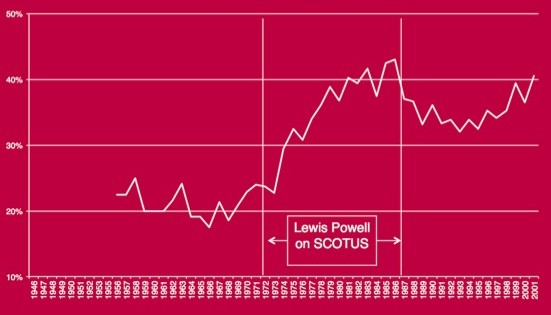
That’s one question that John Coates, a professor at Harvard Law School and a former corporate lawyer, explores in a recent survey of what he calls “the corporate takeover of the First Amendment.” According to Coates, companies are now the beneficiaries of cases involving the First Amendment just as often as individuals, and the frequency of those cases has been rising since the mid-70s. This represents a troubling appropriation of the law: “Power is taken from ordinary individuals with identities and interests as voters, owners, and employees, and transferred to corporate bureaucrats pursuing narrowly framed goals with other people’s money,” Coates writes.
To determine the most-frequent beneficiaries of First Amendment, Coates analyzed the 423 Supreme Court cases between 1946 and 2014 that dealt with questions of speech. He noticed a turning point in the data in 1975, the year that the Court decided Virginia Pharmacy, a case that overruled the precedent that commercial speech deserved no First Amendment protection. (The case involved a drug store that wanted to advertise its prices, and was challenging a ban that would have prevented it from doing so.) Before Virginia Pharmacy, businesses were involved in an average of 1.5 free-speech cases per year, and they had a 20 percent win rate. After, they were involved in 2.2 cases per year, with a 55 percent win rate.
---
The Percentage of First Amendment Cases Involving Businesses, 1946-2001
 COATES
---
The large jump in the 1970s came shortly after Justice Lewis Powell joined the Supreme Court. Powell was well known as a proponent of corporate interests at a time when anticorporate sentiments began agglomerating—a confidential memo he wrote that went public the year before began serving indicates as much. “The time has come,” he wrote to the director of the Chamber of Commerce, “for the wisdom, ingenuity and resources of American business to be marshaled against those who would destroy it.” Suffice it to say Powell sided with the drug store in 1975, and many other businesses during his 15-year tenure.
(In order to make sure that the data wasn’t being warped by the fact that the Supreme Court is highly selective in the cases it takes on, Coates also examined data from appeals courts. He found that the number of cases citingCentral Hudson, a 1979 casethat formed an important basis for corporate speech, has increased each year since then. Coates's methodology is convincing, but the possibility does remain that what has increased in recent decades is not corporations' desire to appropriate the First Amendment, but regulators' likeliness to try to regulate, for instance, advertising language—in which case an escalated reliance on free-speech precedents could be read as a creative defense rather than a shrewd arrogation of power.)
Coates’s work is a reminder, in a decade when Citizens United is many Americans’ foremost association with corporate speech, not to forget what corporations have and haven’t been allowed to do since 1789.In 1819, Chief Justice John Marshall legally defined a corporation as “an artificial being, invisible, intangible, and existing only in the contemplation of law.” And in the hundreds of years since, corporate speech has been tightly regulated, as courts have restricted what companies can and cannot communicate in contracts, to employees, and to the public. In fact, some 150 years passed between the writing of the First Amendment and its first use to strike down a law in favor of an individual (a decision supporting corporate free speech came even later)—which is to say that corporations got along just fine without First Amendment rights before Justice Powelldecided they were in need of help.
So if the Court says, as it did in its decisions in Citizens United and Hobby Lobby, that a company should be viewed as a collection of individuals, it seems to be overlooking centuries of precedents that suggest otherwise—that corporations’ speech is something to be controlled firmly. Given that, as Coates says, these pro-business First Amendment rulings encourage companies to “increasingly place bets not on new technologies and marketing strategies, but on legal and political ‘innovation,’” the courts’ stances are only that much more puzzling.
---
the Supreme Court decision in Central Hudson Gas and Electric Corp. v. Public Service Commission, 447 U.S. 557 (1980), established a four-part test for determining when commercial speech can be regulated without violating the Constitution.
Although the test has been subsequently modified slightly and is often criticized, it remains the standard applied in virtually all commercial speech cases.
The history of First Amendment protection for commercial speech
In 1942 the Supreme Court had flatly denied First Amendment protections to commercial speech in Valentine v. Chrestensen.
In 1976, in Virginia State Board of Pharmacy v. Virginia Citizens Consumer Council, Inc., it noted the value of commercial communications to a free enterprise system, but nevertheless still considered commercial expression to be low-value speech.
With Central Hudson Gas and Electric Corp. v. Public Service Commission, Justice Lewis F. Powell Jr. commanded the support of five of eight justices in the majority in overturning lower court decisions and announcing a new four-part test for determining when commercial speech is protected by the Constitution.
New York orders electric utilities to stop advertising
In an effort to conserve energy and discourage consumption during the 1973 energy crisis, the Public Service Commission of New York had ordered all electric utilities in the state to cease advertising. Central Hudson Gas and Electric Corp. challenged the order in court as a restraint on free speech.
Court used four-part test to declare the regulation to declare the regulation overbroad
Lower courts ruled that the government’s interest in discouraging consumption outweighed the value of the speech. The Supreme Court reversed, declaring the regulation too broad.
- Part one flatly denies constitutional protection to “communication more likely to deceive the public than to inform it” and to “commercial speech relating to illegal activity.” This constitutes a threshold for identifying types of commercial speech that merit First Amendment protection. The burden of proof resides with the communicator to demonstrate that speech does not fall into one of these categories. Any commercial speech that satisfies the threshold requirement is presumed to be protected, and the burden of proof shifts to the state to justify regulation by satisfying parts two through four.
- Part two provides that “the State must assert a substantial interest to be achieved by restrictions on commercial speech.”
- Part three specifies that “the [State’s] restriction must directly advance the state interest involved.”
- Part four ensures that “if the governmental interest could be served as well by a more limited restriction on commercial speech, the excessive restrictions cannot survive.”
To settle a decade-long controversy regarding the evidentiary requirements in commercial speech cases, the Court held in Rubin v. Coors Brewing Co. (1995) that the regulating agency “must demonstrate that the harms [from speech] . . . are real and that its restriction will in fact alleviate them to a material degree.”
Court later modified the Central Hudson test
The Court made a major modification in the Central Hudson test by altering the level of proof required of the government to meet part four of the test. The original requirement entailed that the government prove that the means of regulation be the “least restrictive means” available, but from more recent cases evolved the demand that the government “demonstrate narrow tailoring of the challenged regulation to the asserted interest — ‘a fit that is not necessarily perfect, but reasonable; that represents not necessarily the single best disposition but one whose scope is in proportion to the interest served’ ” (Greater New Orleans Broadcasting Association v. United States [1999], citing Board of Trustees of State University of New York v. Fox [1989]).
Critics contend that the reasonableness standard is inherently subjective because what is reasonable varies from case to case. Nevertheless, since reasonableness was first proposed in In re R.M.J. (1982), the Supreme Court has more often used the standard to overturn than to uphold governmental restrictions on commercial speech.
This article was originally published in 2009. Richard A. “Tony” Parker is an Emeritus Professor of Speech Communication at Northern Arizona University. He is the editor of Speech on Trial: Communication Perspectives On Landmark Supreme Court Decisions which received the Franklyn S. Haiman Award for Distinguished Scholarship in Freedom of Expression from the National Communication Association in 1994.