1st AMEND 2
oops see bak
320 html fail, see capt and baK
merri ok
dunno if i need sep cat for bogus assertions of
see corp person
SEE PPL LOSE
see press suppress nyt v sullivan
see criminalization
see activist suppression STUDENT SUPPRESS --> FASCISM
aha rw evoke as carte blanche for bad acts, as does trump
see censorship pc4 woke DEI hypocrisy musk free sp absolutist
see ACAD SUPPRESS Harvard 7 25
SEE STUDENT SUPPRESS 6 26 MICH
---
western states petrol assoc asserts vs berkeley gas pump sign
---
=-=
=-=-=
-=-=
Political showdown in NC as HOAs ban election signs
an 10 26
-=-=
=-=-=
an 8 26
Trump’s war against ABC and Disney for platforming comedian Jimmy Kimmel has boomeranged on him, with the entertainment behemoth suing Trump’s FCC for violating their First Amendment rights. More recently, the FCC has challenged ABC’s broadcasting licenses.
Even a conservative newspaper is siding with ABC and Disney over the Trump administration.
“ABC sued the FCC on Tuesday for ‘coercing and retaliating’ because it ‘refuses to bow to the Administration’s demands,’” wrote The Wall Street Journal editorial board on Tuesday. “The lawsuit says the government has violated its First Amendment rights ‘by launching pretextual regulatory investigations and threatening the Stations’ valuable broadcast licenses.’”
Describing FCC Chairman Brendan Carr as a “mob-boss” and agreeing with the premise of the lawsuit, the Journal opined that Trump’s FCC is indeed violating “the First Amendment by letting the FCC interfere in editorial judgments and suppress disfavored content and viewpoints. ABC’s lawsuit says the FCC’s pressure has resulted in it ‘passing on further consideration of booking several political candidates,’ and none have appeared on the program since February.”
The Journal added that Carr once criticized Democratic administrations for violating free speech rights, and concluded that “in 2020 he lambasted a progressive media group for petitioning the FCC to censor broadcasts of Mr. Trump’s Covid press conferences, calling it a ‘dangerous and sweeping attempt by the left to weaponize the FCC.’
"It’s a shame Mr. Carr won’t defend ABC’s free-speech rights today," the board added.
Trump’s war against Kimmel began in September when he falsely claimed that the talk show host had disparaged the late right-wing commentator Charlie Kirk after he was assassinated. ABC initially took Kimmel’s show off the air but reversed course after a mass protest.
"But then, you know what happened?” Kimmel said at the time. “A Christmas miracle happened. Well, it was September, it was a September miracle. But the holiday does seem to come earlier and earlier every year, doesn’t it? Millions and millions of people stood up and said: ‘No, this is not acceptable’ ... Our show came back stronger than ever. We won, the president lost and now I’m back on the air every night giving the most powerful politician on earth a right and richly deserved bollocking.”
He added, “That’s a word, right? I used it properly?"
In April Kimmel again was in the spotlight when the administration falsely claimed that one of his jokes had inspired an assassination attempt against the president.
“Kimmel’s hateful and violent rhetoric is intended to divide our country,” First Lady Melania Trump declared on social media at the time. “His monologue about my family isn’t comedy — his words are corrosive and deepens the political sickness within America.”
She continued, “People like Kimmel shouldn’t have the opportunity to enter our homes each evening to spread hate. A coward, Kimmel hides behind ABC because he knows the network will keep running cover to protect him. Enough is enough. It is time for ABC to take a stand. How many times will ABC’s leadership enable Kimmel’s atrocious behavior at the expense of our community.”
-=-=
---
1st amend STUDENT SUPPRESS 6 26
GGL
AI Overview
The Michigan chapter of the Council on American-Islamic Relations (CAIR-MI) is actively representing pro-Palestinian student activists at the University of Michigan (U of M). Legal actions include a federal civil rights lawsuit against U of M officials, campus police, and private contractors for the alleged targeting, surveillance, and arrest of student advocates. [1, 2, 3]
Key developments and legal actions concerning CAIR-MI and U of M students:
- Federal Civil Rights Lawsuit: CAIR-MI, alongside the Sugar Law Center for Economic & Social Justice, filed a federal civil rights lawsuit on behalf of Josiah Walker, a Black Muslim student advocate, citing unconstitutional punishment, unlawful arrest, and harassment. [1, 2]
- DOJ Indictments: Federal prosecutors and the DOJ unsealed indictments against pro-Palestinian activists linked to the University of Michigan following coordinated FBI and state law enforcement raids. [1]
- Free Speech Advocacy: CAIR-MI has actively pushed back against disciplinary sanctions on pro-Palestinian student groups—such as the Students Allied for Freedom and Equality (SAFE)—arguing that public universities are violating students' First Amendment rights by selectively punishing them for political advocacy. [1, 2]
Review additional information on these cases via the official CAIR Press Releases or read the initial reporting from CBS News Detroit.
MICHIGAN STUDENTS DOJ 6 26 cair-mi-raises-serious-first-amendment-concerns-regarding-university-of-michigan-protest-indictments
The Michigan chapter of the Council on American-Islamic Relations (CAIR-MI) today expressed serious concerns regarding the recently unsealed indictments arising from protests at the University of Michigan, warning that while allegations of criminal conduct should be addressed through the judicial process, charging documents should not blur the line between alleged unlawful acts and constitutionally protected political expression, peaceful protest, and advocacy on matters of public concern.
WOW MJR CYA PARa]
---
NYT
Eight people who federal prosecutors said had ties to the University of Michigan were accused Wednesday of conspiring to threaten campus leaders and others into severing ties with Israel.
An indictment unsealed in the U.S. District Court for the Eastern District of Michigan, accused the pro-Palestinian activists of crossing the line from campus protest to crimes that included threats and vandalism. The defendants face varying charges, but the indictment included federal counts of conspiracy to transmit threats, witness intimidation and destruction of property to prevent seizure.
The charges in Michigan, all felonies that carry the possibility of years in prison, appeared to signify an escalation in the federal government’s efforts to crack down on pro-Palestinian activism that roiled American campuses in recent years.
“Their criminal activity included spray-painting threats, breaking windows and throwing glass jars filled with noxious chemicals into family homes,” the indictment said. “They marked their victims with threatening symbols used by Hamas, including red inverted triangles and red handprints. They used the internet and social media to broadcast their message to ensure their threats and commitment to continuing criminal activity were heard by their victims and others who support Israel.”
The Trump administration has taken a hard line against pro-Palestinian protesters, whose activism after the Hamas-led October 2023 attack on Israel and the subsequent war in Gaza led to tumult on campuses. Until now, the administration had mostly targeted universities themselves over their response to protests, although it did move to strip visas and deport some individual students last year.
---
:{GUK
A Palestinian middle school student in Michigan who was publicly admonished for refusing to stand for the pledge of allegiance as part of a personal protest against the war on Gaza has settled with her school district following a lawsuit around her first amendment free speech rights.
The teenager, identified as DK in court documents, said she faced racism from a teacher at the East middle school in Plymouth, Michigan, after she did not participate in the pledge. The teacher reportedly told DK to “go back to her country”, Fox 2 Detroit reported.
In a statement following the settlement, DK called the ordeal “terrifying” and “overwhelming” at times.
“But it taught me the importance of speaking up for what I believe is right,” said DK. “I feel proud of the outcome and of being part of something that reinforces how important free speech is. I’ve learned that even when it feels uncomfortable or risky, speaking out can make a difference, not just for me, but for others as well.”
DK, who is 14, chose not to participate in the pledge on 10 January 2025 given the continuing war on Gaza.
“I decided I wanted to sit down because I didn’t feel comfortable standing because of what’s happening in Palestine,” said DK at a February press conference.
After the pledge, DK said that a teacher told the class that “anyone that was sitting down was being very disrespectful to soldiers, to America”. DK said she tried to explain her view to the instructor but was told that if she did not like the US, she should go back to her own country. DK later left the room in tears.
The Arab American Civil Rights League and the American Civil Liberties Union of Michigan later filed a lawsuit in June 2025 against the Plymouth-Canton community schools district on behalf of DK.
As a part of the recent settlement, the Plymouth-Canton community schools district has pledged to provide diversity, sensitivity and first amendment training for staff. The district has also agreed not to punish DK, remove any indication from school files that suggest her protest was inappropriate and provide needed counseling.
Jacob Khalaf, DK’s father, applauded his daughter for her bravery in advocating for her freedom of speech.
“My daughter has shown her strong moral fiber throughout all of this,” he said in a statement to Fox 2 Detroit. “She had the courage to resist when a person in authority tried to make her relinquish her right to free speech, and then, with the help of the ACLU and ACRL, brought a lawsuit to make sure her first amendment rights, as well as those of others, were protected.”
A representative of the district could not be reached for comment by the Guardian.
---
---
an 5 26
A Canadian critic of President Donald Trump is fighting to block the Department of Homeland Security (DHS) from obtaining their personal and location information from Google.
A press release from the American Civil Liberties Union (ACLU) said that DHS issued an "administrative demand" after "John Doe" posted criticisms of the death of Renee Nicole Good and Alex Jeffrey Pretti. The individuals were killed earlier this year by federal officers who shot them during the so-called "Operation Metro Surge," in which agents were sent into Minneapolis and faced protests.
Doe's posts on X received over 100,000 views. The X account is connected to a Google account, which identifies who the individual is. However, he isn't a U.S. resident and hasn't even been in the U.S. for over a decade.
Google told the man that it can't hold out forever, but it's raising questions about the Trump administration using the power of the federal government to go after critics.
The ACLU’s complaint said that the demand for information is “a transparent gambit to chill speech the government doesn’t like.”
“I have long admired the United States for its commitment to free speech,”the plaintiff said. “Never in a million years did I think that, after criticizing the US government, I would be targeted with a summons seeking to find out who I am, where I live, where I go and what I read online.”
The ACLU's senior staff attorney, Michael Perloff, attacked the DHS effort, saying that "consequences of its potential release go beyond one individual, whether they are in the United States or elsewhere.”
Trump and his allies are known for doxing individuals, but it doesn't scare them into compliance. It has happened to federal judges who rule against the Trump administration. In one case, Trump pal Rudy Giuliani targeted two Fulton County, GA vote counters who faced death threats and harassment. They won a lawsuit, forcing Giuliani to pay millions in damages.
So far, DHS has demanded information on individuals from Google, Reddit, Discord and Meta, the New York Times reported in February, citing four people who are aware of the requests. In each case, the requests were sent directly to the tech companies, and there was no court order granting a warrant. In the past, DHS and ICE have been known to use what's called "Administrative subpoenas," which are simply written up by the departments and not issued by a court.
*The Washington Post* reported earlier this year that DHS is increasingly relying on the use of administrative subpoenas to get such personal information from companies. The report cited former officials and experts who estimate there have been thousands, possibly even tens of thousands of these kinds of subpoenas that are approved by mid-level staff who have no public accountability.
One such subpoena was issued for an individual who emailed an ICE attorney asking that they "[a]pply principles of common sense and decency" in immigration cases. The individual who sent the email filed a motion to quash, saying that the administrative subpoena was motivated by his speech and violated his First Amendment rights.
“Not satisfied with trying to suppress speech at home, the Trump administration is now targeting dissenters abroad,” the ACLU's Perloff said of the latest case of the Canadian.
Google said it requires that government requests not be overly broad.
“When we receive a subpoena, our review process is designed to protect user privacy while meeting our legal obligations,” a spokesperson told CBC News. “We inform users when their accounts have been subpoenaed, unless under legal order not to.”
Google didn't comment on whether it requires the subpoenas to come from a court or whether it accepts the made-up subpoenas issued by DHS.
---
---
EXXONKNEWs
GREENPEACE 667M$ --> 345
...
Energy Transfer’s case, originally filed by the firm Kasowitz Benson Torres (long-time lawyers for Donald Trump), was taken over in 2023 by Gibson Dunn, a law firm with a record of “playing both sides” of the First Amendment on behalf of its corporate clients. }:Gibson Dunn lawyer Trey Cox represented Energy Transfer in its opposition to Greenpeace’s motion this week,:{:{ arguing that juror questionnaires are the appropriate method to ensure a fair trial — and that whether or not Morton County residents received or read the newspaper was irrelevant.}:
:{===
===
---
---
AN 5 26
The Trump administration has called on TV network ABC to “take a stand” after a joke from its late night comedy host Jimmy Kimmel offended the US president and first lady.
Two days before the White House Correpondents’ dinner on April 25, Kimmel broadcast what he said was a “roast” of the Trump administration. Roasts are typically quite savage comedic attacks which have become a traditional part of the dinner.
Trump, who was famously the target of jokes from former president, Barack Obama, at a dinner in 2011, had never attended the dinner while in office. This year he opted to attend, but the comedian’s spot was taken by what was described as a “mentalist”.
So Kimmel said he decided to supply the roast on his show as an “all-American” version of the Correspondents’ Dinner. In what he said was a joke about the 24-year age difference between the couple, he described Melania Trump as “having a glow like an expectant widow”. But after a would-be assassin tried to launch a murderous attack two days later at the dinner, the Trumps have demanded his sacking.
“Enough is enough. It is time for ABC to take a stand. How many times will ABC’s leadership enable Kimmel’s atrocious behaviour at the expense of our community,” Melania Trump wrote in a post on X.
But it appears that ABC, a subsidiary of Disney, is instead standing by Kimmel, who has not been taken off air, in contrast to an episode in September 2025 when Kimmel was suspended after comments he made following the death of right-wing influencer Charlie Kirk, a close friend of the Trumps. After a public outcry, ABC relented and restored Kimmel’s show.
In response, Brendan Carr, the head of the Federal Communications Commission (FCC) has brought forward a review of ABC’s station licences, which were previously not scheduled until 2028 or later. Carr’s actions follow a press conference at the White House on April 26 at which press secretary Karoline Leavitt said coverage critical of Trump, including from his Democrat opponents, was responsible for the rise in political violence in the US by creating what she called a “leftwing cult of hatred”.
These examples highlight the politicisation of “free speech” by the Trump administration as a cudgel to silence disfavoured viewpoints under the guise protecting the public from harm.
First amendment protection for free speech
But these political debates are becoming increasingly distanced from the first amendment. That is, the interpretation of the first amendment by the Supreme Court and the protections it provides to individuals and entities, including media outlets and broadcast companies, from government interference. The wider this gulf becomes, the greater the space between the principles underlying the expansive protections afforded to speech in the US and the public’s understanding of the democratic principles that underpin these protections.
This is more important than ever in the Trump era. Actions taken by the administration to target broadcast networks and individuals for political speech are precisely what the first amendment protects against. It was designed, among other things, to protect individuals, entities and the press from government interference by creating an open marketplace in which ideas compete freely.
This is particularly true for dissenting political speech, which is the core of the first amendment. This explains why government interference with speech based on “the specific motivating ideology or the opinion or perspective of the speaker” – known as “viewpoint discrimination” – is expressly prohibited.
Additionally, whether and to what extent speech is offensive is irrelevant to the protection it enjoys. When it comes to the value of public debate, the first amendment is not neutral. Indeed, as a Supreme Court judgment, Baumgartner v. United States (1944) found: “One of the prerogatives of American citizenship is the right to criticize public men and measures.” Moreover a more recent judgment, Hustler Magazine, Inc. v. Falwell (1988), found that “robust political debate” is expressly encouraged, given that such debate “is bound to produce speech that is critical of those who hold public office”.
Importantly, the Supreme Court found in New York Times Co. v. Sullivan (1964) that such criticism, inevitably, will not always be reasoned or moderate and that public figures as well as public officials will be subjected to “vehement, caustic, and sometimes unpleasantly sharp attacks”.
The motive of the speaker is also irrelevant, as the Supreme Court held in Hustler v Falwell that while a “bad motive” may be deemed controlling for tort liability and in other areas of the law, “the first amendment prohibits such a result in the area of public debate about public figures”.
Stakes couldn’t be higher
By expressly linking Democrat criticisms of the president, and pointed critiques (however off-colour) from Kimmel and his fellow political satirists to an upsurge in political violence, the Trump administration is trying to silence criticism of its actions. But it’s also clear that this behaviour is precisely what the first amendment prohibits.
Ironically, the media often portrays these episodes as “feuds” between Trump and his critics.
But when viewed through the lens of the first amendment and its core values in this context, the stakes are much higher. These episodes constitute an effort to wrest control of public discourse by interfering in the marketplace of ideas in order silence those critical of the government.
And history tells us that a government that can silence its critics often does so in pursuit of unchecked power. Viewed through this lens, perhaps the greatest threat to American democracy is the government itself.
Eliza Bechtold, Programmes Manager and Research Fellow, the Bonavero Institute of Human Rights, Faculty of Law, University of Oxford
This article is republished from The Conversation under a Creative Commons license. Read the original article.
---
---
AN 3 26
On Monday, March 23 in the case Villarreal v. Alaniz, the U.S. Supreme Court rejected an appeal from Laredo, Texas-based journalist Priscilla Villarreal — who believes she was wrongly arrested while doing her work. Villarreal argued that the arrest was a First Amendment violation, but most of the High Court's justices disagreed with her appeal and declined to take the case.
Liberal Justice Sonia Sotomayor, however, offered a vehement dissent in the decision, agreeing with Villarreal (who goes by La Gordiloca online) that journalism was being treated like a crime.
In a newletter published by Slate on March 26, journalist Shirin Ali emphasizes that the High Court's Villarreal v. Alaniz decision and Sotomayor's dissent come at a time when journalism is under attack from the second Trump Administration.
"This week," Ali argues, "the Supreme Court effectively shielded the nation's law enforcement from consequences when it treats journalism as a crime. In rejecting an appeal in Villarreal v. Alaniz, the Court has allowed local officials in Texas to remain immune from prosecution for arresting a journalist who published information she received from a government official. This case presented a strikingly simple question: Does it violate a journalist's First Amendment rights if they are arrested for requesting and publishing information that a government employee willingly hands over?.... The case of Villarreal v. Alaniz has been ping-ponging through the courts since 2019, when it was first filed by Priscilla Villarreal….. Things took a sharp turn for her in 2017, when she was arrested at her home for allegedly violating section 39.06(c) of the Texas Penal Code."
Ali adds, "The obscure law bans a person from soliciting or receiving nonpublic information from a public servant by means of their office or employment with the intent to obtain a benefit."
The Slate reporter notes that although a judge dismissed the charges against Villareal and criticized the Texas law for being too vague, Villareal "fought back with a lawsuit demanding damages."
In her dissent, Sotomayor laid out her arguments in favor of Villareal's position.
The Barack Obama appointee wrote, "It should be obvious that this arrest violated the First Amendment….. By arresting Villarreal, rather than solely disciplining the employee for any wrongdoing, county officials took this 'everyday journalism' and transformed it 'into a crime.' This was a blatant First Amendment violation. No reasonable officer would have thought that he could have arrested Villarreal, consistent with the Constitution, for asking the questions she asked."
The High Court's March 23 decision, Ali argues, is especially bad in light of the Trump Administration's attacks on the First Amendment.
"As we collectively watch Trump's second presidency play out, when he has weaponized every tool at the executive's disposal to attack speech he does not like —Washington Post reporter Hannah Natanson, late night host Jimmy Kimmel, and a slew of major national news organizations come to mind — the Supreme Court's lack of action threatens all Americans," Ali writes. "Journalists have a singular ability to hold the Trump Administration and local governments all across the country accountable, through shedding light on what they are doing and how they are wielding their power. Criminalizing this work without consequence doesn't just endanger those journalists; it threatens everyday Americans who rely on local and national reporting in nearly all aspects of their lives."
---
no mention of don lemon?
You can’t celebrate the First Amendment with Donald Trump
Written by Matt Gertz
:{Published 03/03/26
The White House Correspondents Association has decided that now is the time to link arms with President Donald Trump. After Trump claimed Monday night on Truth Social that the group had “asked me, very nicely, to be the Honoree” at the annual White House Correspondent’s Dinner, its president, CBS News White House correspondent Weijia Jiang, confirmed in a press release that he had accepted its invitation.*
The White House Correspondent’s Dinner — an annual event in which D.C.’s top journalists rub elbows with the people they cover and an odd array of celebrities — is, at its best, an unseemly affair excused by the conceit, as Jiang put it in her press release, that it is “a dinner that celebrates the First Amendment.” Under past administrations, there was a benefit to have the president attend the event and give a speech in which he would inevitably pay tribute to the freedom of the press.
But as a matter of principle, you can either have a dinner that celebrates the First Amendment or you can have a dinner that features Donald Trump. You can’t have both because the president holds the freedom of the press in contempt and is using the administration to hammer reporters into compliance with his whims — and everyone knows it.
Trump’s White House violated the First Amendment by punishing the AP. The president kicked off his second term by barring Associated Press reporters from the White House press pool and other events because the AP continued referring to the “Gulf of Mexico” instead of adopting Trump’s new “Gulf of America” moniker. When a Trump-appointed judge ordered the AP’s access restored on the grounds that this violated the First Amendment, the White House sidestepped the ruling by eliminating the press pool’s dedicated slot for wire service reporters.
The Pentagon replaced its press corps with Trumpist propagandists. Defense Secretary Pete Hegseth, a former Fox News propagandist, has overseen the replacement of credible reporters with MAGA shills. After handing the workspaces of national news outlets to right-wing publications and barring unescorted reporters from much of the building, in September the department rolled out stringent new reporting guidelines that nearly every member of the established press corps refused to sign on the grounds that it would make them “stenographers parroting press releases.” They were subsequently replaced by far-right outlets and influencers willing to accept those terms.
At Trump’s behest, the Justice Department targets journalists. Trump ranted about the “fake news” during a March 2025 speech at DOJ headquarters, instructing its employees to “watch for” their “totally illegal” behavior. Attorney General Pam Bondi subsequently rescinded the previous administration’s restrictions protecting journalists from prosecutorial scrutiny. Several journalists, including former CNN host Don Lemon, were arrested in January and charged with federal crimes in connection with their filming of a protest inside a Minnesota church. The same month, the FBI conducted an unprecedented search of Washington Post reporter Hannah Natanson’s home, seizing her devices as part of a leak investigation.
Trump has also suggested that Bondi could prosecute critical reporters for “hate speech” on the grounds that “you treat me so unfairly, it’s hate,” and said media pollsters whose surveys show he is unpopular “should be investigated for ELECTION FRAUD.”
The FCC crackdown on free speech. Trump has frequently called for the Federal Communications Commission to rescind the broadcast licenses of ABC, CBS, and NBC in retaliation for coverage he finds unfavorable. While taking those networks off the air is not actually within the FCC’s power, its Trumpy chairman, Brendan Carr, is leveraging its authority to cudgel them into line, leading to the censoring of Jimmy Kimmel and Stephen Colbert.
An authoritarian plan for America’s media. Trump emulates the authoritarian policies of Hungary’s Viktor Orbán, who dismantled his country’s independent news media by steering critical outlets into the hands of his cronies. CBS News, the social media platform TikTok, and Paramount’s movie studios have already come under the thumb of the pro-Trump billionaires Larry and David Ellison — and CNN, along with HBO and Warner’s movie business, could soon follow after Trump’s threats of regulatory retribution influenced their sale.
Trump’s endless lawsuits over journalism he doesn’t like.ABC News and CBS News faced lawsuits from Trump they could have won over coverage he didn’t like, but after Trump’s reelection, their parent companies capitulated and settled them. Trump is currently suing The New York Times and several of its reporters for $15 billion over its coverage of his businesses; The Wall Street Journal, two of its reporters, several related entities, and its owner, Rupert Murdoch, for $10 billion over coverage of Trump’s relationship with notorious sex offender Jeffrey Epstein; and The Des Moines Register and its pollster, J. Ann Selzer, for publishing poll results that showed Trump trailing in Iowa in October 2024.
Trump is also currently suing the Pulitzer Prize Board for defamation over its 2018 award to the Times and the Post for their reporting on Russian interference in the 2016 election.
The WHCA’s Jiang should probably consult with the group’s lawyers before announcing the “awards honoring excellent journalism” she said would be given at the event — if the “wrong” honoree wins, the president attending the dinner to celebrate the First Amendment may respond with a lawsuit.
Trump is well aware that the media establishment is capitulating to his will.
“You know at some point, they give up,” he said of media owners in an interview last year with The Atlantic. “At some point they say, No más, no más.”
Now it’s the WHCA’s turn to surrender.
*Notably, Jiang did not address Trump’s assertion that he would be the dinner’s “Honoree.” That's almost certainly a lie designed to humiliate the press — Trump loves grinding them into the dirt, which is what we should expect from the forthcoming event.
---
---
AN 1 267
President Donald Trump's Department of Justice (DOJ) is now claiming that Americans do not have a Constitutional right to film law enforcement officers.
NOTUS reported Tuesday that the DOJ made the claim during a hearing in U.S. District Judge Katherine Menendez's courtroom. The hearing was the result of ongoing litigation by Minneapolis residents over claims that U.S. Immigration and Customs Enforcement (ICE) agents pepper-sprayed and arrested them without cause. While the initial complaint was filed prior to the fatal shooting of U.S. citizen Renee Nicole Good by ICE agent Jonathan Ross, the plaintiffs cited Good's death as reason to issue a temporary restraining order against federal agents.
DOJ attorney Jeremy Newman defended the recent trend of ICE agents drawing their weapons on civilian vehicles following them, saying that "following" can lead to "dangerous activity," and that it was "reasonable for officers to be concerned about their safety. NOTUS further reported that Newman cited the 2023 Molina v. Book case to support his argument that "observing and recording police is not a clearly established First Amendment right."
"It’s very clear that this is an ongoing emergency," Newman said.
However, other court cases decided at the federal appellate court level have ruled that Americans do indeed have the right to document police officers in the course of their duties. In the 2022 Irizarry v. Yehia case, the U.S. Court of Appeals for the Tenth Circuit ruled that the First Amendment guaranteed the right to film police officers "subject to reasonable time, place and manner restrictions."
Judge Menendez – an appointee of former President Joe Biden — reportedly chided ICE agents for not including copies of any police reports, body camera footage or statements from agents involved in altercations with plaintiffs. Newman responded that the agency "did the best we could" as their response to the litigation was cobbled together over the holiday season.
Menendez also told plaintiffs she would rule on their petition for emergency relief by Thursday or Friday, and hinted that any ruling would pertain to their specific case, rather than a broader decision impacting all protesters in Minneapolis.
Click here to read NOTUS' article in its entirety.
---
ABC TERRY MORAN fired for twt on miller 3 hatred
---
PCO
A federal judge on Thursday blocked the Trump administration from deporting a British man who was recently placed on a visa ban after U.S. officials accused him and four other Europeans of online censorship.
Center for Countering Digital Hate CEO Imran Ahmed filed a complaint Thursday against Secretary of State Marco Rubioand Attorney General Pam Bondito prevent “the imminent prospect of unconstitutional arrest,” the lawsuit reads.
“The government’s actions are the latest in a string of escalating and unjustifiable assaults on the First Amendment and other rights, one that cannot stand basic legal scrutiny,” it continues. “Simply put, immigration enforcement—here, immigration detention and threatened deportation — may not be used as a tool to punish noncitizen speakers who express views disfavored by the current administration.”
The suit adds that Ahmed is a lawful permanent resident with a wife and son who are U.S. citizens.
The complaint cites other recent cases where foreign nationals on student visas, including Mahmoud Khalil and Rümeysa Öztürk, were stripped of their documentation and faced with deportation as “part of a larger pattern of attempted repression of constitutionally protected speech.”
“The government has no power to punish Mr. Ahmed for his research, protected speech, and advocacy, and Defendants cannot evade those constitutional limitations by simply claiming that Mr. Ahmed’s presence or activities have ‘potentially serious adverse foreign policy consequences for the United States,'” the suit reads.
The administration placed the visa ban on Ahmed, along with French former European Union Commissioner Thierry Breton, Global Disinformation Index CEO Clare Melford and HateAid leaders Anna-Lena von Hodenberg and Josephine Ballon, on Tuesday.
By signing up, I agree to the Terms of Use, have reviewed the Privacy Policy, and to receive personalized offers and communications via email, on-site notifications, and targeted advertising using my email address from The Hill, Nexstar Media Inc., and its affiliates
Breton backed the EU’s Digital Services Act, which compelled online platforms to tackle hate speech and misinformation and remove it from their pages. U.S. officials claim the law unfairly targets American tech companies and citizens, Reuters reported.
On Tuesday, Rubio accused the five of leading “organized efforts to coerce American platforms to punish American viewpoints they oppose.”
“Today, @StateDept will take steps to bar leading figures of the global censorship-industrial complex from entering the United States,” Rubio posted on social media. “We stand ready and willing to expand this list if others do not reverse course.”
Undersecretary of State Sarah Rogers shared Rubio’s message and warned that “if you spend your career fomenting censorship of American speech, you’re unwelcome on American soil.”
Breton criticized his visa ban, asking in an X post if “[former. Sen. Joe] McCarthy’s witch hunt” was back.
---
an 11 25
President Donald Trump’s Department of Defense is now targeting a sitting U.S. Senator, one of six Democratic lawmakers who appeared in a video reminding members of the U.S. Armed Forces and the Intelligence Community of their right to refuse to obey an illegal order.
U.S. Senator Mark Kelly (D-AZ), a retired astronaut and former naval officer, along with the other five said, “threats to our Constitution aren’t just coming from abroad, but from right here at home.”
“Our laws are clear,” they added. “You can refuse illegal orders.”
In an official statement on social media, the Department of Defense alleged it has “received serious allegations of misconduct against Captain Mark Kelly, USN (Ret.).”
It added, “a thorough review of these allegations has been initiated to determine further actions, which may include recall to active duty for court-martial proceedings or administrative measures.” The statement also said, “federal laws such as 18 U.S.C. § 2387 prohibit actions intended to interfere with the loyalty, morale, or good order and discipline of the armed forces.”
President Trump last week in a series of social media posts promoted hanging the six Democrats.
“It’s called seditious behavior at the highest level,” the president also charged. “Each one of these traitors to our Country should be Arrested and put on trial. Their words cannot be allowed to stand – We won’t have a Country anymore!!! An example must be set.”
“Seditious behavior, punishable by death!” he continued.
Critics blasted the Pentagon’s move.
“Sen. Kelly didn’t tell troops to defy lawful orders, he reminded them of their duty to refuse unlawful ones, which is literally what the UCMJ and decades of military precedent require!” wrote The Bulwark’s Evan Rosenfeld. “Pretending that doing so is ‘misconduct’ is complete propaganda and not rooted in law.”
Punchbowl News’ Andrew Desiderio called it “Pretty extraordinary to call out a sitting senator in this way.”
The Bulwark’s Sam Stein labeled it “ham-handed,” and Bill Kristol of Defending Democracy called it “Naked authoritarianism.”
But The Independent’s Andrew Feinberg noted that the video “looks to have been an official one for which [Kelly] would enjoy Speech or Debate immunity.”
---
intercept 11 25
Federal prosecutors have filed a new indictment in response to a July 4 noise demonstration outside the Prairieland ICE detention facility in Alvarado, Texas, during which a police officer was shot.
There are numerous problems with the indictment, but perhaps the most glaring is its inclusion of charges against a Dallas artist who wasn’t even at the protest. Daniel “Des” Sanchez is accused of transporting a box that contained “Antifa materials” after the incident, supposedly to conceal evidence against his wife, Maricela Rueda, who was there.
But the boxed materials aren’t Molotov cocktails, pipe bombs, or whatever MAGA officials claim “Antifa” uses to wage its imaginary war on America. As prosecutors laid out in the July criminal complaint that led to the indictment, they were zines and pamphlets. Some contain controversial ideas — one was titled “Insurrectionary Anarchy” — but they’re fully constitutionally protected free speech. The case demonstrates the administration’s intensifying efforts to criminalize left-wing activists after Donald Trump announced in September that he was designating “Antifa” as a “major terrorist organization” — a legal designation that doesn’t exist for domestic groups — following the killing of Charlie Kirk.
Sanchez was first indicted in October on charges of “corruptly concealing a document or record” as a standalone case, but the new indictment merges his charges with those against the other defendants, likely in hopes of burying the First Amendment problems with the case against him under prosecutors’ claims about the alleged shooting.
It’s an escalation of a familiar tactic. In 2023, Georgia prosecutors listed “zine” distribution as part of the conspiracy charges against 61 Stop Cop City protesters in a sprawling RICO indictment that didn’t bother to explain how each individual defendant was involved in any actual crime. I wrote back then about my concern that this wasn’t just sloppy overreach, but also ablueprint for censorship. Those fears have now been validated by Sanchez’s prosecution solely for possessing similar literature.
 Photos of the zines Daniel Sanchez is charged with “corruptly concealing.” Photo: U.S. District Court, Northern District of Texas
There have been other warnings that cops and prosecutors think they’ve found a constitutional loophole — if you can’t punish reporting it, punish transporting it. Los Angeles journalist Maya Lau is suing the LA County Sheriff’s Department for secretly investigating her for conspiracy, theft of government property, unlawful access of a computer, burglary, and receiving stolen property. According to her attorneys, her only offense was reporting on a list of deputies with histories of misconduct for the Los Angeles Times.
If you can’t punish reporting it, punish transporting it.
It’s also reminiscent of the Biden administration’s case against right-wing outlet Project Veritas for possessing and transporting Ashley Biden’s diary, which the organization bought from a Florida woman later convicted of stealing and selling it. The Constitution protects the right to publish materials stolen by others — a right that would be meaningless if they couldn’t possess the materials in the first place.
Despite the collapses of theCop City prosecution and the Lau investigation — and its own dismissal of the Project Veritas case — the Trump administration has followed those dangerous examples, characterizing lawful activism and ideologies as terrorist conspiracies (a strategy Trump allies also floated during this first term) to seize the power to prosecute pamphlet possession anytime they use the magic word “Antifa.”
That’s a chilling combination for any journalist, activist, or individual who criticizes Trump. National security reporters have long dealt with the specter of prosecution under the archaic Espionage Act for merely obtaining government secrets from sources, particularly after the Biden administration extracted a guilty plea from WikiLeaks founder Julian Assange. But the rest of the press — and everyone else, for that matter — understood that merely possessing written materials, no matter what they said, is not a crime.
Most Read
Pardoned Capitol Rioter Tried to Hush Child Sex Victim With Promise of Jan. 6 Reparation Money, Police Say
Amanda Moore](https://theintercept.com/2025/11/17/pardoned-jan-6-child-abuse-molestation-andrew-paul-johnson/)
[
Wyden Blasts Kristi Noem for Abusing Subpoena Power to Unmask ICE Watcher
Sam Biddle](https://theintercept.com/2025/11/21/wyden-noem-dhs-customs-unmask-social-media/)
Guilt by Literature
At what point does a literary collection or newspaper subscription become prosecutorial evidence under the Trump administration’s logic? Essentially, whenever it’s convenient. The vagueness is a feature, not a bug. When people don’t know which political materials might later be deemed evidence of criminality, the safest course is to avoid engaging with controversial ideas altogether.
The slippery slope from anarchist zines to conventional journalism isn’t hypothetical, and we’re already sliding fast. Journalist Mario Guevara can tell you that from El Salvador, where he was deported in a clear case of retaliation for livestreaming a No Kings protest. So can Tufts doctoral student Rümeysa Öztürk, as she awaits deportation proceedings for co-writing an opinion piece critical of Israel’s wars that the administration considers evidence of support for terrorism.
At least two journalists lawfully in the U.S. — Ya’akub Ira Vijandre and Sami Hamdi — were nabbed by ICE just last month. The case against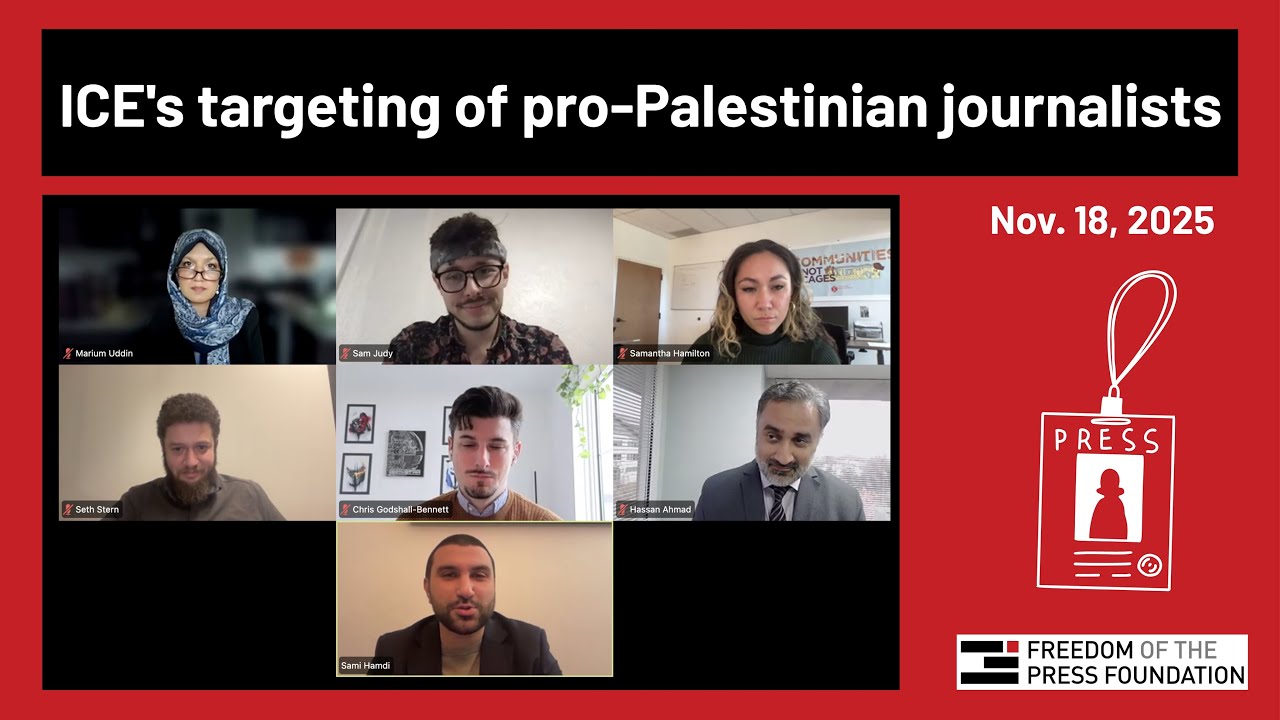 is partially based on his criticism of prosecutorial overreach in the Holy Land Five case and his liking social media posts that quote Quranic verses, raising the question of how far away we are from someone being indicted for transporting a Quran or a news article critical of the war on terror.
Related
“Antifa” Protesters Charged With Terrorism for Constitutionally Protected Activity](https://theintercept.com/2025/10/17/antifa-ice-protesters-terrorism-texas-prairieland/)
Sanchez’s case is prosecutorial overreach stacked on more prosecutorial overreach. The National Lawyers Guild criticizedprosecutors’ tenuous dot-connecting to justify holding 18 defendants responsible for one gunshot wound. Some defendants were also charged with supporting terrorism due to their alleged association with “Antifa.” Anarchist zines were cited as evidence against them, too.
Sanchez was charged following a search that ICE proclaimed on social media turned up “literal insurrectionist propaganda” he had allegedly transported from his home to an apartment, noting that “insurrectionary anarchism is regarded as the most serious form of domestic (non-jihadi) terrorist threat.” The tweet also said that Sanchez is a green card holder granted legal status through the Deferred Action for Childhood Arrivals program.
The indictment claims Sanchez was transporting those materials to conceal them because they incriminated his wife. But how can possession of literature incriminate anyone, let alone someone who isn’t even accused of anything but being present when someone else allegedly fired a gun? Zines aren’t contraband; it’s not illegal to be an anarchist or read about anarchism. I don’t know why Sanchez allegedly moved the box of documents, but if it was because he (apparently correctly) feared prosecutors would try to use them against his wife, that’s a commentary on prosecutors’ lawlessness, not Sanchez’s.
Violent rhetoric is subject to punishment only when it constitutes a “true threat” of imminent violence. Even then, the speaker is held responsible, not anyone merely in possession of their words.
Government prosecutors haven’t alleged the “Antifa materials” contained any “true threats,” or any other category of speech that falls outside the protection of the First Amendment. Nor did they allege that the materials were used to plan the alleged actions of protesters on July 4 (although they did allege that the materials were “anti-government” and “anti-Trump”).
We don’t need a constitutional right to publish (or possess) only what the government likes.
Even the aforementioned “Insurrectionary Anarchy: Organizing for Attack” zine, despite its hyperbolic title, reads like a think piece, not a how-to manual. It advocates for tactics like rent strikes and squatting, not shooting police officers. Critically, it has nothing to do with whether Sanchez’s wife committed crimes on July 4.
Being guilty of possessing literature is a concept fundamentally incompatible with a free society. We don’t need a constitutional right to publish (or possess) only what the government likes, and the “anti-government” literature in Sanchez’s box of zines is exactly what the First Amendment protects. With history and leaders like Vladimir Putin and Viktor Orbán as a guide, we also know it’s highly unlikely that Trump’s censorship crusade will stop with a few radical pamphlets.
The Framers Loved Zines
There’s an irony in a supposedly conservative administration treating anti-government pamphlets as evidence of criminality. Many of the publications the Constitution’s framers had in mind when they authored the First Amendment’s press freedom clause bore far more resemblance to Sanchez’s box of zines than to the output of today’s mainstream news media.
Revolutionary-era America was awash in highly opinionated, politically radical literature. Thomas Paine’s “Common Sense” was designed to inspire revolution against the established government. Newspapers like the Boston Gazette printed inflammatory writings by Samuel Adams and others urging the colonies to prepare for war after the Coercive Acts. The Declaration of Independence itself recognized the right of the people to rise up. It did not assume the revolution of the time would be the last one.
One might call it “literal insurrectionist propaganda” — and some of it was probably transported in boxes.
The framers enshrined press freedom not because they imagined today’s professionally trained journalists maintaining careful neutrality. They protected it because they understood firsthand the need for journalists and writers who believed their government had become tyrannical to espouse revolution.
For all their many faults, the framers were confident enough in their ideas that they were willing to let them be tested. If the government’s conduct didn’t call for radical opposition, then radical ideas wouldn’t catch on. It sure looks like the current administration doesn’t want to make that bet.
---
===
ref
https://www.exxonknews.org/p/exxon-uses-free-speech-argument-to
exxon uses free speech argument to fight climate laws
It’s not the first time the oil giant has tried to ward off accountability using the First Amendment.
Oct 29, 2025
ExxonMobil has sued California over a pair of state laws that force big companies to disclose financial climate risks to shareholders and the full greenhouse gas emissions resulting from their businesses — arguing that the measures violate the company’s free speech. It’s the latest example of Exxon, the biggest U.S. oil company, wielding the First Amendment as both a shield and sword in court.
The California Climate Accountability Package, which passed in 2023, would make companies doing business in California disclose emissions that result from the use of their products — also known as “Scope 3” emissions. That category makes up the vast majority of emissions from the oil and gas industry, but companies including Exxon have fought to avoid making them transparent.
Exxon’s new lawsuit argues that by requiring it to account for the entirety of its emissions, the laws would force it to “espouse California’s preferred framing for issues of immense public concern” and to “describe its emissions and climate-related risks in terms the company fundamentally disagrees with.” The lawsuit asks a U.S. District Court to stop California from enforcing the laws.
The case targets the country’s only existing disclosure laws for greenhouse gas emissions, even as the federal government ends emissions reporting and required climate disclosures at the federal level. But it’s also part of a years-long trend of corporations using First Amendment arguments in an attempt to shield themselves from scrutiny and regulation, experts say.
“This is part of a long history of companies including Exxon trying to use the First Amendment to block regulation that they dislike,” said Amanda Shanor, an associate professor of legal studies and business ethics at the Wharton School of the University of Pennsylvania, who has chronicled some of those high-stakes efforts. “That’s not really how the First Amendment works or is supposed to work.”
The fossil fuel industry, in particular, has leveraged First Amendment arguments to repel criticism over their role in the climate crisis. In recent years, oil companies have claimed that lawsuits across the country accusing them of misleading the public about climate change violate their free speech rights. From Oregon to Massachusetts, the District of Columbia to California, Exxon has brought motions to dismiss states’ and municipalities’ climate deception lawsuits under anti-SLAPP (Strategic Lawsuits Against Public Participation) statutes — laws that were developed to protect the free speech of press and civil society groups.
One of those motions, responding to lawsuits filed by the state of California and eight California municipalities, argues that oil companies “have long exercised their rights to participate in the public debate over which policies best balance the challenges posed by a changing climate and the world’s increasing need for energy,” and that “This lawsuit threatens Defendants’ continued participation in those debates.”
The law firm representing Exxon in that motion, O’Melveny and Myers, is the same as in the latest First Amendment lawsuit against California. The argument seeks to cast Exxon’s public statements on climate change as political speech, which concerns public policy and has stringent First Amendment protections, rather than commercial speech, which does not enjoy the same level of protections.
“We’ve seen this movie before,” said Robert Brulle, an environmental sociologist and professor at Brown University and director of research at the Climate Social Science Network, who has co-authored briefs in support of climate deception lawsuits. “Their fallback defense is freedom of speech — ‘nobody ever said we have to be truthful.’”
Mobil Oil, now part of ExxonMobil, helped pioneer the idea of corporations as citizen-like entities with free speech rights in an effort to revive their reputation back in the 1970s. Exxon and Mobil backed other corporations’ First Amendment lawsuits, arguing that companies should be free to express their views on “matters of public concern,” including climate change. In Supreme Court cases like First National Bank v. Bellotti and Citizens United v. FEC, the idea of corporate free speech was expanded to usher in nearly unlimited corporate money in politics.
Still, none of oil companies’ anti-SLAPP arguments has been validated by judges. Under existing First Amendment law, Shanor explained, Exxon’s lawsuit against California’s disclosure laws should be very unlikely to succeed, too.
“Exxon is grasping at straws,” said Maggie Coulter, a senior attorney for the Climate Law Institute at the Center for Biological Diversity. “Courts have already rejected companies’ weak arguments rebranding their greenwashing and misinformation as free speech.”
Exxon and other corporations could be hoping that the U.S. Supreme Court might eventually use such a case to alter the boundaries between political and commercial speech — or “change what the rules are in a way that will favor them,” Shanor said.
“You just keep throwing the same basic core argument up there, wave the flag of the First Amendment and say, ‘leave us alone.’ Kind of like holding up a cross to a vampire,” said Brulle. “Now they’re playing it out in California to try to build a record in the court.”
‘Disproportionate blame’ on Exxon
According to Exxon’s lawyers, California’s disclosure framework would place “disproportionate blame on large companies like ExxonMobil for being large.”
“ExxonMobil understands the very real risks associated with climate change and supports continued efforts to address those risks,” reads the complaint. Such frameworks “send the counterproductive message that large companies are uniquely responsible for climate change no matter how efficiently they satisfy societal demand for energy, goods, and services.”
Michael Gerrard, director of the Sabin Center for Climate Change Law at Columbia University, said that Exxon should “let the readers decide.”
“If Exxon doesn’t like California’s framing, it’s free to supplement it with its own framing and offer an explanation of why it thinks that one is better,” he said.
The company’s own framing hasn’t gone over well so far, at least with climate experts. Exxon is the top investor-owned carbon emitter in the world, according to the latest Carbon Majors database by researchers at the nonprofit think tank InfluenceMap, and one of the most profitable. But Exxon officials have often blamed the company’s emissions largely on the habits of consumers. In an interviewwith Fortune last year, ExxonMobil CEO Darren Woods said that “the people who are generating the emissions need to be aware of and pay the price … for generating those emissions,” and referred to Scope 3 emissions as “essentially the emissions of our customers.”
Just before that interview, Exxon sued its own shareholders in an effort to block a proposal for the oil giant to limit its Scope 3 emissions. The lawsuit was dismissed, but not before shareholders revoked their proposal.
“What Exxon is asking for in this case is to say that shareholders should have no right to question companies on climate-related issues,” Danielle Fugere, president & chief counsel of shareholder advocacy group As You Sow, told ExxonKnewsat the time.
Both that lawsuit and another last year brought by the U.S. Chamber of Commerce against the California Air Resources Board, which also alleged California’s climate disclosure laws violated the First Amendment, were argued by law firm Gibson Dunn — a favorite of fossil fuel companies. The industry has also used the firm to pursue massive legal damages from their opponents, including this year’s nearly $667 million verdict against Greenpeace for its role in the protests against Energy Transfer’s Dakota Access pipeline.
Earlier this year, after California Attorney General Rob Bonta and a group of nonprofits sued Exxon for a “decades-long campaign of deception” about the efficacy of plastic recycling, Exxon sued them back under defamation laws — a clear example of a SLAPP, legal experts said.
Though climate deception lawsuits face growing attacks from fossil fuel allies and the Trump administration in the United States, they have seen recent successes abroad — a Paris Court just ruled that French oil giant Total’s advertising about “net zero” and leading the energy transition was misleading consumers. And over the last week, two new lawsuits have been brought against major polluters in the UK and Germany by victims of climate disasters. “I think that the evidence is pretty solid that Exxon and Mobil and all sorts of other folks knew all about climate damages and lied about it, and it’s just going to get more solid the more information we get,” said Brulle.
California officials said they would fight to uphold the disclosure laws, which could soon show up in other states, too. “These laws are about transparency,” said Christine Lee, a spokesperson for the California Department of Justice, in a statement.“ExxonMobil might want to continue keeping the public in the dark, but we’re ready to litigate vigorously in court to ensure the public’s access to these important facts.”
---
---
AN 10 25
A Boston federal judge's "blistering" 161-page ruling on what he called the president's attackson the Constitution contains a stunning warning for the president's enemies, Axios reports.
Judge William G. Young's ruling maintains international students' rights to free speech despite the administration's efforts to deport them after a professors union and student groups sued the Trump administration over its efforts to detain and deport immigrants who expressed pro-Palestinianviews.
Tufts University doctoral student Rümeysa Öztürk was detained for six weeks over a pro-Palestinian op-ed she co-wrote in the university newspaper.
Young blasted the Homeland Security and State departments for being used to crack down on free speech, saying if they can be manipulated to do that, so can the IRS, Social Security Administration and Federal Home Loan Mortgage Corp.
They, he wrote, can be "unconstitutionally weaponized" against Trump's enemies, even though "political persecutionis anathema to our Constitution and everything for which America stands."
Young, who called this the biggest case the Boston federal court ever faced, called the State and Homeland Security departments' moves "unconstitutional attacks on political speech," saying Trump's support for this strategy violates his duties as president to defend the Constitution.
Trump's executive orders, Young wrote, singled out pro-Palestinian speech "for a campaign of speech-chilling retribution" under the guise of combating antisemitism and hate speech.
The judge also weighed in on federal immigration agents sporting face masks, likening them to "to KKK members and 'cowardly desperados,'" noting that even the military doesn't shield soldiers with masks, Axios reports.
He called the federal employees who raised concerns about insufficient evidence to deport these students "true patriots" who were "weaponized by their highest superiors to reach foregone conclusions for most ignoble ends."
Also included in the judge's ruling was a random postcard he received from an anonymous sender that said, "Trump has pardons and tanks. What do you have?"
"Alone, I have nothing but my sense of duty," the judge replied. "Together, we ... you and me — have our magnificent Constitution."
---
---
an 10 25
Senior U.S. District Judge William Young — a Ronald Reagan appointee — included a photocopy of a postcard sent to him by an anonymous critic complaining of judicial power in U.S. government.
Young, a U.S. District Judge in Boston, ruled Tuesday that the Trump administration’s policy of targeting foreign students and faculty for pro-Palestinian activism violated the First Amendment’s free speech protections. He included with his decision a scornful scolding of the administration’s attempt to terrify dissent on college campuses — as well as a rebuke to what looks like a pro-Trump voter boasting that: “Trump has pardons and tanks ... What do you have?”
“Dear Mr. or Ms, Anonymous,” Young replied in writing. “Alone, I have nothing but my sense of duty. Together, We the People of the United States — you and me — have our magnificent Constitution.”
“Here’s how that works in a specific case,” added Young, who then submitted a court opinion concluding that “Secretaries Noem and Rubio and their several agents and subordinates acted in concert to misuse the sweeping powers of their respective offices to target non-citizen pro-Palestinians for deportation primarily on account of their First Amendment protected political speech.”
“They did so in order to strike fear into similarly situated non-citizen pro-Palestinian individuals, pro-actively (and effectively) curbing lawful Pro-Palestinian speech and intentionally denying such individuals (including the plaintiffs here) the freedom of speech that is their right,” Young said, adding that “the effect of these targeted deportation proceedings continues unconstitutionally to chill freedom of speech to this day.”
“I gasped when I saw the front page of this decision,” posted American Immigration Council Senior Fellow Aaron Reichlin-Melnick on X.
Politico Senior Legal Affairs Reporter Kyle Chaney called it “the most scathing legal rebuke of the Trump era,” on X.
Read a PBS article on the news at this link.
---
---
GUK 9 25
Trump issued a presidential memorandum on Thursday aimed at reining in what he has called a radical leftwing domestic “terror network” but which seemed likely to meet fierce legal pushback from critics depicting it as a licence for a broad crackdown on his political opponents.
Prompted by journalists, Trump suggested that George Soros, the billionaire Hungarian-born philanthropist who funds the Open Society Foundations, could be in his sights. He also identified Reid Hoffman, a billionaire venture capitalist, adding: “I hear about him. Maybe it could be him. It could be a lot of people.”
Earlier, the Open Society Foundations had hit back at reports that the justice department was planning to target the group and criticized the Trump administration for “politically motivated attacks on civil society”.
Hina Shamsi of the American Civil Liberties Union (ACLU) said in a statement: “After one of the most harrowing weeks for our first amendment rights, the president is invoking political violence, which we all condemn, as an excuse to target non-profits and activists with the false and stigmatizing label of ‘domestic terrorism’. This is a shameful and dangerous move.”
At a signing ceremony in the Oval Office, the memorandum was presented as aimed at “establishing a comprehensive strategy to investigate, disrupt and dismantle all stages of organized political violence and domestic terrorism”.
It was said to be part of an administration-wide response that would include the FBI’s joint terrorism taskforces, the Department of Justice and the Department of Treasury.
The ACLU said in a statement that joint terrorism task forces “already have a long history of investigations that wrongly target protestors, communities of color, and those engaged in dissent”.
Surrounded by members of his cabinet, Trump said the goal was to target “the funders of a lot of these groups”, some of whom he claimed to know. But he was vague when asked which groups he meant or who the funders were.
“These are anarchists and agitators, professional anarchists and agitators, and they get hired by wealthy people, some of whom I know, I guess, probably know,” he said. “You wouldn’t know at dinner with them. Everything’s nice, and then you find out that they funded millions of dollars to these lunatics.”
Daniel Richman, a professor at Columbia Law School and former federal prosecutor, said the memorandum itself probably doesn’t carry much legal weight. “You can’t by executive order create new crimes. This does not create new crimes. This says you will use the Terrorism Task Force to go after things they would usually go after,” Richman said.
But, he added: “The concern is that this administration has made clear it is only interested in pursuing politically oriented terrorism that disagrees with its political agenda.”
The Trump administration does not need to create new crimes in order to do this, he said. Laws already on the books “have and continue to provide the ability to go after ideological opponents”.
Though the memorandum may not hold up in court, “I fear how far they are going to take this,” said Jason Charter, a former activist who faced charges during Trump’s first term in connection with efforts to tear down the Andrew Jackson statue in front of the White House. “Antifa is antifascism, and antifascism is a very widely shared thing, and being against fascism should not be illegal.”
“It’s trying to slap terrorism charges on people doing protected activities under the Bill of Rights,” Charter said.
The memorandum comes amid a rightwing clamor for retribution in the wake of the 10 September murder of the far-right pundit Charlie Kirk, which Trump and his supporters have blamed on an organized leftwing network, despite early indications that the suspect acted alone.
It also followed Wednesday’s deadly attack on a US Immigration and Customs Enforcement (Ice) facility in Dallas that killed one detainee and injured two others. One of the bullets used in the attack was inscribed with the message “anti-Ice”.
The memorandum lumps together a series of apparently unrelated episodes, including a foiled 2022 assassination attempt on the supreme court justice Brett Kavanaugh, the murder of the CEO of United Healthcare in Manhattan last December, last year’s two failed attempts on Trump’s life, and unrest on the streets of Los Angeles and Portland, Oregon.
Stephen Miller, the influential White House deputy chief of staff – who has been vocal in the administration’s previous calls for a crackdown – called the initiative “historical and significant”.
“This is the first time in American history that there is an all-of-government effort to dismantle leftwing terrorism, to dismantle antifa, to dismantle the organizations that have been carrying out these acts of political violence and terrorism,” Miller said. The joint terrorism taskforce, a unit inside the FBI, would be “the hub” of the effort, he added.
He said “an entire system of feeder organisations” were funding “harassment, doxing, intimidation and, ultimately, attempted assassinations” of public officials.
“It is all carefully planned, executed and thought through,” said Miller. “It is terrorism on our soil. We are going to use the entire force of the federal government to uproot these organizations, root and branch.”
Trump and his allies have portrayed political violence as a phenomenon primarily associated with the left, overlooking recent incidents in which Democrats have been targeted by people who are believed to be rightwing extremists or incidents in which the perpetrator’s motives are unclear.
Postingon his Truth Social network on Wednesday, Trump clearly tied the Ice facility attack to the Democrats and their criticism of his immigration crackdown in a manner resembling his response to Kirk’s killing.
“This violence is the result of the radical left Democrats constantly demonizing law enforcement, calling for ICE to be demolished, and comparing ICE Officers to “Nazis,” he wrote. “The continuing violence from Radical Left Terrorists, in the aftermath of Charlie Kirk’s assassination, must be stopped. ICE Officers, and other Brave Members of Law Enforcement, are under grave threat.”
But authorities on Thursday said that they did not find evidence that the suspect was a member of “any specific group or entity, nor did he mention any specific government agency other than Ice”.
In the wake of Kirk’s killing, Trump issued an executive order designating antifa, a loose network of groups that has been involved in confrontations with the far right, as a “domestic terrorist organization”.
The new memorandum states: “This political violence is not a series of isolated incidents and does not emerge organically. Instead, it is a culmination of sophisticated, organized campaigns of targeted intimidation, radicalization, threats, and violence designed to silence opposing speech, limit political activity, change or direct policy outcomes, and prevent the functioning of a democratic society.
“A new law enforcement strategy that investigates all participants in these criminal and terroristic conspiracies – including the organized structures, networks, entities, organizations, funding sources, and predicate actions behind them – is required.”
“Intimidation tactics against those standing up for human rights and civil liberties are sadly not new in the history of this country,” Shamsi, the director of the ACLU’s national security project, said. “In an earlier era, civil rights movement leaders were also labeled security threats and investigated, monitored, threatened, and even arrested.”
*Lauren Gambino contributed reporting
---
---
Donald Trump is the greatest threat to our free speech rights
The president’s new comment demolishes the pathetic argument some elements of the right have pushed over the last week
Written by Matt Gertz
:{Published09/24/25
The greatest threat that free speech currently faces in this country is that the president doesn’t believe in it. Donald Trump treats criticism of himself, his administration, and his policies as fundamentally illegitimate, and he is eager to use government power to curtail it. When Trump’s allies downplay or spin the anti-speech activity flowing downstream from his whims, they engage in willful ignorance or deliberate deception.
Trump responded to Jimmy Kimmel’s Tuesday night return to ABC’s airwaves following a suspension his administration helped bring about by once again threatening the network with retribution. After claiming that ABC had reversed a decision (apparently announced only privately to the White House) that Jimmy Kimmel Live! “was cancelled,” the president accused Kimmel of being an “arm of the DNC,” which he alleged makes Kimmel’s show “a major Illegal Campaign Contribution.” He went on to say: “I think we’re going to test ABC out on this. Let’s see how we do.”
The president’s comment demolishes the pathetic argument some elements of the right have pushed over the last week.
According to Fox News stars, Republican members of Congress, and Federal Communications Commission Chair Brendan Carr, ABC’s decision to take Kimmel off the air was purely a “business decision.” In their telling, it was simply a quirky coincidence that the move came just hours after Carr said that ABC’s affiliates and parent company Disney could “do this the easy way or the hard way” and either “take action, frankly, on Kimmel, or there's going to be additional work for the FCC ahead” — a credible threat given his history of leveraging regulatory power for the right’s benefit.
Even Senate Republicans who criticized the administration’s clear violation of the First Amendment focused their attention solely on Carr while leaving a Trump-shaped hole in their arguments.
Trump’s post, however, shows that Carr’s actions were totally in keeping with the president’s desire to use state power to try to impose censorship on media outlets. Trump is not concerned that his administration was violating the First Amendment by trying to force his critics off the air — he is concerned that it didn’t work, and he is making it abundantly clear to everyone who works for him that he wants them to keep trying.
That position is hardly a new revelation. Denunciations of critical media coverage are a hallmark of Trump’s politics, and he has frequently used personal lawsuits and government authority to try to strong-arm outlets into submission.
:{We saw a similar inability to grapple with Trump’s closely held and consistent position that his administration should be able to punish critics for their speech earlier this month. After Attorney General Pam Bondi declared that the Justice Department would “absolutely target you, go after you, if you are targeting anyone with hate speech,” the floodgates opened.
Commentators across the right condemned her comments as an affront to free speech principles. They wrote that she “fails to understand the basics of the U.S. Constitution” (the editors of National Review), lacks “a basic understanding of the First Amendment” (The Wall Street Journal editorial board), and should be fired (The Daily Wire’s Matt Walsh). The response was so furious and widespread that Bondi was forced to clarify her remarks.}:
That’s commendable as far as it goes. But it’s not like Bondi is some sort of wild outlier in a Trump administration otherwise committed to free speech. When an ABC News reporter asked the president about Bondi’s remarks the following morning, he didn’t even try to distance himself from them. Instead, he told the reporter, “She’ll probably go after people like you, because you treat me so unfairly, it’s hate.”
Trump’s remarks once again give the game away — he views potential “hate speech” prosecutions as an extension of his desire for his administration to punish his critics and media outlets that publish or air them. But right-wing criticism of Trump’s comments was far more muted than the backlash Bondi faced.
Perhaps they think that it’s much more important that an attorney general support the Constitution’s protections than that the president do so. I think it’s more likely they understand the president’s position is a threat to the First Amendment, but also recognize that it is impossible to remain a conservative in good standing while voicing such concerns about the president and have simply decided not to talk about it.
Meanwhile, the president will continue his administration’s efforts to punish critics and coerce media outlets until he can turn on his TV, flip through the channels, and see nothing but Fox-style propaganda on every network.
MMA //
09/18/25 12:00 PM EDT
08/25/25 12:40 PM EDT
07/21/25
---
an 925
In another judicial rebuke to President Donald Trump’s effort to harm funding for the nation’s arts, a federal judge on Friday evening ruled against the president’s insider attack on the National Endowment for the Arts by blocking grant applications from artists or organizations that don’t strictly adhere to the president’s right-wing ideology on gender.
Ruling in favor of several arts organizations that sued the NEA earlier this year over the policy change, US District Court Judge William E. Smith, appointed by President George W. Bush and serving in Rhode Island, said the grant restrictions ran afoul of federal statute and the US Constitution.
As theNew York Times reports:
The lawsuit was filed in March by several arts organizations, including Rhode Island Latino Arts, which promotes art made by Latinos, and National Queer Theater, a New York company. It challenged new agency regulations, initially introduced in February, stating that federal funds “shall not be used to promote gender ideology,” which Mr. Trump’s order said includes “the false claim that males can identify as and thus become women and vice versa.”In the lawsuit, the groups, which said they had all produced or supported work about transgender and nonbinary people, argued that they would effectively be barred from seeking grants “on artistic merit and excellence grounds,” which violated their rights under the First Amendment.
In his ruling, Williams called the policy that came out of Trump’s edict both “arbitrary and capricious,” one that violated not only free speech protections but also the Administrative Procedure Act (APA), which governs the EPA grant-making process.
Smith held that the NEA’s grant application review process “violates the First Amendment because it is a viewpoint-based restriction on private speech.”
Specifically, the judge said the government’s policy “offered zero explanation” to applicants “of what it means for a project to ‘promote gender ideology,’ let alone how that concept relates to artistic merit, artistic excellence, general standards of decency, or respect for the diverse beliefs and values of the American public.”
“The NEA intends to disfavor applications that promote gender ideology precisely because they promote gender ideology,” Smith stated in his judicial order. “The Final Notice therefore promises to penalize artists based on their speech.”
The lawsuit was brought four groups: Rhode Island Latino Arts (RILA), National Queer Theater (NQT), The Theater Offensive (TTO), and Theatre Communications Group (TCG).
Marta V. Martínez, RILA’s executive director, said the court’s ruling “affirms what we have always believed: the freedom to create, to express one’s truth, and to tell our stories is a right protected by the First Amendment.”
“As an organization deeply rooted in storytelling, theater, and the preservation of cultural history,” Martínez added, “we are relieved and grateful that the courts have recognized the importance of protecting artistic expression for all people, including those in LGBTQ+ communities.”
The ACLU, which had helped bring the suit on behalf of the plaintiffs, celebrated the ruling as “an important victory” for artists, free speech, and the rule of law.
“At a time when the government is using its full weight to try to impose ideological conformity, this order is an important reminder that the First Amendment protects us from exactly that,” Vera Eidelman, senior staff attorney with the ACLU’s Speech, Privacy & Technology Project. “Even when the government funds private speech, it does not get to support only those messages that parrot its views.”
---}:
---
9 25
AG Pam Bondi Says "We Can Prosecute You" for Refusing to Print Posters for Charlie Kirk Vigil
But there doesn't seem to be any federal law actually authorizing such prosecutions (or civil lawsuits).
Eugene Volokh | 9.16.2025
The Hill (Ashleigh Fields) reports:
Attorney General Pam Bondi on Monday said the Justice Department was investigating an incident involving a Michigan Office Depot employee who refused to print flyers advertising a vigil for conservative activist Charlie Kirk…. Office Depot said last week they removed the employee responsible for denying the order placed by the Kalamazoo County Republican Party.
Here's the Bondi quote, from Hannity on Fox, starting about 4:42:
Businesses cannot discriminate. If you wanna go in and print posters with Charlie's pictures on them for a vigil, you have to let them do that. We can prosecute you for that. But I have Harmeet Dhillon right now in our Civil Rights unit looking at that immediately, that Office Depot had done that. We're looking at that.
But no federal law, to my knowledge, purports to ban stores from discriminating based on the political expression of the material they're asked to print.
Title II of the Civil Rights Act of 1964 bans discrimination by certain places of public accommodation—such as restaurants, hotels, theaters, and places of public amusement—based on race, religion, and national origin. But it doesn't ban discrimination based on political views, and it doesn't apply to retailers, so it wouldn't apply here. It also bans discrimination based on disability, but that's not applicable here either. Businesses candiscriminate, just not on bases that the law forbids; and here, federal law doesn't appear to forbid this sort of discrimination.
Now some jurisdictions do ban political discrimination in places of public accommodation (see this article). If such a ban were applied to a print shop that deliberately refused to process an order based on its political content, then it might violate the First Amendment (see the concurrence in *Lexington-Fayette Urban County Human Rights Comm'n v. Hands On Originals* (Ky. 2019), a case in which Cato Institute and I filed an amicus brief making the First Amendment argument).
That First Amendment claim would be strengthened, of course, by 303 Creative LLC v. Elenis (2023), which recognized a First Amendment right not to create a website for same-sex weddings. It's conceivable that a court might limit the First Amendment defenses to small businesses where the owner would have to do the work personally; cf. Rumsfeld v. FAIR(2006), which upheld certain requirements that universities host certain speech, and distribute related speech, though perhaps the reasoning of 303 Creativewould apply even to a large business such as Office Depot.
But none of that even arises here, because those jurisdictions are certain cities and counties, some territories, D.C., and perhaps a few states. None of those laws applies to the Office Depot involved in this incident; and even if there was such a law in Michigan or in the town of Portage (where the store was apparently located), it wouldn't be enforced by the U.S. Justice Department. Perhaps I'm missing something here, but it's hard to see a credible legal basis for AG Bondi's statements.
Start your day with Reason
---
---}:
an 7 25
no lnx
One Trump court case will determine whether America will still have a democracy
Sabrina Haake, Raw Story July 26, 2025
Oral arguments were heard this week in Harvard v. Trump’s cross motions for summary judgment. Summary judgment, or “judgment on the papers,” means both sides agree on the facts but disagree on how the law applies to those facts.
Neither Harvard nor the Trump administration dispute that Trump made certain unprecedented written demands to the University, accompanied by unprecedented threats if they refused to comply.
Harvard refused to comply, and sued instead.
Whichever party loses summary judgment will appeal, and the final disposition will likely, eventually, come from the Supreme Court. If the high court’s republican majority further empowers Trump’s edicts under their misguided “unitary executive theory,” our 249 year history of ideological freedoms will come to an end and the nation will yield to Trump’s revenge.
Trump’s pressure campaign against Harvard
The Trump administration, ostensibly seeking to reduce campus antisemitism following widespread protests over Gaza, threatened to withhold billions in federal funding from Harvard, place a lien on University assets, and put academic departments in receivership, unless Harvard agreed to:
Exclusively promote faculty committed to Harvard’s mission and Trump’s viewpoints;
Submit the university to a Trump administration review of “viewpoint diversity;”
Scrutinize any “programs and departments” that might, in Trump’s judgment, fuel ‘antisemitic harassment;’
Submit all faculty to outside review for alleged ‘plagiarism;’
Submit to a comprehensive hiring and review audit conducted by the federal government;
Implement a comprehensive mask ban and suspend anyone who wears a mask;
Report to the federal government on any faculty members who “discriminated against” Jewish or Israeli students;
Screen student applicants to reject those with viewpoints “hostile” to Trump/ Israel’s policies;
Establish outside review for Harvard programs that reflect “ideological capture” ie, programs where classroom messaging does not reflect Trump-supportive dogma;
Diminish the influence of its own professors and faculty over the university; or
Establish “merit based” hiring and admissions policies that pleased the Trump administration.
The oral argument
Oral argument was both testy and basic. The lone DOJ lawyer arguing the motion, Michael Velchik, asserted that the administration “has the power to decide” where it will spend taxpayer money and that, “the government does not want to fund research at institutions that fail to address antisemitism to (the government’s) satisfaction.” According to Velchik, when Harvard refused to go along with Trump’s demands, Trump was free to terminate any and all contracts with the university.
Trump essentially argues that the federal government can terminate or withhold funds under a contract for any reason at all, even if that reason violates free speech, the right of free association, or any other rights protected under First Amendment.
Steven Lehotsky, Harvard’s counsel, countered that Trump’s attempts to control the University, including telling the University what it can teach and how it can teach it, represents Trump’s blatant “and unrepentant” violation of the First Amendment. The Supreme Court has long held viewpoint discrimination to be such a serious violation of the 1st A that it is treated as ‘presumptively unconstitutional.’ Lehotsky argued plainly that, “It’s the constitutional third rail, or it should be, for the government to insist it can engage in viewpoint discrimination.”
Trump has been consistent in his belief that he can punish speech and political conduct he doesn’t like, notwithstanding clear and unequivocal legal precedent to the contrary. He has applied the same strong-arm tactics to boardrooms and corporations, national media outlets, law firms, and, most recently, comedians. If the Roberts court continues to enable him, Trump will extend the same reasoning to imprison or otherwise punish anyone who criticizes him, following the same authoritarian playbook that produced such hits as Nazi Germany, Viktor Orban’s Hungary, and Putin’s Russia.
How does Trump tie withdrawal of medical research funding to the civil rights of Jewish people?
Even if Harvard allowed the expression of antisemitic views on campus—despite a strong Jewish presence among Harvard faculty—there still has to be some nexus, or some connection, between what the government is trying to fix (antisemitism) and the methods it uses to fix it. The judge went to the heart of this concept when she asked Trump’s counsel to explain the relationship between antisemitism and cutting off unrelated cancer research funding, noting that Trump is “not taking away grants from labs that have been antisemitic.”
An amicus brief filed in the case by Jewish scholars also points out that Trump routinely uses “antisemitism” as a ruse to attack freedom of speech, freedom of thought, and freedom of association. As noted in their amici brief, many Jewish scholars reject the notion that being Jewish “requires adherence to a specific conception of Zionism or support for the Israeli government or its policies and practices.”
Judge Burroughs noted that if Trump, or any federal administration, could punish a university without due process simply because they don’t like their politics, or their message, or the substance of their curriculum, the constitutional consequences would be “staggering.”
The outcome of Harvard v. Trump will determine whether we still have a democracy
Harvard v. Trump asks the most fundamental questions one can ask about the relationship between the government and the governed. Under the First Amendment, can the federal government control what is taught in the classroom and what is said on campus at various universities? Can the federal government withhold federal funds if it doesn’t like what it hears, or doesn’t agree with the viewpoints expressed?
If the answer is no, then our Constitution stands. Trump will join a 249 year line-up of presidents who have to grin and bear it when students call them ugly names and protest their policies. Who knows, Trump might even someday learn why the framers made free speech and association the very first amendment to the Constitution.
But if the answer is yes, the First Amendment will fall under the Roberts court, and there’s no reason to believe any other Constitutional protection will stand. Trump will forcibly insert his right-wing ideology onto campuses, boardrooms, and legacy media nationwide. That ideology will serve a madman’s lust for power and revenge, and America’s democracy will cease to exist.
Sabrina Haake is a columnist and 25+ year federal trial attorney specializing in 1st and 14th A defense. Her Substack, The Haake Take, is free.
---
NOTE LEGACY MEDIA CNN NBC ~ OBAMA TRAITOR BS
As Trump struggles to deflect from reporting on his Epstein ties, MAGA media set their sights on the press
It’s getting really bad out there
Written by Matt Gertz
Published 07/23/25 MMA
Six months into Donald Trump’s second presidency, an unhinged MAGA media is infested with calls for the arrest of former President Barack Obama — and one prominent right-wing commentator is even floating legal consequences for journalists who debunk their twisted rationale.
On July 18, amid a Trump administration effort to stave off a MAGA revolt over its handling of disclosures related to convicted sex offender Jeffrey Epstein, Director of National Intelligence Tulsi Gabbard released documents she claimed proved the existence of “a treasonous conspiracy” by the Obama administration following the 2016 election against Trump, claiming she had asked the Justice Department to investigate further. The president piled on in remarks to the press on July 22, claiming that “we caught Barack Hussein Obama” and accusing him of “treason.”
This argument is based on either malice or stupidity. Gabbard is conflating the findings of a December 2016 document showing that the intelligence community did not assess that the Russian government had hacked election systems and changed vote totals to benefit Trump with those of a January 2017 assessment that the Russian government had sought to influence the campaign to benefit Trump by, among other things, hacking Democratic email servers and releasing the contents.
Based on that faulty premise, Gabbard accused Obama and his advisers of subverting the intelligence community for political aims. But the December 2016 assessment is consistent with what the Obama administration was saying publicly at the time, while the findings of the January 2017 assessment were reiterated in Trump administration reports by the Justice Department as well as a Senate committee helmed at the time by current Secretary of State Marco Rubio. Indeed, that committee reviewed the January 2017 intelligence community analysis and concluded it was an “impressive accomplishment” that “reflects proper analytic tradecraft” and “provides a proper representation of the intelligence” and that the analysts who produced it faced “no politically motivated pressure.”
Members of the right-wing media ecosystem, with few exceptions, do not care about these facts, and they are using incredibly demagogic language to rile up their audiences as they call for political retribution.
Benny Johnson is floating a “military tribunal” for Obama; Mike Davis says the former president should “lawyer up”; Charlie Kirk wants “perp walks”; Liz Wheeler is demanding that the charges be not “perjury” but “treason”; Jesse Watters is asking a U.S. senator whether Obama should “go to prison.” They have apparently learned nothing from overpromising on Epstein only for the Trump administration to under-deliver when the facts couldn’t match the MAGA narrative.
Indeed, according to Mollie Hemingway, editor-in-chief of The Federalist and a Fox contributor, even typing the preceding paragraphs casting doubt on the validity of Gabbard’s argument should expose me to legal exposure. In a July 22 thread, she described Gabbard’s “revelations” as “the biggest scandal in our history” and condemned media outlets for “ignoring” and “downplaying” it.
“Every time the Washington Post, CNN, the New York Times, Margaret Brennan, The Atlantic, etc., lie and say this story is not a big deal, they are perpetuating their seditious conspiracy,” she added. “Creative minds should think about what legal exposure they have for their role in this.”
Hemingway went on to describe those outlets and journalists as “co-conspirators” in the alleged plot. She did not identify the legal consequences she believes they should face. Nor is it clear what this legal argument would mean for conservatives like her Fox colleague Andrew McCarthy or Eli Lake, who criticized Gabbard’s conclusions, or the right-wing outlets which published their assessments, Rich Lowry’s National Review and Bari Weiss’ The Free Press.
It should go without saying that the idea of “creative minds” dreaming up ways to punish journalists for producing reporting which contradicts the views of the president, his administration, and its propagandists is an affront to the First Amendment and basic principles of free speech and a free press.
Unfortunately, right-wing dreams of frog-marching journalists may not be far-fetched
We warned in December, after Trump campaigned on threats to jail reporters and pull the licenses of critical news outlets and won, that a coalition of elite right-wing figures were “using wealth, lawfare, and government power to silence the press and carry out their political agenda unimpeded.” And the last six months have demonstrated the president’s determination to use his power to bend the press to his will.
Trump has sought to put financial pressure on news outlets in order to chill speech critical of him. He filed lawsuits that experts found frivolous over reporting he disliked from ABC News and CBS News, then successfully leveraged the threat or use of corrupt regulatory actions to secure eight-figure settlements. He is currently pursuing similar lawsuits against the Pulitzer Prize Board, The Des Moines Register, and the corporate parents of The Wall Street Journal. The president has threatened additional lawsuits against The New York Times and CNN and called for the firings of their reporters.
Corporate owners of media outlets appear to be buckling to this pressure. “Executives at major media outlets are reportedly instructing their newsrooms to temper their coverage of President Trump and his administration amid growing fears of political retribution,” Axios reported in May. Indeed, Trump has gloated to reporters about the effectiveness of his strategy.
Beyond personal lawsuits, Trump has floated federal criminal investigations into news outlets over their reporting. That is no idle threat given his pattern of launching Justice Department probes into his political enemies via executive order and given the reality that the top ranks of federal law enforcement are stocked with people who are comfortable functioning as an extension of his personal desires.
Indeed, federal law enforcement officials appear more than willing to participate in Trump’s assault on the free press. His attorney general terminated rules which restricted prosecutors from seeking records and testimony from journalists as part of leak investigations. Several noncitizens have faced detention by the Department of Homeland Security over their public writing. And a former lawyer for January 6 defendants is running a DOJ “Weaponization Working Group” whose purpose appears to be weaponizing the government against Trump’s foes.
Trump’s diverse right-wing coalition and the fractured media ecosystem he unified during his campaign may be breaking apart over his handling of the Epstein case. But he seems to recognize that one thing that brings them together is their shared hatred of Democrats like Obama and the free press, and he’s been acting accordingly. And that means that just an eighth of the way through his second presidency, we’re already in very dangerous territory.
//
Trump’s latest attempt to defuse the Epstein revolt: Point supporters at common enemies
07/21/25 2:38 PM EDT
12/23/24 9:59 AM EST
05/28/25
---
---
an 7 25
Roughly 140 Environmental Protection Agency employees have been placed on administrative leave after signing a letter warning of political interference in the agency’s work—prompting critics to accuse the Trump administration of ignoring their First Amendment rights.
Calling the letter “a remarkable rebuke of the agency’s political leadership,” The New York Times reported on Monday that more than 270 EPA employees had signed the public letter “denouncing what they described as the Trump administration’s efforts to politicize, dismantle and sideline the main federal agency tasked with protecting the environment and public health.”
On Thursday, the Times reported that 144 workers had been suspended, other news outlets put the number at 139.
In that public letter, signatories said they are joining in “solidarity with employees across the federal government in opposing this administration’s policies,” and that they “stand together in dissent against the current administration’s focus on harmful deregulation, mischaracterization of previous EPA actions, and disregard for scientific expertise.”
READ MORE: ‘Stop Talking’: Johnson Suggests Jeffries Is Lying in Marathon Budget Speech
They detailed their five primary concerns, including, “Undermining public trust,” “Ignoring scientific consensus to benefit polluters,” “Reversing EPA’s progress in America’s most vulnerable communities,” “Dismantling the Office of Research and Development,” and “Promoting a culture of fear, forcing staff to choose between their livelihood and well-being.”
On Thursday, the 140 or so employees who allegedly had signed the letter with their official titles received emails saying they had been placed on leave for two weeks “pending an administrative investigation,” The New York Times reported.
“The Environmental Protection Agency has a zero-tolerance policy for career bureaucrats unlawfully undermining, sabotaging, and undercutting the administration’s agenda as voted for by the great people of this country last November,” Brigit Hirsch, an EPA spokesperson, said in a statement, according to Bloomberg Law News.
“The letter, addressed to EPA head Lee Zeldin, alleged the agency has used its communication platforms to ‘promote misinformation and overtly partisan rhetoric,'” Bloomberg added. “One example the signatories cited was a March statement laying out the administration’s deregulatory agenda, in which Zeldin referred to ‘the climate change religion.'”
READ MORE: Democratic Strategist Warns Trump Could Try to Impose Martial Law Before 2026 Midterms
Nicole Cantello, president of the American Federation of Government Employees (AFGE) Local 704, called the move “blatant retaliation,” The Hill reported.
“We don’t swear an oath to the Trump administration, we swear an oath to the Constitution and so we don’t feel like we violated that oath or that we did anything wrong by signing this letter,” she said.
Cantello, on social media, wrote that EPA workers “have the right to freedom of speech, just like every other American.”
Addressing EPA Administrator Zeldin directly, she said: “See you in court.”
Some denounced the administration’s move.
Attorney Mark Zaid, who handles national security and whistleblower cases, wrote: “Apparently retaliation has already begun. This is what defines this Administration.”He also offered to “provide pro bono consultation to examine current situation.”
The New York Times’ Trip Gabriel asked, “What First Amendment?”
READ MORE: Trump Appeared Unaware His Budget Bill Cuts $1T From Medicaid: Report
---
an 7 25
A new report suggests that President Donald Trump may soon be setting his sights on the Fourth Estate, and his administration is already allegedly looking for a "test case" to see how much it can get away with in the courts.
That's according to a Monday article in Rolling Stone, which reported that unnamed sources close to the White House say Trump is considering the Espionage Act to prosecute journalists who report on leaks obtained from inside the administration. According to Rolling Stone, the president was so incensed about reporting on a leaked Pentagon report that undermined his claims about Iranian nuclear sites being "obliterated" as a result of strikes he ordered in mid-June that he contemplated using the 108 year-old law to bring cases against reporters.
"Why not the press?" Trump reportedly said during the conversation.
READ MORE: 'Effects could be catastrophic': Trump and the Republican Congress could achieve a first
The source said that the Trump administration would not only charge individual journalists under the Espionage Act, but would also indict their employers as "co-conspirators" and bring cases against publications. A separate source described as a "senior Trump administration official" affirmed that the question of whether to invoke the Espionage Act wasn't merely theoretical.
"All we’d really need is one text or email from a reporter telling a source: ‘Can you pull something for me?’ or something very direct of that nature,” the senior official told Rolling Stone. “If somebody in the media wasn’t careful even for a split second, that could make the difference between a reporter, and a criminal.”
Rolling Stone's Ryan Bort and Asawin Suebsaeng recalled a comment from an unnamed conservative attorney close to Trump who suggested in December that Trump's second term would be "brutal" in his approach to whistleblowers, leakers and journalists who they speak to. That attorney promised that Trump's second administration would "be even more aggressive" in its crackdown on leaks and reporters that publish them.
Trump isn't the first president to use the Espionage Act against journalists, however. Bort and Suebsaeng reported that former President Barack Obama's administration indicted eight sources under the law, though Trump had already surpassed that number just two years into his first term.
READ MORE:George Conway reveals the 'one remedy' left to stop Trump's 'lawlessness and illegality'
Click here to read Rolling Stone's full report (subscription required).
---
rww
- Media Matters: Media Matters files suit in federal court to block retaliatory FTC investigation and protect its First Amendment rights
Investigation into Media Matters is the latest example of Trump administration abusing power to target perceived political opponents.
---
ANY PROTESTER DC ARMY PARADE BIRTHDAY MET WITH BIG FORCE
---
trump mentioned? LA mayor (and newsome?) to troops who booed w/o prompt? call N attn seeker
AN 6 25
Military and political experts, veterans, and journalists are condemning President Donald Trump’s political rally at Fort Bragg on Tuesday, warning he crossed a critical line by delivering overtly political and authoritarian-themed remarks before U.S. Army troops. They also expressed alarm that uniformed soldiers appeared at ease booing his political opponents—another troubling breach of military norms. Some now say the time has come for generals to publicly speak out.}:
The commander in chief entered the event to "Hail to the Chief," and as he took to the stage, his "MAGA anthem," "Proud to Be an American," played. For nearly one hour, in about 9,000 words, Trump delivered a political stump speech. He attacked his political opposition, Democrats, including President Joe Biden and his administration, California Governor Gavin Newsom ("Newscum") and L.A. Mayor Karen Bass. He attacked transgender Americans. He attacked the Democratic U.S. Senators who opposed the nomination of Pete Hegseth for Defense Secretary, calling them "a very hostile group of people that I think really don't want to see America be great again."
He got the soldiers to boo "the fake news" media, and President Joe Biden. He told them the 2020 election was "rigged and stolen."
READ MORE: ‘Show. Us. The. Plan.’: Pentagon Chief Ripped for Dodging Budget Details in Heated Hearing
He attacked the people in Los Angeles protesting his deportation policies, describing it as "anarchy," while telling the soldiers that defending their civil rights was not the reason Americans fought overseas:
"Generations of army heroes did not shed their blood on distant shores only to watch our country be destroyed by invasion and third world lawlessness here at home like is happening in California. As Commander in chief, I will not let that happen. It's never going to happen. What you're witnessing in California is a full-blown assault on peace, on public order and on national sovereignty carried out by rioters bearing foreign flags with the aim of continuing a foreign invasion of our country."
He thanked the generals, and mentioned some by name. He talked about "the real generals," as opposed to the ones Americans see on television.
Critics are warning of grave consequences.
"This is the most unacceptable and egregious politicization of our troops we’ve ever seen," wrote veterans' activist Paul Rieckhoff, an Army combat veteran, responding to video of Trump getting the soldiers to boo the press, President Joe Biden, and the mayor of Los Angeles.
Trump goaded active duty troops at his Fort Bragg speech to boo:
The Media, Gov. Gavin Newsom, Mayor Karen Bass, and Joe Biden pic.twitter.com/1v9amsi7rv
— The Bulwark (@BulwarkOnline) June 10, 2025
"And it’s not a one off. It’s a strategy," added Rieckhoff, who is also the founder of Iraq and Afghanistan Veterans of America (IAVA). "And one we’ll see in full and dangerous display this weekend at his military birthday parade for himself. Trump wants the world to think our great military is HIS military. And wants to coerce and manipulate troops into making them think it is too. And driving down their public trust and approval by the minute. Trump has created America’s greatest civil-military relations crisis since the Civil War. And it’s just getting started."
Retired U.S. Army lieutenant colonel Alexander Vindman, a former Director of European Affairs for the National Security Council (NSC), warned: "America’s Generals and Admirals are terrified. They are cowed. They seem unlikely to hold the line and live up to their oaths to serve the U.S. Constitution."
Lamenting that "the Generals stay silent," he added: "Our democracy is in great danger. This morning I wonder if we crossed a line and there’s no going back."
Army combat veteran Fred Wellman, a graduate of West Point and the Harvard Kennedy School who is now the host of the podcast “On Democracy.” responded to Vindman by saying, "The silence is deafening."
READ MORE: Trump Mixes Up World Wars, Days, Civil Rights in Latest Remarks
Retired U.S Army lieutenant general Russel L. Honoré, who served as the commander of Joint Task Force Katrina, blasted Trump's speech: "Damn @POTUS Speech At #FortBraggwas inappropriate, criticizing previous administration, and Generals while speaking to troops , I never witnessed that S..t like this in 37 years in Uniform."
Author and former Under Secretary of State Richard Stengel observed, "Unlike other militaries, American soldiers do not swear an oath to the state, or a person, or a monarch, but to the Constitution. Trump calls them 'his' military—but they are ours, and they swear to 'support and defend the Constitution,' not one man."
Tom Nichols, a retired U.S. Naval War College professor and Russia expert, at The Atlantic targeted the generals for staying silent.
He wrote, "senior officers of the United States military have an obligation to speak up and be leaders. Where is the Army chief of staff, General Randy George? Will he speak truth to the commander in chief and put a stop to the assault on the integrity of his troops? Where is the commander of the airborne troops, Lieutenant General Gregory Anderson, or even Colonel Chad Mixon, the base commander?"
"Where is the chairman of the Joint Chiefs, General Dan Caine? He was personally selected by Trump to be America’s most senior military officer. Will he tell the man who promoted him that what he did today was obscene?"
Retired U.S. Army General Barry McCaffrey, often seen on cable news, called Trump's speech "a disgraceful politicization of the active Armed Forces. He is the Commander in Chief. The only loyalty of the Armed Forces is to the Constitution. Their focus is on protecting America from foreign enemies. Grave danger."
Watch the video above or at this link.
RELATED: ‘Doesn’t Even Know Who He’s Talking to’: Newsom Scorches Trump Over Military Deployment
an 5 25
'Trampling of 1st Amendment rights': GOP lawmaker calls police on man over anti-Trump hat
---}:
AN 525
Whistleblowers and leakers, many constitutional scholars argue, play an important role in safeguarding democracy. When conservative Miles Taylor was serving as chief of staff to the U.S. Department of Homeland Security (DHS) in 2018, he wrote an anonymous op-ed for The New York Times that was famously headlined "I Am Part of the Resistance Inside the Trump Administration."
Now, President Donald Trump is calling for the U.S. Department of Justice (DOJ) and U.S. Attorney General Pam Bondi to investigate Taylor for potentially "treasonous" conduct. And his defenders are arguing that the ex-DHS official turned Never Trumper did the U.S. a huge favor by anonymously drawing attention to his national security concerns.
Trump and Bondi are also taking aim at journalists and media organizations that use whistleblowers and leakers in their reporting.
READ MORE: 'Blatantly illegal': Two officials push back against new Trump plan
In an article published by Salon on May 12, journalist/historian James Thornton Harris explains why he finds this so disturbing.
Bondi, Harris warns, is making a forceful, if underreported, "effort to suppress reporting by seeking to collect the phone records of reporters and trying to force their testimony in court, all in pursuit of government 'leakers.'"
:{:{"Attorney General Pam Bondi announced (a) new policy which replaces a Biden Administration rule restricting federal agencies from intimidating reporters in this manner,}:
" Harris explains. "In 2021, Biden's Department of Justice revealed that in 2017, the Trump Administration had secretly obtained the phone records of reporters from both the New York Times and Washington Post. It also tried unsuccessfully to obtain the reporters' e-mails. The (DOJ) said no legal action was taken against the reporters."}:
Harris adds, "Trump appears eager to pick up where he left off in his first term. Reporters Without Borders described Trump's current campaign as an attack on 'the credibility, independence, and sustainability of the news media.' Despite this disturbing all-out war on the press, which goes directly against First Amendment protections of freedom of speech, most Americans do not seem to care…. A recent poll by the Pew Research Center found that just 36 percent of Americans reported hearing 'a lot' about the Trump Administration's relationship with the news media."
READ MORE:This is the last thing MAGA wants you to do
Harris notes that according to the Committee to Protect Journalists, Trump's attack on freedom of the press is "happening rapidly, and, apparently, many Americans don't know, haven’t heard, or are choosing to look away."
"Free speech advocates are particularly concerned about Bondi's new policy," the journalist/historian warns. "Her directive states the new measures are needed to protect 'classified, privileged and other sensitive information.' By including the vague term 'sensitive information,' the new policy potentially covers a wide range of government information; it goes far beyond the federal criminal code, which focuses on protecting classified information…. Democratic President, John F. Kennedy, a former journalist, spoke out for press freedom and warned that 'without debate, without criticism, no administration and no country can succeed — and no republic can survive.'"
READ MORE:'Deeply offensive': MSNBC host rips 'gold-plated' Trump for trivializing 'financial hardship'
*James Thornton Harris' full article for Salon is available at this link.
---
---
an 5 25 no gfx
Revealed: Young Americans' support for freedom of speech in steep decline — as they drift to the right
May 12, 2025
For much of the 20th century, young Americans were seen as free speech’s fiercest defenders. But now, young Americans are growing more skeptical of free speech.
According to a March 2025 report by The Future of Free Speech, a nonpartisan think tank where I am executive director, support among 18- to 34-year-olds for allowing controversial or offensive speech has dropped sharply in recent years.
In 2021, 71% of young Americans said people should be allowed to insult the U.S. flag, which is a key indicator of support for free speech, no matter how distasteful. By 2024, that number had fallen to just 43% – a 28-point drop. Support for pro‑LGBTQ+ speech declined by 20 percentage points, and tolerance for speech that offends religious beliefs fell by 14 points.
This drop contributed to the U.S. having the third-largest decline in free speech support among the 33 countries that The Future of Free Speech surveyed – behind only Japan and Israel.
Why has this support diminished so dramatically?
Shift from past generations
In the 1960s, college students led what was called the free speech movement, demanding the right to speak freely about political matters on campus, often clashing with older, more censorious generations.
Sociologist Jean Twenge has tracked changes in attitudes using data from the General Social Survey, a biennial survey conducted by the University of Chicago’s National Opinion Research Center.
Since the 1970s, this survey has asked Americans whether controversial figures – racists, communists and anti-religionists – should be allowed to speak. Support for such rights generally increased from the Greatest Generation, born between 1900-1924, to Gen X, born between 1965-1979.
But Gen Z, those born between 1995-2004, has reversed that trend. Despite the fact that the Cold War, which pitted the communist Soviet Union and its allies against the democratic West, ended more than three decades ago, even support for the free speech rights of communists has declined.
Political drift and cultural realignment
At the same time, some data suggests that young Americans may be drifting rightward politically.
A Harvard Institute of Politics poll in late 2024 found that men ages 18–24 now identify as slightly more conservative than those ages 25–29. Another Gallup survey showed that Gen Z teens are twice as likely as millennials to describe themselves as more conservative than their parents were at the same age.
This shift may help explain changes in speech attitudes.
Today’s young Americans may be less likely to instinctively defend speech aligned with liberal or progressive causes. For example, support among 18- to 29-year-olds for same-sex marriage, generally considered a liberal or progressive cause, fell from 79% in 2018 to 71% in 2022, according to Pew Research.
Attitudes toward hate speech
The Future of Free Speech study found that younger Americans are especially hesitant to defend speech that offends minority groups.
Only 47% of those ages 18 to 34 said such speech should be allowed, compared with 70% of those over 55.
Similarly, tolerance for religiously offensive speech was 57% among younger respondents, down from 71% in 2021.
This concern over harmful or bigoted speech is not new. A 2015 Pew survey found that 40% of millennials believed the government should be able to prevent offensive speech about minorities.
More recently, a 2024 report by the nonpartisan free speech advocacy group FIRE found that 70% of U.S. college students supported disinviting speakers perceived as bigoted. Over a quarter said violence could be acceptable to stop campus speech in some cases.
Broader implications
Why does this matter?
The First Amendment protects unpopular speech. It does not just shield offensive ideas, but it safeguards movements that once seemed fringe. Whether it’s civil rights, LGBTQ+ rights or anti-war protests, history shows that ideas seen as dangerous or radical in one era often become widely accepted in another.
Today’s younger Americans will soon shape policies in universities, media, government, tech and the public square. If a growing share believes speech should be regulated to prevent offense, that could signal a shift in how free speech is interpreted and enforced in American institutions.
To be sure, support for free speech in principle remains strong. The Future of Free Speech report found that 89% of Americans said people should be allowed to criticize government policy. But tolerance for more provocative or offensive speech appears to be eroding, especially among young people.
This raises questions about whether these changes reflect a life-stage effect − will today’s young people become more speech-tolerant as they age? Or are we seeing a deeper generational shift?
The data suggests Americans across all generations still value free speech. But for younger Americans, especially, that support seems increasingly conditional.
Jacob Mchangama, Research Professor of Political Science and Executive Director of The Future of Free Speech, Vanderbilt University
This article is republished from The Conversation under a Creative Commons license. Read the original article.
---
AN 4 25
'Dangerous dictator': How Trump 'bullied' Bezos to drop plan to display Amazon tariff cost
SPOX: 'Hostile and political act': Analyst says Leavitt just revealed 'Trump’s weakness'
===
AN 4 25
When the White House Correspondents' Association (WHCA) was founded back in 1914 during Democrat Woodrow Wilson's presidency, the idea was to have an organization of journalists who covered the White House but were independent of it. Seven years later, the WHCA's annual dinner was founded, and the first president who attended was Republican Calvin Coolidge in 1924.
After that, every U.S. president from Franklin Delano Roosevelt to Ronald Reagan to Barack Obama attended the dinner — until Donald Trump became the first exception.
:{:{In a biting op-ed published by The Hill on April 25, veteran journalist Owen Ullmann argues that the dinner and the WHCA shouldn't honor Trump in light of his disdain for the U.S. Constitution's First Amendment:}:
READ MORE: 'Selling out': Michigan Dem mocked after claiming voters don't know what 'oligarchy' means
"Now is the time to stop breaking bread with the Trump Administration, starting with tomorrow's White House Correspondents Association dinner," Ullmann writes. "Trump and his administration's acolytes have made clear they have no respect for the First Amendment, traditional news media, fair reporting or the truth these organizations reveal to the American public. Trump, the first president to skip the dinner during his first term, previously labeled mainstream media 'the enemy of the people,' and in February, started barring the Associated Press from attending some White House events, because its influential style book would not officially rename the Gulf of Mexico the 'Gulf of America,' as Trump insists it be called."
The Trump Administration, Ullmann laments, is "borrowing a tactic used by authoritarian leaders in other countries" when it gives preference to "friendly" reporters at the White House.
"In another chilling move against free speech," Ullmann observes, "the (Trump) Administration has detained and is deporting foreign nationals who are in the U.S. legally because it doesn't like their views in support of Palestinians in Gaza or other causes that displease the Trump crowd. In view of such behavior, the White House Correspondents Association would mock the very reason it was established, were it to hold the dinner this spring with Trump enablers in attendance — even if Trump himself boycotts the event again."
READ MORE:How to prepare for the uprising
*Owen Ullmann's full op-ed for The Hill is available at this link.
---
---}:
no lnx
Is this the moment American democracy finally broke?
Thom Hartmann April 11, 2025
The highest form of freedom in a democracy isn’t just the right to vote or protest — it’s the right to speak truth to power. To call out corruption. To challenge lies. To stand firm when the powerful demand silence. This is the freedom that sustains all others.
And it’s the one Donald Trump tried to crush yesterday with the stroke of a pen.
When he signed an executive order directing the Justice Department to investigate Chris Krebs and Miles Taylor — two public servants whose only crime was telling the truth — Trump didn’t just abuse his office. He weaponized the government against honesty itself.
This wasn’t law enforcement: It was political vengeance. This wasn’t democracy: It was a warning shot from the edge of autocracy.
And if we let this slide — if we treat it as just another Trump headline — we are inviting the next strongman to do the same, only worse.
The freedom to speak truth to power is either sacred, or it’s gone.
Thus, Donald Trump just moved America miles down the road toward our becoming a police state. There’s no other way to describe it.
His Executive Order (EO) signed yesterday demanding criminal investigations into Chris Krebs and Miles Taylor — and his public statement that Taylor is a “traitor” guilty of “treason” — are nothing short of a blatant assault on the rule of law and a perilous step toward turning America into a dictatorship.
This isn't just about settling personal scores; it's a calculated move to instill fear, silence dissent, and dismantle the very foundations of our democratic institutions.
Can you imagine yourself being called a traitor by the president of the United States and thus facing prison? Having to hire expensive attorneys that may well force you to sell your home to pay for, just to defend yourself? Not to mention having to protect yourself and your family from the rightwing enforcers who are probably at this moment doxxing and threatening Krebs and Taylor?
This echoes tactics used by autocrats throughout history: Stalin’s purges, Nixon’s enemies list (though less successfully executed), and more recently, Orbán in Hungary, Duterte in the Philippines, or Putin in Russia. If normalized, it risks further turning the U.S. into an illiberal democracy or autocracy, where elections occur but power is retained through fear, manipulation, and coercion. Or worse, a violent kleptocracy like Russia.
Chris Krebs, the former director of the Cybersecurity and Infrastructure Security Agency (CISA), had the audacity to do his job by ensuring the integrity of our elections and debunking Trump’s baseless lies of fraud in the 2020 election. Miles Taylor, who served as Chief of Staff at the Department of Homeland Security, dared to speak out against the administration's reckless policies and wrote a book.
Their “crime”? Upholding their oaths to the Constitution and telling the truth.
By weaponizing the Department of Justice to pursue these individuals, Trump is not only abusing presidential power but also sending a chilling message to current and future whistleblowers: “Cross me, and you’ll pay.” This is the hallmark of a despot, not a democratically elected leader.
But Trump isn’t stopping there. He’s extending his vendetta to the very institutions that safeguard our legal system and might defend Taylor and Krebs.
Law firms like Perkins Coie, WilmerHale, and Jenner & Block are being targeted with punitive measures — revoked security clearances, terminated federal contracts, and restricted access to federal buildings including courthouses — all because they’ve had the courage to represent clients like these two who have challenged Trump’s overreaches.
In addition to signing an executive order targeting two former employees yesterday, Trump also signed one attacking yet another law firm, this time Susman Godfrey, which helped Dominion Voting Systems get millions from Fox for their 2020 election lies.
This is a direct attack on the Sixth Amendment, which guarantees the right to legal representation. When the government intimidates law firms into submission, it erodes the adversarial system that is essential for justice.
The implications are dire. If attorneys fear retribution for taking on cases that oppose the administration, who will hold the government accountable? Who will defend people like Chris Krebs and Miles Taylor?
This orchestrated campaign of intimidation is designed to create a chilling effect, deterring legal professionals from defending those who dare to speak truth to power.
This EO is a tactic ripped straight from the playbook of violent, authoritarian regimes like Putin’s, Erdoğan’s, and Orbán’s, where the law becomes a tool of oppression rather than justice.
Moreover, this politicization of the Department of Justice undermines its very mission. The DOJ is meant to operate independently, free from political influence, to uphold the law impartially.
Yet, under Trump’s directive, it is being transformed before our eyes into his personal enforcer, pursuing baseless investigations to settle political scores in ways Richard Nixon could only have dreamed of. This perversion of justice not only delegitimizes the department but also erodes public trust in our legal institutions.
Let’s be clear: This isn’t just about Krebs, Taylor, or the targeted law firms: It’s about the survival of our democracy. When a president can wield power to punish dissent and dismantle checks and balances without consequence, we are treading dangerous waters.
The First Amendment guarantees freedom of speech and the right to petition the government for a redress of grievances. Trump’s actions are a direct assault on these freedoms, aiming to silence opposition and consolidate power.
The legal community is beginning to push back. Over 500 law firms have united to challenge these types of executive orders, recognizing them as a grave threat to our constitutional governance. Former top lawyers from major corporations have also voiced their opposition, understanding that this isn’t just a legal issue but a fundamental attack on the principles that underpin our society.
However, resistance must extend beyond the legal profession: we all must speak out. Every American who values democracy, justice, and freedom should be alarmed by these developments.
This is a moment that demands vigilance and action. We cannot afford to be complacent as the pillars of our democracy are systematically dismantled. The phone number for Congress is 202-224-3121, and another set of demonstrations are scheduled for a week from this coming Saturday, April 19th.
If there was ever any doubt, Trump’s authoritarian ambitions are now laid bare. His actions are not those of a leader who respects the Constitution or the people he serves: They are the actions of a man desperate to exploit and cling to power by any means necessary, even if it means destroying the very fabric of our nation.
This executive order is more than just a scandal — it’s a frontal assault on democracy. It shows Trump’s willingness to use the machinery of state as a weapon against truth and accountability, and underscores the urgent need to safeguard democratic institutions, enforce accountability, and reaffirm the independence of the rule of law in America.
If we fail to hold Trump accountable for turning the justice system into a tool of revenge, we are not just rewriting the rules — we're erasing them.
Democracy doesn’t “die in darkness.” It dies when truth becomes a crime and silence becomes survival. The time to speak up is now—while we still can.
NOW READ: The sickening secret sauce to Trump's political success
---
---
NO LNX
Another institution capitulates to Trump
Sabrina Haake, Raw StoryApril 06, 2025
I never worked for a big law firm and never wanted to. No matter their politics, large law firms breed conformity and impose a hierarchy, and chasing 60 billable hours a week in a suit is crushing.
But watching yet another big firm cave to Trump’s extortion scheme is demoralizing. That Doug Emhoff works for the latest firm to fold adds a special sucker punch.
Trump’s racket is illegal, and every lawyer at every law firm bending the knee knows it’s illegal. But instead of standing united, doing the world a solid with the most consequential class action of all time, large law firms are caving serially to Trump’s demands.
With the exception of a noble few led by Jenner & Block, big firms are picking themselves off one by one, putting money and their short-term careers over principle. They are modeling how, in Trump’s America, the law is whatever a malicious and intellectually stunted man says it is.
Nice practice you got there.Shame if something happened to it.
Trump’s executive orders attacking law firms that have opposed his illegal conduct are not law; Trump has no Constitutional authority to make law of any kind. An executive order is a written directive to do or refrain from doing something specific, but a president’s Article II EO authority is limited. A president can issue executive orders for the sole purpose of ensuring that existing laws are “faithfully executed.” He can’t issue them to challenge existing law, he can’t issue them to retaliate against firms that applied existing law, and he can’t issue them prophylactically to insulate himself from legal consequences in the future.
Trump’s illegal EOs seek to blacklist law firms that serve his political opponents by suspending security clearances for those firms. They also instruct federal agencies not to meet or ‘engage with’ (ie, talk to or correspond with) lawyers and personnel of targeted firms. They have restricted physical access to federal buildings for all attorneys and staff employed by targeted law firms, proving that Trump sees federal property as an extension of his own tacky pay-for-play motel, which is itself a glaring violation of federal emoluments law.
There is no legitimate legal theory under which Trump’s big law firm shakedown is Constitutional. A president has the right to select his own legal counsel, and has some limited degree of control over attorneys working under the executive branch. But in a delusional dictator’s wettest dream, that authority does not extend to controlling lawyers in private practice, private industry, or the judiciary. There is no legal scenario whatsoever where Trump’s EO authority trumps the First Amendment.
Trump is targeting adversarial law firms to undermine rather than ‘faithfully execute’ federal law. As such, his EOs are unauthorized and therefore illegal on their face, even without regard to the First and Fourteenth Amendments.
Like his ill-conceived tariffs, Trump is attacking law firms, throwing spaghetti on the wall to see what sticks. Instead of wiping it off with a class action any first year could write, firms like Milbank, Skadden Arps, and Paul Weiss, by agreeing to “pay up” tens of millions of dollars in legal work and adjust which clients they will represent, are eating it and asking for seconds.
The law is stronger, older, and wiser than Trump. Law firms should start acting like it.
It is beyond settled that government officials cannot try to “coerce private parties in order to punish or suppress views” the government disfavors. Just last year in NRA v. Vullo, where a New York government official criticized firms for doing business with gun rights organizations, the Supreme Court limited regulatory authority at the point where that authority intersects with free speech rights. Even the partisan federalists on the bench who appear poised to serve Trump are not likely to reverse their own First Amendment ruling just one year later.
The First Amendment protects the “right to associate with others in pursuit of a wide variety of political, social, economic, educational, religious, and cultural ends.” It has long prohibited government officials from retaliating against private actors for having engaged in this First Amendment-protected conduct. As cited in Jenner and Block’s well drafted complaint, filed last week, Trump’s retaliation against law firms that have opposed his politics is a “blatant and egregious form of content discrimination.”
These cases are well known; there is zero chance the firms capitulating to Trump’s demands are unaware of them.Even the notoriously conservative Wall Street Journal recognizes that Trump is attacking law firms in an attempt to intimidate them, seeking to deter “elite law firms from representing his opponents or plaintiffs who challenge his policies.”
Lawyers, of all people, must stop the deference
Trying to put nationwide firms out of business because they represent, or have represented, Trump’s political opponents is a direct assault on freedom of political speech and association. It is also an authoritarian attack on the rule of law.
Under the American system, every person in the nation, every organization, and even every criminal, including Trump, is entitled to legal representation. Trump’s pettiness and vindictiveness notwithstanding, he doesn’t get to decide who gets legal counsel and who does not.
As Constitutional scholars and pundits have written repeatedly, Trump hates the rule of law because he wants to stay in office for life, and law is the only thing blocking him.His fawning reverence for Roy Cohn, Putin, Xi and Jong-un aside, however, we are not a banana republic where Trump gets to decide what the law is. Large firms need to remember this basic truth.
To the next blue stocking partner Trump threatens to put out of business: Sue the bastard and honor your oath to the legal profession. It will work out better for you in the long run than throwing it under the bus.
Sabrina Haake is a 25+ year federal trial attorney specializing in 1st and 14th A defense.Her columns are published in Alternet, Chicago Tribune, MSN, Out South Florida, Raw Story, Salon, Smart News and Windy City Times. Her Substack, The Haake Take, is free.
---
---
NO LNX
A Quarter-Billion Dollars for Defamation: Inside Greenpeace’s Huge Loss
A pipeline company’s lawsuit against the environmental group could chill free speech, experts said. First Amendment issues are likely to figure prominently in an appeal.
:
:{Greenpeace representatives outside the courthouse in Mandan, N.D., where the jury ruled against the environmental organization this month.
By Karen Zraick
Karen Zraick covered the trial from the courtroom in Mandan, N.D.
March 31, 2025
When the environmental group Greenpeace lost a nearly $670 million verdict this month over its role in oil pipeline protests, a quarter-billion dollars of the damages were awarded not for the actual demonstrations, but for defaming the pipeline’s owner.
The costly verdict has raised alarm among activist organizations as well as some First Amendment experts, who said the lawsuit and damage awards could deter free speech far beyond the environmental movement.
The verdict “will send a chill down the spine of any nonprofit who wants to get involved in any political protest,” said David D. Cole, a professor at Georgetown Law and former national legal director of the American Civil Liberties Union. “If you’re the Sierra Club, or the N.A.A.C.P., or the N.R.A., or an anti-abortion group, you’re going to be very worried.”
The lawsuit, filed by Energy Transfer in 2019, accused Greenpeace of masterminding an “unlawful and violent scheme” to harm the company’s finances, employees and infrastructure and to block the construction of the Dakota Access Pipeline. Greenpeace countered that it had promoted peaceful protest and had played only a minor role in the demonstrations, which were led by the Standing Rock Sioux Tribe over concerns about its ancestral land and water supply.
A key part of Energy Transfer’s case relied on defamation claims. For example, the jury found that Greenpeace defamed the company by saying it had “damaged at least 380 sacred and cultural sites” during pipeline work, the first of nine statements found defamatory.
Greenpeace called Energy Transfer’s lawsuit an attempt to muzzle the company’s critics. “This case should alarm everyone, no matter their political inclinations,” said Sushma Raman, interim executive director of Greenpeace USA. “We should all be concerned about the future of the First Amendment.”
Greenpeace has said it will appeal to the Supreme Court in North Dakota, the state where the trial was held. Free-speech issues are widely expected to figure prominently in that filing.
But Greenpeace was not the only party invoking the First Amendment.
Upon leaving the courtroom, the lead lawyer for Energy Transfer, Trey Cox of Gibson, Dunn & Crutcher, called the verdict “a powerful affirmation” of the First Amendment. “Peaceful protest is an inherent American right,” he said. “However, violent and destructive protest is unlawful and unacceptable.”
Vicki Granado, a spokeswoman for Energy Transfer, described the verdict as “a win for all law-abiding Americans who understand the difference between the right to free speech and breaking the law.”
The clashing comments shine a light on a central tension in the debate: Where do you draw the line between peaceful protest and unlawful activity?
“If people are engaged in non-expressive conduct, like vandalism, like impeding roadways such that cars and passers-by can’t use those roadways, the First Amendment is not going to protect that,” said JT Morris, a senior supervising attorney at the Foundation for Individual Rights and Expression, a nonprofit that defends free speech across the ideological spectrum. “But peaceful protest, criticism of companies on matters of public concern, those are all protected.”
The verdict landed in the midst of a larger debate over the limits of free speech. President Trump has accused news outlets of defaming him, and he has been found liable for defamation himself. His administration has targeted law firms he perceives as enemies, as well as international students deemed too critical of Israel or of U.S. foreign policy. Conservatives have accused social media platforms of suppressing free speech and have vowed to stop what they call online censorship.
“There’s nothing in this particular political climate that’s shocking anymore,” said Jack Weinberg, who in the 1960s was a prominent free-speech activist and later worked for Greenpeace. (He’s also known for the phrase “Don’t trust anyone over 30,” although that’s not exactly how he said it.) “But it’s wrong,” he said of the verdict, “and it will have profound consequences.”
There has long been a high bar for defamation lawsuits in the United States.
The First Amendment protects free speech and the right to protest, and a landmark 1964 Supreme Court decision, New York Times v. Sullivan, strengthened those protections. To prevail in a defamation suit, a public figure must prove that the statement was false and was made with “actual malice,” meaning knowledge that the statement was false, or reckless disregard for its veracity.
Carl W. Tobias, a professor at the University of Richmond School of Law, said that ruling intentionally raised the bar to win a defamation suit. “It’s extreme,” he said. “It’s meant to be.”
Eugene Volokh, a senior fellow at the Hoover Institute at Stanford University, pointed to the history of that famous case. It concerned a 1960 ad in The Times that described police actions against civil rights demonstrators in Alabama as “an unprecedented wave of terror.”
A police official sued the paper and won. But the Supreme Court overturned the verdict. The court ruled that protecting such speech was necessary, even if it contained errors, in order to ensure robust public debate.
In a Greenpeace appeal, Mr. Volokh said, the evidence demonstrating whether Greenpeace’s statements were true or false would be crucial in evaluating the verdict, as would the question of whether Greenpeace’s statements were constitutionally protected expressions of opinion.
Other issues that loom: What was permitted to be entered into evidence in the first place, and whether the instructions to the jury were sufficient. Then, he said, if the statements are found to be clearly false, is there enough evidence to show that Greenpeace engaged in “reckless falsehood, acts of so-called actual malice?”
Any award for defamation chills free speech, Mr. Volokh added, whether against Greenpeace or against the Infowars host Alex Jones, who was found liable for more than $1 billion over his false statements about the murder of children at the Sandy Hook school shooting.
In the Greenpeace case, the nine statements found by the jury to be defamatory referred to Energy Transfer and its subsidiary Dakota Access. One statement said that Dakota Access personnel had “deliberately desecrated burial grounds.” Another said that protesters had been met with “extreme violence, such as the use of water cannons, pepper spray, concussion grenades, Tasers, LRADs (Long Range Acoustic Devices) and dogs, from local and national law enforcement, and Energy Transfer partners and their private security.”
Thumbnail of page 11
Read all nine statements found defamatory by a jury
They’re listed on page 11 of the verdict.
Read Document Page 11 of 33
Other statements were more general: “For months, the Standing Rock Sioux have been resisting the construction of a pipeline through their tribal land and waters that would carry oil from North Dakota’s fracking fields to Illinois.”
The protests unfolded over months, from mid-2016 to early 2017, attracting tens of thousands of people from around the world, and were widely documented by news crews and on social media.
Janet Alkire, chairwoman of the Standing Rock Sioux Tribe, argued that Greenpeace’s statements were true and not defamatory. “Energy Transfer’s false and self-serving narrative that Greenpeace manipulated Standing Rock into protesting DAPL is patronizing and disrespectful to our people,” she said in a statement, using an abbreviation for the Dakota Access Pipeline.
Image
Protesters against the Dakota Access Pipeline in 2016.Credit...Alyssa Schukar for The New York Times
She said that “scenes of guard dogs menacing tribal members” were publicly available “on the news and on the internet.”
Videos of the incidents in question weren’t shown at the trial. Everett Jack Jr. of the firm Davis, Wright Tremaine, the main lawyer for Greenpeace, declined to discuss why.
The 1,172-mile pipeline, priced at $3.7 billion when announced, has been operating since 2017. It carries crude oil from North Dakota to Illinois.
During the trial, some arguments hinged on whether the pipeline crossed Standing Rock’s land, or how to define tribal land. The pipeline is just outside the borders of the reservation but crosses what the tribe calls unceded land that it had never agreed to give up.
There was also debate about whether tribal burial grounds were harmed during construction. Experts working for the tribe found that was the case, but experts brought in by Energy Transfer did not.
Even if a statement was false, Mr. Cole said, a defendant cannot be held liable if they had a basis for believing it. He also predicted that the penalty would likely be reduced on appeal if not overturned.
Martin Garbus, a veteran First Amendment lawyer, led a delegation of lawyers to North Dakota to observe the trial. The lawyers have said that the jury was biased against the defendants and that the trial should have been moved to another county. He expressed concern that an appeal to the U.S. Supreme Court could be used to overturn Times v. Sullivan. He noted that Justice Clarence Thomas has called for the Supreme Court to reconsider that case.
But Mr. Cole, Mr. Tobias and other experts said they did not expect the court to reconsider Times v. Sullivan.
Greenpeace has said previously that the size of the damages could force the organization to shut down its U.S. operations.
The lawsuit named three Greenpeace entities, but it centered on the actions of Greenpeace Inc., based in Washington, which organizes campaigns and protests in the United States and was found liable for more than $400 million.
A second organization, Greenpeace Fund, a fund-raising arm, was found liable for about $130 million. A third group, Greenpeace International, based in Amsterdam, was found liable for the same amount. That group said its only involvement was signing a letter, along with several hundred other signatories, calling on banks to halt loans for the pipeline.
Earlier this year, Greenpeace International filed a countersuit in the Netherlands against Energy Transfer. That lawsuit was brought under a European Union directive designed to fight what are known as SLAPP suits, or strategic lawsuits against public participation — legal actions designed to stifle critics. (State law in North Dakota, where Energy Transfer brought its case against Greenpeace, doesn’t have anti-SLAPP provisions.)
The next hearing in the Netherlands case is in July.
Karen Zraick covers legal affairs for the Climate desk and the courtroom clashes playing out over climate and environmental policy. More about Karen Zraick
A version of this article appears in print on , Section A, Page 11 of the New York edition with the headline: Rising Fears for Free Speech After Greenpeace’s Defeat.
---
---
an 3 25
The new book Murder the Truth: Fear, the First Amendment, and a Secret Campaign to Protect the Powerful by The New York Times business investigations editor David Enrich chronicles an ongoing campaign by the wealthy and powerful to overturn the landmark Supreme Court decision New York Times Co. v. Sullivan, which in 1964 established bedrock protections against spurious defamation and libel cases in the U.S. legal system. By “subject[ing] people to this torturous, long-running and extremely expensive legal process,” those who can afford to pay for expensive and threatening defamation lawsuits can silence any public criticism and suppress others’ rights to free speech, says Enrich. “It has huge implications for our democracy and the ability of everyone to speak their mind.”
AMY GOODMAN: This is Democracy Now!, democracynow.org, The War and Peace Report. I’m Amy Goodman.
We turn now from attacks on the right to protest to attacks on press freedom. President Trump is escalating his criticism of the news media, claiming many outlets are engaged in illegal activity. This is part of what he said last week during a speech at the Great Hall of the Department of Justice.
PRESIDENT DONALD TRUMP: I believe that CNN and MSDNC, who literally write 97.6% bad about me, are political arms of the Democrat Party. And in my opinion, they’re really corrupt, and they’re illegal. What they do is illegal. … These networks and these newspapers are really no different than a highly paid political operative. And it has to stop. It has to be illegal. It’s influencing judges, and it’s entered — it’s really changing law, and it just cannot be legal. I don’t believe it’s legal.
AMY GOODMAN: President Trump’s comments come amidst a right-wing push to overturn protections for the press to investigate public figures, a right guaranteed by the landmark 1964 Supreme Court decision New York Times v. Sullivan.
We’re joined now by David Enrich. He’s New York Times’ business investigations editor. His new book is titled Murder the Truth: Fear, the First Amendment, and a Secret Campaign to Protect the Powerful.
If you can start off — it’s great to have you with us, David — by talking about what this Supreme Court decision, this landmark decision in the 1960s, Sullivan, was all about?
DAVID ENRICH: Well, it was brought on behalf of supporters of Martin Luther King, and it basically detailed this litany of abuses by Southern officials. The gist of it was completely true: Southern officials were trying to preserve white supremacy. Some of the facts were either wrong or exaggerated, and a powerful Southern official named L.B. Sullivan, sued The New York Times and won at trial. And the goal, basically, of Sullivan and his pals was that by filing lawsuits that seized on tiny little inaccuracies, you could punish the media for covering the civil rights movement.
And so, this went up to the Supreme Court, and the Supreme Court ruled, in a unanimous decision in 1964, that in order to preserve free speech and allow people to write and criticize and investigate powerful people and institutions, the media and the public needed breathing room so that if they got a fact wrong by mistake or made an honest error, they would not be sued into oblivion. And so, that Supreme Court ruling has really set the stage for decades of investigative journalism and for normal people, non-journalists, as well, to speak up and kind of reveal abuses and criticize people who hold positions of power, both at the national level or at a community level, as well.
AMY GOODMAN: And what does this mean for the First Amendment?
DAVID ENRICH: And it means that the First Amendment gives everyone the right to speak and to interrogate powerful people, and you do not need to worry about — there should not be a legal cloud hanging over your head when you criticize or investigate someone powerful, and you do not need to worry that an innocent mistake is going to bankrupt you because of litigation.
AMY GOODMAN: So, let’s go back to 2016, Donald Trump vowing to make it easier to sue news organizations.
DONALD TRUMP: I’m going to open up our libel laws, so when they write purposely negative and horrible and false articles, we can sue them and win lots of money. We’re going to open up those libel laws, so that when The New York Times writes a hit piece, which is a total disgrace, or when The Washington Post, which is there for other reasons, writes a hit piece, we can sue them and win money.
AMY GOODMAN: So, that was before Donald Trump became president the first time around. Talk about the significance of what he’s saying and the overall campaign, as in your subtitle, the Secret Campaign to Protect the Powerful.
DAVID ENRICH: Well, when Donald Trump made those remarks in 2016, it kind of acted as the firing of a starter’s pistol in a race, and it sent a signal to the entire kind of conservative movement, and, in particular, the conservative legal movement, that a race was on to try to dismantle some of the long-standing First Amendment protections for the media and for others. And you can trace very directly back to that speech that he gave in Fort Worth, Texas, in February of 2016 the arrival on the scene of this kind of small cottage industry of high-priced lawyers whose entire practices were devoted to suing and threatening news outlets.
And the more successes they piled up, the more the strategy caught on, so that by the time — and within a couple of years, there was a real grassroots movement, funded and fueled by the likes of the Federalist Society, the Heritage Foundation, the Claremont Institute, to really weaponize defamation laws to make it much, much scarier, really, especially for small and independent news outlets and journalists, to write about powerful people — not just the president of the United States, but across — but in their local communities, a big company, maybe a powerful real estate developer, things like that. And this strategy has now worked its way all the way up to the Supreme Court, where there is increasing support for either doing away with New York Times v. Sullivan altogether, or at least chipping away at it around the edges.
AMY GOODMAN: So, you’re the business investigations editor at The New York Times. What led you to write this book?
DAVID ENRICH: Well, we were getting, and still do get, inundated with legal threats basically every time that we start writing about or investigating someone powerful. And it occurred to me — you know, The New York Times is in a pretty good position to handle that kind of threat, but it occurred to me a few years ago that, you know, the experience might be very different if you worked at a smaller outlet or if you were an independent journalist. And, you know, there are so many independent journalists right now, which I think is a really good thing for the media and a good thing for our democracy. But it’s people with a Substack newsletter or a blog or a podcast who are uniquely vulnerable to these types of threats and these types of litigation, because they are enormously expensive to defend against.
And they’re not always meant to — these challenges are not always meant to win in court. They’re often meant to just subject people to this torturous, long-running and extremely expensive legal process. And a lot of people make the economically rational decision, which is that in the face of those threats and in the face of that litigation, they’re going to back down rather than fight, which is exactly what the people making those threats want you to do.
AMY GOODMAN: So, talk about how Hulk Hogan or, as you point out, much more relevantly, Peter Thiel fit into this story.
DAVID ENRICH: Yeah, so, Peter Thiel had a long-running grudge against —
AMY GOODMAN: And explain who he is.
DAVID ENRICH: Yeah, Peter Thiel is one of the most powerful people in Silicon Valley. He was an early supporter of Donald Trump, and he’s very closely aligned with people like Elon Musk. And he —
AMY GOODMAN: Co-founder of PayPal.
DAVID ENRICH: Co-founder of PayPal, yes, and one of the owners of Palantir, as well. And he had a long-running grudge against the website Gawker, because Gawker was really pioneering a form of journalism that was very skeptical of Silicon Valley elites and was kind of puncturing some of the bubble surrounding them. And so he set out in the early 2010s to destroy Gawker. And he went searching. He hired a bunch of people. He put a bunch of money into this. And he eventually settled on a case involving Hulk Hogan. Gawker had published a snippet of a sex tape involving Hulk Hogan.
And so, Peter Thiel secretly financed and organized a multifaceted legal campaign using Hulk Hogan as a vehicle for retribution against Gawker. He won — Hulk Hogan won. Peter Thiel won. Gawker was destroyed. And this became a real blueprint for other billionaires and other powerful people to really attack the media. They saw that they — a well-funded, well-orchestrated, secret legal campaign — had the ability to absolutely destroy a well-established media outlet.
AMY GOODMAN: So, Gawker was destroyed. Now talk about some of the Supreme Court justices’ views. Particularly begin with Clarence Thomas.
DAVID ENRICH: Well, Clarence Thomas, during his confirmation hearings in 1991, expressed real support for New York Times v. Sullivan. He then went through a period where he got some very negative media coverage, and his views seemed to shift. And so, by 2019, Clarence Thomas became the first sitting Supreme Court justice to openly call for the overturning of New York Times v. Sullivan.
His argument originally was grounded in the 45 words of the First Amendment, which do not mention libel or defamation, and therefore should not — he argued that should not be protected under the First Amendment. Really, though, this was a part of a campaign by Thomas and his allies to really erode the powers of the media and the protections for the media and normal people to speak up when they saw abuses and to criticize people like him.
And so, he, now joined by Neil Gorsuch, as well, have really embraced this call and are trying to recruit other justices, I think, and are calling for other people to file lawsuits that might make their way up to the Supreme Court that will challenge these long-standing precedents that protect, again, not just press freedoms, but the right of a person in a community to circulate a petition, for example, or make a comment on Facebook about their mayor, things like that. So this is not just about protecting journalists. It’s really about protecting anyone who wants to stand up and have their voice heard on matters of public importance.
AMY GOODMAN: Where does Neil Gorsuch stand?
DAVID ENRICH: Gorsuch has joined Thomas in wanting to have this overturned. And his views really — and he views Sullivan as protecting all sorts of online defamatory speech. The arguments that he has made — I mean, one of the things I do in this book is really deconstruct those arguments. And it turns out, a lot of them are premised on not just kind of faulty logic, but inaccurate data that he cited, that he got from a law review article that was filled with a lot of false assumptions and kind of misinterpreted data. And so, he has actually had to correct his opinion calling for the overturning of New York Times v. Sullivan, but it is still being cited to this day by the conservative legal movement as one of the real kind of sources of information and authority that should be used to overturn it.
AMY GOODMAN: You begin your book, the prologue, “A Panicked Phone Call.” You tell the story of Guy Larson [sic]. Tell us who he — Guy Lawson — is.
DAVID ENRICH: So, Lawson is an American journalist and author who wrote a book that became the basis for the movie War Dogs, with — starring Jonah Hill. And the book basically tells the story of how these three stoners from Miami Beach become international arms traffickers. It’s kind of a rollicking, really fascinating tale. Some of the action is set in Albania. And there’s a bit part in the book played by the son of Albania’s former prime minister, who is kind of an autocratic strongman. And the details in the book, as far as I’ve been able to determine, were completely accurate. But for argument’s sake, the son of the strongman claims that he was kind of smeared in the book and that some of the facts were wrong, so he filed a lawsuit against Lawson in U.S. court, and it’s worked its way — it’s been kind of years winding its way through the legal process. It got dismissed by multiple courts. But years later, it worked its way up to the Supreme Court, and it became one of the latest vehicles to try and challenge Sullivan.
:{And it was seized on by people who had been inspired by Clarence Thomas, who had basically issued an open invitation to lawyers and, you know, prospective litigants, begging them to bring him a case that he could used to overturn Sullivan. It made its way up to the Supreme Court. They did not get enough votes to actually overturn Sullivan, or even hear the case, but it became another vehicle for Clarence Thomas and Neil Gorsuch to really, you know, bring this issue much more to public light and to argue forcefully that Sullivan should be overturned.
And those calls, while unsuccessful — they did not get the Supreme Court to change the legal standard — they inspired hordes of lawyers, activists and other judges at lower levels across the country to really lean into this argument. And you can look at cases all over the country, and you can see that they are slowing down, they are taking longer, they’re not getting dismissed as quickly. And that creates all sorts of pain and difficulties for — especially for local and independent journalists, who now have much kind of higher odds of being dragged through expensive litigation.}:
AMY GOODMAN: So, you talk about — let’s look a some of the cases that President Trump is involved with right now. He sues ABC. He sues The Des Moines Register. He sues CBS. Is he trying to bring these cases to the Supreme Court? Now, of course, ABC, there was a settlement. Explain what these cases were about and what it means to settle.
DAVID ENRICH: Yeah, well, first of all, Trump is very much trying to get a case to the Supreme Court that will lead to the overturning of Sullivan. I don’t think any of those three cases you mentioned are the likely vehicles, but there are a bunch of others working their way through the federal appeals system that I think stand a much better chance.
These more recent lawsuits against ABC, CBS and The Des Moines Register are all pretty clearly efforts by Trump and his allies to weaponize the law to get — to kind of punish criticism and to deter others from speaking up and saying critical things. And they involve different legal theories. The ABC case was a straight-up defamation case. The Des Moines Register and the —
AMY GOODMAN: I mean, ABC case, where George Stephanopoulos had said President Trump —
DAVID ENRICH: Yeah.
AMY GOODMAN: — was found civilly liable for rape. Now, again —
DAVID ENRICH: Yeah.
AMY GOODMAN: — the judge in the case said, in common parlance, this case would be about rape.
DAVID ENRICH: Yeah, and even in the technical details, that he was actually found liable by the jury for sexual abuse, not rape. But so, even if you assume, for argument’s sake, that that’s an important difference and that Stephanopoulos got it wrong — and I think Stephanopoulos would say he didn’t get it wrong — but for argument’s sake, let’s say he did get it wrong. That is exactly the type of mistake that is supposed to be protected by New York Times v. Sullivan, because it is an honest, good-faith error, and you should not be held liable. ABC nonetheless decided that it was prudent to settle this case.
AMY GOODMAN: Or Disney did —
DAVID ENRICH: Well, right.
AMY GOODMAN: — which owns ABC.
DAVID ENRICH: Disney, as parent company, did. And, I mean, I think the rationale for that — and we’re seeing this play out in other settings, as well — is that these big multinational companies, that have varied interests, are trying to protect their corporate interests and do not feel like having outstanding litigation against the president of the United States is in their best interest, and so they are, pretty clearly, I think, taking the side of their profits in the long term over the First Amendment concerns that many of their journalists have. And you’re seeing a very similar dynamic playing out with CBS right now.
AMY GOODMAN: And CBS is the case of 60 Minutes.
DAVID ENRICH: Yeah.
AMY GOODMAN: And Trump is suing them for $20 billion, I think, at this point, for how they edited a Kamala Harris piece.
DAVID ENRICH: Yeah, and this is the very definition of what I think is a meritless lawsuit. And at the time the lawsuit was filed, there were some discrepancies in the way CBS kind of cut or aired parts of Kamala Harris’s interview with 60 Minutes. We now have the full, unedited transcript. We have the full, unedited recordings of those interviews. And it is plainly clear, objectively, that the interview, while edited, was not done so deceptively. There are not material differences between the different things that aired on different CBS shows. And so, the lawsuit, clearly, to me at least, and certainly all the legal observers I’ve spoken to, with the exception of people aligned with Trump, is not a strong legal argument. And yet, CBS’s parent company, which has a multibillion-dollar merger pending, that it needs —
AMY GOODMAN: Paramount.
DAVID ENRICH: Yeah — that it needs federal approval for, has started talking with the Trump side about possibly settling this. And the rationale, again, is quite clear: They are concerned, on the Paramount side, that if they do not settle this, that the Trump administration is going to essentially punish them by holding up this multibillion-dollar merger. And so, you have journalists and, I think, media executives at CBS who are apoplectic about the prospect of settling this, because, A, they are on very strong legal footing, and, B, it would set a terrible precedent that the companies are going to cave to this kind of legal extortion. But I think — we’ll see what happens.
AMY GOODMAN: How does protection of the press in the United States compare to other countries? And talk about libel tourism.
DAVID ENRICH: Yeah. So, the U.S. is — the First Amendment is a really special thing in the U.S. It’s one of the things that distinguishes America from many other democracies. So, if you look at countries like the U.K., for example, or Australia, which are, you know, very democratic — small-D democratic countries, it is much harder for journalists and others to write critical things or to investigate powerful people and institutions in those countries, because their libel laws make it much easier to sue, and that also allows you to much more easily and kind of potently threaten people.
And so, you have — in the U.K., for example, we’ve had this phenomenon, as you just said, called libel tourism, where people, rich people, like Russian oligarchs, and big companies file lawsuits against journalists from all over the world in the British court system. And that has created a real chilling effect even for American journalists, who sometimes find themselves getting sued in British courts just because you published something. It goes online. It’s accessible probably everywhere in the world. That can expose you to liability in the British court system.
Now, it’s getting a little bit harder to actually bring those suits right now, but, to me, it’s a really clear reminder of the importance of the protections we have in the U.S. It really does differentiate this country from many others. And it means we have a much more robust and aggressive media. And again, it also means that just normal people who want to circulate a petition online can do so without fear that if they get a fact wrong, they are not going to be bullied and intimidated and potentially sued because of just minor inaccuracies.
AMY GOODMAN: So, finally, after you wrote this book, Murder the Truth: Fear, the First Amendment, and a Secret Campaign to Protect the Powerful, were you more or less hopeful?
DAVID ENRICH: Oh my goodness, less hopeful. We have a real problem right now in this country. We have very strong legal protections, and yet people and companies and institutions are, on a daily basis, threatening journalists and threatening normal people, and they are getting their way a lot of the time, and that’s with our legal protections in place. And the assault on these protections is very much underway. It’s a very much alive threat, I think. And we’re seeing the White House engage in this almost on a daily basis, it seems. So I think the threat is growing, and it has huge implications for our democracy and the ability of everyone to speak their mind and criticize powerful people.
AMY GOODMAN: We’re going to talk about some of the particular cases you look at in the book after the show, and we’ll post it as a web exclusive at democracynow.org. David Enrich, New York Times business investigations editor. His new book, just out, Murder the Truth: Fear, the First Amendment, and a Secret Campaign to Protect the Powerful.
---
---
recall florida outlawed the word climate change
trms pix of enola gay hegseth ~ DEI
an 3 25
Many MAGA Republicans vehemently criticize liberals and progressives for language policing, often mocking "woke" terms like "Latinx" and "pregnant people." And some Americans who vote Democratic are critical of "woke" language as well: "Real Time" host Bill Maher and veteran Democratic strategist James Carville argue that it's ridiculous for Democrats to say "Latinx" when the vast majority of Latinos don't use that word.
But language policing exists in the MAGA movement as well.
In an article published on March 7, New York Times journalists Karen Yourish, Annie Daniel, Saurabh Datar, Isaac White and Lazaro Gamio list some of the many words and terms that the Trump Administration is urging government workers to limit or avoid in their communications.
READ MORE:'Clear attack': Trump Org sues major bank for closing its accounts after January 6 riot
The list includes a lot of terms that are often mocked on the right as stereotypically "woke," including "Latinx," "pregnant people," "non-binary" and "pregnant persons." But many of the terms listed aren't necessarily thought of as "woke" — for example, "Black," "stereotype," "prostitute," "mental health," "activists," "sexuality," "inequality," "disparity," "trauma" and "discriminatory."
Also on the list: "hate speech," "gender-affirming care" and "intersectional."
"All presidential administrations change the language used in official communications to reflect their own policies," the Times reporters explain. "It is within their prerogative, as are amendments to or the removal of web pages, which The Times has found has already happened thousands of times in this administration."
The journalists add, "Still, the words and phrases listed here represent a marked — and remarkable — shift in the corpus of language being used both in the federal government's corridors of power and among its rank and file. They are an unmistakable reflection of this administration's priorities."
READ MORE:Marjorie Taylor Greene supports infecting kids at measles 'parties' as outbreaks turn deadly
*Read the full New York Times article at this link (subscription required).
---
---
an 3 25
One of the purposes of “flooding the zone,” as the Trump regime is trying to do — shocking and awing us with its blitzkrieg of bonkers orders — is to make it almost impossible to sort out what we should be incredibly freaked out about from what we should merely freak out about.
I’m incredibly freaked out about the regime grabbing people from their homes who are legally in the United States, with permanent status — not just visas permitting them to work or study here but green cards —and then whisking them away to prison because they’ve engaged in constitutionally protected speech that the regime doesn’t like.
You think I’m exaggerating? This is exactly what happened to Mahmoud Khalil on Saturday night. Khalil, who graduated from Columbia’s School of International and Public Affairs in December, has a green card. His wife, who is eight months pregnant, is an American citizen.
Immigration agents appeared at his apartment building and told him he was being detained. He now appears to be in a detention facility in Louisiana.
Khalil did nothing illegal. He has not been charged with a crime. He expressed his political point of view — peacefully, non-violently, non-threateningly. That’s supposed to be permitted — dare I say even encouraged? — in a democracy.
So why is he in jail?
Khalil was one of the leaders of last year’s peaceful pro-Palestinian protests at Columbia University.
In a post on Truth Social, Trump conceded Khalil was snatched up and sent off because of his politics. “This is the first arrest of many to come,” wrote Trump. “We know there are more students at Columbia and other Universities across the Country who have engaged in pro-terrorist, anti-Semitic, anti-American activity, and the Trump Administration will not tolerate it.”
Where, may I ask, are the “First Amendment absolutists” such as Trump First Buddy Elon Trump when it comes to protecting speech that the Trump regime finds objectionable?
Where are all the Republicans who for years have accused liberals of “cancelling” their views?
Where are the conservatives who have claimed for even longer they only want to conserve traditional American values?
Nearly 13 million people in the United States hold green cards. Tens of thousands more are here temporarily as foreign students and professors. Apparently all are now in danger of being arrested if they speak their minds.
If this assault on civil liberties stands, Trump could just as well arrest and expel permanent residents who voice support for, say, transgender people or DEI or “woke” or Ukraine, or anything else the regime finds “anti-American” and offensive.
If it stands, what’s to stop the Trump regime from arresting American citizens who support any cause the regime doesn’t like — such as, say, replacing Republicans in Congress in 2026 and putting a Democrat in the White House in 2028?
Does anyone remember Senator Joe McCarthy’s communist witch hunts? I do. They weren’t pretty. Careers were ruined; reputations, destroyed. They remain a stain on American democracy.
American democracy. That’s what’s at stake. The Trump regime is out to trash it. The regime doesn’t believe in the First or any other amendments. It doesn’t believe in the Constitution.
Let’s commit to ending Republican control of Congress in 2026 and sending this regime packing in 2028 — if there’s still a democracy that enables us to do so.
---
---
RUBIO PULLED GREEN CARD FOR COLUMBIA STUDENT GAZA 3/1025
AN 3 25
Trump is following Putin’s, Xi’s, and Orban’s playbook. First, take over military and intelligence operations by purging career officers and substituting ones personally loyal to you.
Next, subdue the courts by ignoring or threatening to ignore court rulings you disagree with.
Intimidate legislators by warning that if they don’t bend to your wishes, you’ll run loyalists against them. (Make sure they also worry about what your violent supporters could do to them and their families.)
Then focus on independent sources of information: the media and the universities. Sue media that publish critical stories and block their access to news conferences and interviews.
Then go after the universities.
Last week, Trump threatened in a social media post to punish any university that permits “illegal” protests. On Friday he cancelled hundreds of millions in grants and contracts with Columbia University.
This is an extension of Republican tactics before Trump’s second term. Prior to Trump appointing her ambassador to the United Nations, former Representative Elise Stefanik (Harvard class of 2006) browbeat presidents of elite universities over their responses to student protests against Israel’s bombardment of Gaza, leading to several presidents being fired.
Senator Josh Hawley (Stanford class of 2002 and Yale Law class of 2006) called the student demonstrations signs of “moral rot” at the universities.
But antisemitism was just a pretext.
JD Vance (Yale Law 2013) has termed university professors “the enemy” and suggested using Victor Orban’s method for ending “left-wing domination of universities.”
I think his way has to be the model for us: not to eliminate universities, but to give them a choice between survival or taking a much less biased approach to teaching. [The government should be] aggressively reforming institutions … in a way to where they’re much more open to conservative ideas.”
Trump is also targeting diversity, equity, and inclusion programs on university campuses.
But of all Trump’s and Republicans’ moves against higher education, the most destructive is the cancelation of research grants and contracts. The destruction is hardly confined to Columbia and other suspected left-wing bastions.
Research universities depend on funding from the National Science Foundation and the National Institutes of Health.
Trump reportedly aims to slash the budget of the National Science Foundation by up to two-thirds. And he’s instructed the National Institutes of Health to no longer honor negotiated rates for “indirect costs” on grants that it administers — money that universities use for laboratory space and research equipment.
In defiance of court orders, Trump has largely maintained a freeze on NIH funding.
As a result, many of America’s great research universities have stopped hiring and are cutting Ph.D. programs — in some cases rescinding offers to accepted students.
Trump’s moves are consistent with the tyrant’s playbook, but they’re also jeopardizing America’s national security and competitiveness.
Trump speaks of putting America First, but his attack on the nation’s great research universities is ensuring that the U.S. comes in second — to China.
Although America has long been the global leader in scientific output, China is now surging ahead. Even before Trump’s cuts in research funding, China was projected to match U.S. research spending within five years.
China has already surpassed the U.S. as the top producer of highly cited papers and international patent applications. It now awards more science and engineering Ph.D.s than the U.S.
Tyrants close universities. Fascists burn books. Trump is destroying America’s most important asset — its innovative mind.
---
---
intercept 3 25
Trump administration said Thursday that it canceled a federal grant to a climate nonprofit over the group’s protected First Amendment speech.
The Climate Justice Alliance, a nonprofit that organizes on climate issues in poor and Indigenous communities, was awarded a multimillion-dollar grant under former President Joe Biden’s climate infrastructure package. The Biden administration, however, later delayed that funding over the group’s support for Palestine, The Intercept reported.
Related
Biden Attack on Nonprofit Over Palestine Stance Made Trump’s Job Easier](https://theintercept.com/2025/01/22/biden-climate-justice-alliance-funding/)
Last month, the group received word that it would not receive the funding under President Donald Trump.
The Environmental Protection Agency, which issues the grant, previously said it was continuing to evaluate the funding. On Thursday, however, Trump’s appointee to lead the Environmental Protection Agency posted a tweet that seemed to confirm what the nonprofit has been saying all along: The government canceled its grant in retaliation over its public statements on Palestine.
“I just cancelled a $50 MILLION Biden-era environmental justice grant to the Climate Justice Alliance, which believes ‘climate justice travels through a Free Palestine,” EPA Administrator Lee Zeldin wrote in a tweet on Thursday. (The EPA did not immediately respond to a request for comment.)
A post shared by Climate Justice Alliance (CJA) (@cjaourpower)
CJA collaborates with close to 100 smaller groups, community networks, and other grassroots organizations that deal with climate issues in working-class rural and urban communities. Its direct work has little to do with Palestine, but it has connected its mission of climate justice to theeffects of war in Palestineas aglobal climate issue. CJA also put out a statement calling for a ceasefire shortly after the October 7 attacks in 2023.
In a post to Instagram on Thursday featuring a screenshot of Zeldin’s tweet, CJA wrote that the Biden administration had left its fate in the unwelcoming hands of Trump. (Asked for comment, CJA referred The Intercept to its social media statement.) The group said the grant would have helped create sustainable jobs, provide resources for projects to protect public health and safety, and benefited taxpayers and working-class families.
“The Administration continues its attacks on working class communities, rural and urban families with its announcement of the cancellation of the Climate Justice Alliance’s UNITE-EJ program grant,” CJA wrote, referring to the EPA grant.
“Unfortunately, the Biden administration failed to process these obligated funds intended to help communities facing disasters from climate change and left the decision in the hands of the Trump administration. Despite claims that this administration will protect clean water and clean air for the nation it has attacked basic protections for neglected communities from day one.”
Republican lawmakers and right-wing media have also targeted CJA, claiming it exhibited “anti-Republican sentiment” and wanted to “defund the police.” Republicans also slammed the group for supporting a Green New Deal.
Trump is increasingly using political attacks as a policy tool, starting with his support for a “nonprofit killer bill” passed in the House last year. The bill would allow the Treasury secretary to strip nonprofit status from groups it designates as a “terrorist supporting organization.”
---
---
an 3 25
Hours before delivering his first address to a joint session of Congress in his second term, President Donald Trump issued what some legal experts quickly condemned as an attack on the First Amendment—a statement threatening imprisonment or deportation for certain forms of campus protest. The order, seen by some as authoritarian, targets students and faculty and raises questions about whether he anticipates resistance to the announced theme of his speech, “The Renewal of the American Dream.”
“All Federal Funding will STOP for any College, School, or University that allows illegal protests,” Trump declared at 7:30 Tuesday morning. “Agitators will be imprisoned/or permanently sent back to the country from which they came. American students will be permanently expelled or, depending on on the crime, arrested. NO MASKS! Thank you for your attention to this matter.”
Legal experts and historians swiftly condemned Trump’s threats, arguing they were intended to suppress free speech and, if enforced, could constitute a violation of the First Amendment.
READ MORE: ‘Will Be Big’: Trump Faces Dangerous Warning Signs Ahead of Address to Congress
Larry Sabato, the well-known University of Virginia professor of politics and founder and director of the Center for Politics, had already written remarks about Trump’s theme for his address to Congress.
“You must admit, #Trump 2.0 has exceeded expectations. In both foreign and domestic policy, it’s far worse than most critics had predicted. You might call it the Renewal of the American Nightmare,” Professor Sabato observed.
NCRM asked him to weigh in on the President’s latest statement.
“My response is the First Amendment,” Professor Sabato replied.
READ MORE: White House Is Demanding ‘Explicit’ On-Camera ‘Public Apology’ From Zelenskyy: Report
Former U.S. Attorney Barb McQuade, a professor of law and NBC News/MSNBC legal analyst, said, “Peaceful protests, of course, are not ‘illegal.’ A government ban on peaceful protests would violate the First Amendment. The goal here seems to be intimidation and fear to chill free speech.”
Journalist and historian Paul Brandus, author of books on the presidency and the White House, asked: “The president – who swore to ‘preserve, protect and defend’ the Constitution – is accelerating his attack on the First Amendment. Protests are ‘illegal?'”
Immigration attorney Eric Lee offered this response: “Only in a dictatorship can the president deem protests against his government and its policies ‘illegal.’ Thank you for your attention to this matter.”
Constitutional attorney Casey Mattox, vice president for legal and judicial strategy at the conservative Americans for Prosperity, served up this detailed response:
“1. ‘illegal’ would have to do a whole lot of work here for this not to violate the 1st A. Enough that it would have been better to not even bother using the ‘protest’ word. So let’s assume that.
- The President can’t expel students from their colleges.
- Good morning.”
Joe Walsh, the former Tea Party Republican congressman turned independent talk show host blasted Trump, who just last week declared himself a “king.”
“‘Illegal protests?’ He’s not a king,” Walsh exclaimed. “He doesn’t have the authority to stop protests. Or expel students. Or tell protestors not to wear masks. He’s not a king.”
Attorney and editor-in-chief of MediasTouch, Ron Filipkowski, slammed Trump: “Presumably, this government by Truth Social posts will define exactly what an ‘illegal protest’ is, and that definition will not be so broad that it encroaches on free speech guarantees we’ve enjoyed for two centuries.”
---
===
Freedom of association vs. law & order in NY (2010)
United States District Court for the Southern District of New York
**Five Borough Bicycle Club, et al., v. The City of New York 1:07-cv-02448-LAK
Judge Kaplan ruled on February 16, 2010, that the City of New York did not violate the First Amendment when the New York Police Department instituted a new rule that would let them ticket or arrest any "recognizable group" of 50 or more cyclists riding together without first obtaining a parade permit from the Police Department.[7]
One of the groups most affected was the organizers of "Critical Mass," a group that held frequent "bike protests" in the city. In 2004, during the Republican National Convention, over 100 cyclists were arrested for disorderly conduct after a group of roughly 5,000 of them rode past Madison Square Garden in protest against former President George W. Bush.[7]^
After the law was passed, the Five Borough Bicycle Club (5BBC) sued the city in 2007, describing the process of obtaining permits as a "bureaucratic nightmare," and challenging the NYPD's assertion that it would ticket or arrest a group of 50 cyclists or more without a permit. The 5BBC asserted that the requirement violated its members' constitutional rights of expressive association, free speech, and to travel; several individual plaintiffs also asserted that the NYPD retaliated and selectively enforced regulations against those who participated in the Critical Mass rides.[7]^
Judge Kaplan asserted his sympathy for the cycling groups' position and acknowledged the inconvenience of the law. Nonetheless, he found that the City of New York had a sufficient interest in facilitating traffic flow and protecting the interests of those on the road, and therefore, that there was no violation of the First Amendment.[7]^
an 11 24
Legislation that would have handed President-elect Donald Trump sweeping power to investigate and shutter news outlets, government watchdogs, humanitarian organizations, and other nonprofits was defeated in the House of Representatives on Tuesday after a coalition of progressive advocacy groups and lawmakers mobilized against it, warning of the bill's dire implications for the right to dissent.
But 52 Democratic lawmakers—including Reps. Adam Schiff (D-Calif.), Henry Cuellar (D-Texas), and Ritchie Torres (D-N.Y.)—apparently did not share the grave concerns expressed by the ACLU and other leading rights groups, opting to vote alongside 204 Republicans in favor of the bill.
One Republican, Rep. Thomas Massie of Kentucky, joined 144 Democrats in voting no.
The measure ultimately fell short of the two-thirds majority needed to approve legislation under the fast-track procedure used by the bill's supporters, but progressives wasted no time spotlighting the Democrats who supported the measure.
"If you're looking for a handy list of Democrats who have no fucking clue what is about to hit and need their spines stiffened ASAP, this is a good place to start," wrote Leah Greenberg, co-executive director of the advocacy group Indivisible.
Rep. Rashida Tlaib (D-Mich.), who vocally opposed the legislation, wrote that "these 52 Democrats voted to give Trump the power to shut down any nonprofit he wants."
"The NAACP, ACLU, Planned Parenthood, no organization would be safe," Tlaib added. "Shameful."
If passed, the Stop Terror-Financing and Tax Penalties on American Hostages Act would grant the Treasury Department—soon to be under the control of a Trump nominee—the authority to unilaterally strip nonprofits of their tax-exempt status by deeming them supporters of terrorism.
The bill could be revived in the next Congress, which is likely to be under full Republican control.
Kia Hamadanchy, senior policy counsel with the ACLU, toldThe Intercept late Tuesday that "we will continue our sustained opposition."
It is already illegal under U.S. law to provide material backing for terrorism, and the executive branch has significant authority to target groups it considers terrorist-supporting.
"This isn't just an attack on our communities; it's a fundamental threat to free speech and democracy."
The ACLU noted ahead of Tuesday's vote that while the bill contains "a 90-day 'cure' period in which a designated nonprofit can mount a defense, it is a mere illusion of due process."
"The government may deny organizations its reasons and evidence against them, leaving the nonprofit unable to rebut allegations," the group said. "This means that a nonprofit could be left entirely in the dark about what conduct the government believes qualifies as 'support,' making it virtually impossible to clear its name."
Opponents of the bill warned that Palestinian rights organizations would be uniquely imperiled if it passed.
"This bill dangerously weaponizes the Treasury against nonprofit organizations and houses of worship—Christian, Jewish, or Muslim—that dare to support Palestinian and Lebanese human rights or criticize Israel's genocidal actions," said Robert McCaw, director of government affairs at the Council on American-Islamic Relations.
"Allowing such sweeping, unchecked power would set a chilling precedent, enabling the government to selectively target and suppress voices of dissent under the guise of national security," McCaw added. "This isn't just an attack on our communities; it's a fundamental threat to free speech and democracy."
Georgia State Rep. Ruwa Romman (D-97), a Palestinian American, echoed that sentiment following Tuesday's vote and condemned the legislation's 52 Democratic supporters.
"Every single Democrat who voted for this is not taking the threat of Trump remotely seriously and should be disqualified from any leadership positions moving forward," Romman wrote on social media. "This is no longer business as usual. To agree to give him this kind of power is beyond egregious."
===
===
11 24
alternet-no lnx
Trump didn't win — disinformation did
Sabrina Haake, Raw StoryNovember 11, 2024
America has made a terrible mistake. Despite everything we’ve seen from the right, voters have nonetheless moved toward it.
Rather than the mandate Trump/Musk/Christo-nationalists are claiming from the election, however, US voters merely reflected the same pattern emerging from around the globe, almost universally: Incumbent leaders and parties world-wide have been defeated, or their majorities reduced, in a global ‘radicalizing effect’ still lingering from the Covid economy. Across the political spectrum, voters have punished incumbent parties in Japan, South Africa, Italy, Austria, the UK, France, Sweden, Finland, New Zealand, Belgium, Portugal and the Netherlands. As Matthew Yglesias wrote for the NYT, “everywhere you look in the world of affluent democracies, the exact same thing is happening: The incumbent party is losing and often losing quite badly.”
As a healing balm, this may feel thin. After all, other countries don’t have a Trump equivalent (except perhaps Netanyahu, whose war is keeping him in office, and Putin, whose elections are a joke). Americans have seemingly embraced a known monster, someone who sells political violence and hatred, who tried to overthrow the last election. But it’s more complicated than that. Trump supporters in the US consume right wing propaganda far more than the rest of the country, which means they were either not informed about Trump’s sinister plans, or Fox and Musk succeeded in scaring them with a firehose of Harris disinformation.
First Amendment law needs to catch up with an altered media landscape
While it may feel better to think of Trump supporters as misinformed rather than hateful, the downside is that an un-informed public cannot sustain a freely elected democracy. This is exactly what Musk, Murdoch, Putin, and destabilizing forces from around the world are banking on. Like a snake gorging on its own tail, domestic disrupters are weaponizing America’s First Amendment to get rid of it so that the oligarchs funding them can drill, shoot, pollute, and defraud American consumers with impunity.
I’ve been a trial lawyer for decades, and I’ve had the misfortune of litigating arcane aspects of First Amendment law. Fox and Musk have gotten away with spreading disinformation because of a self-serving misapprehension of the political speech doctrine: The First Amendment protects ‘core political speech’ above all other forms of expression. But Musk purchasing the world’s town square only to weaponize it to support his own agenda, and Fox admittedly lying to viewers nonstop to promote Trump, isn’t political speech presumptively entitled to legal protection.
Weaponized disinformation will ultimately kill the First Amendment, which the Supreme Court recognized back in 1969 when it approved the Fairness Doctrine and required accuracy in the media. Even in politics, the foundational role of protecting free speech is the promotion of free ideas, not to protect a nefarious publisher’s monopoly.
Musk, Fox and Putin spread rampant election disinformation
Elon Musk is a disinformation superspreader who weaponized Twitter/X to amplify blatant anti-Harris lies to his 200 million followers. Fox is an admitted network of lies, one with nationwide reach close to that of Musk’s. Russia also disseminated false information to benefit Trump, spreading fake videos and election-related press releases across multiple social media platforms, including a hoax impersonating FBI officials to scare people away from the polls.
US courts need to carefully consider the political speech doctrine before it does us in, if it hasn’t already. Under the theory that only more speech can cure bad ideas, the right to speak one’s mind politically has been and must remain sacrosanct: “(T)he remedy to be applied (to expose falsehoods and fallacies) is more speech, not enforced silence.”Rampant disinformation from the 2024 election reveals the limitations of that approach: monopolized conversations ultimately become one-sided.
The bottom line is that speech is no longer the same because we don’t consume media the same way we did when the First Amendment was written.We don’t even consume media the same way we did more recently, when the Fairness Doctrine was embraced by SCOTUS.
We aren’t hateful.We’re just misinformed.
As I see it, Trump didn’t win this election. Disinformation did, demonstrating that the world’s richest men, funding disinformation, will stop at nothing to end government regulations and taxes, or to defeat democracy itself.
We aren’t a hateful nation, we’re a nation that’s been lied to. By Fox, by Russia, by Elon Musk.We have the strongest economy in the world, we recovered post-Covid better than any other advanced economy, unemployment is low, and the Biden stock market hit more records than Trump’s, yet Fox, Musk and Russia convinced half the country that we’re in economic peril. According to AP VoteCast’s sweeping survey and other network exit polls, most voters were focused on a ‘crumbling’ economy, and they broke hard for Trump.
While it’s true that Biden’s $1.9 trillion rescue plan temporarily exacerbated inflation by up to 3 percentage points, it also powered the US’ stunning comeback from Covid. Economists have observed that the gap between voters’ positive perceptions of their own financial health, compared to their negative perceptions of the country’s economic health, is mainly explained by what they are being told by the media.
The richest men in the world bought the election
In the final weeks before the election, Elon Musk hosted town halls throughout battleground states and promoted a fraudulent “lottery” that wasn’t really a lottery at all, giving away $1 million a day to promote Trump. Musk, the richest man in the world, says he and his America PAC, funded with $118 million of his own money, will “keep going after this election, and prepare for the midterms and any intermediate elections.” We shall see.
His and Fox’s willingness to skirt the law show the fruits of an intimidation campaign by Republican attorneys general and legislators designed to force social media to platform falsehoods and hate speech. These same nefarious forces will oppose any efforts to impose fairness in the media’s coverage of politics, because, for now, they benefit politically from the lies.
But there will come a day when their goals run counter to Trump/Musks, and even they, educated by federal courts, will see the value in protecting truth.
Sabrina Haake is a columnist and 25 year litigator specializing in 1st and 14th Amendment defense. She writes the Substack, The Haake Take.
===
mma 10 24 OMG
Project 2025 partner blog advocates for overturning New York Times Co. v. Sullivan
The Claremont Institute's American Mind: “President Trump should make the case for revisiting the Sullivan ruling a more prominent and recurring part of his public rhetoric”
Written by Madeline Peltz
:{Published 10/25/24
The American Mind, a project of Project 2025 partner The Claremont Institute, published a piece on October 23 advocating for a second Trump administration to seek the Supreme Court to overturn New York Times Co. v. Sullivan, a key decision protecting the First Amendment.
Legal scholars have described the Sullivan decision, which established the “actual malice” standard in libel law, as “one of the Supreme Court’s most significant First Amendment rulings.” As Oyez outlines: “When a statement concerns a public figure, the Court held, it is not enough to show that it is false for the press to be liable for libel. Instead, the target of the statement must show that it was made with knowledge of or reckless disregard for its falsity.”
The Claremont Institute’s Carson Holloway recently argued that “President Trump should seek the reversal of New York Times v. Sullivan,” casting his argument as a continuation of the Dobbs decision that reversed the constitutional right to abortion. Holloway celebrates Trump as singularly responsible for Dobbs, describing it as his “signature accomplishment” in his “already impressive legacy” of the “restoration of self-government.” Continued:
If Trump is elected to a second term, he should build on this legacy by seeking the reversal of another egregious instance of judicial activism that continues to distort the Constitution and our nation’s politics: New York Times v. Sullivan. In this 1964 ruling, the Warren Court imposed a new doctrine of libel and the First Amendment on the nation.
Holloway then lays out a three point plan for how to accomplish this.
First, he suggests, “President Trump should make the case for revisiting the Sullivan ruling a more prominent and recurring part of his public rhetoric.” He has good reason to believe this is viable. In 2016, Trump promised that if he won he would “open up our libel laws” to make it easier to sue the press, singling out The New York Times and The Washington Post. On the Supreme Court, Justices Thomas and Gorsuch have both signaled their openness to reconsidering Sullivan.
More recently, Trump has been ramping up his attacks on journalists, advocating for revoking broadcasting licenses and launching other legal attacks. Brendan Carr, a Trump-appointed member of the Federal Communications Commission that oversees broadcasting licenses, could be a key ally in this threat. Carr wrote the chapter on the FCC in Project 2025’s policy book, Mandate for Leadership: The Conservative Promise.
Holloway’s next suggestion on stripping the press of legal protections is a given: “President Trump should continue his first-term policy of appointing serious constitutionalists to the Supreme Court and, indeed, to all federal judicial vacancies.”
Finally, Holloway states: “President Trump should direct his Department of Justice to seek the reversal of the actual malice doctrine and restore judicial respect for the original meaning of the First Amendment. This policy should include the regular filing, in appropriate cases, of amicus curiae briefs by the Justice Department urging the courts to revisit this question.”
This argument harmonizes with the vision of a weaponized Department of Justice outlined in Mandate. As Gene Hamilton, vice president and general counsel of former Project 2025 partner America First Legal, wrote in his chapter on the Justice Department, DOJ policy “must always be consistent with the President’s policy agenda and the rule of law.” Project 2025 would gut the federal government’s system of checks and balances through a radical consolidation of executive power.
Project 2025’s emphasis on personnel would also bolster a second Trump administration’s attacks on free speech. Through the initiative, The Heritage Foundation has assembled a prevetted database of Trump loyalists, which it calls a “conservative LinkedIn,” of potential administration hires that have taken loyalty tests to prove they’d be willing to stretch or even violate the law in order to enact his agenda. Project 2025 also advocates for the implementation of a policy known as “Schedule F,” which would remove civil service protections for politically neutral career bureaucrats so they could be fired en masse and replaced with pro-MAGA sycophants. Remaking the federal workforce in this way would allow Trump to more easily exercise control over the Department of Justice and enact a retributional, anti-free speech agenda.
===
===
an ah 8 24
With its 6-3 GOP supermajority, the U.S. Supreme Court is now, critics say, dominated by hard-right ideologues. But in an article published on August 12, Vox's Ian Millhiser warns that the High Court could move even further to the right if former President Donald Trump defeats Vice President Kamala Harris in the 2024 presidential election. And if that happens, Millhiser argues, there is a good chance that the First Amendment will suffer.
"The good news for proponents of free speech is that, based on the Court's most recent First Amendment decisions, it does appear to have a 6-3 majority in favor of preserving the post-1960s understanding of that amendment," Millhiser writes. "The bad news is that there are three justices willing to drastically shrink the protections offered by that amendment. And those three could easily swell to five if former President Donald Trump gets to appoint more justices to the Court."
Millhiser adds, "Justice Sonia Sotomayor, one member of the Court's pro-free speech majority, is now 70. Chief Justice John Roberts, another member of that majority, will turn 70 shortly after the next president is inaugurated."
READ MORE:**Trump is losing it because he's afraid of losing**
The Vox journalist notes that Justices Clarence Thomas and Neil Gorsuch "have openly called for New York Times v. Sullivan (1964), the fount of press freedom in the United States, to be overruled" — and Trump agrees with them.
"More broadly, Sullivan stands for the proposition that state governments cannot use defamation law to maliciously target the press," Millhiser explains. "If a reporter makes a serious error, that reporter may still be liable for defamation. But governments that want to shut down a newspaper cannot simply wait until a reporter misremembers which song was sung at a rally, and then pounce with a multi-million-dollar lawsuit."
Millhiser points out that many times in U.S. history, the First Amendment has come under attack — from the Comstock Act to Sen. Joseph McCarthy (R-Wisconsin) "ramping up his witch hunts against suspected communists."
"In the American system, where justices serve until they retire or die, no one can be sure how much power each president will have to reshape the Constitution," the Vox journalist observes. "A vote for Trump is a vote to roll the dice on a drastically different vision of free speech in the United States — one that bears far more resemblance to the not-so-distant past than it does to anything most modern-day Americans have experienced."
READ MORE:[Inside the GOP plot to silence Texas voters
*Read the full Vox article at this link.
===
an 8 24
//
There is already a growing bloc on the right flank of the Supreme Court that wants to cripple key elements of the First Amendment, warned Ian Millhiser for Vox — and if former President Donald Trumpis given another term, he could possibly add enough justices to let that actually happen.
It comes down to a pair of key rulings from the 1960s: Brandenburg v. Ohio, which protected political agitators' right to speech, and New York Times v. Sullivan, which limited the government's right to sue the news media — a practice long used by segregationists to suppress the Civil Rights Movement.
Before that point, Millhiser wrote, free speech existed as an idea, but not a court-enforced reality: "Dissidents were commonly thrown in prison, often for many years, when the government disagreed with their views. Near the end of World War I, the great union leader Eugene Debs was sentenced to 10 years in prison for giving a speech opposing the draft, and his conviction was upheld by a unanimous Supreme Court. In 1951, as Sen. Joseph McCarthy was ramping up his witch hunts against suspected communists, the Supreme Court blessed his and similar efforts by upholding the convictions of several individuals who did nothing more than try to organize a (wildly unsuccessful) Communist Party in the United States."
Today, the First Amendment truly protects protesters and journalists — and for now, the Supreme Court has a majority upholding this. But some far-right Supreme Court justices want to turn back the clock.
"Justice Samuel Alito, in a pair of opinions joined by Thomas and Gorsuch, spent the last two years unsuccessfully fighting in favor of laws that seem designed to challenge the modern understanding of free speech," wrote Millhiser. "These two cases, known as *Netchoice v. Paxton* (2022) and *Moody v. Netchoice* (2024), concerned Texas and Florida laws that would essentially allow the Republican governments of those states to seize control of content moderation at major social media outlets like Facebook or YouTube." Ultimately, the court reined in these laws — but these three justices wanted them to stand.
And it's not hard to envision Trump would appoint more justices who agree with them. On the campaign trail, he has vowed to "open up our libel laws" to let reporters be sued over their stories, and he also suggested deporting the students who protested the Israel-Hamas War on college campuses earlier this year.
"If Trump wins, and if he gets to fill just two more seats on the Supreme Court, Americans could swiftly lose First Amendment rights that have been secure for nearly six decades," Millhiser wrote.
===
===
an ah 8 24
With its 6-3 GOP supermajority, the U.S. Supreme Court is now, critics say, dominated by hard-right ideologues. But in an article published on August 12, Vox's Ian Millhiser warns that the High Court could move even further to the right if former President Donald Trump defeats Vice President Kamala Harris in the 2024 presidential election. And if that happens, Millhiser argues, there is a good chance that the First Amendment will suffer.
"The good news for proponents of free speech is that, based on the Court's most recent First Amendment decisions, it does appear to have a 6-3 majority in favor of preserving the post-1960s understanding of that amendment," Millhiser writes. "The bad news is that there are three justices willing to drastically shrink the protections offered by that amendment. And those three could easily swell to five if former President Donald Trump gets to appoint more justices to the Court."
Millhiser adds, "Justice Sonia Sotomayor, one member of the Court's pro-free speech majority, is now 70. Chief Justice John Roberts, another member of that majority, will turn 70 shortly after the next president is inaugurated."
READ MORE:**Trump is losing it because he's afraid of losing**
The Vox journalist notes that Justices Clarence Thomas and Neil Gorsuch "have openly called for New York Times v. Sullivan (1964), the fount of press freedom in the United States, to be overruled" — and Trump agrees with them.
"More broadly, Sullivan stands for the proposition that state governments cannot use defamation law to maliciously target the press," Millhiser explains. "If a reporter makes a serious error, that reporter may still be liable for defamation. But governments that want to shut down a newspaper cannot simply wait until a reporter misremembers which song was sung at a rally, and then pounce with a multi-million-dollar lawsuit."
Millhiser points out that many times in U.S. history, the First Amendment has come under attack — from the Comstock Act to Sen. Joseph McCarthy (R-Wisconsin) "ramping up his witch hunts against suspected communists."
"In the American system, where justices serve until they retire or die, no one can be sure how much power each president will have to reshape the Constitution," the Vox journalist observes. "A vote for Trump is a vote to roll the dice on a drastically different vision of free speech in the United States — one that bears far more resemblance to the not-so-distant past than it does to anything most modern-day Americans have experienced."
READ MORE:[Inside the GOP plot to silence Texas voters
*Read the full Vox article at this link.
===
exxon-texas-courts-critics-climate-crimes
guard uk
exxonMobil is attempting to use an unusual Texas law to target and intimidate its critics, claiming that lawsuits against the company over its long history of downplaying and denying the climate crisis violate the US constitution’s guarantees of free speech.
The US’s largest oil firm is asking the Texas supreme court to allow it to use the law, known as rule 202, to pursue legal action against more than a dozen California municipal officials. Exxon claims that in filing lawsuits against the company over its role in the climate crisis, the officials are orchestrating a conspiracy against the firm’s first amendment rights.
A US small-town mayor sued the oil industry. Then Exxon went after him
Read more](https://www.theguardian.com/environment/2021/oct/16/imperial-beach-california-exxon-mobil-climate-crisis)
The oil giant also makes the curious claim that legal action in the California courts is an infringement of the sovereignty of Texas, where the company is headquartered.
Eight California cities and counties have accused Exxon and other oil firms of breaking state laws by misrepresenting and burying evidence, including from its own scientists, of the threat posed by rising temperatures. The municipalities are seeking billions of dollars in compensation for damage caused by wildfires, flooding and other extreme weather events, and to meet the cost of building new infrastructure to prepare for the consequences of rising global temperatures.
Rule 202 in effect allows corporations to go on a fishing expedition for incriminating evidence. They are able to question individuals under oath and demand access to documents even before any legal action is filed against them.
Exxon wants to use the provision to force the California officials to travel to Texas to be questioned by the firm’s lawyers about what the company describes as “lawfare” – the misuse of the legal system for political ends.
Exxon claims in a petition to the Texas supreme court that it is entitled to question the officials in order to collect evidence of “potential violations of ExxonMobil’s rights in Texas to exercise its first amendment privileges” to say what it likes about climate science.
“The potential defendants’ lawfare is aimed at chilling the speech of not just ExxonMobil, but of other prominent members of the Texas energy sector on issues of public debate, in this case, climate change,” the company claims in its petition.
The oil giant’s critics say Exxon’s attempt to use claims of free speech to curtail the first amendment rights of others follows a pattern of harassment toward those who challenge the company’s claims about the climate crisis.
Patrick Parenteau, a law professor and former director of the Environmental Law Center at Vermont law school, has described the company’s move as “intimidation” intended to make “it cost a lot and be painful to take on Exxon” whether or not the company wins its case.
Greg Abbott made the unusual move of writing to the state supreme court to advocate on the behalf of Exxon. Photograph: Bob Daemmrich/Zuma Wire/Rex/Shutterstock
In a highly unusual move, Texas’s governor, Greg Abbott, has written to the all-Republican court – half of whose members he appointed – in support of Exxon. He accused the California litigants of attempting “to suppress the speech of eighteen Texas-based energy companies on the subject of climate and energy policies”.
“When out-of-state officials try to project their power across our border, as respondents have done by broadly targeting the speech of an industry crucial to Texas, they cannot use personal jurisdiction to scamper out of our courts and retreat across state lines,” Abbott wrote.
In backing its claim, Exxon’s petition to the Texas supreme court gives the example of the Oakland city attorney, Barbara Parker, who in 2017 “issued a press release seeking to stifle the speech of the Texas energy sector or, as she likes to refer to it, ‘BIG OIL’”.
The press release said: “It is past time to debate or question the reality of global warming … Just like BIG TOBACCO, BIG OIL knew the truth long ago and peddled misinformation to con their customers and the American public.”
Big oil and gas kept a dirty secret for decades. Now they may pay the price
Read more](https://www.theguardian.com/environment/2021/jun/30/climate-crimes-oil-and-gas-environment)
The company also names the then San Francisco city attorney, Dennis Herrera, because he accused fossil fuel companies of launching a “disinformation campaign to deny and discredit” the reality of global heating, and pledged to hold the companies responsible “to account”.
Exxon has, in addition, targeted an environmental lawyer in Boston, Matthew Pawa, who represents some of the California municipalities. The firm describes him as “an outspoken advocate of misusing government power to limit free speech” and alleges that Pawa “recruited” the California cities and counties to sue Exxon.
“Those lawsuits are an affront to the first amendment,” the company claims.
Naomi Oreskes, a Harvard professor and co-author of Merchants of Doubt: How a Handful of Scientists Obscured the Truth on Issues from Tobacco Smoke to Global Warming, said Exxon had a long history of attempting to bully its critics into silence.
“Now that the arguments have moved into the legal sphere, this feels to me like an extension of the sort of harassment, bullying and intimidation that we’ve seen in the scientific sphere for the last two decades,” she said.
Oreskes said that the legal strategy is also part of a broader public relations campaign to paint the company as a victim of radical environmentalists and opportunistic politicians when Exxon argues that it should be heralded for its efforts to combat the climate crisis.
“Exxon Mobil has for a long time now tried to make themselves out to be the victim, as if somehow they’re the innocent party here,” she said.
The Texas supreme court is considering the case after a lower court backed Exxon’s attempts to use rule 202 against the California officials. The ruling was later overturned on appeal.
The appeal court sympathised with Exxon by acknowledging “an impulse to safeguard an industry that is vital to Texas’s economic well-being” and saying that “lawfare is an ugly tool by which to seek the environmental policy changes” pursued by California municipalities. But the appeal court said the defendants did not have sufficient direct connection to Texas for the case to be heard in the state.
Exxon has ‘a track record of promoting half truths, misrepresentations and in some cases outright lies’
Naomi Oreskes
Exxon has tried to head off climate litigation before with lawsuits claiming that the attorney generals of Massachusetts and New York were violating the company’s rights by investigating it. Those moves were blocked by the Massachusetts supreme court and by a federal court.
If the Texas supreme court allows its rule 202 bid to proceed, Exxon might expect a more sympathetic hearing for its claims in a state court system that has shown deference to big oil.
Exxon is facing a barrage of other lawsuits across the US. A number accuse the company and other fossil fuel firms of breaching consumer protection laws by propagating misinformation about climate science.
Oreskes said Exxon went further than most other oil companies in seeking to hide the evidence of its own scientists collected about global heating and in running a disinformation campaign.
“They’re pushing their freedom of speech as an issue because more than any other company, it’s been proven by people like me and others that they have a track record of promoting half truths, misrepresentations and in some cases outright lies in the public sphere,” she said.
“This is so well documented that unless they can come up with some strategy to defend it, they’re in potentially pretty serious trouble.”
This story is published as part of Covering Climate Now, a global collaboration of news outlets strengthening coverage of the climate story
guk ref
a US small-town mayor sued the oil industry. Then Exxon went after him
This article is more than 2 years old
The mayor of Imperial Beach, California, says big oil wants him to drop the lawsuit demanding the industry pay for the climate crisis
Chris McGreal in Imperial Beach, California
Sat 16 Oct 2021
Serge Dedina is a surfer, environmentalist and mayor of Imperial Beach, a small working-class city on the California coast.
He is also, if the fossil fuel industry is to be believed, at the heart of a conspiracy to shake down big oil for hundreds of millions of dollars.
ExxonMobil and its allies have accused Dedina of colluding with other public officials across California to extort money from the fossil-fuel industry. Lawyers even searched his phone and computer for evidence he plotted with officials from Santa Cruz, a city located nearly 500 miles north of Imperial Beach.
The problem is, Dedina had never heard of a Santa Cruz conspiracy. Few people had.
“The only thing from Santa Cruz on my phone was videos of my kids surfing there,” Dedina said. “I love the fact that some lawyer in a really expensive suit, sitting in some horrible office trying to find evidence that we were in some kind of conspiracy with Santa Cruz, had to look at videos of my kids surfing.”
That’s where the laughter stopped.
The lawyers found no evidence to back up their claim. But that did not stop the industry from continuing to use its legal muscle to try to intimidate Dedina, who leads one of the poorest small cities in the region.
The mayor became a target after Imperial Beach filed a lawsuit against ExxonMobil, Chevron, BP and more than 30 other fossil-fuel companies demanding they pay the huge costs of defending the city from rising seas caused by the climate crisis.
Homes along the final stretch of Imperial Beach coast before reaching the border with Mexico. Photograph: John Francis Peters/The Guardian
Imperial Beach’s lawsuit alleges the oil giants committed fraud by covering up research showing that burning fossil fuels destroys the environment. The industry then lied about the evidence for climate change for decades, deliberately delaying efforts to curb carbon emissions.
The city’s lawsuit was among the first of a wave of litigation filed by two dozen municipalities and states across the US that could cost the fossil-fuel industry billions of dollars in compensation for the environmental devastation and the deception.
Dedina says his minority majority community of about 27,000 cannot begin to afford the tens of millions of dollars it will cost to keep at bay the waters bordering three sides of his financially strapped city. Th.. have turned Imperial Beach into an island.
One assessment calculated that, without expensive mitigation measures, rising sea levels will eventually swamp some of the city’s neighbourhoods, routinely flood its two schools and overwhelm its drainage system.
Imperial Beach’s annual budget is $20m. Exxon’s chief executive, Darren Woods, was paid more than $15m last year.
“We don’t have a pot to piss in in this city. So why not go after the oil companies?” he said. “The lawsuit is a pragmatic approach to making the people that caused sea level rise pay for the impacts it has on our city.”
That’s not how Exxon, the US’s largest oil company, saw it. Its lawyers noted that Imperial Beach filed its case in July 2017, at the same time as two California counties, Marin and San Mateo. The county and city of Santa Cruz followed six months later with similar suits seeking compensation to cope with increasing wildfires and drought caused by global heating.
Exxon alleged that the sudden burst of litigation, and the fact that the municipalities shared a law firm specialising in environmental cases, Sher Edling, was evidence of collusion.
Exxon filed lawsuits claiming the municipalities conspired to extort money from the company by following a strategy developed during an environmental conference at the Scripps Institution of Oceanography in La Jolla, 25 miles north of Imperial Beach, nine years ago.
The meeting, organised by the Climate Accountability Institute and the Union of Concerned Scientists, produceda report outlining how legal strategies used by US states against the tobacco industry in the 1990s could be applied to cases against fossil fuel companies.
Dedina was also targeted by one of the US’s biggest business groups at the forefront of industry resistance to increased regulation to reduce greenhouse gases, the National Association of Manufacturers, and a rightwing thinktank, the Energy & Environment Legal Institute.
Mayor Dedina looks out to sea. Photograph: John Francis Peters/The Guardian
The manufacturing trade group was behind the efforts to obtain data from Dedina’s phone and documents in 2018. In its public disclosure request to the mayor’s office, NAM called Imperial Beach’s lawsuit “litigation based on political or ideological objections more appropriately addressed through the political process”.
Exxon is attempting to use a Texas law that allows corporations to go on a fishing expedition for incriminating evidence by questioning individuals under oath even before any legal action is filed against them. The company is trying to force Dedina, two other members of Imperial Beach’s government, and officials from other jurisdictions, to submit to questioning on the grounds they were joined in a conspiracy against the oil industry.
“A collection of special interests and opportunistic politicians are abusing law enforcement authority and legal process to impose their viewpoint on climate change,”the oil firm claimed. “ExxonMobil finds itself directly in that conspiracy’s crosshairs.”
[
How cities and states could finally hold fossil fuel companies accountable
Read more](https://www.theguardian.com/environment/ng-interactive/2021/jun/30/climate-crimes-fossil-fuels-cities-states-interactive)
A Texas district judge approved the request to depose Dedina, but then a court of appeals overturned the decision last year. The state supreme court is considering whether to take up the case.
The target on Dedina is part of a wider pattern of retaliation against those suing Exxon and other oil companies.
In an unusual move in 2016, Exxon persuaded a Texas judge to order the attorney general of Massachusetts, Maura Healey, to travel to Dallas to be deposed about her motives for investigating the company for alleged fraud for suppressing evidence on climate change. The judge also ordered that New York’s attorney general, Eric Schneiderman, be “available” in Dallas on the same day in case Exxon wanted to question him about a similar investigation.
Healey accused Exxon of trying to “squash the prerogative of state attorneys general to do their jobs”. The judge reversed the deposition order a month later and Healey filed a lawsuit against the company in 2019, which is still awaiting trial.
But similar tactics persuaded the US Virgin Islands attorney general to shut down his investigation of the oil giant.
Patrick Parenteau, a law professor and former director of the Environmental Law Center at Vermont law school, said the attempt to question Dedina and other officials is part of a broader strategy by the oil industry to counter lawsuits with its own litigation.
“These cases are frivolous and vexatious. Intimidation is the goal. Just making it cost a lot and be painful to take on Exxon. They think that if they make the case painful enough, Imperial Beach will quit,” he said.
The city’s lawsuit claims it faces a ‘significant and dangerous sea-level rise’. Photograph: John Francis Peters/The Guardian
If the intent is to kill off the litigation against the oil industry, it’s not working. Officials from other municipalities have called Exxon’s move “repugnant”, “a sham” and “outrageous”, and have vowed to press on with their lawsuits.
Dedina described the action as a “bullying tactic” by the oil industry to avoid accountability.
“The only conspiracy is [that] a bunch of suits and fossil-fuel companies decided to pollute the earth and make climate change worse, and then lie about it,” he said. “They make more money than our entire city has in a year.”
The city’s lawsuit claims it faces a “significant and dangerous sea-level rise” through the rest of this century that threatens its existence. Imperial Beachcommissioned an analysis of its vulnerability to rising sea levels which concluded that nearly 700 homes and businesses were threatened at a cost of more than $100m. It said that flooding will hit about 40% of the city’s roads, including some that will be under water for long periods. Two elementary schools will have to be moved. The city’s beach, regarded as one of the best sites for surfing on the California coast, is being eroded by about a foot a year.
Imperial Beach sits at the southern end of San Diego bay. Under one worst-case scenario, the bay could merge with the Tijuana River estuary to the south and permanently submerge much of the city’s housing and roads.
A view of the Tijuana River estuary. Photograph: John Francis Peters/The Guardian
The city has received some help with creating natural climate barriers. The Fish and Wildlife Service restored 400 acres of wetland next to the city as a national wildlife refuge which also acts as a barrier to flooding, and is expected to restore other wetlands together with the Port of San Diego. A grant is paying for improved equipment to warn of floods.
But that still leaves the huge costs of building new schools and drainage systems, and adapting other infrastructure. Dedina said that without the oil companies stumping up, it won’t happen.
“People ask, how did you go against the world’s largest fossil fuel companies? Isn’t that scary? No. What’s scary is coastal flooding and the idea that whole cities would be under water,” said the mayor.
“Honestly, bring it on. I can’t wait to make our case. I can’t wait to take the fight to them because we have nothing to lose.”
===
===
ggl 7 24
How Exxon is using an unusual law to intimidate critics ...
The Guardian
https://www.theguardian.com › environment › jan › ex...
Jan 18, 2022 — America's largest oil firm claims its history of publicly denying the climate crisis is protected by the first amendment.
Exxon Mobil Corp. v. Healey
Climate Change Litigation Databases
https://climatecasechart.com › Case Bundles
Nineteen states and the District of Columbia argued in their brief that the First Amendment did not preclude states from conducting anti-fraud investigations ...
Missing: Grist. | Show results with: Grist.
Weinstein-Climate-Change-Disinformation-Citizen- ...
Colorado – Law Review
https://lawreview.colorado.edu › uploads › 2018/05
by J WEINSTEIN · Cited by 26 — Though it is a close question,. I conclude that the First Amendment should not absolutely bar liability for securities fraud even if misleading investors was.
36 pages
Missing: Grist. | Show results with: Grist.
Exxon and Its Allies Invoke First Amendment to Fight ...
Inside Climate News
https://insideclimatenews.org › News
Apr 22, 2016 — Exxon, the Competitive Enterprise Institute and their allies are invoking free speech protections in a pugnacious pushback against subpoenas ...
Missing: 2018 Grist. 6/19/18
Exxon Tries To Bury Climate Documents By Claiming First ...
HuffPost
https://www.huffpost.com › entry › exxon-first-amend...
Apr 19, 2016 — ExxonMobil is fighting a subpoena seeking its internal documents on climate change, arguing that the order violates the company's constitutional ...
Missing: 2018 Grist.
1st Amendment News
First Amendment Coalition
https://firstamendmentcoalition.org › page
Exxon Mobil flies First Amendment flag to stall investigations of alleged fraud about climate change · California county passes strict rules for surveillance ...
Missing: 2018 Grist. 6/19/18
FINAL-9-15-COMPLAINT.pdf
Governor of California (.gov)
https://www.gov.ca.gov › uploads › 2023/09 › FI...
Sep 15, 2023 — ROB BONTA,. ATTORNEY GENERAL OF CALIFORNIA,. Plaintiff, v. EXXON MOBIL CORPORATION;. EXXONMOBIL OIL CORPORATION;. SHELL PLC; SHELL USA, INC.
135 pages
Missing: Amendment Grist.
Climate change: ExxonMobil is using a unique legal ...
WFAA
https://www.wfaa.com › article › tech › science › climat...
Jan 18, 2022 — Texas-based ExxonMobil is attempting to use Texas law to “target and intimidate its critics on climate change,” according to a report from ...
Missing: 1st 2018 Grist. 6/19/18
===
not related
The Supreme Court has also implied that corporations have Constitutional rights.Exxon has claimed in federal court that its lying about climate change is protected by its rights under the First Amendment (Grist.org, 6/19/18)!
Exxon Mobil's insane argument against action on climate change | Grist
2/16
Exxon Mobil has devised a bizarre new argument to wriggle away from its shareholders’ demands: Humanity can’t fix the problem we created, so we shouldn’t even try. Yep — as it turns out, Exxon Mobil’s shareholders care a lot more about climate change than the company itself does.
The planet’s largest publicly traded oil and gas company challenged a resolution about climate change regulations from its own shareholders on Friday, arguing that it’s a practical improbability that the emissions-restricting goals set forth by the recent climate accord in Paris will actually be achieved. Therefore, Exxon Mobil says, it shouldn’t have to address the impact that the regulations would have on its business.
“It’s a little bit like a toddler putting their fingers in their ears and saying, ‘If I can’t hear you then what you’re saying isn’t true,'” Shanna Cleveland, manager of the Carbon Asset Risk Initiative, told InsideClimate.
The resolution, originally brought by the New York State Comptroller and four other Exxon Mobil shareholders earlier this week, had asked the U.S. Securities and Exchange Commission to force the company to address how its business would be impacted by climate mitigation efforts. Comptroller Thomas DiNapoli, whose office manages a state pension fund that has a large stake in the oil and gas giant, told Reuters that investors “need to know how Exxon Mobil’s bottom line will be impacted by the global effort to reduce greenhouse gas emissions and what the company plans to do about it.”
For decades, other investors have been filing resolutions asking Exxon Mobil to take action on climate change, with most of them falling on deaf ears. Among their demands: Transparency about its anti-climate action lobbyists, a board member devoted to climate issues, and even a request for it to take “moral responsibility” for its contribution to climate change.
With Exxon Mobil blatantly ignoring climate science on one hand and giving up on emissions regulations on the other, the company seems to have flipped from willful ignorance to purposeful complacency. We’re not sure which one is worse, but either way: Exxon Mobil is clearly a nightmare for the planet.
=
comm dr greg c 2024
let’s Wish Corporate Constitutional Rights a Very Unhappy Birthday
The actual “birth” of corporate constitutional rights, often referred to as “corporate personhood,” wasn’t Citizens United; it dates to May 10, 1886 in the Santa Clara v. Southern Pacific Railroad Company ruling.
May 10, 2024Common Dreams
The origins of the current political influence by weapons corporations to profit from perpetual wars, occupations, and arm sales; the fossil fuel industry to continue burning oil, gas, and coal in the face of irrefutable evidence that it’s overheating the planet; and insurance and pharmaceutical corporations to prevent the enactment of Medicare for All aren’t any law, regulation, or executive decision. Rather, they’re Supreme Court rulings that define corporate entities as legal “persons” with many of the same rights as human beings under the U.S. Constitution.
This reality didn’t begin with the *Citizens United v. FEC* 2010 decision, contrary to common belief. Citizens United simply expanded corporate First Amendment “free speech rights” to directly donate (or, more accurately, invest) in elections that originated with the *First National Bank of Boston v. Bellotti* case in 1978
The actual “birth” of corporate constitutional rights, often referred to as “corporate personhood,” dates to May 10, 1886 in the *Santa Clara v. Southern Pacific Railroad Company* ruling. The summary of the tax case, called the “headnotes”—not the actual decision—granted the railroad corporation with “equal protection rights” under the 14th Amendment.
All the good work by individuals and organizations to legalize protections of individuals, communities, and nature and hold corporate entities accountable for their harms will never be systemically achieved as long as we continue to constitutionalize corporate rights as equivalent to the rights of human persons.
The 14th Amendment granted citizenship to all persons born or naturalized in the U.S, including former enslaved human beings. Although it was not intended to apply to corporations, they hijacked the Amendment for their political and economic benefit. As former Supreme Court Justice Hugo Black declared, “Of the cases in this court in which the 14th Amendment was applied during the first 50 years after its adoption, less than one half of 1% invoked it in protection of the negro race, and more than 50% asked that its benefits be extended to corporations.”
Human persons are grossly unequal to corporations. Bankruptcy, tax, and criminal laws are more favorable to “corporate persons” than human beings. Corporations can write off certain legal expenses; real people can’t. Laws increasingly allow corporations to design arbitration rules that force employees and customers to settle disputes over unsafe products, consumer fraud, employment discrimination, nonpayment of wages, and other instances of corporate malfeasance. And unlike human persons with limited lifespans and physical mobility, corporations can live forever and legally and quickly move assets between physical locations to evade accountability.
The Santa Clara corporate perversion of the 14th Amendment profoundly shifted how corporations were defined. Until then, state legislatures granted individuals a corporate charter, or license, to conduct business. The charter established specific standards for a limited period, after which in many instances the business became public. The charter’s terms were privileges, not rights. If the business violated the charter’s terms, it was revoked by state legislatures or courts, which frequently occurred, and the company was dissolved. The same occurred following the shift from individually granted charters to the creation of state laws addressing entire categories of corporations, such as banks, railroads, and canals.
Santa Clararepresented a tectonic antidemocratic shift in the authority to define corporate entities—from the state legislative arena to federal courts, specifically the U.S. Supreme Court, which was beyond the direct reach of citizens and elected officials. It unleashed business corporations to massively plunder, profit, and protect themselves from democratic accountability, resulting in the declining protection of people, communities, and the ability to ensure a livable natural world.
Corporate First Amendment political “free speech” rights to invest money in elections, including the Citizens Uniteddecision, is the most recent constitutional descendant of the Santa Claraprecedent. There are many others.
√ First Amendment Right Not to Speak, Negative Speech Rights and Commercial Speech Rights
The Supreme Court overturned a California state law allowing a ratepayer advocacy group to enclose information in the utility corporations’ billing envelopes calling for regulations that would lower utility rates and a New York law that would save energy by banning the promotion of the use of electricity by a utility corporation.
A court also overturned a Vermont law mandating the disclosure of a dangerous synthetic growth hormone on dairy products.These court-invented rights have been used by corporate entities to defy the legitimate rights of people to know factual information; the authority of government to protect the health, safety, and welfare of residents; the provision of basic health needs of employees; and the ability to hold corporations publicly accountable.
VS TWITTER FILES BS?
√ Fourth Amendment Search and Seizure Rights
The Supreme Court overturned laws mandating routine surprise inspections of corporate property, claiming the “right of the people to be secure in their persons [and] houses... against unreasonable searches and seizures” applied to corporations. These judicial decisions treat corporate entities like human persons, even though the Fourth Amendment’s original language applies only to human beings, their homes, and personal effects. Governmental attempts to protect the public from the dangers stemming from commercial activities like food contamination, drug impurities, automobile defects, and environmental hazards are thwarted by removing surprise inspections, thus allowing businesses to hide, alter, or disguise dangerous conditions.
BOEING DOOR 737 MAX?
√ Fifth Amendment Takings Rights
The Supreme Court has struck down regulatory laws protecting homeowners and workers from corporations, claiming the laws are a “taking of property without just compensation.” This includes a Pennsylvania law regulating the mining of coal beneath homes to prevent their sinking and a California law allowing union organizers from having access to agricultural employees at worksites under certain conditions.
Public laws to protect residents, communities, and the natural world should supersede legally mandated compensation of lost present and future corporate profits. This is especially urgent as it becomes more evident that to tackle climate change, fossil fuels must be kept in the ground. This may simply not be possible as long as corporations can assert Fifth Amendment “takings rights.”
Corporate constitutional rights transcend Citizens United and corporate First Amendment political “free speech” rights. All the good work by individuals and organizations to legalize protections of individuals, communities, and nature and hold corporate entities accountable for their harms will never be systemically achieved as long as we continue to constitutionalize corporate rights as equivalent to the rights of human persons.
The We the People Amendment (HJR54) is the only current proposal that seeks the abolition of all corporate constitutional rights. More support is needed to add co-sponsors. The amendment, however, will never achieve sufficient power to make change until we decolonize our minds from believing that corporate rule and rights are inevitable and irreversible. A good place to start, especially on this day, is to internalize the statement: “Slavery is the legal fiction that a person is property. Corporate personhood is the legal fiction that a property is a person.”
It’s time we quickly end the life of constitutional corporate persons.
===
===
{{{== note ccr 1st amend bs
desmog 4 24
fossil fuel interest groups have mobilized quickly to oppose a new rule issued by the Biden administration designed to speed up America’s transition to hybrid and electric vehicles.
The rule, which the U.S. Environmental Protection Agency (EPA) finalized on March 20, limits emissions from tailpipes on new cars, starting in 2027.
Well before the EPA finalized the new standard, powerful corporate lobbies like the American Fuel & Petrochemical Manufacturers (AFPM) had already promised to spend at least a million dollars campaigning against the rule by falsely portraying it as a “ban” on new cars. The group’s
 warn viewers that their freedoms and choices “will soon be taking a back seat to big government.”
The EPA predicts that the change would result in around two-thirds of new vehicle sales being hybrid or electric by 2032 — up from around eight percent today.
Beyond stopping more than 7 billion tons of carbon pollution, the agency predicts that the rule could save drivers more than $60 billion in fuel and maintenance costs, according to an EPA fact sheet that accompanied the final rule. The pollution reduction benefits would particularly benefit Black and brown communities because they are disproportionately likely to suffer from air pollution.
“These strongest-ever pollution standards for cars solidify America’s leadership in building a clean transportation future and creating good-paying American jobs,” EPA administrator Michael S. Regan said in a statement.
Compared to the EPA’s initial proposal, the final rule was scaled back to give car manufacturers more time to comply, but the New York Times still described the new standard as “one of the most significant climate regulations in the nation’s history.”
The heads of AFPM and the American Petroleum Institute (API) — the leading trade group for the oil and gas industry — declared in a joint statement that the rule “will unequivocally eliminate most new gas cars and traditional hybrids from the U.S. market in less than a decade.”
In February, AFPM had already begun portraying the rule as a “car ban” and announced a “seven-figure issue campaign” featuring TV and digital ads, as well as billboards and text messages. Some of the efforts target electoral swing states, including Michigan, Wisconsin, and Pennsylvania. The group also launched a website that warns readers, in all caps, to “keep the government’s hands off our cars!”
Despite the industry’s attempt to misleadingly brand the new standard, “this is not a ban of internal combustion engines,” Margaret Wooldridge, a professor of mechanical engineering at the University of Michigan, said in a statement.
Last year, AFPM spent nearly $7 million lobbying the federal government — more than any year in its history — according to OpenSecrets.
The top two bills the group reported lobbying for are designed to prevent the EPA from finalizing or enforcing vehicle emissions standards. Both bills passed the House last year. (Chevron, API, Koch Industries, and Marathon Petroleum are among the other industry groups and companies that lobbied for these bills last year.)
In addition to lobbying Congress and running million-dollar public influence campaigns, corporate trade groups have increasingly used lawsuits and the threat of costly, time-consuming litigation to stop or delay climate-related regulations.
Earlier this month, for instance, the U.S. Securities and Exchange Commission (SEC) finalized a long-delayed rule that requires public companies to disclose some of their emissions and climate risks that could impact their businesses. While the published rule was substantially weaker than what the SEC originally proposed, the U.S. Chamber of Commerce was among a handful of conservative interest groups that immediately challenged the measure in court.
Another recent EPA rule targeting methane emissions also met with opposition from Republican officials and oil and gas interests, according to Politico.
And on March 6, barely a month after the EPA finalized a separate rule limiting soot pollution, API, the National Association of Manufacturers, and the Chamber were among eight trade groups that sued the agency in the D.C. Circuit court.
‘Prepared to challenge it in court’
In a blog post, AFPM claims that the EPA “does not have authority to overhaul the U.S. economy or transportation system or compel — directly or otherwise — the use of EVs to address vehicle emissions.”
Similar objections to the authority of federal agencies to issue regulations have found a receptive audience among the Supreme Court’s conservative majority.
If the EPA doesn’t undo the tailpipe emissions rule, “our organizations are certainly prepared to challenge it in court,” the AFPM and API CEOs said in the joint statement that followed the announcement.
In attacking the rule, corporate interest groups like AFPM are following a well-trod path of fighting new climate regulations on every playing field they can find.
During the Trump administration, AFPM helped lead a successful effort to weaken previous EPA fuel efficiency standards. The group helped marshal Republican governors to advocate for the rollback, while also supporting Energy4US, a front group that encouraged Americans to flood the EPA with public comments, as DeSmog previously reported.
“One of the big advantages that oil industry lobbyists like AFPM have is money, and AFPM certainly isn’t afraid to use it,” Jesse Coleman, a senior researcher at the investigative outlet Documented, told DeSmog in an email.
“Million dollar ad campaigns are an unfortunately common way for groups like AFPM to pressure legislators and regulators by raising the political temperature on an issue. Litigation slows things further, leading to years of delays in implementation.”
---
REF DESMOG
March 21 (Reuters) - A U.S. judicial panel on Thursday consolidated at least nine lawsuits challenging the U.S. Securities and Exchange Commission's new rules requiring public companies to report climate-related risks in a venue favored by Republican-led states and a business group.
The St. Louis-based 8th U.S. Circuit Court of Appeals was chosen randomly via a lottery and will consider the legal challenges to the landmark rule, which aims to standardize public company disclosures about greenhouse gas emissions, weather-related risks and how they are preparing for the transition to a low-carbon economy.
The court, which has 10 Republican-appointed active judges and one appointed by a Democratic president, was the venue where nine Republican-led states including Iowa, Montana and North Dakota and the business lobbying group American Free Enterprise Chamber of Commerce filed their challenge.
Representatives for the Republican-led states and industry challengers did not immediately respond to requests for comment. The SEC declined to comment.
First proposed in 2022, the rules are part of Democratic President Joe Biden’s efforts to leverage federal agency rulemaking to address climate change threats.
They were approved by the SEC on March 6, and the first lawsuit seeking to block them was filed later that day.
The consolidated lawsuits include challenges filed by at least 25 Republican-led states, energy industry companies and business groups, including the U.S. Chamber of Commerce, the nation's largest business lobby, seeking to overturn the rules.
They have argued, among other things, that the disclosure requirements amount to back-door environmental regulations that go beyond the SEC’s legal authority.
Challengers on the other side of the issue like the environmental organization the Sierra Club and Natural Resources Defense Council have meanwhile said the rules do not go far enough to protect investors, and arbitrarily stripped the final version of stronger reporting requirement rules.
Representatives for the environmental groups said they look forward to arguing before the court.
The conservative-dominated 5th Circuit, the court where Texas and energy companies filed their challenges, temporarily paused the rules from going into effect on Friday.
The SEC is expected to ask the 8th Circuit to revisit that ruling. It had told the 5th Circuit a pause was unnecessary, since the rules have extended compliance deadlines that do not require disclosures before March 2026.}:
The agency has also said the rules "fit comfortably within" its authority to require disclosure of information important to investors, and that they would provide "consistent, comparable and reliable information" about climate risks.
The nine lawsuits were filed in six appeals courts. The 8th Circuit had previously set a deadline for the challengers who sued in that court to file their opening brief in May.
--
REF
March 6 (Reuters) - Ten Republican-led states have sued to challenge new federal rules that require U.S.-listed companies to report climate-related risks, a spokesperson for the West Virginia Attorney General's Office said on Wednesday, hours after the U.S. Securities and Exchange Commission approved the rules.
The states, which also include Georgia, Alabama and Alaska, filed the petition at the Atlanta-based 11th U.S. Circuit Court of Appeals, according to the spokesperson. The rules aim to standardize climate-related company disclosures about greenhouse gas emissions, weather-related risks and how they are preparing for the transition to a low-carbon economy.
The Sierra Club environmental group, meanwhile, said it was considering suing the SEC because it believed the new rules did not go far enough.
The SEC, Wall Street’s top regulator, said the information would give investors reliable information about financial risks companies face related to climate change.
An SEC spokesperson said in a statement that the agency crafts rules that are consistent with its legal authority, and that it will "vigorously defend" the climate disclosure rules in court.
First proposed in 2022, the rules are part of Democratic President Joe Biden’s efforts to leverage federal agency rulemaking to address climate change threats. Similar disclosure requirements have been adopted in Europe and in California.
West Virginia Attorney General Patrick Morrisey on Wednesday said during a press conference that the Biden administration is trying to act as a "puppeteer" using public companies to drive forward its climate agenda.
Republican-led states had been signaling their intent to challenge the rules for years, arguing in public comments in 2022 that they amount to back-door environmental regulations that go beyond the SEC’s legal authority.
They claimed then the rules would require companies to create, gather and disclose a “crushing” amount of material that goes well beyond the finance-based disclosures that investors need.
Anticipating legal challenges, the Biden administration had dropped more ambitious elements of the rules requiring companies to disclose “Scope 3” emissions, indirect emissions by suppliers or customers.
For many businesses, Scope 3 emissions account for 70% of their carbon footprint, according to the consulting firm Deloitte.
The final SEC rules also allow larger companies to determine whether emissions from their own operations and the power they purchase constitute information investors need to make decisions.
Morrisey said that despite changes to the proposed rule, the finalized rule was still defective and unconstitutional.
The Sierra Club, one of the largest environmental advocacy groups in the U.S., said in a statement it was considering filing a lawsuit to challenge the SEC's decision to remove the more robust reporting requirements. The group said it would also defend the SEC's legal authority to issue and implement the rules.
In California state court, litigation has been already been filed by business groups including the U.S. Chamber of Commerce challenging that state’s climate disclosure laws, which include Scope 3 emissions disclosure requirements. That lawsuit filed in January said the state’s laws will impose “massive” costs on businesses and violate free speech protections in the U.S. Constitution by compelling the disclosures.
===}}}:
===
schmerz herb wrong url?
https://www.dropbox.com/s/t98nfoexa2fglji/SchmertzAMBspeech.jpeg?dl=0
===
Trump makes a lame attempt on drug prices by requiring wholesale prices (?) in TV ads, sued by merck, Lilly and Amgen on 1st amend .[ nader got jiu jitsued?]
===
==
http://motherjones.com/print/149261 Michigan DARK $ state CoC launders $
--?
DARK $
UPDATE:April 28 — The legislation passed out of the Ways and Means Committee on a party line vote with all Republicans in support and Democrats in opposition. Prior to the vote, committee members were sent another letter in support of the bill. This letter came from Phillip Ellender, president of Koch Public Sector, the official lobbying and PR arm of the Koch brothers.
PREVIOUSLY:
WASHINGTON — Republicans in Congress are trying to decrease the already scant amount of disclosure for politically-active nonprofits — known as dark money groups. The legislative effort is unsurprisingly supported by the main political arm of the billionaire brothers Charles and David Koch.
Rep. Peter Roskam (R-Ill.) is expected to introduce a bill in the Ways and Means Committee that would eliminate the requirement for nonprofits to make a non-public disclosure of their donors to the IRS when they file their annual tax forms. The donor disclosures — known as the Schedule B report — are not released to the public, but the list of donation amounts with the donor names redacted are released.
The bill is supported by Freedom Partners Chamber of Commerce, the dark money donor hub run by the Koch brothers. The Kochs operate a vast political empire that mostly operates through nonprofit organizations that do not disclose their donations.
“This bill is an important first step towardreaffirming Americans’ right to free speech while protecting them from threats and intimidation because of their personal beliefs,” Mark Holden, Freedom Partners chairman and lead lobbyist for Koch Industries, said in a statement.
Roskam’s legislation comes amid a court case involving the donor list of another Koch brothers outfit,Americans for Prosperity Foundation. California attorney general Kamala Harris had sought the donor list of the organization for non-public review to ensure that it was abiding by California laws. A federal court, however, agreed on April 21 with Americans for Prosperity Foundation’s argument that this was a violation of its First Amendment rights.
Campaign finance reform and transparency proponents issued a letter calling on members of the Ways and Means Committee to oppose Roskam’s bill. Those backing the letter include Brennan Center for Justice, Campaign Legal Center, Common Cause, CREW, Democracy 21, Public Citizen, Sunlight Foundation and Rootstrikers.
“Eliminating the existing requirement for disclosure to the IRS of donations to 501(c)(4) “social welfare” groups would open the door wide for secret, unaccountable money from foreign governments, foreign corporations and foreign individuals to be illegally laundered into federal elections through 501(c)(4) groups,” the letter reads.
==
ggl doc endgame:
LEGAL FOUNDATIONS
PACIFIC LEGAL 1973
memo --> The Alliance document reported that the California Chamber of Commerce picked up on Powell and proposed what became in 1973 the Pacific Legal Foundation, the first of eight regional litigation centers.
[ Cases argued up the judicial ladder by radical litigators have often reached the Supreme Court. They tried unsuccessfully to roll back the Miranda rights of prisoners placed under arrest, and to limit the right of states to enforce certain environmental protections.]
[The Pacific Legal Foundation (PLF) was formed in California in 1973 to counter public-interest law firms and represent the interests of business and private property holders against environmental regulations. PLF’s prospectus quoted the Powell memo at length. (Kim Phillips-Fein, “Invisible Hands,” p. 162).
When asked for his opinion of the “most critical” area of public interest law, PLF’s then-executive legal director replied, “environmental law,” citing the firm’s support for the use of DDT, the construction of a dam and reservoir project, the use of herbicides in national forests and the use of public grazing lands without environmental impact review. The early cases established a clear pattern for PLF and its followers at the Mountain States Legal Foundation and other regionally named corporate defenders.
Environmental cases would be a priority and the foundations’ positions in such cases would invariably be those of their business benefactors, including Monsanto, Weyerhaeuser, Gulf Oil, ARCO, Ford and other companies (Houck, "With Charity for All," pp. 1461-1462). The work of these groups also supported the Wise Use movement; radical property rights activists and corporate front groups that attacked environmental laws and regulations on behalf of landowners, ranchers and the oil industry (Helvarg, The War Against the Greens).]
{Soon the California Chamber of Commerce would propose what would become in 1973 the Pacific Legal Foundation, a nonprofit set up in Sacramento, California, from seed money raised by J. Simon Fluor of the Fluor Corporation [MIC]. And in 1975, the National Legal Center for the Public Interest (NLCPI) was formed "to assist in the establishment of independent regional litigation foundations dedicated to a balanced view of the role of law in achieving economic and social progress."}:
WASHINGTON LEGAL FOUNDATION
CIR Vioxx 38 - 60K dead; Tozzi: CRE went after hayes; ~EPA GHG; Starr Olsen TORT --> defund the left (class action?) RICO? Popeo Samp CoC
D'Aubusson
Merck called half dozen medical schools to get them to stop talking about harm of Vioxx, including Stanford; dossier on Singh
TROYVIOXX:DQA, Graham, Bork
FDA regs 22% of economy;
Troy does tobacco and pharma at Wiley, then FDA (1st political vs civil service appointee; // to RR put pro-corp ppl to run regulatory agencies, but maybe they actually knew something about the industry; B43 staffed with corp PR hacks, eg Cooney CEQ Connaughton, not to mention Timberwolf, beef boy etc). Troy not only helps industry worm in, but then lays foundation for them to continue to undermine regs after he’s left; goes back to CTT and legal foundations CIR WLF, w/ Graham [Lamar Smith builds on this DQA → IQA to gut EPA regs and stack science advisory boards, cut NOAA and NSF budget, and get “quality” research vs new incarnation of Junk science?]
[But the Bush administration made the chief counsel a political appointee for the first time since the 1980s, easing out civil-servant Porter and empowering Troy...Appointed in August, 2001, Troy had vast authority. With no FDA commissioner until November 2002, Troy reigned for more than a year as top administrator in an agency that regulates 22 percent of the U.S. economy.
"He sent a signal to companies that if you want to deal with the FDA on a number of issues, he's the man to see," said a senior FDA official.
In three years, Troy has held 129 meetings with lobbyists and others with issues before the FDA.
Mark McClellan, commissioner from October 2002 to March 2004, held 30 such meetings, FDA records show.
From 1998 to 2001, Troy's predecessor, Margaret Porter, held one meeting.]
{August 2001: Bush Appoints Daniel E. Troy as the FDA’s chief counsel
President Bush appoints Daniel E. Troy as the FDA’s chief counsel. [FINANCIAL TIMES, 8/14/2001] Before taking the position, Troy was a partner at the law firm Wiley Rein & Fielding, where he sued the FDA several times on behalf of drug companies, including pharmaceutical giant Pfizer. He has repeatedly argued that the agency has only limited authority to regulate drug companies. Troy is mostly known for his involvement in the landmark Supreme Court case that ruled the FDA does not have the authority to regulate tobacco. [BOSTON GLOBE, 12/22/2002; DENVER POST, 5/23/2004] }:
Troy "was a symbol of what is rotten at the FDA: the pharmaceutical industry's influence has ensured that business interests take precedence over public safety.
[In a dramatic legal novelty, the FDA has intervened for manufacturers in lawsuits, urging courts to dismiss damages claims against them. FDA briefs have helped the world's two largest drug companies win product-liability cases.
The FDA says courts are not equipped to judge a product's safety. On regulation, officials say their position reflects court rulings that warn about restricting commercial speech. Allowing inconclusive health claims on food labels such as walnuts gives consumers more information, the agency says...A Queens-born Columbia Law School standout, Troy, 44, came to the FDA primed for activism: Clerk for conservative icon Robert Bork;partner at blue-chip Wiley, Rein & Fielding[acta anna neal?]; scholar at the pro-business American Enterprise Institute; litigant for the anti-regulatory Washington Legal Foundation.
Representing a tobacco company against the FDA in the late 1990s, Troy helped win a landmark Supreme Court ruling blocking the agency's attempt to regulate tobacco products.
Litigating for the legal foundation, which drug-company foundations help fund, Troy challenged the FDA's restrictions on promoting drugs for uses the FDA has not approved.
The policy, Troy wrote in 1999, reflects "an overzealous FDA."
Appointed in August, 2001, Troy had vast authority. With no FDA commissioner until November 2002, Troy reigned for more than a year as top administrator in an agency that regulates 22 percent of the U.S. economy.
"He sent a signal to companies that if you want to deal with the FDA on a number of issues, he's the man to see," said a senior FDA official.
In three years, Troy has held 129 meetings with lobbyists and others with issues before the FDA.
Mark McClellan, commissioner from October 2002 to March 2004, held 30 such meetings, FDA records show.
From 1998 to 2001, Troy's predecessor, Margaret Porter, held one meeting..'] th frank
" WLF is to the first amendment what the NRA is to the second amendment. That is, every argument by WLF begins and ends with the first amendment as it applies to a special interest group -- i.e., businesses like the pharmaceutical industry. "
{ Expanding corporate influence over the U.S. educational system was one of the crucial themes of Powell's memo to the U.S. Chamber of Commerce. Corporate power in society gained longevity from influencing the opinions of educated young adults about to enter the workforce and helped reshape institutions of higher learning to prioritize commercial interests.}:
---
==
https://www.drillednews.com/post/the-mobil-oil-flack-who-brought-us-false-equivalence-advertorials-and-corporate-free-speech
ep 4 and 5
In episodes four and five of Drilled, we tell the story of Herb Schmertz, former VP of Public Affairs for Mobil Oil. Schmertz brought many new PR tactics to the oil industry; he invented the advertorial, bullied journalists into false equivalence (what he called "creative confrontation"), and pushed for the first big corporate personhood case—long before Citizens United—back in the 1970s. He also coined the term "affinity of purpose" marketing to describe Mobil's longtime funding of Masterpiece Theatre and various other PBS programming, which helped to establish Mobil as "the thinking man's oil company."
Collected below are examples of the advertorials Schmertz distributed (in numerous interviews he refers to them as "pamphlets" and to The New York Timesas an excellent distribution system for the company's pamphlets), as well as some of the documents we referred to in the episode (speeches Schmertz gave, transcripts of interviews with him, and a Mobil doc explaining its advertorial strategy and the success of it). You can also listen to the episodes wherever you get your podcasts, or via the embedded players below.
Documents:
- 1978 briefing for the American Management Association, _{"Corporations and the First Amendment"}_

- _{1982 internal Mobil progress report on its advertorial program}_, uncovered by the Climate Investigations Center
- 1984 article by Schmertz in the journal Communications and Law, entitled _{"The Press and The Public"}_
- 1987 Herb Schmertz speech_{ "Patronage, Creativity, and American Culture: Patronage that Pays"}_given at Fairfield University in Fairfield, CT
- 1991 _{transcript of interview }_with Laurence Jarvik for the book Masterpiece Theatre and the Politics of Quality
Advertorials
==
drilled
fines boost $150,000 but 10x for organizing (not even on site) 1.5 mil$
treas state...front montana
witchita regional CoC = koch
BP, exxon, API, trade groups; koch reg to lobby ark and alabama
https://drillednews.com/another-line-3-battleground-free-speech/
We’ve covered the ongoing, fossil fuel-backed push tocriminalize protestbefore. In 2017, Oklahoma passed the first of these bills, specifically citing the Standing Rock protest of the Dakota Access Pipeline in North Dakota.Then American Fuel and Petrochemicals Manufacturers (AFPM), the trade group for refineries and petrochemical facilities, crafted sample legislation based on the Oklahoma bill, and pushed the American Legal Exchange Council (ALEC) to adopt it. In 2020 , the Covid-19 pandemic slowed things down a bit, but in 2021 things are speeding up. In January, Ohio passed a bill that’s been debated for years, bringing the total number of states with so-called “critical infrastructure laws” in place to 14.
What’s defined as critical infrastructure varies a bit from state to state, but pipelines are always included; penalties range, too, but across the board these laws increase both the criminal and financial penalties of protest, potentially landing protestors in jail for years with fines up to $150,000. It’s worth noting that all of these states have trespassing and property damage laws already, it’s not as though those things have been going unpunished; the new laws merely make the consequences much tougher. They also add penalties for organizers and organizing entities. In Montana, for example, a proposed bill would fine organizations up to a million dollars for being involved in protest.
All of which comes into play in Minnesota, where the fight against Line 3 is underway. There are currently six bills under consideration in the state, packaged into four legislative packages.If any of them pass, not only could protestors be facing stiffer penalties but also the organizations involved, most of them led by Native women, could find themselves slapped with large fines too.
In this interview, researcher Connor Gibson walks us through the origin of these laws, why they’re picking up steam, and what to expect this year.
[audio]
Connor Gibson: There’s only one state this year that really has a high profile pipeline protest going on, that’s Minnesota.
PBS News Hour: 30 years ago this week, the line three pipeline in northern Minnesota ruptured, spilling one point seven million gallons of crude oil into a frozen river near Grand Rapids, Minnesota. If the river had not been frozen, the oil could have seeped into the Mississippi River and contaminated drinking water for millions. Downstream protests have been ongoing to stop construction, rerouting a section of the line three pipeline, which could impact indigenous communities and local waterways.
Amy Westervelt: Hello and welcome to Drilled, I’m Amy Westervelt. You might have heard recently about the Line 3 pipeline project in Minnesota. Some people are calling it the next Standing Rock because it’s been at the center of protests for years, particularly from indigenous tribes in the area. Activist and author Winona LaDuke has been involved in that fight for seven years. Here she is talking to PBS news about it earlier this month.
Winona LaDuke: I’m a grandmother, you know, and we’re standing out there. I have six charges against me for this pipeline. And there’s a bunch of us that are facing charges for, you know, trying to be a water protector.
PBS News Hour: LaDuke and others have been part of this seven year fight opposing the project throughout the state and federal review processes.
Winona LaDuke: It is the largest tar sands pipeline in the world. This pipeline is the equivalent of 50 new coal fired power plants. So, you know, if you’re trying to save the planet, this is not the way to do it.
Amy Westervelt: I couldn’t get to Minnesota myself. I’m not vaccinated yet, so I don’t want to impose myself on the community. Plus I have kids. But also this is one of those stories where I want to hear from local, and particularly Native journalists. I did want to see, though, whether the evolving Line 3 story dovetailed at all with something else I’ve been tracking: fossil fuel-backed anti-protest bills. I’ve written about this a few times. A bunch of other journalists have done some great reporting on it as well. There’s some good stuff in Huff Post and The Intercept. I’ll drop some links in the show notes for those of you who want to read more.
These bills have been passed in 14 states now and proposed in about half the states in the country. They differ a little bit from state to state, but in general they increase the fines and jail time associated with trespassing dramatically. They often bump trespassing up from a misdemeanor to a felony. And they seem to be specifically targeting organizers and the organizations they work with, with steep penalties for organizing or training activists who then trespass. So even if the organizer isn’t there at the protest, they can still be charged.
And it turns out there are six—six—anti-protest bills making their way through the Minnesota state legislature right now. Some of them are bundled together, so it amounts to four different legislative packages. But still, that’s a lot. And it’s important because on top of cracking down on pipeline protests, there’s growing concern that these bills will be used to quell other sorts of protests, too. And remember, Minnesota was ground zero for last summer’s Black Lives Matter protests in the days after police murdered George Floyd.
To talk about Minnesota’s proposals, where these laws came from in general and how they’re moving through the country right now, I asked researcher Connor Gibson to join me. He’s been keeping tabs on these bills really since they started to pick up steam in the wake of the Standing Rock protests. That conversation coming up right after this quick break.
Amy Westervelt: It seems like all of a sudden the pace has picked up again, but I don’t know if that’s just like a feeling or if that’s actually what happened. So I’m curious to see what you’ve seen on that front.
Connor Gibson: Yes, it is the case that the fossil fuel infrastructure, anti protest bills are currently gaining steam in the 2021 legislative sessions of many states. I think the main difference between this year and last year is last year the pandemic really just messed up the strategy. We still saw plenty of bills and laws passed in twenty twenty. But I think it’s it was reduced by the impact of the pandemic, the confusion and cancelations and delays that caused the state legislature. So I suspect what we’re seeing in twenty twenty one is a lot of what companies intended to do last year. They just weren’t able to do as much as quickly as they would have liked. But that said, bills still passed into law during the pandemic in West Virginia and Kentucky. And this year we’re seeing more states continue the trend, including some states that failed to pass bills last year, like Illinois, like Alabama. And there’s only one state this year that really has high profile pipeline protests going on, that’s Minnesota, with the Line 3 revamp being done by Enbridge and being hastened along by many other players in the oil industry, so that makes the situation a little bit more relevant and urgent in Minnesota than in other states. I can’t tell you why Arkansas cares so much; its big pipeline resistance kind of happened a couple of years ago with the Diamond Pipeline, right.
Amy Westervelt: Connor, did that come into play in Oklahoma, too? Is it the same pipeline, the Diamond pipeline?
Connor Gibson: I want to say yes.
Amy Westervelt: Yep, it was. I checked. So in early 2017, local newspapers in Arkansas and Oklahoma were reporting that tribes, mostly in Oklahoma, did not approve of the Diamond Pipeline and that several Indigenous activists plan to protest it. There was a lot of hand-wringing about whether this would be the “next Standing Rock.” I’m noticing a theme here. In February 2017,Oklahoma Representative Scott Biggs proposed the anti protest billthat the rest would be based on. Here’s a bit of tape from that session. The person you’ll hear pushing Biggs for answers is Representative Cory Williams.
Rep Scott Biggs: This issue has definitely risen to the level of concern here in Oklahoma, giving our state status as an oil producer, energy producer and what’s going on in other states. So we took what happened or what bill we passed last year with the critical infrastructure bill regarding flying drones over refineries or Cushing or places like that. And we’ve now expanded that to provide some greater protection for those those critical infrastructures that are necessary for the state to operate. So the proposed committee sub basically lines out. Trespassing helps defines what critical infrastructure is and provides for some enhanced penalties for damage caused by trespassing.
Rep Cory Williams: Thank you, Mr. Chairman. When I was looking through some of the definitions on this, and I am. A lot of them I can see, but a couple of them, I thought, well, that’s pretty open ended if we wanted to prosecute it just as railroad tracks. That’s that’s pretty open ended thing to consider to be critical infrastructure that would have this enhanced penalty along with it. I mean, I understand like a power generation facility and substations and things like that. I guess my question is twofold. Do you think that in a couple of these definitions might be a little bit open ended and allow some abusive prosecution? And then secondly, can you tell can you elaborate more on you said that this has risen to the level of a need. Can you describe the incident that there are incidents that have brought to the forefront?
Rep Scott Biggs: Answer your questions, number one. Absolutely not. I do not believe the prosecutors are abusive in their discretion and their role and their function to protect the state. I know you disagree with me on that. And we have for four years. But no, they’re not abusive in their discretion. No, I do not disagree, you know, agree with you that these definitions are open ended. I believe that if you have an issue with the rail industry, I’m pretty sure the rail industry could demonstrate how they’re vital to Oklahoma. You know, there in Cushing, just south of your district, is extremely vital. The oil gas industry for all the rail pumping in this crude oil, because the pipelines have been protesting, the pipelines have been built. So now they’re using rail to move that oil, to move those products into our state.
Amy Westervelt: The Oklahoma bill was pointed to as the one that all the other bills were modeled after, but not without some help from the fossil fuel industry. In fact, industry reps were there the day Oklahoma’s bill was introduced. Ready to answer questions
Rep Cory Williams: in your last response, I didn’t actually hear you elaborate on the incidents. It was it just the pipeline incident or I don’t think they did damage to property, but obviously There,
I’m pretty sure they did a whole lot of damage to property in North Dakota.
Is that.
Yes, please join if you want to learn more. We actually have a meeting here at four o’clock today with some individuals from North Dakota that are here to talk to us, talk to the industry about what they’re having to deal with, the aftermath of those protesters up there as four o’clock and McBryde as sponsoring that open meeting to the public. But, yes, that is the main reason behind this.
Amy Westervelt: So there’s a bit of background on the origins of these bills. Now back to my conversation with Connor for more.
Amy Westervelt: OK, so actually maybe I’ll have you back up a little bit and give folks a brief sort of history of these bills that, you know, they sort of started to appear with the Oklahoma bill shortly after Standing Rock, and very much were a reaction to that protest.
Connor Gibson: Sure thing. I’m actually going to take us way back in time toSeptember 11th, 2001, terrible day in world history when the World Trade Centers went down and the Pentagon was attacked and the country was in a state of fear and confusion and very much ready to accept some draconian government restrictions in the name of our national security and not having to live through anything like that. Again, there were some industries that were starting to have this kind of conversation and the first more coherent discussion that I saw about critical infrastructure. And upping penalties for people that are trespassing on it or near it or certainly damaging any of the equipment, those conversations, as far as I can tell, were starting to happen in two thousand three, two thousand four. There was a law that was passed in Louisiana, Act one fifty seven, that set in motion the idea that there would be heightened penalties for trespassing on critical infrastructure sites. I don’t think oil pipelines were included efforts in that Louisiana law. They added that in twenty fifteen.
But at that point, some companies, including oil companies, started talking about this. And there is a group that’s similar to ALEC, but not nearly as captured and partizan called the Council of State Governments. It is a bipartisan consortium of state legislators. They do produce some model legislation in a way that’s similar to ALEC. But in addition to working in ways that are much more broad than Alec does a bunch of different kinds of legislative trainings and working groups on various issues, the Council of State Governments produced a a report that was financed by BP and others that embellished upon some of this. And then I couldn’t really tell you what happens between twenty six 2006] and twenty fifteen. As far as my research went, there didn’t seem to be any major events, but twenty fifteen. And this is before standing rock and before the Dakota Access Pipeline was being hotly protested, Louisiana started updating that critical infrastructure law that it had passed in 2004.
Amy Westervelt: Interesting.
Connor Gibson: And. It wasn’t until 2017 the end of the year, December, that the American Legislative Exchange Council ended up creating a model bill, which is just to say that there were some states starting to field test different avenues with which to restrict oil and gas. Protesters specifically including Alabama, including Michigan, including Washington, they just hadn’t taken coherent shape in terms of this play that we’re seeing now where it’s felony level penalties for people who are committing nonviolent acts of trespass, coupled with compounded fines and jail sentences, often for organizations or individuals who are found to be affiliated with those protesters. They don’t have to have trespass themselves. They don’t have to have damaged anything themselves. If they’re affiliated with somebody that did they wind up being charged in the first state to pass both of those things in a pretty clear and coherent way with Oklahoma in 2017. And that’s usually where the story starts in terms of people that are following and talking about the issue.
But I do think it’s important to know that it didn’t just explode randomly or not so randomly, but in reaction to standing rock, there was activity happening in a lot of these states leading up to that point. And in twenty seventeen things really became codified into the strategy that we’ve seen. It was later that year the American Legislative Exchange Council passed its model bill internally within itself at a meeting in December of that year. And there’s really there was some excellent reporting that was done that actually has really helped inform and understand how this trend took off. There was a letter that was written to the legislators who participated in that specific ALEC meeting in December 2017.
They had not yet approved this critical infrastructure felony law template law yet. And the American Chemistry Council, which is chemical manufacturers, lobbyists, and the Edison Electric Institute, which is electric utility lobbyists and the American Fuel and Petrochemical Manufacturers, which is the refinery companies, in addition to Marathon Petroleum and the American Gas Association, which is gas utility companies, they all signed a letter to ALEC’s legislatorsand said, please make a model bill out of this, do it at this meeting, do it in the next few days. And they listed a bunch of reasons justifying why a law was needed. One of the examples used was the valve turners, a nonviolent protest that occurred in order to stop the development of the Keystone XL pipeline and and the the valve turners example was the only example that was used by these lobbyists to justify these laws that didn’t have to do actually with oil industry, ex employees or people suffering from serious incidents of mental illness, committing acts of sabotage against U.S. infrastructure. So much like we’re seeing with the Capitol riots, where George Floyd gets murdered by police, a bunch of time goes by. Republicans theorize about ways to punish the people who are reacting in outrage to the murder of black and brown people in this country by police officers. Then the Capitol riots happen. A bunch of white supremacists stormed the Capitol and now we’re going to be passing riot laws to go after Black people, essentially for the sins committed by white nationalists.
This trend in the oil and gas industry struck me as starkly similar there, justifying going after environmental protesters who are largely nonviolent, committing acts of civil disobedience in order to stop the fossil fuel buildout and blaming them with behavior that actually was had nothing to do with environmental activism.Some of the tribal groups in Montana who protested the bill that is currently making its way through that legislature a terrible, terrible bill, maximum sentence of 30 years in prison, max, fines of one point five million dollars. If you linked to somebody who was arrested under those offenses, it’s an individual protester in Montana would be subject to a max fine of one hundred and fifty thousand dollars, which is atrocious. That is way bigger than most of these states. The penalties in these states, which are draconian enough, tends to cap around like twenty or twenty five thousand dollars. Montana has upping it to one hundred and fifty thousand, but times ten if you are found to be a supporter of a protester arrested. And of course, Keystone XL cuts through at least one of the reservations in Montana. And I believe that’s the Flathead Tribal Reservation, the LAS. The bill was protested in committee by a lot of different indigenous peoples from different tribal nations and different native organizations, non-profits in Montana, and they were all concerned not only about the ongoing fight over Keystone XL, but just once the laws on the books, who knows what it will be used to punish people for in regard to any future infrastructure project that qualified for critical infrastructure.
Amy Westervelt: And it’s quite broad, right? The definition of critical infrastructure.
Connor Gibson: Yes. And I would have to look at Montana’s definitions again, because all of the states are a little bit different. But roughly following the trend that was set forth by the state of Oklahoma and by the American Legislative Exchange Council is model bill. It includes utility infrastructure, electric transmission lines. It includes pipelines of all kinds. That includes water infrastructure. Some of them include dams. The Louisiana levees was attempted to be added to the definitions last year, which failed gas compressor stations, refineries, export terminals. Pretty much everything you can think of that is dirty energy infrastructure qualifies as critical under this bill. Right.
Amy Westervelt: Right. I do wonder how much some of these laws could be used to tamp down on various other types of protests like the Black Lives Matter protests, some new research done, and I’m not sure if it’s out there yet or not around some groups that have been looking at what Gibson Dunn has done in response, both to indigenous tribes in Ecuador suing Chevron and to the standing rock protests against their client energy transfer partners and using RICO. I definitely hear echoes of in these in these anti protest laws, especially the recent ones where they’re going after the quote unquote organizers there.
Connor Gibson: It…the plot thickens, Amy, because in the bill that’s currently being considered in Kansas and it has already passed the Senate in Kansas, it actually has a hearing in the House tomorrow, which is March 17th. That bill includes a RICO provision and what I believe is the first overlap between corporations using racketeering, anti mafia laws to go after their critics or attorneys representing plaintiffs that inconvenience them or whatever it might be, an anti protest, the fossil fuel anti protest laws specifically, I believe RICO is also starting to creep into the broader trend of riot redefinition and protesting laws where you find the lowest common the common denominator way to accuse somebody of rioting and then you get to charge them with very, very serious felonies. And if some of these states succeed, potentially racketeering implication, as well as if civil disobedience is organized crime.
Amy Westervelt: In very simple terms, that is the attempt that’s underway: it’s to redefine civil disobedience as organized crime. And people should know that the RICO laws were created to to deal with the mob.
Connor Gibson: Yeah, I’m sorry. Just like the more extreme. And I don’t even want to use that word because there’s no explosions or violence or threats involved. But like an activist cutting a fence or throwing a carpet over the razor wire and trespassing or even shutting off a pipeline valve, I’m sorry. That’s not like walking into somebody’s store and breaking their kneecaps for not paying their dues that month or even nearly as threatening about that.
Amy Westervelt: Do you have a count of how many states have enacted these laws and then how many are sort of in play right now?
Connor Gibson: I do. OK, there are a total of 14 states that have so far passed the fossil fuel infrastructure, anti protest bills since twenty seventeen. The most recent one was in two thousand twenty one. But the the fight actually started years previous, and that’s Ohio. They just passed a law in January. That bill carried over from the previous year. After that, we’ve seen bills pop up in Minnesota for a grand total of six bills. I don’t know, they’re just really disorganized or what. Some of them are concurrent. So it’s really it’s basically four legislative packages in Minnesota in the form of six bills.
Amy Westervelt: That’s really interesting to me in the context of the Line 3 protests right now. Is there any sense that like the number of proposals or the movement on them recently is connected to some sort of reaction to that protest?
Connor Gibson: That’s a great question. I’m going to say my gut tells me yes, because in 2018 there was only one bill. In 2019 there were two bills. And I believe they were they might have been concurrent. And then 2020 there were also two bills. And then suddenly this year are six. There’s also there’s a little bit of difference between some of them. Some of the bills are more focused on the felonies for the individuals, including the loophole that you’re trespassing on a fossil fuel infrastructure facility with the intent to impede or inhibit or and another bill with the intent to disrupt the operation. I’m going to go ahead and say a aggressive prosecutor would slap me with a felony charge if I was sitting in front of a road because that would impede or inhibit the operation of the facility or disrupt the operation. So that’s like that’s where the loophole is. You’re right. They frame this as if it’s about property damage, as if it’s about violence. Guess what? All of that’s already illegal everywhere it has been. Right. All of this nation’s recent history and all of the state’s recent history. You can’t hurt people. You can’t blow stuff up. You can’t damage property, you can’t trespass. There are laws on the books to deal with those things. So what these bills really aimed to change, then the mills to the Minnesota bills illustrated well is that there is a loophole put in there that if you’re disrupting or interrupting the facility in some minor way, you’re on the hook for the same level felony offense that is normally reserved for somebody who is abusing or hurting another human being.
Amy Westervelt: Yeah, I think that’s a that’s a good way to put it. And an important thing for people to understand that it’s not like in the absence of these bills, there has just been a blanket permissiveness for trespassing and property rights.
Activists protesting you know, the people at Standing Rock in addition to getting blasted by the cops, water cannons and freezing cold temperatures and attacked by dogs and having their arms blown off by concussion grenades and stuff like that, like the people who are arrested, like trespassing in those situations. They do without having to get charged with things. And they do end up having to fight that out in court. And I know that for skeptics of like kind of protest culture and this like perhaps what’s seen as a really self-righteous liberalism to stand up for what’s right, that really irks some people. But I don’t think they think about how the people who engage in acts of civil disobedience really have a lot of shit to deal with after that happens. Or I’ll use myself as an example. Right. Like people are annoyed that somebody like me, this college educated white kid like goes and protest the Keystone XL pipeline in 2011 at the White House, which I did, there was a mass civil disobedience. We all got arrested. We went to jail.
We didn’t have to go to a cell. We just had to pay our hundred dollars and forfeit and we got to leave, you know, but in many of these situations, that is not what happens. You go to jail, you get held, you get out, you have to talk with lawyers. You have to show up for court hearings. Several months to several years of your life is potentially disrupted. Even if you don’t end up going to prison or paying thousands of dollars in fines, you would lose a lot of time and you lose a lot of money in order to take that principled stand. So it’s not just a bunch of spoiled kids that don’t have to deal with any consequence. And they’re really abusing, you know, major loopholes in our legal system. They are accepting those consequences. Right. Or the kind of higher calling and saying no more fossil fuel infrastructure is not OK. More oil spills are not OK, more disruption to the sovereignty of indigenous nations. Treaties we have violated over and over and over again is not OK.
Amy Westervelt: [00:27:22] OK, so you were saying there’s Minnesota, there’s four different legislative packages that are kind of in play in Minnesota.
Connor Gibson: Right. And they’re all aimed in differing ways that felonies for individual violators as well as going after people affiliated with them as well. So you don’t even necessarily have to commit the crimes. And this is so if you’re a Sierra Club or a Greenpeace or any other organization, maybe the American Civil Liberties Union and you’re you’ve been on email threads with these activists, it raises the question, are you liable for the crimes they commit? Like a fool I met could go do something like spray paint, a piece of equipment. And, you know, that just strikes me as exceptionally unfair that I can possibly held be held to account for that thing that I didn’t give permission to be affiliated with and I wouldn’t have recommended and yadda, yadda. So that’s a big problem with in Kansas. There is a similar bill, as I believe I said earlier, that is part. Out of one of the legislative chambers and it has a hearing tomorrow, there are some groups locally opposing it, Kansas Interfaith Action as testified against the bill, the Kansas Sierra Club has testified against the bill and showing up against them, of course, is the American fuel and petrochemical manufacturers, as well as the Wichita Regional Chamber. I’m going to go ahead and guess much means Koch Industries and Cessna. I don’t know who else in Wichita is a particularly large company. And I’m going to go ahead and guess that Cessna doesn’t care about this law. And the lobbyist did mention we’ve heard a lot from our members about this one. And I was like, yeah, I bet I can tell you which one.
Of the other bills, there’s one in Montana. That law is being supported again by trade associations that represent many of the usual suspects, TransCanada, Enbridge, Exxon Mobil. It’s the but it’s being done through groups that are not quite so, obviously. So in Montana, one of the groups that is supporting the anti protest law is called the Treasure State Resource Association of Montana State Resource Association, it turns out, represents oil and gas companies, among among others. I saw the American Chemistry Council is in there. Enbridge and Exxon Mobil are members in Montana Petroleum Association, also supporting the bill in Montana. And I believe it’s pretty much the same oil companies that are the members of the Montana Petroleum Association as well. The other states that are considering bills, Alabama and Arkansas. In Alabama, that bill has not yet moved. Arkansas’s bill has passed in the House and it’s working its way through the Senate. I could not tell you in either of those states who is advocating for it. If those states disclose that information, I haven’t been able to find it. They certainly don’t disclose it. And lobbying registrations, although I can’t say that Coke is registered to lobby in both of those states. I noticed.
And then the the kind of outlier, the state that I’m afraid will take a little too much interest for some of the wrong reasons is Illinois because a Democrat is sponsoring the bill in Illinois, and that has been the situation in Illinois since the beginning. So in Illinois as well as Wisconsin, there has been a. A different strategy than has been used in most other states, and that is the oil industry appeals to local trade unions, to the messaging in their hands. This is exactly what happened in Wisconsin. I’m not sure about Illinois. The American Petroleum Institute put messaging and talking points into the hands of the local trade unions who then lobbied Democrats in the legislature and championed the law that passed in Wisconsin and Illinois.
I suspect the trend is similar because just in the last 36 hours, in addition to Enbridge and the American Petroleum Institute and some Illinois based lobbying organizations, there are a lot of trade unions that have just signed on in support of the bill in Illinois. They’re supposed to be hearing today. And I heard that this bill was taken out of the calendar for discussion. I don’t I don’t know why I don’t have more details, but, yeah, it means I have no idea what direction the bill is heading towards. I don’t know if that indicates some sort of conflict or stall or if it’s just a there was some procedural reason why they delayed. But I would keep my eyes out for Illinois. They tried to pass a law in twenty nineteen. It went through one of the legislative chambers, but not the other. And and I’m sure they’re going to try and fight like hell again this year to get a law on the books, because this is a third year in the row that they’ve they’ve tried pushing bills in Illinois.
Amy Westervelt: Hmm. That’s interesting.
Okay thank you so much for spending spending this time with me.
===
===
atlantic
https://www.theatlantic.com/politics/archive/2013/01/to-stop-gun-violence-we-need-to-remember-we-can-regulate-corporate-speech-and-advertising/272494/
There's a big difference between the free speech rights of individuals under the First Amendment and socially destructive marketing by corporations of products that kill.
- JIM SLEEPER AND DANIEL J. H. GREENWOOD
- JANUARY 25, 2013
1st amend??
https://www.alternet.org/2021/06/trump-doj-secretly-seized-nyt-reporters-phone-records-report/
===
===
trump 1st amend rts will be big in 2nd impeachment trial?
===
// pendejo, grossman writes Rivkin stuff? free speech for sci BS
===
===
BO banned fox for a bit?
https://www.alternet.org/2021/05/ron-desantis-first-amendment
Florida Gov. Ron DeSantis (R) turned heads on Thursday, May 6 when he only allowed Fox News to cover his signing of the state's newly-passed voting restrictions bill. Now, experts say he may have violated the U.S. Constitution by doing so.
DeSantis' move blocked all news outlets from covering the bill signing with the exception of Fox News. And it may be a violation of the First Amendment, according to Pamela Marsh, the executive director of the open-government advocacy firm First Amendment Foundation. On Friday, May 6, Marsh offered her assessment of DeSantis' stunt during an interview with The Tampa Bay Times.
"The law leaves no question as to the impropriety of banning certain media while allowing only friendly media," said Marsh. "That is viewpoint and content discrimination."
Prior incidents of similar nature also affirm that elected officials have no authority to prohibit specific news outlets from releasing reports on public events simply for the sake of preference. The Tampa Bay Times highlighted a number of past incidents where First Amendment violations were identified.
When a local mayor in Louisiana attempted to exclude news reporters from certain publications from attending press conferences in the 1980s, he ended up in court. A federal judge ultimately ruled in favor of the publications, deeming the mayor's actions, "the essence of censorship forbidden by the First Amendment and so abhorred by the founding fathers."
Then in 2007, a federal judge in Ohio ruled against a former Toledo mayor who refused to notify certain radio stations prior to his news conferences. In that case, the federal court insisted that the mayor was attempting to "manage the news by manipulating who comes to hear what's to be said and therefore who reports it."
In DeSantis' case, the publication notes that the signing of the bill is considered a "public proceeding." Clay Calvert, a law professor at the University of Florida, weighed in with his take on the ordeal as he agreed that it does appear to fall under First Amendment violations.
"Unless you're watching Fox, you're going to be denied access to information," Calvert said. "That's troubling regardless of the First Amendment issues."
FROM YOUR SITE ARTICLES
- Ron DeSantis signs 'outrageous and blatantly unconstitutional' bill ... ›
- 'Fascist' Ron DeSantis burned to the ground by Florida reporter for ... ›
- Ron DeSantis faces backlash as pandemic rages in Florida ... ›
RELATED ARTICLES AROUND THE WEB
- Florida governor DeSantis suspends all remaining Covid restrictions ›
- Florida Gov. Ron DeSantis signs restrictive voting bill - CNNPolitics ›
===
//oann AZ ninja? all local press, including cbs pool for network? barred
**Ron DeSantis** Thursday morning signed a voter suppression bill into law that massively restricts access to the ballot box, following the lead of Georgia GOP Governor Brian Kemp. DeSantis, a Trump acolyte rumored to be a possible vice presidential choice should the former president decide and be able to run in 2024, barred all local news outlets from covering the event for Florida citizens.
"that’s not normal’: DeSantis signs voter suppression bill into law — bars all local news but gives Fox 'exclusive'
David Badash The New Civil Rights Movement
Florida Republican Governor **Ron DeSantis** Thursday morning signed a voter suppression bill into law that massively restricts access to the ballot box, following the lead of Georgia GOP...
===
===
https://www.alternet.org/2021/04/constitutional-convention/
Paul Krugman, liberal economist and long-time columnist for the New York Times, has argued that Republicans have long since ceased to view Democrats as the loyal opposition — and that they don't believe that Democrats even have "the right to govern." Journalist Travis Waldron, in an article published by HuffPost this week, examines the type of changes that far-right Republicans would make to the U.S. Constitution if a constitutional convention were to come about. And according to Waldron, "The project to overhaul the Constitution is much closer to fruition than most people realize."
"Since 2014, the Convention of States Project and other conservative groups, including the American Legislative Exchange Council (ALEC), have helped persuade lawmakers in 15 states to pass resolutions that call for a new constitutional convention," Waldron explains. "Led by a prominent right-wing activist ― former Tea Party Patriots founder Mark Meckler, who is also the current acting CEO of Parler, a social media platform popular on the right ― the Convention of States Project has spread the gospel of a convention to an increasingly radical audience.This year, lawmakers proposed 42 Convention of States resolutions in at least**24 new states**, according to the Center for Media and Democracy, which has long monitored the convention push."
Article V of the U.S. Constitution allows a constitutional convention to be called if two-thirds of the states called for one, which means that34 states would be needed.
Dave Super, a law professor at Georgetown University in Washington, D.C., believes that a constitutional convention is a strong possibility if Republicans perform well in the 2022 midterms.
Super told HuffPost, "I think if (Republicans) win the midterm elections, if they take the House and Senate, they will try to call an Article V convention immediately. It's not a foregone conclusion that the simple Republican majority would get there, but if they get big majorities, I think they'll try."
Some civil libertarians, Waldron warns, fear the type of changes far-right Republicans would make to the U.S. Constitution if a constitutional convention were held.
According to Waldron, "Opponents…. see a far more nefarious plot: a master class in astroturfing that could open the entire document up to a radical rewrite meant to serve the right-wing corporate interests that already dominate our politics, especially at the state level. The convention, they argue, could lead to the demolition of everything from the social safety net and environmental protections to civil rights laws. Or maybe even the Constitution itself."
Both liberals and right-wing libertarians who spoke to HuffPost are worried about what Republicans would do at a constitutional convention.
Jay Riestenberg of the liberal group Common Cause told HuffPost, "The 1st Amendment, the 14th Amendment, the 15th Amendment — any civil rights, any constitutional protection in the Constitution could be up for grabs in this constitutional convention." And Walter Olson, a senior fellow at the libertarian Cato Institute, told HuffPost, "We shouldn't want to go down that road, especially now that we've just had an experience of how dangerous and unpleasant it is to get close to a constitutional legitimacy crisis."
Although the Cato Instituteis quite conservative on economic issues, the libertarian think tank has been highly critical of the more authoritarian ideas pushed by some Republicans and social conservatives.
Waldron notes that because an "an Article V convention has never been called," the "legal limits haven't yet been meaningfully tested."
Some liberals like the idea of a constitutional convention, but Super fears that if one were held, it would be the far-right — not liberals or progressives — calling the shots.
Super told HuffPost, "My fears are basically that the oil and gas industry makes sure that we can ever have cap-and-trade or a carbon tax, and makes it very easy for a single friendly administration to give them irrevocable rights to public lands that the Takings Clause would prevent anyone from ever taking from them — so basically, crippling environmental enforcement."
FROM YOUR SITE ARTICLES
- Constitutional law expert makes the case for Trump to resign — but ... ›
- Mike Flynn joins chorus of right-wingers demanding new election ... ›
- 'Everybody shouldn't be voting.': Arizona Republicans wage war on ... ›
RELATED ARTICLES AROUND THE WEB
- The Constitutional Convention - Teaching American History ›
- Constitutional Convention | History & Compromises | Britannica ›
- Constitutional Convention (United States) - Wikipedia ›
==
===
https://www.alternet.org/2021/03/kentucky-senate-advances-bill-to-criminalize-insulting-police-as-critics-warn-it-could-cause-violent-response/
===
===
BUSINESS
How Corporations Took Over the First Amendment
More and more, it's companies—not individuals—that are benefiting from free-speech rights.
JOE PINSKER [odd choice given beat /family?]
APRIL 1, 2015
https://www.theatlantic.com/business/archive/2015/04/how-corporations-took-over-the-first-amendment/389249/
When the D.C. Circuit Court of Appeals ruled that POM Wonderful was overstating pomegranate juice's health benefits in its advertisements, a press release from the FTC, which was challenging POM in court, called the decision “a victory for consumers.” The Wall Street Journal agreed, describing it as “a notable win.” In a sense, it was: The company was banned from trumpeting its juice as an elixir that could help prevent heart disease, prostate cancer, and erectile dysfunction if there wasn't sufficient research done to back up those claims.
But in another sense, the decision wasn’t a victory at all. Buried in the FTC’s press release was the reluctant acknowledgement that the Circuit Court denied the FTC the ability to require that POM base its advertising on at least two randomized, well-controlled clinical trials. (POM only relied on one.) It’s a loss for consumers if there are situations in which no disclaimer of “initial” or “preliminary” must accompany any product whose benefits were determined by a single study—a fairly flimsy standard, given how frequently published studies are withdrawn.
To arrive at this decision, the Court wasn’t relying on some obscure bit of corporate law; it was relying on the First Amendment. How problematic is it that a company selling at least $100 million worth of juice every year based on sketchy empiricism could defend its preposterous advertising claims in court on free-speech grounds, and still be humored?
-
That’s one question that John Coates, a professor at Harvard Law School and a former corporate lawyer, explores in a recent survey of what he calls “the corporate takeover of the First Amendment.” According to Coates, companies are now the beneficiaries of cases involving the First Amendment just as often as individuals, and the frequency of those cases has been rising since the mid-70s. This represents a troubling appropriation of the law: “Power is taken from ordinary individuals with identities and interests as voters, owners, and employees, and transferred to corporate bureaucrats pursuing narrowly framed goals with other people’s money,” Coates writes.
To determine the most-frequent beneficiaries of First Amendment, Coates analyzed the 423 Supreme Court cases between 1946 and 2014 that dealt with questions of speech. He noticed a turning point in the data in 1975, the year that the Court decided Virginia Pharmacy, a case that overruled the precedent that commercial speech deserved no First Amendment protection. (The case involved a drug store that wanted to advertise its prices, and was challenging a ban that would have prevented it from doing so.) Before Virginia Pharmacy, businesses were involved in an average of 1.5 free-speech cases per year, and they had a 20 percent win rate. After, they were involved in 2.2 cases per year, with a 55 percent win rate.
---
The Percentage of First Amendment Cases Involving Businesses, 1946-2001
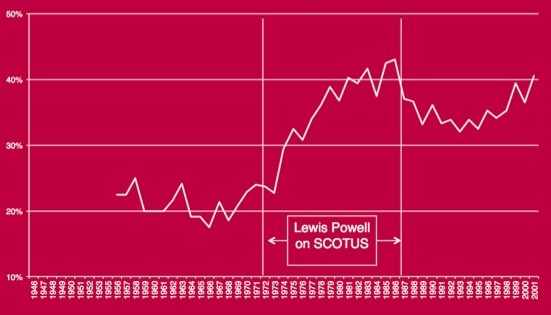 COATES
---
The large jump in the 1970s came shortly after Justice Lewis Powell joined the Supreme Court. Powell was well known as a proponent of corporate interests at a time when anticorporate sentiments began agglomerating—a confidential memo he wrote that went public the year before began serving indicates as much. “The time has come,” he wrote to the director of the Chamber of Commerce, “for the wisdom, ingenuity and resources of American business to be marshaled against those who would destroy it.” Suffice it to say Powell sided with the drug store in 1975, and many other businesses during his 15-year tenure.
(In order to make sure that the data wasn’t being warped by the fact that the Supreme Court is highly selective in the cases it takes on, Coates also examined data from appeals courts. He found that the number of cases citingCentral Hudson, a 1979 casethat formed an important basis for corporate speech, has increased each year since then. Coates's methodology is convincing, but the possibility does remain that what has increased in recent decades is not corporations' desire to appropriate the First Amendment, but regulators' likeliness to try to regulate, for instance, advertising language—in which case an escalated reliance on free-speech precedents could be read as a creative defense rather than a shrewd arrogation of power.)
Coates’s work is a reminder, in a decade when Citizens United is many Americans’ foremost association with corporate speech, not to forget what corporations have and haven’t been allowed to do since 1789.In 1819, Chief Justice John Marshall legally defined a corporation as “an artificial being, invisible, intangible, and existing only in the contemplation of law.” And in the hundreds of years since, corporate speech has been tightly regulated, as courts have restricted what companies can and cannot communicate in contracts, to employees, and to the public. In fact, some 150 years passed between the writing of the First Amendment and its first use to strike down a law in favor of an individual (a decision supporting corporate free speech came even later)—which is to say that corporations got along just fine without First Amendment rights before Justice Powell decided they were in need of help.
So if the Court says, as it did in its decisions in Citizens United and Hobby Lobby, that a company should be viewed as a collection of individuals, it seems to be overlooking centuries of precedents that suggest otherwise—that corporations’ speech is something to be controlled firmly. Given that, as Coates says, these pro-business First Amendment rulings encourage companies to “increasingly place bets not on new technologies and marketing strategies, but on legal and political ‘innovation,’” the courts’ stances are only that much more puzzling.
===
===
https://www.alternet.org/2020/11/voice-of-america
no twt
President Donald Trump's appointed head of the U.S. Agency for Global Media is barred from making any further editorial or personnel decisions following a series of injunctions issued by a federal courtlate Friday, in what journalists called a major rebuke of the Trump administration's attempt to reshape government-funded news broadcasters.
In Washington, D.C., Chief U.S. District Judge Beryl A. Howellruled in favor of five USAGM executives who were fired or suspended in August at the direction of CEO Michael Pack, who took the helm of the agency in June and promptly dismissed several career officials in what was called a "Wednesday night massacre."
Current and former USAGM employees applauded the ruling, with chief strategy officer Shawn Powers tweeting that Pack "has repeatedly and intentionally violated the First Amendment rights" of journalists at the agency.
twt]
the five former employees sued to stopPack, a close associate of former White House adviser and Breitbart News executive Steve Bannon, from interfering in the editorial affairs of Voice of America (VOA), Radio Free Asia, and other broadcasters which operate under the USAGM.
The lawsuit was filed after Pack opened an investigation into VOA's chief White House reporter, Steve Herman, over unspecified concerns that he displayed an anti-Trump bias. The plaintiffs and many other critics inside and outside of the agency saidPack violated the "firewall" between political appointees and the broadcasters' newsrooms which is meant to keep the organizations from becoming mouthpieces for the White House.
Progressive critics have long considered VOA a vehicle for U.S. government propaganda overseas, promoting American-friendly coverage of world events. However, the overt takeover by a Trump loyalist has raised alarm since June.
A month after being confirmed by the U.S. Senate in a party-line vote to run the agency, the USAGM announced it would not renew visas for foreign journalists, potentially sending dozens of reporters who have worked for VOA and other broadcasters for years, back to countries where they could be persecuted. The decision was attributed by many critics to the Trump administration's "xenophobia."
Under Howell's order, Pack will no longer be able to make personnel decisions for the remainder of his tenure, which is set to end in January when President-elect Joe Biden takes office. He also will not be permitted to communicate directly with editorial teams or investigate editors or their news stories.
Howell said Pack's investigation of Herman imposed "an unconstitutional prior restraint not just on Herman's speech, but on the speech of [Herman's editors] and journalists at VOA."
NPR media correspondent David Folkenflik called Howell's ruling a "tremendous rebuke" of Pack's actions during his five months at USAGM.
FROM YOUR SITE ARTICLES
- Wife divorces Trump-supporting husband after his love for the ... ›
- The Trump administration wants to kill off Stars and Stripes ... ›
- Trump to turn Voice of America into American Pravda as new CEO ... ›
RELATED ARTICLES AROUND THE WEB
- Lawsuits, Bias Claims And A Sex Scandal: VOA's Five Months under ... ›
- Voice of America CEO curbed First Amendment rights of its ... ›
- VOA Interference: Trump Appointee Acted Unconstitutionally, Judge ... ›
===
===
https://theintercept.com/2020/09/23/facebook-sued-over-kenosha-killings/
WHEN 17-YEAR-OLD Kyle Rittenhouse killed two Black Lives Matter protesters (and wounded a third) in late August in Kenosha, Wisconsin, he instantly became a hero among white nationalist circles, in which theSecond Amendment is sacrosanct.
:{:{}:
}:
On Wednesday, Rittenhouse and the members of the armed militias that supported him, including the Kenosha Guard and Boogaloo Bois, were named in a federal lawsuit brought under the post-Civil War Reconstruction amendments that aimed to establish Black equality.
The suit also names what it alleges was the militia groups’s most prominent enabler: Facebook. All of the parties, the complaint contends, helped deprive Kenosha Black Lives Matter protesters of their First Amendment right to assemble, thus violating the Black Lives Matter activists’ 14th Amendment right to equal protection.
attorneys Jason Flores-Williams and Jennifer Sirrine filed the case in the Eastern District Court of Wisconsin, which covers Kenosha. Along with a handful of protesters harassed by the militia groups, the plaintiffs include Hannah Giddings, the life partner of 26-year-old Anthony Huber, who was gunned down by Rittenhouse while trying to disarm the teenager.
According to the complaint, the Kenosha Guard, Boogaloo Bois, and Facebook all partook in a conspiracy that resulted in Huber’s death (thus causing harm to Giddings) and deprived the other plaintiffs of their ability to peacefully protest.
Both the First and 13th amendment stipulations were key to Griffin v. Breckenridge, a U.S. Supreme Court case that was decided in 1971 and is cited in the complaint. That case concerned the right to travel, which is also an issue in the Kenosha protests. Some of the plaintiffs had their tires slashed and were otherwise impeded.
The 14th Amendment provided the constitutional basis for federal statutes §1985 and §1986, which prohibit interference by private groups with other’s exercise of their rights. Established under the Ku Klux Klan Act of 1871, the statutes were recently applied in the aftermath of the Charlottesville, Virginia, white supremacist protest in 2017.
In order to recruit foot soldiers for the August 25 protest, the Kenosha Guard created an event page on its Facebook account. Titled “Armed Citizens to Protect Our Lives and Property,” the posting summoned “patriots willing to take up arms … and defend our City from the evil thugs.”
Over 450 Facebook users alerted the platform’s moderators that the Guard’s violent rhetoric violated the company’s policies. According to BuzzFeed News, four Facebook moderators deemed the Guard’s posts “non-threatening.”
In Flores-Williams’s view, Facebook’s actions subsequent to the event — shutting down the Guard’s account and admitting to what CEO Mark Zuckerberg called an “operational mistake” in not heeding the 450 warnings — amounted to a recognition it behaved with negligence.
“Facebook’s negligence enabled the conspiracy here,” said Flores-Williams. He maintains that “this is not a First Amendment issue. It’s a matter of responsibility on the part of Facebook.”
“I would love to see Facebook change their moderation policies and for them to take accountability. One way to do that would be for them to make the moderators work directly for the company instead of outsourcing them,” added Sirrine.
Citing the likelihood of voter intimidation by armed militias on Election Day, and the possibility that those same groups may try to keep Donald Trump in the White House should he lose in November, Flores-Williams hopes that the action in federal court will send the company a message.
“If Facebook won’t change their M.O.,” he said, “then a judge needs to tell them to enforce their own standards and stop allowing violent groups to use their site as a recruiting station.”
A Facebook spokesperson didn’t immediately respond to a request for comment.
===
==
https://scholarship.law.georgetown.edu/cgi/viewcontent.cgi?article=3087&context=facpub
2018 Big Food and Soda Versus Public Health: Industry Litigation Against Local Government Regulations to Promote Healthy Diets
Sarah A. Roache Georgetown University Law Center, sarah.roache@law.georgetown.edu Charles Platkin School of Urban Public Health, City University of New York, cplatkin@hunter.cuny.edu Lawrence O. Gostin Georgetown University, gostin@law.georgetown.edu Cara Kaplan Fordham Law School, ckaplan7@law.fordham.edu
p 1078
sf 2015:
D. San Francisco Soda Warning Ordinance
In 2015, San Francisco became the first United States jurisdiction to pass legislation requiring soda companies to include a statement on advertisements warning of the health impacts of consuming sugar sweetened beverages.181 Specifically, the ordinance required companies to place warnings on advertisements on billboards, vehicles, and similar structures, stating: “WARNING: Drinking beverages with added sugar(s) contributes to obesity, diabetes, and tooth decay. This is a message from the City and County of San Francisco.”182
The ordinance required that this warning occupy twenty percent of the total advertisement space.183 It applied to advertisements for non-alcoholic beverages containing caloric sweeteners and more than twenty-five calories per twelve ounces of beverage, with exemptions for milk, milk alternatives, and 100% natural fruit and vegetable juices.184 San Francisco’s purpose in requiring the warning was to “inform the public of the presence of added sugars and thus promote informed consumer choice that may result in reduced caloric intake and improved diet and health, thereby reducing illnesses to which [sugar-sweetened beverages] contribute and associated economic burdens.”185
Shortly after the City passed the ordinance, the ABA, the California Retailers Association, and the California State Outdoor Advertising Association filed a suit in the United States District Court, Northern District of California, to preliminarily enjoin the ordinance, alleging that it violated the plaintiffs’ freedom of speech and unjustly targeted sugar-sweetened beverages as a contributing factor to the obesity epidemic.186 To obtain a preliminary injunction, a plaintiff “must establish that he is likely to succeed on the merits, that he is likely to suffer irreparable harm in the absence of preliminary relief, that the balance of equities tips in his favor, and that an injunction is in the public interest.”187 At the district court level, the judge found that the plaintiffs were unlikely to succeed on the merits of their First Amendment claim and were unlikely to suffer irreparable harm if the ordinance went into effect.188 Furthermore, the district court found that even if the plaintiffs may succeed on the merits, the balancing test would weigh in favor of denying the injunction.189
The district court noted that the city had a reasonable basis to enforce the ordinance due to its interest in public health and safety.190 The plaintiffs subsequently appealed the decision to the Ninth Circuit Court of Appeals,which reversed the district court’s decision and upheld the preliminary injunction to enjoin the San Francisco ordinance.191 First, the court of appeals found that the plaintiffs were likely to succeed on the merits of their First Amendment claims.192 The plaintiffs claimed that the warning label requirements infringed on their First Amendment right to freedom of speech.193 While the First Amendment freedom of speech protectionsmay traditionally be associated with individual liberty, the U.S. Supreme Court has confirmed that these protections extend to commercial speech.194
p 1080...
===
===
https://www.courthousenews.com/en-banc-9th-circuit-grills-san-francisco-on-soda-warning-label-law/
9/18
sAN FRANCISCO (CN) – An expanded panel of Ninth Circuit judges on Tuesday reconsidered whether a San Francisco law requiring warning labels on billboard ads for soda passes constitutional muster, with the soda industry arguing that singling out sodas and other sugary drinks as the main contributor to health problems sends a misleading message to consumers.
“Obesity and related conditions are serious health problems. The city is entitled to have and share its view that drinking beverages with added sugar contributes to these conditions more so than consuming equivalent calories from other foods and beverages,” saidindustry attorney Richard Bress. “What the city can’t do, consistent with the First Amendment, is force us to convey its controversial view and that’s exactly what the city is doing here with this warning, by singling out advertisements for beverages with added sugar.”
A year ago, a three-judge Ninth Circuit panel ruled in favor of the American Beverage Association, the California Retailers Association and the California State Outdoor Advertising Association, finding San Francisco’s 2015 ordinance requiring warning labels on outdoor soda ads “unduly burdened and chilled protected speech.”
The ordinance would have required a black-box warning label saying: “WARNING: Drinking beverages with added sugar(s) contributes to obesity, diabetes, and tooth decay. This is a message from the City and County of San Francisco.” The label would have to cover at least 20 percent of the ad space.
...
===
===
https://www.alternet.org/2020/07/the-trump-campaigns-legal-strategy-includes-suing-a-tiny-tv-station-in-northern-wisconsin/
Trump campaign’s legal strategy includes suing a tiny TV station in northern Wisconsin
Meg Cramer, Katherine Sullivan / WNYC, Pro PublicaJuly 23, 2020
ProPublica is a Pulitzer Prize-winning investigative newsroom. Sign up for The Big Story newsletter to receive stories like this one in your inbox. This year, President Donald Trump’s reelection campaign…
This year, President Donald Trump’s reelection campaign filed defamation lawsuits against three of the country’s most prominent news outlets: The New York Times, The Washington Post and CNN. Then it filed another suit against a somewhat lower-profile news organization: northern Wisconsin’s WJFW-TV, which serves the 134th-largest market in the country.
The Trump campaign sued the station over what it claims is a false and defamatory ad WJFW aired that showed Trump downplaying the threat of the coronavirus as a line tracking new COVID-19 infections ticks up and up on the screen.
Dozens of stations ran the ad. But the Trump campaign chose to sue just NBC-affiliate WJFW, which is owned by a relatively small company that only has two other local TV stations, both in Bangor, Maine. The campaign did not initially sue the political organization that produced the ad. That group later joined the case as a defendant.
The curious lawsuit is part of a larger, aggressive and exceedingly expensive legal operation by the Trump campaign that’s the focus of our latest “Trump, Inc.” podcast.
The campaign has spent over $16 million on litigation and other legal costs — more than any past presidential campaign and more than 10 times what presumptive Democratic nominee Joe Biden has spent on legal services, according to disclosures.
Trump has long boasted about his penchant for filing lawsuits. The president and his businesses have reportedly filed over 2,000 lawsuits. After losing a 2006 defamation lawsuit against the journalist Tim O’Brien, Trump told the Post that he knew he couldn’t win, but he sued anyway. “I spent a couple of bucks on legal fees, and they spent a whole lot more,” Trump said. “I did it to make his life miserable, which I’m happy about.”
As with other areas, Trump has taken his approach to running his personal life and business to the presidency.
Multiple media law experts told us that the suit against tiny WJFW has little chance of succeeding. Susan Seager, a media defense lawyer and adjunct professor at The University of California, Irvine, School of Law, said, “The courts are very deferential and very protective of opinions about public figures and political issues.”
So if Trump isn’t likely to win, what might he be trying to do? Matthew Sanderson, who served as counsel for Sens. John McCain and Mitt Romney, said he thinks the Trump campaign is “engaging in scare tactics.”
“The reason in my opinion that the Trump campaign is filing these types of lawsuits is not necessarily to punish the Wisconsin station — they’re not going to be successful,” Sanderson said. “The reason they’re doing this is to send a message to the rest of the stations to be careful” about running anti-Trump ads.
Unlike many other states, Wisconsin doesn’t have a law that makes complainants pay for defendants’ legal costs if a defamation suit ends up being dismissed as frivolous.
Seager estimates that fighting a defamation lawsuit brought by a high-profile group like the Trump campaign could cost anywhere from $100,000 to $250,000, just to go through the process of getting it dismissed.
We asked the Trump campaign and its lawyers about the suit and why they chose WJFW. They did not respond.
The TV station commented, through a lawyer, that “WJFW has no choice but to fight the Trump campaign’s attempt to bully a small-market broadcaster into surrendering its First Amendment rights. The public counts on local broadcasters, especially in an election year, to remain free to air criticisms of public officials.”
Of course, one critical difference between lawsuits Trump used to file in his business dealings and the ones his campaign is filing is that Trump no longer has to use his own money. His donors are picking up the tab.
Trump’s disclosures show his campaign has paid about $200,000 to the firm handling the Wisconsin case.
The campaign has also paid $3.3 million to the firm ofattorney Charles Harder, who specializes in high-profile reputation defense lawsuits.Harder is representing the Trump campaign in the three other defamation suits against media organizations. Harder is perhaps best known as the lawyer who successfully sued Gawker into bankruptcy on Hulk Hogan’s behalf while being surreptitiously funded by venture capitalist Peter Thiel.
Another set of expenses in the disclosures is also interesting. It shows the Trump campaign spent $95,161 on “legal & IT consulting” paid to … “The Trump Corporation.” Neither the campaign nor Trump’s company responded to questions about those charges.
Contact Us
You can contact us via Signal, WhatsApp or voicemail at 347-244-2134. Here’s more about how you can contact us securely.
You can always email us at tips@trumpincpodcast.org.
And finally, you can use the postal service:
Trump Inc at ProPublica
==
==
media realclear and fedsoc
note 1st amend free sp fought hard for by tobacco (previous RICO?)
cei ~RICO
Free Speech and Climate Change
11,877 views•Apr 19, 2016
Andrew M. Grossman discusses climate change and freedom of speech in a Federalist Society produced video
sez not // tobacco RICO b/c it covered up harm that was certain; agw NOT certain of harm (catastrophic?)
answers unclear on AGW; objects to CEI subpoena off all docs related to climate for decades [true?]
puts a cloud of legal uncertainty, intimidatuon, threat of criminal sanctions, will chill very important debate/discussions that we needto formulate correct policy, more speech is better (vs censor, implies truth will win)
Andrew Grossman, Partner at BakerHostetler, explains the investigation of the fossil fuel industry and public policy groups skeptical of climate change by the Attorneys General of nineteen states. He underscores the importance of free speech in public policy debates on climate change. Mr. Grossman is also Counsel for the Competitive Enterprise Institute. As always, the Federalist Society takes no position on particular legal or public policy issues; all expressions of opinion are those of the speaker. Related links: John Schwartz, Pressure on Exxon Over Climate Change Intensifies With New Documentshttp://www.nytimes.com/2016/04/14/sci... CEI Fights Subpoena to Silence Debate on Climate Change, April 7, 2016https://cei.org/content/cei-fights-su...Addressing the Risks of Climate Change: ExxonMobil's Views and Actionshttps://exxonmobil.com/Benelux-Englis...A.G. Schneiderman, Former Vice President Al Gore And A Coalition Of Attorneys General From Across The Country Announce Historic State-Based Effort To Combat Climate Changehttp://www.ag.ny.gov/press-release/ag... David Rivkin Jr. and Andrew M. Grossman, Punishing Climate Change Skepticshttp://www.wsj.com/articles/punishing...
:{:{}:
}:
:{:{}:
WSJ. Magazine
Search
:{:{}:
}:
OPINION COMMENTARY
Punishing Climate-Change Skeptics
Some in Washington want to unleash government to harass heretics who don’t accept the ‘consensus.’
By David B. Rivkin Jr. and Andrew M. Grossman
March 23, 2016 6:29 pm ET
:{:{}:
}:
Galileo Galilei was tried in 1633 for spreading the heretical view that the Earth orbits the sun, convicted by the Roman Catholic Inquisition, and remained under house arrest until his death. Today’s inquisitors seek their quarry’s imprisonment and financial ruin. As the scientific case for a climate-change catastrophe wanes, proponents of big-ticket climate policies are increasingly focused on punishing dissent from an asserted “consensus” view that the only way to address global warming is to restructure society—how it harnesses and uses energy. That we might muddle through a couple degrees’ of global warming over decades...
:{:{}:
}:
RELATED VIDEO
Opinion Journal: Free Speech for Scientists!
YOU MAY ALSO LIKE
:{:{}:
}:
UP NEXT
:{:{}:
}:
Opinion Journal: Free Speech for Scientists!
Baker Hostetler Partner David Rivkin on a legal effort to protect climate-change scientists from bullying and intimidation
The Climate Change Inquisition by Peggy Littlehttp://www.fed-soc.org/blog/detail/th...The fossil-fuel industry’s campaign to mislead the American people by Sen. Sheldon Whitehousehttps://www.washingtonpost.com/opinio...}:
==
more BS on right be gagged "free mkt energy blog" dreissen
Blog Roll Link
- American Energy Alliance
- Energy In Depth
- GlobalWarming.org
- Institute for Energy Research
- Knowledge Problem
https://www.masterresource.org/climate-speech-freedom/exxonmobil-climate-speech/
BS
ExxonMobil, Climate Change And Free Speech: Down from Climategate
By Allen Brooks -- July 27, 2016
“The Spanish Inquisition and the McCarthy Era are two examples of dark periods in history when silencing freedom of thought and association were punished. History is replete with periods of repression of personal freedoms. Society has never been advanced by these efforts to control the populace’s thoughts and actions.” [he's quoting himself?]
Recently, 19 Democratic Senators have “called out” conservative organizations that have produced research and policy papers questioning the orthodoxy of climate change–using their privilege of making claims from the floor of the Senate where a politician cannot be legally attacked for his speech (Article I, Section 6, Clause 1, United States Constitution).
These legislators wasted taxpayer money (the Senate had to be in session, so that meant staffers had to be paid) in attacking the free-speech rights of those companies, individuals, and organizations questioning the “settled” science of climate change. This three-day affair, “Web of Denial,” was led by Senator Sheldon Whitehouse (D-RI), a career politician representing a state with barely over one million in population that ranks at the bottom of most economic measures and places considered attractive to do business.
Britain/EU Rethink
Despite attempts to promote/scare the public about the impact of climate change, survey results show the issue ranks at the bottom of the public’s concern about social issues.
The climate change movement also took a blow following the change in the UK’s government leadership following the nation’s Brexit vote to secede from the 28-nation European Union. The country installed a new prime minister, Theresa May, who promptly eliminated the Department of Energy and Climate Change, shifting its duties to the Department of Business, Energy and Industrial Strategy.
Post-Brexit, climate activists attempted to put the best face on this situation by saying it was more appropriate that climate policy be moved to the business department that would be implementing policies to promote actions to deal with the issue. But that argument doesn’t square with the recent decisions to back away from adding more wind energy projects and the country’s need to reactivate mothballed coal-fired power plants to meet winter energy demands.
What happened in Britain was just the latest example of the re-examination of the role of renewables in European economies such as Germany and Denmark. Both countries are being forced to back away from the embrace of renewables because of what the cost of these renewables’ fuel subsidies have done to power prices, their impact on the operation of the power grid, and the countries’ economies. Questions are now being raised over what will happen to the Paris Climate Change Agreement negotiated last fall as European countries challenge the renewables mandate.
Target Exxon-Mobil
The centerpiece of the latest climate change dustup is Exxon Mobil Corporation. The company has become the target of the Progressive, climate-change movement, which has seized on the concept of targeting the fossil fuel industry with the Racketeer Influenced and Corrupt Organizations Act (RICO).
This law was used against the tobacco industry and has become the popular way to attack fossil fuel companies and their “supporters.” The Democrats have enlisted the help of a handful of state attorneys general, mostly from states led by Democratic governors, to sue ExxonMobil for “fraud” over its supposed efforts to promote the continued use of fossil fuels while “secretly” hiding the knowledge that the carbon dioxide emissions from burning these fossil fuels would create a climate Armageddon.
ExxonMobil has been at the center of these attacks. But several think-tanks, and a handful of climate scientists holding contrary views about the potential damage from climate change (formerly known as global warming until we entered aone-to-two decade hiatus in rising temperatures)have also been targeted for holding their views.
The absurdity of the attacks was highlighted when the attorney general from Puerto Rico subpoenaed ExxonMobil for documents to build its case against the company. ExxonMobil has no offices in Puerto Rico, nor does it do any business there, raising the question of what legal standing the AG had.
Despite his bluster that it was all about the common good, he later withdrew his subpoena. That episode shined a spotlight on what this campaign is truly about – another cog in a broader Progressive movement to suppress the freedom of speech of conservative political groups or of anyone who openly questions the views of Progressives.
Strassel’s The Intimidation Game
I have just finished reading Kimberley Strassel’s recently published book, The Intimidation Game: How The Left is Silencing Free Speech. It is a book people should read.
Ms. Strassel is the Washington-based writer of the weekly column “Potomac Watch” for The Wall Street Journal. She has an interesting background, having been educated at Princeton University (often cited as a locus of the Progressive movement, because it was once led by Woodrow Wilson, a champion of the Progressive movement) and is a 22-year veteran of the newspaper.
She began working for the WSJ in Brussels and subsequently moved to London to cover technology. She joined the Journal’s editorial page shortly after moving to the U.S. in 1999. She continues in this role along with writing her column, which started in 2005, twice per week.
Ms. Strassel’s book analyzes the moves of the President and carried out by ideologically-in-step agency bureaucrats at the Internal Revenue Service, the Federal Election Commission, the Environmental Protection Administration, the Housing and Urban Development Department, and even in the halls of Congress, to silence opposition speech.
This entire effort, of which Sen. Whitehead’s effort is a part, emerged from the Supreme Court’s ruling in the 2008 Citizens United case holding that corporations were entitled to the same freedom of speech rights flowing from political campaign funding that union organizations and individuals possess. You may remember that President Barack Obama attacked this decision during his 2009 State of the Union speech with the members of the court sitting immediately in front of him.
Of course, the facts and the interpretation of the decision were twisted in his speech for political purposes, to the point that Associate Justice Samuel Alito mouthed the words “You’re wrong.”
The Citizens United case involved the makers of a movie critical of 2008 presidential candidate Hillary Clinton. The film-makers wanted to show the film during the campaign but they were restrained by a law suit, which was finally overturned by the Supreme Court.
On September 11, 2014, fifty-four members of the Senate Democratic caucus voted to approve a bill to begin the legal process for amending the First Amendment that henceforth, “Congress and the states may regulate and set reasonable limits on the raising and spending of money by candidates and others to influence elections.”
This bill never progressed, but is now being highlighted by presumptive Democratic presidential candidate Hillary Clinton as one her top priorities within the first 30 days of her administration.
Climategate Redux
The attacks on ExxonMobil and the various think-tanks over their climate-change positions continues a trend uncovered by Climategate. Recall the attemptsto restrict publication of scientific articles demonstrating flaws with global warming and climate change research, attempts undertaken by leading global warming proponents which came to light in 2009 when the emails of various scientists at the Climate Research Unit at the University of East Anglia were made public.
Not only did these emails demonstrate the extent of the efforts of these scientists to secretly modify their data to fit their pre-conceived positions, they showed how extensive the conspiracy was to prevent the articles critical of global warming studies from being published in academic journals. So much for the principle of honesty in scientific inquiry.
Congressman Raύl Grijalva (D-AZ)
The effort to restrict challenges to thereligionof climate change was extended into a pillorying of respected climate researchers by Congressman Grijalva in 2015. He sent a letter to a number of universities asking them about seven climate scientists who had, at one-time or another, questioned the climate change hysteria.
The letters demanded that the universities provide details about the funding of these seven scientists. They also asked for any communications with anybody about their compensation.
This effort was backstopped by three Democratic Senators – Barbara Boxer (CA), Ed Market (MA) and Sheldon Whitehouse (RI)– who fired off letters to 107 different companies, think-tanks, independent organizations, and trade associations, demanding information about anybody in the climate arena to whom they had given funding.
The interesting thing is that one of the seven scientists targeted actually acknowledges climate change and supports reductions in carbon emissions. However, he had once challenged the climate change alarmists linking global warming to extreme weather events. The problem was that this challenge was against the position held by John Holdren, President Obama’s science czar, and a leading climate change alarmist.
What Would Hillary Do as President?
While most of us look at the attacks on ExxonMobil and the conservative think-tanks over their climate change positions and what it might mean for energy policy in another Democratic administration, the big question is whether there will be any deviation from the existing administration’s energy policies.
Energy policy in a Hillary Clinton administration is likely to be a continuation of the Obama policies with a further ramping up of attacks on coal and fossil fuels. The policies would likely add to the regulatory burden on fossil fuel companies, limiting growth in domestic oil and gas production and leading to higher energy and utility costs for consumers as more expensive renewable fuels are forced into the power grid.
While these are important issues for energy analysts and investors, all of us should become more sensitive to the bigger problem of the growing attack on free speech. Free speech is what made America the country it is, and a country very different from many leading countries around the world.
The Spanish Inquisition and the McCarthy Era are two examples of dark periods in history when silencing freedom of thought and association were punished. History is replete with periods of repression of personal freedoms. Society has never been advanced by these efforts to control the populace’s thoughts and actions.
I worry that the current attacks on climate “skepticism” are just another example of actions that will retard scientific investigation and hold back progress to the detriment of our population.
citizens and journalists have lost 1st amendment protections (esp since 911): war on whistleblowers
http://www.tomdispatch.com/post/175856/tomgram%3A_peter_van_buren,_rip,_the_bill_of_rights/
===
am promise
- Corporations abuse First Amendment rights in other ways.
Since being awarded First Amendment protections by the Supreme Court, corporations have used these rights in ways beyond political spending. For example, in investigations over recent years, Exxon Mobil, the world’s largest oil and gas corporation, was discovered concealing corporate knowledge of its business’ “catastrophic” impact on the health of the planet, while dismissing these claims publicly. In response, the company argued it had a First Amendment right to not speak, and not share this knowledge with the public or regulators.
Vox reports on numerous other examples: “In recent years, large corporations have been emboldened to argue that corporate speech rights entitle them to strike down state health care prescription information laws—those forbidding pharmaceutical companies from selling information about the prescribing patterns of individual doctors, for example.
They have argued that speech rights forbid certain securities regulations—specifically, those requiring investigation and disclosure of whether a company sells “conflict minerals” from the Democratic Republic of Congo. They have said that the First Amendment gives them a right to decline to say on product labels that the meat they sell comes from foreign countries, or that food products contain genetically modified ingredients.”
----
ref jeff clements and coats
Why is the attorney general of Massachusetts, Maura Healey, being forced to justify to a Texas judge why and how she is doing her job?
In the latest instance of the corporate takeover of the First Amendment — and other constitutional rights — Exxon Mobil, the world’s largest oil and gas corporation, has invented a constitutional right to obstruct state investigations into allegations of fraud.
Investigations by the Massachusetts and New York attorneys general began late last year after the Los Angeles Times reported that Exxon scientists and executives have known for decades about the connection between fossil fuel consumption and the likelihood of catastrophic changes in the Earth’s atmosphere and climate.
The report alleged that as early as the 1980s, Exxon scientists were warning the company in internal communications that global climate change could "indeed be catastrophic (at least for a substantial fraction of the earth's population)." According to the journalists’ report, Exxon’s internal teams used that information for purposes of assessing the potential for profitable investment in new oil exploration and production. Yet these were the same climate models that Exxon “dismissed as unreliable and based on uncertain science” in statements to investors, consumers, and the general public.
A parallel with investigations of Big Tobacco
The attorneys general embarked on investigations on behalf of their citizens, asking whether Exxon was guilty of selling products and equity while concealing information about their risks.
The similarity of these allegations to the illegal conspiracy of the tobacco industry — a cover-up of internal corporate knowledge about deadly consequences of continued consumption of its products — did not escape notice. In January 2016, the Department of Justice asked the FBI to investigate whether Exxon should be prosecuted under the federal Racketeer Influenced and Corrupt Organizations Act, as the tobacco industry was. The investigations by the Massachusetts and New York attorneys general, focusing on whether Exxon had been forthright in its disclosures to investors, soon followed.
Given identified sources and specific studies cited in news reports, it is not surprising that chief law enforcement officers of federal and state governments would investigate. Indeed, it would be extremely troubling if they did not.
But rather than show that the allegations of investor and consumer fraud are baseless, Exxon Mobil is misusing the Constitution to continue to conceal what it knew about the connection between catastrophic climate change and continued fossil fuel use, and when.
It is not uncommon, of course, for companies to resist subpoenas from attorneys general on a variety of legal grounds. For example, Exxon could have filed a motion in Massachusetts asking a judge to set aside the subpoena on the grounds that it was overly broad, and arguing that the investigation exceeded the jurisdiction of the attorney general. (In fact, Exxon did just that, and lost.)
Until fairly recently, no US court would have entertained free speech claims by a corporation that wanted to strike down regulation
But Exxon has gone much further. It has filed a federal “civil rights” lawsuit in its home court of Texas against the New York and Massachusetts attorneys general. The multibillion-dollar global corporation claims that the state investigations violate a previously unrecognized corporate right under the Constitution both to “speak” and to “not speak” about climate change any way it wants, however deceptive that speech may be.
This is where the Supreme Court’s decision in Citizens United v. Federal Election Commission is taking the country. That 2010 ruling is infamous for opening the floodgates of big, dark money in our elections by deciding that any limits on supposedly “independent” political ads violate the speech rights of corporations, unions, and billionaires. What is less well-known about Citizens Unitedis how radically it empowers corporations to misuse the First Amendment in other ways — ways we now see playing out in the Exxon case, and elsewhere.
Citizens United was the capstone on a remarkable series of cases, dating only to the 1970s, that revolutionized the application of the First Amendment in the corporate context. Very few people realize just how quickly this constitutional revolution has occurred; very few people realize that American corporations thrived for the first two centuries of American history with virtually no First Amendment protections.
In the early 20th century, First Amendment cases involving firms tended to involve media companies, as when Louisiana Gov. Huey Long imposed special taxes on newspapers (a clear attempt to punish them). It was generally assumed that the “speech” of business corporations was no more free from court scrutiny than the language of their contracts or their SEC filings.
That finding was then broadened and expanded in National Bank of Boston v. Bellotti(1978), which held that corporations can contribute to ballot initiatives, and again in Central Hudson Gas & Electric Corp. v. Public Service Commission(1980), which asserted that a utility could run advertisements promoting the use of electricity.
Those two cases continue to be cited in almost all commercial speech cases — and they are cited more and more frequently. Citizens United affirmed those cases and extended them to campaign finance laws. After his appointment to the high court in 1971, however, Justice Lewis F. Powell Jr., a former business lawyer who ardently believed that corporate America was being undermined by the public’s support for reformers like Ralph Nader, helped reinvent the Court’s doctrine in this area. In Virginia State Pharmacy Board v. Virginia Citizens Consumer Council (1976), the Court said, on First Amendment grounds, that the state could not forbid pharmacists from advertising prescription drug price — a remarkable departure from precedent.[why wd they wnt to?]
Despite the “free speech” rhetoric, corporations are not simply seeking to offer opinions about public policy issues. They do that all the time, routinely spending millions to fund ads, research, policy papers, and lobbying activities.
Today corporations are claiming that their “rights” to speak clash with longstanding forms of regulation of business activity. Whenever they are required to disclose information to consumers, regulators, the public, or enforcement officials, they argue, their First Amendment rights are implicated. Whenever they seek or transmit information, they say, they are “speaking,” and the First Amendment gives them the right to do that without fear of consequences.
A growing number of constitutional challenges to reasonable regulations
In recent years, large corporations have been emboldened to argue that corporate speech rights entitle them to strike down state health care prescription information laws — those forbidding pharmaceutical companies from selling information about the prescribing patterns of individual doctors, for example. They have argued that speech rights forbid certain securities regulations — specifically, those requiring investigation and disclosure of whether a company sells “conflict minerals” from the Democratic Republic of Congo. They have said that the First Amendment gives them a right to decline to say on product labels that the meat they sell comes from foreign countries, or that food products contain genetically modified ingredients.
In a related egregious constitutional expansion, corporations have even attacked minimum wage laws as violating their rights under the 14th Amendment’s equal protection clause — when, as is typical, such laws treat firms differently based on size (or form of organization). The corporate misuse of the First Amendment and the Constitution more broadly, has gone viral. It now might be considered corporate legal malpractice not to take a swing at challenging, on constitutional grounds, any law that gets in the way of the largest corporate profits.
Investigations by public agents, including attorneys general, are a necessary component of law enforcement. Efforts by public agents to ascertain facts in such investigations should not create constitutional controversy, provided the agents respect due process and other constraints on how they perform these duties. If corporations can invoke “free speech” as a way to conceal relevant information about allegedly false statements — if they can effectively create immunity from investigation by playing a constitutional trump card — then we are on a slippery slope to the civic incapacity and relative weakness in both rule of law and economic growth that characterizes Russia and other regimes that collapse the distinction between economic and political power.
That’s why Exxon’s attack on the state investigations says so much about the damage to our constitutional framework wrought by the Supreme Court’s invention of these new corporate rights. In our federal system, attorneys general are the highest law enforcement officers in the state, generally elected directly by people, and charged with protecting the public interest and checking the abuse of corporate power. Yet in the post–Citizens United world, Exxon — with a virtually unlimited budget — can summon any officials with the temerity to do their job into physically distant courts. Trumped-up “civil rights” litigation of this kind has self-evident potential for the harassment and intimidation of would-be investigators.
Even the majority of justices in Citizens United did not argue that corporate speech rights protected fraudulent statements. Yet unless the Court revisits its First Amendment doctrines, Exxon’s attack on efforts by the states to investigate its conduct shows that such nuances may not matter. Whether Exxon wins or loses its “free speech” claims, it has already delivered its real message: Those who stand up for the public interest will face a high cost.
Jeff Clements is the president of :{American Promise}:, a national nonpartisan group of American citizen leaders working for the 28th Amendment to secure government of the people, not money. He previously was a partner in a Boston law firm and served as chief of the Public Protection Bureau in the Massachusetts Attorney General’s Office.
John Coates is the John F. Cogan Jr. professor of law and economics, as well as research director of the Center on the Legal Profession, at Harvard Law School. Before joining Harvard, he was a partner at Wachtell, Lipton, Rosen & Katz specializing in financial institutions and mergers and acquisitions.
===
5/14
https://www.ibtimes.com/food-labeling-laws-could-be-undermined-first-amendment-court-challenge-1587213
The meat processing industry’s drive to overturn revised country-of-origin labeling (COOL) laws continued Monday, when the full U.S. Court of Appeals for the D.C. Circuit considered the industry’s argument that the regulations violate free speech laws.
If the court sides with the meat industry, the fallout could have far-reaching consequences, as it would potentially undermine a wide range of labeling laws, particularly COOL regulations, which require companies to disclose where their products and ingredients are produced and manufactured through the display of packaging labels. Most American consumers are familiar with common COOL labels like "Made in China" or "product of the United States" from everything from sneakers to frozen hamburger patties, even if they are not aware of how exactly they are regulated.
The meat industry made its case during Monday’s en banc review -- an uncommon type of proceeding conducted before all 11 judges on the court rather than the typical three-judge panel -- that the COOL laws as revised in 2013 infringe on companies’ First Amendment rights by compelling speech.
Chief Judge Merrick Garland said that in order to decide thatFirst Amendment rights were being violated under the regulations, the court would “have to strike down at least half a dozen statutes on the books since the 1930s,” according to Politico. He also pointed out that many products far beyond the scope of the meat industry, including the razor he shaved with Monday morning, are required to display COOL labels, Politico reported.
As such, a decision by the court that the COOL labels infringe on companies’ free speech rights could mean changes for industries that rest far beyond the food realm.
A three-judge panel of the court handed down a decision on March 28 suggesting that the en banc hearing on just the First Amendment issues be held at a future date, but otherwise affirming a district court’s decision not to allow a preliminary injunction against the 2013 COOL laws. The case is known as American Meat Institute vs. U.S. Department of Agriculture.
“We suggest that the full court hear this case en banc to resolve for the circuit whether, under Zauderer, government interests in addition to correcting deception can sustain a commercial speech mandate that compels firms to disclose purely factual and non-controversial information,” the three-judge panel wrote in the March 28 decision.
the National Farmers Union and other American farmers’ and food production industry groups like the U.S. Cattlemen’s Association and the Consumer Federation of America continue to support the laws, which provide clarity about food origins.
“The information required by the regulation to be provided is factual and noncontroversial,” NFU President Roger Johnson said, according to the Ohio’s Country Journal agricultural publication. “I am hopeful that the full Circuit will affirm the panel’s prior decision and continue to deny the preliminary injunction requested by appellants.”
But the American Meat Institute has consistently argued that the laws will have serious negative impacts on the meat industry.
RELATED STORIES
Vermont Becomes First State To Mandate GMO Labeling
Pro-GMO Bill Could Repeal Rules To Label GMOs In Food
“It is incomprehensible that USDA would finalize a controversial rule that stands to harm American agriculture, when comments on the proposal made clear how deeply and negatively it will impact U.S. meat companies and livestock producers,” AMI Senior Vice President of Regulatory Affairs and General Counsel Mark Dopp said last year. “This rubber stamping of the proposal begs the question of the integrity of the process: many people spoke, but no one at USDA listened.”
Food labeling is a major issue in food and agriculture circles, as food safety advocates and right-to-know groups have gone head-to-head with food manufacturers and industry groups over whether foods containing GMOs should be labeled, as well as what exactly labels like “natural” or “organic” should really mean.
The GMO labeling debate has made headlines in recent months, particularly in Vermont, where Gov. Peter Shumlin signed the nation’s first unconditional mandatory GMO labeling bill into law on May 8.
The Vermont law is the first in the nation to require a state to begin labeling foods that contain genetically modified ingredients no matter how other states' lawmakers decide to address the issue. Connecticut and Maine had already passed GMO labeling laws, but the launch of their labeling regimes does not begin unless other states pass similar bills.
==
Corporations can legally put carcinogens in our food without warning labels. Here's why
Cheerios has so much glyphosate in it, it should be labeled as toxic. Corporate free speech precedents prevent that
MATTHEW ROZSA
JULY 14, 2019
A recent study by the Environmental Working Group revealed something horrifying: Glyphosate, the active ingredient in the popular weedkiller Roundup, was present in 17 of the 21 oat-based cereal and snack products at levels considered unsafe for children. That includes six different brands of Cheerios, one of the most popular American cereals.
I've written before about the limits of corporate free speech when it comes to public safety, but on that occasion I discussed this insofar as it involved corporate-sponsored climate change denialism. Yet here we have something more tangible, more direct: The safe glyphosate limit for children is 160 parts per billion (ppb), yet Honey Nut Cheerios Medley Crunch has 833 parts per billion and regular Cheerios has 729 ppb. While the potential risks of glyphosate are fiercely debated, many scientists believe that it is linked to cancer.
So if there are unsafe levels of glyphosate in a cereal popular with children, why isn't this disclosed on the cereal boxes? The complicated answer has to do with a legal case that defined free speech as something that non-human persons, like corporations, have a "right" to, in a sense. That sounds absurd, perhaps, and probably not something the framers of the constitution intended. Indeed, the idea of "corporate constitutional rights" is a relatively new one, yet one that corporations' legal arms fight tooth and nail to preserve.
There are several activist groups working to amend the constitution to undo the notion of corporate personhood and make it so that this mind-bending and harmful interpretation of corporate free speech is no longer enshrined in law. Move to Amend — as in, the constitution — is one such group. Salon interviewed ...What does glyphosate do to weeds?
There are several activist groups working to amend the constitution to undo the notion of corporate personhood and make it so that this mind-bending and harmful interpretation of corporate free speech is no longer enshrined in law. Move to Amend — as in, the constitution — is one such group. Salon interviewed Kaitlin Sopoci-Belknap, the National Director of Move to Amend, to understand how this weird legal situation came to exist.
Glyphosate is a non-selective herbicide, meaning it will kill most plants, not just weeds. It prevents plants from making certain proteins that are needed for plant growth.
What do peer-reviewed studies indicate it does to human beings and animals if they ingest it?
The International Agency for Research on Cancer (IARC) has labeled glyphosate as “probably carcinogenic” and the California Office of Environmental Health Hazard Assessment categorized it as a “chemical known to the state to cause cancer.”
How did glyphosate wind up in foods like breakfast cereals?
According to the U.S. Geological Survey, 250 million pounds of glyphosate are sprayed on American crops each year. Glyphosate is primarily used on Roundup Ready corn and soybeans that are genetically modified to withstand the toxin. Glyphosate is also sprayed on other non-GMO crops, like wheat, oats, barley and beans, right before harvest.
What have Monsanto and other companies done to suppress knowledge of its effects (lobbying, suppressing science, etc.)?
Monsanto has waged a sophisticated PR campaign to bully scientists and undermine findings that glyphosate is cancerous. In addition Monsanto and agribusiness leaders protecting the company's interests have a revolving door relationship with many agencies that are supposed to be overseeing and regulating the corporation. Monsanto and agribusiness associations have also made significant political contributions to Congressmembers like former Rep Lamar Smith from Texas who chaired the House Science, Space, and Technology Committee where he used his platform to undermine the [International Agency for Research on Cancer] when their cancer findings came out, accusing the agency of using "cherry-picked" science when determining that glyphosate is “probably carcinogenic.” ...Monsanto has argued that California's Prop 65 labeling law is a violation of the company's First Amendment right not to speak.
What is the boundary separating corporate free speech between their responsibility to the public health? Have those boundaries shifted over the years?
The courts have expanded the ability of corporations to overturn labeling requirements on a number of occasions over the last 35 years. In 1986 the Supreme Court decided that the Pacific Gas and Electric Company in California was not required to allow a consumer advocacy group to use the extra space in their billing envelope, upholding the corporation's right not to speak and protecting the corporation's “freedom of mind.” [scu 1987 https://digitalcommons.law.scu.edu/cgi/viewcontent.cgi?referer=https://www.google.com/&httpsredir=1&article=1838&context=lawreview ]
In 1996 the U.S. Second Circuit Court of Appeals overturned a Vermont law requiring the labeling of all products containing bovine growth hormone and ruled that the right not to speak inheres in political and commercial speech alike and extends to statements of fact as well as statements of opinion.
In Nike v. Kasky in 2003the Supreme Court heard arguments on whether purposeful untruths in advertising are protected political speech before sending the case back to a California courtwhere it was settled in Kasky’s favor, finding that the state laws requiring truth in advertising had been violated. The question of whether the First Amendment gives a corporation the right to speak lies remains unsettled.
Legally speaking, why are companies allowed to have poisons in our foods without warning the public of that fact?
The Supreme Court never had the authority to determine that corporations have any Constitutional rights, including First Amendment rights. By granting corporations these powers, meant to be the ultimate protections for people from government overreach, it in effect means that in many ways regulatory agencies have no authority over corporate actions — even when those actions are determined to cause public harm. In cases involving the First Amendment right not to speak it is even more insidious because it means that their so-called right not to warn the public about their toxic products trumps our right to know what's in our food.
The only solution to this problem is to pass an amendment to the US Constitution to make clear that only human beings have Constitutional rights, and that government absolutely has the right to regulate corporations like Monsanto, so that they can no longer use the Constitution as a shield against public oversight and protection. The We the People Amendment will do just that.
MATTHEW ROZSA
Matthew Rozsa is a breaking news writer for Salon. He holds an MA in History from Rutgers University-Newark and is ABD in his PhD program in History at Lehigh University. His work has appeared in Mic, Quartz and MSNBC.
==
===
https://www.alternet.org/2020/04/how-trump-it-ratcheting-up-his-dangerous-war-on-the-first-amendment/
no lnx
How Trump is ratcheting up his dangerous war on the First Amendment
Written by Bill Blum / Independent Media Institute April 24, 2020
Donald Trump is at war with the First Amendment and the free press. The war is on full display nearly every day in his rage-filled press conferences on the COVID-19 pandemic, in which he regularly condemns the “fake news” media and bashes reporters who dare to ask the slightest probative questions about his handling of the ongoing public-health crisis.
Trump’s war is also longstanding. And it is waged not only on television and in angry tweets and at campaign rallies (which have been put on hold because of the coronavirus), but also in courtrooms across the country in the form of defamation lawsuits designed to shame, silence and punish his critics.
The latest victim of the president’s intimidation-by-litigation strategy is TV station WJFW, an NBC affiliate located in Price County in the rural reaches of northern Wisconsin. On April 13, Trump’s principal reelection campaign committee—Donald J. Trump for President, Inc., headquartered in New York City—sued the station in the county’s circuit court. The suit alleges that the station had libeled the campaign and harmed the reputation of the president by airing an anti-Trump attack ad produced by Priorities USA Action, a pro-Democratic Super PAC.
Entitled “Exponential Threat,” the ad features audio and video clips of Trump downplaying the severity of the virus and disavowing any responsibility for his administration’s slow and incompetent response to the virus overlaid against a graph displaying the exponential rise in the number of COVID-19 cases in the U.S. since January.
The lawsuit contends that the ad stitched together Trump’s statements about the virus in a false, misleading, deceptive and malicious manner to make it appear that he had called the virus a “hoax.” According to the complaint, Trump never termed the virus itself a hoax, but instead said at a rally in Charleston, South Carolina, on February 28, that the Democrats were perpetrating a hoax by politicizing his record on the virus.
The lawsuit comes on the heels of other recent threats made by the Trump campaign to take legal action against TV outlets in Florida, Michigan, Minnesota and Pennsylvania for broadcasting the same ad.
The president’s campaign committee has also been busy suing print media. In March, the committee sued the Washington Post for defamation allegedly arising from opinion columns written by journalists Greg Sargent and Paul Waldman in June 2019 on the possibility of renewed foreign collusion in the 2020 election. And in February, Trump’s 2016 campaign committee sued the New York Times, claiming defamation stemming from an op-ed about Russian collusion written in March 2019 by Max Frankel, who had served as the paper’s executive editor from 1986-94.
Sadly, the president’s latest round of defamation revenge is part of a pattern that dates back to his formative days as a real-estate developer and publicity-seeking huckster in New York City.
As detailed in a 2016 study published by the Media Law Resource Center, Trump filed his first major libel suit in 1984, when he took the Chicago Tribune and architecture columnist Paul Gapp to court, claiming that he had sustained $500 million in damages as a result of an article Gapp had written, maligning Trump’s plans to build a 150-story skyscraper in lower Manhattan. The case was dismissed the following year after the presiding judge determined Gapp’s article was a constitutionally protected expression of opinion.
The Media Law Resource Center study also summarizes Trump’s failed defamation lawsuit against writer Timothy O’Brien and the Time Warner Book Group, Inc. Now a senior columnist with Bloomberg Opinion, O’Brien asserted in a 2005 book—TrumpNation: The Art of Being the Donald—that Trump wasn’t actually a billionaire. O’Brien’s estimate of Trump’s net wealth so rankled the future president that he demanded “a whopping $5 billion in damages.” Like the lawsuit against Gapp, the case was eventually dismissed.
In addition, the study chronicles Trump’s case against comedian Bill Maher. Trump targeted Maher in 2013 for a disparaging joke he told on NBC’s Tonight Show, in which he offered to donate $5 million to charity if Trump could prove he was not “the spawn of his mother having sex with an orangutan.” After Trump sent a copy of his birth certificate to Maher and the comedian refused to pay up, Trump sued Maher for breach of contract in California. Trump voluntarily withdrew the case eight months later, however. Although his then-spokesperson, Michael Cohen, told Politico that Trump planned to amend and renew the lawsuit, he never did.
Like most of Trump’s past defamation forays, the president’s latest round of defamation lawsuits seems destined to crash and burn. The cases will falter for one simple reason: they are utterly devoid of legal merit.
Under the Supreme Court’s landmark 1964 ruling in New York Times Co. v. Sullivan, criticism of public officials is entitled to stringent First Amendment protections. As the great liberal Justice William Brennan wrote for a unanimous court in Sullivan, the Constitution embodies our “profound national commitment to the principle that debate on public issues should be uninhibited, robust, and wide-open, and that it may well include vehement, caustic and sometimes unpleasantly sharp attacks…”
Public officials, Brennan instructed, must be precluded from recovering damages for allegedly defamatory statements related to official conduct unless they prove that the statements are made with “actual malice”—that is, that they are made with the knowledge that they are false or with “reckless disregard” of whether they are true or false.
In subsequent cases, the Supreme Court extended Sullivan’s “actual malice” holding to defamation lawsuits initiated by “public figures” and business entities that have obtained public-figure status, such as Trump’s political campaign committees.
Sullivan is one of the Supreme Court’s most consequential decisions, providing the press with the safeguards needed to keep the public informed and hold the rich and powerful to account. Among the court’s current members, only Clarence Thomas has gone on record to suggest that Sullivan be reconsidered.
Why, then, does the president persist? The answer, it appears, is purely political.
At a rally in Fort Worth, Texas, in February 2016, Trump told a throng of cheering red-meat followers, “I think the media is among the most dishonest groups of people I’ve ever met. They’re terrible. … If I become president, oh, do they have problems. They’re going to have such problems.”
And then he added, in a veiled reference to Sullivan:
“One of the things I’m going to do if I win, and I hope we do, and we’re certainly leading, is I’m going to open up our libel laws so when they write purposely negative and horrible and false articles, we can sue them and win lots of money. We’re going to open up those libel laws so that when the New York Times writes a hit piece, which is a total disgrace, or when the Washington Post, which is there for other reasons, writes a hit piece, we can sue them and win money instead of having no chance of winning because they’re totally protected.”
As of now, the president is losing his war on the First Amendment and the free press. But as Trump’s improbable rise to power confirms, the future remains uncertain. If we have learned anything in the Trump era, it is that our constitutional rights can never be taken for granted.
Bill Blum is a retired judge and a lawyer in Los Angeles. He is a lecturer at the University of Southern California Annenberg School for Communication. He writes regularly on law and politics and is the author of three widely acclaimed legal thrillers: Prejudicial Error, The Last Appeal, and The Face of Justice.
This article was produced by the Independent Media Institute.
==
===
420 random grab drilled
fossil Fuel Companies Try Again to Shake Baltimore’s Climate Liability Suit
ExxonMobil, Chevron, Shell, and BP, along with nearly two dozen other fossil fuel defendants named in a climate liability suit by the city of Baltimore, have asked a state court to dismiss the case, in part because they maintain it is a violation of their First Amendment right to free speech. Story coming soon!
==
==
DRA Corporate Speech and the First Amendment: History, Data, and Implications">Constitutional Commentary, Forthcoming
===
41 Pages Posted: 9 Mar 2015 Last revised: 14 May 2015
:{Harvard Law School:(style="background-color:#ffff66;"):}:
Date Written: February 27, 2015
https://washingtonmonthly.com/magazine/janfeb-2014/the-corporate-free-speech-racket/
very long, cf 2 other neutral/con by kent g?
**The Corporate “Free Speech” Racket**
**How corporations are using the First Amendment to destroy government regulation.**
:{ :(style="background-color:#ffff66;"):}:
:{ :(style="background-color:#ffff66;"):}:
:{ :(style="background-color:#ffff66;"):}:
[sadly gorsuch, brett k and moscow mitch ct packing]
**Exxon Tries To Bury Climate Documents By Claiming First .**..
www.huffingtonpost.com/.../exxon-first-amendment_us_571662c6e4b0060ccda46d6...
First Amendment Freedoms Must Be Protected | The Daily Caller
dailycaller.com/.../texas-is-fighting-back-against-the-activist-ags-dangerous-climate-su...
Does Exxon Have a Constitutional Right to Deny Climate Change ...
https://www.motherjones.com/environment/2016/.../exxon-ken-paxton-first-amendme...
1.
https://www.rightwingwatch.org/post/the-constitution-gives-david-barton-more-protection-than-the-rest-of-you/
Earlier this month, Religious Right pseudo-historian David Barton asserted on his “WallBuilders Live” radio program that “religious folks” are entitled to “more protection” under the First Amendment than everyone else.
Barton was praising recent Supreme Court rulings having to do with the issues of religious liberty and expression, such as the Bladensburg cross case, and hailed the Court for supposedly recognizing that the Founding Father intended for religious citizens to be granted “added, special protection” under the Constitution … three times more protection, to be exact.
“Secular speech is protected by the Constitution,” Barton said, “but religious speech has several protections in the First Amendment.”
Barton said that while everyone has a right to free speech, religious speech and expression are “protected by three clauses,” which means that his speech is entitled to “more protection, if you will, than just normal, secular speech.”
He insisted that the idea that secular speech or expression should receive the same protections as religious speech or expression is unconstitutional because “that’s not what the First Amendment gave me.”
“It gave me more protection because I get my speech but if it’s religious, I get it twice, and if it is religious with others, I get it three times,” Barton claimed. “In addition to free speech, there is also free exercise of religion, which often involves free speech. For me to exercise my faith means I will speak about it, I will live it out, I will activate it, I will do it. And, by the way, I have the right to assembly, so I can get together with other believers and we can act out our faith … While religious folks have at least three different forms of protection under the First Amendment for their speech, secular folks have their protections as well for speech and assembly, but they just don’t have the same religious motivations.”
When Barton’s son, Tim, tried to clarify that all citizens “have the exact same protections that a religious person does,” Barton disputed that assessment.
“You actually get added protection because it singles out your religious expression,” he said, “That’s a level of protection the Founding Fathers wanted to make sure that religious folks had, so they singled that out to give, if you will, added protection if you’re a religious folk … The First Amendment says, ‘Hey, religion is so vitally important that you get added, special protection.’”
===
==
https://www.cnbc.com/2019/07/08/us-judge-halts-trump-hhs-rule-requiring-drug-prices-in-tv-ads.html
...A federal judge on Monday blocked the Trump administration from implementing a new rule that would force pharmaceutical companies to include the wholesale prices of their drugs in television advertising.
U.S. District Judge Amit Mehta in Washington, D.C., sided with drugmakers Merck & Co, Eli Lilly and Co and Amgen by halting the U.S. Department of Health and Human Services rule from taking effect on Tuesday as planned HS Secretary Alex Azar announced the rule on May 8, saying that forcing drugmakers to disclose their prices in direct-to-consumer TV advertising could help drive down skyrocketing prescription drug costs if the companies were embarrassed by them or afraid they would scare away customers.
The rule was originally suggested last May as part of U.S. President Donald Trump’s “blueprint” to lower prescription drug costs for U.S. consumers....
==
am pro
July 10, 2019 by Susie Fagan
A Trump administration-backed rule requiring pharmaceutical companies to disclose drug prices in TV ads was blocked in federal court. Among the arguments was drug companies’ claim that the rule would violate their First Amendment rights.
A new rule to require pharmaceutical companies to publish drug prices in their television advertising was blocked by a federal court a day before it was to take effect. President Donald Trump’s administration pushed for the rule as part of its effort to reduce prescription drug prices for U.S. consumers.
:{Three drugmakers—Merck, Eli Lilly and Amgen—filed the legal challenge along with the advertising trade group the Association of National Advertisers, arguing that the rule::{}:
}:
- Went beyond the authority of the U.S. Department of Health and Human Services because Congress did not authorize the requirement.
- Would confuse consumers by forcing them to disclose a price irrelevant to patients with insurance.
- Violated their free speech rights under the First Amendment of the U.S. Constitution.
That last argument leans on the U.S. Supreme Court ruling in the 2010 Citizens United v. FEC case. In that 5-4 decision, the court lifted restrictions on corporate political spending, calling the restrictions violations of corporations’ 1st Amendment free speech rights, enshrining constitutional rights for corporations and unleashing a wave of political spending from Super PACs and other outside groups.
A Hot Topic in Congress
A federal judge this week blocked a White House initiative on prescription drug costs, saying the Trump administration lacked the legal authority to require drugmakers to disclose their prices in television ads.
The rule, which would have required ads for any medicine with a list price over $35 a month to disclose the cost during the commercial, is just one of several recent attempts on both sides of the aisle to rein in drug prices.
Nearly a quarter of Americans say they have trouble affording the cost of their prescription drugs, according to a recent Kaiser Family Foundation poll, and nearly a third say they don’t take their medicines as prescribed because of high costs. A cross-partisan majority of Americans say drug companies should have to list prices in their ads, as proposed by the Trump administration and advocated for by consumer rights groups, and that regulations should be changed to speed access to generic drugs.
Drug prices are a hot topic during this session of Congress, with notable bipartisan support—yet initial efforts have stalled in the face of pharmaceutical industry lobbying, according to the Center for Responsive Politics. Lawmakers are considering several pieces of legislation designed to limit rising costs:
- The Affordable Prescriptions for Patients Act, introduced by Sens. John Cornyn (R-Texas) and Richard Blumenthal (D-Conn.), would classify certain patent practices as anticompetitive, making it easier for the Federal Trade Commission to bring lawsuits against drug companies that try to block generic alternatives. After backlash from the pharmaceutical industry, the bill is undergoing changes in what is being called “a major victory” for the drug industry.
- In late May, Sens. Lamar Alexander (R-Tenn.) and Patty Murray (D-Wash.) introduced a more comprehensive bill that targets drug prices as well as other health care issues such as surprise billing.
- In June, Reps. Hakeem Jeffries (D-N.Y.), Debbie Mucarsel-Powell (D-Fla.), Doug Collins (R-Ga.) and Ben Cline (R-Va.) introduced a bill that seeks to allow for more generic drugs by increasing the burden of proof for companies seeking additional patents on an existing medication.
The pharmaceutical industry has long ranked among the top industries for campaign donations, with the three drug companies that filed the lawsuit among among the industry’s top four political contributors for the 2017-2018 campaign cycle.
Overcoming Big Money
In ruling that corporate political spending was protected free speech in Citizens United, the Supreme Court based its decision on the assertion that corporations deserve these constitutional protections because they are assemblies of people. However, corporations typically don’t represent the opinions of all of the people who comprise them—and most Americans agree that corporations are not people.
The 28th Amendment will affirm the rights of people in our government—rather than corporations, unions, special interest groups and other big-money influences—by addressing reforms to political spending and other issues, including corporate rights, gerrymandering and term limits for Congress.
Through a constitutional amendment, Americans can strengthen our elections, prevent corruption, and ensure equal representation and political equality.
==
==
AN 619
==
Kansas City Star editorial board blasts Missouri Republican for bill aimed at big tech companies: ‘A dangerous assault on the First Amendment’
by Alex Henderson June 20, 2019
Republican Sen. Josh Hawley is drawing criticism from both the left and the right for a bill they are stressing would reduce First Amendment protections for large tech companies. And…
===
==
dn 619
==
==
https://www.climateliabilitynews.org/2018/01/16/exxon-continues-first-amendment-defense-climate-fraud-probes/
Karen Savage
Exxon continues to cry foul, alleging that two state attorneys general are violating its First Amendment right to express its opinion on climate change.
In a brief filed last week in New York, attorneys for Exxon once again asserted that that investigations by Massachusetts Attorney General Maura Healey and New York Attorney Eric Schneiderman are part of a politically motivated conspiracy against the company and an attempt to silence the oil giant through intimidation.
The filing was the latest effort by Exxon to thwart investigations by the attorneys general into possible climate change-related deception by the company. It follows a filing by the AGs in December urging a dismissal of Exxon’s suit against them, based on the company’s recent announcement that it would begin considering climate risks on its business in disclosures to its stockholders. Healey and Schneiderman contend that announcement equates to an admission that Exxon has not been forthcoming about those risks as the AGs have alleged.
But Exxon continues to insist that the investigations are an abuse of Healey’s and Schneiderman’s political positions and are violations of the oil giant’s First, Fourth and Fourteenth amendment rights.
In November, New York U.S. District Court Judge Valerie Caproni ordered each side to submit written arguments in the case, which was first filed by Exxon in the U.S. District Court for the Northern District of Texas in June 2016, but has since:{been transferred}: to New York.
In its most recent brief, attorneys for Exxon:{said}: the attorneys general are targeting Exxon with “burdensome” and “harassing” investigations because of the company’s views on climate change. Attorneys also link Healey and Schneiderman to climate activists who Exxon says are seeking to “harass perceived political opponents” and “delegitimize” Exxon.
Attorneys for Healey call Exxon’s allegations absurd, particularly considering Exxon has taken the public stance of supporting the overwhelming scientific consensus on climate change.
“Exxon asserts that Attorney General Healey has joined in an illegal conspiracy to violate Exxon’s rightsbecause she does not agree with Exxon’s views about climate change. Yet Exxon also states that it now endorses climate science, the existence of climate change, and efforts to combat it—consistent with Attorney Healey’s position,” Healey’s attorneys wrote in a recent brief.
Schneiderman’s attorneys said that for Exxon to prevail on a free speech allegation, it must plead and prove its right to free speech has been violated, something they contend Exxon has not done.
They point to Exxon’s own court filings, in which the company said it speaks publicly about the risks of climate change and shares its perspective on climate change on the company’s:{website}:.
In a website posting last week, Exxon denounced a recent climate change-related lawsuit:{filed:(style="box-sizing:inherit"):}: against it by New York City and reiterated its climate change perspective. A:{video}: shared on the company’s Twitter page carried a similar message.
“These public statements demonstrate that, far from being muzzled, Exxon:{regularly}:engages in corporateadvocacy concerning climate change,” wrote attorneys for Schneiderman, adding that a state investigation is not a violation of Exxon’s constitutionally protected rights.
Schneiderman also said that fraudulent statements are not protected by the First Amendment.
Exxon fired back, alleging that not only are its statements protected but also the company has been harmed by having to endure the “burden and expense” of the investigations.
“Based on the record before this Court, there is no basis to classify ExxonMobil’s speech on climate change and climate policy as anything but fully protected by the First Amendment,” wrote attorneys for Exxon.
But attorneys for Healey said Exxon’s recent filing with the Securities and Exchange Commission that promised climate risk disclosure raises further questions about the company’s truthfulness.
That decision came after 62 percent of Exxon shareholders voted in favor of requiring the company to produce a report outlining financial risks to the company from global efforts to prevent temperatures from rising more than 2 degrees Celcius.
“This filing makes clear that, at a minimum, Exxon’s prior disclosures to investors, including Massachusetts investors, may not have adequately accounted for the effect of climate change on its business and assets,” attorneys for Healey wrote.
:{:{[Exxon Will Continue to Fight Climate Probes by State Attorneys General](https://www.climateliabilitynews.org/2018/04/23/exxon-climate-probe-new-york-massachusetts/ "Exxon Will Continue to Fight Climate Probes by State Attorneys General}:
By Karen Savage Exxon continues to try to shake probes by two state attorneys general into possible climate fraud by the company. The oil giant filed notice on Friday that it will appeal the decision by a federal judge to dismiss its suit against Massachusetts Attorney General Maura Healey and…")}:
:{:{[Exxon's First Amendment Claims in Climate Fraud Case Draw Judge's Skepticism](https://www.climateliabilitynews.org/2017/11/30/exxon-climate-fraud-case-schneiderman-healey/ "Exxon's First Amendment Claims in Climate Fraud Case Draw Judge's Skepticism}:
By Karen Savage Exxon’s quest to convince a federal judge that two state attorneys general are stifling their right to free speech is proving to be no easy task. In a hearing Thursday in New York, U.S. District Court Judge Valerie Caproni said the oil giant’s rationale involved “wild leaps…")}:
:{:{[Federal Judge Dismisses Exxon Lawsuit Challenging State Climate Probes](https://www.climateliabilitynews.org/2018/03/29/exxon-climate-fraud-lawsuit-ny-mass-schneiderman-healey/ "Federal Judge Dismisses Exxon Lawsuit Challenging State Climate Probes}:
By Karen Savage A federal judge dismissed Exxon’s lawsuit attempting to stop investigations by two state attorneys general into potential climate fraud by the company, which the company claimed are politically motivated and in violation of its Constitutional rights. Ruling that Exxon’s allegations against Massachusetts Attorney General Maura Healey and…")}:
no lnx
Exxon Faces Another Shareholder Climate Lawsuit
Chamber of Commerce Reports: Government Should Squelch Municipal Climate Suits Chamber of Commerce Reports: Government Should Squelch Municipal Climate Suits
What Oil Companies Knew About Climate Change and When: A Timeline What Oil Companies Knew About Climate Change and When: A Timeline
Human Rights Claims Show Promise in Climate Cases, Report Says Human Rights Claims Show Promise in Climate Cases, Report Says
Inside the GCC: The Industry Group That Mobilized to Fight Global Climate Action Inside the GCC: The Industry Group That Mobilized to Fight Global Climate Action
Global Climate Coalition: Documents Show How a Fossil Fuel Lobby Group Manipulated UN Climate Negotiations Global Climate Coalition: Documents Show How a Fossil Fuel Lobby Group Manipulated UN Climate Negotiations
Government Says Kids Have No Right to Sue Over Climate Change Government Says Kids Have No Right to Sue Over Climate Change
Recent Posts
Chamber of Commerce Reports: Government Should Squelch Municipal Climate Suits
Exxon Faces Another Shareholder Climate Lawsuit
UK Court Rejects Climate Challenge to Heathrow Airport Expansion
Human Rights Claims Show Promise in Climate Cases, Report Says
Toronto Will Explore Suing Big Oil for Climate Costs
===
ref filing
https://www.documentcloud.org/documents/4349504-Exxon-Response-Jan-12-2018.html
UNITED STATES DISTRICT COURT:(style="font-family:Merriweather"):
SOUTHERN DISTRICT OF NEW YORK:(style="font-family:Merriweather"):
EXXON MOBIL CORPORATION,:(style="font-family:Merriweather"):
Plaintiff,:(style="font-family:Merriweather"):
No. 17-CV-2301 (VEC) (SN):(style="font-family:Merriweather"):

v.:(style="font-family:Merriweather"):
ERIC TRADD SCHNEIDERMAN, Attorney:(style="font-family:Merriweather"):
General of New York, in his official capacity, and:(style="font-family:Merriweather"):
MAURA TRACY HEALEY, Attorney General of:(style="font-family:Merriweather"):
Massachusetts, in her official capacity,:(style="font-family:Merriweather"):
Defendants.:(style="font-family:Merriweather"):

EXXON MOBIL CORPORATION’S OPPOSITION TO DEFENDANTS’:(style="font-family:Merriweather"):
MOTIONS TO DISMISS THE AMENDED COMPLAINT UNDER RULE 12(B)(6):(style="font-family:Merriweather"):

PAUL, WEISS, RIFKIND,:(style="font-family:Merriweather"):
WHARTON & GARRISON LLP:(style="font-family:Merriweather"):
1285 Avenue of the Americas:(style="font-family:Merriweather"):
New York, NY 10019-6064:(style="font-family:Merriweather"):
HAYNES & BOONE, LLP:(style="font-family:Merriweather"):
2323 Victory Avenue, Suite 700:(style="font-family:Merriweather"):
Dallas, TX 75219:(style="font-family:Merriweather"):
Tel: (214) 651-5579:(style="font-family:Merriweather"):
CANTEY HANGER LLP:(style="font-family:Merriweather"):
600 W. 6th St. #300:(style="font-family:Merriweather"):
Fort Worth, TX 76102:(style="font-family:Merriweather"):
Tel: (817) 877-2800:(style="font-family:Merriweather"):
Counsel for Exxon Mobil Corporation:(style="font-family:Merriweather"):
...PRELIMINARY STATEMENT:(style="font-family:Merriweather"):The Attorneys General of New York and Massachusetts (the “Attorneys General”) ask:(style="font-family:Merriweather"):
this Court to abdicate its duty to protect constitutional rights from overreaching state power. In:(style="font-family:Merriweather"):
their telling, it is “speculative” and “implausible” for a plaintiff to allege that public officials:(style="font-family:Merriweather"):
took adverse action against ExxonMobil because they disagreed with the viewpoint expressed in:(style="font-family:Merriweather"):
the Company’s speech. :(style="font-family:Merriweather"):The Federal Reporter abounds with decisions holding precisely the:(style="font-family:Merriweather"):
opposite. Consistent with that precedent, ExxonMobil has alleged that the Attorneys General,:(style="font-family:Merriweather"):
acting individually and as members of an unlawful conspiracy, determined that certain speech:(style="font-family:Merriweather"):
about climate change presented a barrier to their policy objectives, identified ExxonMobil as one:(style="font-family:Merriweather"):
source of that speech, launched investigations based on the thinnest of pretexts to impose costs:(style="font-family:Merriweather"):
and burdens on ExxonMobil for having spoken, and hoped their official actions would shift:(style="font-family:Merriweather"):
public discourse about climate policy. Each of those specific, concrete factual allegations is:(style="font-family:Merriweather"):
supported by statements and documents in the public record. A plaintiff in federal court is not:(style="font-family:Merriweather"):
required to do more at the pleading stage.:(style="font-family:Merriweather"):Faced with a pleading standard that ExxonMobil has easily satisfied, the Attorneys
General urge this Court to apply a heightened standard of review unsupported by rule or
precedent. It would be improper to do so. While the Attorneys General claim that their motives
are pure and their actions justified, those assertions are entitled to no weight at this point in the
proceedings. Were it otherwise, no action against state officials would ever proceed beyond the
pleading stage. The Attorneys General also ask this Court to conduct fact-finding and draw
inferences in their favor, but fact-finding at the motion to dismiss stage would be inappropriate
(particularly, as here, in the absence of discovery) and all inferences must be drawn in favor of
the plaintiff, ExxonMobil. In another futile gambit, the Attorneys General present arguments
loss
http://www.pfaw.org/blog-posts/confirmed-judges-confirmed-fears-trump-circuit-judge-tries-to-strike-down-lobbyist-registration-and-disclosure-law-as-applied-to-unpaid-lobbyist-on-free-speech-grounds/?utm_medium=email&utm_source=nl&utm_campaign=december2018
"Confirmed Judges, Confirmed Fears” is a blog series documenting the harmful impact of President Trump’s judges on Americans’ rights and liberties.
Trump Eighth Circuit Judge David Stras dissented from an opinion by two other Republican-appointed judges in late November and argued that Missouri’s lobbyist registration and disclosure law violated the First Amendment as applied to an unpaid conservative lobbyist. The majority strongly disagreed with Stras’ attempt to expand the reach of decisions likeCitizens Unitedand explained that the state’s interest in transparency and public disclosure of who is trying to influence legislation clearly warranted the minimal burdens imposed by the law.
Ronald Calzone is the president, director, and unpaid lobbyist for Missouri First, a conservative nonprofit organization that regularly lobbies members of the state legislature. He filed a First Amendment challenge to the Missouri lobbying registration and disclosure law. The law simply requires filling out a form and paying a $10 fee once each year, as well as filing additional reports concerning lobbying-related expenditures. The district court rejected his claim that the law was unconstitutional as applied to him as an unpaid lobbyist, and he appealed.
In Calzone v. Summers,Judges Steven Colloton and Bobby Shepherd, both appointed by President George W. Bush, affirmed the lower court decision, but Judge Stras dissented. The majority explained that it was improper to consider Calzone’s additional argument that he makes no lobbying-related expenditures, as Judge Stras did in dissent, because that argument had not been raised below or even in the court of appeals until oral argument, noting that Stras’ view to the contrary was “unfair” to the lower court and to the state. All three judges agreed that Citizens Unitedrequired “exacting scrutiny” of the law as applied to Calzone, but Stras claimed that the state’s interest in “transparency” was not enough.
The majority strongly disagreed, explaining that based on precedent, there was a strong interest in disclosure of who is “pressuring and attempting to influence legislators.” They also noted that even unpaid lobbyists could offer “things of value” to legislators, raising the state interest in “avoiding the fact or appearance of public corruption.” The burden of complying with the law was “minimal,” they stated, particularly if Calzone did not make lobbying-related expenditures as he claimed in the court of appeals.
Overall, the majority concluded, the state system was “precisely that which we have previously held would satisfy” the requirement that such a disclosure law have a “substantial relationship” to the state’s interests. Stras’ dissent, on the other hand, would have further extended efforts in Citizens United and similar cases to misuse the First Amendment to undermine important public disclosure laws.
Tags:
Confirmed Judges Confirmed FearsDavid StrasFighting Big Money in Politicslobbyingmoney in politics
==
==
https://grist.org/article/exxon-says-climate-lawsuits-violate-its-right-to-free-speech-seriously/
Exxon says climate lawsuits violate its right to free speech. Seriously.
By Zoya Teirstein on Jun 19, 2018
Just a short time ago, it seemed like Exxon might finally be forced to reckon with the harm it had inflicted through the digging up, selling, and burning of fossil fuels.
A wave of cities led by San Francisco and Oakland filed suit against Exxon and other major polluters last year, alleging that the companies had purposefully misled the public about the effects of climate change in order to keep profits high. In March, a federal judge handed the California cities a small win: the chance to publicly debate polluters in court about their role in denying climate science.
But if we’ve learned anything from the way the tobacco industry rapidly went on the offensive when it was accused of peddling cancer sticks, it’s that getting industry to fess up to its wrongdoings is easier said than done. And Exxon, it seems, will do anything to shift the blame from its own shoulders, even if that means spinning an entirely new narrative around who the real victim is.
After the California cities filed suit, Exxon brought a petition before the Texas 2nd Circuit Court of Appeals claiming the lawsuits were part of a conspiracy intended to waylay the company’s right to free speech and force it to change its position on climate change. Yes, you read that correctly. Exxon argued that the cities were trying to make the company agree to a number of truths about climate change, which, in effect, violated Exxon’s First Amendment rights to say whatever the hell it wants about climate change.
Yeah, sounds crazy! But the Texas judge, R.H. Wallace Jr., bought the argument and handed Exxon a victory in April. That means the company can now grill California city officials about whether the climate suits, from the Bay to New York City, have been one big conspiracy to violate the company’s right to free speech.
Michael Burger, Executive Director of Columbia University’s Sabin Center for Climate Change Law, doesn’t think Exxon’s free speech argument holds up under scrutiny. Exxon already tried a similar tactic in a New York court. Former Attorney General Eric Schneiderman, who recently resigned after four women accused him of sexual assault, started investigating the company over climate change in 2015. Exxon’s lawyers argued Schneiderman tried to “silence and intimidate one side of the public policy debate on how to address climate change” by launching the probe.
The New York judge dismissed the case this year. When Exxon tried to edit, or “amend,” its original complaint, the judge denied the amendment “as futile,” which is a fancy way of saying the judge kicked Exxon in the gnads. The fact that Exxon already tried and failed to invoke its First Amendment rights doesn’t bode well for the company’s latest attempt in California. “The idea that these lawsuits could infringe on First Amendment rights is, as the judge in New York said, implausible,” Burger says.
So, while the Texas judge gave Exxon a small window of opportunity to question California officials about the alleged “conspiracy,” Burger says that doesn’t mean it’ll turn into a full-blown court case. California has already appealed Judge Wallace Jr.’s decision.
The First Amendment claim isn’t an entirely new invention — big companies have asserted such claims before, says Peter Lehner, former chief of the Environmental Protection Bureau of the New York State Attorney General’s office. But Exxon’s argument that the climate lawsuits are a big conspiracy, he says, is based on “flimsy ground.”
First of all, attorneys general communicate with each other often. And second of all, he says, “If the company is lying to their shareholders and to their consumers, then that is fraud.” It all comes back to the underlying issue: If California can prove Exxon knew about climate change and lied to the public about it, the company probably won’t be able to get out of an investigation by crying free speech. Why? Because the First Amendment doesn’t protect liars!
As for why Exxon might be pulling out the flawed free speech argument again, Burger raises one possibility: “It may well be that Exxon is threatening to bring a lawsuit in an effort to intimidate those [California] officials or enact some form of retribution.”
A major oil company acting like a huge bully? Nah, doesn’t sound like good ol’ Exxon. Psyche!
BUT NOTE CTR-SUIT ON CITY FRAUD?!
===
Exxon says climate lawsuits violate its right to free speech. Seriously ...
https://grist.org/.../exxon-says-climate-lawsuits-violate-its-right-to-free-speech-seriousl...
1.
Missing: 1st | Must include: 1st
Donald Trump Thinks the First Amendment Protects Deliberate Lies ...
https://www.theatlantic.com/politics/archive/2016/...first-amendment...lies/496004/
2.
Missing: exxon | Must include: exxon
Did Exxon lie to its investors as well as the public? - Los Angeles Times
www.latimes.com/opinion/op-ed/la-oe-mckibben-exxon-proxy-20170608-story.html
1.
Does the First Amendment Protect Lying?
law2.umkc.edu/faculty/projects/ftrials/conlaw/lying.html
1.
Missing: exxon | Must include: exxon
Dem Congressmen: First Amendment Doesn't Protect Global Warming ...
https://dailycaller.com/.../dem-congressmen-first-amendment-doesnt-protect-global-w...
1.
Exxon Tries To Bury Climate Documents By Claiming First ...
https://www.huffingtonpost.com/.../exxon-first-amendment_us_571662c6e4b0060ccd...
1.
:{:(style="background-color:#ffffff;"):}:
How Corporations Hijacked the First Amendment to Evade Regulation ...
https://newrepublic.com/.../how-corporations-hijacked-first-amendment-evade-regulat...
2.
https://knightcolumbia.org/sites/default/files/content/CRF_amicus_Knight_v_Trump.pdf
http://www.coolidgereagan.org/crf-amici-kfai-v-trump
Knight First Amendment Institute at Columbia University,
Rebecca Buckwalter, Phillip Cohen, Holly Figueroa, Eugene Gu,Brandon Neely, Joseph Papp, and Nicholas Pappas,Plaintiffs-Appellees, v. Donald J. Trump, President of the United States, and Daniel Scavino, White House Director of Social Media and Assistant to the President,Defendants-Appellants._On Appeal from the U.S. District Courtfor the Southern District of New YorkBRIEF OF AMICUS COOLIDGE-REAGAN FOUNDATION IN SUPPORT OF DEFENDANTS-APPELLANTS_Dan BackerPOLITICAL.LAW PLLC
441 N. Lee Street, Suite 300 Alexandria, VA 22314 (202) 210-5431 dan@political.lawCounsel for Amicus Coolidge- Reagan Foundation*Application for admission pending
...
CORPORATE DISCLOSURE STATEMENT Amicus Coolidge-Reagan Foundation has no parent corporation, and no publicly held corporation owns 10% or more of its stock.
...
CRF presents this brief because it believes the district court has misconstrued the First Amendment in this case, and its ruling could have problematic consequences for other areas of law. CRF’s President, undersigned counsel Dan Backer, has authorized it to file this brief. ARGUMENT I. THE DISTRICT COURT SHOULD NOT HAVE ADJUDICATED THE KNIGHT FIRST AMENDMENT INSTITUTE’S CLAIMS The district court erred by adjudicating the Institute’s claims because the Institute lacked standing to complain of the President’s decision to block the individual, non-institutional plaintiffs (hereafter, “Blocked Users”) from Twitter. Moreover, the district court’s ruling in favor of the Blocked Users mooted the Institute’s claims, resolving its Article III case or controversy against the Government. Finally, given the tremendously different legal consequences between
...
===
==
common scam/distortion:
avuncular happy warrior often on pbs newshour
https://www.alternet.org/trump-backer-rants-about-his-first-amendment-rights-after-host-accuses-him-using-fancy-rhetorical
CNN’s Alisyn Camerota on Wednesday battled conservative Matt Schlapp over the legal implications of Donald Trump’s former personal lawyer and onetime campaign chairman both landing on the wrong side of the law, after Michael Cohen struck a plea deal with the Southern District of New York on the same day Paul Manafort was convicted of eight counts in the Eastern District of Virginia.
Asked if Cohen’s plea deal impacts his support of Trump, Schlapp insisted the only thing made clear by the deal is that the president’s personal attorney, like Manafort, “had an elaborate scheme to not pay their taxes and committed a lot of financial crimes and in Cohen's case, because they had him over a barrel.”
“I believe what happened is Michael Cohen pled to charges that are actually not crimes according to the FEC but that are an attempt to try to do anything to connect Cohen's wrongdoing to potential wrongdoing by Trump, and I think it’s a travesty,” Schlapp argued. “I don't believe that the transactions associated with these two people are FEC crimes and I believe that Michael Cohen pled guilty to crimes in the plea deal that aren't in fact crimes,” he later said.
“What I think you're doing is a lot of fancy rhetorical footwork,” Camerota replied.
“I'm answering your question,” Schlapp shot back.
“My question to you was does at all affect your support of Donald Trump knowing these things?”
Schlapp rehashed the conservative talking point that he knew “Donald Trump had an extravagant life-style” and “nobody in my party or nobody of the folks that made up the Trump coalition were naive to the fact of the life he had.”
“So you were okay with those things?” Camerota asked, referring to Trump’s payouts to multiple women who claim they’ve had affairs with the president.
“No, I never said I was okay with those things,” Schlapp claimed, before complaining that Camerota was treating him with less respect than she had with her previous guest.
“I would like this interview to be along the same tone as Elizabeth Warren just had,” Schalpp whined. “Ask your questions and let me answer them.”
“I'd like that, Matt, but you have to answer my questions and not redirect,” Camerota said.
“I get to do whatever I want,” Schapp insisted. “I have a First Amendment right to answer.I will answer any question you pose to me. If you're going to turn this into a morals case against Donald Trump what the reason for the special counsel was to determine whether or not there was collusion with Putin's government, I think that that is the ultimate redirect and I think it bastardizes the very reason for this investigation.”...
===
https://www.desmogblog.com/2018/01/02/suing-spree-oil-and-gas-industry-risks-speech-chilling-precedents
In 2017, while the Trump administration absorbed media attention with its cries of “fake news,” the oil and gas industry was busy launching private legal actions across the U.S., attacking critics who presented information and opinions to the public.
Those lesser-noticed legal maneuvers, if successful in 2018, could create chilling new precedents, keeping important facts away from the public eye and making it more expensive and risky to talk about the fossil fuel industry's real and potential impacts on human health and the air, land, and water.
The past year brought some of the most aggressive lawsuits by the oil and gas industry against environmentalists in recent decades. They included legal moves aimed at preventing researchers from discussing their findings, motions painting political movements as for-profit conspiracies, and even a $5 million dollar lawsuit brought against a cancer patient whose tap water, state investigators determined years ago, was contaminated by gas drilling — by the company that is now suing him.
That lawsuit, filed by a shale gas drilling company, claims that a Pennsylvania landowner violated a non-disclosure agreement by talking to the press about his fouled drinking water, his home's plummeting property value, the impacts of truck traffic on his community, the poor air quality around his home since drilling and fracking began in the area, or other problems he believes the company itself caused.
These oil and gas industry cases — involving novel uses of conspiracy, defamation, and even wire fraud laws — represent new and concerted efforts by large corporations to make individuals and groups pay for presenting information and opinions to the public.
Cancer Patient Gagged
Dimock, Pennsylvania, landowner Ray Kemble, who was diagnosed with bladder cancer in March 2017, was sued in August by Cabot Oil and Gas, which drilled a series of Marcellus shale wells in Kemble's hometown.
Back in 2010 state environmental regulators concluded that Cabot Oil and Gas's drilling operations had contaminated the area's groundwater and ordered the company to cough up $4.6 million. In May 2016, federal health officials concluded that the drinking water in Dimock was indeed unsafe, and in December 2016, the U.S. Environmental Protection Agency's (EPA) long-awaited national study warned that hydraulic fracturing (fracking) has contaminated drinking water supplies across the U.S. (without directly commenting on Kemble's situation).
Cabot signed settlements with virtually all of the families drawing water from the contaminated Pennsylvania aquifer, though the precise terms of those agreements remain secret. A separate federal lawsuit, brought by two families down the road from Kemble, the Elys and the Huberts, was settled in September for an undisclosed amount, a sign that the Ely and Hubert settlement also includes a non-disclosure clause.
Cabot's new lawsuit argues that a 2012 settlement bars Kemble from “disparaging” the companyby discussing any harm he believes the company caused him — or even talking about things the company did after the settlement was reached.
But good luck finding out what exactly a settlement agreement between Kemble and the company might have said: In December, Cabot argued in court that it didn't need to provide the document at the heart of the case to the attorneys representing Kemble's co-defendents, nevermind the public.
Non-disparagement and non-disclosure agreements have been in the public spotlight lately amid the #MeToo scandals, after it came to light that powerful sexual harassers and assaulters frequently used the clauses to prevent those they assaulted from talking publicly.
Critics argue that non-disclosure and non-disparagement agreements (NDAs) should also not be used in cases where the public health could be at risk, warning that NDAs could, for example, keep someone sickened after drinking bad water from warning their neighbors about the danger.
Legal experts have questioned whether courts would ever actually enforce such an order — so the case brought by Cabot against Kemble could set a significant precedent.
Cabot also sued Kemble's attorneys and the law firms where they work for representing Kemble in his earlier lawsuit against Cabot, which Kemble withdrew a few months after his cancer diagnosis (Kemble's attorneys have cited unspecified “new information” in explaining the decision to drop the case). Kemble's supporters say they fear that by including Kemble's attorneys in the lawsuit, Cabot is trying to make it harder for those harmed by powerful companies to find representation.
On December 21, 2017, Susquehanna County Judge Jason J. Legg allowed Cabot's claims against the attorneys to go forward, while admonishing Cabot for breaking Pennsylvania's Rules of Civil Procedure by claiming $5 million in damages, even though the rules forbade Cabot to name a specific figure higher than $50,000 in their complaint. The judge noted that the claiming damages of $5 million “may have been designed to attract media attention” and “likely” served no legitimate legal purpose.
To Kemble, the lesson is clear. “This is just a way to shut the people up of the county and of the state, and I just don’t think it’s right,” Kemble said, according to NPR's State Impact. “We the people have the right to talk.”
Stop Citing Working Paper, Gas Supplier Demands
In a December 11, 2017 letter, natural gas supplier Eversource Energy demanded that environmental advocacy group Environmental Defense Fund (EDF) stop citing a study that found evidence that Eversource and another utility legally manipulated natural gas pipeline markets in ways that caused astronomical gas price spikes during cold snaps from mid-2013 to mid-2016.
That analysis found that Eversource and Avangrid booked pipeline capacity and then left it unused, driving down New England's natural gas supplies while demand was high, costing New England's power customers over $3.6 billion. This working paper, prepared by a group of researchers including an EDF economist, emphasized that researchers hadn't found that anything the company's did was illegal, but suggested that the laws might need reform.
Those price spikes have been heavily touted by pipeline builders, who say they prove that New England needs to build more pipelines to carry fracked natural gas to the northern states in winter. The new study calls into question whether gas shortages were caused by a lack of pipelines or a failure to fully use the ones already built.
“Limited pipeline capacity is indeed partly responsible for these extreme prices,” the researchers wrote. “But we also find strong evidence that two firms that held significant shares of the contracts to flow gas on the Algonquin Gas Transmission Pipeline — one of the two major pipelines serving New England — regularly restricted capacity to the region by scheduling deliveries without actually flowing gas.”
The cease and desist letter warns EDF that Eversource could sue the environmental group if it continues to cite claims the company describes as “unsupported by fact.”
EDF told DeSmog that the study has been presented for peer review, the method the scientific and academic communities use to ensure research is rigorous. “The Working Paper is going through the process for academic publication in a peer-review journal,” EDF spokesperson Jon Coifman told DeSmog. “Versions have been presented at several academic conferences and workshops.”
Cease and desist letters are often sought in defamation cases, which allow people and companies to sue when someone harms their reputation by deliberately spreading false factual claims — which means it's unusual to see a cease and desist letter sent over scientific analysis.
The study was authored by Levi Marks, PhD candidate at the University of California, Santa Barbara and Charles Mason, Chair in Petroleum and Natural Gas Economics at the University of Wyoming, along with EDF researcher Kristina Mohlin, and Matthew Zaragoza-Watkins, Assistant Professor of Economics at Vanderbilt.
In November, Eversource and Avangrid were hit with a class action lawsuit over the same general allegations made in the study. The class action argues that the companies violated consumer protection and anti-trust laws, and unjustly enriched themselves by driving up power prices by 20 percent.
EDF has rebuffed the cease and desist demand. “We stand by the analysis and reject this obvious attempt to intimidate and chill legitimate public inquiry,” Coifman told UtilityDive shortly after receiving Eversource's letter.
Suing the Grassroots
In August, Dakota Access pipeline builder Energy Transfer Partners (ETP) filed a major lawsuit alleging racketeering and conspiracy by the grassroots environmental movement Earth First!, along with environmental groups Greenpeace and Banktrack.
The lawsuit accuses the non-profits of seeking to profit through environmental activism. “Maximizing donations, not saving the environment, is Greenpeace's true objective,” ETP's complaint alleges, while accusing pipeline opponents of violating anti-racketeering laws (meant to protect against mafia-style organized crime) and characterizing emails and tweets sent by Dakota Access pipeline (DAPL) critics as wire fraud.
The lawsuit claims that ETP suffered nearly a billion dollars in damages and seeks to legally bar defendants from engaging in political protests. But civil rights advocates have taken issue with the coporation's approach.
“Defendants employed time-honored, lawful means to advance their views, protected by core constitutional rights of free speech and association,” the American Civil Liberties Union (ACLU) wrote in a friend-of-the-court brief objecting to ETP's claims of racketeering, defamation, and conspiracy. “Under ETP’s theories, ordinary political speech that runs counter to a corporation’s business interests could expose the speaker to enormous, unwarranted liability.”
In December, attorneys for Earth First Journal, a publication whose name echoes the name of the activist group Earth First!, arrived in federal court to argue that Earth First! is a social movement based on a shared set of ideas, and not a legal entity like a corporation, and therefore isn't a thing that you can sue.
Earth First!, the journal's attorney said, lacks the sorts of characteristics you'd find at something like a corporation, like a leadership structure, employees, or even members.
Even if the oil industry's 2017 lawsuits don't make it very far, the specter of defending multi-million dollar legal claims could make non-profits and social movements nervous about publicly criticizing powerful corporations.
And that, opponents say, is exactly the point.
“Defending major lawsuits like these against deep-pocketed corporations is extremely expensive, time consuming, and stressful, particularly for cash strapped non-profits,” ACLU staff attorney Brian Hauss wrote in a December 6, 2017 postabout ETP's 231-page lawsuit. “If the courts have any sense, this case won’t get to trial. But ETP doesn’t need to win in court to do major damage.”
===
https://www.desmogblog.com/2018/03/10/exxon-accuses-california-cities-misleading-investors-climate-change
In January, ExxonMobil filed a legal petition seeking to depose more than a dozen city and county government officials in California, claiming that the municipal officials are defrauding investors by not fully disclosing the risks posed by climate change.
You read that right. Exxon is legally challenging cities and counties for not talking up the risks of climate change enough to the investors who purchase municipal bonds for those localities. Has Exxon had a change of heart and now become concerned about transparency and the impacts of climate change?
Let's take a closer look.
Exxon is responding to the municipalities which have filed lawsuitsseeking to hold Exxon and other oil companies accountable for the damages to their cities from sea level rise. Exxon's legal petition is calling those lawsuits a “conspiracy” because — according to its petition — “A collection of special interests and opportunistic politicians are abusing law enforcement authority and legal process to impose their viewpoint on climate change.”
The oil giant goes on to say: “ExxonMobil finds itself directly in that conspiracy’s crosshairs. Even though it has long acknowledged the risks presented by climate change …”
You have to give Exxon’s lawyers credit for the sheer audacity of this legal maneuver and the claims that Exxon “has long acknowledged the risks presented by climate change.”
According to its legal filing, Exxon just wants to be able to talk about climate change but claims its First Amendment rights are being taken away by the lawsuits the various municipalities have filed:
“Through abusive law enforcement tactics and litigation in California, Respondents and others are attempting to stifle ExxonMobil’s exercise, in Texas, of its First Amendment right to participate in the national dialogue about climate change and climate policy.”
How the lawsuits have stifled Exxon’s free speech is not clear from the legal document, but law experts say it certainly looks like an attempt to intimidate anyone considering holding Exxon and the industry accountable for the impacts of climate change.
“It’s an aggressive move,” Howard Erichson, a law professor at Fordham with expertise in the procedure and ethics of complex litigation, explained to Bloomberg. “Does Exxon really need these depositions or is Exxon seeking the depositions to harass mayors and city attorneys into dropping their lawsuits?”
Misleading Investors — Pot Meet Kettle
Exxon’s claim that these municipalities are misleading investors on climate change is interesting because that is — of course — exactly what Exxon has been accused of in multiple lawsuits and in the national dialogue over climate liability.
One recent example of Exxon’s failure to disclose the risks of climate change to investors is its 2018 Energy and Carbon Summary. This is the report in which Exxon says none of its oil and gas reserves are at risk of becoming stranded assets due to climate action and that all of those reserves can be produced and consumed as the world pursues efforts to limit global warming to 2°C (3.6°F).
Kathy Mulvey of the Union of Concerned Scientistshighlighted how she believes Exxon is misleading investors in a recent statement:
“Already facing liability from a rising number of climate-related lawsuits, the company has chosen to add another layer of risk by failing to disclose the challenges to its business model posed by assets that may not be profitable to extract in a carbon-constrained world, costly litigation, and climate impacts to its operations. ExxonMobil is leaving its shareholders in the dark as climate change barrels down the tracks.”
In an interesting turn of events, Exxon is using the tactic of accusing its opponents of what it appears to be guilty of when it comes to climate risks.
Panic in San Francisco
San Francisco is one of the cities targeted in Exxon's latest legal effort. The company makes the following claim:
“The San Francisco Complaint contains panicked allegations about the 'imminent threat of catastrophic storm surge flooding' that global warming purportedly poses to San Francisco.”
Yet earlier in the same legal document, Exxon said it had “long acknowledged the risks presented by climate change.” Bit of a change of tone.
As for the “panicked allegations” about the threat of flooding in San Francisco, a brand new peer-reviewed study from UCBerkeley and Arizona State University appears to give San Francisco reason to panic. The study notes that San Francisco is even more vulnerable to sea level rise than previously thought because — unfortunately — the city is sinking. When combined with rising seas, concern about the city's future seems to be warranted.
Considering sea level rise alone, models show that, on the low end, 20 square miles could be inundated by 2100. But factor in subsiding land and that estimate jumps to almost 50 square miles. The high end? The San Francisco Bay Area is looking at 165 square miles lost.
The image below shows various scenarios for San Francisco’s future. The colored sections represent areas that would be experiencing “significant inundation by 2100.” SFO is the city's main airport.
[maps]
Scenarios for local land subsidence only (top), sea level rise in 2100 under a business-as-usual emissions pathway (middle), and a combination of the two (bottom) for Foster City, Union City, and San Francisco International Airport (SFO). Credit: Shirzaei and Bürgmann 2018, Science Advances
Exxon Sticking to its Playbook
Exxon has known about the reality of climate change and its contribution to it for decadesand actively worked to mislead the public, both directly and by funding climate science-denying groups, about that reality ever since. However, 40 years ago when Exxon realized the impact its business was having on the world’s climate, it was much easier to deny the scientific evidence.
The idea of regular flooding in downtown Bostonprobably seemed like science fiction at the time. In all likelihood, no one used the phrase “sunny day flooding” back then. Major prosperous cities weren’t running out of water. No one was sailing through the Arcticwithout an icebreaker. Those were different times.
The stakes have been raised as today the very real impacts of climate change are much more difficult to deny. But after committing to decades of climate science denial, it appears that Exxon intends to continue that approach and is even upping the ante with aggressive legal actions.
Because even though Exxon fails to mention the company’s exposure to climate liability to its investors, the possibility remains that international efforts to address climate change could seriously cut into Exxon’s profits. It should be expected that as the impacts of climate change continue to intensify, Exxon’s attacks on those looking to hold them accountable will ramp up as well.
==
==
https://www.alternet.org/news-amp-politics/alt-right-verge-collapse
no link
March 5, 2018
Michael Edison Hayden
Posted with permission from Newsweek
The white supremacist, alt-right movement that rose during the presidential campaign of President Donald Trump appears to be splintering.
Kyle Bristow, an attorney and key ally to alt-right leader Richard Spencer said this weekend he was dropping out of politics a day before he was slated to host a white nationalism-themed conference in Detroit, Michigan. As this was happening, other key figures in the movement lashed out at one another in a public way, accusing each other in heated terms of sabotaging their efforts to organize.
The chaos, defection and infighting shows a political movement mired in turmoil seven and a half months after appearing united at the deadly Unite the Right event in Charlottesville, Virginia.
Bristow, a white nationalist lawyer based in Michigan, defected from the movement on Saturday just before his own organization, Foundation for the Marketplace of Ideas, was to hold an event in Detroit on Sunday. The event, which was billed as an opportunity to hash out the direction of the anti-immigrant, anti-Semitic alt-right movement, was cancelled. Spencer, who had been scheduled to attend Bristow’s event ahead of a speaking engagement on Monday at Michigan State University in East Lansing, was forced to hold a small gathering at a private residence as a substitute, he told Newsweek.
“I support Kyle in whatever path he chooses to take,” Spencer told Newsweek. “We’re in touch.”
Spencer spoke at Michigan State University in front of a sparse crowd of fewer than 50 people on Monday. He didn't address the subject of splintering in his movement, but acknowledged that the alt-right was going through “growing pains.” The meager turnout for Monday’s rally showed a significant decline from rallies the alt-right held as recently as last October, when slightly more than 200 people showed up to a “White Lives Matter” in Tennessee.
Bristow represented Spencer in his attempts to give speeches at several colleges throughout the country, and argued successfully to allow his client a chance to speak Monday at Michigan State University, his own alma mater. He was also an integral and unifying figure in the so-called racist right going back for the better part of a decade. Bristow published in 2010 a novel called White Apocalypse, which detailed violent fantasies directed at Jewish people, people of color and characters that eerily resembled staffers at the Southern Poverty Law Center. He also voiced big plans of creating his own rights group, as a way todefend the alt-right movement on grounds of free speech, and was in the middle of raising money on the crowdsourcing site Patreon toward that goal. Bristow did not respond to a request for comment, but he blamed his exit from the movement on journalists in a statement.
“In light of the recent relentless and unjustifiable vilification of me, as well as the mischaracterizations of who I am as a person, I have unilaterally made the decision to provide this clarification and to withdraw from politics,” Bristow wrote on Saturday in a parting statement to the alt-right, which was published on his wesbite.
Ryan Lenz of the Southern Poverty law Center told Newsweek Monday that Bristow's unexpected departure was significant for the movement in part because it would force Spencer to find new representation to continue his current efforts at galvanizing press attention, which typically occur when protesters mobilize to shut down his speaking engagements. Bristow has bragged in the past that Foundation for the Marketplace of Ideas was the “sword and shield of the Alt-Right.” ?
To be sure, recent turmoil in the alt-right movement has spread beyond Spencer's inner circle. Daily Stormer, a neo-Nazi website that once served as the de facto homepage for young white supremacists, was uncharacteristically silent Monday about Spencer’s speaking appearance at Michigan State University. When Spencer spoke at the University of Florida in October, in contrast, the website promoted that event. The shift may have something to do with Spencer’s recent alignment with the Traditionalist Worker’s Party, a small, neo-Nazi group that has become a regular fixture at alt-right protests throughout the country over the last few years.
Andrew Anglin, Daily Stormer’s editor, sniped publically at Matt Heimbach, the leader of the Traditionalist Worker’s Party, calling him a “good-natured but socially awkward fat kid” on a popular alt-right forum on Saturday, while denouncing his influence as a leader. Anglin, and his colleague, Andrew “Weev” Auernheimer, took turns ridiculing the presentation of Traditionalist Worker’s Party rallies, suggesting their uniforms and “communist” rhetoric were discouraging people from aligning with their cause.
“Everyone in the alt-right is a malignant contrarian,” Lenz said about the growing divisions in their movement following the united front the alt-right displayed in Charlottesville. “They come from a culture where insults are the coin of the realm.”
Anglin and Auernheimer were in turn criticized in a public way on the same forum throughout Saturday and Sunday for linking the alt-right to overt neo-Nazism, violence and misogyny. Auernheimer has publically praised Atomwaffen, for example, a neo-Nazi group linked to a string of brutal murders, a move that has caused embarrassment to Traditionalist Worker’s Party and members of the “Southern Nationalist” outfit League of the South, two groups that marched in Charlottesville last August. Anglin has spoken in sadistic terms about white women, going so far as to celebrate the idea of them being raped and physically abused.
Daily Stormer are “hypocrites who are clinging to failed reactionary politics,” Heimbach told Newsweek on Monday about the public collapse into infightin
==
===
http://www.alternet.org/news-amp-politics/inmate-sues-prison-imposing-christian-propaganda
Shari Webber-Dunn, an inmate serving a murder charge in Kansas, said her First Amendment rights were violated by "Christian propaganda" imposed by the all-female prison.
The lawsuit alleged that the Topeka Correctional Facility in Kansas unconstitutionally embraces Christianity by displaying an eight-foot-tall wooden cross in its basement, publically posting prison-related prayers, soliciting book donations for a spiritual library and offering prayer request submission on a Christian bulletin board. Christian movies are also broadcasted on facility televisions and spiritual quotes are posted at the laundry room workplace, the lawsuit explained.
Webber-Dunn believed that the correctional center was "imposing strong Christian values on inmates" and creating "a coercive atmosphere where inmates are pressured to spend their time in a highly religious atmosphere and to participate in religious activities and prayers."
Inmates are prohibited from removing anything from the public bulletin boards, which Webber-Dunn said violates the establishment clause prohibiting government agencies from establishing a religion.
"There is no valid reason why Christian materials should be displayed there in a state-owned and operated correctional facility," the lawsuit said, referring to the prison laundry room, where inmates are required to drop off and pick up clothes three times a week.
Webber-Dunn wants the religious items removed and the eight-foot cross covered when it's not being used for Christian religious services. She is partnering with the American Humanist Association—a nonprofit organization dedicated to advancing the separation of church and state. The group champions the constitutional rights of humanists and atheists. Webber-Dunn is registered with the prison as a practicing Thelemite, a system that encourages people to follow their true will and not interfere with the true will of another person.
...
==
==
http://www.prwatch.org/news/2017/05/13240/bradley-foundation-bankrolls-front-groups-richard-berman
In addition, Bradley is recommending a $200,000 grant in renewed support for ALEC in 2016 as it continues to build a "comprehensive communications infrastructure" in response to citizen campaigns targeting its funders. The grant summary reads: "ALEC has been under sustained, organized attack from the Left for several years, as well-documented in Bradley Prize recipient Kimberly Strassel's new book The Intimidation Game: How the Left Silences Free Speech. Under Executive Director Lisa Nelson and at Bradley's urging, ALEC is aggressively, but thoughtfully responding." "The plan consciously mimics the Left's Citizen Engagement Laboratory (CEL)...the parent organization of Forecast the Facts and Color of Change."
ALEC also redesigned and beefed up its website, deployed more social media, and partnered with CrowdSkout a data analytics company to track, view and engage supporters (ALEC, Grant Proposal Record, 8/16/2016).
Bradley outlines the bigger game plan for ALEC: "The larger plan also has an important component for aggressive 'opposition research,' which has yielded many beneficial outcomes, including to Strassel for her helpful book, among others." This last comment in the Bradley documents suggests that ALEC provided Wall Street Journal editorial writer Kim Strassel with information for her book Intimidation Game. In it, Strassel portrayed the sustained citizen campaigning against ALEC as a well-funded, nefarious effort to crush the "free speech" rights of ALEC and its enormous funders, including Koch Industries, ExxonMobil, Pfizer, and ALTRIA/Phillip Morris (Strassel received a $250,000 Bradley Prize in 2014).
As part of its opposition research funding, Bradley recommended $115,000 in 2016 for the Capital Research Center run by Bradley-ally Scott Walter to develop "an online encyclopedia of the left" in conjunction with Berman that mimics the Center for Media and Democracy's Sourcewatch.org wiki. CRC wants to focus on the anti-ALEC groups and the Democracy Alliance, a group of liberal funders.
==
U.S.
FEB 18, 11:44 AM EST
BUSINESS
Food Labeling Laws Could Be Undermined By First Amendment Court Challenge
BY CONNOR ADAMS SHEETS @CONNORASHEETS ON 05/20/14 AT 12:24 PM
The meat processing industry’s drive to overturn revised country-of-origin labeling (COOL) laws continued Monday, when the full U.S. Court of Appeals for the D.C. Circuit considered the industry’s argument that the regulations violate free speech laws.
If the court sides with the meat industry, the fallout could have far-reaching consequences, as it would potentially undermine a wide range of labeling laws, particularly COOL regulations, which require companies to disclose where their products and ingredients are produced and manufactured through the display of packaging labels. Most American consumers are familiar with common COOL labels like "Made in China" or "product of the United States" from everything from sneakers to frozen hamburger patties, even if they are not aware of how exactly they are regulated.
The meat industry made its case during Monday’s en banc review -- an uncommon type of proceeding conducted before all 11 judges on the court rather than the typical three-judge panel -- that the COOL laws as revised in 2013 infringe on companies’ First Amendment rights by compelling speech.
An upcoming court decision could undermine a whole host of food labeling laws that serve to inform consumers about the origins of what they eat.
Chief Judge Merrick Garland said that in order to decide that First Amendment rights were being violated under the regulations, the court would “have to strike down at least half a dozen statutes on the books since the 1930s,” according to Politico. He also pointed out that many products far beyond the scope of the meat industry, including the razor he shaved with Monday morning, are required to display COOL labels, Politico reported.
As such, a decision by the court that the COOL labels infringe on companies’ free speech rights could mean changes for industries that rest far beyond the food realm.
A three-judge panel of the court handed down a decision on March 28 suggesting that the en banc hearing on just the First Amendment issues be held at a future date, but otherwise affirming a district court’s decision not to allow a preliminary injunction against the 2013 COOL laws. The case is known as American Meat Institute vs. U.S. Department of Agriculture.
“We suggest that the full court hear this case en banc to resolve for the circuit whether, under Zauderer, government interests in addition to correcting deception can sustain a commercial speech mandate that compels firms to disclose purely factual and non-controversial information,” the three-judge panel wrote in the March 28 decision.
The National Farmers Union and other American farmers’ and food production industry groups like the U.S. Cattlemen’s Association and the Consumer Federation of America continue to support the laws, which provide clarity about food origins.
“The information required by the regulation to be provided is factual and noncontroversial,” NFU President Roger Johnson said, according to the Ohio’s Country Journal agricultural publication. “I am hopeful that the full Circuit will affirm the panel’s prior decision and continue to deny the preliminary injunction requested by appellants.”
But the American Meat Institute has consistently argued that the laws will have serious negative impacts on the meat industry.
Related Stories
Vermont Becomes First State To Mandate GMO Labeling
Pro-GMO Bill Could Repeal Rules To Label GMOs In Food
“It is incomprehensible that USDA would finalize a controversial rule that stands to harm American agriculture, when comments on the proposal made clear how deeply and negatively it will impact U.S. meat companies and livestock producers,” AMI Senior Vice President of Regulatory Affairs and General Counsel Mark Dopp said last year. “This rubber stamping of the proposal begs the question of the integrity of the process: many people spoke, but no one at USDA listened.”
Food labeling is a major issue in food and agriculture circles, as food safety advocates and right-to-know groups have gone head-to-head with food manufacturers and industry groups over whether foods containing GMOs should be labeled, as well as what exactly labels like “natural” or “organic” should really mean.
The GMO labeling debate has made headlines in recent months, particularly in Vermont, where Gov. Peter Shumlin signed the nation’s first unconditional mandatory GMO labeling bill into law on May 8.
The Vermont law is the first in the nation to require a state to begin labeling foods that contain genetically modified ingredients no matter how other states' lawmakers decide to address the issue. Connecticut and Maine had already passed GMO labeling laws, but the launch of their labeling regimes does not begin unless other states pass similar bills.
===
pwl memo : Another significant shift in the law since Powell’s memo was circulated has been the gradual expansion of corporate constitutional rights (referred to by some business groups as “business civil liberties”), especially in the realms of commercial and political speech. The most infamous example is the Supreme Court’s 2010 decision in Citizens United v. Federal Election Commission. In the commercial sphere, companies have similarly used corporate speech doctrines to challenge various restrictions on corporate advertising (e.g. direct-to-consumer advertising of prescription drugs for off-label uses), limits on media ownership, and product safety labeling requirements (e.g. cigarettes and genetically modified foods).
Corporate constitutional rights are regularly claimed (with the implicit threat of litigation) in opposition to new or proposed regulations. One recent example came during recent attacks on regulations created by the Dodd-Frank financial reform package, which contained a provision requiring that companies report their use of tin, gold and other minerals that can be traced back to the conflict-ridden Democratic Republic of the Congo. In its comments to the SEC, Tiffany & Co. claimed the SEC rules would “compel speech in a manner that violates the First Amendment.”
===
D.C. Circuit Vacates Dodd-Frank Conflict Minerals Provision & SEC Rule as Violating First Amendment Free Speech
By Leland E. Beck on April 14th, 2014Posted in Agency Authority, Constitutional Issues in Regulations, Regulatory Process
The United States Court of Appeals for the District of Columbia today, in *National Association of Manufacturers v. SEC*, affirmed a district court judgment that the Securities and Exchange Commission (SEC) did not violate procedural requirements or misconstrue the statute in promulgating the Conflict Minerals Rule, but vacated the specific underlying statutory provision and the rule because the requirements compelled speech in violation of the First Amendment to the United States Constitution.
Compelling reporting, disclosure, and publication to the extent that entails “compelled speech” pose a distinct constitutional limitation on both statutes and rulemaking under statutes. Agencies must consider carefully this developing caselaw in formulating any reporting requirement that will be publicly disclosed – and provide a detailed justification for such requirements in the preamble of any such rule – or counsel for regulated parties will, and should, press judicial review.
Dodd-Frank Act: In the 2010 Dodd-Frank Wall Street Reform and Consumer Protection Act, Congress required the SEC to issue regulations requiring companies using “conflict minerals” – gold, tantalum, tin, and tungsten mined from the Democratic Republic of the Congo or an adjoining country – to investigate and disclose the origin of those minerals. The statutory scheme applies only to “person[s] described” in the Act – those if conflict minerals are necessary to the functionality or production of a product manufactured by the company. A covered company must disclose annually, whether the necessary conflict minerals originated in the DRC or an adjoining country. If so, the company must file a report with the SEC, describing the due diligence measures taken to establish the source and chain of custody of the minerals, including a private sector audit of the report. The report must also list the products manufactured or contracted to be manufactured that are not “DRC conflict free.” A product is “DRC conflict free” if it’s necessary conflict minerals did not “directly or indirectly finance or benefit armed groups” in the covered countries.
==
Sorrell v. IMS Health Inc., 564 U.S. 552 (2011), was a United States Supreme Court case in which the Court held that a Vermont statute that restricted the sale, disclosure, and use of records that revealed the prescribing practices of individual doctors violated the First Amendment.[A]^
- :{1:(style="display:table-cell;padding-left:0px;padding-right:0.5em"):}::{Background}:
- :{2:(style="display:table-cell;padding-left:0px;padding-right:0.5em"):}::{Opinion}:
- :{2.1:(style="display:table-cell;padding-left:0px;padding-right:0.5em"):}::{Dissent}:
- :{3:(style="display:table-cell;padding-left:0px;padding-right:0.5em"):}::{Notes}:
- :{4:(style="display:table-cell;padding-left:0px;padding-right:0.5em"):}::{References}:
Background
In 2007, Vermont passed the Prescription Confidentiality Law which required among other things that records containing a doctor's prescribing practices not be sold or used for marketing purposes unless the doctor consented. The law was a response to a Vermont Medical Society resolution stating that using the prescribing history of doctors in marketing was an intrusion into the way doctors practice medicine.[2][3] The Vermont Medical Society had found that the marketing efforts of pharmaceutical companies used in large part the data of individual doctors' prescribing patterns, sold to the companies by pharmacies without the doctors' consent[4] and successfully lobbied the Vermont legislature to enact the law.[5]^
Data mining companies and pharmaceutical manufacturescontended that the law violated their First Amendment rights and sought declaratory and injunctive relief against Vermont officials.[B] The United States District Court for the District of Vermont denied relief; the plaintiffs appealed to the United States Court of Appeals for the Second Circuit which reversed, holding that the law violated the First Amendment by restricting the speech of the companies without adequate justification.[C] Vermont's Attorney General appealed to the The Supreme Court, which granted certiorari to resolve the contradiction of a ruling of the United States Court of Appeals for the First Circuit US Court of Appeals for the First Circuit, which had overturned similar laws in New Hampshire and Maine, concluding that the laws regulated economic conduct. not commercial speech.[6]^
Opinion
The first finding of the Court was that the law placed content and speaker based restrictions on speech.[D] Citing Cincinnati v. Discovery Network, Inc., the Court noted that these restrictions warranted heightened judicial scrutiny.[E]Associate Justice Anthony Kennedy delivered the opinion of the Court, which Chief Justice Roberts, Justice Scalia, Justice Thomas, Justice Alito, and Justice Sotomayor joined. The Court held that the law violated the First Amendment and affirmed the judgment of the Court of Appeals.
The Court rejected Vermont's argument that the law was only a commercial regulation and not a regulation of speech on the grounds that the law imposed more than an incidental burden on speech.[F]^
The second and final finding of the Court was that Vermont did not meet its burden to justify its content-based law as consistent with the First Amendment. According to Board of Trustees, State Univ. of N. Y. v. Fox, Vermont must demonstrate that the law directly advances a substantial government interest.[G] The Court rejected Vermont's claims that the law was necessary to protect medical privacy and achieve improved public healthcare.[H]^
Dissent
:{:{:{Associate Justice:(style="background-color:#ffff66;"):}::{ Stephen Breyer wrote a dissenting opinion, which Justice Ginsburg and Justice Kagan joined.}::{ Breyer argued that the law should be reviewed as an economic regulation, not under a heightened standard applied for First Amendment issues. Breyer found that the legitimate regulatory objectives outweighed the small harm done to First Amendment interests.}:[I]:{ Breyer also noted that applying a strict First Amendment standard whenever a legislative program burdened speech would give judges the power to choose to undermine or support legislative efforts.}:[J^
]}:}:
==