Rockefeller
uber1 JD the old man 8joYQY
see standard oil
http://en.wikipedia.org/wiki/John_Davison_Rockefeller
http://www.pbs.org/wgbh/amex/rockefellers/
timeline
http://www.pbs.org/wgbh/amex/rockefellers/timeline/index.html
http://en.wikipedia.org/wiki/Rockefeller_family
The Rockfeller family (pronounced /ˈrɑkɨfɛlər/), the Cleveland family of John D. Rockefeller (1839–1937) ("Senior") and his brother William Rockefeller (1841–1922), is an American industrial, banking, and political family of British/German origin that made one of the world's largest private fortunes in the oil business during the late 19th and early 20th century, :{primarily through the::{:{Standard Oil Company}::{.}:[^^1]^(http://en.wikipedia.org/wiki/Rockefeller_family#cite_note-0):{ The family is also known for its long association with and financial interest in the }::{Chase Manhattan Bank}::{, }:now JP Morgan Chase. As a political family, they were known for being a prominent Republican dynasty. The only known Democratic family member is incumbent senator Jay Rockefeller.
...
The Rockefellers eventually settled near Cleveland, Ohio, where they would develop family empire they are today. It was in Cleveland where John D. Sr. would amass his great fortune through Standard Oil which he formed with his brother William Rockefeller, Henry Flagler, chemist Samuel Andrews, and silent partner Stephen V. Harkness, and where he would later be buried at Lake View Cemetery. In the generations since, however, the Rockefeller family has largely migrated to New York City, although many descendants remain in Cleveland or have since spread out across the country (e.g. Jay Rockefeller of West Virginia). The family business headquarters is now located in New York City's Rockefeller Plaza.
...
Senior's donations led to the formation of the University of Chicago in 1889, where the first American Nobel Prize in science was produced in 1907, and notable for the Chicago School of Economics.[^^8(http://en.wikipedia.org/wiki/Rockefeller_family#cite_note-7)
^...
International politics/finance/economics
The family has been awarded the annual UNA-USA’s Global Leadership Award, along with other recipients over time, including Bill Clinton and Michael Bloomberg. Members of the Rockefeller family into the fourth generation (especially the prominent banker and statesman David Rockefeller, who is the present family patriarch) have been heavily involved in international politics, and have donated money, established or been involved in the following major international institutions:
- The Council on Foreign Relations - David, David Jr., Nelson, John D. 3rd, John D. IV (Jay), Peggy Dulany, Rockefeller Foundation, Rockefeller Brothers Fund.
- The Trilateral Commission - David, Rockefeller Brothers Fund.
- The Bilderberg Group - David, John D. IV.
- The Asia Society - John D. 3rd, John D. IV, Charles, David.
- The Population Council - John D. 3rd. 1952
- The Council of the Americas - David.
- The Group of Thirty - The Rockefeller Foundation.
- The World Economic Forum - David.
- The Brookings Institution - Junior.
- The Peterson Institute (Formerly the Institute for International Economics) - David.
- The International Executive Service Corps - David.
- The Institute for Pacific Relations - Junior.
- The League of Nations - Junior.
- The United Nations - Junior, John D. 3rd, Nelson, David, Peggy Dulany, Rockefeller Brothers Fund.
- The United Nations Association - David.
[The family archives
---
alternet:As Valerie Aubourg examined in an article for the journal Intelligence and National Security (Vol. 18, No. 2, 2003), the Bilderberg meetings were organized largely at the initiative of a handful of European elites, with heavy financial backing from select American institutions including the Rockefeller Foundation, the Ford Foundation and the CIA. The meetings incorporate leadership from the most prominent national think tanks, such as the Council on Foreign Relations, Brookings Institution, Carnegie Endowment and others from across the North Atlantic ‘community.’
Hugh Wilford, writing in the journal Diplomacy & Statecraft (Vol. 14, No. 3, 2003), identified major philanthropic foundations such as the Rockefeller, Ford, and Carnegie foundations as not only major sources of funding but also providers for much of the leadership of the Bilderberg meetings, which saw the participation of major industrial and financial firms in line with those foundations (David Rockefeller of Chase Manhattan is a good example). Bilderberg was a major force in helping to create the political, economic and strategic consensus behind constructing a common European market.
With the support of these major foundations and their leadership, the Bilderberg meetings became a powerful global tool of the elites, not only in creating the European Union but in designing the process of globalization itself. Will Hutton, a former Bilderberg member, once referred to the group as “the high priests of globalization,” and a former Bilderberg steering committee member, Denis Healey,once noted [6]: “To say we were striving for a one-world government is exaggerated, but not wholly unfair...we felt that a single community throughout the world would be a good thing.”
The large industrial foundations have played a truly profound – and largely overlooked – role in the shaping of modern society. The ‘Robber Baron’ industrial fortunes of the late 19th century – those of Morgan, Rockefeller, Carnegie, Harriman, Vanderbilt, etc. – sought to shape a new order in which they would maintain a dominant influence throughout society. They founded major American universities (often named after themselves) such as Vanderbilt, or the University of Chicago which was founded by John D. Rockefeller.
It was through their institutions that they sought to produce new elites to manage a new society, atop of which they sat. These universities became the harbingers of modern social sciences, seeking to "reform" society to fit the needs of those who dominated it; to engage in social engineering with the purpose of social control. It was in this context that the Carnegie Corporation, the Rockefeller Foundation, and later the Ford Foundation and others were founded: as engines of social engineering. One of their principal aims was to shape the development of the social sciences – and their exportation around the world to other industrial and imperial powers like Great Britain, and beyond. The social sciences were to facilitate the “scientific management” of society, and the foundations were the patrons of "social control [7]."
The Rockefeller, Carnegie and Ford foundations were instrumental in providing funding, organization and personnel for the development of major American and international think tanks such as the Council on Foreign Relations, which became essential to the emergence of a dominant and entrenched U.S. business class linking academia, political, strategic, corporate and financial elites. The Rockefeller and Ford foundations in particular constructed the field of modern political science and "Area Studies" with a view to educating a class of people [8] who would be prepared to help manage a global empire.
They were also prominent in developing the educational system for black Americans designed to keep them relegated to labor and “vocational” training. They helped found many prominent universities in Africa, Asia and Latin America to train indigenous elites with a "Western" education in the social sciences, to ensure continuity [9] between a domestic and international elite, between core and periphery, empire and protectorate.
Another major policy planning group is the Trilateral Commission, created out of the Bilderberg meetings as a separate transnational think tank and founded by Chase Manhattan CEO (and Chairman of the Council on Foreign Relations) David Rockefeller along with academic-turned-policymaker Zbigniew Brzezinski in 1973. The Trilateral Commission linked the elites from Western Europe, North America and Japan (hence “trilateral”), and it now also includes members from China, India and a range of other Pacific-East Asian countries.
==
===
AN 10 24
alternet-NO LNX
Democracy dies in their wallets
Twitter employees respond to new owner Elon Musk’s annihilation of top execs — on Twitter
Thom Hartmann October 28, 2024
Do not obey in advance. Most of the power of authoritarianism is freely given. In times like these, individuals think ahead about what a repressive government will want, and then offer themselves without being asked. A citizen who adapts in this way is teaching power what it can do.—Yale historian Timothy Snyder, On Tyranny
I cancelled my Washington Post subscription Friday evening. Jeff Bezos, Mister “Democracy Dies In Darkness” (the Post’s slogan on their masthead), by blocking his editorial staff from endorsing Harris chose darkness over his nation’s future, and I can’t support that.
The big mistake John D. Rockefeller made back in the day — that Jeff Bezos and Elon Musk appear committed to not repeating — was not buying a media outlet like a newspaper. Had John D. had that sort of a vehicle to mold public opinion, American history may be very different.
By 1880, Rockefeller’s Ohio-based company controlled over 90 percent of the nation’s oil, owned 4000 miles of pipelines, and employed over 100,000 people. As Rockefeller’s oil empire got larger and larger, eating alive hundreds of smaller operations, ruthlessly driving up prices, destroying his competitors, and throwing workers out of a job, public outrage grew.
In 1887, Ohio sued him, arguing that he was operating in ways that were detrimental to the state and its citizens and businesses; in 1892 the Ohio Supreme Court ordered his company dissolved. As I lay out in detail in Unequal Protection: How Corporations Became “People,” this led Rockefeller to move Standard Oil to New Jersey after that state changed its corporation laws to allow for his monopolistic behavior.
Which brought in the federal government; in 1890, Ohio Senator John Sherman introduced and saw passed into law the Sherman Anti-Trust Act which provided not just fines but jail sentences against people like Rockefeller who were committed to destroying competition and owning entire markets. The law was flawed with a few loopholes and ambiguities, so it was amended in 1914 with the Clayton Anti-Trust Act.
Nonetheless, in 1906 progressive Republican Teddy Roosevelt’s administration filed an antitrust action against Rockefeller that went to the Supreme Court in 1911 during the administration of progressive Republican President William Howard Taft. The behemoth was broken up into 34 separate companies, an action that, like the breakup of AT&T by Jimmy Carter and Ronald Reagan, led to an explosion of competition in the marketplace and a dramatic increase in shareholder value.
But back to Jeff Bezos and his 2013 purchase of The Washington Post.
It was reporters and editors for the hundreds of independent newspapers during the First Gilded Age (1880-1900) era that led the crusades against Rockefeller and his fellow monopolists. Investigative journalism was all the rage then, and it fed public demand for a return to competition and the de-throning of that age’s oligarchs.
The vast majority of workers were struggling and they worked for a very small 10 percent of the population who controlled most of the nation’s wealth (a situation we’re at again).
The result was constant strife, strikes, and the murder of labor leaders; entire towns were in arms (and sometimes ablaze) with labor conflict. The “problem of labor”was the number one issue of the day. As President Grover Cleveland — the only Democrat elected during that period — proclaimed in his 1887 State of the Union address:
“As we view the achievements of aggregated capital, we discover the existence of trusts, combinations, and monopolies, while the citizen is struggling far in the rear or is trampled to death beneath an iron heel. Corporations, which should be the carefully restrained creatures of the law and the servants of the people, are fast becoming the people’s masters.”
There was a broad consensus across American society that those “Robber Barons” were feathering their own nests at the expense of the American public, hurting both working class people and small businesses. The Supreme Court endorsed breaking up Standard Oil in 1911, and even broke up the Associated Press in 1944.
The law was so rigorously enforced — so the game of business could be played by all comers, not just the “big boys” — that in the 1960s the Supreme Court barred the merger of the Kinney and Buster Brown shoe companies because the new combined company would control a mere 5 percent of the shoe market.
Back in the ’60s every mall and downtown in America was filled with small, locally-owned businesses; there might be a Sears to anchor the shopping center or a retail part of town, but most shops, restaurants, and hotels were family-owned.
But then Reagan, in 1983, ordered the DOJ, SEC, and FTC to stop enforcing the Sherman Act, which is why today Nike, for example, controls about a fifth of the entire nation’s shoe market. It’s the same across industry after industry, from retail to grocery stores to railroads to computer software to social media to chip manufacturing to airlines to hotels…and on and on. In virtually every industry, a handful of massive companies control 80 percent or more of the market.
The Biden administration is the first to seriously try enforcement of the nation’s anti-trust laws since Carter broke up AT&T, going after Google and blocking mergers in multiple industries. It’s led a bunch of American billionaires to demand that the Federal Trade Commission’s head, Lina Kahn, be fired.
Kahn and her FTC went after Bezos last year, suing Amazon for running a monopoly that price-gouges customers and blocks out competition. The trial is scheduled for 2026 if Kahn keeps her job; a Trump administration would fire her immediately, and pressure from major corporate donors and billionaires is building on Harris to do the same.
Bezos also must remember well when he got on the wrong side of then-President Trump because of the Post’s coverage of the orange oligarch’s lies and crimes; Trump, in a fit of pique, awarded a $10 billion Pentagon contract for cloud computing to Microsoft, shocking analysts across the industry.
Bezos is also working for his Blue Origin spaceship company to get more billions in NASA and Pentagon contracts. He and his companies also own billions in Google and AirBNB stock as well as owning outright almost a hundred other companies.
Might be a good time to own one of the two most influential newspapers in America, eh?
Similarly, billionaire oligarch Elon Musk, in addition to apparently taking orders from Russian President Vladimir Putin, is fighting numerous government efforts to regulate his companies (which exist in large part because Obama bailed out Tesla in 2010 with $465 million, and NASA is now pouring hundreds of millions into SpaceX):
— Tesla is fighting the National Labor Relations Board (NLRB) over union-related issues, with Musk taking a lawsuit to the Supreme Court alleging government protections of unions are unconstitutional.
— SpaceX is battling the NLRB over employee firings.
— The SEC is investigating Musk’s acquisition of Twitter (now X) and his “funding secured” tweets about taking Tesla private.
— The FTC is investigating X’s compliance with a $150 million privacy settlement.
— The Federal Communications Commission recently denied SpaceX’s Starlink a $886 million rural broadband award.
— The Equal Employment Opportunity Commission is suing Tesla over alleged racial harassment.
— The FAA is in conflict with SpaceX over launch licensing and environmental reviews.
— The EPA has fined SpaceX for water-related violations.
— The National Highway Traffic Safety Administration has opened multiple investigations into Tesla’s vehicle safety and Autopilot system.
— SpaceX faces scrutiny over its environmental impact at its Texas launch site.
To avoid the Rockefeller mistake, Musk — with the apparent help of two Russian oligarchs and the leader of Saudi Arabia — purchased Twitter, the online digital equivalent of our nation’s largest newspaper.
And he’s now using it to try to get Trump and Republicans into office, presumably so they can gut the FTC, FCC, SEC, NLRB, and any other regulator that might take him on to protect workers, the public, and the national interest.
We took on the superrich with success during the First Gilded Age, and our enforcement of antitrust laws lasted all the way to 1983, when Reagan blocked them, leading to the “merger mania” of the 1980s and bringing us today’s oligarchic business empires across multiple industries.
Now that we’re in America’s Second Gilded Age — with today’s billionaires vastly richer than Rockefeller’s wildest dreams — we confront a similar crossroads to that of previous generations.
Is it okay, for example, for billionaires to own media properties they can use to manipulate politics and government agencies to amplify their other business interests? Or that five corrupt Republicans on the Supreme Court have ruled that our morbidly rich plutocrats can own judges and politicians? Most Americans would probably say “No” to both.
At some point, America is going to have to confront its oligarch problem. And the sooner the better, if we don’t want darkness to entirely subsume our democracy.
===
===
https://historynewsnetwork.org/article/173944
chase manhat david rockefeller?
https://www.nytimes.com/2019/12/29/world/middleeast/shah-iran-chase-papers.html
https://www.nytimes.com/2019/12/29/world/middleeast/shah-iran-chase-papers.html?smid=nytcore-ios-share
no lnx
How a Chase Bank Chairman Helped the Deposed Shah of Iran Enter the U.S.
The fateful decision in 1979 to admit Mohammed Reza Pahlavi prompted the seizure of the American Embassy in Tehran and helped doom the Carter presidency.
Shah Mohammed Reza Pahlavi and Empress Farah leaving Iran for the last time on Jan. 16, 1979.
Shah Mohammed Reza Pahlavi and Empress Farah leaving Iran for the last time on Jan. 16, 1979.Credit...Associated Press
David D. Kirkpatrick
By David D. Kirkpatrick
Dec. 29, 2019
One late fall evening 40 years ago, a worn-out white Gulfstream II jet descended over Fort Lauderdale, Fla., carrying a regal but sickly passenger almost no one was expecting.
Crowded aboard were a Republican political operative, a retinue of Iranian military officers, four smelly and hyperactive dogs and Mohammed Reza Pahlavi, the newly deposed shah of Iran.
Yet as the jet touched down, the only one waiting to receive the deposed monarch was a senior executive of Chase Manhattan Bank, which had not only lobbied the White House to admit the former shah but had arranged visas for his entourage, searched out private schools and mansions for his family and helped arrange the Gulfstream to deliver him.
“The Eagle has landed,” Joseph V. Reed Jr., the chief of staff to the bank’s chairman, David Rockefeller, declared in a celebratory meeting at the bank the next morning.
Less than two weeks later, on Nov. 4, 1979, vowing revenge for the admission of the shah to the United States, revolutionary Iranian students seized the American Embassy in Tehran and then held more than 50 Americans — and Washington — hostage for 444 days.
The shah, Washington’s closest ally in the Persian Gulf, had fled Tehran in January 1979 in the face of a burgeoning uprising against his 38 years of iron-fisted rule. Liberals, leftists and religious conservatives were rallying against him. Strikes and demonstrations had shut down Tehran, and his security forces were losing control.
The shah sought refuge in America. But President Jimmy Carter, hoping to forge ties to the new government rising out of the chaos and concerned about the security of the United States Embassy in Tehran, refused him entry for the first 10 months of his exile. Even then, the White House only begrudgingly let him in for medical treatment.
:{
}:
Now, a newly disclosed secret history from the offices of Mr. Rockefeller shows in vivid detail how Chase Manhattan Bank and its well-connected chairman worked behind the scenes to persuade the Carter administration to admit the shah, one of the bank’s most profitable clients.
For Mr. Carter, for the United States and for the Middle East it was an incendiary decision.
The ensuing hostage crisis enabled Ayatollah Ruhollah Khomeini to consolidate his theocratic rule, started a four-decade conflict between Washington and Tehran that is still roiling the region and helped Ronald Reagan take the White House. To American policymakers, Iran became a parable about the political perils in the fall of a friendly strongman.
Although Mr. Carter complained publicly at the time about the pressure campaign, the full, behind-the-scenes story — laid out in the recently disclosed documents — has never been told.
Mr. Rockefeller’s team called the campaign Project Eagle, after the code name used for the shah. Exploiting clubby networks of power stretching deep into the White House, Mr. Rockefeller mobilized a phalanx of elder statesmen.
:{
}:
They included Henry A. Kissinger,the former secretary of state and the chairman of a Chase advisory board; John J. McCloy, the former commissioner of occupied Germany after World War II and an adviser to eight presidents as well as a future Chase chairman; a Chase executive and former C.I.A. agent, Archibald B. Roosevelt Jr., whose cousin, the C.I.A. agent Kermit Roosevelt Jr., had orchestrated a 1953 coup to keep the shah in power; and Richard M. Helms, a former director of the C.I.A. and former ambassador to Iran.
Charles Francis, a veteran of corporate public affairs who worked for Chase at the time, brought the documents to the attention of The Times.
“Today’s corporate campaigns are demolition derbies compared to this operation,” he said. “It was smooth, smooth, smooth and almost entirely invisible.”
Records of Project Eagle were donated to Yale by Mr. Reed, the campaign’s director. But he deemed the material so potentially embarrassing to his patron that Mr. Reed, who died in 2016, stipulated that the records remain sealed until Mr. Rockefeller’s death. Mr. Rockefeller died in 2017 at the age of 101.
Some of the information may embarrass others as well. Hawkish critics have often faulted Mr. Carter as worrying too much about human rights and thus failing to prop up the shah.
But the papers reveal that the president’s special envoy to Iran had actually urged the country’s generals to use as much deadly force as needed to suppress the revolt, advising them about how to carry out a military takeover to keep the shah in power.
A spokeswoman for Mr. Carter did not respond to requests for comment. A spokesman for Mr. Carter at the time of the crisis was not immediately available.
After the hostages were taken, the Carter administration worked desperately to try to free the captives, and on April 24, 1980, authorized a rescue mission that collapsed in disaster: A helicopter crash in the desert killed eight service members, whose charred bodies were gleefully exhibited by Iranian officials.
The hostage crisis doomed Mr. Carter’s presidency. And the team around Mr. Rockefeller, a lifelong Republican with a dim view of Mr. Carter’s dovish foreign policy, collaborated closely with the Reagan campaign in its efforts to pre-empt and discourage what it derisively labeled an “October surprise” — a pre-election release of the American hostages, the papers show.
The Chase team helped the Reagan campaign gather and spread rumors about possible payoffs to win the release, a propaganda effort that Carter administration officials have said impeded talks to free the captives.
“I had given my all” to thwarting any effort by the Carter officials “to pull off the long-suspected ‘October surprise,’” Mr. Reed wrote in a letter to his family after the election, apparently referring to the Chase effort to track and discourage a hostage release deal. He was later named Mr. Reagan’s ambassador to Morocco.
Mr. Rockefeller then personally lobbied the incoming administration to ensure that its Iran policies protected the bank’s financial interests.
The records indicate that Mr. Rockefeller hoped for the restoration of a version of the deposed government.
At the start of the Iranian upheaval, the papers show, Mr. Kissinger advised Mr. Rockefeller that the probable conclusion would be “a sort of Bonapartist counterrevolution that rallies the pro-Western elements together with what was left of the army.”
:{
}:
Mr. Kissinger, in a recent email, acknowledged that the prediction “reflects my thinking at the time” but said “it was a judgment, not a policy proposal.”
But Mr. Rockefeller evidently continued to advocate for some form of restoration long after the shah fled Tehran.
As late as December 1980, Mr. Rockefeller personally urged the incoming Reagan administration to encourage a counterrevolution by stopping “rug merchant type bargaining” for the hostages and instead taking military action to punish Iran if the hostages were not released. He suggested occupying three Iranian-controlled islands in the Persian Gulf.
“The most likely outcome of this situation is an eventual replacement of the present fanatic Shiite Muslim government, either by a military one or a combination of the military with the civilian democratic leaders,” Mr. Rockefeller argued, according to his talking points for meetings with the Reagan transition team.
An heir to his family’s oil fortune, Mr. Rockefeller styled himself a corporate statesman and personally knew many White House officials, including Mr. Carter. He had known the shah since 1962, socializing with him in New York, Tehran and St. Moritz, Switzerland.
As Tehran’s coffers swelled with oil revenues in the 1970s, Chase formed a joint venture with an Iranian state bank and earned big fees advising the national oil company.
By 1979, the bank had syndicated more than $1.7 billion in loans for Iranian public projects (the equivalent of about $5.8 billion today). The Chase balance sheet held more than $360 million in loans to Iran and more than $500 million in Iranian deposits.
Mr. Rockefeller often insisted that his concern for the shah was purely about Washington’s “prestige and credibility.” It was about “the abandonment of a friend when he needed us most,” he wrote in his memoirs.
His only advocacy for the shah, Mr. Rockefeller wrote, had been in a brief aside to Mr. Carter during an unrelated White House meeting in April 1979.
“I did nothing more, publicly or privately, to influence the administration’s thinking.”
Yet the Project Eagle papers show that Mr. Rockefeller received detailed updates on the risks to Chase’s holdings, and that even his aside to Mr. Carter in April had been planned out the previous day with Mr. Reed, Mr. McCloy and Mr. Kissinger.
Over lunch at the Knickerbocker Club in New York, Mr. Carter’s special envoy to Tehran, Gen. Robert E. Huyser, told the Project Eagle team that he had urged Iran’s top military leaders to kill as many demonstrators as necessary to keep the shah in power.
If shooting over the heads of demonstrators failed to disperse them, “move to focusing on the chests,” General Huyser said he told the Iranian generals, according to minutes of the lunch. “I got stern and noisy with the military,” he added, but in the end, the top general was “gutless.”
Mr. Rockefeller had his own special envoy to try to help the shah: Robert F. Armao, a Republican operative and public relations consultant who had worked for Mr. Rockefeller’s brother Nelson, the former governor of New York and former vice president.
Mr. Armao became one of the shah’s closest advisers, and after Nelson Rockefeller died at the start of 1979, he reported to the Project Eagle team at Chase nearly every day for more than two years.
“Everybody had the hope that there would be a repeat of the 1953 events,” Mr. Armao recalled recently, referring to the American-backed coup that restored the shah the first time he fled.
When the shah’s rule became untenable at the start of 1979, the State Department first turned to David Rockefeller for help relocating the Iranian monarch in the United States.
“Not large enough for my very special client,” Mr. Reed wrote to a Greenwich, Conn., broker who had offered two estates priced at around $2 million each — about $7.4 million today.
But while the shah tarried in Egypt and Morocco, an Iranian mob briefly seized the American Embassy in February. Diplomats warned that admitting the shah risked another assault, and Mr. Carter changed his mind about offering haven.
Mr. Rockefeller refused to deliver this bad news to the shah, afraid that it would hurt the bank by alienating a prized client.
“The risks were too high relating to the CMB position in Iran,” he responded, referring to Chase Manhattan Bank, according to the records.
Instead, Mr. Rockefeller scrambled to find accommodations elsewhere — first in the Bahamas, and then in Mexico — while strategizing with Mr. Kissinger, Mr. McCloy and others about how to persuade the White House to let in the shah.
During a three-day push in April, Mr. Kissinger made a personal appeal to the national security adviser, Zbigniew Brzezinski, and a follow-up phone call to Mr. Carter. Mr. Rockefeller buttonholed the president at the White House.
And in a speech, Mr. Kissinger publicly accused the Carter administration of forcing a loyal ally to sail the world in search of refuge, “like a flying Dutchman looking for a port of call” — the seed of what became a “who lost Iran” campaign theme for the Republicans.
Mr. McCloy flooded the White House with lengthy letters to senior officials, often arguing about the danger of demoralizing other “friendly sovereigns.” “Dear Zbig,” he addressed his old friend Mr. Brzezinski.
Finally, in October, Mr. Reed sent his personal doctor to Cuernavaca, Mexico, “to take a ‘look-see’” at the shah.
He had been hiding a cancer diagnosis. The doctor, Benjamin H. Kean, determined that the shah needed sophisticated treatment within a few weeks — in Mexico, if necessary, Dr. Kean later said he had concluded.
But when Mr. Reed put the doctor in touch with State Department officials, they came away with a different prognosis: that the shah was “at the point of death” and that only a New York hospital “was capable of possibly saving his life,” as Mr. Carter described it at the time to The Times.
With that opening, the Chase team began preparing the flight to Fort Lauderdale.
“When I told the Customs man who the principal was, he almost fainted,” the waiting executive, Eugene Swanzey, reported the next morning.
The plane’s bathroom was malfunctioning. The shah and his wife hunted in vain for a missing videocassette to finish a movie. And their four dogs — a poodle, a collie, a cocker spaniel and a Great Dane — jumped on everyone. The Great Dane “hadn’t been washed in weeks,” Mr. Swanzey said. “The aroma was just terrible.”
When Mr. Reed met the plane on its final arrival in New York, he recalled the next day, the shah seemed to be thinking, “‘At last I am getting into competent hands.’”
But as he checked the shah into New York Hospital, Mr. Reed was circumspect.
“I am the unidentified American,” he told the inquisitive staff.
Mr. Reed, Mr. Rockefeller and Mr. Kissinger met again three days after the hostages were taken.
“Noted was the feeling of indignation as being high and nothing useful to say,” read the minutes.
The White House said the shah had to depart as soon as possible, but Project Eagle continued.
“The ideal place for the Eagle to land,” Mr. Reed wrote to Mr. Armao on Nov. 9, forwarding a brochure for a 350-acre Hudson Valley estate.
A week later, Mr. Rockefeller personally urged Mr. Carter in a phone call to direct the secretary of state to meet with the shah about “the current situation.” Mr. Carter did not and the shah soon departed, for Panama, then Egypt.
Only after the death of the shah, on July 27, 1980, nine months after his landing in Fort Lauderdale, did the Project Eagle team shift to new objectives. One was protecting Mr. Rockefeller from blame for the crisis.
Over roast loin of veal and vintage wine at the exclusive River Club in New York, Mr. Rockefeller and nine others on the team gathered on Aug. 19. Amid discussion of a laudatory biography of the shah by a Berkeley professor that the team had commissioned, some warned that a Rockefeller link to the embassy seizure would be hard to escape.
Why was the shah admitted? “Medical treatment/DR recommended,” one said, using Mr. Rockefeller’s initials, according to minutes of the dinner. “This association cannot be ignored.”
But Mr. Kissinger was reassuring. Congress would never hold an investigation during an election campaign.
“I don’t think we are in trouble any more, David,” Mr. Kissinger told him.
The hostages were released on Inauguration Day, Jan. 20, 1981, and a few days later Mr. Carter’s departing White House counsel called Mr. Rockefeller to inquire about how the release deal affected Chase bank.
“Worked out very well,” Mr. Rockefeller told him, according to his records. “Far better than we had feared.”
==
CIA
The Rockefeller Commission — In an attempt to reduce the damage done by the Church Committee, President Ford creates the "Rockefeller Commission" to whitewash CIA history and propose toothless reforms. The commission�s namesake, Vice President Nelson Rockefeller, is himself a major CIA figure. Five of the commission�s eight members are also members of the Council on Foreign Relations, a CIA-dominated organization.
Nelson's son michael eaten by cannibals while collecting primitive art
===
===
Research Guides: This Month in Business History: Standard Oil Established
john D. Rockefeller formed the Standard Oil Company on January 10, 1870 with his business partners and brother. The success of this business empire made Rockefeller one of the world’s first billionaires and a celebrated philanthropist. He garnered both admirers and critics during his lifetime and after his death. Wall Street idolized his money-making abilities, muckrake journalists exposed his unethical business practices, and his charitable causes created a legacy of generosity.
John Davison Rockefeller was born on July 8, 1839 to William Avery Rockefeller and Eliza Davison in Richford, New York. His family later moved near Cleveland, Ohio, where he attended Cleveland’s Central High School before dropping out and starting his first job as an assistant bookkeeper, earning 50 cents per day. With the money he saved from his first job and a loan from his entrepreneurial, snake-oil salesman father, he opened his first business — a commodities brokerage — in 1859. Around the same time in nearby Titusville, Pennsylvania, Edwin Drake and the Seneca Oil Company completed the first drilled oil well. A discovery of large underground oil reservoirs, made accessible with new drilling technology, created a boom of oil companies in Pennsylvania and Ohio.
In 1870, Rockefeller joined in the oil business, along with his brother William, Samuel Andrews, Henry M. Flagler, and Stephen V. Harkness. Their business, the Standard Oil Company of Ohio, focused on oil refining, which had less variable costs than oil exploration and drilling. Rockefeller’s contemporaries often commented on his fixation with cost-saving and waste-reduction, but in order to be the best, he also invested in research and development. Standard Oil brought as much labor in-house as they could and focused on finding markets for refinery by-products. After knowingly buying fields in Ohio containing sour oil, Rockefeller relied on his research and development team to create a way to remove the oil impurities, which they eventually did, allowing him to cash in on oil no one else wanted.
Rockefeller’s lack of opulence was also evident in his home life. He had married Laura Celestia “Cettie” Spelman in 1864, and together they raised their children, Bessie, Alice (who died as an infant), Alta, Edith and John Jr., in a devoutly Baptist household. Although they lived comfortably at their mansion on Euclid Avenue External and their Forest Hill summer home, they avoided extravagant possessions.
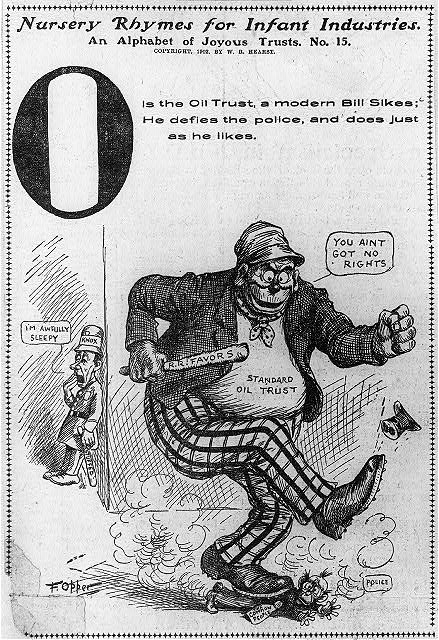 *[Anti-trust cartoons]: Nursery Rhymes for Infant Industries, No. 15: 'O' is the Oil Trust, a modern Bill Sikes; he defies the police, and does just as he likes. c1901. Library of Congress Prints and Photographs Division. lil guy sign says common ---?
While free-market capitalism led to the creation of numerous oil companies, it also, to Rockefeller, created unpredictable chaos in the industry, with oil refiners undercutting each other on prices, creating wide fluctuations. In order to remove this “marketplace inefficiency,” Rockefeller began acquiring competing oil refineries. Within the first three months of 1872, he had bought out, shut down or bankrupted 22 of his 26 Cleveland competitors.
Unsympathetic to goodwill pricing, he offered a “fair market price” for refineries that were losing money with outdated equipment. However, as muckrake journalists later pointed out, the refineries were losing money because of Standard Oil’s monopoly. Its very size meant that Standard Oil, unlike other refineries, could negotiate a railroad discount by promising 60 carloads of oil daily, which appealed to railroad owners wanting to maintain a high and steady volume. These train rebates helped Standard Oil keep transportation costs low; other refineries could not compete. Oil and railroad tycoons proposed a deal to fix transportation costs, called the Southern Improvement Company, but public outcry quickly stopped further negotiations.
In 1882, Standard Oil Trust created a network of Standard Oil companies throughout the country, led by a board of trustees, where Rockefeller owned over one third of the certificates. By the late 1880s, Standard Oil controlled 90% of American refineries. This control of the market, along with the Southern Improvement Company scandal, caught the attention of politicians, who started passing anti-trust laws and prohibiting train rebates. Rockefeller had a strict no-talking-to-the-press rule, which did nothing to combat the widely popular, scathing critique of Standard Oil External by journalist Ida Tarbell. Rockefeller eventually retired from daily operations in 1895, at the age of 56, but stayed in a figurehead role as president.
In 1911, the Supreme Court found Standard Oil in violation of the Sherman Antitrust Act. As a result, Standard Oil was split into 34 independent companies, although over time these corporate descendants regrew into large integrated oil companies that still dominate the market, such as ExxonMobil.
The Supreme Court case also hadn’t slowed Rockefeller’s wealth: newspaper headlines from 1916 announced he was the world’s first billionaire. According to *Forbes*External, Rockefeller’s total assets in 1937 equaled 1.5% of America’s total economic output for that same year, making him one of the wealthiest people in the world to this day (in comparison, Bill Gates’ wealth in 2018 would be 0.45% of 2018 GDP).
He was often approached about donating his money to various causes. His publicist Ivy Lee, hired after the anti-trust case, “cultivated the notion of a benign old man giving away dimes and preoccupied with charity,” according to one biographer. Rockefeller and his family established the Rockefeller Foundation External in 1913, which supported public health causes through a large endowment. He also used his money to establish the University of Chicago and the Rockefeller Institute for Medical Research. His goal as a young adult was to make $100,000 and live to be 100 years old. While he surpassed his financial goal, John D. Rockefeller died on May 23, 1937, at the age of 98.
===
---