Monopoly/Merger/Consolid
==
619 see anti-trust too big to fail
merri ok
bak
SEE MONOPOLY 2
SEE HOSTILE TAKEOVER 12 25
see also M&A (more historical?) [overwrite 819?]
US steel japan 8 25
neglected? see also media consolidation
aha note also allow for rebranding chem corps monsanto bayer dupot dow
---
---
AN 12 25
On Sunday, President Donald Trump declared that he will “be involved” in the federal government’s decision on whether to allow the streaming service Netflix to buy mass media and entertainment conglomerate Warner Brothers Discovery. On Monday, Paramount Skydance, another mass media and entertainment conglomerate, announced a hostile takeover bid for WBD — with news soon following that Trump son-in-law Jared Kushner’s private equity firm is part of the Paramount offer.
“Paramount is telling WBD shareholders that it has a smoother path to regulatory approval than does Netflix, and Kushner’s involvement only strengthens that case,” Axios reported. “Paramount is led by David Ellison, whose billionaire father Larry is a major supporter of President Trump.”
Axios added that Kushner’s firm, Affinity Partners, “was not mentioned in Paramount’s press release on Monday morning about its $108 billion bid, nor were participating sovereign wealth funds from Saudi Arabia, Abu Dhabi and Qatar.”
Fortune reported that “Affinity and the other outside financing partners have agreed to forgo any governance rights, which Paramount said means the Committee on Foreign Investment in the United States would have no jurisdiction over the transaction.”
But Axios’ Sarah Fischer wrote on social media: “Ask yourself, why would anyone want to put money into an investment of this caliber and have no governance rights or board seats?”
“Essentially,” she added, “people want to have control/access/political power behind the scenes.”
“Reality is,” Fischer explained, this hostile takeover is a good explanation “of how capitalism/democracy can be exploited for political gain,” with “Paramount essentially betting our open system incentivizes shareholders to take [the] best financial deal even if it means giving soft power” to three sovereign wealth funds, the President, and his son-in-law.
Critics are blasting Kushner’s and Trump’s involvement.
U.S. Senator Elizabeth Warren (D-MA) remarked, “Donald Trump said he’ll ‘be involved in’ deciding if Netflix can buy Warner Bros. Is that an open invite for CEOs to curry favor with Trump in exchange for merger approvals? It should be an independent decision by the Department of Justice based on the law and facts.”
Award-winning journalist Sophia A. Nelson, responding to trump’s remarks, observed: “This is ridiculous. Corrupt. And NOT what a President gets involved in.”
Professor, investor, and marketing executive Adam Cochran wrote: “Trump is talking about him personally being involved in deciding the fate of the Netflix-Warner Brothers deal, and how it’s ‘bad.’ Meanwhile his son-in-law is financing the competing offer. There has truly never been a more corrupt administration in US history!”
Alexander Vindman, former Director of European Affairs for the United States National Security Council (NSC), wrote: “F– NO to another corrupt Trump deal. Nepobaby, Jared’s, involvement would deliver CNN to MAGA.”
NewsNation’s Kurt Bardella, a communications advisor and media relations consultant, asked: “Alexa, what is a ‘conflict-of-interest’?”
---
---}:
an 8 25
New Republic reporter Timothy Noah said seven out of the ten top donors to the presidential race last year gave to Trump — and now their favored president is turning on them
“… The White House keep[ing] scorecards measuring the loyalty of 553 corporations to President Donald Trump’s Big Beautiful reconciliation bill demonstrates that the relationship between private wealth and this presidential administration isn’t as happy as you might think,” said Noah.
Trump is certainly making corporations happy by “chucking health care for the poor so it can cut taxes for the rich,” said Noah, and he’s also “dismantling regulatory agencies created to check corporate power.” Trump lowering taxes and deregulation “are what oligarchs desire more than anything else,” Noah adds, which is why “people like Elon Musk, Timothy Mellon, and Miriam Adelson supported Trump in 2024.”
READ MORE: 'Complete 180' and 'hot mic moment': Brutal CNN supercut reveals how Trump got played by Putin
However, “Trump’s pathological attachment to high tariffs, his never-ending threats to destabilize the Federal Reserve, and, increasingly, his demands that corporations bend the knee are all more than these plutocrats likely bargained for,” Noah said.
Even as Trump dismantles regulatory agencies legitimately created by Congress, he is introducing a new, “more chaotic regulatory regime dictated by his own whims,” said Noah. “Trump appears intent on ripping up business regulations" and “replacing them with himself.”
Consider the president allowing chip-maker Nvidia to sell AI chips to China. Trump had previously blocked those sales on national security grounds, but Noah said Trump changed his mind and allowed sales, providing Nvidia turned over 15 percent of the resultant revenues to the United States Treasury.
The Constitution does not grant a president the right to demand Invidia surrender a portion of its revenues from Chinese sales to the U.S. Treasury, said Noah, “Nor does the Constitution encourage a president to tell Goldman Sachs to fire its chief economistor Intel to fire its chief executive."
READ MORE: buckle up: Former Trump attorney Alina Habba may be in office for awhile
And then there’s the issue of Trump approving the merger of Nippon and U.S. Steel — provided the federal government retain a “golden share” that allows it to veto certain future actions affecting workers. Language in that agreement refers unnecessarily to Trump by name,which strikes Noah as “unsettlingly authoritarian.”
And now comes the news that Trump has loyalty “scorecards” on corporations that rank their support as “strong, moderate, or low” based on whether and how they supported passage of the Big Beautiful Bill through “social media posts, press releases, video testimonials, ads, [or] attendance at White House events.” The most obedient companies, said Noah, appear to be AT&T, Airlines for America, Cisco, Delta, DoorDash, the Steel Manufacturers Association, Uber and United.
“[I]f history is any guide, businesses don’t fight fascist corporatism; they just grope their way toward accommodating it,” writes Noah. “That’s certainly what we’re seeing thus far. Even when Trump bullies American oligarchs, they can’t see their way to judging him anything other than their guy.”
Read the full New Republic report at this link.
---
===
mcconnell mafia
an 12 24
Trump's pick to lead the Federal Trade Commission vowed in his job pitch to end current chair Lina Khan's "war on mergers," a signal to an eager corporate America that the incoming administration intends to be far more lax on antitrust enforcement.
Andrew Ferguson was initially nominated by President Joe Biden to serve as a Republican commissioner on the bipartisan FTC, and his elevation to chair of the commission will not require Senate confirmation.
In a one-page document obtained by Punchbowl, Ferguson—who previously worked as chief counsel to Sen. Mitch McConnell (R-Ky.)—pitched himself to Trump's team as the "pro-innovation choice" with "impeccable legal credentials" and "proven loyalty" to the president-elect.
Ferguson's top agenda priority, according to the document, is to "reverse Lina Khan's anti-business agenda" by rolling back "burdensome regulations," stopping her "war on mergers," halting the agency's "attempt to become an AI regulator," and ditching "novel and legally dubious consumer protection cases."
Trump announced Ferguson as the incoming administration's FTC chair as judges in Oregon and Washington state blocked the proposed merger of Kroger and Albertsons, decisions that one antitrust advocate called a "fantastic culmination of the FTC's work to protect consumers and workers."
According to a recent report by the American Economic Liberties Project, the Biden administration "brought to trial four times as many billion-dollar merger challenges as Trump-Pence or Obama-Biden enforcers did," thanks to "strong leaders at the FTC" and the Justice Department's Antitrust Division.
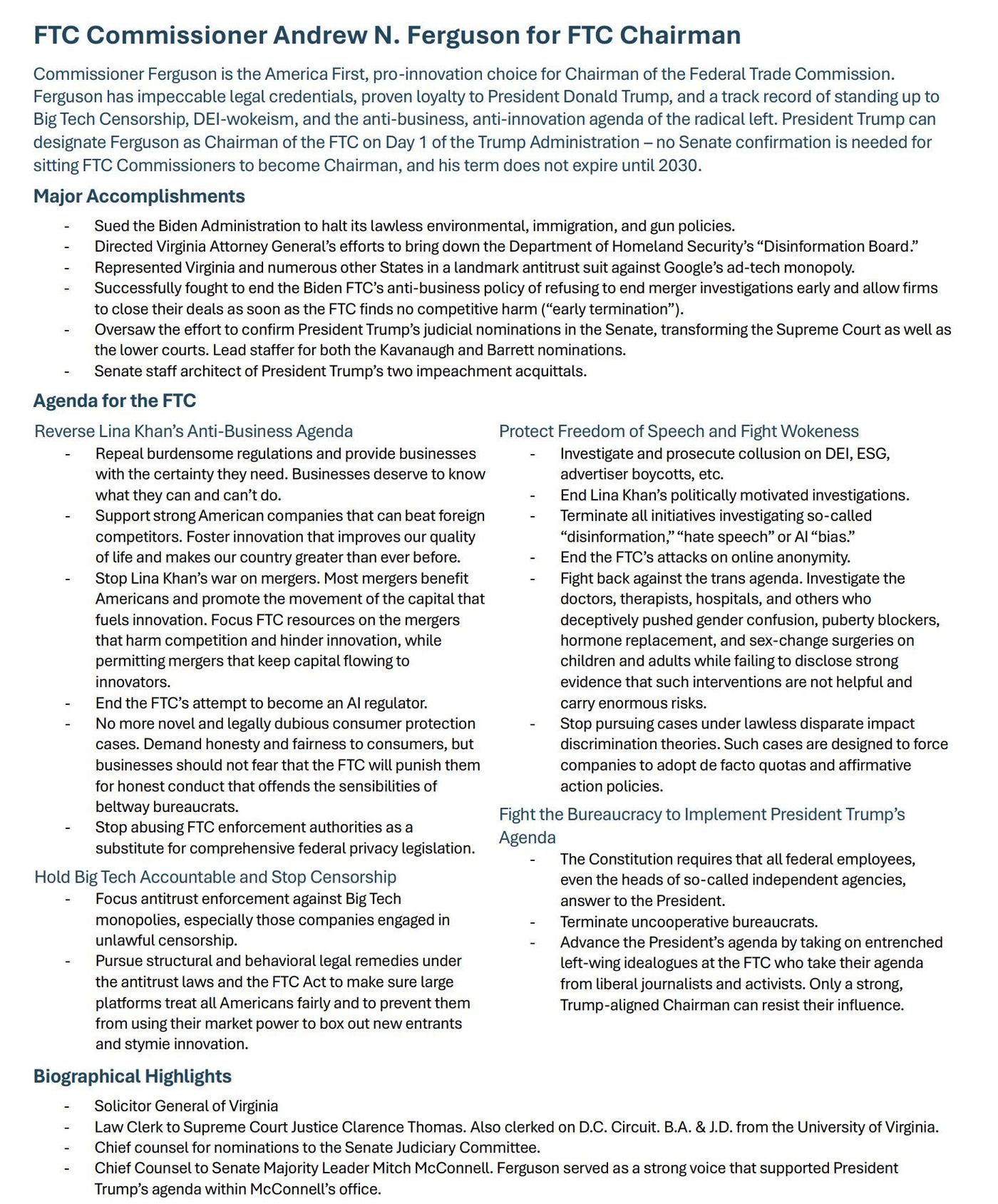
In a letter to Ferguson following Trump's announcement on Tuesday, FTC Commissioners Alvaro Bedoya and Rebecca Kelly Slaughter wrote that the document obtained and published by Punchbowl "raises questions" about his priorities at the agency mainly "because of what is not in it."
"Americans pay more for healthcare than anyone else in the developed world, yet they die younger," they wrote. "Medical bills bankrupt people. In fact, this is the main reason Americans go bankrupt. But the document does not mention the cost of healthcare or prescription medicine."
"If there was one takeaway from the election, it was that groceries are too expensive. So is gas," the commissioners continued. "Yet the document does not mention groceries, gas, or the cost of living. While you have said we're entering the 'most pro-worker administration in history,' the document does not mention labor, either. Americans are losing billions of dollars to fraud. Fraudsters are so brazen that they impersonate sitting FTC commissioners to steal money from retirees. The word 'fraud' does not appear in the document."
"The document does propose allowing more mergers, firing civil servants, and fighting something called 'the trans agenda,'" they added. "Is all of that more important than the cost of healthcare and groceries and gasoline? Or fighting fraud?"
As an FTC commissioner, Ferguson voted against rules banning anti-worker noncompete agreements and making it easier for consumers to cancel subscriptions. Ferguson was also the only FTC member to oppose an expansion of a rule to protect consumers from tech support scams that disproportionately impact older Americans.
"Andrew Ferguson is a corporate shill who opposes banning noncompetes, opposes banning junk fees, and opposes enforcing the Anti-Merger Act," said Basel Musharbash, principal attorney at Antimonopoly Counsel. "Appointing him to chair the FTC is an affront to the antitrust laws and a gift to the oligarchs and monopolies bleeding this country dry."
===
AN 10 24
alternet-NO LNX
Democracy dies in their wallets
Twitter employees respond to new owner Elon Musk’s annihilation of top execs — on Twitter
Thom Hartmann October 28, 2024
Do not obey in advance. Most of the power of authoritarianism is freely given. In times like these, individuals think ahead about what a repressive government will want, and then offer themselves without being asked. A citizen who adapts in this way is teaching power what it can do.—Yale historian Timothy Snyder, On Tyranny
I cancelled my Washington Post subscription Friday evening. Jeff Bezos, Mister “Democracy Dies In Darkness” (the Post’s slogan on their masthead), by blocking his editorial staff from endorsing Harris chose darkness over his nation’s future, and I can’t support that.
The big mistake John D. Rockefeller made back in the day — that Jeff Bezos and Elon Musk appear committed to not repeating — was not buying a media outlet like a newspaper. Had John D. had that sort of a vehicle to mold public opinion, American history may be very different.
By 1880, Rockefeller’s Ohio-based company controlled over 90 percent of the nation’s oil, owned 4000 miles of pipelines, and employed over 100,000 people. As Rockefeller’s oil empire got larger and larger, eating alive hundreds of smaller operations, ruthlessly driving up prices, destroying his competitors, and throwing workers out of a job, public outrage grew.
In 1887, Ohio sued him, arguing that he was operating in ways that were detrimental to the state and its citizens and businesses; in 1892 the Ohio Supreme Court ordered his company dissolved. As I lay out in detail in Unequal Protection: How Corporations Became “People,” this led Rockefeller to move Standard Oil to New Jersey after that state changed its corporation laws to allow for his monopolistic behavior.
Which brought in the federal government; in 1890, Ohio Senator John Sherman introduced and saw passed into law the Sherman Anti-Trust Act which provided not just fines but jail sentences against people like Rockefeller who were committed to destroying competition and owning entire markets. The law was flawed with a few loopholes and ambiguities, so it was amended in 1914 with the Clayton Anti-Trust Act.
Nonetheless, in 1906 progressive Republican Teddy Roosevelt’s administration filed an antitrust action against Rockefeller that went to the Supreme Court in 1911 during the administration of progressive Republican President William Howard Taft. The behemoth was broken up into 34 separate companies, an action that, like the breakup of AT&T by Jimmy Carter and Ronald Reagan, led to an explosion of competition in the marketplace and a dramatic increase in shareholder value.
But back to Jeff Bezos and his 2013 purchase of The Washington Post.
It was reporters and editors for the hundreds of independent newspapers during the First Gilded Age (1880-1900) era that led the crusades against Rockefeller and his fellow monopolists. Investigative journalism was all the rage then, and it fed public demand for a return to competition and the de-throning of that age’s oligarchs.
The vast majority of workers were struggling and they worked for a very small 10 percent of the population who controlled most of the nation’s wealth (a situation we’re at again).
The result was constant strife, strikes, and the murder of labor leaders; entire towns were in arms (and sometimes ablaze) with labor conflict. The “problem of labor”was the number one issue of the day. As President Grover Cleveland — the only Democrat elected during that period — proclaimed in his 1887 State of the Union address:
“As we view the achievements of aggregated capital, we discover the existence of trusts, combinations, and monopolies, while the citizen is struggling far in the rear or is trampled to death beneath an iron heel. Corporations, which should be the carefully restrained creatures of the law and the servants of the people, are fast becoming the people’s masters.”
There was a broad consensus across American society that those “Robber Barons” were feathering their own nests at the expense of the American public, hurting both working class people and small businesses. The Supreme Court endorsed breaking up Standard Oil in 1911, and even broke up the Associated Press in 1944.
The law was so rigorously enforced — so the game of business could be played by all comers, not just the “big boys” — that in the 1960s the Supreme Court barred the merger of the Kinney and Buster Brown shoe companies because the new combined company would control a mere 5 percent of the shoe market.
Back in the ’60s every mall and downtown in America was filled with small, locally-owned businesses; there might be a Sears to anchor the shopping center or a retail part of town, but most shops, restaurants, and hotels were family-owned.
But then Reagan, in 1983, ordered the DOJ, SEC, and FTC to stop enforcing the Sherman Act, which is why today Nike, for example, controls about a fifth of the entire nation’s shoe market. It’s the same across industry after industry, from retail to grocery stores to railroads to computer software to social media to chip manufacturing to airlines to hotels…and on and on. In virtually every industry, a handful of massive companies control 80 percent or more of the market.
The Biden administration is the first to seriously try enforcement of the nation’s anti-trust laws since Carter broke up AT&T, going after Google and blocking mergers in multiple industries. It’s led a bunch of American billionaires to demand that the Federal Trade Commission’s head, Lina Kahn, be fired.
Kahn and her FTC went after Bezos last year, suing Amazon for running a monopoly that price-gouges customers and blocks out competition. The trial is scheduled for 2026 if Kahn keeps her job; a Trump administration would fire her immediately, and pressure from major corporate donors and billionaires is building on Harris to do the same.
Bezos also must remember well when he got on the wrong side of then-President Trump because of the Post’s coverage of the orange oligarch’s lies and crimes; Trump, in a fit of pique, awarded a $10 billion Pentagon contract for cloud computing to Microsoft, shocking analysts across the industry.
Bezos is also working for his Blue Origin spaceship company to get more billions in NASA and Pentagon contracts. He and his companies also own billions in Google and AirBNB stock as well as owning outright almost a hundred other companies.
Might be a good time to own one of the two most influential newspapers in America, eh?
Similarly, billionaire oligarch Elon Musk, in addition to apparently taking orders from Russian President Vladimir Putin, is fighting numerous government efforts to regulate his companies (which exist in large part because Obama bailed out Tesla in 2010 with $465 million, and NASA is now pouring hundreds of millions into SpaceX):
— Tesla is fighting the National Labor Relations Board (NLRB) over union-related issues, with Musk taking a lawsuit to the Supreme Court alleging government protections of unions are unconstitutional.
— SpaceX is battling the NLRB over employee firings.
— The SEC is investigating Musk’s acquisition of Twitter (now X) and his “funding secured” tweets about taking Tesla private.
— The FTC is investigating X’s compliance with a $150 million privacy settlement.
— The Federal Communications Commission recently denied SpaceX’s Starlink a $886 million rural broadband award.
— The Equal Employment Opportunity Commission is suing Tesla over alleged racial harassment.
— The FAA is in conflict with SpaceX over launch licensing and environmental reviews.
— The EPA has fined SpaceX for water-related violations.
— The National Highway Traffic Safety Administration has opened multiple investigations into Tesla’s vehicle safety and Autopilot system.
— SpaceX faces scrutiny over its environmental impact at its Texas launch site.
To avoid the Rockefeller mistake, Musk — with the apparent help of two Russian oligarchs and the leader of Saudi Arabia — purchased Twitter, the online digital equivalent of our nation’s largest newspaper.
And he’s now using it to try to get Trump and Republicans into office, presumably so they can gut the FTC, FCC, SEC, NLRB, and any other regulator that might take him on to protect workers, the public, and the national interest.
We took on the superrich with success during the First Gilded Age, and our enforcement of antitrust laws lasted all the way to 1983, when Reagan blocked them, leading to the “merger mania” of the 1980s and bringing us today’s oligarchic business empires across multiple industries.
Now that we’re in America’s Second Gilded Age — with today’s billionaires vastly richer than Rockefeller’s wildest dreams — we confront a similar crossroads to that of previous generations.
Is it okay, for example, for billionaires to own media properties they can use to manipulate politics and government agencies to amplify their other business interests? Or that five corrupt Republicans on the Supreme Court have ruled that our morbidly rich plutocrats can own judges and politicians? Most Americans would probably say “No” to both.
At some point, America is going to have to confront its oligarch problem. And the sooner the better, if we don’t want darkness to entirely subsume our democracy.
===
---
PRO PUB 2022? WM BARR TRUMP DOJ FAIL? // FTC?
Roper told ProPublica that when he was developing the YieldStar software more than a decade ago, he was concerned about avoiding both issues. He also said he didn’t want to misuse private data in pricing.
“I was highly sensitized to: You just don’t do it,” Roper said.
Despite differences in the software’s design, RealPage acquired LRO in 2017 after months of scrutiny by the antitrust division of the justice department. Federal regulators review mergers above a certain size — right now, it is transactions valued at $101 million — and typically allow them to proceed after only a preliminary review. But some are flagged for a more extensive look. The government can challenge a merger in court if it believes it could substantially harm competition.
RealPage’s purchase of LRO received such a second look, but the DOJ allowed it to proceed in late 2017. The department did not respond to requests for comment.
The approval allowed RealPage to acquire its only significant competitor, Roper said, adding, “I was surprised the DOJ let that go through.”
RealPage was pricing 1.5 million units, and the acquisition of LRO would double that, Steve Winn, RealPage’s then-CEO, said at a mid-2017 investor conference. “I don’t think there’s any concentration, enough concentration, of buying or pricing power here” to warrant DOJ concerns, he said. A third company had a substantial footprint in the market, Winn said, but property managers’ own manual pricing processes or proprietary systems were RealPage’s largest competitor.
“We expect our combined platform to drive accelerated, sustained revenue growth,” Winn said in a media release announcing the deal.
RealPage’s influence was burgeoning. That year, the firm’s target market — multifamily buildings with five or more units — made up about 19 million of the nation’s 45 million rental units. A growing share of those buildings were owned by firms backed by Wall Street investors, who were among the most eager adopters of pricing software.
RealPage renamed its combined pricing software AI Revenue Management. By the end of 2020, the firm was reporting in a Securities and Exchange Commission filing that its clients used its services and products to manage 19.7 million rental units of all types, including single-family homes. The private equity firm Thoma Bravo bought the public company a few months later for $10.2 billion.
Winn, whose net worth Forbes estimates at $1.7 billion, stepped aside. He did not respond to requests for comment.
A spokesperson for Thoma Bravo declined to comment.
Who Uses the Software and How It Works
Somewhere around 2016, according to one trade group, the industry’s use of the pricing software began to achieve “critical mass.”
The more property managers who sign on to RealPage services, the more data flows into the company’s repository. That in turn aids its pricing service, which the company says “leverages multifamily’s largest lease transaction database.”
RealPage’s clients include some of the largest property managers in the country. Many favor cities where rent has been rising rapidly, according to a ProPublica analysis of five of the country’s top 10 property managers as of 2020. All five use RealPage pricing software in at least some buildings, and together they control thousands of apartments in metro areas such as Denver, Nashville, Atlanta and Seattle, where rents for a typical two-bedroom apartment rose 30% or more between 2014 and 2019.
---
cbi 10 23
In the span of two weeks, ExxonMobil made its largest oil acquisition in two decades, Chevron increased its oil production capacityby 10%, and Shell cut 200 clean energy jobs. It’s clearer than ever that Big Oil companies are doubling down on the fossil fuels driving the climate crisis, while they continue to mislead the public about the harm they are causing. Communities around the nation are seeing the industry’s ongoing deception for what it is and taking Big Oil companies to court to make them pay for their climate lies.
In a $60 billion deal, Exxon acquired Pioneer Natural Resources, an oil producer in the Permian Basin. The massive merger — which more than doubles the company’s Permian production to 1.3 million barrels of oil per day — comes after Exxon spent years claiming to support taking action to limit global warming per the Paris Agreement. The oil giant, however, just made a $60 billion bet that it will be able to continue business as usual despite the urgent calls for energy transition.
The greenwashing and deception isn’t surprising; Exxon and other major oil companies are being sued by communities across the country for knowingly lying to the public about their product’s role in advancing climate change and launching a climate science denial campaign to avoid public scrutiny.
Chevron is also doubling down on its oil production, acquiring competitor Hess for $53 billion — a consolidation that will increase Chevron’s existing daily oil production of three million barrels by 10%. Meanwhile, Shell — after one of its most profitable years on record — is reducing its low-carbon workforce by 200 positions just one month after Shell employees penned an open letter to CEO Wael Sawan expressing their concern with the company’s movement away from renewable energy investments.
There is overwhelming scientific consensus that the world needs to urgently pivot to renewable fuels in order to avoid worsening impacts of the climate crisis. In 2021, the International Energy Agency declared that all oil and gas infrastructure development must stop immediately in order for the world to meet its goal of net zero emissions by 2050. Earlier this year, the United Nations report on climate change concluded the planet will be pushed past the point of catastrophic warming in the next 10 years without an immediate transition away from fossil fuels.
Despite those warnings, oil giants continue to put profit over public safety and double down on fossil fuel investments — just like they have done for decades. It’s clearer than ever that Big Oil will only continue to act in its own self interest; it’s time to hold these companies accountable for their climate destruction.
---
---
https://www.alternet.org/2020/04/how-the-pandemic-pulled-back-the-curtain-on-the-flawed-global-economic-system/
no lnx
How the pandemic pulled back the curtain on the flawed global economic system
Written by Marshall Auerback, Jan Ritch-Frel April 2, 2020
When the wealthiest country in the world is unable to produce basic medical gear to cope with a rampaging pandemic, it is dealing with a strategic vulnerability by depending on multinational supply chains to produce manufactured goods. Absent sufficient redundancies and physical reserves of resources, “just-in-time” lean supply systems can’t cope with sudden disruptions. The global pandemic of 2020 is a case in point.
This pandemic continues to unfold, but it will serve as the D-Day equivalent of a new predominating economic model for the world, and which in many ways was beginning to take shape before COVID-19. At its core, developed and mixed market economies will factor in the health risk and growing military cost of sustaining international supply chains against investing in high-tech production closer to their markets, and increasingly export their goods to the rest of the world.
Dozens of economies that developed in the past 50 years by enmeshing themselves in the international supply chain on the basis of their labor price advantage will find themselves increasingly cut out of the new process. The contest for global power will increasingly pivot to the extraction and refinement of minerals and component materials that are critical to sustaining the high-tech economy model, away from carbon energy resources. We will be hearing much more about “national stockpiling” and “strategic reserves” beyond oil in the months and years ahead.
Not only has COVID-19 exposed potential health risks and costs involved (as globalized trade routes become vectors of contagion), but the champions of the offshoring phenomenon increasingly resort to myths and misconceptions that are irrelevant to a 21st-century economy. They are as obsolete as spending trillions annually on managing the supply and price of Middle East oil, which American foreign policy figures, including Martin Indyk, are beginning to openly say “isn’t worth it.”
Before we get into the details on thefuture economy, let’s quickly review how the U.S. saw a massive decline in its industrial capacity. Bad ideas and pernicious orthodoxies grew like barnacles over the decades on what was once the world’s leading manufacturer. First was the idea that offshoring is essential to preserving profitability. Often this assertion has been more apparent than real. As far as profitability goes, many companies have made choices to move manufacturing offshore despite continuing domestic profits on home shores. For example,the five North American plants that General Motors (GM) shut down in 2019 were still profitable, but the company, which had received a government bailout in 2009, chose to refocus on the higher-margin operations in China.
Of course, capitalism controlled by bankers and speculators gives free rein to companies to make profits on how they see fit.The consequences are that for decades, Detroit’s “Big Three” automakers have consistently underperformed their German and Japanese counterparts because of their decision to embrace a Wall Street-driven culture that has prioritized short-term quarterly earnings, massive dividend payouts and unprecedented spending on stock repurchases over productive investment in innovation. And as GM’s 2019 experience illustrates, the resultant profits did not go to spur domestic reinvestment, which in turn creates domestic employment, but abroad to expand China’s manufacturing base. GM is but one example of the hundreds of major corporate actors that have denuded the country’s industrial ecosystem, creating gaps in the U.S. workforce and shortages of vital skilled labor.
There are also multiple examples of companies acquiring smaller innovative companies “solely to discontinue the target’s innovation projects and preempt future competition,” according to researchers Colleen Cunningham, from London Business School, and Florian Ederer and Song Ma, both from Yale. A particularly poignant example of these“killer acquisitions,” given today’s ongoing ventilator shortage, is Covidien’s attempted 2012 purchase of California-based Newport Medical Instruments, a smaller competing medical device company that had secured a contract from the federal government in 2010 to produce up to40,000 mobile ventilators.But as David Dayen of The American Prospect observed, the purported rationale for the acquisition was bogus: It had nothing to do with expanding Covidien’s product base and everything to do with destroying a competitor whose product “could cut into its existing profits.”
For years, the political economist Seymour Melman argued that companies that embraced the soft option of downsizing/offshoring labor would ultimately create grave production weaknesses in the U.S. economy and stifle innovation. Higher domestic wages, by contrast, would induce competent managers to compensate by using and investing in more and better machinery, which in turn would lead to a virtuous cycle of production: higher profits, which can lead to higher wages, leading to better machinery and organization of work.
While American companies may think they are improving their individual competitiveness in the short term by shifting operations to low-cost labor economies, the current pandemic illustrates that they collectively undermined America’s (and their own) competitiveness over the long haul.
...
==...
==
The report from the investigative team at Unearthed focused on the practices of Bayer,BASF, Corteva (formerly Dow and DuPont), FMC and Syngenta, which are continuing to sell HHPs like neonicotinoids and glufosinate that have been banned in other parts of the world, according to the produce industry publication Fresh Produce Journal.
---
===
ew 220
https://www.ecowatch.com/highly-hazardous-pesticides-investigation-2645202101.html
Poor people in developing countries are far more likely to suffer from exposure to pesticides classified as having high hazard to human health or the environment, according to new data that Unearthed analyzed.
The analysis shows that the world's top five pesticide makers are making billions, accounting for more than 36 percent of their income, from chemicals that are proven to hazards to humans and the environment and are contributing to the precipitous demise of bee populations, as Unearthed reported.
The researchers found that the sale of these highly hazardous pesticides (HHPs), disproportionately occurred in poorer nations, which often have fewer regulations than industrialized nations, according to The Guardian. In India, for example, sales of HHPs were nearly 60 percent, while in the UK it was just 11 percent.
The report from the investigative team at Unearthed focused on the practices of Bayer,BASF, Corteva (formerly Dow and DuPont), FMC and Syngenta, which are continuing to sell HHPs like neonicotinoids and glufosinate that have been banned in other parts of the world, according to the produce industry publication Fresh Produce Journal.
Unearthed dove into data collected by Phillips McDougall, the leading agribusiness analysts, from buyer surveys that concentrated on the best sellers in the top 43 pesticide buying countries, as The Guardian reported.
While regulations have stopped the sale of certain pesticides in Europe, the U.S. and Canada, it has hardly slowed down chemical companies, which sold $4.8 billion worth of products containing HHPs in 2018,as The Guardian reported. guk] Bayer called the analysis "misleading" but did not offer proof of that assessment.
Since the investigation focused on just 43 countries, it covered less than half of the companies' global sales. That suggests that the companies actually made billions more from pesticides that regulatory agencies have said pose hazards like acute poisoning or chronic illness in people, or high toxicity to bees and other wildlife, according to Unearthed.
The investigation found that pesticide manufacturers sold the majority of its highly hazardous pesticide in low- and middle-income countries like Brazil and India, where experts say the risks posed by using these chemicals are greatest, according to Unearthed. The biggest market for HHPs were for corn and soya crops.
About a quarter of sales were from products known to be human carcinogens or dangerous to reproductive health.Another 10 percent were toxic to bees. An additional 4 percent of chemicals sold are acutely toxic to humans. Every year, nearly 200,000 suicides are linked to pesticide poisoning, almost entirely in developing countries, according to The Guardian.
"This investigation shows that there is a huge disconnect between what those companies are saying in the international policy arena and what they are actually doing," Meriel Watts, a senior science and policy advisor to the Pesticide Action Network, said to Unearthed.
Baskut Tuncak, the United Nations' special rapporteur on toxic substances and human rights, told Unearthed, "There is nothing sustainable about the widespread use of highly hazardous pesticides for agriculture."
"Whether they poison workers, extinguish biodiversity, persist in the environment, or accumulate in a mother's breast milk, these are unsustainable, cannot be used safely, and should have been phased out of use long ago," Tuncak said....
==
---
IT&T 400K$ to nixon to get doj to drop monop case trms 12/19
kleindienst sp AG resigns; butied by watergate
==
---
https://www.alternet.org/2019/08/to-fight-corporate-assault-on-journalism-sanders-unveils-plan-to-stop-big-media-mergers-and-bolster-independent-news
no lnx
To fight corporate ‘assault on journalism,’ Sanders unveils plan to stop big media mergers and bolster independent news
Bernie Sanders image by JStone, Shutterstock
Written by Jake Johnson / Common Dreams August 27, 2019
Warning the “decimation of journalism” by big business and billionaire executives poses a major threat to democracy, Sen. Bernie Sanders on Monday unveiled a plan to stop the long-running corporate consolidation of American media, take anti-trust action against tech giants like Facebook and Google, and bolster independent news.
“Today, after decades of consolidation and deregulation, just a small handful of companies control almost everything you watch, read, and download,” Sanders, a 2020 Democratic presidential candidate, wrote in an op-ed for the Columbia Journalism Review.
This consolidation, as well as the domination of the digital market by Facebook and Google, has led to the destruction of local independent news and hard-hitting reporting, Sanders said, leaving a void that has been filled by the vapid punditry, “infotainment,” and business-friendly propaganda that is so often featured on America’s corporate-owned television networks.
“At precisely the moment when we need more reporters covering the healthcare crisis, the climate emergency, and economic inequality,” wrote the Vermont senator, “we have television pundits paid tens of millions of dollars to pontificate about frivolous political gossip, as local news outlets are eviscerated.”
Sanders went on to provide an overview of the long-running destruction of local news and independent journalism, which he said has been “gutted by the same forces of greed that are pillaging our economy”:
Over the past 15 years, more than 1,400 communities across the county have lost newspapers, which are the outlets local television, radio, and digital news sites rely on for reporting. Since 2008, we have seen newsrooms lose 28,000 employees—and in the past year alone, 3,200 people in the media industry have been laid off. Today, for every working journalist, there are six people now working in public relations, often pushing a corporate line.
To fight the corporate assault on journalism—which Sanders noted has been made “far worse” by President Donald Trump’s “authoritarian bullying”—the senator’s plan would:
Impose an immediate moratorium on federal approval of mergers of major media companies;
Require media corporations to disclose whether their corporate transactions and mergers would cause significant layoffs of reporters;
Require that employees “be given the opportunity to purchase media outlets through employee stock-ownership plans”;
Block federal merger and deregulation moves that harm people of color and women;
“Reinstate and strengthen media ownership rules” with the goal of limiting “the number of stations that large broadcasting corporations can own in each market and nationwide”;
Enforce anti-trust laws against tech behemoths like Facebook and Google “to prevent them from using their enormous market power to cannibalize, bilk, and defund news organizations”;
Increase funding for federal programs that support public local media “in much the same way many other countries already fund independent public media.”
“Today’s assault on journalism by Wall Street, billionaire businessmen, Silicon Valley, and Donald Trump presents a crisis,” Sanders wrote. “We cannot sit by and allow corporations, billionaires, and demagogues to destroy the Fourth Estate, nor can we allow them to replace serious reporting with infotainment and propaganda.”
“When I am president,” Sanders said, “my administration will put in place policies that will reform the media industry and better protect independent journalism at both the local and national levels.”
Sanders’ plan to stop corporate consolidation of U.S. media and reverse its devastating effects won praise from journalists and press freedom advocates.
Journalists should understand that ?@BernieSanders? isn’t against journalism. He’s against a profit-driven corporate system that has long stymied real journalism and is now destroying the entire industry. https://t.co/y3wwnDXbvu
...
==
china bought smithfield pork and
bayer buys monsanto when it gets evil rep, same here?
https://en.wikipedia.org/wiki/Syngenta
Syngenta AG is a global company that produces agrochemicals and seeds and is based in Basel, Switzerland. As a biotechnology company, it conducts genomic research. It was formed in 2000 by the merger of Novartis Agribusiness and Zeneca Agrochemicals. As of 2014 Syngenta is the world’s largest crop chemical producer[2] As of 2009 it ranked third in seeds and biotechnology sales.[3] Sales in 2015 were approximately US$13.4 billion, over half of which were in emerging markets.[1] It is owned by ChemChina, a Chinese state-owned enterprise.
- 1History
- 2Products
- 3Corporate structure
- 4Litigation
- 5Controversies
- 6Lobbying in the EU
- 7Lobbying in the US
- 8Syngenta Foundation
- 9Awards and community involvement
- 10References
- 11External links
History
Based in Basel, Switzerland, Syngenta was formed in 2000 by the merger of Novartis Agribusiness and Zeneca Agrochemicals.[4][5] Its roots are considerably older.
Novartis was formed of the 1996 merger of the three Swiss companies:[6] Geigy, which has roots back to 1758;[7] Sandoz Laboratories which was founded in 1876;[citation ^needed] and Ciba, founded in 1884.[8] Ciba and Geigy had merged in 1971 and had concentrated mainly on crop protection in its agro division,[citation ^needed]Sandoz more on seeds.[citation ^needed]
In 2004, Syngenta Seeds purchased Garst, the North American corn and soybean business of Advanta, as well as Golden Harvest Seeds.[10][11] On 5 December 2004, the European Union ended a six-year moratorium when it approved imports of two varieties of genetically modified corn sold by Monsanto and its Swiss rival, Syngenta.[12]Zeneca Agrochemicals was part of AstraZeneca, and formerly of Imperial Chemical Industries. ICI was formed in the UK in 1926. Two years later, work began at the Agricultural Research Station at Jealotts Hill near Bracknell.[9]
In 2005, Syngenta opposed a Swiss ban on genetically engineered organisms.[13] On 28 November 2005, Switzerland enacted a five-year ban on the farming of genetically modified crops, underscoring the problems facing the European Commission and biotech companies like Syngenta, Bayer and Monsanto as they try to overcome consumer doubts about safety.[14]
As of 2014 Syngenta's main competitors were Monsanto Company, BASF, Dow AgroSciences, Bayer CropScience and DuPont Pioneer.[15]
In 2014, Monsanto sought to acquire Syngenta for a reported $40 billion, but Syngenta rejected the offer.[2][16] Since April 2015 Monsanto and Syngenta had been working with their investment banks Morgan Stanley and Goldman Sachs respectively on a deal. The U.S. Treasury tried to stop the deal for tax inversion.[17] Syngenta's Board of Directors rejected an even better offer by Monsanto during August 2015, and Monsanto withdrew from the negotiations on 26 August.[18]
According to the Swiss business weekly, Finanz und Wirtschaft, many Syngenta shareholders were enraged, both by the company's refusal to enter into takeover negotiations with Monsanto, and with the subsequent offer withdrawal.[19][20] This resulted in a group of investors responding by creating the Alliance of Critical Syngenta Shareholders, which urged the Board to "evaluate all options for value creation without prejudice".[21]
In a 2015 interview, Chairman Michel Demaré was asked whether Syngenta could remain independent. He responded, "If you have the patience to wait for cycles to materialize, then it would be possible. But in these circumstances, where our shareholders have a kind of a benchmark share price, what they think this company is worth, it is very difficult to say that we can deliver this in the next twelve months."[22] He thereby acknowledged that the company needs to be sold, especially given industry consolidation, which is creating larger competitors.
The failed Monsanto buyout caused Syngenta shares to increase by nearly 40%.In February 2016, ChemChina, a Chinese state-owned enterprise, offered to purchase Syngenta for $43 billion (480 Swiss francs per share), a deal which the company "unanimously recommended to shareholders”.[23] In April 2017, the Federal Trade Commission, the Committee on Foreign Investment in the United States, and the European Commissioner for Competition approved of the acquisition, allowing thelargest foreign takeover in Chinese history to proceed.[24] To secure approval, ChemChina agreed to divest from pesticide production of paraquat, abamectin, and chlorothalonil.[25][26] As an additional condition for the acquisition, 67 percent of the shareholders of Syngenta had to offer their shares to ChemChina. According to a press release, over 80 percent of shareholders agreed to the takeover by May 4, 2017. The transaction was planned to close on June 7, 2017 [27] and the transaction closed on June 26, 2017.[28]
Acquisition history
[complex chart!]
---
==
In addition, politicians such as U.S. Senator Elizabeth Warren have criticized big mergers for giving a handful of companies too much clout. President-elect Trump said in October that his administration would not approve the AT&T-Time Warner merger “because it’s too much concentration of power in the hands of too few.”
During the campaign, Trump didn’t signal what his broader approach to mergers would be.But the early signs are that his administration will weaken antitrust enforcement and strengthen the hand of economists. He selected Joshua Wright, an economist and professor at George Mason’s Antonin Scalia Law School, to lead his transition on antitrust matters. Wright, himself a former consultant for Boston-based Charles River Associates, regularly celebrates mergers in speeches and articles and has supported increasing the influence of economists in assessing monopoly power. “Mergers between competitors do not often lead to market power but do often generate significant benefits for consumers,” he wrote in The New York Times this week.
==
t-mobile and sprint approved ~ warren
==
https://www.alternet.org/2019/07/merger-mania-the-military-industrial-complex-is-on-steroids/
hartung cmn dreams
When, in his farewell address in 1961, President Dwight D. Eisenhower warned of the dangers of the “unwarranted influence” wielded by the “military-industrial complex,” he could never have dreamed of an arms-making corporation of the size and political clout of Lockheed Martin. In a good year, it now receives up to $50 billion in government contracts, a sum larger than the operating budget of the State Department. And now it’s about to have company.
Raytheon, already one of the top five U.S. defense contractors, is planning to merge with United Technologies. That company is a major contractor in its own right, producing, among other things, the engine for the F-35 combat aircraft, the most expensive Pentagon weapons program ever. The new firm will be second only to Lockheed Martin when it comes to consuming your tax dollars — and it may end up even more powerful politically, thanks to President Trump’s fondness for hiring arms industry executives to run the national security state.
Just as Boeing benefited from its former Senior Vice President Patrick Shanahan’s stint as acting secretary of defense, so Raytheon is likely to cash in on the nomination of its former top lobbyist, Mike Esper, as his successor. Esper’s elevation comes shortly after another former Raytheon lobbyist, Charles Faulkner, left the State Department amid charges that he had improperly influenced decisions to sell Raytheon-produced guided bombs to Saudi Arabia for its brutal air war in Yemen. John Rood, third-in-charge at the Pentagon, hasworked for both Lockheed Martin and Raytheon, while Ryan McCarthy, Mike Esper’s replacement as secretary of the Army, worked for Lockheed on the F-35, which the Project on Government Oversight (POGO) has determined may never be ready for combat.
And so it goes. There was a time when Donald Trump was enamored of “his” generals — Secretary of Defense James Mattis (a former board member of the weapons-maker General Dynamics), National Security Advisor H.R. McMaster, and White House Chief of Staff John Kelly. Now, he seems to have a crush on personnel from the industrial side of the military-industrial complex.
As POGO’s research has demonstrated, the infamous “revolving door” that deposits defense executives like Esper in top national security posts swings both ways. The group estimates that, in 2018 alone, 645 senior government officials — mostly from the Pentagon, the uniformed military, and Capitol Hill — went to work as executives, consultants, or board members of one of the top 20 defense contractors.
Fifty years ago, Wisconsin Senator William Proxmire identified the problem when he noted that:
“the movement of high ranking military officers into jobs with defense contractors and the reverse movement of top executives in major defense contractors into high Pentagon jobs is solid evidence of the military-industrial complex in operation. It is a real threat to the public interest because it increases the chances of abuse… How hard a bargain will officers involved in procurement planning or specifications drive when they are one or two years away from retirement and have the example to look at of over 2,000 fellow officers doing well on the outside after retirement?”
In other words, that revolving door and the problems that go with it are anything but new. Right now, however, it seems to be spinning faster than ever — and mergers like the Raytheon-United Technologies one are only likely to feed the phenomenon.
The Last Supper
The merger of Raytheon and United Technologies should bring back memories of the merger boom of the 1990s, when Lockheed combined with Martin Marietta to form Lockheed Martin, Northrop and Grumman formed Northrop Grumman, and Boeing absorbed rival military aircraft manufacturer McDonnell Douglas. And it wasn’t just a matter of big firms pairing up either. Lockheed Martin itself was the product of mergers and acquisitions involving nearly two dozen companies — distinctly a tale of big fish chowing down on little fish. The consolidation of the arms industry in those years was strongly encouraged by Clinton administration Secretary of Defense William Perry, who held a dinner with defense executives that was later dubbed “the last supper.” There, he reportedly told the assembled corporate officials that a third of them would be out of business in five years if they didn’t merge with one of their cohorts.
...
==
https://www.alternet.org/2019/06/heres-why-elizabeth-warren-could-be-big-corporations-worst-nightmare/
==
https://www.ecowatch.com/bayer-secret-list-of-monsanto-critics-2636999291.html
no lnx
Bayer Apologizes Over Secret List of Monsanto Critics
Deutsche Welle 3 hours ago BUSINESS
O. Andersen / Getty Images / AFP
Germany's Bayer, which bought the U.S. agrochemical firm Monsanto, issued an apology on Sunday following reports that its American subsidiary drew up a list of those critical of the firm's practices.
"After an initial analysis, we understand that such a project raised concerns and criticism," Bayer said in a statement. "This is not the way Bayer would seek dialogue with different stakeholders and society, so we apologize."
The Leverkusen-headquartered firm said it would hire a law firm to carry out an external investigation into the matter.
The French prosecutor said Friday it had opened a probe after newspaper Le Monde filed a complaint.
The French daily alleges that Monsanto built up a file of about 200 names, including journalists and lawmakers who are skeptical about the company and its products, in the hope of influencing their positions on pesticides.
The charge is that the information was collected illegally.
Paris police are investigating the possible "collection of personal information by fraudulent, unfair or illicit means."
Naming Names
Le Monde and one of its journalists complained that they were on the list drawn up since 2016 and allegedly leaked by U.S. public relations firm FleishmanHillard.
The name of France's former Environment Minister Segolene Royal is also said to be on the list. She told AFP it "says a lot about the methods of lobbyists ... they carry out spying, infiltration, seek to influence, sometimes financially, I imagine."
PR firm FleishmanHillard said on Friday it would investigate the allegations.
French public broadcaster France Televisions announced Sunday that it would also file charges.
Monsanto's Roundup.
Lawsuits Over Monsanto's Roundup
Monsanto produces the broad-spectrum glyphosate-based herbicide Roundup. The firm and new owner Bayer deny that Roundup causes cancer.
However, last August, a U.S. jury found Bayer liable because Monsanto had not warned users of alleged cancer risks linked to Roundup.
The U.S. Environmental Protection Agency (EPA) issued a new decision in April that glyphosate, the active ingredient in Roundup, which is made by Monsanto, does not cause cancer or other health problems if used according to instruction labels.
Bayer Chief Executive Officer Werner Baumann is facing increased shareholder pressure over the litigation it inherited from Monsanto. It is the named defendant in U.S. lawsuits concerning Roundup filed by 13,400 people.
Bayer shares have fallen about 40 percent since the $63 billion (€56 billion) Monsanto purchase was completed last June.
Reposted with permission from our media associate Deutsche Welle.
RELATED ARTICLES AROUND THE WEB
Bayer apologizes for Monsanto PR firm's media list | The Japan Times ›
---
==
https://www.alternet.org/2019/02/how-a-failing-capitalist-system-is-allowing-amazon-to-cripple-america/
Capitalism is failing in America, and Amazon is both the cause and beneficiary of much of the breakdown.
:{:{}:
}:
Jeff Bezos said, “We’ve had three big ideas at Amazon that we’ve stuck with for 18 years, and they’re the reason we’re successful: Put the customer first. Invent. And be patient.” He might have added three capitalist practices familiar to his company: (1) Pay no taxes; (2) Drive competitors out of business; and (3) Exploit workers.
:{:{}:
}:
Anarcho-Capitalism: The Sordid Details of Amazon’s Tax Avoidance
In 2018, according to its own SEC filings, Amazon claimed a refund on its $11 billion in U.S. profits. It did the same on nearly $6 billion in profits in 2017. The company has reportedly positioned itself to avoid even more future taxes with unspecified tax credits.
In the most extreme form of capitalism taxes do not exist. This is called “anarcho-capitalism.” Among all corporations, Amazon may be the leading advocate of this philosophy. They haven’t paid federal income tax for the past two years. They set up headquarters in Luxembourg for tax breaks that are now being challenged. They claim minimal profits on hundreds of billions in revenue, resulting in one of the lowest profit margins among major corporations, and thus much less tax. Of course, Amazon claims to be using tax credits from past losses that stemmed from investment in research and development (R&D). But the company appears to overstate and obfuscate the R&D numbers. Its only ‘explanation’ of R&D in its annual report comes in an ambiguously all-encompassing section called “Technology and Content.” Plus, that’s no excuse to dodge taxes. Walmart and Google each spent nearly $12 billion on technology in 2018, almost as much as Amazon, but Walmart paid 28 percent in federal taxes, and Google 14 percent.
We learn much more at the state level. Amazon has played one state against another for tax breaks over the years, most recently negotiating an estimated $3 billion tax credit from the state of New York before residents rebelled — as well they should have. The Economic Policy Institute found that employment levels don’t significantly change in communities with new Amazon warehouses, and a recent study by The Economist concluded that the opening of a fulfillment center in a given community actually depresses warehouse wages. Furthermore, as an indication of the folly of wooing corporations with state subsidies, Upjohn research found that in the great majority of cases incentives are not even a part of a company’s decision to locate in a given area.
Most insidiously, Amazon’s seemingly fair-minded acceptance of state sales taxes likely has a dark side. For years the company fought the state tax as it built a competitive advantage over smaller firms. Now that it’s firmly established, online variety and convenience have replaced price as the primary incentives for most consumers, and so Amazon now supports a sales tax, very likely to discourage competition. Evidence comes from one study that found Walmart 34 percent cheaper than Amazon in four of five product categories.
Monopoly: Amazon and the Killing of Competition
Kiplinger compiled a remarkable list of 49 companies, many of them familiar to almost all Americans, that are in danger of being driven out of business by Amazon. One of them, Toys ‘r’ Us, has already succumbed. Sears is nearly gone. Others include Barnes & Noble, Kroger, Rite Aid, Best Buy, Etsy, Yelp, Pandora, and even stalwarts like Target and Trader Joe’s and UPS and Fedex and Office Depot and Staples. Investopedia agrees, adding Macy’s and even Walgreen’s and CVS and Costco.
In a summary of “The Myth of Capitalism,” by Jonathan Tepper and Denise Hearn, it is argued that “an increase in market concentration across the United States has resulted in a system that is not true capitalism, since freedom is being restricted…Amazon is crushing retailers…It can determine what products can and cannot sell on its platform, and it competes with any customer that encounters success.” Columbia University and UN economist Howard Steven Friedman adds, “Monopolies are one example of capitalism failing. Monopolies have virtually no competition and can dictate prices to their customers unless they are restricted by regulators.”
Of course, along the way Amazon has destroyed or dismantled or discouraged many smaller businesses. Like the jewelry store in New Mexico owned by Candelora Versace, who said her customers have started buying gems online, in part to avoid state taxes, and then visiting her store just for the settings. She considers the far-reaching effects of Amazon’s tax avoidance: “The roads don’t pay themselves. The schools don’t fund themselves…When they don’t want to pay the tax, it cheats us.”
Labor in Decline: The Economic and Physical Abuse of Amazon’s Workers
Amazon warehouse workers make about $13 per hour. That’s not a living wage for a U.S. family of four, and not even for a single person in many areas of the country. So the employees of this super-rich company turn to food stamps, letting U.S. taxpayers take care of them. In Ohio and Pennsylvania, one in ten Amazon workers were recently on SNAP. In Arizona, one in three. Along with the low pay comes intolerable working conditions, with overheated warehouses and employees using water bottles to avoid bathroom breaks in order to meet their schedules. And worse, employees have suffered workplace injuries that leave them homeless, disabled, or unable to earn an income. Employees are also forced to deal with constant surveillance, anti-union pressure, and the threat of losing their jobs. Much of Amazon’s over-hyped R&D spending is focused on the development of robots to replace human workers.
Capitalism has failed workers, and it has caused a surge in inequality that gets worse with each passing year. In Capital in the 21st Century, Thomas Piketty showed that for 40 years, from 1970 to 2010, labor’s share of national income (wages and salaries) has declined. Stanford research reveals that “the declining labor share at the economy level is driven by the growth of large firms.” Like Amazon.
A Good Reason for Democratic Socialism
There may be no better argument for democratic socialism in America than the way individual state leaders have been falling over each other trying to lure corporations to their states with tax subsidies. We Americans have never been able to cooperate in ending this pointless waste of tax money that should be going to education and jobs and infrastructure.
Does Jeff Bezos have any sense of social responsibility for all the societal benefits heaped upon his company? Amazon has arguably benefited more than any other company from what The Economist calls the “game-changing breakthroughs” of the Internet, which was built with our tax money through the National Science Foundation since the 1980s, and before that by the taxpayer-funded Defense Advanced Research Projects Agency (DARPA). Fortune refers to Amazon’s actions as “extracting public money for its own enrichment.”
But perhaps the Amazon boss doesn’t care. According to The Atlantic, “Bezos has argued that there is not enough philanthropic need on earth for him to spend his billions on.” If that truly reflects the man’s attitude, it shows an incomprehensible ignorance or disdain on his part. Bezos himself said, “The only way that I can see to deploy this much financial resource is by converting my Amazon winnings into space travel…I am going to use my financial lottery winnings from Amazon to fund that.”
Good work, Jeff. Benefit from seventy years of public inventiveness and productivity and funding, and then fly off to the skies before you have to pay for it.
===
---
verizon merger? saudis buy whole floors?
Needing Trump's backing, telecom giant books rooms at his hotel ...
www.msnbc.com/.../needing-trumps-backing-telecom-giant-books-rooms-his-hotel
1.
Missing: verizon | Must include: verizon
---
==
NB aha less diversity on marketplace and species
What Would a Monsanto-Bayer Merger Really Grow?
By Courtney Lindwall
A megamerger between two of the world's biggest agricultural corporations looms on the horizon. The seed and pesticide giant Monsanto is inching closer to uniting with the German pharmaceutical and chemical company Bayer—a consolidation that could spell disaster for farmers, pollinators, and affordable, healthy food.
Here's why the Monsanto-Bayer merger is a toxic relationship:
One-Stop Shopping for Increased Pesticide Use
When the same people who sell seeds for pesticide-resistant crops also make the pesticides, there's a huge incentive for that company to encourage chemical-heavy growing practices, cashing in twice on farmers who become ever more dependent on its products. And when pests and weeds inevitably develop a resistance to those chemicals? More seeds. More pesticides.
If the merger gets the green light, the result is a megacorporation, not a recipe for competition and innovation. In the past, such monopolies have cost small farmers big-time. Take corn, for example. As the likes of Monsanto and other big ag companies gobbled up smaller seed sellers in recent decades, the cost of corn seed nearly quadrupled while corn prices are roughly the same as they were in 1996.
Bad News for Bees and Butterflies
As you likely know, pollinators are in trouble. Bees are dying off in record numbers (without them, our crops would take a serious hit) and monarch butterfly numbers have dropped nearly 90 percent in just the past two decades. While climate change and habitat loss are contributing to these declines, we can also point a finger at neonics and glyphosate—two types of pesticides commonly found in Bayer and Monsanto products. Americans are spraying more and more of these toxins on crops and lawns—we used 3.5 million pounds of neonics in 2011 alone (double the amount used just five years earlier)—and pollinators are paying the price.
Our Wallets Could Also Be Taking a Hit, Along With Our Health
As farmers pay more for seeds and Monsanto-Bayer rakes in more cash, American families could be forking over more money at the grocery store. One in eight families in the U.S. already struggle to put dinner on the table, and climate change threatens to disrupt food production worldwide. Further, the World Health Organization classifies glyphosate, the widely used herbicide found in Monsanto's Roundup, as a probable carcinogen, and increasing its use would only put more fieldworkers, consumers, and those living near farms at risk.
In these challenging times, we need a more diverse marketplace—one that values public health, the environment, and the rights of farmers—to spur innovation and encourage resilient food supplies. What we don't need is a megacorporation with the power (and the financial incentive) to lock in a food system that douses our food and soils with toxic chemicals.
==
FB
https://www.democracynow.org/2018/8/1/a_threat_to_global_democracy_how
==
nyu biz schoolThe Four
https://kpfa.org/episode/the-ralph-nader-radio-hour-july-2-2018/ alexa agent AI
https://www.esquire.com/news-politics/a15895746/bust-big-tech-silicon-valley/
I've benefited enormously from big tech. Prophet, the consulting firm I cofounded in 1992, helped companies navigate a new landscape being reshaped by Google. Red Envelope, the upscale e-commerce company I cofounded in 1997, never would have made it out of the crib if Amazon hadn’t ignited the market’s interest in e-commerce. More recently, L2, which I founded in 2010, was born from the mobile and social waves as companies needed a way to benchmark their performance on new platforms.
Over the past decade,Amazon, Apple, Facebook, and Google—or, as I call them, “the Four”—have aggregated more economic value and influence than nearly any other commercial entity in history. Together, they have a market capitalization of $2.8 trillion (the GDP of France), a staggering 24 percent share of the S&P 500 Top 50, close to the value of every stock traded on the Nasdaq in 2001.The benefits of big tech have accrued for me on another level as well. In my investment portfolio, the appreciation of Amazon and Apple stock restored economic security to my household after being run over in the Great Recession. Finally, Amazon is now the largest recruiter of students from the brand-strategy and digital-marketing courses I teach at NYU Stern School of Business. These firms have been great partners, clients, investments, and recruiters. And the sum of two decades of experience with, and study of, these companies leads me to a singular conclusion: It’s time to break up big tech.
How big are they? Consider that Amazon, with a market cap of $591 billion, is worth more to the stock market than Walmart, Costco, T. J. Maxx, Target, Ross, Best Buy, Ulta, Kohl’s, Nordstrom, Macy’s, Bed Bath & Beyond, Saks/Lord & Taylor, Dillard’s, JCPenney, and Sears combined.
[graph only foe few]
...
Meanwhile, Facebook and Google (now known as Alphabet) are together worth $1.3 trillion. You could merge the world’s top five advertising agencies (WPP, Omnicom, Publicis, IPG, and Dentsu) with five major media companies (Disney, Time Warner, 21st Century Fox, CBS, and Viacom) and still need to add five major communications companies (AT&T, Verizon, Comcast, Charter, and Dish) to get only 90 percent of what Google and Facebook are worth together.
And what of Apple? With a market cap of nearly $900 billion, Apple is the most valuable public company. Even more remarkable is that the company registers profit margins of 32 percent, closer to luxury brands Hermès (35 percent) and Ferrari (29 percent) than peers in electronics. In 2016, Apple brought in $46 billion in profits, a haul larger than that of any other American company, including JPMorgan Chase, Johnson & Johnson, and Wells Fargo. What’s more, Apple’s profits were greater than the revenues of either Coca- Cola or Facebook. This quarter, it will clock nearly twice the profits that Amazon has produced in its history.
The Four’s wealth and influence are staggering. How did we get here?
As I wrote in my book, The Four, the only way to build a company with the dominance and mass influence of Google, Amazon, Facebook, and Apple is to appeal to a core human organ that makes adoption of the platform instinctive.
GOOGLE: MIND-ALTERING....
---
booktv saul bellow kid adam
zephyr teachout
1981 RR stopped enforcing anti-trust, no one has since.
---
==
3/18
https://www.ecowatch.com/bayer-monsanto-merger-2550813842.html
EU Approves Controversial Bayer-Monsanto Merger
The European Union approved Bayer's takeover of Monsanto, a major hurdle in the $66 billion merger that would create the world's largest integrated seed and pesticide conglomerate.
The European Commission said the German chemical-maker's takeover of the St. Louis-based agribusiness giant is "conditional on an extensive remedy package, which addresses the parties' overlaps in seeds, pesticides and digital agriculture."
==
==
see chart
Report: Global Food Chain Increasingly Threatened by Corporate Consolidation
https://www.ecowatch.com/corporations-global-food-2504858599.html
Report: Global Food Chain Increasingly Threatened by Corporate Consolidation 11/17.
As the European Commission considers a proposed mega-merger between Bayer and Monsanto, new research published Tuesday illustrates how corporations are monopolizing the global food system—jeopardizing consumer choice, labor conditions and efforts to eradicate world hunger.
The Agrifood Atlas (pdf), which was jointly published by two German foundations and Friends of the Earth Europe, found that "two trends coincide in the agrifood sector: ever-fewer corporations are taking control of an ever-bigger market share and are gaining influence in many parts of the world. At the same time, the opportunities for civil society and social movements to oppose such developments are being restricted."
"The fight for market share is achieved at the expense of the weakest links in the chain: farmers, and workers," the report explains. "The price pressure exerted by supermarkets and food firms is a major cause of poor working conditions and poverty further back in the chain. It also promotes the onward march of industrial agriculture and its associated effects on the environment and climate."
The atlas warns that further corporate consolidation throughout the global food chain will exacerbate issues that have already been perpetuated, in whole or in part, by past mergers among major companies in the agrifood sector. Those issues include:
- Less consumer choice;
- A risk to future food production;
- Job cuts and low wages;
- Price pressure through buyers' cartels; and
- A situation where the poorest stay hungry despite an oversupply of food.
"The increasing size and power of agrifood corporations threatens the quality of our food, the working conditions of the people producing it, and our ability to feed future generations," said Mute Schimpf, a food campaigner at Friends of the Earth Europe. Schimpf urged the European Union to "play a leading role in rejecting these consolidations," while commending "local food producers and citizens across Europe" who are "creating safe jobs and greener farms."
...
---
https://www.propublica.org/article/these-professors-make-more-than-thousand-bucks-hour-peddling-mega-mergers
If THE GOVERNMENT ENDS UP approving the $85 billion AT&T-Time Warner merger,
credit won’t necessarily belong to the executives, bankers, lawyers, and lobbyists pushing for the deal. More likely, it will be due to the professors.
A serial acquirer, AT&T must persuade the government to allow every major deal.Again and again, the company has relied on economists from America’s top universities to make its case before the Justice Department or the Federal Trade Commission. Moonlighting for a consulting firm named Compass Lexecon, they represented AT&T when it bought Centennial, DirecTV, and Leap Wireless; and when it tried unsuccessfully to absorb T-Mobile. And now AT&T and Time Warner have hired three top Compass Lexecon economists to counter criticism that the giant deal would harm consumers and concentrate too much media power in one company.
Today, “in front of the government, in many cases the most important advocate is the economist and lawyers come second,” said James Denvir, an antitrust lawyer at Boies, Schiller.
Economists who specialize in antitrust — affiliated with Chicago, Harvard, Princeton, the University of California, Berkeley, and other prestigious universities — reshaped their field through scholarly work showing that mergers create efficiencies of scale that benefit consumers.But they reap their most lucrative paydays by lending their academic authority to mergers their corporate clients propose.Corporate lawyers hire them from Compass Lexecon and half a dozen other firms to sway the government by documenting that a merger won’t be “anti-competitive”: in other words, that it won’t raise retail prices, stifle innovation, or restrict product offerings. Their optimistic forecasts, though, often turn out to be wrong, and the mergers they champion may be hurting the economy.
American industry is more highly concentrated than at any time since the gilded age. Need a pharmacy? Americans have two main choices. A plane ticket? Four major airlines. They have four choices to buy cell phone service. Soon one company will sell more than a quarter of the quaffs of beer around the world.Some of the professors earn more than top partners at major law firms. Dennis Carlton, a self-effacing economist at the University of Chicago’s Booth School of Business and one of Compass Lexecon’s experts on the AT&T-Time Warner merger, charges at least $1,350 an hour. In his career, he has made about $100 million, including equity stakes and non-compete payments, ProPublica estimates. Carlton has written reports or testified in favor of dozens of mergers, including those between AT&T-SBC Communications and Comcast-Time Warner, and three airline deals: United-Continental, Southwest-Airtran, and American-US Airways.
Mergers peaked last year at $2 trillion in the U.S. The top 50 companies in a majority of American industries gained share between 1997 and 2012, and “competition may be decreasing in many economic sectors,” President Obama’s Council of Economic Advisers warned in April.
While the impact of this wave of mergers is much debated, prominent economists such as Lawrence Summers and Joseph Stiglitz suggest that it is one important reason why, even as corporate profits hit records, economic growth is slow, wages are stagnant, business formation is halting, and productivity is lagging. “Only the monopoly-power story can convincingly account” for high business profits and low corporate investment, Summers wrote earlier this year.
In addition, politicians such as U.S. Senator Elizabeth Warren have criticized big mergers for giving a handful of companies too much clout. President-elect Trump said in October that his administration would not approve the AT&T-Time Warner merger “because it’s too much concentration of power in the hands of too few.”
During the campaign, Trump didn’t signal what his broader approach to mergers would be.But the early signs are that his administration will weaken antitrust enforcement and strengthen the hand of economists. He selected Joshua Wright, an economist and professor atGeorge Mason’s Antonin Scalia Law School, to lead his transition on antitrust matters. Wright, himself a former consultant for Boston-based Charles River Associates, regularly celebrates mergers in speeches and articles and has supported increasing the influence of economists in assessing monopoly power. “Mergers between competitors do not often lead to market power but do often generate significant benefits for consumers,” he wrote in The New York Times this week.
...
==
==
populism traditional foe:
http://washingtonmonthly.com/magazine/junejulyaug-2016/populism-with-a-brain/
National Review recently described Bernie Sanders and Donald Trump as “two populist peas in a pod.” This was not a compliment. Across the political spectrum, people stick the “populist” label on politicians they see as exploiting the worst resentments and envies of some tribe or another. The segregationist George Wallace, by this reckoning, was a populist. So, too, Jean-Marie Le Pen.
Yet there is a richer tradition of populism in the United States that has new relevancy today. The term itself dates to the early 1890s, when, as the historian Michael Kazin notes, journalists used it to describe members of the newly formed People’s Party. These Populists with a capital P were men and women who, like us, faced an America in which monopolists were fast tightening their grip on all realms of the economy and concentrating immense wealth and political power.
These first Populists drew upon a political philosophy with roots back to the American Revolution. Part of this tradition is familiar—a belief that government must be run by the people. Populists called for direct election of senators and led the push for referendums and initiatives to bypass corrupt legislatures. But another part is largely forgotten—that the people are sovereign over the economy and have a responsibility to structure marketsto promote the common good.
This was the “democratic republicanism” of Thomas Jefferson and James Madison. It holds that, just like political power, economic power must be distributed as widely as possible. Thus, the Populists focused much of their energy on combating efforts to monopolize commerce and natural resources, especially land. They also closely studied how to govern large corporations, and strongly supported unionization of workers and farmers to counter the power of concentrated capital.
In almost every key respect, the Populists succeeded in their revolution. In 1896 they captured the Democratic Party and ran William Jennings Bryan for president. He lost the election, but over the next sixteen years, even as the plutocrats tightened their grip, Bryan helped keep the fires of rebellion burning.
The turning point came in 1913 when Democratic President Woodrow Wilson, guided closely by future Supreme Court Justice Louis Brandeis, enacted key parts of the Populist agenda, modernizing anti-monopoly law, creating the Federal Reserve System, and reforming trade policy. It was these years that teed up the achievements of the 1930s, when the administration of Franklin Roosevelt and Populist members of Congress like Wright Patman carried anti-monopoly principles back into almost every realm of American life.
By the 1960s, the anti-monopoly movement championed by the Populists existed no more, but largely because it had become thoroughly institutionalized. In 1962, the Supreme Court upheld an antitrust case, brought by the Eisenhower administration, that prevented the merger of two shoe companies because it would have given a single distributor a 2 percent share of the national market.
It is important to understand what the Populists were not. In 1892 they did call for public ownership of railroads, but the movement generally looked askance at “socialistic” actions that might undermine wide-scale ownership of private property. Populists also parted company with those who, like Teddy Roosevelt, argued that the way to control Big Business was to regulate it with Big Government. Populists did favor using the federal government, but mainly to break up monopolies so as to make them small enough to be regulated by competition in open markets.
Some historians have judged all Populists by the actions of a racist minority. It is true that one early Populist leader, Tom Watson, later became one of the most virulent segregationists and anti-Semites in American history. And Woodrow Wilson himself segregated the U.S. government and U.S. military. But most Populists kept their focus on restructuring the economy to better promote equality and democracy. In many regions, Populists pioneered inter-racial organizing, often drawing the ire of established political groups. In one county in Texas, Democrats formed a “White Man’s Union” specifically to combat the alliance of whites and blacks in the local People’s Party.In the late 1970s, policymakers in both parties, under the banner of “free markets” and “deregulation,” began dismantling the economic regime put in place by the Populists and their followers. The concentration of wealth that resulted is now so extreme that even the Economist has chided Americans for failing to stand up to monopoly.
The Populists would certainly have supported Sanders’s call for public financing of campaigns and his embrace of “Break Up the Banks.” But the men and women who rose against America’s oligarchs of a century ago would have been deeply dismayed that no candidate in 2016 has taken a strong stand against monopoly.
And so we ask: If a candidate for office in 2016 were truly guided by traditional American Populist principles, what would he or she aim to do?
1. PROTECT DEMOCRACY BY RESTORING MARKET COMPETITION
In the campaign of 1912, Woodrow Wilson made one of the most powerful attacks on monopoly in American history. Wilson condemned monopolists for harming not only the economy but also democracy. “If monopoly persists, monopoly will always sit at the helm of the government,” Wilson said. “[W]hat we have to determine now is whether we are big enough, whether we are men enough, whether we are free enough, to take possession again of the government which is our own.”
Here is the Populist philosophy of competition at its purest. To ensure the liberty of the individual and protect democracy, citizens must force the powerful to compete. Adam Smith’s economics plays a role. But it is the stark realism of Jefferson and Madison, with their intense distrust of concentrated power, that governs. The fundamental aim of government is to extend the system of checks and balances to the political economy, and to break or neutralize all big concentrations of private power.
As Senator John Sherman, author of the Sherman Antitrust Act of 1890, put it, “It is the right of every man to work, labor, and produce in any lawful vocation and to transport his production on equal terms and conditions and under like circumstances. This is industrial liberty, and lies at the foundation of the equality of all rights and privileges.”
In this tradition, breaking up monopoly has little to do with promoting efficiency or better deals for consumers, and everything to do with protecting political equality, self-government, and democratic institutions. As Brandeis explained, “The doctrine of the separation of powers was adopted . . . not to promote efficiency but to preclude the exercise of arbitrary power.” The way to “save the people from autocracy,” he said, is precisely by building “friction” into the system.
Over the following decades, these principles guided how Americans distributed economic power and protected industrial liberty. Despite wave after wave of technological change, concentration declined in almost every realm of the economy.
But in the 1970s, a small group of intellectuals—some, like Alfred Kahn, with roots in mainstream liberalism; and others, like Robert Bork, with roots in conservative Chicago school economics—systematically targeted the achievements of the Populist tradition. While anti-monopoly laws remained on the books, they were reinterpreted in ways that defeated their historical purpose. No longer would the aim be to promote economic and political liberty. Instead, according to guidelines enacted in 1982 by Ronald Reagan’s Justice Department, big corporations would be allowed to get bigger so long as they did not immediately hike prices to the “consumer.”
In retrospect, the evidence is close to irrefutable that adoption of this philosophy of “efficiency” unleashed a process of concentration that over the last generation has remade almost the entire U.S. economy, and is now disrupting our democracy.
What would a True Populist do today? Immediately restore America’s traditional anti-monopoly philosophy, most importantly in the guidelines that determine how enforcers view the purpose of these laws, and start breaking uptoday’s monopolies.
2. USE TRADE POWER TO RESTORE AMERICAN INDEPENDENCE
The Boston Tea Party, every schoolchild knows, struck a blow for America’s independence from Britain. Less well known is that the Tea Partiers were specifically protesting domination by corporations.
As Samuel Adams and John Hancock put it in a 1773 letter, the Tea Act was dangerous precisely because, in giving a huge tax break to the British East India Company, it was “introductive of Monopolies which, besides the trains of evil that attend them in a commercial view, are forever dangerous to public liberty.”...
see populism
==
:{:{:{Amidst the imminent merger between chemical giants Monsanto and Bayer, we’re facing a consolidated seed and food supply controlled by just a few corporations. Right now, Monsanto, DuPont, and Syngenta alone own more than 50% of the global commercial seed supply, and just 10 corporations own 73% altogether.Corporate ownership of our seed supply means that these companies can limit the seed varieties available to farmers and gardeners, limit the availability of non-GMO seed, and control the cost of these seeds. }:
}:}:
In response,CFS is launching a peer-to-peer online network for sharing seedswith the ultimate goal of creating an independent seed supply to bypass the corporations altogether and empower farmers and home gardeners.
==
the midst of three pending mega-mergers between agrichemical corporations, Donald Trump's recent pick of Dow Chemical CEO Andrew Liveris to head the American Manufacturing Council signals yet more serious potential conflicts of interest in top government posts that could damage American farmers, the health of the public and the environment. The council serves as a liaison between the U.S. manufacturing industry and the federal government.
Tuesday, shareholders of agrichemical giant Monsanto approved a proposed takeover of the company by Bayer. Meanwhile, Liveris' company, Dow Chemical, is in the midst of negotiating a merger with DuPont.
"Andrew Liveris should be disqualified for the position due to his likely conflicts of interests. Serving as head of the American Manufacturing Council could allow Liveris to use a government post to benefit Dow Chemical and to line his own pockets," said Friends of the Earth Food Futures campaigner Tiffany Finck-Haynes.
The final decision on the mergers will fall to the Department of Justice, where Trump named Jeff Sessions as potential Attorney General. Sessions, who has received campaign contributions from Monsanto and Bayer, will head the agency investigating the economic impact and antitrust implications of the proposed mergers.
"Donald Trump's picks demonstrates that he is willing to allow corporate interests to control the food that's grown in our country and determine what's on our plates," said Finck-Haynes. "Despite his promise to 'drain the swamp,' his actions prove he is more concerned with advancing corporate interests than protecting the American people, workers and farmers."
The top six agrichemical and seed companies are currently negotiating mergers, which could result in just three powerful multinational corporations controlling this industry. If Monsanto and Bayer, Dow and DuPont and Syngenta and ChemChina form their proposed partnerships, they will control nearly 70 percent of the world's pesticide market, 80 percent of the U.S. corn-seed market and more than 61 percent of commercial seed sales.
The day before Trump's announcement, DuPont's Chief Executive Ed Breen, said a Trump administration won't impact the proposed Dow-DuPont merger. Edward Liveris and Breen, chief executive officers of Dow and DuPont, are expected to earn $80 million from the merger. Meanwhile, Dow already plans to eliminate 2,500 jobs and 8 percent of its Michigan workforce due to its takeover of the smaller company Dow Corning and DuPont is implementing a cost-cutting plan by planning to cut1,700 workers in Delaware, in preparation for the merger.
"Trump's appointment signals that he will rubber stamp these mega-mergers, limiting farming and food options and increasing prices for farmers and consumers," said Finck-Haynes. "The mergers would also further tilt the balance of power away from independent science and the health and safety of the American people towards the influence of chemical corporations."
==
==
June 1, 2016
The Pepco-Exelon merger was hotly debated because of concerns over competition, potential rate hikes and questions over commitments to green energy goals from opponents. Advocates for the deal argued Pepco needed a parent company with significant resources to improve the District's aging power grid. Pepco spent large amounts on lobbying and ads in an effort to shape public opinion, outflank opponents and give their shareholders big returns.
---
http://www.alternet.org/environment/dangers-monsantobayer-merger
=
SYNGENTA CHINA?
43billion $
http://www.nakedcapitalism.com/2016/03/senators-try-to-scuttle-syngentachemchina-merger-in-a-harbinger-for-u-s-posture-toward-chinese-investment.html
==
agriz biz 5/16
http://www.latimes.com/business/la-fi-bayer-monsanto-20160519-snap-story.html
Bayer's potential acquisition of Monsanto Co. would create a giant seed and farm chemical company with a strong footprint in the U.S., Europe and Asia, combining two businesses with complementary geographical focus.
But Bayer might have to shed part of its business because of antitrust concerns. And the price tag on any deal would be huge: Monsanto's market value is around $42 billion.
Germany-based Bayer said Thursday in a short statement that its executives had met recently with their Monsanto counterparts “to privately discuss a negotiated acquisition” of the specialist in genetically modified crop seeds.
The news of a potentially costly deal sent Bayer shares tumbling 8.2%. Monsanto shares climbed 3.5%.
Both companies are familiar brands on farms around the globe. Bayer, whose farm business produces seeds as well as compounds to kill weeds, bugs and fungus, said the proposed acquisition would help it “create a leading integrated agriculture business.”
Monsanto, based in St. Louis, said it was reviewing Bayer's proposal. Neither company gave other details.
The possible deal had been rumored for a week, but these were the first comments from either company.
“A combination of both companies would create $67 billion of annual sales and the world's largest seed and crop-chemical company,” analyst Ulrich Huwald at Warburg Research wrote in a research note to investors. “However, the question is if Monsanto would be interested in a deal.”
Huwald said that “the businesses are geographically complementary, with Monsanto having a strong presence in North America and Bayer in Europe and Asia.”
A combination of the two would have 28% of the global market for pesticides and a strong presence in the U.S. corn and soybean seed business.
Huwald said that the two companies do overlap in their vegetable and cotton seed business, which could require divestments due to antitrust issues. Bayer might also have to sell parts of its weed killer business.
See the most-read stories this hour >>
Antitrust regulators scrutinize mergers and takeovers and have the authority to block them if they hinder free-market competition. If companies get too much control over a market, they can charge higher prices and have fewer incentives to innovate.
News of the talks follows a wave of consolidation in the chemical industry: DuPont and Dow Chemical agreed to combine last year, and ChemChina agreed to buy Syngenta of Switzerland in March after Monsanto's own bid for its Basel-based rival failed.
Monsanto has some 20,000 employees and produces seeds for fruits, vegetables and other crops including corn, soybeans and cotton, as well as the popular weed killer Roundup.
Its sales have suffered recently as falling crop prices have reduced farmers' spending on its genetically enhanced seeds. And the strong U.S. dollar has meant its products are more expensive overseas.
Bayer, headquartered in Leverkusen, Germany, specializes in healthcare and agriculture. It employs about 117,000 people worldwide and had sales last year of $52.22 billion
---
china bought pork and now http://ecowatch.com/2016/02/03/syngenta-merger
==
http://www.opensecrets.org/news/2015/06/monsantos-latest-bid-could-test-its-lobbying-might
==
BIG TOBACCO MERGER UNITES POWERFUL NC POLITICAL DONORS:The deal joining North Carolina-based tobacco giants Reynolds American and Lorillard also unites two of the state's biggest corporate political contributors. Besides donating directly to candidates and committees, the companies have also been funneling money into outside spending groups active in the state's politics. (7/25/2014)
==
AlterNet [1] / By Alex Henderson [2]
10 Corporate Behemoths Stifling Competition and Delivering Awful Service to You
April 24, 2014 |
One of the fundamentals of free-market capitalism is that consumers benefit when competition is plentiful. If a business is selling a weak or inferior product, consumers can turn to the competition for a better deal. President Franklin Delano Roosevelt understood that, which is why a key element of his New Deal was the anti-trust, anti-monopoly legislation of the 1930s. Roosevelt firmly believed that large companies should be forced into a competitive environment whether they liked it or not, and that belief served the U.S. well for many years. But in recent decades, a variety of corporate lobbyists, far-right Republicans and neoliberal Democrats have shredded the New Deal and undermined anti-trust laws—thus encouraging corporations to grow larger and larger and engage in monopolistic practices.
Here are 10 mammoth corporations that detest free-market competition and do everything they can to stamp it out or greatly reduce it.
1. Comcast
When Comcast acquired Greater Media’s cable TV operations in Philadelphia in 1999 and gained over 250,000 new cable television customers in the East Coast’s second largest city (thus expanding its Mid-Atlantic customer base to more than 2 million at that point), consumer rights advocates feared that the company was growing too large. But Comcast is a much larger company than it was 15 years ago: it has since acquired major companies ranging from NBC Universal to AT&T Broadband, and if the proposed Comcast/Time Warner Cable merger [3] goes through, Comcast will have at least 30 million cable customers and an estimated 38% of the U.S.’ broadband customers. Despite being infamous for its poor customer service, Comcast keeps growing bigger and bigger, which is a reflection of its mammoth lobbying budget. Comcast spent $18.8 million on lobbying in 2013, and many politicians (both Republicans and Democrats) are afraid to challenge its monopolistic practices and force the company into genuine free-market competition.
Harming net neutrality will only add to the already-unfair advantage that telecom giants like Comcast and Verizon enjoy. Tom Wheeler, the new head of the Federal Communications Commission (FCC), is a former lobbyist for the telecom industry—which, arguably, is a conflict of interest—and now, the FCC itself is undermining net neutrality [4] by accepting the idea that ISPs can ask content providers to pay for preferential treatment.
2. Monsanto
Founded in 1901, the Monsanto Corporation has been in business for 113 years. Monsanto’s size has increased considerably along the way, and these days, it is a corporate bully that doesn’t hesitate to throw its weight around. Now the world’s dominant provider of controversial GMO (genetically modified organism) seeds, Monsanto has been quite aggressive about suing farmers for unauthorized use of its seeds—even if the farmer never intended to become a Monsanto customer. Percy Schmeiser (a canola farmer in Saskatchewan, Canada) was sued by Monsanto [5] for a patent violation after GMO seeds from a neighbor’s canola plants drifted onto his land. Schmeiser has complained that Monsanto made it impossible for him to continue with his canola strain because he can’t prove his canola plants are Monsanto-free. Meanwhile, organic farmers have complained that because Monsanto’s GMO seeds are so ubiquitous in the U.S., it has become much harder for them to maintain organic standards. Monsanto hates competition, and its strong-arm tactics with Schmeiser and other farmers bear that out.
3. Blue Cross
During the healthcare reform debate of 2009 and 2010, Blue Cross and other health insurance giants used their lobbying muscle to make certain that the outcome—whether it was one favored by Democrats, Republicans or the Tea Party—would be more favorable to corporate profits than to consumers. Republicans and the Tea Party wanted to maintain the status quo, while some of the more liberal/progressive Democrats favored a public option that health insurance companies would have to compete with (a single-payer system was never on the table). Terrified at the thought of real competition, the health insurance industry spent a fortune lobbying against the establishment of a public option—and the law Democrats in Congress ended up passing in 2010, the Affordable Care Act, was greatly influenced by Republican ideas of the past (including those of the Heritage Foundation and 2006 GOP presidential candidate Bob Dole). The ACA does contain some positive reforms and has brought health insurance to millions of Americans who were unable to obtain it before, but it would have a lot more teeth had the health insurance industry not been unwilling to face real competition in the form of a public option [6].
4. Bank of America
The “too big to fail” status that Bank of America now enjoys is ironic in light of its humble beginnings. Founded as Bank of Italy by Amadeo Gianni in San Francisco in 1904, BofA originally found its niche by catering to Italian immigrants who faced discrimination from other banks. But today’s BofA has very little in common with the operation Gianni started 110 years ago. In recent decades, the megabank (which received $45 million in bailout money after the crash of September 2008 and now controls almost one in five home mortgages in the U.S.) has demonstrated its anti-competition philosophy by gobbling up one bank after another—and the more competition BofA eliminates, the worse it becomes for consumers. BofA apologists argue that if customers don’t like its abundance of fees and poor customer service, they can simply take their money elsewhere. But that’s a flawed argument because thanks to BofA’s aggressive lobbying and anti-competition practices, there are fewer and fewer alternatives to BofA in many parts of the United States.
5. Verizon
When the Federal Communications Commission approved the merger of Bell Atlantic and GTE in 2000, Verizon Communications became the largest provider of phone service in the United States. Since then, its practices have often been both anti-competition and anti-regulation. One of the biggest complaints consumers have about mobile/wireless providers is being forced to sign long-term contracts [7]. Verizon Wireless has often demonstrated its aversion to competition by chaining customers to such contracts and hitting them with stiff termination fees should they become dissatisfied and cancel. On the landline side, Verizon has been aggressively pushing many of its customers to give up copper wiring and go with its fiber-optics program FiOS—that is, if Verizon even offers landlines in a particular area. After Hurricane Sandy damaged copper lines on Fire Island, NY (where Verizon had a monopoly) in 2012, Verizon wanted to discontinue copper line support, but wasn’t offering FiOS there and tried to force the area’s landline customers onto the wireless program Voice Link. Problem: Voice Link didn’t support broadband, and many Fire Island residents liked having both a cell phone and a landline. Verizon later reconsidered and announced it would be installing FiOS on Fire Island [8], but the debacle underscored the problems that can occur when a behemoth like Verizon becomes a monopoly in a particular area.
6. American Airlines
Like banking and telecommunications, air travel is an industry that has been plagued by more and more consolidation. In 2013, American Airlines became the world’s largest airline when it merged with U.S. Airways (which had merged with America West in 2005). Other big airline mergers of the last five years have included the Delta/Northwest and United/Continental mergers—and now, 85% of the U.S. air travel market is dominated by only four airlines [9]: American, United, Delta and Southwest (widely regarded as the most consumer-friendly of the four). To understand how bad all these mergers are for consumers, one need only look at a study conducted by the Massachusetts Institute of Technology, which found that from 2007-2012, airlines in the United States cut the number of domestic flights by 14% [10]. The more companies like American are allowed to reduce competition, the worse it will be for consumers in terms of price, convenience and customer service [11].
7. Wells Fargo
Like BofA, Wells Fargo had a reputation for being a West Coast bank throughout much of its history. But when the New Deal was greatly undermined in the 1980s and 1990s and the Glass-Steagall Act was overturned in 1999, Wells Fargo expanded considerably. Wells Fargo now has a strong presence all over the U.S. and has been allowed to acquire one bank after another (including Wachovia in 2009). Wells Fargo, whose assets increased from $609 billion before 2008 to $1.4 trillion [12] in 2013, needn’t worry about having a lot of competition because it has devoured so many of the local and regional banks it once competed with.
8. Koch Industries
Billionaires brothers Charles and David Koch like to paint themselves as masters of free-market competition. But in reality, Koch Industries is the essence of crony capitalism—and the tens of millions of dollars the Koch brothers have donated to politicians (especially Republicans and Tea Party candidates, but some Democrats as well) are designed to ensure that politicians never challenge Koch Industries in a meaningful way. The Citizens United and McCutcheon decisions encourage the Koch brothers to make sure that any politicians they help elect are as submissive to Koch Industries [13] as possible. And the Koch brothers’ desire to build a pro-Koch media empire that doesn’t challenge them in any meaningful way will only further their corporatist agenda.
9. Goldman Sachs
Matt Taibbi, who wrote about problems in the banking industry extensively during his years with Rolling Stone, has often said that in a true free-market environment, a behemoth like Goldman Sachs would not exist—especially in light of all the damage banking giants have done to the economies of the U.S. and other countries. But thanks to the too-big-to-fail doctrine, Goldman Sachs has not only been propped up by the U.S. government and the Federal Reserve, but has been allowed to continue growing in size: according to Bloomberg Businessweek, the U.S. five largest banks (JPMorgan Chase, Bank of America, Citigroup, Wells Fargo and Goldman Sachs) went from comprising 43% of American GDP in 2006 to 56% in 2011. Ideally, Goldman Sachs should have been broken up and divided into an abundance of smaller banks after the crash of September 2008—a move that would have mandated competition—but instead, commercial and investment banking were allowed to become even more concentrated. Beholden to banking lobbyists, U.S. politicians have sheltered Goldman Sachs execs [14] from the thing they need the most: competition.
10. JPMorgan Chase
Far-right critics of FDR's New Deal like to characterize Roosevelt as a Marxist, which is downright absurd to actual Marxists. But FDR understood how vital competition was to free-market capitalism when he signed the Glass-Steagall Act into law in 1933. Mandating a strict separation of commercial and investment banking, Glass-Steagall was meant to discourage monopolies—and its repeal in 1999 encouraged JPMorgan Chase to become the unwieldy giant it is today. Formed when J.P. Morgan & Co. merged with Chase Manhattan Bank in 2000, JPMorgan Chase is now the U.S.’ largest financial institution. A company that has $2.4 trillion in assets has enormous lobbying power, and according to the Center for Responsive Politics, it spent $8 million on lobbying in 2012 [15]. CEO Jamie Dimon claims that JPMorgan Chase (which faced hundreds of millions of dollars of fines last year) is overregulated when, in reality, it is woefully underregulated and would not have become so bloated if it operated in a true free-market economy and hadn’t received so much corporate welfare (including $25 billion in bailout money in October 2008).
See more stories tagged with:
competition [16]
---
Source URL: http://www.alternet.org/economy/10-corporate-behemoths-stifling-competition-and-delivering-awful-service-you
---