Patrick T Brown Brkthru
---
good ee
scientist manipulated climate data. Conservative media celebrated.
By Scott Waldman | 09/07/2023
The journal Nature rebuked researcher Patrick Brown for claiming that prestigious publications only accept articles that exaggerate the effects of climate change.

Climate scientist Patrick Brown is the co-director of the climate and energy team at the Breakthrough Institute. The Breakthrough Institute
A climate scientist ignited controversy Tuesday when he claimed that he withheld key details of his wildfire research to fit “preapproved narratives” on climate risks in order to be published in one of the world’s most esteemed science publications.
The researcher, Patrick Brown, said he omitted “the full truth” about nonclimate causes of wildfire, such as insufficient forest management, from a peer-reviewed study that showed how rising temperatures are increasing the risk of wildfire, because he suspected editors of the journal Nature would have rejected his research if it failed to exclusively blame human-caused greenhouse gases for intensifying blazes. Nature said his claims were untrue.
“I knew not to try to quantify key aspects other than climate change in my research because it would dilute the story that prestigious journals like Nature and its rival, Science, want to tell,” Brown wrote in an opinion piece published by the Free Press.
Brown was hailed as a whistleblower by some conservative media outlets that sometimes promote falsehoods around climate change. His accusations were covered by FoxNews.com and the New York Post with headlines that indicated Brown’s claims were evidence of corruption in climate science.
But the editor-in-chief of Nature, Magdalena Skipper, said Brown’s assertions were demonstrably false.
Before the paper was published, peer reviewers of Brown’s research pointed out that he excluded important variables other than climate change that also affect wildfires, Skipper said. Brown argued against including those other variables, she said.
“The only thing in Patrick Brown’s statements about the editorial processes in scholarly journals that we agree on is that science should not work through the efforts by which he published this article,” Skipper said in a statement to E&E News. “We are now carefully considering the implications of his stated actions; certainly, they reflect poor research practices and are not in line with the standards we set for our journal.”
Skipper cited three pieces published in Nature in the last month that she said disprove Brown’s claims, because they questioned or downplayed the role of climate change in ecological disasters. They include research on marine heat waves, increased carbon emissions in the Amazon and the role of human activity in driving wildfires.
Brown, who did not respond to a request for comment, has a doctoral degree in earth and climate science from Duke University. He is the co-director of the climate and energy team at the Breakthrough Institute, which has sometimes been critical of climate claims in the media as well as climate policy. His *Nature* research was published last week.
“To put it bluntly, climate science has become less about understanding the complexities of the world and more about serving as a kind of Cassandra, urgently warning the public about the dangers of climate change,” Brown wrote in the Op-Ed. “However understandable this instinct may be, it distorts a great deal of climate science research, misinforms the public, and most importantly, makes practical solutions more difficult to achieve.”
Brown’s claims were amplified by conservative media outlets.
The New York Postrepublished his op-ed with the headline “As a scientist, I’m not allowed to tell the full truth about climate change.”
Fox News also reran the piece with the headline “Climate scientist admits editing paper to fit ‘preapproved narratives.’”
The right-wing Daily Mail wrote, “Top scientist Patrick Brown says he deliberately OMITTED key fact in climate change piece he’s just had published in prestigious journal to ensure woke editors ran it.”
Marissa Streit, the CEO of PragerU, a far-right advocacy group that aims to bring climate denial videos into schools, wrote on X, the platform formerly known as Twitter, that Brown was “another example” of a scientist who’s brave enough to speak out against their colleagues.
“We’ve been attacked for giving a voice to scientists that have been bullied and marginalized for not towing the elites’ climate change catastrophe narrative,” she wrote. “We will continue to give them a voice.”
That firestorm of attention and distorted claims threaten to blow back on Brown’s seven co-authors, scientists said. It’s not clear if any of his co-authors knew about Brown’s plans. They include recent graduates and early-career scientists. None of them responded to requests for comment Wednesday.
Brown’s actions are “monumentally unethical,” said Gavin Schmidt, director of the NASA Goddard Institute for Space Studies.
Over decades of research in the field, he said he could not remember another author treating publication as a “game.” Brown’s actions won’t hurt his own job prospects since he is no longer an academic, but the controversy could follow his colleagues throughout their careers, Schmidt said.
He added that Brown censored himself, rather than actually being told his paper wouldn’t be published if he broadened his research.
“He’s whistleblowing on himself — he did all of this,” Schmidt said. “Nobody did anything to him.”
dm
editor of Nature journal slams climate scientist Patrick Brown's 'highly irresponsible' research after he said publications reject studies that don't 'support certain narratives'
- Dr Magdalena Skipper, the editor-in-chief of Nature, accused Patrick T. Brown of 'poor research practices' after he said journals favor 'distorted' climate research
- Brown claimed the world's leading academic journals reject papers which don't 'support certain narratives' about climate change
- 'When it comes to science, Nature does not have a preferred narrative,' Skipper said of the journal
By LEWIS PENNOCK FOR DAILYMAIL.COM
Published: 14:44 EST, 6 September 2023 | Updated: 15:10 EST, 6 September 2023
48shares
The editor-in-chief of one of the world's leading academic journals has rebuked a scientist who claimed that research about climate change is rejected if it does not 'support certain narratives'.
Dr Magdalena Skipper, the top editor at Nature, accused Patrick T. Brown, a lecturer at Johns Hopkins University and doctor of earth and climate sciences, of 'poor research practices' that are 'highly irresponsible'.
Brown claimed in an article for The Free Press that editors at Nature and Science - two of the most prestigious scientific journals - select 'climate papers that support certain preapproved narratives' and favor 'distorted' research which hypes up dangers.
He referred to an article he authored which was published in Nature last week and said the study - titled 'Climate warming increases extreme daily wildfire growth risk in California' - focused exclusively on climate change and intentionally ignored other key factors. Brown said researchers often 'tailor' their work in such a way to 'support the mainstream narrative'.
In a scathing response, Skipper said: 'The only thing in Patrick Brown's statements about the editorial processes in scholarly journals that we agree on is that science should not work through the efforts by which he published this [study].
+5
View gallery
Dr Magdalena Skipper, the top editor at Nature, accused Patrick T. Brown, a lecturer at Johns Hopkins University and doctor of earth and climate sciences, of 'poor research practices' that are 'highly irresponsible'
+5
View gallery
Patrick T. Brown, a lecturer at Johns Hopkins University with a PhD in earth and climate sciences, said editors at Nature and Science - two of the most prestigious scientific journals - 'want climate papers that support certain preapproved narratives'
+5
View gallery
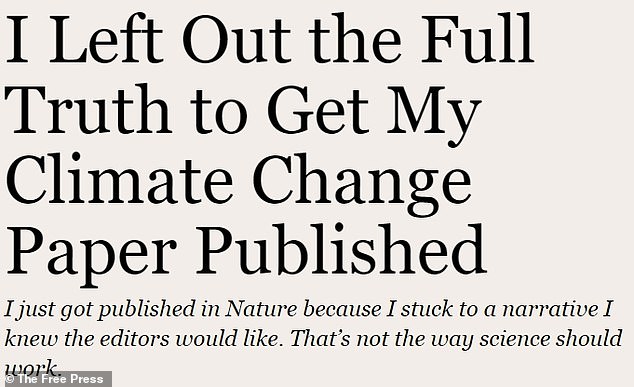
Brown said one of his studies on the subject was published by Nature 'because I stuck to a narrative I knew the editors would like'
'We are now carefully considering the implications of his stated actions; certainly, they reflect poor research practices and are not in line with the standards we set for our journal.'
Skipper said Nature has an 'expectation' that researchers use the most appropriate data, methods and results.
'When researchers do not do so, it goes against the interests of both fellow researchers and the research field as a whole. To deliberately not do so is, at best, highly irresponsible. Researchers have a responsibility for their research which they must take seriously,' she said.
Nature, which is based in London, was founded in 1869 and is one of the world's most cited scientific journals.
'When it comes to science, Nature does not have a preferred narrative,' said Skipper.
The strongly-worded rebuttal came after Brown claimed top scientific journals approach climate change research in the way 'the press focus so intently on climate change as the root cause' of wildfires, including the recent devastating fires inHawaii.
He pointed out research that said 80 percent of wildfires are ignited by humans.
Brown said 'the editors of these journals have made it abundantly clear, both by what they publish and what they reject, that they want climate papers that support certain preapproved narratives—even when those narratives come at the expense of broader knowledge for society.'
He wrote: 'To put it bluntly, climate science has become less about understanding the complexities of the world and more about serving as a kind of Cassandra, urgently warning the public about the dangers of climate change.
+5
View gallery
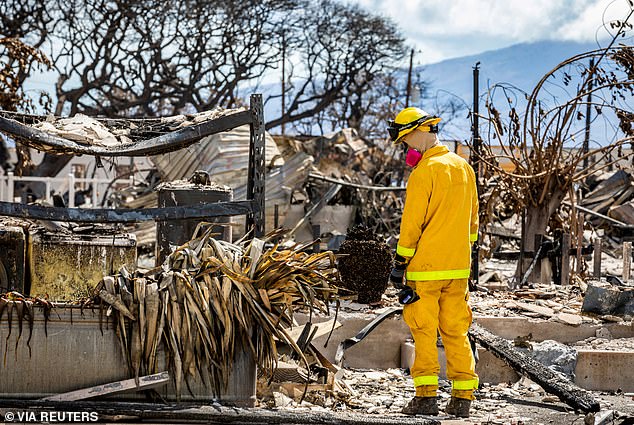
Brown also took aim at the media for focusing 'intently on climate change as the root cause' of wildfires, including the recent devastating fires in Hawaii. Pictured: A search, rescue and recovery member conducts search operations of areas damaged by Maui wildfires in Lahaina
+5
View gallery
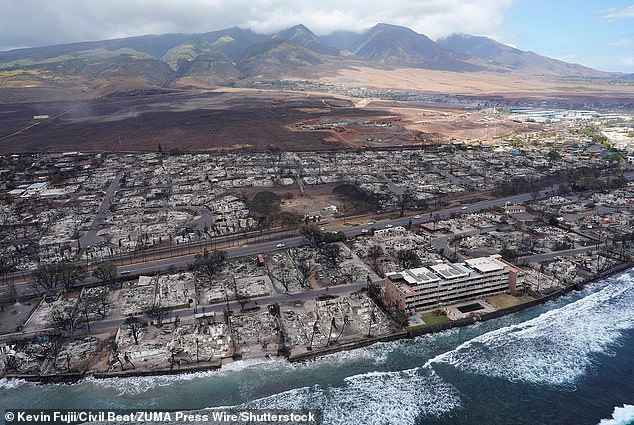
An aerial view of Lahaina shows the sheer scale of destruction that the wildfires have caused in Hawaii
'However understandable this instinct may be, it distorts a great deal of climate science research, misinforms the public, and most importantly, makes practical solutions more difficult to achieve.'
Scientists whose careers depend on their work being published in major journals also 'tailor' their work to 'support the mainstream narrative', he said.
'This leads to a second unspoken rule in writing a successful climate paper,' he added. 'The authors should ignore—or at least downplay—practical actions that can counter the impact of climate change.'
Skipper's response also pointed to the peer review process for Brown's paper - which was written along with seven other researchers - which highlighted the 'lack of inclusion of variables other than climate change' and said 'the authors themselves argued against including it'.
She also listed three recent examples of research published in Nature that does not 'follow the purported editorial biases alleged by Brown'.
Climate Change & Global WarmingCalifornia
blog .org?
writings hosted elsewhere
Posted on January 25, 2025 by ptbrown31
Posted in Uncategorized | Leave a comment
The Potential for Fuel Reduction to Offset Climate Warming Impacts on Wildfire Intensity in CA
Posted on January 25, 2025 by ptbrown31

Talk at the January 2025 American Meteorological Society’s annual meeting on research published here: https://iopscience.iop.org/article/10.1088/1748-9326/adab86
Posted in Uncategorized | Leave a comment
The Social Feedback Loop that Puts Blinders on Climate Science
Posted on January 7, 2024 by ptbrown31

Posted in Uncategorized | Leave a comment
Correcting the Record Regarding My Essay in The Free Press
Posted on September 12, 2023 by ptbrown31
Last week, I wrote an opinion piece in The Free Press on perverse incentives in scientific publishing.
I described the strong incentives researchers face to publish high-profile papers and how those incentives naturally push researchers to mold their research questions and the presentation of work so that they are palatable to ‘high-impact’ journals.
I also described how I believe high-profile papers put an inordinate focus on the negative impacts of climate change and underemphasize other relevant areas, especially the study of societal resilience to climate.
I think that this is a problem because I believe that a hyper-focus on seeking out and highlighting negative impacts of climate change represents a lost opportunity to study practical on-the-ground solutions to climate-related problems. Hence, I argued that the incentives facing researchers are not aligned with the production of the most useful knowledge for society.
I have written about these problems in the scientific literature many times before, but this time, I used my own paper on wildfires as an example. My aim was to simultaneously criticize myself and criticize a broader system.
In response, I received a great deal of support for my editorial privately from other Ph.D. researchers who agree with me, are exasperated, and would like to see change, and a lot of very negative public reaction from high-profile climate researchers and journalists, some of whom have characterized my public airing of decisions that I made to increase the likelihood of the publication of my Nature paper as a “scandal.”
Much of the public criticism revolves around highly misleading (and in some cases patently false) claims about the research approach that I took in designing the study and what then transpired during the peer review process. One outlet falsely stated that I manipulated data. The editor-in-chief of Nature incorrectly suggested that peer reviewers instructed me to include changes in non-climate factors in our wildfire projections.
There is much more to be said about why I chose to write my essay and why the issues I raise are important for both the integrity of the climate science endeavor and the efficacy of societal efforts to mitigate and adapt to climate change. But here I address specifically the false and misleading claims that have been made about my Nature paper and the peer-review process.
Was the publication of my Nature paper, followed by my essay in The Free Press, a hoax or a sting operation?
Absolutely not. When I started working on what would become my Nature paper, I had no intention of writing anything about the publication process. I started doing wildfire research in 2019, and I realized there was an opportunity for a high-profile paper in the fall of 2021. I followed this pathway, shaping the research question and the presentation of the research for a high-profile paper, and submitted it to Nature in the summer of 2022.
I had been bothered by what I saw as strong biases in the scientific literature for a long time, and I started thinking and writing more about this problem as the paper was going through peer review. I gradually realized that I was applying a major double standard, criticizing other researchers’ papers but not my own. Over the course of this past year, and as the Nature paper was getting over the finish line, I decided to write a piece critiquing it. I did not think that my experience was anything exceptional, so I discussed the general incentives facing climate impact researchers and how these incentives make research less useful than it could be.
Did you manipulate data in order to ensure the publication of your paper?
No. As I state in the essay, I chose to frame the research question in my paper narrowly, to focus only on the contribution that climate change was making to wildfire behavior. In doing so, my methodology left out (held constant) the myriad of causal factors that affect wildfire behavior (e.g., non-climate factors like human ignition patterns and fuel loads) and could be altered in the future to mitigate wildfire danger. The paper is honest about leaving those factors out, so there is nothing explicitly wrong with the paper itself. However, at the end of the day, what gets communicated to the public is just part of the story and not the full truth.
This has been standard practice in published peer-reviewed literature that attempts to quantify the impact that climate change is having or will have on a wide range of weather-related phenomena and the resulting impacts that those phenomena have upon society. My Free Press essay simply acknowledged that I, like many others, make these choices, sometimes believing that doing so increases the likelihood that high-impact journals would be interested in the research.
Do you stand by the research findings in your Nature paper? Should it be retracted?
I do stand by the research findings, and there is no basis for retracting the paper on its methods or merits. As I have consistently said, I am proud of the research overall, and I think it significantly advances our understanding of climate change’s role in day-to-day wildfire behavior. There is nothing explicitly wrong with the paper, and it follows the regular conventions of many other papers. My point is simply that molding the presentation of the research for a high-impact journal made it less useful than it could have been.
Did editors or reviewers pressure you into highlighting climate change in your paper?
No. My paper was conceived from the outset to focus exclusively on climate change’s impact on wildfire behavior partially because I thought that would increase its chance of publication in a high-profile journal. I did not claim that editors or reviewers pressured me into highlighting climate change after the submission of the paper. My editorial is about how high-profile venues display preferences for certain research results, and that indirectly solicits research that is customized to those preferences.
Did reviewers ask you to include other non-climate factors in your wildfire projections?
Nowhere in the peer review process did reviewers challenge the usefulness of focusing solely on the impact of climate change when projecting long-term changes in wildfire behavior. The main non-climate factors that I said were important (but held constant) in my essay were ignition patterns and fuel loads. Reviewers brought up ignitions a single time, and fuel loads came up six times. In all cases, reviewers raised these factors in relation to questions about whether my methodology was sufficiently robust to accurately quantify the contribution of climate factors to wildfire growth, not to tell us that we should expand our methodology to include changes in these other non-climate factors in our long-term projections.
Let’s go over them all:
From page 7 of the peer review document,
“The second aspect that is a concern is the use of wildfire growth as the key variable. As the authors acknowledge, there are numerous factors that play a confounding role in wildfire growth that are not directly accounted for in this study (L37-51). Vegetation type (fuel), ignitions ( lightning and people), fire management activities ( direct and indirect suppression, prescribed fire, policies such as fire bans and forest closures) and fire load.”
The reviewer is expressing concern that the “confounding” factors will make it difficult for us to quantify the influence of temperature on wildfire growth in our historical dataset (a relationship we can then use later for our climate change projections). They are implying that it might be easier to quantify the influence of temperature on some other wildfire characteristic other than growth. They are not telling us that we should expand our methodology to include changes in these other non-climate factors in our projections.
In my reply, I pointed out that our models were able to predict wildfire growth well in our historical dataset, even without information on the confounding factors.
From page 8 of the peer review document,
“Did you consider using other fuel moisture variables such as 1 hour and 10 hour fuel that can be important is some fuel types ( grass and shrub etc.)”
“Fuel moisture variables” in this context are climate variables and do not refer to non-climate factors like fuel loads. The reviewer is suggesting ways to better quantify the impact of climate change on wildfires.
From page 9 in the peer review document,
“My main concern is on the robustness of the empirical models due to the extremely unbalanced samples for the binary response variables (extreme vs non-extreme fire days: 380 vs. 18,000) and the very small size for the occurrence samples, especially considering the diverse landscape in California in terms of fuel types and topography.”
The reviewer is concerned that there may not be enough samples of the extreme wildfire growth days that we are studying to get a good quantification of the influence of temperature in our historical dataset (a relationship we can then use later for projections). We demonstrate that the models have good predictive skill on out-of-sample data in our historical dataset.
From page 12 in the peer review document,
“1) The climate change scenario only includes temperature as input for the modified climate. However, changes in atmospheric humidity would also be highly relevant for predicting changes in VPD or fuel moisture.”
The reviewer is asking that we include another climate factor (absolute humidity) in our projections, not asking us to consider any non-climate factors in our projections.
In my response, I acknowledge that all climate variables other than temperature (and temperature’s influence on aridity) are held constant in the projections, and I bring up the fact that other non-climate factors are also held constant.
“We agree that climatic variables other than temperature are important for projecting changes in wildfire risk. In addition to absolute atmospheric humidity, other important variables include changes in precipitation, wind patterns, vegetation, snowpack, ignitions, antecedent fire activity, etc. Not to mention factors like changes in human population distribution, fuel breaks, land use, ignition patterns, firefighting tactics, forest management strategies, and long-term buildup of fuels.”
I further articulated my stance that the temperature signal dominates other climate variables in its influence on wildfire behavior, and that is why focusing on warming alone (and not other climate-related changes) was valid for representing the entirety of the influence of climate change.
“Accounting for changes in all of these variables and their potential interactions simultaneously is very difficult. This is precisely why we chose to use a methodology that addresses the much cleaner but more narrow question of what the influence of warming alone is on the risk of extreme daily wildfire growth. We believe that studying the influence of warming in isolation is valuable because temperature is the variable in the wildfire behavior triangle (Fig 1A) that is by far the most directly related to increasing greenhouse gas concentrations and, thus, the most well-constrained in future projections. There is no consensus on even the expected direction of the change of many of the other relevant variables. We do not believe that absolute humidity is an exception to this, and thus it is just as justifiable to hold it constant as any of the other variables mentioned above. Support for this can be summarized with the following two points…”
This is all to say that if we can hold everything else constant in the projections, then there is no reason we should not also be able to hold absolute humidity constant. Further, it is an argument that temperature is sufficient to represent the influence of climate change. It is not an argument making the case that focusing solely on the impact of climate change is more useful than an expansive assessment that includes other non-climate factors.
Page 23 of the peer review document,
“Line 73 – It is worth mentioning that fuels including both fuel types, structure, and amount were held constant in addition to fuel moisture.”
The reviewer asks for us to state that fuel characteristics are held constant at a particular place in the manuscript (even though that is already stated in other places).
Page 26 of the peer review document,
“Lastly, area burned is influenced by many variables and I think that fire management effort is one that deserves some mention. Fire management effectiveness varies due to a number of factors, but fire load/resource availability is a key factor that could confound your results.”
The reviewer is expressing concern that fire management will make it more difficult for us to quantify the influence of temperature on wildfire growth in our historical dataset (a relationship we can then use later for our climate change projections). We address this by inserting a caveat.
Reviewers did not challenge the usefulness of focusing solely on the impact of climate change when calculating long-term changes in wildfire behavior in any of these discussions. Rather, they are focused on making sure the methodology is able to get an accurate quantification of the impact of climate change.
Wouldn’t accounting for these other non-climate factors in your wildfire projections make your paper better andhelpit get published in Nature?
A paper that appropriately accounted for projections in other relevant non-climate factors would probably be inconclusive in even the direction of future wildfire change with uncertainty ranges that overlap with zero. That research – which is more useful research – would tell a much less clean story and would be less likely to be a high-profile paper. This is the sense in which ‘leaving out the full truth’ (other relevant causal factors) made the paper more compelling, which then makes it more worthy of a high-profile venue. This “positive results bias,” where researchers are more likely to submit, and editors are more likely to accept, results that demonstrate a clear significant relationship over an inconclusive one, is a well-known phenomenon.
To conclude,
My aim is to highlight a problem and push for reform so that the incentives facing researchers are better aligned with what produces the most useful knowledge for society.
There are many reasonable reasons that climate researchers and journalists might disagree with my essay. Nature has published papers that push back against the narrow focus on climate impacts that I describe. I can’t say for certain that a paper focused more broadly on climate and non-climate factors would nothave been published in Nature. And any criticism of climate science practice will assuredly be amplified by right-wing media eager to promote skepticism about climate change.
But the specific claims above, which have been widely repeated and have constituted much of the effort to ignore the issues I have raised, are false and misleading.
More broadly, I’d like to push for changes in attitudes and norms from researchers to institutions to journals and the media. My main thrust is simply that research on climate and society should not have such an inordinate focus on identifying and highlighting negative climate impacts at the expense of studying the effectiveness of solutions that can help people today. I am interested in hearing ideas and forming networks of people who would also like to see reform in this direction, and I hope, perhaps unrealistically, that those determined to loudly discredit the concerns I have raised will consider whether doing so, over the long term, really serves the credibility of the climate science enterprise.
Appendix: Responses to Some Additional Questions I Have Received.
Are you happy that your piece was used by people who think climate change isn’t real or is not caused by humans?
No.
I think it goes without saying that climate change is real and that the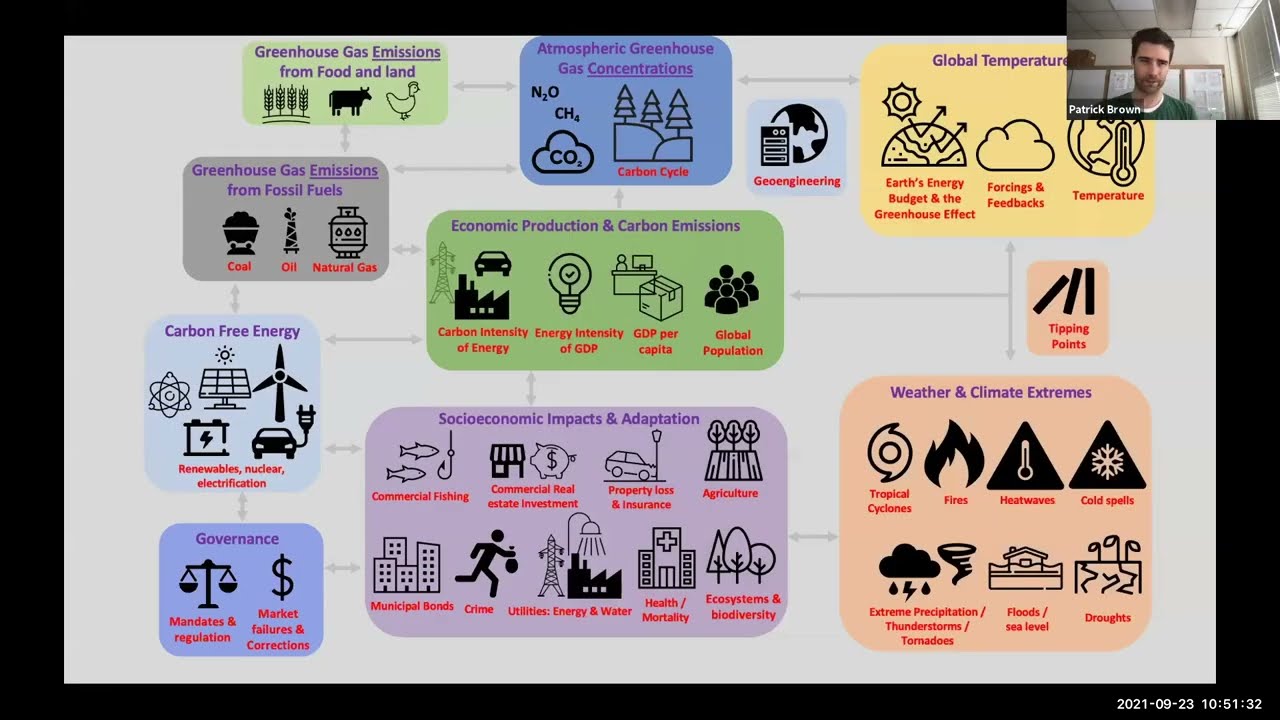 that humans have caused about
 . Also, in order to stabilize the climate, we must reduce CO2 emissions to near zero in the long run. Furthermore, as I said in the editorial, warming has very important effects on increasing wildfire danger.
I do not wish to spread doubt on these facts, so I turned down many, many media requests that came from outlets that I thought wanted me to question the fundamentals of climate science.
But I also think that the climate science community is overly concerned about “giving ammunition” to the “bad side” who are not fully on board with, e.g., net-zero by 2050 policies. That concern is biasing the literature. I have seen this several times where a reviewer of a paper says something to the effect of “the authors should be very careful how this result is presented so that it cannot be used by climate deniers.” As scientists, we cannot be so careful to mold our results so that they support a message or our science will lose its credibility.
In your title, you said you “left out the full truth.” How so?
I did not choose the title, but I take 100% responsibility for it because I approved it. I regret that the title caused a lot of confusion. However, I do think it accurately communicates a main theme of my piece. The title was not meant to mean that there was anything explicitly untruthful about the paper itself – something that is made clear if you read the piece.
“The full truth” in this context, simply refers to the myriad of causal factors that affect wildfire behavior (e.g., non-climate factors like human ignition patterns and fuel loads) and could be altered in the future to mitigate wildfire danger. My methodology left those out when it came to projecting changes in wildfire behavior over time. The paper is honest about leaving those factors out, so there is nothing explicitly wrong with the paper itself. However, at the end of the day, what gets communicated to the public is just part of the story and not the full truth. My claim is that high-profile papers that do the same type of thing are very common, and so the public and decision-makers are often left without the full truth.
Why did you say “As a scientist, I’m not allowed to tell the full truth about climate change”?
I did not say that. The New York Post made that up.
Hasn’t Nature published other papers that go against the narrative you describe?
Yes. My claim is not that there are no exceptions to the type of paper I am describing. My claim is that following the strategy I outline represents a particularly easy path to publication.
This is informed by my many years of experience reading high-impact journals, reviewing for them, submitting to them, and publishing in them. The elements I identify of focusing narrowly on a negative climate change impact and using unrealistic future warming scenarios are very common in the output from high-impact journals, especially those covered the most by the media (2022, 2021, 2020, 2019, 2018, 2017). That media coverage gets the papers not only in front of decision-makers but other scientists, who are then more likely to cite the work and shape their own work in a similar way. The general practices of straining to highlight negative climate impacts within data that paint an overall positive picture, and overemphasizing unrealistically high future warming scenarios are thenadoptedinauthoritativeassessment reports of the literature and coverage of those reports, all reinforcing a positive feedback loop.
How did Nature respond to the accusation of having a preferred Narrative?
To me, a reasonable dismissal of my criticism would be to say something to the effect of “Yes, the assessment of scientific research is done by people, and people have conscious and unconscious preferences that affect that assessment. This is an issue thatphilosophers have grappled with for centuries and is hardly anything novel”.
Instead, they doubled down on the façade of pristine objectivity, saying, “When it comes to science, Nature does not have a preferred narrative.”
But what about your coauthors? Was it fair to them to call into question research that they contributed to?
I was 100% responsible for molding the presentation of the research in a way that I thought would be palatable to a high-profile venue, so my critique is only on my own actions, not those of my co-authors.
I knew my editorial would be controversial and generate discussion, but I did not anticipate the level of negative coverage it would get. It was not fair of me to subject my coauthors to the firestorm, I regret that quite a lot, and I am very sorry to them.
Do you have ideas for reform?
Identifying a problem is much easier than identifying a concrete solution. But I’d like to work on concrete solutions much more going forward. These solutions range from being more technical, at the level of the journal, to being more broad at a cultural level.
At the level of journals, I think something that would help would be more widespread adoption of preregistering methodologies – preferably resembling hypothesis tests. This would help reduce the ‘file drawer effect, where only the flashiest results make it to publication and subsequent promotion in the media.
At the level of synthesis and dissemination of the state of climate change, I think the Bulletin of the American Meteorological Society’s annual State of the Climate Report is a good model because it reports the state of virtually all relevant climate variables in a systematic, consistent way without an effort to seek out and highlighting only the most dramatic changes.
More broadly, I am pushing for changes in attitudes and norms from researchers to institutions to journals and the media. My main thrust is simply that research on climate and society should not have such an inordinate focus on identifying and highlighting negative climate impacts at the expense of studying the effectiveness of solutions that can help people today. I am interested in hearing ideas and forming networks of people who would also like to see reform in this direction.
Posted in Uncategorized | 11 Comments
The Not-so-Secret Formula for Publishing a High-Profile Climate Change Research Paper.
Posted on September 5, 2023 by ptbrown31
There is a formula for publishing climate change impacts research in the most prestigious and widely-read scientific journals. Following it brings professional success, but it comes at a cost to society.
This is a version of a piece that is published in The Free Press.
This month, I published a lead-author research paper in *Nature* on changes in extreme wildfire behavior under climate change. Because Nature is one of the world’s most prestigious and visible scientific journals, getting published there is highly competitive, and it can significantly advance a researcher’s career.
This is my third publication in Nature to go along with another in Nature’s climate-focused journal Nature Climate Change. I have also served as an expert peer reviewer for both journals as well as Nature Communicationsand Nature Geoscience. Through this experience, as well as through various failures to get research published in these journals, I have learned that there is a formula for success which I enumerate below in a four-item checklist. Unfortunately, the formula is more about shaping your research in specific ways to support pre-approved narratives than it is about generating useful knowledge for society.
In order for scientific research to be as useful as possible, it should prize curiosity, dispassionate objectivity, commitment to uncovering the truth, and practicality. However, scientific research is carried out by people, and people tend to subconsciously prioritize more immediate personal goals tied to meaning, status, and professional advancement. Aligning the personal incentives that researchers face with the production of the most valuable information for society is critical for the public to get what it deserves from the research that they largely fund, but the current reality falls far short of this ideal.
Many will have heard the phrase “publish or perish” in relation to academic research. It is a simple truth that, at bottom, research is a social endeavor: if you do not communicate what you have done to your colleagues, your funders, and the public, it is the same as not having done the work at all. The way that research is communicated is by publishing it in academic peer-reviewed journals, but which journals you publish in makes a huge difference.
A researcher’s career depends on their work being widely known and perceived as important. This begins the self-reinforcing feedback loops of name recognition, funding, quality applications from aspiring Ph.D. students and postdocs, and of course, accolades. But as the number of researchers and the volume of research has skyrocketed in recent years, it has become more competitive than ever to stand out in the crowd. Thus, while there has always been a tremendous premium placed on publishing in the most high-profile scientific journals – namely Nature and its rival Science –this has never been more true.
Given then that the editors at Nature and Science serve as gatekeepers for career success in academic research, their preferences exert a major influence on the collective output of entire fields. They select what gets published from a much larger pool of what is submitted, but in doing so, they also shape how research is conducted more broadly because savvy researchers will tailor their studies to maximize their likelihood of being accepted. I know because I am one of those savvy researchers.
My overarching advice for getting climate change impacts research published in a high-profile journal is to make sure that it supports the mainstream narrative that climate change impacts are pervasive and catastrophic, and the primary way to deal with them is not through practical adaptation measures but through policies that reduce greenhouse gas emissions. Specifically, the paper should try to check at least four boxes.
The first thing to know is that simply showing that climate change impacts something of value is usually sufficient, and it is not typically necessary to show that the impact islargecompared to other relevant influences.
In my recent Nature paper, we focused on the influence of climate change on extreme wildfire behavior but did not bother to quantify the influence of other obviously relevant factors like changes in human ignitions or the effect of poor forest management. I knew that considering these factors would make for a more realistic and useful analysis, but I also knew that it would muddy the waters and thus make the research more difficult to publish.
This type of framing, where the influence of climate change is unrealistically considered in isolation, is the norm for high-profile research papers. For example, in another recent influential Nature* paper, they calculated that the two largest climate change impacts on society are deaths related to extreme heat and damage to agriculture. However, that paper does not mention that climate change is *not the dominant driver for either one of these impacts: temperature-related deaths have been declining, and agricultural yields have been increasing for decades despite climate change.
This brings me to the second component of the formula, which is to ignore or at least downplay near-term practical actions that can negate the impact of climate change. If deaths related to outdoor temperatures are decreasing and agricultural yields are increasing, then it stands to reason that we can overcome some major negative effects of climate change. It is then valuable to study how we have been able to achieve success so that we can facilitate more of it. However, there is a strong taboo against studying or even mentioning successes since they are thought to undermine the motivation for emissions reductions. Identifying and focusing on problems rather than studying the effectiveness of solutions makes for more compelling abstracts that can be turned into headlines, but it is a major reason why high-profile research is not as useful to society as it could be.
A third element of a high-profile climate change research paper is to focus on metrics that are not necessarily the most illuminating or relevant but rather are specifically designed to generate impressive numbers. In the case of our paper, we followed the common convention of focusing on changes in the risk of extreme wildfire events rather than simpler and more intuitive metrics like changes in the amount of acres burned. The sacrifice of clarity for the sake of more impressive numbers was probably necessary for it to get into Nature.
Another related convention, which we also followed in our paper, is to report results corresponding to time periods that are not necessarily relevant to society but, again, get you the large numbers that justify the importance of your research. For example, it is standard practice to report societal climate change impacts associated with how much warming has occurred since the industrial revolution but to ignore or “hold constant” societal changes over that time. This makes little sense from a practical standpoint since societal changes have been much larger than climate changes since the 1800s. Similarly, it is conventional to report projections associated with distant future warming scenarios now thought to be implausible while ignoring potential changes in technology and resilience.
A much more useful analysis for informing adaptation decisions would focus on changes in climate from the recent past that living people have actually experienced to the foreseeable future – the next several decades – while accounting for changes in technology and resilience. In the case of my recent Nature paper, this would mean considering the impact of climate change in conjunction with proposed reforms to forest management practices over the next several decades (research we are conducting now). This more practical kind of analysis is discouraged, however, because looking at changes in impacts over shorter time periods and in the context of other relevant factors reduces the calculated magnitude of the impact of climate change, and thus it appears to weaken the case for greenhouse gas emissions reductions.
The final and perhaps most insidious element of producing a high-profile scientific research paper has to do with the clean, concise format of the presentation. These papers are required to be short, with only a few graphics, and thus there is little room for discussion of complicating factors or contradictory evidence. Furthermore, such discussions will weaken the argument that the findings deserve the high-profile venue. This incentivizes researchers to assemble and promote only the strongest evidence in favor of the case they are making. The data may be messy and contradictory, but that messiness has to be downplayed and the data shoehorned into a neat compelling story. This encouragement of confirmation bias is, of course, completely contradictory to the spirit of objective truth-seeking that many imagine animates the scientific enterprise.
All this is not to say that I think my recent Nature paper is useless. On the contrary, I do think it advances our understanding of climate change’s role in day-to-day wildfire behavior. It’s just that the process of customizing the research for a high-profile journal caused it to beless usefulthan it could have been. I am now conducting the version of this research that I believe adds much more practical value for real-world decisions. This entails using more straightforward metrics over more relevant timeframes to quantify the impact of climate change on wildfire behavior in the context of other important influences like changes in human ignition patterns and changes in forest management practices.
But why did I follow the formula for producing a high-profile scientific research paper if I don’t believe it creates the most useful knowledge for society? I did it because I began this research as a new assistant professor facing pressure to establish myself in a new field and to maximize my prospects of securing respect from my peers, future funding, tenure, and ultimately a successful career. When I had previously attempted to deviate from the formula I outlined here, my papers were promptly rejected out of hand by the editors of high-profile journals without even going to peer review. Thus, I sacrificed value added for society in order to for the research to be compatible with the preferred narratives of the editors.
I have now transitioned out of a tenure-track academic position, and I feel liberated to direct my research toward questions that I think are more useful for society, even if they won’t make for clean stories that are published in high-profile venues. Stepping outside of the academy also removes the reservations I had to call out the perverse incentives facing scientific researchers because I no longer have to worry about the possibility of burning bridges and ruining my chances of ever publishing in a Nature journal again.
So what can shift the research landscape towards a more honest and useful treatment of climate change impacts? A good place to start would be for the editors of high-profile scientific journals to widen the scope of what is eligible for their stamp of approval and embrace their ostensible policies that encourage out-of-the-box thinking that challenges conventional wisdom. If they can open the door to research that places the impacts of climate change in the appropriate context, uses the most relevant metrics, gives serious treatment to societal changes in resilience, and is more honest about contradictory evidence, a wider array of valuable research will be published, and the career goals of researchers will be better aligned with the production of the most useful decision support for society.
Posted in Uncategorized | 29 Comments
New Article highlighting a conceptual error in the peer-reviewed literature that leads to major exaggerations of the influence of climate change on extreme weather impacts
Posted on August 9, 2023 by ptbrown31
brown-2023-climatic-changeDownload
Posted in Uncategorized | 1 Comment
Overestimating the Human Influence on the Economic Costs of Extreme Weather Events
Posted on February 14, 2022 by ptbrown31
Estimating the human influence on extreme weather events and their economic costs is relevant to many policy discussions around climate change including those that concern the social cost of carbon.
There are many different ways to estimate the economic costs of climate change that range from theoretical to empirical and apply to entire economies or the impacts of single events.
In this post, I will discuss a particular method used to estimate the economic damages attributable to climate change for a single disaster.
Attributable Costs
The method has been referred to as the “attributable costs” method. It traces its origins to a 2003 Nature commentary called “Liability for climate change” (Allen, 2003). The critical passage is the following:
“If at a given confidence level, past greenhouse-gas emissions have increased the risk of a flood tenfold, and that flood occurs, then we can attribute, at that confidence level, 90% of any damage to those past emissions”.
The statement above was hypothetical but more recently, this reasoning has been adopted in the climate impacts literature.
Notably, it was used in an assessment of the economic impact of human influence on Hurricane Harvey (Frame et al., 2020). Specifically, Frame et al. (2020) state that estimated damages from Hurricane Harvey were $90 billion and that human influence on the climate was responsible for 75% of this $90 billion or ~$67 billion. They then use this number to argue that traditional estimates of the costs of climate change that inform the social cost of carbon estimates are drastically underestimated, as the authors’ post on Carbon Brief communicates:
Cost of extreme weather due to climate change is severely underestimated.
This study received a great deal of attention. According to Altmetric, of over 20 million research outputs tracked, it was in the 99th percentile in terms of online attention. It was cited prominently (5 times) in the IPCC AR6 Working Group 2 Report. It was promoted on social media by high-profile climate communicators, endorsed by a climate scientist on Time Magazine’s 100 most influential people list, and made headlines in places like The Guardian.
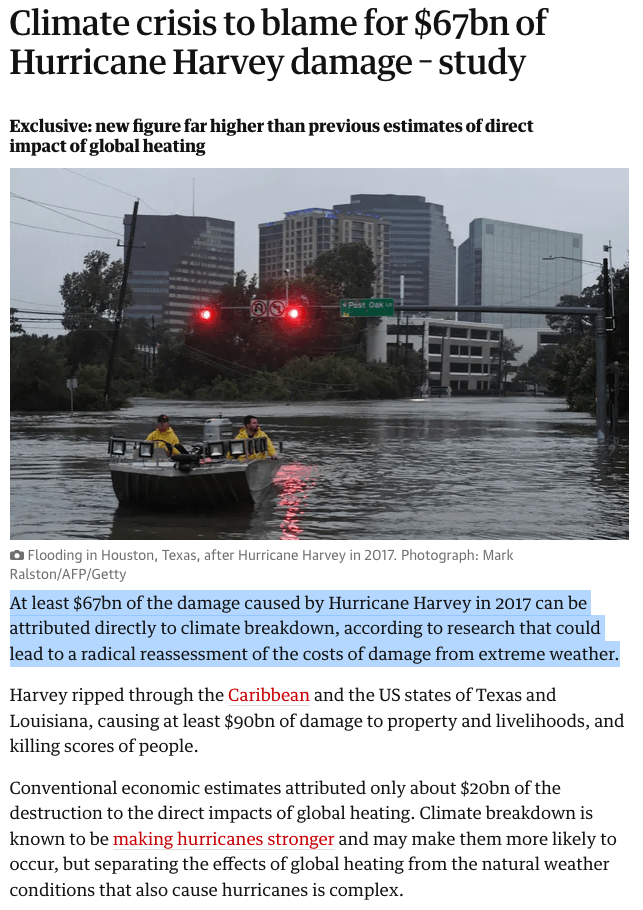
Despite the attention and high-profile influence of this study and others like it, I believe it contains a fundamental flaw in reasoning that undermines its results.
The study makes use of the concept of the “Fraction of Attributable Risk (FAR)” which is a concept borrowed from epidemiology (Levin et al., 1953).
The idea is that you can quantify how a change in conditions affects the risk of some outcome. For example, it can quantify how exposure to a particular chemical affects the risk of contracting cancer over some period of time. The formula is,

where P(outcome | normal conditions) should be read as “the probability of the outcome given normal conditions”. For the chemical-cancer example, the outcome would be the contraction of cancer, normal conditions would correspond to a group not exposed to the chemical and altered conditions would correspond to a group exposed to the chemical. Probabilities of cancer for the two groups could be estimated empirically by calculating the percentage in each group that was observed to contract cancer (Attributable fraction among the exposed).
If exposure to the chemical doubles the risk of cancer, and an exposed individual contracts cancer, then half of the risk of their contraction of cancer can be attributed to exposure to the chemical. If exposure to the chemical triples the risk of cancer then 2/3rds ^of their risk of cancer can be attributed to exposure and so on.
Now, we can further imagine that treatment of this cancer universally costs $20,000. If the fraction of attributable risk is 3/4ths or 75%, then a person exposed to the chemical with cancer can claim that
(0.75)x($20,000) = $15,000
of the expense of cancer treatment is due to that exposure.
This is the “attributable costs” method. Expressed as a formula it is:

Implicit in the above formula is the notion that there is no cost if the outcome does not take place. In that sense, you could also think of the fraction of attributable risk as being multiplied by the difference between the cost with the outcome and the cost without the outcome where the cost without the outcome is zero.

The reasoning here makes sense because contracting cancer can more-or-less be considered a binary (either you contract it or you don’t). That means the $20,000 cost for treatment is also a binary (either $20,000 is paid for treatment or $0 for no treatment) and thus the ‘cost without outcome’ is zero and you can calculate the full financial impact by using the “attributable costs” method which simply multiplies the fraction of attributable risk by the expense of the outcome.
Analogously, the attributable costs of a weather event to human influence on the climate can be written as:

In Frame et al. (2020) they are interested in quantifying the economic damage from Hurricane Harvey that is due to human influence. But the first issue that arises is how to define the “weather event” they are studying.
The first idea that might come to mind might be that “landfalling tropical cyclones” constitute the event. Landfalling tropical cyclones are discrete phenomena that can be said to either occur or not and would thus more-or-less fit into this framework. However, many estimates of changes in tropical cyclone activity actually project a decrease in total tropical cyclone number under climate change. This would yield a negative attributable cost. However, the researchers of Hurricane Harvey weren’t necessarily interested in changes in the odds of all landfalling tropical cyclones but rather changes in the odds of tropical cyclones very much like Hurricane Harvey. Harvey was notable, in particular, because of its extreme rainfall and there is robust evidence that the most extreme rainfall should be enhanced as the world warms.
Thus, Frame et al. (2020) define the “weather event” using rainfall totals that breach the threshold of being as high or higher than what was seen during Hurricane Harvey.
Unlike landfalling tropical cyclones, however, rainfall totals are not really discrete phenomena that you can count in the same way. It’s more natural to think of rainfall totals as coming from a continuous probability distribution of possible rainfall totals.
This move from a discrete weather event, to defining an “event” by choosing a threshold from a continuum renders the “attributable costs” method invalid. When we unpack the logic into steps we can see where it breaks down:
- Hurricane Harvey caused $90 billion in damage
- The definition of the “event” representing Harvey is rainfall at or above the amount seen during Harvey
- Human influence on the climate is responsible for 75% of the risk of the “event”, so defined.
- Thus, human influence on the climate is responsible for 75% of $90 billion of damage, or $67 billion.
The above reasoning smuggles in the idea from the epidemiological example that the “event” is dichotomous: either it occurs or it does not and thus the $90 billion in damage either occurs or it does not. The reasoning requires that the ‘cost without the outcome’ is zero.
The costs from cancer only activate if you contract cancer. There are no costs for cancer if you don’t contract cancer. But the costs from rainfall begin to accumulate long before the event threshold is reached. There are costs from rainfall even when there is no ‘event’, so defined.
One could argue that the cost without the outcome would be zero if the ‘event’ was landfalling tropical cyclones (if there is no landfalling tropical cyclone then there is no damage from a landfalling tropical cyclone) but one cannot claim this for rainfall beyond a threshold. Imagine 1/100th of an inch less rain fell during Harvey. Would the $90 billion in damage disappear? Of course not. All of the rain from Harvey, including that last 1/100th of an inch, is required for the 75% ‘fraction of attributable risk’ to be valid but not all of the rain is required for there to be any damage at all.
In summary, the authors of Frame et al. (2020) are implicitly attributing all$90 billion in damages to the very last 1/100th of an inch of rainfall which is what allowed the arbitrary threshold to be crossed and ‘eventhood’ to be achieved. This flawed reasoning also applies to the original 2003 Nature commentary which used flooding as the example.
Changes in the Magnitude of an Event
A much clearer framing of the question is obtained when human influence on changes in the magnitude of some aspect of the weather are focused on rather than the frequency of crossing an arbitrary threshold (I have discussed the relationship between these previously Brown, 2016). Some of the studies referenced in Frame et al. (2020) also estimate the human influence on the magnitude of rainfall during Harvey and they come up with the following figures:
“Human-induced climate change likely increased Hurricane Harvey’s total rainfall by at least 19%” (Risser and Wehner at al., 2017)
“We conclude that global warming made the precipitation about 15% (8%–19%) more intense” (van Oldenborgh et al., 2017)
Immediately these numbers should give one pause when they are compared to the 75% estimate from Frame et al. (2020). Does the paper claim that 75% of the damage from Harvey came from the additional 15% to 19% of precipitation? That would be theoretically possible if the additional 15%-19% of rain caused some physically meaningful threshold to be breached (like one corresponding to the height of a levee). However, the authors do not claim this and in fact, one of the authors calculates in a more recent study that the 20% increase in rain results in only a 15% increase in flood area (Wehner and Sampson, 2021).
Looking at the human influence on the magnitude rather than on the frequency of crossing an arbitrary threshold, yields an estimate of the damages from human influence of $13 billion (Wehner and Sampson, 2021). Taken at face value, this would indicate that the logical flaw in the “attributable costs” method led to an overestimation of the damages from Harvey by a factor of about 5.
However, I contend that even this type of calc xzsulation is misleading if one wishes to get a holistic sense of the economic impact of climate change in any given year. Frame et al. (2020) are indeed interested in this: in both the paper itself and in their CarbonBrief article they compare their damage estimate from Harvey to those from Integrated Assessment Models (IAMs) which correspond to mean damages for any given year. They argue that IAM-based damages must be huge underestimates because they only calculate annual mean costs of ~$20 billion per year in the US while their study attributes $67 billion to human influence for a single event (Harvey).
I argue that this too is a deeply flawed comparison because the rarity of an event like Hurricane Harvey would have to be taken into account to compare it to an annual mean estimate of damages from human influence on the climate. I illustrate what I believe is a better way to get a full sense of the human influence on economic damages below.
Expected Damages with and without Human Influence
Figure 1 illustrates a more complete way of estimating the economic damages from rainfall in Houston with and without climate change. This is intended to be an illustrative exercise and none of the exact numbers should be taken too seriously.
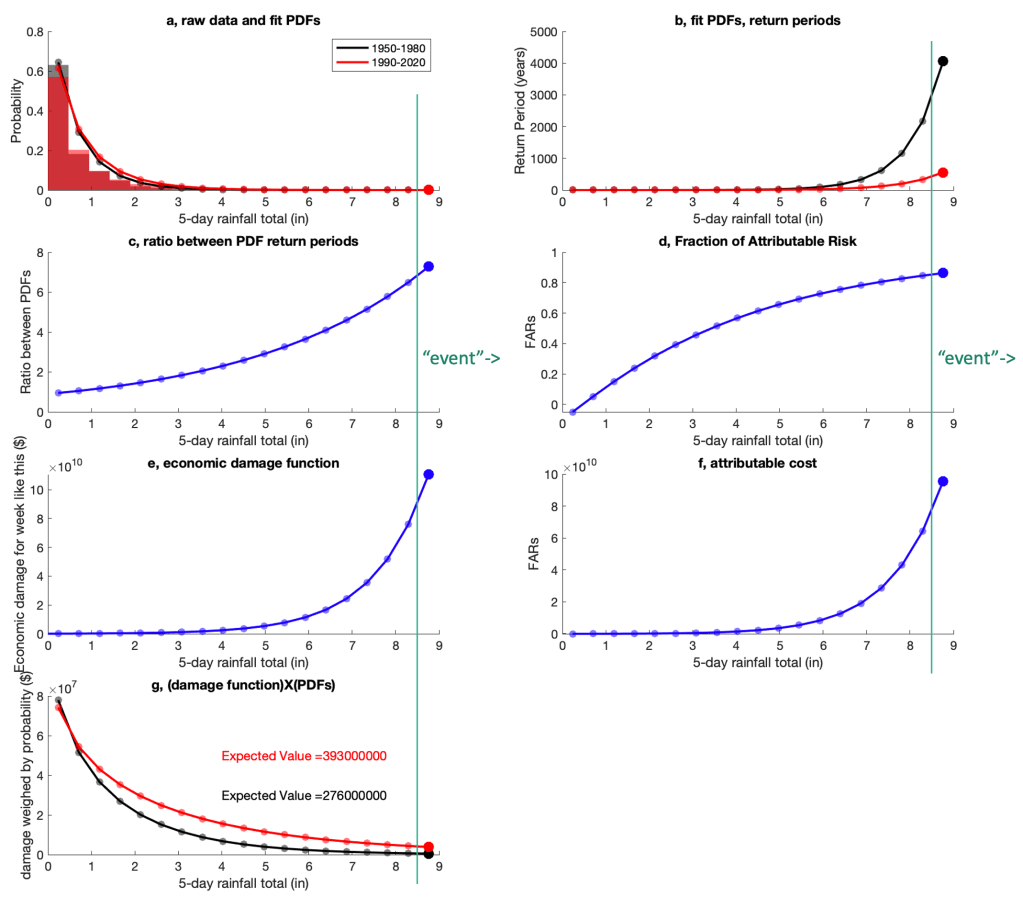 Figure 1 | Analysis of the expected values of various levels of damages from rainfall totals in Houston. Based on ERA-5 5-day rainfall totals from 263.875-265.375 East longitude, and 29.125-30.625 North Latitude. Note that the large region is what makes the most extreme rainfall totals more unlikely (compared to reported point totals from Harvey).
Figure 1a shows histograms of 5-day rainfall totals for the 30 year period from 1950 to 1980 (grey) and for the 30 year period from 1990 to 2020 (red) averaged over the broader Houston area. Superimposed are gamma distributions fit to the raw data. Gamma distributions are often used to model rainfall (Wilks, 2011) and although the fit is imperfect, these distributions exemplify the most relevant properties of how rainfall probabilities are thought to shift under warming. In particular, the distribution shifts in the most recent period such that the probability of low rainfall weeks is decreased and the probability of high rainfall weeks is increased (c.f., red and black in Figure 1a and 1b). Return periods and shifts in return periods of the most extreme events are also roughly in line with those calculated from more sophisticated methods.
In this example, the most extreme rainfall bin (above ~8.5 inches) shifts its probability from a once-in-4,300 year event in the 1950 to 1980 period to a once-in-600 year event in the 1990 to 2020 period (Figure 1b). Consistent with more comprehensive studies and basic theory, the more extreme the rainfall, the more the probability shifts between the two distributions. Figure 1c shows the ratio between the probabilities (or equivalently, return periods) between the two distributions, and Figure 1d shows the fraction of attributable risk to human influence on the climate (assuming that 100% of the shift in the rainfall distribution can be attributed to human influence).
Now let’s suppose a “damage function” that estimates the economic damage as a function of rainfall totals. Small rainfall totals cause almost no damage but the largest rainfall totals can cause damage close to 100 billion (as seen in Harvey). A function that mimics this behavior (shown in Figure 1e) is the exponential function with a=1×10⁸ and b=0.8,

Multiplying the economic damage function by the ‘fraction of attributable risk’ gives us the “attributable cost” function (Figure 1f) which emphasizes how extreme the costs attributable to human influence get using this method: If we define an event to be an occurrence of the most extreme rainfall (thick circles in all plots), and that event occurs, then the costs attributable to human influence would be calculated to approach $100 billion.
However, as noted above, even in the most recent time period, this most extreme rainfall total is still a once-in-600 year event. Thus, if you want to estimate the annual average damage from this level of rainfall, you’d have to divide it by 600 to account for its rarity.
Thus, damages estimated from this single event (even if they are magnitude-based rather than frequency-based) could be off by two to three orders if they are interpreted as corresponding to an annual mean value.
More formally, the holistic way to compare the two climate states is to take the difference of the expected values of the damages between the current climate and the preindustrial climate. In doing this, the economic damage function is weighted by the corresponding probabilities and then summed across all values.
Figure 1g shows that as rainfall becomes more extreme, the rarity of the event reduces its impact on the expected value. We see a change in expected value from $276 million per year in the 30 year period from 1950 to 1980 to $393 million per year in the 30 year period from 1990 to 2100 or a total difference of $117 million per year attributable to climate change.
The IAM figure that Frame et al. (2020) claim must be a huge underestimate was $20 billion annual damage in the US from climate change. Comparing $117 million per year to $20 billion per year, is it possible that 0.6% of total us climate damages attributable to human activity comes from rainfall shifts in one of the largest metro areas on the gulf coast? I don’t know, but that calculation does not obviously invalidate the IAM estimate as Frame et al. (2020) claim to do.
I should note that the more the damage function is magnified at higher rainfall totals, the more the ‘attributable cost’ method will overestimate the costs from climate change relative to the more holistic ‘expected value’ method. Thus, a lot of effort should be placed on defining this damage function.
In conclusion, the ‘attributable cost’ method is not appropriate to apply when the ‘event’ must be defined with an arbitrary threshold on a variable that imposes costs on a continuum (rather than flipping costs on or off). It should only be applied if the ‘event’ is a real physical phenomenon that can be said to either ‘occur or not’ or if the threshold is physically meaningful (i.e., enough rain to overwhelm a levee). Applying the attributable costs method likely overestimated the economic damages from Harvey by a factor of about 5 (if the estimates of Wehner, M., Sampson, C. (2021) are taken at face value). Furthermore, if one wishes to compare the numbers produced from these types of analyses to existing annual mean damage estimates (e.g., from IAMs), the damages from extremes have to be weighed by their low probability of occurrence in any given year. In this case, not doing so could cause an overestimate of the annual mean costs of human influence on the climate by two to three orders of magnitude.
This is a very important topic and it’s crucial that the methods used to address it are as accurate as possible. I hope this post serves as constructive criticism and possibly helps inform future research in this area.
Appendix
Since writing this, I see that several of the authors of the Frame et al. (2020) study have published a paper (Perkins et al., 2022) walking back some of their claims and/or urging caution in interpreting the results of the ‘attributable cost’ method. It looks like the authors of this study would agree with several of the points I have raised here. However, I don’t see an explicit repudiation of the reported results of Frame et al. (2020) or any effort to correct any media coverage of the results.
References
Allen M (2003) Liability for climate change. Nature 421:891–892
Brown, P. T. (2016) Reporting on global warming: A study in headlines, Physics Today, doi:10.1063/PT.3.3310
Frame, D.J., Wehner, M.F., Noy, I. et al. (2020) The economic costs of Hurricane Harvey attributable to climate change. Climatic Change 160, 271–281. https://doi.org/10.1007/s10584-020-02692-8
Levin, M. (1953) The occurrence of lung cancer in man. Acta Unio Int. Contra Cancrum., 9, 531–541.
Perkins-Kirkpatrick, S. E. et al. (2022) Environ. Res. Lett. 17 024009. https://doi.org/10.1088/1748-9326/ac44c8
Risser, M. D., & Wehner, M. F. (2017). Attributable human-induced changes in the likelihood and magnitude of the observed extreme precipitation during Hurricane Harvey. Geophysical Research Letters, 44, 12,457–12,464. https://doi.org/10.1002/2017GL075888
Oldenborgh GJV, Wiel KVD, Sebastian A, Singh R, Arrighi J, Otto F, Haustein K, Li S, Vecchi G, Cullen H (2017) Attribution of extreme rainfall from Hurricane Harvey, august 2017. Environ Res Lett 12:124009
Wehner, M., Sampson, C. (2021) Attributable human-induced changes in the magnitude of flooding in the Houston, Texas region during Hurricane Harvey. Climatic Change 166, 20. https://doi.org/10.1007/s10584-021-03114-z
Wilks, D. (2011) Statistical Methods in the Atmospheric Sciences. 3rd addition, Elsevier.
Posted in Climate Change | Tagged climate, economics, extreme weather | 8 Comments
Meteorology and Climatology of Wind and Solar Droughts
Posted on September 28, 2021 by ptbrown31
We have a paper out on a field of increasing importance in meteorology: The analysis of synoptic-scale extreme reductions in wind and solar power energy resources (i.e., wind and solar “droughts”)....
---
li 11 25
3rd degree connection3rd
Fellow, Ethics and Public Policy Center

Ethics and Public Policy Center

University of Notre Dame
Columbia, South Carolina, United States Contact info
- 500+ connections
Featured
ActivityActivity
866 followers866 followers
Patrick T. hasn’t posted yetRecent posts Patrick T. shares will be displayed here.
ExperienceExperience



EducationEducation

- Woodrow Wilson School of Public and International Affairs
SkillsSkills
- Laura De Olden, Ph.D. and 5 connections have given endorsements for this skillLaura De Olden, Ph.D. and 5 connections have given endorsements for this skill
- EditingEditing
- [-

Endorsed by 3 colleagues at Catholic Charities USAEndorsed by 3 colleagues at Catholic Charities USA](https://www.linkedin.com/in/ptbrown89/overlay/urn:li:fsd_skill:%28ACoAAAFQHyoBBozTmlq3A0tZjPtVcr2Dt5jVn10,4%29/endorsers?profileUrn=urn%3Ali%3Afsd_profile%3AACoAAAFQHyoBBozTmlq3A0tZjPtVcr2Dt5jVn10&tabIndex=1&modalTabIndex=1)
Honors & awardsHonors & awards
- Publius FellowshipPublius Fellowship
Issued by The Claremont Institute · Jul 2016Issued by The Claremont Institute · Jul 2016
- Student Leadership AwardStudent Leadership Award
Issued by University of Notre Dame · Jan 2011
- Publius FellowshipPublius Fellowship
Issued by The Claremont Institute · Jul 2016Issued by The Claremont Institute · Jul 2016
-
- Student Leadership AwardStudent Leadership Award
Issued by University of Notre Dame · Jan 2011Issued by University of Notre Dame · Jan 2011
-
- Hipp-Beeler Memorial Scholarship RecipientHipp-Beeler Memorial Scholarship Recipient
Issued by University of Notre Dame · Jan 2010
More profiles for you

[Erika BachiochiErika Bachiochi · 3rdThird degree connection
Professor of Practice, School of Civic and Economic Thought and Leadership at ASU; Fellow, Ethics and Public Policy CenterProfessor of Practice, School of Civic and Economic Thought and Leadership at ASU; Fellow, Ethics and Public Policy Center](https://www.linkedin.com/in/erika-bachiochi-076005a0?miniProfileUrn=urn%3Ali%3Afs_miniProfile%3AACoAABVbohoBhoGMgmN8KM0NboVxQhBdXbD3D5A)
- Message
- [
[Rafael FloresRafael Flores · 3rdThird degree connection
Director @ Green Eyed Media - Executive Director @ Hidden GEM Studios - Professor @ SF State UniversityDirector @ Green Eyed Media - Executive Director @ Hidden GEM Studios - Professor @ SF State University](https://www.linkedin.com/in/rafael-flores-815b90a?miniProfileUrn=urn%3Ali%3Afs_miniProfile%3AACoAAAH0QZEByyEAEiakcFyKHd41Z5Kg2K2kyrQ)
- Follow

[Michael ToscanoMichael Toscano · 3rdThird degree connection
Senior Fellow, Director of the Family First Technology InitiativeSenior Fellow, Director of the Family First Technology Initiative](https://www.linkedin.com/in/michael-toscano-ab662896?miniProfileUrn=urn%3Ali%3Afs_miniProfile%3AACoAABRhxioBVGYOLfVUr_DQpCvdXd_qmL5aZ8c)
- Message

[Kendra HurleyKendra Hurley · 3rdThird degree connection
Policy Writer & ResearcherPolicy Writer & Researcher](https://www.linkedin.com/in/kendra-hurley-8aabbb43?miniProfileUrn=urn%3Ali%3Afs_miniProfile%3AACoAAAlBPkIBKW_dTzyRVaK_7D24COHKc2pAoRM)
- Message
- Nikolaus Kleber
[Nikolaus KleberNikolaus Kleber · 3rd+3rd+ degree connection
Ph.D. Candidate at University of Notre DamePh.D. Candidate at University of Notre Dame](https://www.linkedin.com/in/nikolaus-kleber-031969148?miniProfileUrn=urn%3Ali%3Afs_miniProfile%3AACoAACO8zuUB9XuQc8rb1zuFGBOnEv6sKIAbXVg)
- Message

[Jon GrantJon Grant · 3rdThird degree connection
Chief Strategy Officer (CSO) at the Low Income Housing Institute (LIHI)Chief Strategy Officer (CSO) at the Low Income Housing Institute (LIHI)](https://www.linkedin.com/in/jongrant0?miniProfileUrn=urn%3Ali%3Afs_miniProfile%3AACoAAA_v1lABHBdpLtAjpuWpM4igvyb8RVPK3Jw)

[Michael CugliettaMichael Cuglietta · 3rd+3rd+ degree connection
Content Writer and JournalistContent Writer and Journalist](https://www.linkedin.com/in/michael-cuglietta?miniProfileUrn=urn%3Ali%3Afs_miniProfile%3AACoAADWoUjMBz6R8LxBBTbdqKJ5BiVl_kAGbt_M)
- Message
- [
 ](https://www.linkedin.com/in/greg-dinnell-04065980?miniProfileUrn=urn%3Ali%3Afs_miniProfile%3AACoAABEumfABgiqNdnNUFmbAcJEGEjlQbH-_hiM)
[Greg DinnellGreg Dinnell · 3rd+3rd+ degree connection
PVC Unit Manager & Regional Continuous Improvement Lead at WestlakePVC Unit Manager & Regional Continuous Improvement Lead at Westlake](https://www.linkedin.com/in/greg-dinnell-04065980?miniProfileUrn=urn%3Ali%3Afs_miniProfile%3AACoAABEumfABgiqNdnNUFmbAcJEGEjlQbH-_hiM)
- Message

[Devin GlaserDevin Glaser · 3rdThird degree connection
Public interest civil litigator, policy innovator, and youth advocate.Public interest civil litigator, policy innovator, and youth advocate.](https://www.linkedin.com/in/devinglaser?miniProfileUrn=urn%3Ali%3Afs_miniProfile%3AACoAAAEP64wBoAnuqewc4lGOEFd0Hie6Jlp_0ms)
- Message

[Lisa RabLisa Rab · 3rdThird degree connection
Journalist | Author |SpeakerJournalist | Author |Speaker](https://www.linkedin.com/in/lisa-rab-b3508913?miniProfileUrn=urn%3Ali%3Afs_miniProfile%3AACoAAAKuOxkBbt5Qd4PygfgMyEgxuXATJlvcFp4)
- Message

[Cat WiseCat Wise · 3rdThird degree connection
Senior Producer at Accenture Song Production Studios, formerly CreativeDriveSenior Producer at Accenture Song Production Studios, formerly CreativeDrive](https://www.linkedin.com/in/catwise?miniProfileUrn=urn%3Ali%3Afs_miniProfile%3AACoAAAqy2zsB5RiNeD4s8fWoisghG49IJ0ftWr0)
- Message

[Henry OlsenHenry Olsen · 3rdThird degree connection
Senior Fellow at Ethics and Public Policy CenterSenior Fellow at Ethics and Public Policy Center](https://www.linkedin.com/in/henry-olsen-999a75132?miniProfileUrn=urn%3Ali%3Afs_miniProfile%3AACoAACCMtkUBZ94OBC0LcPlcm70X6tOeJ8P_hCQ)
- Message
---
ggl 11 25
[### Patrick T. Brown (@PTBwrites) / Posts ...

X · PTBwrites
5.3K+ followers](https://x.com/PTBwrites)
Patrick T. Brown. PTBwrites. Location: Columbia, SC. Website: https://t.co/TIQ28lRdEL. Joined: Nov 3, 2011. 26638Posts. 52 ...

[### Patrick T. Brown - Fellow, Ethics and Public Policy Center

LinkedIn · Patrick T. Brown
860+ followers](https://www.linkedin.com/in/ptbrown89)
Columbia, South Carolina, United States · Fellow · Ethics and Public Policy Center
Fellow, Ethics and Public Policy Center · Experience: Ethics and Public Policy Center · Education: University of Notre Dame · Location: Columbia · 500+ ...
[### Patrick T. Brown Fairer Disputations
https://fairerdisputations.org › patrick-t-brown](https://fairerdisputations.org/patrick-t-brown/)
Patrick T. Brown is a fellow at the Ethics and Public Policy Center, where his work with the Life and Family Initiative focuses on supporting families.

[### Patrick T. Brown

Public Discourse
https://www.thepublicdiscourse.com › author › patrick-t...](https://www.thepublicdiscourse.com/author/patrick-t-brown/)
Patrick T. Brown is a fellow at the Ethics and Public Policy Center, where he writes on family policy. He is a former senior policy advisor to Congress' Joint ...

[### Patrick T. Brown, PhD | It's easy to construct a persuasive ...

Patrick T. Brown, PhD
https://patricktbrown.org](https://patricktbrown.org/)
Jan 25, 2025 — My main thrust is simply that research on climate and society should not have such an inordinate focus on identifying and highlighting negative ...
Latest posts from Patrick T. Brown

Shohei Ohtani, the baseball player since Babe Ruth (and maybe even better), has also given time change-affected parents a model to pursue
1 day ago
[

PTBwrites
X](https://x.com/PTBwrites?ref_src=twsrc%5Egoogle%7Ctwcamp%5Eserp%7Ctwgr%5Eauthor)

14 years will give you such a crick in the neck #MyXAnniversary
8+ likes ·
1 day ago
[

PTBwrites
X](https://x.com/PTBwrites?ref_src=twsrc%5Egoogle%7Ctwcamp%5Eserp%7Ctwgr%5Eauthor)

Only thing prettier than the Seahawks offense are those royal-blue throwbacks 😍
1 day ago
[

PTBwrites
X](https://x.com/PTBwrites?ref_src=twsrc%5Egoogle%7Ctwcamp%5Eserp%7Ctwgr%5Eauthor)
From the South Bay to the Valley From the West Side to the East Side Everybody's very happy 'Cause the sun is shining all the time Looks like another perfect day...or night Congrats, #Dodgers , what an absolutely all-time series
2 days ago
[

PTBwrites
X](https://x.com/PTBwrites?ref_src=twsrc%5Egoogle%7Ctwcamp%5Eserp%7Ctwgr%5Eauthor)
Unbelievable drama Absolutely classic series, no matter how it ends
10+ likes ·
2 days ago
[

PTBwrites
X](https://x.com/PTBwrites?ref_src=twsrc%5Egoogle%7Ctwcamp%5Eserp%7Ctwgr%5Eauthor)
Ohtani...is mortal?
2+ likes ·
2 days ago
[

PTBwrites
X](https://x.com/PTBwrites?ref_src=twsrc%5Egoogle%7Ctwcamp%5Eserp%7Ctwgr%5Eauthor)

If I send you this it's because I just got saved from a potentially fatal situation by an incredible stroke of luck
7+ likes ·
3 days ago
[

PTBwrites
X](https://x.com/PTBwrites?ref_src=twsrc%5Egoogle%7Ctwcamp%5Eserp%7Ctwgr%5Eauthor)
Dannnnnnnnnnnnnng Dodgers, thank you for keeping the baseball season alive for one more night
10+ likes ·
3 days ago
[

PTBwrites
X](https://x.com/PTBwrites?ref_src=twsrc%5Egoogle%7Ctwcamp%5Eserp%7Ctwgr%5Eauthor)

Update on tonight's Game 6
3 days ago
[

PTBwrites
X](https://x.com/PTBwrites?ref_src=twsrc%5Egoogle%7Ctwcamp%5Eserp%7Ctwgr%5Eauthor)
Today's *Family Matters* features an egregious ruling out of Hawaii yesterday, saying that the FDA erred in placing any restrictions on mifepristone. The DOJ needs to appeal - and a poll suggests at least some voters are open to the argument that greater restrictions are needed.
8+ likes ·
4 days ago
[

PTBwrites
X](https://x.com/PTBwrites?ref_src=twsrc%5Egoogle%7Ctwcamp%5Eserp%7Ctwgr%5Eauthor)
[### Patrick T. Brown

The Dispatch
https://thedispatch.com › author › patrick-t-brown](https://thedispatch.com/author/patrick-t-brown/)
Patrick T. Brown is a contributing writer at The Dispatch and a fellow at the Ethics and Public Policy Center, where his work with the Life and Family ...

[### Patrick T. Brown

Princeton University
https://jrc.princeton.edu › people › patrick-t-brown](https://jrc.princeton.edu/people/patrick-t-brown)
Patrick T. Brown. Position. MPA, Domestic Policy (Class of 2019). Role. School of Public and International Affairs. Email. ptb@alumni.princeton.edu. Bio ...

Images

Patrick T. Brown

Ethics & Public Policy Center

Bio | Patrick T. Brown, PhD

Patrick T. Brown, PhD
Patrick T. Brown (@PTBwrites) / Posts / X

X

Patrick T. Brown, Author at Public Discourse

Public Discourse

Patrick T. Brown - Fellow, Ethics and Public Policy Center ...


Patrick T. Brown

Plough Publishing
---
Show more images
[### Bio - PTB

patricktbrown.net
https://www.patricktbrown.net › home › bio](https://www.patricktbrown.net/home/bio)
Patrick T. Brown is a fellow at the Ethics and Public Policy Center, where his work focuses on developing a robust pro-family economic agenda.
[### Patrick T. Brown

Google Scholar
https://scholar.google.com › citations](https://scholar.google.com/citations?user=ZAewk9UAAAAJ&hl=en)
The Breakthrough Institute - Cited by 1085 - Climate Variability - Change and Impacts on Human Systems
---