DENIAL 4 24
ESTB 10 24
SEE FIVE
see paris withdraw agaIN
SEE ZELDIN EPA FOX BRO //CHRIS WRIGHT TRUMP FF CEO 1B$
see social media xitter monetization
SEE MEMORY HOLE WWW
JRNL FAIL FOX 10 BARI WEISS CBS
SEE CONSPIRACY
SEE CRM 4 / 5
---
mma tag Climate deniers | Media Matters for America
eg 11 25
Archives
Climate deniers are those who reject or dispute the scientific consensus on climate change — that the warming of Earth’s surface, ocean basins, and subsequent shift in weather conditions are largely caused by human activity.
Featured
Project 2025 partners join right-wing media and climate deniers to celebrate SCOTUS decision overturning Chevron deference
06/28/24 6:18 PM EDT
Twitter logos coming out of smoke stacks in a city
Climate deniers gain traction on Elon Musk's Twitter
12/08/22 2:15 PM EST
climate_scotus_2022
Right-wing media and climate deniers celebrate Supreme Court ruling limiting federal government's power to tackle climate change
07/01/22 2:12 PM EDT
The Latest
Tell The News to Cover Climate Change
Ahead of COP30, right-wing media misrepresented Bill Gates' memo to declare climate change is over
11/14/25 1:56 PM EST
baier-zeldin-endangerment
Fox News' Bret Baier promised a “fair” and “balanced” interview with EPA Administrator Lee Zeldin that was anything but
08/22/25 2:43 PM EDT
power plant with EPA logo
The Trump administration launches assault on the EPA’s endangerment finding following decades-long right-wing media campaign
08/14/25 2:26 PM EDT
trump in front of image of planet
Trump's climate and energy executive orders are Project 2025 approved and then some
01/28/25 4:43 PM EST
Newsmax guest: “We may never see another windmill built in the United States”
01/21/25 8:29 AM EST
Dollar signs in front of burning trees
Media Matters weekly newsletter, January 17
01/17/25 10:44 AM EST
National TV news coverage of devastating western U.S. and Canadian wildfires rarely connected them to climate change
Right-wing media insist climate change has nothing to do with LA wildfires despite a clear connection
01/15/25 8:04 PM EST
Newsmax host on LA wildfires: “This is actually the opposite of climate change. This is the climate staying the same.”
01/10/25 9:18 AM EST
Project 2025 and Heritage Foundation President Kevin Roberts' views on climate are dangerous and costly
10/22/24 4:05 PM EDT
Fox & Friends hosts laughingly dismiss that climate change is affecting insurance rates
09/25/24 1:53 PM EDT
RWM Hoax
“An unprecedented threat to democracy”: Hoaxes that right-wing media have been spreading during the 2024 election (so far)
09/23/24 3:04 PM EDT
Kamala speaking
Right-wing media falsely claim that Kamala Harris is telling Americans not to have kids because of climate change
07/31/24
---
---
---
MMA
Fox cheers Trump’s repeal of the EPA endangerment finding — a move that could cost thousands of lives and billions of dollars in health care costs
Special ProgramsClimate & Energy
Written by Allison Fisher
Published 02/13/26
- On February 12, the Trump administration finalized repeal of the endangerment finding – the landmark legal determination that protected Americans by limiting greenhouse gases and carbon pollution from cars, power plants, and other industries. The Associated Press reported last year that the protections mandated by this finding were projected to “prevent an estimated 30,000 deaths and save $275 billion each year they are in effect.”
Ignoring these benefits, Fox News and Fox Businesses personalities celebrated the repeal while pushing climate denial talking points to bolster support for this huge rollback of pollution safeguards — including dismissing the overwhelming scientific evidence that underpins the endangerment finding, suggesting that cold weather in winter somehow disproves climate change, or outright calling climate science a “hoax.”
Environmental Protection Agency Administrator Lee Zeldin has referred to the endangerment finding as “the holy grail of the climate change religion,” while The New York Times reports that “dozens of conservative activists, lawyers, scientists and others had worked for years to prepare the case against the endangerment finding,” including a secretive campaign underwritten by The Heritage Foundation. As documented by Media Matters, this effort has also relied on a decades-long right-wing media campaign to undermine climate science.
- ## Pollution from the burning of fossil fuels is an unequivocal threat to human health and safety
- In 2009, the EPA’s endangerment finding established that greenhouse gases must be regulated because they “cause or contribute to air pollution that may reasonably be anticipated to endanger public health or welfare.” Lisa Jackson, the agency’s first Black administrator, formally “announced an endangerment finding on greenhouse gases, setting the stage for EPA action on climate change. Under her leadership, EPA issued clean air standards designed to reduce emissions from large facilities without burdening small businesses, and a clean cars program.” Environmental Protection Agency, accessed [7/30/25, accessed 7/30/25]
- The Trump administration’s proposed repeal of the endangerment finding, issued in July, was based on arguments made by a handpicked working group of climate contrarians. NBC News reported that “it’s not clear whether the final rule will rely on the same arguments or change its justifications in response to public comments,” while also pointing out that “a judge ruled last month that (Energy Secretary Chris) Wright and the Energy Department had violated transparency laws in the way it formed and operated the working group behind the report.” Media Matters, [7/31/25, 8/14/25; NBC News, 2/10/26]
- EPA regulations reducing greenhouse gases, based on the agency’s own assessment, were projected to “prevent an estimated 30,000 deaths and save $275 billion each year they are in effect.” AP further noted that “experts say the numbers are conservative and that even a partial dismantling of the rules would mean more pollutants such as smog, mercury and lead — and especially more tiny airborne particles that can lodge in lungs and cause health problems.” The Associated Press, [6/5/25]
- :{:{The Trump administration claims that repealing the endangerment finding will benefit the economy — including bringing down the cost of “light-duty cars, S.U.V.s and trucks” — are dubious. The New York Times reported the administration has declined to explain how it assessed the benefits of repealing the finding, with one expert noting, “‘It’s hard to find any math in their assessment that doesn’t seem, frankly, a little bit ridiculous.” On CNN News Central, correspondent Renee Marsh pointed out that by “the EPA’s own data” under the Clean Air Act, “between 1970 and 2023 combined emissions of six common pollutants dropped some 78% and that all happened while the U.S. economy continued to grow,” with a 321% increase in gross domestic product. }:
Marsh continued, “So it's not an either or — you don't have to pick dirty air in order to have a strong economy.” Later in the program, author and climate expert Porter Fox pointed out that “back when the endangerment finding was adopted in 2009, we were looking at a billion-dollar climate disaster roughly every month or so. Now it's every three weeks. So, you know, if Trump is going to claim that $1.3 trillion will be saved by easing these regulations, just do the math. In less than 10 years, we're already going into the red, and those billion-dollar disasters are getting more and more expensive and more and more frequent every year.” The New York Times, [2/12/26; CNN, CNN News Central, 2/12/26, 2/12/26]}:
- Video
Citation
From the February 12, 2026, edition of CNN News Central
- The scientific evidence supporting the endangerment finding has only strengthened since 2009. As reported by Stanford University, “evidence for climate change’s damaging impacts – such as food insecurity, mass migration, and health problems – has only grown since the finding was established.” Meanwhile, the Earth just experienced its hottest decade ever recorded, “the atmospheric concentration of carbon dioxide – as well as methane and nitrous oxide – are at the highest levels in the last 800,000 years,” and in the U.S. alone there were “two dozen billion-dollar weather and climate disasters in 2025, causing at least 276 fatalities and costing a total of $115 billion in damages.” Stanford Report, [9/19/25; AccuWeather, 3/19/25; ABC News, 1/8/26]
- ## Right-wing media personalities celebrated Trump’s ending of the endangerment finding and pushed climate denial talking points to justify scrapping regulation of greenhouse gas pollutants
- Fox Business host Stuart Varney celebrated news that the Trump administration would end the endangerment finding: “Wave goodbye to the Green New Deal — the energy policies of Obama and Biden are going, going, gone.” Varney said, “If you questioned that finding, the climate crowd called you a denier as if you were denying the Holocaust — the science is in, they said, the argument is over. Not so fast.” Fox Business, *Varney & Co.*, [2/10/26]
- Video
Citation
From the February 10, 2026, edition of Fox Business' Varney & Co.
- :{On Fox Business’The Evening Edit, the :{Federalist}:’s Brianna Lyman said: “All we’ve been doing for the past 15 years or so is saddling American consumers and businesses with these regulatory burdens that are expensive and ineffective in the grand scheme of things.” She claimed, “China is responsible for a third of the world's global emissions and a third of the world's greenhouse gas emissions. The United States on its own accounts for about 10% of CO2 emissions, 10% of greenhouse gases, which means 90% of these emissions are coming from other countries. So at the end of the day, no matter what we do here, it is ultimately negligible until countries like China, and India and Russia abide by the same set of standards that we are abiding by, and they don't.”
The argument that the U.S. shouldn’t act to regulate pollution because of the emissions output of other countries has been employed by climate deniers for more than a decade. It discounts the domestic benefits of climate action and the role of U.S. leadership in driving solutions, and also falsely suggests that other countries are not taking action. For example, according to a new analysis, China’s emissions fell by 1% in the last three months of 2025, and the drop “extends the ‘flat or falling’ trend in China’s CO2 emissions that began in March 2024 and has now lasted for nearly two years.” Fox Business, *The Evening Edit*, [2/10/26; Newsweek, 12/1/23; Carbon Brief, 12/2/26]}:
- The Bottom Linehost Dagen McDowell called the endangerment finding “an Obama-era rule — shocker — that has been used for years as the foundation to push its climate religion up our wazoo.” McDowell said: “Oh, this is so delicious — the Trump administration about to mark its most sweeping rollback yet. Get 'er done. An Obama-era rule — shocker — that has been used for years as the foundation to push its climate religion up our wazoo.” Fox Business, *The Bottom Line*, [2/10/26]
- Fox Business host and former Trump economic adviser Larry Kudlow: “The whole climate change crowd never proved their case” behind the endangerment finding. Kudlow said, “We can argue till we are blue in the face but I will say the whole climate change crowd never proved their case. Or let me put it to you this way. It never proved the existential risk, what I would call the extremist case. I’m not denying that there’s emissions in the air. The question is how much and how bad is it for your everyday health.” Fox Business, T*he Big Money Show*, [2/10/26]
- Video
Citation
From the February 11, 2026, edition of Fox Business' The Big Money Show
- In the same segment about President Donald Trump’s end to the endangerment finding, Fox Business host Jackie DeAngelis claimed: “There is no global warming here. Maybe the president is right.” She said, “This idea that the climate is changing — it was negative 8 degrees here on Sunday. There is no global warming here. Maybe the president is right that this is moving, this is the climate doing what it does and that it goes in cycles.” Fox Business, *The Big Money Show*, [2/10/26]
- Describing the endangerment finding as “a regulatory wet blanket on the economy,” Fox contributor Marc Thiessen said, “We've got to recognize climate change isn’t an existential crisis. It is a problem that can be managed. … AI will help us find lots of ways to adapt to a warming climate so we can live with it.”Thiessen: “First of all, the regulations were a regulatory wet blanket on the economy that’s now being taken off, which is good for Trump and good for Americans. … We've got to recognize climate change isn’t an existential crisis. It is a problem that can be managed. And the answer is adaptation. … Air conditioning is cheaper than heat. AI will help us find lots of ways to adapt to a warming climate so we can live with it. Because we can't destroy the free market economy in order to stop the planet from warming.” Fox News, *Special Report with Bret Baier,* [2/12/26]
- New York Post columnist Miranda Devine cheered Trump’s repeal of the endangerment finding as “the final nail in the coffin of the climate hoax that we’ve all been laboring under all around the world.” Devine: “Look, it’s absolutely huge. This is really the final nail in the coffin of the climate hoax that we’ve all been laboring under all around the world since at least 20 years ago when Al Gore brought out that piece of propaganda, that apocalyptic movie An Inconvenient Truth that scared, you know, a generation of kids to thinking that really planet would be all burned up by now. You know, their deadlines have kept on have come and gone and nothing has changed. So I think people are now waking up to the fact that it was a hoax.” Fox Business, *Kudlow*, [2/12/26]
- Video file
Video
Citation
From the February 12, 2026, edition of Fox Business' Kudlow
- Fox & Friendsco-host Brian Kilmeade said the rollback is “really going to be jet fuel for the economy,” adding, “You will be surprised about the impact because they can't back up the science when it comes to the new green mania.”Kilmeade: “It’s really going to be jet fuel for the economy. Cover of the New York Post, cars will cost $2,400 less. You will be surprised about the impact because they can't back up the science when it comes to the new green mania.” Fox News, *Fox & Friends*, [2/13/26]
//
08/14/25 2:26 PM EDT
07/31/25 12:45 PM EDT
- ### Right-wing media hyped a supposed “shovel” attack against ICE. Prosecutors just dropped the charges.
02/13/26
---
---}:
MMA
January 25, 2026, episode of CNN This Morning Weekend
VICTOR BLACKWELL (ANCHOR): We're seeing the impacts of that winter storm across multiple states. This is Kansas City from our affiliate KMBC. You can see the roads covered in snow there. We'll keep you updated on the storm and where it's headed throughout the day here on CNN. Now, President Trump says that he's pulling the U.S. out of the global U.N. Climate treaty. The move would leave the U.S. out of international climate change talks and is likely to raise tensions even more with allies. The timing of the announcement is notable, as tens of millions of Americans are facing an enormous and potentially catastrophic winter storm. Let me bring in Robert Kopp. He's a climate scientist at Rutgers University and is lead author on U.N. climate assessments. Mr. Kopp, thank you for being with me. Let me first talk about the overlap between the big story of the day, the storm that's hitting so many Americans, and climate change.
The president posted on Truth Social. We can put it up on the screen, "Record cold wave expected to hit 40 states. Rarely seen anything like it before. Could the environmental insurrectionist please explain – Whatever happened to global warming?" Suggesting that the two were divorced from one another. What does he need to know?
ROBERT KOPP (CLIMATE SCIENTIST, RUTGERS UNIVERSITY): Well, he needs to know that the United States is not, in fact, the world, and global warming is a global phenomenon. Just because it's cold where I am, you know, it’s about 15 degrees outside here in New Jersey, doesn't mean it's cold everywhere. In Greenland, in fact, its highs today are above freezing. They're about 25 degrees above average. And in parts of south Australia there are 120 degrees. We also know that it's cold in winter, and it will continue to get cold, even as the average temperature of the planet increases.
---
---
MMA
:{:{01/26/26}:
---
MMA
CBS News’ climate anxiety segment laundered right-wing climate framing as the network shifts its coverage under new leadership (https://www.mediamatters.org/cbs/cbs-news-climate-anxiety-segment-laundered-right-wing-climate-framing-network-shifts-its)
01/13/26
VID]
December 29, 2025, episode of CBS Evening News
CBS News downplayed climate risks to focus on personal decision-making
Throughout the segment, Evening News treated climate change as contextual background in a story explicitly framed around youth climate anxiety and individual reproductive choices. Global warming was presented as one influence among many, not as a driver of instability meriting examination on its own terms. The framing steered viewers to question whether climate is given too much weight in personal decision making, effectively displacing a discussion about the real, worsening, and existential impacts of climate change.
After citing a survey showing that climate concerns influence some young people’s reproductive decisions, the story pivoted to fertility and economic data suggesting that declining birth rates are driven by economic factors rather than climate change. Regardless of whether this is even accurate, the claim further narrowed the frame, positioning climate concern as secondary and contestable rather than as a rational response to worsening conditions and separating climate disruption from the harm it compounds.
To reinforce that narrowing frame, CBS featured Alina Voss, communications director of the American Conservation Coalition, which CBS described as an “environmental nonprofit that promotes conservative values.” The ACC describes itself as a “pro-innovation,” limited-government organization that prioritizes market-based approaches to environmental issues. Voss told viewers that “the innovation is working” and, according to the correspondent, expressed confidence that “technology will protect families from the worst impacts of climate change,” a claim the segment did not challenge or contextualize. By presenting that reassurance without scrutiny, the segment also laundered technological optimism, a familiar narrative that downplays climate change.
CBS News echoed right-wing media’s approach to minimizing climate risk
Climate anxiety tied to decisions about child-rearing has repeatedly featured in right-wing media commentary. For example, a 2023 Fox News segment blamed “globalist” and “climate alarmist” propaganda for declining birth rates, accusing environmental advocates of teaching young people to fear having children and calling climate concern an “anti-human agenda.” In this framing, climate anxiety is cast as ideological manipulation rather than as a response to worsening material conditions.
The CBS segment followed this same narrative framing. By filtering the issue of climate risk through questions about family planning, CBS shifted attention away from climate impacts and accountability into lifestyle and cultural debates. The effect is consistent with right-wing media’s coverage more broadly: Climate change is treated as something for individuals to weigh or manage rather than as a public risk that demands corporate and political scrutiny. Whether the focus is natalism, consumption, or culture, the narrative maneuver is the same. Climate concern becomes a matter of judgment or preference, not a response to escalating harm.
This approach also aligns with well-established patterns documented in climate communication research showing how climate skeptics purport to accept the reality of global warming, even as they minimize its urgency. By emphasizing individual choices and optimistic solutions, while eliding discussion of current impacts and responsibility, this type of coverage reduces pressure for accountability — without necessarily disputing the science.
By emphasizing individual choices and optimistic solutions, while eliding discussion of current impacts and responsibility, this type of coverage reduces pressure for accountability — without necessarily disputing the science.
The segment aired amid a shift in editorial direction at CBS News
For several years, CBS News stood out among broadcast networks for its sustained climate reporting that foregrounded science, impacts, and solutions. That approach has been disrupted. In late 2025, newsroom restructuring eliminated nearly all of CBS’ dedicated climate reporting capacity. In light of these changes, the youth climate anxiety segment suggests that CBS News plans to use climate change as a backdrop — when it's mentioned at all — rather than as a subject of direct examination.
Reports from inside the CBS newsroom suggest Bari Weiss herself proposed the segment back in October using broad outlines that closely mirror the segment CBS ultimately aired, and the narrative framing is consistent with editorial patterns long present in The Free Press, the outlet she founded. Rather than interrogating climate disruption as a material crisis, The Free Press has frequently covered the story through a right-wing media lens that frames climate concerns as exaggerated and alarmist. Writers associated with the outlet like Lucy Biggers have argued that young people today were wrongly led to believe they have “no future” because of climate change, insisting that “no one should have climate anxiety.”
What this signals for CBS News' climate coverage in 2026
By rerouting climate coverage into questions about personal judgment and lifestyle choice, the segment reproduced a familiar right-wing move shifting attention away from emissions, policy, and industry responsibility toward whether people are overreacting.
This narrative framing has been increasingly used by the fossil fuel industry and its right-wing media allies to blunt climate action and accountability without explicitly denying the science. It works by narrowing the frame until the structural causes and effects of climate change disappear from view. Responsibility is redirected away from government and industry. Consequence is softened by treating climate as background context. Urgency is recast as excess.
When CBS News adopts this framing, it does not merely downplay climate risk. It allows a corporate and political narrative designed to shield power and avoid accountability to circulate as mainstream reporting. The effect is not subtle. It constrains what viewers are encouraged to question and who they are encouraged to hold responsible at precisely the moment when the Trump administration's policy choices and regulatory rollbacks carry immediate, measurable consequences in a world of rapidly escalating climate impacts.
//
12/05/25 10:49 AM EST
12/03/25 10:00 AM EST
11/04/2
---
---
OMFG
MOJO
This story was originally published by theGuardian and is reproduced here as part of the*Climate Desk*collaboration.}:
The Trump administration is breaking up a research center praised as a “crown jewel” of climate research after accusing it of spreading “alarmism” about climate change.
Russell Vought, the director of the White House’s office and management budget, said the National Center for Atmospheric Research (NCAR) in Boulder, Colorado, would be dismantled under the supervision of the National Science Foundation.
“This facility is one of the largest sources of climate alarmism in the country,” he wrote in a social media post. “A comprehensive review is underway & any vital activities such as weather research will be moved to another entity or location.”
The announcement was the latest in a series of climate-skeptic moves by the administration, which has vowed to eliminate what it calls “green new scam research activities.”
It drew fierce condemnation from climate experts, who said the Colorado center was renowned for advances in the study of weather patterns, including tropical cyclones.
Roger Pielke Jr, a senior fellow at the American Enterprise Institute thinktank, told *USA Today*, which first reported the story, that the facility was “a crown jewel of the US scientific enterprise and deserves to be improved not shuttered.”
He added: “If the US is going to be a global leader in the atmospheric sciences, then it cannot afford to make petty and vindictive decisions based on the hot politics of climate change.”
The move was also criticized by Colorado’s governor, Jared Polis, who said it put “public safety at risk.”
“Climate change is real, but the work of NCAR goes far beyond climate science,” he said. “NCAR delivers data around severe weather events like fires and floods that help our country save lives and property, and prevent devastation for families.”
The center employs approximately 830 staff and includes the Mesa Laboratory in Boulder, which Vought said would be shut. It also operates two aircraft for atmospheric research and manages a government-owned supercomputing facility in Wyoming.
The decision to dismantle it is consistent with Donald Trump’s frequent characterisations of climate change as a “con job” or a “hoax.”
The White House has accused the centre of following a “woke direction” and identified several projects that administration officials say are wasteful and frivolous, USA Today reported.
These include a Rising Voices Center for Indigenous and Earth Sciences that seeks to “make the sciences more welcoming, inclusive, and justice-centered,” as well as research into wind turbines, an innovation that Trump has repeatedly denounced.
The administration has already proposed a 30 percent cut to the funding of the National Oceanic and Atmospheric Administration, slashing spending on its climate, weather and ocean laboratories, which work to improve forecasting and better understand weather patterns.
---
---
fellow Victor Davis Hanson discuss the COP30 conference, ...
Marc Morano scorches COP30 conference: 'This is a disaster' [Video] - AOL.com
AOL.com
An annual United Nations climate summit being held in the Amazonian city of Belém in Brazil is slated to include talks and appearances by California ...
INGRHAM Marc Morano scorches COP30 conference: 'This is a disaster' Video
trump issues that matter, rockstar; has to bash trump; invas sp
JET AMBIT CLIM PREZ VAIN DUMB AS PLANT; GET MORTGAGE INSURE; TEQUL AT HOmE DURING FIRE; middle of winter, insurance GREENIAC CRaZIEST TP massive global CENSORSHIP regime GOOGLE PARTNER SQUELch DEBATE BC LOSE; UN WANTS TO CONTRoL ECON and energy IN 100 YES; TP IN BUCKET; FLUSH ECON AND FR SP; VIcT h d ctt cred censorhio regime is here; world passed them by king gustav bill gates NEWSOME IS A REACTIONARY; KING 6% COMEP BEAT US; ALTMAN AI NEED S 100 GIG; TRUMP PUMP OIL TO GET GAS DN, BANKRUPT ----iran russia lng europe p[als; AND _ RUSSIA? HATE 2ND mend want am to suffer; china chesh grin below cost built coal , nuke; wind expensive and ruin our economy; overfishing; predictions ice free by 2016; cooling 70’s block sun w pollut; another ice age bc ocean circ; species; added 47 yrs to tip pt.temp; king chls 100 mos; climate nut never say sorry never suffer conseq of grn; parochial irrelevant ; suffer bc our abundance 4th and #? poor ppl pay for dreamchasing?
---
aha hmmn do they look for cudgel before cop eg UK server -gate?
mma
Ahead of COP30, right-wing media misrepresented Bill Gates' memo to declare climate change is over
Climate scientists question why Gates is pitting poverty reduction against climate action
Special ProgramsClimate & Energy
Written by Allison Fisher
Research contributions from Ilana Berger
Published 11/14/25
- Ahead of COP30 — the United Nations climate summit which began November 6 in Brazil — Bill Gates released a memo targeted at the international climate community which argued that “although climate change will have serious consequences—particularly for people in the poorest countries—it will not lead to humanity’s demise” and called for a “strategic pivot” on climate change to prioritize “human welfare.”
Bill Weir, CNN’s chief climate correspondent, correctly predicted how right-wing media would respond: “This will be used by detractors and denialists to say that the story is shifting.”
On *CNN News Central’*s day one coverage of COP30, Erica Hill laid out some of the impact of Gates’ memo at a time when the United States is already turning its back on the “world’s largest climate summit”:
- > President Trump, of course, has called climate change a, quote, con job. That's despite the overwhelming evidence of its reality and the very real threat it poses. President Trump seemed to get an assist recently from Bill Gates, who argued that resources actually should be shifted away from the battle against climate change. It's a move that experts have said is just flat out wrong.
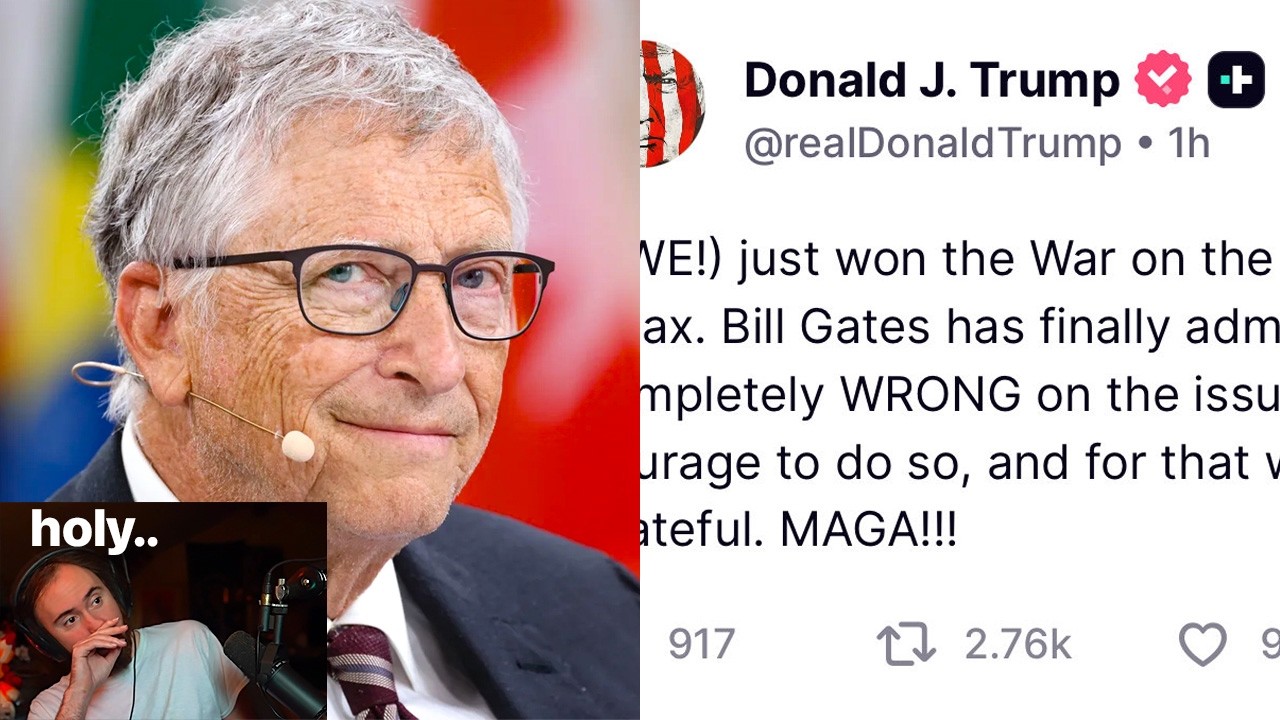
- In fact, in response to Gates' memo, Trump posted on Truth Social that “I (WE!) just won the War on the Climate Change Hoax” because Bill Gates had “finally admitted that he was completely WRONG on the issue.” Gates said that Trump and other right-wing media reactions that echo his remarks are a “gigantic misreading of the memo,” while he has also pushed back at “climate scientists who said he was setting up a false dichotomy pitting climate efforts against foreign aid.”
- ## Right-wing media celebrate Bill Gates’ shift on climate, misrepresent his memo to downplay the climate crisis
- The Associated Press reported that Bill Gates remarked: “If you think climate is not important, you won't agree with the memo. If you think climate is the only cause and apocalyptic, you won't agree with the memo.”
But there it seems Gates was wrong. Right-wing media figures, who regularly downplay the climate crisis are likely among those who “think climate is not important,” and they are not disagreeing with the memo. They have celebrated it and used it to further downplay the climate crisis, attack climate science as “fraudulent,” and advance right-wing narratives and misinformation related to global warming, including denying sea level rise, suggesting that current climate change is unremarkable because the climate has been changing for billions of years, and pushing the “global cooling” myth.
- The New York Post editorial board concluded, “If Gates wants any credit for belatedly seeing the light, he needs to put maximum effort into getting the left’s climate warriors to wake up, too.” NY Post, [10/28/25]
- Former Fox News host John Stossel used Bill Gates’ memo to push his climate change denial content on social media, writing, “Welcome to the club, Bill. Here 3 climate scientists debunk several of the doomsday myths.”Stossel shared one of his videos featuring three climate skeptics, Willie Soon, David Legates, and Patrick Michaels, from an event at The Heartland Institute, a conservative think tank that has received funding from fossil fuel interests. Twitter/X, [10/28/25; Media Matters, 1/16/24, 8/14/25; NPR, 9/12/20; Desmog; accessed 11/10/25]
- Hannity.com: “CLIMATE KOOK FLIPS! Bill Gates Suggests Rethinking Climate Change 'Doomsday Outlook'”Hannity.com, [10/28/25]
- Fox host Jimmy Failla claimed that Gates’ memo proves climate change is a “grift” and pushed the misleading narrative that the climate is always changing. Failla continued:“What an about face. And it really gives up the whole entire grift we always knew it was. It drives me crazy because, you know this, the movement has not only changed again but changed in name three times before we got here. We were going to freeze to death in the ‘70s. Can you give me some money? We were going to melt in the ‘80s. Can you give me a few bucks? Then they were like, we're not freezing or melting, but the weather changes every day. How about a couple of bucks.” Fox News, *Fox & Friends*, [10/29/25; climatefactcheck.org,
- Glenn Beck, founder of TheBlaze, wrote on his website that Gates did a “strategic pivot” because “the ruling class” finds AI “more useful than fear of the weather.”“Climate alarmism gave elites a pretext to centralize power over energy. Artificial intelligence gives them a mechanism to centralize power over people,” he later wrote. [Glennbeck.com,
- In an interview with Newsmax’s Rob Schmitt, conspiracy theorist and U.S. Agency for Global Media senior adviser Kari Lake said, “When we get documents declassified on the climate hoax, he’s probably trying to get ahead of what happens then.”Newsmax, *Rob Schmitt Tonight,* [10/29/25; Media Matters, 12/12/24]
- OnAmerica’s Newsroom, co-host Bill Hemmer used the memo to falsely claim that “rising sea levels just ain’t happening.” “He says it will not lead to the humanities demise. … Maybe an asteroid will, but the rising sea levels just ain’t happening as Al Gore warned us back in 2005.” The World Economic Forum has said that “rising sea levels caused by climate change are impacting 1 billion people worldwide,” while “2024 saw an unexpectedly fast rising of sea levels, which are already unprecedented.” Fox News, *America’s Newsroom*, [10/29/25; World Economic Forum, 3/25/25]
- OnOutnumbered, Fox News contributor Kaylee McGhee White said “climate change doomerism” was a ploy to “drive young adults … to leftist activism.” “This is the least surprising development ever. I think that the climate change doomerism, it was always a ploy, the real purpose of which was to drive young adults my age into leftist activism, that is all it was a vehicle for. And you know, what’s frustrating about this is Bill Gates is suddenly switching his position, but there is no new science behind." Fox News, *Outnumbered*, [10/29/25]
- Fox’s Will Cain hosted Alex Epstein, author of the petroleum-promoting bookFossil Future, and suggested that fossil fuel advocacy is the “potential explanations for the change of heart of Bill Gates.” He claimed, “It is really most of the thoughtful scientists and thinkers through the last several hundred years who have understood the power of fossil fuels and economic growth in helping the vast majority of people across the world. Maybe that finally broke through to Bill Gates. Maybe just seeing the writing on the wall in modern America and under President Donald Trump.” Fox News, *The Will Cain Show*, [10/29/25; Media Matters, 11/4/25]
- OnThe Five, Greg Gutfeld claimed that “people were told to stop having kids” and that Gates' shift is akin to admitting the “climate models … are fraudulent.”Gutfeld said, “It was a lie that impacted the mental health of generations and the physical health of a civilization. People were told to stop having kids. If you had kids you were hurting the planet. But it is hopeful that Gates and others are ceding to reality. We saw it happen already. Nobody is talking about data anymore because the data, the climate models, they are finally admitting are fraudulent, they were retrofitted so that they matched the results they were getting, and now that is out in the open.” Fox News, *The Five*, [10/29/25]
- Fox host Joey Jones claimed that Gates’ memo meant that Trump “won the climate change war.”“I think Trump has won another war. He won the climate change war now. Americans are coming around. You want to talk about petroleum products, think about how much oil is used to make all of those syringes for all of those vaccines during Covid. I mean just the impact and imprint of petroleum on our lives is endless,” Jones claimed. Fox News, *The Five*, [10/29/25]
- Contributor Katie Pavlich told Fox Business’Kudlowthat she wants “reparations for damage this guy [Bill Gates] did on the climate change front.”She claimed, “There were years of groups that were funded by Bill Gates, foreigners doing fact checks on conservative web sites like TownHall, demonetizing us for talking about climate change and that it’s not going to destroy humanity and in fact a lot of the science has been bought and paid for and has been debunked on this issue. I would get laughed at when I would point out I am from Arizona, and you can find sea shells, fossils at the top of the Grand Canyon because yes, climate change has been happening for billions of years.” Fox Business, *Kudlow*, [10/29/25]
- Frequent Fox guest and climate denier Marc Morano on Fox Business’The Evening Editsuggested that Bill Gates “knew” all along that climate change was nonsense.“Bill Gates knew in the year 2000 that the climate agenda was complete bleep. He knew in 2010 it was nonsense, he knew in 2020 it was nonsense, but only in 2025 is he willing to tell the truth. And the reason is he needs connections. He needs energy.” [Fox Business, The Evening Edit,
10/30/25; Washington Post, 9/16/16; Media Matters, 12/17/12; 5/22/19]
Newsmax host Rob Finnerty falsely claimed that Gates is “saying that it’s [climate change] not real.Finnerty said, “Now think about what Democrats have done to all of us in reaction to the climate hysteria created by people like Bill Gates over the last five decades: wind farms, electric cars, carbon footprint, bike lanes, electric buses, eating less meat, renewable energy. We could go on all night and all of it was total garbage. … Bill Gates, who's been right there with always-wrong Al Gore warning us of impending doom for years now, saying that it's not real.” Newsmax, *Finnerty*, [10/31/25]
Right-wing streamer Zack Hoyt, known online as Asmongold, told his audience that Bill Gates no longer believes in climate change and quotes Trump’s Truth Social Post.“You know who else doesn't believe in climate change recently? Bill Gates. Bill Gates has dramatically changed his position on climate change, acknowledging for the first time that there is no doomsday risk for, of global warming. … We just won the war on the climate change hoax. Bill Gates has finally admitted that he was completely wrong on the issue.” [YouTube, AsmongoldTV,
 ]}:
- Fox & Friends Weekendguest and Republican strategist Mehek Cooke claimed Gates shifted on climate change because he realized “we're not going to pay for this green climate change hoax.” She said, “We're not all going to die at the end of the day. So farmers can increase their herd share, I can eat more meat. I mean, all the things that Bill Gates said to the American people, he realized he was losing because we're not going to pay for this green climate change hoax. I also think he's listening to President Trump. It's about innovation and not more regulation.” Fox News, *Fox & Friends Weekend*, [11/2/25]
- Power The Future Founder and frequent right-wing media guest Daniel Turner wrote that Bill Gates’ “climate crusade was always a grift.” Twitter/X, [11/3/25; Media Matters, 5/8/24;
- ## Climate scientists push back on Gates pitting poverty reduction against efforts to reduce carbon emissions
- During a segment on CNN News Central, Bill Weir highlighted concerns from “the chorus of top climate scientists who spent the week trying to debunk the billionaire's confusing new message that rich cities will be immune from the worst effects and that technology can save us.”
Additionally, The Guardian pointed out that a number of climate scientists have criticized Gates for using “‘straw man’ arguments about the threat to humanity and ‘false dichotomies’ between spending on climate or aid for the poor.”
- In comments to NBC, Jeffrey Sachs, who leads Columbia University’s Center for Sustainable Development, “called the memo ‘pointless, vague, unhelpful and confusing,'" adding that there’s “no reason to pit poverty reduction versus climate transformation.’" NBC, [10/28/25]
- Climate scientist Michael Mann has been outspoken about Gates’ memo, pointing out that it coincided with the landfall of the climate-driven Hurricane Melissa and that it was defended by former Fox News star Megyn Kelly. Mann also wrote a rebuttal of the memo in Bulletin of the Atomic Scientists, making the point that “Gates’ latest missive … plays like a game of climate change-diminishing bingo, drawing upon nearly every one of the tropes embraced by professional climate disinformers.” Twitter/X, [10/28/25, 10/29/25; The Bulletin, 10/31/25; The New York Times, 11/6/25]
- Daniel Swain, a climate scientist at the University of California Los Angeles, said of the memo: “Despite agreeing with some points therein, I still think its framing is fundamentally flawed and thus also its key conclusions.” Twitter/X, [11/3/25]
- Climate scientist Zeke Hausfather wrote: “There are a lot of things I agree with in Bill Gates’ new memo on climate change. … But in other areas I feel that it needlessly sets up a conflict between laudable goals.” Hausfather said that “we can both mitigate emissions and alleviate poverty, disease, and hunger. While there are some tradeoffs it is more a question of policy priority than a zero sum game. Similarly, I feel that Gates is a bit too cavalier in his treatment of climate risk.” The Climate Brink, [11/5/25]
- Katherine Hayhoe, chief scientist at the Nature Conservancy, also criticized Gates’ memo. She said, “‘I have not seen a single scientific paper that ever posited that the human race would become extinct … it’s a straw man, the way he’s proposing it.” The Guardian, [11/6/25]
---
433 pp gmail amy w ref
web-version-Roberts-et-al-Climate-Obstruction-A-Global-Assessment.pdf?ref=drilled.ghost
dl file:///C:/Users/patmc/OneDrive/Documents/BOOK/web-version-Roberts-et-al-Climate-Obstruction-A-Global-Assessment.pdf
thirteen chapters developed by a global team of 110 scholars led by thirty-one
lead authors, the volume summarizes the current state of knowledge on who
is impeding action on climate change, and how. While it recounts the history
of that obstruction, we focus primarily on the period between 2015, when a
global climate treaty, the Paris Agreement, was negotiated, and 2024.
The assessment reviews obstruction efforts by the fossil fuel industries
(Chapters 2 and 3), as well as by utilities (Chapter 3), agribusiness (Chapter 4),
media and public relations (PR) firms (Chapter 6), and organizations on
:{:{the political far right (Chapter 5).}:
Research teams also explored the role}:
of the news and social media in disseminating climate disinformation and
misinformation (Chapter 6) and how these narratives potentially affected
:{:{public opinion on climate action (Chapter 7).}:
Other teams examined how}:
obstruction of climate action occurs across the Global South (Chapter 8),
at the subnational level (Chapter 9), at the United Nations and in the IPCC
(Chapter 10), and in the context of climate adaptation (Chapter 11). The final
chapters analyze the surge in regulatory and litigation efforts and civil society
movements around the world to curb climate obstruction (Chapters 12 and
:{:{13).}:
All chapters underwent peer review and reviews by the volume’s four coed-}:
itors. As with the IPCC reports, a free download of the assessment is available
online.
DEFINING OBSTRUCTION
We define climate obstruction as intentional actions and efforts to slow or
block policies on climate change that are commensurate with the current
scientific consensus of what is necessary to avoid dangerous human-caused
interference with the climate system.2 That scientific consensus is summarized
and brought up to date in the assessments by the IPCC.
Climate obstruction has existed since at least 1980, when the American
Petroleum Institute (API) began publicly downplaying the emerging threat of
global warming.3 Research into climate obstruction began in the early 1990s,
as civil society groups in the United States, such as the Sierra Club4 and Ozone
Action,5 helped journalists expose the links between coalitions of fossil fuel
companies and contrarian scientists who downplayed the unfolding realities
of climate change.6
The first scholarly articles on climate obstruction—on contrarian scien-
tists,7 conservative think tanks8,9, and the media10—were published in the late
1990s and early 2000s. In the 2010s, interest in the topic rose11,12,13 and soon
the research coalesced to form a picture: a complex network of organizations
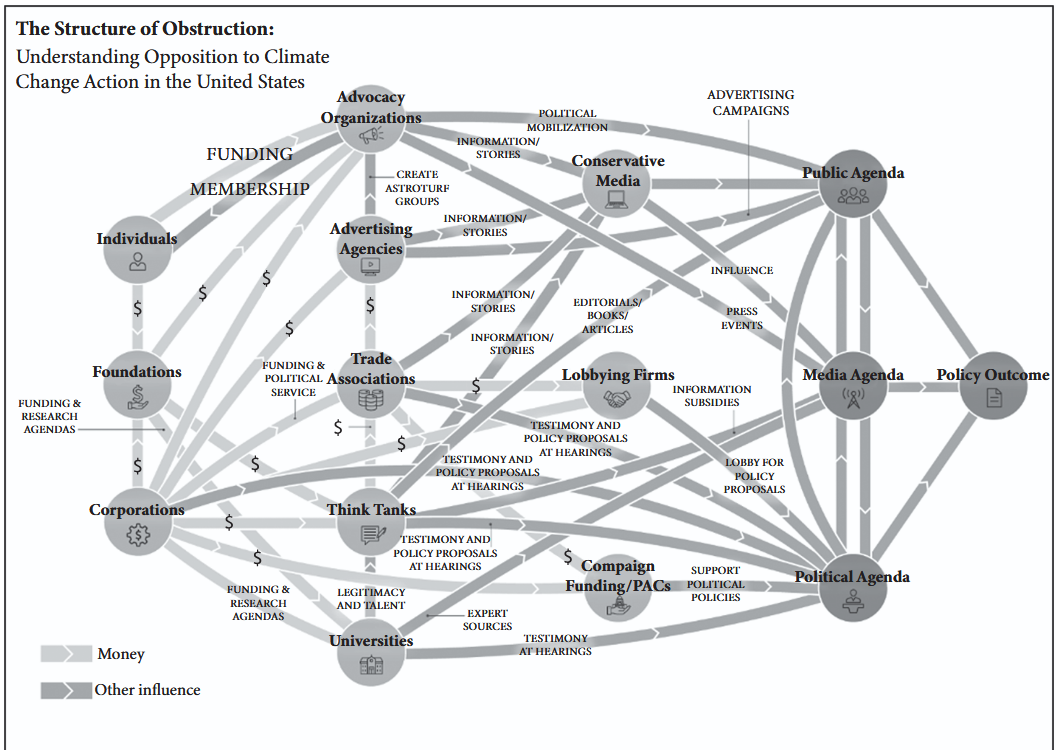
supporting climate obstruction (Figure 1.1). A 2015 series of investigative
pieces by Inside Climate News brought to light the extent to which fossil fuel
giant Exxon knew about the science of climate change in the 1970s and 1980s
but suppressed it and moved aggressively to block climate-related policies.14
More than twenty-five years of scholarly attention, as well as a range of inves-
tigations by civil-society groups, social movements, and journalists, inform
this global assessment, the first attempt to summarize what we know—and
what we still need to find out—about obstruction of climate action around the
world.
The network of organizations and individuals fighting action on climate
change is substantial (for one representation, see Figure 1.1).15 Fossil fuel and
allied corporations and wealthy individuals use various channels to seek and
achieve policy outcomes that favor their fortunes: media ownership and influ-
ence, lobbying firms, campaign donations and organizations, advocacy groups
in national capitals and across countries, trade organizations, think tanks, and
funding funneled to researchers and centers at strategically selected univer-
sities.
This funding flows through family or corporate foundations as well as
through “donor advised funds,” which hide the funders’ identities from public
view. These influence groups target key politicians and other decision-makers
with the goals of instilling doubt about the need to act on climate and creating
uncertainty about the ability of renewable energy and other climate solutions
to meet society’s needs. By raising these doubts, network members hope to
achieve delays in rule-making, weak regulations, and postponement of the
transition away from their products and practices.
...
...
actors. For example, certain companies were aware that climate change existed
and was dangerous—and in some cases even participated in scientific research
on the subject. Yet they chose to challenge the reality of climate change to avoid
regulations that would affect their business operations.
Some obstruction is more consequential than others: not all participants in
climate obstruction are equally responsible for causing global warming. Attri-
bution science is a fast-growing field seeking to document how much of present
and future climate impacts are the result of various actors’ behavior.16 In legal
cases, scientific evidence can provide support for plaintiffs’ damage claims
from those who demonstrably contributed to the harm they experienced.17,18
However, attribution science must wrestle with many issues when determin-
ing what and whom to hold culpable, such as which gasses to count, from
which sources, and during what time frame.19,20,21 Attribution of responsibil-
ity for climate obstruction presents a similar set of nascent questions: How
is responsibility distributed across the known network of climate obstruction
organizations?22,23
To address that complexity, some researchers have proposed four argu-
ments that investor-owned fossil fuel producers have a unique liability for
anthropogenic climate change.24 First, these companies produced a large share
of the products whose use contributed substantially to climate change. Second,
they continued their business operations even after the danger of doing so was
scientifically established. Third, they intend to continue expanding the produc-
tion and use of fossil fuels, even now that the science is clear that these fuels
have to be phased out rapidly. Finally, they have done all of this while working
to obstruct action on climate change. So while this assessment widens its lens
to capture the many other actors involved in blocking climate action nation-
ally and globally, we recognize that fossil fuel producers are one of the most
significant generators of climate obstruction.
In each chapter of this volume, the authors describe and analyze the range
of actors involved in climate obstruction and the contexts in which it occurs;
we summarize them in the following ten key findings.
TEN KEY FINDINGS
- Climate obstruction is not just about denial
Since the Paris Agreement in 2015, public denial of the fact that climate change
exists, is human-caused, and is an existential threat has become far less preva-
lent.25 Rather, most actors involved in obstructing climate action today spend
less time on denying the scientific reality of climate change and more time on
creating doubt about the severity of climate change, challenging the viability
of certain climate solutions and policies,26 or “greenwashing” their products
or businesses by claiming that they are sustainable.27 Typologies have been
...
- Big oil is a key player in obstruction, but only one of many
Most of the early literature on climate obstruction focused on the oil and gas
industry and the role corporations such as ExxonMobil, Chevron, Total, and
Shell have played to slow or block action on climate change. But we now have
evidence that as climate science was developing in the 1970s and 1980s, some
major oil companies including Exxon also participated in research efforts that
documented the likely future trajectory of global warming if fossil fuel use
continued unabated.39 Under President Lee Raymond, the company later dis-
continued that research and shifted its position from undertaking to attacking
climate science (Chapter 2).
While the oil and gas industry led the way on climate obstruction,40 this
assessment shows that numerous other industries—coal companies, utilities,
car manufacturers, and meat and dairy producers—joined climate obstruction
efforts or deployed their own. Supply chains (both upstream and downstream)
create shared interests among corporations across sectors and industries.41 For
example, the aviation, maritime, trucking and railroad industries are all heavy
consumers of oil and gas fuels, and a major part of the latter three industries’
business is transporting their products. Utilities are still dependent mainly
on coal and gas to power their grids; some manufacturing and, increasingly,
computing require high volumes of electricity from these grids (Chapter 3).
The meat and dairy industries have also engaged in climate obstruction; this
sector is uniquely emissions-intensive compared with other agricultural indus-
tries due to methane emissions from livestock and deforestation to feed them
(Chapter 4). It is not only the largest greenhouse gas emitters that obstruct
climate action, but also the businesses in their supply chains.
One manifestation of this interdependency is economy-wide coalitions
of business interests that collectively oppose climate policies. In the United
States, the US Chamber of Commerce and the National Association of Manu-
facturers have a history of pooling resources, sharing information, and under-
taking joint political activities such as lobbying campaigns to block attempts
to legislate a nationwide emissions-trading program.42,43 Business coalitions
such as the European Roundtable of Industrialists (Chapter 3) and the Indone-
sian Chamber of Commerce and Industry (Chapter 8) have also been involved
in weakening or obstructing climate legislation and directives. Industries with...
strong interests in avoiding regulation have often pushed these associations
to extreme anti-climate positions, even when many other member firms might
prefer ambitious climate action.
The preferences, strategies, and tactics of the variety of actors engaged in
climate obstruction are by no means uniform. For example, in the utility indus-
try, while many firms remain dependent on fossil fuels to generate electricity
and therefore tend to oppose climate policies, others hold a more diverse port-
folio of generation assets or purchase most of their electricity from renewable
energy sources, and hence take different positions (Chapters 3 and 9).44,45,46
In US states where utilities are permitted to own electricity-generating power
plants, those utilities are more likely to oppose climate and renewable-energy
legislation than in those where they are not (Chapter 9).47 Among automakers,
there are notable divisions between firms that have embraced manufacturing
electric vehicles and those who continue to focus on producing gas- and diesel-
engine cars; the latter have lobbied heavily against attempts to strengthen
emissions and fuel-efficiency standards (Chapter 3).
- Trade associations are key agents of climate obstruction
Trade associations, which represent entire industries, and business associa-
tions (which represent national or local business interests) allow corporations
to “hide in the crowd” when engaging in obstructive actions; this reduces their
risk of reputational damage (Chapter 3). Firms in the fossil fuel industries
use trade associations as a “command center” for political campaigns to pool
resources and coordinate political activities. The API has been at the forefront
of climate obstruction for decades, coordinating the oil majors’ lobbying and
advertising campaigns and launching front groups such as Energy Citizens,
to delay US efforts to curb the oil and gas industry’s emissions (Chapter 2).
API maintains lobbyists in nearly all states, monitoring legislation and rou-
tinely meeting with members of Congress and state agency officials to oppose
unwanted legislation and programs. The same is true of trade associations
in the transport, utilities, coal, and meat and dairy industries. For example,
the International Air Transport Association (IATA), which represents airlines,
has opposed national climate regulations such as the inclusion of aviation in
emissions-trading schemes and international passenger levies for climate dam-
ages. Similarly, the Federation of Electric Power Companies in Japan continues
to promote coal and downplay the need to transition to renewable energy
(Chapter 3).
In the transport sector, the European Automobile Manufacturers’ Asso-
ciation, the Japanese Automobile Manufacturers Association, and the Fed-
eral Chamber of Automotive Industries in Australia opposed fuel-efficiency
standards and a managed transition off internal-combustion engines. Mean-
while, the automakers were able to present their companies as climate leaders
(Chapters 3 and 13). Agricultural trade associations have also been involved
in climate obstruction: the American Farm Bureau Federation has denied the
science of climate change since the early 1990s, and the National Cattlemen’s
Beef Association has hired university experts to challenge the link between
cattle farming and climate change (Chapter 4). Overall, these are vast organiza-
tions. In the United States, about ninety trade associations working on climate
issues had total revenues of $25.6 billion between 2008 and 2018, with 13%
of that, or $3.4 billion, spent directly on political activities.48
- Networks of think tanks are spreading obstruction globally
A group of think tanks—public policy institutes that perform research and
advocacy—have promoted disinformation and misinformation about climate
science and contested climate policies via reports and presentations to leg-
islatures, news and social media, and other channels.49,50,51 They present
quasi-academic positions while shifting the framing of climate change from
a science-based issue to a matter of individual liberty and economic free-
dom (Chapter 5). They have also funded research reports and conferences to
challenge the IPCC consensus on anthropogenic climate change52 and have
networked transnationally to increase their capacity to promote or disrupt
specific political discourses on the topic.53 Their institutional structure is
shaped by the predominance of men, especially in the case of European think
tanks, illustrating a documented alignment between masculinity and climate
contrarianism.54 There is also a strong convergence between the far-right,
neoliberal thought advanced by these think tanks and resistance to climate
action (Chapter 5).55
Many of the most influential think tanks are based in the United States, but
the dominance of think tanks has spread globally, thanks in part to the Atlas
Network, a global network of such organizations that advocates free-market
(libertarian) and neoliberal policies (Chapter 5). The Heartland Institute in the
United States, the Free Market Foundation in South Africa, and the Global
Warming Policy Foundation in the United Kingdom all have worked to chal-
lenge climate policies and programs (Chapter 5). Similar ideas and practices
have also spread to think tanks in the Global South, such as Andes Libre in Peru
and the Instituto Liberdade in Brazil (Chapter 8). Funding flows around the
world to support these think tanks, which share information, tactics, events,
connections, experts, board memberships, and legal support.56
- PR firms enable corporate efforts to obstruct climate action
Public relations and strategic communications firms help companies and trade
associations conduct their climate obstruction efforts.57,58,59 These companies
and allied firms collect intelligence on opponents (such as environmental non-
governmental organizations, or NGOs), conduct industry-friendly research,
design advertising campaigns, launch front groups, and undertake opinion
polling, among other activities (Chapter 6). In the United States, PR firms such
as Edelman, the DCI Group, and the Hawthorn Group have run campaigns
such as “Advanced Energy for Life” in support of the coal industry (Chapter 3).
In Ireland, the PR firm Red Flag Consulting worked for the meat and dairy
industry to promote positive messages about animal products (Chapter 4).
The growing role of PR firms in blocking climate action has led to their
being named in public-interest lawsuits (Chapter 12),60 being criticized by the
United Nations secretary-general,61 and to the passage of new laws banning
advertisements promoting fossil fuels.62
PR firms’ climate obstruction efforts are facilitated by the characteristics
of the global media system. For example, many media companies rely on an
advertiser-based business model, which includes revenue streams from cor-
:{:{porations that obstruct climate action}: (Chapter 6).
Between 2020 and 2022,}:
Google reportedly received more than $23.7 million from oil majors such
as ExxonMobil and BP to purchase online advertising.63 Meta, the owner of
Facebook and Instagram, permitted fossil fuel companies to purchase mis-
leading advertisements despite the assessments of independent fact-checkers
that the spots were inaccurate (Chapter 6).64 PR firms design and place such
ads for their clients as part of complex information and influence campaigns
:{:{to burnish the companies’ image.65}:
In addition, advertising revenue may}:
also inhibit negative coverage of fossil fuel advertisers. Workers in the PR
industry have begun to organize against these practices, targeting the PR
firms that have run obstructive campaigns for the highest-polluting clients
(Chapters 6 and 13).
- Some governments have taken leading roles in obstructing
climate action
Government interests often align with those of their major industries, includ-
ing fossil fuel–extracting firms, leading governments to take positions to
protect those industries (Chapters 8, 9, and 10). This stance is particularly
obvious in the case of state-owned oil and gas companies and when national
and local governments are heavily dependent upon one main polluting indus-
:{:{try as an income source.}:
Petro-state Saudi Arabia’s obstruction of climate}:
action at the UN climate negotiations over the last two decades is a clear
example (Chapter 10) but hardly unique: more than two dozen countries have
included oil- industry employees in their official delegations to the UNFCCC,
and others allow the industry to influence their national negotiating posi-
tions (Chapter 10). Many of these governments also seek to support their
fossil fuel industries by using public finance to secure export markets. For
example, China and Japan have promoted coal-fired power throughout Eurasia
by providing public subsidies to countries that import their technology, such
as Indonesia, India, and Vietnam (Chapter 8); they have a history of deflecting
criticism of such investments at the UN meetings
...
In addition, agribusiness and the meat-production industry in Brazil have
built strong political connections with government agencies at federal and
state levels (Chapters 4 and 8). In South Africa, coal mining is the historical
backbone of that nation’s economy and social order; in the case of some devel-
oped countries (e.g., the Netherlands) and developing ones, such as Venezuela,
Iran, and Mexico, the key industry is oil (Chapter 8). Therefore, a just tran-
sition away from fossil fuels will require rethinking the central role of the
state in promoting new development models and creating the means to make
these new models socially and environmentally sustainable in an era of climate
change.
Governments in heavily industrialized countries with more diverse
economies have also persistently taken obstructive action on climate. The
United States, for example, supported and then withdrew from the Paris
Agreement, again creating political whiplash in the global effort to address
climate change. While numerous governments have obstructed action in
the UN negotiations at one time or another, such moves have typically
received limited attention despite their substantial implications. For example,
at COP 27 in 2022, New Zealand sought to weaken methane accounting rules
(Chapter 4); Uruguay has aligned with Argentina and Brazil (the ABU Coali-
tion) when its livestock interests were at stake. Understanding and overcoming
climate obstruction thus requires attention to national political economies,
and those are often built on local ones: subnational provinces and states
that are heavily dependent on fossil fuel extraction often seek to under-
mine national climate policy, as in the case of Canada and the United States
(Chapter 9).
- Obstruction occurs within multilateral governance structures
The UNFCCC and the IPCC are global institutions that play key roles in
establishing priorities on the climate agenda by organizing major interna-
tional conferences at which multinational negotiations take place and by
highlighting areas for future action by governments, corporations, and soci-
eties. They are also arenas for establishing and enforcing norms and values
such as, for example, climate justice, fair governance, and suitable finance,
but they have been unable to respond rapidly and effectively to the climate
emergency (Chapter 10).66,67 Currently, national sovereignty (often defined
in opposition to responsibility) is the bedrock of the UN system, and thus
global governance institutions lack adequate enforcement and compliance
mechanisms. Similarly, international development banks and wealthy “donor
nations” inside and outside the UN system have failed to assist lesser devel-
oped countries with climate change adaptation (Chapter 11). World mar-
itime and aviation governance institutions face many of the same issues
(Chapter 3)
Multilateral forums’ tendency to slow and obstruct climate action make
them an easy target for polluting companies and trade organizations and allow
these groups to play a double-game. They can point to a lack of international
action as a reason for slowing action in their own countries. At the same time,
the fossil fuel industry, nation-states, and other economic actors employ a vari-
ety of diplomatic, procedural, and substantial strategies to obstruct progress in
international venues. They have secured a lack of political will to exclude the oil
industry, agribusiness, and other obstructionist actors from participating in
UN decision-making, a change some campaigning groups have unsuccessfully
advocated (Chapter 10).68
- National and local contexts shape obstruction, particularly
in the Global South
Climate obstruction looks different depending on national and local contexts.
Consider the Global South, which encompasses a group of more than 130 coun-
tries outside the core of the global economy, with different trajectories in social
and state formation and economic and social development (Chapter 8)69,70,71.
The Global South’s greenhouse gas emissions are also heavily concentrated:
India and China alone account for some 60% of the region’s emissions, while
120 other Global South countries account for only 22%.72
Leaders from the Global South have argued that the Global North—due
to its historical responsibility for causing the most emissions—must be more
proactive in supporting developing countries in dealing with climate change.
Delivering the financing required to decarbonize and adapt to climate change
in the Global South is a topic still being negotiated and obstructed within
the UNFCCC (Chapter 10).73 But the Global South can also be an agent of
climate obstruction. Political representatives from the Global South often
use development priorities as a reason to sideline decarbonization goals, fre-
quently claiming that they have a “right to pollute” as part of their “right to
development,” and failing to question their own development models or to
consider helping the most vulnerable groups in their countries (Chapter 8).
Moreover, dominant ideologies can also feed into overt and extreme cli-
mate obstruction efforts, including religious influence in government and/or
right-wing legacies—be they neoliberalism, conservatism, or farther right.
Such trends can be seen in Brazil under former president Jair Bolsonaro, the
United States under President Donald Trump, Hungary under Prime Minis-
ter Viktor Orban, or Argentina under President Javier Milei (Chapters 5, 7,
and 8).74
The configuration of organized interests engaged in climate politics shapes
how obstruction occurs not just at the national level but also the local,
subnational, and international levels. For example, studies have shown that
distributive conflicts among energy interests, such as between coal and
gas, are vital to explaining climate policy outcomes.75,76,77,78 How those
industries are structured can also shape how obstruction unfolds. For example,
in the United States, many utilities hold a monopoly on providing electric-
ity to the city or region in which they are based; therefore, ratepayers may
unwittingly be funding the industry’s lobbying and advertising efforts to delay
and block climate policies (Chapters 3 and 9). Similarly, in countries where
media industries are highly concentrated, with a few firms or families owning
the majority of news outlets, collective goals including climate action can be
undermined (Chapter 6).
- Obstruction starts at the top but requires social acceptance
As noted earlier, industries such as oil, gas, and coal, utilities, car manufactur-
ing, and meat and dairy production—as well as their trade associations and PR
firms—fund and implement climate obstruction from the top down. However,
for those efforts to be effective, their rhetoric must be accepted and adopted by
the media, political parties, politicians, and individual citizens. For example,
a study of more than 1,700 press releases about climate change found that
US newspapers covered messages from business coalitions and trade associa-
tions that opposed climate policy at double the rate they covered pro-climate
policy positions from other types of organizations (Chapters 6 and 7).79 In
addition, most media platforms have few, if any, effective policies in place to
prevent the spread of climate misinformation (Chapter 6). Obstructive forces
have been able to use social media to exponentially speed the spread of such
misinformation among the public.
Individuals are constantly exposed to climate obstruction content from a
variety of outlets. Scholars have identified the major categories of anti-climate
claims: (1) global warming isn’t real, (2) it isn’t human-caused, (3) climate
impacts aren’t bad, (4) climate solutions won’t work, and (5) experts are
unreliable (Chapter 7). More recently, studies show, attacks on the scien-
tists themselves and on renewable energy and other climate solutions havereplaced the first three claims.80
Whether people are more or less receptive}:
to such rhetoric depends on various social and psychological factors.81 For
example, early research in this area documented how industrial companies targeted Republicans with influence campaigns that helped make climate change
a polarized issue in the United States (Chapter 6).82,83,84 Addressing such cli-
mate change misinformation requires systemic changes that make it more
difficult for misinformation to spread and that will ensure individuals are able
to discern misinformation from fact.
- There are efforts to address climate obstruction through regulation,
litigation, and social movements
Some countries and communities are working to address climate obstruc-
tion in formal and informal ways. Options have included direct governmen
regulation and legislation, which attempt to restrict net-zero claims and
pledges made by corporations and financial firms, limit corporate influence
over climate policy, and prohibit greenwashing. To do so, governments have
used a variety of tools including shaming tactics and other forms of man-
dated disclosure (Chapter 12). They can also limit or prohibit the “revolving
door” through which industries co-opt regulators by hiring them, restrict lob-
byists’ access to key staff and legislators, and limit company or large-donor
contributions to political campaigns (Chapter 12).
About 1,500 climate-related lawsuits have been filed around the world; a
subset of these suits target climate obstruction, in particular the historical
and continuing deception of consumers (Chapter 12). The plaintiffs include
individuals (grandmothers in Switzerland, teenagers in Oregon, Indigenous
and quilombola groups in Brazil, and many others), subnational actors includ-
ing city and state governments, federal justices, and major climate organi-
:{:{zations.}:
Lawsuits targeting climate obstruction have been brought against}:
:{:{fossil fuel producers, including Exxon, Shell, BP, Peabody, and Total, but haverecently expanded to other firms.}:
Lawsuits have implicated trade associations,}:
such as the API (Chapter 12) and consulting firms, such as McKinsey & Company, which an Oregon municipality sued along with fossil fuel company tradegroups.
Lawsuits have also expanded beyond fossil fuel related cases. In 2021,
for example, three NGOs won the first climate lawsuit in Denmark against
the meat producer Danish Crown, which had claimed that its pork was
“climate friendly.”85 In 2024, the New York State attorney general filed
a lawsuit against beef producer JBS USA Food Co., alleging the com-
pany had misled consumers about its net-zero commitments (Chapters 4
and 12).
In the Global South, Brazil has one of the highest numbers of climate
cases, including 2023 litigation in which the federal environmental protection
agency, IBAMA, sued agribusiness leader Dirceu Kruger for climate damage
caused by illegal deforestation in the Amazon.86
Climate-focused NGOs are finding ways to challenge obstruction. These
efforts include social exposure (or “naming and shaming”) to shower nega-
tive publicity on obstruction activities, lobbying to advocate prevention of
obstruction, and campaigns and protests that mobilize citizens concerned
about blatant climate obstruction and deception. For example, BankTrack.org
monitors the financial activities of private-sector commercial banks around
the globe and feeds this information to campaigners who name and shame
banks in hope of strengthening their policies on investments that affect the
climate (Chapter 13). The record of wins from regulatory, litigative, protest,
and shaming campaigns against obstruction is still modest, but may be aided
by the broadening understanding of the problem and growing efforts to
address disinformation.
...
Journalists
Journalists, like NGOs, have played a significant role in exposing climate
obstruction and debunking misinformation. For example, investigative outlets
such as Inside Climate News and DeSmog have helped to expose misinformation
and obstruction campaigns in the oil, gas, and coal industries, among many
others. Their work has included revealing the role that “influencers” hired by
PR firms play to promote their oil and gas clients (Chapter 6). Other news orga-
nizations, such as The Guardian, have run series examining the political tactics
of fossil fuel corporations (from whom they have stopped accepting advertis-
ing; Chapter 13). Early efforts by journalists to expose climate obstruction have
developed into coordinated actions to fight its spread. Groups such as Climate
Feedback, comprising science journalists, have emerged to fact-check climate
news stories and help readers evaluate the sources of these stories (Chapter 6).
As discussed, debunking misleading claims in this way is considered vital to
inoculating the public and making climate misinformation harder to spread.
Scholars
Academics, including scientists, also aid the efforts of policymakers, NGOs,
and journalists to expose and counter climate obstruction, and the results have
prompted legislative investigations, legal proceedings, newspaper reports, and
social media campaigns. CSSN,91 which includes 800 scholars worldwide,
encourages peer-reviewed research into obstruction. Some academics work
closely with journalists from organizations such as Climate Feedback to expose
and debunk misinformation. University researchers have also participated in
institutional campaigns to convince universities to disclose funding from the
fossil fuel industry, and more recently to “disassociate” from firms and indus-
tries that advance climate misinformation.92 While many of these campaigns
have been led by students, professors have also pressured their home institu-
tions to act. For example, campaigns by faculty at Brown University and the
University of California, San Diego in the United States and the University
Cambridge in the United Kingdom, among others, have sought to dissuade the
schools from engaging with companies that promote climate disinformation
by, for example, refusing their research funding (Chapter 13).
Students
Campuses around the world now face growing pressure to mitigate the risks
from taking industry funding, including its influence over research agendas
...
C H A P T E R 2
The Global Role of the Oil and Gas
Industry in Climate Delay and Denial
LE AD AUTHORS: GEOFF DEMBICKI, KRISTOFFER EKBERG,
AND KERT DAVIES
CONTRIBUTING AUTHORS: ANN-KRISTIN BERGQUIST,
ADA NISSEN, AND STELL A LEVANTESI
INTRODUCTION: THE NET-ZERO OBSTRUCTION ERA
In the years leading up to and following the signing of the 2015 Paris Accords,
something significant changed within the oil and gas sector—at least, on the
surface. One major company after another began declaring themselves climate
leaders and loudly announcing net-zero targets, a process by which their vast
greenhouse gas (GHG) output would either be reduced to zero or neutralized
through reductions elsewhere. Companies had for years tried to “greenwash”
their images, but this was of another magnitude entirely. “The world’s carbon
budget is finite and running out fast; we need a rapid transition to net zero,”
declared BP’s CEO Bernard Looney in 2020, promising that the UK oil and
gas giant would become a net zero company within three decades. “This will
certainly be a challenge, but also a tremendous opportunity.”1
Similar state-
ments emerged from oil companies across the world, from Royal Dutch Shell
and Canada’s Suncor to Chevron and Saudi Aramco.2
We now know, due to the 2024 release of thousands of internal oil and
gas company documents obtained through a joint investigation by Democrats
in the US House and Senate, that these pledges were more about prolonging
the survival of fossil fuel production than fundamentally shifting the indus-
try’s business model. In private corporate communications, top oil and gas
executives appeared to state this explicitly. Supporting the goals of the Paris
Agreement, as well as US involvement in it, was “the most obvious course of
...
Building on a previous meta-analysis of industry communication,10 we
characterize obstruction by three distinct but interconnected tactics. The first
is denial, or emphasizing scientific uncertainty. Denial occurs when the indus-
try publicly questions the research of climate scientists and the work of the
Intergovernmental Panel on Climate Change (IPCC) in order to hinder a tran-
:{:{sition.}:
The second tactic, delay, or the use of socioeconomic arguments to}:
stall regulations, is a strategy that emerged in tandem with the creation of
think tanks and the rise of neoliberal hegemony since the 1970s. Here, indus-
try lobbies against regulations and legislation by appealing to perceived costs
for society or citizens at large. The third tactic is industry co-optation of the
public policy process, or appearing to take the climate crisis seriously while
intervening in governing bodies to weaken, neutralize, or undermine potential
policy and technological solutions. Much literature assumes a chronological
evolution of these tactics moving from denial toward the others. While the
intensity with which specific arguments and tactics have been used certainly
:{:{has changed over time, this does not mean that efforts to delay and co-optthe policy arena are exclusive to the post-Paris period.}:
Rather, our focus on}:
the longer history of obstruction in this chapter demonstrates how all three
tactics—denial, delay, and co-optation—have been used by the oil and gas
industry throughout decades of environmental and climate governance.
The Oil and Gas Industry
The combustion of oil and gas is one of the most consequential contribu-
tors to climate change. But it is important to acknowledge that these fossil
fuels are very different from other polluting and hazardous substances such as
F-gases, asbestos, or lead. The existing global economic order has for more
than a century been built on the inexpensive and powerful energy provided
by oil and gas. The industry has also created energy path-dependencies—
examples include car-dependent urban design and national highway systems,
which disadvantage environmentally safer alternatives.11 This is not merely a
technological dilemma. The development of fossil fuels has shaped global capi-
talism, democracy, and modernity, and has been the cause of colonization, war
:{:{and international power struggles.12}:
Oil and gas industry leaders and political}:
supporters often argue that without continually expanding global production,
the developed world would neither be able to maintain current living standards
nor economic growth and stability.13
Despite the oil and gas industry’s vast global reach and influence, it is domi-
nated by a relatively small handful of private firms (investor-owned companies,
or IOCs) and state-owned companies (nationally owned companies, or NOCs).
These companies in turn are responsible for a large majority of the green-
house gas emissions released by humankind over the past century and a half.
...
OBSTRUCTION STRATEGIES
The oil and gas industry has deployed three distinct but interlocked
obstruction tactics: undermining or denying the growing scientific consen-
sus on the urgency and dangers of climate change; utilizing socioeconomic
scare tactics to delay action by governments; and co-opting or trying to
shape the environmental discourse and policies on terms favorable to the
industry.
Science Denial: Amplifying Uncertainty to Delay Policy
In the early years of the climate policy debate, which we define roughly as the
late 1980s through the early 2000s, the lead obstruction tactic deployed by
fossil fuel corporate interests was to downplay or deny the scientific consen-
:{:{sus, casting doubt in order to forestall action in the policy arena.}:
This tactic}:
continues intermittently in various forms to this day.
One recent example took place during the international climate negotia-
tions in Dubai in 2023, when COP28 president Sultan Al Jaber stated during
a panel discussion that there is “no science” supporting the idea that phasing
out fossil fuels is essential for restricting global warming to 1.5 degrees C, the
level agreed by scientists is a dangerous threshold. Al Jaber, who at the time
was also the chief executive of the United Arab Emirates’ state oil company,
Adnoc, faced backlash for the statement, which one scientist called “verging
on climate denial.”28 A large body of scientific literature—including a land-
mark 2021 report from the International Energy Agency29—has demonstrated
that managing a rapid decline of fossil fuel production is crucial for stabilizing
global temperatures.30
While Al Jaber’s comments were widely publicized and debated, denial
about the required pace of transition off of fossil fuels is so commonplace
within the oil and gas industry that it is often ignored. During the Dubai talks,
IPCC chair and former professor of energy Jim Skea noted that while a full
phaseout of oil and gas might not be required to achieve 1.5 degrees C, global
oil use by 2050 needs to be reduced by 60% and gas use must fall by 45%.31
Yet when researchers compared the production output of 142 coal, oil, and gas
companies against necessary fossil fuel reductions, they determined that from
2014 to 2020, 63% of the oil companies and 70% of the gas companies in their
study exceeded the production limits required for global temperature stabi-
lization. If the companies continued producing at these levels, the oil industry
would overshoot its cumulative production budget by 42% by 2050, while the
gas industry would overshoot its budget by 53%, vastly increasing the likeli-
hood that humankind would fail to meet the Paris climate targets.32 A 2011
study showed that keeping the Earth’s carbon budget within safe limits wou
...
CONCLUSION
On the surface it may seem like we are in a different era for climate action
following the Paris Agreement. Most major oil companies across the planet
now loudly tout their ambition of helping the world achieve net-zero emis-
sions by 2050, a requirement for avoiding global catastrophe. Yet the transi-
tionary rhetoric from oil companies is not matched by the necessary actions.
While companies have developed and touted projects to develop renew-
ables or address environmental pollution,126 the results have been marginal.
The ultimate impact of these activities has been to legitimize oil and gas
operations as well as keeping open the possibility for continued extrac-
tion.127 Production of the fuels at the center of our climate crisis continues
to rise.
The current net-zero pledges and solutions put forward by industry are the
latest phase in a process of climate obstruction going back at least to the 1970s.
During those decades, the oil and gas industry’s tactics have shifted depend-
ing on the political and economic context. The industry has alternately pushed
denial of the basic science on climate change, used economic scare tactics to
justify aggressive lobbying against solutions, and attempted to co-opt the pol-
icymaking process on terms favorable to its business model. Though each of
these tactics has risen and fallen in prominence at various times, we argue that
all three are currently in play.
While outright science denial from oil and gas companies has subsided since
its peak in the 1990s, it has since 2015 morphed into a subtler and less public
form of denial through fossil fuel expansion plans that seemingly ignore the
increasingly dire warnings of climate breakdown.
As we have shown, companies are ignoring and/or obstructing global efforts
to curb emissions to match the goal of the IPCC guidance defining 1.5 degrees
C of average warming as “dangerous” climate change. Similarly, the oil and gas
industry continues to frame climate action as destructive to the economy and
people’s livelihoods in its attack on national legislation in the US and European
Union. All the while, producers push false solutions such as carbon capture and
natural gas that merely prolong our reliance on fossil fuels.
Even though oil and gas producers are currently portraying themselves
as climate leaders, they could shift to cruder or more aggressive obstruction
tactics as the need arises. Companies, for example, may return to explicitly
backing and funding populist social movements questioning strong climate
action—a topic for future research to track. If far-right and authoritarian politics continue to gain hold, this trend may herald a new form of denial and
obstruction that is not passive or opaque but blatantly refuses to comply with
the scientific warnings about climate change.128 A potential return to more
overt anti-science politics and the impacts it could have on the oil and gas
industry’s tactics and rhetoric, could be a valuable research area
---
CH5 RGT AND FAR RT
...into a global network of think tanks.25 Several Mises Institutes in different
countries have been active in the Atlas network; according to the results of two
global surveys of both networks, about one-quarter of the individuals affiliated
with Mises Institutes are also affiliated with Atlas think tanks.26
In turn, leading intellectuals involved in Mises Institutes around the world,
including economist Hans Hermann Hoppe, founded the Property and Free-
dom Society. The Society advocates a new version of far-right neoliberalism
that opposes almost any state interventionism and supports radical privatiza-
tion and decentralization. The group’s rejection of global policy coordination
under the umbrella of the United Nations is similar to that of the anti-systemic
far right. Property and Freedom split away from the Mont Pèlerin Society in
2004; the latter supports both culturally progressive and conservative varieties
of neoliberalism and, in the context of climate change, is home to supporters
of global economic constitutionalism and both supporters and opponents of
international policy coordination.27
Discourses of Delay
Beyond their free-market rhetoric, a wide range of think tanks has developed
other discourses of climate delay,28 including promoting nontransformative
solutions and advocating limited responsibility for addressing climate change.
These strategies include the growing emphasis on achieving net-zero emis-
sions, a focus on carbon sequestration rather than de-carbonization, and an
emphasis on “discounting” in economic models (which asserts that mitigation
can wait because it will be less expensive in the future). These delay-focused
forms of discursive obstruction have not only been integrated across the
political and corporate policy spheres, but also accepted in the public mind.29
These narratives have been echoed by individual members of these think
tanks, who spread these ideologically supported positions on climate change
:{:{via public-facing media appearances.30}:
Murdoch media regularly feature con-}:
tent from both free-market conservative and hard-right climate denialist think
tanks, companies, and funders in North America, particularly those based in
the United States31 (e.g., the Heartland Institute). They also spotlight speak-
ers and content from think tanks based in Canada (Frontier Centre for Public
Policy), Australia (Institute of Public Affairs, Centre for Independent Studies),
Europe (Institute of Economic Affairs, the Austrian Economics Center), and
South Africa (Free Market Foundation, South African Institute of Race Rela-
tions), for example. Consequently, partisan think tanks have ultimately been
able to guide “public opinion, political debate, economic discourse and even
academic discussions on climate change mitigation” in several countries and
policy arenas.32
Financial Linkages
Scholarly research on the relationship between conservative foundations and
climate obstruction began with a seminal quantitative 2014 analysis of the
US Climate Change Countermovement (CCCM).33 The CCCM is a network of
organizations (including think tanks), individuals, and activities dedicated to
preventing ambitious climate policy. Since then, research on philanthropic
financial support within the political economy of climate obstruction has
revealed three themes.
The first theme is opacity: reliable data on foundation support are difficult
to obtain. When such data are gathered, it can be difficult to discern the intent
and influence of this type of financial support. For example, 74% of dona-
tions made through donor-advised funds come from unidentified sources.34
To learn more about funding patterns, it can be helpful to trace funding flows
and board membership. The Dunn Foundation, for example, has funded sev-
eral think tanks involved in climate denial, including the Heartland Institute
and the Cato Institute. Between 2002 and 2017, the latter received more than
$7 million from the Dunn Foundation;35 a foundation member also serves on
Cato’s supervisory board.
While some such think tanks in the United States reportedly benefit from
untraceable contributions from conservative family donations and the liber-
tarian/conservative Donors’ Trust,36 others lack even limited transparency
:{:{when it comes to their funding sources.}::{ }:
Recent research has documented the}:
funding patterns established by brothers Charles and David Koch of corporate
giant Koch Industries, who discreetly fund the climate change countermove-
ment by directing money through their family foundations (the Charles Koch
Foundation and the David H. Koch Charitable Foundation). The beneficiaries
are a network of conservative think tanks and advocacy groups that actively
promote climate change skepticism and oppose environmental regulations,
often funneling the funds through “dark money” organizations such as Donors
Trust to obscure the source of these donations. (This network is sometimes
referred to as the “Kochtopus” due to its extensive reach and influence.)37
The second theme is concentration. Despite the fact that many contribu-
tions to obstructionist think tanks and civil society groups are made anony-
mously, research has found that a small group of foundations tends to provide
the bulk of financial support for organizations involved in climate obstruc-
tion efforts:38 “The top 1% of grant makers account for 67% of grants, and
the top 10% of grant makers account for 95% of grants.”39 In Europe, the
number of foundations involved in promoting and/or funding climate change
denial is smaller than in the United States. To compare the two regions, one
can examine the foundations supporting think tanks that are partners of the
global Atlas Network. Many Atlas think tanks are involved in climate denial
and other forms of obstruction, as discussed earlier. While there is no infor-
mation on foundation funding in Europe comparable to that available in the
United States, a recent survey found forty-eight foundation representatives on
the boards of Atlas think tanks in Europe, compared with almost three hun-
dred individuals representing more than two hundred foundations who served
on the boards of Atlas think tanks in the United States.40
A few European
foundations in the survey sample are notable for funding Climate Counter-
movement organizations in Latin America, including the Fundación para el
Análisis y los Estudios Sociales in Spain, and the Friedrich Naumann Founda-
tion, for example, funds them in Germany. Both European foundations fund
Latin American think tanks. The European arm of the Atlas Network, the Inter-
national Policy Network, was involved in channeling US funding to European
denial organizations.41
The third theme is heterogeneity. Scholars have noted the variety of the cli-
mate obstruction actors funded. Foundation support flows to many different
organizations, with varied levels of focus on climate change; thus, scholars face
a challenge in isolating the impact of these flows on climate obstruction when
it is one among many issues of concern within the neoliberal and conservative
movement.42
Cultural Linkages: The Role of Religion
Many major religions embrace ambitious environmental action and endorse
climate mitigation, out of concern over, for example, protecting God’s cre-
ation. There are also some religious linkages to climate obstruction, especially
among rank-and-file adherents whose traditions are more closely aligned with
right-wing politics.43 In the United States and Australia, for example, reli-
giosity has been found to be a key factor in the popularization of climate
science skepticism.44,45 Research on spirituality on the Netherlands has mir-
rored American patterns.46 Other types of religious organization have been
involved in climate obstruction, notably the US-based Cornwall Alliance for the
Stewardship of Creation.
Its founder, E. Calvin Beisner of the Catholic Acton
Institute, described the group as a “network of evangelical theologians, sci-
entists, and economists.”47 Its activities have included organizing a seminar in
Rome with the Acton and Heartland institutes to mobilize against the language
of “environmental crisis” in Pope Francis’s encyclical Laudato Si.48
Like the Cornwall Alliance’s, many of the best-studied Catholic denial-
ist activities have been traced to the United States. Their main themes are
reflected in the prominent blog and forum Catholic Answers: climate change
is natural, not anthropogenic; anthropogenic climate change is “prudential
judgment” (i.e., belonging to the scientific sphere, which is not infallible); cli-
mate concern reflects pantheism and neopaganism; support for subsidiarity
... RUSSIA ROMANIA
...
are then translated into Romanian and published on right-wing Orthodox
websites such as Cuvˆantul Ortodox and those mentioned earlier.55 They also
quote renegade scientists such as climate change–denying physicists John
Clauser and Victor Manuel Velasco.56 Such views occasionally find an echo even
within the Church hierarchy. For example, in a pastoral letter from 2022, one
Romanian bishop stated that “planned pandemics” and “exaggerated climate
obsessions” are both instruments of “the great reset.”57
Latin America
In Latin America, research on religion and climate change is still in its early
stages. There currently exist no comprehensive studies on the transnational
dimensions of climate denialism among right-wing religious groups in Latin
America. A few studies focus on local networks of religious climate denialism
in Brazil and these groups’ relationships with the government of Jair Bol-
sonaro, which utilized climate denialism to foster a populist ideology.58
Much
of this work tends to focus on the linkages between recent conservative polit-
ical movements and the rise of Pentecostal and neo-Pentecostal evangelical
movements.59 In Brazil, for example, the Bolsonarist right-wing movement
is supported politically and financially by a conservative network including
many Pentecostal evangelicals (a sector that has grown dramatically since the
1990s and today represents around 37% of the population). But the “strategic
role of climate denialism” in “blocking processes of environmental governmentalization in Brazil”60 has also involved the publication and distribution of
translated books by small Catholic publishers with ties to agribusiness.61
Individual government members, such as former Foreign Minister Ernesto Araújo,
have used religion to deny climate change.62 Both Pentecostal and Catholic
groups have reinforced the broader climate countermovement in Brazil; for
example, the government refused to host COP 26, the annual international
UN climate conference, and withdrew key decision-making power from the
country’s environmental and climate governance institutions.63
The ideology behind such right-wing religious obstructionism in Latin
America lies at the intersection of markets and nature, postulating that “God
is in control,” meaning environmental issues should not be a concern for
Christians because the Earth’s fate is predetermined. Furthermore, the free
market is seen as a channel allowing people to “wisely use” nature, which in
its undeveloped state is considered savage. The denial discourses of Brazil’s
religious obstructionists thus differ only slightly from those in the United
States and Europe. However, the former is characterized by a stronger focus
on discrediting IPCC research and promoting the idea that environmen-
talism is a communist conspiracy that aims to destroy Western Christian
civilization.6
...
the United States since the 1990s, research shows that the mainstream Repub-
lican Party has continually sowed climate skepticism in order to maintain a
free-market status quo.68 In contrast, the far-right or “alt-right” movement
sees “the anti-environmentalism of the present conservative movement as
nothing but a modernist, capitalist . . . [and] Jewish conception that has found
fertile ground in the hands of billionaire plutocrats wiping out nature all over
the Earth for the sake of higher profit margins.”69
In the United States, the mainstream right consistently supports inter-
national cooperation in military, corporate, and humanitarian affairs, with
the exception of climate change. The European spectrum of conservative and
right-wing parties tends to be more diverse, but center-right parties typically
embrace international climate cooperation whereas Europe’s revolutionary far
right sees increased international cooperation negatively, advocating instead
for a disintegration of global solidarity.
Multiculturalism and Ethnopluralism
The revolutionary far right envisions a world grounded in “ethnopluralism,” in
which distinct racial or ethnic groups live in separate regions, preserving their
unique identities and rejecting global community connectivity.70 The slogan
of Arktos Media, “Making anti-globalism global since 2009,” succinctly cap-
tures how the revolutionary far right today expands on the idea of ethnically
homogeneous nations, as seen in contemporary movements such as Indian
Hindutva and Japanese Shinto nationalism. Arktos is known for distribut-
ing the work of figures in the global far-right movement and has published
books by the prominent American alt-right figure Richard Spencer, the Rus-
sian ultra-nationalist Aleksandr Dugin, Alain de Benoist of the French New
Right, and Brazilian right-wing philosopher Olavo de Carvalho.71 The rela-
tionship between these revolutionary far-right actors and climate obstruction
should thus be thought of as a rejection of the terms of the debate: the global
cannot exist.
The authors of the revolutionary far right are united in their critique
of what they see as an increasingly “multicultural” world, one where ethnic
and national distinctions have become less clear-cut. Eschewing a class-based
critique—which for many in the farthest reaches is seen as Marxist ideology
invented to sever people from their natural ethnic consciousness—the revo-
lutionary far right turns to cultural explanations for what they see as a trend
toward an indistinguishable and homogenous global community.72
For many global far-right movements, the supposed threat of a multicul-
turalist global community is often argued against using some variation on
the “Great Replacement Theory,” the belief that there is a deliberate effort by
obscure global elites, often imagined as Jewish and referred to as a “cabal,” tO
replace white populations in Western countries with non-white and/or immi-
grant populations. Today, a wide range of multisectoral actors—from Fox
News in the United States to the AfD party in Germany—have propagated
this belief.73 In recent years the revolutionary far right has linked the imag-
ined set of “Great Replacement” actors and relationships with climate change,
considering it to be one of the many artificial panics and false flags allegedly
precipitated by elites. In other words, the charge is no longer that science isn’t
right, but that climate change itself is part of a conspiracy. Additionally, the
basic logic of replacement has found resonance beyond Western contexts. Sim-
ilar narratives have surfaced within the right-wing Rashtriya Swayamsevak
Sangh (RSS), based in India, for example.74
Extremist Goals
Beyond advancing replacement theories, the broad global swath of far-right
actors exhibits varying responses to anthropogenic climate change. One such
approach is “accelerationism,” a radical theory of change advocating the delib-
erate intensification of forces that will destabilize existing systems and pre-
cipitate societal collapse, thereby hastening social transformation in line with
accelerationists’ own ideology and vision of society.75 Accelerationism is a
strategy adopted by radicals on both the left and right. Far-right and neo-
fascist accelerationists view climate collapse—ideally, cultural collapse—as a
means of transformation facilitating a return to traditional, often authori-
tarian, social structures. For example, a section of the manifesto released by
a mass shooter in an attack on two mosques in Christchurch, New Zealand
in 2019 is titled “Destabilization and Accelerationism: Tactics for Victory.”
It
attempts to justify the murder of fifty-one people as part of a strategy to trigger
broader conflicts and speed change. Similarly, a recent study from West Point’s
Combating Terrorism Center notes that multinational neo-Nazi groups like
The Base and Atomwaffen employ accelerationist strategies using extreme vio-
lence with the aim of destabilizing and toppling the US federal government.76
Extremist groups have always exploited vulnerabilities to shape grievance
narratives, but recent research suggests that climate crises (and local gov-
ernmental responses) provide new avenues for extremist exploitation. For
example, a recent study on climate-induced violent extremism in North Africa
found that
violent extremist (VE) groups such as Boko Haram and the Islamic State exploit
crises and conflicts resulting from environmental stress to recruit more followers,
expand their influence and even gain territorial control. In such cases, climate
change may be described as a ‘risk multiplier’ that exacerbates a number of conflict
drivers.7
These extreme perspectives thus diverge ideologically from climate obstruction
as it is typically understood on the mainstream right, which often employs it to
maintain the status quo, especially with regard to the regulatory environment.
Instead, the revolutionary far right has begun to integrate climate change into
a broader political ideology aimed at promoting far-right ecologies.
For the revolutionary far right, the problem lies not with climate science
but with its practical consequence: the need for more coordination between
multinational corporate capital and international policymakers.
In their logic,
the existing resource extraction and distribution networks of global capital-
ism will lead to a dystopia that will destroy all local ethnic connections to land
(“blood and soil”) and usher in a New World Order in which sovereign nations
are replaced with a totalitarian global government. In addition to examining
nonstate extremist actors, such as those involved in the Christchurch attack
and a similar 2019 race-based massacre in El Paso, Texas, research has also
examined far-right policy platforms related to climate change.78
Perhaps the
most famous example is the rise of “blood and soil” nationalist identities, such
as in Nazi Germany, which used the Reich Ministry of Food and Agriculture to
anchor an extremist ideology in agrarian connections to nature, place, and the
environment. Today, the link between the environment, climate, and nation-
alism still figures heavily in the rhetoric of French politician Marine Le Pen’s
Le Front National (FN), especially its emphasis on preserving environmental
heritage, or “patriotic ecology,” which it frames as a holistic approach to halt-
ing the collapse of the French way of life. In a 2022 debate, Le Pen emphasized
the urgency of environmental concerns, criticizing globalization for its detri-
mental impact on the planet and animal welfare and advocating “localism” and
“economic patriotism” to enhance the production and consumption of French
products.
Strategies and Tactics
An important distinction between mainstream right-wing social forces and
revolutionary far-right movements lies in their political strategy and tac-
tics. Whereas mainstream right-wing groups engage directly in policy pro-
cesses to obstruct climate action, revolutionary far-right movements are often
relegated to “metapolitical” strategies, leveraging online platforms, “news”
stations, and political spectacles such as rallies to foster skepticism toward
international cooperation and climate policies and thereby influence politics
indirectly. Internet-based metapolitical obstruction is not merely rhetoric:
such far-right ideology has inspired violent attacks on particular groups and
activists.
For example, the aforementioned El Paso massacre was a metapolitical spec-
tacle that illustrates how the system-attacking nature of the revolutionary fa
...
C H A P T E R 6
Steering the Climate Discourse
Legacy News, Social Media, Advertising,
and Public Relations
LEAD AUTHORS: MELISSA ARONCZYK
AND MAXWELL BOYKOFF
CONTRIBUTING AUTHORS: TR AVIS G. COAN,
MYANNA L AHSEN, HANNA E . MORRIS,
AND CHRIS RUSSILL
Introduction: Steering Obstruction
In the lead-up to the international treaty on climate change known as the Paris
Agreement, the Intergovernmental Panel on Climate Change (IPCC) released
its fifth report, describing the causes of climate change in unequivocal terms.
Anthropogenic greenhouse gas emissions (GHGs), “together with those of
other anthropogenic drivers, have been detected throughout the climate sys-
tem and are extremely likely to have been the dominant cause of the observed
:{:{warming since the mid-20th century.”1}:
In 2017, New York Times opinion writer}:
Bret Stephens challenged those who claimed the “complete certainty” of cli-
mate causes. His piece was not meant “to deny climate change of the possible
severity of its consequences,” he wrote. “But ordinary citizens also have a right
to be skeptical of an overweening scientism.” Such framing may be perceived
as presenting a “balanced” opinion; it is also a way to retain skepticism as an
acceptable response to the climate crisis.
Since at least 2004, the pretext of balance in media coverage of global warm-
ing has exacerbated the disparity between scientific and public understandings
of climate change.2 Research published in 2004 examining peer-reviewed cli-
mate science found that experts had reached agreement (consensus) thaT
...
humans contribute to climate change.3 Another 2004 study found that 53%
of news articles published between 1988 and 2002 in major American news-
papers told a so-called “balanced” story whereby some scientists found that
humans contributed to climate change while others continued to argue that
humans’ role was in doubt.4 This study—and many others since then—offer
explanations for the outsized gap between scientific knowledge and public
understanding: the inappropriate deployment of the journalistic norm of bal-
anced reporting combined with the outsized influence of industry groups who
use anti-climate action think tanks and other strategies to shape public sto-
ries and those quoted in them.5
While this disparity has diminished (but not
disappeared) in these sources since then,6 it exposes one way in which casting
doubt about anthropogenic climate change is a form of climate obstruction.7
To be clear: the ongoing disparity between scientific and public understand-
ings of climate change is not a matter of happenstance. Oil and gas producers
and their collaborators actively work with legacy news (television, newspapers,
radio) as well as social media platforms and public relations and advertising
firms to promote disinformation that stymies climate policy. The deliberate
production and promotion of climate disinformation and climate obstruction
appears via news coverage, journalistic practices, public relations (PR) and
strategic influence campaigns, and social media posts as well as in other modes
of communication (e.g., blogs, instant messaging) in the public arena. Financial
motivations are part of the problem as a result of the corporate control of main-
stream media and the importance of advertising revenue to media companies’
bottom line.8
This chapter synthesizes research that explains how climate dis-
information circulates through media and contributes to climate obstruction
that benefits carbon-based industries and status-quo actors at the cost of soci-
ety and the environment (see Chapters 5 and 7). It focuses on the discourses
and structures that shape the terrain of these practices and then points to areas
where this disinformation and obstruction can effectively be countered.
Contrarians in the Mediated Public Sphere
A growing—at times cacophonous—chorus of climate-contrarian voices has
gained prominence through multiple media platforms and modes of com-
munication. Contrarian views are promoted by a network of obstructionist
organizations and actors with aligned ideological and cultural inclinations
:{:{(see Chapter 1).9}:
These movements often gain attention to their outlier}:
:{:{:{views through media channels.10}:
At least four arguments for climate delay}:}:
can be observed in media communications: (1) shifting the responsibility
for climate action; (2) arguing that mitigating climate change is impossi-
ble; (3) advancing nontransformative solutions; and (4) emphasizing thedownsides of any climate solution.11 }:}:
Captured in media portrayals, advertising}:
and PR campaigns, these discourse types demonstrate the growing tendency
among disinformation actors to move from overt denial of climate change
and its anthropogenic causes to more subtle tactics of delegitimation of cli-
mate solutions. Choices about how to frame communications through media,
advertising, and PR—shaping perceptions of responsibility and solutions, for
example—can channel public attention and action in important ways. In many
cases, this agenda setting can foster preferences for system preservation over
structural transformation.12 Mass media enable the formation of political
structures and norms that condition public responses to climate change. Ulti-
mately, such obstruction efforts seek to advance special-interest goals and
objectives to maintain the status quo or to distract from, delay, and/or deny
science—effectively obstructing climate engagement and action.
How Disinformation Spreads in the Mediated Public Sphere
The deliberate circulation of climate disinformation is partly enabled by
the unprecedented economic and social power of the global media system.
Power structures were further consolidated during the COVID-19 pandemic
when many independent and local newsrooms were shuttered as digital
media expanded and consolidated.13 Boosted by new digital technologies and
legacy/social media, disinformation campaigns can now operate at greater
scale and expanded scope, influencing human experience with increasing con-
trol and precision.14 Technology companies and their platforms allow pow-
erful actors to shape cognition and actions in ways that lack accountability.
The use of artificial intelligence (AI) and communications technologies in
political campaigns has had profoundly negative consequences for global cli-
mate mitigation, even when climate policy obstruction was not an explicit or
direct aim.15
New media technologies can boost longstanding patterns of control and
socioeconomic inequality that are harmful for the environment. Social dispar-
ities, a lack of democratic practices, and environmental destruction tend to
reinforce one another.16 To address the problem of disinformation and how it
shapes climate and environmental outcomes, it is vital to broaden the scope
:{:{of what we commonly think of as climate and environmental policy.}:
Collective goals in the name of the public interest, such as democracy, environmental
protection, and socioeconomic equity, are threatened by the concentration of
ownership and corporate control of communications and digital technologies
and how information then becomes subject to financial and political incen-
tives. This concentration is enabled by current policies in the United States and
many other countries that are determined by the wealthiest and most power-
ful players.17 The concentration of media control in relatively few news outlets
and internet companies is a global phenomenon—though concentration can
strategic management, where PR agents engage in intelligence-gathering in
the environmental community, at government agencies and in other organiza-
tions that influence public policy on environment, climate, and energy issues;
and (2) industry-friendly research, public-opinion polling, and data collection
to promote clients’ viewpoints in the media, in addition to producing scien-
tific, legal, or technical expert material for media circulation. One way various
agencies, think tanks, boards and associations are tightly bound with PR firms
is through a revolving door strategy (e.g., former government agency admin-
istrators are hired by PR firms, former PR firm employees are hired as trade
association administrators, and so on).
Media communications aiming to advance climate denial and opposition
often amplify existing patterns of polarization.36 A study of polarizing tweets
on X (Twitter) during United Nations climate (COP) summits identified five
styles of climate contrarianism, from outright denial (“@COP26 You have been
lying to the public and mocking them for decades with your climate scam”)
to (untrue) rejection of climate solutions (“China is not going to COP26.
So what’s the point?”).37
In 2022, the Third Working Group of the United
Nations Intergovernmental Panel on Climate Change Sixth Assessment Report
pointed to “public discourses of media and organized countermovements” as
fuel for polarization, with damaging potential for climate action.38 The tech-
nical summary noted that “accurate transference of the climate sciences has
been undermined significantly by climate change countermovements, in both
legacy and new/social media environments through misinformation.”39 It also
noted that “on occasion, the propagation of scientifically misleading informa-
tion by organised countermovements has fuelled polarisation, with negative
:{:{implications for climate policy.”40}:
Further linking obstruction activities and}:
polarisation, the report mentions “political polarisation leading to erosion of
environmental governance” (see Chapter 10).41
Digital platforms have also been identified as sources of climate disinfor-
mation. Meta (Facebook), for instance, has overridden the determinations of
its independent fact-checkers for climate science, allowed fossil fuel compa-
nies to purchase misleading ads, and limited the transparency and usefulness
of its data sharing tool, Crowdtangle, relied upon by journalists and academics
to analyze engagement with content on the platform.42 There are claims that
Meta’s own Climate Science Center is underequipped to serve its purpose.
One report estimated that Google alone received $23.7 million between 2020
and 2022 from the five largest oil companies in the world (ExxonMobil,
British Petroleum [BP], Chevron, Shell, and Aramco) to promote their advertis-
ing.43 The nonprofit coalition Climate Action against Disinformation (CAAD)
has found that the major tech platforms (TikTok, Meta, YouTube, and X)
have become “complicit” actors in the spread of climate denial, since “dis-
information is now a guaranteed byproduct, if not a central part, of social
media companies’ business models.”44 Among several findings in the study,
X ranked last among platforms for its absence of policies on climate disin-
formation, lack of public transparency mechanisms, and failures of effective
policy enforcement.45
POLITICAL AND ECONOMIC AIMS, ALLIANCES, AND STRATEGIES
Climate disinformation disseminated through media content, platforms, and
formats such as legacy news coverage, social media posts and discussions,
advertising campaigns, and corporate promotional strategies often mask the
original source and coordinated efforts of these actors.46
Macro-Scale Influences
At the macro scale, questions of representation in, differential access to, and
regulation and ownership configurations of media systems are crucial fac-
tors in climate policy obstructionism in and by both alternative and main-
stream news media. These are multifaceted processes through which dominant
assumptions, beliefs, values, and election outcomes are shaped, often facili-
tated by public policies that allow private concentration of ownership of media
and associated technologies with limited public oversight and participation.47
Efforts to shape public opinion via media systems, old and new, influence how
publics perceive polluting companies and activities.
Corporate-funded media
tend to privilege certain discourses and make highly unequal access to (and
pollution of) environmental resources seem natural and inevitable, even where
they are irrational and detrimental to the public interest.48 One particularly
problematic phenomenon is the increased funding of social media influencers
by fossil fuel companies to spread a positive image of their sector with the help
of PR firms.49 Research by the international research team DeSmog found that
more than one hundred influencers have been hired by public relations firms
such as Edelman and ad agencies including EssenceMediaCom (owned by WPP,
the largest marketing communications services group in the world) to promote
oil and gas clients Shell and BP internationally since 2017, from the United
States to Malaysia and the South Pole.50
Meso-Scale Factors
At the meso scale, research has considered how multiple organizations have
influenced environmental and climate politics over time. As other chapters in
this volume attest, the political power of intermediaries such as trade asso-
ciations, foundations, think tanks, and universities and research institutes
contribute to the maintenance of the corporate political power of fossil fuel
producers. These organizations, operating worldwide, have helped to harness
the collective power of business and free-enterprise ideology from at least
1970 through the present day. Such power networks wield influence through
both discursive and financial means. Many major national and global media
companies depend on money from advertising, including from fossil fuel com-
panies.51 Media ownership is no longer in the hands of just a few wealthy
moguls, as was the case some decades ago.
The need for capital has pushed
media companies to seek multiple sources of investment, leading to more
differentiated ownership (still largely within the confines of private owner-
ship groups, distinct from community- or state-owned media).52 Still, the
general reliance by media companies on an advertiser-based business model
inhibit more hard-hitting and investigative reporting required to uncover
the root causes and impacts of climate change as well as to illuminate the
different methods and means of climate obstructionism.53 To give but one
devastating example, climate reporters Amy Westervelt and Matthew Green
investigated how seven major news organizations—Bloomberg, The Economist,
the Financial Times, the New York Times, Politico, Reuters, and the Washington
Post—featured content and hosted events favorable to fossil fuel companies.
In some cases, the media companies even used their internal brand studios to
create the content in-house for the fossil fuel corporations.54
Micro-Scale Aspects
At the micro scale, discourse and behaviors at the individual level shape these
spaces of interaction.55 Most forms of media have an original author as well
as an editor who oversees content. These individuals may be influenced by
:{:{incentives within the media organization or many other factors.}:
Harassment of scientists, journalists, researchers, and climate communicators is also a sig-
nificant problem.56 In addition to the suppression or even criminalization
of NGO and activist actions, academic researchers and others investigating
climate obstruction are experiencing online and offline threats to the con-
tinuation of their work.
The Guardian, a British newspaper, reported in 2023
on “striking similarities in the way governments from Canada and the US
to Guatemala and Chile, from India and Tanzania to the UK, Europe and
:{:{Australia, are cracking down on activists trying to protect the planet.”57}:
Often, harassment attempts to leverage commonly shared democratic values such
as freedom of speech, open debate, and due process to legitimate harmful
statements or delay regulatory actions. Politicians and influencers associated
with the circulation of disinformation attempt to frame as censorship initia-
tives such as fact-checking, labeling of content, and enforcement of platform
policies on content moderation. Contrarian claims feed journalistic pressure
...
C H A P T E R 7
Understanding the Political
and Psychological Roots of Climate
Misinformation and Its Impact on
Public Opinion
LE AD AUTHORS: DOMINIK A . STECUŁA AND JOHN COOK
CONTRIBUTING AUTHORS: ARUNIMA KRISHNA , ADRIAN
DOMINIK WÓJCIK , JE AN C ARLOS HOCHSPRUNG
MIGUEL , MAT THEW HORNSEY, AND SALIL BENEGAL
INTRODUCTION: UNDERSTANDING THE CAUSES AND CONSEQUENCES
OF CLIMATE MISINFORMATION
Journalists, academics, and politicians have devoted considerable attention
to misinformation since at least 2016, when false information about the
US presidential election and the UK Brexit campaign spread rapidly through
social media. These developments highlighted how quickly and effectively
false information can be disseminated through our digital information ecosys-
tem and the consequences of that spread. Given the urgency of effectively
addressing climate change, preventing and addressing misinformation about
climate-related issues has become an urgent task.
Misinformation can be defined as false and misleading information, most
often spread without the intention to deceive. Disinformation is false and mis-
leading information spread on purpose.1 Given that intention is very difficult
to assess, we use “misinformation” to refer to any falsehoods about climate
change, whether or not they are spread with an intent to harm. Misinforma-
tion matters because it can influence attitudes and behavior of both the public
and political elites. Public opinion is of particular importance in democratic
...
Elite Cues
In seeking to explain how polarization on climate change has shifted over
time and across nations, some have focused on the notion of elite cues: that
people’s beliefs about climate change are influenced by the messages con-
veyed by senior or high-profile figures within their political communities. For
example, aggregates of US polls conducted in the 2000s showed that climate
change concern was influenced by top-down messaging (e.g., Congressional
press releases from Republicans and Democrats or messages about climate
change from political actors transmitted via the mass media) and that these
messages were more influential than scientific communication published in
academic journals—or even than people’s own observations of climate change
effects.45,46
In Australia, polling data over ten years showed that climate skep-
ticism varied reliably as a function of political support for conservative political
parties.47 Furthermore, experiments have shown that when assessing climate
policies, people rely on their source of information rather than on the specific
content of the policy—thus confirming the so-called party over policy effect.48
Both Democrats and Republicans tended to more strongly support specific
environmental solutions (such as cap-and-trade or carbon tax policies) when
they were told that the policy was proposed by representatives of their own
party.49
Elite cues, like messages from trusted political leaders, play an important
role in shaping public opinion about climate change, following top-down mod-
els of attitude formation. Public opinion research has consistently shown that
public opinion follows the opinions of political leaders, and climate change is
no different.50,51 As noted, during the 1970s in the United States, Republican
and Democratic political elites shared similar views on environmental issues
and were able to pass many environmental bills with bipartisan agreement—in
several cases with near-consensus or supermajorities.52,53 But politicians from
both parties diverged on this issue over time.
Elite divergence on climate change after the Kyoto Protocol saw an asym-
metric shift in which Republican politicians began explicitly to deny the
existence of climate change, question the validity or consensus of scientific
findings supporting it, or claimed that climate change was natural and not
affected by human activity.54 Concurrently, segments of an uninformed public
that had heard little about the issue became misinformed as Republican vot-
ers turned to trusted in-group elites as sources of information.55,56 In cases
where Republican elites have changed course or presented pro-climate change
stances, Republican voters have seemed to show more alignment with the sci-
entific consensus on climate change or increased their support for climate
policies.57,58 However, such cases have been rare or politically costly for Repub-
:{:{licans who take such stances: for example, after advocating a bipartisan carbo}:
...
Different Publics
To design effective communication campaigns, understanding the varied audiences for one’s message is crucial. Communication scholars and practitioners
have long advocated for the development and use of public-segmentation
strategies that help classify the broader population into similarly minded
72,73
groups.
Thus, the creation of the typology of disinformation-susceptible publics
may be an important step in helping to address climate change misin-
formation.74 The typology is a theoretically grounded classification of the
broader population into one of four groups: those who are (1) disinformation-
immune, (2) disinformation-vulnerable, (3) disinformation-receptive, and
(4) disinformation-amplifiers. Drawing on the situational theory of problem
solving, scholars have proposed and tested the typology of disinformation-
susceptible publics on the issue of climate change.75
The central feature of the typology of disinformation-susceptible publics
is that individuals who are highly motivated about an issue, hold extreme
attitudes about it, and are knowledge-deficient about it (i.e., have previously accepted false information about the topic) can be classified as lacuna publics
or disinformation-amplifying publics.76
Disinformation-amplifiers are con-
ceptualized not only to accept misinformation messages but also to actively
amplify and share them with others. Although disinformation-amplifiers are
typically very small in number, they tend to be the loudest voices about an issue
around which they are motivated.77 Any efforts to convince disinformation-
amplifiers otherwise will likely not be successful. On the other end of the
spectrum are disinformation-immune publics, or those who are neither knowl-
edge deficient nor hold extreme attitudes about a topic, in this case climate
change. Disinformation-immune publics may benefit most from prophylactic,
or preemptive, “inoculations” to forearm them against future climate change
misinformation efforts.78
Much of the population, however, tends to fall into the categories
of disinformation-vulnerable and disinformation-receptive. Disinformation-
receptive publics comprise individuals who are knowledge-deficient about an
issue and display either high levels of motivation or extreme issue attitudes
around it, making them highly susceptible to misinformation. Disinformation-
vulnerable publics are conceptualized to be at moderate risk of accepting misin-
formation and may be the focal point for communication campaigns designed
to reduce the negative effects of climate change misinformation. Thus, the
typology of disinformation-susceptible publics may provide climate commu-
nicators with a starting point to help design interventions to address climate
:{:{change misinformation.}:
Indeed, it has been noted that “a well-constructed}:
typology can advance other aims of science including prediction, explanation,
and understanding, and can offer practitioners insight into how to craft}:
more effective public communication,” and the typology of disinformation-
susceptible publics has the potential of fulfilling this promise.
Several recent studies also identify other individual-level belief systems and
biases that appear to complement and amplify the effects of other factors pre-
viously discussed. Anti-intellectualism—or a generalized mistrust of scientific
experts—plays an important role in fostering belief in misinformation about
climate change.
While mistrust of scientific experts is not new and has been
well documented across various American political eras,79,80 anti-intellectual
attitudes have become more prevalent among the general public as these views
have converged with more populist sentiments 81 and the emergence of pop-
ulist leaders/political figures in countries such as the United States or Brazil,
during the past decade.82 These populist attitudes are typically associated with
a distrust or rejection of scientific experts, and individuals who hold such
worldviews also show a greater tendency to seek or disseminate information
from nonexperts on climate change and other scientific issues.83,84,85
These
processes may be further amplified by populist rhetoric, which exists across
ideological and partisan lines and is prevalent in multiple country contexts.86
Of course, sometimes mistrust of scientists’ statements can be justified, as in
the case of eugenics. However, when a consensus is reached through the appli-
cation of the scientific method, as is the case with climate change, the weight
of evidence is squarely on the side of science.87
Attitudes about race and gender also shape public views about climate
change, motivating both explicit denial of climate change and opposition
to mitigation efforts. Multiple processes appear to play a role in this phe-
nomenon. Within the United States, race may have become more strongly
associated with climate change through a “spillover effect” during the Obama
presidency for voters who frequently viewed Obama and his policy agenda
through a racialized lens 88 and through increased awareness or consideration
of environmental justice issues in climate action.89 Gendered differences have
also become more salient in a range of country and regional contexts via both
conservative elite and media messages that have disproportionately attacked
women climate advocates such as Greta Thunberg 90 and amplified gender dis-
parities in the perceived costs of climate mitigation in wealthier nations like
the United States or the United Kingdom.91
These biases have been amplified by individuals who perceive climate action
as a threat to existing capitalist, racial, and gendered hierarchies, and by far-
right populist movements in several countries that have also emphasized
:{:{anti-egalitarian views while dismissing climate change.92,93,94}:
Consequently,}:
a range of studies now documents a growing association between individuals’
racialized and gendered biases and belief in varying types of misinforma-
tion about climate change. While they have become increasingly associated
with far-right political parties and populist elites in the United States, Brazil,
and parts of Western Europe, such as Spain,95,96 these biases are evident
across partisan and ideological divides and may help explain the prevalence
or persistence of climate misinformation in a range of country contexts.
Another dimension of public responses to climate change is explicated in
research that explored three types of climate denial: (1) literal (rejection of
the existence of climate change), (2) interpretive (downplaying its severity or
anthropogenic causes), and (3) implicatory (accepting the basic facts of climate
change but ignoring their implications).97 While literal and interpretive denial
involve rejecting the reality of human-caused global warming and the corre-
sponding impacts,98 implicatory denial describes more subtle psychological
responses such as a disconnection between environmental behavior (or lack
thereof) and its implications for climate change.
Climate considerations, in other words, interact with many other cultural
and political identities and commitments that all citizens have. Ultimately,
effectively communicating climate messages to the public and policymakers
requires framing that information skillfully in order to consider audience
beliefs and identities that might potentially interfere with accepting accurate
scientific information.
CLIMATE MISINFORMATION ARGUMENTS
Surveys of climate attitudes have identified five key beliefs about climate
change: (1) global warming is real, (2) it is human-caused, (3) experts agree on
these two first points, (4) climate impacts are harmful, and (5) there is hope
:{:{that we can avoid the worst impacts of climate change.99}:
Of particular note}:
is the perceived scientific consensus, which has been identified as a gateway
belief influencing the other key climate beliefs.100 However, these positively
framed beliefs are mirrored by negatively framed misinformation arguments.
As noted in the previous section, a recently developed taxonomy of contrar-
ian claims about climate change has revealed that climate misinformation can
be grouped into five main categories, paraphrased as: (1) global warming isn’t
real, (2) it isn’t human-caused, (3) climate impacts aren’t bad, (4) climate solu-
tions won’t work, and (5) experts are unreliable. These five themes have been
described as the five key climate disbeliefs.
The researchers found that from 2000 to 2020, contrarian arguments
showed a long-term transition from science-based to solutions-based mis-
information. The newer forms negate not so much the existence of climate
change, but rather the necessity of swift and decisive action.101,102,103 This new
trend goes under many names: climate delayism, response skepticism,104 or
:{:{secondary obstruction.105}:
All of those terms describe a new form of climate}:
change misinformation intended to challenge the efficacy of action to address
the problem. It comprises four major arguments: denying that climate change
may be solved, emphasizing the downsides of mitigating actions, redirecting
responsibility for climate change to others, and advocating nontransformative
:{:{solutions.}:
This new form of climate change misinformation may be chal-}:
lenging to neutralize, as it is often used to “greenwash” the actions of GHG
emitters, such as by conducting pro-environmental campaigns while with-
drawing from the European Green Deal.106,107 (Greenwashing is a strategy of
misleading public opinion to present entities in a deceptively positive light
in terms of their actions on behalf of the environment.)
The fifth category
of climate misinformation—attacking scientists—is particularly prominent
on social media, with 60% of climate misinformation tweets on Twitter/X
containing conspiracy theories or ad-hominem attacks on climate actors.108
The five climate disbeliefs are content-based in that they describe the
content of contrarian arguments. Another important lens through which
to understand climate misinformation is the technique-based or logic-based
approach, which seeks to understand the misleading rhetorical techniques and
reasoning fallacies used in spreading misinformation.
A useful tool for under-
standing this approach is the FLICC framework, which describes five tech-
niques of science denial: (1) f ake experts, (2) logical fallacies, (3) impossible
expectations, (4) cherry picking, and (5) conspiracy theories.109 While these
techniques can be deployed as intentional strategies to deceive, they can also
result from genuinely held psychological biases. For example, people tend to
ascribe greater expertise to those they agree with, which can result in reliance
on spokespeople with no expertise or whose expertise is in a nonrelevant
domain.110
People’s susceptibility to immediate cues such as warmer or cooler
local temperatures make them vulnerable to anecdotal arguments.111 The dif-
ficulty in distinguishing genuinely believed misinformation from intentionally deceptive disinformation means that care must be taken when attributingdeceptive motives to misinformation sources.
NEGATIVE IMPACTS OF CLIMATE MISINFORMATION
Climate misinformation is associated with specific negative impacts on pub-
lic opinion about climate change. Just a few misleading statistics can lower
people’s acceptance of the reality of climate change.112 Misinformation cast-
ing doubt on the scientific consensus on human-caused climate change—a
gateway belief—has been found not only to reduce the degree of consensus
someone perceives but also to negatively affect other climate attitudes such
as acceptance of the reality of human-caused global warming and support for
climate action.113
Misinformation has also been found to cancel out attempts to commu-
nicate accurate information. When participants received information about
the 97% scientific consensus on human-caused climate change along with
misinformation casting doubt on the consensus, there was no significant
...
---
OMFG
MMA
Under the leadership of Bari Weiss, The Free Press’ climate change coverage mirrors that of right-wing media outlets like Fox News
As the editor-in-chief of CBS News, Weiss will oversee the broadcast news leader in climate coverage
Special ProgramsClimate & Energy
Written by Allison Fisher
Published 11/04/25
In early October, Paramount Skydance bought the The Free Press and hired its founder, Bari Weiss, as the editor-in-chief of CBS News, a newly created position which will shape how the newsroom covers major stories which could include the climate crisis.
Notably, among the national broadcast networks, CBS has led coverage of climate change for at least the past four years, airing the most coverage, the most climate scientist guest appearances, and the most segments that discussed climate solutions as compared to ABC and NBC. But its role as network leader is already under threat. Reported by HEATED, as part of a series of layoffs at the network, the “majority of the five person team supporting CBS News’s climate coverage” were fired. In the memo announcing the layoffs, the new chief executive David Ellison said “he was ‘phasing out roles that are no longer aligned with our evolving priorities.’”
And there are other changes that could compound this threat: On October 24, it was reported that Weiss was interested in poaching Fox News anchor Bret Baier, who has a troubling record on climate reporting to “potentially helm the *CBS Evening News.” Additional reporting suggests that she may also be interested in bringing on board another conservative voice, CNN contributor Scott Jennings. And on October 27, *CBS Evening News co-anchor John Dickerson announced he was leaving the network at the end of the year.
Though Weiss infrequently focused her contrarian opinions on climate-related issues in her pieces for The New York Times and on her podcast, under her leadership as founder and editor-in-chief, The Free Press has published a number of articles undermining climate science and promoting contrarian views that mirror commentary from right-wing media outlets like Fox News.
The Free Press has undermined climate science
On August 19, The Free Press reported on a widely criticized climate study from the Department of Energy through an interview with one of its authors, Steven Koonin, a climate contrarian who has appeared on several right-wing media programs including several appearances on Fox. The interview included questions such as “what about climate change is real?” and provided a platform for Koonin to misrepresent a report from the United Nations Intergovernmental Panel on Climate Change that affirmed the link between climate change and extreme weather events.
Koonin has made the same false claims on Fox, including on the August 10, 2021, edition of Special Report with Bret Baier, where he downplayed the findings of the IPCC’s sixth climate assessment. Koonin dismissed the connection between extreme weather and climate change, a key finding of the report, claiming that natural disasters are “on the face of it, weather. If they were climate, we would see trends over several decades in those phenomena, and we don't.”
In fact, climate scientists have been able to estimate how much climate change affects any given extreme weather event for years. Notably, researchers found that the heat wave that sent temperatures in the Pacific Northwest and Canada into triple digits just six weeks before the release of the 2021 report would have been “virtually impossible” without global warming.
In January of this year, The Free Press interviewed Koonin to downplay the role of climate change in intensifying the LA wildfires. Similar to right-wing media outlets like Fox, The Free Press misleadingly suggested that then-President Joe Biden and many climate scientists claimed climate change was the cause of the fires rather than a contributing factor to the intensity of the blazes.
In 2023, The Free Press published one of its signature contrarian pieces – titled “I Left Out the Full Truth to Get My Climate Change Paper Published” by Patrick T Brown. In the piece, the author, who works for Breakthrough Institute, which was founded by anti-renewable advocate Michael Shellenberger, claims to have purposely limited his research paper showing warming temperatures increased the likelihood of wildfire growth in California in order to prove that articles in scientific journals were “distorting the scientific process by focusing too narrowly on climate change.” As reported by The Washington Post, “The opinion piece quickly provoked backlash from scientists and the editor of Nature herself.”
The stunt by Brown reflects the decades-old right-wing media narrative that climate scientists are “cooking the books” or playing “fast and loose” with data in order to manufacture a climate crisis.
The Free Press elevates contrarian and conservative voices to disparage climate activism and action
In February of this year, The Free Press published a piece by Doomberg, an independent publication focused on energy, finance and geopolitics, titled “Everybody Freeze! It’s the Climate Police,” which used a proposed policy in the the city of Ottawa “limiting residents from using remote car starters to warm up their vehicles for more than one minute before driving” and reporting that a “Washington Democrat hopes to study the impact of medical anesthesia on climate change” as proof that efforts to address climate change have gone too far – and as a result caused a “global popular revolt” against climate action.
It is the kind of cherry-picked reporting Fox News does to paint the climate movement as out of touch and radical. And like with Fox’s coverage, it feels disingenuous in its failure to either acknowledge the severity of the climate crisis or present the mainstream efforts to decarbonize the economy through policies, like renewable energy deployment, that are both popular and effective.
:{:{In March, The Free Press published a story on the Environmental Protection Agency’s efforts to claw back $20 billion of congressionally appropriated climate funds titled “A $20 Billion Slush Fund—Paid by You to Progressive Nonprofits.” The piece largely represents the position of EPA Administrator Lee Zeldin that the funds were somehow fraudulent. It also pushes the Fox News narrative that the funding is a slush fund for the left, including Democratic politicians, that was rushed out the door before Biden’s term ended like “gold bars” tossed “off the Titanic.”}:
The “gold bars” which Fox News has repeatedly mentioned are a reference to a video from Project Veritas — an organization built on deceitful tactics — in which a purported EPA employee was filmed with a hidden camera saying the Biden administration tried to quickly spend federal money before Donald Trump resumed office. He said, “We’re just trying to get the money out as fast as possible before they come in and stop it all,” comparing the effort to “throwing gold bars off the Titanic.”}:
But, as Politico noted, the “EPA had already obligated the $20 billion in climate grants months before a conservative activist group shot that video.” In fact, the climate funds were not hastily approved as Biden left office – the funding was legally appropriated through the Inflation Reduction Act passed by Congress in 2022, and grants were awarded through established procedures, with public announcements made months before the election.
Additionally, as The New York Times reported, a lawyer for the EPA staffer who appeared in the video “has since said he was not referring to the $20 billion grant program.” The Washington Post also reported that the former employee “had ‘nothing to do with the evaluation and selection’ of the recipients, said a former EPA official briefed on the matter.” These facts were largely absent from the Free Press piece.
In 2024, The Free Press published a contrarian piece by a “retired sustainability influencer” who is also the social media editor for the outlet: “I Helped Make Standing Rock Go Viral. Now I Regret It.”
The author lamented that as an early social media influencer she presented the Native American-led protest against an oil pipeline as “black and white” or “good versus evil.” She claimed her opinion on the Dakota Access Pipeline and fossil fuels changed after she “began reading books and news sources that strayed from the progressive party line, titles like Unsettled by Steve Koonin, Apocalypse Never by Michael Shellenberger, and Fossil Future by Alex Epstein. I realized that the environmental causes I had so breathlessly championed were much more complicated than good versus evil.”
Notably, the titles that she cited and their authors – Koonin, Shellenberger and Epstein – frequently appear across right-wing media to downplay the climate crisis, disparage renewable energy, and/or promote fossil fuel use.
Similarly, in 2023, a former member of Extinction Rebellion UK penned a piece for The Free Press, “Climate Activism Has a Cult Problem,” in which the author argued that the climate action organization, known for controversial direct actions, is run by a cult leader.
The piece was published at a time when right-wing media hostility against climate activists was at a fever pitch and some right-wing media personalities were cheering on calls for violence against climate groups.
Conservative journalists like Bret Baier could undermine CBS’ leadership in climate coverage
For at least the last four years, CBS has led its broadcast counterparts in volume of climate coverage. In 2024, the network accounted for 50% of total broadcast TV news climate reporting – 381 minutes of 771 minutes across all three national broadcast networks. The network also led in the number of climate scientist guest appearances it aired and the number of segments it ran that discussed climate solutions.
Meanwhile, the climate denial that has for decades been a staple of Fox News opinion shows has also appeared on the so-called straight news program anchored by Bret Baier. Fox’s flagship Special Report has repeatedly softened or distorted the stakes of global warming and climate action. From 2009 through May 2021, more than 87%of its climate segments contained misinformation or misleading narratives.
More recently, Baier conducted a nearly 10-minute interview with Trump EPA Administrator Lee Zeldin in which Baier promised a “fair” and “balanced” conversation. Instead, he helped the administration justify repealing the endangerment finding — potentially the most consequential climate rollback in modern history.
While Americans may be changing how they consume the news, legacy media and broadcast journalism at networks like CBS still matter, as the entire media landscape still relies on traditional journalism as part of the beginning of the information food chain. This includes how anchors report on extreme weather events, climate action, and scientific reports and findings. If CBS under Weiss approaches this reporting like the outlet she founded or like the anchor she seeks to poach, the network will risk becoming another cog in the machinery of climate denial and delay.
//
:{:{11/03/25}:
:{:{10/24/25}:
10/24/2
---
===
morano gmaIl 10 25
no lnx
Audrey Streb
DCNF Energy Reporter
October 13, 2025
Republican Utah Sen. John Curtis is reportedly planning to co-lead a delegation to the annual U.N. climate change conference, which some critics told the Daily Caller News Foundation clashes with President Donald Trump’s energy agenda.
Curtis told E&E News Friday that he and Democratic Delaware Sen. Chris Coons will lead a delegation to Brazil together for this year’s COP30 and that three other unnamed Republicans are also interested in joining the troop. The U.N. climate change conference is set to host several youth-led climate forums and discuss the Paris Agreement that Trump directed the U.S. to abandon through a day-one executive order.
“RINOs like Sen. Curtis are trying to snatch defeat from the jaws of MAGA victory by going to the annual UN climate confab in Brazil,” Steve Milloy, Senior Fellow at the Energy & Environment Legal Institute told the DCNF. “There, they will conspire with China and Europe in trying to subvert President Trump’s agenda of defeating the climate hoax, terminating the Green New Scam and making America energy dominant.” (RELATED: John Curtis Has History Of Raking In Thousands From Green Energy Donors)
U.S. Senator-elect John Curtis (R-UT) arrives for the Senate Republican leadership elections at the U.S. Capitol on November 13, 2024 in Washington, DC. (Photo by Kevin Dietsch via Getty Images)
U.S. Senator-elect John Curtis (R-UT) arrives for the Senate Republican leadership elections at the U.S. Capitol on November 13, 2024 in Washington, DC. (Photo by Kevin Dietsch via Getty Images)
A spokesperson for Curtis’ office told the DCNF that “plans are not finalized yet for the Senator’s travel,” though E&E News reported Friday that Curtis said “we have an agenda that is really coming together nicely. We’re super happy with it.”
The Trump administration has not announced that it will send a delegation to the November conference and Trump recently called climate change policy the “greatest con job ever perpetrated on the world” in front of the United Nations General Assembly in September. Trump has moved to ax federal support for green energy sources like wind and solar that the Biden administration favored while bolstering conventional resources like coal.
“Leave it to ‘Mitt Romney’ style Republicans like Sen. Curtis to try to snatch defeat from the jaws of victory. … The UN climate agenda and the UN’s COP30 meetings should be disbanded, not given credibility by GOP senators,” Marc Morano, author and Climate Depot executive editor, told the DCNF. “This is a pathetic throwback to the pre-Trump Republicanism of George H. Bush, George W. Bush, John McCain, and Mitt Romney. … The UN climate agenda has quite literally overseen the outsourcing of the West’s once dominant industries to China, India, and the developing world. The U.S., Canada, and Europe have boasted about emission accounting tricks, while China builds two new coal plants a week and benefits from the West’s attempts at a ‘green transition.’ The U.S. does not need ‘a seat at the table’ at the UN climate summit, we need to knock the table over.”
Curtis has historically split with many Republicans over climate change policy and has notably advocated against a wholesale repeal of Biden-era green energy tax credits that Trump railed against. Earlier this year, Curtis told Secretary of State Marco Rubio that it is “really important” to have a “Republican voice at that table,” in reference to COP30.
The Senator pointed to nuclear specifically as an energy resource Republicans could elevate at COP30.
Critics like Milloy, Morano and President of the Heartland Institute James Taylor told the DCNF that COP30 should not be endorsed by Republican participation as it runs counter to Trump’s energy policies and suggests that the left-leaning climate talking points the president has fought hold legitimacy.
“Republicans who attend COP30 for any reason other than to mock it are hypocrites and grandstanders,” Taylor told the DCNF. “How much carbon dioxide are they going to spew into the atmosphere merely so they can have a ‘photo op’ at a portion of the Amazon rainforest that was destroyed in order to create a venue for this vacation conference of UN bureaucrats?”
Notably, developers razed portions of the Amazon rainforest to construct a road for COP30, and a 2024 study released right before COP29 showed that emissions rise sharply during major conferences due to private jet travel.
Coons’ office did not respond to the DCNF’s multiple requests for comment.
All content created by the Daily Caller News Foundation, an independent and nonpartisan newswire service, is available without charge to any legitimate news publisher that can provide a large audience. All republished articles must include our logo, our reporter’s byline and their DCNF affiliation. For any questions about our guidelines or partnering with us, please contact licensing@dailycallernewsfoundation.org.
Tags : brazil climate change cop 30 john curtis rinos trump administration
---
---
MMA
Right-wing media personalities seize on arson charge to falsely deny the role of climate change in Palisades Fire
:{SpecialPrograms Climate & Energy:(style="font-family:Merriweather"):}:
Written by Allison Fisher
Research contributions from Ilana Berger
Published10/10/25
Right-wing media personalities are using the arrest of a man charged with igniting the Palisades fire in Los Angeles — a blaze that killed a dozen people and destroyed nearly 7,000 structures in January — to deny climate change.
For example, Fox News host Jesse Watters claimed that the finding that arson started the Palisades Fire “put the final nail in the climate change coffin.”
*As the Palisades fire and the nearby Eaton fire were raging in LA, many right-wing media figures attacked those who were connecting the intensity of the blaze to climate change. The arson charge is now serving as a baffling “gotcha” moment for right-wing media figures who are misrepresenting the scientific finding that climate change contributes to, not causes, wildfires.
By attacking a claim no one is making these figures advance their campaign to undermine climate science and decouple the impacts of increasingly destructive extreme weather events from our warming planet.
- ## Climate change didn’t start the LA fires; it created conditions that intensified them
- While the fires were burning, UCLA climate scientist and Southern California climate expert Daniel Swain explained on MSNBC that “the level of vegetation and landscape scale dryness” was at “highly anomalous, even record-breaking levels.” Swain continued: “This year, there has been virtually no rainfall at all in the LA region, even as we head towards mid-January. And that is extremely unusual.” On top of that, “the extreme heat waves that we saw in the same region this past autumn” set the stage for intense winds to cause extensive damage. MSNBC, *Chris Jansing Reports*, [1/8/25]
- :{:{A 2023 attribution study found that “nearly all of the observed increase in” burned area in California over the past 50 years is “attributable” to human-caused climate change. Attribution studies “calculate whether, and by how much, climate change affected the intensity, frequency or impact of extremes,” according to Carbon Brief, which covers climate science. Carbon Brief, [11/18/24; The Proceedings of the National Academy of Sciences, 6/12/23]}:
- As Yale Climate Connections reported, the Palisades and Eaton fires were “intensified by severe drought and driven by winds gusting up to 100 mph (161 km/hr) from a severe Santa Ana wind event.”The report explained that “the main way that climate change worsens wildfires is by drying out vegetation. Prolonged heat turns forests and grasslands into tinder, fueling faster, more intense burns.” And in the case of the LA fires, “vegetation growth in early 2024 was enhanced by a wetter-than-average winter in Southern California. But during the summer of 2024, California experienced its hottest summer on record. This record heat, combined with near-record dryness, dried out the plentiful vegetation that grew in response to the wet winter.” Yale Climate Connections, [1/9/25]
- An attribution study of the LA fires found that climate change made them 35% more likely. As reported by NBC, “The hot, dry and windy conditions that preceded the fires were about 35% more likely because of human-caused global warming, according to a new report from the World Weather Attribution group, which analyzes the influence of global warming on extreme events. … In the case of the recent California fires, the report's authors found that although climate change played a role, it was not the sole factor.” NBC, [1/28/25]
- ## Right-wing media claimed arrest of alleged arsonist disproved link between climate change and the LA fires
- Newsmax host Greg Kelly played a montage of reporting connecting climate change to the LA wildfires to suggest that the alleged arson charge negates that point.Above the chyron “Many blamed L.A. fires on ‘climate change’” Kelly noted, “Yeah, well, it turned out that the guy who started that great big Palisades fire was some nut with a lighter, some liberal nut.” Newsmax, *Greg Kelly Reports*, [10/8/25]
- Newsmax host Carl Higbie undermined his argument that climate change didn’t cause the Palisades Fire by pointing out that National Geographic reported that “the fires were 35% more likely because of climate change.” Higbie went on to say, “Gavin Newsom sold us the same bill of goods about extremes. … It's not climate change. It's: One, you guys not maintaining your forest. And two, some allegedly, at this point, deranged arsonist who then called 911 to stroke his own ego to report himself.” Newsmax, *Carl Higbie Frontlines*, [10/8/25]
- Fox News host Jesse Watters similarly showed a montage of people correctly discussing climate as a contributing factor in intensifying fires before he concluded that “it wasn't global warming; it was an arsonist. And not just any arsonist — a Biden donor.” “This year, Los Angeles burned to the ground,” he said. “A dozen killed, billions in damage. The leadership was too clueless to tame the blaze. … No one took responsibility. They just kept saying, oh, it's not our fault, it's climate change. … We just found out what really sparked the fire. … It wasn't global warming; it was an arsonist. And not just any arsonist — a Biden donor.” Fox News, *Jesse Watters Primetime*, [10/8/25]
- Fox News host Laura Ingraham mocked Democrats for making the link between climate change and the fires, saying, “Climate change caused the devastating fires that ravaged LA, said the Democrats.” She continued, “Well, today, a 29-year-old Uber driver has been arrested in connection to starting those fires.” Fox News, *The Ingraham Angle*, [10/8/25]
- Right-wing influencer Robby Starbuck took aim at California Gov. Gavin Newsom, writing on X, “Didn’t you blame the fire on climate change? Stop lying.”Twitter/X, [10/9/25]
FLOYD BROWN WJC
- Right-wing news site The Western Journal wrote, “Democrats and their left-wing media lapdogs beclowned themselves after their manufactured outrage claiming ‘climate change’ had caused the Pacific Palisades fire earlier this year turned out to be a big, fat lie.”The Western Journal, [10/9/25;The New York Times,8/22/19]
- After news of the arrest came out, former MTV star Spencer Pratt, who has attracted right-wing fans for railing against Newsom and Los Angeles Mayor Karen Bass, attacked the New York Times for reporting earlier this month that he “dismisses climate change as a major factor in the fires and instead seems to be looking for someone to blame.”Pratt wrote, “What was the @nytimes saying about me not believing ‘climate change’ was cause of the palisades fire?” Twitter/X, [10/9/25; The New York Times, 10/1/25]
- Bonchie, a writer for the right-wing site Red State, said on X that “we got months of ‘climate change’ crap from the left, and yet again the fire turned out to be set by a human.”“And they’ll do the same thing the next time because climate change is a religion, not an observation of evidence,” he also wrote. Twitter/X, [10/8/25; Red State, accessed 10/9/25]
- CJ Pearson, former co-chair of the Republican National Committee Youth Advisory Council, wrote on X: “BREAKING: The DOJ just announced the arrest of an arsonist responsible for the Palisades fire. Remember when the left assured us for months that climate change was to blame?” Twitter/X, [10/8/25]
- Bongino Inc., the media company founded by former right-wing pundit and current FBI deputy director Dan Bongino, posted:“BREAKING: Police have arrested the ‘climate change’ responsible for the deadly Palisades Fire in Los Angeles. His name is Jonathan Rinderknecht.” Facebook, [10/8/25]
- Blaze Media founder Glenn Beck wrote on Facebook, “Palisades Fire ‘climate change’ narrative crumbles after arson arrest.” Facebook, [10/8/25]
- Climate change denier Steve Milloy complained on X that “WaPo still tags the story as ‘Climate.’”Twitter/X, [10/8/25, AAP Factcheck, 1/23/23]
- Right-wing podcaster Eric Matheny wrote on X: “Weren’t we told that the Palisades fire was the result of climate change? No. It was an arsonist.” Twitter/X, [10/8/25]
//
01/10/25 1:47 PM EST
01/15/25 8:04 PM EST
01/09/25
---
---
MMA 10 25
Frequent Fox appearances are central to the Trump administration's climate and energy misinformation strategy
Special ProgramsClimate & Energy
Written by Evlondo Cooper
Research contributions from Harrison Ray
Published 09/29/25
Fox News and Fox Business have not simply covered President Donald Trump’s destructive climate and environmental agenda — they have served as the administration’s preferred vehicles for selling it to the public.
Since late July, Environmental Protection Agency Administrator Lee Zeldin, Energy Secretary Chris Wright, and Interior Secretary Doug Burgum have made dozens of appearances across Fox News and Fox Business programs to defend the proposed repeal of the EPA’s endangerment finding, shift blame for soaring electricity bills away from fossil fuel volatility, and portray offshore wind projects as both unreliable and dangerous.
By turning to Fox networks, senior Trump officials gain a platform where destructive environmental deregulation is framed as common sense and basic policy questions are never asked. What emerges from these appearances is not legitimate debate or accountability journalism, but a symbiotic relationship that allows the Trump administration to launder harmful misinformation through Fox’s news and opinion programming — leaving viewers with a distorted picture of climate science, energy policy, and the real stakes of the administration’s environmental rollbacks.
Topline findings
- Doug Burgum, Chris Wright, and Lee Zeldin have appeared a combined 36 times on Fox networks from July 29 through September 21. Zeldin and Burgum are tied for the most appearances during this period, with 13 apiece, followed by Wright with 10.
- Fox Business’Mornings with Maria Bartiromofeatured the three Trump administration officials the most, with 8 total appearances, followed by the network’sVarney & Co.(7 combined appearances) and Fox News’America Reports(5 appearances). Kudlow, The Ingraham Angle, and Fox & Friends each hosted the Trump officials twice during the studied period.
- ## Trump officials used Fox appearances to push misinformation after the administration proposed repealing the EPA’s landmark endangerment finding
- While Fox networks have spread misleading claims about climate and energy for years, the appearances by administration officials in the weeks following the proposed repeal of the endangerment finding released on July 29 offer a snapshot of how they work hand-in-hand with the Trump White House to downplay the scientific basis for greenhouse gas regulation, distort the causes of rising electricity prices, and attack renewable energy.
EPA Administrator Lee Zeldin
Zeldin has leaned on Fox’s coverage to launder claims that climate regulations are illegitimate and that reliance on renewable energy is driving economic pain.
During the August 13 episode of Fox Business’ Kudlow, Zeldin argued that the endangerment finding — a 2009 scientific determination that provided the legal framework for the EPA to regulate greenhouse gas emissions — rested on “a lot of mental leaps” and claimed that “the Clean Air Act doesn’t make any reference to the greenhouse gases.” (In reality, the Supreme Court’s Massachusetts v. EPA ruling explicitly found that greenhouse gases qualify as air pollutants under the Act.) He paired that dismissal with charges that Obama-era scientific findings were exaggerated and “pessimistic,” and closed the segment by promoting natural gas pipelines as the only path to affordable energy and job growth.
- Video file
Video
Citation
From the August 13, 2025, episode of Fox Business' Kudlow
- During the September 1 episode of Fox News’ One Nation with Brian Kilmeade, Zeldin presented Trump’s deregulatory agenda as the backbone of U.S. “energy dominance,” dismissing offshore wind projects as inefficient and unreliable for consumers. In contrast, he again portrayed fossil fuel expansion — particularly natural gas — as both environmentally superior and essential for national security.
Energy Secretary Chris Wright
Wright has similarly leaned on Fox to attack renewable energy as too costly, unreliable, and an obstacle to America’s economic and technological ambitions. He also used his appearances to make sweeping claims that fossil fuel expansion is the only realistic path forward and to blame renewable energy for electricity price increases.
During a segment about the “importance of unleashing U.S. energy” to meet growing demand from artificial intelligence on the September 4 episode of Fox & Friends, Wright told viewers that artificial intelligence represents “perhaps the highest use of electricity.” Later that day on Fox News’ The Ingraham Angle, Wright described offshore wind projects as a “guaranteed” driver of higher electricity costs, telling host Laura Ingraham that wind and solar are “variable, parasitic sources” that make the power grid less reliable and more expensive. He also claimed that by adopting offshore wind, the United States would be “competing for the most expensive electricity in the world.” Ingraham did raise the issue of higher electricity costs during the Trump administration but allowed Wright to spin, evade, and double down on falsely blaming renewable energy.
- Video file
Video
Citation
From the September 4, 2025, edition of Fox News’ The Ingraham Angle
- On the September 19 episode of Fox Business’ Mornings with Maria Bartiromo, Wright labeled global investment and uptake of renewables such as wind and solar as a “complete trainwreck” and insisted that climate change is a “slow-moving, gradual phenomenon, nowhere near a crisis or a disaster.”
Interior Secretary Doug Burgum
Burgum has also used Fox appearances to promote the administration’s fossil fuel expansion agenda while attacking renewables as unreliable and costly.
During the August 2 episode of Fox Business' Maria Bartiromo’s Wall Street, Burgum defended the administration’s proposed rollback of the endangerment finding, agreeing with Zeldin and Wright that the EPA had overstepped its authority. He also blamed increased energy costs on Obama- and Biden-era climate regulations, pushed deregulation as a way to unleash economic growth, and attacked offshore wind.
- Video file
Video
Citation
From the August 2, 2025, episode of Fox Business' Maria Bartiromo’s Wall Street
- On the August 20 episode of Mornings with Maria Bartiromo, Burgum announced a sweeping offshore oil and gas leasing plan while continuing to attack offshore wind. He tied fossil fuel production to U.S. dominance in the race for artificial intelligence, claiming that only coal and gas could deliver the electricity needed for growth, and contrasted this with “blue state” reliance on renewables, which he described as intermittent, subsidized, and responsible for high electricity costs.
- ## The climate and energy realities Fox keeps from its audience
- Fox networks have repeatedly provided Zeldin, Wright, and Burgum with a platform to repeat administration talking points and propaganda without pressing them on the evidence that undercuts their claims. As a result, Fox viewers have been left with a curated narrative that omits the most important facts.
For example, on Kudlow, after Zeldin dismissed the endangerment finding as “a lot of mental leaps,” Fox host and former Trump economic adviser Larry Kudlow never pointed out that it was grounded in the Supreme Court’s 2007 Massachusetts v. EPA decision and decades of scientific consensus. Nor did viewers hear that it has prevented hundreds of thousands of premature deaths and delivered billions in net economic benefits.
And when Wright insisted that renewables drive up electricity prices on The Ingraham Angle, the Fox host did not mention that analysts instead point to fossil fuel volatility, surging demand from AI data centers, and Trump’s own decision to roll back and cancel renewable energy projects as the primary drivers of increased electricity costs.
On Mornings with Maria Bartiromo, as Burgum railed against offshore wind energy and celebrated coal and gas as the foundation of energy dominance, Bartiromo never noted that solar energy combined with battery storage is now the cheapest and fastest-to-build source of new power, or that clinging to coal plants saddles consumers with higher bills while increasing pollution. Instead, the segment cast fossil fuels as the only reliable option, ignoring the economic and health benefits of renewables.
The Trump administration’s reliance on Fox News and Fox Business is not incidental; it is a core communications strategy. By prioritizing their appearances on Fox networks, officials like Zeldin, Wright, and Burgum gain access to a powerful megaphone while shielding themselves from scrutiny or accountability. Fox’s “straight news” programs give their talking points the appearance of neutrality, and its opinion hosts repeat and amplify those same claims until they harden into conventional wisdom.
The result is the laundering of misleading talking points: Administration officials feed misinformation into Fox, the network recycles and legitimizes it, and audiences are left with a propagandistic narrative that obscures the public health costs of climate change and environmental deregulation and dismisses the economic benefits of clean energy.
- ## Methodology...
---
===}:
email 9 25 // UN rant
kirk ai FF ripff of
https://heated.world/p/charlie-kirks-extremism-was-fossil
no lnx
Charlie Kirk was a fossil fuel industry plant
Big Oil's money gave Kirk a larger platform to spread baseless climate conspiracy theories—as well as other extremist views.
Emily Atkin
Sep 18, 2025
The term “plant” is often used to describe someone whose success was not solely the result of a grassroots movement, but instead bolstered by powerful corporate interests who secretly poured massive amounts of money into ensuring their fame.
For example: Charlie Kirk was a fossil fuel industry plant. The right-wing activist murdered last week built his massive platform for racism, sexism, transphobia and climate denial in part by using anonymous funding from Big Oil.
Turning Point USA, the group Kirk founded to ignite a culture war on college campuses, has managed to hide much of its funding sources. Roughly half of the group’s $40 million in income in 2020 came from 10 anonymous donors, NBC News reported.
But in 2017, Kirk admitted that some of the group’s anonymous donors “are in the fossil fuel space.” Speaking to The New Yorker’s Jane Mayer, Kirk disclosed that he’d fundraised for TPUSA at the annual meeting of the Independent Petroleum Association of America (IPAA), as well as the 2017 board meeting of the National Mining Association.
In those meetings, Kirk promised oil and gas companies he’d fight “the myth that fossil fuels are dirty,” and target the “leftist professors” on college campuses who “perpetuated” the “myth.”
The meetings “went great,” Kirk told Mayer. The IPAA’s president, Barry Russell, wound up joining TPUSA’s advisory council, where he remains today. (Kirk had said that most advisory council members are also TPUSA donors).
How Kirk tried to re-popularize climate denial
Over the next nine years, Kirk worked to chip away at young Americans’ rising concerns about climate change. He did this by claiming climate science is still debated—and then peddling the conspiracy theory that all climate policies are a Democratic bid for government control.
“A tyrant’s fantasy is to have a massive green economy transition,” he said in 2023. “You can get rid of private property, you can control people’s movements. It’s fundamentally the abolition of civilization as we know it.”
To justify his claim that climate science is unsettled, Kirk would often cite “experts” who downplay the seriousness of planetary heating. For example, in 2023, Kirk claimed climate science is “debated” because “a Nobel prize winning scientist recently came out and said there is no real climate crisis.” Kirk also cited the opinions of John Coleman, the now-deceased founder of the Weather Channel, as evidence that climate change is a hoax.
But the experts Kirk cited were almost always unqualified. For example, Coleman was a meteorologist, not a climate scientist, and his claims were frequently debunked by publishing climate scientists. The Nobel-Prize-winning scientist Kirk referenced, John Clauser, is not a climate scientist, and won the Nobel for physics in the 1970s. No other Nobel Prize-winning physicist denies mainstream climate science; in fact, some of them are climate scientists themselves.
Coincidentally, Kirk never considered the opinions of publishing climate scientists to be credible. Instead, he reflexively dismissed their warnings as "garbage … designed for one thing: power and control.”
A YouTube caption for one of Kirk’s videos calls climate change “nonsense” and “boulder dash” [sic]
Kirk’s final climate segment
Kirk’s continued to frame climate change as a conspiracy in an interview with Trump’s Secretary of Energy Chris Wright three weeks before his death.
In the interview, Kirk and Wright spoke about the Department of Energy’s recently-released 151-page report claiming climate change is not a serious problem. That report was put together by five contrarian scientists personally recruited by Wright, a former fracking executive.
Kirk praised the report, and dismissed all criticism against it as politically motivated. “We think this is all politicized,” Kirk said. “This is driven towards a environmentalist agenda that is trying to weaken American energy dominance.”
Wright agreed, and said all the critics of his climate report only took issue with who wrote it—not the data within it. “They want to impugn the writers or impugn the way we reference people,” Wright said. “They want to find little things. What we want to talk about is the data.”
This, however, was objectively false. The data within Wright’s report was meticulously criticized by 85 publishing climate scientists, who issued a 439-page rebuttal pointing out various misrepresentations, messy citations, cherry-picking, and factual errors. In addition, many of the scientists cited in Wright’s report complained that their data was misrepresented, and explained their complaints in detail.
Perhaps the most mind-boggling part of Kirk’s final climate interview, however, was the argument he used to claim there can be no such thing as a scientific consensus about climate change.
”Science does not have consensus,” he said. “This is a very important thing. Right? Science says nothing. Scientists say things. Okay? Science never talks. Science is silent. This is a good thing that could apply to everything.”
Kirk was certainly correct that scientists say things. But over the course of his life, Kirk was set on ignoring most of them. For example, the vast majority of publishing climate scientists have been saying the same thing over and over for decades: That heat-trapping pollution from fossil fuels, industrial agriculture, and deforestation is steadily raising the average temperature of the planet—and that the warming poses an existential threat to human, animal and plant life.
Kirk ignored those scientists for a simple reason: Because listening to them would mean accepting that fossil fuels harm people. Neither Kirk nor his donors could accept that reality.
The inseparable connection between climate denial and right-wing extremism
The point of this newsletter is not to claim that Kirk was paid by the fossil fuel industry to say things he didn’t believe about climate change. I think most online political commentators genuinely believe what they’re saying, no matter who they’re funded by.
The point is to reinforce what has been true for decades: the fossil fuel industry is behind most of the climate disinformation you see and hear today.
Big Oil has spent billions sowing doubt about the reality and severity of climate change. They’ve done this for one reason: Solving climate change would require using less of their product, and using less of their product would hurt their bottom line.
Pretty much everyone with a massive following who spreads climate denial derives money or power from fossil fuels. The sooner everyone understands that, the better.
The other point here is to remind everyone about the inseparable connection between climate denial and other types of right-wing extremism. Often, you’ll hear climate activists debate whether it’s a good idea to get involved in larger movements for justice, or whether it’s better to just “stay in their lane” of climate policy.
The opposition to climate action is not having that debate. Instead, they are funding right-wing extremists who say things like the Civil Rights Act was "huge mistake;” that Supreme Court Justice Ketanji Brown Jackson was "a diversity hire;" that trans people are responsible for inflation; and that Taylor Swift should "submit to [her] husband." As long as “climate change is fake” is part of that rhetoric, they don’t care what the rest of it looks like.
Racism, sexism, and transphobia is being used to build the climate denier base. If you want climate action, you can’t pick and choose which you fight back against.
---
---
---
politico 9 25
Most Read
- How House Republicans plan to rewrite history of Jan. 6
- China weaponizes ag imports to target Trump and US farmers
- Energy Dept. adds ‘climate change’ and ‘emissions’ to banned words list
- ‘Laughter Can’t Be Put on Trial’: Why Donald Trump Is Afraid of Jimmy Kimmel
- Why Donald Trump is obsessed with Portland
---
---
From Katrina to Helene: A timeline of Fox News’ hurricane misinformation, harmful narratives, and climate denial
August 29 marks the 20th anniversary of Hurricane Katrina’s landfall in Louisiana
Written by Allison Fisher
Published 08/28/25 mma
For two decades, Fox News has weaponized major disasters caused by supercharged storms to attack political opponents, push right-wing narratives, and deny climate change.
Major storms that hit populated areas generate wall-to-wall TV news coverage. At its best, this coverage exposes systemic issues that leave certain populations vulnerable to disasters, keeps a spotlight on both rescue and recovery processes to keep accountable those responsible for disaster response, and discusses the link between our warming planet and the intensification of storms, along with solutions for reducing climate pollution.
At its worst, coverage ignores these issues, downplaying or denying the role of climate change and using disasters to amplify false narratives and misinformation that serve a political agenda. In 20 years of hurricane reporting, Fox News’ coverage has predominately reflected the latter.
Below is an overview of some of the major storms that have made landfall in the U.S. over the past 20 years – and how Fox covered them.
- ### 2005 Hurricane Katrina: Fox pushed a false narrative of widespread violence and redirected federal failures to Democratic state and local officials
Hurricane Katrina remains the costliest extreme weather disaster in U.S. history and one of the deadliest, with many of the 1,392 deaths likely having come as a direct result of the federal government’s failed response. Over 1.5 million survivors were displaced, making it also “one of the largest forced migrations in U.S. history. … Families were separated, homes were lost, and entire communities were erased.”
The media latched on to unverified stories of violence and societal breakdown, demonizing those most impacted by the storm and further delaying rescue and recovery efforts. Military forces were deployed to suppress the victims rather than evacuate them. Fox pushed this narrative of violence — “robberies, rapes, carjackings, riots and murder. Violent gangs are roaming the streets at night, hidden by the cover of darkness” — and supported the Bush administration's reported strategy of blaming the faulty emergency response on Democratic state and local officials.
- ### 2012 Hurricane Sandy: Fox personalities and guests tried to brand the federal response to Hurricane Sandy as “Obama’s Katrina”
Superstorm Sandy hit the eastern United States in October 2012, causing at least 182 deaths and approximately $65 billion in damage. Fox criticized the Obama administration's Hurricane Sandy relief efforts by comparing them to the Bush administration's response to Hurricane Katrina. In fact, there were few similarities between the responses, and the Obama administration's response to Sandy was widely praised by members of both parties.
Discussing Hurricane Sandy on the November 1, 2012, edition of his show, Fox host Sean Hannity asked: “So where's President Obama? Well, after his photo-op with Gov. Chris Christie, and the help of your tax dollars, he boards Air Force One and he begins his day with a stump speech.” Hannity later said, “And with the horrifying images of Sandy's devastation now contrasted with the president's constant campaigning, this is starting to look like, in my opinion, Obama's Katrina.”
- ### 2017 Hurricanes Harvey & Irma: Fox personalities downplayed the storms, claiming, “It’s called the weather,” and suggested that the number of hurricanes making landfall is “decreasing”
Hurricane Harvey was, at the time, “the most significant tropical cyclone rainfall event in United States history” and was particularly devastating to Black and Hispanic communities in Texas. Discussing Hurricane Harvey on the August 25, 2017, edition of The Five, Fox host Jesse Watters downplayed the impact of climate change on hurricanes, stating, “Hurricanes have been happening since the beginning of time. … These things just happen. It’s called the weather” — a nonsensical argument, as scientists are not claiming that climate change causes hurricanes, but that it makes them stronger and more intense.
Hurricane Irma, which hit Florida, was one of the strongest hurricanes ever recorded in the Atlantic. It claimed 129 lives in the U.S. and Caribbean and cost an estimated $52 billion in damages. Discussing Hurricane Irma on the September 11, 2017, edition of The Five, co-host Greg Gutfeld also brought up the frequency of hurricanes while ignoring intensity, stating that “landfalling U.S. hurricanes, they’ve been decreasing over the last 140 years.”
- ### 2017 Hurricane Maria: Fox defended Trump’s response to Hurricane Maria and his lie that the death toll in Puerto Rico was inflated
Hurricane Maria killed an estimated 3,000 people in the U.S. territory and caused roughly $90 billion worth of damage. President Donald Trump’s administration was widely criticized for its response and for blocking federal aid to Puerto Rico, which struggled for weeks to return power to its residents. The mayor of San Juan publicly criticized Trump’s response, and Trump drew backlash when he threw paper towels into the crowd at a relief center. Lying about death toll numbers, Trump claimed Democrats had inflated the number to make him look “as bad as possible.”
Fox personalities were among the right-wing media figures who leapt to Trump's defense. Fox Business’ Lou Dobbs called the Hurricane Maria death toll a “farce” and “an amazing tortured inflation.” Fox News’ John Roberts suggested that the dispute over Maria's death toll in Puerto Rico was part of Trump’s “feud with Puerto Rican officials.”
On the October 19, 2017, edition of Tucker Carlson Tonight, the former host defended Trump from charges of racism against Puerto Ricans because “Puerto Rico is 75 percent white, according to the U.S. Census.” Carlson characterized as “unfounded” the charges that the Trump administration’s response to Hurricane Maria in Puerto Rico was racist and added that “the race angle” bothered him because “it makes people hate each other, and it’s just stupid.”
- ### 2018 Hurricane Florence: Fox guest and climate science denier Joe Bastardi claimed, “If there’s climate change going on, it's actually decreasing the amount of major hits”
Hurricane Florence caused catastrophic damage to the Carolinas, claiming at least 37 lives. On Fox, climate denier Joe Bastardi and Rush Limbaugh’s former “official climatologist” Roy Spencer dismissed the link between climate change and intensifying hurricanes in favor of the denier argument that the frequency of hurricanes is decreasing. (Climate science does not argue that climate change is increasing the number of storms, but rather that it is making storms “more intense, with higher wind speeds, heavier rainfall, and more severe storm surge.”)
On the September 14, 2018, edition of Tucker Carlson Tonight, Spencer talked about the declining frequency of “hits of the United States by major hurricanes,” claiming there’s too much “natural variability” to determine what influence human actions have had on hurricanes. On Hannity, Bastardi stated, “The amount of hurricanes in the last 50 years, from Florida to New England, is 37% of what it was the previous 50 years, so if there’s climate change going on, it's actually decreasing the amount of major hits.”
- ### 2019 Hurricane Dorian: Fox personalities dismissed the impact of climate on hurricanes and defended Trump’s “Sharpie-gate.” Hannity called the media who reported on Trump’s lie “psychotic jackasses.”
Affecting many states in the south, Hurricane Dorian was also the worst storm ever to hit the Bahamas and was responsible for at least 78 deaths. But the lives that Dorian claimed were overshadowed by the spectacle of “Sharpie-gate” when the president altered a map of the storm’s predicted path with a marker. After Trump lied about the path of Hurricane Dorian, using a Sharpie to manufacture a threat to Alabama, not only did prime-time host Sean Hannity defend him, but Fox’s Howard Kurtz attacked the media for covering Trump’s comments. Hannity called the media who reported on Trump’s lie “psychotic jackasses” and claimed that only “Trump derangement syndrome” could explain why reporters would point out that the president was wrong.
Roy Spencer appeared on the September 2, 2019, edition of The Story with Martha MacCallum to downplay climate change’s impact on hurricanes. Spencer stated that there is “no long term trend in either their intensity or in the number of major hurricanes … that have hit Florida.” On the September 4, 2019, edition of Fox & Friends, co-host Ainsley Earhardt again brought up storm frequency in order to downplay the link between climate change and hurricanes, stating, “Hurricanes have been happening since the beginning of the atmosphere.” Later, on September 4, 2019, Jesse Watters appeared on The Story with Martha MacCallum to claim falsely that “there's no correlation between temperature and hurricanes, and there's no trend over the last hundred years about intensity or ferociousness or numbers.”
- ### 2021 Hurricane Ida: Fox host Sean Hannity claimed, “The left is blaming climate change for the heavy rainfall, severe weather, and using it as yet another pretext to push their Green New Deal socialist agenda”
Hurricane Ida caused extensive damage from the Southeast to the Northeast U.S., where it brokeprecipitation records in New Jersey, New York, and Pennsylvania and caused major flash flooding, killing 95 people and causing an estimated $85 billion in damages. Fox News used the storm to downplay the seriousness of climate change and attack then-President Joe Biden’s climate agenda, including the infrastructure bill that contained measures to make communities more resilient in the face of extreme weather.
While discussing Hurricane Ida on the September 7, 2021, edition of The Ingraham Angle, one of the network’s favorite climate contrarians, Michael Shellenberger, said that the frequency of hurricanes is decreasing and that there is “no significant increase” in intensity — a bald-faced lie. On the September 8, 2021, edition of Tucker Carlson Tonight, Joe Bastardi downplayed the intensity of the storm by arguing that other bad storms happened in the 1950s.
On the September 2, 2021, edition of Fox News’ Hannity, Sean Hannity began a segment downplaying the impacts of climate on Ida by stating, “The left is blaming climate change for the heavy rainfall, severe weather, and using it as yet another pretext to push their Green New Deal socialist agenda.” On the September 5, 2021, edition of Fox News’ The Next Revolution with Steve Hilton, host Steve Hilton ran a short segment on Democrats supposedly using Ida to implement the Green New Deal.
- ### 2022 Hurricane Ian: Former Fox host Tucker Carlson falsely stated “there’s no science” behind claims connecting climate change to more intense storms
Hurricane Ian brought a historic storm surge and catastrophic flooding to Florida and was responsible for at least 84 storm-related fatalities. As Hurricane Ian pummeled Florida and the Carolinas, Fox News dismissed, mocked, and outright denied climate change’s impact on hurricanes. On the September 29, 2022, edition of Tucker Carlson Tonight, former Fox host Tucker Carlson focused on hurricane frequency and downplayed the intensity argument, falsely claiming that “there’s no science behind these claims.” On the September 28, 2022, edition of Hannity, Sean Hannity stated, “During hurricane season, you usually have hurricanes, like we did a hundred years ago.” Later that night on The Ingraham Angle, Michael Shellenberger stated that hurricanes are “not intensifying right now, so any perception that hurricanes are more intense is just a perception fed by that relentless alarmist media.”
Meanwhile, Jesse Watters mocked Biden's disaster response. Watters said, “Maybe the reason Joe [Biden] isn't talking with the leader of the state that's about to be devastated by this natural disaster is because he's already got the whole thing covered with the Inflation Reduction Act. Sen. Amy Klobuchar laid it out for us clearly. There's no need to worry, people, because the Inflation Reduction Act and voting for Democrats is going to stop hurricanes.”
- ### 2023 Hurricane Idalia: Fox guest and climate science denier Judith Curry said scientists have “seriously mischaracterized” the threat of climate change
Hurricane Idalia slammed into Florida's Gulf Coast, causing approximately $4 billion in damage to one of the state's poorest and least populated areas. As climate-fueled Hurricane Idalia barreled toward Florida, Jesse Watters Primetime hosted Judith Curry, a climate contrarian who consulted for oil and gas companies during her time in academia, to argue that scientists have “seriously mischaracterized” the threat of climate change. She claimed that the “dominant factor” in climate change is “far and away” Earth’s “natural climate variability.”
On the August 30, 2023, edition of Fox News’ so-called straight news program Special Report with Bret Baier, anchor Bret Baier dismissed comments from Joe Biden connecting the storm to climate change.
- ### 2024 Hurricane Helene: Fox host Jesse Watters claimed that “the Biden-Harris administration spent a billion dollars of FEMA money on illegal aliens”
With 213 fatalities, Hurricane Helene became the second deadliest hurricane to hit the U.S. mainland in 50 years, with economic losses estimated at more than $200 billion. Fox used Hurricane Helene to attack the Biden administration’s policies and disaster response while laundering harmful misinformation, even while politicians of both parties representing the impacted areas praised the response and begged media and bad actors to stop spreading misinformation that ultimately disrupted rescue and recovery efforts and put Federal Emergency Management Agency workers in danger.
One of these false and harmful claims contended that FEMA’s hurricane victim relief funds had been drained by aid to undocumented immigrants. In reality, the funding is separate and unrelated. Jesse Watters and Sean Hannity led the charge in repeating the false claim; Watters’ prime-time show repeated the lie in 5 consecutive broadcasts starting October 3, and Hannity managed 6.
Fox News also falsely claimed that Vice President Kamala Harris and the Biden administration were ignoring millions of Americans impacted by intense flooding while dishonestly claiming that victims were only entitled to $750 in aid, when in reality that is just the start of federal benefits. Fox’s misleading coverage of the $750 payments was “one of the more dishonest omissions ever seen on Fox News – which is saying something,” Mediaite senior editor Michael Luciano wrote of the misleading attack by Fox hosts Hannity, Watters, and Laura Ingraham.
Fox personalities also complained about the Biden administration’s pledge to give $157 million to Lebanon, incorrectly claiming that the humanitarian aid for Lebanon was being taken from funds that would otherwise be used for disaster relief assistance. Hannity misleadingly suggested U.S. foreign aid was competing with disaster relief for funding. Watters, meanwhile, incredulously asked, “How is it that Biden and Harris can send money overseas faster than they can send it to our own citizens?”
- ### 2025 extreme weather season: Fox News is giving the Trump administration a pass on federal disaster response
In May, just weeks before the start of the Atlantic hurricane season and peak extreme weather, CNN obtained an internal memo warning that FEMA was “not ready” for hurricane season. According to the internal assessment, preparations for hurricane season have been “derailed” and issues abound at the agency, “including a general uncertainty around its mission, lack of coordination with states and other federal agencies, low morale and new red tape that will likely slow responses.” Fox ignored reporting on the agency's lack of preparation for this year’s extreme weather season. The network was also quiet about multiple states that expressed frustration over delayed or denied disaster relief from the Trump administration.
On June 2, acting FEMA Administrator David Richardson made headlines, first in Reuters, for telling staff in a daily briefing that he had been unaware the U.S. has a hurricane season. Legacynewsoutlets, including cable networks CNN and MSNBC, covered Richardson’s controversial remarks and the wider concerns about FEMA’s hurricane preparedness while Fox News seemingly ignored them.
After the deadly flooding in Central Texas in early July, Fox News personalities attacked the media and prominent Democrats for linking the flooding to climate change and for raising concerns about Trump administration cuts to agencies and services that predict and respond to extreme weather events. When reporting showed that the Trump administration’s response had been delayed, Fox ran defense for Department of Homeland Security Secretary Kristi Noem.
---
---
mma
Fox News' Bret Baier promised a “fair” and “balanced” interview with EPA Administrator Lee Zeldin that was anything but
Fox’s “straight news” show proves once again to be a safe space for Trump officials to propagandize the administration's most radical rollbacks
Special ProgramsClimate & Energy
Written by Evlondo Cooper
Published 08/22/25
Fox News has spent years manufacturing consent for the GOP to dismantle climate policy, building a narrative ecosystem that depicts environmental regulations as illegitimate and recasts climate funding as corruption.
Former Republican congressman turned Environmental Protection Agency Administrator Lee Zeldin is one of the latest beneficiaries of this ecosystem, relying on Fox’s programming to promote his rollbacks. His August 19 appearance on Special Report with Bret Baier showed how the network’s flagship “straight news” show turns the Trump administration’s destructive policy into routine politics, treating one of the most consequential climate rollbacks in modern history as common-sense rather than a public health emergency.
Baier let Zeldin define the stakes and avoid the consequences of Trump’s EPA rollbacks
During the nearly 10-minute interview, Fox anchor Bret Baier invited Zeldin to frame the EPA’s endangerment finding — the legal foundation for greenhouse gas regulation under the Clean Air Act which Zeldin recently announced plans to revoke — on his own terms.
:{:{First, Zeldin dismissed the finding as a series of “mental leaps,” a line that Baier let stand without noting its legal basis in the Supreme Court’s 2007 Massachusetts v. EPA decision or its firm grounding in scientific consensus. When Baier pivoted to discuss the Biden administration’s climate funding, he allowed Zeldin to parrot debunked allegations of “waste and abuse.” }:
The Fox “news-side” anchor also credulously echoed Zeldin’s talking points about “pass-throughs” rather than pressing him on what canceling $29 billion in grants for programs such as Solar for All would mean for emissions, public health, or making energy more affordable for low-income communities. Baier ended the interview by paraphrasing Politico’s description of Zeldin’s former congressional colleagues being “mystified” by his actions as EPA administrator. This provided Zeldin with an opportunity to rebut his critics while avoiding questions from experts, industries, or communities affected by his policies.}:
Video
Citation
From the August 19, 2025, episode of Fox News' Special Report
In May, Fox anchor Maria Bartiromo referenced the same Politico description during her program, setting Zeldin up to defend himself in similar fashion. By raising vague criticisms from colleagues instead of hard questions about policy impacts, Bartiromo and Baier provided Zeldin with an easy stage to launder administration talking points and reframe catastrophic policy rollbacks as common-sense governance.
Baier promised a “fair” and “balanced” interview with Zeldin, but he delivered only the facade of actual journalism — a flattering segment dressed up as accountability that, in practice, serves to mislead viewers and shield the administration from scrutiny.
Special Reportlaunders Fox’s climate denial narratives into “straight news”
Fox News has long amplified fossil fuel industry talking points and elevated climate contrarians to downplay or dismiss the scientific consensus on global warming. Several such figures — Judith Curry, John Christy, Steven Koonin, and Roy Spencer — recently helped co-author the Department of Energy’s widely discredited “critical review” of climate science, which is being used to justify rolling back the endangerment finding and other protections. Fox has played a key role in the decades-long campaign by right-wing groups to dismantle the finding itself.
This pattern of denial and distortion also runs through Special Report. For years, Fox’s flagship “straight news” program has consistently softened or distorted the stakes of global warming and climate action. Between 2009 and 2021, more than 87% of its climate segments contained misinformation or misleading narratives.
Zeldin has slotted into this system seamlessly. During his first 100 days as EPA administrator, Zeldin made 36 cable news appearances, 35 of them on Fox networks — more than any other Trump Cabinet official. He has used this saturation to shape the climate discourse, pushing talking points that frame climate funding as corruption, environmental regulation as overreach, and fossil fuel expansion as common sense. Fox has amplified these claims across its networks, airing more than 50 segments portraying the Biden administration’s $20 billion in climate funding as waste, fraud, or abuse. By repeating Zeldin’s rhetoric and omitting the evidence that undermines it, Fox has helped harden these claims into conventional wisdom for its audience.
Together, Fox’s opinion shows and its “straight news” programs such as Special Report form a unified ecosystem that primes viewers to accept the right’s policy priorities without question. By the time the Trump administration moved to repeal the endangerment finding, Fox had already established the narrative for Zeldin’s talking points.
Fox rarely, if ever, holds Trump administration officials accountable. By contrast, networks like CNN have aired critical segments and investigations, even if their rare live interviews with Trump officials too often miss the mark. And while CNN and other outlets must do better when they have rare opportunities to interview administration officials, Baier’s role is different.
Special Report is the program Fox relies on the most for its credibility as a news network, and that is why Baier’s handling of Zeldin matters. In presenting the Trump EPA administrator’s comments without pushback under the network’s “straight news” banner, Baier helped the administration to justify repealing the endangerment finding — potentially the most consequential climate rollback in modern history.
//
08/14/25 3:47 PM EDT
08/12/25 4:01 PM EDT
08/14/25
---
---}:
mma
August 19, 2025, edition of The Charlie Kirk Show SALEM
CHARLIE KIRK (HOST): You've taken on the entire kind of climate science world. Energy department attacks climate science in contentious report. By the way, you're in safe company here. We think this is all politicized. This is driven towards a environmentalist agenda that is trying to weaken American energy dominance. The agency asked five client skeptics to write a report criticizing the consensus on global warming.
First of all, science does not have consensus. This is a very important thing. Right? Science says nothing. Scientists say things. Okay? Science never talks. Science is silent. This is a good thing that could apply to everything. Scientists say things. And scientists, like we learned during COVID, we learned during the lockdowns, learned during the vaccines, can say a lot of different things with the data.
Now, again, global warming does not have consensus like the second law of thermodynamics. Global warming does not have consensus like a object at rest will stay at rest. Your reaction, Mr. Secretary, and how you think about this because they — again, let me read this New York Times article, The consensus on global warming. What an outrageous claim. Your thoughts, sir.
CHRIS WRIGHT (GUEST): Yeah. I always give the contrast between the science, which is what the left likes, which is the opposite of science. Science is a process of challenge and engagement and debate and wrestling with data. And if the data doesn't agree with your model, your model is wrong. Where the science is this top-down, authority-driven thing used with COVID to me was the climate movement in fast forward. The science told you what to do.
But as you said, Charlie, look at those critics. They critique the authors. Five skeptics. Well, skeptical of what? They presented — these are five highly distinguished scientists. One of them was undersecretary for science in the Obama administration, provost at Caltech, PhD from MIT. All of those scientists were accomplished scientists that are also tired of this censorship of the science, censoring real science and real process of engagement. But even on my CNN interview a couple weeks ago, I went on to talk about the climate report. There are zero questions about climate change. Zero. They want to impugn the writers or impugn the way we reference people. They want to find little things. What we want to talk about is the data.
Let's talk about climate science. Like, it's a real phenomenon. It's a slow-moving phenomenon, not even remotely close to the world's biggest problem, but it's used by the left to justify big government and top-down control of everything. Let's be honest. Let's engage in real science, as you said. That's what we're about. And I'm excited to have that debate over four years. We're going to end a lot of children's nightmares. We're going to end a lot of people trying to be pushed around and bullied by people that don't know what they're talking about. Like, I've spent twenty years studying climate science as physical data, and the people who were passionate about it never want to debate me because they don't know anything about it. But we're going to have that debate whether they want it or not.
KIRK: Science is a process. It doesn't tell you anything. People tell you. Science is a method. It's a methodology. And good science, which again is a verb, they they act as if, well, science, you know, puts something out. No. You do science. You go in exploration of truth. And then once you have a conclusion, you have to measure it, you have to analyze it, you have to inquire it, you have to cross-reference it. And by the way, we're bringing back that methodology to our government, RFK at HHS, and you at the Department of Energy.
---
---
mma
The Trump administration's “critical review” of climate science is authored by some of Fox News’ favorite climate deniers
Special ProgramsClimate & Energy
Written by Allison Fisher
Published 08/14/25
- On July 23, the Department of Energy released a so-called “critical review” of climate science to serve as a basis for the Environmental Protection Agency to stop regulating climate pollution. The New York Times reported:
- > Sea level rise is not accelerating. More carbon dioxide in the atmosphere will be good for plant growth. The computer models used to predict global warming tend to exaggerate future temperature increases.
These arguments, routinely made by people who reject the scientific consensus on climate change, were included in an unusual report released by the Energy Department on Tuesday. The report, which is meant to support the Trump administration’s sweeping efforts to roll back climate regulations, contends that the mainstream scientific view on climate change is too dire and overlooks the positive effects of a warming planet.
- The conclusions in the DOE report have been widely criticized by climate scientists. From The Washington Post:
- > Scientists argue that the new report, composed in less than two months by five authors known to have skeptical views on climate science, would not pass any peer review process. “If almost any other group of scientists had been chosen, the report would have been dramatically different,” Andrew Dessler, a climate scientist at Texas A&M University, said in a statement.
“There is a history of some of the authors of this document cherry-picking dates to show that there is no change, but they’re not providing the evidence to support that,” said Kristie Ebi, a professor of global health at the Center for Health and the Global Environment at the University of Washington.
- To author its new report, the Department of Energy tapped climate contrarians, including several who have been on the payroll of the fossil fuel industry and whose discredited and debunked arguments have been promoted by right-wing media to manufacture doubt about the science that compels climate action. In fact, four of the five authors of the report — Judith Curry, John Cristy, Steven Koonin, and Roy Spencer — have appeared on Fox News during key moments to dismiss climate science and deny the link between our warming planet and extreme weather.
- ## Climate deniers behind the Trump administration’s new climate report have appeared on Fox News to dismiss climate science during key moments
- Judith Curry
Judith Curry, former chair of the School of Earth and Atmospheric Sciences at Georgia Tech, consulted for oil and gas companies during her time in academia. She resigned from Georgia Tech in 2017 citing climate “craziness” and has been called out by other scientists for promoting debunked climate denial arguments.
As climate-fueled Hurricane Idalia barreled toward Florida in August 2023, Curry appeared on Jesse Watters Primetime to argue that scientists have “seriously mischaracterized” the threat of climate change. She claimed that the “dominant factor” in climate change is “far and away” the “natural climate variability” of the Earth. (Earlier that same month, Curry published an op-edin the New York Post, another Murdoch property, where she falsely claimed that the “overwhelming scientific consensus” on climate change is “manufactured” and suggested that scientists are incentivized by “fame and fortune” to push the idea that climate change is caused by human activity.)
John Christy
John Christy is “an atmospheric scientist who doubts the extent to which human activity has caused global warming,” according to The New York Times. (In reality, “more than 99.9% of peer-reviewed scientific papers agree that climate change is mainly caused by humans.”) He has regularly downplayed the link between climate change and extreme weather and has also pushed the false narrative — central to the Trump DOE climate report — that “CO2 is not the problem” because “carbon dioxide makes things grow. The world used to have five times as much carbon dioxide as it does now. Plants love this stuff. It creates more food.”
During a deadly global heat wave in July 2022, Christy appeared on The Ingraham Angle to falsely claim that extreme heat and other disasters are not “increasing in intensity or frequency.” He also repeated the common climate denial argument that “deaths from weather disasters and so on has gone down about 95% in the last hundred years.” But Reuters points out that the decrease in deaths since 1920 is largely due to “better forecasting and preparedness,” even while “the number, intensity, and cost of climatic and meteorological hazards have all increased over the last hundred years.”
Steven Koonin
Physicist Steve Koonin, a former scientist for the oil and gas giant BP who wrote a book chock-full of errors about climate change, appeared on the August 10, 2021, edition of Fox Business’ Kudlow to downplay the release of the U.N. Intergovernmental Panel on Climate Change’s sixth climate assessment. Koonin stated that “it is kind of absurd to think that another one degree over a century is going to create catastrophe.” But this would put the planet at over 2 degrees Celsius of warming, which climate scientists have long urged policymakers to prevent because it will be catastrophic for large parts of the globe.
Koonin also appeared on the August 10, 2021, edition of Special Report with Bret Baier to dismiss the connection between extreme weather and climate change, claiming that natural disasters were “on the face of it, weather. If they were climate, we would see trends over several decades in those phenomena, and we don't.”
In fact, climate scientists have been able to estimate how much climate change affects any given extreme weather event for years. Notably, researchers found that the heat wave that sent temperatures in the Pacific Northwest into triple digits just two months before the release of the 2021 report would have been “virtually impossible” without global warming.
Roy Spencer
Roy Spencer is a research scientist at the University of Alabama in Huntsville, an adviser to the Heartland Institute, and a former visiting fellow at the Heritage Foundation who was known as Rush Limbaugh's “official climatologist.” Politico reported that even while he has written that “climate change is big business” driven by a “marching army of climate scientists whose careers now depend on a steady stream of funding from governments” (a frequent claim among climate deniers), Spencer himself “has worked with organizations that have received funding from an interlinked network of fossil fuel companies — a multitrillion-dollar global industry — as well as wealthy foundations with billions of dollars in holdings that support groups opposing climate and energy regulations.”
After Hurricane Irma devastated parts of the U.S. in 2017, Fox & Friends hosted Spencer to undermine the science linking more intense storms to a warming planet. Spencer claimed: “As you go through time, there has been no increase in the number of major land-falling hurricanes in Florida, and there's been no increase in their intensity.” While climate scientists predict that “storm frequency will either decrease or remain unchanged” due to climate change and studies consistently show “no discernible trend in the global number of tropical cyclones,” data has confirmed that warmer temperatures have increased their intensity — including stronger wind speeds and greater precipitation.
- ## Energy Secretary Chris Wright has appeared on Fox and CNN to defend the report and its authors
- On August 5, CNN anchor Kaitlan Collins summarized the Trump DOE report’s conclusions “that more carbon dioxide in the air is good for plant growth, that [rising] sea levels are not accelerating,” and asked Secretary of Energy Chris Wright how the authors were selected. Wright responded:
“I've been in the climate debate and discussion for over 20 years, so I know certainly a lot of people in that world and I just made a list of who I think are the true, honest scientists,” Wright responded. “They follow the data and the facts where they lead them. They don't have a political agenda or a desired policy or a desired thing. They're just honest scientists. There's plenty of those. But I made a list of about a dozen of them that I thought were very senior and very well-respected. I called the top five and everyone said yes.”
Collins noted that “some people have criticized the report saying the information was cherry-picked by people who had already predetermined what they wanted to say in this report.” Notably, “some people” includes climate scientists whose work is cited in the report.
Wright also claimed that “the report references the Intergovernmental Panel on Climate Change reports over 100 times,” but it is worth noting that the well-known climate contrarians behind the Trump administration’s “critical review” contradict the findings of the hundreds of scientists who spent eight years developing the IPCC report.
On the August 7 edition of Morning with Maria, host Maria Bartiromo asked Wright to respond to The New York Times’ “pushback” from the article headlined “Energy Department attacks climate science in contentious report.”
“What a crazy headline, but I guess that’s par for the course for The New York Times — in fact we are doing the exact opposite,” Wright responded. “We are exposing the American people and the broader scientific community to what is actually in the Intergovernmental Panel on Climate Change reports, not the hyperbolic summaries for policymakers or media headlines that claim all sorts of crazy stuff. This is what we actually know.”
“How often do you hear that the planet is getting greener because there’s more carbon dioxide in the air that contributes to increased crop productivity and greener wilderness?” he continued. “How often do you hear that deaths from extreme weather have been falling like stone for a century? And that insured losses from extreme weather events have been on a multidecadal decline — those are just facts.”
All of these climate denial arguments have been debunked for years. Increasing CO2 is far more harmful to plants and farmers than any short-term benefit. Extreme weather deaths are falling because of better forecasting even while weather events are more intense due to our warming planet. And we are currently facing an insurance crisis because of climate-fueled events making some locations economically unviable and dangerously uninhabitable. But these stark realities were abandoned in the Trump administration’s climate report in favor of debunked arguments that support the fossil fuel industry’s campaign against climate action.
---
MMA EVLONDO C
The Trump administration’s repeal of the Environmental Protection Agency’s endangerment finding marks one of the most consequential climate and environmental rollbacks in modern U.S. history. In the aftermath of the announcement, CNN aired interviews with EPA Administrator Lee Zeldin and Energy Secretary Chris Wright, which are among the only major network appearances by either official since the repeal. Zeldin and Wright have seldom appeared on non-Fox outlets; their recent CNN interviews presented the network with rare opportunities to question senior officials directly about a coordinated policy campaign that threatens to undermine decades of climate and public health protections.
There is precedent for how the media can falter during these high‐stakes moments. For example, in 2018, after the first Trump administration attempted to bury a major federal climate report on Black Friday, all five Sunday morning political shows covered the story. However, much of that coverage featured climate denial, soft‐pedaled the findings, and framed the issue narrowly as partisan debate. The following month, in response to the outcry, then-host of NBC's Meet the Press Chuck Todd opened an episode dedicated to climate coverage by declaring that the program would no longer debate the existence of climate change, acknowledging that such framing misleads audiences and undermines urgency.
Unfortunately, in August 2025, as the Trump administration moved to erase the legal foundation for regulating climate pollution, those same dynamics resurfaced. CNN’s interviews with senior officials framed their positions as one side of a conventional political debate rather than as part of a governance strategy with immediate, material consequences for the climate, public health, and environmental enforcement.
CNN was offered rare access to top Trump climate officials at a moment of extraordinary policy consequence
CNN’s interviews with Wright and Zeldin aired a few days after the administration proposed repealing the EPA’s 2009 endangerment finding — the legal foundation for regulating greenhouse gas emissions. Rescinding the finding would gut the agency's core climate authority and open the door to deregulating emissions across multiple sectors.
These segments represented a rare opportunity for direct, public-facing accountability outside of the protective ecosystem Fox News creates for Trump administration officials. Media Matters has documented how Fox has repeatedly provided Zeldin a friendly platform to reframe deregulatory moves as economic reform and to portray climate funding as partisan waste. Fox has played the same role for other senior Trump officials, most recently including Department of Homeland Security Secretary Kristi Noem, who used the network to defend FEMA’s response to catastrophic flooding in Texas.
These appearances, in which administration officials have often gone unchallenged, serve to reframe and defend policies that weaken environmental protections, limit federal disaster response accountability, and risk significant harm to public health. CNN’s interviews were among the few opportunities to press the officials advancing this agenda at a moment of extraordinary policy consequence.
Chris Wright’s CNN interview allowed him to spew climate denial under the guise of scientific neutrality, while Zeldin's reframed a regulatory gutting as legal housekeeping
During the August 5 episode of CNN’s The Source with Kaitlan Collins, Energy Secretary Chris Wright used a solo, prime-time interview to promote an anti-science Department of Energy report — one designed to undercut the climate consensus and is already being cited to justify rollbacks on environmental protections. The report disputes the urgency of climate change, downplays sea level rise, and frames increased carbon dioxide as beneficial for plant growth. Wright echoed and amplified these points in the interview, adding that “nobody who is a credible economist or scientist” sees climate change as a major threat and repeating that carbon dioxide is “a fertilizer.” The interview aired again during the August 9 episode of The Source: Weekend.
:{:{Video}:
Share
Citation
From the August 5, 2025, episode of CNN's The Source with Kaitlan Collins
Collins raised substantive issues: the report’s rushed timeline, hand-picked, climate-contrarian authors, the fact that “the EPA is already using this [report] to change its policy,” and that scientists said their work was misrepresented. But these points were handled in isolation, without sustained follow-up to clarify that the DOE document diverges sharply from the consensus positions of federal agencies such as the National Aeronautics and Space Administration and the National Oceanic and Atmospheric Administration, as well as the Fifth National Climate Assessment, which was produced by the U.S. Global Change Research Program.
Wright sidestepped Collins’ EPA point by insisting the report wasn’t “radical” and was in “the conventional lines,” invoking the Intergovernmental Panel on Climate Change report citations to give the appearance of rigor and alignment with established science, even as its conclusions distort that science. He leaned on process language — “open for public comment,” “part of a dialogue” — to shift the frame toward procedural disagreement, casting objections from scientists as normal debate rather than evidence of distortion. Collins’ choice to frame those objections as “some people say” made them easier for Wright to dismiss and reinforced the idea that this was simply another area where reasonable people can disagree.
Instead of forcing a clear accounting of the report’s aims and its role in advancing anti-climate science policy, the interview became mired in procedural talk. That shift blurred the stakes for viewers and left the core of the report — an ideologically driven, anti-science document already being used to justify rolling back climate and environmental protections — largely unexamined. In the absence of sustained scrutiny, Wright was able to present it not as a political weapon against climate science, but as a credible contribution to policymaking.
During the August 4 episode of CNN’s State of the Union, guest host Kasie Hunt opened her interview with EPA Administrator Zeldin by explaining the purpose of the EPA’s endangerment finding and asking Zeldin about climate science. She also raised the issue of the insurance crisis tied to climate risk and, toward the end of the interview, noted that Zeldin had the power to leave the rule in place. Although Hunt pressed for clarity around certain questions, most of them landed as isolated challenges rather than part of a sustained effort to correct or contextualize misleading claims.
:{:{Video}:
Citation
From the August 3, 2025, episode of CNN's State of the Union
When asked about rising insurance costs, Zeldin pivoted, saying that “there has been a greening of the planet that’s been taking place” and “it’s important to note that emissions have been down.” The first statement reframes rising carbon dioxide as a net benefit, sidestepping the severe and widespread harms associated with climate change. The second tacitly concedes the desirability of reducing emissions, yet uses that very point to argue against retaining the EPA’s core climate authority. These two points undercut each other, but more importantly, both misrepresent the stakes of the repeal. Hunt did not press Zeldin to reconcile the contradiction or to explain how either point justified removing the agency’s central regulatory tool.
The interview ended with Hunt asking, “Do you think the federal government should have a role in trying to combat climate change?” followed by her observation that Zeldin was “taking an action” and “could just leave it alone.” By then, the moment to draw clear lines between his rhetoric and the consequences of his policy had passed. Without sustained clarification, viewers were left with Zeldin’s account — one that misrepresented both the scope of the endangerment finding and the implications of its repeal.
In both interviews, the hosts surfaced substantive issues but left them as isolated exchanges, allowing senior Trump officials to reframe the stakes, deflect from the core science, and leave viewers without a clear accounting of how their actions would weaken climate protections.
A pattern of deference lets Fox-fortified narratives pass unchallenged
CNN’s handling of the Wright and Zeldin appearances reflects a broader pattern in which media figures conducting high-stakes interviews with senior Trump officials avoid sustained challenges to the administration’s narratives. During Earth Month this year, CBS’ Face the Nation hosted Zeldin and asked about his efforts to clawback $20 billion in climate funding — but offered no pushback when he relied on vague economic justifications, procedural deflections, and claims that had already been dismissed by a federal judge. The exchange also never addressed the environmental justice consequences of Zeldin’s actions or the public health costs of EPA workforce cuts.
In June 2024, Face the Nation gave Doug Burgum space to deny that then-candidate Trump had asked oil executives to direct campaign contributions to him. Fox News later celebrated the segment as a rhetorical win for Burgum, citing the host’s passivity as proof he had neutralized the issue. That reaction underscores how Fox functions as both a refuge for Trump officials and a megaphone for their preferred narratives. For years, the network has given these officials space to frame regulatory rollbacks as economic reform and climate funding as partisan waste.
When administration officials appear on mainstream platforms, the bar must be higher
Although CNN and other major TV outlets have produced strong reporting on the administration’s anti-climate actions, that reporting did not surface during these interviews. Instead, Wright and Zeldin were not pressed on documented harms or contradictions. When mainstream interviews fail to apply sustained, adversarial questioning, they create accountability gaps that allow harmful narratives to go unchallenged.
Live interviews with senior officials driving climate rollbacks are rare moments for direct, public accountability. These are also moments when weak framing or deference can shape public understanding long after the segment ends. The stakes are material: The decisions under discussion affect emissions, public health, and the resilience of vulnerable communities. Here are a few dos and don’ts for meeting those stakes in real time.
Don’ts:
- Don't frame regulatory dismantling as a routine policy disagreement. False balance treats harmful rollback agendas as acceptable political variance.
- Don't allow legal deflection to replace accountability. Citing precedent or public comment does not absolve responsibility for outcomes.
- Don't underplay the stakes of live appearances. Deference in the moment can’t be undone after the fact.
Dos:
- Do anchor questions in real-world consequences. Climate policy must be discussed in terms of its impact on emissions, health, and vulnerable communities.
- Do hold officials to their records, not their rhetoric. Framing actions as legally constrained or procedurally neutral cannot erase their material impacts.
- Do integrate existing reporting into the interview. Investigations that have already found harm or wrongdoing must inform live questioning.
Holding the most powerful decision-makers to account in these moments is not just good journalism — it is essential to making the stakes of their actions visible to the public.
//
07/31/25 12:45 PM EDT
07/21/25 5:18 PM EDT
07/17/2
===
---
CONTEXT JRNL FAIL
OMFG
note temp
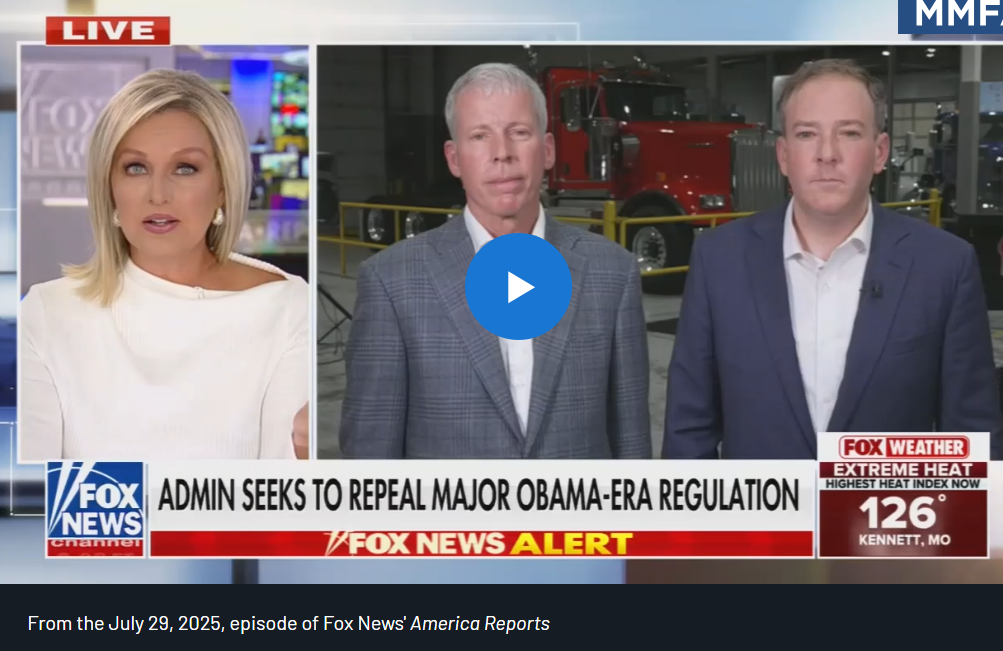
MMA 7 25
Fox News’ America Reports hosted Environmental Protection Agency Administrator Lee Zeldin and Energy Secretary Chris Wright to discuss the Trump administration's proposal to repeal the EPA’s 2009 endangerment finding, which affirmed that greenhouse gases endanger public health and welfare and which has served as the legal foundation for regulating emissions under the Clean Air Act.
Zeldin and Wright used the appearance to frame the repeal as a return to scientific integrity and regulatory restraint, ignoring the harms that this repeal would have on vulnerable communities. Fox anchor Sandra Smith did not challenge the claims and made no mention of the public health implications or regulatory consequences of revoking the finding. The exchange typified Fox’s pattern of amplifying Trump administration narratives about climate and energy while downplaying their real-world impacts.
Video
Citation
From the July 29, 2025, episode of Fox News' America Reports
The segment typified Fox’s role in obscuring the consequences of climate deregulation
During their appearance, Zeldin and Wright were not pressed on the public health, environmental, or legal implications of the proposal to reverse the endangerment finding. Instead, the host framed the discussion around economic themes and legal processes, asking whether repeal would make it easier to “undo a lot more of the Biden-Obama era climate rules.” Viewers heard nothing about the policy’s real-world impacts, but they did hear climate advocates characterized as ideological or extreme. Zeldin referred to them as “climate zealots,” while Wright framed the repeal as a return to “rationalism” — signaling to Fox’s audience that those who defend public protections are unserious.
This approach mirrors Fox’s longstanding pattern of covering regulatory actions through the lens of efficiency, growth, and personal freedom, while sidelining the communities most affected by the Trump administration's harmful actions. The result is a consistent minimization of climate risk and a distorted narrative in which climate and environmental outcomes are treated primarily as a political liability rather than a public necessity.
By allowing unchallenged repetition of misleading claims, and by omitting the central consequences of the policy under discussion, Fox News once again advanced a message strategy that serves to normalize and obscure the dismantling of basic climate and environmental protections.
Zeldin and Wright advanced a series of unsupported or misleading claims
During their appearance on the July 29 episode of Fox News' America Reports, Zeldin and Wright made a series of unsupported or misleading claims about the endangerment finding and what its repeal would mean for Americans.
Zeldin, for example, asserted that repealing the endangerment finding would yield “$1 trillion in savings”—a figure with no grounding in published EPA analyses or historical regulatory assessments. In contrast, EPA data has consistently shown that rules issued under the endangerment finding and the broader Clean Air Act generate substantial net benefits.
The agency’s Second Prospective Study of the Clean Air Act found that “the central benefits estimate exceeds costs by a factor of more than 30 to one," with most benefits stemming from reduced mortality linked to particulate pollution. By 2020, Clean Air Act programs were projected to prevent over 230,000 premature deaths, as well as millions of asthma attacks, heart attacks, and lost workdays annually.
More recently, the EPA’s Regulatory Impact Analysis for vehicle greenhouse gas standards projected net societal benefits of $272.7 billion between 2022 and 2050, with annualized gains of more than $14 billion, driven by fuel savings, reduced emissions, and avoidance of climate damages. These figures underscore that, far from being a financial burden, regulations grounded in the endangerment finding generate substantial and enduring public and economic value.
Similarly, Wright’s claim that the repeal reflects a return to scientific rigor collapses under scrutiny, relying on a report authored by a small group of contrarian scientists, including Steven Koonin and John Christy, who reject the well-established conclusion that greenhouse gas emissions from human activity are driving global warming and endangering public health. Their views stand in opposition to the broader scientific community, which includes the consensus positions of federal agencies such as the National Aeronautics and Space Administration and the National Oceanic and Atmospheric Administration, as well as the Fifth National Climate Assessment, which was produced by the U.S. Global Change Research Program.
Beyond economic distortions and scientific misrepresentation, Zeldin and Wright also ignored the far-reaching legal consequences of repeal — including for the fossil fuel industry itself.
As Grist reported, rescinding the endangerment finding would not only eliminate the federal government’s core authority to regulate greenhouse gases, it could also expose fossil fuel companies to a wave of climate liability lawsuits previously blocked by federal preemption. Some industry groups have reportedly urged the administration not to proceed, warning that repeal could unravel their legal defenses and leave them vulnerable to a patchwork of state regulations and courtroom challenges.
Fox viewers heard nothing about how repeal would harm the very communities most at risk
Zeldin and Wright also failed to mention what rescinding the endangerment finding would mean for public health, environmental protection, or the EPA’s ability to respond to pollution that threatens the air we breathe, the water we rely on, and the land we depend on to live and work. Viewers were not told that the standards targeted for repeal are central to reducing industrial emissions that worsen heat, flooding, and wildfire risk — or that dismantling these protections would increase illness, displacement, and hardship for older adults, children, low-income households, and rural communities, including many in Fox’s own audience.
---
---
gmail to newsbusters
IT'S SUMMER, NITWITS! NPR Blames ‘Climate Change’ for Texas Floods and ‘Rainstorms’
July 18th, 2025
the cuts to National Public Radio’s taxpayer funding have definitely been a long time coming. The leftist outlet is blaming climate change (there’s a surprise) for — wait for it — a lot of rain, in summertime!
[pix]
“Climate change is fueling brutal rainstorms. Here's how to stay safe,” read the ridiculous headline for NPR’s July 15 Consider This podcast by All Things Consideredco-host Juana Summers (ironic) and Climate Desk correspondent Michael Copley, both of whom are not scientists.
Of course, Summers exploited the Texas flood disasters as a springboard to blame rainfall and recent flooding writ large in the U.S. as being a byproduct of the left’s eternal boogeyman: climate change. “So why is climate change expected to make extreme rainstorms like the ones we've seen this month more common,” Summers teased. “To dig into that question and what people can do to prepare, I spoke with Michael Copley from NPR's climate desk.”
Copley then went for the typical climate activist drivel: blame the darn humans! “So people keep releasing a ton of greenhouse gas emissions, mainly from burning fossil fuels like coal and oil, and that's raising global temperatures and fueling more intense rainstorms that drop more water in shorter periods of time,” he spewed. What’s telling is that he said the quiet part out loud when he prefaced his statement by admitting,“So in general, a warmer atmosphere holds more moisture.” No kidding, Sherlock! But he insisted that “we're going to see more extreme weather events as the Earth keeps heating up, and that's going to pose bigger threats to people and their homes and cities.”
Climate Depot Founder Marc Morano blasted NPR's eco-fanaticism in comments to MRC Business. "Listening to or reading climate 'news' from NPR was a throwback experience to the days when the U.S. actually funded such tripe. Oh, wait! We still do," Morano rebuked. "But as of July 17, it looks like the days of U.S. taxpayers footing the bill for utter climate garbage are severely numbered."
Morano then tore apart NPR's arguments to shreds:
NPR rehashes all the same old scare tactics about extreme weather and, in particular, how 'climate change is fueling brutal rainstorms.' There is just one glaring problem with NPR's reporting. Even the United Nations' climate reports don't agree with the soon-to-be defunded network. On climate timescales, flooding and flash floods are not increasing globally, nationally, or locally in Texas, contrary to NPR claims.
Further, noted Morano, "the United Nations, the US federal National Climate Assessment, and peer-reviewed studies all show that extreme weather, ranging from hurricanes, tornadoes, wildfires, and droughts, is not increasing on climate timescales of 30, 50, or 100 years."
As CO2 Coalition Science and Research Associate Vijay Jayaraj wrote in an April 21 op-ed using monsoon-afflicted India as a case study for summer climate, “The average annual rainfall between 2000 and 2023 shows us that there is no crisis. The early 2000s experienced several significantly wet years, with 2003 recording nearly 49 inches of precipitation.” In addition, wrote Jayaraj, “From the mid-2000s to the early 2010s, there was a notable decline in rainfall, with 2009 being especially arid.”
What the data indicates is that there is “no discernible trend of increasing or decreasing precipitation throughout the period.” The overarching principle, Jayaraj concluded, was that “climate fluctuates” in summer. Did Summers or Copley consider that possibility? Probably not.
So what’s Copley’s solution to the climate problem? Ah yes, just throw an ungodly bunch of tax money at it: “[Columbia Business School climate economist Gernot] Wagner says communities need to invest billions and billions to deal with more extreme weather.”
*Listen to NPR's entire 10-minute climate propaganda below.
---
---}:
OMFG EJ AIR POLLUTE
MMA
In his first 100 days as EPA administrator, Lee Zeldin has used his frequent Fox appearances to shape the climate discourse
Special ProgramsClimate & Energy
Written by Allison Fisher
Research contributions from Harrison Ray
Published 05/16/25
Environmental Protection Agency Administrator Lee Zeldin has used his many appearances on Fox News and Fox Business to become one of the most visible members of the Trump administration so far. A Media Matters analysis found that Zeldin made at least 36 appearances on cable news during his first 100 days as EPA administrator, with 35 of those occurring on Fox networks — the most of any Trump Cabinet official.
Appearing on networks that are friendly to Trump’s agenda has allowed Zeldin to push climate-related misinformation and shape the discourse around environmental issues as he emerges “as one of the most devoted public champions” of Trump’s quest to “demolish the Biden agenda.”
Staples of Zeldin’s Fox appearances have included promoting rollbacks of environmental safeguards, hyping cuts and the elimination of programs at the EPA, and pushing the campaign to claw back congressionally allocated climate funds. He has also appeared on Fox to defend Trump’s orders to boost coal and muddy the waters on the root causes of the Tijuana River sewage issue.
- ## Zeldin appeared twice as much as Trump’s first EPA administrator, Scott Pruitt, in half the time.
- Lee Zeldin is far outpacing his recent Trump administration predecessors in cable news appearances.
During the first six months of his tenure, Trump’s first-term EPA administrator, Scott Pruitt, appeared 15 times across cable news — Fox News (12 appearances), CNN (2) and MSNBC (1).
Andrew Wheeler, who served as Pruitt’s deputy and assumed the top spot after Pruitt resigned amid scandal, appeared only 3 times on cable while serving in the position, all on Fox.
- ## Zeldin is using Fox to push misinformation about climate funding
- Fox News has aired more than 50 segments amplifying Zeldin’s false claims that $20 billion in federal climate grants allocated by Congress through the Inflation Reduction Act were mired in waste, fraud, and abuse. In fact, the network's coverage has been largely informed by Zeldin while Fox has omitted important details of the story reported by other news outlets that challenge his claims.
The administration tried to freeze the IRA funds, using the claims of waste and fraud, but a federal judge chastized the agency for failing to provide “credible evidence” for the claims. Even after the EPA was rebuffed in court, Zeldin’s public campaign to demonize the climate grants — many of which were intended to reduce climate and air pollution and mobilize public and private capital in underserved communities — and their recipients has continued undeterred on Fox networks.
- ## Here’s how Zeldin is using Fox appearances to shape the discourse around a number of environmental issues.
- ##### Environmental protections
On March 12, Zeldin announced sweeping measures to undo environmental protections and radically reshape the agency’s mission in what he has proudly called the “largest deregulatory announcement in U.S. history.”
As part of these actions, Zeldin has redefined the mission of the EPA. Rather than focusing on the agency’s twin tenets of environmental protection and public health, Zeldin has promised to fulfill “President Trump’s promise to unleash American energy, lower cost of living for Americans, revitalize the American auto industry, restore the rule of law, and give power back to states to make their own decisions.” And he has used Fox networks to promote and justify this shift.
Zeldin has claimed on Fox programs that current environmental protections need to be rolled back because they are "suffocating the economy” and that they have nothing to do with environmental protection but rather are part of former President Joe Biden’s “green new scam.” Zeldin’s arguments neatly position environmental safeguards into a pre-existing Fox News narrative that demonizes all climate action.
On the March 16 edition of Fox & Friends Weekend, host Charlie Hurt reflected this characterization of regulations back to Zeldin, saying: “Green New Deal things have nothing to do with actually cleaning the environment or clean air or clean water. It more has to do with spending money on pet projects that benefit basically, like, political supporters of the Democrat party.”
Such claims discount the role of environmental protections in public health and corporate polluter accountability. For example, Zeldin wants to loosen wastewater regulations for coal and other steam-powered power plants and relax limits to the amount of mercury and other toxic metals power plants can emit. Zeldin claims these regulations “improperly targeted coal-fired power plants,” even though coal plants emit “the vast majority of mercury and other toxic air pollution.”
The EPA also wants to make it easier for manufacturers to release more particulate matter, or soot, even though “exposure to these tiny particles has been linked to asthma attacks, heart attacks, strokes and other ailments.” In fact, one analysis, based on a 2024 report from the Environmental Protection Network that assessed the public health benefits of various EPA regulations, found that the targeted rules “were set to save the lives of nearly 200,000 people in the years ahead.”
Environmental justice
Zeldin is redefining environmental justice efforts as “forced discrimination programs” in order to nix it as part of Trump’s executive order on “ending radical and wasteful government DEI programs and preferences.”
To that end, he has closed the Office of Environmental Justice and External Civil Rights and signaled that he is “eliminating all diversity, equity and inclusion and environmental justice offices and positions immediately,” leaving under-resourced grassroots environmental justice groups to take over these efforts. Hundreds of environmental justice grants are being canceled as well.
On Fox, Zeldin has repeatedly suggested that the EPA previously used terms like “environmental justice” to “justify spending money not on actually directly remediating challenges to land, air, and water in America, but to funding left-wing activist groups.”
Zeldin used similar language in Fox coverage when he announced the closure of the EPA museum, calling it “another tribute to environmental justice” and saying: “What's amazing is over the course over this last administration, all this talk about environmental justice and climate change, it was really to justify giving out tens of billions of dollars to their friends through self-dealing conflicts of interests, unqualified recipients.” Zeldin’s closure of the EPA museum was covered by at least 5 other Fox News programs.
Tijuana River sewage issue
The Tijuana River sewage issue is one of the first specific environmental issues Zeldin discussed on Fox News. Every year, billions of gallons of sewage and toxic industrial waste flow down the Tijuana River, across the U.S.-Mexico border, and into the Pacific Ocean. It is a complex, decades-old, transjurisdictional issue that environmentalists and governments at the local, state, and federal level have been grappling with for years.
Zeldin has predominately characterized this issue as Mexico’s failure to stop pollution from crossing the border, while largely ignoring Mexico’s efforts to improve the problem and other progress made by the Biden administration.
For example, in March 2024, federal funding was secured to make the repairs and updates needed at California’s South Bay International Wastewater Treatment Plant. And in December, Biden approved $250 million in additional funding “towards the full repair and expansion of the South Bay International Wastewater Treatment Plant,” which is expected to be functional in the next five years.
In January 2024, Mexico began rehabilitating a shuttered wastewater treatment plant, the San Antonio de los Buenos plant, and on April 28 of this year, the plant started treating waste again. Taken together, the improvements to the U.S. waste treatment plant and the wastewater infrastructure in Mexico are “intended to eliminate up to 90% of untreated wastewater reaching the coast.”
Fox News has aired at least a dozen segments on the issue, many of which have been shaped by Zeldin’s framing.
- ## Here’s how Fox personalities are responding to Zeldin’s deregulatory efforts.
- Zeldin's Fox-heavy communications strategy has allowed him to dodge tough questioning and push misleading talking points with limited rebuttal. Fox hosts have rarely probed the consequences of cutting climate and environmental programs and rolling back safeguards, instead echoing his argument that previous government climate initiatives “didn’t really have anything to do with protecting the environment.”
Here are three examples of Fox News and Fox Business hosts teeing up Zeldin to talk about deregulation of environmental protections, efforts to boost coal, and “media attacks” on his actions.
On Sunday Night in America, host Trey Gowdy set up Zeldin to push the narrative that the protections he’s rolling back were part of a political agenda rather than pertinent to public health and safety:
- > TREY GOWDY (HOST): We all want clean water and air, period. But regulation has gotten out of control, and it’s used to advance political agendas. Lee Zeldin aims to change that. He recently terminated a $2 billion grant that started doling out money after Harris lost. He joins us now. Welcome to you, Mr. Administrator. Have you already identified areas of regulation which do nothing to advance safety or health, but simply advance a political agenda?
- On the April 1 edition of Larry Kudlow’s Fox Business program, Kudlow hosted Zeldin to discuss the EPA’s efforts to “grow the economy” and slash “red tape.” Kudlow congratulated the administrator on his recent deregulatory actions: “Thirty-one rule changes in one day at EPA. That's probably a world record, Lee Zeldin.”
Kudlow went on to reflect Zeldin’s characterization of environmental protection as radical: “A lot of the Biden stuff didn't really have anything to do with protecting the environment. It had to do with their radical Green New Deal climate change stuff. I mean, protecting the environment is very important. ... But this stuff has nothing to do with that.”
On April 10, Fox Business anchor Maria Bartiromo asked for Zeldin’s reaction to Trump’s so-called “clean coal” plan. She also applauded the agency for stripping grants from environmental justice projects and gave him a platform to respond to recent reporting from Politico on his shift from “‘pro-climate Republican to ‘one of the Trump disruptors”:
- > MARIA BARTIROMO (ANCHOR): You’ve said that the EPA is already reinvigorating America’s clean coal industry?
LEE ZELDIN (EPA ADMINISTRATOR): … At EPA just over four weeks ago, we announced what amounted to the largest deregulatory action in the history of the country. Just one agency was able to do that. Why? Because at the end of the Biden administration in 2023 and 2024, there were all sorts of regulations coming out. And as it related to the coal industry, the Biden EPA was trying to strangulate the coal industry out of existence.
…
BARTIROMO: I mean, look, you've been doing so well. I love the fact that you're taking costs out while also opening up the spigot of opportunities in energy. Your interview with Laura Ingraham recently was fantastic as you walked us through the building. Now the EPA is refusing to give Oregon an $85 million Biden-era grant meant to fund environmental justice projects in the state. You have uncovered lots of things that aren't exactly what they seem, Lee. These actions ramp up media attacks on you. Politico wrote this: “From pro-climate Republican to one of the Trump disruptors, EPA administrator Lee Zeldin's attacks on his agency’s spending and regulations have made him a rising star in the Trump cabinet but left some former colleagues mystified.”
Methodology...}:
---
---
gmail 7 25
UN calls to criminalize fossil fuel 'disinformation' - Rebel News
the UN's special rapporteur on human rights and climate change argued this week that wealthy nations are legally obligated to phase out oil, gas and coal by 2030 while compensating communities harmed by resource development — and called for the criminalization of those spreading so-called misinformation about climate change.
“These countries are responsible for not having prevented the widespread human rights harm arising from climate change and other planetary crises we are facing – biodiversity loss, plastic pollution and economic inequalities – caused by fossil fuels extraction, use and waste,” argued Elisa Morgera, who, in addition to her role with the UN, serves as a professor of global environmental law at the University of Strathclyde in the U.K.
A report from The Guardian focusing on Morgera's findings outlined the UN rapporteur's goal:
*States must ban fossil fuel ads and lobbying, criminalize greenwashing (misinformation and misrepresentation) by the fossil fuel industry, media and advertising firms, and enforce harsh penalties for attacks on climate advocates who are facing a rise in malicious lawsuits, online harassment and physical violence.
On Wednesday's episode of The Ezra Levant Show, Ezra was joined by Climate Depot founder Marc Morano, who provided a less hyperbolic perspective on the situation.
“They first want to intimidate you into silence,” Marc said, noting how the term “climate denier” is used in the same manner as calling someone a “Holocaust denier.”
When this tactic fails, radical environmentalists then try to seize control of information by working with Big Tech firms like Google “to manipulate information flow.”
Demands to criminalize so-called climate misinformation are an attack on free speech the Climate Depot founder said, with environmentalists pushing to silence critics “because people might vote the wrong way.”
Ezra compared these censorship efforts to the attempts to stifle “alternative views” during the COVID-19 pandemic.
“It's very political what's going on here,” noted Ezra. “They're basically saying, 'we want to win the argument, but we want to stop the other side from even being allowed to argue'. That's really their confession.”
Marc was in agreement, suggesting the debates around COVID and climate follow “the same exact template.” Following President Trump's first electoral victory in 2015, “that's when all of the controls came down,” Marc explained.
“Not only the mainstream media, but all the social media. That's when we had the deep state and national security and intel agencies embedded in things like Twitter,” he said.
“Why are they saying all of this? Because the COP30 UN summit is coming up and is perhaps the most unanticipated dreaded UN summit by climate activists in the history of climate summits because, as of right now, not even two dozen countries out of 200 have even made pledges let alone kept pledges in line with the UN Paris Climate Agreement net-zero goals.”
ref guk
un-expert-urges-criminalizing-fossil-fuel-disinformation-banning-lobbying
a leading UN expert is calling for criminal penalties against those peddling disinformation about the climate crisisand a total ban on fossil fuel industry lobbying and advertising, as part of a radical shake-up to safeguard human rights and curtail planetary catastrophe.
Elisa Morgera, the UN special rapporteur on human rights and climate change who presents her damning new report to the general assembly in Geneva on Monday, argues that the US, UK, Canada, Australia and other wealthy fossil fuel nations are legally obliged under international law to fully phase out oil, gas and coal by 2030 – and compensate communities for harms caused.
Fracking, oil sands and gas flaring should be banned, as should fossil fuelexploration, subsidies, investments and false tech solutions that will lock in future generations to polluting and increasingly costly oil, gas and coal.
“Despite overwhelming evidence of the interlinked, intergenerational, severe and widespread human rights impacts of the fossil fuel life cycle … these countries have and are still accruing enormous profits from fossil fuels, and are still not taking decisive action,” said Morgera, professor of global environmental law at the University of Strathclyde.
“These countries are responsible for not having prevented the widespread human rights harm arising from climate change and other planetary crises we are facing – biodiversity loss, plastic pollution and economic inequalities – caused by fossil fuels extraction, use and waste.”
Island nations, Indigenous and other vulnerable communities – who have benefited least from fossil fuels – now face the worst and compounding harms caused by the climate crisis and other environmental harms linked to their extraction, transport and use for energy, fuel, plastics and synthetic fertilizers.
The report points to a mountain of evidence on the severe, far-reaching and cumulative damage caused by the fossil fuel industry – oil, gas, coal, fertilizers and plastics – on almost every human right including the rights to life, self-determination, health, food, water, housing, education, information and livelihoods.
Morgera makes the case for the “defossilization” of our entire economies – in other words the eradication of fossil fuels from all sectors including politics, finance, food, media, tech and knowledge. The transition to clean energy is not enough to tackle the widespread and mounting harms caused by the fossil fuels, she argues.
In order to comply with existing international human rights law, states are obliged to inform their citizens about the widespread harms caused by fossil fuels and that phasing out oil, gas and coal is the most effective way to fight the climate crisis.
People also have the right to know how the industry – and its allies – has for 60 years systematically obstructed access to this knowledge and meaningful climate action by peddling disinformation and misinformation, attacks on climate scientists and activists, and by capturing democratic decision-making spaces including the annual UN climate negotiations.
“The fossil fuel playbook has undermined the protection of all human rights that are negatively impacted by climate change for over six decades,” said Morgera in the imperative of defossilizing our economies report.
States must ban fossil fuel ads and lobbying, criminalize greenwashing (misinformation and misrepresentation) by the fossil fuel industry, media and advertising firms, and enforce harsh penalties for attacks on climate advocates who are facing a rise in malicious lawsuits, online harassment and physical violence.
Communities across the world are facing growing threats from sea level rise, desertification, drought, melting glaciers, extreme heat, floods, and other climate-related impacts. This is on top of the deadly air pollution, water scarcity, biodiversity loss, and forced displacement of Indigenous and rural peoples associated with every stage of the fossil fuel lifecycle.
Meanwhile, fossil fuel and petrochemical companies have benefited from huge profits, taxpayer subsidies, tax avoidance schemes and undue protection under international investment law – without ever reducing energy poverty and economic inequalities. In 2023, oil and gas companies globally earned $2.4tn, while coal companies pocketed $2.5tn, according to the report.
Removing fossil fuel subsidies, estimated to have topped $1.4tn for OECD members and 48 other countries in 2023, would alone reduce emissions by up to 10% by 2030.
Redirecting these subsidies would help wealthy fossil fuel-producing states fulfill their legal obligations to aid developing countries to phase out fossil fuels – and provide financial and other remedies for the widespread human rights violations and environmental damage they have caused – and continue to cause.
The compensation could also be funded by enforcing penalties for damages caused by fossil fuel companies, and cracking down on tax evasion and avoidance by the industry, as well as introducing wealth and windfall taxes. States could – and should – require the industry to finance climate adaptation, mitigation and loss and damage through climate superfunds or other mechanisms that are directly accessible to affected communities.
[
World’s climate fight needs fundamental reform, UN expert says: ‘Some states are not acting in good faith’
Read more](https://www.theguardian.com/environment/ng-interactive/2025/jan/07/climate-change-reform-elisa-morgera)
Land unjustly appropriated for fossil fuel operations should be cleaned up, remediated and returned to Indigenous communities, people of African descent and peasants, if they want it back, or they should be fairly compensated, Morgera argues.
The report lays out the human rights case for decisive and transformative political action to limit the pain and suffering from the climate crisis. The recommendations offer a glimpse at a world in which the basic rights of all people are prioritized above the profits and benefits enjoyed by a few, but will probably be dismissed by some as radical and untenable.
“Paradoxically what may seem radical or unrealistic – a transition to a renewable energy-based economy – is now cheaper and safer for our economics and a healthier option for our societies,” Morgera told the Guardian.
“The transition can also lead to significant savings of taxpayers’ money that is currently going into responding to climate change impacts, saving health costs, and also recouping lost tax revenue from fossil fuel companies. This could be the single most impactful health contribution we could ever make. The transition seems radical and unrealistic because fossil fuel companies have been so good at making it seem so.”
---
---
an 525
Defenders of climate and the rule of law blasted the Trump administration on Friday for using what one consumer campaigner called a "phony" emergency to wage lawfare agaist states trying to hold Big Oil financially accountable for the planetary crisis.
On Thursday, the U.S. Department of Justice (DOJ) filed complaints against New York and Vermont over their climate superfund laws, which empower states to seek financial compensation from fossil fuel companies to help cover the costs of climate mitigation. The burning of fossil fuels is the main driver of human-caused global heating.
Separately, the DOJ also sued Hawaii and Michigan "to prevent each state from suing fossil fuel companies in state court to seek damages for alleged climate change harms."
"The use of the United States Department of Justice to fight on behalf of the fossil fuel industry is deeply disturbing."
Hours later, Hawaii became the 10th state to sue Big Oil for lying about the climate damage caused by fossil fuels. The Aloha State's lawsuit targets ExxonMobil, Chevron, Shell, BP, and other corporations for their "decadeslong campaign of deception to discredit the scientific consensus on climate change" and sow public doubt about the existence and main cause of the crisis.
"The federal lawsuit filed by the Justice Department attempts to block Hawaii from holding the fossil fuel industry responsible for deceptive conduct that caused climate change damage," Hawaii Attorney General Anne E. Lopez said. "The use of the United States Department of Justice to fight on behalf of the fossil fuel industry is deeply disturbing and is a direct attack on Hawaii's rights as a sovereign state."
The DOJ on Thursday cited President Donald Trump's April 8 executive order, " Protecting American Energy From State Overreach," which affirms the president's commitment "to unleashing American energy, especially through the removal of all illegitimate impediments to the identification, development, siting, production, investment in, or use of domestic energy resources—particularly oil, natural gas, coal, hydropower, geothermal, biofuel, critical mineral, and nuclear energy resources."
Trump also signed a day-one edict declaring a "national energy emergency" in service of his campaign pledge to "drill, baby, drill" for climate-heating fossil fuels. The "emergency" has been invoked to fast-track fossil fuel permits, including for extraction projects on public lands.
Acting Assistant Attorney General Adam Gustafson of the DOJ's Environment and Natural Resources Division said in a statement Thursday, "When states seek to regulate energy beyond their constitutional or statutory authority, they harm the country's ability to produce energy and they aid our adversaries."
"The department's filings seek to protect Americans from unlawful state overreach that would threaten energy independence critical to the well-being and security of all Americans," Gustafson added.
Robert Weissman, co-president of the consumer advocacy watchdog Public Citizen, on Friday accused the Trump administration of "using a phony energy emergency declaration to illegally attack state climate and clean energy laws."
"There is no energy emergency, and Trump's stated reasoning for it is as much a scam as every other pathetic con and hustle this president attempts," Weissman continued. "Fake constitutional claims based on a fake emergency cannot and will not displace sensible and long overdue state efforts to hold dirty energy corporations accountable."
"These corporations have imposed massive costs on society through their deceptive denial of the realities of climate change, and through rushing us toward climate catastrophe," he added. "It's good policy, common sense, and completely within state authority, for states to hold these corporations accountable."
---
---
afp
Los Angeles fires spark 'smart city' conspiracy theories
:{:{Published on January 21, 2025}:
{By Daniel Patrick GALGANO, AFP USA}:
As a string of wildfires hit Los Angeles County, social media users spread claims that authorities purposefully set the blazes to encourage the development of so-called "smart cities." While America's second-largest city does have long-term plans to implement digital technologies to improve services, experts say the claims have no merit and that razing neighborhoods would not accomplish these goals.
"And then I find this document and it all begins to connect the dots. You have a fire, things burn down, you rebuild it and you make it a smart city," says a January 9, 2025 X post with thousands of interactions.
"And you have the government, the insurance agents and the electric companies all into it together."
Image

Screenshot from X taken January 16, 2025
The same claim has circulated elsewhere on X, Facebook, Instagram, Threads, TikTok, Bluesky, Rumble and Gettr.
The posts are the latest describing conspiracy theories linking natural disasters to smart city plans that frequently crop up in the United States and Canada.
Several wildfires near Los Angeles have claimed more than two dozen lives and billions of dollars in property damage. The largest of the two, which have enveloped neighborhoods in the Palisades and the nearby city of Pasadena, were spurred on by destructive high winds as firefighters attempted to limit their spread.
The posts claim officials and investors set the fires to make room for a "smart city," an urban planning concept that uses a wide range of technology to monitor traffic patterns, electricity and utility consumption and criminal activity to improve public services and cut greenhouse gas emissions.
Other users conflate smart cities with "15-minute cities," a different philosophy that involves rezoning cities to place most day-to-day amenities, such as shops, parks, medical services and schools, within walking distance of residential areas.
SmartLA 2028
In December 2020, city officials announced an infrastructure investment plan called SmartLA 2028, which proposes using technology to monitor electricity usage, integrating city services onto a mobile app and installing sensors that can alert emergency services to potential crimes and housefires (archived here).
Los Angeles is due to host the Summer Olympics and Paralympics in 2028, spurring hopes that the city will be able to ease its notoriously dense traffic, reduce greenhouse gas emissions and improve emergency services.
The plan does not call for razing entire neighborhoods or rebuilding portions of the city from scratch. Instead it focuses on efforts including installing devices to monitor traffic patterns and gathering data on air quality, crime, road conditions and other things to help improve local services.
"Technology enables the City of Los Angeles to efficiently and ethically improve the quality of life for our residents, businesses, and visitors," Ted Ross, chief information officer for the City of Los Angeles, says in a explaining the strategy (archived here). vid]

The SmartLA 2028 plan also only applies to the City of Los Angeles and does not outline a scheme for the rest of the county, which includes other fire-affected cities such as Pasadena.
AFP reached out to Ross for further information, but a response was not forthcoming.
Disaster recovery is expensive
Susan Winter, the associate dean of research at the University of Maryland (archived here), said causing destruction is not a "rational way to approach urban planning."
The cost to the government to rebuild areas devastated by fires could quickly surpass the economic benefits of adding smart technology to those regions, she noted.
Winter added that city planners have worked to address some public concerns about smart technology infringing on residents' privacy by anonymizing gathered data and restricting where information is stored to reduce the risk of a breach.
"There's nothing in that city of Los Angeles plan that looks at all shady or nefarious to me," she said on January 13.
Several home and fire insurance companies have scaled down or entirely withdrawn their operations in California amid concerns over the frequency of climate change-fueled disasters in the region, reportedly leaving thousands of Los Angeles residents without private home insurance ahead of the fires. The State of California created an insurance carrier of last resort for homeowners unable to secure private insurance that offers more limited coverage options.
The carrier reportedly could face losses of as much as $24 billion due to the Los Angeles fires, while total property damage could surpass $250 billion.
Image
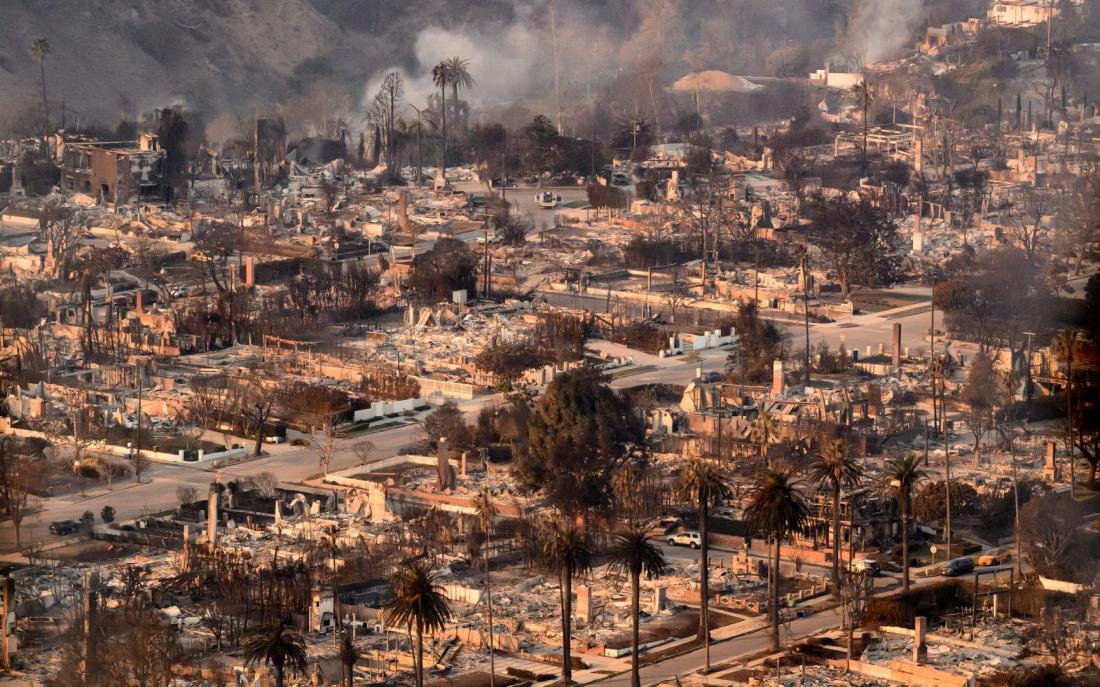
Homes smolder near the Pacific Palisades neighborhood of Los Angeles, California on January 9, 2025 (AFP / JOSH EDELSON)
Hussam Mahmoud, a professor of civil and environmental engineering at the Colorado State University (archived here), said US cities have been investing in systems designed to spot wildfires early to prevent them from spreading too widely.
"I highly doubt that anyone would say, 'let's wipe the area by doing this,'" he said on January 14.
Investigators are still attempting to uncover what caused the fires. Lawsuits have placed some blame for the Eaton fire on Southern California Edison for failing to de-energize its equipment. However, there is no evidence government agencies deliberately sparked the infernos.
AFP has debunked other claims about the Los Angeles fires.
//
cbs
Wildfire conspiracy theories are going viral again. Why?
By
Laura Doan,
Erielle Delzer
January 16, 2025 CBS News
While investigators workto find out what caused multiple wildfires in the Los Angeles area, some conspiracies about the fires' origins have spread on social media platforms.
Posts about baseless theories — ranging from celebrity involvement to secret government weapons — have racked up millions of views.
Despite fact-checking efforts, researchers say conspiracies of this kind regularly emerge after large wildfires.
"I think that the more emotionally overwhelming it is, the more likely we are to just see high volumes of conspiracy theories to cope and make people feel like they have control," said misinformation researcher Abbie Richards.
Directed energy weapons conspiracy resurfaces
Misleading videos have fueled false claims that directed energy weapons, often referred to as DEWs, ignited the flames. The conspiracy theory suggests that governments or secret organizations use lasers or microwave systems to ignite fires.
Experts have repeatedly debunked these claims, attributing irregular burn patterns to natural factors like wind, terrain and vegetation.
While the U.S. has developed and tested DEWs for military applications — such as disabling enemy drones or missiles — there is no credible evidence of DEWs being employed in civilian settings, including for igniting wildfires.
The DEW theory also surfaced during the California wildfires of 2018, with Rep. Marjorie Taylor Greene claiming in a now-deleted social media post the fires could be caused by lasersfrom space. And online users spread the conspiracy during other disasters including the Canadian and Maui fires in 2023 and the Texas Smokehouse Creek wildfire in 2024.
"Most people will see this sort of stuff and completely reject it because it doesn't match with how they already view the world. But there are people who view the world through a conspiratorial lens," said Joseph Uscinski, co-author of "American Conspiracy Theories."
Claims that weather is manmade
Claims have circulated that the government could have geoengineered rain to stop the Los Angeles wildfires.
Theories that the government has some control over the weather have surfaced after several natural disasters, including hurricanes Helene and Milton. And meteorologists and agencies including the National Oceanic and Atmospheric Administration have debunked these claims.
People blame the government or company executives because it's easier than facing structural problems, like drought conditions," Geoff Dancy, a political science professor at the University of Toronto, told CBS News.
"That is more attractive to people that are desperate for order amid catastrophe," Dancy said.
The U.S. Government Accountability Office said in a December assessment on cloud seeding at least nine states are using the technology, which is "primarily funded at the state level or below" and there is little federal intervention.
For cloud seeding to be effective, the atmosphere around greater Los Angeles would have required more moisture in the clouds for water vapor to be condensed, Katja Friedrich, a cloud physics expert and professor at Colorado University at Boulder, told PolitiFact.
"The L.A. area is currently so dry that there is not enough water that you could condense," Friedrich said.
Land grab conspiracy
Another unfounded claim shared on social media suggests the Southern California wildfires were started to clear land so officials could make way for what are called "smart cities," aligned with United Nations' goals.
The U.N.'s agenda to cut global emissions includes making cities more sustainable. And the Los Angeles Area's SmartLA 2028 initiative suggests renovating the city's transportation systems, among other technological changes, to make the city greener — but the plan does not involve mass demolition or rebuilding.
This conspiracy also gained traction after the wildfires in Maui, when a video of Hawaii's governor was clipped, taken out of context and shared to bolster the false claim the state was aiming to create a "smart city" on scorched land. And similar theories were debunked after wildfires in Canada and Spain's Canary Islands.
Celebrity crime cover-up conspiracy
Some posts that reached millions of people on TikTok falsely claim the wildfires were sparked to destroy evidence in the sex trafficking case against Sean "Diddy" Combs — falsely claiming his mansion was consumed in flames.
In reality, Combs' mansion remains intact and outside the evacuation zone as of Jan. 16.
His home was raided in March by federal agents who seized evidence on the property, and People reported the home was listed for sale in September.
In an aerial view, the home of Sean "Diddy" Combs is seen during a raid by federal law enforcement agents on March 25, 2024 in Los Angeles, California. MEGA/GC Images/Getty Images
False claims about celebrity homes also spread after the Maui wildfire, with some users sharing baseless claims that Oprah Winfrey helped start those fires.
Addressing the spread of conspiracies
By coincidence, on the day the wildfires started, Facebook announced it was ending its third party fact checking program and loosening its automated systems that police policy violations, instead relying more on users to report issues before they take action. The platform is adopting a crowdsourced "community notes" system, similar to Elon Musk's X.
Dancy said conspiracy theorists are "benefitting from the information revolution" we live in. "It's an attention economy, and conspiracy theories get attention," Dancy said.
He advocates for regulating social media algorithms that prioritize sensational content.
Richards, who wrote a thesis about climate conspiracy theories circulating on TikTok, agreed.
The Storm Is Coming: Climate Change and Conspiracy Theories on TikTok Written by Abbie Richards 1048585 MSc. Thesis Environmental Policy Group Supervisor: Dr. Mattijs Smits December 2022
"You're fighting against algorithms that are designed for profit and not for creating a well-informed and healthy society," she said.
Western Wildfires}:
---
Addressing the spread of conspiracies
By coincidence, on the day the wildfires started, Facebook announced it was ending its third party fact checking program and loosening its automated systems that police policy violations, instead relying more on users to report issues before they take action. The platform is adopting a crowdsourced "community notes" system, similar to Elon Musk's X.
Dancy said conspiracy theorists are "benefitting from the information revolution" we live in. "It's an attention economy, and conspiracy theories get attention," Dancy said.
He advocates for regulating social media algorithms that prioritize sensational content.
Richards, who wrote a thesis about climate conspiracy theories circulating on TikTok, agreed.
The Storm Is Coming: Climate Change and Conspiracy Theories on TikTok Written by Abbie Richards 1048585 MSc. Thesis Environmental Policy Group Supervisor: Dr. Mattijs Smits December 2022
DL file:///C:/Users/patmc/OneDrive/Documents/BOOK/storm_is_coming_climate_change_and_conspiracy_the-groen_kennisnet_590388.pdf
"You're fighting against algorithms that are designed for profit and not for creating a well-informed and healthy society," she said.
We demand rigidly defined areas of doubt and uncertainty! -Douglas Adams, The Hitchhiker’s Guide to the Galaxy
Climate Action Against Disinformation coalition and to Friends of the Earth for their support. Many thanks to the kind researchers at the Algorithmic Transparency Institute who allowed me to use their tool Junkipedia. Special thanks to Dr. Rhianna Rogers for her mentorship. To EcoTok, thank you for teaching me about the power of community.
Abstract
:{ :{Conspiracy theories are sense-making tools that frequently arise during periods of high anxiety and uncertainty. It is a reasonable assumption that they may proliferate in response to the increasing devastation caused by anthropogenic climate change. While previous research into climate change conspiracy theories has explored the relationship between conspiracy theories and climate change denialism, little is known about their broader relationship with climate change as an experience of the material and social worlds.}:
To examine this interaction, this thesis provides a qualitative analysis of 96 socio-ecological conspiracy theories on the social media platform TikTok. Collected via a user-centric, exploratory research methodology, these videos were found to contain six dominant themes: anti-oil, weather manipulation, fear of a “green agenda,” supply control, science rejection, and apocalypse. Further analysis found that conspiracy narratives related to climate change in either cause, significance, effect, or response. These conspiracy theories were found to provide a means of interpreting climate change outside of a climate science framework.
This conspiratorial framework of interpretation seemingly allowed users to experience climate change without attributing it to anthropogenic causes such as the dependence on fossil fuels. Using theoretical elements from political ecology as well as system justification theory from social psychology, these major themes were largely found to dismiss the need for urgent systemic climate action. While the consequences of climate change were recognized, users frequently attributed them to scapegoated groups or higher powers rather than to systems in which they are complicit.}:
... By applying system justification theory to the conspiracy themes
identified, I examined the conspiracy narratives’ relationship to support for climate action. I
:{:{found that these narratives provided users with a framework for experiencing and processing climate change outside of a climate science framework.}:
Furthermore, most of these conspiracy}:
narratives implicitly rejected the need for climate action and frequently offered alternative
solutions to climate change such as scapegoating or spiritual solutionism.
Using a political ecology framework to interpret this phenomenon within a socio-ecological
context, I identified the implementation of conspiracy frameworks as means of interpreting
:{:{climate change outside of the scope of climate science.}:
These frameworks allow for the lived}:
experience of anthropogenic climate change to coexist while still justifying a societal
dependence on fossil fuels. In this sense, these frameworks serve as extensions of traditional
climate denialism.
As climate change continues to impact society to increasingly devastating degrees, causing
feelings of existential threat, conspiracy frameworks of interpretation may become a means of
sense-making. These frameworks may provide mEANING AND CERTAINTY IN THE FACE OF
74
existential threat while simultaneously relieving believers’ feelings of complicity and
responsibility. Furthermore, the tendency of the conspiracy narratives in the data set to blame
environmental problems on an out-group is extremely concerning, both for the implications for
support of climate action as well as for potential harm to vulnerable groups. Conspiratorial
scapegoating during moments of societal crisis has historically been a motivating factor for
violence committed by individuals as well as by state governments...
...
6.3.3 Spiritual Solutionism
One interesting theme which tied together seemingly unrelated conspiracy theories was
spiritual solutionism. Regardless of whether the narratives feature the Earth shifting into a new
universe, an Anunnaki alien princess warning of climate catastrophes (Figure 24), or language
about “awakenings” and “spiritual warfare,” their relationships to climate action are similar.
While these narratives may present climate change as real (though often not anthropogenic),
the solution they offer is one of internal contemplation and the spiritual unification of humanity.
While this sounds lovely, it alone does not address any causes of climate change. Presenting
spirituality as the solution to the climate crisis may address some of the anxiety of the climate
crisis, but it may also discourage participation in solutions.
Spiritual solutionism seemingly allows for believers to experience anthropogenic climate
change but attribute it to the actions of some higher power. This framework of interpretation
functions as a reinforcement to the fossil fuel status quo. If the effects of climate change are
attributed to an act of God, intergalactic energetic forces, or a shift into a higher dimension,
then they must also be interpreted as beyond humanity’s control. Not only do these conspiracy
57
theories appear to negate the role of fossil fuels in climate change, but they comprehensively
reject the possibility for mitigative action through legislation. No international environmental
policy, no matter how vast, could change the planet’s fate as determined by God (or aliens or
galactic rotations or lapses into parallel universes PIX OF UFO PRINCESS BABE
SAMPLE SEARCH TERMS:
14
Climate change conspiracy theory: “climate change hoax” or “global warming hoax” or
“climate change fake” or “global warming fake” or “climate conspiracy” or “Great Reset”
or “green scam” or “chemtrails” or “direct energy weapon” or “DEW” or “flat Earth” or
“hollow Earth” or “NASA lies” or “unknown planet” or “ninth planet” or “Nibiru” or
“firmament” or “local sun”
OR
Conspiracy rhetoric: “conspiracy” or “conspiracy theory” or “conspiracy tiktok” or
“conspiracytok” or “spiritualitytok” or “woketok” or “conspiracies coming true” or “open
your eyes” or “awake” or “awakened” or “awakening” or “great awakening” or “wake up”
or “spiritual awakening” or “end times” or “media lies” or “matrix” or “redpill” or
“blackpill” or “truth seeker” or “deep state” or “illuminati” or “new world order” or “NWO”
AND
Socio-ecological component: “Climate” or “climate change” or “global warming” or
“weather” or “snow” or “rain” or “storm” or “hail” or “drought” or “flood” or “heat” or “heat
wave” or “high temperature” or “gas” or “gasoline” or “red meat” or “animal agriculture” or
“food shortage” or “water shortage” or “blackouts” or “power outage” or “ESG” or
“Agenda21” or “Agenda 2030” or “United Nations” or “HAARP” or “green agenda” or
“LED lights” or “electric vehicle” or “green energy” or “renewable energy” or “power” or
“electricity” or “renewable” or “recycle” or “plant-based” or “vegan” or “geoengineering”
or “weather modification” or “weather manipulation” or “cloud seeding” or “block out the
sUN...
...
2.2 System-justifying function of conspiracy theories
To understand the political ecology of conspiracy theories, I employ system justification
theory. System justification theory posits that our assessments of social systems and institutions
are influenced by epistemic, existential, and social needs (Feygina, Jost, & Goldsmith, 2009).
People are drawn to conspiracy theories when they promise to satisfy these needs (Douglas,
Sutton, & Cichocka, 2017; Douglas et al., 2019). Though intuition, popular belief, proponents,
and some scholars suggest that conspiracy theories challenge power and subvert social systems
(Sapountzis & Condor, 2013), research suggests that conspiracy theories may reinforce the
status quo (Jolley, Douglas, & Sutton, 2017). Conspiracy theories identify a small group of
wrongdoers, a tangible group who are responsible for the ills of society. These wrongdoers are
not representations of social issues; rather, they are perceived as what is wrong with society.
In this sense, conspiracy theories deflect blame for societal problems to small evil groups often
with nearly supernatural power. By attributing problems to malevolent individuals, conspiracy
theories appear to divert people away from questioning the inherent limitations of their society
and toward accepting the status quo (Jolley, Douglas, & Sutton, 2017). This acceptance of the
status quo also aligns with Douglas and Sutton’s (2014) findings that exposure to conspiracy
theories weakens political engagement. After all, what is the point in voting if the outcome is
already decided by reptilian overlords?
The reality of anthropogenic climate change is not only a threat to our safety and well-being
but also to our identities. It challenges the belief systems of those who have benefited the most
from the fossil fuel status quo and see the existing political and economic structures as fair.
Daggett (2018) and Nelson (2019), argue that it is therefore no coincidence that white,
politically conservative men, at all socioeconomic levels, have consistently been found to
endorse climate change denial more than members of any other demographic in the United
:{:{States.}:
Accepting the reality of a changing climate also requires accepting that the political,}:
social, and economic beliefs and norms that govern our world are imperfect and require change.
For those whom this fossil-fueled society most serves, it may be easier to accept conspiracy
theories than to change their political and economic worldview. In this sense, conspiracy
theories, like all discourse, are a means of enacting power upon socio-ecological systems.
These rhetorical devices tug on the political-ecological web of connections, shaping everything
from consumer habits to global climate policy....
Western Wildfires}:
---
---
//
Reuters
https://www.reuters.com › fact-check › klaus-schwab-did-not-say-la-wildfires-were-manmade-2025-01-21}:
Fact Check: Klaus Schwab did not say LA wildfires were manmade
Jan 21, 2025 A "smart city, opens new tab" is an urban development model that uses technology to improve the lives of those living in cities. A "15-minute city" is an urban planning model that envisions an
---
---
MMA 4 25
April 22, 2025, edition of Fox News' Hannity
SEAN HANNITY (HOST): Make no mistake, at the end of the day, this has nothing to do with the Earth cooling, global warming, which has evolved into the generic climate change, so if it gets warm, they have a name for it. If it gets cold, they have a name for it. If it snows, they've got a name for it. If it doesn't snow, they have a name for it.
Look at this list. It's the Green New Deal. Look, everything on this list has nothing to do really with climate. Climate warming, climate cooling, climate changing is the left's mechanism for Marxism, statism as represented by that list, to each according to their need, from each according to their ability. The only thing Democrats really care actually is political power and you being dependent on them.
---
---}:
colbert called out z on reframe of epa mission BS
mma
How Fox manufactured legitimacy for Zeldin’s destructive climate and environmental rollbacks
Special ProgramsClimate & Energy
Written by Evlondo Cooper
Research contributions from Harrison Ray
Published 03/13/25
Environmental Protection Agency Administrator Lee Zeldin has used his extensive appearances on Fox News and Fox Business to justify freezing environmental programs and slashing climate-related funding. A Media Matters analysis found that Zeldin has made at least 22 appearances on cable news since his confirmation on January 29, with 21 of those on Fox networks.
This pattern of strategic media appearances has enabled the Trump administration to reframe essential climate initiatives as corrupt and wasteful while avoiding substantive media scrutiny of its climate and environmental rollbacks, shielding it from the consequences of these harmful policy shifts. Moreover, Zeldin has used these appearances to create a feedback loop in which harmful narratives aimed at climate funding are repeatedly echoed by Fox personalities until they become conventional wisdom across the network.
Fox provided Zeldin a shield from scrutiny, echoing past Trump EPA media strategies}:
- Zeldin's Fox-heavy strategy has allowed him to avoid tough questioning and push misleading talking points without rebuttal. Zeldin's Fox appearances have been largely friendly and laudatory, with hosts rarely probing the consequences of cutting climate and environmental programs or challenging his characterization of climate initiatives as wasteful.
- Zeldin made at least 21 appearances on Fox News and Fox Business since his confirmation on January 29, including 2 appearances each on Varney & Co., The Story with Martha MacCallum, Mornings with Maria, and Sunday Morning Futures. He has appeared on The Ingraham Angle at least 3 times. This approach directly echoes former Trump EPA Administrator Scott Pruitt, who in 2017 appeared on Fox News twice as often as he did on CNN, MSNBC, ABC, CBS, and NBC combined. Media Matters, [8/15/17]
- During his sole CNN appearance during the studied period, Zeldin faced direct questioning about specific EPA actions and workforce reductions — a stark contrast to his numerous Fox appearances, where such scrutiny was consistently absent. This emerging pattern resembles the approach of Pruitt, who overwhelmingly favored conservative media outlets during his tenure at the EPA. CNN, *CNN Newsroom*, [2/4/25; Mother Jones, 7/14/17; Media Matters, 8/15/17]
- On March 12, Zeldin announced the most aggressive environmental rollbacks in EPA history, including rescinding pollution regulations and eliminating environmental justice programs, framing these actions as essential to lowering energy costs despite the widespread environmental and public health risks. Under his leadership, the agency has also moved to repeal the endangerment finding which underpins federal climate regulations, proposed slashing EPA staff by 65%, and paused the implementation of key pollution rules limiting “forever chemicals” in Americans’ drinking water. Fox has largely failed to ask Zeldin about these major actions. The New York Times, [3/12/25; The New York Times, 2/20/25; Inside Climate News, 2/16/25; Reuters, 2/27/25; Union of Concerned Scientists, 1/21/25; The Associated Press, 2/27/25; Inside Climate News, 3/2/25; Bloomberg Law, 3/10/25]
- ## With Fox’s help, Zeldin framed EPA policy rollbacks as economic necessity
- Zeldin and Fox hosts repeatedly framed environmental deregulation as a purely economic decision, shifting the conversation away from environmental protection to discussions of government efficiency and business growth.
- During Zeldin’s appearance on the February 25 episode of Varney & Co., host Stuart Varney pivoted the conversation toward the administration’s efforts to “speed up the permitting process for companies investing in America” over a chyron reading “EPA prioritizes deregulation, promotes investments.” Fox Business, *Varney & Co.*, [2/25/25]
- During Zeldin's February 27 interview on The Evening Edit, host Elizabeth MacDonald characterized his EPA cuts as focusing exclusively on eliminating “this shocking amount” of wasteful government spending, saying: “You are working to cut EPA spending by about two-thirds because you're finding waste.” Fox Business, *The Evening Edit*, [2/27/25]
- ## Fox and Zeldin politicized climate funding to justify cuts
- Fox hosts and Zeldin reframed climate and environmental initiatives as corrupt political projects, feeding into Fox’s larger misinformation loop.
- During his February 18 interview on Mornings With Maria, Zeldin bragged about canceling environmental justice funding, claiming federal grants were directed toward “left-wing ideologues” instead of addressing legitimate environmental concerns for communities in need. “It’s absolutely incredible,” Bartiromo said, demanding, “What were the Biden officials doing other than being asleep at the wheel?” Fox Business, *Mornings with Maria*, [2/18/25]
- Speaking with host Maria Bartiromo during the February 23 episode of Sunday Morning Futures, Zeldin suggested that grant recipients were selected based on political connections rather than merit and stated, “It’s a clear-cut case of waste and abuse. The entire scheme is criminal, in my opinion.” Fox News, *Sunday Morning Futures*, [2/23/25]
Zeldin used his Fox appearances to create a feedback loop in which these talking points were introduced, echoed by hosts, and then repeated in later segments — laundering false claims and misleading narratives into conventional wisdom spread across Fox networks.
- ## Fox provided a platform for Zeldin to inject, recycle, and amplify misinformation about climate programs
- A key example is Zeldin's misleading claim that $2 billion in climate funds were improperly awarded to an organization linked to Democratic politician Stacey Abrams, implying she personally received EPA funds. (Abrams was senior counsel for Rewiring America, a member of the Power Forward Communities coalition; there is no evidence she personally received EPA grant funds.) This specific accusation targeting Abrams later evolved into broader claims characterizing all climate funding as corrupt political payoffs to Democratic allies and donors, demonstrating how targeted accusations expanded into wholesale attacks on climate and environmental programs.
- February 18: Zeldin planted the seed for his attack on Abrams on America Reports, claiming that Biden's EPA structured the grants around “drastically reducing accountability and oversight” and alleging that it included "$20 billion going out the door up front." He framed protests against federal spending cuts as proof that “a lot of left-wing organizations … are beneficiaries of the money.” Fox News, *America Reports*, [2/18/25]
- February 20: On The Ingraham Angle, host Laura Ingraham explicitly suggested that Abrams criticized cuts to federal agencies because she personally received government funds, stating, “She’s worried about them getting DOGE’d — maybe it's because she was profiting from the EPA,” over a chyron reading “Stacey Abram’s Slush Fund.” Zeldin reinforced the claim, emphasizing that Power Forward Communities received $2 billion in grants after Abrams' affiliated group had only received $100 the previous year. He framed the funding as corrupt and implied mismanagement, further fueling the broader narrative that climate funding was being funneled to Democratic allies. Fox News, *The Ingraham Angle*, [2/20/25]
- February 21: Fox News’ Special Report repeated this framing of the EPA’s climate funding, with correspondent Steve Harrigan reporting, “Lee Zeldin claims the money was basically a slush fund to reward left-wing political groups, including one where Georgia Democrat Stacey Abrams worked as senior counsel.” Fox News, *Special Report*, [2/21/25]
- February 23: Zeldin sharpened the claim on Sunday Morning Futures, suggesting that the organization receiving the funds had no track record of handling large budgets. “This group in 2023 only received $100,” he claimed. “This isn't even like it’s a longtime group that has some reputation of handling large budgets. They received $2 billion in 2024.” Fox News, *Sunday Morning Futures*, [2/23/25]
- February 26: Fox & Friends enabled Trump administration officials to amplify the claim, with White House press secretary Karoline Leavitt telling viewers: “You look at what Lee Zeldin has found at the EPA — $20 billion that the Democrats pushed out the door in the final weeks of Joe Biden’s presidency, $2 billion of that went to an NGO that was run by Stacey Abrams. So there is real fraud taking place in our federal government.” Fox News, *Fox & Friends*, [2/26/25]
- March 6: Zeldin reiterated the claim on Jesse Watters Primetime, broadening it further: “It's going to people who are in the Obama and Biden administrations, it’s going to donors.” He added, “It's not going directly to remediate that environmental issue, to deliver clear air, land, and water. It's billions — tens of billions of dollars — going through their friends.” Fox News, *Jesse Watters Primetime*, [3/6/25]
- March 12: On The Ingraham Angle, the host escalated the framing of climate funding as Democratic fraud, amplifying Zeldin’s earlier claim that “$20 billion of your tax dollars were parked in an outside financial institution in a deliberate effort to limit government oversight.” She also explicitly called for criminal prosecutions, asserting that Democrats used the EPA to funnel money to political allies. Zeldin reinforced this narrative, tying his regulatory cuts — including the repeal of the Clean Power Plan 2.0 — to ending government waste, claiming that “you have self-dealing, conflicts of interest, unqualified recipients,” and alleging that a Stacey Abrams-linked group had signed agreements that “tied EPA's hands behind their back.” Fox News, *The Ingraham Angle*, [3/12/25]
- ## Fox’s propaganda shields Zeldin’s climate destruction from accountability
- Fox News has played a pivotal role in manufacturing legitimacy for the Trump administration’s climate and environmental rollbacks. By allowing Zeldin to spread questionable claims about climate funding, amplifying his misleading narratives, and repeating unverified accusations as established facts, Fox has functioned not just as a shield but as an active participant in the Trump administration’s attempts to reframe climate funding as corruption and environmental deregulation as necessary reform.
At the same time, Fox hosts consistently failed to challenge Zeldin on policy rollbacks targeting key environmental protections. Despite appearing on Fox twice after the Supreme Court’s March 4 ruling weakening the Clean Water Act, Zeldin was never asked about how the decision could impact the EPA’s ability to regulate pollution. Similarly, Fox did not press Zeldin on reports that he urged the Trump administration to reconsider the endangerment finding, the EPA’s determination that “planet-warming greenhouse gases endanger public health and welfare,” which forms the legal basis for regulating emissions.
This strategy doesn’t just obscure policy impacts — it actively misleads the public. By laundering misinformation through repetition and friendly framing, Fox creates an echo chamber in which attacks on climate programs are treated as fact while the real-world consequences of slashing climate funding are ignored, effectively shielding Zeldin from accountability for the full scope of his EPA agenda.
As the Trump administration advances its fossil fuel agenda, from gutting the Clean Water Act to dismantling the legal foundation for climate regulation, Fox's selective coverage ensures that the consequences of these policies remain hidden from public scrutiny — allowing the real impacts of these destructive environmental rollbacks to remain largely unexamined.
- :{:{## Methodology...}:
---
===
AN 2 25 ANNO MEM HOLE // BIRD FLU KIA
Information on the internet might seem like it’s there forever, but it’s only as permanent as people choose to make it.
That’s apparent as the second Trump administration “floods the zone” with efforts to dismantle science agencies and the data and websites they use to communicate with the public. The targets range from public health and demographics to climate science.
We are a research librarian and policy scholar who belong to a network called the Public Environmental Data Partners, a coalition of nonprofits, archivists and researchers who rely on federal data in our analysis, advocacy and litigation and are working to ensure that data remains available to the public.
In just the first three weeks of Trump’s term, we saw agencies remove access to at least a dozen climate and environmental justice analysis tools. The new administration also scrubbed the phrase “climate change” from government websites, as well as terms like “resilience.”
Here’s why and how Public Environmental Data Partners and others are making sure that the climate science the public depends on is available forever:
Why government websites and data matter
The internet and the availability of data are necessary for innovation, research and daily life.
Climate scientists analyze NASA satellite observations and National Oceanic and Atmospheric Administration weather records to understand changes underway in the Earth system, what’s causing them and how to protect the climates that economies were built on. Other researchers use these sources alongside Census Bureau data to understand who is most affected by climate change. And every day, people around the world log onto the Environmental Protection Agency’s website to learn how to protect themselves from hazards — and to find out what the government is or isn’t doing to help.
If the data and tools used to understand complex data are abruptly taken off the internet, the work of scientists, civil society organizations and government officials themselves can grind to a halt. The generation of scientific data and analysis by government scientists is also crucial. Many state governments run environmental protection and public health programs that depend on science and data collected by federal agencies.
Removing information from government websites also makes it harder for the public to effectively participate in key processes of democracy, including changes to regulations. When an agency proposes to repeal a rule, for example, it is required to solicit comments from the public, who often depend on government websites to find information relevant to the rule.
And when web resources are altered or taken offline, it breeds mistrust in both government and science. Government agencies have collected climate data, conducted complex analyses, provided funding and hosted data in a publicly accessible manner for years. People around the word understand climate change in large part because of U.S. federal data. Removing it deprives everyone of important information about their world.
Bye-bye data?
The first Trump administration removed discussions of climate change and climate policies widely across government websites. However, in our research with the Environmental Data and Governance Initiative over those first four years, we didn’t find evidence that datasets had been permanently deleted.
The second Trump administration seems different, with more rapid and pervasive removal of information.
In response, groups involved in Public Environmental Data Partners have been archiving climate datasets our community has prioritized, uploading copies to public repositories and cataloging where and how to find them if they go missing from government websites.
 Most federal agencies decreased their use of the phrase ‘climate change’ on websites during the first Trump administration, 2017-2020.Eric Nost, et al., 2021, CC BY
As of Feb. 13, 2025, we hadn’t seen the destruction of climate science records. Many of these data collection programs, such as those at NOAA or EPA’s Greenhouse Gas Reporting Program, are required by Congress. However, the administration had limited or eliminated access to a lot of data.
Maintaining tools for understanding climate change
We’ve seen a targeted effort to systematically remove tools like dashboards that summarize and visualize the social dimensions of climate change. For instance, the Climate and Economic Justice Screening Tool mapped low-income and other marginalized communities that are expected to experience severe climate changes, such as crop losses and wildfires. The mapping tool was taken offline shortly after Trump’s first set of executive orders.
Most of the original data behind the mapping tool, like the wildfire risk predictions, is still available, but is now harder to find and access. But because the mapping tool was developed as an open-source project, we were able to recreate it.
Preserving websites for the future
In some cases, entire webpages are offline. For instance, the page for the 25-year-old Climate Change Center at the Department of Transportation doesn’t exist anymore. The link just sends visitors back to the department’s homepage.
Other pages have limited access. For instance, EPA hasn’t yet removed its climate change pages, but it has removed “climate change” from its navigation menu, making it harder to find those pages.
 During Donald Trump’s first week back in office, the Department of Transportation removed its Climate Change Center webpage.Internet Archive Wayback Machine
Fortunately, our partners at the End of Term Web Archive have captured snapshots of millions of government webpages and made them accessible through the Internet Archive’s Wayback Machine. The group has done this after each administration since 2008.
If you’re looking at a webpage and you think it should include a discussion of climate change, use the “changes” tool“ in the Wayback Machine to check if the language has been altered over time, or navigate to the site’s snapshots of the page before Trump’s inauguration.
What you can do
You can also find archived climate and environmental justice datasets and tools on the Public Environmental Data Partners website. Other groups are archiving datasets linked in the Data.gov data portal and making them findable in other locations.
Individual researchers are also uploading datasets in searchable repositories like OSF, run by the Center for Open Science.
If you are worried that certain data currently still available might disappear, consult this checklist from MIT Libraries. It provides steps for how you can help safeguard federal data.
Narrowing the knowledge sphere
What’s unclear is how far the administration will push its attempts to remove, block or hide climate data and science, and how successful it will be.
Already, a federal district court judge has ruled that the Centers for Disease Control and Prevention’s removal of access to public health resources that doctors rely on was harmful and arbitrary. These were put back online thanks to that ruling.
We worry that more data and information removals will narrow public understanding of climate change, leaving people, communities and economies unprepared and at greater risk. While data archiving efforts can stem the tide of removals to some extent, there is no replacement for the government research infrastructures that produce and share climate data.
Eric Nost, Associate Professor of Geography, University of Guelph and Alejandro Paz, Energy and Environment Librarian, Massachusetts Institute of Technology (MIT)
===
By the authority vested in me as President by the Constitution and the laws of the United States of America, it is hereby ordered as follows:
Section 1. Purpose. The United States must grow its economy and maintain jobs for its citizens while playing a leadership role in global efforts to protect the environment. Over decades, with the help of sensible policies that do not encumber private-sector activity, the United States has simultaneously grown its economy, raised worker wages, increased energy production, reduced air and water pollution, and reduced greenhouse gas emissions. The United States’ successful track record of advancing both economic and environmental objectives should be a model for other countries.
In recent years, the United States has purported to join international agreements and initiatives that do not reflect our country’s values or our contributions to the pursuit of economic and environmental objectives. Moreover, these agreements steer American taxpayer dollars to countries that do not require, or merit, financial assistance in the interests of the American people.
Sec. 2. Policy.It is the policy of my Administration to put the interests of the United States and the American people first in the development and negotiation of any international agreements with the potential to damage or stifle the American economy. These agreements must not unduly or unfairly burden the United States.
Sec. 3. Implementation. (a) The United States Ambassador to the United Nations shall immediately submit formal written notification of the United States’ withdrawal from the Paris Agreement under the United Nations Framework Convention on Climate Change. The notice shall be submitted to the Secretary-General of the United Nations, the Depositary of the Agreement, attached as Appendix A. The United States will consider its withdrawal from the Agreement and any attendant obligations to be effective immediately upon this provision of notification.
(b) The United States Ambassador to the United Nations shall immediately submit written formal notification to the Secretary-General of the United Nations, or any relevant party, of the United States’ withdrawal from any agreement, pact, accord, or similar commitment made under the United Nations Framework Convention on Climate Change.
(c) The United States Ambassador to the United Nations, in collaboration with the Secretary of State and Secretary of the Treasury, shall immediately cease or revoke any purported financial commitment made by the United States under the United Nations Framework Convention on Climate Change.
(d) Immediately upon completion of the tasks listed in subsections (a), (b), and (c), the United States Ambassador to the United Nations, in collaboration with the Secretary of State and Secretary of the Treasury shall certify a report to the Assistant to the President for Economic Policy and Assistant to the President for National Security Affairs that describes in detail any further action required to achieve the policy objectives set forth in section 2 of this order.
(e) The U.S. International Climate Finance Plan is revoked and rescinded immediately. The Director of the Office of Management and Budget shall, within 10 days of this order, issue guidance for the rescission of all frozen funds.
(f) Within 30 days of this order, the Secretary of State, Secretary of the Treasury, Secretary of Commerce, Secretary of Health and Human Services, Secretary of Energy, Secretary of Agriculture, Administrator of the Environmental Protection Agency, Administrator of the U.S. Agency for International Development, Chief Executive Officer of the International Development Finance Corporation, Chief Executive Officer of the Millennium Challenge Corporation, Director of the U.S. Trade and Development Agency, President of the Export-Import Bank, and head of any other relevant department or agency shall submit a report to the Assistant to the President for Economic Policy and the Assistant to the President for National Security Affairs that details their actions to revoke or rescind policies that were implemented to advance the International Climate Finance Plan.
(g) The Secretary of State, Secretary of Commerce, and the head of any department or agency that plans or coordinates international energy agreements shall henceforth prioritize economic efficiency, the promotion of American prosperity, consumer choice, and fiscal restraint in all foreign engagements that concern energy policy.
Sec. 4. General Provisions. (a) Nothing in this order shall be construed to impair or otherwise affect:
(i) the authority granted by law to an executive department or agency, or the head thereof; or
(ii) the functions of the Director of the Office of Management and Budget relating to budgetary, administrative, or legislative proposals.
(b) This order shall be implemented in a manner consistent with applicable law and subject to the availability of appropriations.
(c) This order is not intended to, and does not, create any right or benefit, substantive or procedural, enforceable at law or in equity by any party against the United States, its departments, agencies, or entities, its officers, employees, or any other persons.
THE WHITE HOUSE, January 20, 2025.
===
ggl 1 25
[### Putting America First In International Environmental ...

The White House (.gov)
https://www.whitehouse.gov › ... › Presidential Actions](https://www.whitehouse.gov/presidential-actions/2025/01/putting-america-first-in-international-environmental-agreements/)
2 days ago — By the authority vested in me as President by the Constitution and the laws of the United States of America, it is hereby ordered as ...
---
[### Trump Signs Executive Order Directing US Withdrawal ...

U.S. News & World Report
https://www.usnews.com › News › Science News](https://www.usnews.com/news/politics/articles/2025-01-20/trump-says-hes-withdrawing-the-us-from-the-paris-climate-agreement-again)
2 days ago — WASHINGTON (AP) — President Donald Trump signed an executive order Monday directing the United States to again withdraw from the landmark ...
---
[### Trump just declared an 'energy emergency.' Here's what it ...

The Washington Post
https://www.washingtonpost.com › 2025/01/20 › trump...](https://www.washingtonpost.com/climate-environment/2025/01/20/trump-day-one-executive-orders-energy/)
2 days ago — In a Day 1 executive order, President Donald Trump withdrew from the landmark climate accord. Additional orders on energy are expected.
NO LNX WAPO
Trump just declared an ‘energy emergency.’ Here’s what it means.
In Day 1 executive orders, President Donald Trump withdrew from the landmark climate accord and pushed to dismantle his predecessor’s environmental agenda.
January 20, 2025
By Maxine Joselow, Chico Harlan and Evan Halper
During his first moments as the nation’s 47th president Monday, Donald Trump moved to withdraw the United States from the Paris agreement, boost domestic fossil fuel production and reverse many of former president Joe Biden’s signature efforts to combat climate change and other pressing environmental problems.
The flurry of executive orders drew cheers from the fossil fuel industry but raised fears among U.S. allies about the future of global climate initiatives. The United States ranks as the largest historical emitter of planet-warming greenhouse gases, and its exit from the Paris accord threatens to derail emissions-cutting efforts during a critical four-year period.
Nations pledged in 2015 to limit global temperature rise to 1.5 degrees Celsius (2.7 degrees Fahrenheit) above preindustrial levels — a crucial threshold for averting the most catastrophic climate impacts. But scientists recently confirmed that 2024 was the first year to surpass this threshold — and the hottest year on record.
Trump signed an executive order pulling out of the Paris climate accord during an event with supporters at Capital One Arena in D.C. He slammed the accord as “unfair” and “one-sided,” prompting loud applause from the crowd.
Later on Monday in the Oval Office, Trump signed additional executive orders declaring a “national energy emergency,” boosting oil and gas drilling in Alaska, “unleashing American energy” and stopping new offshore wind projects in federal waters. It was not immediately clear what government actions the energy emergency would entail, although Trump allies have suggested it could allow federal agencies to quickly approve pipelines and other fossil fuel infrastructure deemed important to national security.
In the orders, Trump directed agencies to review dozens of Biden’s environmental policies and, if possible, quickly reverse them. He instructed the Energy Department to end the Biden administration’s pause on approving new facilities that export liquefied natural gas, and he instructed the Interior Department to lift restrictions on oil and gas drilling across millions of acres of federal lands in Alaska, including in the Arctic National Wildlife Refuge.
“We will drill, baby, drill,” Trump declared in his second inaugural address Monday, adding that the United States has “the largest amount of oil and gas of any country on Earth, and we are going to use it.” (In fact, Venezuela and Saudi Arabia have the biggest oil reserves, according to the U.S. Energy Information Administration.)
It is common for presidents to sign executive orders on their first day that reverse some of their predecessors’ decisions. But the contrast between Biden’s climate legacy and Trump’s energy agenda is particularly pronounced, heralding a seismic shift in policy across the federal government.
Some of the steps outlined in Trump’s executive orders, such as ending the pause on new LNG exports, will take effect immediately. Other efforts, such as rewriting complicated regulations, could take months or even years.
For instance, it could take years for the Environmental Protection Agency and the Transportation Department to weaken fuel-efficiency standards for cars and light trucks, which Biden strengthened. Though Trump has described these rules as an “electric vehicle mandate,” they do not ban the sale of new vehicles powered by gasoline or diesel.
In some cases, market forces could have a greater impact on the nation’s energy landscape than the new administration’s policies. The price of oil, for instance, tends to dictate companies’ decisions about major new investments in drilling and refining.
Trump had made no secret of his energy agenda for his first day in office, frequently boasting about his plans after his November victory over Biden.
“I will sign Day One orders to end all Biden restrictions on energy production, terminate his insane electric vehicle mandate, cancel his natural gas export ban, reopen [Arctic National Wildlife Refuge] in Alaska — the biggest site, potentially anywhere in the world — and declare a national energy emergency,” Trump said in December.
Former North Dakota governor Doug Burgum, Trump’s pick for interior secretary and “energy czar,” also suggested during his confirmation hearing Thursday that the incoming administration could consider declaring an energy emergency because of soaring electricity demand.
“This is part of a larger crisis our nation is facing around electricity,” Burgum told the Senate Energy and Natural Resources Committee.
The energy emergency declaration relies heavily on concerns about the nation’s power grid not being able to keep up with surging demand, particularly from tech companies developing artificial intelligence. It stresses that the nation’s “ability to remain at the forefront of technological innovation” requires more energy.
In a call with reporters Monday morning, officials with the incoming administration stressed that the order is focused, in part, on keeping the United States ahead of China in the AI arms race.
The tech companies building these data centers had initially planned to power them solely with clean energy. But new wind and solar generation is not keeping up with the needs of the immense AI infrastructure, and tech companies are routinely being told their projects will have to wait years to come online.
Pulling out of Paris again
Among Trump’s initial climate moves, the decision to exit the Paris agreement stands as the most internationally consequential, reinforcing a sense that the United States is an unreliable partner in the global effort to reduce emissions. That sense had been growing even before Trump’s election, as the United States expanded its oil and gas production after joining other nations in pledging to phase out fossil fuels.
“We are back to countries performing actions in their narrow, short-term interests,” said Li Shuo, director of the China climate program at the Asia Society Policy Institute. “That will inform the judgment of all the other political capitals in the world that the zeitgeist of global climate action is not where it should be.”
In Beijing, China’s Foreign Ministry expressed concern over Trump’s decision to withdraw from the Paris agreement.
“Climate change is a common challenge faced by all of humanity. No country can stand apart from it or stay unaffected,” said Guo Jiakun, the ministry’s spokesman. “Upholding the concept of a shared future for mankind, China will work with all parties to actively tackle the challenges of climate change and jointly advance the global transition toward a green and low-carbon [future],” Guo said at a press briefing Tuesday.
Though Trump announced a similar action in 2017, at the start of his first term, the circumstances then were different: A rule stated that parties could withdraw from the accord, which came into force in 2016, only once it was three years old. Because the withdrawal process takes a year, the United States technically remained a member of the agreement until Nov. 4, 2020 — one day after voters awarded the presidency to Biden.
This time, the United States will be able to exit the accord more quickly. And the move will come at a perilous time for global climate efforts.
Right-wing parties, particularly in Europe, are gaining traction by pushing back against green policies. Wealthy countries are falling well short in financing climate-related projects in poorer nations, swelling a sense of injustice between the Global North and Global South — and leaving some countries worried about the viability of future global negotiations.
“A lot of countries could use [the U.S. exit] as an excuse to do little,” said Linda Kalcher, a former U.N. climate adviser and the founder of Strategic Perspectives, a Brussels-based climate policy group.
At the same time, many countries see an economic case for the clean-energy transition — and a political opportunity to fill a power vacuum.
China might have the most to gain, policymakers and experts predict. Already, China’s share of global solar panel manufacturing exceeds 80 percent. And Chinese-made EVs are surging in competition against those of American and European automakers. The United States’ withdrawal from the Paris accord could further cement a perception of Beijing as the superpower that can help the world cope with climate perils.
When Trump pulled out of the Paris agreement the first time, a group called America is All In announced that dozens of states, cities and corporations were still committed to the pact. Gina McCarthy, the former White House climate czar under Biden and the managing co-chair of America is All In, promised in a statement to continue that fight.
“Our states, cities, businesses, and local institutions stand ready to pick up the baton of U.S. climate leadership and do all they can — despite federal complacency — to continue the shift to a clean energy economy,” she said.
Dino Grandoni contributed to this report. Vic Chiang in Taipei, Taiwan, also contributed.
---
[### Trump orders U.S. withdrawal from Paris Agreement ...

NPR
https://www.npr.org › 2025/01/21 › nx-s1-5266207 › t...](https://www.npr.org/2025/01/21/nx-s1-5266207/trump-paris-agreement-biden-climate-change)
1 day ago — President Trump issued a barrage of orders Monday targeting Biden-era initiatives on global warming. The decisions come on the heels of the ...
--
[### Trump signs executive order to withdraw US from Paris ...

WRAL.com
https://www.wral.com › news › state › clean-energy-shift...](https://www.wral.com/news/state/clean-energy-shift-trump-north-carolina-2025/)
2 days ago — Trump's “Drill, baby, drill” agenda, including exiting the Paris Agreement and halting wind leases, threatens North Carolina's clean energy ...
===
January 20, 2025
By the authority vested in me as President by the Constitution and the laws of the United States of America, it is hereby ordered as follows:
Section 1. Purpose and Policy. The previous administration has embedded deeply unpopular, inflationary, illegal, and radical practices within every agency and office of the Federal Government. The injection of “diversity, equity, and inclusion” (DEI) into our institutions has corrupted them by replacing hard work, merit, and equality with a divisive and dangerous preferential hierarchy. Orders to open the borders have endangered the American people and dissolved Federal, State, and local resources that should be used to benefit the American people. Climate extremism has exploded inflation and overburdened businesses with regulation.
To commence the policies that will make our Nation united, fair, safe, and prosperous again, it is the policy of the United States to restore common sense to the Federal Government and unleash the potential of the American citizen. The revocations within this order will be the first of many steps the United States Federal Government will take to repair our institutions and our economy.
Sec. 2. Revocation of Orders and Actions. The following executive actions are hereby revoked:
AN 1 25
alternet
Trump's mysterious relationship with Zuckerberg — and the real reason behind Meta's shift
Thom Hartmann January 09, 2025
Meta’s CEO Mark Zuckerberg (wearing a $900,000 watch) announced yesterday morning that across their over-7-billion-user-strong social media empire — Facebook, Instagram, Threads, WhatsApp — they’ll be dialing back on fact-checking. They’re also preparing to promote more “political” content (among other changes that support those two moves, like no longer filtering out trash-talking women, queer people, or immigrants, and moving what’s left of their Trust & Safety team from liberal California to conservative Texas).
Here’s the problem: Republican politicians rely on lies, distortions, and falsehoods to sell most of their policies and candidates.
They must do this because the reality of their actual goals (cut billionaire taxes, increase pollution, gut worker and consumer protections, defund schools and medical care, privatize and cut Social Security and Medicare, subsidize oil companies, outlaw abortion, etc.) are so repellent to most Americans.
The Democratic Party, on the other hand, has been shockingly scrupulous for decades about telling the truth, at least with regard to policy. The last “big lie” I can remember coming from the Dems was LBJ’s claiming that North Vietnam had attacked us at the Gulf of Tonkin. And that was 60 years ago!
Seriously, can you think of any major Democratic Party lies in the past few decades that Democratic politicians repeated regularly on cable TV shows, op-eds, and in campaign commercials? Particularly, lies about important public policy debates and the structure of our government and its programs?
I did a search for “Democratic lies” using 2 different AI programs, Google, and DuckDuckGo. The worst I could find — none of which are consequential or even real, actual, or oft-repeated lies — were, according to those search sites:
— Only the rich will pay more taxes under proposed policies.
— A transition to green energy won’t cost any jobs.
— Sanctuary cities reduce crime rates universally.
— Social media platforms primarily suppress left-wing voices.
— Trump’s Project 2025 wasn’t actually Trump’s project.
— Expanding federal funding for education guarantees improved student outcomes.
— Kamala Harris falsely claimed Trump encouraged Putin to invade U.S. allies.
— Harris mischaracterized a border security bill as the "strongest in decades."
— Tim Walz falsely attributed a quote about ruthless use of power to JD Vance.
— Illinois Governor JB Pritzker misleadingly claimed Trump told people to drink bleach for COVID-19.
— Electric vehicles are affordable and practical for all Americans, regardless of income or location.
On the other hand, those same sources handed me this (partial) list of actual and destructive-to-democracy-and-society lies that are regularly told and promoted by Republicans in pretty much every venue and show up every Sunday on the political shows:
— The 2020 election was stolen.
— Global warming isn’t real or important.
— Giving tax cuts to billionaires helps average working people.
— Biden “opened” our southern border for four years.
— Democrats encourage illegal immigrants to vote.
— Social Security is a Ponzi scheme that’s going broke and can only be fixed by cutting benefits or privatization.
— A national healthcare system like every other advanced democracy in the world has won’t work in America.
— Free or inexpensive college doesn’t benefit the nation, but student debt builds “individual responsibility.”
— The Democratic Party is filled with sexual monsters and child predators who drink blood.
— Iraq had weapons of mass destruction and Afghanistan was responsible for 9/11.
— The United States was founded as a Christian nation, and the Founding Fathers intended it to be governed by biblical law.
— Critical Race Theory is being taught in elementary schools to make white children feel guilty.
— Cutting corporate taxes leads to higher wages for workers.
— Climate change policies are an attack on the economy and personal freedom.
— Gun control laws lead to higher crime rates.
— Wind and solar energy are unreliable and will destroy the energy grid.
— LGBTQ+ rights threaten religious freedom and the safety of children.
— Voter fraud is a widespread problem in the United States.
— Democrats want to abolish the police and create lawless “anarchy zones.”
— Universal basic income or expanded welfare programs discourage hard work.
— Raising the minimum wage will destroy small businesses and increase unemployment.
— Public schools are indoctrinating children with Marxist and homosexual ideologies.
— The Affordable Care Act (Obamacare) caused massive job losses and economic ruin.
— Immigration is the primary cause of crime and drug trafficking in the U.S.
— The January 6th insurrection was a peaceful protest.
— Unions are corrupt and hurt workers more than they help.
— Democrats are pushing to remove God and religion from American society.
— The mainstream media is entirely biased and acts as a propaganda arm for the Democratic Party.
— Raising taxes on the wealthy will hurt small businesses and destroy the economy.
— Abortion is murder, and Democrats support killing babies even after birth.
— Medicare and Medicaid are unsustainable and should be privatized.
— America’s biggest national security threat is China, not climate change.
— Universal background checks for gun purchases are a slippery slope to gun confiscation.
— The U.S. military is being weakened by “woke” policies and diversity initiatives.
— Public health measures during pandemics, like masks and vaccines, are a government overreach and an attack on personal freedom.
— The Green New Deal will eliminate cows, airplanes, and American jobs.
— The COVID-19 vaccine is part of a government tracking or depopulation program.
— Teachers’ unions are destroying education by prioritizing their own interests over students.
— Democrats want to eliminate suburbs through urban housing policies.
— Cutting capital gains taxes helps working Americans and stimulates the economy.
— The U.S. has the best healthcare system in the world, and any changes would make it worse.
— Climate scientists are exaggerating or fabricating evidence to get government funding.
— Most Americans support banning books and other restrictions on teaching controversial topics.
— Homelessness is caused by laziness and bad personal choices, not systemic issues like housing costs and investment operations.
— DEI, Affirmative Action, and similar programs are a form of “reverse racism” that discriminates against white people.
— Black immigrants eat white people’s dogs and cats.
— January 6th was an inside FBI operation, a Democratic Party Antifa operation, or both.
These lies have political potency and have often altered election outcomes. Many or even most are frequently promoted by Republican politicians at every opportunity. Many are at the foundation of GOP political campaigns.
Zuckerberg, the country’s richest millennial (with an estimated 1/50th of all American millennial’s wealth in his own money bin), recently made the pilgrimage to Mar-a-Lago to kiss Trump’s ass and hand him a $1 million check.
Yesterday, Trump bragged that Zuck did this because he was frightened by Trump’s explicit and written threat to put him in prison for the “rest of his life.” He essentially bragged, “I’m alpha, Zuck is beta.”
Zuckerberg also put one of Trump’s closest personal buds, CEO of Ultimate Fighting Championship Dana White, on Meta’s board of directors, where White can keep an eye on the CEO for Trump.
Finally, Zuckerberg promoted Joel Kaplan, former White House Deputy Chief of Staff for George W. Bush, to Chief Global Affairs Officer. Kaplan then went on Fox and bragged that they were making the changes because Trump is coming into the White House:
“We saw a lot of societal and political pressure, all in the direction of more content moderation, more censorship, and we’ve got a real opportunity. Now, we’ve got a new administration and a new president coming in who are big defenders of free expression, and that makes a difference.”
Right.
One hand washes the other. Meta is fighting the federal government right now, which wants to break up its alleged monopoly. Trump’s friends Putin and the rightwing death squad militias forming in America — when their most violent members are let out of prison with a pardon — can now have free rein to dominate, recruit, and terrorize on social media, much like they did before.
Most important, though, in a nation where one political party routinely uses lies and distortions but the other is generally committed to telling the truth, who benefits when the “free expression” of political lies is dramatically boosted?
(And none of this even begins to explore the political bias of the algorithms used by Meta and X to promote rage-producing content to users…because those algorithms are secret.)
Meta and X could prioritize telling the truth and stopping — or at least identifying — naked political lies to help stabilize America’s political system and society. Instead, it appears that the 54% of Americans who get all or most of their news from social media are now about to get drenched in a hurricane of Republican lies and misinformation.
This is not without consequences for our nation and the world.
The removal of fact-checkers and subsequent increase in false online information, which we’ve already seen on other platforms, erodes truth and accountability in public discourse, creates fertile ground for authoritarian politicians, undermines democratic processes, and fuels societal polarization.
It’s exactly what Vladimir Putin wants for America and has paid millions for trolls to produce for years, which is why it’s no surprise that Donald Trump would threaten Mark Zuckerberg to make it happen.
Without a shared baseline of truth, meaningful public debate becomes impossible. People retreat into echo chambers, making collective problem-solving a relic of the past and turning governance into a tool for manipulation rather than representation.
Ultimately, this path leads to a dystopia where truth becomes irrelevant, power dictates reality, and the fundamental principles of democracy — accountability, transparency, and representation — are destroyed.
The proof that we’re already a far ways down this road is that — by substantial margins — voters who got their news and political/current events information from traditional sources like major newspapers and the mainstream TV networks (that still fact-check) voted for Harris, while those who got most of their news from social media primarily voted for Trump.
Republican strategists know this and are rubbing their hands with glee at the prospect of Meta following X’s path.
But the worst of it is that virtually all of the Democratic “lies” aren’t really lies; they’re usually disjointed attempts to push policies (like raising taxes on the rich or Medicare For All) that ultimately benefit average Americans.
On the other side, though, virtually all of the Republican “lies” are actual lies or major distortions designed to either inflame bigoted passions or conceal the real goal of what they’re doing in the background (typically to make the morbidly rich even richer).
For example, as the press is focused on Trump‘s Greenland rants, Republicans in Congress are preparing a massive multi-trillion-dollar tax cut (that will fuel inflation and further impoverish working-class people) for billionaires like Musk, Zuckerberg, and Trump.
The old sleight-of-hand begins anew, with social media ready to put it on steroids.
Using massive amounts of naked lies as a political strategy is relatively new in America, having started with Reagan promising that trickle down would increase prosperity and gone into hyperdrive with Trump’s first lie-filled term.
By killing off or even reducing meaningful fact-checking, Zuckerberg, like Musk before him, is handing a loaded gun to a GOP ready and willing to use it, while Democrats are left with, at best, slingshots that they really don’t even want to use (and aren’t particularly good at).
And you can bet your bottom dollar that billionaires Trump, Zuckerberg, Putin, and Musk know it.
---
mojo 12 24
n 2016, Jarrod Fidden, an Australian entrepreneur living in Ireland, announced that he’d launched a dating app for conspiracy theorists—or, as he put it at the time, for those who engage with “socially inconvenient truths.” The app was written up in dozens of news outlets in multiple languages as a funny curiosity. Fidden himself was described the same way: a jaunty, voluble character who liked to tell reporters how he and his wife had “woken up” together a few years before to the sinister, hidden hands shaping the world, generating the idea for the site.
Elon Musk’s version of X has proven especially helpful for the science-denying account.
While Awake Dating soon vanished from the headlines, the man behind the app seems to have moved on to more impactful pursuits. Less than a decade later, Wide Awake Media, a Twitter account that Fidden appears to operate, has become a major voice for climate denialism. Its more than 500,000 followers on X include former Donald Trump adviser Roger Stone; Craig Kelly, a former member of Australian Parliament and an overt climate change denialist; former General Mike Flynn, who was briefly Trump’s national security adviser before becoming a QAnon promoter; and Dr. Jay Bhattacharya, an opponent of early Covid lockdown measures and a professor of health policy at Stanford, whom Trump has tapped to lead the National Institutes of Health in his second term.
Wide Awake Media is a huge player in a small but exceedingly noisy echo chamber of climate denial accounts on X, which parrot each other’s paranoid assertions that climate change is a “hoax” and that green energy proposals are a pretext to impose global control. With the help of Twitter’s monetized verification system, Wide Awake has grown an exceedingly large audience, mostly on the right; Elon Musk himself recently replied to the account, further raising its visibility.
The fact that a single conspiracy entrepreneur has been able to gain such a large foothold in Twitter’s information ecosystem is concerning to experts who research climate denialism and its dissemination.
Jennie King is the director of climate research and policy for the Institute for Strategic Dialogue, a UK-based think tank that studies how extremism and disinformation spread online. “The Wide Awake story is indicative of various online trends,” she says, “including the diversity of actors who are piggybacking on the climate crisis as a way to generate both clout and revenue.”
In its current form, Wide Awake Media began as a Telegram channel promoting primarily anti-vaccine and anti-lockdown content before joining Twitter in 2022 and becoming more active after Musk’s purchase of the site. (The Telegram channel remains, but is less frequently updated.) At the same time, the account also shifted to focus largely on climate denialism.
The Twitter account is verified, meaning its operator pays for a subscription, and in return has its visibility and replies boosted by the site’s algorithm. A verified account also means Wide Awake Media can make money from popular content.
In 2023, the account saw a huge boom in traffic; between April and November of that year, King says, “they had gone from having 322 followers to 250,000 followers. This morning they’re at 577,000. So in the course of 18 months, that is a 1.7 thousand fold increase.”
The account focuses on several themes, King says, that reliably drive grievance-based engagement, including perceived government overreach during early days of Covid and its tension with “individual liberties,” and “fundamental changes to infrastructure and our lived environment,” like proposals for so-called 15-minute cities.
“There was a diverse community of people with grievances around these themes,” she explains. “Trauma and anger from the pandemic were then directed towards something new, in this case climate action.”
The transition was especially pronounced in 2023, King says. At that time, with the worst days of Covid infections over, you couldn’t “generate the same engagement with pandemic-related content,” she explains. “So you need to expand the business model and think about how you’re going to maintain your relevance, visibility, traction, and profit drivers.”
Acting in a “mutually reinforcing” echo chamber with other online climate deniers is a huge part of Wide Awake’s strategy, King says. “It’s a tiny minority of accounts, probably less than 50 in the Anglosphere, who are really driving this ecosystem. They are constantly citing each other, appearing in each other’s channels, using each other to provide a veneer of credibility, and doing what disinfo needs to in order to survive: create the impression of critical mass.”
Wide Awake Media also uses Twitter to promote an online store selling T-shirts with conspiratorial slogans—another way the operator has monetized their presence on the platform. (It also periodically promotes donations through fundraising platforms.) As Media Matters noted in a September 2023 analysis, the account’s “seemingly scrappy operation offering little original content besides t-shirts, proves that becoming a climate denial influencer is easier than ever.”
A previous email for Fidden is no longer operational, and whoever is behind the Twitter account didn’t respond to several requests for comment—except to post a screenshot of one email I sent, warning that a “hit piece” was imminent. But there are strong indications Fidden is the person behind the Wide Awake Media Twitter account. For one, Wide Awake Media LLC was the name of the company he founded to promote Awake Dating. A previous website, wideawakemedia.ie, which advertised Awake Dating, began redirecting to an identical US-based site, wideawakemedia.us, in 2018. Both the Irish and US sites linked to the Wide Awake Media Twitter account as methods of contact. So does the vendor that sells Wide Awake Media’s T-shirts, suggesting one common operator behind the Irish site, the US site, and the T-shirt seller.
(The Twitter account has claimed to be a “one man operation” based in the UK, uses British spelling, and engages heavily with conspiracy theories about Australian politics, where Fidden is from, and local issues affecting the UK and Ireland.)
“Trauma and anger from the pandemic were then directed towards something new…climate action.”
In the transition from conspiracist dating to climate denial, Fidden seems to have lost at least one ally. Daniel John Sullivan, a Seattle-based software engineer, was previously identified as Awake Dating’s CTO. On one of several blogs he maintains, Sullivan has called Fidden a “shit head” and “a grifter.” In a brief email exchange, Sullivan emphatically stated that he’s no longer involved with Fidden or any of his projects.
Wide Awake Media could be viewed as what the Pew Research Center, in a recent report, called a “news influencer”—a poster with no journalism background or news outlet affiliation, that nonetheless helps shape how their audience reads and interprets current events.
Musk’s version of X has proved especially helpful for Wide Awake Media as it expands its audience and promotes paranoia, given that under him, the company has dismantled its trust and safety teams and fundamentally ceded the fight against disinformation. That can, King says, “create a culture of permissibility within a platform.”
“People know they’re likely to be able to act with impunity,” she adds. By removing the safeguards, “You create an enabling environment where certain accounts are suddenly able to accumulate enormous followings overnight.”
Of course, individual climate disinformation peddlers are always joined by the much more powerful industry lobbyists. At this year’s UN climate summit, known as COP29, oil and gas lobbyists outnumbered “the delegations of almost every country,” the Guardian reported.
But responses to the climate denialism industry, and the individuals who spread it, are also starting to take shape. Brazil, the United Nations, and UNESCO recently announced a project to respond to climate disinformation. Their Global Initiative for Information Integrity on Climate Change will, the groups have said, “expand the scope and breadth of research into climate disinformation and its impacts.” (Rhode Island Democratic Sen. Sheldon Whitehouse has also announced support for the move.)
Meanwhile, King says, climate disinformation is likely to continue to be a major area of focus for conspiracy peddlers, because of the grim reality that climate change and its harmful impacts are increasingly impossible to ignore.
“Judging from what we know about the climate crisis, and how its effects are becoming more directly experienced by the general public, this topic is going to have a long shelf life,” she says.
---
11 24 cmd
In a coordinated effort to undermine climate science and slow environmental progress, prominent American climate change denial organizations recently teamed up with a conservative Austrian trade union known as the Union for Sovereignty and the German climate denialist European Institute for Climate and Energy to strategize on defeating climate solutions that threaten the fossil fuel industry or are otherwise deemed too radical.
The Heartland Institute, one of the leading climate denial organizations in the U.S., and the Committee for a Constructive Tomorrow (CFACT), a longstanding libertarian group, hosted the 16th International Climate Change Conference (ICCC), which took place from June 13–15 in Vienna — a new stronghold of the far right. It was the first time the conference had been held in Europe in almost a decade. According to CFACT, their intention was “to make the case for ‘climate realism,’” a phrase used by right-wing organizations to delegitimize climate change and downplay the urgency of the crisis.
Over the past few years, Europe has become a prime target for climate denialists, with fossil fuel lobbyists effectively peddling climate disinformation to far-right parties that oppose climate mitigation policies.
James Taylor, president of the Heartland Institute, that the new political climate in Europe — where the far right has been gaining traction in recent years — presents an opportunity to strengthen a global conservative “coalition” to push back against climate-friendly policies.
Spreading Misinformation and Conspiracy Theories
At the conference, speakers shared strategies for combating both “climate alarmism” and the growth of renewable energy. Craig Rucker, president of CFACT, participating in shareholder meetings to propose anti-green initiatives, drafting model bills against renewables, and drawing more attention to whale deaths to ramp up public opposition to offshore wind farms — using what experts have called a misinformation campaign.
Many presenters, including Taylor and Marc Morano of ClimateDepot.com, framed climate change as an anti-democratic, left-wing plot to consolidate global power, echoing conspiracy theories associated with recent Covid-19 measures.
Morano further claimed that sustainable farming policies would force American farmers to sell their land to tech-world billionaires such as Bill Gates and Jeff Bezos due to rising compliance costs. He also painted net-zero policies like restrictions on gas-powered cars as “corporate government collusion” aimed at benefiting the Chinese EV industry — a claim that echoes the rise in anti-China rhetoric used by Republican politicians and other conservatives. Morano further criticized Natural Asset Companies (NACs) — a boogeyman to conservatives for valuing ecosystems and natural resources — as a Wall Street plot to “take away available land from private citizens.”
The Supporting “Science”
The scientists who presented at the conference, including a Nobel laureate in physics and a former Trump administration scientific advisor, promoted denialist rhetoric by casting doubt on scientific evidence of global warming and the impact of greenhouse gasses. Some reiterated the fringe argument that carbon dioxide is not a pollutant but rather “plant food,” while others questioned mainstream climate models such as those used by the United Nations.
Many of the scientists who presented at the conference have ties to oil industry money and have been criticized for accepting but not disclosing industry funding for their research.
Willie Soon, an astrophysicist formerly associated with the Harvard-Smithsonian Center for Astrophysics, failed to disclose that he had accepted more than $1.2 million in research-related donations from corporate fossil fuel funders, including the Charles G. Koch Charitable Foundation, ExxonMobil, the American Petroleum Institute, and DonorsTrust, according to reporting by the New York Times.
William Happer and John F. Clauser, both of whom kowtowed to the fossil fuel industry by downplaying the role of carbon emissions on climate change, are members of the Koch-funded CO2 Coalition, which also receives funding from the Bradley Foundation, the Mercer Family Foundation, The 85 Fund (run by right-wing legal firebrand Leonard Leo), the Scaife Foundation, and other far-right donors. Additionally, Happer received $8,000 from Peabody Energy in exchange for testimony at a 2015 Minnesota state hearing claiming that carbon dioxide makes a positive impact on society, a Greenpeace investigation revealed.
Host Groups’ Industry Ties
Heartland and CFACT also receive significant funding from the fossil fuel industry. In 2019, a coalition of 19 U.S. Senators accused these groups of creating a “web of denial” to mislead the public about climate change and stymie legislative action. Heartland has received funding from fossil fuel companies such as Murray Energy and the American Fuel and Petrochemical Manufacturers. Since 2014, it has also received over $15 million from Donors Capital Fund and DonorsTrust, identity-scrubbing operations that give Big Oil a way to fund climate misinformation while avoiding bad press. These donor-advised funds have increasingly supported climate denial organizations as the traceability of funding from Big Oil has decreased, a correlation documented by Greenpeace.
Donors to CFACT have included ExxonMobil as well as the Scaife and Koch family foundations, which are largely funded by fossil fuel fortunes. Despite claims by its senior policy advisor that the group stopped accepting fossil fuel money as of 2010, data collected by DeSmogshows small grants from Charles Koch’s foundation and Murray Energy between 2014 and 2018. CFACT has also received more than $8 million from DonorsTrust and Donors Capital Fund over the past 20 years.
While these organizations claim to be “climate realists,” they play a major role in elevating and promoting arguments against net-zero initiatives and climate mitigation strategies critical to addressing the climate crisis. By reconnecting with their counterparts in Europe, they are expanding their global reach in ways that threaten serious efforts to radically reduce carbon emissions before it’s too late.
---
---
an the conv 10 24
as TVs across Florida broadcast the all-too-familiar images of a powerful hurricane headed for the coast in early October 2024, people whose homes had been damaged less than two weeks earlier by Hurricane Helene watched anxiously. Hurricane Milton was rapidly intensifying into a dangerous storm, fueled by the Gulf of Mexico’s record-breaking temperatures.
Many residents scrambled to evacuate, clogging roads away from the region. Officials urged those near the coast who ignored evacuation warnings to scrawl their names on their arms with indelible ink so their corpses could be identified.
The two hurricanes were among the most destructive in recent memory. They are also stark reminders of the increasingly extreme weather events that scientists have long warned would be the consequence of human-driven climate change.
Still, many people deny that climate change is a worsening threat, or that it exists at all. As its impacts grow more visible and destructive, how is this possible? Views of Hurricane Milton’s damage across Florida.
One answer lies in a unique facet of human psychology – specifically, in how people manage the fear aroused by existential threats. For many people, denying the existence of a climate crisis is not only convenient, but may feel psychologically necessary.
Terror management theory
The Pulitzer Prize-winning anthropologist Ernest Becker put it this way: “The idea of death, the fear of it, haunts the human animal like nothing else … to overcome it by denying it in some way is the final destiny for man.”
In plain terms, he was saying that most people struggle to accept their mortality and take pains to distort their perception of reality to avoid confronting it.
In the 1980s, social psychologists developed “terror management theory,” showing the lengths people go to deny death. Hundreds of experiments have tested its implications. In a common method, participants reflect on their own death, while control groups consider less threatening topics, like dental pain. The key question: What does death awareness do to people?
After writing about death, people tend to quickly move on, pushing thoughts of it from consciousness with distractions, rationalizations and other tactics. Health care professionals see this every day. For example, people often dodge screenings and diagnostic tests to avoid the frightening possibility of discovering cancer. Skidmore College psychologist Sheldon Solomon discusses Ernest Becker’s ‘The Denial of Death’ and terror management theory in the context of humanity’s history of brutal behavior.
But here’s the rub: Terror management theory suggests that when people are not thinking about death, it nevertheless holds influence. The unconscious mind lingers on the problem even after people have used strategies to quiet the fear by pushing it from awareness.
Social psychology experiments show that people often cope with the specter of death by attaching themselves to cultural ideologies, such as religious, political or even sports fandom. These worldviews imbue life with meaning, values and purpose. And that can ease the terror of mortality by connecting people to an enduring and comforting web of ideas and beliefs that transcend one’s own existence.
When people are made aware of death, those systems of meaning become even more critical to their psychological functioning. Existential threats make us cling even tighter to the meaning systems that sustain us.
Climate denial as a defense mechanism
Much like a terror management lab experiment – or the onset of the COVID-19 pandemic – natural disasters like hurricanes Helene and Milton trigger death anxiety.
Rising sea levels, warming oceans and intensifying storms – all tied to global warming fueled by human actions – represent an existential threat.
From our perspective, it is not surprising that climate-related disasters disappear from the public consciousness almost as soon as they have passed. Google Trends data exemplifies this: Incoming storms instigated an uptick in searches for “climate change” and “global warming” in the days before Hurricane Helene made landfall on Sept. 26, 2024, and Hurricane Milton on Oct. 9, 2024. Then those searches quickly declined as people shifted their focus away from the threat.
Unfortunately, climate change isn’t going away, no matter how hard anyone tries to deny it.
While climate denial allows people to protect themselves from feelings of distress, terror management theory suggests that denying death is just the tip of the iceberg. For some people, accepting the reality of climate change would necessitate reevaluating their ideologies.
Terror management theory predicts that individuals whose ideologies conflict with environmental concerns may ironically double down on those beliefs to psychologically manage the existential threat posed by climate-related disasters. It’s similar to how mortality reminders can lead people to engage in risky behavior, such as smoking or tanning. Hurricanes may reinforce denial and commitment to a worldview that rejects climate change.
A path forward: Building new worldviews
Although denial may be a natural psychological response to existential threats, the U.S. may be getting to a point where even deniers can’t ignore the existential threat associated with climate change.
Again and again, Americans are gobsmacked by the devastation – from hurricanes to severe flooding, wildfires and more.
A terror management analysis suggests that overcoming this crisis requires weaving a solutions-focused narrative into the ideologies that people rely on for comfort. As psychologists who work on terror management, we believe the fight against climate change should be framed not as an apocalyptic battle that humanity is destined to lose, but as a moral and practical challenge that humanity can collectively overcome.
[vid] Tampa, Florida, meteorologist had the right idea as the two hurricanes headed for his community: His fact-based social media updates eschew partisan critique, encourage neighbors to support one another and emphasize preparedness and resilience in the face of incoming storms.
As Milton approached, Phillips told residents to remember his Rule #7: Don’t freak out. That doesn’t mean do nothing – it means evaluate risks without letting emotion interfere, and take action.
Shifting the narrative from helplessness to collective empowerment and action can help people confront climate change without triggering the existential anxieties that lead to denial – offering a vision for a future that is both secure and personally meaningful.
Jamie Goldenberg, Professor of Psychology and Area Director, Cognitive, Neuroscience and Social Psychology, University of South Florida; Emily P. Courtney, Assistant Professor of Instruction, University of South Florida, and Joshua Hart, Professor of Psychology, *Union College
This article is republished from The Conversation under a Creative Commons license. Read the original article.
===
Geoff Dembicki @ DeSmog: Trump Megadonor Tim Dunn Has a Plan More Extreme Than Project 2025
The Texas fracking billionaire wants to rewrite the U.S. Constitution to advance climate denial and other far-right priorities.
ref
for months top Democrats have fixated on Project 2025, the radical blueprint of policy and personnel recommendations for a Donald Trump administration published by The Heritage Foundation and its allies, with Kamala Harris’ campaign calling it “a sweeping takeover of the federal government.”
But one of Trump’s most prominent donors, the Texas fracking billionaire and pastor Tim Dunn, has for years been backing what critics refer to as a conservative Christian Nationalist plan for America. Some experts in right-wing politics think it has the potential to be more extreme than Project 2025.
Dunn is among the top 10 individual donors to the Trump campaign, having contributed $5 million through his fracking company CrownQuest Operating to a Super PAC called Make America Great Again. He is also director of a political nonprofit known as the Convention of States, which is leading an effort to rewrite the U.S. Constitution in ways that it says would “limit the power and jurisdiction of the federal government.” The Bible, according to Dunn, “should profoundly affect” politics.
The group has the backing of conservative media superstars including Fox News anchor Sean Hannity and Daily Wire co-founder Ben Shapiro; religious right leaders such as Focus on the Family founder James Dobson and Wallbuilders founder David Barton; political operatives like Vivek Ramaswamy and Turning Point USA founder Charlie Kirk; Florida Governor Ron DeSantis and Republican Congressmember Rand Paul; and the Heritage Foundation’s Kevin Roberts, one of the lead architects of Project 2025.
Among the Convention of States’ priorities is to “resist top down planning by our federal government” when it comes to limiting the fossil fuels at the heart of the climate emergency. It describes global heating as a “hoax,” erroneously stating on its website that “the claim that 97% of scientists agree that climate change is man-made is patently false.”
Dismissal of the climate emergency is also central to Project 2025, which calls for a Republican administration to aggressively advance climate obstruction along with a cavalcade of other conservative policies, including a national ban on medication abortion. Project 2025’s proponents would do so by taking a “dictatorial view of the presidential powers,” explained Peter Montgomery, research director at the progressive nonprofit organization People for the American Way. They’re advising Trump to replace thousands of career government employees with political appointees and concentrate decision-making power in the White House.
But Dunn’s plan for a theocratic petrostate goes one step further. “The Convention of States wants to put that vision into the Constitution,” Montgomery told DeSmog. As unlikely as that scenario might seem, he argues that this project goes far beyond mere political rhetoric or posturing.
Dunn has a long track record of successfully backing far-right policies and state representatives in his home state of Texas. He and his allies are now reportedly looking to take that strategy national. “They’re spending a lot of money organizing in states and they’ve got a long-term plan,” Montgomery claimed. “They are deadly serious.”
DeSmog sent a list of questions to the Convention of States and to Dunn via his nonprofit Citizens for Self-Governance but didn’t receive a response.
‘Politics and religion’
Dunn is currently one of the richest people in Texas, having amassed a net worth of $2.2 billion through his family fracking company CrownQuest, which pumps 140,000 barrels of oil per day from the Permian basin in West Texas.
New houses for sale next to an active oilfield in Midland, Texas. May 26, 2020. Credit: Justin Hamel for DeSmog
In addition to running one of the country’s biggest privately-owned oil companies, Dunn is a pastor in Midland, the Texas oil town where he lives along with five of his six grown children on a 20-acre compound. He believes that “politics and religion are inseparable,” telling a Convention of States gathering in 2022 that “you can’t have one without the other.”
Dunn and his wife have reportedly given $29 million since 2000 to conservative candidates and PACs in Texas, making him one of the state’s top political donors. He works closely with Farris Wilks, a fellow Texas fracking billionaire who is a co-owner of The Daily Wire, the right-wing media outlet whose stars include Jordan Peterson and Ben Shapiro. Dunn and Wilks recently put $6.8 million into a new PAC called Texans United for a Conservative Majority, whose logo depicts Austin’s Capitol building with a Christian cross on top.
Though Dunn’s political base is in Texas, he’s involved with groups that have a national focus. Tax forms show that for over two decades he’s been on the board of a conservative think tank called the Texas Public Policy Foundation, which has received millions of dollars from charities linked to the Koch brothers and as recently as 2015 was disputing whether humans cause climate change.
And in 2015, the Convention of States filed its first tax form with Dunn listed as a board member. A key goal is to make the U.S. a more explicitly Christian nation. “When we started the Convention of States — and I was there at the beginning — I knew we had to have a spiritual revival, a Great Awakening and a political restoration for our country to come back to its roots,” Dunn said while addressing a summit for the group.
The Convention of States pushes a conservative economic agenda, advocating against the thousands of regulations created by an “out-of-control Washington.” The group wants to remove “federal interference” from the oil and gas industry, claiming that fracking “can only be a good thing for our living conditions and geopolitical considerations” and arguing that any attempt to ban fossil fuels “is both impossible to achieve and dangerous to attempt.”
This fusion of religion and economic libertarianism “is supported by people on the corporate right, and people on the Christian right,” Montgomery said. It aims to impose that agenda on Americans by altering the country’s foundational documents. “They are very committed to rewriting the U.S. Constitution,” he said.
Allies in the Trump Campaign
The process by which Dunn and his allies hope to do that is called an Article V convention. Their goal is to convince 34 U.S. state legislatures to pass resolutions supporting a constitutional convention. That is the threshold required for Congress to take up the matter. If 38 states then approve the proposed amendment, it becomes part of the Constitution.
Numerous groups since the 1960s have mounted Article V campaigns on issues including abortion bans and federal fiscal restrictions, yet none have been successful. The Convention of States claims to be working “across every legislative district in the nation,” saying that 19 states “have successfully passed the Convention of States Resolution.”
The group gained a powerful potential supporter this summer when Trump named as his running mate Ohio Senator JD Vance, a major recipient of oil and gas donations who previously endorsed the project. “Super excited we have a vice presidential candidate that is an official supporter of the Convention of States,” the group’s president Mark Meckler said in a video in July.
Dunn himself is attempting to make inroads with powerful Republicans. He’s given $250,000 to High Plains PAC, which is supporting the re-election of Senator John Borrasso in Wyoming, currently the top Republican on the Senate Committee on Energy and Natural Resources.
Dunn’s poured $2 million into the Jefferson Rising Fund, which is supporting the Senate bid of Trump ally Kari Lake in Arizona and advocating against Democratic Senate contenders in states such as Wisconsin, Montana, and Nevada.
The Texas fracking billionaire has become a central behind-the-scenes figure in a constellation of Trump-aligned nonprofits. Dunn is on the board of directors of the America First Policy Institute. That group is co-sponsoring the Courage Tour led by Christian right influencer and Trump ally Lance Wallnau, which is holding a series of rallies in swing states. The Courage Tour recently partnered for an event with vice presidential candidate Vance.
Dunn is reportedly a significant funder of the conservative nonprofit Center for Renewing America, as well as the Conservative Partnership Institute. All this could help give Dunn policy leverage should Trump win the presidential election. “He’s definitely seeking a national impact,” Montgomery said.
A second Trump administration could be useful to Dunn’s business interests. He signed a deal late last year to sell a major part of his fracking company CrownQuest to Occidental Petroleum for $12.4 billion, a transaction in which he’s set to personally collect almost $2.2 billion. Less than a month later, Dunn donated $5 million to Trump.
Occidental CEO Vicki Hollub complained last spring during a Houston fundraiser with Trump that federal regulators were delaying the sale. According to sources quoted in the Washington Post, Trump voiced his dismay, saying, “Can you just wait a few months?”
===
===
Climate denial fuels right-wing attacks on vice presidential debate moderators
Special ProgramsClimate & Energy
Written by Evlondo Cooper
Research contributions from Ilana Berger
Published 10/04/24 mma
CBS' October 1 vice presidential debate put climate change front and center, breaking from recent debates that sidelined the issue. In the wake of Hurricane Helene's devastating path across the Southeast and Mid-Atlantic, moderators Norah O'Donnell and Margaret Brennan pressed candidates on specific climate plans and reinforced the scientific consensus on climate change's role in intensifying hurricanes.
This approach promptly drew criticism from right-wing media figures and online influencers who argued that CBS had overemphasized climate at the expense of covering issues like the economy and immigration. These critics, many of whom have previously questioned climate science, disregarded both the context of Helene's destruction and increasing public concern over climate impacts. Their responses often employed familiar narratives of climate skepticism and attempted to challenge the scientific information presented by the moderators, illustrating right wing media's ongoing resistance to substantive climate discussions.
- ## Hurricane Helene's climate signals and public concern contradict right-wing media claims about climate change's relevance to the debate
* Hurricane Helene made landfall as the strongest storm ever to hit Florida's Big Bend region, with top sustained winds of 140 mph. This continues a trend of increasingly powerful storms, with Helene being the eighth Category 4 or 5 hurricane to hit the U.S. in the past eight years. The storm underwent rapid intensification fueled by “exceptionally warm” Gulf waters, 1-2°C above average.
Researchers estimate that this warming, largely attributed to climate change, increased Helene's destructive power by 40-50%. Helene set new storm surge records along Florida's west coast, breaking records set just last year. An attribution study found that similar cyclones are up to 20% wetter and 7% windier in the present climate compared to the past. Yale Climate Connections, [9/27/24; Grist, 9/26/24; The Washington Post, 9/28/24; World Weather Attribution, 9/30/24]
According to CBS News polling, 70% of Americans — including over 60% of Republicans under 45 — favor taking steps to reduce climate change impacts. This aligns with a recent Pew Research Center survey showing 74% of Americans support U.S. participation in international climate efforts. The Pew survey also found that 71% of Americans expect to make at least minor sacrifices in their lives due to climate change. CBS News, [4/21/24; Pew Research Center, 10/25/23]|}:
- The 2024 debates occurred against a backdrop of escalating climate-related disasters, highlighting that the next president will be a climate president. The year 2023 was the hottest on record, with 2024 experiencing record-breaking heat as well. Hurricane Helene devastated the southeastern United States just before the vice presidential debate, starkly demonstrating the brutal reality of climate-fueled extreme weather. The mounting climate crisis ensures that whoever wins the election will face critical decisions on climate policy. Grist, [10/2/24; Media Matters, 6/25/24]
- ## Fox News, among other conservative outlets, attacked CBS' debate moderators for asking climate questions and highlighting the proven connection between hurricanes and climate change
- Fox host Lawrence Jones criticized the moderators for focusing too much on climate change instead of other voter priorities. “They spent way more time on climate change than the number one issue on voters' minds. I wanted to hear the response. Let's have a back and forth. Sometimes you got to go off script. I know they wanted to get all the questions in, but something so important on the top of voters' minds, maybe spend a little more time on that and not climate change.” Fox News, *Fox and Friends*, [10/2/24]
- Fox's Greg Gutfeld falsely accused the moderators of assuming there is a link between climate change and hurricanes without evidence. He also suggested that the moderators were uninformed about climate issues: "'Overwhelming consensus on climate change,' that's as much as Norah O'Donnell has ever read about the climate, and she doesn't believe there is any expectation that she has to read more about anything." Fox News, *The Five*, [10/2/24]
- Fox's Sean Hannity claimed the moderators were biased and prioritized climate change over more pressing issues. “Two very liberal, left-wing, arrogant, pompous moderators who were clearly trying to tip the scales in Tim Walz's favor. Almost every question tainted with Democratic talking points. There was a question about climate change before any mention of the economy or illegal immigration.” Fox News, *Hannity*, [10/2/24]
- Matthew Continetti dismissed the proven connection between climate change and hurricanes and criticized moderators for making it. “But climate change, that is not a primary or secondary issue in my mind in concern to this devastation brought by the hurricane. But that's what the moderators did on question two. And so, from that point on, I said, 'Well, it's three on one.'” Salem Radio Network, *The Hugh Hewitt Show*, [10/3/24]
- ## Right-wing media figures reacted poorly on social media to accurate climate questions in vice presidential debate
Right-wing host Benny Johnson criticized the debate format and fact-checking: “Moderators start debate with 3 straight questions about ‘climate change’ and a smarmy fact check. Republicans need to simply say ‘no’ to rigged debates.” Twitter/X, [10/1/24]|}:
- Former Fox News producer Kyle Becker called climate change questions a waste: “Three questions in and we're already getting VP debate questions about the Climate Hoax. Public opinion polling shows that virtually zero Americans think this is a priority. Waste of a question.” Twitter/X, [10/1/24]
- Daily Wire host Matt Walsh dismissed climate change as a debate topic: “It’s ridiculous to waste time in a debate talking about ‘climate change.’” Twitter/X, [10/1/24]
- Fox & Friends Weekend co-host Will Cain criticized the focus on climate change: “People are suffering…still missing in NC…wondering who is coming to help…wondering about their government…and the debate here is whether climate change is a hoax!?” Twitter/X, [10/1/24]
* Sinclair host Sharyl Attkisson accused moderators of bias: “Once again, moderators taking the biased position regarding climate change as if there is no debate.” Twitter/X, [10/1/24]
- Right-wing radio producer and podcast host Duane Patterson decried supposed moderator bias: “Norah O'Donnell jumps in with the fact-check/editorializing comment to reinforce the left's view of climate change. it will be a 3-1 debate, apparently.” Twitter/X, [10/1/24]
- Meteorology student and social media figure Chris Martz disputed climate change's real impact on hurricanes: “FACT-CHECK = FALSE. They need an actual meteorologist on that debate stage. This is awful. @NorahODonnell: ‘Scientists say climate change makes these hurricanes larger, stronger and more deadly because of the historic rainfall.’ There is absolutely zero evidence that climate change makes hurricanes larger in size (i.e., diameter).” Twitter/X, [10/1/24]
- Right-wing account Oilfield Rando falsely claimed climate change is a low priority for voters: “‘Climate change’ consistently ranks in the bottom of voter concerns and yet it’s a direct question in every single debate because Narrative.” Twitter/X, [10/1/24]
- Former Fox News host Megyn Kelly questioned the timing of the climate change question: “Did she really just turn Helene into a CLIMATE CHANGE Q & ask it on the SECOND q of the debate?” Twitter/X, [10/1/24]
- Former Trump official and meteorologist Ryan Maue disputed CBS News' climate reporting: “Fact check: CBS News. No evidence in a trend either way of hurricanes become larger due to climate change. CBS News is not where you should go for accurate or authoritative information on climate change.” Twitter/X, [10/1/24]
- Conservative journalist and Truth in Media founder Ben Swann called the climate questions “ridiculous”: “JD Vance just delivered a MASTERCLASS on how to handle the corporate media in response to CBS’ ridiculous question on ‘climate change.’” Twitter/X, [10/1/24]
- Media Research Center's Curtis Houck accused CBS of ignoring hurricane victims: “Insane question from CBS' Norah O'Donnell casting aside the suffering in North Carolina and the American south due to #HurricaneHelene to INSTEAD make it ALL ABOUT climate change in the #VPDebate:...” Twitter/X, [10/1/24]
* Power the Future founder Daniel Turner denied the existence of the climate crisis: “JD Vance flips the script on CBS and their attempt at a climate change gotcha question. There is no climate crisis. #VPDebate.” Twitter/X, [10/1/24]
- Conservative website Townhall.com mocked CBS' climate change stance: “CBS News: OF COURSE climate change is real!” Twitter/X, [10/1/24]
- Right-wing commentator John Cardillo called CBS' climate commentary “weird”: “CBS adding commentary on bogus ‘climate change’ was just weird.” Twitter/X, [10/1/24]
- Conservative podcast host Keith Malinak (“Just Keith” on X) criticized CBS' fact-checking: “Holy shit, CBS! You just ‘fact checked’ with a climate change disclaimer like we see under YouTube videos. Please do, suck it.” Twitter/X, [10/1/24]
- The National Pulse Editor-in-Chief Raheem Kassam suggested CBS misrepresented voter priorities: “Americans: ‘Climate change is our 18th priority.’ CBS: ‘LeTs mAkE iT tHe sEcOnD qUesTiOn!’” Twitter/X, [10/1/24]
- Popular conservative troll account Catturd accused CBS of blaming hurricanes on climate change: “OMG - CBS is blaming the hurricanes on climate change - F.U.C.K CBS You evil demons.” Twitter/X, [10/1/24]
---
---