ACTIV SUPPRESS 6
ESTB 7 26
FIVE HEADERS
SEE DOJ 3 BONDI PIRRO
SEE WATCHLIST DATABASE
SEE RENEE GOOD MINNE --> SPIKE UP? EVANG?
SEE CRIMINALIZATION
SEE PPL LOSE 1ST AMEND EG VIDEO COPS/ICE 2ND AMEND?!
SEE CRC WH ANTIFA MTG 10 25 TERROR 3 BS rubio miller 4
SEE AI 3 DATA CTR
SEE PAID PROTESTOR SOROS AGITATOR
BENNY 1 26 PRETTI AGITATOR reboot, meld w paid protestor soros BS // antifa 4 terror 3 BS
BANNON
violent rhet?
see intercept ~
-=-=
-=-=
-=-=
boguslaw
10 26
https://www.wired.com › story › us-law-enforcement-warns-of-anti-tech-extremism
US Law Enforcement Warns of 'Anti-Tech Extremism' as AI ... - WIRED
May 26, 2026As Americans stew over the looming risk of job-stealing AI and data centers in their back yards, the feds are raising the alarm about a new category of threat, documents obtained by WIRED show.
no lnx
in the wake of attacks on CEOs, a nationwide protest movement targeting data centers, and increasing concerns about AI job replacement, federal intelligence agencies and domestic law enforcement are circulating reports with a new domestic target in mind: anti-technology extremists.
More than 1,000 pages of unpublished reports from the Department of Homeland Security, FBI, and fusion centers obtained by WIRED show a national shift taking place to surveil this new and worryingly broad category of people and activities deemed an emerging threat.
This new effort follows President Donald Trump's National Security Presidential Memo 7, which instructs the Department of Justice to target anyone holding “anti-American,” “anti-Christian,” and "anti-capitalism” beliefs. Earlier this month, Trump's counterterrorism czar, Sebastian Gorka, released a public counterterrorism strategy claiming that left-wing extremists are one of the three top counterterrorism priorities facing the United States.
Featured Video
Hundreds Of Millions Of iPhones Can Be Hacked With A New Tool Found In The Wild
Taken together, these Trump administration directives have commandeered the domestic surveillance apparatus to surveil and criminalize speech and assembly that challenges the ideology of the White House. A new focus on anti-technology extremism adds an unreported category to already public designations under a presidency that has heavily invested political and material capital in AI and data center proliferation.
Among the documents in the tranche obtained by WIRED is a New York Intelligence and Counterterrorism Bureau report that warns of widespread upheaval in response to AI adoption. Of particular note is a novel term for what the bureau purports to be an emerging extremism threat.
"The chaotic atmosphere that may result from emergent AI technology in the next five years may fuel large-scale protests that devolve into civil unrest and anti-tech violent extremist activity, especially in large urban areas such as New York City," the report reads. The term "anti-tech violent extremism" does not appear in any publicly available DHS or FBI domestic extremism reports or guides and represents a novel grouping of a wide range of ideologies under a single extremist category.
In the same Intelligence Bureau assessment, analysts also describe a novel threat emerging in the wake of the arrest and trial of Ziz Laota, an extreme rationalist who allegedly led a small cultlike group, three members of which have been charged with murder, tied to an obsessive ideology focused on the existential risk posed by AI.
While the Zizian ideology is extremist in nature, a less extreme version of the same fears surrounding the cataclysmic potential of AI are a common concern among AI alignment experts, machine learning engineers, and even frontier AI companies. Nonetheless, the Intelligence Bureau warns that "paranoid views regarding AI" may proliferate in the aftermath of the Zizians' trial, thanks to their "attempt to reason the belief that a godlike incarnation of AI is imminent," and belief that "humans must best use their time in the present to devote themselves to ensuring its compliance with human morality, or face existential consequences for failing to do so."
The NYPD intel assessment follows the department’s collaboration with the FBI last year to monitor the Signal chat of an activist group coordinating volunteers to monitor public hearings at immigration courts in New York. According to documents obtained by The Guardian, the FBI surveilled activists as part of a broader investigation into "anarchist violent extremist actors," one of the threat categories named in the new counter terrorism strategy.
Created in the wake of 9/11, 80 fusion centers now pockmark the country and serve as go-betweens for federal intelligence agencies and state and local law enforcement. In addition to concerns about portions of the American populace disturbed by the rapid proliferation of AI, these centers are also gathering and circulating “intelligence” about alleged threats to data centers.
A Western Pensylvania fusion center, for example, claimed that "adversarial actors, including state-sponsored entities, criminal groups, and extremists, such as homegrown violent extremists or environmental extremists, may target US data centers" and that "these actors could also exploit the strategic importance of data centers to the US economy, using them for activities like cryptocurrency mining or leveraging third-party entities, such as front companies, to gain access to US data and infrastructure."
A report from the Northern Virginia Regional Intelligence Center warned that AGAAVEs—anti-government, anti-authority violent extremists—influenced by government-related grievances and conspiracy theories, have engaged in pre-operational planning targeting data centers and other critical infrastructure facilities to disrupt government operations. But in the breakdown of Suspicious Activity Reporting indicators, the intelligence report lists activities that could easily be carried out by peaceful protesters, legal experts say.
"These intelligence reports are part of a long tradition of agencies identifying protest or even simply having strong opinions as precursors to violence," Spencer Reynolds, senior counsel at the NAACP Legal Defense Fund, tells WIRED. “Suspicious activity reports are incredibly unreliable, often about vague or innocent behavior, issued under permissive standards. These reports, often received in large volumes, allow officers to inject their own biases and see what they want to see in the facts.”
Among the vaguely defined activities flagged by the Northern Virginia intelligence center as suspicious are "expressed/implied threat," "observation/surveillance," "photography," "testing/probing of security," and "attempted intrusion."
“The FBI investigates individuals who commit or intend to commit violence and criminal activity that constitutes a federal crime or poses a threat to national security,” the FBI wrote in a statement to WIRED. “We have no additional comment.”
Meanwhile, the same intelligence center also circulated a report in March showing monitoring of constitutionally protected events and demonstrations related to critical views on technology. These events included multiple "Tesla Takedown" protests against Elon Musk’s ransacking of the US government and a “Break Up With Tech Rager" sponsored by Eject Elbit, an activist group organizing to halt investment in the Israeli weapon’s manufacturer Elbit.
In addition to intelligence analysts working inside fusion centers and federal law enforcement agencies, open source intelligence companies that contract with federal law enforcement agencies appear to be scouring the web for what they claim to be anti-technology sentiment as well. In January 2025, SITE Intelligence circulated bulletins to fusion centers alleging that conversations in a "neo-Luddite" Discord server had turned violent, with one user of the group called for violence against tech CEOs and power plants.
“SITE is a for-profit private intelligence firm that monitors social media for its law enforcement customers. It promises to do an incredibly difficult if not impossible job, consistently mining social media written by anonymous posters, full of in-jokes, slang, different languages, vagueness, and so on, to deliver credible information that can predict threats,” Reynolds says. “Instead, this type of activity tends to focus on people's views about things like policing, abortion, economic inequality, vaccines, or any other hot-button topic of the day.” (SITE told WIRED post-publication that its customers do not direct what it monitors.)
“By narrowing our OSINT focus exclusively to communities with a proven link to real-world harm, even trolling remarks have an informative value, demonstrating sentiment within a community toward a target, and our reports have shown a notable spike in online threats advocating for sabotage against data centers, which is a true cause for concern,” Rita Katz, founder of SITE, tells WIRED in an email.
The documents obtained by WIRED also show that fusion centers are currently keeping tabs on in-person assemblies. The Northern Virginia center generated a report about demonstrations at local civic events, including the Arlington County budget meeting and the Fairfax County School Board meeting. Across the country, town halls and budget committee meetings have been among the chief forums for local residents to express their dissent with data centers being built in their neighborhoods.
According to Data Center Watch, a project by AI security firm 10a Labs that tracks opposition to data centers, hundreds of organizations across 42 states have organized to block data center construction in their towns and counties. These efforts are often contentious. In California, Illinois, Indiana, New Jersey, Oklahoma, and Wisconsin, state and local police have removed or arrested speakers at town halls who criticize data centers, in one case before they were even allowed to speak.
Under US law, domestic terrorism is not a stand-alone crime that is brought to bear during trial. Instead, domestic terrorism laws allow for targeting and surveillance of extremists, with charges sometimes bearing terrorism enhancements and sometimes excluding them altogether. This has led to protesters and activists being surveilled under domestic extremism provisions while being charged with crimes like criminal trespass and vandalism.
The zeroing in on anti-tech activity by federal agencies is evident in an invitation to a lecture by extremism researcher Mauro Lubrano circulating in fusion centers across the country. Lubrano has emerged as one of the foremost experts on anti-technology extremism. He is the author of Stop the Machines: The Rise of Anti-Technology, which describes three main strains of a newly minted threat matrix: insurrectionary anarchists, eco-extremists, and ecofascists.
Lubrano's book identifies followers of “Unabomber” Ted Kaczynski, German anarchists, Mexican eco-extremists, and far-right fascists in the Terrorgram Collective as distinct but aligned components of an emerging tech extremism movement. In Lubrano’s analysis, these groups are united by the fact that they have all plotted or carried out acts of violence in furtherance of their ideological goals.
‘Nightmare Scenario’: Zero-Click Spyware Is Infecting Phones via Targeted Ads
By Matt Burgess
Lubrano said he was not surprised that his lecture turned up in a fusion center but cautioned that any anti-tech extremism framework must be exercised carefully. “I hope the warning I, along with other colleagues, raised is being acknowledged. While anti-technology violence is unacceptable, it should not be used as an excuse to securitize AI and emerging technologies, thereby silencing those who are critical of the current trajectory,” Lubrao tells WIRED.
But Spencer Reynolds says that, despite the real if limited threat posed by these groups, a category like “anti-tech extremism” could be drawn so broad as to ensnare peaceful data center protesters, AI skeptics, and anyone with a bone to pick with technology that permeates modern life.
“As people continue to organize for a better future, we're likely to see more surveillance and criminalization of this opposition, just as we have of Black Lives Matter, Occupy Wall Street, and environmental movements in recent decades,” Reynolds says.
A January 2025 DHS Office of Intelligence and Analysis report furthers this perspective by attempting to connect Luigi Mangione—the alleged assassin of UnitedHealth CEO Brian Thompson—with Kaczynski. “Law enforcement reports that the individual may have drawn inspiration from Ted Kaczynski (the Unabomber) and his anti-technology beliefs,” the report reads, without offering further evidence. It concludes with a warning alleging that executives “are at a heightened risk for targeted acts of violence or threats of violence” when they are “perceived as taking advantage of individuals of lesser means.”
But perhaps the clearest-cut example of how nonviolent critiques of technology can be swept up along with threats is found in an open-source report circulated by SITE Intelligence in April 2025. The report flags a video from the progressive nonprofit More Perfect Union on the destructive effects of a data center to nearby residents in Georgia. Nothing in the video advocated for violence against property or people. But thanks to fusion center targeting, the advocacy group is now circulating among US intelligence and law enforcement across the country as a potential threat vector.
-=-=
-=-=
intercept 9 26
Cops Are Using Flock to Spy on People for the Crime of Standing Around
-=-=
-=-=
“ICE agents entered a polling place to intimidate a worker about her social media posts,” said a civil liberties advocate.
Jun 25, 2026
COMM DREams
-=-=
-=-=
MAY 30 TRAVIS GETTY RAW Data firm is building 'detailed portraits of Americans' on Trump's order: report
The data analytics firm Palantir is building a master list of personal information on Americans that could give president Donald Trump immense surveillance power.
The president signed an executive order in March calling for the federal government to share data across various agencies, and while he hasn't publicly spoken about the effort since, officials have been putting the plan into place with the help of the publicly traded tech firm Palantir, which the government has paid at least $113 million since Trump took office, reported the *New York Times*.
"The push has put a key Palantir product called Foundry into at least four federal agencies, including [the Department of Homeland Security] and the Health and Human Services Department," the newspaper reported. "Widely adopting Foundry, which organizes and analyzes data, paves the way for Mr. Trump to easily merge information from different agencies, the government officials said. Creating detailed portraits of Americans based on government data is not just a pipe dream."
ALSO READ: 'I'm shocked': Chris Christie's telling Trump moment among revelations in new Russia files
"The Trump administration has already sought access to hundreds of data points on citizens and others through government databases, including their bank account numbers, the amount of their student debt, their medical claims and any disability status," the report added.
The company has received also new contracts from the Pentagon and is speaking to the Social Security Administration and the Internal Revenue Service about buying its technology, according to six government officials and knowledgable Palantir employees, and Democratic lawmakers have warned that Trump could use the personal information to target immigrants and punish his critics.
"Palantir’s selection as a chief vendor for the project was driven by Elon Musk’s Department of Government Efficiency, according to the government officials," the Times reported. "At least three DOGE members formerly worked at Palantir, while two others had worked at companies funded by Peter Thiel, an investor and a founder of Palantir."
"Some current and former Palantir employees have been unnerved by the work," the report added.
"The company risks becoming the face of Mr. Trump’s political agenda, four employees said, and could be vulnerable if data on Americans is breached or hacked. Several tried to distance the company from the efforts, saying any decisions about a merged database of personal information rest with Mr. Trump and not the firm."
Privacy advocates, student unions and labor rights organizations have challenged the company's data access in court, and 13 former employees signed a letter this month urging Palantir to end its work for Trump, saying that combining that private data poses a significant risk of misuse – and current employees expressed the same concerns to the Times.
"The goal of uniting data on Americans has been quietly discussed by Palantir engineers, employees said, adding that they were worried about collecting so much sensitive information in one place," the Times reported. "The company’s security practices are only as good as the people using them, they said. They characterized some DOGE employees as sloppy on security, such as not following protocols in how personal devices were used."
Linda Xia, a former Palantir engineer who signed the critical letter, said current employees are "raising questions internally" about their work for the Trump administration, while others have already left in protest, such as Brianna Katherine Martin, a former strategist who posted that she left over the data firm's work with ICE.
“For most of my time here, I found the way that Palantir grappled with the weight of our capabilities to be refreshing, transparent and conscionable,” Martin wrote. “This has changed for me over the past few months. For me, this is a red line I won’t redraw.”
-=-=
-=-=
context
Trump admin discussed sending the battle-ready 82nd ...

https://www.the-independent.com › ... › US politics
Oct 4, 2025 — Defense Secretary Pete Hegseth reportedly considered deploying an elite Army unit to Portland, Oregon, to address protests President Donald ...
-=-=
ggl 8 26
Horror as MAGA ally gushes over tracking tool that could ' ...

https://www.rawstory.com › jennica-pounds
Jennica Pounds, the data scientist known online as DataRepublican, is drawing fire once again after unveiling an interactive database that critics warn could be used to track Americans by their political ties.
Pounds, a former DOGE volunteer who was publicly identified in 2025 after years operating anonymously, announced on Thursday what she calls the DSA Explorer, a clickable map of the Democratic Socialists of America and what she described as the "wider anti-imperialist solidarity network." She said it draws on more than a year of research.
"Click any org, person, or project and walk the network one tie at a time," Pounds wrote on X. "Start at DSA and see where it leads."
ALSO READ: 'I'm shocked': Chris Christie's telling Trump moment among revelations in new Russia files
The tool lets users trace links between organizations, individuals and projects connected to the socialist group. Pounds billed it as a preview of a wider relaunch, DataRepublican v2.0, timed ahead of her book UNELECTED, written with Joshua Lisec and due Oct. 13. She added that she could build similar maps for "the Soros network, democracy organizations, and much more."
The launch set off immediate alarm bells.
Max Blumenthal, editor of The Grayzone, called it a "McCarthyite database tracking Americans based on party affiliation," and noted Pounds "idiotically outed herself as a secret Pentagon employee last week."
Writer Pedro L. Gonzalez went further, describing Pounds as "a special government employee creating tools that will be used to intimidate the public and go after dissenters under the pretext of fighting a domestic terror threat." His warning came as the administration faces accusations of inventing a terror threat to target charities.
Will Sommer of The Bulwark added: "A secret Dept of Defense employee has built a database to track American citizens by their political affiliations. The Pentagon still refuses to say what her job description is."
Another user mocked the project as "just helping my government do the thing that right wingers have been saying is their biggest fear for decades."
The alarms also come amid reports that a data firm was building "detailed portraits of Americans" on Trump's order, and that DOGE turned AI loose on federal workers to flag hostility to the president.
-=-=
tnr
An internet troll on the Pentagon’s payroll has made a database to track Americans based on their political affiliation.
Jennica Pounds, the Utah woman behind the prominent right-wing account DataRepublican, launched a public tool Friday called DSA Explorer, which she described as an “interactive map of the Democratic Socialists of America and the wider anti-imperialist solidarity network.”
The project is a disgusting attempt to target Americans for their political affiliations, but it’s a particularly inappropriate project for a federal worker. Pounds has been listed as a “special government employee” of the Defense Department since July, The Bulwark reported Thursday.
The truth came to light after Pounds falsely accused Sarah B. Rogers, the State Department’s undersecretary for public diplomacy, of attempting to get her to leak sensitive information. The DOD later confirmed that Pounds, who was posing as an independent journalist, was actually on the government’s payroll, but refused to explain what her job was or what office she worked in.
The release of the evidently government-funded DSA Explorer comes amid a broader effort to label left-wing activists and organizers as domestic terrorists.
In a lengthy disclaimer on the database website, Pounds warned that her data may not be 100 percent accurate. “Inferred, ideological, and patron/sphere associations are analytical interpretations, not statements of fact, and nothing here alleges unlawful conduct by any named person or organization,” the disclaimer states. “Do not rely on this material without independent verification.”
ref 16 pp
https://www.whitehouse.gov/wp-content/uploads/2026/05/2026-USCT-Strategy-1.pdf
toc
Presidential Foreword ................................................................. 3 Introduction | Good versus Bad Counterterrorism...................... 4 The Threat................................................................................... 5 Our Counterterrorism Strategy ................................................... 6 Our CT Principles .................................................................. 6 Our CT Priorities.................................................................... 6 The Goals of Our CT Strategy ............................................... 7 Counterterrorism Resources........................................................ 8 Counterterrorism and Presidential Diplomacy....................... 9 Counterterrorism by Region ..................................................... 10 Terrorists and Weapons of Mass Destruction........................... 15 America First Counterterrorism……………………………….16
-=-=
joe my god
New Republic reports:
An internet troll on the Pentagon’s payroll has made a database to track Americans based on their political affiliation. Jennica Pounds, the Utah woman behind the prominent right-wing account DataRepublican, launched a public tool Friday called DSA Explorer, which she described as an “interactive map of the Democratic Socialists of America and the wider anti-imperialist solidarity network.”
The project is a disgusting attempt to target Americans for their political affiliations, but it’s a particularly inappropriate project for a federal worker. Pounds has been listed as a “special government employee” of the Defense Department since July, The Bulwark reported Thursday. The release of the evidently government-funded DSA Explorer comes amid a broader effort to label left-wing activists and organizers as domestic terrorists.
Read the full article. The cult is applauding.
-=-=
3 days ago — Jennica Pounds, the data scientist known online as DataRepublican, is drawing fire once again after unveiling an interactive database that ...
New Pentagon Database Tracks Membership Of DSA

https://www.joemygod.com › 2026/08 › new-pentagon...
1 day ago — Jennica Pounds, the Utah woman behind the prominent right-wing account DataRepublican, launched a public tool Friday called DSA Explorer ...Read more
-=-=
=-=-=
INTERCEPT 8 26
Secret ICE Agent Tried to “Entice” Minneapolis Activists Into Confrontational Tactics
...
One of the group’s most famous early acts was occupying then-Rep. Nancy Pelosi’s office in support of the Green New Deal. It brought that same energy to the protests in Minneapolis, playing a key role in the nighttime noise protests targeting hotels in the Twin Cities that were allegedly hosting ICE agents. But it has always counseled its supporters to remain peaceful, Shiney-Ajay said.
“We are a strictly nonviolent movement. We make that very clear in almost every training we run, in all the meetings we run,” she said.
Yet almost as soon as Operation Metro Surge started, ICE agents were attending Sunrise trainings on the sly.
...
the killing of Pretti — and the ensuing nationwide backlash against ICE — appears to have done nothing to slow the investigation. One week after Pretti’s slaying, two undercover agents attended a Sunrise Movement Twin Cities training on “resistance skills” hosted at a public library.
The meeting included primers on deescalation at protests, and the ICE agent noted that it was “made clear that the Sunrise Movement organization focused on ‘peaceful’ protests.”
That did not stop the undercover agent from making a private approach to one of the organizers, according to a report the agent produced. The agent told the organizer that he worked in construction and “could build items that might assist other groups with more ‘direct-action’ protests.” When the undercover agent declared that “going to jail did not bother him,” the organizer “acknowledged” the agent’s comments and took down his phone number, according to the report.
Kevin Riach, the attorney representing one of the defendants in the indictment targeting Minneapolis activists, said in a court filing this week that that report was one of several showing that ICE’s undercover agents “actively participated in organizing and directing the groups they were surveilling, at times working to entice people into discussing or committing crimes.”
By the start of March, the federal government had scaled down its immigration crackdown in Minneapolis — but it was continuing to investigate groups such as Sunrise.
...
The Foundation for Individual Rights and Expression, which has received funding from conservative and libertarian donors, said it found the investigation disturbing.
“Some activists have violated federal law, and the government is entirely justified in investigating and prosecuting them. But criminal conduct by some members of a movement does not justify government surveillance and investigation of anyone who shares their broader political goals. That type of aggressive scrutiny chills protected speech and association. It will likely make many Americans think twice before joining a protest, attending a meeting, donating to an advocacy organization, or speaking out at all,” said Aaron Terr, the group’s director of public advocacy.
On Thursday, a coalition of dozens of Minnesota groups promised that that they would not be cowed.
“We know the truth, and we will not be intimidated,” the groups said. “When self-serving politicians are losing, they lie and attempt political repression, trying to silence the voices of those who bravely stand up to them. Minnesotans will not be intimidated or divided by sham accusations or investigations of some of the countless groups and community members who organized, acted, and stood up together to protect their neighbors during Operation Metro Surge.”
-=-=
INTERCEPT
Big Finance Might Be Dooming the SPLC — Even Before Its Day in Court
//
The Southern Poverty Law Center is preparing for the legal fight of its life with the U.S. government — but its most immediate threat is coming from the financial system, rather than the courts.
Fidelity Charitable, Charles Schwab affiliate DAFgiving360, and Vanguard Charitable have begun blocking donor-advised fund, or DAF, donations to the SPLC — effectively cutting off one of the organization’s most important funding pipelines at a critical moment. The decision arrives alongside a politicized and bogus indictment announced late last month by the Trump Department of Justice, which is attempting to paint one of the country’s most prominent watchdogs against hate and racial violence as a promoter of it.
A letter from Democratic Reps. Jamie Raskin and Mary Gay Scanlon notes the House Judiciary Committee has received whistleblower reports that the DOJ “ordered the U.S. Attorney’s Office for the Middle District of Alabama to rush through the indictment of the SPLC despite serious concerns about the strength of the case.” As Alabama Reflector editor Brian Lyman wrote, “DOJ has no evidence of SPLC committing a crime. The organization’s real offense, in the eyes of Trump’s toadies, is its lack of obedience.”
But before any courts can assess the merits of the case, the SPLC is already suffering severe financial consequences.
Donor-advised funds have become a key part of American philanthropy. Managed by firms like Fidelity and Vanguard, DAFs allow donors to receive immediate tax benefits while recommending grants to IRS-recognized nonprofits over time. They are one of the primary channels many nonprofits use to connect with donors.
Vanguard, Schwab, and Fidelity are punishing a lawful nonprofit organization that hasn’t been convicted of any wrongdoing.
What’s happening to the SPLC fits a broader pattern of using financial exclusion to punish speakers who challenge those in power. In 2010, after WikiLeaks published State Department cables that embarrassed the U.S. government, major financial institutions — including Visa, Mastercard, and Bank of America — cut off its ability to receive online donations. The punishment happened without WikiLeaks ever having a chance to defend itself in a court of law. The consequences were devastating for the organization, which lost more than 95 percent of its revenue the following year.
That episode is often treated as a one-off, but my research has shown that’s far from the case. I’ve spoken to dozens of law-abiding U.S. citizens who’ve lost financial services due to speech or political viewpoints — groups like VoteAmerica, which had a bank account closed by Chase Bank and was denied an account by First Republic Bank, and the National Committee for Religious Freedom, which also had its bank account shuttered by Chase. I detail these and many other cases in my newly published book, “Transaction Denied: Big Finance’s Power to Punish Speech.”
Most Read
Cornell to Pro-Palestine Students Targeted by ICE: Come Back to the U.S. or Lose Funding
Secret ICE Agent Tried to “Entice” Minneapolis Activists Into Confrontational Tactics
As with the SPLC, financial censorship sometimes happens to those who have been merely accused of a crime. I’m reminded of the case of a Stop Cop City activist who faced charges for participating in an anti-police protest in Atlanta. The Daily Mail wrote a disparaging news article about her, calling her “an Antifa terrorist who is part of the Atlanta cell.” Shortly after that article was published, Chase closed the bank account she’d held for years, citing “negative media.”
The implications of this type of censorship go beyond the individual accounts impacted; it has a chilling effect on anyone who wants to attend protests or engage in advocacy. Like WikiLeaks before and the SPLC today, organizations and individuals who challenge the status quo must fear drawing the ire of the corporations that wield immense power over our financial lives.
Related
Nonprofit Killer Provision Quietly Disappears From Trump’s “Big, Beautiful Bill”
We’ve also seen financial corporations try to police the news, as with a 2022 policy rolled out by PayPal that promised a $2,500 fine to any accounts spreading “misinformation” — a term left conspicuously undefined. PayPal was widely criticized and swiftly retracted the policy. Given the Trump administration’s open hostility to journalism and its novel legal tactics to attack the press, it’s entirely possible that the next target of financial censorship could be a news outlet after the WikiLeaks blockade set the precedent.
Courts have recognized the danger when the government plays a direct role in shuttering financial accounts. In Backpage.com v. Dart, the 7th U.S. Circuit Court of Appeals compared a government official pressuring credit card companies to end services to a website as similar to suffocation, saying it was like “killing a person by cutting off his oxygen supply rather than by shooting him.” The Supreme Court has also seen the dangers of financial companies policing speakers at the behest of the government, noting in National Rifle Association of America v. Vullo that intermediaries like financial companies won’t stand up for free expression because they “will often be less invested in the speaker’s message and thus less likely to risk the regulator’s ire.” But in both of these cases, the government pressure was overt and coercive, triggering the First Amendment protections for the speakers involved.
Related
“We Knew They Were Paying Informants”: SPLC Donors Reject Trump DOJ Fraud Claims
The case of SPLC is more ambiguous but no less troubling. As of now, there is no public evidence that the government contacted Vanguard, Schwab, or Fidelity directly. Instead, these financial giants are justifying their decisions by pointing to their own terms of service, which they can write and amend as they see fit and which don’t trigger the same First Amendment concerns.
But the ethical and societal concerns are just as important. Vanguard, Schwab, and Fidelity are punishing a lawful nonprofit organization that hasn’t been convicted of any wrongdoing. These companies are under no obligation to shut off SPLC donations at this time. The San Francisco Foundation, which also oversees donor-advised funds, has promised to continue sending DAFs to SPLC, noting, “we are guided by our values and by our donors, not shifting political winds.”
The result of Vanguard, Schwab, and Fidelity’s decisions could be devastating for the SPLC, which will have fewer resources available to fight this politicized prosecution. Regardless of how one feels about the SPLC, we should all object to weaponizing the financial system this way.
This is a problem across the ideological spectrum. The SPLC has itself championed the idea that DAFs should stop the flow of donations to conservative nonprofit organizations it alleges promote hate and racial violence. Pressuring financial intermediaries to advance a political agenda when no court has weighed the merits of a case is no more appropriate in those cases than it is in this one.
Related
ICE’s Private Prison Contractors Spent Millions Lobbying to Force Banks to Give Them Loans
What is particularly ironic about this moment is that President Donald Trump himself has spoken out against financial exclusion used as a political weapon, going so far as to sign an executive order against debanking last year that attempted to stop “politicized or unlawful debanking.” But under his administration, one of the country’s most prominent civil rights organizations now faces a sudden constriction of its funding channels.
A financial system that shutters or blocks the accounts of advocacy organizations that have not been convicted of any wrongdoing is not neutral. It is a system that can be used to sideline communities and activists — without ever stepping into a courtroom.
-=-=
GUK 8 26
US conducted ‘mass spying campaign’ against leftwing groups and anti-ICE protesters, records reveal
Newly disclosed records reveal the US government extensively spied on prominent leftwing organizations and on protesters as part of a vast operation into groups opposing the immigration crackdown in Minnesota earlier this year.
Internal investigative reports show the Department of Homeland Security (DHS) sent undercover agents to community meetings in the Twin Cities and New York City, infiltrated Signal chats and obtained financial records of mainstream unions and left-leaning non-profit groups.
Nearly 30 internal law enforcement reports were released on Thursday as part of a criminal case the Department of Justice has filed against 15 Minneapolis protesters. The defendants are accused of a “conspiracy” to “impede” US immigration officers during the Trump administration’s surge in the region.
Protesters marching during a Nationwide Shutdown demonstration against ICE enforcement in Minneapolis on 30 January. Photograph: Stephen Maturen/Getty Images
The DHS investigative reports were disclosed by the government and submitted to the court by an attorney for one of the defendants. The records show that in January, DHS launched an inquiry called “Operation Puppet Master” to identify a “network of conspirators” organizing against US Immigration and Customs Enforcement (ICE). The operation came as community organizing against ICE was swelling in the region in response to the killings of Renee Good and Alex Pretti.
A DHS report from February said the agency was looking into people who were “providing material support to violent opportunists and agitators”. The records suggest agents launched elaborate spying efforts targeting activists, protesters and mainstream progressive organizations opposing the Trump administration’s immigration policies.
“I was shocked at the scope and the apparent lack of investigative discipline involved, but not totally surprised,” said Kevin Riach, an attorney for one of the indicted protesters, who filed the tranche of records in federal court.
A DHS spokesperson said that Homeland Security Investigations, its branch that carried out the investigations, “does not comment on the existence or status of specific on-going investigations, nor on investigative methods”. The agency referred questions to the justice department in Minnesota, which declined to comment.
A memorial to Alex Pretti in Minneapolis. Pretti was shot and killed by federal officers while recording them in January. Photograph: Bridget Bennett/The Guardian
The records indicate that the investigations followed the directive of Trump’s executive order last year that designated “antifa” a “domestic terrorist organization” responsible for “riots” against ICE. The investigations led to the criminal case filed in June against 15 protesters, which focused on Direct Action Minnesota, a loose coalition of organizers that the government says was part of a “conspiracy” opposing ICE’s surge in the region.
The documents show that the government alleged major groups were connected to the criminal conspiracy, including the national labor unions AFL-CIO and Service Employees International Union; the local unions Minneapolis Federation of Educators and the Minnesota Association of Professional Employees; and several large left-leaning groups, including the Democratic Socialists of America (DSA) and Showing Up for Racial Justice (SURJ).
None of those organizations have been charged with any crimes.
The records have added fuel to the concerns of civil rights groups, who have argued that the federal government was criminalizing lawful protest activity under the guise of targeting leftwing “terrorism”.
A man dressed up as a pickle shouts at counter-protesters through a megaphone during a protest against a new ICE detention center in the small town of Appleton, Minnesota, in August. Photograph: Tim Evans/Reuters
The documents show that DHS investigators obtained financial records of unions and non-profits, as part of an inquiry into “domestic terrorist financing”. One investigative record showed the DHS used administrative subpoenas to obtain “wire transfers from various financial institutions to and from” SEIU, one of the largest unions in the US. Investigators also requested that the Federal Reserve Bank of New York provide financial data from the Communications Workers of America, an international union, the records showed.
The DHS further obtained financial records related to the Sunrise Movement, a national non-profit focused on the climate crisis.
Federal agents hold a person down, two weeks after the fatal ICE shooting of Renee Nicole Good on 7 January during an immigration raid. Photograph: Leah Millis/Reuters
The records also provided detailed documentation of spying operations conducted by undercover agents who posed as activists and surveilled community activities.
One DHS report documented “undercover agent activity” on 31 January at a Sunrise Movement “resistance skills training” at the Minneapolis public library. An agent described activists discussing recruitment and “de-escalation” at protests, with speakers suggesting having a “police liaison” and “safety marshal” at events. The report said: “It was clear that the Sunrise Movement organization focused on ‘peaceful’ protests.”
The undercover agent actively engaged participants, according to the report. At one point, the agent told someone in attendance that he “works in construction and could build items that might assist other groups with more ‘direct-action’ protests”. That agent told the individual that “going to jail did not bother him” and gave out his phone number.
A protester kneels in front of state troopers outside the Bishop Henry Whipple Federal Building during a protest opposing ICE operations in Minneapolis in March. Photograph: Kerem Yücel/AFP/Getty Images
The records documented the operations of another undercover agent who joined Signal groups of activists involved in protests.
The records also showed undercover agents surveilling a virtual meeting at Hunter College in New York focused on “ICE brutality” and “responding to state violence”; a meeting at a labor center in Minneapolis during which activists discussed a wide range of political issues; a meeting in a Minneapolis public park about protest tactics; and a Direct Action Minnesota meeting at a church.
The documents indicate that agents made audio recordings of the events.
One undercover agent attended a “training” event at a gymnasium in a church and participated in “boxing/sparring practice”, according to a DHS report. The report noted that the agent was surreptitiously recording audio of the event, but that at one point the recorder “erroneously fell to the floor” and the agent had to return to the gym to retrieve the device.
Rev Edward Ford Jr, from Shiloh Christian church in Middletown, speaks at a protest demanding justice for Renee Nicole Good. Photograph: Connecticut Post/Hearst Newspapers/CT Post/Getty Images
At one anti-ICE event at a church, agents documented the license plate information of attenders, the records showed. When two agents were approached by a man who “asked if they were ICE”, the agent responded, falsely, that they were not.
Riach, the defense attorney, filed the records as part of a motion urging the court to compel the government to release additional records. In his filing, Riach accused the government of presenting “wild conspiracy allegations … born from the fantasies of political retribution that animate the Trump Administration”.
He also alleged that DHS’s investigations were part of a “mass spying campaign” and said undercover agents “participated in organizing and directing the groups they were surveilling, at times working to entice people into discussing or committing crimes”.
The records relate to activities that extend far beyond the allegations of the 15 defendants facing prosecution. That case alleges a vast conspiracy to organize against ICE, but across a 94-page indictment, there are no allegations of injuries to specific ICE officers caused by any defendants and no charges of serious violence.
Emilia Gonzalez Avalos is the executive director of Unidos MN, a Minneapolis social justice non-profit group, whose activities were mentioned in the files.
“I believe that this is a clear attempt to intimidate us, to punish and politically repress disagreement and difference,” she said. “And that is not the America that we have built through hundreds of years. And it’s definitely not the America that we are organizing for.”
A detained woman sits inside a vehicle surrounded by federal agents in January, two weeks after the shooting of Renee Nicole Good. Photograph: Leah Millis/Reuters
During trainings, organizers asked people not to record the sessions, Gonzalez Avalos said. But organizers would also say if there were any immigration agents or officers in the room, they were welcome to stay because the group had nothing to hide, because their work was “entirely grounded in the United States constitution”.
Mike German, a former FBI agent and civil liberties advocate, said it was striking that the DHS was leading the investigations when typically the FBI would spearhead operations targeting potential “terrorist” activity. He said it was also notable that the DHS was using administrative subpoenas, which don’t require judicial authorization, to obtain records.
The government, German said, also appeared to be relying on theories of “guilt by association” to justify surveillance instead of narrower investigations focused on specific alleged criminal activity. German, who previously served as an undercover agent, further scoffed at the notion of undercover agents spying on what appeared to be accessible, community events.
An ‘ICE out’ sign in the window of a home in Minneapolis. Photograph: UCG/Universal Images Group/Getty Images
“You’re talking about meetings that are open to the public, where they are recruiting among the public, saying: ‘Please come to this protest,’” he said. “It’s hardly a challenge to ‘infiltrate’ this kind of meeting, and that should be a clue this isn’t a criminal group. It’s very rare for criminals to [publicize] discussion of their criminal activities.”
The investigations, he added, fit patterns in US history of the government targeting leftwing activist and labor organizing. After 9/11, he said, those powers to spy on communities were greatly expanded.
“Nobody should be surprised that the government would use these authorities to target political opposition rather than target criminals, particularly so under this administration,” he said.
-=-=
REF
CNN 8 26
A former employee of the Southern Poverty Law Center has been arrested in California on charges that she oversaw secret payments to informants inside of White supremacist groups, one of whom she was allegedly living with and had a romantic relationship with at the time.
The woman, Heidi Beirich, previously ran the SPLC’s project tracking hate groups in the US. The Justice Department has alleged that the program, which is no longer running, defrauded donors who did not realize they were helping to pay individuals inside the same groups that the SPLC aimed to root out.
Beirich allegedly “oversaw payments of donors’ money” to people inside of these hate groups, according to an indictment unsealed Wednesday. She also allegedly shared a bank account with one of those sources, which included funds from the SPLC’s payments.
“I believe she was part of the effort to open bank accounts in completely fictitious companies’ names and make payments to individuals for reasons that were not accurate as described,” Attorney General Todd Blanche said at a news conference Wednesday. “This is exactly what we said would happen in a case like this, which is that our investigators and the US attorneys and the agents working the case will can keep on working it even after the initial indictment.”
Beirich has been charged as part of a superseding indictment with wire fraud conspiracy, conspiracy to submit false statements to a federally insured bank and conspiracy to conceal money laundering.
A lawyer for Beirich denied wrongdoing on her part.
The SPLC has fought the case, arguing that the government is mischaracterizing a long-standing informant program designed to gather intelligence on hate groups, and accused the Justice Department of charging them for political reasons. Attorneys for the SPLC have also said that law enforcement officials have used information gathered by the organization’s informants in the past.
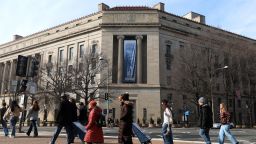
Tourists walk past the Department of Justice in Washington, DC, on February 27, 2026.
SPLC charged with defrauding donors over paid extremism informant program
The charges are part of the Justice Department’s case against the SPLC over the alleged payments, which prosecutors say were done through shell companies. In earlier court documents, the department gave details on nine unnamed informants it says received payments through the program, which began in the 1980s.
Despite her role in overseeing the payments — some of which were directed to an Imperial Wizard in the KKK — Beirich allegedly had a romantic relationship with one source who infiltrated a White Supremacy group and stole documents for the SPLC, according to the indictment.
That person, prosecutors say, was paid over $1 million by the SPLC since 2007 – $140,000 of which was put into a bank account that Beirich and the person shared. Beirich allegedly used that money to pay for their personal living expenses.
The documents that person allegedly stole were used as part of an article that the SPLC later published. Beirich then allegedly paid a second informant $6,000 to take the fall for the stolen documents.
“Dr. Beirich is innocent, and this case is without merit,” her attorney, Michael J. Proctor said in a statement. “We believe the charges against her and the SPLC are politically motivated, and Dr. Beirich has been targeted in this case because of the important work she has done to combat hate groups and extremists.”
Proctor said Beirich left the SPLC over six years ago.
“Dr. Beirich won’t be silenced or intimidated by the government’s false and politicized allegations now,” Proctor continued. “She welcomes the opportunity to present the truth in court.”
The SPLC told CNN the indictment has not changed their commitment to the cause.
“Taking on violent hate and extremist groups is among the most dangerous work there is, and we believe it is also among the most important work we do. The actions taken by the DOJ will not shake our resolve,” the group said in a statement. “We remain steadfast in our fight for justice and in our commitment to ensuring the promise of the Civil Rights movement becomes a reality for all. We are confident in our position and look forward to presenting the evidence and making our case in court.”
-=-=
-=-=
wsj 8 26
In recent months, ICE has deployed a round-the-clock digital dragnet to scour the public internet—from Facebook to Instagram to X—for speech that could endanger the agency’s mission. The government has paid millions to private contractors to surface everything from potential threats to agents to activities that could disrupt ICE’s operations, according to federal documents, contractors and former Homeland Security Investigations agents.
The program has ensnared U.S. citizens and activist groups that alert community members about ICE activity. Contractors prepare daily reports and dossiers on threat actors, identifying the poster’s name, location, date of birth, workplace, Social Security number, vehicle registration and criminal history when possible.
To unmask anonymous online critics, DHS has sent hundreds of subpoenas to social-media companies, according to people familiar with the matter. Its agents have tracked down Americans at work and on the road, asking them to sign letters acknowledging their online speech about ICE “may” be a crime.
DHS says it is trying to protect its agents and their families from “coordinated campaigns of violence” that have fueled an 8,000% increase in death threats since Trump took office.
But civil-rights lawyers and former DHS staffers say the approach has swept up people expressing opinions that are protected by the First Amendment. ...
Read more: https://www.wsj.com/politics/policy/ice-surveillance-internet-critics-e3b22f49
-=-=
AN 7 26
Shame!': Man dragged from hearing as Texas judge clears room during anti-GOP remarks
-=-=
AN 7 26
Trump DHS is using a Civil War-era statute to arrest protestors for conspiracy
Protesters are being arrested by President Donald Trump's Department of Homeland Security, a new report from National Public Radio detailed.
Treasure Thoreson, a Minneapolis special education teacher, along with 14 others, has been charged with "conspiracy to impede federal agents" because they were using "blockades" outside of the Whipple Federal Building, where ICE is headquartered.
"The charges against Thoreson are part of an escalating trend," the report said, after reviewing court records from the last five years. The analysis compared how the federal government is using one specific charge against protesters: "conspiracy to impede or injure an officer, which can carry a sentence of up to six years in federal prison," the report said.
NPR claimed that the statute was established during the Civil War and it isn't used often. Since Trump took over, however, more than three dozen people in fewer than 10 cases have been prosecuted using the law. All of them are for protesters of federal immigration enforcement. There have also been nearly 50 people indicted on conspiracy charges using different statutes.
But it was also a law used after the Jan. 6 attackers, particularly against the militia members. All of them were pardoned.
NPR noted that the sudden increase in conspiracy charges is sounding some alarms for legal experts who think it's being stretched to fit the administration's targeting of political activists.
"These cases are part of a broader trend that's worth watching," Aaron Terr, director of public advocacy at the Foundation for Individual Rights and Expression, told NPR.
He explained that the cases all appear to be different and the administration is getting around the First Amendment by alleging destruction of property or violence, like what was seen on Jan. 6.
"The government can legitimately prosecute people for that. But some defendants aren't accused of personally engaging in that conduct," Terr says. "The concern there is that the government may be casting too wide a net. It may be lumping in innocent people or people who committed minor misdemeanors, based on their political beliefs."
Civil disobedience and non-violent protests can still break some laws, but the charges are typically minor. Conspiracy is another matter.
"For a conspiracy to occur, Terr says there has to be an agreement among people to commit a crime and, according to the statute involving impeding or injuring an officer, that crime has to prevent the officer from doing their duties through force, intimidation or threat," the report explained.
Terr said that someone showing up to a protest and deciding in the moment to block an ICE van should not be enough to constitute a criminal conspiracy.
NPR said that many of the cases have been dismissed, but there have been some successes. About 30 people outside of Spokane, Wash. were arrested after they linked arms to block the transport of two people detained by ICE. The following day, an internal email seen by Reuters from the Justice Department demanded that U.S. attorneys prioritize charges against protesters who "destroyed property or assaulted law enforcement."
The memo from former Attorney General Pam Bondi said that she wanted the protesters charged "with the highest provable offense available under the law."
Washington and Minnesota are just a few of the examples. Other protesters have been arrested in Chicago and Texas.
Katie Schwartzmann, legal counsel with the organization Protect Democracy told NPR, "It's important to see these indictments and the use of this law for what it is, which is an attempt to scare Americans. But also, Americans should not be afraid to organize peaceful resistance in this moment. Those acts of ordinary people organizing and working together have been the most important force for justice in the history of our country."
-=-=
an 7 26
All he did was call Homeland Security Secretary Markwayne Mullin a "monstrous human being" and federal agents showed up at his door.
Syracuse.com reportedon Monday that father of two David Streever filed a lawsuit in U.S. District Court in Washington, D.C., against Mullin and six other officials, alleging that they violated his First Amendment Rights.
The Foundation for Individual Rights and Expression, or FIRE, joined Streever in the lawsuit alleging Streever, a Rochester man, wrote a critical email to the former head of Immigration and Customs Enforcement (ICE) about the slayings of protesters at the hands of police. Five months later, feds were staking out his New York City hotel room after he returned from an overseas vacation with his daughter.
"That’s an outrageous violation of an American’s First Amendment rights. So today, the Foundation for Individual Rights and Expression filed a federal lawsuit to challenge ICE’s efforts to scare Streever and others into silence and remind other government officials that such behavior is un-American, unconstitutional, and unacceptable in a free society," FIRE said in a statement.
“Like many Americans, I was deeply upset after the shootings in Minnesota and I felt compelled to do something,” Streever explained. “Writing an email to the head of ICE seemed like the least I could do to express my sense of outrage. I never dreamed it would lead to a knock on my door by federal officers or descending on my hotel in the dark of night.”
Streever's Nest doorbell video recorded two officers ringing the bell, looking through the windows of his home and standing around before ringing the bell again. They ultimately left. Streever was in Finland with his 7-year-old daughter, FIRE said. No one else arrived home until later. When his wife, an Episcopal priest, arrived home, the agents were waiting.
She was handed a “WARNING NOTICE," said FIRE. It said, "in underlined capital letters printed on official federal stationery from ICE and DHS, with respect to Streever that 'YOU MAY BE IN VIOLATION OF FEDERAL LAW' for sending his email to the ICE director. The notice insists that he should 'promptly … discontinue' his 'behavior,' and warns that the notice will be 'taken into consideration' if he 'continue[s] to be involved' in 'criminal activities.'"
His spouse told the agents that he would be back in the country on Friday. Streever arrived back in the U.S., landing in New York City, and went to a hotel to sleep off some jet lag before heading home the rest of the way.
After checking into their hotel, a federal agent appeared at the front desk looking for him. The agent left his card, which the hotel told Streever about. Two agents then repeatedly called his cell phone "leaving anonymous voicemails identifying themselves only as 'Homeland Security Investigations.'"
It unnerved the family, given that his spouse never indicated where he was staying. The only way that Homeland Security could have known where he was located was by monitoring him.
As he and his daughter rode the train home, he told the child that there was a chance that a federal agent might confront him. His daughter then broke down crying because she was afraid.
The email from Streever addressed to Todd Lyons, who served as the acting ICE official until May 31, calls Lyons a "monstrous human being" and compared him to Nazi Reinhard Heydrich.
"The way you are protecting the obvious execution in Minnesota, even as we see the videos, will lead to your downfall," the email continued. "Even Trump will turn on you before the end, and you will be a sad, despised man who eats himself alive with shame at your own pathetic weakness. You will never know peace. You will seek to lose yourself, to escape the burden of knowing the truth about yourself. But wherever you go, you will find yourself. You will torment yourself until your last day on Earth."
Indeed, Lyons was ousted from the administration. Unlike other members of Trump's administration, he was sent off to the "private sector" consulting on "national security and defense."
FIRE explained that "Streever’s email contained only fully protected speech, and nothing that could constitutionally justify ICE’s 'knock it off' threats. And it came nowhere close to an unlawful threat of violence, as the notice and subsequent ICE posts suggested. Telling the director of ICE that he would carry a guilty conscience around with him for the rest of his life, at the pinnacle of public debate over ICE actions, is no crime. It’s core protected exercise of the rights to free speech and to petition government officials."
One observation made by FIRE Senior Attorney Adam Steinbaugh is that it doesn't generally take five months for police to deal with credible threats of violence.
AN 7 26
A new report has revealed that top Florida officials had a 77-year-old Army veteran investigated for mailing a postcard to the state's chief financial officer that said nothing but "You lack values."
According to Reason, “James O'Gara, a resident of Largo, Florida, was interviewed by detectives from the criminal division of the Florida Department of Financial Services (DFS) last September after he mailed the postcard to Chief Financial Officer Blaise Ingoglia's office. The police encounter led to accusations of First Amendment retaliation and government bullying by Florida Republican Gov. Ron DeSantis' administration… An audio recording of detectives' interview with O'Gara shows that they didn't think there was anything wrong with his statement and quickly closed their investigation.”
But when word of the incident began to spread, so did O’Gara’s message. Soon, Ingoglia's office received dozens of postcards from across the country bearing the message: "You lack values."
The investigation was launched on September 15, 2025, when the then-director of the Criminal Investigations Division, Simon Blank, emailed the division's assistant director and lieutenant colonel, saying, “The attached was mailed to the CFO. Can you have someone look into the name and do a threat assessment?" Two weeks later, Lt. Col. James Evangelina wrote to Darrell Wilson, the former chief of the division's Bureau of Fire, Arson and Explosives Investigations, “I'd like a member of our team to arrange a meeting with the individual mentioned to discuss potential avenues for assistance. Additionally, if possible, please verify the sender's identity and evaluate any potential threat level associated with the information provided."
Two detectives visited O’Gara a few days later, telling him, “Look, you didn't do anything wrong. I understand that right now our country's in a very interesting position politically. Everything's polarized and whatnot."
"I have a right to voice my opinion, and I will do so all the more reciprocally because they sent you guys out," said O'Gara.
"I completely support the First Amendment, 100 percent,” the detective replied. “Just being how things are polarized right now politically, anything that's going on with anybody disagreeing with whatever, they're having us check things, stuff like that."
According to Reason, “O'Gara said he'd sent 200 similar postcards to other politicians but had never had any problems before. The detectives remained courteous throughout the interview, comparing Army service records with O'Gara and repeating several times during the conversation that they hadn't seen a threat in his postcard.”
"Yeah, like I said, they're making us check up on things," said one detective. "I looked at your postcard and was like, you didn't do anything wrong."
"I'm pissed that they sent you here," noted O'Gara. "I know it's not your fault. This is totally inappropriate, totally inappropriate."
The detectives left then interviewed two of his neighbors, asking about his behavior. In their report, they said they found “no credible threat,” noting O’Gara’s “displeasure” at being investigated, and concluding, “As a result, he will be sending further correspondence to express his 1st amendment right. He has no intention on escalating to actual threats and will continue to let the CFO know this is wrong."