RUBIO 3 SOS
ESTB 3 25
MERRI OK
THREE 3 SOS 25 USAID WH AMBUSH SHAME
CUBA REPORT 7 26
NOTE AHA MIDTERMS COMING UP FAST, IRAN WAR DISASTER CONTINES NO END, TANKED HOUSING BILL TO GET BS SAVE ACT, REB BAIT LAST CHANCE? HELPED BY DSA WINS 726
SEE TERROR BS MILLER NSPM7
SEE ICC RETALIATION NOBEL
SEE ~ DISINFO EU
MBS SAUDI NIKE PWR 8 26
kid killer maroccogoon africa aid hq
HABEAS CORPUS FOREIGN STUDENT FUCKERY fascism pending
SEE CENSOR WWW MEM HOLE EL SALV RUSSIA ISRAEL HU RTS disinfo STUDENT SUPPRESS GAZA // NOEM ~ CT
7 26 RUBIO VICEROY VENEZ SOON CUBA SAYS WILL TEAR DOWN ICC [WE BOMB BOATS]
// --> FASCISM
ALT RT EUR? afd
sort of bak, 2/19
STARLINK AFRICA CORRUPT
see ORBAN HUNGARY NUKE PGM
LCV 7%
veepstakes 7 24 snl ridicule
---
-=-=
-=-=
AN 10 26
A longtime lawmaker and former diplomat flagged how illegal a recent move at the State Department is this week.
The Washington Sun reported Thursday that the State Department has begun asking career diplomats up for promotion whether they voted for President Donald Trump in 2016, 2020 and 2024.
Washington Sun reporter Eric Katz explained that "federal law prohibits politically based hiring for career staff."
According to the report, "Top officials in the State Department made clear that only candidates who voted for President Donald Trump would be eligible for the mid-to-upper level foreign service roles. They also told candidates that their campaign donation history would be examined and any donation to Democrats would be disqualifying."
The report comes on the heels of another revelation that the State Department is trying to shove out the top career staff, leaving a huge void of experience and longtime foreign relationships.
According to some, senior State Department officials are outright asking longtime employees to retire. Others "have been reassigned other top career staff into the Administration Bureau, what employees consider to be a 'purgatory' where employees’ careers 'go to die.'"
Sen. Jeanne Shaheen said that the Senate Foreign Relations Committee has been following the allegations.
“These are critical national security positions and individuals should be chosen for their experience and ability, not their political loyalty. We are working with the House and other relevant committees to thoroughly investigate all such claims," she said.
Former Rep. Tom Malinowski (D-N.J.), who also served as a diplomat and assistant secretary of state for Democracy, Human Rights and Labor, posted on X that all of this is illegal.
"Asking career officers how they voted is not just wrong — it violates the Hatch Act. Those doing it may be investigated by the U.S. Office of Special Counsel, fired, and/or fined," said Malinowski. "There is no statute of limitations — so the next administration can go after them."
One of the biggest problems with the Hatch Act, however, is that it outlines possible penalties but does not impose one automatic punishment, such as firing, for every violation. If a Trump appointee has already left the administration, firing them isn't a punishment. A civil fine, however, could be. The president could not pardon a Hatch Act violation as it is classified as civil administrative infraction, explained the Brookins Institute.
Malinowski said that any future administration could impose a penalty for a Hatch Act violation on a Trump appointee, but the firing from office likely wouldn't matter if they were already gone. A civil fine could be issued, but the maximum is $1,000; however, it outlines that the penalty is "adjusted for inflation." The Hatch Act was first passed into law in 1939. The Bureau of Labor Statistics offers a CPI Inflation Calculator.
-=-=
AN 10 26
President Donald Trump's disappointment at not winning the Nobel Peace Prize was followed by a major move against the International Court, where this year's winner once served as a judge, with the timing suggesting retaliation.
On Friday, the Trump administration announced it was imposing sanctions on the International Criminal Court (ICC), aiming to weaken its operations by limiting financial transactions and possibly cutting off access to essential services.
The announcement followed the Norwegian Nobel Committee's decision to award the 2026 Nobel Peace Prize to Navi Pillay, a South African jurist who was a former judge of the ICC and who has been recognized for her work in promoting international law.
The close timing doesn't prove the sanctions were imposed in response to the Nobel Prize decision. As The New York Times reported, the administration had been planning the measures for months.
Marco Rubio, who is the Secretary of State, made it clear that Washington intended to severely limit the court's activities. Rubio stated, "Either the ICC will end its threats, or we will end the ICC."
The administration had earlier sanctioned individual judges and prosecutors. On Friday, however, it went much further by targeting the institution itself and could thus force banks, insurers and technology companies to sever ties with the court.
The Nobel Committee's decision gave the growing confrontation a rather unusual turn.
The Nobel winner, now 85, served on the ICC's Appeals Chamber from 2003 to 2008 and earlier led the United Nations' human rights office. She also led a U.N. commission that investigated the conflict in Gaza.
On Truth Social, Trump endorsed his former lawyers' criticism of her record.
When announcing her award, the Nobel Committee specifically pointed out the threats international judicial institutions face.
"The judges – those who guard the thin red line between order and chaos – are therefore highly deserving of our praise," the committee said.
The ICC swiftly denounced the sanctions imposed by Washington, accusing the administration of attempting to obstruct international justice. The court president, Tomoko Akane, said the institution would keep operating on its own even in the face of the restrictions.
The clash comes after Trump has on several occasions stated that he deserves the Nobel Peace Prize. Earlier this week, he said no one in the award's history deserved it more, based on his claim that he had settled eight wars.
The sanctions imposed on Friday also showed Washington's long-standing objections to the International Criminal Court conducting investigations that involve American military personnel and to the issuance of arrest warrants against Israeli leaders, including Prime Minister Benjamin Netanyahu.
The court, headquartered in the Netherlands, has 125 member states, including several American allies.
To avoid possible sanctions, its officials have already replaced Microsoft software and arranged alternative financial services.
-=-=
-=-=
Oct. 5, 2026,
Throughout American history, officials have recognized that Congress has what’s known as “the power of the purse.” In our constitutional system, it’s lawmakers who have the sole authority to dictate government spending. It’s designed this way for a reason: As the editorial board of The New York Times explained last fall, “Money is power, and the founders of this country feared that a president would turn into a monarch if he alone could dictate how the government uses the federal Treasury.”
It’s a model that Donald Trump has never been altogether comfortable with. Indeed, Russell Vought, who leads the president’s White House budget office, made clear during his Senate confirmation hearings early last year that he believes in an executive branch that has vast powers when it comes to federal spending.
He clearly meant what he said. Consider three examples that emerged over the course of a week.
On Friday, Sept. 25, the White House decided unilaterally to cut nearly $1 billion in domestic spending appropriated by Congress, executing a tactic known as a “pocket rescission.” Days later, the Government Accountability Office reaffirmed its stance that this is illegal, and Team Trump said it didn’t care.
On Wednesday, Sept. 30, the Trump administration redirected tens of millions of dollars in U.S. military assistance from European and Middle Eastern countries to reward conservative governments in Latin America.
As The Washington Post reported, the State Department notified Congress of its intention to do so last month, at which point the top Democrats on the House and Senate foreign affairs committees placed a hold on the diversion of funds. Last week, the administration decided it would proceed with its plan anyway.
In a letter to Secretary of State Marco Rubio on Wednesday, the two Democratic lawmakers, Sen. Jeanne Shaheen of New Hampshire and Rep. Gregory Meeks of New York, wrote to Secretary of State Marco Rubio, describing the move as a violation of statutory requirements about where the money could go. Team Trump apparently didn’t care about this, either.
On Friday, Oct. 2, the Times reported that the National Science Foundation, one of the biggest sources of federal research funding, withheld $1.4 billion that Congress had intended for research over the course of the past year as part of a brazen effort to circumvent Congress.
Rep. Zoe Lofgren of California, the top Democrat on the Science, Space and Technology Committee, said, “The money should be granted as Congress intended, and essentially, they’re ignoring what Congress did.”
Or more to the point, they’re ignoring what Congress did again.
//
Trump uses rare authority to claw back nearly $1 billion in spending approved by Congress
-=-=
-=-=
9 26 GOT SASH ECUADOR EXTRA JUD KILLING, THEY DID IT TOO
-=-=
AN 9 26
The State Department is busting President Donald Trump's bubble with it's new move to avoid the Strait of Hormuz.
The Washington Sun reported Monday that the U.S. government is quietly admitting that sending supplies through the Strait of Hormuz is currently too risky and unreliable. It's happening after weeks of Trump repeatedly claiming the U.S. fully controls the waterway and that it is open for business.
The U.S. Embassy in Kuwait needs regular shipments of supplies, and that cargo typically moves through the Strait of Hormuz — the narrow waterway between Iran and the Arabian Peninsula. Due to the war between the U.S. and Iran, the latter is threatening to strike any ship it hasn't authorized. So, ships aren't moving through unless they've worked something out with Iran.
“The security situation in the region remains fluid and subject to sudden escalation,” the department said in a notice to vendors. It was posted on a government contracting website.
According to the report, the State Department said standard shipping routes are currently unreliable or unavailable because of rapidly changing regional security risks. So it hired another company for $26,908 to move the embassy’s freight through an unspecified alternative route instead.
The Sun noted that the statement is "undercutting President Donald Trump’s assertions that the strait is open and under U.S. control."
Indeed, Trump has stated either publicly or on Truth Social that the Strait is perfectly safe.
“We have total control over the Strait… The Strait is open," he said on Aug. 17, according to a White House fact sheet.
Two days later, according to the same fact sheet, Trump claimed, “Right now, the Strait is open. A lot of boats are coming through. People aren’t reporting that … The naval blockade has been extremely effective.”
Aug. 26, he said, “The Strait is open. We take a lot of ships through the Strait now … It’s a very functioning Strait. A lot of oil is pouring out.”
On Aug. 27, Trump claimed, "The Strait of Hormuz is open. We have control, and we have the blockade. Iran is not getting anything; nothing is going through."
As recently as Sept. 9, Trump was promising the country before his Dallas convention, “We’ll win it. We’re winning it. We control the Hormuz Strait.”
Traffic remains well below normal transit levels, and carriers are treating the route as hazardous. In a statement released on Sept. 16, the global Danish shipping and logistics company Maersk announced that it has suspended or rerouted some Gulf shipping. They're also adding emergency freight charges and said that they too will have alternative routing plans for cargo bound for Kuwait and other Gulf states.
-=-=
-=-
===
an 9 26
A very wealthy donor to President Donald Trump scored a deal with a Russian state-owned bank that would normally be off-limits due to sanctions, the International Consortium of Independent Journalists reported.
Konstantin Sokolov is a Russian-American businessman and a major donor to Trump's political groups. In 2025, he gave $11 million to MAGA Inc., the president's super PAC, and also contributed to Trump’s White House ballroom project.
Trump signed off on new sanctions last week. The new sanctions would target Russian officials, financial institutions, energy and defense sectors and oil-shipping networks. It also authorizes tariffs of up to 100 percent on major purchasers of Russian oil and gas, one explainer outlined.
But already, Trump's funder is exempt, according to a Treasury Department decision. Sokolov will be able to buy a major copper mine in Armenia from the Russian state-owned bank.
"The Treasury Department’s Office of Foreign Assets Control, known as OFAC, can grant a license to individuals or companies to complete transactions that would otherwise be prohibited by sanctions," the ICIJ explained. "OFAC states on its website that it may grant a license to do business with sanctioned Russian entities when it is in the interest of the applicant and the U.S. government."
Sokolov's spokesperson confirmed that such approval was given.
Sokolov was also appointed chairman of a new $200 million State Department enterprise fund that will invest in Central Asia and the South Caucasus, which is a strategic geographic region at the border of Eastern Europe and Western Asia. Armenia is expected to benefit. That means Sokolov has two overlapping roles: first, he owns or manages private businesses in Armenia, including the copper mine. Second, Sokolov helps oversee a U.S. government-backed investment fund that may invest in Armenia.
Armenian lawmakers and critics are concerned that the relationship creates a potential conflict of interest by essentially granting Sokolov public or government-supported investment and decision-making in a country where he also has large private financial interests.
Armenia’s National Assemblymember Mesrop Manukyan said when speaking to the ICIJ that Sokolov’s position “create[s] legitimate questions about … the separation between private commercial interest and decisions involving public or government-backed funds.”
Sokolov's spokesperson also claimed there was “no evidential basis” to link Sokolov's donations to Trump and approval by Trump's government. Suggesting otherwise “would be incorrect and wholly misplaced," they added.
While the administration and Sokolov deny any corruption, the report raises legitimate questions about transparency, favoritism and whether private business interests could overlap with Trump's government power.
-=-=
-=-=
GGL 9 26
AI Overview
The keywords you provided point directly to the intense, ongoing geopolitical clash between the European Union's aggressive anti-disinformation regulations and the U.S. government's pushback against perceived global tech censorship, specifically highlighting the intersection of climate disinformation tracking. [1]
- The "Drilled" and "Westervelt" Connection
The name Amy Westervelt is an award-winning investigative journalist and founder of the critical climate reporting podcast and newsroom known as Drilled. [1]
- Westervelt and Drilled are heavily involved with organizations like the EU DisinfoLab, where they speak on panels exploring how tech platforms are responding to European regulations to combat organized climate disinformation campaigns. [1]
- These groups track how fossil fuel entities and bad actors use algorithmic amplification to spread misleading narratives, using the EU's strict legislative tools to demand transparency from American tech platforms. [1]
- The EU's "Censor" & Disinformation Crackdown
Europe has taken the global lead in policing online speech through landmark legislation like the Digital Services Act (DSA). More recently, the EU Parliament has pushed to implement a robust "European Democracy Shield" and the European Centre for Democratic Resilience. These frameworks enforce strict rules on: [1, 2, 3, 4]
- Big Tech Compliance: Forcing companies like Meta, TikTok, and Google to aggressively label AI-generated content, curb foreign election interference, and restrict hate speech.
- Financial Penalties: The EU Commission has levied heavy fines against major platforms, including a massive fine against Elon Musk’s X. [1, 2, 3]
- The U.S. Backlash against "Extraterritorial Censorship"
The United States—spearheaded by the House Judiciary Committee and the Trump administration—views these European rules as a decade-long campaign to censor American free speech globally. The U.S. government argues that the EU uses its laws to strong-arm American firms into altering their global content moderation policies. [1, 2, 3]
This culminated in explosive retaliatory actions:
- The "Censorship" Travel Ban: The U.S. State Department issued visa bans blocking five prominent European regulators and anti-disinformation researchers from entering the United States. [1, 2]
- High-Level Targets: Among those barred were former EU Digital Commissioner Thierry Breton and Clare Melford of the Global Disinformation Index. U.S. Secretary of State Marco Rubio characterized them as "radical activists" and "weaponized NGOs" trying to force their speech standards onto American companies. [1, 2]
- Trade Threats: President Trump launched probes into whether EU tech laws unfairly target American industries, leading Brussels to warn that it may retaliate by pulling out of major transatlantic trade agreements. [1, 2]
-=-=
9 26

Trump and Rubio’s Friends Secretly Prepping to Cash in on Cuba
-=-=
South Africa-Trump row: US limits visas for officials over alleged anti-white discrimination
BBC 9 26
-=-=
RWW
09/09/2026
by
- Andrea Fuller, Ken Bensinger and Edward Wong @ The New York Times: For Fired DeSantis Campaign Staff Member, a Second Chance at State Dept.
The hiring of Nate Hochman, who lost his job amid an uproar over a video containing a Nazi symbol, underscores the administration’s willingness to overlook past transgressions.
-=-=
7 26 intercept
Rubio’s Paranoid Cuba Report Designed to “Justify a Military Attack on Cuba,” Says Democratic Rep.
After "Political Terrorism" Summit, U.S. Names 43 Americans + Groups
-=-=-=
-=-=
Aug. 25, 2026,
For 17 months, the State Department has promised to deliver proof of a long-promoted conspiracy theory about its own agency: that its officials routinely censored conservative Americans. This week, it failed that mission, as Under Secretary for Public Diplomacy Sarah Rogers released a trove of documents that proved nothing.
The conspiracy theory has grown during President Donald Trump’s second term, providing the State Department with a rationale for dismantling the offices that once studied and countered foreign disinformation campaigns, for firing officials with decades of experience and for shuttering entire departments.
The effort was first led by acting Under Secretary of State for Public Diplomacy Darren Beattie, a former far-right academic who had been fired from the first Trump administration after he attended a white nationalist conference. Beattie claimed the DOGE-style decimation of the State Department was necessary to rid the agency of officials who were tied to a baseless conspiracy theory known as the “censorship-industrial complex.”
Promoters of the censorship-industrial complex — a secret but somehow sprawling partnership between the Biden government, journalists, academics and civil society groups, aimed at silencing conservative Americans — have repeatedly failed to prove their case, in congressional investigations and in the courts, including the Supreme Court. Still, the theory persists.
Beattie had no evidence for his unfounded claims that the State Department had participated in that conspiracy, but in March 2025, he launched an investigation inside the State Department that he said would reveal all. Beattie requested the files, emails and other communications of State Department officials, including any records with seemingly random keywords like “Black Lives Matter,” “great replacement theory” and “Pepe the Frog,” as well as any communications with figures Beattie believed to be part of the conspiracy. (These included The Atlantic’s Anne Applebaum, Bill Gates, disinformation researcher Nina Jankowicz and some 60 others, including this reporter.)
In the official announcement for the closure of the Counter Foreign Information Manipulation and Interference Hub, formerly known as the Global Engagement Center (GEC), Secretary of State Marco Rubio told Mike Benz, a former pseudonymous racist YouTuber and chief architect of the censorship-industrial complex theory, that a reckoning was coming. It would be driven by evidence, disclosed in the model of the “Twitter Files,” a 2022 dump of internal Twitter records that Elon Musk gave to selected writers to show the alleged censorship of conservatives. (It didn’t.)
Rubio said the job now was to “document what happened.”
“Because one thing is to say it in a broadcast like this, another thing is to actually put it on paper,” he said.
This week, Rogers, Beattie’s replacement, finally had something to share.
According to a series of posts on X, some since deleted, Rogers messaged Jennica Pounds, a self-described analyst who goes by the moniker Data Republican, known for creating massive, if amateur, data troves used to allege government waste, fraud and abuse, which made her a favorite of Musk’s.
Pounds said she thought Rogers was handing documents about Cuba, but got “shoved a bunch of hard copy documents to leak” about the GEC.
“I wanted to give you the option of ‘breaking’ the story as sort of a gift,” Rogers told her, according to a direct message that Pounds posted.
Then things got weird. Pounds has been a reliable vector for the Trump administration to push its narrative that a so-called deep state, or shadow government, was operating in secret and against the best interests of its citizens. But when she received the State Department’s “gift,” Pounds determined that it was a plot by Rogers to entrap her into committing a crime, asserting that releasing or reporting on the documents would be illegal.
Rogers responded “lol” and released the documents herself in a series of 35 posts that borrowed the breathless cadence of the Twitter Files, drawing ominous connections between GEC emails, international projects to combat foreign disinformation, and nongovernmental coalitions. It all implied the existence of a censorship-industrial-complex operation — without proving it. Rogers’ document dump got little attention from right-wing media.
More articles
Team Trump turns on contractor after it failed to bolster election conspiracy theory

Resigning labor secretary falsely claims there was a ‘deep state’ conspiracy against her
“There were State Department employees sharing news articles. Diplomats had communicated with foreign governments. And somewhere in the rubble was a project examining ‘gendered disinformation’ that had been — wait for it — announced at the Summit for Democracy and published on the State Department website,” former senior foreign service officer Orna Blum wrote sarcastically on Substack.
Pounds seemed to agree with the former State Department official.
“The actual documents were nothingburgers,” she posted.
Neither the State Department nor Pounds responded to requests for comment.
The debacle may show that the half-decade of unproven censorship claims has exhausted their audience.
“The under secretary is yet again twisting decontextualized snippets of emails and long-public documents to try to propagate a conspiracy theory,” said Renée DiResta, an associate research professor at Georgetown University. As the former research manager for the Stanford Internet Observatory, DiResta has long been a boogeyman of the censorship-industrial complex theory.
“The mass censorship claims were a hoax,” DiResta said.
Over the weekend, some of the State officials pushed out in last year’s purge lit up Signal chats, commenting on Rogers’ rollout of the long-promised proof of the conspiracy that had cost them their jobs and hollowed out the agency where they had spent their careers. One former senior official, granted anonymity to speak candidly, told MS NOW: “In the end, it’s not the greatest consolation on earth to find out that the people who wrecked 10 years of your work and your career are a bunch of galaxy-level dipshits.”
The release did reveal something, however: an unintentional revelation about an undisclosed relationship between a federal agency and Pounds, a professed independent researcher who has often criticized others, without evidence, of being “a fed.”
In her posts, Pounds alleged that Rogers was trying to threaten her employment, revealing along the way that since July she had been a special government employee of the Department of Defense. Before that, Pounds had been provided credentials as a member of the Pentagon’s hollowed-out press corps.
A Defense Department official confirmed her employment but declined to give further details.
Brandy Zadrozny is a senior enterprise reporter for MS NOW.
-=-=
AN 8 26
Republicans appear to be realizing that President Donald Trump's claims that "affordability" is a "con job" aren't winning messages for the GOP as the November 3 election nears.
Writing for The New Republic on Tuesday, Alex Thomas explained that for years, critics have claimed that Republican economic policies aren't working for the vast majority of Americans. Some have gone so far as to claim that it's outright hollowing out the middle class.
Vice President JD Vance appeared on Joe Rogan's show, where he complained that Republicans allowed Wall Street to turn “every asset of modern life” into a profit machine. So, homes, jobs, health care and basic stability are being treated as investments for the wealthy rather than necessities for working families. Vance explained that this was the reason so many younger Americans are open to socialism. The GOP has spent generations championing deregulation, tax cuts for the wealthy, union-busting and free trade. When big banks and mortgage companies were caught making risky financial decisions and companies collapsed, the government swooped in to bail them out. The victims of the banks were not similarly rescued.
Republican Sen. Josh Hawley (Mo.) has criticized his party over corporate giveaways and drastic cuts to social programs. Sen. Bernie Moreno (R-Ohio) supports restrictions on investors buying up homes all over the U.S. Even Secretary of State Marco Rubio acknowledged that "free and unfettered trade at the expense of our national economy has shrunk the middle class and left the working class in crisis." TARIFFS?
Thomas argued that these statements aren't merely minor changes in rhetoric. He believes that they amount to a growing recognition that the old Republican economic model failed millions of Americans.
In a way, Thomas wrote, Republicans are the dog that caught the car. Meanwhile, Donald Trump's economic policies trend toward being a "dedicated transactionalist." He has "stacked up a Jenga tower of economic policies that are largely short-sighted. Not the sort of ideas you would use to rebuild a party platform that has failed, let alone revive a crumbling economy," Thomas wrote.
Calling Trump's economic policies "zaney," at least "as much as they can be coherently understood," Thomas called it a sharp reversal of the Republican doctrine.
Then there is the party’s biggest obstacle: its donors. Vance may talk about restoring worker power and rebuilding private-sector unions, but he will need the billionaire backers when it's time to begin collecting his own campaign war chest.
Vance may compare AI to the Industrial Revolution, but that was also a period that created huge fortunes while workers fought for basic rights. The difference this time is that the industrialists are already in control, the labor movement is weaker and the Republican Party is still dependent on the billionaires who stand to benefit most, Thomas closed.
-=-=
-=-=
RELATED? 8 26 GUK
What is the US-Saudi Arabia nuclear deal and why is it causing concern?
The US and Saudi Arabia have agreed a landmark deal that would use American technology and expertise to establish a civilian nuclear program in the Gulf country, a move that has caused alarm across the Middle East and through the corridors of power in Washington.
Much of the deal remains unclear, but concerns centre on whether Saudi Arabia would have the capability to enrich uranium domestically, and what that means for nuclear proliferation.
What is the nuclear deal that’s agreed?
The 30-year deal is designed to meet the “energy needs” of oil-rich Saudi Arabia, according to a statement from US energy secretary Chris Wright.
Under Crown Prince Mohammed bin Salman’s economic plan, Saudi Arabia aims to use nuclear power for some electricity generation, thereby boosting oil sales by freeing up more supplies for export. The deal would make American companies central in the development of the country’s nuclear infrastructure, while denying competitors like China and Russia a foothold in the country.
The deal is thought to be worth tens of billions of dollars, and is the continuation of a plan first conceived during the Biden administration. That deal would have seen the US agree to nuclear cooperation in exchange for Saudi Arabia establishing formal ties with Israel.
The prospect of normalisation between Israel and Riyadh has been derailed by the 7 October attack by Hamas, and the resulting years-long war in Gaza. The Trump administration has chosen to push the deal through without the wider agreement with Israel.
Will Saudi Arabia be able to enrich uranium on its soil?
The deal reportedly paves the way for the building of a uranium enrichment facility in Saudi Arabia, but this would be contingent on a joint US-Saudi study determining such a facility is necessary.
The study would run for two years, potentially leaving Donald Trump’s successor in the White House with the decision on whether to sign off on allowing domestic enrichment in Saudi Arabia.
Many countries with nuclear energy industries do not enrich uranium domestically – a process which could theoretically produce highly enriched uranium for a nuclear weapon. They instead rely on importing the fuel for reactors.
Part of the US justification for going through with the deal, is that Washington would have oversight of any enriched uranium and spent fuel from reactors, ensuring they could not be reused to make a bomb.
Why is it controversial?
Nuclear nonproliferation groups have warned for years that such a deal could set Saudi Arabia on the path to develop a nuclear weapon. Riyadh has in the past said it would need a nuclear weapon if its regional rival, Iran, acquired one.
The US is engaged in a war with Iran that is in part being fought to prevent Tehran from acquiring a nuclear bomb or enriching uranium to weapons-grade level.
US secretary of state Marco Rubio has dismissed concerns about the Saudi deal, saying the US is “not going to reach any agreement with any country in the world that leads to the risk of proliferation”.
The Trump administration’s nuclear cooperation agreement was signed alongside a separate “bilateral safeguards agreement” which it said would provide for adequate monitoring.
But experts have expressed alarm that Wednesday’s deal lacks the oversight and guardrails of previous nuclear agreements. Saudi Arabia will reportedly not be subject to the most rigorous monitoring from the UN nuclear watchdog, the International Atomic Energy Agency (IAEA).
24:00
Trump gifts Saudi Arabia a nuclear win | Politics Weekly America
The IAEA’s “Additional Protocol” has been implemented by dozens of countries, and was one of the requirements of the Obama-era nuclear deal with Iran from which Trump withdrew in 2018. It involves inspection and verification to ensure that countries are using nuclear material solely for peaceful purposes.
When the US struck a similar deal with the United Arab Emirates, the UAE agreed not to seek enrichment or process spent atomic fuel, a measure that became known as the “gold standard” for nations wanting atomic power. The Saudi-US agreement reportedly does not include this gold standard.
Can this deal be blocked?
Opponents have long argued that providing Saudi Arabia with a domestic nuclear program will set off a race across the Middle East for other countries to pursue similar capabilities. Israel – which is known to have a secretive nuclear weapons program – has reportedly raised concerns that the deal could launch a regional arms race.
Democrats in Congress have expressed similar concerns. Senator Chris Murphy said the agreement would “set off a nuclear race in the region, further disincentivizing Iran from limiting its own program”.
However, Murphy and his colleagues in Congress will probably have difficulty blocking the deal. The deal is expected to be submitted to Congress for approval in the coming days, but to block the agreement, Congress would need to pass a joint resolution and have a two-thirds majority to override the president’s veto.
-=-=
-=-=-=
State Department takes 'full responsibility' after map mislabels every country in Africa
AN 7 26
-=-=--
AN 7 26
US Secretary of State Marco Rubio is again taking aim at Cuba. This time, however, the Trump administration is framing Havana as a decades-long sponsor of terrorism and espionage that has helped cultivate the “radical left” in the United States.
As part of this, the administration is making pains to link Cuba with the Democratic Socialists of America (DSA), which is growing politically in the US, thanks to Zohran Mamdani’s win as New York City mayor and other victories.
And it comes against the backdrop of fear-mongering by US President Donald Trump about the prospect of communism threatening the US again. He has specifically linked Democrats to communism, as well.
So, why is the Trump administration making this spurious argument, and why now?
What the administration is alleging
Last week, the US State Department published a nearly 100-page report titled “Cuba: The Capital of 21st Century Communism”.
The report’s core claim is that Cuba has spent over half a century influencing and aiding the domestic left in the US. Among its more extraordinary allegations:
- the far-left Weather Underground had direct contact with Cuban officials and Cuban spies in the 1970s, who helped facilitate the group’s bombings in the US
- delegations of other “American radicals” travelled to Cuba during that decade to learn urban terrorism and guerrilla tactics
- Cuban intelligence today treats infiltrating US universities as a top priority
- leftist activists in the US and elsewhere routinely make “revolutionary tourism” excursions to the island, and
- the DSA specifically maintains a “fierce, almost religious commitment to the cause of the Cuban regime”.
That framing collapses under scrutiny. The report anchors its argument in a handful of genuine espionage and terrorism cases. But it then tries to connect these with more innocuous activities: attending a Cuban-organised trip, expressing solidarity with Havana, or opposing the US embargo on the island.
This echoes a long US tradition of using national security as a premise to target leftist movements. This includes everything from the targeting of civil rights and labour organisers during the McCarthy era to the Cold War surveillance of anti-war activists.
Equally telling is what the report leaves out: six decades of documented US covert action against Cuba, including assassination plots and support for armed exile groups.
The report also came just days after Rubio convened delegations from dozens of countries in Washington for a conference on “resurgent far-left political terrorism”. At the event, he said the threat of far-left violence “can no longer be denied” and that it was “time to crush this evil forever”.
And in May, the White House released a new counterterrorism strategy that called “violent left-wing extremists” one of three terror threats facing the US (alongside narcoterrorists and Islamist terror groups). There was no mention of neo-Nazi or other far-right groups.
Why now?
Viewed against this wider context, the State Department report dramatically amplifies the Trump administration’s pressure campaign on Cuba.
In the past few months, Washington has imposed an oil blockade on Cuba, expanded economic sanctions against the island, directly sanctioned President Miguel Díaz-Canel and members of former leader Raúl Castro’s family, and secured a criminal indictment against Castro himself.
This economic warfare has pushed the island towards humanitarian collapse. UN experts have condemned it as a serious violation of international law.
Trump has repeatedly floated a “friendly takeover” of Cuba, and his officials have not ruled out direct military action if Havana does not yield. Rubio’s report and recent statements now provide the ideological framework to justify such an action.
What is driving the timing of this coordinated campaign is harder to explain. However, two factors appear to be converging.
First, the administration is seeking a foreign policy “victory” after the costly and inconclusive war with Iran.
The other is the midterm elections in November. A hardline stance on Cuba could help the Republican Party shore up support with its base. It also allows the party to frame the US left as being aligned with foreign forces and supporters of “communism”.
The more consequential question is what could come next. The administration has created a premise for action on several fronts:
- further measures against Havana, including a possible military operation
- expanded moves against US left-wing organisations, such as targeting their tax-exempt status or funding
- designating left-wing groups as terror organisations, and
- increased pressure on European governments to act against their own leftist organisations.
The brunt of the Trump administration’s actions, however, will be felt by the Cuban people themselves, who have long been scapegoats and collateral damage of their powerful neighbour to the north.
Juan Zahir Naranjo Cáceres, PhD Candidate, Political Science, International Relations and Constitutional Law, University of the Sunshine Coast
This article is republished from The Conversation under a Creative Commons license. Read the original article.
X-X-X-
ken k 7 26
new State Department report on Cuba’s “campaign of subversion against the United States” is a virtual government blacklist against left-wing Americans and groups. Linked to last week’s Rubio-led summit on “political terrorism,” the report is unusually candid about the government’s targets.
“Many of the most significant upheavals in recent American political history — from the George Floyd riots to the rise of Antifa to the explosion of pro-terrorist activism on American college campuses — can be linked, in some way, shape, or form, to Cuban influence,” the report says.
As for who these supposed agents of Cuban influence are, the report is remarkably explicit. It names people like Ben Cohen (of Ben & Jerry’s ice cream fame), Mayors Zohran Mamdani and Karen Bass, media figures like Amy Goodman and Hasan Piker, and organizations like the Democratic Socialists of America and the Amazon Labor Union.
The implication is clear: Secretary of State Marco Rubio thinks there should be a modern-day blacklist of the political left in America. In fact, the report explicitly mentions the “blacklists, McCarthy-era investigations and prosecutions” of the 1950s and their effectiveness at dismembering the Communist Party USA.
The 100-page report, titled “Cuba: The Capital of 21st Century Communism,” was released this morning.
 Cuba Report
44.6MB ∙ PDF file
An entire section of the report — numbering over three pages long — is dedicated to the Democratic Socialists of America.
“The Democratic Socialists of America (DSA) serves as a particularly potent illustration of the ideological victory of Cuba’s effort to position itself as the spiritual capital of Third Worldist Radicalism,” the report says. “This represents a significant advance for the Cuban influence operation: Havana no longer needs to rely solely on intelligence penetration or asset cultivation to exert influence over the United States.”
Though the report concedes that “DSA was not shaped by the direct and tangible influence of the Cuban government” and that it has “organic ideological commitments,” it insists that “None of that is to say that the group has no ties to the Cuban regime and its influence network.”
Instead, the report points to the group’s delegations to Cuba as evidence of Cuban influence.
“For more than six decades, the Cuban regime has been the leading sponsor of radical leftism and Third Worldism in the United States,” Secretary of State Marco Rubio said in a post on X/Twitter linking to the report.
Whatever you think of DSA, it is hardly fringe. It claims as members prominent politicians like New York Mayor Zohran Mamdani and has helped to nominate dozens of politicians like him to office in recent years. Senator Bernie Sanders identifies as a Democratic Socialist — having himself popularized the term — as do Reps. Alexandria Ocasio Cortez and Rashida Tlaib, who are card carrying members (as well as Mamdani).
The Cuba report follows last week’s Rubio-led international summit on “political terrorism.” That summit, as I reported, introduced the new term “Far-Left Terrorism” (abbreviated “FLT”), a term it never really defined.
A White House press release summarizing the event said that “far-left extremism will be treated with the same seriousness and ferocity the world has long reserved for jihadist terrorism.”
Speaking at the summit, Rubio vowed that further new terrorist designations for left-wing groups would be coming “soon.”
DOGEBAG
Jeremy Lewin, the Under Secretary of State for Foreign Assistance, linked last week’s political terrorism summit to today’s Cuba report, saying on X: “For seven decades, the Cuban regime has been behind both the ideological underpinnings of third worldism and subversive organizing structures of the new radical left political terrorists that @SecRubio called out with clarity last week.”
But virtually all the summit could do to substantiate the supposed scourge of political terrorism was to focus on groups that are almost comically dated — like the 70’s era Symbionese Liberation Army or the Weather Underground. The summit was vague about what are the equivalent groups today.
Today’s Cuba report, however, “names names,” in an obvious attempt to stigmatize American citizens who are very much politically active today.
In some cases these are even sitting politicians, from congresswoman Maxine Waters to Los Angeles Mayor Karen Bass.
I read the 100-page report and counted references to at least 43 contemporary American groups and individuals, which the report identifies as follows:
I love this work but it’s time consuming and costly. Please become a paid subscriber so I can do more of it (or chip in to my GoFundMe here)
- Adely, Suzanne: The president of the National Lawyers Guild who participated in the Nuestra América Convoy and who, the report notes, praised Venezuela’s 2024 elections.
- Amazon Labor Union: A labor union founded by Christian Smalls that participated in the 2026 Nuestra América Convoy to Cuba.
- Antifa: A decentralized group of self-described “Anti-fascist” political activists
- Assata’s Daughters: A Chicago-based Black Lives Matter abolitionist offshoot that trains young activists in the radical spirit of Assata Shakur.
- Association for Investment in Popular Action Committees (AIPAC): A California-based umbrella nonprofit that funds left-wing media and delegations to Cuba and Venezuela.
- Bass, Karen: The current Mayor of Los Angeles and former Congresswoman who was a Venceremos Brigade organizer in the 1970s.
- Benjamin, Medea (Susan Benjamin): A co-founder of Code Pink and Global Exchange who organizes Cuba solidarity efforts.
- Black Alliance for Peace: An activist group that maps U.S. military bases and police training facilities as targets for radical agitation.
- Black Lives Matter (BLM) (including Global Network Foundation, Grassroots, and at School): A sprawling racial justice network whose leaders and offshoots, the report says, have expressed solidarity with Cuban regime and radical figures like Assata Shakur.
- Boudin, Chesa: The former District Attorney of San Francisco and son of Weather Underground member Kathy Boudin.
- changingFrequencies: A Black Queer Feminist-led abolitionist project aiming to disrupt waht it calls the “Medical Industrial Complex”.
- Claudia Jones School: A Washington, D.C.-based organizing collective that conducts popular education and, the report says, pro-Cuba lobbying.
- Code Pink: Women for Peace: A left-wing protest group that describes itself as anti-war and organizes solidarity delegations to Cuba.
- Cohen, Ben: The co-founder of Ben & Jerry’s who attended the wedding of Neville Roy Singham and Jodie Evans.
- de la Cruz, Claudia: The co-founder of the People’s Forum, IFCO executive director, and 2024 presidential candidate for the Party for Socialism and Liberation.
- De Los Santos, Manolo: The co-founder and head of the People’s Forum who the report says maintains deep relationships with Cuban regime elites.
- Democratic Socialists of America (DSA): A major socialist political organization that has organized official delegations to Cuba.
- Ensler, Eve (V): A prominent playwright who attended the wedding of Neville Roy Singham and Jodie Evans.
- Equality for Flatbush: A Brooklyn-based Black Lives Matter abolitionist group fighting gentrification, police, and ICE.
- Evans, Jodie: The co-founder of Code Pink who married Neville Roy Singham.
- Floyd, George: A Minneapolis man whose 2020 death sparked nationwide uprisings that the report notes were praised by Cuba.
- Garza, Alicia: The co-founder of Black Lives Matter who credited Assata Shakur as a key influence in her organizing work.
- Goodman, Amy: The host of Democracy Now! who the report notes attended the wedding of Neville Roy Singham and Jodie Evans.
- Haitian Women for Haitian Refugees: An activist group led by Black women that organizes to defend Black migrants and block deportations.
- Hirsi, Isra: A campus activist and daughter of Ilhan Omar who was suspended from Barnard College for organizing anti-Israel encampments before traveling to Cuba.
- IFCO / Pastors for Peace: An ecumenical foundation that organizes aid caravans to leftist regimes and serves as a fiscal sponsor for numerous radical U.S. groups.
- Larudee, Paul: A U.S. citizen based in San Francisco who serves as the North American coordinator for the pro-Iranian “Resistance Axis” coalition Al-Tajammu.
- Mamdani, Zohran: Mayor of New York
- National Lawyers Guild (NLG): An association of radical lawyers that provides legal defense and “legal observers” for various left-wing groups
- National Network on Cuba (NNOC): A coalition of over 60 American groups dedicated to lobbying for Cuba and coordinating nationwide direct actions.
- Omar, Ilhan: A Democratic Congresswoman and mother of campus activist Isra Hirsi.
- Party for Socialism and Liberation: A leftist political party that fielded a 2024 presidential candidate and conducts protests.
- People’s Forum, The: An activist hub for anti-ICE and pro-Cuban agitation.
- Piker, Hasan: A streamer and left-wing political commentator who, the report notes, traveled to Cuba to film a documentary and participated in the Nuestra América Convoy.
- Pressley, Ayanna: A Democratic Congresswoman who, the report notes, publicly praised convicted murderer Assata Shakur upon her death.
- Singham, Neville Roy: A Shanghai-based American technology magnate who funds various left-wing activist groups.
- Smalls, Christian: The founder of the Amazon Labor Union who participated in the 2026 Nuestra América Convoy to Cuba.
- Thousand Currents: A progressive nonprofit that served as the fiscal sponsor for the Black Lives Matter Global Network Foundation.
- Villaraigosa, Antonio: A former Mayor of Los Angeles and Speaker of the California Assembly who was a Venceremos Brigade alumnus.
- Viva Palestina US: The American branch of an international network that, the report says, previously provided convoys and funds to Hamas.
- Waters, Maxine: A Democratic Congresswoman who, the report notes, once wrote a letter urging Fidel Castro not to extradite fugitive Assata Shakur.
- Wilson, Diane: A co-founder of Code Pink.
- Witness for Peace Solidarity Collective: An organization that runs recurring solidarity delegations to Cuba.
Guilt by association at its finest. But what exactly are they guilty of?
What the report shows isn’t that any of these people are knowingly taking directions from a foreign power — only that they disagree with the U.S. government on Cuba policy (or at most, agree with Cuba).
Their views can be wrong — aggressively, offensively wrong even — but it’s their goddamn right as Americans to express them.
KEN REF 1
Tomorrow, Marco Rubio will open a summit unveiling a new designation branding his political opponents as terrorists, documents leaked to me reveal.
The unveil will happen on the opening day of the over 60-nation summit — which I reported on here — called the Ministerial on the Resurgence of Political Terrorism.
That this summit is happening at a time when the Iran war is literally exploding, and while so much else in the world seems to be on fire, is a baffling way for the Secretary of State (and National Security Advisor!) to spend his precious time.
Welcome to the War on FLT, short for “Far-Left Terrorism,” a new acronym appearing in State Department documents about the summit and which I obtained.
A three-letter acronym for an imaginary threat that could be radioactive to a politician’s presidential ambitions. Sound familiar? It’s this generation’s WMD. And it’s going to haunt him.
Rubio, who fancies himself a deep thinker and is already being anointed as the experienced middle-of-the-road alternative to JD Vance, is revealing his true stripes: Trump flunkey, oblivious, and lost in the sauce of the bureaucracy’s ideological hotbox.
Far-left is hard enough to define (who decides what’s “far”?) but to add terrorism takes it to another level of crazy. Not that Rubio cares. The summit will introduce a new visa policy under which State targets “far-left terrorist and other aligned groups” not just for violence against actual people but also “economic sabotage including against public and private property” — a phrase broad enough to cover a broken window or a boycott.
Rubio has spent a decade cultivating the image of the responsible statesman — fourteen years on the Senate Foreign Relations Committee, the grown-up steadying a chaotic administration. The FLT designation is a good place to watch that image dissolve. The State Department is being turned into another clown car, and Rubio seems happy to be the driver.
State’s talking points drop any pretense that this is a politically neutral endeavor. Officials are instructed to rely on the following talking points (per the leaked documents):
- “We go where the threat is. Political terrorism is resurgent, and far-left terrorism specifically poses a unique and distinctive threat today. Addressing and defeating that is the focus of the Ministerial.”
- “The United States has observed a concerning convergence between violent far-left and anarchist networks and other violent extremist actors, including violent pro-Iranian and antisemitic networks, as well as militant anti-tech and eco-terrorist movements. This is a trend we are monitoring closely and engaging partners to address.”
- “The Ministerial will focus world attention on the resurgence of political terrorism and bring together the United States and foreign partners to address the terrorist actors, particularly far-left terrorist networks, operating across Europe, Asia, the Western Hemisphere, and beyond. It focuses on improving coordination, information sharing, and practical law enforcement cooperation to counter political terrorism, including violent far-left attacks on law enforcement, critical infrastructure, political figures, and state institutions.”
kirk?
- “Political terrorism is resurgent, particularly among far-left terrorist networks that have grown more sophisticated. They leverage decentralized cell structures, encrypted communications, and transnational coordination to carry out attacks on rail, energy, and telecommunications infrastructure, as well as targeted violence against political figures and their families. In 2024 alone, there were 21 far-left and anarchist terrorist attacks in the EU — nearly matching the number of jihadist attacks that year.”
tomato soup on pting glass?
- “These are not isolated incidents, but are part of a sustained, transnational campaign of political terrorism that is growing in sophistication and lethality, aimed at dismantling the foundations of self-governing societies.”
accusation is confession
- “The Department of State is committed to confronting organized political violence, including from far-left terrorist and other aligned groups that engage in or support terrorist or criminal activities, economic sabotage, or support far-left terrorist-led violent actions.” CONFLATE PROPERTY AND VIOLENCE
- “In support of this effort, the Department of State is announcing a new visa restriction policy that targets members of far-left terrorist and other aligned groups who have supported or incited acts of terrorism; supported violent criminal activity; participated in economic sabotage including against public and private property; financed, recruited, or provided logistical support for violent or criminal actions committed by far-left terrorist and other aligned groups; and/or facilitated the convergence of far left terrorist and other aligned networks for the purposes of economic sabotage.”
- “…this policy will protect U.S. citizens and safeguard the American homeland by restricting entry of foreign nationals who finance, recruit, incite, or otherwise enable terrorist, violent, and criminal far-left terrorist networks — closing the visa pathways that far-left terrorists and other aligned groups could exploit to threaten American lives, undermine economic stability, and coordinate violent actions on U.S. soil.”
Consider who Rubio is comfortable putting in charge of the summit, names I gleaned from an internal State Department roster detailing the event.
Tera Dahl, a senior advisor in State’s Bureau of Counterterrorism, is a Michael Flynn colleague from the first Trump administration who was pushed out of the National Security Council by H.R. McMaster. Before that, she wrote for Steve Bannon’s Breitbart, co-founded the now-defunct Council on Global Security — a think tank devoted to warning about the dangers of Islam. There, she worked with Katharine Gorka, wife of current Trump terrorism czar Sebastian Gorka, authoring a string of pieces praising Egypt’s strongman Abdel Fattah el-Sisi for “leading Egypt towards democracy” as he jailed his critics.
Dahl got her start as a staffer for then-Representative Michele Bachmann — which is its own kind of full circle. In 2012, Bachmann and four House colleagues sent letters to federal inspectors general alleging that the Muslim Brotherhood had infiltrated the U.S. government, singling out longtime Clinton aide Huma Abedin. The claim was baseless enough that John McCain went to the Senate floor to rebuke a member of his own party.
Then there’s Monica Jacobsen, another senior official at State’s Counterrorism Bureau, a holy warrior who emphasizes the defense of global Christians. She testified to Congress this year that her agency would “hold governments’ feet to the fire when they fail to address terrorist threats that undermine religious freedom.”
Then there’s Brent Munyon, Senior Adviser to the Deputy Secretary of Management and Resources. A few years ago, he was a partisan dirt digger for the Republican National Committee. Finally, there’s Oscar Buynevich, Special Advisor for the Office of the Under Secretary for Public Diplomacy, another partisan commentator whose career amounted to shoveling culture war slop at right-wing campus watchdogs like Campus Reform and The College Fix.
It’s a rogues’ gallery befitting the imaginary Iraqi WMD fiasco, the main contributor to the mess we are still in more than 20 years later. Think Dick Cheney, Paul Wolfowitz, Richard Perle.
Welcome to Rubio 2028.
JUL 14 KEN REF 2
secretary of State Marco Rubio will be hosting a big diplomatic summit in Washington on Thursday — not about the Iran war, but about “political terrorism.”
Sterile as that may sound, it’s a resurrection of an obscure Nixon-era term pointed squarely at the political left and recruiting foreign governments to assist its war on domestic political opponents. As a U.S. diplomatic cable leaked to me puts it, all of this is about combatting “far-left terrorism.”
To the extent that media have noticed the summit at all, they’ve focused on the confusion and wariness among some of the over 60 countries invited; but the significance of the term has been completely overlooked. Put simply, it’s a more powerful attack on protest, free speech and the Democratic Party than Trump’s designation of “Antifa” as a domestic terrorist group or NSPM-7.
The summit is called the “Ministerial on the Resurgence of Political Terrorism.” Unlike familiar organized terrorist groups like Al Qaeda or ISIS, “political terrorism” refers to domestic opposition, here and abroad.
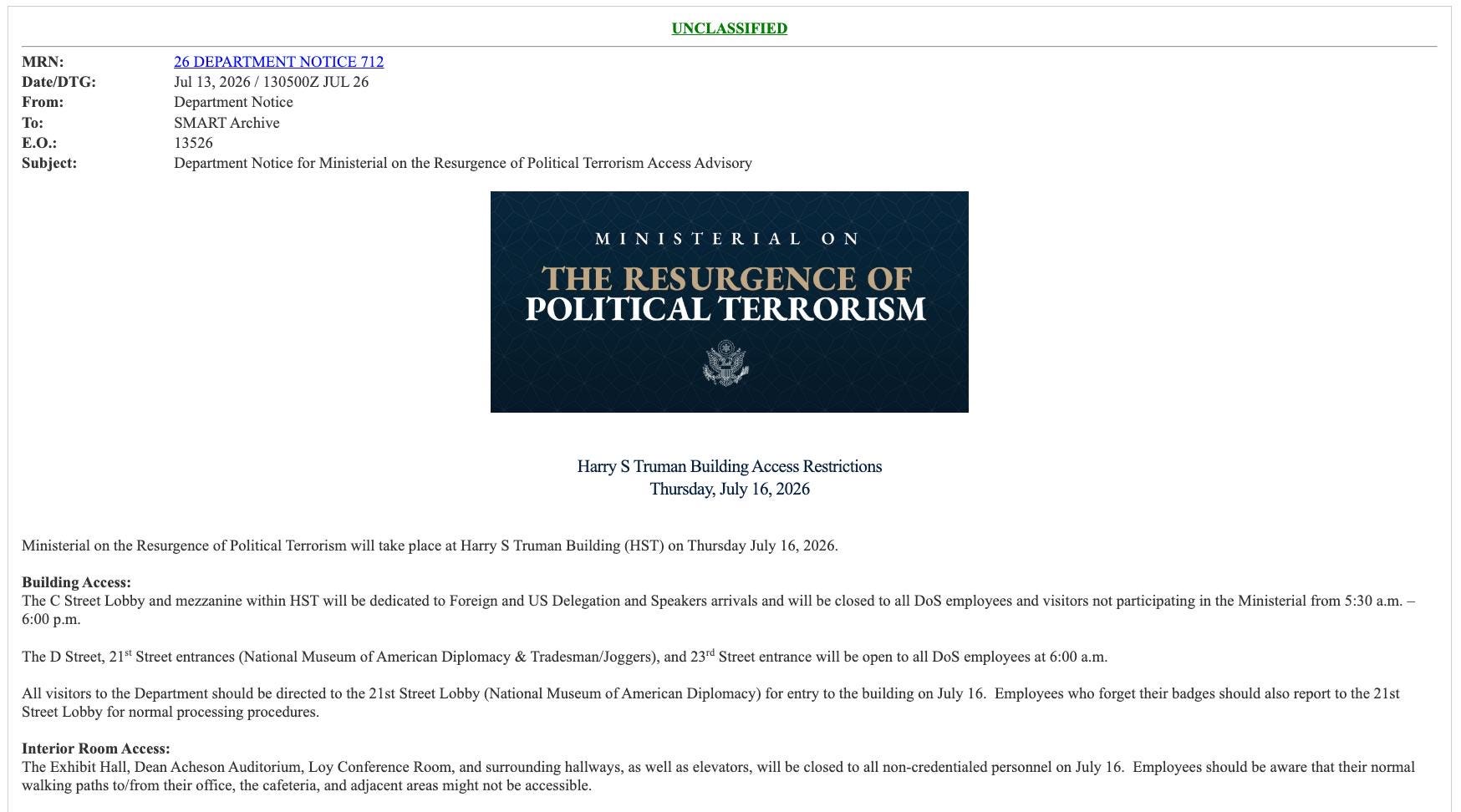
Leaked diplomatic cable
If you’ve never heard the term, it’s because the Trump administration has up to now never used it. In fact, this is the first time it’s been used by the federal government in decades.
“This summit is a vital first step in countering rising political violence worldwide, including far-left terrorism, through international collaboration,” a U.S. diplomatic cable dated July 13 says.
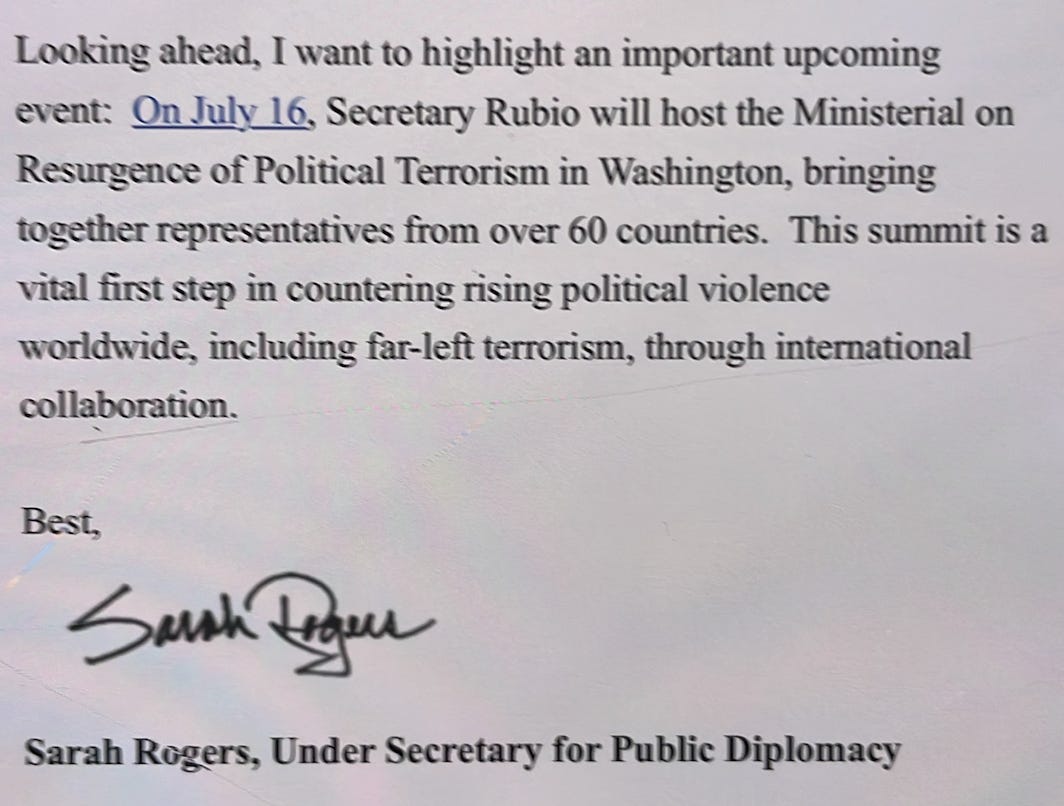
Leaked diplomatic cable
“Political terrorism” is a term first adopted by the Nixon administration for its war on “subversives,” carried out in the darkest days of the Vietnam war and a period of intense public protest. Sometimes referred to as “COINTELPRO” (an acronym for Counterintelligence Program), it was a series of covert and illegal actions by the FBI from 1956 through the early seventies that aimed to surveil, infiltrate, entrap and undermine leftist political organizations, everything from civil rights and anti-war groups to the Black Panthers.
State Department spokesman Tommy Piggot hinted at the historical significance last week.
“The resurgence of violent far-left political terrorism is not a new phenomenon — it is an old threat re-emerging with strong transnational links and new convergences,” Piggot said in a statement on the summit.
The administration’s obsession with left-wing terrorism was precipitated by the murder of conservative commentator Charlie Kirk — a personal friend of Trump’s and many in the administration. In my reporting at the time, based on interviews with friends of the alleged gunman, Tyler Robinson, I warned that there wasn’t any evidence that the murder was a partisan act, nor that he was a leftist or even political in general.
That reporting, criticized at the time in an environment where seemingly everything was polarized into Team Red White and Blue, has now been vindicated to an extent that I did not anticipate.
Just last week, Robinson’s lover, Lance Twiggs, who is cooperating with federal prosecutors, testified that Robinson barely ever discussed politics and had never once mentioned Kirk before the shooting.
It’s an extraordinary revelation, made under the clearest penalty of perjury one can imagine, given the Trump administration’s investment in framing the killing as an act of “political terrorism.” After the shooting, FBI Director Kash Patel even testified before Congress that the Bureau was investigating every other member of Robinsons’ discord chats and even the possibility of a foreign nexus. This was based on his suspicion that the killing was carried out by some kind of organized cell, a theory that promptly fell apart.
The killing was, by all appearances, just a young man with a gun, pissed off about what Charlie Kirk said about the LGBT community.
To the Trump camp, Kirk’s killing solidified their thinking that a vast conspiracy existed amongst the left to destroy the nation. Their counter to this imagined national security threat has been to link Trump’s NSPM-7 national security directive, the nihilist violent extremism label, and the executive order designating “Antifa” as a terrorist organization into a larger umbrella: “political terrorism.”
Or as I call, POLTERGEIST, because the “political-terrorism” term is an attempt by the Trump administration to summon a ghost from the Nixon years.
Perhaps the only official definition of political terrorism appears in a declassified 1970 CIA intelligence report.
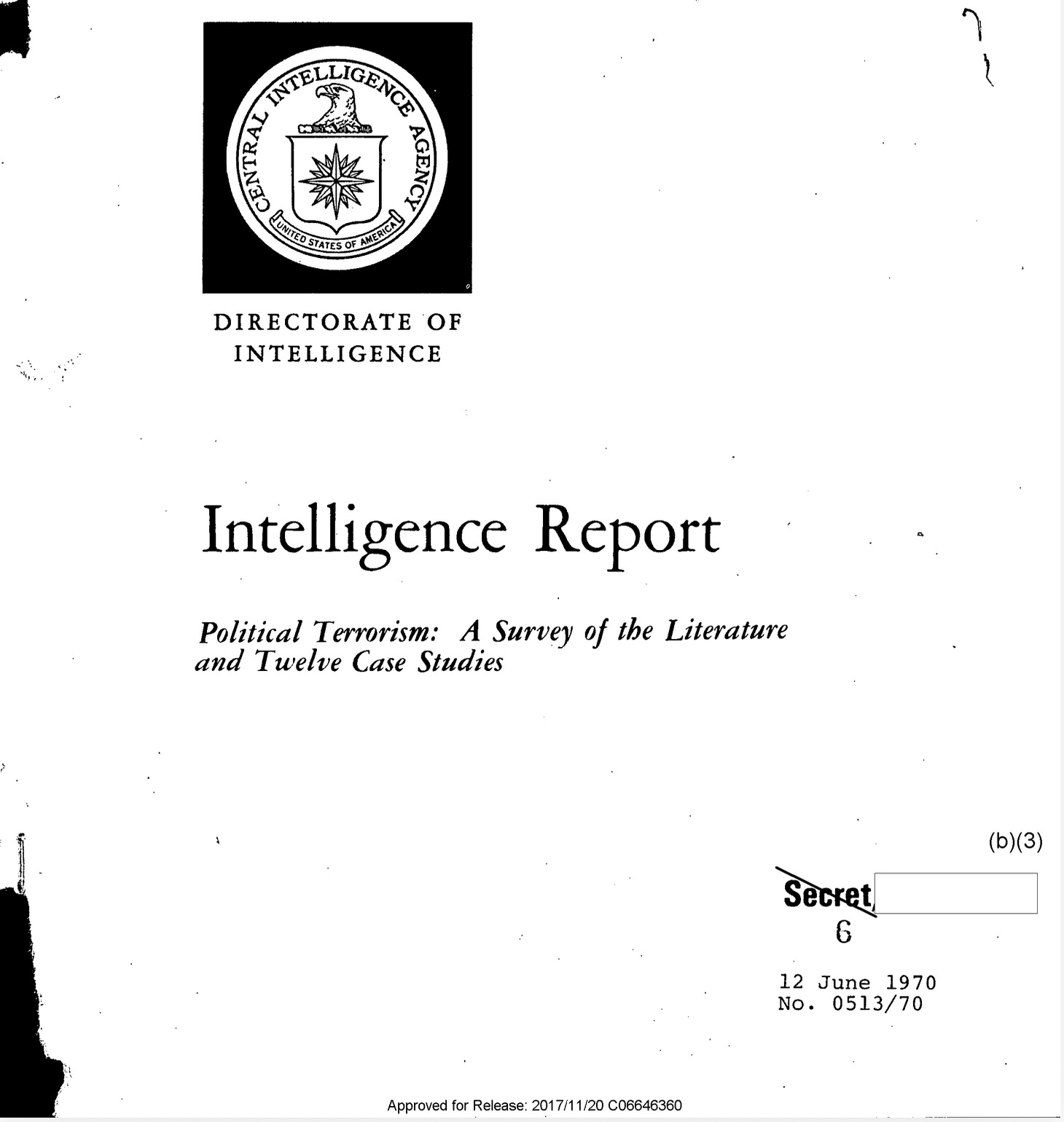
Cover of declassified CIA intelligence report.
“Political terrorism is symbolic action, by those out of power, designed to achieve political ends through the systematic use of violence,” the report says.
It goes on to differentiate political terrorism from other forms of violence, saying:
“It is distinguished from intimidation (which emphasizes threats), mob violence (normally unplanned and uncontrolled), mass insurrection (larger in scale, later in time), and governmental terrorism (presented as law-enforcement). It may be practiced by anarchists, by nihilists, by their successors the modern totalitarians, by nationalists, and by a variety of social groups with genuine or fancied grievances.”
In 1972, responding to the Black September terrorist attack at the Munich Olympic Games, Nixon issued a formal presidential memorandum that officially institutionalized counter-political terrorism by creating a Cabinet Committee. Nixon’s 1972 mandate explicitly ordered the heads of the State Department, DOJ, CIA, FBI, Treasury and other agencies to coordinate government-wide actions to “prevent terrorism here and abroad.”
Again, not terrorism as we normally think of it, but political opposition.
In response to the memo, the State Department appointed its first-ever Special Assistant to the Secretary of State and Coordinator for Combating Terrorism. Within days, the new Special Assistant was peppering the term “political terrorism” in internal memos.
1973 kissenger
Historical Documents - Office of the Historian
Unlike the Kirk assassination, the Munich Olympics massacre really was carried out by a terrorist group. Black September was a highly structured, centrally-commanded paramilitary with the explicit political goal of compelling the release of Palestinian political prisoners and forcing global visibility onto the Palestinian nationalist cause. It counted among its leaders the intelligence chief of the Palestinian Authority, Amin al-Hindi.
Now compare that with Tyler Robinson, an angsty 23-year-old from a Mormon family who was dating Lance (known to him as “Luna”) Twiggs and was upset enough about Charlie Kirk’s rhetoric on LBGT people to take action, allegedly.
In Trump’s National Security Presidential Memorandum 7, or NPSM-7, the president directs the Departments of State Treasury, Justice and various other federal agencies to prioritize investigating and preempting left-wing violence. Sound familiar?
In a section examining the effectiveness of terrorism in different political environments, the CIA report from 1970 says:
“Terrorism can pose a serious challenge to free societies in which great social injustices or severe economic problems exist (e.g. Guatemala), but terrorism does not do well in free societies in which serious grievances are not widespread [redacted].”
Good thing Americans perceive no “great social injustices” today!
===
Coalition for Independent Technology Research says ...

The GOP- led committee “won't let unelected bureaucrats waste taxpayer dollars censoring speech or pushing anti- American ideology abroad,” Mast ...Read more
The Coalition for Independent Technology Research says the US State Department is engaged in a 'brazen and far-reaching campaign of censorship' targeting researchers and anti-disinformation advocates
A group of technology researchers filed a lawsuit on Monday alleging that US President Donald Trump’s administration has adopted an unconstitutional policy that targets foreign nationals who study disinformation and hate speech on social media for visa denials and deportation.
The San Francisco-based Coalition for Independent Technology Research in a lawsuit filed in federal court in Washington argues that the administration’s policy unlawfully chills the work of non-citizen researchers in the United States.
Play Video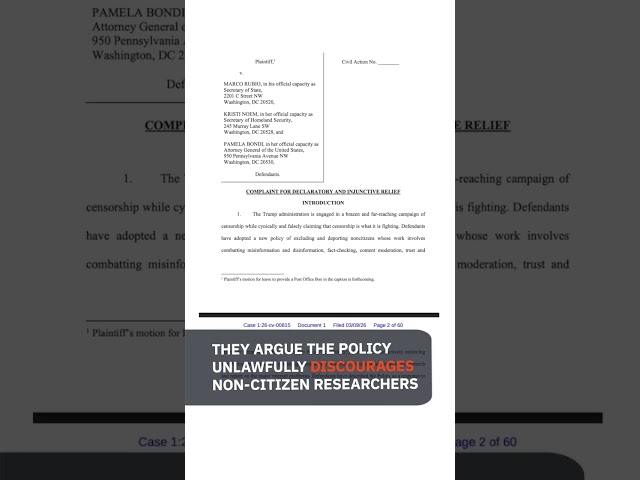
The group said the US State Department, while claiming it is fighting online censorship that Trump’s allies have argued has affected conservative speech on social media, is engaged in a “brazen and far-reaching campaign of censorship” targeting researchers and anti-disinformation advocates.
The lawsuit asks a judge to block the policy on the grounds that it violates the US Constitution’s First Amendment protections for free speech, Fifth Amendment promise of due process as well as requirements under a federal law called the Administrative Procedure Act.
“The Trump administration is using the threat of detention and deportation to suppress speech it disfavors,” Carrie DeCell, a lawyer for the coalition at the Knight First Amendment Institute at Columbia University, said in a statement.
A State Department spokesperson said in a statement that the United States “is under no obligation to admit or suffer the presence of individuals who subvert our laws and deny our citizens their constitutional rights.”
The administration has made free speech, particularly what it sees as the stifling of conservative voices online, a focus of its foreign policy, including in Brazil and in Europe.
In May, Secretary of State Marco Rubio announced a visa ban on foreign nationals “complicit in censoring Americans.” Rubio said some foreign officials have engaged in “flagrant censorship actions against US tech companies and US citizens and residents when they have no authority to do so.”
In December, the State Department imposed visa bans on five Europeans, including a former European Union commissioner and anti-disinformation activists who Rubio called “leading figures of the global censorship-industrial complex.”
The department did so after EU tech regulators that month fined Elon Musk’s social media company X 120 million euros ($140 million) in the first sanction imposed under the EU’s landmark Digital Services Act, which is intended to combat hateful speech, misinformation and disinformation.
Among the five hit by the visa ban were Imran Ahmed, the British CEO of the US-based Center for Countering Digital Hate, and Clare Melford, co-founder of the Global Disinformation Index. Their groups are members of the Coalition for Independent Technology Research, the lawsuit said. – Rappler.com
an 7 26 see fasc
Last Thursday, three speeches delivered by MAGA figureheads in the Trump administration amounted to “pronouncements” of the death of American democracy. This is according to veteran critical care physician Robert B. Shpiner, who took to the Guardian to warn of the dangerous way the White House is wielding the word “cancer” to describe its political opponents.
“The presumption that US elections are legitimate died last week in Washington,” writes Shpiner. “It did not die of one wound. It died of three, inflicted in a single day… And the country, running to the loudest of them, never examined the one most likely to kill.” Shpiner admits that while such pronouncements can seem alarmist, when his family left Russia in 1917 and Germany in 1933, “in both generations, leaving was called excessive; staying was the reasonable position. But an alarm that was right both times it sounded is not overcaution.” He asserts that the alarm sounded three times last Thursday.
“The morning belonged to the secretary of state,” writes Shpiner. “Before officials of more than 60 countries, he announced that the counterterrorism architecture of the free world, built over a generation against jihadist mass murder, should be rebuilt and aimed at the domestic left. He named a transnational enemy defined by hatred of the west, ‘a revolt of the worst against the best.’ He tied it to Iran and to Cuba and offered no evidence for either link. He said the journalists and thinktanks who might check the claims often agree with the enemy’s goals. The move is old and reliable: discredit the second opinion in advance.”
Then, writes Shpiner, “midday belonged to the White House deputy chief of staff. What he said deserves to be quoted rather than summarized, because summary is a mercy it has not earned. He called ‘leftwing political terrorism’ a ‘fatal cancer of civilization.’ He said that its politics, left to run its course, ‘always becomes a gulag.’ He said antifa demonstrators are ‘all deformed in some way, in their appearance, in their dress, in their mannerism,’ that ‘their outer appearance becomes a manifestation of their inner hatred,’ and he asked why there is ‘not one normal-looking person among them.’ He said that when the leftist protests that his rights are being violated, those appeals ‘must fall on deaf ears.’ He urged the assembled governments to be ‘completely unflinching in the pursuit of justice against these enemies of civilization.’”
Here Shpiner notes that he has practiced critical care for four decades, and that “cancer is my vocabulary, not his,” writing, “I know what happened the last time a government borrowed it. The Nazi state’s central perversion was the medicalization of killing: the enemy as tumor, as bacillus, the nation as patient, extermination as cure… When a government describes citizens as a cancer, it has written the first line of a treatment plan. On Thursday, the plan was read aloud, from a state department podium.”
Finally, writes Shpiner, “the evening belonged to the president. In primetime he called the American election system indefensible, claimed a foreign power held 220 million voter files, declared mail voting inherently corrupt, accused his own intelligence services of concealment, and told Congress that the only reason to oppose his bill is the intent to cheat. That framework converts every future outcome into evidence. Pass the bill and win: the bill worked. Fail and lose: the cheaters blocked it. A presumption of legitimacy cannot survive inside a belief system engineered to be unfalsifiable.”
Shpiner describes the media’s response in the days to come as a “triage error,” asserting that the focus fell on the “loudest injury” — President Donald Trump — and ignored “the morning’s remarks, the ones that declared a class of Americans a cancer and read enmity on their bodies.” Writes Shpiner, “I have watched teams run to the dramatic patient while the quiet one, the one not crying out, exsanguinates behind a curtain. The most dangerous words spoken in Washington on Thursday were not spoken in primetime. They were spoken before lunch, to more than 60 countries. The official transcript records the applause.”
He concludes on a grim note, writing, “In 40 years of intensive care, I have pronounced death many times. The criteria are strict because the declaration is irreversible, and so we are taught to be certain before we speak. I have also, more than once, seen a rhythm return after the room had gone quiet, when someone refused to stop compressions on schedule. This notice is filed in the knowledge that pronouncements can be premature. It is filed in the fear that this one is not.”
CNN 7 26
Secretary of State Marco Rubio and top White House adviser Stephen Miller on Thursday sought to paint a dark picture of the threat of “far-left terror” to the United States as they urged diplomats from around the world to “defend” their civilizations against the “scourge.”
In remarks focused almost entirely on the US, Miller spoke of the need to fight the “fatal cancer of civilization,” claiming that so-called left-wing terrorism, when “left to run its course, it always becomes a gulag.” He argued that the US’ political, legal, and judicial systems don’t work “if the threat of violence and terror goes on unchecked.” And he denounced Antifa protesters as “deformed,” saying, “their outer appearance becomes a manifestation of their inner hatred.”
“The greatest risk that we have is that our institutions have grown too soft and too cowardly to be able to defend themselves against a mortal threat,” Miller told a room full of representatives from more 60 countries and fellow Trump administration officials at the State Department on Thursday. “If your civilization is your home, you must defend it with the same passion and force as if an enemy intruder is inside your own house where your family lives.”
The ministerial on Thursday was meant to coalesce allies around a strategy to combat the alleged resurgence. Later on Thursday, Rubio announced a new visa restriction policy to target “members of Far-Left Terrorist and other aligned groups.”
The fight against the alleged rise of “violent left-wing extremists, including anarchists and anti-fascists,” is a key priority of the Trump administration, which has argued that they are a foremost terrorist threat to the US.
However, multiple former officials said the issue has been politicized by the administration and that the threat from the “far-left” does not rise to the level of that posed by groups like ISIS or by far-right extremists, the latter of which was absent entirely from the administration’s counterterrorism strategy released in May. And critics have expressed concerns that the strategy is an attempt to amplify the threat and target those on the political left who oppose President Donald Trump’s policies.
Rubio said the threat had been dismissed “as a right-wing fever dream, or worse, as a dangerous fascist conspiracy,” but that its resurgence is “an undeniable reality” comparable to the left-wing attacks of the 1970s.
“They can call themselves anti-capitalist or anti-imperialist, communist, or anarchist, or Marxists, but the fundamental character is always the same,” Rubio said.
Rubio called on the countries in the room to work with the US to “identify and map this threat and rebuild our counterterrorism architecture to defeat it.”
“Through intelligence and information sharing, through coordinated law enforcement strategy, through financial targeting and disruption, we will dismantle these networks brick by brick,” he said.
Treasury Secretary Scott Bessent, who also spoke at the opening session, said his department was “expanding its efforts to identify organizations that abuse charitable and nonprofit structures as vehicles for illicit finance” for alleged far-left terrorism.
Rubio’s convening of the ministerial comes not only as the matter has become a key domestic focus for the administration, but also amid growing chatter about the top US diplomat’s potential political future.
Sixty-seven countries attended the event, a State Department spokesperson said on Thursday. They represented countries mostly from Europe, although there are countries from Asia and the Western Hemisphere with representatives. Israel is the only Middle Eastern country in attendance, according to the list provided by a spokesperson.
Many of the delegations were not be led by the foreign ministers of the countries, but rather ambassadors or working-level and technical officials. Several sources cited scheduling for the lower-level attendance, with invitations to the event only being issued at the beginning of July.
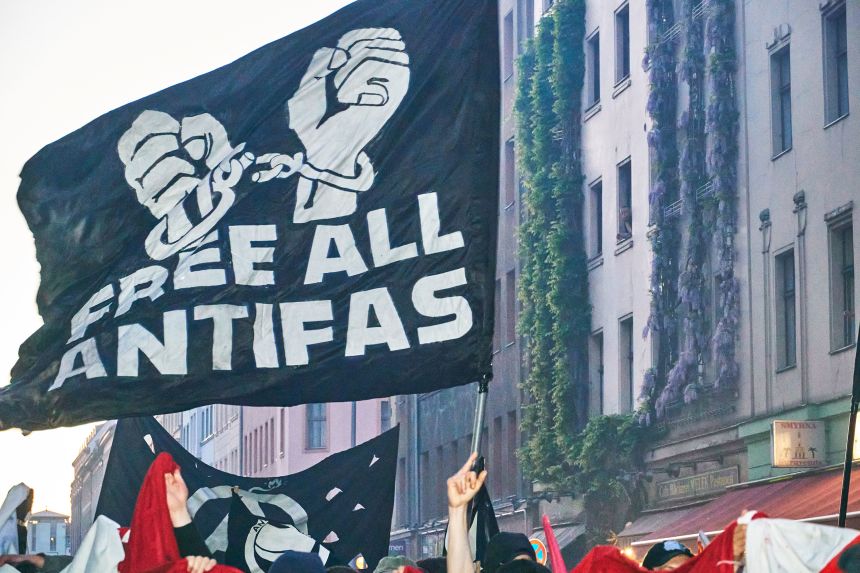
A banner reading ''Free All Antifas'' is displayed at the traditional ''Revolutionarer 1. Mai'' May Day protest in Berlin, Germany, on May 1.
Tonny Linke/NurPhotoGetty Images/File
However, former officials said the ministerial appears to be a part of the administration’s broader effort to amplify the threat to suit a domestic political agenda. Several who spoke with CNN said that the reality of the threat from far-left extremists does not match the administration’s portrayal.
“We looked at terrorism of all stripes, including left-wing terrorism, but the reality and the data, both here domestically and abroad, indicate that left-wing extremism is not and has not been the type of threat or the degree of threat that far-right terrorism or extremist violence or jihadist violence have posed,” said Ian Moss, the former deputy coordinator for counterterrorism at the State Department under the Biden administration.
Moss, now an attorney with Jenner & Block, noted that there are “other forms of violent ideological extremism, Islamist violence for starters, and then certainly violent right-wing extremists or White identity terrorists, which are a real risk, a real concern domestically and internationally, and one that the administration seems to have not focused on.”
Michael Duffin, a former senior counterterrorism adviser at the State Department, said that “never” in his nine years of working on counterterrorism “had so-called left-wing extremism risen” to a level warranting such high-level focus.
“There’s no violent extremist element, organizational element on the left, that would justify the expenditure of these resources,” he told CNN. Duffin was among many State Department officials who worked on counterterrorism who were fired last year as part of the administration’s mass firings and overhaul of the department.
Last November, the administration designated four European Antifa groups as terrorists. Throughout Trump’s second term, his administration has also ramped up domestic pressure against alleged far-left extremists.
Trump designated the anti-fascist movement Antifa as a so-called “domestic terrorist organization.” Despite claims that Antifa is a top concern domestically, law enforcement agencies have struggled to define the amorphous group, its size, locations of chapters and other basic information.
BBC 7 26
US Secretary of State Marco Rubio has urged countries to collaborate against what he called a growing threat of left-wing terrorism.
The Trump administration hosted representatives from more than 60 countries in Washington, where it argued left-wing political violence was the result of a "unique evil rooted in a deep resentment towards civilisation".
Officials made no mention of countering far-right threats, and Democrats said Rubio's focus on left-wing groups was "politically partisan".
The initiative aligns with the Trump administration's stated priority of confronting left-wing groups, particularly Antifa, a loosely organised far-left movement.
At Thursday's session in Washington DC, Rubio called for a global effort to share intelligence to counter the "transnational" issue of far-left extremism.
The invitation list included officials from most European nations, several Latin American countries and India, Indonesia and Singapore, reports the Washington Post.
The Trump administration has already designated Antifa - short for anti-fascist - as a domestic terrorist group.
At the session, White House deputy chief of staff Stephen Miller characterised leftists as "fundamentally motivated by envy, by hatred, by jealousy".
Also on Thursday, the state department announced visa restrictions targeting members of what it labels as "Far-Left Terrorist and other aligned groups", including those that have allegedly participated in "economic sabotage".
Washington has already designated four European groups as Foreign Terrorist Organizations: Antifa Ost (based in Germany), the Informal Anarchist Federation/International Revolutionary Front (Italy), Armed Proletarian Justice (Greece) and Revolutionary Class Self-Defense (Greek).
Eleven Democratic lawmakers wrote to Rubio on Wednesday questioning whether his focus on left-wing groups might target lawful protests and political opponents.
"We strongly urge the Department to return its focus to a serious mission set that is definitionally apolitical, data-driven, and rooted in reality," said the letter, obtained by Reuters news agency.
The lawmakers suggested the state department was "rubberstamping the political priorities of extremists within the Administration".
Research presents a mixed picture of far-left and far-right extremism in the US.
A 2025 report by the Center for Strategic and International Studies, a think tank, found that left-wing terrorism had surpassed that from the far right for the first time in more than 30 years, although it also said incidents from both sides were relatively low.
However, the US justice department last year quietly removed from its website a 2024 internal study indicating that far-right extremists were responsible for the bulk of ideologically motivated deaths.
What is Antifa and why is President Trump targeting it?
AN 7 26
Secretary of State Marco Rubio is often described as a traditional conservative in an administration dominated by far-right MAGA Republicans, Donald Trump loyalists and conspiracy theorists — a holdover from an era in which President Ronald Reagan, not MAGA, was the dominant influence in the Republican Party. But according to The New Republic's Malcolm Ferguson, Rubio catered to MAGA themes in a big way when, on Thursday morning, July 16, he hosted a "Ministerial on the Resurgence of Political Terrorism" and focused heavily on "left-wing political terrorism."
The attendees, according to Ferguson, ranged from Israeli Foreign Minister Gideon Saar to Trump allies who included FBI Director Kash Patel, Treasury Secretary Scott Bessent and White House adviser Stephen Miller.
Rubio told attendees, "This is what radical leftism is. They may wear various different slogans and ideologies across place and time. They can call themselves anti-capitalists, or anti-imperialists, communists, or anarchists, or Marxists. But the fundamental character is always the same.... It is a poisonous resentment cloaked in the language of equality, justice, liberation — an overwhelming need to tear down what greater men have built.... Through violence and through terror, they once again seek to impose their ugliness on all of us.”
During the event, Miller promoted Trump's National Security Presidential Memorandum directive, AKA NSPM-7 — which claims to address violence on the left.
Miller said of the memo, "It directs.… all of our law enforcement and intelligence agencies to work together to disrupt, identify, defund, debank, arrest, and prosecute these political terrorists that are operating in our country. Left-wing political terrorism seeks, as its ultimate end, the overthrow of our system and form of government — and we've seen this has taken place…. many times, in many places, throughout the years.”
The Trump adviser continued, "Left-wing terrorism always ends in bloodshed, misery, and suffering. It only can travel in one direction. There's no point at which the left-wing terrorist is satisfied with his gains, and ceases progressing.... It always becomes a gulag, it always becomes the mass imprisonment of political enemies, the stripping of their rights and freedoms.… in order to establish complete and total control."
But Ferguson, in his New Republic article, emphasizes that political violence is hardly unique to the left in the United States.
"It's so interesting to watch these people wield what they see as this infallible moral compass, never once considering that they — and their predecessors — have created many of the conditions which have forced people to resist, whether it be abroad or domestically," Ferguson comments. "Furthermore, this blanket definition of left-wing terrorism is not rooted in reality; it's to serve their NSPM-7 agenda, to crack down on dissidents. Meanwhile, they continue to fully ignore the right-wing terrorism that this administration has not only ignored, but fostered."
---
...For far too long, however, our counterterrorism doctrine has had a blind spot – a blind spot when it comes to extremist violence from the political left. Even today, the very idea that far-left terrorism could be a serious threat is treated as a right-wing fever dream, or worse, as a dangerous fascist conspiracy. It’s treated this way by many in the press, by many in academia and our universities, and by many of our legacy institutions. You will no doubt see the dogma rear its head in the coverage of this very conference. In spite of the clear and the undeniable reality, in spite of the objective numbers and statistics, in spite of the fact that in this room today there are representatives from across the political spectrum, we will hear this organized – that this kind of organized violence and terror will be dismissed. It will be dismissed as a partisan fiction.
A whole industry grew up in our countries around the study of extremism. We have think tanks and fellowships and journals and consultancies, with the unspoken understanding among them that the only kind of political violence that was a true threat to our system – I’m sorry – that only one kind of political violence was a true threat to the system. A bomb planted by a neo-Nazi group was a nefarious and murderous act of evil. It is. But a bomb planted by a Marxist revolutionary – well, that’s just merely a tragic excess of idealism. Perhaps its means were misplaced or overzealous, but its ends were virtuous and just. That’s the implication of how they treat it.
For years, this extraordinary ideological prejudice was embedded in the way we talked about political violence and extremism. It was repeated again and again, until it was accepted as the neutral and objective baseline, so entrenched – so entrenched in the mainstream conventional wisdom that it came to be regarded as an apolitical fact. It is the reason why, here in my country, so many people in positions of power have repeatedly dismissed acts of violence and even terrorism as legitimate forms of political expression so long as they served a left-wing cause.
It is why during those George Floyd – so-called George Floyd – riots in the summer of 2020, as criminals and extremists burned and looted their way through American great – America’s great cities and nearly brought the country to its knees, city governments all across the country simply refused to prosecute the people conducting these acts of violence and terror. It is the reason for the now infamous image – and you all recall this – of a news anchor from a very prominent agency – a news anchor standing in a neighborhood consumed in flames; meanwhile the chyron on the bottom read that the protests were mostly peaceful. This was something worse than a double standard. Left-wing violence was not just excused; it was treated as sacrosanct, a protected class unto itself. That era has to end.
...
The simple fact is none of this that I’ve just described is new. Far-left political terrorism is not a recent-day, modern novelty. It is not a fiction manufactured by conservative politicians. For most of the modern era, it was, in fact, the dominant form of political violence. Every one of our friends here from the nations of the Western Hemisphere remember – remember the decades of kidnappings and bombings and assassinations and executions, the violent terror of the Tupamaros, of the Montoneros, of the FARC, of the ELN. You remember the inhuman savagery of Peru’s Shining Path, the Maoist fanatics who massacred the peasant villages of Peru, hacking pregnant women and newborn infants to death with axes and machetes. You remember the tens of thousands of Marxist guerrillas trained to kill in Castro’s terrorist camps.
All of you here from Europe remember. You remember the machine gun massacres of Italy’s Red Brigades, which held the five-time prime minister captive for 55 days before subjecting him to a revolutionary, so-called “people’s trial” and executing him in 1978. You remember the Red Army Faction’s nearly three-decade campaign of bombings, kidnappings, and assassinations in Germany, murdering dozens and injuring hundreds more. You remember the 17 November organization in Greece, the Marxist extremists that terrorized Athens for more than a quarter century, including, by the way, shooting my country’s CIA station chief dead outside of his home in front of his wife as they were returning home from a Christmas party.
And here in America we remember. We remember the same reign of deadly terror, justified by the same slogans, motivated by the same wicked ideas. We remember the Weather Underground, which bombed the Pentagon, which bombed the State Department, and bombed the Capitol. We remember the Black Liberation Army, which staged armed robberies and executed police officers at point-blank range. We remember the Symbionese Liberation Army, which shot a public-school superintendent to death with cyanide-packed hollow-point bullets. In one 18-month period between 1971 and 1972, the FBI counted some 2,500 bombings on American soil, a rate of nearly five a day. The overwhelming share of that violence came from left-wing extremists. Between 1970 and 1980, 93 percent of terrorist attacks in the West came from the far extremist left.
These are numbers that would shock most Americans today because we’ve been taught to believe that this kind of political violence, it simply doesn’t exist or it’s being exaggerated. But it does exist, and we’re actually underestimating it, and our nations bear the scars to prove it.
And today, we face a new wave of this old evil. Here in the United States, the share of left-wing terrorist attacks and plots has risen to levels not seen in decades. In Germany, far-left violence has jumped by more than 40 percent in just the last year alone. In Greece, more than 80 percent of radical violence is now driven by far-left and anarchist actors. These are not abstract statistics.
Americans have seen what those numbers mean – an all-out assault on our immigration officers, sniper attacks, explosives, armed ambushes. A transgender shooter opening fire on Catholic elementary school students as they pray, his gun marked with slogans like, “Where is your God now?” A health care executive executed in cold blood in the streets. Multiple assassination attempts on a sitting president. And the murder of the greatest conservative activist of a generation, a man who happened also to be a husband and the father of two young children, shot and killed while speaking to a crowd of students.
This is a distinctive and unique evil. It has always been driven by a hatred above all else, a hatred for civilization itself. It is a revolt of the worst against the best, a revolt of the weak and the cowardly against the strong and the good. It is perpetrated by those who cannot build, who cannot create, who cannot achieve great things, and take their revenge upon the world for their own inadequacy by seeking to destroy those who can. This is what radical leftism is. It may wear various different slogans and ideologies across place and time. They can call themselves anti-capitalist or anti-imperialist or communist or anarchist or Marxist. But the fundamental character is always the same. It’s always the same.
It is a poisonous resentment cloaked in the language of equality and justice and liberation, an overwhelming need to tear down what greater men have built, to wreck what is beautiful and what is right on behalf of people who are only filled with ugliness and have nothing else to offer the world. Through violence and through terror, they once again seek to impose their ugliness on all of us. The old dogma was wrong. The old dogma was wrong; none of this is driven by idealism. It is not utopian. In fact, it is the opposite.
One of the criticisms you sometimes hear of communism, for example, is that it sounds good in theory, but it never works in practice. That’s actually not true. Communism does not sound good in theory. The world it envisions for all of us is small, flat, grey, leveled of all exception, drained of all that is good and noble in the human soul. The world it envisions is a world without courage, a world without creativity or ambition, a world without heroes or glory or great causes to strive towards, without – a world without miracles, without myths, without men who rise above the rest to do incredible and extraordinary things. And the world communism envisions is a world without God.
For these architects of revolutionary violence, the towering achievement of our civilization – for them it’s an unbearable humiliation, a reminder of what they cannot do and a reminder of what they cannot be. So they choose instead to destroy. They attack pipelines; they attack railroads; they attack power grids and laboratories, the physical embodied symbols of power and invention and achievement. This is the nature of the terrorism we face today. They despise the West because the West is great.
This is an international conference because we are facing an international – we are facing a transnational threat. These are not distinct and isolated cells. They are interconnected networks. They do not recognize our borders. They do not believe, in fact, in the nation state itself. They coordinate, they communicate, they travel, they train, and they act together, sharing the same infrastructure, sharing the same enemies, sharing the same mission. Antifa militants and their comrades travel from across Europe and to the Americas to participate in each other’s attacks, to funnel propaganda and training materials and target information through shared encrypted channels, moving through underground networks of safe houses and finance, and sustain their operations through transnational funds.
And they work alongside hostile foreign states that share their mission, like Iraq’s – Iranian proxy networks who are increasingly intimately tied to leftist militant groups around the world. The Cuban regime’s sprawling intelligence and ideological network helped to build the far-left in our country and in our hemisphere, and it remains inextricably linked to the far-left groups and movements across and beyond the West.
Today’s far-left terrorists can raise money in one country; they can host their communications in a second country; they can receive training in a third country; they can recruit militants in a fourth country, and then together strike a target in a fifth country. And so, we have no choice but to confront this menace together. We will either cooperate across our borders or the terrorists will continue to exploit the gaps between them.
Under President Trump, for the first time, the United States is building the infrastructure, the partnership, and the strategy to defeat the scourge of far-left terror. The President signed National Security Presidential Memorandum number 7, outlining a comprehensive strategy to investigate and disrupt Antifa terror networks and their allies. Last November, the State Department designated four violent far-left extremist groups as Foreign Terrorist Organizations, and there will be more designations soon.
In December, we announced Rewards for Justice offering up to $10 million for information disrupting the financing behind these groups. In May, we convened the first Counter Terrorism Law Enforcement Workshop, joining American law enforcement officials and their counterparts in our partner country – nations together to map and develop strategies for dismantling these networks. The next workshop will be co-hosted with our partners in Germany. The coalition we’re building together is already bearing fruit, and we are here today to build on that work.
We can – and we must – identify and map this threat and rebuild our counterterrorism architecture to defeat it. Just as we have done together before, now we must do it together again. Through intelligence and information sharing, through coordinated law enforcement strategy, through financial targeting and disruption, we will dismantle these networks brick by brick. It is time for the people of the civilized world to defend ourselves, to stand united against this encroaching darkness, and fight – fight for what is ours.
It is easy to destroy great things; it is far more difficult to make them. The enemies of civilization are only capable of the former. They are only capable of destroying great things. All they know is destruction. But we have built great things together. We have done it time and again. We know what we must do, and now we must do it.
Thank you for coming today. (Applause.)
...
AN 726
Military leaders are putting together military options for President Donald Trump possible actions against Cuba.
While Trump has rebooted his war in Iran, he's also looking at what's next and they're trying to keep it quiet, CBS News reported on Wednesday.
"Military planners have in recent weeks examined a range of options for possible action against the island, including an Army-led air assault involving thousands of U.S. soldiers to be carried out by the 101st Airborne Division, the only unit trained for such a task, according to multiple U.S. officials with knowledge of the discussions," the report said.
Officials who spoke to CBS News did so anonymously and stressed that there's no final decision by Trump on whether he'll carry out the operation.
The report noted that such an operation would "confront the Pentagon with a significant problem because much of the U.S. military's attention and some of its most valuable offensive capabilities are already committed elsewhere."
In June, the U.S. military met to conduct a "concept-of-operations briefing," which dealt with the early-stage military planning that could involve a Cuba attack, the officials said.
CBS News said that such briefings are "routine" because the military wants to give the president a large range of options and "contingencies."
an7 26
According to the latest reports, Ken Griffin — a prominent Republican donor who spent upwards of $100 million on the last election — has decided who to back in the 2028 presidential race.
Ken Griffiin is famously anti-MAGA, and this latest news represents a growing tide of Republicans who are backing Marco Rubio rather than Vance, the latter of whom was once considered the heir apparent to President Donald Trump but whose star has fallen in recent months.
Griffin’s intentions were revealed during the annual Allen & Company conference in Sun Valley, Idaho, where the billionaire hedge fund manager told financial journalist Andrew Ross Sorkin he was “predisposed” to support Rubio, whom he backed previously during the 2016 GOP primary. Notably, Griffin donated neither to President Donald Trump’s campaign nor his MAGA Inc. super PAC during the 2024 election, instead throwing his money and platform behind former U.S. Ambassador to the United Nations Nikki Haley.
Neither of the current White House officials has officially thrown their hat into the ring, and according to the Hill, “Vance and Rubio have repeatedly deflected regarding whether they will run to succeed the term-limited Trump in 2028 — with the latter telling Vanity Fair last year he will defer to Vance if the vice president seeks the nomination…Trump has not explicitly endorsed a candidate, with roughly 18 months to go before the Iowa Republican caucuses. But he said last month a Vance-Rubio ticket would be formidable for their Democratic opponents.”
While most polls show Vance firmly in the lead on the question of who will take the GOP nomination in 2028, Republican insiders have spoken of a “shadow” effort to get Rubio elected since early this year. At the same time, Vance experienced a string of high-profile embarrassments, arguably the most looming being the troubled negotiations for peace with Iran that he helmed and fumbled initially. And while he was getting hammered by bad headlines, Rubio was enjoying favorable press and assignments as he accompanied Trump to UFC fights and flew off to make nice with the Pope. As a result, there has been growing buzz around his candidacy.
Some in the Republican Party, however, say that Rubio’s 2028 chances have been overstated.
W. James Antle III of the American Conservative, for example, wrote, of Rubio “being feted as a throwback to pre-Trump Republicanism, which is also why he is currently being overrated for 2028. That’s not to say that a Rubio nomination can’t happen. There are, however, some roadblocks that are being widely ignored in favor of viral clips that make people misty-eyed for the return of Ronald Reagan.” He thinks Rubio will be unable to walk the “tightrope” between MAGA and those who want to see a “major departure” from Trump. Rubio has also been linked to the disastrous war with Iran, and he’s never fared well in a national election.
Conservative commentator Ann Coulter was more unvarnished in her assessment of Rubio, saying he was a “half-wit” whose presidency would be an “unmitigated disaster.”
---
LOOKS MISERABLE STANDING BEHIND TRUMP ON IRAN MOU
---
06/22/26
---
---
new ap
By ELLEN KNICKMEYER and DAVID RISING
Updated April 4, 2025
WASHINGTON (AP) — Day after day, Chinese rescue teams haul children and elderly people from collapsed buildings as cameras beam the thanks of grateful survivors around the world. Russian medical teams show off field hospitals erected in a flash to tend the wounded.
Notably absent from the aftermath of the 7.7-magnitude earthquake in the poor Southeast Asian nation Myanmar: the uniquely skilled, well-equipped and swift search-and-rescue teams and disaster-response crews from the United States.
In this photo released by Xinhua News Agency, rescuers move a survivor out from a collapsed building in the aftermath of an earthquake in Mandalay, Myanmar, Monday, March 31, 2025. (Cai Yang/Xinhua via AP)
At least 15 Asian and Western government rescue teams have landed crews reaching hundreds of workers in size, alongside initial pledges of financial aid reaching tens of millions of dollars, as the death toll of the March 28 quake tops 3,000, Myanmar’s government says. Cameras showed Vietnam’s team on arrival, marching square-shouldered to the rescue behind their country’s flag.
While Myanmar’s military junta and civil war have posed challenges, the U.S. government has worked with local partners there previously to successfully provide aid for decades, including after deadly storms in 2008 and 2023, aid officials say.
The American government dwarfs other nations’ rescue capacity in experience, capacity and heavy machinery able to pull people alive from rubble. But in Myanmar after the most recent quake, the U.S. has distinguished itself for having no known presence on the ground beyond a three-member assessment team sent days after the quake.
“We all worried what would be the human impact” of President Donald Trump’s dismantling of the six-decade-old U.S. Agency for International Development, said Lia Lindsey, a senior humanitarian policy adviser for Oxfam, which scrambled to provide tents, blankets and other aid to quake survivors.
Now, Lindsey said, “we’re seeing it in real time. We’re seeing it in increased suffering and increased death.”’
A retreat from decades of American policy may be fueling the absence
The United States, the world’s largest economy, long saw its strategic interests and alliances served by its standing as the world’s top humanitarian donor. Myanmar’s quake is as close to a no-show as the nation has had in recent memory at a major, accessible natural disaster.
Current and former senior private and government officials say the Myanmar disaster points to some of the results — for people in need on the ground, and for U.S. standing in the world — of the Trump administration’s retreat from decades of U.S. policy. That approach held that Washington needs both the hard power of a strong military and the soft power of a robust aid and development program to deter enemies, win and keep friends and steer events.
Secretary of State Marco Rubio, in Europe for a NATO gathering, rejected a suggestion that the administration was ceding influence abroad by canceling thousands of its aid and development contracts, including for disasters. He told reporters that those complaining were the aid groups, which he accused of profiting off past U.S. aid.
U.S. Secretary of State Marco Rubio talks to the reporters at NATO Headquarters in Brussels, Friday, April 4, 2025. (AP Photo/Jacquelyn Martin, Pool)
“We will do the best we can,” Rubio said Friday. “But we also have other needs we have to balance that against. We’re not walking away.”
He pointed to “a lot of other rich countries in the world. They should all be pitching in and do their part.” deflection SOP
Leading Senate Democrats wrote Rubio this week, urging him to scale up U.S. disaster aid to Myanmar — and fast. Separately, Delaware Sen. Chris Coons, a Democratic member of the Senate Foreign Relations Committee, spoke of watching a news broadcast of the disaster showing Chinese government teams at work.
“It hurt my heart to see where, instead of a USAID ... team leading the response, there was a team from the PRC that was being celebrated for having saved some people in the rubble,” Coons said.
The 2 1/2-month-old Trump administration, through Elon Musk’s Department of Government Efficiency teams, has frozen USAID funding, terminated thousands of contracts and is firing all but a handful of its staff globally. It accuses the agency of waste and of advancing liberal causes. The Myanmar quake is the first major natural disaster since that work started.
The Trump administration and some Republican lawmakers say they will reassemble a reduced slate of aid and development programs under the State Department, fitting their narrower interpretation of work that serves U.S. strategic and economic interests.
The first announcement of help came days later
Days after the Myanmar quake, the U.S. made its first announcement of help: It was sending a three-member assessment team of non-specialist advisers from a regional USAID office in Bangkok, Thailand. Coincidentally, like hundreds of other USAID staffers around the world, the three had received layoff notices from the Trump administration on March 28 within hours of the quake, current and former USAID officials confirmed.
The administration also promised $2 million in aid, and announced another $7 million Friday. But there’s a much larger number at play.
That $9 million total is dwarfed by the roughly $2 billion in payments for previously rendered services and goods that the Trump administration has owed nonprofit humanitarian groups and other contractors and government and nongovernment foreign partners, aid officials say. The Trump administration abruptly shut down USAID and State foreign assistance payments — including for work already done — on Jan. 20, Inauguration Day.
Combined with abruptly terminated aid contracts and the freeze on the USAID and State aid and development payments, the U.S. back debt is forcing larger aid operations and businesses to scale back their services to people in need and to slash staff. Some smaller organizations were driven out of business. That was even before the Myanmar quake.
Under court order, the administration is slowly making good on those back payments.
In the meantime, nonprofit groups are having to draw on reserve funds they would normally use for sudden unplanned disasters like the Myanmar quake to pay the bills that the U.S. should have paid, said Lindsey, the Oxfam official.
Michael Dunford, World Food Programme Country Director in Myanmar, hands aid boxes to earthquake survivors at Ottara Thiri Hospital in Naypyitaw, Myanmar, Sunday, March 30, 2025. (Diego Fernandez/World Food Programme via AP)
Asked about the burden that the non-government organizations — another name for aid groups — say USAID’s unpaid back bills are placing on their work, the State Department said in an email, “The U.S. government cannot comment on how NGOs manage their financing.”
Typically, the United States itself would have provided $10 million to $20 million in the initial phase of response to a disaster like the Myanmar quake, with more later for long-term aid and rebuilding, said Sarah Charles, who ran disaster response and overall humanitarian affairs at USAID in the Biden administration.
“We have a long history in Burma,” Charles said, adding, “It’s an environment that the U.S. government has been operating in over the last many decades.”
Normally, the United States also would have had 20 to 25 specialized disaster workers on the ground in as few as 24 hours, Charles said. That number would have jumped to 200 or more if USAID had flown in urban rescue teams from California and Virginia. They deploy as self-contained units, with dog handlers and the capacity to feed and provide clean water to the teams, Charles said.
The Trump administration preserved contracts for the California and Virginia rescue teams under pressure from lawmakers. But the contracts for their transport are believed among the thousands of USAID contracts that the administration canceled. That left the U.S. no quick way to move search-and-rescue crews when disaster struck, Charles said.
Britain has pledged $13 million in aid and said it will match up to $5 million in private donations, and China and others have promised financial aid. At least 15 countries sent in dozens or hundreds of rescuers or aid workers, including Russia, China, India and the United Arab Emirates, according to Myanmar officials.
China shares a border and close ties with Myanmar. Chinese rescuers had their first success Sunday, fewer than 48 hours after the quake, when they joined hands with local people to pull an elderly man from a badly damaged hospital in the capital city of Naypyitaw.
By Wednesday, Chinese rescuers had pulled out nine survivors, including a pregnant woman and a child. In Mandalay, Chinese rescuers saved a 52-year-old man who trapped for nearly 125 hours.
---
5 26
[### Federal judge blocks US sanctions against UN rapporteur ...

Al Jazeera
https://www.aljazeera.com › ... › Israel-Palestine conflict](https://www.aljazeera.com/news/2026/5/14/federal-judge-blocks-us-sanctions-against-un-rapporteur-francesca-albanese)
11 hours ago — UN Human Rights Council Special Rapporteur Francesca Albanese was sanctioned in July 2025 after she publicly criticised Washington's policy on ...Read more
AI Overview
+4
A U.S. federal judge has temporarily blocked sanctions imposed by the Trump administration on UN Special Rapporteur Francesca Albanese, who was penalized for accusing Israel of war crimes in Gaza. Sanctioned in July 2025 by Secretary of State Marco Rubio, the measures aimed to freeze her assets and ban her from the U.S. due to her reports on Gaza, which also implicated U.S. companies.
 Al Jazeera +3
Key Details on the Sanctions and Legal Challenge
- The Sanctions (July 2025): The U.S. imposed sanctions on Albanese under Executive Order 14203, citing her advocacy for International Criminal Court (ICC) action against Israeli and U.S. officials.
 Human Rights Watch +1
- Court Action (May 2026): A U.S. federal judge temporarily blocked these sanctions, finding that the administration likely violated her free speech rights, The Guardian reports.
The Guardian
- Controversy: The sanctions sparked outcry from Human Rights Watch, which accused the U.S. of attempting to silence a UN expert for doing her job. Other reports indicate this is a "defining moment" for whether the UN defends its own mandates against political pressure, Middle East Monitor notes.
 Human Rights Watch +1
- Context: Albanese, an Italian lawyer, has served as the UN Special Rapporteur on the Occupied Palestinian Territories since 1 May 2022.
---
AN 5 26
Veteran diplomats and Democratic lawmakers are raising the alarm about a private conservative group they accuse of spreading “Trumpian ideas” throughout the State Department. According to reporting by the New York Times, the Ben Franklin Fellowship has been criticized for its invitation-only mission to “identify and recruit diplomats based on ideology.”
While the group claims to be nonpartisan, its founders and members explicitly “aim to promote conservative policy ideas and combat pro-diversity policies.” It regularly posts “pro-Trump” content on its website and works in tandem with Republican officials.
Said the Times, “Critics have likened the fellowship to a secret society that is trying to seed Trumpian ideas throughout the department by helping the office of Secretary of State Marco Rubio promote career diplomats who exhibit conservative ideology — including many of the group’s members.” This is a major break from tradition, as “unlike political appointees, career diplomats have traditionally embraced a culture of nonpartisanship.”
Rubio has been accused of “weakening and demoralizing” the department by firing its most experienced diplomats and experts while appointing and promoting those aligned with President Donald Trump, including many Ben Franklin fellows. While some veteran diplomats who spoke with the Times agreed that the department could use improvement, “they insist the changes under Mr. Rubio have gone too far.” On Tuesday, for example, alarm was raised after the State Department fired over 200 Foreign Service officers.
All of this, say critics, is part of Trump’s mission to rid the agency and government of a “woke” mindset. The Ben Franklin Fellowship’s overwhelmingly white, male membership speaks to that goal, and since it has worked its way into the agency, current and former diplomats have “denounced a new State Department video recruiting campaign with imagery that almost exclusively features white men. It includes many black-and-white photographs of early- and mid-20th century workers, recalling an era when the diplomatic corps was mockingly known for being ‘pale, male and Yale.’”
According to State Department spokesman Tommy Pigott, “We have one fundamental goal: to implement President Trump’s America First foreign policy.”
As the Times notes, “As a 501(c)3 nonprofit group, the group is not required to disclose its funding sources publicly. It was the recipient last year of a financial ‘innovation prize’ from the Heritage Foundation, which hailed it for ‘rejecting ideological conformity’ and ‘producing a new generation of diplomats committed to an America First vision.’”
:{:{On Monday, Representative Gregory W. Meeks (D-NY), who sits on the House Foreign Affairs Committee, sent Rubio a letter demanding “immediate clarification” of the group’s role in the department. “The letter noted that at least 25 of the group’s members, known as fellows, hold senior State Department jobs. }:
The highest ranking fellow in the agency is Christopher Landau, the deputy secretary of state.” Another, Lew Olowski, who previously served as general counsel for Tucker Carlson’s The Daily Caller News Foundation and has inveighed against career diplomats who testified during Trump’s first impeachment, “is now the top official in the office of foreign missions, which oversees U.S. embassies and consulates worldwide.”}:
According to John R. Bass, a career diplomat and three-time ambassador who retired last year after serving in two under secretary roles, the Ben Franklin Fellowship is “the opposite of a meritocracy,” and “its selection process is nontransparent, its application process is nontransparent, its funding is nontransparent.”
Eric Rubin, another retired diplomat with over 40 years of experience, including as the head of the American Foreign Service Association, recently wrote that the fellowship “functions as the equivalent of a Communist Party cell in Soviet government ministries.”
---
an 5 26
Many of President Donald Trump's appointees received widespread opposition from Senate Democrats, but a major exception was Secretary of State Marco Rubio. Not a single Senate Democrat voted against confirming the former U.S. senator.
Trump made a point of filling his administration with ultra-MAGA loyalists, from Defense Secretary Pete Hegseth to former Homeland Security Secretary Kristi Noem. Rubio, however, is known for being a traditional conservative and an establishment Republican — and Democrats who voted to confirm Rubio hoped he would be a voice of reason as secretary of state.
But Salon's Chauncey DeVega, in a biting article published on May 5, argues that Rubio has seriously "sacrificed his values" in order to survive in the second Trump Administration.
"While also attending to Trump's needs," DeVega explains, "Rubio has been busy remaking the State Department in the MAGA image — an act that is undermining democracy at home and accelerating strategic failures abroad. What the administration calls 'America First' is, in practice, white racial authoritarianism and white Christian nationalism that governs who and what is deemed to be in America's vital interests."
DeVega notes that during the Cold War, the U.S. State Department "emphasized cultural pluralism" and "inclusiveness" with its "public messaging" — as officials realized that "American diplomacy takes place around the world."
"During the Cold War," the Salon journalist recalls, "America's elites understood that racism at home made America weak abroad…. Jim and Jane Crow were an international embarrassment, giving the Soviet Union a powerful counternarrative about American hypocrisy and the color line…. The State Department, meanwhile, deployed jazz diplomacy and other cultural outreach programs to project, in a carefully curated way, an image of American diversity as a weapon against communism and authoritarian regimes. These traditions have been largely abandoned under Rubio at the behest of Trump."
According to DeVega, Trump's "America First" purity tests for State Department employees are hurting the U.S. from a foreign policy standpoint.
"Limiting the number of Black and brown diplomatic corps members at a time when China is making great inroads in Africa and other parts of the non-white world through infrastructure development, securing rare earth and other vital resources, and building military bases is a strategic blunder," DeVega writes. "The (State) Department has also overseen the systematic dismantling of America's soft power. The gutting of the U.S. Agency for International Development (USAID) and related programs that support public health have already contributed to an estimated 762,000 preventable deaths…. Since Trump's return to power, the United States has been repositioning itself as an explicitly Judeo-Christian nation — and government departments and agencies are following suit."
DeVega notes that Rubio "was a strong advocate for global democracy" during his years in the U.S. Senate but has "abandoned" that outlook to please Trump.
"He wanted America to be more confrontational with Russia and backed Ukraine in its freedom struggle," DeVega observes. "Now, while enduring the president's humiliation rituals — the public debasements Trump uses to test and bind the loyalty of those around him — Rubio has adopted his values…. Rubio sacrificed his values and the storied institutional legacy of the State Department itself to be in closer proximity to Donald Trump, a chaos agent — and America's reputation and power are collapsing."
---
===
an 3 26
...
Landa has repeatedly filed lawsuits in response to allegations against nursing homes with which he is affiliated. In 2022, he brought a suit for libel against The American Prospect, as well as one of its reporters and an editor, following an investigation titled “The Nursing Home Slumlord Manifesto.” Years earlier, he sued freelancers writing for ProPublica, also alleging defamation. Judges dismissed both cases.
Landa’s nomination remains under consideration by the Senate Foreign Relations committee. (No hearing has been scheduled.) But if confirmed as ambassador to Hungary, Landa would hold a powerful position.
Hungary, despite its small population and historically minor role in U.S. foreign policy, holds increasing symbolic importance in the global conservative movement.
In a mid-February visit to Budapest, Trump administration officials reinforced their support for Orban. Secretary of State Marco Rubio signed an agreement to nurture Hungary’s civilian nuclear program. (The country does not presently have nuclear weapons, according to the World Nuclear Association, an international organization that publishes reports on global nuclear activity.)
“We are entering this golden era of relations between our countries,” Rubio in Budapest, “not simply because of the alignment of our people, but because of the relationship that you have with the president of the United States.”
---
---
ref
The Miami Trial Exposing Foreign Influence In Trumpland
Inside a $50 million Venezuelan lobbying deal and a court battle ensnaring White House power brokers — including Secretary of State Marco Rubio and chief of staff Susie Wiles.
 Luke Goldstein
ShareFollow *The Lever* On Google
At every stage in Marco Rubio’s political ascent, David Rivera has been by his side.
Twenty years ago, the two Miami-raised Cuban-American Republicans earned the nicknames “Batman and Robin” as they rose to power in the Florida House of Representatives. When Rubio sought the speaker’s gavel, Rivera, known as Rubio’s “enforcer,” whipped the necessary votes. The young legislators even put down a mortgage together for a Tallahassee bachelor pad near the state Capitol.
Later, when Rubio was debating whether to launch a long-shot bid for the U.S. Senate, Rivera convinced him to run and campaigned for him across Florida. And when Rubio decided to propose to his now-wife, Rivera helped him pick out the engagement ring.
This month, the two will be by one another’s side once again — except this time on opposite sides of a courtroom.
Rivera is standing trial in Miami federal court for allegedly acting as a foreign agent on behalf of Venezuela, and Rubio, now secretary of state, is scheduled to testify as a government witness against him.
The blockbuster case hasn’t just ensnared Rubio, a central architect of President Donald Trump’s recent overthrow of the Venezuelan government. It provides a rare glimpse into a constellation of powerful figures in Trump’s orbit — including his White House chief of staff — who have profited from shaping U.S. policy on Venezuela, potentially without always disclosing the true nature of their work.
Now-Secretary of State Marco Rubio, left, talks to reporters as David Rivera looks on. (AP Photo/Alan Diaz)
Alongside Rubio, the cast of characters in the case includes a Florida oilman currently advising Trump on Venezuela policy; former Trump senior counselor Kellyanne Conway; a powerful Republican congressman code-named “Sombrero”; a notorious player in the Iran-Contra scandal; a convicted cocaine trafficker with cartel ties; the legal counsel for Jeffrey Epstein’s associate, Ghislaine Maxwell; and even Venezuela’s deposed president, Nicolás Maduro.
Filings in the case, alongside those in related lawsuits and countersuits, hint at hundreds of pages of unreleased documents detailing illicit business networks running from Caracas, Venezuela, to Miami and Washington, D.C. The limited records available describe clandestine operations, government bribes, multimillion-dollar kickbacks, drug smugglers, FBI informants, and secret deals involving Venezuela’s acting president.
The biggest bombshell of all? Documents presented by defense attorneys indicate that Rivera may not have been the only unregistered foreign agent working for Venezuela. According to a subpoena and a judicial decision, representatives of an ascendant lobbying firm in D.C. may also have been hired to promote the Venezuelan government’s interests without the proper disclosures. That includes one of Trump’s top officials: Susie Wiles, his chief of staff.
The trial — and its revelations about foreign influence — is poised to bedevil the White House, even as it tries to move on from its Venezuela ventures to its next regime-change operations in Iran. Under Trump’s increasingly hawkish second administration, the foreign lobbying industry has been booming, with new foreign-agent registrants reaching record highs over the past year.
Legal insiders in Miami interviewed by The Lever never expected the Justice Department’s case against Rivera, initiated in 2022 during the Biden administration, to reach trial under Rubio’s watch. Many still anticipate it will end in a sweetheart deal, given the Trump administration’s freewheeling approach toward pardoning allies.
“This Trump DOJ has been notorious for dropping cases and giving pardons, pointing the finger at the Biden administration, claiming this is some sort of witch hunt,” said Joseph DeMaria, a former prosecutor with the Justice Department’s organized crime strike force who is now a Miami-based defense attorney familiar with the Rivera case. “The question is, why wait until the eve of the trial for this one?”
The Justice Department did not respond to a request for comment on the case. But whichever route it chooses, the government is caught in a bind.
Dropping the case — and appearing to go soft on an alleged Venezuelan foreign agent just as government prosecutors build their narco-terrorism case against the country’s former leader and reportedly prepare corruption charges against his replacement — could spark a media firestorm.
Keeping the case alive, however, could expose the administration’s inner circle to scrutiny and potentially damning revelations.
A $50 Million Mystery
By the time Rubio and Rivera sold their Tallahassee home in 2015 after facing foreclosure over disputed bank payments, Rivera had become a political liability.
During their four terms together in the Florida state legislature, Rubio harnessed the flair and showmanship of political theater. Rivera was the workhorse.
A power broker with meticulous attention to detail, Rivera wielded political muscle behind the scenes to pass landmark legislation on projects ranging from the buildout of the Port of Miami tunnel to a free trade agreement with Colombia. An inveterate policy wonk, Rivera would fondly cite arcane provisions from these measures years later.
But alongside those accomplishments came accusations of graft. In Tallahassee, Rivera garnered a reputation as a “Nixonian” political operator for the lengths he would go to win. He once rear-ended a truck carrying incriminating campaign leaflets from his political opponent, according to a 2002 police report.
By the time Rivera lost his reelection for U.S. Congress in 2013 after serving one term, he had been plagued by so many scandals that colleagues described his behavior as “pathological.” And some of his schemes reportedly implicated Rubio.
In the 2000s, the FBI investigated Rivera for a variety of transgressions, although it never brought charges. Among other matters, agents examined whether the legislator accepted bribes from gambling industry executives seeking to block Native American tribes from expanding their casino operations.
In a separate incident, both Rivera and Rubio faced scrutiny for voting to exonerate a fraudulent investment company that wagered on life insurance policies held by elderly and infirm AIDS patients after the two lawmakers received thousands of dollars in donations from a political action committee cofounded by the head of the operation.
Soon after, federal authorities investigated the company for allegedly laundering drug cartel money, eventually shutting it down and sending its top executive to prison.
In 2017, the Federal Election Commission filed a lawsuit against Rivera, alleging that he financed a straw candidate to run against his Democratic opponent in the 2012 primary for Florida’s 25th district in an unsuccessful effort to damage his electoral prospects. After pursuing the matter for years, regulators dropped the case at the start of 2025.
The State Department did not respond to a request for comment regarding Rubio and Rivera’s long-standing friendship and other matters. But for years, despite the slew of controversies, Rubio publicly defended his old roommate as he rose through the Republican ranks.
In 2022, however, Rivera faced charges that were far more difficult to overlook.
That year, federal prosecutors arrested Rivera and charged him — along with a fellow political consultant, Esther Nuhfer — with working for Venezuela in violation of the Foreign Agents Registration Act (FARA), which requires individuals and organizations to register with the Department of Justice when engaging in U.S. political activity on behalf of foreign governments.
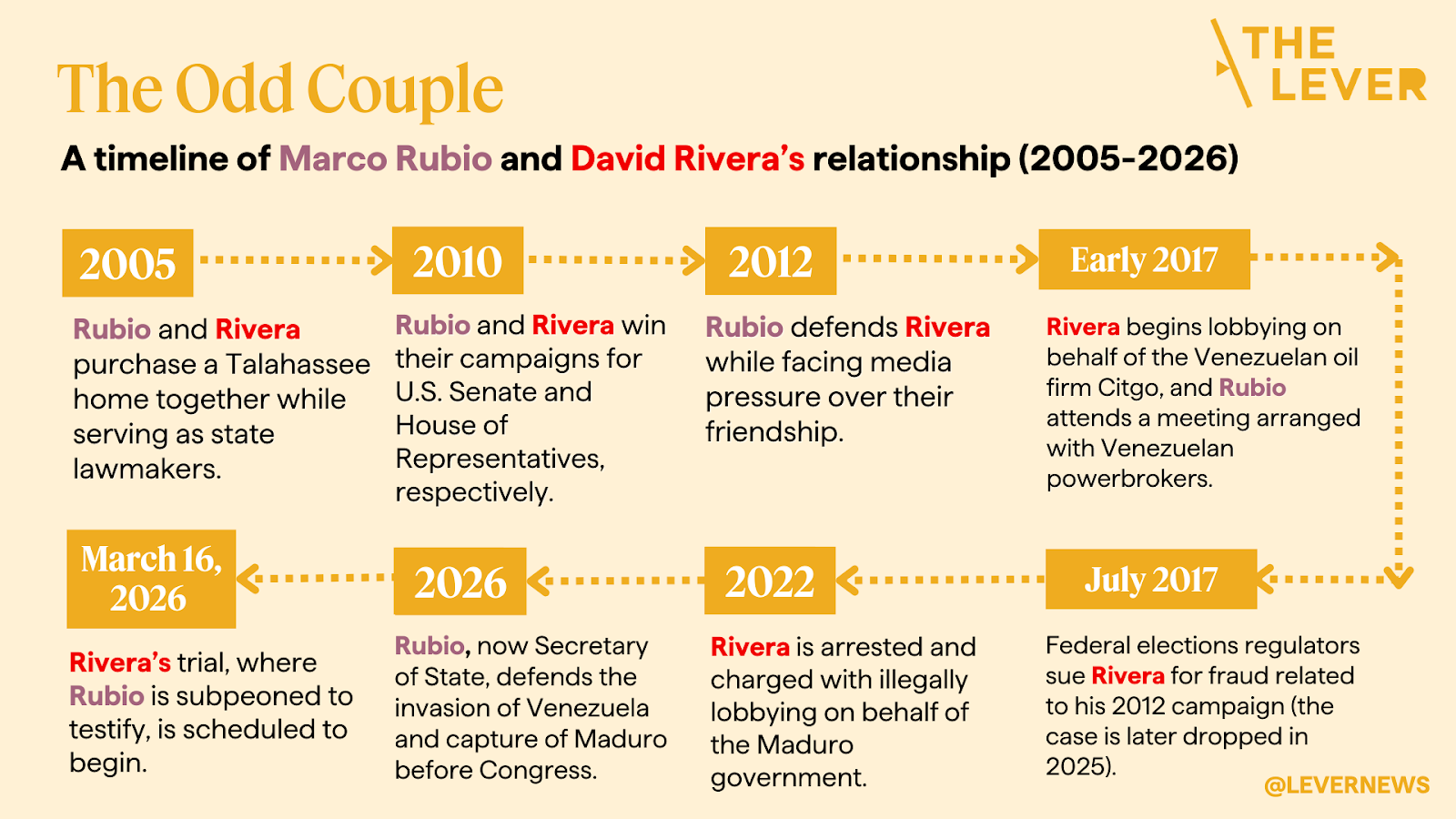 A graphic illustrating Marco Rubio and David Rivera’s relationship. (Source: The Lever)
Enacted in 1938 in response to rising Nazi propaganda in the United States, the Foreign Agents Registration Act requires more stringent disclosures than ordinary lobbying, since foreign clients may have national interests that conflict with those of the United States.
“The question under the law is whether the benefit [of the lobbying] is purely private, divorced from a benefit or control by a foreign government or party,” said Joshua Rosenstein, a lawyer at the Washington firm Sandler Reiff, which advises clients on compliance with lobbying and ethics laws. “The greater the involvement of a foreign government or political party, the less likely it is that you can shoehorn your activities under an exemption.”
The statute also applies to “a person whose activities are directly or indirectly supervised, directed, controlled, financed, or subsidized” by a foreign principal.
According to the Justice Department’s indictment of Rivera, the problems originated in 2017, when he began lobbying on behalf of Citgo, the U.S. subsidiary of Venezuela’s state-owned oil company.
For his work, Citgo paid Rivera’s consulting firm $50 million, a massive sum of money for a single lobbying firm. For comparison, the entire U.S. oil and gas industry spent just over $120 million on federal lobbying in 2022.
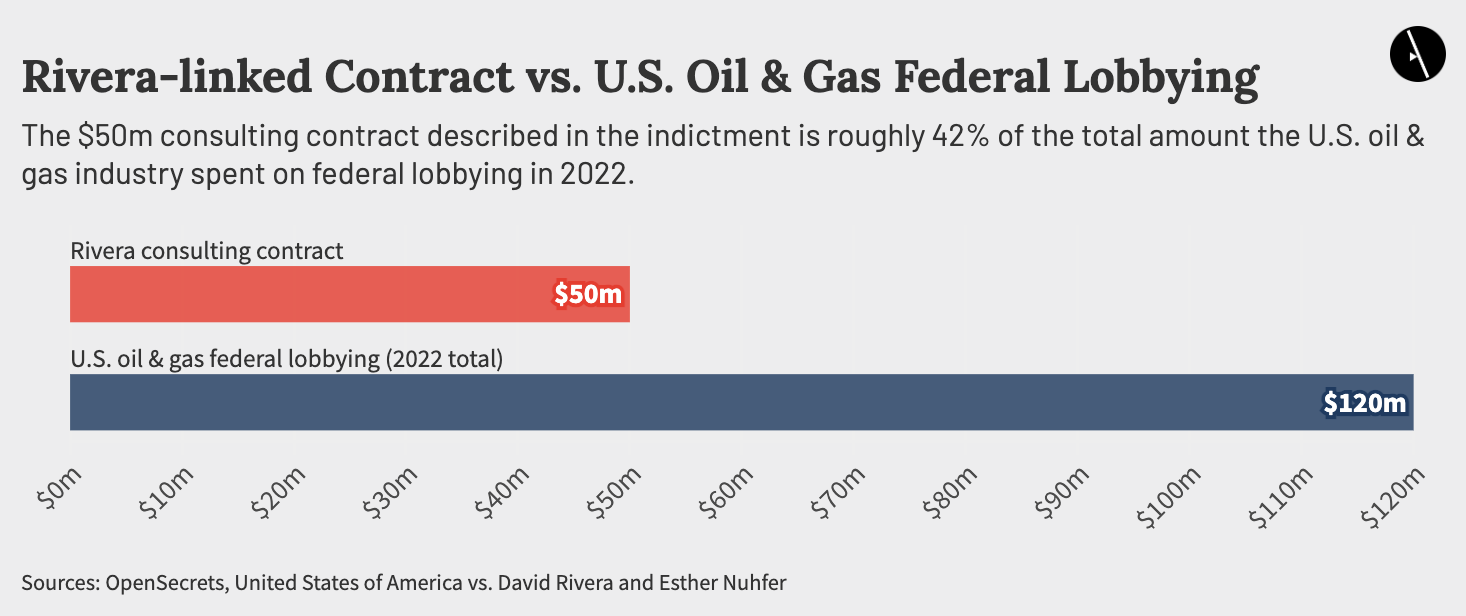 A graphic illustrating the size of David Rivera’s Citgo lobbying contract. (Source: The Lever)
Federal prosecutors allege that Rivera’s lobbying contract was actually a front for a foreign-influence campaign designed to avoid registering under the Foreign Agents Registration Act to conceal the full scope of the operation.
According to the indictment, Rivera was operating as an unregistered foreign agent to normalize relations between Venezuela and the U.S. — two countries that have been adversaries since socialist leader Hugo Chávez came to power in 1999.
Rivera was allegedly working for representatives of the Maduro government, which took power after Chávez’s death in 2013. Among the officials involved, prosecutors say, was then-Vice President Delcy Rodríguez, who now serves as Venezuela’s president.
“It was the purpose of the conspiracy for the defendants to unlawfully enrich themselves… in an effort to influence United States foreign policy towards Venezuela and to conceal these efforts by failing to register under FARA as agents of the Government of Venezuela,” the indictment reads.
Rivera allegedly used his political connections as a longtime Republican lawmaker to arrange meetings between Venezuelan power brokers and U.S. officials.
According to prosecutors, those meetings included a sit-down with Rubio as well as a meeting in Caracas between Maduro and Rep. Pete Sessions (R-Texas), who represents the oil-rich Lone Star State, which has financial interests in Venezuela’s mammoth oil reserves. At the time, Sessions chaired the House Rules Committee, which plays a pivotal role in deciding what legislation receives votes on the House floor.
Kellyanne Conway, a senior counselor to Trump during his first term, also participated in several of the meetings, according to text messages included in the indictment.
Sessions and Conway could not be reached for comment.
In text message exchanges cited by prosecutors, Rivera and his associates used pseudonyms to obscure the specifics of these meetings. The Texas congressman was referred to as “Sombrero,” while millions of dollars were called “melones.” Their code name for Maduro was “El Guaguero,” a reference to the president’s early career as a bus driver.
These 2017 and 2018 meetings— some reported at the time — came at a fraught moment in U.S.-Venezuela relations. Inside the Trump administration, officials were split over Venezuela policy, including proposals to tighten sanctions or normalize U.S. business ties.
Officials ultimately chose the former, ramping up sanctions in 2017 and again in 2020.
At the end of 2025, Rivera’s defense team subpoenaed Rubio to testify about those meetings. Federal prosecutors subsequently decided to call Rubio themselves, apparently concluding that his testimony would strengthen the government’s case.
Rivera, whose lawyers refused to make him available for an interview with The Lever, denies any wrongdoing. His attorneys have argued in court filings that Rivera, a longtime critic of Venezuela’s communist government, was working to undermine Maduro, not help him.
“We confidently believe that the evidence proves the opposite of what the government has alleged,” Rivera’s lawyers wrote in a December letter to the State Department requesting Rubio’s testimony.
“Specifically, then Senator Rubio and Mr. Rivera were focused only on their support for the Opposition [political leaders] in Venezuela, on sanctions against the Maduro government, and on removing Maduro as head of state in Venezuela.”
The Tycoon, The Trafficker, And The Trump Whisperer
As part of their defense, Rivera’s attorneys appear ready to suggest that the foreign-agent violations leveled against their client could just as easily be applied to another political operative: Wiles, Trump’s chief of staff.
To make their case, Rivera’s lawyers are zeroing in on two businessmen named in the indictment: a wealthy Venezuelan media mogul named Raúl Gorrín and a convicted cocaine trafficker named Hugo Perera.
Court documents claim that Gorrín, the politically connected head of a Caracas-based media company called Globovisión, helped orchestrate the alleged foreign-agent operation and served as a go-between for Rivera and the upper echelons of the Venezuelan government.
According to Rivera’s indictment, Gorrín took part in several of the meetings brokered by Rivera, including a sit-down with Rubio. Rivera also reportedly tried to use Gorrín’s private jet for the rendezvous with Conway.
An employee at Globovision works at the channel’s headquarters in Caracas, Venezuela. (AP Photo/Leslie Mazoch)
Gorrín, who was sanctioned by the U.S. government in 2019 for his purported involvement in foreign bribes and money laundering, was reportedly paid handsomely for his work.
In 2020, Citgo filed a lawsuit against Rivera for breach of contract. According to the suit, Rivera paid $4 million of his $50 million contract fee to Gorrín as a kickback for helping him land the arrangement. Rivera apparently funneled the money through Gorrín’s Miami-based yacht company.
The Lever did not receive a response from Globovisión for a request for comment from Gorrín.
The Citgo lawsuit also alleges Rivera paid $5 million to another subcontractor for help arranging the Citgo contract: Perera, a Miami real estate developer who was convicted in the 1990s for his role in a drug-smuggling operation run by the Cali Cartel in Colombia.
Perera’s name is notably absent in the government’s indictment, and he’s agreed to act as a cooperating witness against Rivera at trial. In retaliation, Rivera has countersued Perera for allegedly violating their confidentiality agreement. Rivera has also claimed in a court deposition that the FBI told him that Perera was an informant.
Perera, who now runs a Miami real estate company, did not respond to a request for comment.
At the same time that Gorrín and Perera were working with Rivera, court documents indicate that both men were engaged in related activities for Ballard Partners, a powerful U.S. lobbying firm that Wiles co-led at the time.
In 2017, the first year of the alleged foreign-agent scheme involving Rivera, Ballard Partners also registered to lobby on behalf of Gorrín’s Globovisión, seeking to expand the network’s presence on U.S. television platforms. Ballard earned $450,000 from the contract, making Globovisión the firm’s third-largest client that year.
Ballard’s work for Gorrín appears to have been extensive. In a subpoena letter sent to the White House requesting Wiles to testify in the upcoming trial, Rivera’s defense team describes roughly 400 pages of documents related to Wiles’ lobbying work gathered during the discovery phase of the case.
Court filings also reference numerous emails exchanged between Gorrín, Wiles, and other Ballard lobbyists. One of those lobbyists was Otto Reich, a former U.S. ambassador to Venezuela who previously ran the interagency office that helped coordinate the Iran-Contra weapons sales during the Ronald Reagan administration.
Other Ballard emails went to Harry Sargeant, an oil executive who is currently advising Trump on his post-regime-change efforts in Venezuela. (Trump’s attorney general, Pam Bondi, began working at Ballard Partners in 2019 after serving as Florida’s attorney general, though she is not referenced in the correspondence described in the filings.)
Based on these email exchanges, Rivera’s lawyers also claim Perera was simultaneously working for Ballard while also serving as a subcontractor for Rivera.
“Discovery documents show that Hugo Perera, an important government witness in the case, was involved in these pro-Venezuelan activities through Ballard Partners at the same time the government has alleged that Mr. Rivera and Ms. Nuhfer were supporting pro-Maduro efforts on behalf of Venezuela,” the attorneys wrote.
 A graphic showing how Venezuelan oil money moved through a network of Washington power brokers. (Source: The Lever)
“I Happen To Know That My Government Wants A Way Out”
Rivera’s lawyers do not accuse Wiles or her Ballard colleagues of illegal conduct. But their filings suggest the government’s legal standard for charging Rivera could potentially implicate a far wider circle of MAGA operatives — including the president’s chief of staff.
No federal records show that Wiles or Ballard Partners ever registered under the Foreign Agents Registration Act for any Venezuelan entity.
“We’re not taking a position on that [legal question] in the case,” said Ed Shohat, one of the defense attorneys representing Rivera.
Ballard Partners did not respond to multiple requests for comment. But the firm has publicly maintained that it complied with all foreign and domestic lobbying laws and that its work related only to Globovisión’s commercial interests in the U.S. The lobbying firm dropped Gorrín as a client in 2018, amid a federal investigation that would lead to U.S. sanctions against him the following year.
“Ballard Partners’ work for Globovisión involved Globovisión’s efforts to expand its TV network into the U.S. market,” Brian Ballard, the founder of Ballard Partners, said in a statement to the Miami Herald.
But a key document in the Rivera case obtained by the Miami Herald appears to suggest that Ballard’s work for Gorrín may have gone beyond strictly commercial interests.
In 2017, Ballard reportedly drafted a memo for Gorrín to provide to Trump, though he ultimately never delivered it. The letter apparently outlined a proposal to mend strained U.S.-Venezuela relations by offering Maduro a path out of the country in exchange for a transition in leadership. As described by the Miami Herald, the document did not directly relate to, or mention, Globovisión’s access to U.S. markets or other commercial interests.
“I happen to know that my government wants a way out, a way to save their skins and fortunes,” the draft letter from Gorrín read. “The opposition, on the other hand, wants a way in but is not unified in how to achieve its goals.”
Should Ballard Partners’ work on the Gorrín letter — or its other lobbying efforts — have required the firm to register under the Foreign Agents Registration Act? That’s likely impossible to determine without additional information about Globovisión’s relationship with the Venezuelan government.
“An exemption [to FARA] would be available, provided the client (Globo) isn’t directed/controlled by a foreign government or political party, and the principal beneficiary of the work wasn’t a government or political party,” said Rosenstein, the lobbying lawyer. “That’s a factual question.”
According to Rosenstein, foreign lobbying involves many legal gray areas, in part because the Justice Department has prosecuted relatively few cases, leaving the law with limited judicial precedent. Under Attorney General Pam Bondi, the Trump Justice Department has curtailed enforcement of foreign corruption and lobbying laws.
Made with Flourish • Create a chart
A graphic illustrating where key figures connected to the alleged Venezuelan lobbying network are based. (Source: The Lever)
The hundreds of pages of Ballard records described by Rivera’s attorneys could shed light on the matter, but the documents may never become public. Last month, a federal magistrate judge in Florida’s Southern District Court granted a Justice Department petition allowing Wiles to avoid testifying at Rivera’s trial, thereby permitting related documents to remain under seal.
But in his ruling, the judge made a surprising admission.
“To be clear, no one disputes that Ballard Partners registered under FARA and dealt with Gorrín openly,” wrote Magistrate Judge Edwin Torres.
Torres’ office refused to comment. But if Torres is correct, it would mean that — despite no publicly available record of the filing — Trump’s chief of staff previously worked as a registered foreign agent for a government the U.S. recently moved to overthrow.
Under Pressure
Miami insiders say Rivera’s aggressive defense strategy isn’t just legal maneuvering ahead of trial; it’s also a political effort to pressure the Trump administration to drop the case.
That campaign includes issuing subpoenas to a striking list of high-profile witnesses, including not just Rubio, but also Conway and Sessions. Rivera’s attorneys even subpoenaed Maduro, Venezuela’s deposed president, who is currently awaiting his own trial on U.S. narco-terrorism charges. Maduro’s attorneys resisted the subpoena, saying their client would plead the Fifth.
Former U.S. Rep. David Rivera speaks with media outside Miami federal court in Miami, Dec. 20, 2022. (AP Photo/Joshua Goodman)
While Miami defense lawyer Joseph DeMaria believes some of these witnesses could provide crucial testimony for Rivera’s defense, he also notes the political optics of such subpoenas.
“A lot of this strategy is political — to try to put pressure on the Trump administration to leave Rivera alone,” said DeMaria. ”Depending on how the judge rules on [the defense’s requests for testimony], that could lead them to wanting to make a deal with Rivera.”
Rivera’s legal team has a track record of exploiting political leverage when evidence-based legal defenses don’t pan out in the courtroom. One of Rivera’s attorneys is David Markus, a renowned Miami defense lawyer who also represents Ghislaine Maxwell, Jeffrey Epstein’s associate and convicted sex trafficker.
“A lot of this strategy is political — to try to put pressure on the Trump administration to leave Rivera alone.”
As Maxwell’s counsel, Markus has openly proposed a deal with the Trump administration in which his client would receive “clemency” in exchange for being allowed to speak “fully and honestly” about whether the president was involved in any potential sex crimes, or the crimes for which she was convicted.
In a *Vanity Fair*interview about his work, Markus embraced the ethos of a defense attorney: “I love representing the underdog.”
If David Rivera is an underdog, he’s an underdog with powerful friends in Washington — some of whom may soon be called to testify.
---
---
RUBIO BENZ MUSK cornholed by jo 3 26
953,672 views Mar 8, 2026 #lastweektonight
John Oliver discusses the United States Agency for International Development, why the Trump Administration has gutted it, who is being impacted, and how the Cha Cha Slide can help us get to the bottom of this.
...0:21
the United States Agency for International Development or USAD. It was once described as the world's single
0:26
largest humanitarian donor, providing aid in the form of disaster relief, global health, food assistance, climate
0:31
resilience, education, and much more. And when Trump returned to the White House last year, he made it clear that
0:38
the agency was in his sights. USID run by radical lunatics.
0:44
It sounds so nice. US aid. Isn't that beautiful? But it's a whole big scam.
0:50
When you look at USA ID, that's a uh that's a fraud. The whole thing is a
0:56
fraud. Very little uh very little being put to good use. Okay, so set aside the irony of Donald
1:03
Trump of Trump University accusing anything of being a fraud. You can't
1:08
just call something a scam because you don't like it. I want to call low-rise jeans a scam. I feel like Peppa Pigs a
1:16
fraud. I believe radical lunatics run Jamba Juice. liquid fruit isn't a treat. It's cough syrup at best. But even I,
1:22
agonize, my feelings don't make any of those thoughts true. But Trump was fixated on USA ID and its spending,
1:29
which is a little surprising given it amounted to less than 1% of the federal budget. Yet Trump and Elon Musk quickly
1:36
dismantled the agency with Elon at one point proudly tweeting he'd spent the weekend feeding USA ID into the wood
1:43
chipper. And a lot of MAGA Republicans were ecstatic about that. Right-wing influencer Benny Johnson even made a
1:49
trip to DC to celebrate. I just got into Washington DC. I had to see it for myself to believe it. USID
2:01
is no more. Check it out. There we go. Got the duct
2:06
tape. Got the doors all closed off.
2:13
Got the Got everything all blacked out up there.
2:18
had to see it to believe it. The uh the consequences of Doge....num 1 selfie spot
...
:47
have issues. And even then, half of that was reclaimed. But even without knowing that, it's tough to take waste
9:53
allegations from Elon seriously, given his Doge team seem to have no idea what the programs they were cutting even did.
10:00
ProPublica recently revealed that people at the agency watch as their brand new chief of staff scrolled down a
10:06
spreadsheet of programs, turning rows red, yellow, or green every few seconds, never asking a single question. Then
10:13
realizing that the bread programs were slated to be cut, they frantically started editing descriptions so he'd at
10:18
least know what those programs did. And while the administration at one point insisted the programs would be spared if
10:25
they were considered lifesaving, just listen to this former USAD employee tell a Senate roundt how those decisions got
10:32
made. When we kept flagged a long list of awards that were needed for life- saving activities, we were told that the
10:38
problem was the names of those awards didn't make clear that they were life-saving. Um, it didn't have the word
10:45
life-saving in the name. And therefore, it was very hard for the secretary's team to to understand which awards
10:51
should or should not be terminated. And so, the implication was that if we had been more clear in the names that these
10:56
were life-saving awards, maybe then they would have been saved. Now, obviously that is stupid for a thousand reasons. first because
11:03
everybody knows that names aren't usually literal descriptions of what you are getting. It's the reason that
11:08
ketchup isn't called salty tomato inspired glo. Conjunctivitis isn't called on your finger then touched
11:14
your eye disease. And this show isn't called facts you read in a New Yorker 18 months ago with what seems to be a
11:20
middle-aged man. It's called poetic license. And it is notable that for all
11:27
the talk of fraud, even Jeremy Leuen, a Doge guy who eventually served as deputy administrator and COO of the agency and
11:34
who often personally decided which program should be axed, later admitted
11:39
his team didn't find much. You know, we talk about people talk
11:44
about fraud, right? Doge didn't find that much fraud at USAD. It's sort of a definitional question. What is fraud? In...
13:03
seemed like a whole lot of words for racist. And I don't think that's a definitional issue. Now, before Leuen
13:10
got that job at USAD, his position was held by a different member of the Trump administration called Pete Morocco. He
13:16
actually worked there during Trump's first term, too, and attempted to delay or halt dozens of programs, but
13:22
ultimately wasn't successful. Which is why when he came back last year, one former official said, "What we're seeing
13:28
right now is Pete's Revenge Tour." And for the record, Pete's Revenge Tour sounds like a band composed entirely of
13:35
former middle school football coaches who got fired because kids kept getting heat stroke and all of whom were at the
13:41
capital on January 6th. And I only say that because Morocco did apparently storm the capital on January 6th with
13:49
with his wife, by the way. Couple goals. But the thing is, as eager as this
13:55
administration has been to eradicate any funding it claimed was going to woke causes and singling out small individual
14:01
expenditures for ridicule, it still doesn't explain wholly dismantling this
14:06
agency. Because traditionally, administrations have been free to make sure foreign aid reflects their values,
14:13
whatever those values are. Just listen to the man who ran USD under George W.
14:18
Bush explain that to Congress. When the Democrats took over, they moved the
14:23
agency to the left. I moved it to the right. The Obama people actually said I was very right-wing. I was the most
14:30
right-wing administrator in the history of the agency. And yet, the career people followed what I wanted to do in
14:36
the agency. We put heavy emphasis on economic growth. I believe in economic growth. I believe in the private sector.
14:43
I believe in free markets. That's what aid does. The notion that aid is some kind of a Marxist
14:50
institution is absolutely ridiculous. Okay. Exactly. Think of USID like the
14:56
chaa slide. You can slide it to the left. You can slide it to the right and
15:01
the next administration can then take it back. Now y
15:06
even during Trump's first term, he didn't take USAID apart. He just shifted
15:12
its focus by deprioritizing areas like maternal health and family planning. while increasing funding for emergency
15:18
responses and digital infrastructure. All of which raises the question, what changed this time to make them want to
15:24
put the agency through a wood chipper? Well, I'm afraid the answer to that is incredibly dumb. Because many observers
15:31
think it has something to do with this guy, Mike Benz, a far-right conservative activist. Elon's fixation on USA ID
15:38
appears to date to late 2024 when Benz appeared on Joe Rogan's podcast and all over the agency. Elon then
15:44
retweeted, replied to, or mentioned Benz over 160 times in the next year, sharing
15:50
things like, "USID was a viper nest of radical left Marxists who hate America and USAD is a criminal organization."
15:57
Even that wood chipper tweet was in reply to Mike Benz. And and it's worth
16:02
taking a minute to explain who Mike Benz is. He worked a few jobs during Trump's
16:08
first term, including a brief stint at the State Department. and he is, to put it mildly, a chronically online lunatic.
16:14
Among the things he's posted are this portrait of Trump made out of shakuterie
16:19
and this AI slot video where he farts in former FBI director Chris Ray's mouth.
16:24
He also once posted about the jeans he got for his birthday. And you're thinking, well, hold on, that doesn't seem so bad to me. I'll point out these
16:31
were the jeans. That's right. He got 911 jeans for his birthday. You can
16:38
apparently buy those jeans online for $180. And the reason I know that is, oh,
16:43
you. How little do you think of me, but it gets worse because Ben apparently
16:52
used to be a content creator who went by frame game and pushed a variety of far-right narratives, including the
16:57
great replacement theory, and made montages urging white viewers to unite under the banner of race. and he is
17:03
fixated on the notion that USID is basically a front. Here is how he put it
17:08
to Rogan in that interview that got Elon's attention. There's no aid in in US A by the way. That's your brain is
17:15
being tricked when you see the phrase US A. It's not an aid organization. The aid in US A stands for agent US agency for
17:22
international development. Yeah, it's an acronym, Mike.
17:28
It's it's an acronym. We all know how those work. You haven't exactly blown
17:34
Roswell open there. But that's just the beginning. Ben has also said when it's too dirty for the CIA, you give it to
17:41
USAD, which for the record is obviously not the case. We all know when a job is too dirty for the CIA, you arm Afghan
17:47
mojaheden and train them in cell warfare with a stated goal of beating back Soviet influence in the region. And then coincidentally, they team up with Osama
17:53
bin Laden, who will later carry out the very attack Mike Ben is so obsessed with, he got birthday denim merch. And
17:59
look, that is not to say there aren't small grains of truth underneath all of Benz's Look, USAD was not
18:07
perfect. As one of its former heads of global health wrote, it sometimes fostered dependency. It could be
18:12
inefficient. Too much of its funding went to international institutions rather than local ones. And yes, its history does include episodes in which
18:18
aid was bent to American military and political aims, including an incident in 2010 when it created a social networking
18:24
service in Cuba designed to kindle opposition to the government. And I do not like the fact that the agency did
18:30
that. In general, I like my regime changes the way I like my produce locally sourced. But let's not pretend
18:38
instances like that were anything other than a tiny portion of what USID did. Also, as the people of Venezuela and
18:45
Iran can attest, when the US wants regime change nowadays, it tends to do so pretty directly. So, it's not
18:52
like any of those criticisms justify getting rid of the agency entirely. But
18:57
to hear Benz tell it, USAD is basically the root of all this world's problems.
19:02
USAD is one of the most disturbing organizations in the entire federal government. It it may rank number one.
19:10
In fact, many people think they live in the world they think they live in, but in some respects, it's a carefully
constructed Truman show made up of movie characters around them produced by US A.
19:22
And what I mean by that is US A has infected the institutional architecture of every aspect of American society and
19:30
and world society. Wow. The whole world has been Truman showed
19:35
by USA ID is not something you expect to hear someone say on TV. At best, it's
19:41
something you expect to hear them muttering on a city bus. Yeah. Yeah. Yeah. Yeah. They've infected the institutional architecture. You know
19:46
what? I think I'm going to get off here. I I know we're halfway across a bridge, but I'm pretty sure that this is my stop. It's frankly no wonder Ben took a
19:54
victory lap when USAD was gutted, posting this image of himself celebrating at its grave. And at this
20:00
point, you should probably see some of the damage that's been done because it is vast. As one expert put it, I think
20:08
the best evidence that USAiD works is how quickly people started dying when it went away. Now, it is hard to get exact
20:15
counts on deaths, partly because these cuts have, among other things, halted data monitoring. But researchers have
20:21
estimated over 262,000 adults and over half a million children
20:27
died last year as a result of these cuts. Though, I do have to tell you, Marco Rubio strongly denies claims like
20:34
those. Anybody who tells you that somehow it's the United States. If we cut a dollar, somehow we're responsible
20:40
for some horrific thing that's going on in the world is is just not true. Are you standing by your contention that
20:45
no one no one has died because the United States has cut aid? No. Okay. So, is he
20:50
telling the truth there? Well, I would argue that the answer to that is the same as the answer to the question, are Marco Rubio's ears proportional to the
20:57
size of his head? Which is to say, absolutely, demonstrabably not. And
21:03
maybe the best way to rebut that is to show you some of the specific places and programs that have been impacted by
21:09
these cuts. And let's start with food and nutrition assistance which have been devastated. For instance, in Nigeria,
21:14
clinics which provided malnutrition treatment for more than 300,000 children below the age of two were shut down at
21:20
the end of July. And in Afghanistan, NGO warehouses were bare despite 900,000 children being in desperate need of
21:26
treatment for severe acute malnutrition. And it is not just cuts to the food itself. The administration also
21:32
disrupted the global supply chain that moves food for desperate people all over the world. And that means even when the
21:39
food's actually there, the ability to get it to people who need it can be gone. For instance, last summer,
21:45
disruptions led to some food spoiling in a warehouse. The Trump administration is planning to
21:52
destroy a massive amount of emergency food. Some 500 metric tons or just over
21:58
a million pounds of high energy biscuits meant to feed hungry kids in Afghanistan
22:03
and Pakistan will now be incinerated. That first reported by the Atlantic.
22:09
We have a kind of a standard procedure that if food uh is expired, we it will
22:14
be destroyed. Federal workers had requested approval from USID leadership
22:20
to move the emergency food before it spoiled, but their memos went unanswered. That is just maddening,
NEWSMAX! TAMMY BRUCE SPOX VS
22:28
especially not even answering the memos. Leaving someone on red is always unforgivable, but especially when the
22:35
text is, "Hey shorty, 1 million pounds of high energy biscuits about to expire you up." And scenes like that are
22:42
playing out all over the world. At one refugee camp in Kenya that had relied on USA ID funding, reporters found mothers
22:48
who'd had to choose which of their kids to feed and pregnant women who were so desperate for calories that they ate
22:54
mud. But it's not just food assistance that's been cut. It's estimated more than 2,000 health clinics have closed in
23:00
crisis zones around the world. Here is what happened at just one. Before the NGO Action Against Hunger ran this
23:07
center here, providing life-saving medical assistance, but it closed down in February along with seven others in
23:13
the area when USAD stopped funding the organization. Within just over a month, 29 children in
23:20
the district died of malnutrition and illness. We've never had such a high death rate.
23:27
It was catastrophic. These are deaths that we could have avoided if funding had been maintained and we continued our
23:33
activities. Yeah, it's appalling. And it makes it even worse when you remember House
23:38
Republicans literally celebrated these cuts with this
23:47
Yeah, it's true. You are killing a lot of people in Africa. You jibjabbed The point is these cuts have cost..
23:33
activities. Yeah, it's appalling. And it makes it even worse when you remember House
23:38
Republicans literally celebrated these cuts with this
23:47
Yeah, it's true. You are killing a lot of people in Africa. You jibjabbed The point is these cuts have cost
23:55
lives. And perhaps one of the clearest examples of this concerns PEPAR or the
24:00
president's emergency plan for AIDS relief. It was created during the George W. Bush administration and is often described as one of the most successful
24:07
global health programs in history. It's credited with saving 26 million lives
24:12
and enabling 7.8 million babies to be born without HIV since it was created. It is as close to a miracle as this
24:20
government has ever accomplished. If I had to say one nice thing about George W. Bush, this program would be it. And
24:26
if I had to say two, I would go quiet. And while the administration will stress
24:32
that PEPAR still exists, its crucial aid delivery mechanism has been severely disrupted. As soon as the cut started
24:39
last January, critics were clinics were forced to shut their doors, essential frontline health workers were furoughed,
24:45
and community programs reaching the most vulnerable people stopped. And while PEPFAR was granted a limited waiver to
24:51
implement urgent life-saving HIV treatment services, a lot got left out
24:57
of that waiver because well, for instance, it it allowed uh the prevention medication prep for pregnant
25:02
and breastfeeding women, it didn't include it for anyone else, including those who were already on it. It also
25:08
left out funding for HIV prevention more generally and most programming for orphans and vulnerable children. And a
25:14
major casualty of cuts to PEPFAR were locally rooted programs tailored to the needs of specific groups of people like
25:21
specialized clinics for sex workers, men who have sex with men, and people who inject drugs. And infuriatingly to some
25:27
Republicans, that seemed to be sort of the point. This stuff about PEP 4, oh my
25:33
god, you're going to destroy the world. Now, there's a part of PEP for that deals with money for life-saving care,
25:41
isn't it? Absolutely. And there's a part of PEP 4 that won't you look at it and you you
25:47
want to say pass me the sick bucket, isn't there? Yes, sir. And you're pass you're getting rid of
25:53
the sick bucket stuff. Yes, sir. You you're getting rid of $5.5 million
25:59
to lesbian, gay, bisexual, transgender, queer, and interex advocacy in Uganda.
26:07
Aren't you? Yes, sir. I can't believe we're arguing about this.
26:12
I can't believe we're arguing about this. Wow, that is some pretty homophobic stuff coming from a man wearing the
26:19
single cuntiest pair of glasses I think I've ever seen. Also, for what it's
26:24
worth, if anything is going to make me say pass the sick bucket, it isn't the critical work of PEP 4. It is the memory
26:31
rattling eternally around my head of Senator John Kennedy saying this.
26:37
I can't wait to have your in my mouth. Well, that certainly makes one of us.
26:45
But despite what Kennedy said there, cuts to PEPFAR are absolutely affecting
26:51
life-saving care. And for a huge amount of people, and not just those whose lives seem to make him want to reach for
26:57
the sick bucket. Even short disruptions to HIV care can be deadly and have
27:02
already resulted in stories like this. The cut off of the medication of the HIV
27:08
ARVs has really, you know, affected us so much.
27:14
The eight HIV positive orphans he cared for used to get their medicine from the
27:19
local hospital for free. After the cuts, he was told he'd have to pay. And because he couldn't afford to do so, the
27:26
orphanage ran out. Without this medication, 14-year-old
...
---
---
CUBA OIL PLUS NEW SANCTIONS --> HUNGER?! // GAZA SEIGE FRANTIFA
---
2 26 MUNICH SECUR CONF 1 YR AFTER JDV AND MUSK? WENT ALT RT NEO-NAZI, RUBIO GETS APPLAUSE FOR VENEER VERSION
DHS POSTER WHICH WAY WESTERN/AM MAN?
---
---
AN 2 26
President Donald Trump's appointee Susan B. Rogers is “arguably… the public face of the Trump administration’s growing hostility to European liberal democracies,” according to a prominent British publication that accuses her of propping up far right regimes.
Rogers, who has been Trump’s Under Secretary of State for Public Diplomacy and Public Affairs since October, has repeatedly characterized efforts to stop the rise of the far right as threats to free speech and met with marginalized extremist parties, according to a Wednesday report in The Guardian.
On the social media platform Twitter/X, Rogers has characterized German migrants as “barbarian rapist hordes,” linked Sweden’s immigration policy to sexual violence (“If your government cared about ‘women’s safety,’ it would have a different migration policy”) and claimed that “advocates of unlimited third world immigration have long controlled a disproportionate share of official knowledge production.”
The Guardian also highlighted Rogers’ meetings with members of the Alternative für Deutschland (AfD) Party, which is widely viewed as neo-Nazi in its ideology. After meeting with AfD parliamentarian Markus Frohnmaier, Rogers wrote that “unlike the Russian government (and the current German one), AfD took an anti-censorship stance in its meeting with me last week. One reason they’re gaining popularity in Germany.”
Rogers defended her meeting by telling The Guardian, “Mr Frohnmaier is the foreign policy spokesman for the most popular political party in Germany. He delivers AfD’s foreign policy positions in the Bundestag, and is the person German media call when they want a policy statement from AfD. For this reason, we talk to him in his official capacity to understand AfD’s positions.”
Yet Rogers has done more than meet with AfD. According to The Financial Times, Rogers has also scheduled meetings with far right parties throughout Europe on a mission to “fund MAGA-aligned think-tanks and charities.” According to a senior member of the UK’s far-right Reform party, Rogers has a “State Department slush fund to get MAGA-style things going in various places” and was keen to “fund European organisations to undermine government policies.”
Others in Trump’s orbit have also worked to prop up AfD. Twitter/X CEO Elon Musk, who performed a Nazi salute at Trump’s 2025 inauguration, has publicly embraced AfD as the “last spark of hope.” Meanwhile Vice President JD Vance wrote a Twitter/X post promoting Musk’s pro-AfD statements while adding, “I’m not endorsing a party in the German elections, as it’s not my country and we hope to have good relations with all Germans. But this is an interesting piece.”
Vance then added, “Also interesting; American media slanders AfD as Nazi-lite, But AfD is most popular in the same areas of Germany that were most resistant to the Nazis.”
Trump’s Secretary of State Marco Rubio, describing the Trump administration’s opposition to the pro-democracy multinational alliances that governed the post-World War II international order, argued that “the postwar global order is not just obsolete, it is now a weapon being used against us. Eight decades later, we are once again called to create a free world out of the chaos, and this will not be easy.”
In response to Trump’s support for the far right from Germany and the United Kingdom to Marine Le Pen in Russia and Viktor Orbán in Hungary, the Munich Security Conference — widely regarded as the world’s top independent forum for analyzing foreign policy — warned that his policies could lead to global conflict.
“Transactional deals may well replace principled cooperation, private interests may increasingly trump public ones, and regions may become dominated by great powers rather than governed by international rules and norms,” the Munich Security Conference’s recent report warned.
===
---
AN 1 26
A Reagan-appointed federal judge declared that U.S. Secretary of State Marco Rubio and U.S. Secretary of Homeland Security Kristi Noem had “conspired” to chill First Amendment rights in a case involving pro-Palestinian student protesters.
Senior Judge William Young of the U.S. District Court for Massachusetts, on Thursday said that Rubio and Noem had “failed in their duty to uphold the constitution,” as Politico’s Kyle Cheney reported.
Judge Young’s remarks were reported in real time by journalists covering the proceedings and shared on social media as the hearing unfolded.
“What happened here is an unconstitutional conspiracy to pick off certain people, to twist the laws,” Judge Young said, denouncing the lack of any actual policy. “Two cabinet secretaries conspired … they intentionally, knowing what they were doing, counseled by professionals who cautioned them, nevertheless went ahead to pick off these people with the intention that your clients would be chilled. And did so rather effectively, by the way.”
Judge Young, 85, also invoked President Donald Trump.
“The big problem in this case,” Young said, “is that the cabinet secretaries and ostensibly the president of the United States are not honoring the First Amendment.”
Young, who has served on the bench for over four decades, continued, saying, “let’s talk the truth here,” as he denounced decisions made at DHS that directed professionals to be “taken off anti-terrorist investigations.”
“They were taken off human trafficking investigations all to look up … what dirt they could find on this group … the very highest levels of the DHS decided – that’s the best use of those people.”
He called it “chapter and verse about how the government can be weaponized against a disfavored group.”
According to All Rise News editor-in-chief Adam Klasfeld, Judge Young also slammed President Trump.
“It’s fairly clear that this President believes, as an authoritarian, when he speaks, everyone, everyone, in Article II, is going to toe the line absolutely.”
According to Reuters, Judge Young indicated that he would issue an order presuming immigration actions against the plaintiffs’ members were retaliatory unless the government could prove otherwise in court.
---}:
---
simon clark 1 26 66 int’l org 2 help kids only armed conflict domestic violence
no senate ratification 172 species conservation of nature
energy ipcc
curtail am biz to do whatever they want

---
---
Trump Brings Putin's Booted Propaganda Goon Back to U.S.}:

The Daily Beast
https://www.thedailybeast.com › trump-brings-putins-bo...](https://www.thedailybeast.com/trump-brings-putins-booted-propaganda-goon-lauren-chen-back-to-us/)
6 hours ago — ... State Department senior adviser Joe Rittenhouse. She credited Rittenhouse with “moving mountains to ensure we were able to return in time ...Read more
...Last week, Trump and Secretary of State Marco Rubio barred five European campaigners and watchdog leaders from entering the country under a new “free speech” visa policy.
It also raises questions about Trump’s friendly behavior toward Russia and its president Vladimir Putin. Even in the past month, Trump—who in 2022 called Putin a “genius”—has described Putin as being “very generous” about Ukraine’s future in a call they had about the war there, prompting visible disbelief from Ukrainian President Volodymyr Zelensky.
Trump Gets Beauty Salon Owner to Decide Who to Ban From U.S.EYEBROW RAISING

Trump’s State Department has increasingly been populated with loyalists in roles that control who gets a visa and who gets turned away. Rittenhouse, for instance, is a former actor who became a Trump presidential campaign worker. Over Christmas, it also emerged that Trump had elevated Project 2025 contributor Mora Namdar to run the consular bureau overseeing visa approvals and revocations.
ref
President Donald Trump has installed an attorney and part-time beauty salon owner to decide which foreigners are allowed to enter the United States.
The State Department announced that Mora Namdar has been promoted from her post working on U.S foreign policy in the Middle East and North Africa to become assistant secretary for consular affairs, overseeing everything from passport issuance to visa approvals and revocations.
1/2
The video player is currently playing an ad.
Namdar, who is the daughter of Iranian immigrants, previously did the job on an interim basis during Trump’s first term in 2020.
Mora Namdar, center, photographed with her beauty salon team in 2017.Facebook
Namdar owns a mini-chain of beauty salons called Bam in her native Texas, with locations in the West Village in her hometown of Dallas, as well as in Fort Worth and Plano.
The original salon, she told Voyage Dallas magazine, was intended to be “gorgeous, sophisticated, and evoke dreams of a Parisian heaven in Dallas,” with a 20-foot flower wall, and grew out of her friends asking her to do their makeup at their weddings. “It dawned on me that there is a need for a gorgeous place that treats the styling of women like a form of art,” she said, while she told DMagazine in 2017 that it was “fun and cheeky.” Blowouts start at $45 and professional make-up sessions at $55.
Mora Namdar appeared on Good Morning Texas on WFAA 88 ABC in 2016 to promote her salon.Facebook
The chain has diversified into hair extensions, starting at $325, events, off-site events, including running lash and braid bars for $100-a-person and home visits.
Namdar combined owning the salon with running a one-woman law firm. On Christmas Day, she announced the firm was no longer active.
She was also one of the contributors to the notorious Project 2025, which has heavily influenced Trump’s second term, writing a section about the U.S. Agency for Global Media (USAGM), according to the Columbia Journalism Review.
In it, Namdar accused USAGM—the federal umbrella for U.S.-funded broadcasters including Voice of America and Radio Free Europe—of serious mismanagement, “espionage-related security risks,” and of using “anti-U.S. talking points to parrot America’s adversaries’ propaganda,” while calling for it to be reformed or closed altogether.
Mora Namdar at the attorney’s office she owns.Instagram
Namdar’s Senate confirmation earlier this month now puts a politically connected operator with media experience in charge of a bureau that can effectively decide who gets to enter the United States—and who gets turned away.
In prepared testimony for her October Senate hearing, she framed visa adjudications as critical to national security, saying she concurred with Rubio’s assessment that if someone “undermine[s] our foreign policy, [then] consular officers have the authority to revoke their visa.”
Mora Namdar’s official government photo from 2020.State Department
Namdar’s record inside government has already drawn scrutiny. Several outlets have reported that her interim leadership in the State Department’s Near Eastern affairs bureau this year triggered internal concerns about management and morale.
She will now be leading moves by the administration to ban people entering the U.S. including actions against citizens of various European countries who the president, 79, and Secretary of State Marco Rubio, 54, announced on Wednesday had been barred from entering the U.S. for what it described as “egregious” censorship of “American viewpoints” on social media platforms, promising more would likely follow.
When reached for comment, the State Department’s Principal Deputy Spokesperson Tommy Pigott told the Daily Beast, “What a shameful, pathetic, and quite frankly sexist way to describe her career. Assistant Secretary Mora Namdar is an accomplished lawyer, business owner, and government official. Americans can be proud that patriotic public servants like her are stepping forward to serve our country and advance our national interests.”
Trump repeatedly sought to distance himself from Project 2025 during the campaign. But by year’s end, PBS reported that outside trackers estimate the administration has implemented roughly half the agenda’s goals, with “personnel is policy” hires—like Namdar, and Federal Communications Commission (FCC) chairman Brendan Carr—singled out as a key mechanism.
The FCC is the independent regulator that oversees broadcast licensing, telecom, and a growing share of the government’s fights over media power and “viewpoint” disputes.
Donald Trump and Brendan Carr pictured chatting in November 2024.Brandon Bell/Getty Images
Trump Pours Water on His FCC Attack Dog’s PlottingLEAD BALLOON
Carr, 46, authored Project 2025’s FCC chapter, which argues the agency should take a more aggressive posture toward “Big Tech” and what he calls a “censorship cartel,” while pairing that culture-war agenda with an explicit push to roll back swaths of existing telecom regulation.
Since taking the job, Carr has moved in ways that critics say align with those priorities—steps that have triggered Senate blowback and warnings from former FCC leaders about speech-chilling politicization.
The Daily Beast has also contacted Namdar for comment.
---
---
THEHILL TURLEYBS
“We are the free world now.” Those words from Raphael Glucksmann, a French socialist member of the European Parliament, captured the pearl-clutching outrage of Europeans after the Trump administration did what no prior administration has ever done — stand up to Europe to defend the freedom of speech.
This week, Secretary of State Marco Rubiobarred five figures closely associated with European censorship efforts from traveling to the U.S. This includes Thierry Breton, the former European Union commissioner responsible for digital policy.
In a post on X, Rubio declared that the U.S. “will no longer tolerate these egregious acts of extraterritorial censorship” and will target “leading figures of the global censorship-industrial complex from entering the United States.”
Breton achieved infamy as one of the architects of the massive EU censorship system, which is now being globalized. Armed with the notorious Digital Service Act, Breton and others threatened American companies and officials that they would have to yield to European standards of free speech. After Breton learned that Musk was planning to interview Trump before the last presidential election, he even warned the X owner that he would be “monitored” and potentially subject to EU fines.
Socialist Glucksmann is now irate at “this scandalous sanction against Thierry Breton.”
“We are Europeans,” he declared. “We must defend our laws, our principles, our interests.” In other words, this is a war over whether Europe or the U.S. Constitution will dictate the scope of free speech for American companies and citizens.
Breton and his colleagues are finally being treated as what they are: a clear and present danger to the “indispensable right” that defines all Americans.
The EU has been enlisted by anti-free speech figures in the U.S. to force companies like X and Facebook to restore censorship of Americans. After Musk bought Twitter with a pledge to restore free-speech protections, Hillary Clintoncalled upon European officials to force him to censor under Europe’s Digital Services Act.
Nina Jankowicz, the former head of Biden’sinfamous Disinformation Governance Board, appeared before the European Parliament. She called upon the 27 EU countries to fight against the U.S., which she described as a global threat.
The E.U. enthusiastically took up the challenge. This year, I spoke in Berlin at the World Forum, which boosted the slogan, “A New World Order with European Values.” Bill and Hillary Clinton and other Americans cheered on the European efforts.
The Digital Services Act bars speech that is viewed as “disinformation” or “incitement.” When it was passed over the condemnations of many of us in the free speech community, European Commission Executive Vice President Margrethe Vestagercelebrated by declaring that it is “not a slogan anymore — that what is illegal offline should also be seen and dealt with as illegal online. Now it is a real thing. Democracy’s back.”
It is indeed a “real thing.” In my forthcoming book, Rage and the Republic: The Unfinished Story of the American Revolution, I discuss the challenges facing our republic in the 21st century, including the EU and its transnational governance model. Many on the left are supporting the erosion of national laws and values in favor of standards set by global experts and elites.
This cadre of American enablers has been increasingly vocal in Europe. Notably, late-night ABC host Jimmy Kimmeldelivered a Christmas Eve address in Great Britain denouncing the U.S. as a global threat. He declared that “from a fascism perspective, this has been a really great year. Tyranny is booming over here.”
It was crushingly ironic. Many of us have been writing for years about how free speech has been eviscerated in the United Kingdom, where people are being prosecuted for “toxic ideologies” and an ever-lengthening list of unacceptable political viewpoints.
Justice Amy Coney Barrettissued a warning this week about the collapse of free speech in the United Kingdom. Yet that is where a comedian, who is paid millions and attacks Trump nightly, went to complain about the threat to free speech in the U.S.
Both Vice President JD Vance and Secretary Rubio have delivered major speeches warning the EU about its effort to export censorship systems, particularly targeting American citizens and companies. After years of encouragement and enabling from the Obamaand Bidenadministrations, the U.S. government is finally in this fight.
That is why Europe is up in arms, denouncing the move to bar these officials as an attack on its own sovereignty. In other words, an effort to defend our own free speech values is a threat to the proclaimed “New World Order with European Values.”
In reality, I do not like travel bans. I prefer that these figures come to this country and face free-speech advocates. Yet despite our calls for Congress to get into this fight, it has done nothing due to opposition from Democratic members. We cannot wait as the EU weaponizes and globalizes censorship.
Glucksmann is right about one thing. This is a fight over who today can be rightfully called the “free world.” In the U.S., we continue to cling to the quaint notion that the free world should be based on … well, freedom.
*Jonathan Turleyis the Shapiro Professor of Public Interest Law at George Washington University. He is the author of the forthcoming “Rage and the Republic: The Unfinished Story of the American Revolution” on the 250th anniversary of the American Revolution.
---
REF THEHILL
NEWSWEEK
Khaleda Rahman
National Correspondent
Khaleda Rahman is Newsweek's National Correspondent based in London, UK. Her focus is reporting on education and national news. Khaleda joined Newsweek in 2019 and had previously worked at the MailOnline in London, New York and Sydney. She is a graduate of University College London. Languages: English. You can get in touch with Khaleda by emailing k.rahman@newsweek.com
Newsweek is a Trust Project member
Supreme Court Justice Amy Coney Barrett has warned about threats to free speech in the United Kingdom.
Coney made the remarks during an interview with Bishop Robert Barron for an episode of his podcast, Bishop Barron Presents, which was released on Sunday.
“Think about what’s happening with respect to free speech rights in the U.K.,” Barrett said during a discussion about the purpose of law. “Contrary opinions or opinions that are not in the mainstream are not being tolerated, and they’re even being criminalized. Because of the First Amendment, that can’t happen here.”
Barrett has been contacted for further comment via an email to a Supreme Court spokesperson.
Supreme Court Justice Amy Coney Barrett speaks at the Reagan Library on September 9, 2025, in Simi Valley, California. | Mario Tama/Getty Images
Why It Matters
Barrett’s comments come as Britain has faced increased scrutiny over its policing of speech, including from Vice President JD Vance, in recent months.
Some critics have focused on the Online Safety Act, rolled out this year, which requires social media companies to remove illegal content on their platforms. Critics say is being implemented too broadly and has resulted in the censorship of legal content.
Others have pointed to specific cases, including that of a British Catholic woman who recently became the first person charged for silently praying outside an abortion facility under a new buffer zone law. Meanwhile, police in London and Manchester recently pledged to arrest people who chant “globalize the intifada,” raising free speech concerns.
What To Know
In the interview, Barron refers to the Catholic thinker John Courtney Murray and his argument that in a pluralistic society, peace depends on shared principles. He goes on to ask Barrett whether what Catholics call “natural law” or “basic moral intuitions” can still play a role today.
But Barrett says the Constitution “could help to that end.”
“If we think about free speech or freedom of religion, I think we can see those guarantees as a way in which they can function as articles of peace,” she said.
She noted that in the U.S., the First Amendment prevents the government from criminalizing opinions, adding that it doesn’t just allow free speech but also forces tolerance.
“I think the First Amendment protects, guarantees, forces us to respect one another and to respect disagreement. There’s a tolerance of different faiths, a tolerance of different ideas…we can see what would happen if you didn’t have the guarantee to hold that in place.”
Barrett, who is a devout Catholic, jointed the nation's highest court in 2020 after President Donald Trump appointed her to replace the late Justice Ruth Bader Ginsburg. Her appointment cemented the court's conservative supermajority, which overturned the constitutional right to abortion in 2022.
What People Are Saying
Vice President JD Vance said at the Munich Security Conference earlier this year: “In Britain and across Europe, free speech, I fear, is in retreat.”
He added: ”I will admit that sometimes the loudest voices for censorship have come, not from within Europe, but from within my own country.”
A U.S. State Department report on human rights practices in the U.K. released over the summer said, "significant human rights issues” in the U.K. included “credible reports of serious restrictions on freedom of expression, including enforcement of or threat of criminal or civil laws in order to limit expression.”
British Prime Minister Sir Keir Starmer told reporters in September: "Free speech is one of the founding values of the United Kingdom, and we protect it jealously and fiercely and always will.”
He added: ”I draw a limit between free speech and the speech of those that want to peddle pedophilia and suicide (on) social media to children. Therefore, I'm all for free speech, but I'm also for protecting children from things that will harm them."
What Happens Next
The debate over free speech in the U.K. is sure to continue in the coming months.
---
---
NYT
NO LNX
They Seek to Curb Online Hate. The U.S. Accuses Them of Censorship.
The Trump administration said five regulators and researchers who work to tackle disinformation and abuse on the internet had been barred from entering the United States.
By Adam Satariano
Reporting from London
Published Dec. 24, 2025
Updated Dec. 25, 2025
Josephine Ballon and Anna-Lena von Hodenberg lead a German legal aid organization that assists individuals facing online abuse and violent threats.
Clare Melford runs a British group that helps identify disinformation.
Imran Ahmed is a British activist who runs an organization that has chronicled anti-vaccination content on social media.
On Tuesday, the Trump administration accused all of them of a campaign of censorship against Americans.
The four individuals, along with a former senior European Commission official, Thierry Breton of France, were barred from entering the United States after Secretary of State Marco Rubio labeled them “radical activists” who undercut free speech.
On Wednesday, European officials including President Emmanuel Macron of France criticized the Trump administration’s decision.
“These measures amount to intimidation and coercion aimed at undermining European digital sovereignty,” Mr. Macron said on social media. “The rules governing the European Union’s digital space are not meant to be determined outside Europe.”
Thomas Régnier, a spokesman for the European Commission, said, “Our digital rules ensure a safe, fair and level playing field for all companies, applied fairly and without discrimination.”
The travel ban is a major escalation in a dispute between the Trump administration and Europe over the regulation of online content and social media.
In the United States, free speech protections allow social media companies to set their own content policies. And Mr. Trump and others on the right have successfully pushed social media firms to roll back moderation rules that they viewed as silencing conservative voices.
In Britain and the European Union, there are certain restrictions on hate speech and open bigotry. In 2022, the European Union passed a law called the Digital Services Act that requires social media companies to meet transparency standards and to remove certain racist, antisemitic and violent content if it violates national laws.
The Trump administration sees the Digital Services Act as an attempt to force American platforms to censor speech globally — an allegation European officials deny.
The issue came to a head this month when the European Commission, the executive branch of the European Union, fined Elon Musk’s social media platform X $140 million. The commission said that the site had violated the Digital Services Act by selling verification check marks that allow users to mislead others about their identities, by maintaining opaque advertising practices and by refusing to provide researchers with data access. In response, Mr. Musk said the European Union should be abolished.
Mr. Breton helped draft the digital services law when he was a European commissioner overseeing digital policy.
The other individuals facing a travel ban were involved in nonprofit organizations that the Trump administration accused of targeting American social media companies and users.
Ms. Ballon, co-chief executive of HateAid, a German group that assists victims of online attacks, said she received an email on Tuesday notifying her that her visa had been revoked. She did not understand why until a few hours later, when she saw a news article about Mr. Rubio’s announcement.
HateAid, founded in 2018, provides counseling, safety advice and litigation financing to help victims of online attacks take legal action against perpetrators. The group, which Ms. Ballon runs with Ms. von Hodenberg, also lobbies for stronger regulation of social media companies in Germany and the rest of the European Union.
German officials came to the organization’s defense on Wednesday after the Trump administration accused it of countering conservative groups.
“The entry bans imposed by the USA, including those against the chairpersons of HateAid, are not acceptable,” Johann Wadephul, the German foreign minister, said on social media.
Ms. Ballon and Ms. von Hodenberg said in a statement, “We will not be intimidated by a government that uses accusations of censorship to silence those who stand up for human rights and freedom of expression.”
Ms. Melford runs the Global Disinformation Index, a group that provides risk ratings to advertising firms to help them avoid placing ads on websites seen as spreading disinformation and harmful content. In a statement, the group called the travel ban “an authoritarian attack on free speech and an egregious act of government censorship.”
Mr. Ahmed is the chief executive of the Center for Countering Digital Hate, which has teams in Britain and the United States. Mr. Musk sued the group in 2023 after the organization documented a rise in hate speech on Twitter following his acquisition of the platform, which is now called X. An American court dismissed the lawsuit last year as a violation of the right to free speech.
Mr. Ahmed could not be reached for comment.
Adam Satariano is a technology correspondent for The Times, based in London.
A version of this article appears in print on Dec. 25, 2025, Section B, Page 1 of the New York edition with the headline: 5 Fighters of Online Hate Are Barred From the U.S..
---
PCO
A federal judge on Thursday blocked the Trump administration from deporting a British man who was recently placed on a visa ban after U.S. officials accused him and four other Europeans of online censorship.
Center for Countering Digital Hate CEO Imran Ahmed filed a complaint Thursday against Secretary of State Marco Rubioand Attorney General Pam Bondito prevent “the imminent prospect of unconstitutional arrest,” the lawsuit reads.
“The government’s actions are the latest in a string of escalating and unjustifiable assaults on the First Amendment and other rights, one that cannot stand basic legal scrutiny,” it continues. “Simply put, immigration enforcement—here, immigration detention and threatened deportation — may not be used as a tool to punish noncitizen speakers who express views disfavored by the current administration.”
The suit adds that Ahmed is a lawful permanent resident with a wife and son who are U.S. citizens.
The complaint cites other recent cases where foreign nationals on student visas, including Mahmoud Khalil and Rümeysa Öztürk, were stripped of their documentation and faced with deportation as “part of a larger pattern of attempted repression of constitutionally protected speech.”
“The government has no power to punish Mr. Ahmed for his research, protected speech, and advocacy, and Defendants cannot evade those constitutional limitations by simply claiming that Mr. Ahmed’s presence or activities have ‘potentially serious adverse foreign policy consequences for the United States,'” the suit reads.
The administration placed the visa ban on Ahmed, along with French former European Union Commissioner Thierry Breton, Global Disinformation Index CEO Clare Melford and HateAid leaders Anna-Lena von Hodenberg and Josephine Ballon, on Tuesday.
By signing up, I agree to the Terms of Use, have reviewed the Privacy Policy, and to receive personalized offers and communications via email, on-site notifications, and targeted advertising using my email address from The Hill, Nexstar Media Inc., and its affiliates
Breton backed the EU’s Digital Services Act, which compelled online platforms to tackle hate speech and misinformation and remove it from their pages. U.S. officials claim the law unfairly targets American tech companies and citizens, Reuters reported.
On Tuesday, Rubio accused the five of leading “organized efforts to coerce American platforms to punish American viewpoints they oppose.”
“Today, @StateDept will take steps to bar leading figures of the global censorship-industrial complex from entering the United States,” Rubio posted on social media. “We stand ready and willing to expand this list if others do not reverse course.”
Undersecretary of State Sarah Rogers shared Rubio’s message and warned that “if you spend your career fomenting censorship of American speech, you’re unwelcome on American soil.”
Breton criticized his visa ban, asking in an X post if “[former. Sen. Joe] McCarthy’s witch hunt” was back.
---
---
sadly no paste --> whole page no lnx
Washington
By —
Fatima Hussein, Associated Press
U.S. bars five Europeans it says pressured tech firms to censor American viewpoints online
:{:{Politics Dec 24, 2025}:
WASHINGTON (AP) — The State Department announced Tuesday it was barring five Europeans it accused of leading efforts to pressure U.S. tech firms to censor or suppress American viewpoints.
The Europeans, characterized by Secretary of State Marco Rubio as "radical" activists and "weaponized" nongovernmental organizations, fell afoul of a new visa policy announced in May to restrict the entry of foreigners deemed responsible for censorship of protected speech in the United States.
"For far too long, ideologues in Europe have led organized efforts to coerce American platforms to punish American viewpoints they oppose," Rubio posted on X. "The Trump Administration will no longer tolerate these egregious acts of extraterritorial censorship."
The five Europeans were identified by Sarah Rogers, the under secretary of state for public diplomacy, in a series of posts on social media. They include the leaders of organizations that address digital hate and a former European Union commissioner who clashed with tech billionaire Elon Musk over broadcasting an online interview with Donald Trump.
Rubio's statement said they advanced foreign government censorship campaigns against Americans and U.S. companies, which he said created "potentially serious adverse foreign policy consequences" for the U.S.
The action to bar them from the U.S. is part of a Trump administration campaign against foreign influence over online speech, using immigration law rather than platform regulations or sanctions.
The five Europeans named by Rogers are: Imran Ahmed, chief executive of the Centre for Countering Digital Hate; Josephine Ballon and Anna-Lena von Hodenberg, leaders of HateAid, a German organization; Clare Melford, who runs the Global Disinformation Index; and former EU Commissioner Thierry Breton, who was responsible for digital affairs.
Rogers in her post on X called Breton, a French business executive and former finance minister, the "mastermind" behind the EU's Digital Services Act, which imposes a set of strict requirements designed to keep internet users safe online. This includes flagging harmful or illegal content like hate speech.
She referred to Breton warning Musk of a possible "amplification of harmful content" by broadcasting his livestream interview with Trump in August 2024 when he was running for president.
Breton responded Tuesday on X by noting that all 27 EU members voted for the Digital Services Act in 2022. "To our American friends: 'Censorship isn't where you think it is,'" he wrote.
French Foreign Minister Jean-Noël Barrot said France condemns the visa restrictions on Breton and the four others. Also posting on X, he said the DSA was adopted to ensure that "what is illegal offline is also illegal online." He said it "has absolutely no extraterritorial reach and in no way concerns the United States."
A statement from Ballon and von Hodenberg, the co-CEOs of HateAid, called the move, "an act of repression by a government that is increasingly disregarding the rule of law and trying to silence its critics by any means necessary."
Most Europeans are covered by the Visa Waiver Program, which means they don't necessarily need visas to come into the country. They do, however, need to complete an online application prior to arrival under a system run by the Department of Homeland Security, so it is possible that at least some of these five people have been flagged to DHS, a U.S. official said, speaking on condition of anonymity to discuss details not publicly released.
Other visa restriction policies were announced this year, along with bans targeting foreign visitors from certain African and Middle Eastern countries and the Palestinian Authority. Visitors from some countries could be required to post a financial bond when applying for a visa.
Associated Press Diplomatic Writer Matthew Lee contributed to this report.
---
AN 12 25
Employees at the U.S. Department of State are hesitant “to give advice that the political appointees might not want to hear” as officials "become guarded about what they say" under President Donald Trump, multiple former State Department lawyers told HuffPost.
In an article published Saturday, HuffPost reports “a severe and unusual fear of being punished for doing their jobs has spread among staff at the State Department’s legal office, bolstering concerns about how the Trump administration is crafting foreign policy.”
According to the report, lawyers at the Office of the Legal Adviser at State (“L”), fear repercussions “if they suggest the administration’s plans could break domestic or international law.”
The president’s “drastic” international moves — including “strikes on accused drug boats in the waters around South America” — have drawn particular concern among former State Department employees, according to the report.
“It’s really difficult to imagine how any State Department lawyer could sign off on these strikes,” former “L” employee Charlie Trumbull told HuffPost. “That leads me to believe that the normal vetting process for vetting these things is not functioning as it did.”
Trumbull added there’s “much more hesitancy to give advice that the political appointees might not want to hear.”
“We’ve always had a culture where we speak frankly, challenge things and really push ideas to ensure they’re solidly supported,” a former lawyer told HuffPost.
“There’s an underlying fear of … providing advice that wasn’t well-received and then being cut out of a subject, being further and further removed from the job that you spent your career trying to do,” that lawyer added.
According to the report, “L” has experienced “a drastic and uncommon loss of staff since Trump’s second term began.”
---
terrible pix wiles VF 12 25
---
an 12 25
One of Donald Trump's top officials working on the effort to broker a peace deal to end the war in Ukraine is thought of as "a gift to the Russians," according to a new report from NBC News, and seems to be in conflict over the situation with Secretary of State Marco Rubio.
The Monday report from NBC detailed the increasingly contentious dynamic between Rubio and Steve Witkoff, a billionaire real estate developer appointed as a "special envoy for peace missions." Among the responsibilities this position entails is helping to negotiate peace between Russia and Ukraine, as the conflict between the two nations nears its fourth anniversary.
Witkoff and Rubio are said to have "sharply different views about how to end the war," as well as about "how much the U.S. should trust Russia’s promises." Witkoff, according to NBC, favors negotiating a deal quickly and putting more pressure on Ukraine to accept Russia's unfavorable demands. This includes withdrawing forces from the Donbas region, which Russia currently occupies and has been attempting to seize control of. Witkoff's desire for expedience is said to be on Trump's orders.
Witkoff's efforts have come under heavy scrutiny for his willingness to take Russia's claims in good faith and push for concessions that favor the Kremlin. Others decried him as an "amateur" in the diplomatic sphere.
“He’s a gift to the Russians,” one anonymous Congressional official told NBC.
Rubion, on the other hand, reportedly favors a more long-term effort, using increased economic pressures to get Russia to accept more Ukraine-friendly concessions, "a view shared by America’s European allies."
“They seem to be singing off of a different sheet of music,” Alexander Vershbow, a former diplomat who served as ambassador to NATO, told NBC. “And if you don’t have a common understanding of the problems and of your adversary in a negotiation, it can’t be good.”
NBC's report further detailed a recent incident in which Witkoff traveled to Switzerland ahead of Rubio to meet with Ukrainian officials, effectively conducting an "end-run around" Rubio and attempting to "beat him to the punch." At the time, Rubio was attending a wedding in which his daughters served as bridesmaids.
"Witkoff did not communicate his travel plans to Rubio and other State Department officials, the three sources said, in what they perceived as a move to allow Witkoff to negotiate with Ukraine in a way he saw fit," NBC's report explained.
---}:
whaT IS HIS RELATION TO HEGS?
an 12 25
Despite being given powers well beyond previous presidents, President Donald Trump has largely outsourced his duties to advisors who are actually running the White House's day-to-day operations, according to a recent analysis.
In a Wednesday op-ed for the New York Times, columnist Jamelle Bouie argued that Trump is mostly "uninterested in anyone except his most devoted fans, and would rather collect gifts from foreign businessmen than take the reins of his administration." Bouie pointed to White House chief of staff Susie Wiles' recent bombshell profile in Vanity Fair, in which she maintained that despite occupying America's highest office, Trump "doesn't know the details" of the "smallish agencies" that his administration decimated earlier this year.
"The president doesn’t know and never will," Wiles said.
Despite Trump being "practically AWOL," Bouie pointed out that he is president at a time when the Supreme Court of the United States (SCOTUS) has dramatically expanded the powers of the executive branch under the philosophy of "unitary executive theory." Under that system, Trump himself is vested with all the powers of the executive branch as outlined in Article II of the U.S. Constitution, which SCOTUS' conservative majority has clarified includes the ability to fire executive branch employees at will — even those at independent agencies.
However, Bouie asserted that the caveat of SCOTUS' new broad definitions of executive power is that Trump is mostly idle, "rarely meets with ordinary Americans" and "is shuttled from one Trump resort to another to play golf and hold court with donors, supporters and hangers-on." He added that SCOTUS' empowering of Trump to act beyond traditional checks and balances has, by default, meant that his cadre of advisors has free reign to run the White House as they see fit.
"[T]here is something ironic at work in this effort to concentrate executive power in the name of constitutional fidelity. It is being done on behalf of a president who is mostly missing from the business of government," Bouie wrote. "The unitary executive lacks an executive. And the president we have isn’t unitary. He has given his newfound power away to a small set of virtually unaccountable advisers, insulated from public outcry and indifferent to public opinion."
These advisors include Office of Management and Budget Director Russ Vought, who Bouie characterized as the "de facto shadow president for domestic affairs," and White House deputy chief of staff Stephen Miller, who the Times columnist called the "shadow president for internal security." Bouie noted that the work of foreign policy — which has always traditionally been seen solely as the president's wheelhouse — is largely being handled by Secretary of State and National Security Advisor Marco Rubio and Defense Secretary Pete Hegseth.
Bouie quoted former President John F. Kennedy, who wrote in the foreword of his advisor Ted Sorensen's 1963 book Decision Making in the White House that the “secret of the presidential enterprise is to be found in an examination of the way presidential choices are made."
"What do we make of a president who chooses not to make these choices?" Bouie wrote.
Click here to read Bouie's New York Times column in full (subscription required).
---
---
- Anna Maria Barry-Jester and Brett Murphy @ ProPublica: Trump Officials Celebrated With Cake After Slashing Aid. Then People Died of Cholera
Trump officials were told that cutting aid to South Sudan would exacerbate a deadly cholera epidemic. They did so anyway.
---
REF
MANY LG PIC
NO LNX
Trump Officials Celebrated With Cake After Slashing Aid. Then People Died of Cholera.
by Anna Maria Barry-Jester and Brett Murphy, photography by Peter DiCampo
:{:{December 15, 2025,}:
Series:The End of Aid: Trump Destroyed USAID. What Happens Now?
More in this series
ProPublica is a nonprofit newsroom that investigates abuses of power. Sign up to receive our biggest stories as soon as they’re published.
This story is the first in a three-part series on the deadly fallout from U.S. foreign aid cuts in Africa.
Reporting Highlights
Early Warnings: Trump officials were told that cutting aid to South Sudan would exacerbate a deadly cholera epidemic. They did so anyway.
Aid Charade: Even as lifesaving programs closed in South Sudan, Rubio and other officials maintained they were still active and that no one had died. We found that wasn’t true.
A Surging Outbreak: After the funding cuts, cases in South Sudan spiked. It’s the worst cholera epidemic in the country’s history.
These highlights were written by the reporters and editors who worked on this story.
On the one-month anniversary of President Donald Trump’s inauguration earlier this year, a group of his appointed aides gathered to celebrate.
For four weeks, they had been working overtime to dismantle the U.S. Agency for International Development, freezing thousands of programs, including ones that provided food, water and medicine around the world. They’d culled USAID’s staff and abandoned its former headquarters in the stately Ronald Reagan Building, shunting the remnants of the agency to what was once an overflow space in a glass-walled commercial office above Nordstrom Rack and a bank.
There, the crew of newly minted political figures told the office manager to create a moat of 90 empty desks around them so no one could hear them talk. They ignored questions and advice from career staff with decades of experience in the field.
Despite the steps to insulate themselves, dire warnings poured in from diplomats and government experts around the world. The cuts would cost countless lives, Secretary of State Marco Rubio and the other Trump officials were told repeatedly. The team of aides pressed on, galvanized by two men who did little to hide their disdain for the agency: first Peter Marocco, a blunt-spoken Marine veteran, and then 28-year-old Jeremy Lewin, who, despite having no government or aid experience, often personally decided which programs should be axed.
By the third week in February, they were on track to wipe out 90% of USAID’s work. Created in 1961 to foster global stability and help advance American interests, USAID was the largest humanitarian donor in the world. In just a month’s time, the small band of appointees had set in motion its destruction.
In a corner conference room, it was time to party. They traded congratulatory speeches and cut into a sheet cake.
Days later, on a remote patch of land in South Sudan, a 38-year-old man named Tor Top gathered with his neighbors outside the local health clinic. Surrounded by floodwaters, their hamlet of thatch and mud homes had been battling a massive outbreak of cholera, a deadly disease spread by poor sanitation. Around the country, it had infected 36,000 people in three months, killing more than 600, many of them babies. Top’s family lived in the epicenter.
The clinic, one of 12 in the area run by the Christian, Maryland-based humanitarian organization World Relief and funded by USAID, provided a key weapon in the fight: IV bags to stave off dehydration and death. The bags cost just 62 cents each, and in three months, the clinics had helped save more than 500 people.
Now, Top, who lived with his wife, children and mother in a one-room house less than 50 feet from the clinic, listened as World Relief staff shared grim news: The Trump administration had stopped USAID’s funding to World Relief. Their clinic, their lifeline, was closing.
Top’s usual gentle demeanor broke down. Why would the U.S. just cut off their medical care in the middle of a deadly outbreak?
By now the broad story of USAID’s ruin has been widely told: The decree handed down by Trump; Elon Musk, who led the new Department of Government Efficiency; and Russell Vought, who holds the purse strings for the administration as the head of the Office of Management and Budget, to scuttle the agency and undo decades of humanitarian work in the name of austerity. Publicly, the administration tried to temper international backlash by promising to keep or restore critical lifesaving programs.
But that promise was not kept. Instead, a cast of Trump’s lesser-known political appointees and DOGE operatives cut programs in ways that guaranteed widespread harm and death in some of the world’s most desperate situations, according to an examination by ProPublica based on previously unreported episodes inside the government as well on-the-ground reporting in South Sudan. In some cases, they abandoned vital operations by clicking through a spreadsheet or ignoring requests in their inboxes.
The abrupt moves left aid workers and communities with no time to find other sources of funding, food or medicine. Borrowing from a phrase used to describe the U.S.’ overwhelming military campaign during the Iraq War, political appointee Tim Meisburger told senior USAID staff that the strategy was “shock and awe.” (Meisburger declined to comment.)
Tibor Nagy, a veteran diplomat who was Trump’s acting undersecretary of state for management until April, has long been a critic of the vast networks of nonprofit organizations funded by American taxpayers. But he told ProPublica the administration never cared to differentiate between the “fluff” and vital humanitarian programs. “It was the most harebrained operation I’d seen in my 38 years with the U.S. government,” Nagy said, referring to the methods used this year. “Who knows how much damage was done.”
In public statements and congressional testimony, Rubio has repeatedly insisted that no one died because of cuts to U.S. foreign aid and that his staff had reinstated lifesaving operations. But ProPublica found that those claims were a charade: Lifesaving programs remained on the books, but the flow of money didn’t restart for months, if at all. Lewin blocked funding requests for programs like tuberculosis treatment in Tajikistan and emergency earthquake response in Myanmar, records show.
This meant that dozens of supposedly “active” operations were dormant throughout most of the year. Rubio’s advisers let other critical programs, which typically run on one-year grants, expire without renewing them.
Few places were hit harder than South Sudan, the youngest and poorest country in the world, as well as one of the most dependent on American aid.
After Trump’s inauguration, career USAID and State Department staff spent months warning top officials that the funding cuts would exacerbate a historic cholera epidemic ripping through the country. They needed less than $20 million to fund lifesaving health programs, including cholera response efforts, for three months at the beginning of the year — an eighth of what Trump recently approved to buy private jets for one cabinet secretary and just 3% of USAID’s budget in South Sudan last year. But Rubio, Marocco and Lewin failed to heed their own agencies’ assessments, according to internal records and interviews.
As a result, people in South Sudan died.
By denying and delaying those funds for months, Trump’s appointees incapacitated the fragile nation’s emergency response systems at the very moment when doctors and aid workers were scrambling to contain cholera’s spread. “We had to start rationing lifesaving interventions,” said Lanre Williams-Ayedun, the senior vice president of international programs for World Relief. “To have something like this happen in a place like this, where there aren’t mechanisms for backup, just means people are going to die.”
Villages and towns that had been reining in the outbreak suddenly lost essential services. Cholera came roaring back. “The trend was going down,” said a former U.S. official. “When we stopped the funding, it just surged.”
This summer, ProPublica journalists hiked and boated across Rubkona County, the epicenter of South Sudan’s outbreak and home to the country’s largest refugee camp, to interview families that the U.S. cut off from help. We collected medical files, diaries, meeting notes and photographs documenting cholera’s devastation after essential services stopped.
Sudan
Detail
Disputed
Malakal
Bentiu
Rubkona
County
ethiopia
Wau
South sudan
Central
African
republic
Juba
Yei
D.R.
Congo
Kenya
Uganda
100 miles
ProPublica also interviewed more than 100 government and aid officials and reviewed enormous caches of previously unreported memos, correspondence and other documents from inside the Trump administration. Many were granted anonymity due to fears of reprisal.
In response to a detailed list of questions, a senior State Department official said fast, drastic changes to foreign aid were necessary to reform a “calcified system.” The world, especially U.S. interests, will be better for it in the long run, the official said, despite “some disruptions in the short term.”
The official also said that Rubio was the final decision-maker for all aid programs. They also contended that they had a limited budget to work with, “which required some tradeoffs on what programs to continue,” saying OMB has ultimate control over new humanitarian funds.
The official maintained that nobody died as a result of the funding cuts. “That’s a disgusting framing,” the official said. “There are people who are dying in horrible situations all around the world, all of the time.”
“Who is responsible for the suffering of the people of South Sudan?” the official added. “The South Sudanese [government leaders] who take their oil revenues and buy private jets and fancy watches and don’t see to their own people? Or the United States? Are we responsible for every poor person all around the world?”
Officially, the death count in South Sudan is nearly 1,600, making it the worst cholera epidemic in the country’s history. But that toll is a dramatic undercount. ProPublica found newly dug, unmarked graves alongside roads and in backyards. In one town, community leaders showed reporters an informal cemetery with at least three dozen people who they said did not make it to medical facilities in time.
Tor Top’s mother, Nyarietna, was one of the uncounted. In March, the clinic doors had been padlocked for two weeks when she developed vomiting and diarrhea. Top bundled her into a rented canoe and began paddling toward the nearest hospital, eight hours away. Less than halfway into the journey, long after they had stopped reassuring one another that she would be OK, Nyarietna died.
Top turned the canoe around and made his way back home, where he buried his mom in their backyard. Now he alone tends the small garden where she grew corn and okra for their family. “If there was medicine here,” he said later, “maybe her life would have been saved.”
A rustic gardening tool rests against the remains of a dead tree, in the midst of a muddy garden with corn and other plants.
Nyarietna’s gardening tool was left behind when she fell ill.
Aid to South Sudan
For years, Sudan’s Arab-led central government waged a campaign of brutal violence against its Christian minority in the south. Their persecution became a cause celebre of the American Evangelical movement, which convinced President George W. Bush’s administration to help broker a peace agreement that led to independence 15 years ago. Since then, the U.S. has given the fledgling nation nearly $10 billion in aid, according to federal data. That money subsidized virtually every corner of the health care system, among other institutions.
Still, South Sudan remains undeveloped. Political instability, corruption and dysfunction are rampant. The transitional government hasn’t paid public employees’ salaries for most of the last two years. U.S. officials had long been on alert to South Sudanese aid workers siphoning resources. Deadly political violence — left over from the civil war and threatening a new one — besets much of the country.
Well before Trump took office this year, the international community had broadly agreed that it was necessary to end the nation’s dependence on foreign aid, and U.S. officials were working on strategies to force its leaders to take responsibility for its citizens.
Some of the most vulnerable among them live in Rubkona County, an oil and cattle hub larger than Rhode Island near Sudan’s border. There, a refugee camp formed in 2014 during the nation’s civil war when thousands of people fled behind a United Nations peacekeeping mission to escape a massacre in the nearby town of Bentiu. As South Sudan’s political turmoil continued to spiral, tens of thousands more fled to the camp. In 2020, Rubkona was hit by a series of catastrophic floods that submerged the majority of the county. Generations of people are now essentially trapped there with nowhere else to go.
A view from above a square patch of land in the midst of blue water. The land is divided by dirt paths into square areas containing the roofs of thousands of small shack structures.
Since South Sudan was hit by catastrophic floods in 2020, the Bentiu refugee camp has been an island, made habitable only through a complex drainage and dike system largely funded by the U.S. Dara Johnston/UNICEF
The Man-Made Island of Trapped Refugees
After the U.N. lost its U.S. funding to maintain dikes, canals and latrines, the Bentiu refugee camp turned into an open sewer that helped spread cholera. More than 110,000 displaced people live in dark, single-room homes made of corrugated metal and tarps on a square mile of land surrounded by floodwaters.
N
Detail
Bentiu
1 mile
1/4 mile
An elaborate drainage system
prevents rainwater from
flooding the camp
Water flow
Canals cut through
neighborhoods, moving contaminated water past people’s homes and into an enormous basin at the camp’s center
United Nations
mission
Motorized pumps
keep the basin from
overflowing
Miles of dikes surround
the camp, the only barrier
between refugees and
the encroaching floodwaters
Floodwaters
Refugee
neighborhoods
Sources: Google Earth, Planet Labs PBC, ProPublica reporting. Chris Alcantara/ProPublica
Scores of people, including the elderly, share a single latrine, a walled-off, overflowing hole in the ground alongside drainage ditches.
A hole in the ground that is overflowing with feces, walled off on three sides by rusty, dilapidated metal doors. A mouse is perched on a wooden beam above the dirt floor.
Rainy months last half the year, softening the camp into a slurry of mud that’s nearly impossible to traverse.
Children play near ditches that are filled with thick, muddy water full of garbage and feces. In the background are a dilapidated metal latrine and numerous simple metal huts.
People survive by fishing in the polluted floodwaters.
A small strip of land divides floodwater. On the land, people use the floodwater to wash dishes, laundry and themselves. In the water, several people use poles to move canoes.
Even before the funding cuts, Bentiu was known by residents and humanitarian workers as one of the most punishing and dilapidated refugee camps in the world.
An intersection of dirt paths is lined with simple wooden and metal shacks used as storefronts. A man in the foreground handles clothing, another crosses the street on a motorcycle and several other people walk along the path.
Previously, USAID gave the U.N.’s International Organization for Migration $36 million for work in South Sudan, which included keeping the Bentiu camp habitable and making critical repairs to the dikes that surround the camp and hold back the rising floodwaters. The group maintained the drainage system and paid people to pick up garbage and clean the latrines — essentially performing sanitation services for 110,000 people.
Despite those efforts, cholera began spreading late last year as new refugees poured in from neighboring Sudan. Rubkona County quickly became the outbreak’s epicenter. In a matter of days, hundreds of infections turned to thousands and the death toll mounted. U.S.-funded organizations raced to set up treatment units in the camp and surrounding communities.
The situation was dire, and people had few viable options to leave Bentiu, U.S. Ambassador Michael Adler reported back to Washington after USAID staff visited the camp to assess the outbreak in early December. The U.S.-funded cholera clinics and other programs were necessary given the “explosivity” of the illness’ spread, he wrote.
It was the kind of routine crisis response that USAID was renowned for handling. The last cholera outbreak in Rubkona, in 2022, lasted seven months, and government statistics say that just one person died while about 420 were sickened. An aggressive sanitation campaign, largely funded by the U.S., was crucial to containing the disease.
In a blurry photograph, a person in a tan vest and surgical mask bends over to place an IV into the arm of a person who is lying on the floor, mostly undressed. Another person holds them.
A person sits on the ground outdoors. Another person lifts a cup of water to their mouth. In the background, people sit on the ground, and other people stand over them, some distributing water. IV bags hang from sticks.
Overwhelmed clinics struggled to keep up with patients during the height of Rubkona’s cholera outbreak. Obtained by ProPublica
Now faced with a new outbreak, the embassy’s staff rushed to get the aid organizations in Rubkona more money, according to the organizations and former officials. By early January, humanitarians were preparing to expand operations. World Relief planned to expand its mobile clinics, Williams-Ayedun said. USAID told Solidarités International, which repaired water pipes, provided sanitation services and distributed soap, to aggressively spend the money it had to combat cholera, with the understanding that the agency would immediately review a proposal for more funds, according to two former officials. An additional $30 million for the U.N.’s migration office — which planned to use the money to continue maintaining the refugee camps — was already committed.
Then Trump took office, signing an executive order on day one to freeze all foreign aid pending a review of whether it aligned with the administration’s stated values.
“Just Throw Them in the Pot”
Days later, Rubio issued sweeping stop-work orders to aid programs worldwide. Musk declared that his DOGE team had fed USAID “into the woodchipper.” After a swift backlash from aid organizations, foreign governments and U.S. ambassadors overseas, Rubio announced that lifesaving operations would continue during his review. Marocco told lawmakers as much during briefings.
It wasn’t true. Behind the scenes, Marocco and his lieutenants repeatedly obstructed USAID’s Africa, humanitarian aid and global health bureaus from restarting programs critical for responding to disease outbreaks, according to interviews and memos obtained by ProPublica. The money aid organizations in South Sudan were expecting by February didn’t come. Meanwhile, the appointees suspended nearly all of USAID’s staff, and those remaining said their bosses blocked payments even for approved programs.
Marocco was meant to be “the destroyer, and then someone else would come in to rebuild,” one former official said a senior political appointee had told her. “I guess the one thing happened, but not the other.” (Marocco did not respond to multiple requests for comment.)
The cuts were so frenetic that, for a brief time, the U.S. government stopped paying for the fuel that ran the electricity for the American embassy in Juba, including the security compound, just as violence was surging throughout South Sudan, according to former senior officials.
In response to questions about the episode in Juba, the senior State Department official denied it was a mistake or that Rubio’s review wasn’t careful. “Going back and looking at things again doesn’t mean that you’ve made a mistake,” the senior official said.
At one point in February, Marocco tried ordering the immediate return of foreign service officers stationed abroad. Several senior USAID officials protested, citing safety and logistical concerns for staff in war zones. During one meeting that month, Lewin responded, “You don’t want to get to know the lobsters. Just throw them in the pot,” according to an attendee and meeting notes.
Lewin joined the government via Musk’s DOGE and later took over for Marocco. He seldom came to the USAID office or met with his own staff experts, officials said. Publicly, he called the agency an “unaccountable independent institution” where secrets leak so quickly “we have to hand-walk memos around like we’re in the ’40s.”
In the weeks that followed, DOGE and Trump appointees forbade those who remained at USAID from communicating with aid groups and discouraged discussion internally, telling staff abroad not to approach ambassadors to advocate for programs, emails show.
Senior staffers said they were prohibited from meeting with congressional delegations to share basic information, which was critical to Congress’ oversight capabilities. The government’s health experts feared that taking any action to save lives could be a fireable offense.
Still, some spoke out.
“The consequences on lives lost and funding squandered will grow exponentially and irreversibly in many cases,” Nicholas Enrich, then an acting assistant administrator at USAID, warned in a Feb. 8 email to agency leaders, including Joel Borkert, the chief of staff, and Meisburger, who led the humanitarian affairs bureau. They did not respond to his plea, and Enrich was later put on administrative leave.
Crucially, even when USAID’s new bosses did approve organizations to resume lifesaving work, they at times denied requests for the money that would allow them to do so, internal records show. Other proposals to fund existing grants or reverse terminations languished in limbo.
The official responding on behalf of the State Department said Trump’s OMB ultimately has more control over approving new grants and extensions, but that it was never the administration’s intention to keep all of the lifesaving programs forever.
When ProPublica asked about the funding delays and the State Department’s explanation, OMB communications director Rachel Cauley said in an email, “That’s absolutely false. And that’s not even how this process works.” She did not clarify what was false, and the State Department did not address when Lewin sought funds from OMB for South Sudan’s cholera response.
In early February, embassy staff in South Sudan provided Adler, the ambassador, with a list of the most critical operations there, warning that funds had not been released and lifesaving programs would cease when their money ran out.
Hundreds of people gather on a large patch of dirt to watch people playing soccer. In the foreground, people walk on a dirt road, one of them pushing a wheelbarrow.
Soccer games are one of the few pastimes in the camp.
A career foreign service officer appointed to his post by the Biden administration, Adler had long been critical of the government of South Sudan for ongoing violence and deserting its own people, according to embassy cables and interviews with people familiar with his thinking.
Still, early on he appeared to recognize that without U.S. intervention, the most vulnerable people in the country did not stand a chance against cholera. In a Feb. 14 memo addressed to the leadership of the State Department’s Africa bureau, Adler asked the administration to release money to keep people alive.
“Lifesaving medicine and medical care, as well as emergency water and sanitation services, play a critical role in controlling disease outbreaks,” the embassy wrote, “notably a severe cholera outbreak in South Sudan’s border regions hosting the greatest number of refugees.”
Adler declined to meet with ProPublica in South Sudan and did not respond to a detailed list of questions.
Death by Spreadsheet
As humanitarian groups racked up unpaid bills, they began to file lawsuits challenging the foreign aid freeze. A federal judge ordered the administration to reimburse the organizations. But on Feb. 26, the Supreme Court temporarily paused the lower court’s order.
In a meeting with senior agency staff the next day, Lewin, who at that time was not yet in charge of USAID programs, indicated that he interpreted the recent legal decisions as a potential license to dispense with one of the key review processes for unfreezing operations, according to two attendees and meeting notes. One of those attendees took Lewin’s remarks to mean that “he had no intention to review contracts or implement lifesaving programs.”
In response, the senior State Department official told ProPublica, “No one meant that or said that.”
The next night, a Friday, staff at the Bureau of Humanitarian Assistance, the division of USAID that dealt with emergencies and ran nearly all of the programs in South Sudan, were working late, scrambling to keep emergency programs operational. Suddenly, they noticed Borkert making changes to a key spreadsheet.
To create the spreadsheet, DOGE had sidestepped career staff, pulling information from databases made for project management. It was so rudimentary that it was often impossible to tell what a program did from descriptions as vague as “extension No. 4” or “allocation of funds,” according to people who saw the spreadsheet.
Rubio and his aides had already terminated hundreds of programs in preceding days. Staff were bracing for another round of cuts, but many of the line items remaining in the file were for programs that provided food, clean water or essential medicines.
Veteran USAID officials watched as Borkert scrolled down the spreadsheet, turning rows red, yellow or green every few seconds, never asking a single question. Realizing the red programs were slated to be cut, they frantically started editing descriptions so that Borkert would at least know what those programs did. Within minutes, he’d flagged dozens of them for termination. (Borkert declined to comment.)
A senior staff member in the group raced upstairs and begged Borkert to reinstate them, according to two officials familiar with the episode. He relented on several. But the next day, Marocco and Lewin told the group they’d kept far too many programs, emails show. Lewin ordered 151 additional awards terminated, writing that he would “have strong objections to these awards being turned on.” Marocco followed up by email at 11:30 p.m. saying the reactivations were “far too broad,” indicating several more line numbers and writing “sound like terminations,” next to them, ultimately canceling even more programs.
A headshot of a man in a suit looking at the camera, in front of the American flag.
Peter Marocco U.S. Department of Defense
A yearbook photo of a man in a suit looking at the camera, in front of a blue background.
Jeremy Lewin Dartmouth Rauner Special Collections Library
A headshot of a man in a suit looking at the camera, in front of the American flag.
Joel Borkert U.S. Department of State
A headshot of a man in a suit looking at the camera, in front of the American flag and the USAID logo.
Tim Meisburger USAID
On March 10, Rubio announced on X that the review was over. In response to lawsuits, Trump officials told the courts that the review was a careful examination of USAID’s operations.
More than 5,000 programs had been canceled, and fewer than 1,000 remained — a figure that many officials told ProPublica was arbitrary but binding. In reality, the administration still wasn’t releasing money and many of the surviving programs had no funds, according to interviews with humanitarian groups and government officials, as well as memos and spreadsheets documenting those decisions.
When asked about the current status of the 1,000, the senior State Department official criticized USAID’s former vetting procedures and said the administration is in the process of creating new programs.
Soon after the review ended, the cholera response in South Sudan came crashing down.
A chaotic scene in which a patient is lying on a hospital bed in a tent, apparently unconscious, a woman is holding his hand and cleaning an injection site for an IV, and two other people are leaning in to offer her supplies.
Nyataba Gai, center, a nurse at Bentiu State Hospital, cares for Wicliak Tutdel, who arrived on the edge of death from cholera. Hospital staff revived him with two IV bags of fluids.
“God Is With Us”
Rebecca Nyariaka and Koang Kai were shrouded in grief throughout the upheaval in Washington. Their only child, 4-year-old son Geer, had been one of the first victims when cholera inundated the Bentiu camp in December.
The couple met in secondary school at a refugee camp in Kenya and got married after they’d both returned to their homeland in 2013. After violence broke out, they fled to Bentiu, finding occasional jobs working with health clinics.
Now, in early March, they prodded one another to stay hopeful: 28-year-old Nyariaka was once again pregnant.
In the refugee camp, the couple could see the signs of the funding cuts everywhere. Uncollected garbage barricaded the drainage ditches that encased their neighborhood. Human waste spilled out of the overflowing communal latrines near Nyariaka’s house and into the fetid water filling the culverts. Toilets crawling with rats, maggots and flies became so noxious that neighbors began defecating on the surrounding dirt roads. The stench was overwhelming. “Those who washed the latrines have gone,” Kai said. “And we are left here all alone.”
A latrine in the midst of a refugee camp. One of the stalls is missing a door and is overflowing, and the remaining stalls all have liquid flowing from them into a nearby culvert.
A latrine in the midst of a refugee camp. The latrine is dilapidated, with two missing doors and numerous holes in the walls.
A latrine in the midst of a refugee camp with overflowing stalls and holes in the walls.
A latrine in the midst of a refugee camp with doors that have been tied shut with string.
Latrines across the Bentiu camp are in a dilapidated state, filled with garbage and crawling with rats, maggots and flies.
The U.N.’s new sanitation contract had been committed before Trump took office, but it hadn’t received any money since last year. On March 12, USAID staff in the region sent Washington field notes about the conditions in the camp, where health services faced “closure or severe cutbacks” because of the funding shortfall. Officials at the organization pleaded behind the scenes as well. They repeatedly called and met with embassy leaders to request help, to no avail. “What we have now is survival of the fittest,” one U.N. official told ProPublica.
When Nyariaka gave birth to a healthy baby boy, cholera was rampant throughout the camp. Neighbors were dying around them, and Kai was worried for his wife and new baby. “When cholera enters your home, you know the chances of survival are very low. Very few people survive it,” he said later.
Nyariaka named the baby Kuothethin, “God is with us.” In her first days back from the hospital, her body still healing, the new mom used the bathroom frequently, teetering back and forth to the overflowing latrines close to her house. She soon developed violent vomiting and diarrhea, the hallmark symptoms of cholera.
Kai, tall and muscular, picked her up in his arms and raced to the camp hospital, but it was too late. Nyariaka died just after they arrived.
A man sits on a bed, with a mosquito net hanging above him, in a room with brown mud walls. He has his eyes closed and is holding his chin with one hand.
Koang Kai’s wife, Rebecca, died from cholera she contracted in the camp.
She had been nowhere except her house and the latrines since coming home from the hospital, Kai said. He’s certain the toilets are to blame for her death. Depressed and unable to care for their newborn, he sent the baby across the floodwaters to live with his mother-in-law on another side of the state.
Kai and Nyariaka had been best friends for years before they started dating, their lives intertwined for nearly two decades. “Her whole way of life was good. She loved our children and cared for them,” Kai said. “I am heartbroken.”
As the disease ripped through the camp, more services shut down, including transportation for the dead. Kai’s neighbor, John Gai, lost his father to cholera. Gai had to take him to the cemetery himself in a wheelbarrow, his father’s head bobbing at his knees. “Nobody should have to carry a dead body among the living,” Gai said.
A man stands in the center of a refugee camp, next to a muddy culvert that is full of trash, feces and mud. In the background are people walking by and simple homes made from straw.
John Gai believes his father contracted cholera from the overflowing latrines outside their home in the Bentiu refugee camp.
“Gross Neglect”
On March 28, Rubio notified Congress that he was officially shuttering most USAID operations and transferring programs that survived his review, including several in South Sudan, to the State Department.
Staffers spent the next weeks repeatedly appealing to Lewin — who by then had replaced Marocco as Rubio’s top foreign aid official — for authority to perform the mundane tasks needed to keep the programs operating. In late April, the agency’s humanitarian bureau submitted a blanket request to fund grants that Lewin had already approved. Lewin refused, records show, and the humanitarian bureau had to submit country-specific proposals for consideration. That process dragged on for months.
In June, just before USAID was shut down for good, Lewin finally approved some of the funding the staff had advocated for. But by then it was too late. The officials had run out of time to transfer money already appropriated by Congress to remaining programs.
On June 26, R. Clark Pearson, a supervisory contracting officer at USAID, sent a scathing email to USAID offices around the world in response to an email from the top procurement officer for the agency listing the hundreds of programs that were meant to be active. He said there was no one who could manage the awards, which he called “gross neglect on an astonishing level.”
“In a time of unimaginable hubris, gross incompetence and failures of leadership across the Agency, this has to be one of the most delusional emails I have seen to date,” Pearson wrote. “Lives depend on these awards and for the [U.S. government] to simply not manage them because of an arbitrary deadline is inexcusable.”
That same day, a senior humanitarian adviser informed Adler that payment extensions for several programs, with the exception of food aid, weren’t processed because the “approval was received late.”
In September, the Supreme Court issued another emergency ruling that let the administration withhold nearly $4 billion that Congress earmarked for foreign aid.
Later that month, OMB released some new foreign aid funds. That’s when World Relief finally began to receive funding, allowing the clinic in Tor Top’s community to reopen, even though the administration claimed the program had been “active” for almost seven months.
The U.N.’s migration program has not received a new South Sudan grant. The organization will run out of money for dike maintenance in Bentiu by February, after months of some of the most severe flooding in years.
Waves crash against a collapsed embankment as people walk by in the background.
Some of the heaviest floodwaters in years crashed along Bentiu’s dikes in November. The Trump administration stopped funding the U.N.’s efforts to repair and maintain them. Obtained by ProPublica
A spokesperson for the U.N.’s migration program said the organization was still in discussion with the State Department and “continues to engage with donors about the critical humanitarian needs in South Sudan.”
The Uncounted
During the first months of the cholera outbreak, a mobile health team run by the International Rescue Committee, a U.S.-based nonprofit that works in crisis zones around the world, visited Nyajime Duop’s remote village on the edges of Rubkona County twice weekly. The team brought soap and transported sick people to IRC’s nearby clinic for care.
At 27, Duop’s youthful face belied a life marked by war and poverty. She had arrived just a few months earlier, fleeing violence in Khartoum, Sudan, with an infant and toddler in tow, when Trump officials terminated IRC’s $5.5 million grant.
The IRC suspended its operations in the village in the spring. When Duop’s 1-year-old baby, Nyagoa, fell ill with cholera in July, on a day IRC would have visited, there was no one to help her. By the morning, Nyagoa was unconscious. She died that day, the Fourth of July.
Two women stand and look at the camera wearing brightly colored clothes in front of a field, trees and several homes made of woven straw.
Nyajime Duop, left, and her mother, Mary Nyapuoka. Duop’s 1-year-old daughter died from cholera on the Fourth of July.
Cholera has spread to nearly every corner of South Sudan, infected at least 100,000 people and killed 1,600, though cases began abating this fall. The true death toll is impossible to know, in part because clinics that would have cared for people and counted the dead were shuttered. The Trump administration also cut funding to the World Health Organization, which helped the South Sudanese government gather accurate data on the outbreak.
In a pasture a short walk from IRC’s clinic, ProPublica found at least three dozen mounds covered in sticks — the makeshift graves, village leaders said, of those who died of cholera before reaching the clinic. The clinic’s security guard told reporters he saw one man collapse and die just yards from the front gate.
“There are many more cases,” said Kray Ndong, then acting minister of health for the area, “many more deaths.”
The Trump administration recently announced a new era of foreign aid, where the U.S. will prioritize “trade over aid.” South Sudan, with a gross domestic product one-tenth the size of Vermont’s, has little to offer.
“The administration says they are committed to humanitarian needs,” one aid official in South Sudan said. “But we don’t know what that means, only that it will be transactional.”
---
---
DOGE CUTS?
AN 12 25
The New York Times reports U.S. diplomacy is floundering with fully 98 percent of diplomats reporting plummeting workplace morale since the Trump administration took over in January.
“The Foreign Service is in crisis,” said John Dinkelman, president of the American Foreign Service Association, or A.F.S.A. “Damage is being done to America’s diplomatic service that we will be paying for for decades to come.”
An upcoming A.F.S.A. report warns that “America’s diplomatic capacity is being decimated from within” as seasoned diplomats are laid off or abandon their government roles. The Times reports findings are consistent with “countless anecdotal complaints from both Foreign Service officers, trained professionals who work in embassies and consulates abroad, and the civil servants who mainly staff the State Department’s headquarters in Washington.”
Likely fueling the dissatisfaction is a sense among current and former U.S. officials that, under Secretary of State Marco Rubio, the department has become more political and less relevant, despite Rubio initially assuring department workers that he valued their expertise and wanted the department to play a greater role in foreign policy.
Surveys show 86 percent of employees say it has become harder to carry out U.S. foreign policy. Just 1 percent reported an improvement.
Diplomats say their years of experience and input is not welcome, especially if it diverges from President Trump’s views.
“They have watched from the sidelines as much of America’s most sensitive diplomacy is conducted not by … Rubio but by Trump insiders such as Steve Witkoff, a real estate mogul with no prior diplomatic experience, and Mr. Trump’s son-in-law Jared Kushner, often acting with little or no assistance from career diplomats,” the Times reports.
Just this week Witkoff and Kushner traveled to Moscow to meet with President Vladimir V. Putin of Russia, just after leaked transcripts show Witkoff coached Putin apparatchik Yuri Ushakov on how to manipulate President Donald Trump with flattery.
Until this year, the Times reports the State Department had a strong ethos of nonpartisanship, and “many career officials have blanched at the appointments of relatively inexperienced ideological conservatives to senior positions.” A more politicized workplace has also led diplomats to self-censor their observations and advice, according to Dinkelman. Additionally, orientation training for new workers no longer informs them of the State Department’s “dissent channel,” which was created in 1971 in response to concerns that unwelcome opinions about the disastrous Vietnam War that proved accurate were ignored or suppressed.
“If I’m not telling you everything I know because I fear that you might not like the answer to the question, then what is the value of diplomacy?” Dinkelman said.
Read the New York Times report at this link.
---
AUS
The Nobel Peace Prize has long been celebrated as the pinnacle of international recognition for peace, democracy, and human rights advocacy. Yet, the authority of the Norwegian Nobel Committee relies fundamentally on political appointments by Norway’s parliament. Its five members, including Jørgen Watne Frydnes, Asle Toje, Anne Enger, Kristin Clemet, and Gry Larsen, bring perspectives shaped by domestic political contexts and broader geopolitical realities. This structure naturally situates the Prize within global political interests and national foreign policies, making claims of impartial global and moral authority increasingly untenable. The 2025 award to Venezuela’s María Corina Machado vividly illustrates this reality, profoundly compromising the Nobel Peace Prize’s moral credibility and revealing its transformation from a beacon of peace into an instrument of geopolitical legitimation.
The Paradox of a ‘War Peace Prize’
Upon her selection, Machado dedicated her Nobel Peace Prize to Donald Trump, praising his “decisive support” and claiming on Fox News that he “deserves” the Prize for having ended “eight wars,” a false claim with fact-checking confirming many of these wars continued or were mischaracterised. This conflation of militarism with peace fundamentally challenges the Prize’s core ethos, undermining its foundational principles and moral credibility.
The celebration becomes particularly grotesque when examined against Trump’s escalating military threats against Venezuela. Machado’s praise for a president who has confirmed CIA covert operations in her own country and is openly considering strikes on Venezuelan territory reveals extraordinary political cynicism.
A Record Rooted in Militarism and Foreign Intervention
Machado’s political career has consistently reflected support for force and external interference, demonstrating her rejection of democratic sovereignty. She signed the Carmona Decree during the 2002 coup attempt against Hugo Chávez, a document that dissolved Venezuela’s democratically approved constitution, the National Assembly, and the Supreme Court. The coup disrupted what the Organization of American States described as the “democratic and constitutional order” under Chávez’s unquestionable electoral mandate as Venezuela’s sitting constitutional president.
Her 2014 appeal to U.S. Congress for military intervention, stating “the only path left is the use of force,” represented escalation in her willingness to invite foreign aggression. More recently, she has supported U.S. military strikes in Caribbean waters, deploying over 10,000 troops, warships, nuclear submarines, and advanced aircraft. These operations have killed at least 32 civilians without due process, earning condemnation from the United Nations as extrajudicial killings violating international law. Machado’s open endorsement of these aggressive policies deepens humanitarian crisis and regional instability.
In a further demonstration of her interventionist stance, in 2018 Machado sent a letter to former Argentine President Mauricio Macri and Israeli Prime Minister Benjamin Netanyahu, urging them to use their “strength and influence to advance the dismantling of the criminal Venezuelan regime” purportedly linked to “drug trafficking and terrorism.” This appeal for external intervention disregards sovereignty and democratic principles, providing political cover for unprovoked aggression.
Venezuela’s Strategic Wealth and the Ignored Gaza Catastrophe
Escalating U.S. aggression against Venezuela stems directly from its extraordinary oil wealth. Venezuela possesses the world’s largest proven oil reserves, with over 303 billion barrels—exceeding even Saudi Arabia’s 267 billion barrels. This resource endowment has made Venezuela a consistent target of successive U.S. presidential administrations seeking to remove leadership that refuses to subordinate these resources to U.S. corporate interests.
Machado’s support for sanctions compounds this tragedy through devastating humanitarian cost. The Lancet Global Health study, encompassing over 152 nations, links unilateral sanctions to over 500,000 annual excess deaths worldwide, disproportionately harming children under five. U.S.-led sanctions have caused Venezuela to lose oil revenue equivalent to 213% of its GDP between 2017 and 2024, totalling approximately $226 billion in losses. Over 7 million Venezuelans have since left the country, creating one of the hemisphere’s largest refugee crises.
The Nobel Committee’s timing proves particularly damning when contrasted with ongoing crises they have chosen to ignore. The award comes during an unprecedented humanitarian disaster in Gaza, with more than 2.1 million residents suffering from famine conditions, tens of thousands of deaths including numerous children, and decimated healthcare. The Committee paradoxically awards Machado, a vocal promoter of U.S. military and sanction policies, while ignoring those actively struggling to stop this catastrophe.
Violation of International Norms and Historical Precedents
Machado’s advocacy to move Venezuela’s embassy to Jerusalem contravenes UN Security Council Resolution 478, which condemns such actions as violations of international law. Her alignment with aggressive U.S. policies suggests potential Venezuelan participation in broader Middle Eastern conflicts should she assume power.
Machado’s Prize, nominated by a group that included then-Senator Marco Rubio (now U.S. Secretary of State) and Mike Waltz (current U.S. Ambassador to the UN), along with other American politicians, who submitted a letter to the Nobel Committee, continues a troubling pattern exemplified by controversial laureates. These nomination advocates represent the hawkish wing of U.S. foreign policy establishment with long-standing interventionist positions toward Latin America. The pattern includes former U.S. Secretary of State Henry Kissinger, awarded despite his orchestration of the Vietnam War’s expansion, clandestine bombings in Southeast Asia killing hundreds of thousands, and support for oppressive regimes across Latin America through Operation Condor. Former U.S. President Barack Obama’s 2009 Prize sparked similar criticism amid expanded drone warfare programs that resulted in thousands of civilian casualties. Former Colombian President Juan Manuel Santos, despite negotiating the FARC peace deal, served as Defence Minister under the authoritarian former Colombian President Álvaro Uribe, during which the military’s “false positives” scandal resulted in the extrajudicial killing of over 6,400 innocent civilians.
The Threat of Regional War and International Law Violations
Current U.S. military deployments near Venezuela, involving thousands of troops and nuclear assets without UN authorisation, violate international law and represent the most serious threat to regional peace in decades. Trump’s confirmation of CIA covert operations and his consideration of strikes inside Venezuelan territory mark a “sharp escalation” beyond the series of recent lethal attacks on boats in the Caribbean, which Democrats and United Nations experts have forcefully condemned as unlawful.
This escalates conflict risks across the entire Caribbean Basin and northern South America, threatening regional stability in unprecedented ways. Venezuela’s strategic location, bordering Colombia, Brazil, and Guyana while controlling key Caribbean shipping routes, means any military intervention could destabilize the broader region and trigger massive refugee flows into neighbouring countries. Machado’s support empowers these destabilising forces, potentially contributing to a broader regional war that could engulf multiple neighbouring states – from Colombia and Brazil to Caribbean nations – in a protracted conflict over Venezuela’s vast energy resources, with implications extending across Latin America and threatening established regional security frameworks.
Conclusion: From Peace Symbol to War Instrument
The Nobel Committee’s award to María Corina Machado represents a final, stark departure from its founding ideals. By endorsing a figure who champions sanctions, coercion, and foreign military intervention, the Prize does not merely make a political choice—it actively legitimizes a toolkit of statecraft that is antithetical to peace. The evidence is overwhelming: from the sanction-induced deaths documented in The Lancet to blatant violations of international law, Machado’s record contradicts every principle the Prize claims to uphold. In doing so, the Committee has completed the Prize’s transformation from a symbol of moral authority into an instrument of geopolitical power. As Venezuela faces the prospect of direct military intervention backed by a Nobel Peace Prize winner, the award risks becoming not a symbol of peace, but an instrument facilitating war and legitimizing the systematic destruction of international law in service of dominant geopolitical interests.
*Juan Zahir Naranjo :{Cáceres is a PhD candidate in Political Science, International Relations & Constitutional Law at the University of the Sunshine Coast (Australia), where he teaches International Justice and Human Rights. His research examines constitutional governance and democratic institutions in comparative perspective. He holds a Bachelor of Laws degree and postgraduate degrees in Constitutional Law, Australian Migration Law, International Relations, and Teaching.}:
---
---}:
MMA
As Trump threatens regime change in Venezuela, right-wing media embrace opposition figure María Corina Machado
Conservative pundits have given Machado a platform to agitate in favor of Trump’s aggressive military campaign, while she’s given them fuel for discredited conspiracy theories
Written by John Knefel
Research contributions from Alex Kaplan, Sophie Lawton, Monica Rodriguez & Ben Van Bloem
Published 12/03/25
Right-wing media figures have spent the last year championing Venezuela opposition figure María Corina Machado, who has supported President Donald Trump’s threats of regime change in her home country.
The relationship between Machado and conservative media is mutually reinforcing: She provides right-wing outlets with inflammatory claims about President Nicolás Maduro — including exaggerated or false accusations of tampering in U.S. elections and running narcotics enterprises — and in return these outlets provide her with a platform to agitate for his ouster. As The New York Times reported, Machado recently endorsed the debunked conspiracy theory that Venezuela interfered in the 2020 U.S. election, further ingratiating herself to MAGA by adopting one of the movement’s core tenets. She has also claimed without evidence that Maduro is the leader of two drug cartels, one of which doesn't even exist as a discrete or coherent organization, according to many experts.
Since early September, President Donald Trump has ordered airstrikes on at least 21 boats, killing at least 83 people, in the Caribbean Sea and Pacific Ocean — part of a larger pressure campaign aimed at removing Maduro from office. In October, the administration ended diplomatic outreach to the country, though Trump and Maduro reportedly spoke over the phone in late November. Secretary of State Marco Rubio, a key Machado-backer, has been pushing for Maduro’s ouster for months with what some believe is an eye toward eventually collapsing the government of Cuba as well.
Right-wing media responded to Trump’s escalation by defending the extrajudicial boat strikes and pushing for even greater incursions into Venezuela, including toppling Maduro’s government. Many in conservative media have told their audiences that regime change in Venezuela would be easy, despite all evidence to the contrary.
- ### Right-wing media celebrate Machado
Right-wing coverage of Machado often relies on a blurry distinction between supporting Machado and cheering the removal of Maduro on the one hand while misleadingly claiming to oppose U.S.-led regime change on the other — arguably a distinction without a difference. Sometimes Machado employs this sleight-of-hand rhetorical device herself, seemingly to assure her audience that attacking Maduro’s government would not result in a replay of George W. Bush’s unpopular forever wars.
Fox News’ Rachel Campos-Duffy is perhaps Machado’s most significant ally in right-wing media, having interviewed her in both English- and Spanish-language media. Campos-Duffy’s colleagues at Fox have also praised Machado, as has Donald Trump Jr. on his Triggered podcast. Other conservative figures celebrated her even prior to Trump’s election in November 2024.
- In July 2024, Sebastian Gorka discussed Machado on hisAmerica Firstshow with a guest who said Machado “has been the real leader of Venezuela for years.” Guest Joseph Humire was, at the time, executive director of a think tank focused on national security issues and now serves as deputy assistant secretary of war for Western Hemisphere affairs, according to his LinkedIn page. A later analysis of Humire’s think tank found that it spread false information about Tren de Aragua, a criminal organization in Venezuela. Gorka, now a counterterrorism adviser to Trump, and Humire were discussing the recent election in Venezuela, in which Maduro claimed victory despite international observers determining the election did not meet democratic standards. Salem Media Group, *America First with Sebastian Gorka*, [7/29/24; LinkedIn, accessed 10/7/25; C-SPAN, 8/21/25; The Carter Center, 7/30/24; The Guardian, 8/13/25]
- In January, just days before Trump’s second inauguration, Campos-Duffy said Machado is “considered Venezuela’s liberator” and floated the possibility of regime change within the year. Campos-Duffy then paraphrased Trump’s approach to the Western Hemisphere, saying, “We will control our backyard, our neighborhood. And that is what you’re seeing play out right now.” She continued: “Venezuela couldn’t be happier that Donald Trump won, but it’s going to be difficult to take this dictator out of power. It’s going to be a very interesting year for Venezuela.” Fox News, *Fox & Friends*, [1/10/25]
- In March, Donald Trump Jr. interviewed longtime U.S. mercenary and Blackwater founder Erik Prince, who said the Maduro government is “going to have to be pushed out. And it doesn’t require U.S. military — it can be covert action from the intelligence community or covert action from Venezuelan patriots helped by outsiders.” Earlier in the interview, Prince said: “María Corina Machado is a brave woman and deserving of our help and our support. And they did to her what they tried to do to your dad.” Prince added that “the Maduro regime” is “effectively a narco-state,” and accused it of “exporting leftist, communist money to all the other political parties all across the continent.” Earlier, in February, Trump Jr. gave Machado a friendly interview on his program as well. Rumble, *Triggered*, [3/17/25, 2/26/25; The Wall Street Journal, 8/16/25]
- Trump Jr. returned to the subject in April in an interview with Secretary of State Marco Rubio, during which Trump referred to Machado as “clearly the choice of the Venezuelan people.” Rubio added that Machado was “one of the bravest people in the world.” Rumble, *Triggered*, [4/8/25]
- :{:{In July, former GOP congressman and current One America News host Matt Gaetz interviewed right-wing activist Roderick Navarro, who has long supported the overthrow of Maduro and now said that “it is necessary that María Corina Machado, which is the leader of the opposition, the true opposition, can be aligned with the Secretary of State Marco Rubio, to end this situation as soon as possible.” Navarro’s statement came in response to a question from Gaetz about how change could come to Venezuela following the disputed election the previous year. One America News,:(style="background-color:#ffff00ff"):}: *The Matt Gaetz Show*, [7/20/25; The Guardian, 12/14/18]}:
- In August, Trump Jr. interviewed Deputy Secretary of State Chris Landau, who said Machado is “somebody that I admire tremendously, and clearly she won the election last year.” Landau continued: “I very much look forward to a day, very soon, when we have constitutional order restored in Venezuela.” Earlier in the interview, Landau cautioned against U.S.-led regime change. Rumble, *Triggered*, [8/11/25]
- The same month, Campos-Duffy interviewed Machado, giving her an opportunity to persuade Americans who support Trump “taking on Nicolás Maduro” but worry that “this kind of smells like regime change.” Machado responded: “This has nothing to do with regime change for two reasons. First, because the change of the regime was already mandated by the presidential election we won by a landslide. And secondly, because this is about dismantling a criminal terrorist enterprise that has taken the power of Venezuela by force.” She added: “We are ready to take power — the legitimate government, elected. Venezuela will move orderly and peacefully to the transition.” Fox News, *Jesse Watters Primetime*, [8/13/25]
- Two days after Trump’s initial boat strike on September 2, Machado said in an interview with Campos-Duffy that Maduro “is understanding, finally, that the time of impunity is over and it is in his best interest to accept the will of the people that voted against him. It’s time to go.” Campos-Duffy replied, “The pressure is mounting and he is feeling more and more like a caged animal.” Fox News, *Fox & Friends*, [9/4/25; The New York Times, 9/2/25]
- On September 6, Campos-Duffy argued that “Latin American social media” was proof of “cries from the entire hemisphere of, yes, do it, we need to get rid of these cartels, we need to have our countries back, liberate us President Trump” because “they know it can only happen with him.” During her appearance on Fox & Friends Weekend, which replayed her Machado interview, Fox’s Brian Brenberg added, “Machado is one of the most impressive leaders around the globe, and your interview with her was awesome. Following that story is like following the story of liberty, and I hope it has a very successful ending.” Fox News, *Fox & Friends Weekend*, [9/6/25]
- On September 30, Campos-Duffy again interviewed Machado, who said outright that “Maduro is not the president.” Machado added, “Maduro is illegitimate, as the secretary of state, Marco Rubio, has repeated so many times,” and said that “regime change was demanded last year with the vote of the Venezuelans.” Fox Deportes, *Fox Noticias*, [9/30/25]
- :{:{In October, Fox News host Sean Hannity said Machado “sounds like a pretty good leader to me for the people of Venezuela and the end of narco terrorism.” Fox News:(style="background-color:#ffbb16ff"):}:, *Hannity*, [10/20/25]}:
- A few days later, Campos-Duffy hinted that the Rubio-led campaign against Venezuela could expand to other Latin American countries. “A lot of people saying, we’ve heard María Corina Machado say it on our show as well, if Venezuela returns to the people who won the election last July, to the opposition party, and the Marxist, you know, socialist government of Maduro goes down, so will Cuba and so will Nicaragua. It will essentially get all of the communists out of our hemisphere,” Campos-Duffy said. Fox News, *Fox & Friends Weekend*, [10/25/25]
- OnSunday Night In America with Trey Gowdy, after Rep. Maria Salazar (R-FL) mentioned that Venezuelan opposition leader Maria Machado is planning to “open the oil rigs” to U.S. companies, host Trey Gowdy mentioned that “she may be leading that country here in the not-too-distant future.” Fox News, *Sunday Night in America with Trey Gowdy*, [10/26/25]
- On November 19, Campos-Duffy teased an upcoming interview with Machado, arguing that “unlike other countries where you’ve seen regime change and the U.S. has been in some way involved, Brian, this is a country that doesn't need to be stood up economically.” Earlier in the segment, host Brian Kilmeade asked: “Rachel, it looks like she’s preparing to take over. Does she know something that we don’t?” Fox News, *Fox & Friends*, [11/19/25]
- The interview aired a few days later on November 22, with Machado predicting that Venezuela “will see an orderly and peaceful transition … that will happen very soon.” During a separate segment of the interview, Machado argued that “regime change was already mandated by the Venezuelan people by a landslide.” She said “Maduro started this war; President Trump is ending this war,” adding that “we are solving and dismantling a criminal structure that has produced great pain and turn our country, our nation, into the best ally of the United States — a security shield for the Americas and a huge opportunity for energy security.” Fox News, *Fox & Friends Weekend*, [11/22/25, 11/22/25]
Machado’s rise has also given election deniers an opportunity to revive the long debunked conspiracy theory that Venezuela interfered in the 2020 U.S. election against Trump. Machado — who had recently been awarded the Nobel Peace Prize — repeated that false claim during an October 31 interview on a Bloomberg podcast. “I have no doubt that Nicolás Maduro, Jorge Rodríguez, and many others are, you know, the masterminds of a system that has rigged elections in many countries, including in the U.S.,” Machado said. “I have no doubt about that.”
Former Overstock CEO and "prominent election denier" Patrick Byrne mocked a post criticizing Machado’s interview on his Telegram channel, writing that people who say the 2020 U.S. was fair “doth protest too much.” In August, Byrne claimed that Smartmatic, which provides electronic voting systems, is “a spinoff of the Venezuelan government” and that the company “has been rigging elections for people around the world.” In October, Bryne said the United States had to “overthrow the governments of Venezuela and Cuba" because they “overthrew our republic.”
In November, Trump promoted a right-wing show on social media during which a guest said “there are at least a dozen people in Venezuela that have more money and power” than the CIA, adding: “This is the largest transnational criminal organization in the world that no one knew about, or no one wanted to talk about, until they stole our election in 2020."
- ### What comes next
For all of the right-wing media claims that Maduro interfered in the 2020 election, it’s worth underscoring that in 2002 the United States at least tacitly supported a failed coup against then-President of Venezuela Hugo Chavez. During Trump’s first term, his administration engineered an unsuccessful campaign to oust Maduro and install opposition figure Juan Guaidó.
:{:{Despite those failures, conservative media have embraced Machado in a way that’s reminiscent of earlier episodes in U.S. foreign policy, when media and government officials celebrated opposition figures in the early years of the invasions and occupations of Afghanistan and Iraq.}:
As The New York Times notes, Machado has been a “darling” of Washington for decades, and her people are in constant contact with Secretary Rubio, the Trump administration figure leading the charge to topple Maduro. One possible reason Washington has been enthralled with her for so long is that, according to Bloomberg, she “favors privatizing all industries in Venezuela,” including the state-owned oil company, if the United States takes out Maduro. Ian Bremmer noted that U.S. action in Venezuela “in large part about the oil.”}:
Should Trump's plan move forward, Machado is the most likely candidate for his administration to rally behind. She’s already won over right-wing outlets — but as U.S. campaigns in Iraq and Afghanistan showed, sometimes an opposition figure’s charm offensive is the easiest battle of the war.
---
---
digby an 10 25
President Donald Trump's former "tormenter" turned Secretary of State, Marco Rubio, has become a "MAGA powerhouse," driving an "illegal war on Venezuela," writes Salon's Heather Digby Parton.
Digby Parton recalls Rubio's "most-cringe prime time performances" when he gave the rebuttal to President Barack Obama's 2013 State of the Union speech and , "cementing his reputation as the thirstiest man in the U.S. Senate."
What was viewed by many as the end of Rubio's career has long been forgotten, or at least ignored, and, Digby Parton writes, "it’s a testament to his limitless ambition that he came back from that and is now one of the most powerful people in the world."
The former Florida senator, she writes, "showed early on an aptitude for sensing which way the wind was blowing," and "over the years he held both moderate and conservative positions on most issues."
Rubio, she says, initially "rejected the scientific consensus on climate change and then, a few years later, decided it was true." He was also "once one of the Republican Party’s most vocal advocates for comprehensive immigration reform and even sponsored the DREAM Act," she writes.
"Now he energetically supports Donald Trump on the most draconian deportation program in American history," she writes, adding that "he broke with the GOP on more than one occasion when it came to budget battles, at times striking a pose as populist defender of the little guy, but overall he was a standard-issue right-wing conservative on taxes and spending."
Rubio's focus, she says, has always been national security and foreign policy as an "unreconstructed hawk," but has also taken a hard-line stance against human rights violations in China, Turkey and Venezeula.
Rubio also served as co-chair of the Senate Select Committee on Intelligence with Sen. Mark Warner (D-VA), with whom he led a three-year investigation that found clear evidence of Russian interference on Trump’s behalf in the 2016 election, exactly as Robert Mueller’s investigation had established, Digby Parton notes.
Rubio even once taunted Trump about his "small hands," something that Digby Parton says "for a man who carries around grudges like precious offspring, it’s odd that Trump has apparently decided to overlook all that, but Rubio worked hard to abase himself and get into the inner circle."
And while the political establishment and many Democrats were "relieved" when Trump chose Rubio as Secretary of State, thinking he would "keep Trump foreign policy from going off the rails," Digby Parton writes, "little did they know that Rubio had happily made a deal with the devil and now seems to relish the idea of ripping up the world order in Trump’s image."
"They certainly couldn’t have anticipated how eagerly Rubio would join in thedeportationcrusade by targeting foreign students for visa violations, as well as for unauthorized opinions about Israel and Charlie Kirk," she writes.
Among Rubio's other turns include his endorsement of the Trump administration's shutdown of medical and food programs of the U.S. Agency for International Development (USAID), of which Rubio had always been supportive.
"It came a something of a shock," she writes, adding "he even agreed to betray informants under U.S. protection to Salvadoran President Nayib Bukele in exchange for an agreement to lock up purported Venezuelan gang members in El Salvador’s gruesome gulag."
When Russia first invaded Ukraine, Rubio condemned President Vladimir Putin's aggression, but then quickly "changed his tune," "voting against military aid early on and adopting the Trump line that a negotiated settlement was the only way out."
Rubio's stance on Venezuela, she says, comes from his background as a member of "the anti-Castro Cuban-American community of South Florida."
"Rubio has a strong strain of anti-left ideology which has made him especially obsessed with Nicolás Maduro, Venezuela’s socialist authoritarian president," Digby Parton says.
According to recent reports in the *Wall Street Journal*, "the extrajudicial killings, CIA covert actions and pending war plans against Venezuela are all being driven by Rubio," she writes. "Rubio and deputy White House chief of staff Stephen Miller have carried the day with a full-fledged plan to pressure and perhaps depose the Venezuelan leader."
Rubio's future ambitions, she says, is the driving force in all of his actions.
"Marco Rubio almost certainly intends to run for president in 2028 and sees his service in that cause as the best way to fulfill his own agenda and expand both his power and his political profile," she says, adding "He’s a fully paid-up MAGA fanatic now, and no one should think otherwise."
---
AN 10 25
Cuba's foreign minister not only accused Secretary of State Marco Rubioof being corrupt, but he also said the Cuban American "knows nothing about Cuba," The Hill reports.
In an interview with the Associated Press Wednesday, Foreign Minister Bruno Rodríguez Parrilla said Rubio, whose parents are Cuban immigrants, said he has made it his mission to carry out a "maximum pressure" campaign against the island nation.
"There is a very personal and corrupt agenda that he is carrying out, which seems to be sacrificing the national interests of the U.S. in order to advance this very extremist approach," Rodríguez Parrilla told the AP.
Since taking office, the Trump administration redesignated Cubaas a state sponsor of terrorism, days after former President Joe Biden lifted that designation before the end of his term. Trump has also placed new restrictions on Cuban tourists and revoked legal protected status that shielded approximately 300,000 Cubans in the U.S. from deportation.
Despite all that, Cuba's top foreign diplomat since 2009 says he doesn't blame Trump, but, rather, Rubio.
"Trump 'portrays himself as an advocate of peace,' Rodríguez Parrilla said, but Rubio “promotes the use of force or the threat to use force as an everyday, customary tool.”
The foreign ambassador then cut into Rubio's Cuban American heritage, saying, “The current secretary of state was not born in Cuba, has never been to Cuba, and knows nothing about Cuba."
:{:{---}:
AN 10 25
A Boston federal judge's "blistering" 161-page ruling on what he called the president's attackson the Constitution contains a stunning warning for the president's enemies, Axios reports.
Judge William G. Young's ruling maintains international students' rights to free speech despite the administration's efforts to deport them after a professors union and student groups sued the Trump administration over its efforts to detain and deport immigrants who expressed pro-Palestinianviews.
Tufts University doctoral student Rümeysa Öztürk was detained for six weeks over a pro-Palestinian op-ed she co-wrote in the university newspaper.
Young blasted the Homeland Security and State departments for being used to crack down on free speech, saying if they can be manipulated to do that, so can the IRS, Social Security Administration and Federal Home Loan Mortgage Corp.
They, he wrote, can be "unconstitutionally weaponized" against Trump's enemies, even though "political persecutionis anathema to our Constitution and everything for which America stands."
Young, who called this the biggest case the Boston federal court ever faced, called the State and Homeland Security departments' moves "unconstitutional attacks on political speech," saying Trump's support for this strategy violates his duties as president to defend the Constitution.
Trump's executive orders, Young wrote, singled out pro-Palestinian speech "for a campaign of speech-chilling retribution" under the guise of combating antisemitism and hate speech.
The judge also weighed in on federal immigration agents sporting face masks, likening them to "to KKK members and 'cowardly desperados,'" noting that even the military doesn't shield soldiers with masks, Axios reports.
He called the federal employees who raised concerns about insufficient evidence to deport these students "true patriots" who were "weaponized by their highest superiors to reach foregone conclusions for most ignoble ends."
Also included in the judge's ruling was a random postcard he received from an anonymous sender that said, "Trump has pardons and tanks. What do you have?"
"Alone, I have nothing but my sense of duty," the judge replied. "Together, we ... you and me — have our magnificent Constitution."
---
---
an 10 25
Senior U.S. District Judge William Young — a Ronald Reagan appointee — included a photocopy of a postcard sent to him by an anonymous critic complaining of judicial power in U.S. government.
Young, a U.S. District Judge in Boston, ruled Tuesday that the Trump administration’s policy of targeting foreign students and faculty for pro-Palestinian activism violated the First Amendment’s free speech protections. He included with his decision a scornful scolding of the administration’s attempt to terrify dissent on college campuses — as well as a rebuke to what looks like a pro-Trump voter boasting that: “Trump has pardons and tanks ... What do you have?”
“Dear Mr. or Ms, Anonymous,” Young replied in writing. “Alone, I have nothing but my sense of duty. Together, We the People of the United States — you and me — have our magnificent Constitution.”
“Here’s how that works in a specific case,” added Young, who then submitted a court opinion concluding that “Secretaries Noem and Rubio and their several agents and subordinates acted in concert to misuse the sweeping powers of their respective offices to target non-citizen pro-Palestinians for deportation primarily on account of their First Amendment protected political speech.”
“They did so in order to strike fear into similarly situated non-citizen pro-Palestinian individuals, pro-actively (and effectively) curbing lawful Pro-Palestinian speech and intentionally denying such individuals (including the plaintiffs here) the freedom of speech that is their right,” Young said, adding that “the effect of these targeted deportation proceedings continues unconstitutionally to chill freedom of speech to this day.”
“I gasped when I saw the front page of this decision,” posted American Immigration Council Senior Fellow Aaron Reichlin-Melnick on X.
Politico Senior Legal Affairs Reporter Kyle Chaney called it “the most scathing legal rebuke of the Trump era,” on X.
Read a PBS article on the news at this link.
---
---
an 9 25
canary mission to target visa and green cards?
'Sense of fear': Trump officials frustrated by 'sharp decline in transparency' at State Dept.
---
===
REF
Inside the Hidden Conservative Network Bankrolling an “Ecosystem” of Right-Wing News – Mother Jones
GFX
“Now more than ever, the world needs an honest newsroom.” With these words, the little-known Informing America Foundation was awarded the $250,000 Gregor G. Peterson Prize in “venture philanthropy” last December for its “high-quality journalism.”
If few had heard of IAF, hinted the nonprofit’s CEO, Debbie Myers, it was by design. “We stay very much under the radar,” she said, accepting the prize at the 2024 annual summit of the American Legislative Exchange Council, the corporate-funded group that works to advance conservative policies at the state level. IAF’s goal, Myers explained, was to create an “ecosystem” of news. The group boasts of funding a network of thousands of platforms that have quietly shaped public opinion by stoking an array of right-wing conspiracy theories, from the alleged corruption of Joe Biden to the supposedly nefarious mission of the US Agency for International Development, along with more recent attacks on critics of President Donald Trump.
Myers, who once led Gingrich 360, Newt Gingrich’s multimedia production firm, is a longtime TV executive who helped produce shows such as Little People, Big World; Talk Soup; and Punkin Chunkin. Her “partner in crime” in launching IAF in 2021, as she described him as he joined her onstage, is John Solomon, a former investigative reporter for the Associated Press and Washington Post and a DC fixture who has drawn criticism for pushing right-wing stories and smearing Democrats with the kind of allegations that a Post ombudsman once described as “‘gotcha’ without a gotcha.”
In 2019, Solomon was at the forefront of efforts to tie Biden to shady dealings in Ukraine on his son Hunter’s behalf, penning a series of columns for The Hill that reported dubious information from Ukrainian prosecutors with an axe to grind. A 2020 review of his work by the paper called its reliability into question, concluding Solomon had “failed to identify important details about key Ukrainian sources, including the fact that they had been indicted or were under investigation.”
In the wake of the controversy, he set up the independent outlet Just the News and launched a podcast, John Solomon Reports. In an email, Solomon defended his Hill reporting’s accuracy and claimed he has no formal role at IAF, while confirming he provides it an office at the same K Street address as Just the News and another Solomon enterprise, Bentley Media Group. In 2021, Myers and Solomon also formed the Affinity Media Exchange, an advertising business that soon inked a deal with Trump’s Truth Social to be one of the platform’s ad representatives.
IAF’s tax filings, which say its mission is funding “investigative, explanatory, data-driven and multimedia journalism,” show it brought in close to $8 million in contributions during its first year, with the largest nonprofit donation coming from the family foundation of Diana Davis Spencer, whose late father, an investment banker, once chaired the Heritage Foundation. In subsequent years, millions have flowed to IAF through donor-advised charities that do not disclose the source of their initial contributions.
IAF, in turn, has doled out funds to an array of right-leaning outlets, including Just the News and Off the Press, run by Joseph Curl, a veteran of Drudge Report and the Washington Times. ADN América, aimed at Spanish speakers, received more than $1 million from IAF in the site’s first three years of operation. The foundation sent another million-plus to Performance One Media, which owns Real America’s Voice, the right-wing network best known for carrying Steve Bannon’s War Room. Real America’s Voice gave Solomon his own nightly show in 2022, which he has used to promote IAF allies.
IAF has also directed more than $1.7 million to Star News Digital Media, a conglomerate of 12 mostly battleground state sites whose names suggest a local focus but that actually push pro-GOP partisan news. Star News’ Tennessee Star, for instance, featured a section called “KamaLawfare” prior to the 2024 presidential election that highlighted incidents from Kamala Harris’ prosecutorial tenure in California, but seemed to ignore top news events in the state. One day this past June, the homepages of Star News outlets in Pennsylvania, Ohio, Georgia, and Virginia looked almost identical, all covering transgender youth health care in California, New York City’s mayoral race, and a Florida sheriff’s threats against anti-Trump protesters.
Media observers have dubbed such agenda-driven news sites “pink slime”—so named for by-products added as filler to ground beef. Pink slime news is a growing phenomenon, according to University of Cincinnati journalism professor Jeffrey Blevins, rising as partisan interests take advantage of the devastated newspaper market. “We saw these news deserts popping up,” he says. “It was very cheap to put in a website and say, ‘Okay, we’re doing local news.’ Local news is always seen as being more credible.” Sites like the Tennessee Star, he explains, use that perception to push “poor-quality” coverage “funded by some outside political interest.”
In 2023, the most recent year tax records are available, filings show IAF’s largest contribution—more than $1 million—went to the Institute for Citizen Focused Service, a secretive nonprofit set up by Interior Department officials from Trump’s first term. In turn, ICFS has funneled money to Pipeline Advisors, which holds a portfolio of local outlets—including the Midland Times, Austin Journal, Federal Newswire, and others—that have also been described as pink slime. All told, IAF says its news “ecosystem” includes “more than 2,000 hyperlocal platforms and 10 national platforms” reaching an audience of more than 50 million people.
One hallmark of IAF-connected organizations is that they often promote the same allegations and storylines. This is no accident: At the award ceremony last December, Myers provided a glimpse into how IAF works, explaining that each morning, the team gathers on a call to choose the stories they believe the mainstream media is ignoring. After hanging up, “we amplify each other,” she said, “and get it to the hands of the American people.”
Star News outlets regularly repackage Just theNews articles. Just the News writes stories based on Off the Press coverage and vice versa. They do not disclose their financial links. For example, Just the News covered the 2021 launch of Off the Press without noting that either organization was funded by IAF.
The network’s thousands of platforms have quietly shaped public opinion by stoking an array of right-wing conspiracy theories.
Solomon’s podcast often features guests from the broader IAF universe, including Mike Benz, a right-wing influencer and former Trump State Department official whose attacks targeting USAID as a “censorship octopus” helped fuel Elon Musk’s crusade to feed the agency to the “wood chipper.” Benz, a onetime alt-right Twitter troll, has appeared on Solomon’s show to rail against social media censorship and US foreign aid. In such appearances, he’s been identified as the executive director of the Foundation for Freedom Online—which is not a foundation, but which launched as a project of an organization called Empower Oversight that has also been heavily funded by IAF. An Empower Oversight spokesperson said the group served as FFO’s fiscal sponsor through February 2023. That year, Benz was paid $253,889 by ICFS.
In 2022, Benz began issuing reports from his one-man think tank positing a conspiracy to silence conservatives online. IAF-funded outlets have presented a drumbeat of interviews with him, in which he argued that outfits battling online disinformation—from media watchdogs like NewsGuard to the US military and Big Tech—were actually undertaking a project to suppress conservative voices. The interviews presented Benz as an independent expert—“Mike Benz exposes State Department’s use of USAID as an ‘intelligence cloak,’” said one Just the News headline—without revealing that his think tank was little more than a website whose existence seems to have been made possible by IAF. The interviews got repackaged as news by other outlets in the IAF stable, expanding their reach.
Empower Oversight, the organization that originally backed Benz, was formed in Virginia in 2021, just one day before IAF was registered in Washington, DC. IAF supplied Empower Oversight with the sole grant it received that year, a $400,000 allocation whose purpose, according to tax filings, was to “develop an infrastructure to cultivate, protect and work with whistleblowers.” Since its founding, Empower Oversight has focused heavily on typical MAGA obsessions, including the Russian collusion probe, purported FBI involvement in January 6, and Hunter Biden.
Empower Oversight is headed by Jason Foster—a longtime aide to Republican Sen. Chuck Grassley—whom ProPublica exposed in 2018 as an inflammatory blogger who wrote under the handle “Extremist.” According to ProPublica, Foster, a “partisan combatant” known for his “conspiratorial thinking,” was the main force behind the Senate Judiciary Committee’s scrutiny of research firm Fusion GPS and ex–British spy Christopher Steele, author of the 2016 memos alleging collusion between Trump and Russia.
Empower Oversight, which continues to receive most of its funding from IAF, represented Gary Shapley, an IRS criminal investigator who alleged that the Biden administration sandbagged a tax fraud investigation into Hunter Biden. (Earlier this year, Shapley briefly served as Trump’s IRS director.) Shapley’s allegations were heavily promoted by members of the IAF network, including Just the News, the Tennessee Star, and other Star News outlets such as the Pennsylvania Daily Star and the Arizona Sun Times.
During the Biden years, Empower Oversight’s work followed a familiar formula: First, it would file a battery of Freedom of Information Act requests to a federal agency, usually related to some right-wing intrigue or a query Grassley’s Senate office had submitted to that department. Empower Oversight then would frequently follow up with a lawsuit alleging deficiencies in the agency’s response. With the help of Solomon’s Just the News, it turned routine records requests and civil complaints into a PR bonanza, while fueling a narrative that the Biden administration and its supposed deep state allies were suppressing information.
While Benz did not respond to our requests for comment—and hung up when we called—he’s arguably delivered the most impact for IAF’s supporters. In April, the State Department shuttered its Global Engagement Center, which focused on combating foreign disinformation but which Benz had alleged was a government tool of anti-conservative censorship.
Secretary of State Marco Rubio rewarded Benz with an exclusive interview announcing the move. The next day, Just the News announced that the “censorship nerve center” had been shut down, and multiple Star News platforms dutifully signal-boosted the news. All cited Benz as merely a “former State official.”
---
---
AN 9 25
U.S. President Donald Trump's administration earned condemnation from Amnesty International on Thursday over its leaked plans to downplay human rights violations in countries favored by the American government.
News of the plan was originally reported on Wednesday by The Washington Post, which documented how the administration has been revising State Department reports on human rights in El Salvador, Israel, and Russia to "strike all references to LGBTQ+ individuals or crimes against them." The Post also added that "the descriptions of government abuses that do remain have been softened."
In the case of El Salvador, where the administration earlier this year began lawlessly shipping immigrants deported from the United States, the administration's report stated that were "no credible reports of significant human rights abuses" there, even though a State Department report under former President Joe Biden's administration issued last year documented "significant human rights issues" in the country.
Human rights violations against LGBTQ+ people were deleted from the State Department's report on Russia, while the report on Israel deleted references to Israeli Prime Minister Benjamin Netanyahu's corruption trial and to his government's threats to the country's independent judiciary.
Amanda Klasing, Amnesty International USA's national director of government relations and advocacy, ripped the administration for selectively whitewashing human rights records of nations favored by the president.
"The leaked chapters of the latest Annual Human Rights Report reveal a disturbing effort by the Trump administration to purposefully fail to fully capture the alarming and growing attacks on human rights in certain countries around the globe," she said. "Alarmingly, we understand that the mandate from Secretary Rubio was... to go back and wipe out portions of the reports that had already been written—to delete stories from survivors of human rights violations."
Klasing went on to accuse the administration of turning the human rights report "into yet another tool to obscure facts to push forward anti-rights policy choices."
She also emphasized that "it would be a travesty and subversion of congressional intent to downplay or ignore human rights violations faced by marginalized populations including refugees and asylum seekers, women and girls, Indigenous people, ethnic and religious minorities, and LGBTQI+ people throughout the world."
An unnamed State Department official this week told the Post that the administration was merely simplifying the human rights reports to make them more "readable."
"The 2024 Human Rights report has been restructured in a way that removes redundancies, increases report readability, and is more responsive to the legislative mandate that underpins the report," the official said. "The human rights report focuses on core issues."
NOW READ:DOJ memo reveals Trump’s dark plan for a new Red Scare — and it may be perfectly legal
---
---
an 9 25
Deputy Secretary of State Christopher Landau has taken to X in the wake of the shocking assassinationof conservative activist Charlie Kirk, insisting visitors to the U.S. who make light of the tragedy are not welcome in the country.
On Thursday morning, Landau posted, "In light of yesterday’s horrific assassination of a leading political figure, I want to underscore that foreigners who glorify violence and hatred are not welcome visitors to our country. I have been disgusted to see some on social media praising, rationalizing, or making light of the event, and have directed our consular officials to undertake appropriate action. Please feel free to bring such comments by foreigners to my attention so that the @StateDept can protect the American people."
Following that post, a swarm of replies ensued.
One conservative X user immediately replied, "This is a South African woman who works in DC and is in your country on a visa. She hates President Trump, has sided with America’s enemies including Hamas, and today celebrated the death of Charlie Kirk. There is no reason this woman should be in the US let alone in DC."
The deputy secretary replied back, with a picture that said "El Quitavisas," which translates as "Visa Remover."
Another X user replied with a post by MAGA mouthpiece Laura Loomer in which she was dancing the grave of Texas Democrat Sheila Jackson Lee, who passed away in July, asking, "Does this count? I understand she's an anchor baby."
"I'd like to report @LauraLoomer for incitement and glorification of violence against other American Citizens who don't align with her political views. Thank you for your attention to this matter," posted userAlien Must in another tweet.
"You're disgusting and hateful. Kirk propagated hate, just like you're doing," spewed another.
---
7 25 US AID BODY CT WILL BE 14 MILLION BY 2023
AI GGL 7 25
Based on a study published in the medical journal The Lancet in July 2025, cuts to the US Agency for International Development (USAID), which was eliminated in early 2025, could lead to over 14 million additional deaths by 2030. This includes an estimated 4.5 million deaths among children younger than five.
The study, conducted by an international research team, estimated that USAID funding had prevented 91.8 million deaths in developing countries between 2001 and 2021. The researchers attributed these averted deaths to USAID-supported programs in various sectors, including healthcare, nutrition, education, water, sanitation, and humanitarian relief.
The elimination of USAID was initiated under the Trump administration with the support of Elon Musk, who served as a close advisor. Musk had previously stated his intention to drastically reduce government spending and headcount, targeting USAID as one of the first departments to be dismantled. This action has been criticized by medical experts and lawmakers who argue that it will have devastating consequences for global health.
MSNBC
Medical experts and lawmakers are denouncing Elon Musk as cruel after a new study predicted that the billionaire’s efforts to help the Trump administration dismantle theU.S. Agency for International Developmentcould lead to more than 14 million deaths over the next five years.
According to the analysis, published Monday in the medical journal The Lancet, programs funded by USAID prevented nearly 92 million deaths worldwide from 2001 through 2021. Researchers found that across 133 countries, the agency helped stop more than 25 million deaths from HIV/AIDS, about 11 million from diarrheal diseases, 8 million from malaria and nearly 5 million from tuberculosis.
Using that data, experts calculated that 14 million people around the globe could die over the next five years because of the USAID cuts, including about 4.5 million children younger than 5.
USAID became an agency of particular interest to Musk, as his so-called Department of Government Efficiency carried out President Donald Trump’s mission to slash the federal budget. In February, Musk bragged on Xthat he “spent the weekend feeding USAID into the wood chipper.”
A month later, Secretary of State Marco Rubio announced the cancellationof 83% of USAID’s programs, saying they did not serve “the core national interests of the United States.” Rubio’s move had an immediate effect, as NBC News reported:
The action brought many overseas humanitarian efforts to a grinding halt, leading to the closings of food kitchens and health clinics in underserved countries and in some cases delaying or stopping the distribution of lifesaving medications, bed nets to ward off malaria, nutritional packets for starving children and chlorine tablets to disinfect dirty water.
Samantha Power, who led USAID during the Biden administration, told CNN that the effects that Musk’s cuts will have on global health are “not something that any American should tolerate.”
“Efficiency, we’re all for efficiency, but actually taking away programming that is saving lives … that’s just devastating,” Power said.
Timothy Caulfield, a professor of health law and science policy at the University of Alberta in Canada, called the prediction “Sickening. Heartbreaking. Evil.” Rachel Clarke, an English physician specializing in severe illness, seemingly singled out Musk, attributing the estimated death toll to “one man’s cruelty & venality.”
Congressional Democrats also shared their reactions to the study.
“Donald Trump’s legacy: As many as 14 MILLION more deaths over the next five years thanks to USAID cuts made by him, Elon Musk, and his DOGE bros,” Sen. Dick Durbin of Illinois wrote on X.“Absolutely shameful.”
“This administration’s cruelty knows no bounds,” Rep. Pramila Jayapal of Washington wrote in her own post.
---
---
an 6 25
'Banning people for speech': US State Dept. revokes English punk duo’s visa after Glastonbury chant
---
AN 6 25
Mouthpiece for the Kremlin': Rubio scorched for 'Russia Day' congratulations
---}:
an 6 25
In late May — four months into Donald Trump's second presidency — The Guardian reported that record numbers of Americans are applying for residency or citizenship in the U.K. Plenty of Americans are looking at countries in Continental Europe as well, and liberal American actress Rosie O'Donnell — a major critic of Trump — is now living in the Republic of Ireland and has no plans to return to the United States anytime soon.
But many observers of international politics are warning Americans who have hopes of becoming expatriates that Europe has its far-right populists as well, from Hungarian Prime Minister Viktor Orbán to National Rally leader Marine Le Pen in France to Germany's Alternative für Deutschland (AfD) party.
In an article published on June 1, Axios' Tal Axelrod examines the alliances between far-right MAGA Republicans in the U.S. and far-right movements in Europe.
READ MORE: How Trump is 'undercutting' America’s 'status' with 'all kinds of nuttery'
"MAGA media heavyweights are intervening in elections around the world, increasingly obsessed with exporting President Trump's brand of right-wing populism beyond America's borders," Axelrod reports. "Why it matters: What began as a nationalist reaction to America's perceived decline has evolved into a global ideological crusade. Now at the apex of its domestic power, MAGA is rallying behind candidates who share its views on immigration, globalism and the fight for 'western civilization.'"
The Conservative Political Action Conference (CPAC) has held events in Hungary and Poland, and Axelrod cites examples of Trump allies promoting far-right movements in Romania and Germany.
"MAGA leaders — including Vice President Vance — excoriated Romanian authorities for annulling the results of December's election and banning the leading far-right candidate over allegations of Russian interference," Axelrod reports. "In last week's rerun, MAGA podcasters like Jack Posobiec and Steve Bannon rallied behind pro-Trump candidate George Simion, who even described himself as running 'on the MAGA ticket. Simion ultimately fell short to centrist Bucharest Mayor Nicusor Dan, a result that MAGA blamed on globalist meddling…. Vance, Elon Musk and scores of pro-Trump influencers have championed the far-right Alternative for Germany (AfD) party, which had its best-ever showing in elections earlier this year."
Axelrod adds, "Secretary of State Marco Rubio condemned German intelligence's since-retracted decision to classify AfD as a right-wing extremist organization, calling it 'tyranny in disguise.'"
READ MORE:Social Security payments could shrink for some recipients in June — here's why
Axelrod points out, however, that "MAGA's influence abroad has yielded mixed results."
According to the Axios reporter, "The AfD has been shut out of government in Germany, Simion lost in Romania, the liberal candidate is favored to win in South Korea.… A win in Poland would be a major symbolic victory — and a sign MAGA's global playbook might finally be working."
READ MORE:Another 'narcissist': MSNBC panel slams Trump ally's 'tremendous conflicts of interest'
*Read Tal Axelrod's full Axios article at this link.
---}:
---=
comm dr an 5 25
More than a million people in some of the world's most impoverished countries could be fed for three months and hundreds of thousands of children's lives could be saved if $98 million in ready-made meals and other rations were able to leave four warehouses run by the U.S. foreign aid agency dismantled by the Trump administration.
But instead, there is no end in sight to the food languishing in the facilities—or to the starvation of millions of people in Gaza, Sudan, South Sudan, and other parts of the Global South facing high levels of hunger and malnutrition.
Some of the 66,000 tonnes of food, including grains, high-energy biscuits, and vegetable oil, are slated to expire as soon as July, when they will likely be turned into animal feed, incinerated, or otherwise destroyed, Reuters reported Thursday.
The warehouses are located in Houston, South Africa, Djibouti, and Dubai, and are run by the U.S. Agency for International Development's (USAID) Bureau for Humanitarian Assistance. Many of the staff who help run the warehouses are scheduled to be fired on July 1 in the first of two rounds of cuts that will effect nearly all of USAID.
Contracts with suppliers, shipping companies, and contractors have been canceled since USAID was taken over by the Trump administration's so-called Department of Government Efficiency, with the White House saying the agency—with a relatively small budget of just $40 billion—was responsible for "significant waste."
Since DOGE, run by tech billionaire Elon Musk, targeted USAID in one of its first full-scale attacks on a federal entity, the agency is being run by Secretary of State Marco Rubio. The State Department's Office of Foreign Assistance has not yet approved a proposal to give the stranded food stocks to aid organizations for distribution, two former USAID staffers told Reuters.
That office is being led by Jeremy Lewin, a 28-year-old former DOGE employee who is overseeing the complete decommissioning of USAID, which has provided humanitarian assistance in conflict zones and the Global South for more than six decades.
Max Hoffman, a foreign policy adviser to Sen. Bernie Sanders (I-Vt.), said the massive waste of life-saving food rations was the result of President Donald Trump and Musk deploying "some idiot 20 year old staggering around USAID turning things off without the faintest idea of the consequences."
Some of the rations were intended for Gaza, where half a million Palestinians are currently facing starvation and the rest of the population of 2.3 million people are suffering from acute levels of food insecurity due to Israel's total blockade on humanitarian aid which was reimposed in March after a brief cease-fire. Thousands of children have been hospitalized with acute malnutrition since the beginning of the year, but Israel's U.S.-backed assault on Gaza has left health providers with extremely limited means to treat them.
The entire population of Gaza could be fed for a month and a half with the food rations that are on the verge of rotting in the four warehouses, Reuters reported.
Nearly 500 tonnes of high-energy biscuits in Dubai are among the stocks that will expire in July, a former USAID official told the outlet. They could feed at least 27,000 acutely malnourished children for a month.
The food aid was also scheduled to go to Sudan, where famine has been confirmed in at least 10 areas as the country faces the third year of a civil war.
Action Against Hunger is one of many aid groups that have had to scale back operations after losing significant funding due to U.S. cuts; the group said last month that its suspension of work in the Democratic Republic of Congo had already directly led to the deaths of at least six children.
In addition to USAID's warehouses full of soon-to-be-expired food, the U.S.-based company Edesia, which makes the peanut-based Plumpy'Nut, told Reuters that USAID's cuts to transportation contracts had forced the company to open an additional warehouse. A $13 million stockpile of 5,000 tonnes of Plumpy'Nut, which is used to prevent severe malnutrition in children, is in the warehouse now—but could be used to feed more than 484,000 children.
"The dismantling of USAID and cuts to humanitarian aid has been devastating and unacceptable," said Oxfam America.
---
---}:
AN PP 5 25
Reporting Highlights
- “Maximum Pressure”: The State Department conducted a monthslong campaign to push a small African country to help Musk’s satellite internet company, records and interviews show.
- “Ram This Through”: Working closely with executives at Starlink, the U.S. government has made a global push to help expand Musk’s business empire in the developing world.
- “Crony Capitalism”: Diplomats said the events were an alarming departure from standard practice — because of both the tactics used and the person who would benefit most from them.
In early February, Sharon Cromer, U.S. ambassador to Gambia, went to visit one of the country’s Cabinet ministers at his agency’s headquarters, above a partially abandoned strip mall off a dirt road. It had been two weeks since President Donald Trump took office, and Cromer had pressing business to discuss. She needed the minister to fall in line to help Elon Musk.
Starlink, Musk’s satellite internet company, had spent months trying to secure regulatory approval to sell internet access in the impoverished West African country. As head of Gambia’s communications ministry, Lamin Jabbi oversees the government’s review of Starlink’s license application. Jabbi had been slow to sign off and the company had grown impatient. Now the top U.S. government official in Gambia was in Jabbi’s office to intervene.
Musk’s Department of Government Efficiency loomed over the conversation. The administration had already begun freezing foreign aid projects, and early in the meeting, Cromer, a Biden appointee, said something that rattled Gambian officials in the room. She listed the ways that the U.S. was supporting the country, according to two people present and contemporaneous notes, noting that key initiatives — like one that funds a $25 million project to improve the electrical system — were currently under review.
Jabbi’s top deputy, Hassan Jallow, told ProPublica he saw Cromer’s message as a veiled threat: If Starlink doesn’t get its license, the U.S. could cut off the desperately needed funds. “The implication was that they were connected,” Jallow said.
In recent months, senior State Department officials in both Washington and Gambia have coordinated with Starlink executives to coax, lobby and browbeat at least seven Gambian government ministers to help Musk, records and interviews show. One of those Cabinet officials told ProPublica his government is under “maximum pressure” to yield.
In mid-March, Cromer escalated the campaign by writing to Gambia’s president with an “important request.” That day, a contentious D.C. meeting between Musk employees and Jabbi had ended in an impasse. She urged the president to circumvent Jabbi and “facilitate the necessary approvals for Starlink to commence operations,” according to a copy of the letter obtained by ProPublica. Jabbi told confidantes he felt the ambassador was trying to get him fired.
The saga in Gambia is the starkest known example of the Trump administration wielding the U.S. government’s foreign policy apparatus to advance the business interests of Musk, a top Trump adviser and the world’s richest man.
Since Trump’s inauguration, the State Department has intervened on behalf of Starlink in Gambia and at least four other developing nations, previously unreported records and interviews show.
As the Trump administration has gutted foreign aid, U.S. diplomats have pressed governments to fast-track licenses for Starlink and arranged conversations between company employees and foreign leaders. In cables, U.S. officials have said that for their foreign counterparts, helping Starlink is a chance to prove their commitment to good relations with the U.S.
In one country last month, the U.S. embassy bragged that Starlink’s license was approved despite concerns it wasn’t abiding by rules that its competitors had to follow.
“If this was done by another country, we absolutely would call this corruption,” said Kristofer Harrison, who served as a high-level State Department official in the George W. Bush administration. “Because it is corruption.”
Helping U.S. businesses has long been part of the State Department’s mission, but former ambassadors said they sought to do this by making the positive case for the benefits of U.S. investment. When seeking deals for U.S. companies, they said they took care to avoid the appearance of conflicts or leaving the impression that punitive measures were on the table.
Ten current and former State Department officials said the recent drive was an alarming departure from standard diplomatic practice — because of both the tactics used and the person who would benefit most from them. “I honestly didn’t think we were capable of doing this,” one official told ProPublica. “That is bad on every level.” Kenneth Fairfax, a retired career diplomat who served as U.S. ambassador to Kazakhstan, said the global push for Musk “could lead to the impression that the U.S. is engaging in a form of crony capitalism.”
The Washington Post previously reported that Secretary of State Marco Rubio has instructed U.S. diplomats to help Starlink so it can beat its Chinese and Russian competitors. Multiple countries, including India, have sped up license approvals for Starlink to try to build goodwill in tariff negotiations with the Trump administration, the Post reported.
ProPublica’s reporting provides a detailed picture of what that push has looked like in practice. After Gambia’s ambassador to the U.S. declined an interview about Starlink — a topic seen as highly sensitive given Musk’s position — ProPublica reporters traveled to the capital, Banjul, to piece together the events. This account is based on internal State Department documents and interviews with dozens of current and former officials from both countries, most of whom requested anonymity for fear of retaliation.
In response to detailed questions, the State Department issued a statement celebrating Starlink. “Starlink is an America-made product that has been a game changer in helping remote areas around the world gain internet connectivity,” a spokesperson wrote. “Any patriotic American should want to see an American company’s success on the global stage, especially over compromised Chinese competitors.” Cromer and Starlink did not respond to requests for comment, nor did the office of the president of Gambia. Jabbi made Jallow available to discuss the situation.
During the Biden administration, State Department officials worked with Starlink to help the company navigate bureaucracies abroad. But the agency’s approach appears to have become significantly more aggressive and expansive since Trump’s return to power, according to internal records and current and former government officials.
Foreign leaders are acutely aware of Musk’s unprecedented position in the government, which he has used to help rewrite U.S. foreign policy. After Musk spent at least $288 million on the 2024 election, Trump gave the billionaire a powerful post in the White House. In mere months, Musk’s team has directed the firing of thousands of federal workers, canceled billions of dollars in programs and dismantled the U.S. Agency for International Development, which supported humanitarian projects around the world. African nations have been particularly hard-hit by the cuts.
At the same time, Musk continues to run Starlink and the rest of his corporate empire. In past administrations, government ethics lawyers carefully vetted potential conflicts of interest. Though Trump once said that “we won’t let him get near” conflicts, the White Househas also suggested Musk is responsible for policing himself. The billionaire has waved away criticisms of the arrangement, saying “I’ll recuse myself” if conflicts arise. “My companies are suffering because I’m in the government,” Musk said.
In a statement, the White House said Musk has nothing to do with deals involving Starlink and that every administration official follows ethical guidelines. “For the umpteenth time, President Trump will not tolerate any conflicts of interest,” spokesperson Harrison Fields said in an email.
Executives at Starlink have seized the moment to expand. An April State Department cable to D.C. obtained by ProPublica quoted a Starlink employee describing the company’s approach to securing a license in Djibouti, a key U.S. ally in Africa that hosts an American military base: “We’re pushing from the top and the bottom to ram this through.”
Musk entered the White House at a pivotal moment for Starlink. When the service launched in 2020, it had a novel approach to internet access. Rather than relying on underground cables or cell towers like traditional telecom companies, Starlink uses low-orbiting satellites that let it provide fast internet in places its competitors had struggled to reach. Expectations for the startup were sky high. Bullish Morgan Stanley analysts predicted that by 2040, Starlink would have up to 364 million subscribers worldwide — more than the current population of the U.S.
Starlink quickly became a central pillar of Musk’s fortune. His stake in Starlink’s parent company, SpaceX, is estimated to be worth about $150 billion of his roughly $400 billion net worth.
Although the company says its user base has grown to over 5 million people, it remains a bit player compared to the largest internet providers. And the satellite internet market is set to become more competitive as well-funded companies launch services modeled on Starlink. Jeff Bezos’ Project Kuiper, a unit of Amazon, has said it expects to start serving customers later this year. Satellite upstarts headquartered in Europe and China aren’t far behind either.
“They want to get as far and as fast as they can before Amazon Kuiper gets online,” said Chris Quilty, a veteran space industry analyst.
In internal cables, State Department officials have said they are eager to help Musk get ahead of foreign satellite companies. Securing licenses in the next 18 months is critical for Starlink due to the growing competition, one cable said last month. Senior diplomats have written that they hope to give Musk’s company a “first-mover advantage.”
Africa represents a lucrative prize. Much of the continent lacks reliable internet. Success in Africa could mean dominating a market with the fastest-growing population on earth.
As of last November, Starlink had reportedly launched in 15 of Africa’s 54 countries, but it was beginning to spark a backlash. Last year, Cameroon and Namibia cracked down on Musk’s company for allegedly operating in their countries illegally. In South Africa — where Starlink has so far failed to get a license — Musk exacerbated tensions by publicly accusing the government of anti-white racism. Since Trump won the election, at least five African countries have granted licenses to Starlink: the Democratic Republic of Congo, Somalia, Guinea-Bissau, Lesotho and Chad.
Now Musk’s campaign of cuts has given him leverage inside the State Department. A Trump administration memo that leaked to the press last month proposed closing six embassies in Africa.
The Gambian embassy was on the list of proposed cuts.
An 8-year-old democracy, Gambia’s 2.7 million residents live on a sliver of land once used as a hub in the transatlantic slave trade. For two decades until 2017, the nation was ruled by a despot who had his opponents assassinated and plundered public funds to buy himself luxuries like a Rolls-Royce collection and a private zoo. When the dictator was ousted, the economy was in tatters. Today Gambia is one of the poorest countries in the world, with about half the country living on less than $4 a day.
In this fragile environment, the telecom industry that Jabbi oversees is vitally important to Gambian authorities. According to the government, the sector provides at least 20% of the country’s tax revenue. Ads for the country’s multiple internet providers are ubiquitous, painted onto dozens of public works — parks, police booths, schools.
It’s unclear why Starlink’s efforts in Gambia, a tiny market, have been so intense.
Cromer’s efforts on behalf of the company started under the Biden administration, as she documented last December in a cable sent back to Washington. Last spring, Starlink began the process of securing necessary approvals from a local utilities regulator and the Gambian communications agency. The utilities regulator wanted Starlink to pay an $85,000 license fee, which the company felt was too expensive. Cromer spoke to local officials, who then “pressured” the regulator to remove “this unnecessary barrier to entry,” the ambassador wrote.
Gambian supporters of Starlink felt that its product would be a boon for consumers and for economic growth in the country, where internet service remains unreliable and slow. “The ripple effects could be extraordinary,” Cromer said in the December cable, contending it could enable telehealth and improve education.
Opponents argued that local internet providers were one of Gambia’s few stable sources of jobs and infrastructure investments. If Starlink killed off its competition and then jacked up its prices — in Nigeria, the company announced last year it would suddenly double its fees — authorities could have little leverage to manage the fallout. When Musk refused to turn on Starlink in part of Ukraine during the war there, it heightened concerns about handing control of internet access to the mercurial billionaire, industry analysts said. One Musk tweet about foreign regulators’ ability to police his company caught the attention of Gambian critics: “They can shake their fist at the sky,” Musk said in 2021.
The ultimate authority for granting Starlink a license lies with Jabbi, an attorney who spent years in the local telecom sector. Gambian telecom companies that don’t want competition from Musk see Jabbi as an ally.
Jallow, Jabbi’s top deputy, told ProPublica that the ministry is not opposed to Starlink operating in Gambia. But he said Jabbi is doing due diligence to ensure laws and regulations are being followed before opening up the country to a consequential change.
After Trump’s inauguration, Jabbi’s position pitted him against not only Starlink but also the U.S. government. In the weeks after the February meeting where Cromer reminded Jabbi about the tenuous state of American funding to his country, the ambassador told other diplomats that getting Starlink approved was a high priority, according to a Western official familiar with her comments.
The stance surprised some of Cromer’s peers. Cromer had spent her career at USAID before President Joe Biden appointed her as ambassador. Her tenure in Gambia often focused on human rights and democracy building.
In March, when Jabbi and Jallow traveled to D.C. to attend a World Bank summit, the State Department helped arrange a series of meetings for them. The first, on March 19, was with Starlink representatives including Ben MacWilliams, a former U.S. diplomat who leads the company’s expansion efforts in Africa. The second was with U.S. government officials at the State Department’s headquarters.
The meeting with the company quickly became contentious. Huddled in a conference room at the World Bank, MacWilliams accused Jabbi of standing in the way of his nation’s progress and harming ordinary Gambians, according to Jallow, who was in the meeting, and four others briefed on the event. “We want our license now,” Jallow recalled MacWilliams saying. “Why are you delaying it?”
The conversation ended in a stalemate. In the hours that followed, Starlink and the U.S. government’s campaign intensified in a way that underscored the degree of coordination between the two parties. The company told Jabbi it would cancel his scheduled D.C. meeting with State Department officials because “there was no more need,” Jallow said.
The State Department meeting never happened. Instead, 4,000 miles away in Gambia’s capital, Cromer would try an even more aggressive approach.
That same day, Cromer had already met with Gambia’s equivalent of a commerce secretary to lobby him to help pave the way for Starlink. Then she was informed about the disappointing meeting Starlink had had in D.C., according to State Department records. By day’s end, Cromer had sent a letter to the nation’s president.
“I am writing to seek your support to allow Starlink to operate in The Gambia,” the letter opened. Over three pages, the ambassador described her concerns about Jabbi’s agency and listed the ways that Gambians could benefit from Starlink. She also said the company had satisfied conditions set by Jabbi’s predecessor.
“I respectfully urge you to facilitate the necessary approvals for Starlink to commence operations in The Gambia,” Cromer concluded. “I look forward to your favorable response.”
In the weeks since, Jabbi has refused to budge. The U.S. government’s efforts have continued. In late April, Gambia’s attorney general met in D.C. with senior State Department officials, according to a person familiar with the matter, where they again discussed the Starlink issue.
Diplomats were troubled by how the pressure campaign could hurt America’s image overseas. “This is not Iran or a rogue African state run by a dictator — this is a democracy, a natural ally,” said another senior Western diplomat in the region, noting that Gambia is “a prime partner of the West” in United Nations votes. “You beat up the smallest and the best boy in the class.”
Gambia is not the only country being leaned on. Since Trump took office, embassies around the world have sent a flurry of cables to D.C. documenting their meetings with Starlink executives and their efforts to cajole developing countries into helping Musk’s business. The cables all describe a problem similar to what happened in Gambia: The company has struggled to win a license from local regulators. In some countries, ambassadors reported, their work appears to be yielding results. (The embassies and their host countries did not respond to requests for comment.)
The U.S. embassy in Cameroon wrote that the country could prove its commitment to Trump’s agenda by letting Starlink expand its presence there. In the same missive, embassy officials discussed the impact of U.S. aid cuts and deportations and cited a humanitarian official who was reckoning with America’s shifting foreign policy: “They may not be happy with what they see, but they are trying to adapt as best they can.”
In Lesotho, where embassy officials had spent weeks trying to help Starlink get a license, the company finalized a deal after Trump imposed 50% tariffs on the tiny landlocked country. Lesotho officials told embassy staff they hoped the license would help in their urgent push to reduce the levies, according to Mother Jones. A major multinational company complained that Starlink was getting preferential treatment, embassy documents obtained by ProPublica show, since Musk’s firm had been exempted from requirements its competitors still had to follow.
In cables sent from the U.S. embassy in Djibouti this spring, State Department officials recounted their meetings with the company and pledged to continue working with “Starlink in identifying government officials and facilitating discussions.”
In Bangladesh, U.S. diplomats pressed Starlink’s case “early and often” with local officials, partnered with Starlink to “build an educational strategy” for their counterparts and helped arrange a conversation between Musk and the nation’s head of state, according to a recent cable. The embassy’s work started under Biden but bore fruit only after Trump took office.
Their efforts resulted in Bangladesh approving Starlink’s request to do business in the country, the top U.S. diplomat there said last month, a sign-off that Musk’s company had sought for years.
Do you have information about Elon Musk’s businesses or the Trump administration? Josh Kaplan can be reached by email at joshua.kaplan@propublica.org and by Signal or WhatsApp at 734-834-9383. Brett Murphy can be reached at 508-523-5195 or by email at brett.murphy@propublica.org.
Anna Maria Barry-Jester contributed reporting.
---
---
'Politically motivated cash grab': Secretary Rubio wants to kill this crucial office in State Department
Ailia Zehra an 4 25
thom an 4 215
— Our government used to keep track of lies and disinformation coming from Russia. Marco Rubio just shut that agency down.Most Russian and Chinese propaganda designed to get Americans hating each other or destroy our country from within first appears on rightwing websites and social media sites. They’ve been so successful at it that when YouGov polled Americans they found that roughly a third of us believeat least ten outright lies Russia has promoted via our media including things like “Ukraine President Zelensky's approval rating is down to 4%” and “Ukraine sold Hamas weapons that were donated to Ukraine by the United States.”
Our federal government set up an agency within the State Department, the Counter Foreign Information Manipulation and Interference Hub (CFIMIH), which has been regularly documenting these thousands of daily efforts to damage America, but Trump and his buddies are outraged that the CFIMIH keeps pointing out lies, deepfakes, and outright propaganda appearing on rightwing media, websites, and Xitter. So, ‘Lil Marco deleted the agency this week. As The New York Timesreported yesterday:
“Secretary of State Marco Rubio and his aides shut down a State Department office on Wednesday that tracks and counters global disinformation from foreign actors, including the governments of China, Russia and Iran, U.S. officials said. …
“The office had been tracking disinformation campaigns by rival powers of the United States, as well as terrorist groups, and publishing reports on them. Some Republican lawmakers in recent years have accused federal employees and nongovernment experts working on tracking disinformation of trying to stifle the views of right-wing political groups around the world and trying to coordinate with social media companies to do so. Russian disinformation often circulates in far-right online channels.”
So, here we are. Both the GOP, the rightwing media ecosystem, and the Trump administration are all just fine with Russian efforts to influence our elections, foment hatred, and cause the collapse of America’s soft power around the world. Apparently, they all hate democracy as much as Putin does, and are committed to ending the rule of law — and any semblance of honest dialogue and debate — in our nation. In any other time and circumstance, the news media would be calling this out for what it is: treason.
---
---
rubio had to sign off? paki guy? ok to go into house w/o warrant if suspected for gang?
an 3 25
Since March 8, Mahmoud Khalil — a 30-year-old Columbia University student — has been held in a federal detention center in Louisiana for, Trump Administration officials allege, expressing sympathy to the terrorist group Hamas during protests on the campus.
Khalil, who was born in Syria to Palestinian parents, is a legal resident of the United States and is not accused of any acts of violence. And his wife is a U.S. citizen. But Khalil is at risk for deportation, and critics of the Trump Administration and U.S. Attorney General Pam Bondi are arguing that his detention is an example of thought policing — not an action based on legitimate national security concerns.
Two of those critics are attorneys Thomas Anthony Durkin and Bernard Harcourt (a law professor at Columbia University in New York City).
READ MORE:Sabotaging Social Security: Behind the leaked memo to cut agency staff and critical services
In an op-ed published by The Guardian on March 21, Durkin and Harcourt argue that the movement to deport students for saying controversial things recalls the late Sen. Joseph McCarthy's (R-Wisconsin) witch hunt of the 1950s.
"The legal risks are real," Durkin and Harcourt warn. "They are perilous, and they are alarming. Where a designated foreign terrorist organization (FTO) — such as Hamas, the Popular Front for the Liberation of Palestine, or related organizations such as the Samidoun Palestinian Prisoner Solidarity Network — is concerned, the line separating political advocacy from material support to terrorism can be razor thin, and any doubt tends to be resolved against those engaged in the political advocacy. FTOs are foreign organizations that the Bureau of Counterterrorism in the U.S. State Department designates as terrorist entities under Section 219 of the Immigration and Nationality Act."
The legal scholars add, "Once such a designation is made, it becomes unlawful for a U.S. person to knowingly provide that group with 'material support or resources.'"
According to Durkin and Harcourt, the "questionable legal strategy" being used against Khalil and other student protesters raises major civil liberties concerns.
READ MORE:'Clear and present danger': Experts alarmed at 'insanity' of Musk getting secret war plans
"Legal jeopardy for political advocacy has long existed in this country despite its storied embrace of the First Amendment," the attorneys explain. "But the Justice Department's new taskforce and threatened anti-terrorist prosecutions reach deeper into policing political dissent than anything seen since the McCarthy era. The consequences could be far more draconian than the usual campus risk of a misdemeanor civil-disobedience arrest or student discipline. The threat to the values of free speech and open debate on college campuses could hardly be more consequential."
READ MORE:Trump official urging Fox viewers to buy Tesla stock decried as 'abuse of power'
*Thomas Anthony Durkin and Bernard Harcourt's full op-ed for The Guardian is available at this link.
---
THOM 3 VENEZ GANG BS
And they’re proud of it.
Secretary of State Marco Rubio, ridiculing the judge’s order to stop the illegal, no-due-process deportation flights to El Salvador, retweeted “Oopsie … Too late,” with a smirking emoji.
---
says cuts usaid 83 % done 18% trans to state
an 3 25
After enduring days of harsh headlines and relentless ridicule, U.S. Secretary of State Marco Rubio took to his personal social media account at 4:55 AM on Monday to announce the official, sweeping cancellation of the vast majority of U.S. Agency for International Development (USAID) contracts—igniting a firestorm of outrage and backlash.
Claiming a “6 week review” had been conducted, Secretary Rubio announced, “we are officially cancelling 83% of the programs at USAID.”
“The 5200 contracts that are now cancelled spent tens of billions of dollars in ways that did not serve, (and in some cases even harmed), the core national interests of the United States,” Rubio alleged, not defining what those core interests are. “In consultation with Congress, we intend for the remaining 18% of programs we are keeping (approximately 1000) to now be administered more effectively under the State Department. Thank you to DOGE and our hardworking staff who worked very long hours to achieve this overdue and historic reform.”
The Bulwark’s Sam Stein noted Secretary Rubio’s announcement “was news to state officials who were told LAST WEEK they’d have until this Wednesday to submit forms for the review process.”
READ MORE: ‘You’re Not Supposed to Be Asking That’: Trump Refuses to Answer Questions About Musk
Last week had already been a bad week for Secretary Rubio. A high-profile cabinet meeting fight with Elon Musk dominated headlines for days, leading to a Saturday Night Live skit mocking him and Elon Musk. Rubio is also being hammered with his own eloquent 2016 speech, for switching support from Ukraine to Russia. And he is being mocked for ignoring his own speech on why Ukraine gave up its nuclear arsenal.
The bad news did not stop there.
After his pre-dawn tweet, CNN’s KFile published a report on Rubio’s acting Under Secretary of State for Public Diplomacy, “one of Trump’s most senior State Department appointees,” that exposed “deleted tweets spreading unfounded rumors that Rubio attended gay foam parties and calling him ‘low IQ.'”
Meanwhile, backlash is growing from Rubio’s announcement that USAID is being dismantled.
“Huge mistake,” declared Michael McFaul, former U.S. Ambassador to Russia, now a Stanford University professor. “We needed reform of USAID not dismantlement. China is not ending is foreign assistance programs. In an age of great power competition, the Trump administration is unilaterally destroying one of our best instruments of soft power influence.”
Dr. Norman Ornstein, a highly regarded political scientist, wrote: “I cannot believe that you were once viewed as a hero in the development and diplomacy community. Little Marco is not accurate enough for your cowardice and cruelty. Selling your soul and the lives of thousands or millions to bow down to Trump and have a Cabinet post. Disgraceful.”
Let month, Ambassador McFaul had written, “In 2012, when I was the US ambassador to Russia, Putin shut down USAID inside Russia. Why? Because their work supported free markets, democracy, human rights —ie causes that threatened Putins dictatorship. Shutting down USAID is exactly what autocrats all over the world want.”
An Army veteran of 22 years who served four combat tours, Fred Wellman is a graduate of West Point and the Harvard Kennedy School. He is now a political consultant and the host of the podcast “On Democracy.”
READ MORE: Marjorie Taylor Greene Supports Infecting Kids at Measles ‘Parties’ as Outbreaks Turn Deadly
“You are disgusting. 6 weeks. Millions will suffer because you’re a coward. China will step in because you want Trump to give you power. What a small pathetic man,” Wellman charged.
But he did not stop there.
He pointed to a ProPublica report from last week titled, “Internal Memos: Senior USAID Leaders Warned Trump Appointees of Hundreds of Thousands of Deaths From Closing Agency.”
“One million children will go untreated for severe malnutrition,” the report reads, “up to 166,000 people will die from malaria and 200,000 more children will be paralyzed by polio over the next decade, the memos estimated. The programs were cut anyway.”
“This is your legacy, Little Marco,” Wellman angrily declared. “Hundreds of thousands of deaths.” And in strong language Wellman attacked Rubio for apparent hypocrisy over his habit of posting biblical passages to social media, while accusing him of being a “fascist.”
Journalist Kevin Baron, the founding executive editor of Defense One, wrote: “In just 6 weeks they determined the worthiness of every USAID program? Ridiculous claim. When we investigated 4-years of USAID spending from 2001-2004, we had 55,000 rows of expenditures to sift through, from AIDS drugs to embassy curtains.”
Joey Politano, who writes about economics at Apricitas, offered some stark facts.
“Impossible for cuts this deep to not have incredibly devastating effects on global well-being—in 2024, ~28% of 2024 USAID spending was emergency response distribution of food & medicine alone, another ~15% was HIV/AIDS prevention work, and another ~6% was TB/Malaria/Ebola control,” Politano said.
“USAID’s programming is so massive and so diverse that it’s almost impossible to understand the immense ramifications of these cuts,” observed former CIA political analyst Michael Shurkin. “But little if any negative effects are or will be visible to most Americans, who will shrug their shoulders and say, ‘good job!'”
National security and civil liberties journalist Marcy Wheeler accused Secretary Rubio of “defunding support for Christian minorities overseas.”
Tim Hirschel-Burns, a policy liaison for the Global Economic Governance Initiative at the Boston University Global Development Policy Center noted: “The most important thing here is how many people are suffering unnecessarily, but remember this is also an insanely clear violation of the separation of powers. If the executive can get rid of 83% of something Congress appropriated, Congress doesn’t control the budget anymore.”
ref cNN —
A top acting State Department official deleted at least half a dozen tweets that ridiculed his now boss, Secretary of State Marco Rubio, including ones calling him “low IQ” and repeating a false rumor about Rubio’s sexuality.
The deleted tweets from Darren Beattie, the acting under secretary of state for public diplomacy, were uncovered as part of a CNN review of his social media and include a mixture of insults and harsh attacks against Rubio.
Beattie, who was fired from his role as a speechwriter during the first Trump administration after CNN’s KFile revealed he attended a conference featuring White nationalists, made a series of attacks over the years against other Republicans, including a number of offensive, homophobic and racist comments.
Though Beattie left up several of his most inflammatory posts, he does appear to have purged criticism of Rubio from his feed. Beattie deleted tweets suggesting a deep hostility toward Rubio — particularly after the then-senator voted to certify the 2020 election results and condemned the January 6, 2021, attack on the Capitol. One deleted tweet also attacked Rubio for criticizing possible Russian actions in Ukraine.
[
kfileFBI Deputy Director Bongino repeatedly said pipe bombs planted ahead of Jan. 6 were ‘inside job’](https://www.cnn.com/2025/03/01/politics/kfile-dan-bongino-january-6th-pipe-bomb-fbi)
After being ousted from the Trump White House in 2018, Beattie launched Revolver News, a far-right media outlet that has spread conspiracies regarding the January 6 attack. The website has boosted false claims that federal agencies orchestrated aspects of the attack and that extremist groups involved were under government control.
In a tweet that was removed for violating Twitter’s terms of service, on the day Roe v. Wade was overturned, Revolver News posted about shooting women who get abortions.
“BREAKING: It’s now legal to shoot women having abortions in New York City with your Supreme Court-issued concealed handgun,” read the post.
Beattie’s appointment fueled outrage, with Democrats calling for his removal over his history of racist and misogynistic tweets and posts that denied the Uyghur genocide in China — most of which are still on his public X account.
In response to a series of questions from CNN, Beattie responded, “Secretary Rubio is 100 percent America First and it’s a tremendous honor to work for him in advancing President Trump’s world historical agenda.”
Rubio has declined to comment on Beattie’s past offensive statements and said that Beattie’s role would focus on perceived online censorship. He has also said Beattie will not be nominated for the full-time position, which requires Senate confirmation. Acting officials can servefor 300 days.
Beattie’s position ranks as one of the most important at the State Department, serving as the secretary of state’s top adviser on public affairs and public diplomacy. Beattie also oversees the Bureau of Educational and Cultural Affairs, which implements educational, professional and cultural exchanges to advance US interests, such as foreign exchange programs and Fulbright scholarships.
Secretary of State Marco Rubio arrives before President Donald Trump addresses a joint session of Congress at the US Capitol in Washington, DC, on March 4.
Alex Brandon/AP
Beattie’s position at the State Department highlights Rubio’s unique role in the administration. Once a fierce Trump critic and a hawkish internationalist, Rubio now finds himself working with people who have openly ridiculed him.
In a now-deleted tweet on January 7, 2021, Beattie invoked far-right conspiracy theories about Rubio’s past, referencing “Wainwright Park” — a curfew violation from Rubio’s teenage years that was later twisted into baseless speculation that Rubio is gay — and “foam,” a reference to similarly unfounded claims about Rubio attending foam parties at gay nightclubs.
“Forget Wainwright park, forget the foam, forget the war promotion and the neocon sugar daddies, forget the low IQ, forget the 2016 primary, Rubio is TOUGH ON CHINA (and good for military industrial complex) So be a good DOG and vote for him!!!” Beattie wrote.
A follow-up tweet about Rubio said, “What happens in the Cabana stays in the Cabana #Rubio.”
[
kfileWhite House point man at Homeland Security shared ‘martial law option’ post to keep Trump in office](https://www.cnn.com/2025/02/26/politics/paul-ingrassia-trump-administration-liaison-dhs-kfile)
Beattie followed up his tweet with one that mocked what he perceived as Rubio’s attempt to rebrand himself as a nationalist, while sarcastically saying he supported tax credits for Black Lives Matter and criticizing his hawkish rhetoric on China.
“If a bunch of DC wonks try to reinvent Marco Rubio as a nationalist, but a ‘respectable’ one who promises tax credits to BLM supporters and is “TOUGH ON CHINA” will you be a good dog and vote for him?” the tweet said.
“Does Marco Rubio have a future in politics?” Beattie asked in another deleted tweet.
Beattie deleted three other tweets from July 23, 2020, that called efforts to rebrand Rubio a nationalist a “scam,” “nonsense” and “fake.”
“The idea behind the Hawley/Rubio scam is this. They are smart enough to know the rebranded neoconservatism of Nikki Haley and Crenshaw has no legs. Also smart enough to know free-market libertarianism has no legs,” Beattie wrote.
In a deleted March 7, 2022, tweet, Beattie cast doubt that then-Syrian President Bashar al-Assad used chemical weapons during the country’s civil war in a tweet attacking Rubio’s warning that any chemical, biological or nuclear attacks in Ukraine would be attributable to Russia.
“I bet Rubio still thinks Assad gassed his own people,” Beattie wrote, responding to Rubio.
---
an 4 25
As part of its initiative to enforce a broad new executive order aimed at supporting federal employees who are Christians, the Trump administration has reportedly instructed State Department staff to report any cases of colleagues showing “anti-Christian bias."
Politico reported Friday that an administration-wide task force at the department will help gather information “involving anti-religious bias during the last presidential administration." Under this new policy, examples of "anti-Christian bias" will be collected through anonymous employee report forms.
According to the document obtained by Politico, the task force, which was established by an executive order President Donald Trump issued in February, will meet around April 22 to address its findings.
READ MORE:'It was culture': Gen Z activist details how 'unhinged' Trump won his 'nihilistic' generation
The document calls on State Department employees to report on one another through a "tip form" that can be filled out anonymously.
“Reports should be as detailed as possible, including names, dates, locations (e.g. post or domestic office) where the incident occurred,” the cable says, per Politico.
“It’s very ‘Handmaid’s Tale'-esque,” a State Department official, who was not identified, told Politico.
"Some State Department officials reacted to the cable with shock and alarm, saying that, even if well-intentioned, it is based on the flawed premise that the department harbors anti-Christian bias to begin with, and warning it could create a culture of fear as the administration pushes employees to report on one another," the report says.
READ MORE:Trump’s 'off-the-cuff comments' signal effort to 'carve out exemptions' for 'reckless' policy
---
---
an 3 25
After the Trump administration moved to freeze nearly $60 billion in foreign aid in January, officials like Secretary of State Marco Rubio repeatedly assured Americans that lifesaving operations would continue. “We don’t want to see anybody die,” he told reporters in early February.
Aid organizations the world over scrambled to prove their work saved lives, seeking permission from the State Department and the U.S. Agency for International Development to continue operating.
The administration conceded that many programs prevent immediate death and should remain online: field hospitals in Gaza, an HIV drug supplier for the Democratic Republic of Congo, Syrian refugee food programs, health clinics that combat Ebola in Uganda and most of the landmark President’s Emergency Plan for AIDS Relief, known as PEPFAR.
In late January, Rubio and one of his top aides, Peter Marocco, said those programs and dozens of others could continue, granting them temporary waivers while the officials conducted what they have called a “targeted, case-by-case review” of all foreign aid programs managed by the State Department and USAID. That review, they said, would take three months.
Four weeks later, on Wednesday, Rubio and Marocco completely ended nearly 10,000 aid programs in one fell swoop — including those they had granted waivers just days earlier — saying the programs did not align with Trump’s agenda. The move consigns untold numbers of the world’s poorest children, refugees and other vulnerable people to death, according to several senior federal officials. Local authorities have already begun estimating a death toll in the hundreds of thousands.
Now, as the administration faces multiple lawsuits challenging its actions, the court fights largely hinge on whether government officials deliberated responsibly before cutting off funding. The U.S. has also refused to pay almost $2 billion that the government owes aid organizations for work they’ve already completed.
Rubio and Marocco appear to have taken their dramatic steps without the careful review they’ve described to the courts, according to internal documents and interviews with more than a dozen officials from the State Department and USAID, which raises fresh questions about the legality of President Donald Trump’s evisceration of the American foreign aid system.
Current and former officials say that Marocco and Rubio cut critical programs without consulting contract officers, who have oversight of individual programs and are aid groups’ primary contacts. “None of us believe that they’re conducting a careful, individualized review,” one official said.
In an episode that highlights how cursory and haphazard their efforts appear to have been, Marocco and Rubio ordered the cancellation of contracts, including for cellphone service, at an office they do not control. The move stranded people in war zones without phones, according to multiple officials and internal correspondence obtained by ProPublica. On Wednesday, AT&T received a termination notice for a $430,000 contract with USAID’s Office of Inspector General. That office is meant to be independent from USAID so that it can effectively audit the agency.
For more than 24 hours, OIG staff, including people in Ukraine and Haiti, did not have access to their government phones. No one at the OIG, including contract officers, knew it was coming, according to the officials. “This is an urgent issue for us, as we have OIG staff in warzones with no ability to receive security alerts,” a senior official in the agency wrote in an email to the company.
Eventually USAID reversed the termination.
Current and former officials throughout USAID and the State Department said the breakneck pace, lack of input from key officials, mistaken cancellations and boilerplate language in Wednesday’s termination notices undermine Marocco’s claims of a deliberative process.
“It’s a pretext,” one USAID official told ProPublica. “The review was supposed to take 90 days. An actual review based on substance requires laying out a process with guidelines, identifying info on each project, and selecting working groups to review. Any review they did was fake.”
If that turns out to be the case, legal experts and government officials say, the administration will have defied a federal judge’s order in a brazen gambit to continue dismantling USAID.
The morning after the mass termination notices went out, a senior USAID official sent an email saying Marocco and Rubio had canceled awards for essential services that the agency now wanted reinstated, telling staff, “We need your immediate input on any awards that may have been terminated that contain essential services related to the safety, security, and operations of USAID staff,” according to a court filing.
Since the initial decision to suspend foreign aid, humanitarian organizations and labor groups have taken the government to court, arguing that only Congress can dismantle USAID and that Trump’s blanket actions are unconstitutional. The government has told the courts that it has the right to cancel contracts, dismiss staff and reorganize USAID to align with Trump’s agenda.
Earlier this month, a federal judge issued a temporary restraining order prohibiting USAID and the State Department from following Trump’s executive orders to stop all foreign aid and to force the agency to pay its bills. When it didn’t comply, the judge issued another order, giving the government until midnight Wednesday to pay what it owes to aid groups.
On Wednesday, the Supreme Court temporarily paused the last order over unpaid bills to conduct further legal review. That same day, aid organizations around the world began receiving termination notices.
More than 90% of USAID’s global aid operations and half of those managed by the State Department received termination notices. The move is already putting children and refugees in gravely dangerous situations. The administration canceled almost 50 United Nations Population Fund projects worth more than $370 million, including programs to address maternal deaths and gender-based violence in Egypt, Nigeria and several other member nations around the world.
In early February, the nonprofit Alight received waivers for its programs supporting refugees in war-torn Sudan, Somalia and South Sudan. On Wednesday, they were all terminated.
Alight runs six centers for extremely malnourished children in Sudan, where the organization treats babies and infants so sick that they will die within hours without ongoing care. The centers cost about $120,000 a month to operate. Alight is trying to fundraise to keep them open, knowing that the day they close their doors, children will die, CEO Jocelyn Wyatt told ProPublica.
In the meantime, they have been forced to close other lifesaving programs. In Somalia, around 700 malnourished children visited Alight clinics every day for weight check-ins and to pick up special food. Thirteen health clinics and a mobile unit served around 1,200 patients a day. On Thursday, all of those clinics closed, Wyatt said.
Alight also shuttered 33 primary health clinics in Sudan and stopped providing water to three refugee camps that house people displaced by decades of war. Alight had kept all those programs running these past five weeks, even though the organization hasn’t received any payments since Trump took office.
“We believed when Rubio said that there was no intention of cutting emergency lifesaving services that would basically cause immediate death,” said Wyatt. “We trusted that those would be protected.”
One of the State Department’s highest-ranking humanitarian aid officials, Jennifer Davis, stepped down this week, according to her resignation letter, which was obtained by ProPublica. During a meeting earlier this week, Davis, the principal deputy assistant secretary of the agency’s refugees bureau, told staff she believed she was bound by the judge’s order to restore programs and their funding, according to an attendee. “She was in tears about it,” the attendee said. (Davis did not respond to a request for comment.)
The State Department, USAID and the White House did not respond to a detailed list of questions for this story. The State Department did not make Rubio available for an interview. Marocco also did not respond to questions.
By Thursday, hundreds of workers had returned to USAID’s former headquarters, where the name has been removed from the building facade, to collect their personal items. They left with boxes and suitcases. Some were crying. Dozens of people cheered and rang bells each time someone exited the building; many of them had recently lost humanitarian aid jobs as well.
“This is more than lost jobs. We’re losing the sector,” a former USAID employee said through tears as she waited for her allotted 15-minute time window to pick up her belongings. “The U.S. government is losing its influence. We’re now more unsafe as a country.”
In the early hours of Feb. 13 at a refugee camp in northern Syria, two armed men wearing masks and police uniforms broke into offices and a warehouse for the aid group Blumont, stealing more than $12,000 worth of laptops and other supplies the U.S. government had already paid for. Because the organization hadn’t received any funds since Trump took office, it no longer had personnel at the camp full time and had paused all its U.S.-funded work except a daily bread delivery.
The armed theft was the result of the U.S. not paying its bills, the group told USAID officials, according to an internal agency email obtained by ProPublica.
Shortly after the incident, the government started paying Blumont’s invoices and the aid group brought back staff and food services that had received a waiver. It is one of the few programs still online and receiving money.
Prior to Jan. 20, the U.S. spent about $60 billion on nonmilitary humanitarian and developmental aid each year — far more than any other country in total dollars, but less than 1% of the federal budget. The vast majority of that money is managed by USAID and the State Department. A network of aid organizations carry out the work, which is funded by Congress.
Since Trump took office, Marocco and Rubio have not only halted foreign aid, laid off thousands of workers and put many more on administrative leave, they have also stopped paying bills for work that has already been done. In one of several lawsuits related to the administration’s dismantling of USAID, aid groups are suing the federal government over the mass program closures and unpaid bills. It was that case that led federal district court Judge Amir Ali to order the administration to settle those bills, which by Feb. 13 totaled nearly $2 billion, according to figures Marocco gave the court. Almost none of it has been paid, the court filings show.
U.S. taxpayers will also be on the hook for interest and damages from the unpaid bills and broken contracts, legal experts told ProPublica.
Organizations have struggled to get through the opaque waiver process, and programs that succeeded were often so strapped for cash because the government hadn’t reimbursed them that they remained inoperative. Medicines that were already purchased by U.S. taxpayers are languishing in warehouses instead of being delivered to the people who need them, several contractors told ProPublica.
On Wednesday, as Chief Justice John Roberts temporarily paused the district court’s order to the federal government to pay its bills, the administration told the court it had terminated 5,800 of the 6,300 foreign aid programs that USAID administered. The government also shuttered 4,100 programs managed by the State Department, about 60% of the total.
In Marocco’s own testimony to the court on Feb. 18 about the process, he said that senior staff and political appointees choose “specific awards” to be evaluated for termination or suspension. He said he personally examines the program and any potential consequences of terminating it before making final recommendations to Rubio.
But USAID staff say that subject-area experts and key personnel who are responsible for the programs were not involved in many terminations, while most others had already lost their jobs.
In the case of the phone contract for the OIG office, for example, the contract officers had no idea the termination notices were coming, officials said. Those officers are specially trained in contract law and regulations to manage these agreements and make sure the government is in compliance. But they were cut out of the process and only learned about it from AT&T, according to the officials and internal emails obtained by ProPublica. (AT&T did not respond to a request for comment.)
The one-page notice to the telecom giant said that Rubio and Marocco had “determined your award is not aligned with Agency priorities and made a determination that continuing this program is not in the national interest.” The notice added: “Immediately cease all activities.”
The notice came as an emailed PDF and not through the normal file management and correspondence system, which led multiple OIG officials to question whether anyone even looked at the contract’s basic information, like its statement of work, much less conducted a careful review.
David Black, an attorney specializing in government contracts, said that the law requires contract officers to approve termination notices and that the episode with the OIG raises questions about Marocco’s claims in court about careful reviews. “It suggests the process was done very hastily,” he said.
On the ground, in the places where the aid kept starvation at bay and deadly viruses in check, program directors say there will now be little to stop those threats.
“What really bothers me is that we’re just looking at numbers, we’re not thinking about real people who are actually going to suffer the consequences of these terminations,” said Dr. Anja Giphart, the acting president of the Elizabeth Glaser Pediatric AIDS Foundation, which had HIV programs terminated in Eswatini, Lesotho and Tanzania.
Pulling treatment away from pregnant women means children will be infected with HIV in the weeks ahead, Giphart said. And doing it so suddenly means other governments and donors don’t have the opportunity to step in. Half of children who are undiagnosed and untreated for HIV die before their first birthday. “We don’t have the luxury of waiting months and months to get this back on track again,” she said.
In Uganda, Baylor College of Medicine Children’s Foundation, which is funded by USAID, treats tens of thousands of patients for HIV and tuberculosis. In addition, it has for years been one of the only organizations in the country that helps contain Ebola outbreaks — including the current one, which has so far killed two people and infected at least eight others. Earlier this month, the U.S. government issued the foundation a waiver and said it could continue its lifesaving work.
So those who run the foundation were shocked to receive a termination notice hours later. The foundation’s executive director, Dr. Dithan Kiragga, told ProPublica his staff had just begun contact tracing patients with Ebola. He said they will likely now have to halt all U.S.-funded operations and hope that the Uganda health ministry can step in.
“The patients will be told that we are closing,” Kiragga said. “They’ve relied on our systems and support for quite a few years. We saved lives.”
ProPublica plans to continue covering USAID, the State Department and the consequences of ending U.S. foreign aid. We want to hear from you. Reach out via Signal to reporters Brett Murphy at 508-523-5195 and Anna Maria Barry-Jester at 408-504-8131.
Maryam Jameel and Ashley Clarke contributed reporting.
an 3 25
An executive at USAID, the foreign aid agency in the process of being dismantled, was placed on administrative leave after sending memos criticizing the Trump administration’s cuts, Sam Stein writes Monday at the Bulwark. Nicholas Enrich, the acting assistant administrator for global health at USAID, was showing the consequences of the Trump administration was not honoring its promise to exclude life saving foreign aid.
“Enrich had authored two memos, both dated February 28, 2025,” Stein writes. “One noted the dramatic staff reductions that had taken place at the Bureau for Global Health, whose workforce had gone from 783 ‘encumbered’ positions to 69 personnel ‘that received Essential Personnel Designations, of which 15 received RIF letters.’ In the other, Enrich identified ‘72 activities across 31 awards’ that had been approved for waivers by Secretary of State Marco Rubio but for which no payments had been released. He said the death toll from this was ‘not known.’”
In a third unfinished memo, which Stein called, "more alarming than the other two," Enrich outlined consequences of a stop to $7.7 billion in global health aid. This could lead to “12.5–17.9 million cases of malaria with an additional 71,000–166,000 deaths annually, a 28 to 32 percent increase in tuberculosis globally, an additional 200,000 paralytic polio cases a year, and potentially more than 28,000 cases of Ebola, Marburg, or related diseases.” In addition, nearly 17 million pregnant women would lose out on lifesaving programs.
READ MORE: 'Strong eugenic connotation': Here’s the hateful slur the alt-right is bringing back
He noted that these cuts could affect global trade. They could also cause job losses for American farmers providing food to send overseas. Finally, he pointed out that risk of preventable diseases would reach the U.S.
Ending these programs, he said, could pose risks for national security. “Weakened disease surveillance doesn’t only jeopardize natural outbreak detection — it also creates openings for malicious actors,” Enrich wrote. “Global health monitoring systems serve as the ‘smoke alarm’ for unusual disease patterns that could signal a bioterrorism event. If those alarms are switched off or muted due to lack of funding, a deliberate release of a pathogen could spread for weeks under the guise of a normal outbreak.”
Enrich was aware that the memos would have repercussions for his own career. “He knew sending those would result in discipline and the end of his career (at USAID), but also sending those ‘for the record’ ensured that the world had a light on what was really going on,” a source told the Bulwark.
“How much good will come of this is the larger question,” Stein writes. “It’s fair to be skeptical. That said, there is some precedent for people using public pressure to compel DOGE and Trump to reverse their decisions to shutter critical programs. Over the weekend, Elon Musk took to Twitter to try and shame folks for insisting that 400,000 boxes of USAID-branded nutrient-rich, peanut-based paste were languishing in a warehouse because of the aid pause. But he also pledged to look into it. And then he reported back that the payments for those shipments had been restored — which, by late Sunday night,they had been.”
READ MORE: Alarm sounded as Trump’s recent moves threaten to upend the Constitution
---
scotus stay order to release $
an 2 25
During his years in the U.S. Senate, now-Secretary of State Marco Rubio was a strong supporter of the U.S. Agency for International Development (USAID) — which he viewed as a valuable asset from a foreign policy standpoint. Rubio and Senate Democrats had plenty of disagreements, but they agreed that foreign aid via USAID did a lot to advance the United States' interests abroad.
But now, USAID is a major target of the Trump Administration and the Elon Musk-led Department of Government Efficiency (DOGE). Experiencing mass layoffs, USAID is being gutted by MAGA Republicans. Axios reported that 92 percent of foreign assistance grants were being "axed."
According to NOTUS reporter Haley Byrd Wilt, spending Rubio approved as secretary of state was blocked by DOGE staffers. And some GOP lawmakers are crying foul.
READ MORE:'Putting on a blindfold and smashing everything': New Trump order draws fire from critics
Wilt, in an article published on February 27, reports, "Republicans love Elon Musk's plans to slash government spending, but they're not quite as thrilled at how a set of unelected bureaucrats is carrying it out — or how those new staffers are defying Senate-confirmed Cabinet secretaries in the process.
When Secretary of State Marco Rubio approved foreign aid programs he deemed critical to American interests, two Department of Government Efficiency employees canceled the spending instead. The Washington Post reported that those DOGE employees have access to the payment system and manually blocked the funding, including money for Ukraine and HIV treatment programs — prompting pushback from Republicans on Capitol Hill."
One of the GOP lawmakers who is speaking out is Rep. Tim Burchett (R-Tennessee).
Burchett told NOTUS, "I have problems with that. I have problems that they have access to that. If it was a mistake, I get it. But if it wasn't, they need to be fired."
Sen. Thom Tillis (R-North Carolina) isn't happy either.
READ MORE:DOGE gains access to confidential medical details — even domestic violence
The conservative senator told NOTUS that when it comes to the U.S. State Department, "I consider Marco Rubio to be the head chef." And Tillis described the DOGE block on funding Rubio approved as "a natural consequence of a lot of cooks in the kitchen."
Tillis argued, "Now that Marco is confirmed and in place, there should be nobody in the (Trump) Administration — outside of the president of the United States or at the direction of the president — that should pause, delay or cancel anything Marco thinks is in our best national interest."
//
'Bloodbath by design': Trump’s Russia negotiators criticized for 'almost no experience'
an 2 25 see zelen anno ukraine talks, trump funder?
---
NOTE STRAIGHT NEWS SLING BS
MMA
Right-wing media want you to think stopping infectious diseases and feeding the poor is woke
Written by Gideon Taaffe
Research contributions from Jack Wheatley
Published 02/11/25 MMA
Right-wing media are focused on culture war battles as the Trump administration suspends lifesaving work from the U.S. Agency for International Development, cherry-picking USAID programs to dismiss the agency as “woke,” “radical,” and “overwhelmingly hard left.” In reality, USAID is responsible for providing health care and nutritional aid to thousands of the world’s vulnerable people, many living in war-torn regions.
The Trump administration has sought to put a halt to USAID’s operations
- On February 4, Secretary of State Marco Rubio announced that USAID was now under the direct authority of the State Department, and the administration froze U.S. foreign aid.Rubio placed Pete Marocco in charge of USAID; he served in the agency during Trump’s first term and has been accused of attempting to dismantle it during his tenure. CNN, [2/3/25]
- Following Rubio’s takeover, 10,000 USAID employees were placed on administrative leave, and a couple days later the Trump administration announced plans to leave fewer than 300 workers in place to carry out the organization’s work. A judge put a temporary pause on some of the Trump administration’s job cutting, resulting in 2,200 employees being reinstated but with uncertain futures at the agency. USA Today,[2/4/25; The Associated Press, 2/6/25; NBC News, 2/7/25]
- USAID workers in high-risk locations have reported being cut off from communication and were left unsure of how to access evacuation protocols. Employees of USAID are also facing interruptions to medical care and housing insecurity. Bluesky, [2/7/25]
- Rubio claimed he had issued a blanket waiver for lifesaving programs, but workers on the ground have said that operations have come to a halt. While some programs have been granted a waiver to continue under Rubio, many have lost access to supplies, and payments to contractors that are covered by the waiver have not come through. That has affected emergency food aid in Ethiopia, a refugee camp in Syria, a resettlement program for victims of the Islamic State group, and more. One USAID worker told CNN, “That work is grounded to a halt because there’s no staff to manage it, and there’s no staff in DC to answer questions from partners.” The Washington Post, [2/10/25; CNN, 2/8/25]
- ## The Trump administration’s antics have prevented USAID from providing critical aid to some of the world’s most vulnerable people
- The freeze impacted the President’s Emergency Plan for AIDS Relief, which has been credited with saving more than 25 million lives and reducing AIDS-related deaths by 68% since 2004.Charles Kenny, a senior fellow at the Center for Global Development in Washington, told The Associated Press that even short interruptions in care could have negative outcomes, as “HIV viral loads rebound in about three weeks if you go off antiretrovirals.” The initial freeze to USAID has already sparked confusion among PEPFAR workers and local partners as appointments are canceled. The Associated Press, [2/3/25; AVAC, 2/8/23; The New York Times, 1/27/25]
- As a result of the USAID freeze, thousands of people in medical trials for dealing with HIV and other illnesses have been left adrift, with their treatments suddenly stopped or with medical equipment in their bodies. The New York Times, [2/6/25]
- The freeze will also impact millions of dollars in aid that is being used to help those in war zones dealing with infectious diseases.The Associated Press reported that 1.2 million people in Congo could lose lifesaving support and 600,000 people in Sudan will be at risk of catching and spreading cholera, malaria, and measles. The Associated Press, [2/3/25]
- Defunding USAID also hurts American farms that sell products to the organization for disbursement via its nutrition programs.According to The Washington Post, “Purchases and shipments of U.S. food aid worth over $340 million — including rice, wheat and soybeans — have been paused during Trump’s foreign-aid freeze.” The Post also reports that the aid freeze “disrupted more than 507,000 metric tons of American food aid.” The Washington Post, [2/6/25]
- The Famine Early Warning Systems Network, a USAID program that helps aid programs determine where to send resources, has also been shut down. An analyst specializing in food insecurity told Reuters, “Famine was disappearing from the world in the 2000s, and now its return will likely accelerate as we become increasingly blind to it, even as it becomes a more common tool of politics and war.” Reuters, [2/6/25]
- ## Right-wing media have dismissed USAID as a “woke” left-wing “slush fund”
- Fox & Friends Weekendco-host Rachel Campos-Duffy claimed USAID is “not aid like you would imagine,” like “setting up soup kitchens in Africa.”She claimed it’s a “slush fund for Democrat donors, the Clinton Foundation, George Soros, all of the NGOs who have been doing stuff that American people never voted for them to do.” Fox News, *Fox & Friends’ Weekend*, [2/9/25]
- Fox News contributor Ben Domenech claimed USAID has “not been acting in the interests of the American people or the United States for a very long time” and is instead enacting a “woke agenda.” Fox News, *Sunday Night in America*, [2/9/25]
- Podcast host Megyn Kelly dismissed USAID as an organization that seems to give money to “woke” projects like “LGBTQ and that kind of promotional stuff.” Kelly also said it “appears” that USAID employees are “overwhelmingly hard left.” iHeartRadio, *The Megyn Kelly Show*, [2/5/25]
- On Fox, former podcast host Vivek Ramaswamy claimed USAID funds are “not even going to help starving children in Africa,” adding that it was a “smokescreen.” He claimed that instead foreign aid is being used to push “progressive ideas, LGBTQ+ agendas, woke and DEI agendas, onto foreign countries.” Fox News, *Jesse Watters Primetime*, [2/5/25]
- Newsmax’sFinnertyran a chyron reading “USAID funded some ridiculous causes.”Guest and former Trump deputy press secretary Hogan Gidley criticized USAID’s operations, calling them “crazy, ridiculous programs.” Newsmax, *Finnerty*, [2/5/25]
- Fox’s Sean Hannity said everything USAID does is “radical DEI, woke, transgender, you know, leftist, Green New Deal madness.”Premiere Radio Networks, *The Sean Hannity Show*, [2/4/25]
- On Fox News’The Five, Jesse Watters claimed USAID is a “slush fund for social justice warriors and permanent Washington to bribe people, staff people at NGOs, and just create hell.”Fox News, *The Five*, [2/4/25]
- ## Others in right-wing media have bizarrely claimed USAID’s critical work will continue despite the Trump administration’s efforts to gut the agency
- Jesse Watters claimed saving babies from getting AIDS in Africa is “still going to happen once they look at everything and get this thing streamlined.”Fox News, *Jesse Watters Primetime*, [2/7/25]
- Fox News anchor Bret Baier claimed that Marco Rubio is not against critical foreign aid, but he is going to “scrub what is real and what is not.”His guest, Republican strategist Matt Whitlock, agreed and said that “so much of what we have seen” is “exporting a social agenda.” Fox News, *Special Report with Bret Baier*, [2/7/25]
- Fox News anchor John Roberts claimed that Marco Rubio will “continue with the good that USAID does.” Roberts: “The Democrats are literally losing their minds over all of this, saying that Elon Musk is gutting U.S. foreign policy. But Rubio is saying, ‘No no, we’re going to continue with the good stuff that USAID does. We’re just going to get rid of what we think is the wasteful spending that has been engaged in and the insubordination of the entire agency.’” Fox News, *America Reports*, [2/7/25]
- Fox News anchor Harris Faulkner falsely claimed, “No one is talking about taking the food and taking the things for people who actually need those things away.”She added, “Who doesn't audit? It’s been years. We need to know where that money is going. And some of it is going to terrorist organizations.” Fox News, *The Faulkner Focus*, [2/6/25]
- OutKick columnist Mary Katherine Ham claimed the frozen funds were just getting “audited.” Ham: “We're told that waste, fraud, and abuse is such a small percentage of the federal government's budget, and should be easy to deal with, given that. And yet we're also told that that small slice of the federal government is the end of democracy if you start auditing it.” Fox News, *The Story with Martha MacCallum*, [2/5/25]
===
badash 2 25
U.S. Secretary of State Marco Rubio is facing backlash after criticizing charity workers and nonprofit organizations striving to deliver essential, lifesaving supplies—humanitarian aid such as food and medicine—to those in desperate need. According to The Washington Post, Secretary Rubio went so far as to suggest that these organizations are intentionally obstructing their own efforts to score a “political point.”
“Secretary Rubio blamed aid groups for failing to navigate Trump’s freeze on foreign aid, saying they are either too incompetent to apply for exemptions or deliberately sabotaging their work to make a ‘political point,'” Washington Post diplomacy and national security reporter John Hudson wrote.
“I issued a blanket waiver that said, if this is life saving programs … if it’s providing food or medicine or anything that is saving lives … you’re not included in the freeze,” Rubio told reporters (video below), according to Hudson. “I don’t know how much more clear we can be than that.”
The U.S. Secretary of State “added that if an aid group [is] receiving funds from the United States and “does not know how to apply a waiver, then I have real questions about the competence of that organization -or I wonder whether they’re deliberately sabotaging it for purposes of making a political point.”
READ MORE: ‘You Will Have Blood on Your Hands’: GOP Senator, a Physician, Condemned for RFK Jr. Vote
Experts sharply criticized Secretary Rubio, suggesting he failed to grasp that while aid groups can apply for waivers, those applications cannot be reviewed or approved if no one is working at USAID.
Rubio was made acting head of USAID by President Donald Trump. USAID is expected to be folded into the U.S. State Department, although experts question the legality of such a move.
Derek Martin is the founder of Pathfinder Research. He previously conducted “supply chain counterintelligence at the National Security Agency (NSA), where he further developed his investigative skills and protected critical government IT infrastructure from foreign threats.”
Pointing to a Politico article that reports the Trump administration is putting “thousands” of USAID employees on “forced leave,” Martin responded to Rubio’s remarks by saying: “Might be hard to apply for waivers with all agency staff on forced leave.”
Politico also cited a senior USAID official who “said the agency’s human resources department said in a meeting Tuesday morning that it had already revoked system access for more than 1,400 staffers — an indication that many more are being put on leave than those previously announced.”
“That’s in addition to hundreds of USAID contractors who have been laid off or furloughed in recent weeks. The contractors lost their jobs in part due to an ongoing freeze on foreign aid imposed by President Donald Trump and his aides, who are making moves to fold USAID into the State Department.”
READ MORE: ‘Why on Earth Should We Believe That?’: Top Dem Doubts Claim Musk Has Only Limited Access
Dylan Williams, Vice President for Government Affairs at the Center for International Policy, noted that “Trump put out overbroad orders that Rubio failed to coherently operationalize, resulting in mass confusion at nearly every point in the aid supply chain — and now Rubio is calling those trying to make sense of it incompetent or malicious.”
Refugees International president Jeremy Konyndyk served in both the Obama and Biden administrations in senior USAID positions, including “as USAID’s lead official for COVID-19,” according to his bio:
“He oversaw USAID’s multi-billion-dollar COVID-19 assistance portfolio, led the design and implementation of the administration’s Global VAX initiative, and coordinated the U.S. government’s global donations of hundreds of millions of vaccine doses. He later served as the administration’s lead official for the global MPox response. He also served on the Biden-Harris transition teams for the Departments of State and Health and Human Services.”
“A very cheap shot by Rubio to accuse the NGOs [nongovernmental organizations] of politicizing this, when the breakdowns are in fact coming from the (willful?) dysfunction within the administration,” Konyndyk charged.
He also called Rubio’s remarks a “very damning admission,” and said it “makes clear he’s blind to what’s happening on his watch.”
“Why aren’t waivers going through? Because @USAID staff (not by the NGOs) have to request them case-by-case from State, and DOGE has now purged all those personnel.”
Watch the video below or at this link.
READ MORE: Dems Blocked From Entering USAID Offices: ‘Illegal and Corrupt’*
---
mojo 2 25
USAID, the nation’s primary distributor of foreign aid, remains in DOGE purgatory. Elon Musk says President Donald Trump has agreed to shut it down, while Secretary of State Marco Rubio says the agency will be absorbed by the State Department.
Rubio on Monday tapped State Department Director of Foreign Assistance Pete Marocco to take over USAID. Marocco, a former Trump appointee and longtime critic of USAID, was pushed out of the agency during Trump’s first term. He also was allegedly photographed storming the Capitol on Jan. 6, 2021.
According to NBC News, in 2023 “online sleuths who aided the FBI in cases against hundreds of Jan. 6 rioters identified Marocco and his now-wife as being among the rioters who stormed the Capitol in 2021.” The online group Sedition Hunters — which worked to identify participants in the Capitol riot using open source research and facial recognition technology — alleged in November that Marocco and his wife, Merritt Corrigan, entered the Capitol during the riot through a broken window. The pair were allegedly identified using their clothing, jewelry, and the facial recognition software PimEyes. In a November statement to *D Magazine*, Marocco did not address questions about his alleged participation in the attempted insurrection, but claimed that he was being subjected to “petty smear tactics and desperate personal attacks by politicians with no solutions.”
Marocco was never charged with offenses related to the assault on the Capitol.
The Trump loyalist had a tumultuous career in various foreign policy jobs during the president’s first administration. Marocco was reportedly ousted from jobs at the Department of Defense, State Department, and Department of Commerce after clashing with coworkers and officials.
In 2020, high-level USAID officials wrote a 13-page memo scorching Marocco — then an assistant to the administrator at the USAID Office of Transition Initiatives — accusing him of leveraging his position to benefit his personal political goals over the agency’s mandate. Marocco would frequently “re-litigate decisions or commitments, revoke long-delegated authorities in favor of his personal control, or both,” the memo read, adding that he “has leveraged once-routine administrative processes to reopen previously-approved plans, interrogate and redirect country programs, halt movement on programs, procurements, and people, and inject uncertainty into daily operations and office planning.”
“There has been and continues to be significant waste of USG resources because of [Marroco’s] directives and decisions. Taxpayer dollars are being wasted through hundreds of USG staff hours squandered on unproductive or duplicative tasks, midstream activity cancellations, ill-advised program pivots, interventions in the PSC contracting process, and in the potential legal liabilities created by [Marroco’s] actions,” officials added. Marocco left the agency shortly after, and his return is doing little to temper the frustration of agency staff.
“What he’s doing now is frighteningly similar to everything he was trying to do at USAID before, but this time he’s destroying it,” one USAID official told NBC News on Tuesday.
“He hasn’t been responsible for building anything ever. He’s very good at turning things off and questioning things and making people feel uncomfortable. He’s taken apart a lot of things,” said another staffer.
Marocco isn’t the only questionable Trump loyalist Rubio has brought into the State Department in the past few days. Earlier this week, Semafor reported that disgraced former White House speechwriter Darren Beattie would be tapped to serve as acting under secretary for public diplomacy and public affairs.
===
AN 2 25
Secretary of State Marco Rubio and Treasury Secretary Scott Bessent are considered some of the less controversial members of President Donald Trump's administration. Although Senate Democrats have vigorously opposed some of Trump's nominees — Defense Secretary Pete Hegseth didn't receive a single Democratic vote — Rubio and Bessent were easily confirmed along bipartisan lines.
Rubio and Bessent have a reputation for being traditional conservatives rather than far-right MAGA Republicans. But the Washington Post's Catherine Rampell, in a February 4 opinion column, lays out some reasons why she believes they are acting like "spineless cowards."
"Many of President Donald Trump's appointees have been self-evidently bad — unqualified, ethically-conflicted cranks," Rampell explains. "A few, though, were supposed to be competent. Responsible, even. Treasury Secretary Scott Bessent, a respected hedge fund manager, was considered a relatively traditional pick, allowing him to clear his confirmation vote with the help of 16 Democrats. Secretary of State Marco Rubio, similarly, sailed into his Cabinet post with unanimous support from his former Senate colleagues."
READ MORE:'Unchecked power': Trump himself ordered firings of prosecutors working criminal cases against him
Rampell continues, "Yet, two weeks in, they have both turned out to be spineless cowards. Both are complicit in the ongoing dismantling of the federal government and shredding of the Constitution."
The Post columnist argues that both the U.S. Treasury and the U.S. Agency for International Development (USAID) are under attack by the Department of Government Efficiency (DOGE), headed by Elon Musk. And she contends that Bessent isn't doing enough to protect the integrity of the U.S. Treasury Department, while Rubio "repeatedly praised" USAID in the past but "remained silent" when Musk "went nuclear on the agency."
"On Monday, (February 3)," Rampell writes, "Rubio belatedly announced that he was taking control of USAID, assuming it continues to exist. Meanwhile, Rubio has nothing to say about Trump's decision to strip legal protections from 350,000 Venezuelans who have been living and working in this country lawfully."
The columnist adds, "They are now vulnerable to deportation back to their repressive homeland — a fate Rubio described in 2022 as a 'death sentence'…. The 'adults in the room' sometimes failed in Trump's first term. Now, they're not even pretending to try."
===
===