TEXAS
SEE TEXAS 2
NO MERRI
see tag for newer content
==
AHA: texas is southern thus conservative/racist, but oil has produce millionaires who affect state and national elections, eg Bush 1 and esp 2; Rove engineered judicial takeover, leveraged evangelicals; delay pioneered gerrymander at state? dems fled. hunt bros/fred koch; jfk shot.
==
http://www.motherjones.com/politics/2014/09/texas-textbooks-promote-climate-change-denial-downplay-segregation
textbooks 9/14:
Tuesday's hearing comes on the heels of several reports claiming the proposed social-science textbooks, which span grades K-12, are rife with bias and factual errors. One analysis commissioned by the Texas Freedom Network, a nonprofit watchdog that advocates church-state separation, found that some materials downplayed the hardships blacks faced under segregation and "gave nods to neo-Confederate arguments" that states' rights rather than slavery was the driving issue behind the Civil War. The group also maintains that some books take a tea party line on issues such as taxation. As an example, TFN cites a passage in the high school American government text submitted by Pearson, the world's largest textbook publisher:
In the words of Oliver Wendell Holmes, Jr. taxes are "what we pay for civilized society." Society does not appear to be much more civilized today than it was when Justice Holmes made that observation in 1927. However, "what we pay" has certainly gone up.
The book makes no mention of the potential benefits of taxation, including safety net programs such as Social Security and Medicare, that have been adopted since 1927 and have slashed poverty, especially among the elderly. In another chapter, the Pearson text takes aim at affirmative action with a cartoon showing two aliens in a space ship landing on Earth. Pointing toward a man in a suit and tie, one of them exclaims: "This planet is great!—He says we qualify for affirmative action!" The only context is a caption asking readers to parse the cartoon's meaning.
Another report, released Monday by the Oakland-based National Center for Science Education, which has previously clashed with the Board of Education over its dubious treatment of evolution, highlights a handful of "deeply concerning" passages in those social-science texts that deal with climate change. The report cites a passage in the teacher's edition of the sixth grade World Cultures & Geography text issued by McGraw-Hill, the nation's second largest textbook publisher:
Scientists agree that Earth's climate is changing. They do not agree on what is causing the change. Is it just another natural warming cycle like so many cycles that have occurred in the past? Scientists who support this position cite thousands of years' worth of natural climatic change as evidence. Or is climate change anthropogenic—caused by human activity? Scientists who support this position cite the warming effect of rapidly increasing amounts of greenhouse gases in the atmosphere.
The book goes on to quote two reports on global warming. One is from the Intergovernmental Panel on Climate Change, a global outfit comprised of climate scientists who have assembled a vast body of evidence that human beings are to blame; the other is from the Heartland Institute, a conservative think thank, which has a long history of shilling for dirty industries (including Big Oil) and has tried to undermine the science linking human activity to climate change. "Scientists who study the issue say it is impossible to tell if the recent small warming trend is natural," reads the Heartland passage quoted in the book. "Thousands of peer-reviewed articles point to natural sources of climate variability that could explain some or even all of the warming in the second half of the twentieth century."
Pearson's fifth-grade social-studies book contains a similarly skewed description of climate change:
Burning oil to run cars also releases carbon dioxide into the atmosphere. Some scientists believe that this carbon dioxide could lead to a slow heating of Earth's overall climate. This temperature change is known as global warming or climate change. Scientists disagree about what is causing climate change.
In reality, as NCSE points out, there's no indication that climate change is a passing phase, and 97 percent of climate scientists agree that human activity is the primary driver.
Besides distorting the underlying science, NCSE's programs and policy director Josh Rosenau says many of the 104 social-studies textbooks up from review give climate change short shrift. "In this day, social-studies education ought to include an in-depth discussion of climate change," he told Mother Jones. "There are serious policy implications. There are cultural, geographic, and economic consequences. But if you include the topic, it becomes a flash point with conservatives on the Board of Education."
The current crop of textbooks were written to comply with a set of standards that the Texas State Board of Education, then controlled by a group of ultra-conservatives, crafted in 2010 with input from a cadre of hand-picked "experts." Among them were conservative culture warriors such as David Barton, a self-styled historian with deep ties to the Republican Party who argues that the principle of church-state separation is a myth. As a result, the books are required to glorify free-market capitalism, promote America's Christian heritage, and pay tribute to conservative icons, such as Newt Gingrich and Phyllis Schlafly.
Comments from Tuesday's hearing will be forwarded to publishers, who are allowed to make changes but tend to be wary of doing anything that will put them at odds with the board. The final vote on which books to adopt will be held November. Under a new Texas law, board members can only vote to reject books that have blatant factual errors or fail to meet at least half of the state's requirements, meaning it may be too late to address some of the concerns raised by Texas citizens. As Republican board member Thomas Ratliff put it last week, "If there's a complaint about the standards, that ship has sailed."
Ratliff struck a more diplomatic note during Tuesday's meeting. "....
==
wamo background:
Until recently, Texas’s influence was balanced to some degree by the more-liberal pull of California, the nation’s largest textbook market. But its economy is in such shambles that California has put off buying new books until at least 2014. This means that McLeroy and his ultraconservative crew have unparalleled power to shape the textbooks that children around the country read for years to come.
 p until the 1950s, textbooks painted American history as a steady string of triumphs, but the upheavals of the 1960s shook up old hierarchies, and beginning in the latter part of the decade, textbook publishers scrambled to rewrite their books to make more space for women and minorities. They also began delving more deeply into thorny issues, like slavery and American interventionism. As they did, a new image of America began to take shape that was not only more varied, but also far gloomier than the old one. Author Frances FitzGerald has called this chain of events “the most dramatic rewriting of history ever to take place.”
This shift spurred a fierce backlash from social conservatives, and some began hunting for ways to fight back. In the 1960s, Norma and Mel Gabler, a homemaker and an oil-company clerk, discovered that Texas had a little-known citizen-review process that allowed the public to weigh in on textbook content. From their kitchen table in the tiny town of Hawkins, the couple launched a crusade to purge textbooks of what they saw as a liberal, secular, pro-evolution bias. When textbook adoptions rolled around, the Gablers would descend on school board meetings with long lists of proposed changes—at one point their aggregate “scroll of shame” was fifty-four feet long. They also began stirring up other social conservatives, and eventually came to wield breathtaking influence. By the 1980s, the board was demanding that publishers make hundreds of the Gablers’ changes each cycle. These ranged from rewriting entire passages to simple fixes, such as pulling the New Deal from a timeline of significant historical events (the Gablers thought it smacked of socialism) and describing the Reagan administration’s 1983 military intervention in Grenada as a “rescue” rather than an “invasion.”
To avoid tangling with the Gablers and other citizen activists, many publishers started self-censoring or allowing the couple to weigh in on textbooks in advance. In 1984, the liberal advocacy group People for the American Way analyzed new biology textbooks presented for adoption in Texas and found that, even before the school board weighed in, three made no mention of evolution. At least two of them were later adopted in other states. This was not unusual: while publishers occasionally produced Texas editions, in most cases changes made to accommodate the state appeared in textbooks around the country—a fact that remains true to this day.
The Texas legislature finally intervened in 1995, after a particularly heated skirmish over health textbooks—among other things, the board demanded that publishers pull illustrations of techniques for breast self-examination and swap a photo of a briefcase-toting woman for one of a mother baking a cake. The adoption process was overhauled so that instead of being able to rewrite books willy-nilly, the school board worked with the Texas Education Agency, the state’s department of education, to develop a set of standards. Any book that conformed and got the facts right had to be accepted, which diluted the influence of citizen activists.
Around this time, social conservatives decided to target seats on the school board itself. In 1994 the Texas Republican Party, which had just been taken over by the religious right, enlisted Robert Offutt, a conservative board member who was instrumental in overhauling the health textbooks, to recruit like-minded candidates to run against the board’s moderate incumbents. At the same time, conservative donors began pouring tens of thousands of dollars into local school board races. Among them were Wal-Mart heir John Walton and James Leininger, a hospital-bed tycoon whose largess has been instrumental in allowing religious conservatives to take charge of the machinery of Texas politics. Conservative groups, like the Christian Coalition and the Eagle Forum, also jumped into the fray and began mobilizing voters.
Part of the newcomers’ strategy was bringing bare-knuckle politics into what had been low-key local races. In the run-up to the 1994 election, Leininger’s political action committee, Texans for Governmental Integrity, sent out glossy flyers suggesting that one Democratic incumbent—a retired Methodist schoolteacher and grandmother of five—was a pawn of the “radical homosexual lobby” who wanted to push steroids and alcohol on children and advocated in-class demonstrations on “how to masturbate and how to get an abortion!” The histrionics worked, and the group quickly picked off a handful of Democrats. The emboldened bloc then set its sights on Republicans who refused to vote in lockstep. “Either you’d hippity-hop, or they would throw whatever they could at you,” says Cynthia A. Thornton, a conservative Republican and former board member, who refers to the bloc as “the radicals.”
It took more than a decade of fits and starts, but the strategy eventually paid off. After the 2006 election, Republicans claimed ten of fifteen board seats. Seven were held by the ultra-conservatives, and one by a close ally, giving them an effective majority. Among the new cadre were some fiery ideologues; in her self-published book, Cynthia Dunbar of Richmond rails against public education, which she dubs “tyrannical” and a “tool of perversion,” and says sending kids to public school is like “throwing them into the enemy’s flames.” (More recently, she has accused Barack Obama of being a terrorist sympathizer and suggested he wants America to be attacked so he can declare martial law.) Then in 2007 Governor Rick Perry appointed Don McLeroy, a suburban dentist and longstanding bloc member, as board chairman. This passing of the gavel gave the faction unprecedented power just as the board was gearing up for the once-in-a-decade process of rewriting standards for every subject.
:{
 cLeroy has flexed his muscle particularly brazenly in the struggle over social studies standards. When the process began last January, the Texas Education Agency assembled a team to tackle each grade. In the case of eleventh-grade U.S. history, the group was made up of classroom teachers and history professors—that is, until McLeroy added a man named }:Bill Ames. Ames—a volunteer with the ultra- conservative Eagle Forum and Minuteman militia member who occasionally publishes angry screeds accusing “illegal immigrant aliens” of infesting America with diseases or blasting the “environmentalist agenda to destroy America”—pushed to infuse the standards with his right-wing views and even managed to add a line requiring books to give space to conservative icons, “such as Newt Gingrich, Phyllis Schlafly and the Moral Majority,” without any liberal counterweight. But for the most part, the teachers on the team refused to go along. So Ames put in a call to McLeroy, who demanded to see draft standards for every grade and then handed them over to the Texas Public Policy Foundation, a conservative think tank founded by his benefactor, James Leininger. The group combed through the papers and compiled a list of seemingly damning omissions. Among other things, its analysts claimed that the writing teams had stripped out key historical figures like George Washington and Abraham Lincoln. Pat Hardy, a Republican board member who has sat in on some of the writing-team meetings, insists this isn’t true. “No one was trying to remove George Washington!” she says. “That group took very preliminary, unfinished documents and drew all kinds of wrongheaded conclusions.”
Nevertheless, the allegations drummed up public outrage, and in April the board voted to stop the writing teams’ work and bring in a panel of experts to guide the process going forward—“expert,” in this case, meaning any person on whom two board members could agree. In keeping with the makeup of the board, three of the six people appointed were right-wing ideologues, among them Peter Marshall, a Massachusetts-based preacher who has argued that California wildfires and Hurricane Katrina were God’s punishment for tolerating gays, and David Barton, former vice chairman of the Texas Republican Party. Both men are self-styled historians with no relevant academic training—Barton’s only credential is a bachelor’s degree in religious education from Oral Roberts University—who argue that the wall of separation between church and state is a myth.
When the duo testified before the board in September, Barton, a lanky man with a silver pompadour, brought along several glass display cases stuffed with rare documents that illustrate America’s Christian heritage, among them a battered leather Bible that was printed by the Congress of the Confederation in 1782, a scrap of yellowing paper with a biblical poem scrawled by John Quincy Adams, and a stack of rusty printing plates for McGuffey Readers, popular late-1800s school books with a strong Christian bent. When he took to the podium that afternoon, Barton flashed a PowerPoint slide showing thick metal chains. “I really like the analogy of a chain—that we have all these chains that run through American history,” he explained in his rapid-fire twang. But, he added, in the draft social studies standards, the governmental history chain was riddled with gaps. “We don’t mention 1638, the first written constitution in America … the predecessor to the U.S. Constitution,” he noted as a hot pink “1638” popped up on the screen. By this he meant the Fundamental Orders of Connecticut, which called for a government based on the “Rule of the Word of God.” Barton proceeded to rattle off roughly a dozen other documents that pointed up the theocratic leaning of early American society, as the years appeared in orange or pink along the length of the chain.
Barton’s goal is to pack textbooks with early American documents that blend government and religion, and paint them as building blocks of our Constitution. In so doing, he aims to blur the fact that the Constitution itself cements a wall of separation between church and state. But his agenda does not stop there. He and the other conservative experts also want to scrub U.S. history of its inconvenient blemishes—if they get their way, textbooks will paint slavery as a relic of British colonialism that America struggled to cast off from day one and refer to our economic system as “ethical capitalism.” They also aim to redeem Communist hunter Joseph McCarthy, a project McLeroy endorses. As he put it in a memo to one of the writing teams, “Read the latest on McCarthy—He was basically vindicated.”
On the global front, Barton and company want textbooks to play up clashes with Islamic cultures, particularly where Muslims were the aggressors, and to paint them as part of an ongoing battle between the West and Muslim extremists. Barton argues, for instance, that the Barbary wars, a string of skirmishes over piracy that pitted America against Ottoman vassal states in the 1800s, were the “original war against Islamic Terrorism.” What’s more, the group aims to give history a pro-Republican slant—the most obvious example being their push to swap the term “democratic” for “republican” when describing our system of government. Barton, who was hired by the GOP to do outreach to black churches in the run-up to the 2004 election, has argued elsewhere that African Americans owe their civil rights almost entirely to Republicans and that, given the “atrocious” treatment blacks have gotten at the hands of Democrats, “it might be much more appropriate that … demands for reparations were made to the Democrat Party rather than to the federal government.” He is trying to shoehorn this view into textbooks, partly by shifting the focus of black history away from the civil rights era to the post-Reconstruction period, when blacks were friendlier with Republicans.
Barton and Peter Marshall initially tried to purge the standards of key figures of the civil rights era, such as César Chávez and Thurgood Marshall, though they were forced to back down amid a deafening public uproar. They have since resorted to a more subtle tack; while they concede that people like Martin Luther King Jr. deserve a place in history, they argue that they shouldn’t be given credit for advancing the rights of minorities. As Barton put it, “Only majorities can expand political rights in America’s constitutional society.” Ergo, any rights people of color have were handed to them by whites—in his view, mostly white Republican men.
While the writing teams have so far made only modest concessions to the ideologue experts, the board has final say over the documents’ contents, and the ultraconservative bloc has made it clear that it wants its experts’ views to get prominent play—a situation the real experts find deeply unsettling. While in Texas, I paid a visit to James Kracht, a soft-spoken professor with a halo of fine white hair, who is a dean at Texas A&M University’s school of education. Kracht oversaw the writing of Texas’s social studies standards in the 1990s and is among the experts tapped by the board’s moderates this time around. I asked him how he thought the process was going. “I have to be careful what I say,” he replied, looking vaguely sheepish. “But when the door is closed and I’m by myself, I yell and scream and pound on the wall.”
http://www.washingtonmonthly.com/features/2010/1001.blake.html
tx textbooks pearson 7/14
http://www.alternet.org/belief/exposed-how-creationists-texas-are-putting-pressure-schoolbook-publishers-bring-god-biology
==
http://www.alternet.org/environment/appalling-war-science-now-includes-war-science-museums
According to a draft party platform obtained by the Houston Chronicle, the Texas Republican Party is ready to support a sweeping right-wing agenda with planks related to the “Benghazi cover up,” the elimination of the minimum wage and “the myth of separation of church and state.”
Voting
Not only does the draft platform advocate for the abolition of the Federal Reserve, the Environmental Protection Agency, the Transportation Security Administration and the Departments of Education and Energy, but it also calls for an end to the direct election of U.S. Senators:
Full Repeal of the 17th Amendment of the U.S. Constitution: Return the appointment of U.S. Senators by the State Legislatures.
While the state GOP wants Texas voters to lose their right to elect their U.S. senators, the party does on the other hand “support our right to select our judges by direct vote.”
The party also wants to make it more difficult to register to vote and urges Congress to repeal the Voting Rights Act:
Voter registration: We support restoring integrity to the voter registration rolls and Registration reducing voter fraud. We support repeal of all Motor Voter laws; re-registering voters every four years; requiring photo ID of all registrants; proof of residency and citizenship, along with voter registration application; retention of the 30-day registration deadline; and requiring that a list of certified deaths be provided to the election administrator in order that the names of deceased voters be removed from the list of registered voters.
VRA: We urge that the Voter [sic] Rights Act of 1965 codified and updated in 1973 be repealed and not reauthorized.
Science And Education
The draft platform also targets schools, calling evolution a “controversial theory” that should be challenged in the classroom, demanding that schools restrict access to “community organizers” and encouraging schools to embrace “subjects with emphasis on the Judeo-Christian principles upon which America was founded and which form the basis of America’s legal, political and economic systems.”
The platform also includes climate change denial: “While we all strive to be good stewards of the earth, 'climate change' is a political agenda which attempts to control every aspect of our lives. We urge government at all levels to ignore any plea for money to fund global climate change or ‘climate justice’ initiatives.”
The draft describes Agenda 21, a nonbinding United Nations agreement on sustainable development, as a threat to America and calls for “the withdrawal of the United States from the United Nations and the removal of U.N. headquarters from United States soil.”
Social Issues
Along with supporting “reparative therapy and treatment to patients who are seeking escape from the homosexual lifestyle,” the state party also wants to repeal Texas’ hate-crimes statute (or at least its “sexual orientation category”), block non-discrimination laws and seeks a “prohibition of the manufacturing and sale of abortifacients (e.g. morning after pill).”
The draft also calls for bans on “any form of reparation” and Sharia law, and limits to data gathering by the U.S. Census. It opposes “the use of Radio Frequency Identification Chips (RFID) on humans,” while reaffirming opposition to “any direct financial support of special interest organizations, such as ACORN and the ACLU, by any level of government.” ACORN, of course, hasn’t existed since 2010.
Guns
Unsurprisingly, the Texas GOP believes the state should be able to ignore federal gun laws:
All federal acts, laws, executive orders, and court orders which restrict or infringe on the people’s right to keep and bear arms shall be invalid in Texas, not be recognized by Texas, shall be specifically rejected by Texas, and shall be considered null and void and of no effect in Texas.
Just to clarify that they mean business, the party supports “the establishment and maintenance of a volunteer Constitutional State Militia with assistance from County Sheriffs.”
Vaccinations
To cap it off, Texas Republicans also have an anti-vaccination stance:
Immunizations: All adult citizens should have the legal right to conscientiously choose which vaccines are administered to themselves, or their minor children, without penalty for refusing a vaccine. We oppose any effort by any authority to mandate such vaccines or any medical database that would contain personal records of citizens without their consent.
See more here.
==
90% in drought
http://www.alternet.org/news-amp-politics/texas-drought-spawning-fires-and-dust-bowl-conditions
http://thinkprogress.org/climate/2014/06/05/3445339/texas-gop-2014-platform-climate-change/ get official denier tag, along w/ Perry gov
There is no mention of climate change in the 2012 Texas GOP platform and the Environmental Protection Agency is identified as an agency that should be abolished. The 2014 temporary GOP platform, revealed this week, no longer calls for the EPA to be abolished, but rather demands the elimination of onerous environmental regulations. It also mentions climate change:
While we all strive to be good stewards of the earth, “climate change” is a political agenda which attempts to control every aspect of our lives. We urge government at all levels to ignore any plea for money to fund global climate change or “climate justice” initiatives.
With the announcement of the EPA’s new rule for regulating the carbon emissions from power plants this week and the release of detailed studies from the IPCC along with theNational Climate Assessment this year, climate change is emerging as one of the hottest political battlegrounds this summer. The Texas Republican Party, whose 2014 convention kicks off this Thursday, has now officially staked their claim as enduring climate deniers.
“With the announcement of the draft EPA carbon rule this week, it’s clearly a hot topic,” Luke Metzger, founder and director of Environment Texas, told ThinkProgress. “And with energy-related PACs donating more than $12 million to influence Texas elections in 2012 — most of which went to the GOP — it’s not surprising, but still disappointing, that the party is carrying water for big polluters.”....
http://app.mx3.americanprogressaction.org/e/er?s=785&lid=157661&elq=4a697ee3f52c4de5a2460ff9529efbf7
CA and some NE state outlaw gay therapy for minors; TX adds to state platform 6/6/14
==
sansoon 4/14
Texas Yanks Funding From San Antonio Air Quality Program For Releasing Emissions Data
A few casual words and the early release of some scientific data have cost the San Antonio region much-needed state funds to battle its growing air pollution problem. The misstep, which appears to have been unintentional, highlights the sensitivity of studying oil and gas pollution in business-friendly Texas.
==
the cover article for the new March/April/May issue of the Washington Monthly, Phillip Longman definitively debunks one of the most important propaganda memes of American politics: the “Texas Economic Miracle.” Hyped endlessly by Rick Perry but echoed by most conservative media at one time or another, the idea that the Lone Star State has found the formula for limitless growth and prosperity by making itself an unregulated playground for job creators has not only encouraged race-to-the-bottom competitors in the large number of states governed by Republicans after the 2010 GOP landslide, but has served as a rationale for similar policies at the federal level as well.
As Longman explains, a lot of the “Texas Miracle” talk is based on simple misinformation. For one thing, a big part of Texas’ current stretch of growth is based on the same old boom-and-bust economics of the oil and gas industry that has always blessed and cursed the state, not anything attributable to state policies.
Outside the energy sector, are Americans really “voting with their feet” for the governing policies of Rick Perry by moving to the Lone Star State in vast numbers? Not exactly:
[A]ccording to Census Bureau data, 441,682 native-born Americans moved to Texas from other states between 2010 and 2011. Sounds like a lot. But moving (fleeing?) in the opposite direction were 358,048 other native-born Americans leaving Texas behind. That means that the net domestic migration of native-born Americans to Texas came to just 83,634, which in a nation of 315 million isn’t even background noise….
Net domestic migration to Texas peaked after Hurricane Katrina devastated Louisiana and Mississippi, and has been falling off ever since.
Moreover, those supposedly fleeing to refuge to Texas from godless socialist places like California aren’t actually experiencing relief from higher taxes, unless they are very wealthy:
Texas has sales and property taxes that make its overall burden of taxation on low-wage families much heavier than the national average, while the state also taxes the middle class at rates as high or higher than in California. For instance, non-elderly Californians with family income in the middle 20 percent of the income distribution pay combined state and local taxes amounting to 8.2 percent of their income, according to the Institute on Taxation and Economic Policy; by contrast, their counterparts in Texas pay 8.6 percent.
And unlike in California, middle-class families in Texas don’t get the advantage of having rich people share equally in the cost of providing government services. The top 1 percent in Texas have an effective tax rate of just 3.2 percent. That’s roughly two-fifths the rate that’s borne by the middle class, and just a quarter the rate paid by all those low-wage “takers” at the bottom 20 percent of the family income distribution. This Robin-Hood-in-reverse system gives Texas the fifth-most-regressive tax structure in the nation.
Middle- and lower-income Texans in effect make up for the taxes the rich don’t pay in Texas by making do with fewer government services, such as by accepting a K-12 public school system that ranks behind forty-one other states, including Alabama, in spending per student.
Even businesses (if they aren’t large enough to feed from the state’s various corporate welfare troughs) don’t necessarily find Texas hospitable:
==
http://www.sourcewatch.org/index.php/Texas_and_fracking
fracking ford eagle shale sick salon:
- The Texas Legislature has cut the TCEQ’s budget by a third since the Eagle Ford boom began, from $555 million in 2008 to $372 million in 2014. At the same time, the amount allocated for air monitoring equipment dropped from $1.2 million to $579,000.
- The Eagle Ford boom is feeding an ominous trend: A 100 percent statewide increase in unplanned, toxic air releases associated with oil and gas production since 2009. Known as emission events, these releases are usually caused by human error or faulty equipment.
- Residents of the mostly rural Eagle Ford counties are at a disadvantage even in Texas, because they haven’t been given air quality protections, such as more permanent monitors, provided to the wealthier, more suburban Barnett Shale region near Dallas-Fort Worth.
http://www.pbs.org/newshour/bb/raising-health-air-quality-concerns-texas-fracking-frontier/
==
http://stateimpact.npr.org/texas/ climate chemicals
==
Air and water problems mainly make headlines these days when extraordinary pulses of pollution surge in places like Beijing and Shanghai. But there are still enormous, if largely hidden, health and environmental costs in many parts of the United States that have failed to meet the goals set decades ago under the Clean Air Act and Clean Water Act (e.g., see Muller, Mendelsohn, Nordhaus, 2011). Sometimes the issue is visible. I visited Houston briefly this week and snapped the photo above on the airport approach. Not pretty.
Read on for excerpts from two relevant articles. The first, from the Allegheny Front, explores how lessons learned in trying to cut pollution from natural gas facilities in Houston can be applied in Pennsylvania’s fracking zone. The second, by my Pace University colleague and longtime water analyst John Cronin, digs in on the gap between Environmental Protection Agency statements on water pollution and the results in America’s waterways.
Here’s “Houston Air Pollution: Preview for Pennsylvania?” It’s the second article in a planned four-part series, “The Coming Chemical Boom,” that was in part paid for by the Fund for Investigative Journalism.
HOUSTON – The largest chemical hub in the Americas courses through this city in a seemingly unending line of plants that produce about a quarter of the country’s petrochemicals.
These plants have helped fuel the city’s economic rise. But they also have added to its poor air quality, with emissions that have been linked to asthma, cancer, and heart attacks.
In recent years, Houston has found ways to reduce air pollution, in part by zeroing in on chemical plant emissions. Experts say Houston’s experience may show others how to keep chemical emissions down, even as the industry expands along the Gulf Coast, and possibly into Pennsylvania. *[Read the rest here.*]
[There's a valuable update below related to Pennsylvania's air pollution issues.]
==
texas school textbook censoring
cse and eagle forum
http://www.tfn.org/site/News2?page=NewsArticle&id=5629
timeline:
2001 -The Texas Public Policy Foundation and other pressure groups successfully lobby to ban an environmental science textbook they called “anti-free enterprise” and “anti- Christian.” Among the criticisms are those regarding textbook information on global warming and the U.S. role in creating pollution. The textbook had been used at the college level for several years. Publishers make changes to other books that significantly curtail the talk of endangered species and discussions of Native American cultures.
http://www.tfn.org/site/PageServer?pagename=issues_public_schools_censorship_timeline
==
educ:
Texas
Texas, in this case, is a bit of a wild card. Rather than a bill proposed by a state legislature, in 2009, the Texas School Board passed an amendent calling for the "balanced" teaching of climate change, meaning both science and "skepticism."
The Austin Statesman explained,
"The State Board of Education…adopted standards on the teaching of global warming that appear to both question its existence and prod students to explore its implications.
Standards are used to guide textbook makers and teachers.
Language…instructed students to 'analyze and evaluate different views on the existence of global warming,'"…
This provision mirrors and is likely inspired by the ALEC model bill provision on global warming, which suggested science teachers should "Provide a range of perspectives presented in a balanced manner."
==
alternet
- Texas
Ivanpah may be in California, but its behemoth energy co-parent NRG [13] is based in New Jersey and Texas, which annually farts out over 650,000 metric tons of CO2. NRG recently closed [14] a deal to annually provide half of Houston's electricity using solar, which would rule if the state wasn't right behind California in ozone pollution, or well above the national average in per capita CO2 emissions.
“Houston is already known as the energy capital of the world, but we are committed to becoming the alternative energy capital of the world as well," said Mayor Annise Parker, whose metropolis is now reportedly the largest buyer of municipal renewable power in America. It's almost enough to erase memories of Reliant Energy's sinister role in California's manufactured energy "crisis" [15] or that energy corporation is one of America's worst CO2 emitters.
But Texas is nevertheless leaning green [16], especially on the municipal level, and it's not alone. "A lot of new solar is going to come online this year," said Johnson. "We've got 30 utility-scale projects under construction around the country. Other areas are watching carefully to see how solar takes hold, but costs to consumers have dropped by more than 40 percent. So solar is rapidly becoming very competitive with traditional energy sources. And we're doing it without adversely impacting the environment. So despite the amazing progress solar has made, its best days are ahead."
under gov b2, tx had most Cl air act viol 179 b/c of vol
rfk2:
Crimes Against Nature Harper Collins 2004
c1 mess in Tx
1999 houston smoggiest city, #1 in childhood asthma bd air and water, drop to 49 on ecology spending p12
p13 sent most chemicals and toxins in air, co2 (10 % of US); most chem spills and made the most toxic waste
shortly after inaugm tort reform emergency issue and appt's judges accordingly p13
1995 takings bill make taxpayers pay for cleanup (overturns longtime legal notion that X can't damage y's proprty/commons
property w/o compensation Lincoln freeing slaves ? 14
tx envro stocked w/ pesticide friendly anti union guy, ex monsanto lobbyist eXec
(chemical assoc), and another pro pest guy 14 TRNCC aka train wreck, eliminated
public input on permits and plant inspections, slashed budget by 20%, avg ozone
over larger areas 15
TAM Marshall Tx PO Box patent troll tort reform
| http://www.pbs.org/wgbh/pages/frontline/shows/architect/texas/tort.html | |
|---|---|
Executive editor, Texas Monthly 1988 is, in many ways, a watershed for Rove. It shows you how an issue can … help Republicans accelerate this trend towards Republicanism. And the issue was tort reform. I think that the country is about to get a big dose of this [issue], but we've been having big doses of this for a long time [in Texas] -- in fact, since Karl Rove started to run Supreme Court justices back in the late '80s. The Supreme Court basically swung 100 percent, too. Rove ran almost every single one of them. The kind of cases that would come to the Supreme Court would be, somebody works for an oil refinery down in Corpus Christi or something, and somebody gets hurt, or let's say, claims long-term poisoning by the atmosphere -- big case like this [is] your typical tort case. So a worker for the company would be poisoned or claiming he was poisoned, and then he would sue the company. And of course, the trial lawyers, the tort lawyers, would come in behind this guy, and the corporate defense lawyers would take [on] the major oil company that was being sued. This then would go up through the various lower courts, state courts and appellate courts. And some of these cases would get to the [Texas] Supreme Court. So let's say the Supreme Court sided with the little guy all the time, which they did in the '80s. It became, in effect, a plaintiff's court. The Supreme Court in Texas was ruling almost every time in the favor of plaintiffs. The effect of this ... is you get higher malpractice rates for doctors; insurance costs a lot more money. Some people perceive it as an ill to society to have too many verdicts in favor of plaintiffs. If a woman gets scalded by McDonald's coffee, maybe she shouldn't get a $5 million award. This is the realm that we're in now. So Karl comes in and says, "You know, we're going to run [with] tort reform. And he does for a whole decade. How does he come up with this idea? He wasn't the first one to think about it, but he understood what it was, and he understood how it could be used. He began deliberately to work for candidates for whom that issue was important. I think one of the reasons perhaps that someone in Texas would think of tort reform before someone in Iowa is because we have some of the most famous plaintiffs venues in the country here. In the Golden Triangle of Beaumont area of Texas, you have a lot of plants that made asbestos and other things or that used a lot of chemical and oil refinery. The border is perhaps the most notorious place. That's where the famous McDonald's verdict came from. Texas was a place where a smart trial lawyer could venue shop and get himself a good jury and get, you know, a $30 million verdict against a large company and win it and then take obviously half of it. This was the place where that sort of thing happened. So I think that Karl ... saw it as a coming issue, and a big one. And believe me, not everybody saw this. The other side of it was … if you looked at the biggest givers to the Texas Democratic Party in the '80s and the '90s, you would see at the top of that list trial lawyers. So it became this giant pitched battle, because it wasn't just necessarily about the kind of verdicts and the ease with which someone might get a verdict for a plaintiff, but it was also about the back end, which was the financing of the entire Democratic Party. Karl saw it as an adversary proposition in that particular way, and he also saw, through these Supreme Court candidates, that this was the wave to ride. And he rode it. Now, the Supreme Court candidates in the state of Texas or almost anywhere else are "down ballot," as they say in the business. We're not talking about the governorship, for example. We're talking about something that is important to a certain group of people: business interests, trial lawyers, a handful of other people. … How does he figure out that this is the vulnerable spot? Is that Rove's genius at work or what? I think it's Rove genius at work. I think he understands the significance of the issue before most people do. Most people do not understand that it's going to be this giant, pitched battle, which it becomes in the '90s -- I mean, a real pitched battle. It's a battle for the soul of Texas politics because it's a battle for the money, the lifeline money of Democrats, which is now drying up. …
Texas political consultant How does tort reform become an issue in a state like this? And how important was it? Well, what happened in tort reform is that Republicans were still thwarted in winning statewide office in many ways. And there was not a breakthrough moment until 60 Minutes came to the state in '89 and did an expose, is justice for sale on the Texas Supreme Court? They had done some filming at a retreat where judges were there, and there were big trial lawyers, and it was just too friendly for words. You looked at the pictures and you think, "This really doesn't measure up." And many of the decisions coming out of the court were angering -- and that's putting it mildly -- business interests in the state. Suddenly, you had this TV profile about the Supreme Court. Bill Clements had won election to the governorship after being thwarted in '82, and the chief justice retired. So he appointed a fellow named Tom Phillips to become chief justice. Tom is as straight as the day is long -- nicest guy you'll ever want to meet. He had a great issue, and he had Karl Rove as his consultant and they took [on] the court. They beat the Democrats, and then the Democrats began seeing that this is going to be a hard place to live successfully. The other members of the court left. Other appointments were made. And suddenly the court was beginning to switch to Republican. And this is down ballot, which is not normally how you win statewide races. You win at the top rather than the bottom. But because the court had tort reform and Karl, it was a great environment to elect Republicans. You could raise a huge amount of money. You had a great gut emotional issue, and you were in business. What makes it a great gut emotional issue? If you have tort reform, and you have a news profile that basically slams your opposition -- in this case the trial bar; it makes them look like total sellouts, buying justice, buying the result on the court -- that is something that people can feel. It's a visceral reaction. It's dishonest. And then you got the 60 Minutes label on this, and all of a sudden you've got money, you got a good candidate, you got a visceral issue. When people see it, they get emotionally tight about it. What's your assessment of the effect, in terms of Texas politics, of those victories? Well, I think that what happened is the trial bar became the bogeyman in state politics. Anybody who took money from trial lawyers became part of tort reform [opposition]. And so in legislative races and other races, any time the Democratic Party and the Democratic candidates took an enormous amount of money from the trial bar, then you could say, "They're in the back pocket of the trial bar." It gave you an issue going forward, and you could paint your opponent as being against tort reform and in the pocket of the trial bar. That worked as a miracle drug for politics. In other words, if you just got some money from the trial lawyers -- Your opponent had to defend taking that money. And you know, the environment was such that defense was never credible. The more you talk about it, the deeper the hole. … Part of the story of the Supreme Court and tort reform was that the system was awash in all kinds of funny money. … And Phillips made this promise or pledge… He did a self-limitation on contributions. In Texas you can give as much money as you choose to in state races, and Tom Phillips was the first candidate, I believe, who sort of self-limited what he would receive. At the end of the day it didn't really affect the amount of money he raised, because he raised millions and millions of dollars. He just raised it in slightly smaller amounts than the big chunks that you see otherwise. How smart an idea was that, at the time? Well, it was a perfect idea for coming out of what you had seen that you're working against the trial bar, which had given enormous-sized checks. So it made him look like he was trying to clean up the system and look straight and narrow. And that was exactly the perception that people had of him. And that's exactly the way he is, really. …
Lobbyist, Texas Medical Association …How does [Karl Rove] attach himself to this issue, or the issue attach itself to him? He knew intuitively, as most of us would have, that you had to have, as Mark Twain says, "a devil for the crusade." And if this was the crusade in the context of a judicial race, of which no one really cares about, you had to demonize somebody and in this case it was central casting. [The Supreme Court justices] were doing it to themselves. They were writing opinions that were offensive on their face. And essentially one particular opinion stated, "I don't care what this court previously said. I don't care what the legislature said. In fact, I was in this legislature when this law was passed. It was a political compromise. I've been elected to the court, and therefore I have a mandate to change these laws because they just aren't right." And there was a level of hubris, and we had a side that allowed us to exploit that. And it just so happened, because that was that era when the trial lawyers were a very convenient device for us to use to begin to educate voters in terms of a philosophical shift. And Karl's particular skill position, his expertise? Communication. He has a gift for messaging, among other things, as history has shown us. But a great sense of campaigning, knowing where the votes were, knowing what messages worked with which voters. … Karl retailed it and convinced a very cynical lobby to impose self limits … on what [amount of money] they would accept, again distinguishing himself. It was a ingenious approach. Of course the chief justice [Tom Phillips] was a very, very bright man -- but so was Karl. And [Phillips] sat us in a room and he said, "I know you all want to send me more money. I will not accept more than this," what we thought were fairly minimal amounts, knowing the other side was going to outspend us. And Rove said, "And that's the point. Their strength becomes their weakness." And I was nodding my head and thinking, "That's very smart and bold and very risky, but also arguably by far the best strategy to take if you want to take the risk." … So what tort reform really is, is a catch phrase, an organizing principle. It's like "Right to Work…" Yeah, it's an organizing principle to bring together swing voters and, more importantly, to consolidate business [and] professional communities together. And frankly … tort reform has a kinder, gentler face. … It's a way of softening the blunt instrument that tort reform is when you're asking to limit damages or to allow to counter sue or limit standards for expert witnesses and all the things that are the esoterica of what, essentially, is saying, "Plaintiff, you had this right, but we're taking it away because we think you've abused it." And you do it by putting a lab coat on and arguing about access to care and the cost of medical care, not whether or not Dow Chemical is going to pay this or this and punitive damages on a suit where they might or might not be guilty. … Was tort reform a big issue in [the 1994 Texas governor's race]? It was. Yeah, it was. And that was Karl driving that in or that was Bush? I think it would be indistinguishable. I mean, it was a mantra-like issue for their natural core constituencies, including doctors. And it was also something that they could run right at Ann [Richards] with, because she had tons of trial lawyer support. It was a wedge issue, but it would have been imprudent not to use it. … How important was the success of tort reform in that first term for Bush, for Bush's re-election? … It established his pro-business credentials in a real simple and obvious way. It was not in and of itself the one thing, but it was delivering on a promise. It was certainly consolidated business and professional support for him in ways it would make him virtually unassailable from a Democrat ever again, which was something still to consider in those days in Texas. …
Chief Justice of the Texas Supreme Court (1988-2004) … So the plan for your campaign, what was the bottom line? One of the decisions early on was that you would only accept certain amount of donations. What did you guys sit down and decide and why? One of the things I liked about working with Karl is, although he was not a lawyer, he instantly perceived why a race for judge needed to be entirely different than a race for any other political office. And why it would be bad for the state -- and fatal politically -- for a judicial candidate, to be taking a position on substantive policy issues that were currently being debated around the state; why judicial candidates had to be seen as, and in fact be completely in adherence with both the spirit and the law of all the ethical codes and the ethical norms that surrounded being a judge. I think he felt the tension between judges standing for election and judges being judges in a way that most political consultants simply had no patience with. Their view was -- many of them at any rate -- go out and try to jump on some of the bandwagons of momentary public interest, whether that was English-only in the schools, or abortion, or guns, and be seen as a popular advocate for something and win a lot of votes. And the next time an election comes up, if there were other hot issues, by then you could get in front of those. Karl completely rejected that and was instrumental in seeing that the Republican Party rejected that. … I made it clear that I was soliciting people to vote for me, not because I was a Republican, but because of the job I would do as a judge. Karl was quite good at crafting that message, and persuading other people to accept that message. I'd never run a contested race before for any office. And I was seen, I think quite rightly, as a neophyte in terms of actual experience. … The "Clean Slate '88" vote -- how important was that? And how did that come about? Why did that group take on the important role that they did? 1988 was a very unusual year because ordinarily there were three justices on the ballot each year, on a nine-justice court, but, because of resignations, there were six races for the Supreme Court on the ballot in 1988. So it was absolutely a chance to shape the whole Texas Supreme Court. … And so with an opportunity for six of the nine seats to be decided in one election, a lot of groups that might otherwise have just sat aside and watched … decided to get involved. And there was a coalition built -- which I'm really not aware of the details, because it was conducted separate from the campaign -- that decided to back a bipartisan slate. That was seen to be very important at the time, not only because they genuinely felt that some Republicans and some Democrats were going to be better justices, but also because the state was not a Republican state. … The heritage of the Civil War and FDR, made the Democratic Party the dominant party at the courthouse level in Texas by a huge margin, perhaps 10 to 1 [among] all elected officials in the state. This "Clean Slate" effort tried to break through that. We tried to go out into areas of the state that had never voted for a Republican before, except perhaps for Richard Nixon or Ronald Reagan, maybe Sen. Tower, Sen. Gramm. [We] tried to go out and convince those people that it was safe to vote Republican way further down the ballot, at least in some of the races; that you couldn't look at these judge races on a partisan basis. You had to look at the individuals. The judges weren't going to behave in a party fashion. There wasn't going to be a party platform for the cases they heard. So what was Karl Rove's involvement with that kind of an organization, and also in understanding that the vote had to be pushed out into the rural areas? … Karl had some excellent ideas of how to take an abstract plan -- let's make a judicial race interesting to 2 million voters -- and put that into practice in a way that people will decide it was important enough to study who all these candidates were in these court races, and cast a vote not based on which party had felt which way about the Civil War, but based on right now, what was important to the people of the state of Texas. So in 1988, [six] out of nine Supreme Court judges were replaced. … Did that sort of set the stage for a lot of other Republicans, and Republican donors to realize that this was a doable thing? I'm sure the fact that [so many Republicans candidates won] the Supreme Court was important in building the Republican Party. For whatever reason the Republicans left very few races unopposed after that on the statewide ballot. I think [there were only] maybe five or six judicial races where there was a Democratic incumbent for the rest of the decade. At most five or six did not have an opponent. And, of course, by the end of the 1990s, Republicans were running unopposed, at least in judicial races. … The bigger issue of tort reform, what was Karl Rove's point of view on the issue and in the support that it garnered? Well, I think there was a widespread feeling in Texas at the time among the average citizen, as well as among other people, that the trial lawyers were too powerful within the legislature. The plaintiff's personal injury lawyers, as a small group, had wielded an inordinate amount of power in the legislature. And Texas's very lax venue laws -- those are laws that say where you can [hold a] trial -- allowed a disproportionate number of cases to be tried in areas of the state that had no real connection with the dispute, but were areas where juries were known to be liable to give a very large award if their sympathies could be properly invoked. And that reputation was very damaging to the state of Texas in terms of discouraging businesses to locate in Texas, or expand, or discouraging professionals like doctors to locate their practice uniformly across the state rather than just in particular areas. And [many thought] it would be a good thing for Texas if the legislature would overhaul some of the tort laws, and if the judges would have somewhat more respect for the common-law precedence that had obtained in Texas for a long time, and not be quite so "activist," was the popular term in overruling those precedents. And I think Karl felt that. … Were you surprised that Karl sort of rode this issue and pushed it and that it still is such a popular issue today, an important issue? Well, Gov. Bush ran in 1994 against Gov. Richards on four planks, and tort reform was one of those planks, and he got what he wanted from the legislature on all four of those planks. And since then, some citizen groups have formed in Texas that have been remarkably successful in persuading legislators to adopt their suggested changes in tort law. And they've done it without going through the normal, capitol lobbyist crowd. I think Karl has seen that, and it has been a salient issue in Texas. And so I'm not surprised that he's interested in that issue, but I don't think you can draw a direct line from Supreme Court races in 1988 to the proposals that President Bush is making before Congress now. … | |


no carbon tax pledge:
TEXAS
Rep. Louie Gohmert (R-TX-01): We’re finding out the world is staying the same or actually cooling.  ]
Rep. Ted Poe (R-TX-02): The consensus has been for some time that global warming, climate change, continues because man is the perpetrator. Now we are beginning to learn that may not be true, that there is not a consensus that there is global warming or climate change. We now have heard about Climategate, where the expert scientists hid emails in England that disagreed with the so-called consensus that there is global warming and global climate change. We have heard now new evidence that even NASA is involved in not revealing evidence that contradicts climate change. [source]
Rep. Ralph Hall (R-TX-04): There is growing concern and evidence that scientific data, from which global warming theories emerged, has been manipulated, enhanced or deleted. [source]
Rep. Joe Barton (R-TX-06): “You’re not just off a little, you’re totally wrong,” said Texas Rep. Joe Barton, the leading Republican on the House Energy and Commerce Committee, as he challenged Gore’s conclusion that carbon dioxide emissions cause rising global temperatures. Barton and Gore’s exchange grew testy at one point—Barton demanding that Gore get to the point and Gore responding that he would like time to answer without being interrupted. “Global warming science is uneven and evolving,” Barton said. [source]
Rep. John Culberson (R-TX-07): This week the Environmental Protection Agency (EPA) decided that the air we exhale, carbon dioxide, is toxic and poses a danger to our well-being…. While this blatant power grab is disappointing, the truly alarming part is that the scientific evidence the EPA used to support its conclusion comes directly from United Nations (U.N.) climate data – the same data that were recently found to have been deliberately manipulated to support the global warming movement. When EPA Administrator Lisa Jackson announced the proposed endangerment finding in April, she readily admitted that the agency “relied heavily upon the major findings and conclusions from recent assessments of the U.S. Climate Change Science Program and the Intergovernmental Panel on Climate Change.” Emails recently made public offer definitive proof of a collective effort among some U.N. scientists to misrepresent climate data in order to foist their political agenda onto the public.
Rep. Kevin Brady (R-TX-08): Climategate reveals a serious lack of integrity in the underlying data and models, such that it is doubtful that any process can be trusted until the data and models are validated and their integrity assured. [source]
Rep. Mike McCaul (R-TX-10): Whereas recent events have uncovered extensive evidence from the Climate Research Unit at the University of East Anglia in England (in this resolution referred to as the ‘CRU’) which involved many researchers across the globe discussing the destruction, altering, and hiding of data that did not support global warming claims. [source]
Rep. Mike Conaway (R-TX-11): Science is never settled…they changed the phraseology because the climate isn’t warming.  ]
Rep. Mac Thornberry (R-TX-13): Global Warming: Politics or Science? Some scientists believe that the temperature of the Earth is increasing rapidly. Others, such as those at the United Kingdom’s Hadley Center for Climate Studies, say that the Earth’s temperature is not much different now than it was 50 or 100 years ago. The case that man is causing any change in temperature is even more hotly contested. [source]
Rep. Ron Paul (R-TX-14): Global warming is a hoax.  ]
Rep.-elect Bill Flores (R-TX-17): It is time we stopped putting petty politics based on dubious “agenda-driven, scientific” research ahead of creating more American energy. [source]
Rep. Randy Neugebauer (R-TX-19): What we have here is a case of formulating scientific findings that back up policy, instead of creating policy that is backed up by legitimate science. Proponents of man-made global warming in Congress will use every opportunity they have to invite witnesses to testify before Congress who only share their point of view. We now have clear evidence of what we knew all along, that there are perhaps thousands of scientists who don’t share these views, and sadly have been the subject of concerted efforts to discourage and suppress their findings from publication. [source]
Rep. Lamar Smith (R-TX-21): We now know that prominent scientists were so determined to advance the idea of human-made global warming that they worked together to hide contradictory temperature data. But for two weeks, none of the networks gave the scandal any coverage on their evening news programs. And when they finally did cover it, their reporting was largely slanted in favor of global warming alarmists. [source]
Rep. Pete Olson (R-TX-22): The emails that emerge from the University of East Anglia call into question the accuracy of the IPCC data. [source]
Rep. Michael Burgess (R-TX-26): Numerous reports now suggest that the scientists at CRU intentionally excluded data that did not fit into their political agenda…
Rep. Blake Farenthold (R-TX-27): Global warming is scare tactic used by groups with a political agenda. [sic] [source]
Rep. John Carter (R-TX-31): Global warming is simply a chicken-little scheme to use mass media and government propaganda to convince the world that destruction of individual liberties and national sovereignty is necessary to save mankind, and that the unwashed masses would destroy themselves without the enlightened global dictatorship of these frauds. [source]
Rep. Pete Sessions (R-TX-32): Despite the Democrats’ erroneously claims that it will curb global warming, the facts remain clear: Nancy Pelosi’s National Energy Tax will kill American jobs, raise prices on hardworking families, and do little to clean up our environment. [source]
Sen. John Cornyn (R-TX): Taxpayer funded research by NASA and the Goddard Institute for Space Studies (GISS) concerning the warmest years on record has been the subject of dispute and after challenges, has been changed and re-released. What is less known is why the changes were made and what inherent flaws existed in the original data, if any. It is important to understand the reasons behind these alterations and further to avoid suspicion that data was massaged to fit the prescribed theory that global warming is attributable to man-made greenhouse gas emissions. [source]
Sen. Kay Bailey Hutchison (R-TX): Although rising greenhouse gas concentrations should warm the planet, it is difficult to determine how much of the past warming is due to human activities. It is even more difficult to determine whether human activities will have a relatively benign or catastrophic effect on the climate in the future. [source]
==
From the state that brought you the nation’s first ban on climate science comes another legislative gem: a bill that would prohibit automakers from selling their cars in the state.
The proposal, which the Raleigh News & Observer reports was unanimously approved by the state’s Senate Commerce Committee on Thursday, would apply to all car manufacturers, but the intended target is clear. It’s aimed at Tesla, the only U.S. automaker whose business model relies on selling cars directly to consumers, rather than through a network of third-party dealerships.
The bill is being pushed by the North Carolina Automobile Dealers Association, a trade group representing the state’s franchised dealerships. Its sponsor is state Sen. Tom Apodaca, a Republican from Henderson, who has said the goal is to prevent unfair competition between manufacturers and dealers. What makes it “unfair competition” as opposed to plain-old “competition”—something Republicans are typically inclined to favor—is not entirely clear. After all, North Carolina doesn’t seem to have a problem with Apple selling its computers online or via its own Apple Stores.
Still, it’s easy to understand why some car dealers might feel a little threatened: Tesla’s Model S outsold the Mercedes S-Class, BMW 7 Series, and Audi A8 last quarter without any help from them. If its business model were to catch on, consumers might find that they don’t need the middle-men as much as they thought.
Incidentally—not that he would be in any way swayed by this—I couldn’t help but notice that Apodaca received $8,000 in campaign contributions from the North Carolina Automobile Dealers Association last year, the maximum amount allowed by state law. I’ve reached out to the senator for further comment and will update this post if he replies.
Tesla’s vice president of corporate and business development, Diarmuid O'Connell, told me he’s hopeful that the state legislature will amend the bill so that it doesn’t prohibit Tesla from doing business there. He said the company has already sold 80 cars in North Carolina, mostly through the Web, and has about 60 more orders in the works. It also has plans to build its first showroom in the state next year. The Raleigh-Durham Research Triangle in particular appears to be a hotbed of Tesla interest, O'Connell said, which makes sense given its similarities to Silicon Valley.
In its current form, North Carolina’s bill would be the harshest of a handful of anti-Tesla regulations around the country. In Texas, the company is fighting a law under which the employees of its “showroom” in Austin are not allowed to sell any vehicles, offer test drives, or even tell customers how much the car costs. But at least Texas still lets people buy the car online, which North Carolina’s law would prohibit.
Tesla’s O’Connell rejects the idea that laws prohibiting automakers from selling their cars are designed to protect consumers, as trade groups like the North Carolina dealers’ association claim. He says the franchise-dealer model might work fine for giant automakers, but not for a startup like Tesla—especially since Tesla’s products represent a challenge to the traditional auto industry on which dealerships rely. “How do you sell the future if your business depends on the present?” he asked.
And here's one more reason both parties target Texas: Money.
Residents of Texas generated almost $343 million in political contributions of more than $200 during the 2012 election cycle, according to Center for Responsive Politics research. That total was surpassed only by California, the mecca for national candidates seeking political dough. It was also a record, and an 85% increase over the $185 million residents contributed during the last presidential contest.
So far, the vast majority is going to the GOP: Republicans reaped nearly $1 of every $2 donated in the state last cycle to candidates and parties; Dems, just 17 percent. Much of it, about $36 million, went to Republican presidential hopeful Mitt Romney. But Gov. Rick Perry also goosed more than $10 million out of his home-state donors before his presidential campaign collapsed.
Working hard in the wings are newly elected Sen. Ted Cruz, who raised $4.7 million from state residents during his 2012 race, and Sen. John Cornyn, the Senate's No. 2 Republican. Cornyn has raised nearly $10.3 million from in-state donors during the last four years.
==
Kochworld: To see how the Koch brothers’ free-market utopia operates, look no further than Corpus Christi
Validated Independent News Jan 29, 2013
Hillcrest, a poor neighborhood of Corpus Christi, Texas, is the home of two oil refineries, Citgo and Flint Hills Resources, a subsidiary of Koch Industries, Inc. There has been recent speculation that these refineries, more specifically Flint Hills, are releasing various toxins into the air which can cause serious medical problems.
According to a 2010 study, Flint Hills and Citgo refineries released 26 various pollutants into the air; 25,000 pounds of toluene, 25,000 pounds of hydrogen cyanide, 19,000 pounds of benzene, and 11,000 pounds of sulfuric acid. Many residents blame the pollutants for causing cancer, chronic asthma, birth defects and other cancers. Latricia Jones, a resident of Hillcrest, reports the cause of her son’s asthma is due to the toxins released by the refineries. Jim and Bobi Miller live a quarter mile from the Flint Hills west plant and believe Bobi’s rare lung disease is due to the air she breathes. Recent public health studies show elevated rates of asthma, birth defects and cancer near oil refineries. These residents would like to move father away but they can simply not afford to move since rent and housing is much cheaper near the refineries.
After receiving her Ph.D., Melissa Jarrell decided to move to Corpus Christi in 2005 to study environmental crime. Jarrell is the author of Environmental Crime and the Media and discovered that Koch-owned refineries had the highest number of environmental violations country wide in 2000 to 2001. Koch Industries paid the highest civil environmental fine in American history of $35 million in 2000. Koch Industries caused almost 100,000 gallons of oil to spill into the Corpus Christi bay due to a damaged pipeline and have deceived regulators about their ability to control releases of benzene, which can cause cancers.
Texas has lax environmental regulation and Corpus Christi offers local tax incentives and an industry-friendly city government, making this an ideal location for refineries. The two Koch brothers have profited from this leading to a combined personal fortune of $ 62 billion. Katie Stavinoha, Flint Hills spokesperson, states that there is “no link between refinery pollutants and chronic illness.”
Sources: “Kochworld” The Texas Observer, October 24, 2012 http://www.texasobserver.org/kochworld/
“Kochworld” The Investigative Fund, October 25, 2012 http://www.theinvestigativefund.org/investigations/envirohealth/1716/kochworld/
“Kochworld” Association of Alternative Newsmedia, October 29, 2012 http://www.altweeklies.com/aan/kochworld/Story?oid=6712714
Student Researchers: Kirsten Bigelow and Hope Jordan
Faculty Instructor: Kevin Howley
Evaluator: James Mills, Professor of Geosciences and Chair of the Geosciences Department, DePauw University
==
as goes texas book
Mon, 2011-04-11 04:35Chris Mooney

Texas Republicans Ignore Climate Science at Their Peril

About a month back, I wrote about the “Strange Case of Ralph Hall [1],” a leading Republican whose Texas district was suffering through severe drought—a condition expected to worsen, due to climate change, in the future—but who challenges mainstream climate science. As I put it then:
So here is the strange summation: Ralph Hall represents a state and district suffering from (and highly vulnerable to) drought; global warming is expected to worsen drought risks for Texas and Hall’s district; Hall questions the science of global warming; Hall leads his party in an effort to block funding for a climate service that would help his district, and many other regions, assess their vulnerability and prepare for a changing climate.
I bring this up again now because, as Nick Sundt points out at the WWF climate blog, it isn’t just Hall [2]--or, just his district.
March 2011 was Texas’s driest month on record; 98 % of the state is currently in drought conditions; the stage is set for devastating wildfires [2]; and the current drought is expected to persist or intensify [3].But drought isn't the only thing that’s growing more stark—so is the contrast between these weather and climate conditions that their state faces on the one hand, and the behavior of Texas’s elected representatives on the other. As Sundt reports [2]:
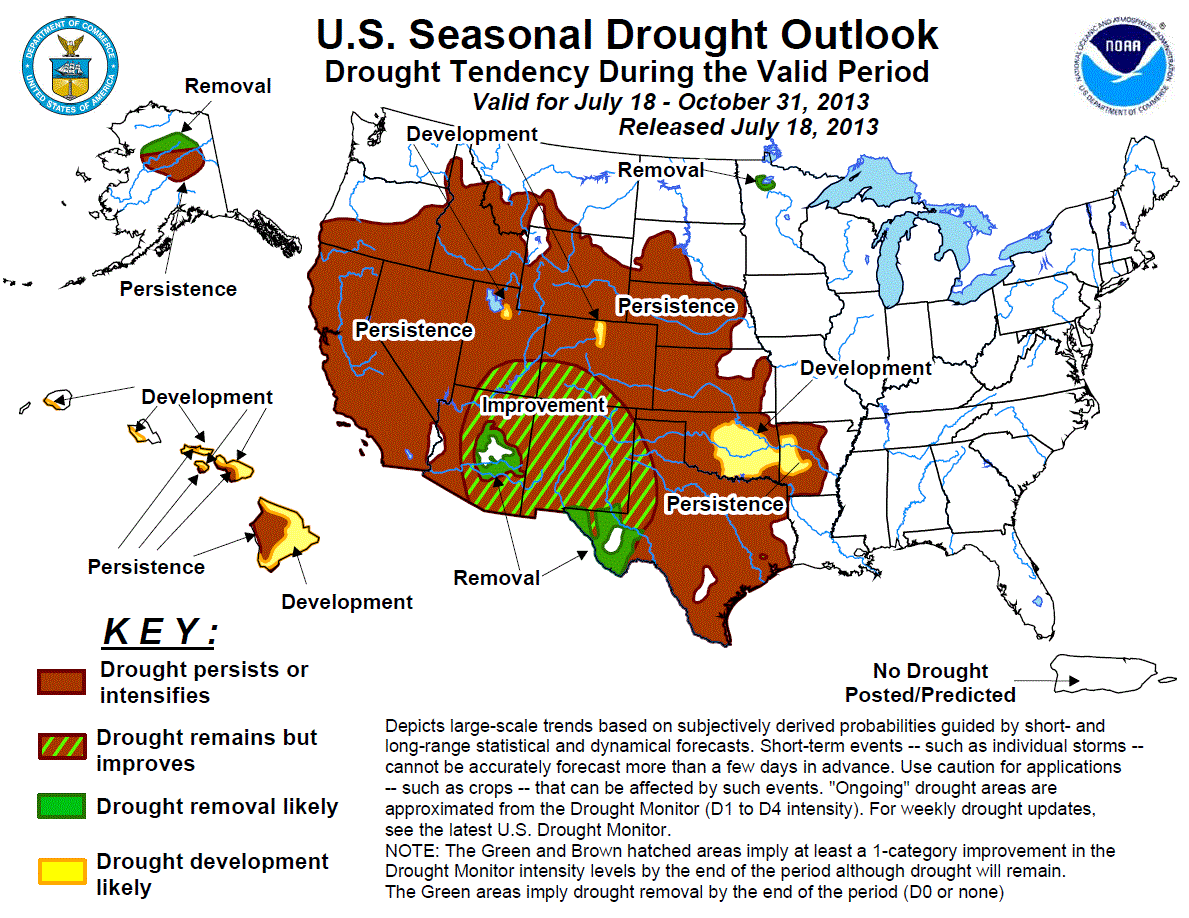
On Thursday 7 April 2011, all but one of the Republican members of the U.S. House of Representatives from Texas voted for H.R. 910 [4]to prevent the Environmental Protection Agency from regulating greenhouse gases. One Texas Republican (Rep. Michael Burgess) abstained and one Texas Democrat (Rep. Henry Cuellar) also supported the measure. The measure passed the House (255 Ayes, 172 Nays), with no Republicans voting against it. They were joined by 19 Democrats [5].
Just juxtapose this fact with the drought map of Texas, pictured with this post—and the fact that Texas’s state climatologist has warned [6] that “it is likely that drought frequency and severity will increase in Texas” due to climate change, and it would appear that you’ve got a real “What’s The Matter with Texas" story on your hands.
Senator James Inhofe's home state of Oklahoma isn't much better, by the way. Here is [7] its drought map.
Tags:
texas [8]
drought [9]
wildfires [10]
Read more: Texas Republicans Ignore Climate Science at Their Peril [11]
Source URL: http://www.desmogblog.com/texas-republicans-ignore-climate-science-their-peril
Links:
[1] http://www.desmogblog.com/whats-matter-ralph-hall
[2] http://www.wwfblogs.org/climate/content/texas-drought-wildfires-climate-11apr2011
[3] http://www.cpc.ncep.noaa.gov/products/expert_assessment/season_drought.gif
[4] http://www.opencongress.org/vote/2011/h/249
[5] http://www.opencongress.org/roll_call/sublist/8441?party=Democrat&vote=Aye
[6] http://www.texasclimate.org/Portals/6/Books/ImpactTX/Ch2Nielsen-Gammon.pdf
[7] http://drought.unl.edu/DM/DM_state.htm?OK,S
[8] http://www.desmogblog.com/directory/vocabulary/917
[9] http://www.desmogblog.com/directory/vocabulary/2010
[10] http://www.desmogblog.com/directory/vocabulary/6279
[11] http://www.desmogblog.com/texas-republicans-ignore-climate-science-their-peril
tx judge ok's xl pipeline 12/12
voter ID http://click.lists.propublica.net/?qs=39a515ec2da742c79d672eb18b0b0b822a44d41feeb3f0f01da81571b16c4d78 tX ct overturns
revolving door: http://www.statesman.com/news/texas-politics/lawyer-for-industry-played-key-role-establishing-texas-1029143.html?printArticle=y
Texas Judge Warns of Civil War if Obama Re-elected
A Texas judge is drawing controversy for declaring he is prepared to join a civil war to overthrow President Obama. In a televised interview, Judge Tom Head of Lubbock, Texas, said he thinks Obama will hand U.S. sovereignty over to the United Nations if re-elected.
Tom Head: "He is going to try to hand over the sovereignty of the United States to the U.N. OK, what’s going to happen when that happens? I’m thinking worst case scenario here. Civil unrest, civil disobedience, civil war maybe. And we’re not talking just a few riots here and demonstrations. We’re talking — we’re talking Lexington-Concord take up arms and get rid of the guy. OK, now what’s going to happen if we do that, if the public decides to do that? He’s going to send in U.N. troops. I don’t want 'em in Lubbock County, OK? So I'm going to stand in front of their first armored personnel carrier and say, ’You’re not coming in here.’ And the sheriff, I’ve already asked him, I said, 'You gonna back me?' He said, 'Yeah, I'll back you.’ Well, I don’t want a bunch of rookies back there. I want trained, equipped, seasoned veteran officers to back me."
public citizen: http://texasvox.org/
Rove flipped texas sup ct priscilla owen?
education:
Texas GOP officially comes out against critical thinking
It’s not a shock that the Republican Party of Texas’ official platform, announced and adopted this month, is a seething morass of racism and homophobia. Republicans: That’s how we do! Nor is it surprising that the platform comes out in favor of employee discrimination and corporal punishment in schools, and opposed to comprehensive sex education, environmental protections, affirmative action, and the Voting Rights Act. Yawn, really. But get ready to hand your $10 to Nick Fury, because they actually managed to pull out something so blatant that it surprised even jaded old me: The Texas GOP’s platform is explicitly opposed to critical thinking skills.
Here’s the relevant text:
We oppose the teaching of Higher Order Thinking Skills (HOTS) (values clarification), critical thinking skills and similar programs that are simply a relabeling of Outcome-Based Education (OBE) (mastery learning) which focus on behavior modification and have the purpose of challenging the student’s fixed beliefs and undermining parental authority.
To be fair, I guess Texas is willing to grandfather in people who already use critical thinking skills — as long as those skills don’t cause them to support things like marriage equality, voter enfranchisement, environmental responsibility, social justice of any kind, or not hitting children. They just don’t want this stuff to SPREAD. Don’t pass your dirty Communist “logic” on to OUR children, buster, or by god we will have you drinking hemlock.
According to Talking Points Memo, the party is now backpedaling the whole “brain thoughts are for homogays” approach, claiming that it was “not the intent of the subcommittee” to come out against critical thinking and that they “regret” the oversight. But they don’t regret it all that damn much, apparently, because they also say what’s done is done: The convention approved the platform, so it can’t be changed until the next state convention in 2014. By which time, if Texas Republicans had their druthers, there would be nobody left who even knew how to read the thing.
http://grist.org/list/texas-gop-officially-comes-out-against-critical-thinking/
thom hartmann: texas texbooks took TJ out (TH tells funny story of how GW ducked clergy test on xianity) http://www.youtube.com/watch?v=Hziy7WR9TQc&feature=related
Even as Texas and Wisconsin Republicans see their versions of ALEC’s voter ID model bill run into constitutional problems, Minnesota’s Republicans — who wafted into office on a magic carpet propelled in large part by cash from corporate voter ID backers — are prepared to flout that part of the state constitution that guarantees the right to vote. As Governor Mark Dayton, a Democrat who vetoed last year’s GOP efforts to push the ALEC Voter ID Bill but whose hands are tied this year because ballot amendments can’t be vetoed, says:
“This is a partisan amendment based on a false premise that voter fraud is a significant problem in Minnesota. Our election system is the best in the nation. We have the highest voter turnout year after year and under intense, bipartisan scrutiny, the recent statewide recounts have highlighted how reliable the results are. Much of the strength of the system derives from over 150 years of bipartisan work and its federated nature – the 87 county auditors, hundreds of municipal clerks, and 30,000 volunteer election judges who administer Minnesota’s elections and ensure they are free and fair.
“Republicans in the legislature had two years to negotiate bipartisan reforms to election law, and it is disappointing that their failure to do so has led to an unnecessary constitutional amendment that would make it harder for law abiding citizens, including tens of thousands of seniors, service members, and students, to exercise their right to vote. I cannot support a constitutional amendment that is pushed through the legislative process by only one political party – and neither should Minnesotans if they see it on the ballot this fall.”
http://firedoglake.com/2012/04/07/come-saturday-morning-minnesotas-alec-inspired-chaos-amendment-paid-for-by-wells-fargo-u-s-bank-and-tcf/
Texas Leads Resistance to EPA Climate Action
- by Kate Galbraith
- 9/23/2010
Come January, the Environmental Protection Agency will — in theory — begin regulating greenhouse gas emissions around the country for the first time. Large polluters planning expansions must include carbon dioxide and other gases linked to climate change on their permit applications, with broader regulations coming into force over time.
But not if Texas can help it. Attorney General Greg Abbott last week lodged legal challenges in a federal court against EPA actions on multiple fronts, including a reiteration of the state's long-standing argument against the EPA's scientific foundation for determining the dangers of greenhouse gas pollution. EPA regulation, Abbott's document said, "is the most draconian of its kind of any advanced economy in the world" and would damage the Texas economy.
Whether the flurry of legal activity can derail the EPA remains to be seen. The lawsuits — not just from Texas but also from coal and other business groups around the country, which are joining together to sue — are awaiting a response from a three-judge panel at the U.S. Court of Appeals in Washington, D.C., which will make a ruling about whether to stay the EPA's hand. Moreover, Texas plans to resist the EPA regulations even if the state loses its court battle. Abbott and Bryan Shaw, the chairman of the Texas Commission on Environmental Quality, or TCEQ, told the EPA in a letter last month that Texas would openly defy the regulations and refuse to ensure that companies comply. "We write to inform you that Texas has neither the authority nor the intention of interpreting, ignoring or amending its laws in order to compel the permitting of greenhouse-gas emissions," the letter said.
The greenhouse gas challenges should not be confused with Texas's separate but equally acrimonious battle against the EPA air-pollution permitting efforts in Texas. Federal regulators have rejected the state's system of permitting big plants — for a variety of toxic pollutants, from benzene to sulfur dioxide — as inadequate because it gives only an overall measure of a plant's pollution rather than more detailed data from individual smokestacks. Here again, Texas charges that the EPA rules will hurt Texas companies; the EPA counters that Texas is defying measures designed to protect the public. Abbott is challenging the EPA on this matter in federal court in New Orleans, and the 130 or so big plants caught up in the crossfire are trying to figure out what to do. The EPA offered one partial solution this week, allowing companies to undergo a voluntary audit but not triggering severe penalties if their past activities with the old permits fall short of EPA guidelines.
On climate change issues, Texas has emerged as one of the country's most vocal opponents of federal regulation — to the disgust, if not the surprise, of environmentalists. "Texas is aligned in this litigation with the biggest polluters in America," says Vickie Patton, deputy general counsel for the Environmental Defense Fund.
The Tribune
In fact, Texas is the biggest polluter in America. Due to its size and heavy concentration of factories, such as oil refineries and chemical plants, the state tops the list of greenhouse gas emitters. That underpins the arguments from Abbott — who did not respond to requests for comment — that the regulations hurt the Texas economy. (In an op-ed in the *Houston Chronicle* this spring, Abbott said his action against the EPA reflected on the agency's flawed methodologies, but he avoided the question of whether global warming was happening or not.) Gov. Rick Perry has also publicly decried the regulatory interference and its drag on business.
The long campaign
The state's campaign against EPA climate initiatives began in February, when the attorney general fired off his first petition challenging the scientific basis for the EPA's climate-regulation proposals. Two months earlier, the agency had taken an essential step toward regulating greenhouse gas emissions by asserting the gases posed a danger to human health and welfare. Known as the "endangerment finding," the ruling triggered a clause in the Clean Air Act calling for regulation. Restrictions on greenhouse gases had been considered under the Bush administration but remained stalled until the Obama administration took the matter up. A critical 2007 Supreme Court ruling, much-resented by conservatives, found that the EPA had the authority to regulate the gases. The Texas petition in February asked the EPA to recant its endangerment finding, and a court filing signaled the state's intent to mount a legal challenge.
Texas' filings last week, to the D.C. Circuit court, read in part like a traditional lawsuit but also ran through whole gamut of political arguments against climate regulation. Abbott challenges the EPA on four fronts. In blasting the the science behind the EPA's endangerment finding, he charges that the EPA relied excessively on the findings of "unaccountable volunteer scientists spread across the globe and unchecked by the American electorate." In other words, the EPA should have performed its own analysis of the dangers of climate change rather than using information from the Intergovernmental Panel on Climate Change, an international body whose work has stirred controversy. The panel's critics point to its premature forecast of Himalayan glaciers melting and the 2009 release of thousands of hacked e-mails and documents, dubbed "Climategate," that reflected poorly on climate researchers' conduct.
Abbott also takes aim at three other rules designed to implement the findings: one that would regulate tailpipe emissions from cars and effectively increase fuel economy, another that would establish greenhouse gas requirements for plants that are already must apply for a permit for other types of emissions, and a third called the "tailoring rule," which would exempt small polluters but rope in big ones. On a political level, Texas would seem to cheer the exemption of small companies — the less regulation, the better. But acting pragmatically on the legal front, the state argues the federal government can't legally exempt certain companies from regulation it applies to others and still be in compliance with the Clean Air Act.
Texas' challenge to the endangerment finding likely will fail, says the David Adelman, a professor specialized in environmental law at the University of Texas School of Law, because the courts generally defer to agencies on such technical scientific issues. However, he says, the outcome of the "tailoring rule" challenge would "be the harder one to predict."
The politics of resistance
Whatever the result of the court fight, another battle remains over Texas' plan to defy or ignore the regulations.
"TCEQ is not making any preparations for the greenhouse gas regulations," said Terry Clawson, a TCEQ spokesman, in an e-mail. For states like Texas that resist, the EPA can issue the permits on its own, directly to companies — but only after a lag time, up to 12 months in this case, to allow the state a chance to act, Clawson said. The result, he said, would be "uncertainty" for companies potentially subject to EPA regulation, a situation similar to that in the ongoing Texas-Washington fight over permitting of polluters. Some companies could even be subject to a construction ban come January, Clawson said, if the EPA pushes forward.
Abbott, in his filing last week, expressed concern not only about the EPA's rapid timeline but also about the cost to TCEQ of implementing the provisions. TCEQ, he wrote, would have to add 91 full-time employees to deal with climate regulation, at a cost of $4.1 million. The attorney general's office says it has spent $15,608.93 on the lawsuits so far — a figure that includes filing fees, man hours and copying costs — with the endangerment finding being the most expensive.
In the D.C. Circuit court, Texas has consolidated its challenges with those of many other entities, among them the U.S. Chamber of Commerce, the Ohio Coal Association and the National Association of Manufacturers, which all are bringing similar complaints. No one knows what the court will do or when. It could stay EPA action, preventing the agency from enforcing rules starting in January, or it could decide against a stay. Either way, the decision will be the first step in a process that will involve more in-depth hearings and filings on whether the EPA can ultimately proceed.
Texas' motivations are as much political as legal, says Patton of the Environmental Defense Fund, who points to the rabble-rousing language in the filings. "A big part of what is going on here," she says, "is that some of the forces that oppose EPA's effort to carry out the law in the science-based way are trying to engender support in Congress to politically countermand EPA's efforts."
Some in Congress are indeed trying to stop the EPA. Having beaten back controversial cap-and-trade legislation — a proposed alternative to EPA regulation — some lawmakers are now seeking to halt the regulation of climate-changing emissions under the Clean Air Act, too. An effort led by Sen. Jay Rockefeller of West Virginia, a coal-state Democrat, would delay regulation by two years. These efforts have the support of both Republican senators from Texas, Kay Bailey Hutchison and John Cornyn.
Environmentalists, for their part, say that Texas, the nation's leader in wind power, should be embracing limits on greenhouse gases rather than standing in the way. "Texas could be very well-positioned to be a major contributor to a clean-energy economy," Patton says, "and instead it's pouring precious public dollars into delay, deny, obstruct."
Gregory Wayne "Greg" Abbott[1](born November 13, 1957) is the Texas Attorney General, and is the second Republican since Reconstruction to serve in that role. Abbott was sworn in on December 2, 2002, following John Cornyn's election to the U.S. Senate. Prior to assuming the office of attorney general, Abbott was a justice on the Texas Supreme Court, a position to which he was initially appointed in 1995 by then-Governor George W. Bush. He is noted outside the state of Texas for successfully defending the right of the state of Texas to display the Ten Commandments in front of the state Capitol in Austin in a 2005 United States Supreme Court case known as Van Orden v. Perry.
desmog
11 April 11
Texas Republicans Ignore Climate Science at Their Peril

About a month back, I wrote about the “Strange Case of Ralph Hall,” a leading Republican whose Texas district was suffering through severe drought—a condition expected to worsen, due to climate change, in the future—but who challenges mainstream climate science. As I put it then:
So here is the strange summation: Ralph Hall represents a state and district suffering from (and highly vulnerable to) drought; global warming is expected to worsen drought risks for Texas and Hall’s district; Hall questions the science of global warming; Hall leads his party in an effort to block funding for a climate service that would help his district, and many other regions, assess their vulnerability and prepare for a changing climate.
I bring this up again now because, as Nick Sundt points out at the WWF climate blog, it isn’t just Hall--or, just his district.
March 2011 was Texas’s driest month on record; 98 % of the state is currently in drought conditions; the stage is set for devastating wildfires; and the current drought is expected to persist or intensify.But drought isn't the only thing that’s growing more stark—so is the contrast between these weather and climate conditions that their state faces on the one hand, and the behavior of Texas’s elected representatives on the other. As Sundt reports:
On Thursday 7 April 2011, all but one of the Republican members of the U.S. House of Representatives from Texas voted for H.R. 910to prevent the Environmental Protection Agency from regulating greenhouse gases. One Texas Republican (Rep. Michael Burgess) abstained and one Texas Democrat (Rep. Henry Cuellar) also supported the measure. The measure passed the House (255 Ayes, 172 Nays), with no Republicans voting against it. They were joined by 19 Democrats.
Just juxtapose this fact with the drought map of Texas, pictured with this post—and the fact that Texas’s state climatologist has warned that “it is likely that drought frequency and severity will increase in Texas” due to climate change, and it would appear that you’ve got a real “What’s The Matter with Texas" story on your hands.
Senator James Inhofe's home state of Oklahoma isn't much better, by the way. Here is its drought map.
rfk2
1/Sep/2011
Crimes Against Nature Harper Collins 2004
c1 mess in Tx
1999 houston smoggiest city, #1 in childhood asthma bd air and water, drop to 49 on ecology spnding p12
p13 sent most chemicals and toxins in air, co2 (10 % of US); most chem spills and made the most toxic waste
shortly after inaug tort reform emergency issue and appt's judges accordingly p 13
1995 takings bill made taxpayers pay for cleanup (overturns longtime legal notion that X can't damge y's proprty/comons
property w/o compensation Lincoln freeing slaves ? 14
tx envro stocked w/ pesticide friendly anti union guy, ex monsanto lobbyist exec (chemical assoc), and another pro pest guy 14 TRNCC aka train wreck, eliminated public input on permits and plant inspections, slashed budget by 20%, avg ozone over larger areas 15
grandfathered many on air including TXI and cement capital, produced 1/3 of smog 16. clinton epa went after, but big donors to b2?; alcoa, exxon, shell, amoco, enron, dow etc 1.5m$ 17
2 laws make all vol (chems founf to be 6-15x higher than reported by mfg 18 almost 300 schols 2 mi from grandfathered; 9 gave at least 100K to be pioneers (Baker and Botts law firm, also vinson and elkins (alcoa) ceo Paul Oneil (fired b/c?)
energy dept transition team headed by DC incl 3 tx pioneers incl Lay 19
dep commerce don Evans, oil delay ("epa is the Gesapo of gov't")
TXU got 600MK tax rebate? Gt Unravel p 246
also chevon, texaco, enron, phillips petrol, all texas co?
Palast:
By 1998, after boarding and capturing England, U.S. power buccaneers, led by Southern,
Enron, TXU, Reliant and Entergy had grabbed generating stations and wires on every
continent save Antarctica.
But not in the United States, not at first. Americans believe in free enterprise, but we
prefer cheap electricity and nearly free water, the product of a combination of our tight
regulations and government ownership. Almost alone on the planet, the USA stubbornly
exempted itself from what the World Bank calls "neo-liberal reform"-and this rankled the
new international players who hungered to work the free market can in the USA. The
industry lobbyists landed on two beachheads, Texas and California, the only two states
with electric systems big enough, and governments Republican enough, to convert to
"free" markets.
California was the first to fall over the electricity deregulation cliff, but Texas was the
first to leap-with a push from its young new governor, George W. Bush. With Texas
companies raking it in worldwide, it's not surprising that the rush to deregulate started in
the Lone Star State.
But there was a technical problem that delayed the ripping down of regulation in Texas.
To understand why requires a little lesson in engineering. The power stations of Texas
produce three things: electricity, pollution and political donations. And, as always, Texas
is biggest in all three. Take, for example, the giant power plant named, with admirable
candor, Big Brown, owned by TXU. When it comes to filth, Big Brown is champ. A strip
mine near Waco stuffs Big Brown's furnaces with lignite, a kind of flammable dirt. TXU
dumps 389,000 tons of contaminants into the air each year, making it the number-one
polluter in the number-one polluting state in the USA.
Bush made Dallas residents gasp (literally) when he signed a "grandfather" statute
exempting some TXU plants from laws requiring scrubbers for these fossil-burning
dinosaurs. The other beneficiary: polluter number two, Reliant. TXU and Reliant popped
over half a million dollars into Bush's second gubernatorial race.
In 1995, the Clinton Justice Department opened an investigation into evidence of
conspiracy by TXU and Reliant to monopolize the Texas power lines. The promised
"competition" created by deregulation could placate the Feds and make Enron's Ken Lay
a very happy man at the same time. Problem was, TXU and Reliant were stuck with Big
Brown and plants so costly, inefficient, dangerous and contaminated the companies
would lose billions in a true competitive market.
Governor Bush was always cautious to avoid conflicts of interest-in this case, the conflict
between the interests of his top donors, Enron, El Paso Corporation and Dynegy (power
traders) and TXU and Reliant (power producers). Former Enron lobbyist Terry Thorn
told me straight up this quandary for the governor kept Texas deregulation stalled for two
legislative sessions until Bush found a third party to pick up the tab: Texas electricity
customers.
In 1999, the governor, the power traders and power producers shook hands on a deal to
add a $9 billion "stranded cost" surcharge to Texans' electric bills.
Ken Lay had another concern. Bush's stranded cost surcharge would let the games
http://www.opensecrets.org/news/2010/08/find-the-epicenter-of-the-oil.html
And, perhaps surprisingly, more oil and gas-related federal political donations have originated in Fort Worth 76102 this election cycle than in any other U.S. ZIP code, a Center for Responsive Politics analysis indicates. Indeed, it's more money than from ZIP codes in oil company haunts such as Houston or Dallas, or even in Washington, D.C., where industry lobbyists earn tens of millions of dollars annually defending petroleum interests.
In all, 76102 is responsible for $248,330 this cycle from people and political action committees associated with the oil and gas industry; more than $221,000 of it went to federal-level Republican candidates or committees. (More than $1 million in total federal-level contributions have so far this election cycle come from 76102.)
...
Through July, Texas as a whole is responsible for an exponentially greater amount of oil and gas-related money flowing into federal politics -- $3.72 million -- than any other state.
Oklahoma ($941,708), Louisiana ($502,590), Kansas ($471,627) and California ($466,731) complete the top five.
At the bottom: Delaware ($200), Idaho ($1,000), Maine ($1,500), Rhode Island ($3,150) and Hawaii ($3,750).
The top states this election cycle are bucking historical trends, to an extent. While Texas and Oklahoma are also No. 1 and No. 2 in oil and gas industry-related contributions going back to the 1990 election cycle, Washington, D.C., sits in the third spot, followed by California and Colorado.