Crt2 Bak
===
===
new
jacobin no lnx
Race Marxism Is a Very Strange, Very Bad Book
By
Matt McManus
James Lindsay has a best-selling book out called Race Marxism. Reading the book, you soon learn that Lindsay has a shallow understanding not just of Marxism or racism in the US but the classical liberal tradition he seeks to defend.
James Lindsay speaking with attendees at the 2021 AmericaFest at the Phoenix Convention Center in Phoenix, Arizona, on December 19, 2021. (Gage Skidmore / Flickr)
“Trumpism,” our issue focusing on the global right, is out now. Subscribe to our print edition at a discounted rate today.
The Church of Human Resources
Tyler Austin Harper
Democrats Aren’t Campaigning to Win the Working Class
Jared Abbott Fred DeVeaux
Cori Bush: Why I’m Calling for a Cease-Fire in Gaza
Cori Bush
Shawn Fain: Workers Deserve More Time for Themselves
Shawn Fain
Review of Race Marxism: The Truth About Critical Race Theory and Practice by James Lindsay (New Discourses, 2022)
In Race Marxism: The Truth About Critical Race Theory and Praxis, James Lindsay accuses critical race theory of being a “sweeping set of conspiracy theories about race and racial power in Western liberal democracies” that is descended from a long line of “Marxist conspiracy theories about the upper class of society.” Lindsay goes on to accuse critical race theory of working to penetrate and undermine “every school, college, university; every workplace, office, hospital; every magazine, journal, newspaper; every television program, movie, website; every government agency, institution, program; every church, synagogue, mosque; every club, affinity, pastime, and interest” in the United States and beyond.
Hearing Lindsay’s paranoid speculations, one suspects that before long critical race theory will have inspired the shooter on the grassy knoll, concealed the remaining Romanov children, and — worst of all — ruined my night at the bar.
In Search of Argumentation
Lindsay’s book is part of a new genre of conservative critiques of the Left. Gone is the old strategy of compensating for reading nothing by saying a lot. Now we get an avalanche of pages that demonstrate the author has read a lot, followed by little in the way of substance or assertion (see Mark Levin’s American Marxism for the gold standard).
I say this because despite Lindsay’s conspiratorial claims, there is no doubt he has read more critical theory generally and critical race theory specifically than your average conservative firebrand. Race Marxism is filled with long (sometimes pages-long) quotations from major critical race theorists, typically paired with his own explanations of the meaning. Sometimes he’s in the ballpark; other times it is clear he doesn’t understand the thinkers he’s talking about. But it is telling is that Lindsay never sets out to refute these thinkers. In fact, one of the defining features of his book is how remarkably free of arguments and counterarguments it is.
One of the defining features of his book is how remarkably free of arguments and counterarguments it is.
This doesn’t appear to be an accident. In the concluding chapter, Lindsay describes the mess that came before as giving “some sense of what Critical Race Theory really is, where it comes from, how it operates.” Now, he writes, “we can make a few tentative comments about what we can do about it.”
Note that none of this includes what should be the vital argument: why critical race theory is wrong. While the cynic might chalk up the omission to simple ignorance, I suspect the reality is far more banal. Lindsay believes that the mere presentation and mockery of his opponent’s views will reveal them to be so transparently bad, or at least seen as such by a sympathetic audience, that the task of pointing out why they are in fact bad is unnecessary.
To spare the reader the triple headaches I experienced going through the book, I will give just two examples. At one point, Lindsay unpacks Derrick Bell’s controversial theory of “interest convergence.” In a variety of publications, Bell marshals historical and legal research to argue that one rarely sees improvements in the conditions of racialized peoples unless those changes also benefit the white majority. For instance, Bell claims that many of the civil rights movement–era reforms were motivated by a desire to improve America’s moral standing in the Cold War.
Whatever you think about the broader argument — and it’s certainly not immune to criticism — Bell’s latter point is well-documented: as early as the Harry Truman administration, US officials asked the President’s Committee on Civil Rights to report on the foreign policy ramifications of racial discrimination and recommend potential remedies. Lindsay never cites any evidence to rebut Bell’s legal and historical claims, dismissing them as “shocking” “mind reading” demonstrative of the “paranoia and conspiracy of Critical race theorists.”
Lindsay’s claim is an odd one, not least because revising our understanding of history is what historical research does.
An even more telling example is Lindsay’s long tirade against the “historical revisionism that is central to the storytelling of Critical Race theory,” by which he means efforts to retell the history of the United States that emphasize racial and other forms of exploitation. Lindsay’s claim is an odd one, not least because revising our understanding of history is what historical research does. As we gather new evidence about the past, we arrive at a better, more complete sense of both our history and present. This is what many historical commentators have done with race, too, going back at least to Frederick Douglass’s famous pricking of US hagiography in his 1852 speech “What to the Slave Is the Fourth of July?”
So what evidence does Lindsay present against those who argue that an honest rendering of US history must include the country’s long periods of racial domination and violence — and the struggles by those at the bottom of society to wrest themselves free? Not even an iota.
He instead insists that the “rationale” of historical revisionism is “raising a racial critical consciousness, which is to say manipulating people into becoming Critical Race Theorists.” In the face of libraries worth of books about race — including many, many works written by non–critical race theorists — this is his objection. How foregrounding the bleak facts of racism in the United States is manipulation, Lindsay doesn’t say.
Misunderstanding Marxism
In the few instances where Lindsay tries to offer some actual criticisms, the results are more than a little puzzling. For instance, Lindsay repeatedly parrots the conservative philosopher Eric Voegelin in describing Marxism as one in a
long line of Gnostic cult ideologies that seek to characterize God as tyrannical and the existing order of the world as a prison (hello Foucault) into which we are flung (hello Heidegger) that we can escape if we discover the true nature of “reality” which is a kind of consciousness that must be raised. That is, Marxism is rebellious Gnosticism reconfigured for industrial Modernity.
For one, Lindsay ignores that Voegelin argued that liberalism was also a secularized Gnostic faith, one of the reasons he has long been an influence on conservative and postliberal critics. But even more egregious is his rendering of Karl Marx.
You see, according to Lindsay, the “prevailing view . . . that Marx offered an economic theory” is “not true in the slightest.” This would come as a surprise to the Prussian theorist, who gave his magnum opus the subtitle “a critique of political economy” and filled thousands of pages with commentary on Adam Smith, David Ricardo, and the other classical economists.
An 1867 edition of Karl Marx’s Das Kapital, from the Saitzew Collection in the Zurich Central Library. (Zentralbibliothek Zürich / Wikimedia Commons)
The basis of Lindsay’s argument is that Marx’s Hegelian roots commit him to a kind of atheistic eschatology, where revolutionary agitation against liberal “common sense” and “reality” are to bring about an ill-defined utopia through mass violence. In reality, Marx had many good things to say about both liberalism and capitalism, and his own vision of an ideal human society was one where the “development of human powers [is] an end in itself.”
Much of Lindsay’s misunderstanding comes from his deep misreading of Marx, whom Lindsay describes as analyzing the “material contradictions in the conditions of the working class as compared to the wealthy bourgeois capitalists.” Lindsay has it entirely backwards, since for Marx the disparities in conditions and power between classes were an expression of the more fundamental contradictions of capital. This is key to understanding Marx’s revolutionary argument, since he didn’t think reforms that only improved workers’ material conditions could resolve the fundamental contradictions of capitalism.
Whatever one thinks of this argument, even a cursory understanding of Marx’s economic theory would correct Lindsay’s errors. Though I suppose that kind of attention is unlikely since Lindsay thinks it is “not true in the slightest” that a figure even pro-capitalists acknowledge made important contributions to economics actually wrote about economics.
Misunderstanding Liberalism
Most strikingly of all, Lindsay doesn’t have a robust understanding of the classical liberal doctrines he sets out to defend. To be fair, he acknowledges that Race Marxism isn’t intended to provide an account of “the good,” which is “too big a topic for this volume.” But the concluding sections of the book defend a “classical liberal” and “commonsense” commitment to “reality” and “human nature” along with “meritocracy,” “individualism,” and “rights” (especially the right to property). He lays this out in a manifesto of sorts at the end of the book.
That all men are created equally (in the image of God) and endowed by the creator with certain inalienable rights that precede any pretense to privileges granted by the state is a great starting place. That we will therefore judge people on their merits and character, not their identity, is a solid starting place. That we can understand reality as it is, in ourselves, in pursuit of a more perfect union (not just American nation, but people more broadly) is a powerful value. That we can own things and do as we will with our property within the reasonable bounds of the law is a cornerstone of a free people.
Seemingly unbeknownst to Lindsay, some of the most effective criticisms of these mythologized values have come from liberals themselves.
Consider the idea of “meritocracy” and merit. As Michael Sandel points out in The Tyranny of Merit, both right- and left-liberal theorists throughout the twentieth century rejected meritocracy as implausible. In The Constitution of Liberty, libertarian thinker F.A. Hayek criticized meritocracy for holding that property should flow to those considered deserving rather than those who happen to benefit from purely free market transactions. If it turns out that the people want Fifty Shades of Grey novels rather than Gravity’s Rainbow, the market accepts that the less meritorious author will get rich. Writing from the other side of the spectrum, John Rawls argued that the very notion of meritocracy is incomprehensible given the sheer volume of “morally arbitrary” factors that influence our lives. Even our natural talents are the result of a genetic lottery rather than any effort of our own — hardly the basis for a convincing moral theory.
A caricature of John Stuart Mill by the cartoonist Leslie Ward in Vanity Fair, March 29, 1873. (Wikimedia Commons)
Or consider the contention that liberalism is synonymous with an unadulterated respect for private property rights. This may be true of liberals in the “possessive individualist” tradition, such as John Locke. But it’s not even true of all classical liberals. Adam Smith lambasted arguments against higher wages for labor, arguing that capitalists would “say nothing concerning the bad effects of high profits. They are silent with regard to the pernicious effects of their own gains. They complain only of those of other people.” J.S. Mill, whom Lindsay has elsewhere praised as a defender of free speech, identified as a socialist. For Mill, liberalism was less about defending capitalist property rights than protecting individuals from the domination of unchecked power.
Lindsay is largely silent on this more left-wing side of liberalism — which explains why he can slam someone like Charles Mills in the book, while failing to acknowledge that Mills himself identified as a “radical” black liberal.
A Very Strange Book
Lindsay deserves credit for reading a fair number of the major authors of critical race theory. Even if that’s a low bar, it’s one that other critics of so-called postmodern neo-Marxism and its offshoots haven’t managed to clear. I also think the Left (or at least some quadrants of it) would benefit from dropping their affinity with postmodernism and anti-Enlightenment skepticism and adopting a more assertive approach to theory and politics.
But Lindsay’s ever-so-minor accomplishments shouldn’t disguise the fact that Race Marxism is a very strange, very bad book — one as light on real arguments as it is heavy on snide exposition and American exceptionalism.
So, as an antidote, I will end with the wise and prophetic words of Frederick Douglass:
The blessings in which you, this day, rejoice, are not enjoyed in common. The rich inheritance of justice, liberty, prosperity, and independence, bequeathed by your fathers, is shared by you, not by me. The sunlight that brought life and healing to you, has brought stripes and death to me. This Fourth [of] July is yours, not mine. You may rejoice, I must mourn. To drag a man in fetters into the grand illuminated temple of liberty, and call upon him to join you in joyous anthems, were inhuman mockery and sacrilegious irony.
Contributors
Matt McManus is a lecturer at the University of Calgary. He is the author of The Rise of Post-Modern Conservatism and Myth, the coauthor of Mayhem: A Leftist Critique of Jordan Peterson, and editor of Liberalism and Socialism: Mortal Enemies or Embittered Kin?.
===
mma 4 24
Before anti-woke crusader Chris Rufo became a right-wing influencer and leading force driving moral panic around sex education and LGBTQ curriculum in our nation’s schools, his now-defunct nonprofit created a course that assisted students in making films about affirming and supporting gay youth and going through pregnancy in high school. A review of the student films reveal Rufo’s organization was involved in helping students produce the type of content that he now seeks to ban from schools, and he charged them hundreds of dollars for his services.
From 2009 to 2011, Rufo’s nonprofit Documentary Foundation ran a program called Doc School, a “community outreach and education initiative” intended to teach students how to make films on “important local topics” and gain skills necessary for “activism in the community.” (Rufo reportedly closed the foundation last year but not before he funneled at least $1.3 million in dark money to a new right-wing media nonprofit whose stated goal was to reveal “the implications of a far-left ideological takeover.”)
Media Matters reviewed student films posted to Doc School’s apparent Vimeo account — which bears the program’s name, location, and a link to Documentary Foundation’s now-defunct website — and tax filings for his organization, which show Rufo’s nonprofit earned more than $23,000 from the program in its first year.
Doc School student films celebrate gay youth and pregnant teens overcoming adversity
Before Rufo helped influence a Florida law that bars discussion of LGBTQ identity in schools, he and his collaborator Keith Ochwat assisted high school students in making a number of short documentaries highlighting the sorts of experiences Rufo fearmongers about today.
Gay Youth tells the story of a 17-year-old who discovered his sexuality in sixth grade and was removed from school by his parents after he came out. The short ends with an uplifting and affirming message describing how finally being able to come out gave him newfound confidence.
The filmmakers thanked Rufo by name in the credits.

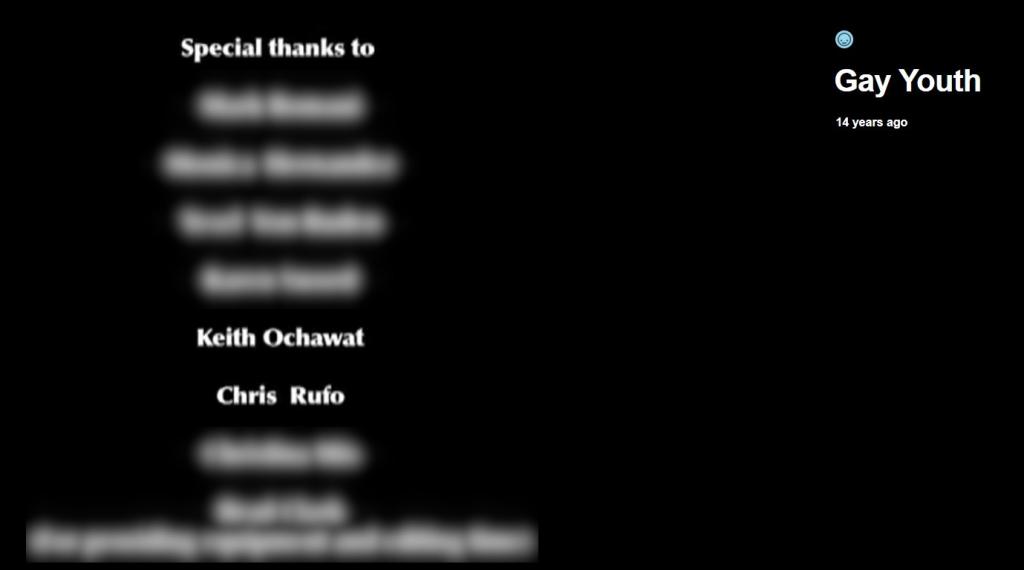
Other films feature underage high schoolers’ descriptions of their experience with sex and pregnancy, as well as sexually explicit descriptions of hazing.
Are You Ready? — A film about Teen Pregnancy features a 17-year-old girl recounting the difficulties of going through pregnancy as a high schooler. The film features discussion of both drug use and considerations about when to first have sex. A copy of the film found on YouTube lists both Doc School and Documentary Foundation as sponsors in the credits.
Another film, Hazing High, features high schoolers recounting their experiences with hazing, including being stripped and forced to consume bodily fluids.
In 2009, Rufo’s nonprofit earned nearly a quarter of its annual income — more than $23,000 — from Doc School
Rufo founded Documentary Foundation in 2007, billing it as an organization “dedicated to the production and support of documentary films.” Along with production and “community outreach,” the nonprofit also claimed its mission included “youth education.”
Youth education took the form of Doc School, which launched in 2009 in partnership with a Northern California PBS affiliate. A flier describing the course listed Rufo and Ochwat as instructors and filmmakers who “enjoy sharing their filmmaking experience with our communityʼs next generation of filmmakers.” Documentary Foundation described Doc School as an “integral part of the Foundationʼs community outreach and education initiative.”
For $390, local high school students met with Rufo and Ochwat every Saturday for two months to make their own documentary shorts. Students were instructed to pay their tuition directly to Rufo’s nonprofit. After the instruction and films were completed, the films were screened at a “Doc School Film Festival.”
According to Documentary Foundation’s 990 form from 2009, Doc School netted the foundation more than $23,000, nearly a quarter of its total revenue for the year. The organization said the program would be offered biannually going forward, and it lasted until 2011, per tax filings.
Rufo went from empowering gay youth to deploying culture warriors against them
Today Rufo endorses a completely different view of how students and teachers should express themselves.
He now insists that K-12 schools are weaponizing “principles of academic queer theory,” which he alleges teachers have translated into “K-12 pedagogy,” and he worked to pass Florida’s so-called “Don’t Say Gay” law, which prohibits K-12 educators from discussing gender identity, sexual orientation, or reproductive health with students.
Rufo’s crusade has similarly inspired conservative parents and groups to harass and take over local school boards based on the perception that public schools are implementing “woke” curricula and policies.
When Florida Gov. Ron DeSantis appointed Rufo to the board of trustees of New College of Florida, a public liberal arts college in Sarasota, Rufo pushed to abolish gender studies programs at the school, claiming that “gender studies and queer theory” were “explicitly opposed to the classical conceptions of the true, the good, and the beautiful.”
Rufo recently announced he would be leading a new program to fund the projects of aspiring culture warriors who seek to advance the right’s war on “gender ideology” and issues like “critical race theory” to reshape public policy. Rufo again promised to teach his students important skills for activism. This time around, though, he will be paying them.
04/04/24 2:28 PM EDT
04/04/24 1:30 PM EDT
Related
06/30/22 3:51 PM EDT
04/03/23 11:25 AM EDT
04/06/22 10:05 AM EDT