Climate Central
BS PIELKE
2025
ANOTHER SCANDAL
Like a zombie, the so-called “billion dollar disasters” (BDD) tabulation is back. This week the advocacy group Climate Central announced that it was the new home of the effort, formerly housed at the U.S. National Oceanic and Atmospheric Administration (NOAA). To much fanfare and media attention, Climate Central released its supposedly newly-tabulated numbers for 2025 to date.
Remarkably, the shenanigans associated with the BDD are apparently continuing, as documented in this post. Fool me once . . .
Before getting to the shenanigans, let me emphasize that Climate Central is a proper home for “billion dollar disasters,” because the tabulation has always been about promoting climate activism in the guise of science-like numbers. Political advocacy is often full of dodgy claims, of course, and climate advocacy is no different.
Climate Central, the group that also brought us World Weather Attribution, is funded by theBezos Earth Fund, among others. The group seeks to place the “existential threat” of climate change at the center of everything:
At Climate Central, we envision a world where public will to address the climate challenge is robustly deep, broad, and sustained—where it becomes a core element of culture everywhere.
The many problems with the “Billion Dollar Disasters” tabulation have been discussed extensively here at THB and in the peer reviewed literature, and won’t be revisited today.
This week does however bring a remarkable new twist in the saga, and perhaps even rising to the level of a new scandal.1
The Climate Central press release this week on their list of disasters so far in 2025 was dutifully and uncritically amplified by the New York Times, Washington Post, USA Today, and Time, among others.2
I took a look at the new 2025 tabulation and was surprised to discover that it simply copied loss estimates from Gallagher Re, a reinsurance company. You can see the near-identical numbers in the table below.
[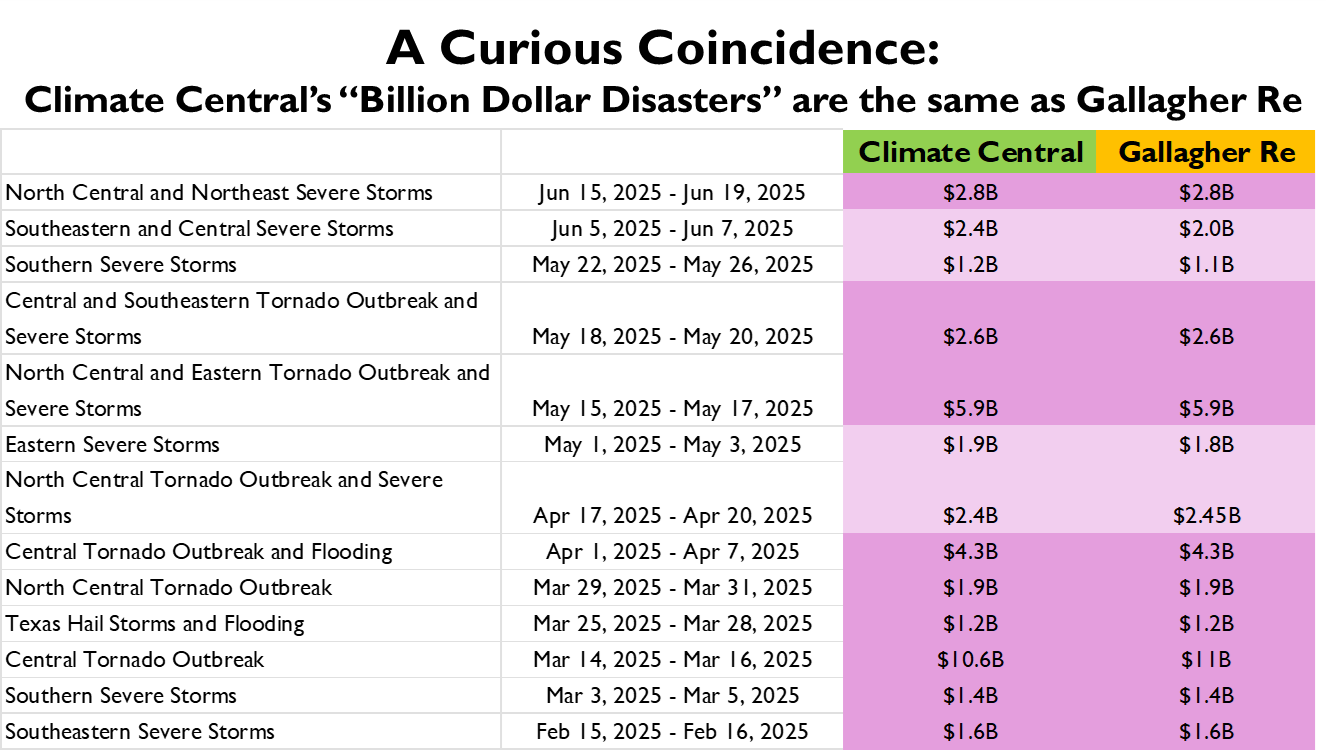 ](https://substackcdn.com/image/fetch/$s_!YLA8!,f_auto,q_auto:good,fl_progressive:steep/https%3A%2F%2Fsubstack-post-media.s3.amazonaws.com%2Fpublic%2Fimages%2Fd3de6908-64fe-4941-b7c9-6967f4923f1b_1326x751.png)Sources: Climate Central and Gallagher Re.
I can think of three possibilities here:
- Climate Central has simply plagiarized the numbers from Gallagher Re, and all its talk of “peer reviewed” methods and dozens of carefully vetted public and private sector data sources are just a fiction;
- Climate Central and Gallagher Re are working together behind the scenes to launder the Gallagher Re loss estimates into the media from a supposedly “independent” source — again meaning the Climate Central “methods” are just veneer;
- A remarkable, fantastic, unbelievable coincidence that led to identical results from the two groups. Anyone who is familiar with disaster loss estimation methods will also understand that such a coincidence is about as likely as aliens landing on the White House lawn today.
That leaves plagiarism or conspiracy. Either way, Climate Central is playing us all for fools and apparently some are happy to take on that role. I am of course happy to publish a response from Climate Central and/or Gallagher Re about how they came to have the same numbers.
One final note — The architect of the Gallagher Re numbers is a one-time former collaborator of mine who I called out in*Forbes*back in 2020 when he was at Aon for putting a very heavy thumb on Aon’s loss estimates. At the time I concluded:
Whatever is going on here, it is clear that the Aon catastrophe dataset is not suitable for analysis of trends in losses, much less for academic research. Going forward, I will drop Aon data from my research and suggest that other researchers and the media exercise extreme caution in using it.
Not much has changed.
I have some upcoming university events, please come and say “Hello” if you are in the neighborhood! All are free and open to the public, details at links below.
- New College, Sarasota, FL - 28 October, 6PM — Climate, Covid, and the Politicization of Science: The intersection of science, politics, and public trust
- Johns Hopkins University, Baltimore, MD - 6 November, 2PM — Bridging Perspectives in COVID’s Wake: Science, Policy, and Public Trust in Crisis Response
- Cornell University, Ithaca, NY - 12 November, 5PM — What Climate Science Actually Says About Extreme Weather
*Postscript: Here is a fun little story related to this post — After my 2020 Forbes piece questioning Aon’s data was published, I was told by my editor at Forbes that Aon had complained about the post (but did not contest its content) and that all my future columns would have to be cleared in advance. That was enough for me to bid Forbes goodbye and helped motivate me to start The Honest Broker on Substack later in 2020.
REF
- 3greenassistance
- Actions@EBMF
- S. Decker and Sherron Anstrom Family Fund
- The David R. and Patricia D. Atkinson Foundation
- Bezos Earth Fund
- CO2 Foundation
- dsm-firmenich
- Floyd Fund
- Freedom Together Foundation
- Gutenstein Heritage Foundation
- Gutenstein Legacy Foundation
- Harney & Sons
- William and Flora Hewlett Foundation
- High Meadows Foundation
- Kresge Foundation
- The Landers Family
- Litterman Family Fund
- Mary Penniman and Garrett Moran
- Nature's Own
- Orchard Foundation
- Quadrivium Foundation
- The Rao Foundation
- Rita Allen Foundation
- The Robert Wood Johnson Foundation
- Ed Rounds and Callae Walcott Rounds
- George H. and Estelle M. Sands Foundation
- The Schmidt Family Foundation
- Nancy and Greg Serrurier
- Silicon Valley Community Foundation
- Fred and Alice Stanback
- Tiger Baron Foundation
- VoLo Foundation
- Helen and Will Webster Foundation
- Anonymous (6)
---
new rep 10 26 mark h
ref
With the U.S. midterm elections less than three weeks away, is it any surprise that corruption has emerged as voters’ top concern? “Corrupt” was the adjective most often chosen when registered voters were asked for a single word to describe President Donald Trump, according to a survey conducted in September by The Economist and the market research firm YouGov, with 53 percent of respondents calling Trump “corrupt” and only 23 percent saying he is “honest.” A Pew Research Center poll in early October found that nearly seven in 10 (69 percent) of Americans are “not confident” that Trump keeps his business interests separate from his presidential decisions.
Americans can thank diligent investigative reporting for alerting them to much of the self-dealing by Trump, his family, and aides. For example, The Washington Post has reported that Trump’s sons, Don Jr. and Eric, were investors in 15 companies that “collectively generated at least $3.2 billion in direct government business since the sons invested and an additional $3.1 billion in future contract options.” On Tuesday, in a rare retreat, the White House asked Kimberly Guilfoyle to resign as U.S. ambassador to Greece after a Wall Street Journal investigation revealed that Guilfoyle promised political favors to a Trump donor if he would quietly pay off her $100,000 American Express credit card bill.
Throughout the history of modern polling, voters have usually ranked the economy (or its proxies, such as “the cost of living”) as their top issue. Now, linking corruption with the cost of living, “Democrats Are Making Corruption Messaging a Pocketbook Issue,” a recent Politico headline declared. The Democrats’ claim, The New York Times reported, “is that rampant corruption in Congress and the administration is directly costing average citizens who are paying more for necessities like groceries, gas, and medicine.”
Both Democrats and the press, however, so far, are overlooking one of the most overt and consequential examples of Trump’s pay-to-play behavior. On May 24, 2024, Josh Dawsey and Maxine Joselow of The Washington Post published a blockbuster exposé, reporting that Trump privately told a group of oil company CEOs they should donate $1 billion to his 2024 presidential campaign. It would be a good “deal” for the industry, Trump reportedly said, because of the tax and regulation benefits they would receive if he returned to the Oval Office.
Specifically, Trump reportedly said he would reverse the Biden administration’s pause on new liquefied natural gas, or LNG, export permits, approve more drilling for oil in the Gulf of Mexico and Alaska, and roll back environmental regulations the industry didn’t like, including electric vehicle purchasing mandates and vehicle emissions limits. Dawsey and Joselow then published a follow-up, reporting that Trump also promised to soften Federal Trade Commission scrutiny of industry mergers and acquisitions.
Two and a half years later, his administration has delivered on each of these promises and then some. The Brennan Center has published a well-documented summary of Trump’s assault on climate policy—including his administration’s repeal of the “endangerment finding,” which granted the federal government the authority to regulate greenhouse gas emissions—that connects the dots between Trump’s actions and the many billions of dollars the oil industry has reaped as a result, including many millions of dollars benefiting oil executives as individuals.
What makes all this relevant to the midterm elections—beyond the fact that the leader of the Republican Party is directly implicated—is that many of Trump’s accomplishments were only possible because of rubber-stamp support from Republicans in Congress. Now those same Republicans must face the voters. How will they explain themselves?
To be clear, Democrats don’t get a pass here; corruption has been part of politics forever, and one of the press’s central obligations is to expose and hold its perpetrators to account, whoever they may be. That requires following the facts where they lead. But it also requires challenging the practice, still common among old-school newsrooms, of false equivalence—of portraying both sides as equally culpable for a given transgression for fear that an accurate portrayal would look like “taking sides.” If most of the facts point in one direction, our reporting should have the integrity and courage to say so.
Most voters don’t have access to directly question candidates seeking their votes. It’s our job as journalists to ask questions on their behalf so they can make informed decisions about their leaders.
Corruption is understandably a hot issue these days. Meanwhile, new scientific analysis from the nonprofit Climate Central shows that every congressional district in the country is hotter than it was in 1970, thanks to climate change. No surprise, then, that polling also shows that the vast majority of people want their government to take stronger climate action. Journalism that connects those dots—accurately and fairly, and without pulling any punches—is a true public service.
-=-=
-=-=
Our history
In 2008, motivated by climate scientists’ high levels of concern about the heating planet versus the low priority given by the public and decision-makers, a group of leading scientists, philanthropists and communicators established Climate Central. They aimed to bridge that gap and promote understanding and action in line with the threat. To do it, they built an organization designed to communicate the facts about climate change and its solutions accurately, widely, and effectively.
Over the years, Climate Central has grown from working with just a handful of news organizations to collaborating with hundreds and making a mark on thousands. We have evolved from creating a small number of fully produced stories to providing science-based content, tools, and training that support countless storytellers and stakeholders in media, social media, government, businesses, NGOs, and beyond. We moved from tapping only existing climate science to filling key gaps and making headlines with our own research. We have developed an advanced technology capacity to generate and disseminate tailored, local climate information at national and global scale, with high-quality graphics–all available, for free. And we have expanded from a U.S. focus at the start to embracing global initiatives today.
Climate Central took its original shape with seed funding from the Flora Family Foundation and development funds from the 11th Hour Project. The founding board members were Jane Lubchenco, Stephen W. Pacala, and Wendy Schmidt.
Climate Central has developed several high-impact major initiatives. We created Climate Matters to bring climate change into weathercasts via local voices highly trusted by Americans everywhere: TV meteorologists. In the program’s first year, we placed our content in about 50 segments; in its tenth, that number exceeded 5,000. Climate Central’s research, tools, and visuals on sea level rise have repeatedly achieved widespread global distribution and are used by millions. And Climate Central’s work developing and communicating the rapid scientific attribution of extreme weather events to climate change has accelerated a critical shift in the narrative. You can legitimately quantify the link between many individual events and climate change, and the media, leaders, and the public increasingly recognize this.
Timeline
2008
- Climate Central is founded.
- First television segment aired on PBS NewsHour.
2009
- Began research on sea level rise.
2010
- Piloted an initiative to bring climate change to TV weather.
2012
- Launched Climate Matters and spurred 55 TV segments, aired by a dozen participating TV meteorologists.
- Made national headlines with sea level rise program research and maps. Invited to and testified in a Senate committee hearing.
2014
- Led the creation of World Weather Attribution, in order to put a number on the influence of climate change on select individual extreme weather events; do it fast enough to bring results into the news cycle; and eliminate the false public narrative that individual events could not be tied to warming.
2015
- Co-authored the first-ever rapid extreme weather attribution analysis.
- Ahead of Paris climate talks, published sea level research and visuals reaching 5,000 news stories. Driven substantially by concerns about sea level rise, the global Paris Agreement included a more ambitious stretch goal than expected: limiting warming to below 1.5 degrees C.
2016
- The U.S. National Academy of Sciences validated attribution of extreme weather events to climate change in a report. Media narratives increasingly recognized climate links to extreme events.
2017
- Completed 10th rapid extreme event attribution project.
2018
- Launched WeatherPower, bringing solar and wind power generation into the daily local forecast.
- More than 1,000 TV segments included Climate Matters content. Climate Matters expanded beyond the TV weatherdesk to all beats and all media.
2019
- Launched Partnership Journalism program, collaborating with local newsrooms nationwide to produce in-depth science-backed stories.
2019
- Rewrote understanding of global sea level threats with publication of a new AI-supported assessment. Generated more media and online attention than any other peer-reviewed climate research paper from at least 2011-2021 (sources: Altmetric, Carbon Brief). More than 1 million users explored Climate Central’s associated online mapping tool.
2020
- More than 1,000 TV meteorologists participating in Climate Matters–plus 800 other journalists.
2021
- More than 5,000 TV segments included Climate Matters content. Climate Matters named an international Landmark initiative by Tools of Change.
- Launched Realtime Climate, a system for rapidly dispatching tailored local climate content and alerts to subscribers when local conditions warrant.
- 4,000 media outlets worldwide covered Picturing Our Future, Climate Central’s research and visuals that show contrasting futures under different pollution and heating scenarios—released three weeks ahead of major global climate talks in Glasgow.
2022
- Climate Central began working with The Weather Company, an IBM Business, to make our climate-related content available to a larger audience via TWC’s hundreds of media product clients.
- Launched the Climate Shift Index, the world’s first service for daily local temperature attribution—putting a number on the influence of climate change on observations and forecasts.
BS WND
http://www.wnd.com/2018/06/tv-weathercasters-now-push-global-warming/
a campaign “fraught with bad science” to deploy TV weathercasters as climate activists is spearheaded by federally funded groups that support shutting down debate on the issue by invoking RICO statutes, contends a leading skeptic of the theory of human-caused global warming.
Marc Morano, editor of the Climate Depot site, highlights a report by NBC News that claims meteorologists are being recruited by George Mason University and the non-profit Climate Central.
The objective of the effort, according to Morano, is “to promote climate change fears on your nightly weather forecast.”
He calls the climate information promoted by the activist meteorologists “pure propaganda,” noting they use 1970 as a starting date for their claim of a recent, dramatic rise in global temperatures.
The 1970s was one of the coldest decades in American history, and had they started with 1950, there would be almost no warming shown, Morano argues.
The Princeton, New Jersey-based group Climate Central sponsors classes and webinars for meteorologists and also shares real-time data and graphics with TV stations.
Since launching its “Climate Matters” education program in 2012, the group has reached more than 500 local TV weathercasters, about a quarter of those working in the U.S.
This week, according to NBC, it is expanding its effort to a wider group of journalists.
Morano points out that Climate Central is funded by federal tax dollars that “helps promote climate fears.”
“So taxpayers are having to pay Climate Central to produce what is often grossly inaccurate and misleading propaganda, which in turn supports the federal government’s agenda,” he writes.
NBC News cites George Mason professor Ed Maibach as a key figure in the effort to recruit weathercasters.
However, as Morano points out, Maibach is not a climate scientist. He has a BA in social psychology from the University of California and a PhD in communication research from Stanford University.
[whole bunch of code]
Maibach was a signatory of the controversial letter to President Obama urging the use of RICO statutes against climate skeptics.
Climate Central receives government funding from NASA, the National Science Foundation and private funding from groups such as Grantham Foundation and Rockefeller Family Fund.
Morano cites blogger Paul Homewood, who said it “could hardly be a more incestuous relationship.”
“NASA pumps funding into the Center in order to persuade the public of the terrors of global warming, which in turn will help to maintain their own funding, which can then be used to further ramp up the scare,” Homewood wrote. “It is no wonder Mr Maibach is so keen to sign the (RICO) letter, and silence skeptics.”
The NBC story features veteran weatherman Steve LaPointe of WRGB in Albany, New York, who was skeptical about the claims of global-warming scientists over most of his career.
But after doing “a lot of homework” and connecting with Climate Central, he “increasingly came to realize he was wrong,” NBC said, and eventually concluded it’s “irrefutable” that humans causing potentially catastrophic warming of the Earth
==