espionage act 1917
2nd 7 25 trump iran bombing
DN 5 26
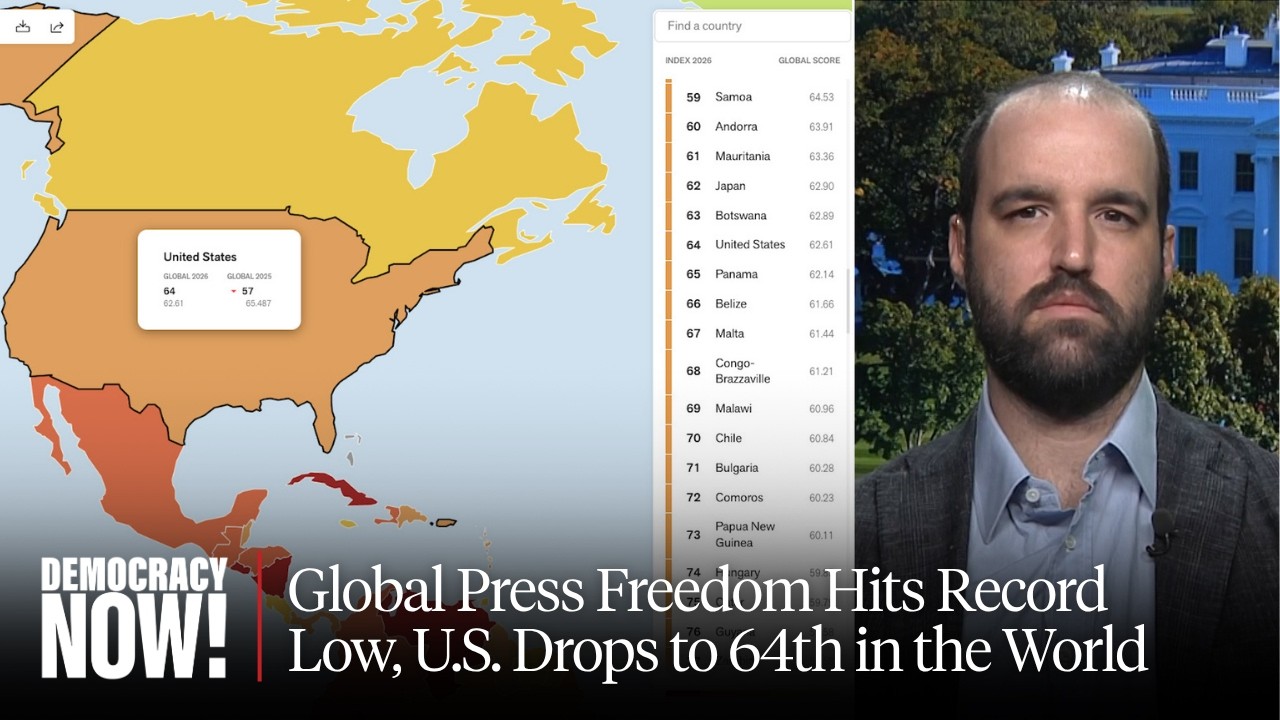
...
8 minutes, 53 seconds
Just this week, Hannah won a Pulitzer Prize along with her colleagues for their reporting on Doge. The
9:02
9 minutes, 2 seconds
significance of this Clayton and what happened to her?
9:07
9 minutes, 7 seconds
I don't think we can overstate how dangerous that raid is. It is unprecedented for the FBI to raid the
9:16
9 minutes, 16 seconds
home of a journalist and seize both their professional and personal devices.
9:20
9 minutes, 20 seconds
They took her laptops, they took her phones, they took her Garmin watch,
which suggests that they are tracking her movements. And there are legal protections against this. There's the Constitution obviously, but there's also
9:31
9 minutes, 31 seconds
the Privacy Protection Act, which flatly uh uh rejects uh which flatly makes searches like this illegal. And in fact,
9:40
9 minutes, 40 seconds
when the government went to court over this uh against the Washington Post, the judge admonished the government lawyers for failing to disclose the specific
9:49
9 minutes, 49 seconds
legal protections that they should have when they sought the warrant. And so,
9:54
9 minutes, 54 seconds
you know, we've now had two judicial decisions that have ruled that this search was improper. And what I think is really scary about this is if you dig
10:02
10 minutes, 2 seconds
deeper into the government's justification, they cite possible violations of the Espionage Act that they thought Hannah may have committed,
which is a preposterous conclusion for them to draw, but unfortunately, not totally unexpected. You know, the Espionage Act is uh an overly broad
piece of legislation from World War I that makes no distinction between an act of journalism and an act of espionage.
10:26
10 minutes, 26 seconds
And at RSF, we've long warned that there is this sort of backdoor that the federal government could use in order to
10:34
10 minutes, 34 seconds
target journalists. And we've been urging reform of the Espionage Act uh going back a long time. And you know,
...
trump maralogo papers?
major world newspapers back assange (espionage act)
nixon ordered agents to completely incapacitate DE
https://www.democracynow.org/2022/12/14/daniel_ellsberg_john_young_assange_case
---
an 7 25
A new report suggests that President Donald Trump may soon be setting his sights on the Fourth Estate, and his administration is already allegedly looking for a "test case" to see how much it can get away with in the courts.
That's according to a Monday article in Rolling Stone, which reported that unnamed sources close to the White House say Trump is considering the Espionage Act to prosecute journalists who report on leaks obtained from inside the administration. According to Rolling Stone, the president was so incensed about reporting on a leaked Pentagon report that undermined his claims about Iranian nuclear sites being "obliterated" as a result of strikes he ordered in mid-June that he contemplated using the 108 year-old law to bring cases against reporters.
"Why not the press?" Trump reportedly said during the conversation.
READ MORE: 'Effects could be catastrophic': Trump and the Republican Congress could achieve a first
The source said that the Trump administration would not only charge individual journalists under the Espionage Act, but would also indict their employers as "co-conspirators" and bring cases against publications. A separate source described as a "senior Trump administration official" affirmed that the question of whether to invoke the Espionage Act wasn't merely theoretical.
"All we’d really need is one text or email from a reporter telling a source: ‘Can you pull something for me?’ or something very direct of that nature,” the senior official told Rolling Stone. “If somebody in the media wasn’t careful even for a split second, that could make the difference between a reporter, and a criminal.”
Rolling Stone's Ryan Bort and Asawin Suebsaeng recalled a comment from an unnamed conservative attorney close to Trump who suggested in December that Trump's second term would be "brutal" in his approach to whistleblowers, leakers and journalists who they speak to. That attorney promised that Trump's second administration would "be even more aggressive" in its crackdown on leaks and reporters that publish them.
Trump isn't the first president to use the Espionage Act against journalists, however. Bort and Suebsaeng reported that former President Barack Obama's administration indicted eight sources under the law, though Trump had already surpassed that number just two years into his first term.
READ MORE:George Conway reveals the 'one remedy' left to stop Trump's 'lawlessness and illegality'
Click here to read Rolling Stone's full report (subscription required).
---
this machine kills secrets
ch 1
dan ellsberg RAND
more than a yr to xerox, 8 foot pile; 10c/page fulbright aide offered to reimburse but balked at 345 incl postage; fullb also 180 on pledge for hearings p 13
enlisted marines for korea
VN 1/1/67 VC repeated ambushes, well-coordinated.
Mcnamara comiss study before he bailed to world bank = pent papers 7k pages: one war for 25 yrs and US backed; supported french, then b/c of cold war we could not let VN go; state dept reports that ho chi minh had pop support; never a civil war; DE went to war resister mtg, broken by courage 26
McGov 180 also b/c of campaign
WH accused NYT ~ Espionage Act 36
==
...
Congress rushed the draconian Espionage Act to a vote two months after the country entered the war. It outlawed anything that would “cause insubordination, disloyalty, mutiny, or refusal of duty in the military.” There was, however, not the slightest danger of mutiny among American troops sent to the Western Front in France. Many were so eager to fight that their commanders found gung-ho rear-area soldiers “deserting to the front.” Nor was there much danger of espionage. In those years, only 10 people would be charged under the Act with being German agents.
The president who oversaw this particular 100-Year Flood was no Donald Trump, not in his manner anyway. Rabid invective was hardly Woodrow Wilson’s style. He carefully kept his image as an above-the-fray idealist by outsourcing inflammatory rhetoric to others, such as hisspecial emissary to Russia, Elihu Root.
A corporate lawyer and former secretary of war, secretary of state, and senator from New York, Root would prove the prototype of the “wise men” who moved between Wall Street and Washington to form the twentieth-century foreign policy establishment. “Pro-German traitors” were threatening the war effort, Root declared to an audience at New York’s Union League Club in August 1917. “There are men walking about the streets of this city tonight who ought to be taken out at sunrise tomorrow and shot for treason... There are some newspapers published in this city every day the editors of which deserve conviction and execution for treason.”
Fake news indeed! The actual bullying of those newspapers Wilson left to Postmaster General Albert Sidney Burleson, of Texas. The Espionage Act gave the Post Office great powers over the press.Newspapers were censored, editors jailed, and publications shut down, most famously Max Eastman’s *The Masses*, the Greenwich Village radical monthly that was one of the liveliest magazines this country has ever seen. Some 75 newspapers and periodicals either had specific issues banned or were forced to close entirely.
As today on the U.S.-Mexico border, vigilante groups sprang up across the country. The largest was the American Protective League, an official auxiliary of the Justice Department,which even enjoyed the franking privilege of sending mail for free. With a membership that swelled to 250,000, its ranks were filled with men too old for the military who still wanted to do battle, at home if not abroad.So they regularly broke up antiwar meetings and, by the tens of thousands, beat up or made citizens’ arrests of suspected draft dodgers.
https://www.alternet.org/2020/03/the-dark-roots-of-political-censorship-in-the-american-system
no lnx
The dark roots of political censorship in the American system
[ pix: President Donald J. Trump speaks with reporters on the South Lawn driveway of the White House Thursday, Aug. 1, 2019, prior to boarding Marine One to begin his trip to Cincinnati. (Official White House Photo by Tia Dufour)]
Written by Adam Hochschild/ TomDispatch March 18, 2020
Every month, it seems, brings a new act in the Trump administration’s war on the media. In January, Secretary of State Mike Pompeo exploded at National Public Radio reporter Mary Louise Kelly when he didn’t like questions she asked — and then banned a colleague of hers from the plane on which he was leaving for a trip to Europe and Asia. In February, the Trump staff booted a Bloomberg News reporter out of an Iowa election campaign event.
The president has repeatedly called the press an “enemy of the people” — the very phrase that, in Russian (vrag naroda), was applied by Joseph Stalin’s prosecutors to the millions of people they sent to the gulag or to execution chambers. In that context, Trump’s term for BuzzFeed, a “failing pile of garbage,” sounds comparatively benign. Last year, Axios revealed that some of the president’s supporters were trying to raise a fund of more than $2 million to gather damaging information on journalists at the New York Times, the Washington Post, and other media outfits.In 2018, it took a court order to force the White House to restore CNN reporter Jim Acosta’s press pass. And the list goes on.
Yet it remains deceptively easy to watch all the furor over the media with the feeling that it’s still intact and safely protected. After all, didn’t Richard Nixon and Ronald Reagan rail against the press in their presidencies? And don’t we have the First Amendment? In my copy of Samuel Eliot Morison’s 1,150-page Oxford History of the American People, the word “censorship” doesn’t even appear in the index; while, in an article on “The History of Publishing,” the Encyclopedia Britannica reassures us that, “in the United States, no formal censorship has ever been established.”
So, how bad could it get? The answer to that question, given the actual history of this country, is: much worse.
Censoring the News, Big Time
Though few remember it today, exactly 100 years ago, this country’s media was laboring under the kind of official censorship that would undoubtedly thrill both Donald Trump and Mike Pompeo. And yet the name of the man who zestfully banned magazines and newspapers of all sorts doesn’t even appear in either Morison’s history, that Britannica article, or just about anywhere else either.
The story begins in the spring of 1917, when the United States entered the First World War. Despite his reputation as a liberal internationalist, the president at that moment, Woodrow Wilson, cared little for civil liberties. After calling for war, he quickly pushed Congress to pass what became known as the Espionage Act, which, in amended form, is still in effect. Nearly a century later, National Security Agency whistleblower Edward Snowden would be charged under it and in these years he would hardly be alone.
Despite its name, the act was not really motivated by fears of wartime espionage. By 1917, there were few German spies left in the United States. Most of them had been caught two years earlier when their paymaster got off a New York City elevated train leaving behind a briefcase quickly seized by the American agent tailing him.
Rather, the new law allowed the government to define any opposition to the war as criminal. And since many of those who spoke out most strongly against entry into the conflict came from the ranks of the Socialist Party, the Industrial Workers of the World (famously known as the “Wobblies”), or the followers of the charismatic anarchist Emma Goldman, this in effect allowed the government to criminalize much of the Left. (My new book, Rebel Cinderella, follows the career of Rose Pastor Stokes, a famed radical orator who was prosecuted under the Espionage Act.)
Censorship was central to that repressive era. As the Washington Evening Star reported in May 1917, “President Wilson today renewed his efforts to put an enforced newspaper censorship section into the espionage bill.”The Act was then being debated in Congress. “I have every confidence,” he wrote to the chair of the House Judiciary Committee, “that the great majority of the newspapers of the country will observe a patriotic reticence about everything whose publication could be of injury, but in every country there are some persons in a position to do mischief in this field.”
Subject to punishment under the Espionage Act of 1917, among others, would be anyone who “shall willfully utter, print, write or publish any disloyal, profane, scurrilous, or abusive language about the form of government of the United States, or the Constitution of the United States, or the military or naval forces of the United States.”
Who was it who would determine what was “disloyal, profane, scurrilous, or abusive”? When it came to anything in print, the Act gave that power to the postmaster general, former Texas Congressman Albert Sidney Burleson. “He has been called the worst postmaster general in American history,” writes the historian G. J. Meyer, “but that is unfair; he introduced parcel post andairmail and improved rural service. It is fair to say, however, that he may have been the worst human being ever to serve as postmaster general.”
Burleson was the son and grandson of Confederate veterans. When he was born, his family still owned more than 20 slaves. The first Texan to serve in a cabinet, he remained a staunch segregationist. In the Railway Mail Service (where clerks sorted mail on board trains), for instance, he considered it “intolerable” that whites and blacks not only had to work together but use the same toilets and towels. He pushed to segregate Post Office lavatories and lunchrooms.
He saw to it that screens were erected so blacks and whites working in the same space would not have to see each other. “Nearly all Negro clerks of long-standing service have been dropped,” the anguished son of a black postal worker wrote to the New Republic, adding, “Every Negro clerk eliminated means a white clerk appointed.” Targeted for dismissal from Burleson’s Post Office, the writer claimed, was “any Negro clerk in the South who fails to say ‘Sir’ promptly to any white person.”
One scholar described Burleson as having “a round, almost chubby face, a hook nose, gray and rather cold eyes and short side whiskers. With his conservative black suit and eccentric round-brim hat, he closely resembled an English cleric.” From President Wilson and other cabinet members, he quickly acquired the nickname “The Cardinal.” He typically wore a high wing collar and, rain or shine, carried a black umbrella. Embarrassed that he suffered from gout, he refused to use a cane.
Like most previous occupants of his office, Burleson lent a political hand to the president by artfully dispensing patronage to members of Congress. One Kansas senator, for example, got five postmasterships to distribute in return for voting the way Wilson wanted on a tariff law.
When the striking new powers the Espionage Act gave him went into effect, Burleson quickly refocused his energies on the suppression of dissenting publications of any sort. Within a day of its passage, he instructed postmasters throughout the country to immediately send him newspapers or magazines that looked in any way suspicious.
And what exactly were postmasters to look for? Anything, Burleson told them, “calculated to… cause insubordination, disloyalty, mutiny… or otherwise to embarrass or hamper the Government in conducting the war.” What did “embarrass” mean? In a later statement, he would list a broad array of possibilities, from saying that “the government is controlled by Wall Street or munition manufacturers or any other special interests” to “attacking improperly our allies.” Improperly?
He knew that vague threats could inspire the most fear and so, when a delegation of prominent lawyers, including the famous defense attorney Clarence Darrow, came to see him, he refused to spell out his prohibitions in any more detail. When members of Congress asked the same question, he declared that disclosing such information was “incompatible with the public interest.”
One of Burleson’s most prominent targets would be the New York City monthly The Masses. Named after the workers that radicals were then convinced would determine the revolutionary course of history, the magazine was never actually read by them. It did, however, become one of the liveliest publications this country has ever known and something of a precursor to the New Yorker. It published a mix of political commentary, fiction, poetry, and reportage, while pioneering the style of cartoons captioned by a single line of dialogue for which the New Yorker would later become so well known.
From Sherwood Anderson and Carl Sandburg to Edna St. Vincent Millay and the young future columnist Walter Lippmann, its writers were among the best of its day. Its star reporter was John Reed, future author of Ten Days That Shook the World, a classic eyewitness account of the Russian Revolution. His zest for being at the center of the action, whether in jail with striking workers in New Jersey or on the road with revolutionaries in Mexico, made him one of the finest journalists in the English-speaking world.
A “slapdash gathering of energy, youth, hope,” the critic Irving Howe later wrote, The Masses was “the rallying center… for almost everything that was then alive and irreverent in American culture.” But that was no protection.On July 17, 1917, just a month after the Espionage Act passed, the Post Office notified the magazine’s editor by letter that “the August issue of the Masses is unmailable.” The offending items, the editors were told, were four passages of text and four cartoons, one of which showed the Liberty Bell falling apart.
Soon after, Burleson revoked the publication’s second-class mailing permit. (And not to be delivered by the Post Office in 1917 meant not to be read.) A personal appeal from the editor to President Wilson proved unsuccessful. Half a dozen Masses staff members including Reed would be put on trial — twice — for violating the Espionage Act. Both trials resulted in hung juries, but whatever the frustration for prosecutors, the country’s best magazine had been closed for good. Many more would soon follow.
No More “High-Browism”
When editors tried to figure out the principles that lay behind the new regime of censorship, the results were vague and bizarre. William Lamar, the solicitor of the Post Office (the department’s chief legal officer), told the journalist Oswald Garrison Villard, “You know I am not working in the dark on this censorship thing. I know exactly what I am after.I am after three things and only three things – pro-Germanism, pacifism, and high-browism.”
Within a week of the Espionage Act going into effect, the issues of at least a dozen socialist newspapers and magazines had been barred from the mail. Less than a year later, more than 400 different issues of American periodicals had been deemed “unmailable.”The Nation was targeted, for instance, for criticizing Wilson’s ally, the conservative labor leader Samuel Gompers; the Public, a progressive Chicago magazine, for urging that the government raise money by taxes instead of loans; and the Freeman’s Journal and Catholic Register for reminding its readers that Thomas Jefferson had backed independence for Ireland. (That land, of course, was then under the rule of wartime ally Great Britain.) Six hundred copies of a pamphlet distributed by the Intercollegiate Socialist Society, Why Freedom Matters, were seized and banned for criticizing censorship itself. After two years under the Espionage Act, the second-class mailing privileges of 75 periodicals had been canceled entirely.
From such a ban, there was no appeal, though a newspaper or magazine could file a lawsuit (none of which succeeded during Burleson’s tenure). In Kafkaesque fashion, it often proved impossible even to learn why something had been banned. When the publisher of one forbidden pamphlet asked, the Post Office responded: “If the reasons are not obvious to you or anyone else having the welfare of this country at heart, it will be useless… to present them.” When he inquired again, regarding some banned books, the reply took 13 months to arrive and merely granted him permission to “submit a statement” to the postal authorities for future consideration.
In those years, thanks to millions of recent immigrants, the United States had an enormous foreign-language press written in dozens of tongues, from Serbo-Croatian to Greek, frustratingly incomprehensible to Burleson and his minions. In the fall of 1917, however, Congress solved the problem by requiring foreign-language periodicals to submit translations of any articles that had anything whatever to do with the war to the Post Office before publication.
Censorship had supposedly been imposed only because the country was at war. The Armistice of November 11, 1918 ended the fighting and on the 27th of that month, Woodrow Wilson announced that censorship would be halted as well. But with the president distracted by the Paris peace conference and then his campaign to sell his plan for a League of Nations to the American public, Burleson simply ignored his order.
Until he left office in March 1921 — more than two years after the war ended — the postmaster general continued to refuse second-class mailing privileges to publications he disliked. When a U.S. District Court found in favor of several magazines that had challenged him, Burleson (with Wilson’s approval) appealed the verdict and the Supreme Court rendered a timidly mixed decision only after the administration was out of power. Paradoxically, it was conservative Republican President Warren Harding who finally brought political censorship of the American press to a halt.
A Hundred Years Later
Could it all happen again?
In some ways, we seem better off today. Despite Donald Trump’s ferocity toward the media, we haven’t — yet — seen the equivalent of Burleson barring publications from the mail. And partly because he has attacked them directly, the president’s blasts have gotten strong pushback from mainstream pillars like the New York Times, the Washington Post, and CNN, as well as from civil society organizations of all kinds.
A century ago, except for a few brave and lonely voices, there was no equivalent. In 1917, the American Bar Association was typical in issuing a statement saying, “We condemn all attempts… to hinder and embarrass the Government of the United States in carrying on the war… We deem them to be pro-German, and in effect giving aid and comfort to the enemy.” In the fall of that year, even the Times declared that “the country must protect itself against its enemies at home. The Government has made a good beginning.”
In other ways, however, things are more dangerous today. Social media is dominated by a few companies wary of offending the administration, and has already been cleverly manipulated by forces ranging from Cambridge Analytica to Russian military intelligence. Outright lies, false rumors, and more can be spread by millions of bots and people can’t even tell where they’re coming from.
This torrent of untruth flooding in through the back door may be far more powerful than what comes through the front door of the recognized news media. And even at that front door, in Fox News, Trump has a vast media empire to amplify his attacks on his enemies, a mouthpiece far more powerful than the largest newspaper chain of Woodrow Wilson’s day. With such tools, does a demagogue who loves strongmen the world over and who jokes about staying in power indefinitely even need censorship?
Adam Hochschild, a TomDispatch regular, teaches at the Graduate School of Journalism, University of California at Berkeley. He is the author of 10 books, including King Leopold’s Ghost and Spain in Our Hearts: Americans in the Spanish Civil War, 1936-1939. His latest book, just published, is Rebel Cinderella: From Rags to Riches to Radical, The Epic Journey of Rose Pastor Stokes.
Follow TomDispatch on Twitter and join us on Facebook. Check out the newest Dispatch Books, John Feffer’s new dystopian novel (the second in the Splinterlands series) Frostlands, Beverly Gologorsky’s novel Every Body Has a Story, and Tom Engelhardt’s A Nation Unmade by War, as well as Alfred McCoy’s In the Shadows of the American Century: The Rise and Decline of U.S. Global Power and John Dower’s The Violent American Century: War and Terror Since World War II.
Copyright 2020 Adam Hochschild
==
ref 9/19?
https://www.axios.com/2020-presidential-campaign-trump-allies-journalists-6733432f-b008-45d3-99c2-9dca7931faff.html
Trump's political allies are trying to raise at least $2 million to investigate reporters and editors of the New York Times, Washington Post and other outlets, according to a 3-page fundraising pitch reviewed by Axios.
Why it matters: Trump’s war on the media is expanding. This group will target reporters and editors, while other GOP 2020 entities go after the social media platforms, alleging bias, officials tell us.
- The group claims it will slip damaging information about reporters and editors to "friendly media outlets," such as Breitbart, and traditional media, if possible.
- People involved in raising the funds includeGOP consultant Arthur Schwartzand the "loose network" that the NY Times reported last week is targeting journalists. The operations are to be run by undisclosed others.
- The prospectus for the new project says it's "targeting the people producing the news."
The irony: The New York Times exposed an extremely improvisational effort that had outed a Times editor for past anti-Semitic tweets. This new group is now using the exposure to try to formalize and fund the operation.
- Organizers joke that their slogan should be: "Brought to you by the New York Times."
Under "Primary Targets," the pitch lists:
- "CNN, MSNBC, all broadcast networks, NY Times, Washington Post, BuzzFeed, Huffington Post, and all others that routinely incorporate bias and misinformation in to their coverage. We will also track the reporters and editors of these organizations."
This isn't an entirely new concept. The liberal group Media Matters monitors journalists and publications and goes public with complaints of bias. But being this blatant and specific about trying to discredit individual reporters is new.
Go deeper: Trump allies plot new war on social media
ref
https://www.axios.com/trump-2020-campaign-social-media-bias-41bbed1e-0bd3-445d-bf6f-195b5c3e65a6.html
Trump's campaign and key allies plan to make allegations of bias by social media platforms a core part of their 2020 strategy, officials tell Axios.
The big picture: Look for ads, speeches and sustained attacks on Facebook and Twitter in particular, the sources say. The irony: The social platforms are created and staffed largely by liberals — but often used most effectively in politics by conservatives, the data shows.
Why it matters: Trump successfully turned the vast majority of his supporters against traditional media, and he hopes to do the same against the social media companies.
- Republicans' internal data shows it stirs up the base like few other topics.
- "In the same way we've seen trust in legacy media organizations deteriorate over the past year, there are similarities with social media companies," a top Republican operative involved in the effort told me.
Between the lines: The charges of overt bias by social media platforms are way overblown, several studies have found. But, if the exaggerated claims stick, it could increase the chances of regulatory action by Republicans.
- "People feel they’re being manipulated, whether it's by what they're being shown in their feeds or actions the companies have taken against conservatives," the operative said.
- "It's easy for people to understand how these giant corporations could influence them and direct them toward a certain favored candidate."
How tech execs see it: They know the escalation is coming, so they are cranking up outreach to leading conservatives and trying to push hard on data showing that conservative voices often outperform liberal ones.
Reality check, from Axios chief tech correspondent Ina Fried: What is real is that most of the platforms have policies against bias that some conservative figures have run afoul of.
- Managing editor Scott Rosenberg notes that Twitter is Trump's megaphone, while Facebook is often his favorite place to run ads.
What's next: By the time 2020 is over, trust in all sources of information will be low, and perhaps unrecoverable.
- A nation without shared truth will be hard-to-impossible to govern.
==
ref
https://www.nytimes.com/2019/08/25/us/politics/trump-allies-news-media.html
no lnx
Trump Allies Target Journalists Over Coverage Deemed Hostile to White House
The operation has compiled dossiers of potentially embarrassing social media posts and other public statements by hundreds of people who work at prominent news organizations.
The operation has compiled dossiers of potentially embarrassing social media posts and other public statements by hundreds of people who work at prominent news organizations.
By Kenneth P. Vogel and Jeremy W. Peters
Published Aug. 25, 2019
Updated Aug. 26, 2019
WASHINGTON — A loose network of conservative operatives allied with the White House is pursuing what they say will be an aggressive operation to discredit news organizations deemed hostile to President Trump by publicizing damaging information about journalists.
It is the latest step in a long-running effort by Mr. Trump and his allies to undercut the influence of legitimate news reporting. Four people familiar with the operation described how it works, asserting that it has compiled dossiers of potentially embarrassing social media posts and other public statements by hundreds of people who work at some of the country’s most prominent news organizations.
The group has already released information about journalists at CNN, The Washington Post and The New York Times — three outlets that have aggressively investigated Mr. Trump — in response to reporting or commentary that the White House’s allies consider unfair to Mr. Trump and his team or harmful to his re-election prospects.
Operatives have closely examined more than a decade’s worth of public posts and statements by journalists, the people familiar with the operation said. Only a fraction of what the network claims to have uncovered has been made public, the people said, with more to be disclosed as the 2020 election heats up. The research is said to extend to members of journalists’ families who are active in politics, as well as liberal activists and other political opponents of the president.
It is not possible to independently assess the claims about the quantity or potential significance of the material the pro-Trump network has assembled. Some involved in the operation have histories of bluster and exaggeration. And those willing to describe its techniques and goals may be trying to intimidate journalists or their employers.
But the material publicized so far, while in some cases stripped of context or presented in misleading ways, has proved authentic, and much of it has been professionally harmful to its targets.
It is clear from the cases to date that among the central players in the operation is Arthur Schwartz, a combative 47-year-old conservative consultant who is a friend and informal adviser to Donald Trump Jr., the president’s eldest son. Mr. Schwartz has worked with some of the right’s most aggressive operatives, including the former Trump adviser Stephen K. Bannon.
“If the @nytimes thinks this settles the matter we can expose a few of their other bigots,” Mr. Schwartz tweeted on Thursday in response to an apologetic tweet from a Times journalist whose anti-Semitic social media posts had just been revealed by the operation. “Lots more where this came from.”
The operation is the latest step in a long-running effort by President Trump and his allies to undercut the influence of legitimate news reporting.
The information unearthed by the operation has been commented on and spread by officials inside the Trump administration and re-election campaign, as well as conservative activists and right-wing news outlets such as Breitbart News. In the case of the Times editor, the news was first published by Breitbart, immediately amplified on Twitter by Donald Trump Jr. and, among others, Katrina Pierson, a senior adviser to the Trump campaign, and quickly became the subject of a Breitbart interview with Stephanie Grisham, the White House press secretary and communications director.
The White House press office said that neither the president nor anyone in the White House was involved in or aware of the operation, and that neither the White House nor the Republican National Committee was involved in funding it.
The Trump campaign said it was unaware of, and not involved in, the effort, but suggested that it served a worthy purpose. “We know nothing about this, but it’s clear that the media has a lot of work to do to clean up its own house,” said Tim Murtaugh, the campaign’s communications director.
The campaign is consistent with Mr. Trump’s long-running effort to delegitimize critical reporting and brand the news media as an “enemy of the people.” The president has relentlessly sought to diminish the credibility of news organizations and cast them as politically motivated opponents.
[Latest Updates: 2020 Election
Asked about Russian bounties, Trump says his phone call with Putin focused on ‘other things.’
A new poll shows Biden tied with Trump in Georgia.
The president floats the idea of giving his renomination speech in Washington, a likely Hatch Act violation.
See more updates]
Journalism, he said in a tweet last week, is “nothing more than an evil propaganda machine for the Democrat Party.”
The operation has compiled social media posts from Twitter, Facebook and Instagram, and stored images of the posts that can be publicized even if the user deletes them, said the people familiar with the effort. One claimed that the operation had unearthed potentially “fireable” information on “several hundred” people.
“I am sure there will be more scalps,” said Sam Nunberg, a former aide to Mr. Trump who is a friend of Mr. Schwartz.
Mr. Nunberg and others who are familiar with the campaign described it as meant to expose what they see as the hypocrisy of mainstream news outlets that have reported on the president’s inflammatory language regarding race.
Image
Arthur Schwartz, a conservative consultant who is a friend and informal adviser to the president’s eldest son.]
“Two can play at this game,” he said. “The media has long targeted Republicans with deep dives into their social media, looking to caricature all conservatives and Trump voters as racists.”
But using journalistic techniques to target journalists and news organizations as retribution for — or as a warning not to pursue — coverage critical of the president is fundamentally different from the well-established role of the news media in scrutinizing people in positions of power.
“If it’s clearly retaliatory, it’s clearly an attack, it’s clearly not journalism,” said Leonard Downie Jr., who was the executive editor of The Post from 1991 to 2008. Tension between a president and the news media that covers him is nothing new, Mr. Downie added. But an organized, wide-scale political effort to intentionally humiliate journalists and others who work for media outlets is.
“It’s one thing for Spiro Agnew to call everyone in the press ‘nattering nabobs of negativism,’” he said, referring to the former vice president’s famous critique of how journalists covered President Richard M. Nixon. “And another thing to investigate individuals in order to embarrass them publicly and jeopardize their employment.”
A. G. Sulzberger, the publisher of The Times, said in a statement that such tactics were taking the president’s campaign against a free press to a new level.
“They are seeking to harass and embarrass anyone affiliated with the leading news organizations that are asking tough questions and bringing uncomfortable truths to light,” Mr. Sulzberger said. “The goal of this campaign is clearly to intimidate journalists from doing their job, which includes serving as a check on power and exposing wrongdoing when it occurs. The Times will not be intimidated or silenced.”
In a statement, a CNN spokesman said that when government officials, “and those working on their behalf, threaten and retaliate against reporters as a means of suppression, it’s a clear abandonment of democracy for something very dangerous.”
The operation is targeting the news media by using one of the most effective weapons of political combat — deep and laborious research into the public records of opponents to find contradictions, controversial opinions or toxic affiliations. The liberal group Media Matters for America helped pioneer close scrutiny of public statements by conservative media personalities.
Those familiar with the campaign described it as meant to expose what they see as the hypocrisy of mainstream news outlets that have covered the president’s inflammatory language regarding race.Credit...George Etheredge/The New York Times]
The conservative operative James O’Keefe has twisted that concept in ways inconsistent with traditional journalistic ethics, using false identities, elaborate cover stories and undercover videos to entrap journalists and publicize embarrassing statements, often in misleading ways, to undercut the credibility of what he considers news media biased in favor of liberals.
In the case of the pro-Trump network, research into journalists is being deployed for the political benefit of the White House. It is targeting not only high-profile journalists who challenge the administration, but also anyone who works for any news organization that members of the network see as hostile to Mr. Trump, no matter how tangential that job may be to the coverage of his presidency. And it is being used explicitly as retribution for coverage.
Some reporters have been warned that they or their news organizations could be targets, creating the impression that the campaign is intended in part to deter them from aggressive coverage as well as to inflict punishment after an article has been published.
Trained as a lawyer, Mr. Schwartz has endeared himself to members of the president’s family by becoming one of their most aggressive defenders, known for badgering and threatening reporters and others he believes have wronged the Trumps.
He has publicly gone after Republicans he views as disloyal, including the former White House chief of staff Reince Priebus, about whom he admitted spreading an unsubstantiated rumor.He has called himself a “troll on Twitter,” which is where he has boasted of being aware of, or having access to, damaging information on dozens of journalists at CNN and The Times that could be deployed if those outlets ran afoul of Mr. Trump or his allies.
The operation’s tactics were on display last week, seemingly in response to two pieces in The Times that angered Mr. Trump’s allies. The paper’s editorial board published an editorial on Wednesday accusing Mr. Trump of fomenting anti-Semitism, and the newsroom published a profile on Thursday morning of Ms. Grisham, the new White House press secretary, which included unflattering details about her employment history.
One person involved in the effort said the pro-Trump forces, aware ahead of time about the coverage of Ms. Grisham, were prepared to respond. Early Thursday morning, soon after the profile appeared online, Breitbart News published an article that documented anti-Semitic andracist tweets written a decade ago by Tom Wright-Piersanti, who was in college at the time and has since become an editor on the Times’ politics desk. The Times said it was reviewing the matter and considered the posts “a clear violation of our standards.”
Mr. Schwartz tweeted a link to the Breitbart piece before 7 a.m., which Donald Trump Jr. retweeted to his 3.8 million followers— the first of about two dozen times that the president’s son shared the article or its contents.Other prominent Republicans, including Senator Ted Cruz of Texas, joined in highlighting the report.
Image
Mr. Schwartz is a friend and informal adviser to Donald Trump Jr., the president’s eldest son.Credit...Erin Schaff/The New York Times]
Breitbart’s article quoted several people or groups with close ties to Mr. Schwartz, including Richard Grenell, Mr. Trump’s ambassador to Germany, and the Zionist Organization of America. It was written by the site’s Washington political editor, Matthew Boyle, whose relationship with Mr. Schwartz started when Mr. Bannon ran the website.
Mr. Boyle’s article included a reference to the Times profile of Ms. Grisham, which it characterized as “attacking White House Press Secretary Stephanie Grisham.” Mr. Wright-Piersanti was uninvolved in the editing of the article about Ms. Grisham.
The tweets revealed in the Breitbart article quickly spread to other conservative outlets favored by the president and his allies, including the radio shows of Rush Limbaugh and Mark Levin.
Mr. Wright-Piersanti apologized on Twitter on Thursday morning and deleted offensive tweets. Mr. Schwartz then issued his warning that he had further damaging information about Times employees.
Mr. Wright-Piersanti, 32, said the tweets, posted when he was a college student with a Twitter following consisting mostly of personal acquaintances, were “my lame attempts at edgy humor to try to get a rise out of my friends.”
But he said “they’re not funny, they’re clearly offensive,” adding, “I feel deep shame for them, and I am truly, honestly sorry that I wrote these.”
He said he had forgotten about the tweets as he started a career in journalism.
“For my generation, the generation that came of age in the internet, all the youthful mistakes that you made get preserved in digital amber, and no matter how much you change and mature and grow up, it’s always out there, waiting to be discovered,” Mr. Wright-Piersanti said.
Like Mr. Wright-Piersanti, other targets of the pro-Trump network have been young people who grew up with social media and wrote the posts in question when they were in their teens or early 20s, in most cases before they became professional journalists.
Image
The photojournalist Mohammed Elshamy in 2014 in South Sudan. Tweets he wrote in his teens became the basis for articles in conservative news outlets.Credit...Andrei Pungovschi]
A week after a White House reporter for CNN sparred with Mr. Trump during a news conference, Mr. Schwartz highlighted a tweet by the reporter from 2011, when the reporter was in college, that used an anti-gay slur. Other similar tweets quickly surfaced, and the reporter apologized, though Mr. Schwartz has continued to antagonize the reporter on Twitter.
In recent months, Mr. Schwartz highlighted a nearly decade-old tweet in which a reporter for The Post had repeated in an ambiguous manner a slur used by a politician.
In March, Mr. Schwartz tweeted a link to an article from Breitbart, written by Mr. Boyle, about a reporter from Business Insider whose Instagram account included anti-Trump references and a photograph of the reporter demonstrating against the president.
In July, around the time CNN published an article exposing old posts by a Trump appointee spreading suggestions that Barack Obama was a Muslim whose loyalty to the United States was in question, Mr. Schwartz resurfaced anti-Semitic tweets from 2011 by a CNN photo editor. Mr. Schwartz suggested that a CNN reporter who specializes in unearthing problematic archival content should “look into the social media activities of your employees.”
The tweets became the basis for several articles in conservative news outlets and hundreds of tweets from conservatives targeting the photo editor, Mohammed Elshamy, which did not stop even after he resigned under pressure from CNN and apologized.
“It felt like a coordinated attack,” said Mr. Elshamy, who said he had received death threats. “It was overwhelming.”
Mr. Elshamy, who is now 25, said he posted the tweets when he was 15 and 16 years old, growing up in Egypt, when he was still learning English and did not fully grasp the meaning of the words.
“I was repeating slogans heard on the streets during a highly emotional time in my nation’s history,” he said. “I believe that my subsequent work and views over the years redeems for the mistakes I made as a kid.”
While he said he understands “the severity and harm of my comments,” he questioned the motivation of the campaign that cost him his job. “It is a very dirty tactic that they are using to cause as much harm as they can to anyone who is affiliated with these media outlets,” he said. “It actually feels like a competition and every termination or vilification is a point for them.”
Mr. Bannon, at the time the head of Breitbart, oversaw the site’s efforts in 2015 to attack Megyn Kelly, then of Fox News, after she called out Mr. Trump for tweets disparaging women as “fat pigs,” “dogs” and “slobs.” In an interview, he said the work that Mr. Schwartz was undertaking should be seen as a sign that Mr. Trump’s supporters were committed to executing a frontal assault on news media they considered adversarial.
“A culture war is a war,” he said. “There are casualties in war. And that’s what you’re seeing.”
==
United States v. Sterling
Jeffrey Alexander Sterling was being investigated during the Bush administration. In 2010 he was indicted under the Espionage Act of 1917, one of the few people in US history whose alleged contact with a journalist was punished under espionage law.[9]
Risen was subpoenaed in relation to the case in 2008.[10] He fought the subpoena, and it expired in the summer of 2009.[11] In what The New York Times called "a rare step," the Obama administration renewed the subpoena in 2010.[11] In 2011, Risen wrote a detailed response to the subpoena, describing his reasons for refusing to reveal his sources, the public impact of his work, and his experiences with the Bush administration.[12]
In July 2013 US Court of Appeals from the Fourth Circuit ruled that Risen must testify in the trial of Jeffrey Sterling. The court wrote "so long as the subpoena is issued in good faith and is based on a legitimate need of law enforcement, the government need not make any special showing to obtain evidence of criminal conduct from a reporter in a criminal proceeding."[13] Judge Roger Gregory dissented, writing "The majority exalts the interests of the government while unduly trampling those of the press, and in doing so, severely impinges on the press and the free flow of information in our society."[14][15]
The Supreme Court rejected his appeal during June 2014,[16] leaving Risen facing the possibility of jail depending upon whether the federal prosecutors choose to pursue his testimony. He has stated that he will continue to refuse and is willing to go to jail.[17]
In October 2014, Attorney General Eric Holder, speaking at a Washington, D.C. event, stated “no reporter’s going to jail as long as I’m attorney general.”[18]
In January 2015 The New York Times reported that Risen "will not be called to testify at a trial", which ended a seven-year legal fight over whether he could/would be forced to identify his confidential sources.[19]
==
Daniel Ellsberg: Espionage charges against Assange are most significant attack on press in decades
As the Justice Department charges WikiLeaks founder Julian Assange with…
https://www.democracynow.org/2019/5/24/exclusive_julian_assange_s_attorney_decries
In an unprecedented move, the Justice Department has indicted WikiLeaks founder Julian Assange on 17 charges of violating the Espionage Act for his role in publishing U.S. classified military and diplomatic documents exposing U.S. war crimes in Iraq and Afghanistan. The documents were leaked by U.S. Army whistleblower Chelsea Manning. The Espionage Act of 1917 has never been used to prosecute a journalist or media outlet. The new charges come just over a month after British police forcibly removed Assange from the Ecuadorean Embassy in London, where he took asylum in 2012. Initially the Trump administration indicted Assange on a single count of helping Manning hack a government computer, but Assange faces up to 170 additional years in prison under the new charges—10 years for each count of violating the Espionage Act. We speak with Jennifer Robinson, an attorney for Julian Assange. “It is a grave threat to press freedom and should be cause for concern for journalists and publishers everywhere,” Robinson says.
:{
}:
GOODMAN: In an unprecedented move, the Justice Department has indicted WikiLeaks founder Julian Assange on 17 charges of violating the Espionage Act for his role in publishing U.S. classified military and diplomatic documents exposing U.S. war crimes in Iraq and Afghanistan. The documents were leaked by Army whistleblower Chelsea Manning. The Espionage Act of 1917 has never been used to prosecute a journalist or media outlet. The new charges come just over a month after British police forcibly removed Assange from the Ecuadorean Embassy in London, where he took asylum in 2012. Initially, the Trump administration indicted Assange on a single count of helping Manning hack a government computer. But Assange faces up to 170 years in prison under the new charges—10 years for each count of violating the Espionage Act.
Press freedom advocates have denounced the new charges. Ben Wizner of the American Civil Liberties Union said, quote, “For the first time in the history of our country, the government has brought criminal charges against a publisher for the publication of truthful information. This is an extraordinary escalation of the Trump administration’s attacks on journalism and a direct assault on the First Amendment.” Joel Simon, the head of the Committee to Protect Journalists, said, quote, “Press freedom in the United States and around the world is imperiled by this prosecution.” The legendary journalist Seymour Hersh told The New York Times, quote, “Today Assange. Tomorrow, perhaps, The New York Times and other media that published so much of the important news and information Assange provided,” unquote.
Assange is being held in a British jail but faces extradition to both the United States and Sweden, where authorities have reopened an investigation into sexual assault charges.
Later in the broadcast, we’ll be joined by Pentagon Papers whistleblower Daniel Ellsberg, who was charged under the Espionage [Act] in 1973, and the award-winning national security journalist Jeremy Scahill of The Intercept. But first we go to London, where we’re joined by Jennifer Robinson, an attorney for Julian Assange.
First, Jen, can you start off by talking about these new charges, the possibility that if Julian Assange were extradited to the United States, he could face 170 years in jail?
JENNIFER ROBINSON: As you said, these are unprecedented charges. Since 2010, we’ve been warning about this very possibility. The Obama administration opened this criminal investigation in 2010, and we’ve been warning since then that any prosecution under the Espionage Act would be a direct attack on the First Amendment and all media organizations, in a precedent that could be used against journalists and publishers everywhere. Since the Trump administration came to power, they’ve been more aggressively pursuing the investigation, and the outcome is this indictment overnight.
It is a grave threat to press freedom and should be cause for concern for journalists and publishers everywhere, because, of course, Julian Assange is not American. Everything that he did was outside of the United States. So this is a concern for all journalists and publishers anywhere in the world who are publishing truthful information about the United States.
AMY GOODMAN: The United States has the death penalty. What does this mean for Assange? And what agreement did the Ecuadorean government make with the British authorities, who removed Julian Assange from the embassy, where he had political asylum for the last almost seven years?
JENNIFER ROBINSON: Of course, the reason Julian went into the embassy in the first place was to protect himself from extradition to the United States to face prosecution, not in relation to the death penalty. But the asylum that was granted was to protect him from this very outcome. Publishers, for publishing truthful information, should not be facing criminal prosecution at all.
The U.K. government has given an assurance against extradition to the death penalty. The U.K. does not typically extradite to the death penalty in any event. But that assurance does not cover off his extradition to the United States. And that’s what we’ve been asking for, for a long time. It is not right or appropriate that a publisher should face criminal prosecution in this way. And 170 years, certainly a very long time in prison, is, for a publisher who has won journalism awards—he’s won the Sydney Peace Prize, journalism awards the world over—for having revealed government wrongdoing, human rights abuse, war crimes—this is a direct attack on the press and democracy itself.
AMY GOODMAN: Can you explain what espionage means, what exactly Julian Assange faces?
JENNIFER ROBINSON: Well, if you look at the indictment, while it is the Espionage Act, it’s publishing classified information damaging to the United States. But if you look at the indictment and the way in which it’s been described, effectively what this is, is a journalist and a publisher having conversations with a source about what information is available, and discussing with that source publishing the information. This is what journalists do, investigative journalists do, all the time. It is criminalizing the investigative journalism process and will place a massive chill on national security journalism in the United States and elsewhere around the world.
AMY GOODMAN: I want to turn to the late Michael Ratner, who served for many years as an attorney for Julian Assange. He was the former head of the Center for Constitutional Rights. This was Michael speaking to Democracy Now! in 2012 about the Espionage Act.
MICHAEL RATNER: I think there’s a serious question whether someone like Julian Assange, who is not a U.S. citizen, can be indicted under the Espionage Act. What duty does Julian Assange owe the United States vis-à-vis the Espionage Act? If I, tomorrow, surface documents that had to do with the Soviet Union, or Russia, rather, and what it’s doing in Chechnya, that were classified, could Russia actually get my extradition from the United States because I put out classified documents belonging to Russia? I don’t think so. But that would be—if they actually have an indictment and if they go after Julian Assange in the way that so far they’ve indicated they want to, that will certainly be an important issue. What duty did Julian Assange owe to the United States?
AMY GOODMAN: I want to turn now to an interview I did with Julian Assange in 2012. I visited him in the Ecuadorean Embassy—oh, this is when he was speaking on Skype to us, when he talked, himself, about the Espionage Act.
JULIAN ASSANGE: The new interpretation of the Espionage Act that the Pentagon is trying to hammer in to the legal system, and which the Department of Justice is complicit in, would mean the end of national security journalism in the United States, and not only the United States, because the Pentagon is trying to apply this extraterritorially. Why would it be the end of national security journalism? Because the interpretation is that if any document that the U.S. government claims to be classified is given to a journalist, who then makes any part of it public, that journalist has committed espionage, and the person who gave them the material has committed the crime, communicating with the enemy.
AMY GOODMAN: So, that was Julian Assange speaking to us a few years ago. This is John Demers, the head of the Justice Department’s National Security Division, briefing reporters on Thursday about the new charges against Julian Assange. He said, quote, “Some say that Assange is a journalist and that he should be immune from prosecution for these actions. The department takes seriously the role of journalists in our democracy and we thank you for it. It is not and has never been the department’s policy to target them for reporting. But Julian Assange is no journalist,” he said. Your response, Jennifer Robinson?
JENNIFER ROBINSON: If the Department of Justice is concerned about journalism, then they ought to be concerned about the precedent this sets and the impact it will have on all American journalists. Michael Ratner was absolutely correct in making the points that he made, and I think that is the concern. It’s not even just a concern about journalists in the United States, but what this precedent says about the Department of Justice exercising extraterritorial jurisdiction over journalists and publishers outside of the country for having published this information. As Michael rightly pointed out, what would it mean if Russia or China was starting to seek the extradition of American journalists for having published Chinese or Russian secrets? This is an incredibly serious precedent. And for the Department of Justice to suggest that this won’t be used by the Trump administration against other media organizations and journalists, I think, is naive at best.
AMY GOODMAN: Jennifer Robinson, Ecuador has seized some of WikiLeaks founder Julian Assange’s possessions, left behind when the British authorities took him out of the embassy. WikiLeaks says that Ecuador is allowing U.S. prosecutors to help themselves to Assange’s belongings. Is this the case?
JENNIFER ROBINSON: Ecuador did receive a request from the United States to seize control over WikiLeaks property that was inside the embassy and Julian’s property inside the embassy. Ecuador has provided that. We are very concerned, both about the fact that Ecuador has allowed their embassy staff to be questioned by U.S. prosecutors and now handing over this material. In circumstances where there is no chain of custody, we don’t know who has been into the embassy and who has accessed that room, accessed the belongings. So, it raises serious concerns about our ability to defend ourselves and defend him in this case, and serious concerns about the nature of the evidence and the process by which it was obtained.
AMY GOODMAN: Now, what about Sweden also reviving, reopening their case, their allegations of rape against Julian Assange, when they had dropped all of the charges, both of sexual assault and rape before? What does this mean, Sweden calling for the extradition also of Julian Assange?
JENNIFER ROBINSON: First, of course, he’s never been charged in Sweden. And this is the third time that a different prosecutor has reopened this investigation, after it has been closed. It was first closed in 2010 because the first prosecutor said there wasn’t evidence of any crime. It was reopened again by a prosecutor who dragged it out for years despite our offers to cooperate. After finally questioning Julian inside the embassy, that case was dropped. The entire matter was dropped again. And now we have, now that he’s in prison here, a third prosecutor reopening the case, over a decade. This is, by any stretch, an abuse of process. He has always been willing to answer those allegations. He has given his testimony. And it’s time that that matter is determined once and for all.
Of course, now there is a serious question that will arise here in the U.K. as to which of the requests, if Sweden does seek his extradition—they’ve only reopened the criminal investigation and will have to make a decision about whether to seek his extradition. But if they do, it raises questions about which extradition request will take precedence. As you can see, Julian Assange is going to be in a—is in a very difficult position with respect to both extradition requests.
AMY GOODMAN: And which one takes precedence, U.S. or Sweden? And if Sweden were to extradite him—and again, you just said he actually has never officially been charged, even now, with rape or sexual assault. They are reopening the investigation, and that’s been going on for years. If he were extradited to Sweden, his original concern was that he would then be extradited to the United States. Do you still fear this?
JENNIFER ROBINSON: Of course. That was the reason he sought asylum in the first place, is that we were seeking assurances from Sweden that if he were to return to Sweden to face any potential process there with respect to those allegations, that he would not be sent to the United States. Sweden refused to give that assurance. The Australian government—he’s an Australian citizen—refused to request that assurance. The Ecuadorean government, once he got asylum inside the embassy, also sought that assurance from Sweden, and they refused to give it.
Now we’re in a situation where we have an indictment on the record from the United States, and it will be a matter for the home secretary here to determine, if Sweden also requests his extradition, which of those two cases will take precedence. We are, of course, concerned about the risk that he will face if he goes back to the United States. And it will raise massive free speech questions, irrespective of whether he goes to Sweden first or not.
AMY GOODMAN: Jennifer Robinson, how is Julian doing in prison? He was in the Ecuadorean Embassy for almost seven years, taken out by British authorities. Where is he currently jailed, and how is he?
JENNIFER ROBINSON: He’s currently imprisoned in Belmarsh Prison in South East London, which is a high-security prison here in the U.K. We were very concerned about his health at the time he was forcibly removed from the embassy. He had been denied medical treatment for more than seven years. We are concerned it’s had a permanent impact upon his health. We’ve recently had a visit from the U.N. special rapporteur on torture, who came with medical experts to assess his health inside the prison. And I am very concerned about the ongoing health issues that he has and whether he’s getting adequate medical treatment here within the British prison system. He’s finding it very difficult. He’s very isolated.
And I think the prospect of a very long extradition fight and potential extradition to the United States is a real concern. But, of course, he is resolved to fight this, as he said at his first extradition hearing. He refused to consent to extradition to the United States, because he would not be extradited for doing journalism. And this case raises—as we’ve seen from the free speech groups that have come out overnight, this case raises fundamental questions of free speech, which is why he is resolved to absolutely fighting this extradition.
AMY GOODMAN: Finally, as we speak today, it’s just been a few hours since the British Prime Minister Theresa May announced she is resigning. Will that make a difference in Julian’s case?
JENNIFER ROBINSON: It remains to be seen who will become the prime minister after Theresa May’s resignation. We’ve already seen, from the leader of the opposition here, Jeremy Corbyn, say that the British government should not extradite Julian to the United States to face prosecution for having revealed war crimes. So I think there would need to be a change of government here to see the British government positions change, because the Conservative government has made very clear their position on this and that it’s a matter for the British courts, but have not said that they would prevent any extradition if it were ultimately ordered. So, really, it depends what happens. And we’ve still got a very long extradition fight ahead of us.
AMY GOODMAN: Do you think if Jeremy Corbyn were to ascend to the prime ministership, that he could free Julian Assange?
JENNIFER ROBINSON: Of course, it is a matter for the courts, but the British government retains the discretion, ultimately, about whether to extradite a person or not. And if Jeremy Corbyn came to power, he has already said, made clear, in a public statement and through the the shadow home secretary, Diane Abbott, that Julian Assange ought not be extradited to the U.S. for publishing truthful information and for revealing war crimes. So, it remains to be seen what would happen if he came to power and where Julian was in the extradition process at that time, but it is a possibility.
AMY GOODMAN: And finally, explain the sentence he is now serving and what will happen after that sentence.
JENNIFER ROBINSON: He has been convicted of a bail offense for having sought asylum when he did, going into the embassy. He was given a sentence of 50 weeks, which he’s currently serving in Belmarsh Prison. And the extradition process will carry on shortly. The U.S. issued a provisional warrant back in April, when he was first arrested. Now that there’s an additional indictment, we are expecting a new extradition request that will include those additional charges. And the extradition process will begin. Fighting extradition with respect to the United States can take anywhere between one and three years. So, this is the beginning of, like I said, what will be quite a long process.
AMY GOODMAN: Do you think that U.S. press has come out strongly enough? Today, The New York Times, in an editorial, said, “It is a marked escalation in the effort to prosecute Mr. Assange, one that could have a chilling effect on American journalism as it has been practiced for generations. It is aimed straight at the heart of the First Amendment.”
JENNIFER ROBINSON: I think it’s very important that The New York Times and other major media organizations come forward and speak about this principle and stand against this prosecution, because, as you’ve rightly pointed out, this will have a chilling impact on all media organizations and is a cause for concern that the precedent that is being set by the Trump administration could be used against The New York Times and other media organizations. We’ve been saying, since 2010, that the media needs to get behind WikiLeaks, and they need to acknowledge that any prosecution would set that precedent and cause them risk. Finally, we’re seeing an acknowledgment of that. And I hope that we will see that continue as this fight goes on.
AMY GOODMAN: Jennifer Robinson, we want to thank you for being with us, human rights attorney who’s been advising Julian Assange and WikiLeaks since 2010.
When we come back, the legendary Pentagon Papers whistleblower Daniel Ellsberg. He faced over a hundred years in jail for espionage
- Part 1: Exclusive: Julian Assange’s Attorney Decries Espionage Charges as “Grave Threat to Press Freedom”
- Part 2: Daniel Ellsberg: Espionage Charges Against Assange Are Most Significant Attack on Press in Decades
- Part 3: Jeremy Scahill: New Indictment of Assange Is Part of a Broader War on Journalism & Whistleblowers
==
Espionage Act of 1917 is a United States federal law passed on June 15, 1917, shortly after the U.S. entry into World War I. It has been amended numerous times over the years. It was originally found in Title 50 of the U.S. Code (War) but is now found under Title 18, Crime. Specifically, it is 18 U.S.C. ch. 37 (18 U.S.C. § 792 et seq.)
It was intended to prohibit interference with military operations or recruitment, to prevent insubordination in the military, and to prevent the support of United States enemies during wartime. In 1919, the Supreme Court of the United States unanimously ruled through Schenck v. United States that the act did not violate the freedom of speech of those convicted under its provisions. The constitutionality of the law, its relationship to free speech, and the meaning of its language have been contested in court ever since.
Among those charged with offenses under the Act are German-American socialist congressman and newspaper editor Victor L. Berger, labor leader and five-time Socialist Party of America candidate, Eugene V. Debs, anarchists Emma Goldman and Alexander Berkman, former Watch Tower Bible & Tract Society president Joseph Franklin Rutherford, communists Julius and Ethel Rosenberg, Pentagon Papers whistleblower Daniel Ellsberg, Cablegate whistleblower Chelsea Manning, and National Security Agency (NSA) contractor and whistleblower Edward Snowden. Rutherford's conviction was overturned on appeal.[1] Although the most controversial sections of the Act, a set of amendments commonly called the Sedition Act of 1918, were repealed on March 3, 1921, the original Espionage Act was left intact.[2]
Contents
Enactment
The Espionage Act of 1917 was passed, along with the Trading with the Enemy Act, just after the United States entered World War I in April 1917. It was based on the Defense Secrets Act of 1911, especially the notions of obtaining or delivering information relating to "national defense" to a person who was not "entitled to have it", itself based on an earlier British Official Secrets Act. The Espionage Act law imposed much stiffer penalties than the 1911 law, including the death penalty.[3]
President Woodrow Wilson, in his December 7, 1915 State of the Union address, asked Congress for the legislation:[4]
There are citizens of the United States, I blush to admit, born under other flags but welcomed under our generous naturalization laws to the full freedom and opportunity of America, who have poured the poison of disloyalty into the very arteries of our national life; who have sought to bring the authority and good name of our Government into contempt, to destroy our industries wherever they thought it effective for their vindictive purposes to strike at them, and to debase our politics to the uses of foreign intrigue ...
I urge you to enact such laws at the earliest possible moment and feel that in doing so I am urging you to do nothing less than save the honor and self-respect of the nation. Such creatures of passion, disloyalty, and anarchy must be crushed out. They are not many, but they are infinitely malignant, and the hand of our power should close over them at once. They have formed plots to destroy property, they have entered into conspiracies against the neutrality of the Government, they have sought to pry into every confidential transaction of the Government in order to serve interests alien to our own. It is possible to deal with these things very effectually. I need not suggest the terms in which they may be dealt with.
Congress moved slowly. Even after the U.S. broke diplomatic relations with Germany, when the Senate passed a version on February 20, 1917, the House did not vote before the then-current session of Congress ended. After the declaration of war in April 1917, both houses debated versions of the Wilson administration's drafts that included press censorship.[5] That provision aroused opposition, with critics charging it established a system of "prior restraint" and delegated unlimited power to the president.[6] After weeks of intermittent debate, the Senate removed the censorship provision by a one-vote margin, voting 39 to 38.[7] Wilson still insisted it was needed: "Authority to exercise censorship over the press....is absolutely necessary to the public safety", but signed the Act without the censorship provisions on June 15, 1917,[8] after Congress passed the act on the same day.[9]
Attorney General Thomas Watt Gregory supported passage of the act, but viewed it as a compromise. The President's Congressional rivals were proposing to remove responsibility for monitoring pro-German activity, whether espionage or some form of disloyalty, from the Department of Justice to the War Department and creating a form of courts-martial of doubtful constitutionality. The resulting Act was far more aggressive and restrictive than they wanted, but it silenced citizens opposed to the war.[10] Officials in the Justice Department who had little enthusiasm for the law nevertheless hoped that even without generating many prosecutions it would help quiet public calls for more government action against those thought to be insufficiently patriotic.[11] Wilson was denied language in the Act authorizing power to the executive branch for press censorship, but Congress did include a provision to block distribution of print materials through the Post Office.[3]
It made it a crime:
- To convey information with intent to interfere with the operation or success of the armed forces of the United States or to promote the success of its enemies. This was punishable by death or by imprisonment for not more than 30 years or both.
- To convey false reports or false statements with intent to interfere with the operation or success of the military or naval forces of the United States or to promote the success of its enemies when the United States is at war, to cause or attempt to cause insubordination, disloyalty, mutiny, refusal of duty, in the military or naval forces of the United States, or to willfully obstruct the recruiting or enlistment service of the United States. This was punishable by a maximum fine of $10,000 or by imprisonment for not more than 20 years or both.
The Act also gave the Postmaster General authority to impound or to refuse to mail publications that he determined to be in violation of its prohibitions.[12]
The Act also forbids the transfer of any naval vessel equipped for combat to any nation engaged in a conflict in which the United States is neutral. Seemingly uncontroversial when the Act was passed, this later became a legal stumbling block for the administration of Franklin D. Roosevelt, when he sought to provide military aid to Great Britain before the United States entered World War II.[13]
Amendments
Main article: Sedition Act of 1918
The law was extended on May 16, 1918, by the Sedition Act of 1918, actually a set of amendments to the Espionage Act, which prohibited many forms of speech, including "any disloyal, profane, scurrilous, or abusive language about the form of government of the United States ... or the flag of the United States, or the uniform of the Army or Navy".[10]
Because the Sedition Act was an informal name, court cases were brought under the name of the Espionage Act, whether the charges were based on the provisions of the Espionage Act or the provisions of the amendments known informally as the Sedition Act.
On March 3, 1921, the Sedition Act amendments were repealed, but many provisions of the Espionage Act remain, codified under U.S.C. Title 18, Part 1, Chapter 37.[14]
In 1933, after signals intelligence expert Herbert Yardley published a popular book about breaking Japanese codes, the Act was amended to prohibit the disclosure of foreign code or anything sent in code.[15] The Act was amended in 1940 to increase the penalties it imposed, and again in 1970.[16]
In the late 1940s, the U.S. Code was re-organized and much of Title 50 (War) was moved to Title 18 (Crime). The McCarran Internal Security Act added 18 U.S.C. § 793(e) in 1950 and 18 U.S.C. § 798 was added the same year.[17]
In 1961, Congressman Richard Poff succeeded after several attempts in removing language that restricted the Act's application to territory "within the jurisdiction of the United States, on the high seas, and within the United States" 18 U.S.C. § 791. He said the need for the Act to apply everywhere was prompted by Irvin C. Scarbeck, a State Department official who was charged with yielding to blackmail threats in Poland.[18]
Proposed amendments
In 1989, Congressman James Traficant tried to amend 18 U.S.C. § 794 to broaden the application of the death penalty.[19] Senator Arlen Specter proposed a comparable expansion of the use of the death penalty the same year.[20] In 1994, Robert K. Dornan proposed the death penalty for the disclosure of a U.S. agent's identity.[21]
History
World War I
[pix doc blessed are peacemakers]
 | Wikisource has original text related to this article: |
Much of the Act's enforcement was left to the discretion of local United States Attorneys, so enforcement varied widely. For example, Socialist Kate Richards O'Hare gave the same speech in several states, but was convicted and sentenced to a prison term of five years for delivering her speech in North Dakota. Most enforcement activity occurred in the Western states where the Industrial Workers of the World was active.[22] Finally Gregory, a few weeks before the end of the war, instructed the U.S. Attorneys not to act without his approval.
A year after the Act's passage, Eugene V. Debs, Socialist Party presidential candidate in 1904, 1908, and 1912 was arrested and sentenced to 10 years in prison for making a speech that "obstructed recruiting". He ran for president again in 1920 from prison. President Warren G. Harding commuted his sentence in December 1921 when he had served nearly five years.[23]
In United States v. Motion Picture Film (1917), a federal court upheld the government's seizure of a film called The Spirit of '76 on the grounds that its depiction of cruelty on the part of British soldiers during the American Revolution would undermine support for America's wartime ally. The producer, Robert Goldstein, a Jew of German origins, was prosecuted under Title XI of the Act, and received a ten-year sentence plus a fine of $5000. The sentence was commuted on appeal to three years.[24]
Postmaster General Albert S. Burleson and those in his department played critical roles in the enforcement of the Act. He held his position because he was a Democratic party loyalist and close to both the President and the Attorney General. At a time when the Department of Justice numbered its investigators in the dozens, the Post Office had a nationwide network in place. The day after the Act became law, Burleson sent a secret memo to all postmasters ordering them to keep "close watch on ... matter which is calculated to interfere with the success of ... the government in conducting the war".[25] Postmasters in Savannah, Georgia, and Tampa, Florida, refused to mail the Jeffersonian, the mouthpiece of Tom Watson, a southern populist, an opponent of the draft, the war, and minority groups. When Watson sought an injunction against the postmaster, the federal judge who heard the case called his publication "poison" and denied his request. Government censors objected to the headline "Civil Liberty Dead".[26] In New York City, the postmaster refused to mail The Masses, a socialist monthly, citing the publication's "general tenor". The Masses was more successful in the courts, where Judge Learned Hand found the Act was applied so vaguely as to threaten "the tradition of English-speaking freedom". The editors were then prosecuted for obstructing the draft and the publication folded when denied access to the mails again.[27] Eventually, Burleson's energetic enforcement overreached when he targeted supporters of the administration. The President warned him to exercise "the utmost caution" and the dispute proved the end of their political friendship.[28]
In May 1918, sedition charges were laid under the Espionage Act against Watch Tower Bible and Tract Society president "Judge" Joseph Rutherford and seven other Watch Tower directors and officers over statements made in the society's book, The Finished Mystery, published a year earlier. The book had claimed that patriotism was a delusion and murder, so the officers were charged with attempting to cause insubordination, disloyalty, refusal of duty in the armed forces and obstructing the recruitment and enlistment service of the U.S. while it was at war.[29] The book had been banned in Canada since February 1918 for what a Winnipeg newspaper described as "seditious and antiwar statements"[30] and described by Attorney General Gregory as dangerous propaganda.[31] On June 21 seven of the directors, including Rutherford, were sentenced to the maximum 20 years' imprisonment for each of four charges, to be served concurrently. They served nine months in the Atlanta Penitentiary before being released on bail at the order of Supreme Court Justice Louis Brandeis. In April 1919 an appeal court ruled they had not had the "intemperate and impartial trial of which they were entitled" and reversed their conviction.[32] In May 1920 the government announced that all charges had been dropped.[33]
Red Scare, Palmer Raids, mass arrests, deportations
Main articles: Red Scare, Schenck v. United States, and Abrams v. United States
The house of Attorney General Palmer after being bombed by anarchists in 1919; Palmer was not injured, although his housekeeper was
During the Red Scare of 1918–19, in response to the 1919 anarchist bombings aimed at prominent government officials and businessmen, U.S. Attorney General A. Mitchell Palmer, supported by J. Edgar Hoover, then head of the Justice Department's Enemy Aliens Registration Section, prosecuted several hundred foreign-born known and suspected activists in the United States under the Sedition Act of 1918. This extended the Espionage Act to cover a broader range of offenses. After being convicted, persons including Emma Goldman and Alexander Berkman were deported to the Soviet Union on a ship the press called the "Soviet Ark".[3][34][35]
[doc]
Chafee's "Free Speech in War Times", the work that helped change Justice Holmes' mind
Many of the jailed had appealed their convictions based on the U.S. constitutional right to the freedom of speech. The Supreme Court disagreed. The Espionage Act limits on free speech were ruled constitutional in the U.S. Supreme Court case Schenck v. United States (1919).[36] Schenck, an anti-war Socialist, had been convicted of violating the Act when he sent anti-draft pamphlets to men eligible for the draft. Although Supreme Court Justice Oliver Wendell Holmes joined the Court majority in upholding Schenck's conviction in 1919, he also introduced the theory that punishment in such cases must be limited to such political expression that constitutes a "clear and present danger" to the government action at issue. Holmes' opinion is the origin of the notion that speech equivalent to "falsely shouting fire in a crowded theater" is not protected by the First Amendment.
Justice Holmes began to doubt his decision due to criticism from free speech advocates. He also met the Harvard Law professor Zechariah Chafee and discussed his criticism of Schenck.[35][37]
Later in 1919, in Abrams v. United States, the Supreme Court upheld the conviction of a man who distributed circulars in opposition to American intervention in Russia following the Russian Revolution. The concept of bad tendency was used to justify the restriction of speech. The defendant was deported. Justices Holmes and Brandeis, however, dissented, with Holmes arguing that "nobody can suppose that the surreptitious publishing of a silly leaflet by an unknown man, without more, would present any immediate danger that its opinions would hinder the success of the government arms or have any appreciable tendency to do so."[35][38]
In March 1919, President Wilson, at the suggestion of Attorney General Thomas Watt Gregory, pardoned or commuted the sentences of some 200 prisoners convicted under the Espionage Act or the Sedition Act.[39] By early 1921, the Red Scare had faded, Palmer left government, and the Espionage Act fell into relative disuse.
World War II
Prosecutions under the Act were much less numerous during World War II than they had been during World War I. Associate Justice Frank Murphy noted in 1944 in Hartzel v. United States that "For the first time during the course of the present war, we are confronted with a prosecution under the Espionage Act of 1917." Hartzel, a World War I veteran, had distributed anti-war pamphlets to associations and business groups. The court's majority found that his materials, though comprising "vicious and unreasoning attacks on one of our military allies, flagrant appeals to false and sinister racial theories, and gross libels of the President", did not urge mutiny or any of the other specific actions detailed in the Act, and that he had targeted molders of public opinion, not members of the armed forces or potential military recruits. The court overturned his conviction in a 5–4 decision. The four dissenting justices declined to "intrude on the historic function of the jury" and would have upheld the conviction.[40] In Gorin v. United States (early 1941), the Supreme Court ruled on many constitutional questions surrounding the act.[41]
The Act was used in 1942 to deny a mailing permit to Father Charles Coughlin's weekly Social Justice, effectively ending its distribution to subscribers. It was part of Attorney General Francis Biddle's attempt to close down what he called "vermin publications". Coughlin had been criticized for virulently anti-Semitic writings.[42][43][44]
The same year, a June front page story by Stanley Johnston in the Chicago Tribune, headlined "Navy Had Word of Jap Plan to Strike at Sea", implied that the Americans had broken the Japanese codes before the Battle of Midway. The story resulted in the Japanese changing their codebooks and callsign systems. The newspaper publishers were brought before a grand jury for possible indictment, but proceedings were halted because of government reluctance to present a jury with the highly secret information necessary to prosecute the publishers, as well as concern that a trial would attract more attention to the case.[45][46]
In 1945, six associates of Amerasia magazine, a journal of Far Eastern affairs, came under suspicion after publishing articles that bore similarity to Office of Strategic Services reports. The government proposed using the Espionage Act against them but later softened its approach, changing the charges to Embezzlement of Government Property (now 18 U.S.C. § 641). A grand jury cleared three of the associates, two associates paid small fines, and charges against the sixth man were dropped. Senator Joseph McCarthy said the failure to aggressively prosecute the defendants was a communist conspiracy. According to Kleht and Radosh, the case helped build his later notoriety.[47]
Mid-20th century Soviet spies
Navy employee Hafis Salich sold Soviet agent Mihail Gorin information regarding Japanese activities in the late 1930s. Gorin v. United States (1941) was cited in many later espionage cases for its discussion of the charge of "vagueness", an argument made against the terminology used in certain portions of the law, such as what constitutes "national defense" information.
Later in the 1940s, several incidents prompted the government to increase its investigations into Soviet espionage. These included the Venona project decryptions, the Elizabeth Bentley case, the atomic spies cases, the First Lightning Soviet nuclear test, and others. Many suspects were surveilled, but never prosecuted. These investigations were dropped, as can be seen in the FBI Silvermaster Files. There were also many successful prosecutions and convictions under the Act.
In August 1950, Julius and Ethel Rosenberg were indicted under Title 50, sections 32a and 34, in connection with giving nuclear secrets to the Soviet Union. Anatoli Yakovlev was indicted as well. In 1951, Morton Sobell and David Greenglass were indicted. After a controversial trial in 1951, the Rosenbergs were sentenced to death. They were executed in 1953, making their two sons orphans. The boys were adopted by another family.[48][49][50] In the late 1950s, several members of the Soble spy ring, including Robert Soblen, and Jack and Myra Soble, were prosecuted for espionage. In the mid-1960s, the act was used against James Mintkenbaugh and Robert Lee Johnson, who sold information to the Soviets while working for the U.S. Army in Berlin.[51][52]
1948 code revision
In 1948, some portions of the United States Code were reorganized. Much of Title 50 (War and National Defense) was moved to Title 18 (Crimes and Criminal Procedure). Thus Title 50 Chapter 4, Espionage, (Sections 31–39), became Title 18, 794 and following. As a result, certain older cases, such as the Rosenberg case, are now listed under Title 50, while newer cases are often listed under Title 18.[48][53]
1950 McCarran Internal Security Act
In 1950, during the McCarthy Period, Congress passed the McCarran Internal Security Act over President Harry S. Truman's veto. It modified a large body of law, including espionage law. One addition was 793(e), which had almost exactly the same language as 793(d). According to Edgar and Schmidt, the added section potentially removes the "intent" to harm or aid requirement and may make "mere retention" of information a crime no matter what the intent, covering even former government officials writing their memoirs. They also describe McCarran saying that this portion was intended directly to respond to the case of Alger Hiss and the "Pumpkin Papers".[17][54][55]
Judicial review, 1960s and 1970s
Brandenburg
Main article: Brandenburg v. Ohio
Court decisions of this era changed the standard for enforcing some provisions of the Espionage Act. Though not a case involving charges under the Act, Brandenburg v. Ohio (1969) changed the "clear and present danger" test derived from Schenck to the "imminent lawless action" test, a considerably stricter test of the inflammatory nature of speech.[56]
Pentagon Papers
Main article: New York Times Co. v. United States
In June 1971, Daniel Ellsberg and Anthony Russo were charged with a felony under the Espionage Act of 1917, because they lacked legal authority to publish classified documents that came to be known as the Pentagon Papers.[57] The Supreme Court in New York Times Co. v. United States found that the government had not made a successful case for prior restraint of Free Speech, but a majority of the justices ruled that the government could still prosecute the Times and the Post for violating the Espionage Act in publishing the documents. Ellsberg and Russo were not acquitted of violating the Espionage Act, but were freed due to a mistrial based on irregularities in the government's case.[58]
The divided Supreme Court had denied the government's request to restrain the press. In their opinions the justices expressed varying degrees of support for the First Amendment claims of the press against the government's "heavy burden of proof" in establishing that the publisher "has reason to believe" the material published "could be used to the injury of the United States or to the advantage of any foreign nation".[citation needed]
The case prompted Harold Edgar and Benno C. Schmidt Jr. to write an article on espionage law in the 1973 Columbia Law Review. Their article was entitled "The Espionage Statutes and Publication of Defense Information". Essentially they found the law to be poorly written and vague, with parts of it probably unconstitutional. Their article became widely cited in books and in future court arguments on Espionage cases.[59]
United States v. Dedeyan in 1978 was the first prosecution under 793(f)(2) (Dedeyan 'failed to report' that information had been disclosed). The courts relied on Gorin v. United States (1941) for precedent. The ruling touched on several constitutional questions including vagueness of the law and whether the information was "related to national defense". The defendant received a 3-year sentence.[60][61]
In 1979–80, Truong Dinh Hung (aka David Truong) and Ronald Louis Humphrey were convicted under 793(a), (c), and (e) as well as several other laws. The ruling discussed several constitutional questions regarding espionage law, "vagueness", the difference between classified information and "national defense information", wiretapping and the Fourth Amendment. It also commented on the notion of bad faith (scienter) being a requirement for conviction even under 793(e); an "honest mistake" was said not to be a violation.[61][62]
1980s
Alfred Zehe, a scientist from East Germany, was arrested in Boston in 1983 after being caught in a government-run sting operation in which he had reviewed classified U.S. government documents in Mexico and East Germany. His attorneys contended without success that the indictment was invalid, arguing that the Espionage Act does not cover the activities of a foreign citizen outside the United States.[63][64] Zehe then pleaded guilty and was sentenced to 8 years in prison. He was released in June 1985 as part of an exchange of four East Europeans held by the U.S. for 25 people held in Poland and East Germany, none of them American.[65]
One of Zehe's defense attorneys claimed his client was prosecuted as part of "the perpetuation of the 'national-security state' by over-classifying documents that there is no reason to keep secret, other than devotion to the cult of secrecy for its own sake".[66]
The media dubbed 1985 "Year of the Spy". U.S. Navy civilian Jonathan Pollard was charged with 18 U.S.C. § 794(c), for selling classified information to Israel. His 1986 plea bargain did not get him out of a life sentence, after a 'victim impact statement' including a statement by Caspar Weinberger.[67] Larry Wu-Tai Chin, at CIA, was charged with 18 U.S.C. § 794(c) for selling info to China.[68] Ronald Pelton was dinged for 18 U.S.C. § 794(a), 794(c), & 798(a), for selling out to the Soviets, and ruining Operation Ivy Bells.[69] Edward Lee Howard was an ex-Peace Corps and ex-CIA agent charged with 17 U.S.C. § 794(c) for allegedly dealing with the Soviets. The FBI's website says the 1980s was the "decade of the spy", with dozens of arrests.[70]
Seymour Hersh wrote an article entitled "The Traitor" arguing against Pollard's release.[71]
Morison
Samuel Loring Morison was a government security analyst who worked on the side for Jane's, a British military and defense publisher. He was arrested on October 1, 1984,[72] though investigators never demonstrated any intent to provide information to a hostile intelligence service. Morison told investigators that he sent classified satellite photographs to Jane's because the "public should be aware of what was going on on the other side", meaning that the Soviets' new nuclear-powered aircraft carrier would transform the USSR's military capabilities. He said that "if the American people knew what the Soviets were doing, they would increase the defense budget." British intelligence sources thought his motives were patriotic, but American prosecutors emphasized Morison's personal economic gain and complaints about his government job.[73]
The prosecution of Morison was used as part of a wider campaign against leaks of information as a "test case" for applying the Act to cover the disclosure of information to the press. A March 1984 government report had noted that "the unauthorized publication of classified information is a routine daily occurrence in the U.S." but that the applicability of the Espionage Act to such disclosures "is not entirely clear".[74] Time said that the administration, if it failed to convict Morison, would seek additional legislation and described the ongoing conflict: "The Government does need to protect military secrets, the public does need information to judge defense policies, and the line between the two is surpassingly difficult to draw."[74]
On October 17, 1985, Morison was convicted in Federal Court on two counts of espionage and two counts of theft of government property.[74] He was sentenced to two years in prison on December 4, 1985.[75] The Supreme Court declined to hear his appeal in 1988.[76] Morison became "the only [American] government official ever convicted for giving classified information to the press" up to that time.[77] Following Senator Daniel Patrick Moynihan's 1998 appeal for a pardon for Morison, President Bill Clinton pardoned him on January 20, 2001, the last day of his presidency,[77] despite the CIA's opposition to the pardon.[76]
The successful prosecution of Morison was used to warn against the publication of leaked information. In May 1986, CIA Director William J. Casey, without citing specific violations of law, threatened to prosecute five news organizations–The Washington Post, The Washington Times, The New York Times, Time and Newsweek.[78]
Soviet spies, late 20th century
Christopher John Boyce of TRW, and his accomplice Andrew Daulton Lee, sold out to the Soviets and went to prison in the 1970s. Their activities were the subject of the movie The Falcon and the Snowman.
In the 1980s, several members of the Walker spy ring were prosecuted and convicted of espionage for the Soviets.
In 1980, David Henry Barnett was the first active CIA officer to be convicted under the act.
In 1994, CIA officer Aldrich Ames was convicted under 18 U.S.C. § 794(c) of spying for the Soviets; Ames had revealed the identities of several U.S. sources in the USSR to the KGB, who were then executed.[79]
FBI agent Earl Edwin Pitts was arrested in 1996 under 18 U.S.C. § 794(a) and 18 U.S.C. § 794(c) of spying for the Soviet Union and later for the Russian Federation.[80][81][82][83]
In 1997, senior CIA officer Harold James Nicholson was convicted of espionage for the Russians.
In 1998, NSA contractor David Sheldon Boone was charged with having handed over a 600-page technical manual to the Soviets c. 1988-1991 (18 U.S.C. § 794(a)).
In 2000, FBI agent Robert Hanssen was convicted under the Act of spying for the Soviets in the 1980s and Russia in the 1990s.
Other spies of the 1990s
| *Name | Agency | Foreign party.[84] |
|---|---|---|
| Brown, Joseph Garfiel | former Airman | Selling info to the Philippines |
| Carney, Jeffrey M | Air Force | East Germany |
| Clark, James Michael, Kurt Allen Stand and Therese Marie Squillacot | Govt contractors | East Germany |
| Charlton, John Douglas | Lockheed | Sold info to an undercover FBI agent posing as a foreign agent |
| Gregory, Jeffery Eugen | Army | Hungary and Czechoslovakia |
| Groat, Douglas Frederick | CIA | Original espionage charges dropped to avoid disclosure at trial. |
| Faget, Mariano | INS | Cuba |
| The Cuban Five (Hernández, Guerrero, Labañino, González, and González) | Cuba | |
| Hamilton, Frederick Christopher | [[[2]]] | Ecuador. |
| Jenott, Eric | Army | charged with Espionage but acquitted. |
| Jones, Geneva | State Department | passing classified info to West African journalist Dominic Ntube |
| Kim, Robert Chaegu | Navy | South Korea |
| Lalas, Steven John | State | Greece |
| Lee, Peter | LANL | China (discussing hohlraums) |
| Lessenthien, Kurt | Navy | Russia |
1990s critiques
In the 1990s, Senator Daniel Patrick Moynihan deplored the "culture of secrecy" made possible by the Espionage Act, noting the tendency of bureaucracies to enlarge their powers by increasing the scope of what is held "secret".[85]
In the late 1990s, Wen Ho Lee of Los Alamos National Laboratory (LANL) was indicted under the Act. He and other national security professionals later said he was a "scapegoat"[This ^quote ^needs ^a citation] in the government's quest to determine if information about the W88 nuclear warhead had been transferred to China. Lee had made backup copies at LANL of his nuclear weapons simulations code to protect it in case of a system crash. The code was marked PARD, sensitive but not classified. As part of a plea bargain, he pleaded guilty to one count under the Espionage Act. The judge apologized to him for having believed the government.[citation needed] Lee later won more than a million dollars in a lawsuit against the government and several newspapers for their mistreatment of him.[86]
21st century
In 2001, retired Army Reserve Colonel George Trofimoff, the most senior U.S. military officer to be indicted under the Act, was convicted of conducting espionage for the Soviets in the 1970s–1990s.[87]
Kenneth Wayne Ford Jr. was indicted under 18 U.S.C. § 793(e) for allegedly having a box of documents in his house after he left NSA employment around 2004. He was sentenced to six years in prison in 2006.[88]
In 2005, Pentagon Iran expert Lawrence Franklin, along with AIPAC lobbyists Rosen and Weissman were indicted under the Act. Franklin pleaded guilty to conspiracy to disclose national defense information to the lobbyists and an Israeli government official.[89] Franklin was sentenced to more than 12 years in prison, but the sentence was later reduced to 10 months of home confinement.[90]
Under the Obama administration, seven Espionage Act prosecutions have been related not to traditional espionage but to either withholding information or communicating with members of the media. Out of a total eleven prosecutions under the Espionage Act against government officials accused of providing classified information to the media, seven have occurred since Obama took office.[91] "Leaks related to national security can put people at risk," the President said at a news conference in 2013. "They can put men and women in uniform that I've sent into the battlefield at risk. I don't think the American people would expect me, as commander in chief, not to be concerned about information that might compromise their missions or might get them killed."[92]
Jeffrey Alexander Sterling, a former CIA agent was indicted under the Act in January 2011 for alleged unauthorized disclosure of national defense information to James Risen, a reporter for The New York Times, in 2003 regarding his book State of War. The indictment described his motive as revenge for the CIA's refusal to allow him to publish his memoirs and its refusal to settle his racial discrimination lawsuit against the Agency. Others have described him as telling Risen about a backfired CIA plot against Iran in the 1990s.[93]
In April 2010, Thomas Andrews Drake, an official with the NSA, was indicted under 18 U.S.C. § 793(e) for alleged willful retention of national defense information. The case arose from investigations into his communications with Siobhan Gorman of The Baltimore Sun and Diane Roark of the House Intelligence Committee as part of his attempt to blow the whistle on several issues, including the NSA's Trailblazer project.[94][95][96][97][98] Considering the prosecution of Drake, investigative journalist Jane Mayer wrote that "Because reporters often retain unauthorized defense documents, Drake's conviction would establish a legal precedent making it possible to prosecute journalists as spies."[99]
Chelsea (Formerly Bradley) Manning, US Army Private First Class convicted in July 2013 on six counts of violating the Espionage Act.[100]
In May 2010, Shamai K. Leibowitz, a translator for the FBI, admitted sharing information with a blogger and pleaded guilty under 18 U.S.C. § 798(a)(3) to one count of disclosure of classified information. As part of a plea bargain, he was sentenced to 20 months in prison.[101][102]
In August 2010, Stephen Jin-Woo Kim, a contractor for the State Department and a specialist in nuclear proliferation, was indicted under 18 U.S.C. § 793(d) for alleged disclosure in June 2009 of national defense information to reporter James Rosen of Fox News Channel, related to North Korea's plans to test a nuclear weapon.[103][104]
In 2010, Chelsea (formerly Bradley) Manning, the United States Army Private First Class accused of the largest leak of state secrets in U.S. history, was charged under Article 134 of the Uniform Code of Military Justice, which incorporates parts of the Espionage Act 18 U.S.C. § 793(e). At the time, critics worried that the broad language of the Act could make news organizations, and anyone who reported, printed or disseminated information from WikiLeaks, subject to prosecution, although former prosecutors pushed back, citing Supreme Court precedent expanding First Amendment protections.[105] On July 30, 2013, following a judge-only trial by court-martial lasting eight weeks, Army judge Colonel Denise Lind convicted Manning on six counts of violating the Espionage Act, among other infractions.[100] She was sentenced to serve a 35-year sentence at the maximum-security U.S. Disciplinary Barracks at Fort Leavenworth.[106][107] On January 17, 2017, President Barack Obama commuted Manning's sentence to nearly seven years of confinement dating from her arrest on May 27, 2010.[108][109]
In January 2012, John Kiriakou, former CIA officer and later Democratic staffer on the Senate Foreign Relations Committee, was charged under the Act with leaking information to journalists about the identity of undercover agents, including one who was allegedly involved in waterboarding interrogations of al-Qaeda logistics chief Abu Zubaydah.[110][111] Kiriakou is alleged to have also disclosed an investigative technique used to capture Zubaydah in Pakistan in 2002.[112]
In June 2013, Edward Snowden was charged under the Espionage Act after releasing documents exposing the NSA's PRISM Surveillance Program. Specifically, he was charged with "unauthorized communication of national defense information" and "willful communication of classified intelligence with an unauthorized person".[113]
In June 2017, Reality Leigh Winner was arrested and charged with "willful retention and transmission of national defense information," a felony under the Espionage Act.[114] Her arrest was announced on June 5 after The Intercept published an article describing Russian attempts to interfere with the 2016 presidential election, based on classified National Security Agency (NSA) documents leaked to them anonymously.[115][116] On June 8, 2017, she pleaded not guilty and was denied bail.[114]
On June 21, 2018, Winner asked the court to allow her to change her plea to guilty[117] and on June 26 she pleaded guilty to one count of felony transmission of national defense information.[118][119] Winner's plea agreement with prosecutors called for her to serve five years and three months in prison followed by three years of supervised release.[120]
On August 23, 2018, at a federal court in Georgia, Winner was sentenced to the agreed-upon length of time for violating the Espionage Act. Prosecutors said her sentence was the longest ever imposed in federal court for an unauthorized release of government information to the media.[121]
Criticism
Numerous people have criticized the use of the Espionage Act against national security leakers. A 2015 study by the PEN American Center found that almost all of the non-government representatives they interviewed, including activists, lawyers, journalists and whistleblowers, "thought the Espionage Act had been used inappropriately in leak cases that have a public interest component." PEN wrote, "experts described it as 'too blunt an instrument,' 'aggressive, broad and suppressive,' a 'tool of intimidation,' 'chilling of free speech,' and a 'poor vehicle for prosecuting leakers and whistleblowers.'"[122]
Pentagon Papers whistleblower Daniel Ellsberg said, "the current state of whistleblowing prosecutions under the Espionage Act makes a truly fair trial wholly unavailable to an American who has exposed classified wrongdoing," and that "legal scholars have strongly argued that the US Supreme Court – which has never yet addressed the constitutionality of applying the Espionage Act to leaks to the American public – should find the use of it overbroad and unconstitutional in the absence of a public interest defense."[123] Professor at American University Washington College of Law and national security law expert Stephen Vladeck has said that the law “lacks the hallmarks of a carefully and precisely defined statutory restriction on speech.”[122] Trevor Timm, executive director of the Freedom of the Press Foundation, said, “basically any information the whistleblower or source would want to bring up at trial to show that they are not guilty of violating the Espionage Act the jury would never hear. It’s almost a certainty that because the law is so broadly written that they would be convicted no matter what.”[122] Attorney and former whistleblower Jesselyn Radack notes that the law was enacted "35 years before the word 'classification' entered the government's lexicon" and believes that "under the Espionage Act, no prosecution of a non-spy can be fair or just."[124] She added that mounting a legal defense to the Espionage Act is estimated to "cost $1 million to $3 million."[124]
See also
General topics
Related law
- Alien and Sedition Acts (late 18th century)
- Intelligence in the American Revolutionary War
- Defense Secrets Act of 1911 (precursor)
- Venona project (evidence issues)
- Executive Order 9835 (President Truman)
- McCarran Internal Security Act (1950)
- Intelligence Identities Protection Act
- Non-Detention Act (1971)
- Computer Fraud and Abuse Act 1980s (inherited some language)
- Economic Espionage Act of 1996
- Moynihan Commission on Government Secrecy
Related persons
Persons considered whistleblowers and charged under the Act
- Thomas Andrews Drake
- Daniel Ellsberg
- Stephen Jin-Woo Kim
- John Kiriakou
- Shamai Leibowitz
- Chelsea Manning
- Samuel Loring Morison
- Edward Snowden
- Jeffrey Alexander Sterling
- Reality Winner
References
...