carter page
neglected?
only not used by GRU b/c he did not have any useful info?
AN 6 26
On Monday, a new Supreme Court announcement complicated the fate of a settlement paid by the Department of Justice to an ally of President Donald Trump, turning down a request by Trump 2016 advisor Carter Page to revive a lawsuit filed against former FBI director James Comey and others. The Trump administration had previously paid Page a $1.25 million settlement tied to the lawsuit, but now the top court’s decision means that the case prompting the payout had no legal merit.
The matter dates back to the FBI’s investigation into Russian interference during the 2016 election, during which Page was targeted with a FISA wiretap due to allegations surrounding his travel to Russia, which fueled rumors about Trump’s ties to the Kremlin. While Page was never charged with a crime, a DOJ investigation during Trump’s first term turned up errors and omissions that made Page appear more suspicious than he was in order to justify the surveillance. As the New York Times notes, “Although the wiretapping was just a part of a much larger investigation of Russian interference in the 2016 campaign, Mr. Trump and his allies used it to try to broadly discredit the inquiry.”
Page filed suit against Comey and seven others in 2020, claiming that the public revelations of his surveillance had harmed his reputation and business. While lower courts dismissed his claims, saying that he had taken too long to file them, he appealed to the Supreme Court.
Then in April, while waiting on the Court’s decision, the Trump administration abruptly agreed to the $1.25 million settlement, paying Page even though an inspector general — and appointee of George H.W. Bush — said he could find no evidence that the case against Page had been motivated by political bias. Though the settlement was reached, his appeal to the Supreme Court continued.
Now the Court has declined to revive the suit, including the decision among a list of others it has elected to decline or accept without further explanation. While this ends the lawsuit, it also likely raises new questions about the legality of the settlement, as the case it was based upon has essentially been deemed invalid.
The settlement is among several similar recent payments or efforts that have raised controversy. The Trump administration also paid $1.2 million to former National Security Adviser Michael Flynn, who faced allegations of misconduct in the Russia investigation. More recently, the Trump administration drew bipartisan outrage by announcing the creation of a $1.8 billion “anti-weaponization fund” for the benefit of those “harmed” by the Biden administration. The fund, which was widely decried as a “slush fund” for Trump’s allies, has been stymied by the courts as well as lawmakers on both sides of the aisle, though the president has persisted in pursuing it.
920 booktv interview carter page both victims of dark tyranny, sharyl atkinson
==
no lnx
National Security
Trump’s 2016 campaign chair was a ‘grave counterintelligence threat,’ had repeated contact with Russian intelligence, Senate panel finds
By
Karoun Demirjian and
Ellen Nakashima
August 18, 2020
:{
}:
President Trump’s 2016 campaign chairman posed a “grave counterintelligence threat” due to his interaction with people close to the Kremlin, according to a bipartisan Senate report released Tuesday that found extensive contacts between key campaign advisers and officials affiliated with Moscow’s government and intelligence services.
:{
}:
In its report, the Republican-led Senate Intelligence Committee states that Trump’s then-campaign chair Paul Manafort worked with a Russian intelligence officer “on narratives that sought to undermine evidence that Russia interfered in the 2016 U.S. election,” including the idea that purported Ukrainian election interference was of greater concern.
It found that a Russian attorney who met with Manafort, along with the president’s son, Donald Trump Jr., and his son-in-law Jared Kushner at Trump Tower in 2016, had “significant connections” to the Kremlin. The information she offered them was also “part of a broader influence operation targeting the United States that was coordinated, at least in part with elements of the Russian government,” the report stated.
But the panel also concluded that the FBI’s handling of Russian threats to the election was “flawed” and that the bureau gave “unjustified credence” to allegations about Trump’s Russia ties made in a dossier compiled by former British spy Christopher Steele, “based on an incomplete understanding of Steele’s past reporting record.”
Document: Read the Senate Intelligence Committee’s report on Russian interference in the 2016 election]
The Senate Intelligence Committee’s three-and-a-half year investigation stands as Congress’s only bipartisan examination of Russian interference in the 2016 election. The panel, significantly, agreed that the FBI overestimated Steel’s reliability and that Manafort and other aides exposed the campaign to undue Russian influence. But its leaders were noticeably divided along party lines in how they interpreted the report’s significance, and several committee members — including its acting chairman Sen. Marco Rubio (R-Fla.) — endorsed dissenting conclusions about Trump’s own culpability.
The partisan divisions are a sign that the panel’s tome likely will not put to rest the political wrangling over how seriously to treat foreign interference in U.S. democracy as the country heads into its most divisive election in modern history.
“After more than three years of investigation by this Committee, we can now say with no doubt, there was no collusion,” a group of six panel Republicans, including Rubio, wrote in a statementinstead accusing the Democratic Party of coordinating with foreign actors to produce Steele’s dossier.
“In 2016, the Democratic Party, using a series of arm’s length transactions, hired a foreign citizen to seek out dirt on a political opponent, provided by foreign sources,” the Republicans wrote, attacking the FBI for “sloppy work and poor judgment.”
Five Democrat senators — including Kamala D. Harris (D-Calif.), the party’s 2020 vice-presidential nominee — asserted the report “unambiguously shows that members of the Trump Campaign cooperated with Russian efforts to get Trump elected.” Referring specifically to their findings on Manafort, the Democrats wrote, “This is what collusion looks like.”
The intelligence committee’s vice chairman, Sen. Mark R. Warner (D-Va.), who did not sign onto the Democrats’ dissenting views, noted “a breathtaking level of contacts between Trump officials and Russian government operatives that is a very real counterintelligence threat to our elections,” and he encouraged “all Americans to carefully review the documented evidence of the unprecedented and massive intervention campaign waged on behalf of then-candidate Donald Trump by Russians and their operatives and to reach their own independent conclusions.”
The committee’s past chairman Sen. Richard Burr (R-N.C.), who oversaw the bulk of the investigation and also steered clear of the GOP’s dissent, struck a position in the middle.
“One of the Committee’s most important — and overlooked — findings is that much of Russia’s activities weren’t related to producing a specific electoral outcome, but attempted to undermine our faith in the democratic process itself,” he said in a statement. “Their aim is to sow chaos, discord, and distrust. Their efforts are not limited to elections. The threat is ongoing.”
Senate panel told Justice Dept. of suspicions over Trump family members’ Russia testimony
Burr and Warner launched the committee’s probe before Trump’s inauguration in January 2017 and sustained the bipartisan investigation over the following three and a half years, even as other Congressional investigations into the same matter faltered along partisan lines. Since the Senate Intelligence Committee began its probe, former special counsel Robert S. Mueller III also released a 448-page report on Russian interference in the 2016 election — and Trump was impeached and acquitted after Democrats accused him of coercing Ukrainian leaders to interfere in the 2020 election.
Though the committee’s probe covers much of the same turf as Mueller’s investigation, it was different in nature. Mueller was running a criminal probe; the Senate committee was conducting an intelligence investigation — a distinction that helps to explain some of nuanced differences between their conclusions.
The Senate panel’s probe, which was mostly driven by the committee’s bipartisan staff, included more than 200 witnesses and considered evidence relating to Russian disinformation, Trump’s personal, business and campaign contacts with Russians and the transition period following the 2016 election.
:{
}:
At one point, the document all but concludes that Trump aides were duped and manipulated by Russian interests they were too callow to understand.
“Russian officials, intelligence services, and others” acting in concert with the Kremlin “were capable of exploiting the transition team’s shortcomings,” the report concluded. “Based on the available information, it is possible — and even likely — that they did so.”
The report also presents a damning portrait of the Trump campaign’s hasty move in March 2016 to assemble a foreign policy team, asserting that it had recruited inexperienced people without thoroughly vetting them and thus potentially exposed itself to Russian influence.
“Ultimately,” the committee wrote, “the foreign policy team exposed the Trump Campaign to significant counterintelligence vulnerabilities.”
The committee pointed to Trump campaign aide George Papadopoulos, who attempted to secure a face-to-face meeting between Trump and Russian President Vladimir Putin through “highly suspicious” contacts with people close to the Russian government. Ultimately, investigators concluded, Papadopoulos “was not a witting co-optee of the Russian the Russian intelligence services.
:{
}:
The panel also found that while Russia seemed to show an interest in campaign adviser Carter Page, investigators “found no indication that Page had useful Campaign information for the Russian intelligence services to extract, nor meaningful influence for them to exploit.”
The committee did find however that Putin personally directed the 2016 hack-and-leak campaign targeting the Democratic Party, the Democratic Congressional Campaign Committee and the Clinton campaign. The anti-secrecy group WikiLeaks “actively sought and played a key role in the Russian campaign and very likely knew it was assisting a Russian intelligence influence effort,” the report stated, surmising that a Russian military spy agency, known as the GRU, transferred hacked emails to WikiLeaks likely because it offered a more effective platform for publicity than the GRU’s own methods.
Yet investigators could not “reliably determine the extent of authentic, nonpublic knowledge” Trump’s friend Roger Stone had about WikiLeaks’s coming releases and shared with the campaign.
The panel noted that its investigation was hampered by several witnesses’ refusing interviews and to produce documents, citing Fifth Amendment rights that protect against self incrimination. These included Stone, Manafort and Rick Gates, the campaign’s deputy chair at that time. The panel’s request to interview Julian Assange was rebuffed.
The committee also outright accused Blackwater founder and Trump supporter Erik Prince of stonewalling its investigation, saying that it was “hampered by a lack of cooperation” and that his account of a controversial 2017 meeting in the Seychelles alongside a Russian official was “brief and deceptive.”
:{
}:
The committee previously released other volumes detailing aspects of its inquiry. Those reports focused on U.S. election security, Russia’s use of social media in disinformation campaigns, the Obama administration’s response to the perceived threat in 2016 and the intelligence community’s joint assessment that Russia had interfered in an attempt to tip the scales in Trump’s favor.
Yet the panel’s effort to maintain a bipartisan approach has not saved it from partisan scrutiny. Last year, the panel came under fire from Senate Republicans after issuing a subpoena for Donald Trump Jr. to come in for a second round of testimony.
After his testimony, Trump Jr. was one of several witnesses that the panel referred to the Justice Department for closer scrutiny over discrepancies between their testimony and that of Gates, the ex-deputy campaign chair who was a key witness in Mueller’s probe.
:{
}:
Earlier this year, Burr stepped aside as panel chairman after coming under scrutiny over stocks he sold in industries hit badly by the coronavirus pandemic. Rubio has been serving as acting chairman in his place.
==
vfair
no lnx
THE MUELLER VICTORY LAP
RUSSIAGATE D-LISTER CARTER PAGE TAKES HIS POST-MUELLER VICTORY LAP TO CAPITOL HILL
The bucket-hat-happy former Trump campaign adviser popped up at various Congressional offices, offering “help out.”
BY TINA NGUYEN
MARCH 26, 2019
Carter Page attends Politicon 2018 at Los Angeles Convention Center on October 20 2018 in Los Angeles California. ]
BY PHILLIP FARAONE/GETTY IMAGES FOR POLITICON.
Whereas Donald Trump and his allies might be relieved to have escaped indictment in the Russia probe, Carter Page, the bucket-hat-happy ex-Trump adviser implicated by the F.B.I. long before Robert Mueller began his investigation, is simply happy to be nominated. Page, seemingly vindicated by the special counsel’s report, was spotted on Capitol Hill Tuesday taking meetings, strolling around, and loitering outside the House Judiciary Committee offices unannounced. “I want to help out,” he told Politico, saying that he was hoping to provide documents for the Democratic-led investigations of possible obstruction of justice
Page, a somewhat peripheral figure in Trumpworld, first drew F.B.I. attention thanks to his activities during the 2016 campaign, which included meeting with allies of Vladimir Putin during a July trip to Russia; allegedly discussing the acquisition of damaging information about Hillary Clinton; and allegedly floating the prospect of lifting sanctions against the Kremlin. He became the subject of a FISA surveillance warrant beginning in October 2016. To hear Page tell it, however, the warrant was bunk, based on the compromised findings of Christopher Steele, who compiled it for Clinton-linked data firm Fusion GPS. An indignant Page temporarily became the center of his own mini-controversy as he pleaded his innocence on cable news and before congressional committees, refusing any legal help.
Of course, reports later emerged that Russia had indeed tried to cultivate Page as an asset beginning in 2013, but had a difficult time of it, with one agent reportedly describing him as an “idiot.” But through the milieu, Page maintained he was nowhere close to being indicted, as he told the Daily Caller shortly after attorney general William Barr’s summary of Mueller’s report was released on Sunday night. (“I was the mildest of the mild,” he protested.) With his name essentially cleared, Page is now free to do whatever he damn well pleases, as he told Politico:
Page said the end of the Mueller probe underscored his contention all along: “Everything I did was 110% above board. I was triply careful,” he said of his overseas trips.
Asked if he felt the end of the Mueller probe without new indictments had lifted a cloud in his life, Page said, “It was always a fake cloud to begin with.”
”There was a lot of damage created and it’s going to be a process repairing that damage,” he said. The release of the report’s principal conclusions, as curated by Barr, “was an obvious step. There’s a lot of things that need to be fixed.”
==
https://en.wikipedia.org/wiki/Carter_Page
Carter William Page (born June 3, 1971) is an American petroleum industry consultant and a former foreign-policy adviser to Donald Trump during his 2016 presidential election campaign.[1] Page is the founder and managing partner of Global Energy Capital, a one-man investment fund and consulting firm specializing in the Russian and Central Asian oil and gas business.[2][3][4]
Page was a focus of the 2017 Special Counsel investigation into links between Trump associates and Russian officials and Russian interference on behalf of Trump during the 2016 presidential election.[2] In April 2019, the Mueller Report revealed that investigators found no direct evidence that Page coordinated Trump campaign activities with the Russian government.[5][6]
In 2019 the Justice Department determined the last two of four FISA warrants to surveil Page were invalid.[7][8]
- :{1:(style="display:table-cell;padding-left:0px;padding-right:0.5em"):}::{Life and career:(style="display:table-cell"):}:
- :{1.1:(style="display:table-cell;padding-left:0px;padding-right:0.5em"):}::{Education and business:(style="display:table-cell"):}:
- :{1.2:(style="display:table-cell;padding-left:0px;padding-right:0.5em"):}::{Foreign policy and ties to Russia:(style="display:table-cell"):}:
- :{1.3:(style="display:table-cell;padding-left:0px;padding-right:0.5em"):}::{Trump 2016 presidential campaign:(style="display:table-cell"):}:
- :{1.4:(style="display:table-cell;padding-left:0px;padding-right:0.5em"):}::{House Intelligence Committee testimony:(style="display:table-cell"):}:
- :{2:(style="display:table-cell;padding-left:0px;padding-right:0.5em"):}::{Mueller Report findings:(style="display:table-cell"):}:
- :{3:(style="display:table-cell;padding-left:0px;padding-right:0.5em"):}::{Horowitz Report findings:(style="display:table-cell"):}:
- :{4:(style="display:table-cell;padding-left:0px;padding-right:0.5em"):}::{See also:(style="display:table-cell"):}:
- :{5:(style="display:table-cell;padding-left:0px;padding-right:0.5em"):}::{References:(style="display:table-cell"):}:
- :{6:(style="display:table-cell;padding-left:0px;padding-right:0.5em"):}::{External links:(style="display:table-cell"):}:
Life and career
Carter Page was born in Minneapolis, Minnesota, on June 3, 1971,[9] the son of Allan Robert Page and Rachel (Greenstein) Page.[10][11] His father was from Galway, New York, and his mother was from Minneapolis.[12] His father was a manager and executive with the Central Hudson Gas & Electric Company.[13] Page was raised in Poughkeepsie, New York, and graduated from Poughkeepsie's Our Lady of Lourdes High School in 1989.[10]
Page graduated with a Bachelor of Science from the United States Naval Academy in 1993; he graduated with distinction (top 10% of his class) and was chosen for the Navy's Trident Scholar program, which gives selected officers the opportunity for independent academic research and study.[14][15][16] During his senior year at the Naval Academy, he worked in the office of Les Aspin as a researcher for the House Armed Services Committee.[17] He served in the U.S. Navy for five years, including a tour in western Morocco as an intelligence officer for a United Nations peacekeeping mission, and attained the rank of lieutenant.[17][18] In 1994, he completed an MA degree in National Security Studies at Georgetown University.[17] After leaving active duty in 1998, Page was a member of the Navy's inactive reserve until 2004.[18]
Education and business
After leaving the Navy, Page completed a fellowship at the Council on Foreign Relations, and in 2001 he received an MBA degree from New York University.[14][19] In 2000, he began work as an investment banker with Merrill Lynch in the firm's London office, was a vice president in the company's Moscow office,[3] and later served as COO for Merrill Lynch's energy and power department in New York.[15] Page has stated that he worked on transactions involving Gazprom and other leading Russian energy companies. According to business people interviewed by Politico in 2016, Page's work in Moscow was at a subordinate level, and he himself remained largely unknown to decision-makers.[3]
After leaving Merrill Lynch in 2008, Page founded his own investment fund, Global Energy Capital, with partner James Richard and a former mid-level Gazprom executive, Sergei Yatsenko.[3][20] The fund operates out of a Manhattan co-working space shared with a booking agency for wedding bands, and as of late 2017, Page was the firm's sole employee.[2] Other businesspeople working in the Russian energy sector said in 2016 that the fund had yet to actually realize a project.[2][3] The building which contains Page's working space is connected to Trump Tower by an atrium, a fact Page referenced when describing his work for the 2016 Trump campaign in a 2017 letter to the Senate Intelligence Committee.[21]
Page received a PhD degree from SOAS, University of London in 2012, where he was supervised by Shirin Akiner.[2][14] His doctoral dissertation on the transition of Asian countries from communism to capitalism was rejected twice before ultimately being accepted by new examiners.[22] One of his original examiners later said Page "knew next to nothing" about the subject matter and was unfamiliar with "basic concepts" such as Marxism and state capitalism.[23] He sought unsuccessfully to publish his dissertation as a book; a reviewer described it as "very analytically confused, just throwing a lot of stuff out there without any real kind of argument."[2] Page blamed the rejection on anti-Russian and anti-American bias.[23] He later ran an international affairs program at Bard College and taught a course on energy and politics at New York University.[24][25] In more recent years, he has written columns in Global Policy Journal, a publication of Durham University.[3]
Foreign policy and ties to Russia
In 1998, Page joined the Eurasia Group, a strategy consulting firm, but left three months later. In 2017, Eurasia Group president Ian Bremmer recalled on his Twitter feed that Page's strong pro-Russian stance was "not a good fit" for the firm and that Page was its "most wackadoodle" alumnus.[26] Stephen Sestanovich later described Page's foreign-policy views as having "an edgy Putinist resentment" and a sympathy to Russian leader Vladimir Putin's criticisms of the United States.[2] Over time, Page became increasingly critical of United States foreign policy toward Russia, and more supportive of Putin, with a United States official describing Page as "a brazen apologist for anything Moscow did".[4] Page is frequently quoted by Russian state television, where he is presented as a "famous American economist".[3]
In August 2013, Page wrote, "Over the past half year, I have had the privilege to serve as an informal advisor to the staff of the Kremlin in preparation for their Presidency of the G-20 Summit next month, where energy issues will be a prominent point on the agenda."[27] Page described his role differently in 2018: "I sat in on some meetings, but to call me an advisor is way over the top."[28]
Also in 2013, Evgeny Buryakov and two other Russians attempted to recruit Page as an intelligence source, and one of them, Victor Podobnyy, described Page as enthusiastic about business opportunities in Russia but an "idiot".[2][25] "I also promised him a lot," Podobnyy reported to a fellow Russian intelligence officer at the time, according to an FBI transcript of their conversation, which was covertly recorded. "How else to work with foreigners?" Podobnyy added.[25][29][30]
Page was the subject of a Foreign Intelligence Surveillance Act (FISA) warrant in 2014, at least two years earlier than was indicated in the stories concerning his role in the 2016 presidential campaign of Donald Trump,[31][32] 2017 news accounts about the warrant indicated it was granted because of Page's ties to Buryakov, Podobnyy, and the third Russian who attempted to recruit him, Igor Sporyshev.[31]
Trump 2016 presidential campaign
Trump announced Page as a foreign policy adviser in his campaign on March 21, 2016.[33] On September 23, 2016, Yahoo News reported U.S. intelligence officials investigated alleged contacts between Page and Russian officials subject to U.S. sanctions, including Igor Sechin, the president of state-run Russian oil conglomerate Rosneft.[4] Page promptly left the Trump campaign.[1][34]
Upon his departure, Trump campaign communications director Jason Miller said of Page, "He’s never been a part of our campaign. Period." Another campaign spokesman, Steven Cheung, stated, "we are not aware of any of his activities, past or present." [35]
Shortly after Page left the Trump campaign, the Federal Bureau of Investigation obtained another warrant from the United States Foreign Intelligence Surveillance Court (FISC) in October 2016 to surveil Page's communications and read his saved emails.[36][37] To issue the warrant, a federal judge concluded there was probable cause to believe that Page was a foreign agent knowingly engaging in clandestine intelligence for the Russian government.[38] The initial 90-day warrant was subsequently renewed three times.[39]
The New York Times reported on May 18, 2018, that the surveillance warrant expired around October 2017.[40] The FBI did not use a so-called "filter team" to prevent irrelevant information from being seen by investigators, and it was later determined that use of such a team is not required.[37]
In January 2017, Page's name appeared repeatedly in the "Trump–Russia / Steele dossier" containing allegations of close interactions between the Trump campaign and the Kremlin.[41][42][43][44] By the end of January 2017, Page was under investigation by the Federal Bureau of Investigation, the Central Intelligence Agency, the National Security Agency, the Director of National Intelligence, and the Financial Crimes Enforcement Network.[45] Page was not accused of any wrongdoing.[46]
The Trump Administration attempted to distance itself from Page, saying that he had never met Trump or advised him about anything,[2] but a December 2016 Page press conference in Russia contradicts the claim that Page and Trump never met.[47] Page responded to a question about his contact with Trump saying, "I've certainly been in a number of meetings with him and I've learned a tremendous amount from him."[48] The Mueller Report found that Page produced work for the campaign, traveled with Trump to a campaign speech and "Chief policy adviser Sam Clovis expressed appreciation for Page's work and praised his work to other Campaign officials".[49][50]
In October 2017, Page said he would not cooperate with requests to appear before the Senate Intelligence Committee and would assert his Fifth Amendment right against self-incrimination.[51] He said this was because they were requesting documents dating back to 2010, and he did not want to be caught in a "perjury trap". He expressed the wish to testify before the committee in an open setting.[52]
On July 21, 2018, the Justice Department released a heavily redacted version of the October 2016 FISA warrant application for Page, which expressed in part the FBI's belief that the Russian government was collaborating with Page and possibly others associated with the Trump campaign,[53] as well as that Page had been the subject of targeted recruitment by Russian intelligence agencies.[54] The application also said that Page and a Russian intelligence operative had met in secret to discuss compromising material (kompromat) the Russian government held against "Candidate #2" (presumed to be Hillary Clinton) and the possibility of the Russians giving it to the Trump campaign.[55] Former U.S. Attorney for the District of Columbia Joseph diGenova, who was under consideration to join Trump's legal team in 2018,[56] argued before and after release of the Mueller Report that the FISA warrants to surveil Page were obtained illegally.[57][58] Other observers oppose diGenova's view, pointing out that the warrants were approved by four different judges, all of whom were appointed by Republican presidents.[59][60]
The FBI applications to the FISA court to wiretap Page were founded on the Steele dossier which was based on information provided by Igor Danchenko. He was described as "Russia-based" but he lives in the U.S. The FBI did not disclose to the FISA court that Danchenko's declarations to the FBI "raised questions about [the Steele] dossier's credibility."[61]
House Intelligence Committee testimony
On November 2, 2017, Page testified[62] to the House Intelligence Committee that he had kept senior officials in the Trump campaign such as Corey Lewandowski, Hope Hicks, and J. D. Gordoninformed about his contacts with the Russians[63] and had informed Jeff Sessions, Lewandowski, Hicks and other Trump campaign officials that he was traveling to Russia to give a speech in July 2016.[64][65][66]
Page testified that he had met with Russian government officials during this trip and had sent a post-meeting report via email to members of the Trump campaign.[67] He also indicated that campaign co-chairman Sam Clovis had asked him to sign a non-disclosure agreement about his trip.[68] Elements of Page's testimony contradicted prior claims by Trump, Sessions, and others in the Trump administration.[64][67][69][70] Lewandowski, who had previously denied knowing Page or meeting him during the campaign, said after Page's testimony that his memory was refreshed and acknowledged that he had been aware of Page's trip to Russia.[71]
Page also testified that after delivering a commencement speech at the New Economic School in Moscow, he spoke briefly with one of the people in attendance, Arkady Dvorkovich, a Deputy Prime Minister in Dmitry Medvedev's cabinet, contradicting his previous statements not to have spoken to anyone connected with the Russian government.[72] In addition, while Page denied a meeting with Sechin as alleged in the Trump–Russia dossier, he did say he met with Andrey Baranov, Rosneft's head of investor relations.[73] The dossier alleges that Sechin offered Page the brokerage fee from the sale of up to 19 percent of Rosneft if he worked to roll back Magnitsky Act economic sanctions that had been imposed on Russia in 2012.[73][74][75] It also alleges that Page confirmed, on Trump's "full authority", that this was Trump's intent.[73][76][77][78][79][80] Page testified that he did not "directly" express support for lifting the sanctions during the meeting with Baranov, but that he might have mentioned the proposed Rosneft transaction.[73]
Mueller Report findings
When the Mueller Report was released in April 2019, it described Page's testimony about his role in the 2016 Trump campaign and connections to individuals in Russia as contradictory and confusing, and his contacts with Russians before and during the campaign as tangential and eccentric.[81] He was not charged with any crimes, though the report indicated there were unanswered questions about his actions and motives: "The investigation did not establish that Page coordinated with the Russian government in its efforts to interfere with the 2016 presidential election". However, with incomplete "evidence or testimony about who Page may have met or communicated with in Moscow", "Page's activities in Russia – as described in his emails with the [Trump campaign] – were not fully explained."[82][83]
Horowitz Report findings
Main article: Inspector General report on the Crossfire Hurricane investigation
In December 2019, Michael E. Horowitz, the Inspector General for the Department of Justice, concluded an investigation into the circumstances of the FBI's investigation into the 2016 Trump campaign and its ties to Russia, code named Crossfire Hurricane.[84] On December 9, 2019, US Inspector General Michael Horowitz testified to Congress that the FBI showed no political bias at the initiation of the investigation into Trump and possible connections with Russia.[85][86][87] However, he also stated in a Senate hearing that he could not rule out political bias as a potential motivation.[88][89][90][91]
Horowitz did fault the FBI for overreaching and mistakes during the investigation. These included failing to disclose when applying for a FISA warrant to surveil Page in October 2016 that he had provided the Central Intelligence Agency details of his prior contacts with Russian officials, including the incident the FBI indicated made Page's conduct most suspicious.[84] In addition, Horowitz found that an FBI lawyer intentionally altered an interagency email to exclude from the FISA warrant application that Page was a CIA source from 2008 to 2013.[84][92] According to the Horowitz Report, if the FISA court judges had been informed of Page's CIA relationship, his conduct might have seemed less suspicious, although the Report did not speculate on "whether the correction of any particular misstatement or omission, or some combination thereof, would have resulted in a different outcome."[84][93] Horowitz referred the FBI lawyer who altered the FISA warrant application to prosecutors for potential criminal charges.[94]
Horowitz attributed the warrant problems to "gross incompetence and negligence" rather than intentional malfeasance or political bias.[95] In a December 10, 2019, interview on Hannity, Page indicated that he had retained attorneys to review the Horowitz Report and determine whether he has grounds to sue.[96]
In December 2019, the Justice Department secretly notified the FISA court that in at least two of the 2017 warrant renewal requests "there was insufficient predication to establish probable cause" to believe Page was acting as a Russian agent.[97]
In a subsequent analysis of 29 unrelated FISA warrant requests, Horowitz found numerous typographical errors but just two material errors, which were determined not to impact the justifications for the resulting surveillance.[98] This contrasts with 17 material errors and omissions found in the 4 FISA warrants related to Carter Page.
See also
- Michael Flynn
- Paul Manafort
- Rick Gates (political consultant)
- Roger Stone
- Russian interference in the 2016 United States elections
- Timeline of investigations into Trump and Russia
References
- ^ :{Jump up to::(style="user-select:none;top:-99999px;clip:rect(1px, 1px, 1px, 1px);overflow:hidden;position:absolute !important;padding:0px !important;border:0px !important;height:1px !important;width:1px !important"):}:^a b(https://en.wikipedia.org/wiki/Carter_Page#cite_ref-The_Washington_Post_26_September_2016_1-1) Rogin, Josh (September 26, 2016). "Trump's Russia adviser speaks out, calls accusations 'complete garbage:{':(style="padding-right:0.2em"):}:". The Washington Post. Retrieved September 29,2016.
- ^ :{Jump up to::(style="user-select:none;top:-99999px;clip:rect(1px, 1px, 1px, 1px);overflow:hidden;position:absolute !important;padding:0px !important;border:0px !important;height:1px !important;width:1px !important"):}:^a b(https://en.wikipedia.org/wiki/Carter_Page#cite_ref-nyt-what_2-1) c(https://en.wikipedia.org/wiki/Carter_Page#cite_ref-nyt-what_2-2) d(https://en.wikipedia.org/wiki/Carter_Page#cite_ref-nyt-what_2-3) e(https://en.wikipedia.org/wiki/Carter_Page#cite_ref-nyt-what_2-4) f(https://en.wikipedia.org/wiki/Carter_Page#cite_ref-nyt-what_2-5) g(https://en.wikipedia.org/wiki/Carter_Page#cite_ref-nyt-what_2-6) h(https://en.wikipedia.org/wiki/Carter_Page#cite_ref-nyt-what_2-7) i(https://en.wikipedia.org/wiki/Carter_Page#cite_ref-nyt-what_2-8) Zengerle, Jason (December 18, 2017). "What (if Anything) Does Carter Page Know?". New York Times.
- ^ :{Jump up to::(style="user-select:none;top:-99999px;clip:rect(1px, 1px, 1px, 1px);overflow:hidden;position:absolute !important;padding:0px !important;border:0px !important;height:1px !important;width:1px !important"):}:^a b(https://en.wikipedia.org/wiki/Carter_Page#cite_ref-Politico_23_September_2016_3-1) c(https://en.wikipedia.org/wiki/Carter_Page#cite_ref-Politico_23_September_2016_3-2) d(https://en.wikipedia.org/wiki/Carter_Page#cite_ref-Politico_23_September_2016_3-3) e(https://en.wikipedia.org/wiki/Carter_Page#cite_ref-Politico_23_September_2016_3-4) f(https://en.wikipedia.org/wiki/Carter_Page#cite_ref-Politico_23_September_2016_3-5) g(https://en.wikipedia.org/wiki/Carter_Page#cite_ref-Politico_23_September_2016_3-6) Ioffe, Julia (September 23, 2016). "Who Is Carter Page?". Politico. Archived from the original on September 24, 2016. Retrieved September 24, 2016.
- ^ :{Jump up to::(style="user-select:none;top:-99999px;clip:rect(1px, 1px, 1px, 1px);overflow:hidden;position:absolute !important;padding:0px !important;border:0px !important;height:1px !important;width:1px !important"):}:^a b(https://en.wikipedia.org/wiki/Carter_Page#cite_ref-Yahoo!News_23_September_2016_4-1) c(https://en.wikipedia.org/wiki/Carter_Page#cite_ref-Yahoo!News_23_September_2016_4-2) Isikoff, Michael (September 23, 2016). "U.S. intel officials probe ties between Trump adviser and Kremlin". Yahoo! News. Retrieved September 24, 2016.
- ^ Scarborough, Rowan (April 18, 2019). "Carter Page exonerated by Mueller report". Washington Times. Washington, DC. Associated Press.
- ^ Samuelsohn, Darren; Cheney, Kyle; Bertrand, Natasha (April 23, 2019). "What you missed in the Mueller report". Politico. Arlington, VA.
- ^ "Justice Department Believes It Should Have Ended Surveillance of Trump Adviser Earlier". Retrieved January 24, 2020. Judge Boasberg ordered the government to explain further the specific steps it intended to take in response to its belief that some of the surveillance collected against Mr. Page lacked a legal basis.
- ^ Rachel Sandler. "DOJ Says Two Wiretap Warrants Against Former Trump Aide Carter Page Are Invalid". Forbes.com. Retrieved July 5, 2020.
- ^ "Carter William Page in the Minnesota Birth Index, 1935–2002". Ancestry.com. June 3, 1971.
- ^ :{Jump up to::(style="user-select:none;top:-99999px;clip:rect(1px, 1px, 1px, 1px);overflow:hidden;position:absolute !important;padding:0px !important;border:0px !important;height:1px !important;width:1px !important"):}:^a b(https://en.wikipedia.org/wiki/Carter_Page#cite_ref-Page,Poughkeepsie_Native,Linked_to_Trump-Russia_10-1) Howland, Jack (March 3, 2017). "Page, Poughkeepsie Native, Linked to Trump-Russia". Poughkeepsie Journal. Poughkeepsie, N.Y.
- ^ "Minnesota, Marriage Index, 1958–2001". Ancestry.com. June 20, 1970.
- ^ "Hennepin County Marriage License Applications, Allan R. Page and Rachel Greenstein". Minneapolis Star Tribune. Minneapolis, MN. March 28, 1970. p. 18.
- ^ "2 Workers Promoted at Central Hudson". Poughkeepsie Journal. Poughkeepsie, N.Y. August 2, 1984. p. 22.
- ^ :{Jump up to::(style="user-select:none;top:-99999px;clip:rect(1px, 1px, 1px, 1px);overflow:hidden;position:absolute !important;padding:0px !important;border:0px !important;height:1px !important;width:1px !important"):}:^a b(https://en.wikipedia.org/wiki/Carter_Page#cite_ref-Gidda1_14-1) c(https://en.wikipedia.org/wiki/Carter_Page#cite_ref-Gidda1_14-2) Gidda, Mirren (April 12, 2017). "Who is Carter Page and Why is the FBI Surveilling Him?". Newsweek. New York.
- ^ :{Jump up to::(style="user-select:none;top:-99999px;clip:rect(1px, 1px, 1px, 1px);overflow:hidden;position:absolute !important;padding:0px !important;border:0px !important;height:1px !important;width:1px !important"):}:^a b(https://en.wikipedia.org/wiki/Carter_Page#cite_ref-The_Washington_Post_8_July_2016_15-1) Mufson, Steven; Tom Hamburger (July 8, 2016). "Trump Adviser's Public Comments, Ties to Moscow Stir Unease in Both Parties". The Washington Post. Retrieved September 24, 2016.
- ^ Page, Carter W. (May 17, 1993). "Balancing Congressional Needs for Classified Information: A Case Study of the Strategic Defense Initiative" (PDF). Ft. Belvoir, Va.: Defense Technical Information Center.
- ^ :{Jump up to::(style="user-select:none;top:-99999px;clip:rect(1px, 1px, 1px, 1px);overflow:hidden;position:absolute !important;padding:0px !important;border:0px !important;height:1px !important;width:1px !important"):}:^a b(https://en.wikipedia.org/wiki/Carter_Page#cite_ref-McClatchy_17-1) c(https://en.wikipedia.org/wiki/Carter_Page#cite_ref-McClatchy_17-2) Hall, Kevin G. (April 14, 2017). "Why did FBI suspect Trump campaign adviser was a foreign agent?". Washington, D.C.: McClatchy DC Bureau.
- ^ :{Jump up to::(style="user-select:none;top:-99999px;clip:rect(1px, 1px, 1px, 1px);overflow:hidden;position:absolute !important;padding:0px !important;border:0px !important;height:1px !important;width:1px !important"):}:^a b(https://en.wikipedia.org/wiki/Carter_Page#cite_ref-nbc-who_18-1) Dilanian, Ken; Memoli, Mike (February 5, 2018). "Who is Carter Page and what does he have to do with the Russia probe?". NBC News. New York, NY.
- ^ Lucas, Ryan (November 7, 2017). "Carter Page Tells House Intel Panel He Spoke To Sessions About Russia Contacts". NPR.org. Washington, D.C. p. Transcript, page 41.
- ^ "Capital Markets: Company Overview of Global Energy Capital LLC". New York: Bloomberg News. 2017.
- ^ CBS News (July 22, 2018). *FBI releases Carter Page's surveillance records*. CBSNews.com: New York, NY.
- ^ Sabur, Rozina (December 22, 2017). "Carter Page, Donald Trump's former adviser, blamed British academics after two failed PhD attempts". The Telegraph. London, UK.
- ^ :{Jump up to::(style="user-select:none;top:-99999px;clip:rect(1px, 1px, 1px, 1px);overflow:hidden;position:absolute !important;padding:0px !important;border:0px !important;height:1px !important;width:1px !important"):}:^a b(https://en.wikipedia.org/wiki/Carter_Page#cite_ref-phd-bias_23-1) Harding, Luke (December 22, 2017). "Ex-Trump adviser Carter Page accused academics who twice failed his PhD of bias". The Guardian. London.
- ^ Scott, Shane (April 19, 2017). "Trump Adviser's Visit to Moscow Got the F.B.I.'s Attention". The New York Times. New York, NY.
- ^ :{Jump up to::(style="user-select:none;top:-99999px;clip:rect(1px, 1px, 1px, 1px);overflow:hidden;position:absolute !important;padding:0px !important;border:0px !important;height:1px !important;width:1px !important"):}:^a b(https://en.wikipedia.org/wiki/Carter_Page#cite_ref-nyt-recruit_25-1) c(https://en.wikipedia.org/wiki/Carter_Page#cite_ref-nyt-recruit_25-2) Goldman, Adam (April 4, 2017). "Russian Spies Tried to Recruit Carter Page Before He Advised Trump". New York Times.
- ^ Stephanie Kirchgaessner; Spencer Ackerman; Julian Borger; Luke Harding (April 14, 2017). "Former Trump adviser Carter Page held 'strong pro-Kremlin views', says ex-boss". The Guardian. Retrieved April 14, 2017.
- ^ Calabresi, Massimo; Abramson, Alana (February 4, 2018). "Carter Page Touted Kremlin Contacts in 2013 Letter". Time. Retrieved May 11, 2019.
- ^ Tatum, Sophie. "Carter Page says FISA warrant accusations 'so ridiculous' and 'misleading:{':(style="padding-right:0.2em"):}:". CNN. Retrieved July 23, 2018.
- ^ Watkins, Ali (April 3, 2017). "A Former Trump Adviser Met With A Russian Spy". Buzzfeed News. Retrieved September 22, 2018.
- ^ Monaghan, Gregory (January 23, 2015). "Sealed complaint, United States v. Evgeny Buryakov, Igor Sporyshev, and Victor Podobnyy" (PDF). US Department of Justice. Retrieved September 22, 2018.
- ^ :{Jump up to::(style="user-select:none;top:-99999px;clip:rect(1px, 1px, 1px, 1px);overflow:hidden;position:absolute !important;padding:0px !important;border:0px !important;height:1px !important;width:1px !important"):}:^a b(https://en.wikipedia.org/wiki/Carter_Page#cite_ref-Phillips_31-1) Phillips, Ariella (August 3, 2017). "Former Trump adviser Carter Page under FISA warrant since 2014: Report". The Washington Examiner. Washington, D.C.
- ^ Perez, Evan; Brown, Pamela; Prokupecz, Shimon (August 4, 2017). "One year into the FBI's Russia investigation, Mueller is on the Trump money trail". CNN.com. Atlanta, GA.
- ^ "Opinion - A transcript of Donald Trump's meeting with The Washington Post editorial board". Washington Post. Retrieved July 24, 2018.
- ^ Shane, Scott; Mazzetti, Mark; Goldman, Adam (April 19, 2017). "Trump Adviser's Visit to Moscow Got the F.B.I.'s Attention". The New York Times.
- ^ Neidig, Harper (September 24, 2016). "Trump camp backs away from adviser suspected of Kremlin ties". Retrieved July 24, 2018.
- ^ Rosenberg, Matthew; Apuzzo, Matt (April 13, 2017). "Court Approved Wiretap on Trump Campaign Aide Over Russia Ties". The New York Times. p. A13. Retrieved April 13, 2017.
- ^ :{Jump up to::(style="user-select:none;top:-99999px;clip:rect(1px, 1px, 1px, 1px);overflow:hidden;position:absolute !important;padding:0px !important;border:0px !important;height:1px !important;width:1px !important"):}:^a b(https://en.wikipedia.org/wiki/Carter_Page#cite_ref-auto_37-1) Fandos, Nicholas; Goldman, Adam (April 10, 2019). "Barr Asserts Intelligence Agencies Spied on the Trump Campaign" – via NYTimes.com.
- ^ Beckwith, Ryan Teague; Abramson, Alana (February 1, 2018). "Who Is Carter Page? Meet the Donald Trump Advisor at the Center of the GOP Memo". Time. New York, NY: Meredith Corporation. Retrieved February 8, 2018.
- ^ Nakashima, Ellen; Barrett, Devlin; Entous, Adam (April 12, 2017). "FBI obtained FISA warrant to monitor Trump adviser Carter Page". The Washington Post. p. A1.
- ^ "F.B.I. Used Informant to Investigate Russia Ties to Campaign, Not to Spy, as Trump Claims". May 18, 2018. Retrieved May 20, 2018 – via NYTimes.com.
- ^ Sengupta, Kim (March 2, 2017). "US Senate calls on British spy Christopher Steele to give evidence on explosive Trump-Russia dossier". Retrieved March 6, 2017.
- ^ Bensinger, Ken; Miriam Elder; Mark Schoofs (January 10, 2017). "These Reports Allege Trump Has Deep Ties To Russia". New York: BuzzFeed News. Retrieved January 12, 2017. See also the attached full transcript of the dossier.
- ^ First major new report, from Bernstein, et al., at CNN: Evan Perez; Jim Sciutto; Jake Tapper; Carl Bernstein (January 10, 2017). "Intel Chiefs Presented Trump with Claims of Russian Efforts to Compromise Him". CNN. Retrieved January 12, 2017.
- ^ Editorial regarding the journalist issues raise by the published leak and subsequent story: Wemple, Erik (January 10, 2017). "BuzzFeed's Ridiculous Rationale For Publishing the Trump-Russia Dossier". The Washington Post News. Retrieved January 12, 2017.
- ^ Schmidt, Michael S.; Rosenberg, Matthew; Goldman, Adam; Apuzzo, Matt(January 19, 2017). "Intercepted Russian Communications Part of Inquiry Into Trump Associates". The New York Times. ISSN 0362-4331. Retrieved January 20,2017.
- ^ Ballhaus, Rebecca; Tau, Byron (February 2, 2018). "Former Trump Aide Carter Page Was on U.S. Counterintelligence Radar Before Russia Dossier". Wall Street Journal. Court documents, testimony show foreign-policy adviser was known to authorities as early as 2013… Mr. Page hasn’t been accused of wrongdoing.
- ^ O'Meara Morales, Kelly (February 6, 2018). "Carter Page told George Stephanopoulos he never met Donald Trump. Here's a video of him telling Russian media they had 'a number of meetings.:{':(style="padding-right:0.2em"):}:". The Week. New York, NY. Retrieved February 7, 2018.
- ^ Savaransky, Rebecca (February 6, 2018). "Carter Page told Russian TV he was in 'a number of meetings' with Trump". The Hill. Washington, DC. Retrieved February 7, 2018.
- ^ Mueller Report, vol. I, p. 98: "In May 2016, Page prepared an outline of an energy policy speech for the Campaign and then traveled to Bismarck, North Dakota, to watch the candidate deliver the speech. Chief policy advisor Sam Clovis expressed appreciation for Page's work and praised his work to other Campaign officials."
- ^ Brice-Saddler, Michael; Alemany, Jacqueline (April 19, 2019). "Here's what Trump and his associates said at the time. Now, read what the Mueller report tells us". The Washington Post. Retrieved April 21, 2019.
- ^ "Carter Page says he won't testify before Senate Intelligence panel in Russia probe". Politico. Retrieved October 11, 2017.
- ^ "Carter Page subpoenaed by Senate intel committee". CNN. Retrieved November 1, 2017.
- ^ "Justice Dept. Releases Secret Carter Page Surveillance Documents at Center of Partisan Clash". Retrieved July 21, 2018.
- ^ Cheslow, Daniella (July 22, 2018). "Trump Administration Releases Classified Warrants For FBI Wiretap Of Carter Page". NPR. Retrieved July 23, 2018.
- ^ Dupree, Jamie (July 21, 2018). "FBI releases declassified Carter Page FISA applications". The Atlanta Journal-Constitution.
- ^ "Lawyers Joseph diGenova, Victoria Toensing won't join Trump's Russia legal team". CBS News. New York, NY. March 25, 2018.
- ^
 on YouTube. Fox Business Network, October 15, 2018.
- ^ "DOJ inspector general found all four Carter Page FISA warrants were illegally obtained, Joe diGenova says". Washington Examiner. August 29, 2019. Retrieved September 3, 2019.
- ^ Dilanian, Ken (July 23, 2018). "Why Team Trump is wrong about Carter Page, the dossier and that secret warrant". NBC News. New York, NY.
- ^ Balsamo, Michael (May 3, 2019). "What's known about surveillance of Trump campaign aides". New York, NY. Associated Press.
- ^ Goldman, Adam; Savage, Charlie (July 25, 2020). "The F.B.I. Pledged to Keep a Source Anonymous. Trump Allies Aided His Unmasking". The New York Times. Retrieved July 26, 2020.
- ^ "Testimony of Carter Page, U.S. House Select Committee on Intelligence, Nov. 7, 2017" (PDF). Archived from the original (PDF) on July 24, 2018. Retrieved May 20, 2018.
- ^ Manu Raju; Jeremy Herb; Katelyn Polantz. "Carter Page reveals new contacts with Trump campaign, Russians". CNN. Retrieved May 20, 2018.
- ^ :{Jump up to::(style="user-select:none;top:-99999px;clip:rect(1px, 1px, 1px, 1px);overflow:hidden;position:absolute !important;padding:0px !important;border:0px !important;height:1px !important;width:1px !important"):}:^a b(https://en.wikipedia.org/wiki/Carter_Page#cite_ref-cnn110217_64-1) Raju, Manu; Herb, Jeremy (November 2, 2017). "Carter Page testifies he told Sessions about Russia trip". CNN.com. Atlanta, GA.
- ^ Price, Greg (November 7, 2017). "Carter Page Says Russia Trip was Approved by Trump Campaign Manager Lewandowski". Newsweek. New York, NY.
- ^ Correll, Diana Stancy (November 6, 2017). "Corey Lewandowski and Hope Hicks knew about Carter Page's trip to Russia". The Washington Examiner. Washington, D.C.
- ^ :{Jump up to::(style="user-select:none;top:-99999px;clip:rect(1px, 1px, 1px, 1px);overflow:hidden;position:absolute !important;padding:0px !important;border:0px !important;height:1px !important;width:1px !important"):}:^a b(https://en.wikipedia.org/wiki/Carter_Page#cite_ref-nyt110317_67-1) Mazzetti, Mark; Goldman, Adam (November 3, 2017). "Trump Campaign Adviser Met With Russian Officials in 2016". New York Times. New York, NY.
- ^ Raju, Manu; Herb, Jeremy; Polantz, Katelyn (November 8, 2017). "Carter Page reveals new contacts with Trump campaign, Russians". CNN.com. Atlanta, GA.
- ^ "Ex-Trump adviser Carter Page contradicts Sessions in testimony about Russia trip". Fox News. New York, NY. November 3, 2017.
- ^ Tacopino, Joe (November 2, 2017). "Carter Page: I told Jeff Sessions about my trip to Russia". New York Post. New York, NY.
- ^ Lima, Cristiano (November 8, 2017). "Lewandowski: 'My memory has been refreshed' on Carter Page Moscow trip". Politico. Washington, D.C.
- ^ Chia, Jessica (November 3, 2017). "Carter Page flew to Moscow, met with Russian government officials during presidential campaign: report". New York Daily News. New York, NY. He has previously denied meeting with any Russian government officials during the trip. Just yesterday, Page said he traveled to Moscow to deliver a speech and that the trip was “completely unrelated to my limited volunteer role with the campaign.”
- ^ :{Jump up to::(style="user-select:none;top:-99999px;clip:rect(1px, 1px, 1px, 1px);overflow:hidden;position:absolute !important;padding:0px !important;border:0px !important;height:1px !important;width:1px !important"):}:^a b(https://en.wikipedia.org/wiki/Carter_Page#cite_ref-VF_73-1) c(https://en.wikipedia.org/wiki/Carter_Page#cite_ref-VF_73-2) d(https://en.wikipedia.org/wiki/Carter_Page#cite_ref-VF_73-3) Tracy, Abigail (November 7, 2017). "Is Carter Page Digging the Trump Administration's Grave?". Vanity Fair. Retrieved November 7, 2017.
- ^ Shepherd, Todd. "Carter Page: Committees have 'completely blocked' me from testifying". The Washington Examiner. Retrieved December 1, 2017.
- ^ Bertrand, Natasha. "Memos: CEO of Russia's state oil company offered Trump adviser, allies a cut of huge deal if sanctions were lifted". Business Insider. Retrieved December 1, 2017.
- ^ Bertrand, Natasha (February 11, 2017). "The timeline of Trump's ties with Russia lines up with allegations of conspiracy and misconduct". Business Insider. Retrieved December 29, 2017.
- ^ Withnall, Adam; Sengupta, Kim (January 12, 2017). "The 10 key Donald Trump allegations from the classified Russia memos". The Independent. Retrieved December 29, 2017.
- ^ Bertrand, Natasha (January 27, 2017). "Memos: CEO of Russia's state oil company offered Trump adviser, allies a cut of huge deal if sanctions were lifted". Business Insider. Retrieved December 29, 2017.
- ^ Roazen, Ben (February 21, 2017). "What Else Does the Donald Trump–Russia Dossier Tell Us?". GQ. Retrieved December 29, 2017.
- ^ Raju, Manu; Herb, Jeremy; Polantz, Katelyn (November 7, 2017). "Carter Page reveals new contacts with Trump campaign, Russians". CNN. Retrieved February 9, 2018.
- ^ Graham, David A. (April 20, 2019). "What If Everything Mueller Told Us Had Been New?". The Atlantic. Washington, DC.
- ^ Scarborough, Rowan. "Carter Page exonerated by Mueller report". Associated Press. Retrieved May 4, 2019.
- ^ Siddiqui, Sabrina. "The key unanswered questions from the Mueller report". The Guardian. Retrieved May 5, 2019.
- ^ :{Jump up to::(style="user-select:none;top:-99999px;clip:rect(1px, 1px, 1px, 1px);overflow:hidden;position:absolute !important;padding:0px !important;border:0px !important;height:1px !important;width:1px !important"):}:^a b(https://en.wikipedia.org/wiki/Carter_Page#cite_ref-Savage_84-1) c(https://en.wikipedia.org/wiki/Carter_Page#cite_ref-Savage_84-2) d(https://en.wikipedia.org/wiki/Carter_Page#cite_ref-Savage_84-3) Savage, Charlie; Goldman, Adam; Benner, Katie (December 9, 2019). "Report on F.B.I. Russia Inquiry Finds Serious Errors but Debunks Anti-Trump Plot". The New York Times. New York, NY.
- ^ "Read the full text: Justice Department watchdog report into origins of Russia probe". NBC News. Retrieved December 9, 2019.
- ^ Barrett, Devlin (December 9, 2019). "Inspector general report says FBI had 'authorized purpose' to investigate Trump campaign's Russia ties but finds some wrongdoing". Washington Post. Retrieved December 9, 2019.
- ^ Breuninger, Kevin (December 9, 2019). "Justice Department watchdog finds Trump-Russia probe was not tainted by political bias". CNBC. Retrieved December 9, 2019.
- ^ https://www.nbcnews.com/politics/justice-department/doj-watchdog-tell-senate-he-has-deep-concerns-about-fbi-n1099636
- ^ "IG Report On Russia Probe: No Evidence Of Bias, But Issues With Surveillance". NPR. December 9, 2019. Retrieved July 5, 2020.
- ^ "Horowitz: 'We found no bias' in decision to open probe". TheHill. December 11, 2019. Retrieved July 5, 2020.
- ^ Cournoyer, Caroline (December 11, 2019). "Inspector General Michael Horowitz Horowitz defends Trump-Russia report but is "deeply concerned" about FBI's surveillance failures". Cbsnews.com. Retrieved July 5, 2020.
- ^ Office of the Inspector General (December 2019). "Review of Four FISA Applications and Other Aspects of the FBI's Crossfire Hurricane Investigation"(PDF). Justice.gov. Washington, DC: U.S. Department of Justice. p. 79. Page had been approved as an operational contact for the other agency from 2008 to 2013.
- ^ Barrett, Devlin. "FBI was justified in opening Trump campaign probe, but case plagued by 'serious failures,' inspector general finds". Washington Post.
- ^ Charlie Savage (November 22, 2019). "Russia Inquiry Review Is Said to Criticize F.B.I. but Rebuff Claims of Biased Acts - The New York Times". Nytimes.com. Retrieved July 5, 2020.
- ^ Savage, Charlie; Goldman, Adam (December 11, 2019). "Withering Criticism of F.B.I. as Watchdog Presents Russia Inquiry Findings" – via NYTimes.com.
- ^ Creitz, Charles (December 10, 2019). "Carter Page: I have a 'team of attorneys' scouring Horowitz report for potential lawsuits". Fox News.
- ^ "Justice Dept. concedes it had ?insufficient predication? to continue monitoring former Trump campaign adviser Carter Page in Russia probe". The Washington Post. January 23, 2020. Retrieved July 5, 2020.
- ^ https://www.usatoday.com/story/news/politics/2020/07/30/fbi-says-wiretap-applications-contained-minor-errors/5551226002/
External links
 | Wikimedia Commons has media related to Carter Page. |
- globalenergycap.com — Global Energy Capital site
-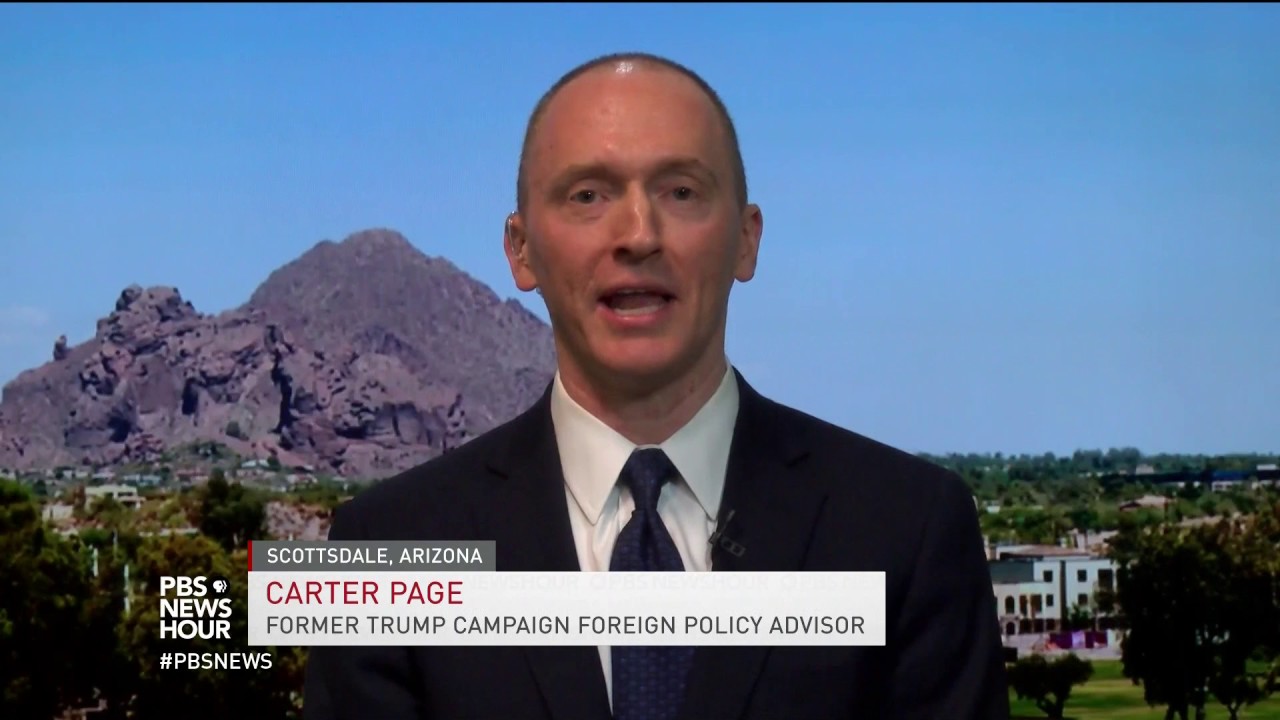 on YouTube, February 15, 2017, PBS NewsHour interview
- Testimony of Carter Page, U.S. House Select Committee on Intelligence, Nov. 7, 2017
- FISA warrant on Carter Page, redacted
- FISA declassified Order Regarding Handling and Disposition of Information on Carter Page
hide <ul style="list-style-image: url(" w="w" skins="skins" vector="Vector" resources="resources" skins.vector.styles="skins.vector.styles" images="images" bullet-icon.svg="bullet-icon.svg" d4515="d4515" margin="margin" px="px" padding="padding" display="display" inline-block="inline-block" white-space="white-space" nowrap="nowrap" line-height="line-height" inherit="inherit"><font size="4" face="Times New Roman"></font><li class="nv-view" style="margin: 0px; display: inline; word-spacing: -0.125em;"><font size="4" face="Times New Roman"><font size="4" face="Times New Roman"><font size="4" face="Times New Roman"><font size="4" face="Times New Roman"><font size="4" face="Times New Roman"><font size="4" face="Times New Roman"><font size="4" face="Times New Roman"><font size="4" face="Times New Roman"><font size="4" face="Times New Roman"><font size="4" face="Times New Roman"><a href="https://en.wikipedia.org/wiki/Template:Special_Counsel_investigation_(2017%E2%80%932019)" title="Template:Special Counsel investigation (2017–2019)" style="text-decoration-line: none; background: none;"><abbr title="View this template" style="border: none; cursor: inherit; text-decoration-line: none; text-decoration-style: initial; font-variant-numeric: normal; font-variant-east-asian: normal; font-variant-caps: small-caps; background: none transparent; box-shadow: none; padding: 0px;">v</abbr></a></font></font></font></font></font></font></font></font></font></font></li><li class="nv-talk" style="margin: 0px; display: inline; word-spacing: -0.125em;"><a href="https://en.wikipedia.org/wiki/Template_talk:Special_Counsel_investigation_(2017%E2%80%932019)" title="Template talk:Special Counsel investigation (2017–2019)" style="text-decoration-line: none; background: none;"><abbr title="Discuss this template" style="border: none; cursor: inherit; text-decoration-line: none; text-decoration-style: initial; font-variant-numeric: normal; font-variant-east-asian: normal; font-variant-caps: small-caps; background: none transparent; box-shadow: none; padding: 0px;">t</abbr></a></li><li class="nv-edit" style="margin: 0px; display: inline; word-spacing: -0.125em;"><a class="external text" href="https://en.wikipedia.org/w/index.php?title=Template:Special_Counsel_investigation_(2017%E2%80%932019)&action=edit" style="text-decoration-line: none; background: none !important; padding: 0px !important;"><abbr title="Edit this template" style="border: none; cursor: inherit; text-decoration-line: none; text-decoration-style: initial; font-variant-numeric: normal; font-variant-east-asian: normal; font-variant-caps: small-caps; background: none transparent; box-shadow: none; padding: 0px;">e</abbr></a></li></ul> | hide <ul style="list-style-image: url(" w="w" skins="skins" vector="Vector" resources="resources" skins.vector.styles="skins.vector.styles" images="images" bullet-icon.svg="bullet-icon.svg" d4515="d4515" margin="margin" px="px" padding="padding" display="display" inline-block="inline-block" white-space="white-space" nowrap="nowrap" line-height="line-height" inherit="inherit"><font size="4" face="Times New Roman"></font><li class="nv-view" style="margin: 0px; display: inline; word-spacing: -0.125em;"><font size="4" face="Times New Roman"><font size="4" face="Times New Roman"><font size="4" face="Times New Roman"><font size="4" face="Times New Roman"><font size="4" face="Times New Roman"><font size="4" face="Times New Roman"><font size="4" face="Times New Roman"><font size="4" face="Times New Roman"><font size="4" face="Times New Roman"><font size="4" face="Times New Roman"><a href="https://en.wikipedia.org/wiki/Template:Special_Counsel_investigation_(2017%E2%80%932019)" title="Template:Special Counsel investigation (2017–2019)" style="text-decoration-line: none; background: none;"><abbr title="View this template" style="border: none; cursor: inherit; text-decoration-line: none; text-decoration-style: initial; font-variant-numeric: normal; font-variant-east-asian: normal; font-variant-caps: small-caps; background: none transparent; box-shadow: none; padding: 0px;">v</abbr></a></font></font></font></font></font></font></font></font></font></font></li><li class="nv-talk" style="margin: 0px; display: inline; word-spacing: -0.125em;"><a href="https://en.wikipedia.org/wiki/Template_talk:Special_Counsel_investigation_(2017%E2%80%932019)" title="Template talk:Special Counsel investigation (2017–2019)" style="text-decoration-line: none; background: none;"><abbr title="Discuss this template" style="border: none; cursor: inherit; text-decoration-line: none; text-decoration-style: initial; font-variant-numeric: normal; font-variant-east-asian: normal; font-variant-caps: small-caps; background: none transparent; box-shadow: none; padding: 0px;">t</abbr></a></li><li class="nv-edit" style="margin: 0px; display: inline; word-spacing: -0.125em;"><a class="external text" href="https://en.wikipedia.org/w/index.php?title=Template:Special_Counsel_investigation_(2017%E2%80%932019)&action=edit" style="text-decoration-line: none; background: none !important; padding: 0px !important;"><abbr title="Edit this template" style="border: none; cursor: inherit; text-decoration-line: none; text-decoration-style: initial; font-variant-numeric: normal; font-variant-east-asian: normal; font-variant-caps: small-caps; background: none transparent; box-shadow: none; padding: 0px;">e</abbr></a></li></ul> | hide <ul style="list-style-image: url(" w="w" skins="skins" vector="Vector" resources="resources" skins.vector.styles="skins.vector.styles" images="images" bullet-icon.svg="bullet-icon.svg" d4515="d4515" margin="margin" px="px" padding="padding" display="display" inline-block="inline-block" white-space="white-space" nowrap="nowrap" line-height="line-height" inherit="inherit"><font size="4" face="Times New Roman"></font><li class="nv-view" style="margin: 0px; display: inline; word-spacing: -0.125em;"><font size="4" face="Times New Roman"><font size="4" face="Times New Roman"><font size="4" face="Times New Roman"><font size="4" face="Times New Roman"><font size="4" face="Times New Roman"><font size="4" face="Times New Roman"><font size="4" face="Times New Roman"><font size="4" face="Times New Roman"><font size="4" face="Times New Roman"><font size="4" face="Times New Roman"><a href="https://en.wikipedia.org/wiki/Template:Special_Counsel_investigation_(2017%E2%80%932019)" title="Template:Special Counsel investigation (2017–2019)" style="text-decoration-line: none; background: none;"><abbr title="View this template" style="border: none; cursor: inherit; text-decoration-line: none; text-decoration-style: initial; font-variant-numeric: normal; font-variant-east-asian: normal; font-variant-caps: small-caps; background: none transparent; box-shadow: none; padding: 0px;">v</abbr></a></font></font></font></font></font></font></font></font></font></font></li><li class="nv-talk" style="margin: 0px; display: inline; word-spacing: -0.125em;"><a href="https://en.wikipedia.org/wiki/Template_talk:Special_Counsel_investigation_(2017%E2%80%932019)" title="Template talk:Special Counsel investigation (2017–2019)" style="text-decoration-line: none; background: none;"><abbr title="Discuss this template" style="border: none; cursor: inherit; text-decoration-line: none; text-decoration-style: initial; font-variant-numeric: normal; font-variant-east-asian: normal; font-variant-caps: small-caps; background: none transparent; box-shadow: none; padding: 0px;">t</abbr></a></li><li class="nv-edit" style="margin: 0px; display: inline; word-spacing: -0.125em;"><a class="external text" href="https://en.wikipedia.org/w/index.php?title=Template:Special_Counsel_investigation_(2017%E2%80%932019)&action=edit" style="text-decoration-line: none; background: none !important; padding: 0px !important;"><abbr title="Edit this template" style="border: none; cursor: inherit; text-decoration-line: none; text-decoration-style: initial; font-variant-numeric: normal; font-variant-east-asian: normal; font-variant-caps: small-caps; background: none transparent; box-shadow: none; padding: 0px;">e</abbr></a></li></ul> | hide <ul style="list-style-image: url(" w="w" skins="skins" vector="Vector" resources="resources" skins.vector.styles="skins.vector.styles" images="images" bullet-icon.svg="bullet-icon.svg" d4515="d4515" margin="margin" px="px" padding="padding" display="display" inline-block="inline-block" white-space="white-space" nowrap="nowrap" line-height="line-height" inherit="inherit"><font size="4" face="Times New Roman"></font><li class="nv-view" style="margin: 0px; display: inline; word-spacing: -0.125em;"><font size="4" face="Times New Roman"><font size="4" face="Times New Roman"><font size="4" face="Times New Roman"><font size="4" face="Times New Roman"><font size="4" face="Times New Roman"><font size="4" face="Times New Roman"><font size="4" face="Times New Roman"><font size="4" face="Times New Roman"><font size="4" face="Times New Roman"><font size="4" face="Times New Roman"><a href="https://en.wikipedia.org/wiki/Template:Special_Counsel_investigation_(2017%E2%80%932019)" title="Template:Special Counsel investigation (2017–2019)" style="text-decoration-line: none; background: none;"><abbr title="View this template" style="border: none; cursor: inherit; text-decoration-line: none; text-decoration-style: initial; font-variant-numeric: normal; font-variant-east-asian: normal; font-variant-caps: small-caps; background: none transparent; box-shadow: none; padding: 0px;">v</abbr></a></font></font></font></font></font></font></font></font></font></font></li><li class="nv-talk" style="margin: 0px; display: inline; word-spacing: -0.125em;"><a href="https://en.wikipedia.org/wiki/Template_talk:Special_Counsel_investigation_(2017%E2%80%932019)" title="Template talk:Special Counsel investigation (2017–2019)" style="text-decoration-line: none; background: none;"><abbr title="Discuss this template" style="border: none; cursor: inherit; text-decoration-line: none; text-decoration-style: initial; font-variant-numeric: normal; font-variant-east-asian: normal; font-variant-caps: small-caps; background: none transparent; box-shadow: none; padding: 0px;">t</abbr></a></li><li class="nv-edit" style="margin: 0px; display: inline; word-spacing: -0.125em;"><a class="external text" href="https://en.wikipedia.org/w/index.php?title=Template:Special_Counsel_investigation_(2017%E2%80%932019)&action=edit" style="text-decoration-line: none; background: none !important; padding: 0px !important;"><abbr title="Edit this template" style="border: none; cursor: inherit; text-decoration-line: none; text-decoration-style: initial; font-variant-numeric: normal; font-variant-east-asian: normal; font-variant-caps: small-caps; background: none transparent; box-shadow: none; padding: 0px;">e</abbr></a></li></ul> | hide <ul style="list-style-image: url(" w="w" skins="skins" vector="Vector" resources="resources" skins.vector.styles="skins.vector.styles" images="images" bullet-icon.svg="bullet-icon.svg" d4515="d4515" margin="margin" px="px" padding="padding" display="display" inline-block="inline-block" white-space="white-space" nowrap="nowrap" line-height="line-height" inherit="inherit"><font size="4" face="Times New Roman"></font><li class="nv-view" style="margin: 0px; display: inline; word-spacing: -0.125em;"><font size="4" face="Times New Roman"><font size="4" face="Times New Roman"><font size="4" face="Times New Roman"><font size="4" face="Times New Roman"><font size="4" face="Times New Roman"><font size="4" face="Times New Roman"><font size="4" face="Times New Roman"><font size="4" face="Times New Roman"><font size="4" face="Times New Roman"><font size="4" face="Times New Roman"><a href="https://en.wikipedia.org/wiki/Template:Special_Counsel_investigation_(2017%E2%80%932019)" title="Template:Special Counsel investigation (2017–2019)" style="text-decoration-line: none; background: none;"><abbr title="View this template" style="border: none; cursor: inherit; text-decoration-line: none; text-decoration-style: initial; font-variant-numeric: normal; font-variant-east-asian: normal; font-variant-caps: small-caps; background: none transparent; box-shadow: none; padding: 0px;">v</abbr></a></font></font></font></font></font></font></font></font></font></font></li><li class="nv-talk" style="margin: 0px; display: inline; word-spacing: -0.125em;"><a href="https://en.wikipedia.org/wiki/Template_talk:Special_Counsel_investigation_(2017%E2%80%932019)" title="Template talk:Special Counsel investigation (2017–2019)" style="text-decoration-line: none; background: none;"><abbr title="Discuss this template" style="border: none; cursor: inherit; text-decoration-line: none; text-decoration-style: initial; font-variant-numeric: normal; font-variant-east-asian: normal; font-variant-caps: small-caps; background: none transparent; box-shadow: none; padding: 0px;">t</abbr></a></li><li class="nv-edit" style="margin: 0px; display: inline; word-spacing: -0.125em;"><a class="external text" href="https://en.wikipedia.org/w/index.php?title=Template:Special_Counsel_investigation_(2017%E2%80%932019)&action=edit" style="text-decoration-line: none; background: none !important; padding: 0px !important;"><abbr title="Edit this template" style="border: none; cursor: inherit; text-decoration-line: none; text-decoration-style: initial; font-variant-numeric: normal; font-variant-east-asian: normal; font-variant-caps: small-caps; background: none transparent; box-shadow: none; padding: 0px;">e</abbr></a></li></ul> | hide <ul style="list-style-image: url(" w="w" skins="skins" vector="Vector" resources="resources" skins.vector.styles="skins.vector.styles" images="images" bullet-icon.svg="bullet-icon.svg" d4515="d4515" margin="margin" px="px" padding="padding" display="display" inline-block="inline-block" white-space="white-space" nowrap="nowrap" line-height="line-height" inherit="inherit"><font size="4" face="Times New Roman"></font><li class="nv-view" style="margin: 0px; display: inline; word-spacing: -0.125em;"><font size="4" face="Times New Roman"><font size="4" face="Times New Roman"><font size="4" face="Times New Roman"><font size="4" face="Times New Roman"><font size="4" face="Times New Roman"><font size="4" face="Times New Roman"><font size="4" face="Times New Roman"><font size="4" face="Times New Roman"><font size="4" face="Times New Roman"><font size="4" face="Times New Roman"><a href="https://en.wikipedia.org/wiki/Template:Special_Counsel_investigation_(2017%E2%80%932019)" title="Template:Special Counsel investigation (2017–2019)" style="text-decoration-line: none; background: none;"><abbr title="View this template" style="border: none; cursor: inherit; text-decoration-line: none; text-decoration-style: initial; font-variant-numeric: normal; font-variant-east-asian: normal; font-variant-caps: small-caps; background: none transparent; box-shadow: none; padding: 0px;">v</abbr></a></font></font></font></font></font></font></font></font></font></font></li><li class="nv-talk" style="margin: 0px; display: inline; word-spacing: -0.125em;"><a href="https://en.wikipedia.org/wiki/Template_talk:Special_Counsel_investigation_(2017%E2%80%932019)" title="Template talk:Special Counsel investigation (2017–2019)" style="text-decoration-line: none; background: none;"><abbr title="Discuss this template" style="border: none; cursor: inherit; text-decoration-line: none; text-decoration-style: initial; font-variant-numeric: normal; font-variant-east-asian: normal; font-variant-caps: small-caps; background: none transparent; box-shadow: none; padding: 0px;">t</abbr></a></li><li class="nv-edit" style="margin: 0px; display: inline; word-spacing: -0.125em;"><a class="external text" href="https://en.wikipedia.org/w/index.php?title=Template:Special_Counsel_investigation_(2017%E2%80%932019)&action=edit" style="text-decoration-line: none; background: none !important; padding: 0px !important;"><abbr title="Edit this template" style="border: none; cursor: inherit; text-decoration-line: none; text-decoration-style: initial; font-variant-numeric: normal; font-variant-east-asian: normal; font-variant-caps: small-caps; background: none transparent; box-shadow: none; padding: 0px;">e</abbr></a></li></ul> | hide <ul style="list-style-image: url(" w="w" skins="skins" vector="Vector" resources="resources" skins.vector.styles="skins.vector.styles" images="images" bullet-icon.svg="bullet-icon.svg" d4515="d4515" margin="margin" px="px" padding="padding" display="display" inline-block="inline-block" white-space="white-space" nowrap="nowrap" line-height="line-height" inherit="inherit"><font size="4" face="Times New Roman"></font><li class="nv-view" style="margin: 0px; display: inline; word-spacing: -0.125em;"><font size="4" face="Times New Roman"><font size="4" face="Times New Roman"><font size="4" face="Times New Roman"><font size="4" face="Times New Roman"><font size="4" face="Times New Roman"><font size="4" face="Times New Roman"><font size="4" face="Times New Roman"><font size="4" face="Times New Roman"><font size="4" face="Times New Roman"><font size="4" face="Times New Roman"><a href="https://en.wikipedia.org/wiki/Template:Special_Counsel_investigation_(2017%E2%80%932019)" title="Template:Special Counsel investigation (2017–2019)" style="text-decoration-line: none; background: none;"><abbr title="View this template" style="border: none; cursor: inherit; text-decoration-line: none; text-decoration-style: initial; font-variant-numeric: normal; font-variant-east-asian: normal; font-variant-caps: small-caps; background: none transparent; box-shadow: none; padding: 0px;">v</abbr></a></font></font></font></font></font></font></font></font></font></font></li><li class="nv-talk" style="margin: 0px; display: inline; word-spacing: -0.125em;"><a href="https://en.wikipedia.org/wiki/Template_talk:Special_Counsel_investigation_(2017%E2%80%932019)" title="Template talk:Special Counsel investigation (2017–2019)" style="text-decoration-line: none; background: none;"><abbr title="Discuss this template" style="border: none; cursor: inherit; text-decoration-line: none; text-decoration-style: initial; font-variant-numeric: normal; font-variant-east-asian: normal; font-variant-caps: small-caps; background: none transparent; box-shadow: none; padding: 0px;">t</abbr></a></li><li class="nv-edit" style="margin: 0px; display: inline; word-spacing: -0.125em;"><a class="external text" href="https://en.wikipedia.org/w/index.php?title=Template:Special_Counsel_investigation_(2017%E2%80%932019)&action=edit" style="text-decoration-line: none; background: none !important; padding: 0px !important;"><abbr title="Edit this template" style="border: none; cursor: inherit; text-decoration-line: none; text-decoration-style: initial; font-variant-numeric: normal; font-variant-east-asian: normal; font-variant-caps: small-caps; background: none transparent; box-shadow: none; padding: 0px;">e</abbr></a></li></ul> | hide <ul style="list-style-image: url(" w="w" skins="skins" vector="Vector" resources="resources" skins.vector.styles="skins.vector.styles" images="images" bullet-icon.svg="bullet-icon.svg" d4515="d4515" margin="margin" px="px" padding="padding" display="display" inline-block="inline-block" white-space="white-space" nowrap="nowrap" line-height="line-height" inherit="inherit"><font size="4" face="Times New Roman"></font><li class="nv-view" style="margin: 0px; display: inline; word-spacing: -0.125em;"><font size="4" face="Times New Roman"><font size="4" face="Times New Roman"><font size="4" face="Times New Roman"><font size="4" face="Times New Roman"><font size="4" face="Times New Roman"><font size="4" face="Times New Roman"><font size="4" face="Times New Roman"><font size="4" face="Times New Roman"><font size="4" face="Times New Roman"><font size="4" face="Times New Roman"><a href="https://en.wikipedia.org/wiki/Template:Special_Counsel_investigation_(2017%E2%80%932019)" title="Template:Special Counsel investigation (2017–2019)" style="text-decoration-line: none; background: none;"><abbr title="View this template" style="border: none; cursor: inherit; text-decoration-line: none; text-decoration-style: initial; font-variant-numeric: normal; font-variant-east-asian: normal; font-variant-caps: small-caps; background: none transparent; box-shadow: none; padding: 0px;">v</abbr></a></font></font></font></font></font></font></font></font></font></font></li><li class="nv-talk" style="margin: 0px; display: inline; word-spacing: -0.125em;"><a href="https://en.wikipedia.org/wiki/Template_talk:Special_Counsel_investigation_(2017%E2%80%932019)" title="Template talk:Special Counsel investigation (2017–2019)" style="text-decoration-line: none; background: none;"><abbr title="Discuss this template" style="border: none; cursor: inherit; text-decoration-line: none; text-decoration-style: initial; font-variant-numeric: normal; font-variant-east-asian: normal; font-variant-caps: small-caps; background: none transparent; box-shadow: none; padding: 0px;">t</abbr></a></li><li class="nv-edit" style="margin: 0px; display: inline; word-spacing: -0.125em;"><a class="external text" href="https://en.wikipedia.org/w/index.php?title=Template:Special_Counsel_investigation_(2017%E2%80%932019)&action=edit" style="text-decoration-line: none; background: none !important; padding: 0px !important;"><abbr title="Edit this template" style="border: none; cursor: inherit; text-decoration-line: none; text-decoration-style: initial; font-variant-numeric: normal; font-variant-east-asian: normal; font-variant-caps: small-caps; background: none transparent; box-shadow: none; padding: 0px;">e</abbr></a></li></ul> | hide <ul style="list-style-image: url(" w="w" skins="skins" vector="Vector" resources="resources" skins.vector.styles="skins.vector.styles" images="images" bullet-icon.svg="bullet-icon.svg" d4515="d4515" margin="margin" px="px" padding="padding" display="display" inline-block="inline-block" white-space="white-space" nowrap="nowrap" line-height="line-height" inherit="inherit"><font size="4" face="Times New Roman"></font><li class="nv-view" style="margin: 0px; display: inline; word-spacing: -0.125em;"><font size="4" face="Times New Roman"><font size="4" face="Times New Roman"><font size="4" face="Times New Roman"><font size="4" face="Times New Roman"><font size="4" face="Times New Roman"><font size="4" face="Times New Roman"><font size="4" face="Times New Roman"><font size="4" face="Times New Roman"><font size="4" face="Times New Roman"><font size="4" face="Times New Roman"><a href="https://en.wikipedia.org/wiki/Template:Special_Counsel_investigation_(2017%E2%80%932019)" title="Template:Special Counsel investigation (2017–2019)" style="text-decoration-line: none; background: none;"><abbr title="View this template" style="border: none; cursor: inherit; text-decoration-line: none; text-decoration-style: initial; font-variant-numeric: normal; font-variant-east-asian: normal; font-variant-caps: small-caps; background: none transparent; box-shadow: none; padding: 0px;">v</abbr></a></font></font></font></font></font></font></font></font></font></font></li><li class="nv-talk" style="margin: 0px; display: inline; word-spacing: -0.125em;"><a href="https://en.wikipedia.org/wiki/Template_talk:Special_Counsel_investigation_(2017%E2%80%932019)" title="Template talk:Special Counsel investigation (2017–2019)" style="text-decoration-line: none; background: none;"><abbr title="Discuss this template" style="border: none; cursor: inherit; text-decoration-line: none; text-decoration-style: initial; font-variant-numeric: normal; font-variant-east-asian: normal; font-variant-caps: small-caps; background: none transparent; box-shadow: none; padding: 0px;">t</abbr></a></li><li class="nv-edit" style="margin: 0px; display: inline; word-spacing: -0.125em;"><a class="external text" href="https://en.wikipedia.org/w/index.php?title=Template:Special_Counsel_investigation_(2017%E2%80%932019)&action=edit" style="text-decoration-line: none; background: none !important; padding: 0px !important;"><abbr title="Edit this template" style="border: none; cursor: inherit; text-decoration-line: none; text-decoration-style: initial; font-variant-numeric: normal; font-variant-east-asian: normal; font-variant-caps: small-caps; background: none transparent; box-shadow: none; padding: 0px;">e</abbr></a></li></ul> | hide <ul style="list-style-image: url(" w="w" skins="skins" vector="Vector" resources="resources" skins.vector.styles="skins.vector.styles" images="images" bullet-icon.svg="bullet-icon.svg" d4515="d4515" margin="margin" px="px" padding="padding" display="display" inline-block="inline-block" white-space="white-space" nowrap="nowrap" line-height="line-height" inherit="inherit"><font size="4" face="Times New Roman"></font><li class="nv-view" style="margin: 0px; display: inline; word-spacing: -0.125em;"><font size="4" face="Times New Roman"><font size="4" face="Times New Roman"><font size="4" face="Times New Roman"><font size="4" face="Times New Roman"><font size="4" face="Times New Roman"><font size="4" face="Times New Roman"><font size="4" face="Times New Roman"><font size="4" face="Times New Roman"><font size="4" face="Times New Roman"><font size="4" face="Times New Roman"><a href="https://en.wikipedia.org/wiki/Template:Special_Counsel_investigation_(2017%E2%80%932019)" title="Template:Special Counsel investigation (2017–2019)" style="text-decoration-line: none; background: none;"><abbr title="View this template" style="border: none; cursor: inherit; text-decoration-line: none; text-decoration-style: initial; font-variant-numeric: normal; font-variant-east-asian: normal; font-variant-caps: small-caps; background: none transparent; box-shadow: none; padding: 0px;">v</abbr></a></font></font></font></font></font></font></font></font></font></font></li><li class="nv-talk" style="margin: 0px; display: inline; word-spacing: -0.125em;"><a href="https://en.wikipedia.org/wiki/Template_talk:Special_Counsel_investigation_(2017%E2%80%932019)" title="Template talk:Special Counsel investigation (2017–2019)" style="text-decoration-line: none; background: none;"><abbr title="Discuss this template" style="border: none; cursor: inherit; text-decoration-line: none; text-decoration-style: initial; font-variant-numeric: normal; font-variant-east-asian: normal; font-variant-caps: small-caps; background: none transparent; box-shadow: none; padding: 0px;">t</abbr></a></li><li class="nv-edit" style="margin: 0px; display: inline; word-spacing: -0.125em;"><a class="external text" href="https://en.wikipedia.org/w/index.php?title=Template:Special_Counsel_investigation_(2017%E2%80%932019)&action=edit" style="text-decoration-line: none; background: none !important; padding: 0px !important;"><abbr title="Edit this template" style="border: none; cursor: inherit; text-decoration-line: none; text-decoration-style: initial; font-variant-numeric: normal; font-variant-east-asian: normal; font-variant-caps: small-caps; background: none transparent; box-shadow: none; padding: 0px;">e</abbr></a></li></ul> | hide <ul style="list-style-image: url(" w="w" skins="skins" vector="Vector" resources="resources" skins.vector.styles="skins.vector.styles" images="images" bullet-icon.svg="bullet-icon.svg" d4515="d4515" margin="margin" px="px" padding="padding" display="display" inline-block="inline-block" white-space="white-space" nowrap="nowrap" line-height="line-height" inherit="inherit"><font size="4" face="Times New Roman"></font><li class="nv-view" style="margin: 0px; display: inline; word-spacing: -0.125em;"><font size="4" face="Times New Roman"><font size="4" face="Times New Roman"><font size="4" face="Times New Roman"><font size="4" face="Times New Roman"><font size="4" face="Times New Roman"><font size="4" face="Times New Roman"><font size="4" face="Times New Roman"><font size="4" face="Times New Roman"><font size="4" face="Times New Roman"><font size="4" face="Times New Roman"><a href="https://en.wikipedia.org/wiki/Template:Special_Counsel_investigation_(2017%E2%80%932019)" title="Template:Special Counsel investigation (2017–2019)" style="text-decoration-line: none; background: none;"><abbr title="View this template" style="border: none; cursor: inherit; text-decoration-line: none; text-decoration-style: initial; font-variant-numeric: normal; font-variant-east-asian: normal; font-variant-caps: small-caps; background: none transparent; box-shadow: none; padding: 0px;">v</abbr></a></font></font></font></font></font></font></font></font></font></font></li><li class="nv-talk" style="margin: 0px; display: inline; word-spacing: -0.125em;"><a href="https://en.wikipedia.org/wiki/Template_talk:Special_Counsel_investigation_(2017%E2%80%932019)" title="Template talk:Special Counsel investigation (2017–2019)" style="text-decoration-line: none; background: none;"><abbr title="Discuss this template" style="border: none; cursor: inherit; text-decoration-line: none; text-decoration-style: initial; font-variant-numeric: normal; font-variant-east-asian: normal; font-variant-caps: small-caps; background: none transparent; box-shadow: none; padding: 0px;">t</abbr></a></li><li class="nv-edit" style="margin: 0px; display: inline; word-spacing: -0.125em;"><a class="external text" href="https://en.wikipedia.org/w/index.php?title=Template:Special_Counsel_investigation_(2017%E2%80%932019)&action=edit" style="text-decoration-line: none; background: none !important; padding: 0px !important;"><abbr title="Edit this template" style="border: none; cursor: inherit; text-decoration-line: none; text-decoration-style: initial; font-variant-numeric: normal; font-variant-east-asian: normal; font-variant-caps: small-caps; background: none transparent; box-shadow: none; padding: 0px;">e</abbr></a></li></ul> | hide <ul style="list-style-image: url(" w="w" skins="skins" vector="Vector" resources="resources" skins.vector.styles="skins.vector.styles" images="images" bullet-icon.svg="bullet-icon.svg" d4515="d4515" margin="margin" px="px" padding="padding" display="display" inline-block="inline-block" white-space="white-space" nowrap="nowrap" line-height="line-height" inherit="inherit"><font size="4" face="Times New Roman"></font><li class="nv-view" style="margin: 0px; display: inline; word-spacing: -0.125em;"><font size="4" face="Times New Roman"><font size="4" face="Times New Roman"><font size="4" face="Times New Roman"><font size="4" face="Times New Roman"><font size="4" face="Times New Roman"><font size="4" face="Times New Roman"><font size="4" face="Times New Roman"><font size="4" face="Times New Roman"><font size="4" face="Times New Roman"><font size="4" face="Times New Roman"><a href="https://en.wikipedia.org/wiki/Template:Special_Counsel_investigation_(2017%E2%80%932019)" title="Template:Special Counsel investigation (2017–2019)" style="text-decoration-line: none; background: none;"><abbr title="View this template" style="border: none; cursor: inherit; text-decoration-line: none; text-decoration-style: initial; font-variant-numeric: normal; font-variant-east-asian: normal; font-variant-caps: small-caps; background: none transparent; box-shadow: none; padding: 0px;">v</abbr></a></font></font></font></font></font></font></font></font></font></font></li><li class="nv-talk" style="margin: 0px; display: inline; word-spacing: -0.125em;"><a href="https://en.wikipedia.org/wiki/Template_talk:Special_Counsel_investigation_(2017%E2%80%932019)" title="Template talk:Special Counsel investigation (2017–2019)" style="text-decoration-line: none; background: none;"><abbr title="Discuss this template" style="border: none; cursor: inherit; text-decoration-line: none; text-decoration-style: initial; font-variant-numeric: normal; font-variant-east-asian: normal; font-variant-caps: small-caps; background: none transparent; box-shadow: none; padding: 0px;">t</abbr></a></li><li class="nv-edit" style="margin: 0px; display: inline; word-spacing: -0.125em;"><a class="external text" href="https://en.wikipedia.org/w/index.php?title=Template:Special_Counsel_investigation_(2017%E2%80%932019)&action=edit" style="text-decoration-line: none; background: none !important; padding: 0px !important;"><abbr title="Edit this template" style="border: none; cursor: inherit; text-decoration-line: none; text-decoration-style: initial; font-variant-numeric: normal; font-variant-east-asian: normal; font-variant-caps: small-caps; background: none transparent; box-shadow: none; padding: 0px;">e</abbr></a></li></ul> | hide <ul style="list-style-image: url(" w="w" skins="skins" vector="Vector" resources="resources" skins.vector.styles="skins.vector.styles" images="images" bullet-icon.svg="bullet-icon.svg" d4515="d4515" margin="margin" px="px" padding="padding" display="display" inline-block="inline-block" white-space="white-space" nowrap="nowrap" line-height="line-height" inherit="inherit"><font size="4" face="Times New Roman"></font><li class="nv-view" style="margin: 0px; display: inline; word-spacing: -0.125em;"><font size="4" face="Times New Roman"><font size="4" face="Times New Roman"><font size="4" face="Times New Roman"><font size="4" face="Times New Roman"><font size="4" face="Times New Roman"><font size="4" face="Times New Roman"><font size="4" face="Times New Roman"><font size="4" face="Times New Roman"><font size="4" face="Times New Roman"><font size="4" face="Times New Roman"><a href="https://en.wikipedia.org/wiki/Template:Special_Counsel_investigation_(2017%E2%80%932019)" title="Template:Special Counsel investigation (2017–2019)" style="text-decoration-line: none; background: none;"><abbr title="View this template" style="border: none; cursor: inherit; text-decoration-line: none; text-decoration-style: initial; font-variant-numeric: normal; font-variant-east-asian: normal; font-variant-caps: small-caps; background: none transparent; box-shadow: none; padding: 0px;">v</abbr></a></font></font></font></font></font></font></font></font></font></font></li><li class="nv-talk" style="margin: 0px; display: inline; word-spacing: -0.125em;"><a href="https://en.wikipedia.org/wiki/Template_talk:Special_Counsel_investigation_(2017%E2%80%932019)" title="Template talk:Special Counsel investigation (2017–2019)" style="text-decoration-line: none; background: none;"><abbr title="Discuss this template" style="border: none; cursor: inherit; text-decoration-line: none; text-decoration-style: initial; font-variant-numeric: normal; font-variant-east-asian: normal; font-variant-caps: small-caps; background: none transparent; box-shadow: none; padding: 0px;">t</abbr></a></li><li class="nv-edit" style="margin: 0px; display: inline; word-spacing: -0.125em;"><a class="external text" href="https://en.wikipedia.org/w/index.php?title=Template:Special_Counsel_investigation_(2017%E2%80%932019)&action=edit" style="text-decoration-line: none; background: none !important; padding: 0px !important;"><abbr title="Edit this template" style="border: none; cursor: inherit; text-decoration-line: none; text-decoration-style: initial; font-variant-numeric: normal; font-variant-east-asian: normal; font-variant-caps: small-caps; background: none transparent; box-shadow: none; padding: 0px;">e</abbr></a></li></ul> | hide <ul style="list-style-image: url(" w="w" skins="skins" vector="Vector" resources="resources" skins.vector.styles="skins.vector.styles" images="images" bullet-icon.svg="bullet-icon.svg" d4515="d4515" margin="margin" px="px" padding="padding" display="display" inline-block="inline-block" white-space="white-space" nowrap="nowrap" line-height="line-height" inherit="inherit"><font size="4" face="Times New Roman"></font><li class="nv-view" style="margin: 0px; display: inline; word-spacing: -0.125em;"><font size="4" face="Times New Roman"><font size="4" face="Times New Roman"><font size="4" face="Times New Roman"><font size="4" face="Times New Roman"><font size="4" face="Times New Roman"><font size="4" face="Times New Roman"><font size="4" face="Times New Roman"><font size="4" face="Times New Roman"><font size="4" face="Times New Roman"><font size="4" face="Times New Roman"><a href="https://en.wikipedia.org/wiki/Template:Special_Counsel_investigation_(2017%E2%80%932019)" title="Template:Special Counsel investigation (2017–2019)" style="text-decoration-line: none; background: none;"><abbr title="View this template" style="border: none; cursor: inherit; text-decoration-line: none; text-decoration-style: initial; font-variant-numeric: normal; font-variant-east-asian: normal; font-variant-caps: small-caps; background: none transparent; box-shadow: none; padding: 0px;">v</abbr></a></font></font></font></font></font></font></font></font></font></font></li><li class="nv-talk" style="margin: 0px; display: inline; word-spacing: -0.125em;"><a href="https://en.wikipedia.org/wiki/Template_talk:Special_Counsel_investigation_(2017%E2%80%932019)" title="Template talk:Special Counsel investigation (2017–2019)" style="text-decoration-line: none; background: none;"><abbr title="Discuss this template" style="border: none; cursor: inherit; text-decoration-line: none; text-decoration-style: initial; font-variant-numeric: normal; font-variant-east-asian: normal; font-variant-caps: small-caps; background: none transparent; box-shadow: none; padding: 0px;">t</abbr></a></li><li class="nv-edit" style="margin: 0px; display: inline; word-spacing: -0.125em;"><a class="external text" href="https://en.wikipedia.org/w/index.php?title=Template:Special_Counsel_investigation_(2017%E2%80%932019)&action=edit" style="text-decoration-line: none; background: none !important; padding: 0px !important;"><abbr title="Edit this template" style="border: none; cursor: inherit; text-decoration-line: none; text-decoration-style: initial; font-variant-numeric: normal; font-variant-east-asian: normal; font-variant-caps: small-caps; background: none transparent; box-shadow: none; padding: 0px;">e</abbr></a></li></ul> | hide <ul style="list-style-image: url(" w="w" skins="skins" vector="Vector" resources="resources" skins.vector.styles="skins.vector.styles" images="images" bullet-icon.svg="bullet-icon.svg" d4515="d4515" margin="margin" px="px" padding="padding" display="display" inline-block="inline-block" white-space="white-space" nowrap="nowrap" line-height="line-height" inherit="inherit"><font size="4" face="Times New Roman"></font><li class="nv-view" style="margin: 0px; display: inline; word-spacing: -0.125em;"><font size="4" face="Times New Roman"><font size="4" face="Times New Roman"><font size="4" face="Times New Roman"><font size="4" face="Times New Roman"><font size="4" face="Times New Roman"><font size="4" face="Times New Roman"><font size="4" face="Times New Roman"><font size="4" face="Times New Roman"><font size="4" face="Times New Roman"><font size="4" face="Times New Roman"><a href="https://en.wikipedia.org/wiki/Template:Special_Counsel_investigation_(2017%E2%80%932019)" title="Template:Special Counsel investigation (2017–2019)" style="text-decoration-line: none; background: none;"><abbr title="View this template" style="border: none; cursor: inherit; text-decoration-line: none; text-decoration-style: initial; font-variant-numeric: normal; font-variant-east-asian: normal; font-variant-caps: small-caps; background: none transparent; box-shadow: none; padding: 0px;">v</abbr></a></font></font></font></font></font></font></font></font></font></font></li><li class="nv-talk" style="margin: 0px; display: inline; word-spacing: -0.125em;"><a href="https://en.wikipedia.org/wiki/Template_talk:Special_Counsel_investigation_(2017%E2%80%932019)" title="Template talk:Special Counsel investigation (2017–2019)" style="text-decoration-line: none; background: none;"><abbr title="Discuss this template" style="border: none; cursor: inherit; text-decoration-line: none; text-decoration-style: initial; font-variant-numeric: normal; font-variant-east-asian: normal; font-variant-caps: small-caps; background: none transparent; box-shadow: none; padding: 0px;">t</abbr></a></li><li class="nv-edit" style="margin: 0px; display: inline; word-spacing: -0.125em;"><a class="external text" href="https://en.wikipedia.org/w/index.php?title=Template:Special_Counsel_investigation_(2017%E2%80%932019)&action=edit" style="text-decoration-line: none; background: none !important; padding: 0px !important;"><abbr title="Edit this template" style="border: none; cursor: inherit; text-decoration-line: none; text-decoration-style: initial; font-variant-numeric: normal; font-variant-east-asian: normal; font-variant-caps: small-caps; background: none transparent; box-shadow: none; padding: 0px;">e</abbr></a></li></ul> | hide <ul style="list-style-image: url(" w="w" skins="skins" vector="Vector" resources="resources" skins.vector.styles="skins.vector.styles" images="images" bullet-icon.svg="bullet-icon.svg" d4515="d4515" margin="margin" px="px" padding="padding" display="display" inline-block="inline-block" white-space="white-space" nowrap="nowrap" line-height="line-height" inherit="inherit"><font size="4" face="Times New Roman"></font><li class="nv-view" style="margin: 0px; display: inline; word-spacing: -0.125em;"><font size="4" face="Times New Roman"><font size="4" face="Times New Roman"><font size="4" face="Times New Roman"><font size="4" face="Times New Roman"><font size="4" face="Times New Roman"><font size="4" face="Times New Roman"><font size="4" face="Times New Roman"><font size="4" face="Times New Roman"><font size="4" face="Times New Roman"><font size="4" face="Times New Roman"><a href="https://en.wikipedia.org/wiki/Template:Special_Counsel_investigation_(2017%E2%80%932019)" title="Template:Special Counsel investigation (2017–2019)" style="text-decoration-line: none; background: none;"><abbr title="View this template" style="border: none; cursor: inherit; text-decoration-line: none; text-decoration-style: initial; font-variant-numeric: normal; font-variant-east-asian: normal; font-variant-caps: small-caps; background: none transparent; box-shadow: none; padding: 0px;">v</abbr></a></font></font></font></font></font></font></font></font></font></font></li><li class="nv-talk" style="margin: 0px; display: inline; word-spacing: -0.125em;"><a href="https://en.wikipedia.org/wiki/Template_talk:Special_Counsel_investigation_(2017%E2%80%932019)" title="Template talk:Special Counsel investigation (2017–2019)" style="text-decoration-line: none; background: none;"><abbr title="Discuss this template" style="border: none; cursor: inherit; text-decoration-line: none; text-decoration-style: initial; font-variant-numeric: normal; font-variant-east-asian: normal; font-variant-caps: small-caps; background: none transparent; box-shadow: none; padding: 0px;">t</abbr></a></li><li class="nv-edit" style="margin: 0px; display: inline; word-spacing: -0.125em;"><a class="external text" href="https://en.wikipedia.org/w/index.php?title=Template:Special_Counsel_investigation_(2017%E2%80%932019)&action=edit" style="text-decoration-line: none; background: none !important; padding: 0px !important;"><abbr title="Edit this template" style="border: none; cursor: inherit; text-decoration-line: none; text-decoration-style: initial; font-variant-numeric: normal; font-variant-east-asian: normal; font-variant-caps: small-caps; background: none transparent; box-shadow: none; padding: 0px;">e</abbr></a></li></ul> | hide <ul style="list-style-image: url(" w="w" skins="skins" vector="Vector" resources="resources" skins.vector.styles="skins.vector.styles" images="images" bullet-icon.svg="bullet-icon.svg" d4515="d4515" margin="margin" px="px" padding="padding" display="display" inline-block="inline-block" white-space="white-space" nowrap="nowrap" line-height="line-height" inherit="inherit"><font size="4" face="Times New Roman"></font><li class="nv-view" style="margin: 0px; display: inline; word-spacing: -0.125em;"><font size="4" face="Times New Roman"><font size="4" face="Times New Roman"><font size="4" face="Times New Roman"><font size="4" face="Times New Roman"><font size="4" face="Times New Roman"><font size="4" face="Times New Roman"><font size="4" face="Times New Roman"><font size="4" face="Times New Roman"><font size="4" face="Times New Roman"><font size="4" face="Times New Roman"><a href="https://en.wikipedia.org/wiki/Template:Special_Counsel_investigation_(2017%E2%80%932019)" title="Template:Special Counsel investigation (2017–2019)" style="text-decoration-line: none; background: none;"><abbr title="View this template" style="border: none; cursor: inherit; text-decoration-line: none; text-decoration-style: initial; font-variant-numeric: normal; font-variant-east-asian: normal; font-variant-caps: small-caps; background: none transparent; box-shadow: none; padding: 0px;">v</abbr></a></font></font></font></font></font></font></font></font></font></font></li><li class="nv-talk" style="margin: 0px; display: inline; word-spacing: -0.125em;"><a href="https://en.wikipedia.org/wiki/Template_talk:Special_Counsel_investigation_(2017%E2%80%932019)" title="Template talk:Special Counsel investigation (2017–2019)" style="text-decoration-line: none; background: none;"><abbr title="Discuss this template" style="border: none; cursor: inherit; text-decoration-line: none; text-decoration-style: initial; font-variant-numeric: normal; font-variant-east-asian: normal; font-variant-caps: small-caps; background: none transparent; box-shadow: none; padding: 0px;">t</abbr></a></li><li class="nv-edit" style="margin: 0px; display: inline; word-spacing: -0.125em;"><a class="external text" href="https://en.wikipedia.org/w/index.php?title=Template:Special_Counsel_investigation_(2017%E2%80%932019)&action=edit" style="text-decoration-line: none; background: none !important; padding: 0px !important;"><abbr title="Edit this template" style="border: none; cursor: inherit; text-decoration-line: none; text-decoration-style: initial; font-variant-numeric: normal; font-variant-east-asian: normal; font-variant-caps: small-caps; background: none transparent; box-shadow: none; padding: 0px;">e</abbr></a></li></ul> | hide <ul style="list-style-image: url(" w="w" skins="skins" vector="Vector" resources="resources" skins.vector.styles="skins.vector.styles" images="images" bullet-icon.svg="bullet-icon.svg" d4515="d4515" margin="margin" px="px" padding="padding" display="display" inline-block="inline-block" white-space="white-space" nowrap="nowrap" line-height="line-height" inherit="inherit"><font size="4" face="Times New Roman"></font><li class="nv-view" style="margin: 0px; display: inline; word-spacing: -0.125em;"><font size="4" face="Times New Roman"><font size="4" face="Times New Roman"><font size="4" face="Times New Roman"><font size="4" face="Times New Roman"><font size="4" face="Times New Roman"><font size="4" face="Times New Roman"><font size="4" face="Times New Roman"><font size="4" face="Times New Roman"><font size="4" face="Times New Roman"><font size="4" face="Times New Roman"><a href="https://en.wikipedia.org/wiki/Template:Special_Counsel_investigation_(2017%E2%80%932019)" title="Template:Special Counsel investigation (2017–2019)" style="text-decoration-line: none; background: none;"><abbr title="View this template" style="border: none; cursor: inherit; text-decoration-line: none; text-decoration-style: initial; font-variant-numeric: normal; font-variant-east-asian: normal; font-variant-caps: small-caps; background: none transparent; box-shadow: none; padding: 0px;">v</abbr></a></font></font></font></font></font></font></font></font></font></font></li><li class="nv-talk" style="margin: 0px; display: inline; word-spacing: -0.125em;"><a href="https://en.wikipedia.org/wiki/Template_talk:Special_Counsel_investigation_(2017%E2%80%932019)" title="Template talk:Special Counsel investigation (2017–2019)" style="text-decoration-line: none; background: none;"><abbr title="Discuss this template" style="border: none; cursor: inherit; text-decoration-line: none; text-decoration-style: initial; font-variant-numeric: normal; font-variant-east-asian: normal; font-variant-caps: small-caps; background: none transparent; box-shadow: none; padding: 0px;">t</abbr></a></li><li class="nv-edit" style="margin: 0px; display: inline; word-spacing: -0.125em;"><a class="external text" href="https://en.wikipedia.org/w/index.php?title=Template:Special_Counsel_investigation_(2017%E2%80%932019)&action=edit" style="text-decoration-line: none; background: none !important; padding: 0px !important;"><abbr title="Edit this template" style="border: none; cursor: inherit; text-decoration-line: none; text-decoration-style: initial; font-variant-numeric: normal; font-variant-east-asian: normal; font-variant-caps: small-caps; background: none transparent; box-shadow: none; padding: 0px;">e</abbr></a></li></ul> | hide <ul style="list-style-image: url(" w="w" skins="skins" vector="Vector" resources="resources" skins.vector.styles="skins.vector.styles" images="images" bullet-icon.svg="bullet-icon.svg" d4515="d4515" margin="margin" px="px" padding="padding" display="display" inline-block="inline-block" white-space="white-space" nowrap="nowrap" line-height="line-height" inherit="inherit"><font size="4" face="Times New Roman"></font><li class="nv-view" style="margin: 0px; display: inline; word-spacing: -0.125em;"><font size="4" face="Times New Roman"><font size="4" face="Times New Roman"><font size="4" face="Times New Roman"><font size="4" face="Times New Roman"><font size="4" face="Times New Roman"><font size="4" face="Times New Roman"><font size="4" face="Times New Roman"><font size="4" face="Times New Roman"><font size="4" face="Times New Roman"><font size="4" face="Times New Roman"><a href="https://en.wikipedia.org/wiki/Template:Special_Counsel_investigation_(2017%E2%80%932019)" title="Template:Special Counsel investigation (2017–2019)" style="text-decoration-line: none; background: none;"><abbr title="View this template" style="border: none; cursor: inherit; text-decoration-line: none; text-decoration-style: initial; font-variant-numeric: normal; font-variant-east-asian: normal; font-variant-caps: small-caps; background: none transparent; box-shadow: none; padding: 0px;">v</abbr></a></font></font></font></font></font></font></font></font></font></font></li><li class="nv-talk" style="margin: 0px; display: inline; word-spacing: -0.125em;"><a href="https://en.wikipedia.org/wiki/Template_talk:Special_Counsel_investigation_(2017%E2%80%932019)" title="Template talk:Special Counsel investigation (2017–2019)" style="text-decoration-line: none; background: none;"><abbr title="Discuss this template" style="border: none; cursor: inherit; text-decoration-line: none; text-decoration-style: initial; font-variant-numeric: normal; font-variant-east-asian: normal; font-variant-caps: small-caps; background: none transparent; box-shadow: none; padding: 0px;">t</abbr></a></li><li class="nv-edit" style="margin: 0px; display: inline; word-spacing: -0.125em;"><a class="external text" href="https://en.wikipedia.org/w/index.php?title=Template:Special_Counsel_investigation_(2017%E2%80%932019)&action=edit" style="text-decoration-line: none; background: none !important; padding: 0px !important;"><abbr title="Edit this template" style="border: none; cursor: inherit; text-decoration-line: none; text-decoration-style: initial; font-variant-numeric: normal; font-variant-east-asian: normal; font-variant-caps: small-caps; background: none transparent; box-shadow: none; padding: 0px;">e</abbr></a></li></ul> | hide <ul style="list-style-image: url(" w="w" skins="skins" vector="Vector" resources="resources" skins.vector.styles="skins.vector.styles" images="images" bullet-icon.svg="bullet-icon.svg" d4515="d4515" margin="margin" px="px" padding="padding" display="display" inline-block="inline-block" white-space="white-space" nowrap="nowrap" line-height="line-height" inherit="inherit"><font size="4" face="Times New Roman"></font><li class="nv-view" style="margin: 0px; display: inline; word-spacing: -0.125em;"><font size="4" face="Times New Roman"><font size="4" face="Times New Roman"><font size="4" face="Times New Roman"><font size="4" face="Times New Roman"><font size="4" face="Times New Roman"><font size="4" face="Times New Roman"><font size="4" face="Times New Roman"><font size="4" face="Times New Roman"><font size="4" face="Times New Roman"><font size="4" face="Times New Roman"><a href="https://en.wikipedia.org/wiki/Template:Special_Counsel_investigation_(2017%E2%80%932019)" title="Template:Special Counsel investigation (2017–2019)" style="text-decoration-line: none; background: none;"><abbr title="View this template" style="border: none; cursor: inherit; text-decoration-line: none; text-decoration-style: initial; font-variant-numeric: normal; font-variant-east-asian: normal; font-variant-caps: small-caps; background: none transparent; box-shadow: none; padding: 0px;">v</abbr></a></font></font></font></font></font></font></font></font></font></font></li><li class="nv-talk" style="margin: 0px; display: inline; word-spacing: -0.125em;"><a href="https://en.wikipedia.org/wiki/Template_talk:Special_Counsel_investigation_(2017%E2%80%932019)" title="Template talk:Special Counsel investigation (2017–2019)" style="text-decoration-line: none; background: none;"><abbr title="Discuss this template" style="border: none; cursor: inherit; text-decoration-line: none; text-decoration-style: initial; font-variant-numeric: normal; font-variant-east-asian: normal; font-variant-caps: small-caps; background: none transparent; box-shadow: none; padding: 0px;">t</abbr></a></li><li class="nv-edit" style="margin: 0px; display: inline; word-spacing: -0.125em;"><a class="external text" href="https://en.wikipedia.org/w/index.php?title=Template:Special_Counsel_investigation_(2017%E2%80%932019)&action=edit" style="text-decoration-line: none; background: none !important; padding: 0px !important;"><abbr title="Edit this template" style="border: none; cursor: inherit; text-decoration-line: none; text-decoration-style: initial; font-variant-numeric: normal; font-variant-east-asian: normal; font-variant-caps: small-caps; background: none transparent; box-shadow: none; padding: 0px;">e</abbr></a></li></ul> | hide <ul style="list-style-image: url(" w="w" skins="skins" vector="Vector" resources="resources" skins.vector.styles="skins.vector.styles" images="images" bullet-icon.svg="bullet-icon.svg" d4515="d4515" margin="margin" px="px" padding="padding" display="display" inline-block="inline-block" white-space="white-space" nowrap="nowrap" line-height="line-height" inherit="inherit"><font size="4" face="Times New Roman"></font><li class="nv-view" style="margin: 0px; display: inline; word-spacing: -0.125em;"><font size="4" face="Times New Roman"><font size="4" face="Times New Roman"><font size="4" face="Times New Roman"><font size="4" face="Times New Roman"><font size="4" face="Times New Roman"><font size="4" face="Times New Roman"><font size="4" face="Times New Roman"><font size="4" face="Times New Roman"><font size="4" face="Times New Roman"><font size="4" face="Times New Roman"><a href="https://en.wikipedia.org/wiki/Template:Special_Counsel_investigation_(2017%E2%80%932019)" title="Template:Special Counsel investigation (2017–2019)" style="text-decoration-line: none; background: none;"><abbr title="View this template" style="border: none; cursor: inherit; text-decoration-line: none; text-decoration-style: initial; font-variant-numeric: normal; font-variant-east-asian: normal; font-variant-caps: small-caps; background: none transparent; box-shadow: none; padding: 0px;">v</abbr></a></font></font></font></font></font></font></font></font></font></font></li><li class="nv-talk" style="margin: 0px; display: inline; word-spacing: -0.125em;"><a href="https://en.wikipedia.org/wiki/Template_talk:Special_Counsel_investigation_(2017%E2%80%932019)" title="Template talk:Special Counsel investigation (2017–2019)" style="text-decoration-line: none; background: none;"><abbr title="Discuss this template" style="border: none; cursor: inherit; text-decoration-line: none; text-decoration-style: initial; font-variant-numeric: normal; font-variant-east-asian: normal; font-variant-caps: small-caps; background: none transparent; box-shadow: none; padding: 0px;">t</abbr></a></li><li class="nv-edit" style="margin: 0px; display: inline; word-spacing: -0.125em;"><a class="external text" href="https://en.wikipedia.org/w/index.php?title=Template:Special_Counsel_investigation_(2017%E2%80%932019)&action=edit" style="text-decoration-line: none; background: none !important; padding: 0px !important;"><abbr title="Edit this template" style="border: none; cursor: inherit; text-decoration-line: none; text-decoration-style: initial; font-variant-numeric: normal; font-variant-east-asian: normal; font-variant-caps: small-caps; background: none transparent; box-shadow: none; padding: 0px;">e</abbr></a></li></ul> | hide <ul style="list-style-image: url(" w="w" skins="skins" vector="Vector" resources="resources" skins.vector.styles="skins.vector.styles" images="images" bullet-icon.svg="bullet-icon.svg" d4515="d4515" margin="margin" px="px" padding="padding" display="display" inline-block="inline-block" white-space="white-space" nowrap="nowrap" line-height="line-height" inherit="inherit"><font size="4" face="Times New Roman"></font><li class="nv-view" style="margin: 0px; display: inline; word-spacing: -0.125em;"><font size="4" face="Times New Roman"><font size="4" face="Times New Roman"><font size="4" face="Times New Roman"><font size="4" face="Times New Roman"><font size="4" face="Times New Roman"><font size="4" face="Times New Roman"><font size="4" face="Times New Roman"><font size="4" face="Times New Roman"><font size="4" face="Times New Roman"><font size="4" face="Times New Roman"><a href="https://en.wikipedia.org/wiki/Template:Special_Counsel_investigation_(2017%E2%80%932019)" title="Template:Special Counsel investigation (2017–2019)" style="text-decoration-line: none; background: none;"><abbr title="View this template" style="border: none; cursor: inherit; text-decoration-line: none; text-decoration-style: initial; font-variant-numeric: normal; font-variant-east-asian: normal; font-variant-caps: small-caps; background: none transparent; box-shadow: none; padding: 0px;">v</abbr></a></font></font></font></font></font></font></font></font></font></font></li><li class="nv-talk" style="margin: 0px; display: inline; word-spacing: -0.125em;"><a href="https://en.wikipedia.org/wiki/Template_talk:Special_Counsel_investigation_(2017%E2%80%932019)" title="Template talk:Special Counsel investigation (2017–2019)" style="text-decoration-line: none; background: none;"><abbr title="Discuss this template" style="border: none; cursor: inherit; text-decoration-line: none; text-decoration-style: initial; font-variant-numeric: normal; font-variant-east-asian: normal; font-variant-caps: small-caps; background: none transparent; box-shadow: none; padding: 0px;">t</abbr></a></li><li class="nv-edit" style="margin: 0px; display: inline; word-spacing: -0.125em;"><a class="external text" href="https://en.wikipedia.org/w/index.php?title=Template:Special_Counsel_investigation_(2017%E2%80%932019)&action=edit" style="text-decoration-line: none; background: none !important; padding: 0px !important;"><abbr title="Edit this template" style="border: none; cursor: inherit; text-decoration-line: none; text-decoration-style: initial; font-variant-numeric: normal; font-variant-east-asian: normal; font-variant-caps: small-caps; background: none transparent; box-shadow: none; padding: 0px;">e</abbr></a></li></ul> | hide <ul style="list-style-image: url(" w="w" skins="skins" vector="Vector" resources="resources" skins.vector.styles="skins.vector.styles" images="images" bullet-icon.svg="bullet-icon.svg" d4515="d4515" margin="margin" px="px" padding="padding" display="display" inline-block="inline-block" white-space="white-space" nowrap="nowrap" line-height="line-height" inherit="inherit"><font size="4" face="Times New Roman"></font><li class="nv-view" style="margin: 0px; display: inline; word-spacing: -0.125em;"><font size="4" face="Times New Roman"><font size="4" face="Times New Roman"><font size="4" face="Times New Roman"><font size="4" face="Times New Roman"><font size="4" face="Times New Roman"><font size="4" face="Times New Roman"><font size="4" face="Times New Roman"><font size="4" face="Times New Roman"><font size="4" face="Times New Roman"><font size="4" face="Times New Roman"><a href="https://en.wikipedia.org/wiki/Template:Special_Counsel_investigation_(2017%E2%80%932019)" title="Template:Special Counsel investigation (2017–2019)" style="text-decoration-line: none; background: none;"><abbr title="View this template" style="border: none; cursor: inherit; text-decoration-line: none; text-decoration-style: initial; font-variant-numeric: normal; font-variant-east-asian: normal; font-variant-caps: small-caps; background: none transparent; box-shadow: none; padding: 0px;">v</abbr></a></font></font></font></font></font></font></font></font></font></font></li><li class="nv-talk" style="margin: 0px; display: inline; word-spacing: -0.125em;"><a href="https://en.wikipedia.org/wiki/Template_talk:Special_Counsel_investigation_(2017%E2%80%932019)" title="Template talk:Special Counsel investigation (2017–2019)" style="text-decoration-line: none; background: none;"><abbr title="Discuss this template" style="border: none; cursor: inherit; text-decoration-line: none; text-decoration-style: initial; font-variant-numeric: normal; font-variant-east-asian: normal; font-variant-caps: small-caps; background: none transparent; box-shadow: none; padding: 0px;">t</abbr></a></li><li class="nv-edit" style="margin: 0px; display: inline; word-spacing: -0.125em;"><a class="external text" href="https://en.wikipedia.org/w/index.php?title=Template:Special_Counsel_investigation_(2017%E2%80%932019)&action=edit" style="text-decoration-line: none; background: none !important; padding: 0px !important;"><abbr title="Edit this template" style="border: none; cursor: inherit; text-decoration-line: none; text-decoration-style: initial; font-variant-numeric: normal; font-variant-east-asian: normal; font-variant-caps: small-caps; background: none transparent; box-shadow: none; padding: 0px;">e</abbr></a></li></ul> | hide <ul style="list-style-image: url(" w="w" skins="skins" vector="Vector" resources="resources" skins.vector.styles="skins.vector.styles" images="images" bullet-icon.svg="bullet-icon.svg" d4515="d4515" margin="margin" px="px" padding="padding" display="display" inline-block="inline-block" white-space="white-space" nowrap="nowrap" line-height="line-height" inherit="inherit"><font size="4" face="Times New Roman"></font><li class="nv-view" style="margin: 0px; display: inline; word-spacing: -0.125em;"><font size="4" face="Times New Roman"><font size="4" face="Times New Roman"><font size="4" face="Times New Roman"><font size="4" face="Times New Roman"><font size="4" face="Times New Roman"><font size="4" face="Times New Roman"><font size="4" face="Times New Roman"><font size="4" face="Times New Roman"><font size="4" face="Times New Roman"><font size="4" face="Times New Roman"><a href="https://en.wikipedia.org/wiki/Template:Special_Counsel_investigation_(2017%E2%80%932019)" title="Template:Special Counsel investigation (2017–2019)" style="text-decoration-line: none; background: none;"><abbr title="View this template" style="border: none; cursor: inherit; text-decoration-line: none; text-decoration-style: initial; font-variant-numeric: normal; font-variant-east-asian: normal; font-variant-caps: small-caps; background: none transparent; box-shadow: none; padding: 0px;">v</abbr></a></font></font></font></font></font></font></font></font></font></font></li><li class="nv-talk" style="margin: 0px; display: inline; word-spacing: -0.125em;"><a href="https://en.wikipedia.org/wiki/Template_talk:Special_Counsel_investigation_(2017%E2%80%932019)" title="Template talk:Special Counsel investigation (2017–2019)" style="text-decoration-line: none; background: none;"><abbr title="Discuss this template" style="border: none; cursor: inherit; text-decoration-line: none; text-decoration-style: initial; font-variant-numeric: normal; font-variant-east-asian: normal; font-variant-caps: small-caps; background: none transparent; box-shadow: none; padding: 0px;">t</abbr></a></li><li class="nv-edit" style="margin: 0px; display: inline; word-spacing: -0.125em;"><a class="external text" href="https://en.wikipedia.org/w/index.php?title=Template:Special_Counsel_investigation_(2017%E2%80%932019)&action=edit" style="text-decoration-line: none; background: none !important; padding: 0px !important;"><abbr title="Edit this template" style="border: none; cursor: inherit; text-decoration-line: none; text-decoration-style: initial; font-variant-numeric: normal; font-variant-east-asian: normal; font-variant-caps: small-caps; background: none transparent; box-shadow: none; padding: 0px;">e</abbr></a></li></ul> | hide <ul style="list-style-image: url(" w="w" skins="skins" vector="Vector" resources="resources" skins.vector.styles="skins.vector.styles" images="images" bullet-icon.svg="bullet-icon.svg" d4515="d4515" margin="margin" px="px" padding="padding" display="display" inline-block="inline-block" white-space="white-space" nowrap="nowrap" line-height="line-height" inherit="inherit"><font size="4" face="Times New Roman"></font><li class="nv-view" style="margin: 0px; display: inline; word-spacing: -0.125em;"><font size="4" face="Times New Roman"><font size="4" face="Times New Roman"><font size="4" face="Times New Roman"><font size="4" face="Times New Roman"><font size="4" face="Times New Roman"><font size="4" face="Times New Roman"><font size="4" face="Times New Roman"><font size="4" face="Times New Roman"><font size="4" face="Times New Roman"><font size="4" face="Times New Roman"><a href="https://en.wikipedia.org/wiki/Template:Special_Counsel_investigation_(2017%E2%80%932019)" title="Template:Special Counsel investigation (2017–2019)" style="text-decoration-line: none; background: none;"><abbr title="View this template" style="border: none; cursor: inherit; text-decoration-line: none; text-decoration-style: initial; font-variant-numeric: normal; font-variant-east-asian: normal; font-variant-caps: small-caps; background: none transparent; box-shadow: none; padding: 0px;">v</abbr></a></font></font></font></font></font></font></font></font></font></font></li><li class="nv-talk" style="margin: 0px; display: inline; word-spacing: -0.125em;"><a href="https://en.wikipedia.org/wiki/Template_talk:Special_Counsel_investigation_(2017%E2%80%932019)" title="Template talk:Special Counsel investigation (2017–2019)" style="text-decoration-line: none; background: none;"><abbr title="Discuss this template" style="border: none; cursor: inherit; text-decoration-line: none; text-decoration-style: initial; font-variant-numeric: normal; font-variant-east-asian: normal; font-variant-caps: small-caps; background: none transparent; box-shadow: none; padding: 0px;">t</abbr></a></li><li class="nv-edit" style="margin: 0px; display: inline; word-spacing: -0.125em;"><a class="external text" href="https://en.wikipedia.org/w/index.php?title=Template:Special_Counsel_investigation_(2017%E2%80%932019)&action=edit" style="text-decoration-line: none; background: none !important; padding: 0px !important;"><abbr title="Edit this template" style="border: none; cursor: inherit; text-decoration-line: none; text-decoration-style: initial; font-variant-numeric: normal; font-variant-east-asian: normal; font-variant-caps: small-caps; background: none transparent; box-shadow: none; padding: 0px;">e</abbr></a></li></ul> | hide <ul style="list-style-image: url(" w="w" skins="skins" vector="Vector" resources="resources" skins.vector.styles="skins.vector.styles" images="images" bullet-icon.svg="bullet-icon.svg" d4515="d4515" margin="margin" px="px" padding="padding" display="display" inline-block="inline-block" white-space="white-space" nowrap="nowrap" line-height="line-height" inherit="inherit"><font size="4" face="Times New Roman"></font><li class="nv-view" style="margin: 0px; display: inline; word-spacing: -0.125em;"><font size="4" face="Times New Roman"><font size="4" face="Times New Roman"><font size="4" face="Times New Roman"><font size="4" face="Times New Roman"><font size="4" face="Times New Roman"><font size="4" face="Times New Roman"><font size="4" face="Times New Roman"><font size="4" face="Times New Roman"><font size="4" face="Times New Roman"><font size="4" face="Times New Roman"><a href="https://en.wikipedia.org/wiki/Template:Special_Counsel_investigation_(2017%E2%80%932019)" title="Template:Special Counsel investigation (2017–2019)" style="text-decoration-line: none; background: none;"><abbr title="View this template" style="border: none; cursor: inherit; text-decoration-line: none; text-decoration-style: initial; font-variant-numeric: normal; font-variant-east-asian: normal; font-variant-caps: small-caps; background: none transparent; box-shadow: none; padding: 0px;">v</abbr></a></font></font></font></font></font></font></font></font></font></font></li><li class="nv-talk" style="margin: 0px; display: inline; word-spacing: -0.125em;"><a href="https://en.wikipedia.org/wiki/Template_talk:Special_Counsel_investigation_(2017%E2%80%932019)" title="Template talk:Special Counsel investigation (2017–2019)" style="text-decoration-line: none; background: none;"><abbr title="Discuss this template" style="border: none; cursor: inherit; text-decoration-line: none; text-decoration-style: initial; font-variant-numeric: normal; font-variant-east-asian: normal; font-variant-caps: small-caps; background: none transparent; box-shadow: none; padding: 0px;">t</abbr></a></li><li class="nv-edit" style="margin: 0px; display: inline; word-spacing: -0.125em;"><a class="external text" href="https://en.wikipedia.org/w/index.php?title=Template:Special_Counsel_investigation_(2017%E2%80%932019)&action=edit" style="text-decoration-line: none; background: none !important; padding: 0px !important;"><abbr title="Edit this template" style="border: none; cursor: inherit; text-decoration-line: none; text-decoration-style: initial; font-variant-numeric: normal; font-variant-east-asian: normal; font-variant-caps: small-caps; background: none transparent; box-shadow: none; padding: 0px;">e</abbr></a></li></ul> |
|---|---|---|---|---|---|---|---|---|---|---|---|---|---|---|---|---|---|---|---|---|---|---|---|---|---|
| Scope | |||||||||||||||||||||||||
| Timelines |
|
|
|
|
|
|
|
|
|
|
|
|
|
|
|
|
|
|
|
|
|
|
|
|
|
| Personnel | |||||||||||||||||||||||||
Direct indictments | At large | Pled not guilty |
| Pleaded guilty | Charges dropped | ||||||||||||||||||||
| Criminal referrals | |||||||||||||||||||||||||
| Outcome | |||||||||||||||||||||||||
| Related |
Authority control  |
- 1971 births
- Living people
- Alumni of SOAS University of London
- 21st-century American businesspeople
- Controversies of the 2016 United States presidential election
- Donald Trump 2016 presidential campaign
- School of Foreign Service alumni
- New York (state) Republicans
- New York University alumni
- People associated with the 2016 United States presidential election
- United States Naval Academy alumni
==
caputo:
Carter Page, with his bucket hat and sunny disposition, was destroyed. He endured unexpected legal costs while his oil and gas consulting business dwindled to nothing as reporters, investigators and well-placed partisans ripped him to shreds. Of all the people the United States of America failed in this investigation, Carter Page had it the worst.
aha: depressing that our best tool, name and shame gets perverted: "bad faith" the term can be weaponized / co-opted like "fake news" (one can use the charge in bad faith, in fact Barr did)
carter page calls for reparations for rw scotus v schumer price to pay
a kind of mirroring?
aha: grn blk death: see energy poverty
felt sorry for him for a hot minute bc thot he was bumbler in over his head, but now just a dick:
https://www.alternet.org/2020/03/trump-supporter-carter-page-is-calling-for-reparations-to-go-to-conservatives-people-do-have-to-pay-for-this
no lnx
Trump supporter is ‘calling for reparations’ — to go to conservatives: ‘People do have to pay for this’
Written by Bob Brigham / Raw Story March 6, 2020
Former Donald Trump campaign advisor Carter Page called for reparations on Fox News, but not the kind generally discussed.
There is a movement in America to provide reparations to the descendants of slaves, as their family wealth remains lower due to the theft of their labor.
But Carter Page suggested a different kind of reparations during an interview with Sean Hannity.
“Sean, it has just done so much damage to so many individuals. And yes, I have some initial legal action going right now, but I also am calling for reparations for all the other innocent Americans whose lives were put at risk, you know, like you were just talking about Mr. Schumer — all of these lies and these threatening statements have just caused so much damage for so many people,” Page said.
Conservatives have complained about Schumer’s comments that Justice Neil Gorsuch and Brett Kavanaugh will be held to account if they rule against abortion rights.
“People do have to pay for this terrible assault on our democracy,” Page concluded.
Acyn Torabi
@Acyn
Carter Page calls for reparations for “all the other innocent Americans whose lives were put at risk”
Embedded video
https://www.nytimes.com/**2017**/06/04/business/vnesheconombank-veb-bank-russia-trump-kushner.html
no lnx
Bank at Center of U.S. Inquiry Projects Russian ‘Soft Power’
Video
TRANSCRIPT
0:00/2:17
Jared Kushner’s Meeting With a Russian Banker
Jared Kushner is now under congressional and F.B.I. scrutiny after his meeting with a close ally of Vladimir V. Putin of Russia. Here’s how the Russian banker Sergey N. Gorkov could benefit from meeting President Trump’s senior adviser.
They met for a half-hour in December: Jared Kushner, the president’s son-in-law and senior adviser and Sergey Gorkov, a prominent Russian banker and close associate of Vladimir Putin. NATPOP: Vladimir V. Putin meeting with Gorkov [Rossiya 24. February 2017]: How is it going at the bank? - All Normal Who is this Russian banker and why is his meeting with Kushner now under Congressional and FBI’s scrutiny? TITLE: When a Putin’s Ally Meets Trump’s Advisor Sergey Gorkov is the chief of Vnesheconombank, the state-owned Russian bank that was deeply intertwined with Russian intelligence and that was hit with sanctions after the annexation of Crimea. SOT Rossiya 24, Dec 29 - Gorkov: “We are preparing to work under sanctions, pay our debt.” The White House said the meeting between the men was just a routine diplomatic encounter. But Gorkov has no known diplomatic role for Putin. The White House has also said there were no discussions of sanctions against Vneshekonombank during the Kushner-Gorkov meeting.
But removing sanctions would greatly expand the ability of Gorkov’s bank to do business in the United States, and the issue was clearly on his mind. In this interview on Russian TV right around the time of the meeting, Gorkov had been expressing optimism that the sanctions would be lifted. SOT: Gorkov Rossiya 24, Dec 29: “Let’s hope hope that the situation with sanctions will change for the better next year.” Interviewer: “” That’s right, after the new administration takes over.” Gorkov: “Yes, that’s possible Putin personally appointed Gorkov to lead Vnesheconombank in 2016. Experts say it was in part because of his ties to Russia’s security services - he studied law at the university known to train spies. Here’s Gorkov reporting on Vneshekonombank successes to the Russian president. SOT Vladimir V. Putin [Moscow, Aug. 2016 - Channel One News on Youtube]: It seems that as a new head of the bank, you’re overcoming the challenges you encountered. Three months after the meeting with Kushner, Gorkov said it had been part of his bank strategy to discuss promising trends with influential businesses abroad. What remains unclear, and what investigators are looking into, is what exactly Mr. Kushner and Mr. Gorkov wanted from each other.
Jared Kushner is now under congressional and F.B.I. scrutiny after his meeting with a close ally of Vladimir V. Putin of Russia. Here’s how the Russian banker Sergey N. Gorkov could benefit from meeting President Trump’s senior adviser.CreditCredit...Sergei Karpukhin/Reuters..
By Ben Protess, Andrew E. Kramer and Mike McIntire
June 4, 2017
It has offices in a sleek Manhattan skyscraper. Its bonds are accessible to millions of American investors. And it holds ties to some of New York’s biggest banks.
Despite this presence on Wall Street, detailed in previously unreported financial records, Vnesheconombank, or VEB, is no normal bank. It is wholly owned by the Russian state. It is intertwined with Russian intelligence. And the Russian prime minister is, by law, the chairman of its supervisory board.
:{
}:
Now VEB is at the center of an international firestorm that threatens the Trump presidency because the bank’s chief — a prominent graduate of Russia’s spy school — met with Jared Kushner, President Trump’s son-in-law, during the presidential transition. That meeting is a focus of a federal counterintelligence investigation about possible collusion between the Trump campaign and the Russian government.
Three years ago, in response to Moscow’s military intervention in Ukraine, the Obama administration imposed sanctions on VEB that have effectively kept it from taking on most new business in the United States. Since then, however, VEB has quietly kept up appearances on Wall Street in the event that sanctions would be lifted, according to interviews with American bankers and former government officials.
That moment appeared to be nearing with Mr. Trump’s victory. And so the bank’s chief, Sergey N. Gorkov, traveled to New York in December for what he described as a “roadshow” promoting the bank that was largely hinged on the prospect of improved diplomatic and business relationships between the United States and Russia.
During that trip, The New York Times has found, Mr. Gorkov met with bankers at JPMorgan Chase, Citigroup and another, unidentified American financial institution. Goldman Sachs bankers also tried to arrange a meeting but ultimately had a scheduling conflict. The meetings, which are not prohibited by sanctions, were confirmed by three people briefed on the discussions but unauthorized to speak publicly about them.
None of the American banks were new to VEB. Citi and JPMorgan had long, established relationships clearing financial transactions for VEB in the United States, activities not affected by the sanctions. And before the sanctions, securities filings show, Goldman and others had helped the Russian bank issue bonds, activity that was blocked by the sanctions and that VEB was eager to resume.
After a few painful years, continuing Western borrowing had become a pressing priority for Moscow. The Russian Finance Ministry has spent about $10 billion to prop up the bank over the past three years, according to banking analysts.
On that same trip, Mr. Gorkov met with Mr. Kushner. The nature of the meeting, which remains in dispute, followed a session between Mr. Kushner and the Russian ambassador, Sergey I. Kislyak, about opening a communications channel with Russian officials during the presidential transition, according to current and former American officials.
The F.B.I. and congressional investigators are now scrutinizing whether Mr. Kushner may have met with Mr. Gorkov to help establish a direct line to Russia’s president, Vladimir V. Putin, or for other reasons not cited by the White House.
The White House and VEB have issued contradictory statements about the purpose of the Gorkov meeting.
The White House has said that Mr. Kislyak requested the meeting and that “Mr. Kushner was acting in his capacity as a transition official.” But VEB said Mr. Gorkov had met with Mr. Kushner, who was still running his family’s real estate company, to discuss business. The statement said VEB’s management had met with “a number of representatives of the largest banks and business circles of the U.S.,” a claim supported by the Times’s reporting about Mr. Gorkov’s meetings with banks in New York.
VEB has not disclosed specifics of the conversation with Mr. Kushner, which is of keen interest to investigators.
Mr. Kushner’s hunt for overseas investors for his company’s financially troubled Manhattan office tower on Fifth Avenue has been documented by The Times. While such an investment would not fit the profile of VEB’s past lending, it would have been possible for Mr. Gorkov to relay such information to other Russian banks. It is not known, however, whether the subject was raised in the meeting.
ImageVnesheconombank, or VEB, has offices on Third Avenue in New York. Sanctions have limited the bank’s United States activities.
Vnesheconombank, or VEB, has offices on Third Avenue in New York. Sanctions have limited the bank’s United States activities.Credit...Sam Hodgson for The New York Times]
The subject of sanctions was also freshly topical in December. The rolling back of sanctions was an essential part of Mr. Gorkov’s strategy in visiting New York, and was central to the health of his bank. The next month, during Mr. Trump’s first week in office, administration officials signaled they were considering lifting the sanctions that stemmed from the conflict in Ukraine.
Separately, Michael T. Flynn, the former national security adviser, had several phone conversations late last year with Mr. Kislyak, the Russian ambassador. In one, the two men discussed additional sanctions imposed by the Obama administration in response to the Russian government’s efforts to disrupt the 2016 presidential election.
The meeting with Mr. Kushner was not VEB’s only connection to Mr. Trump’s campaign or associates.
A banker who pleaded guilty last year to spying for Russia out of VEB’s office in New York was part of an unsuccessful Russian scheme to recruit Carter Page, an American businessman who later became a Trump campaign adviser, as a spy. VEB also obtained shares in a Ukrainian steel smelter when it was sold by a business partner of Mr. Trump’s who built a Trump hotel in Toronto, according to previously undisclosed documents from the vast leak known as the Panama Papers. The VEB involvement in the smelter deal was first reported by The Wall Street Journal.
These interactions have stirred concerns over whether the bank, which few Americans have heard of despite its ties to Wall Street and big companies like Boeing, has been spreading Russian influence along with its financial footprint.
A representative for the bank would not comment.
‘This Is Not a Bank’
VEB and Mr. Putin are inextricably linked.
The bank stepped up lending after 2008 when Mr. Putin, then prime minister, became chairman of the board. And during the oil boom, VEB was seen as embodying Russia’s new financial might.
Under a 2007 law, VEB’s mandate was to lend to important but underfinanced sectors of the Russian economy, including infrastructure and businesses that help diversify the economy beyond oil dependence.
There are other government-controlled banks in Russia, Sberbank and VTB, but they are primarily retail banks. VEB serves a very different role, lending mostly to large borrowers, many of them politically connected.
To that end, VEB over the last decade has lent freely in ways that dovetail with government priorities and make it a tool of Russian soft power. The purse strings opened for two influential groups in particular: oligarchs building Olympic sites in Sochi and companies in Russian-speaking eastern Ukraine.
“This is not a bank,” said Karen Vartapetov, a public finance analyst at Standard & Poor’s. “We should rather treat this bank as a government agency. It is used by the government as a tool to invest in politically and socially important but not always financially viable projects.”
VEB’s role as a projector of state influence was on display in 2010 with a deal that potentially affected a Trump hotel in Toronto.
At the time, Alex Shnaider, a Russian-Canadian businessman developing the hotel, was looking to sell a steel plant in Ukraine. His Midland Resources Holding Ltd., which owned the Zaporizhstal steel factory, sold at least half its stake to a collection of five offshore companies that received funding from VEB, according to documents in the trove of files from the law firmMossack Fonsecathat were obtained by the International Consortium of Investigative Journalists.
The documents show that one year after acquiring the Zaporizhstal stake, the five companies — based in Cyprus and the British Virgin Islands — transferred it to Russian control.
In each case, the companies’ shares were “charged in favor of” VEB, meaning the bank effectively took ownership of them in exchange for financing the steel plant acquisition.
Court papers in Canada show that Mr. Shnaider’s deal to sell the steel plant coincided with his need to cover cost overruns in the Trump deal. His lawyer initially told The Wall Street Journal last month that about $15 million from the Ukraine sale went into the $500 million Toronto project, but he later backtracked.
Nothing in the Panama Papers linked VEB’s financing to the Trump project, which Mr. Trump did not own. Rather, the deal underscored VEB’s strategy to venture into Ukraine at the behest of the Russian government.
More broadly, the bank’s plan had been to tap capital markets in New York to help finance the Ukraine lending, but the plan collapsed with the imposition of sanctions in 2014.
The bank today, not unlike Mr. Putin’s government, expanded its sway abroad in a way that appears unsustainable. Weighed down by sanctions and the oil price collapse, the Russian economy has slipped to 12th in the world, below South Korea’s, according to a World Bank ranking.
At the time sanctions were imposed, the bank’s total debt ran about $20 billion. It has since been reduced to $17 billion, according to financial disclosures at the end of last year. But the Ukraine lending in particular is affecting the balance sheet, with outstanding Ukraine debt totaling $14.2 billion at the current exchange rate, banking analysts say.
Last week, the Russian business newspaper Vedomosti reported that about 40 percent of VEB’s loans were at risk of default.
Mr. Gorkov, who previously worked at the Yukos oil company and was a senior executive at Sberbank, became director of VEB in February 2016, partly with a mandate to find market solutions to the bank’s financial woes.
For Mr. Gorkov, fixing VEB would require a new focus, and that, according to the bank’s statement, became the reason for a meeting with Mr. Kushner.
The two met as Mr. Gorkov traveled to gather ideas for a new strategy for the bank, published a month after the meeting with Mr. Kushner in a document called “Strategy 2021.” It called for shifting some risks directly to the Russian budget, selling assets not considered central to the bank and trying to resume borrowing in places like the United States.
The document suggested that the bank was expecting some relief from sanctions. “The forecasts for the term of the strategy predict certain decrease of geopolitical risks and gradual weakening of the restricted access to global capital markets,” it said.
:{
}:
Robert Amsterdam, a lawyer who has represented Mr. Gorkov’s former boss at Yukos, Mikhail B. Khodorkovsky, said it was essential that sanctions be lifted for the VEB turnaround to succeed.
“Putin doesn’t have to worry about what the voters think of him,” Mr. Amsterdam said. “Putin has to think about the top 100. And the top 100 are those who are sanctioned.”
American Ties
Long before VEB became saddled with sanctions, it had deep ties to Washington and Wall Street.
:{
}:
In 2010, Mr. Gorkov’s predecessor appeared at theU.S. Chamber of Commerce in Washington to unveil a pact with the Export-Import Bank of the United States,the federal agency that supports American exports. Under the deal, the two institutions agreed “to cooperate in financing U.S. exports to Russia.”
The arrangement was followed by two little-noticed deals. In 2013, the Export-Import Bank guaranteed a loan of about $500 million so that, in effect, a VEB subsidiary could acquire a number of Boeing 777 aircraft — planes that VEB then leased to Aeroflot Russian Airlines. A year later, shortly before the sanctions hit, the American agency guaranteed another loan of about $700 million for a similar deal.
In a statement, a spokeswoman for the Export-Import Bank said, “These transactions all supported the sale of U.S. exports and thus supported American jobs.”
Since the sanctions took effect, the spokeswoman said, there have been no new VEB transactions, and deals involving any Russian entities have been placed on “administrative hold.”
The sanctions also limited VEB’s relationship with American banks. The sanctions prohibit United States banks and companies from “transacting in, providing financing for or otherwise dealing” in new long-term debt.
For years, issuing debt was a good business for both Wall Street and VEB. Between 2006 and 2013, Goldman, Citi and Morgan Stanley helped the Russian bank issue one bond deal after another, according to data from S&P Global Market Intelligence.
Now, American banks can work for VEB only in more limited roles.
JPMorgan, Citi and BNY Mellon, for example, remain registered to clear VEB’s transactions through the United States, clearinghouse records show, though such transactions have waned since the sanctions were imposed. Many major American banks and investment firms also continue to include VEB debt in mutual funds, including those of Fidelity and Pimco, securities filings show.
It would not be out of the ordinary, then, for a VEB official to have brief courtesy meetings with New York bankers about continuing business, though they would not be allowed to discuss new bond deals, said Aaron Wolfson, a partner at Lewis Baach who previously worked at JPMorgan and prosecuted banks for skirting sanctions.
Still, Zachary K. Goldman, a former Treasury Department official who worked on financial sanctions issues, said the banks needed to be cautious.
“Just because limited interactions with VEB may be legally permissible doesn’t mean that there aren’t reputational and other kinds of risks involved,” said Mr. Goldman, now the executive director of the Center on Law and Security at the New York University School of Law. “The concern for me with this particular entity would be its reported ties to the Russian security services.”
Spies in Suits
Mr. Gorkov, 48, graduated in 1994 from the university of the Federal Security Service, the successor to the K.G.B. — a school for spies. Like many in his generation of security agents in the early post-Soviet period, he ventured into banking and the oil business.
In fact, say businessmen who have worked in Russia, so many F.S.B. agents are in the upper management of state-owned companies that the roles of spy and executive blend almost seamlessly.
“In Putin’s Russia, they don’t draw a distinction,” said Mr. Amsterdam, the lawyer who represented Mr. Gorkov’s former employer.
Highly educated and often speaking foreign languages, former F.S.B. officers include Mr. Putin himself, senior officials throughout his government, and board members and top executives at state-run corporations.
Mr. Gorkov’s biography on VEB’s website does not suggest he ever served in the F.S.B. The bank did not respond to questions about whether he worked for the agency.
But the bank has been known to employ spies. In 2015, federal prosecutors in Manhattan and Washington announced charges against Evgeny Buryakov, an employee at VEB’s New York office, accusing him of acting as a covert agent of the S.V.R., the Russian foreign intelligence agency.
Mr. Buryakov, who was charged alongside two other Russian men accused of trying to recruit Mr. Page, later pleaded guilty, and VEB paid his legal bills.
At the time, the authorities suspected that some VEB managers were aware of Mr. Buryakov’s spy activities, according to a person briefed on the investigation. Federal authorities recorded a conversation between the two co-defendants discussing how an S.V.R. official told Mr. Buryakov’s supervisor at VEB that Mr. Buryakov was an “employee of the service.”
==
==
from tymoshenko
...
Page-Manafort connection
Which brings us back to Carter Page. It is important here to note that Page’s tenure at Merrill Lynch was from 2004–2007, and the only two companies his aforementioned current bio mentions in relation to this tenure are Gazpromand RAO EUS, claiming that he was an adviser on “key transactions” of theirs.
It is hard to imagine transactions more “key” than those involving natural gas being transported from Central Asia and Russia to Ukraine and Europe, the creation of RUE, and RAO’s subsequent deal with Ukraine.
If Page is telling the truth about his role, then it is virtually inconceivable?—?considering that he advised both Gazprom and RAO and the way they would be tied together starting in 2006?—?that he would not be aware of what was going on.
And after all, as someone with a Ph.D. and an MBA and a graduate the U.S. Naval Academy, Page would certainly have been aware of the geopolitics of these deals, and that they went against American interests at a time when Ukraine was trying to escape the stranglehold of the Kremlin.
However, Julia Ioffe’s profile of Page raises important questions about whether Page is exaggerating his role, and her story is filled with anecdotes from people knowledgeable about these types of deals who had never heard of Page?—?and people who did know of him suggested he was a nobody.
Read ‘Welcome to the Era of Rising Democratic Fascism’]
Maybe Page deliberately kept a low profile. Without a more formal investigation, it is impossible to know what the full picture is. Even if Page exaggerated his role, if he was still talking to people at both Gazprom and RAO at this time?—?even if his discussions interactions may have been more informal than formal?—?it is certainly a realistic possibility that he still knew a lot and performed an advisory role, one that was perhaps unknown by his colleagues at Merrill.
Finally, if he knew what was going on and was involved, there is certainly a possibility of interest being piqued if he came to know that Manafort?—?another American?—?was involved on the other side of these deals, with the same being the case with Manafort. Interest on either side could have led to either one making contact with the other, which may have led to some sort of coordination.
This is admittedly speculative, but a real possibility nonetheless, and is certainly not one bit less speculative than an enormous portion of the mainstream media discussion and reporting on both the e-mail/server situation with Hillary Clinton and the Clinton Foundation.
The question of a possible Manafort and Page link,and the fact that they were involved on one level or another in the massive Eurasian gas scheme, deserve more official scrutiny and need to be answered through a formal investigation, because it is clear that those in question have no intention of sharing the truth.
Yulia Tymoshenko in June 2008. European People’s Party photo]
Manafort and Putin’s allies prep Yanukovych’s comeback
As for the dispute that derailed the 2006 gas deal, the foundations were laid with the unpopular deal itself.
In 2007, Yulia Tymoshenko, a former prime minister and gas tycoon in her own right and a co-leader of the Orange Revolution, rose to become prime minister again. It was clear that she was on a mission to drive out Russian domination of the whole gas system and push against Russian influence in Ukraine overall.
This meant taking on Firtash, Mogilevich and the Russian mafia, and RUE.
Tymoshenko’s first step was to get rid ofUkrGazEnergo, run by RUE and Naftogaz, but then Tymoshenko set her sights on taking RUE and Firtash?—?and thus Mogilevich and the Russian mobsters?—?out of the loop, which lead to a series of hostile exchanges between Russia and Ukraine.
In October 2008, Tymoshenko finally worked out a deal with Putin to remove RUE from Ukrainian gas deals, but they were subsequently unable to agree on pricing, leading to Russia to again shut off gas going into Ukraine, and by extension, most of Europe, for almost three weeks in January.
But on Jan. 19, 2009, a long-term, 10-year agreement was reached, and only a few days later normal flows were restored, much to the relief of not only Ukraine, but also Europe, as it was the middle of winter. Additionally, the parties agreed to take future disputes to arbitration in an international commercial dispute court in Stockholm, Sweden.
If it seemed the players of Team Putin gave up too easily on having RUE taken out of the game, they had other plans in motion to counter Tymoshenko’s effort to limit Russian influence in Ukrainian politics.
Manafort linked to possible money laundering during crackdown
Even before Putin agreed to let Tymoshenko shut down RUE, his agents?—?including Firtash, Mogilevich and Yanukovych (the latter with Manafort acting as his right-hand man)?—?were already putting in place plans to go around and escape her efforts.
Some of these involved setting up a U.S. investment fund initially capitalized with $100 million. Firtash paid Manafort and Rick Gates?—?who had joined Manafort’s efforts as part of his consulting firm in 2006?—?$1.5 million to handle the money. The main purpose of the fund was to allegedly act as a conduit to launder money from the Firtash gas dealings that were being scrutinized by the Tymoshenko government.
Among the various deals Firtash and Manafort went into was one in 2008 for $895 million for the site of the famous Drake Hotel on Park Avenue in New York, with Firtash wiring $25 million toward the project to make it look legitimate, and a further $25 million was later launderedthrough the project, according to a U.S. court indictment.
But rather than move forward and apply the money to the project, the Drake property was never actually purchased.
The deal, like their other deals, never closed and eventually fell through after many third parties had spent a lot of time and money trying to close it out and after many employees were not paid, but not before Manafort, Firtash, Mogilevich, Yanukovych and their allies were able to keep substantial funds away from the prying eyes of Tymoshenko and Ukrainian authorities during crucial periods of her time as prime minister.
Unfortunately for Firtash, Mogilevich and their backers,natural gas is not something that can be laundered. In early 2009, Tymoshenko orchestrated a seizure by Ukraine’s own state-run Naftogaz —allowed under the agreement she made with Putin?—?of 11 billion cubic meters of gas from RUE’s gas stockpiles, a quantity worth billions of dollars at the time.
Tymoshenko had effectively cut out the middlemen who had been hiking up prices and using those profits to poison and pollute Ukrainian politics.
Playing a longer-term game, Firtash initiated a lengthy arbitration process through Stockholm.
Other planted crops were already bearing fruit. Unfortunately for Tymoshenko, though she had risen to be prime minister late in 2007, in that election and even in the prior 2006 parliamentary elections,Manafort had built Yanukovych’s Party of Regions into a political forcethat campaigned with modern, highly effective techniques and tactics.
In both elections, the Party of Regions ended up having the most seats in parliament of any single party by significant margins, but ended up being in the opposition because of alliances made between Tymoshenko’s bloc and other parties.
Of course, Manafort and the Party of Regions were operating with a gigantic advantage?—?the enormous amount of money flowing from the massive Eurasian gas scam.
All this meant that Yanukovych’s opposition was certainly within striking distance of taking over the government, and that even by 2006 Manafort and the gas scheme had already achieved great success in rehabilitating Yanukovych and his party.
The distance would close in 2010.
Russia’s then-president Dmitry Medvedev, left, and Ukrainian president Viktor Yanukovych in 2011. Kremlin photo]
The downfall of Tymoshenko
hard core?
https://themoscowproject.org/dispatch/ukrainian-weapons-and-the-rnc-platform/
Two interesting Ukrainian weaponry threads are in the news this week. First, of course, is the fact that Ukrainian investigators are freezing their cooperation with the Mueller investigation so as not to upset the administration amid anti-tank missile sales.
Second, Mueller is still reportedly investigating a decision to remove language supporting lethal weapons for Ukraine from the GOP party platform, a surprising reversal of a key attack on President Obama’s Ukraine policy. While Republicans—House Intel Committee members in particular—have tried to downplay that event, consider it in the broader timeline of Trump-Russia collusion. This could be a down payment on a quid for Russian interference quo. In other words, the platform change is a clear and tangible deliverable from Trump to Russia.
It was an odd change.
- Initially, a draft of the RNC platform called for “providing lethal defensive weapons” to Ukraine to combat Russian incursions. This was a common demand made by GOP senators since 2014 and the basis for frequent Republican attacks on Obama.
- Days later, the language was softened: The final version called instead for “providing appropriate assistance” to Ukraine.
- After weeks of intrigue, the motive became clear: It happened because the Trump campaign asked for it.
- In fact, Trump adviser J.D. Gordon intervened to make the change at the convention.
But it didn’t happen in a vacuum. Other events in July of 2016 show a broader pattern: the Trump campaign repeatedly handing the Kremlin gifts.
- Campaign adviser Carter Page, already on the FBI’s radar as a potential Russian infiltrator, traveled to Moscow’s New Economic School to
 and discuss the campaign with high-ranking Russian officials and oligarchs.
- On July 20, Gordon, Page, and then-Senator Jeff Sessions met with Russian Ambassador Sergey Kislyakat the Republican National Convention in Cleveland.
- While ordinarily this might be written off as mundane diplomatic box-checking, in this case Kislyak made no such appearance at the Democratic National Convention to check in with the clear front-runner in the race.
- Two days later, WikiLeaks began releasing emails from the DNC. By July 26, it was clear the Kremlin was behind the hack. Trump not only refused to denounce this, but encouraged Russia to hack into his opponent’s inbox.
- Trump ended the month by telling George Stephanopoulos that Putin was “not going into Ukraine” and that “the people of Crimea, from what I’ve heard, would rather be with Russia than where they were.”
For the Kremlin who, like everyone else, didn’t think Trump would become president, softening the platform of a historically hawkish party would be a huge foreign policy achievement.
==
1119 an
...That a DOJ official apparently falsified evidence in a criminal investigation while authorizing surveillance of Page is a big deal, and if true, it’s great that it was uncovered. Everyone should be happy when law enforcement abuses are uncovered. But the reports do not indicate that the errors in the applications for surveilling Page would have undermined the case for the surveillance, even if they are serious.
And the finding doesn’t suggest what conservatives have long asserted, which is that the Russia probe was a hit job. Instead, it reflects what we should expect — that heavy scrutiny is likely to find some errors and wrongdoing in any human endeavor....
nyt
...
Mr. Trump had steamrollered his primary opponents in part by taking aim at Republican foreign policy orthodoxy. The post-9/11 wars were foolish and costly, he would often say at campaign events. America’s allies were deadbeats and freeloaders, he told supporters, who cheered in agreement. Russia was not an existential threat, he said, but a potential ally in beating back terrorist groups.
In early March 2016, the establishment struck back. In an open letter, dozens of the party’s national security luminaries vowed publicly to try to stop the election of a candidate “so utterly unfitted to the office.”
:{
}:
They took particular umbrage at Mr. Trump’s remarks about the Russian president, writing that his “admiration for foreign dictators such as Vladimir Putin is unacceptable for the leader of the world’s greatest democracy.”
But Mr. Trump was not cowed. He soon signed on new advisers and aides, including some who had been pushed to the fringe of a political party that had long lionized President Ronald Reagan for staring down Soviet leaders at the height of the Cold War.
To the Kremlin, they must have looked like a dream team.
Mr. Flynn, the former head of the Defense Intelligence Agency, had long viewed Russia as a natural ally in what he saw as a “world war” against radical Islam. In June 2013, when he was D.I.A. chief, he sat inside the imposing headquarters of the G.R.U., Russia’s military intelligence agency, and chatted with officers. Two years later, he sat at Mr. Putin’s elbow at a gala dinner in Moscow.
Mr. Manafort, a longtime Republican lobbyist, had earned millions working for a pro-Kremlin leader in Ukraine and had a history of business dealings with Oleg Deripaska, a Russian aluminum magnate close to Mr. Putin. He was nearly broke when he joined the Trump campaign in March 2016 — hired to help prevent a mass defection of convention delegates — and yet he offered to work on the campaign unpaid.
Carter Page, a businessman who spent several years working in Moscow, was virtually unknown in Washington when Mr. Trump appointed him a foreign policy adviser. But the S.V.R., Russia’s foreign intelligence service, knew who he was.
:{
}:
In 2013, Mr. Page met in New York with a Russian spy posing as an attaché at the United Nations andpassed along energy industry documents in hopes of securing lucrative deals in Moscow.
The F.B.I., which had been tracking Russian spies when Mr. Page came on the bureau’s radar, determined that he had no idea he was meeting with a Russian agent.
“I promised him a lot,” said the spy, Victor Podobnyy, speaking to another Russian intelligence officer about his dealings with Mr. Page, according to an F.B.I. transcript. “How else to work with foreigners? You promise a favor for a favor.”
The new team was in place by the end of March, and Mr. Trump had a new message that was strikingly similar to one of Mr. Putin’s most ardent talking points.
“I think NATO’s obsolete,” Mr. Trump said during an interview on ABC’s “This Week.”
“NATO’s not meant for terrorism,” he went on to say. “NATO doesn’t have the right countries in it for terrorism.”
By then, the Russian intelligence operation to intervene in the American election — including efforts to infiltrate and influence the Trump campaign — had begun.
Mr. Papadopoulos, the 28-year-old campaign adviser, did not know this when he met in the cafe of the London hotel with Mr. Putin’s “niece” (he has no niece) and an obscure Maltese professor in late March. The academic had taken an interest in Mr. Papadopoulos when he joined the campaign.
F.B.I. agents have identified the professor, Joseph Mifsud, as a likely cutout for Russian intelligence, sent to establish contact with Mr. Papadopoulos and possibly get information about the direction of the Trump campaign. He disappeared after his name surfaced last October, and his whereabouts is unknown. At one point he changed his WhatsApp status to a simple, if cryptic, message: “Alive.”
Professor Mifsud arranged an email introduction between Mr. Papadopoulos and a Russian foreign ministry official. The American also exchanged emails with Olga Polonskaya, the woman in the cafe. “We are all very excited by the possibility of a good relationship with Mr. Trump,” she wrote in one message, and the two discussed a possible meeting between Mr. Putin and Mr. Trump.
Over time, though, Mr. Papadopoulos came to question whether the messages were actually from Ms. Polonskaya. The woman he had met in the cafe barely spoke English. The emails he received were in nearly perfect English.
“I even remember sending her a message asking if I’m speaking to the same person I met in London because the conversations were so strange,” he said during an interview this month.
In late April, Mr. Trump gave his first major foreign policy address in the ballroom of a historic Washington hotel. Some of the speech was a familiar litany of Republican policy positions — hawkish warnings to Iran and pledges to be tough on terrorism. But midway through the speech, as Russia’s ambassador to the United States watched from the front seats, Mr. Trump pivoted and said the United States and Russia should look for areas of mutual interest.
“Common sense says this cycle, this horrible cycle of hostility, must end, and ideally will end soon,” he said.
Video
The Associated PressPublished OnSept. 17, 2018]
“That’s the signal to meet,” Mr. Papadopoulos wrote in an email to his Russian foreign ministry contact that evening, meaning that Mr. Trump’s favorable comments about Russia suggested he might be interested in meeting Mr. Putin.
Just one day earlier, Professor Mifsud had told the campaign aide about a possible gift from Moscow: thousands of hacked emails that might damage Mrs. Clinton’s candidacy.
It was a breathtaking revelation. But there was no evidence that Mr. Papadopoulos — while ambitious and eager for advancement in the bare-bones campaign — passed the information along to anyone inside the Trump circle.
More than two years later, Mr. Papadopoulos says he has “no recollection” of telling anyone in the campaign about the emails. He said he was supposed to have a phone call that day with Stephen Miller, a top campaign adviser, but it was postponed. If the two men had talked, Mr. Papadopoulos said, he might have shared the information.
“How fate works sometimes, I guess,” said Mr. Papadopoulos, who has been sentenced to 14 days in jail for lying to the F.B.I.
As Mr. Trump continued to win primaries and vacuum up convention delegates late in the spring, the Russians made multiple attempts to establish contact with campaign officials.
A Republican operative connected to the N.R.A. tried to arrange a meeting between Mr. Trump and a Russian central banker at an N.R.A. convention in Kentucky in May. “Putin is deadly serious about building a good relationship with Mr. Trump,” wrote the operative, Paul Erickson, in an email with the subject “Kremlin connection.” “Ever since Hillary compared Putin to Hitler, all senior Russian leaders consider her beyond redemption.”
Mr. Page, the foreign policy adviser, was invited to deliver the commencement address at the prestigious New Economic School in Moscow. That invitation now appears to have been an effort both to gain information about the Trump campaign and to influence it by feting Mr. Page in the Russian capital. Russian television that year was describing him as a “famous American economist,” but he was an obscure figure in this country.
At that time, the last American to give the commencement speech was Mr. Obama, who used the opportunity to criticize Russia for its treatment of Georgia and Ukraine.
Mr. Page, though, criticized the “hypocrisy” of the United States and its NATO allies for lecturing Russia about bullying its neighbors, which were former Soviet republics, while the Westerners were taking “proactive steps to encourage regime change overseas.” During his time in Moscow,Mr. Page met with at least one top Russian official and numerous business leaders.
And there was the now infamous June 2016 approach to Donald Trump Jr. by Russians whom he and his father had known from their days taking the Miss Universe pageant to Moscow. The Russians met at Trump Tower in Manhattan with top campaign officials after promising damaging information on Mrs. Clinton.
See the timeline of events that surround the Trump Tower meeting.
...
==
hmmn blog
Follow the Russian Natural Gas
If you want to understand Carter Page
Follow the Russian Natural Gas
WIB POLITICS February 14, 2018
Brian E. Frydenborg
To make sense of Carter Page — an American oil consultant and former foreign-policy adviser to Donald Trump — you have to look at his proximity to Ukraine, Russia and some seemingly bizarre natural-gas deals.
Back in the mid-2000s, future Trump campaign chairman Paul Manafort set up shop in Ukraine to do some consulting work, bringing his protégé Richard “Rick” Gates to assist. Both have been hit with criminal charges by FBI special counsel Robert Mueller and his team.
On one level, the duo ran the politics for disgraced pro-Russia Ukrainian politician Viktor Yanukovych. Yanukovych won Ukraine’s presidency in 2010 in large part due to Manafort’s efforts and the scheme detailed below. He was driven out of power in 2014 by Ukraine’s Euromaidan revolution.
On another level, Manafort and Gates worked with Putin-linked mobsters and oligarchs in one of the most elaborate and complex money-laundering schemes in history.
This plot involved massive natural gas deals between Russia and Ukraine and their main intermediary RosUkrEnergo. Russian oil giant Gazprom generally sold gas to Ukrainian businessmanDmytro Vasylovych Firtashvia RUE at a significantly discounted price. Firtash would mark up the prices when selling the gas onward to Ukraine.
The profits — billions of dollars — were then allegedly laundered by the Russian mafia and used to bribe and control Ukrainian politicians to bend them to Putin’s will and increasingly make Ukraine’s political system subservient to Russian interests.
Ukrainian politicians who were not in Putin’s pocket resisted this arrangement, leading to a major dispute over the gas deals in January 2006. Russia ended up shutting off Ukraine’s gas in the dead of winter. A new deal even more favorable to Putin resulted — one that made RUE the exclusive, direct supplier of all Russian and Central Asian gas imports.
Along with Gazprom, RUE sold to a new joint venture between RUE and Ukraine’s Naftogaz called UkrGazEnergo, which in turn marketed oil and gas to Ukraine’s industrial customers. RUE itself sold to Naftogaz for onward sale to Ukraine’s residential and municipal customers.
This only dramatically increased the corrupt markup opportunities involving Ukraine’s gas, further cheating and angering Ukrainians.
Another part of the deal involved the major Russian state-owned power company RAO UES, which paid for and imported Ukrainian electricity to sell in Russia. Ukraine generated this power from the gas UkrGazEnergo acquired to sell within Ukraine.
Obviously, this scheme gave Firtash additional points with which he could mark up prices and generate a profit. It’s telling that gas already being transported by Russia’s Gazprom pipelines into Ukraine through RUE — itself half-owned by Gazprom — was being used to generate electricity in Russia.
This confusing arrangement makes no logistical or logical sense, as it would have been easier for Russia to just ship gas from Gazprom to RAO through Russia. But for allegedly generating illicit funds in order to dominate Ukrainian politics, it all makes perfect sense.
Enter Page.He moved to Moscow in 2004 to set up Merrill Lynch’s office there and remained until 2007. During this period — in which the complex gas deals were scouted, negotiated and put into effect — Page claims to have advised both Gazprom and RAO on major deals.
Despite his warped, very pro-Russian worldview, Page clearly possesses deep knowledge of the energy sector and regional geopolitics. The apparently informal meet-and-greet, wine-and-dine roles he often played offered him perfect opportunities to soak up gossip from drunken gas executives celebrating their blatant corruption.
Page was only too eager to trade in information. Even if he was hardly a major player, it’s hard to accept that he wasn’t aware of the Eurasian gas scheme. He advised not one but two major entities on opposite ends of the corrupt process. Thus it’s extremely likely he had some inkling of the improper nature of the RAO-Gazprom dealings and how they helped to undermine U.S. interests in the region by pushing Ukraine away from the United States.
For those arguing against Page’s importance, don’t forget that George Papadapolous also held a junior position with the Trump campaign, but still played a key role in linking the campaign to Russia and prompting the FBI’s ongoing Trump-Russia probe. Papadapolous has already pleaded guilty to lying to the FBI and has become a cooperating person of interest in Mueller’s probe.
After his stint in Russia, Page in 2008 founded — along with Sergey Yatsenko, Gazprom’s ex-deputy head of finance — investment firm Global Energy Capital LLC. Yatsenko was among a number of Russians and Russian officials with whom Page met during and after the time he was attached to Trump’s campaign. By 2013, Page was calling himself “an informal advisor to the staff of the Kremlin.”
Page’s pro-Kremlin views even convinced a three-man Russian spy ring to try to recruit him in 2013. That ring that wasbusted by none other than U.S. attorney Preet Bharara, who was later fired by Trump.The one member of the ring not protected by diplomatic immunity went to prison, while the man with whom Page interacted, Victor Podobnyy, avoided prosecution thanks to his diplomatic cover.
Page was under FBI surveillance in 2014. A second round of surveillance began in October 2016. The Trump campaign hired Page in 2016. Page is mentioned in the paid opposition-research effort that culminated in the dossier compiled by ex-intelligence official Christopher Steele.
The dossier and the surveillance of Page have become the subject of blatant distortion by Trump’s allies, who accuse the FBI and Department of Justice of conspiring against the former reality T.V. star. But there’s no conspiracy. Page has ties to Russia.
==
https://www.alternet.org/donald-trumps-latest-conspiracy-theory-inexplicable-mess-and-thats-whole-point
...But in reality, it may be that the confusing nature of the Page conspiracy theory is the point, and that it is actually helping Trump's efforts to discredit the Mueller investigation.
The real story of Page is clear enough. He worked for the Trump campaign, albeit briefly and at some distance from the candidate. Thanks to evidence collected from multiple sources, the FBI, as clearly stated in its FISA warrant request, came to believes Page was "the subject of targeted recruitment by the Russian government" and that he had been "collaborating and conspiring with the Russian government."
In contrast, the Trumpian conspiracy theory is hard to follow. As far as I can tell, Trump seems to be claiming that the FBI, under Obama and in conspiracy with Clinton, falsified information against Page to get this warrant. And the "evidence" for this is the existence of a dossier compiled by private intelligence researcher Christopher Steele, which was part, but certainly not all, of the FBI's case. Trump claims the Steele dossier is somehow discredited because the Clinton campaign, at one point, was financing Steele's work. (Initially, he had been funded by a Republican hostile to Trump.) If Page is so innocent, how this complex conspiracy to surveil him was supposed to make a difference isn't really explained, though Trump tries to distract from that question by posturing dramatically in faux outrage over all this.
Odds are the typical Fox News viewer, when asked to explain who Page is and why his story somehow proves Trump is innocent, would have no idea what the hell is supposed to be going on and certainly not why any of this proves Trump's innocence. But that's probably the point. The complex nature of the Page conspiracy theory works to shield the claims being made from critical inquiry. By dumping a bunch of hard-to-follow noise about Page and the Russians and FISA warrants and dossiers and Obama and Steele, Trump and his propaganda administrators will scare most people away from even trying to figure out what the hell is going on.
And because people aren't looking too closely, they won't be able to see the huge holes in Trump's story, much less take the time to understand the various lies propping it up. Instead, most people will see this complex knot of accusations and counter-accusations about Trump and the Russians and just decide to believe whoever they want to believe rather than figuring it out.
It's human nature, when confronted with a complex subject that's hard to wrap your mind around, for people simply to take on faith what people they already trust or like think about it. Most people don't understand complex scientific theories, for instance, so they look instead to trusted authorities to assure them that yes, we know how chemotherapy works or why airplanes fly, so you don't have to know the exact mathematics.
...
==
https://www.alternet.org/justice-department-releases-fisa-applications-accused-trump-adviser-carter-page-conspiring-russian
no lnx
Justice Department Releases FISA Applications That Accused Trump Adviser Carter Page of 'Conspiring With the Russian Government'
"That the FISA materials hurt the GOP narrative is not surprising since Rep. Devin Nunes admitted he never read the source documents on Carter Page. In fact, the first Nunes memo was such a disaster that I can't wait for the second one."
By Jake Johnson / Common Dreams July 22, 2018, 2:42 AM GMT
In an unprecedented and unusually timed document dump Saturday night, the Justice Department released a 412-page, partially redacted version of the FBI's 2016 FISA application requesting authorization to wiretap former Trump campaign foreign policy adviser Carter Page.
"The FBI believes Page has been the subject of targeted recruitment by the Russian government," reads the FBI's application, which was ultimately approved by a federal court. The application goes on to accuse Page of "collaborating and conspiring with the Russian government."
The documents can be viewed here.
As Common Dreams reported, the FBI's surveillance of Page became a subject of "partisan sniping" earlier this year when Democrats and the GOP latched onto competing narratives about how Obama's Justice Department obtained permission to wiretap the former Trump campaign adviser.
Aligning with President Donald Trump, Republicans alleged in a memo drafted by House Intelligence Committee Chairman Devin Nunes (R-Calif.) that the FBI's surveillance of Page amounted to an abuse of power—an abuse Republicans don't typically care about when the privacy rights of ordinary Americans are at risk.
But as Splinter's Dell Cameron and Jack Mirkinson note, the Nunes memo "turned out to be self-defeating for the GOP for several reasons." They explain:
First, it charged that in seeking the secret surveillance warrant, federal investigators had failed to inform judges that key evidence was obtained from a biased source—the so-called Steele dossier, which was initially written by former British spy Christopher Steele on behalf of Democrats. But a response memo published by the Democrats on the House Intelligence Committee later debunked the accusation, revealing that the court had in fact been informed of the source’s political bias.
The memo also backfired by inadvertently confirming that the Steele dossier was not the primary factor jumpstarting the Russia inquiry. Instead, it acknowledged events previously reported by the New York Times: A former Trump foreign policy adviser, George Papadopoulos, came under the scrutiny of investigators in July 2016 after boasting that Russia had dirt on then-candidate Hillary Clinton to an Australian diplomat in London.
Responding to the newly released FISA documents on Saturday, Rep. Ted Lieu (D-Calif.) wrote: "That the FISA materials hurt the GOP narrative is not surprising since Rep. Devin Nunes admitted he never read the source documents on Carter Page. In fact, the first Nunes memo was such a disaster that I can't wait for the second one."
In a tweet early Sunday morning, Trump asserted—citing the right-wing advocacy group Judicial Watch—that the documents actually prove that the GOP's narrative was correct, and that the FBI "misled the courts."
"Witch Hunt Rigged, a Scam!" Trump added.
The FISA documents were released on Saturday in response to Freedom of Information Act requests by numerous news outlets and advocacy groups.
As Charlie Savage of the New York Times observes, "The spectacle of the release was itself also noteworthy, given that wiretapping under the Foreign Intelligence Surveillance Act, or FISA, is normally one of the government's closest-guarded secrets. No such application materials had apparently become public in the 40 years since Congress enacted that law."
==
mojo
Louise Mensch
Of all the self-appointed detectives propagating their theories on Twitter, Mensch, a novelist and former Conservative member of the British Parliament, is the most bombastic and controversial. The day before the presidential election, Mensch, who’s known for making fantastical claims, reported that the Foreign Intelligence Surveillance Court had granted the FBI a warrant to surveil Americans with ties to Trump as part of its investigation. Another two months would pass before the New York Times confirmed the existence of a warrant from the court in the case of Carter Page. Since then, Mensch has made claims that Page traveled to Moscow last July to explicitly request Russia’s help in hacking the election, delivering a prerecorded tape of Trump offering to make US policy more beneficial to Putin if elected. No reputable media have reported this.
==
Sergey Gorkov
A graduate of the FSB’s finishing school for spies, Gorkov heads Vnesheconombank, Russia’s state-owned development bank—effectively Putin’s slush fund. With its board seeded with Kremlin ministers, including Prime Minister Dmitri Medvedev, the bank was the majority lender for the Sochi Olympics, has helped Russia gain financial power in Ukraine, and is currently under US sanctions because of Russia’s 2014 annexation of Crimea. In December 2016, Gorkov attended a meeting with Jared Kushner brokered by Kislyak—after which Gorkov appears to have gone directly to meet with Putin.
Felix Sater
This Russian American businessman (and onetime FBI informant) has quite the rap sheet, including prison time for stabbing a man with the stem of a margarita glass and a guilty plea in a Mafia-linked racketeering case. Though Trump claimed in a 2013 deposition that he wouldn’t know Sater if they were in the same room, the pair in fact worked together on a variety of projects, including a potential Moscow hotel. Once a managing partner of Bayrock Group, a real estate firm with offices in Trump Tower and alleged organized crime ties, Sater reportedly worked as a senior adviser to Trump in 2010, with a Trump Organization email address and business card. In January,Sater met with Trump attorney Michael Cohen and Andrii Artemenko, a pro-Putin Ukrainian lawmaker, to discuss a “peace plan” for Ukraine and Russia.
Andrii Artemenko
Currently facing an inquiry by Ukrainian prosecutors into possible treason over his collaboration with Trump associates on the Russia-friendly peace plan, the Ukrainian parliament member claims to have evidence of corruption that could oust his country’s current pro-European president. Artemenko has spent time in prison on embezzlement charges (eventually dropped) that he says were politically motivated.
Tevfik Arif
The Kazakh founder of theBayrock real estate firm was formerly a USSR commerce official. He hired Sater, who by 2005 became Bayrock’s managing partner; subsequently, the firm entered into deals with Trump to develop various hotel and condo projects. In 2010, Bayrock’s former finance director sued the company (but not Trump) over one of those joint ventures, the Trump SoHo, calling the building “a Russian mob project” financed with mysterious cash from Kazakhstan and Russia.
Victor Podobnyy
At a January 2013 energy conference in New York, Podobnyy met future Trump adviser Carter Page. At the time, Podobnyy was a clandestine Russian intelligence agent working under diplomatic cover in Russia’s UN delegation. For the next five months, Page met with, emailed, and provided documents to Podobnyy about the energy business, believing that Podobnyy’s UN position would help him broker deals in Russia. All the while, Podobnyy and one of his colleagues attempted to recruit Page as an asset. In 2015, Podobnyy was busted by the FBI for being an unregistered agent of a foreign government, along with two other Russians, but avoided arrest and prosecution because of his diplomatic immunity.
==
https://www.desmogblog.com/2017/03/30/carter-page-trump-russia-energy-writings
Carter Page, a foreign policy adviser for Donald Trump during the 2016 presidential campaign, has been mentioned repeatedly in news coverage about the ongoing investigation into the Trump campaign's alleged ties to Russia.
Page owns the New York City firm Global Energy Capital LLC, located right next to Trump Tower, and lived and worked in Russia for a few years. Beyond that, however, he comes across as somewhat of an enigma, with little known about his past. Yet his own scholarly writings on the topics of geopolitics, energy, and climate, along with other career details, reviewed by DeSmog, may offer deeper insight into who Page is and how he came to assume the role of a Trump foreign policy adviser.
Page left the campaign in September 2016 after it was revealed he had visited Moscow, Russia in early July to give a speech at the New Economic School titled, “The Evolution of the World Economy: Trends and Potential,” just weeks before the Republican National Convention (RNC). Page eventually confirmed he had met with Russia's ambassador to the U.S., Sergey Kislyak, at the RNC, but says it was a brief conversation and one among many he had with various ambassadors.
“The perspectives of mutual respect, equality, and mutual benefit both acknowledge the relative contributions of diverse parties while aligning closely with the respective competing economic models,” Page said in his July speech, in which he pointed to the “Great Game” theory of foreign policy in Central Asia as an anachronism. “Free market approaches have tended to incentivize positive relative performance by corporations through its inherent architecture of encouraging mutual benefits for shareholders and management.”
...
==
==
http://www.dailykos.com/stories/2017/4/3/1649907/-Carter-Page-passed-documents-to-a-Russian-spy-in-2013
http://www.msnbc.com/all-in/watch/carter-page-i-don-t-deny-meeting-with-russian-ambassador-889043011736
Two years before joining the Trump campaign as a foreign policy adviser, New York business consultant Carter Page was targeted for recruitment as an intelligence source by Russian spies promising favors for business opportunities in Russia, according to a sealed FBI complaint.
Page confirmed to ABC News that he is the individual identified as "Male-1" in a 2015 court document submitted in a case involving the Russian spies.
Page told ABC News he cooperated in the case, and felt the Feds "unmasked" him by describing him in January 2015 in a manner that would be known to energy insiders.
"I didn't want to be a spy," he said in an interview early Monday afternoon. "I'm not a spy."
According to the document, the FBI interviewed Page as part of the investigation stemming from the indictment of three Russian men identified as agents of the Russian overseas intelligence agency, the SVR. One of them, Evgeny Buryakov, was operating undercover as an executive in the New York office of a Russian development bank. The Buryakov case resurfaced in headlines last week when President Trump’s son-in-law Jared Kushner revealed he had met with the head of the same bank. Buryakov was sentenced to 30 months in prison as part of a plea agreement, but he was released from prison over the weekend and is awaiting deportation to Russia.
In the FBI court filings, spy recruiters were overheard speaking with Buryakov about “the attempted use of Male-1 as an intelligence source for Russia,” the court record says. The recruiter says he “promised Male-1 a lot” and told him he would use his “connections in Russia” to “push contracts” his way. “For now, his enthusiasm works for me,” the recruiter says of Page.
Page was never accused during the Buryakov case of having been successfully recruited or of spying. FBI agents say in the court record that they interviewed “Male-1” in June 2013. During the interview, Page described how he and the man identified as a Russian recruiter, Victor Podobnyy, met periodically and exchanged emails about the energy industry, but nothing in the court document suggests that Page shared any sensitive information with Podobnyy. Rather, it appears they spoke in much the way business executives seeking opportunities do – with Page touting his work ties to the Russian energy firm Gazprom. The Russians were heard laughing, saying Page had no idea they were government agents.
The FBI said “Male-1” provided the Russians his “outlook on the current and future of the energy industry” and “also provided documents … about the energy business.”
Early in his campaign for president, Trump identified Page as one of his top foreign policy advisers during a Washington Post editorial board meeting. At the time, Page had almost no public profile in Washington foreign policy circles. In September, he emerged as a key figure in the investigation into Russian interference in the 2016 elections when questions began to circulate about a speech he gave at a prominent Moscow university over the summer. Page was also named in the now infamous dossier prepared by former British spy Christopher Steele hired to conduct opposition research on Trump. The dossier alleged that Page used the speech as cover to meet with senior Kremlin officials on Trump’s behalf, a claim that Page has denied.
In an interview with ABC News in February, Page said that he has always advocated for warmer relations between the U.S. and Russia – both in his published work and during his July speech in Moscow - but he never met with key Russian officials on Trump’s behalf.
“It would have been an honor to meet [Russian oil executive and Putin ally] Igor Ivanovich [Sechin], but I never had that opportunity,” Page said.
Page, whose name appears repeatedly in Steele's dossier under the heading “Secret Kremlin Meetings Attended by Trump Advisor,” called its assertion “absolutely ridiculous.”
“Never happened,” he said emphatically.
Page’s cameo in the Buryakov spy case has not been previously reported. The federal case resurfaced in news reports last week when Kushner confirmed that, in late December, he met with the director of the Russian-owned Vnesheconombank (VEB Bank) at the suggestion of the Russian ambassador to the U.S. VEB Bank is currently under Ukraine-related sanctions from the U.S. Bank officials told ABC News in a statement that the meet with Kushner was business related.
Federal prosecutors argued that Buryakov had use his job as a high-ranking official in the Manhattan office of VEB Bank as cover for espionage. He was arrested on January 26, 2015, and accused of serving as an agent for SVR, Russia's foreign intelligence service. According to the U.S. Department of Justice, Buryakov operated under "non-official cover," posing as a private citizen while he passed information to two SVR agents tasked with gathering "economic intelligence" about the United States.
"More than two decades after the end of the Cold War, Russian spies still seek to operate in our midst under the cover of secrecy," said former U.S. Attorney Preet Bharara, whose office handled the case, in 2016. "But in New York, thanks to the work of the FBI and the prosecutors in my office, attempts to conduct unlawful espionage will not be overlooked. They will be investigated and prosecuted."
Undercover FBI agents lured Buryakov and his SVR associates, Igor Sporyshev and Victor Podobnyy, into a trap by masquerading as a well-placed business sources ripe for recruitment while using physical and electronic surveillance to gather enough information to build their case.
Following his arrest, Buryakov agreed to plead guilty to "conspiracy to act in the United States as an agent of a foreign government" in exchange for serving just 30 months in prison (rather than the five-year maximum sentence) and paying a fine of $100,000. Sporyshev and Podobnyy fled the country and returned to Russia.
On Friday, Buryakov was granted early release from federal prison. The terms of his sentence included a requirement that he be deported upon his release. A source familiar with his case told ABC News “Mr. Buryakov has been released and is awaiting return to Russia.”
==
http://www.alternet.org/news-amp-politics/anderson-cooper-nails-former-trump-adviser-right-wall-explosive-new-interview
==
desperado?
https://theintercept.com/2017/02/15/carter-page-at-center-of-trump-russian-investigation-writes-bizarre-letter-to-doj-blaming-hillary-clinton/
CARTER PAGE, BRIEFLY a foreign policy adviser to Donald Trump’s presidential campaign,sent a peculiar, rambling letter this week to the Department of Justice, asking it to review “the severe election fraud in the form of disinformation, suppression of dissent, hate crimes and other extensive abuses led by members of Mrs. Hillary Clinton’s campaign and their political allies last year.”
Page is reportedly one of several targets of a counterintelligence investigation by the FBI into possible links between Trump associates and Russian officials.
Page provided the lengthy letter to The Intercept when asked whether he would support President Trump using his power as president to declassify any government material to disclose any intercepted conversations between Page and Russian officials. He did not say. Instead he forwarded the letter, which is well-formatted, heavily footnoted, grammatically correct and has no spelling mistakes. However, itscontent is bizarre.
To begin with, it is addressed to the voting section of the Justice Department’s civil rights division, which is charged exclusively with enforcing federal laws that protect the right to vote.
It then makes the grandiose claim that “the actions by the Clinton regime and their associates may be among the most extreme examples of human rights violations observed during any election in U.S. history since Dr. Martin Luther King, Jr. was similarly targeted for his anti-war views in the 1960’s.”
Page repeatedly describes as “outrageous” the news coverage claiming that he has significant connections to Russian officials and what he says was the Clinton campaign’s hidden hand behind it.
The Clinton campaign, says Page, engaged in “human rights violations,” “illegal activities,” “unlawful deceptions,” “Obstruction of Justice — the charge upon which President Nixon was impeached,” spreading “False Evidence,” and “an obviously illegal attempt to silence me on an important issue of national and international consequence in violation of my Constitutional rights.”
Page also states that he was targeted by the Clinton campaign because he is Catholic, a military veteran, and a man.
In addition to the letter, Page included three appendices: A July 2016 speech he delivered at the New Economic School in Moscow; a response to the director of national intelligence’s report claiming that Vladimir Putin ordered the Russian government to intervene in the 2016 election to help Trump; and a September 15 letter to FBI Director James Comey asking him to close any inquiry into Page.
In his response to the DNI report, Page addresses the report’s statement that “Putin’s chief propagandist Dmitriy Kiselev used his flagship weekly newsmagazine program this fall to cast President-elect Trump as an outsider victimized by a corrupt political establishment.”
Page writes that “Both as a world-class journalist and as a human being, [Kiselev] is an exceptionally competent, kind and fair individual with the highest level of personal integrity,” whose broadcast views “closely align with the perspectives held by tens of millions of hard-working, patriotic Americans.”
In addition being a television host, Kiselev is head of the Russian government news agency Rossia Segodnya. He is notorious for saying on air in 2012: “I think banning gays from distributing propaganda to children is not enough. … I think they should be banned from donating blood or sperm, and if they die in a car crash, their hearts should be burnt or buried in the ground as unsuitable for the continuation of life.”
PAGE WAS ESSENTIALLY unknown in political and foreign policy circles until Trump listed him as one of five people slated for his foreign policy team in an interview with the Washington Post in March 2016.
In August, then-Senate minority leader Harry Reid wrote a letter to FBI Director James Comey calling for an investigation of evidence he said suggested that Russia might try to manipulate voting results — and referred to the speech delivered by Page the previous month in Moscow, in which he criticized American sanctions policy toward Russia.
Yahoo News in September reported that intelligence officials were specifically looking into whether Page had private communications with senior Russian officials about the possible lifting of economic sanctions if Trump became president. Precisely that kind of conversation — between former National Security Adviser Michael Flynn and the Russian ambassador to the U.S. — led to Flynn’s resignation.
In an interview with the Washington Post, Page responded to the Yahoo story, saying, “All of these accusations are just complete garbage.” But he announced he was taking a leave of absence from his work with the Trump campaign due to the controversy.
Trump’s press secretary said in September that Page had “no formal role” in the campaign, and during a January 2017 news conference before Trump took office, Trump spokespersonSean Spicer stated that “Carter Page is an individual who the president-elect does not know and was put on notice months ago by the campaign.”
Page himself said Wednesday night on the PBS NewsHour: “I was a junior member of the campaign’s foreign policy advisory group … compared to other people that had much more direct interaction with Mr. Trump, who I never actually briefed or was in any small meetings with.I went to many rallies with him, but never any direct meetings.”
Page worked in Merrill Lynch’s Moscow office between 2004 and 2007, where he was involved in trades involving Russian state-run energy companies, and rose to the level of vice president.
In 2008, Page founded an investment firm called Global Energy Capital, together with Sergei Yatsenko, a former manager at the Russian state-run oil firm, Gazprom. He is now a managing partner there. The company, according to its website, “invests growth capital in private energy services companies.”
After The Intercept asked Page by email how anything the Clinton campaign had done could be considered a hate crime, Page responded, “It all seems to be pretty textbook definition to me (and my lawyers).” He added: “I’ve been harassed non-stop for the last year, based on these and other lies originated by the Clinton campaign.”
The letter and appendices Page provided to The Intercept can be read below.
Classified briefing materials provided to President Barack Obama and President-elect Donald Trump by US intelligence officials last week indicated that Russian operatives claimed to have compromising personal and financial information on Trump,according to CNN.
US intelligence officials gleaned the information from a former British intelligence operative who provided the FBI with a series of memos in August 2016 detailing how Russia has tried to cultivate Trump for at least five years.
The Kremlin denied these allegations in a statement Wednesday morning.
The British spy's findings — which were apparently based on conversations he had had with Russian intelligence sources — were summarized in a two-page synopsis that was appended to the US intelligence agency's report on Russia's interference in the 2016 election, CNN reported.
The material was not corroborated by intelligence agencies and could not be immediately verified independently. CNN said it was working to confirm the details contained in the memos composed by the unidentified British operative, who is apparently considered trustworthy by US intelligence officials.
Only Obama, Trump, and top lawmakers received the version of the report with a summary of the British operative's memos.
Trump responded to the reports in a tweet Tuesday evening.
"FAKE NEWS — A TOTAL POLITICAL WITCH HUNT!" he wrote.
The operative collected the information from Russian intelligence sources while he was doing opposition research for a project financed by anti-Trump Republicans. The information the operative collected indicated that Russia had compromising information on both Trump and Clinton but chose to release information that was potentially damaging only to the Clinton campaign.
BuzzFeed, which reported that the memos have been circulating around Washington for months, published the full dossier on Tuesday night, it said, "so that Americans can make up their own minds about allegations about the president-elect that have circulated at the highest levels of the US government."
Here are a few of the unverified details contained in the 35-page dossier that BuzzFeed published:
- Russian officials allegedly fed Trump information about his political opponents including his Democratic presidential rival Hillary Clinton.
- Russian officials reportedly offered Trump the opportunity to partner in real-estate development deals, which he did not participate in.
- Trump hired sex workers, according to the report, to perform lewd acts referred to as "golden showers" in a Ritz Carlton presidential suite where President Obama once stayed.
- "Trump's unorthodox behavior in Russia over the years," as the dossier described, provided Russians with information that they could potentially use to blackmail him.
Mother Jones cited the dossier in a report on the alleged Trump-Russia connection in October. The author of that story, David Corn, said he chose not to publish the full dossier because he could not confirm the allegations.
'A regular flow of intelligence from the Kremlin'
The memos authored by the operative claim that the Trump campaign and the Kremlin had established an "exchange of information" of "mutual benefit," and that Trump's lawyer, Michael Cohen, met secretly with Kremlin officials in Prague in August 2016.
Cohen denied the assertions contained in the memo.
"I have never been to Prague in my life. #fakenews," he tweeted, accompanied by a photo of his passport.
The memo also said that month earlier, Trump's adviser on foreign affairs, Carter Page, held secret meetings in Moscow with the president of Russia's state-owned oil company and a senior Kremlin internal affairs official, according to the dossier.[later debunked?]
"So far Trump has declined various sweetener real estate business deals offered him in Russia ... but he and his inner circle have accepted a regular flow of intelligence from the Kremlin, including on his Democratic and other political rivals," the memo says.
The operative claimed that Russian intelligence sources said they had "compromised" Trump during his visits to Moscow and could "blackmail him" with evidence of his conduct, which included "perverted sexual acts arranged and monitored" by the Russian federal security service (FSB).
But the Russians, the operative says in the dossier, "promised not to use the 'kompromat' they hold on Trump as leverage, given high levels of voluntary cooperation forthcoming from his team."
The memo asserts that the Kremlin has "been cultivating, supporting and assisting TRUMP for at least 5 years. Aim, endorsed by PUTIN, has been to encourage splits and divisions in western alliance."
In October, former Senate Minority Leader Harry Reid wrote an open letter to FBI Director James Comey calling on him to release the "explosive information" he possesses about the "close ties and coordination between Donald Trump, his top advisors, and the Russian government — a foreign interest openly hostile to the United States."
Reid's former spokesman, Adam Jentleson, said Tuesday that Reid had seen the documents before writing the letter.
When asked about reports that Trump's campaign had contact with Russia during the election, Comey told the Senate Select Committee on Intelligence on Tuesday that he could "not comment in an open forum" on whether his agency was pursuing an investigation into the alleged ties.
Carl Bernstein, who contributed reporting to CNN's story on the British spy's revelations, tweeted in December that it was "essential for citizens/Congress to know holdings and debts and partners in Russia (especially) of Donald Trump and his companies."
Trump said frequently during the campaign that he supported mending ties with Russia. Recently, he said the US intelligence community should "move on" from its focus on the hacks targeting the Democratic National Committee and Hillary Clinton's presidential campaign chairman, John Podesta.
biz insider
A dossier with unverified claims about President Donald Trump's ties to Russia contained allegations that Igor Sechin, the CEO of Russia's state oil company, offered former Trump ally Carter Page and his associates the brokerage of a 19% stake in the company in exchange for the lifting of US sanctions on Russia.
The dossier says the offer was made in July, when Page was in Moscow giving a speech at the Higher Economic School. The claim was sourced to "a trusted compatriot and close associate" of Sechin, according to the dossier's author, former British spy Christopher Steele.
"Sechin's associate said that the Rosneft president was so keen to lift personal and corporate western sanctions imposed on the company, that he offered Page and his associates the brokerage of up to a 19 per cent (privatised) stake in Rosneft," the dossier said. "In return, Page had expressed interest and confirmed that were Trump elected US president, then sanctions on Russia would be lifted."
Four months before the intelligence community briefed Trump, then-President Barack Obama, then-Vice President Joe Biden, and the nation's top lawmakers on the dossier's claims — most of which have not been independently verified but are being investigated by US intelligence agencies — a US intelligence source told Yahoo's Michael Isikoff that Sechin met with Page during Page's three-day trip to Moscow. Sechin, the source told Yahoo, raised the issue of the US lifting sanctions on Russia under Trump.
Page was an early foreign-policy adviser to the Trump campaign. He took a "leave of absence" in September after news broke of his July trip to Moscow, and the campaign later denied that he had ever worked with it.
Page, for his part, was "noncommittal" in his response to Sechin's requests that the US lift the sanctions, the dossier said. But he signaled that doing so would be Trump's intention if he won the election, and he expressed interest in Sechin's offer, according to the document.
In a recent interview with The Wall Street Journal, Trump suggested the sanctions could be lifted if Moscow proved to be a useful ally. "If you get along and if Russia is really helping us," Trump asked, "why would anybody have sanctions if somebody’s doing some really great things?”
Page has criticized the US sanctions on Russia as "sanctimonious expressions of moral superiority." He praised Sechin in a May 2014 blog post for his "accomplishments" in advancing US-Russia relations. A US official serving in Russia while Page worked at Merrill Lynch in Moscow told Isikoff that Page "was pretty much a brazen apologist for anything Moscow did."
Page is also believed to have met with senior Kremlin internal affairs official Igor Diveykin while he was in Moscow last July, according to Isikoff's intelligence sources. The dossier separately claimed that Diveykin — whom US officials believe was responsible for the intelligence collected by Russia about the US election — met with Page and hinted that the Kremlin possessed compromising information about Trump.
It is unclear whether Isikoff's reporting is related to the dossier, which has been circulating among top intelligence officials, lawmakers, and journalists since mid-2016.
A scramble for a foreign investor
After mid-October, the dossier said, Sechin predicted that it would no longer be possible for Trump to win the presidency, so he "put feelers out to other business and political contacts" to purchase a stake in Rosneft.
Rosneft then scrambled to find a foreign investor, holding talks with more than 30 potential buyers from Europe, the US, Asia, and the Middle East. The company signed a deal on December 7 to sell 19.5% of shares, or roughly $11 billion, to the multinational commodity traderGlencore Plc and Qatar's state-owned wealth fund. Qatar's sovereign wealth fund is Glencore's largest shareholder.
The "11th hour deal" was "so last minute," Reuters reported, "that it appeared it would not close in time to meet the government's deadline for booking money in the budget from the sale."
The purchase amounted to the biggest foreign investment in Russia since US sanctions took effect in 2014. It showed that "there are some forces in the world that are ready to help Russia to circumvent the [West's] sanction regime," said Lilia Shevtsova, an associate fellow in the Russia and Eurasia program at Chatham House.
"In Russia we have a marriage between power and business, and that is why all important economic deals need approval and the endorsement of the authorities," Shevtsova said. "This was a very serious commercial deal that hardly could have succeeded without the direct involvement of the Kremlin."
The privatization deal was funded by Gazprombank, whose parent company is the state-owned Russian energy giant Gazprom.
Page holds investments in Gazprom, though he claimed in a letter to FBI Director James Comey in September that he sold his stake in the company "at a loss." His website says he served as an adviser "on key transactions" for the state-owned energy giant before setting up his energy investment fund, Global Energy Capital, in 2008 with former Gazprom executive Sergei Yatsenko.
There is no evidence that Carter played any role in the Rosneft deal. But he was back in Moscow on December 8 — one day after the deal was signed — to "meet with some of the top managers" of Rosneft, he told reporters at the time. Page denied meeting with Sechin, Rosneft's CEO, during that trip but said it would have been "a great honor" if he had.
The Rosneft deal, Page added, was "a good example of how American private companies are unfortunately limited to a great degree due to the influence of sanctions." He said the US and Russia had entered "a new era" of relations but that it was still "too early" to discuss whether Trump would be easing or lifting sanctions on Moscow.
Page's extensive business ties to state-owned Russian companies were investigated by a counterintelligence task force set up last year by the CIA. The investigation, which is reportedly ongoing, has examined whether Russia was funneling money into Trump's presidential campaign — and, if it was, who was serving as the liaison between the Trump team and the Kremlin.
The dossier claims that Trump's former campaign manager Paul Manafort asked Page to be the liaison. That claim has not been verified. Manafort served as a top adviser to a pro-Russian political party in Ukraine from 2004 to 2012 and emerged as a central figure in both the dossier and the intelligence community's early inquiries into Trump's ties to Russia.
Editor's note: This article originally stated that Carter and his associates were offered a 19% stake in Rosneft. They were allegedly offered the brokerage of the 19% stake, whose purchase by the QIA and Glencore was ultimately facilitated by Gazprombank.
SEE ALSO: A look at the scope of the intelligence community's investigations into Trump's ties to Russia
==
==