SCOTuS 4
estb 1 25
MERRI OK
RULE OF LAW HABEAS? ~ nat’l injunction 6 25
see shadow docket: ROBERTS ALITO CPP EMERGENCY
SEE IMPERIAL PRES ~ CHECKS
see roberts 2
NO ORAL ARGUMENT, NO NAMES?
SEE CONSERV RT JUSTICES PRO-CORP INEQUALITY DISSENT
I TEND TO NEGLECT SPECULATION ON FORTHCOMING
BAYER ROUNDUP LIABILITY
CITIZENS UNITED 7 26 EXPANDED?! ALITO, KAVANAUGH
SEE TRUMP IMMUNITY
see 14th amend KAVA FLIPABLE?
---
CT OF HISTORY POD SID BLUM
KICKASS 10 25 COURTS 10:1 ~, SCOTUS 10:1 for
-=-=
// PARAMOUNT DEAL BONTA CAVE?
9 26
AN A new Supreme Court decision is suffocating local TV stations
-=-=
-=-=
AN 10 26
Supreme Court Justices Sonia Sotomayor, a liberal, and Neil Gorsuch, a conservative, united Tuesday to denounce what they called “serious constitutional problems” in the government’s prosecution of a Mexican national for illegally reentering the United States. It’s the latest example of the unlikely pairing teaming up as allies despite being on opposing sides.
Their synonymous viewpoints emerged when both agreed it was difficult to see how Jesus Herrera-Salazar’s treatment aligned with double jeopardy protections. “Should circumstances like these arise again, I encourage courts to avoid the constitutional absurdity that occurred here and give the Double Jeopardy Clause its full weight and meaning,” Sotomayor wrote in her assertion.
The Supreme Court rejects many requests to hear cases, and on Tuesday, it declined to take up Herrera-Salazar’s appeal along with dozens of others. Sotomayor and Gorsuch agreed with their colleagues that the case should not have been taken, pointing out that Herrera-Salazar was already deported.
Herrera-Salazar was charged with returning to the U.S. illegally following deportation. He was first discovered in Texas in 2020 and sentenced to prison time. Upon release, he was under supervision and was required to remain in the U.S. under the government’s watch. After being found in Oklahoma, he was charged and convicted of illegal reentry for the second time, per The Hill.
Although Sotomayor acknowledged that a federal appeals court disagreed with her view that Herrera-Salazar’s second conviction was “difficult to square” with double jeopardy protections, she warned that the court’s reasoning would allow “a person in Herrera-Salazar’s shoes” to face repeated, potentially limitless “found in” charges without violating the Constitution.
With Gorsuch joining her, Sotomayor argued that courts should “avoid the constitutional absurdity that occurred here” in similar cases and give the Double Jeopardy Clause “its full weight and meaning.”
This marks the second consecutive week Sotomayor has spoken out on the court’s order list as the justices begin their new term. Last week, she issued a solo statement in a death penalty case, arguing that it deserved public scrutiny regardless of whether it would go on to be reviewed by the Supreme Court, MS Now reports.
Her statement addressed Mulkey v. Alabama, the case of Steven Mulkey, who was sentenced to death for killing Ching and Siu Mei Kao, an elderly couple, in 2018. According to the state, the killings stemmed from “a dispute over thirty dollars’ worth of yard work.”
In his Supreme Court petition, which the justices denied and Sotomayor agreed with the ruling, Mulkey’s lawyers argued that his constitutional rights were violated because the trial judge publicly sanctioned and jailed a prospective juror in front of the jury pool for running late, and the judge didn’t inquire about how the other jurors or potential jurors would be impacted.
Sotomayor recounted that two potential jurors expressed fear of being punished for voicing their opinions. Although the judge assured them they would face no such punishment, Sotomayor noted that the assurance was not given in front of the broader jury pool, as it had been during an earlier reprimand. Consequently, she said, it remained unclear how many other potential jurors “felt similarly but did not share their fear because they were not called for individual questioning.”
Gorsuch and Sotomayor have demonstrated collegiality before. In 2021, the two justices made a rare joint public appearance to warn that the spread of misinformation on social media posed an urgent threat to national security.
-=-=
AN 10 26
Supreme Court Justice Samuel Alito has spent his career skeptical of the rigid version of originalism championed by Justice Antonin Scalia. Now, that skepticism has placed him in an unexpected position: as a model for a Trump-era legal movement increasingly impatient with old conservative rules.
Jack Goldsmith, a professor of law at Harvard, states in an article for The Atlantic that the new book by Alito, titled So Ordered: An Originalist’s View of the Constitution, the Court, and Our Country, demonstrates a justice who is attempting to reshape originalism even though the New Right has moved beyond it.
The view of originalism holds that the Constitution should be understood in the light of its meaning at the time that its provisions were adopted, and for many years it has been the central doctrine of the conservative legal movement since it committed to limiting judges from imposing their political preferences.
Yet Alito has never been able to fit properly into that pattern.
Goldsmith points out that when he was serving on the federal appeals court, Alito seldom used originalist reasoning and at times disagreed with Scalia after he had joined the Supreme Court; in his book So Ordered, Alito sets out what he terms a "working judicial" form of originalism which allows judges more scope to use their judgment in cases where the Constitution does not offer a clear answer.
He also regards restraint as not being the main aim, on the ground that originalism “sometimes calls for bold action.”
As Goldsmith points out, this reflects a broader change on the right. The idea behind traditional originalism was to keep judicial decisions separate from political consequences. However, a growing New Right legal movement aligned with President Donald Trump has become dissatisfied with that arrangement, favoring conservative results and judges willing to uphold Trump’s program over strict adherence to originalist methodology.
Goldsmith refers to originalism as an increasingly "zombie creed" since it is still used as a way of earning conservative credentials even though it has little effect in explaining how the Supreme Court's right-wing majority arrives at its decisions in important cases.
Goldsmith notes that a number of conservative justices, such as those appointed by Trump, have joined the liberals in opposing major initiatives of the second term administration. The fact that they have made these rulings has annoyed Trump and his supporters, who have in turn attacked the conservative lawyers and judges that they regard as not loyal enough.
Goldsmith stresses that Alito is not formally a member of that New Right movement and that he does not depict his judicial decisions merely as a means of achieving political results; instead, he presents Alito as a serious lawyer whose legal philosophy is influenced by conservative instincts, even though those principles may be difficult to reconcile.
The similarity is clear. Goldsmith states that Alito, along with Clarence Thomas, has supported the administration in all of the major cases during its second term, and at the same time his focus on results, his skepticism about restraint, and his attitude towards the cultural wars are in line with the legal movement that has developed around Trump.
Which is why, Goldsmith concludes, Alito has become a figure he never originally intended to be: the Supreme Court's unintended face of the Trumpian legal agenda.
-=-=
-=-=
AN 10 26
The Supreme Court is kicking off its next term and preparing "to trample even more of our rights," but as one legal scholar argued for The Nation, "we, the people, are not powerless in the face of their power grab."
Elie Mystal is a former litigator turned outspoken legal news analyst and liberal judicial reform advocate, who also works as a justice correspondent and columnist for The Nation. In his latest piece from Monday, Mystal lamented that "things weren’t supposed to play out like this way," as a new Gallup poll found a record-low public approval for the court and a growing frustration among citizens toward its justices getting to "rule over the American people, more or less, without their consent," for lifetime appointments.
"The people who wrote the Constitution wanted the court to be insulated from public pressure, to be sure, but they never intended those insulated judges to be imbued with this much political power," he explained. "In our republic, the representatives are supposed to make the important legal and political decisions, while the unelected, unaccountable judges are charged with mediating disputes between the states. That’s why the Supreme Court has original jurisdiction over cases in which one state is suing another."
He added later: "This term, the court will continue its dread work, despite the will of the American people. Human rights will be smashed. Popular laws will be vanquished. And the world the Supreme Court leaves to our children will become ever dirtier and more violent."
Mystal further detailed the various cases before the court and the most likely rulings the conservative majority will hand down, few of which "will be popular."
"Republicans would never be able to overturn popular laws like the National Voter Registration Act or Title IX at the ballot box," Mystal argued. "People in Washington State voted to protect runaways, while people in Chicago voted to ban assault weapons. And the fossil-fuel industry counts among the least-popular mustache-twirling capitalists in our society. The fact that none of these Republican-aligned cases could win in front of the people is the reason they’re in front of the Supreme Court. The court is where Republicans go to do what the people reject."
He added further: "But we are not powerless. While the political branches will never buck the Supreme Court on their own, we can demand it — and push and push until they rein in this rogue branch of government. There’s a lot that our elected leaders can do, much of it through simple legislation. They can change the number of justices on the Supreme Court. They can cut its funding. And, at the end of the day, they can strip its jurisdiction over laws passed by Congress. Indeed, all of these things can be done without the need of a constitutional amendment."
Mystal concluded that "this Supreme Court can be stopped," but also warned that "Congress will not take back power for the people unless the people recognize how much power they’ve lost." Therefore, it falls to voters to demand in large numbers that Washington take action reform the court.
-=-=
-=-=
AN 10 26
Justice Brett Kavanaugh found himself in an unusual position at the Supreme Court on Monday, standing apart from his conservative colleagues after Justice Samuel Alito unexpectedly recused himself from a major oil-company case.
The court refused to hear the case of Sunoco Inc. v. Cline, and so left intact a class-action judgment of roughly $100 million against the company. One notable point in the short order was that Kavanaugh was the only member of the judiciary who had made a public statement expressing his desire for the court to take the case.
At the same time, Alito did not take part in the decision. The court gave no reason for his recusal, but Newsweek reported that he has a financial interest he has in Sunoco's competitors
The disagreement stems from the allegations that Sunoco did not pay the required interest when payments to the owners of oil wells in Oklahoma were delayed, and the case later developed into a class action suit involving tens of thousands of holders of royalties and interest.
Sunoco contended that the class was far too wide and that a great many of the individuals included in the ruling had never been identified or proven to have suffered an injury that would entitle them to bring a lawsuit.
The federal appeals court dismissed those arguments and maintained the judgment. The Supreme Court's decision not to consider Sunoco's appeal meant that the ruling could stay in place.
By supporting the company's plea for another hearing, Kavanaugh had taken a position that was clearly at odds with that of the other members of the court. On the same day Kavanaugh showed sympathy for another big energy company in a separate case involving Suncor Energy and Exxon Mobil, the development took place.
The disagreement centers on lawsuits initiated by local governments in Colorado against oil companies for damages caused by climate change, and the companies contend that interstate pollution is essentially a matter for the federal government and cannot be dealt with by means of individual state-law claims.
While giving his oral arguments, Kavanaugh referred to a number of earlier Supreme Court rulings which he stated strongly supported the companies' position.
“As I read them together, [these precedents] make crystal clear that interstate air and water pollution are matters for federal law unless Congress specifically preserves state law,” Kavanaugh said. “That is through and through those four cases.”
The two cases involve different companies and legal issues, even though they share similar names: Sunoco and Suncor. Yet on Monday there was a rare opportunity to see Kavanaugh's view on the court, where the six-member conservative majority usually acts in unison.
In the case of the Sunoco dispute, Kavanaugh was prepared to give the company another hearing while none of his colleagues publicly supported him.
-=-=
an 9 26
On Monday, September 14, President Donald Trump suffered a major disappointment when the U.S. Supreme Court rejected his push to impose new restrictions on voting by mail. Many Democrats, including Senate Minority Leader Chuck Schumer (D-New York), were quick to applaud the ruling. But according to Claire Finkelstein, a law professor at the University of Pennsylvania in Philadelphia, the September 14 decision in USPS v. California left important questions unanswered. And the battle over voting rights, she emphasizes in an op-ed for The Guardian, will continue.
"Last week's Supreme Court decision upholding the district court's restraining order on USPS' (the United States' Postal Service) mail-in ballot restrictions is being hailed as a victory for electoral integrity by politicians, political commentators and voting rights advocates alike," Finkelstein writes in The Guardian. "The senator Chuck Schumer, for example, called the decision 'one of the most important cases to protect voting rights before the Supreme Court.' But the unsigned, three-sentence opinion, with only a brief concurrence and a lengthy dissent, is no such thing. The Court based its brief opinion entirely on the timing of the rollout of the new rules, which became effective on 21 August, just weeks away from the midterm elections and only days before several states were scheduled to begin mailing out their ballots."
Finkelstein continues, "California's submission to the Court, joined by 22 states and the District of Columbia, asking the Court to leave the injunction against the rule change in place, made clear that compliance with the rules in advance of the midterms would not only be difficult — it would be impossible without disenfranchising thousands of voters. And that, of course, is the point."
According to Finkelstein, the "court fight" over voting "does not address whether USPS has a right to burden mail-in voting to this degree in the first place." And the Penn law professor notes that Justices Clarence Thomas and Samuel Alito "increasingly divide up the landscape as a struggle between presidential power on the one hand versus anything that might infringe on that power on the other."
Finkelstein writes, "Whether the issue is the president's right to regulate the mail; his right to remove heads of agencies, including supposedly independent agencies; his right to claim executive privilege over communications with advisers; or even his right to commit crimes with impunity through the vehicle of his official duties, Alito and Thomas, joined frequently by other members of the Court's conservative majority, have increasingly allowed their jurisprudence to be held prisoner by the drive to expand presidential authority … Defenders of voting rights must not relax. While USPS v. California is a temporary political setback for the president and his fellow Republicans, it is not yet a home run for democracy."
-=-=
SCOTUS MAIN VOTE FAIL 6-3 ALITO CLAR
AN 9 26
The real reason the Supreme Court blocked Trump and the Postal Service
// ~
Not so fast: Experts warn the Supreme Court is still in the tank for Trump
//?
Whistleblower warns Trump’s secret voter program violated state laws
-=-=
-=-=
9 26
 NPR
Trump's EPA repeals pollution limits on fossil fuel power plants
The Trump administration is repealing limits on greenhouse gas emissions emitted by the nation's fossil fuel-fired power plants. The head of the Environmental Protection Agency called it the largest deregulatory action of the U.S. power sector in history.
This action eliminates rules the EPA finalized during the Biden administration that required existing coal and new natural gas-fired power plants to significantly reduce their carbon dioxide pollution, starting in the 2030s. Carbon dioxide from human activity is the main driver of global warming.
Power plants are the second largest source of planet-heating carbon dioxide emissions in the U.S., behind transportation.
At a press conference on Monday, EPA Administrator Lee Zeldin said that the actions to curtail planet-heating pollution under the Biden and Obama administrations led to higher energy prices and prevented the country from reaching its full energy potential.
"The days of Biden and Obama working to destroy natural gas and coal are over," said the EPA administrator.
Large solar and wind projects, however, provide more cost-competitive energy than natural gas and coal projects, according to financial services firm Lazard.
Zeldin made his remarks in Houston, where the U.S. is hosting the G20 Energy Summit. The administrator said that the EPA was also proposing to rescind all remaining greenhouse gas emissions standards for power plants. "All of them," he said.
Environmental groups say the move to repeal power plant rules will increase pollutants that harm human health. "These rules are really important, not just for our climate, but also to protect public health from the dangers of local air pollution," says Gudrun Thompson, senior attorney at the Southern Environmental Law Center.
Trump has rejected the basic tenets of climate science and has called climate change a "con job." This is his latest effort to reverse former President Biden's climate agenda and make it more difficult for future administrations to limit the human-caused greenhouse gas pollution heating the planet. Environmental groups plan to challenge the decision in court.
Power plant regulations that never happened
The legal basis for rules to limit climate pollution from power plants started with the Supreme Court's 2007 Massachusetts v. EPA decision. It concluded that the EPA is required to regulate carbon dioxide and other greenhouse gas emissions under the Clean Air Act. That led to the EPA's 2009 endangerment finding that designated greenhouse gas pollution as a threat to human health.
In 2014, the Obama administration proposed the "Clean Power Plan" aimed at cutting carbon dioxide emissions from power plants by 32%, from 2005 levels, by 2030. That plan faced legal challenges and never went into effect. Still the country met that goal well before 2030, as coal-fired power plants were replaced by natural gas plants that emit less carbon dioxide and renewable energy projects began producing more electricity.
Five years later, Trump replaced the Obama-era Clean Power Plan with his Affordable Clean Energy rule, which allowed power plants to emit more climate pollution.
Then Biden came into office in 2021 with the most ambitious plan to address climate change of any major party candidate in U.S. history. The administration set a goal of eliminating climate pollution from the power sector by 2035.
In 2022, the U.S. Supreme Court weighed in again and restricted the EPA's options for regulating power plant emissions. Justices said that without a specific law, the agency cannot force the entire power generation industry to move away from fossil fuels toward less-polluting energy sources.
So, instead, the EPA created regulations governing individual power plants. The agency and environmental groups believed that would allow the rules to survive scrutiny from a court dominated by conservative justices. But now the Trump administration is eliminating the limits altogether.
Last month was the hottest ever recorded month globally, because of human-caused climate change and a developing El Niño climate pattern.
The EPA's decision to repeal emission regulations on power plants comes at a time when the world needs to be limiting planet-heating greenhouse gas emissions, not allowing more emissions, says Michael Gerrard, law professor at Columbia University and director of the Sabin Center for Climate Change Law.
" 2026 is shaping up to be the warmest year in recorded history," Gerrard says, "and we ain't seen nothing yet."
-=-=
Trump repeals emissions regulations of fossil-fuel power plants
-=-=
-=-=
AN 9 26
The 'false mythology' that gave the Supreme Court unconstitutional power
Political scholars often describe the U.S. Supreme Court as one of the three "co-equal branches of government" in the United States' system of checks and balances. But according to Mother Jones, the High Court is being elevated by a "false mythology" that isn't in the U.S. Constitution — and as a result, often overreaches.
Journalist Pema Levy, in Mother Jones, explains, "Today's Court bolsters its authority to decide what the Constitution means for the entire country by cultivating an aura of expertise and impartiality, like oracles who hand down Constitutional truths from on high. This mythology is powered in part by a lack of transparency or accountability — mechanisms of control reserved for political actors, which they claim vociferously they are not."
Levy, in her article, is highly critical of the Roberts Court. But she stresses that the High Court was overreaching long before George W. Bush appointee John Roberts was sworn in as chief justice in 2005.
"There is perhaps no Supreme Court case worse than Dred Scott v. Sandford, the 1857 decision that propelled the country toward civil war," Levy argues. "Infamously, the Court ruled both that Black people could not be citizens and that Congress could not ban slavery in U.S. territories. The decision was expressly overturned by the 14th Amendment to the Constitution, establishing citizenship to all people born on American soil. But Dred Scott also deserves a place in history as the birth of judicial supremacy —of the Supreme Court overruling an act of Congress."
Levy continues, "The Court overrules Congress so frequently today, that it's hard to imagine that such an assertion of authority could be a scandal. But of all the shocking and intemperate parts of Dred Scott, the fact that the Court invalidated an act of Congress — the Missouri Compromise that banned slavery in certain territories — was among the most audacious."
According to Levy, the Supreme Court's overreach is explained in the book, "Supremacy: How Rule by the Court Replaced Government by the People," written by Harvard University law professors Nikolas Bowie and Daphna Renan. The book, Levy writes, shows that SCOTUS "has taken more power than the Framers entrusted to them."
"Tracing the growth of the Court's authority through the nation's history," Levy explains, "they describe our current system, in which the High Court can veto Congress' will, as judicial supremacy. Rather than a constitutional construct, they show, it is a social one. Over a period of some 100 years, the American people, encouraged by leaders on both sides of the political aisle, came to believe that the Supreme Court had the final say over what the country would become. Rather than the people, through their representatives, running the country — nine unelected judges took control."
Levy continues, "Now, the authors argue, it's time to take it back … Rather than throw up their hands at the Court's stranglehold on the country's ability to provide health care, protect voting rights, and keep up the guardrails of democracy, they argue that the solution is remarkably simple. 'We can rebuild a democratic government of the people in place of supreme rule by the Court' if Americans build a movement to demand it."
-=-=
AN 9 26
MAGA melts down after 'traitor' Kavanaugh defies Trump
-=-=
PETITION TO THE SUPREME COURT OF THE UNITED STATES AND TO THE U.S. CONGRESS
(By signing this form, you will be added to the Supreme Court petition and an email will be sent to your U.S. Representatives and Senators.)
Subject: Justice Clarence Thomas must recuse himself from Monsanto Co. v. Durnell, No. 24-1068, due to conflicts of interest undermining judicial impartiality.
To the Honorable Justices of the Supreme Court of the United States and the U.S. Congress:
We, the undersigned citizens, believe that Justice Clarence Thomas should recuse himself from participating in Monsanto Co. v. Durnell — a case docketed for the current term involving alleged harms from Monsanto’s Roundup herbicide — because of his previous employment with the company, his documented history of support for the company as a Senate aide, and longstanding ethical concerns related to his position on previous cases involving Monsanto — all of which give rise to reasonable questions about his impartiality.
Background
Monsanto Co. v. Durnell is a petition for writ of certiorari in which Monsanto seeks review of a state court judgment against it on claims that exposure to glyphosate — the active ingredient in Roundup — caused serious illness, and that Monsanto failed to warn consumers about the risks.
Grounds for Recusal
Under 28 U.S.C. § 455, federal judges and justices should disqualify themselves “in any proceeding in which their impartiality might reasonably be questioned,” including when they have a former professional relationship with a party.
1. Former Employment at Monsanto
- Early in his career, Clarence Thomas worked as an attorney for Monsanto Corporation in the late 1970s. Subsequently, as a Senate aide, it is documented that he relentlessly lobbied his boss on behalf of corporate interests, including Monsanto’s.
- Although more than four decades have passed, this prior professional relationship creates at least the appearance of bias when Thomas adjudicates cases involving his former employer — particularly given the seriousness and potential economic impact of disputes like Durnell.
- In past Supreme Court cases involving Monsanto, including Monsanto Co. v. Geertson Seed Farms (2010), Thomas did not recuse despite this connection, while other justices, like Justice Breyer, voluntarily stepped aside when they had distinct personal ties to the case.
2. Judicial Ethics and Public Confidence
- Supreme Court justices are not bound by the Judicial Code of Conduct that applies to lower federal judges, and are rarely required to explain recusal decisions. Still, experts and lawmakers have repeatedly noted that the Court’s legitimacy depends on avoiding even the appearance of partiality.
- Public trust in the judiciary is eroding, in part due to perceptions that justices participate in cases where conflicts should warrant recusal. Ensuring that Justice Thomas steps aside from Monsanto Co. v. Durnell would affirm the principle that justice must not only be done but be seen to be done.
3. Precedent and Standards
- In federal practice, judges routinely recuse themselves when a reasonable observer could question their impartiality, including when they previously represented a party in a matter substantially related to the case before the judge.
- Although recusal by a Supreme Court justice is discretionary, it is grounded in the same normative principles that apply across the judiciary: fairness, impartiality, and confidence in the rule of law....
-=-=
-=-=
AN 9 26
Twofer: Trump begs Supreme Court to nuke mail-in voting — again
Conservative justice just ruled against Trump on major Michigan case
-=-=
AN 9 26
They’re scared: Dems’ big plan for Trump's pet Supreme Court is coming
-=-=
an 9 26 ballroom
Invisible coup: Shadow-docket decision just handed Trump Congress' power
The Supreme Court’s 'cry wolf' defense explodes after new Trump ruling
-=-=
good hist analysis
Solving The Supreme Court's Corruption | Alex Aronson | TMR
Aug 31, 2026 The Majority Report w/ Sam Seder
Live-streamed on July 13, 2026. In a pre-taped interview, Sam talks with Alex Aronson, co-founder and executive director of Court Accountability, about SCOTUS corruption and its billionaire-backed right-wing takeover. Watch the Majority Report live Monday–Friday at 12pm EST on YouTube or http://www.Majority.fm More about Court Accountability: https://www.courtaccountability.org/
Solving The Supreme Court's Corruption | Alex Aronson | TMR
-=-=
-=-=
One Justice rips open the ‘scary’ weaponization of the Supreme Court
A federal judge just trapped the Supreme Court in an ingenious loophole
an 8 26
-=-=
maj rept seder 7/21 robt kuttner all scotus since 70 = ----?
-=-=
AN BILL BLUM THE PROGRESSIVE
There is no bigger con man in the United States than Supreme Court Chief Justice John Roberts. Not even President Donald J. Trump.
The con began in September 2005, during Roberts’s confirmation hearing before the Senate Judiciary Committee. Articulate, handsome, and energetic at fifty years old, Roberts seemed to have been culled “straight from central casting,” as Republican Senator Jeff Sessions of Alabama actually remarked on the first day of the hearings. Roberts was also convincing—he famously promised that if confirmed, he would serve in the fashion of a baseball umpire, calling only “balls and strikes, and not to pitch or bat.” Seventy-eight Senators, including twenty-two Democrats, fell for the ploy and voted to give him the lifetime assignment.
The biggest yarn Roberts told during his hearing concerned his views on the Voting Rights Act of 1965 (VRA), a cornerstone of American democracy, which the Supreme Court gutted this past April in a redistricting case from the state of Louisiana (Louisiana v. Callais).
As is his prerogative as Chief Justice, Roberts assigned the task of drafting the Callais majority opinion to fellow conservative Justice Samuel Alito, who responded with a 6 to 3 ruling that held that, henceforth, Section 2 of the landmark legislation would require VRA plaintiffs to meet the nearly impossible burden of proving that redistricting maps challenged as “racial gerrymanders” were created with discriminatory intent rather than for permissible political purposes. The opinion allowed Louisiana to eliminate one majority Black Congressional district. It also effectively negated legislation passed in 1982 that had amended Section 2 to permit the Justice Department and private citizens to challenge election laws that have the effect of diluting minority voting power without proving intent.
Flash back to 2005 and it is apparent that, at best, Roberts misled the judiciary committee. In response to a question from Massachusetts Democratic Senator Ted Kennedy about the VRA’s constitutionality, Roberts replied, “[T]he existing Voting Rights Act—the constitutionality has been upheld. And I don’t have any issue with that.”
In fact, Roberts had plenty of issues with the VRA. As a young lawyer serving as a special assistant to Attorney General William French Smith in the Reagan Administration, Roberts authored upward of twenty-five memos opposing the 1982 legislation. In them, Roberts urged the administration to defeat any proposed changes to the VRA and to keep the “intent test” established by a 1980 Supreme Court decision (City of Mobile v. Bolden) that required VRA plaintiffs to prove officials explicitly intended to discriminate against minority voters. Adopting the effects test over the intent test, Roberts argued, would create “a quota system [akin to affirmative action] for electoral politics by creating a right to proportional racial representation on elected governmental bodies.”
In another exchange at his confirmation hearing, this time with Wisconsin Democratic Senator Russ Feingold, Roberts sought to explain away his memos as just part of the job he had been assigned at the time rather than a reflection of his personal views, saying, “I was a twenty-six-year-old staff lawyer. It was my first job as a lawyer after my clerkships [with Second Circuit Judge Fred Friendly and Supreme Court Chief Justice William Rehnquist]. I was not shaping administration policy. The administration policy was shaped by the Attorney General . . . . It was the policy of President Reagan. It was to extend the Voting Rights Act without change.”
Despite young Roberts’s warnings, the 1982 amendments were passed by Congress with overwhelming bipartisan support by a vote of 389 to 24 in the House and 85 to 8 in the Senate. President Reagan quickly reversed course and signed the amendments into law on June 29, 1982. In 2006, Congress extended the VRA for another twenty-five years with even greater bipartisan support, by a vote of 390 to 33 in the House and 98 to 0 in the Senate.
Once installed as the nation’s seventeenth Chief Justice, it didn’t take Roberts long to show his true colors, declaring in a 2007 majority opinion on busing in public schools (Parents Involved in Community Schools v. Seattle School District Number One) that, “The way to stop discrimination on the basis of race is to stop discriminating on the basis of race.”
Two years later, in an otherwise obscure case (Northwest Austin Municipal Utility District Number One v. Holder) involving the elected board of a municipal water district in Texas, he turned his attention to Sections 4 and 5 of the VRA, which required state and local jurisdictions, mostly in the South, with histories of egregious voter discrimination to obtain advance federal approval—known as “preclearance”—before making changes to their election procedures. Although his opinion left the sections intact, Roberts warned that unless Congress updated the formula to determine which jurisdictions should be subject to the preclearance process, the Supreme Court might stop the process altogether.
In 2013, he made good on that threat. Writing for a 5 to 4 majority in Shelby County v. Holder, he invalidated the preclearance formula and effectively put an end to the process, reasoning that racism in American elections was a thing of the past and there was no longer any justification for singling out Southern states for remedial measures. Shelby led swiftly to an upsurge in restrictive voter ID laws, voting-roll purges, and limitations on mail-in balloting in Republican-led states across the country, especially in the South.
Although Roberts also declared in Shelby that Section 2 of the VRA “is permanent, [and] applies nationwide,” he returned to the attack with his 2019 majority opinion in Rucho v. Common Cause, holding that “political gerrymandering” claims cannot be brought in federal courts because they present nonjusticiable “political questions.” Political gerrymandering has a long history in the United States, Roberts noted, dating back to the salamander-shaped voting districts created by Massachusetts Governor Elbridge Gerry in 1812 to give an advantage to his Democratic-Republican Party. “The Constitution,” Roberts argued in Rucho, “supplies no objective measure for assessing whether a districting map treats a political party fairly” and thus provides no basis for proportional political representation.
Lacking objective standards to work with, he concluded, the federal courts had no business entering the redistricting wars.
Rucho, in turn, set the stage for Callais in 2026, which put an end to claims of racial gerrymandering, the last bastion of relief from discrimination available under the VRA. Callais gave red states permission to redesign their electoral maps to eliminate “majority-minority districts” (where a minority group comprises a majority of the population) that had been created to boost the electoral power of Black and Latine voters, who tend to lean Democratic. Election law predict that as a result of Callais, as many as nineteen seats in Tennessee, Alabama, Mississippi, South Carolina, Florida, and Louisiana could be eliminated, starting with the November midterms, potentially returning the bulk of the former states of the Confederacy to virtual one-party rule.
As The Nation’s justice correspondent Elie Mystal put it in a mournful post-Callais column, “The ruling effectively ends the VRA, and with it the all too brief era of multiracial democracy in America.” And as Ari Berman added in a piece for *Mother Jones*, Callais may have been written by Alito, but it “represents the life’s work of Chief Justice John Roberts . . . [who] has been trying to kill the Voting Rights Act for more than forty years.”
The severe negative reaction to Callais forced Roberts to do damage control. Addressing a judicial conference in Hershey, Pennsylvania, in early May, he said: “I think at a very basic level, people think we’re making policy decisions, [that] we’re saying we think this is what things should be as opposed to this is what the law provides . . . . I think they view us as truly political actors, which I don’t think is an accurate understanding of what we do. I would say that’s the main difficulty . . . . We’re not simply part of the political process.”
The problem for Roberts is that his shtick just isn’t working anymore. Any lingering pretense of impartiality ended with his stunning majority opinion in 2024’s Trump v. United States, which offered the President near-complete immunity from criminal prosecution for his official acts. In addition to shielding Trump from legal accountability, the immunity ruling embraced the Reagan-era “unitary executive theory,” which posits that all executive power is concentrated in the person of the President, as a settled principle of Constitutional law.
The unitary theory was on full display again in late-June opinions this term on immigration and independent agencies. In Trump v. Slaughter, another 6 to 3 majority opinion written by Roberts involving the firing of a Federal Trade Commissioner, the Court overturned a federal law that bars the President from firing members of the independent agencies created by Congress without just cause. In the process, Roberts overruled a precedent decision that had stood since 1935 (Humphrey’s Executor v. United States), which had upheld the contested statute.
In rulings on the immigration cases, both written by Alito and resolved 6 to 3 along party lines, the Court upheld the administration’s termination of temporary protected status (TPS) for an estimated 350,000 Haitian and 6,000 Syrian nationals who were allowed to come to the United States to avoid persecution (Mullin v. Doe), and authorized the administration to revive Trump’s first-term policy denying asylum seekers the right to enter the country before reaching the U.S.-Mexico border (Mullin v. Al Otro Lado).
The immigration decisions sparked uncommonly vitriolic dissents from the Court’s three liberal Justices, exposing deepening fissures on the bench. In the asylum case, Justice Sonia Sotomayor blasted the majority, writing, “The consequences of today’s decision are predictable. More people will die. More people will attempt to cross the border illegally, and some will make it while others will not.” In the TPS case, Justice Elena Kagan all but accused the majority of enabling Trump’s racism, citing the President’s public statements accusing Haitian refugees of “eating” cats and dogs, “poisoning the blood,” and saying they come from a “shithole country” and “probably have AIDS.”
The Court’s racial bias was also evident in its “shadow docket,” the term given to emergency appeals that come before the Court outside of its standard “merits” docket and are typically resolved rapidly without full briefing and on an interim basis while litigation proceeds in lower courts. In one particularly egregious ruling (Noem v. Perdomo), the Court permitted immigration agents to detain suspected undocumented immigrants on the basis of race, ethnicity, language, location, and occupation, green-lighting unbridled racial profiling.
The shadow docket also included an emergency order permitting Alabama to reinstate a Congressional map that eliminates a Black-majority district that the Court had invalidated under the VRA just three years ago.
Even in the handful of major decisions the Trump Administration lost this term, the cases were narrowly framed. In Learning Resources, Inc. v. Trump, with Roberts writing for a 6 to 3 majority, the Court invalidated Trump’s worldwide “liberation day” tariffs under the International Emergency Economic Powers Act, but left the door open for more targeted duties under different statutes. Similarly, in Trump v. Cook, with Roberts writing for a 5 to 4 majority, the Court temporarily barred Trump from firing a member of the Federal Reserve Board of Governors while her lower-court challenges continue.
Continuing the trend, with Justice Amy Coney Barrett writing for a 5 to 4 majority in Watson v. Republican National Committee, the Court held that existing federal election laws do not prevent Mississippi, and by extension other states, from counting absentee ballots postmarked by election day but received up to five days thereafter. Barrett, however, very carefully noted that her opinion did “not consider the scope of Congress’s authority to regulate federal elections” through legislation, possibly a covert nod to the Safeguard American Voter Eligibility (SAVE) Act that Trump has insisted Congress pass, which would outlaw nearly all mail-in voting.
The same is true for the Court’s much-anticipated decision in Trump v. Barbara, on Trump’s Executive Order declaring an end to birthright citizenship under the Fourteenth Amendment for the children of undocumented people. In years past, the Court would have unanimously rejected Trump’s gambit. Instead, in a 5 to 4 opinion written by Roberts and joined by Barrett, the order was barely rebuffed for violating the text and history of the Amendment.
Roberts may have gained a small measure of redemption with his Barbara opinion, but the Court’s accelerating lurch to the right under his stewardship has done permanent damage to the institution, and sparked renewed calls for radical reforms, including the imposition of term limits for the Justices and, most far-reaching of all, for an expansion of the bench to as many as thirteen members.
To accomplish any significant reforms, however, will require Democrats to stiffen their spines and to take back both houses of Congress later this year and the presidency in 2028. In the meantime, we can take heart that the long con Roberts started in 2005 has been exposed for all to see. And we can heed the call of New York Times columnist Jamelle Bouie to remind ourselves that Roberts and his GOP confederates do not own the future of the Constitution. We do.
-=-=
AN 8 26
Trump's desperate Supreme Court bid goes down in flames
-=-=
AN 8 26
President Donald Trump and President Joe Biden are treated very differently by the Supreme Court — and that double standard is hurting the American people, at least according to the editorial board of a prominent newspaper.
“When Mr. Biden was president, the court quickly acted to halt several policies it considered illegal, including his second attempt at student-loan forgiveness,” wrote The New York Times' editorial board on Tuesday. “When faced with blatant defiance of the law from Mr. Trump, however, the court’s Republican-appointed majority sometimes takes its time or demurs. In the meantime, Mr. Trump’s policies do damage.”
Earlier in the article they described how the Supreme Court has already rejected Trump’s tariffs, characterizing them as illegal because they lacked congressional authorization, but that the president has continued to levy them despite not receiving legislative approval on future occasions.
“President Trump’s repeated attempts to impose tariffs have become an encapsulation of his second term,” the Times wrote. “They have hurt the American economy and his own popularity. They also range from legally dubious to blatantly illegal.”
They continued, “With Mr. Trump now engaging in a trade war with Canada — which has decided to stand up to his bullying — we want to step back and explain both the economic and the legal damage from his tariffs. We also urge Congress and the courts to take action and stop this madness. The tariffs offer a signature opportunity for the other two branches of the federal government to insist that Mr. Trump abide by the Constitution and stop punishing American workers and consumers.”
In terms of the Supreme Court, they contrasted its behavior with Trump’s tariffs and how they reacted when Biden tried to circumvent around the issue of student loans.
“It is true that other presidents have at times taken a similarly combative approach to a Supreme Court decision,” the Times claimed. “They have abandoned policies that the court rejected and enacted alternatives that tried to accomplish the same goals in different ways. Only a few years ago, President Joe Biden did so with student debt. ‘The Supreme Court blocked me from relieving student debt,’ Mr. Biden said. ‘But they didn’t stop me.’”
Yet unlike Biden, Trump has twice tried to circumvent the Supreme Court’s ruling, and they have not made a point of urgently stepping in as they did with Biden and student loan relief.
“When Mr. Biden was president, the court quickly acted to halt several policies it considered illegal, including his second attempt at student-loan forgiveness,” the Times pointed out. “When faced with blatant defiance of the law from Mr. Trump, however, the court’s Republican-appointed majority sometimes takes its time or demurs. In the meantime, Mr. Trump’s policies do damage.”
They added, “After the Supreme Court threw out Mr. Trump’s original tariff policy, the average effective tariff rate on U.S. imports fell to 7 percent, from 14 percent, according to the Yale Budget Lab. The rate has since risen to 11 percent.”
After pointing out that Trump’s tariffs have raised prices without leading to the manufacturing revival he promised, they concluded that there is an “even more important principle,” namely upholding the US Constitution.
“Mr. Trump is breaking the law,” the Times wrote. “Congress and the judiciary need to respond.”
The Times is not the only one to call out Trump’s attitude toward tariffs as being problematic. In August, The Washington Post's David J. Lynch wrote that “as Carney prepared to walk away — a rare example of a foreign leader telling the president ‘enough’ — Trump was retreating on another trade front. On Friday, after insisting for more than a year that tariffs do not affect consumer prices, he lifted tariffs on beef imports, saying the move would lead to lower grocery prices.”
Lynch continued, “The two developments, coupled with legal challenges to Trump’s tariffs, leave the president’s signature economic policy in a state of flux.”
Speaking with AlterNet in July, Ed Gresser — the Vice President and Director for Trade and Global Markets at the liberal-leaning think tank Progressive Policy Institute — noted the irony of Trump using big government to control the economy despite describing his opponents as communists.
“I don't think of it as communism, although the Trump administration is actually a very big-government presidency — taking stakes in big companies and trying to manage them in a fairly inappropriate way,” Gresser explained. “So it's a bit odd to see them drumming up fears of socialism, since that's very much in the background of a lot of what they've done."
Also speaking with AlterNet in July, Dr. Robert Shapiro — undersecretary of commerce for economic affairs in the administration of President Bill Clinton and principal economic adviser to Clinton's 1992 campaign — analyzed how Trump’s tariffs are hurting American businesses.
“It's about uncertainty,” Shapiro explained. “Every investment is based on an assessment of the likely future demand for whatever you're investing in, and how much it's going to cost to produce it. So there are assumptions about labor costs, material costs and other input costs — and again, about demand. If you have a set of arrangements that give you some confidence about the price of your inputs coming from Mexico or Canada, or about demand for goods in Canada — and don't forget, we have virtually no trade deficit with Canada; we have enormous trade, and it goes in both directions — so it's certainly right, and it's not just about investments based on these probabilities that the trade agreement can help reduce uncertainty about.”
Shapiro continued, “It's also about how much you're going to produce today, apart from investment, because you've got thousands of companies selling goods or services into Canada. And so there's uncertainty about whether this will lead to more conflict with Canada, which would hurt Canadian demand for US goods, or whether Canada will impose a new tariff in retaliation for ours that makes my goods less competitive there. Of course it's bad — it's bad for American workers, it's bad for American investment.”
-=-=
an 8 26
If you want to understand how the Supreme Court became the sinkhole of ideological extremism and corruption it is today under the leadership of Chief Justice John Roberts, you have to go back to the beginning and examine the institution’s own origin story. A good place to start is with the debates on ratification of the Constitution that played out in 1787 and 1788 in what are now known as the Federalist and Anti-Federalist papers, in which the pros and cons of replacing the Articles of Confederation with a new national charter were laid out in passionate detail.
This article originally appeared on Truthdig.
Totaling 85 essays, Alexander Hamilton was the author of 51 of the Federalist Papers; John Jay of New York and James Madison of Virginia penned the remainder. Of the three, Hamilton was the staunchest advocate for creating an independent federal judiciary fortified with the power of “judicial review” that would enable judges to declare acts of Congress and the executive unconstitutional.
Writing under the pseudonym “Publius,” Hamilton outlined the principles of judicial review in Federalist No. 78, explaining:
The interpretation of the laws is the proper and peculiar province of the courts. A constitution is, in fact, and must be regarded by the judges, as a fundamental law. It therefore belongs to them to ascertain its meaning, as well as the meaning of any particular act proceeding from the legislative body.
Hamilton was aware of the potential for overreach, but he believed the federal judiciary would prove “the least dangerous” of the Constitution’s three branches of government. Unlike Congress and the president, he reasoned, the courts would have “no influence over either the sword or purse,” but would possess “only judgment,” rendering them repositories of detached wisdom and impartiality. To put it plainly, his argument was that we could trust the judges.
This was a novel and highly controversial idea at the time and remains a subject of contention nearly 240 years later.
Among the earliest dissenters was New York state Judge Robert Yates, a delegate to the 1787 Constitutional Convention. Yates feared that the power of judicial review would result in judicial supremacy, and historians consider him the probable author of several anti-federalist tracts published under the pen name of “Brutus.”
In Anti-Federalist essay No. 14, Brutus rebuked Hamilton, writing that under the new Constitution, the Supreme Court “would be exalted above all other power in the government, and subject to no control.” In No. 15, Brutus added in words that echo eerily to the present that the Supreme Court
[will] have a right, independent of the legislature, to give a construction to the constitution and every part of it, and there is no power provided in this system to correct their construction or do it away. … Men placed in this situation will generally soon feel themselves independent of heaven itself.
Hamilton’s position triumphed, and a Supreme Court equipped with judicial review became official doctrine with the landmark 1803 decision in Marbury v. Madison. But the triumph came with a price. Although it is difficult to imagine an independent court system that lacked authority to invalidate legislative and executive acts, judicial review has proven to be a two-edged sword. It has been wielded at times to advance democratic ideals (Brown v. Board of Education) but at others to thwart, damage and reverse those ideals (Dred Scott v. Sandford, Plessy v. Ferguson, and the cases invalidating key legislative pieces of the early New Deal).
We are in one of the dark periods now. With Roberts at the helm, the Supreme Court has used the power of judicial review to tack hard to the right on a number of fronts: reinterpreting the Second Amendment to include an individual right to bear arms, undermining the legal foundations of union organizing, removing political gerrymandering from the jurisdiction of federal courts, opening election campaigns to unlimited spending by corporations and wealthy individual donors, overturning the right to abortion, endowing the president with immunity for official acts and neutering the Voting Rights Act.
Hamilton got a lot right about the need for judicial independence, but the faith he placed in the president and the Senate to select and confirm only well-qualified judges was egregiously wrong. While he lived long enough to see Supreme Court Justice Samuel Chase impeached by the House of Representatives in 1804 (he died in a duel with Aaron Burr before Chase’s acquittal in the upper chamber), he scarcely could have imagined a court completely dominated by a chief justice who has falsely portrayed himself as an institutionalist committed to calling “balls and strikes,” and a supporting cast of grifters, ideologues and political hacks. He also likely would have been surprised to see how Roberts and his confederates have fulfilled Brutus’ fears by elevating themselves to the status of unaccountable and inscrutable Delphian oracles, who deign to tell the rest of us that they alone get to determine what the Constitution means.
We are in one of the dark periods now.
The Roberts court’s rollback of constitutional rights is deeply unpopular, as reflected in recent polling showing that the court faces a legitimacy crisis of its own making. The rollback has sparked renewed calls for structural reforms, ranging from the imposition of term limits to restrictions on the court’s appellate jurisdiction and an expansion of the bench to as many as 13 members. Accomplishing any of these, however, will require Democrats to do three things: stiffen their spines, take back both houses of Congress and win the presidency. Even then, reforms will be difficult to achieve and slow to implement.
In the meantime, we need a theory of constitutional interpretation and reform to rival and ultimately displace the “originalism” that Roberts and his forerunners have deployed to engineer the right’s takeover of the Supreme Court. Fortunately, one such alternative, known as “popular constitutionalism,” already exists and is gaining traction.
As set forth by the legal scholar Larry Kramer in his 2004 book, “The People Themselves: Popular Constitutionalism and Judicial Review,” popular constitutionalism is the idea that “the people” — not as an abstract concept but as actual engaged citizens — are the ultimate source of constitutional meaning rather than the nine unelected black-robed members of the Supreme Court. We may be legally bound by the court’s rulings, but we have the right to criticize them, promote alternative interpretations and take peaceful action to overturn wrongly decided cases through voting, demonstrations, litigation, legislation, impeachment, amendments to the Constitution and a myriad of other means.
As New York Times columnist Jamelle Bouie wrote in June:
Constitutional meaning deals with the shape and structure of our political community. And as much as courts help build our collective constitutional understanding, the question of meaning is as much the purview of the public as it is the job of a jurist. … It is only in the last half-century, in fact, that we have fully conflated legal decision-making with the production of constitutional meaning. The result … is a strong form of judicial supremacy, where the meaning of the Constitution and therefore the structure of our political community are fixed in place by the decisions of a small, cloistered and often self-interested tribunal.
Even Hamilton, the principal proponent of judicial review, conceded in Federalist 78 that his vision for the courts “did not by any means suppose a superiority of the judicial to the legislative power. It only supposes that the power of the people is superior to both. …”
There are a number of examples from the past that illustrate popular constitutionalism in action — the ratification of the 13th, 14th and 15th Amendments, the passage of the Civil Rights Acts of the 1950s and ’60s, and more recently, the recognition of same-sex marriage, to cite just a few.
This summer, the legal commentators at Slate launched a series of articles and podcasts called By the People to renew this tradition. The series unpacks the history of popular constitutionalism and provides a guide to citizen involvement. After a brief hiatus, the series will resume in the fall, just as the Supreme Court convenes for another harrowing term.
It will take a long time to produce meaningful change, but as we move forward, we should remember that it took the radical right decades of organizing by groups like the Federalist Society and the promotion of originalism to highjack the Supreme Court. With that history in mind, we need to prepare for a marathon, not a sprint. More than anything else, we must be prepared to win.
-=-=
rww -->
- Margaret Talbot @ The New Yorker: The Delusions of John Roberts
The Chief Justice insists that his Supreme Court isn’t biased even as it keeps making dramatic leaps rightward.
-=-=
AN 8 26
More often than not, the U.S. Supreme Court's 6-3 right-wing supermajority has been favorable to President Donald Trump's positions — from presidential immunity in Trump v. the United States to overturning Roe v. Wade with Dobbs v. Jackson Women's Health Organization. But Trump remains bitter over High Court decisions that weren't favorable to him, angrily railing against rulings on tariffs and birthright citizenship and looking for ways to get around rulings he doesn't like. And according to Slate's Alex Romero, Justice Brett Kavanaugh — the second of three conservative justices Trump appointed during his first term — helped pave the way for the president's defiance of SCOTUS.
"Last week," Romero explains in analysis for Slate, "President Donald Trump continued his defiant stance against the Supreme Court's birthright citizenship decision from earlier this summer, firing off two new executive orders about which people born in the U.S. should be declared citizens. Despite losing at the Supreme Court on the legal issue in late June, the Trump administration remains committed to twisting a long-settled constitutional question into a tool to keep Black and brown people out of American life. The conservative legal movement, at first skeptical of Trump's original executive order attacking birthright citizenship, has now fully embraced the cause. And the cause's survival can all be traced back to our Supreme Court's unwillingness to give the Trump administration the overwhelming legal defeats it deserves."
In Trump v. Barbara, the High Court struck down the president's executive order on birthright citizenship, which most of the justices said was protected by the U.S. Constitution's 14th Amendment. But many liberals and progressives, along with some right-wing Never Trump conservatives and libertarians, argued that the ruling could have been much more emphatic — and that it was way too close for comfort.
"It's not unusual for President Trump to try to ignore or twist a legal ruling on an issue he lost on," Romero observes. "The better question is why he thinks the effort will succeed. After all, there are other areas where Trump has quietly retreated after a court loss or public outcry. The reason the president persists is that despite all this history, text, and precedent, only five of the nine justices read the 14th Amendment as protecting birthright citizenship in Barbara. The narrowness of that margin was and continues to be a scandal. Justice Brett Kavanaugh sided with Justices Neil Gorsuch, Clarence Thomas, and Samuel Alito in saying they would rule that the Constitution does not protect birthright citizenship for children of immigrants who don't have permanent legal status or are temporary visitors."
Romero continues, "Kavanaugh, in a separate opinion joined by nobody, thought the executive order only contradicted a federal statute that Congress could change. Let's be clear: This Court was one vote away from doing Dred Scott for yet a new group of people who lack political power. All in defense of an order that has been rightly condemned as 'blatantly unconstitutional.' Barbara…. is also a symptom of a Court that operates in a lopsided manner that favors the administration. This is especially true in the immigration context."
-=-=
AN 7 26
Trump, who has been livid when the Supreme Court rules against him and was particularly incensed by losing a decision over birthright citizenship, just received a decisive blow on one of the key issues of his presidency.
"The Supreme Court has put a decisive end to one of President Donald Trump’s signature crusades after he missed the deadline to seek a rehearing," wrote The Daily Beast's Erkki Forster on Monday. "When the court struck down Trump’s bid to end birthright citizenship for millions of Americans in a 6-3 ruling at the end of June, it started a 25-day clock for the president to seek a reversal of the decision, which he vowed to do."
They reported on Trump saying last month on his Truth Social platform that "I will be asking for a Rehearing by the United States Supreme Court, IMMEDIATELY. This miscarriage of justice will destroy America if they don’t change their absolutely insane decision.”
They added, "Still, the Supreme Court was not united in its opposition to Trump’s efforts to gut the citizenship protections guaranteed under the 14th Amendment, which states that all persons born or naturalized in the United States 'are citizens of the United States.' The court’s ultra-conservative wing of Clarence Thomas, Neil Gorsuch, and Samuel Alito dissented, signaling they would have overturned a century and a half of citizenship rights. And while Kavanaugh voted with the majority, he took the unusual step of filing a partial dissent, saying Trump’s executive order did not violate the Constitution but that it did 'contravene a federal statute.'"
Overall The Daily Beast concluded, "After the court issued its ruling in June, Trump suggested that Congress 'can easily make it up' with legislation to end birthright citizenship, saying, 'No long and unwieldy Constitutional Amendment is necessary!' He was wrong: the court’s majority decision rests on constitutional grounds, meaning that it would indeed take a constitutional amendment to undo it, according to the Associated Press."
-=-=
an 7 26
Donald Trump recently took to his Truth Social platform to celebrate a Supreme Court judgment. In response to the court’s decision in Trump v Slaughter on June 29, he posted: “90 years of precedent has been COMPLETELY AND UNEQUIVOCALLY OVERRULED, greatly increasing Presidential Power at a time when it is most needed!”
The US president is famously hyperbolic, but this time he did not exaggerate. His reading of US constitutional law was entirely correct. The court overruled its own precedent set in 1935 and held that the president had the power to fire federal trade commissioner Rebecca Slaughter “at will”.
Slaughter was one of two Democratic members of the commission sacked by Trump. The president invoked his powers under Article II of the constitution and said that their continued service was “inconsistent” with the “administration’s priorities”.
She sued Trump and other administration officials on the grounds that Congress, by statute, had said that a commissioner of the independent agency could only be fired “for cause”, meaning there had to be a proven reason to terminate her.
In 1935, in Humphrey’s Executor v United States, the court held 9-0 that then-president Franklin D. Roosevelt did not have the power to fire Federal Trade Commission (FTC) commissioner William Humphrey. Roosevelt had asked Humphrey to resign because he believed that his administration’s agenda for the FTC would be “most effectively carried out with personnel of my own selection”.
But when Congress established the FTC, it insulated the agency’s political independence by design. Commissioners could only be fired for “inefficiency, neglect of duty, or malfeasance in office”.
Overruling the precedent set by Humphrey’s Executor gives the president individual authority over great swaths of the administrative state. Since the FTC was established, Congress has created dozens of “independent agencies” operating under the same “for cause” rule to protect their independence.
The decision is a triumph for the US Supreme Court’s conservative supermajority of six justices. Their aim is to restructure the US government according to the “unitary executive” theory of the constitution. This theory holds that when the framers of the constitution “vested” the power of the executive in a president, they intended that the power and responsibility for executing the laws of the United States would ultimately be held by one man.
Under this theory, the president must be able to control the entire executive branch, including its independent agencies. Ironically, given the No Kings protests against Trump, the version of history promoted by this Supreme Court under the leadership of the chief justice John Roberts, maintains that the framers did this because only a single, all-powerful president could resist a return to a monarchy.
Trump posted: “The Republican Party was treated very fairly by the United States Supreme Court. Thank you for your attention to this matter!” Overruling Humphrey’s Executor was included in Project 2025, the blueprint drawn up by ultra-conservative thinktank the Heritage Foundation for Trump’s second term.
The conservative legal movement could be confident that this aim would be well received by the court. Roberts had championed the unitary executive agenda since his days in Ronald Reagan’s justice department in the 1980s.
Unprecedented power
Justice Sonia Sotomayor, joined by justices Kagan and Jackson, dissented from the Slaughter decision. She wrote in her dissenting opinion the court “gives the President a power unknown even to the English Crown against which the Founders revolted”. In the dissenters’ view, for at least the past 140 years Congress and the president, together, had set up independent agencies that did not rely “on who is disfavored or owed a favor by those in office”.
The US Supreme Court had approved “for cause” requirements in statutes as constitutional in 1935. But only now did the court decide that the president, congress and the court had all been “acting in open defiance of the Constitution all this time”.
Under the guise of upholding the principle of “separation of powers”, the court reinterpreted the constitution and shifted power away from Congress to the president.
Already in Trump’s second term, the court has given the president unprecedented power at the expense of Congress. Following on from its decisions on abortion and voting rights, the court has continued to overrule its own precedent and reinterpret the US constitution in line with the public policy objectives of the conservative legal movement.
In two years, Trump will be out of office and a Democrat might even replace him. But the court’s decisions will remain, and the only check on presidential power will be the president’s own morality and self-restraint.
Andrea Loux Jarman, Senior Lecturer in Law, Bournemouth University
This article is republished from The Conversation under a Creative Commons license. Read the original article.
AN 7 26
Supreme Court judge blasts Trump for attacking America's highest bench
---
SEDER CAMP FIN KILLED?
7 26 Corporate PACs Splurge; Virginia’s Data Center Revolt w/ Robert Weissman, Brennan Gilmore | MR Live
PRES CAP Neera Tanden - Wikipedia
35:46
35 minutes, 46 seconds
We are back and we are joined now by Robert Weissman, co-president of Public Citizen, uh here to discuss their
35:53
35 minutes, 53 seconds
new report entitled Corporate Supremacist Super PACs Drive $500 million midterm spending surge. Robert,
AN 7 26
If there's one problem with the U.S. Supreme Court, it's that Chief Justice John Roberts has helped accelerate a bigger constitutional project.
Adam Serwer, justice and politics reporter for *The Atlantic*, penned a column on Tuesday that described Roberts as the cartoon monkeys who cover their eyes, ears, and mouths, boasting, "see no evil, hear no evil, and speak no evil." The Roberts court has spent the past several years stripping away the protections promised by the Reconstruction amendments while giving President Donald Trump and the right-wing legal movement room to keep pushing for more.
It isn't merely that the high court keeps ruling for the right, Serwer explained. It’s that the Court is increasingly willing to look at authoritarian-style power grabs and treat them as anything other than what they are.
Case after case has allowed the conservative majority to expand presidential power while narrowing the reach of anti-discrimination laws.
Serwer said that it began in the first Trump term and has gone into turbo-drive since Trump began his second term, particularly when it comes to immigrants and ethnic minorities.
"The Court’s approach echoes one of the most notorious decisions in American history: the 1944 ruling in Korematsu v. United States, which upheld the forced relocation of tens of thousands of Japanese Americans in the middle of World War II," he wrote. "With apologies to Fred Korematsu, a brave and honorable man who resisted internment, we could call the Roberts Court’s 'See no evil' approach to overt bigotry the Neo-Korematsu Doctrine."
"Writing on behalf of the majority in Korematsu, Justice Hugo Black—a former Klansman—rebuked his colleagues for suggesting that racism or bigotry was behind the internment of Japanese Americans," added Serwer, quoting the ruling.
“To cast this case into outlines of racial prejudice, without reference to the real military dangers which were presented, merely confuses the issue,” Black wrote. “Pressing public necessity may sometimes justify the existence of such restrictions; racial antagonism never can.”
It wasn't that long ago that Roberts repudiated Korematsu, saying that it was as “gravely wrong the day it was decided” and “overruled in the court of history." He said that it “has no place in law under the Constitution.” Oddly, those words appear in the case in which Roberts upheld Trump's executive order banning people from traveling to the U.S. from predominantly Muslim countries.
It shows Roberts' willingness to bend doctrine when it suits the project of executive branch authority. So, the presidency, and Trump along with it, keeps scoring more room to do what it wants, while pretending it is just being faithful to history and constitutional structure.
At the same time, the judges are hedging by making their own exceptions while waving away the hardest legal questions using language that amounts to “because we said so.”
Anything culture-war-related has been one-sided, explained Serwer. The justices upheld bans on transgender girls and women in school sports, which has only deepened the pattern of using trans people as a political punching bag. It has become the authority hardening discrimination into U.S. law, while pretending to be measured and moderate.
Ultimately, Serwer closed by saying that the court isn't just failing to stop the authoritarian drift of the American government. It is quietly smoothing out the path for it.
AN 7 26
Supreme Court divisions rage as public disputes intensify - Alternet.org
---
07/02/26 MMA
---
AN 7 26
We understand that politics can bring on self-delusion about reality when it flies in the face of ideological goals, but the Supreme Court's purposeful turn away from the racism behind Donald Trump's immigration policies is both absurd and angering.
In twin decisions this week, the right-leaning majority on the Court allowed Trump to end "temporary protective status" for Haitians, Syrians and eventually others, including Afghans who helped our war efforts, and to eliminate access to asylum procedures at the border for whomever he chooses. They were bad decisions for a variety of reasons, but what really stung were the arguments offered that simply struck away any racial bias in our immigration policies.
Justice Samuel Alito's ruling for the 6-3 majority had to determine legally that race had played no role before removing the humanitarian protections to shield Haitians. His ruling said that Trump's many statements about Haitians were not "overtly racial," and that it was unlikely that race had been a motivating factor in the administration's decision to end the protections.
In dissent, Justice Elena Kagan suggested Alito was wearing blinders, adding "The statements fairly shout in their racial undertones and overtones alike" and to prove her point, she listed many, including discredited Trump statements that Haitian immigrants in Springfield, Ohio had been eating neighbors' pets, that Haiti was a "s-------" country and that he wanted immigrants from Norway instead. Haitian immigration is "like a death wish for our country." Haitians are "poisoning the blood" of the nation. Trump's remarks were "so repellent and racially inflected that the majority declines to put them in print," she wrote. Actually, Trump has invited White African immigrants from South Africa, but the point is all about race.
That Trump has an unwarranted obsession with immigrants and a strong liking for all efforts to remake this into a White Christian Nation are well established. What has become problematic is that in its zeal to support Trump, those six justices on the right apparently cannot see real racial impact in cases that range from immigration to unequal treatment by social services to policing and imprisonment cases to election redistricting issues.
Deportation to Violence
Even mindful that the Court decides how to so narrow the legal cases that it decides to consider, this court is building a distrust with the public for its failure to recognize the practical and very real impact of its rulings.
Haiti is in freefall; this week even a national police figure was kidnapped by rebel gangs. What does Trump or those justices think is going to happen to the hundreds of thousands of Haitians that the White House is panting to put on planes to Port-au-Prince? The whole reason for temporary protective status is to shield refugees from prosecution and social harm.
How does sending Haitians who have lived here for years "home" to chaos comport with the State Department warnings to Americans to stay away from Haiti as a dangerous place?
Alito did acknowledge that "political discourse by prominent public figures is increasingly couched in terms that would have scandalized the public just a short time ago." But he concluded that the administration opposed immigration generally and had not used racial criteria in its decisions.
The same court majority said the same thing in allowing redistricting to eliminate Black-majority voting districts and in settling various recent policing cases. Chief Justice John G. Roberts Jr. has been outspoken about a "post-racial" era that ignores the reality of college admissions, hiring and promotion practices, Justice department prosecution and punishment practices, mortgage redlining and other cases.
As The Huffington Post noted, Alito doesn't notice bias of any kind unless it is perceived to be anti-Catholic, his own religion, or anti-Christian in its effect. In this week's opinion, Alito said there were neutral reasons for lifting the Temporary Protected Status protections for Haitians, noting that temporary protections had been lifted in more than a dozen countries, including Nepal, Burma, Afghanistan, Yemen, Syria, Somalia, Ethiopia, South Sudan, Cameroon, Nicaragua, Honduras and Venezuela. "Most would regard this as a racially diverse group of countries," he wrote. The plaintiffs contended that they were all "nonwhite."
When the case was argued in April, Alito suggested that "nonwhite" was not a meaningful category. Alito had told the plaintiffs' lawyer, "I don't like dividing the people of the world into these groups." Justice Amy Coney Barrett, who adopted two children born in Haiti, joined Alito's majority opinion along with Roberts and Justices Clarence Thomas, Neil M. Gorsuch and Brett M. Kavanaugh.
Not What Was Promised
Roll back the clock and remember that what Trump said he wanted to tackle were the presence of undocumented migrants with backgrounds of violent crime. We are way beyond that now, evidenced by the botched campaigns to rebuild huge holding facilities for immigrants rounded up in courtrooms, from workplaces and schools for visa overstays and traffic violations.
The current crop of immigrant law cases concerns legal immigration methods, as ICE and border patrols pursue de-naturalizations, end legal asylum procedures, rush deportation cases through overloaded courts or skip legalisms altogether. The current cases involve humanitarian treatment of migrants and separation of families.
This case will prompt disarray in health care industries, where Haitians have found work, and in urban areas. In New York city, Mayor Zohran Mamdani is already declaring a campaign against rules that "are putting so many people's lives in jeopardy."
It's not limited to courts. Behind the deportation program are ideologies that are specifically racial and nationalistic in the most peculiar way. Support requires actively looking the other way. At the same time, Texas education officials requiring St. James version Bible readings clearly have chosen not to look at the feelings or considerations of non-Christians.
One wonders why Trump is rushing aid to Venezuela after two devastating earthquakes to help the very people he had consistently demeaned as mentally ill criminals until the U.S. military grabbed former leader Nicholas Maduro. Oh yeah, Trump took control of that nation's oil industry, and suddenly we care about the Venezuelans we deported there six months ago.
On this 250th birthday as a nation that proudly displays a Statue of Liberty, we ought to be finding ways to celebrate our diversity, not to trample it.
---
(AP) — The Supreme Court on Tuesday erased limits on how much political parties can spend in coordination with candidates for Congress and president, striking down a federal election law that is more than 50 years old.
Prodded by a Republican-led lawsuit that includes Vice President JD Vance, the court’s six conservative justices were again in the majority of the latest decision that upended congressionally enacted limits on raising and spending money to influence elections. The court’s 2010 Citizens United decision opened the door to unlimited independent spending in federal elections.
The limits on party spending stem from a desire to prevent large donors from skirting caps on individual contributions to a candidate by directing unlimited sums to the party, with the understanding that the money will be spent on behalf of the candidate.
The Supreme Court had previously upheld the limits, in 2001.
But Justice Brett Kavanaugh, writing for the court, said that decision was wrong and should be overruled. “In short, constitutional text, history and precedent establish that the political-party coordinated-expenditure limits violate the First Amendment,” Kavanaugh wrote.
Justice Elena Kagan’s dissent for the three liberal justices said the court “ushers in untold harm” by enabling parties to funnel large contributions to individual candidates, far in excess of what donors can give those candidates directly.
National parties now will be able to make direct contributions to candidates’ campaigns,
The decision is likely to give Republicans at least a short-term boost because they maintain a sizable cash advantage over Democrats.
The Republican National Committee and its Senate and House campaign fundraising arms have dwarfed Democrats’ in the months before congressional elections where the GOP is defending narrow majorities in both houses.
At the end of May, the RNC reported having more than $125 million to spend, its highest-ever cash on hand total, according to its most recent Federal Election Commission filing in May. Meanwhile, the National Republican Senatorial Committee had more than $48 million on hand in its most recent report and the National Republican Congressional Committee had more than $81 million.
In the same period, the Democratic National Committee had $14.4 million on hand, while the Democratic Senatorial Campaign Committee had roughly $37 million and the Democratic Congressional Campaign Committee, roughly $73 million.
The Republican committees for House and Senate candidates filed the lawsuit in Ohio in 2022, joined by Vance, then a senator from Ohio, and then-Rep. Steve Chabot.
After President Donald Trump took office for his second term, the Federal Election Commission dropped its defense of the law and joined with Republicans in urging that it be overturned.
Democrats had called on the court to uphold the law, even though there is wide agreement that the spending limits have hurt political parties in an era of unlimited spending by other organizations.
Last year, the coordinated party spending for Senate races ranged from $127,200 in several states with small populations to nearly $4 million in California, the most populous state. For House races, the limits were $127,200 in states with only one representative and $63,600 everywhere else.
Entrenched divisions between liberal and conservative justices over campaign finance restrictions were on display when the court heard arguments in December.
“Every time we interfere with the congressional design, we make matters worse,” said Justice Sonia Sotomayor, a dissenter in Citizens United and the court’s other campaign money cases.
By contrast, Justice Samuel Alito, a member of the Citizens United majority, described the decision as “much maligned, I think unfairly maligned.” The effect of the decision was to ”level the playing field,” Alito said, by expanding the right to spend freely that had previously belonged only to media companies.
Associated Press writer Thomas Beaumont contributed to this report.
---
07/01/26 MMA
---
Revealed: Most Supreme Court rulings are now secretive votes with little justification
an 7 26 shADOW?
---
an 7 26
How a radical far-right doctrine triumphed at the Supreme Court: legal scholar - Alternet.org
imp prez unitary
---}:
14TH AMEND
AN 6 26
The U.S. Supreme Court issued a decision striking down President Donald Trump's birthright citizenship executive orderin an opinion that was written by Chief Justice John Roberts. However, Justice Ketanji Brown Jackson issued her own concurrence that targeted Justice Clarence Thomas by name.
After 31 pages of Roberts walking through the long history of birthright citizenship in the law, Jackson wrote a response to the dissent that Thomas penned along with Justices Samuel Alito and Neil Gorsuch.
"Despite his longstanding endorsement of a 'colorblind' Constitution, Justice Thomas now surprisingly suggests that the Citizenship Clause was a race-conscious remedial measure, relating only to 'freed slaves such as Dred Scott,' post, at 56, and those who shared with them certain characteristics ... It is for this reason, he says, that 'children who were born in the United States but [to parents] not domiciled here' are not entitled to claim birthright citizenship. ... But that narrow vision of the Fourteenth Amendment bears little relationship to the history of its ratification. Even worse, Justice Thomas’ telling elides the entire point of the Second Founding: The Reconstruction Amendments were an anticaste, antisubordination reset for the Nation, not a mere spot treatment for the dark stain of slavery."
She goes on to allege that Thomas has a "myopic treatment" of the 14th Amendment.
"The Amendment caused a paradigm shift in the trajectory of our Nation; the teacher who scolds a student for bullying a classmate hopes the student learns the broader lesson of treating everyone with kindness, not just that one kid," she says.
She even went so far as to add an extensive footnote of cases "denied by this court" that refers back to Thomas' slavery argument.
"It is common ground that the Fourteenth Amendment was 'enacted ... with the one pervading purpose of securing equal citizenship for the freed slaves.' Also true is the fact that this Court 'has time and again denied Americans that promise.'"
Her footnote for that comment reads: "I suspect, though, that Justice Thomas and I disagree about when and how that promise has been denied by this Court. My list is long (and sadly only getting longer)." She cited 11 separate cases, the most recent of which refers back to a decision earlier this term in *Louisiana v. Callais.*
Jackson closes by saying, "Thankfully, a majority of the Court remembered this today, and has dutifully preserved the most basic animating principle of our Nation’s founding — that all human beings are created equal — once more."
Bill Shein called it a "blistering concurring opinion/takedown of Clarence Thomas's dissent."
Northwestern University School of Law Professor Paul Gowder said, "Justice Jackson knows what's up." He later added, "God bless Justice Jackson actually talking about what the Black folks who won the clause had said and done."
Loyola University School of Law Professor Justin Levitt wrote, "Justice Jackson is absolutely on fire in her birthright concurrence, unloading on the dissent not only for their votes in this case, but its apparent inconsistency with most of the 'colorblindness' jurisprudence of the past few terms."
---
AN 6 26
The U.S. Supreme Court kicked off the closing stretch of this term with a triple blow to President Donald Trump.
In a much-watched case surrounding states’ rights and voting, the court ruled that the federal government cannot require states to toss mail-in ballots that arrive after Election Day, as long as they are postmarked by that deadline.
Trump wants to ban most voting by mail, and the Republican National Committee had sued Mississippi, which grants a five-day grace period for ballots received after Election Day as long as they are postmarked by Election Day.
“The ruling, authored by Justice Amy Coney Barrett, is a setback for President Donald Trump, who has frequently criticized mail-in voting, claiming without offering evidence that it is rife with fraud,” NBC News reported. The votes of hundreds of thousands of Americans voting by mail were counted in the 2024 election despite being received after Election Day.
“This ruling is a big loss for Trump & GOP allies who have repeatedly claimed that ballots postmarked by Election Day – but arriving days later in the mail – should not be counted,” observed journalist Jamie Dupree. “That issue is now off the table for the 2026 midterms.”
Trump himself recognized the ruling as a “tremendous loss” just one hour after it was handed down — and he used it to again call for passage of his SAVE America Act, which critics say is a voter suppression bill.
He wrote that there was only one reason to oppose the legislation: “Cheating!”
“In a time when there is a powerful Communist Movement taking place in our Country, one more dangerous than World War I, World War II, Pearl Harbor, or September 11th, all Dumocrats, and our five Republican Senate Hold Outs, Lisa Murkowski, Susan Collins, Thom Tillis, Bill Cassidy, and Mitch McConnell must vote to save our country,” he wrote. “There can be no more excuses!”
Trump also faced another loss on Monday, when the court ruled that the president could not fire Federal Reserve Governor Lisa Cook, at least for now. NBC News called the court’s ruling a “setback” for Trump. The court did, however, grant the president greater control over other independent federal agencies, a win Trump quickly trumpeted.
“It is such an Honor to be the sitting President who won this Historic and Unprecedented Ruling, one of the most important ever given with respect to Presidential Powers,” Trump wrote on Truth Social.
The Supreme Court also refused to review lower-court rulings that require Trump to pay journalist E. Jean Carroll $5 million.
“A 2023 trial found President Donald Trump liable for allegedly sexually assaulting journalist E. Jean Carroll,” The Washington Post reported. “The decision Monday leaves in place a ruling affirming the judgment.”
mma
06/30/26 12:15 PM EDT
06/30/26 12:09 PM EDT
06/30/26 11:21 AM EDT
06/30/26 11:18 AM EDT
- ### Tim Pool: “Trump should just shd close usps no ballots
---
AN 6 26
AN 6 26
On Monday, a new Supreme Court announcement complicated the fate of a settlement paid by the Department of Justice to an ally of President Donald Trump, turning down a request by Trump 2016 advisor Carter Page to revive a lawsuit filed against former FBI director James Comey and others. The Trump administration had previously paid Page a $1.25 million settlement tied to the lawsuit, but now the top court’s decision means that the case prompting the payout had no legal merit.
The matter dates back to the FBI’s investigation into Russian interference during the 2016 election, during which Page was targeted with a FISA wiretap due to allegations surrounding his travel to Russia, which fueled rumors about Trump’s ties to the Kremlin. While Page was never charged with a crime, a DOJ investigation during Trump’s first term turned up errors and omissions that made Page appear more suspicious than he was in order to justify the surveillance. As the New York Times notes, “Although the wiretapping was just a part of a much larger investigation of Russian interference in the 2016 campaign, Mr. Trump and his allies used it to try to broadly discredit the inquiry.”
Page filed suit against Comey and seven others in 2020, claiming that the public revelations of his surveillance had harmed his reputation and business. While lower courts dismissed his claims, saying that he had taken too long to file them, he appealed to the Supreme Court.
Then in April, while waiting on the Court’s decision, the Trump administration abruptly agreed to the $1.25 million settlement, paying Page even though an inspector general — and appointee of George H.W. Bush — said he could find no evidence that the case against Page had been motivated by political bias. Though the settlement was reached, his appeal to the Supreme Court continued.
Now the Court has declined to revive the suit, including the decision among a list of others it has elected to decline or accept without further explanation. While this ends the lawsuit, it also likely raises new questions about the legality of the settlement, as the case it was based upon has essentially been deemed invalid.
The settlement is among several similar recent payments or efforts that have raised controversy. The Trump administration also paid $1.2 million to former National Security Adviser Michael Flynn, who faced allegations of misconduct in the Russia investigation. More recently, the Trump administration drew bipartisan outrage by announcing the creation of a $1.8 billion “anti-weaponization fund” for the benefit of those “harmed” by the Biden administration. The fund, which was widely decried as a “slush fund” for Trump’s allies, has been stymied by the courts as well as lawmakers on both sides of the aisle, though the president has persisted in pursuing it.
---
AN 6 26
As the Supreme Court heads into what Slate, legal analyst Mark Joseph Stern calls “Opinionpalooza,” the final stretch of the term may prove pivotal for both the court and Donald Trump’s presidency. On his podcast Amicus, Stern and Dahlia Lithwick argued that the familiar story of John Roberts as a restrained check on Trump is badly overstated, and that the conservative majority has repeatedly used both public rulings and secretive shadow docket actions to expand executive power, emboldening Trump while narrowing the court’s own credibility.
Thus far, "where the ambitions of the MAGA wing of the court dovetail with Trump’s goals," Stern said, "Trumpism will run the table."
He fears that if the Supreme Court doesn't act to curb Trump's power trip, they might regret it.
"The Supreme Court keeps aligning with Donald Trump on this maximalist view of the imperial presidency, both in front of the curtain and behind it," Lithwick explained. For every case on the merits docket that gives Trump a big win in public, there are shadow docket cases that do the same in secret. It feels like any appearance of conflict between the president and the court is stage-managed, with lots of invisible wires we don’t always pay attention to."
Stern said it was one of the reasons that if the judges strike down the birthright citizenship case, no one should claim it as a victory.
"Because there are so many other cases where the court is absolutely making him a king," he said.
Lithwick explained that Roberts tends to make small moves at first until people are used to things, and then "it’s less of a surprise and almost looks like it flows logically from when the court did it in a lesser way."
So, the idea that Roberts is maintaining his independence is bunk, they agreed. Rather than acting as a neutral check on Trump, Roberts is portrayed as someone who has long pursued a project of reshaping American politics from the bench, and the piece suggests his recent urgency may reflect an awareness that time is running out to lock in those changes.
Meanwhile, the Court can ignore public transparency by using the shadow docket to decide its orders, Stern complained.
"The conservative supermajority issued all these shadow docket orders clearing the way for that to happen," he added. "Now it has happened; Trump’s takeover of the federal government is largely complete. So I just don’t think the court needs to issue nearly as many shadow docket orders as it did during that shock-and-awe campaign; it has already achieved its objectives."
He confessed he's particularly cynical about it.
"It’s less that the court has learned its lesson or become more solicitous toward lower court judges, and more that the court already accomplished a hugeamount of what it wanted in terms of giving Trump what he sought. Trump came in and had expansive ideas about the scope of his executive power — impounding federal funds, firing executive officials, rewriting immigration laws," Stern said. "And by and large, the Supreme Court let him do it."
Lithwick said that when Trump doesn't get his way he throws a "tantrum." When their interests align, however, "the court goes full steam ahead."
"So, what the court keeps doing is not just reaffirming maximalist views of executive power for Trump, but reaffirming its own maximalist power to be the decider at the end of the day," she explained. "Does that put the lie to the whole story everyone wants to tell about John Roberts versus Donald Trump? And by giving Trump so much of what he wants so often—sometimes racing to do it on the shadow docket—does the court in fact embolden him in a way that imperils its own ability to someday say no to an important question in the future, because it’s squandering whatever authority it actually has to say no?"
The real problem will come when or if the Supreme Court puts its foot down, and Trump decides to ignore it. Stern said that Trump is always abides by their rulings, but is happy to defy lower courts. He wondered what would happen when Trump decides those days are over.
---
AN 5 26
NO LNX
Trump doesn't have to care about your pain anymore — thanks to John Roberts
John Stoehr May 18, 2026
In the absence of fundamental change, especially among Democratic leaders, I can't say I have a lot of hope these days. That's in spite of all the polling showing that Donald Trump is the most unpopular president ever. He was unpopular the first time. That he's unpopular the second time should not be surprising. What is surprising is he was elected again despite being unpopular. More surprising is we keep believing unpopularity will doom him.
Don't get me wrong.
It could be that Trump's policies burn up so much of the American electorate that voters storm the polls in November to put Democrats back in charge of the Congress. But what if they storm the polls and nothing changes? Not because Democratic leaders are squishes, though that's true enough, but because John Robert's US Supreme Court, and now state courts, legalized cheating. We all believe in our bones that you win when you're popular, lose when you're not. But white-power gerrymandering takes that foundational belief and perverts it.
Trump admitted this week that he doesn't care about the economic effects of his war against Iran. (Inflation hit 3.8 percent. In effect, that means we all got a pay cut.) To what extent are Americans' financial situations motivating him toward a peace deal? "Not even a little bit," the president said. "The only thing that matters is ... they can't have a nuclear weapon. I don't think about Americans' financial situation. I don't think about anybody. I think about one thing. We cannot let Iran have a nuclear weapon. That's the only thing that motivates me."
That clip was shared widely by liberals and Democrats, as it seemed to be more evidence of the growing backlash against the president and his party. (Most Americans were not concerned about Iran's nuclear program before the war.) But what if it wasn't evidence so much as foreshadowing – of the kind of dystopian future we can expect to experience in which the American president has been fully liberated from the consequences of his choices, in which he can do virtually anything he wants without fear of democratic accountability.
I'm talking about immediate material stakes here, more than ideological stakes. Complaints about an executive branch acting like it's above the law are going to feel almost quaint in a context of food shortages. But the longer Trump's war goes on, the more likely we are to face such a crisis. Overseas markets have dried up. Fertilizer is scarce. The price of diesel is soaring. Crop-pickers are getting deported. And farms are going bankrupt at alarming rates. If we're lucky, saying he doesn't care will be a warning to future presidents to never, ever, ever say that. If we're unlucky, however, it won't be a warning. It will be an abomination.
Last week, Virginia's supreme court struck down a ballot measure that would have redrawn the state's congressional maps, giving Democrats an advantage. The referendum was lawful and legitimate, yet the court overturned the law in a blatant act of usurpation, following the lead of the US Supreme Court. The response by Virginia Democrats should have been a declaration of war against unelected legislators, knowing that a majority was behind them.
But instead of leading an effort to force out the judges (by lowering the retirement age) and bringing the law to a refreshed court, Virginia’s state Senate Majority Leader Scott Surovell told Greg Sargent there were practical obstacles. But beyond that, Surovell said, "wiping out the entire supreme court is an incredibly extreme step to take over a decision you don’t like." He added that his party will appeal the decision to the US Supreme Court, but short of a favorable ruling there, he still expects voters to put Democrats in two of four lost seats.
In other words, don't worry.
"The people" will come through.
Praising "the people" is patriotic propaganda with a long history in America that feels good, but it's wrong, even dangerous. Joe Biden hoped the 2024 election would be a trial of sorts of a treasonous former president. He hoped that his administration would not have to take the risk of criminally prosecuting him. Look where that got us. The lesson should be to never ask "the people" to make sound moral judgments. They won't do it. Instead, they will give a traitor a second chance, then complain about the ruinous consequences of giving it to him.
Sadly, it seems some Democratic leaders still have not learned this lesson. They hope "the people" will do the work for them, saving them from the risk of doing what needs to be done. In the Virginia case, it would be good to remove anti-democratic judges anyway for the fact that they exposed themselves as anti-democratic judges. Indeed, the Virginia case is a microcosm. There no such thing as democratic progress if rogue courts go unpunished. As Jonathan Bernstein said today, even if the Democrats have a trifecta after 2028, "there’s just about nothing Congress could do to prop up healthy democracy in the US (or, for that matter, to pass any other policy agenda the Democrats might have) that is safe from the six Republicans on the Supreme Court. There’s simply no way to court-proof anything."
Like everyone else, I hope "the people" correct their error. (The Bulwark's Jonathan Last says don't worry, the "panicrats" are, well, panicking.) But despite what Democratic leaders say, electoral victory is not the same as saving the republic. That requires cold-blooded partisans using their legitimate authority to change the institutions that have corrupted democracy.
Donald Trump, the Republicans and their rightwing allies in the courts have rigged the system, through white-power gerrymandering, so that being a monumentally unpopular party might no longer be an impediment to rule. (Ordinary people could face food shortages, for God's sake, while Trump shrugs.) The Democrats cannot hope that "the people" can overcome a rigged system, because "the people" cannot overcome one. Indeed, they have proven capable of making things worse. Democrats like Virginia's Scott Surovell fear being too extreme. My hope is in Democrats who realize they haven't been extreme enough.
---
AN 5 26 VID]
A recent dissent from U.S. Supreme Court Justice Clarence Thomas has prompted two legal analysts to question just "how far gone" the infamous conservative is.
Last week when the Supreme Court temporarily upheld telehealth access to Mifepristone, a frequently used drug that can expel pregnancies and miscarriages.
Thomas wrote in his own dissent, disagreeing with the majority of the court, claiming that the 1873 Comstock Act blocks the mail delivery and telehealth prescriptions for the drug. The law, however, applied to "obscene" materials and was used to stop the mailing of adult photos, magazines and other items.
“I write separately to note that, as Louisiana argued below, it is a criminal offense to ship Mifepristone for use in abortions,” said Thomas. “The Comstock Act bans using ‘the mails’ to ship any ‘drug ... for producing abortion.’"
Those pharmaceutical companies, Thomas claimed, "cannot, in any legally relevant sense, be irreparably harmed by a court order that makes it more difficult for them to commit crimes."
He said that they should be "thrown in prison."
"Applicants, which are the makers of these drugs, are not entitled to a stay of an adverse court order based on lost profits from their criminal enterprise. They cannot in any legally relevant sense be irreparably harmed by a court order that makes it more difficult for them to commit crimes," Thomas continued.
Slate legal reporter Mark Joseph Stern spoke with "Balls and Strikes" deputy editor Madiba Dennie, who called the Thomas opinion "outrageous."
Stern wondered what Dennie made of Thomas "throwing down" and "making the Comstock act great again."
She keyed in on the claim that the companies are part of some "criminal enterprise" as if they were "some guy on the corner selling heroin."
"I'm just like, 'Okay, buddy.' Like it's like somebody's been watching too much crime TV," she quipped.
Dennie went on to say it was "really egregious and just really trying to legitimize what was once a fringe theory that the Comstock Act does apply here, that it is valid, that it's still good law and should be used to prosecute all so many people."
"It's truly something absurd. I think it just shows how far gone Clarence Thomas is," she continued. "The language is on another level."
Stern explained that the language comes from the "crazy far-right anti-abortion advocates."
"They have been saying for years that this is a criminal network and a criminal conspiracy, and Thomas is just like, 'Absolutely. I'm just going to copy-paste that stuff into the U.S. reports, right?'" Stern argued.
Dennie agreed, "I think you have seen this sort of trend for Thomas for a while. Like he always describes abortion as this really nefarious, like racist eugenics-like operation happening across the country. And yeah, he really sees the opportunity to sort of put that put that into into his dissent here and mix in some criminality for good measure."
Stern clarified that she wasn't being hyperbolic, that Thomas did describe it as a racist eugenics program in a previous opinion.
"So, this guy is not pretending to be a neutral judge in these cases. He is like, 'We must outlaw abortion and imprison everyone who participates in it, including quite possibly patients,'" Stern said.
---
AN 5 26
Alito refuses to recuse from Supreme Court case despite owning stock in industry - Alternet.org
GO AFTER ca DISTRICTS POST CALAIS
AI Overview GGL 5 26
Following the Supreme Court's ruling in Louisiana v. Callais (April/May 2026), which curbed the use of race in redistricting, U.S. Senator Eric Schmitt (R-MO) has spearheaded a Republican effort to challenge Democratic-led congressional maps. [1, 2]
Schmitt's Actions Following Callais
- DOJ Pressure: Schmitt sent a letter to the Department of Justice (DOJ) urging them to act on the ruling, which he argues makes it illegal to use the Voting Rights Act (VRA) to justify racially gerrymandered districts. [1, 2]
- Targeting Blue States: Schmitt has specifically called on the DOJ to target California, arguing their maps were driven by partisan, not racial, considerations. He described the ruling as a "map war" that allows for challenging maps in blue states. [1, 2]
- Subcommittee Role: Acting as Chairman of the Subcommittee on the Constitution, Schmitt is pushing for a nationwide review of districts. [1]
GOP Strategy & "Map War"
- Shifting Legal Landscape: Republicans, including Schmitt, argue that the Callais decision means states can no longer use the VRA as an excuse for racial gerrymandering. [1]
- "Ending Racial Gerrymandering": Schmitt states that the decision restores the promise of equal representation and prevents "carving up America into racial spoils". [1]
- Reactions: While proponents suggest this ensures fair maps, critics argue it allows for more traditional partisan gerrymandering and could eliminate majority-minority districts that ensure representation. [1, 2]
- Harmeet Dhillon Response: Assistant Attorney General Harmeet Dhillon responded to Schmitt, stating the DOJ is "on it" regarding the review of potentially illegal districts. [1, 2]
Callais is expected to cause significant changes to the 2026 midterm election landscape, with the potential for legal battles over district lines in several states. [1, 2]
---
---
AN 5 26
In late April, the Supreme Court handed down a decision that critics say “demolishes” the Voting Rights Act by ending a provision that prevents racial discrimination. Now, according to experts, it appears that arguments made by Justice Samuel Alito were based on “misleading data analysis.”
According to the Guardian, “In his opinion gutting section 2 of the Voting Rights Act last week, Alito said that Black voter turnout had exceeded white voter turnout in two of the five most recent presidential elections, both nationally and in Louisiana. Alito’s claim was copied almost verbatim from a friend-of-the-court brief filed by the justice department. It was a critical data point Alito used to make the argument that the kind of discrimination that once made the Voting Rights Act necessary no longer exists.”
But a review of this assertion revealed that an “unusual methodology” was used to come to such a conclusion.
The brief provided by the Trump-led Justice Department calculated Black and white voter turnout in direct proportion to the total adult population of each racial group. But as the Guardian explained, “Such an approach is not preferred by experts in calculating statewide turnout because the general over-18 population may include non-citizens, people with felony convictions and others who cannot legally vote. But it does yield Alito’s conclusion that Black voter turnout exceeded white voter turnout in the 2012 and 2016 presidential elections in Louisiana.”
If calculated using the accepted method, however, the numbers offer a different conclusion: “that Black voter turnout in Louisiana only exceeded white voter turnout in the 2012 presidential election.” What’s more, “The Guardian also reviewed data from the Louisiana secretary of state’s office, which calculates voter turnout a third way, as a percentage of registered voters. Using that methodology, Black turnout has not exceeded white turnout in any of the last five presidential elections in Louisiana.”
Experts suggest that this was no mere mistake, but an intentional attempt to manipulate the outcome.
“[The DOJ approach] is misleading because they’re including ineligible voters in the denominator,” said University of Florida political science professor Michael McDonald. One of the nation’s leading expertson voter turnout, he noted that if he wanted to reach Alito’s conclusion, McDonald would “manipulate” the numbers in the exact same way. “They had to fudge how they’re calculating the turnout rate to get there, and they’re not even taking into account margin of error, and all these other methodology issues about the current population survey to arrive at that number. Someone knew what they were doing.”
---
an 5 26
For the first time in seven years, Congress is asking Supreme Court justices to testify on their budget request, but the top Republican is warning against turning the appearances into a “circus.”
The Court wants an additional $14.6 million for security, and is slated to have a budget of $207 million — an increase of nearly $44 million, according to Punchbowl News. That comes on top of a last-minute $30 million appropriated in January for security, Bloomberg Law reported.
Punchbowl News’ Dave Clark reports that the hearings “used to be routine.” Citing “political tensions,” Clark says these are now “more intense.”
The request for justices to appear is bipartisan. Rep. Dave Joyce (R-OH), the House Appropriations Committee’s Financial Services and General Government panel chairman, is working to schedule appearances for the justices. The Committee’s Ranking Member, Rosa DeLauro (D-CT), has been calling for the justices to testify.
Rep. DeLauro says that Justice Elena Kagan “told her the justices are open to appearing,” Punchbowl reported, but the Committee’s chairman, Tom Cole (R-OK), wants to ensure the justices are not put on the spot,” Punchbowl reported.
“It would be good for the American public, and I think it’d be good for the two parties, but not if one side or the other turned into some sort of circus,” Cole said.
In 2019, the last time justices testified on the Supreme Court’s budget, Justices Samuel Alito and Elena Kagan appeared, SCOTUSblog reported, noting that “they also fielded questions about cameras in the courtroom, law clerk diversity, partisan attacks on the judiciary, and the #MeToo movement.”
---
an 5 26
---
an badash 5 26
There has been a “deterioration of morale” at the U.S. Supreme Court, Yale Law School professor Justin Driver told Bloomberg News, as he predicted “there will be major fireworks” by the time the high court’s term comes to a close around the end of June.
Other legal scholars share that concern.
“It appears from the outside that there has been an erosion of comity and trust,” William & Mary Law School constitutional and administrative law Professor Jonathan Adler told Bloomberg. “This raises the concern that it could affect how the court operates and inhibit deliberation.”
The court already appears to be operating at an unusual level of enmity.
“Tensions are starting to boil over,” Bloomberg reports. “Back-and-forth sniping between Justices Ketanji Brown Jackson and Samuel Alito Monday night marked the latest sign of strain at a court that has become a prominent symbol of the polarization besetting the country.”
During last week’s landmark ruling all but gutting what remains of the six-decade-old Voting Rights Act, liberal Justice Ketanji Brown Jackson accused the court’s conservative majority of taking political sides. Justice Samuel Alito, a conservative, called her claims “insulting” and “utterly irresponsible.”
More high-profile — and possibly highly-contested — decisions are to be handed down over the next eight weeks, and with them, more contentious opinions.
Justices are set to rule on President Donald Trump’s effort to eliminate birthright citizenship, they are to hand down opinions on transgender girls in women’s sports, and on Trump’s attempt to fire Federal Reserve Governor Lisa Cook.
On Monday, as the court cleared the way for Louisiana to eliminate a majority-minority district, Justice Jackson “accused the court of betraying its principles, including its past pronouncements that judges shouldn’t change the voting rules on the eve of an election.”
“Just like that, those principles give way to power,” Jackson warned.
Jackson’s remarks “drew a fiery response” from Justice Alito, who said that her dissent “levels charges that cannot go unanswered.” Bloomberg reports that “Alito took particular umbrage at Jackson’s claim that the court was engaging in an unprincipled power play,” which he called “a groundless and utterly irresponsible charge.”
At the time, Justice Amy Coney Barrett in an appearance said that “collegiality is a decision you make,” as she shared that she and other justices spend time together at lunches and even dinners at each other’s homes.
“You have to make decisions to spend time with people, and particularly people with whom you might disagree, in order to forge those bonds,” Barrett said.
Pointing to what it calls the “Jackson Factor,” Bloomberg reports that Jackson, the nation’s newest justice, “has been at the center of much of the sparring,” and much of that seems to be with Justice Alito.
---
HUFFPO 5 26
Supreme Court Restores Access To Abortion Pill Mifepristone | HuffPost Latest News
---
AN 5 26
Chief Justice John Roberts made a rare public appearance last year to defend his Supreme Court colleagues from criticism that they were overturning decades-old precedent, according to CNN reporter John Fritze.
Roberts has sought to rebut accusations that the court is partisan, pointing to its record since the overturning of Roe v. Wade in 2022. However, Fritze examined Roberts' claims against the court's actions.
The court has overruled Humphrey's Executor, which protected federal employees from being fired by the president without cause; aspects of the Voting Rights Act of 1965, which addressed discriminatory gerrymandering; and Chevron v. Natural Resources Defense Council, which empowered federal agencies to interpret vague laws. The court also appears poised to overturn Employment Division v. Smith, which held that the First Amendment does not protect people engaged in illegal acts as part of religious activity.
Roberts stated that the court has not explicitly overturned more than two precedents per year. Fritze noted this is accurate when using a narrow definition of "overturning precedents."
"Those numbers don't account for instances in which the court has significantly departed from a precedent without explicitly overruling it," Fritze wrote. "In recent years, the conservative majority has also moved away from precedents involving religious freedom."
New York Times columnist Jamelle Bouie offered a broader critique of the court's direction. Bouie stated that the court is "acting as a super legislature: an unelected group of people who have taken it upon themselves to revise Congress's work."
Bouie pointed to the court's decisions on Reconstruction amendments, presidential power, corporate speech, and campaign finance as evidence of a consistent direction in prioritizing particular outcomes over textual analysis.
---
AN 4 26
The Supreme Court is so determined to kowtow to President Donald Trump, and so willing to openly politicize the bench, that it is losing tremendous credibility.
"In the past few weeks, two Supreme Court justices offered comments that were greeted with outrage and condemnation," wrote Jesse Wegman, senior fellow at the Brennan Center for Justice, for The New York Times on Sunday. "The episodes were unrelated, but together they offer a revealing glimpse of the state of the Supreme Court, on the verge of momentous rulings in the weeks ahead. Only one justice issued a public apology — the wrong justice."
Wegman went on to describe how Justice Sonia Sotomayor, a liberal Democrat, seemingly criticized conservative Republican Justice Brett Kavanaugh for using the Supreme Court’s so-called “shadow docket” to temporarily permit immigration officers to use race and apparent ethnicity as a basis for detaining suspected undocumented immigrants. Sotomayor commented that Kavanaugh’s decision reflected that he was raised in a professional household and did not understand the disadvantages of marginalized groups, and later apologized for making “inappropriate” remarks about her colleagues.
By contrast, Wegman observed that conservative Republican Justice Clarence Thomas incorrectly compared progressivism with totalitarian movements like fascism (as promulgated by Adolf Hitler and Benito Mussolini) and communism (Joseph Stalin). He even gave a shout-out to Harlan Crow, his billionaire friend who he has been criticized for accepting lavish gifts from. From Wegman’s perspective, Thomas rather than Sotomayor should have apologized.
Going further, Wegman attributed the Supreme Court’s falling public approval ratings to the combination of "ideological arrogance and intellectual incoherence” reflected in Thomas’ speech and in blatantly partisan rulings in favor of Trump. He illustrated this point by comparing Sotomayor’s remarks with Thomas’ comments.
“One was of a court that would work for America: tough-minded, passionate and willing to admit error,” Wegman wrote. “The other was of the court we have: smug, unapologetic and gleefully divisive. Meanwhile, the millions of Americans who are no less devoted than Justice Thomas to the egalitarian principles of the Declaration must wonder where they might go for an apology.”
Wegman is not alone in noting the declining situation in the Supreme Court. Writing for the Philadelphia Inquirer last week, columnist Will Bunch observed that “almost every day, there are new signs — from shocking news leaks to surprisingly indecorous public jabs, and legal opinions that read like cries for help — that the U.S. Supreme Court is at war … with itself. Looming large over this soft civil war inside one of America’s three branches of government is our most fundamental liberty, the right to vote.”
Also in April, The Conversation reported that “according to Gallup, as of September 2025, 42% of respondents approve, 52% disapprove and 6% have no opinion of the Supreme Court. A 2025 Pew Research Center poll found that 48% of Americans have a favorable view of the court, down from 70% five years earlier.”
---
AN 4 26
Oral arguments unfolded at the U.S. Supreme Court on Mondayin *Chatrie v. United States*, which will decide whether police demands for all Google data from anyone near a crime scene violate the Fourth Amendment's protection against unreasonable search.
The case surrounds a 2019 robbery of a federal credit union in Virginia. Law enforcement investigating the robbery served a warrant on Google, asking for information on any devices near the bank at the time. The district court found there was no probable cause but allowed the warrant anyway, citing the "good-faith exception."
The U.S. Court of Appeals for the Fourth Circuit affirmed. So, the Supreme Court will decide whether Americans can control their privacy and data held by third-party tech companies, and what the government must do if it intends to subpoena the digital records.
During the arguments, the justices sparked online debate about whether they fully comprehend the uses of technology they were debating.
In one discussion, Chief Justice John Roberts didn't understand why they were even meeting to discuss the issue, since users can ask their phones to turn off location services.
Roberts asked, "What's the issue?" Saying that people could simply turn it off.
Arguing for Chatrie, lawyer Adam Unikowsky explained that Americans shouldn't have to turn off "location services" just to avoid being surveilled by the government.
Location services are necessary for features like GPS directions in Google Maps or "find my phone" technology. Parents use the location services to keep an eye on where their kids are. Friends can share it with other friends when meeting up or use it for safety if they're going out with someone they met online.
Roberts argued that the government only gets access if the user decides to make it public.
Constitutional Law Professor Anthony Michael Kreis commented, "If you don’t want the government to track you, just turn the location off. Well, Chief Justice Roberts, maybe I want my friends to know where to find me if I’m dying in a ditch or lost at a festival without the government knowing. Such an unrealistic question."
One lawyer joked, "But under an originalist interpretation, nothing restricted the government from triangulating your location in real time by intercepting and tracing homing pigeons, which people were, of course, constantly sending and releasing at all times."
The justices generally make "originalist" arguments, but such arguments come from a time when technology available today didn't exist.
Another remarked, "If you don't want the electorate to track you, establish a docket to announce decisions without explanation."
This is a slight on the justices, specifically Roberts, who have tried to hide debate from the public using the "shadow docket," where there are no public oral arguments in the court.
Tech Crunch security editor Zack Whittaker confessed it took him just five minutes of listening to the oral arguments before he was "annoyed by Roberts' flawed logic."
A follower joked that Roberts was basically saying, "Just opt out like our Founders intended..."
---}:
an 4 26
This Monday, April 27, the U.S. Supreme Court is hearing oral arguments in Monsanto Company v. Durnell. At issue in the case, according to SCOTUSblog, is "whether the Federal Insecticide, Fungicide, and Rodenticide Act preempts a label-based failure-to-warn claim where" the Environmental Protection Agency (EPA) "has not required the warning."
The Monsanto in Monsanto Company v. Durnell is the Bayer-owned company Monsanto.
Carey Gillam, author of the 2018 book, "Whitewash: The Story of a Weed Killer, Cancer and the Corruption of Science," examines the case in an article published by The Guardian on April 27.
"The case centers on glyphosate, a weedkilling chemical used in the popular Roundup brand and numerous other herbicide products," Gillam explains. "The chemical has been scientifically linked to cancer in multiple studies, and was classified a probable human carcinogen by an arm of the World Health Organization in 2015. Monsanto, the company that introduced glyphosate to the world in the 1970s and is now a part of the German conglomerate Bayer, has spent the last decade fighting more than 100,000 lawsuits claiming it failed to warn customers of cancer risks."
Gillam continues, "While maintaining that its products don't cause cancer, Monsanto is asking the Supreme Court to rule that under the Federal Insecticide, Fungicide, and Rodenticide Act (FIFRA), it cannot be held liable for failing to warn of a cancer risk if the Environmental Protection Agency (EPA) has not found such a risk exists and not required such a warning. The EPA's position is that glyphosate is 'unlikely' to be carcinogenic."
Gillam notes that Bayer believes a ruling favorable to Monsanto in the case will put an end to the lawsuits, while Jim Jones — who served in the EPA under former President Barack Obama — filed an amicus brief against Monsanto.
Environmentalist Vani Hari agrees with Jones' position.
Hari told The Guardian, "The Trump administration should know that siding with Bayer over American families is a losing position. People expect leadership that puts their health first, not policies that protect corporations from being held responsible."
---
---
an 4 26
When Justice Clarence Thomas joined the U.S. Supreme Court in 1991, he had strong disagreements not only with the liberal justices, but also, with Ronald Reagan appointees Anthony Kennedy and Sandra Day O'Connor. Kennedy had a libertarian approach to conservatism, embracing a right-view of economics but voting with the High Court's liberal justices on cases involving gay rights and abortion.
Thomas, however, had an ally in Justice Antonin Scalia (Reagan's most socially conservative High Court appointee), and Justice Samuel Alito was often described as Thomas' kindred spirit after then-President George W. Bush appointed him in 2006.
According to analysis from SCOTUSblog's Kelsey Dallas in July 2025, Thomas and Alito "agreed in 97 percent of all cases resolved with opinions from the Court and in 100 percent of the closely divided (6-3 or 5-4) ones in the 2024-25 term." But Reason's Damon Root, in an article published on April 23, describes a rare example of Thomas and Alito finally having a major disagreement.
The case that found the far-right justices on opposite sides was Hencely v. Fluor Corporation,decided on April 22.
"It originated with a suicide bombing carried out by a Taliban operative at the U.S. Bagram Air Base in Afghanistan," Root explains. "Army Specialist Winston Hencely was severely injured in the attack and later filed suit for negligence in state court against the Fluor Corporation, the U.S. military contractor that employed the bomber. In its own investigation of the matter, the U.S. Army faulted the Fluor Corporation for, among other things, 'an unreasonable complacency by Fluor to ensure Local National employees were properly supervised at all times, as required by their contract.' The question presented by the case was whether Hencely's state lawsuit may proceed or whether it is preempted by federal law."
Root continues, "Writing for the majority, Thomas held that Hencely's state negligence suit may move forward. 'No provision of the Constitution and no federal statute justifies that preemption of the State's ordinary authority over tort suits,' Thomas wrote. 'Nor does any precedent of this Court command such a result.'"
Hencely v. Fluor was a 6-3 ruling, with Thomas joined by the High Court's three Democratic appointees (Justices Sonia Sotomayor, Elena Kagan and Ketanji Brown) and two Donald Trump appointees (Neil Gorsuch and Amy Coney Barrett). The dissenters were Alito, Chief Justice John Roberts and Trump appointee Brett Kavanaugh.
"What a fascinating line up," Root comments. "Not only do we have the rare sight of Thomas butting heads with Alito, but we have Thomas joined by all three Democratic appointees, while Alito has mustered the votes of only Roberts and Kavanaugh. In this case, as in certain others, the principles of federalism helped to make for some unusual judicial bedfellows."
Root argues that "Alito basically accused Thomas of letting federalism run amok to the detriment of the war powers of the national government."
The libertarian journalist notes, "'May a State regulate security arrangements on a military base in an active warzone?' Alito demanded. 'May state judges and juries pass judgment on questions that are inextricably tied to military decisions that balance war-related risks against long-term strategic objectives? In my judgment, the answer to these questions must be no, and for that reason, this state-law tort case is preempted by the Constitution's grant of war powers exclusively to the Federal Government.'"
---
AN 4 26
The U.S. Supreme Court, “nine angry men and women in black robes,” according to Philadelphia Inquirer columnist Will Bunch, has gone “off the rails,” and is now “at war with itself.”
“Almost every day, there are new signs — from shocking news leaks to surprisingly indecorous public jabs, and legal opinions that read like cries for help — that the U.S. Supreme Court is at war … with itself,” Bunch argues. “Looming large over this soft civil war inside one of America’s three branches of government is our most fundamental liberty, the right to vote.”
Pointing to President Donald Trump’s war in Iran, amid its “shaky” ceasefire and “the daily unraveling” of the White House, “the biggest bombshell wasn’t dropped in the Persian Gulf but in the pages of the New York Times.”
Bunch is referring to the widely-cited scoop from the Times‘ Jodi Kantor and Adam Liptak, that reveals the extreme steps Chief Justice John Roberts took to block President Barack Obama’s Clean Power Plan — and expand the powers of the Court via the “shadow docket.”
“For more than a decade now, these emergency rulings have largely constrained Democratic presidents and boosted the power of Donald Trump on major issues,” Bunch writes.
He notes that the Times published a batch of five justices’ secret memos, including those from Roberts, that “exposed the hypocrisy” of the Chief Justice, “who has argued during his two decades overseeing the court that its justices are not political actors but impartial umpires ‘calling balls and strikes,’ based on sound interpretation of the law.”
Bunch states these memos “reveal Roberts as less an umpire and more the manager of a team desperate to win the World Series for corporate America.”
The leaking of the memos, which, to many, cast Roberts in a negative light, “is just the latest in a series of news leaks and public statements coming from the Supreme Court that lack any precedent, legal or otherwise.”
Bunch says the court had already been facing a “crisis of credibility,” given the “revelations of alleged corruption” swirling about Justice Clarence Thomas, and the “billion-dollar efforts by wealthy conservatives to shape and then lobby the court.”
The Times’ report was far from the first leak.
In 2022 came the “Mother of All Leaks” — the draft opinion that would ultimately overturn 1970s’ landmark ruling, Roe v. Wade.
The leaker was never discovered, but “there’s been much speculation that it came from the conservative wing hoping the news coverage would prevent last-minute defections.”
Meanwhile, since the Court’s 2024 decision granting President Donald Trump and all presidents sweeping immunity from criminal prosecution for “official acts,” Bunch writes, “there has been even less decorum and more overt verbal warfare.”
Sometimes, justices publish their snipings inside their opinions, “as when Justice Sonia Sotomayor wrote in response to that ruling on presidential power that POTUS is now ‘a king above the law,’ signing off ‘with fear for our democracy.'”
Bunch says an even more “shocking” event occurred when Sotomayor “lashed out” at Justice Brett Kavanaugh, when she commented that one of his opinions had come from “a man whose parents were professionals. And probably doesn’t really know any person who works by the hour.”
She quickly apologized.
Like the 2022 leak, no one has publicly stated who leaked the secret memos to The New York Times.
But, Bunch surmises, someone “very high in the judicial pyramid is trying to send a ‘bat signal’ to the American public — that things at the nation’s highest court have gone off the rails.”
---
4 26 alito and clar under pressure to bail; clar crazy speech // d’souza fake history
an 4 26
I’ve long assumed that Samuel Alito was the worst.
Alito — who authored the majority opinion in Dobbs v. Jackson Women's Health Organization (2022), the case that ended constitutional abortion rights by merely asserting that the high court’s prior opinion inRoe v. Wade (1973) was wrongly decided; who accepted a 2008 luxury fishing trip to Alaska, including private jet travel, from hedge fund billionaire and GOP donor Paul Singer yet failed to disclose it on Alito's financial forms and didn’t even recuse himself from decisions involving Singer’s subsequent business before the Supreme Court; who hoisted an inverted American flag outside his Virginia home shortly after the January 6 Capitol riot, a symbol of support for Trump's false claims of a stolen 2020 election — has the moral and intellectual stature of a poisonous toad.
But I’ve come to revise my view of the court’s worst Justice.
Clarence Thomas is 77 years old. He has now served on the Supreme Court for over 34 years, making him the longest-serving member of the Court. He is a bitter, angry, severe hard-right, intellectually dishonest, ideologue. After reading his latest thoughts on America, I’ve concluded Thomas is even worse than Alito.
Last Wednesday, Thomas gave a rare public address at the University of Texas in Austin that began as a banal tribute to the Declaration of Independence before degenerating into a misleading screed against progressivism.
“At the beginning of the twentieth century, a new set of first principles of government was introduced into the American mainstream,” Thomas intoned. “The proponents of this new set of first principles, most prominently among them the twenty-eighth president, Woodrow Wilson, called it progressivism.”
Thomas went on to blame progressives for the worst crimes of the 20th century, insisting that “Stalin, Hitler, Mussolini, and Mao” were all “intertwined with the rise of progressivism,” as was “racial segregation,” “eugenics,” and other evils.
This is pure rubbish.
In reality, America’s Progressive era emerged at the start of the 20th century from the corruption and excesses of America’s first Gilded Age (we’re now in the second, if you hadn’t noticed) — its record inequalities of income and wealth, its “robber barons” who monopolized industries and handed out sacks of money to pliant legislators, it’s dangerous factories and unsafe working conditions, its violent attacks on workers who tried to form unions, its corporate control over all facets of government, its widespread poverty and disease, and its corrupt party machines.
In many ways, the Progressive Era — whose most prominent leader was Republican president Theodore Roosevelt, not Woodrow Wilson, by the way — saved capitalism from its own excesses by instituting a progressive income tax, an estate tax, pure food and drug laws, and America’s first laws against corporate influence in politics.
Then, under Teddy Roosevelt’s fifth cousin (Franklin D.), came Social Security, the 40-hour workweek (with time-and-a-half for overtime), the right to form unions, and laws and regulations that limited Wall Street’s ability to gamble with other people’s money.
Clarence Thomas got it exactly backwards. Had we not had the Progressive Era and its reforms extending through the 1930s, America might well have succumbed to fascism — as did Germany under Hitler, and Italy under Mussolini, or to communist fascism, as did Russia under Stalin. Progressive and New Deal reforms acted as bulwarks against the rise of fascism in America.
In fact, it’s been the demise of such reforms since Ronald Reagan that have opened the way to Trumpian neo-fascism.
Over a third of American workers in the private sector were unionized in the 1950s, giving them bargaining leverage to get higher wages and better working conditions. Now, fewer than 6 percent are unionized, which has contributed to the flattening of wages, a contracting middle class, inequalities of income and wealth rivaling the first Gilded Age, and an angry and suspicious working class that’s become easy prey for demagogues.
Wall Street has been deregulated — allowing it to go on gambling sprees such as the one that produced the financial crisis of 2008, which claimed millions of working peoples’ homes, savings, and jobs.
America’s social safety nets have become so frayed that almost a fifth of the nation’s children are now in poverty. Yet Reagan, George W. Bush, and Trump have slashed taxes on the rich and on big corporations and have allowed giant corporations to merge into giant monopolies rivaling the trusts of the first Gilded Age. And Trump has ushered in an era of corruption the likes of which America hasn’t seen since that earlier disgraceful era.
Thomas claims that “The century of progressivism did not go well.” Baloney. It helped America create the largest middle class the world had ever seen, while also extending prosperity to millions of Black and brown people.
The tragedy is that America turned its back on progressivism and on social progress, in part because of the Supreme Court and Justice Clarence Thomas.
Flashback: I was in law school in 1973 when the Supreme Court decided Roe, protecting a pregnant person’s right to privacy under the 14th amendment to the Constitution.
Clarence Thomas was in my law school class at the time, as was Hillary Rodham (later Hillary Clinton) and Bill Clinton.
The professors used the “Socratic method” – asking hard questions about the cases they were discussing and waiting for students to raise their hands in response, and then criticizing the responses. It was a hair-raising but effective way to learn the law.
One of the principles guiding those discussions is called stare decisis — Latin for “to stand by things decided.” It’s the doctrine of judicial precedent. If a court has already ruled on an issue (say, on reproductive rights), future courts should decide similar cases the same way. Supreme Courts can change their minds and rule differently than they did before, but they need good reasons to do so, and it helps if their opinion is unanimous or nearly so. Otherwise, their rulings appear (and are) arbitrary — even, shall we say? — partisan.
In those classroom discussions almost fifty years ago, Hillary’s hand was always first in the air. When she was called upon, she gave perfect answers – whole paragraphs, precisely phrased. She distinguished one case from another, using precedents and stare decisis to guide her thinking. I was awed.
My hand was in the air about half the time, and when called on, my answers were meh.
Clarence’s hand was never in the air. I don’t recall him saying anything, ever.
Bill was never in class.
Only one of us now sits on the Supreme Court. And he has shown no respect for stare decisis.
Nor has he respected judicial ethics.
A federal law — 28 U.S. Code § 455 — requires that “any justice, judge, or magistrate judge of the United States shall disqualify himself in any proceeding in which his impartiality might reasonably be questioned.”
In the aftermath of the 2020 election, Thomas’s wife, Ginni, actively strategized with White House chief of staff Mark Meadows on overturning the election results. Between Election Day 2020 and the days following the January 6th attack on the Capitol, she exchanged 29 text messages with Meadows, in which she spread false theories about the election, urged Meadows to overturn the election results, and called for specific actions from the White House to help overturn the election. She also served as one of nine board members of a group that helped lead the “Stop the Steal” movement and called for the punishment of House Republicans who participated in the U.S. House Select Committee investigating the January 6th attack.
Yet Clarence Thomas has repeatedly participated in cases that have come to the high court directly or indirectly involving the 2020 election results, refusing to disqualify himself.
In addition, he failed to disclose his wife’s income from her work at the Heritage Foundation, in violation of the Ethics in Government Act.
Finally, there’s his speech last week in Austin. How can Americans be expected to believe in the impartiality of the Supreme Court in general and Clarence Thomas in particular when he condemns an entire philosophy of government — progressivism — and all the people who continue to call themselves progressives, in effect labeling them neo-fascists?
At the start of his speech last week in Austin, Clarence Thomas noted that “My wife Virginia and I have many wonderful friends and acquaintances here, and it is so special to have our dear friends Harlan and Kathy Crow join us today.”
He was, of course, referring to the Republican mega-donor who has spent the last twenty years lavishing Thomas with personal gifts, luxury yacht trips, fancy vacations, and funding for Ginni Thomas’s political organization.
Small wonder that Clarence Thomas prefers the Gilded Age over the Progressive Era. He’s the living embodiment of The Gilded Age’s public-be-damned excesses.
Hence, he’s my nominee for the worst justice in modern Supreme Court history.
*Robert Reich
---
an 4 26
From children’s books to multi-million-dollar memoirs, several Supreme Court justices are cashing in on their celebrity.
Justices are limited to accepting a maximum of $30,000 in outside income, but royalties and advances for books are exempt. And the payoff for “political celebrities” can be big, The Washington Post reports. Some justices have received million-dollar book advances.
Children’s books, which are easier to write, can net justices “big paydays” — tens of thousands of dollars, or more. They appear to be a particular favorite for several justices, although there tends to be more big money for non-children’s books.
Justice Neil Gorsuch has written an illustrated children’s storybook about America’s Founding Fathers, timed to coincide with the nation’s 250th birthday, according to the Post, titled “Heroes of 1776: The Story of the Declaration of Independence.”
“I just wanted to share with children some stories about the courage and sacrifice of the heroes behind 1776, who gave us our Constitution and our liberties,” he told Fox News in November, pointing to “so many ordinary people who did extraordinary things.”
Places of Worship
Justices have “name recognition, particularly among people who share their ideological values,” the Post notes, which “creates built-in audiences that publishers see as a safe bet.”
Justice Sonia Sotomayor earned $870,000 from 2017 to 2024 for publishing three children’s books and one for young adults.
“In September,” according to the Post, “Sotomayor released her most recent children’s book, ‘Just Shine! How to Be a Better You’ — a tribute to her mother, with an audiobook version narrated by the Cuban American singer Gloria Estefan.”
Justice Sandra Day O’Connor, who retired in 2006, was the first justice to publish a children’s book, “Chico,” a picture book published in 2005 about her childhood pony.
But the bigger money is not in children’s books.
Justice Amy Coney Barrett reportedly received $2 million for “Listening to the Law: Reflections on the Court and Constitution,” which came out in September.
Justice Ketanji Brown Jackson received a nearly $3 million advance for her autobiography, “Lovely One,” published two years after her confirmation to the Supreme Court. There is now a young adult version.
She also received a Grammy nomination for the audiobook version. Justice Jackson attended the awards ceremony, despite not having won, causing some controversy.
Part of her job, she said, during an is “public outreach and education.”
“When the justices are on recess — which is what we are doing right now — we really have an opportunity to go out into the community in various different ways,” she said in February, responding to right-wing criticism of her decision to attend the ceremony.
“How much Gorsuch received in advance for his children’s book, or how much Jackson received for the young-adult version of her autobiography, is unknown,” the Post noted.
But it was Justice Clarence Thomas who “broke the mold” when he released his autobiography in 2007, Gabe Roth, executive director of the ethics watchdog group Fix the Court, told the Post. Justice Thomas, the Post noted, “received a $1.5 million advance, which at the time was the most for a sitting member of the court.”
---
Dangerous Supreme Court Precedents Expanding Presidential Power
4,143 views Apr 13, 2026
Lisa Graves is a legal activist and the author of a remarkable and terrifying book, “Without Precedent,” that documents the assault on democracy via the story of John Roberts. I spoke with her about how America has come to its current state, and what the future may hold. Learn more about “Without Precedent” here: https://bookshop.org/p/books/without-...
//
Apr 11, 2026
On the corruption of our politics — and the Supreme Court
bush v gore
CU
---
---
GIFT KEEPS GIVING
AN 4 26
President Donald Trump has had no qualms about abusing his pardon authority during his second term, reportedly promising preemptive pardons to anyone close to him before he leaves office, but there are still legal avenues available to get around this "pardon-palooza" threat.
Kimberly Wehle is a legal scholar, author and professor at the University of Baltimore's School of Law. On Wednesday, she published a piece for The Hill breaking down Trump's corruption of the pardon system and his alleged promise to issue blanket pardons to his officials and allies. The president recently suggested he might offer them to " everyone who has come within 200 feet of the Oval Office," which Press Secretary Karoline Leavitt suggested was a joke, while also insisting that his pardon authority is "absolute."
Trump's quip should not be taken lightly, however, as Wehle explained that, if he were to go ahead with pre-pardons for "anyone who may have committed crimes at his behest," it is not likely that he would face much legal scrutiny, or at least, none that could stick.
"Thanks to his friendly majority on the Supreme Court, Trump is now likely immune from prosecution for many crimes conceivably committed in connection with his pardons. That is because in Trump v. U.S., the court manufactured a doctrine of criminal immunity for presidents. This effectively killed off former Special Counsel Jack Smith’s indictment over Trump’s alleged role in inciting the Jan. 6, 2021, attack on the U.S. Capitol."
She continued: "In that ruling, the majority deemed the pardon power 'core' to the president’s constitutional powers and thus absolutely immune from legal scrutiny — possibly even if a pardon is issued in exchange for a bribe... Couple presidential immunity with the court’s view that pardons are a 'core' presidential responsibility and thus legally inscrutable — a notion likewise announced for the first time in that case — and the Supreme Court effectively greenlighted an organized crime spree in the Oval Office."
Wehle argued that legal accountability could still be pursued in jurisdictions where Trump's presidential pardons cannot reach, most notably in state-level prosecutions. Trump himself has reportedly fumed at his inability to do anything about his Manhattan "hush money" felony conviction for this very reason. His pardons also cannot "touch civil liability for wrongdoing, either, so money damages for executing unlawful presidential orders or programs are still on the table."
"Of course, any future state prosecutions would hinge on the existence of state governments willing to uphold law over party politics," Wehle explained. "Nor would every state have legal jurisdiction over crimes committed in Washington, D.C., for example. But if the goal in this moment is (as it should be) deterring Trump acolytes from risking their personal liberty out of loyalty to him, the threat of state criminal liability should be taken seriously now."
---
---
AN 4 26
Rumors have been swirling that Supreme Court Justice Samuel Alito might announce he is retiring at the end of this term, and while some wonder if the rumors are part of a "pressure campaign," there are valid reasons why an Alito retirement — or one by Justice Clarence Thomas — would be beneficial to President Donald Trump.
According to CNN analysis, even though Alito, 76, and Thomas, 77, are staunch conservatives, they are near the average retirement age for Supreme Court justices. There are signs Democrats might take control of the Senate after the November midterm elections. Even if Republicans keep control, the GOP's margin might shrink, making a confirmation battle difficult for any Trump nominee.
CNN notes that "even if Senate Democrats come up short in November, there could be a big difference between Trump nominating a justice with 53 Republican votes this year and trying to do so with 50 or 51 in the second half of his term."
"But the president may have other reasons, apart from the confirmability factor, to try and usher things in this direction," CNN notes.
For instance, a confirmation fight could be an election issue that Republicans could use to drive a "significantly less enthusiastic" GOP base to the polls.
"There is some thought," CNN notes, "that Democrats’ attempts to defeat Trump’s nomination of Brett Kavanaugh in the runup to the 2018 election helped the GOP win some vulnerable red-state Senate races in what was otherwise a tough election for the party."
There are other reasons.
"Given Trump’s recent disenchantment with two of his appointees who ruled against him on the tariffs case — Justices Amy Coney Barrett and Neil Gorsuch — he would likely prefer to have some cushion to choose someone he might view as more loyal," CNN notes.
But Trump’s legacy might be the more motivating factor for the almost 80-year-old president.
"Trump in his comments to Fox Business spoke about appointing someone who could serve for 40 years," CNN reports. "If he replaced even one of Alito or Thomas with someone in their 40s, for example, the average age of the conservative justices would be less than 60. If he replaced both with justices in their 40s, that average age would drop into the mid-50s."
With four or five appointments over two terms to the nation's highest court, Trump could be among the few presidents in modern history to so fully shape the Supreme Court in their image.
“In theory, it’s two or three, they tell me," Trump said of the number of possible nominations he might still be able to make.
"If you just read statistics, it could be two, could be three, could be one. I don’t know,” Trump told Fox Business, adding: “I’m prepared to do it.”
---
---
AN 4 26
During an April speech at the University of Alabama Law School, U.S. Supreme Court Justice Sonia Sotomayor sounded the alarm about the number of emergency appeals to SCOTUS coming from the second Trump administration.
The Barack Obama appointee told attendees, "We've done it to ourselves. The newspapers are filled with reports about how many emergency motions we are receiving. It's unprecedented in the Court's history.”
Sotomayor noted that there is "disagreement" among justices over whether Trump administration policies being blocked or held up in the lower federal courts merit examination by the High Court.
The justice explained, "There are members of my Court.... who believe that when Congress passes a law, it causes Congress and the people irreparable harm to have that law ignored.... It has changed the paradigm on the Court."
Newsweek's Jenna Sundel points out that Sotomayor "expressed similar concerns last year in a dissent to a decision related to the government's ability to remove illegal immigrants to countries other than the ones listed on their removal orders."
According to Sundel, the second Trump Administration "has filed around 30 emergency applications with the Supreme Court over the past 15 months, and the Court has ruled in its favor more than 80 percent of the time."
The Hill's Tolu Talabi, covering Sotomayor's University of Alabama speech on April 10, notes, "The administration has appealed cases related to Trump's immigration directives and his administration's firings of members of independent federal agencies. The administration says it is a result of federal district judges overstepping their authority to block Trump's agenda, while the president's critics say the judicial decisions against his administration reflect it acting lawlessly."
---
AN 4 26
President Donald Trump is facing off against the U.S. Supreme Court as part of his ongoing effort to bully his way into remaking the country in his image. It could also be only the first example.
Speaking about his trip to the Court this week, Emily Bazelon, a staff writer for The Times Magazine, chatted with opinion columnist David French about the proceedings that legal analysts agree did not go well, with Trump looming in the audience.
Bazelon called Trump's flex a provocative political stunt, doubting its legal merit against the 14th Amendment, the Wong Kim Ark case (1898) and longstanding statutes.
"To me, this is the headline: Trump Trolls America. Because I don’t think the administration is making a serious legal argument," she said.
Criticizing Solicitor General D. John Sauer's "revisionist" history, Bazelon pointed to a moment in which the Trump lawyer outright misrepresented a 1921 law review article. Normally, lawyers trying to make a case before the Supreme Court cite the law itself, or conversations around making the law.
"Evan Bernick, a law professor, posted excerpts from that article to show that the solicitor general got it wrong," said Bazelon. While Sauer cited part of the review to justify those who thought the 14th Amendment to have a "domicile requirement." Meaning, if a family has a child in the U.S. they have to be established in the U.S. They can't simply come to the U.S. as part of "birth tourism," he called it.
"Too easy,"Evan Bernick said, chipping away at Sauer's argument. "He literally goes on to say that WKA follows the common law and the common law has no domicile requirement."
"Here’s the transcript. Sauer is just… lying," he added.
At one point, responding to Sauer's claim that it was a "new world," Chief Justice Roberts retorted, "It's a new world, but it's the same Constitution." It indicated skepticism on his part, but it was only the beginning of a very "bad" legal argument, CNN analysts agreed.
French focused on MAGA's outcome-driven approach with the textualists crowd, who believe the law applies to exactly what the text says and means at the time it was written.
Both note Trump's courtroom attendance was outright bullying, akin to his attacks on "rogue judges."
French added that Trump has started to treat the Supreme Court the same way he does with Republicans in Congress.
"He’s trying to insult, mock and bully them into compliance, but it’s not going to work. With precious few exceptions, the judiciary from top to bottom is unmoved. Judges are not so easily intimidated," said French.
Bazelon has another concern, however.
Another piece of "law as politics maneuvering that is eating at me," she said," is Stephen Miller. He "has been suggesting that Texas end public school funding for undocumented kids. A 1982 Supreme Court decision, Plyler v. Doe, requires states to pay for the education of all students, no matter their immigration status. But Miller and his allies would like nothing better than to set up a court challenge that could lead to the reversal of Plyler. It’s all in the service of immiserating immigrants to induce them to leave. I hope this is obvious, but taking away school from children — that is a real betrayal."
It's only one of the many cases that Republicans have their eyes on.
French said that it's time that Congress take the next steps to clarify the vague laws.
---
an 3 26
The Trump administration is turning to Civil War-era white supremacists in its challenge to a more than one century-old ruling, based on the 14th Amendment, that states that most children born in the United States are U.S. citizens.
Over a century ago, Confederate officer and Louisiana attorney Alexander Porter Morse “was among a trio of thinkers who spearheaded a failed effort — steeped in anti-Black and anti-Chinese racism — to erase birthright citizenship,” The Washington Post reported. “The Trump administration is reviving their arguments to make its case today, some legal scholars say.”
University of New Hampshire history professor Lucy Salyer told the Post “she was struck that the Trump administration had chosen to elevate those figures and their ideas.”
“If you know the history and the broader context of what they were trying to achieve,” Salyer said, “it does ring alarm bells.”
The Post adds that “Trump administration attorneys cite Morse in their Supreme Court brief to argue the disputed idea that commentators in the 19th century widely agreed that the Constitution ‘exclude[s] the children of foreigners transiently within the United States’ from qualifying for citizenship.”
President Trump is making clear exactly where he stands on the issue of birthright citizenship. On his first day back in office Trump signed an executive order attempting to limit birthright citizenship for certain U.S.-born children of undocumented or temporary-status parents.
On Monday, the president went even further.
“Birthright Citizenship is not about rich people from China, and the rest of the World, who want their children, and hundreds of thousands more, FOR PAY, to ridiculously become citizens of the United States of America,” the president wrote on Truth Social. “It is about the BABIES OF SLAVES!”
“Look at the dates of this long ago legislation – THE EXACT END OF THE CIVIL WAR!” he continued. “The World is getting rich selling citizenships to our Country, while at the same time laughing at how STUPID our U.S. Court System has become (TARIFFS!). ‘Dumb Judges and Justices will not a great Country make!'”
The Post notes that the ACLU calls the administration’s argument “nothing less than a remaking of our Nation’s constitutional foundations.” They say it would apply to tens of thousands of children born in the U.S. every month, and would be “devastating” to families around the country.
“But worse yet, the government’s baseless arguments — if accepted — would cast a shadow over the citizenship of millions upon millions of Americans, going back generations.”
According to the Post, the 1800s campaign against birthright citizenship also relied on prominent legal scholar Francis Wharton, who posited the idea that citizenship be granted to children of European immigrants but not to children of Chinese immigrants.
“Like Wharton, the Trump administration says in its brief a child’s citizenship is dependent on the parents’ nationality, not birth in the United States.”
The Trump administration, also like Wharton, “highlights the 14th Amendment phrase ‘subject to the jurisdiction thereof ,’ saying it disqualifies children of illegal migrants and temporary visitors from becoming citizens because they can’t demonstrate the necessary political allegiance to the United States the phrase evokes.”
The case, which will consider the legality of Trump’s executive order, will be argued before the Supreme Court on Wednesday.
---
an 3 26
President Donald Trump’s proposed law to “crack down on rogue judges” and his rhetoric toward judges who rule against him — such as calling them “criminals” and “a disgrace to our nation” — is a “breathtaking” danger to the Constitution, according to an expert.
“Demanding that the legislative branch enact laws that punish the judiciary is a breathtaking breach of the president’s oath to support and defend the Constitution, which creates our three separate — and coequal — branches of government,” lawyer and former US attorney Barbara McQuade wrote in a recent editorial for Bloomberg. “Trump’s recent attacks came after the Supreme Court struck down his tariffs, which he has used to wield economic power against foreign governments, last month. By a 6-3 majority, the Court held that the International Emergency Economic Powers Act did not authorize the president to impose tariffs, a power otherwise reserved for Congress. Among the justices joining the majority were two of Trump’s own appointees, Neil Gorsuch and Amy Coney Barrett.”
Trump, who said Gorsuch and Barrett “sicken” him because they dissented, is doing something “different” with his attempts to cower judges, McQuade wrote.
“His proposed legislation would target the judges themselves for punishment,” McQuade said. “It seems likely that Trump knows he will not get his wish. Even a Congress that has been largely submissive during his second administration would surely not go so far as to retaliate against judges based on their case decisions, a move that would wreak havoc on the separation of powers. But the president’s public statements nonetheless risk the independence of the judiciary, an essential pillar of democracy. By attacking judges and justices who rule against him, Trump is sending a message to the others: Rule my way or else you’ll be next.”
McQuade is not alone in criticizing Trump’s attacks on the judiciary. Earlier this month The New York Times reported that judges themselves are “quietly” saying that it is concerning how much “risk” is involved in speaking out against the president.
"Judges are turning up the volume" in their rulings against Trump, eschewing the judiciary’s traditional “restrained” tone in favor of "an emotive, populist approach" which permits them to give "full vent to the intensity of their concerns about cases flooding their dockets since President Trump returned to office."
The Times added, "One compared her district’s ballooning caseload to a demigod’s battle against a mythological monster. Another sought to buttress his argument against National Guard deployments to U.S. cities with a YouTube link to a 1970 protest song. A third compared the Trump administration’s rewriting of American history to the Ministry of Truth in George Orwell’s novel '1984.'"
Trump’s intimidation of the judiciary extends to the jurists he has appointed in his second term, many of whom have been required to avoid telling the truth about Trump losing the 2020 presidential election while under oath.
Senate Judiciary member Richard Blumenthal (D-CT) typically ended each hearing for a judgeship with the question, “Who won the popular vote in 2020?”
He always received variations on the same reply, namely that “President Biden was certified and served four years as president.” By using the word “certified,” they curry favor with the president who nominated them by refusing to flat-out say that Trump lost.
“There is a special peril when federal judges, who serve for life if confirmed, agree to demean themselves in this fashion,” legal analyst Jeffrey Toobin said at the time.
---
---
AN 3 26
NO ACTUAL EVIDENCE AI?
The Supreme Court is currently hearing a case challenging state laws that allow mail-in ballots to be counted after election day, and it appears the conservative justices are sympathetic to suggestions that the practice should be illegal. This, according to , is a sign that these justices have “pickled their brains in MAGA slop.”
Questions surrounding mail-in ballots were first raised by President Donald Trump, who blamed them for his loss in 2020, even though, and Bouie points out, “he insisted that he didn’t lose the election." Now Republican justices on the court seem compelled by his argument that absentee ballots are “somehow suspicious in some way.”
This is despite the fact that studies have firmly proven that voter fraud is “basically nonexistent,” and that, ironically, in recent elections, it appears the GOP actually benefited from mail-in ballots, as these are often relied on by rural and older voters. As Bouie also notes, had mail-in ballots been banned in 2020, it still wouldn’t have impacted the outcome as the 6 key states Trump lost don’t have provisions for them in the first place.
“The extent to which Republican members of the Supreme Court seem to take serious claims of fraud when it comes to mail-in balloting is to me one of those signs that these people are as brain-curdled as any kind of Fox News grandpa,” says Bouie. “In fact, they are literally Fox News grandpas in the case of Alito and Thomas in particular. Their minds have pickled in MAGA slop as much as any pardoned January 6er.”
The ideas they’re supporting come “directly from the mind of Trump” and are circulated through conservative media, and have “no basis in fact.”
“They’re pure conservative conspiracism meant to sow distrust in elections,” says Bouie, “and the fact that Supreme Court justices are repeating them back during oral arguments is one of many troubling signs of the media environment in which these people operate.”
Bouie points out that while Trump thinks any ballots that come in late “change the result” of the election, they don’t — the election isn’t over until all the ballots are counted. The idea that an election process that takes more than a day is somehow new and wrong is completely ahistorical. It’s actually much more akin to early U.S. elections, when there was no election day; it was more like election month or “election season,” and results would trickle out gradually over time.
“If you’re looking at this from a historical basis,” says Bouie, “the level of flexibility we have in voting today, the amount of time we set aside to allow people to vote — that is much more in keeping with the American tradition of voting than this highly restrictive, very narrow idea that election day is the only day you get to vote, and if you can’t get to it, too bad.”
According to Bouie, justices should “start from the position that voting is a right that has to be protected, and that the court’s role is to ensure democratic participation — not to find ways to allow others to restrict it.”
While in the past the Supreme Court has enjoyed a fairly consistent level of public esteem, confidence in the Court has plunged since 2000, and in recent years has been at an all-time low.
---
AN 3 26
Supreme Court has become Trump's ultimate get-out-of-jail card — and they know it - Alternet.org
---
Joe Rogan gave RFK Jr. a platform to defend the administration’s embrace of glyphosate, but some other MAHA personalities aren’t letting it go so easily
MAHA-friendly Rogan previously emphasized the harms of glyphosate in the herbicide Roundup. A new interview with Robert F. Kennedy Jr. saw Rogan take a far more passive approach.
Special ProgramsClimate & Energy
Written by Ilana Berger
Published 03/16/26
In a February 27 interview with Health and Human Services Secretary Robert F. Kennedy Jr., podcaster Joe Rogan did not press the secretary on President Donald Trump’s recent executive order boosting the domestic production of the Roundup ingredient glyphosate, nor did he mention that the move, as well as other significant actions, angered MAHA influencers.
The White House’s executive order, which was announced on February 18, calls glyphosate a “cornerstone of this Nation’s agricultural productivity and rural economy.” Using the Defense Production Act, Trump is prioritizing production of glyphosate “over performance of any other contracts or orders” because he argues it is “central to American economic and national security."
For years, Kennedy was a strong opponent of glyphosate, much like the social media figures he was able to add to his coalition during his presidential campaign by promising to “Make America Healthy Again.” Prior to his appointment in the Trump administration, he was part of a legal team that won a lawsuit against Monsanto after “arguing that its Roundup weedkiller contributed to his client’s cancer."
Before this episode, Rogan had also spoken extensively about the harms of glyphosate. He has also praised the MAHA movement and platformed its leaders, and he’s been described as a “walking incubator for supplements" much like other MAHA figures who benefit tremendously from the $1.5 trillion global wellness market.
The executive order — and Kennedy’s support of it — has revealed some fractures in the MAHA-Trump alliance.
In a recent episode of Ask Dr. Drew, conservative host Drew Pinsky interviewed Hands Off My Food! author Dr. Sina McCullough, who has been featured in the MAHA Report newsletter. McCullough said that while she applauds Kennedy’s work, she’s worried that “the corruption, the loopholes that will always be there, the backdoor deals — that's government."
Pinksy echoed her frustration, saying, “The back room deals immediately causes me to wonder, how did we get red food dye back, why is red food dye back? Why is glyphosate back? What happened there? What’s going on?"
Zen Honeycutt, who founded the advocacy group Moms Across America, later told Pinsky that Trump is “sending a message to our legislators that he wants to prioritize glyphosate accessibility in America. … He wants to sort of protect glyphosate and its availability to the farmers, and this is extremely concerning to us.” In the interview, Honeycutt called the executive order “a betrayal."
Meanwhile, on MAHA Media Hub, MAHA Action President Tony Lyons said the Trump administration's support of Bayer in the Roundup lawsuit is a “mistake.”
While these figures are speaking out, Rogan stopped short of demanding accountability.
On his podcast, Rogan gave Kennedy an enormous platform to defend the executive order as a supposedly necessary response to “national security vulnerability” and claim that “we have addicted our farmers to these pesticides” who don't like using it.
:{:{Video}:
Citation
From the February 27, 2026, episode of The Joe Rogan Experience
Toward the end of the episode, Rogan asked Kennedy, “What was the recent ruling on glyphosate?"
Kennedy said that it was “not something I was particularly happy with — let me put it that way mildly" and highlighted his work getting “an $11 billion settlement with Monsanto." But he went on to defend the executive order, saying, “I also understand the president's point of view. The president didn't create this system. He's dealing with a problem that was created long before over the past 60 years."
Kennedy also argued that glyphosate is key to national security, because “if you got rid of it or if somebody else cut off our supply, it would destroy the American food system.”
The question came after Rogan claimed earlier in the podcast that he was “watching liberals, the people that are always worried about food ingredients, just dismissing all of this talk about preservatives and glyphosate.”
Some groups that are typically viewed as left-leaning on key issues and receive funding from progressive donors and foundations, such as the Center for Biological Diversity, the Natural Resources Defense Council, the Environmental Working Group, and Food & Water Watch, have long been critical of the herbicide. Their advocacy against glyphosate largely predates the MAHA movement.
In the interview, Kennedy also attempted to smooth over the different stances his Make America Healthy Again movement and the agriculture industry take on Roundup. He said that “we’ve got to transition off of glyphosate" and that “the farmers hate it."
“We all understand that this is a huge problem," Kennedy added, before highlighting a “billion-dollar commitment” made by Trump to support farming.
In reality, according to a statement from Modern Ag Alliance, numerous major farming groups including the American Farm Bureau Federation, the American Soybean Association, and the National Corn Growers Association have thanked Trump for the executive order.
The whole conversation stood in stark contrast to a 2023 interview Rogan did with Kennedy prior to his role in the Trump administration, when he himself was running for president. The podcaster asked about glyphosate, and Kennedy discussed the “many, many diseases that are linked to glyphosate exposure” and even suggested that glyphosate exposure may be “one of the reasons we had the highest death rate during COVID." He said that such “chronic disease … is bankrupting us."
:{:{Video}:
Citation
From the June 15, 2023, edition of The Joe Rogan Experience
Fast-forward to 2026, and Kennedy is deferring to Trump’s argument about Bayer, which acquired Monsanto in 2018. During the interview, Kennedy said that we do ultimately need to “transition” away from such chemicals but noted that Trump has said “we can't allow the company to go bankrupt."
At no point during the February 2026 interview did Rogan bring up Kennedy’s past campaign promise to put additional limitations on the pre-harvest use of glyphosate.
Rogan also did not mention the response to the executive order, which, as MAHA influencer Vani Hari put it, sparked “a level of anger and frustration like I’ve never seen before.” Hari, who is also known as The Food Babe, and the group Moms Across America have praised Rogan for discussing MAHA-related issues in the past.
This wasn’t the administration’s first slight against MAHA. In January, the Supreme Court agreed toreview a case that could result in limits on Bayer’s liability for failing to warn consumers about Roundup’s cancer risks on labels, and Trump’s Department of Justice filed a brief in support of Bayer.
Recent reporting has also revealed that “less than two weeks ahead of a request" from the Supreme Court for the Trump administration’s Department of Justice to weigh in on whether the court should hear Bayer’s case, Environmental Protection Agency Secretary Lee Zeldin met with Bayer’s CEO “to discuss ‘litigation’ issues — including ‘supreme court action’ over its glyphosate weed killer."
Influencer Kelly Ryerson, also known as Glyphosate Girl, highlighted the reporting on her Instagram page. “Many concerning discussion topics, but perhaps the most concerning is that Bayer planned to thank the EPA for their help updating the glyphosate web page (wonder how) and for working with MAHA," she wrote.
---
same day 3 6 26 ~ billionaire tax Mar 5, 2026 The Majority Report w/ Sam Seder
More from the MR crew: Bryan Vokey:  / mrbryanvokey Matt Binder DOOMED
 / mattbinder Brandon Sutton DISCOURSE
 / @th3discourse Emma Vigeland ESVN
 / esvnshow Matt Lech LEFT RECKONING
 / leftreckoning Our alt YouTube:
 / majorityreportlive
Washington Post readers are pushing back against the paper and an op-ed that laments what its author sees as a shortage of evangelical Christians in the “halls of power.”
“Evangelicals are 23 percent of U.S. adults and one of the most loyal Republican voting blocs, with 81 percent backing Donald Trump in 2024,” writes author Aaron M. Renn. “Yet despite six of the nine Supreme Court justices being appointed by Republican presidents, there are no evangelicals on the Supreme Court.”
The Supreme Court “is just one of the many elite institutions in which evangelicals are absent or underrepresented,” he continues. Declaring that evangelicals “have excelled in politics,” he points to U.S. Senator Josh Hawley (R-MO) and House Speaker Mike Johnson as examples.
Arguing that evangelicals “are also prominent in well-run and profitable businesses with relatively low cultural impact, such as food processing (Tyson Foods) and retail (Hobby Lobby),” he says that “they are all but absent from the leadership of prestigious universities, major foundations, Big Tech companies, leading financial firms and large media companies.”
“A stronger evangelical presence in elite institutions could strengthen them while addressing polarization and public mistrust,” he continues. “The lack of evangelicals in the halls of power contributes to anti-institutional public sentiment. It also deprives those institutions of an important pool of talent.”
Washington Post readers scorched the op-ed and the paper.
“The author remarked, more than once, of the lack of formal education among the vast numbers of evangelicals,” wrote one reader. “He then questions the lack of said evangelicals on corporate and college boards and in executive offices. Am I the only one seeing a connection here?”
“Is this not a request for a new DEI program to benefit evangelicals?” asked a reader.
---
---
YIKES TRUMP WILL REPLACE CLARENCE ALITO --> 5-4
---
AN 3 26
In United States v. Hemani, the U.S. Supreme Court is examining a federal law that forbids gun ownership if one "is an unlawful user of or addicted to any controlled substance." The Hemani in the case is Texas resident Ali Danial Hemani, who is arguing that the law violates the U.S. Constitution's Second Amendment.
During a 2022 search, FBI agents found a gun, marijuana and cocaine in Hemani's home. And he acknowledged that he uses marijuana roughly every other day.
In an article published by the libertarian Reason on March 4, journalist Jacob Sullum notes that the case is uniting "strange bedfellows" from two different lobbies: conservative and libertarian critics of gun control, and liberal and progressive opponents of the War on Drugs.
"Under federal law," Sullum explains, "millions of Americans are committing felonies right now because they own guns and use marijuana — even if they live in states that have legalized the drug. There is nothing unconstitutional about that baffling situation, a Trump Administration lawyer assured the Supreme Court on Monday, (March 2), because cannabis consumers are analogous to 'habitual drunkards,' who historically, could be confined to workhouses or mental institutions. Most of the justices, including both Republican and Democratic appointees, seemed skeptical of that claim."
Sullum continues, "Their agreement reflected the trans-partisan alliances inspired by this case, which illustrates the potential for common ground between right-leaning critics of gun control and left-leaning critics of the War on Drugs."
Hemani, Sullum notes, was charged with illegal gun possession in 2023 after the FBI search of his home.
"The case never went to trial," according to Sullum. "The charge was dismissed based on a 2024 decision by the U.S. Court of Appeals for the 5th Circuit, which held that the Second Amendment bars such prosecutions when they are based on nothing beyond the elements specified by the statute. Those elements do not require any showing that the defendant's pattern of drug use disrupts his own life, let alone that it poses a threat to public safety. Yet the Trump Administration, despite its avowed commitment to 'protecting Second Amendment rights,' wants the Supreme Court to reject the 5th Circuit's logic and reinstate the case against Hemani."
Sullum adds, "Counterintuitively, a bunch of blue states that have legalized marijuana are siding with the Trump Administration, condemning a decision in which the country's most conservative appeals court upheld the constitutional rights of cannabis consumers."
The "strange bedfellows," according to Sullum, are showing up in legal briefs "urging the Supreme Court to uphold the 5th Circuit's ruling."
"They include the Drug Policy Alliance, the National Organization for the Reform of Marijuana Laws, and the National Association of Criminal Defense Lawyers as well as leading Second Amendment groups such as the National Rifle Association, Gun Owners of America, and the Firearms Policy Coalition," Sullum observes. "Even the American Civil Liberties Union (ACLU), which has not previously shown much interest in defending the Second Amendment, is siding with Hemani…. The Trump Administration's argument hinges on equating even occasional or moderate cannabis consumers with people who would have been deemed 'habitual drunkards' at the Founding."
Sullum adds, "As Justices Neil Gorsuch and Sonia Sotomayor noted during Monday's oral argument, that comparison makes little sense."
---
AN 2 26
President Donald Trump is crossing “a dangerous line” by attacking the Supreme Court for overturning his controversial tariffs, according to America’s most distinguished organization of lawyers.
“The recent remarks by the president of the United States, leveling personal criticisms against members of the U.S. Supreme Court, are not acceptable and cross a dangerous line that threatens the safety of the judiciary and our judicial process,” declared American Bar Association (ABA) President Michelle A. Behnke in a statement.
“Vigorous debate over policy is a strength of our democracy, but attacks that demean the judiciary are not,” Behnke added. “Incendiary rhetoric has helped contribute to the alarming increase in attacks on and threats to our judges. It must stop.”
The ABA head is referring to Trump’s criticism of the six Supreme Court justices who ruled against his emergency tariff authority, including two jurists — Justices Neil Gorsuch and Amy Coney Barrett — that Trump himself appointed. Deriding them as “fools and lapdogs for the RINOs and the radical left Democrats,” Trump said Gorsuch and Barrett are “an embarrassment to their families. You want to know the truth, the two of them.” He also said the liberal justices were loyal to the Democrats, which he admired, but added that he believes they are a “disgrace to our nation.” The president also claimed those judges were motivated by foreign powers, although did not provide evidence for this assertion.
“Personal attacks against individual justices, particularly allegations that they are influenced by ‘foreign interests,’ are wholly inappropriate,” Behnke criticized Trump in that statement. “Such statements risk undermining the rule of law and the public’s faith in an impartial judiciary, foundational pillars of our democracy that have guided our nation since its founding.”
She added, “The men and women of the Supreme Court, regardless of who appointed them, deserve respect for exercising their duty to interpret the Constitution faithfully and independently. The health of our constitutional system depends on maintaining that independence, free from political intimidation or retribution.”
Perhaps anticipating Trump’s lashing out, Gorsuch explained in his opinion that the president’s seeming desire to bypass the legislature to more effectively achieve his policy goals is dangerous to the American system of government.
“Yes, legislating can be hard and take time,” Gorsuch said. “And yes, it can be tempting to bypass Congress when some pressing problem arises. But the deliberative nature of the legislative process was the whole point of its design. Through that process, the nation can tap the combined wisdom of the people’s elected representatives, not just that of one faction or man.”
In addition to the ABA, one of the most prominent Republicans currently holding elected office also criticized Trump for his words about the Supreme Court. Former Sen. Majority Leader Mitch McConnell (R-Kentucky), who told Trump in a statement that "Congress is not an inconvenience to avoid." The conservative publication The Wall Street Journal similarly argued that Trump’s language was “ugly,” adding that “this is the same Court that ruled Mr. Trump’s way on presidential immunity, which was more personally consequential for this President.”
---
---
TARIFFS 70% 2 20 26
---
AN 2 26
Conservative Supreme Court Justice Neil Gorsuch's stance in the recent ruling against Donald Trump's tariffs hints at a "quite extreme" outlook on how government ought to operate, according to a new analysis from Vox, and it could potentially help the Court derail any future Democratic president's agenda.
Gorsuch, a Trump appointee, was among the six justices who ruled on Fridaythat the president had overstepped his authority when levying tariffs under a specific law, which the Court determined had not given the president the ability to set a new tax under certain circumstances. Digging deeper into the concurring opinions for Vox on Tuesday, legal correspondent Ian Millhiser highlighted a notable contrast between Gorsuch's view of the matter and that of Amy Coney Barrett, another Trump-appointed justice.
Both conservatives ultimately agreed that the law in question, the International Emergency Economic Powers Act, did not see Congress delegate some of its power to set taxes to the president. Barrett, according to Millhiser, seems to believe that Congress is capable of making such a move, and that the Supreme Court could not bar a president from acting on that given authority. Gorsuch, meanwhile, appears to believe that the Court could override anything that the majority of justices disliked, even if it was accomplished by an act of Congress.
"Gorsuch is among the Court’s most outspoken judicial supremacists, and his opinions suggest that his Court should invalidate many federal policies even when those policies are authorized by an act of Congress," Millhiser wrote. "Barrett, by contrast, suggests that her Court should take a more humble approach when the two elected branches do not share the justices’ preferences — even as she also concludes that Trump’ s tariffs went too far."
This view from Gorsuch is unlikely to have much impact during the remainder of Trump's second term, as, despite Friday's ruling, the Supreme Court generally rules in his favor. However, Millhiser argued that it could have a substantial impact on the ability of a future Democratic president to govern, as even the authorization of a Democrat-led Congress could not save their plans from a contrary Supreme Court ruling.
"Though this disagreement did not shape the outcome of [Friday's decision], it could matter a great deal in a future Democratic presidency, if Congress authorizes that president to act in a way that Republicans find objectionable," Millhiser explained. "Gorsuch’s opinion indicates that he will likely strike down such an act of Congress — or, at least, to read it narrowly enough to prevent the president from doing as he or she pleases."
On the flipside, Millhiser noted that Barrett's view on the issue indicates that she might vote in favor of a future Democratic administration, even if she opposes their actions on political grounds.
---
AN 2 26
Legal analysts are calling a bizarre case before the U.S. Supreme Court a "bad decision" on Tuesday.
In the case *USPS v. Konan*, the Court was asked to decide whether the Federal Tort Claims Act’s (FTCA) postal exception covers if someone intentionally failed to deliver someone's mail. The act already blocks such claims against the government that arise out of the “loss, miscarriage, or negligent transmission” of the mail.
The incident began when a landlady in Texas discovered her key to her mailbox no longer worked. She couldn't get the mail for her tenants unless she proved she owned the property. It was easy enough, but it didn't end there, SCOTUS Blog reported in Oct. 2025. Petitioner, Lebene Konan, alleged that two local USPS employees led “a campaign of racial harassment," involving the refusal to deliver the mail. She filed more than 50 administrative complaints before she sued.
The case against the individuals was dismissed, but the one against the U.S. government persisted. The Supreme Court ruled Tuesday that the government enjoys "sovereign immunity." Conservative Justice Neil Gorsuch joined with the liberals in the 5-4 decision.
Slate's legal analyst Mark Joseph Stern announced the ruling, calling it a "bad decision" and citing Justice Sonia Sotomayor, who explained that it was a clear case of flagrant racial discrimination.
"She alleges that the United States Postal Service employees intentionally withheld delivery because they did not like 'that a black person own[ed]' the properties and 'lease[d] rooms ... to white people.'"
Even the conservative Fifth Circuit Court of Appeals didn't agree with the Supreme Court on the matter, the Federalist Society noted.
It prompted questions from at least four people about whether it means the USPS could now refuse to deliver ballots in states with all-mail voting.
City University of New York Professor Angus Johnston wrote, "We used to live in a country that worked like this: 1. Congress passes a 'you can't sue if USPS lost your mail' law. 2. SCOTUS says 'that means you can't sue if USPS threw your mail away.' 3. Congress passes a law saying 'you absolutely can, because "lost" and "threw away" are different.'"
"Folks should note the word 'damages' above," said Georgetown Law School Professor Steve Vladeck. "It remains possible to challenge USPS policies through other legal avenues, including suits for injunctive relief and/or under the Administrative Procedure Act. But here's yet another example of how hard it is to sue the federal government for money."
---
MMA
02/20/26
---
---
---
AN 2 26
Trump](https://www.alternet.org/2020/11/trump) is furious after losing his tariff case before the U.S. Supreme Court. The high court ruled that Trump overstepped his authority when he tried to make "emergency" tariff laws in retaliation against countries that weren't nice to him.
Speaking about the matter on Friday, legal analyst and CNN reporter Paula Reid noted that even Trump's own lawyers have been shocked by the Supreme Court granting him so much leeway on the "unitary executive theory."
"So, there's been a question about whether there still is a respect for separation of powers, and I think that's what really matters," Reid said. "That matters so much in the Trump administration right now because I think we're seeing a lot of questions about how he might use his office to take over — he has taken over the Justice Department. Used that to pursue his enemies, use that to try and put his thumb on the scale of the election. Will there be a check on President Trump?"
CNN legal analyst Elliot Williams cited the separation between Justice Brett Kavanaugh and Chief Justice John Roberts, wondering if there's an "intellectual fracas" brewing between the two conservatives on the law.
He predicted that over the next few years, there will likely be more conversation about the "Major Questions Doctrine." It is an idea that in order for the president to act, Congress must give him the power to do so under the law.
Kavanaugh and Roberts clashed in the ruling today, where Kavanaugh said that an issue like this is "squarely in the authority of the president," Williams characterized.
"So, I think the next several years of debates between the conservatives over what the reach of conservative jurisprudence ought to be," he added. "We saw the road map for it here."
New York Times White House correspondent Zolan Kanno-Youngs recalled the conversation he had with Trump in the Oval Office, where he was "candid" about "just how disappointed he would be in the justices he helped put on the Supreme Court. It almost seemed like he would personally be insulted by this."
Kanno-Youngs noted that it will cause problems for Trump in other foreign policy because he uses tariffs as a "diplomatic sledgehammer, right? This is what he hangs over nations when they don't do what he wants. It was his threat before Greenland."
---
AN 2 26
Typically, when the U.S. Supreme Court hears a case, it’s because it has worked its way up from local courts through appeals. That’s not enough for President Donald Trump’s administration.
In a Friday report, CNN's John Fritze wrote that under the leadership of Solicitor General D. John Sauer, however, the DOJ has filed at least five unsolicited briefs demanding action from the Supreme Court on culture-war issues.
Guns, religion and regulation are top of mind for an administration that wants huge changes to U.S. law immediately. One of those is a challenge to Colorado’s rules on funding religious preschools and a Second Amendment case over Hawaii’s limits on carrying guns onto private property.
Traditionally, the Justice Department can contribute its own opinions on the high court, and the solicitor general can make his own recommendations. The post has "long carried a special weight at the Supreme Court," the report explained.
“It’s using the solicitor general’s unique position as a way to push not just the policy and political agenda of the current president, but the broader ideological agenda of the Republican Party,” said Georgetown University Law Center professor Steve Vladeck, when speaking to CNN.
While earlier solicitor general offices tended to avoid overtly political battles, Trump’s DOJ is seeking them out. Sauer serves at the pleasure of the president, but he also occupies a special role as a kind of “10th justice,” with a distinct responsibility to the Court itself. So far, Sauer has largely managed to balance those sometimes competing demands: the 6–3 conservative Court repeatedly sided with Trump last year, backing the administration about 80% of the time on its emergency docket. Attorney General Pam Bondi even bragged about that record before a contentious House hearing this week.
Seeing Sauer pivot away from past practices to political territory, however, could mean higher scrutiny, CNN said.
When there is an appeal from a lower court, the high court spends weeks debating over whether it should move forward. There are third parties that submit letters and their own official "friend-of-the-court" briefs on the matter.
Over the last year, however, at least five times, the Trump administration sent its own demand for intervention.
There were no similar briefs submitted by President Joe Biden's administration over his four years in office. Former President Bill Clinton served for eight years, SCOTUSblog said.
CNN cited a source familiar with the DOJ's approach, saying that, so far, the court has been open to Trump's demands, granting three of five cases.
“Only infrequently does the solicitor general file unsolicited amicus briefs at the certiorari stage,” said former solicitor general assistant Patricia Millett in a 2009 academic journal. “After all, if the court believes that the government’s views would be helpful to its decision, it will ask for them.”
The department’s credibility “depends, in large part, on consistently applying extremely selective and exacting criteria before asking the court to exercise its jurisdiction," the now-judge added.
Appellate attorney William Jay, who worked in the solicitor general's office and clerked for far-right Justice Antonin Scalia, claimed that Biden likely didn't use the tactic because they were being more selective. Trump's administration is generally less strategic.
“In absolute terms, the numbers remain small,” appellate lawyer John Elwood wrote on SCOTUSblog. “But relative to historical practice, the increase is meaningful. A mechanism once used sparingly is now being deployed with some regularity.”
---
an 2 26
Conservative Supreme Court journalist and SCOTUSblog founder Adam Feldman wrote on Wednesday that — when it comes to determining the outcomes of cases important to President Donald Trump — Justice Brett Kavanaugh is the judge most likely to split from his Republican leader.
On the other hand, Justice Neil Gorsuch is the one most likely to dissent from the Trump line in cases involving Trump and/or his policies. Yet because Kavanaugh is more likely to be a deciding vote in key cases, whereas Gorsuch tends to dissent in cases where Trump’s position nevertheless prevails, Kavanaugh “is the conservative justice most likely to side with liberals in outcomes.”
“This is perhaps not surprising,” Feldman added, pointing out that among the three judges appointed by Trump — a group of three that also includes Justice Amy Coney Barrett — Kavanaugh most frequently votes with the majority. “His liberal-majority votes in close cases are perhaps best explained less by a single subject area (as in the case of Gorsuch) than by a repeatable posture, as he appears most likely to cross over when the liberal position can be framed as institutionally stabilizing and incremental – preserving existing decision rules, cabining remedies, or avoiding structural leaps.”
In terms of Gorsuch, Feldman attributed his comparatively more frequent dissents to a genuine liberal streak in his otherwise conservative philosophy. For example, he took the liberal position in the cases of Arizona v. Navajo Nation and Oklahoma v. Castro-Huerta, both of which involved tribal law, and in criminal cases that even split the liberal bloc such as Pulsifer v. United States and Diaz v. United States.
Overall Kavanaugh joined liberal majorities approximately 74 percent of the time, Gorsuch 73 percent of the time and Barrett 72 percent of the time. These three Trump-appointed judges, along with the three other Republican judges, are expected to split from the president on even more future occasions. NBC News recently speculated that in 2026 the Supreme Court will differ from Trump on issues like his unilateral tariffs, attempted firing of the Federal Reserve’s board of governors and challenging of birthright citizenship.
"In all three cases, the justices could have acted sooner, but the Supreme Court has a long history of waiting until a president has lost some of his post-election power and popularity before delivering major legal losses," said NBC. They quoted Professor Richard Pildes from the New York University School of Law saying “The court is not confronting the president head-on until spring this year. That’s very different in terms of his political strength.”
As recently as January, conservative judges like Kavanaugh, Barrett and Samuel Alito began signaling plans to strike down Trump’s firing of the Federal Reserve board members. Kavanaugh in particular was concerned about setting a negative precedent in terms of allowing unchecked executive power.
“History is a pretty good guide,” Kavanaugh said. “Once these tools are unleashed, they are used by both sides, and usually more the second time around.”
---
AN 226
Although Democrats have won the popular vote in seven of the United States' last nine presidential elections, they have had terrible luck with the U.S. Supreme Court — which has had a hard-right GOP-appointed 6-3 supermajority since 2020. And the High Court's image, according to Gallup, has suffered a great deal: in Gallup polls conducted in 2025, approval of SCOTUS ranged from 39 percent to 42 percent.
In an article published on February 2, the New York Times' Jodi Kantor stresses that the Supreme Court has grown increasingly "secretive" as its approval remains historically low.
"In November of 2024, two weeks after voters returned President Donald Trump to office, Chief Justice John G. Roberts Jr. summoned employees of the U.S. Supreme Court for an unusual announcement," Kantor explains. "Facing them in a grand conference room beneath ornate chandeliers, he requested they each sign a nondisclosure agreement promising to keep the Court's inner workings secret…. Trust in the institution was languishing at a historic low. Debate was intensifying over whether the black box institution should be more transparent. Instead, the chief justice tightened the Court's hold on information."
Kantor continues, "Its employees have long been expected to stay silent about what they witness behind the scenes. But starting that autumn, in a move that has not been previously reported, the chief justice converted what was once a norm into a formal contract, according to five people familiar with the shift."
New York Times sources who described the nondisclosure agreement, according to Kantor, did so on condition of anonymity.
Kantor reports, "Former clerks and academics, told by The Times about the Supreme Court's new nondisclosure agreements, said they were a sign that the justices felt they could no longer rely on more informal pledges or longstanding norms to guard their internal workings from public view."
Jeffrey L. Fisher, a former clerk to Justice John Paul Stevens who is now with the Stanford Law School, told the Times, "They feel under the microscope and are unwilling to rely simply on trust."
University of Florida law professor Mark Fenster described the contracts as "a sign of the Court's own weakness."
---
AN 1 26
Trump’s top trade negotiator has a plan to buck the Supreme Court if it rules against him
---
---
AN 1 26
Supreme Court to hear arguments to overturn E. Jean Carroll's verdict against Trump
---
AN 1 26
Trump blames welfare fraud investigation for 'violent' protests in Minnesota
---
2X SAME DAY ADMIN WORDS BITE ASS
AN 1 26
This week, the U.S. Supreme Court is expected to respond to President Donald Trump's claimthat a national emergency justified his drastic tariff moves. However, the Constitution allocates tariff-regulation power to Congress, not the presidency.
The New Republic's Greg Sargent spoke with MS NOW's Steve Benen on Monday morning, noting that Trump’s own words may be the strongest case against his tariff powers. The two analysts argued that Trump has repeatedly blown up the legal and political rationale for his trade war in public statements.
During a morning podcast "The Daily Blast,"Sargent and Benen dissected Trump’s recent threats to increase tariffs on parts of Europe not because of some economic reason but because the countries sent military to aid in the defense of Greenland from the U.S.
Trump keeps publicly admitting that his “emergencies” are more whims and leverage plays. Trump threatened tariffs on Brazil for multiple reasons and also claimed that France rejected his Gaza 'Board of Peace.'
Trump boasted that he raised tariffs from 30 to 39 percent after a call with Swiss President Karin Keller-Sutter “rubbed [him] the wrong way,” then lowered them after being courted by industry executives who brought him a Rolex and a personalized gold bar.
The two incidents make it clear that there isn't an "emergency" necessitating a tariff, but that Trump is using them for his own personal gain, the men agreed.
Benen argued that these anecdotes from the president undermine the administration’s legal claim that Trump is using emergency powers under the 1977 law to address a genuine economic emergency, namely trade deficits.
He continued, saying that Trump is "so far gone, is so wrapped up in his own delusion that he forgets he’s supposed to maintain the emergency pretense." Trump then ends up “confessing in public that the entire rationale for his policy is a sham.”
The trade deficits that Trump claimed are an emergency, Benen said, are not inherently harmful.
He explained, “You and I have trade deficits with our grocery store,” and they have been shrinking, not exploding into crisis. The Constitution vests tariff power in Congress, through Article I, not to the presidency. It's the main reason most legal scholars and experts think Trump is likely to lose at the Supreme Court if the justices follow the statute and the Constitution. In fact, one of Trump's own officials thinks the policy might fall at the high court.
The two men go on to skewer House Speaker Mike Johnson, who praised Trump’s supposed “Article II” tariff power, which simply doesn’t exist. Tariff authority sits in Article I, Benen told Sargent, making Johnson’s hands-off posture “completely antithetical” to the system he claims to revere.
Meanwhile, Republicans who privately dislike tariffs are allowing Trump to proceed unilaterally, even though it is "pushing prices up and that it’s becoming a drag on the economy."
Sargent agreed, saying, "It’s very, very clear that affordability is an enormous issue in these elections." Those high costs are hammering voters and it could cost the GOP the House, and possibly the Senate, in 2026.
If the Supreme Court upholds Trump’s approach despite his public admissions, Benen said, it would mark “a breakdown of American governance at crisis levels,” normalizing an enormous abuse of power with no institutional check.
---
---
On Tuesday, January 14, the U.S. Supreme Court handed down its 7-3 ruling in Bost v. Illinois State Board of Elections. Overturning a 7th Circuit Court decision, the justices found that Rep. Michael Bost (R-Illinois) could challenge a state law that allowed the counting of mail-in ballots that arrived after Election Day as long as they were postmarked before Election Day.
The two dissenters were Democrat-appointed Justices Sonia Sotomayor and Ketanji Brown Jackson. However, Justice Elena Kagan, appointed by former President Barack Obama, voted with the six GOP-appointed justices and joined Justice Amy Coney Barrett in a concurring opinion.
Journalist Oriana González examines the decision's possible results in an article for NOTUS, noting Democratic concerns that it could lead to an avalanche of election-related lawsuits ahead of the 2026 midterms.
"In 2022, Bost sued the Illinois State Board of Elections, challenging a law that allowed the counting of mail-in ballots that arrived after Election Day," González explains. "Lower federal courts initially dismissed the lawsuit, arguing that because Bost won his election with 75 percent of the vote, he lacked standing to bring the case. But on Tuesday, Chief Justice John Roberts wrote, in a 7-2 decision, that Bost had a right to sue because 'he is a candidate for office. And a candidate has a personal stake in the rules that govern the counting of votes in his election'…. Bost said he feels confident that judges will rule in his favor moving forward."
Rep. Mike Kelly, a Pennsylvania Republican, believes the ruling "sets the stage" for more challenges to mail-in ballots.
Tom Fitton, president of the right-wing legal group Judicial Watch, described the Bost decision as "the most important Supreme Court election law ruling in a generation.”
But some Democrats are highly critical of the decision.
In her dissent, Jackson — an appointee of former President Joe Biden — wrote, "Alarmingly, today's ruling also has far-reaching implications beyond Bost's election, since dispensing with our usual standing requirements opens the floodgates to exactly the type of troubling election-related litigation the Court purportedly wants to avoid."
Jackson also wrote that the ruling "complicates and destabilizes both our standing law and America's electoral processes." And Obama appointee Sotomayor concurred.
House Minority Leader Hakeem Jeffries (D-New York) was critical of the High Court's decision as well and warned, "We're assuming that Republicans are going to do everything possible to prevent a free and fair election from taking place in November 2026."
*Read the full NOTUS article at this link.
---
AN 1 26
In its 6-3 ruling in *Vasquez Perdomo v. Noem* handed down on Monday, September 8, the U.S. Supreme Court upheld the way in which the Trump Administration is conducting U.S. Immigration and Customs Enforcement (ICE) raids. A federal court judge in Los Angeles and the 9th Circuit Court of Appeals had ruled that the raids amounted to illegal racial profiling, but the High Court's six GOP-appointed justices disagreed. The three dissenters, meanwhile, were Democratic appointees: Justices Sonia Sotomayor, Ketanji Brown Jackson and Elena Kagan.
:{:{Critics of the Vasquez Perdomo v. Noem ruling range from the American Immigration Council to the America Civil Liberties Union (ACLU) to MSNBC host Ali Velshi, who described the decision as anti-4th Amendment during a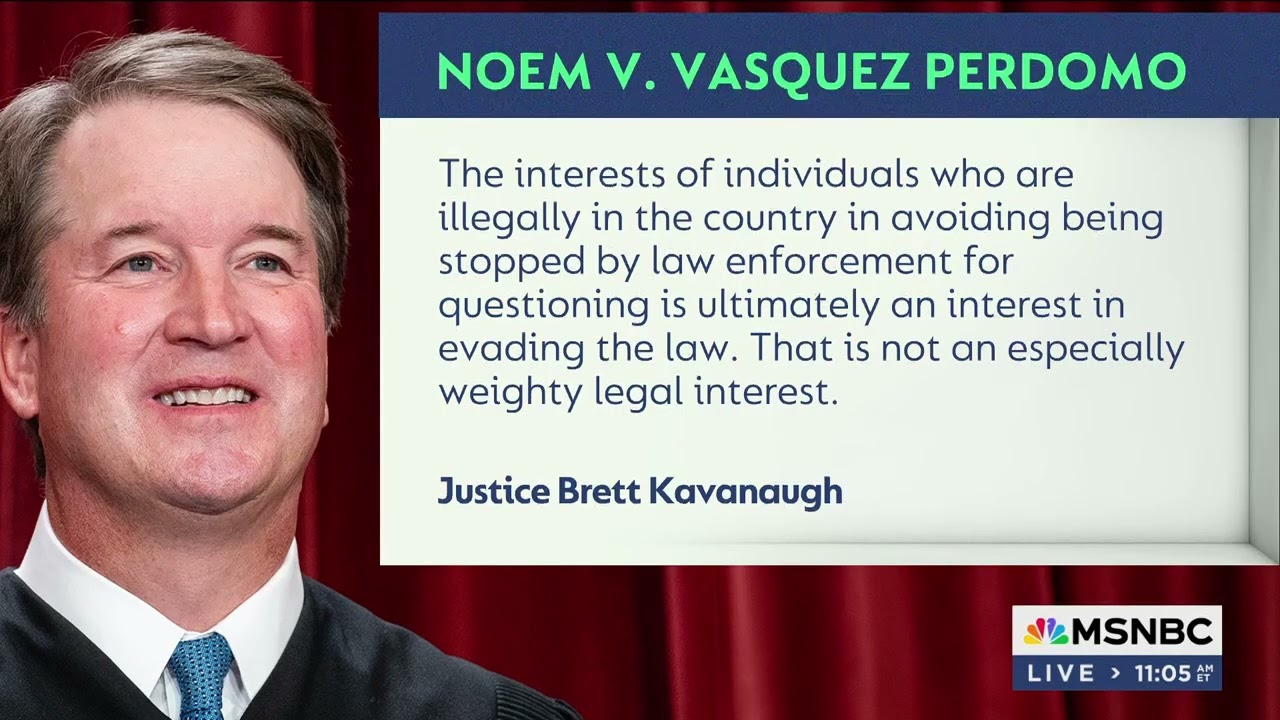 }:
The decision's implications, Velshi warned, go way beyond immigration policy and ICE raids and treat the U.S. Constitution's 4th Amendment as expendable. Ratified in 1791 as part of the Bill of Rights, the 4th Amendment protects against unreasonable search and seizure.
READ MORE:'Doing a pretty terrible job': Trump official mocked over response to dismal economic data
"ICE agents now have the High Court's blessing to racially profile people during immigration sweeps in Los Angeles," Velshi warned. "They're allowed to stop people based solely on their apparent race or ethnicity, language or accent, the type of work they do, where they do it. The 4th Amendment requires reasonable suspicion before anyone, any person, citizen or not, documented or not, can be stopped by law enforcement. The law is not allowed to just guess at that — that because of how you look or speak, or where you live and work, that you might have committed a crime."
Velshi continues, "Equal protection forbids race as a factor. The lower courts enforced that principle; the Supreme Court just erased it. And perhaps the most outrageous part: the conservative majority in the Supreme Court issued their decision using the so-called shadow docket, where the Court rules on Trump Administration emergency motions without oral arguments or explanation — no hearing, no accountability, just judicial fiat handed down in the dark."
However, the MSNBC host, who is originally from Canada, stressed that "this ruling isn't about immigration" and has "broader implications."
"It tells millions of Americans that your protection from unreasonable search and seizure depends on whether the government decides you look like you belong, which is not what the Constitution's Framers envisioned, I hope — certainly not democracy as we have come to know it in this country," Velshi told viewers. "Consider Brian Gavidia, a U.S. citizen from East Los Angeles — who voted for (Donald) Trump, by the way…. He says federal agents shoved him against a fence, twisted his arm, and demanded to know which hospital he was born in. All because he looked Latino. This is the new normal that the Court has sanctioned."
READ MORE:'Republican for Trump': Alleged Kirk shooter's grandmother confirms entire family is MAGA
Velshi attacked Justice Brett Kavanaugh's reasoning in Vasquez Perdomo v. Noem as "hollow," stressing, "Rights are not conditional favors granted after innocence is proven — they are the shield against arbitrary suspicion in the first place. Kavanaugh's distorted logic seems to suggest that if you're brown, you're guilty of an immigration violation until you're proven innocent…. That's not just sloppy logic, it's dangerous….. It's not that the conservative justices don't understand the Constitution; it's that they don't care…. Once the 4th Amendment is treated as negotiable for one group — Latino communities, brown people, in this case — it becomes weaker for all of us."
---
AN 1 26
An extensive new study from a team of Ivy League economists has uncovered just how much the Supreme Court has shifted towards favoring the wealthier side in any given case, with a New York Times report concludingreport concluding that you can "follow the money" to determine how it will in any given case.
The new study, dubbed "Ruling for the Rich," was published on Monday and hailed from the team of Yale's Fiona Scott Morton, Columbia's Andrea Prat and Columbia's Jacob Spitz. Adam Liptak, the leading Supreme Court correspondent for the Times, dug into its findings, noting that "the wealthy have the wind at their backs before the justices," and questioning whether or not they are living up to their oath to "do equal right to the poor and to the rich."
Per Liptak's analysis, the study found that Republican appointees, who have held a 6-3 majority on the Supreme Court since 2020 and an overall majority for much longer, are "far more likely than Democratic ones to side with the wealthy," and adding "that the Supreme Court has become deeply polarized in cases pitting the rich against the poor." This is now in sharp contrast to the court of the mid-20th Century, "when appointees of the two parties were statistically indistinguishable" in terms of favoring wealthier parties.
Specifically, the study found that Republican-appointed justices sided with wealthier parties in cases around 70 percent of the time. By comparison, in 1953, conservative justices sided with them only 45 percent of the time.
Speaking with Liptak about the findings, Adam Cohen, author of the book "Supreme Inequality," noted that the study essentially reiterated ideas about the court's conduct that "some of us have been observing for a long time."
“But it is great to see,” Cohen added. “Respected academics crunching the numbers and producing the data to show that this is exactly what has been going on.”
These findings come as leaders in both political parties are ramping up plans to radically alter their campaign finance plans ahead of an upcoming decision, in which the court is widely expected to lift the limits on how much party committees and campaigns are allowed to coordinate with each other. This, experts argue, would hand even more power to the wealthiest donors and further erode the power of small-dollar donors.
---
AN 1 26
NO LNX
Inside the GOP plot to end America as we know it
Thom Hartmann January 05, 2026
It’s not just a brand new year; it’s a midterm election year. And the stakes this coming November are mind-boggling, so, of course, Republicans are starting to do everything they can to rig the election.
Just a week ago, for example, Trump’s Postal Service changed the rules about getting your mail-in ballot postmarked so it’ll be counted. Instead of postmarking letters when they’re received, Post Offices will now postmark them when they get “processed,” which may happen days later.
In the 2024 presidential election, the feds estimated that around 104,000 mail-in ballots nationwide weren’t counted because they were postmarked late; with this change, the number this fall and for 2028 could be in the millions.
Meanwhile, Republican secretaries of state are enthusiastically purging voters from the rolls as they get ready for this fall. Remember, reporter and economist Greg Palast found, using official federal and state numbers, that in 2024:
Kamala Harris“Trump lost. That is, if all legal voters were allowed to vote, if all legal ballots were counted, Trump would have lost the states of Wisconsin, Michigan, Pennsylvania and Georgia. Vice-President would have won the Presidency with 286 electoral votes.“And, if not for the mass purge of voters of color, if not for the mass disqualification of provisional and mail-in ballots, if not for the new mass “vigilante” challenges in swing states, Harris would have gained at least another 3,565,000 votes, topping Trump’s official popular vote tally by 1.2 million.”
You’d think we each have a right to vote, rather than voting being just a privilege that Republican-controlled states could take away in dozens of different ways.
Supreme Court Republicans on the ruled, for example, that we have a right to own a gun. As a result, before a state or local government can take away your gun, they must first go before a judge to prove the necessity of doing so.
But, Republicans on the Court tell us, Republican secretaries of state can eliminate your right to vote without even telling you; how does that make sense?
14th Amendment After all, the to the Constitution references “the right to vote at any election” and even says that any state that violates that right shall lose members of its congressional delegation as punishment.
The 19th Amendment references “The right of citizens of the United States to vote…”
The 24th Amendment starts, “The right of citizens of the United States to vote…”
The 26th Amendment is all about, “The right of citizens of the United States, who are eighteen years of age or older, to vote…”
ConstitutionAdditionally, the , in Article I, Section 4, says that Congress can make federal laws that overrule state laws restricting or regulating voting:
“The Times, Places and Manner of holding Elections for Senators and Representatives, shall be prescribed in each State by the Legislature thereof; but the Congress may at any time by Law make or alter such Regulations…”
And, sure enough, Congress did just that in 1993 when it passed the National Voter Registration Act (NVRA), sometimes referred to as the Motor Voter Act because, among other things, it provided for the option of instant voter registration when a person gets a driver’s license in every state in the union.
Now known as 52 U.S. Code § 20501, this law of the land opens with:
The Congress finds that -(1) the right of citizens of the United States to vote is a fundamental right
(2) it is the duty of the Federal, State, and local governments to promote the exercise of that right and
(3) discriminatory and unfair registration laws and procedures can have a direct and damaging effect on voter participation in elections for Federal office and disproportionately harm voter participation by various groups, including racial minorities.
And it wasn’t a particularly contentious law when it was passed: every Democrat present in the Senate voted for it (Rockefeller missed the vote) as did all but two Republicans.
So how did we get from the Constitution repeatedly asserting a “right to vote” and Congress passing a law that unambiguously proclaims that right, to the current state of affairs where states regularly and methodically deprive citizens of their “right” to vote and instead claim that it’s merely a privilege?
As I lay out in The Hidden History of the War On Voting, much of the blame rests with the most conservative and regressive of our federal institutions, the Supreme Court.
The first real test of the NVRA came in 2018, when Ohio’s Republican Secretary of State, John Husted, went on a voter-purge binge (that hit Black, student, and elderly neighborhoods particularly hard) and was sued by the A. Phillip Randolph Institute for violating Ohio citizens’ constitutional right to vote.
In a bitter 5-4 decision, the Republican majority ruled in Husted v Randolph that purging voters because they failed to return a junk-mail-like postcard was entirely legal.
It’s a practice that was called “caging” back when Karl Rove’s guy was allegedly doing it and it was illegal then but has, since that Court ruling, spread to pretty much every Republican-controlled state in the nation.
They’ll identify a part of the state that they consider particularly “prone to fraud“ — in other words, filled with a lot of Black and brown people — and mail postcards that look like junk mail into those precincts. When people failed to return them, they are automatically removed from the voting rolls. In most cases they don’t even know they’ve been purged until they show up to vote and are turned away.
Justice Samuel Alito’s decision was particularly biting, claiming that the arguments made by the citizens who’d lost their right to vote were “worse than superfluous” and their argument that they shouldn’t have to regularly check in with the Secretary of State’s office to stay on the voter rolls represented logic “no sensible person” could agree with.
Sensible or not, in his dissent, liberal Justice Stephen Breyer pointed out that around 4 percent of Americans move every year. Yet, he wrote:
“The record shows that in 2012 Ohio identified about 1.5 million registered voters — nearly 20 percent of its 8 million registered voters — as likely ineligible to remain on the federal voter roll....”
Justice Sonia Sotomayor’s dissent was even more scathing.
“Congress enacted the NVRA against the backdrop of substantial efforts by States to disenfranchise low-income and minority voters,” she wrote, “including programs that purged eligible voters from registration lists because they failed to vote in prior elections.“The Court errs in ignoring this history and distorting the statutory text to arrive at a conclusion that not only is contrary to the plain language of the NVRA but also contradicts the essential purposes of the statute, ultimately sanctioning the very purging that Congress expressly sought to protect against.”
She then quoted the “right to vote” NVRA preamble noted above, and, essentially, accused the conservatives on the Court of helping Republicans in the states they controlled engage in massive racial and economic discrimination in the voting process.
“[This decision] entirely ignores the history of voter suppression against which the NVRA was enacted and upholds a program that appears to further the very disenfranchisement of minority and low-income voters that Congress set out to eradicate. … Our democracy rests on the ability of all individuals, regardless of race, income, or status, to exercise their right to vote.”
The “right to vote” took another hit when the State of Florida’s Supreme Court ordered a recount of the 2000 presidential election but five Republicans on the US Supreme Court ignored the 10th Amendment (“states’ rights”) and stopped the recount.
That was a good thing for George W. Bush because when the Florida vote was later recounted by a consortium of newspapers including the New York Times and the Washington Post, they found, as the Times noted on Nov. 12, 2001:
“If all the ballots had been reviewed under any of seven single standards and combined with the results of an examination of overvotes, Mr. Gore would have won...”
Nonetheless, Chief Justice William Rehnquist dismissed all the nation’s concerns about the Court flipping the 2000 presidential election in that totally partisan 5-4 decision, writing in his opinion:
“[T]he individual citizen has no federal constitutional right to vote for electors for the President of the United States.”
Which casts us in a pretty terrible light. As Rep. Jamie Raskin (D-MD) points out:
“The constitutions of at least 135 nations — including our fellow North American countries, Canada and Mexico — explicitly guarantee citizens the right to vote…”
Instead, Raskin notes, because of five corrupt Republicans on the US Supreme Court we’re in the company of countries like Azerbaijan, Chechnya, Indonesia, Iran, Libya, and Pakistan.
Republicans are pushing a full-blown authoritarian agenda and they know it’s so unpopular that the only way they can get it through is to suppress the vote and thus rig the system.
That’s why they’ve already successfully passed previously-unthinkable major voter suppression laws in 18 states and have them pending in many more. They’ve changed the law in Georgia and several other states so that they can now throw out the votes from entire neighborhoods or cities where they don’t like the outcome; all they have to do is vaguely assert a “suspicion of fraud.”
Between the massive gerrymandering effort the GOP has launched nationwide and the Post Office’s changes that’ll hit Blue states with high levels of mail-in voting (some only have mail-in voting), the next few elections are going to be a real challenge for Democrats.
Additionally, as you’re reading these words, millions of voters are being purged from the rolls in Red states, particularly in Blue cities with significant minority populations.
As a result, this fall we’re going to have to show up in absolutely overwhelming numbers just to get squeaker victories in these now-heavily-rigged Republican-controlled states.
Unless enough of us stand up, speak up, and get active to regain control of Congress this fall and push legislation protecting American voters, Republicans will continue to eviscerate the voting right they’ve now turned into a privilege until it becomes completely meaningless.
And that will signal the end of America as we know it.
---
---
an 1 26
Supreme Court advances 'kooky theory' devoid of 'constitutional grounding': legal expert
---
SHADOW DOCKET PROTECT DOGE FROM FOIA? MAK REPT MARK JOS STERN, GOT OUR DATA
---
---
AN 12 25
Sotomayor corners GOP lawyer on Trump’s 'quid pro quo' in campaign finance argument
---
AN 12 25
The U.S. Supreme Court handed President Donald Trump a rare, if temporary, loss on Tuesday, over his efforts to deploy the National Guard in Illinois.
The Court rejected the Trump administration’s emergency request to send troops to Chicago. The administration had claimed that troops were needed to protect federal agents.
“At this preliminary stage, the Government has failed to identify a source of authority that would allow the military to execute the laws in Illinois,” the Supreme Court declared, according to The Washington Post.
The Post called the ruling a “major defeat” for the Trump administration that “could have far-reaching effects,” and a “significant setback for his campaign to push troops into cities across the country over the objections of local and state leaders.”
In rebuffing Trump’s bid, NBC News reported, “the court at least provisionally rejected the Trump administration’s view that the situation on the ground is so chaotic that it justifies invoking a federal law that allows the president to call National Guard troops into federal service in extreme situations.”
“Those circumstances can include when ‘there is a rebellion or danger of a rebellion’ or ‘the president is unable with the regular forces to execute the laws of the United States.'”
The high court reportedly also cited the Posse Comitatus Act, which limits the use of the U.S. Armed Forces to enforce domestic laws.
Bloomberg Law’s Jordan Fischer reported that “In a 6-3 order, the court says at least at this stage the administration has not overcome the Posse Comitatus Act.”
Former U.S. Attorney Joyce Vance, calling it a “Huge loss” for the administration, wrote: “SCOTUS tells Trump no on deployment of Illinois Nat’l Guard, finding a valid exception to the Posse Comitatus Act doesn’t exist.”
Dissenting were Justices Samuel Alito, Clarence Thomas, and Neil M. Gorsuch.
---
AN 12 25
When the U.S. Supreme Court listened to oral arguments in Trump v. Slaughter on Monday, December 8, the three Democratic appointees — Justices Elena Kagan, Sonia Sotomayor and Ketanji Brown Jackson — expressed strong misgivings about President Donald Trump's position in the case.
The "Slaughter" challenging Trump is Rebecca Slaughter, a former Federal Trade Commission (FTC) commissioner Trump fired. The former FTC official is arguing that presidents shouldn't be able to fire people from independent agencies established by Congress, as they play an important role in the United States' system of checks and balances. But Trump and his allies are invoking a far-right legal doctrine known as the Unitary Executive Theory and maintain that U.S. presidents have every right to fire people from independent agencies.
MS NOW's Lisa Rubin, offering legal analysis after the hearing, characterized Kagan's position as Trump trying to make an "enormous power grab with real consequences for our country." Georgetown University law professor Paul Butler, joining Rubin and host Ana Cabrera on the panel, agreed with Rubin's analysis but predicted that the High Court's GOP-appointed right-wing supermajority will "almost certainly" rule in Trump's favor.
The New Republic's Matt Ford is also confident that the justices will side with Trump. And in an article published on December 9, he warns that U.S. consumers will suffer for it.
"Precedent is on Slaughter's side," Ford argues. "In the 1935 case Humphrey’s Executor v. United States, the Supreme Court upheld the for-cause removal protections for FTC commissioners. The justices acknowledged that presidents could generally remove top federal officials at will, but argued that this power was more limited in the FTC context because agencies like it also exercised 'quasi-legislative' and 'quasi-judicial' powers. Congress has relied on that decision to structure much of the federal government over the past century."
Regardless, Ford doubts that the High Court's GOP appointees will agree with Rebecca Slaughter's arguments.
"Under the Constitution," Ford explains, "Congress has the power to regulate interstate commerce. To exercise these powers, lawmakers created a host of federal agencies over the years to enact regulations and enforce federal law. Some of these agencies, like the FDA (Food and Drug Administration) and the EPA (Environmental Protection Agency), are directly under the president's control because he can fire the officials who lead them. Other agencies are structured to be more independent. The Federal Trade Commission, the agency at issue in this case, enforces federal antitrust law and some consumer-protection laws, with a mandate to prevent fraudulent, anticompetitive, and deceptive business practices. To ensure that the FTC operated in the interests of good government, Congress placed it under the direction of a board of Senate-confirmed commissioners and insulated them from unjustified removal by the president."
Ford continues, "This has generally been a good thing for the American people. Agencies like the FTC, the Securities and Exchange Commission, the National Labor Relations Board, and so on have existed for roughly a century now — a century where Americans enjoyed unprecedented growth in prosperity, quality of life, and individual liberty."
But Ford warns that "the conservative legal movement" and the High Court's right-wing justices have "a much different view." And he believes that the Humphrey’s Executorstandard from 90 years ago is "doomed."
Ford writes, "They favor the Unitary Executive Theory, whereby presidents should be able to wield absolute control over every aspect of the executive branch…. It is virtually certain that Slaughter will lose. "
*Read Matt Ford's full article for The New Republic at this link.
---
CCI
⚖️ The New Republic: The Supreme Court’s Ethics Code Is a Joke. Big Oil Knows That.
---
Supreme Court Justice Samuel Alito sat out of the court's consideration regarding a petition against President Donald Trump, according to *Newsweek.*
The case, filed by plaintiff Dr. Mac Truong, who has filed several lawsuits against political leaders in addition to Trump including Vice President JD Vance, and Texas Governor Greg Abbott, "saw the petition for a writ of certiorari dismissed with Justice Alito explicitly taking 'no part' in the matter," Newsweek reports.
A "writ of certiorari" is a formal request to a higher court (usually the U.S. Supreme Court) asking it to review a decision from a lower court, essentially asking the court to "be informed of" the case to correct a significant legal error or resolve conflicting interpretations of law, with the court granting review only for compelling reasons.
"The Court did not specify the reason for Justice Alito's non-participation," they add.
Truong's lawsuits have involved allegations of abuse of power, constitutional violations (13th and 14th Amendments), intellectual property theft, and various personal philosophical or social issues, they explain.
A photograph published in May 2024 showed an inverted U.S. flag flying outside the Alitos' Virginia home in January 2021. Flying the U.S. flag upside down is a traditional sign of dire distress, but in the context of January 6 and the peaceful transfer of power, it became a symbol used by Trump supporters who falsely claimed widespread fraud in the 2020 election.
A second report revealed this flag was flown at the Alitos' New Jersey beach house in 2023. This flag features a pine tree on a white background and dates back to the Revolutionary War, but it has more recently been adopted by some Christian nationalists and "Stop the Steal" protesters.
Justice Alito has refused calls to recuse himself from cases related to the 2020 election or the January 6 Capitol riot as a result of the incidents.
:{:{In letters to Congress, he said he had no involvement in the decision to fly the flags, placing the responsibility solely on his wife, who he said was exercising her First Amendment rights}:
in the context of "very nasty neighborhood disputes."}:
---
AN 1225
On Monday, December 8, the U.S. Supreme Court is scheduled to hear oral arguments in Trump v. Slaughter,which deals with the legality of President Donald Trump's firing of Rebecca Slaughter — a former commissioner for the Federal Trade Commission (FCC).
According to legal experts, the case has major implications for the United States' system of checks and balances. One of those experts is Kate Shaw, a law professor at the University of Pennsylvania in Philadelphia.
In an op-ed published by the New York Times on December 8, Shaw stresses that Trump v. Slaughter "will decide whether to grant the president, for the first time in American history, the power to fire the heads of virtually all independent agencies at will."
"This would be a vast transfer of power from Congress to the president," Shaw warns. "The Constitution doesn't explicitly grant the president any such power, and nearly a century ago, the (U.S. Supreme) Court unanimously rejected an argument that the president possessed it. Today's Republican-appointed justices appear to be firmly under the sway of an atextual and ahistoric theory — the Unitary Executive Theory — that demands complete presidential control over essentially every government agency and insists that the power to fire agency heads at will is an indispensable part of such control."
Shaw notes that over the years, Congress has given some federal agencies "a degree of independence from the president."
"Giving a president complete control would have a profound impact on how our government functions and the ability of these agencies to do work that touches the lives of practically every American," the Penn law professor explains. "It could undermine, in tangible and immediate ways, agencies' ability to safeguard consumers' privacy, ensure the rights of workers and unions, minimize the hazards posed by ordinary household products and more. In his brief in Slaughter, President Trump insists that the Constitution grants him, as part of his core powers, the ability to remove agency leaders at will."
Shaw adds, "In this case, he is trying to remove Rebecca Slaughter from the Federal Trade Commission…. Despite Mr. Trump's claims, presidential power is not so fragile that a few Democratic appointees at an agency like the FTC pose a mortal threat to it."
*Kate Shaw's full op-ed for the New York Times is available at this link (subscription required).
---
AN 12 25
On Monday morning, December 8, the U.S. Supreme Court listened to oral arguments in Trump v. Slaughter — a case dealing with President Donald Trump's ability, under the U.S. Constitution, to fire employees of independent government agencies.
Trump and his allies, in the case, are promoting a far-right legal doctrine known as the Unitary Executive Theory — which claims that presidents have total control over who can be fired in the federal government. But opponents of the Unitary Executive Theory vehemently disagree, arguing that Congress has the ability to create agencies that are independent from a president's executive powers. One of those opponents is Rebecca Slaughter, who is arguing that Trump had no right to fire her from the Federal Trade Commission (FTC) because of the independence she enjoyed.
During the December 8 hearing, Solicitor General John Sauer was aggressively grilled by the High Court's three Democratic appointees: Justices Elena Kagan, Sonia Sotomayor and Ketanji Brown Jackson. And MS NOW's Lisa Rubin offered , emphasizing that Kagan was essentially accusing Trump of trying to carry out an "enormous power grab." VID]
Rubin told Cabrera, "This concept of a unitary executive…. has gained currency among political conservatives," adding, "Certainly, it's not a legally conservative theory because it is a gigantic enlargement of executive power. That's not how legal conservatives have traditionally thought, but that is what's going on here."
According to Rubin, the "liberal justices" are "playing out the consequences of the logic being employed by the (Trump) Administration, which is (that) this isn't just about the FTC."
Rubin told Cabrera, "I want to read to you something that Justice Kagan said in her discussion with the solicitor general, John Sauer, because I thought it got to the heart of what this is really about…. The idea was that the president was supposed to do the executing, but he wasn't supposed to do the legislating…. In other words, in Justice Kagan's view, this is a power grab by the president… That, according to Justice Kagan and the other liberals on the Court, is an enormous power grab with real consequences for our country."
Georgetown University law professor Paul Butler, also on the panel, predicted that the High Court's GOP-appointed justices will "almost certainly" rule in Trump's favor and "say the president has the authority to fire the FTC commissioner."
"This outcome is virtually certain," Butler told Cabrera and Rubin — who agreed with him that the outcome in Trump v. Slaughter is a "fait accompli" and that the GOP-appointed supermajority will reject the arguments of Kagan, Sotomayor and Jackson."
---
AN SLATE 12 25
Slate Senior writer Mark Joseph Stern says the Supreme Court is gearing up to hand President Donald Trump kinglike firing powers over independent federal agencies in Trump v. Slaughter, peddling the false argument that the Constitution gives the commander in chief absolute control over the executive branch.
The argument from conservatives on the court is that this supreme power is rooted in tradition, but “they are wrong in every conceivable way,” said Stern.
“Their pop-historical account of the Constitution has been debunked from top to bottom by legitimate legal historians, who have refuted the rotten moorings of this bogus theory with devastating precision. And yet there is no real question that the Supreme Court’s Republican-appointed justices will endorse it anyway in Slaughter, handing Trump sweeping new authority to abuse his office in direct violation of federal law,” said Stern. “This near-inevitable ruling confirms the most stinging critique of originalism: It allows judges to align constitutional meaning with the Republican Party’s preferences, disregarding evidence that contradicts their desired outcome.”
When Congress created the FTC in 1914, it allowed the president to fire commissioners only for “inefficiency, neglect of duty, or malfeasance in office.” Lawmakers wanted a panel of experts insulated from partisan pressure who would act in the best interest of the American people rather than promote the president’s ambitions. And in 1935 the Supreme Court unanimously upheld these good-cause protections against removal in a landmark decision called Humphrey’s Executor.
Leaders at more than two dozen multimember agencies are, for now, shielded against presidential termination by statute, giving people like Federal Reserve Chair Jerome Powell independence from Trump, no matter how hard Trump boasts of wanting to remove him.
But when Rebecca Slaughter, a Democratic member of the Federal Trade Commission, sued over her firing lower courts reinstated her SCOTUS overruled them by a 6–3 vote through the shadow docket, without argument or debate. Stern said these six justices did the same when other agency leaders sued for their jobs. Then the conservative supermajority scolded lower courts for failing to accept that Trump’s removals were now endorsed and legitimized by the Supreme Court.
The Republican-appointed justices want Trump to be king because all six are deeply committed to the “unitary executive” theory, an idea that Stern said is foundational to the modern conservative legal movement.
“The premise of the theory is that the president does not merely lead the executive branch; he is the executive branch, because the Constitution vests the ‘executive power’ in him alone,” said Stern. “Agencies like the FTC and the NLRB ostensibly exercise this power by interpreting and enforcing the law. But under the Constitution, they may do so only on the president’s behalf. And so if the president disagrees with officers leading these agencies, he must be able to fire them at will. Any impediment to this ‘removal power’ unduly restricts the commander in chief’s inherent authority.”
But the actual text of the Constitution says none of this, Stern adds. There is no “removal clause,” nor any definition of “executive power” that implies total dominion over the executive branch.
“… [James] Madison acknowledged that some executive branch officials could be shielded from termination. So did Alexander Hamilton, who argued that the president could not fire executive officers without the consent of the Senate. So did Chief Justice John Marshall, who arguably did more in this period than any of his contemporaries to shape constitutional interpretation,” Stern said.
The fact that the first Congress enacted an independent agency, the Sinking Fund Commission, to manage repayment of the nation’s debt and the president was unable to fire several of its members alone “reveals that many of the men who wrote the Constitution did not think that it gave the president unlimited authority to fire high-ranking federal officials,” said Stern.
“Now Trump wants the Supreme Court to say that Madison, Hamilton, Marshall, Story, and all the rest were wrong. He wants the justices to give him the unprecedented authority to seize control of the FTC, the NLRB, and other independent agencies by sacking their Democratic members,” said Stern.
Read the Slate article at this link.
---
an 11 25 tim snyder orig is not in const
Mother Jones writers Pema Levy and Ari Berman say that President Donald Trump "owes his corrupt and abusive reign to one man" — Supreme Court Chief Justice John Roberts.
"Twenty years ago, John Roberts promised that as chief justice of the Supreme Court, he would be like an umpire, calling balls and strikes," they write.
"His promise charmed senators and the media, who believed that his predilection for executive power and long-held antipathy for civil rights could be moderated by this commitment to faithfully apply the law," they add.
But Roberts wasn't what he seemed, they say.
"The delusion was so powerful that for two decades, the media defaulted to portraying him as a moderate institutionalist, pointing to high-profile decisions — to uphold parts of the Affordable Care Act or striking down President Donald Trump’s attempt to ask about citizenship in the 2020 census — in which he broke from conservative orthodoxy," they write.
Roberts, they say, is the sole reason for Trump's authoritarian streak.
"Today, as the Roberts court rewrites the Constitution in the image of Trumpian autocracy, it’s become clear that Roberts’ promise to be a neutral umpire was a lie. We are watching a rigged game, and Roberts set it up," they write.
"The Roberts court has spent Trump’s second term not applying the law so much as clearing it out of his way," they add.
Among the lawless actions Roberts has allowed: "firing independent agency commissioners, using racial profiling in immigration sweeps, disappearing immigrants to authoritarian and war-torn nations, and defying Congress’ power of the purse," they note.
But Roberts' "acquiescence to an anti-democratic America" isn't new, noting he "has been embedding white-dominant authoritarianism into the country’s source code for two decades. It’s impossible to imagine today’s crisis without the Roberts court having first undermined the foundations of our democracy."
Ryan Doerfler, a Harvard Law professor who studies the judiciary’s role in a democratic system, says that "You really can trace, in so many ways, the moment we’re in to critical decisions surrounding our law of democracy."
And much of that began with Roberts, who, "over the last five decades, has taken aim at the law, beginning as a young lawyer in President Ronald Reagan’s Justice Department fighting its reauthorization, when he claimed it would 'lead to a quota system in all areas,'" the Mother Jones writers explain.
"In 2019, Roberts toppled another pillar of democratic governance — if you don’t like a politician, you can vote them out — by writing in Rucho v. Common Causethat federal judges could not even review claims of partisan gerrymandering, deeming them 'political questions beyond the reach of the federal courts,'" they explain.
The writers also note that "Roberts didn’t just strip political power from ordinary people — he handed it to billionaires."
His decisive vote in 2010’s Citizens United v. FEC "lifted restrictions on political spending, while ludicrously insisting it would not 'lead to, or create the appearance of, quid pro quo corruption.' Political spending by billionaires has since increased 160-fold," they note.
That decision is "a direct line between the ruling and Elon Musk buying Trump the White House with more than $290 million and being given free rein to fire his companies’ regulators in return," they add.
In his nearly five decades in law, Roberts, they write, "didn’t wait till he was on the Supreme Court to empower Republican presidents — he auditioned for the job by showing his willingness to break the rules and come through for his team."
And under Trump, "we are now operating under a Robertsian reimagining of the separation of powers, in which laws passed by Congress are mere suggestions for a monarchical president," they explain.
"Trump needed Roberts to win, and Trump’s victory came just in time for Roberts," they add. "His corrupt bargain has had an exorbitant cost, both for the nation and the court’s reputation."
The writers agree, saying, today's court under Roberts "will greenlight Trump’s corrupt, self-enriching behavior and unlawful power grabs. The majority will instinctively know that its fate is tied to the fate of Trump’s movement, and so it will protect it. The result will be a democracy in name only."
---
---
AN TD 11 25
My fellow Americans, this is Liberation Day … April 2, 2025, will forever be remembered as the day American industry was reborn.*
— President Donald John Trump
*This story originally appeared at TruthDig.
Donald Trump’s “Liberation Day” tariffs offer the Supreme Court a chance to turn the tables on an authoritarian president and claim a liberation day of its own. To strike down the tariffs, however, the court will have to use its favorite analytical tools — the conservative legal doctrines of originalism and textualism — to produce a liberal decision.
[
:{:{](https://youtu.be/9GVnXh4QG1k) in a televised Rose Garden ceremony before the iconic outdoor space was hideously remodeled as a concrete courtyard.}:
On Nov. 5, the Supreme Court heard oral arguments on the legality of the levies by way of a pair of consolidated lawsuits (Learning Resources Inc. v. Trump and Trump v. V.O.S. Selections) initiated by two groups of small businesses that claimed the tariffs placed crippling new taxes on them. In a hearing that lasted 2 hours and 40 minutes, the justices showed little deference to the administration’s defenses, whether originalist or textual, signaling they may finally be ready to regain a small but much-needed measure of judicial independence.}:
Since the appointment of John Roberts as chief justice in 2005, the court has deployed originalism and textualism to move aggressively rightward. When necessary to shield Trump from legal accountability, the court’s Republican supermajority has been willing to twist the doctrines almost beyond recognition, most notably in its July 2024 decision on presidential immunity, which had no basis in either the text or history of the Constitution. The court has also dramatically expanded its emergency “shadow docket” to greenlight significant parts of Trump’s political and economic agenda, lifting lower-court injunctions that had placed temporary holds on the mass firings of civil servants, the defunding of scientific research and racial profiling in immigration sweeps, to cite just a few examples.
But the Liberation Day tariffs may prove a bridge too far, even for the Roberts court. Styled as “reciprocal” measures designed to redress long-standing international trade imbalances, the tariffs imposed duties on imports from virtually every country in the world, ranging from a baseline of 10% to as high as 50% for Lesotho. Yes, Lesotho. Other nations receiving rates in the upper tiers included China, Vietnam, Taiwan, Thailand and Madagascar.
The Liberation Day tariffs may prove a bridge too far, even for the Roberts court.
In the aggregate, according to many economists, the new tariff rates exceeded those imposed by the disastrous Smoot-Hawley Act of 1930, which helped trigger and prolong the Great Depression. Since April, the rates have fluctuated wildly, depending on Trump’s mood swings and which countries have curried his favor with obsequious flattery and/or outright gifts (here’s looking at you, Switzerland and South Korea).
Trump has long been fixated on tariffs, touting them as magical cures for the nation’s budgetary woes. In his first term, he placed tariffs on steel, aluminum, solar panels and washing machine imports, and a host of other products made in China. Although the tariffs did little good for the economy and precipitated a trade war with China, they were authorized by a series of statutes passed by Congress since 1917 that delegated tariff-setting powers to the president, but which came with strict procedural, substantive and time limits on how those powers could be exercised.
During the 2024 presidential campaign, Trump repeatedly extolled the virtues of Gilded Age President William McKinley for his use of tariffs as a key driver of federal revenue before the ratification of the income tax with the 16th Amendment. If reelected, Trump promised to follow McKinley’s example. On April 2, he made good on the pledge.
In a sharp departure from the first-term levies, the April 2 tariffs were based on a complex and lengthy federal statute enacted in 1977 — the International Emergency Economic Powers Act (IEEPA), which permits the president to regulate international commerce after declaring an emergency under the National Emergencies Act. Trump had threatened to use IEEPA for tariffs in his first term, but wound up using it, as former presidents had, to impose sanctions on foreign countries and dignitaries who had incurred his displeasure, such as the leaders of the International Criminal Court, whose U.S. visas Trump suspended in September 2020.
It’s easy to understand IEEPA’s appeal for Trump and his advisers. Unlike other tariff-related statutes, IEEPA sanctions have no time limits. They can also be unlimited in scope, and require only a presidential emergency proclamation to trigger.
In keeping with IEEPA, Trump in the Rose Garden declared the country’s trade imbalances to be a national emergency and a threat to U.S. economic sovereignty, exclaiming, “For decades, our country has been looted, pillaged, raped and plundered by nations near and far, both friend and foe alike. But it’s not going to happen anymore.”
The new tariffs were off and running, except for two problems: First, Article I, Section 8 of the Constitution vests the power to tax in Congress, not the president. And second, while IEEPA gives the president the power to “investigate, block … regulate … nullify, void, prevent or prohibit” imports or exports concerning designated countries in a declared emergency, the words “tariff” and “tax” nowhere appear in the law.
These problems were front and center in the Nov. 5 oral arguments. From the outset, it was clear that Trump’s motor-mouthed solicitor general, D. John Sauer, was in deep trouble.
Sauer’s first task was to convince the court that the IEEPA tariffs were regulations, not taxes, and that any revenues they raised were incidental to the president’s powers under Article II of the Constitution to direct foreign policy. The contention seemingly convinced no one.
Justice Sonia Sotomayor was quick to point out the obvious. “This [Trump’s tariff regime] is a tax,” she remarked. “I just don’t understand your argument. You want to say tariffs are not taxes, but that’s exactly what they are. They’re generating money from American citizens, revenue.”
“Tariffs are taxes. They take dollars from Americans’ pockets and deposit them in the U.S. Treasury.”
Even the usually cards-to-the-vest chief justice joined in, observing that the tariffs constitute “the imposition of taxes on Americans, and that has always been the core power of Congress,” implying that allowing the administration to use IEEPA would violate the separation of powers, the very essence of the founder’s constitutional design.
Sauer did his best to parry the court’s skepticism, stammering and talking over the justices, “It [the tariff package] is a — it is a — if I may, it’s a foreign-facing regulation of foreign commerce.” He also argued unpersuasively that the tariffs did not run afoul of either the “major questions” or “nondelegation” doctrines that the Roberts court had used to scuttle Biden administration initiatives on student loans, environmental protection and COVID vaccine mandates in the absence of highly specific congressional delegations of authority.
By the time Georgetown University Law Center professor Neil Katyaltook his place at the lectern representing one group of plaintiffs, the case was all but over. “Tariffs are taxes,” Katyal told the court. “They take dollars from Americans’ pockets and deposit them in the U.S. Treasury. Our founders gave that taxing power to Congress alone. Yet, here, the president bypassed Congress and imposed one of the largest tax increases in our lifetimes.”
Katyal had originalism, textualism and the facts on his side. Tariffs are, in fact, taxes paid directly by importers or on their behalf by businesses operating as their agents directly to Customs and Border Patrol, which in turn passes the collected funds to the Treasury. Importers can either absorb the tariffs or raise domestic prices, adding to inflation.
In posts on Truth Social, Trump has boasted his tariffs will bring in “trillions of dollars” to the Treasury. He has also claimed the country will face economic disaster if the Supreme Court rules against him.
Despite the direction of the oral arguments on Nov. 5, it is possible that the Roberts court will find a way to rescue the president and uphold the sweeping IEEPA tariffs, or preserve at least some of them under other statutory authorities. This is, after all, a deeply compromised court that has shown in the past it is more committed to sustaining Republican power than it is to its own declared principles. In the meantime, we can hope, at least this one time, for liberation.
---
AN 11 25
Blow for Trump as Supreme Court reinstates fired copyright chief
---
LOTS OF BIG CASES PILING UP EG ON ELECTION GERRY THAT WILL HAVE TO BE DEALT W FAST?
---
AN 11 25 TARIFFS
 ](https://youtu.be/_0dOtl8uWkU), legal scholar Steve Vladeck tells conservative attorney George Conway that he thinks Supreme Court Justice Neil Gorsuch could be the deciding vote in striking down President Donald Trump's tariffs.
Vladeck says that while he's confident that all three Democratic appointees on the Court —Justices Elena Kagan, Sonia Sotomayor and Ketanji Brown Jackson — are "solid votes against the Trump administration," and he's also sure that Justices Clarence Thomas and Samuel Alito are "solid votes for the Trump administration, it's the other four" that he's not so sure about.
Conservative Justice Amy Coney Barrett, Vladeck says, "has become very, very hard to predict, even based on the questions she asked at the oral arguments," which he says were "tough questions on both sides."
Conservative Justice Brett Kavanaugh, he says, "also asked challenging questions of both sides," adding that "he's never going to be the fifth vote against the Trump administration. He might be the sixth or seventh."
Gorsuch, however, nominated by Trump in 2017, has demonstrated independence from Trump's specific positions and the executive branch generally and could be the deciding vote that rules against him this time.
Vladeck says that Gorsuch's questions during oral arguments "suggested that he's very skeptical of the government's position," and that he has "historically been sympathetic when it comes to small business versus big government."
Vladeck also says that the Trump administration didn't make their argument that "there would be these massively deleterious consequences if the court would strike them down," and that "is the dog that didn't bark."
"That to me is the biggest bad sign for the administration," Vladeck said.
---
AN 11 25 TARIFFS
More than once, the U.S. Supreme Court's 6-3 GOP-appointed right-wing supermajority has ruled in ways favorable to President Donald Trump — from presidential immunity to immigration policies. But it remains to be seen how the High Court will ultimately rule on the steep tariffs that Trump is unilaterally imposing, by executive order, on a long list of countries.
Trump is invoking the International Emergency Economic Powers Act of 1977 (IEEPA), signed into law by President Jimmy Carter, in defense of his tariffs. And the Court, in a November 5 hearing, heard oral arguments both for and against that approach in the case Learning Resources v. Trump.
In an article published by the conservative website The Bulwark on Thursday night, November 6, Catherine Rampell — an MSNBC host and former Washington Post opinion columnist — argues that SCOTUS' conservative justices can either make or break the U.S. economy in the weeks and months ahead.
"If you ever took an econ class," Rampell explains, "you probably learned the two main ways the government can stimulate a sagging economy: The Federal Reserve can cut interest rates, or Congress can pass a spending or tax-cut package. We may soon discover an innovative third form of stimulus, courtesy of the Supreme Court. As this week's elections made clear, Americans are unhappy about the economy. With good reason. Layoff announcements have reached recessionary levels; subprime borrowing is back; electricity prices are skyrocketing. To the extent we can actually measure anything right now — given that the shutdown has halted the release of government economic data — we appear to be suffering from the dreaded s-word: stagflation."
The MSNBC host adds, "What's stagflation, you ask? It's when prices are rising (inflation) while the economy is slowing (stagnation)."
Rampell argues that Trump has "one weird trick" he could use to "help cure stagflation without turning to Congress or the Fed — he "could just cut tariffs."
"Alas, our self-described 'Tariff Man' president hasn't taken the hint," the former Washington Post columnist stresses. "Instead, Trump has septupled(!) the average effective tariff rate from 2.4 percent in early January to 17.9 percent (on November 6), and threatened to jack up rates further. His tariffs are being challenged in court, however. SCOTUS heard oral argument…. in one of those cases, and the justices sounded pretty skeptical that Trump has the broad tariffing power he claims."
Rampell continues, "As of this writing, betting markets placed the odds that Trump’s tariffs survive at a measly 27 percent…. It would be very painful if the Court surprises everyone and ultimately decides Trump does have the authority under IEEPA to implement these tariffs. Expect a market rout and widespread panic if that happens…. In short order, we could find ourselves in a scenario in which the Supreme Court, stacked with three Trump-appointed justices, hands him a political gift."
*Catherine Rampell's full article for The Bulwark is available at this link.
---
AN 11 25
SAUER FLAILS?
Wednesday, November 5 was an important day for the U.S. Supreme Court, whose justices listened to oral arguments in Learning Resources v. Trump.The nine justices are examining President Donald Trump's ability to unilaterally impose, by executive order, steep new tariffs invoking a Jimmy Carter-era law: the International Emergency Economic Powers Act of 1977 (IEEPA).
The legal analyst Lisa Rubin weighed in on the hearing — and she thought that conservative Justice Amy Coney Barrett was especially tough when questioning Trump's allies.
Conservative host Joe Scarborough noted that when Solicitor General John Sauer gave evasive answers to Barrett's questions, liberal Justice Sonia Sotomayor jumped in and chastised him for it.
Scarborough told Rubin and "Morning Joe" co-host Mika Brzezinski, "I got to say, Lisa, that the most remarkable part of that hearing was when Amy Coney Barrett had the solicitor general on the line, and he kept trying to pull away — and she kept reeling him in, and he kept trying to pull away. He kept pulling away. She just — she was tenacious. And finally, Justice Sotomayor, I think, in an act of mercy, said: Just answer her question. You're not answering her question. We all know you can't answer her question. Just admit it, basically, is what Justice Sotomayor was saying."
Rubin agreed with Scarborough's analysis, emphasizing that Barrett was tenacious in her questioning of Sauer.
"Pity the person who comes on the other side of Amy Coney Barrett, who is precise, pragmatic and the mother of seven children," Rubin told Scarborough and Brzezinski. "So, if anybody is well prepared for that kind of questioning, I would venture a guess, it's Amy Coney Barrett. And you're right to say that she was completely fixated on the plain text of the statute. The argument that the (Trump) administration is relying upon is that the words 'regulate importation' somehow include the power to impose tariffs."
Rubin continued, "But of course, not only is the word tariff not present ... there is nothing in the string of verbs there, as Justice (Elena) Kagan mentioned, that gets to where John Sauer, the solicitor general, wants to see the argument go. There's nothing in all of the things that the president can do under this Emergency Powers Act that has anything to do with raising revenue, much less imposing taxes or duties. And that's where you get to the question of the larger constitutional issues about whose responsibilities really are these?"
---
AN 11 25
Wednesday's Supreme Court "showdown" over President Donald Trump's tarriffs is putting America's highest court in a major bind, Politico reports.
Trump is asking the justices to overturn lower-court decisions that declared many of his tariffs "an illegal overreach" as they found that a 1977 law, the International Emergency Economic Powers Act, did not authorize the president to impose such broad tariffs.
“Nowhere does it say tariffs, taxes, duties,” noted Elizabeth Goitein, who studies emergency powers at New York University’s Brennan Center.
This showdown, Politico says, is an "epic clash between two of the most deeply ingrained tenets of the conservative legal movement."
One of those tenets, Politico explains, "is that presidents need and are entitled to extreme deference on matters of national security and foreign policy," suggesting that "the six conservative justices may be willing to uphold Trump’s unprecedented move to bypass Congress and unilaterally impose sweeping global tariffs."
Chief Justice Roberts, however, has made a name for himself opposing "government meddling in the free market," they explain, which "could prompt the court’s conservatives to view Trump’s tariffs more skeptically than they view many of his other, non-economic policies."
Jonathan Adler, a professor at William and Mary Law School, says that the justices are going to be conflicted.
“I think that some of the justices that matter are going to feel a bit torn,” he said. “What’s interesting here is that this case requires some of the conservative justices to confront a conflict between different strands of their own jurisprudence.”
The court, Politico explains, must differentiate between whether the tariffs are just part of the president's economic policy or a "core part" of his management of national security and international relations.
“How this case comes out will depend in large part on what the frame or the lens on it is,” said Vikram Amar, a law professor at the University of California at Davis. “Is this a case about unbridled, unauthorized — at least not explicitly authorized — broad executive authority, or is this a case about presidential ability to discharge foreign affairs and national security responsibilities?”
These questions, Politico says, is "most acute" for Justice Brett Kavanaugh, who is "the high court’s most outspoken voice for the president’s need for flexibility and dexterity in response to international challenges. But he is also highly skeptical of government power in the economic realm."
"If an agency wants to exercise expansive regulatory authority over some major social or economic activity … an ambiguous grant of statutory authority is not enough,” Kavanaugh wrote in a nod to his "fealty" to the conservative theory known as the “major questions doctrine."
That doctrine says that "courts should block executive branch actions of widespread impact when their legal basis is ambiguous," Politico explains.
“Congress must clearly authorize an agency to take such a major regulatory action," Kavanaugh added.
Experts see Kavanaugh "likely to lean towards blessing the tariffs," Politico says, while "Justices Clarence Thomas, Samuel Alito and Neil Gorsuch are thought by court watchers to be even more likely to uphold the tariffs."
Roberts and Justice Amy Coney Barrett are the ones to watch, they say.
“The center of the court is going to be especially interesting to watch,” Roman Martinez, a former law clerk to Kavanaugh and Roberts, said about them during a discussion at Georgetown Law.
“I think this case will probably split the conservatives,” said Cary Coglianese, a University of Pennsylvania law school professor who specializes in administrative law and regulatory processes.
Whatever they rule, Politico writes, the conservative justices will likely emerge unscathed.
"While a ruling against the tariffs would surely infuriate Trump, it wouldn’t do much if anything to hurt the conservative justices’ standing in their legal, political and social circles," they note.
Goitein disagrees, saying, "This will be a true test of the Supreme Court in many, many ways."
---
AN 10 25
A recent unanimous ruling against one of President Donald Trump's key policies suggests that the Supreme Court may have overplayed its hand, making rebels out of conservative lower court judges.
That's according to Slate legal correspondents Mark Joseph Stern and Dahlia Lithwick, who argued on Monday that last week's 7th Circuit Court of Appeals ruling preventing Trump from deploying the National Guard in Illinois may have been rooted in animus against how the nation's highest court has treated lower courts. That 7th Circuit ruling upheld a previous ruling by the U.S. District Court for the Northern District of Illinois, in which the Trump administration's assertion that calling the guard was necessary to quell a "rebellion" in Chicago failed to convince the court to let him move forward with the deployment. The 3-0 panel even included Trump appointee Amy St. Eve.
Lithwick and Stern observed that the district court stage of litigation is typically seen as the "fact-finding" part of a legal case. And appellate court judges in those respective circuits are usually bound to accept the facts of the district courts unless they were proven to be erroneous.
The experts then pivoted to the Supreme Court's habit during Trump's second term of overturning lower court rulings, often in emergency docket or "shadow docket" rulings that contain no rationale or explanation for their decisions.
"I’m wondering if it was an unforced error by the U.S. Supreme Court to treat lower courts — their findings of fact, their efforts to do hard doctrinal work under unbelievably challenging circumstances — with hostility or overt contempt," Lithwick said. "I find myself wondering if the court, particularly over the summer, made a lot of enemies by using dismissive rhetoric, and now in a lot of ways emboldening judges to say: Not today, Satan. Don’t lie to me."
Stern agreed, saying: "[W]e are starting to see some conservative judges on the lower courts bristle at the way that the Supreme Court is treating them and their colleagues."
"It seems to me that the Supreme Court has fomented an 'us vs. them' dynamic with the lower courts. It’s presenting itself as the final arbiter of all facts on the ground, ignoring its obligation to defer to what the district court believes is happening in the real world," Stern said. "The Supreme Court has decided: We know everything, we have a crystal ball, we are omnipresent and omnipotent. That arrogance doesn’t just offend the lower courts’ egos — it undercuts the work they see as their duty, especially the careful establishment of facts. So when the Supreme Court treats fact-finding as optional, maybe judges like St. Eve respond by making it decisive. They’re not just fact-checking, they’re reality-checking."
Click here to read Lithwick and Stern's full analysis in Slate (subscription required).
---
---
AN 10 25
The Washington Post's editorial board says that President Donald Trump's Supreme Court strategy when it comes to defending his tariffsis to dare the justices to defy him and make the case "about himself as much as possible."
The president, reports thePost, announced Wednesday that he intends to attend the November 5 hearing to observe oral arguments before the Court on the legality of the worldwide tariffs he imposed under the International Emergency Economic Powers Act.
“I think I’m gonna go to the Supreme Court to watch it,” Trump said at the White House. “I’ve not done that, and ... I had some pretty big cases. I think it’s one of the most important cases ever brought."
His attendance, the Post says, would not only "create a spectacle," especially considering the fact that "no president has ever claimedunlimited power to raise revenue by taxing imports."
Although the U.S. Court of Appeals for the Federal Circuitruled against Trump in August, its order is on hold until the justices decide.
"Trump has already signaled to the justices that the case is of huge importance to him," the Post says.
In the brief submitted to the court, the government wrote, "With tariffs, we are a rich nation; without tariffs, we are a poor nation,” the Postreports.
"You can almost hear the president dictating that to his lawyers,' they write.
"The brief even quotes Trump, who said in August, 'One year ago, the United States was a dead country, and now, because of the trillions of dollars being paid by countries that have so badly abused us, America is a strong, financially viable, and respected country again.' It warns of a '1929-style result'— that is, a Great Depression — if Trump loses the case."
Trump could have "acted in a measured way," the Post says, letting the legal arguments speak for themselves," but that's not the case.
"Instead, Trump is emphasizing just how extraordinary the case is and how angryhe would be if it doesn’t go his way. He is also leaning into the argument that invalidating the levies would cause so much chaos that the court should accept the status quo."
The Postsarcastically offers a suggestion for how Trump should play this out.
"That might work with justices who are too timid to rock the boat," they write. "Perhaps the president should not only attend the oral arguments at the Supreme Court in a few weeks, but deliver them on behalf of the U.S. government. That would really get his point across."
---
// an 10 25
In an article for MSNBC published Wednesday, legal analyst Jordan Rubin argued that conservative Supreme Court Justice Brett Kavanaugh, an appointee of President Donald Trump, is driving a dangerous effort to limit voting rights, based on what Rubin calls an “unfounded insistence” that race-based remedies must have an expiration date.
Rubin warned that Kavanaugh’s position, voiced during oral arguments in a major voting rights case out of Louisiana on Wednesday, could pave the way for the Court to further dismantle the Voting Rights Act.
"The Supreme Court is on the verge of further limiting voting rights, thanks in part to Justice Brett Kavanaugh’s unfounded insistence that considering race can only be legal for a certain amount of time into the future — regardless of what the law and the Constitution say,” he wrote.
At issue is whether the state’s congressional map, which includes a second majority-Black district, violates constitutional protections against race discrimination.
But Kavanaugh steered the hearing into broader ideological territory by pressing the National Association for the Advancement of Colored People (NAACP) Legal Defense Fund attorney, Janai Nelson, on when race-conscious remedies should end — a question not rooted in the actual text of the law or Constitution, Rubin noted.
Nelson responded that there is no legal time limit, emphasizing that Section 2 of the Voting Rights Act — currently under scrutiny — targets current, provable racial discrimination in voting. That provision has become especially vital since the Court’s 2013 decision, led by Chief Justice John Roberts, which effectively dismantled another key part of the Act.
Kavanaugh first introduced his “time limit” theory in a 2023 case from Alabama, where he and Roberts joined liberal justices in a surprising 5-4 vote upholding a Section 2 claim.
However, Rubin noted that Kavanaugh signaled then that he might not support such remedies indefinitely, writing that “race-based redistricting cannot extend indefinitely into the future.”
Now, Rubin argues, that theory is no longer theoretical.
With the Court’s conservative majority expressing discomfort with race-based considerations, even when aimed at remedying discrimination, Rubin sees the Louisiana case as a potential turning point.
If the Court rules in favor of the state, it could sharply curtail Section 2’s power, a result Nelson called “pretty catastrophic.”
Rubin concluded that abandoning race-conscious remedies not only misreads the law but ignores the ongoing racial realities they were designed to address.
---
---
AN 10 25
President Donald Trump set the tone for his second term by issuing 26 executive orders, four proclamations and 12 memorandums on his first day back in office. The barrage of unilateral presidential actions has not yet let up.
These have included Trump’s efforts to remove thousands of government workers and fire several prominent officials, such as members of the Corporation for Public Broadcasting and the chair of the Commission on Civil Rights. He has also attempted to shut down entire agencies, such as the Department of Education and the U.S. Agency for International Development.
For some scholars, these actions appear rooted in the psychology of an unrestrained politician with an overdeveloped ego.
But it’s more than that.
As a political science scholar who studies presidential power, I believe Trump’s recent actions mark the culmination of the unitary executive theory, which is perhaps the most contentious and consequential constitutional theory of the past several decades.
A prescription for a potent presidency
In 2017, Trump complained that the scope of his power as president was limited: “You know, the saddest thing is that because I’m the president of the United States, I am not supposed to be involved with the Justice Department. I am not supposed to be involved with the FBI, I’m not supposed to be doing the kind of things that I would love to be doing. And I’m very frustrated by it.”
The unitary executive theory suggests that such limits wrongly curtail the powers of the chief executive.
Formed by conservative legal theorists in the 1980s to help President Ronald Reagan roll back liberal policies, the unitary executive theory promises to radically expand presidential power.
There is no widely agreed upon definition of the theory. And even its proponents disagree about what it says and what it might justify. But in its most basic version, the unitary executive theory claims that whatever the federal government does that is executive in nature – from implementing and enforcing laws to managing most of what the federal government does – the president alone should personally control it.
This means the president should have total control over the entire executive branch, with its dozens of major governmental institutions and millions of employees. Put simply, the theory says the president should be able to issue orders to subordinates and to fire them at will.
The president could boss around the FBI or order the U.S. attorney general to investigate his political opponents, as Trump has done. The president could issue signing statements – a written pronouncement – that reinterpret or ignore parts of the laws, like George W. Bush did in 2006 to circumvent a ban on torture. The president could control independent agencies such as the Securities and Exchange Commission and the Consumer Product Safety Commission. The president might be able to force the Federal Reserve to change interest rates, as Trump has suggested. And the president might possess inherent power to wage war as he sees fit without a formal authorization from Congress, as officials argued during Bush’s presidency.
A constitutionally questionable doctrine
A theory is one thing. But if it gains the official endorsement of the Supreme Court, it can become governing orthodoxy. It appears to many observers and scholars that Trump’s actions have intentionally invited court cases by which he hopes the judiciary will embrace the theory and thus permit him to do even more. And the current Supreme Court appears ready to grant that wish.
Until recently, the judiciary tended to indirectly address the claims that now appear more formally as the unitary executive theory.
During the country’s first two centuries, courts touched on aspects of the theory in cases such as Kendall v. U.S. in 1838, which limited presidential control of the postmaster general, and Myers v. U.S. in 1926, which held that the president could remove a postmaster in Oregon.
In 1935, in Humphrey’s Executor v. U.S., the high court unanimously held that Congress could limit the president’s ability to fire a commissioner of the Federal Trade Commission. And in Morrison v. Olson the court in 1988 upheld the ability of Congress to limit the president’s ability to fire an independent counsel.
Some of those decisions aligned with some unitary executive claims, but others directly repudiated them.
Warming up to a unitary executive
In a series of cases over the past 15 years, the Supreme Court has moved in an unambiguously unitarian, pro-presidential direction. In these cases, the court has struck down statutory limits on the president’s ability to remove federal officials, enabling much greater presidential control.
These decisions clearly suggest that long-standing, anti-unitarian landmark decisions such as Humphrey’s are on increasingly thin ice. In fact, in Justice Clarence Thomas’ 2019 concurring opinion in Seila Law LLC v. CFPB, where the court ruled the Consumer Financial Protection Bureau’s leadership structure was unconstitutional, he articulated his desire to “repudiate” the “erroneous precedent” of Humphrey’s.
Several cases from the court’s emergency docket, or shadow docket, in recent months indicate that other justices share that desire. Such cases do not require full arguments but can indicate where the court is headed.
In Trump v. Wilcox, Trump v. Boyle and Trump v. Slaughter, all from 2025, the court upheld Trump’s firing of officials from the National Labor Relations Board, the Merit Systems Protection Board, the Consumer Product Safety Commission and the Federal Trade Commission.
Previously, these officials had appeared to be protected from political interference.
Total control
Remarks by conservative justices in those cases indicated that the court will soon reassess anti-unitary precedents.
In Trump v. Boyle, Justice Brett Kavanaugh wrote, “whether this Court will narrow or overrule a precedent … there is at least a fair prospect (not certainty, but at least a reasonable prospect) that we will do so.” And in her dissent in Trump v. Slaughter, Justice Elena Kagan said the conservative majority was “raring” to overturn Humphrey’s and finally officially embrace the unitary executive.
In short, the writing is on the wall, and Humphrey’s may soon go the way of Roe v. Wade and other landmark decisions that had guided American life for decades.
As for what judicial endorsement of the unitary executive theory could mean in practice, Trump seems to hope it will mean total control and hence the ability to eradicate the so-called “deep state.” Other conservatives hope it will diminish the government’s regulatory role.
Kagan recently warned it could mean the end of administrative governance – the ways that the federal government provides services, oversees businesses and enforces the law – as we know it:
“Humphrey’s undergirds a significant feature of American governance: bipartisan administrative bodies carrying out expertise-based functions with a measure of independence from presidential control. Congress created them … out of one basic vision. It thought that in certain spheres of government, a group of knowledgeable people from both parties – none of whom a President could remove without cause – would make decisions likely to advance the long-term public good.”
If the Supreme Court officially makes the chief executive a unitary executive, the advancement of the public good may depend on little more than the whims of the president, a state of affairs normally more characteristic of dictatorship than democracy.
Graham G. Dodds, Professor of Political Science, Concordia University
This article is republished from The Conversation under a Creative Commons license. Read the original article.
---
AN 10 25
Submissive' Supreme Court 'does Trump’s bidding' as new term gets underway: analysis
---
an ah 10 25
When then-President George W. Bush chose John Roberts to head the U.S. Supreme Court in 2005 following the death of Chief Justice William Rehnquist, the combination of justices was much different from what it is today.
The High Court leaned conservative and had some hardcore social conservatives (Clarence Thomas and the late Antonin Scalia). But conservative Ronald Reagan appointee Anthony Kennedy had strong libertarian leanings, joining the late liberal Justice Ruth Bader Ginsburg in some landmark gay rights rulings. And Donald Trump's first presidency was more than a decade away.
In 2025, Roberts oversees a hard-right 6-3 GOP-appointed supermajority, half of which was nominated by Trump. Lisa Graves, who heads the judicial watchdog group True North Research, believes that Roberts is doing little to discourage the MAGA agenda — a point she emphasized in an interview with Mother Jones' Pema Levy published in Q&A form on October 3.
Referencing 2022's Trump v. the United States, Graves told Levy that "the immunity decision signaled that Roberts has moved more into MAGA Land."
Graves continued, "He has really taken the driver's wheel in terms of embracing a MAGA agenda, and that's reflected in the January 6 trio of cases last year — and in particular, the unprecedented immunity decision, and is reflected in the rulings this year, these emergency rulings. He is embracing the White House’s position on immigration in a way that is not consistent with most of the business community that does not support these sort of aggressive attacks on immigration and our employment systems."
In Trump v. the United States, the High Court's GOP supermajority ruled that U.S. presidents enjoy absolute immunity from criminal prosecution for "official" acts but not for "unofficial" acts. Justice Sonia Sotomayor, in her scathing dissent, warned that the decision gives a dangerous amount of power to the federal government's executive branch.
"At his confirmation hearings," Graves recalled, "(Roberts) affirmed that no president is above the law, no one is above the law. And then, when it mattered most for him to stand for that principle, he not only abandoned it — he aggressively wrote this very expansive opinion, ignoring the language of the Constitution that says in two places, the job of the president is to faithfully execute the law. And nothing could be less faithful than breaking the law."
*Read the full Mother Jones interview at this link.
---
---
an 9 25
This is a win': Supreme Court issues rare decision to halt Trump’s firing of Lisa Cook
---
AN 9 25
Trump and his allies are having some intense debates with opponents over the amount of power that the federal government's executive branch enjoys under the U.S. Constitution.
Many of Trump's executive orders are being challenged in the lower federal courts, from tariffs to immigration policy — and Trump's allies, including Vice President JD Vance and U.S. Attorney General Pam Bondi, are accusing lower federal court judges of failing to respect the powers of the executive branch. But Trump's opponents are responding that the executive branch, according to the Constitution, doesn't enjoy nearly as much power as Trump thinks it does — and that when federal judges and Congress (the federal government's legislative branch) stand up to Trump, that's exactly what they're supposed to do under the United States' system of checks and balances.
What remains to be seen is how the U.S. Supreme Court will view these debates.
In an article published on September 26, The New Republic's Matt Ford fears there will be some Trump-friendly rulings from the U.S. Supreme Court in the weeks and months ahead.
"From the cases it has already agreed to hear," Ford laments, "this upcoming Supreme Court term will be yet another opportunity to push the country further to the right. While the justices were out of the office for July through September, they still dealt with the myriad shadow docket petitions that crop up all year round. Many of those interventions ended up with the Roberts Court showing extreme deference to the president’s executive power. This is a trend that seems likely to continue: Two of the most important merits cases from this term will address the Trump Administration’s extraordinary claims of executive power — and how far the Court's conservative justices will go to embrace them."
One of those cases is Learning Resources v. Trump, which according to SCOTUSblog, addresses "whether the International Emergency Economic Powers Act authorizes the president to impose tariffs."
Trump's opponents contend that tariffs need to be imposed by Congress, not by presidential executive orders.
"The case has monumental implications for the Trump Administration's economic agenda," Ford explains. "By imposing high tariffs on the nation's top trading partners, Trump has claimed that he will revive American industries, which is questionable, and correct long-standing trade imbalances — which is not really how trade imbalances work. Trump imposed the relevant tariffs in this case through the International Emergency Economic Powers Act, better known as IEEPA. The 1977 law gives broad powers to presidents to regulate foreign transactions in the United States during a declared national emergency."
Trump's executive powers are also at issue in Trump v. Slaughter. The Slaughter in that case is Democratic appointee Rebecca Slaughter, who Trump fired from the Federal Trade Commission (FCC); Slaughter argues that Trump was wrong to fire her without Congress' input.
"My personal rule is that I never definitively predict the outcome of a Supreme Court case," Ford writes. "The justices can always change their minds at the last minute…. That said, it would be one of the most surprising moves in the High Court's history if the justices were to side with Slaughter."
*Matt Ford's full article for The New Republic is available at this link.
---
RWW
09/24/2025
by
- Katherine Kelaidis @ Vox: MAGA’s first martyr
The killing of Charlie Kirk could turn the movement into a faith that outlives Donald Trump.
- William Bredderman and Aneela Mirchandani @ Mother Jones: Inside the Hidden Conservative Network Bankrolling an “Ecosystem” of Right-Wing News
John Solomon’s Informing America set out to create an echo chamber to shape public opinion. It’s working.
- The Throckmorton Initiative: David Barton Appointed Texas History Advisor
State Board of Education picks Barton for advice on history.
- Jonathan Greco @ KOCO: Ryan Walters says every Oklahoma high school will have a Turning Point USA Club America chapter
Turning Point USA, which was co-founded by Charlie Kirk, helps organize and educate students in conservative principles.
- Will Neal @ The Daily Beast: Trump Goon Threatens Sandy Hook Hero for Suing Alex Jones
InfoWars founder celebrates after DOJ asks questions about FBI special agent who responded to the Connecticut school shooting.
- Matt Ford @ The **New Republic: The Roberts Court Is Winning Its War on American Democracy
Twenty years ago, Chief Justice John Roberts took the oath of office and ushered in a new era for the Supreme Court. His 2005 confirmation vote marked the transition from the Rehnquist court—where a narrow majority of conservatives and moderates had largely maintained the status quo on abortion, affirmative action, and voting rights—into something much more reactionary.
===
---
RWW
09/24/2025
by
- Katherine Kelaidis @ Vox: MAGA’s first martyr
The killing of Charlie Kirk could turn the movement into a faith that outlives Donald Trump.
- William Bredderman and Aneela Mirchandani @ Mother Jones: Inside the Hidden Conservative Network Bankrolling an “Ecosystem” of Right-Wing News
John Solomon’s Informing America set out to create an echo chamber to shape public opinion. It’s working.
- The Throckmorton Initiative: David Barton Appointed Texas History Advisor
State Board of Education picks Barton for advice on history.
- Jonathan Greco @ KOCO: Ryan Walters says every Oklahoma high school will have a Turning Point USA Club America chapter
Turning Point USA, which was co-founded by Charlie Kirk, helps organize and educate students in conservative principles.
- Will Neal @ The Daily Beast: Trump Goon Threatens Sandy Hook Hero for Suing Alex Jones
InfoWars founder celebrates after DOJ asks questions about FBI special agent who responded to the Connecticut school shooting.
- Matt Ford @ The New Republic: The Roberts Court Is Winning Its War on American Democracy
Twenty years ago, Chief Justice John Roberts took the oath of office and ushered in a new era for the Supreme Court. His 2005 confirmation vote marked the transition from the Rehnquist court—where a narrow majority of conservatives and moderates had largely maintained the status quo on abortion, affirmative action, and voting rights—into something much more reactionary.
===
---
The one man who's done more to destroy democracy than Donald Trump
AN COMM DR FRED W 9 25
Chief Justice John Roberts is smart and skilled. He will be remembered, however, as a historic failure.
This is not a claim to make lightly, but his record compels it, because Roberts’ legacy will be defined by two catastrophic roles he played.
First, Roberts has played the lead role in destroying indispensable rules of our democracy.
Second, Roberts has played the lead judicial role in serving as the handmaiden to President Trump’s efforts to turn our democracy into an autocracy. This historic failure will be detailed next week in Part II.
Destroying essential rules of democracy
Roberts has taken the lead in writing a series of opinions that have destroyed essential rules governing our democracy. They deal with:
- The sacred right of every eligible citizen to vote.
- The integrity and honesty of the political system.
- The right of citizens to have an unrigged opportunity to choose their representatives.
- The idea that public officials should not be allowed to sell influence with their office.
- The foundational principle that no person is above the law.
The following opinions, written by Roberts and joined in all but one case only by the Republican-appointed majority on the Court, have done unprecedented harm to our democracy.
Roberts wrote the majority opinion for a 5–4 decision in Shelby County v. Holder(2013). It declared key sections of the landmark Voting Rights Act of 1965, the most consequential voting rights law ever enacted, to be unconstitutional. The Act was reenacted periodically over decades until the Shelby County decision.
*The Roberts opinion unleashed a wave of regressive and discriminatory voting changes by states and local jurisdictions that disadvantaged minority voters and impeded their voting rights and their ability to fully participate in the democratic process.
Roberts wrote the majority opinion for a 5–4 decision in McCutcheon v. Federal Election Commission (2014) which struck down the aggregate limit on all contributions by a donor in an election cycle, a provision previously held constitutional by the Supreme Court in Buckley v. Valeoin 1976.
InBuckley, the Supreme Court had found that unlimited contributions given to support candidates were inherently corrupt. The McCutcheon *decision, however, eviscerated the limits on individual contributions to candidates by unleashing billionaires, millionaires, and other big money donors to give unlimited, often huge, contributions to Super PACs to benefit specific candidates.
Roberts wrote the majority opinion for a 5–4 Court decision in Rucho v. Common Cause(2019),in which the Court decided that it could not act on challenges to partisan redistricting plans. The decision claimed that the Court is incapable of establishing standards for determining when partisan maps become unconstitutional, no matter how extreme.
TheRucho *decision means that there are no constitutional restrictions on partisan gerrymandering, no matter how rigged the plans are. The result is that politicians get to choose their voters rather than voters choosing their representatives.
Roberts wrote the unanimous opinion in McDonnell v. United States, (2016), which vacated the conviction of former Virginia Governor Robert McDonnell for honest services fraud and extortion. In his opinion, Roberts said that McDonnell’s actions did not constitute “official acts” under the applicable laws, including the bribery law.
In its decision, the Court adopted a narrow, unrealistic construction of the term “official act” to exclude various acts of an officeholder that should be covered, even when those acts are done in direct exchange for gifts or other benefits. For all practical purposes, the Court has left the country without effective bribery laws to prevent public officials from selling their office for financial benefits.
Roberts wrote the opinion for a 6–3 majority in Trump v. United States (2024), which gave Trump presidential criminal immunity.
The decision violated a guiding principle of our Founders that no person is above the law. The Roberts opinion placing Trump above the law and also giving him personal control of the Justice Department and FBI can be seen in such outrageous Trump pronouncements as the statement that he has “The right to do anything I want to. I’m the president of the United States,” and “I run the country and the world.”
*It is unlikely that any Chief Justice in history played more of a role in destroying more of our nation’s democracy rules than Roberts. And that is how he will be remembered.
---
---}:
9 25 shadow docket
racial profile ok
humphreys executor fire ftc etc
---
---
an 8 25
Legal analyst James Zirin tells Washington Monthly that the increasingly unmoored U.S. Supreme Court is floating out to sea, particularly with its split decision on the National Institutes of Health (NIH) case.
Through an executive order, President Donald Trump declared NIH grants can no longer fund scientific research related to diversity, equity, and inclusion (DEI), including gender identity, COVID-19 studies or grants related to race. The Supreme Court issued an interim shadow docketdecision regarding Trump’s cancellation of $783 million NIH.
“The short, unsigned order … was all over the place,” said Zirin. “Eight justices, except Amy Coney Barrett, dissented from part of the ruling. The 5-4 split decision had no majority opinion and just a single, sparse paragraph.”
READ MORE: Economist Paul Krugman says Trump 'telling the truth' on this issue — but there's a catch
Zirin reports four Republican-nominated justices (Clarence Thomas, Samuel Alito, Neil Gorsuch, and Brett Kavanaugh) voted to reverse an order for the government to pay the funds. But four other justices (John Roberts, Elena Kagan, Sonia Sotomayor, and Ketanji Brown Jackson) voted to affirm the lower court’s decision. Meanwhile, Barrett stayed the repayment but left the guidance vacated.
The court’s unsteady decision somehow blocks grant funding while agreeing with the mechanics that allow it to proceed.
“Curiously, Chief Justice John Roberts, who has evinced an outsized deference to the president, went wobbly,” Zirin said. “Joining the liberals’ dissent, he noted the government had conceded that the district court’s two remedies are ‘inseparable.’ Roberts concluded that, in such circumstances, the district court was not ‘required . . . to split [the Siamese twins] into two parts.’”
This means the administration can, for now, withhold NIH funding for research it deems “woke,” even though litigation over NIH grant payments will likely proceed in the Court of Claims.
READ MORE: Trump just accidentally revealed a dirty secret — and it has America's CEOs panicking
“The Court’s illogic boggles the mind,” said Zirin. “How can they plausibly hold that … the government’s conduct is probably illegal, and then allow the illegality to continue indefinitely while they consider the matter?”
Justice Ketanji Brown Jackson described the NIH decision as the “newest entry in the Court’s quest to make way for the Executive Branch” and one that “has real consequences, for the law and for the public.”
Zirin, a former federal prosecutor in New York’s Southern District, said with casinos, “the House always has an advantage, and it doesn’t need to explain why. On the Supreme Court shadow docket, it’s not entirely different — heads, Trump wins; tails, the people lose. And there’s no need to explain why.”
Read the full Washington Monthly report at this link.
---
AN 7 25
During the first six months of President Donald Trump's second term, the Supreme Court has frequently issued emergency docket (also known as the "shadow docket") rulings that have usually gone Trump's way. And at least one justice is admitting that the shadow docket is not popular even among his own colleagues.
According to a Thursday evening report in the Daily Beast, Justice Brett Kavanaugh — who Trump appointed to the Court in 2018 – spoke about the Roberts Court's shadow docket rulings during a recent conference in Missouri. Kavanaugh acknowledged that the shadow docket's brief decisions that rarely offer details on why the justices ruled the way they did is a divisive topic among the nine members of the High Court.
"I think there are different views among members of the court about when to do it and when not," he said. "We’re nine independent people."
READ MORE:'This is a good one right?' Epstein victim recalled being introduced to Trump at age 14
"There can be a risk in writing the opinion of lock-in effect – of making a snap judgment and putting it in writing, in the written opinion, that is not going to reflect the final view," he added.
The Brennan Center for Justice explained that while the Supreme Court's "merits docket" happens during its regularly scheduled term, and has decisions that are thoroughly explained in detail, the shadow docket decisions usually happen between terms, and come with little to no explanation. And while merits docket cases are accompanied by briefings publicly submitted by both plaintiffs and respondents and have oral arguments, shadow docket decisions have neither briefings nor hearings, and can sometimes be handed down in the middle of the night.
One recent controversial shadow docket ruling — in which the Court's six conservatives voted as a united bloc — allowed the Trump administration to hollow out the Department of Education. That ruling overturned a previous decision by a lower court judge, and gave no reasoning for its decision. And after another 6-3 shadow docket ruling allowing Trump to fire three Democratic appointees on the National Labor Relations Board and the Merit System Protection Board, Justice Elena Kagan (appointed by former President Barack Obama) slammed both that decision and the Roberts Court's reliance on the shadow docket.
"Once again, this Court uses its emergency docket to destroy the independence of an independent agency, as established by Congress," Kagan said.
---
omg 6 25 an neutered judic on natl injunction}:
dissent soto and kbj
What the Supreme Court did was far more dangerous than ending birthright citizenship
---
303 creative wedding website is fantasy fb
daily show lawless bk
vibes snowflakes
---
---
an 7 25
'All power to Trump': 'Worst modern chief justice' John Roberts bashed in scathing editorial
---
NO LNX // ROBT R SAME DAY
This jaw-dropping truth about the Supreme Court will make you furious
Thom Hartmann July 18, 2025
Earlier this month, Louise and I vacationed across several different cities and rural areas in Norway, the country from which my grandfather emigrated to the United States in 1917. The place was immaculate, modern, and, astonishingly, seemed entirely free of homelessness. Official stats say around 3,000 people lack housing across the entire country. That’s about the number you’ll see sleeping on sidewalks in a single Los Angeles neighborhood.
Depending on the city, it looked like half or more of the cars on the road were electric. Norway has mandated that, starting this coming January, all new cars sold in that nation must be zero-emission. Charging stations are everywhere. Already, 89 percent of all new cars sold there last year were fully electric.
But the real eye-opener wasn’t the electric cars or tidy sidewalks; it was the democracy. Norway is a functioning democratic republic, but not in the American sense where billionaires run the show to their own benefit.
It’s a country that practices democratic socialism, a term that causes conniptions among Fox “News” anchors and libertarian think tanks but simply means this: The people vote for leaders who actually implement policies the majority wants.
Sadly, that’s not the case here pretty much at all, at least since the Reagan Revolution. Back here in the United States, six billionaire-corrupted Supreme Court justices just told us that democracy doesn’t matter anymore. That the desires of millions of Americans can be rendered meaningless, especially if billionaires and their puppets want it that way.
Yesterday, this Trump-packed Supreme Court quietly — in an unsigned ruling on their badly-abused so-called “shadow docket” with no public debate and no explanation — handed down one of the most destructive rulings in modern history.
In a 6–3 decision, the justices green-lit Trump’s plan to gut the Department of Education, firing 1,400 people, freezing $6.8 billion in funding, and throwing the constitutional guarantee of equal access to education under the proverbial bus. It also flies in the face of the constitutional requirement that the president “take care that the laws be faithfully executed” by spending money Congress appropriates and keeping open agencies Congress created.
Justice Sotomayor’s dissent was scathing, calling the ruling “indefensible” and warning it would “cripple the federal government’s ability to ensure civil rights are enforced in education.”
The highest court in our land just sided with a twice-impeached, sexual-assaulting, insurrection-inciting president to dismantle the very agency responsible for making sure children with disabilities get accommodations. That Black and Brown, Jewish and Muslim students aren’t systematically discriminated against. That poor children in poor neighborhoods can still get a good education. That people with massive student debt can get some small breaks. That schools have at least some federal oversight.
Compare that to Norway.
While American billionaires are buying legislators and court decisions to keep their taxes low, their subsidies for the fossil fuel industry flowing, and to crush unions, Norwegians are investing in their people.
Nobody in Norway ever goes bankrupt from medical bills. College and trade schools are free. Unions are everywhere, wages are high, and stiff taxes on the morbidly rich ensure that public services like education and healthcare are publicly funded rather than run by greedy corporations and billionaire CEOs.
How do they do it? Why is it so different there compared to here?
Because in Norway, and across most of Europe, democracy is real. Citizens are automatically registered to vote. Elections are free of voter suppression, and dark money is illegal. Politicians are answerable to the people, not to fossil fuel barons or Wall Street banksters.
And so, people can vote for legislators who can actually give them what they want:
Universal healthcare
Free higher education
Robust public transit
Workers’ rights and living wages
Climate action, not climate denial
Meanwhile, in America, six corrupt Republicans on our Supreme Court have become an unelected, billionaire-funded wrecking crew that’s gleefully tearing down every public institution that threatens plutocratic rule.
This disparity, this tragedy, is no accident here in our country.
As I’ve written about for years and most recently detailed in The Hidden History of the Supreme Court and the Betrayal of America, it began in the modern era with Lewis Powell’s 1971 Memo, a blueprint for corporate America to seize the courts, media, education, and politics. Nixon rewarded Powell by putting him on the Supreme Court the following year, and the rest is tragic history.
From Buckley v. Valeo to Citizens United, this court and its billionaire benefactors have redefined bribery as “free speech” and legalized the wholesale purchase of politicians. And, of course, Supreme Court justices.
This week’s shadow docket ruling is just the latest in that decades-long march toward oligarchy and, now, dictatorship.
The irony? The majority of Americans want a Norway-style system.
66% support Medicare for All
58% support free college and student debt cancellation
64% support taxing the ultra-rich more heavily
60% of workers say they’d join a union if they could
So why don’t we have it?
Because six corrupt Republican Supreme Court justices, and the corrupt rightwing billionaires who bought them and support their lavish lifestyles, won’t let us.
They’ve legalized voter suppression, gutted campaign finance laws, blessed gerrymandering, and are now attacking public education, the very foundation of a functioning democracy.
The lesson of Norway isn’t that the people there are somehow better. It’s that they’ve built institutions that respect the will of the majority and block the power of the morbidly rich. And when their democratic institutions are under threat, they act.
In America, we must do the same.
End lifetime appointments to the Supreme Court and put in term limits.
Ban dark money in politics.
Rebuild public education, not dismantle it.
Tax the morbidly rich.
Expand and protect voting rights.
This isn’t a left-right issue; it’s a democracy-versus-oligarchy issue. And this week’s Supreme Court ruling should be a five-alarm fire.
If we want a country that looks more like Norway and less like the feudal state Trump and his bought-off justices envision, we’ve got to fight for it.
The billionaires may have the Supreme Court, the White House, and Congress, at least for now. But we still have the numbers.
And in a democracy, that still means something, if we make it mean something.
NOW READ: MAGA is mad about more than a broken promise
---
---
an 7 25
Anyone wanting to understand the brouhaha over Pam Bondi’s refusal to turnover (or even acknowledge) the Epstein files need look no further than what the Supreme Court just did.
In McMahon v. New York the Supremes gave Trump a simple way to revoke federal spending authorized by Congress: just fire everyone responsible for implementing that spending.
The high court is allowing Trump and Education Secretary Linda McMahon to fire over half the people who work for the Department of Education until there’s a full hearing on the constitutionality of their action. But by then it will be too late to save much of the department.
Note that the Supreme Court made this astounding decision on its so-called “shadow docket” where it doesn’t even have to explain itself (the only record we have is Justice Sotomayor’s dissent).
No matter that Congress created the Department of Education; apparently, Trump can effectively end it. No matter that Congress in the 1974 Impoundment Control Act prohibits a president from unilaterally refusing to spend money that has been authorized by Congress; apparently, Trump can disregard the Act.
Trump now has unbridled power to repeal federal laws by the simple expedient of firing federal employees who implement them.
Why? How? On what basis? Who’s behind this? We don’t know. We may never know.
Which gets us to the brouhaha over Jeffrey Epstein.
For years, Trump has talked darkly of a “deep state” — a secret cabal intent on destroying America by harming the nation’s children.
Such as, perhaps, six justices who let him shut down the Education Department without even setting out their reasons?
Recall “Pizzagate,” the QAnon conspiracy theory that in 2016 allegedly linked Democrats to a ring of child sex-traffickers. It’s still around but has morphed into a less partisan conspiracy theory involving an alleged worldwide elite of child sex-traffickers.
Jeffrey Epstein and his death fit perfectly. Many right-wing media personalities have posited that the billionaire convict was murdered in prison as part of a cover-up of a sprawling sex-trafficking conspiracy.
Senior Trump administration officials built up great fanfare around the release of the supposed Epstein “client list.”
Even JD Vance accused the government of hiding the list. “If you’re a journalist and you’re not asking questions about this case,” Vance said, “you should be ashamed of yourself.”
But that was back in 2021, before Vance became part of the, um, conspiracy.
In February of this year, Attorney General Pam Bondi acknowledged the existence of Epstein’s client list. She said the client list is “sitting on my desk right now.”
Now the Trump-Vance administration says Epstein’s client list doesn’t exist.
The Epstein case illustrates Trump’s “deep state” no less than does an unsigned “shadow docket” Supreme Court decision allowing Trump to wipe out the Department of Education.
The phrase “Epstein didn’t kill himself” — a rebuttal to the official explanation of Epstein’s death — has taken on a cultural meaning way beyond the facts of the case. It means an unaccountable elite doing evil things in secret.
Trump built his political base on that premise. Once in office, he said time and again, he would expose that unaccountable, secret, evil elite.
No wonder 70 percent of voters believe “law enforcement is withholding information about powerful people connected to Epstein,” including 61 percent of Trump voters. And 58 percent of voters said Trump “maybe was or definitely was” involved in a cover-up.
Conspiracy theories thrive when elites act in secret. I have no idea whether Epstein killed himself or was murdered. But Wired Magazine’s metadata — showing that the FBI’s “raw” surveillance video from the night Epstein killed himself is seemingly missing 2 minutes and 53 seconds — got my attention.
As did the Supreme’s bonkers secret decision in McMahon.
And I’m no conspiracy theorist.
After hyping the promised release, a joint FBI and Department of Justice report last week said they had found no evidence of a list — or that Epstein, who died by suicide in his prison cell in 2019, had been murdered — prompting outcry from within MAGA circles.
As Bondi faces heightened scrutiny for her repeated attempts to dodge questions about the Epstein files, Loomer also teased that “there are people in the White House who agree with me that Pam [Bondi] spent too much time on Fox News and her statements were inconsistent and undermined what messaging is today about the Epstein files.”
Other prominent MAGA-aligned supporters of the president have also warned that Trump could see significant damage to his standing among his base if he does not change course.
Sixty-three percent of voters in a Quinnipiac University national poll released Wednesday said that they disapproved of Trump’s handling of the files. Republicans were also nearly split. Just 40 percent said they support how he’s handled the files, with 36 percent disapproving and another 20 percent not offering an opinion.
Mike Flynn — who briefly served as Trump’s national security adviser in his first term — wrote in a lengthy X post on Wednesday that Trump needed to “gather your team and figure out a way to move past this.”
“The roll out of this was terrible, no way around that,” Flynn wrote. “Americans want America to be successful, therefore, WE NEED YOU TO BE SUCCESSFUL.”
Elon Musk — with whom Trump had a blowup fight last month in which Musk accused Trump of being named in the Epstein files — criticized his former boss for trying to paint the whole situation as a hoax.
“He should just release the files and point out which part is the hoax,” Musk wrote on X Wednesday.
The MAGA meltdown over Epstein “could be his Afghanistan going into the fall,” Mark Mitchell, head of polling and operations at Rasmussen Reports, told Steve Bannon Tuesday on his “War Room” podcast.
“People are trying to say this isn’t a big deal,” Mitchell said. “People are trying to say nobody wants this Epstein information out. It’s an absolute misdirection. This is horrifying. And if it isn’t corrected, it threatens derailing Trump’s agenda, getting rid of his political capital.”
“This is not about a guy who died in 2019, this is about a representation of two-tier justice and about unaccountable government,” Mitchell told Bannon.
On Wednesday, conservative political commentator John Solomon told Bannon that he had interviewed the president, and that Trump supported the appointment of a special prosecutor to investigate elements of the Epstein case as part of a broader look into a supposed deep state conspiracy to punish the Republican Party.
“I think he’s frustrated by all the social media chatter by people who don’t really know what’s in the Epstein files,” Solomon said. “He was very pointed about that, let’s stay focused on the things that matter to the American people. ‘I want the answers to Epstein like everyone’, he said, so let the prosecutor do that.”
The Epstein fiasco also prompted Speaker Mike Johnson to split with Trump on Tuesday, calling for the Department of Justice to release all the information it has on the sex offender in the name of “transparency.”
“It’s a very delicate subject, but you should put everything out there, let the people decide it,” Johnson told conservative commentator Benny Johnson, adding that Bondi should explain her previous claims of having the elusive Epstein “client list.”
Just a day prior, the Louisiana Republican had defended Bondi, choosing to defer to the Trump administration instead of criticizing the attorney general.
But Trump appears to remain unmoved despite growing rebellion within his MAGA cohort.
In the Oval Office on Wednesday, Trump repeated his claims that the whole ordeal was a “hoax” peddled by Democrats and once again defended Bondi’s handling of the case.
“She’s done very good. She says ‘I gave you all the credible information,’ and if she finds any more credible information, she’ll give that too. What more can she do than that?” Trump said, adding that he had “lost a lot of faith in certain people” over their outcry on the administration’s approach to the issue.
---
---
rww
07/16/2025
by
Supreme Court Justice Amy Coney Barrett was nominated by President Trump and confirmed by Senate Republicans while voters were in the process of removing Trump from office in 2020. Barrett cemented the right-wing majority that overturned Roe v. Wade, gave Trump virtually complete immunity for lawbreaking he commits as president, and has generally backed Trump’s assault on the rule of law and the federal government. But all that hasn’t been enough for MAGA hardliners.
Earlier this year, far-right commentators were furious that Barrett did not back Trump 100 percent of the time. On Steve Bannon’s War Room podcast in January, right-wing judicial activist Mike Davis viciously attacked Barrett, repeatedly saying she had her “head up her ass” and calling on her to resign.
After Barrett and Chief Justice John Roberts voted in March not to immediately overturn a judge’s ruling overturning Trump’s freeze on nearly $2 billion in foreign aid work that had been approved by Congress and already performed, MAGA activist Mike Cernovich denounced her as “evil” and a “DEI hire,” the latter charge echoed by MAGA influencers Laura Loomer and Jack Posobiec. Davis went back on Bannon’s show to repeat his vulgar “head up her ass” comment.
In April, when Barrett partially joined more liberal justices’ dissent over Trump invoking the Alien Enemies Act of 1798 to deport Venezuelan migrants to a gulag in El Salvador, the right-wing hate poured in, with Trump’s online pal “catturd” calling her a “commie” and “an ungrateful POS.”
In recent high-profile cases, Barrett has sided with the rest of the MAGA justices to allow mass firings of federal employees and limit federal judges’ ability to halt lawbreaking policies, including Trump’s assertion that he can by executive order overturn the 150-year-old doctrine of birthright citizenship.
Those votes encouraged right-wing radio host John Frederick to ask MAGA lawyer John Eastman this week whether Barrett is “finally coming around.”
“Well, I think there are a lot of plays going on here,” Eastman responded. “One,” he said with a chuckle, “I think she and her family were being threatened. That was serious. I think as a new justice she’s wanting to make sure that everybody knows she’s her own person, so that was serious.”
Eastman said Barrett has “come around” because “the left has gone so far off the rails” with injunctions against Trump administration actions. He said “the greater the absurdity the more she realized that she needed to join” the MAGA majority.
“These judges who disagree with the agenda that the American people voted for don’t have any authority to block the agenda that the American people voted for unless it’s clearly unconstitutional, and it is not.”
Of course, right-wing legal groups had no issue with nationwide injunctions against Biden administration policies, and in fact actively pursued them. Eastman and the Court’s MAGA justices seem to have discovered a new constitutional doctrine now that judges are ruling against Trump’s policies.
Eastman complained that Democrats in the Senate would block any effort to strip federal courts of their jurisdiction over whole classes of cases and that therefore “it’s up to the Supreme Court to get control of the lower courts under its authority.”
Eastman went further in his criticism of the Court’s liberal justices. When Fredericks asked if Justice Ketanji Brown Jackson, who has written powerful dissents, is “becoming a clown,” Eastman suggested that she has been a clown since her confirmation hearing. Even worse, he accused the dissenting justices who defended the constitutional doctrine of birthright citizenship of using “an old Nazi propaganda tactic” by repeatedly noting that it is long-established law.
Eastman said he is “cautiously optimistic” that the Supreme Court will adopt his opposition to birthright citizenship—and overturn more than 150 years of precedent—when it takes up the substance of the issue during its next term.
Eastman, long associated with the hard-right Claremont Institute, was disbarred in California for what judges have deemed his unethical actions in helping Trump try to subvertthe 2020 election. Eastman helped challenge results in swing states and promoted a strategy to get then-Vice President Mike Pence to block Congress from affirming Joe Biden’s Electoral College victory. Eastman helped Trump rile up the crowd at the Ellipse on the morning of Jan. 6, 2021.
---
---
clarence approved writ then voted ~?
civil contemp for order disobey immigr 2 laws
conservative Justice Clarence Thomas and at least four of his colleagues on the U.S. Supreme Court, though it's unclear how many, unceremoniously declined to disturb a federal judge's order blocking enforcement of SB 4-C, a law that created state criminal penalties for illegal immigration in Florida.
The Wednesday denial of Florida Attorney General James Uthmeier's application for a stay of U.S. District Judge Kathleen Williams' preliminary injunction pending appeal in the 11th U.S. Circuit Court of Appeals was only one line, containing no further explanation or reasoning from SCOTUS.
"The application for stay presented to Justice Thomas and by him referred to the Court is denied," the order said.
In April, Williams, a Barack Obama appointee, sided with the plaintiffs, the Florida Immigrant Coalition and the Farmworker Association of Florida, granting the temporary restraining order and the injunction they requested. Williams was persuaded by the argument that SB 4-C amounted to an unconstitutional state assertion of immigration enforcement powers that belong to the federal government.
---
---
Supreme Court hands 'huge' loss to Trump and DeSantis over illegal Florida law
an 7 25
---
rww
06/27/2025
by
- Robert McCoy @ The New Republic: Supreme Court Caves to Trump in Ominous Birthright Citizenship Ruling
The Supreme Court has just limited the ability of lower courts to rein in Donald Trump’s anti-constitutional orders.
- Ian Millhiser @ Vox: The Supreme Court just imposed a “Don’t Say Gay” regime on every public school in America
The Republican justices’ decision fundamentally altered how public schools must operate.
- Kiera Butler @ Mother Jones: The Other Reason MAGA Is Melting Down Over Iran
Christian nationalists are fighting over Israel’s role in the “end times.”
- Angry White Men: Andrew Isker: Witchcraft ‘Stopped Working’ When European Christians Arrived In The Americas
On The Auron MacIntyre Show, white Christian nationalist Andrew Isker claimed that witchcraft “stopped working” in the Americas after the arrival of European Christians. Isker also appeared to defend the Salem witch trials, asserting that “weird stuff” happened at the time which had “no rational explanation whatsoever.”
- Hemant Mehta @ Friendly Atheist: Sean Duffy turns military graduation into blatant ad for Christian Nationalism
The Transportation Secretary pushed Christian Nationalism during his address at the Merchant Marine Academy, sidelining real issues.
- Steve Benen @ The Maddow Blog: California’s Gavin Newsom sues Fox News, seeking a very specific amount of money
The Democratic governor is seeking more than $787 million — and if that figure sounds at all familiar, there’s a good reason for that.
---
rww
06/26/2025
by
- Ian Millhiser @ Vox: The Supreme Court’s disastrous new abortion decision, explained
The Republican justices just nuked much of federal Medicaid law, in order to spite Planned Parenthood.
- Edith Olmstead @ The New Republic: Pete Hegseth Uses Iran Strike Presser to Complain Media Is Mean to Him
Defense Secretary Pete Hegseth attempted to bully journalists for covering the leaked Iran strikes report.
- Alex Bollinger @ LGBTQ Nation: Christians warned marriage equality would end civilization. 10 years in, we’re still standing.
Perhaps the most dire prediction right-wingers made in the first 15 years of this century was that legalizing marriage between two people of the same sex would end civilization. No less than the pope warned that humankind was in peril because of countries legalizing marriage.
- David Edwards @ Raw Story: Trump 2020 fake electors architect disbarred in New York
Kenneth Chesebro, an attorney who plotted to use fake electors to overturn the 2020 presidential election on behalf of President Donald Trump, was disbarred in the state of New York this week.
- Angry White Men: Laura Loomer: Zohran Mamdani Will ‘Stand With’ People Who Firebomb Churches And Synagogues
Once it became apparent that New York state Rep. Zohran Mamdani was the presumptive winner of New York City’s mayoral primary, right-wing figures went into full-blown hysterics. But few could top the meltdown from self-proclaimed “proud Islamophobe” Laura Loomer, who claimed that Mamdani will support firebombing synagogues and murdering the rich — including President Trump.
- Jennifer Bendery @ HuffPost: Trump Court Pick Emil Bove Can’t Say Joe Biden Won In 2020
The U.S. appeals court nominee claimed it is “political” to say Biden got the majority of votes and Electoral College votes to become president.
---
AN 6 25
MAGA rages as Trump judge goes 'squishy' before upcoming decisions - Alternet.org
ACB?
MAGA rages as Trump judge goes 'squishy' before upcoming decisions
---
an 6 25
The U.S. Supreme Court, on Monday, June 23, halted a lower federal court ruling that blocked President Donald Trump's administration from deporting people to countries other than their own without 15 days' notice. And Barack Obama-appointed Justice Sonia Sotomayor was downright scathing in her dissent, writing, "The government has made clear in word and deed that it feels itself unconstrained by law, free to deport anyone, anywhere without notice or an opportunity to be heard."
Justices Elena Kagan and Ketanji Brown Jackson, both Democratic appointees, joined Sotomayor in her dissent.
In an article published on June 26, Slate's Shirin Ali points to that June 23 ruling as an example of the High Court's right-wing supermajority failing to rein in the Trump Administration's "overreach."
READ MORE:'Completely reckless' Trump judicial pick may still be confirmed despite scandal: expert
"Less than three months after the Supreme Court shot down an injunction preventing deportations under the Alien Enemies Act," Ali explains, "it released another historic shadow docket decision. The majority of the justices chose to lift a lower court judge's injunction that had, up until Monday, prevented the federal government from removing immigrants from the U.S. to third countries, instead of their home country of origin, without at least giving them advance notice and allowing them to object on the grounds that they face torture there…. The Supreme Court's intervention comes after the Trump Administration repeatedly violated U.S. District Judge Brian Murphy's orders by attempting to send migrants to South Sudan, Libya, and El Salvador."
Ali continues, "The targets of this scheme argue that they will be tortured and killed if removed to these countries, making their expulsions unlawful under the Convention Against Torture and various federal laws. Murphy ruled that, at a minimum, the government must tell migrants where they are being sent, and give them an opportunity to object, with the assistance of counsel, on the grounds that they'll be tortured there."
Ali agrees with Sotomayor's dissent, arguing that the June 23 decision "shocks the conscience" because it "effectively allows the federal government to get away scot-free with defying a lower court judge's order, establishing an extraordinarily dangerous precedent."
"It also subjects thousands of migrants to potential torture and death overseas in clear violation of federal law," Ali warns. "And the justices offered zero explanation, since they issued their order on the shadow docket."
Deborah Pearlstein, a law professor at Princeton University in New Jersey, shares Ali's disdain for the June 23 ruling.
Pearlstein told Ali, "The Court's order is certainly apt to have immediate and devastating consequences for all those in the crosshairs of the (Trump) Administration's chaotic and increasingly random deportation campaign. Moreover, it sends a really frightening signal about whether the Court is going to stand up to what are increasingly blatant instances of Administration defiance of court orders."
READ MORE:'Abused his position': Trump slammed for nominating personal attorney to federal judiciary
*Shirin Ali's full article for Slate is available at this link (subscription required).
---
an 6 25
The Supreme Court recent unanimous ruling in Ames v. Ohio Department of Youth Services hasn’t got nearly the attention it deserves.
On the surface, the ruling seems innocent enough. The Court merely decided that white and straight employees who allege they’ve been discriminated against don't need to meet a higher standard of proof than do Black or LGBTQ+ employees who sue for discrimination under Title VII of the Civil Rights Act.
(Prior to this ruling, some courts had required that white or straight employees demonstrate not only that they were discriminated against but they also worked in a discriminatory environment.)
The Court’s decision in Ames appears a logical extension of the 2023 ruling by its six conservative justices ending race-conscious admission programs at colleges and universities across the country.
But seen against Trump’s bigoted agenda and the widening discrepancies between the political power of Black or LGBTQ+ people relative to the power of white straight people, the Ames case should trouble everyone.
Trump and his lackeys have argued that discrimination against white and straight Americans occurs under the coverof diversity, equity and inclusion. And Trump has gone to great lengths to undo what it calls “illegal D.E.I.” — ousting diversity officials from federal agencies and removing D.E.I. references from government websites.
The Ames ruling could be the death knell for D.E.I. because it makes it easier for white and straight people to argue that a D.E.I. policy at the workplace caused an employer to discriminate against them.
The Supreme Court I got to know in the 1970s when I worked in the Solicitor General’s office understood its responsibility to balance the scales of justice in favor of the powerless — including Black people, women, and gay people.
That Court understood that as majoritarian institutions, Congress and the executive branch could not always be counted on to reflect the needs of people with far less political power than straight white men.
Hence, they assumed that one of the Court’s essential roles in our system of self government — indeed, the core of its moral authority — was to give extra weight to the challenges or aspirations of such minorities.
Even Nixon’s appointees—Harry Blackmun, Lewis Powell, and Warren Burger—seemed to understand this important counter-balancing role. Blackmun wrote the Court’s decision in Roe v. Wade, and Powell and Burger joined him (as did four Democratic appointees to the Court—William O. Douglas, Thurgood Marshall, William Brennan, and Potter Stewart).
Douglas, Marshall, and Blackmun were the intellectual leaders of that Supreme Court. Their opinions gave the Court its moral heft. They drew not only from the Constitution as written but also from their understanding of how the nation had evolved, and of the distribution of power.
Like an earlier Supreme Court that unanimously decided in Brown vs. Board of Education of Topekathat separate schooling for Black and white children was inherently unequal and therefore unconstitutional, the Supreme Court I argued before understood that America must rely on the Court to protect the rights of the voiceless and the powerless.
Today’s Supreme Court majority doesn’t have a clue about the court’s moral authority or its essential role in counter-balancing a distribution of power disadvantaging Black or LGBTQ+ people.
The Republican appointees to today’s Supreme Court are political hacks intent on entrenching the power of the already powerful.
Five were nominated by presidents who lost the popular vote; three were nominated by a president who instigated a coup against the United States and were confirmed because a rogue Republican Party mounted scorched-earth campaigns to put them on the Court.
The current Supreme Court has no interest in counter-balancing the majoritarian tendencies of Congress and the President. To the contrary, as demonstrated by theAmesdecision, today’s Court is at best the third majoritarian branch of government.
On Juneteenth — the day we commemorate the end of slavery in the United States — it is well to ponder that there is no longer any branch of government dedicated to protecting the life chances of those with less political power due to their race, ethnicity, gender, sexual preference, or sexual orientation.
This is deeply unfortunate.
NOW READ:Trump now faces the same terrible choice
*Robert Reich is a professor of public policy at Berkeley and former secretary of labor. His writings can be found at https://robertreich.substack.com/.
---
---
yikes
an truthdig 6 25
In an unsigned two-page decision (*Trump v. Wilcox*) released on May 22, the Supreme Court upheld the Trump administration’s move to fire members of the National Labor Relations Board and the Merit Systems Protection Board without cause and in the middle of their designated terms. The decision reversed two separate judgments issued by two different D.C. District Court judges that had blocked the firings as unconstitutional.
The Supreme Court’s ruling was issued on an expedited basis as part of a rapidly expanding and highly controversial set of truncated decisions known as the “shadow docket,” a term coined by University of Chicago professor William Baude in a 2015 law review article to describe emergency appeals that come before the court outside of its standard “merits” docket and that are typically resolved without complete briefing, oral arguments or detailed opinions. Although shadow-docket rulings are frequently used to lift, or “stay,” lower-court injunctions while further litigation continues, they often have the same practical effect as final decisions.
The two officials involved in the Wilcox case, Gwynne Wilcox of the NLRB and Cathy Harris of the MSPB, were nominated to their positions by President Joe Biden and were confirmed by the Senate. Before their dismissals, they were set to serve fixed terms, with Wilcox’s tenure expiring in 2028 and Harris’ in 2029.
The NLRB’s five-member governing board is charged with enforcing U.S. labor law and collective bargaining, and adjudicating alleged unfair labor practices. The MSPB has a three-member board and adjudicates federal employee challenges to adverse employment actions. Both agencies were established by Congress to operate as independent, nonpartisan overseers free from presidential interference.
Donald Trump has long railed against agency independence. In a 2019 speech at Turning Point USA’s Teen Action Summit, he declared, “I have an Article 2, where I have the right to do whatever I want as president,” referring to the second article of the Constitution and the “unitary executive” theory, which contends that all executive power is concentrated in the president. Trump is also a proponent of the goal of “deconstructing the administrative state,” a phrase popularized by Steve Bannon and more recently promoted by Project 2025.
Donald Trump has long railed against agency independence.
Sensing an opportunity to strike, Trump fired Wilcox, a career labor attorney, on Jan. 27, a week after his second inauguration. Harris was sent packing a month later. The lower-court orders mandating their reinstatements were issued in March. But on April 9, Trump’s solicitor general and former criminal defense attorney D. John Sauer requested the Supreme Court to intervene and put the district-court judgments on hold, allowing the dismissals to take effect while returning the cases to the district courts and the Court of Appeals for additional hearings, a process that could easily take more than a year.
In his petition to the Supreme Court, Sauer implored the justices to disregard the court’s 1935 precedent decision in Humphrey’s Executor v. United States, which held that Congress has the constitutional power to enact laws limiting the president’s authority to fire executive officers of independent agencies that exercise quasi-legislative or quasi-judicial functions. Sauer asked the justices to put the lower-court reinstatement orders on hold or, alternatively, issue a final decision on the merits, endorsing the administration’s actions.
Although the firings of Wilcox and Harris clearly ran afoul of Humphrey’s, the Supreme Court granted a stay, and both women were sacked. Just as shocking, the court did so without hearing oral arguments, and without citing Humphrey’s a single time in its decision.
The three Democratic-appointees on the court dissented. Writing for herself and justices Sonia Sotomayor and Ketanji Brown Jackson, Justice Elena Kagan blasted her Republican colleagues for their bad faith and bias in favor of the president. “For 90 years,” she charged, “Humphrey’s Executor v. United States … has stood as a precedent of this Court. And not just any precedent. Humphrey’s undergirds a significant feature of American governance: bipartisan administrative bodies carrying out expertise-based functions with a measure of independence from presidential control.”
Quoting Alexander Hamilton, she continued, “To avoid an arbitrary discretion in the courts, it is indispensable that they should be bound down by strict rules and precedents.” Without mentioning the shadow docket by name, she castigated the majority for rushing to judgment, “unrestrained by the rules of briefing and argument — and the passage of time — needed to discipline our decision-making.”
Although the Supreme Court has a long history of entertaining emergency appeals — such as last-minute requests for stays of execution in death penalty cases — emergency requests in high-profile cases proliferated during Trump’s first term, earning the shadow-docket sobriquet. According to Georgetown University law professor and shadow-docket scholar Steve Vladeck, the first Trump administration sought emergency relief 41 times, with the Supreme Court granting relief in 28 of those cases. By comparison, the George W. Bush and Barack Obama administrations filed a combined total of eight emergency relief requests over a 16-year period.
In December 2017, the Supreme Court issued a shadow-docket ruling allowing the third and final version of Trump’s racist Muslim travel ban to move forward pending further appeals. The court ultimately approved the ban in a 2018 merits decision. Later in Trump’s first go-round, the court used the shadow docket to uphold Trump’s executive actions calling for the diversion of federal funds to construct the southern border wall, prohibiting transgender people from openly serving in the military and restricting the ability of Central American refugees to seek political asylum.
During Biden’s presidency, the shadow docket shifted to emergency requests filed by red state governments and private parties, but the court maintained its rightward bias. Among other shadow-docket decisions, the court ended Biden’s COVID-19 eviction moratorium; permitted the new six-week Texas abortion ban to take effect (it would later approve the ban in a final decision that overturned *Roe v. Wade*); and reinstated a first-Trump-term policy that made it easier for companies to pursue projects that pollute U.S. waters.
“What we are seeing are the consequences of a deeply conservative court.”
Kagan is not alone in her critique that the shadow docket undermines precedent and lacks transparency. At times the criticism has become heated. In September 2021, Atlantic staff writer Adam Serwer triggered an open feud with Justice Samuel Alito, penning a column that accused the court’s right-wing majority of publishing its ruling on Texas’ abortion law in the middle of the night to minimize public outcry. In response, Alito excoriated the media during an hour-long live-streamed speech delivered at Notre Dame University for portraying the court’s majority as “a dangerous cabal that resorts to sneaky and improper methods to get its ways,” and for feeding “unprecedented efforts to intimidate the court or damage it as an independent institution.”
Fortunately, not every shadow-docket order has leaned in the direction of Trump and the MAGA movement. One notable exception was the court’s May 16 ruling that extended an earlier ban on the deportation of undocumented Venezuelan men in immigration custody in Texas under the Alien Enemies Act of 1798. But even that decision ended with a note of encouragement for Trump, advising that “The Government may remove the [men] … under other lawful authorities.” There was also an impassioned 14-page dissent written by Alito and joined by Justice Clarence Thomas.
On May 30, the court issued another pro-Trump shadow-docket order, allowing the Trump administration to revoke the temporary legal status of more than 500,000 immigrants from Cuba, Haiti, Nicaragua and Venezuela that had been granted by the Biden administration. And in the coming weeks and months, the court can be expected to return to the shadow docket again in cases involving the deportation of undocumented migrants to South Sudan, the operations of the Department of Government Efficiency (DOGE) and possibly the legality of Trump’s tariffs.
Given the court’s overall jurisprudence, there is scant reason to be optimistic that it will openly repudiate or substantially limit the president’s authority in these or other cases critical to the nation’s future. As Elizabeth Wydra, president of the liberal Constitutional Accountability Center, told Reuters in a 2021 interview, “What we are seeing are the consequences of a deeply conservative court, with the added travesties of the shadow docket.”
---
---
AN 5 25
When the U.S. Supreme Court handed down its controversial 6-3 decision in Trump v. the United States, Justice Sonia Sotomayor was downright scathing in her dissent.
The High Court's right-wing supermajority ruled that presidents enjoy absolute immunity from criminal prosecution for "official" acts committed in office but not for unofficial acts. And Sotomayor, in her dissent, warned that that under the ruling's guidelines, a president could order the assassination of a political rival and claim it was an official act and therefore, exempt from criminal prosecution.
In Sotomayor's view, the Trump v. the United States decision gave the federal government's executive branch way too much power. And in an article published by Slate on May 27, journalist/attorney Mark Joseph Stern argues that the High Court — four months into Donald Trump's second presidency — is imperiled by its own ruling.
READ MORE:'Illegal and unconstitutional': Harvard hits back at Trump
"As the first Supreme Court term of Donald Trump’s second presidency draws to a close," Stern explains, "one particularly alarming throughline has emerged: The Court's decision in Trump v. U.S.nearly one year ago has emboldened the president to challenge the limits of judicial authority to their breaking point. The Supreme Court's 6–3 decision granting Trump sweeping immunity from criminal prosecution looked disastrous from the moment it was released in July 2024. Its impact has only grown more dire since then, as a string of emergency orders and late-night rulings from the Court in response to Trump's daily assaults on the Constitution makes plain."
Stern continues, "At the time, the most immediate consequence of Trump v. U.S. appeared to be its derailment of special counsel Jack Smith's effort to try Trump for his attempted subversion of the 2020 election. And that outcome undoubtedly bolstered Trump's successful campaign to retake the White House by taking a January 6 trial off the table before November 2024."
The High Court's six GOP-appointed justices, Stern argues, shot themselves in the foot in Trump v. the United States —and now, they're paying the price.
"The majority may have also failed to foresee the ways that Trump would use the decision to diminish the Court's own power," Stern laments. "Having freed the president to burst past existing constitutional restraints, the justices must now try to preserve their own authority from executive encroachment. In case after case since Trump's restoration, the Court has tried to have it both ways, reeling in some of his most extreme actions — while still giving the GOP most of what it wants — without entirely ceding its own power to tell the president 'no.' And so, a malignant dynamic is now unfolding between an imperial court and the president whom it crowned 'a king above law.'"
READ MORE:John Roberts is to blame for Trump challenge of federal courts: analysis
Stern adds, "The conservative supermajority continues to pursue its own agenda, which includes an aggressive expansion of executive authority. But it is doing so at the worst possible time, when the presidency has been captured by an aspiring authoritarian who defies all constitutional constraints. So, the Supreme Court is caught between its own desire to shift the law rightward and its fitful inclination to shoot down Trump's most extreme moves — if only to preserve its own power."
READ MORE:'An offense in Canada': Trump may be legally barred from traveling to the G7
*Mark Joseph Stern's full article for Slate is available at this link.
an 5 25
U.S. Supreme Court “has undermined lower courts” and “effectively allowed the president to neutralize some of the last remaining sites of independent expertise and authority inside the executive branch,” University of Pennsylvania law professor Kate Shaw warns. And doing so could have a catastrophic impact of the rule of law in the country.
Shaw, writing for the New York Times, discussed a recent decision by the Supreme Court to “stay” rulings from the U.S. District Courts and the full D.C. Circuit. That ruling permitted President Donald Trump to fire high-level officials — a move previously considered “unlawful under existing precedent.”
Shaw in her essay argues against the “unitary executive theory” and its proponents’ “singular fixation on the president’s power to fire — a power the Constitution doesn’t expressly give the president.”
READ MORE: CNN’s Tapper corners House speaker claiming he ‘doesn’t know’ about Trump’s lavish crypto dinner
“Even if you disagree — even if you think that Article II’s grant of ‘the executive power’ to the president includes the power to fire at will any high-level official in the executive branch — the court’s disposition of the case sends a profoundly dangerous message to the White House,” Shaw warns. “…Handing the president a win here suggests that the administration did not need to abide by Congress’s statutes or the Supreme Court’s rulings as it sought to change legal understandings.”
“This decision risks emboldening the administration further to act outside of our traditional constitutional order,” she adds.
*In the past four months, the lower courts have done more than other government entities to respond to the chaos emanating from the Trump administration. They have enforced constitutional guarantees, required compliance with statutes and insisted on the force of the decisions of the Supreme Court.
The Supreme Court, by contrast, has undermined lower courts seeking to protect the rule of law and emboldened an administration eager to trample it. You can see why White House lawyers could feel encouraged to advise Mr. Trump of the correctness of a claim he was once mocked for making: “I have an Article II, where I have the right to do whatever I want as president.”*
Shaw called the decision “radical,” arguing “it effectively overruled an important and nearly century-old precedent central to the structure of the federal government without full briefing or argument.”
“Many of it decisions involving the presidency — including last year’s on presidential immunity — have enabled the president to declare himself above the law," Shaw warned. "The court’s latest order both enables the consolidation of additional power in the presidency and risks assimilating a ‘move fast and break things’ ethos into constitutional law."
For Shaw, the Supreme Court’s decision to hamstring lower courts could signal it believes “itretains the ultimate authority to check presidential lawlessness.”
“The danger is that by the time the court actually tries to exercise that authority, it may be too late,” she adds.
Read the full essay at the New York Times.
READ MOREL 'Volatile uncertainty': Trauma expert explains the method behind Trump’s 'psychological whiplash'
---
PRO PUB
TOOL SCOTUS
Did you know? Every year, the Supreme Court’s nine justices fill out a form that discloses their financial connections to companies and people.
We have a database that allows you to search for organizations and people that have paid the Supreme Court justices, reimbursed them for travel and given them gifts: https://propub.li/3GyKA3R
---
---
MMA
05/19/25
---
---
an 5 25
the U.S. Supreme Court has declined to hear a lawsuit filed by nearly a dozen Michigan Republican lawmakers seeking to roll back voting rights measures passed by voters in 2018 and 2022.
The suit, filed in 2023 in the U.S. District Court for the Western District of Michigan, argued that because the Elections Clause of the U.S. Constitution, found in Article I, Section 4, provides for state legislatures to regulate the times, places, and manner of holding federal elections, measures passed by citizen-led petition initiatives are unconstitutional as they infringed on the state Legislature’s role within state election law.
The U.S. Supreme Court’s refusal to take the case was the third, and now final, rejection after the lawsuit was initially dismissed by U.S. District Court Judge Jane Beckering, an appointee of former President Joe Biden, in April 2024 for a lack of standing, a decision which was then affirmed by the 6th U.S. Circuit Court of Appeals in December 2024.
The lawsuit was sponsored by Michigan Fair Elections and the Great Lakes Justice Center and named Michigan Secretary of State Jocelyn Benson and Michigan Director of Elections Jonathan Brater as defendants.
Benson hailed the decision not to take up the case as a “victory for the people of Michigan,” saying the U.S. Supreme Court had correctly upheld the right of Michigan voters to amend the state constitution.
“In recent years, voters in Michigan have overwhelmingly supported ballot initiatives to create a citizen-led independent redistricting process, to guarantee at least nine days of early voting for every statewide election, and to make voting more accessible for every eligible citizen. Today’s action ensures that the will of the voters will stand on these and other issues important to the people of our state,” Benson said.
Proposal 3 of 2018 and Proposal 2 of 2022 both passed with at least 60% of the vote and guaranteed the rights to same-day voter registration, nine days of early voting, absentee voting, among other rights. After voters approved the constitutional amendments, the Legislature passed legislation implementing the measures.
The suit sought not only to halt the changes brought on by the voter-passed initiatives, but also prohibit the future use altogether of citizen-led petition initiatives when they pertain to state election law.
“We also have procedures in place at the state level to amend election law,” state Sen. Jonathan Lindsey (R-Coldwater), one of the 11 lawmakers who filed the suit, said at the time. “However, these processes were violated in 2018 and 2022 when an alternative amendment process was used without regard to federal constitutional requirements. This lawsuit challenges recent attempts to subvert our constitutional process and will protect against such actions in the future.”
The legal argument behind the lawsuit, known as the independent state legislature theory, was mostly rejected by the U.S. Supreme Court in June 2023 when it ruled in Moore v Harper.
In that case’s 6-3 majority opinion, Chief Justice John Roberts wrote that there were limits to state legislative power in such matters, effectively repudiating the claim that only state legislatures had the power to make election rules, thus providing state and federal courts, and by extension, state constitutions, a role in that process.
Michigan Advance is part of States Newsroom, a nonprofit news network supported by grants and a coalition of donors as a 501c(3) public charity. Michigan Advance maintains editorial independence. Contact Editor for questions: info@michiganadvance.com.
---
an 5 25
A federal judge's ruling in Pennsylvania on Tuesday marked the first time a court has decided the Trump administration can invoke the Alien Enemies Act of 1798 to expel Venezuelan migrants to El Salvador's notorious Terrorism Confinement Center, and one policy expert said the ruling "further pressures the Supreme Court to act soon" to determine once and for all whether the mass deportation campaign is lawful.
The ruling by U.S. District Judge Stephanie Haines, an appointee of President Donald Trump in the Western District of Pennsylvania, contrasted with those of federal judges in Colorado, New York, and Texas, who have found Trump's invocation of the Alien Enemies Act exceeds its scope.
The law enables the government to swiftly deport migrants during an "invasion" or "predatory incursion" by a foreign nation. The Trump administration has claimed the Venezuelan street gang Tren de Aragua has ties to the South American country's government—an assertion that U.S. intelligence agencies have not endorsed—and has designated the group a foreign terrorist organization.
Having invoked the Alien Enemies Act in March, Trump has deported more than a hundred Venezuelans accused of being members of the gang to El Salvador.
Haines said in her ruling that she hadn't resolved whether the administration can use the law to remove gang members from the country, and rejected a request by the White House to find that an invasion or predatory incursion could include migration.
But she also disagreed with other courts' rulings that found the Alien Enemies Act relates specifically to military invasions, saying instead that it covers "acts by a foreign terrorist organization."
Aaron Reichlin-Melnick, a senior fellow at the American Immigration Council, said her reasoning was "exceptionally weak."
"Her decision, which applies only in the Western District of Pennsylvania, will be appealed to the 3rd Circuit, which will likely put a hold on [Alien Enemies Act] removals out of her district," said Reichlin-Melnick. "But this further pressures the Supreme Court to act soon—potentially before the end of the term."
Reichlin-Melnick and others emphasized that Haines ordered the administration to give migrants far more notice of their impending deportations under the law. The White House had proposed 12-24 hours; Haines ordered officials to provide 21 days' notice in both Spanish and English.
The ACLU last month called on the Supreme Court to rule on the legality of Trump's use of the Alien Enemies Act.
The justices ruled last month that people targeted for removal under the law are entitled to challenge their removal, without providing a timeline.
NOW READ:'It's idiocy': Reality TV producer laughs off Trump ultimatum
---
AN 5 25
During a hearing on Thursday morning, May 15, Solicitor General John Sauer was questioned by justices of the U.S. Supreme Court — including Elena Kagan, Sonia Sotomayor, Amy Coney Barrett and Chief Justice Roberts. The hearing involved universal injunctions blocking President Donald Trump's executive order (EO) against birthright citizenship.
Attorneys who are challenging Trump's order stress that it is unconstitutional, as birthright citizenship is protected by the U.S. Constitution's 14th Amendment.
During her questioning, Kagan asked Sauer, "Does every single person that is affected by this EO have to bring their own suit? Are there alternatives? How long does it take? How do we get to the result that there is a single rule of citizenship…. that is the rule that we've historically applied, rather than the rule that the EO would have us do?"
READ MORE: 'Very disappointed': Rhode Island man finds glaring typo on Trump watch he paid $600 for
After Sauer was questioned by Barrett, the conservative justice accused him of being evasive in his responses to Kagan's questions.
Barrett told Sauer, "Are you really going to answer Justice Kagan by saying there's no way to do this expeditiously?"
The questioning is receiving a lot of responses on X, formerly Twitter — some from angry MAGA Republicans, others praising their questions.
Law professor Jonathan Turley tweeted, "are you really going to answer [J]ustice [K]agan by saying, there's no way to do this expeditiously?"
READ MORE:When the sleeping giant awakens, Trump will be toast
David W. Green, a self-described "MAGA patriot," told Turley, " If the conclusion reached is anything other than 'judicial overreach has gone too far,' then we have an unconstitutional judicial branch and a constitutional crisis."
Jim Devine, a self-described "conservative libertarian," said, " I believe we will be seeing some hypocrisy soon."
MAGA user Dave Harvilicz, @DaveHarvilicz posted, "Amy Coney Barrett on universal injunctions is currently showing her intellectual inadequacy. Better diligence on judicial appointments is warranted."
@GulfFLLinda posted, "The 14th amendment was meant to protect the children of slaves. That’s it. Which should have been done. Period. You’re right it will be Barrett and Roberts who choose to interpret the Constitution and make up their own rules."
Eric Daugherty wrote, "The Supreme Court must overturn Birthright Citizenship. Amy Coney Barrett and/or John Roberts will be required. It was not created so foreign nations could implant pregnant mothers into our country to "anchor" themselves here. Even thinking about the fact this is allowed is ludicrous."
X user Amanda Giancana wrote, " Solicitor Gen Sauer is gettin ANNIHILATED by #SCOTUS, he’s an embarrassment [and] so outta his depth. [Barrett] just called him out on his disgraceful response to Kagan — “did u really answer Justice Kagan with “there’s no way to do this expeditiously!"
Journalist Brian Cano Sr. tweeted, "@SCOTUSblog: Justice Kagan questioned the rationale behind bringing Trump v. CASA, Trump v. Washington, and Trump v. New Jersey to the Supreme Court, stating, 'There's no way that I would bring this before the court.' Is D. John Sauer taking one for the team?"
READ MORE:'Blissfully ignorant': Jen Psaki brutally mocks 'simple country lawyer' Mike Johnson
*Watch the full video below or at this link.
---
---
an 4 25
Legal analysts continue to express concerns over President Donald Trump's defiance of the Supreme Court regarding the deportations carried out by the administration, which have been criticized for lacking due process.
In an article for The Atlanticpublished Friday, journalist Adam Serwer wrote that the Trump administration thinks it possesses a dictator’s prerogative to disappear people off the street and spirit them to CECOT, and that the Supreme Court has not done enough to stop him.
"The Roberts Court has sought to avoid direct confrontation with the Trump administration, but the administration’s insistence that it possesses a dictator’s prerogative to disappear people off the street and spirit them to CECOT has drawn the reluctant justices in," he wrote, in the article titled "The Supreme Court’s ‘Selective Proceduralism’ Would Suffocate the Constitution."
Serwer noted that on April 7, the justices released an order indicating that the administration was prohibited from deporting immigrants under the Alien Enemies Act, an outdated law from the 18th century, without ensuring due process. Although four justices disagreed about permitting the administration to proceed with deportations, all nine justices endorsed the principle of some level of due process for the detainees. While the act only permits the deportation of foreign nationals, the legal rationale put forth by the administration could potentially allow Donald Trump to mistakenly deport American citizens to El Salvador without making any attempts to bring them back.
ALSO READ:Supreme Court at severe disadvantage in dealing with Trump's 'shocking' behavior: expert
"[Justice Sameul] Alito complains that the Court rushed its judgment, acting as though there were some sort of emergency, when in fact there was a genuine emergency, and the rushing was entirely justified," Serwer wrote in the article.
"The administration has also flouted a Supreme Court order telling it to 'facilitate' the return of Kilmar Abrego Garcia, a Maryland resident under a protective order who was sent to CECOT 'in error.' Alito and Thomas must be aware that Abrego Garcia remains confined and that both Salvadoran President Nayib Bukele and Trump have pretended not to have the power to release him, joking about it in front of cameras in the Oval Office," the writer said.
"Selective proceduralism is probably unavoidable given ideological disagreements among the justices, but under these circumstances it takes on a sinister cast, a pantomime of the rule of law that acquiesces to Trump’s assertion of dictatorial powers inconsistent with the Constitution or with basic principles of due process and civil rights. It facilitates authoritarianism while pretending that laws still matter. If the Trump administration can get away with violating the Constitution because it knows the courts will be too slow to prevent it, then those constitutional rights simply no longer exist," he added.
ALSO READ:Supreme Court's unanimous decision against Trump reveals an important detail
---
---
//retaliATION?
AN 4 265
White House columnist Brian Karem wrote in an article published in Salon Thursday that not even former President Donald Trump's closest supporters think he is doing a satisfactory job as president.
"Many believe that Trump is one of his biggest fans, and while Trump fancies himself 'cool,' not even his closest supporters say that of him. The best I’ve heard regarding Trump is he says what he thinks," he wrote.
The author quoted a former member of Congress from the Republican Party, whose name he did not disclose, as saying that Trump was as dangerous as “a monster."
ALSO READ:['Groceries are already outrageous': What Trump voters in South Dakota think of his economic policy
"I was literally sick to my stomach when he said ‘we’ may put homegrown Americans in El Salvadoran jails. Because that statement on top of his refusal to bring back Kilmar Abrego Garcia has me truly scared of what he and his toadies will do," the lawmaker reportedly said.
The article further said, "Does it matter if he is a crazy person in the White House trying to convince you he is not, or is a sane person trying to convince you he is crazy? What matters are the results. Look around. Donald Trump has thumbed his nose at the judiciary, owns Congress, rules by Executive Order, employs DOGE and Elon Musk as hatchet men to destroy the government while ignoring due process and openly, bald-faced lying about what he is doing. Bill Maher said he wouldn’t back off from future criticism of the president, but to those in Trump’s inner circle, it doesn’t matter."
Some other Republicans have expressed similar remarks. Earlier this week, veteran GOP Sen. Lisa Murkowski (R-Alaska) delivered candid responsesto leaders of nonprofit groups in her state, expressing concern over the cuts to federal agencies, programs, and the federal workforce.
“We are all afraid,” she said.
ALSO READ:'They will not cower': Robert Reich cites 3 institutions defying Trump’s 'threats and demands'
“It’s quite a statement. But we are in a time and a place where I certainly have not been here before. And I’ll tell ya, I’m oftentimes very anxious myself about using my voice, because retaliation is real. And that’s not right. But that’s what you’ve asked me to do. And so, I’m going to use my voice to the best of my ability," the Alaska lawmaker said.
ALSO READ:'Bullied into submission': Trump’s 'naked economic incompetence' is now GOP’s greatest liability
---
SORTA REF AN 4 25
As some of President Donald Trump's more outspoken critics see it, way too many people are going out of their way to placate him — from law firms to universities to tech CEOs to non-MAGA Republicans. Those people are often accused of going along to get along in the hope that Trump won't target them for retribution.
But liberal economist Robert Reich, in an April 17 opinion column for The Guardian, cites three recent examples of people standing up to Trump: the U.S. Supreme Court, Harvard University and the government of Mainland China.
The High Court upheld a lower court ruling ordering the Trump Administration to "facilitate" the return of Kilmar Abrego Garcia (a Maryland man deported to a prison in El Salvador) to the United States. Harvard University is speaking out against Trump despite his threats to cut off their funding or remove their tax-exempt status. And the Chinese government is pushing back against Trump's steep new tariffs.
READ MORE:['Bullied into submission': Trump’s 'naked economic incompetence' is now GOP’s greatest liability
"It was bound to happen," Reich writes. "Encouraged by the ease with which many big U.S. institutions caved in to their demands, the Trump regime — that is, the small cadre of bottom-feeding fanatics around Donald Trump: JD Vance, Elon Musk, Russell Vought, Stephen Miller and RFK Jr., along with the child king himself — have overreached. They’ve dared China, Harvard and the Supreme Court to blink. But guess what? They’ve met their matches. None of them has blinked, and they won't."
Reich adds, "China not only refused to back down when the Trump regime threatened it with huge tariffs, but also, retaliated with huge tariffs of its own, plus a freeze on the export of rare-earth elements that the U.S.' high-tech and defense industries depend on. Harvard also pointedly defied the regime, issuing a clear rebuke to its attempt to interfere with academic freedom."
Reich predicts that "these three institutions will not back down" or "cower to Trump."
"I suspect the testosterone-poisoned lackeys around King Trump are urging him to hit back even harder, escalating their confrontations with China, Harvard and the Supreme Court," Reich argues. "They view these showdowns as ultimate tests of the regime's strength…. If they defeat China, they have brought the world's other economic powerhouse to its knees! If they defeat Harvard University, they have been victorious over the world's intellectual powerhouse! If they defeat the Supreme Court, they have conquered the entire U.S. government!"
READ MORE:'That's enough to kill something, right?' House Dems target vulnerable Republicans
Reich continues, "Win these battles, and no one will ever again doubt the power and resolve of the Trump regime!... They cannot and will not cower. If Trump escalates his wars against them, they’ll become even stronger in the eyes of their supporters and constituents, and much of the world. The American people will see that Trump is actually a blowhard with no real power at all. So if he's smart, Trump will try to de-escalate these three conflicts."
READ MORE:'You're lying': MSNBC’s Brzezinski debunks right-wing 'Trump TV’s' bogus claims
*Robert Reich's full column for The Guardian is available at this link.
---
AN 1 25
In his frenetic first week back at the White House, President Donald Trump allowed immigration raids at schools, sidelined federal employees focused on diversity and ended civil rights investigations into book bans.
*This story first appeared at The 74, a nonprofit news site covering education. Sign up for free newsletters from The 74 to get more like this in your inbox.
But the biggest education story of the week — one that could change public schools forever — broke late Friday afternoon at a building two miles away.
The U.S. Supreme Court, backed by the conservative supermajority Trump secured in his first term, agreed to hear an Oklahoma case over whether the law permits public dollars to flow to an explicitly religious charter school. A decision in favor of the first-of-its kind Catholic school could further entangle the government and religion, dramatically altering the historic balance between church and state.
“The stakes really couldn’t be higher,” said Derek Black, a law professor at the University of South Carolina. While there are Catholic schools that have converted into secular charters, St. Isidore of Seville Catholic Virtual School’s “ultimate goal,” according to its website, is “eternal salvation.”
“The issue,” Black said, “is whether a religious entity can operate a charter school that teaches religion as truth.”
Related #### Oklahoma Supreme Court Knocks Down Bid for Virtual Catholic Charter School
Trump supports Christianity in the classroom and has vowed to bring prayer back to public schools. But he’s just the most recognizable face of a larger movement that has been building toward this moment — one that includes governors and state lawmakers, right-leaning think tanks and wealthy donors. Those donors have not only financed campaigns to seat conservative justices, but also helped fund the years of legal work that ultimately landed the school’s application before the high court.
Some evangelicals believe the courts have long misapplied Thomas Jefferson’s famous words about “a wall of separation between church and state.” Dismissed by most constitutional experts, this view holds that Jefferson’s aim was to keep the federal government from interfering with religious freedom — not to protect the government from the church.
The debate over the school will culminate in oral arguments before the Supreme Court in late April.
Governors in Texas, Oklahoma and Louisiana, who advocate for weaving the Bible into classroom instruction, have long awaited such a case. “Denying St. Isidore a charter solely because they’re religious is flat-out unconstitutional,” Oklahoma Gov. Kevin Stitt posted on X. “This will be one of the most significant decisions of our lifetime.”
But his state’s GOP attorney general disagrees. Gentner Drummond’s office will argue that both state and federal laws clearly require charter schools to be non-sectarian. That view was summed up by American Federation of Teachers President Randi Weingarten, who said reversing the Oklahoma court’s decision “would drive a dagger into the very idea of public education and strike at the heart of our nation’s democratic foundations.”
One justice who won’t be involved in the decision is Trump’s most recent Supreme Court appointee. Justice Amy Coney Barrett recused herself from deliberating over whether to hear the case. While the court offered no explanation, Barrett is a longtime friend of Nicole Garnett, the Notre Dame University law professor who advised the Catholic Archdiocese of Oklahoma City and the Diocese of Tulsa on the charter application. Garnett, who had no comment on Barrett’s recusal, also sits on the board of the Federalist Society, a conservative and libertarian legal organization that has influenced Trump and previous Republican presidents on judicial appointments.
Supreme Court Justice Amy Coney Barrett recused herself from deciding whether to hear the case. She is a longtime friend of a Notre Dame law professor who advised the Catholic church on the charter application. (Sarah Silbiger-Pool/Getty Images)
But attorneys for the school may not need Barrett’s vote. Four of the other conservative justices — Clarence Thomas, Samuel Alito, Brett Kavanaugh and Neil Gorsuch — have all voiced support for greater religious freedom. Over a decade ago, Thomas wrote an opinion suggesting states could establish their own Christian denominations. More recently, in 2022, Gorsuch referred to the “so-called” separation of church and state in a case over whether Boston should fly a Christian flag outside City Hall.
While Chief Justice John Roberts takes a more cautious approach to court precedents, he has sided with the conservative majority in all of its most recent church-state cases. Two of them, Espinoza v. Montana Department of Revenue and Carson v. Makin, focused on choice programs at religious schools.
Alliance Defending Freedom, which represents the state’s charter school board, draws on those cases to conclude that charter schools are inherently private organizations — not “state actors.” By keeping St. Isadore closed, the Alliance argues, Oklahoma is discriminating against religion and denying families more options.
“Oklahoma parents and children are better off with more educational choices, not fewer,” Jim Campbell, the Alliance’s chief legal counsel, said in a statement.
Related #### Choice Supporters to Catholic Charter School Backers: ‘Proceed with Caution’
In a brief in support of the charter school, eight GOP-led states said that prohibiting the funding of religious charter schools would compromise their ability to award grants or contracts to other sectarian organizations, like orphanages and groups providing scholarships.
The National Alliance for Public Charter Schools dismissed that fear and said a charter is not “merely a grant program.”
“The charter school is a state-created public school under Oklahoma law, and its actions are state actions,” the organization wrote in its brief.
Black agreed, saying that the school’s argument “has no grounding in facts or law.”
The court’s decision to take the case left the law professor with an “enormous pit” in his stomach. Black worries the justices don’t fully understand the complexities of public education funding, particularly the differences between charters, vouchers and education savings accounts.
“That leads to either honest errors, misunderstandings or the ability of other people to lead you astray,” he said.
Experts say it’s hard to ignore the strides evangelical Republicans have made at elevating the importance of Christianity in the classroom.
Red states aren’t just passing voucher programs that allow parents to pay tuition at faith-based schools; they’re also incorporating Bible lessons into the curriculum. If the court rules in favor of the school, Preston Green, a University of Connecticut education and law professor, predicts religious organizations would suddenly “clamour” to open faith-based charters.
Related #### In Close Vote, Texas Approves Reading Program Laden With Bible Lessons
“We’re on the verge of a new system where religious organizations are going to be among the players” running schools, he said. “How do states deal with that reality?”
In addition to allowing public education funds to support a specific faith, a decision in favor of religious charters could also have a devastating financial impact on traditional districts fighting to prevent enrollment loss, Black said. Oklahoma already offers a tax credit scholarship program for school choice, but it doesn’t always cover the full tuition at a private school. Families who want their child to have a Christian education might be more likely to flock to a religious charter school where the cost is fully covered, he explained.
Robert Franklin, a former member of the state’s charter board, is already thinking about those ramifications. Like public school advocates in other red states, he’s concerned that expanding private school choice will hit rural schools the hardest and leave less funding for traditional schools.
“Oklahoma is a deeply red state,” he said. “I don’t think we have an appetite for raising taxes around here to support schools.”
Franklin has a unique vantage point on the constitutional dispute that began overtwo years ago. He voted against St. Isidore’s contract in 2023 and says he felt “vindicated” last year when the state’s high court struck it down. But he’s less confident the U.S. Supreme Court will rule the same way.
“It’s a tumultuous moment,” he said. “There are a lot of forces pulling the other direction.”
===
YMAIL 1 25
The Supreme Court this morning denied oil majors’ petition to review a Hawai`i Supreme Court decision rejecting the companies’ efforts to stop a climate lawsuit filed against them by the City and County of Honolulu, putting the case back on track to become the first of its kind to reach a jury trial.
The one-line order denying the petition is a major blow to fossil fuel defendants battling cases brought by state and local governments across the country. The lawsuits argue ExxonMobil, Chevron, Shell, BP, and other oil and gas companies spent decades deceiving the public about the dangers their products would cause in order to stall action to address the climate crisis. Many of those cases, like Honolulu’s, are seeking to recover some of the skyrocketing costs of adapting to and rebuilding after worsening climate disasters, including wildfires, heat waves, hurricanes, and floods.
If the Supreme Court had agreed to hear Big Oil’s argument, it likely would have created major hurdles and delays for communities fighting to go to trial. “That sound you hear is a huge exhale from the plaintiffs’ side of these cases,” said Pat Parenteau, an environmental law professor and senior fellow at Vermont Law School. “A grant of review would have frozen the cases for a year or more and could have resulted in a death blow ruling. Now they can move more quickly to trial.”
The Hawai`i Supreme Court had thrown out oil companies’ motions to dismiss Honolulu’s case, positioning it to be one of the first climate deception lawsuits to reach trial and, as a case that could help determine who pays for the costs of climate disasters wrecking havoc on communities, “the most important climate case in the United States,” according to former Hawai‘i Supreme Court Justice Michael Wilson. The defendants, including Exxon, Shell, Sunoco, and others, had asked the Supreme Court to consider its arguments to dismiss the case, primarily arguing that it was preempted by the federal Clean Air Act.
In a December brief encouraging the justices to toss Big Oil’s petition, the Department of Justice sided with the Hawai`i Supreme Court on the grounds that “the Clean Air Act does not categorically preempt [Honolulu’s] claims,” which “target only the [fossil fuel] products’ deceptive marketing.” In other words, the lawsuit isn’t trying to set limits on Big Oil’s emissions — it’s seeking to make them help pay for climate damages Honolulu says these companies knowingly caused and lied about.
The Supreme Court’s order today “should not be surprising given the Court’s long-standing respect for federalism,” said Robert Percival, a law professor and director of the University of Maryland’s environmental law program. “These are state tort cases that the Supreme Court has no business getting involved in despite the oil companies’ desperate attempts to get the Court to quash all climate litigation.”
The companies’ petition was bolstered by an “unprecedented” pressure campaign, run by initiatives of far-right billionaire Leonard Leo that are possibly tied to defendant Chevron (according to reporting by the Guardian), urging the justices to take up the industry’s request. Another petition to the Supreme Court by Republican state attorneys general, which asks the justices to intervene in states’ climate deception cases against Big Oil under different grounds, is still pending.
The denial is the fourth time since 2023 that the justices have rejected an appeal from Big Oil in similar cases, though it is the first time on the question of whether federal law preempts the state law under which the climate deception lawsuits are brought. Fossil fuel defendants spent years trying to move cases like Honolulu’s, which were filed in state court under state law, to federal court – and despite being repeatedly denied, the companies continued to seek review from the Supreme Court. Parenteau cautioned that “this is not the last word from the Supreme Court on the preemption issue that is at the heart of the oil companies’ argument.”
The Supreme Court’s order is likely to have implications for climate deception lawsuits across the country. The same preemption issue Big Oil raised in Honolulu will be the subject of arguments heard by the Colorado Supreme Court next month in oil companies’ appeal of a lawsuit brought by the City and County of Boulder. Fossil fuel defendants’ motions to dismiss another lawsuit brought by Maui County, where more than 100 people were killed in the devastating 2023 wildfires on Lahaina, have been on hold pending the decision in Honolulu.
In light of the Supreme Court’s order, Honolulu’s case can now move into full discovery, a pre-trial stage where both parties can seek additional evidence that would be relevant to the case. A consumer protection lawsuit that Massachusetts brought against Exxon is currently in discovery.
“This is a significant day for the people of Honolulu and the rule of law,” Ben Sullivan, executive director and chief resilience officer at the City and County of Honolulu's Office of Climate Change, Sustainability, and Resiliency, said in a statement. “This landmark decision upholds our right to enforce Hawaii laws in Hawaii courts, ensuring the protection of Hawai`i taxpayers and communities from the immense costs and consequences of the climate crisis caused by the defendants’ misconduct.”
The order comes as communities across Los Angeles County still face raging wildfires that have taken more than 20 lives, destroyed countless homes and entire neighborhoods, and are estimated to become one of the costliest climate disasters in U.S. history. The state of California has its own climate deception lawsuit against Big Oil seeking to recover climate costs.
The Supreme Court’s order “will allow the cases to build a powerful record of evidence on the damages caused by [oil companies’] deception,” said Parenteau. “Imagine how a jury in Los Angeles might view that evidence today.”
ExxonKnews!
---
an 1 25
The U.S. Supreme Court swiftly responded to President-elect Donald Trump’s formal request early Wednesday morning to delay sentencing in his 34-count felony conviction for business fraud in New York, widely known as the “hush money” case.
Trump is scheduled to be sentenced in New York Supreme Court on Friday, for what District Attorney Alvin Bragg described as “falsifying New York business records in order to conceal his illegal scheme to corrupt the 2016 election.” Trump originally was slated to be sentenced on July 11, but he twice succeeded in having those dates postponed. His attorneys in recent days filed unsuccessful motions in two New York courts to have the sentencing delayed again, before submitting their case to the U.S. Supreme Court.
Describing his latest attempt as “a highly unusual request that relies in part on the court’s decision last year to grant him broad immunity from criminal prosecution,” CNN reports Trump’s attorneys told the nation’s highest court the delay, or pause, is necessary “to prevent grave injustice and harm to the institution of the presidency and the operations of the federal government.”
READ MORE: ‘If We Were to Happen to Go to War With China’: Tuberville Backs Trump on Panama Canal
Trump’s argument, in part, is based on the U.S. Supreme Court’s ruling granting him and all subsequent presidents vast immunity from prosecution for what it deemed are “official acts” of the presidency. Many legal experts doubt Trump’s conviction on falsifying business records when paying “hush money” to an adult film star is an official act of the presidency.
The Supreme Court Wednesday morning responded to Trump’s request by directing New York District Attorney Alvin Bragg to reply to Trump’s motion by 10 AM ET Thursday, Lawfare senior editor Roger Parloff reported. Law360’s Katie Buehler also reported SCOTUS’s response.
“If Trump’s lawyers are successful in halting the proceedings before he is sworn-in in fewer than two weeks, the hush money case could linger for months while his attorneys pursue an appeal to toss out the conviction,” CNN adds.
ABC News’ Peter Charalambous notes, “Trump’s lawyers have asked the country’s highest court for an unprecedented intervention in the ongoing criminal case of a former president — whose appointment of three justices cemented the court’s conservative majority – that would effectively toss his criminal conviction less than two weeks ahead of his inauguration.
===
===
an ah 1 25
On the last day of 2024, U.S. Supreme Court Chief Justice John Roberts issued his "2024 Year-End Report on the Federal Judiciary."
This was the 20th annual year-end report that Roberts has issued since being appointed chief justice by then-President George W. Bush in 2005. The High Court has changed a lot since that appointment 20 years ago, when it leaned conservative but didn't have the 6-3 GOP supermajority that it has now. And Roberts, in his report for 2024, was highly critical of "public officials" who have accused judges of showing a "political bias."
"Public officials certainly have a right to criticize the work of the judiciary," Roberts wrote, "but they should be mindful that intemperance in their statements when it comes to judges may prompt dangerous reactions by others."
READ MORE:There's only one real firewall against the Trump regime
In a biting article published on New Year's Day 2025, Rolling Stone's Andrew Perez argues that Roberts' comments sounded a lot like President-elect Donald Trump's rhetoric.
" Trump is so proud of the conservatives on the Court that he frequently praised the justices, individually by name, at 2024 campaign events — thanking them for their 'courage' in deciding to overturn Roe v. Wade, so states could ban abortion," Perez writes. "At a September rally, Trump called the conservative justices 'very brave' and argued that 'people should be put in jail' for criticizing them. The Supreme Court's chief justice, John Roberts, is now echoing Trump's demand that people stop criticizing him, his colleagues, and other federal jurists — while continuing to pretend that judges are not political."
Perez continues, "In his annual end-of-year report, issued on Tuesday, Roberts wrote that public officials (read: Democrats) 'regrettably have engaged in recent attempts to intimidate judges — for example, suggesting political bias in the judge's adverse rulings without a credible basis for such allegations.'"
The Rolling Stone journalist argues that it's "ridiculous" to deny that Supreme Court justices are "political appointees."
READ MORE:How US citizens can combat 'malicious, unjust prosecutions' during Trump’s second presidency
"In his first term as president," Perez observes, "Donald Trump built a conservative 6-3 supermajority on the Supreme Court. Ever since, the nation's highest court has repeatedly issued increasingly extreme, far-right decisions on topics of abortion, race, the environment, corruption, and much more."
Perez continues, "The Supreme Court has eliminated federal protections for abortion rights; limited the federal government's ability to regulate carbon emissions, protect Americans' drinking water, and limit ozone pollution; gutted federal agencies' ability to implement regulations generally; opened up long-standing regulations to new challenges; made it easier for states to enact racial gerrymanders; eliminated college affirmative action policies; found businesses can discriminate against LGBTQ+ customers; permitted public school employees to lead students in prayer; decided that companies can pay public officials gratuities, or thank-you payments, for corrupt contracting decisions; and broadly shielded Trump from criminal prosecution for any so-called official acts he committed as president…. Roberts and his colleagues were appointed to the Supreme Court to carry out a conservative political agenda — and that's exactly what they have done. No one should pretend otherwise."
READ MORE:[Supreme Court signals it will uphold 'state-sanctioned discrimination' in new case
===
===