Time Mag
---
Benioff, who owns Time magazine, told the New York Times last week that he had not closely followed news about immigration raids, in an interview where he also said, “I fully support the president. I think he’s doing a great job.”
Unsurprisingly, the perspective landed him in hot water. Ron Conway, a famed Silicon Valley venture capitalist, has reportedly left the nonprofit Salesforce Foundation’s board because of Benioff’s call, in that Times interview, for National Guard troops to act as San Francisco police. Conway wrote, per reports, that he was “shocked and disappointed” by the comments and “by [Benioff’s] willful ignorance and detachment from the impacts of the ICE immigration raids of families with NO criminal record.”
---
https://www.alternet.org/2022/07/corporatization-of-just-about-everything
and
July 21, 2022
an 623? few lnx https://milled.com/time/the-cover-story-planet-earths-future-now-rests-in-the-hands-of-big-business-AL5u1Lxjt1BFTGoG
back in the day, a Yale law professor named Charles Reich wrote a bestselling book called the Greening of America. His masterwork topped the New York Times best seller list and drew a ton of popular attention. Reich argued that American society was undergoing a major shift in cultural awareness (He used "consciousness", a word that no longer seems to be in vogue) and opined that this would lead to a major and lasting revitalization of our deepest cultural norms and values. It was a noble thought.
One reason the book drew so much interest is because of Reich's background. He was a former editor-in-chief of the Yale Law Journal and a friend of Supreme Court Justice William O. Douglas. In writing about something as retrospectively "mushy" as the consciousness movement of the sixties, Reich's unique stance might then have been described as "establishmentarian as hippie" but also more contemporary than "old school". His impressive background provided both gravitas and a strong air of credibility to the prevailing Zeitgeist. (Fun fact: among Reich's students, William and Hillary Clinton.)
The sixties, of course, disappeared into the black hole of cultural amnesia that was the Reagan era. But as Reich continued his own personal and intellectual journey, he was having none of the social trend whereby many Boomer culture warriors eventually became yuppies, merrily plunging themselves into the consumer society they once railed against. Instead, and to his credit, Reich continued to develop his ideas and aspirations in the direction of the massive changes needed to right the ship of state. And many younger folks of his vintage learned and matured from the protests and educational rebellions of the Sixties.
In 1995, Reich followed up with a second book that was titled "Opposing the System" that offered a prophetic warning about what would happen if corporations became powerful enough to "run the show." Unlike his previous masterwork, the book was, for the most part, roundly ignored by the mainstream media. It was simply too radioactive. By chance, I happened to pick it up at a used bookstore and remember marveling at how it was shunted off to the remainder shelves after the smashing success of "The Greening of America." So thoroughly was this book buried in the collective memory that when the LA Times wrote his obituary (Reich died in 2019), it wasn't even mentioned.
Does "The System" Still Exist?
Whatever anyone might want to say about the excesses or over-reach of the Sixties, with the influential younger demographic of the time, there was a widespread perception and understanding that the US government was increasingly being influenced by corporations. But that was a bit too simplistic.The semi-invisible power structure that guided many policy decisions had far-reaching tentacles and was basically an interlocking directorate of corporations working in tandem with a variety of educational and governmental institutions. It was this system of values that constituted "the establishment." The fact that, in the current political perception, many Americans no longer perceive this phenomenon (which has now mushroomed many times over in power and influence) or think of it as an obstacle to positive social change, is unfortunate.Back in the Sixties, the process of understanding the embedded role of corporate power in politics gave rise to the maxim: "If you're not part of the solution, you're part of the problem."
Reich's quixotic warning about the anti-democratic effects of excessive corporate control on the quality of our political life, of course, went largely unheeded. Since that time, corporate power has increased many times over and it has been ably argued that corporations now have effective control over Western governments in many important legislative and policy areas. What's troubling to contemplate is how easily we've come to accept this reality as the new normal.
Not only is there more corporate control in more areas of life but (worse) there has been consolidation of corporate power into monopolies that are so powerful that they seem unstoppable. In addition to Big Tech, Big Pharma, Big Media, Big Ag, we now have the new kid on the block: Big Medicine. And sadly, the privatization ( now coded as "public/private partnerships") that was initially pushed by Republicans and Libertarians has now been embraced by mainstream Democrats and has been the case for many years.
If we are to ever untangle what's happening in US politics, we should consider taking Charles Reich's advice and revisiting the notion of "the system," a juggernaut of unquestioned values and influences feeding on itself, continually reinforced by the mainstream corporate media, and having a multitude of negative impacts on the quality of life. Equally important is moving beyond the illusion that our political parties operate the same way they did 30 or 40 years ago. It's precisely this illusion that keeps ordinary citizens from exercising the full spectrum of their rights and power while serving as the conceptual underpinning for massive wealth re-distribution to economic elites.
Corporations to the rescue? Don't hold your breath
It is possible that just about every major social and political mega-problem we're now facing can in some way be traced to varying degrees of corporatization—from renewed interest in war as a solution to international relations to Big Pharma's capture of health care to the influence of dark money in our political system to a climate crisis fed and ignored by Big Energy. In my opinion, this is a worthy topic to explore. Rest assured, however, that to counter this notion, corporate interests are vigorously employing massive and costly PR and propaganda campaigns to muddy the water.
As mentioned, as corporations engage in more intrusive involvement in social and political problems (not just in the US but globally), they're also busy re-positioning themselves as agents for social change, under the moniker of "stakeholder capitalism." This is often effected under another slightly Orwellian euphemism "public/private partnerships" (Read: government in the service of business). Many areas formerly under the purview of government are now open season for powerful corporations including the climate crisis and the exploration of space. (My metaphor for this is opening up a fast-food franchise on the Titanic.)
The purported desirability of these new initiatives was made abundantly clear in several articles appearing in an April 2022 issue of Time magazine. One of them, addressing the climate crisis, advised: "Planet Earth's Future Now Rests in the Hands of Big Business." In the article we learn that:
"The U.S. Department of Energy has partnered with private companies to bolster the clean energy supply chain, expand electric-vehicle charging, and commercialize new green technologies, among a range of other initiatives. In total, the agency is gearing up to spend tens of billions of dollars on public-private partnerships to speed up the energy transition…..Across the Biden Administration, and around the world, government officials have increasingly focused their attention on the private sector—treating companies not just as entities to regulate but also as core partners….For some, the emergence of the private sector as a key collaborator in efforts to tackle climate change is an indication of the power of capitalism to tackle societal challenges; for others it's a sign of capitalism's corruption of public institutions."
In other words, it's not enough that many corporations have despoiled the earth through systematic abuse of the profit motive and the widespread capture of regulatory agencies (Just one example: the FDA now receives major portions of its funding from Big Pharma).Instead of acknowledging culpability for their role in these problems, corporate entities are busy thinking about how they can make more money on the climate crisis and the other mega-problems facing humanity. Nice.
Next up: The corporatization of space
Once again, let's draw on the self-declared wisdom of Time magazine for guidance. (This is a publication that's now in the Big Tech/Big Media" camp as it's now owned by the CEO of Salesforce.com). In the same issue, another article gushed over the fact that corporations are poised to dominate the exploration and use of space:
"….NASA made it clear that when that clock does toll, the U.S. will be getting out of the space station game, likely for good. Instead, the space agency signed a $415.6 million seed money deal with three companies—Blue Origin, Nanoracks, and Northrop Grumman—to develop their own private space stations, on which NASA and other customers could lease space for professional crews and tourists. The article goes on to point out that, in a press statement, a NASA spokesperson boasted that…." NASA is once again leading the way to commercialize space activities" and that "we are partnering with U.S. companies to develop the space destinations where people can visit, live, and work."
There are many other examples of the corporate capture of public functions could be mentioned. It's arguable, of course, that some of these efforts have effected positive change under the right circumstances. But uncontrolled and uncontrollable market forces are no substitute for thoughtful and enlightened public policy and democratic norms. Granted, this is in short supply these days but allowing corporations to fill that void is hardly a solution.
As our glorious planet continues to experience crisis after crisis, it's sad and troubling that there seems to be no shortage of profiteers looking to make an easy buck off the spoils. It seems abundantly clear that the top-down corporate model of governance is fundamentally anti-democratic by its very nature and the waning power and direction of our democratic institutions worldwide has much to do with this fact.
Given these realities, the first task at hand is to foster a widespread recognition that the stakeholder capitalism being pushed by the Davos crowd with its call to accept the public/private partnership model is little more than a clever PR inversion. As such, much of it can be placed in the same bucket as greenwashing and other forms of corporate virtue signaling. Only with the deeper conceptual change that Charles Reich tried in vain to inspire will it be possible to make a sustained commitment to cleaning up the corporate takeover of our political system, eliminating pay-for-play politics, and restoring the kind of democratic governance that Americans deeply long for.
FROM YOUR SITE ARTICLES
The Privatization Scam: 5 Horror Stories of Gov't Outsourcing to ... ›
Social Security defenders urge Senate to block Joe Biden's pro ... ›
Betsy DeVos and her school privatization agenda are no match for ... ›
'They ruined everything': Jake Tapper tears into boomers during interview with Gen. Z candidate - Alternet.org ›
The decaying politics of white boomer men - Alternet.org ›
'New form of capitalism': Why Patagonia's billionaire founder donated his company to fight climate change - Alternet.org ›
BlackRock CEO swears off term 'ESG' as MAGA Republicans slam investment powerhouse for 'woke capitalism' - Alternet.org ›
RELATED ARTICLES AROUND THE WEB
The corporatization of veterinary medicine | American Veterinary ... ›
Corporatization of Public Water Utilities Public Private Partnership ›
The Corporatization of Higher Education - Dissent Magazine ›
===
October 3, 2024, edition of Fox News' The Five
GREG GUTFELD (CO-HOST): They're trying to revive the corpse of January 6.
I have to say, though, this is an improvement over 2020, because in this case this election interference is done right in front of you, you know, from a combination of lawfare and the media embrace. You've got to go back to February 4th, 2021, when Time magazine published an article boasting of the conspiracy of business titans and left-wing activists to oppose what they called Trump's assault on democracy.
You know, they described it as a vast shadow effort, an organized collection of operatives that changed voting systems and laws, secured hundreds of millions of dollars in public and private funding. They recruited, you know, armies of poll workers, got millions to vote by mail. Then they went after disinformation, they pressured social media companies, they called that election protection.
So we -- Republicans, Independents, libertarians -- were suspicious when we're told that our side or the person we support is an existential risk. We were told that everything was on the table. That in fact, if you didn't cheat, that would be immoral. So what they did was they suppressed Hunter's laptop, which ushered in Joe's ill-gotten victory. So the suspicion of a rigged election is more than justified, because you told us that. You told us what you were going to do. So I think that's an important context when you approach January 6. It wasn't an attempt to overthrow the government, it was just like, 'We're just reacting to what you guys said.'
mma
ref
The Secret History of the Shadow Campaign That Saved the 2020 Election
By Molly Ball xitter
February 4, 2021
A weird thing happened right after the Nov. 3 election: nothing.
The nation was braced for chaos. Liberal groups had vowed to take to the streets, planning hundreds of protests across the country. Right-wing militias were girding for battle. In a poll before Election Day, 75% of Americans voiced concern about violence.
Instead, an eerie quiet descended. As President Trump refused to concede, the response was not mass action but crickets. When media organizations called the race for Joe Biden on Nov. 7, jubilation broke out instead, as people thronged cities across the U.S. to celebrate the democratic process that resulted in Trump’s ouster.
A second odd thing happened amid Trump’s attempts to reverse the result: corporate America turned on him. Hundreds of major business leaders, many of whom had backed Trump’s candidacy and supported his policies, called on him to concede. To the President, something felt amiss. “It was all very, very strange,” Trump said on Dec. 2. “Within days after the election, we witnessed an orchestrated effort to anoint the winner, even while many key states were still being counted.”
In a way, Trump was right.
There was a conspiracy unfolding behind the scenes, one that both curtailed the protests and coordinated the resistance from CEOs. Both surprises were the result of an informal alliance between left-wing activists and business titans. The pact was formalized in a terse, little-noticed joint statement of the U.S. Chamber of Commerce and AFL-CIO published on Election Day. Both sides would come to see it as a sort of implicit bargain–inspired by the summer’s massive, sometimes destructive racial-justice protests–in which the forces of labor came together with the forces of capital to keep the peace and oppose Trump’s assault on democracy.
The handshake between business and labor was just one component of a vast, cross-partisan campaign to protect the election–an extraordinary shadow effort dedicated not to winning the vote but to ensuring it would be free and fair, credible and uncorrupted. For more than a year, a loosely organized coalition of operatives scrambled to shore up America’s institutions as they came under simultaneous attack from a remorseless pandemic and an autocratically inclined President. Though much of this activity took place on the left, it was separate from the Biden campaign and crossed ideological lines, with crucial contributions by nonpartisan and conservative actors. The scenario the shadow campaigners were desperate to stop was not a Trump victory. It was an election so calamitous that no result could be discerned at all, a failure of the central act of democratic self-governance that has been a hallmark of America since its founding.
Their work touched every aspect of the election. They got states to change voting systems and laws and helped secure hundreds of millions in public and private funding. They fended off voter-suppression lawsuits, recruited armies of poll workers and got millions of people to vote by mail for the first time. They successfully pressured social media companies to take a harder line against disinformation and used data-driven strategies to fight viral smears.
They executed national public-awareness campaigns that helped Americans understand how the vote count would unfold over days or weeks, preventing Trump’s conspiracy theories and false claims of victory from getting more traction. After Election Day, they monitored every pressure point to ensure that Trump could not overturn the result. “The untold story of the election is the thousands of people of both parties who accomplished the triumph of American democracy at its very foundation,” says Norm Eisen, a prominent lawyer and former Obama Administration official who recruited Republicans and Democrats to the board of the Voter Protection Program.
For Trump and his allies were running their own campaign to spoil the election. The President spent months insisting that mail ballots were a Democratic plot and the election would be “rigged.” His henchmen at the state level sought to block their use, while his lawyers brought dozens of spurious suits to make it more difficult to vote–an intensification of the GOP’s legacy of suppressive tactics. Before the election, Trump plotted to block a legitimate vote count. And he spent the months following Nov. 3 trying to steal the election he’d lost–with lawsuits and conspiracy theories, pressure on state and local officials, and finally summoning his army of supporters to the Jan. 6 rally that ended in deadly violence at the Capitol.
The democracy campaigners watched with alarm. “Every week, we felt like we were in a struggle to try to pull off this election without the country going through a real dangerous moment of unraveling,” says former GOP Representative Zach Wamp, a Trump supporter who helped coordinate a bipartisan election-protection council. “We can look back and say this thing went pretty well, but it was not at all clear in September and October that that was going to be the case.”
Biden fans in Philadelphia after the race was called on Nov. 7Michelle Gustafson for TIME
This is the inside story of the conspiracy to save the 2020 election, based on access to the group’s inner workings, never-before-seen documents and interviews with dozens of those involved from across the political spectrum. It is the story of an unprecedented, creative and determined campaign whose success also reveals how close the nation came to disaster. “Every attempt to interfere with the proper outcome of the election was defeated,” says Ian Bassin, co-founder of Protect Democracy, a nonpartisan rule-of-law advocacy group. “But it’s massively important for the country to understand that it didn’t happen accidentally. The system didn’t work magically. Democracy is not self-executing.”
That’s why the participants want the secret history of the 2020 election told, even though it sounds like a paranoid fever dream–a well-funded cabal of powerful people, ranging across industries and ideologies, working together behind the scenes to influence perceptions, change rules and laws, steer media coverage and control the flow of information. They were not rigging the election; they were fortifying it. And they believe the public needs to understand the system’s fragility in order to ensure that democracy in America endures.
THE ARCHITECT
Sometime in the fall of 2019, Mike Podhorzer became convinced the election was headed for disaster–and determined to protect it.
This was not his usual purview. For nearly a quarter-century, Podhorzer, senior adviser to the president of the AFL-CIO, the nation’s largest union federation, has marshaled the latest tactics and data to help its favored candidates win elections. Unassuming and professorial, he isn’t the sort of hair-gelled “political strategist” who shows up on cable news. Among Democratic insiders, he’s known as the wizard behind some of the biggest advances in political technology in recent decades. A group of liberal strategists he brought together in the early 2000s led to the creation of the Analyst Institute, a secretive firm that applies scientific methods to political campaigns. He was also involved in the founding of Catalist, the flagship progressive data company.
The endless chatter in Washington about “political strategy,” Podhorzer believes, has little to do with how change really gets made. “My basic take on politics is that it’s all pretty obvious if you don’t overthink it or swallow the prevailing frameworks whole,” he once wrote. “After that, just relentlessly identify your assumptions and challenge them.” Podhorzer applies that approach to everything: when he coached his now adult son’s Little League team in the D.C. suburbs, he trained the boys not to swing at most pitches–a tactic that infuriated both their and their opponents’ parents, but won the team a series of championships.
Trump’s election in 2016–credited in part to his unusual strength among the sort of blue collar white voters who once dominated the AFL-CIO–prompted Podhorzer to question his assumptions about voter behavior. He began circulating weekly number-crunching memos to a small circle of allies and hosting strategy sessions in D.C. But when he began to worry about the election itself, he didn’t want to seem paranoid. It was only after months of research that he introduced his concerns in his newsletter in October 2019. The usual tools of data, analytics and polling would not be sufficient in a situation where the President himself was trying to disrupt the election, he wrote. “Most of our planning takes us through Election Day,” he noted. “But, we are not prepared for the two most likely outcomes”–Trump losing and refusing to concede, and Trump winning the Electoral College (despite losing the popular vote) by corrupting the voting process in key states. “We desperately need to systematically ‘red-team’ this election so that we can anticipate and plan for the worst we know will be coming our way.”
It turned out Podhorzer wasn’t the only one thinking in these terms. He began to hear from others eager to join forces. The Fight Back Table, a coalition of “resistance” organizations, had begun scenario-planning around the potential for a contested election, gathering liberal activists at the local and national level into what they called the Democracy Defense Coalition. Voting-rights and civil rights organizations were raising alarms. A group of former elected officials was researching emergency powers they feared Trump might exploit. Protect Democracy was assembling a bipartisan election-crisis task force. “It turned out that once you said it out loud, people agreed,” Podhorzer says, “and it started building momentum.”
He spent months pondering scenarios and talking to experts. It wasn’t hard to find liberals who saw Trump as a dangerous dictator, but Podhorzer was careful to steer clear of hysteria. What he wanted to know was not how American democracy was dying but how it might be kept alive. The chief difference between the U.S. and countries that lost their grip on democracy, he concluded, was that America’s decentralized election system couldn’t be rigged in one fell swoop. That presented an opportunity to shore it up.
THE ALLIANCE
On March 3, Podhorzer drafted a three-page confidential memo titled “Threats to the 2020 Election.” “Trump has made it clear that this will not be a fair election, and that he will reject anything but his own re-election as ‘fake’ and rigged,” he wrote. “On Nov. 3, should the media report otherwise, he will use the right-wing information system to establish his narrative and incite his supporters to protest.” The memo laid out four categories of challenges: attacks on voters, attacks on election administration, attacks on Trump’s political opponents and “efforts to reverse the results of the election.”
Then COVID-19 erupted at the height of the primary-election season. Normal methods of voting were no longer safe for voters or the mostly elderly volunteers who normally staff polling places. But political disagreements, intensified by Trump’s crusade against mail voting, prevented some states from making it easier to vote absentee and for jurisdictions to count those votes in a timely manner. Chaos ensued. Ohio shut down in-person voting for its primary, leading to minuscule turnout. A poll-worker shortage in Milwaukee–where Wisconsin’s heavily Democratic Black population is concentrated–left just five open polling places, down from 182. In New York, vote counting took more than a month.
Suddenly, the potential for a November meltdown was obvious. In his apartment in the D.C. suburbs, Podhorzer began working from his laptop at his kitchen table, holding back-to-back Zoom meetings for hours a day with his network of contacts across the progressive universe: the labor movement; the institutional left, like Planned Parenthood and Greenpeace; resistance groups like Indivisible and MoveOn; progressive data geeks and strategists, representatives of donors and foundations, state-level grassroots organizers, racial-justice activists and others.
In April, Podhorzer began hosting a weekly 2½-hour Zoom. It was structured around a series of rapid-fire five-minute presentations on everything from which ads were working to messaging to legal strategy. The invitation-only gatherings soon attracted hundreds, creating a rare shared base of knowledge for the fractious progressive movement. “At the risk of talking trash about the left, there’s not a lot of good information sharing,” says Anat Shenker-Osorio, a close Podhorzer friend whose poll-tested messaging guidance shaped the group’s approach. “There’s a lot of not-invented-here syndrome, where people won’t consider a good idea if they didn’t come up with it.”
The meetings became the galactic center for a constellation of operatives across the left who shared overlapping goals but didn’t usually work in concert. The group had no name, no leaders and no hierarchy, but it kept the disparate actors in sync. “Pod played a critical behind-the-scenes role in keeping different pieces of the movement infrastructure in communication and aligned,” says Maurice Mitchell, national director of the Working Families Party. “You have the litigation space, the organizing space, the political people just focused on the W, and their strategies aren’t always aligned. He allowed this ecosystem to work together.”
Protecting the election would require an effort of unprecedented scale. As 2020 progressed, it stretched to Congress, Silicon Valley and the nation’s statehouses. It drew energy from the summer’s racial-justice protests, many of whose leaders were a key part of the liberal alliance. And eventually it reached across the aisle, into the world of Trump-skeptical Republicans appalled by his attacks on democracy.
SECURING THE VOTE
The first task was overhauling America’s balky election infrastructure–in the middle of a pandemic. For the thousands of local, mostly nonpartisan officials who administer elections, the most urgent need was money. They needed protective equipment like masks, gloves and hand sanitizer. They needed to pay for postcards letting people know they could vote absentee–or, in some states, to mail ballots to every voter. They needed additional staff and scanners to process ballots.
In March, activists appealed to Congress to steer COVID relief money to election administration. Led by the Leadership Conference on Civil and Human Rights, more than 150 organizations signed a letter to every member of Congress seeking $2 billion in election funding. It was somewhat successful: the CARES Act, passed later that month, contained $400 million in grants to state election administrators. But the next tranche of relief funding didn’t add to that number. It wasn’t going to be enough.
Private philanthropy stepped into the breach. An assortment of foundations contributed tens of millions in election-administration funding. The Chan Zuckerberg Initiative chipped in $300 million. “It was a failure at the federal level that 2,500 local election officials were forced to apply for philanthropic grants to fill their needs,” says Amber McReynolds, a former Denver election official who heads the nonpartisan National Vote at Home Institute.
McReynolds’ two-year-old organization became a clearinghouse for a nation struggling to adapt. The institute gave secretaries of state from both parties technical advice on everything from which vendors to use to how to locate drop boxes. Local officials are the most trusted sources of election information, but few can afford a press secretary, so the institute distributed communications tool kits. In a presentation to Podhorzer’s group, McReynolds detailed the importance of absentee ballots for shortening lines at polling places and preventing an election crisis.
The institute’s work helped 37 states and D.C. bolster mail voting. But it wouldn’t be worth much if people didn’t take advantage. Part of the challenge was logistical: each state has different rules for when and how ballots should be requested and returned. The Voter Participation Center, which in a normal year would have supported local groups deploying canvassers door-to-door to get out the vote, instead conducted focus groups in April and May to find out what would get people to vote by mail. In August and September, it sent ballot applications to 15 million people in key states, 4.6 million of whom returned them. In mailings and digital ads, the group urged people not to wait for Election Day. “All the work we have done for 17 years was built for this moment of bringing democracy to people’s doorsteps,” says Tom Lopach, the center’s CEO.
The effort had to overcome heightened skepticism in some communities. Many Black voters preferred to exercise their franchise in person or didn’t trust the mail. National civil rights groups worked with local organizations to get the word out that this was the best way to ensure one’s vote was counted. In Philadelphia, for example, advocates distributed “voting safety kits” containing masks, hand sanitizer and informational brochures. “We had to get the message out that this is safe, reliable, and you can trust it,” says Hannah Fried of All Voting Is Local.
At the same time, Democratic lawyers battled a historic tide of pre-election litigation. The pandemic intensified the parties’ usual tangling in the courts. But the lawyers noticed something else as well. “The litigation brought by the Trump campaign, of a piece with the broader campaign to sow doubt about mail voting, was making novel claims and using theories no court has ever accepted,” says Wendy Weiser, a voting-rights expert at the Brennan Center for Justice at NYU. “They read more like lawsuits designed to send a message rather than achieve a legal outcome.”
In the end, nearly half the electorate cast ballots by mail in 2020, practically a revolution in how people vote. About a quarter voted early in person. Only a quarter of voters cast their ballots the traditional way: in person on Election Day.
THE DISINFORMATION DEFENSE
Bad actors spreading false information is nothing new. For decades, campaigns have grappled with everything from anonymous calls claiming the election has been rescheduled to fliers spreading nasty smears about candidates’ families. But Trump’s lies and conspiracy theories, the viral force of social media and the involvement of foreign meddlers made disinformation a broader, deeper threat to the 2020 vote.
Laura Quinn, a veteran progressive operative who co-founded Catalist, began studying this problem a few years ago. She piloted a nameless, secret project, which she has never before publicly discussed, that tracked disinformation online and tried to figure out how to combat it. One component was tracking dangerous lies that might otherwise spread unnoticed. Researchers then provided information to campaigners or the media to track down the sources and expose them.
The most important takeaway from Quinn’s research, however, was that engaging with toxic content only made it worse. “When you get attacked, the instinct is to push back, call it out, say, ‘This isn’t true,'” Quinn says. “But the more engagement something gets, the more the platforms boost it. The algorithm reads that as, ‘Oh, this is popular; people want more of it.'”
The solution, she concluded, was to pressure platforms to enforce their rules, both by removing content or accounts that spread disinformation and by more aggressively policing it in the first place. “The platforms have policies against certain types of malign behavior, but they haven’t been enforcing them,” she says.
Quinn’s research gave ammunition to advocates pushing social media platforms to take a harder line. In November 2019, Mark Zuckerberg invited nine civil rights leaders to dinner at his home, where they warned him about the danger of the election-related falsehoods that were already spreading unchecked. “It took pushing, urging, conversations, brainstorming, all of that to get to a place where we ended up with more rigorous rules and enforcement,” says Vanita Gupta, president and CEO of the Leadership Conference on Civil and Human Rights, who attended the dinner and also met with Twitter CEO Jack Dorsey and others. (Gupta has been nominated for Associate Attorney General by President Biden.) “It was a struggle, but we got to the point where they understood the problem. Was it enough? Probably not. Was it later than we wanted? Yes. But it was really important, given the level of official disinformation, that they had those rules in place and were tagging things and taking them down.”
SPREADING THE WORD
Beyond battling bad information, there was a need to explain a rapidly changing election process. It was crucial for voters to understand that despite what Trump was saying, mail-in votes weren’t susceptible to fraud and that it would be normal if some states weren’t finished counting votes on election night.
Dick Gephardt, the Democratic former House leader turned high-powered lobbyist, spearheaded one coalition. “We wanted to get a really bipartisan group of former elected officials, Cabinet secretaries, military leaders and so on, aimed mainly at messaging to the public but also speaking to local officials–the secretaries of state, attorneys general, governors who would be in the eye of the storm–to let them know we wanted to help,” says Gephardt, who worked his contacts in the private sector to put $20 million behind the effort.
Wamp, the former GOP Congressman, worked through the nonpartisan reform group Issue One to rally Republicans to the effort. “We thought we should bring some bipartisan element of unity around what constitutes a free and fair election,” Wamp says. The 22 Democrats and 22 Republicans on the National Council on Election Integrity met on Zoom at least once a week. They ran ads in six states, made statements, wrote articles and alerted local officials to potential problems. “We had rabid Trump supporters who agreed to serve on the council based on the idea that this is honest,” Wamp says. This is going to be just as important, he told them, to convince the liberals when Trump wins. “Whichever way it cuts, we’re going to stick together.”
The Voting Rights Lab and IntoAction created state-specific memes and graphics, spread by email, text, Twitter, Facebook, Instagram and TikTok, urging that every vote be counted. Together, they were viewed more than 1 billion times. Protect Democracy’s election task force issued reports and held media briefings with high-profile experts across the political spectrum, resulting in widespread coverage of potential election issues and fact-checking of Trump’s false claims. The organization’s tracking polls found the message was being heard: the percentage of the public that didn’t expect to know the winner on election night gradually rose until by late October, it was over 70%. A majority also believed that a prolonged count wasn’t a sign of problems. “We knew exactly what Trump was going to do: he was going to try to use the fact that Democrats voted by mail and Republicans voted in person to make it look like he was ahead, claim victory, say the mail-in votes were fraudulent and try to get them thrown out,” says Protect Democracy’s Bassin. Setting public expectations ahead of time helped undercut those lies.
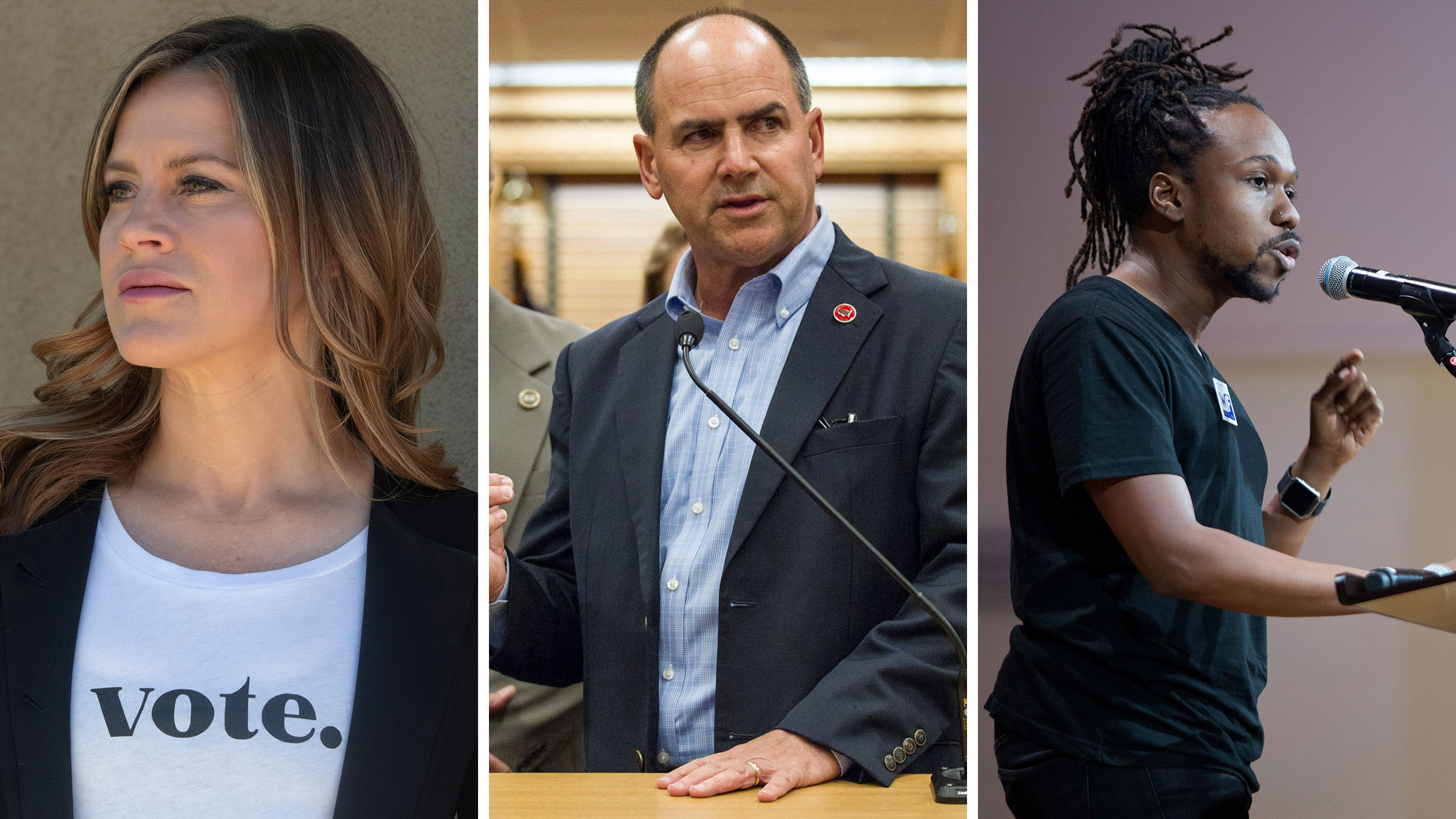 Amber McReynolds, Zach Wamp and Maurice MitchellRachel Woolf for TIME; Erik Schelzig—AP/Shutterstock; Holly Pickett—The New York Times/Redux
The alliance took a common set of themes from the research Shenker-Osorio presented at Podhorzer’s Zooms. Studies have shown that when people don’t think their vote will count or fear casting it will be a hassle, they’re far less likely to participate. Throughout election season, members of Podhorzer’s group minimized incidents of voter intimidation and tamped down rising liberal hysteria about Trump’s expected refusal to concede. They didn’t want to amplify false claims by engaging them, or put people off voting by suggesting a rigged game. “When you say, ‘These claims of fraud are spurious,’ what people hear is ‘fraud,'” Shenker-Osorio says. “What we saw in our pre-election research was that anything that reaffirmed Trump’s power or cast him as an authoritarian diminished people’s desire to vote.”
Podhorzer, meanwhile, was warning everyone he knew that polls were underestimating Trump’s support. The data he shared with media organizations who would be calling the election was “tremendously useful” to understand what was happening as the votes rolled in, according to a member of a major network’s political unit who spoke with Podhorzer before Election Day. Most analysts had recognized there would be a “blue shift” in key battlegrounds– the surge of votes breaking toward Democrats, driven by tallies of mail-in ballots– but they hadn’t comprehended how much better Trump was likely to do on Election Day. “Being able to document how big the absentee wave would be and the variance by state was essential,” the analyst says.
PEOPLE POWER
The racial-justice uprising sparked by George Floyd’s killing in May was not primarily a political movement. The organizers who helped lead it wanted to harness its momentum for the election without allowing it to be co-opted by politicians. Many of those organizers were part of Podhorzer’s network, from the activists in battleground states who partnered with the Democracy Defense Coalition to organizations with leading roles in the Movement for Black Lives.
The best way to ensure people’s voices were heard, they decided, was to protect their ability to vote. “We started thinking about a program that would complement the traditional election-protection area but also didn’t rely on calling the police,” says Nelini Stamp, the Working Families Party’s national organizing director. They created a force of “election defenders” who, unlike traditional poll watchers, were trained in de-escalation techniques. During early voting and on Election Day, they surrounded lines of voters in urban areas with a “joy to the polls” effort that turned the act of casting a ballot into a street party. Black organizers also recruited thousands of poll workers to ensure polling places would stay open in their communities.
The summer uprising had shown that people power could have a massive impact. Activists began preparing to reprise the demonstrations if Trump tried to steal the election. “Americans plan widespread protests if Trump interferes with election,” Reuters reported in October, one of many such stories. More than 150 liberal groups, from the Women’s March to the Sierra Club to Color of Change, from Democrats.com to the Democratic Socialists of America, joined the “Protect the Results” coalition. The group’s now defunct website had a map listing 400 planned postelection demonstrations, to be activated via text message as soon as Nov. 4. To stop the coup they feared, the left was ready to flood the streets.
STRANGE BEDFELLOWS
About a week before Election Day, Podhorzer received an unexpected message: the U.S. Chamber of Commerce wanted to talk.
The AFL-CIO and the Chamber have a long history of antagonism. Though neither organization is explicitly partisan, the influential business lobby has poured hundreds of millions of dollars into Republican campaigns, just as the nation’s unions funnel hundreds of millions to Democrats. On one side is labor, on the other management, locked in an eternal struggle for power and resources.
But behind the scenes, the business community was engaged in its own anxious discussions about how the election and its aftermath might unfold. The summer’s racial-justice protests had sent a signal to business owners too: the potential for economy-disrupting civil disorder. “With tensions running high, there was a lot of concern about unrest around the election, or a breakdown in our normal way we handle contentious elections,” says Neil Bradley, the Chamber’s executive vice president and chief policy officer. These worries had led the Chamber to release a pre-election statement with the Business Roundtable, a Washington-based CEOs’ group, as well as associations of manufacturers, wholesalers and retailers, calling for patience and confidence as votes were counted.
But Bradley wanted to send a broader, more bipartisan message. He reached out to Podhorzer, through an intermediary both men declined to name. Agreeing that their unlikely alliance would be powerful, they began to discuss a joint statement pledging their organizations’ shared commitment to a fair and peaceful election. They chose their words carefully and scheduled the statement’s release for maximum impact. As it was being finalized, Christian leaders signaled their interest in joining, further broadening its reach.
The statement was released on Election Day, under the names of Chamber CEO Thomas Donohue, AFL-CIO president Richard Trumka, and the heads of the National Association of Evangelicals and the National African American Clergy Network. “It is imperative that election officials be given the space and time to count every vote in accordance with applicable laws,” it stated. “We call on the media, the candidates and the American people to exercise patience with the process and trust in our system, even if it requires more time than usual.” The groups added, “Although we may not always agree on desired outcomes up and down the ballot, we are united in our call for the American democratic process to proceed without violence, intimidation or any other tactic that makes us weaker as a nation.”
SHOWING UP, STANDING DOWN
Election night began with many Democrats despairing. Trump was running ahead of pre-election polling, winning Florida, Ohio and Texas easily and keeping Michigan, Wisconsin and Pennsylvania too close to call. But Podhorzer was unperturbed when I spoke to him that night: the returns were exactly in line with his modeling. He had been warning for weeks that Trump voters’ turnout was surging. As the numbers dribbled out, he could tell that as long as all the votes were counted, Trump would lose.
The liberal alliance gathered for an 11 p.m. Zoom call. Hundreds joined; many were freaking out. “It was really important for me and the team in that moment to help ground people in what we had already known was true,” says Angela Peoples, director for the Democracy Defense Coalition. Podhorzer presented data to show the group that victory was in hand.
While he was talking, Fox News surprised everyone by calling Arizona for Biden. The public-awareness campaign had worked: TV anchors were bending over backward to counsel caution and frame the vote count accurately. The question then became what to do next.
The conversation that followed was a difficult one, led by the activists charged with the protest strategy. “We wanted to be mindful of when was the right time to call for moving masses of people into the street,” Peoples says. As much as they were eager to mount a show of strength, mobilizing immediately could backfire and put people at risk. Protests that devolved into violent clashes would give Trump a pretext to send in federal agents or troops as he had over the summer. And rather than elevate Trump’s complaints by continuing to fight him, the alliance wanted to send the message that the people had spoken.
So the word went out: stand down. Protect the Results announced that it would “not be activating the entire national mobilization network today, but remains ready to activate if necessary.” On Twitter, outraged progressives wondered what was going on. Why wasn’t anyone trying to stop Trump’s coup? Where were all the protests?
Podhorzer credits the activists for their restraint. “They had spent so much time getting ready to hit the streets on Wednesday. But they did it,” he says. “Wednesday through Friday, there was not a single Antifa vs. Proud Boys incident like everyone was expecting. And when that didn’t materialize, I don’t think the Trump campaign had a backup plan.”
Activists reoriented the Protect the Results protests toward a weekend of celebration. “Counter their disinfo with our confidence & get ready to celebrate,” read the messaging guidance Shenker-Osorio presented to the liberal alliance on Friday, Nov. 6. “Declare and fortify our win. Vibe: confident, forward-looking, unified–NOT passive, anxious.” The voters, not the candidates, would be the protagonists of the story.
The planned day of celebration happened to coincide with the election being called on Nov. 7. Activists dancing in the streets of Philadelphia blasted Beyoncé over an attempted Trump campaign press conference; the Trumpers’ next confab was scheduled for Four Seasons Total Landscaping outside the city center, which activists believe was not a coincidence. “The people of Philadelphia owned the streets of Philadelphia,” crows the Working Families Party’s Mitchell. “We made them look ridiculous by contrasting our joyous celebration of democracy with their clown show.”
The votes had been counted. Trump had lost. But the battle wasn’t over.
THE FIVE STEPS TO VICTORY
In Podhorzer’s presentations, winning the vote was only the first step to winning the election. After that came winning the count, winning the certification, winning the Electoral College and winning the transition–steps that are normally formalities but that he knew Trump would see as opportunities for disruption. Nowhere would that be more evident than in Michigan, where Trump’s pressure on local Republicans came perilously close to working–and where liberal and conservative pro-democracy forces joined to counter it.
It was around 10 p.m. on election night in Detroit when a flurry of texts lit up the phone of Art Reyes III. A busload of Republican election observers had arrived at the TCF Center, where votes were being tallied. They were crowding the vote-counting tables, refusing to wear masks, heckling the mostly Black workers. Reyes, a Flint native who leads We the People Michigan, was expecting this. For months, conservative groups had been sowing suspicion about urban vote fraud. “The language was, ‘They’re going to steal the election; there will be fraud in Detroit,’ long before any vote was cast,” Reyes says.
Trump supporters seek to disrupt the vote count at Detroit’s TCF Center on Nov. 4Elaine Cromie—Getty Images
He made his way to the arena and sent word to his network. Within 45 minutes, dozens of reinforcements had arrived. As they entered the arena to provide a counterweight to the GOP observers inside, Reyes took down their cell-phone numbers and added them to a massive text chain. Racial-justice activists from Detroit Will Breathe worked alongside suburban women from Fems for Dems and local elected officials. Reyes left at 3 a.m., handing the text chain over to a disability activist.
As they mapped out the steps in the election-certification process, activists settled on a strategy of foregrounding the people’s right to decide, demanding their voices be heard and calling attention to the racial implications of disenfranchising Black Detroiters. They flooded the Wayne County canvassing board’s Nov. 17 certification meeting with on-message testimony; despite a Trump tweet, the Republican board members certified Detroit’s votes.
Election boards were one pressure point; another was GOP-controlled legislatures, who Trump believed could declare the election void and appoint their own electors. And so the President invited the GOP leaders of the Michigan legislature, House Speaker Lee Chatfield and Senate majority leader Mike Shirkey, to Washington on Nov. 20.
It was a perilous moment. If Chatfield and Shirkey agreed to do Trump’s bidding, Republicans in other states might be similarly bullied. “I was concerned things were going to get weird,” says Jeff Timmer, a former Michigan GOP executive director turned anti-Trump activist. Norm Eisen describes it as “the scariest moment” of the entire election.
The democracy defenders launched a full-court press. Protect Democracy’s local contacts researched the lawmakers’ personal and political motives. Issue One ran television ads in Lansing. The Chamber’s Bradley kept close tabs on the process. Wamp, the former Republican Congressman, called his former colleague Mike Rogers, who wrote an op-ed for the Detroit newspapers urging officials to honor the will of the voters. Three former Michigan governors–Republicans John Engler and Rick Snyder and Democrat Jennifer Granholm–jointly called for Michigan’s electoral votes to be cast free of pressure from the White House. Engler, a former head of the Business Roundtable, made phone calls to influential donors and fellow GOP elder statesmen who could press the lawmakers privately.
The pro-democracy forces were up against a Trumpified Michigan GOP controlled by allies of Ronna McDaniel, the Republican National Committee chair, and Betsy DeVos, the former Education Secretary and a member of a billionaire family of GOP donors. On a call with his team on Nov. 18, Bassin vented that his side’s pressure was no match for what Trump could offer. “Of course he’s going to try to offer them something,” Bassin recalls thinking. “Head of the Space Force! Ambassador to wherever! We can’t compete with that by offering carrots. We need a stick.”
If Trump were to offer something in exchange for a personal favor, that would likely constitute bribery, Bassin reasoned. He phoned Richard Primus, a law professor at the University of Michigan, to see if Primus agreed and would make the argument publicly. Primus said he thought the meeting itself was inappropriate, and got to work on an op-ed for Politico warning that the state attorney general–a Democrat–would have no choice but to investigate. When the piece posted on Nov. 19, the attorney general’s communications director tweeted it. Protect Democracy soon got word that the lawmakers planned to bring lawyers to the meeting with Trump the next day.
Reyes’ activists scanned flight schedules and flocked to the airports on both ends of Shirkey’s journey to D.C., to underscore that the lawmakers were being scrutinized. After the meeting, the pair announced they’d pressed the President to deliver COVID relief for their constituents and informed him they saw no role in the election process. Then they went for a drink at the Trump hotel on Pennsylvania Avenue. A street artist projected their images onto the outside of the building along with the words THE WORLD IS WATCHING.
That left one last step: the state canvassing board, made up of two Democrats and two Republicans. One Republican, a Trumper employed by the DeVos family’s political nonprofit, was not expected to vote for certification. The other Republican on the board was a little-known lawyer named Aaron Van Langevelde. He sent no signals about what he planned to do, leaving everyone on edge.
When the meeting began, Reyes’s activists flooded the livestream and filled Twitter with their hashtag, #alleyesonmi. A board accustomed to attendance in the single digits suddenly faced an audience of thousands. In hours of testimony, the activists emphasized their message of respecting voters’ wishes and affirming democracy rather than scolding the officials. Van Langevelde quickly signaled he would follow precedent. The vote was 3-0 to certify; the other Republican abstained.
After that, the dominoes fell. Pennsylvania, Wisconsin and the rest of the states certified their electors. Republican officials in Arizona and Georgia stood up to Trump’s bullying. And the Electoral College voted on schedule on Dec. 14.
HOW CLOSE WE CAME
There was one last milestone on Podhorzer’s mind: Jan. 6. On the day Congress would meet to tally the electoral count, Trump summoned his supporters to D.C. for a rally.
Much to their surprise, the thousands who answered his call were met by virtually no counterdemonstrators. To preserve safety and ensure they couldn’t be blamed for any mayhem, the activist left was “strenuously discouraging counter activity,” Podhorzer texted me the morning of Jan. 6, with a crossed-fingers emoji.
Trump addressed the crowd that afternoon, peddling the lie that lawmakers or Vice President Mike Pence could reject states’ electoral votes. He told them to go to the Capitol and “fight like hell.” Then he returned to the White House as they sacked the building. As lawmakers fled for their lives and his own supporters were shot and trampled, Trump praised the rioters as “very special.”
It was his final attack on democracy, and once again, it failed. By standing down, the democracy campaigners outfoxed their foes. “We won by the skin of our teeth, honestly, and that’s an important point for folks to sit with,” says the Democracy Defense Coalition’s Peoples. “There’s an impulse for some to say voters decided and democracy won. But it’s a mistake to think that this election cycle was a show of strength for democracy. It shows how vulnerable democracy is.”
The members of the alliance to protect the election have gone their separate ways. The Democracy Defense Coalition has been disbanded, though the Fight Back Table lives on. Protect Democracy and the good-government advocates have turned their attention to pressing reforms in Congress. Left-wing activists are pressuring the newly empowered Democrats to remember the voters who put them there, while civil rights groups are on guard against further attacks on voting. Business leaders denounced the Jan. 6 attack, and some say they will no longer donate to lawmakers who refused to certify Biden’s victory. Podhorzer and his allies are still holding their Zoom strategy sessions, gauging voters’ views and developing new messages. And Trump is in Florida, facing his second impeachment, deprived of the Twitter and Facebook accounts he used to push the nation to its breaking point.
As I was reporting this article in November and December, I heard different claims about who should get the credit for thwarting Trump’s plot. Liberals argued the role of bottom-up people power shouldn’t be overlooked, particularly the contributions of people of color and local grassroots activists. Others stressed the heroism of GOP officials like Van Langevelde and Georgia secretary of state Brad Raffensperger, who stood up to Trump at considerable cost. The truth is that neither likely could have succeeded without the other. “It’s astounding how close we came, how fragile all this really is,” says Timmer, the former Michigan GOP executive director. “It’s like when Wile E. Coyote runs off the cliff–if you don’t look down, you don’t fall. Our democracy only survives if we all believe and don’t look down.”
Democracy won in the end. The will of the people prevailed. But it’s crazy, in retrospect, that this is what it took to put on an election in the United States of America.
–With reporting by LESLIE DICKSTEIN, MARIAH ESPADA and SIMMONE SHAH
*Correction appended, Feb. 5: The original version of this story misstated the name of Norm Eisen’s organization. It is the Voter Protection Program, not the Voter Protection Project. The original version of this story also misstated Jeff Timmer’s former position with the Michigan Republican Party. He was the executive director, not the chairman.
---
https://time.com/6169294/climate-change-politicized-in-1990s/
no lnx
Climate Change Became Politicized in the 1990s. It Didn't Have To Be That Way.
[Demonstrators Rally For Climate Issues On Earth Day
A demonstrator waves smoke canisters after scaling the John A. Wilson Building during a rally on Earth Day in Washington, D.C., U.S., on Friday, April 22, 2022. President Biden today will sign an executive order designed to safeguard old-growth forests as the White House has faced criticism from environmental activists over the inability to provide significant funding for his climate agenda. Graeme Sloan-Bloomberg]
IDEAS
BY EUGENE LINDEN APRIL 22, 2022 Nyack, NY. el@eugenelinden.com.
Linden explored scenarios for instability in his book, The Future in Plain Sight. His most recent book is Deep Past, a novel.
Here’s the situation as it now stands: Even with the Paris Accords on climate change, temperatures are expected to rise by between 2.7 degrees Celsius to 3.7 degrees Celsius above pre-industrial levels by 2100. To put this in perspective,the last time global temperatures were that high was 2.6 million years ago. There was plenty of life back then, but no humans. It’s highly doubtful that a world that overheated could feed the 7.8 billion people alive today, much less the additional billions that will be added in the coming decades. Indeed, global population has grown by 2.5 billion people since the first international efforts to address global warming began in the early 1990s, and four billion people have lived their entire lives since the first signals of a warming world became unmistakable. Those alive in 2100 are going to want to know: why did we let this happen?
It’s not like we haven’t been warned. There have been several false dawns in our efforts to tackle the threat of global warming. President Jimmy Carter convened a blue-ribbon panel to study the issue in the late 1970s. The panel, which included pioneering climate scientists Roger Revelle and George Woodwell, presented him with a paper in 1979 that warned that if we didn’t take action to curb greenhouse gas emissions, we would see changes in climate by the end of the 20th century. We didn’t take action, and we did see changes.
Another false dawn broke nine years later during the sweltering summer of 1988, prompted by James Hansen’s dramatic testimony to a U.S. Senate committeein which he argued that global warming had already begun. Out of that wave of alarm came a toothless agreement called the Kyoto Protocol of 1997, which went into effect in 2005. Most countries ratified it (but not the U.S.), but it did little to halt the rise in emissions of greenhouse gasses, which are now 60% higher than when the first efforts to halt global warming began.
Our present perilous situation is the product of the interaction of four different realms: reality, the scientific world, public opinion, and the world of business and finance. It’s useful to imagine four clocks running at different speeds, with each clock representing one of these four realms, the latter three all lagging the reality of climate change, but to different degrees. In the scientific realm, there is a lag built into the very structure of scientific inquiry. Science proceeds by gathering data, analyzing it, and publishing the results—from the 1980s on, we see a built-in lag of at least two years between what has actually been happening with the climate and our scientific understanding of it. The realms of public opinion and finance lag even further behind reality.
If we think of these four clocks running at different speeds, let’s start them all in 1979, the year President Jimmy Carter’s blue-ribbon panel presented him with their recommendations.
Clock One follows the progress of climate change itself. Hottest years in history began accumulating in the mid-1980’s, and since then each decade has set new records. For instance, the 1980’s counted 6 of its 10 years as among the top ten, with 1988 breaking the all-time record for global warmth. Since 2000, every year but one has been among the top ten globally, with the warming accelerating as we approach 2020 (each of the last seven years of the 2010-2020 decade were one of the seven hottest years on record). There have been many other signals of climate change, such as a rapid acceleration of sea level rise. This clock shows that human-caused climate change has been with us since the 1980s, and that the changes have been accelerating.
Clock Two marks the progress of science. Despite the warnings of the Carter blue-ribbon panel, back then most scientists felt that global warming caused by greenhouse gas emissions wouldn’t arrive until the next century and would make its presence felt only incrementally. In part this was because, those reconstructing past climates literally could not see the rapid, violent global changes that have characterized climate change since the ice ages began some 2.7 million years ago. Starting in the 1980s, the tools for precisely reconstructing past climates became increasingly more precise, and the picture that emerged was both truly alarming and completely different than the conventional wisdom of earlier decades.[ice cores showed fast change/phase shift?]
By the mid-1990s, signals of extremely rapid changes in the past had become blindingly clear, and by 2003, climate science had completed a complete paradigm shift: the consensus on how climate changes shifted from stately and incremental to dramatic and rapid. As climate scientist Richard Alley put it, the old view was that climate change was a dial; the new view, a switch.
Clock Three marks the progress of public appreciation of the threat. At times this clock has advanced rapidly, and at other times it has run backwards. There were periods in the ‘80s and ‘90s when public concern spiked. If the first clock reflects what is happening currently, and the second clock lags by two years, the third clock has lagged the first two by as much as decades. Opinion is changing rapidly, but as recently as 2018 nearly half of Americans polled by Gallup didn’t believe climate change would pose a “serious threat” in their lifetime – even as global warming was already inflicting trillions in economic damage.
Clock Four marks the understanding of climate change in the world of business and finance, including the economics community, the markets, and investors. With a couple of exceptions, this clock lags even the public in terms of appreciation of the threat. Right now, this is changing rapidly, but until a couple of years ago, the principle way climate change captured the attention of business, economists, and investors was not how climate change might affect the economy, but rather how attempts to limit fossil fuel emissions might lower profits.
This fourth clock is perhaps the least well examined and least well understood of the causes of our present dilemma, but it is also the most important.If the markets had the incentives and penalties to price in the likely future costs of climate change, the world would have acted decades ago, and we might have forestalled the changes we are seeing today. Instead, much of the business community put their resources into disputing the science and the scientific consensus, questioning the motives of the scientists, and, most of all, saying that we had time. We didn’t.
Because the markets are where the money is, politicians followed. Nothing illustrates this more vividly than the dizzying evolution of George H.W. Bush starting in 1988. Aware of the upsurge in interest in environment during that year, Bush vowed to be the environmental president. On Aug. 31, 1988 in a campaign speech, he said, “Those who think we are powerless to do anything about the ‘greenhouse effect’ are forgetting about the ‘White House effect’. In my first year in office, I will convene a global conference on the environment at the White House. It will include the Soviets, the Chinese… The agenda will be clear. We will talk about global warming.”
Bush actually did convene a conference once president, but sometime between his campaign speech and the conference in April, the “lobbyist effect” came into play. The Chinese were not invited, and the briefing papers for cabinet members warned them not to use the phrases “global warming” or “greenhouse effect.” This is akin to convening a conference on pandemics and forbidding your aides from mentioning COVID-19.
The battle to contain global warming was lost in the 1990s. The mixed messages coming from the U.S. on global warming undercut efforts to convince China and other emerging nations to eschew coal and “leapfrog” fossil fuels in powering their industrialization. China leapfrogged the U.S., but it was in greenhouse gas emissions and not in the adoption of renewables. A study of 2019 emissions by The Rhodium Group found that China accounted for 27% of total emissions that year, two and a half times more than the U.S., and equivalent to more than the combined emissions of the 27 nations in the European Union and the 38 nations in the OECD.
There is one other legacy of the 1990s that we still live with today: the issue became politicized. With the adoption of the Kyoto Protocol in 1997, fossil fuel and allied interests poured large amounts of money into campaigns linking climate change action to the liberal agenda. As we have seen with COVID-19, once an issue becomes politicized, the message [ie facts] doesn’t matter, only the messenger. If patients can refuse to admit COVID-19 is real, even as they are dying of it, what chance do warnings about climate change have if the messenger is perceived to be a liberal know-it-all who wants to tell you how to run your life. In that same Gallup poll where only 45% of Americans felt that climate change would seriously impact their lives in their lifetime, the number for Republicans was 18%.
Today, the issue remains politicized—witness the vitriolic debate over whether we should push renewables or drilling to replace the Russian oil and gas sanctioned because of the Ukraine invasion—but there has been a seismic shift in the posture of the monied interests with regard to climate change. Rather than seeing regulation as the threat, most major corporations now see climate change itself as a threat to the economy. This is welcome.Unfortunately, the past 33 years have underscored the tremendous momentum of business as usual, [PELTZMAN FLA CA INSURANCE?] and business as usual will produce a climate hostile to humanity and most of the plants and animals we depend on to live. That first clock, reality, ticks louder every year. Should we not act, the harsh judgment of our survivors in the year 2100 will be the least of humanity’s worries.
Adapted from Fire and Flood: A People’s History of Climate Change From 1979 to the Present
STATS produces an annual list called the "Dubious Data Awards", highlighting egregious factual inaccuracies in news reporting. In 2006, it challenged a study by the Center on Addiction and Substance Abuse, used by The New York Times and Forbes, which claimed that almost half of the alcoholindustry's revenue came from underage drinkers. According to STATS, American teenagers who drink alcohol would each have to consume more than 1,000 drinks per year for this to be true.[10] STATS has also disagreed with recommendations from Time that parents should discontinue use of soft vinyl toys, teethers, and similar products containing **phthalates**, pointing out that phthalates in children's toys have been cleared for use by both the Consumer Product Safety Commission and the European Union's Institute for Health and Consumer Protection.[10] The annual list has received coverage from The Washington Post and the Los Angeles Times, among other news organizations.[3][11]
==
https://www.alternet.org/2019/12/trump-supporters-cry-bitter-tears-after-time-names-greta-thunberg-person-of-the-year/
no lnx
Trump supporters cry bitter tears after Time names Greta Thunberg ‘Person of the Year’ [djt runner up last yr?]
Written by Brad Reed / Raw Story December 11, 2019
Climate activist Greta Thunberg has been named Time Magazine’s Person of the Year — and Trump supporters are deeply unhappy about it.
https://www.alternet.org/2019/02/national-enquirers-suspected-source-for-bezos-story-believed-trump-knew-and-supported-the-effort-report/
On Sunday, The Daily Beast reported that the National Enquirer’s likely source for the steamy text messages between Amazon founder Jeff Bezos and his mistress Lauren Sanchez was the mistress’ brother, Michael Sanchez.
But the saga could be deeper than that. It turns out that Sanchez believed that the Enquirer, and its parent company AMI, were acting with the blessing of President Donald Trump, who allegedly wanted revenge on Bezos for negative coverage about him in the Washington Post:
Documents reviewed by The Daily Beast show that Michael Sanchez believed the Enquirer pursued its story about Bezos with “President Trump’s knowledge and appreciation” — a chase encouraged, in Sanchez’s estimation, by Republican operatives “who THINK Jeff gets up every morning and has a WaPo meeting to plot its next diabolical attack on President Trump.”
Bezos, the richest man in the world, purchased the Post in 2013. However, there is no evidence he plays any role in the paper’s editorial direction, and the Post has actually run a number of articles critical of Amazon under his ownership without comment from him.
AMI and its owner, David Pecker, are facing backlash after Bezos revealed that the company tried to blackmail him with nude photos after he launched an investigation into how they acquired text messages from his affair.
Pecker, a friend of Trump’s, was granted immunity last fall as part of an investigation by the Southern District of New York attorney’s office into Trump’s hush payments to women prior to the 2016 presidential election, one of which — to cover up Trump’s encounter with Playboy Playmate Karen MacDougal — was brokered by AMI. If it turns out that AMI broke the law by blackmailing Bezos, which could constitute criminal extortion, this would violate the terms of their immunity agreement, meaning SDNY prosecutors could pursue charges against the company.
Moreover, there may be yet another side to Trump’s alleged involvement. The president has reportedly “rewarded” Pecker by putting him in touch with people connected to the Saudi royal family, at roughly the same time thatAMI was attempting to secure funding from the Saudis to acquire Time Magazineand ran a special edition that lavished praise on Saudi Arabia and Crown Prince Mohammed bin Salman.
If it transpired that Trump tried to hook up his publisher friend with funding from a despotic foreign regime in return for helping to discredit a businessman at the center of a personal vendetta, then the Russia collusion allegations could be just the tip of the iceberg for the president’s wrongdoing. Sanchez’s belief that Trump gave his imprimatur to AMI’s actions does little to help him.
==
https://www.ecowatch.com/climate-denying-koch-brothers-back-purchase-of-time-magazine-2512979338.html
The media company Meredith announced Sunday night that it's buying Time magazine for an estimated $2.8 billion.
"We are creating a premier media company serving nearly 200 million American consumers across industry-leading digital, television, print, video, mobile and social platforms positioned for growth," said Meredith Corporation Chairman and CEO Stephen Lacy.
Buried deep in the press release was where a significant proportion of this money is coming from: "Meredith has also secured $650 million in preferred equity commitment from Koch Equity Development (KED)."
And here's where the alarm bells should start ringing. The KED fund is run by the Koch Brothers, some of the biggest funders of groups promoting climate denial and libertarian causes for the last two decades.
To try to assuage concerns, Meredith's board added the statement that the Koch brothers will not have seats on the company's board or any "influence on Meredith's editorial or managerial operations." John Fahey, Time's chairman, said the sale was in the best interests of the company.
But not everyone believes the spin. You don't invest $650 million for nothing.
Charles Alexander spent 23 working for Time as a reporter, writer and editor—thirteen years working on the environmental beat, including the iconic 1989 cover which had the earth as "Planet of the Year," which stated that "man has reached a point in his evolution where he has the power to affect, for better or worse, the present and future state of the planet."
In the following years, as scientists have increasingly warned about our warming world and the state of the world, the Koch brothers have spent millions denying the problem of climate change.
Writing in The Nation last week, before the deal was formalized, Alexander said, "Can you imagine what it would be like to see your life's work suddenly go down the drain? I can—right now."
Alexander wrote of his "despair" at the deal, as "Koch Industries is a big player in the oil and gas business and whose philanthropy has long funded climate denial."
He added, "If Charles and David Koch gain control of Time, I expect my life's work to be repudiated in the very magazine in which it appeared. The thought is almost too much to bear … it is perverse and dangerous for two billionaires with no commitment to factual truth to be permitted to buy a magazine that has been a voice for reason and use it to further their narrow business interests."...
==
==
trashed el mozete
William Alan Henry III (1950–1994) was an award-winning American cultural critic and author.
Career
Henry lived in North Plainfield, New Jersey as a young man. Henry graduated from Yale in 1971 and began his career in journalism in Boston, writing for the Boston Globe. His coverage of school desegregation in Boston won a (shared) Pulitzer Prize in 1975. He also wrote on the arts for the Globe, winning a second Pulitzer for his television criticism in 1980.[1]
In the 1980s he worked as an arts critic for Time magazine, while pursuing his interests in cultural criticism and in American politics. Among his articles for Time was a story critical of the Hollywood trade newspapers in their cozy relationship in an industry town.[2] Among his notable works were his 1984 book, Visions of America, on the American presidential campaign of that year; his 1990 video documentary of Bob Fosse, Steam Heat, which won an Emmy; and his 1992 (print) biography of Jackie Gleason, The Great One.[3]
His final, and perhaps most notable, book was In Defense of Elitism, a work of social and cultural criticism that argued that societies and cultures might be ranked on a spectrum ranging from 'egalitarianism' to 'elitism', and that the contemporary United States had moved too far away from the latter; a view he defended with reference to college education, multiculturalism, and other topics. He died of a heart attack on June 28, 1994 while the book was coming to press.[4]
References
- :{Jump up:(style="top:-99999px;clip:rect(1px 1px 1px 1px);overflow:hidden;position:absolute !important;padding:0px !important;border:0px !important;height:1px !important;width:1px !important;-webkit-user-select:none"):}:^ Official website of the Pulitzer Prize
- :{Jump up:(style="top:-99999px;clip:rect(1px 1px 1px 1px);overflow:hidden;position:absolute !important;padding:0px !important;border:0px !important;height:1px !important;width:1px !important;-webkit-user-select:none"):}:^ Trades Blow No Ill Winds, TIME, September 27, 1982
- :{Jump up:(style="top:-99999px;clip:rect(1px 1px 1px 1px);overflow:hidden;position:absolute !important;padding:0px !important;border:0px !important;height:1px !important;width:1px !important;-webkit-user-select:none"):}:^ Henry's biographical sketch at Random House, which published In Defense of Elitism
- :{Jump up:(style="top:-99999px;clip:rect(1px 1px 1px 1px);overflow:hidden;position:absolute !important;padding:0px !important;border:0px !important;height:1px !important;width:1px !important;-webkit-user-select:none"):}:^ Short obituary of Henry at Time magazine; long obituary of Henry at TIME Magazine
==
blog
why time cnn suck
It is a question of ownership. The current owners are not interested in running news organizations; or even maximizing returns for shareholders. The current ownership regard their news properties and an agit-prop operation to promote their corporate agenda.
There is Jeffrey Bewkes, Chairman and CEO. Clearly Bewkes has had bad dealings with at least one inventor. Last month alone Bewkes dumped $1,605,089.28 worth of TimeWarner stock because, it seems, $21.5 million a year is not sufficient to get by on. This is not the action of a man with any interest in maximizing shareholder value, or even any confidence in his own management.
Robert Shaye is Co-Chairman of New Line Cinema and Co-Chief Executive Officer of New Line Cinema. No indication of stock dumping or other dubious conduct, so it seems someone on the board of directors is actually interested in product.
Ann Moore is Chairman of Time Inc and Chief Executive Officer of Time Inc., she also serves on the Board of Directors of the Wallace Foundation. She hasn't dumped any TimeWarner stock; but she has dumped a lot of Avon stock where she sits on the Board of Directors and contributes God knows what to the company.
Barry Meyer is Chairman of Warner Bros Entertainment Inc and Chief Executive Officer of Warner Bros Entertainment Inc. He serves on the Board of Directors of Human Rights Watch and has no record of dumping stock.
Michael Lynne is Co-Chairman of New Line Cinema and Co-Chief Executive Officer of New Line Cinema. He does not dump stock and like his co-chair Robert Shaye, would appear to have an interest in producing actual product.
Bill Nelson is Chairman of Home Box Office and Chief Executive Officer of Home Box Office. He has no indications of stock dumping or other dubious activity.
Philip Kent is Chairman of Turner Broadcasting System and Chief Executive Officer of Turner Broadcasting System. He appears to be a career guy and has engaged in no stock dumping that I know of. There does not seem to be any obvious explanation as to why he is content to preside over a news organization so bad as to be a national embarrassment. Mr. Kent, stop hurting America!
Tim Armstrong is Chairman of AOL and Chief Executive Officer of AOL. Reportedly he wants to turn AOL into a low cost content machine.
Now we get to the fun part, the outside directors:
Stephen Bollenbach of Hilton Parsippany, President and Chief Executive Officer of Christopher Reeve Paralysis Foundation, he also serves on as a director for Teach for America, which goes a long way to explain Time and CNN's enthusiasm for education deform. At least he has not dumped any TWX stock so far, so there's that.
Michael Miles is Director, Chairman of Compensation Committee, Member of Executive Committee and Director of American Airlines. He also sits on the board of directors of Citadel Broadcasting, yes that Citadel Broadcasting. Formerly Michael Miles was with Philip Morris. Need I say more?
Robert Clark is Independent Director, Chairman of Nominating & Governance Committee and Member of Audit & Finance Committee. He is a former Harvard Prof., he authored an article entitled: "Does the Nonprofit Form Fit the Health Care Industry?" 93 Harvard Law Review 1416 (1980). Don't suppose we have any readers who could get hold of it?
Kenneth Novackis a Senior Counsel at Mintz Levin. He also holds senior positions in the firm’s portfolio companies and is actively involved in all aspects of the firm, including the investment process.
James L. Barksdale is currently with FedEx, but is most famous for running Netscape into the ground. Barksdale seems to have spent this year dumping Sun Microsystems stock, where is is also a director. Sourcewatch:
James L. Barksdale was described March 5, 2001, by Mother Jones as a "die-hard Republican who has backed George W. Bush, John Ashcroft, and Senate Majority Leader Trent Lott" and has broken "party ranks only when high-tech issues are on the line: He gave $3,000 to Rep. Zoe Lofgren, a Democrat from Silicon Vallye known for her support of easing trade, and former Senator Bob Kerrey, a Nebraska Democrat who chaired the Web-based Education Commission that advocated federal spending to wire public schools."
Frank Caufield is General Partner and Co-Founder, Kleiner, Perkins, Caufield & Byers, a venture capital firm in Silicon Valley. In 2009 Caufield dumped $2,589,227 worth of TimeWarner, which tells you what he thinks of the company.
Deborah Wright is CEO of Carver Bancorp Inc. She is a Giuliani crony.
Jessica Einhorn seems very tight with international banksters. She serves on Pete Peterson's Institute for International Economics. This may explain CNN's role in anti-social security agit-prop. Maybe we should start a campaign to have her resign form TimeWarner's Board of Directors.
Mathias Döpfner is CEO of Axel Springer AG, a German media corporation. He seems normal.
William Barrwas Bush 41's AG. He is VP and General Counsel for Verizon, so he is one reason that both Time and CNN are so enthusiastic about warrantless wiretaps. Barr appears to spend his time at Verizon making tiny stock acquisitions and huge stock dumps.
Fred Hassan is CEO of Schering of Plough, Merck & Co. Inc., and no doubt a major reason Time and CNN have a black out on Medicare for All news. (He also sits on the board of Cabela's, a luxury retailer for hunters and fishermen.
When you look at the leadership of TimeWarner, it is pretty clear why Time and CNN are such poor excuses for news organizations.
Time Gives Up on Factchecking: Corporate Media Can't Find a Way to Tell the Truth
by PRW Staff — December 10, 2012 -
--by Peter Hart, originally published in FAIR (Fairness & Accuracy In Reporting)
In October, the inevitable was announced: Struggling Newsweek magazine would be finished as a print publication as of the end of the year. But the last mass newsweekly left, Time, also made an announcement of sorts: It was out of the factchecking business.
"Who Is Telling the Truth? The Fact Wars," read Time's October 15 cover. With a setup like that, one might have hoped for a bold break from the campaign pack, an acknowledgment that facts matter, and that politicians who run on a record of resisting reality should be exposed.
Instead Time told a more familiar story, one in which both major parties commit comparable "factual recklessness," because accuracy—and reality—are less important than the appearance of evenhandedness. In the article, and a subsequent response to critics, the magazine essentially waved the white flag in the journalistic war against political deception.
==
==
Time is an American weekly news magazine published in New York City. It was founded in 1923 and for decades dominated by Henry Luce, who built a highly profitable stable of magazines. A European edition (Time Europe, formerly known as Time Atlantic) is published in London and also covers the Middle East, Africa and, since 2003, Latin America. An Asian edition (Time Asia) is based in Hong Kong. The South Pacific edition, covering Australia, New Zealand and the Pacific Islands, is based in Sydney. In December 2008, Time discontinued publishing a Canadian advertiser edition.[2]
Time has the world's largest circulation for a weekly news magazine, and has a readership of 25 million, 20 million of which are in the US.
Richard Stengel has been the managing editor since May 2006.[3]
Contents |
History
[ ](http://en.wikipedia.org/wiki/File:Time_Magazine_-_first_cover.jpg)
[ ](http://en.wikipedia.org/wiki/File:Time_Magazine_-_first_cover.jpg "Enlarge")
The first issue of Time (March 3, 1923), featuring Speaker Joseph G. Cannon.
Time magazine was created in 1923 by Briton Hadden and Henry Luce, making it the first weekly news magazine in the United States.[4] The two had previously worked together as chairman and managing editor respectively of the Yale Daily News. They first called the proposed magazine Facts. They wanted to emphasize brevity, so that a busy man could read it in an hour. They changed the name to TIME and used the slogan "Take Time—It's Brief."[5] Hadden was a rather carefree figure, who liked to tease Luce and saw Timeas something important but also fun. That accounts for its tone, which many people still criticize as too light for serious news and more suited to its heavy coverage of celebrities (including politicians), the entertainment industry, and pop culture. It set out to tell the news through people, and for many decades the magazine's cover was of a single person. The first issue of Time was published on March 3, 1923, featuring on its cover Joseph G. Cannon, the retired Speaker of the United States House of Representatives; a facsimile reprint of Issue No. 1, including all of the articles and advertisements contained in the original, was included with copies of the February 28, 1938 issue as a commemoration of the magazine's 15th anniversary.[6] On Hadden's death in 1929, Luce became the dominant man at Time and a major figure in the history of 20th-century media. According to Time Inc.: The Intimate History of a Publishing Enterprise 1972–2004 by Robert Elson, "Roy Edward Larsen [...] was to play a role second only to Luce's in the development of Time Inc." In his book, The March of Time, 1935–1951, Raymond Fielding also noted that Larsen was "originally circulation manager and then general manager of Time, later publisher of Life, for many years president of Time Inc., and in the long history of the corporation the most influential and important figure after Luce."
Around the time they were raising US$100,000 from wealthy Yale alumni like Henry P. Davison, partner of J.P. Morgan & Co., publicity man Martin Egan and J.P. Morgan & Co. banker Dwight Morrow, Henry Luce and Briton Hadden hired Larsen in 1922 – although Larsen was a Harvard graduate and Luce and Hadden were Yale graduates. After Hadden died in 1929, Larsen purchased 550 shares of Time Inc., using money he obtained from selling RKO stock which he had inherited from his father, who was the head of the B.F. Keith theatre chain in New England. However, after Briton Hadden's death, the largest Time Inc. stockholder was Henry Luce, who ruled the media conglomerate in an autocratic fashion, "at his right hand was Larsen," Time Inc.'s second-largest stockholder, according to "Time Inc.: The Intimate History of a Publishing Enterprise 1923–1941". In 1929, Roy Larsen was also named a Time Inc. director and a Time Inc. vice-president. J.P. Morgan retained a certain control through two directorates and a share of stocks, both over Time and Fortune. Other shareholders were Brown Brothers W. A. Harriman & Co., and The New York Trust Company (Standard Oil).
By the time of Henry Luce's death in 1967, the Time Inc. stock which Luce owned was worth about US$109 million and yielded him a yearly dividend income of more than US$2.4 million, according to The World of Time Inc: The Intimate History of a Changing Enterprise 1957–1983 by Curtis Prendergast. The value of the Larsen family's Time Inc. stock was now worth about $80 million during the 1960s and Roy Larsen was both a Time Inc. director and the chairman of its Executive Committee, before serving as Time Inc.'s vice-chairman of the board until the middle of 1979. According to the September 10, 1979 issue of The New York Times, "Mr. Larsen was the only employee in the company's history given an exemption from its policy of mandatory retirement at age 65."
After Time magazine began publishing its weekly issues in March 1923, Roy Larsen was able to increase its circulation by utilizing U.S. radio and movie theaters around the world. It often promoted both "Time" magazine and U.S. political and corporate interests. According to The March of Time, as early as 1924, Larsen had brought Time into the infant radio business with the broadcast of a 15-minute sustaining quiz show entitled Pop Question which survived until 1925." Then, according to the same book, "In 1928 [...] Larsen undertook the weekly broadcast of a 10-minute programme series of brief news summaries, drawn from current issues of Time magazine [...] which was originally broadcast over 33 stations throughout the United States."
Larsen next arranged for a 30-minute radio program, The March of Time, to be broadcast over CBS, beginning on March 6, 1931. Each week, the program presented a dramatisation of the week's news for its listeners, thus Time magazine itself was brought "to the attention of millions previously unaware of its existence," according to Time Inc.: The Intimate History of a Publishing Enterprise 1923–1941, leading to an increased circulation of the magazine during the 1930s. Between 1931 and 1937, Larsen's The March of Time radio program was broadcast over CBS radio and between 1937 and 1945 it was broadcast over NBC radio – except for the 1939 to 1941 period when it was not aired. People Magazine was based on Time's People page.
Time became part of Time Warner in 1989, along with Warner Bros. when Time, Inc. and Warner Communications merged. Jason McManus succeededHenry Grunwald in 1988 as Editor-in-Chief and oversaw the transition before Norman Pearlstine succeeded him in 1995.
In 2000, the magazine became part of AOL Time Warner, which reverted to the name Time Warner in 2003.
In 2007, Time moved from a Monday subscription/newsstand delivery to a schedule where the magazine goes on sale Fridays, and is delivered to subscribers on Saturday. The magazine actually began in 1923 with Friday publication.
During early 2007, the year's first issue was delayed for roughly a week due to "editorial changes." The changes included the job losses of 49 employees.[7]
In 2009 Time announced that they were introducing a personalized print magazine, Mine, mixing content from a range of Time Warner publications based on the reader's preferences. The new magazine met with a poor reception, with criticism that its focus was too broad to be truly personal.[8]
The magazine has an online archive with the unformatted text for every article published. The articles are indexed and were converted from scanned images using optical character recognition technology. There are still minor errors in the text that are remnants of the conversion into digital format.
Time Inc. and Apple have come to an agreement wherein US subscribers to Time Inc. magazines will be able to read the iPad versions of those magazines for free, at least until the two companies sort out a viable digital subscription model.[9]
In January 2013, Time Inc. announced that it would cut nearly 500 jobs – roughly 6% of its 8,000 staff worldwide.[10] Although Time magazine has maintained high sales, its ad pages have declined significantly over time.[11]
Legal controversy
On September 10, 2007, the Indonesian Supreme Court awarded former Indonesian President Suharto damages against Time Asia magazine, ordering it to pay him 1 trillion rupiah for libel. The High Court reversed the judgment of the Appeal Court and Central Jakarta District Court (made in 2000 and 2001). Suharto sought more than US$27 billion in the suit against US-based Time over a 1999 article which published that he transferred stolen money abroad.[12]
Circulation
Time magazine paid circulation by year| Year | 1997 | 1998 | 1999 | 2000 | 2001 | 2002 | 2003 | 2004 | 2005 | 2006 | 2007 | 2008 | 2009 |
| Circulation (millions) | 4.2 | 4.1 | 4.1 | 4.1 | 4.1 | 4.1 | 4.1 | 4.0 | 4.0 | 4.1 | 3.4 | 3.4 | 3.4 |
During the second half of 2009 the magazine saw a 34.9% decline in newsstand sales.[13] During the first half of 2010, there was another decline of at least one third in Time magazine sales. In the second half of 2010, Time magazine newsstand sales declined by about 12% to just over 79,000 copies per week.
Style
Time initially possessed a distinctive writing style, making regular use of inverted sentences. This was parodied in 1936 by Wolcott Gibbs in an article inThe New Yorker: "Backward ran sentences until reeled the mind [...] Where it all will end, knows God!"[citation needed]
Up until the mid-1970s or so,[14] Time had a weekly section called "Listings", which contained capsule summaries and/or reviews of then-current significant films, plays, musicals, television programs, and literary bestsellers, much like The New Yorker's section "Current Events".
Time is also known for its signature red border, introduced in 1927. The iconic red border was homaged or satirized by Seattle's The Stranger newspaper in 2010.[15] The border has only been changed four times since 1927: The issue released shortly after the September 11 attacks on the United States featured a black border to symbolize mourning. However, this edition was a special "extra" edition published quickly for the breaking news of the event; the next regularly scheduled issue contained the red border. Additionally, the April 28, 2008, Earth Day issue, dedicated to environmental issues, contained a green border.[16] The next change in border was in the September 19, 2011 issue, commemorating the 10th anniversary of September 11 attacks with a metallic silver border. The most recent change (again with a silver border) was in the December 31, 2012 issue, noting Barack Obama's selection as Man of the Year.
In 2007, Time engineered a style overhaul of the magazine. Among other changes, the magazine reduced the red cover border in order to promote featured stories, enlarged column titles, reduced the number of featured stories, increased white space around articles, and accompanied opinion pieces with photographs of the writers. The changes have met both criticism and praise.[17][18][19]
Special editions
Person of the Year
Main article: Time Person of the Year
Time's most famous feature throughout its history has been the annual "Person of the Year" (formerly "Man of the Year") cover story, in which Timerecognizes the individual or group of individuals who have had the biggest impact on news headlines over the past 12 months. The distinction is supposed to go to the person who, for good or ill, has most affected the course of the year; it is therefore not necessarily an honor or a reward. In the past, such figures as Adolf Hitler and Joseph Stalin have been Man of the Year.
In 2006 the Person of the Year was designated as "You", a move that was met with split reviews. Some thought the concept was creative; others wanted an actual person of the year. Editor Stengel reflected that, if it had been a mistake, "we're only going to make it once."[20]
Time 100
Main article: Time 100
In recent years Time has assembled an annual list of the 100 most influential people of the year. Originally, they had made a list of the 100 most influential people of the 20th century. These issues usually have the front cover filled with pictures of people from the list and devote a substantial amount of space within the magazine to the 100 articles about each person on the list. There have, in some cases, been over 100 people, when two people have made the list together, sharing one spot.
The magazine also compiled "All-TIME 100 best novels" and "All-*TIME* 100 best movies" lists in 2005,[21][22][23] and "The 100 Best TV Shows of All-TIME" in 2007.[24]
Time for Kids
Main article: Time for Kids
Time for Kids is a division magazine of Time that is especially published for children and is mainly distributed in classrooms. TFK contains some nationalnews, a "Cartoon of the Week", and a variety of articles concerning popular culture. An annual issue concerning the environment is distributed near the end of the U.S. school term. The publication rarely exceeds ten pages front and back. It is used in many libraries.
Staff
Editors
- Briton Hadden (1923–1929)
- Henry Luce (1929–1949)
- Thomas S. Matthews (1949–1953)
Managing editors
- Thomas S. Matthews (1943–1949)
- Roy Alexander (1949–1960)
- Otto Fuerbringer (1960–1968)
- Henry Grunwald (1968–1977)
- Ray Cave (1979–1985)
- Jason McManus (1985–1987)
- Henry Muller (1987–1993)
- James R. Gaines (1993–1995)
- Walter Isaacson (1996–2001)
- Jim Kelly (2001–2005)
- Richard Stengel (2006–present)
Notable contributors
 | This section needs additional citations for verification. Please help improve this article by adding citations to reliable sources. Unsourced material may be challenged and removed. (January 2012) |
- Aravind Adiga, Time correspondent for three years, winner of the 2008 Man Booker Prize for fiction
- James Agee, book and movie editor for Time
- Ann Blackman[25]
- Lasantha Wickrematunge, journalist
- Margaret Carlson, the first female columnist for Time
- Whittaker Chambers, Time employee from 1939 to 1948, ending as senior editor and then special projects editor to Henry Luce
- Richard Corliss, film critic for the magazine since 1980
- Nancy Gibbs, essayist and editor-at-large; has written more than 100 Time cover stories
- Lev Grossman, brother of Bathsheba and Austin, writes primarily about books for the magazine
- Robert Hughes, Time's long-tenured art critic
- Pico Iyer, essayist and novelist, essayist for Time since 1986
- Joe Klein, author (Primary Colors) and a columnist for the magazine who writes the "In the Arena" column for the magazine
- Andre Laguerre, Paris bureau chief 1948–1956, London bureau chief 1951–1956, also wrote about sports for Time; later longtime managing editor ofSports Illustrated
- Nathaniel Lande, author, filmmaker, and former creative director of Time
- Will Lang Jr. 1936–1968, Time Life International
- Michael Schuman, American author and journalist who specializes in Asian economics, politics and history, currently the Asia business correspondent for TIME Magazine based in Hong Kong
- Donald L. Barlett and James B. Steele, investigative reporters who won two National Magazine Awards while at Time
- Joel Stein, columnist who wrote the Joel 100 just after Time Magazine's Most Influential issue in 2006
- David Von Drehle, current Editor-at-Large
- Fareed Zakaria, current Editor-at-Large
- Alexander Eliot, art editor from 1945-1961, author of eighteen books on art, mythology, and history, including "Three Hundred Years of American Painting" published by Time-Life Books.
See also
- Lists of people on the cover of *Time* magazine
- "The Thriving Cult of Greed and Power", 1991 article about Scientology, by Richard Behar, which received the Gerald Loeb Award
- Heroes of the Environment