Columbia Univ
==
see cjr
WFB?
exxon
see student suppression
pres is tory, previous oversight led to fire/resign
===
some missing see webodec4
---
Washington Free Beacon Flexes After Columbia Removes Deans
Washington Free Beacon Flexes After Columbia University Removes Deans Over Antisemitic Texts
The conservative outlet has published a string of embarrassing stories that have impacted left-leaning institutions
Natalie Korach
July 8, 2024 @ 3:04 PM
Protestors wave Palestinian flags on the West Lawn of Columbia University on April 29, 2024 in New York. Student demonstrators at Columbia University, the epicenter of pro-Palestinian protests that have erupted at US colleges, said Monday they would not budge until the school met their demands, defying an ultimatum to disperse or face suspension.
The conservative Washington Free Beacon is winning attention after a string of stories that have embarrassed left-leaning figures or institutions, most recently Columbia University, which was forced to remove three associate deans from their positions after the revelation of their private text messages mocking antisemitism concerns on campus.
“The Free Beacon exists to do hard-hitting, fact-based reporting from a conservative perspective and to attracting and growing the talent to produce it,” editor-in-chief Eliana Johnson told TheWrap. “Generally speaking, the right has over-indexed for opinion and commentary and we think traditional reporting continues to play a vital and important role.”
The digital outlet, which currently employs 28 editorial staffers, occupies a unique position in the right-leaning media ecosystem, pursuing original reporting in a space often dominated by commentary since its founding in 2012. The Beacon’s approach has become particularly evident this year, with the outlet contributing explosive reporting on university administrators embroiled in scandal since war broke out between Israel and Hamas on Oct. 7, 2023, which has contributed to antisemitic rhetoric and rising violence across campuses.
Debate moderators (L-R) Washington Free-Beacon Editor-In-Chief Eliana Johnson, former FOX News host Megyn Kelly and Elizabeth Vargas of NewsNation take the stage ahead of the NewsNation Presidential Primary Debate at the University of Alabama Moody Music Hall on December 6, 2023 in Tuscaloosa, Alabama.
File: Eliana Johnson, Megyn Kelly and Elizabeth Vargas (Photo by Justin Sullivan/Getty Images)
Earlier this year, the Beacon was also instrumental in reporting on the plagiarism allegations against Harvard president Claudine Gay, who was ousted in January following a rocky appearance giving congressional testimony on campus antisemitism. The Washington Post declared Gay’s resignation a “win” for the outlet, saying it was “ahead of the pack” on the story.
Read Next
Columbia University Cancels Main Commencement Ceremony After Gaza Protests
According to Johnson, “The Beacon’s most impactful reporting over the past year has been on elite university campuses, from Harvard to the University of Pennsylvania and now Columbia due to the eruption of antisemitism at those schools — and the public interest in the leaders and institutions that have enabled and fomented it.”
The Washington Free Beacon’s masthead.
Just over a week ago, the news outlet published images showing Columbia officials sending hostile text messages during a May 31 panel focused on Jewish life on campus and concerns about mounting antisemitism. The messages included administrators trading problematic commentary about the panel, including using vomit emojis as a reaction, and asserting that Jewish figures were using the attention for “fundraising potential.”
The photos were taken by an audience member sitting behind a Columbia vice dean during the presentation, where her phone was in plain sight, according to the outlet.
While a university spokesperson did not specify which officials had been placed on leave, the Beacon had reported that those involved were vice dean and chief administrative officer Susan Chang-Kim, dean of undergraduate student life Cristen Kromm and associate dean for student and family support Matthew Patashnick.
Read Next
Harvard President Claudine Gay Resigns Amid Plagiarism Scandal, Backlash Over Response to Antisemitism on Campus
The Beacon also drew attention to the Washington Post’s foreign desk including multiple former Al-Jazeera journalists, raising concerns about how that could be impacting their coverage of recent events in Gaza, including their coverage of a recent rescue by the Israeli military of multiple hostages. They also reported on journalist Maha Hussaini’s support for Hamas and sharing of antisemitic cartoons, which led to the International Women’s Media Foundation rescinding a Courage Award they’d given the Palestinian reporter.
Much of the privately owned, for-profit digital newspaper’s funding comes from billionaire and Harvard Law School graduate Paul Singer, according to the Washington Post. Michael Goldfarb, a conservative writer who cofounded the Beacon, serves as its chairman.
The Beacon describes itself on its website as “dedicated to uncovering the stories that the powers that be hope will never see the light of day” and “committed to serving the public interest by reporting news and information that is not being fully covered by other news organizations.”
The outlet has exposed problematic power dynamics and the behavior of officials for years. One of its biggest stories early in its life included playing a massive role in unearthing old audiotapes of Hillary Clinton in 2014.
Their work continues, with Johnson pointing out Monday on social media that the Columbia administrators are set to be reassigned to new positions, even after the messages were exposed, according to New York Times reporting.
“Columbia really cracking down on antisemitism!” Johnson quipped.
Read Next
Elise Stefanik Flexes Ratings for University Presidents Panel: 'Most-Viewed Congressional Testimony' in History | Video
---
guk
...A month later, Trump won the presidential election. Since then, what the Free Press editors termed “this new elite consensus” has been under siege from the federal government, which has openly sought to purge anything it considers “wokeness” from universities, newspapers and NGOs, and in particular has sought to criminalize pro-Palestinian activism and criticism of Israel. Weiss, who has presented herself as a leading defender of free speech, has in effect leveraged her publication to help the government suppress it.
If you work at a liberal institution and you want the Trump-controlled federal government to step in and discipline it, Bari Weiss is there to help
The Free Press’s involvement in the administration’s war on Columbia University, Weiss’s alma mater (and, full disclosure, mine; I socialized with Weiss as an undergraduate, though we have not spoken in years) has been a case in point. Trump’s joint task force to combat antisemitism chose the Free Press to break the news on 7 March that the administration was withholding $400m in federal grants to Columbia over the university’s alleged failure to combat antisemitism in the wake of the 7 October attacks – essentially the opening volley in Trump’s assault on elite higher education. Two weeks later, on 21 March, Columbia conceded to Trump’s blackmail, agreeing to place its Middle East studies department – which Weiss has been crusading against since she was an undergraduate two decades ago – under academic receivership. Just four days after that, the Free Press published a leaked transcript of a private Zoom call in which the university’s then president, Katrina Armstrong, told about 75 faculty members that she did not intend to comply with all of Trump’s demands, despite her public surrender. Three days later, Armstrong resigned – and according to the New York Times, a key reason why was that Trump’s antisemitism task force expressed concern over the transcript leaked to the Free Press.
Weiss’s publication, in short, was the preferred vehicle for conveying information from Columbia insiders who wanted to purge all criticism of Israel from the university to Trump administration officials who were using unprecedented financial pressure to help them do exactly that. Just as with CBS a year ago, Weiss and the Free Press were there to help reactionaries at elite institutions advance their internal turf wars – and unlike a year ago, those reactionaries can now count on the full weight of Trump’s authoritarian administration to back them up.
david klion
---
---
ccr
in Solidarity With Katherine Franke, Our Former Board Chair
Contact: press@ccrjustice.org
Prof. Franke Will No Longer Teach at Columbia Law School, Stemming from her Defense of Palestinian Students
Jan 10, 2025, New York – In response to the end of Professor Katherine Franke’s 25-year career as a highly-esteemed member of the Columbia University Law School faculty, the Center for Constitutional Rights issued the following statement:
In an egregious attack on both academic freedom and Palestinian rights advocacy, Columbia University has entered into an “agreement” with Katherine Franke to leave her teaching position after an esteemed 25-year career. The move – “a termination dressed up in more palatable terms,” according to Franke’s statement – stems from her advocacy for students who speak out in support of Palestinian rights.
Her ostensible offense was a comment expressing concern about Columbia’s failure to address harassment of Palestinians and their allies by Israeli students who come to campus straight from military service – after Israeli students sprayed Palestinian rights protestors with a toxic chemical. For this, she was investigated for harassment and found to be in violation of Columbia’s policies. The actual cause of her forced departure is the crackdown on dissent at Columbia resulting from historic protests opposing Israel’s genocide of Palestinians in Gaza. Franke’s fate was sealed when former Columbia president Minouche Shafik threw her under the bus during her cowardly appearance before Congress.
That charged moment has passed, but the climate of repression on college campuses is only intensifying, and Israel’s genocide of Palestinians continues unabated. The goal of the crackdown on Palestinian rights advocacy is to silence criticism of Israel’s barbaric assault, which has killed at least 46,000 Palestinians. The actual total, according to a new study, could be as high as 65,000. This is where our attention should be, and where Franke will now be able to refocus her efforts.
Read Katherine Franke’s full statement here
 Statement from Katherine Franke.docx.pdf
*The Center for Constitutional Rights works with communities under threat to fight for justice and liberation through litigation, advocacy, and strategic communications. Since 1966, the Center for Constitutional Rights has taken on oppressive systems of power, including structural racism, gender oppression, economic inequity, and governmental overreach. Learn more at ccrjustice.org.
---
the conv an 8 25
When people use the term “Orwellian,” it’s not a good sign.
It usually characterizes an action, an individual or a society that is suppressing freedom, particularly the freedom of expression. It can also describe something perverted by tyrannical power.
It’s a term used primarily to describe the present, but whose implications inevitably connect to both the future and the past.
In his second term, President Donald Trump has revealed his ambitions to rewrite America’s official history to, in the words of the Organization of American Historians, “reflect a glorified narrative … while suppressing the voices of historically excluded groups.”
This ambition was manifested in efforts by the Department of Education to eradicate a “DEI agenda” from school curricula. It also included a high-profile assault on what detractors saw as “woke” universities, which culminated in Columbia University’s agreement to submit to a review of the faculty and curriculum of its Middle Eastern Studies department, with the aim of eradicating alleged pro-Palestinian bias.
Now, the administration has shifted its sights from formal educational institutions to one of the key sites of public history-making: the Smithsonian, a collection of 21 museums, the National Zoo and associated research centers, principally centered on the National Mall in Washington, D.C.
On Aug. 12, 2025, the Smithsonian’s director, Lonnie Bunch III, received a letter from the White House announcing its intent to carry out a systematic review of the institution’s holdings and exhibitions in the advance of the nation’s 250th anniversary in 2026.
The review’s stated aim is to ensure that museum content adequately reflects “Americanism” through a commitment to “celebrate American exceptionalism, [and] remove divisive or partisan narratives.”
On Aug. 19, 2025, Trump escalated his attack on the Smithsonian. “The Smithsonian is OUT OF CONTROL, where everything discussed is how horrible our Country is, how bad Slavery was…” he wrote in a Truth Social post. “Nothing about Success, nothing about Brightness, nothing about the Future. We are not going to allow this to happen.”
Such ambitions may sound benign, but they are deeply Orwellian. Here’s how.
Winners write the history
Author George Orwell believed in objective, historical truth. Writing in 1946, he attributed his youthful desire to become an author in part to a “historical impulse,” or “the desire to see things as they are, to find out true facts and store them up for the use of posterity.”
But while Orwell believed in the existence of an objective truth about history, he did not necessarily believe that truth would prevail.
Truth, Orwell recognized, was best served by free speech and dialogue. Yet absolute power, Orwell appreciated, allowed those who possessed it to silence or censor opposing narratives, quashing the possibility of productive dialogue about history that could ultimately allow truth to come out.
As Orwell wrote in “1984,” his final, dystopian novel, “Who controls the past controls the future. Who controls the present controls the past.”
Historian Malgorzata Rymsza-Pawlowska has written about America’s bicentennial celebrations that took place in 1976. Then, she says, “Americans across the nation helped contribute to a pluralistic and inclusive commemoration … using it as a moment to question who had been left out of the legacies of the American Revolution, to tell more inclusive stories about the history of the United States.”
This was an example of the kind of productive dialogue encouraged in a free society. “By contrast,” writes Rymsza-Pawlowska, “the 250th is shaping up to be a top-down affair that advances a relatively narrow and celebratory idea of Americanism.” The newly announced Smithsonian review aims to purge counternarratives that challenge that celebratory idea.
The Ministry of Truth
The desire to eradicate counternarratives drives Winston Smith’s job at the ironically named Ministry of Truth in “1984.”
The novel is set in Oceania, a geographical entity covering North America and the British Isles and which governs much of the Global South.
Oceania is an absolute tyranny governed by Big Brother, the leader of a political party whose only goal is the perpetuation of its own power. In this society, truth is what Big Brother and the party say it is.
The regime imposes near total censorship so that not only dissident speech but subversive private reflection, or “thought crime,” is viciously prosecuted. In this way, it controls the present.
But it also controls the past. As the party’s protean policy evolves, Smith and his colleagues are tasked with systematically destroying any historical records that conflict with the current version of history. Smith literally disposes of artifacts of inexpedient history by throwing them down “memory holes,” where they are “wiped … out of existence and out of memory.”
At a key point in the novel, Smith recalls briefly holding on to a newspaper clipping that proved that an enemy of the regime had not actually committed the crime he had been accused of. Smith recognizes the power over the regime that this clipping gives him, but he simultaneously fears that power will make him a target. In the end, fear of retaliation leads him to drop the slip of newsprint down a memory hole.
The contemporary U.S. is a far cry from Orwell’s Oceania. Yet the Trump administration is doing its best to exert control over the present and the past.
Down the memory hole
Even before the Trump administration announced its review of the Smithsonian, officials in departments across government had taken unprecedented steps to rewrite the nation’s official history, attempting to purge parts of the historical narrative down Orwellian memory holes.
Comically, those efforts included the temporary removal from government websites of information about the Enola Gay, the plane that dropped the atomic bomb over Hiroshima. The plane was unwittingly caught up in a mass purge of references to “gay” and LGBTQ+ content on government websites.
Other erasures have included the deletion of content on government sites related to the life ofHarriet Tubman, the Maryland woman who escaped slavery and then played a pioneering role as a conductor of the Underground Railroad, helping enslaved people escape to freedom.
Public outcry led to the restoration of most of the deleted content.
Over at the Smithsonian, which earlier in the year had been criticized by Trump for its “divisive, race-centered ideology,” staff removed a temporary placard with references to President Trump’s two impeachment trials from a display case on impeachment that formed part of the National Museum of American History exhibition on the American presidency. The references to Trump’s two impeachments were modified, with some details removed, in a newly installed placard in the updated display.
Responding to questions, the Smithsonian stated that the placard’s removal was not in response to political pressure: “The placard, which was meant to be a temporary addition to a 25-year-old exhibition, did not meet the museum’s standards in appearance, location, timeline, and overall presentation.”
Repressing thought
Orwell’s “1984” ends with an appendix on the history of “Newspeak,” Oceania’s official language, which, while it had not yet superseded “Oldspeak” or standard English, was rapidly gaining ground as both a written and spoken dialect.
According to the appendix, “The purpose of Newspeak was not only to provide a medium of expression for the worldview and mental habits proper to the devotees of [the Party], but to make all other modes of thought impossible.”
Orwell, as so often in his writing, makes the abstract theory concrete: “The word free still existed in Newspeak, but it could only be used in such statements as ‘This dog is free from lice’ or ‘This field is free from weeds.’ … political and intellectual freedom no longer existed even as concepts.”
The goal of this language streamlining was total control over past, present and future.
If it is illegal to even speak of systemic racism, for example, let alone discuss its causes and possible remedies, it constrains the potential for, even prohibits, social change.
It has become a cliché that those who do not understand history are bound to repeat it.
As George Orwell appreciated, the correlate is that social and historical progress require an awareness of, and receptivity to, both historical fact and competing historical narratives.
*This story is an updated version of an article originally published on June 9, 2025.
*The Smithsonian is a member of The Conversation U.S.
Laura Beers, Professor of History, American University
This article is republished from The Conversation under a Creative Commons license. Read the original article.
---
ink 7 25
After Columbia University deal, Trump Administration puts the screws on Harvard and other prominent universities.
In the wake of Columbia University’s $220 million settlement with the Trump Administration to restore federal funding, the Administration is now putting pressure on other universities around the country to make similar deals. Vox explains why Columbia’s agreement is a troubling blueprint for higher education as more schools face pressure from the Trump Administration to concede not just money but also federal oversight over programs and admissions that erode academic freedom and autonomy. Columbia also adopted the controversial IHRA definition of ‘antisemitism’ into its antidiscrimination policy, which lists criticism of the Israeli government as ‘antisemitic’ and
AN 7 25
In its clash with Columbia University, the Trump administration is touting a historic $221 million settlement as a major triumph for conservative ideology—even though it had originally framed the case as a response to antisemitism on college campuses. On Thursday, Education Secretary Linda McMahon hailed the outcome as a “monumental victory for conservatives” while condemning “far-left-leaning professors.”
“Under the terms of the deal to resolve several federal probes into allegations that it had violated anti-discrimination laws,” CNN reported, “Columbia did not admit to wrongdoing but agreed to pay the government a $200 million settlement over three years and an additional $21 million to settle US Equal Employment Opportunity Commission investigations.”
Secretary McMahon, CNN added, “heralded the outcome as a ‘seismic shift in our nation’s fight to hold institutions that accept American taxpayer dollars accountable for antisemitic discrimination and harassment,'” and called it “a roadmap for elite universities that wish to regain the confidence of the American public by renewing their commitment to truth-seeking, merit, and civil debate.”
READ MORE: Tuberville: Dems Must ‘Lawyer Up’ for Plot to Make America ‘Communist’
Thursday morning on Fox News Business, Secretary McMahon offered a different explanation.
“I think that this is a monumental victory for conservatives who’ve wanted to do things in these elite campuses for a long time, because we had such far-left-leaning, you know, professors, and we had 27% of the students that are coming in, you know, are from outside of the United States,” McMahon told host Maria Bartiromo. She noted that the 27% was a statistic from Harvard.
“I’m really pleased with this victory,” McMahon continued. “It wouldn’t have happened if Donald Trump were not president, then I’m really pleased to execute his vision for this, that our campuses are now, what they should be. They are places for debate, they are places for education.”
“They’re not places for left-leaning riots and antisemitism, and I’m really pleased with this result.”
Amy Spitalnick, CEO of the Jewish Council for Public Affairs, wrote in response to McMahon’s remarks: “This is about advancing an extreme agenda.”
READ MORE: GOP Congressman: ‘Round Everybody Up and Deport Them All’
“This administration,” Spitalnick said, “continues to exploit real concerns about antisemitism to undermine our core democratic norms & institutions. This is not about keeping Jews safe — if it were, they wouldn’t have gutted OCR [Office for Civil Rights] & other key protections.”
Constitutional law professor and political scientist Anthony Michael Kreis warned, “Columbia has now allowed itself to be regulated by a deal. A complete capitulation to the state, yielding their academic freedom to select their students, appoint their faculty, and adopt their curriculum. The Fellows of Magdalen College had more courage against James II in 1687.”
Jordan Acker, who serves on the University of Michigan’s Board of Regents noted:
“Three things can be true here: -Campus faculty, especially in the humanities, needs reform -Antisemitism is a problem on campus -Trump simply cares about destroying higher ed. One and two are fixable. The third is a dire threat to the American way of life and must be fought.”
Watch the video below or at this link.
---
mma 4 24
two right-wing media figures with extremist backgrounds and connections are planning a “United For Israel” countermarch on April 25 in response to the reportedly peaceful student-led pro-Palestinian protests at Columbia University, with one claiming the campus has “been taken over by radical Pro-Hamas protestors,” and the other urging “every Christian who can” to “join us in standing with Israel.”
Christian nationalist media figure Sean Feucht has used a member of the Proud Boys as security at an event he held, while right-wing radio host Eric Metaxas has admitted to punching an anti-Trump protester in the face in 2020.
Other far-right media figures such as Laura Loomer and Andy Ngô have also promoted the march to their hundreds of thousands of social media followers. Proud Boys founder Gavin McInnes was also reportedly seen on Columbia University’s campus near the protest the day before the scheduled countermarch.
- ## Far-right figures Feucht and Metaxas are planning a counterprotest to the reportedly peaceful pro-Palestinian student protests
- The pro-Palestinian protests at Columbia University have included some arrests, but New York police officials say they have not included violence.NBC New York reported that the New York Police Department had “received no reports of physical violence against anyone” on Columbia University’s campus, and the department’s deputy commissioner of public information said there were “no credible threats to any particular group or individual.” NBC New York, [4/22/24, 4/18/24]
- Feucht and Metaxas have claimed Columbia has “been taken over by radical Pro-Hamas protestors” and “on April 25, that changes,” urging people to join them for a “United for Israel” countermarch and claiming Navy Seals will provide protection for it.Feucht shared a flyer for the march that lists him and Metaxas as featured speakers, and he claimed that “folks are making plans and taking planes, buses and trains to join us” and “partner organizations are joining us from across the nation.” Feucht also announced that “a large group of former Navy Seals just reached out and said they will provide all security and safety for our UNITED FOR ISRAEL MARCH.” Metaxas declared on social media that “every Christian who can should join us in standing with Israel this Thurs in NYC!” Twitter/X, [4/22/24, 4/23/24, 4/23/24, 4/23/24]
- Feucht is a Christian nationalist media figure who has associated with far-right extremists and held rallies that faith leaders have condemned as an attempt to “court political violence across our region and the country.”Feucht has repeatedly associated with right-wing extremists, including using a member of the Proud Boys as rally security and praising former Republican Washington state lawmaker Matt Shea — who authored a document titled the “Biblical Basis for War” that called for the execution of nonconservative males — as a “hero.” (Shea was the subject of a report by the Washington legislature arguing he had “participated in an act of domestic terrorism” by supporting armed confrontations with the government.) Additionally, after Feucht went on a joint worship tour with Charlie Kirk’s Turning Point USA Faith, dozens of faith leaders from Oregon, Washington, and Idaho called the rallies an attempt to “court political violence across our region and the country.” Media Matters, [9/14/23; Religion News Services, 8/13/21]
- Metaxas is a right-wing Christian radio host who spreads extreme rhetoric and has admitted to punching an anti-Trump protester at the 2020 Republican National Convention.In 2020, Metaxas reportedly admitted that he punched a protester because he became fearful, saying that he tried to “knock him away,” and ”it just happened.” Metaxas uses his Salem Media program to spread extreme rhetoric, including the idea that far-right Christians should control the government. He also spoke ahead of January 6 at the Jericho marches, a Christian-based protest movement against nonexistent election fraud that some have argued laid the groundwork for the insurrection. Religion Unplugged, [9/3/20; Media Matters, 7/12/23]
- ## Far-right media figures and some actors with large followings are promoting the march on social media
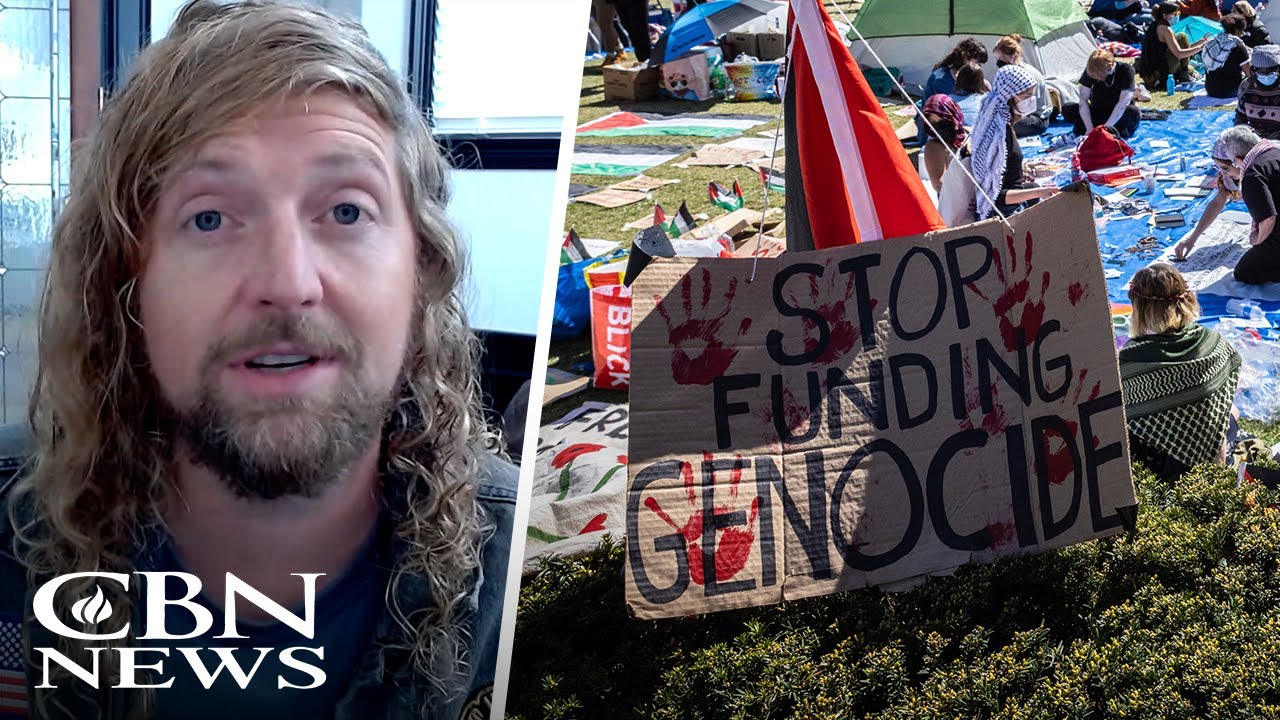
- Feucht appeared on Christian Broadcasting Network to promote the march, and he claimed that the war in the Middle East and discord on campus “reminds us, like, we are living in the last days” and ”these are the End Times.”Other Christian nationalist and right-wing media figures have also embraced the war between Israel and Hamas as a sign of the “End Times,” claiming “the role of Christians is to convert the Jews.” YouTube,[
 ; Media Matters, 11/7/23]
- Feucht appeared on Christian Broadcasting Network to promote the march, and he claimed that the war in the Middle East and discord on campus “reminds us, like, we are living in the last days” and ”these are the End Times.”Other Christian nationalist and right-wing media figures have also embraced the war between Israel and Hamas as a sign of the “End Times,” claiming “the role of Christians is to convert the Jews.” YouTube,[
- On X (formerly Twitter), “proud Islamophobe” Laura Loomer promoted the march and thanked Metaxas, saying he is “leading the charge.”Loomer claimed that “Jew hatred and support of Islamic terrorism on college campuses across America” is “being supported and egged on by @JoeBiden and the Democrat Party.” Loomer has nearly 900,000 followers on X and is known for her anti-Muslim rhetoric, having called herself a “proud Islamophobe.” Twitter/X, [4/23/24; Media Matters, 2/26/24]
- Right-wing provocateur Andy Ngô promoted the march, claiming that at Columbia, there “has been days of an extremist CHAZ-style occupation for Gaza.” Ngô has 1.4 million followers on X. Twitter/X, [4/23/24]
- Charisma, a far-right Christian outlet, promoted the march under a “spiritual warfare” label on its website and said that the march “is needed now more than ever,” calling student protesters “terror-supporting extremists.”The outlet connected the student protests to “spiritual warfare taking place in America” that it said is a result of “adopting ungodly morals and ethics.” Charisma, [4/22/24; Twitter/X, 4/22/24; Media Matters, 4/8/24]
- Actor Patricia Heaton, who has been beloved in right-wing circles for her anti-abortion views, also promoted the march to her more than 500,000 X followers.She wrote, “Friends, here is an opportunity to stand up for humanity, for decency, for democracy, for Judeo- Christian values, for Israel, for America, for Western civilization.” Twitter/X, [4/23/24; Media Matters, 11/16/18; Breitbart, 3/12/24]
---
rubio had to sign off?
an 3 25
Since March 8, Mahmoud Khalil — a 30-year-old Columbia University student — has been held in a federal detention center in Louisiana for, Trump Administration officials allege, expressing sympathy to the terrorist group Hamas during protests on the campus.
Khalil, who was born in Syria to Palestinian parents, is a legal resident of the United States and is not accused of any acts of violence. And his wife is a U.S. citizen. But Khalil is at risk for deportation, and critics of the Trump Administration and U.S. Attorney General Pam Bondi are arguing that his detention is an example of thought policing — not an action based on legitimate national security concerns.
Two of those critics are attorneys Thomas Anthony Durkin and Bernard Harcourt (a law professor at Columbia University in New York City).
READ MORE:Sabotaging Social Security: Behind the leaked memo to cut agency staff and critical services
In an op-ed published by The Guardian on March 21, Durkin and Harcourt argue that the movement to deport students for saying controversial things recalls the late Sen. Joseph McCarthy's (R-Wisconsin) witch hunt of the 1950s.
"The legal risks are real," Durkin and Harcourt warn. "They are perilous, and they are alarming. Where a designated foreign terrorist organization (FTO) — such as Hamas, the Popular Front for the Liberation of Palestine, or related organizations such as the Samidoun Palestinian Prisoner Solidarity Network — is concerned, the line separating political advocacy from material support to terrorism can be razor thin, and any doubt tends to be resolved against those engaged in the political advocacy. FTOs are foreign organizations that the Bureau of Counterterrorism in the U.S. State Department designates as terrorist entities under Section 219 of the Immigration and Nationality Act."
The legal scholars add, "Once such a designation is made, it becomes unlawful for a U.S. person to knowingly provide that group with 'material support or resources.'"
According to Durkin and Harcourt, the "questionable legal strategy" being used against Khalil and other student protesters raises major civil liberties concerns.
READ MORE:'Clear and present danger': Experts alarmed at 'insanity' of Musk getting secret war plans
"Legal jeopardy for political advocacy has long existed in this country despite its storied embrace of the First Amendment," the attorneys explain. "But the Justice Department's new taskforce and threatened anti-terrorist prosecutions reach deeper into policing political dissent than anything seen since the McCarthy era. The consequences could be far more draconian than the usual campus risk of a misdemeanor civil-disobedience arrest or student discipline. The threat to the values of free speech and open debate on college campuses could hardly be more consequential."
READ MORE:Trump official urging Fox viewers to buy Tesla stock decried as 'abuse of power'
*Thomas Anthony Durkin and Bernard Harcourt's full op-ed for The Guardian is available at this link.
---
note no concession appeasement is ever enough
an 3 25
One of the purposes of “flooding the zone,” as the Trump regime is trying to do — shocking and awing us with its blitzkrieg of bonkers orders — is to make it almost impossible to sort out what we should be incredibly freaked out about from what we should merely freak out about.
I’m incredibly freaked out about the regime grabbing people from their homes who are legally in the United States, with permanent status — not just visas permitting them to work or study here but green cards —and then whisking them away to prison because they’ve engaged in constitutionally protected speech that the regime doesn’t like.
You think I’m exaggerating? This is exactly what happened to Mahmoud Khalil on Saturday night. Khalil, who graduated from Columbia’s School of International and Public Affairs in December, has a green card. His wife, who is eight months pregnant, is an American citizen.
Immigration agents appeared at his apartment building and told him he was being detained. He now appears to be in a detention facility in Louisiana.
Khalil did nothing illegal. He has not been charged with a crime. He expressed his political point of view — peacefully, non-violently, non-threateningly. That’s supposed to be permitted — dare I say even encouraged? — in a democracy.
So why is he in jail?
Khalil was one of the leaders of last year’s peaceful pro-Palestinian protests at Columbia University.
In a post on Truth Social, Trump conceded Khalil was snatched up and sent off because of his politics. “This is the first arrest of many to come,” wrote Trump. “We know there are more students at Columbia and other Universities across the Country who have engaged in pro-terrorist, anti-Semitic, anti-American activity, and the Trump Administration will not tolerate it.”
Where, may I ask, are the “First Amendment absolutists” such as Trump First Buddy Elon Trump when it comes to protecting speech that the Trump regime finds objectionable?
Where are all the Republicans who for years have accused liberals of “cancelling” their views?
Where are the conservatives who have claimed for even longer they only want to conserve traditional American values?
Nearly 13 million people in the United States hold green cards. Tens of thousands more are here temporarily as foreign students and professors. Apparently all are now in danger of being arrested if they speak their minds.
If this assault on civil liberties stands, Trump could just as well arrest and expel permanent residents who voice support for, say, transgender people or DEI or “woke” or Ukraine, or anything else the regime finds “anti-American” and offensive.
If it stands, what’s to stop the Trump regime from arresting American citizens who support any cause the regime doesn’t like — such as, say, replacing Republicans in Congress in 2026 and putting a Democrat in the White House in 2028?
Does anyone remember Senator Joe McCarthy’s communist witch hunts? I do. They weren’t pretty. Careers were ruined; reputations, destroyed. They remain a stain on American democracy.
American democracy. That’s what’s at stake. The Trump regime is out to trash it. The regime doesn’t believe in the First or any other amendments. It doesn’t believe in the Constitution.
Let’s commit to ending Republican control of Congress in 2026 and sending this regime packing in 2028 — if there’s still a democracy that enables us to do so.
---
---
aug 2024
no lnx
Why Did Shafik Step Down Now?
Congress grilled seven leaders over campus antisemitism in three hearings. Columbia President Minouche Shafik is now the third leader to resign in the aftermath.
By Josh Moody
Shafik endured the wrath of lawmakers, students, faculty and alumni, only to resign weeks before the fall semester starts.
When Columbia University President Minouche Shafik resigned abruptly on Wednesday, she became the third campus leader since December to step down amid Congressional pressure over how they handled sprawling student protests tied to the war between Israel and Hamas.
But unlike her peers, Liz Magill of the University of Pennsylvania and Harvard’s Claudine Gay, who stepped down soon after their widely criticized performance before lawmakers last year, Shafik seemed to be in the clear. Following her own grueling inquisition by the House Education and Workforce Committee in April, she weathered the wrath of lawmakers, students, faculty and alumni, but maintained the support of Columbia’s board of trustees.
So why did she bow out now, just weeks before the start of the fall semester and during a period of relative calm on campus? The move seemed more likely in a turbulent spring semester, when students set up an encampment on campus and occupied an administrative building, resulting in dozens of arrests, and sharp scrutiny of Shafik.
Most Popular
Where Students Have Had Their Visas Revoked
Government Defends Itself Against Visa Revocations
NIH Resumes Key Grant Review Panels
Thus far, Columbia administrators have had little to say about the timing of her exit. Shafik, in her resignation letter, touched lightly on the matter: “Over the summer, I have been able to reflect and have decided that my moving on at this point would best enable Columbia to traverse the challenges ahead. I am making this announcement now so that new leadership can be in place before the new term begins,” she wrote.
Columbia University did not respond to questions about Shafik’s resignation.
Now Shafik plans to work with the United Kingdom’s Foreign Secretary in an international development role, an area where she has experience, and a job she set up before announcing her departure. Shafik, who holds British, American and Egyptian citizenship, was already a member of the U.K. House of Lords. But it is not clear when talks began for her return to London; the Foreign Secretary’s office did not respond to a request for comment from Inside Higher Ed.
Terrence Casey, a professor of political science at Indiana’s Rose-Hulman Institute of Technology, wrote by email that given Shafik’s “life peer” appointment to Parliament’s upper house in 2020, “there really is no vetting process for Dr. Shafik” to accept a role in the U.K.
Janet Laible, a professor of political science at Lehigh University in Pennsylvania, wrote by email “that since the current [U.K.] government was only appointed after winning elections on July 4, there would not have been any formal communication with her before that.” Still, Laible added, “that is not to say that there was no informal communication” between Shafik and the U.K. government.
When Shafik stepped down, Dr. Katrina Armstrong was announced as interim on the same night. A Columbia administrator and professor, Armstrong will be at the helm when the fall semester begins in early September—and students have made it clear that protests are likely to resume.
Students for Justice in Palestine, a group active in campus protests, has warned that any leader who spurns their demands to divest from Israel and those profiting off the war “will end up exactly as President Shafik did.”
Shafik angered protesters by failing to act on their divestment demands, as well as by allowing police on campus to clear Hamilton Hall, the building they occupied, and arrest those inside. Faculty have likewise expressed outrage over both Shafik’s handling of the occupation and her performance on Capitol Hill, where many believe she failed to defend professors targeted by Congress.
“President Minouche Shafik threw me under the bus when she testified before Congress, but I’m still an employee of Columbia University, she's not. Turns out that capitulating to the bullies didn’t work out well for her. It never does,” Columbia faculty member Katherine Franke wrote on X, referring to Shafik’s acquiescence to Congressional criticism.
Editors' Picks
How Trump’s Early Actions Compare to Project 2025, Other Blueprints
NIH Freezes Millions More in Funding for Columbia
Community Colleges Make Difficult Calls and Cuts Under Trump
Congressional Republicans also blasted Shafik for not cracking down on protesters sooner. On Wednesday night, Several GOP critics took a victory lap as news of Shafik’s resignation spread.
In the immediate aftermath of her resignation, free speech advocacy organizations and the American Association of University Professors (AAUP) condemned Shafik’s leadership at Columbia.
“By suppressing academic freedom and the free speech rights of students and faculty and inviting punitive discipline and a brutal police crackdown on student protests at Columbia, Shafik failed to protect basic tenets of higher education and capitulated to a new McCarthyist witch hunt against the Academy,” AAUP President Todd Wolfson said Thursday. “This is her legacy.”
How We Got Here
Shafik’s resignation was preceded by Liz Magill stepping down as president of Penn in December and Claudine Gay resigning the top job at Harvard in January. Both succumbed to public anger over their disastrous performance at the first Congressional hearing on campus antisemitism, when they and Massachusetts Institute of Technology President Sally Kornbluth gave legalistic and equivocating answers to a hypothetical question about calls for the genocide of Jews on campus. Only Kornbluth, who is Jewish, managed to hold onto her job at MIT.
Shafik had been asked to appear before Congress at that hearing in December, but was unable to do so because she was traveling overseas.
Instead, Shafik received a hearing of her own in April. Flanked by members of Columbia’s Board of Trustees and co-chair of the university’s antisemitism task force, Shafik largely avoided the missteps of her predecessors in the hot seat. When asked the same question that stymied her peers—whether calling for the genocide of Jewish people would violate university policies—Shafik stated clearly that it would at Columbia.
But even as she temporarily escaped the fury of Congress, Shafik outraged many Columbia faculty members who believed she threw them under the bus. And as she was testifying, pro-Palestinian protesters set up an encampment on Columbia’s campus, which would soon spark a wave of similar demonstrations at colleges coast to coast.
Congress held a third hearing on campus antisemitism in May, featuring the presidents of Northwestern University, Rutgers University and the University of California at Los Angeles. Where are they now? Here’s a look at the other six presidents who spoke to Congress, and what happened afterward.
Liz Magill
The Penn president was the first to go. Already under fire for her initial statements on the Israel-Hamas war—and for allowing a Palestinian literary festival to proceed on campus—she apologized and sought to clarify her remarks from the Congressional hearing. But the damage was done; Magill resigned in December amid withering criticism from Congressional Republicans and donors, who threatened to close their checkbooks should she remain at Penn. She had been in the role for a little more than a year.
Penn Board of Trustees chair Scott Bok also stepped down following Magill’s resignation, issuing a warning about allowing donors to wield too much influence.
Claudine Gay
Harvard’s first Black president survived the Congressional hearing only to be felled by another scandal.
Like Magill, she apologized for her missteps before Congress and seemed poised to keep her job until accusations of plagiarism suddenly emerged in December. Harvard initially batted away allegations trafficked by conservative activists but the clamor soon became too loud to ignore; Gay submitted corrections and acknowledged mistakes.
But it failed to placate the critics, and she resigned in January. Afterward, the former Harvard president defended herself, acknowledging she had made some mistakes but arguing that the effort to oust her was racially motivated.
Gay, who has retained a tenured faculty role, was president of Harvard for less than a year.
Sally Kornbluth
Of the first three presidents to speak to Congress, Kornbluth emerged relatively unscathed.
Like her peers, Kornbluth apologized for her missteps in the December hearing. That apology, and a subsequent plan to improve the campus climate by rethinking student disciplinary processes, free expression policies, and diversity, equity and inclusion programs—as well as by launching quality-of-life surveys for students and employees—seemed to satisfy her critics.
At the time of the hearing, Kornbluth, too, was relatively new to the job, with less than a year under her belt as MIT’s president. She is unique, however, in keeping her position despite the fallout.
Gene Block
When the UCLA chancellor spoke to Congress at the third antisemitism hearing in May, he was already on the way out, having announced last August his intent to retire at the end of the academic year. Block, who is Jewish, led UCLA for nearly two decades. But his last year in the job was marred by violence at campus protests.
Block faced criticism from Congress for allowing a large pro-Palestinian encampment to grow on the UCLA campus, a site that later came under attack from pro-Israel counter demonstrators. Violent clashes erupted and videos of pro-Palestinian protesters blocking Jewish students from accessing parts of campus went viral, prompting Congress to haul Block in for questioning.
Flanked by the presidents of Northwestern and Rutgers, the long-time UCLA leader and his peers stood their ground at the hearing, pushing back at times in response to pointed questions.
Block stepped down last month as planned.
Michael Schill
Congressional Republicans took aim at Northwestern’s president during the May hearing—and missed.
Schill was a frequent target at that hearing, with Republicans pressing him about striking a deal with protesters to take down an encampment in exchange for more transparency on investments, scholarships for Palestinian undergraduates and other concessions. They also took issue with the speech and conduct of some Northwestern faculty members, and the university’s business dealings with Qatar.
But Schill pushed back, rejecting the premise of several questions and refusing to discuss individual faculty members or to comment on student speech.
Schill, who has led Northwestern since fall 2022, remains in his role as president.
Jonathan Holloway:
Fresh off of an agreement with campus protesters to remove an encampment in exchange for a discussion about university investment policies and other concessions, the Rutgers president, who has said he opposes divestment, was also called before Congress in May.
Republicans accused both Schill and Holloway of making “shocking concessions to the unlawful antisemitic encampments on their campuses” when they first called the presidents in to testify. But at the hearing, Holloway rejected the notion he made concessions to a mob, as Congress alleged, emphasizing that he was speaking with his students and seeking to minimize disruption.
He was evasive at times, prompting Republican representative Bob Good to ask pointedly: “Are you in a position to answer any questions? Do you have an opinion on anything?”
Despite that criticism, Holloway managed to avoid the major missteps and viral moments that upended other presidents.
Holloway, who has led the university since 2020, remains president of Rutgers.
Next Story
Campus police at the University of Central Florida walk amid student protesters.
Government State Policy
Florida Universities Sign Agreements With ICE
Amid a state crackdown on undocumented migrants, at least 10 public universities are giving campus police immigr
---
MMA
March 7, 2025, edition of The Charlie Kirk Show, streamed on Rumble
CHARLIE KIRK (HOST): Breaking news, everybody. Trump has canceled 400 million dollars to Columbia University over rising antisemitism on campus. That is just the start. For all these campuses that don't treat us well at Turning Point USA, and you guys restrict freedom of speech, your funding might be cut soon.
===
lONDON—However hard they try — and try they do — the British cannot beat Americans for dysfunctional, embarrassing, weird, indeed criminal, politics.
They haven’t witnessed anything like a former “adult film” star conjuring a picture of the 45th president in his underwear, telling her right before they had sex that she reminded him of his daughter, an encounter she describes as “brief.”
Maybe if Prince Andrew had been forced to listen to one of convicted pedophile Jeffrey Epstein’s teenagers discuss her, um, “date” with His Royal Highness in a public courtroom, it might come close to this cringe-making awkwardness.
But the prince settled out of court, so no points there.
Still, while Conservative Prime Minister Rishi Sunak can’t begin to compete with Donald Trump’s epic vulgarity, and members of Parliament insist on speaking in sentences complete with nouns and verbs — unlike many in Congress (looking at you, Marjorie Taylor “peachtree dish” Greene) who could use some English lessons — that doesn’t mean they aren’t giving it their all.
The sitting Tory government knows it’s likely to lose the next election bigly, so for some reason best known to themselves (or attributable to the subsidized booze in the House of Commons bar) they’ve decided to copy every stupid, crazy, hateful hairball of an idea puked up by our own Republicans.
You’re welcome, Britain.
Diversity initiatives in government? No mas.
No more networks for Muslim staff in the Civil Service. No more support of LGBTQ employees.
And no more attaching official IDs to “rainbow lanyards” or other displays of supposedly “woke” tendencies.
Studies show that most Britons support diversity and inclusion in the workplace, but who cares what the voters want?
Define a woman?
The sick and spiteful policies of Florida’s own mini-Mussolini have inspired the Conservatives to embrace a bunch of lousy schemes, such as a new education ruleforbidding schools to teach about where babies come from, contraception, consent, etc. to any kid under 9 — which apparently doesn’t happen anyway — and bans discussion of gender identity.
Don’t say “gay,” don’t say “sex,” and certainly don’t say “trans.”
Rishi Sunak, who likes to say “a man is a man and a woman is a woman,” wants it made clear to the Youth of the U.K. that being trans is bad.
He’s fond of accusing Labour leader Keir Starmer of being “unable to define a woman” (a favorite talking point among U.S. Republicans) and recently added to his image as a jerk of the first order by making a transphobic “joke”in the House of Commons.
He made said “joke” on the day the mother of Brianna Ghey, a 16 year-old trans girl murdered by two teenagers, was sitting in the Commons gallery.
Sunak refused to apologize.
Ronald Dion DeSantis would be proud.
Protests
USF campus police using tear gas on protestors on the USF campus in Tampa on April 30, 2024 (photo credit: Tampa Bay SDS)
Top Gov would not, however, be proud of how the British government is handling pro-Palestinian protests at universities.
Not once have the police been summoned to break up the encampments which have sprung up on the silky lawns of Oxford and in the hallowed halls of the London School of Economics.
The Tories would much prefer the approach of Columbia’s president, Minouche Shafik, who didn’t seem to mind how the cops treated her students and has categorically refused to divest from Israel.
Fun fact: Not only is the dual U.S.-U.K. citizen Shafik a distinguished economist, she was awarded a life peerage by Prime Minister Boris Johnson, he of the hair and the endless scandals.
Baroness Shafik sits in the House of Lords — when she’s not screwing up a major educational institution, that is.
In contrast to Columbia and other seats of learning across the country, many British universities are actually discussing divestment with student demonstrators.
Trinity, the richest college at the very rich Cambridge University, has agreed to give up its stock in arms companiesthat supply the Israeli military.
Gaza protests across the U.K. have been almost entirely peaceful, but that’s not stopping Rishi Sunak from scaremongering, summoning university headsand demanding they take “personal responsibility” for the safety of students, especially Jewish students, some of whom feel understandably uncomfortable about their classmates’ vehement opposition to Israeli policy.
Antisemitism
It’s undeniable there’s a fair amount of anti-semitism in the U.K. , some on the left, some on the right. “Free Palestine” has been spray-painted on buildings in London neighborhoods known to have a substantial Jewish population and Jewish kids verbally harassed.
Some Jewish students say the academic environment is hostile, making them feel vulnerable; others, such as Jews for Justice for Palestinians, have joined the protests.
A group of rabbis, lawyers, and other prominent British Jews have called for a ceasefire.
It’s not that Sunak really likes Israel; it’s more that he really dislikes universities, even though he has degrees from two of them (Oxford and Stanford).
Universities teach young people to question authority, especially the Conservative Party, and often encourage students to pursue what he has called “useless” degrees, the kind that don’t lead to high-paying jobs providing a good “return on investment” to society.
Sunak means degrees in subjects such as the arts and the humanities.
(He himself studied philosophy at Oxford).
Kind of reminds you of Top Gov (Yale and Harvard), doesn’t it?
Brown folks
Then there’s immigration: Ron DeSantis, Donald Trump, and the rest of their whole sick crew despise immigrants — unless they’re rich, conservative and, ideally, from Norway or some other white country.
Brown folks are not welcome.
Dislike of foreigners is also a core value of British Conservatives; they don’t like brown people, either.
They are, however, pretty ecumenical in their xenophobia: Brexit was fueled by pissed-off Britons wanting to throw those dang Poles, Italians, Germans, Filipinos, and other not-English types out of this green and pleasant land.
Never mind the fruit rotting on the vines for lack of farm laborers and the dire shortage of nurses and other health care workers.
I have to admit that on immigration policy, the Sunak government may have Florida and Texas beat.
You will recall Top Gov sent planes to collect asylum seekers from Texas and flew them off to Massachusetts to keep them out of Florida (makes zero sense, I know).
The Tories are more ambitious: They mean to catch the boatloads of desperate refugees when they arrive from France and dispatch them to Rwanda to be “processed.”
Yes, Rwanda, which the Tory government has declared “a safe country,” despite strong rulings to the contrary by the British High Court, and despite what the U.S. State Department calls “significant human rights issues,” i.e. targeting journalists, violence against LGBTQ people, and extra-judicial killings.
The British government has, to date, paid the Rwandan government £370 million pounds.
So far, they’ve flown exactly one guy there.
Slow start
Sunak allows that, sure, it’s a slow start, but it’s not his fault, it’s those human rights groups, high court judges, and flaming liberals in the House of Lords.
He boasts the government is poised to export pesky asylum seekers any day now: Commercial charters have been booked and planes are waiting on runways ready to take off.
Problem is, of the 5,700 refuges deemed “eligible” for removal, more than half of them have disappeared, blending into the general British population, probably working and contributing to the economy.
While the Sunak government has yet to go so far as to claim asylum seekers are rapists and murderers “poisoning the blood” of the nation, their xenophobic rants are nonetheless reminiscent of Trump’s.
Priti Patel, a former Tory cabinet minister, warned that immigration would destroy the U.K. from within.
MP Suella Braverman utters dire warnings about the cross-Channel “invasion.”
Braverman embraces the Great Replacement conspiracy theory, railing against threats to “the West” and dilution of “English culture” from too damn much diversity.
Racist snark
For months, Rishi Sunak seemed to like her racist snark, but then she went too far, accusing the London police of “playing favorites” and being too nice to pro-Palestinian demonstrators.
That was too much for a law-and-order suck-up like Sunak and he fired her.
Unrepentant, she is now the darling of fascist-adjacent groups such as Britain First.
(That name sounds kind of familiar … .)
More fun facts: Sunak, Patel, and Braverman are all the children of immigrants. Their parents came to Britain from Uganda, Mauritius, and Tanzania, children of immigrants from India themselves.
Apparently British Conservatives are so eaten up with prejudice and paranoia they wouldn’t recognize irony if it slapped them upside the head.
Barring some almighty intervention, Labour is going to beat them like a rented mule, and while the party of Keir Starmer isn’t going to bring about the New Jerusalem, they’re unlikely to spend their time in government tormenting the weak and the vulnerable.
They might even do some good.
Meanwhile, the Tories might want to stop taking their cues from Ron DeSantis and his master, the Beast of Mar-a-Lago.
As Rick Wilson, the smartest (ex) Republican in the U.S., reminds us, everything Trump touches dies.
Florida Phoenix is part of States Newsroom, a nonprofit news network supported by grants and a coalition of donors as a 501c(3) public charity. Florida Phoenix maintains editorial independence. Contact Editor Diane Rado for questions: info@floridaphoenix.com. Follow Florida Phoenix on Facebook and Twitter.
===
https://climate.law.columbia.edu/
The no lnx
Sabin Center develops legal techniques to fight climate change, trains students and lawyers in their use, and provides up-to-date resources on key topics in climate change law and regulation.
New Sabin Center White Paper Assesses the New York State Executive Branch's Authority to Enact a Moratorium on the Permitting of Consolidated Proof-of-Work Cryptocurrency Mining Facilities, by Jacob Elkin, March 21, 2022
Renewable Energy Projects Face Opposition in 49 States, Local Restrictions in 31 States, by Jacob Elkin, March 15, 2022
Recent Publications
Regulation of Polyfluoroalkyl Chemicals in New York, by Michael B. Gerrard and Edward McTiernan, New York Law Journal, March 9, 2022
Evaluating Climate Risk in NEPA Reviews: Current Practices and Recommendations for Reform, by Romany Webb, Michael Panfil, Stephanie H. Jones, and Dena Adler, February 15, 2022
Biden's climate promises require oil and gas leasing reform, op-ed by Romany Webb, The Hill, February 3, 2022
Politics v. science: How President Trump's war on science impacted public health and environmental regulation, by Romany Webb and Lauren Kurtz, ScienceDirect, January 27, 2022
The Biden administration's first year: Slow and steady does not win this race, op-ed by Lauren Kurtz and Romany Webb, The Hill, January 20, 2022
News and Events
Events: Argentina's Hydrocarbon Border Expansion: The rise of climate litigation against offshore fossil fuel exploitation, Tuesday, April 5, 2022. Register here.
Compensation for a Just Energy Transition to a Zero-Carbon World: Practices and Principles in International (Investment) Law and Domestic Law, April 14, 2022. Register here.
Sabin Center-UNEP Annual Conference on Global Climate Litigation, April 19-20, 2022. Register here.
News: Paper looks at NY state authority on climate rules, Observer-Review, March 29, 2022
Columbia Law School Pushes Governor to Pause Permits for Cryptomining, Finger Lakes Daily News, March 21, 2022
Climate Law Blog
Guest Post: Brazil Will Have First Climate Litigation Trials in the Supreme Court, by Isabela Soares Bicalho, Gabriel Mantelli, Maria Antonia Tigre and Carmem Añon Brasolin, March 28, 2022
Key Elements of the SEC's Proposed Climate-Related Disclosure Rule, by Romany Webb, March 23, 2022
Australian Federal Court Dismisses the Novel Duty of Care Previously Found in Sharma, by Maria Antonia Tigre, March 21, 2022
===
===
:{Climate Regulations Under a Watchful Internet Eye:(style="-webkit-padding-start:0px"):}:
BY: ZAHRA HIRJI
Bracing for a rollback, website run byColumbia Law School alerts any time President Trump or Congress change a rule involving climate change or energy.
==
law schoolclimate blog
http://blogs.law.columbia.edu/climatechange/2016/06/22/az-court-reverses-protection-for-climate-scientists/
==
In a sentence buried at the very bottom of a story making headlines nationwide, Politico revealed for the first time one of thefunders of Columbia University's influential Center on Global Energy Policy (CGEP).
The funder: ExxonMobil, the company embroiled in a New York state Attorney General investigation for its extensiveinternal knowledge of the impacts of climate change since the 1970s, followed by Exxon's funding of climate change denial campaigns to the tune of $31 million. Politico got its numbers from ExxonMobil's 2014Worldwide Contributions and Community Investments report.
While Politico reported on Exxon's grievances about the Los Angeles Times' two-part investigation conducted by students and staff at Columbia University's Graduate School of Journalism that exposed what Exxon knew about climate change science and when it knew it, it also touched on what money currently flows into the University's coffers via the “private empire.”
“Through its foundation, Exxon gave $219,229 to Columbia in 2014 as part of a matching gift program for educational institutions, as well as $9,000 in direct grants,” reads the article's final paragraph. “The company also gave $25,000 last year to the markets program at the university's Center on Global Energy Policy.”
DeSmog has long sought to discover who funds CGEP and has sent multiple rounds of information requests to the Center, never receiving a response.
The watchdog group Checks and Balances Project, which contacted DeSmog months back about CGEP and its lack of disclosure regarding funding, has also written multiple rounds of letters to the Center and also received no response.
Checks and Balances Project wrote letters to CGEP, published here for the first time on DeSmog, asking for clarification about who butters its bread in both September 2014 and January 2015.
Academic Veneer, Advocacy Reality
As reported previously by DeSmog, CGEP has used the veneer of academia and traded on the Columbia University brand to serve as a leading advocate for exporting oil obtained via hydraulic fracturing (“fracking”)to the global market, as well as forMexico's energy sector privatization and other energy issues.
“If you were looking for a success story in starting up a brand new group at your university and having it very quickly jump into a leading role in the national energy policy debate, Columbia’s CGEP represents the gold standard,” wrote DeSmog's Justin Mikulka back in October. “On the surface the formula is pretty simple, although perhaps not easily replicated without some deep-pocketed funders.”
The Center is headed by Jason Bordoff, former special assistant to President Barack Obama and senior director for energy and climate change for the National Security Council. Bordoff has not responded to multiple requests for comment onCGEP's funding stream sent by DeSmog.
With 22 fellows and 19 faculty affiliates staffed at CGEP — with backgrounds ranging from Wall Street bank oil trading, a U.S.ambassador, an industry executive, industry consultants, etc. — one can probably safely bet that the $25,000 Exxon gave to the Center merely serves as pennies to the dollar in terms of overall industry bucks buttering CGEP's bread. DeSmog will continue digging for answers.
==
http://ecowatch.com/2015/10/15/columbia-divest-fossil-fuels/
==
earth obs ca drought https://www.ldeo.columbia.edu/
==
climate law project cf az 4/15
==
http://www.law.columbia.edu/media_inquiries/news_events/2014/december2014/debating-divestment
A diverse lineup of investment experts hashed out the issues in a Nov. 24 panel discussion at Columbia Law School. The event was moderated by Michael B. Gerrard, Andrew Sabin Professor of Professional Practice and director of theSabin Center for Climate Change Law.
“We need to better understand the competing considerations that inform decisions on divestment,” said Gerrard in introducing the panel, which drew a large audience that included Columbia University President Lee C. Bollinger ’71.
The first speaker was Stephen Heintz, president of the Rockefeller Brothers Fund, which rocked the philanthropy world this fall by announcing plans to divest from fossil fuel investments. Heintz said that, while the fund is a values-oriented institution that reached its decision in part for moral reasons, he also believes that renewable energy is a smart investment that will inevitably eclipse fossil fuels.
“We wanted to demonstrate that you can divest and still make your investment and financial goals,” Heintz said. “This is about opening up a new dimension of debate, and exploring what actions are available to investors, not so much the impact of our particular holdings.”
Offering a very different perspective was Christianna Wood, president and chief executive officer of Gore Creek Capital and a veteran of previous divestment efforts on issues including tobacco. Acknowledging the seriousness of the climate challenge and calling for decisive global action, she argued that divestment damages financial portfolios and prevents constructive engagement that helps companies adopt better environmental practices.
“You lose your right to a voice that you have owning part of the company, and the shares end up in the hands of people who fundamentally don’t care about the issue,” Wood said, contending that only governments can solve the problem of climate change. “Divestment is a blunt instrument incapable of remedying anything.”
Wood added that university endowments and private funds, which cover crucial expenditures ranging from financial aid to health care and pension plans, operate with less room for error than mission-driven philanthropies.
...
ennett Freeman, senior vice president for sustainability research and policy at Calvert Investments, agreed that divestment has limitations, but argued against an all or nothing strategy.
“Divestment at this point is more clearly a political statement than a way to make immediate economic change, but there’s a place for that,” Freeman said, warning against inaction. “Active ownership with engagement with companies, states, and international actors is a promising approach as well. They are two sides of the same coin, going right after the problem.”
Dr. Bruce M. Kahn, a portfolio manager at Sustainable Insight Capital Management and lecturer in the sustainability management program at Columbia University’s Earth Institute, presented data on the recent performance of the S&P 500 indicating lower returns when capital is shifted from fossil fuel related stocks and spread indiscriminately among other investments.
“You have to understand the risks you take when you make decisions, and consider the ramifications of your actions,” Kahn said. “For investors it’s not really about divesting, but about actively creating a different investment strategy.”
Panelists also took questions from Gerrard and the audience, including representatives from Barnard Columbia Divest for Climate Justice.
Generously supported by the David Sive Memorial Fund, the panel was sponsored by the Sabin Center for Climate Change Law, the Earth Institute, the Columbia Center on Sustainable Investment, Columbia Law School’s Environmental Law Clinic, and the Environmental Law Socie
==
The Republican Metals Magnate Fighting Climate Change Through the Courts
 Tate Williams
Go ahead and read that a second time if you want. Andrew Sabin is a Republican donor, owner of a precious metals refiner, and he just gave $3.5 million to support legal strategies to fight climate change.
Sabin’s grant to Columbia Law School will expand upon the school’s Center for Climate Change Law, which he first helped launch with a $1.5 million gift in 2009, to develop legal techniques to fight developers over environmental issues and otherwise combat climate change. The Center is headed by Michael B. Gerrard, who once served as the family business Sabin Metal Corp.’s environmental attorney.
If you’re skeptical of a climate change grant from a guy who also cuts six-figure checks to Karl Rove’s American Crossroads PAC, open your mind, brother. He told the Wall Street Journal that he’s trying to educate his party about the importance of the environment and climate change, saying that “at the end of the day, there's no question that science proves there's climate change."
His Sabin Family Foundation has also given to Conservation International, Earthjustice (another legal environmental group), The Nature Conservancy and Oceana. The guy’s a conservationist, don’t pigeonhole him.
But given that the family’s foundation gave $2.9 million total in 2013, the gift to Columbia is by far his biggest environmental grant. And it takes a pretty interesting approach to fighting climate change by doing legal research and training attorneys how to fight polluters within the bounds of existing law.
“Congress has not enacted a major new environmental law since 1990 and that is not likely to change any time soon,” Gerrard said in a statement about the gift. “Thus our mission is especially vital—developing new legal tools within the existing statutory framework to tackle this extraordinarily important problem.”
Since its founding, the center has worked closely with Columbia University’s Earth Institute, and has released a report rating states’ climate change preparedness, offering legal tools for cities to stop development in areas that might be threatened by rising shorelines.
It also works to help control greenhouse gas emissions and pay particular attention to how well regulations are being followed, where the press and public might not follow.
==
One hundred thirty-six of the 161 core members (84 percent) are male. Eighty-eight percent are whites of European descent (just nineteen are people of color). Fifty-two percent hold graduate degrees—including thirty-seven MBAs, fourteen JDs, twenty-one PhDs, and twelve MA/MS degrees. Almost all have attended private colleges, with close to half attending the same ten universities: Harvard University (25), Oxford University (11), Stanford University (8), Cambridge University (8), University of Chicago (8), University of Cologne (6), Columbia University (5), Cornell University (4), the Wharton School of the University of Pennsylvania (3), and University of California–Berkeley (3). Forty-nine are or were CEOs, eight are or were CFOs; six had prior experience at Morgan Stanley, six at Goldman Sachs, four at Lehman Brothers, four at Swiss Re, seven at Barclays, four at Salomon Brothers, and four at Merrill Lynch.
==
The Sellout of the Ivory Tower, and the Crash of 2008 (Excerpt)
Posted: 05/22/2012
Re-printed fromPredator Nation: Corporate Criminals, Political Corruption, and the Hijacking of America*; Copyright © 2012 by Charles Ferguson. Published by Crown Business, a division of Random House, Inc.
Many people who saw my documentary film about the 2008 economic crisis, Inside Job, found that the most surprising, and disturbing, portion of the film was its revelation of widespread conflicts of interest in universities, think tanks, and among prominent academic experts on finance, economics, business, and government regulation. Viewers who watched my interviews with eminent professors were stunned at what came out of their mouths.
Over the last thirty years, in parallel with deregulation and the rising power of money in American politics, significant portions of American academia have deteriorated into "pay to play" activities. These days, if you see a famous economics professor testify in Congress, appear on television news, testify in a legal case or regulatory proceeding, give a speech, or write an opinion article in the New York Times (or the Financial Times, the Wall Street Journal, or anywhere else), there is a high probability that he or she is being paid by someone with a big stake in what's being debated. Most of the time, these professors do not disclose these conflicts of interest, and most of the time their universities look the other way. Increasingly, professors are also paid to testify for defendants in fraud trials, both civil and criminal. The pay is high -- sometimes a quarter of a million dollars for an hour of congressional testimony. But for banks and other highly regulated industries, it's a trivial expense, a billion or two a year that they barely notice; and just as with politicians, it's a very good investment, with very high benefits.
Academics on industry payrolls are now so numerous and powerful that they can often prevent universities, professional associations, and academic journals from adopting or enforcing strong conflict-of-interest policies. They also have a chilling, even dominant, effect on several areas of academic research and policy analysis.
The sale of academic "expertise" for the purpose of influencing government policy, the courts, and public opinion is now a multibillion-dollar business. Academic, legal, regulatory, and policy consulting in economics, finance, and regulation is dominated by a half dozen consulting firms, several speakers' bureaus, and various industry lobbying groups that maintain large networks of academics for hire specifically for the purpose of advocating industry interests in policy and regulatory debates.
These consulting firms are not like McKinsey or the Boston Consulting Group. They do not exist to help companies make better products or operate efficiently. Their principal focus is on helping companies avoid or influence legislation, public debate, regulation, prosecution, class-action lawsuits, antitrust judgments, and taxes
.
The largest academic regulatory consulting firms are the Berkeley Research Group, the Analysis Group, the Brattle Group, Criterion, Compass Lexecon, and Charles River Associates. All have relationships with many prominent academics. Their combined academic roster is around one thousand, and their combined revenues are certainly well over $1 billion per year. (Most are private and don't release revenue information.) In some cases, they include a majority of the prominent academics in important policy-related fields, such as antitrust policy and the economics of regulation.
But how important and influential are these people and their relationships? Let's take two examples, one Republican and one Democratic: Glenn Hubbard and Larry Summers.
R. Glenn Hubbard became dean of Columbia Business School in 2004, shortly after leaving the George W. Bush administration, where he was chairman of the White House Council of Economic Advisers from 2001 through 2003. Hubbard has a PhD from Harvard and has taught at Columbia since 1988. Hubbard is co-chairman of the Committee on Capital Markets Regulation, a nonprofit organization that serves as a de facto public policy lobbying organization for Wall Street.
Much of Hubbard's academic work has been focused on tax policy. A fair summary is that he has never seen a tax he would like, particularly one on corporations or the wealthy. He was deeply involved in designing the Bush administration's tax cuts in 2003, which heavily favored the wealthy; half of their benefits went to the wealthiest 1 percent of the population.
Hubbard also coauthored an astonishing article with William C. Dudley in November 2004. The article, entitled "How Capital Markets Enhance Economic Performance and Facilitate Job Creation," was published by the Goldman Sachs Global Markets Institute. Dudley, his coauthor, was the chief economist at Goldman Sachs at the time. In 2009, when Tim Geithner became Obama's treasury secretary, Dudley succeeded Geithner as president of the Federal Reserve Bank of New York; he's still there. This should not reassure you. But neither should the fact that Glenn Hubbard remains dean of Columbia Business School.
Their article would be kind of funny, if it weren't deadly serious. Remember, this is November 2004, with the bubble well under way.
- "The ascendancy of the US capital markets . . . has improved the allocation of capital and risk throughout the US economy. . . . [The benefits include] enhanced stability of the US banking system . . .more jobs and higher wages . . . less frequent and milder [recessions] . . . a revolution in housing finance."
- "The capital markets have helped make the housing market less volatile. . . . 'Credit crunches' of the sort that periodically shut off the supply of funds to home buyers, and crushed the homebuilding industry . . . are a thing of the past."
- "The revolution in housing finance has also led to another radical transformation that has been important in making the economy less cyclical."
- "We believe that the economic performance of the United States over the past decade provides strong evidence of the benefits of well-developed capital markets."
Hubbard refused to say whether he was paid to write the article. He also refused to provide me with his 2001 federal financial disclosure form (from when he entered the George W. Bush administration), which we could not obtain otherwise, because the White House had already destroyed it. Hubbard also refused to identify most of his private consulting clients. He is currently on the boards of MetLife, ADP, Inc., KKR Financial Corporation, and BlackRockClosed End Funds. In 2010, the first three paid him $707,000 in cash and stock. Consulting/advisory relationships listed on Hubbard's CV include Nomura Holdings, Bank of America, Capital Research, Citigroup, Fidelity,
Franklin Resources, JPMorgan Chase, Visa, Laurus Funds, Chart Venture Partners, and Ripplewood Holdings. Until January 2009, he was also on the board of Capmark, a major player in commercial real estate during the bubble that went bankrupt after the crisis.
Hubbard was paid $100,000 to testify for the criminal defense of two Bear Stearns hedge fund managers prosecuted in connection with the bubble, who were acquitted. That assignment came through the Analysis Group, one of the large economic consulting firms mentioned earlier. Hubbard's Columbia web page lists the Analysis Group as a consulting client but does not list the ultimate, real clients for whom he worked via this relationship. Nor does his Columbia web page list his paid speaking engagements. However, satisfied clients giving public testimonials to Hubbard's speaking abilities include the Alternative Investment Group, BNP Paribas, the Massachusetts Bankers' Association, and Barclays Bank.
In 2011, Hubbard became a senior economic advisor to Mitt Romney's presidential campaign.
Larry Summers, who is undeniably brilliant, became a full professor at Harvard at a very young age and by now has held almost every important government position in economics. After being chief economist of the World Bank, he became, successively, undersecretary of the treasury for international affairs, deputy treasury secretary, and finally treasury secretary in the Clinton administration. He then became president of Harvard, his candidacy championed by Robert Rubin, until Summers was forced out in 2006. In 2009 he became director of the National Economic Council in the Obama administration; he returned to Harvard in 2011 as a professor at the John F. Kennedy School of Government.
At the World Bank, Summers authorized a memo suggesting that wealthy nations should export pollution to the poor; when president of Harvard, he suggested that women might be innately inferior to men in scientific reasoning. Then there were his policy choices: remaining entirely silent about the abuses within investment banking that furthered the Internet bubble; working with Robert Rubin and Alan Greenspan to repeal the Glass-Steagall Act and then to ban regulation of all privately traded derivatives.
When Summers became president of Harvard, he also started consulting to, and making speeches for, financial services firms. Because Harvard, along with most other major universities, does not require its faculty (or its presidents) to disclose outside income, we do not know how much Summers made. Even now, his Harvard Web page lists none of his consulting clients or speaking engagements.
Most of our information about his outside activities at Harvard comes from his mandatory federal disclosure form. (Like Summers himself, Harvard's president and provost declined to be interviewed for my film and also declined to respond to written questions.) Shortly after he was forced to resign as president and returned to being a professor, Summers agreed to work one day a week at D. E. Shaw, a large hedge fund, which paid him over $5 million in the year before Summers entered the Obama administration in 2009.
Summers's 2009 federal disclosure form stated his net worth to be $17 million to $39 million. His total earnings in the year prior to joining the administration were $7,813,000. He made $1,729,000 from thirty-one speaking engagements, nearly all for financial services companies; Goldman Sachs paid him $135,000 for one speech. He was also paid $45,000 by Merrill Lynch for a speech on November 12, 2008 -- after Merrill had completely collapsed financially, and one week after Obama's election. After questions were raised, Summers donated the Merrill Lynch fee to charity.
In the Obama administration, Summers opposed strong measures to sanction bankers or curtail their income. He has never apologized for any of the decisions or statements he made between 1995 and 2006.
And as of early 2012, the web page on his speaking agent's website included testimonials about Summers from seven clients. All but one (Regent University) were financial; they included the Texas Pacific Group, the Chinese Finance Association, Charles River Ventures, and Institutional Investor magazine.
===
strasssel cites on exxon rico:
Columbia Law Professor Merritt B. Fox:
:{:{Michael E. Patterson Professor of Law; }::{NASDAQ Professor }::{for the Program in the Law & Economics of Capital Markets;}:
Co-Director, Center for Law & Economic Studies
Columbia Law School}:
Co-Director, Program in the Law & Economics of Capital Markets
Columbia Law School & Columbia Business School
Professor Fox, one of the three Co-Directors of the program, teaches several business law classes from a law and economics perspective at Columbia Law School, including Securities Regulation, International Securities Regulation,Capital Markets Regulation (jointly listed for both Columbia Law School and Columbia Business School students), and Corporate Finance. His scholarly work has focused on corporate governance, global securities regulation, securities disclosure, securities litigation, and related law and economics issues more generally. He has served as the Co-Director of Columbia Law School's Center for Law and Economic Studies since July 2004 and as the Co-Director of the Program on the Law and Economics of Capital Markets since July 2007.
Prior to joining the faculty at Columbia Law School in 2003, Professor Fox taught at the University of Michigan Law School for 15 years, where he also served as Director of the Center for International and Comparative Law from July 1999 through June 2003 and the Co-Director for Corporate Governance Studies for the William Davidson Institute at the University of Michigan Business School. Prior to joining the University of Michigan in 1988, he was a professor at Indiana University Law School where he began teaching full time in 1980. He is also the past chair of the Business Associations Section of the American Association of Law Schools.
Befor entering the academy, Professor Fox practiced in the Securities and Capital Markets area with the firm of Cleary, Gottlieb, Steen & Hamilton LLP from 1974 to 1980. During this period, he also completed his doctoral work in Economics and taught as an adjunct professor at Fordham University Law School (from 1976 through 1980) and an acting instructor and visiting lecturer at Yale College (in 1973 and 1976, respectively).
Education: B.A. (Political Science and Economics), Yale University (1968); J.D., Yale University (1971); Ph.D. (Economics), Yale University (1980)