bunch, jonathan BH fund
#2 to leo
===}:
SLUDGE
Former law professor Neomi Rao is facing headwinds in her judicial nomination, so Charles Koch’s Americans for Prosperity is stepping in.
:{:{Billionaire manufacturing magnate Charles Koch has for decades used his enormous wealth and political power to install elected officials (https://readsludge.com/2018/10/19/koch-and-adelson-come-to-the-rescue-of-trump-devotee-ron-desantis-in-florida/),}:
government administrators (https://www.salon.com/2016/06/19/big_men_on_campus_the_koch_brothers_university_donations_are_a_veiled_political_weapon/), and regulators (https://readsludge.com/2018/10/04/koch-backed-sec-commissioner-claims-corporate-law-is-in-the-public-interest/) who will keep the business interests of Koch Industries and other giant, heavily polluting companies in mind.}:
But Koch is also dipping into the judicial arena. One of his protegés has been nominated by President Trump and is poised to join the second-most powerful court in the United States, and Koch’s premier political spending group wants to make sure it happens.
In 2016, the Charles Koch Foundation (CKF) and a mystery donor combined to give $30 million to the George Mason University (GMU) law school, renaming it after the late, conservative Supreme Court Justice Antonin Scalia. Koch’s foundation put in $10 million, and the remaining $20 million, it was later discovered, was administered by Federalist Society officials through a 501(c)(4) nonprofit, BH Fund.
:{:{The grant established 12 new law professorships—nearly all the hires had ties to the conservative Federalist Society (https://legacy.tyt.com/2018/05/18/after-donation-administered-by-federalist-society-leaders-gmu-hired-professors-tied-to-the-federalist-society/)—}:
and founded two ideological law school centers (https://ia601201.us.archive.org/24/items/GMUASSLawMOU2016/GMU%20ASSLaw%20MOU%202016.pdf#page=6),
the Center for Liberty and Law and the Center for the Study of the Administrative State. The founder and director of the latter center was Neomi Rao (https://www.law.gmu.edu/assets/files/faculty/cv/rao.pdf), who had been a law professor at GMU since 2012. She previously clerked for the most conservative Supreme Court justice, Clarence Thomas, and was associate counsel and special advisor to President George W. Bush. She has never been a judge.}:
Rao took a leave of absence from George Mason in 2017 when President Donald Trump appointed her as director of the White House Office of Information and Regulatory Affairs (OIRA), Trump’s “regulation czar.”
:{:{The dean of the GMU law school told another donor to her center, corporate lobbyist and longtime Koch ally C. Boyden Gray (https://www.desmogblog.com/c-boyden-gray), that he hoped to lure her back to GMU with a $1.5-million professorship, funded by Gray, according to an email unearthed by GMU alumna Allison Pienta (}:
:{:{http://www.unkochmycampus.org/dec-20-2018-donor-control-at-gmu-update?rq=boyden%20gray).}:
“This chair would help me to entice Neomi to return home to Scalia Law after she dismantles the administrative state (https://www.documentcloud.org/documents/5750669-Antonin-Scalia-Law-School-Grant-Agreement.html#document/p2/a484188)
while serving at OIRA,” he wrote in a May 2017 letter to Gray. Gray gave another $3 million to the center, and it was renamed in his honor.}:}:
Dismantling the administrative state (p. 2) (https://www.documentcloud.org/documents/5750669-Antonin-Scalia-Law-School-Grant-Agreement.html#document/p2/a484234)
IFrame Content (https://www.documentcloud.org/documents/5750669-Antonin-Scalia-Law-School-Grant-Agreement/annotations/484234.html?embed=true&maxheight=750&maxwidth=500)
View entire document on DocumentCloud (https://www.documentcloud.org/documents/5750669-Antonin-Scalia-Law-School-Grant-Agreement.html#document/p2/a484234)
But instead of returning to the law school, Rao may be headed to the powerful D.C. Circuit Court of Appeals to fill the seat vacated by the newest Trump-appointed Supreme Court justice, Brett Kavanaugh. Rao’s GMU center hosted a conference (https://administrativestate.gmu.edu/rethinking-judicial-deference/) in 2016 that featured Kavanaugh, a fellow Federalist Society member, as keynote speaker.
Rao’s judgeship nomination is perhaps the crowning achievement of the Antonin Scalia Law School’s initiative to reshape the federal judiciary. In 2017, the law school’s Law and Economics Center, which CKF had been funding for years, drew up a funding proposal (https://www.documentcloud.org/documents/5751080-GMU-Law-and-Economics-Center-Federal-Judges-and.html) for the center’s “Federal Judges and Attorneys General Initiatives.”
‘Reshaping’ the Federal Bench
“The election of Donald Trump presents a historic opportunity for a new president to reshape the federal judiciary, reform the regulatory state, promote economic growth, and restore constitutional federalism,” reads the proposal.
The program educates newly appointed judges on economics and other issues so they will “be more likely to make sound decisions that support the rule of law and the free enterprise system.” The new Federal Judges Initiative will “cover topics expected to be highly relevant to the current presidential administration’s policy agenda, such as the economics of health care and health financing, financial services regulation, environmental and energy regulation, health and safety regulation, privacy, labor and employment law, and telecommunications regulation.”
As of 2017, over 5,000 judges and 700 state attorneys general had participated in at least one Law and Economics Center program. In the 2018 fiscal year, the Law and Economic Center requested over $1.7 million for its Judicial Education Budget.
“Rao’s transition from the Koch-funded Antonin Scalia School of Law to her nomination to the second-highest court in the country is exemplary of Koch’s successful strategy of leveraging George Mason University to exert influence on the judicial branch for decades to come,” Samantha Parsons, a GMU graduate and director of campaigns at the activist group UnKoch My Campus, told Sludge. “Her nomination should serve as a warning of the anti-democratic agenda we can expect throughout our nation’s judicial system should George Mason University succeed in its goals to facilitate the education and placement of hundreds of new federal judges under Trump’s presidency.”
:{:{In December, when Trump nominated Rao, Koch’s most prominent political advocacy organization, Americans for Prosperity, endorsed (https://americansforprosperity.org/afp-endorses-slate-of-highly-qualified-judicial-nominees/) her for the judgeship.}:
But Rao has since encountered some bumps in the road. Republican Missouri Sen. Josh Hawley said he has “deep concerns (https://www.axios.com/neomi-rao-dc-circuit-nominee-josh-hawley-concerns-228fe428-7944-430a-bc5c-71a50278ec38.html?utm_source=twitter&utm_medium=twsocialshare&utm_campaign=organic),” telling Axios that she may not be sufficiently anti-abortion.}:
At a recent Senate committee hearing, Iowa Republican Sen. Joni Ernst expressed concerns over Rao’s 1994 essay on date rape (https://www.washingtonpost.com/local/legal-issues/neomi-rao-pressed-on-past-writings-on-date-rape-at-hearing-on-her-judicial-nomination/2019/02/05/156b4784-28b4-11e9-b2fc-721718903bfc_story.html?utm_term=.e68dab1a1db9), which alleged that women who are raped while drunk are partially to blame for being raped. Rao’s OIRA has stalled issuing an employer guidance on sexual harassment for 15 months (https://theintercept.com/2019/02/04/neomi-rao-hearing-oira-brett-kavanaugh/), a process that normally takes no longer than 90 days, as David Dayen reported for The Intercept.
:{:{Americans for Prosperity will fund digital advertising and grassroots efforts (https://www.axios.com/neomi-rao-dc-circuit-nominee-josh-hawley-concerns-228fe428-7944-430a-bc5c-71a50278ec38.html?utm_source=twitter&utm_medium=twsocialshare&utm_campaign=organic)}:
in an attempt to sway public opinion in favor of Rao this week, according to Axios. On Tuesday morning, the Facebook ad archive (https://www.facebook.com/ads/archive/?active_status=all&ad_type=political_and_issue_ads&country=US&q=americans%20for%20prosperity) listed six AFP ads in favor of Rao, which began running on Monday. Each ad targets one Republican senator, including Ernst and Hawley, urgin Facebook users to tell their senator to vote for Rao’s D.C. Circuit Court nomination. Additional targeted senators are Ted Cruz (Texas), Marsha Blackburn (Tenn.), James Lankford (Okla.), and Ben Sasse (Neb.). The Google ad archive did not list any recent AFP purchases.}:
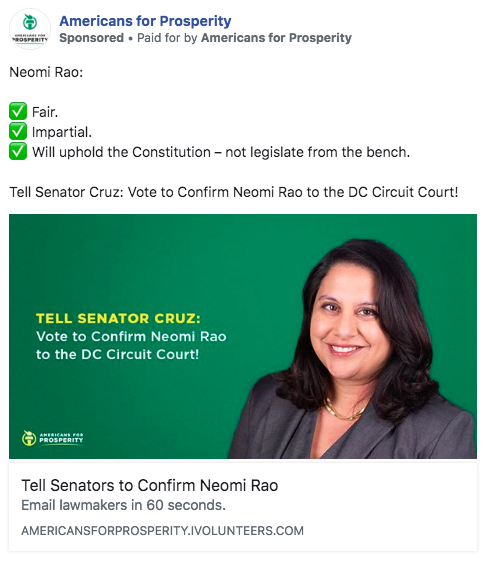 One of Americans for Prosperity’s Facebook ads supporting Neomi RaoFacebook Ad Archive
Americans for Prosperity did not reply to Sludge’s request for comment.
‘Regulatory Obstruction’
The American Constitution Society says OIRA, which is part of the Office of Management and Budget, “has embraced politicized regulatory obstruction (https://www.acslaw.org/acsblog/a-lesson-in-failure-oira-neomi-rao-and-deregulation-at-any-cost/) as its raison dêtre” under Rao. In OIRA’s 2018 report (https://www.whitehouse.gov/wp-content/uploads/2018/10/2018-Unified-Agenda-Cutting-the-Red-Tape.pdf), entitled “Cutting the Red Tape,” Rao writes, “we are working to push back the expansion of the administrative state, which has placed undue burdens on the public and impeded economic growth.”
Under Rao’s leadership, OIRA, has approved sweeping environmental deregulation by the EPA. Koch Industries, which Charles Koch runs, is a giant manufacturing conglomerate with subsidiaries that refine and transport oil, create paper products, and produce chemicals. The company is among the country’s biggest air and water polluters and has paid hundreds of millions of dollars for environmental violations. Koch and his brother David are lifelong libertarians who have fought taxes and regulations for decades.
“Rao has never seen a regulation she didn’t hate, and as a judge would dismantle 40 years of environmental and social progress,” Brett Hartl, government affairs director at the Center for Biological Diversity, said (https://www.buzzfeednews.com/article/zoetillman/trump-nominates-neomi-rao-brett-kavanaugh-seat) in a statement to Buzzfeed News. “Her confirmation would be the most damaging and regressive yet by Trump after Kavanaugh and Gorsuch.”
GMU is by far the biggest recipient of grants from the Charles Koch Foundation (CKF), which gives tens of millions of dollars each year to free-market higher education programs. Since 2005, CKF and the Charles Koch Institute have donated nearly $129 million to GMU, including over $34 million for the free-market Mercatus Center, according to Sludge’s analysis. Another free-market-focused GMU center, the Institute for Human Studies, has received $8.7 million.
The university has come under fire for allowing the CKF to impact hiring decisions (https://www.insidehighered.com/news/2018/05/01/koch-agreements-george-mason-gave-foundation-role-faculty-hiring-and-oversight). In the case of Florida State University, CKF was even allowed to control economics curricula (https://publicintegrity.org/federal-politics/koch-foundation-proposal-to-college-teach-our-curriculum-get-millions/).
AFP isn’t the only Koch-linked group to spend money to influence the judiciary. The Center for Media and Democracy reports that Donors Trust, a donor-advised fund that wealthy conservatives including Koch use to score tax deductions and potentially anonymize their donations to nonprofits, has bankrolled right-wing groups (https://www.prwatch.org/news/2019/02/13449/donorstrust-bankrolled-right-wing-judicial-appointments-trumps-acting-ag-and) such as the Judicial Crisis Network and its sister organization, the Judicial Education Project, which spent millions of dollars on ads supporting the Supreme Court confirmation of Neil Gorsuch. Donors Trust also funds the Federalist Society and, as Sludge recently reported, several Southern Poverty Law Center-designated hate groups (https://readsludge.com/2019/02/19/americas-biggest-charities-are-funneling-millions-to-hate-groups-from-anonymous-donors/).
Related:
Charles Koch Is Funding Rightwing, Pro-Trump Media, New Disclosure Reveals (https://readsludge.com/2018/11/21/charles-koch-is-funding-rightwing-pro-trump-media-new-disclosure-reveals/)
Koch Brothers Continue to Influence Tax Policy After Huge Cuts Last Year (https://readsludge.com/2018/06/18/koch-brothers-continue-to-influence-tax-policy-after-huge-cuts-last-year/)
Koch-Backed SEC Commissioner Claims Corporate Law is in the Public Interest (https://readsludge.com/2018/10/04/koch-backed-sec-commissioner-claims-corporate-law-is-in-the-public-interest/)
Author profile](https://readsludge.com/author/alex/)
Alex Kotch (https://readsludge.com/author/alex/)
Alex is a reporter at Sludge and a contributor to The Young Turks. He was previously part of the award-winning investigative team at International Business Times, and his other work has appeared in T
---
https://www.alternet.org/playing-fast-loose-megadonor-watchdog/
an no lnx
How a Republican megadonor is 'playing fast and loose' to push 'dangerous, extreme agenda': watchdog
Maya Boddie June 18, 2023
Republican billionaire Leonardo Leo's trust fund, Marble Freedom Trust's latest Internal Revenue Service (IRS) filing, revealing the former President Donald Trump donor's mission to control right-wing politics, Truthout reports.
Progressive watchdog Accountable.US obtained the recent IRS filing, which according to Truthout, shows the Federalist Society leader "has dumped at least $411 million into fueling right-wing infrastructure in the U.S. since mid-2020."
Furthermore, according to Truthout, the filing reveals "Leo has spent at least $182 million during the Biden administration to fund right-wing groups from May 1, 2020, through April 30, 2022," noting, "This surge has come as Leo has become more publicly outspoken in attacking reproductive rights as well as efforts to protect our environment and crucial measures that advance Americans' equality."
READ MORE: Conservative activist arranged for Clarence Thomas’ wife to get secret payouts
Additionally, it "adds to the growing public knowledge of how Leo's for-profit business works in tandem with nonprofit groups he funds to change the rules in our democracy, and also provides a glimpse of how lucrative this effort is."
The news outlet reports prior to Accountable's findings, "the Campaign for Accountability filed an IRS complaint against Leo based on other filings showing that seven of his affiliated nonprofits had sent $73 million to his for-profit CRC Advisors."
Truthout also notes:
As Sen. Sheldon Whitehouse (D-Rhode Island) has noted, before the public learned of the existence ofMarble Freedom Trust, Leo rose to prominence as a volunteer advising Trump by creating the list of Supreme Court candidates that Trump chose from, as well as by helping to secure the confirmation of three controversial high court nominees — Neil Gorsuch, Brett Kavanaugh and Amy Coney Barrett (and helped get numerous other lower court judges appointed). As True North documented, Leo's network played a central role in this right-wing court packing, raising over $600 million from 2014 through the 2020 election. This dark money network has received more than $2 billion when accounting for Marble.
Accountable President Kyle Herrig told Truthout he believes "Leonard Leo is playing fast and loose with his $1.6 billion slush fund, enriching himself and doling out paychecks and favors for his cronies," adding, "This kind of corruption is par for the course for Leo. It clearly pays to do his bidding."
READ MORE: Charities often move 'dark' money that shapes public policy: report
Herring said, "This is just the latest development in Leonard Leo's decades-long scheme to push his dangerous, extreme agenda and get rich while doing it. From personal enrichment for himself and his inner circle to his machine of nonprofits advancing the MAGA agenda, we’ve only scratched the surface of Leo’s devastating impact on our democracy."
READ MORE: 'Largest political donation ever': Trump ally received $1.6 billion through Federalist Society contact
Truthout's full report is available at this link.
FROM YOUR SITE ARTICLES
New report details Clarence Thomas’ 'shady ties to sprawling network of dark money' ›
'No mention of Ginni': Kellyanne Conway may have confirmed payments made to Clarence Thomas’ wife ›
Trump Supreme Court advisor Leonard Leo tied to more than $80 mllion in dark money ›
RELATED ARTICLES AROUND THE WEB
Leonard Leo used Federalist Society contact to obtain $1.6B ... ›
Leonard Leo Pushed the Courts Right. Now He's Aiming at ... ›
Federalist Society's Leonard Leo is helping Trump make courts ... ›
ref
apr 2023
https://truthout.org/articles/new-details-from-leonard-leos-trust-fund-expose-the-inner-workings-of-the-right/
newly obtained documents show that the billion-dollar trust fund given to Leonard Leo — the right-wing attorney and longtime leader the Federalist Society who orchestrated Donald Trump’s Supreme Court picks — has dumped at least $411 million into fueling right-wing infrastructure in the U.S. since mid-2020.
:{
}:
The latest IRS filing of the new nonprofit, Marble Freedom Trust — obtained by:{ :(style="background-color:#f8f8f8;"):}::{Accountable.US:(style="background-color:#ffff66;"):}:, a progressive watchdog group — shows that Leo has spent at least $182 million during the Biden administration to fund right-wing groups from May 1, 2021, through April 30, 2022. This surge has come as Leo has become more publicly outspoken in attacking reproductive rights as well as efforts to protect our environment and crucial measures that advance Americans’ equality.
Leo chose to have most of that, more than $153 million, wash through the Schwab Charitable Fund, a “donor-advised fund” that serves as a passthrough to help obscure the money trail between a funder and its beneficiaries. In recent years, since Leo secured control of $1.6 billion in the largest single gift of its kind from Chicago billionaire Barre Seid, Leo’s network of groups has relied heavily on donor-advised funds to move cash between entities in ways that can help keep the original donor secret from the public.
marble’s filing included only one other grantee: the Concord Fund (also known as the Judicial Crisis Network), to which it gave a $29 million gift. The Concord Fund then paid $12 million in fees to CRC Advisors, a for-profit PR firm that Leo has helped helm since 2020.
Kyle Herrig, the president of Accountable told Truthout that in his opinion “Leonard Leo is playing fast and loose with his $1.6 billion slush fund, enriching himself and doling out paychecks and favors for his cronies. This kind of corruption is par for the course for Leo. It clearly pays to do his bidding."
before Accountable’s latest revelations, theCampaign for Accountability filed an IRS complaint against Leo based on other filings showing that seven of his affiliated nonprofits had sent $73 million to his for-profit CRC Advisors.
Despite more than $1 billion in assets, Leo’s Marble Freedom Trust has no publicly known website, and its street address is actually a UPS drop box in Utah. Meanwhile, however, Marble disclosed spending nearly $250,000 on “office expenses.” Its disclosed phone number, with an area code for southeastern coast of Florida, has been held for years — well before Marble was created — by Leo’s longtime collaborator Neil Corkery, an anti-gay rights and anti-abortion operative central to Leo’s court capture network.
This latest filing also adds to the growing public knowledge of how Leo’s for-profit business works in tandem with nonprofit groups he funds to change the rules in our democracy, and also provides a glimpse of how lucrative this effort is.
Marble’s filing shows that in its second year of operations Leo gave himself a raise from $350,000 to $400,000 a year for working part-time (25 hours a week) for the trust he controls. It also reported that he spends 10 hours a week on Rule of Law Trust, a 501(c)(4) nonprofit launched in 2018 with a gift of nearly $80 million from a donor kept secret from the public. Leo is the only trustee of that entity, and Corkery holds its books. Like Marble, it has no website and its address is a drop box location. Its listed phone goes to a law firm.
Marble’s latest filing shows that Leo’s billion-dollar trust also added a new employee to its operations: Alex Marshall as CIO, an acronym that typically stands for Chief Information Officer. His salary was listed at a whopping $764,000.
According to Accountable, until 2021 Marshall was likely working as a branch manager for the investment firm Oppenheimer & Co., a brokerage firm and investment bank, and was likely making hundreds of thousands less because Marshall’s broker record indicates he completed “entry-level” financial industry exams for principal and supervisory roles.
How did Alex Marshall get plugged into Leo’s operation?
As True North Research’s Lisa Graves first uncloaked, Alex Marshall is married to Maria Marshall, who currently works at Leo’s CRC Advisors and previously worked for the Federalist Society, the networking group created to get right-wing lawyers into powerful offices. Marshall’s title was “director of operations” in the “Office of the Federalist Society’s Executive [Vice President].” That was Leo’s office, where she handled his schedule, among other roles. She previously worked as U.S. Sen. Arlen Specter’s scheduler.
She left her day job to work with Leo, who also left his day job at the Federalist Society in 2020 to help lead the PR firm Creative Response Concepts, which rebranded as CRC Advisors, though he still helps lead and fund the Federalist Society as co-chair of its board.
While she was working for Leo at the Federalist Society, Leo’s Rule of Law Trust paid nearly $600,000 to YAS, LLC. That is the name of the Washington, DC-filed consulting firm created in 2015 and owned by Maria Marshall. Leo’s Rule of Law Trust paid YAS another $175,000 in 2020, after he left his employment but not his leadership role with the Federalist Society.
The Marshalls were also guests at the special table purchased by the major “anonymous” donor to the renaming ceremony of George Mason University’s law school in tribute to Antonin Scalia, an event cohosted by Leo.
Allison Pienta, a George Mason student who worked with UnKoch My Campus to obtain public records, revealed that the anonymous donor who gave $20 million to rebrand the law school and put Leo in a key role was none other than Barre Seid. (Charles Koch also gave $10 million to fund the law school.) There is no indication that Seid, a notoriously secretive billionaire, was there at the Scalia tribute dinner cohosted by Leo.
The Marshalls were at that special table alongside Jonathan Bunch, who was later named as a successor trustee at Marble, meaning he is Leo’s potential successor at the billion-dollar trust.Bunch, who is now listed as president of CRC Advisors, was paid more than $1.5 million for consulting by Leo’s Rule of Law Trust in 2018,when he was also working at the Federalist Society with Leo. Two years later, as Heidi Przybyla from Politico documented, Bunch and his wife closed on a $1.28 million home on the Chesapeake Bay, a second home a few hours south of their longtime home in a suburb of Washington, D.C.
As Accountable uncovered, since the launch of YAS, the Marshalls also purchased a second home near the beach in Avalon, New Jersey, the third most expensive zip code in the state. That research revealed that the Marshalls rent out the home, valued at $1.38 million home, for up to $7,700 a week depending on the season.
As Robert O’Harrow Jr. and Shawn Boburg documented in the Washington Post, on the eve of the Senate vote on Brett Kavanaugh’s nomination by Donald Trump to the U.S. Supreme Court,Leo bought a $3.3 million seaside mansion in Maine.
Just two months after that story broke, and less than a year after he closed on the mansion, Leo paid off the mortgage in full, for more than $2 million, while he was still working as the executive vice president of the Federalist Society, with a six-figure salary. As the Post revealed, a year earlier, after Supreme Court Justice Anthony Kennedy announced his retirement and as Leo was advising Trump on packing the Supreme Court as well as aiding the effort to get Trump’s nominees confirmed, Leo paid offhis 30-year mortgage 22 years ahead of schedule.
As Politicolater detailed, after officially joining CRC Advisors, Leo bought a second mansion in Maine, and has spent his growing wealth by purchasing four new cars, paying private school tuition for his children, and obtaining a wine buyer and locker at Morton’s Steakhouse. He has also donated hundreds of thousands of dollars to religious groups and he has also spent money on electoral candidates himself. Additionally, Leo-tied nonprofits have directed millions of dollars to playing an increasing role targeting voters around elections.
As Sen. Sheldon Whitehouse (D-Rhode Island) has noted, before the public learned of the existence of Marble Freedom Trust, Leo rose to prominence as a volunteer advising Trump by creating the list of Supreme Court candidates that Trump chose from, as well as by helping to secure the confirmation of three controversial high court nominees — Neil Gorsuch, Brett Kavanaugh and Amy Coney Barrett (and helped get numerous other lower court judges appointed). As True North documented, Leo’s network played a central role in this right-wing court packing, raising over $600 million from 2014 through the 2020 election. This dark money network has received more than $2 billion when accounting for Marble.
As *Politico* noted, “Campaign-style politics — and the generous paydays that go along with it — are now adjacent to the Supreme Court, the one U.S. institution that’s supposed to be immune to it.”
Leo’s ties to such efforts are not only recent. Last month, the Washington Post revealed that in2012 Leo had been instructing Kellyanne Conway, who ran the Polling Company, to bill the Judicial Education Project (now known as the 85 Fund and the Honest Elections Project) to pay Ginni Thomas up to $100,000.She is the wife of Supreme Court Justice Clarence Thomas.That is, Leo was secretly orchestrating the pay of the wife of a Supreme Court Justice, Clarence Thomas, from a secret funder. That funder’s identity remains hidden. That year, the Judicial Education Project also paid CRC $165,000. CRC later acquired the Polling Company in 2017, with the help of another Leo group, as Politico revealed late last year.
Leo’s income from his for-profit operations or any consulting, such as CRC Advisors, is not required to be publicly disclosed.
The new filing that Accountable.US obtained provides vital insights into how Leo is using the billion that Seid gave him and also provides new information about the shape of his efforts to remake our courts and our country to advance his view of the world.
“This is just the latest development in Leonard Leo’s decades-long scheme to push his dangerous, extreme agenda and get rich while doing it,” Herrig told Truthout. “From personal enrichment for himself and his inner circle to his machine of nonprofits advancing the MAGA agenda, we’ve only scratched the surface of Leo’s devastating impact on our democracy.”
Note: Lisa Graves, True North’s executive director, contributed to this piece. A correction was made post-publication to correct a typo in a date (changing “May 1, 2020” to “May 1, 2021).
[[ no mention of bunch?
an 8 23
:{ former United States Department of Justice trial attorney under ex-President Bill Clinton is probing Republican billionaire and ex-President Donald Trump donor Leonard Leo along with "his network of nonprofit groups," POLITICO exclusively reports.
}:
Washington, D.C. Attorney General Brian Schwalb's investigation comes after the GOP billionaire and Federalist Society leader's trust fund, Marble Freedom Trust's latest Internal Revenue Service (IRS) filing revealed in June Leo's mission to control right-wing politics, according to a Truthout report.
Truthout notes the IRS filing obtained by progressive watchdog Accountable.US "shows the Federalist Society leader 'has dumped at least $411 million into fueling right-wing infrastructure in the U.S. since mid-2020.'"
POLL: Should Trump be allowed to hold office again?"
According to POLITICO, the probe also "comes after POLITICO reported in March that one of Leo's nonprofits — registered as a charity — paid his for-profit company tens of millions of dollars in the two years since he joined the company.'
The news outlet notes that "a few weeks later, a progressive watchdog group filed a complaint with the D.C. attorney general and the IRS requesting a probe into what services were provided and whether Leo was in violation of laws against using charities for personal enrichment."
POLITICO reports:
Best known as Donald Trump's White House 'court whisperer,' Leo played a behind-the-scenes role in the nominations of all three of the former president's Supreme Court justices and promoted them through his multi-billion-dollar network of nonprofits. Trump chose his three Supreme Court picks, Neil Gorsuch, Brett Kavanaugh and Amy Coney Barrett, from a list drawn up by Leo. More recently, Leo was the beneficiary of a $1.6 billion contribution, believed to be the biggest political donation in U.S. history.
"There are questions as to whether Leo-affiliated nonprofits have diverted substantial portions of their income and assets, directly or indirectly, to the personal benefit of Leonard Leo," the Campaign for Accountability's complaint said. "Such payments were generally listed as made in exchange for alleged consulting, research, public relations, or similar services. However CFA has reasonable questions about whether those alleged services were actually rendered at all or, if services were rendered, whether the payments made were substantially in excess of fair market value."
Per the report, "The news of the investigation comes as the nonprofit that was a subject of the complaint quietly relocated in recent weeks from the capital area to Texas, according to paperwork filed in Virginia and Texas," after "for nearly 20 years the nonprofit, now known as The 85 Fund, had been incorporated in Virginia."
The news outlet notes:
The Leo-aligned nonprofit The 85 Fund — which is registered as a tax-exempt charity — paid tens of millions of dollars to a public relations firm in Virginia which he co-chairs in the two years since he joined the firm, known as CRC Advisors. The watchdog complaintalleges the total amount of money that flowed from Leo-aligned nonprofits to his for-profit firms was $73 million over six years beginning in 2016.
According to POLITICO, attorney David B. Rivkin Jr., who represents the parties in the probe, "said in a statement that the complaint 'is sloppy, deceptive and legally flawed and we are addressing this fully with the DC Attorney General's office.'"
Politico's full report is available at this link.
HEIDI PRZYBYLA
08/22/2023
Washington
D.C. Attorney General Brian Schwalb is investigating judicial activist Leonard Leo and his network of nonprofit groups, according to a person with direct knowledge of the probe.
The scope of the investigation is unclear. But it comes after POLITICO reported in March that one of Leo’s nonprofits — registered as a charity — paid his for-profit company tens of millions of dollars in the two years since he joined the company. A few weeks later, a progressive watchdog group filed a complaint with the D.C. attorney general and the IRS requesting a probe into what services were provided and whether Leo was in violation of laws against using charities for personal enrichment.
David B. Rivkin Jr., an attorney for the parties in the investigation, said in a statement that the complaint “is sloppy, deceptive and legally flawed and we are addressing this fully with the DC Attorney General’s office.”
The news of the investigation comes as the nonprofit that was a subject of the complaint quietly relocated in recent weeks from the capital area to Texas, according to paperwork filed in Virginia and Texas. For nearly 20 years the nonprofit, now known as The 85 Fund, had been incorporated in Virginia.
Gabe Shoglow-Rubenstein, Schwalb’s communications director, declined to confirm or deny the existence of the probe, including whether the attorney general took any action in response to the complaint.
Schwalb, who took office in January, has a background in tax law and served as a trial attorney in the tax division of the Department of Justice under President Bill Clinton.
Best known as Donald Trump’s White House “court whisperer,” Leo played a behind-the-scenes role in the nominations of all three of the former president’s Supreme Court justices and promoted them through his multi-billion-dollar network of nonprofits. Trump chose his three Supreme Court picks, Neil Gorsuch, Brett Kavanaugh and Amy Coney Barrett, from a list drawn up by Leo. More recently, Leo was the beneficiary of a $1.6 billion contribution, believed to be the biggest political donation in U.S. history.
He is also the co-chair of the Federalist Society, the academic arm of the conservative legal movement, for which he worked in various capacities for decades while building his donor base.
While Leo grants few interviews, in mid-July he was featured in a two-part podcast with the Maine Wire, a conservative news organization. Asked why he’s become a “lightening rod for criticism,” Leo cited his commitment to “defend the Constitution” and spoke about the “long history” of dark money in U.S. politics.
“It’s not to hide in the shadows,” he said. “It’s because we want ideas judged by their own moral and intellectual force.”
He did not address any allegations of potential misuse of nonprofit tax law.
Real estate and other public records illustrate that the lifestyle of Leo and a handful of his allies took a lavish turn in the course of the making of the current ultraconservative court, beginning in 2016, the year he was tapped as an unpaid adviser to Trump. Citing the report, a progressive watchdog group called on the IRSand D.C. Attorney General a few weeks later to investigate whether the groups may be violating their tax-exempt status by “siphoning” assets or income for personal use.
:{
Anthony Burke, a public affairs specialist with the IRS, declined to comment. “Under the federal tax law, federal employees cannot disclose tax return information,” he said.
The Leo-aligned nonprofit The 85 Fund— which is registered as a tax-exempt charity — paid tens of millions of dollars to a public relations firm in Virginia which he co-chairs in the two years since he joined the firm, known as CRC Advisors.
The watchdog complaintalleges the total amount of money that flowed from Leo-aligned nonprofits to his for-profit firms was $73 million over six years beginning in 2016.
“There are questions as to whether Leo-affiliated nonprofits have diverted substantial portions of their income and assets, directly or indirectly, to the personal benefit of Leonard Leo,” read the Campaign for Accountability’s complaint.
“Such payments were generally listed as made in exchange for alleged consulting, research, public relations, or similar services. However CFA has reasonable questions about whether those alleged services were actually rendered at all or, if services were rendered, whether the payments made were substantially in excess of fair market value,” said the complaint, which covers the period between 2016 and 2020.
POLITICO reported that a total of $43 million flowed to Leo’s company over two years and that the bulk of it came from The 85 Fund, a nonprofit run by his allies which has spent tens of millions of dollars over the past decade to promote Trump’s Supreme Court picks, file briefs before the court and, more recently, used an alias to push for voting restrictions and of cheating in the 2020 election.
It is now run by Carrie Severino, an attorney and former clerk for Justice Clarence Thomas listed as director in the group’s most recent IRS paperwork and is collecting massive amounts of anonymous funds: $117 million in 2021.
In discontinuing the group in the state of Virginia, the new address Severino listed is a virtual office suite in Fort Worth, Texas, shared by a “Two Men and a Truck”franchise. The office building advertises virtual and coworking spaces.
Further complicating the picture: in Texas, a new registration for “The 85 Fund” was filed on June 27 under yet a different address in a different city than the one listed on the Virginia paperwork. It is also registered in Texas as a for-profit entity.
This location is a UPS store in a strip mall next door to a restaurant called the “Snooty Pig Cafe.” As POLITICO previously reported, The 85 Fund had been using a UPS drop box in DC’s Georgetown neighborhood as its principal office address.
Beginning in 2016, Leo formed or helped reorganize twofor-profit businesses — CRC Advisors and BH Group— to perform millions of dollars in services for his aligned nonprofits.
In those five years, BH Group brought in $15 million from the nonprofits. Yet unlike CRC, BH Group doesn’t appear to have advertised itself as a consulting or public relations firm, or even have had a website. During some of that time, Leo was employed full-time as a vice president at the nonprofit Federalist Society, raising questions about how he could have reasonably generated millions of dollars in consulting fees at the same time, the complaint says.
}:
The 85 Fund’s switch to the Fort Worth office building came days after POLITICO inquired, on June 30, about certain Leo allies who may have personally benefited from millions in anonymous donations that moved through the 85 Fund over the past decade.
A number of the groups that receive contributions from Leo’s “dark money” network, in turn, hold sizable contracts with his firm, CRC Advisors. This includes the Federalist Society, the nation’s preeminent conservative debating society where Leo was executive vice president and still serves as co-chairman. Among payments the complaint flagged to the IRS and DC attorney general is $3.1 million which the Federalist Society paid to CRC between 2020 and 2021 for “media training.”
On July 7, a Leo spokesperson offered an initial response to inquiries POLITICO had made about The 85 Fund, previously known as the Judicial Education Project.That was the day paperwork with Severino’s signature was filed “surrendering” The 85 Fund’s charter in Virginia.
In the paperwork, Severino stated the plan to move to Texas was adopted by a majority of the board of directors on Dec. 8, 2022. It has three board members. In addition to Severino, they include treasurerGary Marx and chair Todd Graves,according to the latest IRS paperwork available.
It’s not the only major conservative nonprofit to have moved to Texas in recent years. The National Rifle Association, contesting multiple lawsuits from attorneys general in New York state and Washington, D.C., alleging violations of nonprofit law, announced in early 2021 that it would relocate to Texas.
Yael Fuchs, who was a senior lawyer on the New York case against the NRA, said Texas has limited regulation over charities, making it a more attractive legal environment for nonprofits.
“This gambit isn’t going to deprive the regulator [DC] of jurisdiction over past wrongdoing but it could create some hurdles,” she said. They include complications in gaining injunctive relief or obtaining evidence, “but there are ways of getting over those,” said Fuchs, former head of charities enforcement in the New York attorney general’s office.
It’s also not the first time a Leo-aligned group has shifted operations after media scrutiny.
A separate Leo-aligned group that appears to have been involved in the 2017 sale of GOP pollster Kellyanne Conway’s company was dissolved last fall,three days after POLITICO inquired about whether it helped to facilitate the multi-million-dollar deal while she was advising Trump on judicial candidates.
In his statement, Rivkin, the lawyer for the groups targeted in the CFA complaint, said CFA was connected to Arabella Advisors, a firm that was founded by former Bill Clinton appointee Eric Kessler. Leo has long compared his business practices to those of Arabella.
Both Michelle Kuppersmith, CFA executive director, and Steve Sampson, Arabella spokesperson, said their groups have no financial relationship. However, CFA was originally part of the Hopewell Fund, a nonprofit for which Arabella provides administrative support. CFA spun off from Hopewell in 2017, both groups confirmed.
Arabella is a for-profit company that provides administrative, HR and accounting services to largely philanthropic nonprofits which are largely independently run.
- FILED UNDER:
- U.S. SUPREME COURT,
- U.S. SUPREME COURT,
- FEDERALIST SOCIETY,
===]]
an pro publ
...A recent Teneo fundraising email laid out how the group can bring its members' influence together in service of a cause.
To “confront” what he dubbed “woke capitalism,” Jonathan Bunch, a longtime Leo deputy and now Teneo board member, wrote that the group had brought together a coalition of Teneans “working with (or serving as) state attorneys general, state financial officers, state legislators, journalists, media executives and best-in-class public affairs professionals” to launch investigations, hold hearings, pull state investment funds and publish op-eds and news stories in response to so-called environmental, social and governance, or ESG, policies at the corporate level.
“Our members were in the rooms where it happened,” Bunch wrote.
Another project underway, Baehr explained in a 2020 presentation, was a “surreptitious and exciting” effort to map key institutions in major cities — private schools, country clubs, newspapers, Rotary and so on — and find ways to get Teneo members inside those institutions and help members connect with each other. The initiative has begun by mapping Atlanta and several cities in Texas.
an ah 3 23
The Religious Right movement, which gained considerable momentum during President Ronald Reagan's 1980 campaign, has had a complex relationship with Catholicism over the years. The Religious Right is dominated by far-right white evangelical Protestant fundamentalists, who are vehemently critical of Catholic practices (the confessional, physical images of Jesus). Yet Republican evangelicals will work with the Catholic right when it comes to fighting abortion or same-sex marriage.
The Catholic right is by no means universally loved by American Catholics. President Joe Biden and former House Speaker Nancy Pelosi (D-California), for example, are both known for being devout Catholics, but they are also major critics of the Religious Right and its influence on the U.S. Supreme Court — which the Catholic right now dominates. Justice Clarence Thomas, Justice Samuel Alito, Justice Brett Kavanaugh and Justice Amy Coney Barrett are all hard-right Catholics and GOP appointees who voted to overturn Roe v. Wade in the Dobbs v. Jackson Women’s Health Organization ruling of 2022.
In contrast, Justice Sonia Sotomayor, a Democratic Barack Obama appointee, is a Catholic who was a dissenter in Dobbs and has been a scathing critic of the High Court's current direction. She even used the word "stench" to express her disdain. Sotomayor is to the left of the Vatican, while Thomas, Alito and Barrett are to the right of the Vatican.
One of the Catholic right's most influential figures is judicial activist Leonard Leo, former executive vice president of the Federalist Society. Leo has spent decades lobbying to push the federal courts to the far right. And according to Politico's Heidi Przybyla, he has made a fortune in the process.
In an article published by Politico on March 1, Przybyla reports, "A network of political nonprofits formed by judicial activist Leonard Leo moved at least $43 million to a new firm he is leading, raising questions about how his conservative legal movement is funded. Leo's own personal wealth appeared to have ballooned as his fundraising prowess accelerated since his efforts to cement the Supreme Court's conservative majority helped to bring about its decision to overturn abortion rights. Most recently, Leo reaped a $1.6 billion windfall from a single donor in what is likely the biggest single political gift in U.S. history."
According to Przybyla, Politico's analysis of "dozens of financial, property and public records dating from 2000 to 2021" shows that Leo's "lifestyle took a lavish turn beginning in 2016." And his fortunes grew considerably during the Trump years, Przybyla reports.
READ MORE: Dark money groups pump nearly $90 million into 'independent state legislature' case
The Politico journalist explains, "The spending by Leo-aligned nonprofits on his for-profit businesses coincided with changes in his personal lifestyle and finances. IRS and other public records between 2016 and 2020 show a major expansion of Leo's personal wealth that coincided with the start of his work for Trump and the creation of his own for-profit entity calledBH Group. Both happened in 2016."
The former Federalist Society VP forcefully lobbied for many of the severe social conservatives who are now on the U.S. Supreme Court, including Barrett. In 2016, he encouraged then-Senate Majority Leader Mitch McConnell (R-Kentucky) to do everything he could to derail then-President Barack Obama's nomination of Merrick Garland following the death of Justice Antonin Scalia (a far-right Catholic social conservative). It worked; that seat stayed open until 2017, when then-President Donald Trump appointed Justice Neil Gorsuch — another justice who voted to overturn Roe in 2022. Gorsuch was raised Catholic but has more recently attended an Episcopal church.
Trump was very specific about the type of justices he wanted: hardcore social conservatives. Former Justice Anthony Kennedy was a right-wing fiscally conservative 1987 Reagan appointee, but he was much more of a libertarian than Scalia, Alito or Thomas and often voted with Democratic justices when it came to abortion or gay rights. And that wasn't the type of justice that Trump and Leo wanted.
Przybyla notes, "The Court’s 2022 decision overturning half a century of the federal right to abortion was widely seen as a victory for the conservative legal movement led by Leo. Trump picked his Court nominees from a list drawn up by Leo, who then served as his unofficial adviser in the White House. A constellation of outside groups affiliated with Leo poured tens of millions of dollars in anonymous donor funds into promoting those nominees — Neil Gorsuch, Brett Kavanaugh and Amy Coney Barrett — thereby cementing a new conservative majority for the next generation."
Read Politico's full report at this link.
---
3 23 raw
Leonard Leo, the right-wing leader of the judicial activist network the Federalist Society, is coming under scrutiny for his "lavish" use of the organization's funds to live the high life, POLITICO reported on Wednesday.
"A network of political non-profits formed by judicial activist Leonard Leo moved at least $43 million to a new firm he is leading, raising questions about how his conservative legal movement is funded," reported Heidi Przybyla. "Leo’s own personal wealth appeared to have ballooned as his fundraising prowess accelerated since his efforts to cement the Supreme Court’s conservative majority helped to bring about its decision to overturn abortion rights. Most recently, Leo reaped a $1.6 billion windfall from a single donor in what is likely the biggest single political gift in U.S. history."
Leo has been a massively influential figure, often called Trump's "judge whisperer" for the outsized role he played in getting right-wing jurists seated who have been involved in everything from dismantling abortion rights, to rolling back voting and redistricting protections, to undermining the regulatory process.
According to POLITICO, which has obtained records of Leo's finances over the last two decades, Leo's personal wealth skyrocketed under President Donald Trump, with whom he worked closely to appoint a steady stream of right-wing judges to the federal bench including three at the Supreme Court — "the same period during which he erected a for-profit ecosystem around his longtime nonprofit empire that is shielded from taxes."
CRC Advisers, the consulting firm he created in 2020, did not respond to questions about what the $43 million is being used for. However, Leo, who led a "middle class lifestyle" prior for most of his time at the Federalist Society, began making extravagant purchases after the former president's election in 2016, including "two new mansions in Maine, four new cars, private school tuition for his children, hundreds of thousands of dollars in donations to Catholic causes and a wine buyer and locker at Morton’s Steakhouse."
Stetson University law professor Ciara Torres-Spelliscy, an expert on campaign finance, told POLITICO, “If millions of dollars in dark money are sloshing around, it makes it really easy for people on the inside to take a cut ... That behavior is, unfortunately, now showing in the judicial nominating process."
This is not the first time questions have been raised about Leo's financial activities. In 2019, The Washington Post flagged that Leo has helped right-wing nonprofits raise $250 million to promote his approved judges, with no transparency in the donors' identity. And another dark-money group, BH Ventures, which contributed $24 million to CRC Advisors and up to $5 million to former Trump adviser Kellyanne Conway's polling firm, shut down shortly after reporters began investigating it.
Alarmed Democrats have responded in force to the Federalist Society's efforts to remake federal courts. Since taking office, President Joe Biden has been confirming judges at an even faster pace than Trump did, with 97 seated in his first two years alone — often from a diverse array of racial and professional backgrounds.
===
---
an 1 23
On December 20, 2022, Politico’s Heidi Przybyla reported that right-wing judicial activist and Federalist Society Vice President Leonard Leo appeared to “have helped facilitate” the sale of GOP strategist Kellyanne Conway’s business, The Polling Company, to the firm Creative Response Concepts (CRC) in 2017. Now, a month later, Przybyla is reporting that a “dark money group tied to” Leo was “dissolved” only “three days after Politico inquired about whether it helped to facilitate” that sale.
When Americans complain about the overturning of Roe v. Wade and the radical-right direction of the U.S. Supreme Court, Leo is one of the people they have to thank. Leo, the Federalist Society’s former vice president, played an important role in the appointment of far-right socially conservative justices like Amy Coney Barrett. Leo was a strong Barrett supporter when former President Donald Trump nominated her in 2020, and four years earlier, in 2016, he encouraged Sen. Mitch McConnell to do everything he could to derail then-President Barack Obama’s nomination of Merrick Garland (who is now U.S. attorney general under President Joe Biden).
One-third of the U.S. Supreme Court is now comprised of Donald Trump appointees, all of whom voted to overturn Roe v. Wadein the caseDobbs v. Jackson Women’s Health Organization. And Leo did everything he could to help Trump move the High Court to far right. That is in addition to all of the far-right judges Leo helped bring to the lower federal courts.
Przybyla, in an article published by Politico on January 20, explains, “The BH Fund, which was formed in 2016 with an anonymous $24 million donation, has been a nerve center for distributing millions of dollars around Leo’s network of dark-money groups bolstering former President Donald Trump’s Supreme Court picks. On the day of the 2017 sale of Conway’s polling business to the firm Creative Response Concepts Inc., a lawyer filed similar liens with Virginia regulators for both CRC and BH Fund, which financial experts say suggested the dark money group played a role in financing the transaction, Politico reported in late December.”
The 2017 sale, according to Przybyla, was “valued at between $1 million and $5 million” in Conway’s “federal filings” — and it “raised potential ethical concerns because Conway” was “simultaneously advocating with Trump for some of Leo’s favored judicial candidates.”
“But just three days after Politico’s inquiries,” Przybyla reports, “the BH Fund closed down, according to documents filed with the Virginia State Corporation Commission. Adam Kennedy, a spokesperson for the firm now known as CRC Advisors — which had performed extensive consulting work for Leo in 2017 and is now led by him— said the BH Fund has been dormant since the end of 2021. He confirmed it was dissolved in October ‘as other organizations made it obsolete.’”
Przybyla adds, “Indeed, Leo now controls more than $1.6 billion in conservative donor funds, and he is erecting a new architecture of dark-money groups to administer it. Critics have long maintained that understanding how Leo has distributed his trove of anonymous funds is critical to understanding how the conservative legal movement claimed a majority of the U.S. Supreme Court…. Under the current tax code, nonprofits like BH Fund can spend unlimited amounts of money on political activities without disclosing their donors — as long as they are deemed ‘social welfare’ activities that do not primarily promote a political candidate.”
READ MORE: Dark money groups pump nearly $90 million into "independent state legislature" case
One outspoken critic of dark money in politics is Saurav Ghosh, who serves as director of federal campaign finance reform for the Campaign Legal Center.
Ghost, discussing Leo’s role in the sale of Conway’s company, told Politico, “Nothing screams ‘efforts to conceal’ quite like folding up an organization just as you start getting questions about it…. (The) influence of dark money is doubly problematic once someone is in office because they’re (potentially) able to influence outcomes.”
After Politico published Przybyla’s December 20, 2022 article, Democratic Sen. Dick Durbin described her reporting on Conway and Leo as “further evidence of the troubling role that Leonard Leo and the Federalist Society played in driving Donald Trump’s judicial selection process.”
“Leo’s network of outside groups built successful advocacy campaigns around the nominations of Chief Justice John Roberts, Samuel Alito, Neil Gorsuch, Brett Kavanaugh and Amy Coney Barrett and blocked President Barack Obama’s nomination of Merrick Garland,” Przybyla notes. “BH Fund operated alongside two other Leo-linked entities to promote Trump’s nominees.”
===
===
https://www.politico.com/news/2022/12/20/trump-conway-leonard-leo-00074690
heather p
longtime judicial activist Leonard Leo appears to have helped facilitate the sale of former White House senior adviser Kellyanne Conway’s polling company in 2017 — as she was playing a key role in advocating for Leo’s handpicked list of Supreme Court candidates, according to previously unreported financial documents reviewed by government ethics and finance experts.
The transaction came at a critical moment for Conway — shortly after her ownership of The Polling Company had come under scrutiny from a congressional oversight committee for potential “conflicts of interest,” likely creating pressure to unload it even though its value was unclear because she was its biggest asset and committed to her White House job.
It appears Leo, via one of his dark money groups, helped finance the transaction between the firm, Creative Response Concepts Inc., and Conway — worth between $1 million and $5 million, according to experts citing the timing of the transactions filed through the same attorney and bank. At the time, CRC was also bringing in millions of dollars from dark money groups to promote Leo’s picks.
[vid]
it’s the latest example of how Leo has used his network to secure and protect allies at the highest levels of government to successfully advance his decadeslong agenda of shifting the Supreme Court rightward for the next generation. Conway was among a small circle of advisers with outsized influence over a newly elected president whose commitment to overturning major precedents like the right to abortion was in doubt by some social conservatives. While former President Donald Trump — a onetime supporter of abortion rights and former registered Democrat — was considered unpredictable by some social conservatives, Conway proved from the earliest days of Trump’s presidency to be an outspoken advocate for Leo’s list of handpicked candidates.
If Leo helped facilitate the transaction, it could violate ethics laws designed to prevent executive branch employees from obtaining benefits from people with whom they interact in their official capacities, said Bruce Freed, president of the nonpartisan Center for Political Accountability, which tracks corporate spending in politics. Federal ethics laws prohibit executive branch employees from using their positions for private personal gain and from accepting gifts.
“It really shows Kellyanne as a vehicle for Leo, the leading role Leo has played and how Trump became his instrument,” said Freed, after reviewing the documents.
On the same day of the sale, on Sept. 21, 2017, a lawyer filed liens with Virginia regulators listing collateral for two loans: one for the buyer and the other for a dark money group controlled by Leo, BH Fund. The liens were filed within five minutes of each other.
Government ethics and finance experts say the timing and the similarity of the two transactions suggest that BH Fund, too, may have been involved in the purchase of Conway’s firm.
Leo, through spokesman Adam Kennedy with CRC, declined repeated requests over the span of several weeks beginning in late October to comment on whether Leo played a role in facilitating the purchase. Conway did not respond to repeated emails and text messages requesting comment, although she acknowledged having received an email. CRC Vice President Keith Appell also declined to comment.
“Unfortunately, I don’t think we will be responding to questions around the purchase of the polling company,” Kennedy wrote in an Oct. 31 email.
The Conways and Leo have longstanding ties. At the time of the sale of Conway’s company, Leo was executive vice president of the Federalist Society, the conservative legal group for which many of Trump’s judicial appointees were members. Conway’s husband, George, was a longtime friend of Leo’s and one of the Federalist Society’s earliest members. George Conway also did not respond to a request for comment.
The ties between BH Fund and CRC are substantial. Leo is now a partner and chairman at CRC. The other BH Fund director listed in their corporate filings, Jonathan Bunch, also joined CRC around the same time as president. At the time of the sale in 2017, groups tied to Leo were merely major customers: In total, CRC took in more than $52 million from groups in Leo’s network from 2016 to 2020 — as it was conducting a media campaign to install justices considered reliable votes to overturn precedents including the federal right to abortion, according to a review for POLITICO conducted by nonpartisan organization OpenSecrets.
The financial deal between Conway and CRC adds to an emerging picture of the extent to which groups associated with Leo — who now controls more than $1.6 billion in conservative donor funds — interacted with key players in the conservative movement’s efforts to reshape the judiciary. The New York Times first reported the windfall donation to a Leo-controlled group, among the largest single contributions ever to a political nonprofit.
Leo served on the board of a group led by Virginia Thomas, the wife of Supreme Court justice Clarence Thomas, and he and the Thomases have maintained a longstanding friendship. Leo’s network has been among the most prolific forces behind the new conservative majority, successfully advocating to confirm Chief Justice John Roberts and Justices Samuel Alito, Neil Gorsuch, Brett Kavanaugh and Amy Coney Barrett as well as to block former President Barack Obama’s nominee Merrick Garland.
Ed Whelan, a conservative constitutional law expert and former clerk to the late Justice Antonin Scalia, downplayed the influence Conway may have had over the then-new president at a time when social conservatives were concerned whether Trump — a former supporter of abortion rights whom they considered unpredictable — would keep his promise to appoint Leo’s handpicked candidates.
Trump had already made a “clear and high-profile commitment” to the list months before he assumed office, said Whelan. “It seems bizarre to think that any possible lobbying by Kellyanne Conway would have added to the force of that commitment or to the influence that Mitch McConnell and Don McGahn had already wielded,” he said, referring to the Republican leader in the Senate and Trump’s former White House counsel.
Yet she lobbied inside the White House for the specific conservative justices Leo preferred as part of his decadeslong agenda of shifting the balance of the court sharply rightward, according to news reports, her recent memoir and other public records.
They included Gorsuch and Barrett. Conway joined with legislative director Marc Short and press secretary Sarah Huckabee Sanders in a push for Barrett ahead of Kavanaugh, whom Leo initially had reservations about, according to the book “Supreme Ambition: Brett Kavanaugh and the Conservative Takeover,” by Washington Post columnist Ruth Marcus. Leo was “never a big Brett fan,” Marcus wrote.
During the same time frame Conway was a senior adviser to Trump, she was under pressure to sell The Polling Company. In a May 9 statement, then-House Oversight Committee Chair Elijah Cummings, a Democrat from Maryland, said the White House had not produced evidence of a certificate of divestiture. The sale to CRC a few months later reduced political pressure on her.
Ethics specialists pointed to the possible involvement of BH Fund as a key question looming over the sale.
The financing documents filed by the same lawyer and bank within minutes of each other registered, separately, debts of CRC and BH Fund, including a requirement that BH Fund keep $2.5 million in an account as collateral. BH Fund is a group Leo has used to direct:{ :(style="box-sizing:border-box;font-weight:bolder"):}:millions of dollars to organizations boosting the nominations of Gorsuch, Kavanaugh and Barrett. As a nonprofit, it is not required by the IRS to disclose its donors but Leo was listed as president in 2017.
Notably, a search of Virginia’s filing system yielded no other BH Fund liens other than the one posted on the date Conway’s company was sold.
After reviewing the 2017 Virginia statements, Timothy Hughes, managing shareholder of Bean, Kinney & Korman, the law firm listed on them, said in an email that he was “not in a position” to comment. He did not respond to subsequent email questions about whether the filings were part of a single transaction.
Brett Kappel, a lobbying and government ethics counsel at the Harmon Curran law firm in Washington who also reviewed the documents at POLITICO’s request, said the transactions appear to be connected.
“Based on the available documentation and the timing of the filings, it certainly appears as though these transactions are related,” said Kappel, who has represented candidates and political committees on both sides of the aisle. Still, Kappel cautioned it may depend on whether Conway was advising the president on court nominations at the same moment she sold to constitute a clear violation of ethics rules.
Kyle Herrig, president of Accountable.US, a non-partisan progressive group that investigates corporate influence in politics and alerted POLITICO to the financial records and timestamps, said it was concerned about whether the Leo-affiliated groups rewarded Conway for her advocacy by purchasing her business at a time when its value was unclear.
It also raises “serious concerns” about how Leo will use his new, “no-strings-attached” $1.6 billion windfall, arranged through a series of transactions that appear to have avoided tax liabilities, to influence the White House, Congress and the Supreme Court, said Herrig.
This would be particularly problematic if the firm wouldn’t have otherwise been purchased or wasn’t purchased at fair market value, said Melanie Sloan, a former House Judiciary Committee counsel for Democrats who is now senior adviser to American Oversight, a government ethics watchdog that filed a series of lawsuits against the former Trump administration.
“We don’t know if she received fair market value for the company, and that’s an important question. It also seems she was having trouble selling it, and that alone is a gift if you’re buying something nobody else wants to buy,” said Sloan, after having reviewed the documents. “If you’re just absorbing the employees, you could just hire them. So, what were they buying?” she said.
Conway was largely its name brand. The Polling Company’s then-chief executive, Brett Loyd, continued to consult for the Trump administration but was let go in 2019 and now runs The Bullfinch Group. Contacted by POLITICO, he declined to comment in accordance with a non-disclosure agreement he signed.
Leo left his post as Federalist Society executive vice president in 2020 to become chairman of a newly rebranded CRC Advisors, but he remains co-chairman of the Federalist Society board. He has subsequently devoted himself to cultivating his donor network. The New York Times recently reported that since 2016, “grant-making hubs in Leo’s network and the recipients of their money have paid more than $30 million to the firms owned at least partly by Mr. Leo, CRC and BH Group.”
In further evidence suggesting BH Fund was involved in CRC’s purchase of Conway’s business, two days prior to the sale, the Virginia regulating authority issued certificates of good standing for both entities within three minutes of each other.
It’s not the first time Leo’s BH Fund, seeded by an anonymous $24 million donation, has been the focus of attention for helping to further the interests of the conservative legal movement through wealthy donors. It first gained attention for “being responsible for enforcing a donation agreement between a secret $20 million donor and the Antonin Scalia Law School at George Mason University, whose president came under scrutiny for allegedly allowing donors to dictate academic and hiring conditions in return for financial gifts,” the nonprofit Center for Responsible Politics and MapLight reported.
Leo’s outsized role in promoting conservative candidates for judgeships has come under scrutiny as polls show public confidence in the integrity of the court plummeting. The new conservative majority upended 50 years of precedent on abortion rights and is slated to hear similarly consequential decisions on voting rights, guns and the environment in the coming months.
During the 2016 presidential campaign, Leo crafted a list of potential Supreme Court nominees for Trump to help quell concerns among social conservatives about the candidate, who had repeatedly changed party affiliation and, as recently as 2004, said “in many cases, I probably identify more as Democrat.” Indeed, in the book “The Hill to Die On,” by former POLITICO reporters Jake Sherman and Anna Palmer, it was reported that Trump even privately raised the prospect at several points of appointing Garland, Obama’s ill-fated Supreme Court nominee, to the seat now held by Gorsuch.
In her own memoir, Conway recounts being in a small Oval Office meeting with Senate leadership just two days into the new administration to discuss the seat Republicans had kept open by blocking Garland.
In the meeting, Sen. Chuck Schumer, the Senate Democratic leader, suggested that Trump renominate Garland to “heal the nation.” Trump “skeptically” asked Conway what she thought.
“I don’t think much of it, sir,” she recalled saying.
Days after Trump was elected, Leo was among the first people given a personal meeting with the new president-elect. Conway welcomed Leo to Trump Tower in Manhattan with a kiss on the cheek and then escorted him to lobby media cameras after what she described as a “fabulous” meeting, according to a POLITICO review of C-SPAN footage.
She introduced Leo to the media after the Nov. 16 meeting by putting to rest speculation Trump might select a candidate to fill a Supreme Court vacancy other than one from Leo’s handpicked list of 21 names.
To be sure, Conway was a frequent presence at Trump Tower in the days after the election and appeared in the lobby to escort other important guests such as Rep. Raúl Labrador, who was being considered for a post within the Justice Department, according to a review of C-SPAN livestream footage.
Yet filling the Supreme Court vacancy Republicans had held open by blocking Obama’s nomination of Garland was one of the most consequential decisions facing the newly elected president.
Private payouts to top White House officials have drawn ethical reprimands in the past. In 2016, ProPublica reported that Obama’s chief economic adviser Gene Sperling had borrowed hundreds of thousands of dollars from a top Washington lawyer at below-market rates. It appeared to violate federal rules meant to prevent conflicts of interest, ethics experts said.
Among the questions CRC did not address from POLITICO about The Polling Company is whether it continues to serve major clients. CRC does not list “polling” among its services on its homepage. According to a review of Federal Elections Commission filings by OpenSecrets, no federal political committee has paid CRC for polling services since Conway sold the company, with the exception of a $27,000 disbursement on Feb. 4 of this year. It also found at least $60,000 in 2020 in payments from the Republican Attorneys General Association.
A statement at the time of the purchase from CRC president Greg Mueller regarding the sale said The Polling Company would maintain a D.C. hub. Its current website now lists the same address as CRC in Alexandria, Va.
The main number on The Polling Company’s web page goes to voicemail. A message left there was not returned. Its page also lists 2017 on the footer of its main page. There is no indication Conway returned to her company after leaving the White House in August of 2020.
- FILED UNDER:
- U.S. SUPREME COURT,
- U.S. SUPREME COURT,
- KELLYANNE CONWAY,
===
===
8 22
https://www.cnn.com/2022/08/22/politics/dark-money-donation-conservative-group-invs/
cnn
A new group led by a prominent conservative lawyer has received $1.6 billion from one donor -- the largest single contribution to a politically focused nonprofit that's ever been made public, and a fortune that could be used to fuel right-wing interests.
The nonprofit, Marble Freedom Trust, received the contribution in the form of stock and then funneled more than $200 million to other conservative organizations last year, a tax form CNN obtained from the IRS shows.
Marble Freedom is led by Leonard Leo, the co-chairman of the conservative Federalist Society, who advised former President Donald Trump on his Supreme Court picks and runs a sprawling network of other right-wing nonprofits that don't disclose their donors, which are often referred to as dark money groups.
A CNN review of financial documents connected the donation to Barre Seid, a low-profile, 90-year-old Chicago electronics company executive and philanthropist who has previously been tied to smaller anonymous contributions to other right-wing groups. The New York Times, which first reported the contribution on Monday, also identified Seid as the donor.
the massive donation instantly makes the Utah-based group one of the most well-funded organizations bankrolling conservative causes in the US -- a staggering distinction for a group with zero public profile or even a website. In comparison, the single contribution is more than double the total amount raised by Trump's presidential campaign committee during the entire 2020 election cycle.
Robert Maguire, the research director of Citizens for Responsibility and Ethics in Washington, called the donation "stupefying," and "by far" the largest known contribution to a dark money political group.
"I've never seen a group of this magnitude before," Maguire said. "This is the kind of money that can help these political operatives and their allies start to move the needle on issues like reshaping the federal judiciary, making it more difficult to vote, a state-by-state campaign to remake election laws and lay the groundwork for undermining future elections."
Leo said in a statement that "it's high time for the conservative movement to be among the ranks of George Soros, Hansjörg Wyss, Arabella Advisors and other left-wing philanthropists, going toe-to-toe in the fight to defend our Constitution and its ideals" -- referring to two liberal-leaning billionaires and a consulting firm that manages several smaller dark money groups on the left.
Seid did not respond to requests for comment left on phone numbers listed for him and his longtime assistant.
Huge anonymous donation has ties to Chicago executive
"Dark money" generally refers to nonprofits that get involved in politics but do not disclose their donors, a practice that significantly ramped up after the Supreme Court's Citizens United decision in 2010. Many dark money groups, like Marble Freedom, are 501(c)4 organizations -- nonprofits that are allowed to participate in politics as long as it is not their primary activity.
Groups on both sides of the political spectrum have increasingly turned to dark money in recent years to sway voters or push agendas without revealing their ultra-wealthy benefactors -- but the Marble Freedom donation dramatically eclipses even the largest of the previously known groups.
Marble Freedom's tax return covers its initial year of existence between May 2020 and April 2021. The gift of just over $1.6 billion came in the form of 100% of the stock of a privately held company, which Marble Freedom then sold to another company, according to the tax form.
The arrangement likely saved Seid a large amount of money in taxes, according to Marcus Owens, an attorney and former director of the IRS division on tax-exempt organizations, who reviewed the form for CNN. If Seid had personally sold the stock in the company, he would likely have had to pay capital gains tax on the proceeds of the sale. By donating the stock to Marble Freedom, he avoided having to pay that tax, and the nonprofit would be exempt from paying it.
Marble Freedom wrote that it was withholding information about which company was donated and who it sold to because "disclosing it would effectively disclose the identity of its donors."
Supreme Court issues rare emergency order favoring voters challenging elections rules
But details about the donation connect it to the sale of the Chicago-based electrical device firm Tripp Lite, whose longtime chairman was Seid.
After receiving the donated stock, Marble Freedom sold the company on March 17, 2021, according to the tax form. The same day, according to Securities and Exchange Commission documents, the American-Irish power company Eaton acquired Tripp Lite for $1.65 billion.
During the sale, "the sole shareholder of Tripp Lite" was represented by New York law firm Sullivan & Cromwell, Law360 reported at the time. Less than two weeks later, Marble Freedom paid Sullivan & Cromwell $940,000 in legal fees, the tax form shows. A spokesperson for Eaton said the company would not provide more details about the acquisition, and several lawyers involved in the transaction did not respond to requests for comment.
Seid served as chairman and CEO and listed himself as the "owner" of Tripp Lite in federal campaign donation records from 2008. He worked at the company, which produces power strips, surge protectors and other devices, for more than 50 years, according to a Facebook post from Tripp Lite. He grew up in Chicago, the son of immigrants from Russia, according to Census records, and graduated from the University of Chicago.
Seid has previously had a history of donating anonymously to conservative political groups and causes. An internal 2015 document from the Bradley Foundation, a right-wing nonprofit, stated that the conservative think tank Foundation for Government Accountability had received support from "Barre Seid (anonymously)." The document was part of a trove of records from Bradley that was hacked and released, and was later included as an exhibit in Senate testimony.
In addition, Salon reported in 2010 that "Barry Seid" was listed in tax documents as the identity of an anonymous donor who gave nearly $17 million to a group that produced an anti-Islam documentary and sent DVDs of the movie to millions of households during the 2008 election. An assistant for Seid told Salon that he did not contribute to the organization, although she didn't address whether he made the donation by routing it through another group.
And publicly released emails suggest that Seid may also be the anonymous donor who pledged $20 million over five years to George Mason University's law school in order to rename it for former Supreme Court justice Antonin Scalia in 2016. The emails were obtained through a public records request and published by George Mason Law alum Allison Pienta in 2019. The school has refused to identify the donor but has said that Leo coordinated the gift.
Seid and his wife make public donations through another nonprofit, the Barbara and Barre Seid Foundation, which mostly funds Chicago-based cultural organizations and universities but has given to conservative and libertarian groups such as the Cato Institute, the Competitive Enterprise Institute and the Heartland Institute. Seid also donated to various political campaigns in Illinois and elsewhere in the 1990s and 2000s.
Big spending and opaque groups
Even in its infancy, Marble Freedom Trust has already funneled hundreds of millions of dollars to other dark money groups.
Leo, Marble Freedom's chairman and trustee, is one of the most influential figures in the world of conservative dark money. A longtime executive at the Federalist Society, a national network of right-leaning lawyers, Leo has led or served on the board of more than a dozen different nonprofits. Several of his groups have been associated with political campaigns promoting conservative Supreme Court nominees, operating in complex networks of spending.
The new $1.6 billion donation "solidifies Leo as just an absolute gravitational force within the conservative political and legal world," Maguire said. "He was already the man behind the scenes raising money for reshaping the American judiciary, and this amount of money just takes it to a stratospheric level."
'I don't say his name, ever': Vulnerable Republicans seek to avoid Trump in 2022 midterms
On the Marble Freedom tax form, Leo is listed as being paid a $350,000 annual salary for 25 hours a week of work for the group.
The form states that the group's mission is to "maintain and expand human freedom consistent with the values and ideals set forth in the Declaration of Independence and the Constitution of the United States." While politics can't be its primary focus, it can use at least some of its huge resources to influence this year's midterms or future elections.
"This is such a significant amount that it would be a game-changer if they do decide to devote even a portion of that to election-related spending," said Anna Massoglia, the Editorial and Investigations Manager at OpenSecrets, a group that researches campaign finance.
Marble Freedom reported making four donations to other nonprofits -- transactions that appear to have taken place between the sale of the stock in mid-March 2021 and the end of April 2021.
The largest contribution was a $153 million gift to the Rule of Law Trust, a dark money nonprofit led by Leo that has funded other conservative organizations. The group's tax returns show it received just under $80 million in donations in 2018 and no contributions in 2019 or 2020, so the gift from Marble Freedom represents a massive funding boost for the organization.
Marble Freedom contributed $41.1 million to Donors Trust, a nonprofit that distributes money to conservative and libertarian groups in addition to nonpolitical organizations. The group is a donor-advised fund, which means its contributors can recommend where their donations to the fund are sent.
In the past, Donors Trust has funneled millions of dollars to groups that have amplified false claims about election fraud and advocated for more restrictive voting rules. The group has previously said that its donations are intended to "serve the public good."
Marble Freedom also donated $16.5 million to The Concord Fund, a nonprofit that has advocated for conservative nominees to the Supreme Court and other judgeships and is associated with a group that has pushed restrictive voting laws. Concord, which was previously known as the Judicial Crisis Network, raised $20.4 million from July 2019 to June 2020, according to its most recent tax return.
In addition to the three groups with political connections, Marble Freedom gave $18 million to Schwab Charitable Fund, another donor-advised fund.
Marble Freedom lists two other board members in addition to Leo, both of whom are unpaid. One is Tyler Green, the former solicitor general of Utah, who has represented the Republican National Committee and other GOP groups in multiple voting-related lawsuits in recent years. Green, who is listed as Marble Freedom's administrative trustee, is also a former law clerk for Supreme Court Justice Clarence Thomas. The trust's address is listed as a home in North Salt Lake, Utah, that Green owns.
The board's third member is Jonathan Bunch, a former Federalist Society vice president who has been involved with various groups led by Leo. Bunch is listed as Marble Freedom's successor trustee. Green and Bunch did not respond to requests for comment.
At the end of April 2021, Marble Freedom had more than $1.4 billion in assets -- positioning it to play a major role in conservative causes potentially for years to come.
"This group is emblematic of the corrosion and the breakdown of our campaign finance system," Maguire said -- and how it gives "wealthy donors, whether they be corporations or individuals, access and influence over the system far greater than any regular American can ever imagine."
CNN's Yahya Abou-Ghazala contributed to this report.
===
===
https://news.yahoo.com/attorneys-remade-supreme-court-now-110017179.html
no lnx many
lawyers for Trump: These lawyers remade the Supreme Court. Now they're fighting to limit voting.
Lisa Riordan Seville and Sally Bronston
November 1, 2020·
Way back in February, before the pandemic, the lockdowns and the epic lines at polling places, election officials in the battleground state of Michigan got a letter. It said voter registration in 19 counties was "abnormally" high, indicating that they weren't maintaining their rolls.
"Michigan's failure to provide accurate voter rolls violates federal law [and] jeopardizes the integrity of the upcoming 2020 federal election," the letter warned. If officials didn't clean up rolls "bloated with ineligible voters," they'd be taken to court.
:{The group spearheading the letters, called the Honest Elections Project, describes its mission as a nonpartisan effort to fight fraud, protect every American's right to vote and instill faith in the electoral process.
"Elections should be above the political fray," Executive Director Jason Snead told NBC News. "We're talking about elections from a point of principles, not politics."}:
Behind Snead's group, however, is a network that includes some of Washington's most powerful conservative figures, with close ties to the Republican Party and the Trump administration. Hundreds of pages of financial records and other documents, some not previously reported, lead back to Leonard Leo, an adviser to President Donald Trump and former executive vice president of the influential conservative legal group known as the Federalist Society.
Although he doesn't hold public office, Leo has spent three decades helping to shift the American judiciary, including the Supreme Court, to the right. Now his network, backed by millions of dollars in untraceable "dark money," is working to reshape the American vote.
Alongside lawyers who also work for the Republican National Committee, Leo and his team during this election cycle have teed up lawsuits about voter rolls, run ads and filed court briefs to support litigation against mail-in voting. Leo is also on the advisory board of Lawyers for Trump, which is recruiting a battalion of lawyers ready to go to court in the wake of the election.
Whatever the outcome of the race, some see Leo's efforts as part of a longer-term strategy by conservatives to hold onto power in the face of demographic shifts that aren't going their way.
"It's a small circle of Republican advisers and donors who are all wrapped up in the same project," said David Daley, the author of "Ratf**ked," a book about gerrymandering, and a senior fellow at FairVote, which advocates for electoral reform. "The project is using redistricting, voting rights and the courts to ensure long-term Republican power."
:{Since 1988, Republicans have won the popular vote in a presidential election just once, in 2004. In March, Trump said on Fox & Friends that if the $3.6 billion congressional Democrats had requested to support elections during the pandemic had been approved, "you'd never have a Republican elected in this country again."
"The president always says the quiet part out loud," said Sarah Longwell, a veteran Republican political strategist who broke with the party to co-found Republican Voters Against Trump.}:
Longwell pushes back against the idea touted by some liberals that the GOP has been engaged in a long-term effort to disenfranchise voters.
She spent years in Republican circles, she said, and "never heard anybody talk about suppressing the vote." But in this cycle, she said, "the lengths a lot of the Republicans are going to affect voting, those to me do look suppressive. Nakedly suppressive."
'Bloated' voter rolls
In June, the Honest Elections Project made good on its threat over voter rolls, joining a local conservative activist to file suit in Michigan. Trump won the state by just 12,000 votes in 2016, the thinnest margin in the country.
Michigan's Democratic secretary of state, Jocelyn Benson, who is fighting the lawsuit, rejects the characterization of state rolls as "abnormally" high. A spokesperson for her office said the project's methodology, which compares current voter registrations to slightly older population estimates, "misleads the public and misunderstands our nation's laws."
"The goal is 100 percent voter registration, and any suggestion otherwise is antithetical to democracy," the spokesperson said. "Michigan's registration rates are strong because we have had one of the best motor-voter systems in the country."
Snead rejected claims that the suit seeks to suppress the vote, pointing out that Michigan now allows same-day voter registration.
"I would strongly object to the notion that we're trying to stop people from voting when we're talking about cleaning up voter rolls," Snead said. "What we're talking about should be no more controversial than throwing out a spoiled container of yogurt."
Michigan is among at least six swing states that have faced litigation this year over their voter rolls from conservative groups who said keeping voter rolls "clean" protects against election fraud. Voting rights advocates describe them as "purges" that disenfranchise low-income, minority and young voters, who tend both to move more and to vote Democratic.
In a statement, the Trump campaign's deputy national press secretary, Thea McDonald, said: "President Trump has clearly and consistently advocated for stable, understandable rules that will give every American faith in the election's results.
"Democrats have duped the mainstream media into advocating for states to ignore the fact that their voter rolls are inaccurate and outdated," McDonald said, "so that there are tens of thousands unclaimed ballots out there for harvesters to snatch and illegally cast, diluting the will of every eligible voter."
The rolls should be kept up to date, experts said, but officials need to weigh the risk of fraud against that of disenfranchisement.
"There's very, very little evidence of voter fraud based upon voter rolls," said Paul Rosenzweig, a security expert and senior fellow at the R Street Institute, a right-leaning think tank. "There's a lot of evidence that purging voter rolls ends up purging legitimate voters."
Claims of widespread voter fraud have been largely debunked by experts, including Trump's own commission. The organization perhaps best known for asserting them is the Heritage Foundation, whose voter fraud database Snead managed before he moved to the Honest Elections Project. Last year, he was also in Heritage's private election fraud briefing with Republican secretaries of state and active members of the Justice Department, as ProPublica first reported.
While Snead insists that his organization doesn't fight for either party, the lawyers working with him are also leading the Republicans' legal battle over rules for the 2020 contest.
:{
William S. Consovoy, a former clerk to Supreme Court Justice Clarence Thomas,}: is the head of a boutique Washington, D.C., law firm whose clients include the Republican National Committee and the Trump campaign. His firm has been paid $2 million this year for legal work on behalf of the Republican National Committee and the campaign, according to election filings, which included litigation against mail-in voting in Wisconsin. He is also one of Trump's private attorneys.
Before helping Trump with his fight to keep his financial records secret, Consovoy was on the winning side of the Supreme Court case that gutted a key section of the Voting Rights Act, which had prevented areas with histories of racial discrimination from changing their voting rules without federal approval.
Jason Torchinsky, listed as a plaintiff's counsel on the Michigan lawsuit with Consovoy, is a well-known lawyer for conservative dark money groups, including several linked to Leo. He has also represented the Republican National Committee in the past, and he is general counsel for the National Republican Redistricting Trust, the GOP group gearing up to do battle over redrawing state legislative and House district maps in 2021. In September, he represented Pennsylvania's GOP state senators in their unsuccessful Supreme Court petition to block the state's counting of late mail-in ballots.
Further behind the scenes is Leo. A dapper Washington figure who wears distinctive round glasses, he has played a role in placing every one of the six conservative justices on the Supreme Court. In 1991, two years out of law school, he helped prep Thomas for his confirmation hearings.
This year, Leo's network helped to push the confirmation of the court's newest member, Justice Amy Coney Barrett. Justice Ruth Bader Ginsburg died Sept. 18, creating a vacancy. Leo's network immediately pledged to spend millions to advocate for Trump's right to fill the vacancy before the election.
The White House said in a statement that Barrett and Leo didn't speak "after the vacancy arose."
"As President Trump has said, he has no more solemn obligation and no greater honor than to appoint Supreme Court Justices and, as such, it was his decision alone to nominate this well-qualified jurist," White House deputy press secretary Judd Deere said.
Should the election go to the high court, as many think it will, the justices Leo helped to seat will decide it.
Soft power
Leo's influence came from his position at the top of the Federalist Society, which he was instrumental in building. Thirty years ago, the organization was a scrappy island for conservatives in what they viewed as a sea of left-leaning legal institutions. Today, its 70,000 members range from law school students and leading legal scholars to Supreme Court justices and Trump's personal attorneys.
The Federalist Society doesn't litigate or take policy positions. It doesn't have to, because its members have come to occupy positions of power across the legal landscape, said Steven Teles, a political science professor at Johns Hopkins University who wrote a book about the conservative legal movement.
"That's where a lot of the power comes from," he said. "It can coordinate, even in an informal way, across boundaries that government often tends to stovepipe."
Leo moved smoothly across those borders. When a seat on the Supreme Court opened up under a Republican president, he'd take leave from the Federalist Society to organize "the outside coalition efforts," as he did with the confirmations of Justice Samuel Alito and Chief Justice John Roberts.
Until recently, he worked largely "behind the scenes," said Amanda Hollis-Brusky, an associate professor of politics at Pomona College in Claremont, California, and the author of a book about the Federalist Society. "Leo's influence really hasn't been fully felt until the Trump administration."
It began during the 2016 campaign, after the death of Supreme Court Justice Antonin Scalia that February.
Don McGahn, a longtime Federalist Society member who served as the Trump campaign's counsel and would become the White House counsel, realized early that the judiciary could help rally a fractured Republican Party behind a controversial candidate. He pulled together a tight team to talk with Trump about who should fill Scalia's seat.
In March 2016, Leo had a quiet meeting with Trump at McGahn's D.C. law firm, Jones Day. Soon after, the Trump campaign did something unheard of: It released a list of potential Supreme Court nominees, a signal to conservatives that he would do right by them with the judiciary.
"It ended up being the single biggest issue that brought Republicans home to someone they were largely troubled by," Senate Majority Leader Mitch McConnell, R-Ky., told The New York Times.
Leo has always insisted that his mission is intellectual.
"I'm engaged in the battle of ideas, and I care very deeply about our Constitution and the role of courts in our society," Leo told The Washington Post in the paper's investigation into his work. "And I don't waste my time on stories that involve money and politics."
But money and politics have been crucial to his success.
The network
Not long after Trump's victory, Leo stood in the gilded lobby of Trump Tower after a meeting with the president-elect.
Beside him was Kellyanne Conway, Trump's campaign manager and counselor. Leo and Conway knew each other well. Her husband, George, was a longtime Federalist Society member; he has since become one of the right's most ardent "Never Trumpers." And according to ethics filings, in the year before she joined the administration, she did consulting work for at least seven companies and nonprofits with close ties to Leo.
In addition to Leo's role at the Federalist Society, where tax filings show he made about $400,000 a year, he was involved in a constellation of nonprofits and companies supporting conservative causes, fueled by tens of millions of dollars of largely untraceable cash.
For years, Leo's presence in this tangled web "was visible, but it wasn't official," said Anna Massoglia, a researcher at the nonpartisan Center for Responsive Politics, who first wrote about Leo's connection to the Honest Elections Project. "He's been effectively leaving breadcrumbs all over. It's just a matter of finding them and putting it together."
One of the most prominent of the interconnected groups was the Judicial Crisis Network, a Washington, D.C., nonprofit that has been the public relations machine supporting the nomination of conservative, originalist judges to the country's courts. The group has an office in the same building as the Federalist Society.
:{After Scalia died, the Judicial Crisis Network kicked into gear. Its $7 million campaign helped block President Barack Obama's nominee, keeping Scalia's seat open for the next president to fill.
In January 2017, the group announced that it would spend $10 million to back Trump's pick, who was soon revealed as Neil Gorsuch. Working with the Judicial Crisis Network were several figures who are now official partners in Leo's consolidated dark money network.}:
There was Greg Mueller, the head of powerful CRC Public Relations, who ran point, according to a news release. He serves with Leo on the board of the anti-abortion rights group Students for Life of America. Leo would later join Mueller at the firm.
There was also Gary Marx, a political strategist and Judicial Crisis Network senior adviser, who worked to build support in key states. Marx now leads the two main tax-exempt groups in Leo's new network, corporation filings show.
In 2018, the network rallied around the nomination of Judge Brett Kavanaugh, which survived the most contentious set of hearings since Thomas faced Anita Hill in 1991. McGahn, the White House counsel at the time, coached Kavanaugh, who disputed accusations that he had assaulted Christine Blasey Ford as a teenager.
Leo's network threw millions at the cause, including buying ads to pressure Democratic senators in red states to vote for confirmation.
CRC reached out to reporters offering quotations from former Kavanaugh clerks. The PR firm was, according to Politico, also behind an ultimately embarrassing effort to exonerate Kavanaugh by claiming that someone else might have assaulted Ford.
After Kavanaugh was confirmed, supporters gathered in the Senate's Mansfield Room for a private reception, Politico reported. Leo, Marx and Jonathan Bunch, Leo's right-hand man at the Federalist Society, were there.
Their quest undoubtedly was driven by a shared vision of the law and limited government. But it was also lucrative.
:{
All told, at least $330 million flowed through nonprofits linked to Leo from 2015 to 2018}:, according to an analysis by NBC News that built on a Washington Post tally done last year.
Millions flowed back to the men behind it. A company Leo owns in part received nearly $9 million, according to the tax filings of various nonprofits from 2016 through 2018. CRC, Mueller's company, brought in $9.3 million in that period.
During Trump's first term, Leo's network helped him confirm more federal judges than any other administration had done since Jimmy Carter's. In addition to three Supreme Court justices, Trump appointed 220 federal judges, including 1 of every 4 circuit court judges.
No compromises
Leo's network is prepared for whatever follows Election Day.
He began consolidating the existing strands this year. In January, he announced that he was leaving the Federalist Society to officially head up a push to spread "big money and expertise across the conservative movement," as Axios put it.
Leo implied that his effort was an answer to dark money groups on the left, which in 2018 outspent the conservative groups for the first time.
He surrounded himself with a familiar list of names, essentially making his role official in a network he'd helped create.
Leo became chairman of the newly branded CRC Advisors, Mueller's public relations firm. Bunch joined him.
:{To move the "big money," they revamped two tax-exempt organizations already in their network, with Marx at the helm.
One became The 85 Fund, the fiscal sponsor of the Honest Elections Project}:.
"The conservative movement is finally adopting some of the left's tactics, but the left is still spending far more," Marx said in a statement, pointing to the Arabella Advisors network, one of the largest left-leaning dark money networks. Like the Honest Elections Project, Arabella has said it is nonpartisan.
The Judicial Crisis Network became an entity underneath The Concord Fund.It has given more than $2 million to the Republican Attorney Generals Association, financial disclosures show. Some of that money has gone to pay consulting and research fees to CRC.
The Republican Attorney Generals Association backed Barrett's nomination to the Supreme Court. Several Republican attorneys general are also part of Lawyers for Trump, the group marshaling legal power for the election, which also includes Leo and Consovoy, the attorney for the Honest Elections Project suit in Michigan.
Leo didn't respond to an interview request or a detailed list of questions. Neither did Consovoy or Torchinsky, the other attorney on the Michigan suit. The Republican National Committee, for which both Consovoy and Torchinsky have worked, didn't respond to a query.
The Federalist Society, where Leo remains co-chairman of the board, reiterated that it doesn't "take a position on legislation, litigation, candidates for office or judicial nominees." The spokesman who sent that response is a senior vice president at CRC Advisors.
The support for conservative attorneys general could also be a sign of what's to come.
Attorneys general have mounted aggressive political challenges to Washington over the past decade. Republicans in Oklahoma and Texas challenged Obama's environmental regulations and the Affordable Care Act. Their Democratic counterparts banded to block Trump policy changes on immigration and cuts to food stamps.
"If Biden wins, Republican AGs in general are going to be a real thorn in the side of a Democratic administration, much like Democratic AGs have been for the Trump administration," said Paul Nolette, an associate professor of political science at Marquette University who runs a database that tracks litigation by attorneys general.
If they rally together to file multistate litigation, as state attorneys general increasingly do, they will have an advantage — the ability to "forum shop" for like-minded judges, choosing which states and which federal courts in which to file their cases. The Trump administration's appointments have broadened their options.
In a politically polarized landscape in which Congress is often gridlocked, policy fights are likely to land at the judiciary's feet. Some may like it that way.
"For partisans, it's an appealing avenue," Nolette said. "It doesn't force the two sides to come to a compromise."
Like an election, he said, a lawsuit is "largely win or lose."
===