psy-ops
==
SEE scl CAMBRIDGE ANAL
oops, see also PSYOPS
see ZAMEL PSY-GROUP
OTTO REICH
[### Israeli firm under FBI scrutiny in Trump probe allegedly ...

The Times of Israel
https://www.timesofisrael.com › israeli-firm-under-fbi-s...](https://www.timesofisrael.com/israeli-firm-under-fbi-scrutiny-in-trump-probe-allegedly-targeted-bds-activists/)
Jun 6, 2018 — Psy-Group, which operates in Israel under the name Invop Ltd, is a self-styled leader in “intelligence and influence” which boasts in its ...Read more
Psy-Group, a mysterious Israeli company that is reportedly being investigated by the FBI in connection with Special Counsel Robert Mueller’s probe into alleged illegal interference in the 2016 US presidential election, was also involved in covert anti-BDS efforts, according to a lawsuit against the company and multiple sources who spoke to The Times of Israel.
BDS is a campaign by some pro-Palestinian activists encouraging people to boycott, divest from and sanction Israel over what they call its ill-treatment of the Palestinians.
Psy-Group, which operates in Israel under the name Invop Ltd, is a self-styled leader in “intelligence and influence” which boasts in its marketing material of its covert techniques and capabilities. Its founder and co-owner Joel Zamel was reported by the New York Times last month to have met with Donald Trump Jr. three months before the November 2016 US presidential elections, offering to assist his father’s campaign, and the company was reported to have drawn up “a multimillion-dollar proposal for a social media manipulation effort to help elect Mr. Trump.”
While a lawyer for Zamel denied that he or any his companies had any involvement in the US election campaign, Bloomberg News has reported that Special Counsel Mueller’s team is investigating flows of money into Psy-Group’s Cyprus bank account, and also that Psy-Group formed an alliance with Cambridge Analytica, a (now collapsed) company that the Trump campaign consulted on social media issues, following Trump’s election.
Psy-Group’s marketing materials highlight its “professionalism, legality and discretion,” and little is publicly known of its activities, but a Canadian legal battle has shed some light on its practices, including its alleged work to counter anti-Israel BDS activities.
The outlawbds.com website
Canadian hedge fund West Face Capital Inc. is currently involved in a legal dispute with rival Canadian investment fund Catalyst Capital Group Inc. West Face alleges that Catalyst hired Psy-Group and a second private intelligence company, Black Cube, to conduct a sting operation and defamation campaign against it. West Face is suing the two Israeli companies and their operatives for $500 million in damages. Catalyst, for its part, accuses West Face of foul play.
In the course of its investigation into the tactics allegedly used by Black Cube and Psy-Group, West Face discovered that a Psy-Group operative registered the website outlawbds.com, West Face’s complaint alleges.
Outlawbds.com has disappeared from the internet, but some BDS proponents have claimed that the site contained a “blacklist” with photos and email addresses of individuals believed to support BDS.
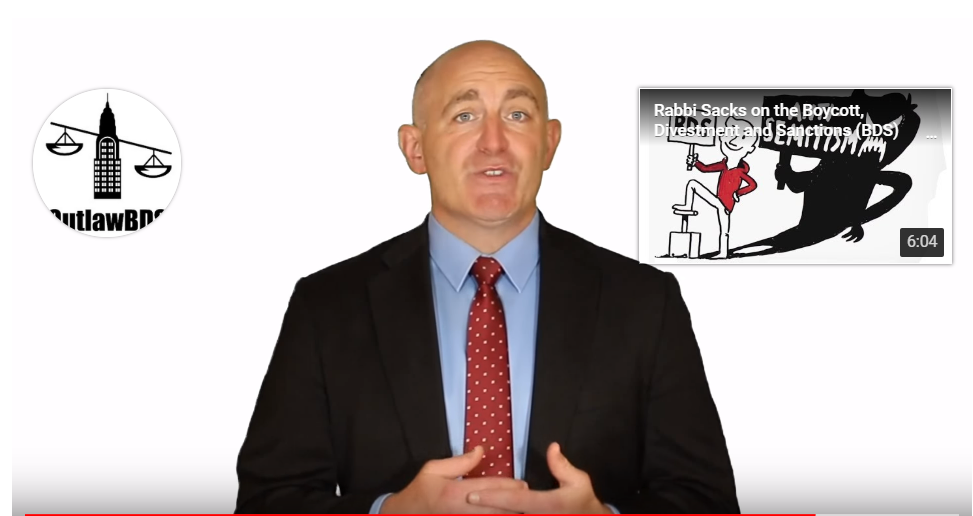 Screenshot of a YouTube video posted by a user called OutlawBDS. (YouTube screenshot)
Other BDS supporters report having received an email in September 2017 from the email address admin@outlawbds.com warning them: “Be aware that you have been identified as a BDS promoter. According to new legislation in New York State, individuals or organizations that engage in or promote BDS activities with US allies will no longer receive public funding or support. Moreover, the state and its agencies will no longer engage in business or hire these organizations and individuals as they have been deemed problematic and anti-American. You have been marked. You have been identified. You have a limited window of opportunity to cease and desist or face the consequences of your actions in legal proceedings. In case you have ceased your past wrongdoing, please contact us at admin@outlawbds.com for your profile to be removed from the Blacklist.”
The Times of Israel was told by multiple sources that Psy-Group worked to counter BDS activists — and is one of several such firms, set up by or employing former Israeli intelligence operatives, that do so.
Such work, The Times of Israel was told, is known to the Israeli government, and specifically the Ministry of Strategic Affairs, but is not paid for by the government.
Psy-Group marketing material
The sources said that such companies engage in various undercover activities against BDS leaders and activists. This work includes highlighting the sources of funding for BDS activities if such funding is obtained from terrorist or other banned organizations, and making public instances where activists have expressed extremist and/or anti-Semitic views. The goal can be to deter the activists from continuing their activities, the sources explained.
In the case of Psy-Group, The Times of Israel was told but could not independently verify, its anti-BDS work was financed by private donors, and the firm did not engage in illegal activity, did not disseminate false information, and did not engage in hacking.
The West Face project
The complaint in the lawsuit filed by West Face devotes relatively little attention to Psy-Group’s alleged anti-BDS work.
It briefly asserts that the Psy-Group operative who registered the outlawbds website went on to hire one “Amin Razvi (‘Razvi’), an individual residing in India,” to carry out work related to outlawbds.com.
The main thrust of the document deals with the alleged “defamation campaign against West Face,” as carried out by Psy-Group and Black Cube. Razvi worked for Psy-Group on that campaign, the document claims, posting defamatory content about West Face online.
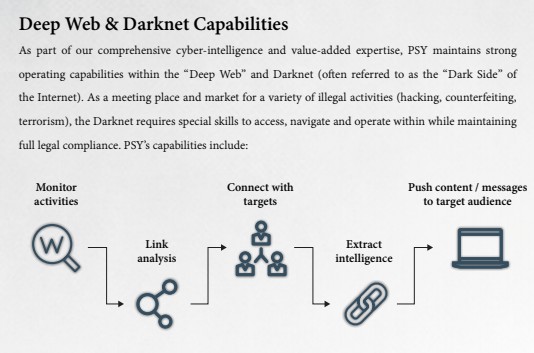 Psy-Group marketing material
Detailing the alleged activities of the two Israeli companies, the complaint claims that operatives from both Black Cube and Psy-Group “conspired to provide reporters, news agencies (including the National Post, Bloomberg News and the Associated Press), as well as others, with edited, distorted or otherwise falsified recordings and/or transcripts of meetings between operatives of Black Cube and its targets, including current and former employees.”
According to the complaint, Psy-Group — whose operatives in the Canadian project allegedly included former Israeli television journalist Emmanuel Rosen — worked in tandem with Black Cube, publishing defamatory articles and social media posts about West Face and using sophisticated masking techniques to hide their tracks.
 Harvey Weinstein attends the ‘Reservoir Dogs’ 25th anniversary screening during the 2017 Tribeca Film Festival in New York, April 28, 2017. (Charles Sykes/Invision/AP)
West Face learned of Black Cube and Psy-Group’s activities when its employees recognized the image of Stella Penn Pechanac in news reports about rape and harassment accusations against Hollywood mogul Harvey Weinstein. Pechanac was a Black Cube employee who reportedly posed as a woman’s rights activist and who befriended actress Rose McGowan in a bid to gather intelligence on behalf of Weinstein. Employees of West Face recognized Pechanac as the same woman who had reached out to them.
Several affidavits by employees and former employees of West Face Capital allege that Stella Penn Pechanac approached them, using various aliases, offering unique and exciting employment opportunities and in some cases flying them to London for fake job interviews. Black Cube operatives then allegedly plied some of these employees with alcohol in an attempt to extract information that would benefit their client in its legal proceedings.
In one instance, a Black Cube operative is alleged to have tried to entrap a retired Canadian judge into making anti-Semitic comments. According to the plaintiffs, the hope was to discredit a verdict the judge had handed down against Black Cube’s client, Catalyst, whose managing partner is Jewish.
 Black Cube logo
In response to a Times of Israel request for comment, Black Cube sent the following statement: “It is Black Cube’s policy to never discuss its clients with any third party, and to never confirm or deny any speculation made with regard to the company’s work. Referencing Black Cube has become an international sport during 2018. It is important to note that Black Cube always operates in full compliance of the law in every jurisdiction in which it conducts its work, following legal advice from the world’s leading law firms.”
In a separate matter, Black Cube was accused last month of working to slander Obama administration officials involved with the Iran nuclear deal as part of a covert effort to discredit the multinational accord. It denied the allegation.
Psy-Group closing down
Psy-Group is currently in bankruptcy proceedings in an Israeli court.
Thepublicly available bankruptcy filings, in which 29 of the Psy-Group’s employees have requested that the firm be liquidated, contain various hitherto unpublished details about Psy-Group, its activities and employees.
In Israel, Psy-Group operates under the name Invop Ltd., which according to Israel’s corporate registry was founded on December 22, 2014. Its chief executive officer is Royi Burstien, the former commander of an Israeli psychological warfare unit, according to Bloomberg. All of Invop’s shares are owned by a Cypriot company called IOCO Ltd., which in turn is owned by a British Virgin Islands company called Protexer Limited.
According to the petition by Psy-Group employees, dated February 28, 2018, employees were informed the previous week that they would not receive their February salaries because “two critical business developments had failed.” As a result, the company had fallen into a credit crunch and would be unable to pay its employees their February salaries, or, for that matter, continue to operate. The company’s director, Burstien, did not object to the bankruptcy proceedings initiated by employees and on May 21, the court appointed a special administrator for the company.
The majority of Psy-Group’s 29 employees listed in the petition appear to be young recent university graduates. A perusal of their LinkedIn pages reveals that many attended the Interdisciplinary Center in Herzliya, an elite private college near Tel Aviv, and many served in intelligence units in the Israel Defense Forces and other Israeli security services, although not necessarily in senior roles.
Despite her relative youth, at least one employee of Psy-Group earned a salary that is more than three times the Israeli average of NIS 10,300 a month: The petition includes the pay stub of an employee whose job title was “project manager” and whose gross salary was NIS 33,0363.
A few names on the list stand out. One of the petitioners is Emmanuel Rosen, a former Israeli journalist. Contacted by The Times of Israel, he had no comment on this article.
Also on the list of Psy-Group employees is Eitan Charnoff, who in 2016 was the director of iVote Israel, a controversial get-out-the-vote campaign for Americans in Israel. He directed iVote Israel at the same time that he worked at Psy-Group. “Eitan Charnoff is not currently involved with either independent organization so is not in a position to comment on anything related to either entity,” said his attorney Carrie H. Cohen of Morrison & Foerster LLP.
:{
iVoteIsrael volunteers sign up US citizens for absentee ballots at a mall in Jerusalem in June 2012 (photo credit: courtesy of iVoteIsrael.com)}:
Israeli-Australian Paul Vesely, who is not one of the petitioners, but who claimed in his LinkedIn page to have been one of the founders of Psy-Group, was previously the chief operating officer at Veribo, a company that provided online reputation management services to binary options companies. He had not replied to a request for comment at the time of publication.
In addition, four previous Psy-Group employees listed in Invop Ltd’s bankruptcy filings currently work for a company called Cyabra, whose stated mission is to help identify sockpuppets and fake Facebook profiles for organizations that have been targeted by fake comments. Cyabra had no comment on this article.
Psy-Group had not responded to a request for comment at the time of publication.
=-==
https://www.fastcompany.com/90235437/before-trump-cambridge-analytica-parent-built-weapons-for-war
no lnx
Revelations of dirty tricks and improperly-harvested data have turned Cambridge Analytica into a symbol for the dark side of digital influence. And yet, while the political consultancy claimed to have helped elect Donald Trump in 2016 by psychologically profiling every American voter, its actual role in his insurgent victory has remained one of many mysteries surrounding the now-defunct company. Its cutting-edge electioneering tactics, which promised to provide clients with “behavioral understandings of your electorate,” seemed to rely as much upon hype and marketing whimsy as they did upon basic psychology, Facebook ads, and giant pools of data.
In reality, some of Cambridge Analytica’s political warfare techniques had been quietly battle-tested in actual war zones, under secret military contracts aimed at fighting terrorism.
According to interviews and documents seen by Fast Company, before Cambridge began working on Trump’s campaign, its parent company SCL Group developed a set of techniques to battle extremism and disinformation for a range of defense agencies, including the British Foreign Office, the Norwegian Government Defense Research Agency, the Kingdom of Saudi Arabia, the British Army’s 15 Psychological Operations Group, and multiple U.S. agencies. As SCL built its reputation in the worlds of psychological warfare and political campaigns, the company relied upon its close ties with current and former officials, including eventual Trump national security advisers Michael Flynn and John Bolton.
Among SCL’s American clients was Sandia National Laboratories, a leading Pentagon research and development partner. Last year a Sandia spokesperson told Bloomberg that the laboratories had never formally worked with SCL. But documents show Sandia collaborations with SCL on counterextremism projects between 2007 and 2012, including “an in-depth behavior change study in relation to violent extremism in South and Southeast Asia.” In a more recent interview with Fast Company, a Sandia spokesperson acknowledged the partnership and apologized for the earlier denial. “Sandia unintentionally muddied those waters” due to “human error,” the spokesperson said.
‘RESPONDENTS [WHO] HAD BEEN TARGETED WITH BOLTON SUPER PAC MESSAGING ON FOREIGN POLICY AND NATIONAL SECURITY SHOWED A SIGNIFICANT INCREASE IN THEIR AWARENESS OF THESE SUBJECTS.’”
FROM AN INTERNAL CAMBRIDGE ANALYTICA REPORT FOR THE JOHN BOLTON SUPER PAC IN 2015
Emma Briant, a scholar of propaganda at Bard College who has spent years studying SCL, says the company’s mix of work demonstrates how military-funded psychological research can be exploited to wage domestic political warfare, establishing a dangerous template for political campaigning. During elections, tactics intended for battlefields could be used to foment division and extremism or discourage voters.
“Personnel and methodological insights were shared and informed the behavioral methodology SCL Elections deployed in numerous elections, and SCL’s global experience shaped the formation of a digital strategy that crystallized in the abuses of Cambridge Analytica,” she says. “The risks of influence industry companies adapting military-funded techniques or repurposing data and its derivative models have not been focused on enough, and there have been few questions raised over how U.S., U.K. and NATO government procurement and oversight for contractors can be strengthened. Oversight, transparency and reporting were clearly not fit for purpose.”
The conglomerate has sunk under bankruptcies, lawsuits, and investigations. But its personnel and data persist, and similar influence operations are thriving, powered by state-sponsored actors and an unregulated industry of influence peddlers. In a report last year, a UK parliamentary committee investigating SCL and voter manipulation found campaigns “financed by less than transparent means and employ legally dubious methods.” The committee noted how “easy it is for discredited companies to reinvent themselves and potentially use the same data and the same tactics to undermine governments, including in the UK.”
Related: The strange afterlife of Cambridge Analytica and the mysterious fate of its data
SCL touted two decades of experience in marketing, electioneering, and data analysis when, in 2013, it helped launch Cambridge Analytica as a U.S.-focused political subsidiary. With the backing of billionaire donor Robert Mercer and the guidance of future Trump adviser Steve Bannon, the company would go on to work for Bolton’s super PAC and dozens of right-wing candidates before joining the campaigns for Ted Cruz and Trump.
As SCL’s military-focused subsidiaries sought government contracts, the company capitalized on a revolving-door culture and cultivated close ties to defense officials. SCL’s officers and advisers have included modern psychological operations commanders, top defense officials, and members of the inner circle of Margaret Thatcher’s administration.
In 2010, SCL undertook one of its earliest military projects, analyzing Afghani populations under the auspices of the U.S.’s then-leading intelligence official in Afghanistan, Michael Flynn. In late 2016, shortly before he would become Trump’s first national security advisor, Flynn agreed to work as a consultant for SCL’s defense unit.
SCL began working in U.S. elections the previous year, on behalf of another future Trump national security adviser. In 2015, a group billing itself as “Cambridge Analytica, in partnership with SCL Elections” began working on U.S. congressional campaigns for the John Bolton super PAC. Using voter profiles gleaned from focus groups, phone surveys, AggregateIQ software, Facebook data, and psychographic models, the companies analyzed target audiences and created a series of anti-immigration and pro-military advertisements in support of hawkish Republican candidates like Tom Cotton, Cory Gardner, and Thom Tillis
“Primarily concerned with promoting [Bolton’s] agenda with regards to national defence and foreign policy, the PAC made use of significant input from SCL on messaging and target audiences, with positive results,” read a 2014 post-election report by Cambridge Analytica, released last year by the Center for Public Integrity. “Respondents [who] had been targeted with Bolton Super PAC messaging on foreign policy and national security showed a significant increase in their awareness of these subjects.
Social media advertisements, targeted according to psychological profile, placed by CA for the John Bolton Super PAC during 2015 campaigns. [Screenshot: courtesy of Center for Public Integrity]
By mid-2015, Cambridge was making use of data unwittingly collected from millions of Facebook users in order to hone its targeting methods and build its infamous psychographic models. The company contends it deleted its cache of ill-gotten Facebook data by 2016, but as late as November 2016, some of Cambridge Analytica’s political and commercial campaigns targeted audiences on Facebook and Instagram that were named by personality trait.
In December 2016, around the time of Flynn’s brief consultancy for SCL, the firm signed a half-million dollar counter-terrorism contract with the US State Dept. That month in London, the CEO of Cambridge had an off-the-record, undisclosed meeting with then-Foreign Secretary and current Prime Minister Boris Johnson. The sitdown was followed by SCL’s appearance at a closed-door Foreign Office event on data analytics in early 2017. By that year’s end, SCL Insight, the conglomerate’s only surviving subsidiary, began work on a contract for unspecified data analysis on behalf of the U.K. Ministry of Defence.
Alongside defense contracts, other government-funded projects managed by SCL aimed to enhance stability and disseminate propaganda. In recent years, one subsidiary was hired by the Kingdom of Saudi Arabia to build a “psychological road map” of its citizenry in an era of declining oil prices and to test reform plans by Crown Prince Mohammed bin Salman, like legalizing cinemas and allowing women to drive. One consultant who viewed SCL’s report described it to New York Times as “Machiavellian,” calling it a manual for the prince to manage widespread discontent. An SCL executive would only say the work helped to advance human rights.
In 2017, as the company was under investigation by Special Counsel Robert Mueller, one SCL company was researching Islamic extremism for the U.S. State Department while another waged a covert and controversial reelection campaign for the Kenyan president. That October, a newer SCL company microtargeted diplomats during the United Nations General Assembly in New York, using #BoycottQatar messages on social media. Months later, the subsidiary, SCL Social, retroactively registered as a foreign lobbyist on behalf of the United Arab Emirates, Qatar’s leading rival, which paid SCL $333,000 for the campaign, according to documents.
“THERE ARE NO OTHER COMPANIES THAT CAN COMPETE”
Information operations missions tend to be shrouded under the cover of national security, and government agencies have been tight-lipped about their work with SCL. But within the defense establishment, the company’s capabilities were respected. The British government gave SCL “List X” status until 2013, granting it...
many many lnx grfx
https://medium.com/textifire/a-special-relationship-the-birth-of-cambridge-analytica-97633129cb06
A Special Relationship & the Birth of Cambridge Analytica
Bridging the Atlantic to bring radical nativists of Trump & Brexit together via military tech & ad money, one donation or dataset at a time.
TEXTIFIRE
May 19, 2017· 46 min read
Steve Bannon-owned Cambridge Analytica LLC, a US subsidiary ofUK defense contractor SCL Group, has been increasingly faulted for its dual role in both Donald Trump and Brexit’s victories. Its elevated & expensive role in the Trump digital marketing team’s self-proclaimed voter suppression rollout was the culmination of several years of preparation by military and anti-government interests on both sides of the Atlantic, as well as nationless finance & technology kingmakers seeking to enhance their own profit power.
As a direct result of the reporting led by the Observer’s Carole Cadwalladr, Cambridge Analytica is already under active investigation for violating United Kingdom data protection laws, as related to their involvement with Leave.EU. It’s unclear if anything will come of this, as Leave’s ‘Bad Boys of Brexit’ seem quite confident they were able to skate through some loopholes and use some creative accounting to their advantage.
Separate issues have been under the microscope of UK authorities. For example, one is the improper collection & use of voters’ personal data via the internet for political marketing/advertising purposes, and another is the question of foreign (read: non-UK) money being used to fund the Leave campaigns. Cambridge Analytica is at the center of the data inquiry, and US-based stock trader Robert Mercer has been identified as the primary source of the foreign money, but in both cases political media production & dissemination is the underlying issue.
Our previous article looked at the undertold history of the nonprofit organization Citizens United regarding highly influential American political media & advertising from 1988 to 2011, and we’ll continue just prior to where we left off. SCL was in a down period at the beginning of our tale, and its Cambridge Analytica did not yet exist. Donald Trump would soon begin early-2011 meetings with his new friends Steve Bannon and Citizens United’s David Bossie (fresh off a huge Supreme Court victory) to plot out a Trump 2012 presidential campaign, but they ultimately decided to once again put his formal aspirations on hold.
Still, the fire rises.
Dukakis to Donald: 30 Years of Citizens United - TEXTIFIRE - Medium
1988 Democratic presidential nominee Michael Dukakis, who was attempting to win back the White House after 8 years of…
medium.com
PROFIT BOTS
Bannon & Bossie began releasing their political issue advocacy film collaborations in 2010, months after Bossie’s Citizens United v FEC case received its big Supreme Court victory, but they were among many looking to exploit the new election [de]regulations. One such up-and-coming major player was half-billionaire Robert Mercer.
Mercer had won awards in his first career, working for IBM’s Watson AI project in the field of natural language processing, where he wrote code teaching computers how to understand humans. The avid yachtsman changed tacks slightly in 1993, as he went on to make his sudden fortune with the wildly profitable private hedge fund Renaissance Technologies, also known as RenTec, of which he is now co-CEO. Its stock-in-trade, if you will, is using quantitative analysis and high frequency trading (HFT) to win big on the global financial markets.
Quantitative analysis is a blanket term that covers a range of techniques, but the basic idea is to execute financial transactions based on predictions made by calculating large groups of historical alphanumeric sets; i.e., using existing patterns to predict future outcomes. When you’re anticipating future numbers, you might naturally expect to first inspect past numbers.
However, the standard human brain can only do so much these days, so the vast majority of work involved in this field is performed by computers. Even experts in the field — unsurprisingly called ‘quants’, though RenTec is known for exclusively employing mathematicians, physicists, and cryptographers — are still only able to quickly & accurately calculate a small grouping of historical variables. As a result, giant datasets — consisting of any number of different variables tracked over time — are fed into computers which calculate them using complex math equations, following repeatable series of preprogrammed steps that are known as algorithms.
Not only do quants employ algorithms to spit out robotically identified market trends, but they frequently direct the algorithms to buy and sell stocks all on their own. This outsourcing of labor is known as algorithmic trading, and since the computers involved are usually employing algorithms on both sides of these transactions, the trades can happen incredibly quickly (nanoseconds) and in high volumes (around half of all US equity trades). Now we’re describing the quant subgenre of high frequency trading.
HFT is very controversial within the financial industry, with supporters saying it helps keep the markets liquid & transparent and detractors saying it increases volatility, but it’s probably safe to say most outside observers think it’s very dangerous. It’s been responsible for “flash crashes”; allowed for massive accumulations of private wealth for no reason other than automated exploitation of loopholes, timezones, and bandwidth; played a sizable (or at least very profitable) role in the 2008 global financial meltdown; and put the planet’s resources under the control of larval artificial intelligence.
For these reasons, it should be no surprise HFT came under the scrutiny of regulators, but only after a decade of algorithmic trading that was enabled by the 2000 changeover to stock decimalization (pricing shares by pennies instead of quarter-dollars). The EU had been fairly vigilant in that regard, but the US government hadn’t pricked up its ears until after the July 2009 arrest of Sergey Aleynikov, a Russian-born U.S. citizen, for allegedly stealing ‘proprietary’ algorithms from his employer Goldman Sachs.
Aleynikov was accused of sticking his digital avatar hand into the “black box” — the batches of algorithms that are kept secret by HFT firms — of Goldman Sachs, but his still-active case has been in & out of courts for these past 8 years, partially because some of the laws he broke had not yet been fully written. That genre of legislative inefficiency sparked the interest of Peter DeFazio, a Democratic congressman from Oregon, which in turn caught the eyes of quants and black box houses like RenTec.
4 minutes of HFT
DeFazio spearheaded the idea of a financial transactions tax — to impose a micropercent tax on trades that would only affect the high-volume HFT in any tangible way— and teamed up with a couple colleagues to bring bills to the floor of Congress. He got nowhere in 2009, two years after the “Quant Quake”, nor in 2010, even after the May 6th “Flash Crash” again alerted the public to the dangers of HFT. Despite the failure to ignite substantial interest, his dedication to reform did not go unnoticed.
TEST DRIVING CITIZENS UNITED
DeFazio’s 2010 reelection campaign was nearly derailed by the appearance of highly-funded ads which attacked him and supported his ‘Tea Party’ Republican opponent, Art Robinson. Created by a PAC calling itself Concerned Taxpayers of America (CTA), it had been an ongoing mystery at the time as to who put up the big money for that organization. Only a few weeks before the election, as per the then-newly lax criteria set forth by the Citizens United decision earlier that year, was it revealed that one of the only two funders was Mr Robert Mercer, who contributed $643,750.
Investigation by the Washington Post prior to the reveal turned up even more curiosities, including a denial of the existence of CTA by a PR rep standing in the doorway of its registered address and directly to DeFazio’s face. Also, we should not be surprised to learn CTA’s treasurer was Jason Miller, who would go on to become Trump’s campaign communications director starting 30 June 2016. Miller was briefly named White House communications director in December 2016, before recusing himself a few days later after a fellow campaign worker accused the otherwise married Miller of fathering her unborn child.
Mercer’s attacks on DeFazio are easily attributable to HFT tax proposals, but his support of political then-novice Art Robinson is also notable. Robinson is a crackpot pseudoscientist whose mentor was Nobel Prize Winner Linus Pauling, before they acrimoniously parted ways in a divorce which ultimately ended in Robinson’s $25.5m lawsuit against the Pauling Institute (which he settled for $575k).
Robinson then became a supporter of homeopathic disease cures via exposure to raw radioactive elements, as well as a well-known climate change denier, an obsessive hoarder of 14,000+ human urine samples, and a forest-dwelling widower who homeschooled his 6 children using his own Bible-based, available-for-sale “Robinson Curriculum” (all of which basically makes him the Anti-Captain Fantastic). He lost to DeFazio in 2010 and lost again & again & again in 3 subsequent elections, but managed to become the chairman of the Oregon Republican Party from 2013–15, and has recently been considered for the role of Trump’s chief Science Adviser.
Robert Mercer and his politically powerful daughter Rebekah are said to have become fans of Robinson’s after reading his newsletter “Access to Energy”, which argues such things as Chernobyl radiation and carbon pollution are ultimately beneficial to planetary life. However, Mercer has privately “downplay[ed] the dangers posed by nuclear war” when excitedly expressing his belief that Hiroshima & Nagasaki radiation made the greater population of Japan healthier, and Robinson has published a book & multi-DVD set on Nuclear War Survival Skills, so they have that hobby in common.
After bringing someone like Robinson close to victory in 2010, the Mercers’ fresh taste for political power brought them the privileges and lifestyles of the rich & famous. They soon found themselves at a 2011 conference of the Club For Growth, a pro-business activist group for the conservative elite, which spent $6m of its own in support of 2010 GOP/Tea Party contenders. The Club is perhaps best known for being sued and fined by the FEC in 2005 for violating fair election laws. Its Executive Director David Keating then formed SpeechNow, a group which sued the FEC and did even more damage to campaign finance regulations via their Ninth Circuit Court victory in the immediate wake of Citizens United v FEC, but right now we’re focused on the Club as the place where Mercer first met Andrew Breitbart.
BREITBART OUT, BANNON & MERCER IN
Three years after meeting Steve Bannon in 2004 — at the Beverly Hills movie premiere of Bannon’s directorial debut In the Face of Evil: Reagan’s War in Word and Deed — Breitbart left The Drudge Report to start his own media outlet, Breitbart News, which he said was intended to be “unapologetically pro-freedom and pro-Israel.” Breitbart rapidly became the darling of the ultraconservatives and elbowed his way into mainstream relevance, becoming a driving force in the 2009–10 rise of the explicitly anti-Obama Tea Party.
With their respective stars on the rise, it’s impossible to know who was more smitten with whom at the Spring 2011 Club For Growth meeting, but Breitbart took enough interest in the Mercers to later introduce them to his man Bannon. Having been with Breitbart News since its inception, Bannon ended up hitting it off with the Mercers and they immediately joined forces. In June 2011, the Mercers invested $10m in Breitbart, becoming co-owners in the process, but one of their contract stipulations demanded that their brand new friend Bannon be promoted to the board of directors.
Bannon & Breitbart, aka the Three Men and A Baby ghost
Around that same time in 2011, the 42yo Breitbart suffered a heart attack. Within a year, he collapsed on an L.A. street and died on 1 March 2012, with his autopsy blaming another massive heart attack due to an enlarged heart. Later that very same day, Bannon has said he met with New York investors to plan the future of Breitbart News, and he would quickly be named Executive Chairman on 19 March.
This was a crucial time period for all of these players. In February 2012, Bannon founded the Government Accountability Institute (GAI) with $2m in seed funding from the Mercers. Rebekah Mercer became Chairwoman, and Bannon installed Peter Schweizer — author of Reagan’s War, the book adapted into Bannon’s first “documentary” — as president of GAI. Like Bossie and Mercer, Schweizer is yet another Clinton-hating, Reagan-adoring, tax reform & financial deregulation advocate and conspiracy theorist.
A couple of the first ‘reports’ out of the gate for GAI: a treatise attesting to the horrors of food stamps, as well as another which itemized every instance of President Barack Obama’s attendance at his daily briefings. Breitbart predictably publishes multiple stories each time GAI puts out a press release, but both of those early missives were picked up for publication and discussion in major media outlets, such as ABC News, Washington Times, National Review, and Washington Post.
Peter Schweizer on Russia Today
What we’ll call ‘Mercer Money’ was also funneled into Citizens United’s coffers, to the tune of another 2 million dollars. This cash was at least partly used to fund Bannon & Bossie’s 4th Citizens United Productions collaboration, The Hope and the Change, an anti-Obama movie which premiered at the August Republican National Convention and played in theatres & on cable TV up through Election Day. Once again, the Citizens United v FEC decision enabled that release schedule.
And yet despite all of this intrigue, perhaps the most important development and deployment of Mercer Money in 2012 came in the form of a $5,000,000 investment in a relatively unknown British defense contractor, then called Strategic Communication Laboratories Ltd but now known as SCL Group. The Mercers tossed the pounds across the pond to enable data analytics research, with Rebekah wanting a “results-oriented consultant.”
This investment has been noted elsewhere as a natural fit for Robert Mercer, as his background in algorithms and language processing mesh with what we now know about SCL’s recent use of big data to enhance electioneering communications, but that actually didn’t yet make sense at the time. Back then, the only technology strongly tied to SCL would have been communications hardware (as opposed to database software), but only as one aspect of their rather straightforward advertising-cum-propaganda tactics.
SCL had worked on some elections, in a few war zones, and for the Pentagon over the years, with perhaps their most notable appearance being in 2004 Ukraine at the time of the Orange Revolution (allegedly on behalf of the vested interests of British intelligence, according to one untrustworthy source, as previously noted by TEXTIFIRE). SCL carries a Secret clearance as a ‘List X’ contractor for the British Ministry of Defence and had always portrayed themselves as experts in the field of behavioral dynamics and psychological warfare, but had no known background in the algorithmic data processing with which they are now associated.
So why would an ill-equipped foreign defense contractor like SCL be called upon by the Mercers to do big data research? The answer again appears to lie somewhere in the weeds near Steve Bannon.
Header for Nigel Farage’s dozens of Breitbart essays (Source)
WEREN’T THE FIRST TEA PARTIERS ANGRY AT THE BRITS..?
Bannon became interested in United Kingdom politics in the early 2010s, seeing it as fertile ground for ideological manipulation. He began making friends with far right bloggers and politicians, particularly those tied in with Nigel Farage’s United Kingdom Independence Party (UKIP). A hard right party commonly disparaged as fascist, UKIP sought to restore what it saw as true conservatism. Bannon was greatly invested in the USA Tea Party ‘movement’ at the time, as evidenced by his movie productions and speaking engagements, so he viewed UKIP as a natural comrade in arms.
UKIP had been stagnating as a political force while known as a single platform party, focused almost entirely on immigration crackdown and demand for UK’s exit from the European Union. Co-founder Farage had returned to lead the party for a 2nd time in November 2010 — later in the same week as the first Tea Party Republicans were elected in the US midterms — after failing in his bid to become House of Commons Speaker earlier that year, and began to incorporate a wider variety of populist messaging with a focus on local elections to increase growth.
Soon after Bannon took over Breitbart in the summer of 2012, he brought Farage to the USA for a grand tour of New York and Washington, D.C. During this trip, Bannon introduced Farage to a number of movers & shakers, including the staff of Jeff Sessions, the then-senator from Alabama who is now US Attorney General. This was certainly not the first connection between UK eurosceptics and US nativists, however.
Throughout the previous year, a UK political activist ‘pressure group’ called Atlantic Bridge was garnering a lot of press for all the wrong reasons. Fronted by then-Defence Secretary Liam Fox, after being founded in 1997 by Fox and Reagan BFF/ex-UK-PM Margaret Thatcher, its stated goal was to protect the 80's holdover concept of the US & UK’s military and cultural ‘special relationship’ from “the European integrationists who would like to pull Britain away from its relationship with the United States.”
Louise Mensch (#TrumpRussia false idol, Tory ex-MP, and current News Corp employee) defending Liam Fox and a Brexit
Atlantic Bridge fell into the sea in late 2011, after extensive investigations found Fox had been implementing a “shadow foreign policy” by internationally courting a variety of corporate lobbyists and military contractors via the dark money donated to Bridge as a falsely-labeled charity. Fox then resigned his Cabinet position, taking a few others down with him.
One of those affected was yet another powerful hedge fund manager, ex-Goldman Sachs trader, climate-change denier & funder, and longtime Tory/Conservative donor named Michael Hintze who provided the majority of those donations and lent his private jet to Fox for schmoozy jaunts to meet with D.C. defence contractors. With a strong interest in geopolitical wargames, a habit of supporting Defence Secretaries, and a predilection for hiring senior military officials at his powerful firm Convertible & Quantitative Strategies, it’s small wonder Hintze sought to establish a Western security superhighway before the Bridge collapsed.
Back in 2007, however, Atlantic Bridge was still in its prime, and it gained even more power when a giant among US political activist groups began an official partnership with it. The American Legislative Exchange Council — better known as ALEC — set up a stateside nonprofit called the Atlantic Bridge Project, in order to “foster positive relationships between conservatives on both sides of the Atlantic, so they may further the ideals exemplified by Ronald Reagan and Margaret Thatcher.”
Atlantic Bridge’s Liam Fox thanking ALEC 2008
ALEC’s decades-old modus operandi is to write complete versions of new legislation, which invariably benefits only its powerful corporate members, to be passed off to complicit politicians and introduced in Congress as original products. An official ALEC newsletter from Dec 2007 bragged of the Bridge Project’s new plans to enact “a series of events aimed at conservative leaders from the field of politics, media, business, and academia — exposing them to innovative conservative thinking from the U.S. and Great Britain and helping them forge new transatlantic relationships.”
Catherine Bray is pictured in the newsletter as the Director of International Relations for Atlantic Bridge; she had previously worked for prominent UKIP member & climate change denier Roger Helmer and subsequently worked for Tory Daniel Hannan, “the man who brought you Brexit.” In 2015, Bray married Wells Griffith, who became the battleground states director for Trump’s presidential campaign.
Managing the D.C. operations for the Project was Gordon Cohen Strategies LLC, co-founded by Lee Cohen, Atlantic Bridge’s Washington DC Director, and J.D. Gordon, a retired Pentagon spokesman and well-traveled defense lobbyist. Lee Cohen is now an ardent Trump supporter, publishing an IJR essay in November 2016 predicting Trump and new UK PM Theresa May will be the new Reagan & Thatcher.
Within a few days of Liam Fox’s 2011 resignation, J.D. Gordon took a job as communications director for Herman Cain’s 2012 presidential campaign, in which Tea Partier Cain promised to reduce corporate taxes and install the Shell Oil CEO as head of the EPA. Cain began briefly leading Obama in the polls at that time and was the most reported-on GOP candidate in 2011, but quit the race less than 2 months later after sexual misconduct charges arose.
Gordon was slightly controversial when he originally joined up as one of Cain’s foreign policy advisers, as he had recently left a fellowship position at the Washington-based Center for Security Policy, a far-right think tank (or perhaps hate group) devoted to advancing founder and former Reagan official Frank Gaffney’s pet cause of extreme Islamophobia. Cain’s campaign also absorbed the staff of Gordon’s own embryonic thinktank, the Center for Security and Democracy, which included a former Heritage Foundation manager.
J.D. Gordon is most recently known for his work as a key foreign policy adviser to Cain clone Donald Trump, who counted Herman among his early campaign rally speakers/surrogates, and about whom Gordon wrote a pro-Trump Breitbart article in April 2016. Gordon was also Jeff Sessions’ deputy, allegedly traveled to Budapest six times during the campaign, participated in the infamous July 2016 Republican National Convention meeting — hosted by the Heritage Foundation — involving co-adviser Carter Page and Russian Ambassador Sergei Kislyak, and is said to have previously recommended that Page embark on his Congressionally-investigated trip to Moscow. Gordon also claims he personally asked to water down the RNC platform with noncommittal language omitting lethal weapons support for Ukraine, and that Trump directly ordered him to do so.
(L to R) Lee, Johnson, Toomey, DeMint, Rubio
Atlantic Bridge’s leading light in the US Congress was South Carolina Senator Jim DeMint, then frequently cited as one of the farthest-right sitting Senators. An ardent tax reformer, Family member, and anti-immigration crusader, he was on board with the Tea Party from its inception in early 2009, setting the stage with the establishment of his Senate Conservatives Fund PAC in 2008. The Fund attacked Republicans for being too ‘moderate’ and then gave millions to the successful 2010 Senate campaigns of such first-time Tea Party candidates as Rand Paul, Marco Rubio, Ron Johnson, Mike Lee, and Pat Toomey. Also in 2010, DeMint introduced the first bill intended to repeal the Affordable Care Act, aka Obamacare.
Senator DeMint followed up that legislation a few months later with his first published article/op-ed on Breitbart News, dated 6 May 2010. Breitbart repeatedly showered him with glowing coverage, so he went on to publish another article there on 27 Jul 2012, in which he endorsed Tea Party candidate Ted Cruz for Senate and lauded the aforementioned Club for Growth’s monetary “air and ground support” for Cruz’s campaign.
A large chunk of the money for that tactical assault was provided by Robert Mercer, with other miniature morsels of Mercer Money going to DeMint, Toomey, and Rubio at various times. Unsurprisingly, Club for Growth rated Paul, Johnson, Lee and DeMint as 4 of the only 5 Senators to vote ‘correctly’ 100% of the time, with Lee and Demint tying for the Heritage Foundation’s top honor at 99% approval.
“Breitbart Embassy” in DC, 2012 (Source)
DeMint resigned from the Senate less than two months after the 2012 election in order to become president of Heritage — a thinktank which shares an enormous number of historical, practical, and membership commonalities with ALEC — by which time Atlantic Bridge had been dead [in the UK] for over a year. Even so, it’s easy to imagine DeMint, Liam Fox, J.D. Gordon, and/or any of the other Atlantic Bridge ambassadors still managed to make their way to any one of the legendary parties thrown at the “Breitbart Embassy”, a four-story townhouse rented (?) by Breitbart near the Supreme Court in Washington, D.C.
As for the gregarious and cigar-chomping heavy drinker Nigel Farage, we don’t have to imagine anything. He was treated as the guest of honor at a Breitbart Embassy dinner & cocktail party in September 2014, where the stars of the new right rubbed shoulders with journalists from across the media spectrum. Other guests that night included LifeZette’s Laura Ingraham, a reporter from Rolling Stone, Jeff Sessions, and Sessions’ then-top aide Stephen Miller.
Steve Bannon had been partially living at the Embassy since at least 2011, when Breitbart staff and writers were first encouraged to work & sleep there, though it was initially expected to serve as a means to rub shoulders with the movers & shakers of the DC political elite. “Andrew [Breitbart] said that if you didn’t have a place within spitting distance of the Capitol, no one would come,” Bannon told The Washington Post at an Embassy blowout schmooze-and-boozefest CPAC rager in 2014. “He loved to throw big parties.”
But regardless of the precise circumstances by which Bannon became enmeshed with the UK’s conservative elite prior to mid-2012, engrossing as the detailed story may be, his friendship with UKIP & Brexit’s Farage tells us all we need to know. As such, we should be unsurprised to learn it was allegedly Steve Bannon who urged the Mercers to invest US$15m in big data research funds with the British defence contractor SCL Group.
PSYOPS GOES MAINSTREAM
In October 2012, a month before Mitt Romney’s loss initiated the Bannon-driven deposit of Mercer Money toward new election management technology, a Strategic Communication Laboratories subsidiary named SCL Elections was registered in the UK. All company shares were initially owned by Alexander Nix, Director of SCL Group and public face of the conglomerate, but its first and current Managing Director is Mark Turnbull.
Turnbull had previously worked for the tremendously influential public relations and strategic communications firm Bell Pottinger — co-founded by infamous PR guru Lord Timothy Bell — spending 18 years at the company. In 2004, he founded and led Bell Pottinger Public Advocacy (BPPA, fka Bell Pottinger Special Projects), which claimed to specialize in “understanding and influencing the human and social dynamics of conflict and cooperation…[using]…people’s identities, interests, networks and narratives that are the focal point for communications designed to deliver measurable change in support of political, social, developmental or military objectives.”
Bell Pottinger (B-PC) landed a 2004 Pentagon contract in Iraq devoted to manufacturing pro-Coalition media — including in-house advertising, video production, and paid placement of newspaper/TV/radio news items — in support of post-Saddam Hussein nation building and anti-Daesh messaging. The creative team of BPPA collaborated on the media directly with US military intelligence, with the crews working side-by-side in the most highly secured locations, such as Baghdad’s Camp Victory.
Though initially intended to be a 4-month contract, first granted by Ian Tunnicliffe’s Office of Strategic Communications of the Coalition Provisional Authority under USA’s pseudo-viceroy of Iraq, L. Paul Bremer, the project ultimately extended all the way to 2011. Upwards of 40 ‘stratcom’ companies — including BKSH & Associates, formed from the ashes of Black, Manafort, and Stone — followed B-PC’s lead, creating a veritable vortex of political propaganda and psychological operations experimentation. B-PC came out as the big winner of the free-for-all, as by the end of its time in Iraq, B-PC’s contract payouts had ballooned from US$5.8m to a total of $540m–660m.
Also present in Iraq during those years was a specialized British Armed Forces tri-service unit, the 15 (UK) Psychological Operations Group, formerly known as Shadow. Its stated objective was to “influence attitudes in order to affect behaviour” with “planned, culturally sensitive, truthful and attributable activities directed and disseminated by various means to an approved target audience.” It drew from the Army, Navy & Air Force, seeking out Reserves who were also “TV & film producers, camera operators, radio presenters, [and] graphic designers/illustrators for print/web.”
Two important members of 15 (UK) PSYOPS (aka 15 POG) were Stephen Jolly of the Ministry of Defence and Royal Navy Commander Steve Tatham, both graduates of Cambridge University-affiliated schools. A linguistic scientist, certified psyops planner, and instructor for 15 POG, Jolly went on to serve as the UK’s Director of Defence Communications, starting in Dec 2012. He retired in 2015 as the most senior serving psyops officer in British Defence, moving on to become Fellow of the UK Defence Academy and Fellow in Communications at the Cambridge University Judge Business School.
As Defence Comms Director, Jolly embraced the new ‘Army 2020’ holistic reform initiative, pushing a “full spectrum” approach which combines the fields of public relations, media operations, information operations (IO) and psyops. This led to the creation of the 77th Brigade of the British Army, which absorbed several specialized units, including the 15 (UK) PSYOPS Group. Its establishment received a fair amount of media coverage, due to the claim it would partially focus on utilizing social media to wage the ‘dark arts’ of asymmetric warfare, but its ?1 Column focuses on “the behavioural analysis of actors, audiences and adversaries.”
Commander Steve Tatham served with 15 POG in Iraq, but commanded its Afghanistan regiment for years. He also plied his trade as Director of Communication Research at the UK Defence Academy, and was the UK’s longest continuously serving Influence Activities officer. Upon retirement he became Director of Operations at IOTA-Global, a UK company owned by Nigel Oakes, the founder of SCL and its research arm, Behavioural Dynamics Institute (BDi).
Grown just outside battlefields across the globe, Tatham designed a course titled “Target Audience Analysis” for the National Defence Academy of Latvia on behalf of the NATO Strategic Communications Centre of Excellence, teaching several agencies how to counter Russia’s propaganda in Eastern Europe. Originally a 9-week intensive training, delivered as a collaboration between IOTA-Global, BDi, and SCL Defence (formerly an SCL Group subsidiary), Tatham has repeated the course in Moldova and Ukraine. As IOTA-Global recently disbanded its corporate status, Tatham is currently Director of Defence Operations at SCL Group.
Verbalisation’s RAID
Another pair of 15 (UK) PSYOPS veterans and avowed fans of the new 77th Brigade, Sven Hughes and David Stanhope, are leaders at the behavioral marketing firm Verbalisation, which bills itself as “the world’s first consultancy dedicated to changing behaviour by precision-engineering language.” Hughes, a former head of elections at SCL from 2009–10 who also assisted NATO forces in Afghanistan, says his staff members are “largely ex-military personnel and political campaigners.” Stanhope spent eight years with 15 POG, serving under Cdr Tatham for a spell in Afghanistan, and also worked in 2011 for SCL (briefly joining fellow ex-IO/psyops agents Jerry Knight & the aforementioned Ian Tunnicliffe, both former SCL directors). The POG vets claim Verbalisation’s RAID aka Rapid Audience Insight Diagnostics® software tool can help military and marketing clients — including several News Corp media outlets — “decode” personalities based on 24 set parameters, including language, cognition, susceptibility, and culture.
Despite years of effort and billions of international dollars, the Iraq and Afghanistan information operations (IO) projects were deemed by experts to have been a failure. Cdr Tatham even co-wrote a UK Defence Academy report lamenting “the corporate failure to adapt IO and PSYOPS’s operating practices to the 21st century, instead relying upon ages-old methods of communication,” as well as an “over reliance of IO and PSYOPS on commercial advertising and marketing strategies.”
“Commercial marketing and advertising methods are designed to increase the hit rate of customers in a target group. A conversion of 10% would be considered outstanding and highly profitable. But in military operations achieving a 10% change in the behaviour of an insurgent group or a hostile community would be operationally insignificant,” Tatham wrote in the NATO StratCom Target Audience Analysis (TAA) course summary. He instead advocates for TAA and the use of scientific research into behavior predictors, such as language, likes, and motivation, as opposed to focusing the majority of resources on creative media production glitz.
To this end, the Defence Science and Technology Laboratory (Dstl), a trading fund of the UK Ministry of Defence (MoD) which is the equivalent of USA’s DARPA, conducted a study between May-Sept 2013 called ‘Project DUCO’ which contracted SCL and BDi to test out their TAA capabilities. The evaluation was undertaken as part of the Human and Social Influence project, funded from the MoD Science and Technology research budget. In-person questionnaires were verbally completed by young unmarried males (“YUMs”) in target regions, with SCL-trained interviewers canvassing neighborhoods like standard solicitors, simply because no other means existed to gain insight into individual personalities and groupthink.
It seems that the psyops startup incubators of Iraq and Afghanistan failed to overwhelmingly win the hearts and minds of the target audiences in those locales, but succeeded in honing the methodological requirements of the IO traffickers. As Tatham suggested, giant billboards and radio jingles aimed at a large population based on small sample size indicators weren’t effective enough, so a product like Verbalisation — listed under “Counter Terrorism and Security” on R-Cloud, Dstl’s marketplace for partnered contractors — was born, ready and able to pinpoint individuals & target groups for analysis and alteration.
Of course, all of this sounds exactly like the TAA work SCL was contracted in early 2017 to perform for the US State Department’s new Global Engagement Center, a reboot of the Center for Strategic Counterterrorism Communications (CSCC) and its famously failed 2010s online propaganda & surveillance program.
SCL Group Joins the US State Dept.
Robert Mercer-funded Cambridge Analytica’s foreign parent company signs deal to do propaganda work for State’s Global…
medium.com
SCL and State’s CSCC were not strangers prior to 2017, though, as Nigel Oakes had spoken at a January 2012 CSCC seminar on “The Most Common Mistakes in Designing Influence Campaigns,” at which Oakes was pitching the State Dept on knowledge acquired from Iraq and Afghan 15 POG work. The seminar’s BDi-provided video description explains, “Nigel highlighted four very common errors made in designing influence campaigns, especially if one is trying to induce significant behavior change.”
Bits and pieces of the 2000s Middle Eastern psyops extravaganza had trickled out back then, but the full extent of B-PC/BPPA’s Iraq work under Mark Turnbull was only revealed in a October 2016 report entitled “Fake News and False Flags” by the Bureau of Investigative Journalism, a UK nonprofit devoted to extended and unbiased investigations.
Five years previous, the Bureau conducted another well-publicized investigation into Turnbull’s BPPA, in which B-PC executives were caught on tape boasting about their unique “dark arts” ability to initiate political change via their deep infiltration into the highest levels of UK government. The execs also boasted of their skills in hiding bad PR by manipulating Google results with juiced-up ‘Google bombing’, and how they had a team devoted to Wikipedia reputation management, which is common now but was rather cutting-edge at the time.
NOT EXACTLY MAGGIE & GORBY
Also back in 2004 — the same year BPPA formed and their work began in Iraq — B-PC took on a contract to spin their web in Ukraine for Yulia Tymoshenko in the time of the Orange Revolution, which would have seen them working against Paul Manafort’s clients in the Party of Regions, as well as in the vicinity of fellow contractor SCL. A previous article published by TEXTIFIRE explored SCL’s role in those events and the related history, which involves billionaires, rigged elections, the most glamorous Russian spy in history, and a mythical war room SCL billed as “The Most Powerful Weapon In The World.”
SCL Group’s Eurasian Vacation
SCL once had their defense contractors’ conference booth made by a design team from Goldeneye 007. Here’s a pitch for…
medium.com
Bell’s involvement in Ukraine did not end in 2004, for even though they had been employed by future Prime Minister Yulia Tymoshenko, it was her frequent antagonist and Party of Regions bigwig Dmytro Firtash who retained the long-term services of B-PC. Firtash is an oil & natural resources magnate who also owns Ukraine’s largest TV station, but is now an internationally wanted criminal suspect trailing a long history of personal relationships with Vladimir Putin and Russian mobster Semion Mogilevich. Just as with the American PR firm Black, Manafort, Stone, and Atwater, whose client list is littered with objectively unsavory characters, Bell Pottinger has long made itself available to the highest bidder.
Bell advised the Firtash Foundation while Anthony Fisher, senior consultant with Bell Pottinger, served as director of the Foundation. Fisher also co-founded the Firtash front Scythian Limited, which came under fire for funneling foreign funds to Tory politicians in a scandal which prevented a National Security Adviser nominee from being confirmed, and is a board member of the Firtash-supported group British Ukrainian Society (BUS). Chairman of BUS is Lord Risby, an economics graduate of Cambridge University, former vice-chairman of the Conservative Party, and current member of the House of Lords.
Firtash’s direct ties to several well-placed UK Conservatives is a curiosity. Despite his heavy baggage, Firtash has stayed active in politics via his BUS, and he donated a truck full of cash to help establish Cambridge University’s Ukrainian Studies school. Perhaps his open checkbook and loose lips have allowed him to avoid extradition to the USA, instead roaming free in Vienna while out on US$125,000,000 bail from long-unprosecuted charges. Without speculating too much about his actual place in this tale, Firtash’s story in particular is reminiscent of the days of Reagan-Thatcher-Gorbachev era Cold War double agents.
What’s old is apparently new again, however, as the Parliamentary members of the short-lived group Conservative Friends of Russia would no doubt decline to attest. Conservative Friends rapidly fizzled after public outcry but quickly relaunched as the Westminster Russia Forum, yet those ex-Friends could be expected to assure us that their original so-called “Tories for Putin” group was strictly on the up and up.
As Friends co-founder Richard Royal explained at the time in his 2012 Guardian op-ed, the Tories had turned their backs on the more liberal Labour leadership but found their increasingly hardlining nativist gaze met in Eurasia. “We must remember, however, that being a Friend of Russia is not the same as being a Friend of the Russian government,” said Royal. “By that reckoning, our Conservative members were not friends of Britain between 1997 and 2010[.]”
Margaret Thatcher & Lord Tim Bell (Source)
Retro ’80s stylings abound, in fact, as Conservative bedfellow Lord Bell was nominated for his knighthood by Margaret Thatcher, for whom he served as personal media adviser throughout her time as UK Prime Minister, with their close friendship illustrated by Bell’s official announcement of her 2013 death.
The Iron Lady left behind quite the well-connected coterie, with her Atlantic Bridge co-founder Liam Fox overseeing the aforementioned psyops work while Shadow Defence Secretary & Defence Secretary from 2005–2011, his megadonor patron Michael Hintze a client of Lord Bell’s during the time of Atlantic Bridge, and old friend Sir Geoffrey Pattie — another former vice-chair of the Conservative party who served as Thatcher’s Minister of State for Industry & Information Technology and Undersecretary for Defence Procurement — spending a few years as a Director of SCL.
Though Sir Pattie had switched from Director to President of SCL Group four years prior, SCL Elections’ official registration in the month preceding President Obama’s reelection — with Mercer Money in its coffers and Lord Bell’s ‘Special Projects’ ex-director Mark Turnbull at its helm — set off a chain reaction of SCL corporate maneuverings that extended across the following four years.
A flurry of declarations of new subsidiaries and subsequent name changes of those companies culminated on 7 September 2016, when SCL Director Alexander Nix transferred all 100 original shares of SCL Elections from himself to the company SCL Analytics. Formed a year prior, SCL Analytics is 70% owned by Nix and 30% owned by its parent company SCL Group.
As far as is known at presstime, SCL Group and Nix currently co-own all shares of SCL Analytics, which owns all shares of SCL Elections, which owns all shares of [what was originally named SCL USA Ltd but as of 13 April 2016 is officially known as] Cambridge Analytica (UK) Limited.
However, that CA-UK is technically separate from the American subsidiary Cambridge Analytica LLC, which was registered in Delaware on 31 Dec 2013, over two years sooner. To confuse us even further, 22 Apr 2014 saw the DE registration of SCL USA Inc., which is also wholly owned by SCL Elections but is separate from the 12 Feb 2003 establishment of SCL USA LLC.
If you followed all that, give yourself a pat on the back and a candy.
TEXTIFIRE peer edited this tremendous chart by Wendy Siegelman & Ann Marlowe
SEEKING A Ph.D. IN EXPLOITATIVE AD-TECH
Cambridge Analytica LLC — the US company which will henceforth be referred to as CA or CambAnal — has garnered a large amount of public interest over the last year and a half for its use of big data in elections, just like Rebekah Mercer wanted. The primary subject of that media attention has been debate over the controversial merits of CA’s claimed use of Five Factor Model or BIG5 personality profiling — aka OCEAN, an acronym derived from Openness, Conscientiousness, Extraversion, Agreeableness, and Neuroticism — with much less of a focus on either the sourcing of the identifying datapoints or the origination of the tools & methodology CA deployed.
A December 2016 article in Das Magazin — a sensation in Germany at the time, which spread virally upon its English translation published by VICE’s Motherboard in January — told a story relayed by Michal Kosinski, formerly Director of Operations for Cambridge University’s Psychometrics Centre and Leader of the e-Psychometrics Unit. Kosinski seemed to be suggesting SCL and CA might have stolen (or at least repurposed without permission) his team’s research into third-party use of millions of Facebook interactions as data point items, which Kosinski et al collected using a Facebook quiz app and then ran through OCEAN profiling for personality cataloguing purposes.
Cambridge University played a major role in an earlier TEXTFIRE article, as it has become a hotbed of international spy chatter over the last several months, encompassing rumors about Gen. Michael Flynn and Russian influence at the renowned spycraft coffee klatch, the Cambridge Intelligence Seminar (where 15 POG’s Stephen Jolly is said to be a frequent attendee). Switching gears, however, it is important to note that Cambridge was partnering with another organization on this and other psychometrics projects: Microsoft Research.
But How Does It Work?!? (Source)
At the time of his key March 2013 journal article, Kosinski was also a research advisor to the Online Services and Advertising group at Microsoft Research Cambridge. One of his two article co-authors was Dr. Thore Graepel, who “is a researcher at Microsoft Research Cambridge leading the Online Services and Advertising and Applied Games group, where their work is focused on the application of large scale machine learning and probabilistic modelling techniques to a wide range of problems including online advertising, web search, and games,” according to his still-active Cambridge online profile.
Perhaps Cambridge simply needs to update its website, for Dr. Graepel currently works as Research Lead at Google DeepMind and Professor of Computer Science at University College London. DeepMind is a company Google purchased in 2014, which seeks to conquer quantum computing but now primarily develops “the best techniques from machine learning and systems neuroscience to build powerful general-purpose learning algorithms,” and which has come under fire for its mishandling of millions of UK patients’ health data while under contract from Britain’s NHS.
The other significant co-author on that publication (and its several predecessors, starting in Feb 2012) was Dr David Stillwell, Deputy Director of The Psychometrics Centre, whose Cambridge profile labels the barely-30y/o as the “Mark Zuckerberg of Psychometrics.” Stillwell originally wrote the myPersonality app which gathered the studies’ data from millions of Facebook profiles, doing so while preparing for his graduate studies in 2007. Just one year after Facebook first became available to the general public, myPersonality began hoarding user profiles.
Stillwell also created a Facebook app called You Are What You Like, a product released no later than October 2013. “By linking the myPersonality database to Facebook Likes we have created an application that is able to predict your personality simply by logging in to your Facebook account,” boasted its deactivated Cambridge webpage.
Another tool developed from myPersonality (and its cousin myIQ) was LikeAudience, described in the 2010–11 annual Cambridge report as “a breakthrough research and marketing tool developed by Michal Kosinski that provides detailed psycho-demographic profiles of brands, products, ideas, and all the other things people like on Facebook.”
The Psychometrics Centre was working on “gender difference in intelligence” and “perceptions of intelligence in Facebook images and their relationship to actual IQ and to personality, the validity of social network likes as predictors of product preference and the relationship between personality and product preference,” the report went on to say. “Michal Kosinski established a continuing collaboration with the Microsoft Laboratory at Cambridge, on several projects including an exploration of crowd sourcing of intelligence in the Amazon Mechanical Turk.”
“Never before have we had access to such comprehensive behavioural data about consumers,” said Kosinski in a 22 Apr 2011 article by Cambridge. “We think [LikeAudience] will revolutionise marketing, because it introduces a completely new dimension by adding scientifically robust personality tests to other demographic information.”
The same article announced Kosinski and Stillwell “believe that [LikeAudience] will be of particular value to marketers, who will be able to uncover new potential audiences for their advertising campaigns, and exploitable niches based on the fans of their closest rivals. The potential significance for politicians, particularly when on the election trail, is also clear.”
LikeAudience’s dashboard (Source)
Identifying politics and elections as potential use case scenarios has been a common theme with these products. The “How Does It Work?” page on YouAreWhatYouLike.com posited, “If most of the things you like are liked by liberal people (e.g. Quentin Tarantino) — it is quite likely that you are also liberal.”
“Sarah Palin appeals to a rather different personality type. Her followers are likely to be more traditional in mindset, disciplined, dutiful, and older than the average Obama fan.” Further analysis of Palin-approving LikeAudience users found those with similar profiles “still track the fortunes of the last President, George W. Bush, and also enthuse about Pizza Hut and the Seattle Seahawks.”
PreferenceTool, the successor of the deprecated LikeAudience, seems quite sure of its efficacy in applying all this knowledge to behavioural modification. “PreferenceTool enables marketers to significantly improve targeting and reduce the cost of marketing campaigns,” said its splash page. “It is used by leading online marketing agencies and is proved to have increased campaign effectiveness by up to 140%. [emphasis theirs]”
Dr. Graepel explains Cambridge & Microsoft’s psychometric Facebook study; compare this to CA/SCL Elections’ explanation of their methodology HERE
Despite an outward veneer of academically pure intention, this research is clearly being conducted for specific purposes. To get a better sense of their work, Cambridge has helpfully provided us with a litany of online demonstrations of what appears to be its currently most hyped [and administratively sanctioned] product, the online psychometric assessment creation tool Concerto. We can quickly see the difference between Cambridge Psychometric’s historical topics of focus, such as preschool activities and mental disorders, as compared to the names of quizzes performed in Concerto, including several titled “Advertisement Test”.
Both the Psychometrics Centre and Microsoft Research websites plainly hawk their myPersonality-derived services to interested clients, using keywords of ‘advertising’ and ‘machine learning’. Cambridge offers the use of myPersonality data as a service, on both the Psychometrics homepage and and its flagship Apply Magic Sauce site, and also offers open-source data to hundreds of active researchers at myPersonality.org.
Apply Magic Sauce hosts a sample personality quiz, which likely distracts rubberneckers more interested in the self-help quizzes found on Cambridge’s DiscoverMyProfile.com, but its business2business page boasts of services which will sound very familiar if you’ve read this far. “We enable instant psychological assessment of your users based on their online behaviour,” it excitedly exclaims, by using a range of tools “from multi-channel keyword targeting to psycholinguistic tailoring.”
Apply Magic Sauce pricing (Source)
“In a fraction of a second, you can now adjust the presentation, delivery and content of your message to suit the distinct psychological make-up of the person viewing it,” if you are simply willing to pay a few hundred or thousand quid per month, depending on the extent of your customised needs. To be clear, Cambridge University’s publicly available Apply Magic Sauce product is openly offering to perform high-frequency advertisement creation based on psychographic profiling data culled from Facebook, in what is likely a very lucrative setup for the school.
On the private sector side, “Online Services and Advertising and Applied Games group” sounds rather self-explanatory, so it is relatively clear what Microsoft has intended to accomplish through its Cambridge funding. Microsoft Research Cambridge (MSRC) research is being funneled into Microsoft’s Cortana AI tool and its Azure Cognitive Services AI platform, as well as “voting games” and internet ads. An MSRC study from Sept 2014 is titled “Efficient Advert Assignment”, focusing on algorithmic pay-per-click schemes in online search results.
“Only in the recent literature have computationally efficient methods been considered for market and auction design,” the paper reminds us. “In the context of electronic commerce and specifically sponsored search auctions, these computational considerations are of critical importance given the increased diversity and competition associated with online advertising.”
Cambridge and Microsoft’s team-up has produced algorithm-to-algorithm HFT of consumers’ personalities and their custom-targeted online adverts. No wonder the Psychometrics Centre changed departments in 2016, moving from Social and Developmental Psychology to Stephen Jolly’s Judge Business School.
MS Cognitive Services AI isn’t NEURTRAL, it’s RAYCYST (Source)
TAKING THE CAMBRIDGE OUT OF CAMBANAL
With fingers pointing at CambAnal and CambUni as a result of all the recent media coverage, blame has begun to be shifted around. School, tech company, and professors are all turning on each other. In an attempt to uncover their true relationships, data protection advocate and researcher Paul-Olivier Dehaye has filed a number of Freedom Of Information requests with Cambridge, but has thus far only received refusals; instead, the University has appeared to be attempting to distance itself from the research in question. Their stance seems to be that they have no claim to the data or results, that Michal Kosinski owns it all, and that Microsoft is solely responsible for its existence.
In the aforementioned Das Magazin article, Kosinski absolved himself and Cambridge of any responsibility, saying, “This is not my fault. I did not build the bomb. I only showed that it exists.” He instead laid nearly all the blame at the feet of a young Cambridge professor, then known as Dr Aleksandr Kogan. Kosinski said Kogan approached him in late January 2014, attempting to purchase access to myPersonality on behalf of a deep-pocketed company, and it was not until some time later that Kosinski remembered it was SCL. Kogan went on to start his own company and began harvesting Facebook information from unsuspecting Amazon Mechanical Turk workers, paying the going rate of pennies per full profile download, and then turned that info over to SCL in some sort of licensing deal.
In a public Facebook conversation, Kogan denies almost all of this. He says he and Kosinski knew each other and continued to stay in touch after SCL entered the frame; SCL also met and had direct interactions with Kosinski; and SCL was by that time heavily into machine learning and microtargeting applications of psychological data for political purposes.
As he noted in his lengthy Facebook rebuttal, Kogan legally changed his married name to Aleksandr Spectre in 2016, making him Dr Spectre. He only has a small handful of published papers to his name(s), focused exclusively on emotionality neuroscience, though that didn’t stop him from becoming Director aka “beloved commander” of the Cambridge Prosociality and Well-Being Lab as early as July 2013. His full birth name was Aleksandr Borisovich Kogan, owing to his Moldovan birth and Russian ancestry.
As easy as it would be to cast the Russian mad scientist Dr Spectre as the villain in this British spy story, the problem is Kosinski’s timeline doesn’t make a whole lot of sense.
The word on the street is CambAnal hired researchers from Cambridge University as part of its original staff, which is allegedly where the “Cambridge” came from when naming the company on its first 31 Dec 2013 Delaware registration, along with the perceived instant name cachet. But that this would be less than a month before Spectre allegedly approached Kosinski on behalf of SCL — or before SCL met Kosinski — is an enormous coincidence, especially since the Psychometric Centre’s Facebook-related research publications and marketing products had been making the rounds for 3–5 years at that point.
Not to mention, the first pre-CA “unpaid pilot project to show how SCL might work” for electioneering purposes was in the 2013 Virginia gubernatorial race, which culminated on 5 Nov 2013. What was their ‘value add’ in mid/late 2013 if SCL was merely offering UK military psyops techniques (as described in our companion article), if Cambridge Analytica and its fancy-sounding name wouldn’t be officially established until two months later, and if they weren’t testing out any BIG5 methodology or offering up psycho-demographic profile data from Facebook?
Of course, it’s possible these shortcomings contributed to their candidate Ken Cuccinelli’s loss, despite another $600,000 of Mercer Money given to Cuccinelli supporters at Virginia Principles Fund, which is the only donation ever listed for that PAC. Perhaps they emerged from the losing battle with a better sense of their big data needs, but as the next few years unfolded, this model where Mercer donates to a campaign or PAC just prior to Cambridge Analytica’s employment would quickly become de rigueur.
Cuccinelli, who would later advise Ted Cruz, said he met Mercer on a fundraising trip to New York. “He’s very solid and understated. You wouldn’t know you were talking to someone with that kind of force,” said Cuccinelli. “He just thinks our country is off track and he’s in a position to do something to get it back on track.”
It’s unlikely CambAnal/SCL was the reason for the recent FBI raid of Strategic Campaign Group, a firm which also worked for Cuccinelli’s 2013 campaign and the Mercer-funded/CA-assisted John Bolton SuperPAC. Still, it’s unclear if SCL was legally allowed to do unpaid electioneering work in 2013, since SCL USA LLC’s 12 Feb 2003 Delaware establishment as a defense contractor made it the only American SCL subsidiary in existence at that time. And why is SCL USA LLC currently listed as a Foreign Company in VA records if it’s registered to Steve Bannon’s Beverly Hills business address…?
After recommending that the Mercers fund the startup SCL Elections in 2012, which was the major catalyst for the creation of CambAnal, Steve Bannon continued his push into UK affairs. He flew to England in late 2013 to meet with Raheem Kassam, a young far-right blogger and frequent thinktank employee. Bannon invited him to guide the hand of the upcoming Breitbart London bureau expansion site, which Kassam agreed to do.
Breitbart London successfully launched in February 2014 and began working surprising magic on the fortunes of UKIP, which would gain its biggest head of steam yet as it made huge gains in Parliamentary seats and pushed for an exit of Britain from the EU. This seems to be partially due to Kassam’s positioning as Bannon’s UK avatar. Kassam not only tirelessly supported the cause on Breitbart, but switched his voting allegiance from Conservative to UKIP at the time Bannon visited in 2013, and then suddenly rose to become UKIP leader Nigel Farage’s chief of staff in 2014.
Unfortunately for Farage’s bizarrely alleged good friend Robert Mercer, this was a few months before Renaissance Technologies would again be mentioned in the halls of Capitol Hill.
Farage: “Well Done Bannon; Well Done Breitbart” (Source)
MR. MERCER GOES TO WASHINGTON
On 22 July 2014, the Permanent Subcommittee on Investigations, led by US Senators Carl Levin (D) and John McCain (R), held a hearing titled, “Abuse of Structured Financial Products: Misusing Basket Options to Avoid Taxes and Leverage Limits.” Called in to testify were six financial heavyweights: the Managing Director of Barclays, the CEO of Barclays Capital, a Managing Director and the President of Deutsche Bank Securities, and two executives from Renaissance Technologies.
After a 6-year investigation, the firms were being accused of nearly 15 years of tax evasion through the use of “basket contracts” aka “basket options”, which are too complicated to necessitate a full explanation in this space. The end result is the conversion of short-term trading profits into long-term capital gains, which lowered the tax rate on their gains/profits from 35% to 15%, saving RenTec et al billions of dollars in taxes.
Using algorithms written to identify and exploit opportunities for statistical arbitrage — aka StatArb, which focuses on tiny and very brief pricing anomalies of publicly-traded assets, which occur for various reasons and are only visible to computers — Rentec would execute more than 100 thousand trades a day, and more than 30 million a year. Deutsche and Barclays then assisted RenTec and two hedge funds in covering up the digital paper trail, skirting the outermost edges of the tax law in the process.
This type of high frequency trading is among many different strategies that act as one, including the implementation of machine-learning technologies to make and implement investment decisions. In contrast to algorithms that make short-term market forecasts, incredibly powerful computer arrays use big data to look far into the future, continually buying and selling securities based on those predictions. To power this, RenTec developed its own programming language to run those modeling systems. Medallion Fund, its most profitable fund — perhaps the most profitable in the world, though it’s open only to RenTec employees — includes several million lines of code in its algorithmic instructions.
As RenTec founder Dr Jim Simons — the 2nd largest Democratic donor in 2016 and one of the first people Barack Obama visited in his first post-presidential trip to NYC — once said, “It’s 100% automated. It’s as automated as it can be. The computer does its thing. It generates its trade, and the trade gets executed. No one sticks its head to the door, and says: ‘Jeez! You should buy IBM!’ We couldn’t model that.”
Big winners in HFT need the best computers, the most bandwidth, and the closest proximity to stock exchanges in order to maximize their chances of finding exploits, but this is all much more useful when combined with constantly refreshed input on the state of the planet’s activities. RenTec is said to maintain one of the largest data troves in the world, compiling information on every bit or byte they can get their hands on. Just as with BlackRock, another financial firm with incredible success leveraging big data & information surveillance due to their decades-old data facility in Washington State and ten more elsewhere, the storage of eclectic trivia empowers their algorithms to make decisions based on all available data points & variables.
As Dr Peter Brown, Robert Mercer’s co-CEO and co-President testified in front of McCain, “We collect all the publicly available data we can find that we believe might bear on the movement of the prices of tradable instruments — news stories, analysts’ reports, energy reports, crop reports, weather reports, regulatory filings, accounting data, and, of course, quotes and trades from markets around the world. Our models use this data to make predictions about future price changes.”
Another huge source of the information constantly being compiled by enormous data warehouses like these comes from private distributors of pure social media output, known as the Firehose. Facebook and Twitter are the most important generators of this info flow, but nearly all social media companies make their raw data streams available for harvesting and analysis. A slew of companies have offered paid access to view the mountains of data via slick interfaces, as well as feed into hungry algorithms. All of these online interactions are near-instantly categorized, contextualized, and transformed into stock trades and/or ad purchases.
Mercer hoards his chips
Despite all this money constantly changing hands, which is encoded in law as an important event for tax purposes, between 2010 — the midterm election cycle year when Republicans & Tea Partiers took control of the House of Representatives — and 2014, the I.R.S. budget dropped by almost $2 billion in real terms, or nearly 15 percent. Just to reiterate, RenTec is thought to have kept over $6,000,000,000 in tax money away from the I.R.S. and federal government simply through the use of basket contract schemes, which was then paid out to RenTec employees and funneled back into the coffers of the ad & PR agencies who work for Citizens United v FEC-enabled SuperPACs.
Nothing much came of the McCain hearing, except suggestions by the I.R.S. in 2015 that basket contracts would come under scrutiny, before backing off of that threat a few months later. Hillary Clinton had proposed HFT taxes as part of her platform, which may help explain Mercer’s hatred of her, and the loopholes may get another look this year, possibly maybe, but not if Robert Mercer or his friends in the White House have anything to say about it. Any rage over the embarrassment of RenTec’s perceived persecution in 2014—later more fully addressed through the funding of an opposing GOP candidate in McCain’s next Senate race — found an easy outlet that summer, as Cambridge Analytica LLC added psychographic profiles to the data warehouses and high-frequency personality trading algorithms finally became operational.
A landmark moment for CambAnal arrived a month before the RenTec hearing, as it was rewarded for all of its convoluted preparation when it received its first publicly recorded paycheck on June 10th, 2014: $20,000 for working on urine hoarder Art Robinson’s third attempt to unseat HFT critic Peter DeFazio in Oregon. The two PACs which donated enough to Robinson to cover that bill were America Inc ($21,000), run by conservative media activist L. Brent Bozell, and Ending Spending Action Fund ($732,712), which received $1.75m of Mercer Money during the 2014 election cycle.
It has recently been revealed that June was CA’s first claimed month with its heavyweight Vice President/Secretary, who is primarily known as the former stock trader, Pentagon employee, executive chairman of the most influential online news outlet of the past few years, and Tea Party & Brexit supporter extraordinaire who initially helped kickstart SCL as it rolled down its current path. All of this describes just one person: Mr Stephen K. Bannon.
CATCHING UP TO THE PRESENT TENSION
Steve Bannon — the current White House Chief Strategist who still attends National Security Council meetings, as of this article’s publication date — has owned at least a hefty chunk of Cambridge Analytica LLC, the Facebook-powered, international military psyops-based, Mercer-funded, Microsoft-enabled, finance-loopholed, Amazon-trained, far-right-affiliated, foreign-born, algorithmic-advertising-driven media machine which participated in both the victorious Brexit and Donald Trump campaigns.
In fact, Bannon is the only publicly documented shareholder/owner of Cambridge Analytica LLC to date. Every SCL subsidiary in the UK has reported their shareholders on a regular basis for public dissemination, as is the lawful standard, but similar information is generally not available in the US. As a result of Bannon’s required White House financial disclosures, however, we learned he owned between $1m-$5m in CambAnal, though in defiance of legality he had not sold it as of at least late April 2017.
Now, there is no shortage of marketing & PR agencies looking to exploit technology for political or financial gain, as evidenced by a private psychological operations firm-for-hire like Bell Pottinger, British Army psyops-based Verbalisation, or any number of boutique advertising startups. Even frequent GOP candidate vendor Campaign Solutions did so back in 2014 for the radically right wing John Bolton SuperPAC, which received $4m of Robert Mercer’s money between Apr 2014-Sep 2016.
Their job was to help microtarget DirectTV advertisements by cross-checking state voter files with consumer data such as magazine subscriptions, so the voters could then be sorted into 100 personality types, arranged into 28 clusters, and sent a specific version of a political ad tailored to each of those clusters through their satellite TV. This was a far cry from SCL’s in-person questionnaires of mere hundreds of YUMs for UK’s MoD, but Cambridge Analytica was also hired to work closely with Campaign Solutions on the 2014 campaigns to create those varying TV ads. In 2015 & 2016, CambAnal was repeatedly contracted by John Bolton SuperPAC to work with Connell Donatelli, which shares an owner with Campaign Solutions, to produce more targeted ads.
Even so, when Bannon’s CambAnal later joined Trump’s GOP data team in employing the same high-speed AI advertising and algorithmic purchasing strategies laid out by Microsoft, Cambridge University, Verbalisation, and even RenTec while partnering with Facebook & Google’s ad deployment platforms during the 2016 elections, it was a very big deal. Here we had highly motivated, massively funded, ideologically driven, career specialist military, psychology, and technology minds from both sides of the Atlantic working closely together to achieve specific outcomes at any cost.
For example, Liam Fox is the first-ever UK Secretary of State for International Trade, despite all of his outrageous behavior just a few short years ago. Apparently someone who profits off of private deals with international military contractors, all while taking a government paycheck to represent the public’s best interests, is exactly who should be in charge of Trade as Britain prepares to exit the European Union. Brexit’s success paved the way for Fox to triumphantly reclaim his lost power, which makes his role clear.
Brexit kingpin and former financial trader Nigel Farage was invited to speak at Heritage Foundation in 2015, along with Roger Helmer & other UKIP “Patriotic Voices from Europe”, delivering a barrage of Obama attacks to the delight of the crowd. In fact, Farage’s Leave campaigns were entirely unafraid of identifying their friends across the pond, as evidenced by the namecheck in Go Movement Ltd’s (GML) application for Leave designation: “GML will further coordinate with the Heritage Foundation and other think tanks that support an EU referendum, which will provide a strong ‘outside’ voice within the echo chamber.” Predictably, the director of Heritage’s Margaret Thatcher Center for Freedom is elated about Brexit.
Heritage Foundation was credited with formulating the exact blueprint for Trump’s first 100 days, which mostly worked perfectly (if we can agree its true intent was to deconstruct the administrative state). Even its slight failure might explain why President Jim DeMint was recently ousted, after which time Steve Bannon was floated as a replacement candidate. Things are now looking like they might go very bad in the Trump administration, but the suggestion that a White House Chief Strategist would leave that post for a thinktank should clarify the extent of Heritage’s power and influence. Rebekah Mercer’s placement as a strong Heritage board member, along with her donations of millions of Mercer Money, is likely stoking the coals under a Bannon-Heritage matchup.
Club for Growth, which has received at least $2,000,000 of Mercer Money since 2011, is welcoming the new administration with open arms. Vice President Mike Pence gave a speech at the Spring 2017 Club event on 19 March, in which he mentioned Tea Partiers Pat Toomey & Mike Lee by name and regaled the crowd with stories of the Club’s strong support for Pence since way back in 2000.
Atlantic Bridge’s former partner ALEC has also filled the halls of the US government and especially the White House, with supporters, donation recipients, and members running the show at the highest possible level. Those names include CIA chief Mike Pompeo, EPA head Scott Pruitt, Secretary of Education Betsy DeVos, United Nations representative Nikki Haley, and — wait for it — VP Mike Pence.
Renaissance Technologies is a legend in the trading industry, partially because they have consistently been pioneers of automated financial prediction. In 2017, human quants across the market spectrum are being increasingly laid off and replaced by AI & algorithms. Machine learning is so prevalent in finance, with so much more predictive power than humans, that HFT and algos are the new normal. However, Robert Mercer is poised to dominate the industry with RenTec’s new HFT-killing patent, which will essentially elbow out all but the largest black box houses, leaving him King of FinTech.
These are the people that profited from techniques and software honed by the world’s largest militaries and tech corporations, merging media production intended to craft weapons out of art with… well, actually that perfectly describes both psyops and advertising, but merging those with total information awareness and special access to the control panels of the ubiquitous technologies used by billions of people. Theirs is the money that flowed freely in the wake of the Citizens United ruling, and that money has steered the conversations that buoyed their ascendancy.
At least two more enormous components to their success were glossed over in these pages, and we didn’t even get a chance to talk about the entire situation’s legality.
Amazingly, there is still so much more story to tell.
https://www.youtube.com/watch?v=cy-9iciNF1A
17 min BBC 4 (Trump USA) origins in military psy-ops
Cambridge Analytica: Undercover Secrets of Trump's Data Firm
Mar 20, 2018
==
==
In July 2005 O'Dwyers PR Daily reported that BKSH had been hired by The Lincoln Group "one of three firms selected last month by the U.S. Special Operations Command to wage psychological warfare on behalf of the Pentagon in Iraq and other hot spots."
"BKSH has experience on the Iraqi front earned from work forAhmed Chalabi and his Iraqi National Congress.Col. James Treadwell, director of the Joint Psychological Operations Support Element, said TLG was selected to develop 'cutting-edge types of media,' including radio/TV ads, documentaries, text messages, Internet spots and podcasts for the U.S. military. The Pentagon expects to spend $3M in the first-year as a 'test,' and could spend up to $300M over five years if the 'psyops' operations conducted by TLG, SYColeman and Science Applications International Corp are deemed successful," O'Dwyers reported.
==
===
Published on DeSmogBlog (http://www.desmogblog.com)
Home > Blogs > Brendan DeMelle's blog >
Gas Fracking Industry Using Military Psychological Warfare Tactics and Personnel In U.S. Communities
By Brendan DeMelle
Created 2011-11-09 14:12
Gas Fracking Industry Using Military Psychological Warfare Tactics and Personnel In U.S. Communities [2]
James Cannon Psyops Range Resources.png [6]
At the “Media & Stakeholder Relations: Hydraulic Fracturing Initiative 2011 [7]” conference last week in Houston, Matt Pitzarella, Director of Corporate Communications and Public Affairs at Range Resources, revealed in his presentation [8] that Range has hired Army and Marine veterans with combat experience in psychological warfare to influence communities in which Range drills for gas.
As CNBC reported [9], Range spokesman Matt Pitzarella boasted to the audience:
“[“…looking to other industries, in this case, the Army and the Marines. We have several former PSYOPs folks that work for us at Range because they’re very comfortable in dealing with localized issues and local governments. Really all they do is spend most of their time helping folks develop local ordinances and things like that. But very much having that understanding of PSYOPs in the Army and in the Middle East has applied very helpfully here for us in Pennsylvania.”
[**Listen: MP3 [10]**]
At that same conference, Matt Carmichael [11], External Affairs Manager at Anadarko PetroleumCorporation, suggested three things to attendees during his presentation:
“If you are a PR representative in this industry in this room today, I recommend you do three things. These are three things that I’ve read recently that are pretty interesting.
“(1) Download the U.S. Army/Marine Corps Counterinsurgency Manual [audible gasps from the audience], because we are dealing with an insurgency. There’s a lot of good lessons in there, and coming from a military background, I found the insight in that extremely remarkable. (2) With that said, there’s acourse provided by Harvard and MIT twice a year, and it’s called ‘Dealing With an Angry Public.’ Take that course. Tied back to the Army/Marine Corps Counterinsurgency [Field] Manual, is that a lot of the officers in our military are attending this course. It gives you the tools, it gives you the media tools on how to deal with a lot of the controversy that we as an industry are dealing with. (3) Thirdly, I have a copy of “Rumsfeld's Rules.” You’re all familiar with Donald Rumsfeld — that’s kind of my bible, by the way, of how I operate.”
[**Listen: MP3 [12]**]
Carmichael is also the former Senior Manager of External Communications for Kellogg, Brown and Root (KBR) [13], a subsidiary ofHalliburton, which at one point had over 15,000 mercenaries placed in Iraq, according to the Los Angeles Times [14].
The Counterinsurgency (COIN) Field Manual [15] [PDF] devotes an entire chapter to PSYOPs, confirming its utility as a major element of a counterinsurgency campaign. The COIN manual is the current U.S. military doctrine in both Iraq and Afghanistan.
USE OF PSYOPs PSYCHOLOGICAL WARFARE ON U.S. CITIZENS IS ILLEGAL
PSYOPs is the military short-hand for “psychological operations,” used extensively in U.S. wars abroad, including in Iraq [16] and Afghanistan [17]. Much of this work is carried out by Army reserve personnel, who travel from village to village dropping leaflets and offering financial incentives in an attempt to convince residents not to support the insurgency. This often entails using psychological tactics to "win hearts and minds."
As the Pittsburgh Post-Gazette [18] reported about PSYOPs in Iraq:
"…reservists in psychological operations typically do communications with the local folks. In the beginning, they distribute millions of leaflets and do loudspeaker broadcasts. They also spend a lot of time talking with people."
The use of PSYOPs by active military personnel on U.S. citizens is illegal and a violation of the Smith-Mundt Act of 1948 [19], as Michael Hastings of Rolling Stone explained [20] in his February 2011 investigative story uncovering the fact that U.S. military generals had used PSYOPs on members of Congress. The Smith-Mundt act “was passed by Congress to prevent the State Department from using Soviet-style propaganda techniques on U.S. citizens.”
Hastings wrote in Rolling Stone:
“According to the Defense Department’s own definition, psy-ops – the use of propaganda and psychological tactics to influence emotions and behaviors – are supposed to be used exclusively on "hostile foreign groups." Federal law forbids the military from practicing psy-ops on Americans, and each defense authorization bill comes with a "propaganda rider" that also prohibits such manipulation. "Everyone in the psy-ops, intel, and IO community knows you’re not supposed to target Americans," says a veteran member of another psy-ops team who has run operations in Iraq and Afghanistan. "It’s what you learn on day one." (emphasis added)
JAMES CANNON - RANGE PSYOPS SPECIALIST IN PA
Range's dominance in the Marcellus fracked gas rush is hardly surprising - Range Resources was the first company to begin drilling for unconventional gas in the Marcellus Shale, back in 2004. Range says on its website [21] that “In 2011, Range is directing 86% of its capital budget toward development drilling in the region.”
It certainly has every reason to protect that investment, but hiring an Army PSYOPs specialist?
Range Resources’ Local Government Relations Manager in Pennsylvania is James Cannon [22], a former Marine and Army Reservist whose unit conducted PSYOPs during Operation Iraqi Freedom. According to his personal website [23] and LinkedIn page [22], Jim Cannon says he is still an active reservist with the 303rd Psychological Operations Company, who served under the US Army Special Operations Command (USASOC) as part of Operation Iraqi Freedom.
One of his colleagues in the 303rd Psychological Operations Company discussed the unit's PSYOP experiences in Iraq in April 2003. The Pittsburgh Post-Gazette [18] reported, “Since October [2003], a massive public information campaign has been under way in Iraq. American and British planes have dropped 36 million leaflets in Iraq. They have distributed scores of solar-powered and hand-crank short wave radios with instructions for tuning in to Arabic-language broadcasts that urge cooperation with coalition troops. Trucks with loudspeakers have been used to spread the message that America is in Iraq to liberate, not to occupy the nation.”
What if the same techniques that the Army used to weaken the insurgency in Iraq and Afghanistan are being used by the gas industry to intimidate U.S. citizens in Pennsylvania? Of course they wouldn't need the Black Hawk helicopters, the U.S. Postal Service can drop letters just fine. But the tactics of using financial incentives and disseminating propaganda designed to pit neighbor against neighbor?
Jim Cannon's company Range Resources has deployed these PSYOP-inspired tactics in Pennsylvania, sending threatening letters to the citizens of Mt. Pleasant Township in hopes of dividing the community, and attempting to sway the township supervisors to do industry’s bidding.
As best documented by This American Life [24], Range has sent threatening letters to residents of Mount Pleasant, PA, where citizens were concerned about the impacts of natural gas drilling on their community. The Pittsburgh Post-Gazette also covered the Range Resources letters controversy [25], and included PDFs of the actual letters sent by Range to Mt. Pleasant residents.
The first letter, sent in April 2011 to all Mt. Pleasant Township residents [PDF] [26], used a ‘winning hearts and minds’ style approach, touting the company’s local investments:
"Over those years, we have become a part of your community. From millions of dollars in corporate giving to tax-free road improvements, Range has strived to be a good neighbor and community partner."
Range sent a second letter around the same time, but only to property owners with gas leases. It appears to seek to divide the community, by threatening that the company might pull out of the town if it didn’t get its way, essentially striking fear into residents that such a decision would hurt their lease income and encouraging them to pressure local leaders to keep Range happy. The second letter [PDF] [27] states:
“Throughout the state, Range is held up as the model for the natural gas drilling industry; everywhere, that is, except Mt. Pleasant. While we have made every effort to establish a positive and robust working relationship with your elected officials, our attempts continue to be rejected. As a result, we are sending this communication to inform you that we have revised our future long-term plans in the Township due to continuing difficulties with your Township supervisors and their unwillingness to work with us. As it stands, those revisions may prove detrimental to leaseholders.
Ultimately we may be forced to shift activity to other, more cooperative townships.The shifting of operational activities will inevitably result in the shift of related activities, including the purchase of goods, services and food to other, more cooperative communities.”
At issue was the company’s distaste for a local ordinance banning temporary housing, which blocked Range from erecting bunkhouses at drill sites for its employees. Matt Pitzarella suggested the company might sue or leave the town.
"If the township continues to push this issue, we may have to challenge it in court or walk away," Mr. Pitzarella told the Post-Gazette.
Range’s aggressive pressure tactics created a backlash in the community, as the Post-Gazette story [28] reported:
"We are outraged," said Dencil Bachus, a Mount Pleasant resident and coordinator of a citizens committee that advised the township on the Marcellus ordinance. "This is an effort by Range Resources to divide a community on the eve of a decision on an ordinance that affects them directly. It's an attempt by the company to get what they want rather than operate within the [township government] process. It's a divide-and-conquer public relations strategy."
Other area residents have also experienced Range’s intimidation tactics first hand. Ron Gullah [29], Hickory resident whose pond was contaminated near a Range drilling operation, says,
“Range Resources operates on intimidation. They have intimidated everyone and have taken advantage of this rural area.”
Another Mt. Pleasant resident, who wished to remain anonymous for fear of reprisal, told DeSmogBlog that:
“What’s going on here, it’s kinda like Love Canal. The intimidation from these corporations is astounding to me. I don’t know how they’re allowed to get away with it. I’d like to see them get nailed.”
OTHER POSSIBLE EXAMPLES OF PSYOPs-INSPIRED INTIMIDATION
One indicator of PSYOPs type behavior by the gas industry occurred in April 2011, when an Ohio woman found a binder in her driveway, “Talking Points for Selling Oil and Gas Lease Rights.” [30] The source of the document was never identified, so its authenticity is not confirmed, however the manipulative techniques mentioned in the binder are consistent with PSYOPS tactics.
The focal point of a well-run PSYOPs campaign is to reward those who go along with the mission, and punish those who do not. Other “winning hearts and minds” PSYOP-like tactics include industry sponsorship of county fairs [31], sponsorship of child domestic abuse centers [32], and donating money [33] to other community projects.
This all comes roughly a year after the Pennsylvania Department of Homeland Security, then headed by James Powers [34], a man with three decades of military experience and formerly a professor at the Joint Special Operations University and the U.S. Army War College, was caught spying on anti-fracking activists [35], via an Israel-based private security firm called the Institute of Terrorism Research and Response[35].
HOW WIDESPREAD IS THIS PRACTICE IN THE GAS INDUSTRY?
According to a March 2011 story appearing in the Pittsburgh Business Times, Range Resources “estimates that veterans account for about 10 percent of its employees.” [36] That is an impressive statistic, and many of the skills learned in the military would naturally come in handy in oil and gas operations. However, legitimate questions arise when companies like Range Resources tout their hiring of military PSYOPs specialists to deploy these tactics on American citizens.
Is Range the only industry player deploying veterans with PSYOPs experience, and using these propaganda techniques in U.S. communities? The company’s leadership role in the Marcellus Shale fracking industry suggests that this practice is likely more widespread.
A November 2010 press release from the Marcellus Shale Coalition [37] (MSC), a Pennsylvania lobbying association that promotes unconventional gas development, shows that scores of veterans now work for the natural gas industry [38], at corporations ranging from Chesapeake Energy, Anadarko, Atlas Energy, and more. The Coalition includes Exxon (XTO), Shell, Statoil, Halliburton, Chesapeake, and others.
The Chairman of the Marcellus Shale Coalition is Ray Walker [39], Senior Vice President of Range Resources. Walker's Range colleague Matt Pitzerella chairs MSC's communications Subcommittee [40], and also is sub-chairman of America's Natural Gas Alliance (ANGA), another major gas industry PR outfit promoting fracking and unconventional gas development.
Has Range promoted the use of PSYOPs to these other companies? Do the Marcellus Shale Coalition and ANGA officially sanction its use?
RANGE AND THE GAS INDUSTRY PROMISE TRANSPARENCY AND ACCOUNTABILITY IN PUBLIC, BUT DOES THIS PSYOPS ACTIVITY MEET THAT PROMISE?
Engaging in PSYOPs runs contrary to the promises that Range Resources makes to the public about the company’s behavior.
For example, Matt Pitzarella, in a September 2011 interview [41], stated, “We need to engage, communicate, be transparent, accessible and accountable.”
John Pinkerton, CEO of Range Resources stated in a June 2011 press release [42], “Along with all of Range's employees, management team and Board of Directors, we have established a strong culture at Range based on integrity, transparency, performance and teamwork.” (emphasis added)
Range alleges that it complies with all laws, without exception [43]:
“It is the policy of Range that we will conduct business in accordance with all applicable federal, state and local laws and regulations, as well as applicable laws and regulations of foreign jurisdictions, and in a manner that will always reflect a high standard of ethics,” reads their Code of Business Conduct and Ethics. “The laws and regulations applicable to Range are far reaching and complex. Compliance with the law does not comprise our entire ethical responsibility; rather, it is a minimum, essential condition for performance of our duties.”
It also has stated a commitment [44] [PDF] to “continuously improve our practices and seek transparency in our operations” and that it is “committed to being responsible members of the communities in which we work,” in an October 2011 Company Presentation. Furthermore, it has stated [45], “[W]e can make a better way of life for all Pennsylvanians. At the same time, we remain dedicated to enhancing the environment and communities we all call home.”
In one document, Range states [46], “As one of America’s leading natural gas producers, we are committed to responsibly develop this resource and to being open, honest and transparent.”
Range’s rhetoric is admirable, but does it match the reality of its practices? It appears that Range’s use of psychological warfare tactics on U.S. citizens may mean that it is violating the Smith-Mundt Act.
One has to wonder, though, how frequently and to what depth are these immoral tactics being used by the gas industry on American citizens? It is certainly worthy of an in-depth examination.
Additional Reporting by DeSmogBlog Research Fellow Steve Horn
==