PSYOPS
new 7/15
oops also psy-ops
FRACKING? BDS? DIRTY TRICKS?
[### Israeli firm under FBI scrutiny in Trump probe allegedly ...

The Times of Israel
https://www.timesofisrael.com › israeli-firm-under-fbi-s...](https://www.timesofisrael.com/israeli-firm-under-fbi-scrutiny-in-trump-probe-allegedly-targeted-bds-activists/)
Jun 6, 2018 — Psy-Group, which operates in Israel under the name Invop Ltd, is a self-styled leader in “intelligence and influence” which boasts in its ...Read more
Psy-Group, a mysterious Israeli company that is reportedly being investigated by the FBI in connection with Special Counsel Robert Mueller’s probe into alleged illegal interference in the 2016 US presidential election, was also involved in covert anti-BDS efforts, according to a lawsuit against the company and multiple sources who spoke to The Times of Israel.
BDS is a campaign by some pro-Palestinian activists encouraging people to boycott, divest from and sanction Israel over what they call its ill-treatment of the Palestinians.
Psy-Group, which operates in Israel under the name Invop Ltd, is a self-styled leader in “intelligence and influence” which boasts in its marketing material of its covert techniques and capabilities. Its founder and co-owner Joel Zamel was reported by the New York Times last month to have met with Donald Trump Jr. three months before the November 2016 US presidential elections, offering to assist his father’s campaign, and the company was reported to have drawn up “a multimillion-dollar proposal for a social media manipulation effort to help elect Mr. Trump.”
While a lawyer for Zamel denied that he or any his companies had any involvement in the US election campaign, Bloomberg News has reported that Special Counsel Mueller’s team is investigating flows of money into Psy-Group’s Cyprus bank account, and also that Psy-Group formed an alliance with Cambridge Analytica, a (now collapsed) company that the Trump campaign consulted on social media issues, following Trump’s election.
Psy-Group’s marketing materials highlight its “professionalism, legality and discretion,” and little is publicly known of its activities, but a Canadian legal battle has shed some light on its practices, including its alleged work to counter anti-Israel BDS activities.
The outlawbds.com website
Canadian hedge fund West Face Capital Inc. is currently involved in a legal dispute with rival Canadian investment fund Catalyst Capital Group Inc. West Face alleges that Catalyst hired Psy-Group and a second private intelligence company, Black Cube, to conduct a sting operation and defamation campaign against it. West Face is suing the two Israeli companies and their operatives for $500 million in damages. Catalyst, for its part, accuses West Face of foul play.
In the course of its investigation into the tactics allegedly used by Black Cube and Psy-Group, West Face discovered that a Psy-Group operative registered the website outlawbds.com, West Face’s complaint alleges.
Outlawbds.com has disappeared from the internet, but some BDS proponents have claimed that the site contained a “blacklist” with photos and email addresses of individuals believed to support BDS.
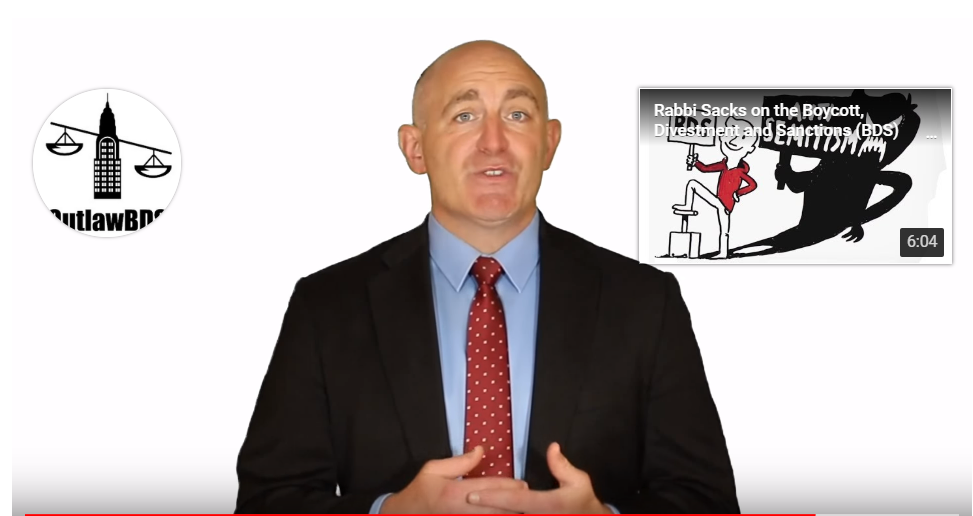 Screenshot of a YouTube video posted by a user called OutlawBDS. (YouTube screenshot)
Other BDS supporters report having received an email in September 2017 from the email address admin@outlawbds.com warning them: “Be aware that you have been identified as a BDS promoter. According to new legislation in New York State, individuals or organizations that engage in or promote BDS activities with US allies will no longer receive public funding or support. Moreover, the state and its agencies will no longer engage in business or hire these organizations and individuals as they have been deemed problematic and anti-American. You have been marked. You have been identified. You have a limited window of opportunity to cease and desist or face the consequences of your actions in legal proceedings. In case you have ceased your past wrongdoing, please contact us at admin@outlawbds.com for your profile to be removed from the Blacklist.”
The Times of Israel was told by multiple sources that Psy-Group worked to counter BDS activists — and is one of several such firms, set up by or employing former Israeli intelligence operatives, that do so.
Such work, The Times of Israel was told, is known to the Israeli government, and specifically the Ministry of Strategic Affairs, but is not paid for by the government.
Psy-Group marketing material
The sources said that such companies engage in various undercover activities against BDS leaders and activists. This work includes highlighting the sources of funding for BDS activities if such funding is obtained from terrorist or other banned organizations, and making public instances where activists have expressed extremist and/or anti-Semitic views. The goal can be to deter the activists from continuing their activities, the sources explained.
In the case of Psy-Group, The Times of Israel was told but could not independently verify, its anti-BDS work was financed by private donors, and the firm did not engage in illegal activity, did not disseminate false information, and did not engage in hacking.
The West Face project
The complaint in the lawsuit filed by West Face devotes relatively little attention to Psy-Group’s alleged anti-BDS work.
It briefly asserts that the Psy-Group operative who registered the outlawbds website went on to hire one “Amin Razvi (‘Razvi’), an individual residing in India,” to carry out work related to outlawbds.com.
The main thrust of the document deals with the alleged “defamation campaign against West Face,” as carried out by Psy-Group and Black Cube. Razvi worked for Psy-Group on that campaign, the document claims, posting defamatory content about West Face online.
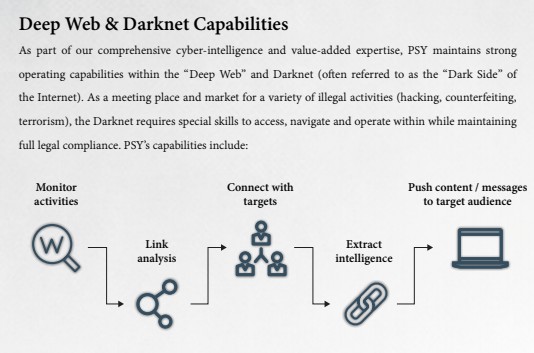 Psy-Group marketing material
Detailing the alleged activities of the two Israeli companies, the complaint claims that operatives from both Black Cube and Psy-Group “conspired to provide reporters, news agencies (including the National Post, Bloomberg News and the Associated Press), as well as others, with edited, distorted or otherwise falsified recordings and/or transcripts of meetings between operatives of Black Cube and its targets, including current and former employees.”
According to the complaint, Psy-Group — whose operatives in the Canadian project allegedly included former Israeli television journalist Emmanuel Rosen — worked in tandem with Black Cube, publishing defamatory articles and social media posts about West Face and using sophisticated masking techniques to hide their tracks.
 Harvey Weinstein attends the ‘Reservoir Dogs’ 25th anniversary screening during the 2017 Tribeca Film Festival in New York, April 28, 2017. (Charles Sykes/Invision/AP)
West Face learned of Black Cube and Psy-Group’s activities when its employees recognized the image of Stella Penn Pechanac in news reports about rape and harassment accusations against Hollywood mogul Harvey Weinstein. Pechanac was a Black Cube employee who reportedly posed as a woman’s rights activist and who befriended actress Rose McGowan in a bid to gather intelligence on behalf of Weinstein. Employees of West Face recognized Pechanac as the same woman who had reached out to them.
Several affidavits by employees and former employees of West Face Capital allege that Stella Penn Pechanac approached them, using various aliases, offering unique and exciting employment opportunities and in some cases flying them to London for fake job interviews. Black Cube operatives then allegedly plied some of these employees with alcohol in an attempt to extract information that would benefit their client in its legal proceedings.
In one instance, a Black Cube operative is alleged to have tried to entrap a retired Canadian judge into making anti-Semitic comments. According to the plaintiffs, the hope was to discredit a verdict the judge had handed down against Black Cube’s client, Catalyst, whose managing partner is Jewish.
 Black Cube logo
In response to a Times of Israel request for comment, Black Cube sent the following statement: “It is Black Cube’s policy to never discuss its clients with any third party, and to never confirm or deny any speculation made with regard to the company’s work. Referencing Black Cube has become an international sport during 2018. It is important to note that Black Cube always operates in full compliance of the law in every jurisdiction in which it conducts its work, following legal advice from the world’s leading law firms.”
In a separate matter, Black Cube was accused last month of working to slander Obama administration officials involved with the Iran nuclear deal as part of a covert effort to discredit the multinational accord. It denied the allegation.
Psy-Group closing down
Psy-Group is currently in bankruptcy proceedings in an Israeli court.
Thepublicly available bankruptcy filings, in which 29 of the Psy-Group’s employees have requested that the firm be liquidated, contain various hitherto unpublished details about Psy-Group, its activities and employees.
In Israel, Psy-Group operates under the name Invop Ltd., which according to Israel’s corporate registry was founded on December 22, 2014. Its chief executive officer is Royi Burstien, the former commander of an Israeli psychological warfare unit, according to Bloomberg. All of Invop’s shares are owned by a Cypriot company called IOCO Ltd., which in turn is owned by a British Virgin Islands company called Protexer Limited.
According to the petition by Psy-Group employees, dated February 28, 2018, employees were informed the previous week that they would not receive their February salaries because “two critical business developments had failed.” As a result, the company had fallen into a credit crunch and would be unable to pay its employees their February salaries, or, for that matter, continue to operate. The company’s director, Burstien, did not object to the bankruptcy proceedings initiated by employees and on May 21, the court appointed a special administrator for the company.
The majority of Psy-Group’s 29 employees listed in the petition appear to be young recent university graduates. A perusal of their LinkedIn pages reveals that many attended the Interdisciplinary Center in Herzliya, an elite private college near Tel Aviv, and many served in intelligence units in the Israel Defense Forces and other Israeli security services, although not necessarily in senior roles.
Despite her relative youth, at least one employee of Psy-Group earned a salary that is more than three times the Israeli average of NIS 10,300 a month: The petition includes the pay stub of an employee whose job title was “project manager” and whose gross salary was NIS 33,0363.
A few names on the list stand out. One of the petitioners is Emmanuel Rosen, a former Israeli journalist. Contacted by The Times of Israel, he had no comment on this article.
Also on the list of Psy-Group employees is Eitan Charnoff, who in 2016 was the director of iVote Israel, a controversial get-out-the-vote campaign for Americans in Israel. He directed iVote Israel at the same time that he worked at Psy-Group. “Eitan Charnoff is not currently involved with either independent organization so is not in a position to comment on anything related to either entity,” said his attorney Carrie H. Cohen of Morrison & Foerster LLP.
:{
iVoteIsrael volunteers sign up US citizens for absentee ballots at a mall in Jerusalem in June 2012 (photo credit: courtesy of iVoteIsrael.com)}:
Israeli-Australian Paul Vesely, who is not one of the petitioners, but who claimed in his LinkedIn page to have been one of the founders of Psy-Group, was previously the chief operating officer at Veribo, a company that provided online reputation management services to binary options companies. He had not replied to a request for comment at the time of publication.
In addition, four previous Psy-Group employees listed in Invop Ltd’s bankruptcy filings currently work for a company called Cyabra, whose stated mission is to help identify sockpuppets and fake Facebook profiles for organizations that have been targeted by fake comments. Cyabra had no comment on this article.
Psy-Group had not responded to a request for comment at the time of publication.
=-==
Featuring: Bob Brulle, environmental sociology researcher at Brown University; Christine Arena, former Edelman PR executive; and clips from Daniel Edelman, founder of Edelman PR.
WWI news clip about Nazi propaganda: These German pictures, destined for certain neutral countries, were intended to spread Nazi propagada, but Dr. Goebbels tripped up badly, very badly…
Amy Westervelt: Just a few months after their meetings with Ivy Ledbetter Lee, the Third Reich’s propaganda machine kicked into high gear. Within a year they were at war, and using techniques they’d learned from Lee and others to cover up atrocities and to sell the German public – not only on the war effort but also the superiority of the Aryan race. In the final months of World War II, that propaganda took a very Ivy Lee-style turn into completely made up news stories about German wins in battles that had never even happened.. In those months, a young Jewish American reporter was charged with analyzing and combatting those claims. That man’s name was Daniel Edelman. Here he is, remembering those days.
Daniel Edelman: Doing the psychological warfare thing was fascinating because we were offsetting the claims made by the Germans. It was all lies…. And we had to disclaim them.
Amy Westervelt: Edelman would ultimately spend four years working in psychological warfare. He became an expert on propaganda, and how to combat it. And he put that expertise to work for American industries, from beauty products and Sarah Lee to cigarettes and Big Oil. He added several new tactics to Big Oil’s propaganda machine, including a unique blend of lobbying and media relations, that he called “marketing public relations, and a fun new thing called “astroturfing” that involves creating fake “grassroots” groups.That’s the story we’re going to get into today. I’m Amy Westervelt and this is Drilled, Season 3: The Mad Men of Climate Denial.
Daniel Edelman was born in 1920 in Brooklyn. He was a diligent student and something of aboy genius, so by 16 he was already at university. He ultimately went to Columbia Journalism School,and spent the first year or so of his professional life as a journalist, mostly covering sports and human interest stories.
When the U.S. joined World War II, Edelman wanted to enlist but his poor eyesight got in the way. Within a year, so many infantrymen had died the military no longer cared about things like eyesight, it needed bodies. Edelman was drafted. But his vision still made him ineligible for combat. And his background in journalism made him a perfect fit for counter-intelligence. He was sent for training, and then on to join the Fifth Mobile Radio Broadcasting Company in London.
WWII mobile radio tape: “This is your American expeditionary station, in the field with the fifth army.
Amy Westervelt: After learning for a time in London, Edelman was tapped by a former Columbia classmate to join him in France, helping to prepare a nightly analysis of German propaganda. Edelman was soon in charge of the entire operation.
Daniel Edelman: He says it’s a good job. You work in a truck and in psychological warfare and I said fine.
Amy Westervelt: When the fighting ended, Edelman was transferred to Berlin to help shut down the German propaganda effort and state-owned media. He actually helped start the popular magazine Der Spiegel which he and a few other Americans ran for a few months before turning over to German ownership. For a while, Edelman thought he might stay in Germany and take a job as a reporter there. Eventually his family dissuaded him and he returned home. And then, Like Ivy Lee before him, and plenty of journalists since, Edelman struggled with whether he wanted to report the news or make the news, live the modest life of a journalist or take advantage of the burgeoning post-war economy in America and get into the business side of communications.
By this point he had worked in psychological warfare for years and he knew that expertise would be valuable in the public relations business. So he went for it, and took a job for his brother-in-law’s music label. Through that job he met the folks behind the Toni hair company, who eventually hired him to run their PR department, which brough Edelman to Chicago.
As the PR guy at Toni, he took the company’s ad campaign – which twin has the Toni? – on the road, with six sets of twins. The campaign featured side-by-side twins, both with perms, and dared customers to guess which had a salon perm and which had the Toni home perm.
Toni ad: Which twin had the Toni? You can’t tell? Nobody can. Not yet, anyway. But wait. Only Toni gives you this twin guarantee.
Amy Westervelt: Media tours had been part of political campaigns forever, but product companies had never bothered with them. Edelman saw that as a missed opportunity to score hundreds of local press hits and move product in communities across the country. And he was right. In addition to getting coverage in local newspapers, radio and TV, at one point during the tour the twins were arrested, in Oklahoma, for “performing salon services without a license.” Edelman turned it into a national news story that made Toni a household name.
It also paved the way for another new approach to P.R., one that included a bit of lobbying on the side.The Oklahoma arrests happened because salon owners were pissed about these home perm kits taking their business. Salon owners in states across the country were mobilizing to push for laws that would ban kits like the TOni kit. So Edelman got busy meeting with state legislators and applying some of those psy-oppsmoves, mocking the salon owners and their proposals until they were literally laughed out of state building after state building. A couple years later, he started his own firm, calling it Daniel J. Edelman and Associates, with Toni as his first client. But within a few years, he had signed several huge clients, including Mobil Oil, Sarah Lee, Heinz, and several tobacco companies and tobacco trade groups. His hunch was proving correct: What he’d learned about psychological warfare was extremely valuable to American industry.
If that sounds like an exaggeration, you don’t have to take my word for it. Edelman’s son Richard bragged about this history in a tribute to his father on the Edelman website.
Richard Edelman clip: My dad was a real New York City kid. Born in Brooklyn, went on to high school, Columbia College, and Columbia Journalism School. He went on to work in Europe in the U.S. army for four years in psychological warfare, and when he got out, somehow the cumulation of all these experiences led him to become the father marketing P.R.
Amy Westervelt: “Marketing public relations” was the term Edelman came up with to describe his 360-degree approach to PR – it wasn’t just media relations, it was also legislator relations, and true public relations where you were creating a direct relationship between the company and the public. One way to do that was to pretend to be part of the public yourself.
Christine Arena: I’m a 20-year communications industry professional. I’ve worked in corporate PR for a long time, on lots of different kinds of accounts. Including fossil fuel accounts, which I hated.”
Amy Westervelt: That’s Christine Arena. She was an executive vice president at Edelman’s firm, by that time just called Edelman. Arena headed up the firm’s sustainability division right at the same time that it was representing the American Petroleum Institute. She and a few other executives at the Firm made the news when they quit en masse over the companies dealings with fossil fuel clients. She can’t share any specific inside information about her time there, so she’s speaking here generally about the firm’s reputation and about the techniques deployed by the fossil fuel industry.
Christine Arena: That creation of fake, grassroots support which came to be known as astroturfing. Edelman was genius at doing that.
Amy Westervelt: Edelman and his firm worked with multiple tobacco and oil clients, all big fans of “astroturfing.”
Christine Arena: So fossil fuel industry organizations fund these fake front groups and they give these fake front groups, these names that sound there, like perfectly innocuous names like the California Drivers Alliance or the Washington Consumers for Sound Fuel Policy. And these groups there are hundreds of them are usually secretly run by lobbying organizations like those two I just mentioned are actually run by the Western States Petroleum Association, which is a top lobbyist for the oil industry. And that group, the Western States Material Petroleum Association, is in turn funded by members including BP, Shell, Exxon Mobil, Chevron and Occidental, among others. So it’s fake activism, it’s corporate money posing as activism. And and it’s designed to undo all of the progress that real activism makes.
Amy Westervelt: Working for both tobacco and fossil fuel clients,Edelman also invented litigation PR. Basically making his clients’ cases in the media. A key part of this was what Arena calls the “attack the messenger” strategy.
Christine Arena: They are relentless at the attack the messenger strategy. This has been ongoing for like 30 years. So the most effective attack the messenger strategy to me is like the use of labeling. So, for example, if climate scientists refer to facts and data rather than ideology, then they’re labeled liberal elites. If climate scientists or activists are alarmed by the data, then they’re labeled alarmists. If climate scientists apply for grant dollars to fund their research, then they are accused of being in it for the money.
Tom DeLay: The report is made by scientists that get paid to further the politics of global warming.
Rick Santorum: If there was no climate change, we’d have a lot of scientists looking for work. The reality is a lot scientists are driven by the money.
President Donald Trump: All of this with the global warming, and da da da, a lot of it’s a hoax. It’s a hoax. I mean, it’s a money making industry, ok?
Amy Westervelt: Arena says that while tobacco used the same strategy, the fossil fuel guys were just better at it. Big Tobacco would attack the whistleblowers personally, Big Oil – they attacked the whole idea of fossil fuels being any sort of problem. Because they’d spent decades crafting the narrative that fossil fuel is an essential part of American life, it was easy to call anyone who thought otherwise un-American, effectively politicizing the issue.
Of course we know that Big Oil learned new tactics from Big Tobacco, too, namely in the form of science denial. And Daniel Edelman was right there, too. In the 1970s Edelman proposed an aggressive campaign for the RJ Reynolds tobacco company. It contained more than a few echoes of the PR giant’s time in the trenches of psychological warfare.
Salem tobacco ad: Country soft, country fresh, that’s the taste you get wherever you light up a Salem, because Salem genty’ air-softens every puff, for the smoothest, most refreshing taste of any filter cigarette.
Amy Westervelt: The proposal begins by suggesting, for example that, “The non-smoker must be made to feel that the smoker cares about him. It is our sense that the non-smoker is divided into two general groups – those who don’t really care if others smoke; and those who are growing more hostile to anyone who does smoke. We need to woo the former group to our side; we need to soften the opposition of the latter. Step 2 is pure science denial. Edelman recommends “We need to pierce the solidly-assumed notion that no additional research is necessary on the subject of cigarette smoking, Imaginative and creative ways must be found to correct this Impression.” Of course one of those creative ways is to create doubt. Edelman proposes: “We need to counter public impressions based on oversimplification by dramatizing pinpointed areas of study that are mysteries to researchers and scientists on both sides of this issue.”
That proposal won Edelman a contract, and the firm would go on to work for Big Tobacco for more than a decade. If the science approach they recommended for tobacco sounds an awful lot like the climate science denial that starts showing up a few years later, there’s a reason for it. Edelman also worked for several fossil fuel clients, and the American Petroleum Institute. That’s important becauseby the 1980s the API, Ivy Lee’s brainchild, was pushing the industry away from researching climate change and toward denyingit. Former Exxon scientist Richard Werthamer told us that in Season 1.
Richard Werthamer: The key is the American Petroluem Institute. Exxon had a huge influence, rightly so, in the API and I think the API changed its tune, and probably other majors went along with that.
Amy Westervelt: And you can hear exactly the same sort of strategy that Edelman suggested for RJ Reynolds in this speech from then-ExxonMobil CEO and American Petroleum Institute president Lee Raymond in 1996:
Lee Raymond: Proponents of the global warming theory, say that higher levels of greenhouse gases, especially CO2, are causing world temperatures to rise and that burning fossil fuels is the reason. By scientific evidence remains inconclusive as to whether human activities affect the climate.
Amy Westervelt: You heard that right? Raymond said the evidence that humans contribute to climate change is “inconclusive.” But this speech was in 1996, long past the point where Exxon’s own scientists had said climate change would cause catastrophic damage for some percentage of the planet in the not so distant future if emissions weren’t curbed.
In the late 1990s, Daniel Edelman’s son Richard took over as CEO, but Dan remained involved for the rest of his life. In various interviews, and in Edelman’s biography, Richard said he talked to his dad daily about the business. They didn’t always agree, of course. When he took the reins, Richard almost immediately decided to drop tobacco clients, for example. The writing was on the wall about tobacco by that point, and what it cost the firm in tobacco billings it more than made up for in good PR and new clients.
The firm did continue to apply the same strategies for Big Oil for several more years though, including, as Daniel Edelman’s biography puts it, “putting a human face on Big Oil for the American Petroleum Institute.”
American Petroleum Institute ad: Leading the world in oil and gas production. I vote to keep it going. With the right policies we can produce, refine and supply, more oil and natural gas.
Amy Westervelt: Edelman picked up where Ivy Lee had left off, continuing to tie the extraction of oil, coal, and gas to life, liberty and the pursuit of happiness, And again, it’s hard not to see the roots of Edelman’s World War II work in the approach the firm crafted for Big Oil. Suddenly anyone who wasn’t pro-oil was anti-American.
Daniel Edelman died in 2013,but the firm that bares his name continued to apply the same tactics that he’d been using effectively for decades. In 2014, Greenpeace leaked several documents that showed anaggressive campaign that Edelman had come up with for TransCanada to push theKeystone pipeline. It includes all the same tactics we’ve talked about here: aggressive opposition research, fake grassroots groups, attacking the messenger, and a big nationalistic messaging push. In 2015, the firm announced that it would no longer be working with coal companies or any company that denied climate science. By that point, they’d already lost not only executives but also clients, and the reputational risk was just too great. However, that same year, Edelman spun off its internal advertising group, Blue, which continued to work for the API.
American Petroleum Institute ad: More secure American jobs opportunity and economic growth for our children and grandchildren, that’s why this election I’m voting for American energy.
Amy Westervelt: For all the rah rah America stuff the oil industry pushes, these campaigns often work to subvert democracy. In his most recent research, environmental sociologist Bob Brulle found that the biggest indicator of fossil fuel PR spend was the likelihood of any sort of climate legislation passing.
Bob Brulle: When you look at their public relations spending, the more the more Congress starts to have hearings and write bills dealing with climate change, the more they start spending on public relations the next year. In other words, you start having hearings this year. Next year, you’re going to have a public relations onslaught from the oil companies, telling you how good they are, how they’re so responsible and good corporate citizens, and that whatever problem it is that you’re talking about, they’re right on top of it and handling it. And the hidden messages is: so therefore, there’s no need to regulate us at all.
Amy Westervelt: In some cases they move even faster. As the Washington Post just reported, the oil guys just dropped a $1million targeted ad buy the day after a couple of current Democratic candidates said they might ban fracking. And in 2008, when Demcrats won control of all branches of the government heading into the global climate negotiations in Copenhagen, they were spending preemptively. The API alone spent a whopping $75 million with Edelman.
Bob Brulle: I don’t think there’s any other way to call it other than propaganda, which is a one sided message designed to create a certain impression, that’s exactly what it was. And it’s very focused, targeted, extremely well done and apparently pretty effective.
Amy Westervelt: So we went from Ivy Lee working with Standard Oil to World War I propaganda to Lee advising Hitler and Goebbels to Daniel Edelman learning the tools of the trade by studying and countering the Third Reich’s propaganda in World War II, and bringing those tactics right back to Big Oil.
Next time we’ll meet another key architect of the propaganda apparatus, Herb Schmertz, the PR legend who took on Mobil Oil after Edelman. And guess what? Schmertz also started out in military intelligence. He wound up adding so many new bells and whistles to the propaganda machine that we’re gonna spend two episodes delving into his story. See you then.
For more, visit the DrilledNews podcast website here.
As environmentalists began ratcheting up pressure against Canada's tar sands three years ago, one of the world's biggest strategic consulting firms was tapped to help the North American oil industry figure out how to handle the mounting activism. The resulting document, published online by WikiLeaks, offers another window into how oil and gas companies have been scrambling to deal with unrelenting opposition to their growth plans.
The document identifies nearly two-dozen environmental organizations leading the anti-oil sands movement and puts them into four categories: radicals, idealists, realists and opportunists—with how-to's for managing each. It also reveals that the worst-case scenario presented to industry about the movement's growing influence seems to have come to life.
The December 2010 presentation by Strategic Forecasting, or Stratfor, a global intelligence firm based in Texas, mostly advised oil sands companies to ignore or limit reaction to the then-burgeoning tar sands opposition movement because "activists lack influence in politics." But there was a buried warning for industry under one scenario:Letting the movement grow unopposed may bring about "the most significant environmental campaign of the decade."
"This worst-case scenario is exactly what has happened," partly because opposition to tar sands development has expanded beyond nonprofit groups to include individual activists concerned about climate change, said Mark Floegel, a senior investigator for Greenpeace. "The more people in America see Superstorm Sandys or tornadoes in Chicago, the more they are waking up and joining the fight."
Since the presentation was prepared, civil disobedience and protests against the tar sands have sprung up from coast to coast. The movement has helped delay President Obama's decision on the Keystone XL pipeline—designed to funnel Canada's landlocked oil sands crude to refineries on the Gulf Coast—and has held up another contentious pipeline in Canada, the Northern Gateway to the Pacific Coast.
The Power Point document, titled "Oil Sands Market Campaigns," was recently made public by WikiLeaks, part of a larger release of hacked files from Stratfor, whose clients include the Departments of Homeland Security and Defense, Lockheed Martin, Raytheon and the American Petroleum Institute, the oil industry lobby. It appears to have been created for Calgary-based petroleum giant Suncor Energy,Canada's largest oil sands producer.
The company told InsideClimate News that it did not hire Stratfor and never saw such a presentation. Suncor is mentioned 11 times in the document's 35 pages and all of Stratfor's advice seems to be directed at the energy company. For example, one slide says, "Campaign ends quickly with a resolution along the lines Suncor had wanted." In several emails released by WikiLeaks, Stratfor employees discuss a $14,890 payment Suncor owes the company for two completed projects, though no details were provided.
The presentation is the latest in a series of revelations that suggest energy companies—which for most of their history seemed unfazed by activists—have been looking for ways to dilute environmentalists' growing influence.
Earlier this year, TransCanada, the Canadian energy company behind the Keystone XL, briefed Nebraska law enforcement authorities on how to prosecute demonstrators protesting the 1,200-mile project. In 2011, Range Resources, an oil and gas company, allegedly hired combat veterans with experience in psychological warfare to squash opposition of natural gas drilling.
"The Stratfor presentation isn't a complete surprise," said Scott Parkin, a senior campaigner for the Rainforest Action Network and volunteer organizer for Rising Tide North America, both grassroots environmental groups. "As opposition has grown, coal, oil and gas companies are all starting to put more money into responding—from surveillance to protection to public relations."
Who Is Targeted
For each of Stratfor's categories of environmental activist—radicals, idealists, realists and opportunists—the presentation explains how their campaigns are structured and how the fossil fuel industry could deal with them.
Three grassroots organizations—Rising Tide North America, Oil Change International and the Indigenous Environmental Network—were labeled radicals. Greenpeace and the Rainforest Action Network were classified as a cross between radicals and idealists. Sierra Club, the nation's largest environmental group, Amnesty International and Communities for a Better Environment, among others, were labeled idealists. Several mainstream environmental groups, including the National Wildlife Federation, World Wildlife Fund, Natural Resources Defense Council and Ceres, a nonprofit that organizes businesses, investors and public interest groups, were called realists.
It then lays out tactics the groups would use to push for change. They include holding demonstrations outside annual meetings and marketing events, generating fear of oil spills and other environmental disasters, targeting CEOs and their families, collaborating with other green groups, and splitting the fossil fuel industry on the issue by praising companies working with activists and publicly shaming those that aren't.
The presentation says that while environmental groups are publicly fighting to stop the expansion of the oil sands, their "real demand" is for fossil fuel companies to adopt a "global code of conduct"—a set of best practices not required by law, but that take into consideration things like greenhouse gas reduction policies and human rights.
The Power Point also describes all the ways fossil fuel companies like Suncor could choose to react to green groups' campaigns, such as limiting contact with the organizations, intentionally delaying negotiations, developing its own environmental initiatives to overshadow activists' demands, or simply not responding. It provides the pros and cons of each public relations decision, as well as the best- and worst-case outcomes for each.
For example, Stratfor said that choosing not to respond could be useful because in 2010, "activists are not stopping oil sands' growth and they have no power in Alberta or Ottawa. Chance of success with U.S. government is slim." The best outcome from a no-response strategy, according to the presentation, is that green "groups move to fracturing natural gas [fracking] or some other venue to press for the first major code of conduct."
Stratfor would not answer questions about the presentation because it has a policy not to comment on any of the WikiLeaks documents.
Several environmental groups named in the Stratfor presentation said they weren't surprised by the consulting firm's assessment of their work, but were disappointed, especially by its assumption that all they wanted was a code of conduct.
"The environmental community has been very united in saying that we need to stop tar sands expansion and clean up the mess already made there," said Susan Casey-Lefkowitz, director of the Natural Resources Defense Council's international program. "That's the only real path forward if we're going to protect not only the health of communities on the ground in the boreal forests near the tar sands region, but also around the world from the impacts of climate change. We're not looking for a code of conduct."
For many, the leaked presentation provided proof that their work was having an impact, boosting their confidence to keep protesting.
"Knowing that groups like Stratfor are targeting us, surveying us, and also analyzing us shows how powerful these movements have become," said Parkin of the Rainforest Action Network and Rising Tide North America. "Obviously this wasn't meant for public consumption, but this doesn't intimidate us. If anything, it emboldens us. It encourages us to push harder."
PUBLISHED UNDER:
https://www.youtube.com/watch?v=cy-9iciNF1A
17 min BBC 4 (Trump USA) origins in military psy-ops
Cambridge Analytica: Undercover Secrets of Trump's Data Firm
Mar 20, 2018
==
https://www.democracynow.org/2020/1/10/defense_contractors_are_using_a_new
We continue our conversation with the directors of “The Great Hack,” Jehane Noujaim and Karim Amer, as well as former Cambridge Analytica employee Brittany Kaiser and propaganda researcher Emma Briant, about Cambridge Analytica’s parent company SCL Group’s history as a defense contractor. “We’re in a state of global information warfare now,” Briant says. “How do we know if our militaries develop technologies and the data that it has gathered on people, for instance, across the Middle East … how do we know when that is turning up in Yemen or when that is being utilized by an authoritarian regime against the human rights of its people or against us? How do we know that it’s not being manipulated by Russia, by Iran, by anybody who’s an enemy, by Saudi Arabia, for example, who SCL were also working with? We have no way of knowing, unless we open up this industry and hold these people properly accountable for what they’re doing.”
Transcript
AMY GOODMAN: I wanted to bring Emma Briant back into this conversation. You mentioned it in Part 1 of our discussion —— this issue of military contractors —— and the nexus of military and government power, the fact that with Trump’s election — — military contractors were one of the greatest financial beneficiaries of Trump’s election.
KARIM AMER: But I think it’s important to remember that — the issue is that also these — when we think of military contractors, we think of people selling tanks and guns and bullets and these types of things. The problem that we don’t realize is that we’re in an era of information warfare. So the new military contractors aren’t selling — aren’t selling the traditional tanks. They’re selling the —
AMY GOODMAN: Although they’re doing that.
KARIM AMER: They’re doing that, as well, but they’re selling the equivalent of that in the information space. And that’s a new kind of weapon. That’s a new kind of battle that we’re not familiar with.
And the reason why it’s more challenging for us is because there’s a deficit of language and a deficit of visuals.We don’t know where the battlefield is. We don’t know where the borders are. We can’t pinpoint, be like, “This is where the trenches are.” Yet we’re starting to uncover that. And that was so much of the challenge in making this film, is trying to see where can we actually show you where these wreckage sites are, where the casualties of this new information warfare are, and who the actors are and where the fronts are.
And I think, in entering 2020, we have to keep a keen eye on where the new war fronts are and when they’re happening in our domestic frontiers and how they’re happening in these devices that we use every day. So this is where we have to have a new kind of reframing of what we’re looking at, because while we are at war, it is a very different kind of borderless war where asymmetric information activity can affect us in ways that we never imagined.
AMY GOODMAN: And, Emma Briant, you talked about when Facebook knew the level of documentation that Cambridge Analytica was taking from them.
AMY GOODMAN: I mean, Cambridge Analytica paid them, right?
EMMA BRIANT: Yes. I mean, they were providing the data to GSR, who then, you know, were paid by —
AMY GOODMAN: Explain what GSR is.
EMMA BRIANT: Sorry, the company by Kogan and Joseph Chancellor, their company that they were setting up to do both academic research but also to exploit the data for Cambridge Analytica’s purposes. So they were working with — on mapping that data onto the personality tests and giving that access to Cambridge Analytica, so that they could scale it up to profile people across the target states in America especially, but also all across America. They obtained way more than they ever expected, as Chris Wylie and Brittany have shown.
But I want to also ask: When did our governments know about what Cambridge Analytica and SCL were doing around the world and when they were starting to work in our elections? One of the issues is that these technologies have been partly developed by, you know, grants from our governments and that these were, you know, defense contractors, as we say. We have a responsibility for those companies and for ensuring that there’s reporting back on what they’re doing, and some kind of transparency.
As Karim was saying, that if you — you know, we’re in a state of global information warfare now. If you have a bomb that has been discovered that came from an American source and it’s in Yemen, then we can look at that bomb, and often there’s a label which declares that it’s an American bomb that has been bought, that has, you know, been used against civilians. But what about data? How do we know if our militaries develop technologies and the data that it has gathered on people, for instance, across the Middle East, the kind of data that Snowden revealed — how do we know when that is turning up in Yemen or when that is being utilized by an authoritarian regime against the human rights of its people or against us? How do we know that it’s not being manipulated by Russia, by Iran, by anybody who’s an enemy, by Saudi Arabia, for example, who SCL were also working with? We have no way of knowing, unless we open up this industry and hold these people properly accountable for what they’re doing.
AMY GOODMAN: SCL Defence was the parent company of Cambridge Analytica. Emma Briant, human rights researcher at Bard College, her upcoming book, Propaganda Machine: Inside Cambridge Analytica and the Digital Influence Industry. We’ll be back in less than 30 seconds.
[break]
AMY GOODMAN: This is Democracy Now! I’m Amy Goodman, as we continue our look at Cambridge Analytica, Facebook, and their roles in U.S. and other elections. I speak to the directors of The Great Hack, Jehane Noujaim and Karim Amer, as well as former Cambridge Analytica whistleblower Brittany Kaiser, who’s begun posting online a trove of documents detailing the operations of the now-defunct company. I asked propaganda researcher Emma Briant to talk about the significance of the documents.
EMMA BRIANT: I think the biggest reveal is going to be in the American campaigns around this, but I think you haven’t seen the half of it yet. This is the tip of the iceberg, as I’ve been saying.
My thing that I think that is most interesting of what’s been revealed so far is actually the Iran campaign, because, you know, this is a very complex issue, and it really is an exemplar of the kinds of conflicts of interest that I’m talking about, at a company that is, you know, set out to profit from the arms trade and from the expansion of war in that region and from the favoring of one side in a regional conflict, essentially, backed by American power, by the escalation of the conflict with Iran and, you know, by getting more contracts, of course, with theGulf states, the UAE and the Saudis. You know, and, of course, they were trying to put Trump in power, as well, to do that, and advancing John Bolton and the other hawks who have been trying to demand that sanctions — to keep sanctions and to get out of the Iran deal, which they have been arguing is a flawed deal.
And, of course, SCL were involved in doing work in that region since 2013, including they were working before that on Iran for President Obama’s administration, which I’m going to be talking more about in the future. The issue is that there is a conflict of interest here. So you gain experience for one government, and then you’re going and working for others that maybe are not entirely aligned in their interests.
AMY GOODMAN: Although it was for the election of Donald Trump, of course, it happened during the Obama years.
EMMA BRIANT: Yes.
AMY GOODMAN: That’s when Cambridge Analytica really gained its strength in working with Facebook.
EMMA BRIANT: Yeah. And SCL’s major shareholder, Vincent Tchenguiz, of course, was involved in the early establishment of the company Black Cubeand in some of its early funding, I believe. I don’t know how long they stayed in any kind of relationship with that firm. However, the firm Black Cube were also targeting Obama administration officials with a massive smear campaign, as has been revealed in the media. And, you know, this opposition to the Iran deal and the promotion of these kinds of, you know, really fearmongering advertising that Brittany is talking about is very disturbing, when this same company is also driving, you know, advertising for gun sales and things like that.
AMY GOODMAN: Wait. Explain what Black Cube is, which goes right to today’s headlines —
EMMA BRIANT: Exactly.
AMY GOODMAN: — because Harvey Weinstein, accused of raping I don’t know how many women at last count, also employed Black Cube, former Israeli intelligence folks, to go after —
EMMA BRIANT: Yes.
AMY GOODMAN: — the women who were accusing him, and even to try to deceive the reporters, like at The New York Times, to try to get them to write false stories.
EMMA BRIANT: Absolutely. I mean, this is an intelligence firm that was born, again, out of the “war on terror.” So, Israel’s war on terror, this time, produced an awful lot of people who had gone through conscription and developed really, you know, strong expertise in cyberoperations or on developing information warfare technologies, in general, intelligence gathering techniques. And Black Cube was formed by people who came out of the Israeli intelligence industries. And they all formed these companies, and this has become a huge industry, which is not really being properly regulated, as well, and properly governed, and seems to be rather out of control. And they have been also linked to Cambridge Analytica in the evidence to Parliament. So, I think the involvement of all of these companies is really disturbing, as well, in relation to the Iran deal.We don’t know that Cambridge Analytica in any way were working with Black Cube in this, at this point in time. However, the fact is that all of this infrastructure has been created, which is not being properly tackled. And how they’re able to operate without anybody really understanding what’s going on is a major, major problem.
AMY GOODMAN: Brittany?
BRITTANY KAISER: Black Cube isn’t the only company you should be concerned about. The founder of Blackwater, or their CEO, Erik Prince, was also an investor in Cambridge Analytica. So he profits from arm sales around the world, and military contracts, and has been accused of causing the unnecessary death of civilians in very many different wartime situations. He was one of the investors in Cambridge Analytica and their new company, Emerdata. And so, I should be very concerned, and everyone should be very concerned, about the weaponization of our data by people that are actually experts in selling weapons. So, that’s one thing that I think needs to be in the public discussion, the difference between what is military, what is civilian, and how those things can be used for different purposes or not.
KARIM AMER: And I think what’s important to see — is that, you know, in the clip you showed, Chris Wylie is talking about how Cambridge is a full-service propaganda machine. What does that really mean? You know, I would say that what’s happening is we’re getting insight to the the network of the influence industry, the buying and selling of information and of people’s behavioral change. And it is a completely unregulated space.
And what’s very worrisome is that, as we’re seeing more and more, with what Emma’s talking about and what Brittany has shown, is this conveyor belt of military-grade information and research and expertise coming out of our defense work, that’s being paid for by our tax money, then going into the private sector and selling it to the highest bidder, with different special interests from around the world. So what you see in the files is, you know, a oil company buying influence campaign in a country that it’s not from and having no — you know, no responsibility or anything to what it’s doing there. And what happens in that, the results of that research, where it gets handed over to, no one knows. Any contracts that then result in the change that happens on the political ground, no one tracks and sees.
So, this is what we’re very concerned about, is because you’re seeing that everything has become for sale. And if everything is for sale —
JEHANE NOUJAIM: Our elections are for sale.
KARIM AMER: Exactly. And so, how do we have any kind of integrity to the vote, when we’re living in such a condition?
JEHANE NOUJAIM:This was why we felt so passionate about making this film, because it’s invisible. How do you make the invisible visible? And this is why Brittany is releasing these files, because unless we understand the tactics, which are currently being used again, right now, as we speak, same people involved, then we can’t change this.
AMY GOODMAN: Facebook’s a crime scene, Jehane. Elaborate on that.
JEHANE NOUJAIM: Absolutely. Facebook is where this has happened. Initially, we thought this was Cambridge Analytica — right? — and that Cambridge Analytica was the only bad player. But Facebook has allowed this to happen. And they have not revealed. They have the data. They understand what has happened, but they have not revealed that.
AMY GOODMAN: And they have profited off of it.
JEHANE NOUJAIM: And they have profited off of it.
KARIM AMER: Well, it’s not just that they’ve profited off it. I think what’s even more worrisome is that a lot of our technology companies, I would say, are incentivized now by the polarization of the American people. The more polarized, the more you spend time on the platform checking the endless feed, the more you’re hooked, the more you’re glued, the more their KPI at the end of the year, which says number of hours spent per user on platform, goes up. And as long as that’s the model, then everything is designed, from the way you interact with these devices to the way your news is sorted and fed to you, to keep you on, as hooked as possible, in this completely unregulated, unfiltered way — under the guise of freedom of speech when it’s selectively there for them to protect their interests further. And I think that’s very worrisome.
And we have to ask these technology companies: Would there be a Silicon Valley if the ideals of the open society were not in place? Would Silicon Valley be this refuge for the world’s engineers of the future to come reimagine what the future could look like, had there not been the foundations of an open society? There would not be. Yet the same people who are profiting off of these ideals protecting them feel no responsibility in their preservation. And that is what is so upsetting. That is what is so criminal. And that is why we cannot look to them for leadership on how to get out of this.
We have to look at the regulation. You know, if Facebook was fined $50 billion instead of five, I guarantee you we wouldn’t be having this conversation right now. It would have led to not only an incredible change within the company, but it would have been the signal to the entire industry. And there would have been innovation that would have been sponsored to come out of this problem. Like, we can use technology to fix this, as well. We just have to create the right incentivization plan. I have belief that the engineers of the future that are around can help us get out of this. But currently they are not the — they are not the decision makers, because these companies are not democratic whatsoever.
EMMA BRIANT: Could I? Yes, please. I just wanted to make a point about how important this is for ordinary Americans to understand the significance for their own lives, as well, because I think some people hear this, and they think, “Oh, tech, this is maybe quite abstract,” or, you know, they may feel that other issues are more important when it comes to election time. But I want to make the point that, actually, you know what? This subject is about all of those other issues.
This is about inequality and it being enabled. If you care about, you know, having a proper debate about all of the issues that are relevant to America right now, so, you know, do you care about the — you know, the horrifying state of American prison system, what’s being done to migrants right now, if you care about a minimum wage, if you care about the healthcare system, you care about the poverty, the homelessness on the streets, you care about American prosperity, you care about the environment and making sure that your country doesn’t turn into the environmental disaster that Australia is experiencing right now, then you have to care about this topic, because we can’t have an adequate debate, we cannot, like, know that we have a fair election system, until we understand that we are actually having a discussion, from American to American, from, you know, country to country, that isn’t being dominated by rich oil industries or defense industries and brutal leaders and so on.
So, I think that the issue is that Americans need to understand that this is an underlying issue that is stopping them being able to have the kinds of policies that would create for them a better society. It’s stopping their own ability to make change happen in the ways that they want it to happen.
EMMA BRIANT: It’s not an abstract issue. Thank you.
AMY GOODMAN:
What would be the most effective form of regulation? I mean, we saw old Standard Oil broken up, these monopolies broken up.
EMMA BRIANT: Yeah.
AMY GOODMAN: Do you think that’s the starting point for companies like Facebook, like Google and others?
EMMA BRIANT: I think that’s a big part of it. I do think that Elizabeth Warren’s recommendations when it comes to that and antitrust and so on are really important. And we have legal precedents to follow on that kind of thing.
But I also think that we need an independent regulator for the tech industry and also a separate one for the influence industry. So, America has some regulation when it comes to lobbying. In the U.K., we have none. And quite often, you know, American companies will partner with a British company in order to be able to get around doing things, for instance. We have to make sure that different countries’ jurisdictions cannot be, you know, abused in order to make something happen that would be forbidden in another country.
We need to make sure that we’re also tackling how money is being channeled into these campaigns, because, actually, there’s an awful lot we could do that isn’t just about censoring or taking down content, but that actually is, you know, about making sure that the money isn’t being funneled in to the — to fund these actual campaigns. If we knew who was behind them, if we were able to show which companies were working on them and what other interests they might have, then I think this would really open up the system to better journalism, to better — you know, more accountability.
And the issue isn’t just about what’s happening on the platforms, although that is a big part of it. We have to think about, you know, the whole infrastructure.
AMY GOODMAN: Propaganda researcher Emma Briant; Jehane Noujaim and Karim Amer, the directors of The Great Hack, the Netflix documentary just shortlisted for an Academy Award; and Cambridge Analytica whistleblower Brittany Kaiser, author of Targeted: The Cambridge Analytica Whistleblower’s Inside Story of How Big Data, Trump, and Facebook Broke Democracy and How It Can Happen Again.
To see the first hour of our discussion, go to democracynow.org.
guard uk no links (many)
gXardian.com/politics/2017/feb/26/robert-mercer-breitbart-war-on-media-steve-bannon-donald-trump-nigel-farage
Mercer: the big data billionaire waging war on mainstream media
With links to Donald Trump, Steve Bannon and Nigel Farage, the rightwing US computer scientist is at the heart of a multimillion-dollar propaganda network
Carole Cadwalladr
Sunday 26 February 2017
This article is the subject of a legal complaint on behalf of Cambridge Analytica LLC and SCL Elections Limited.
Just over a week ago, Donald Trump gathered members of the world’s press before him and told them they were liars. “The press, honestly, is out of control,” he said. “The public doesn’t believe you any more.” CNN was described as “very fake news… story after story is bad”. The BBC was “another beauty”.
That night I did two things. First, I typed “Trump” in the search box of Twitter. My feed was reporting that he was crazy, a lunatic, a raving madman. But that wasn’t how it was playing out elsewhere. The results produced a stream of “Go Donald!!!!”, and “You show ’em!!!” There were star-spangled banner emojis and thumbs-up emojis and clips of Trump laying into the “FAKE news MSM liars!”
Trump had spoken, and his audience had heard him. Then I did what I’ve been doing for two and a half months now. I Googled “mainstream media is…” And there it was. Google’s autocomplete suggestions: “mainstream media is… dead, dying, fake news, fake, finished”. Is it dead, I wonder? Has FAKE news won? Are we now the FAKE news? Is the mainstream media – we, us, I – dying?
It leads to a website called CNSnews.com and an article: “The Mainstream media are dead.” They’re dead, I learn, because they – we, I – “cannot be trusted”. How had it, an obscure site I’d never heard of, dominated Google’s search algorithm on the topic? In the “About us” tab, I learn CNSnews is owned by the Media Research Center, which a click later I learn is “America’s media watchdog”, an organisation that claims an “unwavering commitment to neutralising leftwing bias in the news, media and popular culture”.
Another couple of clicks and I discover that it receives a large bulk of its funding – more than $10m in the past decade – from a single source, the hedge fund billionaire Robert Mercer. If you follow US politics you may recognise the name. Robert Mercer is the money behind Donald Trump. But then, I will come to learn, Robert Mercer is the money behind an awful lot of things. He was Trump’s single biggest donor. Mercer started backing Ted Cruz, but when he fell out of the presidential race he threw his money – $13.5m of it – behind the Trump campaign.
It’s money he’s made as a result of his career as a brilliant but reclusive computer scientist. He started his career at IBM, where he made what the Association for Computational Linguistics called “revolutionary” breakthroughs in language processing – a science that went on to be key in developing today’s AI – and later became joint CEO of Renaissance Technologies, a hedge fund that makes its money by using algorithms to model and trade on the financial markets.
One of its funds, Medallion, which manages only its employees’ money, is the most successful in the world – generating $55bn so far. And since 2010, Mercer has donated $45m to different political campaigns – all Republican – and another $50m to non-profits – all rightwing, ultra-conservative. This is a billionaire who is, as billionaires are wont, trying to reshape the world according to his personal beliefs.
Donald Trump’s presidential campaigned received $13.5m from Robert Mercer.
Robert Mercer very rarely speaks in public and never to journalists, so to gauge his beliefs you have to look at where he channels his money: a series of yachts, all called Sea Owl;a $2.9m model train set; climate change denial (he funds a climate change denial thinktank, the Heartland Institute); and what is maybe the ultimate rich man’s plaything – the disruption of the mainstream media. In this he is helped by his close associate Steve Bannon, Trump’s campaign manager and now chief strategist. The money he gives to the Media Research Center, with its mission of correcting “liberal bias” is just one of his media plays. There are other bigger, and even more deliberate strategies, and shining brightly, the star at the centre of the Mercer media galaxy, is Breitbart.
It was $10m of Mercer’s money that enabled Bannon to fund Breitbart – a rightwing news site, set up with the express intention of being a Huffington Post for the right. It has launched the careers of Milo Yiannopoulos and his like, regularly hosts antisemitic and Islamophobic views, and is currently being boycotted by more than 1,000 brands after an activist campaign. It has been phenomenally successful: the 29th most popular site in America with 2bn page views a year. It’s bigger than its inspiration, the Huffington Post, bigger, even, than PornHub. It’s the biggest political site on Facebook. The biggest on Twitter.
Prominent rightwing journalist Andrew Breitbart, who founded the site but died in 2012, told Bannon that they had “to take back the culture”. And, arguably, they have, though American culture is only the start of it. In 2014, Bannon launched Breitbart London, telling the New York Times it was specifically timed ahead of the UK’s forthcoming election. It was, he said, the latest front “in our current cultural and political war”. France and Germany are next.
A determined plutocrat and a brilliant media strategist can, and have, found a way to mould journalism to their own ends
But there was another reason why I recognised Robert Mercer’s name: because of his connection to Cambridge Analytica, a small data analytics company. He is reported to have a $10m stake in the company, which was spun out of a bigger British company called SCL Group. It specialises in “election management strategies” and “messaging and information operations”, refined over 25 years in places like Afghanistan and Pakistan. In military circles this is known as “psyops” – psychological operations. (Mass propaganda that works by acting on people’s emotions.)
Cambridge Analytica worked for the Trump campaign and, so I’d read, the Leave campaign. When Mercer supported Cruz, Cambridge Analytica worked with Cruz. When Robert Mercer started supporting Trump, Cambridge Analytica came too. And where Mercer’s money is, Steve Bannon is usually close by: it was reported that until recently he had a seat on the board.
Last December, I wrote about Cambridge Analytica in a piece about howGoogle’s search results on certain subjects were being dominated by rightwing and extremist sites. Jonathan Albright, a professor of communications at Elon University, North Carolina, who had mapped the news ecosystem and found millions of links between rightwing sites “strangling” the mainstream media, told me that trackers from sites like Breitbart could also be used by companies like Cambridge Analytica to follow people around the web and then, via Facebook, target them with ads.
On its website,Cambridge Analytica makes the astonishing boast that it has psychological profiles based on 5,000 separate pieces of data on 220 million American voters – its USP is to use this data to understand people’s deepest emotions and then target them accordingly. The system, according to Albright, amounted to a “propaganda machine”.
A few weeks later, the Observer received a letter. Cambridge Analytica was not employed by the Leave campaign, it said. Cambridge Analytica “is a US company based in the US. It hasn’t worked in British politics.”
Which is how, earlier this week, I ended up in a Pret a Manger near Westminster with Andy Wigmore, Leave.EU’s affable communications director, looking at snapshots of Donald Trump on his phone. It was Wigmore who orchestrated Nigel Farage’s trip to Trump Tower – the PR coup that saw him become the first foreign politician to meet the president elect.
Wigmore scrolls through the snaps on his phone. “That’s the one I took,” he says pointing at the now globally famous photo of Farage and Trump in front of his golden elevator door giving the thumbs-up sign. Wigmore was one of the “bad boys of Brexit” – a term coined by Arron Banks, the Bristol-based businessman who was Leave.EU’s co-founder.
Cambridge Analytica had worked for them, he said. It had taught them how to build profiles, how to target people and how to scoop up masses of data from people’s Facebook profiles. A video on YouTube shows one of Cambridge Analytica’s and SCL’s employees, Brittany Kaiser, sitting on the panel at Leave.EU’s launch event.
Facebook was the key to the entire campaign, Wigmore explained. A Facebook ‘like’, he said, was their most “potent weapon”. “Because using artificial intelligence, as we did, tells you all sorts of things about that individual and how to convince them with what sort of advert. And you knew there would also be other people in their network who liked what they liked, so you could spread. And then you follow them. The computer never stops learning and it never stops monitoring.”
It sounds creepy, I say.
“It is creepy! It’s really creepy! It’s why I’m not on Facebook! I tried it on myself to see what information it had on me and I was like, ‘Oh my God!’ What’s scary is that my kids had put things on Instagram and it picked that up. It knew where my kids went to school.”
They hadn’t “employed” Cambridge Analytica, he said. No money changed hands. “They were happy to help.”
Why?
“Because Nigel is a good friend of the Mercers. And Robert Mercer introduced them to us.He said, ‘Here’s this company we think may be useful to you.’ What they were trying to do in the US and what we were trying to do had massive parallels. We shared a lot of information. Why wouldn’t you?” Behind Trump’s campaign and Cambridge Analytica, he said, were “the same people. It’s the same family.”
There were already a lot of questions swirling around Cambridge Analytica, and Andy Wigmore has opened up a whole lot more. Such as: are you supposed to declare services-in-kind as some sort of donation? The Electoral Commission says yes, if it was more than £7,500. And was it declared? The Electoral Commission says no. Does that mean a foreign billionaire had possibly influenced the referendum without that influence being apparent? It’s certainly a question worth asking.
In the last month or so, articles in first the Swiss and the US press have asked exactly what Cambridge Analytica is doing with US voters’ data. In a statement to the Observer, the Information Commissioner’s Office said: “Any business collecting and using personal data in the UK must do so fairly and lawfully. We will be contacting Cambridge Analytica and asking questions to find out how the company is operating in the UK and whether the law is being followed.”
Cambridge Analytica said last Friday they are in touch with the ICO and are completely compliant with UK and EU data laws. It did not answer other questions the Observer put to it this week about how it built its psychometric model, which owes its origins to original research carried out by scientists at Cambridge University’s Psychometric Centre, research based on a personality quiz on Facebook that went viral. More than 6 million people ended up doing it, producing an astonishing treasure trove of data.
These Facebook profiles – especially people’s “likes” – could be correlated across millions of others to produce uncannily accurate results. Michal Kosinski, the centre’s lead scientist,found that with knowledge of 150 likes, their model could predict someone’s personality better than their spouse. With 300, it understood you better than yourself. “Computers see us in a more robust way than we see ourselves,” says Kosinski.
But there are strict ethical regulations regarding what you can do with this data. Did SCL Group have access to the university’s model or data, I ask Professor Jonathan Rust, the centre’s director? “Certainly not from us,” he says. “We have very strict rules around this.”
A scientist, Aleksandr Kogan, from the centre was contracted to build a model for SCL, and says he collected his own data. Professor Rust says he doesn’t know where Kogan’s data came from. “The evidence was contrary. I reported it.” An independent adjudicator was appointed by the university. “But then Kogan said he’d signed a non-disclosure agreement with SCL and he couldn’t continue [answering questions].”
Kogan disputes this and says SCL satisfied the university’s inquiries. But perhaps more than anyone,Professor Rust understands how the kind of information people freely give up to social media sites could be used.
“The danger of not having regulation around the sort of data you can get from Facebook and elsewhere is clear. With this, a computer can actually do psychology, it can predict and potentially control human behaviour. It’s what the scientologists try to do but much more powerful. It’s how you brainwash someone. It’s incredibly dangerous.
“It’s no exaggeration to say that minds can be changed. Behaviour can be predicted and controlled. I find it incredibly scary. I really do. Because nobody has really followed through on the possible consequences of all this. People don’t know it’s happening to them. Their attitudes are being changed behind their backs.”
Mercer invested in Cambridge Analytica, the Washington Post reported, “driven in part by an assessment that the right was lacking sophisticated technology capabilities”. But in many ways, it’s what Cambridge Analytica’s parent company does that raises even more questions.
Emma Briant, a propaganda specialist at the University of Sheffield, wrote about SCL Group in her 2015 book, Propaganda and Counter-Terrorism: Strategies for Global Change. Cambridge Analytica has the technological tools to effect behavioural and psychological change, she said, but it’sSCL that strategises it. It has specialised, at the highest level – for Nato, the MoD, the US state department and others – in changing the behaviour of large groups. It models mass populations and then it changes their beliefs.
SCL was founded by someone called Nigel Oakes, who worked for Saatchi & Saatchi on Margaret Thatcher’s image, says Briant, and the company had been “making money out of the propaganda side of the war on terrorism over a long period of time. There are different arms of SCL but it’s all about reach and the ability to shape the discourse. They are trying to amplify particular political narratives. And they are selective in who they go for: they are not doing this for the left.”
In the course of the US election, Cambridge Analytica amassed a database, as it claims on its website, of almost the entire US voting population – 220 million people – and the Washington Post reported last week thatSCL was increasing staffing at its Washington office and competing for lucrative new contracts with Trump’s administration. “It seems significant that a company involved in engineering a political outcome profits from what follows. Particularly if it’s the manipulation, and then resolution, of fear,” says Briant.
It’s the database, and what may happen to it, that particularly exercises Paul-Olivier Dehaye, a Swiss mathematician and data activist who has been investigating Cambridge Analytica and SCL for more than a year. “How is it going to be used?” he says. “Is it going to be used to try and manipulate people around domestic policies? Or to ferment conflict between different communities? It is potentially very scary. People just don’t understand the power of this data and how it can be used against them.”
There are two things, potentially, going on simultaneously: the manipulation of information on a mass level, and the manipulation of information at a very individual level. Both based on the latest understandings in science about how people work, and enabled by technological platforms built to bring us together.
Are we living in a new era of propaganda, I ask Emma Briant? One we can’t see, and that is working on us in ways we can’t understand? Where we can only react, emotionally, to its messages? “Definitely. The way that surveillance through technology is so pervasive, the collection and use of our data is so much more sophisticated. It’s totally covert. And people don’t realise what is going on.”
Public mood and politics goes through cycles. You don’t have to subscribe to any conspiracy theory, Briant says, to see that a mass change in public sentiment is happening. Or that some of the tools in action are straight out of the military’s or SCL’s playbook.
But then there’s increasing evidence that our public arenas – the social media sites where we post our holiday snaps or make comments about the news – are a new battlefield where international geopolitics is playing out in real time. It’s a new age of propaganda. But whose? This week, Russia announced the formation of a new branch of the military: “information warfare troops”.
Sam Woolley of the Oxford Internet Institute’s computational propaganda institute tells me that one third of all traffic on Twitter before the EU referendum was automated “bots” – accounts that are programmed to look like people, to act like people, and to change the conversation, to make topics trend. And they were all for Leave. Before the US election, they were five-to-one in favour of Trump – many of them Russian. Last week they have been in action in the Stoke byelection – Russian bots, organised by who? – attacking Paul Nuttall.
You can take a trending topic, such as fake news, and then weaponise it, turn it against the media that uncovered it
“Politics is war,” said Steve Bannon last year in the Wall Street Journal. And increasingly this looks to be true.
There’s nothing accidental about Trump’s behaviour, Andy Wigmore tells me. “That press conference. It was absolutely brilliant. I could see exactly what he was doing. There’s feedback going on constantly. That’s what you can do with artificial intelligence. You can measure ever reaction to every word. He has a word room, where you fix key words. We did it. So with immigration, there are actually key words within that subject matter which people are concerned about. So when you are going to make a speech, it’s all about how can you use these trending words.”
Wigmore met with Trump’s team right at the start of the Leave campaign. “And they said the holy grail was artificial intelligence.”
Who did?
“Jared Kushner and Jason Miller.”
Later, when Trump picked up Mercer and Cambridge Analytica, the game changed again. “It’s all about the emotions. This is the big difference with what we did. They call it bio-psycho-social profiling. It takes your physical, mental and lifestyle attributes and works out how people work, how they react emotionally.”
Bio-psycho-social profiling, I read later, is one offensive in what is called “cognitive warfare”. Though there are many others: “recoding the mass consciousness to turn patriotism into collaborationism,” explains a Nato briefing document on countering Russian disinformation written by an SCL employee. “Time-sensitive professional use of media to propagate narratives,” says one US state department white paper. “Of particular importance to psyop personnel may be publicly and commercially available data from social media platforms.”
Yet another details the power of a “cognitive casualty” – a “moral shock” that “has a disabling effect on empathy and higher processes such as moral reasoning and critical thinking”. Something like immigration, perhaps. Or “fake news”. Or as it has now become: “FAKE news!!!!”
How do you change the way a nation thinks? You could start by creating a mainstream media to replace the existing one with a site such as Breitbart. You could set up other websites that displace mainstream sources of news and information with your own definitions of concepts like “liberal media bias”, like CNSnews.com. And you could give the rump mainstream media, papers like the “failing New York Times!” what it wants: stories. Because the third prong of Mercer and Bannon’s media empire is the Government Accountability Institute.
Bannon co-founded it with $2m of Mercer’s money. Mercer’s daughter, Rebekah, was appointed to the board. Then they invested in expensive, long-term investigative journalism. “The modern economics of the newsroom don’t support big investigative reporting staffs,” Bannon told Forbes magazine. “You wouldn’t get a Watergate, a Pentagon Papers today, because nobody can afford to let a reporter spend seven months on a story. We can. We’re working as a support function.”
Welcome to the future of journalism in the age of platform capitalism. News organisations have to do a better job of creating new financial models. But in the gaps in between, a determined plutocrat and a brilliant media strategist can, and have, found a way to mould journalism to their own ends.
In 2015, Steve Bannon described to Forbes how theGAI operated, employing a data scientist to trawl the dark web (in the article he boasts of having access to $1.3bn worth of supercomputers) to dig up the kind of source material Google can’t find. One result has been a New York Times bestseller, Clinton Cash: The Untold Story of How and Why Foreign Governments and Businesses Helped Make Bill and Hillary Rich, written by GAI’s president, Peter Schweizer and later turned into a film produced by Rebekah Mercer and Steve Bannon.
This, Bannon explained, is how you “weaponise” the narrative you want. With hard researched facts. With those, you can launch it straight on to the front page of the New York Times, as the story of Hillary Clinton’s cash did.Like Hillary’s emails it turned the news agenda, and, most crucially, it diverted the attention of the news cycle. Another classic psyops approach. “Strategic drowning” of other messages.
This is a strategic, long-term and really quite brilliant play. In the 1990s, Bannon explained, conservative media couldn’t take Bill Clinton down because “they wound up talking to themselves in an echo chamber”.
As, it turns out, the liberal media is now. We are scattered, separate, squabbling among ourselves and being picked off like targets in a shooting gallery. Increasingly, there’s a sense that we are talking to ourselves. And whether it’s Mercer’s millions or other factors,Jonathan Albright’s map of the news and information ecosystem shows how rightwing sites are dominating sites like YouTube and Google, bound tightly together by millions of links.
Is there a central intelligence to that, I ask Albright? “There has to be. There has to be some type of coordination. You can see from looking at the map, from the architecture of the system, that this is not accidental. It’s clearly being led by money and politics.”
There’s been a lot of talk in the echo chamber about Bannon in the last few months, but it’s Mercer who provided the money to remake parts of the media landscape. And while Bannon understands the media, Mercer understands big data. He understands the structure of the internet. He knows how algorithms work.
Robert Mercer did not respond to a request for comment for this piece. Nick Patterson, a British cryptographer, who worked at Renaissance Technologies in the 80s and is now a computational geneticist at MIT, described to me how he was the one who talent-spotted Mercer. “There was an elite group working at IBM in the 1980s doing speech research, speech recognition, and when I joined Renaissance I judged that the mathematics we were trying to apply to financial markets were very similar.”
Play VideoPlay
Bannon scorns media in rare public appearance at CPAC
He describes Mercer as “very, very conservative. He truly did not like the Clintons. He thought Bill Clinton was a criminal. And his basic politics, I think, was that he’s a rightwing libertarian, he wants the government out of things.”
He suspects that Mercer is bringing the brilliant computational skills he brought to finance to bear on another very different sphere. “We make mathematical models of the financial markets which are probability models, and from those we try and make predictions. What I suspect Cambridge Analytica do is that they build probability models of how people vote. And then they look at what they can do to influence that.”
Finding the edge is what quants do. They build quantitative models that automate the process of buying and selling shares and then they chase tiny gaps in knowledge to create huge wins. Renaissance Technologies was one of the first hedge funds to invest in AI. But what it does with it, how it’s been programmed to do it, is completely unknown. It is, Bloomberg reports, the “blackest box in finance”.
Johan Bollen, associate professor at Indiana University School of Informatics and Computing, tells me how he discovered one possible edge: he’s done research that shows you can predict stock market moves from Twitter. You can measure public sentiment and then model it. “Society is driven by emotions, which it’s always been difficult to measure, collectively. But there are now programmes that can read text and measure it and give us a window into those collective emotions.”
The research caused a huge ripple among two different constituencies. “We had a lot attention from hedge funds. They are looking for signals everywhere and this is a hugely interesting signal. My impression is hedge funds do have these algorithms that are scanning social feeds. The flash crashes we’ve had – sudden huge drops in stock prices – indicates these algorithms are being used at large scale. And they are engaged in something of an arms race.”
The other people interested in Bollen’s work are those who want not only to measure public sentiment, but to change it. Bollen’s research shows how it’s possible. Could you reverse engineer the national, or even the global, mood? Model it, and then change it?
Google, democracy and the truth about internet search
“It does seem possible. And it does worry me. There are quite a few pieces of research that show if you repeat something often enough, people start involuntarily to believe it. And that could be leveraged, or weaponised for propaganda. We know there are thousands of automated bots out there that are trying to do just that.”
THE war of the bots is one of the wilder and weirder aspects of the elections of 2016. At the Oxford Internet Institute’s Unit for Computational Propaganda, its director, Phil Howard, and director of research, Sam Woolley, show me all the ways public opinion can be massaged and manipulated. But is there a smoking gun, I ask them, evidence of who is doing this? “There’s not a smoking gun,” says Howard. “There are smoking machine guns. There are multiple pieces of evidence.”
“Look at this,” he says and shows me how, before the US election, hundreds upon hundreds of websites were set up to blast out just a few links, articles that were all pro-Trump. “This is being done by people who understand information structure, who are bulk buying domain names and then using automation to blast out a certain message. To make Trump look like he’s a consensus.”
And that requires money?
“That requires organisation and money. And if you use enough of them, of bots and people, and cleverly link them together, you are what’s legitimate. You are creating truth.”
You can take an existing trending topic, such as fake news, and then weaponise it. You can turn it against the very media that uncovered it. Viewed in a certain light, fake news is a suicide bomb at the heart of our information system. Strapped to the live body of us – the mainstream media.
One of the things that concerns Howard most is the hundreds of thousands of “sleeper” bots they’ve found. Twitter accounts that have tweeted only once or twice and are now sitting quietly waiting for a trigger: some sort of crisis where they will rise up and come together to drown out all other sources of information.
Like zombies?
“Like zombies.”
Many of the techniques were refined in Russia, he says, and then exported everywhere else. “You have these incredible propaganda tools developed in an authoritarian regime moving into a free market economy with a complete regulatory vacuum. What you get is a firestorm.”
This is the world we enter every day, on our laptops and our smartphones. It has become a battleground where the ambitions of nation states and ideologues are being fought – using us. We are the bounty: our social media feeds; our conversations; our hearts and minds. Our votes. Bots influence trending topics and trending topics have a powerful effect on algorithms, Woolley, explains, on Twitter, on Google, on Facebook. Know how to manipulate information structure and you can manipulate reality.
We’re not quite in the alternative reality where the actual news has become “FAKE news!!!” But we’re almost there. Out on Twitter, the new transnational battleground for the future, someone I follow tweets a quote by Marshall McLuhan, the great information theorist of the 60s. “World War III will be a guerrilla information war,” it says. “With no divisions between military and civilian participation.”
By that definition we’re already there.
==
http://www.rollingstone.com/politics/news/another-runaway-general-army-deploys-psy-ops-on-u-s-senators-20110223
The U.S. Army illegally ordered a team of soldiers specializing in "psychological operations" to manipulate visiting American senators into providing more troops and funding for the war, Rolling Stonehas learned – and when an officer tried to stop the operation, he was railroaded by military investigators.
The Runaway General: The *Rolling Stone Profile of Stanley McChrystal That Changed History*
The orders came from the command ofLt. Gen. William Caldwell,a three-star general in charge of training Afghan troops – the linchpin of U.S. strategy in the war. Over a four-month period last year, a military cell devoted to what is known as "information operations" at Camp Eggers in Kabul was repeatedly pressured to target visiting senators and other VIPs who met with Caldwell. When the unit resisted the order, arguing that it violated U.S. laws prohibiting the use of propaganda against American citizens, it was subjected to a campaign of retaliation.
"My job in psy-ops is to play with people’s heads, to get the enemy to behave the way we want them to behave," says Lt. Colonel Michael Holmes, the leader of the IO unit, who received an official reprimand after bucking orders. "I’m prohibited from doing that to our own people. When you ask me to try to use these skills on senators and congressman, you’re crossing a line."
Photos: Psy-Ops and the General
The list of targeted visitors was long, according to interviews with members of the IO team and internal documents obtained by Rolling Stone. Those singled out in the campaign included senators John McCain, Joe Lieberman, Jack Reed, Al Franken and Carl Levin; Rep. Steve Israel of the House Appropriations Committee; Adm. Mike Mullen of the Joint Chiefs of Staff; the Czech ambassador to Afghanistan; the German interior minister, and a host of influential think-tank analysts.
The incident offers an indication of just how desperate the U.S. command in Afghanistan is to spin American civilian leaders into supporting an increasingly unpopular war. According to the Defense Department’s own definition, psy-ops – the use of propaganda and psychological tactics to influence emotions and behaviors – are supposed to be used exclusively on "hostile foreign groups." Federal law forbids the military from practicing psy-ops on Americans, and each defense authorization bill comes with a "propaganda rider" that also prohibits such manipulation. "Everyone in the psy-ops, intel, and IO community knows you’re not supposed to target Americans," says a veteran member of another psy-ops team who has run operations in Iraq and Afghanistan. "It’s what you learn on day one."
When Holmes and his four-man team arrived in Afghanistan in November 2009, their mission was to assess the effects of U.S. propaganda on the Taliban and the local Afghan population. But the following month, Holmes began receiving orders from Caldwell’s staff to direct his expertise on a new target: visiting Americans. At first, the orders were administered verbally. According to Holmes, who attended at least a dozen meetings with Caldwell to discuss the operation, the general wanted the IO unit to do the kind of seemingly innocuous work usually delegated to the two dozen members of his public affairs staff: compiling detailed profiles of the VIPs, including their voting records, their likes and dislikes, and their "hot-button issues." In one email to Holmes, Caldwell’s staff also wanted to know how to shape the general’s presentations to the visiting dignitaries, and how best to "refine our messaging."
King David's War: How Gen. Petraeus Is Doubling Down on a Failed Strategy
Congressional delegations – known in military jargon as CODELs – are no strangers to spin. U.S. lawmakers routinely take trips to the frontlines in Iraq and Afghanistan, where they receive carefully orchestrated briefings and visit local markets before posing for souvenir photos in helmets and flak jackets. Informally, the trips are a way for generals to lobby congressmen and provide first-hand updates on the war. But what Caldwell was looking for was more than the usual background briefings on senators. According to Holmes, the general wanted the IO team to provide a "deeper analysis of pressure points we could use to leverage the delegation for more funds." The general’s chief of staff also asked Holmes how Caldwell could secretly manipulate the U.S. lawmakers without their knowledge. "How do we get these guys to give us more people?" he demanded. "What do I have to plant inside their heads?"
According to experts on intelligence policy, asking a psy-ops team to direct its expertise against visiting dignitaries would be like the president asking the CIA to put together background dossiers on congressional opponents. Holmes was even expected to sit in on Caldwell’s meetings with the senators and take notes, without divulging his background. "Putting your propaganda people in a room with senators doesn’t look good," says John Pike, a leading military analyst. "It doesn’t pass the smell test. Any decent propaganda operator would tell you that."
At a minimum, the use of the IO team against U.S. senators was a misuse of vital resources designed to combat the enemy; it cost American taxpayers roughly $6 million to deploy Holmes and his team in Afghanistan for a year. But Caldwell seemed more eager to advance his own career than to defeat the Taliban."We called it Operation Fourth Star," says Holmes. "Caldwell seemed far more focused on the Americans and the funding stream than he was on the Afghans. We were there to teach and train the Afghans. But for the first four months it was all about the U.S. Later he even started talking about targeting the NATO populations." At one point, according to Holmes, Caldwell wanted to break up the IO team and give each general on his staff their own personal spokesperson with psy-ops training.
It wasn’t the first time that Caldwell had tried to tear down the wall that has historically separated public affairs and psy-ops – the distinction the military is supposed to maintain between "informing" and "influencing." After a stint as the top U.S. spokesperson in Iraq, the general pushed aggressively to expand the military’s use of information operations. During his time as a commander at Ft. Leavenworth, Caldwell argued for exploiting new technologies like blogging and Wikipedia – a move that would widen the military’s ability to influence the public, both foreign and domestic. According to sources close to the general, he also tried to rewrite the official doctrine on information operations, though that effort ultimately failed. (In recent months, the Pentagon has quietly dropped the nefarious-sounding moniker "psy-ops" in favor of the more neutral "MISO" – short for Military Information Support Operations.)
Under duress, Holmes and his team provided Caldwell with background assessments on the visiting senators, and helped prep the general for his high-profile encounters. But according to members of his unit, Holmes did his best to resist the orders. Holmes believed that using his team to target American civilians violated the Smith-Mundt Act of 1948, which was passed by Congress to prevent the State Department from using Soviet-style propaganda techniques on U.S. citizens. But when Holmes brought his concerns toCol. Gregory Breazile, the spokesperson for the Afghan training mission run by Caldwell, the discussion ended in a screaming match. "It’s not illegal if I say it isn’t!" Holmes recalls Breazile shouting.
In March 2010, Breazile issued a written order that "directly tasked" Holmes to conduct an IO campaign against "all DV visits" – short for "distinguished visitor." The team was also instructed to "prepare the context and develop the prep package for each visit." In case the order wasn’t clear enough, Breazile added that the new instructions were to "take priority over all other duties." Instead of fighting the Taliban, Holmes and his team were now responsible for using their training to win the hearts and minds of John McCain and Al Franken.
On March 23rd, Holmes emailed the JAG lawyer who handled information operations, saying that the order made him "nervous." The lawyer, Capt. John Scott, agreed with Holmes. "The short answer is that IO doesn’t do that," Scott replied in an email. "[Public affairs] works on the hearts and minds of our own citizens and IO works on the hearts and minds of the citizens of other nations. While the twain do occasionally intersect, such intersections, like violent contact during a soccer game, should be unintentional."
In another email, Scott advised Holmes to seek his own defense counsel. "Using IO to influence our own folks is a bad idea," the lawyer wrote, "and contrary to IO policy."
In a statement to Rolling Stone,a spokesman for Caldwell "categorically denies the assertion that the command used an Information Operations Cell to influence Distinguished Visitors." But after Scott offered his legal opinion, the order was rewritten to stipulate that the IO unit should only use publicly available records to create profiles of U.S. visitors. Based on the narrower definition of the order, Holmes and his team believed the incident was behind them.
Three weeks after the exchange, however, Holmes learned that he was the subject of an investigation, called an AR 15-6. The investigation had been ordered by Col. Joe Buche, Caldwell’s chief of staff. The 22-page report, obtained by Rolling Stone, reads like something put together by Kenneth Starr. The investigator accuses Holmes of going off base in civilian clothes without permission, improperly using his position to start a private business, consuming alcohol, using Facebook too much, and having an "inappropriate" relationship with one of his subordinates, Maj. Laural Levine. The investigator also noted a joking comment that Holmes made on his Facebook wall, in response to a jibe about Afghan men wanting to hold his hand. "Hey! I’ve been here almost five months now!" Holmes wrote. "Gimmee a break a man has needs you know."
"LTC Holmes’ comments about his sexual needs," the report concluded, "are even more distasteful in light of his status as a married man."
Both Holmes and Levine maintain that there was nothing inappropriate about their relationship, and said they were waiting until after they left Afghanistan to start their own business. They and other members of the team also say that they had been given permission to go off post in civilian clothes. As for Facebook, Caldwell’s command had aggressively encouraged its officers to the use the site as part of a social-networking initiative – and Holmes ranked only 15th among the biggest users.
Nor was Holmes the only one who wrote silly things online. Col. Breazile’s Facebook page, for example, is spotted with similar kinds of nonsense, including multiple references to drinking alcohol, and a photo of a warning inside a Port-o-John mocking Afghans – "In case any of you forgot that you are supposed to sit on the toilet and not stand on it and squat. It’s a safety issue. We don’t want you to fall in or miss your target." Breazile now serves at the Joint Chiefs of Staff, where he works in the office dedicated to waging a global information war for the Pentagon.
Following the investigation, both Holmes and Levine were formally reprimanded. Holmes, believing that he was being targeted for questioning the legality of waging an IO campaign against U.S. visitors, complained to the Defense Department’s inspector general. Three months later, he was informed that he was not entitled to protection as a whistleblower, because the JAG lawyer he consulted was not "designated to receive such communications."
...
==
==
rendon gulf 2
Organizing for combat
"In the Pentagon, in addition to the normal public affairs structure, the Special Plans Office was deeply involved in this effort, supported (with information) by the Iraqi National Congress. There was the Rendon Group, headed by John Rendon who gave media advice to OSD, the Joint Staff and the White House.Finally, there were connections to large**PSYOPS**activities.
coin from marcellus shale:
3/15
In August 2010, the Federal Bureau of Investigation’s Domestic Terrorism Analysis Unit distributed an intelligence bulletin [3] to all field offices warning that environmental extremism would likely become an increasing threat to the energy industry. The eight-page document argued that, even though the industry had encountered only low-level vandalism and trespassing, recent “criminal incidents” suggested that environmental extremism was on the rise. The FBI concluded: “Environmental extremism will become a greater threat to the energy industry owing to our historical understanding that some environmental extremists have progressed from committing low-level crimes against targets to more significant crimes over time in an effort to further the environmental extremism cause.”
Not long after the bulletin was distributed, a private security firm providing intelligence reports to the Pennsylvania Department of Homeland Security cited the FBI document in order to justify the surveillance of anti-fracking groups. The same security firm concluded that the “escalating conflict over natural gas drilling in Pennsylvania” could lead to an increase in “environmentalist activity or eco-terrorism.”
Since the 2010 FBI assessment was written, the specter of environmental extremism has been trotted out by both law enforcement and energy-industry security teams to describe a wide variety of grassroots groups opposed to the continued extraction of fossil fuels.In 2011, the Royal Canadian Mounted Police (RCMP ) published a report [4] titled, “Environmental Criminal Extremism and Canada’s Energy Sector.” The RCMP warned that environmental extremism posed a “clear and present criminal threat” to the energy industry. While both the FBI and RCMP reports make an effort to distinguish between lawful protest and criminal activity, they often conflate the two – in the RCMP report the terms “violence” and “direct action” are used interchangeably – and suggest opposition to the energy industry will lead to extremism. (The FBI’s Counterterrorism Division declined to answer questions about the 2010 bulletin.)
Yet even as the resistance to “extreme energy projects” has grown in size and scope, there is little evidence to support the breathless warnings about “eco-terrorism.” There has been no upward spiral in criminality among environmental activists. To the contrary, arson, property destruction, and other acts of violence most closely associated with the radical animal rights movement of the 1980s and 1990s have become all but nonexistent. According to figures compiled by the Global Terrorism Database (GTD) at the University of Maryland, there has been only a handful of incidents defined as eco-terrorism since 2010. In fact, between 2010 and 2013, the latest year for which the GTD has published figures, out of a total of 54 terror incidents in the United States, five were attributed to the Animal Liberation Front. The last recorded incident carried out by the Earth Liberation Front – the bulldozing of two radio transmission towers in Washington – was in 2009. Earth First! hasn’t appeared in the database since 1994.
Instead, environmentalists have largely relied on classic social change strategies such as choreographed nonviolent civil disobedience, carefully planned protests, and divestment from the fossil fuel industry. “Overall we’ve seen a decline in activity, in terms of violent criminal activity” among environmentalists, an FBI intelligence analyst told The Washington Post in 2012.
Nevertheless, the FBI, the Department of Homeland Security, and many state law enforcement agencies continue to promote the idea that environmental extremism is on the rise. The oil and gas industry is spending more on security than it ever has. According to a 2013 report by Frost & Sullivan, a marketing research and consulting company, annual spending on global oil and gas infrastructure security is expected to top $30 billion in just a few years. (In comparison, $30 billion is roughly what South Korea spends on defense annually.) “Surveillance will continue to dominate the oil and gas infrastructure security market,” a summary of the report states.
At the same time, numerous intelligence-sharing networks between the private sector and law enforcement have been established at every level of government, giving rise to an unprecedented energy-intelligence complex. They range from project-specific and regional networks like the Nebraska Information Analysis Center’s KeystonePipeline Portal community and the Marcellus Shale Operators’ Crime Committee, to federal programs like the FBI’s Oil and Natural Gas Crime Issues Special Interest Group and the Department of Homeland Security’s Oil and Natural Gas Sector Coordinating Council. These public-private partnerships, coupled with a revolving door between intelligence agencies and the more lucrative energy industry, have created a new kind of foe for the environmental movement. The fossil fuel industry is now an economic behemoth firmly hitched to the national security state.
It is true that environmentalists pose a threat to the energy industry – just not in the way the FBI or RCMP believe. The threat to the industry is existential and economic, not extremist. If the movement to end our reliance on fossil fuels prevails, the oil and gas industry will lose trillions of dollars in forecast profits. According to an estimate by the Carbon Tracker Initiative [5], if we hope to avoid the worst impacts of global warming, the energy sector would have to leave more than$20 trillion worth of fossil fuels in the ground. “The oil and gas industry is doing everything they can to ensure they’re in business for the next 30 to 50 years and doing so at a time when we should be, as a nation, collectively figuring out how to stop using those same fossil fuels over the next ten years,” says Wes Gillingham, program director of Catskill Mountainkeeper [6].
Conflict between fossil fuel interests and environmentalists is inevitable. But as the contest becomes ever more stark, there seems to be little effort to distinguish between lawful political activism and illegal activities. The fossil fuel industry’s reasonable concerns about the strength of its political opponents have morphed into a kind of paranoia, one that threatens to criminalize constitutionally protected dissent.
In the years since the FBI and RCMP reports, unconventional oil and gas development has been met with sustained protest, from small scale tree sits and encampments to massive nationwide demonstrations. The opposition to the Keystone XL pipeline is only the most high-profile example of resistance to the fossil fuel industry. The term “Blockadia” has been used to describe the loose network of citizens seeking to disrupt the continued exploitation of fossil fuels. Tactics vary depending on the region and political backdrop, but the emphasis has been on nonviolent civil disobedience, legal action, and ballot measures to hamper pipeline projects, ban fracking, and prevent or slow down tar sands extraction. A handful of pipeline projects – including Kinder Morgan’s Trans Mountain and Williams Companies’ Constitution pipelines – have been stymied. In mid-December, after several years of intense organizing, lobbying, and direct action campaigns, New York became the first state with substantial shale gas reserves to ban fracking. Towns in Colorado, Texas, and Ohio have passed restrictions that limit oil and gas drilling.
Such successes have emboldened these groups and inspired action elsewhere. (Of course it should be noted that oil and gas development has hardly been halted; it continues apace throughout North America.) Rather than lead to an increase in criminal activity, as the FBI predicted, opposition to the oil and gas industry has, in some ways, become more mainstream.“Five years ago you would have never seen the faces of rural farmers and ranchers and tribal leaders on the front lines of climate actions,” says Jane Kleeb, director of Bold Nebraska [7], an environmental group opposed to the Keystone XL pipeline. “This unlikely Cowboy and Indian Alliance that is also working shoulder to shoulder with big green groups is changing the way America looks at the issue of land, water, and climate change.”
But the new face of the environmental movement seems not to have registered with an industry intent on steamrolling its critics. In 2011, in comments that have been widely cited, a spokesman forAnadarko Petroleum described the anti-fracking movement as an “insurgency” and suggested that industry insiders download the US Marine Corps Counterinsurgency Manual as a guide to dealing with it. Less well known is the fact that Anadarko has built up a team of former intelligence operatives to combat what it views as an insurrection. The company’s southwest regional security manager was an officer with the Drug Enforcement Administration, where he was involved in undercover work. Another Anadarko security manager, LC Wilson, was regional commander of the Texas Department of Public Safety from 2009 to 2011 and oversaw law enforcement statewide. Anadarko has also been involved in the creation of at least two Oilfield Crime Committees, one in Texas and one in Pennsylvania, both of which are headed by former law enforcement officials. The South Texas Oilfield Crime Committee and the Marcellus Shale Operators’ Crime Committee have gathered intelligence on environmental activists and routinely exchange information with law enforcement.
Anadarko is not alone. Most large energy companies have security teams run by former FBI, Secret Service, or law enforcement personnel. The director of corporate security at Devon Energy, for example, was a special agent with the Secret Service for 14 years. Chevron’s chief security officer was the former head of the Department of State’s Diplomatic Security Service. And BP’s head of Government and Political Affairs from 2007 to 2012 worked for MI6, Britain’s top spy agency.
In most cases these security teams have been deployed to manage crises overseas. In Indonesia, for example, ExxonMobil ran its own intelligence operations and consulted regularly with the country’s military leaders as it sought to protect its assets amid destabilizing political conditions. In 2012 The Guardian reported that Shell Oil maintained a 1,200-person police force plus a network of undercover informants in Nigeriaand spent tens of millions of dollars on security in the region.
As shale oil and gas development has expanded in North America, the frontlines of the energy wars are no longer overseas, but rather in places like Nebraska, Texas, and Pennsylvania. Range Resources, one of the largest drillers in Pennsylvania’s Marcellus Shale, has admitted to hiring veterans of the US wars in Iraq and Afghanistan with experience in psychological warfare – or Psyops – to engage with local communities.
Neither Anadarko nor ExxonMobil nor Range Resources responded to requests for comment.
Even as the energy industry has beefed up its own in-house intelligence operations, it has established increasingly close ties with law enforcement agencies. This is partly a result of the post-9/11 national security state and the premium placed on information sharing. The Critical Infrastructure Partnership Advisory Council (CIPAC), established by the Department of Homeland Security in 2006, holds quarterly meetings to facilitate information sharing between the private sector and government agencies. (Meetings are exempt from the Federal Advisory Committee Act, which means there is no public oversight. Indeed, the Critical Infrastructure Information Act of 2002 stipulates that information voluntarily submitted by industry to the DHS or DOE is protected from public disclosure.) Within CIPAC there is an Oil and Natural Gas Sector Coordinating Council and an Energy Government Coordinating Council. According to minutes from an August 2013 CIPAC meeting, the DHS has been working to provide more security clearances to the energy industry. “Currently DHS is working to enhance policies to share more classified information both cyber and non-cyber related,” the document states. Anadarko,Kinder Morgan, ExxonMobil, and the American Petroleum Institute are frequent participants and sponsors of CIPAC meetings.
In addition to CIPAC there is a Homeland Security Information Sharing Network for the Oil and Gas Industry (HSIN-ONG), a web-based platform that allows companies to communicate with each other and with law enforcement.It also gives them access to Suspicious Activity Reports and other intelligence related information. Around the same time that the information-sharing network was being created, the Department of Justice launched its National Suspicious Activity Reporting Initiative to “improve the sharing of suspicious activity reports among state, local, tribal, and federal law-enforcement organizations, as well as private sector entities.”
Intelligence-sharing systems also have been developed at the state level. The Nebraska Information Analysis Center (one of more than 70 Homeland Security “fusion centers”) has its own network that focuses on “possible unlawful tactics and techniques of individuals/groups opposed to Keystone XL pipeline.” According to documents obtained by Earth Island Journal through a public records request, oil infrastructure company TransCanada has its own page in the HSIN portal where suspicious activity reports can be posted. TransCanada representatives, FBI agents, county attorneys, local sheriffs, and the US assistant attorney general all have access to the Keystone pipeline network.
Despite the numerous federal, state, and regional information-sharing networks established during the past decade, the industry has been reluctant to participate in programs that might be subject to public oversight. Thus last summer the oil and gas industry announced the creation of its own information sharing and analysis center, or ISAC, which allows member companies to submit intelligence anonymously and is exempt from public disclosure.
The industry’s fear of transparency is part of a larger pattern. Oil and gas firms often express alarm about having their facilities photographed or filmed by citizen watchdogs, which can lead to official investigations.For example, in 2011 the Rocky Mountain Energy Security Group (yet another regional intelligence sharing network) issued a security report that described activists in Pavillion, Wyoming who had photographed a natural gas processing facility. The report, which was disseminated to law enforcement and security professionals in the industry, defined the behavior as “suspicious activity” and said that the information was being circulated in order to determine “whether the activity has any underlying criminal or terrorism nexus (or intent).”
In recent years the FBI has pursued environmental activists in Texas, Pennsylvania, Oregon, Washington, and Idaho for little more than taking photographs of oil and gas industry installations. In 2011, after receiving an anonymous tip, the FBI went after Texas activist Ben Kessler, a member of the direct action environmental group Rising Tide North America [8]. In November 2013 and February 2014, a Pennsylvania state trooper and member of the FBI’s Joint Terrorism Task Force visited anti-fracking activists at their homes in New York and Pennsylvania under the pretext that they had trespassed while taking photos of a gas compressor station. More recently, members of Rising Tide in the Pacific Northwest have been contacted or visited by FBI agents. (The energy companies’ fear of transparency is in some ways similar to the livestock industry’s exposé anxiety, which has led to the passage of so-called ag-gag laws that prohibit the filming of farms and ranches.)
The frontlines of the energy wars are no longer overseas, but rather in places like Nebraska, Texas, and Pennsylvania.
But what happens when the private sector’s assumptions about criminal activity are wrong or misleading? In Pennsylvania the oil and gas industry has driven speculation that environmental organizations were behind several acts of vandalism at or near drilling sites, even though there’s no evidence of any link whatsoever. The unfounded assertion has spilled into the local press. In February 2014, The Williamsport Sun-Gazette in northeast Pennsylvania ran a story about the crimes headlined, “Ecoterror Target: Gas companies bolster security in response to threats.”
Jeff Monaghan, a PhD candidate in Sociology at Queen’s University in Ontario who writes on issues of surveillance, says the RCMPdocument reflects how deeply intertwined the suspicions of energy companies and intelligence agencies have become. “The broader context of this document is a very, very close working relationship between the Critical Infrastructure Protection team and the energy corporations. As the relationship develops the underlying belief is that environmentalists are first-and-foremost a threat to the economy. It’s really about protecting shared values of economic growth.”
Or, as the RCMP report put it, “Canada’s economic growth … and the objectives of environmentalists are in direct conflict.” Environmental activists wouldn’t disagree with that, especially given theaggressive pro-energy policies of the Harper government.What they take issue with is the highly provocative claim that their opposition to the energy industry will likely lead to criminal activity. As the interests of the state and energy sector become increasingly close, however, this perception is taking hold. Activists worry that it is shaping law enforcement’s approach to the movement and could lead to a crackdown on legal protest.
“It doesn’t surprise me that the industry is trying really hard to paint the environmental movement as fringe or dangerous, because it’s their last resort,” says Catskill Mountainkeeper’s Gillingham. “It’s behavior based on a losing argument.”
The conflict over the Keystone XL pipeline has reinforced the narrative that economic prosperity and environmental protection are mutually exclusive. Pipeline proponents like to paint the opposition as job killers and, yes, extremists. In April 2014, Allison Moore, a spokeswoman for Senate Majority Leader Mitch McConnell, described the pipeline as “a project that is being blocked purely by environmental extremism.” More recently, US Senator Cory Gardner, a Colorado Republican, called anti-fracking activists campaigning for a moratorium “radical environmentalists.” A major Washington PR firm, Berman and Co., has launched an ad campaign bankrolled by the energy industry called “Big Green Radicals” that seeks to smear high-profile activists.
But the demonization of environmental advocates goes far beyond mere polemics. TransCanada, the company behind the Keystone XL pipeline, has worked closely with law enforcement along the proposed pipeline route from the very early stages of its development. A certain amount of collaboration with law enforcement is to be expected with any major infrastructure project. But TransCanada has gone further. The company has pressured attorneys general to prosecute environmental activists under terrorism statutes. It has given local law enforcement advance notice of meetings with landowners whom the company describes as hostile. And the company has held workshops with local law enforcement and the FBI, including a daylong “strategy meeting” in Oklahoma with the FBI in 2012.
According to documents obtained by Earth Island Journal, the FBI distributed a bulletin in early 2013 “regarding threat concerns by environmental extremists against the Keystone Pipeline expansion project” to law enforcement across Nebraska. In its strategic plan for 2014-2017, South Dakota Homeland Security identifies what it considers to be extremist enclaves in the state, through which Keystone is proposed to pass. According to the document, “Uranium mining in the southwest part of the state and a proposed oil pipeline in the western part of the state garnered the attention of extremist environmental groups.” The report does not describe or name the groups, their intentions, or tactics. A public records request for additional documents or communication regarding “extremist environmental groups” in South Dakota was denied.
(Read the FBI bulletin here [3].)
In 2013 Earth Island Journal reported on the infiltration of a Tar Sands Resistance training camp [9] in Oklahoma. Two undercover officers from the Bryan County Sheriff’s office attended the weeklong event and shared intelligence with the Oklahoma Department of Homeland Security Fusion Center. Law enforcement was tipped off and a planned act of civil disobedience was preempted. During that same week TransCanada’s corporate security advisor was in frequent contact with the Oklahoma Fusion Center and made comments on a classified situational awareness bulletin.
In many ways Texas, where the Keystone pipeilne would terminate, is the heart of the American oil and gas industry. Not surprisingly, activists there are routinely harassed by law enforcement and corporate security for nothing more than keeping tabs on the industry. In East Houston, the city’s industrial hub and most polluted neighborhood (Houston itself is one of the most polluted cities in the country), environmental activist and community organizer Bryan Parras has been questioned by the police on several occasions and once was contacted by a Coast Guard special agent assigned to the FBI’s Joint Terrorism Task Force in Houston. The organization he helps run with his father, Texas Environmental Justice AdvocacyServices [10] (or TEJAS), has been closely watched. Parras frequently takes activists and journalists on what he calls “toxic tours” – a survey of the neighborhood’s refineries, chemical plants, and shipping ports. He’s made a point of documenting the air pollution caused by the flaring at the refineries that flank the neighborhood. He says the images “compel people to action.”
They’ve also made Parras a subject of interest for industry and law enforcement. He is routinely questioned by the police orharassed by security representatives from Valero Energy, a major refining company and one of the industries Parras monitors. In 2013 Parras got a text from a friend, Tish Stringer, saying that an agent had visited her home and wanted to know about her relationship with him. The Coast Guard special agent, David Pileggi, told Stringer he’d been tipped off by Valero.
“It’s nothing new,” Parras says. “Since 9/11 we’ve been harassed repeatedly and pulled over for taking pictures or video of the facilities.”
In an emailed statement, Bill Day, vice president of communications at Valero, said the Houston refinery is designated by Homeland Security as “critical infrastructure” and therefore must meet enhanced security requirements. “One of those requirements,” he wrote, “is that when we see people taking photos or video of our facilities, we ascertain the purpose of that activity and then report it to DHS.” According to Shauna Dunlap, media coordinator for the FBI’s Houston Division, photographing and videotaping of critical infrastructures “can be a precursor of potential criminal activity.” The Joint Terrorism Task Force, she says, is “obligated to look into each and every suspicious activity report.”
This kind of surveillance and intimidation, Parras says, is particularly chilling in an area with a large number of undocumented residents. Not only are they vulnerable to threats of deportation, but also they’re quite literally at the crossroads of environmental destruction and the risks associated with climate change. East Houston is home to a disproportionate number of the city’s largest sources of industrial pollution, four major highways, and the shipping channel that feeds into the Port of Houston. If built, the Keystone XL pipeline would terminate in East Houston; Valero has a contract with TransCanada to receive most of the oil. “On the basis of location alone these neighborhoods appear far more vulnerable to health risks than others in Greater Houston,” a 2006 study commissioned by the mayor’s office concluded. In addition, rising sea levels threaten to inundate the heavily industrialized shoreline. “It puts us at even higher risk because we’re on the coast,” says Parras. “All these facilities are right on the water.”
In many ways, for activists like Parras the last line of defense lies in taking photos, documenting the impacts of industrial pollution, and simply bearing witness. TEJAS hasn’t even engaged in civil disobedience or direct action, he says. Still, his organization is on Valero’s watch list. TEJAS organizers have been followed and photographed or videoed by Valero security personnel. Local teachers who joined Parras on one of his toxic tours were bullied into deleting photos and video they had taken of the refinery. Journalists he has shown around have been threatened by Valero that they’ll be reported to the FBI.
In the eyes of the oil and gas industry this is the new environmental extremism. And that view is being shared with law enforcement at every level.
The intimidation and surveillance have had an impact. Parras says his advocacy has been compromised by Valero’s scrutiny of his organization and the refinery’s close relationship with law enforcement. “It’s difficult to get neighbors to want to engage and speak out,” he says.
Adam Federman, recipient of a Polk Grant for Investigative Reporting, is a contributing writer to Earth Island Journal. His work has appeared in Salon, among other outlets.
Source URL: http://www.alternet.org/fracking/inside-big-energys-alliance-intelligence-clamp-down-fracking-opponents
Links:
[1] http://www.alternet.org/authors/adam-federman
[2] http://www.earthisland.org/journal/index.php/issues/current/
[3] http://www.earthisland.org/eijournal/spring2015/assets/fbiBulletin.pdf
[4] http://www.earthisland.org/eijournal/spring2015/assets/RCMP.pdf
[5] http://www.carbontracker.org/
[6] http://www.catskillmountainkeeper.org/
[7] http://boldnebraska.org/
[8] http://risingtidenorthamerica.org/
[9] http://www.earthisland.org/journal/index.php/elist/eListRead/undercover_agents_infiltrated_tar_sands_resistance_camp_to_break_up_planned/
[10] http://tejasbarrios.org/
[11] mailto:corrections@alternet.org?Subject=Typo on Inside Big Energy's Alliance With Intelligence to Clamp Down on Fracking Opponents
[12] http://www.alternet.org/
[13] http://www.alternet.org/%2Bnew_src%2B
==
Range Resources Uses Military “Psy-Ops” to Counter Pennsylvania Drilling Opponents
http://stateimpact.npr.org/pennsylvania/2011/11/08/range-resources-uses-military-psy-ops-to-counter-pennsylvania-drilling-opponents/
==
sky is pink http://vimeo.com/44367635 stats on lobby $ ridge 99K$, corbet 1.6mil
Gag Order: Town Board Decides Community Can No Longer Discuss Fracking at Town Meetings
The town of Sanford sits in what is called New York’s Southern Tier, on the Pennsylvania border. More importantly, it’s in the heart of Marcellus Shale country.
March 5, 2013 |
This story [3] originally appeared at OnEarth.org [4].
During my 12-year career as a newspaper reporter, I spent thousands of hours sitting through city council meetings, zoning board hearings, property tax appeals, school board work sessions, and just about every other kind of attention-sapping municipal meeting you could possibly imagine. (It wasn’t all bad: I met my wife at one.) At these meetings, it wasn’t uncommon for the same topics to come up over and over again, frequently with the same people making the same points about the same issues that everyone in attendance has heard a million times before. (Think “Parks and Rec [5]” without any laughs.) So I sympathize, perhaps more than I should, with elected officials and public servants who would like to find a way to make topics they’ve heard about and debated endlessly just … go ... away.
Still, I had never heard of a town that actually imposed a gag order on its own citizens, until the Natural Resources Defense Council (which publishes OnEarth) received complaints about a town board in Sanford, New York (population: 2,400), that told its residents they could no longer bring up concerns about fracking at town meetings.
NRDC and a local partner, Catskill Citizens for Safe Energy, sued the Sanford town board [6] last month, claiming that the ban on fracking discussions violates the First Amendment rights of the town’s residents, some of whom are NRDC members. In a complaint to the U.S. District Court, the organizations say the town violated the U.S. and New York State constitutions by restricting residents’ right to free speech during the public participation portion of town meetings, which remains open to all other topics -- just not fracking. (Below is a video of the September 11 meeting [7] at which the gag order was adopted.)
Sanford sits in what is called New York’s Southern Tier, on the Pennsylvania border. More importantly for this discussion, it’s in the heart of Marcellus Shale country, where a deep-rock formation contains large natural gas reserves that can only be reached through a controversial and disruptive process known as hydraulic fracturing, or fracking. South of the border, Pennsylvania communities are being swarmed by natural gas drillers who are driving a boom in U.S. energy development -- along with concerns about air and water pollution, health impacts, community division, and declining property values. (For an account of how one Pennsylvania community is being affected, see “Fracking the Amish [8].”) North of the border, though, a moratorium prevents fracking while New York State regulators study whether it can be done safely, and what rules are needed to protect residents. [UPDATE: State Health Department Commissioner Nirav Shah said that a key health review on fracking [9] is going to take more time, likely pushing back a decision that had been expected by the end of this month.]
Communities that stand to be affected by fracking have taken positions on both sides of the debate, with some expressing support for the economic benefits and others enacting rules to forbid natural gas drilling inside their borders. Sanford’s town board has come down largely on the pro-fracking side, even leasing land to a natural gas company for drilling within the town and passing a resolution urging state lawmakers to allow fracking to proceed. A week before the gag order was imposed, Town Supervisor Dewey Decker signed a letter to Governor Cuomo asserting that a delay was “only empowering opponents” -- including, presumably, the opponents in his own community.
Naturally, those fracking opponents weren’t too happy about the board’s pro-drilling actions, and they were vocal about it during the board’s public comment sessions, leading to the gag order. Herbert Kline, an attorney who represents Sanford, told the Associated Press, [10] "People who were against fracking had, in the minds of the town board, monopolized discussion in the public participation portion of prior meetings to the extent that very little other business could be accomplished.”
You know what? Tough. Again speaking as someone who has spent thousands of hours in public meetings, that’s what happens when people have strong opinions about issues that matter to their lives, their families, and their community: they want to talk about them, and they want their elected decision makers to listen. And for people who live in the Marcellus Shale region, it’s hard to imagine an issue more vital to their health and homes than fracking. Mike Mustante, one of the Sanford residents prevented from speaking out, told NRDC that by gagging him, the town board “ended any chance that I might have to affect the future value of my home, or the quality of the air I breathe, or the water I drink.” That’s the kind of thing a guy won't shut up about.
See more stories tagged with:
fracking [11]
Source URL: http://www.alternet.org/environment/gag-order-town-board-decides-community-can-no-longer-discuss-fracking-town-meetings
Links:
[1] http://www.nrdc.org/onearth
[2] http://www.alternet.org/authors/scott-dodd
[3] http://www.onearth.org/blog/town-board-to-residents-shut-up-about-fracking
[4] http://www.onearth.org/
[5] mailto:http://www.nbc.com/parks-and-recreation/
[6] http://switchboard.nrdc.org/blogs/ksinding/youre_silencing_us_-_protectin.html
[7] http://www.youtube.com/watch?v=E0IVHa2IASE
[8] http://www.onearth.org/article/fracking-the-amish
[9] http://www.timesunion.com/business/article/Health-Dept-Fracking-review-needs-more-time-4272342.php#ixzz2KiqmBxD6
[10] http://www.google.com/hostednews/ap/article/ALeqM5hBWjkUEABp-Pu8Fb3sAUA9bgfiPA?docId=f3c091db1a6f4bf5b1b3a8d2f07b2b91
[11] http://www.alternet.org/tags/fracking-0
[12] http://www.alternet.org/%2Bnew_src%2B
==
potter: Pennyslvania’s Department of Homeland Security is in hot water after an intelligence bulletin shows the agency has been monitoring non-violent activists, including a film screening of Gasland, and labeling them “environmental extremists.”
Governor Ed Rendell has said he is “appalled.” But he has said he will not fire the state director of homeland security, James Powers.
As I discussed on the Alyona Show recently, this intelligence memo represents a national problem. Local, state and federal “domestic terrorism” priorities are completely out of line with what most reasonable people would agree are true threats. They are completely detached from any rational definition of terrorism. Perhaps the best example of that is James Powers himself.
As director of homeland security, Powers is responsible for the controversial intelligence bulletins. James Powers wrote in an email that he intended for pro-drilling industry groups, “We want to continue providing this support to the Marcellus Shale Formation natural gas stakeholders while not feeding those groups fomenting dissent against those same companies.” The department chose to focus its resources on non-violent environmental groups such as Climate Ground Zero. But do you know who James Powers does NOT think is a “terrorist”?
Timothy McVeigh.
As I reported here previously, Powers does not think McVeigh is a terrorist, “just a person very angry with the U.S. government.” McVeigh is responsible for the most destructive act of terrorism on U.S. soil prior to 9/11.
Unfortunately, James Powers is indicative of a broader problem. For instance, check out what the head of New Jersey’s homeland security office, Charles McKenna, had to say about his priorities:
“Jihad, Crips, extreme animal-rights activists, it’s all the same: people trying damage the system…”
Pennsylvania “Eco-Terror” Bulletin is Not an Isolated Case: It’s a National Problem
by Will Potter on September 16, 2010
in Surveillance
Pennsylvania’s Department of Homeland Security has distributed intelligence bulletins about non-violent environmental groups, such as Climate Ground Zero, and labeled activists as “environmental extremists.” In response to public outrage, the state’s contract with a private firm called the Institute of Terrorism Research & Response has been terminated; Governor Ed Rendell said he’s “appalled.” But this was no fluke, no error, no isolated instance. The same policies that have come to light in Pennsylvania have been exposed across the country, and up to top levels of the federal government.
After Abrahm Lustgarten at Pro Publica broke the story, the mainstream press and many bloggers have been treating this story as a “news of the weird,” a strange case of a bizarre intelligence bulletin that, if you buy the governor’s rhetoric, was simply a mistake. In reality, this intelligence bulletin is nearly identical to countless others that have been exposed around the country, and it is representative of federal terrorism priorities.
For instance:
In Georgia, local homeland security officials were exposed spying on animal rights activists distributing leaflets at a HoneyBaked Ham store. The vegans prevailed in a lawsuit.
In Maryland, police labeled environmental activists as “eco-terrorists” and “environmental extremists,” monitored group meetings, maintained databases, and shared those files with the FBI and NSA.
In Minnesota, FBI agents approached a local activist with hopes of infiltrating vegan potlucks.
The list goes on. And on. And on.
These are not the goofy exploits of Keystone Kops. These misplaced priorities come from the top levels of government. The animal rights and environmental movements have repeatedly been labeled the “number one domestic terrorism threat.”
If you read the Pennsylvania intelligence bulletin closely, you can see that the reference to activists as “environmental extremists” actually cites an FBI memo as its source for that claim (on page 8).
This is not the work of a few rogue homeland security officials, it is the work of multiple local, state, and federal law enforcement agencies. Until we demand a fundamental restructuring of domestic terrorism operations in this country, and demand true checks and balances on local homeland security cops and, more importantly, the FBI, there will be many more Pennsylvanias.
UPDATE: There has been some great coverage of this issue elsewhere. Please check out John Robbins’ piece on Huffington Post, Jen Phillips’ column in Mother Jones, and the post on Empty Wheel, to name a few. http://www.greenisthenewred.com/blog/pennsylvania-homeland-security-eco-terror-bulletin/3145/
If you went to see Gasland in Pennsylvania, your name might now be on a watchlist compiled by the Pennsylvania Office of Homeland Security. The agency has reportedly been tracking people who are protesting drilling for natural gas -- or fracking -- in the giant Marcellus Shale formation. From the Centre Daily:
According to recently leaked documents, the Pennsylvania Office of Homeland Security has been tracking anti-gas drilling groups and their meetings — including a public screening of the film "Gasland," a documentary about the environmental hazards of natural gas drilling.
The office has included the information in its weekly intelligence bulletins sent to law enforcement agencies.
The bulletins are also sent to gas companies drilling in the Marcellus Shale.
State Homeland Security Director James Powers says he's worried about vandalism. Pennsylvania Gov. Ed Rendell says he's looking into it. Pro Publica posted the state's intelligence bulletin last week. Now the story's finally getting some legs.