lanza, b cu
---
SEE BOSSIE CU
see ballard BAYER GLYPHO
MERRI OK
RUSSIAN SANCTIONS
---
---
Tracing Bayer’s ties to power in Trump’s Washington
From lobby firms to top officials, a look at how Bayer built access and secured favors
Stacy Malkan | February 24, 2026
The White House invokes the Defense Production Act to guarantee supplies of elemental phosphorus and glyphosate-based herbicides. Regulators reapprove dicamba, a Bayer herbicide twice blocked by federal courts, and clear the way for new pesticides containing toxic, persistent PFAS “forever” chemicals.
And the U.S. Justice Department urges the U.S. Supreme Court to erase billions of dollars of Bayer’s liability for its glyphosate-based Roundup weed killer – placing the weight of the executive branch on the side of a foreign company against thousands of Americans who say Bayer’s products caused their cancers.
Over the past year, the administration under President Donald J. Trump has delivered a string of victories to Bayer, the German agrichemical and pharmaceutical giant that merged with Monsanto in 2018 to become the world’s leading manufacturer of genetically modified seeds and pesticides.
Pesticide industry influence in Washington is not new. The Biden administration also delivered wins to Bayer, including defending pesticide deregulatory measures. But Bayer’s big wins with the Trump administration come as the company seeks sweeping legal protections from cancer lawsuits – at a time when a growing body of scientific research links glyphosate to cancer and other chronic diseases, and cancer rates are rising among young people across the U.S. Corn Belt.
These favors to Bayer clash with Trump’s promise to “Make America Healthy Again,” which many supporters understood as a pledge to confront industries linked to chronic disease. They show how a foreign corporation can procure influence at the highest levels of the U.S. government and shape policies that impact health.
Our review of Bayer’s access in Washington found 16 key administration officials with ties to Bayer’s lobbying or legal network. Bayer and its lobbyists have access to people in power at the White House, U.S. Department of Agriculture, the Environmental Protection Agency and even those in high level positions closest to Trump.
Bayer also has a formidable lobbying force in Washington, with 45 people registered to lobby for Bayer under the Lobbying Disclosure Act, and at least 13 outside lobby firms – seven of which are now among the highest-paid firms in D.C. More than 30 senior officials at lobby firms retained by Bayer have direct ties to Trump, having worked in one or both of his administrations or political campaigns.
Taken together, these relationships describe a network of aligned actors positioned across the American institutions that write the rules for pesticides, enforce those rules, and defend them in court. The implications extend beyond one company or product line: Decisions shaped by Bayer’s access to the Trump administration are affecting pesticide regulation, how chemicals are assessed, our nation’s farm policy, and the ability of Americans to seek justice in court.
Bayer’s reach into to Trump’s inner circle
The most potent Bayer connections to the Trump administration involve a group of Florida lobbyists and former lobbyists who hold power in Trump’s Washington: Chief of Staff Susie Wiles, U.S. Attorney General Pam Bondi, and Brian Ballard, who employed both Bondi and Wiles as lobbyists for years before they joined the Trump administration.
Wiles, one of Trump’s most powerful advisors in Washington, worked for Ballard Partners as a lobbyist and then partner for a decade until 2022. From 2016 to 2022, she also worked as a senior advisor to Trump’s presidential campaigns.
Ballard raised more than $50 million for Trump’s 2024 campaign, and served on the 2024 inaugural and transition finance committees; he is widely seen as one of the most influential people in D.C. in who does not hold an official government title.
Ballard’s firm Ballard Partners became the highest-earning lobbying firm in D.C. in 2025, setting a record for the most lucrative year for any lobbying firm in U.S. history. The firm registered to lobby for Bayer in December 2024. The firm also now lobbies for the American Chemistry Council, a trade group that includes Bayer among its corporate members.
Both Ballard and his partner, Daniel McFaul, who served on Trump’s 2016-2017 presidential transition team, are registered to lobby for both Bayer and the American Chemistry Council. The two organizations have paid Ballard Partners a combined half million dollars since Trump was elected the second time, according to federal lobby disclosures.
One of the ACC’s priorities this year is revising the Toxics Substances Control Act, the nation’s main toxic chemicals law. A new Republican bill seeks to narrow the scientific evidence regulators can use to assess health risks and would give chemical companies a larger role in assessing how their products are evaluated.
As Attorney General, Bondi leads the Justice Department and wields broad power over federal legal strategy and the government’s positions in court. Like Wiles, Bondi moved back and forth between her lobbyist job at Ballard Partners and roles supporting Trump. Bondi joined Ballard Partners in January 2019 to launch and chair the firm’s corporate regulatory compliance practice. She left later that year to assist with Trump’s legal defense for his first impeachment inquiry, then rejoined Ballard Partners for five years from 2020 to 2025 before taking the top job in the Justice Department.
For more Ballard Partners executives with ties to Trump see our Bayer Lobby Tracker.
Another Bayer tie to Wiles is the lobbying and public relations firm Mercury Public Affairs.Trump’s chief of staff was co-chair of Mercury from 2022 to November 2024, immediately prior to joining the White House. The firm registered to lobby for Bayer in August 2025. While at Mercury, Wiles also served as co-chair of Trump’s presidential campaign in 2023 and 2024, according to financial disclosures.
Registered lobbyists for Bayer at Mercury Public Affairs include Bryan Lanza, who was deputy communications director for Trump’s 2016 campaign and communications director for Trump’s first presidential transition team. Lanza joined Mercury in 2017 and has been a frequent guest on cable news shows as a surrogate and for Trump.
*Bryan Lanza of Mercury Public Affairs appeared on CNN as a senior advisor to the Trump campaign. He is now a registered lobbyist for Bayer.
More Bayer ties to the White House
Another key White House aide with ties to Bayer’s legal network is Ryan Baasch, Trump’s deputy assistant to the President for economic policy. In this role, Baasch helps convert Trump’s economic agenda into coordinated federal policy. From 2016-2021, Baasch was an associate at Latham & Watkins, a law firm that represented Bayer on Roundup settlement issues and represented Monsanto in a case involving dicamba. The firm also represented Monsanto and CropLife America in a glyphosate warning case.
Another aide close to Trump in 2025, Trent Morse, was a senior associate at Ballard Partners from 2020 to 2022, then moved to Mercury Public Affairs as a senior vice president. As deputy assistant to the President and deputy director of presidential personnel for eight months, Morse was part of the team responsible for recruiting, vetting and recommending candidates for political appointments throughout the executive branch. He left the White House in August for a lobbying job.
USDA officials’ ties to Bayer
The U.S. Department of Agriculture oversees farm policy, crop systems, and biotechnology approvals, shaping the subsidies, research, and planting decisions that drive demand for Bayer’s seeds and chemicals. The agency has long faced criticism over its servility to the chemical industry, and the Trump administration is no exception. Current USDA officials with ties to Bayer and its chemical industry allies include:
- Stephen Vaden, deputy secretary of agriculture, is a former associate at Jones Day(2014–2017), a firm that represented Bayer on its acquisition of Monsanto, and Squire Patton Boggs (2011-2014), which represented Bayer and Monsanto in cases involving glyphosate and PCBs.
- Richard Fordyce,undersecretary for farm production and conservation, is the former agriculture business growth director for the public relations and marketing firm Osborn Barr Paramore (2021-2025), which was Bayer’s PR agency for years. A former director of the United Soybean Board, Fordyce was administrator of the Farm Service Agency in Trump’s first term.
- Scott Hutchins,undersecretary for research, education, economics & chief scientist, spent over 30 years at Dow AgroSciences (now Corteva), most recently as global R&D director. He served in this same USDA role in the first Trump administration.
- Pat Swanson,administrator of the Risk Management Agency, was a director for the lobby groups American Soybean Association and the Iowa Soybean Association, where she advocated for Bayer’s pesticides.
- Bill Beam,administrator of the Farm Service Agency, served for nine years on the United Soybean Board, which collaborates with Bayer on research initiatives. Beam previously served as the deputy administrator for farm programs at the FSA (2018–2021).
- Peter Laudeman, senior policy advisor for trade and foreign agricultural affairs, is a former political affairs manager of Corteva Agriscience (formerly DowDuPont) from 2020-2022, and legislative assistant for the National Corn Growers Association from 2018-2020.
Bayer’s pursuit of federal preemption
Bayer’s case before the Supreme Court has high stakes for public health protections and the legal right of individuals to hold companies accountable in court.
Federal preemption – the idea that federal law can override state law in some circumstances – has long been a priority for chemical and food companies that want a single, often weaker, national standard for regulation and liability, while consumer and health groups argue that states must retain the right to set higher health and safety standards.
The issue is central to Bayer’s case before the Supreme Court: the company argues that because the EPA approved glyphosate, cancer claims tied to Roundup should be barred under state failure-to-warn laws. The federal government’s position on whether pesticide approvals preempt state laws has shifted across administrations, underscoring how much the outcome depends on who holds power, and who influences it.
In May 2025, two appellate attorneys with deep experience at the U.S. Department of Justice, Jennifer Scheller Neumann and Amelia Yowell, joined Holland & Hart LLP,a firm that provides legal and lobbying services. A month earlier, the firm had registered to lobby for Bayer.
Neumann spent 20 years at the DOJ’s Environment and Natural Resources Division, most recently as chief of the appellate section overseeing all appellate litigation involving federal environmental laws. She was a signatory on the DOJ’s 2019 amicus brief in the Ninth Circuit Court of Appeals supporting Monsanto (now Bayer). The brief argues that EPA’s approval of glyphosate preempts state failure-to-warm laws.
The Biden administration reversed that position in 2022, urging the Supreme Court to reject Bayer’s case on the premise that federal pesticide law should not preempt state failure-to-warn laws.The Trump Justice Department reversed it again in 2025 – arguing the Biden-era position was wrong and that juries shouldn’t second-guess EPA science.
Oral arguments before the Supreme Court are scheduled for April 27. A win for Bayer could turn EPA pesticide approvals into a nationwide liability shield, elevating the agency’s slow and often industry-dominated chemical assessment process into a final word on pesticide safety, at a time when peer-reviewed research continues to emerge linking pesticide exposure to cancer, neurological harm, and other chronic illnesses.
As Nathan Donley of the Center for Biological Diversity warned, such a precedent would mean that “the only thing that matters legally in determining a pesticide’s safety is what EPA claims to be true, even if those claims completely ignore the best available science.”
Slashing capacity at EPA
Bayer allies also pervade the U.S. agency charged with protecting health and the environment – in positions where they influence what chemicals and pesticides are approved and how these products are regulated. Chemical industry lobbyists now occupy the top four jobs at the EPA’s Office of Chemical Safety and Pollution Prevention (OCSPP), the division in charge of regulating chemicals and pesticides. EPA officials loosened ethics standards to allow it.
Douglas Troutman, assistant administrator at OCSPP, is the former co-CEO and chief lobbyist for the American Cleaning Institute (ACI), which represents major chemical manufacturers. Troutman worked at the lobby group for 17 years before joining the Trump administration.
Nancy Beck, principal deputy assistant administrator at OCSPP, was a senior director at the American Chemistry Council – a lobby group representing Bayer, Dow Chemical, DuPont and other chemical manufacturers – from 2012 to 2017. In Trump’s first EPA, she held advisory roles within the White House at NEC and OMB. Between Trump administrations she worked at Hunton Andrews Kurth, a law firm that offers, among other services, glyphosate litigation defense to companies facing lawsuits from cancer claims.
Lynn Ann Dekleva OCSPP’s deputy assistant administrator for new chemicals, also held this role during the first Trump administration. In between, she was a senior director at the lobby group American Chemistry Council.She is a 30-year veteran of DuPont chemical company, where she workedas a program manager and engineer.
Kyle Kunkler, OCSPP deputy assistant administrator for pesticides, is a former pesticide industry lobbyist. He was director of government affairs, with a focus on biotech and pesticides, for the American Soybean Association from 2020-2025, and prior to that spent three years managing government affairs on food and agriculture for the Biotechnology Innovation Organization lobby group. CropLife America, the main lobby group for the pesticide industry, gave him a “Rising Star” award in 2020.
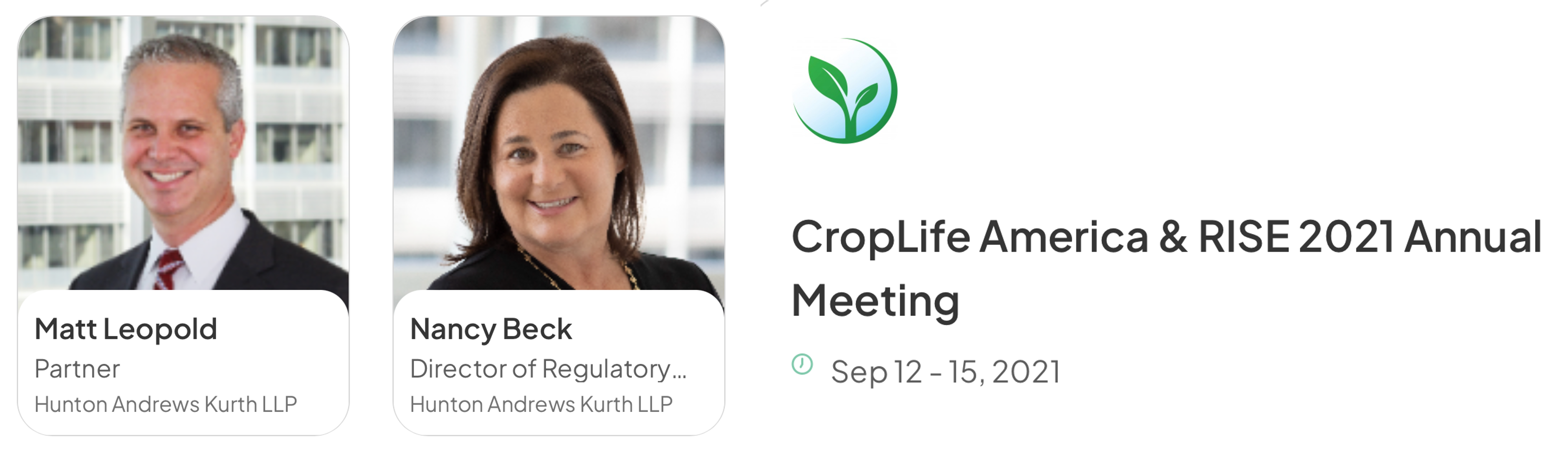 *Bayer was a gold sponsor at CropLife America 2021 where Beck was a featured speaker alongside her colleague Matt Leopold, who was EPA’s top lawyer during the first Trump administration. Hunter Andrews Kurth is a leading firm for pesticide litigation.
---
More EPA officials with ties to Bayer include:
Steven Cook, deputy assistant administrator for the Office of Land and Emergency Management, oversees Superfund sites. Bayer is associated with several Superfund sites due to its pesticide and chemical manufacturing. Cook spent over 20 years as the in-house corporate counsel for LyondellBasell, one of the world’s largest plastics and chemical companies. LyondellBasell has a 50/50 joint venture with Bayer (a propylene oxide and styrene monomer plant). LyondellBasell CEO Peter Vanacker is board chair of the American Chemistry Council.
Aaron Szabo,assistant administrator for air and radiation (appointed in July 2025) was a partner and lobbyist at CGCN Group (2018–2023), which has been registered to lobby for the American Chemistry Council during the past decade. From 2023 to 2024, he was a senior director and attorney at Faegre Drinker Biddle & Reath, where he represented chemical interests, including the ACC, before returning to the EPA in January 2025.
Alex Dominguez,deputy assistant administrator for mobile sources, was a registered lobbyist with Massie Partners, where he represented the National Corn Growers Association, a group whose members are consumers of Bayer’s seeds and pesticides. He worked in that role from 2023 to January 2025.
More Trump officials tied to Bayer
As assistant secretary of legislation at the U.S. Department of Health and Human Services, Gary Andresis a primary liaison between HHS and Congress. He was previously the senior executive vice president of public affairs at the Biotechnology Innovation Organization, the main trade group for biotech companies including Bayer. At BIO, Andres directed the lobbying strategy for the entire biotech sector, which included defending the regulatory framework for GMOs and associated agrichemicals. He previously worked at lobbying firm Dutko Worldwide which has represented Bayer.
Secretary of Transportation Sean Duffy also has ties to a Bayer lobby firm; he was senior counsel and advisory board member of BGR Group from 2019 to 2023 and was a registered lobbyist for the firm in 2020, though there is no record of him lobbying for Bayer.
13 lobby firms working for Bayer in Washington
Bayer’s direct lobbying spending is significant, but its political influence expands considerably when viewed alongside allied trade and commodity groups that together form a well-financed and coordinated lobbying network. In 2025, Bayer retained at least 13 lobby firms and at least 49 registered lobbyists registered to lobby for the company (including Bayer’s six in-house lobbyists) as of the fourth quarter, federal disclosures show.
Bayer spent at least $9.19 million on federal lobbying last year. While it is not among the highest-spending single corporations lobbying in D.C., the agribusiness sector ranked ninth with $219.9 million in lobbying expenditures in 2025 – the highest year on record for the sector. We include the sector total because Bayer’s influence is amplified by an integrated industrial agribusiness system that acts in concert – from pesticide-dependent commodity crops to factory farms and ultra-processed food production – to shape policy in its favor.
Within the sector, groups directly lobbying for favorable pesticide policies include trade groups representing pesticide manufacturers – the American Chemistry CouncilandCropLife America – and commodity groups such as the National Corn Growers Association and American Soybean Association that rely on Bayer’s products.
These four groups spent a combined $22 million on federal lobbying in 2025, with 12 more outside lobby firms and 79 more registered lobbyists in the fourth quarter.
Bayer’s lobbying activity last year was its highest in recent years, but lower than the company’s peak in 2016, 2017 and 2018, just before the Bayer/Monsanto merger and following the 2015 WHO cancer agency finding that glyphosate is a probable human carcinogen.
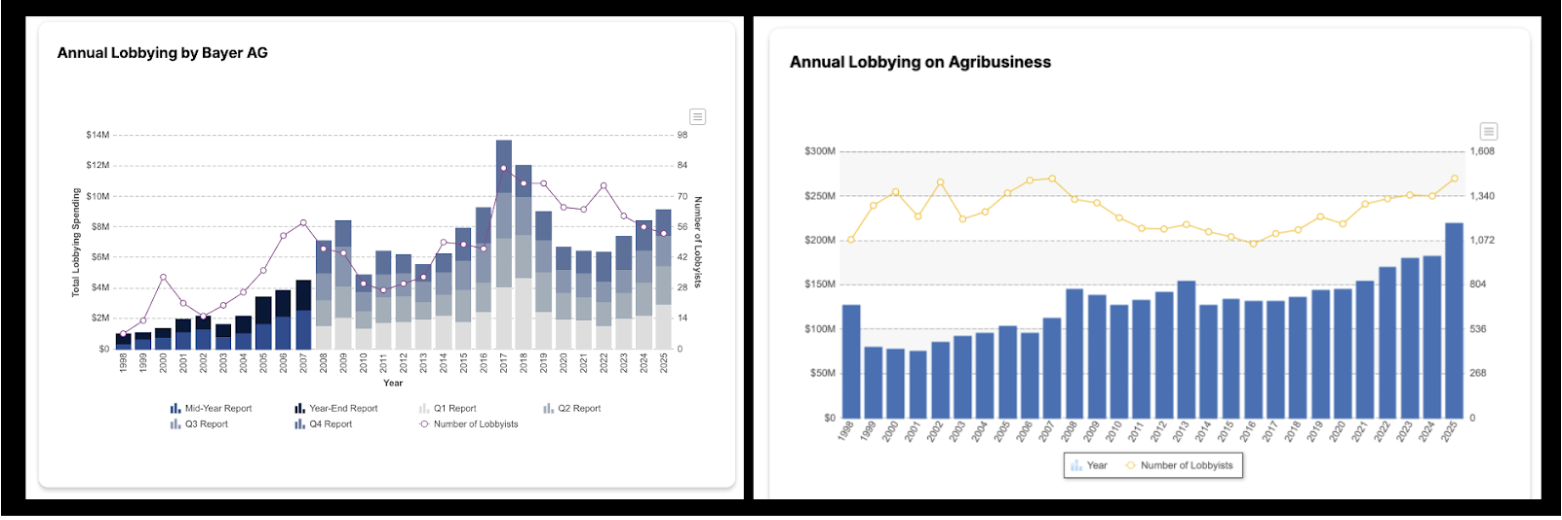 *Source: OpenSecrets
These numbers don’t reflect the whole picture of Bayer’s lobbying activities. The Lobbying Disclosure Act requires registration only after certain spending and activity thresholds are met, so public filings do not capture all of the paid influence work taking place in Washington.
They don’t reflect state-level activity, either. Pesticide related PAC spending surged in late 2024 as companies sought to limit damage awards in courts across the nation. In Iowa alone, Bayer spent a record amount last year trying to pass a state immunity bill critics called the Cancer Gag Act.
Read more about Bayer’s lobby force in our Bayer Lobby Tracker.
More lobbyists tied to Trump
Political scientists have long documented how lobbying shapes public policy by securing access to decision-makers, and helping corporations turn their priorities into laws and regulations. These dynamics help explain how companies like Bayer can translate access in Washington into concrete policy wins.
More than 30 people in leadership positions at lobby firms retained by Bayer have direct ties to Trump’s current or former administrations or presidential campaigns, our analysis shows. Many of these lobbyists are not personally registered to lobby for Bayer, but may be assisting in ways that do not trigger lobby registration, for example, advising the firm’s Bayer lobbyists.
As noted earlier, Ballard Partners – the firm that employed both Susie Wiles and Pam Bondi, and is run by one of Trump’s biggest political fundraisers – is a fundamental connection for Bayer o Trump’s orbit. In addition to Brian Ballard and Daniel McFaul, the two lobbyists at the firm who are registered to lobby for both Bayer and the American Chemistry Council, other partners at Ballard have connections to Trump:
Hunter Morgen, a D.C.-based partner in the firm, served over three years in senior positions during the first Trump administration – as special assistant to the President and senior advisor for policy and strategy in the White House working on trade and immigration issues with Peter Navarro and Stephen Miller. Prior to his White House role, Morgen was policy advisor for the State Department in the Office of Policy and Planning. He previously worked on Trump’s 2016 presidential campaign and transition team. In 2020, Trump appointed Morgen to the Presidential Council on Improving Federal Civil Architecture. Morgen – along with Brian Ballard, Daniel McFaul, Syl Lukas (a senior partner at Ballard) and Susie Wiles – were included among a list of donors invited to an October 2025 gala for Trump’s new $250 million East Wing ballroom.
*Trump has said the new ballroom is being “paid for 100 percent by me and some friends of mine, donors,” raising concerns about conflicts of interest.
Mike Rubino, another D.C. partner at Ballard, was among the first hires on Trump’s 2016 presidential campaign where he was a senior advisor directing operations in ten states and winning nine of them, according to his bio. He joined the first Trump administration as a senior official at HHS before leaving for the private sector where he worked alongside Corey Lewandowski, who is currently a key figure at the Department of Homeland Security.
Ballard D.C. Partner William Russell was the aide responsible for Trump’s daily travel and logistics for nearly four years of the first administration. Russell also worked on Trump’s 2016 and 2024 campaigns.
Brian Hughes, a partner at Mercury Public Affairs– the other lobby firm that previously employed Susie Wiles – was NASA chief of staff from May to December 2025. He joined Mercury in January 2026. Brian Hughes was Trump’s Florida campaign manager in 2024 and communications director for Trump’s transition team. Danielle Alvarez, another partner at Mercury, held communications and advisory roles in Trump’s 2020 and 2024 campaigns.
Other Bayer lobby firm ties to Trump’s White House include:
Amy Swonger, a principal at Invariant– a firm registered to lobby for Bayer – worked in the Executive Office of the President for most of Trump’s first term, as assistant to the president and as director and deputy director of legislative affairs.
Jordan Bonfitto,a director at Invariant, was a policy advisor at the National Economic Council in Trump’s first White House, focused on the agricultural and biotech portfolios. From February to October 2025, Bonfitto was the chief of staff for marketing and regulatory programs at the USDA under Secretary Brooke Rollins. He joined Invariant in November.
Other notable Bayer lobby firm ties to Trump:
Holland & Hart, a lobby firm Bayer retained in April 2025, employs former EPA Administrator Andrew Wheeler, who held the top job at EPA for part of Trump’s first term. Wheeler is a partner at the firm and head of federal affairs. Troy Lyons, a registered lobbyist for Bayer and senior director of federal affairs at Holland & Hart, held senior roles in Trump’s first EPA working under both Wheeler and Trump’s first EPA Administrator Scott Pruitt.
At BGR Government Affairs, several senior lobbyists have ties to Trump. Managing Director David Urban was a senior advisor on Trump’s 2016, 2020, and 2024 campaigns; Practice Head and Principal William Crozer left the firm during Trump’s first term to serve as special assistant to the president and deputy director of the White House Office of Intergovernmental Affairs; and PrincipalJoseph Lai was aspecial assistant to the President for legislative affairs (2017-2019), where he led the outreach and vote-counting efforts to confirm Justices Gorsuch and Kavanaugh, as well as other major appointees.
Akin Gump Strauss Hauer & Feld, longtime lobbyists for Bayer and Monsanto, also has notable advisors and partners with ties to Trump. Geoff Verhoff, senior advisor at the firm, served on the Trump-Pence victory finance leadership committee 2017-2021 and was the vice chair of the RNC Finance Committee in those years. Partner Kelly Ann Shaw, was deputy assistant to the President for international economic affairs and the U.S. lead negotiator (Sherpa) for the G7, G20, and APEC in 2018 and 2019. Senior Advisor Anna Abramdeputy commissioner for policy, legislation and international affairs at the FDA from 2017 to 2021.
For more ties between Bayer’s lobby firms, the Trump administration and other routes of influence see our lobby tracker:
This analysis of Bayer-Trump connections reflects only what is visible in public records. Additional financial, political, or personal ties – including undisclosed funding streams, if they exist – may remain hidden. This story is a work in progress. We will update it. You can help by sending us what you may know about ties between Bayer and the Trump administration, including the federal agencies. Contact Stacy Malkan via Signal or email stacy@usrtk.org.
Updates made February 26:
- Added another USDA official (Peter Laudeman) with ties to Bayer.
- Added total number of lobbyists and lobby firms retained by four trade and commodity groups that work closely with Bayer: American Chemistry Council, CropLife America, National Corn Growers Association and American Soybean Association.
Categories: Monsanto/Bayer, Pesticides Tags: Primary Article
===
---
free press
Drain the Swamp? MAGA Lobbyists Say They’re ‘Drinking from a Fire Hose.’
(Illustration by The Free Press)
Once upon a time, Donald Trump promised to clean up Washington. But for the swampiest industry of all, business is booming.
05.05.25 —U.S. Politics
U.S. Politics
Breaking news, deep investigations, and eye-opening commentary that favor no party.
Since 2016, Donald Trump has promised his supporters that he will  ”—the president’s catchall pledge to end corruption in Washington. But as his second administration gets busy remaking the federal government, business is good for one of D.C.’s most lucrative—and “swampiest”—lines of work: lobbying. And for those lobbyists enmeshed in MAGA World, business has never been better.
One of the biggest winners is Jeff Miller, a veteran Republican lobbyist who has raised hundreds of millions of dollars in donations for Trump and the GOP. His phone has been ringing off the hook ever since election night, which he spent in the grand ballroom of Mar-a-Lago, a few tables away from the incoming president, along with J.D. Vance and Elon Musk.
“We went all-in to make sure President Trump had the resources to win, and we’ve been drinking from a fire hose ever since,” he told The Free Press.
Miller’s firm, Miller Strategies, posted at least $8.5 million in lobbying revenue in the first quarter of 2025—a 190 percent increase from its $2.9 million haul at the same time last year.
His is just one of the lobbying firms with close ties to Trump that cashed in on their influence between January and March, the period captured in the latest lobbying disclosures. They illustrate how, in Trump’s Washington, the “swamp” is far from drained.
Along with other close allies of Trump, Miller is a founding member of a new, invite-only MAGA moguls club in Georgetown called Executive Branch. The club costs $500,000 to join and already has a waitlist. Its co-founders include Donald Trump Jr.; Alex Witkoff and Zach Witkoff, the sons of Steve Witkoff, Trump’s special envoy to the Middle East; and Omeed Malik, a megadonor who was a seed investor in Tucker Carlson’s new media venture.
Miller Strategies, based in Washington, D.C., is lobbying on behalf of powerhouse companies like Zoom, NASDAQ, Apple, Sam Altman’s OpenAI, and Comcast. In March, it signed Cornell University, which, along with other elite colleges, has been roped into Trump’s investigations into alleged racial discrimination and antisemitism on their campuses.
Another new Miller client is Palantir, a data software company that was awarded a $30 million contract from the Trump administration to assist in the government’s deportation efforts.
“Despite all the rhetoric about ‘draining the swamp,’ there remains a thriving industry of lobbying firms who will help those willing to pay for access in Washington, D.C.,” said Michael Beckel, the senior research director for Issue One, a nonpartisan money-in-politics watchdog group.
It’s an echo of the good times that had been enjoyed by Democratic lobbyists with close ties to the Biden White House. For instance, Jeff Ricchetti, the brother of then–White House counselor Steve Ricchetti, saw his lobbying business boom during the Biden years: His lobbying revenues increased fivefold in the first three months of Biden’s presidency. Thus it has always been: When a Republican is in office, firms tied to the GOP thrive; when Democrats are in, the Democratic lobbying firms do well.
Except that Trump has long promised to clean up Washington. On the campaign trail in 2016 he committed to “a complete ban on foreign lobbyists raising money for American elections.” But that pledge has long been forgotten. In the 2024 election, lobbyists registered as agents of foreign governments helped raise more than $10 million for Trump, according to research by Issue One.
Miller was listed in that report because of his work for the Japanese government, his firm’s only foreign client. Miller refuses to sign Chinese clients—“even the ones who say things like, ‘Oh, we just moved into Singapore,’ or wherever,” Miller told The Free Press.
Other firms aren’t so picky.
Ballard Partners, the firm of Republican superlobbyist and Trump fundraiser Brian Ballard, has signed more than 130 clients since Trump’s victory last November. It’s a staggering number given that the firm had signed a total of 178 between 2021 and 2024. White House Chief of Staff Susie Wiles and Attorney General Pam Bondi both previously worked at the firm.
With 10 offices around the world, including in Istanbul, Tel Aviv, and Riyadh, Ballard posted at least $14 million in lobbying revenue in the first quarter of 2025. That’s triple its $4.2 million haul during the first quarter of 2024.
One new client of Ballard’s is Pirelli, an Italian tire manufacturer that the firm signed one month before Trump’s inauguration. Pirelli’s largest shareholder, with a 37 percent stake, is a Chinese state-owned company called Sinochem. In 2021, Sinochem merged with ChemChina, a company identified by the U.S. Department of Defense as an arm of the Chinese military. Pirelli has paid Ballard at least $120,000 since that December lobbying registration, filings show.
Among Ballard’s controversial clients, perhaps the most high-profile is TikTok. Trump delivered a major win for Ballard and TikTok on his first day in office, when he signed an executive order that extended a congressionally mandated deadline for a sale of the popular social media platform by its Chinese parent company, ByteDance.
Foreign ties are nothing new for Ballard. Before Bondi was attorney general, she worked as a lobbyist at Ballard for the gas-rich country of Qatar, which has long harbored the leaders of Hamas. Bondi also lobbied for iGas USA—a Florida-based company that received a large investment from a Chinese state-owned enterprise. Until July of last year, Brian Ballard and his partner, John O’Hanlon, lobbied for iGas USA. Ballard Partners declined to comment.
[ ](https://substackcdn.com/image/fetch/$s_!4Ynd!,f_auto,q_auto:good,fl_progressive:steep/https%3A%2F%2Fsubstack-post-media.s3.amazonaws.com%2Fpublic%2Fimages%2F9e2b06b7-44c1-4fb6-adc0-94b419c66ac4_1320x30.png)
Another firm flexing its influence early on in Trump’s Washington is Florida-based Continental Strategy. It was founded in 2021 by former Trump adviser Carlos Trujillo and employs both Katie Wiles, the daughter of the White House chief of staff, and Alberto Martinez, who served as a chief of staff in the Senate to now–Secretary of State Marco Rubio.
Lobbying disclosures show that Continental netted $3.6 million in the first quarter of 2025, compared to revenue of $127,500 for the same period last year. The firm has added at least 50 clients since Trump’s victory.
It’s hardly a surprise that the firm is in Trump’s good graces. One insider told The Free Press that Trujillo and his colleagues helped raise $15 million for Trump’s inauguration. Trujillo did not dispute the figure.
“We didn’t just show up in Trump World two months ago,” Trujillo told The Free Press—saying that his relationships “make it easy to navigate” Washington.
As business booms for Continental, it is already delivering wins for some clients—with Trump’s blessing. The firm helped broker a deal for a consortium led by BlackRock—that included Continental’s client, the Swiss-based Mediterranean Shipping Company—to pay $23 billion for ports in Panama and across the world. According to a person familiar with the lobbying push, Trujillo’s firm privately secured support from Trump and previewed the deal to federal officials. The president hailed the deal in his March speech to Congress, calling it a step toward “reclaiming” the Panama Canal, a top priority of his administration.
Continental has established an in-house policy of working only with foreign clients that it sees as aligned with American interests, according to two people familiar with the firm.
Then there’s Mercury Public Affairs, where now–White House Chief of Staff Susie Wiles worked as a lobbyist until 2024. Former Trump campaign adviser Bryan Lanza is a partner at the firm, where revenue climbed to $5.2 million in the first quarter of 2025—doubling since the last quarter of 2024. It registered on behalf of around 70 clients in 2024 and 2025, according to lobbying filings.
“The calls started coming in last summer, before Biden dropped out,” said one person familiar with Mercury’s booming operation.
After the election, Lanza registered to lobby for the Chinese electronics giant Xiaomi, which was placed on a Pentagon blacklist during Trump’s first term over alleged Chinese military ties. (The designation was later removed under Biden.)
Mercury clients have included Qatar, the Turkish government, a Chinese surveillance firm linked to China’s persecution of the Uyghurs, and a Chinese solar panel manufacturer called JinkoSolar that saw its Florida factory raided in 2023 after reports the company was linked to forced labor in China.
Mercury has hauled in hundreds of thousands of dollars since 2020 to lobby for China’s Alibaba Group and millions of dollars from Gotion—an electric vehicle battery manufacturer and subsidiary of a Chinese company that pledged in 2022 group documents to “carry out” activities for the Chinese Communist Party. Multiple reports in 2020 linked Alibaba Group to China’s surveillance of Uyghur Muslims. An early client for Lanza upon his joining in 2017 was ZTE, a Chinese telecommunications giant for which Mercury said its work “may inure to the benefit of the People’s Republic of China,” Justice Department filings show.
“As long as evil political regimes like the Chinese Communist Party and the companies they control have willing representatives in Washington, the ‘swamp’ is never going to be fully drained,” said Michael Sobolik, a senior fellow at the Hudson Institute who specializes in U.S.-China relations.
There are, however, limits to how much foreign baggage lawmakers are willing to tolerate.
:{:{“The problem with Mercury is that so many of their clients are total shitbags,” said one senior Republican congressional staffer, “so they have trouble getting meetings.”}:
Drain the Swamp? MAGA Lobbyists Say They’re ‘Drinking from a Fire Hose.’}:
endit?
... “so they have trouble getting meetings.”}:
---
---
For Immediate Release: Contact: Bryan Lanza May 17, 2016 202-547-1249 Citizens United Political Victory Fund Endorses Conservative Pat Mooney in Florida’s 6th Congressional District Primary Election Citizens United Political Victory Fund (CUPVF), the affiliated PAC of Citizens United, issued the following statement endorsing conservative candidate Pat Mooney in Florida’s 6th congressional district primary election. CUPVF has also contributed $2,500 for Mooney’s primary effort. “Pat Mooney is a true conservative citizen-politician. He’s running for Congress because he’s concerned about the dangerous direction out of touch career politicians are taking our country,” said David N. Bossie, president of Citizens United. “The last thing residents of the 6th congressional district of Florida need is a career politician with stale ideas representing them. Pat Mooney is an outsider who is ready to tackle our national debt crisis, fix our broken immigration system, and simplify our impossible tax code, once and for all,” Bossie added. “If you’re looking for a conservative candidate who will listen to his constituents over Washington special interests, Pat Mooney is your candidate for Congress,” Bossie concluded.
---
with Congress mulling legislation to slap new sanctions on Russia for its attack on the 2016 American election, an important Russian bank connected to Vladimir Putin’s government has turned for help to a well-positioned lobbyist in Washington: a Trump insider and former Republican House member named John Sweeney. In August Sweeney signed a whopping contract to lobby on behalf of this bank to stave off sanctions from the US government.
Sweeney, who formerly represented district near Albany, filed paperwork late last month with the Justice Department’s Foreign Agents Registration Act unit to represent Vnesheconombank, known as VEB, a Kremlin-controlled investment bank. The bank’s chair, Igor Shuvalov, was appointed last year by Russian President Vladimir Putin, who gave him orders to increase funding of national development projects.
The filing says that Sweeney will “engage in meetings and other communications with U.S. government officials regarding potential new sanctions legislation…that could affect” the bank.
The Obama administration sanctioned the bank in 2014 as part of the U.S. response to Russia’s invasion of Crimea. Shuvalov, along with all members of the bank’s supervisory board, was also included on a January 2018 Treasury Department report listing officials closely affiliated with the Russian government. That report, which Congress required Treasury to issue, did not lead to sanctions against those individuals. But the bank could be hurt by pending legislation.
Election security legislation proposed by Sens. Marco Rubio (R-Fla.) and Chris Van Hollen (D-Md.) would sanction VEB and other Russian banks. Sanctions legislation proposed by Sens. Lindsey Graham (R-SC) and Robert Menendez (D-NJ), which would bar US firms and citizens from investing in Russian energy projects or participating in ventures that involve Russian government debt, which could harm the country’s ability to finance infrastructure projects. That bill and a separate measure proposed in the House aim at punishing Russia for interfering in the 2016 election.
VEB also had a role in the Trump-Russia scandal. A December 13, 2016 meeting between Shuvalov’s predecessor as the bank’s chairman, Sergey Gorkov, and Jared Kushner, Trump’s son-in-law, was scrutinized as part of former Special Counsel Robert Mueller’s investigation. Disclosure of meeting drew suspicion that Kushner hoped the bank would bailout a debt-laden building, 666 Fifth Avenue, owned by his family. The exact purpose of the meeting remains unclear. VEB claims the meeting was purely business-oriented, related to Kushner’s real estate work. Kushner told Mueller’s office it was diplomatic.
Sweeney was hired to work for Vnesheconombank by the International Centre for Legal Protection, a Moscow entity formed to help Russia and Russian entities enmeshed in complex international legal disputes. The onetime House member will receive $62,500 per month for 12 months for the work, according a contract he filed with Justice Department.
Reached by phone Thursday, Sweeney said he would call back, but he did not. He did not respond to a voicemail or questions sent by text message.
Sweeney represented an upstate New York district from 1999 through 2006, when he was defeated for reelection by Kirsten Gillibrand, now the junior senator from New York. In the final weeks of the 2006 race, Sweeney faced domestic abuse allegations (claims that he has denied). In the years that followed, Sweeney twice pleaded guilty to drunk driving charges. Sweeney stopped drinking and recently announced10 years of sobriety. He also weathered a federal grand jury investigation, into whether he took official acts while in office to help three clients of an Albany lobbying firm in exchange for “a stream of financial benefits,” according to FBI records cited by the Albany Times Union. He was never charged in that case, which lasted from 2006 until at least 2008.
An early Trump backer, Sweeney led Trump’s successful primary campaign in New York.Sweeneyserved on Trump’s presidential transition team, helping to vet potential senior national security and intelligence officials, ambassadors, and political appointees for multiple agencies.
Sweeney began lobbying the White House soon after Trump took office. In 2017 and 2018 he worked on behalf of the Nord Stream 2 pipeline, a project partly owned by Russia’s state-run gas giant, Gazprom. Sweeney’s work, for which he reported receiving $470,000 in lobbying fees, included opposing “potential financial sanctions affecting the project.” Lobbying disclosure forms he filed with Congress say he focused on influencing the “Executive Office of the President.”
Sweeney has also represented Ihor Kolomoisky, a politically influential Ukrainian tycoon who previously controlled a Ukrainian bank seized by that country’s government in 2016 due to purported lack of capital and financial improprieties. In a lawsuit filed in May, the bank sued Kolomoisky and another former owner, alleging that the men forced it to issue loans to entities they controlled and then laundered the proceeds through shell companies that bought up commercial real estate in the United States. The Daily Beast reported in April that the FBI is investigating Kolomoisky, who has assets in the United States, for alleged money laundering and other crimes. (Kolomoisky has denied the allegations.)
Sweeney is among a small group of Trump insiders who have become lobbyists for Russian firms and related interests. Bryan Lanza, a former Trump campaign and transition aide, is now a lobbyist at Mercury Public Affairs, where he has represented the EN+ Group, an aluminum company founded byOleg Deripaska, an oligarch close to Putin. Lanza and Mercury helped the company win relief from US sanctions.
Brian Ballard, who formerly lobbied for Trump in Florida and has since built a thriving Washington practice, has represented David Yakobashvili, a Russian oligarch with interests in gas and the food industry. Yakobashvili identifies himself as president of the Russian–American Council for Business Cooperation, a group that says it was created at Putin’s behest to boost trade between the countries.
==
==
Trump campaign adviser George Papadopoulos was encouraged by campaign officials to communicate with foreign contacts, according to the Washington Post.
As the Post reports, Papadopoulos was urged by deputy communications director Bryan Lanza to participate in an interview with a Russian news agency.
“You should do it,” Lanza told Papadopoulos, adding the connection could benefit a “partnership with Russia.”
According to the Post, emails turned over to special counsel Robert Mueller show “more extensive contact” between Papadopoulos and top campaign and transition officials “than has been publicly acknowledged.”
Papadopoulos also communicated with former White House strategist Steve Bannon and onetime national security adviser Michael Flynn, “who corresponded with [Papadopoulos] about his efforts to broker ties between Trump and top foreign officials.”
Read the full report at theWashington Post.
==
WASHINGTON, Feb. 22, 2017 /PRNewswire-USNewswire/ -- Mercury, a leading global, bipartisan public strategy firm, announced today the addition of Bryan Lanza, Communications Director for President Donald J. Trump's Transition Team. Lanza, who served as Deputy Communications Director for the Trump-Pence campaign prior to his leading role with the new administration, joins Mercury as a Managing Director in the Washington, DC office.
"Washington has been radically transformed in just the first few weeks of the Trump administration," said Vin Weber, Mercury Partner and leader of the firm's Washington, DC operation. "Nowhere is this change more evident than in the growing significance of communications and the means by which it is employed. With critical communications roles throughout the campaign and installation of the new administration, Bryan keenly understands the nuances of this sea change. He is best in class, and rounds out Mercury's unique public affairs expertise to deliver results in this new environment. We're excited to welcome him to the firm."
Lanza joins a robust communications capability at Mercury with deep ties to conservative media including: Trump pollster Tony Fabrizio, Senior Counselor to the firm, as well as media strategy specialists Dan Bank and Dan Wilson. Lanza's addition is the latest in a series of hires of leading Republican political strategists across Mercury's offices, including: former U.S. Senator David Vitter, Al Simpson, former Chief of Staff to new OMB Director Mick Mulvaney, Brian Swensen, Deputy Campaign Manager for Marco Rubio's successful re-election bid and Andrea Bozek, former Communications Director for the National Republican Senatorial Committee (NRSC) and National Republican Congressional Committee (NRCC). The 2017 growth to date underscores Mercury's commitment to build a first-class, bipartisan consultancy comprised of accomplished leaders across the arenas of media, business, politics and policy.
"Mercury, with its top-tier talent and robust policy and public affairs operations, was the ideal next step for me after an incredible and incomparable experience working with President Trump and his team," said Lanza. "I am excited to return to my roots in strategy, and help clients across every sector navigate opportunities as the administration and Congress outline their policy priorities."
Lanza has worked closely with President Trump and White House leadership throughout the 2016 election cycle, inauguration and transition periods. In his role with the transition team, Lanza worked with Cabinet nominees and Ambassador appointees, helping to prepare them for confirmation hearings. He served as Deputy Communications Director for the Trump-Pence campaign, helping to craft strategy and messaging for the campaign, in addition to media relations oversight and surrogate management.
Lanza's work with the Trump White House is preceded by a sterling reputation as a key adviser in conservative politics and policy. Prior to his time with the Trump-Pence campaign, Lanza was the Communications Director for Citizens United, where he worked closely with the group's President David Bossie on strategy and messaging, as well as managing the organization's media relations. His policy experience includes chief of staff tenures at the California State Senate and Assembly where he specialized in agriculture, heath and transportation policy, and was involved in a number of key statewide initiatives and budget negotiations. Lanza's career also includes work in public affairs strategy with Townsend Public Affairs from 2013-2014, and as President of Lanza Strategies from 1999-2007, prior to his years working in the California legislature. Given his west coast roots and deep experience in state politics and policy, Lanza will be servicing clients across Mercury's U.S. and international offices.
Lanza joined Mercury on February 15, 2017.
About MercuryMercury is a high-stakes, bipartisan public strategy firm. The firm provides a comprehensive suite of services that includes federal government relations, international affairs, digital influence, public opinion research, media strategy and a bipartisan grassroots mobilization network in all 50 states. Our firm is not just led by top talent — we distinguish ourselves by having senior talent deeply engaged in each project from start to finish, a promise we keep to clients. The firm has an established global presence, with U.S. offices in Washington, DC, New York, California, New Jersey, Illinois, Pennsylvania, Florida, and Tennessee, as well as international offices in London and Mexico City. Mercury is a part of the Omnicom Public Relations Group.
About Omnicom Public Relations Group
=