Qatar Doha
see kushner
see corrupt 3
BONDI LOBBY
see loomer vs tucker
see arab petro swf
---
SEE BIZZOMG
---
---
no lnx
Trump's new hustles demand a day of reckoning
Thom Hartmann March 01, 2026
On Tuesday night in the State of the Union, we watched the most corrupt president (and presidency) in the history of America lie his way through a fascist-friendly speech. He didn’t mention how rich he’s made himself and his kids off the presidency, as he tried to paint in a good light what is, frankly, the most dishonorable, unprincipled, and criminal regime in the history of the free world.
On Tuesday night in the State of the Union, we watched the most corrupt president (and presidency) in the history of America lie his way through a fascist-friendly speech. He didn’t mention how rich he’s made himself and his kids off the presidency, as he tried to paint in a good light what is, frankly, the most dishonorable, unprincipled, and criminal regime in the history of the free world.
Rumors have been flying for years — ever since Rudy Giuliani apparently confessed during Trump’s first term he and Trump were selling pardons for $2 million each and splitting the money — that Trump is at it again, taking what look like bribes for everything from pardons to business deals to regulatory and tariff relief. And the evidence is piling up in ways that are unmistakable.
For example, Judd Legum’s Popular Info news site is reporting that the parent company of crypto.com has made a series of “donations” to Trump’s main SuperPAC, MAGA Inc., amounting to $35 million.
That SuperPAC has already paid tens of millions for Trump’s legal fees, apparently including personal defense lawyers and business deal lawyers, and can hang onto that money to support Trump’s lavish lifestyle once he leaves office.
Shortly after the last donation, as Legum reports:
“25 days later, on February 17, the Trump administration’s Commodities Futures Trading Commission (CFTC), intervened on Crypto.com’s behalf in high-stakes lawsuit in federal court.”
But that’s just the tip of this particular iceberg. Crypto.com also runs prediction markets, the slick new way to get around laws regulating gambling, and recently cut a deal with Trump’s media company (which owns and runs his Truth Social site that’s so badly Nazi-infested and whose majority stockholder is Trump himself) to offer prediction market products through Truth Social or the company that owns it.
Then there’s the report from The New York Times that lays out how the United Arab Emirates (UAE) desperately wanted to buy super-high-tech chips from the US to kick-start their move from being a petrostate into becoming the Silicon Valley of the Middle East. The only problem was that they have a military cooperation agreement with China, and the US was concerned that they’d funnel some of the chips to that country.
So, the UAE “invested” $500 million in Trump’s new crypto scheme. As the Times laid out:
“An investment firm tied to the United Arab Emirates purchased nearly half of the Trump family’s cryptocurrency company last year, making the family business partners with the U.A.E. even as President Trump negotiated foreign policy matters with the Middle Eastern nation …“At the same time that the crypto deal came together, the Emirati government secured an agreement with the Trump administration for the export of hundreds of thousands of advanced chips to power A.I. technology.”
Similarly, after Trump and his son-in-law Jared Kushner backed the Saudi‑UAE blockade of Qatar and defended the crown prince after the Khashoggi killing, the Saudi’s gave Kushner $2 billion to fund his investment firm. No droids in that car!
Not to mention the millions that the Saudi’s gave Trump’s tacky golf motels to put on their LIV Golf Tournaments. Or the millions he makes by forcing the Secret Service to pay to follow him to his golf courses and Mar-a-Lago, along with a regular army of foreign governments and corporations seeking favors, as CREW just exposed.
Or when Ivanka Trump was the “senior White House advisor” as she and her father were managing a trade and tech confrontation with China and that government “gave” her at least 34 Chinese trademarks worth millions.
Immediately thereafter, Trump suddenly reversed course to “save” Chinese telecom giant ZTE and later moved to ease pressure on Huawei via temporary licenses, despite U.S. national‑security warnings. She and her husband reportedly made as much as $640 million during their time exploiting the White House in Trump’s first term.
Trump’s boys are opening Trump-branded hotel/golf deals all over the world in countries that have had contentious relationships with the United States, mostly because of authoritarianism and corruption, with hundreds of millions to billions of dollars flowing into the Trump family’s money bin.
They include: India, Indonesia, Oman, Vietnam, Romania, Bali (Indonesia), Maldives, Qatar, and Saudi Arabia. Or all other the corrupt “deals” making Trump’s two oldest sons mindbogglingly rich that Liz Dye documents.
And, of course, it works both ways. When Pam Bondi was Florida Attorney General, her office opened an investigation on behalf of Floridians who’d been ripped off by Trump’s scam Trump University. Trump had his fake charity — which was later closed down for fraud — write her campaign an illegal $25,000 check and suddenly the investigation vanished.
And then there’s Trump’s pardon pipeline.
Consider Changpeng Zhao, the billionaire founder of Binance. Zhao pleaded guilty to violating U.S. anti-money-laundering laws, agreed to massive financial penalties, but was thrown into prison nonetheless. Not long after, Trump granted him clemency as Binance worked out a $2 billion stablecoin deal anchored in a Trump entity.
Or take Ross Ulbricht, the Silk Road operator serving a life sentence. Ulbricht ran what was allegedly the world’s largest hub for trading in illegal guns, narcotics, and human trafficking. Nonetheless, Trump gave him a pardon, stunning the legal world.
Other recipients have included well-connected political allies and donors, such as former Las Vegas council member Michele Fiore — convicted of wire fraud — whose sentence was vacated despite a jury verdict, and extremist figures like Enrique Tarrio, the leader of the Proud Boys pardoned after participating in the January 6 insurrection.
Even British billionaire Joe Lewis was pardoned for insider-trading convictions, again showing how Trump’s clemency has disproportionately flowed to the wealthy and well-connected.
None of this should surprise Americans; a jury of his peers found Trump’s little personal corporation guilty of felony tax fraud and fined it over a half-billion dollars (which apparently has yet to be paid). And he was personally convicted of 34 felonies involving falsification of business documents in a successful effort to rig the 2016 election by preventing the public from learning of his relationship with Stormy Daniels.
Since his inauguration just 14 months ago, Trump’s personal wealth has increased by an estimated $4 billion. Not bad for a guy who could have been headed to prison if he hadn’t gotten elected president. After all, both Brazil and South Korea just gave their former presidents long prison terms for trying to pull off what Trump tried to do on Jan. 6, 2021.
This is the most corrupt administration in the history of America, with Trump following Vladimir Putin’s formula for becoming wildly rich step-by-step. And somehow Fox “News” and the rightwing echo chamber never seem to report on any of it…
Thom Hartmann is a New York Times best-selling author and SiriusXM talk show host. His Substack can be found here.
REF
https://popular.info/p/days-after-5m-donation-trump-administration
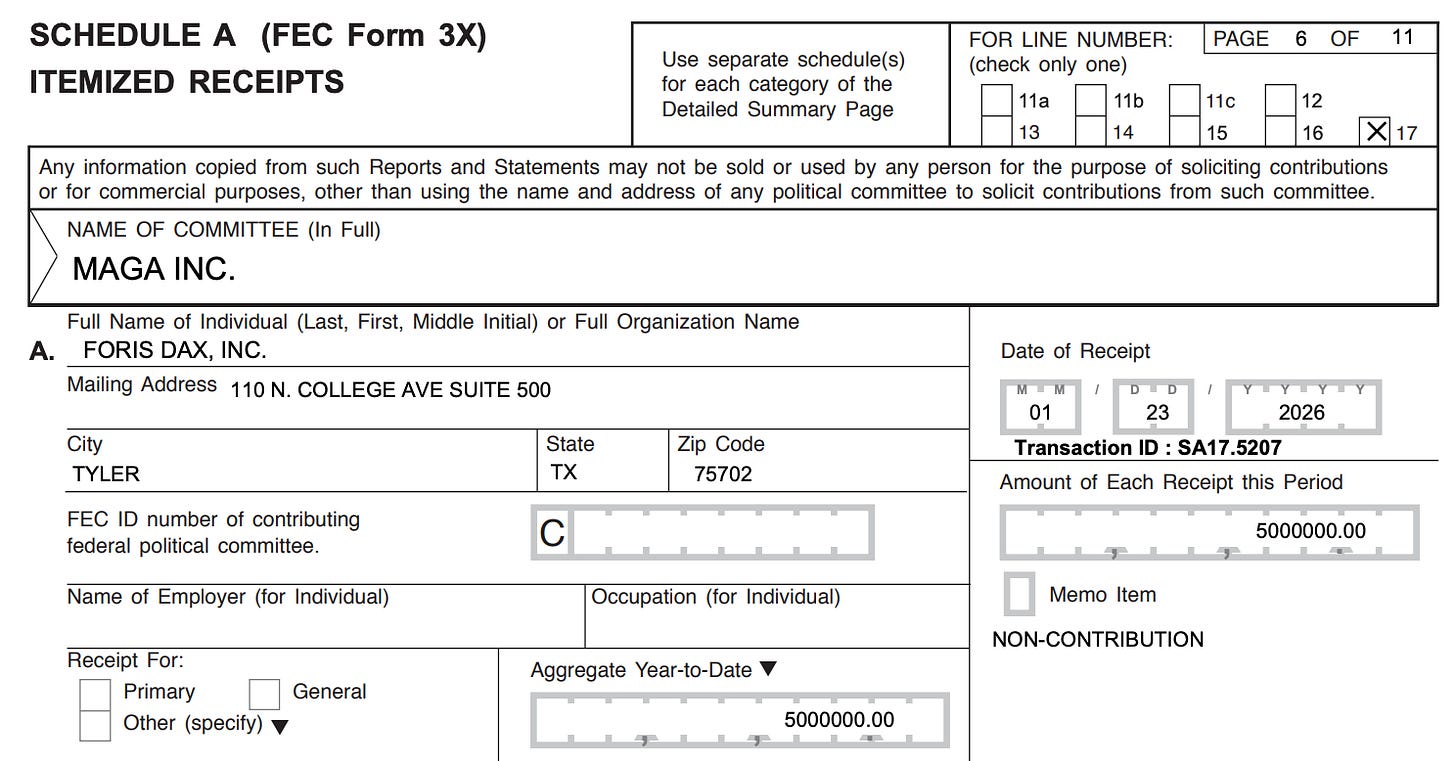
In a document quietly filed with the Federal Election Commission on Friday night, MAGA Inc., the primary Super PAC supporting President Trump, revealed that it received a $5 million donation from Crypto.com on January 23, 2026. The donation was made in the name of Crypto.com’s parent company, Foris Dax, Inc.1
[ ](https://substackcdn.com/image/fetch/$s_!-wdV!,f_auto,q_auto:good,fl_progressive:steep/https%3A%2F%2Fsubstack-post-media.s3.amazonaws.com%2Fpublic%2Fimages%2F21ce65d6-4c52-4c62-8b01-42836f6e0187_1488x778.png)
25 days later, on February 17, the Trump administration’s Commodities Futures Trading Commission (CFTC), intervened on Crypto.com’s behalf in high-stakes lawsuit in federal court.
Last year, Crypto.com sued the Nevada Gaming Control Board, arguing that it has the right to offer “prediction markets” on the outcome of sporting events without obtaining a Nevada gaming license. In October 2025, a federal court denied Crypto.com an injunction, and the company is now appealing the decision.
In addition to filing a formal amicus brief in support of Crypto.com’s appeal, CFTC chairman Mike Selig published an op-ed supporting Crypto.com’s position in the Wall Street Journal and posted a video supporting Crypto.com on X.
The timing of CFTC’s intervention raises serious ethical questions.
Selig, during his November 2025 confirmation hearing, was asked whether he believed it was legal for prediction markets to offer contracts on sporting events without complying with state law. Selig testified that the issue is “working its way through the courts, and so I will respect the decisions of those courts.”
He was also asked directly if he considered placing a bet on the outcome of a football game to be “gambling,” which would place it outside the jurisdiction of the CFTC:
Senator SCHIFF. Well, I mean, let me just ask—maybe even break it down more simply. If you and I bet on who wins the Bills game tomorrow, would you consider that gambling?
Mr. SELIG. Senator, on this issue, I would look to the courts, so I would look to what the courts say about that issue.
In a matter of weeks, Selig went from telling Senators under oath that he would defer to the courts on the issue to arguing on behalf of Crypto.com that the courts have erred.
He publicly announced he was considering intervening in the case during a public appearance on January 29 — less than a week after Crypto.com’s $5 million contribution to MAGA Inc. “I’ve directed CFTC staff to reassess the commission’s participation in matters currently pending before the federal district and circuit courts,” Selig said during his first public remarks as CFTC chairman.
On February 5, Selig explicitly stated that he believed it was legal for prediction markets to offer bets on sports, regardless of whether the company complied with state law.
[Mike Selig@MichaelSelig Strong Disagree.
Chris Christie @GovChristie
I believe Prediction Markets are violating the law. In 40 states we have regulated betting that can’t market to teenagers, pays state taxes, protects game integrity & reports suspicious activity to law enforcement. Prediction markets do none of that at all https://t.co/3dMAnS44Ex
2:06 PM · Feb 5, 2026 · 237K Views
114 Replies · 87 Reposts · 645 Likes](https://x.com/MichaelSelig/status/2019533204068393280?s=20)
Few companies have spent more money to ingratiate themselves politically with Trump than Crypto.com. Including the $5 million in January, Crypto.com has donated a total of $35 million to MAGA Inc. since 2025. It is the Super PAC’s largest donor, accounting for more than 10% of total funds.
Prior to its support for MAGA Inc, Crypto.com’s only political giving was a $1 million donation to Trump’s second inauguration in 2025.
Crypto.com has also formed an extensive partnership with Trump Media and Technology Group (TMTG), Trump’s money-losing media conglomerate that has recently pivoted into cryptocurrency and nuclear fusion. Among other integrations, Crypto.com and TMTG announced in October that Crypto.com would integrate its prediction market with Truth Social, TMTG’s social network. The joint venture will be called Truth Predict. President Trump is TMTG’s largest shareholder.
Crypto.com’s thin legal argument
Crypto.com and other prediction markets — and now the CFTC — argue that creating markets for sporting events is fundamentally different than sports gambling. In practice, however, it looks identical.
[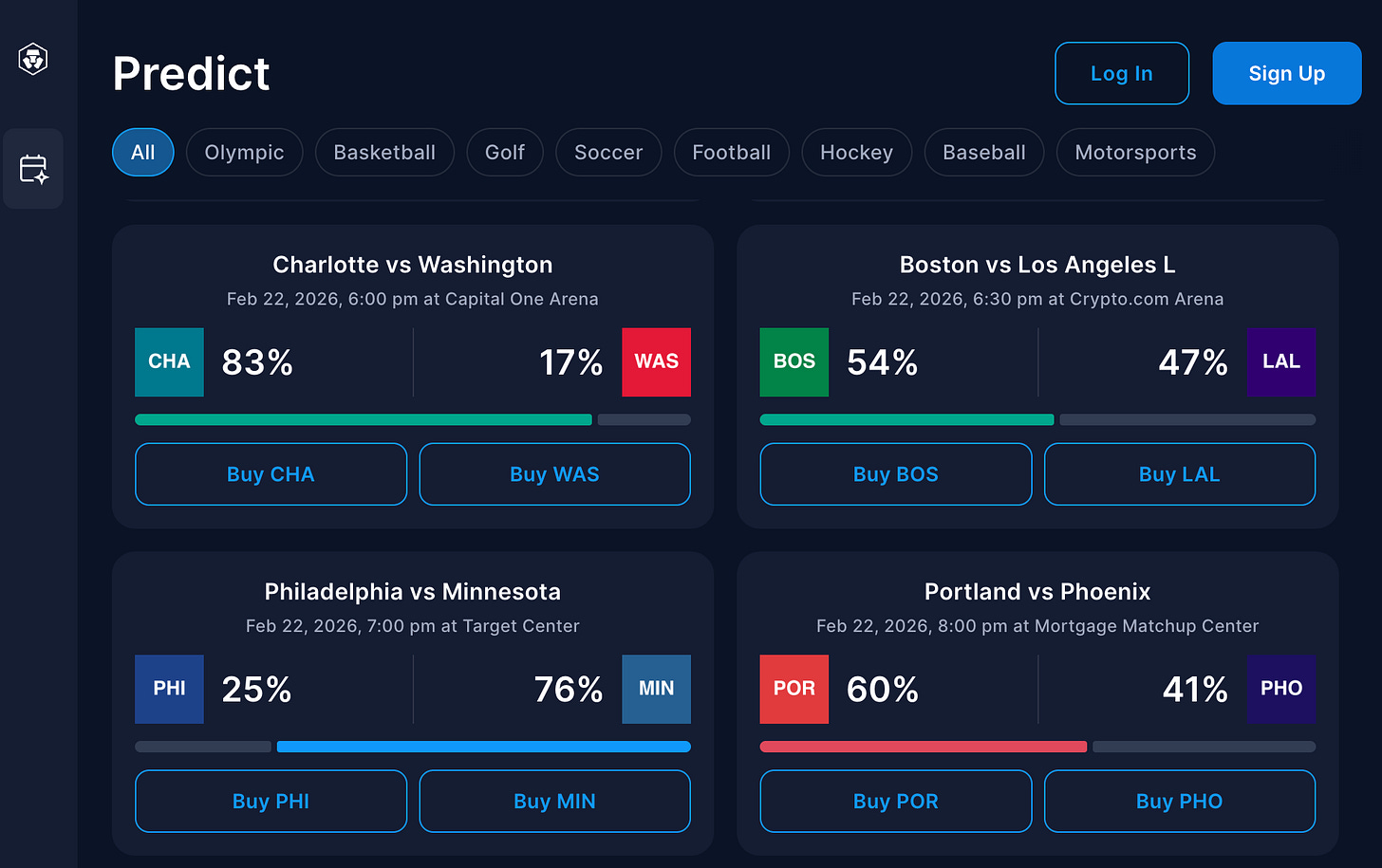 ](https://substackcdn.com/image/fetch/$s_!4ZwJ!,f_auto,q_auto:good,fl_progressive:steep/https%3A%2F%2Fsubstack-post-media.s3.amazonaws.com%2Fpublic%2Fimages%2F39b482a5-9a7e-475a-8dfa-353636dc271f_1926x1210.png)A screenshot from Crypto.com’s prediction market.
The CFTC has jurisdiction over event-related contracts or “swaps” that provide “for any purchase, sale, payment, or delivery… that is dependent on the occurrence, nonoccurrence, or the extent of the occurrence of an event or contingency associated with a potential financial, economic, or commercial consequence.” (Emphasis added.)
The traditional example of this is a contract to buy corn at a certain price in the future. This serves as an economic hedge against price fluctuations that can affect producers of tortilla chips, for example.
There are theoretical arguments that betting on the outcome of a sporting event could serve as an economic hedge. The CFTC, in its brief in support of Crypto.com, tries to make this argument:
Broadly speaking, sporting events are economic enterprises that generate billions of dollars in economic activity and materially affect both regional and national markets… For these reasons, hotels likely adjust pricing models, restaurants expand staffing to accommodate increased demand, vendors increase supply orders, and cities allocate resources to accommodate projected crowds. All of these decisions pose economic risk, which is precisely the type of economic exposure that derivatives markets are designed to mitigate.
Of course, this is not how prediction markets on sporting events are used. No one is wagering on a basketball game to hedge against hotels raising prices. They are used by people who want to gamble on sports, particularly in states where sports gambling is not currently legal. On popular prediction markets like Kalshi, sports betting accounts for over 90% of all trading volume.
Utah Governor Spencer Cox (R) mocked Selig’s position on X. “I don’t remember the CFTC having authority over the ‘derivative market’ of LeBron James rebounds,” Cox wrote. “These prediction markets you are breathlessly defending are gambling—pure and simple.”
The district court noted that, under Crypto.com’s interpretation, if every bet on a sporting event qualified as a “swap” subject to the exclusive jurisdiction of the CFTC. That would mean it would no longer be permissible for people to place sports bets in casinos. “Had Congress intended such a sea change in the regulatory landscape, it surely would have said so,” the district court wrote.
The designation of the $5 million from Foris Dax as a “NON-CONTRIBUTION” in the image refers to the fact that it is a donation to a Super PAC, which is not subject to FEC contribution limits or the prohibition on corporate contributions.
---
The online MAGA-verse were at each other’s throats more than usual this weekend, as right-wing commentators Benny Johnson, Milo Yiannopoulos, and Tucker Carlson were all points of controversy.
The first tiff started on Saturday, when Yiannopoulos—who has made a name for himself as an openly gay far-right bigot—accused multiple conservative influencers like Johnson and Charlie Kirk of being closeted gay men on Tim Pool’s podcast with swindler and former MAGA Representative George Santos, who is also gay.
“One of the most distinctive things about the right-wing in this country is its homosexual overtones. Benny Johnson posts pictures of his children every two days—it’s weird. And everybody knows what went on with Benny Johnson in those lobbies and those hotel rooms at SAS. Everybody knows,” said Yiannopoulos.
“I don’t know what you’re talking about,” Santos replied.
“Men, younger men. Not underage, at least I don’t know that. His wife was crying drunk in the lobby three SAS’s in a row about how her husband was upstairs with boys,” Yiannopoulos claimed. “Go ask her.”
“Come on, Milo, aren’t you ever scared of getting sued?” Santos asked.
Yiannopoulos insisted he was telling the truth, and that he’d never been sued.
On Sunday, Johnson threatened to sue him.
“I am duty bound to take action to protect my family against those who maliciously defame and attack us. More to come on that soon,” he wrote. “Pray for healing for some really sick and delusional people. Jesus is about redemption. The legal system is about justice. Happy Sunday.”
Yiannopoulos responded in a message addressed to Johnson and his wife, Kate:
“I know more about defamation than any lawyer you will hire. Benny is a public figure. Malice is a nonstarter. I have receipts, and the truth is a total defense against any claim of defamation or libel. Do you want to lose a defamation case to MILO YIANNOPOULOS OF ALL PEOPLE about whether or not you are gay? Do you want to even fight one? The people who have poured money into making you a big deal are about to lose their entire investment,” he ranted.
“I know more about your marriage than you think I do,” he continued, “and I have evidence, and I have witnesses. I know who to subpoena. I know what questions to ask. About nocturnal liaisons dangereuses with chaps in assless chaps and about being caught in flagrante delicto at conferences attended by students, some of whom may have been under 18 (I guess we’ll find out!).”
Yiannopoulos also claimed that Turning Point USA may have faked Charlie Kirk’s death.
Meanwhile, other far-righters—mostly Islamophobes and Zionists—were at pundit Tucker Carlson’s throat for his purchase of a property in Qatar.
“Speaking on stage at the Doha Forum in Qatar, Tucker Carlson told Qatar’s Prime Minister Al Thani that he is buying a place in Qatar this week because he’s an ‘American”; and he will live and go wherever he wants,” MAGA crank Laura Loomer posted on Sunday. “Qatar is the financier of the Muslim Brotherhood and they continue to allow HAMAS officials to live in Doha, where Tucker now wants to buy a place to live.”
“Let me explain the joke: Qatar is a bloodthirsty, terror-supporting slave state, and Tucker Carlson is rubbing it in your face that he’s an unregistered foreign agent for them,” another account wrote.
It’s clear that Trump’s base is fraying at the seams. From those questioning the validity of Trump’s “America First” and our fealty to Israel, like Representative Marjorie Taylor Greene, Nick Fuentes, and Tucker Carlson, to those like Yiannopoulos spreading conspiracy theories only Candace Owens would touch, it’s clear that whatever base of hatred Trump still has is fractured.
:{December 8, 2025/
an 5 25
President Donald Trump called for an investigation into NBC News and the CEO of its parent company after one of the network’s top reporters pressed him on the Pentagon’s Wednesday afternoon acceptance of a $400 million luxury airliner from Qatar—a gift some legal scholars warn may violate the Constitution without congressional approval.
“The secretary of defense has accepted a Boeing 747 from Qatar in accordance with all federal rules and regulations,” Chief Pentagon spokesman Sean Parnell said in a statement on Wednesday, as The New York Times reported. “The Department of Defense will work to ensure proper security measures and functional-mission requirements are considered for an aircraft used to transport the president of the United States.”
Estimates range as high as one billion dollars for work that would be required to make the luxury jetliner capable of acting as a mission center to not only transport the President but protect them and other top officials in the event of crisis or war.
Experts “said that accepting the 13-year-old jet would likely cost U.S. taxpayers hundreds of millions of dollars over time, noting that refurbishing the commercial plane would exceed its current value of $400 million,” NBC News reported last week. “The project might also not be completed by the end of Trump’s term in 2029, at which time the plane is expected to be handed over to Trump’s presidential library foundation.”
READ MORE: ‘It’s a Nightmare’: Trump’s ‘Beautiful’ Bill Slashes $500B From Medicare, Dems Say
But when confronted with a question about the jet, President Trump appeared combative and visibly angered.
“What are you talking about?” Trump asked NBC News Chief White House Correspondent Peter Alexander during an Oval Office meeting with the President of South Africa. “You know, you ought to get out of here.”
“What does this have to do with the Qatar jet? They’re giving the United States Air Force a jet, okay? And it’s a great thing. We’re talking about a lot of other things. It’s NBC trying to get off the subject of what you just saw. You are a real — You know, you’re a terrible reporter,” Trump charged.
“Number one, you don’t have what it takes to be a reporter. You’re not smart enough, but for you to go into a subject about a jet that was given to the United States Air Force, which is a very nice thing, they also gave $5.1 trillion worth of investment in addition to the jet. Go back, you ought to go back to your studio at NBC because [Comcast CEO] Brian Roberts and the people that run that place, they ought to be investigated.”
“They are so terrible, the way you run that that. And you’re a disgrace. No more questions from you.”
Moments later, the President of South Africa, Cyril Ramaphosa, jokingly remarked, “I’m sorry I don’t have a plane to give you.”
READ MORE: ‘Shameless Liar and Insane Conspiracy Theorist’: RFK Jr. Slammed by Democratic Senator
“I wish you did,” Trump replied, also saying he would accept it.
HuffPost White House correspondent S.V. Dáte remarked: “And there you have it. If Palestinians want their own state, they need to come up with a half billion dollar luxury jet to give Trump. Same with Zelenskyy, if he wants US help.”
Before the announcement that the U.S. has formally accepted the jet, U.S. Rep. Jamie Raskin (D-MD), a former constitutional law professor, wrote: “I’ve introduced an amendment to block Trump from accepting his $400 million Bribe Force One from Qatar, a jumbo global scandal. It’s unconstitutional to take a foreign present ‘of any kind whatever’ from a foreign state, but House Republicans won’t even give me a vote. They don’t give a flying Emolument.”
Critics blasted and mocked the President.
“Someone’s getting testy about his Flying Bribery Palace,” wrote civil liberties and national security journalist Marcy Wheeler.
“Donald Trump has put a ‘for sale’ sign on the White House,” charged U.S. Rep. Brad Sherman (D-CA). “He’s accepting a $400 million jet from Qatar – rubber stamped by AG Pam Bondi, a registered foreign agent for Qatar. He’s accepting $300 million from a company tied to the PRC and TikTok. This is corruption, plain and simple.”
[Bondi is a former registered foreign agent for Qatar.]
Watch the video below or at this link.
---
---
no lnx
At least one Trump attack dog just killed their career
:{:{Sabrina Haake, Raw StoryMay 18, 2025 |}:
The Attorney General of the United States is considered the nation's top lawyer. As head of the Department of Justice, Pam Bondi leads the nation's largest law office. No federal precedent, and nothing in her oath of office, exempts her from the code of ethics, federal pleading rules, or the rule of law all attorneys swear to uphold.
Lawyers who work for the government have a duty to seek justice, whether facts lead to acquittal or conviction. For that reason, they are expected to avoid public statements displaying partiality because such statements undermine public trust in the legal system. The American Bar Association directs in Rule 3.6 that:
“A lawyer who is participating… in the investigation or litigation of a matter shall not make an extrajudicial (outside the court) statement that … will be disseminated (publicly) and have a substantial likelihood of materially prejudicing (a case.)”
In other words, try your case in court, not on TV. Only supported facts of evidence are allowed in a court room; demagoguery, and assertions of opinion unsupported by admissible evidence, are not allowed. That is why judges have frequently admonished Trump attorneys that statements to the press are not evidence.
Despite the clarity of the ABA rule, Bondi has consistently argued pending cases in the media, particularly Fox News, where she falsely asserts that it is up to Trump to decide what the law requires. Every first-year law student is taught that the judicial branch, not the executive, decides what the law is.
Intentionally misconstrued orders
In April, the U.S. Supreme Court directed the Trump administration to facilitate the return of Kilmar Abrego Garcia, a Maryland man who was deported to El Salvador without constitutionally required process. Under Bondi’s direction, DOJ lawyers argued that they don’t understand plain English, spinning the term “facilitate” to mean “removing any domestic obstacles that would otherwise impede the alien’s ability to return here.”
The word “domestic” does not appear anywhere in SCOTUS’ order to the government “to facilitate Abrego Garcia’s release from custody in El Salvador.”
Rather than respect the plain language of the order, Bondi’s strategy is to play games to either render the ruling null due to delay or worse, to challenge the court’s authority. As an example of the latter, the Justice Department filed an emergency motion to stay the Abrego Garcia order from U.S. District Judge Paula Xinis, aggressively challenging federal courts’ authority even after the Supreme Court ruled, pleading that, “The federal courts do not have the authority to press-gang the President or his agents into taking any particular act of diplomacy.”
The appellate court was appropriately triggered. Without waiting for plaintiffs’ response, the Fourth Circuit court of appeals issued a sharp rebuke, written by a Reagan appointee, describing the US strategy as “shocking:”
“The government is asserting a right to stash away residents of this country in foreign prisons without the semblance of due process that is the foundation of our constitutional order. Further, it claims in essence that because it has rid itself of custody that there is nothing that can be done.
This should be shocking not only to judges, but to the intuitive sense of liberty that Americans far removed from courthouses still hold dear.”
Abuse of pleading rules
Federal pleading rules require attorneys to certify that what they assert is warranted by existing law or a reasonable argument for modifying the law, and that their factual contentions have evidentiary support. Rule 11 states that a court may impose sanctions on any attorney responsible for violating the pleading rule, including supervising attorneys.
As far as I can discern from public record, none of the facts in the El Salvador deportations have been pled with evidentiary support; Donald Trump’s opinion that someone is a violent gang member is not evidence. This means Bondi has either allowed — or directed — attorneys under her supervision to file unsupported pleadings. That a conservative judge called the latest motion “shocking” also sets it outside the rule.
Not only is Bondi authorizing her attorneys to file unsupported pleadings, she has punished staff for making accurate statements to the court. In April, she directed the dismissal of Erez Reuveni, a career lawyer, for acknowledging to the court that Abrego Garcia had been deported to El Salvador in error. Shortly thereafter, a 10-year veteran of the same unit resigned, saying he could not “with clean conscience” defend the department’s actions under Bondi, claiming they ran counter to the law, the Constitution and “basic principles of fairness and humanity.”
Trump’s personal law firm
Bondi’s latest transgression has not yet made it to court, but it likely will. Last week, Bondi declared that, under the Foreign Emoluments Clause, Trump can legally accept a “flying palace 747 jumbo jet” as a gift from Qatar, a country that has directly funded Hamas terrorism.
Qatar's financial and political ties to Hamas have long been known. In a memorandum, Bondi concluded that the gift was “legally permissible,” apparently reasoning that because the gift is not officially conditioned on any official act, it does not constitute bribery.
No such limiting language appears in the Constitution — Bondi just put it there. Her analysis also concluded that the gift complies with the law because the plane is not being given to an individual, but rather to the United States Air Force and, eventually, to the presidential library foundation, where Trump will then make personal use of it. Pity the DOJ lawyer flunky Bondi will force to sign that bad faith legal jujitsu when it gets before a judge.
The facts are that when Trump leaves office, the 747 would be transferred to the Trump Presidential Library. This is plainly a $400 million gift from a foreign government to Trump himself, perhaps meant as a “tip” following Trump’s private $5.5 billion golf course deal with Dar Global and Qatari Diar, a company created from Qatar's sovereign wealth fund in 2005. It's painfully obvious to anyone outside the Fox News bubble that Trump, who has not divested from his private ventures, is using the Oval Office to enrich himself, aided by unethical counsel.
Follow the dirty money
Former federal prosecutor Paul Rosenzweig observed that Bondi’s actions have radically transformed and politicized the DOJ, transmuting it “into Trump’s personal law firm,” which is “a rejection of the founding principle of the rule of law.”
Although four years feels interminable, Trump is not a permanent fixture, and he will be out of office while Bondi still needs her law license. Bondi seems not to care, suggesting she has no intention of practicing law after Trump’s departure. Perhaps she will return to lobbying, where she earned over $100,000 a month lobbying for Qatar. (Conflict of interest, anyone?)
As I see it, Bondi has already met the threshold of bad faith for disbarment. An attorney who trashes the rule of law must know that eventually she will be barred from practicing it.
Sabrina Haake is a columnist and 25 year litigator specializing in 1st and 14th Amendment defense. Her Substack, The Haake Take, is free.
---
---
AN 525 qatar lux jet trump keep after; trump will visit none of std 3 mil ally on trip
Trump—no stranger to allegations of blatant corruption—faced an onslaught of criticism on Sunday in response to ABC Newsreporting that his administration is preparing to accept "what may be the most valuable gift ever extended to the United States from a foreign government."
Ahead of Trump's trip to Saudi Arabia, Qatar, and the United Arab Emirates, sources told ABC that the administration "is preparing to accept a super luxury Boeing 747-8 jumbo jet from the royal family of Qatar—a gift that is to be available for use by... Trump as the new Air Force One until shortly before he leaves office, at which time ownership of the plane will be transferred to the Trump presidential library foundation."
The unnamed sources also explained that "lawyers for the White House counsel's office and the Department of Justice drafted an analysis for Defense Secretary Pete Hegseth concluding that is legal for the Department of Defense to accept the aircraft as a gift and later turn it over to the Trump library, and that it does not violate laws against bribery or the Constitution's prohibition (the emoluments clause) of any U.S. government official accepting gifts 'from any king, prince, or foreign state.'"
"Even in a presidency defined by grift, this move is shocking. It makes clear that U.S. foreign policy under Donald Trump is up for sale."
ABC's revelations about the $400 million "flying palace" follow The Wall Street Journalreporting earlier this month that "the U.S. government has commissioned L3Harris to overhaul a Boeing 747 formerly used by the Qatari government... into a presidential jet."
The White House, Boeing, and L3Harris declined to comment on the Journal's report. Similarly, on Sunday, the White House, Justice Department, and a spokesperson for the Qatari Embassy did not respond to ABC's inquiries.
However, as The Associated Pressreported Sunday:
Hours after the news, Ali Al-Ansari, Qatar's media attaché, in a statement said, "Reports that a jet is being gifted by Qatar to the United States government during the upcoming visit of President Trump are inaccurate.""The possible transfer of an aircraft for temporary use as Air Force One is currently under consideration between Qatar's Ministry of Defense and the U.S. Department of Defense," the statement said. "But the matter remains under review by the respective legal departments, and no decision has been made."
Amid the uncertainty, a range of people across the internet blasted the supposed plan, slamming it as "indefensible," "incredibly illegal," and "comically corrupt." Some critics pointed out that the reporting comes after the Trump Organization, the Saudi partner DarGlobal, and a company owned by the Qatari government last month reached a deal to build a luxury golf resort in Qatar.
Journalist Mike Rothschild said that "this is spectacularly corrupt, a level of greed and depravity that is breathtaking, even for Trump. Air Force One—the people's plane—is going to be a flying palace donated by Qatar. No American should accept this."
Some critics highlighted security concerns. One legal expert declared, "An emolument and security risk all wrapped up in one!"
Robert Weissman, co-president of the watchdog group Public Citizen, said in a statement that "Trump's plan to accept a luxury plane from Qatar is blatantly unconstitutional, a textbook violation of the emoluments clause. The concern with foreign gifts is that they can sway a president's policy and predilections—and there's little doubt that Qatar wants to gift Trump a 'palace in the sky' for exactly that reason."
Weissman continued:
"The legal counsel who advised that this gift is OK because Trump will take personal control of it (through his library) only after leaving office should resign immediately, in shame and disgrace. The situation is no different than if the Qataris gave $400 million in cash to Trump and told him to keep it under his bed until 2029, when he could spend it freely. Except possibly it's worse, because he will use the plane in the interim, at great cost to the U.S. taxpayer, who will have to upgrade it.Even in a presidency defined by grift, this move is shocking. It makes clear that U.S. foreign policy under Donald Trump is up for sale. The juxtaposition with cancelled foreign aid grants and programs for poor and vulnerable people—cancellations that will cost millions of lives unless reversed—could not be starker or more morally grotesque.
"Is taking a gift from a foreign government this big a bribe or bad judgment? Or just Trump?" Congressman Mark Pocan (D-Wis.) asked on social media. "Wish the MAGA movement cared about ethics in their president."
Congressman Brendan Boyle (D-Pa.) said: "The level of corruption from President Trump and his White House is unlike anything we have ever seen in American history. It is appalling and criminal. Openly taking bribes."
Congressional Progressive Caucus Chair Greg Casar (D-Texas) noted that the reporting comes amid issues at the Federal Aviation Administration (FAA).
"While ordinary Americans' flights are grounded because of problems at the FAA, Trump is taking a $400 million bribe in the form of a 'palace in the sky' from a foreign government," Casar said. "Over and over: He gets paid. Everyone else gets screwed."
NOW READ:This is the only way to defeat the morbidly rich
---
---
an 5 25
Donald Trump insists that he is maintaining a strict distance between his presidency and his business interests, and he maintains that he is avoiding conflicts of interest by letting his son, Eric Trump, handle the Trump Organization.
But in an article published by the New York Times on May 5, journalists Eric Lipton and David Yaffe-Bellany report that during Trump's presidency, his business is making more foreign deals than ever.
The deals, according to Lipton and Yaffe-Bellany, are being orchestrated by Eric Trump and his older brother, Donald Trump Jr.
READ MORE:George Washington would have thrown up
"It is a rush to cash in that involves billions of dollars with few precedents in American history," the Times reporters explain. "A luxury hotel in Dubai. A second high-end residential tower in Jeddah, Saudi Arabia. Two cryptocurrency ventures based in the United States. A new golf course and villa complex in Qatar. And a new private club in Washington. In many cases, these new deals promoted over the last week will personally benefit not only Eric Trump and Donald Trump Jr., but also, President Trump himself."
This "marathon of deal making," according to Lipton and Yaffe-Bellany, "has been so rapid that many elements have drawn limited public attention in the United States, despite most of it being out in the open."
Trump White House spokesperson Anna Kelly told the Times, "The president's assets are in a trust managed by his children. There are no conflicts of interest."
But author Douglas Brinkley, a history professor at Rice University in Houston, said of the Trump family's foreign deals, "There’s nothing like it."
READ MORE:'Fundamentally dishonest': Liz Cheney reemerges to blast Trump and 'personality cult' GOP
*Read the full New York Times article at this link (subscription required).
==
---
mbz qtr uae 3 23
https://www.alternet.org/jared-kushner-2659707943/
---
---
thom an 8 22
...
It adds, detailing Trump’s specific obstruction of justice crimes:
These actions ranged from efforts to remove the Special Counsel and to reverse the effect of the Attorney General’s recusal; to the attempted use of official power to limit the scope of the investigation; to direct and indirect contacts with witnesses with the potential to influence their testimony.
Viewing the acts collectively can help to illuminate their significance. For example, the President’s direction to McGahn to have the Special Counsel removed was followed almost immediately by his direction to Lewandowski to tell the Attorney General to limit the scope of the Russia investigation to prospective election-interference only—a temporal connection that suggests that both acts were taken with a related purpose with respect to the investigation.
There are, after all, credible assertions that when Trump was elected, members of Russian intelligence and Putin’s inner circle were literally partying in Moscow, explicitly celebrating a victory they truly believed they helped make happen.
In his first months in office, Trump outed an Israeli spy to the Russian Ambassador, resulting in MOSAD having to “burn” (relocate, change identity of) that spy. That, in turn, prompted the CIA to worry that a longtime US spy buried deep in the Kremlin was similarly vulnerable to Trump handing him over to Putin.
As CNN noted when the story leaked two years later:
The source was considered the highest level source for the US inside the Kremlin, high up in the national security infrastructure, according to the source familiar with the matter and a former senior intelligence official.
According to CNN’s sources, the spy had access to Putin and could even provide images of documents on the Russian leader’s desk.
The CIA concluded that the risk Trump had burned the spy was so great that, at massive loss to US intelligence abilities that may have helped forestall the invasion of Ukraine, we pulled the spy out of Russia in 2017.
Similarly, when they met in Helsinki, Trump and Putin talked in private for several hours and Trump ordered his translators’ notes destroyed; there is also concern that much of their conversation was done out of the hearing of the US’s translator (Putin is alsofluent in English and German) who may have been relegated to a distant part of the rather large room in which they met.
Things were picking up in 2019, as Putin was planning his invasion of Ukraine while Trump was preparing for the 2020 election.
- On July 31, Trump had another private conversation with Putin. The White House told Congress and the press that they discussed “wildfires” and “trade between the nations.” No droids in this car…
- The following week, on August 2nd, The Daily Beast’sBetsy Swan reported that Trump had just asked the Office of the Director of National Intelligence for a list of all its employees (including all our “spies”) who had worked there more than 90 days, and the request had intelligence officials experiencing “disquiet.”
- Within a year, The New York Timesran a story with the headline: “Captured, Killed or Compromised: C.I.A. Admits to Losing Dozens of Informants.” The CIA then alerted spies around the world that their identities had probably been compromised, apparently by Donald Trump himself.
Also in 2019, when the international press verified that Putin was paying the Taliban a bounty to kill American service members in Afghanistan (and 4 had died as a result), Trump refused to demand the practice stop, a possible sign that Putin ran him, not the other way around.
As The New York Times noted at the time:
Mr. Trump defended himself by denying the Times report that he had been briefed on the intelligence... But leading congressional Democrats and some Republicans demanded a response to Russia that, according to officials, the administration has yet to authorize.
Instead of stopping Putin, Trump shut down every US airbase in Afghanistan except one (there were about a dozen), crippling incoming President Biden’s ability to extract US assets from the country in an orderly fashion.
In July 2019, Trump had conversations with five foreign leaders during and just before a visit to Mar-a-Lago; they included Putin and the Emir of Qatar.
In one of those conversations, according to a high-level US Intelligence source, Trump made “promises” to a “world leader” that were so alarming it provoked a national security scramble across multiple agencies.
As The Washington Post noted in an article titled “Trump’s communications with foreign leader are part of whistleblower complaint that spurred standoff between spy chief and Congress":
Intelligence Community Inspector General Michael Atkinson determined that the complaint [against Trump] was credible and troubling enough to be considered a matter of ‘urgent concern,’ a legal threshold that requires notification of congressional oversight committees.
Along his journey toward converting America into a full-blown oligarchy (as I detail in The Hidden History of American Oligarchy: Reclaiming Our Democracy from the Ruling Class), Trump has picked up quite a few democracy-skeptical allies.
As early as 2018, for example, Senator Rand Paul made a solo trip to Moscow to personally hand-deliver a private note from Trump to Putin. Its contents are still unknown.
Senator Paul has also consistently taken Trump’s side with regard to the 2020 election and, when the FBI searched Mar-a-Lago this month, responded with a call for the repeal of the Espionage Act. Perhaps he had ambitious plans for a role in the Trump administration after the planned end of American democracy?
With that backstory, consider more contemporary events to see if they fit together.
In January of last year Trump stole and moved to Florida information that, multiple sources assert, would reveal the identities of many of our spies, as well as our nuclear plans and capabilities.
Three months later, in March of 2021, Jared Kushner filed papers showing that his brand new investment company — against the advice of the Saudi government but at MBS’s order — had received over $2 billion from the Kingdom.
It’s still unknown if or how much money the Kingdom gave to Trump himself, presumably through the dark offshore accounts common among billionaires like Trump.
This was not the first time Kushner had apparently altered US foreign policy or shared valuable US secrets with Middle East players in exchange for large quantities of cash that flowed directly to him or other members of the Trump family.
Kushner was struggling with the ticking time bomb of a $1.8 billion mortgage on 666 Fifth Avenue that would come due in February of 2019—a debt no domestic buyer was interested in. Not even the Chinese or Qataris wanted it. … Kushner desperately needed a bail-out for his troubled building…and the clock was ticking.
Then, in the spring of 2018, two things happened within weeks. First, the U.S. withdrew their support of the blockade of Qatar, leading the Saudis and Emiratis to lift it.
Then, Brookfield, a Canadian real estate investment trust whose largest outside shareholder is the Qatari government, bailed out the Kushners in a deal that has real estate moguls rolling their eyes to this day: A 99-year lease paid upfront on a building that was bleeding money.
Which brings us back, again, to last year, just after Trump’s failed January 6th attempt to overthrow the US government.
About six months after the Saudis gave Kushner that second batch of billions, we learned that for several months “dozens” of American spies and agents had been “captured or killed” around the world. As The Washington Post reported on October 5, 2021:
Top American counterintelligence officials warned every C.I.A. station and base around the world last week about troubling numbers of informants recruited from other countries to spy for the United States being captured or killed, people familiar with the matter said.
Is it possible that all these different data points are part of one whole?
- That Trump had a plan, worked out with Putin, MBS, a few dozen high administration officials, and a large handful of Republicans in the House and Senate, to overthrow our government and establish an oligarchic system like what is currently in place in Russia and that Fox “News” showcased in Hungary? ...
---
---
https://www.alternet.org/2020/06/how-a-behind-the-scenes-bare-knuckle-brawl-shaped-us-foreign-policy-under-trump/
It was a bare-knuckle brawl of the first order. It took place in Washington, D.C., and it resulted in a KO. The winners? Lobbyists and the defense industry. The losers? Us. And odds on, you didn’t even know that it happened. Few Americans did, which is why it’s worth telling the story of howSaudi, Emirati, and Qatari money flooded the nation’s capital and, in the process, American policy went down for the count.
The fight began three years ago this month. Sure, the pugilists hadn’t really liked each other that much before then, but what happened in 2017 was the foreign-policy equivalent of a sucker punch. On the morning of June 5th, Saudi Arabia, the United Arab Emirates (UAE), Egypt, and Bahrain announced that they were severing diplomatic ties with Qatar, the small but wealthy emirate in the Persian Gulf, and establishing a land, air, and sea blockade of their regional rival, purportedly because of its ties to terrorism.
The move stunned the Qataris, who responded in ways that would later become familiar during the Covid-19 pandemic — by emptying supermarket shelves and hoarding essentials they worried would quickly run out. Their initial fears were not unwarranted, as their neighbors,Saudi Arabia and the United Arab Emirates, were even reported to be planning to launch a military invasion of Qatar in the weeks to come (one that would be thwarted only by the strong objections of Donald Trump’s then-Secretary of State Rex Tillerson).
To make sense of this now three-year-old conflict, which turned aspects of American policy in the Middle East ranging from the war in Yemen to the more than 10,000 American military personnel stationed in Qatar into political footballs, means refocusing on Washington and the extraordinary influence operations the Saudis, Emiratis, and Qataris ran there. That, in turn, means analyzing Foreign Agents Registration Act (FARA) documents filed by firms representing all three countries since the spat began. Do that and you’ll come across a no-punches-barred bout of lobbying in the U.S. capital that would have made Rocky envious.
The Saudis Come Out Swinging
The stage had been set for the blockade of Qatar seven months before it began when Donald Trump was elected president. Just as his victory shocked the American public, so it caught many foreign governments off guard. In response, they quickly sought out the services of anyone with ties to the incoming administration and the Republican-controlled Congress. The Saudis and Emiratis were no exception. In 2016, both countries had reported spending a little more than $10 million on FARA registered lobbying firms. By the end of 2017, UAE spending had nearly doubled to $19.5 million, while the Saudi’s had soared to $27.3 million.
In the months following Donald Trump’s November triumph, the Saudis, for instance, added several firms with ties to him or the Republicans to an already sizeable list of companies registered under FARA as representing their interests. For example, they brought on the CGCN Group whose president and chief policy officer, Michael Catanzaro, was on Trump’s transition team and then served in his administration. To court the Republican Congress, they hired the McKeon Group, run by former Republican Representative Buck McKeon, who had previously served as chairman of the House Armed Services Committee.
And that was just registered foreign agents. A number of actors who had not registered under FARA were actively pushing the Saudi and Emirati agendas, chief among them Elliott Broidy and George Nader. Broidy, a top fundraiser for Trump’s campaign, and Nader, his business partner, already had a wide range of interests in both Saudi Arabia and the UAE. To help secure them, the two men embarked on a campaign to turn the new president and the Republican establishment against Qatar. One result was a Broidy-inspired, UAE-funded anti-Qatar conference hosted in May 2017 by a prominent Washington think tank, the Foundation for Defense of Democracies. It conveniently offered Representative Ed Royce (R-CA) a platform to discuss his plans to introduce a bill, HR 2712, that would label Qatar a state sponsor of terrorism. It was to be introduced in the House of Representatives just two days after the conference ended.
Qatar, mind you, had been a U.S. ally in the Middle East and was the home of Al Udeid Air Base, where more than 10,000 American soldiers are still stationed. So that bill represented a striking development in American-Qatari relations and was a clearly traceable result of Saudi and UAE lobbying efforts.
The unregistered influence of players like Broidy and Nader was evidently backed by other FARA-registered Saudi and UAE foreign agents actively pushing the bill. For example, Qorvis Communications, a long-time public relations mouthpiece for the Saudis, circulated a document titled “Qatar’s History of Funding Terrorism and Extremism,” claiming that country was funding Al-Nusra, Hamas, the Muslim Brotherhood, and other groups. (Not surprisingly, it included a supportive quote from David Weinberg, a senior fellow at the Foundation for Defense of Democracies.)
While that anti-Qatar crusade was ramping up in Washington, the president himself was being wooed by the Saudi royals in Riyadh on his first official trip abroad. They gave him the literal royal treatment and their efforts appeared to pay off when, just a day after the blockade began, Trump tweeted, “During my recent trip to the Middle East I stated that there can no longer be funding of Radical Ideology. Leaders pointed to Qatar — look!”
A week after the imposition of the blockade, the Emirati ambassador to the United States, Yousef al-Otaiba, wrote a Wall Street Journal op-ed calling for Al Udeid Air Base to be moved to the UAE, a development the Qataris feared could open the door for an eventual invasion of their country.
However, this Saudi and Emirati onslaught did not go unanswered.
Qatar Strikes Back
Tamim bin Hamad al-Thani, the emir of Qatar, was caught flat-footed by the influence operations of the Saudis and the United Arab Emirates. The year before Donald Trump became president, the Qataris had spent just $2.7 million on lobbying and public relations firms, less than a third of what the Saudis and UAE paid out, according to FARA records. But they now moved swiftly to shore up their country’s image as a crucial American ally. They went on an instant hiring spree, scooping up lobbying and public-relations firms with close ties to Trump and congressional Republicans.Just two days after the blockade began, for instance, they inked adeal with the law firm of former Attorney General John Ashcroft, paying $2.5 million for just its first 90 days of work.
They also quickly obtained the services of Stonington Strategies. Headed by Nick Muzin, who had worked on Trump’s election campaign, the firm promptly set out to court 250 Trump “influencers,” as Julie Bykowicz of theWall Street Journal reported. Among others, Stonington’s campaign sought to woo prominent Fox News personalities Trump paid special attention to like former Arkansas Governor Mike Huckabee. He was paid $50,000 to travel to Qatar just months later.
In September 2017, the Qataris also hired Bluefront Strategies to craft a comprehensive multimedia operation, which was to include commercials on all the major news networks, as well as digital and printed ads in an array of prominent publications, and a “Lift the Blockade” campaign on social media. Meanwhile, ads on Google and YouTube were to highlight the illegality of the blockade and the country’s contributions to fighting terrorism. Bluefront Strategies was to influence public opinion before the next session of the U.N. General Assembly that month. Qatar and its proxies then used the campaign “to target key decision-makers attending the General Assembly, including Trump” to gain support on that most global of stages.
Its agents weren’t just playing defense, either. They actively attacked the Saudi lobby. For example, Barry Bennett of Avenue Strategies, a PR firm they hired, sent a letter to the assistant attorney general for national security accusing Saudi Arabia and the Saudi American Public Relation Affairs Committee (SAPRAC) of FARA violations in their funding of an expensive media campaign meant to connect Qatar’s leaders with violent extremism and acts of terror.
Such counterpunches proved remarkably successful. SAPRAC eventually felt obliged to register with FARA. Meanwhile, Huckabee tweeted, “Just back from a few days in surprisingly beautiful, modern, and hospitable Doha, Qatar.” Finally, at that U.N. meeting, President Trump actually sat:{ down with Emir al-Thani of Qatar and } :{, “We’ve been friends a long time… I have a very strong feeling [the Qatar diplomatic crisis] will be solved quickly.” They both then emphasized the “tremendous” and “strong” relationship between their countries.}:
The Qataris next mounted a concerted defense against HR 2712. Lobbying firms they hired, particularly Avenue Strategies and Husch Blackwell, launched a multifaceted campaign to prevent that legislation from passing. Elliott Broidy even claimed in a lawsuit that the Qatari government and several of its lobbyists had hacked his email account and distributed private emails of his to members of Congress in an attempt to discredit his work for the Saudis.
In November 2017, Barry Bennett from Avenue Strategies went on the attack, using a powerful weapon in Washington politics: Israel. He distributed aletter to members of Congress written by a former high-ranking official in the Israeli national security establishment explicitly stating that Qatar had not provided military support to Hamas, as HR 2712 claimed it had.
Three months later, Husch Blackwell all but threatened Congress and the Trump administration with the cancellation of a $6.2 billion Boeing contract to sell F-15 fighters to the Qatari military (and the potential loss of thousands of associated jobs) if the bill passed and sanctions were imposed on that country. All of this was linked to a concerted effort by Qatari agents to contact “nearly two dozen House offices, including then House Majority Leader Kevin McCarthy,” to prevent the bill’s passage, according to a report by the Foreign Influence Transparency Initiative at the Center for International Policy where we work. Ultimately, HR 2712 died a slow death in Congress and never became law.
The Saudi Bloc’s Battle for the War in Yemen
Just as Qatar started to turn the tide in the fight for influence in Washington, the Saudis and their allies faced another problem: Congress began moving to sever support for the Saudi-led war in Yemen. On February 28, 2018, Senator Bernie Sanders (I-VT) introduced a joint resolution to withdraw U.S. support for that war. According to FARA filings,Brownstein Hyatt Farber Schreck, LLP, representing the Saudi ministry of foreign affairs,contacted several members of the Senate Committee on Foreign Relations, particularly Democrats, presumably to persuade them to vote against the measure.
That March, the firm sent out dozens of emails to members of Congress inviting them to a gala dinner with the key Saudi royal, Crown Prince Mohammed bin Salman himself. According to the invitation from the CGCN Group, another FARA-registered firm representing the Saudis, the “KSA [Kingdom of Saudi Arabia]-USA Partnership Gala Dinner” was to emphasize the “enduring defense and counter-terrorism cooperation” and “historic alliance” between the two countries. It would end up taking place just two days after the Senate voted to table Sanders’s bill.
Emirati lobbyists similarly reached out to Congress to maintain support for their role in that war. Hagir Elawad & Associates, for example, distributed an op-ed written by the UAE minister of state for foreign affairs justifying the war, as well as a letter written by that country’s ambassador, Yousef al-Otaiba, to 50 congressional contacts defending the Saudi-led coalition’s efforts to avoid civilian casualties and arguing that “the United States has a clear stake in the coalition’s success in Yemen.”
When that conflict began, Qatar was still a member of the coalition, but the imposition of the blockade led it to withdraw its forces from Yemen. Qatari officials then used the country’s media empire, centered on the broadcaster Al Jazeera, to highlight the disastrous aspects of the ongoing war. In doing so, they provided the Saudis and Emiratis with yet another reason to focus their own influence machines on both Qatar’s and Al Jazeera’s destruction. (That network’s closure was, in fact, one of the original 13 demands the Saudis and Emiratis had made for lifting the blockade.)
From the moment it was founded in 1996, Al Jazeerahad been an instrument of Qatari soft power, so it was hardly surprising that the UAE had long pressured members of Congress to force the network to register under FARA as a foreign agent. And Emirati lobbying efforts were not in vain. In early March 2018, 19 members of Congress signed and sent aletter to then-Attorney General Jeff Sessions urging the Justice Department to demand that Al Jazeera be registered under FARA. Another such letter sent to the Justice Department in June 2019 by six senators and two representatives asked “why Al Jazeera and its employees have not been required to register.” According to FARA filings, all but one of those representatives had either received campaign contributions from or been contacted by a Saudi or Emirati lobbying firm. Al Jazeera, however, has yet to register.
The Murder of Jamal Khashoggi
Despite the efforts of Saudi and Emirati lobbyists in the early months of 2018, the emir of Qatar still managed to land an invitation to the Oval Office. At their meeting that April 10th, President Trump again described al-Thani as a “friend” and a “great gentleman” as well. The emir, in turn, thanked the president for “supporting us during this blockade.”
If Trump’s cozying up to him was a setback for the Saudis, the murder of critic and Washington Post contributing columnist Jamal Khashoggi nearly did in the Saudi lobbying juggernaut as well. The CIA later confirmed that the crown prince himself had ordered that Saudi citizen’s assassination at the country’s consulate in Istanbul, Turkey.
As a result, some lobbying firmscut ties with the kingdom and its influence on Capitol Hill waned, as did positive public opinion about Saudi Arabia. In December 2018, the Senate passed the Sanders bill to end support for the war in Yemen. Both houses of Congress also passed a War Powers resolution to end involvement in that conflict, a historic congressional move in this century, even if later vetoed by President Trump (as were a series of attempts to block his treasured arms sales to Saudi Arabia and the United Arab Emirates).
Given the president’s unyielding support for the Saudis and Emiratis as especially lucrative customers for this country’s defense industry, the Qataris have clearly decided to crib the Saudi playbook. In May, that country purchased 24 Apache helicopters for $3 billion and, a few months later, agreed to pay for and manage a $1.8 billion expansion of Al Udeid Air Base to ensure the American military’s continued presence for the foreseeable future. In doing so, Qatar was visibly at work coopting two of the most powerful lobbies in Washington: the military and the weapons makers.
And the Winners Are…
Though Qatar faced a near-existential threat to its survival when the blockade began, three years later it’s not only surviving, but thriving thanks significantly to its influence operations in Washington. They have helped immeasurably to deepen economic, diplomatic, and military relations between the two countries.
Meanwhile, the emir’s rivals in Riyadh not only failed to make their blockade a success, but saw their influence wane appreciably in the U.S. as they stumbled from one public relations fiasco to the next. Even their staunchest defender, Donald Trump, recently threatened to sever U.S. military support for the Kingdom if the Saudi royals didn’t end their oil war with Russia (which they promptly did).
In truth, however, the real loser in this struggle for influence hasn’t been Saudi Arabia or the Emiratis, it’s been America. After all, the efforts of both sides to deepen their ties with the military-industrial complex (reinforcing the hyper-militarization of U.S. foreign policy) and increase their sway in Congress have ensured that the real interests of this country played second fiddle to those of Middle Eastern despots. Certainly, their acts helped ensure near historic levels of arms sales to the region, while prolonging the wars in Yemen andSyria, and so contributing to death and devastation on an almost unimaginable scale.
None of this had anything to do with the real interests of Americans, unless you mean the arms industry and K Street lobbyists who have been the only clear American winners in this never-ending PR war in Washington. In the process, those three Persian Gulf states have delivered a genuine knockout blow to the very idea that U.S. foreign policy should be driven by national — not special — interests.
Morgan Palumbo is a researcher with the Foreign Influence Transparency Initiative at the Center for International Policy.
Jessica Draper is a researcher with the Foreign Influence Transparency Initiative and Arms and Security Project at the Center for International Policy.
==
===
https://www.bloomberg.com/news/articles/2017-06-10/singled-out-by-trump-qatar-hires-former-top-law-man-to-lobby
no lnx
Politics
Singled Out by Trump, Qatar Hires Ashcroft’s Firm
By Bill Allison
Former Bush Attorney General Aschroft to lead effort
‘Urgent need to commence work immediately’ given circumstances
The government of Qatar, blockaded by its neighbors and singled out for supporting terror in recent days by President Donald Trump, has hired the firm of former U.S. Attorney General John Ashcroft for services that could include lobbying, according to disclosures released by the Justice Department.
Qatar is paying Ashcroft’s firm $2.5 million to represent it in connection with its efforts to combat global terrorism and comply with U.S. money laundering and counterterrorism financing regulations, according to the four-page contract filed under the Foreign Agents Registration Act, which requires lobbyists for foreign clients to disclose information about their activities. In an appearance Friday with Romanian President Klaus Iohannis, Trump called Qatar a "funder of terrorism at a very high level."
To combat that image, Ashcroft promises to enlist former government leaders who held senior positions in the departments of Treasury and Homeland Security, the Federal Bureau of Investigation, and the intelligence community. The contract also says that Ashcroft, who led the Justice Department from 2001 to 2005 under President George W. Bush, will lead the effort.
The contract doesn’t specify any U.S. legislation, executive orders or policy it will try to change, and the focus of the work will be a thorough regulatory review of Qatar’s efforts to combat money laundering and terrorism financing.
"Qatar intends to share both its current framework and the results of our work with key policy makers," said Michael Sullivan, a partner in the firm who will also be working on the project. "With that in mind we decided to register under the Foreign Agents Registration Act since some of our work may be viewed as quasi-political in nature."
The contract cites the "urgent need to commence work immediately" which will be "a top priority" for the firm. In the wake of Trump’s trip to the Middle East, four U.S. Arab allies took steps to isolate Qatar over its ties to Iran and support of Islamist groups. Saudi Arabia, the United Arabic Emirates, Bahrain and Egypt cut diplomatic ties to the nation Monday. In a series of tweets the same day, Trump congratulated the Saudis for their actions.
On Friday, shortly after Secretary of State Rex Tillerson called on Saudi Arabia and other Gulf nations to ease their blockade of Qatar, Trump seemed to contradict his top diplomat. In a joint appearance in the Rose Garden with the Romanian head of state, Trump called the actions against Qatar “hard but necessary.”
Why Qatar Has So Angered Saudi Arabia
"Nations came to me and spoke to me about confronting Qatar," he said in prepared remarks. "I decided, along with Secretary of State Rex Tillerson, our great generals and military people, the time had come to call on Qatar to end its funding -- they have to end that funding -- and its extremist ideology."
Qatar’s population is smaller than Houston’s, but it has a sovereign wealth fund with stakes in global companies from Barclays Plc to Credit Suisse Group. It’s also a home to the forward headquarters of the U.S. military’s central command in the region.
Aschroft’s firm promised to providecrisis response and management, program and system analysis, media outreach and advocacy, stressing Qatar’s efforts to combat global terror, according to the contract. As part of that effort, it plans "a comprehensive legal and government relations strategy," one that will communicate broadly and to "certaindomestic agencies and leaders."
In addition to Ashcroft, six members of his firm registered as lobbyists for Qatar, including Christopher Peele, a former special trial attorney in the fraud section of the Justice Department, and Sullivan, a former director of the U.S. Bureau of Alcohol, Tobacco, Firearms and Explosives.
==
---
RS andy kroll
https://www.rollingstone.com/politics/politics-features/elliott-broidy-donald-trump-swamp-793159/
no lnx
At 3:45 p.m. on October 6th, 2017, an unassuming man in his early sixties with a low, raspy voice and a thin, wide smile arrived at the White House. He had been here before, in the George W. Bush years, when he was one of the most sought-after fundraisers in the Republican Party. But a scandal had derailed his life, and afterward he had disappeared from politics. In early 2016, the opportunity arose to make his return. The man had helped Donald J. Trump’s long-shot campaign raise millions of dollars, and he could rightly say he played a role in the most improbable presidential victory in American history. Now, Elliott Broidy had come to deliver an urgent message. After a brief visit with Jared Kushner, he was summoned to meet the president in the Oval Office.
SEE ALSO
WASHINGTON, DC - JUNE 18: U.S. President Donald Trump speaks to members of the media prior to a departure from the White House June 18, 2019 in Washington, DC. President Trump and the first lady are traveling to Orlando, Florida for a rally to officially kick off the president’s 2020 re-election campaign. (Photo by Alex Wong/Getty Images)
E. Jean Carroll Alleges President Donald Trump Assaulted Her
Trump Ordered a Military Strike Against Iran ... Then Called It Off at the Last Minute
Trump's Deutsche Bank Problems Are Not Going Away]
Broidy told Trump about a recent trip he’d taken to the United Arab Emirates, the small but wealthy Persian Gulf nation, on behalf of a defense-contracting company he owned. Broidy raved about the crown prince of Abu Dhabi and the UAE’s de facto leader, Sheikh Mohammed bin Zayed Al Nahyan, known as MBZ, whom he had met with while in the Emirates.He said that MBZ and Mohammed bin Salman, the young crown prince of Saudi Arabia, were creating an all-Muslim counterterrorism force made up of 5,000 Arab soldiers to fight against the Taliban and ISIS. With the help of Gen. Stanley McChrystal, the former U.S. commander in Afghanistan, Broidy said, his company would assist the UAE and Saudi Arabia to train and assist those pan-Arab fighters.
Trump loved the idea. As far as he knew, Broidy had business interests in the Middle East and had briefed the president as a courtesy. What Trump didn’t know — and Broidy didn’t disclose, according to his detailed notes about the meeting obtained by Rolling Stone — was that Broidy was also waging a secretive, multimillion-dollar PR and influence campaign in Washington, D.C., to persuade the Trump administration to punish Qatar, an enemy of the UAE and Saudi Arabia — but an ally of the U.S.
Broidy’s operation came with code names (Trump was “Chairman,” MBZ “Friend,” Qatar the “snake”), convoluted money trails and a shadowy liaison to the UAE and Saudi Arabia. The liaison urged Broidy to make the most of his time with Trump (his “priceless asset”) and reiterated MBZ’s wishes in an email sent to Broidy a few days before the Oval Office meeting. “Again, take advantage of it to tell him that Friend would like to come asap to meet you [Trump] SOONEST out of official site,” the go-between wrote in a long email. The two crown princes “are counting on you to relate it blunt and straight as it is!?.?.?.?Tomorrow is a Pivotal and could turn out to be a Historical and milestone meeting!”
Broidy did as he was told, telling Trump that MBZ stood ready to travel to the U.S. for a meeting but would prefer a more private setting than the Oval Office. Broidy recommended New York or New Jersey. When Trump asked Broidy for his thoughts about Qatar, Broidy slammed the Qataris as financial supporters of terrorism and included them with North Korea and Iran in a new “axis of evil.”
Trump smiled and nodded. He had reason to champion Broidy’s cause. Both the UAE and Saudi Arabia had long been loyal customers of his. The Saudis “buy all sorts of my stuff,” Trump said in 2015, and a massive Trump-branded golf course had recently opened in Dubai, in the UAE. The meeting was nearing its end, but the president had one last question for Broidy:What did he think of Secretary of State Rex Tillerson? Tillerson, the former Exxon-Mobil CEO, had shown support for the Qataris. In private, Broidy had seethed at Tillerson, calling him “a tower of Jello.” Broidy told Trump that Tillerson was “performing poorly” and should be fired at a “politically convenient time.”
Broidy then met with H.R. McMaster, Trump’s national security adviser, to push for the private, informal meeting with Trump that MBZ wanted. The sun was starting to set when Broidy left the White House, confident he’d delivered his message. The crown princes were thrilled. Not long after, the liaison emailed him, “You have become a HERO here and at KSA [Kingdom of Saudi -Arabia], to say the least.”
DEPENDING ON where you stood, Trump’s election posed either an existential threat to the American experiment or the business opportunity of a lifetime. The thousands of lawyers, former congressional staffers and retired lawmakers who ply their trade as lobbyists had spent two years preparing for a Clinton administration. “If you went around town and told these lobbying firms you supported Trump, it was like a hate crime,” says Tom Davis, a former lobbyist and onetime Virginia congressman. “Trump threw out the book. He brought in a whole new crowd. The players changed, and the rules changed.”
Overnight, Trump’s small circle of friends and loyalists became extremely valuable. They could speak Trump’s language, explain him, influence him. Or at least that’s what they told the blue-chip corporations and foreign governments scrambling to find someone to help them navigate the new administration. “There’s, like, five people who bet on the long shot and won,” a seasoned GOP operative told me. “The day after the election, those five people all think they’re the biggest fucking swinging dicks in the universe. I’m the guy who can make all your dreams come true now.”
That’s where Elliott Broidy came in. Broidy set out to cash in on his connections to the new administration with breathtaking speed and audacity. In the aftermath of Trump’s win, Broidy, who landed a coveted spot as a vice-chair for Trump’s inauguration committee, used his ties to the president-elect to pitch his defense-contracting company, Circinus LLC, to foreign leaders. He invited two senior Angolan officials to Trump’s inauguration festivities while attaching a proposed contract with Broidy’s firm. He helped secure a brief audience for the Romanians with Trump at a dinner where Broidy was seated next to the president-elect. For a starting rate of $350,000 a month,Broidy offered to help a lawyer based in Moscow remove U.S. sanctions on two Russian companies.(The lawyer recalls Broidy’s proposal but not the suggested fees included in Broidy’s memo, and he says the plan did not go forward.) And in another instance, Broidy and his wife, a lawyer and former entertainment executive, hatched a plan to earn $75 million if they could get the Justice Department to drop an investigation into the multibillion-dollar fraud involving Malaysia’s prime minister and its state investment fund.
The real prize for Broidy, however, was two of the richest countries in the world: Saudi Arabia and the UAE. Contracts with their defense ministries for his security company could be worth hundreds of millions, if not billions. For years, Broidy had tried to win business with the Emirati and Saudi royal families. But that was before Trump came along. “President Trump campaigned on a promise to drain the swamp,” Paul Seamus Ryan, a vice president at Common Cause, tells Rolling Stone. “Instead, he brought a group of swamp creatures with him.”
This story is based on more than 40 interviews, hundreds of pages of legal records as well as private emails and other documents of Broidy’s, which reveal his efforts to shape the Trump administration’s Middle East policy and score foreign contracts for his company. Before publication of this story, a lawyer for Broidy sent a letter to Rolling Stone alleging that “paid agents” of Qatar stole the emails from Broidy as retribution for the “exercise of his First Amendment rights to highlight Qatar’s support for global terrorist organizations.” The lawyer contended that some of the documents were doctored or forged by the alleged hackers. Taken together with Rolling Stone’s reporting, the documents give a rare inside view of how the Trump-era swamp works — and Broidy’s place in it.
ONSTAGE, President Trump and First Lady Melania Trump, joined by members of the new First Family, swayed together to a rendition of Frank Sinatra’s “My Way.” It was January 20th, 2017, a night of parties celebrating the swearing in of the 45th president. At first glance, Trump’s inauguration resembled those that had come before it — the black-tie balls, the speeches and shout-outs to the supporters in attendance. But gaze out into the audience and you saw a motley cast of right-wing conspiracy theorists, overseas real-estate developers and a few Russian oligarchs. By day, they hung out in the lobby of the Trump International Hotel a few blocks from the White House, transforming it into a real-life Mos Eisley cantina, the scene of nonstop scheming and schmoozing by the strange new denizens of Trumpworld.
Larry Mizel, Elliott Broidy, Senator Jeff SessionsChairman's Global Dinner in Washington DC, USA - 17 Jan 2017
Broidy (center) with then Sen. Jeff Sessions and CEO Larry Mizel. After the election, men like Broidy who had backed Trump were very valuable in D.C. “There’s five people out there who bet on a long shot and won,” says one longtime GOP operative. “They could make all your dreams come true now.” Photo credit: Clint Spaulding/WWD/REX/Shutterstock
One person who was in attendance was a Lebanese-American businessman named George Nader. Short and stout, with thinning gray hair, Nader, like Broidy, had once been a player in Washington, and now, years later, the two men met for the first time, at the inauguration. The encounter would prove pivotal.
Nader had run a small but respected magazine in the 1990s called Middle East Insight, and people in the foreign-policy community knew him as a consummate wheeler-dealer, a mediator-for-hire who was always bringing different Middle Eastern delegations — the Israelis, the Syrians, Yasser Arafat — to Washington for conferences and negotiations.
Nader vanished from D.C. in the early 2000s; it later emerged that he’d been convicted in the Czech Republic for sexually abusing minors. He resurfaced in Iraq, working with Erik Prince, the founder of the controversial defense contractor Blackwater. Later, he served as a consultant to two Emirati investment firms and as an adviser to MBZ.
For Nader and MBZ, the Trump presidency was an opportunity for the UAE to assert itself as a greater player in the Middle East. It was also a chance for the Emiratis and Saudis to go on the attack against two of their fiercest rivals, Iran and Qatar. A small monarchy located on a peninsula roughly the size of Connecticut, Qatar has the highest per-capita income in the world, thanks to its vast natural-gas fields shared with Iran.Qatar, some say, is more of a company than a country. The ruling al-Thani family plays an outsize and often provocative — critics say destabilizing — role in the Middle East, funding pro-democracy conferences and using their TV network, Al-Jazeera, to shape public opinion in the region. Qatar’s critics accuse the al-Thanis of allowing terrorists to live in their country and use their financial system.
For years, Saudi Arabia and the UAE had wanted nothing more than to cripple Qatar. In an allegedly leaked email from 2017, the UAE’s ambassador to the U.S. wrote that conquering Qatar would “solve everyone’s problems. Literally,” and that Saudi King Abdullah had considered “doing something in Qatar” before he died in 2015. (Representatives for the Saudi and UAE embassies in Washington did not respond to requests for comment.) Qatar enjoyed a strong relationship with the U.S., hosting one of the most important American air bases in the world, at al-Udeid.
But now, in the chaos of the new administration, the Saudis and Emiratis sought to turn the U.S. against Qatar — and Broidy would convince them that he could make it happen. “The Gulf nations view their wealth as an extension of their power,” says Rep. Adam Schiff, chairman of the House intelligence committee. “When they’ve got a president of questionable ethics and one driven by money, it’s an attractive target.”
Nader and MBZ understood that there were ways to get to Trump that wouldn’t have worked with previous administrations. Trump liked to say that his primary consultant was himself; he trusted few people beyond his own family. Former campaign staffers, Mar-a-Lago members and business partners filled the vacuum where academics, diplomats and other experts would usually be found. The challenge was finding the right acolyte with enough juice to get your message in front of the easily distractible Trump.
For Nader, that man was Elliott Broidy.What they talked about the night of the inauguration isn’t clear. (A lawyer for Nader disputed the reporting about Nader’s pedophilia conviction and claimed that the emails between him and Broidy were “altered or fabricated” but did not give any examples.) But by the time the evening’s festivities were finished, the two men had the makings of a plan.
SOON AFTER the inauguration, a message appeared in Broidy’s inbox from his new friend. “Hi,” Nader wrote. “Here is my private email.” It was one of the first of hundreds of messages Broidy and Nader would exchange over the following year.
Broidy began his work for Nader by designing an extensive PR and influence offensive.The strategy, documents show, involved linking Qatar and the Muslim Brotherhood, the political and social group with millions of followers often accused of fomenting terrorism. In a memo to Nader dated March 15th, 2017, Broidy wrote that theBrotherhood had “infiltrated the Democratic Party” and “almost elected their champion, Keith Ellison, national chairman.” (Ellison, the first Muslim elected to Congress and now Minnesota’s attorney general, has never championed the group.) In another memo, Broidy accused Qatar of funding and hosting members of Hamas and the Taliban. (The State Department’s 2017 terrorism report highlighted Qatar’s participation with the U.S. to combat terrorism financingwhile noting thatterrorist financiers within Qatar are still able to exploit its informal financial system.)
Broidy sought to manufacture a groundswell of activity to demonstrate to Democrats and Republicans that Qatar was not an ally and that the Trump administration should take punitive action in the form of sanctions against Qatari individuals or a foreign-terrorist designation for the entire Muslim Brotherhood. If all went as planned, there would be no public evidence of Broidy and Nader’s efforts behind this covert operation. These activities are common in Washington: For decades, foreign governments have retained pricey law firms and political consulting firms to represent their interests. What made this one so striking was that Broidy and Nader operated outside the usual world of K Street firms and consulting shops.
Broidy had every reason to carry out his plan in secret. The last time he climbed to the top of American politics it ended in disgrace. Raised in Los Angeles in a middle-class Jewish family, he got a degree in accounting at the University of Southern California while running a laundromat on the side. Later he kept the books for the Bell family that had founded the Taco Bell chain and started his own investment firm, quickly becoming rich. Broidy had given modestly to both Democrats and Republicans running for office, but after 9/11 he grew increasingly hawkish and was an obsessive defender of Israel. He became a leader in a small, tightknit group of Jewish Republicans in Southern California who contributed substantial sums of money to Republican and conservative causes.
Our Man in Washington: George Nader and Broidy worked together to align the U.S. with Saudi and UAE interests. When Nader, who was convicted of sexual abuse in Europe, wanted a photo with Trump, Broidy misspelled his name as Vader to White House chief-of-staff to help Nader get past security.
George Nader (above with Trump) and Broidy worked together to align the U.S. with Saudi and UAE interests.
“Mr. L.A.” was how one Republican fundraiser who attended events at Broidy’s house described him. He and his wife, Robin, threw high-dollar political fundraisers and charitable events at Rosewood, their Georgian-style mansion in the hills of Bel-Air that held a near-mythical place in Republican circles; George W. Bush supposedly once said of the place, “This is nicer than the White House.”
Then it all came crashing down. In December 2009, Andrew Cuomo, then the New York attorney general, announced that Broidy had pleaded guilty to bribing officials in the New York state comptroller’s office in exchange for a $250 million investment in a fund he had started called Markstone Capital. Broidy admitted to paying for lavish trips and gifts for state officials and their families and providing $300,000 for a movie called Chooch, produced by the brother of an employee in the comptroller’s office. “This is an old-fashioned payoff of state officials,” Cuomo said at the time. (The felony charge was later reduced to a misdemeanor in exchange for Broidy’s cooperation with the AG’s office.) Overnight, Mr. L.A. became a pariah. Candidates returned his donations. He resigned from Markstone. He and his wife moved out of their mansion and sold off a portion of their wine collection.
For the next few years, Broidy toiled in obscurity. He produced a low-budget movie and hired a PR firm to churn out feel-good releases (“Elliott Broidy Voices Support for Homeless Youth as Los Angeles Area Cities Continue Debates Over the Issue”) about his efforts to combat homelessness and support cancer research.
In the 2016 presidential race, Trump wasn’t his first (or second or third) choice: He’d initially supported Lindsey Graham, whom he’d known from the Bush years, switching to Marco Rubio, then to Ted Cruz. At first, Broidy didn’t think much of Trump: He allegedly told someone close to him Trump was an “idiot” who couldn’t even pronounce the names of countries correctly. But when the RNC and Trump campaign, whose lead fundraiser was Broidy’s friend Steve Mnuchin, came calling in 2016, desperate to find anyone who could raise money, Broidy threw himself into a campaign other Republicans couldn’t stomach. And it surely seemed like a lost cause to the people Broidy was soliciting — until the night of November 8th, 2016.
BY THE END of March 2017, Broidy had finalized a detailed and bulleted strategy with the goal of engineering a major crackdown on Qatar in Congress and the Trump administration. The plan, which he sent to Nader, called for enlisting (and bankrolling) think tanks specializing in foreign policy to educate the public on the dangers of Qatar and the Brotherhood. Broidy proposed using newspapers, magazines, YouTube and social media to spread the message. He suggested working with dark-money nonprofit groups that can run more overt political ads and have more leeway to push lawmakers for congressional resolutions, hearings and other official actions to gin up opposition against the two targets. He also designed a star-studded conference intended to move lawmakers, the administration and American public opinion in the direction of isolating and punishing Qatar.
Nader asked Broidy to send him an invoice for an initial $2.5 million. Whether that was a down payment or the full cost isn’t clear. If Broidy succeeded and proved his worth to Nader and the Emirati and Saudi princes, he hoped the payoff would come in the form of lucrative contracts for his company.
Broidy relied on a few key figures in Washington to help carry out his plan. One was Rep. Ed Royce, the Republican chairman of the House Foreign Affairs Committee. Broidy had helped Royce’s wife get a job at the State Department. A onetime Saudi critic, Royce figured prominently into Broidy’s work. Broidy told Nader that he “caused” Royce to enter into the Congressional Record a fawning FoxNews.com op-ed by a Saudi general that hailed Trump for ushering in a new era in U.S.-Saudi relations.
Royce also headlined a May 2017 conference on Qatar and the Muslim Brotherhood that, at least on paper, was organized by two think tanks, the Foundation for the Defense of Democracy and the Hudson Institute. But emails and other planning documents show that Broidy had a hand in the planning. With dozens of journalists in the audience at the Fairmont Hotel in Washington, Royce announced an upcoming piece of legislation that would accuse Qatar of funding Hamas and open up the possibility of sanctions. “This is the first such bill to do so!” Broidy told Nader in an email. (Royce did not respond to requests for comment.)
Broidy’s conference came amid a crescendo of op-eds, news stories and other critical statements about Qatar in the spring and summer of 2017. As one former foreign lobbyist told me, small actions that create the perception of closer ties or tensions between a foreign nation and the U.S. are nearly as valuable as actual policy. That can take the form of a public event, a critical editorial or a letter from one member of Congress to his or her colleagues.
The lobbyist tells the story of a 2015 hearing about U.S.-Hungary relations hosted by Rep. Dana Rohrabacher, R-Calif., the then-chair of a subcommittee focusing on Eastern Europe. Few people attended the hearing, and it received almost zero coverage in the U.S., but it created a “deluge of coverage” in Hungary and was used by the country’s autocratic prime minister, Viktor Orban, to show that he had champions in the U.S. “The smallest or inconsequential action by a member of Congress, such as a ‘Dear Colleague’ letter, can be put out in the foreign press and used by governments to justify their policies and politics,” the lobbyist says.
One glaring difference between what the lobbyist did for Hungary and Broidy’s efforts was that the lobbyist disclosed his work. Under the law, Americans who try to influence American policy or public opinion on behalf of a foreign government must register under what’s known as the Foreign Agents Registration Act, a law enacted in 1938 to combat the spread of Nazi propaganda. Until very recently,FARA was treated like “a stop sign in the desert,” as one foreign lobbyist told me. Broidy, however, never registered as a lobbyist or reported his activities under FARA; Chris Clark, a lawyer for Broidy, has noted that Nader is a U.S. citizen and said there is “no evidence” that either Nader or a foreign entity directed Broidy’s actions. “Elliott Broidy has never agreed to work for, been retained or compensated by, nor taken direction from any foreign government directly or indirectly for any interaction with the United States government, ever,” Clark tells Rolling Stone. “Any implication to the contrary is a lie.”
Joshua Rosenstein, a lawyer who specializes in FARA, tells Rolling Stone that FARA is an intentionally broad law that encompasses not just lobbying but any work that someone intends to or believes will influence the American public about the politics or policies of a foreign government. “The facts and exchange of emails and documents would give me significant pause if I were advising a client about proceeding under similar circumstances,” Rosenstein says, “and the Department of Justice would be justified in taking a close look at this.” (Clark, Broidy’s lawyer, says Rosenstein’s comment is “ill-informed” and based on “extremely limited knowledge.”)
Broidy’s behind-the-scenes efforts were having an impact. Trump had chosen to take his first foreign trip to Riyadh, where he participated in a strange glowing-orb ceremony with the Saudi king and vowed to work with the Saudis and the UAE to support a new counterterrorism center in the Middle East. He slammed the Iran nuclear treaty negotiated by Obama, mulled a foreign-terrorist designation for the Muslim Brotherhood and was increasingly critical of Qatar, echoing Broidy’s own talking points. “During my recent trip to the Middle East I stated that there can no longer be funding of Radical Ideology,” Trump tweeted in June 2017. “Leaders pointed to Qatar — look!”
A day earlier, Saudi Arabia, the UAE, Bahrain and Egypt had cut diplomatic ties and imposed a blockade on Qatar, closing their borders to the Qataris, a serious blow for a country surrounded by water on three sides that exported natural gas and imported most everything else — and a major escalation in the conflict.
Meanwhile, Trump’s criticism of Qatar heated up and he appeared to be firmly on the side of Saudi Arabia and the UAE. In late June, after just five months in office, he kicked off his 2020 re-election effort with a $35,000-a-head fundraiser at his D.C. hotel, reportedly hauling in $10 million. From the stage, Trump singled out a handful of people in the crowd, including Broidy, who was back on the RNC’s finance team. “Everybody knows Elliott,” Trump said. “Thanks, Elliott.” Later, he took a direct shot at Qatar. “We always say Qa-tar. It’s Qa-tar, they prefer. I prefer that they don’t fund terrorists.”
BROIDY’S WORK had initially caught the Qataris flat-footed. But they soon responded by launching a lobbying counteroffensive in Washington, hiring former U.S. Attorney General John Ashcroft, several former Trump staffers and a slew of others at a rate of several hundred thousand dollars a month. One of those lobbyists was Nick Muzin, who had worked on Trump’s campaign and had extensive ties to the Orthodox Jewish community. Just as Broidy had tapped Christian and Jewish groups, including the American Israel Political Action Committee and the International Fellowship of Christians and Jews to criticize Qatar, Muzin went to work convincing Jewish and evangelical leaders that Qatar was a friend and ally.
He and his business partner, a kosher-restaurant owner named Joey Allaham, arranged for people close to Trump, including law professor Alan Dershowitz and former Arkansas Gov. Mike Huckabee, to visit Qatar, and steered large sums of Qatari money to groups like the Zionist Organization of America. (After Qatar was revealed as the source, ZOA said it would return the money.) What made this so unusual was that this wasn’t a fight between liberals and conservatives; instead, two conservative Jews were battling it out on opposite sides of a Middle East proxy war.
According to sources, the fleet of lobbyists working for Qatar met weekly at its D.C. embassy, a five-story building that blends in with the surrounding consulting companies. One name often came up at those meetings: Elliott Broidy. The Qataris had allegedly drawn up an enemies list, and Broidy was on it. Qatar is “going after you,” Muzin later told an associate of Broidy’s.
For his part, Broidy’s plan was right on track. He used his success to sell Nader and the crown princes on the need to hire Circinus. Contained in Broidy’s leaked emails is a memo he wrote for Nader — and seemingly intended for Saudi crown prince Mohammed bin Salman. Trump’s trip to Riyadh, Broidy wrote, was a “smashing success” and a “major turning point” in U.S.-Saudi relations. He then listed the ways Circinus could assist the Saudi government. “My Goals, Circinus’ goals and the goals of KSA are completely aligned,” he wrote. According to materials Broidy sent to Nader, he had brought on General McChrystal as the chairman of Circinus’ “special-operations division.” Other documents listed former Defense Secretary Leon Panetta as part of Broidy’s team.
As the Qataris ramped up their D.C. presence, Broidy redoubled his efforts to, as he wrote Nader, “crush the snake!” He helped organize another conference on Qatar that attracted bigger names than the first, including Panetta and Gen. David Petraeus as well as former Trump adviser Steve Bannon. (Bannon, emails show, earned $100,000 for the appearance. He declined to comment.)
In an email titled “Strictly Confidential” sent to Nader on November 10th, 2017, Broidy outlined 11 different efforts underway to pressure the Trump administration into action. A handful of Republican and Democratic lawmakers would soon sign on to letters to U.N. Ambassador Nikki Haley and Treasury Secretary Mnuchin (“a close friend of mine,” Broidy claimed) that were critical of Qatar. Rep. Ron DeSantis, R-Fla., Broidy wrote, would introduce legislation allowing victims of attacks by Hamas to sue Qatar. (Broidy would join DeSantis’ fundraising team when he successfully ran for Florida governor.) Sen. Tom Cotton, R-Ark., had agreed to “educate” his fellow senators about the wisdom of relocating the U.S. air command center out of al-Udeid. (Cotton also received donations from both Elliott and Robin Broidy.)
When Broidy needed help publicizing a classified State Department agreement signed with Qatar, he said he turned to “my friend” Rep. Robert Pittenger, a three-term GOP congressman from North Carolina. According to Broidy’s memo, he and his team “convinced” Pittenger to read the document in a secure classified-information facility at the State Department, get the document moved to Capitol Hill and arrange a “viewing party” so that other members of Congress could read it and speak out about it. (Pittenger received the maximum donation from Broidy.)
Pittenger tells Rolling Stone that Broidy’s description of their relationship is not true. Pittenger, who lost his seat in 2018, says he can’t recall meeting Broidy. He decided to view the classified Qatar agreement at the State Department on his own, he says, and Broidy seems to have taken credit for things he’d already done. “He’s a guy that blows a bunch of smoke,” Pittenger says. “There’s a lot of flaky people in Washington, and they love to promote themselves, and unfortunately he seems to fit in that category.”
Similarly, McChrystal tells Rolling Stone that Broidy exaggerated their relationshipwhen he listed him as the chairman of Circinus’ special-operations division. McChrystal says he spent a few days in the UAE as part of a small team Broidy had assembled to compete for business in the region. He says Broidy asked him to accept a long-term role with Circinus and he declined. “I never thought I was the chairman of any part of the firm, although he was clear in his desire that I do so,” McChrystal writes in an email. “After that trip I did no more work with him.”
A spokesman for Panetta tells Rolling Stone in a statement that Panetta “was never involved in any of Mr. Broidy’s companies. Those claims are false.”
Nader told Broidy he wanted to get his picture taken with Trump. According to the leaked emails, when Nader had previously tried to get a photo with Trump at an event, he was turned away by the Secret Service over “something in his background.” On October 10th, 2017, Broidy and his wife drafted an email intended for John Kelly, the president’s chief of staff, to vouch for Nader, whom Broidy referred to as “George Vader” so that Nader could get his photo with Trump. Some emails sent and received by Broidy also use the name Vader; another mentions Nader’s real name multiple times. Ultimately, Nader got in. A few months later, Broidy sent him his photo with Trump.
By late 2017, Broidy was deep in negotiations with Emirati officials to sign contracts with Circinus potentially worth $120 million, according to an email Broidy sent to his lawyer. A month later, Broidy emailed Nader to say that the first payment from the UAE had gone through: $36 million. Nader got the news as he was getting ready to travel to Florida to join Broidy at Mar-a-Lago for a celebration of the one-year anniversary of Trump’s inauguration. “Terrific! First among many to go!” Nader replied. At Dulles Airport, according to the Associated Press, FBI agents working for Robert Mueller intercepted Nader.
[RIYADH, SAUDI ARABIA - MAY 21: (----EDITORIAL USE ONLY MANDATORY CREDIT - "BANDAR ALGALOUD / SAUDI ROYAL COUNCIL / HANDOUT" - NO MARKETING NO ADVERTISING CAMPAIGNS - DISTRIBUTED AS A SERVICE TO CLIENTS----)US President Donald Trump, US First lady Melania Trump (2nd R), Saudi Arabia's King Salman bin Abdulaziz al-Saud (2nd L) and Egyptian President Abdel Fattah el-Sisi (L) put their hands on an illuminated globe during the inauguration ceremony of the Global Center for Combating Extremist Ideology in Riyadh, Saudi Arabia on May 21, 2017. (Photo by Bandar Algaloud / Saudi Royal Council / Handout/Anadolu Agency/Getty Images)]
Trump’s first overseas visit as president was to Saudi Arabia. “The Gulf nations view their wealth as an extension of their power,” says Rep. Schiff, chair of the House Intelligence Committee. “When they’ve got a president of questionable ethics and one driven by money, it’s an attractive target.” Photo credit: Bandar Algaloud/Saudi Royal Council/Handout/Anadolu Agency/Getty Images
ON FEBRUARY 27th, 2018, two political operatives sat across from each other at the Four Seasons Hotel in Georgetown. One was Nick Muzin, the Qatari lobbyist. The other was Joel Mowbray, a conservative-journalist-turned-consultant who has worked for Broidy. Muzin had come to ask for Mowbray’s help to end the blockade against Qatar. When Mowbray declined, Muzin allegedly divulged a startling fact: The New York Times was investigating the connections among Broidy, Nader and the Middle East. Mowbray was surprised. He didn’t know about any story, and no one at the Times had contacted him or Broidy. From there, things completely unraveled for Elliott Broidy.
Two days later, The Wall Street Journal ran a story citing “a cache of emails from Mr. Broidy’s and his wife’s email accounts” that revealed the Broidys’ plan to press the Justice Department to end its investigation into Malaysia’s investment-fund scandal. Soon after, the Times broke the story of Broidy and Nader’s campaign for the UAE and Saudi Arabia, citing Broidy’s memo describing his October meeting with Trump, a copy of which was provided by “someone critical of the Emirati influence in Washington.”
Many suspected that Broidy had been hacked and someone was parceling out his emails to news organizations. When Muzin and Mowbray met again a few days later, Muzin denied any role in the hack-and-dump attack targeting Broidy. But he allegedly told Mowbray that there was “a lot more coming” from the Times and that Broidy was “in deep shit.” More stories soon appeared in the Times, AP, McClatchy, BBC and other outlets citing the hacked documents. The stories prompted an outcry among Democrats: Sens. Richard Blumenthal and Elizabeth Warren called for an investigation into whether Broidy had violated FARA or the Foreign Corrupt Practices Act.
Broidy hired BoiesSchiller Flexner, founded by David Boies, one of the country’s most high-profile litigators, who represented Al Gore in Bush v. Gore and more recently worked for Harvey Weinstein. As for Nader, he’s kept a low profile and is cooperating with the Mueller investigation.
On March 26th, Broidy sued Qatar, Muzin and Muzin’s firm for orchestrating the hack, later adding Allaham as a defendant. (Muzin did not respond to requests for comment. A lawyer for Allaham says, “As Joey has said 100 times, he had nothing to do with the hacking of Mr. Broidy’s emails.”)
The complaint described a “hostile intelligence operation” in which Qatari agents duped Broidy’s wife with a fake Google message into giving up her email password, which was then used to access her and Elliott Broidy’s accounts, while also breaking into Broidy’s company servers. In the winter of 2018, someone using the email account LA.Confidential@mail.com disseminated to the media batches of Broidy’s emails, memos, contracts and more. The documents appeared to be organized by the various countries with which Broidy had pursued business deals — Malaysia, Romania, Angola, Republic of Congo, and of course the UAE and Saudi Arabia. Broidy and his lawyers have verified that his email was hacked, blaming Qatar. (A Qatari spokesman has said Broidy’s allegations are “completely fabricated and without merit.”)
Two weeks after Broidy filed his suit, federal agents raided the office of Michael Cohen, the president’s lawyer. The raid set off an embarrassing chain of events, leading Broidy to admit that he’d had an extramarital affair starting in 2013 with a Playboy Playmate named Shera Bechard. In 2017, Broidy had allegedly gotten Bechard pregnant and demanded she get an abortion; he agreed to pay her $1.6 million in exchange for her silence. Just as he had done for Trump’s affairs with porn actress Stormy Daniels and Playmate Karen McDougal, Cohen helped broker Broidy’s agreement with Bechard. Soon Daniels’ lawyer Michael Avenatti was tweeting about a “prominent GOP donor” who had used Cohen to sign a “hush” deal. (Avenatti says he didn’t disclose any confidential information.) Broidy acknowledged to The Wall Street Journal that he was the donor in Avenatti’s tweet and said he would no longer pay Bechard.
Broidy was toxic once again. Members of Congress, including Royce and Pittenger, returned his donations. He resigned from the RNC’s finance team. Then, in July, Bechard sued Broidy, arguing that he had violated their agreement and owed her close to $1 million. Bechard’s complaint contained multiple redactions, but an error by Broidy’s lawyers disclosed Bechard’s allegations that Broidy kept a gun in his car and claimed to have connections “who could make people disappear.” (Broidy called Bechard’s allegations “false, malicious and disgusting” and accused Bechard of trying to blackmail him.)
Broidy’s efforts also caught the attention of federal law-enforcement agencies. In May, FBI agents twice interviewed a former associate of Broidy’s about his efforts to win contracts with Angola and about African nationals paying to attend Trump’s inauguration, the associate tells Rolling Stone. In August, The Washington Post reported that the Justice Department was investigating Broidy’s work involving the Malaysian investment-fund scandal.
By all indications, Broidy is undaunted and has no plans to go quietly, as he did after his 2009 guilty plea. After a judge dismissed his first lawsuit against Qatar and Muzin, Broidy filed a new one on January 24th in D.C. federal court against Muzin, Allaham and a former Qatari agent.
Broidy and his company have made tens of millions for their work, with the prospect of earning more in the years ahead. (Circinus has multiple postings for job openings in Abu Dhabi.) Whatever price he pays for his influence operation may simply be the cost of doing business in Donald Trump’s swamp. But for now, Broidy has taken Trump’s advice for what to do when dealing with scandals: Fight, fight, fight.
==
==
https://www.alternet.org/2019/03/mysterious-qatar-linked-cash-infusion-that-bailed-out-jared-kushner-will-be-investigated-by-house-dems/
---
https://www.alternet.org/2019/02/the-foreign-policy-money-trail-in-washington-how-middle-eastern-powers-fund-government-think-tanks-and-influence-us-legislation/
The 2016 elections awakened Americans to a startling reality: the country’s political system is ripe for foreign interference. The Russians took full advantage of social media with bot armies and through unregistered foreign agents. While their influence garnered considerable attention and has led to increased enforcement of the Foreign Agents Registration Act (FARA), one area has remained largely off the congressional and media radar screens. Yet it remains a vital part of the way other governments try to influence policy in this country: the foreign funding of think tanks.
This story originally appeared at Tom Dispatch.
Most Americans undoubtedly have little idea what a think tank actually does. Having worked at two of them myself, it’s fair to say that even those of us who have labored inside these basic building blocks for policymaking in Washington are often still trying to figure out just what many of them do. Still, whether you know it or not, you’ve certainly seen think-tank employees on cable news, heard them on the radio, or read their op-ed pieces.
After all, think tanks are homes for so many of the “experts” who are the go-to sources for media coverage of foreign and domestic policy topics on just about any day — and are often key go-to sources for those making policy in Washington, too). You know, the former Department of Defense official you caught on NBC News discussing Iran or the Middle Eastern expert you saw quoted in Newsweek critiquing the Trump administration’s policies there. Outside the public eye, members of Congress and executive branch officials rely heavily on think tanks for expertise on a wide range of issues, for key congressional testimony, and even for quite literally helping craft public policy.
Those who run Washington generally trust the inhabitants of think tanks of their political bent to provide the intellectual foundations upon which much of public policy is built. At least in some cases, however, that trust couldn’t be more deeply misplaced, since cornerstones of the ever-expanding think-tank universe turn out to be for sale.
Every year foreign governments pour tens of millions of dollars into those very institutions and, though many think tanks are tax-exempt non-profits, such donations often turn out to be anything but charitable gifts. Foreign contributions generally come with critically important strings attached — usually a favorable stance toward that country in whatever influential work the think tanks are doing. In other words, those experts you regularly read or see on screen, whose scholarship and advice Washington’s politicians and other officials often use, are in some cases being paid, directly or indirectly, by the very countries on which they are offering advice and analysis. And here’s the catch: they can do so without ever having to tell you about it.
The Money Trail From Foreign Governments to Think Tanks
“I’ve never had to worry in my years at CAP about an analyst or me saying X, Y, and Z and worry about a funding source. Never thought about it. Never,” explained Brian Katulis of the Center for American Progress (CAP). He was speaking at aMiddle East Institute (MEI) event in January entitled “The Role of Think Tanks in Shaping Middle East Policy.” MEI President Paul Salem echoed this sentiment, noting that funding, particularly foreign government funding, shouldn’t ever shape a think tank’s work. “Independence,” he proclaimed, “is sacred.”
Such comments, like the events themselves, are just the norm in Washington think-tank life — unless, that is, you follow the money, in which case they seem both striking and supremely ironic. On any given day, Washington is, in fact, awash in foreign-policy events at think tanks. There, experts convene to publicly discuss just about every topic you’d want to hear about — except one, of course: their funding. And that is what made the Katulis-Salem exchange particularly interesting. What they and their follow panelists never mentioned at an event extolling the importance of think tanks in helping craft political Washington’s Middle East policies was this: both CAP and MEI have received millions of dollars from authoritarian governments in the Middle East.
MEI has publicly reported receiving millions from Saudi Arabia and lesser amounts from the Persian Gulf states of Oman and Qatar. By far its largest donor, however, seems to have been the United Arab Emirates (UAE), reportedly making a “secret” $20 million contribution to that think tank, earmarked to “hire experts in order to counter the more egregious misperceptions about the region” and “to inform U.S. government policymakers.” In other words, in the spirit of that MEI panel title, the UAE’s funding was explicitly designed to shape that think tank’s — and so U.S. — policy considerations.
While hardly in that $20 million range, CAP has also publicly reported receiving at least $1.5 million from the UAE.
And keep in mind that those two think tanks are hardly the only ones receiving donations from countries in the Middle East. The Center for a New American Security, for instance, received $250,000 from the United Arab Emirates to produce a study on the need for the U.S. to export military-grade drones to countries like… the UAE. That think tank’s subsequent report on the topic notes that the U.S. doesn’t export drones to the UAE and other countries, but should because “this reluctance to transfer U.S. drones harms U.S. interests in tangible ways.” Never mind that a third of those killed in drone strikes in the devastating war in Yemen are civilians.
The Brookings Institution received a $14.8 million donation from Qatar. In fact, according to a New York Times analysis, nearly all of the most prominent foreign-policy think tanks in Washington have accepted money from authoritarian regimes in the Middle East or elsewhere. And that, in turn, is just the tip of the iceberg, since think tanks are not legally required to publicly disclose their funding.
Charity or Influence Buying?
If think tanks are to be believed, the money they receive from such funders changes little. Recent events at a number of think tanks, including the Center for American Progress and the Middle East Institute, should, however, give pause to anyone who assumes that such institutions are by their nature insulated from the influence of foreign funders.
Recently, serious questions have been raised about whether CAP’s ties to the UAE, itself a close ally of the Saudi royals, contributed to its awkward response to the brutal murder of Washington Post journalist and Saudi citizen Jamal Khashoggi in that Kingdom’s embassy in Istanbul, Turkey. Following that killing, CAP released a response condemning the Saudis for their involvement in Khashoggi’s murder, but not calling for specific consequences to punish the Kingdom.
According to reporting by the Intercept’s Ryan Grim, such consequences were stripped from the statement by a CAP staffer who just happened to be Brian Katulis. Then, in December, CAP largely sat on the sidelines as the Senate passed a historic resolution to end U.S. involvement in the devastating Saudi-UAE war in Yemen. At the MEI event in January, Katulis dismissed those giving “energy and dynamism” to “the Yemen debate” for ignoring “the full complexity of the challenges.” Jamal Khashoggi’s name wasn’t even mentioned.
Despite MEI head Salem’s claim that “independence is sacred,” there’s reason to question how independent scholars can be when their work is, at least in part, dependent on foreign funding. In at least one case, for instance, Salem’s institute published the work of Fahad Nazer, who was directly on the Saudi payroll. While earning $7,000 a month as a foreign agent for Saudi Arabia, Nazer wrote several pro-Saudi articles for both think tanks and mainstream media outlets, including one for MEI that made no mention of his financial ties to the Saudis. That March 2018 article did, however, encourage yet more U.S. support for the country’s ruling crown prince, Mohammed bin Salman, who, Nazer wrote, would “be good for Saudi Arabia, the United States, and the world.”
Just seven months later, bin Salman would reportedly authorize the brutal murder of Jamal Khashoggi and, in January 2019, Nazer himself would become the official spokesperson for the Saudi Embassy in Washington.
Blurred Lines and Lack of Transparency
Nazer’s case also illustrates a growing pattern of interactions between think tanks that receive foreign funding and the registered foreign agents of those countries. In fact, Emirati foreign agents last year reported contacting think tanks at least 85 times, according to an analysis of Foreign Agents Registration Act filings for a forthcoming report on the Emirati lobby in the U.S. by the Foreign Influence Transparency Initiative at the Center for International Policy, which I direct.
Perhaps not surprisingly, CAP’s Katulis and MEI were among the top think-tank contacts for UAE’s foreign agents. According to 2018 filings, Katulis was contacted at least 12 times by the Harbour Group, which the UAE paid more than $5 million in 2018 to “influence U.S. policy,” according to the firm’s FARA filings. Katulis was a particular focus for them because he was helping to organize a “study tour” in which think-tank experts would take a luxurious trip to both the UAE and Saudi Arabia. That group also contacted MEI at least 14 times on behalf of the UAE, directing most of its efforts towards a “speaking engagement at MEI” for the Emirati ambassador to the U.S., the same man who had directed that “secret” $20 million contribution to the institute.
Under current law, it is perfectly legal for think tanks that receive funding from foreign governments to also work with foreign agents registered to represent those very governments. FARA includes an exemption for those engaged in “bona fide… scholastic, academic, or scientific pursuits.” Like many parts of the FARA statute, it’s not at all clear what “bona fide” means, but think tanks are presumably exempt from registration if they meet this threshold.
While the work done by both think tanks and registered foreign agents can sometimes overlap, the two are worlds apart on one critical score: transparency. Under FARA, registered foreign agents are required to disclose a considerable amount of what they do, including whom they’re working for, how much they’re being paid, and whom they’re contacting, as well as when and where they do it, on behalf of foreign principals like the United Arab Emirates. And most of that information is available online. Anything they distribute on behalf of a foreign backer must also include a “conspicuous statement” to let anyone know that what they’re reading is being distributed on behalf of a foreign principal.
Think tanks receiving funding from foreign sources are, however, not required to do any of the above.
As is appropriate during tax season, most of this should, in the end, be blamed on the Internal Revenue Service. Think tanks usually operate as tax-exempt organizations and, according to the IRS, “a tax-exempt organization is generally not required to disclose publicly the names or addresses of its contributors set forth on its annual return.”
While MEI and CAP do both disclose their funding sources on their websites — for which they should be commended — many think tanks do not. And few, even among those that do, mention any potential conflicts of interest that might be reflected in their published reports or the speeches and media appearances of their members. Even more worrisome, a Project On Government Oversight investigation by Lydia Dennett found numerous examples of think-tank experts not reporting or mentioning financial ties to foreign governments when testifying before Congress. Hiding such potential conflicts of interest is likely to leave the public and policymakers with the impression that they’re hearing truly objective experts, when they may, in fact, be taking testimony from someone who is functionally or literally on the payroll of a country with a deep stake in what they’re telling Congress.
If think tanks are to remain credible sources of foreign-policy expertise, such ties must, at the very least, be laid bare.
A first step would simply be to require think tanks to publicly disclose any foreign funding they receive, something easily done by amending the IRS code. In addition, just as registered foreign agents are required to include a “conspicuous statement” letting readers know they’re working on behalf of a foreign power, think tanks should have to fully disclose their funding sources and any potential conflicts of interest in all their written products, as well as at speaking engagements, especially testimony before Congress. It should also be incumbent upon the media to do a better job of vetting sources. Sure, journalists are extraordinarily busy, but if a simple Google search can reveal that the Middle East “expert” you’re quoting is being paid by a country in the Middle East, it behooves you to tell your readers that.
Finally, transparency is essential, but it’s well past time for think tanks themselves to focus on the track records of the countries they’re getting money from. The Brookings Institution did just that by cutting ties with the Saudis shortly after the murder of Khashoggi and, soon after, MEI, too, announced that it would decline any further funding from the Saudi government. More recently, and following the questions raised about CAP’s involvement with the United Arab Emirates, that think tank announced that it would no longer accept UAE money. As a CAP spokesperson said, “It’s just the right thing to do.”
CAP, MEI, and Brookings are, however, the exceptions. Most think tanks haven’t done “the right thing” and dropped funding from autocratic regimes. Nor are they likely to voluntarily increase transparency about that funding. The burden then falls on Congress to enact reforms ensuring that senators and representatives will know when the expert they’re hearing discuss a specific country or the region it’s in is being paid by that very same country. Failure to act could leave Americans asking a simple and uncomfortable question: Which country is buying U.S. foreign policy today?
===
==
Qatar Spent Nearly $5 Million on U.S. Influence Campaigns Following its Isolation by Saudi Coalition
October 13, 2017 | Qatar has hired seven American lobbying firms and spent nearly $5 million on U.S. lobbying and media campaigns in an effort to fight its isolation by Saudi Arabia, the United Arab Emirates, Bahrain, Egypt, and others in June. The Saudi-led coalition began its economic and diplomatic boycott of Qatar on June 5 after the country’s…
==
Q
atar outmaneuvers quartet of nations arrayed against it
National Catholic Reporter-Sep 25, 2018
Early in that month, a coalition of Arab countries led by Saudi Arabia and the ... station Al-Jazeera and other media outlets, downgrading relations with Iran, ... and this was taken as a green light by MBS and MBZ to act against Qatar. ... The Qatari PR effort coincided with regional developments that worked ...
==
jared pal (po'd qattar did not fund real estate, dad sez wd refuse $
https://www.democracynow.org/2018/3/22/reformer_or_war_criminal_saudi_crown
President Trump met with Saudi Arabia’s Crown Prince Mohammed bin Salman at the White House, where the two leaders finalized a $12.5 billion weapons deal. This comes less than a year after Trump announced a $110 billion arms deal with the Saudis. During the meeting, Trump held up posters of recent Saudi weapon purchases from the United States and said, “We make the best equipment in the world.” Human rights groups warn the massive arms deal may make the United States complicit in war crimes committed in the Saudi-led bombing campaign in Yemen. We speak with Al Jazeera’s Mehdi Hasan and Medea Benjamin of CodePink.
...
==
==
UAE hack?
https://www.democracynow.org/2017/7/21/has_jared_kushners_failed_deal_with
==
msnbc says jared freelancing, infl by ambassadors (ours?) tillerson pissed
==
http://nymag.com/daily/intelligencer/2017/06/what-the-hell-is-happening-with-qatar.html
President Donald Trump made Saudi Arabia the first stop on his foreign trip, and it wasn’t long after his departure from Riyadh that one of the Gulf’s long-seething tensions spilled over into a messy, dangerous standoff. Early last week, several Arab states — including Saudi Arabia, the United Arab Emirates, Bahrain, Egypt, and Yemen — cut off all diplomatic and economic ties with the tiny Gulf state of Qatar. Those countries accused Qataris of funneling money to Islamist groups, including the Muslim Brotherhood, and of keeping inappropriately close ties with Iran. By Tuesday, Trump himself was involved, adding fuel to the rivalry by tweeting support for the Saudi coalition — despite Qatar’s indispensable role in the United States’ military operations in the region. The planes that bomb ISIS targets in Syria take off from the Al Udeid Air Base in Qatar, which is the forward headquarters of U.S. Central Command.
The rest of the administration, led by Secretary of State Rex Tillerson, scrambled to undothe damage, and reportedly got Trump on the phone to talk to both sides. But Trump undercut those efforts on Friday by calling Qatar a funder of terrorism at a “very high level.”The diplomatic meltdown may sound oddly familiar in its cast of characters, which includes alleged Russian hackers and fake news. But the roots of the crisis go back decades, and are unfamiliar to most Americans not steeped in the fine points of political tensions within the Arab world. To give context to the standoff, Daily Intelligencer spoke with Kristian Coates Ulrichsen, a Middle East fellow at Rice University’s Baker Institute. He has studied and written extensively about the region, and is the author of the book Qatar and the Arab Spring,which happens to be a solid place to begin to understand the current tensions
Can you walk through exactly what’s going on?To start with, Saudi Arabia, United Arab Emirates, and Bahrain did the same thing in March 2014, and relations remained disrupted for nine months. What’s different now is that several other countries have joined in, and they have economic sanctions. They’ve also closed off air, land, and sea links with Qatar, and ordered their own nationals to leave Qatar and ordered Qataris to leave their countries, too. So they’ve gone a lot further than in 2014.
But at its very heart, [the conflict] is rooted in the Arab Spring, when Qatar supported Islamist groups — in North Africa, and in Syria, the Muslim Brotherhood in Egypt — and were much more supportive in general of the uprisings. But Saudi Arabia and the UAE were very fearful the uprisings could potentially spread to the Gulf. The Qataris had basically no prospect of any potential unrest in 2011 because it’s such a wealthy state with a very small number of citizens enjoying huge amounts of personal wealth. So they saw the Arab Spring as an opportunity to cast Qatar as something distinct. The Qataris also have Al Jazeera, which gave them a global profile, and they had just won the 2022 World Cup hosting rights. Their self-confidence was at its height, so they figured they could do anything if they threw enough resources at it.

The Persian Gulf
What were the consequences of that?The bet the Qataris placed on the Brotherhood seemed to pay off, at least in the beginning. But then, in 2013, you had the counter-coup in Egypt, when you had Mohammed Morsi being toppled, and then, of course, you had the uprisings in Syria and Libya turning into these never-ending civil wars. The big bet Qatar made failed. They backed the wrong horse. The Saudis and the Emiratis are not going to let them forget that.
But what prompted the Saudis, the UAE, and others to act now?Saudis and the UAE feel emboldened, obviously by Trump’s election and his initial sign that the administration is going to be much more hawkish than its predecessor on Iran and Islamism. Those are exactly the two issues that Qatar was so different on in its approach. The Saudis and Emiratis feel this is now the time to put Qatar back into its box once and for all.
Once and for all?This has been going on for 20 years, since the current emir’s [Sheikh Tamim bin Hamad Al Thani] father [Sheikh Hamad bin Khalifa Al Thani]seized power from his own father in 1995 and began to set Qatar on a much more distinct path — in part to escape the Saudi shadow. The lesson Sheik Hamad, the ruler of Qatar, took in 1995 was from Kuwait in 1990, when it was invaded by Saddam Hussein. You have a 34-country coalition led by the U.S. mobilized within weeks because Kuwait has something of value to the global economic community. The lesson to Qatar was if we create these links around the world, we’ll potentially have people who will have a direct stake in our survival. So ’95 and onward, Qatar has tried to diversify its sources of international relations and security away from Big Brother next door.
So is this Saudi Arabia’s endgame — to assert its influence again over its little brother?The UAE is also a key figure in this — it’s not just a Saudi thing. The Deputy Crown Prince of Saudi Arabia Mohammed bin Salman Al Saud, who’s this 31-year-old, very ambitious young prince; and then his mentor, the Crown Prince of Abu Dhabi, Mohammed bin Zayed Al Nahyan, have become this new axis of hawkish policymakers. Under the Obama administration, the Saudis and Emiratis didn’t feel they had the U.S. government backing. They didn’t believe Obama understood the security concerns about Iran and about Islamism. They were horrified by the Iran nuclear deal, and by the U.S. government’s acceptance of the uprising in Egypt in 2011 that, for them, swept away one of the U.S.’s longest security and political partners in the Middle East. They were thinking, Well, if that could happen to them, it could happen to us. In Abu Dhabi and in Riyadh, they thought for the first time in decades that if they couldn’t rely on the U.S. to ensure security, they would have to do it themselves.
And they also got pushed to become more assertive by Qatar, because Qatar was becoming much more regionally interventionist on the side of the Islamists. But the Saudis and Emiratis came out on top because, by 2013, the initial phase of the Arab Spring was more or less crushed.
But what triggered the Saudis and Emiratis to take action now?In December 2015, a Qatari hunting group, including at least 12 or 13 members of the royal family, were taken hostage in southern Iraq by a Shia militia called Kata’ib Hezbollah, which has links back to Iran. For a long time, the Qatari government refused to make any ransom payments. Finally, in April, the Qataris came to a very complex agreement with Iran, with Hezbollah, and with a couple of Sunni groups in Syria. It involved prisoner exchanges and resettlement of villages in Syria. It also involved large amounts of money changing hands. The exact details are not known, but rumors were that the Qataris paid between $200 to $300 million. Just this week, the Financial *Times* [reported] up to $1 billion. Again, it’s very murky, but it seems a lot of the money ended up either in Shia militias’ and/or in Iran’s pockets. The Iraqi government was furious, claiming that it hadn’t been consulted and it was destabilizing to Iraq to strengthen these militias and strengthen Iran. The Gulf states said the same thing. This is now being used as the casus belli.
You say being usedas the casus belli.I think the trigger was Trump’s visit, and the feeling in Riyadh and Abu Dhabi that they got a green light to be much more assertive. But the ransom payments are what they’re using as a justification. It reinforces the perception that Qatar is supporting all sorts of dodgy groups. It does so in a way that resonates; it plays well in D.C. The Gulf states, the Saudis, and the Emiratis know the U.S. government is not going to look favorably on a country that’s supporting Islamist groups and Iran. They know that this can damage Qatar’s reputation.
==
https://www.nytimes.com/2017/06/06/world/middleeast/trump-qatar-saudi-arabia.html
---
https://www.mediamatters.org/blog/2017/06/12/qatari-crisis-shows-grave-implications-trump-s-twitter-account/216873
President Donald Trump’s staffers have excoriated the media for covering the president’s tweets and for questioning his use of the platform, claiming that "it's social media," not official government policy. However, the Qatari government’s bewildered reaction to Trump’s tweets criticizing the Persian Gulf state over terrorism financing, followed by the president contradicting his secretary of state’s call to ease a recent blockade against Qatar by other Arab nations, demonstrates that journalists should ignore White House staffers’ admonishments and treat Trump's social media comments as presidential statements.
On June 5, White House counselor Kellyanne Conway and deputy assistant to the president Sebastian Gorka made television appearances where they lectured journalists about their coverage of the president’s tweets. When hosts on NBC’s Today and CNN’s New Day asked Trump’s staffers about tweets he had sent earlier that morning, they derided the hosts for their, as Conway put it, “obsession with covering everything [Trump] says on Twitter.” Gorka also repeatedly told his interviewer that the interviewer was “obsessed” with Trump’s tweets and tried arguing that “a hundred characters is not policy. … It’s not policy. It’s social media.”
Enter the sudden diplomatic crisis between Qatar, which hosts America’s largest military base in the region, and other members of the Gulf Cooperation Council (GCC). Several Arab nations cut diplomatic ties with Qatar and cut off access routes to its territory because of the nation’s supposed support for radical Islamist groups. Trump reacted to the volatile situation by posting a series of tweets taking credit for the move to isolate Qatar -- while also explaining why he uses social media to communicate:
:{[
Donald J. Trump :{}:
✔
@realDonaldTrump](https://twitter.com/realDonaldTrump)}:
The FAKE MSM is working so hard trying to get me not to use Social Media. They hate that I can get the honest and unfiltered message out.
:{[
✔
@realDonaldTrump](https://twitter.com/realDonaldTrump)}:
During my recent trip to the Middle East I stated that there can no longer be funding of Radical Ideology. Leaders pointed to Qatar - look!
:{[
✔
@realDonaldTrump](https://twitter.com/realDonaldTrump)}:
So good to see the Saudi Arabia visit with the King and 50 countries already paying off. They said they would take a hard line on funding...
:{[
✔
@realDonaldTrump](https://twitter.com/realDonaldTrump)}:
...extremism, and all reference was pointing to Qatar. Perhaps this will be the beginning of the end to the horror of terrorism!
Trump staffers’ may insist to the media that the president’s tweets aren’t policy and shouldn’t be taken seriously, but the Qatari government apparently feels otherwise. In a June 6 interview with The Daily Beast, Qatar’s ambassador to the U.S., Meshal bin Hamad Al Thani, stated that the Trump administration didn’t express any hostility to Qatar until Trump began tweeting:
Qatar’s brand new ambassador to Washington was already bewildered, along with much of the rest of his country, at dramatic moves by several Arab nations in the past 48 hours to cut diplomatic and trade ties with the tiny Gulf nation. The hate tweets by Donald Trump only made things worse.
“We were surprised,” said Ambassador Meshal bin Hamad Al Thani, perhaps the understatement of the year from the diplomat who is just a couple of months into his post here. “No one approached us directly and said, ‘Look, we have problems with this and this and this,’” he told The Daily Beast in his first on-the-record interview since the controversy broke.
[...]
President Donald Trump hailed the move in tweets as proof his recent visit to the region was a success. “They said they would take a hard line on funding… extremism, and all reference was pointing to Qatar. Perhaps this will be the beginning of the end to the horror of terrorism,” he tweeted.
But here’s the strange thing. Trump had hailed the Gulf nation in his landmark summit in Riyadh, Saudi Arabia, calling Qatar “a crucial strategic partner,” and he met with Qatari leader Emir Sheikh Tamim Bin Hamad Al-Thani—and raised no complaints, the ambassador said.
“We participated in Riyadh. We had a good meeting with the president and with [Saudi] King Salman—nothing was raised,” he said. The Treasury Department has praised Qatar’s work on terrorist financing, and the gulf nation plays host to a massive U.S. air base. Its special operations forces fight side by side with American special operators on a number of battlefields.
“It’s unfortunate to see these tweets,” the ambassador said. “We have close coordination with the United States. They know our efforts to combat financial terrorism and terrorism.”
So much for the president’s tweets not being government policy.
Trump’s June 9 press conference underscored the importance of media scrutinizing the president's social media posts. Secretary of State Rex Tillerson had publicly defended Qatar just an hour before the presser and had called for the Arab countries that had severed ties with the Persian Gulf state to “immediately take steps to de-escalate the situation and put forth a good faith effort to resolve the grievances they have with each other.” But during a presser with the president of Romania, Trump slammed Qatar, again accusing it of having “been a funder of terrorism at a very high level,” and cited Tillerson’s support of his idea that “the time has come to call on Qatar to end its funding” of terrorism. As it turns out, Trump’s tweets were a clear indication of his thinking at the time and showed that journalists should ignore Conway, Gorka, and anyone else from the administration urging them to discount their importance.
Just ask the 9th Circuit Court of Appeals, which just cited a Trump tweet as an "official statement" of the president.
==
nyt
President Trump thrust himself into a bitter Persian Gulf dispute on Tuesday, taking credit for Saudi Arabia’s move to isolate its smaller neighbor, Qatar, and rattling his national security staff by upending a critical American strategic relationship.
In a series of tweets, Mr. Trump said his call for an end to the financing of radical groups had prompted Saudi Arabia and four other countries to actthis week against Qatar, a tiny, energy-rich emirate that is arguably America’s most important military outpost in the Middle East.
“During my recent trip to the Middle East I stated that there can no longer be funding of Radical Ideology,” he wrote in a midmorning post. “Leaders pointed to Qatar — look!”
Qatar has long been accused of funneling money to the Muslim Brotherhood — which has officially forsworn violence but is still accused of terrorism by some countries — as well as to radical groups in Syria, Libya and other Arab nations. But it is also home to two major American command posts, including a $60 million center from which the United States and its allies conduct their air war on Islamic State militants in Iraq and Syria.
Less than 12 hours later, however, Mr. Trump discarded that approach by putting his thumb on the scale firmly in Saudi Arabia’s favor. His tweets, which a senior White House official said were not a result of any policy deliberation, sowed confusion about America’s strategy and its intentions toward a key military partner.
“So good to see the Saudi Arabia visit with the King and 50 countries already paying off,” Mr. Trump wrote. “They said they would take a hard line on funding.” He added, “Perhaps this will be the beginning of the end to the horror of terrorism!”
Additionally, officials in Jordan said on Tuesday that the country would downgrade its diplomatic relations with Qatar and revoke the license of the Doha-based television channel Al Jazeera, Reuters reported.
On Tuesday evening, the president appeared to be trying to ease tensions. In a call with King Salman of Saudi Arabia, Mr. Trump said that unity among gulf nations was “critical to defeating terrorism and promoting regional stability,” according to a White House statement.
Administration officials said Mr. Trump was not trying to cause a rupture among Sunni Muslim nations in the Middle East. Rather, they said, he was expressing genuine frustration with Qatar’s record and making sure it followed through on the commitments it made in backing a new joint Terrorist Financing Targeting Center, which the president announced last month in Riyadh.
“The U.S. still wants to see this issue de-escalated and resolved immediately, keeping with the principles that the president laid out in terms of defeating terror financing,” said Sean Spicer, the White House press secretary.
Mr. Spicer denied that the president was taking sides. He said Mr. Trump had had a “very productive” discussion with Sheikh Tamim bin Hamad al-Thani, the 37-year-old emir of Qatar, during his visit to Riyadh. But another person briefed on the conversation said it had been noticeably colder than the president’s meetings with other gulf leaders.
In Washington, Qatar’s ambassador, Meshal bin Hamad al-Thani, expressed surprise at Mr. Trump’s tweets. “No one approached us directly and said, ‘Look, we have problems with this and this and this,’” he said in an interview with The Daily Beast.
There was little immediate threat to American military facilities in Qatar, administration officials and outside analysts said, not least because Qatar views America’s military presence as an insurance policy against the aggressive moves of its neighbors.
But the mood there was jittery. Government officials and news outlets described the cutoff of diplomatic relations, travel and trade as a “siege” and even as an attempt at a coup.
Those jitters have been intensified by suspicions that Russia was behind a cyberattack that published fake information on Qatar’s state news agency — a claim the United States is investigating, according to an official briefed on the inquiry, who spoke on the condition of anonymity. The official said it was unclear whether the hackers were state-sponsored.
An American diplomat warned that there was a temptation to blame malicious acts on the Russian government before the evidence had been weighed. But the same diplomat noted that Russia had much to gain from divisions among Iran’s rivals in the region, particularly if they made it more difficult for the United States to use Qatar as a major base.
“For sure, this is an attempt at regime change,” said Jamal Elshayyal, a senior producer for Al Jazeera, the Qatari-owned news channel that many in the region accuse of spreading extremist ideas.
Pentagon officials said they, too, were taken aback by Mr. Trump’s tweets, particularly given the American military’s deep ties to Qatar. The military has been eager to avoid political quarrels with the Qataris, a goal reflected in statements by its spokesmen.
“The United States and the coalition are grateful to the Qataris for their longstanding support of our presence and their enduring commitment to regional security,” Lt. Col. Damien Pickart, spokesman for the Air Force component of the Central Command, said on Monday.
Al Udeid Air Base, outside the Qatari capital, Doha, is home to more than 11,000 American and coalition service members. Mr. Mattis made a point of visiting in April, spending three nights in Doha, where he met with the emir.
Mr. Trump’s tweets also appeared to contradict the American ambassador to Qatar, Dana Shell Smith, who this week retweeted a post of hers saying Qatar had made “real progress” in curbing financial support for terrorists.
On Tuesday, an American diplomat in Doha said that Qatar’s relationship with the United States was “strong” and that it had made strides: prosecuting people suspected of funding terrorist groups, freezing assets and putting stringent controls on its banks.
Not for the first time, Mr. Trump’s comments differed sharply from those of his top national security aides.
“We certainly would encourage the parties to sit down together and address these differences,” Mr. Tillerson told reporters in Sydney, Australia, where he and Mr. Mattis were meeting with officials on Monday.
Mr. Mattis added, “I am positive there will be no implications coming out of this dramatic situation at all.”
In addition to hosting the air command center, Qatar is the home of the forward headquarters of the United States Central Command and an American intelligence hub in the Middle East.
It also has deep ties to American academia, providing funding and property to build Middle Eastern campuses for six major universities, including Cornell, Georgetown and Northwestern.
Qatar’s financing of radical groups has long been a source of tension with Washington. But the United States has generally avoided taking sides in the regional feuds in the Persian Gulf, because it has strategic partnerships with several countries and most of them, including Saudi Arabia, have a record of financing extremist groups.
“Clearly, the Saudis and the Emiratis felt they had someone in the White House who would take their side,” said Robert Malley, who coordinated Middle East policy in the Obama administration. “This puts Qatar in a tough position: Either make a dramatic policy shift or face deeper isolation.”
Others analysts were more critical, saying the Saudis had exploited Mr. Trump by seizing on the good will generated during his visit to carry out a long-planned move against a smaller neighbor.
“The Saudis played Donald Trump like a fiddle,” said Bruce O. Riedel, a former intelligence analyst who advised Mr. Obama and now works at the Brookings Institution. “He unwittingly encouraged their worst instincts toward their neighbors.”
It is not the first time the White House has struggled to explain Mr. Trump’s statements about a security partnership. Just last month, during a visit to NATO headquarters in Belgium, he declined to reaffirm America’s commitment to the alliance’s principle of mutual defense, after a senior administration official had told The New York Times he would.
...
==
The political system of Qatar is an absolute monarchy, with the Emir of Qatar as head of state and head of government. Under the 2003 constitutional referendum it should become a constitutional monarchy.[1] Sharia Law is the main source of Qatari legislation according to Qatar's Constitution.[2][3]
Contents
[hide]
- 1Legal system
- 2Executive branch
- 3Ministries
- 4Consultative Assembly
- 5Political parties and elections
- 6Human rights
- 7Administrative divisions
- 8Foreign relations
- 9Notes
- 10References
- 11External links
Legal system
Sharia law is the main source of Qatari legislation according to Qatar's Constitution.[2][3] Sharia law is applied to laws pertaining to family law, inheritance, and several criminal acts (including adultery, robbery and murder). In some cases in Sharia-based family courts, a female's testimony is worth half a man's and in some cases a female witness is not accepted at all.[4] Codified family law was introduced in 2006. In practice, Qatar's legal system is a mixture of civil law and Islamic law.[5][6]
Flogging is used in Qatar as a punishment for alcohol consumption or illicit sexual relations.[7] Article 88 of Qatar's criminal code declares the punishment for adultery is 100 lashes.[8] Adultery is punishable by death when a Muslim woman and a non-Muslim man are involved.[8] In 2006, a Filipino woman was sentenced to 100 lashes for adultery.[8] In 2010, at least 18 people (mostly foreign nationals) were sentenced to flogging of between 40 and 100 lashes for offences related to “illicit sexual relations” or alcohol consumption.[9] In 2011, at least 21 people (mostly foreign nationals) were sentenced to floggings of between 30 and 100 lashes for offences related to “illicit sexual relations” or alcohol consumption.[9] In 2012, six expatriates were sentenced to floggings of either 40 or 100 lashes.[7] Only Muslims considered medically fit were liable to have such sentences carried out. It is unknown if the sentences were implemented.[10] More recently in April 2013, a Muslim expatriate was sentenced to 40 lashes for alcohol consumption.[11][12][13] In June 2014, a Muslim expatriate was sentenced to 40 lashes for consuming alcohol and driving under the influence.[14] Judicial corporal punishment is common in Qatar due to the Hanbali interpretation of Sharia Law.
Stoning is a legal punishment in Qatar.[15] Apostasy is a crime punishable by the death penalty in Qatar.[16] Blasphemy is punishable by up to seven years in prison and proselytizing can be punished by up to 10 years in prison.[16] Homosexuality is a crime punishable by the death penalty for Muslims.[17]
Alcohol consumption is partially legal in Qatar, some five-star luxury hotels are allowed to sell alcohol to their non-Muslim customers.[18][19] Muslims are not allowed to consume alcohol in Qatar and Muslims caught consuming alcohol are liable to flogging or deportation. Non-Muslim expatriates can obtain a permit to purchase alcohol for personal consumption. The Qatar Distribution Company (a subsidiary of Qatar Airways) is permitted to import alcohol and pork; it operates the one and only liquor store in the country, which also sells pork to holders of liquor licences.[20] Qatari officials have also indicated a willingness to allow alcohol in "fan zones" at the 2022 FIFA World Cup.[21]
Until recently, restaurants on the Pearl-Qatar (a man-made island near Doha) were allowed to serve alcoholic drinks.[18][19] In December 2011, however, restaurants on the Pearl were told to stop selling alcohol.[18][22] No explanation was given for the ban.[18][19] Speculation about the reason includes the government's desire to project a more pious image in advance of the country's first election of a royal advisory body and rumours of a financial dispute between the government and the resort's developers.[22]
In 2014, Qatar launched a modesty campaign to remind tourists of the modest dress code.[23] Female tourists are advised not to wear leggings, miniskirts, sleeveless dresses and short or tight clothing in public. Men are advised against wearing only shorts and singlets.[24]
As of 2014, certain provisions of the Qatari Criminal Code allows punishments such as flogging and stoning to be imposed as criminal sanctions. The UN Committee Against Torture found that these practices constituted a breach of the obligations imposed by the UN Convention Against Torture.[25][26] Qatar retains the death penalty, mainly for threats against national security.
Under the provisions of Qatar's sponsorship law, sponsors have the unilateral power to cancel workers' residency permits, deny workers' ability to change employers, report a worker as "absconded" to police authorities, and deny permission to leave the country.[27] As a result, sponsors may restrict workers’ movements and workers may be afraid to report abuses or claim their rights.[27] According to the ITUC, the visa sponsorship system allows the exaction of forced labour by making it difficult for a migrant worker to leave an abusive employer or travel overseas without permission.[28] Qatar also does not maintain wage standards for its immigrant labour. Qatar commissioned international law firm DLA Piper to produce a report investigating the immigrant labour system. In May 2014 DLA Piper released over 60 recommendations for reforming the kafala system including the abolition of exit visas and the introduction of a minimum wage which Qatar has pledged to implement.[29]
Cases of ill-treatment of immigrant labour have been observed. The Nepalese ambassador to Qatar, Maya Kumari Sharma, described the emirate as an "open jail".[30] Qatar does not have national occupational health standards or guidelines, and workplace injuries are the third highest cause of accidental deaths.[31] In May 2012, Qatari officials declared their intention to allow the establishment of an independent trade union.[32] Qatar also announced it will scrap its sponsor system for foreign labour, which requires that all foreign workers be sponsored by local employers, who in some cases hold workers' passports and can deny them permission to change jobs.[32]
Executive branch
In Qatar, the ruling Al Thani (ال ثاني) family continued to hold power following the declaration of independence in 1971. The head of state is the Emir, and the right to rule Qatar is passed on within the Al Thani family. Politically, Qatar is evolving from a traditional society into a modern welfare state. Government departments have been established to meet the requirements of social and economic progress. The Basic Law of Qatar 1970 institutionalized local customs rooted in Qatar's conservative Islamic heritage, granting the Emir preeminent power. The Emir's role is influenced by continuing traditions of consultation, rule by consensus, and the citizen's right to appeal personally to the Emir. The Emir, while directly accountable to no one, cannot violate the Sharia (Islamic law) and, in practice, must consider the opinions of leading notables and the religious establishment. Their position was institutionalized in the Advisory Council, an appointed body that assists the Emir in formulating policy. There is no electoral system. Political parties are banned.
The influx of expatriate Arabs has introduced ideas[clarification ^needed] that call into question the tenets of Qatar's traditional society, but there has been no serious challenge to Al Thani rule.
In February 1972, the heir apparent and Prime Minister, Sheikh Khalifa bin Hamad Al Thani, deposed his cousin, Emir Ahmad, and assumed power. This move was supported by the key members of Al Thani and took place without violence or signs of political unrest.
On 27 June 1995, the heir apparent, Sheikh Hamad bin Khalifa Al Thani, deposed his father, Emir Khalifa, in a bloodless coup.[33] Emir Hamad and his father reconciled in 1996. Increased freedom of the press followed, and the Qatar-based Al Jazeera television channel (founded late 1996) is widely regarded as an example of an uncensored source of news in Arab countries. However, the network has been met with negative responses by the governments of many Arab states.[34]
On 25 June 2013 Tamim bin Hamad Al Thani became the Emir of Qatar after his father Hamad bin Khalifa Al Thani handed over power in a televised speech.[35]wiki
==