Majority Popular Support Polls
SEE POLL POPULAR
---
Oct 28, 2025
New polling commissioned by Issue One and conducted this month by YouGov reveals that overwhelming majorities of Americans — and Montanans — broadly believe that large-scale political spending by corporations, dark money groups, and wealthy donors undermines democracy, creates the appearance of corruption, and reduces trust in government.
The results show that voters across the political spectrum, both nationally and in Montana specifically, reject key assumptions made by the U.S. Supreme Court in its controversial 2010 decision Citizens United v. Federal Election Commission, which unleashed a deluge of big money in elections.
Montanans were polled because a new proposed 2026 ballot measure would eliminate corporate and dark money spending in elections by amending state law governing corporate charters.
Overall, Issue One’s new poll found that nearly 8 in 10 Americans (79%) agreed that large independent expenditures (the technical name for political ads that are not coordinated with a candidate) by wealthy donors and corporations in elections give rise to corruption or the appearance of corruption. This included 84% of Democrats, 74% of Republicans, and 79% of independents.
Relatedly, more than 3 in 4 Americans (76%) — including 84% of Democrats, 68% of Republicans, and 77% of independents — agreed that “the appearance of wealthy donors or corporations gaining influence over or access to elected officials causes me to lose faith in this democracy.”
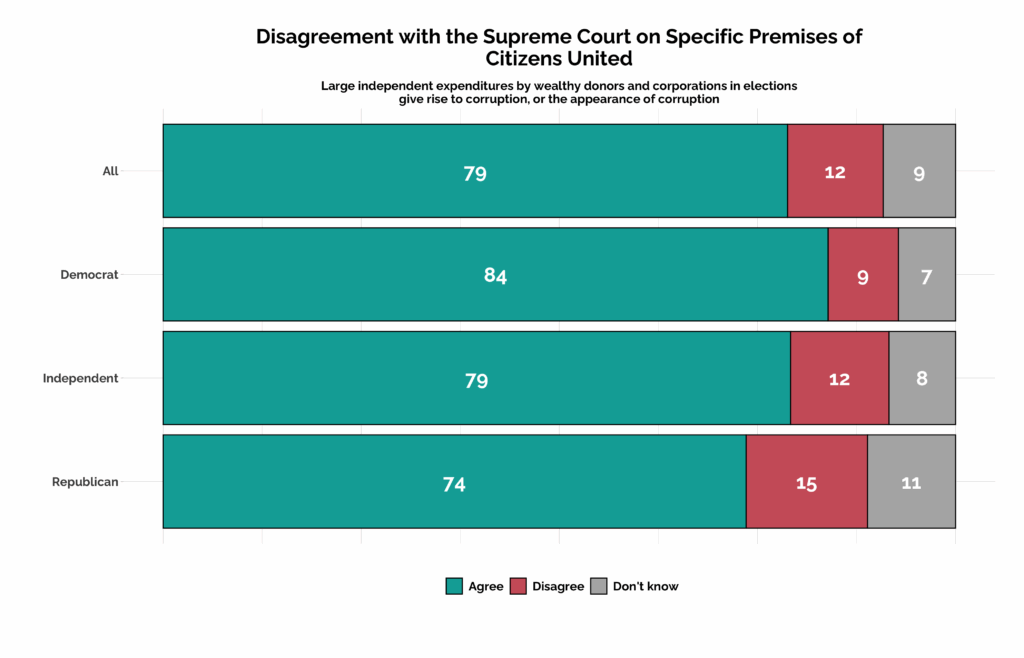 Source: YouGov national survey, Oct. 7-15, 2025
In response to these findings, Issue One Senior Research DirectorMichael Beckel, who oversaw the polling project, said: “Policymakers on both sides of the aisle should be tuning into the fact that overwhelming majorities of Americans across the political spectrum are alarmed by the huge sums being spent in elections by corporations, dark money groups, and wealthy donors.”
Beckel continued: “These findings fly in the face of two of the key assumptions that the U.S. Supreme Court made 15 years ago in Citizens United, namely that independent expenditures do not give rise to corruption or the appearance of corruption, and secondly, that the appearance of influence or access would not cause the electorate to lose faith in democracy. These perceptions of corruption are corrosive to the foundation of our democracy. Our political system cannot function if the public assumes the government is for sale to the highest bidder.”
Added Issue One Policy LeadLiana Keesing: “Montanans are sending a clear message that echoes around the country: Our democracy should be owned by voters, not bought by the wealthy few. These new findings show that people in every corner of the state — and across party lines — want a government that works for all of us, not just those with the deepest pockets. The proposed ballot measure is a bold, practical step toward restoring trust in our political system by ensuring that elections reflect the voices of citizens, not corporate interests. If Montana succeeds, it won’t just reform its own laws; Montanans can pave a path for states across the nation that want to reclaim democracy for the people.”
In Montana, Issue One’s new poll found that nearly 3 in 4 Montanans (74%) — including 84% of Democrats, 69% of Republicans, and 64% of independents — would vote in favor of this proposed ballot measure to eliminate corporate and dark money spending in elections by amending state law governing corporate charters, compared to only 11% opposed.
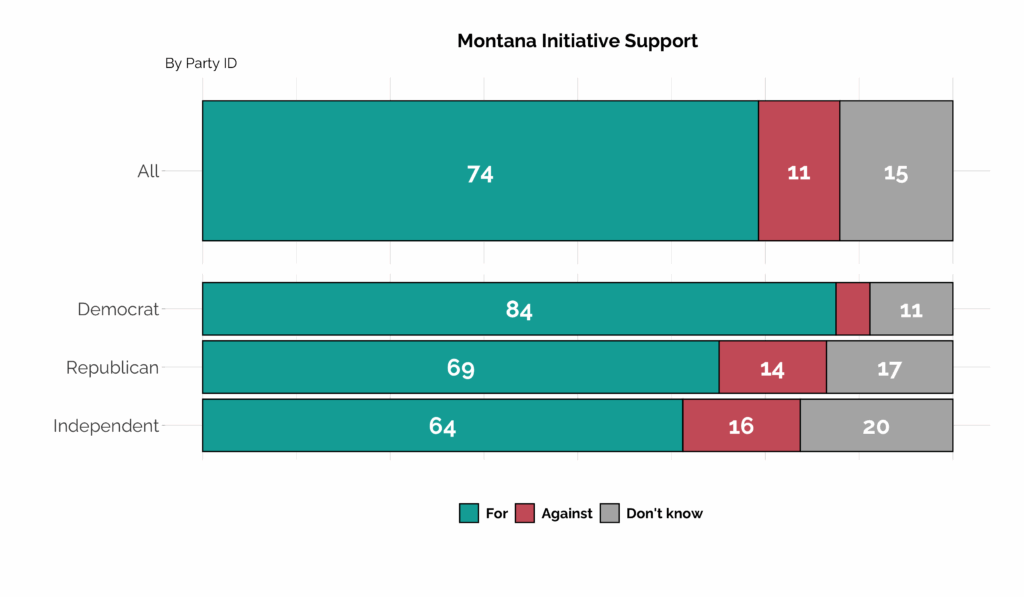 Source: YouGov survey of Montana voters, Oct. 7-20, 2025
Nationally, Issue One’s poll tested a comparable proposal — asking voters how they would respond if a similar measure were considered in their own state. Support was nearly as strong, with 72% of Americans said they would support such a reform, compared to only 12% opposed, after respondents were exposed to messaging from both supporters and opponents. That included support from 81% of Democrats, 64% of Republicans, and 60% of independents.
These high levels of support persisted even when voters were reminded that proposed reforms to curb corporate and dark money spending in elections could apply to their own preferred groups, or raise free speech concerns.
Other key findings from these two polls included:
- 77% of Americans — including 84% of Democrats, 70% of Republicans, and 78% of independents — agreed that anti-corruption rules strengthen our democracy and constitutional rights by ensuring everyone has equal political representation, regardless of money.
- 75% of Americans — including 84% of Democrats, 65% of Republicans, and 73% of independents — said unlimited spending in elections makes our democracy weaker because it gives wealthy special interests too much influence over elected officials. Only 13% of Americans said unlimited spending by people and organizations makes our democracy stronger by protecting the constitutional right to free speech.
- 73% of Americans — including 81% of Democrats, 67% of Republicans, and 71% of independents — agreed that “if a wealthy donor or corporation gains influence over or access to an elected official, I consider that official to be corrupt.”
- 69% of Americans — including 76% of Democrats, 61% of Republicans, and 64% of independents — believe that technology and social media companies have too much influence in politics.
- 63% of Americans — including 73% of Democrats, 53% of Republicans, and 61% of independents — disagreed with the Supreme Court’s Citizens United decision that corporations and labor unions have a First Amendment right to spend unlimited money to influence elections.
- 72% of Montanans — including about 70% of both Democrats and Republicans — continued to support the ballot initiative passed by roughly 75% of voters in 2012 that established a state policy that corporations are not entitled to constitutional rights, such as First Amendment free speech rights, because they are not human beings.
Read the toplines, crosstabs, and interested parties’ memo prepared by YouGov for Issue One’s national poll.
Read the toplines, crosstabs, and interested parties’ memo prepared by YouGov for Issue One’s Montana poll.
===
4 24 belated list of policies a majority of AM SUPPORT (and gop refuses to pass/ support/allow)
5. The fifth way to make more than a billion is to get the money from rich parents or relatives.
A new UBS report finds that a record number — 91 people — became billionaires in 2025 through inheritance. Their total bounty was almost $300 billion.
It’s the beginning of what’s expected to be the largest inter-generational wealth transfer in history, during which heirs will inherit at least $5.9 trillion over the next 15 years.
An estimated 45 percent of all wealth in America is inherited. That’s because, under U.S. tax law — which is itself largely a product of lobbying by the wealthy — the capital gains of one generation are wiped out when those assets are transferred to the next.
As Mitt Romney (remember him?) recently pointed out, had Elon Musk purchased his Tesla stock for, say, $1 billion and held it until his death, and if it were then worth $500 billion, he would never pay the 24 percent federal capital gains tax on the $499 billion profit. Under the current tax code, when Musk’s heirs inherit his stock, the assets will be treated as if the heirs purchased it for $500 billion. So no one will ever pay taxes on the $499 billion capital gain.
If unearned income were treated the same as earned income under the tax code, America’s non-working rich wouldn’t be billionaires. And if capital gains weren’t eliminated at death, many heirs wouldn’t be, either.
The good news is that Americans are becoming increasingly alarmed about the harms billionaires are inflicting on our system. A Harris poll released last month finds that over half of Americans (53 percent) believe that billionaires are threatening democracy.
In addition, a significant 71 percent of Americans believe there should be a wealth tax. And a majority believe there should be a cap on how much wealth a person can accumulate.
These schemes also threaten capitalism itself. The system doesn’t work when monopolies, insider trading, political payoffs, fraud, and large amounts of inherited wealth are rigging it. As the system loses public trust, it begins to unravel.
When and if sane and honest people ever again control the U.S. government, one of the first things they should do is enact a tax on large accumulations of wealth.
Also an end to the current rule that allows all capital gains to be erased when the owners of the capital die, thereby enabling heirs to inherit all the accumulated wealth tax-free.
Not the least, we must get big money out of politics — to end the bribes and corruption that have distorted capitalism for the benefit of a handful of people at the top. (Here’s a way to do it.)
*Robert Reich is a professor of public policy at Berkeley and former secretary of labor. His writings can be found at https://robertreich.substack.com/.*
===
1/24
How Americans feel about Trump’s proposed policies and the Republican primary candidates | YouGov
no gfx
the 2024 Republican primary begins on Monday with the Iowa caucuses, closely followed by the New Hampshire primary on January 23. Ahead of the Republican primaries, two YouGov polls asked Americans whether they support or oppose 30 policies proposed by Republican front-runner Donald Trump — without specifying that he has proposed them — and about which Republican primary candidate would do the best job handling a set of 16 policy issues as president.
A handful of the Trump proposals included in the poll get majority support from Americans. Majorities strongly or somewhat support Trump’s proposals to ban hormonal or surgical treatment for transgender minors (57%) and to require asylum seekers from Latin America to wait in Mexico while their claims are processed in the U.S. (56%). About half support each of the following: passing a law establishing that only two genders, as determined at birth, are recognized by the U.S. (53%), arresting and deporting thousands of illegal immigrants (51%), and building a wall that extends along the entire U.S.-Mexico border (49%).
Among Trump's proposals included in the poll, Americans are most likely to strongly or somewhat oppose cutting taxes on corporations (61%), giving the president control over regulatory agencies such as the Federal Communications Commission and the Federal Trade Commission (59%), and abolishing the U.S. Department of Education (57%). A majority also oppose changing the law to allow presidents to fire civil service workers for any reason (56%).
Democrats and Republicans are divided on most of Trump’s policies. Republicans are more likely to support than oppose 22 of the 30 policies asked about in the poll, while Democrats are more likely to oppose than support 29 of 30. Independents are more likely to oppose than support 22 of the 30 policies. To take one example of a partisan divide: While Republicans are 59 percentage points more likely to support than oppose banning the teaching of critical race theory in public schools and universities, Democrats are 47 points more likely to oppose it than to support it (+59 vs. -47 net support). Independents are 3 points more likely to support than oppose banning critical race theory in public schools.
Of the 30 proposed Trump policies in the poll, Republicans have the highest net support for banning hormonal or surgical treatment for transgender minors (+72) and building a wall that extends along the entire U.S.-Mexico border (+72). Net support is highest among Democrats for requiring asylum seekers from Latin America to wait in Mexico while their claims are processed in the U.S. (+1) and lowest for abolishing the U.S. Department of Education (-68) and withdrawing from the World Health Organization (-66). Independents are most supportive of requiring asylum seekers from Latin America to wait in Mexico while their claims are processed in the U.S. (+31 net support) and least supportive of cutting taxes on corporations (-46).
Republicans, Independents, and Democrats have similar net support for Trump’s proposals to give the president control over regulatory agencies such as the FCC and the FTC, set up tent cities to house homeless people and jail those who decline to go to the tent cities, and revise car pollution rules that would increase the share of vehicles sold in the U.S. that are electric. Each group is more likely to oppose than support these policies.
Trump's likely primary supporters favor even more of his proposed policies than do Republicans overall. Among registered voters who either identify as Republicans or are Independents who lean toward the Republican Party, those who support Trump in the 2024 Republican primary are more likely to support than oppose 27 of his 30 proposed policies polled about — compared to 23 among all likely Republican primary voters and 20 among those who don't plan to support Trump.
The only policies Trump's likely primary supporters are more likely to oppose than support are reversing car pollution rules that would increase the share of vehicles sold in the U.S. that are electric (-13 net support), setting up tent cities to house homeless people and jailing those who decline to go to the tent cities (-18), and giving the president control over regulatory agencies such as the FCC and the FTC (-36). Probable Trump primary supporters have the highest net support for banning hormonal or surgical treatment for transgender minors (+84) and passing a law establishing that only two genders, as determined at birth, are recognized by the U.S. (+83).
Likely Republican primary voters who prefer other candidates over Trump are less likely to support some of Trump’s proposed policies. For example, probable Republican primary voters who support Trump have higher net support for banning travel to the U.S. from many Muslim-majority countries (+47) than probable Republican primary voters who do not support Trump (+5). Trump supporters also have higher net support for sending U.S. troops into large U.S. cities to enforce public order (+21) and ending U.S. aid to Ukraine (+43) than do likely primary voters who don't support Trump, who are more likely to oppose than support sending U.S. troops into large U.S. cities (-25) and ending U.S. aid to Ukraine (-13).
In a separate poll, YouGov asked Americans which candidate in the Republican primary would do the best job handling a set of 16 policy issues were they to become president. (The poll also included Chris Christie as an option, as it was run before he withdrew his candidacy.) On every one of the 16 issues, Trump is the candidate seen as best equipped to handle it. More than one in three Americans think Trump would do the best job handling the economy (39%), immigration (39%), China (38%), and inflation (38%). Americans are least likely to see Trump as the best candidate to handle LGBTQ issues (24%) and the environment (26%).
Between 5% and 10% of Americans think Ron DeSantis would do the best job handling each of the 16 issues polled about, while between 6% and 13% think Haley would do the best job on each of these issues. Of the 16 policies, Americans are most likely to think DeSantis is the Republican primary candidate who would do the best job handling education (10%) and most likely to think Haley would do the best job handling abortion (13%). Between 22% and 31% of Americans think none of the Republican primary candidates would handle each of the 16 issues best, and another 18% to 25% are not sure for each issue.
A majority of the registered voters who either identify as Republicans or are Independents who lean toward the Republican Party think Donald Trump is the Republican primary candidate who would handle 15 of the 16 issues best as president. Likely Republican primary voters are most likely to think Trump is the best candidate to handle the economy (78%), inflation (76%), and China (74%). Only 48% think Trump would be the best Republican primary candidate to handle LGBTQ issues.
About DeSantis, 17% of likely Republican primary voters think DeSantis would be best on education, while 15% think he is best on crime, and 15% think he is best on guns. Of the 16 policies in the poll, likely Republican primary voters are most likely to see Haley as the best Republican primary candidate on abortion (14%), education (11%), and health care (11%). About one in five likely Republican primary voters are unsure which candidate would best handle each of two issues — the environment (20%) and LGBTQ issues (23%) — higher proportions than for the other 14 policies included in the poll.
*— Taylor Orth and Carl Bialik contributed to this article
See the results for the YouGov poll on **Trump proposals**and [Republican primary candidates
Methodology: *The YouGov poll on Trump proposals was conducted on January 3 - 7, 2024. The YouGov poll on Republican primary candidates' handling of issues was conducted on January 5 - 9, 2024. Each was conducted online among 1,000 U.S. adult citizens....
hmmn freedom of too abstract?
BY GARY FIELDS AND AMELIA THOMSON DEVEAUX
, April 3, 2024
WASHINGTON (AP) — Despite the country’s deep political polarization, most Americans share many core beliefs about what it means to be an American, according to a new poll.
The poll from The Associated Press-NORC Center for Public Affairs Research found that about 9 in 10 U.S. adults say the right to vote, the right to equal protection under the law and the right to privacy are extremely important or very important to the United States’ identity as a nation. The survey also found that 84% feel the same way about the freedom of religion.
The results, which included perspectives on a number of different freedoms and rights, have only small variances between Republicans and Democrats except on the right to bear arms, which Republicans are more likely to see as core to the nation’s identity. The overall findings are striking because they come at a time of extreme partisanship when political agreements seem rare and concerns are heightened over the potential for violence during a volatile presidential election year.
“If you get a bunch of normal people at random and put them in a room together and chat about issues, there’s a lot more convergence than you might imagine,” said Michael Albertus, a political science professor at the University of Chicago.
oct 2022
majority Continues to Say U.S. Government Too Powerful
STORY HIGHLIGHTS
- 54% believe federal government is too powerful, similar to past years
- 53% say government doing too many things to solve nation's problems
- Twice as many say there is too much rather than too little business regulation
WASHINGTON, D.C. -- A 54% majority of Americans say the federal government has too much power, while 39% say it has about the right amount of power and 6% say too little. These figures have generally been stable throughout the Donald Trump and Joe Biden presidential administrations. Since 2005, no less than 50% of Americans have said they believe the federal government is too powerful, with some of those readings reaching 60%.
These results are based on Gallup's annual Governance survey, conducted Sept. 1-16.
Americans have typically believed the federal government has too much power, except in the first three years after the 9/11 terrorist attacks. Between 2002 and 2004, about half of Americans said the government had the right amount of power, while close to 40% said it had too much.
At no point in Gallup's trend have more than 9% of U.S. adults said the government has too little power.
The stability in the overall numbers masks large shifts by Republicans and Democrats tied to the party of the sitting president. Generally speaking, Republicans and Democrats are more inclined to say the government has too much power when the president is from the other party, and less inclined when a president from their own party is in the White House. But since 2009, Republicans have been consistently more likely than Democrats to say the government is too powerful, just by larger margins under a Democratic president than under a Republican president.
Currently, 74% of Republicans, 32% of Democrats and 54% of independents believe the federal government has too much power.
Slim Majority Believes Federal Government Is Too Active
When asked how active the government should be in addressing the nation's problems, 53% say it is doing too many things that should be left to individuals and businesses, while 43% believe the government should be doing more to solve problems.
These attitudes are similar to a year ago and have largely held over the past two decades, although with some variation, depending on the party of the president at the time. Typically, as now, Americans have been more likely to see the government as too active when a Democratic president is in office than when a Republican is.
Gallup first asked the question about government activity in 1992. The highest percentages saying the government is doing too much are 61% measured in July 2012 and 60% in December 1995.
There have been only three instances since 1992 in which more Americans have called for the government to do more than to do less. These were in early 1993, after Bill Clinton took office following his victory over the incumbent George H.W. Bush in an election focused on economic issues; in October 2001, weeks after the 9/11 terrorist attacks; and in 2020 during the height of the COVID-19 pandemic.
Consistent with their party platforms, most Republicans (75%) currently say the government is doing too many things, and most Democrats (66%) believe the government should be doing more. Independents' views mirror the national average.
Since 2011, no less than 64% of Democrats have said the government should be doing more than it is, including a high of 83% in 2020. Over that same period, no less than 70% of Republicans have said the government is doing too many things it shouldn't be.
Americans Most Likely to Believe Business Regulated Too Much
Twice as many Americans believe the government regulates business too much (46%) rather than too little (23%), and 29% say there is the right amount of regulation. For the past two years -- the first two of Biden's administration -- the percentage of Americans saying there is too much regulation has exceeded the percentages measured in 2018-2020, the last three years of Trump's administration. Similarly, more Americans thought there was too much business regulation under Barack Obama between 2009 and 2016 than under George W. Bush between 2001 and 2008.
The high point in saying there is too much regulation in Gallup's trend is 50% in 2011. A 1981 Los Angeles Times poll that asked the same question found 54% saying there was too much regulation. That poll was conducted early in Ronald Reagan's presidency, after he won election on a platform of cutting government regulation.
Bottom Line
Americans' views of federal government power haven't changed over the past six years, which have spanned a number of issues or events that involved significant, if not unprecedented, government activity.
During this period, the U.S. Justice Department investigated possible ties between the Trump campaign and Russia in the 2016 election, the U.S. House impeached Trump twice, and the FBI recently raided Trump's home looking for government records, including classified material. The federal government has also spent trillions of dollars addressing the COVID-19 pandemic and authorized $1 trillion for infrastructure and billions more for climate change legislation.
Consistent with the philosophies of the two major parties, Republicans are more likely than Democrats to believe the government is too powerful, is doing too many things that individuals and businesses should be doing, and that it is regulating business too much. However, those views are usually moderated by the party of the current president and whether his approach is in line with what Republicans or Democrats prefer.
To stay up to date with the latest Gallup News insights and updates, *follow us on Twitter*.*
*Learn more about how the Gallup Poll Social Series works.
*View complete question responses and trends (PDF download).
===
Majority of Americans favor wealth tax on very rich
Reuters
https://www.reuters.com › article](https://www.reuters.com/article/idUSKBN1Z9140/)
Jan 10, 2020 — The idea of imposing a wealth tax on the richest Americans has elicited sharply divergent views across a spectrum of politicians, ...
===
cat sparked by
an 4 24 stateside
south Dakota state Sen. John Wiik likes to think of himself as a lookout of sorts — keeping an eye on new laws, programs and ideas brewing across the states.
“I don’t bring a ton of legislation,” said Wiik, a Republican. “The main thing I like to do is try and stay ahead of trends and try and prevent bad things from coming into our state.”
This session, that meant sponsoring successful legislation banning cities or counties from creating basic income programs, which provide direct, regular cash payments to low-income residents to help alleviate poverty.
While Wiik isn’t aware of any local governments publicly floating the idea in South Dakota, he describes such programs as “bureaucrats trying to hand out checks to make sure that your party registration matches whoever signed the checks for the rest of your life.”
The economic gut punch of the pandemic and related assistance efforts such as the expanded child tax credit popularized the idea of directly handing cash to people in need. Advocates say the programs can be administered more efficiently than traditional government assistance programs, and research suggests they increase not only financial stability but also mental and physical health.
Still, Wiik and other Republicans argue handing out no-strings-attached cash disincentivizes work — and having fewer workers available is especially worrisome in a state with the nation’s second-lowest unemployment rate.
South Dakota is among at least six states where GOP officials have looked to ban basic income programs.
The basic income concept has been around for decades, but a 2019 experiment in Stockton, California, set off a major expansion. There, 125 individuals received $500 per month with no strings attached for two years. Independent researchers found the program improved financial stability and health, but concluded that the pandemic dampened those effects.
GOP lawmakers like Wiik fear that even experimental programs could set a dangerous precedent.
“What did Ronald Reagan say, ‘The closest thing to eternal life on this planet is a government program’?” Wiik said. “So, if you get people addicted to just getting a check from the government, it’s going to be really hard to take that away.”
The debate over basic income programs is likely to intensify as blue state lawmakers seek to expand pilot programs. Minnesota, for example, could become the nation’s first to fund a statewide program. But elected officials in red states are working to thwart such efforts — not only by fighting statewide efforts but also by preventing local communities from starting their own basic income programs.
Democratic governors in Arizona and Wisconsin recently vetoed Republican legislation banning basic income programs.
Last week, Texas Attorney General Ken Paxton sued Harris County to block a pilot program that would provide $500 per month to 1,900 low-income people in the state’s largest county, home to Houston.
Paxton, a Republican, argued the program is illegal because it violates a state constitutional provision that says local governments cannot grant public money to individuals.
Harris County Attorney Christian Menefee, a Democrat, called Paxton’s move “nothing more than an attack on local government and an attempt to make headlines.”
Meanwhile, several blue states are pushing to expand these programs.
Washington state lawmakers debated a statewide basic income bill during this year’s short session. And Minnesota lawmakers are debating whether to spend $100 million to roll out one of the nation’s first statewide pilot programs.
“We’re definitely seeing that shift from pilot to policy,” said Sukhi Samra, the director of Mayors for a Guaranteed Income, which formed after the Stockton experiment.
So far, that organization has helped launch about 60 pilot programs across the country that will provide $250 million in unconditional aid, she said.
This is an effective policy that helps our families, and this can radically change the way that we address poverty in this country.
– Sukhi Samra, director of Mayors for a Guaranteed Income
Despite pushback in some states, Samra said recent polling commissioned by the group shows broad support of basic income programs. And the programs have shown success in supplementing — not replacing — social safety net programs, she said.
The extra cash gives recipients freedom of choice. People can fix a flat tire, cover school supplies or celebrate a child’s birthday for the first time.
“There’s no social safety net program that allows you to do that.” she said. “ … This is an effective policy that helps our families, and this can radically change the way that we address poverty in this country.”
Basic income experiments
The proliferation of basic income projects has been closely studied by researchers.
Though many feared that free cash would dissuade people from working, that hasn’t been the case, said Sara Kimberlin, the executive director and senior research scholar at Stanford University’s Center on Poverty and Inequality.
Stanford’s Basic Income Lab has tracked more than 150 basic income pilots across the country. Generally, those offer $500 or $1,000 per month over a short period.
“There isn’t anywhere in the United States where you can live off of $500 a month,” she said. “At the same time, $500 a month really makes a tremendous difference for someone who is living really close to the edge.”
Kimberlin said the research on basic income programs has so far been promising, though it’s unclear how long the benefits may persist once programs conclude. Still, she said, plenty of research shows how critical economic stability in childhood is to stability in adulthood — something both the basic income programs and the pandemic-era child tax credit can address.
Over the past five years, basic income experiments have varied across the country.
Last year, California launched the nation’s first state-funded pilot programs targeting former foster youth.
In Colorado, the Denver Basic Income Project aimed to help homeless individuals. After early successes, the Denver City Council awarded funding late last year to extend that program, which provides up to $1,000 per month to hundreds of participants.
Despite pandemic pay boost, low-wage workers still can’t afford basic needs
A 2021 pilot launched in Cambridge, Massachusetts, provided $500 a month over 18 months to 130 single caregivers. Research from the University of Pennsylvania found the Cambridge program increased employment, the ability to cover a $400 emergency expense, and food and housing security among participants.
Children in participating families were more likely to enroll in Advanced Placement courses, earned higher grades and had reduced absenteeism.
“It was really reaffirming to hear that when families are not stressed out, they are able to actually do much better,” said Geeta Pradhan, president of the Cambridge Community Foundation, which worked on the project.
Pradhan said basic income programs are part of a national trend in “trust-based philanthropy,” which empowers individuals rather than imposing top-down solutions to fight poverty.
“There is something that I think it does to people’s sense of empowerment, a sense of agency, the freedom that you feel,” she said. “I think that there’s some very important aspects of humanity that are built into these programs.”
While the pilot concluded, the Cambridge City Council committed $22 million in federal pandemic aid toward a second round of funding. Now, nearly 2,000 families earning at or below 250% of the federal poverty level are receiving $500 monthly payments, said Sumbul Siddiqui, a city council member.
Siddiqui, a Democrat, pushed for the original pilot when she was mayor during the pandemic. While she said the program has proven successful, it’s unclear whether the city can find a sustainable source of funding to keep it going long term.
States look to expand pilots
Tomas Vargas Jr. was among the 125 people who benefited from the Stockton, California, basic income program that launched in 2019.
At the time, he heard plenty of criticism from people who said beneficiaries would blow their funds on drugs and alcohol or quit their jobs.
“Off of $500 a month, which amazed me,” said Vargas, who worked part time at UPS.
Tomas Vargas Jr. was among the 125 people who participated in the 2019 basic income experiment in Stockton, Calif. Vargas, pictured here with his family, said the $500 a month allowed him to be a better father and take off time to pursue a better career. Courtesy of Tomas Vargas Jr.
But he said the cash gave him breathing room. He had felt stuck at his job, but the extra money gave him the freedom to take time off to interview for better jobs.
Unlike other social service programs like food stamps, he didn’t have to worry about losing out if his income went up incrementally. The cash allowed him to be a better father, he said, as well as improved his confidence and mental health.
The experience prompted him to get into the nonprofit sector. Financially stable, he now works at Mayors for a Guaranteed Income.
“The person I was five years ago is not the person that I am now,” he said.
Washington state Sen. Claire Wilson, a Democrat, said basic income is a proactive way to disrupt the status quo maintained by other anti-poverty efforts.
“I have a belief that our systems in our country have never been put in place to get people out of them,” she said. “They kept people right where they are.”
Wilson chairs the Human Services Committee, which considered a basic income bill this session that would have created a pilot program to offer 7,500 people a monthly amount equivalent to the fair market rent for a two-bedroom apartment in their area.
The basic income bill didn’t progress during Washington’s short legislative session this year, but Wilson said lawmakers would reconsider the idea next year. While she champions the concept, she said there’s a lot of work to be done convincing skeptics.
In Minnesota, where lawmakers are considering a $100 million statewide basic income pilot program, some Republicans balked at the concept of free cash and its cost to taxpayers.
“Just the cost alone should be a concern,” Republican state Rep. Jon Koznick said during .
State Rep. Athena Hollins, a Democrat who sponsored the legislation, acknowledged the hefty request, but said backers would support a scaled-down version and “thought it was really important to get this conversation started.”
Much of the conversation in committee centered on local programs in cities such as Minneapolis and St. Paul. St. Paul Mayor Melvin Carter, a Democrat, told lawmakers the city’s 2020 pilot saw “groundbreaking” results.
After scraping by for years, some families were able to put money into savings for the first time, he said. Families experienced less anxiety and depression. And the pilot disproved the “disparaging tropes” from critics about people living in poverty, the mayor said.
Carter told lawmakers that the complex issue of economic insecurity demands statewide solutions.
“I am well aware that the policy we’re proposing today is a departure from what we’re all used to,” he said. “In fact, that’s one of my favorite things about it.”