Creel Comm
===
https://webbrain.com/brainpage/brain/6950F840-FB80-FCB0-D505-8AB1FA685F08#-2195
=
ca farmworkers
In October 1933, Decker became involved with the San Joaquin cotton strike. Cotton was the "second most lucrative crop in California".[8] In 1921, there were 1,500 acres in production; by 1937 there “was close to 600,00 acres”.[9] The Great Depression had sharply reduced the prices that cotton growers got for their product, and they passed those declines on to workers in the form of lower wages, with wages declining nearly 75 percent in three years.
By the time of the strike, growers had sold 75 per cent of the crop to Japan at 7 cents a pound in advance of the harvest, and had no room whatsoever to pass on added labor costs. Field workers demanded one dollar per hundred pounds; growers offered sixty cents, at which rate "even a strong, steadily working man could make no more than $1.20 a day. An entire family working all day would average $2."[8]
The strike began on October 4, with twelve thousand workers walking off the job and a strike front extending for five hundred miles. Growers evicted families of strikers from company-owned housing, and in Pixley, California, a violent clash between strikers and growers left "two Mexican strikers … dead [and] eight others…wounded.[6] An estimated 5,000 people gathered for the funeral mass for the two murdered strikers—Delfino Davila and Dolores Hernandez. Governor James Rolph appointed a fact-finding committee to look into the violence."[8]
Decker led strikers to the courthouse in Visalia where, on October 19, 1933, the committee began its hearings. She questioned strikers on the stand, where she brought out the details of their lives: "a work day extending from daylight to dark, their fingers bleeding from the prickly cotton bolls, the children working alongside their parents until they collapsed on the ground in exhausted sleep".[8]
After hearing testimony from another woman who said her children "had not worn shoes since 1930" the growers' counsel charged that Decker had coached witness testimony. She "immediately offered to let him personally select all further strikers' witnesses" but he declined the offer.[6]
Despite the drama of the testimony, the action of the government through NRA regional director George Creel ultimately ended the strike. Creel brought in relief supplies for striking workers, and got the Federal Intermediate Credit Bank to help finance the cotton growers so they could give a wage of 75 cents an hour.
Creel's goals were to persuade growers and strikers to accept that rate, and to deny National Labor Board recognition to the CAWIU because of its communist leadership. Eventually the Central Strike Committee agreed to the terms and workers returned to work without an officially recognized union.[8]
===
https://rigged.ghost.io/start/
NO LNX
RIGGED
START HERE: INFORMATION POLLUTION — A BRIEF HISTORY
To understand how each spinmaster, technique, and industry contributed to the current state of disinformation in the U.S., it helps to know the history of how and why the PR industry was created.
LATEST POST
Get 'Em While They're Young
by Rigged
TO UNDERSTAND HOW EACH SPIN MASTER, TECHNIQUE, AND INDUSTRY CONTRIBUTED TO THE CURRENT STATE OF DISINFORMATION IN THE U.S., IT HELPS TO KNOW THE HISTORY OF HOW AND WHY THE PR INDUSTRY WAS CREATED.
In response to a protest, the country’s largest oil company sent in private security teams, who wound up killing several protestors, including women and children. The company’s spokesperson claimed the protestors were hired by a labor union trying to stir up trouble.
Sounds like it could have been written about any of a half dozen recent pipeline protests, right? But these are the basic details of a mining strike in 1914, in Ludlow,Colorado. The mine was owned by Standard Oil, and the Rockefeller family had only a few years prior been raked over the coals by a messy antitrust lawsuit and a series of investigative features about their monopoly on the country’s burgeoning oil industry.
They needed help burnishing their image, so they called on another industry that was just emerging at the time: Public relations.Ivy Ledbetter Lee, the first modern PR guy, came up with that idea that the protestors were hired agitators. Today we would call them “crisis actors” and it’s an accusation thrown at almost every protest, but few people know the whole thing was created by a PR guy working for an oil company back in 1914.
Lee invented all sorts of other tricks of the trade too. The press release, for a start. Before Lee, companies had a pretty adversarial relationship with the press and vice versa. Lee thought businesses would do better to tell journalists more of their story themselves. It was so unusual that when he first began sending press releases to The New York Times, the paper printed them verbatim. On behalf of rail, coal, oil and tobacco clients Lee also created seemingly independent information bureaus, like the Bureau of Railroad Economics, whose experts were regularly quoted criticizing railroad tax proposals. Again, this was more than 100 years ago. And Lee was followed by generation after generation of PR experts, each adding another bell or whistle to America’s disinformation machine—some on behalf of oil, others on behalf of the chemical or tobacco industries, often on behalf of all three at the same time.
For years, the story about disinformation has been that Big Tobacco created it all and then Big Oil copied them. And there's a thread of truth there. Some of the same phony scientists who sold America on the idea that smoking was safe turned around and told them not to worry about climate change. But it’s not the whole story. To get that, we need to look at the context that enabled climate denial to flourish, an information system polluted by 100 years of propaganda. And we need to look at who was hiring those phony scientists—not companies, but PR firms. When people focus on one particular form of science denial, or on one technique that this or that industry copied from another, this is the big picture they miss: the disinformation machine driving everything from QAnon conspiracies to climate denial, vaccine hesitation to white nationalism. It’s bigger than any one industry, but it was built on behalf of all of them, and if we want to have any hope of addressing the large, intersecting, complex problems facing us today, it must be better understood. And then reconfigured, or dismantled altogether.
***
Just as Ivy Lee was building the modern PR industry, the U.S. government realized it needed a bit of propaganda to help sell American citizens on World War I. President Woodrow Wilson had made staying out of the war a key part of his campaign, and now he needed to convince Americans that it was a good idea to join in...without looking like a hypocrite. He tapped George Creel, a journalist turned political campaigner who had helped with Wilson's electoral bid, to build out what was eventually called the Committee on Public Information and generally referred to as The Creel Committee or the Creel Commission. Creel tapped some of the nation's greatest journalists (Ida Tarbell, for one!), filmmakers, artists, and publicity men to create a 360-degree assault on the American public. They made films, created compelling posters, and even launched the world's first "influencers." In cities and towns across the country, Creel and his team found influential members of society and trained them to give 4-minute pro-war speeches before screenings of silent films or big events. They were known as the "4-Minute Men".
Several members of the Creel Committee went on to be major influences on the burgeoning PR industry.One of them was a young publicity agent from the theater, Edward Bernays. Bernays had done some creative promotion of plays with particular social missions and had worked for major ballet companies as well, and his work caught the eye of Creel. It didn't hurt that Bernays's uncle was Sigmund Freud—on both sides, in a bizarre and some might say Freudian twist (Edward's mother was Freud’s sister, and Freud was also married to Bernays’ father’s sister). Bernays grew up in Vienna, hearing all about Freud’s theories on the deeply buried human impulses that drive behavior. While Ivy Lee was not part of the Creel Committee, he handled publicity for the American Red Cross during the war effort, and he and Bernays worked together often through their respective positions. Bernays became a trusted colleague of Lee's during the war, the only other PR guy that Lee thought his equal. It was after WWI thatBernays famously said, “If propaganda could be used so effectively in war, why could we not use it in peace?”
At the time, democracy was still a relatively new idea, and those in power were almost universally terrified of it. Propaganda—which Bernays later renamed “public relations” because “the Germans had given it a bad name”—was created as a reaction to growing public criticism of the titans of industry who had once been hailed as heroes. But it was also created to provide those in power with the tools to manipulate the masses. Bernays, Lee, and a client they both shared—Adolf Hitler—were all close readers of French philosopher Gustav Le Bon, who posited that the public, or as Le Bon put it “the crowd,” could only be both satisfied and safe when it was controlled. Like Le Bon, Bernays had a real disdain for the public, writing in his seminal book Propaganda:
Those who manipulate the unseen mechanism of society constitute an invisible government, which is the true ruling power of our country. We are governed, our minds molded, our tastes formed, our ideas suggested largely by men we have never heard of. In almost every act of our lives, whether in the sphere of politics or business, in our social conduct or our ethical thinking, we are dominated by a relatively small number of persons who understand the mental processes and social patterns of the masses. It is they who pull the wires that control the public mind.
To be clear, Bernays saw himself as part of that “ruling power,” and he relished the role of manipulator.
Ivy Lee died fairly young, in his 50s, and when he did Edward Bernays inherited many of his clients, including both The American Tobacco Company and The American Petroleum Institute, the fossil fuel industry trade group that Lee had helped Standard Oil create as World War I was ending. While Ivy Lee largely focused on shaping and controlling the way the media got information as a way to mold public opinion, Bernays tried to manipulate the masses more directly. His best known trick was obliterating the taboo against women smoking in about six months, a feat he pulled off for American Tobacco.
They tasked Bernays with increasing sales, and he actually went to a psychoanalyst to talk about what cigarettes signified.You guessed it, phalluses. This got Bernays thinking about the “penis envy” women supposedly feel and an emergent push for women’s rights, and boom he had it: he would make smoking a women’s empowerment issue. He convinced a few young women he knew to stage a smoking “protest” in New York, calling cigarettes “freedom torches,” then alerted the press to the protest. It made headlines across the country and within a few months women all over the country were smoking and American Tobacco’s sales were soaring.
So, to recap, PR emerged as a way for industry to deal with a three-pronged threat: the rise of investigative journalism and activism shining a light on the misdeeds of industry, the emergence of regulation (which previously left industry to its own devices), and the expansion of the vote to members of society that had little in common with captains of industry. It was wildly successful. The first wave of PR effectively put a stop to the muckrakers’ early calls for corporate accountability.
Then the Depression hit and once again America’s bosses were the bad guys. Publicists like John W. Hillhelped companies like American Steel paint labor unions, social security, and the New Deal as socialist. Hill paid commentators like George Sokolsky to write op-eds in newspapers and magazines, or join panel discussions on the radio, ginning up fear about these ideas. (At one point, Hill’s firm Hill & Knowlton was paying Sokolsky $40,000 a year to write pieces criticizing Social Security and the New Deal—that's a high six-figure salary in today's dollars). Hill would go on to mastermind the Tobacco Industry Research Committee (TIRC), a hub of science denial around smoking...that sounds an awful lot like the research bureaus Ivy Lee had set up some 40 years before. Not a huge shock given that Hill idolized Lee.
Hill’s client roster also included the American Petroleum Institute, Texaco, and Monsanto during those years, so it's no surprise that you see the same tactics deployed by TIRC then used by oil companies to combat rising concern over "the greenhouse effect" or by agribusiness to combat rising concern over GMOs. In fact Hill would have folks from the tobacco companies and chemical companies join the API, because he spotted ways for all three industries to work together—to lobby together for or against regulation, to trade strategies and ideas, even to create new products together. Without PR firms bringing them together, these industries and companies may have tended to stay in their own worlds, but the type of cross-pollination Hill enabled was hugely influential.
In fact it’s how the cigarette filter came about.
Cigarette filters are one of the reasons oil and gas companies were named defendants in the tobacco litigation of the 1990s. “When tobacco companies needed to assess the toxics in their cigarettes and in cigarette smoke, the people they turned to to do it were the oil companies,” says Carroll Muffett, President and CEO of the Center for International Environmental Law. Oil companies had been testing exhaust and refinery smoke for years because of the Clean Air Act, so they were the ones that had the sophisticated equipment and the knowledge to test for toxins in cigarette smoke.
“And when the oil companies reported back to the tobacco companies on the toxins they were in fact finding in that smoke, you know, what did they do with the information?" Muffett said. "Did they go public and say there's a massive risk here? No. They entered into joint enterprises, joint ventures with the tobacco companies to produce cigarette filters.”
Since the inception of the PR industry, its most expert practitioners have deployed a handful of techniques on behalf of multiple industries and really in service of all industry: to paint business as a good faith member of the community, to sway public opinion, to avoid what infamous PR guy Rick Berman calls "public judgement," and to create political will in their favor. But they weren't operating in a vacuum. In deploying these techniques on behalf of industry, they fundamentally shifted the information ecosystem in America.
Today, it's not just industries that want to avoid regulation or deal with a crisis who use PR techniques, it's everyone from your local county government to your favorite musician to the most earnest nonprofit. It's the filter through which all information flows to the public. Which doesn't have to be a bad thing, but it has certainly led to the information pollution we have in the U.S. today, where trust in journalists and experts is at an all-time low, the public is tremendously confused, people can (and do) just consume "news" that tracks with their opinions, and so on. To clean up that pollution, it helps to know how to spot these techniques. Our hope with this archive and its corresponding podcast is to help people do just that—not to make people even more suspicious of everything they see, or double down on getting their information only from one trusted YouTuber, but to pull the mask off a bit and help people find their way through the filters to the information they need to make important decisions about their lives.
===
hedges death of lib class:
W wilson cavalry escort ~ anarchist, decl war germany 1917, industrial war; also new propaganda; le bon, trotter, ..Freud. brief period of populism wiped out by new PR 62 reformers painted as traitors; jane addams stunned how progressives supported, uppie called for war at mad sq garden rally after us ships sunk, supported ww1 63
:{
}:
1917 Espionage and Sedition laws, disloyal or profane language that cd encourage contempt for flag or Const 65
:{
}:
Debs 2 yrs jail for ~warsp. 65 rather be shot as traitor than "go to war for Wall st" 75
Creel 69, CPI, posters in every PO; thousands of empl, boosted prop and ended local indep press 70, pre pkg news releases ; tactics used by b43 to sell war, and exxon denial 74 (fake studies and experts) ; creel said nonpartisan impossible? after war shady self improvement Pelmanism and Teapot Dome; went anti-commie worked for McC and RMN 75
hired fiction writers for stories and screenplays 76 the kaiser; the beast of berlin...cops had to quell riot for overflow ppl, almost paid for itself
4 min men lib bond and pro wr sp 77, 75 k in stentorian guard; made bk w/ dewey and lippmann sic
demonized: goldberg, bourne, addams, debs, bertie russell; Appeal to Reason mag censor b/c undermine war (Jack london, mo jones, debs) ; and other left jrnl, the Masses, censored itself
boston symphony orch conductor , elderly, arrested for playing german music 79 german miner lynched, "patriotic murder" 25 min not guilty 79 praised by Wapo
after war, target shift german to commies palmer raids(at ast blurred, so lenin and trotsky german agents 82); 247 deported with emma g; App to reason shut down 79 ex CPI went to gov't and corp NY DC.
Dewey ~ fake news 81 news outgunned b/c deals in facts vs emotion 81
local diff cultures gave way to corp cult, not self-suff, thrift, aesthetic expression, history, difference 82
b/c of rising economy/ lib embrace gov't as tool of progress 84, utopian vs classical lib (claimed by libertarian kochs?]
socialist million votes debs 1912; 29 engl and 22 for weekly papers 86 12 mayors and congr; almost beat gompers afl prez;
by late 1929's way to assess public opinion [measurement?]
rad theater 1920-30's ; John Howard Lawson jazz play on coal labor; HUAC WPA theater project a ctr-wt to CPI, played to 30 il ppl; welles houseman voodoo (Virgil Thomson music) Cradle will Rock Mr Mr; harry hopkins liked it prok killed 1939 pinocchio stay as a puppet
HUAC --> self-censor thru fear 95 RR ended NEA grants for left theater
===
...no lnx pix
Within a week of Congress declaring war, on April 13, 1917, Wilson issued an executive order creating a new federal agency that would put the government in the business of actively shaping press coverage.
That agency was the Committee on Public Information, which would take on the task of explaining to millions of young men being drafted into military service – and to the millions of other Americans who had so recently supported neutrality – why they should now support war.
How Woodrow Wilson’s Propaganda Machine Changed American Journalism
George Creel Harris & Ewing/Library of Congress
The new agency – which journalist Stephen Ponder called “the nation’s first ministry of information” – was usually referred to as the Creel Committee for its chairman, George Creel, who had been a journalist before the war. From the start, the CPI was “a veritable magnet” for political progressives of all stripes – intellectuals, muckrakers, even some socialists – all sharing a sense of the threat to democracy posed by German militarism. Idealistic journalists like S.S. McClure and Ida Tarbell signed on, joining others who shared their belief in Wilson’s crusade to make the world safe for democracy.
At the time, most Americans got their news through newspapers, which were flourishing in the years just before the rise of radio and the invention of the weekly news magazine. In New York City, according to my research, nearly two dozen papers were published every day – in English alone – while dozens of weeklies served ethnic audiences.
Starting from scratch, Creel organized the CPI into several divisions using the full array of communications.
The Speaking Division recruited 75,000 specialists who became known as “Four-Minute Men” for their ability to lay out Wilson’s war aims in short speeches.
The Film Division produced newsreels intended to rally support by showing images in movie theaters that emphasized the heroism of the Allies and the barbarism of the Germans.
The Foreign Language Newspaper Division kept an eye on the hundreds of weekly and daily U.S. newspapers published in languages other than English.
How Woodrow Wilson’s Propaganda Machine Changed American Journalism
James Montgomery Flagg/Library of Congress
Another CPI unit secured free advertising space in American publications to promote campaigns aimed at selling war bonds, recruiting new soldiers, stimulating patriotism and reinforcing the message that the nation was involved in a great crusade against a bloodthirsty, antidemocratic enemy.
Some of the advertising showed off the work of another CPI unit. The Division of Pictorial Publicity was led by a group of volunteer artists and illustrators. Their output included some of the most enduring images of this period, including the portrait by James Montgomery Flagg of a vigorous Uncle Sam, declaring, “I WANT YOU FOR THE U.S. ARMY!”
**********
Other ads showed cruel “Huns” with blood dripping from their pointed teeth, hinting that Germans were guilty of bestial attacks on defenseless women and children. “Such a civilization is not fit to live,” one ad concluded.
How Woodrow Wilson’s Propaganda Machine Changed American Journalism
Frederick Strothmann/Library of Congress
Creel denied that his committee’s work amounted to propaganda, but he acknowledged that he was engaged in a battle of perceptions. “The war was not fought in France alone,” he wrote in 1920, after it was all over, describing the CPI as “a plain publicity proposition, a vast enterprise in salesmanship, the world’s greatest adventure in advertising.”
Buried in paper
For most journalists, the bulk of their contact with the CPI was through its News Division, which became a veritable engine of propaganda on a par with similar government operations in Germany and England but of a sort previously unknown in the United States.
In the brief year and a half of its existence, the CPI’s News Division set out to shape the coverage of the war in U.S. newspapers and magazines. One technique was to bury journalists in paper, creating and distributing some 6,000 press releases – or, on average, handing out more than 10 a day.
The whole operation took advantage of a fact of journalistic life. In times of war, readers hunger for news and newspapers attempt to meet that demand. But at the same time, the government was taking other steps to restrict reporters’ access to soldiers, generals, munitions-makers and others involved in the struggle. So, after stimulating the demand for news while artificially restraining the supply, the government stepped into the resulting vacuum and provided a vast number of official stories that looked like news.
Most editors found the supply irresistible. These government-written offerings appeared in at least 20,000 newspaper columns each week, by one estimate, at a cost to taxpayers of only US$76,000.
In addition, the CPI issued a set of voluntary “guidelines” for U.S. newspapers, to help those patriotic editors who wanted to support the war effort (with the implication that those editors who did not follow the guidelines were less patriotic than those who did).
The CPI News Division then went a step further, creating something new in the American experience: a daily newspaper published by the government itself. Unlike the “partisan press” of the 19th century, the Wilson-era Official Bulletin was entirely a governmental publication, sent out each day and posted in every military installation and post office as well as in many other government offices. In some respects, it is the closest the United States has come to a paper like the Soviet Union’s Pravda or China’s People’s Daily.
How Woodrow Wilson’s Propaganda Machine Changed American Journalism
National Archives
The CPI was, in short, a vast effort in propaganda. The committee built upon the pioneering efforts of public relations man Ivy Lee and others, developing the young field of public relations to new heights. The CPI hired a sizable fraction of all the Americans who had any experience in this new field, and it trained many more.
One of the young recruits was Edward L. Bernays, a nephew of Sigmund Freud and a pioneer in theorizing about human thoughts and emotions. Bernays volunteered for the CPI and threw himself into the work. His outlook – a mixture of idealism about the cause of spreading democracy and cynicism about the methods involved – was typical of many at the agency.
“The conscious and intelligent manipulation of the organized habits and opinions of the masses is an important element in democratic society,” Bernays wrote a few years after the war. “Propaganda is the executive arm of the invisible government.”
All in all, the CPI proved quite effective in using advertising and PR to instill nationalistic feelings in Americans. Indeed, many veterans of the CPI’s campaign of persuasion went into careers in advertising during the 1920s.
The full bundle of techniques pioneered by Wilson during the Great War were updated and used by later presidents when they sent U.S. forces into battle.
This article was originally published on The Conversation.
===
https://en.wikipedia.org/wiki/Committee_on_Public_Information
Committee on Public Information, also known as the CPI or the Creel Committee, was an independent agency of the government of the United States created to influence public opinion to support US participation in World War I.
In just over 26 months, from April 14, 1917, to June 30, 1919, it used every medium available to create enthusiasm for the war effort and to enlist public support against the foreign and perceived domestic attempts to stop America's participation in the war. It used mainly propaganda to accomplish its goals.
- :{1:(style="display:table-cell;padding-left:0px;padding-right:0.5em"):}::{Organizational history}:
- :{1.1:(style="display:table-cell;padding-left:0px;padding-right:0.5em"):}::{Establishment}:
- :{1.2:(style="display:table-cell;padding-left:0px;padding-right:0.5em"):}::{Activities}:
- :{1.3:(style="display:table-cell;padding-left:0px;padding-right:0.5em"):}::{Organizational structure}:
- :{1.4:(style="display:table-cell;padding-left:0px;padding-right:0.5em"):}::{Media incidents}:
- :{1.5:(style="display:table-cell;padding-left:0px;padding-right:0.5em"):}::{International efforts}:
- :{1.6:(style="display:table-cell;padding-left:0px;padding-right:0.5em"):}::{Political conflict}:
- :{1.7:(style="display:table-cell;padding-left:0px;padding-right:0.5em"):}::{Termination and disestablishment}:
- :{2:(style="display:table-cell;padding-left:0px;padding-right:0.5em"):}::{Memoirs}:
- :{3:(style="display:table-cell;padding-left:0px;padding-right:0.5em"):}::{Criticism}:
- :{4:(style="display:table-cell;padding-left:0px;padding-right:0.5em"):}::{Staff}:
- :{5:(style="display:table-cell;padding-left:0px;padding-right:0.5em"):}::{See also}:
- :{6:(style="display:table-cell;padding-left:0px;padding-right:0.5em"):}::{Notes}:
- :{7:(style="display:table-cell;padding-left:0px;padding-right:0.5em"):}::{Further reading}:
- :{8:(style="display:table-cell;padding-left:0px;padding-right:0.5em"):}::{Archives}:
- :{9:(style="display:table-cell;padding-left:0px;padding-right:0.5em"):}::{External links}:
Organizational history:{:(style="margin-right:0.25em"):}:[edit:{]}:
[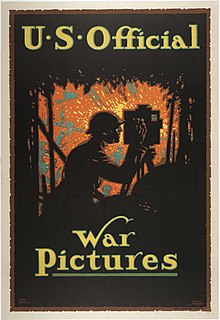 ](https://en.wikipedia.org/wiki/File:U.S._Official_War_Pictures,_by_Louis_Fancher.jpg)
"U.S. Official War Pictures", poster byLouis D. Fancher

Establishment:{:(style="margin-right:0.25em"):}:[edit:{]}:
President Woodrow Wilson established the Committee on Public Information (CPI) through Executive Order 2594 on April 13, 1917.[1] The committee consisted of George Creel (chairman) and as ex officio members the Secretaries of: State(Robert Lansing), War (Newton D. Baker), and the Navy (Josephus Daniels).[2]
Creel urged Wilson to create a government agency to coordinate "not propaganda as the Germans defined it, but propaganda in the true sense of the word, meaning the 'propagation of faith.'"[3] He was a journalist with years of experience on the Denver Post and the Rocky Mountain News before accepting Wilson's appointment to the CPI. He had a contentious relationship with Secretary Lansing.[4]
Activities:{:(style="margin-right:0.25em"):}:[edit:{]}:
Purpose
Poster encouraging consumption of morecottage cheese as a replacement for meat.

The purpose of the CPI was to influence American public opinion toward supporting U.S. participation in World War I via a prolonged propaganda campaign.[5] The CPI at first used material that was based on fact, but spun it to present an upbeat picture of the American war effort.
In his memoirs, Creel claimed that the CPI routinely denied false or undocumented atrocity reports, fighting the crude propaganda efforts of "patriotic organizations" like the National Security League and the American Defense Society that preferred "general thundering" and wanted the CPI to "preach a gospel of hate."[6]
The committee used newsprint, posters, radio, telegraph, cable and movies to broadcast its message. It recruited about 75,000 "**Four Minute Men**," volunteers who spoke about the war at social events for an ideal length of four minutes, considering that the average human attention span was judged at the time to be four minutes. They covered the draft, rationing, war bond drives, victory gardens and why America was fighting. It was estimated that by the end of the war, they had made more than 7.5 million speeches to 314 million people in 5,200 communities.[7] They were advised to keep their message positive, always use their own words and avoid "hymns of hate."[8] For ten days in May 1917, the Four Minute Men were expected to promote "Universal Service by Selective Draft" in advance of national draft registration on June 5, 1917.[9]
The CPI staged events designed for specific ethnic groups. For instance, Irish-American tenor John McCormack sang at Mount Vernon before an audience representing Irish-American organizations.[10] The Committee also targeted the American worker and, endorsed by Samuel Gompers, filled factories and offices with posters designed to promote the critical role of American labor in the success of the war effort.[11]
The CPI's activities were so thorough that historians later stated, using the example of a typical midwestern American farm family, that[12]
Every item of war news they saw—in the country weekly, in magazines, or in the city daily picked up occasionally in the general store—was not merely officially approved information but precisely the same kind that millions of their fellow citizens were getting at the same moment. Every war story had been censored somewhere along the line— at the source, in transit, or in the newspaper offices in accordance with ‘voluntary’ rules established by the CPI.
Rejection of the word 'propaganda':{:(style="margin-right:0.25em"):}:[edit:{]}:
Creel wrote about the Committee's rejection of the word propaganda, saying: "We did not call it propaganda, for that word, in German hands, had come to be associated with deceit and corruption. Our effort was educational and informative throughout, for we had such confidence in our case as to feel that no other argument was needed than the simple, straightforward presentation of facts."[13]
Organizational structure:{:(style="margin-right:0.25em"):}:[edit:{]}:
During its lifetime, the organization had over twenty bureaus and divisions, with commissioner's offices in nine foreign countries.[14]
Both a News Division and a Films Division were established to help get out the war message. The CPI's daily newspaper, called the Official Bulletin, began at eight pages and grew to 32. It was distributed to every newspaper, post office, government office, and military base.[15] Stories were designed to report positive news. For example, the CPI promoted an image of well-equipped U.S. troops preparing to face the Germans that were belied by the conditions visiting Congressmen reported.[16]
The CPI released three feature-length films: Pershing's Crusaders (May 1918), America's Answer (to the Hun)(August 1918), Under Four Flags (November 1918). They were unsophisticated attempts to impress the viewer with snippets of footage from the front, far less sensational than the "crudely fantastical" output of Hollywood in the same period.[17]
To reach those Americans who might not read newspapers, attend meetings or watch movies, Creel created the Division of Pictorial Publicity.[18] The Division produced 1438 designs for propaganda posters, cards buttons and cartoons in addition to 20000 lantern pictures (slides) to be used with the speeches.[19] Charles**Dana** Gibson was America's most popular illustrator – and an ardent supporter of the war. When Creel asked him to assemble a group of artists to help design posters for the government, Gibson was more than eager to help. Famous illustrators such as James Montgomery Flagg, Joseph Pennell, Louis D. Fancher, and N. C. Wyeth were brought together to produce some of World War I's most lasting images.
Media incidents
[ ](https://en.wikipedia.org/wiki/File:Xenophobia_WWI_propaganda_%28cropped%29.jpg)


:{One early incident demonstrated the dangers of embroidering the truth. :(style="background-color:#ffffff;"):}::{The CPI fed newspapers the story that ships escorting the First Division to Europe sank several German submarines, a story discredited when newsmen interviewed the ships' officers in England}::{. Republican Senator }:Boies Penrose of Pennsylvania called for an investigation and The New York Times called the CPI "the Committee on Public Misinformation."[20] The incident turned the once compliant news publishing industry into skeptics.[21]
Early in 1918, the CPI made a premature announcement that "the first American built battle planes are today en route to the front in France," but newspapers learned that the accompanying pictures were fake, there was only one plane, and it was still being tested.[22] At other times, though the CPI could control in large measure what newspapers printed, its exaggerations were challenged and mocked in Congressional hearings.[23] The Committee's overall tone also changed with time, shifting from its original belief in the power of facts to mobilization based on hate, like the slogan "Stop the Hun!" on posters showing a U.S. soldier taking hold of a German soldier in the act of terrorizing a mother and child, all in support of war bond sales.[24]
International efforts:{:(style="margin-right:0.25em"):}:[edit:{]}:
The CPI extended its efforts overseas as well and found it had to tailor its work to its audience. In Latin America, its efforts were led where possible by American journalists with experience in the region, because, said one organizer, "it is essentially a newspaperman's job" with the principal aim of keeping the public "informed about war aims and activities." The Committee found the public bored with the battle pictures and stories of heroism supplied for years by the competing European powers. In Peru it found there was an audience for photos of shipyards and steel mills. In Chile it fielded requests for information about America's approach to public health, forest protection, and urban policing. In some countries it provided reading rooms and language education. Twenty Mexican journalists were taken on a tour of the United States.[25]
Political conflict:{:(style="margin-right:0.25em"):}:[edit:{]}:
Creel used his overseas operations as a way to gain favor with Congressmen who controlled the CPI's funding, sending friends of Congressman on brief assignments to Europe.[26] Some of his business arrangements drew Congressional criticism as well, particularly his sale by competitive bidding of the sole right to distribute battlefield pictures.[27] Despite hearings to air grievances against the CPI, the investigating committee passed its appropriation unanimously.[28]
Creel also used the CPI's ties to the newspaper publishing industry to trace the source of negative stories about Secretary of the Navy Josephus Daniels, a former newsman and a political ally. He tracked them to Louis Howe, assistant to Assistant Secretary of the Navy Franklin D. Roosevelt and threatened to expose him to the President.[29] As a Wilson partisan, Creel showed little respect for his Congressional critics, and Wilson enjoyed how Creel expressed sentiments the President could not express himself.[30][31]
Termination and disestablishment:{:(style="margin-right:0.25em"):}:[edit:{]}:
Committee work was curtailed after July 1, 1918. Domestic activities stopped after the Armistice was signed on November 11, 1918. Foreign operations ended June 30, 1919. Wilson abolished the CPI by executive order 3154 on August 21, 1919.
The Committee on Public Information was formally disestablished by an act of Congress on June 30, 1919, although the organization's work had been formally completed months before.[32] On August 21, 1919, the disbanded organization's records were turned over to the Council of National Defense.[32]
Memoirs:{:(style="margin-right:0.25em"):}:[edit:{]}:
Creel later published his memoirs of his service with the CPI, How We Advertised America, in which he wrote:[13]
In no degree was the Committee an agency of censorship, a machinery of concealment or repression. Its emphasis throughout was on the open and the positive. At no point did it seek or exercise authorities under those war laws that limited the freedom of speech and press. In all things, from first to last, without halt or change, it was a plain publicity proposition, a vast enterprise in salesmanship, the world's greatest adventures in advertising.... We did not call it propaganda, for that word, in German hands, had come to be associated with deceit and corruption. Our effort was educational and informative throughout, for we had such confidence in our case as to feel that no other argument was needed than the simple, straightforward presentation of the facts.
Criticism
Walter Lippmann, a Wilson adviser, journalist, and co-founder of The New Republic, was a sharp critic of Creel. He had once written an editorial criticizing Creel for violating civil liberties, as Police Commissioner of Denver. Without naming Creel, he wrote in a memo to Wilson that censorship should "never be entrusted to anyone who is not himself tolerant, nor to anyone who is unacquainted with the long record of folly which is the history of suppression." After the war, Lippmann criticized the CPI's work in Europe: "The general tone of it was one of unmitigated brag accompanied by unmitigated gullibility, giving shell-shocked Europe to understand that a rich bumpkin had come to town with his pockets bulging and no desire except to please."[33]
The Office of Censorship in World War II did not follow the CPI precedent. It used a system of voluntary co-operation with a code of conduct, and it did not disseminate government propaganda.[12]
Staff
Among those who participated in the CPI's work were:
- Edward Bernays, a pioneer in public relations and later theorist of the importance of propaganda to democratic governance.[34] He directed the CPI's Latin News Service.The CPI's poor reputation prevented Bernays from handling American publicity at the 1919 Peace Conference as he wanted.[35]
- Vira Boarman Whitehouse, director of the CPI's office in Switzerland. She repeatedly crossed into Germany to deliver propaganda materials. She later told of her experiences in A Year as a Government Agent (1920).[36]
- Ernest Poole. Poole was the co Director of the Foreign Press Bureau division. Poole was awarded the very first Pulitzer Prize for Fiction for his novel, His Family.
intereting guy, pal of john reed, settlement house salon
https://en.wikipedia.org/wiki/Ernest_Poole uppie jungle
- Carl R. Byoir (1886 – 1957), like Bernays, a founding father of public relations in America.
- Maurice Lyons was the Secretary of the Committee. Lyons was a journalist who got involved in politics when he became secretary to William F. McCombs, who was Chairman of the Democratic National Committee during Woodrow Wilson's presidential campaign of 1912.
- Charles Edward Merriam, a professor of political science at the University of Chicago and an adviser to several U.S. Presidents.
- Dennis J. Sullivan, Manager of Domestic Distribution for films made by the CPI.[37]
See also:{:(style="margin-right:0.25em"):}:[edit:{]}:
- American Alliance for Labor and Democracy
- Office of War Information
- United States Information Agency, or USIA
- Writers' War Board
- World War I film propaganda
Notes:{:(style="margin-right:0.25em"):}:[edit:{]}:
- :{Jump up:(style="user-select:none;top:-99999px;clip:rect(1px 1px 1px 1px);overflow:hidden;position:absolute !important;padding:0px !important;border:0px !important;height:1px !important;width:1px !important"):}:^ Gerhard Peters; University of California, Santa Barbara. "Executive Order 2594 - Creating Committee on Public Information". ucsb.edu.
- :{Jump up:(style="user-select:none;top:-99999px;clip:rect(1px 1px 1px 1px);overflow:hidden;position:absolute !important;padding:0px !important;border:0px !important;height:1px !important;width:1px !important"):}:^ United States Committee on Public Information; University of Michigan (1917). *Official U. S. Bulletin, Volume 1*. books.google.com. p. 4. Retrieved October 23, 2009.
- :{Jump up:(style="user-select:none;top:-99999px;clip:rect(1px 1px 1px 1px);overflow:hidden;position:absolute !important;padding:0px !important;border:0px !important;height:1px !important;width:1px !important"):}:^ Creel, George (1947). Rebel at Large: Recollections of Fifty Crowded Years. NY: G.P. Putnam's Son's. p. 158. The quoted words refer to the Sacred Congregation for the Propagation of the Faith.
- :{Jump up:(style="user-select:none;top:-99999px;clip:rect(1px 1px 1px 1px);overflow:hidden;position:absolute !important;padding:0px !important;border:0px !important;height:1px !important;width:1px !important"):}:^ Creel, 158-60
- :{Jump up:(style="user-select:none;top:-99999px;clip:rect(1px 1px 1px 1px);overflow:hidden;position:absolute !important;padding:0px !important;border:0px !important;height:1px !important;width:1px !important"):}:^ Rachel Botsman, Roo Rogers, What's Mine Is Yours: The Rise of Collaborative Consumption (NY: HarperCollins, 2010), 21
- :{Jump up:(style="user-select:none;top:-99999px;clip:rect(1px 1px 1px 1px);overflow:hidden;position:absolute !important;padding:0px !important;border:0px !important;height:1px !important;width:1px !important"):}:^ Creel, 195-6
- :{Jump up:(style="user-select:none;top:-99999px;clip:rect(1px 1px 1px 1px);overflow:hidden;position:absolute !important;padding:0px !important;border:0px !important;height:1px !important;width:1px !important"):}:^ Snow, Nancy (2003). Information War American Propaganda, Free Speech and Opinion Control since 9-11. Seven Stories Press. p. 52.
- :{Jump up:(style="user-select:none;top:-99999px;clip:rect(1px 1px 1px 1px);overflow:hidden;position:absolute !important;padding:0px !important;border:0px !important;height:1px !important;width:1px !important"):}:^ Thomas Fleming, The Illusion of Victory: America in World War I. New York: Basic Books, 2003; pg. 117.
- :{Jump up:(style="user-select:none;top:-99999px;clip:rect(1px 1px 1px 1px);overflow:hidden;position:absolute !important;padding:0px !important;border:0px !important;height:1px !important;width:1px !important"):}:^ Fleming, The Illusion of Victory, pp. 92-94.
- :{Jump up:(style="user-select:none;top:-99999px;clip:rect(1px 1px 1px 1px);overflow:hidden;position:absolute !important;padding:0px !important;border:0px !important;height:1px !important;width:1px !important"):}:^ Fleming, The Illusion of Victory, pp. 117-118.
- :{Jump up:(style="user-select:none;top:-99999px;clip:rect(1px 1px 1px 1px);overflow:hidden;position:absolute !important;padding:0px !important;border:0px !important;height:1px !important;width:1px !important"):}:^ Fleming, The Illusion of Victory, pg. 118.
- ^ :{Jump up to::(style="user-select:none;top:-99999px;clip:rect(1px 1px 1px 1px);overflow:hidden;position:absolute !important;padding:0px !important;border:0px !important;height:1px !important;width:1px !important"):}:^a b(https://en.wikipedia.org/wiki/Committee_on_Public_Information#cite_ref-sweeney2001_12-1) Sweeney, Michael S. (2001). Secrets of Victory: The Office of Censorship and the American Press and Radio in World War II. Chapel Hill: University of North Carolina Press. pp. 15–16. ISBN 0-8078-2598-0.
- ^ :{Jump up to::(style="user-select:none;top:-99999px;clip:rect(1px 1px 1px 1px);overflow:hidden;position:absolute !important;padding:0px !important;border:0px !important;height:1px !important;width:1px !important"):}:^a b(https://en.wikipedia.org/wiki/Committee_on_Public_Information#cite_ref-War2_13-1) George Creel, How We Advertised America. New York: Harper & Brothers, 1920; pp. 4–5.
- :{Jump up:(style="user-select:none;top:-99999px;clip:rect(1px 1px 1px 1px);overflow:hidden;position:absolute !important;padding:0px !important;border:0px !important;height:1px !important;width:1px !important"):}:^ Jackall, Robert; Janice M Hirota (2003). Image Makers: Advertising, Public Relations, and the Ethos of Advocacy. University of Chicago Press. p. 14. ISBN 0-226-38917-0.
- :{Jump up:(style="user-select:none;top:-99999px;clip:rect(1px 1px 1px 1px);overflow:hidden;position:absolute !important;padding:0px !important;border:0px !important;height:1px !important;width:1px !important"):}:^ Fleming, The Illusion of Victory, pp. 118-119.
- :{Jump up:(style="user-select:none;top:-99999px;clip:rect(1px 1px 1px 1px);overflow:hidden;position:absolute !important;padding:0px !important;border:0px !important;height:1px !important;width:1px !important"):}:^ Fleming, The Illusion of Victory, pg. 173.
- :{Jump up:(style="user-select:none;top:-99999px;clip:rect(1px 1px 1px 1px);overflow:hidden;position:absolute !important;padding:0px !important;border:0px !important;height:1px !important;width:1px !important"):}:^ Thomas Doherty, Projections of War: Hollywood, American Culture, and World War II (NY: Columbia University Press, 1999), 89-91. Hollywood's films "served to discredit not only the portrayal of war on screen but the whole enterprise of cinematic propaganda." Hollywood titles included Escaping the Hun, To Hell with the Kaiser!, and The Kaiser, the Beast of Berlin.
- :{Jump up:(style="user-select:none;top:-99999px;clip:rect(1px 1px 1px 1px);overflow:hidden;position:absolute !important;padding:0px !important;border:0px !important;height:1px !important;width:1px !important"):}:^ Library of Congress. "The Most Famous Poster". Retrieved 2007-01-02.
- :{Jump up:(style="user-select:none;top:-99999px;clip:rect(1px 1px 1px 1px);overflow:hidden;position:absolute !important;padding:0px !important;border:0px !important;height:1px !important;width:1px !important"):}:^ Creel, George. How we advertised America. New York & London: Harper & Brothers Publishers, 1920. p. 7.
- :{Jump up:(style="user-select:none;top:-99999px;clip:rect(1px 1px 1px 1px);overflow:hidden;position:absolute !important;padding:0px !important;border:0px !important;height:1px !important;width:1px !important"):}:^ Fleming, The Illusion of Victory, pp. 119-120.
- :{Jump up:(style="user-select:none;top:-99999px;clip:rect(1px 1px 1px 1px);overflow:hidden;position:absolute !important;padding:0px !important;border:0px !important;height:1px !important;width:1px !important"):}:^ Mary S. Mander, Pen and Sword: American War Correspondents, 1898-1975 (University of Illinois, 2010), 46. Creel believed his story was correct, but that opponents in the military who were jealous of his control of military information minimized what happened en route.
- :{Jump up:(style="user-select:none;top:-99999px;clip:rect(1px 1px 1px 1px);overflow:hidden;position:absolute !important;padding:0px !important;border:0px !important;height:1px !important;width:1px !important"):}:^ Fleming, The Illusion of Victory, pg. 173. Creel blamed the Secretary of War for the false story.
- :{Jump up:(style="user-select:none;top:-99999px;clip:rect(1px 1px 1px 1px);overflow:hidden;position:absolute !important;padding:0px !important;border:0px !important;height:1px !important;width:1px !important"):}:^ Fleming, The Illusion of Victory, pg. 240.
- :{Jump up:(style="user-select:none;top:-99999px;clip:rect(1px 1px 1px 1px);overflow:hidden;position:absolute !important;padding:0px !important;border:0px !important;height:1px !important;width:1px !important"):}:^ Fleming, The Illusion of Victory, pg. 247.
- :{Jump up:(style="user-select:none;top:-99999px;clip:rect(1px 1px 1px 1px);overflow:hidden;position:absolute !important;padding:0px !important;border:0px !important;height:1px !important;width:1px !important"):}:^ James R. Mock, "The Creel Committee in Latin America," in Hispanic American Historical Review vol. 22 (1942), 262-79, esp. 266-7, 269-70, 272-4
- :{Jump up:(style="user-select:none;top:-99999px;clip:rect(1px 1px 1px 1px);overflow:hidden;position:absolute !important;padding:0px !important;border:0px !important;height:1px !important;width:1px !important"):}:^ Stone, Melville Elijah. Fifty Years a Journalist. Garden City, NY: Doubleday, Page and Company, 1921. p. 342-5.
- :{Jump up:(style="user-select:none;top:-99999px;clip:rect(1px 1px 1px 1px);overflow:hidden;position:absolute !important;padding:0px !important;border:0px !important;height:1px !important;width:1px !important"):}:^ Hearings Before the Committee on Ways and Means, House of Representatives, on the Proposed Revenue Act of 1918, Part II: Miscellaneous Taxes (Washington, DC: 1918), 967ff., available online, accessed January 19, 2011.
- :{Jump up:(style="user-select:none;top:-99999px;clip:rect(1px 1px 1px 1px);overflow:hidden;position:absolute !important;padding:0px !important;border:0px !important;height:1px !important;width:1px !important"):}:^ Stephens, Oren. Facts to a Candid World: America's Overseas Information Program. Stanford University Press, 1955. p. 33.
- :{Jump up:(style="user-select:none;top:-99999px;clip:rect(1px 1px 1px 1px);overflow:hidden;position:absolute !important;padding:0px !important;border:0px !important;height:1px !important;width:1px !important"):}:^ Fleming, The Illusion of Victory. p. 148-149.
- :{Jump up:(style="user-select:none;top:-99999px;clip:rect(1px 1px 1px 1px);overflow:hidden;position:absolute !important;padding:0px !important;border:0px !important;height:1px !important;width:1px !important"):}:^ Fleming, The Illusion of Victory. p. 315.
- :{Jump up:(style="user-select:none;top:-99999px;clip:rect(1px 1px 1px 1px);overflow:hidden;position:absolute !important;padding:0px !important;border:0px !important;height:1px !important;width:1px !important"):}:^ For Wilson's support of Creel to a group of Senators, see Thomas C. Sorenson, "We Become Propagandists," in Garth S. Jowett and Victoria O'Donnell (eds.), Readings in Propaganda and Persuasion: New and Classic Essays (Sage Publications, 2006), p. 88. Asked if he thought all Congressmen were loyal, Creel answered: "I do not like slumming, so I won't explore into the hearts of Congress for you." Wilson later said: "Gentlemen, when I think of the manner in which Mr. Creel has been maligned and persecuted, I think it is a very human thing for him to have said."
- ^ :{Jump up to::(style="user-select:none;top:-99999px;clip:rect(1px 1px 1px 1px);overflow:hidden;position:absolute !important;padding:0px !important;border:0px !important;height:1px !important;width:1px !important"):}:^a b(https://en.wikipedia.org/wiki/Committee_on_Public_Information#cite_ref-CreelIX_32-1) Creel, How We Advertised America, pg. ix.
- :{Jump up:(style="user-select:none;top:-99999px;clip:rect(1px 1px 1px 1px);overflow:hidden;position:absolute !important;padding:0px !important;border:0px !important;height:1px !important;width:1px !important"):}:^ Ronald Steel, Walter Lippmann and the American Century. Boston: Little, Brown, 1980, pp. 125-126, 141-147; Fleming, The Illusion of Victory, pg. 335; John Luskin, Lippmann, Liberty, and the Press. University of Alabama Press, 1972, pg. 36
- :{Jump up:(style="user-select:none;top:-99999px;clip:rect(1px 1px 1px 1px);overflow:hidden;position:absolute !important;padding:0px !important;border:0px !important;height:1px !important;width:1px !important"):}:^ W. Lance Bennett, "Engineering Consent: The Persistence of a Problematic Communication Regime," in Peter F. Nardulli, ed., Domestic Perspectives on Contemporary Democracy (University of Illinois Press, 2008), 139
- :{Jump up:(style="user-select:none;top:-99999px;clip:rect(1px 1px 1px 1px);overflow:hidden;position:absolute !important;padding:0px !important;border:0px !important;height:1px !important;width:1px !important"):}:^ Martin J. Manning with Herbert Romerstein, Historical Dictionary of American Propaganda (Westport, CT: Greenwood Press), 24
- :{Jump up:(style="user-select:none;top:-99999px;clip:rect(1px 1px 1px 1px);overflow:hidden;position:absolute !important;padding:0px !important;border:0px !important;height:1px !important;width:1px !important"):}:^ Manning, 319-20
- :{Jump up:(style="user-select:none;top:-99999px;clip:rect(1px 1px 1px 1px);overflow:hidden;position:absolute !important;padding:0px !important;border:0px !important;height:1px !important;width:1px !important"):}:^ "Dennis J. Sullivan collection: Veterans History Project (Library of Congress". memory.loc.gov. Retrieved 2017-05-09.
Further reading:{:(style="margin-right:0.25em"):}:[edit:{]}:
- Blakey, George T. Historians on the Homefront: American Propagandists for the Great War Lexington, Kentucky: University Press of Kentucky, 1970. ISBN 0813112362 OCLC 132498
- Breen, William J. Uncle Sam at Home : Civilian Mobilization, Wartime Federalism, and the Council of National Defense, 1917-1919. Westport, CT: Greenwood Press, 1984. ISBN 0313241120 OCLC 9644952
- Creel, George. *How We Advertised America: The First Telling of the Amazing Story of the Committee on Public Information That Carried the Gospel of Americanism to Every Corner of the Globe.* New York: Harper & Brothers, 1920.
- *George Creel Sounds Call to Unselfish National Service to Newspaper Men* Editor and Publisher, August 17, 1918.
- Fischer, Nick, “The Committee on Public Information and the Birth of U.S. State Propaganda,” Australasian Journal of American Studies 35 (July 2016), 51–78.
- Kotlowski, Dean J., “Selling America to the World: The Office of War Information's The Town (1945) and the American Scene Series,” Australasian Journal of American Studies 35 (July 2016), 79–101.
- Mock, James R. and Cedric Larson, Words that Won the War: The Story of the Committee on Public Information, 1917-1919, Princeton: Princeton University Press, 1939. OCLC 1135114
- Schaffer, Ronald. America in the Great War: The Rise of the War-Welfare State. New York: Oxford University Press, 1991. ISBN 0195049039 OCLC 23145262
- Vaughn, Stephen. Holding Fast the Inner Lines: Democracy, Nationalism, and the Committee on Public Information.Chapel Hill, NC: University of North Carolina Press, 1980. ISBN 0807813737 OCLC 4775452
- Vaughn, Stephen. "Arthur Bullard and the Creation of the Committee on Public Information," New Jersey History (1979) 97#1
- Merriam, Charles. *American Publicity in Italy*
- Smyth, Daniel. Avoiding Bloodshed? US Journalists and Censorship in Wartime, War & Society, Volume 32, Issue 1, 2013.
Archives:{:(style="margin-right:0.25em"):}:[edit:{]}:
External links:{:(style="margin-right:0.25em"):}:[edit:{]}:
 | Wikimedia Commons has media related to Committee on Public Information. |
- Guy Stanton Ford, "The Committee on Public Information," in *The Historical Outlook*, vol 11, 97-9, a brief history by a participant
- Committee on Public Information materials in the South Asian American Digital Archive (SAADA)
- Open Library. Walter Lippmann; Public Opinion. 1922
- The Committee on Public Information
- Who's Who - George Creel
- WWI: The Home Front
|
<ul style="margin: 0px; padding: 0px; list-style-image: url(" data:image="data:image" svg="svg" xml="xml" c="C" fxml="Fxml" version="version" d="D" encoding="encoding" utf-8="UTF-8" f="F" e="E" a="A" csvg="Csvg" http="http" fwww.w3.org="Fwww.w3.org" f2000="F2000" fsvg="Fsvg" width="width" height="height" ccircle="Ccircle" cx="cx" cy="cy" r="r" fill="fill" display="display" inline="inline" white-space="white-space" nowrap="nowrap" line-height="line-height" inherit="inherit" xmlns="xmlns" xmlns:data="data"><font size="4" face="Times New Roman"></font><li class="nv-view" style="margin: 0px; display: inline; word-spacing: -0.125em;"><font size="4" face="Times New Roman"><font size="4" face="Times New Roman"><font size="4" face="Times New Roman"><font size="4" face="Times New Roman"><font size="4" face="Times New Roman"><font size="4" face="Times New Roman"><font size="4" face="Times New Roman"><font size="4" face="Times New Roman"><font size="4" face="Times New Roman"><font size="4" face="Times New Roman"><font size="4" face="Times New Roman"><font size="4" face="Times New Roman"><font size="4" face="Times New Roman"><a href="https://en.wikipedia.org/wiki/Template:Woodrow_Wilson" title="Template:Woodrow Wilson" style="text-decoration-line: none; background: none;"><abbr title="View this template" style="border: none; cursor: inherit; text-decoration-line: none; text-decoration-style: initial; font-variant-numeric: normal; font-variant-caps: small-caps; background: none transparent; box-shadow: none;">v</abbr></a></font></font></font></font></font></font></font></font></font></font></font></font></font></li><li class="nv-talk" style="margin: 0px; display: inline; word-spacing: -0.125em;"><a href="https://en.wikipedia.org/wiki/Template_talk:Woodrow_Wilson" title="Template talk:Woodrow Wilson" style="text-decoration-line: none; background: none;"><abbr title="Discuss this template" style="border: none; cursor: inherit; text-decoration-line: none; text-decoration-style: initial; font-variant-numeric: normal; font-variant-caps: small-caps; background: none transparent; box-shadow: none;">t</abbr></a></li><li class="nv-edit" style="margin: 0px; display: inline; word-spacing: -0.125em;"><a class="external text" href="https://en.wikipedia.org/w/index.php?title=Template:Woodrow_Wilson&action=edit" style="text-decoration-line: none; background: none !important; padding: 0px !important;"><abbr title="Edit this template" style="border: none; cursor: inherit; text-decoration-line: none; text-decoration-style: initial; font-variant-numeric: normal; font-variant-caps: small-caps; background: none transparent; box-shadow: none;">e</abbr></a></li></ul> |
| Authority control |
- Organizations established in 1917
- Organizations disestablished in 1919
- Defunct agencies of the United States government
- United States government propaganda organizations
- German-American history
- History of the United States (1865–1918)
- United States home front during World War I
- Presidency of Woodrow Wilson
- Committees
- World War I propaganda
==
Vira Boarman Whitehouse (September 16, 1875 – April 11, 1957) was the owner of the Whitehouse Leather Company, a suffragette and early proponent of birth control.[1]
Contents
[hide]
- :{1:(style="display:table-cell;padding-left:0px;padding-right:0.5em"):}::{Biography}:
- :{2:(style="display:table-cell;padding-left:0px;padding-right:0.5em"):}::{Legacy}:
- :{3:(style="display:table-cell;padding-left:0px;padding-right:0.5em"):}::{Gallery}:
- :{4:(style="display:table-cell;padding-left:0px;padding-right:0.5em"):}::{References}:
- :{5:(style="display:table-cell;padding-left:0px;padding-right:0.5em"):}::{Further reading}:
- :{6:(style="display:table-cell;padding-left:0px;padding-right:0.5em"):}::{External links}:
Biography[
Vira Boarman was born in New Orleans, Louisiana, September 16, 1875, to Robert Boarman and Cornelia Terrell.[1][2]
She attended Newcomb College in New Orleans. She married New York stockbroker James Norman de Rapelye Whitehouse (1858–1949), April 13, 1898. They had one child, Alice Whitehouse Harjes.[1]
She was chairman in 1913 of the publicity council of the Empire State Campaign Committee and in 1916 of the New York State Woman Suffrage Party (NYSWSP). She was a leader in securing suffrage for New York women in November 1917.
In 1918, she became director of the Swiss office of the Committee on Public Information, where she worked closely with Rosika Schwimmer, the Hungarian ambassador to Switzerland, and one of the first female ambassadors in the world.[3] Whitehouse reported her experiences in A Year as a Government Agent (1920).[4]
In 1921, she bought the Buchan-Murphy Manufacturing Company, a leather business, renamed it the Whitehouse Leather Products Company, Inc., and reorganized it with herself as president. She managed the company for eight years, reducing the work week from 48 hours to 44 hours, among other changes.[1]
In 1925, she was elected a member of the Democratic County Committee from Manhattan's 15th Assembly District.[1]
The following year, she became Chairman of the Independent Women's Committee for Judge Wagner.[5] She sold her leather company before the stock market crash of 1929.[1]
She died at her home in New York City, April 11, 1957.[1][6]
Legacy[
Her papers are archived at the Harvard University Library.[1]
==