state level news bureau
mebbe belated 819
see local news
see fake newspapers Anshutz
craigslist killed local classified ads
fake news bureau replace real ones, often run by state stinktank? franklin the model?
dark money doc montana bureau?
---
In news deserts, Trump won in a landslide | Local News Initiative
12 24
In news deserts, Trump won in a landslide
But what does this election-result correlation mean?
by Paul Farhi and John Volk
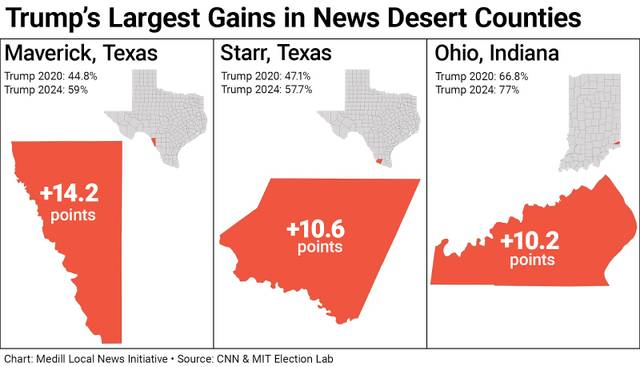
Donald Trump won the 2024 election with one of the smallest popular-vote margins in U.S. history, but in news deserts – counties lacking a professional source of local news – it was an avalanche. Trump won 91% percent of these counties over his Democratic rival, Kamala Harris, according to an analysis of voting data by Medill Journalism School’s State of Local News project.
While Trump’s national popular-vote margin was just under 1.5%, his margin in news deserts was massive. He won these counties by an average of 54 percentage points. In the few won by Harris, her margin was a comparatively slim 18 points, the analysis shows.
The findings are based on results from 193 of the 206 counties Medill has identified as news deserts, in states where county-level election results are currently available. The third annual State of Local News report, released by Medill’s Local News Initiative in October, documented the continuing decline of local news across the country, as measured by the number of newspapers, circulation, frequency of publication, employment and readership.
The report found that the highest concentration of counties with limited access to local news were in solidly “red” states, such as Texas, Kentucky, Arkansas, Idaho, Montana and Mississippi.
In news deserts Trump’s biggest margin of victory, in percentage terms, was in tiny King County in north Texas, which he won by 91 points (123 votes). His biggest margin of victory by votes was in Boone, Ky., a suburb of Cincinnati, which he won by 25,000 votes (37 points). Harris’ biggest margin by percentage points was in Allendale, S.C., which she won by 45 points (1,352 votes). Allendale is 85 percent Black with a 27 percent poverty rate. Her biggest margin of victory by votes was in Chesterfield, Va., a suburb of Richmond, which she won by 19,000 votes (9 points).
Trump’s dominance of news deserts doesn’t imply a cause and effect. That is, people didn’t necessarily vote for Trump because they lack local news. Instead, a simpler and more obvious correlation may be at work: News deserts are concentrated in counties that tend to be rural and have populations that are less educated and poorer than the national average–exactly the kind of places that went strongly for Trump in 2024 and in 2020. (The nonprofit public-policy organization Rebuild Local News found that 87 percent of news-desert counties went for Trump over Joe Biden four years ago.)
Granted, people who live in places without local news don’t lack access to information about a presidential election. Even if there’s no local paper or TV station, they can easily turn to national news sources such as CNN, Fox News, the New York Times; to social media; or to party and candidate campaign material to get information about the race.
But news deserts do have the potential to affect voting behavior in important ways. When voters lose access to local news, they tend to gravitate toward national news sources, according to research by Joshua P. Darr, a professor of public communications at Syracuse University. This kind of news, by definition, focuses on broad national issues—abortion, immigration, the economy, etc.—without regard to local conditions.
The result is increased polarization and partisanship, said Danny Hayes, a political science professor at George Washington University and the co-author of “News Hole: The Demise of Local Journalism and Political Engagement.” People base their choices on the candidates’ statements and on potentially partisan media coverage (say, Fox News or MSNBC), without regard to, or knowledge of, news about local conditions. Local news might tell a voter something that national news can’t, such as how a candidate’s policies might affect local industries or employment.
“The general argument is that local news encourages people to consider other dimensions of a candidate’s appeal besides whether they share the same partisanship,” Hayes said. If you’re regularly exposed to local news about a candidate who has brought funding to your state for roads or other projects, for example, you might be inclined to cast a vote for him or her even if you don’t share the same party affiliation.
The wrong way to interpret this is ‘Oh, the rubes voted for Trump because they’re uninformed.’
Steven Waldman, Rebuild Local News president/founder
But if you’re exposed only to national news, you’re unlikely to know about actions they’re taking, or planning to take, for your state. In that case, “the only thing that’s going to be relevant to you is which candidate shares your views on national issues,” reinforcing basic partisan identity, he said.
In fact, access to local news appears to increase split-ticket voting, moderating the partisan drift. The logic here is simple: Voters who have access to local TV news coverage of their governor and U.S. senators tend to know more about these officials, leading some of them to split their votes among Republican and Democratic candidates, according to research by Daniel J. Moskowitz, a public policy assistant professor at the University of Chicago.
A related but untested question is whether voters in news deserts are more likely to engage in ballot “roll off” – that is, vote for president but leave local and statewide races blank.
Darr, the Syracuse scholar, said roll-off voting explains “much if not all” of the margin in some Senate races this year. In news deserts, said Darr, the assumption is that voters lack information about low-level races and thus decide not to vote in these contests, a potentially harmful trend for democratic participation. “These dynamics seem particularly potent this year, and it could be worth another look,” Darr said.
News deserts have social consequences for everyone who lives in them, but the 2024 voting results indicate that conservative voters may be paying a disproportionate price, said Steven Waldman, Rebuild Local News’ president and founder.
“The wrong way to interpret this is ‘Oh, the rubes voted for Trump because they’re uninformed,’” said Waldman, Report for America’s former president. He pointed out that Trump also increased his support in places with relatively robust local news.
Instead, Waldman said, the election results show “that some of the most common victims of the collapse of local news” are the same people who support Trump. They’re victims, he elaborated, because of all the documented consequences of life in a news desert: more political corruption, higher taxes, lower bond ratings, greater social alienation and rising misinformation, as well as the loss of social cohesion when subjects such as high school sports, local obits and community projects aren’t covered.
The upshot, Waldman said, is that conservative voters – the very ones Trump has targeted with his attacks on the press – “should be helping to lead the drive” to save local news.
moore BS covid study
on
by staff Reporter
Brett Davis reports on Washington state government for The Center Square. He previously worked for public policy organizations the Freedom Foundation and Washington Farm Bureau, as well as various community newspapers.
https://www.thecentersquare.com/site/about/about.html
bs study
Center Square was **launched** in May 2019 to fulfill the need for high-quality statehouse and statewide news across the United States.
The focus of our work is state- and local-level government and economic reporting. A taxpayer sensibility distinguishes our work from other coverage of state and local issues. As a result of this approach, our readers are better informed about the focus of state and local government and its cost to the citizens whose tax dollars fund governmental decisions.
The Center Square is staffed by editors and reporters with extensive professional journalism experience. We engage readers with essential news, data and analysis – delivered with velocity, frequency and consistency.
We distribute our journalism through three main channels at no cost to our partners or readers: a newswire service to legacy publishers and broadcasters, TheCenterSquare.com, and social media.
The Center Square is a project of the 501(c)(3) Franklin News Foundation, headquartered in Chicago.
We welcome our readers to share their insights, feedback and news tips at info_tcs@thecentersquare.com.
https://www.journalism.org/2014/07/10/who-covers-the-statehouse/
quite long 6pp
JULY 10, 2014
AMERICA’S SHIFTING STATEHOUSE PRESS
Who Covers the Statehouse
BY KATERINA EVA MATSA AND JAN LAUREN BOYLES
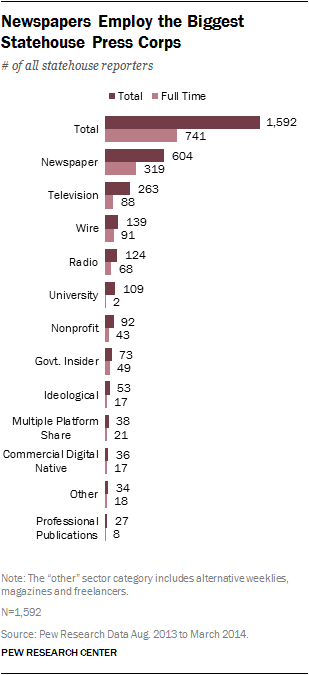 These 1,592 reporters come from a wide range of outlets and sectors. Even with the declines of the last decade, newspapers still employ the greatest portion of all statehouse reporters—38% of the total.
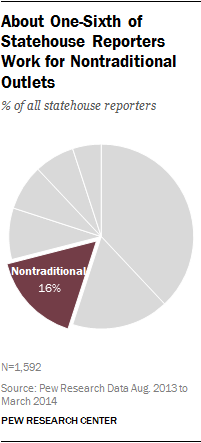
The next largest employer, television stations, account for less than half as many (17%). They are followed by reporters working for a range of nontraditional outlets such as commercial digital sites, nonprofits, specialty outlets and ideological news sites that together make up 16% of the overall reporter pool.
Wire services account for 9% of the total pool and radio 8%.
But it’s perhaps more instructive to look at the organizations supporting the 741 full-time reporters, which represents a greater commitment to ongoing reporting of statehouse issues and events.
The Full-Time Reporter Pool
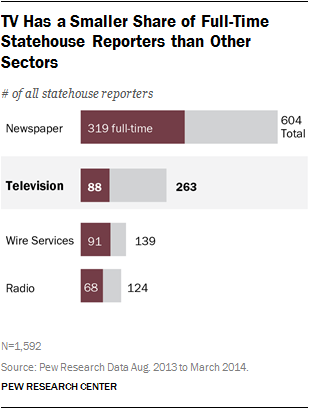
Of the 741 journalists who cover the statehouse full time, 319 (43% of the full-time workforce) report for newspapers.
The second largest group of full-time statehouse reporters works for wire services, primarily for the Associated Press but also others such as Reuters and Bloomberg News. About two-thirds of wire service statehouse reporters (91 in all) are full time. And although they represent a modest 12% of all full-time statehouse reporters, their impact is likely greater as their stories often run in many media outlets that are wire service clients.
Television stations employ a smaller portion of all full-time reporters than they do of the total reporter pool: just 12%, or 88 full-time reporters in all, and 17% of total statehouse reporters. An additional 68 full-time statehouse reporters were assigned there by radio outlets, and 21 other full-time reporters file stories for multi-platform companies that ask them to produce stories across television, radio and print.
In addition to the legacy news organizations listed above, a number of nontraditional outlets cover statehouse news. Many of them were launched in the past six years in response to the sharp reduction of statehouse coverage by more established outlets. Taken together, the nontraditional organizations identified by Pew Research employ 126 full-time statehouse reporters, or 17% of the full-time total.
That figure includes 49 full-time reporters who work for government insider publications. These publications are aimed at those whose business interests are closely tied to state legislative activities, and they can sometimes come with a steep subscription price. Nonprofit news organizations, a growing part of the journalism ecosystem, employ 43 full-time statehouse reporters. A group of ideological news organizations, with clearly stated editorial philosophies, employ 17 full-time statehouse reporters. And another 17 full-time reporters work for a group of commercial, for profit digital native news outlets.
In addition, eight full-time journalists work for professional publications, such as local business journals or others that target a specific industry. Two full-time statehouse reporters work for outlets owned by universities—one each at the University of Illinois and the University of Missouri.
Finally, 18 full-time statehouse journalists work for outlets that we included in an “other category.” Some of them are freelancers whose work appears in a variety of outlets, while others work for outlets such as monthly magazines and alternative weeklies.
Below is a deeper look at the reporters coming from each sector of media.
Newspapers: The Primary but Declining Pool of Reporters
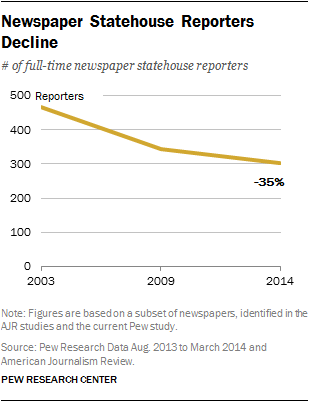 Newspapers account for the greatest portion of statehouse reporters, but to get a sense of how those numbers have declined over time, Pew Research turned to earlier studies conducted by American Journalism Review. The magazine conducted five studies of newspapers’ statehouse staffing levels between 1998 and 2009. Each time, it reported that staffing was down, with the sharpest decline occurring from 2003 to 2009.
Pew Research data show that the decline has continued in the past five years, albeit at a somewhat slower pace.
In order to provide a direct comparison with today, Pew researchers examined staffing at the papers included in both 2003 and 2009 AJR studies as well as in the current 2014 data. Those 220 papers had 467 full-time statehouse reporters in 2003, which dropped to 343 in 2009 and then to 303 in 2014. That amounts to a 27% decline from 2003 to 2009, a 12% loss from 2009 to 2014, and an overall decline of 35%. 3
These cutbacks are not uniform across the board, however. Newspapers’ statehouse staffing among this cohort of papers dwindled in 23 states between 2009 and 2014. The sharpest cuts occurred in Illinois, which lost seven full-time newspaper slots—from 12 to five—during that period. And, two of the three most populous states—California and New York—reported losses of five full-time jobs each.
At the same time, 15 states did not show any change in the number of full-time newspaper reporters covering the statehouse between 2009 and this year, though one—South Dakota—did not have any to begin with. And 12 states posted increases—most of them small. The most significant growth occurred in New Mexico and New Jersey, each of which added three reporters. (In the case of New Mexico, that doubled the staffing from three to six.) Georgia, Idaho and Massachusetts gained two reporters each. Again, this comparison was of a subset of the papers that were a part of the 2009 AJR study.
 In addition to the AJR cohort, however, our current research identified 15 papers that employed 19 full-time reporters, bringing the total number of newspaper reporters currently dedicated to the statehouse full time to 319.4
To bolster the coverage provided by full-time statehouse journalists, newspapers send 285 other reporters to their capitols at various times. Of those, 55 cover state government during legislative sessions only and 144 are part time. An additional 66 reporters are students and 20 are non-student interns and others that papers did not categorize.
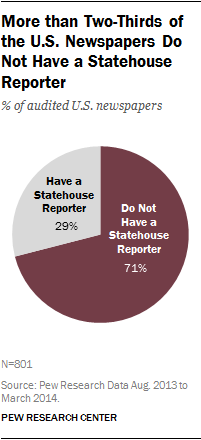
Still, a large majority of newspapers do not send anyone to the statehouse. Of the 801 newspapers nationwide that submit to regular circulation audits by the Alliance for Audited Media, almost three-quarters (71%) have no full- or part-time reporters at the statehouse. Only 229 have at least one statehouse reporter.
With the exception of USA Today—a national newspaper not anchored to any one state—each of the country’s 25 largest newspapers has at least one full-time or part-time statehouse reporter.
At one point, observers say, smaller papers had a larger presence in the nation’s statehouses.
“Way back in the day, 35 years ago, a lot of the small papers had reporters in the statehouse,” said Susan Moeller, news editor of the Cape Cod Times in Massachusetts. Her paper had a two-person statehouse bureau, which was cut to one and then zero during the recession, she said.
“You can lay off your statehouse reporter or you can lay off somebody covering your town that is nearer and dearer to people’s hearts,” Moeller said. “You will lay off the statehouse reporter because you can get that from another source.” Last year, Moeller said, editors hired a reporter to cover the statehouse part time—but he is based in Cape Cod and also responsible for covering the town of Hyannis.
Wire Services
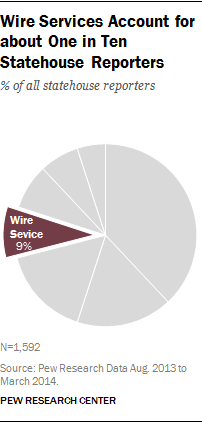 Wire services devote a greater proportion of their statehouse staffs to the beat on a full-time year-round basis than do newspapers or broadcast outlets. Fully two-thirds of their statehouse reporters, 91 out of 139, are assigned to capitols full time.
In addition, wire services send 26 reporters to statehouses only during legislative sessions and 16 on a part-time basis. They complete their staffs with three students and three other journalists.
In all, wire service reporters represent 9% of all statehouse reporters and 12% of all full-time statehouse reporters, but their impact is greater as their work is widely distributed by other outlets that carry those stories. In interviews, several editors say that now that they have cut their own staff, they rely on wire services more than in the past.
“We receive several wire service reports, but no longer have a reporter in Springfield,” said Philip Angelo, senior editor of the Small Newspaper Group, which has a handful of papers in Illinois. “We’ve had several rounds of layoffs.”
About three-fourths (76%) of the full-time wire service reporters (69) work for the Associated Press. Other wire services with state government reporters include two national organizations, Bloomberg News, which has 12 full- and part-time reporters in 11 state capitols, and Reuters, which has one reporter in California alone. There also are several smaller wire services that distribute stories to clients within an individual state. One of those wires, the News Service of Florida, has six full-time, year-round statehouse reporters, more than any other bureau in Tallahassee.
“At the very core of the AP’s core business is state coverage, and at the very core of that is statehouse coverage,” said Brian Carovillano, AP’s managing editor for U.S. news.
Nonetheless, reporters for the AP and other outlets in a number of statehouses said the wire service cut staff during the recession. “As each person left, they never replaced them,” said Amy Worden, the Philadelphia Inquirer’s Harrisburg bureau chief and president of the Pennsylvania Legislative Correspondents’ Association. The AP’s bureau in Pennsylvania’s capitol has dropped from five reporters to three.
The AP declined to enumerate its current or past statehouse reporting staffs. However, Carovillano said: “The AP, like so many news organizations, got a little bit smaller after 2008. There was never a conscious pullback.”
With the improvement of the economy and under the guidance of Gary Pruitt, who became AP’s president and CEO in July 2012, the AP Board of Directors identified state news, in general, and statehouse coverage, in particular, as “a major priority” for 2014, Carovillano said. As a result, he added, “we are hiring a number of political and state government reporters this year.”
The Associated Press also relies more heavily upon temporary reinforcements than organizations in other sectors. While roughly two-thirds (66%) of the AP’s statehouse reporters cover the government full time, their work is supplemented by temporary reporters hired specifically to work full time or part time only during legislative sessions. This is different from the practice of newspapers, which often dispatch reporters to cover statehouses during legislative sessions, but assign them to do other things the rest of the year.
Television
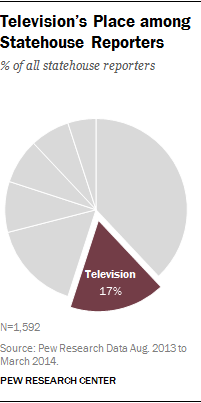 Of the 918 local television stations identified by BIA/Kelsey and Nielsen, only 130 assigned at least one reporter to cover the statehouse—meaning that 86% of the local stations do not have a state government reporter.
Altogether, 263 television journalists play a role in statehouse coverage, which amounts to 17% of all statehouse reporters.
A total of 88 television reporters cover state capitols full time. An additional 28 television reporters cover statehouses only when their legislatures are in session.
The largest group of television reporters—102—cover state government part time. These often are general assignment reporters who are dispatched to the capitol to cover breaking news. In addition, television stations use 21 student reporters and 24 people who don’t fall into the other categories, but who tend to be videographers.
Nationwide, 32 states have at least one full-time television reporter covering the statehouse. Idaho, one of the smallest states with roughly 1.5 million residents, has the greatest per capita representation of television outlets in its statehouse—six stations cover the capitol in Boise. Television reporters are entirely absent from statehouses in Connecticut, Maine, Oklahoma and Oregon. Yet previous Pew studies show that local television is the primary place Americans go for news.
“A lot of people still get their news from TV and they’re not here,” said Stephen Miskin, spokesman for the Pennsylvania House Republican Caucus and for the speaker and majority leader.
 Public television affiliates staff their statehouse bureaus at a somewhat higher rate than commercial broadcast stations. Ten of the 130 stations that cover state government are public TV affiliates. They employ a total of 11 full-time statehouse reporters. These outlets rarely have nightly newscasts, but produce long-form programming that tackles state issues in depth. Washington state’s PBS affiliates produce a trio of programs: “Inside Olympia,” a year-round broadcast featuring interviews with lawmakers; “The Impact,” a newsmagazine show on the statehouse; and “Legislative Review,” a daily recap of lawmaking highlights when the body is in session. In some cases, officials said these broadcasts were created in response to a reduction in reporting by other legacy outlets.
Some state-owned TV stations, such as those in California, Rhode Island and Washington—also broadcast legislative proceedings (similar to what C-SPAN does for Congress). And Pew Research identified seven states that have cable channels or local access channels dedicated to live coverage of the legislature. In some cases, these broadcasts also extend to committee hearings. Some of these channels are independent, while others are extensions of state government. Several journalists interviewed by Pew Research said that these broadcasts enable them to cover the capitol remotely.
Radio
Radio reporters constitute a smaller segment of the statehouse press corps than their television counterparts, about 8% of all statehouse reporters and 9% of those who cover the statehouse full time.
In all, radio stations assign 124 reporters to the statehouse beat: 68 who are full-time, 15 who cover it only during legislative sessions, 31 part time, 7 students and 3 who fall into none of those categories.
Reporters for public radio stations make up a just under half of both the full-time radio contingent working in the nation’s statehouses—31 of the 67. (In addition, 36 report for commercial radio outlets.) They also account for just under half of less than full-time reporters—26 of the 56.
Nontraditional Players in the Statehouse Press Corps
 As legacy news organizations have reduced the size of their statehouse reporting staffs in recent years, nontraditional outlets have sprung up to try to fill the gaps in coverage.
These organizations, which are mostly digital-only, fall into four main categories: nonprofit, government insider or those aimed at government insiders, ideological and for- profit (or commercial digital native). Some news outlets fall into more than one category, particularly those that are nonprofits and also have a stated ideological bent. In those cases, we categorized them as ideological and removed them from the remaining category so as not to count any organization twice.
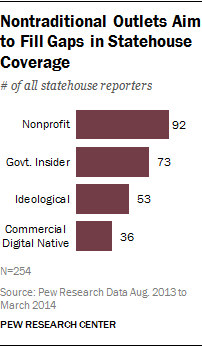
Altogether, nontraditional organizations assign 254 journalists to statehouses, accounting for 16% of all statehouse reporters. That figure comprise 126 full-timers, 28 reporters who cover state government only during legislative sessions, 73 who are on the beat part time, 21 students and 6 who fall into the “other” category.
In seven states—Connecticut, Michigan, New York, Ohio, Tennessee, Texas and Vermont—the outlet with the largest number of full-time statehouse reporters is one of these upstarts.
“We saw the need. There’s been a decline in state coverage here as elsewhere. We felt that there was an underserved market for it,” said Joe Copeland, political editor for Crosscut, a Washington state website that launched in 2007 and started covering the statehouse full time last year.
 According to the AJR census, the largest reduction in newspaper statehouse reporters coincided with historic decreases in total staffing during the recession, though it was underway in the three preceding years. As reporters were laid off or bought out, some of these journalists—who had covered state government for legacy outlets—decided to start their own news organizations or to buy and transform existing ones.
“When we started, everybody was abandoning their state capitol desk at the time. There was this mass exodus,” said Christine Stuart, editor in chief of CTNewsJunkie.com. Stuart bought the for-profit Connecticut website in 2006, the year after it was founded. “We were really filling a gap that existed. The mainstream media had abandoned statehouse reporting.”
Commercial Digital Native
Eleven for-profit websites cover state government with 36 reporters, 17 of whom are on the beat full time. Nine of the outlets were founded in the past decade, including seven during or after 2008.
 The for-profit site that has the greatest number of full-time, year-round statehouse reporters is the four-year-old Capital New York, which has the largest bureau in Albany. With five full-time journalists and one student intern covering the statehouse, Capital New York eclipses the New York Times and the Albany Times Union, each of which has three full-time reporters and none in any other category. None of the 24 other outlets that cover state government in the third most populous state has more than two full-time, year-round reporters in the capitol.
In fact, only 10 other news organizations in the country—of any type—have more than five full-time journalists in their statehouse bureaus year-round. And many of the for-profit outlets are not as large as Capital New York.
Erik Smith, news editor of the Washington State Wire, is the lone journalist for a site that provides a combination of original reporting and aggregation. A former statehouse reporter for two newspapers, Smith founded his outlet in 2003, just as other state government reporters were losing their jobs. Now, he said, he is struggling to find a way to sustain the site financially, and might seek nonprofit status.
Not all the outlets were created recently. Brian Howey, publisher of Howey Politics Indiana, formed his organization in 1994 as the Howey Political Report and put most of it online in 2001. A former newspaper reporter, Howey oversees a website, with some free and some subscription-only content, and a weekly print publication, which he mails to subscribers. He also writes a column that he syndicates to 30 newspapers in the state. His publication, which is edited by his journalist parents, has one full- time, year-round statehouse reporter and two part-timers.
“As a third-generation journalist, I’m alarmed at what’s going on in statehouses around the country,” Howey said. “We’ll pay a price if coverage keeps receding…My fear is that as journalism recedes down [and] fewer people are there on a full-time basis, that’s just going to set the stage for scandal if nobody’s watching. I think we’re heading into a very dangerous territory in state government.”
Nonprofits
Like for-profit digital news organizations, nonprofit outlets have mushroomed since the recession pummeled the legacy news industry. Last year,Pew Research identified 172 nonprofit news outlets across the country. Our new study found that 23 of the nonprofits that were not also ideological cover state government.
The nonprofits have a relatively small number of reporters in capitols, just 43 full time and 92 in total—6% of all statehouse reporters. In addition, five reporters cover the statehouse during legislative sessions and 26 do so part time. Fifteen of the nonprofit reporters are college students, and three fall into the “other” category.
The Texas Observer has been covering the statehouse in Austin for 60 years, but that is an outlier in terms of age. Sixteen of the nonprofits that report on statehouses were founded in the past six years. In addition to the Texas Observer, only one—the Center for Investigative Reporting, which dates back to 1977—existed before 2000. St. Louis Public Radio, an affiliate of National Public Radio, also has existed for some time, but it merged with the newer, digital-only St. Louis Beacon in December 2013 to create a new entity.
:{
[tex trib pix]}:
The Texas Observer has three full-time, year-round statehouse reporters and three students. VTDigger.com also has three full-time statehouse reporters—representing nearly one-quarter of all full-time reporters in Vermont’s capitol. Four other nonprofits have two full-time statehouse reporters.Most nonprofits employ few reporters, but some have bigger staffs. The Texas Tribune has the largest statehouse bureau of any news organization in the country, with 15 full-time, year-round reporters and 10 students. The Connecticut Mirror is next with four full-time reporters.
Ideological Organizations
Among the nontraditional statehouse outlets are those that have a stated ideological point of view. Most of them define themselves as conservative or as in favor of a “free market,” a basic tenet of economic conservatism. Only one outlet, NC Policy Watch, calls itself progressive.
The ideological outlets assign 53 reporters to the statehouse. Those outlets assign 17 reporters to state government full time, just 2% of all full-time reporters.[but this does not mean they only get 2% of eyeballs?]They dispatch 15 reporters to the statehouse only during legislative sessions and 19 are part time. In addition, they have two student reporters. Most of these publications are digital only and many also are nonprofits. But because they describe themselves in ideological terms, we created a category to distinguish them.
About half of the ideological sites (14 out of 33) are owned by the Franklin Center for Government & Public Integrity, a nonprofit that was founded in 2009 “to address the falloff in statehouse reporting as well as the steep decline in investigative reporting in the country,” said spokesman Michael Moroney. The center, based just outside Washington, D.C., in Alexandria, Va., supports a free market, he said.
In a2011 study of news nonprofits, Pew Research found that the Franklin Center’s Watchdog.org sites were about four times as likely to present stories with a conservative theme than with a liberal one, though about half (49%) of their stories either had no ideological theme or had a combination of them. Its president, Jason Stverak, is a former executive director of the North Dakota Republican Party.
The Franklin Center places reporters in state capitols full time when legislatures are in session and assigns them to work on investigative projects the rest of the year, Moroney said. He said there is one reporter in each of 14 state capitols and two in Nebraska and Virginia. In addition to posting the stories on Franklin Center websites, the organization syndicates them. That is a nod to the enduring dominance of more established news outlets, particularly newspapers.[but not unalloyed good news?!]
“We know that the best way to get those stories out there is through the legacy media,” Moroney said.
Representatives of some of the conservative outlets say they are acting as an antidote to what they see as liberal bias in the mainstream media.
“Our feeling was in Tallahassee and many other statehouses, there really wasn’t anybody who was looking at the other side of the story,” said Nancy Smith, executive editor of Sunshine State News, which she described as “right of center.” “They look at a more liberal side of the news—almost everybody up there does.”
Sunshine State News was founded in 2010 with investments by “three people who want to see the other side of the news covered,” Smith added. The organization does not divulge their identities, she said. Smith, like a number of other journalists at outlets with known ideologies, hails from the legacy media. She was an editor at The Stuart News/Port St. Lucie News for 28 years and is former president of the Florida Society of Newspaper Editors.
NC Policy Watch identifies itself on its website as a “progressive, nonprofit and non-partisan public policy organization and news outlet.” It is an independent project of the NC Justice Center, a nonprofit anti-poverty organization.
The fact that ideological organizations have begun to put reporters in statehouses has not gone unnoticed by legacy journalists.
“Some of the vacuum has been filled by advocacy groups,” said Rob Christensen, longtime statehouse reporter for the News & Observer in North Carolina. “Of course, they all have axes to grind, but they do provide information.”
Government Insider Outlets
A total of 73 reporters cover state government for specialty publications aimed at government insiders, and 49 of them are full time—accounting for 7% of the total full-time statehouse reporting corps. Five reporters cover the statehouse only during legislative sessions, and 15 do so part time. Two of the journalists are students and two are in the category of “other.”
These outlets often charge hefty subscription fees, placing the content outside the reach of a general audience. They target lawmakers, lobbyists, activists and even journalists who are willing to pay for highly specialized information about the inner workings of government. Indeed, some of these outlets are owned by lobbyists or interest groups.
Prices for these outlets vary widely. The Alaska Budget Report charges $2,397 a year, the Austin Monitor $1,099 a year and the Tennessee Journal, $247 a year, to name a few. Conversely, StatehouseReport.com/ CharlestonCurrents.com is free.
Most of these organizations track legislative bills and cover many of the small-bore daily developments of government—such as the incremental progression of a bill or a committee hearing—that general-interest outlets tend to ignore.
The Florida Current, which says on its website that it “is written for stakeholders in Florida’s legislative process,” is one of the rare insider outlets that does not charge a fee to readers. It is owned by Lobby Tools,an online subscription service that provides legislative research and analysis, bill tracking and customized daily reports. The Current’s managing editor and three reporters formerly worked at legacy outlets, according to the organizations’ website.
The rise of niche outlets that have stepped in to cover statehouses as the legacy press corps shrunk follows a pattern found in coverage of the U.S. federal government.In an earlier report on the composition of the Washington press corps, Pew Research identified a dramatic rise in specialty publications at the same time that mainstream media coverage of Washington was declining.
==
2015? defunct 819
https://www.governing.com/topics/politics/gov-statehouse-reporting-analysis-lou.html
Anyone who’s been paying attention to the media business knows that the number of journalists covering state government has been shrinking for at least a decade.
It’s not just reporting positions that are being lost; also lost is a wealth of institutional memory, as well as traditions that have supported strong state capitol reporting for decades. But despite the depressing news about the shrinkage of reporting staffs, a few developments suggest reason for optimism.
The most recent assessment of the size of the state capitol press corps was published in July 2014 by the Pew Research Center. The report found that the number of newspaper reporters covering state capitols declined by 35 percent between 2003 and 2014. Less than one-third of newspapers today assign even one reporter to the statehouse -- although that’s better than the rate for local TV news stations, which is just 14 percent. Pew found that there are 1,592 statehouse reporters today, of which fewer than half are employed full-time on the state capitol beat; they range from 53 in Texas to two in South Dakota.
The makeup of the press corps has changed as well. Non-traditional media -- including non-profit outlets, insider publications and ideologically driven websites -- have expanded to fill some of the void created by decline in newspaper reporters. Non-traditional outlets employ 126 full-time statehouse reporters, which is about one of every six full-time reporters. Meanwhile, journalism students now account for 14 percent of the overall state capitol press corps.
Interviews for this article with about two dozen current and former statehouse journalists turned up a number of factors that are affecting the press corps’ ability to cover state government.
Shrinkage of the “news hole.”
With fewer reporters on staff, newspapers (and other media) are devoting less space to covering state government.
The reporters who are left are often spread thin.
Journalists say it is not uncommon for political reporters to be required to post multiple times a day, to aggregate other media coverage and to meet quotas for engaging with readers and commenters. This leaves less time for enterprise reporting.
A loss of institutional memory.
The journalists who have left the state capitol beat, whether voluntarily or not, have tended to be those with the most experience.
“As news outlets fire older, more expensive reporters and replace them with young reporters, they sometimes sacrifice depth and relevant knowledge about process and policy,” said Nicholas Confessore, a New York Times reporter who spent several years covering Albany, N.Y. “It takes two or three legislative sessions to begin to understand the tricks and dodges of the budget process, or where lawmakers hide pork-barrel grants.”
A tendency toward pack journalism.
With a smaller number of reporters and outlets operating in state capitols, journalists sometimes focus on the most basic stories.
“Sometimes, statehouse reporters all tend to do the same story -- the news of the day,” one observer in Mississippi said. “That can seem a little crazy, because in any statehouse, the ground is just littered with stories.”
The rise of click-driven journalism.
“You can just write about outrageous bills that are never going to pass and play the legislature for laughs” -- thus attracting lots of clicks from the public -- “instead of trying to write about the policy options on things that might actually happen,” one reporter said. Richard A. Lee, a former journalist in Trenton, N.J., has studied the issue in his new career as an academic at St. Bonaventure University. Lee said that “journalists no longer have time to thoroughly check allegations and that they are under intense pressure to post stories quickly and frequently, and to post stories that attract web viewers. As a result, negative attacks and details of candidates' personal lives find their way into news stories more often than before.”
Government beats are increasingly seen as stepping stones, not destinations.
“There are reporters for whom the state government beat is merely a stop along the journey, rather than the pinnacle of one's career -- an honor bestowed upon veteran reporters who proved their mettle,” said one Indiana journalist.
The media vacuum has encouraged controversial new entrants.
Some of these newcomers have an ideological lean. Read Daniel C. Vock’s piece on how a growing share of statehouse reporting now comes from conservative groups, blurring the lines between journalism and advocacy.
A separate but similar category consists of strongly partisan bloggers who comment on state politics but don’t work as on-site reporters per se.
Another category consists of “news” outlets run by the government itself. Indiana Gov. Mike Pence, a Republican, recently took heat for unveiling what appeared to be a government-run news site. But for small newspapers and TV stations without a dedicated staff in the state capitol, taking offerings from the governor can be tempting.
The result of all these new sources of media has been public confusion, some journalists say. “Most ordinary news consumers have no clue as to how credible a given source might be,” said one Indiana journalist.
The balance of power increasingly tilts toward politicians.
All these changes have had an impact on the behavior of politicians, often in ways that lessen public accountability, current and former state capitol journalists say. Some journalists said they’re noticing governors and legislative leaders holding press conferences more sporadically than they used to. Some said responses to freedom-of-information requests are being dragged out longer than they used to be or that gubernatorial schedules aren’t being released in advance. In some legislatures, lawmakers feel free to hammer out deals behind closed doors rather than air differences in public hearings.
“The more savvy politicians are trying to bypass the remaining reporters, going to friendly homes on talk radio or blogs to move items and get the spin they want,” said one observer in Mississippi.
“The government can use the Internet and social networks to bypass the scrutiny of the media and get information directly to the public and with their own spin,” added Lee, the St. Bonaventure professor. Chris Christie and his team are “masters” at this, Lee said.
Similarly, a smaller, weaker press corps can be more susceptible to news manufactured by partisan warriors.
“The relatively small number of journalists means that the principals we cover tend to drive the news cycle,” said Steve Mistler, politics and government reporter for the Portland Press Heraldand the Maine Sunday Telegram. “That’s another way of saying that watchdog coverage is sometimes preempted by bombastic press releases and media events designed to generate headlines by partisans. The result is that sometimes the coverage serves the people we cover more than it does the readers.”
Mistler said he has little doubt that state lawmakers are “less accountable than they were 10 or 15 years ago. What’s worse is that the partisan operatives are well aware of these weaknesses, and they work tirelessly to exploit it.”
Journalists noted a few cases in which old-school reporting could have headed off subsequent problems.
In Oregon, for example, more attentive policy coverage might have helped forestall the “fiasco” of the state Affordable Care Act website, said Peter Wong, the Salem bureau reporter for the Portland Tribune and Pamplin Media Group. While lots of factors contributed to the website’s implosion, Wong said, “there was too much trust and too few questions asked by the media or lawmakers about how state agencies were going to build an ambitious computer program given past failures on large-scale IT projects. The Cover Oregon website became news only after it failed to work.”
Meanwhile, an Idaho reporter suggested that greater scrutiny early on could have found red flags about the personal history of GOP state Rep. Mark Patterson. Patterson had won in a low-profile campaign but resigned his seat in 2013 after it came out that he had pleaded guilty to assault with intent to commit forcible rape in Florida in 1974. The takeaway from this episode, the Idaho reporter said, is that “significant news coverage at the time he ran for office could have perhaps revealed more to the voters about whom they were electing. But no one was doing that.”
There are some reasons for optimism, though. Despite the concerns outlined above, current and former journalists agreed that a lot of good work is still going on in state capitals. For starters, some states appear to have avoided shrinkage pretty well.
Tim Murphy, a veteran journalist at the Providence Journal, said that “there's still a pretty robust media contingent covering state government in Rhode Island -- two of the three local TV stations have reporters who regularly cover state government news. A couple of the smaller dailies have semi-regular staffers at the statehouse, and Rhode Island Public Radio has a reporter who covers the statehouse.”
Similarly, “Albany is probably luckier than most state capitols,” said Confessore ofThe New York Times. “Because of the proximity to the media hub in New York, Albany gets close and careful coverage from major news outlets. The total size of the legislative press corps has shrunk, but that shrinkage is largely due to the disappearance of reporters from local and regional state papers that would once have had their own reporter in Albany but now rely on wire copy.”
Asked for examples of top-flight reporting in the face of the ongoing downsizing, current and former journalists had no trouble coming up with suggestions.
In Texas, the Austin American-Statesman investigated a big contract to detect Medicaid fraud and the possible conflicts of interest it entailed; reporting by the combinedTampa Bay Times-Miami Herald bureau played a major role in forcing a House speaker from office; and the Baton Rouge Advocate did solid work on the growth of state tax breaks and their impact on Louisiana’s budget woes. Most recently, spadework by Nigel Jaquiss, an investigative reporter with the alternative Willamette Week helped prompt the resignation of Gov. John Kitzhaber, a Democrat elected to the state’s highest office no fewer than four times.
Charles Ashby, a veteran Colorado journalist, said the state press corps has “brought down” a range of politicians in recent years, ranging from local officials to statewide officials and a potential gubernatorial candidate. “I think the point is that we are holding our own,” Ashby said. “Sure, more bodies and experienced people would help, but we are adapting and doing more with less.”
Journalists also noted a few positive developments.
New formats are emerging for serious journalism.
Wondering what publication has the largest statehouse bureau of any news organization in the nation today, according to the Pew Research Center? It’sTheTexas Tribune -- an online-only, foundation-supported, non-profit based publication in Austin with 15 full-time reporters and 10 student reporters. The Tribune occupies a media niche that didn’t even exist a few years ago. According to Pew, in seven states -- Connecticut, Michigan, New York, Ohio, Tennessee, Texas and Vermont -- online startups boast the largest number of full-time statehouse reporters.
In Vermont, VTDigger has three full-time statehouse reporters -- one-quarter of all full-time reporters in the state capitol. In Tallahassee, the five-reporter News Service of Florida receives plaudits for consistently tracking day-to-day news. Florida’s current governor, Rick Scott, “is under a microscope that's every bit as intense as anything” experienced by his predecessors, said Steve Bousquet, the Tampa Bay Times’ Tallahassee bureau chief.
Radio has also been a fertile medium for expansion, as with the political team assembled by California’s KQED. And in New York, an insider-oriented outlet like Capital New York has “helped bring more overall coverage to state politics, even as more traditional outlets, like the Times, widen the aperture of their coverage somewhat,” Confessore said.
Then there’s the growth of fact checking, primarily through the state affiliates of PolitiFact, the fact checking effort of the Tampa Bay Times. (Full disclosure: I am the deputy editor of PolitiFact's national staff.) PolitiFact’s method is to partner with an existing outlet to publish fact checks of local political leaders while the national staff checks the president and Congress. Typically, the state affiliate will employ two journalists to fact check claims. Currently, PolitiFact operates affiliates in Florida, Texas, Georgia, Virginia, Wisconsin, Rhode Island and New Hampshire. A California outlet is set to launch later this year. Murphy, who edits PolitiFact Rhode Island, says politicians in his state have become more careful knowing that PolitiFact is keeping tabs on them.
“PolitiFact is a verb here, as well as a noun,” Murphy said. “For example, the General Assembly has a press bureau that churns out releases for the state legislators. They used to be filled with misstatements. But they've gotten much more careful about attribution and checking facts.”
New technologies are helping journalists do their jobs better.
Wong, the Oregon reporter, was one of several journalists who praised Internet-era tools that make their life easier. “There are fewer on-site reporters for the traditional media, but thanks to technology, there can be more eyes on events, as committee hearings and floor sessions are livestreamed and archived for easier post-event access." Wong said. The Internet allows citizens, including reporters, “to have more access to state government. They can look up bills and monitor them” more easily than before, said one reporter in Iowa.
That said, the news doesn’t write itself. It still takes smarts and experience to tease meaning from the torrent of available information, said Bill Ballenger, a longtime political reporter in Michigan.
“You can get more information today from a wide array of sources, most of them on the Internet, than you ever could before, but you have to work a little harder to dig it out, and it's more polarizing -- not the so-called ‘objective’ reporting we thought we could count on in the past from mainstream newspapers,” Ballenger said. “It may come from bloggers and websites and online newsletters and press releases, and it's often got a partisan edge to it. You have to collect it, sift through it and balance it out.”
Greg Borowski, who edits PolitiFact for the Milwaukee Journal-Sentinel, agreed. Today, he said, “the breadth of coverage is greater in some ways -- various alternative media, websites, political watchers who are blogging. The challenge for readers is that the information is often without context and may come from a source with an agenda.”
Given the diffusion of outlets, he said, “any politician who thinks they can be more reckless -- even if it is getting a little tipsy at the bar after a legislative session -- is apt to learn the lesson the hard way.”
Louis Jacobson | Contributor | ljacobson@poynter.org | @loujacobson
RELATED
If Trump Axes Public Media Funding, Rural Areas Could Lose Government News‘Stories Are Going to Be Lost’: Mourning the Decline of Alt-WeekliesBad Budget News? Some States Just Bury It.The Biggest Victim of Weekly Newspapers' Demise: Good GovernmentThe Person Standing Between the Press and the Government
==
America's Shifting Statehouse Press | Pew Research ... - Journalism.org
https://www.journalism.org/2014/07/10/americas-shifting-statehouse-press/
1.
:{===:(style="overflow-wrap:break-word"):}:
:{:(style="overflow-wrap:break-word"):}:https://www.washingtonpost.com/news/made-by-history/wp/2018/07/31/journalism-isnt-dying-but-it-is-changing-in-ominous-ways/
:{
}:
:{
Daly is a reporter, historian and professor at Boston University and the author of the prize-winning study of the history of U.S. journalism titled "Covering America."
}:
July 31, 2018
The New York Daily News laid off almost half of its newsroom staff last week, prompting hand-wringing about the dire state of journalism, especially local newsrooms. But laments about the death of the news business are often oversimplified. Newsgathering isn’t dying; instead, it’s becoming stratified, with real implications for our knowledge of the world.
The New York Daily News was founded nearly a century ago by Joseph Medill Patterson, a member of the McCormick family, which parlayed a manufacturing fortune into a second fortune manufacturing public opinion in the heartland. Patterson pioneered in bringing the tabloid format to New York, and he plunged the paper into the high-tech new medium of the day: high-speed photography.
The Daily News even made a bit of photojournalism history early on when photographer Tom Howard smuggled a hidden camera into Sing Sing prison. In defiance of prison rules, he snapped a photo of Ruth Snyder as she was executed in the electric chair for killing her husband. The photo ran the next day on page one under the stark headline “DEAD!”
After a slow start, the Daily News caught on among New Yorkers. The paper took advantage of a flourishing newspaper business — in the early 1920s, New York City alone had a whopping 17 daily newspapers in English. There were many more publications in other languages or aimed at particular audiences, such as union members, African Americans, horse fanciers and more.
Although the Daily News was hardly read outside the New York City area, it was immensely popular with the city’s working and middle class. By 1925, the paper was selling more than 1 million copies a day. Circulation peaked in 1947 at 2.4 million a day and close to 5 million on Sunday.
The Daily News was beloved for not pulling punches. In true tabloid style, it was often brimming with stories about crime (especially if they involved some famous person or some novel technique) and corruption in state or city affairs.
In recent decades, the Daily News was owned by real estate developer Mort Zuckerman, who steered the paper in a somewhat liberal political direction. That positioned the Daily News as a counterweight to the city’s other daily tabloid, the New York Post, owned by the conservative Rupert Murdoch since 1976. Both owners lost money on their tabloids, but each man found reasons to want an editorial platform in the country’s largest city.
Such patronage, alas, has its limits. In September, Zuckerman cut his losses, selling the Daily News to the vulture capitalists known as Tronc (which specializes in buying U.S. newspapers, gutting them until profitable, then selling them) for a single dollar.
Tronc struck last week, but its draconian cuts shouldn’t be a surprise. American newspapers have been shedding jobs for decades. According to the Bureau of Labor Statistics, there were about 455,000 people employed in the newspaper industry in 1990, doing everything from reporting to laying out ads to driving the trucks that deliver the papers. Now, the number is below 200,000. That’s a decline of 60 percent, or something comparable to the decline in coal mining jobs.
But people who interpret these statistics to mean the death of journalism are oversimplifying the situation. The picture is not so bleak if you look at the bigger category of people who work in what might be called “the media” — which includes not only newspapers but also magazines, books, Internet publishing, filmmaking, cable and broadcast TV, radio and others. All told, the BLS counted 1.28 million media types in 1990 and 1.23 million in 2016, a decline of just 4 percent.
And some of that decline could be because of gains in productivity. After all, many journalists today carry around a multimedia production studio in their backpacks and can create audio and video materials that used to require a truckload of gear and a team of unionized specialists.
Even within the hard-news business, developments are not all bad. Some journalism operations, especially with a national audience, are thriving. NPR is having a banner year, as are MSNBC and Fox News. The New York Times, The Washington Post and the Wall Street Journal are reporting record numbers of digital subscribers. And some “digital natives” — such as HuffPo, BuzzFeed, Politico, Jezebel and the Undefeated — have gone from employing essentially zero journalists to employing thousands. Podcasting, which did not exist as a career five years ago, is exploding.
But the business model that supported the American newspaper since the 1830s is cratering and not coming back.
The fundamental problem is that print advertising has dried up as a reliable stream of revenue. During the 19th century, most U.S. newspapers came to rely heavily on display advertising and classified ads. Together, those sources accounted for more than half of all the revenue at most papers. The fraction coming in from circulation (either by subscription or by newsstand sales) dipped below half. In other words, the readers were being subsidized by the advertisers. Readers are resistant to paying more, so as advertising revenue erodes, many newspapers find themselves in a death spiral.
And this has a real impact in how state and local news gets covered — or not covered.
Thirty years ago, I had a unionized, full-time job with benefits working for the Associated Press in Boston, covering the shenanigans in the Massachusetts Statehouse. And I was not alone. The AP had a bureau of three or four reporters, and United Press International had nearly as many. The Boston Globe had a half-dozen staffers in the building, and the Herald had a reporter and a columnist. All of the newspapers from the state’s medium-sized cities also had at least one reporter at the Statehouse, as did a bunch of suburban dailies and local television and radio stations.
Many of the members of that press corps were savvy veterans, senior reporters who saw the beat as the culmination of a career that usually included reporting on fires, crime and zoning board hearings. Many had covered city hall in their hometowns. Most of us were on a first-name basis with members of Congress, the governor and his senior aides, legislators and all the other movers and shakers.
We reporters had a dedicated workspace in the Statehouse known as the press gallery.Desks were jammed together, and correspondents fought for space. Local papers were proud to have their own correspondent watching over their area’s legislative delegation. And there was plenty of news: At one point, four House speakers in a row were indicted on felony corruption charges.
Today, however, the press gallery is nearly empty. The newspapers whose correspondents once filled Room 456 still exist. But they can no longer afford to station a reporter full-time in the state capitol. And that has stark consequences. State legislators, judges and bureaucrats did not suddenly become more virtuous, but today we may never find out what shenanigans are going on.
And that is true in state houses, city halls, cop shops and courthouses across the country — the watchmen no longer exist. It would be a great time to be a corrupt governor, mayor or judge, because no one is looking.
==
aha fang extracts from press, double whammy death spiral? driven by ggl fbk?
https://www.alternet.org/2019/08/a-leading-democrat-has-a-plan-to-save-journalism-from-the-tech-giants/
no lnx
A leading Democrat has a plan to save journalism from the tech giants
Written by Grace Gedye / Washington Monthly August 9, 2019
This was a bad week for journalism, in a depressingly familiar way.
On Monday, the investment firm that controls the newspaper publisher GateHouse Media bought Gannett, another publishing giant, which runs the USA Today network. Both companies own hundreds of newspapers around the country, and had already instituted layoffs this year. Meanwhile, public filings indicate that cost cutting will continue to be a priority, according to the Washington Post.
Then, on Wednesday, Pacific Standard, an online magazine focusing on social and environmental justice, announced abruptly that it would be shutting down. The same day,Governing, which covers state and local policy, said in a statement that it would be closing because it had proven “unsustainable as a business in today’s media environment.”
It’s part of a much larger trend: with Facebook and Google sucking up ever-increasing shares of ad revenue, publications are finding it harder and harder to stay financially viable.
One member of Congress thinks he has a solution. This spring, Rhode Island Congressman David Cicilline proposed the Journalism Competition and Preservation Act, a bill that would allow news publishers to collectively bargain with giant tech companies and negotiate the terms under which their content is republished.
It’s part of Cicilline’s broader effort to counter the negative effects of market consolidation. As chair of the House’s antitrust subcommittee, he has emerged as one of the most prominent critics in Washington of tech giants and monopoly power. This year, he’s leading a congressional investigation into Big Tech, summoning executives to Capitol Hill and grilling them on whether they squash competitors. I spoke with him this week about local journalism, the increasing popularity of reviving antitrust, and whether he thinks President Trump will be an ally—or an obstacle—in the effort.
This conversation has been shortened and edited for clarity
GG: I’d like to start by talking about the topic of yourfirst hearing in the antitrust investigations, which was the impact on local journalism. Why did you choose to start with that subject?
DC: I think this is one of the areas where the market dominance of these large technology platforms is having a really serious and negative impact on our democracy. This is not just about their market dominance resulting in some impact on the sale of widgets, but this is really about the ability of citizens of this country to access trustworthy, reliable, local news, and a free and diverse press—particularly a local press—is really essential to the proper functioning of our democracy.[ANOTHER KIND OF DE FACTO PRESS SUPPRESSION?!]
GG: You proposed a bill in the spring that would allow news publications to collectively bargain with online platforms like Facebook and Google that republish their content. What motivated you to write that bill?
DC: When you look at what’s happening in the marketplace, you see that the vast majority of American people access their news through two large platforms, Facebook and Google. And Facebook and Google have amassed enormous revenue from online advertising—$60 billion last year, the majority of all online revenue. At the very same time, despite [publications’] record levels of online readership, there’s been a steep decline in revenues as a result of the rise of these two large technology giants. And you’re seeing all across the country the impact on newsrooms where people are being laid off, newspapers are closing, and in a lot of ways, local journalism is on life support. So, the legislation I’ve proposed, the Journalism Competition and Preservation Act, provides an interim step to stabilize the marketplace by allowing producers of content online and small newspapers to collectively negotiate with the two large technology platforms.
GG: So, were this bill to pass, what are some specific measures that you could see news organizations pushing for in their negotiations?
DC: Well, I’ll leave it up to them to negotiate, but I think there’s no doubt they will attempt to negotiate terms that ensure that the branding and attribution—that is, when a newspaper has invested significantly in their brand because of high-quality and accurate journalism, then I think they want to be sure that that brand is protected. So, my guess is they would negotiate about attribution and branding, that they would negotiate about making certain that these platforms are not engaged in discriminatory conduct which favors their own publications.
GG: Antitrust seems to be having a resurgence of popularity in the past year or couple of years. It’s now a much more frequent topic of debate in national politics, but we obviously had huge companies before these past couple of years. Why do you think this subject is gaining traction now?
DC: I think we’re beginning to see the consequences of this enormous market concentration: in significant data breaches, in the widespread use of false information on the internet, the consequences of the interference in the American presidential election, the work by Cambridge Analytica. At least in the Democratic Party, we’ve very much focused on developing an economic agenda that really speaks to the anxieties of the American people, the economic anxieties, and focuses on getting the economy to work for everyone, raising family incomes, and being sure that we’re reducing the cost of people’s lives. The kind of mega-mergers and market concentration that we’re seeing is part of the reason that the economy isn’t working for everyone. I think people have just really begun to understand that our failure to be aggressive in antitrust enforcement has contributed to very substantial market concentration and some of the worst income inequality in our country’s history.
GG: For about the past 40 years, much of the discussion about why monopolies are bad—including antitrust legal decisions—has focused on consumer prices, the logic being that monopoly power is bad because it results in higher prices for consumers. But during the antitrust committee hearing that you had a couple of weeks ago, with lawyers from Google, Facebook, Amazon, and Apple, I noticed that very few of your questions had to do with impact on consumer prices. Is that a deliberate pivot?
DC: In the age in which attention is a commodity, and where your attention is monetized for ad revenue, the idea that focusing on, “Well, Facebook and Google are free”—but they’re not actually free. You’re giving them your attention, which is really the coin of the realm. Even in the context where it feels like the service is free, antitrust principles are important. In some ways even more important, because it may feel like “Oh, what’s the big deal, this is all free,” but if in fact they are crushing competitors by excluding them or acquiring them so that there’s no real competition, that has a very adverse impact on innovation. We want to make sure that the next Facebook, or the next Amazon, or the next Google has the ability to be successful.
So, this idea of really seriously impacting innovation is significant. If they are favoring their own products and services while giving you the impression that the search is done in some kind of neutral way, that’s also harmful to the consumer. I think the reason that you probably didn’t hear a lot about consumer prices is that there’s a recognition that that factor alone is insufficient to appreciate the dangers of monopolies and a lack of competition in the 21st century.
GG: Do you think your Republican colleagues agree that we have a monopoly problem?
DC: Yes. I don’t know if they’ll agree with every solution, but I think this is a bipartisan investigation, and I think my Republican colleagues have at least expressed a willingness to be part of the investigation, and help identify some solutions.
GG: So, two weeks or so ago, President Trump said that the government “should be suing Google and Facebook” and then said, “perhaps we will.” The Justice Department also recently opened an antitrust review of tech companies. Do you think President Trump will be an ally in the committee’s work?
DC: Unclear. You know, I don’t take the President at his word, to be very honest. I think this administration has not been effective at all in taking on the question of the technology giants and the deep concentration of market power in the technology platforms, or in monopolies generally. It’s an administration that seems to favor the very wealthy and big corporate interests, so I haven’t seen a lot of evidence that the president is going to be on the side of consumers and workers in the antitrust work and the work for our committee, but we’ll see.
GG: Have you at all been in touch with the president about the committee’s work?
DC: No.
==
influenceatch BS
Controversies
“DARK MONEY” CRITICISM FROM THE LEFT AND RIGHT
Arabella and its nonprofit network have been criticized as “dark money” funders both for channeling hundreds of millions of dollars to left-wing organizations and for hosting hundreds of “pop-up groups”—websites designed to look like standalone nonprofits that are really projects of an Arabella-run nonprofit. [59]
In April 2021, the New York Timescriticized Arabella’s “system of political financing, which often obscures the identities of donors,” as “dark money,” calling the network “a leading vehicle for it on the Left.” [60] In May 2021, the New York Times identified Sixteen Thirty Fund as one of the “leading dark money spenders on the Left” for quietly supporting Democrats with more than $63 million in super PAC donations that hurt Republicans in the 2020 election, as well for “help[ing] create and fund dozens of groups, including some that worked to block Mr. Trump’s nominees and push progressive appointments by Mr. Biden.” [61]
Robert Maguire, research director for the far-left Citizens for Responsibility and Ethics in Washington (CREW), said of Sixteen Thirty Fund in 2021: [62]
“Altogether this is absolutely one of the largest fundraising machines I have ever come across . . . I am really struggling to think of any other group, especially recently, that could rival it,” he added, comparing the amount of money flowing through Sixteen Thirty Fund to the Koch brothers’ network at the height of its influence earlier this decade.
In November 2019, Politico criticized the Sixteen Thirty Fund, the 501(c)(4) advocacy wing of Arabella’s nonprofit network, as a “little-known,” “massive ‘dark money’ group [that] boosted Democrats” in the 2018 midterm elections with $140 million. “The money contributed to efforts ranging from fighting Supreme Court Justice Brett Kavanaugh and other Trump judicial nominees to boosting ballot measures raising the minimum wage and changing laws on voting and redistricting in numerous states,” the left-leaning website reported. Politico also noted that Sixteen Thirty Fund’s biggest single donation (made anonymously) was for $51.7 million, “more than the group had ever raised before in an entire year before President Donald Trump was elected,” adding that “the group’s 2018 fundraising surpassed any amount ever raised by a left-leaning political nonprofit.” [63] However, Politico failed to tie the Sixteen Thirty Fund to Arabella Advisors’ nonprofit network.
The left-leaning Washington Postfurther criticized Arabella’s Sixteen Thirty Fund as a “big campaign donor” in a November 21, 2019 opinion by the editorial board, which called on Congress to change nonprofit disclosure laws, noting in particular a $26.7 million anonymous donation to the Fund. [64] However, the Postalso failed to connect the Sixteen Thirty Fund to Arabella Advisors and its other three nonprofits.
In a November 24, 2019 letter to the editor published by the Washington Post, Capital Research Center president Scott Walter identified the $26.7 million donation as originating with the New Venture Fund, the largest of Arabella’s in-house nonprofits, and confirmed Politico’s suspicion that the Sixteen Thirty Fund is “part of a larger network of dark money.” [65]
In November 2020 Politicocalled the Sixteen Thirty Fund a “liberal dark-money behemoth” and “one of the Left’s biggest financial hubs” for raising $137 million in 2019, much of which was spent on an “eight-figure ad campaign attacking Republican senators.” Politicoalso noted that “more than half of the Sixteen Thirty Fund’s money came from just three anonymous sources in 2019” and it made grants to over “100 different liberal organizations” that year. [66]
ILLEGAL ELECTION INTERVENTION COMPLAINT (2021)
On May 15, 2021, the right-leaning watchdog Americans for Public Trust (APT) filed a complaint (archived here) with the Federal Election Commission (FEC), which oversees political groups’ spending, alleging violations of the Federal Election Campaign Act by Hansjorg Wyss, the Wyss Foundation, the Berger Action Fund, the New Venture Fund (in its capacity as the parent of the Hub Project), and Sixteen Thirty Fund. [67] According to APT, “Mr. Wyss indirectly funded federal electoral advocacy through his nonprofit organizations,” failing to set them up as political action committees (PACs), and “the intended recipient of these funds was ultimately a variety of organizations whose primary purpose is to engage in electoral advocacy.”
Organizations which receive contributions in excess of $1,000 or makes contributions in excess of $1,000 in a calendar year is considered a PAC for the major purpose of influencing elections. PACs are subject to strict financial reporting requirements that 501(c)(3) and (c)(4) nonprofits are not. [68] The complaint points out that the Wyss Foundation, BergerAction Fund, and New Venture**Fund**, which are all 501(c) nonprofits, have failed to file a statement of organization with the FEC, despite Wyss contributing at least $56.5 million from the Wyss Foundation to the New Venture Fund and another $135 from the Berger Action Fund to the Sixteen Thirty Fund. The 501(c)(4) Sixteen Thirty Fund spent $30 million influencing the 2018 midterm elections in order to favor Democratic candidates, “thereby triggering classification as a political committee,” according to APT.
U.S. law strictly prohibits foreign nationals from making direct or indirect contributions to political action committees. [69] Wyss, who was born in Switzerland, resides in the U.S. under an “E-2 VISA” (which is intended for foreign investors who live and work in the country) and “is not a permanent resident of the U.S. under a ‘green card,'” according to his attorney. [70] The complaint cites $41,000 in illegal federal campaign contributions Wyss paid between 1998 and 2003, claiming that, “Since that time, [Wyss] has made indirect contributions and expenditures by means of an intricate network of organizations in a scheme to obscure his role as the source of these funds.” [71]
APT alleges that Wyss established the Hub Project, a front for the “dark money” funder New Venture Fund and the recipient of significant funding from the Wyss Foundation, in order “to avoid any connection with the sizeable election activities carried out by the Hub Project and Change Now,” a super PAC associated with the Hub Project. “Operating since 2015
without the requisite FEC filing,” APT writes, “the Hub Project has been immune to any oversight and accountability despite significant spending in federal election.” It adds:
The Hub Project has served as a vehicle for the political spending of Mr. Wyss. This is demonstrated by the fact that Mr. Wyss has not publicly disclosed his role in founding the Hub Project. Neither his influence nor his financial support can be found anywhere on the group’s website. Rather, information regarding his involvement with the Hub Project was the result of “interviews with five people with knowledge of The Hub Project, an internal memo from another liberal group that was obtained by The New York Times.”
HIDING POLITICAL AGENDA BEHIND “FAKE NEWS SITES”
The nonprofit watchdog OpenSecrets (published by the Center for Responsive Politics) reported in May 2020 on Arabella’s involvement in numerous “fake news sites,” pouring millions of untraceable dollars into advertisements and other digital content “masquerading as news coverage to influence the 2020 election.” [72]
OpenSecrets identified five Facebook pages (Colorado Chronicle, Daily CO, Nevada News Now, Silver State Sentinel, Verified Virginia) that “gave the impression of multiple free-standing local news outlets,” but are in fact “merely fictitious names used by the Sixteen Thirty Fund,”Arabella’s 501(c)(4) lobbying nonprofit. [73] These pages published Facebook political advertisements that favored Democrats and left-wing causes during the 2020 election. After the report was published a number of these pages were deleted.
States Newsroom, which runs another network of left-wing “fake news” websites, was originally created as “Newsroom Network,” a project of the Arabella-run 501(c)(3) Hopewell Fund. In June 2019, States Newsroom was spun off as an independent nonprofit with its own 501(c)(3) tax-exempt status, but a number of its local affiliates are used by the Hopewell Fund as its own legal aliases. [74]
While States Newsroom does not disclose its donors (and is not required to by the IRS), [75]
IRS application records obtained by OpenSecrets show the States Newsroom was offered a $1 million donation from the Wyss Foundation, a private foundation primarily funded by Swiss billionaire Hansjorg Wyss, who made his fortune as CEO of a controversial medical device manufacturer called Synthes.
A financial statement in the IRS records obtained by OpenSecrets shows that the States Newsroom plans to bring in more than $27 million in contributions before the end of 2021.
And in 2018 theHopewell Fund gave $1.72 million to News for Democracy, which OpenSecrets points out “was at the crux of a network of seemingly independent Facebook pages disguised as news outlets that started spending on digital ads in 2018,” with backing from the Sixteen Thirty Fund and Investing in US, an investment vehicle funded by LinkedIn founder and liberal billionaire Reid Hoffman. [76]
Also among these “dark money” groups was ACRONYM, which raised $9.4 million from “secret donors” through April 2019, including $250,000 from Arabella’s 501(c)(3) New Venture Fund. ACRONYM is affiliated with a super PAC, PACRONYM, which spent close to $18 million aiding Democrats and hurting Republicans through independent expenditures in the 2020 election. [77] ACRONYM also owns and operates Courier Newsroom, which in turn manages a network of left-wing websites that present themselves as local news outlets while spreading “hyperlocal partisan propaganda,” according to the centrist watchdog Newsguard. [78] Courier Newsroom spent at least $20,000 in digital advertising campaigns on Facebook between March 2019 and May 2020; its total spending in Facebook ads as of June 2021 is nearly $1.4 million. [79] [80]...