JOURNALISM
==
NO MERRI
see media and jrnlism fail, also media consolidation
SEE JRNL FAIL 3 1/20 4
supports norms/inst
==
---
FAIL AGE OF TRUMP 2.0
AN 5 26
Margaret Sullivan, a Guardian US columnist, argues that mainstream media has largely normalized the extraordinary corruption and chaos of President Trump's second term, treating scandals as routine political theater rather than threats to democratic governance.
Sullivan catalogs Trump's disturbing behavior and policies: his admission that he's not thinking "even a little bit" about Americans' personal finances during Iran negotiations, his apparent drowsiness in meetings, his unhinged social media posts, and his constant lies about the Iran war. She also points to larger abuses of power including the $1 billion ballroom project and the controversial $1.8 billion "anti-weaponization fund"intended to compensate Trump allies, potentially including January 6 rioters, using taxpayer money.
Yet, she argues, these developments receive minimal sustained coverage. Sullivan observes that what would have triggered weeks of headlines and possible impeachment proceedings in previous administrations is now treated as simply "Trump being Trump"—as if his presidency exists outside the normal bounds of journalistic scrutiny. The sheer volume of scandals has created what observers call a normalization effect, where each outrage fades before the next one emerges.
The media's failure to maintain consistent scrutiny reflects a broader pattern of editorial capitulation. Major newsrooms have faced criticism for treating Trump's statements and actions with an evenhandedness inappropriate to the gravity of the issues. Cable news networks, in particular, have been accused of balancing coverage between what Trump says and the factual record, effectively granting credibility to false claims through what media critics call "both-sides" journalism. Meanwhile, network evening newscasts have dramatically reduced investigative reporting in favor of shorter segments that struggle to convey the complexity and severity of institutional corruption.
Sullivan highlights a stark contrast between media treatment of Trump and his predecessor. One observer noted the irony that journalists helped force Biden from his reelection campaign for being too old, yet ignore that Trump, now 79 and turning 80 next month, displays apparent physical and mental decline that hasn't received comparable scrutiny. During Biden's final weeks in office, cable news devoted extensive coverage to his debate performance and calls for his withdrawal. By contrast, reporting on Trump's fitness for office has remained scattered and episodic, with major outlets declining to launch sustained investigations into the president's cognitive state or capacity to govern.
The media's response to the slush fund story exemplifies this pattern. While The New York Times initially led with the story, quoting Citizens for Responsibility and Ethics in Washington calling it "one of the single most corrupt acts in American history," mainstream outlets quickly moved on. NBC's evening news shifted focus to other stories within days, while Fox News offered cursory coverage, primarily amplifying Trump allies like JD Vance. More significantly, few major outlets followed up with investigative reporting on how the fund would function, who would benefit, or the legal mechanisms through which taxpayer money would be distributed to Trump associates.
Media analysts have pointed to structural factors driving this coverage failure. Advertising-dependent networks benefit from the viewership that Trump generates, creating perverse incentives to cover him constantly but not critically. Editorial decisions at major outlets have increasingly emphasized breaking news cycles over sustained investigations, making it difficult for newsrooms to maintain focus on a single issue long enough to move public opinion or trigger political consequences.
Sullivan identifies what she calls the "flood the zone" strategy—a deliberate technique to overwhelm media capacity for sustained investigation. With constant outrages competing for attention, journalists struggle to maintain focus on any single scandal before the next emerges. Trump threatens Cuba, dismisses Americans' budget concerns, and pursues authoritarian relationships, yet none receives adequate investigation. Critics note that this strategy relies on media outlets' existing bias toward episodic rather than thematic reporting, making sustained coverage of systemic corruption nearly impossible.
Sullivan argues that corporate media remains "highly distractible and largely deferential," not entirely unhappy with Trump's presidency because it generates constant outrage and viewership. Studies of cable news during Trump's second term show that major networks devote significant airtime to Trump-related stories while devoting proportionally less time to investigative reporting or policy analysis. Meanwhile, independent journalists like Terry Moran call the slush fund "plunder" and urge media to abandon euphemistic language like "controversial" in favor of plainly describing the corruption. Moran and others have criticized mainstream outlets for using passive construction and weasel words that obscure agency and accountability.
The contrast between independent and corporate media coverage has become stark. Substack writers, newsletter journalists, and smaller outlets have published detailed investigations into specific abuses—the ballroom project, the tax return shields, the slush fund mechanisms—with minimal competition from major newsrooms. This fragmentation means that critical information reaches only engaged readers who actively seek out independent sources, while mainstream audiences encounter only sanitized summaries.
Sullivan concludes that by the time readers finish her column, mainstream media will have already moved on to the next scandal, continuing a cycle that obscures the systematic dismantling of democratic norms and the abuse of power for personal gain. The result is a public sphere increasingly unable to hold power accountable through the mechanisms of informed democratic participation.
:{:{---}:
https://theconversation.com/nobel-peace-prize-for-journalists-serves-as-reminder-that-freedom-of-the-press-is-under-threat-from-strongmen-and-social-media-169579
PI ~ duterte, ~ vlad
1119
media consolidation and newspaper biz model collapse led to unintended diaspora to PR lobby?
off bs bio
christopher Cooper is founder of The Potomac Square Group, which provides high-level media and crisis communications advice, lobbying support and open-source research to help clients define and disseminate their narratives. Current and past clients include international law firms, integrated oil companies, sovereign governments and Native American nations, overseas political parties, private equity companies and hedge funds. Client work focuses on interests in the US and Europe and countries that include Russia, Greece, Nigeria, the Democratic Republic of Congo, Djibouti, Kuwait, Bahrain, Saudi Arabia, the UAE, Argentina and China.
Chris spent more than 20 years as a journalist, namely at The Wall Street Journal, where he covered a variety of corporate, general news and political beats and reported from nearly every US state and more than 50 countries overseas.
==
aha fang extracts from press
https://www.alternet.org/2019/08/a-leading-democrat-has-a-plan-to-save-journalism-from-the-tech-giants/
no lnx
A leading Democrat has a plan to save journalism from the tech giants
Written by Grace Gedye / Washington Monthly August 9, 2019
This was a bad week for journalism, in a depressingly familiar way.
On Monday, the investment firm that controls the newspaper publisher GateHouse Media bought Gannett, another publishing giant, which runs the USA Today network. Both companies own hundreds of newspapers around the country, and had already instituted layoffs this year. Meanwhile, public filings indicate that cost cutting will continue to be a priority, according to the Washington Post.
Then, on Wednesday, Pacific Standard, an online magazine focusing on social and environmental justice, announced abruptly that it would be shutting down. The same day, Governing, which covers state and local policy, said in a statement that it would be closing because it had proven “unsustainable as a business in today’s media environment.”
It’s part of a much larger trend: with Facebook and Google sucking up ever-increasing shares of ad revenue, publications are finding it harder and harder to stay financially viable.
One member of Congress thinks he has a solution. This spring, Rhode Island Congressman David Cicilline proposed the Journalism Competition and Preservation Act, a bill that would allow news publishers to collectively bargain with giant tech companies and negotiate the terms under which their content is republished.
It’s part of Cicilline’s broader effort to counter the negative effects of market consolidation. As chair of the House’s antitrust subcommittee, he has emerged as one of the most prominent critics in Washington of tech giants and monopoly power. This year, he’s leading a congressional investigation into Big Tech, summoning executives to Capitol Hill and grilling them on whether they squash competitors. I spoke with him this week about local journalism, the increasing popularity of reviving antitrust, and whether he thinks President Trump will be an ally—or an obstacle—in the effort.
This conversation has been shortened and edited for clarity
GG: I’d like to start by talking about the topic of yourfirst hearing in the antitrust investigations, which was the impact on local journalism. Why did you choose to start with that subject?
DC: I think this is one of the areas where the market dominance of these large technology platforms is having a really serious and negative impact on our democracy. This is not just about their market dominance resulting in some impact on the sale of widgets, but this is really about the ability of citizens of this country to access trustworthy, reliable, local news, and a free and diverse press—particularly a local press—is really essential to the proper functioning of our democracy.[ANOTHER KIND OF DE FACTO PRESS SUPPRESSION?!]
GG: You proposed a bill in the spring that would allow news publications to collectively bargain with online platforms like Facebook and Google that republish their content. What motivated you to write that bill?
DC: When you look at what’s happening in the marketplace, you see that the vast majority of American people access their news through two large platforms, Facebook and Google. And Facebook and Google have amassed enormous revenue from online advertising—$60 billion last year, the majority of all online revenue. At the very same time, despite [publications’] record levels of online readership, there’s been a steep decline in revenues as a result of the rise of these two large technology giants. And you’re seeing all across the country the impact on newsrooms where people are being laid off, newspapers are closing, and in a lot of ways, local journalism is on life support. So, the legislation I’ve proposed, the Journalism Competition and Preservation Act, provides an interim step to stabilize the marketplace by allowing producers of content online and small newspapers to collectively negotiate with the two large technology platforms.
GG: So, were this bill to pass, what are some specific measures that you could see news organizations pushing for in their negotiations?
DC: Well, I’ll leave it up to them to negotiate, but I think there’s no doubt they will attempt to negotiate terms that ensure that the branding and attribution—that is, when a newspaper has invested significantly in their brand because of high-quality and accurate journalism, then I think they want to be sure that that brand is protected. So, my guess is they would negotiate about attribution and branding, that they would negotiate about making certain that these platforms are not engaged in discriminatory conduct which favors their own publications.
GG: Antitrust seems to be having a resurgence of popularity in the past year or couple of years. It’s now a much more frequent topic of debate in national politics, but we obviously had huge companies before these past couple of years. Why do you think this subject is gaining traction now?
DC: I think we’re beginning to see the consequences of this enormous market concentration: in significant data breaches, in the widespread use of false information on the internet, the consequences of the interference in the American presidential election, the work by Cambridge Analytica. At least in the Democratic Party, we’ve very much focused on developing an economic agenda that really speaks to the anxieties of the American people, the economic anxieties, and focuses on getting the economy to work for everyone, raising family incomes, and being sure that we’re reducing the cost of people’s lives. The kind of mega-mergers and market concentration that we’re seeing is part of the reason that the economy isn’t working for everyone. I think people have just really begun to understand that our failure to be aggressive in antitrust enforcement has contributed to very substantial market concentration and some of the worst income inequality in our country’s history.
GG: For about the past 40 years, much of the discussion about why monopolies are bad—including antitrust legal decisions—has focused on consumer prices, the logic being that monopoly power is bad because it results in higher prices for consumers. But during the antitrust committee hearing that you had a couple of weeks ago, with lawyers from Google, Facebook, Amazon, and Apple, I noticed that very few of your questions had to do with impact on consumer prices. Is that a deliberate pivot?
DC: In the age in which attention is a commodity, and where your attention is monetized for ad revenue, the idea that focusing on, “Well, Facebook and Google are free”—but they’re not actually free. You’re giving them your attention, which is really the coin of the realm. Even in the context where it feels like the service is free, antitrust principles are important. In some ways even more important, because it may feel like “Oh, what’s the big deal, this is all free,” but if in fact they are crushing competitors by excluding them or acquiring them so that there’s no real competition, that has a very adverse impact on innovation. We want to make sure that the next Facebook, or the next Amazon, or the next Google has the ability to be successful.
So, this idea of really seriously impacting innovation is significant. If they are favoring their own products and services while giving you the impression that the search is done in some kind of neutral way, that’s also harmful to the consumer. I think the reason that you probably didn’t hear a lot about consumer prices is that there’s a recognition that that factor alone is insufficient to appreciate the dangers of monopolies and a lack of competition in the 21st century.
GG: Do you think your Republican colleagues agree that we have a monopoly problem?
DC: Yes. I don’t know if they’ll agree with every solution, but I think this is a bipartisan investigation, and I think my Republican colleagues have at least expressed a willingness to be part of the investigation, and help identify some solutions.
GG: So, two weeks or so ago, President Trump said that the government “should be suing Google and Facebook” and then said, “perhaps we will.” The Justice Department also recently opened an antitrust review of tech companies. Do you think President Trump will be an ally in the committee’s work?
DC: Unclear. You know, I don’t take the President at his word, to be very honest. I think this administration has not been effective at all in taking on the question of the technology giants and the deep concentration of market power in the technology platforms, or in monopolies generally. It’s an administration that seems to favor the very wealthy and big corporate interests, so I haven’t seen a lot of evidence that the president is going to be on the side of consumers and workers in the antitrust work and the work for our committee, but we’ll see.
GG: Have you at all been in touch with the president about the committee’s work?
DC: No.
==
==
https://theconversation.com/environmental-reporting-can-help-protect-citizens-in-emerging-democracies-115822
What happens when an illegally logged tree falls or poachers kill endangered brown bears in the forest, but there’s no journalist to report it?
That’s the situation in the Republic of Georgia, which faces challenges that include poaching, deteriorating air quality, habitat disruption from new hydropower dams, illegal logging and climate change. The effects cross national borders and affect economic and political relationships in the Caucasus and beyond.
I researched environmental journalism in the Republic of Georgia as a Fulbright Scholar there in the fall of 2018. I chose Georgia because many of its environmental and media problems are similar to those confronting other post-Soviet countries nearly 30 years after independence. As I have found in my research on mass media in other post-Soviet nations, journalists risk provoking powerful public and corporate interests when they investigate sensitive environmental issues.
But when the media don’t cover these problems, Georgians go uninformed about issues relevant to their daily lives. Eco-violators operate with impunity, and the government and Georgia’s influential private sector remain opaque to the public. At a time when government hostility to journalists is rising in many countries, Georgia illustrates how environmental damage, pollution and ill health can spread, and go unpunished, when powerful interests are unaccountable to the public.
...
Transparent in principle, not in practice
Lack of access to information was also a common complaint, despite transparency laws entitling the public and press to government documents.
For example, when Tsira Gvasalia, Georgia’s leading environmental investigative journalist, reported on the nation’s only gold mining company, she was unable to obtain full information on possible government actions from the local prosecutor, the Ministry of Environmental Protection and Agriculture or the courts. “The company has a close connection with the government,” she noted.
Georgian citizens weren’t much help either. In the small mining town of Kazreti, Gvasalia saw thick layers of dust on roads and bus stops from uncovered trucks transporting ore to the company’s processing facility. When she asked residents how pollution affected their everyday lives, people were “very careful. Once I mentioned the name of the company, everybody went silent. … Everyone worked for the company,” she said.
Who sets the priorities?
In my sources’ view, environmental coverage was not a priority for Georgian journalists and media owners, especially at the national level. Lia Chakhunashvili, a former environmental journalist now associated with the nonprofit International Research & Exchanges Board, observed that covering the environment “is not as glamorous as being a political reporter or on TV all the time or having parliamentary credentials.”
“If the environmental sector becomes a priority for the government, journalists will try to cover it better,” Melano Tkabladze, an environmental economist with the Caucasus Environmental NGO Network, predicted.
What coverage exists is weakened by misinformation, disinformation and “fake news.” Much of it originates from Russia, which briefly invaded Georgia in 2008 to support two breakaway provinces seeking independence, and vehemently opposes Georgia’s efforts to join NATO and the European Union.
Tabula’s Chergoleishvili asserted that Georgian journalists could not distinguish fake news from legitimate sources. As an example, Gvasalia described planted reports on Facebook that claimed a hydroelectric project would “elevate local people” and provide “great social benefit.” “Seventy percent of this needs to be double-checked,” she warned.
Cultivating better reporting
Although Georgia’s media sector remains politically and economically vulnerable, I see two encouraging signs. First, young journalists are increasingly interested in covering the environment. Second, Georgian leaders strongly desire to join the European Union, where multinational eco-issues such as curbing climate change and building a pan-European energy market are priorities. This step would be significant for Georgia, given the trans-border nature of environmental problems, the country’s progress toward energy self-sufficiency and its strategic location.
...
Covering the environment is challenging and can be dangerous in any country. But fostering environmental journalism in emerging democracies like Georgia is one way to hold government officials and powerful businesses accountable.
https://theconversation.com/artificial-intelligence-enhanced-journalism-offers-a-glimpse-of-the-future-of-the-knowledge-economy-117728
Much as robots have transformed entire swaths of the manufacturing economy, artificial intelligence and automation are now changing information work, letting humans offload cognitive labor to computers. In journalism, for instance, data mining systems alert reporters to potential news stories, while newsbots offer new ways for audiences to explore information. Automated writing systems generate financial, sports and elections coverage.
A common question as these intelligent technologies infiltrate various industries is how work and labor will be affected. In this case, who – or what – will do journalism in this AI-enhanced and automated world, and how will they do it?
The evidence I’ve assembled in my new book “Automating the New: How Algorithms are Rewriting the Media” suggests that the future of AI-enabled journalism will still have plenty of people around. However, the jobs, roles and tasks of those people will evolve and look a bit different. Human work will be hybridized – blended together with algorithms – to suit AI’s capabilities and accommodate its limitations.
Augmenting, not substituting
Some estimates suggest that current levels of AI technology could automate only about 15% of a reporter’s job and 9% of an editor’s job. Humans still have an edge over non-Hollywood AI in several key areas that are essential to journalism, including complex communication, expert thinking, adaptability and creativity.
Reporting, listening, responding and pushing back, negotiating with sources, and then having the creativity to put it together – AI can do none of these indispensable journalistic tasks. It can often augment human work, though, to help people work faster or with improved quality. And it can create new opportunities for deepening news coverage and making it more personalized for an individual reader or viewer.
Newsroom work has always adapted to waves of new technology, including photography, telephones, computers – or even just the copy machine. Journalists will adapt to work with AI, too. As a technology, it is already and will continue to change newswork, often complementing but rarely substituting for a trained journalist.
New work
I’ve found that more often than not, AI technologies appear to actually be creating new types of work in journalism.
Take for instance the Associated Press, which in 2017 introduced the use of computer vision AI techniques to label the thousands of news photos it handles every day. The system can tag photos with information about what or who is in an image, its photographic style, and whether an image is depicting graphic violence.
The system gives photo editors more time to think about what they should publish and frees them from spending lots of time just labeling what they have. But developing it took a ton of work, both editorial and technical: Editors had to figure out what to tag and whether the algorithms were up to the task, then develop new test data sets to evaluate performance. When all that was done, they still had to supervise the system, manually approving the suggested tags for each image to ensure high accuracy.
...
==
3/19
In a welcome change, MSNBC had a town hall directly related to climate change. Chris Hayes talked with Rep. Alexandria Ocasio-Cortez (D-NY) about the Green New Deal, and debunked a lot of right-wing smears. Fox News has already had a meltdown about it. Rep. Ocasio-Cortez made the sensible point that America had a massive response to thousands of Americans dying on September 11, 2001, but has not had much of a response at all to thousands of Americans dying in Puerto Rico as a result of climate-linked Hurricane Maria. Fox & Friends was furious at the comparison, with a guest even calling her "shrill" and then declaring that man-made climate change is a hoax. This entire episode matters: Fox News is driving conversation around the Green New Deal because other news outlets generally are sitting out the discussion. So it's important to call this out and have a real, serious discussion about climate change.
tip pt? gimmick? follow __ UK? bbc guard UK?
https://www.ecowatch.com/meet-the-press-climate-change-2624807867.html
NBC’s Meet the Press Devotes Entire Show to Climate Change With No Time for Deniers
In an unusual move for the Sunday talk show circuit, NBC's Meet the Press with Chuck Todd devoted its entire program Sunday to discussing climate change, and only interviewed people who acknowledge that it is a serious threat.
"We're not going to debate climate change, the existence of it," Todd said, as Mother Jones reported. "The Earth is getting hotter. And human activity is a major cause, period. We're not going to give time to climate deniers. The science is settled, even if political opinion is not." T[pix/vid?]his is a departure for Sunday talk shows, and for Meet the Press itself, Mother Jones pointed out. When the Trump administration released volume II of the Fourth National Climate Assessment over Thanksgiving weekend, Todd invited Danielle Pletka of the American Enterprise Institute and Utah Republican Senator Mike Lee, who both disputed the science behind climate change.
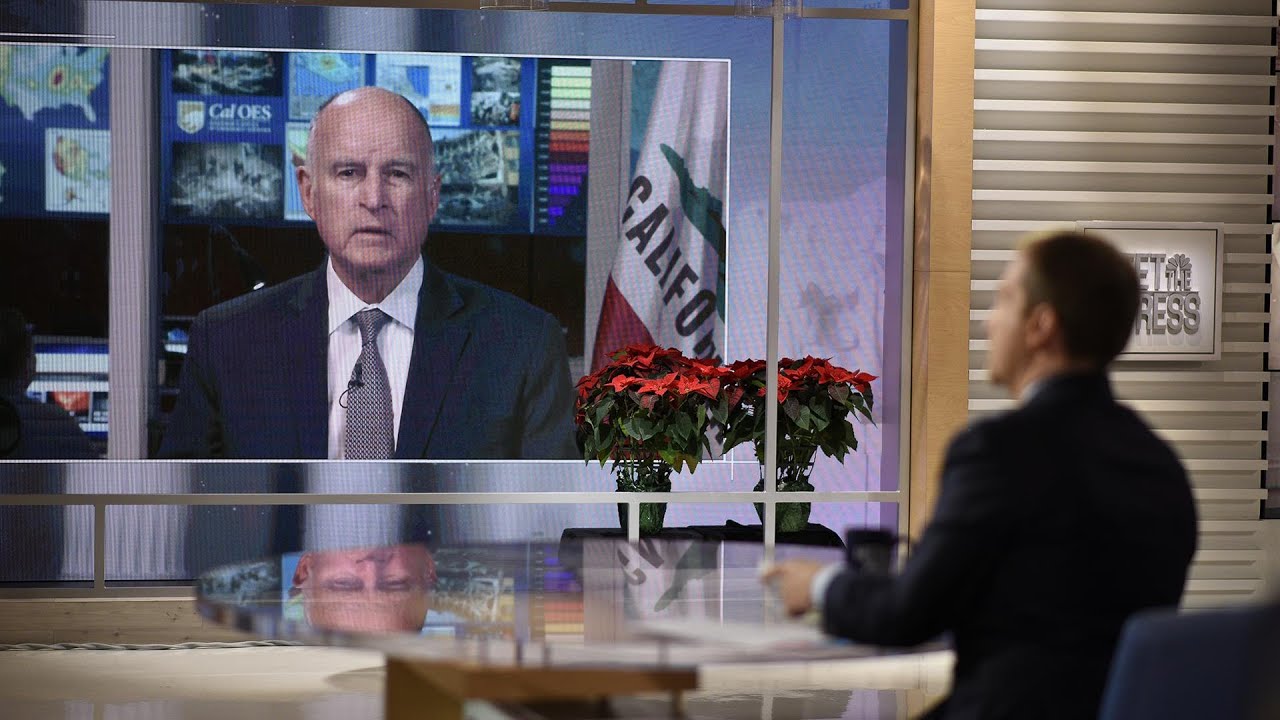
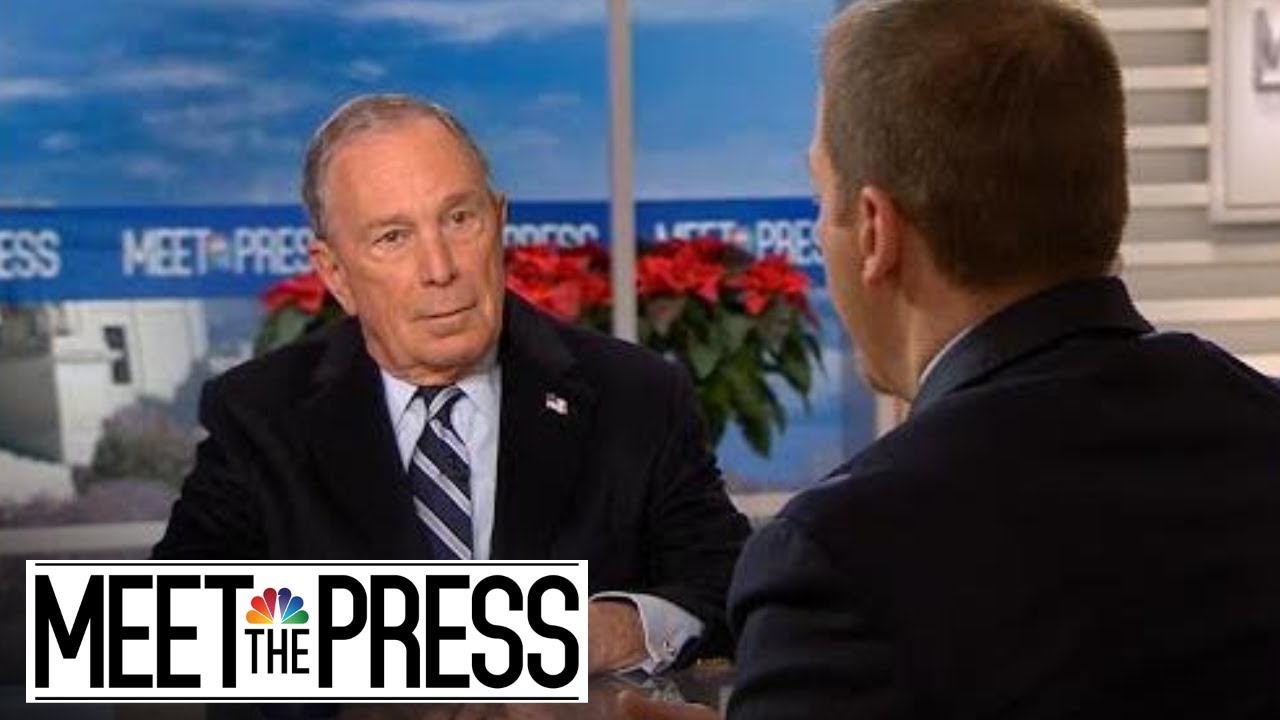
But this Sunday's show broke with that pattern. It featured full interviews with climate leaders, including outgoing California Governor Jerry Brown and former New York City Mayor Michael Bloomberg, as well as a panel with experts Dr. Kate Marvel, NBC's Anne Thompson, Craig Fugate, Michèle Flournoy and Florida Republican Representative Carlos Curbelo, the rare GOP member who pushes for climate action.
"We need to stop covering the debate and start covering the story, so that people see that this is real, and so that politicians take a more-pragmatic approach and find solutions that are actually achievable," Curbelo said.
In both of their segments, Brown and Bloomberg, who co-chaired the Global Climate Action Summit in San Francisco this fall, spoke of the need for the U.S. government to step up its action on climate change. President Donald Trump has denied the importance of the issue and promised to withdraw the U.S. from the Paris agreement to limit global warming to well below two degrees Celsius above pre-industrial levels. Brown said he wished the president and Congress would worry more about transitioning away from fossil fuels than tariffs.
"I would point to the fact that it took Roosevelt many, many years to get America willing to go into World War II and fight the Nazis. Well, we have an enemy, though different, but perhaps, very much devastating in a similar way. And we've got to fight climate change. And the president's got to lead on that," Brown said, as NBC reported. [vid] Jerry Brown: Climate change is about inventing, 'not just adapting' | Meet The Press | NBC News]
>
Bloomberg also criticized Trump's stance.
"You know, I've always thought Trump has a right to his opinions. But he doesn't have a right to his own facts," Bloomberg said.
But Bloomberg also put pressure on whoever may challenge Trump in the 2020 presidential race, saying that climate change needed to be a major campaign issue.
"Any candidate for federal office better darn well have a plan to deal with the problem that the Trump science advisers say could, basically, end this world," he said, The Guardian reported. "I can tell you one thing, I don't know whether I'm going to run or not, but I will be out there demanding that anybody that's running has a plan."[vid?]
Bloomberg On 2020: Any Candidate 'Better Have A Plan' On Climate Change | Meet The Press | NBC New
The show also reported that the majority of Americans are starting to take climate change more seriously, pointing to a survey from the the Yale Program on Climate Change Communication and the George Mason Center for Climate Change Communication showing that 70 percent of Americans think climate change is happening and 57 percent think it is human caused. The polling, and the show, follow two years of extreme weather events from hurricanes to wildfires. NBC's Anne Thompson said that more Americans were beginning to believe in climate change because, "We're starting to live climate change in real time," Meet the Press reported on its Twitter feed. AROUND THE WEB
- BBC Issues First Climate Change Reporting Guidelines ›
- Why isn't the media covering climate change all day, every day ... ›
- The press won't let Trump bury climate change. But it is still complicit ... ›
- Meet The Press Booking a Denier to Discuss Climate Change Is a ... ›
ref 11/18 shamed to do rt thing?
https://www.esquire.com/news-politics/a25304542/meet-the-press-climate-change-chuck-todd-danielle-pletka/
arely do you get news of an ongoing catastrophe and, within a couple of days, a perfect example of why we've done nothing about that exact problem. But Chuck Todd and Meet The Presswere happy to oblige this Thanksgiving weekend. On Friday, the Trump administration attempted to bury a harrowing U.S. government climate-change report by releasing it on Black Friday, a notorious dumping ground for bad news. Normally, though, the bad news is just for the current administration—not the whole world.
On Sunday, Todd hosted Danielle Pletka of the American Enterprise Institute on his teevee show. Her performance—and it was a performance—was a shining example of how the ruling class has successfully hemmed and hawed for decades, with the full support of the feckless Beltway media, slowing any kind of action and safeguarding big-business profits while experts in the field have known full well that human civilization as we know it is in clear and escalating peri[vid]
...Right-wing panelist on Meet the Press on climate change: "I'm not a scientist ... We need to also recognize we had two of the coldest years, biggest drop in global temperatures that we have had since the 1980s, the biggest in the last 100 years. We don't talk about that."
As Pletka so happily volunteered, she is not a scientist. So why was she invited on one of the nation's Premier Political Talk Shows to spread disinformation about a scientific issue? That two years since 1980 have been cold does not have any bearing on the scientific consensus that climate change is real and man-made. This member of the conservative intelligentsia—the American Enterprise Institute, for which Pletka works, is a right-wing "think tank"—is actually just making the more polite version of President Good Brain's argument on Wednesday:
Brutal and Extended Cold Blast could shatter ALL RECORDS - Whatever happened to Global Warming?
114K
119K people are talking about this
This is not the first time Trump has disproved global warming on the basis he is cold today. (Elsewhere, he has simply called it a Chinese hoax.) Nobody put this crap to bed better than Stephen Colbert did all those years ago. Weather is not climate. The weather is affected by changing climate patterns, but warming global temperatures over the decades—an indisputable trend, even among denialist hacks like Pletka—does not mean every day of every year will be warmer than the previous. What it does very likely mean is more powerful storms that drop trillions of gallons of water on American cities, and bigger, more ferocious wildfires that turn the American West to ash.
Of course, Pletka probably knows this. She gave Our Beautiful Boy Chuck Todd that tried-and-true conservative line that's rapidly going stale: that surely somethingis happening with the climate, but who can say whether humans are causing it? Well, after years of exhaustive study, scientists have found it is "extremely likely" (terms the scientific community does not choose lightly) that humans are significantly contributing to warming global temperatures. We also know that the Beautiful, Clean Coal that Pletka suggested the U.S. has switched to does not exist. "Clean coal" is a misleading term for the same coal that continues to be the dirtiest fossil fuel in existence.
Did Todd challenge her with the facts? No. But this is what the evidence says. It's just Pletka isn't concerned with gathering the evidence and coming to a conclusion—also known as the essence of the scientific method. Here is an (albeit anonymous) account from an Atlanticreader who claims to have worked for Pletka at the American Enterprise Institute:
A number of years ago I worked for Danielle Pletka for a summer as a researcher, and her piece today matches the "scholarship" she and AEI were producing in the early part of this decade. I was rarely if ever asked to perform background research on a subject but was more often asked to provide specific evidence to support ready made assertations. At the time AEI was mobilizing in support of military action against Iraq, and it was quite clear to me that the academic process was reversed - positions designed, research dug up to support the positions.
This seems like an opportune moment to mention that Pletka is widely known as a varsity-level cheerleader for the Iraq War. More recently, she demonstrated her intricate knowledge of the conflict by suggesting to the French ambassador on Twitterthat France had joined the U.S. in the conflict. OK, so that was completely and laughably wrong (Remember the idiotic Freedom Fries charade?), but at least by 2013 she was...still defending the invasion. Yes, after it embroiled the region in sectarian conflict, and after all the reasons people like Pletka peddled for going in were proven to be baseless. Eventually, this genius foreign-policy move led to the rise of ISIS. This is just another example of how, if you work in the Beltway, there are absolutely zero consequences for being completely wrong about everything.
In fact, if you work at a think tank like AEI, it might just get you a raise—if you stick to the party line. All think tanks are, to some extent, mouthpieces for their donors, but that particularly goes for a right-wing gun-for-hire shop like the Institute. The Guardianuncovered how AEI works to undermine the science on climate change in 2007:
Scientists and economists have been offered $10,000 each by a lobby group funded by one of the world's largest oil companies to undermine a major climate change report due to be published today.
Letters sent by the American Enterprise Institute (AEI), an ExxonMobil-funded thinktank with close links to the Bush administration, offered the payments for articles that emphasise the shortcomings of a report from the UN's Intergovernmental Panel on Climate Change (IPCC). Travel expenses and additional payments were also offered.
And what did that ExxonMobil funding look like?
The AEI has received more than $1.6m from ExxonMobil and more than 20 of its staff have worked as consultants to the Bush administration. Lee Raymond, a former head of ExxonMobil, is the vice-chairman of AEI's board of trustees.
You may remember that Exxon was also exposed as having discovered, through the work of its own scientists, that climate change was real as early as 1977. Instead of accepting this reality and beginning the work of responding to the burgeoning climate crisis, Exxon chose to fund disinformation on the topic for decades, protecting their profits in the shorter term. They're not alone among oil-and-gas outfits, many of which simultaneously started building their rigs to accommodate sea-level rise that would result from the climate change that, in public, they steadfastly disputed was happening.
One way to fund disinformation is to pay a think tank like AEI to spread it for you. And that's what Pletka was still doing, on Sunday, after just the latest report dropped detailing the catastrophic consequences of our inaction on the climate crisis. The U.S. report focused on the fact that the crisis will melt 10 percent of the American economy and send it crashing into the ocean by 2100. Farmers in the midwest will lose 75 percent of the crop yield on their corn. Rising sea levels will put trillions of dollars in coastal real estate in jeopardy. But last month's report from the U.N. Intergovernmental Panel on Climate Change—compiled by 91 leading scientists from 40 different countries based on more than 6,000 scientific studies conducted by still more scientists—was even more apocalyptic. It found that human civilization as we know it will be in severe peril by 2040, and that we have 12 years to dramatically change course to avoid that scenario.
Amid all that, news programs like Chuck Todd's Meet The Press—offerings that putatively exist to inform the public about the world around them—are still playing host to people who are paid to spread false information about the world. Todd is not alone: CNN hosted Rick Santorum on Sunday. Like NBC News, which employs Pletka as a contributor, they pay Rick directly to spread nonsense.
*...his Week talked about the climate report for two minutes with Sen. Amy Klobuchar and noted that the administration tried to bury it.
The report did not, from what I can tell, come up on the rest of the hour-long show...[vid]*
whitehouse sen
Here's paid CNN commentator Rick Santorum praising the Trump administration for trying to bury the climate report, arguing that climate change is made up by scientists trying to make some money :{pic.twitter.com/lBpLMexgt9:(style="background-color:transparent;text-decoration-line:none;outline:0px;white-space:pre-wrap"):}::{.:(style="background-color:transparent;text-decoration-line:none;outline:0px"):}:..
This festering boil on the body politic highlights another in-vogue conservative argument: that the scientists who've devoted their lives to studying the climate are really just in it for those juicy government grants to continue studying it. It's all about the money! As usual in this era, this is a case of accusing the opposition of something you're already up to.
Santorum is applying the incentive structure that exists for massive multinational oil and gas corporations and those they employ—seeking out certain findings because you have a vested financial interest in a certain outcome—to climate scientists. In reality, the kind of conspiracy that right-wingers like Santorum are alleging here would be perhaps unprecedented in scale. If this is all a big con, thousands of climate scientists spread across dozens of countries would need to all be getting their kickbacks, and have a way to secretly stay on-message. It's absurdly unlikely, and it belies the aforementioned way that the scientific community vets a scientific report's findings.
Oh, and the money in government grants ain't actually that good. That's why some "scientists" might take, say, $10,000 from AEI to dispute the scientific consensus. It's all bullshit, folks, and it's bad for ya.
...ay that the nation's major television news stations routinely play host to propagandists who are paid, directly or indirectly, to spread disinformation and muddy the waters to protect the interests of massive energy corporations, all at the expense of the future of human civilization.When Pletka said emissions are down since President Trump withdrew from the Paris climate accords—making the U.S. the only nation in the world that refuses to participate—that was just true enough: they are down in 2018, though the rate of emissions reductions slowed from the previous two years and will likely continue to slow as the Trump administration attempts to roll back our efforts to combat the crisis. The crown jewel in that regard is the Clean Power Plan, our main vehicle for meeting our obligations under the Paris agreement, which Trump has sought to repeal. At the very least, Todd is obligated to challenge this crap if he's going to host a dishonest broker—or host someone who can. According to John Whitehouse of MediaMatters, none of the Sunday Shows hosted a single scientist while covering the climate in 2016 and 2017.
RELATED STORIES
It's the Golden Age of Climate Denial
There Are Very Fine Scientists on Both Sides
The Meet The Press chief will certainly defend his decision to host a climate-change "skeptic" on the basis of "intellectual diversity" and Hearing From Both Sides, as if what his viewers need is to hear both the truth and utter nonsense. Both Sides are not operating in good faith here. One side accepts the scientific consensus. On the other, the Republican Party is the only major political party in the industrialized world that disputes it. Both Sides Journalism, which falsely equates the truth about the world we've determined through the scientific method with self-serving crap dished out by the instruments of oil interests, has made it politically palatable to do nothing, for decades, about an existential threat to humanity. Friday's report further underlined the crisis facing humankind. Two days later, Meet The Press showcased part of how we've allowed things to get to this point.
But since we're on the topic of intellectual diversity, here's a suggestion: If Chuck Todd wants to talk about a scientific topic, how about having a fucking scientist on?
===
https://www.mediamatters.org/blog/2018/08/14/hundreds-newspapers-plan-editorials-denounce-trump-s-war-press-fox-hosts-attack-newspapers/220991
Fox News and Fox Business hosts are slamming hundreds of newspapers as “anti-Trump” and “fake news” for coordinating to publish editorials on August 16 denouncing President Donald Trump’s war on the press.
Trump and his administration publicly attacked news organizations and specific journalists hundreds of times in just his first year in office. Though he routinely attacked news organizations during his presidential campaign and the transition period between his election and inauguration, Trump’s anti-press rhetoric reached a new low in February 2017, when he began calling news organizations “the enemy of the American people”: ... more than 100 newspaper editorial boards around the country are reportedly planning to publish editorials on August 16 “on the dangers of the administration’s assault on the press.” Each newspaper will be writing its own editorial in this coordinated effort.
Fox, which has both served as a platform for Trump’s attacks on the press and promoted his attacks on its own, is now criticizing the newspapers participating in this effort as anti-Trump and “fake news.” On August 13, five Fox News and Fox Business hosts took offense to the coordinated editorial release protesting Trump’s anti-press rhetoric. Fox & Friends Firstco-host Rob Schmitt said these newspapers are releasing editorials “attacking the president” and that “there is just kind of a mainstream, somewhat leftist bias coming from a lot of our media companies.” Fox & Friends co-host Steve Doocy commented that The Boston Globe “said essentially they’re going after the president.” Varney & Co. guest host Ashley Webster and Wall Street Journaleditorial board member James Freeman both defended Trump’s rhetoric that the media are “the enemy of the people,” pushing Trump’s ridiculous claim that his critique applies only to “fake news.” Fox Business host Lou Dobbs referred to the planned editorials as “anti-Trump screeds” by “coordinated national left-wing fake news.” And Fox host Laura Ingraham, while criticizing media coverage of antifa actions against reporters, mocked the newspapers’ coordinated effort as “not collusion or anything.”
...
Government, The Presidency & White House, Justice & Civil Liberties
Network/OutletFox News Channel, Fox Business
PersonDonald Trump, Laura Ingraham, Steve Doocy, Lou Dobbs, James Freeman, Ashley Webster
Show/PublicationFox & Friends First, FOX & Friends, Varney & Co., Lou Dobbs Tonight, The Ingraham Angle
Stories/InterestsTrump's War on the Press
==
===
AN
https://www.alternet.org/news-amp-politics/facebook-executive-warns-news-outlets-cooperate-or-end-dying-hospice-private
During a closed-door and off-the-record meeting last week, top Facebook executive Campbell Brown reportedly warned news publishers that refusal to cooperate with the tech behemoth's efforts to "revitalize journalism" will leave media outlets dying "like in a hospice."
Reported first by The Australian under a headline which read "Work With Facebook or Die: Zuckerberg," the social media giant has insisted the comments were taken out of context, even as five individuals who attended the four-hour meeting corroborated what Brown had stated.
"Mark doesn't care about publishers but is giving me a lot of leeway and concessions to make these changes," Brown reportedly said, referring to Facebook CEO Mark Zuckerberg. "We will help you revitalize journalism... in a few years the reverse looks like I'll be holding hands with your dying business like in a hospice."
...
==
https://www.propublica.org/article/facebook-new-screening-system-flags-the-wrong-ads-as-political
==

==
https://www.alternet.org/media/what-news-wont-tell-you-about-news
...“Used to be,” I said, “that radio and TV stations had to deliver actual news in order to retain their over-the-air broadcast license. It was called ‘the fairness doctrine,’ and Reagan stopped enforcing it in ’87 and the Obama administration’s FCC removed it altogether. Then the media consolidated like crazy, in part because Reagan had stopped enforcing the Sherman Anti-Trust Act and no president since Jimmy Carter broke up AT&T has been willing to put it back into effect, and in part because of the media deregulation that Clinton signed in 1996.”
“So?” she asked. “Why does that mean that all we get now is nonstop hype and opinion-drivel?”
“It used to be that the metric news organizations used to determine if they were ‘doing their job’ was how well the American public was informed. That was actually a serious metric, pre-1987, because your station’s license depended on it. The public could – and did – complain that they weren’t being well-informed, and stations jumped when those FCC complaints came in. But now, the only metric the ‘news’ business uses is how many viewers they have and, thus, how profitable they are for advertisers.”
“But why does that mean all we get are the disasters and the dramas of Donald Trump and other crap like that?” She’d expanded her universe of media complaints.
I remembered a lesson that Bob Brakeman, the news director at WITL-AM/FM in Lansing, Michigan, where I used to work in the 1970s as a beat reporter and studio news presenter, taught me.
“When you’re choosing what goes into your newscast, remember that there are three buckets of news,” Bob, one of the best news guys I ever worked for, said (as best I can remember). “First, there are the facts: who, what, where, when, why, and how. Second is drama: who is hurt or hurting, who is angry, who is happy, who is trying to do what to whom. And the third is sports: who is winning and who is losing.”
“The facts are the most important,” Bob said. “The drama and sports, unless they’re at the core of the story itself, just add to the interest appeal of the story. The drama could be interviewing a family who just lost their home to a tornado, or the sports could be who’s expected to win or lose an election. But both should always be subordinate to the facts.”“Got that,” I said. “So how do I determine what goes into a story?”
I explained this to our new friend in her airline uniform. “Okay,” she said. “What happened to the facts?”
“Advertising,” I said. “I remember driving down the autobahn in Germany in 1987 listening to American Forces Radio when the reporter announced that, because of Reagan’s change in the Fairness Doctrine, CBS had moved their news division under the supervision of their entertainment division, and the other networks were expected to soon follow. So, now, networks don’t give a damn at all about ‘the facts’ or ‘what Americans need to know’ to be informed and active citizens. They only care about what’s going to get the most eyeballs. And that will always first be drama and sports.”
“This is why we have Trump,” Louise added. “As a reality TV-show star, he’s an expert at delivering what Bob called ‘drama’ and ‘sports’ to the TV news networks. Who’s in, who’s out; who’s ahead, who’s behind. The media loved it, and gave him $2 billion in free TV time, while making billions themselves in advertising because he increased their ratings. Les Moonves, the head of CBS, actually bragged about how much money they were making by hyper-covering Trump in a stockholder phone call.”
“The average American has no meaningful understanding of what’s happening anywhere else in the world,” I said, “nor do they realize what’s being done right now in front of us by the EPA, Interior, and other government agencies that are taking apart over 70 years of work to clean up our world and build a middle class.”
“I’ve noticed this on NPR,” the airline woman said. “I used to love listening to their in-depth reporting, and particularly their investigative reporting. But now I’m hearing more and more spin from think-tanks, and less and less about the details of legislation and news.”
“In 1996, NPR busted Archer Daniels Midland for a huge fraud,” I said. “But the Republicans have now cut their funding so badly that today, with only 7 percent of their budget coming from the government, that they no longer take on corporate malfeasance, but instead beg for corporate money with great enthusiasm. They even publish lists of who’s paying, some would say, to influence their broadcasting.”
“Same as corporate news?”
“Pretty much. Seen or heard ads for oil and natural gas companies? Defense contractors? You want to buy an oil well or a F-35? Unlikely. But they want that money delivered to the networks, so they won’t do any sort of investigative reporting on the fossil fuel or defense industries. Or pharma. Everybody’s metric nowadays is clicks or viewers that can be delivered to advertisers for money. Nobody much cares about whether the American people are informed enough to make an intelligent vote.”
“So, where do we get real news?” our new friend asked.
“My answer a few weeks ago would have been to look on the internet, but Google and Facebook have so locked down what news sources are allowed to get through their search/sort algorithms that it’s hard to get anything that’s not ‘corporate-friendly news.’”
“I thought the internet was neutral,” she said.
“The internet isn’t neutral any more," I said, “because of these corporate behemoths. And it’s going to get a lot worse when Ajit Pai and his FCC decide that your internet service provider – the company that brings internet into your home – can decide to block or slow down sites they don’t agree with…and all of today’s successful ISPs are large, politically active, 'conservative' corporations.”
I added: “When the only metric is profit, everything can be explained by profit. And profit doesn’t give a damn about morality or democracy or you or me or even the future of our nation or world. It’s essentially a sociopathic business model, which works out really well for sociopathic politicians and the sociopathic polluters who own them – and the media they lavish billions onto.”
“What do we do?” she said.
“End Reaganism,” I said. “Start enforcing the Sherman Anti-Trust Act, break up the big media, put back into place local media ownership rules, and have Congress say explicitly that the Net Neutrality that’s the law in every other civilized country on earth should also be the law here.”
“And how do we do that?” she aske.
“Get politically active. Only people power can defeat the oligarchy that’s seized our nation.”
...
===
http://pressthink.org/2016/12/winter-coming-prospects-american-press-trump/
omg
How bad is it? Pretty bad.
For a free press as a check on power this is the darkest time in American history since World War I, when there was massive censorship and suppression of dissent. I say this because so many things are happening at once to disarm and disable serious journalism, or to push it out of the frame. Most of these are well known, but it helps to put them all together. Here is my list: :{:(style="background:transparent;border:0px;margin:0px;padding:0px;vertical-align:baseline;outline:0px;box-sizing:border-box;display:inline-block"):}:
1. An economic crisis in (most) news companies, leaving the occupation of journalism in a weakened state, especially at the state and local level, where newsrooms have been decimated by the decline of the newspaper business. The digital money is going to Google and Facebook, but they do not have newsrooms. :{:(style="background:transparent;border:0px;margin:0px;padding:0px;vertical-align:baseline;outline:0px;box-sizing:border-box;display:inline-block"):}:
2. A low-trust environment for most institutions and their leaders, the same ones who are regularly featured in the news.:{:(style="background:transparent;border:0px;margin:0px;padding:0px;vertical-align:baseline;outline:0px;box-sizing:border-box;display:inline-block"):}:
3. A broken and outdated model in political journalism, which tries to connect to the public through “inside” or access reporting about a class whose legitimacy is itself eroding. And since almost everyone got the result wrong in 2016, responsibility for this massive error is evenly distributed across the press, which means that no one is responsible for fixing what is broken. :{:(style="background:transparent;border:0px;margin:0px;padding:0px;vertical-align:baseline;outline:0px;box-sizing:border-box;display:inline-block"):}:
4. An organized movement on the political right to discredit mainstream journalism, which stretches from Steve Bannon in the White House to Trump’s army of online trolls, with Breitbart, Drudge Report, talk radio and Fox opinion hosts mediating between the two, while the “alt reality” fringe feels newly emboldened. Its latest tactic is to shout down as “fake news” any work of reporting that conflicts with its worldview, leaving the term useless as a fraud alert. “Over the years, we’ve effectively brainwashed the core of our audience to distrust anything that they disagree with,” said John Ziegler, a conservative radio host, to a New York Times reporter. “Because the gatekeepers have lost all credibility in the minds of consumers, I don’t see how you reverse it.” In fact, no one knows how to fix this. :{:(style="background:transparent;border:0px;margin:0px;padding:0px;vertical-align:baseline;outline:0px;box-sizing:border-box;display:inline-block"):}:
5. The rapid escalation of this drive-to-discredit as Trump gained traction with the electorate. Since 1970 it has grown from questioning the motives of people covering a Republican president in the speeches of Spiro Agnew, to countering liberal spin with the personalities at Fox News, to mistrusting all of the mainstream (or “drive-by”) media with Rush Limbaugh, and now to a place beyond that. Sean Hannity— who is probably closer to Trump than any other media figure — recently said on air: “Until members of the media come clean about colluding with the Clinton campaign and admit that they knowingly broke every ethical standard they are supposed to uphold, they should not have the privilege, they should not have the responsibility of covering the president on behalf of you, the American people.” In other words, the mainstream press should not beallowed* to cover Trump. A few years ago that was a bridge too far. Now it’s a plausible test of poisoned waters. :{:(style="background:transparent;border:0px;margin:0px;padding:0px;vertical-align:baseline;outline:0px;box-sizing:border-box;display:inline-block"):}:*
6. After the debacle of 2016, trust in the news media as an institution feels lower than ever in living memory, while popular anger reaches an all-time high. The resentment is coming from the left, the right and what remains of the center. Pew Research Center: “Only about two-in-ten Americans (22%) trust the information they get from local news organizations a lot, whether online or offline, and 18% say the same of national organizations.” Gallup in September of this year: “Republicans who say they have trust in the media has plummeted to 14% from 32% a year ago. This is easily the lowest confidence among Republicans in 20 years.” :{:(style="background:transparent;border:0px;margin:0px;padding:0px;vertical-align:baseline;outline:0px;box-sizing:border-box;display:inline-block"):}:
7. A homogeneity and coastal concentration in American newsrooms that can be described in many ways — lack of diversity is the most common, with disagreements on what kind of diversity is most desired— leaving the press ill-prepared to take creative action across a cultural divide. The situation was summed up in the most quotable line written by a journalist about Trump’s candidacy: “The press takes him literally, but not seriously; his supporters take him seriously, but not literally.” (Salena Zito in The Atlantic.) :{:(style="background:transparent;border:0px;margin:0px;padding:0px;vertical-align:baseline;outline:0px;box-sizing:border-box;display:inline-block"):}:
8. A figure in power who got there in part by whipping up hatred against the press, and who shows no signs of ending that abusive practice… *coupled with a disturbing pattern in which Trump broadcasts through his Twitter feed outrageously false statements, the press reacts by trying to “check” them, and the resulting furor works to his advantage by casting journalists in the role of petty but hateful antagonist, with Trump as the man who takes the heat and “tells it like it is.” :{:(style="background:transparent;border:0px;margin:0px;padding:0px;vertical-align:baseline;outline:0px;box-sizing:border-box;display:inline-block"):}:*
9. The emergence of an authoritarian political style in which trashing the norms of American democracy (as when he cast doubt on the legitimacy of the election, or suggested prosecution of his opponent) works to Trump’s advantage with a huge portion of his supporters, while failing to alarm the rest. This is especially troublesome because norms of democracy are what give the press its place in public life and representative government; if these can be broken without penalty that means the press can be shoved aside and not much will happen. :{:(style="background:transparent;border:0px;margin:0px;padding:0px;vertical-align:baseline;outline:0px;box-sizing:border-box;display:inline-block"):}:
10. The increasingly dim prospect that there will be a fact-based debate to which journalists can usefully contribute when the leader of the free world feels free to broadcast transparently false or ignorant claims… *coupled with the full flowering of the “we make our own reality” attitude (circa 2004) into a kind of performance art that simultaneously kicks up hatred of anyone trying to be evidence-based and liberates the speech of powerful actors from even the most minimal factual constraints. :{:(style="background:transparent;border:0px;margin:0px;padding:0px;vertical-align:baseline;outline:0px;box-sizing:border-box;display:inline-block"):}:*
11. An advanced stage of culture war, political polarization and asymmetrical mistrust of the press in which, instead of leading to greater public awareness and a gradual movement toward reform, sensational revelations, hard-hitting investigations and exposés of corruption are consumed as fuel in an accelerating political divide. In other words, Watergate-style journalism increasingly enflames and polarizes, rather than informing and alerting the public. The more damning and irrefutable the findings are, the more likely is this furious reaction, especially when Trump launches attacks on the journalists and news organizations doing the digging. :{:(style="background:transparent;border:0px;margin:0px;padding:0px;vertical-align:baseline;outline:0px;box-sizing:border-box;display:inline-block"):}:
12. The success of “verification in reverse,”a method on the march, in which a knowing political actor takes facts that have been nailed down, and introduces doubt about them, which then releases energy (controversy, resistance, ready-to-hate news coverage) which in turn helps power a movement among those who wanted the established facts repealed, as it were. This is how Trump launched his political career. He became a birther. Wherever it succeeds, verification-in-reverse is a triumph *overthe craft of journalism, which has to be pro-verification or it may as well exit the stage. :{:(style="background:transparent;border:0px;margin:0px;padding:0px;vertical-align:baseline;outline:0px;box-sizing:border-box;display:inline-block"):}:*
13.Amusing ourselves to death, as Neil Postman’s 1985 book put it, in which the logic of entertainment overtakes adjacent but nominally distinct spheres that are supposed to be governed by their own logic, as when newsworthiness and the requirements of political debate are subordinated to entertainment values by media companies obeying commercial imperatives, while claiming a public service mantle. For journalists, this is the import of Jeff Zucker’s reign at CNN, and one of the lessons of Trump’s career as a “reality TV” star. :{:(style="background:transparent;border:0px;margin:0px;padding:0px;vertical-align:baseline;outline:0px;box-sizing:border-box;display:inline-block"):}:
14. A shift in the power-to-inform toward a single platform and attention-economy colossus: Facebook, a creature of the tech industry that feels no native commitment to journalism… that wants to avoid responsibility for editing because editing does not scale… that easily surfaces demand for false stories about real events… and that is slowly taking charge of the day-to-day relationship with users of the news system, especially on mobile devices, which is where the growth is. :{:(style="background:transparent;border:0px;margin:0px;padding:0px;vertical-align:baseline;outline:0px;box-sizing:border-box;display:inline-block"):}:
15. A proven model — proven, that is, by billionaire Peter Thiel — for bankrupting news companies and driving them out of business by using the court system and jury trials, which can leverage public disgust for The Media (see no. 6 above) into jury awards that defendants cannot possibly pay. As yet there is no known counter to this strategy. The fact that it worked once has an intimidating effect. :{:(style="background:transparent;border:0px;margin:0px;padding:0px;vertical-align:baseline;outline:0px;box-sizing:border-box;display:inline-block"):}:
16. A crisis of representation around covering Trump in which it is not clear that anyone can reliably tell us what his positions are, or explain his reasons for holding them, because he feels free to contradict advisers, spokespeople, surrogates, and previous statements he made. As Esquire’s Charles Pierce put it to me: “Nobody speaks for the prez-elect, not even himself.” I list this because the press is not good at abandoning rituals and routines when they cease to make sense. Every interview with Kellyanne Conway or Reince Priebus is premised on a claim to represent the man in power. This claim may be false. But journalists need people to interview! So they will continue to do it, even though they may be misinforming the public. They may even realize this and be unable to shift course. What I’m trying to point out is that existing methods for “holding power to account” rest on assumptions about how it will behave. A man in power untroubled by contradictions and comfortable in the confusion he creates cannot be held accountable by normal means. :{:(style="background:transparent;border:0px;margin:0px;padding:0px;vertical-align:baseline;outline:0px;box-sizing:border-box;display:inline-block"):}:
17. Weak leadership and a thin institutional structure in the American press, which is not accustomed to organizing itself to fight back or act assertively in any coordinated way, as with the White House Correspondents Association, currently failing even to get a meeting with the Trump transition team, but still planning to yuck it up with him at the WHCA dinner in the spring of 2017. In many ways the press resembles a “herd of independent minds,” with no one responsible for the beast as a whole, and no easy way to fix broken practices, or re-direct effort. Collaboration is on the rise in journalism, and that’s a good a thing. But while it’s easy to act against the press, it’s almost impossible for the press as a whole to deliberate and act in reply. And even if it could miraculously discover the will to do so, this would probably give new ammunition to political enemies of the press. Remaining a “herd of independent minds,” politically weak, is thus the safest course. Which is not to say it will work. :{:(style="background:transparent;border:0px;margin:0px;padding:0px;vertical-align:baseline;outline:0px;box-sizing:border-box;display:inline-block"):}:
So that is what I mean by “winter is coming.” All those things 1-17 are happening at once, and strengthening one another.The combined effect is chilling. :{:(style="background:transparent;border:0px;margin:0px;padding:0px;vertical-align:baseline;outline:0px;box-sizing:border-box;display:inline-block"):}:
The common elements: Low trust all around, an emboldened and nationalist right wing that treats the press as natural enemy, the bill coming due for decades of coasting on a model in political reporting that worked well for “junkies” but failed to engage the rest of us, the strange and disorientating fact that reality itself seems to have become a weaker force in politics, the appeal of the “strong man” and his propaganda within an atmosphere of radical doubt, the difficulty of applying standard methods of journalism to a figure in power who is not trying to represent reality but to substitute himself for it as a show ofstrength, the unsuitability of prior routine as professionals in journalism try to confront these confusing conditions, a damaged economic base, weak institutional structure and newsroom mono-culture that hinders any creative response, and a dawning recognition that freedom of the press is a fragile state, not a constitutional certainty. :{:(style="background:transparent;border:0px;margin:0px;padding:0px;vertical-align:baseline;outline:0px;box-sizing:border-box;display:inline-block"):}:
Are there any bright signs? Yes, a few.
18. When you ask about specific news brands (as against The Media) the trust picture looks better. :{:(style="background:transparent;border:0px;margin:0px;padding:0px;vertical-align:baseline;outline:0px;box-sizing:border-box;display:inline-block"):}:
19. I quote New York Times columnist Jim Rutenberg: “In the weeks since the election, magazines like The New Yorker, The Atlantic and Vanity Fair; newspapers including The New York Times, The Wall Street Journal, The Los Angeles Times and The Washington Post; and nonprofits like NPR and ProPublica have been reporting big boosts in subscription rates or donations.” The Guardian and Mother Jones are benefitting, too. :{:(style="background:transparent;border:0px;margin:0px;padding:0px;vertical-align:baseline;outline:0px;box-sizing:border-box;display:inline-block"):}:
20. According to news industry analyst Ken Doctor, theWashington Post will add more than 60 journalists in the coming year. The Post is making money again. And its leadership believes that “investigative and deeper enterprise stories are good for the brand and the business”— not an expense that has to be subsidized by lighter fare, but a means to sustainability in themselves. That’s significant. :{:(style="background:transparent;border:0px;margin:0px;padding:0px;vertical-align:baseline;outline:0px;box-sizing:border-box;display:inline-block"):}:
21. As the scope of the emergency dawns, it is possible that journalists in the U.S. will be inspired to do a better job and change what needs changing. Talent (and tips) could flood in as a slumbering public for serious news awakens. :{:(style="background:transparent;border:0px;margin:0px;padding:0px;vertical-align:baseline;outline:0px;box-sizing:border-box;display:inline-block"):}:
22. Facing the same kind of hostility in multiple countries where similar conditions are found, journalists may discover a new level of international cooperation that helps them cope with the threat to their occupation. There’s already a global movement for fact-checking in journalism. Maybe another one will emerge around the realization that fact-checking is not enough. :{:(style="background:transparent;border:0px;margin:0px;padding:0px;vertical-align:baseline;outline:0px;box-sizing:border-box;display:inline-block"):}:
23. In the U.S., the Constitution remains firmly in place, hard to alter. First Amendment protections are real and among the strongest in the world. There are no signs that prior restraint or overt government censorship are on the horizon— though self-censorship is another matter. :{:(style="background:transparent;border:0px;margin:0px;padding:0px;vertical-align:baseline;outline:0px;box-sizing:border-box;display:inline-block"):}:
What not to do…
24. Don’t recruit Trump loyalists into the news and opinion space (Jeffrey Lord of CNN is the model) as a gaudy show of balance. This will not save you. Conservative, red state, working class and rural American voices may deserve special recruitment, but if they have integrity these people are just as likely to be critical of Trump. :{:(style="background:transparent;border:0px;margin:0px;padding:0px;vertical-align:baseline;outline:0px;box-sizing:border-box;display:inline-block"):}:
25. Don’t settle for accusation-driven over evidence-based reporting, just to avoid drawing flak from Trump’s press-hating supporters or demonstrate how even-handed you are. :{:(style="background:transparent;border:0px;margin:0px;padding:0px;vertical-align:baseline;outline:0px;box-sizing:border-box;display:inline-block"):}:
26. Don’t make it all about access to the President and his aides, or preserving the routines of White House reporting, as the press corps is currently doing— mostly out of habit. A Trump presidency is likely to be constructed on a propaganda model in which fomenting confusion is not a drag on the Administration’s agenda but a sign that it’s working. Access to such a machinery could wind up enlisting the press in a misinformation campaign. Here, I am getting ahead of the storybecause we don’t really know what a Trump White House will be like. And I am not saying that access to the president and his top advisors is unimportant or a dirty word. Rather, it should not be the organizing principle for journalists who are preparing to cover Trump. :{:(style="background:transparent;border:0px;margin:0px;padding:0px;vertical-align:baseline;outline:0px;box-sizing:border-box;display:inline-block"):}:
In part two of this post, coming tomorrow, I will discuss “measures worth taking,” given what I have said in part one. I have several small ideas, and one larger one. It involves listening better than the political system does to what’s troubling Americans, and fashioning a proper news agenda out of that. This is not a new notion, but it is newly relevant now that winter is here for the public service press. :{:(style="background:transparent;border:0px;margin:0px;padding:0px;vertical-align:baseline;outline:0px;box-sizing:border-box;display:inline-block"):}:
Part two of this post — on things that can be done — is here.
==
94 Professional & Citizen Journalists Killed in 2015
DECEMBER 30, 2015
HEADLINES
Reporters Without Borders says 67 professional journalists and 27 citizen journalists have been killed in 2015 worldwide. The deadliest countries for journalists were Iraq and Syria. The third most deadly country for journalists was France due to the January 7 attack on the newspaper Charlie Hebdo, where eight journalists were killed. Yemen, South Sudan, India, Mexico, the Philippines and Honduras all ranked among the top 10 deadliest countries for journalists. Reporters Without Borders Secretary-General Christophe Deloire spoke about how the majority of journalists killed in 2015 were deliberately targeted for their work.
==
How the Media Fail to Explain the Basic Science That Proves Climate Change
By Laura Dattaro [1] / Columbia Journalism Review [2]
March 16, 2015
Two weeks ago, the New York Times published an article [3] detailing the results of an investigation into Wei-Hock “Willie” Soon, an aerospace engineer who’s published several papers questioning the link between human emissions of greenhouse gases and global warming. Soon, it was revealed, has received more than $1.2 million from the fossil fuel industry over the course of the last decade.
It’s a story with a lot of moving pieces. There’s the funding itself, and Soon’s failure to disclose it; there’s his affiliations with both Harvard and the Smithsonian, which appear [4] to have benefited from his questionable grants; there’s his published papers, and what to do with them; and there are questions about what all of this means for academia and the peer-review process.
*But one piece that got lost is the piece that all of this is ostensibly about: science. Very few outlets — with the notable exception [5] of the Washington Post — took the time to explain what exactly Soon claims about climate change (that it’s caused by the sun), and how his claims fit in with accepted science (short answer: they don’t). Instead, most outlets focused on Soon’s funding, and his use of the word “deliverables” to refer to studies he had completed with that funding, as something close to proof that his research can’t be trusted.
While the source of a scientist’s funding is certainly relevant, particularly in the current political context in which industry interests fund entire institutions dedicated to denying climate science, it doesn’t supersede a close look by journalists at whether the scientist is actually correct. And some recent studies give hope that even reporters who may not have the expertise, or the time, to dig into the data on solar radiation and the sunspot cycle can still have an impact on public understanding of climate science.*
In the great media universe, it would be great to have at least a few instances of dealing with the science. But I kind of think it’s unrealistic.
Last summer, climate communication researchers at George Mason University and Yale University published a commentary [6] urging the science community to reiterate the scientific consensus on climate change—that 97 percent of scientists support the conclusion that climate change is real, and humans are causing it—citing studies showing that exposing individuals to this message can increase their estimates of the scientific consensus by 10 to 20 percent. And a recent study [7] from Yale found that simply stating this fact can induce changes in beliefs about climate change and increase support for public action on the issue in study participants from both sides of the political aisle.
*“In the mainstream media, there’s really not a lot of room for a full explication of the science,” said Elizabeth Bass, director of the Alan Alda Center for Communicating Science and associate professor of journalism at Stony Brook University. “In the great media universe, it would be great to have at least a few instances of dealing with the science. But I kind of think it’s unrealistic.”
The Soon investigation, then, may have been a lost opportunity for some great science journalism, and a chance to rehash what the science community knows (and doesn’t) about climate change. And it’s not the first time this has happened.*
In late 2013, for example, researchers at Drexel University attempted to trace [8] the sources of “dark money”—money that had been donated by industry interests to dubious “research” institutions and think tanks through organizations that obscure the original donors. That news released a wave of backlash from more conservative outlets, including a Forbes contributor piece [9] that claimed far more “dark money” went to fund “global warming alarmism.” Little of this coverage, on either side, mentioned any of the actual science being questioned.
“I think that’s very common,” Bass said. “Political reporters and government reporters far outnumber science reporters, and most of the time when science and public policy collide, or when science is clearly very important in public policy, it’s likely the government and political reporters covering it. They bring their own perspective to it.”
Industry funding is also an issue for the field of biomedical research, and the press who covers it. In February, British researchers leaped to the defense [10] of a top UK government health official after the British Medical Journal revealed [11] that she had received more than $2 million from companies like Coca-Cola, implying that her credibility on obesity policy had been compromised. Coverage from the Guardian’s health editor mentioned no scientific health studies, a critique the researchers were quick to lobby at the BMJ.
In areas of research where a scientist’s conclusions can shape decision making at the individual and policy levels, funding provides important context. But it’s not the whole story.
“If a doctor said that smoking is great for you and has no ill effects, and then you found out they were fully funded by Philip Morris, wouldn’t that make you a tad suspicious? And rightly so,” said Phil Plait, an astronomer and author of the Slate column Bad Astronomer. “But you have to be careful about overreach, and not going too far with it. Suspicious funding is not proof. In the end, the proof is in the claims.”
http://www.alternet.org/print/media/how-media-fail-explain-basic-science-proves-climate-change
Laura Dattaro is a freelance reporter in New York with a focus on the environment and an interest in all things science.
==
sam singer SF poster boy for jrnl degradation?
==
uhoh; 10/14
NPR Reduces Its Environment Team to One Reporter
NPR has cut back on the number of staffers focused solely on the environment and climate change.
==
hooray: The BBC has the right idea, instructing its reporters to improve accuracy by giving less air time to people with anti-science views, including climate change deniers. http://www.desmogblog.com/2014/07/08/bbc-pulls-plug-climate-change-deniers
The BBC is not the first outlet that has tried to weed out climate change deniers. In 2012, the government of Australia forced conservative radio host Alan Jones to take a fact-checking seminar after he repeatedly told his listeners that climate change was a farce, and that there was no sound science on the subject.
American media outlets, on the other hand, not only tolerate anti-science viewpoints, but embrace them. A recent report by the Union of Concerned Scientists showed that cable news giants CNN and Fox News reported incorrect information about climate change in 33% and 72% of their coverage of the issue, respectively.
==
http://ecowatch.com/2014/07/22/danger-of-balanced-climate-science-in-media
The Danger of ‘Balanced’ Climate Science in the Media
We’ve recently seen significant steps taken, both nationally and globally, toward the long-term goal of tackling the climate crisis and transitioning to a sustainable economy. This year in the U.S., the Supreme Court ruled in favor of U.S. Environmental Protection Agency’s stricter rules on coal plant pollution, followed by President Obama announcing regulations requiring significant reductions in greenhouse gases produced by each American state. Taking the U.S.’s lead, though without specific numbers, China announced it would also seek to put a cap on its emissions. And, in addition to celebrating their recent World Cup championship, Germany can now celebrate a milestone of producing nearly one-third of their energy from renewables in the first half of the year.
While it’s clear these governments, as well as many public and private organizations, are beginning to take climate change seriously, skeptics still exist. From extremists in our nation’s congress to Rupert Murdoch’s recent statements expressing doubt, they are brought out front and center in media reports, despite the clear and proven science of climate change. The Union of Concerned Scientists recently analyzed the climate science coverage of major U.S. news networks, finding that accuracy of information varied widely across networks, with the results less than surprising:
CNN, Fox News, and MSNBC are the most widely watched cable news networks in the U.S. Their coverage of climate change is an influential source of information for the public and policy makers alike…
Fox News was the least accurate; 72 percent of its 2013 climate science-related segments contained misleading statements. CNN was in the middle, with about a third of segments featuring misleading statements. MSNBC was the most accurate, with only eight percent of segments containing misleading statements.
The media, in attempting to offer “balanced stories” does a disservice to the public and policymakers by giving small handfuls of climate change contrarians significant attentiondespite the fact that nearly all climate scientists agree that climate change is underway and that it is human-caused. When they share equal airtime it sends the message that the science is more uncertain than it is. The questioning of science by the American right wing clearly does not accurately reflect the scientific consensus, and is detrimental to those interested in moving our economy down a sustainable path. Why then does the media still give skeptics equal amount of air time?
This question was recently asked by an independent body in Britain, the BBC Trust, calling on BBC to stop misleading viewers into thinking that the “debate” on climate change is equal. While critical opinion should not be ignored, they stated, a minority of unqualified skeptics should also not be portrayed as having the same weight as the majority of professional climate scientists. According to the Washington Post, BBC has recently taken steps to address this:
Since the review began in 2010, nearly 200 BBC senior staff were sent to workshops to learn what it means to cover science impartially. “The key point the workshops tried to impart is that impartiality in science coverage does not simply lie in reflecting a wide range of views, which may result in a ‘false balance’…”
In response to the report, BBC News announced that its reporters will be directed to significantly reduce air time to climate deniers and broader anti-science viewpoints. This announcement reflects the culmination of the network’s efforts to improve the accuracy and fairness of news coverage.
Providing an unbalanced view about the accurate science behind environmental issues is not only dishonest, but it’s a serious danger to modernizing the environmental laws and regulations that are so fundamental to our health and well-being. It’s time to stop giving climate change deniers and science skeptics so much media coverage, and focus on the important task of addressing the climate problem and the interconnected environmental problems of global economic sustainability.
Representation of climate change (and climate denial) in the media reflects a broader concern of mine: a willfully uninformed American public. We need to increase the level of science literacy in this nation if we want to get out of the global sustainability crisis we have created. The world’s economy is based on technology that is growing more complex, and the impact of that technology on our fragile planet cannot be understood without basic scientific research. Detailed knowledge of our planet’s systems is necessary if we are to learn how to properly manage production and consumption of our natural resources and ensure environmentally-sustainable economic growth.
The anti-science sentiment we see reflected in the media every day reflects individuals that come to a discussion with ideological biases that prevent reasoned debate and discussion. We need to realize that science is science—not a partisan issue—and understanding it is the first step in dislodging those biases. I’m not certain how to stimulate the public’s scientific curiosity and interest. I do know, however, that the earth systems research and sustainability education that takes place at America’s great research universities—including Columbia University’s Earth Institute—is an important component of putting us on a path to a sustainable economy.
==
this town: jeff birnbaum repected reporter at WSJ (showdown at gucci gulch) jumps to bgr 147 t do PR. lobbyists gloat about luring purists 148
==
cmd 3/14
...Of course none of this could happen without the media's acquiescence. We're not even talking about right-wing talkers like Rush Limbaugh, 2011 winner of Media Matters' "Climate Change Misinformer of the Year [55]" award who recently told his listeners that they cannot concurrently believe in God and climate change [56]. We're talking about the mainstream media that have given very little time to the issue of climate change and how KXL could impact it.
Where's the Media?
The mainstream media's failure to confront climate change is more a sin of omission then one of commission. The Daily Climate [57], an online publication that monitors news coverage of climate issues, has been tracking total coverage of climate change for the past several years. What they have found is shrinking coverage as the crisis has escalated.
Despite the devastation of Superstorm Sandy, a drought that wrought havoc [58] on more than half of the US, California's current epochal drought, and the fact that 2012 was the hottest year on record [59], total reporting on climate change dropped two percent [60] from 2011. And climate coverage in 2011 was 20 percent less [61] than in 2010, and just over half the amount of reportage in 2009, the year when the issue got the most attention in the mainstream media.
Last year, the New York Times, "the paper of record," and "All the news that's fit to print," shut down [62] its environmental reporting desk and its Green blog. Though the editors offered assurances that the paper would cover environmental issues with just as much vigor, reassigning the reporters and terminating two editorial positions makes that difficult to believe.
Evidence indicates skepticism about those promises is well founded. On August 5, the American Geophysical Union [63] and the National Oceanic and Atmospheric Administration [64] each released major climate report. Neither garnered a mention [65] in the Gray Lady.
The Times is not alone in cutting back on specialized environmental reporting. Inside Climate News, a Pulitzer Prize-winning online news outlet, reports that among the top five US newspapers by circulation, there are approximately a dozen reporters [66] on the environment beat.
(To its credit, the recently launched and unjustly attacked [67] cable networkAl Jazeera America dedicated a half-hour of its inaugural day [68] to climate change,which propelled it to the fore of media outlets paying attention to the issue, topping Fox News' and CNN's combined total [69] for the preceding four months.)
When activist organizations can't get their issues covered in the mainstream media, they sometimes turn to the old-fashioned alternative: buying publicity. But for Green organizations, it appears that their money is not green enough to buy a seat at the table for the debate on KXL.
Think Progress reports that the NBC television station in Washington DC rejected an advertisement [70] by a group opposing KXL, despite the organization's assurance that its ad complied with all station policies. A station spokesman said it violated the policy against personal attacks.
The group, NextGen Climate Action, [71] wanted the ad to run in conjunction with President Obama's August 2013 appearance on "The Tonight Show." It parodies [72] the specious and suspect claims made by TransCanada in its ads, such as the one that aired during the preceding Sunday's "Meet the Press" on the very same NBC station that rejected the parody.
All the News That's Fit to Print, on One Side?
The result in this case is a debate in which only one side gets to make its case.
"If you have a large enough bank account you can create a multifaceted campaign that involves buying politicians, influence peddling, and writing the story of energy policy from your perspective," says Public Citizen's Slocum. "That is invaluable if you get to tell the story on your terms about climate change, if you don't have to have a rebuttal, and you don't have to have a fact check."
TransCanada and the API have very large bank accounts. And they've been willing to open their checkbooks (to the tune of $153 million [73] leading up to the 2012 election, or nearly four times what clean-energy groups spent) to tell the story their way. According to their adversaries, that story has what Slocum politely calls "credibility problems." Others offer a more blunt assessment.
"TransCanada has lied repeatedly throughout this process, and unfortunately, some of their lies have been printed," LCV's Sittenfeld says.
(Nation of Change has compiled a lengthy, but not exhaustive, list of misleading and/or unethical conduct [74] on behalf of the KXL project.)
NEXT: Tar Sands, corporate profits, and stopping "game over" for the climate.
Posted: 01/16/2014 7:30 am EST | Updated: 01/16/2014 2:27 pm EST
WASHINGTON -- Climate change got more coverage on broadcast news in 2013 than in the previous few years, but the issue still didn't get nearly as much attention as it did in 2009, Media Matters found in a new analysis.
ABC, CBS, NBC and Fox together featured more coverage in 2013 than they did in 2012. The amount of airtime granted to climate change on both the Sunday shows and the nightly news was up, too -- to a total of 27 minutes, and an hour and 42 minutes, respectively, for the entire year. The progressive media watchdog group Media Matters totaled the time broadcasters devoted to climate change for a new report released Thursday.
The Media Matters report deemed overall coverage of climate change "tepid," and noted there were many news events in 2013 that created opportunities for coverage, including carbon dioxide levels that exceeded 400 parts per million in May, President Barack Obama'smajor climate policy address in June, and the release of the Intergovernmental Panel on Climate Changeassessment in September.
Coverage peaked in 2009, the year of the Copenhagen climate summit and the release of hundreds emailsstolen from climate scientists. It was much lower for the three years that followed.
CBS won the gold medal for Sunday morning coverage, devoting 16 minutes of "Face the Nation" to climate throughout the year. NBC's "Meet the Press," meanwhile, was cited as "failing to offer a single substantial mention of climate change in all of 2013." Even "Fox News Sunday" gave the subject more air time, at four minutes.
The analysis notes that "Face the Nation" was the first Sunday show in five years to feature scientists discussing climate change, in a May 28 segment with climatologist Heidi Cullen. More often, the report noted, the news programs will feature politicians or media figures discussing climate.
Sens. Bernie Sanders (I-Vt.) and Brian Schatz (D-Hawaii) announced earlier this week that they are launching an effort to pressure television networks to devote more time to covering climate change, citing Media Matters' 2012 report.
The analysis notes that "Face the Nation" was the first Sunday show in five years to feature scientists discussing climate change, in a May 28 segment with climatologist Heidi Cullen. More often, the report noted, the news programs will feature politicians or media figures discussing climate.
Sens. Bernie Sanders (I-Vt.) and Brian Schatz (D-Hawaii) announced earlier this week that they are launching an effort to pressure television networks to devote more time to covering climate change, citing Media Matters' 2012 report. [nice graphs]
Editorial: How Bad is the Corporate and Conservative Media?
December 20, 2013 |
HOW BAD IS THE CORPORATE AND CONSERVATIVE MEDIA?
Actually both corporate and right-wing press are getting much worse. There are dozens of examples of journalistic failure every week. The right-wing media is often insane as we report on AlterNet in our super popular weekly series on Right-wing wackos. And, increasingly, mainstream media is about protecting the 1% and the media owner’s financial interests. They too often miss the real story or mislead the reader.
It is no accident that the world's richest man -- Mexico's Carlos Slim, worth $73 billion -- is the second largest stockholder of the New York Times. Or that The Washington Post is now owned totally by one super rich person --Jeff Bezos, the emperor of Amazon.
Bezos recently landed a $600 million contract with the CIA. But, the Post’s articles about the CIA are not disclosing that the newspaper’s sole owner is the main owner of CIA business partner Amazon.
Too often the media's performance is a disgrace to journalism:
The New York Times, in an astonishing bit ofbig bank propaganda,had the audacity to publish, “It is not a crime to make stupid mistakes, and much of what happened in the years before the financial crisis was more foolish than venal.” This is an astonishingly brazen lie, as AlterNet's writer explains, "…our biggest banks were found to have committed -- or have confessed to committing -- thousands of real and deliberate crimes, some of which rank among the largest financial crimes in history (such as LIBOR falsification, phony mortgage scams, and the $800 billion worth of drug money laundered by HSBC, to give just three examples)."
It also was the New York Times that first called the bumpy rollout of healthcare.gov “Obama’s Katrina" in a front-page story. Soon, this over-the-top message was puppeted all over the media. If ever there was a flawed, destructive analogy, this is it. Hurricane Katrina amounted to an abdication of government responsibility, resulting in the deaths and displacements of many thousands? How can anyone in their right mind compare this disaster with the slow web-site role out of the ACA?
Another media shocker was the shameful and distorted editorial inThe Washington Post, which downplayed the retirement crisis and stoked generational tensions by suggesting that Social Security is a burden on young people instead of a vital safeguard. The editorial actually mocked a sensible bill introduced by Sen. Tom Harkin (D-Iowa) that would boost Social Security benefits by increasing taxes on the wealthy. The Washington Post's nonsense was blasted by Senator Elizabeth Warren, who spoke out strongly against cuts of any kind, including Obama's "chained CPI" cut which would prevent Social Security from keeping up with seniors' increasing costs.
Recently, The Washington Post so-called "liberal columnist" Richard Cohen wrote, "People with conventional views must repress a gag reflex when considering the mayor-elect of New York—a white man married to a black woman and with two biracial children.” Enough said on that one. The Post also employs notable rabidly Islamaphobic blogger Jennifer Rubin.
Chuck Todd, NBC News Political Director, actually asserted during an appearance on Morning Joe, “It’s not our job to inform viewers when Republicans lie.” This is what journalism has come to -- in the context of one of the most intense disinformation campaigns in history attacking the Affordable Care Act. What do Chuck Todd and NBC think journalists should do?
There are many more egregious examples... but far too many for this communiqué. Put simply, we cannot trust corporate media to protect us. They too often protect the needs of the billionaire class, not all the classes. Help us provide the alternative 24/7. We have your interests at heart. An end of the year, your tax-deductible contribution will mean a lot.
==
fact, the Employment Policies Institute operates from the same office suite [8] as Berman and Company, a public relations firm owned by Richard Berman [8]. This is not an opinion; it’s a fact anyone can verify by viewing EPI and Berman and Company’s websites. The 990 for the Employment Policies Institute Foundation (EPIF) lists Rick Berman as the CEO; in 2011 his for-profit firm was paid $1.5 million of EPIF's total $2.1 million budget. If you’re wondering how a PR company could so easily fool newspapers across the country—including the Post, which regularly pats itself on the back for breaking Watergate—then you haven’t woken up to the crisis of American journalism.
According to Pew Research Center [9], newspaper newsrooms have shrunk 30% since 2000, leaving fewer than 40,000 newspaper employees across the country, the lowest number since 1978. In such a depressed media environment — where there are four public relations flacks for every reporter, compared to a 1-to-1 ratio in the 1960s – it is not surprising that a P.R. company could successfully rebrand itself as a think tank and capitalize on an acronym held by an actual think tank, the Economic Policy Institute, with 20 staff and 36 respected research associates. Unilke the Berman group, the Economic Policy Institute lists its staff, its raft of experts, its board, its annual report and its annual audit, which shows its funders, right on its website [10].
==
==
Tom Dispatch [1] / By Rebecca Solnit [2]
Why It's So Difficult to Face the Frightening Climate Change Reality
October 6, 2013 |
To stay on top of important articles like these, sign up to receive the latest updates from TomDispatch.com here [3].
Late last week, in the lobby of a particularly unglamorous downtown San Francisco building, a group of passionate but polite activists met with a bureaucrat who stepped forward to hear what they had to say about the fate of the Earth. The activists wanted to save the world. The particular part of it that might be under their control involved getting the San Francisco Retirement board to divest its half a billion dollars in fossil fuel holdings, one piece of the international divestment movement that arose a year ago.
Sometimes the fate of the Earth boils down to getting one person with modest powers to budge.
The bureaucrat had a hundred reasons why changing course was, well, too much of a change. This public official wanted to operate under ordinary-times rules and the idea that climate change has thrust us into extraordinary times (and that divesting didn’t necessarily entail financial loss or even financial risk) was apparently too much to accept.
The mass media aren’t exactly helping. Last Saturday, for instance, the New York Times gave its story [4] on the International Panel on Climate Change’s six-years-in-the-making report on the catastrophic future that’s already here below-the-fold front-page placement, more or less equal to that given a story [5] on the last episode of Breaking Bad. The end of the second paragraph did include this quote: “In short, it threatens our planet, our only home.” But the headline (“U.N. Climate Panel Endorses Ceiling on Global Emissions”) and the opening paragraph assured you this was dull stuff. Imagine a front page that reported your house was on fire [6] right now, but that some television show was more exciting.
Sometimes I wish media stories were organized in proportion to their impact. Unfortunately, when it comes to climate change, there is not paper enough on this planet to properly scale up a story to the right size. If you gave it the complete front page to suggest its import, you would then have to print the rest of the news at some sort of nanoscale and include an electron microscope for reading ease.
Hold up your hand. It’s so big it can block out the sun, though you know that the sun is so much bigger. Now look at the news: in column inches and airtime, a minor controversy or celebrity may loom bigger than the planet. The problem is that, though websites and print media may give us the news, they seldom give us the scale of the news or a real sense of the proportional importance of one thing compared to another. And proportion, scale, is the main news we need right now -- maybe always.
As it happens, we’re not very good at looking at the biggest things. They may be bigger than we can see, or move more slowly than we have the patience to watch for or remember or piece together, or they may cause impacts that are themselves complex and dispersed and stretch into the future. Scandals are easier. They are on a distinctly human scale, the scale of lust, greed, and violence. We like those, we understand them, we get mired in them, and mostly they mean little or nothing in the long run (or often even in the short run).
A resident in a town on the northwest coast of Japan told me [7] that the black 70-foot-high wave of water coming at him on March 11, 2011, was so huge that, at first, he didn’t believe his eyes. It was the great Tohoku tsunami, which killed about 20,000 people. A version of such cognitive dissonance occurred in 1982, when NASA initially rejected [8] measurements of the atmosphere above Antarctica because they indicated such a radical loss of ozone that the computer program just threw out the data.
Some things are so big you don’t see them, or you don’t want to think about them, or you almost can’t think about them. Climate change is one of those things. It’s impossible to see the whole, because it’s everything. It’s not just a seven-story-tall black wave about to engulf your town, it’s a complete system thrashing out of control, so that it threatens to become too hot, too cold, too dry, too wet, too wild, too destructive, too erratic for many plants and animals that depend on reliable annual cycles. It affects the entire surface of the Earth and every living thing, from the highest peaks to the depths of the oceans, from one pole to the other, from the tropics to the tundra, likely for millennia -- and it’s not just coming like that wave, it’s already here.
It’s not only bigger than everything else, it’s bigger than everything else put together. But it’s not a sudden event like a massacre or a flood or a fire, even though it includes floods, fires, heat waves, and wild weather. It’s an incremental shift over decades, over centuries. It’s the definition of the big picture itself, the far-too-big picture. Which is why we have so much news about everything else, or so it seems.
To understand climate change, you need to translate figures into impacts, to think about places you’ll never see and times after you’re gone. You need to imagine sea level rise and understand its impact, to see the cause-and-effect relations between coal-fired power plants, fossil-fuel emissions, and the fate of the Earth. You need to model data in fairly sophisticated ways. You need to think like a scientist.
Given the demands of the task and the muddle of the mainstream media, it's remarkable that so many people get it, and that they do so despite massive, heavily funded petroleum industry propaganda campaigns [9] is maybe a victory, if not enough of one.
Four months ago, two bombers in Boston murdered three people and injured hundreds in a way spectacularly calculated to attract media attention, and the media obeyed with alacrity. Climate change probably fueled [10] the colossal floods around Boulder, Colorado, that killed seven people in mid-September, but amid the copious coverage, it was barely mentioned in the media. Similarly, in Mexico, 115 people died in unprecedented floods [11] in the Acapulco area (no significant mention of climate change), while floods reportedly [12] are halving Pakistan’s economic growth (no significant mention), and 166 bodies were found in the wake of the latest Indian floods [13] (no significant mention).
Climate change is taking hundreds of thousands of lives in Africa every year in complex ways whose causes and effects are difficult to follow. Forest fires, very likely enhanced [14] by climate change, took the lives of 19 firefighters facing Arizona blazes amid record heat waves in July. Again, climate change generally wasn’t the headline on that story.
(For the record, climate change is clearly helping to produce many of the bigger, more destructive, more expensive, more frequent disasters of our time, but it is impossible to point to any one of them and say definitely, this one is climate change. It’s like trying to say which cancers in a contaminated area were caused by the contamination; you can’t, but what you can say is that the overall rise in cancer is connected.)
Not quite a year ago, a climate-change-related hurricane drowned people when superstorm Sandy [15] hit a place that doesn’t usually experience major hurricane impact, let alone storm surges [16]that submerge amusement parks, the New York City subway system, and the Jersey shore. In that disaster, 148 people died directly, nearly that many indirectly, losses far greater than from any terrorist incident in this country other than that great anomaly, 9/11. The weather has now become man-made violence, though no one thinks of it as terrorism, in part because there’s no smoking gun or bomb -- unless you have the eyes to see and the data to look at, in which case the smokestacks of coal plants start to look gun-like and the hands of energy company CEOs [17]and well-paid-off [18] legislators begin to morph into those of bombers.
Even the civil war in Syria may be a climate-change war of sorts: over the past several years, the country has been hit by its worst drought in modern times. Climate and Security analyst Francesco Femia says [19], “Around 75 percent of [Syrian] farmers suffered total crop failure, so they moved into the cities. Farmers in the northeast lost 80 percent of their livestock, so they had to leave and find livelihoods elsewhere. They all moved into urban areas -- urban areas that were already experiencing economic insecurity due to an influx of Iraqi and Palestinian refugees. But this massive displacement mostly wasn’t reported. So it wasn’t factoring into various security analyses. People assumed Syria was relatively stable compared to Egypt.”
Column Inches, Glacial Miles
We like to think about morality and sex and the lives of people we’ve gotten to know in some fashion. We know how to do it. It’s on a distinctly human scale. It’s disturbing in a reassuring way. We fret about it and feel secure in doing so. Now, everything’s changed, and our imaginations need to keep pace with that change. What is human scale anyway? These days, after all, we split atoms and tinker with genes and can melt an ice sheet. We were designed to think about human-scale phenomena, and now that very phrase is almost as meaningless as old terms like “glacial,” which used to mean slow-moving and slow to change.
Nowadays glaciers are melting rapidly or disappearing entirely, and some -- those in Greenland [20], for example -- have gushing rivers of ice water eating through their base. If the whole vast Greenland ice sheet were to melt, it could raise global sea levels by 23 feet.
We tend to think about climate change as one or two or five things: polar ice, glaciers melting, sea-level rise, heat waves, maybe droughts. Now, however, we need to start adding everything else into the mix: the migration of tropical diseases, the proliferation of insect pests, crop failures and declining crop yields leading to widespread hunger and famine, desertification and flooded zones and water failures leading to mass population shifts, resource wars, and so many other things that have to do with the widest systems of life on Earth, affecting health, the global economy, food systems, water systems, and energy systems.
It is almost impossibly scary and painful to contemplate the radical decline [21] and potential death of the oceans that cover 70% of the Earth’s surface and thedramatic decrease [22] of plankton [23], which do more than any other type of organism to sequester carbon and produce oxygen -- a giant forest in microscopic form breathing in what we produce, breathing out what we need, keeping the whole system going. If you want to read something really terrifying, take a look at the rise of the Age of Jellyfish in this review [24] of Lisa-Ann Gershwin’s book Stung!: On Jellyfish Blooms and the Future of the Ocean. Maybe read it even if you don’t.
Only remember that like so much about climate change we used to imagine as a grim future, that future is increasingly here and now. In this case, in the form of millions or maybe billions of tons of jellyfish proliferating globally and devouring plankton, fish eggs, small fish, and bigger creatures in the sea we love, we know, we count on, we feed on, and now even clogging [25] the water-intake pipes of nuclear power plants. In the form of seashells dissolving in acidic waters [26] from the Pacific Northwest to the Antarctic Ocean. In the form of billions of pine-bark beetles massacring [27] the forests of the American West, from Arizona to Alaska, one bite at a time.
It’s huge. I think about it, and I read about it, following blogs [28] at Weather Underground, various climate websites [29], the emails of environmental groups, the tweets of people at 350.org, and bits and pieces of news on the subject that straggle into the mainstream and alternative media. Then I lose sight of it. I think about everything and anything else; I get caught up in old human-scale news that fits into my frameworks so much more easily. And then I remember, and regain my sense of proportion, or disproportion.
The Great Wall, Brick by Brick
The changes required to address climate change are colossal, but they are made up of increments and steps and stages that are more than possible. Many are already underway, both as positive changes (adaptation of renewable energy, increased energy efficiency, new laws, policies, and principles) and as halts to destruction (for example, all the coal-fired plants that have not been built [30] in recent years and the Tar Sands pipeline that, but for popular resistance [31], would already be sending its sludge from Alberta to the Gulf of Mexico). The problem is planetary in scale, but there is room to mitigate the worst-case scenarios, and that room is full of activists at work. Much of that work consists of small-scale changes.
As Sierra Club Executive Director Michael Brune put it [6] last week, “Here's the single most important thing you need to know about the IPCC report: It's not too late. We still have time to do something about climate disruption. The best estimate from the best science is that we can limit warming from human-caused carbon pollution to less than 3.6 degrees Fahrenheit -- if we act now. Bottom line: Our house is on fire. Rather than argue about how fast it's burning, we need to start throwing buckets of water.”
There are buckets and bucket brigades. For example, the movement to get universities, cities, churches, and other entities to divest [32] their holdings of the top 200 fossil-fuel stocks could have major consequences. If it works, it will be achieved through dedicated groups on this campus or in that city competing in a difficult sport: budging bureaucrats. It’s already succeeded in some key places, from the city of Seattle to the national United Church of Christ, andhundreds of campaigns [33] are underway across the United States and in some other countries.
My heroes are now people who can remain engaged with climate change’s complex and daunting facts and still believe that we have some leeway to determine what happens. They insist on looking directly at the black wall of water, and they focus on what we can do about the peril we face, and then they do it. They do their best to understand scale and science, and their dedication and clarity comes from connecting their hearts to their minds.
I hear people who are either uninformed or who are justifying disengagement say that it’s too late and what we do won’t matter, but it does matter, because a rise in the global temperature of two degrees Celsius [34] is going to be very, very different from, say, five degrees Celsius [35] for almost everything living on Earth now and for millennia to come. And there are still many things that can be done, both to help us adapt to the radical change on the way and to limit the degree of change to which we’ll have to adapt. Because it's already risen .8 degrees and that's been a disaster -- many, many disasters.
I spent time over the last several months with the stalwarts carrying on a campaign to get San Francisco to divest from its energy stocks. In the beginning, it seemed easy enough. City Supervisor John Avalos introduced a nonbinding resolution to the Board of Supervisors, and to everyone’s surprise it passed unanimously in April on a voice vote. But the board turned out only to have the power to recommend that the San Francisco Retirement Board do the real work of divesting its vast holdings of fossil-fuel stocks. The retirement board was a tougher nut to crack.
Its main job, after all, is to ensure a safe and profitable pension fund and in that sense, energy companies have, in the past, been good investments. To continue on such a path is to be “smart about the market.” The market, in the meantime, is working hard at not imagining the financial impact of climate change.
The failure of major food sources, including fishing stocks and agricultural crops, and the resultant mass hunger and instability -- see Syria -- is going to impact the market. Retirees in the beautiful Bay Area are going feel it if the global economy crashes, the region fills with climate refugees, the spectacularly productive state agricultural system runs dry or roasts, and the oceans rise on our scenic coasts. It’s a matter of scale. Your investments are not independent of nature, even if fossil-fuel companies remain, for a time, profitable while helping destroying the world as humanity has known it.
Some reliable sources now argue that fossil-fuel stocks are not good investments [36], that they’re volatile for a number of reasons and due to crash [37]. The IPCC report makes it clear that we need to leave most of the planet's fossil fuel reserves in the ground in the coming decades, that the choice is either to fry the planet or freeze the assets of the carbon companies. Activists are now doing their best to undermine the value of the big carbon-energy corporations, and governments clued in to the new IPCC report will likely join them in trying to keep the oil, gas, and coal in the ground -- the fossil fuel that is also much of the worth of these corporations on paper. If we're lucky, we'll make them crash. So divesting can be fiscally sound, and there is a very strong case that it can be done without economic impact. But the crucial thing here isn’t the financial logistics of divestment; it’s the necessity of grasping the scale of things, understanding the colossal nature of the problem and the need to address it, in part, by pressuring one small group or one institution in one place.
To grasp this involves a feat of imagination and, I think, a leap of faith: a kind of conviction about what matters, about living according to principle, about understanding what is too big to be seen with your own eyes, about correlating data on a range of scales. A lot of people I know do it. If we are to pull back from the brink of catastrophe, it will be because of their vision and their faith. You might want to thank them now, and while your words are nice, so are donations. Or you might want to join them.
That there is a widespread divestment movement right now is due to the work of a few people who put forth the plan less than a year ago at 350.org [38]. The president has already mentioned it [39], and hundreds of colleges are now in the midst of or considering the process of divesting, with cities, churches, and other institutions joining the movement. It takes a peculiar kind of genius to see the monster and to see that it might begin to be pushed back by small actions -- by, in fact, actions on a distinctly human scale that could still triumph over the increasingly inhuman scale of our era.
Hold up your hand. It looks puny in relation to the sun, but the other half of the equation of scale is seeing that something as small as that hand, as your own powers, as your own efforts, can matter. The cathedral is made stone by stone, and the book is written word by word.
If there is to be an effort to respond to climate change, it will need to make epic differences in economics, in ecologies, in the largest and most powerful systems around us. Though the goals may be heroic, they will be achieved mostly through an endless accumulation of small gestures.
Those gestures are in your hands, and everyone’s. Or they could be if we learned to see the true scale of things, including how big we can be together.
See more stories tagged with:
climate change [40],
global warming [41],
earth [42],
climate [43]
- * *
Source URL: http://www.alternet.org/media/why-its-so-difficult-face-frightening-climate-change-reality
Links:
[1] http://www.tomdispatch.com/
[2] http://www.alternet.org/authors/rebecca-solnit
[3] http://tomdispatch.us2.list-manage.com/subscribe?u=6cb39ff0b1f670c349f828c73&id=1e41682ade
[4] http://www.nytimes.com/2013/09/28/science/global-climate-change-report.html
[5] http://www.nytimes.com/2013/09/28/business/media/breaking-bad-race-to-the-end.html
[6] http://action.sierraclub.org/site/MessageViewer?em_id=340585.0&dlv_id=293799
[7] http://www.lrb.co.uk/v34/n09/rebecca-solnit/diary
[8] http://www.nytimes.com/2013/05/19/science/earth/joseph-farman-82-is-dead-discovered-ozone-hole.html
[9] http://www.climatesciencewatch.org/2013/09/12/new-greenpeace-report-on-climate-denial-machine/
[10] http://www.motherjones.com/environment/2013/09/climate-colorado-floods-causation
[11] http://www.reuters.com/article/2013/09/23/us-mexico-floods-idUSBRE98K0DJ20130923
[12] http://www.trust.org/item/20130909134725-rm708/
[13] http://www.skynews.com.au/topstories/article.aspx?id=904031
[14] http://www.climatecentral.org/news/the-climate-context-behind-the-deadly-arizona-wildfire-16175
[15] http://www.tomdispatch.com/blog/175613/rebecca_solnit_the_fourth_horseman
[16] http://www.c2es.org/science-impacts/extreme-weather/climate-change-hurricane-sandy
[17] http://www.tomdispatch.com/post/175703/engelhardt_terracide_and_the_terrarists
[18] http://www.opensecrets.org/industries/indus.php?ind=E01
[19] http://www.washingtonpost.com/blogs/wonkblog/wp/2013/09/10/drought-helped-caused-syrias-war-will-climate-change-bring-more-like-it/
[20] http://www.livescience.com/38244-greenland-melt-speeds-ice-flow.html
[21] http://www.climate.gov/news-features/featured-images/ocean-acidification-today-and-future
[22] http://www.uea.ac.uk/mac/comm/media/press/2013/September/ocean-plankton
[23] http://www.sciencedaily.com/releases/2013/09/130908135752.htm
[24] http://www.nybooks.com/articles/archives/2013/sep/26/jellyfish-theyre-taking-over/
[25] http://www.theguardian.com/world/2013/oct/01/jellyfish-clog-swedish-nuclear-reactor-shutdown
[26] http://www.telegraph.co.uk/earth/environment/climatechange/6259404/Arctic-Ocean-acid-will-dissolve-shells-of-sea-creatures-within-10-years.html
[27] http://e360.yale.edu/feature/whats_killing_the_great_forests_of_the_american_west/2252/
[28] http://www.wunderground.com/blog/
[29] http://thinkprogress.org/climate/issue/
[30] http://content.sierraclub.org/coal/victories
[31] http://www.tomdispatch.com/blog/175648/michael_klare_will_the_keystone
[32] http://gofossilfree.org/about/
[33] http://campaigns.gofossilfree.org/
[34] http://www.smh.com.au/environment/climate-change/ipcc-report-finds-temperatures-on-track-to-rise-by-more-than-two-degrees-20130927-2ujhw.html
[35] http://content.usatoday.com/communities/sciencefair/post/2012/03/climate-change-global-warming-temperature-rise-model-predict/1#.UkgPbCQVmHk
[36] http://grist.org/climate-policy/2011-12-20-markets-and-climate-change-a-case-of-cognitive-dissonance/
[37] http://www.theguardian.com/environment/2013/apr/19/carbon-bubble-financial-crash-crisis
[38] http://350.org/
[39] http://thinkprogress.org/climate/2013/06/25/2213341/invest-divest-obama-goes-full-climate-hawk-in-speech-unveiling-plan-to-cut-carbon-pollution/
[40] http://www.alternet.org/tags/climate-change
[41] http://www.alternet.org/tags/global-warming
[42] http://www.alternet.org/tags/earth-1
[43] http://www.alternet.org/tags/climate-0
[44] http://www.alternet.org/%2Bnew_src%2B
Mother Jones
Inside the GOP's Fact-Free Nation
From Nixon's plumbers to James O'Keefe's video smears: How political lying became normal.
By Rick Perlstein | Mon Apr. 25, 2011
IT TAKES TWO THINGS to make a political lie work: a powerful person or institution willing to utter it, and another set of powerful institutions to amplify it. The former has always been with us: Kings, corporate executives, politicians, and ideologues from both sides of the aisle have been entirely willing to bend the truth when they felt it necessary or convenient. So why does it seem as if we're living in a time of overwhelmingly brazen deception? What's changed?
Today's marquee fibs almost always evolve the same way: A tree falls in the forest—say, the claim that Saddam Hussein has "weapons of mass destruction," or that Barack Obama has an infernal scheme to parade our nation's senior citizens before death panels. But then a network of media enablers helps it to make a sound—until enough people believe the untruth to make the lie an operative part of our political discourse.
For the past 15 years, I've spent much of my time deeply researching three historic periods—the birth of the modern conservative movement around the Barry Goldwater campaign, the Nixon era, and the Reagan years—that together have shaped the modern political lie. Here's how we got to where we are.
PROLOGUE
Just Making Stuff Up
WHEN AN EXPLOSION sunk the USS Maine [2] off the coast of Havana on February 15, 1898, the New York Journal claimed two days later, "Maine Destroyed By Spanish: This Proved Absolutely By Discovery of the Torpedo Hole." There was no torpedo hole [3]. The Journal had already claimed that a Spanish armored cruiser, "capable, naval men say, of demolishing the great part of New York in less than two hours," was on its way. "WAR! SURE!" a banner headline announced.
The instigator was a politically ambitious publisher, William Randolph Hearst [4]. Kicked out of Harvard for partying, and eager to make a name for himself outside the shadow of his mining-magnate father, he made his way to New York, where he led the way in a sensationalist new style of newspaper publication—"yellow journalism." In a fearsome rivalry with Joseph Pulitzer [5], he chose as his vehicle the sort of manly imperialism to which the Washington elites of the day were certainly sympathetic—although far too cautiously for Hearst's taste. "You furnish the pictures," he supposedly telegraphed a reporter, "and I'll furnish the war." The tail wagged the dog. At a time when the only way to communicate rapidly across long distances was via telegraph, it proved easy to make up physical facts.
"You furnish the pictures," Hearst supposedly telegraphed a reporter, "and I'll furnish the war."
More than six decades later, that still seemed to be the case. "Some of our boys are floating around in the water," Lyndon Johnson told congressmen to goad them into passing the Gulf of Tonkin Resolution [6] authorizing war in 1964, after a supposed attack on an American PT boat. "Hell, those dumb stupid sailors were just shooting at flying fish," LBJ observed later, after the deed was done. That resolution inaugurated a decade of official American military activities in Southeast Asia (unofficially, we had been carrying out secret acts of war for years). A full-scale air war began the following February, after the enemy shelled the barracks of 23,000 American "advisers" [7] in a South Vietnamese town called Pleiku. But that was just a pretext. "Pleikus are like streetcars," LBJ's national security adviser, McGeorge Bundy, said—if you miss one, you can always just hop on another. The bombing targets had been in the can for months, even as LBJ was telling voters on the campaign trail [8], "We are not about to send American boys 9 or 10,000 miles away from home to do what Asian boys ought to be doing for themselves."
It would have been possible all along for some intrepid soul to drop the dime on the whole thing. There were many who knew or suspected the truth, but with a villain as universally feared as communism was during the Cold War years, denying the facts felt like the only patriotic thing to do.
Then everything changed.
The '70
Question Authority
WALTER CRONKITE traveled to Saigon after the Tet Offensive in 1968, saw things with his own eyes, and told the truth: The Vietnam War was stuck in a disastrous stalemate, no matter what the government said. That was a watershed. By 1969, none other than former Marine Commandant David M. Shoup endorsed a book on the war called Truth Is the First Casualty [9]. In 1971, Daniel Ellsberg leaked the Pentagon Papers [10], the Department of Defense study that plainly revealed that just about everything Americans had been told about Southeast Asia was flat-out untrue. When the Nixon administration ordered the newspapers not to publish the Papers, Supreme Court Justice Hugo* Black thundered back [11] that "for the first time in the 182 years since the founding of the Republic, the federal courts are asked to hold that the First Amendment does not mean what it says." The searing melodrama of the Watergate investigation exposed new Nixon lies every day.
America, it seemed, had had enough. In the mid-'70s, the investigating committees of Sen. Frank Church and Rep. Otis Pike revealed to a riveted public [12] that the CIA had secretly assassinated foreign leaders and the FBI had spied on citizens. Ralph Nader became a celebrity by exposing corporate lies. The mood of the Cold War had been steeped in American exceptionalism: The things America did were noble because they were done by America. Now, it appeared that America just might be susceptible to the same cruel compromises and corruptions as every other empire the world has known. Truth-telling became patriotic—and the more highly placed the liar, the more heroic the whistleblower.
The investigative reporter became a sexy new kind of hero—a shaggy-haired loner, too inquisitive for his own good.
The investigative reporter became a sexy new kind of hero—a shaggy-haired loner, too inquisitive for his own good, played by Warren Beatty [13] and Robert Redford and Dustin Hoffman [14]. Jimmy Carter, the peanut farmer from Plains, swooped in from nowhere to take the White House on the strength of the modest slogan "I'll never lie to you." And during his presidency, one of the grand, founding lies of western civilization itself—that there need be no limits to humans' domination of the Earth—was questioned as never before.
The truth hurt, but the incredible thing was that the citizenry seemed willing to bear the pain. All sorts of American institutions—Congress, municipal governments, even the intelligence community (the daring honesty of CIA Director William Colby [15] about past agency sins was what helped fuel the Church and Pike investigations)—launched searching reconstructions of their normal ways of doing business. Alongside all the disco, the kidnapped heiresses, and the macramé [16], another keynote of 1970s culture was something quite more mature: a willingness to acknowledge that America might no longer be invincible, and that any realistic assessment of how we could prosper and thrive in the future had to reckon with that hard-won lesson.
Then along came Reagan.
The '80s
Don't Worry, Be Happy
IN RESEARCHING this period, I've been surprised to discover the extent to which Ronald Reagan explicitly built his appeal around the notion that it was time to stop challenging the powerful. A new sort of lie took over: that the villains were not those deceiving the nation, but those exposing the deceit—those, as Reagan put it in his 1980 acceptance speech [17], who "say that the United States has had its day in the sun, that our nation has passed its zenith." They were just so, so negative.According to the argument Reagan consistently made, Watergate revealed nothing essential about American politicians and institutions—the conspirators "were not criminals at heart[18]." In 1975, upon the humiliating fall of Saigon, he paraphrased Pope Pius XII [19] to make the point that Vietnam had in fact been a noble cause: "America has a genius for great and unselfish deeds. Into the hands of America, God has placed the destiny of an afflicted mankind."
The Gipper's inauguration ushered in the "Don't Worry, Be Happy" era of political lying. But it took a deeper trend to accelerate the cultural shift away from truth-telling-as-patriotism to a full-scale epistemological implosion.
Reagan rode into office accompanied by a generation of conservative professional janissaries convinced they were defending civilization against the forces of barbarism. And like many revolutionaries, they possessed an instrumental relationship to the truth: Lies could be necessary and proper, so long as they served the right side of history.
"We ought to see clearly that the end does justify the means," wrote evangelist C. Peter Wagner in 1981. "If the method I am using accomplishes the goal I am aiming at, it is for that reason a good method."
This virulent strain of political utilitarianism was already well apparent by the time the Plumbers were breaking into the Democratic National Committee: "Although I was aware they were illegal," White House staffer Jeb Stuart Magruder [20] told the Watergate investigating committee, "we had become somewhat inured to using some activities that would help us in accomplishing what we thought was a legitimate cause."
Even conservatives who were not allied with the White House had learned to think like Watergate conspirators. To them, the takeaway from the scandal was that Nixon had been willing to bend the rules for the cause. The New Right pioneer M. Stanton Evans once told me [21], "I didn't like Nixon until Watergate."
Though many in the New Right proclaimed their contempt for Richard Nixon, a number of its key operatives and spokesmen in fact came directly from the Watergate milieu. Two minor Watergate figures, bagman Kenneth Rietz (who ran Fred Thompson's 2008 presidential campaign [22]) and saboteur Roger Stone [23] (last seen promoting a gubernatorial bid by the woman who claimed to have been Eliot Spitzer's madam) were rehabilitated into politics through staff positions in Ronald Reagan's 1976 presidential campaign. G. Gordon Liddy became a right-wing radio superstar.
"We ought to see clearly that the end does justify the means," wrote evangelist C. Peter Wagner [24] in 1981. "If the method I am using accomplishes the goal I am aiming at, it is for that reason a good method." Jerry Falwell once said his goal was to destroy the public schools. In 1998, confronted with the quote, he denied making it [25] by claiming he'd had nothing to do with the book in which it appeared. The author of the book was Jerry Falwell.
Direct-mail guruRichard Viguerie made a fortune bombarding grassroots activists with letters shrieking things like "Babies are being harvested and sold on the black market by Planned Parenthood." As Richard Nixon told his chief of staff on Easter Sunday [26], 1973, "Remember, you're doing the right thing. That's what I used to think when I killed some innocent children in Hanoi."
1990-Present
False Equivalencies
CONSERVATIVES hardly have a monopoly on dissembling, of course—consider "I did not have sexual relations with that woman." Progressives' response has always been that right-wing mendacity—cover-ups of constitutional violations like Iran-Contra; institutionalized truth-corroding tactics like when the Republican National Committee circulates fliers claiming that Democrats seek to outlaw the Bible [27]—is more systematic. But the deeper problem is a fundamental redefinition of the morality involved: Rather than being celebrated, calling out a lie is now classified as "uncivil." How did that happen?
Back in the days when network news was the only game in town, grave-faced, gravelly voiced commentators like David Brinkley and Eric Sevareid—and on extraordinary occasions anchors like Walter Cronkite [28]—told people what to think about the passing events of the day. Much of the time, these privileged men unquestioningly passed on the government's distortions. At their best, however, they used their moral authority to call out lies with a kind of Old Testament authority—think Cronkite reporting from Saigon. It drove Johnson out of office, and it drove the right berserk.
On November 3, 1969, Richard Nixon gave a speech claiming he had a plan to wind down the war. The commentators went on the air immediately afterward and told the truth as they saw it: that he had said nothing new. Ten days later, the White House announced that Vice PresidentSpiro Agnew was about to give a speech that it expected all three networks to cover—live.
The speech was an excoriation of those very networks and their Stern White Men [29]—"this little group of men who not only enjoy a right of instant rebuttal to every presidential address, but more importantly, wield a free hand in selecting, presenting, and interpreting the great issues of our nation.... The American people would rightly not tolerate this kind of concentration of power in government. Is it not fair and relevant to question its concentration in the hands of a tiny and closed fraternity of privileged men, elected by no one, and enjoying a monopoly sanctioned and licensed by government?" Those in the habit of exposing the sins of the powerful were no longer independent arbiters—they were liberals. Such was the bias, Agnew argued, of "commentators and producers [who] live and work in the geographical and intellectual confines of Washington, DC, or New York City," who "bask in their own provincialism, their own parochialism."
Foreshadowing Reagan's framing of truth-telling as elitist meddling, Agnew singled out for opprobrium the kind of reporting that "made 'hunger' and 'black lung' disease national issues overnight."
Foreshadowing Reagan's framing of reform-minded truth-telling as a brand of elitist meddling, Agnew singled out for opprobrium the kind of reporting that "made 'hunger' and 'black lung' disease national issues overnight" (quotation marks his). TV reporting from Vietnam had done "what no other medium could have done in terms of dramatizing the horrors of war"—and that, too, was evidence of liberal bias.
Agnew's remarks reinforced a mood that had been building since at least the 1968 Democratic National Convention, when many viewers complained about the media images of police beating protesters. By the 1980s the trend was fully apparent: News became fluffier, hosts became airier—less assured of their own moral authority. (Around this same time, TV news lost its exceptional status within the networks—once accepted as a "loss leader" intended to burnish their prestige, it was increasingly subject to bottom-line pressures.)
There evolved a new media definition of civility that privileged "balance" over truth-telling—even when one side was lying. It's a real and profound change—one stunningly obvious when you review a 1973 PBS news panel hosted by Bill Moyers and featuring National Review editor George Will, both excoriating the administration's "Watergate morality." Such a panel today on, say, global warming would not be complete without a complement of conservatives, one of them probably George Will [30], lambasting the "liberal" contention that scientific facts are facts—and anyone daring to call them out for lying would be instantly censured. It's happened to me more than once—on public radio, no less.
In the same vein, when the Obama administration accused Fox News [31] of not being a legitimate news source, the DC journalism elite rushed to admonish the White House.Granted, they were partly defending Major Garrett, the network's since-departed White House correspondent and a solid journalist—but in the process, few acknowledged that under Roger Ailes, another Nixon veteran, management has enforced an ideological line top to bottom.
The protective bubble of the "civility" mandate also seems to extend to the propagandists whose absurdly doctored stories and videos continue to fool the mainstream media. From blogger Pamela Geller [32], originator of the "Ground Zero mosque" falsehood, to Andrew Breitbart's video attack on Shirley Sherrod [33]—who lost her job after her anti-discrimination speech was deceptively edited to make her sound like a racist—to James O'Keefe's fraudulent sting [34]against National Public Radio, right-wing ideologues "lie without consequence," as a desperate Vincent Foster put it in his suicide note [35] nearly two decades ago. But they only succeed because they are amplified by "balanced" outlets that frame each smear as just another he-said-she-said "controversy."
And here, in the end, is the difference between the untruths told by William Randolph Hearst and Lyndon Baines Johnson, and the ones inundating us now: Today, it's not just the most powerful men who can lie and get away with it. It's just about anyone—a congressional back-bencher, an ideology-driven hack, a guy with a video camera—who can inject deception into the news cycle and the political discourse on a grand scale.
Sure, there will always be liars in positions of influence—that's stipulated, as the lawyers say. And the media, God knows, have never been ideal watchdogs—the battleships that crossed the seas to avenge the sinking of the Maine attest to that. What's new is the way the liars and their enablers now work hand in glove. That I call a mendocracy, and it is the regime that governs us now.
Source URL: http://www.motherjones.com/politics/2011/04/history-political-lying
cmd on franklin:
As newsrooms across the country have cut staff reporters -- due in part to slipping ad revenue and corporate media conglomeration -- the Franklin Center for Government and Public Integrity has rushed to fill the gap, as the Center for Media and Democracy (CMD) has documented. The Franklin Center has 40 state news websites, with reporters in 34 states so far. Its reporters have received state house press credentials and its stories appear as news in mainstream print newspapers in each state without alerting readers to the heavy right-wing bias of the Franklin-related publications....
But there are now 20 "Watchdog Bureaus" operated directly by Franklin -- including one writer in Texas to replace Seibert's crew -- and 20 "Watchdog Partners," according to a May 2013 Franklin Center document obtained by CMD. "Watchdog Bureaus" operate as a direct part of Franklin, with reporters and bureau chiefs listed as staff of the center. They are located in Colorado, Florida, Hawaii, Illinois, Iowa, Kansas, Minnesota, Missouri, Montana, Nebraska, New Jersey, New Mexico, Ohio, Oklahoma, Oregon, Pennsylvania, Tennessee, Texas, Virginia, and Wisconsin. That includes the big five swing states of the 2012 election: Florida, Ohio, Virginia, Wisconsin, and Colorado (which was the tipping point state). And it includes two of the more important secondary swing states: Pennsylvania and Iowa. North Carolina, another swing state, is covered by a "Watchdog Partner."...
Concerns Raised about Franklin's Brand of Free "News"
Dave Zweifel of the Capital Times and the Wisconsin Freedom of Information Council said this about Franklin in 2011: "This outfit masks itself as an investigative journalism service that provides free content to newspapers, many of which are cash-strapped these days, and eager for such a product. ... You have to give these guys credit for capturing the moment when the press is particularly vulnerable."
Laura McGann, assistant editor at the Nieman Journalism Lab at Harvard University, wrote in 2010, "As often as not, their reporting is thin and missing important context, which occasionally leads to gross distortions," pointing to several instances where the Watchdog websites wrote stories that turned out to be misleading or untrue. "This sort of misleading reporting crops up on Watchdog sites often enough to suggest that, rather than isolated instances of sloppiness, it is part of a broad editorial strategy."
The Franklin Center continues to grow and shift, as the stories it funds are picked up by more cash-strapped state and local newspapers. In the meantime, its funding of advocacy groups -- like Cause of Action and ALEC allies in the State Policy Network -- indicate that its goals extend further than creating right-wing news. Is funding these groups another part of Franklin's "editorial strategy," or does it reveal the part its funders wish it to play in molding pro-corporate policy state by state?
- * *
The progressive advocacy organization Keystone Progress recently published a report on the Pennsylvania Franklin Center affilate, Pennsylvania Independent -- "Driving the News: How Right-Wing Funders Are Manufacturing News and Influencing Public Policy in Pennsylvania" -- available here.
==
Climate Change's Original Sin
The second trend, of course, is climate change, which has scrambled the term "environmental" across all sorts of domains, including activism, academia, and media. As I've said so many times, the original sin of climate change is that it entered US culture via environmentalism. It was framed as an environmental story, about the struggles of environmentalists, covered by environmental journalists.,...http://www.motherjones.com/blue-marble/2013/08/climate-change-environmental-journalism-david-roberts
life inc rushkoff saidCNN changed news b/c all the time to be filled, now endless catalogue of disconnected stuff we can't do anything about(Present Tense) eg katrina and gulf spill; no longer a distillation of the day's event that gatekeeper makes some sense of (and that we all share via nightly network news)
http://www.alternet.org/print/media/only-koch-brothers-could-make-rupert-murdoch-look-journalisms-savior
==
Brulle in context of ctr-movement:
… In 2008, you had two candidates that were saying we’re going to take action, and today … [there's] tremendous polarization. What does your research find? What’s the reason for that? What’s going on here?
First you have to understand public opinion on climate change. This is a peripheral issue. This is not one of the burning issues in the American public’s mind. It’s that the Gallup poll goes around every month and asks, “What’s the most important problem facing the United States right now?” And of course, 80 percent [say] the economy, jobs, maybe war. Somewhere down around 1, 2, 3 percent, in comes environment, crime, things like that.
So these are very peripheral issues. They are not what most people worry about on a constant basis, OK? …
The other thing that the literature on public opinion chose is that when you call up people and ask them for their opinion on a peripheral issue, they will search their memory to try to come up with an answer, and they will probably go to the most recent thing they saw on TV, or the most recent thing they read in the newspaper or something in the media and say, “Oh, yeah, this,” and they’ll come up with an opinion about it.
So what you find is that the public opinion on climate change is largely driven by media coverage. … And there’s actually a pretty quick decline function, [which means] that if people don’t see it week in and week out, something else is going to pop into their mind, and the concern about climate change is going to [be], “Oh, I saw a FRONTLINE last night; I’m concerned about it today,” and next week, “Oh, Kim Kardashian got divorced; you know, I’m all about that.”
It’s replaced. You have thisdecay function, very quick. Some people say it’s about 30 days. You know, it depends. Certainly quarter to quarter that we were testing, there is no carryover; it’s gone in a quarter for sure.
So what that means is that in order to have levels of concern about climate change high, you have to have a lot of media coverage of it, and it has to be constantly repeated over and over again, and that will raise levels of concern in public opinion.
So what gets media coverage? Well, fights among elites usually bring a lot of media coverage. So if you have a presidential [candidate] debate one side on climate change, the other side against climate change, you get a lot of media coverage. You have disagreeing elites, you’re going to get more media coverage.
What has been the media coverage? What did you find?
Media coverage on climate change peaked in 2007 and 2008, and it’s been declining back to about 2002 levels in the current time. So you see a great big sort of hump as public opinion went up, media coverage went up.
What we were able to explain is, what drives media coverage? And we looked at a number of factors. Weather disasters, nope — doesn’t affect public opinion at the national level. It might affect that locality, but you’ve got a lot of weather all over the place in the United States, so weather has had no significant impact on climate change public opinion.
Scientific information promulgation about climate change has done nothing but go up and up and up, and climate change public opinion has gone up and down. So while information increases, public opinion goes up and down. There is no statistical relationship between providing information about climate change and levels of public concern.
I know that that’s a big blow to a lot of people in the climate change communication field, but that’s what we found: no relationship.
… One major factor that drove a lot of concern about climate change was Al Gore’s movie, An Inconvenient Truth. That really got a lot of media coverage. It put it into the public agenda in a very big way.
It wasn’t the number of people that saw it, that actually went to the movie theater, but it was the media coverage pump that climate change got in response to Al Gore’s movie. We know that Al Gore’s movie drove that pump, and so we know that that movie had a really significant impact on climate change concern in the United States.
The other thing that has a lot of impact are what we call “elite cues.” People have certain ideological beliefs, and they look to opinion leaders on matters that they don’t have direct experience [with] for guidance. So people that trust and listen to Rush Limbaugh hear [him] say that global climate change is a hoax. “Well, I trust Rush; I believe him.” And so their opinion follows it, and you call them up and you say, “What do you think about climate change?,” and they say, “I think it’s a hoax.” Or they believe Al Gore and know it’s real. They follow their ideological leaders, or their thought leaders have this big, big impact, so what we call elite cues.
The president stands up and says, “Climate change is real, and we have to do something about it,” and several senators stand up and say, “We have to do something about it,” [that] has a big impact on public opinion.
What was especially impactful is when Republicans would stand up and say, “We have to do [something] with climate change,” because you get a [Sen.] John McCain [R-Ariz.] standing up and say[ing], “Climate change is real, and we need to deal with it,” suddenly the Republicans are like, “Oh, he is our party leader; I guess this is true,” and it overcomes. The elite cue is, “Climate change is real; we need to get onboard with this,” and people’s opinions follow.
Now, what can drive it down? Elite cuesgoing the other way. … Other things drive it down, things like our economy collapses, … like the Great Recession that drove it way down; the number of war deaths, the war in Iraq, the war in Afghanistan. We’re having all these wars; we have all of these people dying in these wars. That replaces and pushes out climate change concern.
So what we see is this dynamic that really tells us that we need to focus on having elite cues, or the elites coming to some sort of agreement that climate change is real, that we need to address it, before you’re going to see public opinion is going to change. …
In a nutshell, media coverage has fallen off, and people are talking about it. If they had to sum it up, what would you say?
… What we have now, since the media isn’t covering it and the elites aren’t talking about it, is we have levels of concern that approach a similar period around 2002-2003. Now it goes up and down and bounces around a little bit, and everybody jumps on these little blips, but statistically it’s pretty much the same thing.
… [The] 2009 levels of concern aren’t any different than 2010 levels of concern; they are both about statistically the same, which is to be expected, because we’re not talking about it, and so we’re not having factors that are going to change.
You have the committed populations on both sides of the issue that are attentive publics that have their core beliefs, that it’s real and we have to do something about it, or it’s not real or it’s a hoax, so we don’t have to do something about it. And those remain relatively stable.
But the people in the middle that are going to change their opinions are basically just, “Huh?” They are not paying attention to it because it’s not a major issue, and so when you call them up, you just get a random distribution, so you end up with no change.
So you end up with pretty stable public opinion on climate change now. … The sociology term is, our political science stream is punctuated equilibria [until] we have some event that shifts the whole nature of the debate. I … expect that it will remain pretty much where it is for a while unless we have unexpected events or something like Al Gore’s movie comes along again.
But I think that was kind of one out. I don’t think [you're going] to get a climate change movie that gets that kind of attention anymore.
… The media coverage is what, off the mat?
I’ve been charting television coverage of climate change in the major news networks — NBC, ABC, CBS — since 1980, and what we’re seeing in 2011, which is the last four years, I have it back at the levels that it was in 2002. It’s almost virtually no coverage or very, very little coverage of climate change in the major news media, and that’s pretty much paralleled in The New York Times, the major press media and the major magazines.
… The mass American public [is] really just not thinking about it. It’s not in the media. It’s not in the presidential campaign. So it’s really gone back to its very peripheral status and will remain there until some sort of factor changes it. Now, it could be an intervention by social movement; it could be actual physical events. It could be the upcoming Intergovernmental Panel on Climate Change [IPCC] report that’s due out in 2014, [which] will refocus attention on it.
Historically those haven’t worked; they get kind of a media blip and then it goes away. The scientific information argument is really quite thin, so that I don’t expect that that’s going to have this major impact. Maybe if the Arctic Sea completely melts or the Arctic Ocean ice pack completely melts, maybe that will have an impact. But we really don’t know, and the sociology is not very good at predicting those kinds of events.
moyers 4/13 normstein and mann say that "false equivalence" between dems and GOP( // to balancing norms in AGW?) by giving both sides reporters insulate themselves from citicicism (even self crit, fear of bias) and keep advertisers happy.
BILL MOYERS: …named names and pointed fingers. You wrote, "The two parties are not equally to blame because the Republicans have become extreme both in," quoting you, "in terms of policy and process." And you're saying here today, a year later, that's still the case?
THOMAS MANN: It's very much the case, Bill. We had no choice but to say it. It was in some ways, it was obvious if you if you look at the situation, and there is a body of scholarly research that has demonstrated this rightward march of the party, both among elected officials, but also rank-and-file Republicans. And the strongest, most extreme of those, the Tea Party people, have pulled the others back toward them. It's a reality, and it's not just ideological difference either. They begin with those differences, but then it's the strategic hyper-partisanship, what Norm referred to earlier: If Barack Obama is for something, we have to be against it because he's not a real American.
NORMAN ORNSTEIN: Let me just offer a bit of a caveat here on two fronts. First, we're not saying Democrats are angels here. Plenty of flaws there. But I also hold out still some hope for the Senate. You have a number of Republicans in the Senate, and this has less to do with ideology than with focus. Are you there to solve problems, or are you there either to pursue a radical agenda or to gain political advantage? Everybody's going to look for political advantage.
There are problem-solvers in the Senate. They are flawed ones, as we saw with the gun bill. You know, people like Lamar Alexander or Bob Corker, who joined with most of their colleagues. But I've talked to them when it comes to either reforming the nomination process, doing something in a larger fiscal sense that will include revenues, acting on immigration. I think you've got some opportunities here. Those opportunities will go to the House, and the only way they'll pass is with far more Democrats than Republicans. And they may not make it through. But we don't have a lost cause yet in the Senate.
Now, the recent evidence is not great on that front. And the fundamental pathologies that we wrote about and talked about and we just felt an obligation that we'd built up some capital over the years. What's it for if you're not going to spend it now?
BILL MOYERS: You riled the Republicans but you riled the press by talking about false equivalency. Their evenhanded treatment of decidedly uneven behavior on the part of the two parties, the equal treatment for true and false statements by advocates, equal weight to competing spin between opposing politicians and pundits without regard to the accuracy of either. You didn't get invited on the Sunday talk shows after that, did you?
NOMAN ORNSTEIN: And still haven't been.
THOMAS MANN: You noticed that? It's because those programs are predicated upon having spin from one side and then the other side. We're not the first to point out the, thisartificial balance. I mean, reporters, good reporters do it partly out of a sense of professionalism, to be fair. To be wary of allowing your own personal political views to influence your writing. All of that is good.
But now it's a safety valve. It keeps you from being charged as a partisan. It satisfies your producers, worried about advertising. And frankly, it's become really quite pernicious.We point out example after example in the book where they treat clearly unequal behavior as equivalent....
THOMAS MANN: Bill, this is such an important point. Nowadays, political parties are not organizations, they're networks. We talk sometimes about parties versus outside groups. No, no, no. The outside groups are part of the political parties, and so too are the media outlets. The large funders. It's a broad system. Super PACs don't exist as independent forces. They in fact are run by former party operatives and leaders of one kind or another.
And right now, you have a conjunction of forces that you can see in theconservative media, in the funding organizations, and in the Grover Norquist and the Koch brothers. And it all comes together to provide such overwhelming pressure on individual Republicans to toe the line, to oppose even when they want to engage in problem solving.
BILL MOYERS: So when you mention The Club for Growth, you're talking about essentially Wall Street finance group of private citizens who will take on a Republican in the primary to defeat him if he doesn't toe the line on what the financial interests want?
NORMAN ORNSTEIN: And these are financial interests who don't just focus on financial interests. Many of them are themselves radical either libertarians or who have a very strong ideology. And so The Club for Growth will intervene not just on tax issues, but on others. And they're joined by other groups.You know, when Jim DeMint left the Senate
BILL MOYERS: To head The Heritage…
NORMAN ORNSTEIN: Head the Heritage Foundation, you know…
BILL MOYERS: Right. A very conservative organization.
NORMAN ORNSTEIN: Which used to be a think tank. Now, of course, it has a 501(c)4 called Heritage Action. They're raising money. They're aggressively participating in the political debates, and will in campaigns. Because you can have as much impact as Tom said, it's all part of a party apparatus now. From the outside, if you use the leverage of money, and you can also use the leverage of the social media, the talk radio hosts, and others, who have such a dominant impact on the party now, that it takes the problem solvers and puts them in a really, really tricky situation.
http://billmoyers.com/wp-content/themes/billmoyers/transcript-print.php?post=29748
cbs anchors/rept required to wear nike logo roberta baskin Shadows of Liberty doc
- SPN's Legislative Agenda Is Frequently Buttressed by Its Forays as "Press" and the Echoes of Its Allies in the Growing Right-Wing State "Press" Corps. As CMD was one of the first to document,SPN groups like the Goldwater Institute are hiring people to act as reporters, and the legislative agenda of SPN is increasingly echoed by the growing right-wing infrastructure of groups that pose as press. Some even get their stories or "reports" picked up as news and delivered to state newspapers as a "wire" service like the Associated Press, as with the Franklin Center's Watchdog.org groups and the Ryun brothers-allied "American Majority" and "Media Trackers" operations.
- ===
coverage declined since 2009 despite extreme weather
U.S. Climate Change Coverage Declined In 2012 Even As Year Set Major Record
Follow:
Climate Change, Video, 2012 Climate Change Coverage, U.S. Climate Change Coverage, Climate Change 2012, Climate Change Coverage News, Climate Coverage, Tv News Climate Change, Green News
As the country experienced its**warmest year on record**, coverage of climate change on major U.S. television networks and across media outlets dropped in 2012.
Worldwide climate coverage decreased by two percent between 2011 and 2012, according to The Daily Climate, marking the fewest number of published stories since 2009.
Despite the decline, they note, "Stories linking climate change to sea-rise, weird weather and other events showed an all-time high." Newspaper editorial boards also gave more attention to climate change in 2011.
Along with being the warmest year on record, 2012 was also second only to 1998 as the most extreme. Climate Central notes, "In response to global warming, some extreme events, such as heat waves, are already becoming more likely to occur and more intense."
Researchers have shown that further delays in international action will make climate change goals more expensive and then eventually impossible.
According to an analysis by Media Matters, Sunday news talk shows on ABC, CBS, NBC and FOX spent**fewer than 8 minutes on climate change in 2012**. Coverage of climate change has been in decline since 2009, when the topic received over an hour of coverage.
Nightly news programs devoted more time to climate change in 2012 than in the previous two years, but still far less time than in 2009.
2012 saw a presidential election marked by the absence of climate change during the national debates and charges of "climate silence" from activists.
The League of Conservation Voters, along with a coalition of 70 environmental organizations, recently penned an open letter to President Obama, urging him to focus on climate change in his second term. The letter read, "Cutting carbon pollution at home and rejecting dirty fuels will establish America’s leadership and credibility, enabling [President Obama] to create clean energy jobs in the United States while forging an effective international coalition to cut global carbon pollution."
Brad Johnson, Campaign Manager for Forecast the Facts and ClimateSilence.org, said in a statement that he hopes the 2012 record, "will convince President Obama and Congress to lay out a plan to tackle carbon pollution and climate change."
GW effect on ocean #2 on censored list (nb also pres debate)
Climate Model Coverage: Far From Model Journalism
Posted: 12/27/2012 1:28 pm
With a less-than-stellar end to the Qatar climate talks, and with all eyes on the U.S. for more ambitious commitments ahead of the next round, it is more important than ever for the American public to be better educated on the dire implications of a rapidly warming world.
Despite a recent shift toward greater beliefin anthropogenic climate change, perception of its risks remains low among the U.S. public.
A study published in the September issue ofNature Climate Change may help explain why. After analyzing climate coverage in major newspapers, and radio and television shows, the authors find a disproportionately large focus on op-ed and editorial topics in favor of actual explanations of science.The article concludes that the media not only provides insufficient scientific coverage, but also significantly undermines the reliability of climate models (in all news sources analyzed, almost two times the coverage of climate models was negative versus positive).
Rather than merely focus on their imprecise nature, the media should take some time to elaborate on the complexity of computer models and shed light on why they are imprecise, describing what we know along with what we don't know.
Reporting should emphasize that simulating the forces that drive climate, such as ocean circulation and heat exchanges between land, air and sea, and their interactions with living ecosystems requires very sophisticated mathematical analysis. Systems of differential equations based on the laws of physics, fluid movement, and atmospheric chemistry take data from satellite observations, ocean buoys and other environmental monitoring equipment, which are then solved on supercomputers.
More importantly, these models entail dividing the Earth's atmosphere into hundreds of thousands of grid points and predicting values for various physical factors, such as temperature, heat transfer, moisture content, and radiation at each grid point. The temperature at a given grid point is predicted five to 20 minutes at a time, until a projection far in the future, say the year 2100, is reached. Because of the short time-step of just a few minutes (which enables greater accuracy), even a one-year simulation would need to process this calculation tens of thousands of times; according to the World Meteorological Organization, for just one year, this would require processing 27,000 times for each of the 2.5 million grid points on Earth.
Climate models are by no means precise. Given their complexity, assumptions and simplifications have to be made to allow even supercomputers to generate projections in a reasonable amount of time. Nonetheless, they are rigorously mathematically tested, and data from past years have reliably been able to recreate the Ice Age and volcanic eruptions from past decades.
If the general public is given an intricate look at the processes that drive climate and the methods used to predict it, anyone with the ability to recall even a basic problem from middle school physics should begin to comprehend the sheer complexity of these projections. This will, perhaps, dispel the notion of climate scientists sitting in their labs and spewing conspiracy theories about a rapidly warming world.
In the aftermath of a political campaign where Republican candidates made a mockery of science, outrightly denying evolution, stem cell research, and human-induced climate change, it is even more important for the media to step up and defend science instead of continuing to insist that there are two sides to this issue.
The fact that theNaturestudy found thatThe Rush Limbaugh Showprovided the most "explanation" of climate models among major news publications and programs should be disconcerting enough. More than a third of the articles and shows explaining models were also seen to be in political commentary outlets.
Previous studies have called for greater transparency on the part of computer modelers in order to increase public trust in modeling. A paper that argues this in the Communications of the ACM aptly quotes the "reasonable person doctrine": "Information givers should provide enough information to takers for reasonable people to make decisions."
Any less information is unacceptable, the authors state, since it does not give users the ability to make informed decisions, and instead forces them to place blind faith in the "black box" that is computer modeling. The general public are users of information with regard to global warming, no doubt, because they make decisions everyday on energy consumption and carbon footprints: reusable versus paper versus plastic bags, energy-efficient versus regular bulbs, cars versus public transportation, and so on and so forth.
While all scientific issues suffer from perfunctory reporting due to lack of time, resources and expertise of journalists, climate change particularly lends itself well to the "two sides to every issue" narrative, since so much of the research is still preliminary. And when the media encounters an event whose conclusion is unknown, it plays a guessing game, trying to predict a possible conclusion and argue for or against it, often based on little factual evidence (think presidential elections).
While this kind of coverage is corrosive anywhere, it's even more so in the case of scientific stories, where it is important to report on the uncertaintyitself rather than using it as a launching pad for pet theories.
Another reason the media gets it wrong is its endless thirst for the sensational, the controversial and the dramatic. Which is why controversies like Climate Gate or Rick Perry's belief that global warming is a hoax make it to the front pages time and again.
Want dramatic?
Consider this reporting from Bloomberg Businessweek, accompanied by this very explicit cover page in the aftermath of Superstorm Sandy, which took nearly 200 lives and left millions without power on the East Coast:
"Sandy featured a scary extra twist implicating climate change. An Atlantic hurricane moving up the East Coast crashed into cold air dipping south from Canada. The collision supercharged the storm's energy level and extended its geographical reach. Pushing that cold air south was an atmospheric pattern, known as a blocking high, above the Arctic Ocean. Climate scientists Charles Greene and Bruce Monger of Cornell University, writing earlier this year in Oceanography, provided evidence that Arctic icemelts linked to global warming contribute to the very atmospheric pattern that sent the frigid burst down across Canada and the eastern U.S."
Since long-form journalism with context and background is now passé, the media should at least take advantage of high-priority events like Sandy to shed light on the big picture. Unfortunately, these types of stories are exceedingly rare, but this is one way to educate audiences on the fact that computer models draw on the same logic that lies behind weather models, which most people rely on for their daily activities, and which are -- unreliable-weatherman jokes aside -- very close to accurate on a day-to-day basis.
Reporters could also make use of immersive multimedia technology to explain how models work, says Larry Pryor. Video games that allow people to "play" with real simulations can give them firsthand experience in working with computer models.
Games could be specifically designed to allow users to see causes and effects, and to analyze the impact of various factors that affect global warming.The video game, SimCity, has a**new version**with an additional climate change component to be released next year.
Citizen science and crowdsourcing projects to model and predict climate change can also be great ways to enable the public to not only acquire information, but to also take part in the research. Old Weather, for example, is a crowdsourced effortaimed at gathering meteorological data from naval logs of U.S. ships from as far back as the mid-19th century, which can be used in climate models.
Initiatives like the Yale Project on Climate Change Communication are also great approaches to get citizens interested and involved in the climate debate. By tracking public awareness of climate change, including American attitudes, risk perceptions, and views on policies, the project tests new and effective ways to involve the public in climate science research.
Recent efforts to push for the teaching of climate science in schools, where children could learn the nuances, complexities and multidisciplinary aspects of climate research would make the job of the media easier, even while preparing the next generation of scientists and engineers who will likely address these challenges head on.
Meanwhile, the media should do its job. It's the people's right to know. If there were an impending terrorist attack or dangerous epidemic that could affect millions of people, surely the media would use every channel to communicate that to the public? What about global warming -- a phenomenon that may cause entire coastlines to go under water and whole countries to disappear -- doesn't warrant communication?
This article is re-posted from Scientific American.
CTT:
http://www.huffingtonpost.com/gabe-elsner/fossil-fuel-front-groups-_b_2287167.html
http://checksandbalncesproject.files.wordpress.com/2012/12/fossilfuelsonthefrontpage1.pdf
Our research found that:
• Between 2006 and 2010, fossil fuel interests spent $16.5 million on these 10 organizations.
• The following 10 organizations attacked clean energy, solutions to climate change and other environmental
issues while advocating for fossil fuels:
- American Enterprise Institute
- Cato Institute
- Competitive Enterprise Institute
- Heartland Institute
- Heritage Foundation
- Hudson Institute
- Institute for Energy Research
- Marshall Institute
- Manhattan Institute
- Mercatus Center
• These 10 organizations have garnered 1,010 mentions on energy issues in 58 mainstream newspapers,
as well as the Associated Press and Politico, receiving coverage every other day on average
between 2007-2011.
• Ties to fossil fuel donors were not included in most mentions.
• If these organizations were described, it was usually by the self-professed function of the
organizations (e.g., ���think tank”) or their location (e.g., “Washington, DC-based���).
• Almost all descriptions that alluded to the groups’ motivations referenced the groups���
self-identified ideology (i.e., “conservative,” “free market�� or “libertarian”), not their financial
ties to the fossil fuel lobby.
• Financial ties between the mentioned organizations and fossil fuel interests were noted only 6%
of the time in articles or editorial pieces in which the organizations appeared.
• These organizations disproportionately received coverage in influential newspapers that help
shape the national agenda, including Politico, The Washington Post, USA Today and The New
York Times.
Despite being labeled as “free market” or “libertarian,” these organizations focused their criticism
almost exclusively on the costs of clean energy policies, with little to no references to the
far-larger amounts of government money that underwrites fossil fuel use.
....In our review of news coverage, most mainstream media reports omitted any mention of the relationship
between the organizations we identified in this analysis and their financial ties to fossil fuel
interests. In fact, our review showed that the media described the link to fossil fuel interests only
six percent (6%) of the time. :{Several outlets mentioned these organizations repeatedly during the
five-year period, yet never communicated to readers the groups’ financial ties to fossil fuels}:. Of the
60 publications surveyed, the Houston Chronicle had the highest percentage (15%) of descriptions
informing its readers of the financial ties between the 10 organizations and their fossil fuel funders....
...The frequency of coverage that these organizations received is notable not only for quantity, but also
for the quality of their placement. Nearly one third (31%) of the 1,010 mentions came from six national
outlets: Associated Press, Politico, The New York Times, Washington Post, USA Today and Christian
Science Monitor. The average rate of media coverage for the respective organizations ranged one
every other month to more than once a month between 2007-2011. Table 13 shows that a large majority
of appearances in major national publications included no mention of the organizations’ ties to
fossil fuel interests....
FINDING 7: Despite being labeled as “free market” or “libertarian,”
these organizations focus their criticism almost exclusively on
clean energy policy investments. They make:{ few if any – references
to government support for fossil fuels.}:
The appellations “conservative,” “libertarian” and “small government” are terms used both by these
organizations themselves, as well as by media outlets, to define the organizations’ motivations. Specifically,
they are used to define the organizations’ rationale for opposing policy investments for clean
energy, legislation to fight climate change and anti-pollution standards.
However, a review of the 1,010 stories surveyed illustrates that these groups’ criticisms almost completely
omit references to far-higher levels of taxpayer support for mature, highly profitable fossil fuel
industries that least need taxpayer money.
Of 75 stories we reviewed that mentioned “subsidies” or “taxes,” more than half (51%) opposed clean
energy policies, 12% opposed all subsidies, 4% opposed all energy subsidies, 5% opposed fossil fuel
subsidies and 1% supported fossil fuel subsidies and clean energy subsidies.
These results stand in contrast to what is actually spent by taxpayers on different energy sources. For
example, a study by the Environmental Law Institute16 found that thefossil fuel industry received
six times more subsidies than clean energy. Earth Track, which has done the most comprehensive
study to date, found that fossil fuels receive up to 20 times more taxpayer money than clean energy.17
Despite the large disparity in fossil fuel support versus clean energy support, these “limited-government"
organizations almost exclusively...
recs:
In our view, the issues discussed in this analysis are due significantly to the:
• Growing influence of the corporate lobbying industry.
• Declining size of the press corps available to fact check and accurately define that industry.
• Drastic cutbacks in the size and depth of the press corps, combined with the acute time pressures
of blogging, iterative reporting and tweeting have led to severely time-impoverished newsrooms.
• Often-technical nature of energy and environmental issues that makes it easy to cloud the debate
and crowd out honest brokers, such as NREL, with authoritative-sounding pronouncements.
In our view, these four factors have enabled the fossil fuel-funded groups to largely avoid having
their ties to fossil fuel donors discussed in any meaningful way with readers and citizens.
But the national conversation about our energy future is vitally important, as is the need for the media��s
vigilance in informing readers on “expert” sources’ possible motivations. If the media does not
demand answers, these organizations certainly will not supply them.
We confirmed that firsthand when, as part of our True Ties campaign, we attempted to pin down
whether Manhattan Institute��s prolific pro-fossil fuel pundit, Robert Bryce, had ties to the fossil fuel
lobby. When asked if he had direct or indirect ties to fossil fuel interests, Mr. Bryce repeatedly refused
to answer the question.18 19
The unwillingness of fossil fuel-funded advocacy groups to report their financial support from fossil
fuel lobbying interests demands the media strengthen its watchdog role on the “expert�� sources they
mention.
Mr. Bryce and fossil fuel-funded organizations have every right to participate in the public debate.
But readers have every right to know that those who are mentioned are financially tied to lobbying
interests that benefit from their point of view.
We have developed the following recommendations, based on guidelines20 put forth by The New
York Times’ Public Editor Arthur Brisbane, on how to ensure that sources are more accurately described
in the future:
- Media outlets should report that sources in news stories receive
funding from industries that stand to benefit from their viewpoints.
- Author lines for op-eds should include the writer’s current paid role.
- Media outlets should require op-ed contributors to provide a
document listing all current paid positions and to publish a link to
the document.
- Media outlets should require op-ed contributors to list donations
to their organizations from companies or foundations within
industries that stand to benefit from their viewpoint.
- Online editions should include links for these organizational
ties so readers can investigate, if they wish.
Major News Outlets Give Fossil-Fuel-Funded Think Tanks a Free Platform
National newspapers publish anti-green-energy articles—without disclosing that the authors work for industry-backed groups, a new study finds.
By Kate Sheppard | Thu Dec. 13, 2012 3:03 AM PST
- * *
The fossil fuel industry has long been a source of talking points and "studies" aimed at spreading doubt about climate change, and over the past few years, it has broadened its scope to undermine support for clean energy, as well. Often, this criticism is published in the form of articles in major media outlets—penned by employees of think tanks who don't disclose their groups' industry funding, a new study [1] finds.
The Checks and Balances Project [2], a pro-clean-energy watchdog group, surveyed stories published over the past five years in 60 news outlets, including national and regional newspapers, the Associated Press, and Politico. Researchers found that only 6 percent of the stories disclosed the funding when they cited "experts" from those think tanks. Typically, the stories referred to the groups as "free-market" or "libertarian," without mentioning the dirty-energy support.
Among the most frequent op-ed contributors is Robert Bryce, a senior fellow with the Manhattan Institute [3], a think tank that has made promoting fossil fuels and downplaying climate change a central focus—and that has received $1.21 million in funding from the likes of ExxonMobil and Claude R. Lambe [4], a Koch-owned charitable organization. Bryce is quite deft at mowing down clean energy, which is probably why he's become a regular in the op-ed pages of theNew York Times and the Wall Street Journal, on TV, and speaking at events.
The Checks and Balances report notes that Manhattan Institute was mentioned 65 times in the papers it surveyed. That count includes pieces like Bryce's April 2010 op-ed in the *Washington Post* [5], "Five Myths About Green Energy," which includes lines like, "[I]n in the electric car's century-long history, failure tailgates failure." The piece describes Bryce as a senior fellow at Manhattan Institute, but doesn't mention the funding. Nor does his Wall Street Journal piece from August 2010, "Wind Power Won't Cool Down the Planet," which claims that increasing the use of wind will actually increase our emissions of carbon dioxide. Bryce also popped up in [6] a Christian Science Monitor piece on lessons from the BP oil spill, arguing that nothing can compete with oil—again, with no indication that his organization has a dog in the fight. (Media Matters also posted a piece in 2011 [7] that noted Bryce had made 39 different media appearances that failed to disclose the fossil fuel ties.)
Fossil-fuel-funded AEI fellow Steven Hayward has penned WSJ op-eds with titles like "No: Alternatives Are Simply Too Expensive."
Other conservative think tanks have jumped in the clean-tech-bashing game, too. Take the American Enterprise Institute, recipient of at least $2.8 million in money from fossil-fuel interests like ExxonMobil since 1998. AEI fellow Steven Hayward has penned Wall Street Journal op-eds with titles like "No: Alternatives Are Simply Too Expensive." [8] Then there's the Institute for Energy Research, an industry aligned [9] nonprofit that has taken money from Exxon and the Claude R. Lambe Charitable Foundation, one of the Koch family foundations. The institute's president, Thomas Pyle, appeared in a January 2010 *Houston Chronicle* article [10] arguing that the government should not provide tax credits to renewable energy, because it's been proven that they are "not economically viable in the marketplace."...http://www.motherjones.com/print/210806
==
3rd try at media consolidation the charm?
==
Time Gives Up on Factchecking: Corporate Media Can't Find a Way to Tell the Truth
by PRW Staff — December 10, 2012 - 9:39am
--by Peter Hart, originally published in FAIR (Fairness & Accuracy In Reporting)
In October, the inevitable was announced: Struggling Newsweek magazine would be finished as a print publication as of the end of the year. But the last mass newsweekly left, Time, also made an announcement of sorts: It was out of the factchecking business.
"Who Is Telling the Truth? The Fact Wars," read Time's October 15 cover. With a setup like that, one might have hoped for a bold break from the campaign pack, an acknowledgment that facts matter, and that politicians who run on a record of resisting reality should be exposed.
Instead Time told a more familiar story, one in which both major parties commit comparable "factual recklessness," because accuracy—and reality—are less important than the appearance of evenhandedness. In the article, and a subsequent response to critics, the magazine essentially waved the white flag in the journalistic war against political deception.
==
Sandy:
mm on Nov 1, 2012 at 10:33 am
[removed image]
The cover of the year goes to Bloomberg Businessweek, ��It’s Global Warming, Stupid.”
Bill Clinton famously campaigned on the slogan, “It’s the economy, stupid.” Upwards of $50 billion damages from the Frankenstorm Sandy — which was made far more destructive by manmade climate change — underscores the point that it will be increasingly difficult to separate the economy from how we respond to (or fail to respond to) global warming.
The story opens:
Yes, yes, it��s unsophisticated to blame any given storm on climate change. Men and women in white lab coats tell us—and they’re right—that many factors contribute to each severe weather episode. Climate deniers exploit scientific complexity to avoid any discussion at all.
Clarity, however, is not beyond reach. Hurricane Sandy demands it: At least 40 U.S. deaths. Economic losses expected to climb as high as $50 billion. Eight million homes without power. Hundreds of thousands of people evacuated. More than 15,000 flights grounded. Factories, stores, and hospitals shut. Lower Manhattan dark, silent, and underwater.
The piece goes on to provide much-needed clarity — and our favorite climate metaphor:
An unscientific survey of the social networking liter moodature on Sandy reveals an illuminating tweet (you read that correctly) from Jonathan Foley, director of the Institute on the Environment at the University of Minnesota. On Oct. 29, Foley thumbed thusly: “Would this kind of storm happen without climate change? Yes. Fueled by many factors. Is storm stronger because of climate change? Yes.” Eric Pooley, senior vice president of the Environmental Defense Fund (and former deputy editor of Bloomberg Businessweek), offers a baseball analogy: “We can’t say that steroids caused any one home run by Barry Bonds, but steroids sure helped him hit more and hit them farther. Now we have weather on steroids.”
In an Oct. 30 blog post, Mark Fischetti of Scientific American took a spin through Ph.D.-land and found more and more credentialed experts willing to shrug off the climate caveats. The broadening consensus: “Climate change amps up other basic factors that contribute to big storms. For example, the oceans have warmed, providing more energy for storms. And the Earth’s atmosphere has warmed, so it retains more moisture, which is drawn into storms and is then dumped on us.” Even those of us who are science-phobic can get the gist of that.
And for those who mistakenly claim there is no data showing an increase in warming-driven extreme weather disasters, BBW has this rejoinder:
If all that doesn’t impress, forget the scientists ostensibly devoted to advancing knowledge and saving lives. Listen instead to corporate insurers committed to compiling statistics for profit.
On Oct. 17 the giant German reinsurance company Munich Re issued a prescient report titledSevere Weather in North America. Globally, the rate of extreme weather events is rising, and “nowhere in the world is the rising number of natural catastrophes more evident than in North America.” From 1980 through 2011, weather disasters caused losses totaling $1.06 trillion. Munich Re found “a nearly quintupled number of weather-related loss events in North America for the past three decades.” By contrast, there was “an increase factor of 4 in Asia, 2.5 in Africa, 2 in Europe, and 1.5 in South America.��� Human-caused climate change “is believed to contribute to this trend," the report said, “though it influences various perils in different ways.”
Global warming “particularly affects formation of heat waves, droughts, intense precipitation events, and in the long run most probably also tropical cyclone intensity,” Munich Re said. This July was the hottest month recorded in the U.S. since record-keeping began in 1895, according to the National Oceanic and Atmospheric Administration. The U.S. Drought Monitor reported that two-thirds of the continental U.S. suffered drought conditions this summer.
Kudos toBloomberg Businessweek for their being as blunt as many climate scientists have become (see Lonnie Thompson on why climatologists are speaking out: “Virtually all of us are now convinced that global warming poses a clear and present danger to civilization”).
http://thinkprogress.org/climate/2012/11/01/1122241/bloomberg-businessweek-its-global-warming-stupid/
Lacey on Oct 31, 2012 at 12:35 pm
Coverage of climate change from television news outlets has dropped precipitously since 2009. And during the lead-up and arrival of Superstorm Sandy, the climate connection to extreme weather was conspicuously absent.
But as broadcast journalists transition from tracking Superstorm Sandy to covering its aftermath, some television outlets are starting to explore the role of climate change in more detail. Starting yesterday afternoon, there was an increase in climate-related stories, with extensive segments appearing on Al Jazeera, Current TV, MSNBC, and NBC. (There were also a couple segments on Fox, both of which were used to raise doubts about climate science).
Below are some of the top pieces covering the link between a warming planet and extreme weather events like Superstorm Sandy.
NBC News science reporter Robert Bazell had a terrific piece on yesterday’s Nightly News called, "Dramatic weather patterns the ‘new normal’ “:
==
Censored Stories of 2013
- [**2. Oceans in Peril**](http://www.projectcensored.org/top-stories/articles/2-oceans-in-peril/)http://www.projectcensored.org/top-stories/articles/2-oceans-in-peril/
    - [3**. Fukushima Nuclear Disaster** Worse than Anticipated](http://www.projectcensored.org/top-stories/articles/3-fukushima-nuclear-disaster-worse-than-anticipated/)
    -
- [4.**FBI Agents Responsible for Majority of Terrorist Plots in the United States**](http://www.projectcensored.org/top-stories/articles/4-fbi-agents-responsible-for-majority-of-terrorist-plots-in-the-united-states/)- [5. First Federal Reserve Audit Reveals Trillions Loaned to Major Banks](http://www.projectcensored.org/top-stories/articles/5-first-federal-reserve-audit-reveals-trillions-loaned-to-major-banks/) - - [6. Small **Network of Corporations Run the Global** Economy](http://www.projectcensored.org/top-stories/articles/6-small-network-of-corporations-run-the-global-economy/) - - [7. 2012: The International Year of **Cooperative**s](http://www.projectcensored.org/top-stories/articles/7-2012-the-international-year-of-cooperatives/) - - [8. NATO War Crimes in Libya](http://www.projectcensored.org/top-stories/articles/8-nato-war-crimes-in-libya/) - - [9. **Prison Slavery** in Today’s USA](http://www.projectcensored.org/top-stories/articles/9-prison-slavery-in-todays-usa/) - - [10. HR 347 Would Make Many Forms of Nonviolent Protest Illegal](http://www.projectcensored.org/top-stories/articles/10-hr-347-would-make-many-forms-of-nonviolent-protest-illegal/) - - [11. Members of Congress Grow Wealthier Despite Recession](http://www.projectcensored.org/top-stories/articles/11-members-of-congress-grow-wealthier-despite-recession/) - - [12. US Joins Forces with al-Qaeda in Syria](http://www.projectcensored.org/top-stories/articles/12-us-joins-forces-with-al-qaeda-in-syria/) - - [13. Education **“Reform�� a Trojan Horse for Privatiz**ation](http://www.projectcensored.org/top-stories/articles/13-education-reform-a-trojan-horse-for-privatization/) - - [14. Who Are the Top 1 Percent and How Do They Earn a Living?](http://www.projectcensored.org/top-stories/articles/14-who-are-the-top-1-percent-and-how-do-they-earn-a-living/) - - [15. Dangers of Everyday Technology](http://www.projectcensored.org/top-stories/articles/15-dangers-of-everyday-technology/) - - [16. Sexual Violence against Women Soldiers on the Rise and under Wraps](http://www.projectcensored.org/top-stories/articles/16-sexual-violence-against-women-soldiers-on-the-rise-and-under-wraps/) - - [17. Students Crushed By One Trillion Dollars in Student Loans](http://www.projectcensored.org/top-stories/articles/17-students-crushed-by-one-trillion-dollars-in-student-loans/) - - [18. Palestinian Women Prisoners Shackled during Childbirth](http://www.projectcensored.org/top-stories/articles/18-palestinian-women-prisoners-shackled-during-childbirth/) - - [19. New York Police Plant Drugs on Innocent People to Meet Arrest Quotas](http://www.projectcensored.org/top-stories/articles/19-new-york-police-plant-drugs-on-innocent-people-to-meet-arrest-quotas/) - - [20. Stealing from **Public Education to Feed the Prison-Industrial**Complex](http://www.projectcensored.org/top-stories/articles/20-stealing-from-public-education-to-feed-the-prison-industrial-complex/) - - [21. Conservatives Attack US Post Office to Break the Union and Privatize Postal Services](http://www.projectcensored.org/top-stories/articles/21-conservatives-attack-us-post-office-to-break-the-union-and-privatize-postal-services/) - - [22. Wachovia Bank Laundered Money for Latin American Drug Cartels](http://www.projectcensored.org/top-stories/articles/22-wachovia-bank-laundered-money-for-latin-american-drug-cartels/) - - [23. US Covers up Afghan Massacre](http://www.projectcensored.org/top-stories/articles/23-us-covers-up-afghan-massacre/) - - [24. Alabama Farmers Look to Replace **Migrants with Prisoner**s](http://www.projectcensored.org/top-stories/articles/24-alabama-farmers-look-to-replace-migrants-with-prisoners/) - - [25. Evidence Points to Guantánamo Dryboarding](http://www.projectcensored.org/top-stories/articles/25-evidence-points-to-guantanamo-dryboarding/)==
America is unique when it comes to giving a platform to climate deniers and skeptics.
According to a new analysis of data released last year, American newspapers are far more likely to publish uncontested claims from climate deniers, many of whom challenge whether the planet is warming at all and are "almost exclusively found” in the U.S. media. The study was published in the journal Environmental Research Letters.
The researchers were trying to answer three important questions: Is climate denial and disinformation as prevalent in the newspapers outside America? Is it mostly right-wing papers publishing these pieces? And what types of skeptics are being published in different countries?
In all three categories, the U.S. emerged as a unique leader in promoting climate denial in the press.
The newspapers surveyed were��Folha de São Paulo and Estado de São Paulo in Brazil; People’s Daily����and Beijing Evening News in China; Le Monde and Le Figaro in France; The Hindu and Times of India in India; the Guardian/Observer and the Daily/Sunday Telegraph in the United Kingdom; and the New York Times and Wall Street Journal in America. The researchers looked at stories between 2009 and 2010, when the so-called “climategate” story was unfolding. They also compared their findings to coverage in 2007, when the IPCC released its assessment of climate science.
In both periods, the percentage of articles containing voices questioning human-made global warming in the U.S. were dramatically higher than other countries. Here’s a chart illustrating 2009 coverage:
The US newspapers had the largest number of articles in percentage terms (34%) which contained skeptical voices over the period examined, and nearly double the next country which was the UK at 19%. The Chinese newspapers came next with 7% of all articles, although the figures were taken from a low base. India and France followed with roughly 6%, with Brazil last at 3%. So, despite the high number of articles in the Indian and Brazilian press covering the issue, a very low percentage of these included skeptical voices.
So did the political leaning of a newspaper influence its coverage? It’s actually a very mixed picture. When factoring in non-opinion articles, the researchers actually found slightly more articles quoting climate skeptics or deniers in left-leaning newspapers than in right-leaning papers. But when looking at opinion pages, the articles tend to fall within traditional ideological camps — with far more right-leaning publications featuring “uncontested” skeptical voices than left-leaning ones. While France and the U.K. experienced a similar trend, the U.S. was the leader in this area as well:
In conclusion, we can say that from our sample, there is little evidence for much difference in the percentage of articles containing skeptical voices between left-leaning and right-leaning or centrist newspapers in Brazil, France and India. However, in the USA and the UK, where skeptical voices generally appear in much higher numbers, the differences are more marked. The strongest evidence for a distinction between left-leaning and right-leaning newspapers can be found in the opinion pages in France, the UK and the USA, where right-leaning newspapers are much more likely to include uncontested skeptical voices.
So what kind of voices are being published in these papers? The findings here are also mixed. The researchers break down skeptics into three categories: Those who completely deny the planet is warming (trend skeptics); those who accept that the planet is warming, but question if it’s caused by humans (attribution skeptics); and those who falsely claim that increasing CO2 emissions and a warming planet will be a good thing (impact skeptics).
In Brazil, China, France, India, and the U.K., we see a mix of skeptics in the second and third categories who accept that the planet is warming, but question the cause and impact. In the U.S., we see a different trend: a much greater number of deniers who believe that there is no evidence that the planet is warming. (The researchers attribute this to the prominence of Sen. James Inhofe (R-Okla.), the most outspoken climate denier in Congress, who often appears in news stories).
Such results would support the view that the USA is particularly notable for the presence of skeptics who question the need for strong climate change policy proposals.
The study, while only covering newspapers and only looking at two short time periods, shows that American climate denial is unique and more prevalent than in other countries, and that ideology does influence how the topic is covered. From the report’s conclusion:
There is some evidence for arguing that there is a strong correspondence between the political leaning of a newspaper and its willingness to quote or use uncontested skeptical voices in opinion pieces.��The distinction between news pages and opinion pages is important as much of the skepticism in found in the latter category. In right-leaning newspapers such as the Wall Street Journal and the Telegraph, there is very little uncontested skepticism in their news reporting.
There is also evidence for seeing a greater presence in the US media of the sort of skepticism which strongly attacks the scientific legitimacy of climate change policy proposals compared to all the other five countries (with the notable exception of the U.K.).
Along with the U.K., Australia is another country seeing American-style climate denial in the press. A��recent analysis from the Australian Center for Independent Journalism found that 73 percent of articles and opinion pieces published in 2011 on a proposed carbon price were negative.
"Some of Australia’s leading newspapers have been so negative in their reporting of the Gillard government’s carbon policy it’s fair to say they’ve campaigned against it rather than covered it,” concluded the author of the report.
Stephen Lacey is a reporter with Climate Progress covering clean energy issues. He formerly worked as a producer/editor at RenewableEnergyWorld.com.
http://grist.org/climate-energy/were-no-1-in-climate-denier-coverage/
WSJ does not disclose Rove (col) connections
The Wall Street Journal's failure to disclose op-ed columnist Karl Rove's ties to political organizations raising hundreds of millions of dollars to defeat President Obama and other Democratic candidates is drawing harsh criticism from editorial page editors at America's top newspapers.
Even as he writes regular columns on the 2012 election for the Journal, Rove serves as what *Vanity Fair* calls "the defacto leader of the Republican Party." As the co-founder��of the super PAC American Crossroads and its related organization Crossroads GPS, Rove is helping to assemble a massive war chest to run attack ads against Democrats this fall -- an obvious conflict of interest.
also
Respected economists like Brad DeLong and Nobel laureate Paul Krugman noted gross factual inaccuracies in Niall Ferguson'sNewsweek cover story. Newsweek took no responsibility for any inaccuracies though, casually admitting that they don't even fact check the articles they publish. Against a backdrop of shrinking newsrooms and layoffs, I explained how the conservative echo chamber exploits such vulnerabilities: http://mm4a.org/RAlguR
...
Meanwhile, Newsweek's avoidance of fact-checking is just one example of a larger erosion of journalism, led by shrinking newsrooms, layoffs, and more. The erosion of the structures of journalism in turn fuels a growing lack of credibility for the media in general, and offers an opportunity for the conservative echo chamber to fill the gap. This trend is incredibly hard to reverse, largely because of what Julian Sanchez has labeled epistemic closure.
fox dan rather std: http://mediamatters.org/blog/2009/09/16/will-fox-news-hold-beck-to-its-dan-rather-stand/154643
==
Note the irony here that Heartland Institute – one of the major mouthpieces behind the debunked ‘Climategate’ email theft who harped about the suppression of denier voices in peer-reviewed literature – now defending its turf in the unscientific business magazine realm.
-Interesting mentions of Andrew Revkin as a potential ally worth “cultivating," along with Judith Curry.[cf cointelpro atrazine flip attempts]
“Efforts might also include cultivating more neutral voices with big audiences (such as Revkin at DotEarth/NYTimes, who has a well-known antipathy for some of the more extreme AGW communicators such as Romm, Trenberth, and Hansen) or Curry (who has become popular with our supporters).”
gore ...
Continuing on our current course would be suicidal for global civilization. But the key question is: How do we drive home that fact in a democratic society when questions of truth have been converted into questions of power? When the distinction between what is true and what is false is being attacked relentlessly, and when the referee in the contest between truth and falsehood has become an entertainer selling tickets to a phony wrestling match?
The "wrestling ring" in this metaphor is the conversation of democracy. It used to be called the "public square." In ancient Athens, it was the Agora. In the Roman Republic, it was the Forum. In the Egypt of the recent Arab Spring, "Tahrir Square" was both real and metaphorical — encompassing Facebook, Twitter, Al-Jazeera and texting.
In the America of the late-18th century, the conversation that led to our own "Spring" took place in printed words: pamphlets, newsprint, books, the "Republic of Letters." It represented the fullest flower of the Enlightenment, during which the oligarchic power of the monarchies, the feudal lords and the Medieval Church was overthrown and replaced with a new sovereign: the Rule of Reason.
The public square that gave birth to the new consciousness of the Enlightenment emerged in the dozen generations following the invention of the printing press — "the Gutenberg Galaxy," the scholar Marshall McLuhan called it — a space in which the conversation of democracy was almost equally accessible to every literate person. Individuals could both find the knowledge that had previously been restricted to elites and contribute their own ideas.
Ideas that found resonance with others rose in prominence much the way Google searches do today, finding an ever larger audience and becoming a source of political power for individuals with neither wealth nor force of arms. Thomas Paine, to take one example, emigrated from England to Philadelphia with no wealth, no family connections and no power other than that which came from his ability to think and write clearly — yet his Common Sense became the Harry Potter of Revolutionary America. The "public interest" mattered, was actively discussed and pursued.
But the "public square" that gave birth to America has been transformed beyond all recognition. The conversation that matters most to the shaping of the "public mind" now takes place on television. Newspapers and magazines are in decline. TheInternet, still in its early days, will one day support business models that make true journalism profitable — but up until now, the only successful news websites aggregate content from struggling print publications. Web versions of the newspapers themselves are, with few exceptions, not yet making money. They bring to mind the classic image of Wile E. Coyote running furiously in midair just beyond the edge of the cliff, before plummeting to the desert floor far beneath him.
The average American, meanwhile, iswatching television an astonishing five hours a day. In the average household, at least one television set is turned on more than eight hours a day. Moreover, approximately 75 percent of those using the Internet frequently watch television at the same time that they are online.
Unlike access to the "public square" of early America, access to television requires large amounts of money. Thomas Paine could walk out of his front door in Philadelphia and find a dozen competing, low-cost print shops within blocks of his home. Today, if he traveled to the nearest TV station, or to the headquarters of nearby Comcast , the dominant television provider in America — and tried to deliver his new ideas to the American people, he would be laughed off the premises.The public square that used to be a commons has been refeudalized, and the gatekeepers charge large rents for the privilege of communicating to the American people over the only medium that really affects their thinking. "Citizens" are now referred to more commonly as "consumers" or "the audience."
That is why up to 80 percent of the campaign budgets for candidates in both major political parties is devoted to the purchase of 30-second TV ads. Since the rates charged for these commercials increase each year, the candidates are forced to raise more and more money in each two-year campaign cycle....
In the same way, because the banks had their way with Congress when it came to gambling on unregulated derivatives and recklessly endangering credit markets with subprime mortgages, we still have almost double-digit unemployment, historic deficits, Greece and possibly other European countries teetering on the edge of default, and the threat of a double-dip recession. Even the potential default of the United States of America is now being treated by many politicians and too many in the media as yet another phony wrestling match, a political game. Are the potential economic consequences of a U.S. default "real"? Of course they are! Have we gone completely nuts?
We haven't gone nuts — but the "conversation of democracy" has become so deeply dysfunctional that our ability to make intelligent collective decisions has been seriously impaired. Throughout American history, we relied on the vibrancy of our public square — and the quality of our democratic discourse — to make better decisions than most nations in the history of the world. But we are now routinely making really bad decisions that completely ignore the best available evidence of what is true and what is false. When the distinction between truth and falsehood is systematically attacked without shame or consequence — when a great nation makes crucially important decisions on the basis of completely false information that is no longer adequately filtered through the fact-checking function of a healthy and honest public discussion — the public interest is severely damaged.
That is exactly what is happening with U.S. decisions regarding the climate crisis. The best available evidence demonstrates beyond any reasonable doubt that the reckless spewing of global-warming pollution in obscene quantities into the atmospheric commons is having exactly the consequences long predicted by scientists who have analyzed the known facts according to the laws of physics.
The emergence of the climate crisis seems sudden only because of a relatively recent discontinuity in the relationship between human civilization and the planet's ecological system. In the past century, we have quadrupled global population while relying on the burning of carbon-based fuels — coal, oil and gas — for 85 percent of the world's energy. We are also cutting and burning forests that would otherwise help remove some of the added CO2 from the atmosphere, and have converted agriculture to an industrial model that also runs on carbon-based fuels and strip-mines carbon-rich soils.
The cumulative result is a radically new reality — and since human nature makes us vulnerable to confusing the unprecedented with the improbable, it naturally seems difficult to accept. Moreover, since this new reality is painful to contemplate, and requires big changes in policy and behavior that are at the outer limit of our ability, it is all too easy to fall into the psychological state of denial. As with financial issues like subprime mortgages and credit default swaps, the climate crisis can seem too complex to worry about, especially when the shills for the polluters constantly claim it's all a hoax anyway. And since the early impacts of climatic disruption are distributed globally, they masquerade as an abstraction that is safe to ignore.
These vulnerabilities, rooted in our human nature, are being manipulated by the tag-team of Polluters and Ideologues who are trying to deceive us. And the referee — the news media ��� is once again distracted. As with the invasion of Iraq, some are hyperactive cheerleaders for the deception, while others are intimidated into complicity, timidity and silence by the astonishing vitriol heaped upon those who dare to present the best evidence in a professional manner. Just as TV networks who beat the drums of war prior to the Iraq invasion were rewarded with higher ratings, networks now seem reluctant to present the truth about the link between carbon pollution and global warming out of fear that conservative viewers will change the channel — and fear that they will receive a torrent of flame e-mails from deniers.
gore http://www.rollingstone.com/politics/news/climate-of-denial-20110622?print=true
http://mediamatters.org/print/blog/2012/08/06/study-media-begin-to-connect-the-dots-between-c/18914
aug 6 A Media Matters analysis of wildfire coverage in July finds that nearly 14 percent of articles and segments mentioned climate change -- over four times more than in previous months.
twilight of the elites says helearned jrnlism at chic Reader (alt) that now gone; Nation to MSNBC chris hedges
...Instead of covering one of the largest banking scandals in history, American television news outlets have focused on the divorce of Tom Cruise and Katie Holmes, shark sightings, and a chimpanzee attack.
Last week, we documented how television news outlets are practically ignoringan emerging controversy over whether major financial institutions have been manipulating the LIBOR, a key interest rate banks use to borrow money from each other that is "used as a benchmark to set payments on about $800 trillion worth of financial instruments."��MIT professor of finance Andrew Lo told��CNN Money that the LIBOR-manipulation story "dwarfs by orders of magnitude any financial scams in the history of markets."
In the fifteen days after news broke that U.S. and U.K. regulators had fined British multinational bank Barclays $450 million for its role in trying to rig the LIBOR, ABC, CBS, NBC, CNN, Fox News, and MSNBC spent only 12 minutes combined reporting on the story during their evening newscasts and opinion programming.
With few exceptions -- notably MSNBC's Up with Chris Hayes and Current TV's Viewpoint with Eliot Spitzer-- the scandal has been largely relegated to financial outlets. In a post chiding ABC and NBC for ignoring LIBOR entirely during their flagship nightly news programs, Washington Postmedia writer Erik Wemple joked that ABC "[c]an't bump complicated, clunky old LIBOR for fins protruding from the ocean."
Wemple's suggestion that the networks' failure to cover LIBOR was not caused by their preference for other important hard news stories is depressingly accurate. The same outlets that found only 12 minutes of time to report on LIBOR from June 27 to July 12 during their evening programming devoted nearly 65 minutes to stories about sharks during that same time period.
The numbers are even worse when comparing LIBOR coverage to��coverage of the divorce of Tom Cruise and Katie Holmes. ABC, NBC, CNN, Fox News and MSNBC devoted almost 91 minutes to stories related to the celebrity divorce, which is more than seven times longer than they spent on LIBOR��during the same period. Only CBS' Evening News, which was the only network newscast to cover LIBOR during the time of this study, ignored the divorce.
Similarly, a story about chimpanzees attacking an American student at an animal sanctuary in Africa received more than 20 minutes of primetime coverage.
CBS was the only network to devote more coverage to LIBOR than to these trivial stories during the study.
Results
http://mediamatters.org/blog/2012/07/19/report-media-prioritize-animal-attacks-tom-crui/187238
mojo sum of climategate:
But climate scientists don't tend to be adept at politics, and most of them didn't enter the field expecting to land in the middle of a controversy over the future of industrial society. Accustomed to the slow-moving peer-review process, they were utterly unprepared to deal with the real-time, 24/7 news circus.
The press gave the think tanks and pundits a bully pulpit in the form of airtime and headlines—without bothering to dig into the hacked emails and figure out what the fuss was about. While journalists were quick to quote email snippets that were causing a ruckus, it wasn't until December 12—nearly a month after the initial release—that a team of Associated Press reporters finally parsed [23] the entire set of emails and published a more accurate picture of their contents.
Still, you can't completely blame journalists, says Tom Rosenstiel [123], director of the Pew Research Center's Project for Excellence in Journalism [124]. "That's the typical arc of any story," he says. "Allegations and accusations can move more quickly through the media ecosystem than sorting out what's really true." What's more, for years, the press had become accustomed to the refrain that the "science is settled" on global warming, and that it was now time to figure out how to deal with it. The "science is settled" mantra [125] downplayed the many uncertainties that remain about the impacts and implications of climate change and the hard-fought battles over every conclusion. So when the debates about data were laid bare, the scandal was much easier to report than the science.
http://www.motherjones.com/print/106101
2nd try // durban; again press does not come off well:
To read Kate Sheppard's story on the first Climategate scandal, click**here**.
The new round of hacked emails from climate scientists floating around the internet hasn't generated the same buzz as the last iteration—at least not yet. But in certain circles, it's playing out much like the first batch of emails did in 2009. In addition to the tranche of emails, the poster included a list of "greatest hits"—short quotes from the emails taken out of their context that are intended to paint scientists as scheming or lying. The entire batch was quickly posted in searchable format on another site.
As with the first "Climategate," a link to the emails was first noticed on several skeptic blogs, to which their commenters have responded with glee. Climate Depot, the denial site run by Marc Morano, quickly jumped all over it, boasting headlines claiming the emails confirm a "pattern of deception and collusion by alarmists" and a comic that that reads "Same cast, same story, same secrets … Will they survive this time?" Morano's page is also touted over on the National Review's Planet Gore blog, along with a bunch of other coverage of "Climategate 2.0." ESCALATOR
It's since also traveled up line to conservative commentators at the UK's *Telegraph* and Hot Air. And of course, it's getting covered at Fox News, which declared that the emails were "certainly eye-opening" before listing some of the quotes selected by the original poster.
More interesting to me is whether mainstream journalists will tread more cautiously this time than they did last in covering the emails. In 2009, most reporters just ignored it, and then, when they did bother writing about it, used the out-of-context quotes without taking the time to read the entire exchange or understand the science discussed therein. So, has the press done better this time? Not quite.
ABC News just rehashed a bunch of he-said, she-said about it, rather than actually reporting. Media Matters took several reporters to task for unquestioningly repeating the out-of-context lines. That includes the Washington Post's story, which mentions an email from Peter Thorne, a scientist now with NOAA's National Climatic Data Center. Thorne expressed concern about the science behind a portion of an Intergovernmental Panel on Climate Change report on temperatures in the lower atmosphere. The Post'soriginal story online Tuesday did not mention that the email is from February 2005 and referred to an early draft of the IPCC report, nor that the final version of that report was changed to reflect Thorne's feedback when it was released in 2007. (I sent an email to Thorne to get more context on the exchange and its resolution, but got an out-of-office message from him.) The Postdid correct the print story to include the dates, but the piece still quotes Morano and Congressional climate skeptic Jim Sensenbrenner (R-Wisc.) gloating over the fact this proves scientists are all a bunch of liars who can't be trusted.
The Associated Press story on the new emails was particularly atrocious, noting that they "threatened to cause similar embarrassment" to the 2009 version which "caught prominent scientists stonewalling skeptics and attacking opponents in vitriolic terms." A longer version of that story that has appeared online also states that, while the reporter hadn't read the full emails, "the excerpts appeared to show climate scientists talking in conspiratorial tones about ways to promote their agenda and freeze out those they disagree with."
The *New York Times* piece dinged scientists for "catty remarks" and included a quote from the well-known Competitive Enterprise Institute skeptic Myron Ebell claiming that these emails are further proof that scientists "engaged in a conspiracy to provide a scientifically misleading assessment." But at least the Times bothered to try to learn the context for some of the emails and talk to the scientists involved, and notes the numerous exonerations of the science and scientists following the first release.
The Guardian probably did the best job, making it clear that the quotes are "cherry-picked." But like the first go-around, a lot of the coverage falls back on the "scientists say this … but skeptics say this" model of coverage that the press is so happy to follow, rather than actual reporting. We'll be following the story as it continues to develop. But given the fact that the subject of climate change is getting less coverage in general these days, I'm guessing it won't get the traction it did two years ago.http://www.motherjones.com/environment/2011/11/climategate-20-will-media-do-its-job-time
----
Network News Coverage of Climate Change Collapsed in 2011
By Joe Romm on Jan 9, 2012 at 12:41 pm
Last week Climate Progress reported on the loss of interest in the story of the century by the major print media — see Silence of the Lambs 2: Media Herd’s Coverage of Climate Change Drops Sharply — Again.
Robert Brulle, a professor of sociology and environmental science at Drexel University in Philadelphia, put together similarly stunning data on the coverage in the past 15 years by NBC, ABC, and CBS on the night news.
Brulle explains in an email what he has to say on what happened and why:
As far as coverage of climate change on the evening broadcast news (NBC, CBS, and ABC), this year there were a total of 14 stories, for a total of 32 minutes and 20 seconds of coverage on the three evening news broadcasts. This is down from 32 stories with 90 minutes and 28 seconds of coverage last year, and way off from the peak in 2007, with 147 stories and over 386 minutes of coverage.�� The nearest year with this low of TV coverage of climate change was 2003, with only 10 stories and 29 minutes and 30 seconds of coverage.
If last year was titled the year coverage fell off the map — then the headline this year might be WHAT COVERAGE?
What drove this? We know that media coverage reacts to political events and elite cues.�� So from that perspective, we can identify three factors:
1) Failure of the political elite to focus on this issue (Elite Cues) The Obama administration has not discussed this issue at all, as you have previously blogged.
2) Crowding out by other issues (unemployment and economic issue – i.e. macro-economic factors), and
3) No significant change in political equation (no big political events).
Actual news on the climate — including record-smashing extreme weather and its severe consequences — simply can’t compete with the silence of essentially the entire progressive political establishment in terms of driving coverage.
As I have written, the continued self-destructive failure of the nation and the world to reverse greenhouse gas emission trends deserves to be the top story pretty much every year — and how boring is that?!
Stories that might be of interest to future generations, though apparently not our own:
    - [Biggest Jump Ever in Global Warming Pollution in 2010, Chinese CO2 Emissions Now Exceed U.S.’s By 50%](http://thinkprogress.org/romm/2011/11/03/361158/biggest-jump-ever-in-global-warming-pollution-in-2010-chinese-co2-emissions-now-exceed-uss-by-50/)
    - [IEA���s Bombshell Warning: We’re Headed Toward 11°F Global Warming and “Delaying Action Is a False Economy”](http://thinkprogress.org/romm/2011/11/09/364895/iea-global-warming-delaying-action-is-a-false-economy/)
    - [An Illustrated Guide to the Science of Global Warming Impacts: How We Know Inaction Is the Gravest Threat Humanity Faces](http://thinkprogress.org/romm/2011/09/28/330109/science-of-global-warming-impacts/)
- [Climate Story of the Year: Warming-Driven Drought and Extreme Weather Emerge as Key Threat to Global Food Security](http://thinkprogress.org/romm/2011/12/21/393127/climate-story-of-the-year-warming-driven-drought-extreme-weather-emerge-as-threat-to-global-food-security/)- [Oxfam: Extreme Weather Has Helped Push Tens of Millions into “Hunger and Poverty” in “Grim Foretaste” of Warmed World](http://thinkprogress.org/romm/2011/11/29/377015/oxfam-extreme-weather-hunger-and-poverty/).http://thinkprogress.org/climate/2012/01/09/400795/network-news-coverage-of-climate-change-collapsed-in-2011/
Climate Coverage Dips Again in 2011
01-06-2012
The Daily Climate
By Douglas Fischer
Media coverage of climate change continued to tumble in 2011, declining roughly 20 percent from 2010′s levels and nearly 42 percent from 2009′s peak, according to analysis of DailyClimate.org’s archive of global media.
The declining coverage came amid bouts of extreme weather across the globe—historic wildfires in Arizona, drought in Texas, famine in the Horn of Africa���and flashes of political frenzy. Australia’s approval of a carbon tax, the U.S. presidential election, a Congressional inquiry into the failed solar startup Solyndra all generated significant coverage within the mainstream press, but it was not enough to stem the larger trend.
“If you thought last year��was the year that media coverage collapsed, the headline this year would be ‘What coverage?’” said Robert Brulle, a professor of sociology and environmental science at Drexel University in Philadelphia.
19,000 stories in 2011
Last year, at least 7,140 journalists and opinion writers published some 19,000 stories on climate change, compared to more than 11,100 reporters who filed 32,400 stories in 2009, according to DailyClimate.org.
The decline was seen across almost all benchmarks measured by the news service—20 percent fewer reporters covered the issue in 2011 than in 2010, 20 percent fewer outlets published stories, and the most prolific reporters on the climate change beat published 20 percent fewer stories.
Particularly noticeable was the silence from the nation’s editorial boards—In 2009, newspapers published 1,229 editorials on the topic. Last year, they published less than 580—half as many, according to DailyClimate.org’s archives.
Broadcast down, too
Other media analysts back up the findings.
The Center for Science and Technology Policy Research at the University of Colorado, which has tracked media coverage of climate change since 2000, finds a similar slide in five major U.S. newspapers during 2011.
Drexel’s Brulle has been watching TV coverage on climate change since the late 1980s. The three network news stations broadcast 14 climate change stories with a total air time of 32.5 minutes in 2011, he said, down from 32 stories and 90.5 minutes in 2010 and well below the 2007 peak of 147 segments totaling 386 minutes. ��It’s an enormous drop,” Bruelle added.
��
Despite the downward media trend, public opinion saw a slight uptick on the issue. Last month :{Pew Research Center:(style="background-color:#fff200"):}: reported a “modest increase” over the past two years in the percentage of Americans who say there is solid evidence of global warming. And 38 percent of those polled said they considered global warming a “very serious” problem, up from 32 percent last year but below the 43 percent to 45 percent who said so from 2006 through 2008.
The poll was conducted in mid-November among 2,001 adults. It has a margin of error of plus or minus 3 percent.
Brulle is not surprised that public opinion on climate change has taken a similar dive as the reporting on the topic over the past two years.
“People take their cues about what’s important from what shows up in the headline of the newspaper. It doesn’t matter really what (the articles) say,” he said.
Australia’s coverage jumps
There were some exceptions to the downward trends in media coverage.
In Australia, debate over a carbon tax kept the issue in the news throughout the summer. The Australia Broadcasting Corp. published 60 percent more climate stories in 2011 than it did in 2010, while the Sydney Morning Herald saw a 21 percent jump.
Extreme weather was also increasingly linked to climate change. Hurricane Irene delivered a rare punch to the East Coast, reviving the debate about hurricanes and global warming. Of the 19,000 stories published in 2011, almost a quarter—reported on climate impacts. The 4,250 stories covering the consequences of climate change-represent a 10 percent increase from last year�����s coverage.
But in almost every other category, the numbers were down.
Byline count
Major world outlets gave the issue less ink and air time in 2011 than in 2010—The British Broadcasting Corporation (BBC), for instance, produced some 326 pieces on climate-related issues last year, down 30 percent from 2010. The New York Times found room for 953 stories and blog posts, against 1,116 in 2010 and 1,408 in 2009. Reuters, perennially the most prolific outlet for climate news, was again the top source in 2011. But while Reuters published 1,235 stories in 2011—more than three per day—its output was down 27 percent from last year.
The pool of most-productive climate reporters—those writing at least 30 stories a year, or about a story every 12 days—also dropped. Last year just 55 reporters cleared the bar, against 66 in 2010 and 86 in 2009.
Byline counts are an imprecise—and flawed—way to measure a journalist’s productivity. A ground-breaking investigation often requires weeks or even months of research and reporting. And many journalists post news on blogs, a format DailyClimate.org aggregates sporadically.
But those 55 reporters accounted for 2,903 stories last year—15 percent of the total. Fiona Harvey of the Guardian led the pack, with 132 stories. Andrew Revkin, who runs the DotEarth blog on the New York Times website, was second with 118 posts. New York Times energy and environment reporter Matthew L. Wald was third with 96 stories and posts.
Below is a list of the most prolific reporters in DailyClimate.org’s archives, with affiliation, number of stories published in 2011, and a link to their year’s work in the archives of DailyClimate.org and its sister publication, EHN.org.
| Reporter | Affiliation | 2011 stories |
| --- | --- | --- |
| Fiona Harvey | Guardian | 132 |
| Andrew Revkin | New York Times | 118 |
| Matthew L. Wald | New York Times | 96 |
| Richard Black | BBC | 92 |
| Darren Samuelsohn | Politico | 92 |
| Nina Chestney | Reuters | 87 |
| Bryan Walsh | Time Magazine | 84 |
| Lenore Taylor | Sydney Morning Herald | 79 |
| Alister Doyle | Reuters | 76 |
| Ariel Schwartz | Fast Company | 76��� |
| Damian Carrington | Guardian | 75 |
| John Vidal | Guardian | 72 |
| Mike De Souza | Postmedia News | 68 |
| Louise Gray | London Daily Telegraph | 63 |
| Jeremy Hance | Mongabay.com | 63 |
| John M. Broder | New York Times | 59 |
| Juliet Eilperin | Washington Post | 59 |
| Adam Morton | Sydney Morning Herald | 58 |
| David Fogarty | Reuters | 57 |
| Maria Gallucci | Inside Climate News | 56 |
| Suzanne Goldenberg | Guardian | 56 |
| Thomas Content | Milwaukee Journal Sentinel | 54 |
| Gerard Wynn | Reuters | 54 |
| Timothy Gardner | Reuters | 53 |
| David Biello | Scientific American | 52 |
| Bruce Gellerman | Living on Earth | 47 |
| Alyson Kenward | ClimateCentral.org | 46 |
| Evan Lehmann | E&E News | 46 |
| Ben Cubby | Sydney Morning Herald | 44 |
| Andrew Restuccia | Washington Hill | 44 |
| Ben Geman | Washington Hill | 42 |
| Justin Gillis | New York Times | 40 |
| Elizabeth McGowan | Inside Climate News | 40 |
| Lauren Morello | E&E News | 40 |
| Felicity Barringer | New York Times | 38 |
| Sid Maher | Australian | 38 |
| David R. Baker | San Francisco Chronicle | 36 |
| Pilita Clark | Financial Times | 34 |
| John Collins Rudolf | New York Times | 34 |
| Michael Marshall | New Scientist | 34 |
| Arthur Max | Associated Press | 34 |
| Marlowe Hood | Agence France Press | 33 |
| Neela Banerjee | Los Angeles Times | 32 |
| Pete Harrison | Reuters | 32 |
| Tiffany Hsu | Los Angeles Times | 32 |
| Fred Pearce | Freelance | 32 |
| Deborah Zabarenko | Reuters | 32 |
| Phillip Coorey | Sydney Morning Herald | 31 |
| Saqib Rahim | E&E News | 31 |
| Tom Arup | Sydney Morning Herald | 30 |
| Jean Chemnick | E&E News | 30 |
| Andrew Freedman | ClimateCentral.org | 30 |
| Lisa Friedman | E&E News | 30 |
| Darren Goode | Politico | 30 |
| Margot Roosevelt | Los Angeles Times | 30 |
For more information, click here.
http://ecowatch.org/2012/climate-coverage-dips-again-in-2011/
shirkey editorial: http://www.shirky.com/weblog/2011/12/institutions-confidence-and-the-news-crisis/
��
...
* * *
Institutions reduce the choices available to their members. (This is Ronald Coase’s famous argument about transaction costs.) This reduction allows better focus on the remaining choices they face.
An editorial board meets every afternoon to discuss the front page. They have to decide whether to put the Mayor’s gaffe there or in Metro, whether to run the picture of the accused murderer or the kids running in the fountain, whether to put the Biker Grandma story above or below the fold. Here are some choices they don’t have to make at that meeting: Whether to have headlines. Whether to be a tabloid or a broadsheet. Whether to replace the entire front page with a single ad. Whether to drop the whole news-coverage thing and start selling ice cream.
Every such meeting, in other words, involves a thousand choices, but not a billion, because most of the big choices have already been made. These frozen choices are what gives institutions their vitality — they are in fact what make them institutions. Freed of the twin dangers of navel-gazing and random walks, an institution can concentrate its efforts on some persistent, medium-sized, and tractable problem, working at a scale and longevity unavailable to its individual participants.
Institutions also reduce the choices a society has to make. In the second half of the 20th century, “the news” was whatever was in the newspaper on the morning, or network TV at night. Advertisers knew where to reach shoppers. Politicians knew who to they had to talk to to get their message out (sometimes voluntarily, sometimes not.) Readers understood an Letters page as the obvious way of getting wider circulation for their views.
That dual reduction of choices masks an essential asymmetry, though. Institutions are designed to reduce they choices for their members, but they only happen to reduce the choices in society. A publisher may want reporters at their desks at 10 am, and to be the main source of breaking news for the paper’s readers. The former desire is under the publisher’s control; the latter not.
Now this seems easy enough to describe, but people inside institutions tend to confuse the two, to believe their institution is in control of both their daily routine and their destiny. And of course, the longer any given institution maintains a stable role, the less that role seems like an accident and the more it seems like a robust feature of reality.
* * *
Starkman and I could, I think, agree on this story so far, and indeed, most of the time institutional vitality is a safe bet. The ability of institutions to adapt slowly while preserving continuity of mission and process is exactly what lets them last longer than a single leader or lifespan. When change in the outside world outstrips an institution’s adaptive capabilities, though, the ability to defend the internal organization from outside pressures can become a liability. Stability can tun into rigidity and even institutional blindness.
Newspapers were stable for a really long time. The 1830s saw the rise of the penny press, when advertisers generated enough subsidy for the cover price to be reduced from six cents to one, with an attendant explosion in readership. Improbably enough, that model survived for most of two centuries with little more than tweaks and updates, right up to the sudden increase in freedoms occasioned by the internet, freedoms enjoyed by both advertisers and readers. The erosion of geographic sinecure made every story available everywhere. Casual aggregation from multiple sources delighted readers but eroded loyalty. Competition turned paywalls into cul-de-sacs instead of toll roads. Upstart web services (Yahoo and iVillage, Slate and Salon) first set then compressed a market price for ads that the newspapers never had a chance to alter. Users forwarding stories to one another increased audience size, but destroyed scarcity.
Despite these challenges to newspapers, Starkman believes that we can and must “��find ways to preserve and transfer their most important attributes to a digital era, even as we push them to adapt to new financial, technological, and cultural realities.��� I don’t believe we must do this, because I don’t believe we can do this. That, I think, is the core diference between our views.
There are thousands of papers in the US, all facing simultaneous pressures on their revenues, their organizational form, the loyalty of their readership, the ferocity of the competition, and even their sense of self. If, seeing those challenges, we FONeros still thought it was possible to preserve most papers in something like their current form, we’d adopt Plan A too. You’d only pursue something like Plan B if you’d given up on broad institutional preservation in the first place.
....
Brown's last pick contains the voices of some of the country's most celebrated columnists, including Mike Royko and Jimmy Breslin. Co-edited by Jesse Angelo, Errol Louis and Daily Beast columnist John Avlon, Deadline Artists is a collection of the best newspaper columns from important periods of American history.
http://www.grist.org/article/2010-09-09-the-rights-climate-denialism-is-part-of-something-much-larger


The right's project over the last 30 years has been to dismantle the post-war liberal consensus by undermining trust in society's leading institutions. Experts are made elites; their presumption of expertise becomes self-damning. They think they're better than you. They talk down to you. They don't respect people like us, real Americans. Here's Americans' trust in institutions, also from Gallup data (click for larger version):
Of course the decline of trust in institutions is multi-causal, but the right's relentless assault has certainly exacerbated matters. Here's another graph to chill your blood, showing the only two institutions in which trust is rising:
(I was tipped off to these graphs by Chris Hayes, who has written about America's institutional crisis and is working on a book on the subject, which I expect will be one of the big political books of 2011.)
The decline in trust in institutions has generated f
But here in the warm embrace of the Internet it's easy to forget how little science news makes its way to the general public. Dedicated science journalists were among the first people laid off at newspapers and TV channels. That's why I like what Dr. Heidi Cullen and Climate Central are trying to do. Most Americans get their news from local television, Cullen said, and they consider local news to be more honest than cable. So Climate Central works with TV meteorologists (often the closest thing to a science reporter or a scientist in an average American's life) to help them find ways to insert quality climate science into nightly newscasts....
I love what panelist John Abraham and theClimate Science Rapid Response Team are doing—matching scientists with journalists to make sure that science gets its say on controversial topics. But I think that the work of another panelist, Darlene Cavalier, is just as important ... even though it might not seem so at first.
Cavalier is the brains behind the Science Cheerleaders, which is pretty much exactly what it sounds like. There are cheerleaders. They are talking about science.
http://www.boingboing.net/2011/06/29/talking-about-scienc.html
---
R.I.P., Fairness Doctrine
Submitted by Anne Landman on June 9, 2011 - 4:17CMD
On June 8, Federal Communications Commission (FCC) Chair Julius Genachowski agreed to wipe the Fairness Doctrine completely off the agency's books, even though the rule has been officially dead since 1987. House Republicans have long pushed to get the Doctrine off the rule books for good, and they've finally gotten their way.
From the time it was put in place in 1949 until its demise in 1987, the Fairness Doctrine required holders of broadcast licenses to provide the public with news and public affairs programming, and present opposing viewpoints on controversial issues. Back then, the airwaves were dominated by the "big three" networks ABC, CBS and NBC -- which broadcast over publicly-owned airwaves under licenses issued by the government. The idea behind the Fairness Doctrine was to keep broadcasters from monopolizing the airwaves with a biased viewpoint, and assure that those entrusted with the public airwaves broadcast a diversity of viewpoints on important issues.
Media FrenziesIn Our Time
Summaries by Larry J. Sabato
Special to washingtonpost.com
March 27, 1998
'50s | '60s | '70s | '80s | '90s
Does the media feeding frenzy over President Clinton's alleged sexual and truthtelling problems feel somehow familiar?
On dozens of occasions in the past four decades, the news media have gone after a
wounded politician like sharks. The wounds may be self-inflicted, and the
politicians may richly deserve their fates, but it is the journalists who take
center stage, creating the news as much as reporting it, altering both the layout
of the political landscape and the contours of our government.
In "Feeding Frenzy: How Attack Journalism Has Transformed American Politics" (Free
Press, 1991 and 1993), political analyst and University of Virginia government
professor Larry J. Sabato provided a case-by-case account of some notable frenzies
in the last half-century (summaries of frenzies from the 1996 presidential campaign
were written exclusively for washingtonpost.com).
1950s & '60s:
_ Richard Nixon's 'Secret Fund' (1952)
_ George Romney's 'Brainwashing' (1967)
_ Spiro Agnew's 'Fat Jap' Flap (1968)
_ Ted Kennedy's Chappaquiddick (1969)
1970s:
_ Edmund Muskie's New Hampshire 'Cry' (1972)
_ Thomas Eagleton's Mental Health (1972)
_ Watergate (1973-1974)
_ Congressman Wilbur Mills and Stripper Fanne Foxe (1974)
_ Jimmy Carter's 'Lust in the Heart' Playboy Interview (1976)
_ Gerald Ford's 'Free Poland' Gaffe (1976)
_ Jimmy Carter's 'Killer Rabbit' (1979)
1980s:
_ Billygate (1980)
_ Debategate (1983)
_ Gary Hart(pence) (1984)
_ Jesse Jackson's 'Hymietown' Remark (1984)
_ Geraldine Ferraro's Family Finances (1984)
_ Jack Kemp's Purported Homosexuality (1985-86)
_ Gary Hart and Donna Rice (1987)
_ The Iran-Contra Affair (1986-1987)
_ Judge Douglas Ginsburg's Marijuana Use (1987)
_ Joseph Biden's Plagiarism; Michael Dukakis's 'Attack Video' (1988)
_ Pat Robertson's Checkered Past (1988)
_ Dukakis's Mental Health (1988)
_ Quayle Season (1988)
_ Chuck Robb and the Cocaine Parties (1987-1988)
_ John Tower's Nomination for Secretary of Defense (1989)
_ Speaker Jim Wright's Downfall (1989)
_ Speaker Tom Foley's Rocky Rise (1989)
_ Barney Frank and the Male Prostitute (1989)
_ Mayor Marion Barry's Escapades (1983-1990)
1990s:
_ Senator Charles S. Robb and Tai Collins (1991)
_ Bill Clinton and Gennifer Flowers (1992)
_ Dodging the Draft and Bill Clinton's 'Red Scare' (1992)
_ 'Perot-noia' (1992)
_ Dan Quayle v. Murphy Brown (1992)
_ Dan Quayle's 'Potatoe' Incident (1992)
_ Senator Robert Packwood Accused of Sexual Harassment (1992)
_ Dick Morris (1996)
_ Bob Dole's Affair (1996)
The Washington Post Company
http://www.washingtonpost.com/wp-srv/politics/special/clinton/frenzy/frenzy.htm
The Asymmetric War on Climate Change: No Cause for Alarmism?
Posted on 27 September 2010 by gpwayne
Asymmetry of Scientific Challenge is a theory that attempts to quantify bias in media reporting, and the effect it has on the science itself as well as public opinion. Freudenburg and Muselli 2010 examines this phenomena and finds that far from the predictions of climate science being exaggerated, there is a systematic bias that may diminish or conceal the true potential dangers we all face, and that this bias may seriously affect the work of bodies such as the IPCC. This is an analysis of the paper (the abstract is here).
The epithet ‘alarmist’ is often used by climate contrarians to describe those who support the findings of climate science and the IPCC sythesis reports that summarise those findings. Contrarians claim that the findings of climate science are exaggerated and dramatised. Some go so far as to suggest the science itself is faulty, displaying confirmation bias or methodologies that favour ‘warmist’ outcomes to the exclusion of competing theories. It is equally common to hear claims that ‘non-conformist’ science is suppressed, that the mainstream media systematically excludes dissenting voices, that the reporting of climate change is not ���balanced’ because one side of the argument (Anthropogenic Global Warming, or AGW) is being favoured while ‘other explanations’ are ignored.
Two accusations then: the future implications of climate science, both cause and effect, are exaggerated, and media coverage of climate change is biased, in favour of the AGW theory. Both claims are testable, and falsifiable. There is also a third hypothesis; if the media displays a bias, what effect might this bias have, if any, on the science itself. Could media coverage influence the work of a body set to study and report on that science, like the IPCC?
The Asymmetry of Scientific Challenge
We are all aware that the media reports overwhelmingly in favour of bad news in current affairs. There is no attempt at balance e.g. a nice story for every horrid one. Over time, the public perception may change, unduly influenced by the unremitting tide of bad news with little or nothing to balance its depressing implications. The same may be true in the context of scientific enquiry; the potential for influence on the science itself has been considered in light of a theory called Asymmetry of Scientific Challenge (ASC). In a 2010 paper by William Freudenburg and Violetta Muselli at the Environmental Studies Program, University of California, they explain ASC in terms of potential bias :
"The bias that is expected by the ASC perspective... involves systematic error, rather than individual prejudice. [The] Asymmetry of Scientific Challenge — attacks on new findings or hypotheses that might push scientific consensus in one direction [‘alarmist’], combined with an absence of comparably vigorous challenges to new findings or hypotheses that might have the opposite effect [‘contrarian’] — can lead to an initially imperceptible but cumulatively significant bias in what comes to be taken as the prevailing scientific consensus".
‘What comes to be taken as the prevailing scientific consensus.. that’s what the IPCC were formed to report on. If the theory of ASC could be shown to apply, this would have profound implications on the IPCC reports, because it would suggest that far from exaggerating the effects of climate change, it becomes entirely possible they’ve been severely underestimating the dangers. It is this possibility that Freudenburg and Muselli set out to investigate, by comparing the conclusions of scientific papers with media coverage of them.
To avoid any taint in their own work, the authors chose to study four newspapers "...whose work consistently displayed bias against the findings of climate change science, usually expressed by repeated claims that findings are ‘in dispute’".
After analysing two discrete time periods, this is what they found:
"During both periods, new scientific findings were more than twenty times as likely to support the ASC perspective than the usual framing of the issue in the U.S. mass media".
By 'usual framing’ they mean the way that the papers in question claim findings are ‘in dispute’, when in fact there is little or no dispute at all (Boykoff and Boykoff, 2004; Boykoff, 2008). This artefact in the reporting may be claimed to represent ‘balance’, a notion of ethical journalism normally applied to adversarial arenas such as politics and that has only a rather tentative role in science journalism. (A frequent comparison for context is evolution, where the media would find it necessary to give creationism equal space for reasons of ‘balance’, where in fact the two views are not comparable and cannot be debated under the same terms). The authors comment on this supposed ‘balance’:
"The findings indicate that supposed challenges to the scientific consensus on global warming need to be subjected to greater scrutiny, as well as showing that, if reporters wish to discuss ‘‘both sides’�� of the climate issue, the scientifically legitimate ‘‘other side’’ is that, if anything, global climate disruption may prove to be significantly worse than has been suggested in scientific consensus estimates to date..." "Precisely because of the ongoing pattern of criticisms toward climate science in general, and the IPCC in particular, work on the Asymmetry of Scientific Challenge (ASC) predicts that the overall effect on science will be precisely the opposite of the usual charges in the U.S. mass media���that is, that scientific consensus estimates such as those from the IPCC should be expected to underestimate the severity of climate disruption taking place".
But the authors note the effects of ASC are not confined to media reporting of science, but may actually affect the interpretation of results:
"The ASC expectation, more specifically, is that the scientific outcome is likely to be precisely the opposite of the one that is most often feared �� in the case of global climate disruptions, a bias toward underestimating rather than overestimating likely climate disruptions — precisely because so much of the prevailing pattern of scientific challenge has had the opposite focus and concern".
By way of example, the authors considered the difference between the IPCC assessments of putative disruption and the more recent 2009 UNEP report:
"The expectations for global climate disruption in the UNEP Climate Change Compendium (2009) are noticeably more grave than those presented in earlier IPCC assessments. That Compendium analyzed more than 400 major studies that were published after the IPCC’s most recent Assessment Report (Intergovernmental Panel on Climate Change, 2007), and as noted earlier, it concluded that climate disruption appears more severe than would have been expected on the basis of the earlier appraisals from the IPCC. Particularly in the U.S., however, IPCC assessments have been portrayed, repeatedly, as having overstated the scientific evidence on climate disruption".
The authors also referred to previous research supporting the assertion that there was a consistent and deliberate reframing of climate science to suit contrarian agendas:
"Investigative journalists (see e.g. Harkinson, 2009) have noted the potential for contrarian attacks to be seen in a wider range of countries in the future, due to �����‘a loose network of some 500 organizations in dozens of countries,��’ bankrolled by organizations such as the Atlas Economic Research Foundation �� a ‘‘thinktank incubator’’ that receives financial support from fossil-fuel corporations such as ExxonMobil. "Other research has focused on the contrarian literature, in particular. The most careful study of this research, to date, found that almost all of the English-language books expressing environmental skepticism have come directly from a small number of what Jaques et al. (2008) characterize as ideological, ��‘conservative think tanks.’’ Of the 141 books they identified, 130, or 92%, came directly from a handful of ‘‘conservative think tanks’’ such as the Heartland Institute. The criteria of Jaques et al., moreover, were unambiguous — the books’ authors worked at those think tanks, the books were published by those think tanks, or both (see also Dunlap and McCright, 2010)."
Unequal and Opposite Reactions
While media bias and pressure groups may affect the public perception, how can ASC affect the science itself? The authors ascribe the possibility to the traditional scepticism of the scientific method, which demands constant re-evaluation and open-mindedness – qualities again said by its detractors to be lacking in climate science:
"Mainstream scientists are strongly motivated by norms of ‘‘being fair,’’ even to points of view with which they personally disagree. Ironically, if such individual commitments to ���‘fairness��’ are exercised within a broader context where views on one side of an issue have been subjected to substantially greater challenges than those on the opposing side, the net result may well be a collective bias — an excessive readiness to accept the views that have not been examined as carefully. The bias that is expected by the ASC perspective, accordingly, relates to one typical dictionary definition of the term, but not to another — it involves systematic error, rather than individual prejudice".
Another form of bias is the ‘old news’ effect, where results confirming the consensus receive little or no attention since they are not topical:
"An additional, potentially complicating factor is that scientific journals prefer to report ‘‘findings,’��� rather than ‘‘non-findings,’’ and that new evidence on any issue may be more likely to receive attention if it indicates that the problem is ‘‘worse than previously thought,’’ or ‘‘not as bad as previously thought,’��� rather than simply concluding that ‘‘past estimates were roughly correct.’’
Real World Results
If ASC was distorting the popular understanding of climate change, and the widespread bias had an element that was clearly deliberate, what purpose would be served by, for example, paying lobbyists to promote an anti-science agenda? The answer, the authors suggest, is likely found in the murky corners of commercial interest:
"If most scientific articles end by concluding that ‘‘further research is necessary,’�� and if regulatory action can be delayed until there is no longer any need for further research, then it may well prove possible for an industry to delay effective regulation for years, or even indefinitely, while waiting for research findings to become definitive. One article has even concluded that such a pattern is so widespread that it deserves its own name �� ‘‘Scientific Certainty’’ Argumentation Methods, or SCAMs — and it is clear that U.S. policy regarding the regulation of global warming gases has been consistent with the expectation for effective regulations to be delayed (Freudenburg et al., 2008; see also Michaels, 2008; Dietz and Rycroft, 1987; McCright and Dunlap, 2000, 2003)."
Conclusions
The authors identify clear indications of Asymmetric Challenge to Science, but they also caution against over-interpretation. None the less, the last line of the conclusions presented here is emboldened to highlight the implication:
"Overall, it would be premature to consider the present study’s findings to be definitive. It is not too soon, however, to conclude that, based on the best evidence available to date, consensus statements such as those from the Intergovernmental Panel on Climate Change are highly unlikely to represent the kind of ‘‘exaggerated fears’’ often claimed by those who deny the reality or scientific credibility of findings on global climate disruption. There is significantly stronger support for the testable prediction from work on the Asymmetry of Scientific Challenge — namely that, far from overstating the degree of change that is likely, scientific consensus statements such as those provided by the IPCC are more likely to understate the actual degree of climate disruption taking place. "These findings need to be considered in conjunction with other recent findings in the peer-reviewed literature. Particularly noteworthy are two sets of findings — those of Oreskes (2004), showing that any supposed ‘'debates’’ among scientists were remarkable mainly for their absence from leading peer-reviewed scientific journals, and those of Jaques et al. (2008), demonstrating that almost the entire English-language literature expressing climate denialism was produced by a small number of ideologically oriented ‘‘think tanks’’ that in many cases received significant fractions of their funding from fossil-fuel companies. When considered in conjunction with one another, the accumulated findings in this paper and in the broader peer-reviewed literature have clear implications, as well, for credible reporting on ‘‘climate debates.’’
"If the intention is to offer true balance in reporting, the scientifically credible ‘���other side’’ is that, if the consensus estimates such as those from the IPCC are wrong, it is because the physical reality is significantly more ominous than has been widely recognized to date".
Freudenburg, W.R., Muselli, V., Global warming estimates, media expectations, and the asymmetry of scientific challenge. Global Environ. Change (2010), doi:10.1016/j.gloenvcha.2010.04.003
http://www.skepticalscience.com/freudenburg.html
chomsky propaganda model
http://www.chomsky.info/onchomsky/20031209.htm
http://www.ncbi.nlm.nih.gov/pmc/articles/PMC1808044/
EMBO Rep. 2007 March; 8(3): 207���211. doi: 10.1038/sj.embor.7400924. | PMCID: PMC1808044 |
Copyright © 2007, European Molecular Biology Organization
Science and Society
Viewpoint
Signals and noise. Mass-media coverage of climate change in the USA and the UK
Maxwell T Boykoff1 and S Ravi Rajan2
McChesney RW (1999) Rich Media, Poor Democracy: Communication Politics in Dubious Times. Urbana, IL, USA: University of Illinois Press.
MEDIA’S SOCIAL CONSTRUCTION OF ENVIRONMENTAL
ISSUES: Focus on Global Warming - A Comparative Study
by Jaclyn Marisa Dispensa, and Robert J. Brulle, Drexel University
Abstract
Global warming has been a well recognized environmental issue in the
United States for the past ten years, even though scientists had identified
it as a potential problem years before in 1896. We find debate
about the issue in the United States media coverage while controversy
among the majority of scientists is rare. The role that media plays in
constructing the norms and ideas in society is researched to understand
how they socially construct global warming and other environmental
issues. To identify if the U.S. Media presents a biased view of global
warming, the following are discussed 1) the theoretical perspective of
media and the environment; 2) scientific overview and history of
global warming; 3) media coverage of global warming, and 4) research
findings from the content analysis of three countries’ newspaper articles
and two international scientific journals produced in 2000 with
comparison of these countries economies, industries, and environments.
In conclusion, our research demonstrates that the U.S. with differing
industries, predominantly dominated by the fossil fuel industry,
in comparison to New Zealand and Finland has a significant impact on
the media coverage of global warming. The U.S’s media states that
global warming is controversial and theoretical, yet the other two
countries portray the story that is commonly found in the international
scientific journals. Therefore, media, acting as one driving force, is
providing citizens with piecemeal information that is necessary to assess
the social, environmental and political conditions of the country
and world.
International Journal of Sociology and Social PolicyVolume 23 Number 10 2003
http://sobek.colorado.edu/~hunterlm/SOCY5007/Wk6SocialConstruction/DispensaBrulle2003.PDF
Myth of liberal media makes it a target: http://www.fair.org/index.php?page=2447
see also :
The Myth of the Liberal Media contends that the mainstream media are parts of a market system and that their performance is shaped primarily by proprietor/owner and advertiser interests. Using a propaganda model, it is argued that the commercial media protect and propagandize for the corporate system. Case studies of major media institutions?the New York Times, the Wall Street Journal, the Philadelphia Inquirer?are supplemented by detailed analyses of "word tricks and propaganda" and the media's treatment of topics such as Third World elections, the Persian Gulf War, the North American Free Trade Agreement, the fall of Suharto, and corporate junk science.
"Edward Herman's invaluable studies of the media in market-oriented democracies find their natural place in the broader sweep of contemporary history. Herman quotes James Madison's observation in later life that 'a popular government without popular information, or the means of acquiring it, is but a prologue to a farce or tragedy, or perhaps both.' The observation is apt; formal guarantees of personal freedom do not suffice to prevent the farce or the tragedy, even if the guarantees are observed. These issues, explored and illuminated in (these) essays . . ., should be at the center of the concerns of those who seek to create a society that is more free and more just." From the Preface by Noam Chomsky
The *Myth* of a *Liberal Media* by Michael Parenti
The Myth of a Liberal Media Magazine article by Michael Parenti; The Humanist, Vol. ... In fact, more than 70 percent of PBS's prime-time shows are funded ...
www.questia.com/PM.qst?a=o&d=5002217376
cutting funding leads to punditry
Video news release
Planting info st'd technique, cf Gore stories
ross gelbspan in Mo J The Western Fuels campaign was extraordinarily successful. In a Newsweek poll conducted in 1991, before the spin began, 35 percent of respondents said they “worry a great deal” about global warming. By 1997 that figure had dropped by one-third, to 22 percent.
Then as now, a prime tactic of the fossil fuel lobby centered on a clever manipulation of the ethic of journalistic balance. Any time reporters wrote stories about global warming, industry-funded naysayers demanded equal time in the name of balance. As a result, the press accorded the same weight to the industry-funded skeptics as it did to mainstream scientists, creating an enduring confusion in the public mind. To this day, many people are unsure whether global warming is real.
The term fake news has become synonymous with government and corporate sponsored pre-packaged news provided as video news releases (VNRs) and audio news releases (ANRs) to news outlets.
CMD reports on fake news
"Fake TV News: Widespread and Undisclosed" is the title of a report released on April 6, 2006, by the Center for Media and Democracy. The multi-media report tracked television stations' use of selected VNRs over 10 months. The report summary states: "CMD identified 77 television stations, from those in the largest to the smallest markets, that aired these VNRs or related satellite media tours (SMTs) in 98 separate instances, without disclosure to viewers. Collectively, these 77 stations reach more than half of the U.S. population. ... In almost all cases, stations failed to balance the clients' messages with independently-gathered footage or basic journalistic research. More than one-third of the time, stations aired the pre-packaged VNR in its entirety." [1]
On November 14, 2006, CMD issued a follow-up report, "Still Not the News: Stations Overwhelmingly Fail to Disclose VNRs." Although the research period for this report was shorter -- only six months -- dozens more undisclosed VNR broadcasts were documented. The report summary states: "Of the 54 total VNR broadcasts described in this report, 48 provided no disclosure of the nature or source of the sponsored video. In the six other cases, disclosure was fleeting and often ambiguous." [2]
Along with the release of each report, CMD and the media reform group Free Press filed a formal complaint with the Federal Communications Commission (FCC) requesting enforcement of the Commission's sponsorship identification requirements with regard to VNRs. In August 2006, the FCC sent letters of inquiry to the owners of the 77 television stations named in CMD's first report. [3] [4] (PDF)
Fake news fines
In September 2007, the U.S. Federal Communications Commission issued two notices of apparent liability, announcing its intention to fine Comcast Corporation $4000 for each of its regional cable channel CN8's five undisclosed VNR broadcasts that were documented in the Center for Media and Democracy's "Still Not the News" report [5], for a total of $20,000. [6]
In the first notice, for CN8's broadcast of the Nelson's Rescue Sleep VNR [7], the FCC said that the "extensive images and mentions of the product" triggered the need for VNR disclosure. [8] The second notice was for CN8's broadcast of the General Mills (Wheaties) [9], Trend Micro [10], Allstate [11], and General Mills (Bisquick) [12] VNRs. In it, the FCC broadened its explanation for the need for VNR disclosure, saying that "the VNR itself was the 'valuable consideration' provided to CN8." The second notice also faults CN8's broadcast of the four VNRs, saying their promotional content goes far beyond the acceptable "fleeting or transient references to products or brand names." [13]
History of the term "fake news"
A search of the Nexis media database indicates that the term was initially used more broadly. In May 1989 Adweek writer Barbara Lippert panned ads in which former newsreader Linda Ellerbee appeared "in a fake news setting" hustling Maxwell House coffee. In August that year Ad Day's Ed Buxton criticized the use of "the fake news bite" where reporters re-enacted news events as part of a news story.
However, it was a cover article by David Lieberman titled "Fake News" in the February 1992 edition of TV Guide that popularized the term. In his article Lieberman took the media and PR industry to task over video news releases. He argued that if footage from VNR's were used in news it should be labelled so that viewers were aware of its origin. If not, he argued, media outlets risked undermining their own credibility if they "pretend out of pride that what they broadcast is real news, instead of labeling it for what it is."
"There's a good chance that some of the news they [the public] see will be fake. Not that it's necessarily inaccurate. Just that it was made to plug something else. And it's something the PR community has grown skillful at providing," he wrote. The original article generated a dismissive response from the PR industry. However, in June 1992 the Public Relations Service Council saw the need to assemble a committee to develop standards governing the level of disclosure in VNR's.
In April 1993 TV Guide once more returned to the subject with an article titled Fake News: All the PR that News Can Use". (See the Video news releases article for a more detailed review of the responses to Lieberman's articles.)
While controversy over VNR's diminished in the 1990's, when it resurfaced in 2004 following a Government Accountability Office investigation into government funded VNR's, the fake news description was well established.
In late June 2005 the U.S. House of Representatives approved an amendment barring the White House and federal agencies for one year from contracting with PR firms and journalists to secretly promote policies through the use of fake news. "The passage of this amendment is a critical victory for the American people who, as a result of these secret government contracts with writers, broadcasters, and public relations specialists, have been unable to determine whether they are receiving real, objective news or government-sponsored propaganda," said Congressman Maurice Hinchey (D-NY), who chairs the Future of American Media Caucus and sponsored the amendment.
"A properly functioning democracy depends on a news media that is free of any conflicts-of-interest, especially with the government that it is supposed to be holding accountable." [14]
What to do if you encounter Fake News on your local TV station
What should you do if you see or hear what you believe to be a Video News Release?
First, try to confirm that the segment was, in fact, a VNR:
Record all identifying information about the segment: Who was the reporter? What was the subject matter? What date and time was it broadcast? Was there any mention of the origin of the segment or disclosure that it was a paid piece? What made you think it was a VNR?
Call the station that broadcast the suspected VNR and ask to speak to the Managing Editor of the news department. If he or she doesn’t respond, then call back and ask to speak with the station manager. When you get someone in charge, identify the segment clearly and ask if the segment was a video news release. How did news segment originate? How did the reporter get the idea to cover that subject? Why was it covered the particular way it was (e.g., promoting one product, or one side of an issue only?) If they admit it was a commercially-produced VNR and that it was broadcast without being identified as such, ask them to broadcast a notice or correction on TV letting their audience know the segment was paid fake news. If they refuse, notify them that that is a reportable offense to the FCC. (Then report it -- see below for information on how to do this).
If they say they got the segment pre-packaged from an affiliate, get the name of the affiliate and the name of the person who sent it, and pursue it there, moving up the news department chain until you get someone who is accountable. (Then ask them the same questions to try and nail down the origin of the segment). If they refuse to give you any information, notify them that broadcasting a fake news segment without identifying it as such, or in return for compensation or other valuable consideration from a political or corporate entity, is a reportable offense to the FCC. (Then report it - see below).
Other steps you can take to discourage the broadcast of VNRs in your area
Assuming the segment in question is, in fact, an unattributed VNR, you could also write a letter to the editor of the local paper alerting the public to the fake news being broadcast on that station. Include information about what helped you identify it as fake, so others know how to spot them also. You could also contact a competing station to tell them about the story (although they might not pursue it if their own house is not clean). You could contact the local media reporter or a reporter at a local paper to initiate a story. You could also send a a letter to your congressional rep and senators complaining about the station’s action and asking them to refer the matter to the FCC.
How to Report VNRs to the FCC
Go to FCC.gov. On the right side of the home page, under the column titled "Bureaus and Offices," click on "Enforcement." This takes you to the Enforcement Page. On the right side of the page, under "What We Do," click on "Broadcast Issues." On the next page, under "Information You Can Use," click on the fifth line down that says, "Payola and Sponsorship Identification." There you will find the sections of the Communications Act that require broadcasters to disclose whether broadcasted matter has been aired in exchange for money, services or other valuable consideration. The page contains a table listing enforcement actions that have been taken, with links to descriptions of those actions. Below the table are instructions about How to File a Complaint. You can also access information on how to file a complaint with the FCC by clicking here.
FCC's published notice to broadcasters about VNRs
Also, on April 15, 2005, the FCC published a reminder to broadcast licensees, cable operators and other of requirements applicable to video news releases. A PDF copy of that reminder is here (pdf). This document contains the sponsorship identification rules broadcasters must follow, and a statement by FCC Commissioner Michael J. Copps on the matter of VNRs, saying people in this country have a right to know where their news is coming from, and reminding broadcasters that they have to disclose government or corporate-generated "news" sources.
SourceWatch resources
- Alexis Debat
- Audio news releases
- B-Roll
- Barbara Cochran
- Bush Teleconference with Soldiers in Iraq Staged
- Criticisms of PR
- Electronic Press Kit
- Fake TV news
- General Mills#Pushing Pancakes with Fake News
- Lincoln Group
- manufactured journalism
- Pundit payola
- Radio-Television News Directors Association and Foundation
- Satellite Media Tours
- Video news releases
- Wal-Mart Embraces Fake News
External links
Government reports on Williams/Ketchum PR contracts
- Anthony H. Gamboa (General Counsel), "Letter to Frank R. Lautenberg and Edward M. Kennedy Subject: Department o Education���Contract to Obtain Services of Armstrong Williams", Government Accounting Office, September 30, 2005.
- Anthony H. Gamboa (General Counsel), "Subject: Department o Education�����No Child Left Behind Act Video News Release and Media Analysis", Government Accounting Office, September 30, 2005.
- Gary L. Kepplinger, "Letter to Mr. Kent Talbert, Deputy General Counsel Department of Education Subject: Department o Education—No Child Left Behind Newspaper Article", Government Accounting Office, September 30, 2005.
Articles
- Barbara Lippert, "General Foods Maxwell House Coffee: For Maxwell House, Ellerbee Doesn't Quite Perk", Adweek, May 22, 1989.
- Ed Buxton, "Ad Simulations Require Honesty to Reach Audiences", Ad Day, August 22, 1989
- Darren Bosik, "TV Guide attack on VNRs is cheap shot, say video pros", O'Dwyer's PR Services Report, April, 1992.
- PRSC developing set of standards codes for VNRs, O'Dwyer's PR Services Report, June 1992, page 46.
- Darren Bosik, "Success of 'rotten' VNR told at seminar", O'Dwyer's PR Services Report, August, 1992.
- "TV Guide calls VNRs 'fake news,' again", O'Dwyer's PR Services Report, April 1993, page 10.
- Darren Bosik, "Video producers debate need for VNR ethics code", O'Dwyer's PR Services Report, April 1993, page 1.
- Greg Hazley, "Ethics questioned, VNR pros sound off", O'Dwyer's PR Services Report, April 2004, page 1.
- "Fake news is bad news for PR biz", Advertising Age, January 17, 2005, page 16.
- Jim Cameron, "PR & Media: The Perfect Ethical Storm" O'Dwyers PR Daily, June 2, 2005. (Sub req'd).
- "House Approves Hinchey Amendment To End Government Propaganda & Secret Contracts: Measure To Appropriations Bill Would Stop The Practice Of Agencies Hiring Writers & Broadcasters To Covertly Promote Administration Policy", Media Release, June 30, 2005.
- Erica Iacono, "House bill limits use of funds for promoting administration policies", PR Week, July 6, 2005.
- Josie Liu, "CHINA: Journalists too willing to write fake stories for cash, seminar told: Journalism professors warn that faking news is becoming a very serious problem in mainland China, South China Morning Post, July 20, 2005.
- "Weather for a price: The EPA pays a popular cable channel to broadcast reports on climate change", TimesUnion.com, July 24, 2005.
- David B. Caruso, "Fake News Abounds, but Vigilance on Rise," Associated Press (Yahoo! News), August 11, 2005.
- "New Jersey Paper Accepting City Money to Report 'Positive News'", Editor and Publisher, October 24, 2005.
- Jeffrey Gettleman, "To Publicize Its Good News, Newark Makes Deal With a Newspaper", New York Times, October 25, 2005.
- "Time for PR People to Come to the Defense of Media Freedom", Holmes Report, June 9, 2006.
- Trudy Lieberman, "The Epidemic," Columbia Journalism Review, March / April 2007.
- "FCC Proposes 'Fake News' Fine," Associated Press, September 24, 2007.
- Matthew Lasar, "FCC hits Comcast with fake news fine," Lasar's Letter on the FCC, September 24, 2007.
- Jeff Gelles, "FCC fines Comcast over video news release," The Philadelphia Inquirer, September 25, 2007.
- Tonya Garcia, "FCC fines Comcast for airing VNR," PR Week, September 25, 2007.
- "Comcast, D S Simon Named in VNR Notice," O'Dwyer's PR Daily (sub req'd), September 25, 2007.
- Brooks Boliek, "FCC urges fine for Comcast: VNR was aired as part of newscast," Hollywood Reporter, September 25, 2007.
- Ellen Gray, "CN8 to fight fine for promo use," The Philadelphia Inquirer, September 26, 2007.
- John Eggerton, "FCC’s VNR Fine: More to Come? Levy against Comcast for unidentified video news release could be start of get-tough policy," Broadcasting & Cable, October 1, 2007.
- John Eggerton, "FCC: Free, Noncontroversial VNRs Can Still Trigger Fines: Comcast Faces Four More FCC Fines, Totaling $16,000," Broadcasting & Cable, October 1, 2007.
- Kara Rowland, "FCC fines use of VNRs," Washington Times, October 3, 2007.
Retrieved from "http://www.sourcewatch.org/index.php?title=Fake_news"
http://www.eci.ox.ac.uk/publications/downloads/boykoff04-gec.pdf
Balance as bias: global warming andthe US prestige press
Maxwell T. Boykoff a,*, Jules M. Boykoffb
a Environmental Studies Department, University of California, Santa
Cruz, Interdisciplinary Sciences Building,
1156 High Street, Santa Cruz, CA 95064, USA
bDepartment of Government, American University, P.O. Box 27, St Mary’s
City, MD 20686, USA
Abstract
This paper demonstrates that US prestige-press coverage of global
warming from 1988 to 2002 has contributed to a significant
divergence of popular discourse from scientific discourse. This failed
discursive translation results from an accumulation of tactical
media responses and practices guided by widely accepted journalistic
norms. Through content analysis of US prestige press—
meaning the New York Times, the Washington Post, the Los Angeles Times,
andthe Wall Street Journal—this paper focuses on the
norm of balanced reporting, and shows that the prestige press’s
adherence
...
- Conclusion
To address the structural roots of energy and
transportation policy through calls for mandatory
action to combat global warming is to threaten many
well-heeled, carbon-based interests (Houghton, 1997;
Leggett, 2001). George W. Bush’s campaign promises in
2000 not to ratify the Kyoto Protocol, saying, ��‘it would
unfairly burden the United States,’’ illustrates the oft
employedlogic of UnitedState s government regarding
environmental issues, but it also plays into the hands of
oil conglomerates who often spout similar reasoning
(Revkin, 2000, p. A1). In fact, corporate industry lobby
groups such as the Global Climate Coalition andthe
Competitive Enterprise Institute, as well as industry
executives like Brian Flannery of Exxon have heavily
influencedthese positions (Gelbspan, 1998; Leggett,
2001). This prioritization stresses the threats of environmental
policy on the current economic system rather
than the reverse (Muradian and Martinez-Alier, 2001).
Climate-change skeptics fueledthe debate on the
existence of anthropogenic contributions to global
warming by focusing on ‘uncertainty.’ In line with the
findings of Zehr (2000) and Wilkins (1993), scientific
uncertainty has been the key ingredient inserted into
debates regarding action, often in order to inspire
inaction (Demeritt, 2001).
To illustrate, in 1998 a draft report of a proposal
compiled by industry opponents of action regarding
global warming was leakedto the press. Among the
ideas in the proposal was a ‘‘campaign to recruit a cadre
of scientists who share the industry’s views of climate
science andto train them in public relations so they can
help convince journalists, politicians andthe public that
the risk of global warming is too uncertain to justify.’’
Moreover, the plan wouldmeasur e success ‘‘by counting,
among other things, the percentage of news articles
that raise questions about climate science andthe
number of radio talk show appearances by scientists
questioning the prevailing views.’’ This plan proposeda
media-relations budget of $600,000 that was to be
directed at science writers, editors, columnists and
televisions network correspondents, and was to raise
questions about andund ercut the ‘‘prevailing scientific
wisdom.’’ The informal group that assembled this
report—from big oil companies, conservative policy
research organizations andtrad e associations��met in
the American Petroleum Institute’s Washington office
(Cushman, 1998, p. A1).
An emphasis on uncertainty often pavedthe way for
US government officials andpolitici ans to adopt the
‘‘More Research!’’ mantra when it came to global
warming. Through overwhelmingly ‘balancedco verage’
of various decisions regarding action due to global
warming, the prestige press thereby impliedthat the
division between various calls for action was relatively
even. In light of the general agreement in the international
scientific community that mandatory and immediate
action is needed to combat global warming, US
prestige-press coverage has been seriously andsyst ematically
deficient.
Overall, this study demonstrates that there is a
significant difference between the scientific community
discourse and the US prestige-press discourse regarding:
(1) the existence of anthropogenic contributions to
global warming, and (2) decisions regarding action on
global warming. By empirically unpacking the robust
norm of balancedreport ing, this research examines what
may on the surface be an obvious journalistic tendency—
the proclivity to tell ‘both sides of the story—
andexcavat es it to findthat balancedrepo rting is
actually problematic in practice when discussing the
human contribution to global warming andresul ting
calls for action to combat it.
We adopt a social constructionist approach in this
work that values the relationships that lead to the
creation of meaning. We recognize that this meaning is
constructed and manifestedthroug h both the ontological
conditions of nature, and contingent social and
political processes involvedin interpretations of this
nature (Mazur andLee, 1993; Demeritt, 2001).15 Our
research has ledus to believe that, as Edelman (1988, p.
123) said, ‘‘Political understanding lies in awareness of
the range of meanings political phenomena present and
in appreciation of their potentialities for generating
change in actions andbeliefs. It does not spring from
designating some one interpretation as fact, truth, or
scientific finding’’. Structural factors like journalistic
norms andvalues contribute to an explanation as to
why global warming, as an environmental issue, has
struggledfor fair andaccurate attention from the
prestige press in the United States.
Even though the IPCC has strongly positedthat
anthropogenic activities have hada ‘discernable’ effect
on the global climate (IPCC, 1996), urgent, mandatory
action has not been taken. The central messages in the
generally agreed-upon scientific discourse have therefore
not been proliferatedby the mass media into the
popular arena. The failed discursive translation between
the scientific community andpopula r, mass-mediatized
discourse is not random; rather the mis-translation is
systematic andoccurs for perfectly logical reasons
rootedin journalistic norms, and values .
We conclude that the US prestige press—the
New York Times, the Washington Post, the Los AngelesTimes, andthe Wall
Street Journal—has contributed in
significant ways to this failed d iscursive translation
through the adherence to journalistic norms, and more
specifically to the journalistic norm of balance.16 In the
end, adherence to the norm of balanced reporting leads
to informationally biasedcoverage of global warming.
This bias, hidden behind the veil of journalistic balance,
creates both discursive and real political space for the
US government to shirk responsibility andd elay action
regarding global warming.
The findings presented here suggest that studying
journalistic norms andvalues provide a constructive
foundation from which to investigate more nuanced
explanations of media coverage of global warming, such
as why certain facets of the global warming issue
become ‘news’ and others do not. In this arena of study,
future research couldexplore the role that specific claims
makers have in the creation of news as well as how the
backgroundan dtraining of the journalists writing the
articles affect news coverage. Moreover, interviews with
journalists wouldbette r situate andextract explanations
as to why journalists continue to adhere to the norm of
balancedreport ing on the issue of global warming at
certain times, andnot in others. Also, future studies
couldinteg rate macro-structural analysis with the
micro-process analysis featuredhe re. Furthermore,
future work could delineate partial predictive influences
on the production of ‘balanced’ coverage, of global
warming, or divergence from it, in order to more finely
texture explanations of this media coverage. Finally,
comparisons between coverage of global warming in the
US prestige press andco verage in other countries would
be helpful in distilling some of the complex causal
features of adherence to this journalistic norm. Taken
together, these multi-methodap proaches would
strongly contribute to further understanding of mass
media coverage, and public understanding of global
warming.
http://currents.ucsc.edu/02-03/05-26/boykoff.html
Maxwell Boykoff is pursuing his doctorate in environmental studies and
helping poor children in rural Honduras finish their own schooling.
In his third year at UCSC, Boykoff is raising money to help youngsters
in the agricultural village of Duyure, where he served as a Peace Corps
volunteer in the late 1990s. It was an experience that shaped Boykoff’s
academic goals and forged a desire to provide ongoing help to the
community.
Boykoff was in Honduras in 1998 when the country was devastated by
Hurricane Mitch, considered the most destructive storm to hit the
Western Hemisphere in 200 years. The destruction sparked Boykoff’s
interest in exploring the link between global warming and the growing
number of natural disasters like Hurricane Mitch, which caused
torrential floods and landslides, destroyed the capital city of
Tegucigalpa, killed thousands, and left countless numbers homeless. "We
helped evacuate people who were gathering their belongings before their
homes were submerged," recalled Boykoff, now 29. "We piggybacked
children across the water, and then it was an hour-and-a-half hike up
the mountain to higher ground."
Cut off from the Panamerican Highway by landslides and fallen bridges,
Duyure was accessible only by helicopter. Boykoff and others helped
residents for seven days before being evacuated to Panama by the U.S.
government.
Recent selected publications (from 2009-): Boykoff, M., Frame, D. and
Randalls, S. (2009 forthcoming) ‘Discursive stability meets climate
instability: A critical exploration of the concept of ‘climate
stabilization’ in contemporary climate policy’,Global Environmental
Change Boykoff, M. (2009) ‘‘We Speak for the Trees���: Media Reporting on
the Environment��� for Annual Review of Environment and Resources, 34,
431-458 Boykoff, M. and Goodman, M. (2009) ‘Conspicuous Redemption:
Promises and Perils of Celebrity Involvement in Climate Change’ for
Geoforum, 40, 395-406 Boykoff, M. (for 2010) ‘Who Speaks for Climate?
Making sense of mass media reporting on climate change’, Cambridge
University Press Boykoff, M. (ed.) (2009) ���The Politics of Climate
Change’, Routledge/Europa Boykoff, M. and Randalls, S. (for 2009)
‘Theorising the Carbon Economy’, guest editors for special issue in
Environment & Planning A, 41(10), 2299-
Media fairness
From SourceWatch
Jump to: navigation, search
"Media fairness" is a public relations catch-phrase for the common desire that polluting and harmful industries have for a compliant media which publishes only non-critical material on big corporations.
In 1996-97 Burson-Marsteller promoted the idea to Philip Morris that it lead an industry attack on the credibility of the media using such things as the recent outrage over paparazzi after the death of Princess Diana. It sought to use the credibility of some media watchdog organizations for lobbying purposes, suggesting:
...[T]hose we feel should be targeted for a potential partnership are starred on the chart on the following page. The characteristics these organizations share is a credible mainstream ideology, high-profile presence, and history of working on corporate-funded projects.[1]
The days when the popular media were seen as allies of tobacco in support of the Freedom to Advertise campaign, were long gone, and, as B-M explained, "the vexing question is not IF there is a need for greater media fairness, but rather HOW we will achieve this goal."[2]
Contents[hide] |
Media surveys
In the late 1990s, Phillip Morris(PM) had funded a Louis Harris poll of 3004 adults, which found that only 51% of adults think the media "usually get the facts right." PM saw this as an opportunity to get into bed with Press Clubs and journalistic schools, which were also becoming highly critical of the media moguls and the tabloidization of the American press. They identified a number of possible targets:
- Denver Press Club, for instance, was seen as being "receptive to partnerships, sponsorships and exhibits for all of its activities," while the
- Milwaukee Press Club - "has periodic civic/social dinners, holds an annual meeting and awards scholarships to journalism students. Sponsorship opportunities may exist for one of these events."
- New York Press Club - "holds numerous business and social events including monthly meeting, debates, seminars, an awards dinner, a holiday party and a summer boat trip. These events offer a plethora of opportunities to propose speakers and sponsorships. [S]ponsorship is solicited for the annual Christmas party and for the annual Installation Awards Dinner held in May."[3]
Favored Media Watchdogs
- National News Council: In 1973, the National News Council was formed with a $100,000 grant from the Twentieth Century Fund to counter the "unfair reporting" of the Nixon Administration.[citation needed] The council, however, never enjoyed the support of the journalism establishment. It lasted only a decade because of opposition from prominent journalists like Walter Cronkite, and the two key publishing groups, the Washington Post, and the New York Times.[citation needed]
Philip Morris's strategy document for December 1997 list seven media watchdog groups which it viewed as potential partners in "media fairness initiatives during 1998" (e.g. establishing a study of the "liberal media") to cost $20-30,000. The study was to be conducted in "the top 10 media markets (New York, Los Angeles, Chicago, Philadelphia, San Francisco, Boston, Washington DC, Dallas-Fort Worth, Detroit, Atlanta)."
Their list including:
- The Annenberg Public Policy Center (at the University of Pennsylvania);
- The Joan Shorenstein Center on the Press,
- Politics and Public Policy (Harvard University);
- The Roper Center for Public Opinion Research (University of Connecticut);
- Center for Media and Public Affairs - (supposedly non-partisan, but took money from PM to run Louis Harris survey) [4]
CMPA has shown an interest in investigating issues of media fairness, and has done so at the request of Philip Morris in the past.
- The Media lnstitute - This was the outfit of Republican right-winger Leo Brent Bozell III (See below)
- The Twentieth Century Fund - supposedly a nonpartisan foundation involved in "progressive public policy". But also the fund which, In 1973, gave the the National News Council $100,000 to counter the "unfair reporting" of the Nixon Administration.[citation needed]
- The Pew Research Center for the People and the Press
The Pew Research Center for the People & the Press is an independent opinion research group that studies attitudes toward press, politics and public policy issues. The Center conducts regular national surveys which measure public attentiveness to news stories, as well as general trends in values and political and social attitudes. The Pew Center is sponsored by the Pew Charitable Trusts.
Since the Pew Research Center is fully funded by a Pew Charitable Trusts grant, the possibility of a direct corporate donation is unlikely, although the company could publicly support Pew initiatives.[citation needed]
Credibility is the key
This shows the way in which the lobbying industry chooses to use a highly credible organization as its front. Those watchdogs with the most credibility, (according to B-M) were The Pew Center, followed by the Center for Media and Public Affairs and the Roper Center, and:
In addition, the modus operandi of these three organizations most closely parallels the objectives of this strategy, in that they are all oriented towards research in the public interest.[citation needed]
In this case, Philip Morris was not intending to use corrupt intermediary institutions at all, but to turn to their own advantage those with high credibility. The manipulation would come after the survey, when they planned to control the promotion of the findings:
Once the study is completed, we recommend holding a C-SPAN televised press conference at the National Press Club to announce the results and the call to action.
PM's sponsorship of the study and press conference should be fully disclosed, with the disclaimer that the company is taking a totally hands-off approach to the study and initiatives stemming from it.
Their assumption that, following the "independent survey" there would necessarily be a "call to action", suggests that they had no intention of "taking a totally hands-off approach". They then planned to spend another $75-100,000 to:
... launch a roadshow of the study in these markets. The goal of the roadshows would be to create the want for news councils in targeted communities and gain buy-in from local business leaders and media organizations [using] several press/business clubs that would be ideal partner for PM in this initiative, they include: The Atlanta Press Club; City Club of Cleveland; Denver Press Club; Economic Club of Detroit; Milwaukee Press Club; New York Press Club; and the Press Club of Western Pennsylvania;
They clearly expected to see business-oriented conservative forces controlling these new local News Councils, and, in Stage 3, they would move into journalism training:
Journalism schools are not only the training ground for future reporters, they also have the potential to serve as hotbeds of controversy regarding stories that appear in campus newspapers. In order to lay the groundwork for the understanding of the importance of a fair and accountable media among the journalists of the future, we recommend working with a professional news organization to establish a scholarship contest for student-designed media fairness programs.[citation needed]
Other Watchdog Organizations
These were media watchdog groups that seemed to be rejected as a suitable partner for the survey project, probably because they were too obviously partisan.
- The Media Institute (TMI) is a nonprofit research foundation specializing in communications policy and the First Amendment.<http://www.mediainstitute.org/>. Burston-Marsteller points to the value of the tobacco industry maintaining its contact because:
TMI hosts a Communications Forum luncheon series with luncheons held eight times per year. Attendance at the luncheons is by invitation only, but Philip Morris is a sponsor of the Forum and could potentially place a speaker in the future. Also, the luncheons are not planned far in advance so next steps could be rapid. The next series will be held November 20, 1997 and will feature panelists discussing copyright protection policies. No series are planned beyond that date.^[^citation needed]
- Communications Research Corporation (CRC) - a daughter organization to TMI, which is actually a:
...private consulting practice which provides advice, strategic planning, and implementation services for a wide range of communications issues from the standpoint of policy and public affairs. TMI also links to the Freedom of Expression Foundation and the Thomas Jefferson Center for the Protection of Free Expression, of which Robert O'Neil is the director. Both groups seem to have purposes similar to that of The Media Institute.
- Thomas Jefferson Center for the Protection of Free Enterprise. (See above.)
- Freedom of Expression Foundation (See above.)
- The Media Research Center was established by Leo Brent Bozell III with Scaife, Carthage, Olin and other right-wing foundation money. B-M says that this is a:
... conservative watchdog group which attempts to promote political balance by exposing liberal biases that exist in the media. While MRC does accept corporate donations and thus, could be eligible for a grant from the company, their credibility is suspect due to their obvious bias.
- Accuracy in Media (AIM) This is another Scaife funded anti-journalism organisation run by Reed J. Irvine. B-M points out that it:
... is a conservative media watchdog organization which seeks to make the public aware of the liberal bias which exists in all types of media. AIM hosts a speaker's bureau program in which various members can be scheduled for appearances to address the issues of media unfairness. In addition, AIM offers internship opportunities and schedules panel discussions.
AIM hosted a panel discussion on October 18, 1997 which was carried by C-SPAN. Discussions covered topics such as the death of Vince Foster, the crash of TWA Flight 800 and campaign finance reform.
While AIM's speaker's bureau program and panel discussions offer avenues for corporate donations to fund media fairness initiatives, the group's obvious bias may affect their credibility as a research organization.[citation needed]
Media Training Organizations
The tobacco industry was deeply involved journalism training:
- National Journalism Center (NJC) - Philip Morris regularly funded this Center.[citation needed] It held 12-week, "scholarship-type" training courses for selected students (often promoted by politicians -- usually Republican) -- and it ran what amounted to a job-placement agency with the media establishments for its graduates. It started journalists like Michael Fumento on their careers as corporate media lobbyists. PM consultant Richard T. Hines suggested that PM should fund a journalism internship program here to produce a stable of journalists sympathetic to tobacco issues.[5]
- International Journalism Center - Philip Morris was planning to establish, along with the London-based Adam Smith Institute and the Krieble Institutes (plural), an international version of the National Journalism Center. [6] Richard Hines (who supported all right-wing causes: Oliver North; the Confederacy; segregation, and white supremacy, [1] while working as a consultant to Philip Morris) was behind the idea, and he had many possible contacts with think-tanks in Europe who could be used to hide the tobacco connection.[7]
- Foundation for American Communications (FAC) was a journalism training group which kept itself pure by not accepting corporate funding, except from the major media organisations. B-M dismisses it because:
...FACS seems more concerned with improving the technical content of media reports than with improving ethical issues of fairness or accuracy. As such, a general operational grant is unlikely to foster such ideals, except in an abstract way.
- Western Journalism Center - This organization was owned and operated by Joseph Farrah (Executive Director) and financed by John Smith. [8] It was supposedly:
...dedicated to the ideals of "free enterprise, limited government and American values [as a] nonprofit, conservative organization which aims to be "a vehicle for changing the culture of America's newsrooms and for returning the press to its traditional role as watchdog of government."
Farrah and his associate Christopher Ruddy were the fanatics behind the claims that the Clintons had murdered Vince Foster.[9] As the B-M document says:
Recently the WJC has been involved in investigative projects surrounding the deal of Vince Foster and the Lippo Group financial controversy.
WJC does accept corporate donations, and the company (ie Philip Morris) could benefit by being involved with a forum, seminar or internship sponsorship. The company has already donated over $100,000 in unrestricted grants over the past three years. However, the fact that the WJC does exhibit a conservative bias could affect the credibility of its research[citation needed]
This [2] only tells a fraction of the story. As part of the Arkansas Project Philip Morris passed extra money via its think-tank paymaster Roy Marden, to the Pacific Legal Center, then to the Western Journalism Center, and on to the journalist Ruddy.
- Freedom Forum - a nonpartisan, international foundation dedicated to free press, which:
...does not accept unsolicited grant applications, and does not solicit or accept financial donations. It is funded entirely through an endowment established by Frank E. Gannett in 1935 and has assets totaling nearly $900 million. {[fact}}
- Washington Institute for Policy Studies, which B-M describes as:
... a conservative, nonprofit organization which seeks to further the principles of "individual liberty, limited government, and free enterprise" by combating the liberal media bias.
Recently, the WIPS broke into two separate groups. WIPS continues to study policy oriented issues such as electric utility deregulation, the "Three Strikes, You're Out" law, workers' compensation and public subsidies to private corporations.
The other half of the WIPS is the CounterPoint Center for ReMediation which publishes CounterPoint. The CounterPoint Center is a new nonprofit corporation which focuses on the role and performance of the mass media in American democracy. John Hamer is its President. In a letter to Burson-Marsteller on November 4 1997, John Hamer stated, "if Burson-Marsteller would be interested in having us speak to your colleagues or perhaps prepare a report on media performance, we'd be happy to discuss it with you. In addition, one of the services we now offer is detailed media content analysis, which specific clients might find very helpful in deciding how to respond to unfair or inaccurate coverage."[citation needed]
References
- ↑ Burson-MarstellerPhilip Morris Media Fairness Initiative Analysis and Recommendations Speech/presentation. December 2, 1997. 56 pp. Philip Morris Bates No. 2071004777/4832
- ↑ Burson-MarstellerPhilip Morris Media Fairness Initiative Analysis and Recommendations Speech/presentation. December 2, 1997. 56 pp. Philip Morris Bates No. 2071004777/4832
- ↑ Philip Morris Media Fairness Initiative Analysis and Recommendations Speech/presentation. December 2, 1997. 12 pp. Bates NO. 2071004821/4832
- ↑ Burson-MarstellerPhilip Morris Media Fairness Initiative Analysis and Recommendations Speech/presentation. December 2, 1997. 56 pp. Philip Morris Bates No. 2071004777/4832
- �� Hines RT; Richard T. Hines Consulting Letter to M. Winokur May 26, 1994. Philip Morris Bates No. 2025496776/6778
- ↑ Hines RT; Richard T. Hines Consulting Letter to M. Winokur May 26, 1994. Philip Morris Bates No. 2025496776/6778
- ↑ Author unknonwn Europe List. August, 1994. Philip Morris Bates No. 2025496760/6773
- �� See David Brock, 'Blinded by the Right
- ↑ Scarborough R. All News Plus/Washington Times IRS audits target conservative groups: Liberal nonprofits escape scrutiny January 17, 1997. Bates No. 2077271685/1689
rajan and boycoff
...
These external factors have influenced media coverage of science. Scepticism, a historically healthy practice in science, has been invoked by opponents of environmental science to question results and interpretations from climate researchers. The basis of these attacks on climate science is similar to that of other environmental contexts: the fact that theories are often not sufficiently supported by experimental or observational data. Indeed, it is good practice in science to demand more and better verisimilitude; however, when it comes to environmental or public health, demanding ���sound science' often clashes with the ethics of inaction (Shrader-Frechette, 1993). Even when there is sufficient consensus over data and models, scepticism is induced either by manufacturing opposing facts or by conflating facts with values. Consequently, journalists are often faced with a scenario that has seemingly contrary—and in some cases, contradictory—facts, and vastly varying analytical frameworks.
Against this background, journalists make decisions in the context of more mundane pressures, such as constraints on time until deadlines or available space within a predominantly corporate-controlled media environment (Bagdikian, 2004). Norms, values and pressures within journalistic communities and traditions also shape the media coverage of scientific topics. Some factors, such as attempts to affect public discourse through the media, are more apparent, while others—such as a journalist's background and training—are rather subtle. In addition, economic constraints and a shift towards entertainment or ‘infotainment' have led to a decrease in investigative journalism (McChesney, 1999), and more journalists now work as generalists rather than specialists (Bennett, 2002). In reporting on climate science, a lack of training among journalists, and a lack of time to investigate a story and its background can therefore act detrimentally to the translation of science into information (McComas & Shanahan, 1999; Wilson, 2000).
…media researchers have asserted that balance is often ���a surrogate for validity checks”…
In this mixture of pressures and influences, many challenges to media coverage of climatic science—along with many associated factors—gain salience. For example, there is the issue of language and translation. Some of the challenges of reporting on climate change are inherent to the differences in language—in both lexicon and usage—between science and the public. Scientists tend to speak in cautious language when describing their research, and to discuss implications of their research in terms of probabilities. For journalists and policy-makers, this is difficult to translate into the crisp, unequivocal commentary that is often valued in communications and decision-making. Malcolm Hughes, a climate scientist at the University of Arizona, USA, commented in an interview: “On one hand, the users of scientific information … nurture this happy illusion of hard scientific facts and take that too far … on the other hand, we scientists in most cases will emphasize the condition clauses in any sentence because if you are close to the issue, you are aware of the scientific uncertainties in any statement that you make. Now that is a pretty bad combination if you put those two together! Because all the culture of the university and scientific societies is to hedge everything … we are a little too unwilling to say [crisp and clear] things as we see [them].”
Furthermore, journalistic norms themselves have affected the content of news stories on climate change, sometimes to the impediment of improved communication between climate science and policy (Boykoff & Boykoff, 2007). These norms, such as "objectivity', ‘neutrality', "impartiality' and ‘balance', have emerged as standards of professional journalism in the twentieth century; the great American writer and journalist Walter Lippman in particular pushed for the development and use of such standards and norms (Carey, 1989).
…if the process of media framing [��] confuses rather than clarifies scientific understanding, it creates opportunities for policy-makers to defray responsibility and delay action
Among these practices, the norm of ‘balanced reporting' has had a rather detrimental effect on the media coverage of climate science and other scientific topics in the USA (Boykoff & Boykoff, 2004). Balance has been deemed a crucial tool for neutral or objective reporting, by providing ��both sides in any significant dispute with roughly equal attention” (Entman, 1993). However, media researchers have asserted that balance is often “a surrogate for validity checks”, because “the typical journalist, even one trained as a science writer, has neither the time nor the expertise to check the validity of claims” (Dunwoody & Peters, 1992). As Chris Mooney pointed out, this can actually lead to unbalanced reporting if the article gives undue space and attention to views held by only a tiny minority of the scientific community (Mooney, 2004). For the reader or viewer, this creates the impression that the sceptics have a valid point, and that the topic at hand remains disputed and therefore unproven. Indeed, inserting scientific uncertainty into the discourse raises the perception of debate (Zehr, 2000; Wilkins, 1993), despite the fact that the vast majority of scientists support the claim that we are witnessing a rapid change in global weather patterns. This has important repercussions on public policy: if the process of media framing�����whereby the bounds of discourse and meanings are constructed and reinforced—confuses rather than clarifies scientific understanding, it creates opportunities for policy-makers to defray responsibility and delay action.
Furthermore, critics of the mainstream scientific view��that human action causes a change in global climate—have tried to use balanced reporting and other journalistic norms to influence media coverage, in particular in the USA. In the summer of 2006, a memo leaked from the Intermountain Rural Electric Association (Sedalia, CO, USA), an electricity distribution cooperative that owns coal-burning power plants, revealed that the group had funded a long-time sceptic of anthropogenic climate change (Sandell & Blakemore, 2006). Although the funding is not illegal, it has raised ethical questions as the message behind the donation flies in the face of scientific understanding. Other carbon-based industry groups have staged media campaigns: the Competitive Enterprise Institute, a Washington, DC-based public policy organization—”dedicated to advancing the principles of free enterprise and limited government”, according to their website—assembled a set of commercials in 2006 that targeted 13 key cities in the USA, asserting that carbon dioxide is not a pollutant. Their slogan was ‘We Call It Life' (CEI, 2006).
… journalism and public concerns have shaped decisions in climate science and policy, just as climate science and policy have shaped media reporting and public understanding
In 1998, the New York Times revealed that opponents of international climate policy had put together a plan with a US$600,000 budget to recruit scientists “who share the industry's views of climate science and to train them in public relations so they can help convince journalists, politicians, and the public that the risk of global warming is too uncertain to justify controls on greenhouse gases��” (Cushman, 1998). This plan—assembled at the American Petroleum Institute offices in Washington, DC, USA��targeted science writers, editors, columnists and television network correspondents in order to affect media discourse on the human contribution to climate change. The proposal of the group stated that it would measure success “by counting, among other things, the percentage of news articles that raise questions about climate science and the number of radio talk show appearances by scientists questioning the prevailing views”.
In discussing the influence of the mass media, W. Lance Bennett stated, “Few things are as much a part of our lives as the news … [it] has become a sort of instant historical record of the pace, progress, problems, and the hopes of society” (Bennett, 2002). The story of climate science and its coverage by the media is no exception: journalism and public concerns have shaped decisions in climate science and policy, just as climate science and policy have shaped media reporting and public understanding. It is therefore instructive to analyse the intersecting and diverging factors that influence media coverage of climate science in the USA and the UK to understand better the terms and conditions through which policy is negotiated and action is taken. Such considerations can provide insights into many other important topics, such as genetically modified organisms, the safety of vaccines or the ethics of stem-cell research. Central to each of these debates is the understanding and analysis of how the facts and values intertwine. Equally important is the question of how to weigh future potential risks and costs against tangible economic benefits for the present��something that is at the very heart of both the social science and policy communities.
image vs sound bite: