Minimum Wage
promoted primary 819, see 14th amend ~, fight for 15 important union revival, also big way ~ inequality thus moderation thus stable?
---
an 9 25
The huge Labor Day banner outside the Labor Department building with Trump’s picture and the words “American Workers First” depicts one of Donald’s most disgusting lies.
With multiple factual examples, Steve Greenhouse, former labor reporter for the New York Times, provides proof that Trump is the most brazenly “anti-worker” president in U.S. history. With his Big Vicious and Ugly Bill, barely passed by his fawning GOP in Congress, and dozens of illegal Executive Orders, he is smashing the American Worker beyond the avarice of the cruelest Plutocrat.
Quoting liberally from his Labor Day article in The Guardian, I urge labor union leaders and rank-and-file union members to absorb its contents. This article could make American labor angry enough to mount an unstoppable movement to tell Trump, “You’re Fired,” and fire up enough convinced or electorally scared lawmakers in Congress to impeach and remove Trump from office.
The aggregated madness from this failed gambling czar, wholly devoid of empathy, compassion, truth, while betraying his own voters and his oath of office, follows:
- Trump put corporate interests first by “often cutting [workers’] pay or making their jobs more dangerous.” This includes gutting regulations that protect miners from a debilitating, often deadly lung disease. He fired the chair of the top labor watchdog – The National Labor Relations Board, whose now stalled mission is to “protect workers from corporations’ illegal anti-union tactics.” Then “Trump stripped one million federal workers of their right to bargain collectively and tore up their union contracts.”
- “Trump has hurt construction workers by shutting down major wind turbine projects and ending Biden-era subsidies that encourage construction of factories that make renewable-energy products.”
- Trump is pressing to end “minimum wage and overtime protections for 3.7 million home-care and domestic workers,” and has already ended a “Biden plan to prevent employers from paying disabled workers less than the $7.25-an-hour federal minimum wage.” Trump adamantly opposes raising this frozen minimum wage for 25 million workers who would benefit from a $15 federal minimum wage. He ended a “requirement that federal contractors pay their workers at least $17.75 an hour.”
- Tariffs and reckless, wholesale deportations are “pushing up prices and slowing economic growth.” His big tax cut for the super-rich is being paid for by “millions of working families by cutting food assistance and causing many to lose health coverage” (from Medicaid). As for deportation, it is “undermining their employers’ businesses,” and I might add closing down some of them and impairing farmers from harvesting their crops.
- “In her annual State of the Unions address, AFL-CIO president [Liz] Schuler said: ‘We want cheaper groceries, and we get tanks on our streets. We want more affordable healthcare, and we get 16 million Americans about to be kicked off their coverage.’”
- Trump is swinging an axe to end worker safety protections, cutting OSHA staff and pushing those still working at OSHA to weaken all kinds of essential safety and health protections, ranging from coal miners to workers under extreme heat, to reducing fines for violating safety rules, and much more. He “froze enforcement of a Biden-era regulation that protects miners from silicosis, a serious lung disease.” “…a major killer among coal miners.”
- The Economic Policy Institute (EPI) “forecasts that Trump’s effort to deport 1 million immigrants a year will result in 5.9 million lost jobs after four years: 3.3 million fewer employed immigrants and 2.6 million fewer employed US-born workers. ‘If you don’t have immigrant roofers and framers, you’re not building houses, and that means electricians and plumbers lose their jobs.’ ‘Plus, you lose the consumer spending from those workers,’” and tens of billions of withheld tax revenues annually, one might add.
The list of anti-worker cruelty goes on. Tyrant Trump always says, “This is only the beginning.” He acts like an imperious dictator because that is what he is, imposing burdens and pain on the American people – in red and blue states alike. The six rogue Supreme Court Injustices, who thus far know no limits, are enabling the madman in the White House. Before his sleazy conversion, JD Vance called Trump “America’s Hitler.” UNFORTUNATELY, THE WORST IS YET TO COME, MUCH WORSE!
The flip side of Trump’s feverish repression of worker rights, remedies, and existing protections is that there is no chance of reforming anti-union laws, such as the notorious Taft-Hartley Law of 1947, with Trump and his congressional cronies in power.
Readers may well ask why all these attacks on workers didn’t lead unions and their allies to launch a COMPACT FOR AMERICAN WORKERS and insist that the feeble, corporate-conflicted Democratic Party adopt it authentically and replace their stagnant leadership with new, vigorous leaders. That is what they should have done right after their disastrous loss to Trump, the serial law violator, abuser of women, corrupter, daily, delusionary falsehood teller, shredder of the Constitution, greedy, egomaniacal, and seriously dangerous personality.
There is still one Labor Day before the 2026 midterm elections. Can Unions and the Democratic Party save our Republic from the rampaging daily Trump outlawry and viciousness (he is now invading American cities while wrecking our country)? It should be easy, just based on his failed record. (See my letter of August 27, 2024, to Liz Shuler).
As the economy worsens amidst the chaos, consumer prices rise, unemployment rises, and Trump behaves more like Captain Queeg (the fictional, cruel, and crazy skipper in the film, The Caine Mutiny), voters for Trump are starting to ask, “Did We Vote for This?” Non-voters, in turn, should resolve to head for the polls and reject what Trump is doing. The people who are the sovereign in our Constitution must start acting like they have power.
---
AN 6 25
Pennsylvania House Republican Leader Rep. Jesse Topper has faced criticism for his remarks on the House floor opposing livable wages.
"Not every wage, and please hear me clearly on this, is designed to be a livable wage," he said during his speech.
His comments were shared on Wednesday by Democratic State Rep. Malcolm Kenyatta on the social platform X, with the caption, "True mask off moment."
Other social media users also criticized the lawmaker.
READ MORE: ‘The Generals Stay Silent’: Experts Alarmed as Trump Politicizes Army at Fort Bragg Rally
Writer Dr. Allison Wiltzsaid: "They said the quiet part out loud. They to maintain a system where some are subservient to others, yet suffer in poverty."
Interestingly, Topper's comments come just a day after a Republican in the U.S. Senate introduced a billto increase the federal minimum wage for the first time in nearly two decades.
On Tuesday, Sen. Josh Hawley (R-Mo.) teamed up with Sen. Peter Welch (D-Vt.) to propose legislation aimed at boosting the federal minimum wage to $15 an hour — a stance rarely embraced by members of the GOP.
Their proposal, called the Higher Wages for American Workers Act, would implement a $15 minimum wage starting January 1 of the year following its passage.
READ MORE:'Stop the foolishness': Susan Collins in the hot seat as she navigates Trump's second term
After that, the rate would increase each year in line with inflation.
The current federal minimum wage of $7.25 has remained unchanged since 2009. Although Democratic leaders and presidents have repeatedly pushed to increase it over the years, their efforts have consistently fallen short in the Senate, unable to gather the 60 votes needed to overcome filibuster rules.
Watch the video of Topper's remarks below, or byclicking this link.
---
an 11 24
The results of last week's U.S. elections were cataclysmic for the Democratic Party, which lost control of the White House and Senate as the Republicans gained a trifecta, but economic justice advocates on Wednesday said that for many working people, the fight for a better standard of living and a political system that places people over Wall Street profits remains the same.
United Auto Workers (UAW) president Shawn Fain acknowledged in aletter to membersthat while the election outcome was not one that "our union advocated for, and it's not the outcome a majority of our members voted for, our mission remains the same."
"We must raise the standard of living for our members and the entire working class through unity, solidarity, and working-class power," said Fain. "No matter who is in the White House."
Noting that "in a democracy, the four most important words are: The People Have Spoken," Fain suggested that the Democratic Party did not convince a key constituency—working people, including an estimated78% of Americans who live paycheck-to-paycheck—that it represents their interests, and as a result handed the presidential victory to President-elect Donald Trump.
While the UAW endorsed Vice President Kamala Harris and Fain campaigned with her, he said, "for us, this was never about party or personality. As we have said consistently, both parties share blame for the one-sided class war that corporate America has waged on our union, and on working-class Americans for decades."
Trump ran an openly xenophobic campaign, but won the support of low-income voters from a range of ethnic backgrounds as he demonized undocumented immigrants and made outlandish, racist claims about Ohio residents from Haiti, sticking to his longtime narrative that immigration—not corporate greed—is to blame for the country's housing crisis, economic inequality, and stagnant wages.
"The task for the Democrats is what it should have been all along: remaking the party into the party of the bottom 90%... the party that rejects Elon Musk and the entire American oligarchy."
As numerous progressives have pointed outsince the election, the Biden administration has introduced a host of pro-worker policies and Harris unveiled numerous economic justice proposals during her brief campaign—but her decision to campaignwith billionaire businessman Mark Cuban and unveil a more Wall Street-friendly tax proposal have been criticized moves that highlighted the Democratic Party's close ties to rich donors and muddied her message to working families.
With the Democratic Party still taking part in the "one-sided class war" referenced by Fain, the UAW leader said that the union "stand[s] today where we stood last week."
"We stand for bringing back American jobs," said Fain. "We stand for taking on corporations that break their promises to American workers. And we stand against the same things we've always stood against. We will never support the destruction of the union movement. We will never support efforts to divide and conquer the working class by nationality, race, and gender. We will never support handouts to the ultra-wealthy or paying for it by cutting crucial federal investments."
"We are unafraid to confront any politician who takes actions that harm the working class, our communities, and our unions," he said.
Fain's comments came as progressive lawmakers including Sens. Bernie Sanders (I-Vt.) and Elizabeth Warren (D-Mass.) spoke at an event titled Delivering for the Working Class.
While the caucus is set to be in the minority in the House and Senate for at least the next two years, the senators used the event to rally Democratic leaders to "learn the right lessons" from Trump's victory.
As Democrats decide who they answer to, Warren asked, "Is it going to be a handful of billionaires? We know what kind of policy they want to set. Or are we going to show voters that Democrats are the ones who are willing to unrig this economy?"
Sanders suggested that Fain's rallying of the UAW's more than 400,000 members will also be a key to fighting Trump's agenda, including Republicans' plans to make cutsto Social Security and Medicare and hislikely reversalof Biden's pro-worker policies.
"The antidote to enormous economic and political power on the part of the few is mass organizing at the grassroots level among working people—to stand up and fight for an economy that works for all," said Sanders.
Just after the election last week, Sanders became one of the first members of the Democratic caucus to release a statementon the party's major losses, driving home the same message he has repeated during his decades in public service: "It should come as no great surprise that a Democratic Party which has abandoned working-class people would find that the working class has abandoned them."
On MSNBC on Wednesday, Rep. Pramila Jayapal (D-Wash.), the chair of the Congressional Progressive Caucus, said the election results in several red states proved that many of Trump's supporters prioritized working class issues.
"Voters actually want the populist, popular ideas that we have been pushing at the Progressive Caucus, certainly, for quite some time," said Jayapal. "They went to the ballot in three states that voted for Donald Trump... and they voted for a higher minimum wage, they voted for paid sick leave."
Voters in Alaska and Missouriapproved ballot measures requiring a higher minimum wage and demanding that employers provide paid sick leave; Nebraska voters also supported a measure allowing workers to earn paid sick leave.
Former Labor Secretary Robert Reich on Thursday also took a close look at voting figures, writing at his Substack newsletter that the election didn't deliver "a very big mandate" to Trump as the president-elect claimed, or even "a 'red shift' to Trump and the Republicans."
"It was a blue abandonment," he wrote. "We now know that 9 million fewer votes were cast nationwide in 2024 than in 2020. Trump got about a million more votes than he did in 2020 (700,000 of them in the seven battleground states). That's no big deal... The biggest takeaway is that Biden's 9 million votes disappeared... So what happened to the 9 million?"
Reich posited that 9 million potential voters refused to vote for Trump, but also didn't turn out for the Democratic Party because they were left thinking, "They don't give a damn about me."
"The task for the Democrats is what it should have been all along: remaking the party into the party of the bottom 90%—the party of people who don'tlive off stocks and bonds, of people who are not CEOs or billionaires like Mark Cuban, the party that rejects Elon Musk and the entire American oligarchy," he wrote. "Instead, the Democratic Party must be the party of average working people whose wages have gone nowhere and whose jobs are less secure."
He continued:
Blue-collar private-sector workers earned more on average in 1972, after adjusting for inflation, than they are earning now in 2024. This means today's blue-collar workers are on average earning lessin real dollars than their grandparents earned 52 years ago.
Yet the American economy is far larger than it was 52 years ago. Where did the additional money go? To the top. So what's the Democrats' task? To restructure the economy toward more widely shared prosperity.
In his statement on Wednesday, Fain said the lives and daily struggles of many working class voters are unchanged after the election.
"Today, our members clock in to the same jobs they clocked into last week," said Fain. "You face the same threats—corporate greed, Wall Street predators, and a political system that ignores us. And we are driven by the same force, as outlined in our UAW Constitution generations ago: 'The hope of the worker in advancing society toward the ultimate goal of social and economic justice.'"
Fain urged union members to get involved in "political action on every level of government, in every state, in every sector has an impact on every contract, every organizing drive, and every standard we win as a union," while Sanders implored the Democratic Party to urgently "determine which side it is on in the great economic struggle of our times."
"It needs to provide a clear vision as to what it stands for," wrote Sanders in a Boston Globe op-ed on Tuesday. "Either you stand with the powerful oligarchy of our country, or you stand with the working class. You can't represent both."
NOW READ:It's time for Democrats to declare class warfarethom FDR
---
==
re clements, who ref
http://blogs.reuters.com/great-debate/2014/10/06/the-fight-for-living-wages-is-for-workers-not-corporations/
ron fein oct 2014
ndustry trade groups are now challenging Seattle’s new minimum wage law as unconstitutional. They claim the city’s $15 an hour rate violates the 14th Amendment. Passed just after the Civil War to ensure equal rights for the newly freed slaves, that amendment says no state may “deny to any person . . . the equal protection of the laws.”
According to the industry lawsuit, the minimum wage law violates this Equal Protection Clause because it phases in the higher wage at a different schedule for franchised companies than for small local businesses.
But the trade groups’ argument twists the real intent of the 14th Amendment. Its drafters had a special interest in whether workers could earn “fair, living wages,” our research has revealed. That phrase was often used by Senator Jacob Howard, a staunch Republican who served as the 14th Amendment’s Senate floor manager in 1866.
During congressional hearings, Howard repeatedly asked witnesses whether employers were paying the newly freed slaves “fair, living wages.”
Howard had reason to emphasize this point. Even before the Civil War ended, the Union Army was deeply concerned about whether freedmen were receiving fair wages. An 1865 Army work plan, for example, instructed officers to assist freedmen in obtaining “fair wages for their labor.”
Sometimes it was a struggle to achieve this. When employers in two recalcitrant South Carolina counties persisted in underpaying the freedmen, one Army general contemplated moving those counties’ entire freed population to areas that would pay them “fair wages.” By 1866, a special military unit established to assist freedmen during the post-Civil War Reconstruction had resorted to distributing standard labor contracts, with fixed labor rates, that would promote “prosperous relations between capital and labor” and be “satisfactory to the freedmen.”
Many Americans viewed “fair, living wages” as an integral part of the struggle from slavery to full citizenship. The influential abolitionist editor Horace Greeley — famous for his 1865 editorial that advised “Go West, young man” — wrote a widely reprinted open letter to “the Colored People of North Carolina” on September 14, 1865. He urged them to take immediate steps to demand “fair, living wages” as part of their larger struggle for equal rights.
So when members of the special congressional committee asked whether freedmen could earn fair or living wages, they understood the issue as intimately connected with the equality that the 14th Amendment ultimately enshrined.
That wasn’t the only concern behind the 14th Amendment, of course. But, unlike protection of the economic advantages that franchised businesses have over small local businesses, it was part of the 14th Amendment’s overall goals.
Given how important obtaining “fair, living wages” was to the 14th Amendment’s authors, industry lawyers have no basis to argue that the Equal Protection Clause protects the companies, rather than the workers. But it’s not surprising. Ever since the 14th Amendment was passed, corporate lawyers have tried to leverage it to strike down laws like Seattle’s.
In 1938, a frustrated Supreme Court justice complained that of the cases in the court in which the 14th Amendment was applied during the first 50 years after its adoption, “less than one-half of 1 percent invoked it in protection of the negro race, and more than 50 percent asked that its benefits be extended to corporations.”
Just this year, the Equal Protection Clause has been invoked on behalf of coal companies and multinational agribusiness conglomerates.
We need to put a stop to this unfounded constitutional argument. The businesses had their opportunity to make their case to the city of Seattle — and they lost. They shouldn’t be allowed to run to court under the banner of the 14th Amendment.
When Abraham Lincoln was just a rookie congressman, he wrote that securing “to each laborer the whole product of his labor, or as nearly as possible, is a most worthy object of any good government.” That’s what Seattle’s law does. Sixteen years after Lincoln wrote that, he vowed at Gettysburg to preserve a “government of the people, by the people, [and] for the people.” That’s what the industry’s lawsuit threatens.
The congressmen of Reconstruction sought to carry forward Lincoln’s legacy with the 14th Amendment. Their vision of full equality is not yet realized. But if they could see what Seattle is trying to achieve, they would be proud.
===
==
Trump: At $2.13 an hour, this waitress makes too much money
David Cay Johnston / DC Report
A big reason for slow growth is that while cash piles up for those at the top, most struggle to make ends meet.
1/20 dn
Study: Raising Minimum Wage by a Dollar Could Prevent Thousands of Suicides a Year
==
an 1/20
minimum wage has momentum in the states and the House — but Republicans stand in the way
https://www.alternet.org/2019/12/senate-republicans-have-sold-their-souls-to-corporations-and-the-1-percent-and-failed-the-american-people-in-the-process-united-steelworkers-union-president/
no lnx
Senate Republicans have sold their souls to corporations and the 1 percent — and failed the American people in the process: United Steelworkers Union president
Written by Tom Conway / Independent Media Institute December 20, 2019
Patients have punched Marketa Anderson. They’ve kicked and headbutted her. They’ve slammed her into walls.
One threw a shoe, hitting her. Then he threw a chair at her—and missed.
Health care workers like Anderson, president of United Steelworkers Local 9349 in Chisholm, Minnesota, are assaulted by patients all of the time. The Democratic-controlled House recognized the need for action and passed a bill requiring employers in the health care and social service fields to implement violence-prevention plans.
But the Republican-controlled Senate has ignored this bill, along with about 400 others the House passed this year. When these legislators refuse to legislate, they’re telling the American people that they couldn’t care less about urgent issues like workplace safety, failing pension plans or fair wages. They’ll gladly imperil workers and retirees.
That’s because Senate Republicans have sold their souls to corporations and the 1 percent. Working Americans aren’t their concern.
When the House passes bills, Senate Republicans—with Majority Leader Mitch McConnell of Kentucky at the helm—simply ignore them. They can’t be bothered to debate the legislation. They fail to hold hearings or votes.
They refuse to pick up the phone and try to work out a compromise with House leaders. They just let the bills languish. Doing nothing is their strategy for stymying House Democrats’ efforts to help working Americans.
House Democrats tried to shame Senate Republicans. They called the Senate a “legislative graveyard” and displayed fake tombstones representing important bills the Senate ignored to death.
But ensconced deep in the pockets of the wealthy, GOP senators feel no shame. McConnell proudly christened himself a “Grim Reaper” bent on killing House legislation.
While McConnell spent most of the year killing things, Rep. Joe Courtney, D-Conn., tried to make sure that health care workers come home in one piece.
He introduced the House bill requiring employers to implement violence-prevention plans. The House passed it by a wide margin. Thirty-two House Republicans voted for the bill, showing that it’s a prudent measure worthy of bipartisan support.
Health care and social service workers are five times more likely than those in other fields to experience on-the-job violence.
Some are assaulted by out-of-control patients affected by mental illness, dementia or substance abuse. Sometimes, they’re attacked by patients’ family members.
When workers look to their employers for protection, they’re often told that the risk of violence comes with the job.
Anderson, who works with people who have developmental disabilities, said she and her colleagues are regularly attacked.
One patient headbutted her because she wouldn’t give him something he wanted. But sometimes, she and her colleagues are just in the wrong place at the wrong time. That’s what happened the day the one man threw the shoe and chair at her.
“He was in his room, and I was just walking past,” she said.
After the House approved Courtney’s bill, Sen. Tammy Baldwin, D-Wis., called on her Senate colleagues to pass it quickly. Then nothing happened.
As medical doctors, Republican Sens. John Barrasso of Wyoming, Bill Cassidy of Louisiana and Rand Paul of Kentucky know the risks health care workers face. Yet they aren’t hounding McConnell to get the violence-prevention bill moving.
Hospital groups oppose the bill, and Republican senators care about employers, not workers. The bill is just one more bone in the Senate graveyard.
Although they’ve shirked their legislative duties, Republican senators continue to pocket generous taxpayer-funded paychecks.
They’re also earning taxpayer-funded pensions. In retirement, they’ll rely on those pensions. They’ll count on that money being there.
That makes their refusal to rescue workers’ pensions so shameful.
In July, the House passed the Butch Lewis Act. It would enable the federal government to float bonds and use the proceeds to make low-interest loans to failing multiemployer pension plans, saving the pensions of about 1.3 million hard-working Americans like truck drivers and steelworkers.
Nearly 30 House Republicans joined their Democratic colleagues in voting for the bill.
But there’s no bipartisanship in the Senate, where Republicans consider the Butch Lewis Act a “bailout” that workers and retirees don’t deserve.
Bailouts for banks—like Republicans provided during the 2008 recession—are okay. And Republicans love tax cuts for corporations and the rich—like they doled out in 2017. But Reaper Mitch can’t bear the thought of federal assistance for retiree pensions.
Instead of working with the House to implement the Butch Lewis Act, Republicans Chuck Grassley of Iowa and Lamar Alexander of Tennessee want to prop up troubled pension plans with higher taxes on retirees and higher costs on healthy retirement funds.
The Republican senators’ big solution is to punish retirees and set up more plans to fail.
When he took over the Senate in 2015, McConnell vowed to end the gridlock that afflicted previous Congresses. Now, he’s the chief architect of it.
McConnell is all talk and no action. His desire to beat back the House Democrats’ agenda trumps any interest he ever had in doing the job his constituents elected him to do.
Nothing showed how firmly he’s dug in his heels like his reaction to the minimum wage bill the House passed in July.
McConnell’s constituents in Kentucky would benefit from that bill, which would raise the federal minimum wage to $15 an hour by October 2025. Congress hasn’t raised the minimum wage, now $7.25, in a decade.
People who earn $7.25 an hour and work 40 hours a week make just $15,080 in a year, just over the poverty line for a one-person household.
Kentucky has the nation’s sixth-highest poverty rate, 16.9 percent. According to one estimate, a hike in the minimum wage would directly benefit 513,000 Kentuckians.
But after the House passed the minimum wage bill, Reaper Mitch immediately declared it dead on arrival in the Senate. He said he feared helping low-wage workers out of poverty would slow the economy. In other words, corporations told him it would hurt their bottom lines. So he chose to ignore the bill and disregard the needs of Kentuckians and low-wage workers everywhere.
Senate Republicans have passed a few bills renaming post offices. And they’ve confirmed a boatload of conservative judges who side with the rich against the working class.
Otherwise, they’ve wasted the entire year and ignored the pleas of millions of Americans who need help of one kind or another.
Anderson and other health care workers, for example, will suffer more injuries on the job. Right now, except for staying alert, there’s little they can do to prevent assaults or ward off their attackers.
“We’re allowed to block them, but we can’t touch them,” Anderson said.
Tom Conway is the international president of the United Steelworkers Union (USW).
This article was produced by the Independent Media Institute.
==
https://www.exposedbycmd.org/2019/06/26/right-wing-network-fights-proposed-wisconsin-minimum-wage-hike/
Wisconsin Governor Tony Evers’ proposal to increase the state’s long-stagnant minimum wage has run into stiff resistance from a well-coordinated influence network funded by the Milwaukee-based Bradley Foundation.
The proposed increase of 75 cents per year for the next three years would raise the minimum wage from $7.25 to $10.50 per hour by 2023 and put more money in the pockets of Wisconsin’s working poor. Evers’ budget would also create a task force to study the feasibility of moving to a $15 per hour minimum wage.
Not surprisingly, the deployment of the Bradley Foundation’s right-wing infrastructure against Evers’ proposal has followed the right-wing playbook of “weaponized philanthropy” exposed in a series of 2017 investigative reports by the Center for Media and Democracy (CMD).
Following the playbook, a Bradley-funded “think tank” typically teams up with Koch-funded university programs to publish studies that match the corporate funders’ ideology and policy positions while giving them academic credibility. Those studies are then reported on by Bradley-funded groups’ “news outlets,” latched onto by political advocacy operations like Americans for Prosperity, and echoed by legislative members of the American Legislative Exchange Council (ALEC).
In the current Wisconsin fight, The Badger Institute, formerly known as the Wisconsin Policy Research Institute, commissioned a “policy brief” through Marquette University’s economics department, “Minimum Wage: The High Cost of Increasing the Minimum Wage in Wisconsin to $15,” warning that the raise would lead to more than 350,000 workers losing their jobs. The report was authored by Badger Institute visiting fellows Ike Brannon and Andrew Hanson.
The Badger Institute has received at least $14,180,000 dollars in funding from Bradley, including $375,000 in 2018. It is an “affiliate” member of the State Policy Network (SPN), the group that The New Yorker’s Jane Mayer called “a coordinated collection of corporate front groups funded and steered by cash from undisclosed conservative and corporate players.” The Bradley Foundation has also gifted millions to Marquette University, and Charles Koch has provided another $100,000.
The Koch-funded Washington Free Beacon and the Franklin News Network (formerly Franklin Center for Government and Public Integrity) aided in the report’s rollout. Franklin has been praised by Bradley as an “effective” and “valuable partner” in the state, leading the foundation to give Franklin $975,500 between 2010 and 2016.
From there, the findings were reported by WXPR, the journal *Economic Policy*, and elsewhere.
Wisconsin State Representative Barbara Dittrich (R-38), Vice-Chair of the Committee on Workforce Development and member of the Committee on Labor and Integrated Employment, took to Twitter, citing the Badger Institute’s research as a cause for concern “about making things worse for workers rather than better.”
During deliberations regarding Evers’ budget before the Joint Committee on Finance (JCF) in April, Republican state legislators argued that the minimum wage increase would hurt the economy, echoing sentiments put forth by the Institute.
This is the second time the Bradley infrastructure has been deployed to oppose Governor Evers’ budget. In February 2019, Wisconsin Republican State Senators Dave Craig, Duey Stroebel, and Chris Kapenga held a news conference to unveil findings that expanding Medicaid in the state (BadgerCare) would cost taxpayers a whopping $600 million. The findings were based on a report by the Wisconsin Institute for Law & Liberty (WILL) and the University of Wisconsin-Madison’s Center for Research on the Wisconsin Economy (CROWE) that experts have criticized as biased and based on flawed methodology.
Between 2011 and 2018, WILL has received $5.2 million from Bradley and CROWE $400,000 between 2017 and 2018, a CMD analysis of tax filings and annual reports concludes. Sens. Craig and Kapenga are ALEC members.
Maximum Pressure Against Minimum Wage Raises
This year’s playbook mirrors past campaigns against raising the minimum wage in Wisconsin and elsewhere. Internal Bradley files examined by CMD show that funds went to the right-wing MacIver Institute for a 2015 minimum wage report that spun low wages as somehow good for the working poor.
Nationally, Bradley IRS filings detail more than $4 million to PR spin doctor Richard Berman’s Employment Policies Institute between 2009 and 2017, an organization that spreads misinformation on minimum wage increases. Berman’s Interstate Policy Alliance (IPA), a network that serves as a “discrete channel” for providing customized studies to state groups in order “to achieve maximum credibility in local and state media outlets,” received a dedicated stream of this funding.
Bradley’s 2018 IRS filing is unavailable, but in an interesting twist, Bradley discloses in its 2018 Annual Report $625,000 “to support the Interstate Policy Alliance” through the State Policy Network, not the Employment Policies Institute.
Bradley also funded Independent Women’s Forum to develop a “toolkit” on “economic opportunity for all women (alternative to the minimum wage, deregulation, job creation).”
Badger Institute Report Conflicts with Real-World Experience
The Badger Institute’s report warns that 350,000 people could lose their jobs if Wisconsin doubles its minimum wage to $15 per hour. Leaving aside the fact that Governor Evers budget only sets up a study of a $15 minimum wage while phasing in much smaller annual increases, the experience of other states and cities that have recently increased minimum wages conflicts with that conclusion.
Governor Evers’ proposal mirrors what Wisconsin’s neighbor, Minnesota, has done over the past decades. Under Governor Mark Dayton’s leadership, Minnesota raised its minimum wage from $7.25 to $9.50 between 2014 and 2017. Yet, an Economic Policy Institute (EPI) report finds that Minnesota has outperformed Wisconsin on job growth and that “on virtually every metric, workers and families in Minnesota are better off than their counterparts in Wisconsin.”
The EPI report states that the “proximity and many similarities” of the two states make them “a compelling case study for assessing which agenda leads to better outcomes for working people and their families.” EPI found little evidence in Minnesota that the “decision to raise the state minimum wage… did anything to hamper job growth.”
Similarly, a University of California Berkeley study concluded that there was “no distinguishable decrease in employment in Seattle” due to the city’s move to a $15 minimum wage. The UC Berkeley report reached similar conclusions about five other cities that raised their minimum wage and is in keeping with a past study on New Jersey and Pennsylvania wage increases.
Approval of Evers’ budget is set to continue as a bitter fight between the Democratic executive and Republican-controlled legislature, with both indicating a refusal to budge on several key issues. Unless they agree on some form of a budget before July 1, base spending levels from the previous year will continue until they do.
Corporations like Exxon are using spurious free speech claims to fend off regulation
Updated by Jeff Clements and John Coates Feb 14, 2017, 8:40am EST
http://www.vox.com/the-big-idea/2017/2/14/14601932/exxon-first-amendment-free-speech-citizens-global-warming
...
A growing number of constitutional challenges to reasonable regulations
In recent years, large corporations have been emboldened to argue that corporate speech rights entitle them to strike down state health care prescription information laws — those forbidding pharmaceutical companies from selling information about the prescribing patterns of individual doctors, for example. They have argued that speech rights forbid certain securities regulations — specifically, those requiring investigation and disclosure of whether a company sells “conflict minerals” from the Democratic Republic of Congo. They have said that the First Amendment gives them a right to decline to say on product labels that the meat they sell comes from foreign countries, or that food products contain genetically modified ingredients.
In a related egregious constitutional expansion, corporations have even attacked minimum wage laws as violating their rights under the 14th Amendment’s equal protection clause — when, as is typical, such laws treat firms differently based on size (or form of organization). The corporate misuse of the First Amendment and the Constitution more broadly, has gone viral. It now might be considered corporate legal malpractice not to take a swing at challenging, on constitutional grounds, any law that gets in the way of the largest corporate profits.
Investigations by public agents, including attorneys general, are a necessary component of law enforcement. Efforts by public agents to ascertain facts in such investigations should not create constitutional controversy, provided the agents respect due process and other constraints on how they perform these duties.If corporations can invoke “free speech” as a way to conceal relevant information about allegedly false statements — if they can effectively create immunity from investigation by playing a constitutional trump card — then we are on a slippery slope to the civic incapacity and relative weakness in both rule of law and economic growth that characterizes Russiaand other regimes that collapse the distinction between economic and political power.
That’s why Exxon’s attack on the state investigations says so much about the damage to our constitutional framework wrought by the Supreme Court’s invention of these new corporate rights. In our federal system, attorneys general are the highest law enforcement officers in the state, generally elected directly by people, and charged with protecting the public interest and checking the abuse of corporate power. Yet in the post–Citizens United world, Exxon — with a virtually unlimited budget — can summon any officials with the temerity to do their job into physically distant courts. Trumped-up “civil rights” litigation of this kind has self-evident potential for the harassment and intimidation of would-be investigators.
...
CBO analysis shows $15 federal minimum wage would raise pay for 27 million workers and lift 1.3 million out of povertyJake Johnson / Common Dreams
==
https://www.alternet.org/2019/04/centrist-dems-are-trying-to-block-a-universal-15-minimum-wage/
A House bill to raise the federal minimum wage to $15 an hour from $7.25 by 2024 passed a key committee vote in March. The move, as NPR.org reported at the time, “is a sign of broader political momentum for the minimum wage issue,” one that issupported by multiple Democratic presidential candidates, including Sens. Elizabeth Warren, D-Mass., Cory Booker, D-N.J., Kamala Harris, D-Calif., and Bernie Sanders, I-Vt.
As the bill heads to a potential floor vote, however, over a dozen centrist Democrats are pushing a new plan, which would permit lower hourly wages in regional areas, with a longer lead time. The competing visions for the minimum wage, Sarah Ferris writes in Politico, are “threatening to broaden the rift between the party’s progressive and moderate members.”
Democratic opponents to $15, led by Rep. Terri Sewell of Alabama, introduced the Paying Hourly Americans Stronger Earnings (PHASE)-in $15 Wage Act, which would create a “regional” minimum wage, which would allow smaller cities and rural areas to base any minimum wage increases on the local cost of living instead of a $15 national floor. The bill, according to a statement from Sewell’s office, would group census-designated Metropolitan Statistical Areas into five tiers, using Regional Price Parities (RPP) data that would determine the minimum wage for the regions’ cost of living.
Supporters of the bill include LucyMcBath of Georgia and Dean Phillips of Minnesota. Phillips is a small-business owner who, despite paying his own employees at least $15 an hour, says it’s not a “one-size-fits-all wage.”
An aide to a House member who supports the regional bill told Ferris that “more than doubling the wage over five years is going to result in lost jobs,” and “A lot of people would prefer to have a $10 wage than no job.”
Thirteen Democrats support Sewell’s plan, which, Ferris explains, “would dramatically slow the wage hikes in hundreds of smaller cities from Cincinnati to St. Louis compared to metropolis areas like San Francisco and New York.”
Opponents of the (PHASE)-in $15 Wage Act argue that the bill betrays the same promises made during the 2018 midterm elections that helped Democrats win a majority in the House. “We want to pass a full $15 minimum wage bill. Not a regional bill. We’re very clear about that,” Rep. Pramila Jayapal told Politico, adding, “Being in Congress means leading, and we need to lead on minimum wage.”
House Education and Labor Committee Chairman Bobby Scott, D-Va., author of the $15 minimum wage bill that passed the committee, also objected to the idea of a regional bill, telling Politico, “We don’t have differentiated payments for Social Security.”
According to a statement from the Economic Policy Institute, a progressive research organization, the bill “would do little more than lock in low wages for millions of workers in parts of the country where large national employers pay as little as they can get away with.”
The organization estimates that 21% of low-wage workers in regions that would be exempt from a $15 minimum wage would receive just $11.50 per hour by 2024; an additional 22% would get just $12.10 by the same year.
Members of the Congressional Progressive Caucus are, as Ferris writes, “prepared to wield the power of the 96-member caucus to ensure their full $15-an-hour proposal reaches the floor.”
At least one poll suggests they have public opinion on their side. A January survey from The Hill-HarrisX showed 55% of registered voters support a $15 an hour minimum wage. Even 70% of the Republicans surveyed said the minimum wage should be higher than the current level of $7.25, though just 36% agreed it should go up to $15.
Neither Scott’s nor Sewell’s bills are currently scheduled for a floor vote.
fringe coming mainstream gop eg Kudlow
https://www.washingtonpost.com/business/2018/11/01/president-trumps-top-economic-adviser-calls-federal-minimum-wage-terrible-idea/
?dlbk&emc=edit_dk_20181102&nl=dealbook&te=1&utm_term=.601d3ccdd4ce
$15/hr employees whole food, what about contractors? bernie BEZOS bill
11/18
Because the economy is doing well? This shameless president is quick to take credit for what is, according to Forbes magazine, “just a continuation from Obama’s presidency.” Job growth has been steady for the last eight years.
And try selling that booming economy to those who are working two and three and four jobs to scratch out a living, the 41 million Americans in poverty, a third of them kids—or to the more than half a million homeless. As Philip Alston,U.N. special rapporteur on extreme poverty, said in June, “In a rich country like the United States, the persistence of extreme poverty is a political choice made by those in power.”
Why would you vote to keep Trump unchecked? Because he and Republican candidates suddenly are promising that they’d never, cross their hearts, ever disallow people with pre-existing conditions from decent health care? That’s a lie; they’ve spent eight years trying to repeal the Affordable Care Act some seventy times and the Justice Department backs a Texas lawsuit that would overturn Obamacare’s protection of insurance for those with pre-existing conditions.
And lest we forget, should they hold onto their majorities in the House and Senate, the GOP leadership is openly talking about gutting Medicare, Medicaid and Social Security, the programs you’ve paid for throughout your working life. These reductions are to compensate for the trillion-dollar deficit they themselves created with their billions in beloved tax cuts for the rich. There’s even talk about cutting or eliminating the Federal minimum wage.
==
Honoring Reconstruction's legacy: Empowering local communities
After former Confederate states drafted progressive constitutions that allowed black men to hold office for the first time, there was violent resistance to black power at the local level. During the Jim Crow era, legislatures rewrote those constitutions to give themselves broad power to override local governments. (9/26/2018)
New state constitutions adopted in the South after the Civil War gave black men the right to vote and hold office. People who had been slaves were elected to positions in county governments that were formerly dominated by plantation owners and wealthy elites.
Under the Reconstruction constitutions, black men were elected to more than 1,100 local offices across the South, mostly in rural areas. Black sheriffs, magistrates, and election officials impacted the everyday lives of newly free people and were crucial to securing their rights under new state constitutions. Even in communities where blacks did not control local offices, "the advent of Republican rule on the local level — especially when black votes proved crucial in elections — could make an immense difference to freed inhabitants," according to historian Steven Hahn's Pulitzer Prize-winning book, "A Nation Under Our Feet: Black Political Struggles in the Rural South from Slavery to the Great Migration."
Black politicians at the time noted the intense backlash that black local officials encountered. Georgia state legislator Henry McNeal Turner, for example, said that whites "do not care so much about Congress admitting negroes to their halls … but they do not want the negroes over them at home."
The growth in black political power led to a violent backlash from conservatives and elites who had benefited from the old system. Across the South, the Ku Klux Klan and violent mobs intimidated black voters and assassinated their local leaders. In Graham, North Carolina, a black town commissioner and elected constable named Wyatt Outlaw was lynched outside the Alamance County courthouse "because he was a politician," according to a local KKK member. "There was no other crime alleged."
After the federal government abandoned the South to white supremacists, state legislatures again rewrote constitutions to give themselves sweeping control over local governments, including enclaves of black political power.
Upending an aristocratic system
Some of the Reconstruction constitutions drafted a century-and-a-half ago set up new local government systems to supplant the aristocratic, county-based systems that enforced the harsh rules of slave society. The drafters of the 1868 North Carolina Constitution sought to replace the county system, centered on protecting private property, with "local democratic participation geared toward gathering the community together to make progress together," as Harvard Law professor Daniel Farbman wrote.
Under Article VII of North Carolina's Reconstruction constitution, each county would be divided into townships, which were intended to undermine the county governments dominated by wealthy landowners. Farbman described the theory behind the change: "Townships create political engagement, which forms new political communities, which, in turn, train citizens in the arts of self-government and create the circumstances for economic and cultural progress."
In "A Nation Under Our Feet," Hahn describes the base of black political power that developed in Warren County, North Carolina, and "withstood the full onslaught" of the so-called "redeemers" fighting to maintain the antebellum system. Hahn said this may have set the conditions for economic progress for free black people, noting that one-third of black farmers in the county worked their own land by 1900.
But conservatives opposed the township system and campaigned to end it with appeals to racism and fear of "Negro rule." In 1876, constitutional amendments restored to the North Carolina legislature much of the power it had lost in 1868, including the power to remove and replace elected local governments. In his history of the North Carolina Constitution, John Orth said the amendment allowing the legislature to remove elected local officials was targeted at the counties in the eastern part of the state, where blacks were the majority.
Preempting cities today
A similar story played out in Alabama, where constitutional amendments adopted at the end of Reconstruction severely limited local government authority. An entirely new constitution was adopted in 1901 with the express purpose of "establish[ing] white supremacy in this state," and it gave the legislature virtually unlimited power over municipalities.
A federal appeals court recently took note of this history when it struck down a 2016 Alabama law banning local minimum wage increases for violating the U.S. Constitution's equal protection clause. In 2015, Birmingham enacted an ordinance requiring its workers to be paid at least $10.10 per hour, but the wage increase lasted only one day. The legislature swiftly passed a law preempting local minimum wage ordinances. The NAACP, its allies, and a group of fast food workers filed suit over the preemption law.
In its ruling in the case, the 11th U.S. Circuit Court of Appeals noted the disparate impact of a law that "immediately denied a significant wage increase to roughly 40,000 Birmingham residents, the vast majority of whom were black." The court also pointed to the problematic racial dynamics surrounding the law's passage: The preemption bill was introduced by a legislator from a Birmingham suburb where only 1.5 percent of residents are black; it was cosponsored by 52 legislators, all of them white; and it was enacted despite every black legislator voting against it.
The 11th Circuit rejected the argument that further proof of discriminatory intent was required. "Today, racism is no longer pledged from the portico of the capitol or exclaimed from the floor of the constitutional convention; it hides, abashed, cloaked beneath ostensibly neutral laws," the decision stated.
North Carolina legislators also have constitutional authority to preempt local laws, and in 2015 they exercised this power in House Bill 2, the notorious anti-transgender rights bill. In addition to requiring transgender people to use restrooms that don't conform to their gender identities, H.B. 2 was also a preemption bill that banned local minimum wage and civil rights ordinances.
Today, nearly every Southern state has preempted local minimum wage increases. These laws have been passed in response to recent efforts by big cities, which include more non-white residents, to increase wages for the lowest paid workers.
 A 2016 article in the American Prospect noted that the rise in laws limiting local authority came "as Republicans have captured an unprecedented number of state legislatures and as cities have become hotbeds for progressive organizing." The American Legislative Exchange Council, which promotes corporate interests in statehouses, even offers model preemption legislation.
Southern state legislatures have preempted local ordinances designed to protect the environment, workers, immigrants, consumers, and others. The Partnership for Working Families, a national network of racial and economic justice advocates, observes that "preemption legislation is often passed by predominantly white legislatures blocking laws benefiting and supported by majority communities of color."
The crucial role of state courts
Though most state constitutions give legislatures broad authority over local governments, laws that limit local government authority can sometimes violate state constitutions. The Florida Supreme Court, for example, will soon hear a lawsuit over a local minimum wage ordinance in Miami Beach.
That state's 1868 constitutional convention was dominated by more conservative factions, and its Reconstruction constitution gave state legislators broad power over local government. The Florida legislature has not hesitated to use this power, such as in 2003, when it passed a law barring cities and counties from increasing the local minimum wage. The following year, voters responded by amending the state constitution to allow local governments to do so.
The city of Miami Beach, where an earlier attempted wage increase had prompted the 2003 preemption law, then increased its minimum wage to $13.31 per hour. The Florida Chamber of Commerce and its allies sued the city, arguing that the preemption law remained in force. A lower court agreed, but the state Supreme Court has decided to hear the case.
As these legal battles between cities and states play out, special interests backed by corporate money have tried to influence who sits on the courts that define the scope of local authority. The Florida Chamber of Commerce, for example, has supported attempts to allow the Republican governor to pack state courts.
And it's not just Florida: In North Carolina, the state Chamber has spent millions of dollars in recent years to elect its preferred legislators and judges. And the Arkansas Supreme Court, whose recent elections have been dominated by national conservative groups that don't disclose their donors, last year struck down a local civil rights law protecting LGBTQ people.
"State officials are trying to overrule the will of the voters, and ban local communities from doing the right thing and protecting their LGBT residents from discrimination," said Holly Dickson, legal director of the ACLU of Arkansas, which defended the ordinance.
(This is the second story in a series on the legacy of progressive Southern constitutions that were rewritten during Radical Reconstruction. To read the first, on the freedom to vote, click here.)
Tags
- CIVIL WAR
- RECONSTRUCTION
- STATE CONSTITUTIONS
- VOTING RIGHTS
- VOTER SUPPRESSION
- WHITE SUPREMACISM
- RACISM
- JIM CROW
- KU KLUX KLAN
- LYNCHING
- STATE LEGISLATURES
- NORTH CAROLINA
- LOCAL CONTROL
- PREEMPTION
- REDEEMERS
- ALABAMA
- MINIMUM WAGE
- NC HOUSE BILL 2
- COURT PACKING
- ARKANSAS
==
==
https://www.alternet.org/labor/jim-hightower-corporations-use-cheap-trick-avoid-paying-employees-living-wage
Today's captains of corporate capitalism like to think of themselves not as mere businesspeople, but as modern society's genius "innovators."
Sounds positive... until you ask the key question: Innovation for what purpose? After all, some of society's most inventive minds are flimflammers, Ponzi-schemers, gamers and embezzlers. Sure enough, an inordinate amount of the innovation comes out of corporate suites these days, amounting to shameless schemes to dupe and rip off rank and file workers.
The latest of these is a hustle called "gamification," an attempt by such giants as T-Mobile and Walt Disney to give game-like, "psychological" prizes to employees rather than giving pay raises or cash bonuses. As the honchos of United Airlines learned, however, not everyone bites the corporate bait.
United recently announced a new fun game for employees -- rather than giving standard bonus payments this year, bosses were creating a dazzling sweepstakes lottery, with prizes such as luxury cars and $100,000 in cash. But the sizzle quickly fizzled as United's 90,000 workers realized that more than 99 percent of them would get nothing from this big prize scam, which actually would let top executives and big shareholders pocket the bulk of bonus money that was owed to employees. United had hoped the game would create "excitement" among the rank and file, but instead it created resentment. Workers, naturally preferring bonus cash to bogus corporate excitement, rebelled with such fury that United is now reconsidering the switch.
That case aside, however, the push from corporate headquarters to replace real pay with cheap "psychic income" (ranging from good-work badges and thank-you notes from bosses to doling out tickets for a sporting event) is on the rise. Major corporations are even hiring "chief behavioral officers" to analyze reams of personal data on employees to devise non-cash ways to motivate them.
Workplace exploitation is at least as old as the industrial revolution. But rather than using whips and chains to make the assembly lines move ever-faster, today's corporate exploiters use technology, devious work schedules, and lobbyists to extract more work from employees -- for less pay.
Walmart, for example, has tried to grease its pledge to provide next-day delivery for online customers by having its low-wage workforce use their own time and vehicles to drop off packages as they go home after work.Likewise, McDonald's has imposed a complicated, high-tech ordering and curbside pick-up service that requires existing workers to handle more tasks, with no hike in pay. There's a technical term for such unpaid work requirements: Stealing.
Especially victimized by corporate thieves, however, are about 4.3 million Americans who make up our "tipped workforce." Mostly employed as waitstaff in restaurants -- from big chains like IHOP to the most exclusive dining establishments -- these workers fall under a grossly unjust category of labor law that allows their employers to pay a miserly minimum wage as low as $2.13 an hour!The rationale is that customers will make-up for this sub-poverty pay by leaving generous tips -- a convenient corporate lie refuted by the fact that 12.8 percent of America's tipped workers live in poverty.
Even the most notorious robbers in history would be too ashamed to pull a job this wicked. What we have here is the deterioration of executive ethics to the point that openly gaming and cheating America's workaday majority is considered fair game by the avaricious corporate elites. As America is learning, to its horror, the combination of unbridled corporate greed and abandonment of common ethics in TrumpLandia is turning wickedness into gold.Luckily, Trump has intervened to help. Lucky for restaurant owners, that is. Bowing to demands by restaurant industry lobbyists, Trump's labor department has proposed a new rule allowing employers that pay the minimum wage of $7.25 an hour to seize workers tips and use them for any purpose -- including fattening their own profits. Paying $2.13 an hour already amounts to a massive wage theft, but now the thievery is to be humongously compounded... and legalized!
Populist author and radio commentator Jim Hightower writes The Hightower Lowdown,
==
https://qz.com/1034952/economists-still-cant-decide-whether-the-minimum-wage-is-a-good-thing/
The minimum wage arrived in the US in the 1910s, but only in some states, and only for women and children. “Until the advent of a [US] federal minimum in 1938, men were deemed outside such paternal protection, in light of the U.S. Constitution’s explicit protection of the right to free contract,” Leonard explains. The US set a minimum wage in of 25 cents per hour in 1938, and has raised it intermittently since (it is not tied to inflation).
...
A turning point in the minimum-wage debate came in 1993 when David Card and Alan Kreuger, economists at Princeton at that time, published the paper “Minimum Wages and Employment: A Case Study of the Fast-Food Industry in New Jersey and Pennsylvania.” The research examined the impact of New Jersey’s minimum wage increase from $4.25 to $5.05. They compared the labor market outcomes for New Jersey’s fast-food workers with nearby fast-food workers in Eastern Pennsylvania, where the minimum wage was not raised. They found no difference between them.
Card and Kreuger went on to publish the seminal book Myth and Measurement: The New Economics of the Minimum Wage, in which they made a full-throated defense of setting a wage floor. They find that the results from natural experiments, like their New Jersey study, did not show hikes to the minimum wage leading to a fall in employment. In fact, they claimed, a number of studies showed that the minimum wage had a positive effect on employment. Earlier research, they argue, was flawed because it relied on statistical techniques that poorly isolated the effect of the minimum wage compared to other factors.
Some economists were appalled by Card and Kreuger’s stance. Leonard points out that the Nobel Prize-winning economist James Buchanan wrote the following in a 1996 Wall Street Journal op-ed:
Just as no physicist would claim that “water runs uphill,” no self respecting economist would claim that increases in the minimum wage increase employment. Such a claim, if seriously advanced, becomes equivalent to a denial that there is even minimal scientific content in economics, and that, in consequence, economists can do nothing but write as advocates for ideological interests.
How do Card and Kreuger explain this invalidation of long-held economic theory? They argue that the minimum wage’s beneficial effects are a result of an economic phenomenon called “monopsony.” Labor markets don’t operate like commodity markets, Card and Kreuger explain (pdf). It isn’t true that companies have to pay the prevailing price for labor, like if they were buying corn or stocks. Rather, to some degree, they are able to set the price for labor; in a monopsony, there is one buyer (an employer) that sets terms for sellers (prospective workers).
==
https://www.bls.gov/opub/reports/minimum-wage/2016/home.htm
State of residence.The states with the highest percentages of hourly paid workers earning at or below the federal minimum wage were Idaho, Kentucky, Louisiana, Mississippi, and South Carolina (all were at or about 5 percent). The states with the lowest percentages of hourly paid workers earning at or below the federal minimum wage were in the West: Alaska, California, and Oregon (all were 1 percent or less). It should be noted that many states have minimum wage laws establishing standards that exceed the federal minimum wage. (See tables 2 and 3.)
==
main study is
two decades ago the economists David Card and Alan Krueger ?
https://www.nytimes.com/2015/07/17/opinion/paul-krugman-liberals-and-wages.html
...More than two decades ago the economists David Card and Alan Krueger realized that when an individual state raises its minimum wage rate, it in effect performs an experiment on the labor market. Better still, it’s an experiment that offers a natural control group: neighboring states that don’t raise their minimum wages. Mr. Card and Mr. Krueger applied their insight by looking at what happened to the fast-food sector — which is where the effects of the minimum wage should be most pronounced — after New Jersey hiked its minimum wage but Pennsylvania did not.
Until the Card-Krueger study, most economists, myself included, assumed that raising the minimum wage would have a clear negative effect on employment. But they found, if anything, a positive effect. Their result has since been confirmed using data from many episodes. There’s just no evidence that raising the minimum wage costs jobs, at least when the starting point is as low as it is in modern America.
How can this be? There are several answers, but the most important is probably that the market for labor isn’t like the market for, say, wheat, because workers are people. And because they’re people, there are important benefits, even to the employer, from paying them more: better morale, lower turnover, increased productivity. These benefits largely offset the direct effect of higher labor costs, so that raising the minimum wage needn’t cost jobs after all....
Card and Kreuger went on to publish the seminal book Myth and Measurement: The New Economics of the Minimum Wage, in which they made a full-throated defense of setting a wage floor. They find that the results from natural experiments, like their New Jersey study, did not show hikes to the minimum wage leading to a fall in employment. In fact, they claimed, a number of studies showed that the minimum wage had a positive effect on employment. Earlier research, they argue, was flawed because it relied on statistical techniques that poorly isolated the effect of the minimum wage compared to other factors.
Some economists were appalled by Card and Kreuger’s stance. Leonard points out that the Nobel Prize-winning economist James Buchanan wrote the following in a 1996 Wall Street Journal op-ed:
Just as no physicist would claim that “water runs uphill,” no self respecting economist would claim that increases in the minimum wage increase employment. Such a claim, if seriously advanced, becomes equivalent to a denial that there is even minimal scientific content in economics, and that, in consequence, economists can do nothing but write as advocates for ideological interests.
How do Card and Kreuger explain this invalidation of long-held economic theory? They argue that the minimum wage’s beneficial effects are a result of an economic phenomenon called “monopsony.” Labor markets don’t operate like commodity markets, Card and Kreuger explain (pdf). It isn’t true that companies have to pay the prevailing price for labor, like if they were buying corn or stocks. Rather, to some degree, they are able to set the price for labor; in a monopsony, there is one buyer (an employer) that sets terms for sellers (prospective workers).
As a result of this price-setting power, a car factory might end up in a situation where all of its workers are making $7 an hour, but the only way the plant can attract new workers is by offering $8 an hour. If they gave those new workers $8 an hour, it would be hard to avoid also paying $8 to existing workers, given the risk of disruption. So instead of hiring new people, the plant may decide it’s more profitable to keep paying $7 and remain understaffed. Card and Kreuger argue that, in this case, moving the minimum wage to $8 would increase employment, so long as the company remains profitable
==
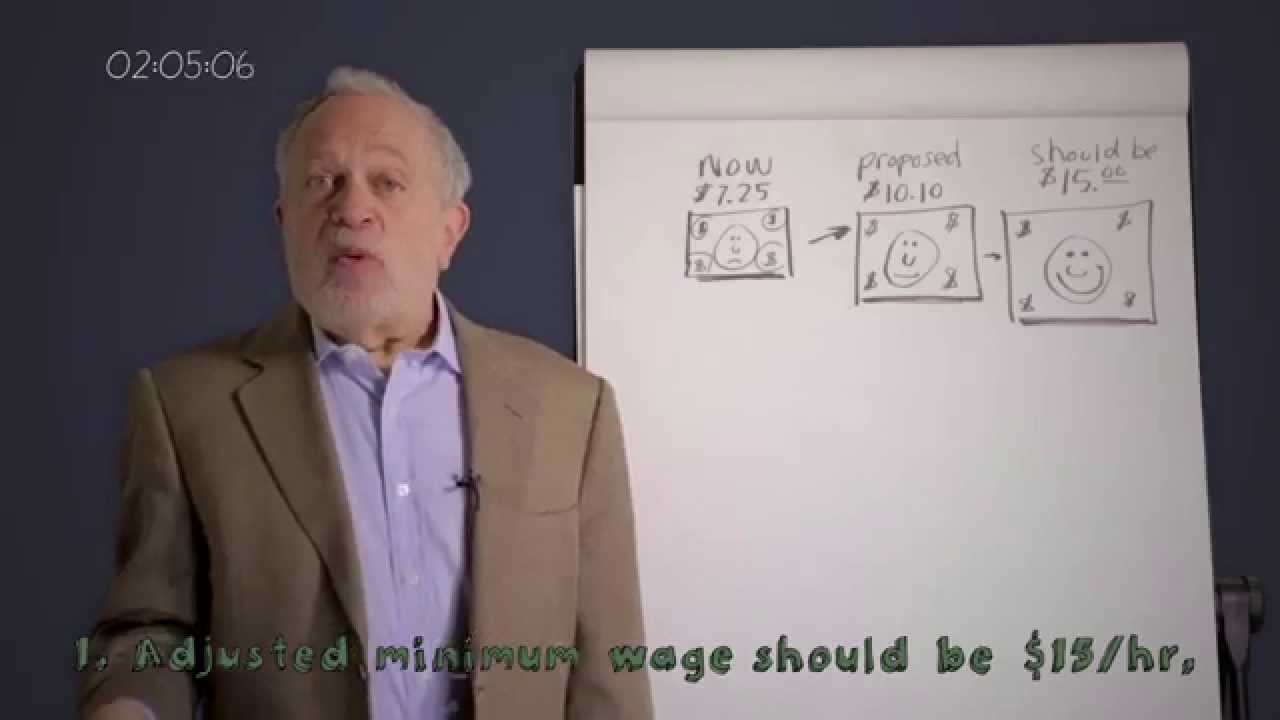
###
https://www.youtube.com/watch?v=GOqtl53V3JI
1.
May 29, 2014 - Uploaded by MoveOn
Robert Reich (The Morality of a $15 Minimum)
robertreich.org/post/131476708345
2.
Robert Reich (WHY THE MINIMUM WAGE SHOULD REALLY BE ...
robertreich.org/post/82134788482
2.
Robert Reich's Ridiculous Argument For A $15 Minimum Wage - Forbes
https://www.forbes.com/.../robert-reichs-ridiculous-argument-for-a-15-minimum-wag...
1.
Robert Reich: 7 Reasons Why the Minimum Wage Should Be Raised ...
https://www.alternet.org/.../robert-reich-7-reasons-why-minimum-wage-should-be-rais...
1.
Robert Reich makes the case for $15 minimum wage — Berkeleyside
https://www.berkeleyside.com/.../robert-reich-makes-the-case-for-15-minimum-wage/
Apr 17, 2015 - Fight for 15, the campaign for an increase in the minimum wage, hit the streets of Berkeley and Oakland yesterday. UC Berkeley Professor Robert Reich was at the center of the protest in Oakland's Temescal district in the morning. He gave a rousing, impromptu speech on the importance of the campai.
RICHARD BERMAN: The price of Robert Reich's $15 minimum wage ...
https://www.washingtontimes.com/.../richard-berman-the-price-of-robert-reichs-15-mi...
1.
A $15 an Hour Minimum Wage? Here's Robert Reich's Argument
==
http://www.alternet.org/republicans-several-states-are-lowering-minimum-wage-yes-you-read-right
ref reuters
‘Living wage’ law is unconstitutional – if you ask lobbyists
By Ron Fein October 6, 2014
Demonstrators rally to raise the hourly minimum wage to $15 for fast-food workers at City Hall in Seattle
Industry trade groups are now challenging Seattle’s new minimum wage law as unconstitutional. They claim the city’s $15 an hour rate violates the 14th Amendment. Passed just after the Civil War to ensure equal rights for the newly freed slaves, that amendment says no state may “deny to any person . . . the equal protection of the laws.”
:{
}:
According to the industry lawsuit, the minimum wage law violates this Equal Protection Clause because it phases in the higher wage at a different schedule for franchised companies than for small local businesses.
:{
}:
But the trade groups’ argument twists the real intent of the 14th Amendment. Its drafters had a special interest in whether workers could earn “fair, living wages,” our research has revealed. That phrase was often used by Senator Jacob Howard, a staunch Republican who served as the 14th Amendment’s Senate floor manager in 1866.
:{
}:
During congressional hearings, Howard repeatedly asked witnesses whether employers were paying the newly freed slaves “fair, living wages.”
:{
}:
Howard had reason to emphasize this point. Even before the Civil War ended, the Union Army was deeply concerned about whether freedmen were receiving fair wages. An 1865 Army work plan, for example, instructed officers to assist freedmen in obtaining “fair wages for their labor.”
Sometimes it was a struggle to achieve this. When employers in two recalcitrant South Carolina counties persisted in underpaying the freedmen, one Army general contemplated moving those counties’ entire freed population to areas that would pay them “fair wages.” By 1866, a special military unit established to assist freedmen during the post-Civil War Reconstruction had resorted to distributing standard labor contracts, with fixed labor rates, that would promote “prosperous relations between capital and labor” and be “satisfactory to the freedmen.”
Many Americans viewed “fair, living wages” as an integral part of the struggle from slavery to full citizenship. The influential abolitionist editor Horace Greeley — famous for his 1865 editorial that advised “Go West, young man” — wrote a widely reprinted open letter to “the Colored People of North Carolina” on September 14, 1865. He urged them to take immediate steps to demand “fair, living wages” as part of their larger struggle for equal rights.
So when members of the special congressional committee asked whether freedmen could earn fair or living wages, they understood the issue as intimately connected with the equality that the 14th Amendment ultimately enshrined.
That wasn’t the only concern behind the 14th Amendment, of course. But, unlike protection of the economic advantages that franchised businesses have over small local businesses, it was part of the 14th Amendment’s overall goals.
Given how important obtaining “fair, living wages” was to the 14th Amendment’s authors, industry lawyers have no basis to argue that the Equal Protection Clause protects the companies, rather than the workers. But it’s not surprising. Ever since the 14th Amendment was passed, corporate lawyers have tried to leverage it to strike down laws like Seattle’s.
:{
}:
In 1938, a frustrated Supreme Court justice complained that of the cases in the court in which the 14th Amendment was applied during the first 50 years after its adoption, “less than one-half of 1 percent invoked it in protection of the negro race, and more than 50 percent asked that its benefits be extended to corporations.”
Just this year, the Equal Protection Clause has been invoked on behalf of coal companies and multinational agribusiness conglomerates.
We need to put a stop to this unfounded constitutional argument. The businesses had their opportunity to make their case to the city of Seattle — and they lost. They shouldn’t be allowed to run to court under the banner of the 14th Amendment.
When Abraham Lincoln was just a rookie congressman, he wrote that securing “to each laborer the whole product of his labor, or as nearly as possible, is a most worthy object of any good government.” That’s what Seattle’s law does. Sixteen years after Lincoln wrote that, he vowed at Gettysburg to preserve a “government of the people, by the people, [and] for the people.” That’s what the industry’s lawsuit threatens.
The congressmen of Reconstruction sought to carry forward Lincoln’s legacy with the 14th Amendment. Their vision of full equality is not yet realized. But if they could see what Seattle is trying to achieve, they would be proud.
http://blogs.reuters.com/great-debate/2014/10/06/the-fight-for-living-wages-is-for-workers-not-corporations/
==
Should McDonald’s & Monsanto Have the Same Rights as People? A Debate on Corporate Personhood
Five years ago, the U.S. Supreme Court handed down its Citizens United v. FEC decision striking down the prohibition on corporate expenditures in federal elections. In a 5-to-4 decision, the Supreme Court ruled that corporations are people, with the same right to influence politics as voters. Meanwhile, many corporations including McDonald’s, Monsanto and Peabody Energy have cited the principle of corporate constitutional rights in recent efforts to fight back against new laws. McDonald’s and other franchises are suing the city of Seattle over its new $15-an-hour minimum wage law, arguing it violates its corporate personhood rights. They are basing their case on the 14th Amendment, a constitutional provision written to protect newly freed slaves after the Civil War and ensure equal rights for all people. Monsanto is challenging Vermont’s recently passed GMO-labeling law under the First Amendment, claiming that it forces them to "speak" against their will. We host a debate on the movement to draft a constitutional amendment to overturn the doctrine of corporate constitutional rights with two guests: Ron Fein, legal director at Free Speech for People, and Kent Greenfield,professor of law and Dean’s Research Scholar at Boston College Law School.
http://www.democracynow.org/2015/3/13/should_mcdonalds_monsanto_have_the_same
==
alternet 5/14
3. Oklahoma Bans Increases in the Minimum Wage
While the Obama administration raises the minimum wage threshold for private contractors working with the government, Democrats in Congress push for a $10.10 minimum wage, and Seattle votes in the country’s highest minimum at $15.00 an hour, Oklahoma is going in the exact opposite direction: not only is Oklahoma not considering a statewide increase, but it banned individual cities [6] from even considering such a raise on their own.
The move was widely viewed as a preemptive attack on a movement by the Central Oklahoma Labor Federation to raise the Oklahoma City’s wage to $10.10, in line with that being called for by President Barack Obama and congressional Democrats.
Oklahoma Governor Mary Fallin and her fellow Republicans in the legislature argued [7] the bill created a “level playing field for all municipalities in Oklahoma” and protected against “artificial” raises in the minimum wage, whatever those are.
"Mandating an increase in the minimum wage would…would create a hardship for small business owners, stifle job creation and increase costs for consumers," Fallin said. "And it would do all of these things without even addressing the goal of reducing poverty."
Not quite. The statistics on the relation of minimum wage to job creation or loss are murky, but most studies find raising the wage’s overall affect on employment to be negligible. Two things raising the minimum wage definitely does: increases earnings for lower-income workers (by $33 billion in the case of a nationwide raise to $10.10) and lifts almost one million people out of poverty. Neither is something metropolises in Oklahoma are going to find out about any time soon.
4. Oklahoma Punishes Solar and Wind Power Producers
Oklahoma wasn’t done. Unhappy with people who install their own solar panels or wind turbines, an action that helps the utilities by easing the pressure on the companies during peak hours, the state is now penalizing private energy producers through a surcharge [8].
The extra charge applies to those who sell excess energy generated by the panels or turbines back to the grid, known as net metering. It was snuck in as a rider on another bill at the last minute, catching lawmakers and alternative energy groups off guard. It passed without a single dissenting vote.
It didn’t take long for Oklahoman owners of small businesses to point out the absurdity of a law that punishes in-state producers of energy.
“Oklahoma offers tax credits for large wind turbines which are built elsewhere, but wants to penalize small wind which we manufacture here in the state?” Mike Bergey, president & CEO of Bergey Windpower said [8]. “That makes no sense to me.”
Who would support such a bill? The ultra-conservative advocacy group ALEC, which has framed people with solar panels as “freeriders on the system,” though they actually contribute to the city’s power resources. ALEC is in good with Fallin. Thanks to this cozy relationship, Oklahoma is set to become the first state to pass a law of this kind. Where states have deals worked out between utility companies and individual power generators, ALEC is set on repealing them. They now have a template in a last-minute sabotoage in Oklahoma.
In a March 31 letter, 20 trade associations that represent companies in the hotel, restaurant and other industries -- including theU.S. Chamber of Commerce, the National Restaurant Association and the National Federation of Independent Business-- wrote that "raising the minimum wage will be detrimental to job creation and low-skilled workers trying to get started on the economic ladder."
The political heft of the opposing trade groups will certainly make it tougher to get the bill through both houses of Congress. The groups have laid out huge amounts of money for both lobbying expenditures and campaign contributions in recent years, giving more than $5.5 million to Congress over the past two election cycles and spending more than $91 million on lobbying just last year.
There has been a noticeable Republican tilt to the donations, matching the party's general opposition to minimum wage hikes. Nearly 83 percent of the groups' contributions to candidates in the 2012 and 2014 cycles went to the GOP, a total of more than $4.7 million.
Below is a list of the trade groups, showing how much they have donated in both the 2012 and 2014 election cycles so far and how much they spent on lobbying last year. The chart does not include independent expenditures by the groups, which in some cases are vast: The U.S. Chamber of Commerce was the largest outside spender on the list, shelling out more than $36 million in the 2012 elections and about $2 million so far in the 2014 mid-terms.
Political Heft of Trade Groups on Anti-Minimum Wage Letter
| Trade Group | Total to Congress 2011-2014 | Lobbying, 2013 |
|---|---|---|
| American Hotel and Lodging Association | $400,450 | $1,310,000 |
| American Wholesale Marketers Association | $6,500 | $0 |
| Asian American Hotel Owners Association | $172,000 | $80,000 |
| Association of Kentucky Fried Chicken Franchisees | $176,250 | $120,000 |
| International Franchise Association | $979,159 | $745,000 |
| International Warehouse Logistics Association | $116,500 | $110,000 |
| National Association of Manufacturers | $0 | $7,620,000 |
| National Association of Wholesaler-Distributors | $176,513 | $586,782 |
| National Council of Chain Restaurants | $0 | $0 |
| National Federation of Independent Business | $921,352 | $1,047,000 |
| Petroleum Marketers Association of America | $293,875 | $680,000 |
| Professional Landcare Network | $14,000 | $0 |
| Society of American Florists | $73,500 | $0 |
| U.S. Chamber of Commerce | $289,925 | $74,470,000 |
| National Franchisee Association | $329,600 | $0 |
| National Grocers Association | $67,500 | $305,000 |
| National Office Products Alliance | $1,000 | $94,550 |
| National Retail Federation | $355,684 | $2,210,000 |
| National Restaurant Association | $1,218,000 | $2,238,691 |
| NATSO (truck stop/travel plaza operators) | $115,500 | $76,9 |