UPS
corp bad actor
heat death
keeling trump admin
---
3X JOB WHAMMY, DOGE CUTS, SHUTDN, TECH CUTS AI 11 25
AN 11 25 badash
'Really hurting': US job cuts surge to decades-high level amid Trump recession fears
Employers have cut over one million jobs so far this year, with announced layoffs surging in October to levels not seen in decades. Some experts have been warning about a possible recession.
“U.S. employers have announced 1.1 million layoffs so far this year — the largest reading since the pandemic recession and on par with 2008 and 2009 job cuts during the Great Recession,” The Washington Post reported on Thursday, pointing to a report from Challenger, Gray & Christmas, which tracks workplace reductions.
Major corporations have cut or are reportedly planning to cut thousands of positions this year:
UPS: 48,000 employees
Amazon: Up to 30,000 employees
Intel: 24,000 employees
Microsoft: 15,000 employees
Target: 1,800 employees
"Employers announced more than 153,000 job cuts last month, a 183 percent increase from the month before, marking the worst October for layoffs since 2003,” the Post reported, citing data from the Challenger report.
“The worst October in 22 years” is how CNN reported the news.
“We’re entering new territory with these layoffs in October,” Challenger CEO John Challenger told the Post. “We haven’t seen mega-layoffs of the size that are being discussed now — 48,000 from UPS, potentially 30,000 from Amazon — since 2020 and before that, since the recession of 2009. When you see companies making cuts of this size, it does signal a real shift in direction.”
Amid the job cuts, the “AI bubble,” President Donald Trump’s massive deportations and tariffs, record-high household debt, climbing automobile payment and consumer loan delinquencies, some believe a recession may be in America’s future.
“Employment has stalled, companies are announcing massive layoffs to appease Wall Street, and car repossessions just reached 2009 (recession) levels,” wrote economics professor and managing director of an economic consulting firm, Hal Singer, just last week. “The GDP numbers mask real suffering in the economy. And the only fiscal tool in the Trump policy kit are tax cuts for the wealthy. This could get ugly.”
Late last month Moody’s Analytics Chief Economist Mark Zandi said 22 U.S. states are already in a recession, Moneywise reported.
"While Zandi did emphasize that the U.S. is not in a recession just yet, he told MarketWatch that ‘we’re on the precipice,’ blaming much of the problem on President Trump’s tariffs and federal job cuts.”
“A growing number of states are struggling, some already in recession, others right on the edge,” Zandi wrote. “Together, they account for nearly a third of U.S. GDP. The national economy isn’t there yet, but it’s clearly losing steam.”
Pointing to a list of ten major corporations’ jobs cuts, U.S. Senator Elizabeth Warren (D-MA) last week declared, “This is Donald Trump’s economy.”
CNN Thursday morning reported that a “brand new report is out … and it shows layoff announcements hit their highest level for October in over 20 years.”
“It’s painting a picture of a job market that is really hurting,” CNN’s Matt Egan noted.
===
MMA
Project 2025 laid a foundation for Trump’s attacks on workplace safety
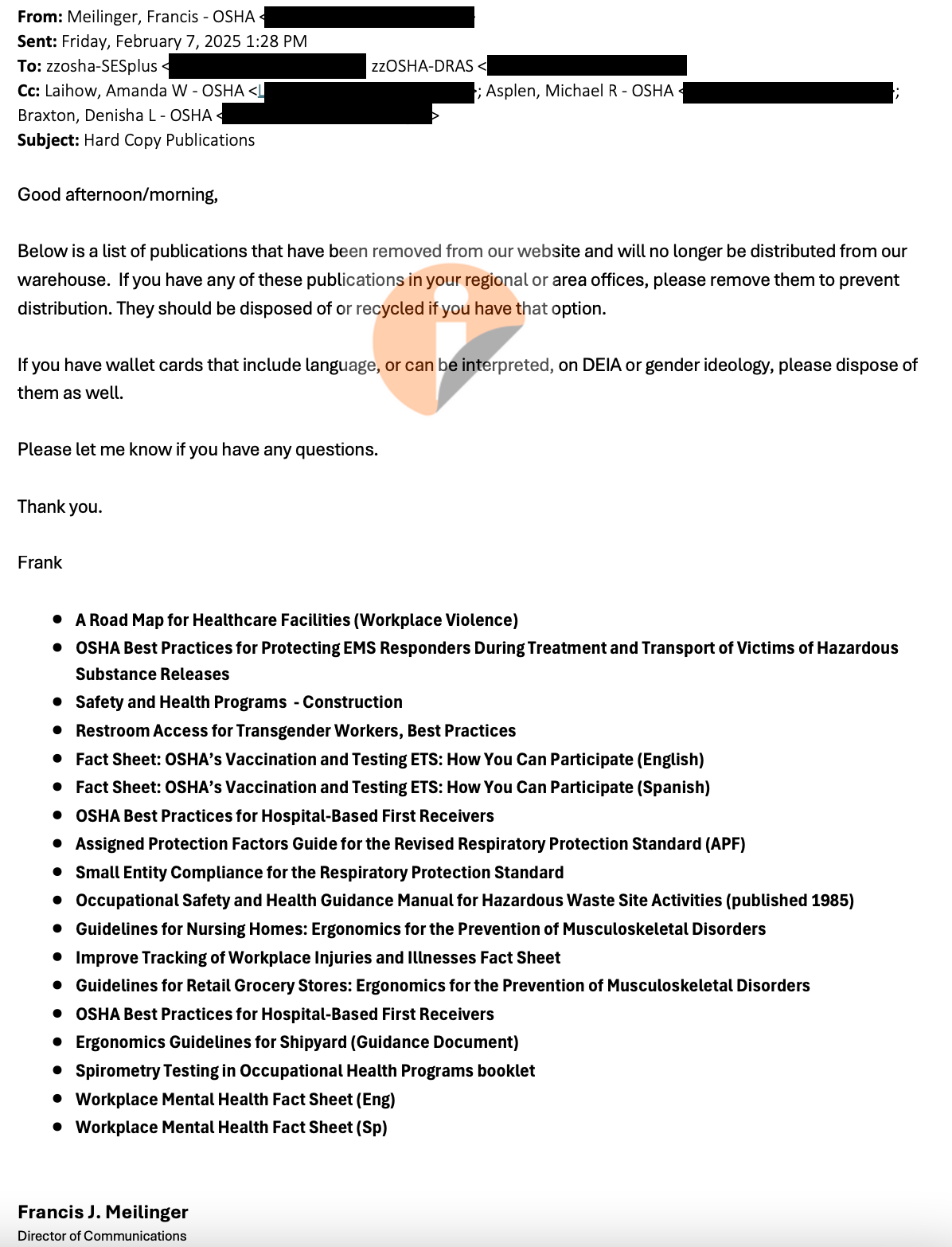
The Trump administration reportedly destroyed 18 publications from the Occupational Safety and Health Administration as part of a larger DEI purge. Most of the guidelines had nothing to do with diversity initiatives.
Written by John Knefel
Published 02/20/25
The Trump administration has reportedly destroyed 18 workplace safety publications as part of a broader attack on diversity initiatives, a development that is largely in line with recommendations made by the sprawling and unpopular presidential transition plan known as Project 2025.
According to Popular Information, 17 of the destroyed workplace guidelines — issued by the Occupational Safety and Health Administration — appeared to have nothing to do with diversity, equity, inclusion, and accessibility programs and instead seem to have been selected because “they include a DEIA-related keyword used in a completely different context.” OSHA is part of the Labor Department and is tasked with making sure U.S. workers “have safe and healthful working conditions free from unlawful retaliation,” according to its official website.
The Trump administration has been targeting diversity programs across the federal government, in some instances using the existence of DEI efforts as a justification for essentially shuttering entire agencies, as in the case of the U.S. Agency for International Development.
The administration’s anti-DEI approach mirrors recommendations made in Project 2025’s nearly 900-page policy book, *Mandate for Leadership*, which called for the elimination of federal DEI programs and for the Department of Justice to investigate private sector programs that promote diversity.
In addition to its direct attacks on DEI, Project 2025 — organized by The Heritage Foundation in collaboration with more than 100 partner groups — proposed drastic rollbacks of labor laws, including dismantling overtime regulations and creating exemptions to the National Labor Relations Act, which protects workers’ rights to collectively bargain and to form a union.
Although the Trump administration’s memo calling for the 18 safety guidelines to be “disposed of or recycled” appears to be a hamfisted and failed attempt to root out DEI programs, it nevertheless fits in with Mandate’s broader approach to dismantling worker protections.
For example, Mandate recommends carve outs to OSHA’s workplace safety regulations, calling on Congress and the Department of Labor to “exempt small business, first-time, non-willful violators from fines issued by the Occupational Safety and Health Administration.”
Mandate further argues that “national employment laws,” like the Occupational Safety and Health Act of 1970, “set out one-size-fits-all ‘floors’ regulating the employment relationship,” and that the protections the law provides could instead be “treated as negotiable defaults rather than non-negotiable floors.” If enacted, this recommendation could allow employers to use safety measures as leverage in contract negotiations, thus increasing the already stark asymmetry in power between workers and bosses. And U.S. workplaces are already deadly; according to the AFL-CIO, in 2022: “344 workers died each day from hazardous working conditions,” and “5,486 workers were killed on the job in the United States.”
The final chapter in Mandate calls on the president to order Cabinet secretaries to “rein in agencies such as the Occupational Safety and Health Administration, which the Biden Administration weaponized to attempt to force COVID-19 vaccine mandates on 84 million Americans through their workplaces.”
That demand built on previous work from The Heritage Foundation, which sued the Biden administration over its Covid-19 workplace vaccine mandate. After the Supreme Court blocked the mandate, Heritage President Kevin Roberts celebrated the decision on former Trump lawyer Jay Sekulow’s radio show. Sekulow is also chief counsel at the American Center for Law and Justice, whose advocacy arm is a partner in Project 2025.
“When it comes to putting government back in the box, it is a series of battles,” Roberts said. “We have won one battle, but we have not won the political and policy war.”
Video
Citation
From the January 14, 2022, edition of Sekulow, streamed on YouTube
Whether the administration adopts the anti-working class OSHA policies in Mandate remains to be seen, but Trump’s pick to head the agency — former Amazon and UPS executive David Keeling — strongly suggests it’s possible. As The New Republic reported, Keeling’s recent job history does not bode well for worker safety:
Both of those companies have been cited for various workplace safety violations by the very agency Keeling is set to control, if confirmed by the Senate. In 2019, OSHA cited UPS for forcing its drivers to work in “excessive heat” with no air conditioning. That same year, UPS was also cited for fire hazards at packaging facilities. Amazon has been cited numerous times for the dangerous, high-pressure environments in its warehouses, as well as the long hours its employees are forced to spend in them. Just last year, Amazon paid a $145,000 settlement over OSHA violations.
Keeling worked as director of safety compliance for UPS from 2011 to 2018 before serving as the vice president of global health and safety from 2018 to 2021, overlapping with OSHA’s 2019 safety citations. The same can be said for Amazon, where he worked from 2021 to 2023—a time when Amazon had one of the highest warehouse injury rates in the country.
Keeling’s nomination hearing has not yet been scheduled, but elsewhere the Trump administration is already waging war on the working class. His pick as general counsel for the National Labor Relations Board just rolled back several major Biden administration policies, including protections for student athletes who want to unionize and guidance that determined most non-compete agreements violate federal labor law.
Many of the Trump administration’s opening salvos against the working class have followed the Project 2025 roadmap and targeted DEI programs. These measures are already making workers’ positions more precarious and less safe, just as Project 2025 recommended.
===
an 6 24
four years after the United States' 2020 presidential race, former President Donald Trump and many of allies continue to make the false, repeatedly debunked claim that the election was stolen from him. And prominent GOP members of Congress, including Rep. Elise Stefanik (R-New York), will not commit to accepting the 2024 election results if President Joe Biden is reelected in November.
Since 2021, the watchdog group Citizens for Responsibility and Ethics in Washington (CREW) has maintained a "sedition tracker" that monitors corporations and political figures who promote the Big Lie and election denialism in some way. And according to an announcement published on June 4, CREW is modifying its system for exposing Big Lie supporters in either government or business.
"In order to more precisely track companies' political giving to members of Congress who are undermining democracy," CREW explains, "we have created a new system for scoring companies' support for democracy based on how much they are giving to members who have done the most to undermine it. Only companies that donated to the 168 members who ran on the Big Lie or voted to overturn the 2020 election are included, but the gifts are weighted to differentiate between those who have gone even further to advance the Big Lie and undermine democracy, both in the leadup to January 6th and since."
READ MORE: ['All she has to do is shut up': Ex-GOP rep skewers RNC chair for risking Senate over Trump 'vanities'
According to CREW, the criteria includes: (1) "voted against certification of the 2020 election results or ran on the Big Lie," (2) "voted against establishing the January 6th Committee," (3) "supported" Texas Attorney General Ken Paxton's lawsuit to overturn the 2020 election results in four states that Biden won, (4) "supported absolute immunity for presidents," and (5) "voted against second Trump impeachment."
"The data on this page will be updated as new filings come in and are processed," CREW notes. "To create our company scores, we use these criteria to weight each member's relative anti-democracy rating, and then use that coefficient to calculate each donor company's score."
CREW lists some of the companies that have the "worst scores" when it comes to democracy.
The top five companies CREW names are Koch Industries, AT&T, American Crystal Sugar, Lockheed Martin and United Parcel Service (UPS).
READ MORE: Ex-federal prosecutor slams Mar-a-Lago docs judge’s 'dangerous and disingenuous' claims
*Read CREW's full announcement at this link.
===
odd that ups and fedex both made top 7 evil? in compet w/ USPS?{nl}https://www.alternet.org/2022/07/billionaires-gop-congress/{nl}{nl}no lnx table grfx{nl}{nl}Just 27 billionaires have spent $90 million to buy GOP congress: report{nl}{nl}[ brk windows london? ]{nl}Rupert Murdoch receiving the 2015 Global Leadership Award, Wikimedia Commons{nl}{nl}Kenny Stancil and Common Dreams July 19, 2022{nl}{nl}A few dozen billionaires are spending tens of millions of dollars on the 2022 midterm elections—mostly to support Republican candidates, including many who have parroted the dangerous lie that the 2020 presidential election was stolen—in a bid to ensure that Congress is full of lawmakers willing "to make their wealthy benefactors even richer," according to a fresh analysis.{nl}{nl{Titled Billionaires Buying Elections, the report from Americans for Tax Fairness (ATF) details how "billionaires are increasingly using their personal fortunes and the profits of connected corporations to drown out regular voters' voices and elect hand-picked candidates who further rig the nation's economy—especially the tax system."}nl}{nl{A pair of super PACs tasked with securing Republican majorities in the House and Senate—the Congressional Leadership Fund (CLF) and the [cnp?] Senate Leadership Fund (SLF)—raised a combined $188.3 million through the first 16 months of the 2022 campaign cycle, according to ATF. }:Nearly half—$89.4 million, or 48%—came from just 27 billionaires. A whopping 86% of the GOP's billionaire money came from "Wall Street tycoons" who are arguably the biggest beneficiaries of glaring loopholes in the tax code.{nl}{nl}The Democratic counterparts of those two super PACs—the House Majority PAC and the Senate Majority PAC—raised a combined $154 million over the same time period. A smaller share—$25.8 million, or 17%—came from 19 billionaires. A majority of billionaire contributions to Democratic candidates also came from the finance and investment sector (35%), but other industries were also well-represented, including cryptocurrency (26%), and tech (18%).{nl}{nl}"Unlike candidates and party committees, super PACs can raise unlimited donations from individuals and corporations," ATF explained. "In return they are not supposed to coordinate activities with the campaigns they support but instead act independently, though that rule is often flouted."{nl}{nl}Top billionaire donors to congressional super PACs include hedge fund magnate Ken Griffin, who has given more than $28.5 million to CLF and SLF, and private equity mogul Stephen Schwarzman, who has pumped $20 million into the GOP's two super PACs.{nl}{nl}"Anti-democratic vote-buying," ATF wrote, "has been facilitated by—and is facilitating—the accelerating wealth growth of the billionaire class and the record profits of the corporations they own."{nl}{nl}The combined net worth of the nation's roughly 750 billionaires surged by $2 trillion, or 70%, during the first two years of the Covid-19 pandemic. The collective wealth of the 27 billionaires bankrolling the GOP's super PACs alone soared by $82.4 billion over that time period, meaning that the $89.4 million they have donated to CLF and SLF constitutes less than 0.1% of their overall pandemic-era gains.{nl}{nl}Meanwhile, the return on that modest investment could amount to billions of dollars if Republicans take back Congress in November and preserve their 2017 tax cuts or further slash taxes on superrich people and the corporations they own.{nl}{nl}Over a recent nine-year period, the 400 wealthiest people in the U.S. paid an average effective federal income tax rate of just 8.2% when the increased value of their stock holdings is included in their income. That is a lower rate than the nationwide average of 13.3% in 2019.{nl}{nl}As ATF explained, focusing on contributions to congressional super PACs fails "to capture the full political influence of billionaires, who in addition to personal donations also steer money to favored candidates from related corporations and organizations."{nl}{nl}Billionaires are among the ultrawealthy Americans who control corporations through their extensive stock holdings. Many corporate giants have been distorting the upcoming midterms, ATF pointed out, by spending tens of millions to help GOP candidates who have vowed to defend special tax breaks for the top 1% get elected, including 144 far-right members of Congress who voted to overturn President Joe Biden's electoral victory.{nl}{nl}According to the report, seven powerful corporations—AT&T, Chevron, ExxonMobil,FedEx, GM, Merck, and UPS—have collectively given nearly $1.5 million to dozens of election deniers and various Republican PACs and election committees this campaign cycle. The companies' demonstrated lack of concern for democracy, ATF noted, likely stems from their desire to keep dodging taxes. In 2021, these firms paid an average federal income tax rate of just 2.7% on a combined $78.4 billion in profits.{nl}{nl}Notably, Peter Thiel, the co-founder of PayPal who is worth about $5 billion and openly opposed to democracy, has been spending big on his preferred Republican candidates but not through the GOP's congressional super PACs.{nl}{nl}Thiel "has so far spent almost $30 million through super PACs supporting the 2022 senatorial bids of two former employees who share his anti-democratic and anti-tax beliefs," ATF found. "J.D. Vance won the Ohio Republican U.S. Senate primary thanks in part to Thiel's $15 million in spending. Blake Masters has a fighting chance in Arizona's GOP U.S. Senate primary in August due to Thiel's $13.5 million in contributions."{nl}{nl}Another source of "billionaire dominance of campaign financing, especially on the Republican side," wrote ATF, are so-called "dark money" groups, which are not required to disclose the identity of their donors. Some dark money groups—including Club for Growth, which has received $32 million from billionaire Wall Street trader Jeffrey Yass over the years—are "notorious for having bankrolled insurrectionist members of Congress" like Sen. Josh Hawley (R-Mo.) and Lauren Boebert (R-Colo.), ATF noted.{nl}{nl}According to the reportnl}{nl}Politically active billionaire Charles Koch has not personally donated to either GOP super PAC this cycle, but his corporation—Koch Industries—has so far given them a total of $1.75 million.{nl}{nl{Two of the biggest "dark money" groups, which do not disclose their donors, are essentially sister groups to thetwo congressional GOP super PACs. American Action Networkgave at least $26 million to CLF in the 2020 cycle and $18.7 million so far this cycle.One Nation donated $77.5 million to SLF last cycle and has given $16.5 million so far this cycle.}nl}{nl{The ability of the nation's wealthiest individuals to translate their disproportionate economic power into political clout has increased exponentially since the U.S. Supreme Court's 2010 Citizens United decision eliminated effective limits on campaign contributions.}nl}{nl}{nl}According to the reportnl}{nl}Billionaires pumped $1.2 billion into the 2020 elections, almost 40 times more than the $31 million they donated in 2010, when the Citizens United rules were first in effect. In the 2020 election cycle, billionaires contributed nearly $1 out of every $10, while making up just 0.01% of all donors contributing more than $200.{nl{Billionaires donated almost $240 million to the combined campaign efforts of Donald Trump's two runs for president. Over half came from just one billionaire household, that of casino magnate Sheldon Adelson (who has since died).{nl}"Billionaires, who are used to buying whatever they want, have increasingly dedicated their almost unlimited resources to buying American elections," Frank Clemente, executive director of ATF, said in a statement.{nl}{nl}"The problem is what's good for billionaires—including cutting taxes on the rich and corporations—is bad for working families," said Clemente. "We need to rein in billionaire political and economic power through campaign finance reforms and tax reforms such as a billionaires income tax."{nl}{nl}Several legislative proposals have emerged to tax the increased value of assets owned by the nation's wealthiest households each year regardless of whether they sell or keep them, which would ensure that income derived from wealth is taxed more like income earned from work.{nl}{nl}{nl}Biden's plan would raise an estimated $360 billion over 10 years, while Sen. Ron Wyden's (D-Ore.) plan would raise an estimated $550 billion over a decade, and Rep. Jamaal Bowman's (D-N.Y.) proposal possibly even more.{nl}{nl}Billionaire-backed Democratic Sen. Joe Manchin (W.Va.), however, has joined Senate Republicans in opposing such a measure.{nl}{nl}={nl}https://www.alternet.org/2022/09/ups-strikes-drivers-collapse-heat/{nl}={nl}note ripple effectnl}As it moves into package delivery, Amazon is bringing its labor model along, relying in part on Amazon Flex drivers, who use their own vehicles, take directions from an app, and are paid a piece rate for each batch of boxes they deliver. The impacts are already being felt at the US Postal Service and UPS, whose hundreds of thousands of unionized employees constitute one of the last surviving corners of the working middle class. A few months ago, over the objections of the Teamsters union, UPS began placing ads for drivers who will use their own vehicles.{nl}={nl}https://www.alternet.org/news-amp-politics/save-us-postal-service-heres-corrupt-scheme-privatize-precious-american{nl}Unable to find a fatal flaw in our far-flung public mail delivery network, the anti-Postal Service forces manufactured a fake flaw. In 2006, then-president George W. Bush, congressional Republican leaders, the powerful "privatizer lobby" (including FedEx, UPS and Wall Street speculators) and Koch-funded think tanks and Astroturf front groups colluded to put a one-of-a-kind paper "debt" on the books of USPS. Congress enacted a postal-service "enhancement" provision requiring the public postal corporation to pre-fund the health and pension benefits for all postal-service retirees 75 years in advance! Think about that. This arbitrary, wholly unprecedented, legislated requirement to pay now for the retirement benefits of future employees (including those not even born yet) has piled a false cost of about $5 billion a year on the debit side of the agency's balance sheet.{nl}... jim h{nl}{nl}{nl}December 6th, 2017 at 3:55 PM (CST){nl}Credo Action delivered a petition to the United Parcel Service with 84,453 signatures earlier today asking the company to dump the American Legislative Exchange Council.{nl}{nl}We're spreading the word about #DisruptDenial at the march — and delivering UPS a special message. UPS calls itself "green," but since 2008, they've spent $1.97 million to bankroll climate deniers in Congress. This year alone, UPS has contributed more to deniers than either ExxonMobil or Chevron. So today, #DisruptDenial is bringing the climate march to UPS. 9/14{nl}==={nl}Exclusive: Conservative group offers support for $2M{nl}:{By: Mike Allen{nl}July 17, 2009
The American Conservative Union asked FedEx for a check for $2 million to $3 million in return for the group’s support in a bitter legislative dispute, then the group’s chairman flipped and sided with UPS after FedEx refused to pay.}:
{nl}For the $2 million plus, ACU offered a range of services that included: “Producing op-eds and articles written by ACU’s Chairman David Keene and/or other members of the ACU’s board of directors. (Note that Mr. Keene writes a weekly column that appears in The Hill.)”{nl}The conservative group’s remarkable demand — black-and-white proof of the longtime Washington practice known as “pay for play” — was contained in a private letter to FedEx , which was provided to POLITICO. {nl}{nl}The letter exposes the practice by some political interest groups of taking stands not for reasons of pure principle, as their members and supporters might assume, but also in part because a sponsor is paying big money.{nl}In the three-page letter asking for money on June 30, the conservative group backed FedEx. After FedEx says it rejected the offer, Keene signed onto a two-page July 15 letter backing UPS. Keene did not return a message left on his cell phone.{nl}Maury Lane, FedEx’s director of corporate communications, said: “Clearly, the ACU shopped their beliefs and UPS bought.” {nl}{nl}ACU's executive vice president, Dennis Whitfield, said that neither the group nor David Keene, the chairman, took any money from UPS. Whitfield said the group has never received a response to its original proposal to FedEx. He said Keene endorsed the second letter as an individual, even though the letter bore the logo of ACU. {nl}{nl}"Our position hasn't changed," said Whitfield, who was a deputy secretary of labor in the Reagan administration. "It won't change. I am fundamentally, philosophically opposed to doing what the Obama administration wants to do [to FedEx], and so is our organization."{nl}FedEx and UPS, fierce competitors in the package delivery business, are at war over a provision under consideration in Congress that would expand union power at FedEx.{nl}FedEx currently has one U.S. union contract for its entire express business. Under a change passed by the House and awaiting action in the Senate, FedEx — like UPS — would have to negotiate union contracts for individual locations, which FedEx claims would make it much more difficult to promise worldwide regularity for deliveries.{nl}The American Conservative Union, which calls itself “the nation's oldest and largest grass-roots conservative lobbying organization,” took UPS’s side on Wednesday as part of a conservative consortium that accused FedEx of “misleading the public and legislators.” ACU's logo is at the top of the letter, along with those of six other conservative groups.{nl}Just two weeks earlier, ACU had offered its endorsement to FedEx, saying in a letter to the company: “We stand with FedEx in opposition to this legislation.”{nl}But there was a catch — an expensive one. ACU asked FedEx to pay as much as $3.4 million for e-mail and other services for “an aggressive grass-roots campaign to stop the legislation in the Senate.”{nl}“For the activist contact portion of the plan, we will contact over 150,000 people per state multiple times at a cost of $1.39 per name or $2,147,550 to implement the entire program,” the letter says. “If we incorporate the targeted, senator-personalized radio effort into the plan, you can figure an additional $125,000 on average, per state” for an estimated 10 states. The total would be $3,397,550.”
{nl}The letter shows one reason why activists get so much junk mail, both on paper and electronically: Some groups that send it charge handsomely for the service.{nl}Under the grass-roots program ACU proposed, “Each person will be contacted a total of seven times totaling nearly 11 million contacts total in the 10 targeted states.” “Within 72 hours of an agreement on the whole plan, we can have the data sets delivered and the first round of e-mail ready for delivery,” the offer states. “Within seven days, the mail can be in the USPS system and the phone call delivered.”{nl}{nl}Lane, the FedEx official, said the offer was refused. "The proposal didn’t fit with our strategy of taking a straightforward approach to discussing the issue,” he said.{nl}After the rebuff, American Conservative Union changed sides. ACU Chairman David A.Keene was one of eight conservative leaders who signed a letter to FedEx Chairman Frederick W. Smith, a champion of capitalism who in the past has been a favorite of conservatives.{nl}The letter accuses FedEx of “falsely and disingenuously” labeling the rules change a“bailout” for UPS, since FedEx would become subject to the same arduous union structure.{nl}The letter is also signed by Grover Norquist, president of Americans for Tax Reform, who is also on ACU’s board. FedEx is pushing its case with a website calledwww.BrownBailout.com.{nl}The letter signed by the conservative leaders concludes: “To paraphrase the words of Ronald Reagan, ‘Mr. Smith, tear down this website.’”
{nl}Among the services ACU had offered to provide for the $2 million-plus price tag: {nl}{nl}—Acquiring data of known conservatives in the targeted states (to be determined by FedEx), matching that data to an e-mail database and then incorporating those e-mail addresses with the current ACU e-mail database to create one targeted database of all potential activists. {nl}{nl}—Sending a piece of targeted direct mail to these potential activists to ensure that they are well-educated prior to their contact with their senators. {nl}{nl}—E-mailing the identified voter activists, in five rounds, in order to educate them on the issue(s) and to urge them to call their senators based on key dates. The ACU would include the phone number of their personal senators directly in the correspondence.{nl}—Conducting targeted phone call campaign that will contact all voter activists to urge them to make a personal call to their senators. Each state would have a specialized message just for that state.{nl}—Encouraging activists who live within 30 miles of a senator’s district office to consider making a personal visit to register their concerns at the office. ACU has proved that we can turn out well-informed, quality voters who present a good image to represent our concerns.{nl}—As the vote for the legislation nears, distributing ACTION ALERT e-mails, and after the vote has taken place, distributing MegaVote e-mails to ACU’s members letting them know how their senators vote.|