RAGA 3
6 22
no merri
50k from rfk2?!
see ESG
see ROLF
SEE PFAS FOREVER 3M STRANGE AND MARSHALL
see team red trump red tie brigade ~ bragg
SEE FED PRE-EMPT STATE LAW API OKLA UTAH 1 26
see leo barre seid teneo--> brenna bird iowa koch fertilizer
see heartbeat
see disinfo suppression attacks eg SIO
see voter suppression
see steven marshall alabama
QUESTION: 4 24 HOW AND TO WHAT DEGREE DOES RAGA TEAM RED COORDINATE WITH FF CORPS/ TRADE GP API AFPM NAM? JUST AMICUS? COC HAS LEGAL SHOP
---
---
2018 3M
political-chemicals-cleanup-3m-1012445
By Annie Snider11/23/2018
Chemical industry giant 3M is waging an aggressive campaign to stave off new regulations and potentially billions of dollars in damages stemming from a contamination crisis that has fouled tens of millions of Americans’ drinking water.
The Minnesota-based company is putting its lobbying muscle to work in Washington and courting the support of state attorneys general as it faces potentially massive financial liability for toxic pollution linked to two of its nonstick and water repellent chemicals, which have turned up in the water supplies of more than 1,500 U.S. communities.
A key component of 3M’s campaign to fend off government action is a new industry advocacy group that began weighing into the debate this summer, arguing that the chemicals don’t pose a health threat — a conclusion that numerous government agencies and independent studies have disputed. The industry group’s efforts to raise doubts about the science have caused alarm among public health watchdogs who call them reminiscent of the tobacco industry’s old playbook.
3M’s combative posture contrasts with a more conciliatory approach taken by other giant companies that have been implicated in the pollution crisis, as well as the industry’s primary lobbying group, the American Chemistry Council. Those organizations have supported federal efforts to evaluate and regulate the chemicals, banking on the Trump administration to deliver industry-friendly rules.
But as the chemicals’ original and biggest manufacturer, 3M faces a different scale of risk.
A glimpse at the scope of its potential liability emerged in February, when 3M reached an $850 million settlement with Minnesota for damage the company’s chemicals caused to the state’s drinking water. New York state soon filed its own lawsuit, and outgoing Republican Michigan Gov. Rick Snyder asked his state’s attorney general to pursue litigation as well. Meanwhile, dozens of other personal injury, class-action and property damage lawsuits are piling up against the company across the country. Altogether, industry experts say the company’s liability could reach the tens of billions of dollars.
Joshua Aguilar, an equity analyst with Morningstar, said analysts view the Minnesota settlement as a one-off event, at least for now, but that the litigation from other states and class-action suits could threaten the company’s value.
“If you have different jurisdictions where this becomes serious, you have to settle one, you have to settle another, it becomes a contagion effect,” he said.
The chemicals, known as PFOA and PFOS, have been used for five decades in products ranging from firefighting foam to Teflon to 3M’s signature Scotchgard. They take years to break down in the environment, giving them the nickname “forever chemicals.” They also accumulate in human bodies, where they have been linked to kidney and testicular cancer, immune disorders and other ailments — and have been found in more than 99 percent of Americans’ blood.
Communities from New York to Michigan to Colorado have been in an uproar as more contaminations have come to light. Earlier this year, POLITICO reported that the Trump administration sought to block a federal study finding they pose a danger at lower levels than the EPA previously deemed safe — a conclusion one White House said warned could be “a public relations nightmare.” That study, published by an agency of the CDC, finally came out this summer.
3M did not respond to multiple questions from POLITICO about its political activity and lobbying around the chemicals, which are part of a broader category of substances known as PFAS. But it acknowledged its membership in the new advocacy group, the Responsible Science Policy Coalition, as well as being a member of other business-oriented organizations such as the U.S. Chamber of Commerce, the National Association of Manufacturers, the Business Roundtable and the American Chemistry Council.
“3M is a technology and manufacturing company committed to scientific research and environmental stewardship,” company spokesperson Fanna Haile-Selassie said in a statement. She noted that the company, which lobbies on a wide variety of topics from taxes to health care, “voluntarily discloses its political activities and the public policy reasons behind them.”
An industry source with knowledge of the Responsible Science Policy Coalition said 3M is its main backer.
3M’s political action committee poured money into state-level campaigns this year including to attorney general candidates in Michigan, Ohio, California and Alabama — all states with major PFAS contaminations. The company also made its first contributions since at least 2013, totaling more than $36,000, to the Republican Attorneys General Association and its Democratic counterpart. Those groups, in turn, donate millions to their parties’ candidates for state attorney general without disclosing which contributions were directed by which corporate donors.
Some attorneys general have proven receptive to the company’s message.
In Alabama, where the chemicals made by 3M’s manufacturing plant in Decatur have contaminated the Tennessee River, a drinking water source for 4.7 million people, the freshly reelected attorney general has refused to join a drinking water utility’s lawsuit against the company. GOP Attorney General Steve Marshall received $2,000 from 3M’s political action campaign, and RAGA gave $735,000 during his bruising primary — a contribution that both Republicans and Democrats in the state argue violates Alabama’s ban on contributions between political action committees. Records do not indicate whether 3M directed any of its RAGA donations to him.
The northern Alabama water utility that supplies some of the state’s poorest communities with water drawn from just downstream of the 3M plant has sued the company over the contamination. The water utility’s manager formally requested Marshall’s help in the litigation an Oct. 12 letter, and said that Marshall’s predecessor, former Alabama Attorney General Luther Strange, had been collaborating with the water utility on the issue before Strange was appointed to the state’s open U.S. Senate seat in February 2017. But Marshall told a Huntsville television station last month that he is trying to determine whether his office has a role in the contamination case, WHNT-TV reported.
“I’m not the environmental watchdog,” he told the station. “My job is to make sure that we enforce the laws and do things that are appropriate for the people of this state.”
Marshall’s office declined to respond to POLITICO’s queries about the campaign contributions or his stance on the lawsuit.
State attorneys general were also the audience for the first public appearance of the Responsible Science Policy Coalition.
The coalition’s lobbyist warned against acting too fast to regulate the chemicals when he spoke on a panel at the Conference of Western Attorneys General in New Mexico in July.
“So much of what you see in emerging chemicals is people jump forward because of public pressure and things like that, make decisions, but then as more science emerges, we realize, ‘Oh, maybe that wasn’t the right decision,’ and it’s very hard to pull things back once you’ve done them,” lobbyist Jonathan Gledhill told the attorneys general, according to  posted online by the conference.
Representatives of the coalition have also met with several congressional offices and EPA political appointees in recent months, arguing that “the weight of current scientific evidence does not show that PFOS or PFOA cause adverse health effects in humans at current levels of exposure.” That conclusion flies in the face of findings by leading independent scientific researchers, EPA and the CDC.
The lobby group contends it is simply interested in assuring a sound process.
“The Coalition supports EPA’s ongoing efforts to evaluate and develop appropriate regulations and guidance for PFAS and to collaborate on testing, remediation and research that will help assist federal agencies, states and communities to more comprehensively evaluate PFAS occurrences,” coalition attorney James Votaw said in a statement to POLITICO.
But Michael Halpern, deputy director of the Center for Science and Democracy at the Union of Concerned Scientists, called the strategy a classic industry approach to delaying and undermining regulations.
“The goal is to stave off regulation by questioning the science,” Halpern said. He likened the new industry group to a similarly named organization, the Advancement of Sound Science Coalition, that the tobacco industry used in the early 1990s to attack EPA’s findings on secondhand smoke.
Briefing materials from the Responsible Science Policy Coalition obtained by POLITICO feature charts comparing the average concentration of the chemicals in Americans’ blood with the levels at which the chemicals have been found to harm animals in industry-backed studies. The implication is that humans’ exposure is far below the level that causes harm.
But David Savitz, an epidemiologist at Brown University’s School of Public Health, called the approach “disingenuous.” He said scientists recognize that humans’ bodies aren’t the same as those of lab animals, and they adjust the comparisons to account for those differences.
Moreover, he said, looking at the average person’s exposure is misleading because people living near contaminated hotspots, like manufacturing sites or military bases, have far higher risks.
Indeed, 3M’s own internal documents, which were handed to the Minnesota attorney general’s office as part of the lawsuit that settled in February, show that the company has known since the 1970s that the chemicals were toxic, according to reporting by The Intercept.
The coalition’s efforts to question the chemicals’ harm have set off alarm bells on Capitol Hill, where Sen. Tom Carper of Delaware, the top Democrat on the Senate Environment and Public Works Committee, pressed Trump administration officials during a recent hearing to dispute the group’s arguments that the chemicals aren’t linked to illnesses.
“What this country needs is responsible regulation to protect the public’s health and the environment, not more efforts to delay solutions and downplay risks,” Carper said in a statement to POLITICO.
3M’s campaign against government regulation has even caused concern from others within industry. DuPont, which faces major liabilities for PFOA, and the industry’s biggest lobbying group, the American Chemistry Council, have backed EPA’s efforts to evaluate and regulate the chemicals, banking on the Trump administration to write the most industry-friendly regulations that they can hope for.
“You are never going to have a more favorable administration than this administration to set standards,” a person in the industry said, speaking on the condition of anonymity to discuss internal industry discussions. “It doesn’t get any better than this.”
Former EPA Administrator Scott Pruitt committed to taking the first step toward potentially regulating PFOA and PFOS in drinking water and setting cleanup standards. His successor, acting Administrator Andrew Wheeler, has reiterated that pledge.
Asked about agency officials’ meetings with 3M and the new coalition, EPA spokeswoman Molly Block said they have met with a “variety” of individuals and officials about the chemicals. She said the agency will issue a plan that outlines short- and long-term steps for dealing with the chemicals.
Still, a version of the strategy 3M is deploying at the national level has already borne fruit in the company’s home state of Minnesota. There, years before this February’s hefty legal settlement, 3M persuaded lawmakers and regulators to pull back from formally declaring the chemicals hazardous — a designation that could have brought even wider-reaching legal consequences.
But now the company is facing a new challenge, from a novel legal technique aimed at short-circuiting 3M’s efforts to question the science.
As part of a class-action lawsuit brought on behalf of residents near DuPont’s Teflon manufacturing plant in Parkersburg, W.Va., a decade and a half ago, DuPont agreed to do medical monitoring and to convene an independent science panel to evaluate PFOA’s health effects. Those studies produced the lion’s share of evidence about the chemical’s effects on human health. And crucially, the settlement required that the company not only fund the independent research but be bound by its findings.
This February, that science led to a settlement between DuPont and residents affected by its plant’s water contamination, with the company agreeing to pay $670 million to 3,550 residents.
The Cincinnati attorney behind that suit has since filed a new lawsuit, on behalf of an Ohio firefighter, that seeks to create another independent science panel that would look at PFOA, PFOS and other chemicals in the class, whose findings would bind 3M, DuPont, Chemours and other major manufacturers of the chemicals.
“There is tremendous fear, anxiety, and uncertainty across the country as to the serious public health threat posed by PFAS contamination,” the attorney, Robert Bilott, said in a news release announcing the lawsuit in October. “This lawsuit could provide a mechanism for addressing and resolving those concerns through a truly comprehensive and independent, science-based process paid for by those that actually created the problem — and not by the American taxpayers.”
Filed Under:
---
---
1 26 GMAIL
Big Oil’s coordinated lobbying efforts to secure legal immunity from climate accountability lawsuits are ramping up. State-level bills aiming to block communities from taking the fossil fuel industry to court have been introduced in Oklahoma and Utah while lobbyists continue to push Congress for a liability shield that could force the rising bill for climate change onto taxpayers and set a harmful legal precedent that protects corporations instead of communities.
Communities across the country are coming together for a national Week of Action to Make Polluters Pay. During the week of January 26, communities will gather in the streets, coordinate letter writing campaigns, and raise attention to Big Oil’s push for legal immunity. See what events are happening near you. If you live in Minnesota or Washington State, you can also sign your state’s petition demanding No Immunity for Big Oil.
Upcoming bills in New York and Hawaiʻi would empower the states to sue Big Oil for fueling the insurance crisis. As climate-related extreme weather triggers higher insurance premiums across the country, states are looking to make the fossil fuel industry — not everyday Americans — pay for the climate damage they knowingly fueled for decades.
“Shouldn’t the entities that caused climate change contribute? Why do residents have to foot the whole bill for the situation we’re now in when they did not profit off it the way the polluters did?”
Hawaiʻi state Sen. Jarrett Keohokalole
Climate change has reduced U.S. incomes by 12% since 2000, a new study finds. Climate chaos — fueled by decades of Big Oil deception — has caused nationwide delays and disruptions to production and trade, leading to significant income loss.
CCI January 15, 2026
Big Oil and its allies have spent the past year quietly building a campaign urging Congress to give fossil fuel companies total legal immunity from the growing wave of climate deception lawsuits filed by communities demanding accountability for their climate lies. As of this week, they’re saying the quiet part out loud.
The American Petroleum Institute (API), the nation’s largest oil and gas trade association, said this week that one of its top 2026 priorities is to stop “state climate lawsuits.”
In his speech at its annual State of American Energy event, API President and CEO Mike Sommers claimed that the U.S. has reached “public consensus” on the need for increased oil production that is currently being “blocked by red tape, delay and endless lawsuits.”
The declaration comes after numerous news outlets have reported that the fossil fuel industry has been lobbying Congress for immunity from climate accountability lawsuits filed by 11 attorneys general and dozens of municipal and tribal governments across the U.S. While Big Oil defendants have been fighting to block and delay the cases at every turn, lawsuits from communities across the country continue to move through the courts and closer to discovery and trial.
“Big Oil is openly asking Congress for a ‘get-out-of-jail-free’ card because fossil fuel companies are desperate to avoid facing the evidence of their climate lies in court,” CCI President Richard Wiles said in response to API’s priorities. “Congress must make clear that any proposal to strip Americans of their right to hold corporations accountable for the damage they cause when they lie to the public about the harms of their products will be dead on arrival.”
Big Oil’s push to put itself above the law is already in the works. Last year, 16 Republican attorneys general proposed creating a “liability shield” for fossil fuel companies modeled on a 2005 law protecting gun manufacturers from lawsuits, and state-level immunity bills for the fossil fuel industry have already been introduced this year in Utah and Oklahoma.
These efforts are not without pushback. A Congressional appropriations bill introduced last year originally included language that would prohibit the District of Columbia from using any funds to enforce its consumer protection laws “against oil and gas companies for environmental claims,” clearly targeting D.C.’s ongoing climate accountability lawsuit against ExxonMobil, BP, Shell, and other oil majors. However, the latest version of the bill no longer includes the restrictive language that aimed to bar D.C. communities from accessing the courts.
“I think anyone in America who breathes the air around them and also believes in corporate accountability ought to be very concerned about these types of end-runs against accountability,” Jay Inslee, the former governor of Washington state, told *The Guardian.
---
...The coordinated litigation strategies and actions of Republican state attorneys general in defense of fossil fuel and other industries stem from an organization called the Republican Attorneys General Association (RAGA), which Graves said was created in the wake of the tobacco industry being held accountable through the 1998 Master Settlement Agreement.
The organization, which currently lists 29 Republican state attorneys general as members, has been funded through donations from conservative judicial activists like Leonard Leo as well as from corporate interests including those in the fossil fuel industry. The American Petroleum Institute gave over $125,000 to RAGA in 2024, and in the first six months of this year Chevron’s Policy, Government and Public Affairs division donated $25,000 to the organization, for example.
Graves describes RAGA as a “pay-to-play organization.”
“It has a pay sheet listing what kind of access you get to attorneys general based on how much you give,” she told Inside Climate News.
“These attorneys general use the prestige of their office and their power and the resources that their taxpayers are providing to serve the interests of industry, select industries that they are most tied to, and that certainly includes the fossil fuel industry,” Graves added.
.. see icn below
off bs site 2026
Austin Knudsen
Chair
Austin Knudsen
Montana
Mike Hilgers
Vice Chair
Mike Hilgers
Nebraska
Liz Murrill
Policy Chairwoman
Liz Murrill
Louisiana
Kris Kobach
Immediate Past
Kris Kobach
Kansas
Alan Wilson
Alan Wilson
South Carolina
Steve Marshall
Steve Marshall
Alabama
Stephen J. Cox
Stephen J. Cox
Alaska
Tim Griffin
Tim Griffin
Arkansas
James Uthmeier
James Uthmeier
Florida
Chris Carr
Chris Carr
Georgia
Douglas Moylan
Douglas Moylan
Guam
Raúl Labrador
Raúl Labrador
Idaho
Todd Rokita
Todd Rokita
Indiana
Brenna Bird
Brenna Bird
Iowa
Russell Coleman
Russell Coleman
Kentucky
Lynn Fitch
Lynn Fitch
Mississippi
Catherine Hanaway
Catherine Hanaway
Missouri
John Formella
John Formella
New Hampshire
Drew Wrigley
Drew Wrigley
North Dakota
Dave Yost
Dave Yost
Ohio
Gentner Drummond
Gentner Drummond
Oklahoma
Dave Sunday
Dave Sunday
Pennsylvania
Marty Jackley
South Dakota
Ken Paxton
Ken Paxton
Texas
Jonathan Skrmetti
Jonathan Skrmetti
Tennessee
Derek Brown
Derek Brown
Utah
Jason Miyares
Jason Miyares
Virginia
J.B. McCuskey
J.B. McCuskey
West Virginia
Keith Kautz
Keith Kautz
Wyoming
Meet The AGs - Republican Attorneys General Association
---
Republican Attorneys General unanimously elected Montana Attorney General Austin Knudsen as Chairman and Nebraska Attorney General Mike Hilgers as Vice Chairman.
Both Knudsen and Hilgers previously served on the organization’s executive committee, with Knudsen having served for numerous years as the organization’s Policy Chairman. Prior to their election as state attorneys general, both Knudsen and Hilgers served as Speakers of their respective state legislatures and have vast professional and political accomplishments.
“RAGA is poised for record success in 2026 with Chairman Knudsen and Vice Chairman Hilgers from a fundraising, policy, and political perspective. Republican Attorneys General are more important today than ever before, and we look forward to ensuring RAGA is positioned to welcome a record-breaking freshman class in November of 2026,” said RAGA Executive Director Adam Piper.
2026 Executive Committee
• RAGA Chairman: Attorney General Austin Knudsen, Montana
• RAGA Vice Chairman: Attorney General Mike Hilgers, Nebraska
• Attorney General Todd Rokita, Indiana
• Attorney General Brenna Bird, Iowa
• Attorney General Liz Murrill, Louisiana (Policy Chairman)
• Attorney General Lynn Fitch, Mississippi
• Attorney General J.B. McCuskey, West Virginia
• Attorney General Kris Kobach, Kansas (Immediate Past RAGA Chair)
---
co lead on?
guk ref 404 ag
5 pp ltr to bondi
2025.06.12%20--%20Letter%20to%20Dep%27t%20of%20Justice%20on%20Energy%20Actions
Dear Attorney General Bondi:
We, the undersigned Attorneys General, write to applaud the Department of Justice’s recent
actions to curtail the climate lawfare that has intensified our Nation’s energy crisis.
The energy industry is foundational to American flourishing. President Trump rightly
observed that our Nation “is blessed with an abundance of energy and natural resources that
historically powered our Nation’s economic prosperity.”1 The industry has created millions of
American jobs and annually generates billions of dollars in tax revenue. This money supports
schools, hospitals, and public infrastructure; it also helps ensure that everything from electricity to
transportation to consumer goods remains both available and affordable for all Americans.
Altogether, “[t]he development of domestic energy resources is of paramount public interest.”2
And traditional energy resources like “oil, natural gas, and coal provide 80% of American
energy.”3
President Trump’s recent Executive Orders recognize just how important the energy
industry is to American success. The President noted that the “burdensome and ideologically
motivated ‘climate change’ [and] energy policies” enacted by some States “weaken our national
security and devastate Americans by driving up energy costs for families coast-to-coast, despite
1 Unleashing American Energy, Exec. Order No. 14154, 90 Fed. Reg. 8353, 8353 (Jan. 29, 2025).
2 U.S. Dep’t of Energy, The Economic Benefits of Oil & Gas (2025), https://perma.cc/7R3GTZCP.
3 Nat. Res. Def. Council v. Kempthorne, 525 F. Supp. 2d 115, 127 (D.D.C. 2007).
...3
Unfortunately, the United States Supreme Court has declined up to this point to tackle these
modern-day climate lawsuits and anti-energy state laws head on. For instance, the Court has
recently denied petitions asking the Court to consider whether these state-law-based claims against
energy companies belong in federal court (as they undoubtedly do). Our own efforts before that
Court to protect the interests of our citizens in a strong American energy industry have largely been
rebuffed.14 Thus, we expect that only legislative and executive actions can provide real answers to
these continuing problems.
We therefore write to suggest additional steps the Department could take to effectuate the
President’s Executive Orders and assist our States in continuing the fight against anti-energy
interests. In particular, the Department could recommend legislation that would:
11 E.g., Patrick Brown, How Much Did Increasing “Climate Whiplash” Impact the Los Angeles
Fires?, Breakthrough Inst. (Jan. 29, 2025), https://perma.cc/UEH2-LYF9.
12 Climate Change Superfund Act, N.Y. S.2129-B, 2023–24 Session; Climate Superfund Act, Vt.
S.259, 2023–24 Session.
13 City of San Francisco v. Exxon Mobil Corp., No. 02-18-00106-CV, 2020 WL 3969558, at *20
(Tex. App. June 18, 2020).
14 E.g., Alabama v. California, 145 S. Ct. 757 (Mar. 10, 2025).
p2 notes
4 Protecting American Energy From State Overreach, Exec. Order 14260, 90 Fed. Reg. 15513,
15513 (Apr. 8, 2025).
5 Id. at 15513–14.
6 Ibid.
7 Press Release, U.S. Dep’t of Just., Justice Department Files Complaints Against Hawaii,
Michigan, New York and Vermont Over Unconstitutional State Climate Actions (May 1, 2025),
https://perma.cc/HSZ7-GK4H.
8 Press Release, U.S. Dep’t of Just., Justice Department Launches Anticompetitive Regulations
Task Force (Mar. 27, 2025), https://perma.cc/XGR5-EJYH.
9 E.g., S. Comm. On Com., Sci., & Transp. And H.R. Comm. on Oversight & Accountability,
Republican Staff, Report, Investigation into Sher Edling, LLP (Oct. 7, 2024),
https://perma.cc/4YNQ-GQXE.
10 Am. Energy Inst., The Environmental Law Institute’s Climate Judiciary Project (CJP) Is
Corruptly Influencing the Courts and Destroying the Rule of Law to Promote Questionable
Climate Science (2024), https://perma.cc/8TJT-JNZD.
These protective measures could complement other initiatives that could affirmatively
strengthen our American energy industry. Among other things, Congress and the Administration
could streamline required permitting for energy-related facilities (including related environmental
assessment requirements), extend current grant and tax-incentive programs limited to so-called
“green” energy to domestic energy producers, and continue peeling back anti-energy regulations
:{:{from past administrations.}:
Measures like these could be expected to re-empower American}:
industry, better enabling it to fend off unjustified attacks like that seen in recent years.
We unhesitatingly support President Trump’s goals to “restore American prosperity” and
“rebuild our Nation’s economic and military security” by unleashing American energy, and his
commitment to protecting American energy from state overreach. Ending the unlawful assault on
American energy is critical to achieving those objectives. We commend the Department for already
taking action to stop climate lawfare and hope that you will consider our suggestions to further
bolster your efforts.
Sincerely,
Mike Hilgers John B. McCuskey
Nebraska Attorney General West Virginia Attorney General
Steve Marshall Tim Griffin
Alabama Attorney General Arkansas Attorney General
James Uthmeier Chris Carr
Florida Attorney General Georgia Attorney General
Brenna Bird Kris Kobach
Iowa Attorney General Kansas Attorney General
Russell Coleman
Austin Knudsen
Kentucky Attorney General Montana Attorney General
Drew Wrigley Dave Yost
North Dakota Attorney General Ohio Attorney General
Ken Paxton Alan Wilson
Texas Attorney General South Carolina A
marty Jackley
South Dakota Attorney General
Ryan Schelhaas
Interim Wyoming Attorney General
---
---
icn
As efforts continue to hold some of the world’s largest fossil fuel corporations liable for destructive and deadly climate impacts, backlash from the politically powerful oil and gas industry and its allies in government is on the rise, bolstered by the Trump administration’s allegiance to fossil fuels.
From lobbying Congress for liability protection to suing states over their climate liability laws and lawsuits, attempts to shield Big Oil from potential liability and to shut down climate accountability initiatives are advancing on multiple fronts.
“The effort has escalated dramatically in the past six or seven months,” said Richard Wiles, president of the Center for Climate Integrity, an organization that advocates for holding fossil fuel companies accountable for selling products they knew were dangerously warming the planet.
Pushback to liability initiatives from fossil fuel interests is not new. But the political landscape has shifted dramatically this year as the second Trump administration works to reward loyalists and campaign donors, including fossil fuel interests.
The oil and gas industry spent $445 million during the last election cycle to influence President Donald Trump and Congress, including $96 million on Trump’s re-election campaign, according to the progressive advocacy group Climate Power.
“What has changed is that there is a new administration,” said Lisa Graves, founder and executive director of True North Research, a national investigative watchdog group. And the Trump administration, she said, “is continuing to defend the fossil fuel industry and assail anyone who dares try to hold them accountable.”
Over the past eight years, communities across the country have filed tobacco-style lawsuits targeting ExxonMobil and major players in the fossil fuel industry, seeking to recover damages for localized climate impacts or to force companies to cease greenwashing and other misleading behavior.
More than 30 of these lawsuits brought by municipal, tribal and state governments are working their way through the courts, and several are now closer than ever to reaching trial.
At the same time, some states are enacting or considering so-called climate superfund legislation that would hold large fossil fuel companies strictly liable for climate damages and require them to help pay for a portion of climate change costs incurred by state governments. Vermont and New York both passed climate superfund laws last year, and similar legislation is pending in a handful of other states.
In response to these budding accountability efforts, the fossil fuel industry, the Trump administration, Republicans in Congress and GOP attorneys general are mounting what Wiles describes as a “massive orchestrated campaign” to try to stop climate liability laws and lawsuits in their tracks, and to push for legal immunity akin to what gun manufacturers received two decades ago. Trump’s Department of Justice has even filed highly unusual, if not unprecedented, lawsuits against Vermont and New York seeking to overturn their climate superfund statutes.
“It’s just this superbly choreographed effort on the part of the oil industry and its allies to get gun-industry-style legal immunity for all the damage that they’ve caused,” Wiles told Inside Climate News.
Oil Industry Is Lobbying Congress for a Liability Shield
Among the climate liability lawsuits inching closer to trial: a consumer protection case brought by Massachusetts against ExxonMobil, and suits seeking damages filed by Honolulu, Hawaii, and Boulder, Colorado.
As reported by The Wall Street Journal earlier this year and confirmed by The New York Times last month, industry representatives are lobbying Congress for a liability shield of some kind.
The details remain unclear. But the American Petroleum Institute, a trade group, reports lobbying on “draft legislation related to state efforts to impose liability on the oil and gas industry,” while disclosures from ConocoPhillips show that the company has lobbied on the matter of “state superfund legislation,” including draft legislation in Congress addressing it.
Neither API nor ConocoPhillips responded to requests for comment.
Pat Parenteau, emeritus professor of law at Vermont Law and Graduate School, told Inside Climate News that he thinks immunity provisions for the fossil fuel industry are unlikely to pass the Senate.
But the fact that the fossil fuel industry is lobbying for legal protections suggests to Wiles that the industry realizes it could be facing serious legal jeopardy. “Let’s be clear. You don’t seek a [liability] waiver unless you know you’re guilty,” Wiles said.
Darren Woods, CEO of ExxonMobil, speaks alongside Energy Secretary Chris Wright (left) and Dario Amodei, CEO of Anthropic, at the Pennsylvania Energy and Innovation Summit at Carnegie Mellon University on July 15 in Pittsburgh. Credit: Jeff Swensen/Getty Images
Over the summer, language emerged in a draft House Appropriations Committee spending bill that specifically would prohibit the District of Columbia from using funds to enforce its consumer protection law “against oil and gas companies for environmental claims.” The bill that included this provision passed the committee but was not brought to the full House for a vote.
But climate accountability advocates say the provision was still alarming because it effectively would have shut down D.C.’s ongoing consumer protection lawsuit against Big Oil. That suit, filed in 2020, alleges that several major oil companies lied to consumers about the climate risks of their products and that they continue to mislead consumers through greenwashing campaigns. In April the D.C. Superior Court rejected the companies’ motions to dismiss the suit.
Anne Havemann, deputy director and general counsel at Chesapeake Climate Action Network, said the appropriations provision “is a threat to this ongoing lawsuit.”
“If [D.C.] can’t use any money to prosecute these cases and advance these cases, then it effectively can’t work on them,” she said.
Big Oil Lawyers Seek Supreme Court Intervention
A parallel effort to skirt accountability is playing out in the courts. Fossil fuel companies are vigorously defending themselves in climate liability lawsuits, and they have seen some success in recent months getting cases dismissed by state trial courts.
Now Boulder’s lawsuit is back before the nation’s highest court on a fresh petition from the oil company defendants, after Colorado courts, including the state Supreme Court, refused to dismiss the case. The question posed by the companies in their petition is whether federal law precludes such state law claims.
It is unclear whether the Supreme Court will take up the case this time.
In January the Supreme Court denied a similar petition from oil companies in a case brought by Honolulu. Courts in Hawaii have rejected the companies’ bids to have the case dismissed, and with the Supreme Court declining to intervene, Honolulu’s case is advancing toward a trial.
Parenteau said the prospect of facing a trial and a potential adverse verdict likely has the oil companies extremely worried. “They’re certainly frightened of a trial just from a reputational standpoint,” he said.
The new petition in the Boulder case now offers the Supreme Court another opportunity to step in. Should the justices decide to intervene, legal experts say that it could essentially shut down all climate liability attempts.
“If they do step in, that’s huge. That changes everything,” Parenteau said. “That is the end game.”
“In one fell swoop it could get rid of all of these cases,” said James May, a law professor at Washburn University.
On Oct. 9, over 100 Republican House members submitted an amicus brief to the Supreme Court backing oil companies ExxonMobil and Suncor in their petition to block Boulder’s lawsuit from moving forward. It is the first time that Republicans in Congress have called on the Supreme Court to intervene in this litigation and to shut down not just this one lawsuit but all others like it.
“In recent years, multiple state and local governments have launched a courtroom war against the American energy industry,” the brief asserts in its opening. “It must stop now.”
The 103 Republican House members who signed onto the brief argue that the municipal and state lawsuits against oil and gas companies are trying to “dictate national energy policy” and that only the federal government has the authority to regulate transboundary greenhouse gas emissions.
“They are arguing that it’s solely EPA’s role to regulate greenhouse gases, but the Trump administration is attempting to eliminate that role by revoking the Endangerment Finding. If that revocation goes through and survives in the courts, it will greatly weaken the oil companies’ preemption defense,” Michael Gerrard, founder and faculty director of the Sabin Center for Climate Change Law at Columbia University, told Inside Climate News.
“This full-court press to block these lawsuits shows that the oil companies and their allies in Congress are really nervous about what would come out if any of these cases actually went to trial,” Gerrard added.
Trump Administration on the Offensive
The Trump administration, through its Department of Justice, is fully backing the fossil fuel industry in climate liability litigation, filing amicus briefs, for example, in cases now pending before the U.S. Supreme Court and the Maryland Supreme Court.
But its efforts to shield the industry from accountability extend beyond friend-of-the-court briefs.
Following a White House meeting where oil company executives raised concerns about state climate laws and lawsuits, Trump issued an executive order in April directing Attorney General Pam Bondi to try to put a stop to these legal initiatives.
In response, the DOJ then sued four states, including preemptive suits brought against Hawaii and Michigan before either state had filed such a lawsuit (Hawaii sued major oil companies the next day). The DOJ’s other lawsuits targeted Vermont and New York to try to strike down their climate superfund laws, which are based on the “polluter pays” logic of the Environmental Protection Agency’s Superfund program aimed at forcing polluting companies to remediate damage from toxic waste sites.
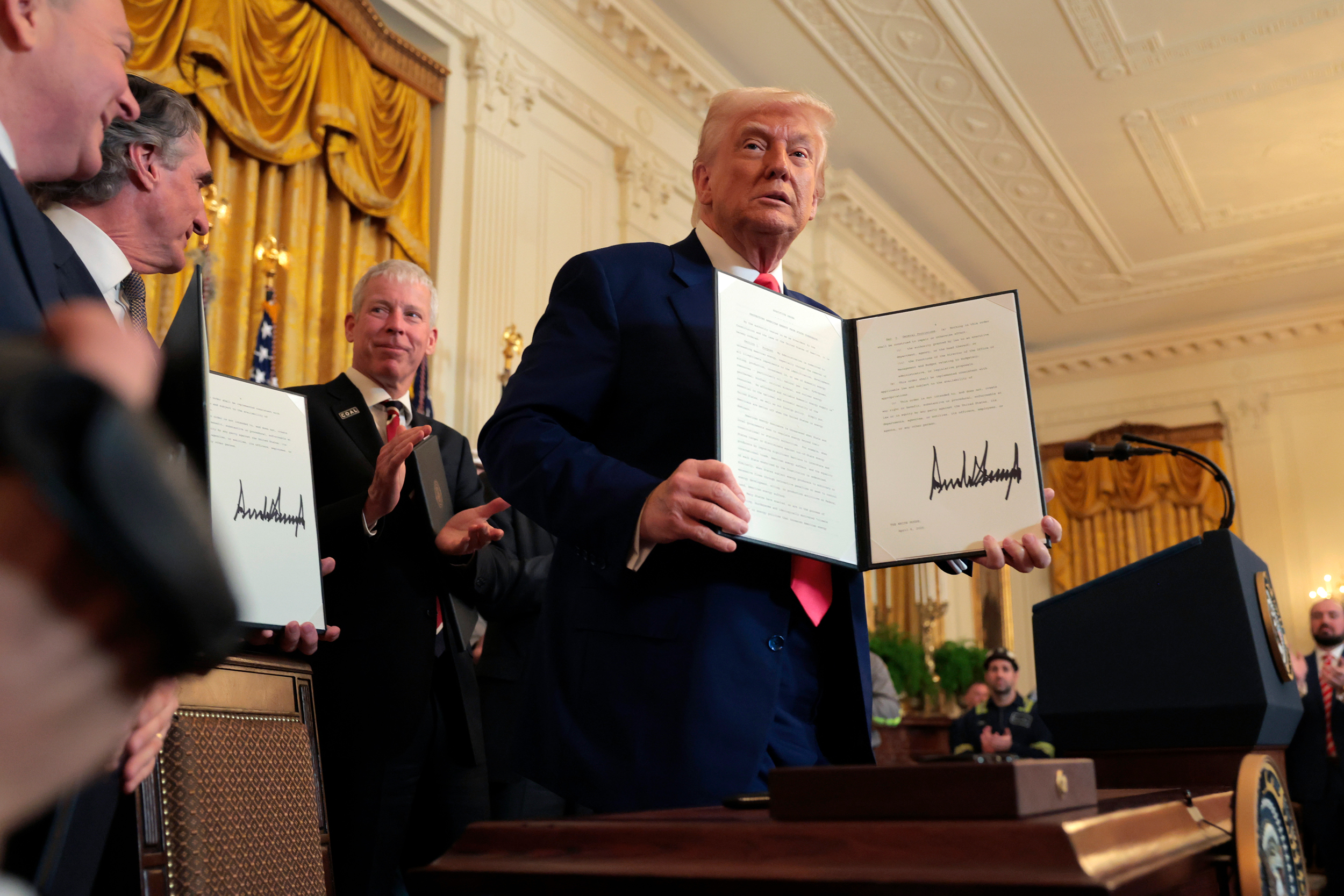 President Donald Trump poses for photos after signing a series of executive orders on American energy production during a ceremony in the East Room of the White House on April 8. Trump was joined by (from left) EPA Administrator Lee Zeldin, Interior Secretary Doug Bergum and Energy Secretary Chris Wright. Credit: Anna Moneymaker/Getty Images
Advances in a field known as climate attribution science have made the “polluter pays” aspect of the superfund laws possible, enabling scientists to quantify the individual contributions of major fossil fuel producers to climate impacts such as sea level rise and heat waves.
The DOJ has now filed motions for summary judgment in both of these lawsuits, asking federal courts to permanently block the states’ climate superfund laws.
“Vermont’s flagrantly unconstitutional statute threatens to throttle energy production, despite this Administration’s efforts to unleash American energy. It’s high time for the courts to put a stop to this crippling state overreach,” Acting Assistant Attorney General Adam Gustafson said in a statement issued by the DOJ on Sept. 16.
Havemann, with the Chesapeake Climate Action Network, told Inside Climate News that the current Trump administration seems to be taking a more aggressive approach to protecting the fossil fuel industry and to fighting attempts to hold it accountable.
“The Trump administration has come in and used many different tools in its toolbox to go after these accountability lawsuits and the laws that also seek to hold the biggest polluters accountable for climate damages,” she said. “It’s very much on the radar of the Trump administration in a way that it has not been in the past.”
The White House did not immediately respond to a request for comment.
“Enter the Dragon”
With U.S. Sen. Ted Cruz (R-Texas) holding the gavel, climate litigation came up as the subject of a Republican-led congressional hearing this summer before a Judiciary Committee subcommittee.
The hearing’s provocative title: “Enter the Dragon—China and the Left’s Lawfare Against American Energy Dominance.”
Cruz used the hearing to attack climate liability lawsuits and claim that they are a nefarious left-wing plot that is in part funded by, and that benefits, the Chinese Communist Party. “Both China and the Democrats want to bankrupt the American energy industry,” Cruz said during the hearing.
NPR’s Michael Copley reported last month that “Cruz’s office has not offered evidence that China or a China-linked nonprofit that Cruz identified by name has funded climate lawsuits in the United States.”
In response to that reporting, Cruz told Inside Climate News that “NPR deliberately ignored objective facts.”
“The Chinese Communist Party uses cut-outs and ‘nonprofits’ to shape U.S. energy policy, funding propaganda, advocacy, and litigation that harm American workers,” Cruz said in an emailed statement, which was also included in the NPR story after it was published. The “China-linked nonprofit” referenced in the NPR story, Energy Foundation China, does fund some climate initiatives, Cruz said in his statement.
“In January 2024, three House committee chairs opened an investigation into Chinese influence, citing EFC’s ties and funding of groups like [the Natural Resources Defense Council] and RMI,” he added.
A spokesperson for RMI, a nonprofit group working on the global energy transition, said that the organization “does not participate in litigation.” RMI’s “work supported by Energy Foundation China, which is a U.S. based charitable organization, is focused squarely on the energy transition inside of China,” the spokesperson added.
The Natural Resources Defense Council (NRDC), a nonprofit group that works to protect public health and the environment, does some “work in China for one reason: there’s not a single global environmental problem that can be fixed unless China is part of the solution,” NRDC spokesperson Josh Mogerman said. He added that the organization “does not fundraise in China” and that “money from China does not fund NRDC litigation in the United States, period.”
Cruz, who represents the country’s biggest oil and gas producing state, did not respond to Inside Climate News’ question about whether he supports immunizing oil companies from liability.
GOP Attorneys General Enter the Fray
During the Cruz-led hearing, the Republican attorney general for the state of Kansas, Kris Kobach, testified as one of the majority witnesses. He referenced the New York and Vermont climate superfund laws, claiming these statutes impose extraterritorial regulation on energy companies, and mentioned that his state and other Republican-led states are suing to try to overturn these state laws.
“We will continue these fights in court as state attorneys general. But we do need some help from Congress,” Kobach said. He suggested that Congress could legislate to expressly preempt state climate laws like the climate superfund laws.
Kobach and 15 other Republican state attorneys general also made this suggestion, along with several other recommendations for congressional action, in a letter addressed to Bondi, the U.S. attorney general.
The June 12 letter references Trump’s executive orders to “unleash” fossil fuels and protect the fossil fuel industry from “state overreach.” The letter says its purpose is to “suggest additional steps” the Department of Justice could take to effectuate these orders and assist in the “fight against anti-energy interests.”
Specifically, the Republican AGs suggest the DOJ could recommend legislation to reinforce federal preemption of state climate liability laws or lawsuits; restrict federal funding for states seeking to impose liability on energy companies; create a right of removal to federal district court for climate suits; and, among other items, stop “activist-funded climate lawsuits” with a liability shield, similar to the law that granted immunity for gun manufacturers.
Wiles, with the Center for Climate Integrity, said it is especially striking to see Republican attorneys general explicitly recommend a similar liability shield for fossil fuel companies. “The attorneys general actually called for Congress to enact a gun-style liability waiver for the oil industry,” he said. “We saw how that [gun industry immunity] ended up. It certainly was not helpful in curbing gun violence or in serving any public interest objective.”
The coordinated litigation strategies and actions of Republican state attorneys general in defense of fossil fuel and other industries stem from an organization called the Republican Attorneys General Association (RAGA), which Graves said was created in the wake of the tobacco industry being held accountable through the 1998 Master Settlement Agreement.
The organization, which currently lists 29 Republican state attorneys general as members, has been funded through donations from conservative judicial activists like Leonard Leo as well as from corporate interests including those in the fossil fuel industry. The American Petroleum Institute gave over $125,000 to RAGA in 2024, and in the first six months of this year Chevron’s Policy, Government and Public Affairs division donated $25,000 to the organization, for example.
Graves describes RAGA as a “pay-to-play organization.”
“It has a pay sheet listing what kind of access you get to attorneys general based on how much you give,” she told Inside Climate News.
“These attorneys general use the prestige of their office and their power and the resources that their taxpayers are providing to serve the interests of industry, select industries that they are most tied to, and that certainly includes the fossil fuel industry,” Graves added.
The Republican Attorneys General Association did not respond to a request for comment.
“A Perilous Moment”
The intensifying backlash to climate accountability efforts coming from the fossil fuel industry and its political defenders is happening at a time when some political scholars warn that the U.S. is sliding into some form of authoritarianism, which advocates say magnifies the challenges of holding powerful interests to account writ large.
“It’s a perilous moment for democratic norms and institutions,” said Kathy Mulvey, accountability campaign director for the climate and energy program at the Union of Concerned Scientists.
“Anybody who is pursuing policy change or litigation for accountability or enforcement is counting on the courts to be a real backstop for democratic institutions,” Mulvey told Inside Climate News.
Should the fossil fuel industry somehow succeed in securing legal immunity, Wiles said it “would be consistent with the erosion of the rule of law that we’re seeing.”
“No industry should be above the law,” he added.
---
---
defectors?
an 10 25
President Donald Trump is now finding fewer support from Republican state attorneys general (AGs) over his controversial deployment of National Guard troops to Chicago, Illinois.
Newsweek reported Thursday that while Trump had 22 Republican AGs sign onto an amicus (meaning "friend of the court") brief in support of deploying the National Guard to Washington D.C. filed in September, a new amicus brief has just 18 signatures from his own party's top law enforcement officials. The D.C. amicus brief had the backing of AGs from Alabama, Arkansas, Florida, Georgia, Idaho, Iowa, Indiana, Kansas, Louisiana, Mississippi, Missouri, Montana, Nebraska, Oklahoma, South Carolina, South Dakota, Texas and West Virginia.
But according to Newsweek's Robert Alexander, the Illinois amicus brief is missing the signatures of AGs from North Dakota's Drew Wrigley, Ohio's Dave Yost and Virginia's Jason Miyares. Alexander wrote that the absence of their names may signal the "first visible crack" in what had typically been a "united GOP front" backing Trump's "expansive view of presidential power."
"While the two filings use nearly identical legal arguments, the smaller roster suggests that some Republican legal officers are unwilling to endorse federal troops entering a state that didn’t request them, exposing quiet unease within the party’s legal ranks over the limits of Trump’s authority," he wrote.
Typically, a president can only deploy National Guard troops to a state if that state's governor explicitly requests it. 10 U.S.C. §12406 gives the president the power to do so in order to "execute the laws of the United States." But since Illinois Governor JB Pritzker never made such a request of Trump, that presidential power does not apply. Trump's deployment of National Guard troops to Memphis, Tennessee was not challenged despite opposition from Mayor Paul Young (D), as Governor Bill Lee (R) made the request.
The governor's legal team made a similar argument before a federal court earlier this week after Trump sent the Texas National Guard to Chicago, and said in September that he planned to take the administration to court in the event Trump sent the guard to the Prairie State against his wishes.
The Department of Justice is expected to soon file its response to Illinois' challenge. And regardless of how U.S. District Judge April Perry (appointed by former President Joe Biden) rules in the case, either side could appeal the decision to the 7th Circuit Court of Appeals.
Click here to read Newsweek's full report.
republican AG Pay-to-Play Group Raises $4.9 Million in Second Quarter
By David Armiak
|
July 19th, 2022
Campaign Finance, Democracy, Elections, Featured Investigations, Koch, News, RAGA
*Editor’s Note: On July 20, 2022, RAGA’s deputy executive director Johnny Koremenos notified CMD that the $300 contribution from Philanthropy Roundtable highlighted in this story was refunded.
The Republican Attorneys General Association (RAGA) raised $4.9 million in the second quarter of this year, according to a report filed with the Internal Revenue Service (IRS) on Friday. RAGA‘s haul is $300,000 less than in the second quarter of 2018 and slightly exceeds the $4.8 million the group raised during the first quarter of 2022.
RAGA spun its fundraising figures by giving Fox Business an exclusive, claiming that it “broke another fundraising record.” But the $6.3 million figure it gave for the quarter was “across all entities,” and since 2022 IRS filings for RAGA’s sister organizations the Rule of Law Defense Fund (RLDF) and the Center for Law and Policy (CLP) will not be publicly available until November 2023 at the earliest, the Center for Media and Democracy (CMD) cannot verify the claim.
RAGA accepts unlimited contributions from corporations, individuals, and special interest groups such as Koch Industries, Altria, and the U.S. Chamber of Commerce, primarily to fund the campaigns of Republican candidates for attorneys general. Together with its affiliates RLDF and CLP, it runs a cash-for-influence operation that coordinates the official actions of Republican state attorneys general and sells its corporate funders access to those AGs and their staff.
RAGA’s largest contribution in the second quarter, $200,000, went to Brenna Bird, the Republican candidate for attorney general in Iowa, who faces an uphill battle to unseat the longest-serving state AG in the country, Tom Miller (D).
In a surprising move, RAGA gave $15,200 to Georgia AG Chris Carr’s reelection campaign. Although Carr is a Republican, he resigned as RAGA’s national chair in 2021 over the selection of Peter Bisbee to replace Adam Piper as RAGA’s executive director, citing “a significant difference of opinion… as to the direction this organization should take going forward” and “vastly opposite views of the significance of the events of January 6.”
Bisbee formerly led RLDF and, in the days prior to the deadly attack on the U.S. Capitol, he was responsible for sending out robocalls encouraging supporters to “march to the Capitol and call on Congress to stop the steal.” His selection also led to an exodus of longtime RAGA staff members, CMD reported.
Raul Labrador, the Republican candidate for attorney general in Idaho, was the only other individual to receive RAGA funding in the second quarter, accepting $5,000 for his campaign, the report discloses.
RAGA hopes to build on the 28 state offices held by Republican attorneys general through “seven-figure investments to flip seats in Wisconsin, Michigan and Nevada, and to retain the attorney general office in Arizona,” according to Fox Business.
Corporations Attending Latest RAGA Fundraiser Contribute $1.2 Million
Over the weekend, 18 companies were scheduled to attend a major RAGA fundraising event at a luxury resort in Florida, CNBC reported. Of those companies, 10 gave a total of $1.2 million to RAGA in the second quarter, CMD found.
Leading the pack was the Institute for Legal Reform (ILR), which gave another $500,000 in addition to the $255,000 it contributed in the first quarter. An affiliate of the U.S. Chamber of Commerce, ILR focuses on advancing business-friendly legal reforms such as making class-action lawsuits more difficult to file and defending business interests in court.
Following the ILR, Centene Management Company, a Missouri-based healthcare company, was the next largest RAGA donor, with a $350,000 contribution in the second quarter.
The consumer wellness company Melaleuca, which has given RAGA $260,000 so far this year, is also a leading donor expected to attend the gathering. In addition, each of the following companies scheduled to attend has already hit or topped the $100,000 mark in 2022: Anheuser-Busch ($105,000), Anthem ($100,000), Comcast ($130,000), and General Motors ($100,000).
BNSF Railway and Ronald Cameron Round Out Top Five
BNSF Railway Company and Ronald Cameron, CEO of the Mountaire Corporation, each gave $150,000, making them among the top five second-quarter donors to RAGA.
Cameron is a top donor to the Koch political network. His company paid $65 million in 2021 to settle a class action lawsuit and agreed to make $140 million in investments in wastewater treatment facilities mandated by the state, CMD reported. In addition, he was the 14th largest donor to super PACs in 2021, CMD found.
RAGA Accepts Another Illegal Donation
In February, Popular Info reported that RAGA accepted an illegal donation of $50,000 from Children’s Health Defense, Robert F. Kennedy, Jr.’s anti-vax propaganda outfit.
According to IRS rules, “a section 501(c)(3) organization may not make a contribution to a political organization described in section 527 (such as a candidate committee, political party committee or political action committee (PAC).” As a 501(c)(3) nonprofit, Children’s Health Defense admitted the donation was illegal, but claimed that “they paid $50K to get access to Republican AGs to brief them on ‘health policy issues.'”
RAGA, a 527 registered group, refunded the $50,000 the day after the Popular Info report, its first quarter filing confirms.
Now, RAGA’s latest filing shows that it received an illegal donation of $300 from the Philanthropy Roundtable, another 501(c)(3) nonprofit chaired by Bradley Foundation President Richard Graber. The Philanthropy Roundtable was established with funding from the Institute for Educational Affairs in the 1970s to help facilitate and coordinate conservative grant-making and foundations.
About David Armiak
David Armiak is research director and an investigative journalist with the Center for Media and Democracy. David joined CMD in 2015, has conducted extensive investigations on dark money, corporate corruption, and right-wing networks, and is responsible for filing and analyzing hundreds of public records requests every year. David has a strong research interest in social movements and political power, and has delivered many talks on the subject. He has a Bachelor's degree in philosophy and anthropology from Boston University and a Master's degree in Anthropology from the University of Wisconsin-Madison.
---
ggl 10 25
[### Republican AG Pay-to-Play Group Raises $4.9 Million in ...

EXPOSEDbyCMD
https://www.exposedbycmd.org › 2022/07/19 › republic...](https://www.exposedbycmd.org/2022/07/19/republican-ag-pay-to-play-group-raises-4-9-million-in-second-quarter/)
---
7 25 GMAIL
Read our_full blog post_on our website.
An attempt to defund the District of Columbia’s consumer protection lawsuit against Big Oil is part of a wider attack on climate accountability lawsuits
As Big Oil and its allies lobby to shield the fossil fuel industry from a growing number of climate deception lawsuits, Congress is now taking aim at a case filed by the nation’s capital.
Recently proposed legislation would prohibit the District of Columbia from using any funds to enforce its consumer protection laws “against oil and gas companies for environmental claims” — a clear attack on D.C.’s ongoing lawsuit against ExxonMobil, Chevron, BP, and Shell.
“The fossil fuel industry and its allies are trying to kill any and all lawsuits that would hold Big Oil companies accountable for their climate lies and the damage they’ve caused — and this assault on D.C.’s ability to enforce its own consumer protection laws is part of their playbook,” said CCI President Richard Wiles.
Read our full blog post on our website:
July 24, 2025
As Big Oil and its allies lobby to shield the fossil fuel industry from a growing number of climate deception lawsuits, Congress is now taking aim at a case filed by the nation’s capital.
Under a newly released appropriations bill, Congress would prohibit the District of Columbia from using any funds to enforce its consumer protection laws “against oil and gas companies for environmental claims.” The legislation clearly targets D.C.’s ongoing lawsuit against ExxonMobil, Chevron, BP, and Shell, which argues the companies violated D.C.’s consumer protection law by engaging in misleading acts and practices around the marketing, promotion, and sale of fossil fuel products. In April, a D.C. court rejected the Big Oil companies’ motions to dismiss the case, bringing it one step closer to trial.
“The fossil fuel industry and its allies are trying to kill any and all lawsuits that would hold Big Oil companies accountable for their climate lies and the damage they’ve caused — and this assault on D.C.’s ability to enforce its own consumer protection laws is part of their playbook,” said CCI President Richard Wiles.
The attack on D.C.’s case comes after 16 Republican attorneys general asked U.S. Attorney General Pam Bondi to help erect a “liability shield” for fossil fuel companies against climate lawsuits. Among its tactics, the attorneys general recommended that the federal government restrict funding for state and local governments that seek to make fossil fuel companies pay for climate damages.
:{:{CCI and nearly 200 other groups have urged Congress to support climate accountability and oppose immunity for Big Oil. Now a growing number of public officials are joining those calls. U.S. Delegate Eleanor Holmes Norton, who represents D.C. in Congress, vowed to fight the attack on D.C.’s lawsuit. The National Association of Counties, representing thousands of county officials across the U.S., is urgingCongress to reject any legislation that “would limit or preempt counties’ access to courts or give companies immunity from lawsuits over damages and costs.” }:
And Oregon’s congressional representatives called for President Trump to rescind an order that targeted state climate actions. “Governments, residents, businesses, and others must have access to legal and legislative remedies in order to hold fossil fuel companies accountable, seek justice, and make polluters pay for the damage they have caused,” they wrote.}:
“No industry should be above the law, especially one as powerful and harmful as Big Oil,” said CCI’s Wiles. “Members of Congress must reject this underhanded attempt to help Big Oil escape accountability and protect access to the courts for every community.”
REF 1 CCI
June 26, 2025
As communities across the country get closer than ever to putting Big Oil companies on trial for decades of climate lies, fossil fuel industry allies are ramping up their efforts to secure blanket immunity for the industry and protect oil companies from facing accountability for their harmful deception.
In a letter to U.S. Attorney General Pam Bondi, more than a dozen Republican attorneys general this month called on the Department of Justice to recommend legislation aimed at barring the courthouse doors for dozens of communities’ fighting to hold fossil fuel companies accountable for their ongoing climate deception and the harm it has caused. Earlier this year, the U.S. Supreme Court rejected a “desperate” and “highly unusual” request from many of the same attorneys general that sought to block states from suing Big Oil. Having failed to escape accountability in court, Big Oil lobbyists have reportedly been urging members of Congress to pass legal protections for the companies.
The new letter includes a laundry list of legislative recommendations, including creating a “liability shield” for fossil fuel companies “similar to the Protection of Lawful Commerce in Arms Act of 2005,” (PLCAA) — the notorious law that gave broad immunity to gun manufacturers and sellers from lawsuits for injuries “resulting from the criminal or unlawful misuse” of a firearm. Victims of gun violence and their families have said that PLCAA has taken away their constitutional right to be heard in court and has shut down avenues for accountability and the healing it can bring.
"This is simply the latest in a long line of desperate maneuvers to help the fossil fuel industry escape accountability in court for their well-documented climate deception and the astronomical damage it has caused,” said CCI President Richard Wiles about the letter. “They want dishonest and polluting corporations to be completely above the law, and if they get their way they would block access to the courts for communities, businesses, and their own constituents who have been harmed by Big Oil."
During a farcical Senate subcommittee hearing yesterday that sought to cast doubt on climate accountability cases, one of those attorneys general, Kris Kobach from Kansas, was pressed by U.S. Senator Richard Blumenthal about his opposition to lawsuits against Big Oil. Blumenthal pointed out that Connecticut and other states are suing ExxonMobil for lying about the harms of its products — just as Kansas is suing Pfizer for, in Kobach’s words, making “certain representations about their product that turned out to be contrary to the information they had.”
Under questioning, Kobach conceded that "I'm not saying the claims [against Big Oil] are wrongly brought." But when he tried to blame individuals for their fossil fuel use, Blumenthal, who successfully sued tobacco companies as Connecticut Attorney General, pointed out the flaw in that logic.
“I could take the words exactly that you’ve just uttered and substitute ‘tobacco,’ and they would be identical to what the tobacco industry was saying about our lawsuit at the time,” Blumenthal commented.
At the top of the hearing, Ranking Member Senator Sheldon Whitehouse of Rhode Island explained that climate accountability lawsuits come down to a simple question: Who should pay for climate damages? Taxpayers, or the fossil fuel companies responsible for the climate crisis?
KICKASS
Earlier this year, nearly two hundred groups, including CCI, called on members of Congress to oppose any efforts to shield Big Oil companies from legal accountability.
REF 2
July 23, 2025
Members of Oregon’s congressional delegation are urging President Trump to repeal an “unprecedented and illegal” executive order that aims to block local governments’ attempts to hold Big Oil companies accountable for climate deception and damages. The letter, signed by U.S. Senators Jeff Merkley and Ron Wyden along with five of Oregon’s six House representatives, comes as oil companies and their allies have ramped up their attempts to escape the growing number of climate accountability lawsuits filed against them.
“Our communities across the country are suffering grave threats to our public health, safety, and economic security as a result of Big Oil’s climate deception and pollution,” the letter says. “Governments, residents, businesses, and others must have access to legal and legislative remedies in order to hold fossil fuel companies accountable, seek justice, and make polluters pay for the damage they have caused.”
The administration’s April executive order called on U.S. Attorney General Pam Bondi to “expeditiously take all appropriate action” to stop climate accountability lawsuits that “could result in crippling damages” for fossil fuel companies. In response, the Justice Department sued Hawai’i and Michigan in an attempt to block those states from filing previously announced lawsuits against fossil fuel companies. In response, Hawai’i officially filed its climate deception lawsuit against Big Oil and Michigan Attorney General Dana Nessel vowed to move forward with her plan to sue fossil fuel companies, calling the Justice Department’s lawsuit “at best frivolous and arguably sanctionable.”
The Oregon letter also questions the legality of the administration’s actions, arguing that the executive order “threatens the ability of states and localities to hold polluters responsible for the costs of their actions.”
“Extreme weather events are already harming households across the country, and the impacts are only going to get worse,” the letter says. “Trillions of dollars will be needed for our country to adapt to the climate future, as well as to help people rebuild in the face of natural disasters. The question is who is going to be responsible for paying those costs: taxpayers, or the oil and gas companies that have profited from the crisis?”
More than one in four Americans live in a community suing oil companies for their climate deception. Oregon’s most populous county, Multnomah County, is suing ExxonMobil, Chevron, Shell, and other fossil fuel companies for knowingly fueling extreme weather events like the 2021 Pacific Northwest heat dome, which killed 69 county residents. In recent court filings, experts noted that Multnomah County was unaware that the heat dome was even possible because of the “misinformation fossil fuel producers have long used to deny or downplay the magnitude and timing of harmful climate change.”
“As members of Oregon’s congressional delegation, we will not stand idly by while this Administration attempts to undercut efforts to combat climate chaos,” Oregon’s congressional delegation letter states. “The Administration cannot only respect the principle of states' rights when it thinks the state is right. We urge you to repeal your executive order so that states are able to protect their citizens as they see fit.”
Oregon’s letter is signed by U.S. Senators Ron Wyden and Jeff Merkley, and U.S. Representatives Suzanne Bonamici, Maxie Dexter, Janelle Bynum, Val Hoyle, and Andrea Salinas.
---
---
amy w
drilled lisa graves
raga primer
You may have noticed a recurring line in news stories over the past decade: 12 Republican attorney general file suit, or 19 Republican attorneys general call on so-and-so to rethink their policy on diversity or guns or birth control, or 14 Republican attorneys general sign onto an amicus brief in x or y constitutional challenge. In the vast majority of cases, any hint of coordination amongst these AGs ends there. It shouldn’t, because it doesn’t. Republican attorneys general don’t just wind up joining suits and letters and briefs en masse because they have a group chat. These efforts are coordinated by a central body, the Republican Attorneys General Association, or RAGA. Regular listeners or readers of Drilled will be all too familiar with this name, we’ve covered them multiple times over the years, but after reading the thousandth story today about 19 Republican AGs signing onto something (this time trying to pressure CostCo to drop its DEI policies), I realized we should probably pull it all together in one spot for easy reference. So herewith: a primer on RAGA.
But first, credit where it’s due: I first came across RAGA while working on a season of the podcast This Land, about the various lawsuits taking aim at the Indian Child Welfare Act, and specifically while talking to former Senate investigator and longtime oppo researcher Lisa Graves, of True North Research, who is probably the reason anyone knows about RAGA (or Leonard Leo and the Federalist Society, or the Koch universe; honestly Lisa’s research is at the root of so many groundbreaking stories over the past decade or more). That conversation with Lisa sparked an ongoing obsession and I’ve since learned everything I can about this organization and how strategically important it is to many of the big political changes we’ve seen over the past 20 years.
RAGA was organized back in the late 1990s by Republicans as a response to widespread tobacco litigation, which had been spearheaded by Democratic attorneys general. Republicans looked at that and realized (a) it was a good idea, and it had worked, (b) Democrats outnumbered Republicans in attorneys general offices, and (c) if they were going to protect other industries from legal action (like, oh I don’t know, the fossil fuel industry), they needed to tip that balance and start strategizing their own multi-state cases.
The attorneys general of Alabama (William Pryor), Texas (John Cornyn), and South Carolina (Charlie Condon) came together to start RAGA, and then set about fundraising and strategizing to get more Republican attorneys general elected. That was step one: get more Republican AGs elected. So at that point, RAGA was no different than any other party-aligned group. Within a decade, they had tipped the scales in favor of Republicans. But since about 2013 RAGA has shifted into a new phase, taking major donations from corporations and dark-money groups and then strategically signing onto suits that help those individuals or industries. Thanks to Citizens United, the 2010 Supreme Court case that gave corporations the right to donate anonymously to political campaigns, RAGA was able to create a Political Action Committee to funnel dark money from industry groups and corporations straight to the attorneys general that are supposed to regulate those industries, but are now working on their behalf instead.
“Since 2013 we've seen their funding build and the Judicial Confirmation Network and the Concord Fund are by far the biggest funders of RAGA,” Graves explained to me. “Their funding dwarfs what RAGA gets from the U.S. Chamber of Commerce or Koch Industries.”
That’s important because JCN and Concord are the funding vehicles controlled by former Federalist Society president Leonard Leo, the guy who’s been picking judicial nominees for the Republican party for the past decade or so, and in more recent years has been masterminding the legal attack on abortion, LGBTQ rights, climate policy and more.
“In 2015 I started a project where we were doing FOIAs [Freedom of Information Act requests] of these AGs all over the countries, and we ended up getting RAGA's fundraising chart, which showed here's what you get for this amount and that amount. But Leo is giving them way more than the top level. You can see what Koch is buying but not what Leo's buying because it's so huge. Then Ken Paxton came in as AG elect in Texas, and one of his advisors was Leonard Leo.”
I asked Graves if Democrats had a similar operation going. But while DAGA exists, it has one fatal weakness when going up against RAGA: “They're at a huge competitive disadvantage because they're not raising money from the corporations that they're regulating,” Graves said.
"We know that it's a pay-to-play operation," Graves said of RAGA."It's had an enormously distorting effect on U.S. law. It provides a mechanism for corporations to pass money through to help attorneys general in ways that they would not be able to individually solicit for their own campaigns, given their regulatory role over those very industries."
So how does it work? Well the case that opened my eyes to RAGA is a good example: Brackeen v Haaland. It went all the way to the Supreme Court in 2023, but it started in Texas, with Paxton. The case challenged the constitutionality of the Indian Child Welfare Act (ICWA), claiming that it was race-based and therefore violated the equal protection clause of the 14th amendment. It was filed on behalf of a white couple in Forth Worth who felt they’d had to jump through too many hoops to adopt a native child. Ultimately, Paxton couldn’t get many other AGs to sign on and the suit failed, but it’s not the last we’ll see of a RAGA-backed attack on ICWA.
Graves said the Brackeen case is a perfect example of the sort of suit that has been made possible by the rise of RAGA. "Texas has hardly any tribal lands," she said. "So you have this attorney general in a state that is particularly friendly and warm to Koch, to the other oil and refinery companies, and to Leonard Leo. And it has very, very few tribal holdings in the state, but yet it's getting involved here."
The same day the Brackeen case was filed, David Hacker, an attorney in Paxton's office who has since left to work for First Liberty Institute, the legal nonprofit spearheading attacks on LGBTQ rights, wrote an email to the RAGA member list with the subject line "New Federalism Case Opportunity."
"Friends, today, Texas filed a new complaint against the federal government concerning application of the Indian Child Welfare Act," he wrote. "I write to ask if any of you want to join this effort as co-plaintiffs. … ICWA creates foster-care and adoption preferences that require state courts to choose Indian families over non-Indian families when determining placement of an Indian child. These preferences set aside state law that would look to the best interest of the child in favor of racial discrimination that violates the Fourteenth Amendment."
Compared to Paxton's anti-abortion, anti-immigration, and anti-climate policy cases, which typically entice a dozen or so co-plaintiffs, Hacker's efforts were relatively unsuccessful. Indiana and Louisiana signed on as co-plaintiffs, and Ohio wrote an amicus brief. Indiana and Louisiana eventually dropped out of the case. Despite that, the Brackeen case shows how well the Republican judicial machine works in Texas, and how critical the AG's office is to making it all work, not just in Texas but on a national level. "What you have now with the judicial selection committee in Texas [headed by Cornyn and Ted Cruz] and the very strategic composition of the 5th Circuit, and then the Supreme Court now too, is an extreme form of forum shopping, where all you need is someone willing to file the initial complaint," Graves said. "The Texas AG's office really sets the docket for the 5th Circuit. It's a really important role."
A Biden administration climate case is another example.
Back in 2016, climate policy researcher Peter Erickson published a paperthat looked at how expanding oil production in the U.S. increased oil consumption worldwide. I’ve said it before and I’ll say it again: despite all of its claims to the contrary, the fossil fuel industry does not just supply a demand. It manufactures demand.
Erickson used the Department of Interior’s own math, which has historically been quite friendly to the fossil fuel industry, to determine that if the U.S. were to expand oil production by X barrels, global oil consumption would increase by about 0.5X barrels, because the fossil fuel industry somehow always finds a way to spur demand. He shared his findings with the Department of the Interior, andin 2022 a D.C. federal court judge used those findings as part of his justification for canceling oil and gas leases of more than 80 million acres in the Gulf of Mexico.
You might recall that Biden canceled those leaseshimself in 2021 via executive order. But almost immediately a RAGA-coordinated group of 13 Republican attorneys general, led by Louisiana Attorney General Jeff Landry, sued and a federal judge in Louisiana blocked that order mandating that the Biden administration hold the lease sales that had already been scheduled.
Environmental groups sued to block them again, saying the Department of Interior had used outdated environmental information to authorize those leases in the first place, and had thus violated the National Environmental Protect Act (NEPA). That’s what federal judge Rudolph Contreras affirmed in his 2022 decision, making the very obvious, but somehow also groundbreaking, conclusion that If you expand oil production, you also expand oil consumption and, therefore, greenhouse gas emissions. What’s really huge about that decision was that it actually took into account the fact that U.S. oil companies supply the rest of the world too.
This case is a perfect example of how and why the courts are so critical when it comes to climate accountability. It’s easy to see RAGA’s fingerprints all over this, but equally, it’s yet another example of them not always winning. The West Virginia v. EPA case, on the other hand, was an example of RAGA working perfectly as designed. To start, the case should never have been heard. It was accepted when Obama’s Clean Power Plan was a thing. By the time it was heard, that policy was dead in the water. So why hear a case about a policy that doesn’t even exist? To preemptively block similar policies from ever being passed.
It was unprecedented for the Supreme Court to step in on such a matter, and it effectively kept the federal agency tasked with environmental protection from following science. That fact was further underscored in Justice Kagan’s dissent, which took the case out of the weeds of the particular Clean Air Act section in question and placed it back into reality: the science is unambiguous on climate, and the impacts will be unprecedented, surely now is not the time to quibble about whether “clean air” explicitly means maintaining a livable atmosphere?
It’s also important to note that West Virginia v EPA didn’t come from some poor, cash-strapped coal producer who was worried about how the Clean Power Plan would affect their business. It was a case crafted very strategically by RAGA. At the time that the case was filed, Scott Pruitt was Attorney General of Oklahoma and led RAGA. He met with failing coal producers in early 2015, then helped coordinate and file the case in November 2015, right around the time those very same coal producers made large contributions to the RAGA coffers. Then, as Trump’s EPA head, Pruitt drafted a proposal in early 2017 to repeal the Clean Power Plan. In that proposal, he introduced the idea that the Clean Power Plan represented a “major question” that ought to be answered by Congress or the courts, not a regulatory agency. It’s the very same argument Chief Justice Roberts repeated in his defense of the court taking up the case.
So, there you have it, RAGA is a pay-for-play operation that enables industries, companies and wealthy individuals who want to shape the regulatory landscape to fund attorneys general in a way they would not be legally allowed to do directly. Those attorneys general then work together to file strategic constitutional challenges or sometimes, as in the CostCo case, just to intimidate people who aren’t playing ball. When you see a story that mentions more than two Republican AGs teaming up on something, it’s almost certainly a RAGA effort, which means you have to question whose interests it’s serving, those of the citizens an attorney general is supposed to protect or those of the wealthy donors RAGA has sworn to serve?
The largest of those donors, Leonard Leo, has been quite clear about what he’s trying to do. In a speech to the Council on National Policy a few years back he said that America stands at the precipice of what he called “the revival of the structural constitution.”
“He told the audience that no one alive in that room had seen the type of legal revolution that America was about to see based on the appointments to the Supreme Court and other courts to revive this so-called structural constitution to the law as it existed pre-New Deal,” Graves said. “And that affects a whole host of laws: civil rights laws, labor laws and labor rights, environmental regulation and more. It's an attempt, in my view, to really limit the ability of Congress to pass laws, to limit the ability of agencies, to regulate corporations and and to sort of change the whole modern structure of government. It’s an extreme, radical, reactionary agenda, to change our rights and and limit our powers in our democracy through our representatives in ways that serve a very elite agenda.”
That’s what we’re dealing with and it would be helpful if journalists made that clear.
---
===
an 1 25
A group of Republican attorneys general — including Kentucky’s Russell Coleman — is pressuring Costco “to end all unlawful discrimination imposed” by the retailer’s diversity, equity and inclusion policies.
The 19 attorneys general sent a letter to Costco CEO Ron Vachris this week citing Republican President Donald Trump’s executive order that encouraged “all agencies to enforce our longstanding civil-rights laws and to combat illegal private-sector DEI preferences, mandates, policies, programs, and activities.”
Writing that Costco “should treat every person equally and based on their merit, rather than based on divisive and discriminatory DEI practices,” the attorneys general asked Vachris to either repeal Costco’s DEI policies or explain why the company is keeping them in place within 30 days.
Costco shareholders recently rejected a proposal from a conservative think tank to examine risks posed by its DEI policies. Nearly 98% ofshareholders voted against the measure. Costco’s board had recommended rejection of the proposal.
At the Jan. 24 shareholders meeting, Costco board chair Tony E Curtis said the company’s commitment to inclusion “does not and has never included quotas or systematic preferences, nor does it mean compromising merit. The demands of our business and our steadfast commitment to serve our members mean that we cannot afford to do anything but hire and promote the most qualified individuals.”
Costco has not publicly responded to the letter. A spokesperson for the company did not immediately respond to a request for comment Wednesday.
Kentucky AG Coleman said in a statement, “Costco has a motto to ‘Do the right thing,’ but their DEI business practices are all wrong. By pushing a DEI agenda, Costco is out-of-step with the Kentuckians who just want affordable prices.”
Costco hasfour storesin Kentucky, according to its website.
Nationwide, some companies are rethinking their commitment to DEI, while others are standing by their diversity practices. Brands like Walmart and Meta have rolled back DEI policies while tech giants Microsoft and Apple reaffirmed their policies within the last week. Last year, Kentucky-based whiskey makerBrown-Forman suspended its DEI policies.
DEI policies are often aimed at removing bias and promoting fairness in areas like employment and education.
Former Kentucky Attorney General Daniel Cameron crusaded with other Republican attorneys general to curb DEI in the private sector, including issuing a letter to Fortune 100 CEOs calling on them to use “race-neutral principles in your employment and contracting practices” following the U.S. Supreme Court’s reversal of affirmative action in higher education.
After losing a race for Kentucky governor in 2023, Cameron became CEO of the 1792 Exchange, a group that aims to “steer public companies back to neutral on divisive, ideological issues.”
Kentucky Democratic Gov. Andy Beshear in an appearance at the World Economic Forum in Davos, Switzerland, recently defended private sector decisions to maintain DEI policies. If companies think encouraging a diverse workforce helps them, Beshear said, “the state that you’re working with should support you.”
Read the letter below
Kentucky Lantern is part of States Newsroom, a nonprofit news network supported by grants and a coalition of donors as a 501c(3) public charity. Kentucky Lantern maintains editorial independence. Contact Editor Jamie Lucke for questions: info@kentuckylantern.com.
---
===
AN 1 25
Ohio Attorney General Dave Yost and 17 other Republican attorneys general are questioning the temporary protected status for immigrants from 17 distressed countries. They’re asking officials in President Donald Trump’s explicitly anti-immigrant administration to review whether protections are necessary.
In a statement Tuesday, Yost said some have been allowed to stay in the United States even after it was “safe for them to return home.” However, he didn’t name a single such country — and publicly available reports make it hard to guess which places he might mean.
His office was asked if he could name a person with temporary protected status who could safely return to her or his home country. A spokeswoman responded that it wasn’t the attorney general’s job to make such determinations.
An immigrant advocate said the letter was another way to scare vulnerable immigrants into the shadows. It’s akin to last summer’s false claims by now-President Donald Trump, Vice President J.D. Vance and others that Haitians under temporary protected status in Springfield were stealing and eating their neighbors’ pets, she said. That led to dozens of bomb threats and reports of violence against immigrants.
“It’s about intimidation,” said Lynn Tramonte, founder of the Ohio Immigrant Alliance. “It’s about destabilization. These are authoritarian tactics where you make people unsafe in their homes and communities. It’s really sad. J.D. Vance himself brought violence to Springfield.”
Longstanding problems
Yost and the other attorneys general sent a letter to Kristi Noem, Trump’s head of the Department of Homeland Security. Now confirmed, Noem has the power to grant or revoke temporary protected status, or TPS. Her farewell address last week as North Dakota governor was peppered with starkly anti-immigrant rhetoric.
The Trump administration is giving immigration officers an expanded authority to rapidly deport immigrants, including people the Biden administration temporarily allowed into the country under parole authority, according to an internal memo, States Newsroom reported this weekend.
“TPS beneficiaries represent over 1 million immigrants residing in the States who are otherwise without legal status,” the attorneys general’s letter to Noem said. “Converting TPS into a license for long-term residency frustrates congressional aims and only increases the financial and governmental strain on States.”
In addition to Yost, attorneys general from Alabama, Georgia, Idaho, Indiana, Kentucky, Mississippi, Missouri, Montana, Nebraska, North Dakota, Oklahoma, South Carolina, South Dakota, Texas, West Virginia and Wyoming signed the letter to Noem.
The letter makes much of the fact that the word “temporary” is in the name of the designation, and that people from some countries have had temporary protected status for decades.
“Honduras, for instance, first received TPS after a hurricane hit in 1998 and DHS bases its current TPS designation on ‘persist[ing]’ conditions from that same event,” the letter said. “TPS extensions spanning decades have become routine.”
According to statutory language provided by Yost’s office, the Homeland Security secretary can grant TPS if she finds “that there exist extraordinary and temporary conditions in the foreign state that prevent aliens who are nationals of the state from returning to the state in safety.”
Tramonte said the attorneys general are misreading the law.
“It’s called ‘temporary protected status,'” she said. “It’s not called ‘short-term protected status.’ When a crisis happens, whether it’s a natural disaster or a political crisis, it takes years to recover. They’re fixating on the word ‘temporary’ as if that means short-term. But all that means is that Congress said we’re going to give you a break and not deport you because it’s dangerous to send you back.”
Harrowing conditions
In its 2023 report on human rights practices, the U.S. State Department had this to say about Honduras, the country the Republican AGs cite as being designated a TPS country for almost 27 years:
“Significant human rights issues included credible reports of: arbitrary or unlawful killings; torture or cruel, inhuman, or degrading treatment or punishment by government agents; harsh and life-threatening prison conditions; arbitrary arrest or detention; serious problems with the independence of the judiciary; serious restrictions on freedom of expression and media freedom, including threats against media members by criminal elements; serious government corruption; extensive gender-based violence, including domestic violence, sexual violence, and femicide; and crimes involving violence or threats of violence targeting lesbian, gay, bisexual, transgender, queer, or intersex persons.”
In fact, of the 17 countries designated for TPS, 11 have the State Department’s most severe travel warning — do not travel. Three have the next-highest, reconsider travel. And three have the second-lowest, exercise increased caution.
Reports for the latter countries — Cameroon, Nepal and El Salvador — indicate how dicey it might be to return there, especially if you’re not a tourist from a developed country.
Human Rights Watch’s World Report 2024 says that El Salvador had been stricken by gang violence, and then “a state of emergency (that was) adopted in March 2022 that suspended basic rights remains in force. Authorities have committed widespread human rights violations, including mass arbitrary detention, enforced disappearances, ill-treatment in detention, and due process violations.”
The Human Rights Watch report for Cameroon detailed “continued clashes between armed groups and government forces throughout Cameroon’s Anglophone and Far North regions severely impacted civilians, with cases of unlawful killings, abductions, and raids on villages increasing in the second half of the year.”
And the State Department’s 2023 report for Nepal described “significant human rights issues (including) credible reports of: arbitrary or unlawful killings, including extrajudicial killings; torture or cruel, inhuman, or degrading treatment or punishment by the government; arbitrary detention; serious restrictions on freedom of expression and media, including violence or threats of violence against journalists and unjustified arrests of journalists.”
Those are the TPS countries that the State Department deems to be the safest of the 17 to travel to. The letter the attorneys general wrote to Noem criticized former President Joe Biden for extending temporary protected status designations for Sudan, Ukraine, and Venezuela, in addition to El Salvador.
Ukraine has been devastated by war since Russian President Vladimir Putin invaded in 2022. Sudan has been torn by civil war since 2023, spurring the enlistment of child soldiers, sexual violence and other atrocities. And in Venezuela, the socialist government has made the economy so dysfunctional that 90% live in poverty, and it has the highest crime rate in the world.
Safe?
In a statement announcing that he and other Republican attorneys general called for a review of TPS designations, Yost, said some could safely return to their home countries.
“This program has been applied too loosely, allowing noncitizens to live here indefinitely, even after it’s safe for them to return home,” the statement quoted Yost, who last week announced a 2026 run for governor, as saying.
Asked if the Ohio AG could name one, his spokeswoman said that wasn’t his job.
“The Ohio Attorney General isn’t the person with authority to make TPS judgments, regardless,” the spokeswoman, Bethany McCorkle, said in an email. “That’s why the letter doesn’t call for the designation to be immediately lifted from any one nation.
“What the letter does ask is that the Secretary engage in a review of the country conditions and exercise her judgment regarding the status of countries that have been designated as ‘temporar[ily]’ protected for years — sometimes decades — based on the same insular events,” she added. “If conditions are currently unsafe in a certain country based on new/current factors that would reach the high bar set by Congress for TPS, then the Secretary would have discretion to give TPS on that basis.”
The call for an administration led by a vehemently anti-immigrant president to review and possibly deny immigrants’ protected status might be out of step with public opinion. A December poll sponsored by the National Immigration Forum and the Bulfinch group said that 73% of Americans agreed that immigration policies should protect the persecuted and keep families intact.
Tramonte, of the Ohio Immigrant Alliance, said the real point of the letter is to distract the public from the real cause of many Americans’ suffering.
“This gets them headlines, this gets them accolades from the people they’re trying to stir up,” she said. “They’re trying to distract from their bigger agenda, which is getting corporations bigger tax breaks and helping the wealthy while average people are having to work multiple jobs just to pay the rent.”
Ohio Capital Journal is part of States Newsroom, a nonprofit news network supported by grants and a coalition of donors as a 501c(3) public charity. Ohio Capital Journal maintains editorial independence. Contact Editor David Dewitt for questions: info@ohiocapitaljournal.com.
===
aha doh THERE’S NO DISINCENTIVE TO BAD ACTORS
CNN
OMFG
CNN —
A prominent Latino advocacy group asked the US Justice Department on Monday to investigate Texas Attorney General Ken Paxton after his office launched a series of raids the group says was at the homes of Democratic activists and leaders on allegations tied to voter fraud.
In a letter to the Justice Department’s civil rights division, the president and the CEO of the League of United Latin American Citizens requested “immediate action” by the federal agency.
“We believe that his conduct constitutes a direct attempt to suppress the Latino vote through intimidation and harassment, in violation of the Voting Rights Act and other federal civil rights law,” LULAC President Roman Palomares and CEO Juan Proaño wrote in the letter.
The Justice Department confirmed to CNN it received the letter, but a spokesperson declined to comment further.
[
Related article Latino advocacy group wants federal investigation of Texas AG over home searches tied to voter fraud probe](https://www.cnn.com/2024/08/26/us/texas-latino-voting-rights-investigation)
So far no charges have been filed as a result of last week’s raids. Paxton’s office said search warrants were executed in Frio, Atascosa, and Bexar counties as part of what his office described as an election integrity probe dating back to 2022.
In a release last week, the attorney general’s office said its election integrity unit was investigating a referral from Audrey Louis, the district attorney in the state’s 81st judicial district, involving allegations of election fraud and vote harvesting.
“Secure elections are the cornerstone of our republic,” Paxton said in the release. “We were glad to assist when the district attorney referred this case to my office for investigation. We are completely committed to protecting the security of the ballot box and the integrity of every legal vote. This means ensuring accountability for anyone committing election crimes.”
Paxton’s office did not respond to a request from CNN on Monday about the investigation and its details.
In a statement to CNN on Tuesday, the district attorney said, “Prosecutors are very limited in discussing pending criminal cases.”
“This rule of professional responsibility ensures due process,” Louis said. “I cannot discuss the pending criminal investigation. I can confirm sending the request for an investigation and that our office takes the allegations of voter fraud seriously and will prosecute those responsible for undermining integrity in the election process regardless of who the person is or their party affiliation.”
Paxton has been accused of using intimidation tactics before.
He took up the voter fraud cause after President Joe Biden won the 2020 election, filing a federal lawsuit to overturn the results in four key swing states. The US Supreme Court threw that suit out and the State Bar of Texas sued Paxton in 2022 for misrepresenting claims of substantial voter fraud.
Earlier this year, Paxton took aim at an El Paso nonprofit that helps migrants, accusing it of facilitating illegal entry to the United States, alien harboring and human smuggling, before a judge halted his efforts to “run roughshod” over the group “without regard to due process or fair play,” the judge’s decision said.
He’s pursued the medical records of transgender youth – including those that some say are protected by patient privacy laws – seeking gender affirming care at out of state clinics.
And under the state’s strict abortion ban, he publicly named both a patient seeking an abortion and her doctor in an open letter threatening potential first degree felony prosecutions and civil penalties of $100,000.
[
Related article Judge rules against Texas AG in battle with nonprofit serving migrants](
https://www.cnn.com/2024/03/12/us/texas-judge-ken-paxton-migrant-nonprofit)
At a news conference Monday outside the attorney general’s office in San Antonio, members of LULAC and Democratic activists condemned the raids and criticized Paxton for launching what they called a campaign of intimidation against Latino voters.
“Attorney General Paxton is using his position of authority to harass and intimidate Latino nonprofit organizations, Latino leaders, and LULAC members,” Palomares said. “This is point-blank voter intimidation, and LULAC will fight for the right of very Latino to exercise their right to vote.”
Those whose homes were raided included Cecilia Castellano, a Democrat running for a state House seat, as well as a 73-year-old woman and an 80-year-old woman, LULAC said. Castellano is one of 12 Latinos in three south Texas counties targeted by Paxton, according to LULAC.
“You don’t go after our grandmothers. You don’t go after our great-grandmothers,” said Domingo Garcia, another leader at LULAC. “And you don’t go after them because they are just trying to vote.”
Castellano told CNN’s Laura Coates on Monday night that her phone was taken during the search of her home.
“I was shocked. I’m still shocked. … I’m more mad because my son was a few feet away,” Castellano said.
An investigator found evidence that the target of another warrant was hired to collect mail ballots for several candidates, an affidavit for a search warrant states.
CNN is not naming the person whose cell phone was seized under the search warrant – a longtime political operative in Frio County – because they have not been charged with a crime.
[
Related articleTexas attorney general targets Georgia clinic in another attempt to obtain private medical records of transgender youth](
https://www.cnn.com/2024/01/30/us/texas-transgender-records-georgia-clinic)
Under Texas law, it is illegal for a person who is not a relative or roommate of a voter to deliver that voter’s mail ballot unless the assistance is disclosed on the ballot. Being paid for “vote harvesting” is also illegal in Texas.
The sealed affidavit obtained by CNN says that, in addition to helping voters fill out mail ballot applications, some voters said in interviews with an investigator that they had received a ballot despite never filling out an application for one.
“Several interviews were conducted and witnesses who had voted by mail had confirmed that (the operative named in the affidavit) either influenced their vote, prepared their ballot, and/or took possession of their carrier envelope to mail their ballot,” the affidavit states.
CNN reached out to the individuals named in the affidavit, and messages were not immediately returned.
The affidavit also says Frio County election administrator Sylvia Santos was among those under “spot surveillance” by the attorney general’s office. It says the subject of the search warrant was seen receiving “what appeared to be sample ballots from Santos behind the election office on February 15, 2024,” suggesting those could have been used to indicate the subject’s preferred candidate to voters.
However, Santos told CNN on Tuesday that providing sample ballots is simply part of her job. “The only thing I can say is that anybody and everybody that calls or walks into this building and requests a sample ballot, I don’t question them,” Santos said.
Lidia Martinez, an 87-year-old activist and LULAC member who has long helped to register voters, told reporters at Monday’s news conference that armed officers with Paxton’s office showed up to her home at the break of dawn August 20 with a search warrant. She said they told her the search was related to fraud and questioned her for three hours. She said they also made her stand outside in her front yard, still in her nightgown.
[
Related article Texas AG sues a nonprofit that helps migrants, accusing it of ‘alien harboring.’ But the group calls the lawsuit ‘unfounded’](
https://www.cnn.com/2024/02/27/us/ken-paxton-migrants-nonprofit-texas)
“It was just embarrassing, intimidating, (and) harassment,” she said, growing emotional. “They searched everything in my house.”
She said she was questioned about other LULAC members, and she blasted the search as a “Gestapo-style” raid. Her devices, personal calendar, and voter registration materials were confiscated, according to LULAC.
“I don’t do anything illegal. I follow the rules of the elections office, and I have never done anything illegal as, as far as voter registration or mail by ballot or any of the things that they’re looking for,” she said. “I don’t know who’s doing it. And, and I don’t care to know; I’m not associated with them. I’m not guilty of it, but I’m being harassed. I’m sick.”
In the letter to the federal government, LULAC argued the recent raids reflected a broader pattern of voter intimidation in Latino and Black communities.
“Attorney General Paxton’s actions are not isolated incidents but are part of a concerted effort to suppress the growing political power of minority communities in Texas,” the letter stated. “These actions are reminiscent of past attempts to intimidate and disenfranchise voters through fear and coercion.”
*CNN’s Andy Rose, Hannah Rabinowitz and Lauren Mascarenhas contributed to this report.
west va morrissey v epa
Nineteen other states, led by West Virginia, and power companies challenged the D.C. Circuit's ruling, asserting that the decision gives the EPA too much power in regulating emissions. The states that joined West Virginia were Alabama, Alaska, Arkansas, Georgia, Indiana, Kansas, Louisiana, Missouri, Mississippi, Montana, Nebraska, North Dakota, Ohio, Oklahoma, South Carolina, South Dakota, Texas, Utah, and Wyoming.[22]
west va v epa
7 22 intercept
...Today’s Supreme Court decision marks perhaps the biggest payoff yet for Koch’s decades of plotting against environmental regulations — and the most devastating loss for everyone else. Three of the extremist judges who joined the decision — Gorsuch, Barrett, and Kavanaugh — wound up on the Supreme Court in large part because of Koch’s activism and contributions.
Americans for Prosperity, an astroturf political group founded by Charles Koch and his brother David, conducted extraordinary campaigns to put all three judges on the highest bench. To support Kavanaugh’s nomination, the group reached out to more than 1.2 million Americans through mail, phone calls, and knocking on doors, according to a flyer released by the organization. The group also pushed hard for Barrett, whose father worked for Shell and the American Petroleum Institute, a powerful trade group for the oil and gas industry. And it campaigned for Gorsuch, whose mother presided — disastrously — over the EPA under President Ronald Reagan. Charles Koch is also closely connected to Leonard Leo, co-chair of the Federalist Society, a conservative organization Koch has supported directly and through his family foundation.
The case itself can also be tied directly to Koch. The challengers are27 Republican attorneys general, who were supported by the Koch-funded Republican Attorneys General Association. At least four Koch-funded entities have filed amicus briefs in the case: the Cato Institute, which was co-founded by Charles Koch; the Competitive Enterprise Institute; the New Civil Liberties Alliance; and Americans for Prosperity. Another foundation that filed an amicus brief, the Landmark Legal Foundation, denied receiving Koch funding, though Jane Mayer reports in her book “Dark Money” that Koch helped subsidize it....
===
drilled 7 24 2025 epa
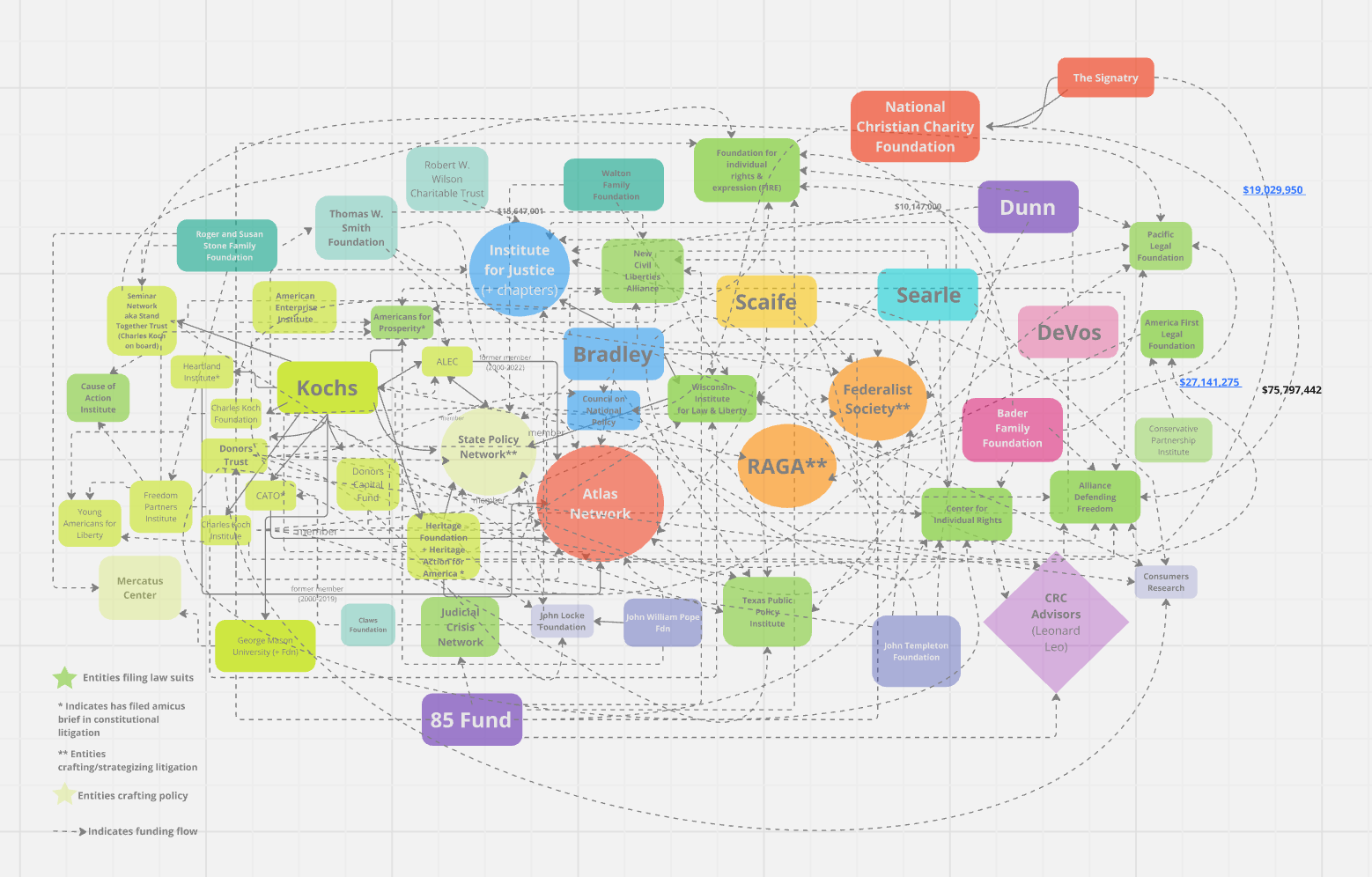
---
here's who paid for Iowa AG Brenna Bird's trip to NYC for Donald Trump's hush money trial
Des Moines Register
Iowa Attorney General Brenna Bird's trip to New York City on Monday to attend Donald Trump's trial was at the invitation of the Republican Attorneys General Association.
A spokesperson for Bird's campaign told the Des Moines Register that the group invited attorneys general, including Bird, "to go to Manhattan and show support for President Trump." The group also covered the trip's expenses.
On Monday, Bird was seen entering the courthouse behind Trump along with a gaggle of his supporters. Her office confirmed she attended, and a spokesperson said no taxpayer money had been used to fund her travel.
Bird repeated that sentiment Tuesday at a press conference in Ankeny, where she announced a lawsuit against California-based electric truck requirements. She did not give details on how the trip was funded or if she was invited — details later provided by a spokesperson.
"No taxpayer funds were used, and I went to New York to show my support for President Trump and to witness what was going on there, in that courtroom in Manhattan," Bird told reporters.
In a news conference outside the courthouse Monday, Bird said she traveled from Iowa to represent the state's support for the former president as he stands trial in a hush money case.
"We need him back as our president leading our country again," Bird said. "My background is as a prosecutor, and what I saw in that courtroom today is a travesty. Politics has no place in a court of law.
"They try to charge him with all these ridiculous things that include a star witness who is a perjurer, disbarred, convicted of lying," Bird added. "It tells us the state we are in this country right now."
The chair of the Iowa Democratic Party, Rita Hart, criticized the appearance, saying "Iowans deserve an attorney general that's focused on serving her constituents — not her political ambitions."
In his January victory speech for the Iowa caucuses, Trump said of Bird, "she's going to be your governor someday."
The Republican Attorneys General Association has been embroiled in political controversy in the past.
Before the Jan. 6, 2020, insurrection in Washington, D.C., the Rule of Law Defense Fund, a fundraising arm of the Republican Attorneys General Association, sent a robocall inviting people to march to the U.S. Capitol.
The robocall said: "The march to save America is tomorrow in Washington, D.C. … At (1 p.m.) we will march to the Capitol building and call on Congress to stop the steal. We are hoping patriots like you will join us to continue the fight to protect the integrity of our election."
*Brianne Pfannenstiel contributed reporting.
*Galen Bacharier covers the Statehouse & politics for the Register. Reach him at gbacharier@registermedia.com or (573) 219-7440, and follow him on Twitter @galenbacharier
---
CMD
group Linked to Anti-Abortion Activist Leonard Leo Was Top Funder of Republican AG Campaigns in 2022
By David Armiak
|
February 2nd, 2023
Campaign Finance, Democracy, Elections, Featured Investigations, Koch, News, RAGA
A group tied to the influential anti-abortion activist Leonard Leo gave $3 million to the Republican Attorneys General Association (RAGA) in the fourth quarter, making it the largest contributor to the organization in 2022, according to an analysis of IRS filings by the Center for Media and Democracy (CMD).
The Concord Fund, a dark money group affiliated with the Trump “judge whisperer” and Federalist Society board co-chair, also made a $1-million contribution to RAGA in the first quarter, bringing its total for the year to $4 million.
This again makes The Concord Fund RAGA’s largest funder in 2022, continuing a trend that began in 2020 and was repeated in 2021.
Leo’s increasing influence on local legal landscapes comes as the fight over reproductive rights moves to the states following the U.S. Supreme Court’s controversial decision last summer overturning Roe v. Wade.
The largest known financial backer of Leo’s political network is Barre Seid, the Chicago electronics manufacturer who contributed $1.65 billion to his Marble Freedom Trust in 2020, which, in turn, passed along $16.5 million to The Concord Fund, The New York Times reported.
RAGA pays Leo’s Creative Response Concepts—rebranded as CRC Advisors—$7,500 per month for “consulting,” according to 2022 IRS filings.
With its $1.5 million in contributions, the Institute for Legal Reform was the second largest donor to RAGA in 2022, CMD found. This affiliate of the U.S. Chamber of Commerce focuses on advancing business-friendly legal reforms such as making class-action lawsuits more difficult to file and defending business interests in court.
A Koch Industries contribution of $755,000 and Altria’s $500,000 donation rounded out the top four 2022 donors to RAGA.
Charles Koch, the billionaire CEO of Koch Industries, has not only heavily financed RAGA over the years—both personally and through his companies—he is also a key contractor for the organization. RAGA continues to subscribe to i360, “Koch’s data mine,” for $4,000 a month, 2022 IRS filings show.
RAGA’s post-general report and year-end report indicate that the organization raised a total of $8.3 million in the fourth quarter, bringing its total revenues to $21.7 million for the year and $34.5 million for the midterm election cycle.
In the fourth quarter, the next largest contributions behind The Concord Fund’s $3 million came from the Rule of Law Defense Fund ($400,000), RAGA’s 501(c)(4) advocacy arm; billionaire real estate tycoon Steve Wynn ($300,000); and GOP megadonor Richard Uihlein‘s Fair Courts America ($250,100).
Together with its affiliates, the Rule of Law Defense Fund and the Center for Law and Policy, RAGA runs a cash-for-influence operation that coordinates the official actions of Republican state attorneys general and sells its corporate funders access to those AGs and their staff.
RAGA Spends Big on Elections, Funnels $1.9 Million to Georgia Governor's Leadership Committee
RAGA spent more than $16 million in the final weeks before the November 2022 elections, bringing its cycle spending total to $36.6 million. In October and November, most of that went to independent expenditures for state AG races, including close to $6.5 million for TV ads, $1.3 million for direct mail and text messages, and $773,000 for digital advertising.
In an unusual move, RAGA also disclosed contributing $1.9 million to the Georgians First Leadership Committee set up by Georgia’s GOP Gov. Brian Kemp, the post-general report shows.
Kemp won a second term in November by again defeating Democratic challenger Stacey Abrams.
RAGA's next largest campaign donation in the fourth quarter was for $800,000 to the Bird for Iowa AG race. Brenna Bird (R) narrowly defeated longtime incumbent Tom Miller (D), winning 50.8% of the vote to oust her predecessor from an almost 40-year run as the country's longest-serving attorney general.
The Iowa race clearly proved to be a top priority for RAGA, which disclosed spending a total of $2 million in 2022 to elect Bird, CMD calculated.
RAGA's other campaign contributions in the fourth quarter went to Louisiana candidate for AG Liz Murrill ($5,000); South Carolina Attorney General Alan Wilson ($3,500), who won reelection to his fourth term in November; and Kentucky candidate for AG Russell Coleman ($2,000).
Both the Louisiana and Kentucky AG races are ongoing, with the election in Louisiana taking place on October 14 this year, and the Kentucky election following on November 7.
---
table no lnx
Republican AG Pay-to-Play Group Raises $4.9 Million in Second Quarter - EXPOSEDbyCMD
Republican AG Pay-to-Play Group Raises $4.9 Million in Second Quarter
By David Armiak | July 19th, 2022
Campaign Finance, Democracy, Elections, Featured Investigations, Koch, News, RAGA
Editor’s Note: On July 20, 2022, RAGA’s deputy executive director Johnny Koremenos notified CMD that the $300 contribution from Philanthropy Roundtable highlighted in this story was refunded.
The Republican Attorneys General Association (RAGA) raised $4.9 million in the second quarter of this year, according to a report filed with the Internal Revenue Service (IRS) on Friday. RAGA‘s haul is $300,000 less than in the second quarter of 2018 and slightly exceeds the $4.8 million the group raised during the first quarter of 2022.
RAGA spun its fundraising figures by giving Fox Business an exclusive, claiming that it “broke another fundraising record.” But the $6.3 million figure it gave for the quarter was “across all entities,” and since 2022 IRS filings for RAGA’s sister organizations the Rule of Law Defense Fund (RLDF) and the Center for Law and Policy (CLP) will not be publicly available until November 2023 at the earliest, the Center for Media and Democracy (CMD) cannot verify the claim.
RAGA accepts unlimited contributions from corporations, individuals, and special interest groups such as Koch Industries, Altria, and the U.S. Chamber of Commerce, primarily to fund the campaigns of Republican candidates for attorneys general. Together with its affiliates RLDF and CLP, it runs a cash-for-influence operation that coordinates the official actions of Republican state attorneys general and sells its corporate funders access to those AGs and their staff.
RAGA’s largest contribution in the second quarter, $200,000, went to Brenna Bird, the Republican candidate for attorney general in Iowa, who faces an uphill battle to unseat the longest-serving state AG in the country, Tom Miller (D).
In a surprising move, RAGA gave $15,200 to Georgia AG Chris Carr’s reelection campaign. Although Carr is a Republican, he resigned as RAGA’s national chair in 2021 over the selection of Peter Bisbee to replace Adam Piper as RAGA’s executive director, citing “a significant difference of opinion… as to the direction this organization should take going forward” and “vastly opposite views of the significance of the events of January 6.”
Bisbee formerly led RLDF and, in the days prior to the deadly attack on the U.S. Capitol, he was responsible for sending out robocalls encouraging supporters to “march to the Capitol and call on Congress to stop the steal.” His selection also led to an exodus of longtime RAGA staff members, CMD reported.
Raul Labrador, the Republican candidate for attorney general in Idaho, was the only other individual to receive RAGA funding in the second quarter, accepting $5,000 for his campaign, the report discloses.
RAGA hopes to build on the 28 state offices held by Republican attorneys general through “seven-figure investments to flip seats in Wisconsin, Michigan and Nevada, and to retain the attorney general office in Arizona,” according to Fox Business.
Corporations Attending Latest RAGA Fundraiser Contribute $1.2 Million
Over the weekend, 18 companies were scheduled to attend a major RAGA fundraising event at a luxury resort in Florida, CNBC reported. Of those companies, 10 gave a total of $1.2 million to RAGA in the second quarter, CMD found.
Leading the pack was the Institute for Legal Reform (ILR), which gave another $500,000 in addition to the $255,000 it contributed in the first quarter. An affiliate of the U.S. Chamber of Commerce, ILR focuses on advancing business-friendly legal reforms such as making class-action lawsuits more difficult to file and defending business interests in court.
Following the ILR, Centene Management Company, a Missouri-based healthcare company, was the next largest RAGA donor, with a $350,000 contribution in the second quarter.
The consumer wellness company Melaleuca, which has given RAGA $260,000 so far this year, is also a leading donor expected to attend the gathering. In addition, each of the following companies scheduled to attend has already hit or topped the $100,000 mark in 2022: Anheuser-Busch ($105,000), Anthem ($100,000), Comcast ($130,000), and General Motors ($100,000).
BNSF Railway and Ronald Cameron Round Out Top Five
BNSF Railway Company and Ronald Cameron, CEO of the Mountaire Corporation, each gave $150,000, making them among the top five second-quarter donors to RAGA.
Cameron is a top donor to the Koch political network. His company paid $65 million in 2021 to settle a class action lawsuit and agreed to make $140 million in investments in wastewater treatment facilities mandated by the state, CMD reported. In addition, he was the 14th largest donor to super PACs in 2021, CMD found.
RAGA Accepts Another Illegal Donation
In February, Popular Info reported that RAGA accepted an illegal donation of $50,000 from Children’s Health Defense, Robert F. Kennedy, Jr.’s anti-vax propaganda outfit.
According to IRS rules, “a section 501(c)(3) organization may not make a contribution to a political organization described in section 527 (such as a candidate committee, political party committee or political action committee (PAC).” As a 501(c)(3) nonprofit, Children’s Health Defense admitted the donation was illegal, but claimed that “they paid $50K to get access to Republican AGs to brief them on ‘health policy issues.'”
RAGA, a 527 registered group, refunded the $50,000 the day after the Popular Info report, its first quarter filing confirms.
Now, RAGA’s latest filing shows that it received an illegal donation of $300 from the Philanthropy Roundtable, another 501(c)(3) nonprofit chaired by Bradley Foundation President Richard Graber. The Philanthropy Roundtable was established with funding from the Institute for Educational Affairs in the 1970s to help facilitate and coordinate conservative grant-making and foundations.
...
| Chamber Institute for Legal Reform | $505,000 |
|---|---|
| Centene Management Company, LLC | $350,000 |
| Melaleuca | $260,000 |
| BNSF Railway Company | $150,000 |
| Cameron, Ronald | $150,000 |
| Comcast Corporation | $130,000 |
| ATandT Services | $125,000 |
| David Nutt and Assoc PC | $125,000 |
| Aetna | $125,000 |
| Consovoy McCarthy PLLC | $105,560 |
| Anheuser-Busch COS | $105,000 |
| Pfizer | $100,560 |
| General Motors | $100,000 |
| Anthem | $100,000 |
| Altria Client Services | $100,000 |
| U-Haul International | $75,000 |
| Exxon Mobil Corporation | $75,000 |
| The Anschutz Corporation | $75,000 |
| Blue Cross Blue Shield of South Carolina | $62,500 |
| National Shooting Sports Foundation | $50,200 |
===
---
Read More
October 2, 2023
Attorney General Bird Leads Letter Opposing Biden Administration Radical Environmental Scheme for Development Projects
DES MOINES- Today, Attorney General Bird led a coalition of 24 states in a letter opposing a proposed Biden Administration rule that will illegally mandate social, environmental, and race-based regulations for infrastructure projects and stop development in its tracks. The Biden Administration’s woke environmental scheme is part of its larger...
Read More
october 2, 2023
Attorney General Bird Leads Letter Opposing Biden Administration Radical Environmental Scheme for Development Projects
DES MOINES- Today, Attorney General Bird led a coalition of 24 states in a letter opposing a proposed Biden Administration rule that will illegally mandate social, environmental, and race-based regulations for infrastructure projects and stop development in its tracks.
The Biden Administration’s woke environmental scheme is part of its larger radical climate change plan. With the new rule in effect, Americans will pay more for energy; face delays for projects such as new housing, power plants, roads, and bridges; and even have to cancel projects due to significant price hikes and delays.
This Biden Administration rule not only eliminates the common-sense Trump-era reforms that made development easier, but it goes even further than before. The new rule imposes expensive red-tape regulations for project developers and sets an illegal double standard. With the new rule in effect, projects that align with the Biden Administration’s radical climate change agenda will be favored, while projects that use traditional energy sources will face stricter regulations.
“The Biden Administration will stop at nothing to force its woke climate agenda on the rest of America,” said Attorney General Bird. “Environmental activists shouldn’t dictate how or when we can build a home or bridge. This rule is nothing more than another illegal power grab. And if left unchecked, the new rule will devastate important, job-creating infrastructure projects.”
A coalition of 17 governors, including Governor Kim Reynolds, also wrote to oppose the rule.
The proposed rule violates the Administrative Procedure Act and federal law requiring that significant legislation go through Congress, rather than unelected bureaucrats.
Iowa led the letter joined by Alabama, Alaska, Arkansas, Florida, Georgia, Idaho, Indiana, Kansas, Louisiana, Missouri, Mississippi, Montana, Nebraska, North Dakota, Ohio, Oklahoma, South Carolina, Tennessee, Texas, Utah, Virginia, West Virginia, and Wyoming.
Read the full letter here
ref 18 pp
...tember 29, 2023 Council on Environmental Quality 730 Jackson Place NW Washington, DC 20503 Re: Reconsideration of Council on Environmental Quality National Environmental Policy Act Implementing Regulations Revisions Phase Two (Docket ID CEQ– 2023–0003) The Attorneys General of Iowa and the 23 undersigned States respectfully submit these comments in response to the Council on Environmental Quality’s (CEQ) Revisions of the National Environmental Policy Act’s (NEPA) Implementing Regulations Revisions Phase Two (Proposed Rule).1 C
EQ’s Proposed Rule serves as a dramatic example of federal and administrative overreach. Rather than serve its long-term goals of collecting information about large development projects, the Proposed Rule injects major substantive considerations into the NEPA process. In doing so, the Proposed Rule turns NEPA on its head, and turns it farther away from the effective reform process started in 2020. This radical and illegal climate power grab goes far beyond CEQ’s delegated authority. Congress passed NEPA to achieve laudable goals: to reduce delays and promote better decision-making consistent with national environmental policy.2 Tasked with NEPA’s
...
p 13?
other requirements,” by contrast, will leave an agency unsure of when it has considered enough factors in its analysis. That uncertainty will lead to front-end delays and back-end litigation risk. How can a court determine whether an NGO plaintiff is correct that the agency didn’t consider enough of these “other requirements” in its initial planning? And even if a court adjudicated that issue, the guidance is vague enough that other courts in other jurisdictions could come to conflicting outcomes. Such a regulatory patchwork stands to create real harm, particularly given the lack of certainty for the Proposed Rule’s consistent application.
Similarly, references in the Proposed Rule to “meaningful” public engagement and public participation introduce a fuzzy, unpredictable, un-analyzable element into the NEPA process. The 2020 CEQ regulatory revision was largely motivated by a desire to streamline and simplify what had grown over the decades since NEPA’s enactment into a sprawling, byzantine, insiders’ game. Project reviews were taking too long, taking up too many pages, sprawling into subject areas beyond what Congress intended, and slowing down or deterring needed permits and other actions. Many, if not most, supporters of the NEPA amendments in the recent FRA intended to similarly streamline the process, as evidence by those amendments’ adoption of key aspects of the 2020 rule. But CEQ here is adding or restoring (from the original 1978 regulations) elements that will cause longer, broader-ranging reviews and less legal certainty. The Proposed Rule is therefore in tension not only with the original statute, but also with Congress’s intent in amending NEPA earlier this year.
respectfully submitted,
Brenna Bird
Attorney General of Iowa
Steve Marshall
Attorney General of Alabama
Treg Taylor
Attorney General of Alaska
Tim Griffin
Attorney General of Arkansas
Ashley Moody
Attorney General of Florida
Chris Carr
Attorney General of Georgia
Raúl R. Labrador
Attorney General of Idaho
Theodore E. Rokita
Attorney General of Indiana
Kris Kobach
Attorney General of Kansas
Jeff Landry
Attorney General of Louisiana
Andrew T. Bailey
Attorney General of Missouri
Lynn Fitch
Attorney General of
Mississippi
Austin Knudsen
Attorney General of Montana
Mike Hilgers
Nebraska Attorney General
Drew Wrigley
Attorney General of North
Dakota
Dave Yost
Attorney General of Ohio
Gentner Drummond
Attorney General of Oklahoma
Alan Wilson
Attorney General of South
Carolina
Jonathan Skrmetti
Tennessee Attorney General
Ken Paxton
Attorney General of Texas
Sean D. Reyes
Attorney General of Utah
Jason Miyares
Attorney General of Virginia
Patrick Morrisey
Attorney General of West
Virginia
Bridget Hill
Attorney General of Wyoming
---
*[BLEEDING HEARTLAND
Herb Strentz](https://www.bleedingheartland.com/author/herb-strentz/) was dean of the Drake School of Journalism from 1975 to 1988 and professor there until retirement in 2004. He was executive secretary of the Iowa Freedom of Information Council from its founding in 1976 to 2000.*
Attorney General Brenna Bird continues to ignore her critics, doubling down on actions that have drawn criticism. Unfortunately for Iowans, she’s picked a bad model to imitate.
This shoot-yourself-in-the-foot strategy had worked so well for Donald Trump that Bird seems to figure, “Why not give it a try?”
And she’ll likely continue that style, despite the unanimous verdict(s) against Trump in the one trial he has not managed to delay.
Bird’s approach follows Trump’s often quoted line from an Iowa campaign rally in January 2016. He used a New York City scenario to explain his anticipated success at the polls: “I could stand in the middle of Fifth Avenue and shoot somebody and I wouldn’t lose voters.”
He maintained that bravado in the wake of being one found guilty not of one minor felony, but of 34 related counts of falsifying his business records “to conceal a $130,000 hush money payment to adult film star Stormy Daniels to influence the outcome of the 2016 election.”
So, if you fret about friends or family who remain devoted to Trump despite your concerns, that underscores Trump’s confidence in his followers. Likewise, if you find fault with Bird, prepare for more of the same.
Bird has yet to rebut criticism of her comments at Trump’s trial locale in New York City. Minutes after the guilty verdicts were announced, she posted on X/Twitter,
Today is a dark day in American history.
Case in point why politics should have absolutely no place in prosecutions.
The American people, not a court, should decide who the next leader of the free world will be. President @realDonaldTrump deserves better.
Iowa Governor Kim Reynolds promptly called the unanimous verdicts a “sham.”
In line with his consistent refusal to hold Trump accountable, U.S. Senator Chuck Grassley recently characterized the case against the former president as a “political lynching.” The outcome in New York was quite unlike the verdict Grassleyand 42 other GOP senators rendered after Trump was impeached for inciting an insurrection in January 2021.
Bird showed up at the Manhattan courthouse to support Trump while he faced felony charges over efforts to cover up some moral indiscretions. She bashed those who believe no one should be above the law, and elected officials should be held accountable.
Iowa’s attorney general asserted that Trump’s legal problems in New York, Florida, D.C. and Georgia are all about politics, which, she declared, has no place in the courtroom. Others have noted the hypocrisyof her words and actions. Politically motivated cases were at the heart of Bird’s campaign to unseat Democrat Tom Miller in 2022. Back then she vowed, “I have news for [President] Joe Biden when I’m attorney general: I’ll see you in court.”
A “RAP SHEET” FOR BIRD
In addition to promising lawsuits against the Biden administration, Bird (who was the Guthrie County attorney) campaigned against Miller for supposedly being soft on crime and not being the equivalent of a county attorney for all of Iowa.
To that end, she enlisted the endorsementsof 71 of Iowa’s 99 county sheriffs. Miller, she complained, spent little time in county law enforcement.
Miller served a total of 40 years as Iowa attorney general, a nationwide record for state attorneys general.
If Bird had paid more attention to what the Iowa attorney general is supposed to do, she might have read 175 words describing the office’s primary responsibilities.
The attorney general is the State of Iowa’s chief legal officer. The attorney general has general charge, supervision and direction of the state’s legal business. The attorney general is elected every four years.
The Office of the Attorney General provides legal advice and representation to most of the state’s major departments, boards, commissions, authorities, officials and institutions. The office further represents the State of Iowa in state administrative law and Iowa District Court matters, the Iowa Court of Appeals, the Iowa Supreme Court, lower federal courts and the U.S. Supreme Court.
The attorney general’s legal and support staff provide day-to-day advice to state officials and agencies. State government is a very large and complex enterprise, doing everything from providing human services, to building roads, to protecting citizens from incompetent licensed professionals and protecting the environment. Legal issues often arise in the context of the state’s work. The office guides, mediates, negotiates, drafts legal documents, and performs a wide range of other legal services to assist state agencies in fulfilling the important work of state government.
No mention of county criminal prosecutions there. Those duties are followed by a 38-word “In addition” reference to lesser chores, including six words on criminal prosecutions.
Cedar Rapids Gazette columnist Todd Dorman detailed Bird’s “rap sheet” on putting divisive MAGA (Make America Great Again) priorities ahead of AG duties. He pointed out:
Maybe Bird believes New York prosecutors are purely political because she is. You’re never more than a few days away from another politically motivated lawsuit joined by Bird assailing the Biden administration.
Environmental protection is among Bird’s favorite targets. This week [May 14], she signed on to a lawsuit to scrap higher fuel efficiency standards for heavy duty vehicles. It might push companies to use electrical vehicles that won’t need ethanol. To the ramparts! […]
Bird is among red states suing to stop Title IX sex discrimination protection from covering LGBTQ students. […]
And, of course, Bird has stopped using victim compensation fund dollars to pay for emergency contraception for rape victims in Iowa.
So, Bird has no compunction about bringing politics into court, so long as it’s her brand of politics.
MAGA AND RAGA
Bird’s New York mission provided yet another target for her critics. There’s some poetic irony in that her dedication to Trump’s MAGA movement includes being an activist in the Republican Attorneys General Association. RAGA promotes the 27 Republican attorneys general around the country, who have filed the numerous multi-state lawsuits against the Biden administration.
RAGA reportedly paid for Bird’s travel expenses to New York, and a RAGA Political Action Committee contributed $2 million to Bird’s 2022 campaign.
Elie Mystal’s column for The Nation described the RAGA agenda as “a hatred of reproductive rights, a love of guns, and an obsession with prosecuting the LGBTQ community.”
That characterization pretty much sums up recent legislative sessions in Iowa. Reynolds and her legislative lemmings rubber-stamped a national MAGA, states’ rights agenda, including attacks on public schools. That agenda would change our national motto designed in 1776 and adopted by Congress in 1782: E Pluribus Unum – “out of many, one” to Ex Uno Multi — “out of one, many.”
This post was initially conceived to compare Bird’s record with that of her predecessors. But Bird’s record to date is so troubling that drawing such a contrast wasn’t worth the time.
...
---
npr? see SIO
...An election partnership that Wilcox helps lead has even stopped advertising a service that allows local officials to report false voting information online, for fear of conservative backlash — a sign of broader concerns of those who work to safeguard elections as America nears another round of presidential voting.
Experts say a campaign of legal and political pressure from the right has cast efforts to combat rumors and conspiracy theories as censorship. And as a result, they say, the tools and partnerships that tried to flag and tamp down on falsehoods in recent election cycles have been scaled back or dismantled. That's even as threats loom from foreign governments and artificial intelligence, and as former President Donald Trump, who still falsely claims to have won the 2020 contest, is likely to use the same tactics again as he pursues the White House in 2024.
Added Wilcox: "Everybody is gun-shy."
"Open season"
As Nina Jankowicz sees it, the opening salvo came in the spring of 2022, when a right-wing campaign quickly snuffed out a Department of Homeland Security initiative called the Disinformation Governance Board.
POLITICS
She joined DHS to fight disinformation. She says she was halted by... disinformation
Jankowicz, who has written books about Russian information operations and online harassment, was tapped to lead the board. The federal government described it as a working group, without "any operational authority or capability," tasked with coordinating efforts to identify false and misleading claims and share facts about security concerns, from elections to natural disasters.
But the combination of the board's ominous-sounding name and DHS's poor efforts to communicate its purpose made it catnip for right-wing influencers, who quickly seized on the board and Jankowicz herself as avatars of a nefarious plot to censor Americans.
"The Biden Administration's decision to stand up a 'Ministry of Truth,' is dystopian in design," said now-House Speaker Mike Johnson, R-La., shortly after the board was announced. "The government has no role whatsoever in determining what constitutes truth or acceptable speech."
Supporters of former President Donald Trump look at merchandise ahead of his rally in Hialeah, Fla., this week. Trump continues to falsely claim he won the 2020 election, fueling conspiracy theories around the voting process.
Ricardo Ardeuengo/AFP via Getty Images
After a barrage of death threats and abuse, Jankowicz resigned, and DHS scrapped the board altogether. Jankowicz told NPR that the timid effort by the federal government to defend her or push back against the allegations sent a clear message.
"That showed ... that it was open season on researchers, on civil servants, on anyone who was working in this space," Jankowicz said.
Amid that furor, in May 2022, the Republican attorneys general of Missouri and Louisiana filed a lawsuit accusing the Biden administration of colluding with social media companies to censor conservative speech, by pressing platforms to take action on misleading posts about COVID-19 and elections.
Supreme Court to hear court ban on government contact with social media companies
This July, a Trump-appointed federal judge ruled the government had likely violated the First Amendment and issued a sweeping injunction blocking agencies' communications with platforms about most content. The injunction was narrowed by an appeals court, before being put on hold last month by the Supreme Court, which is slated to hear the case this term.
Pressure is coming from Congress as well, where the House Judiciary Committee's Select Subcommittee on the Weaponization of the Federal Government, led by GOP Rep. Jim Jordan of Ohio, a Trump ally, is conducting its own probe into alleged collusion between the Biden administration and tech companies to unconstitutionally shut down political speech.
===}:
ymail 4 24
Leonard Leo’s Concord Fund Top Funder of Republican AGs Group in 2024
The Republican Attorneys General Association brought in $5.3 million in contributions in the first quarter of 2024, as its latest Federal Elections Commission disclosure CMD examined shows. The amount raised is almost a million more than RAGA raised in the first quarter of 2020, the last major election cycle. You can read the full story here.
CMD in the News
Our research has recently been cited by or featured in the following publications:
Clean Technica: “Repugnican States Sue To Block Already Weakened Exhaust Emissions Rules”
Jason Garcia/Seeking Rents: “A National Insurance Company Wrote a Bill To Obstruct Asbestos Lawsuits In Florida”
Accountable.US: “Leonard Leo’s Network Is RAGA’s Top Funder Once Again”
The Guardian: “Powerful conservative funds hand out millions to pro-Trump far-right groups”
Talking Points Memo: “Republican AGs Are Teaming Up With The Corporations Poisoning Their States To Gut The Clean Air Act. Why?”
Texas Observer: “TPPF’s Long Love Affair With Ken Paxton”
Law360: “Do New Laws Seek To Regulate Charitable Bail, Or End It?”
---
===
ymail 4 24
our best attempt at visually depicting a shadowy pollution-laden effort to influence U.S. courts. Look, we’re not illustrators, OK?
At the Society of Environmental Journalists conference this year, we heard about a promising legal case that experts believe actually has a real shot at holding the fossil fuel industry accountable for climate change.
City & County of Honolulu v. Sunoco LPis the first climate liability lawsuit against fossil fuel companies to be greenlit for trial, expected later this year. In it, Honolulu accuses several oil and gas giants of misleading its citizens about the environmental consequences of fossil fuels for decades, and seeks financial compensation for past, present, and future damages to the region.
As a trial comes closer, however, we learned that the lawsuit is facing more and more serious obstacles. Most notably, last week, a plethora of fossil fuel-funded groups–including the American Petroleum Institute–filed petitions asking the U.S. Supreme Court to step in and stop the trial from moving forward.
In addition, a whopping 20 Republican state attorneys generalalso filed a petition asking the Supreme Court to do the same. So it’s not just industry groups: nearly half of the country’s chief legal officers are asking the nation’s top court to intervene in a local government’s climate lawsuit.
How did this happen? If you only read Fox, or other conservative news, you’d likely believe that these state attorneys general were acting on behalf of their citizens, out of deep legal concern they all just so happened to share.
But this is not the whole story. In reality, the state AG petition is part of the organized effort by the fossil fuel industry to kill all formal efforts to hold corporations accountable for the climate crisis—both in the litigation space, and beyond.
RAGA: A legal group fueled by oil and gas
To understand how these 20 state attorneys general are connected to the fossil fuel industry, you first must understand The Republican Attorneys General Association, known as RAGA.
“RAGA is a pay to play group,” says Lisa Graves, the executive director of the watchdog group True North Research. “It was created to allow industries to wash money into RAGA, which RAGA then uses to fuel the election campaigns and ambitions of AGs.”
RAGA’s name is not on the Hawaii brief, and beyond its official X account posting a news story about it, it has not publicly admitted its involvement. But the self-described group of “conservative fighters,” which includes 28 Republican attorneys general among its members, has endorsed every single attorney general involved.
 ||
A screenshot of RAGA’s post about the Hawaii case brief. Source: X
According to research by HEATED and the Center for Media and Democracy, all 20 state attorneys general that signed the amicus brief are not only featured on RAGA’s website, but many were elected with RAGA’s help.
The lead counsel for the amicus brief, Alabama attorney general Steve Marshall, was the organization’s chair in 2023. Three attorneys general have served on RAGA’s executive committee (Indiana, Mississippi, and Utah), and five have been chairs or vice chairs (Alabama, Georgia, Montana, South Carolina, and Utah).
At least six AGs won their elections with the support and funding of RAGA, including the attorneys general from Oklahoma, Missouri, Kentucky, Louisiana, Iowa, and Idaho. In a statement last year, RAGA celebrated “a 100 percent success rate for RAGA in the 2023 election cycle.” This included the election of Louisiana AG Liz Murrill, which the organization supported with “a substantial, statewide paid advertising campaign.”
“These AGs, their political futures are underwritten by RAGA,” Graves said. “And who underwrites RAGA? The fossil fuel industry, along with Leonard Leo.”
RAGA did not respond to our requests for comment; when HEATED called executive director Pete Bisbee, he said he doesn’t speak to journalists, referred us to a spokesperson, and hung up. (Bisbee has previously been under fire leading the organization that paid for robocalls encouraging former President Trump supporters to protest the election results at the Capitol on Jan 6.)
But public statements, donations, and recordings of private meetings reveal RAGA’s deep ties to the fossil fuel industry. In 2023 alone, RAGA received more than $15 million in donations, and more than $1 million of those contributions came from the fossil fuel industry, according to HEATED’s analysis of IRS tax forms. Over the last decade, RAGA has accepted more than $10 million from fossil fuel companies, electric utilities, and industry trade groups.
Among RAGA’s donors are Koch Industries, Exxon, Chevron, ConocoPhillips, the American Petroleum Institute, and American Fuel and Petrochemical Manufacturers (AFPM)—and these donors have pushed AGs to adopt an aggressive anti-climate strategy.
How RAGA connects fossil fuel companies to AGs
To connect AGs with the priorities of donors, RAGA offers different tiers of access for different amounts of donations. “It’s not technically money laundering, but it has that appearance,” Graves said.
RAGA members who pay annual fees of $25,000 can help shape the organization’s legal strategy via “online RAGA briefing rooms,” for example. And members who pay more than $125,000 are given access to private meetings with attorney generals and invitations to in-person events with them, according to documents obtained by*The New York Times* in 2014.
In 2016, the Center for Media and Democracy obtained audio from one of those events. Titled “Climate Change Debate: How Speech is Being Stifled,” the session included former Alabama attorney general Luther Strange; AFPM president Chet Thompson;and noted fossil-funded climate denier Myron Ebell.
Together, they talked about the importance of protecting ExxonMobil from lawsuits like Honolulu’s. “We’re facing a coordinated campaign to demonize, weaken and try to destroy the industry,” Thompson said.
But Thompson also said stopping climate liability lawsuits would not be enough to protect the fossil fuel industry. What the industry really needed, he said, was protection from nearly all federal environmental regulation.
What followed was years of litigation led by Republican attorneys general against every environmental regulation worrying Thompson, and more.
RAGA’s goal: industry capture of the U.S. legal system
In 2021, 20 AGs sued the EPA to block its power plant emissions rules, which Thompson specifically called out in the panel. West Virginia v. EPAultimately went to the Supreme Court, whose ruling significantly decreased the EPA’s authority to regulate emissions.
In 2023, 25 Republican AGs sued the Department of Labor over retirement funds that considered ESG factors, including fossil fuel divestment. Thompson had called out divestment in the panel, too.
In 2024, 10 Republican attorneys general, all members of RAGA, sued the SEC over its climate disclosure rules, which Thompson also called out in the session.
RAGA members have also brought lawsuits fighting the Clean Water Act, limits on vehicle emissions, and the LNG exports pause—all while being paid by the industries that profit from pollution.
But the suits brought by RAGA members aren’t limited to the federal government. They’re also trying to stop localities like Honolulu from trying climate liability cases in state courts. RAGA, and the corporations it defends, want these cases tried in federal courts, where Republican-appointed federal judges are more likely to rule in the fossil fuel industry’s favor.
In fact, the same funders who helped appoint ultra-conservative judges to federal courts also donate to RAGA. Among RAGA’s top donors is the dark money group The Concord Fund, which is affiliated with the Federalist Society’s co-chairman Leonard Leo. Leo is credited with playing moving the federal court system to the right, and was instrumental in appointing multiple conservative justices to the U.S. Supreme Court, including Justices Alito, Roberts, Gorsuch, Kavanaugh, and Coney Barrett.
That network of industry influence has purchased the current anti-regulatory legal environment—and RAGA plays an essential role. "These AGs are willing to let the planet burn as they continue to take funding through RAGA from this industry," Graves said.
Former Hawaii Supreme Court Justice Michael Wilson went one step further in describing the effect of RAGA in fighting climate change.
“The AGs are violating their public duty to protect the future of their citizenry,” he said. “This partisan political use of the rule of law is what has caused the judicial branch of government to descend to its lowest level of public approval in recorded history.”
Further reading:
- The Low-Key Republican Officials Quietly Dismantling All of Our Rights. Slate, April 2024
Key quote: ”This agenda to use the Supreme Court to strip us of our rights, to use the court to make it harder for us to deal with climate change, to use the court to roll back reproductive rights, gay marriage, and more. These are all part and parcel of Leo’s agenda and these attorneys general are on that agenda.”
- These Attorneys General Are Defending the Fossil Fuel Industry, Not Their States. The Equation, March 2023
Key quote: “According to the nonpartisan National Association of Attorneys General, a state attorney general’s job is to represent the public interest—not private, special interests—by, among other things, ‘enforcing federal and state environmental laws.’ Attorneys general in the five states most vulnerable to climate change, however, are doing the exact opposite: Instead of defending their constituents, they are defending the fossil fuel industry.”
- Lobbyists, Bearing Gifts, Pursue Attorneys General. The New York Times, October 2014
Key quote: “But success did not come in court or at a negotiating table. Instead, it came at the opulent Loews Santa Monica Beach Hotel in California, with its panoramic ocean views, where more than a dozen state attorneys general had gathered last year for cocktails, dinners and fund-raisers organized by the Democratic Attorneys General Association.”
---
===
{{{== note ccr 1st amend bs
desmog 4 24
fossil fuel interest groups have mobilized quickly to oppose a new rule issued by the Biden administration designed to speed up America’s transition to hybrid and electric vehicles.
The rule, which the U.S. Environmental Protection Agency (EPA) finalized on March 20, limits emissions from tailpipes on new cars, starting in 2027.
Well before the EPA finalized the new standard, powerful corporate lobbies like the American Fuel & Petrochemical Manufacturers (AFPM) had already promised to spend at least a million dollars campaigning against the rule by falsely portraying it as a “ban” on new cars. The group’s
 warn viewers that their freedoms and choices “will soon be taking a back seat to big government.”
The EPA predicts that the change would result in around two-thirds of new vehicle sales being hybrid or electric by 2032 — up from around eight percent today.
Beyond stopping more than 7 billion tons of carbon pollution, the agency predicts that the rule could save drivers more than $60 billion in fuel and maintenance costs, according to an EPA fact sheet that accompanied the final rule. The pollution reduction benefits would particularly benefit Black and brown communities because they are disproportionately likely to suffer from air pollution.
“These strongest-ever pollution standards for cars solidify America’s leadership in building a clean transportation future and creating good-paying American jobs,” EPA administrator Michael S. Regan said in a statement.
Compared to the EPA’s initial proposal, the final rule was scaled back to give car manufacturers more time to comply, but the New York Times still described the new standard as “one of the most significant climate regulations in the nation’s history.”
The heads of AFPM and the American Petroleum Institute (API) — the leading trade group for the oil and gas industry — declared in a joint statement that the rule “will unequivocally eliminate most new gas cars and traditional hybrids from the U.S. market in less than a decade.”
In February, AFPM had already begun portraying the rule as a “car ban” and announced a “seven-figure issue campaign” featuring TV and digital ads, as well as billboards and text messages. Some of the efforts target electoral swing states, including Michigan, Wisconsin, and Pennsylvania. The group also launched a website that warns readers, in all caps, to “keep the government’s hands off our cars!”
Despite the industry’s attempt to misleadingly brand the new standard, “this is not a ban of internal combustion engines,” Margaret Wooldridge, a professor of mechanical engineering at the University of Michigan, said in a statement.
Last year, AFPM spent nearly $7 million lobbying the federal government — more than any year in its history — according to OpenSecrets.
The top two bills the group reported lobbying for are designed to prevent the EPA from finalizing or enforcing vehicle emissions standards. Both bills passed the House last year. (Chevron, API, Koch Industries, and Marathon Petroleum are among the other industry groups and companies that lobbied for these bills last year.)
In addition to lobbying Congress and running million-dollar public influence campaigns, corporate trade groups have increasingly used lawsuits and the threat of costly, time-consuming litigation to stop or delay climate-related regulations.
Earlier this month, for instance, the U.S. Securities and Exchange Commission (SEC) finalized a long-delayed rule that requires public companies to disclose some of their emissions and climate risks that could impact their businesses. While the published rule was substantially weaker than what the SEC originally proposed, the U.S. Chamber of Commerce was among a handful of conservative interest groups that immediately challenged the measure in court.
Another recent EPA rule targeting methane emissions also met with opposition from Republican officials and oil and gas interests, according to Politico.
And on March 6, barely a month after the EPA finalized a separate rule limiting soot pollution, API, the National Association of Manufacturers, and the Chamber were among eight trade groups that sued the agency in the D.C. Circuit court.
‘Prepared to challenge it in court’
In a blog post, AFPM claims that the EPA “does not have authority to overhaul the U.S. economy or transportation system or compel — directly or otherwise — the use of EVs to address vehicle emissions.”
Similar objections to the authority of federal agencies to issue regulations have found a receptive audience among the Supreme Court’s conservative majority.
If the EPA doesn’t undo the tailpipe emissions rule, “our organizations are certainly prepared to challenge it in court,” the AFPM and API CEOs said in the joint statement that followed the announcement.
In attacking the rule, corporate interest groups like AFPM are following a well-trod path of fighting new climate regulations on every playing field they can find.
During the Trump administration, AFPM helped lead a successful effort to weaken previous EPA fuel efficiency standards. The group helped marshal Republican governors to advocate for the rollback, while also supporting Energy4US, a front group that encouraged Americans to flood the EPA with public comments, as DeSmog previously reported.
“One of the big advantages that oil industry lobbyists like AFPM have is money, and AFPM certainly isn’t afraid to use it,” Jesse Coleman, a senior researcher at the investigative outlet Documented, told DeSmog in an email.
“Million dollar ad campaigns are an unfortunately common way for groups like AFPM to pressure legislators and regulators by raising the political temperature on an issue. Litigation slows things further, leading to years of delays in implementation.”
---
REF DESMOG
March 21 (Reuters) - A U.S. judicial panel on Thursday consolidated at least nine lawsuits challenging the U.S. Securities and Exchange Commission's new rules requiring public companies to report climate-related risks in a venue favored by Republican-led states and a business group.
The St. Louis-based 8th U.S. Circuit Court of Appeals was chosen randomly via a lottery and will consider the legal challenges to the landmark rule, which aims to standardize public company disclosures about greenhouse gas emissions, weather-related risks and how they are preparing for the transition to a low-carbon economy.
The court, which has 10 Republican-appointed active judges and one appointed by a Democratic president, was the venue where nine Republican-led states including Iowa, Montana and North Dakota and the business lobbying group American Free Enterprise Chamber of Commerce filed their challenge.
Representatives for the Republican-led states and industry challengers did not immediately respond to requests for comment. The SEC declined to comment.
First proposed in 2022, the rules are part of Democratic President Joe Biden’s efforts to leverage federal agency rulemaking to address climate change threats.
They were approved by the SEC on March 6, and the first lawsuit seeking to block them was filed later that day.
The consolidated lawsuits include challenges filed by at least 25 Republican-led states, energy industry companies and business groups, including the U.S. Chamber of Commerce, the nation's largest business lobby, seeking to overturn the rules.
They have argued, among other things, that the disclosure requirements amount to back-door environmental regulations that go beyond the SEC’s legal authority.
Challengers on the other side of the issue like the environmental organization the Sierra Club and Natural Resources Defense Council have meanwhile said the rules do not go far enough to protect investors, and arbitrarily stripped the final version of stronger reporting requirement rules.
Representatives for the environmental groups said they look forward to arguing before the court.
The conservative-dominated 5th Circuit, the court where Texas and energy companies filed their challenges, temporarily paused the rules from going into effect on Friday.
The SEC is expected to ask the 8th Circuit to revisit that ruling. It had told the 5th Circuit a pause was unnecessary, since the rules have extended compliance deadlines that do not require disclosures before March 2026.}:
The agency has also said the rules "fit comfortably within" its authority to require disclosure of information important to investors, and that they would provide "consistent, comparable and reliable information" about climate risks.
The nine lawsuits were filed in six appeals courts. The 8th Circuit had previously set a deadline for the challengers who sued in that court to file their opening brief in May.
--
REF
March 6 (Reuters) - Ten Republican-led states have sued to challenge new federal rules that require U.S.-listed companies to report climate-related risks, a spokesperson for the West Virginia Attorney General's Office said on Wednesday, hours after the U.S. Securities and Exchange Commission approved the rules.
The states, which also include Georgia, Alabama and Alaska, filed the petition at the Atlanta-based 11th U.S. Circuit Court of Appeals, according to the spokesperson. The rules aim to standardize climate-related company disclosures about greenhouse gas emissions, weather-related risks and how they are preparing for the transition to a low-carbon economy.
The Sierra Club environmental group, meanwhile, said it was considering suing the SEC because it believed the new rules did not go far enough.
The SEC, Wall Street’s top regulator, said the information would give investors reliable information about financial risks companies face related to climate change.
An SEC spokesperson said in a statement that the agency crafts rules that are consistent with its legal authority, and that it will "vigorously defend" the climate disclosure rules in court.
First proposed in 2022, the rules are part of Democratic President Joe Biden’s efforts to leverage federal agency rulemaking to address climate change threats. Similar disclosure requirements have been adopted in Europe and in California.
West Virginia Attorney General Patrick Morrisey on Wednesday said during a press conference that the Biden administration is trying to act as a "puppeteer" using public companies to drive forward its climate agenda.
Republican-led states had been signaling their intent to challenge the rules for years, arguing in public comments in 2022 that they amount to back-door environmental regulations that go beyond the SEC’s legal authority.
They claimed then the rules would require companies to create, gather and disclose a “crushing” amount of material that goes well beyond the finance-based disclosures that investors need.
Anticipating legal challenges, the Biden administration had dropped more ambitious elements of the rules requiring companies to disclose “Scope 3” emissions, indirect emissions by suppliers or customers.
For many businesses, Scope 3 emissions account for 70% of their carbon footprint, according to the consulting firm Deloitte.
The final SEC rules also allow larger companies to determine whether emissions from their own operations and the power they purchase constitute information investors need to make decisions.
Morrisey said that despite changes to the proposed rule, the finalized rule was still defective and unconstitutional.
The Sierra Club, one of the largest environmental advocacy groups in the U.S., said in a statement it was considering filing a lawsuit to challenge the SEC's decision to remove the more robust reporting requirements. The group said it would also defend the SEC's legal authority to issue and implement the rules.
In California state court, litigation has been already been filed by business groups including the U.S. Chamber of Commerce challenging that state’s climate disclosure laws, which include Scope 3 emissions disclosure requirements. That lawsuit filed in January said the state’s laws will impose “massive” costs on businesses and violate free speech protections in the U.S. Constitution by compelling the disclosures.
===}}}:
gmail 3 24
fox no lnx
Texas and 15 states sue Biden admin over climate agenda targeting gas projects
'I will not stand by while Biden attacks Texas,' Attorney General Ken Paxton says
Thomas Catenacci By Thomas Catenacci Fox News
Published March 22, 2024
Comments
Biden's halting of liquified natural gas projects is 'utter nonsense': Marc Morano
Climatedepot.com Executive Director Marc Morano discusses the impact on American energy from the Biden administration's halt of liquified natural gas projects and reacts to Davos saying that drinking coffee causes climate change.
A coalition of 16 Republican states, led by Texas and Louisiana, filed a lawsuit against the Biden administration, challenging its recent climate action pausing proposed energy projects.
The multistate coalition filed its complaint in the U.S. District Court for the Western District of Louisiana, listing President Biden, Energy Secretary Jennifer Granholm and the Department of Energy (DOE) among the defendants in the case. According to the complaint, the DOE's move earlier this year pausing major liquefied natural gas (LNG) export terminal projects violated long-standing federal energy laws.
"Biden’s unilateral decree disregards statutory mandates, flouts the legal process, upends the oil and gas industry, disrupts the Texas economy, and subverts our constitutional structure," said Texas Attorney General Ken Paxton.
"The ban will drive billions of dollars in investment away from Texas, hinder our ability to maximize revenue for public schools, force Texas producers to flare excess natural gas instead of taking it to market, and annihilate critical jobs," he continued. "I will not stand by while Biden attacks Texas."
GOP LEADERS CONFRONT BIDEN’S NEW CLIMATE CZAR ON KEY SECURITY RISKS LURKING IN GREEN AGENDA
Ken Paxton in front of Supreme Court
Texas Attorney General Ken Paxton speaks outside the U.S. Supreme Court on Nov. 1, 2021. (Drew Angerer/Getty Images)
According to Paxton, the LNG export moratorium is unconstitutional, ignores the 1938 Natural Gas Act’s "presumption in favor of exports" and discards decades of DOE energy policy.
In arguing the alleged unconstitutionality of the policy, the states' complaint notes Article I of the Constitution vests Congress with "[a]ll legislative Powers," including the power "[t]o regulate Commerce with foreign Nations." Therefore, since blocking LNG exports can be considered a regulation of commerce, the DOE violated the Constitution, according to the lawsuit.
TIKTOK ACTIVIST SAYS HE ADVISED WHITE HOUSE ON BIDEN'S NEW NATURAL GAS MORATORIUM
"The LNG Export Ban implicates an issue of profound national importance. LNG exports account for billions of dollars to the economy and thousands of jobs," the complaint states. "They also raise serious questions of national security. And this is an issue that has been the subject of proposed legislation and public attention in and outside of Congress."
President Biden ordered pending natural gas export projects to be halted in a stunning move in January. (Getty Images)
The complaint accuses DOE of violating the Administrative Procedure Act which governs the procedures of administrative law. The states highlight that DOE failed to host any public comment period before finalizing its LNG policy without "good cause to forego the notice and comment requirement."
Additionally, the states argue the DOE failed to properly consider the Natural Gas Act and its provision that states the agency issue an export license before hearing from the public.
DOZENS OF FORMER TOP FEDERAL OFFICIALS CALL ON CONGRESS TO STRIKE DOWN BIDEN'S NATURAL GAS CRACKDOWN
"The Biden administration’s illegal attacks on American energy jeopardizes the livelihoods of thousands of hard-working Louisiana men and women, millions of dollars in tax revenue, and billions of dollars in infrastructure," said Louisiana Attorney General Liz Murrill.
"LNG continues to have an enormous positive economic impact for our state — especially on our hard-hit coastal communities, which continue to recover from a recent series of devastating hurricanes. Jobs like these grow the economy, reduce crime, and help address the out-migration problem," she continued. "The people of Louisiana are proud to power this nation. I’m ready to fight for them."
An LNG tanker is pictured at the Elbehafen port in Brunsbuettel, Germany. American LNG has been critical in helping Germany and other European nations wean off Russian gas. (Bodo Marks/picture alliance via Getty Images)
In a surprise move in January, Biden ordered the DOE to pause pending permits for LNG export facilities while federal officials conduct a rigorous environmental review assessing the projects' carbon emissions, which could take more than a year to complete. The action was lauded by climate activists who have loudly called for such a move, which they said would help combat global warming.
However, the move was blasted by industry groups, former federal officials and bipartisan lawmakers, who noted energy exports are vital for aiding allies in Europe and Asia. In the aftermath of Russia's invasion of Ukraine two years ago, U.S. LNG largely filled the void left by Russian natural gas as U.S. allies sought to wean off Russian exports and punish the nation's economy, a plan Biden endorsed at the time.
CLICK HERE TO GET THE FOX NEWS APP
Opponents also argued that LNG exports bolster domestic energy production and boost the U.S. economy. Fossil fuel industry groups recently cited research indicating that LNG exports could add as much as $73 billion to the U.S. economy by 2040, create 453,000 American jobs and increase U.S. purchasing power by $30 billion.
Thomas Catenacci is a politics writer for Fox News Digital.
---
an 3 24
with less than six months before voting begins, the legal jousting over the rules for the 2024 election is already underway. And former President Donald Trump’s campaign is getting support from allies who have stayed mostly under the national radar: red-state attorneys general.
In court filings made in recent months, these chief state legal officers have advanced a string of arguments — some strikingly far-reaching — that appear designed to lay the groundwork for Republican legal victories in the event of a contested presidential vote, or to otherwise boost Trump and the GOP.
Often led by Alabama Attorney General Steve Marshall, a loose coalition of Republican-led states has submitted briefs urging judges to throw out certain mail ballots.Weaken long-standing protections against racial discrimination in voting.
“These are all setting up an argument, potentially, to say that the 2024 election was flawed because of all these state practices that are questionable,” said Paul Nolette, a political science professor at Marquette University in Milwaukee who has written in depth on the role of state AGs. “The AGs just have been critical in pushing these arguments.”
Marshall’s office did not respond to a request to comment for this story. But last month Marshall also led a coalition of red states in submitting an amicus brief urging the Supreme Court to pause Trump’s election subversion trial tied to the events of Jan. 6, 2021 — a stance that aligned the group perfectly with the interests of the Trump campaign.
And in 2020, many of these same state AGs, including Marshall, sought to have the courts overturn Trump’s election loss.
An election decided in the courts?
The danger of outright election subversion this year appears to have receded somewhat, election law experts have said, thanks to important federal legislation and the results of the last midterms. But the chances that the election will be contested, and ultimately settled in the courts, remain very high.
In that scenario, advocates and experts say, these Republican AGs look well-placed to provide the kinds of conservative legal arguments that could prove pivotal, both by directly influencing court decisions and by infiltrating the broader public debate.
But many of these claims, democracy advocates warn — especially those that support new voting restrictions, reduce the power of minority voters, or undermine courts’ authority to set election rules — could threaten fair elections.
“A huge part of the overall anti-democracy movement is really based on continuing to find ways to use legal tactics as a jumping-off point to spread the election denier message,” said Lizzie Ulmer, senior vice president of strategy and communications for States United Democracy Center, a pro-democracy group.
“There are good and pro-democracy state AGs on both sides of the aisle. But the truth is there are AGs in office right now that have the potential to do real harm. And we’ve seen that in the past and we’re seeing it today.”
Growing politicization
The involvement of the Republican AGs in elections cases with national stakes marks the latest step in a decadeslong trend toward AGs taking on more politicized roles.
In less polarized times, experts say, state AGs mostly presented as apolitical prosecutors, and frequently teamed up across party lines to tackle issues of public concern.
How a new way to vote is gaining traction in states — and could transform US politics
That began to shift in earnest during the George W. Bush administration, when Democratic AGs used a series of splashy lawsuits against Wall Street firms and corporate polluters, among others, to advance national policy and political goals — and to boost their own national profiles.
But in the Trump era, the shift has intensified. Several close observers said a key moment came in 2017, when Republicans sought to oust then-Virginia AG Mark Herring, a Democrat — ending a long-standing custom in which neither party spent money targeting incumbent AGs of the other party. Herring ultimately won reelection, but that cycle saw record campaign spending on AG races.
In Republican-led states, the politicization of AG offices reached its height around the 2020 election, centered around the Republican Attorneys General Association, an advocacy group for Republican AGs. In the leadup to the events of Jan. 6, 2021, the group’s fundraising arm, the Rule of Law Defense Fund, sent robocalls urging people to gather for a march to the U.S. Capitol to “stop the steal” and “protect the integrity of our elections.”
Marshall, the Alabama AG, served as chair of RLDF at the time, and has said he was unaware of the robocalls. He has declined to say whether RAGA or RLDF staff were at the Capitol on Jan. 6, and his office has denied public records requests by the Alabama Political Reporter for his calendars covering the period.
Along with other Republican AGs, Marshall sought to cast doubt on the 2020 election results, telling Newsmax not long after the vote: “We obviously have concerns about some of the issues, specifically of irregularities and fraud in other places.”
On Dec. 10, 2020, Marshall and other Republican AGs joined Trump for a meeting at the White House. A day earlier, Marshall had announced that Alabama would join a lawsuit filed by Texas Attorney General Ken Paxton seeking to overturn the results in Pennsylvania and three other states narrowly won by Joe Biden. Seventeen Republican-led states ultimately signed on to the Texas case.
Idaho AG disagreed
One state that didn’t join the suit was Idaho, whose AG at the time, Republican Lawrence Wasden, saw the Texas lawsuit as an improper attempt to use the AG’s office to make policy — and to interfere in other states’ business.
“The policy-making function under both the state and federal constitutions is clearly put in the hands of the legislative branch of government,” Wasden told States Newsroom. “The AG is an executive officer, and does not have those powers. That’s not how we should make public policy.”
After 20 years in office, Wasden lost his 2022 reelection bid in the Republican primary to former U.S. Rep. Raul Labrador — a defeat Wasden attributes to GOP voter anger at his decision not to join the Texas case. But he hasn’t wavered in his view that it was the right call.
“If Texas can control or influence the outcome of the election in Pennsylvania, then California can influence the election in Idaho,” Wasden said. “And that is not how federalism works.”
Labrador was elected attorney general later that year, and has signed Idaho on to several of the elections cases brought by Republican AGs.
Raúl Labrador, who won his race for attorney general in 2022, has signed Idaho on to several of the elections cases brought by other Republican AGs. Otto Kitsinger for Idaho Capital Sun
As for Marshall, in 2021, he withdrew Alabama from the bipartisan National Association of Attorneys General, saying the group had “moved too far to the left.” The next year, Texas, Missouri and Montana followed suit.
In 2022, Marshall declined to say, when asked under oath while testifying before Congress, that Biden was “duly elected,” answering only that “he is the president of this country.”
Months later, Marshall was elected chair of RAGA. Now, he’s leading the charge among Republican AGs on election cases with an eye on 2024.
Weakening voting protections
Marshall has battled on behalf of strict voting laws in his own state.
His office energetically, and successfully, fought off a 2020 court challenge to an Alabama law that bars people with past convictions from casting a ballot. In that year’s election, he also succeeded in getting the Supreme Court to block an effort to allow curbside voting, which voting advocates said could offer easier access for elderly and disabled voters.
But it’s Marshall’s work on behalf of Republicans looking to influence election rules far beyond the Yellowhammer State that could have an even greater impact.
In January, Marshall led a coalition of 17 red states that submitted an amicus brief supporting a bid by national Republicans to require Pennsylvania to reject mail ballots with incorrect or missing dates.
In Pennsylvania’s 2020 election, there were over 10,000 such ballots, and how the case is resolved could help determine the winner of this pivotal swing state, if the result is very close. Democrats have voted by mail at significantly higher rates than Republicans in recent elections.
But the impact could be broader still. A district court found last year that the missing or incorrect dates are irrelevant to establishing a vote’s legitimacy.
That means, the court ruled, that under the materiality provision of civil rights law — first included in the 1964 Civil Rights Act, then extended to cover non-federal elections in the Voting Rights Act the following year — a missing or incorrect date can’t be used as a reason to reject a vote.
In their brief, Alabama and the other states called the district court’s ruling “seriously misguided.”
They argued that the materiality provision should be read more narrowly, and doesn’t bar states from imposing reasonable ballot integrity measures. And, they claimed, the provision contains no “private right of action,” meaning it can be enforced only by the U.S. Justice Department, not by the civil rights groups involved in the Pennsylvania case.
By itself, making the materiality provision harder to use would likely have only a limited impact, since it hasn’t been among the tools most commonly used to protect voting rights, noted Cameron Kistler, counsel at Protect Democracy, a nonpartisan democracy advocacy group.
But, he said, it comes in the context of other ongoing conservative legal attacks on voting protections — including attempts to weaken the Voting Rights Act, and suggestions by the Supreme Court that it may lower the level of scrutiny it applies to voting laws that are accused of harming voters.
“The tools that you’d use to ensure free and fair elections are slowly being pulled away,” said Kistler. “When you take them all together, that’s when it starts to get really problematic.”
Voting Rights Act
As if to prove the point, a separate amicus brief submitted in December by Marshall’s office argued that Section 2 of the Voting Rights Act — the law’s most important plank, since the Supreme Court neutered Section 5 a decade ago — also contains no private right of action.
Marshall and his allies were urging a federal appeals court to reverse a ruling striking down Louisiana’s congressional map as a racial gerrymander under Section 2.
The notion that Section 2 contains no private right of action had until recently been seen by many advocates as outlandish. But a federal judge endorsed it in a separate 2022 case involving an Arkansas redistricting plan, brought by Arkansas Attorney General Tim Griffin, a Republican, who has signed his state on to several of Marshall’s amicus briefs. That decision was upheld on appeal in December.
The issue is likely to come before the Supreme Court. A ruling for Arkansas could dramatically limit the power of the VRA to stop racial discrimination in voting.
Separately, Marshall has sought to defend Alabama’s own redistricting plan. In arguing that the state should not have to draw a new map with an additional majority-Black district, his office adopted an interpretation of the VRA that, experts said, would have made it all but impossible to use for stopping racial gerrymanders.
Nicholas Stephanopoulos, a prominent election law scholar at Harvard Law School, has called Alabama’s approach to the question “directly contrary to 40 years of precedent.”
The claim was too extreme even for the conservative-dominated Supreme Court, which ultimately ordered Alabama to create a new map.
In response, Marshall signaled an agenda that went well beyond Alabama.
“There should be nothing more offensive to the people of our great state than to be sidelined in 2023 by a view of Alabama that is stuck in 1963,” he said in a statement. “This racial agenda is pressed by left-wing activists, not just in Alabama, but in any Republican state where it might advantage Democrats.”
And he compared the ruling, which aimed to empower Black voters, with Jim Crow.
“If this brazen and divisive commandeering is permitted without even a whisper of concern from other quarters, America’s congressional elections as we know them will never be the same,” Marshall continued. “We will be grouped together by race alone, with counties and cities split down the middle—the same way that we were so wrongfully segregated once before.”
Marshall also led a coalition of 18 GOP-led states that filed a 2021 amicus brief supporting Arizona’s defense of a law requiring voters who don’t sign their mail ballots to do so by 7 p.m. on election night.
The issue may seem minor, but Marshall’s brief invoked a far more fundamental question, arguing that state legislatures, not the courts, are in charge of setting election rules.
“The U.S. Constitution is unambiguous about the right of state legislatures to determine the manner of holding elections within their respective states,” wrote Marshall. “Accordingly, state legislatures, not federal courts, are vested with the legal authority to determine state election laws. Court attempts to micromanage election laws duly passed by state legislatures conflict with our constitutional structure and legal precedent.”
When North Carolina brought a version of this claim — known as the Independent State Legislature Theory — to the Supreme Court last year, experts warned that it could radically reshape election law, giving partisan state lawmakers almost unfettered power to make the rules. The Justices ultimately rejected the argument.
Why AGs enjoy influence
Advocates say it’s difficult to assess whether, and to what extent, courts are swayed by amicus briefs. But, they add, the role of state AGs as their state’s chief legal officer gives their claims an invaluable sheen of authority.
GOP backs voting by mail, yet turns to courts to restrict it in battleground states
“State AGs are taken seriously because of the governmental role they play, in a way that parties, who do not have a governmental role, typically are not,” said Dax Goldstein, a senior counsel at States United Democracy Center. “So there’s a real difference between a sitting AG filing a brief and [Donald Trump lawyer] John Eastman filing a brief.”
In addition, since a 2007 Supreme Court ruling in a case where a group of states led by Massachusetts sued the George W. Bush administration’s Environmental Protection Agency, states have enjoyed more power than individual plaintiffs to bring lawsuits on public policy issues.
“States have a greater ability to bring legal challenges than private citizens do,” said Kistler. “So when you have these super active state officials with a greater ability to bring cases than private parties and a judiciary that’s willing to entertain the cases, it makes a difference.”
Nolette, the Marquette political scientist, noted that if the AGs’ series of briefs in election cases appear coordinated, it’s no accident.
“There’s a lot of strategy that goes into planning these far-reaching arguments,” Nolette said, adding that AGs of both parties use their partisan organizations — the Republican Attorney Generals Association, and the Democratic Attorney Generals Association — to align their efforts and figure out the venues where they might have the most chance of success.
“It’s almost like buying a lottery ticket, trying to boost the chances of those arguments taking hold somewhere,” Nolette continued. “And once they get one district court judge to agree with it, then it moves them to a different state of respectability. It’s like, well, a federal judge has agreed with us, so this is a legitimate argument, even if it was considered totally out there in previous years.”
*Ralph Chapoco contributed to this report.
Stateline is part of States Newsroom, a nonprofit news network
---
===
3 24 update no more judge shopping but not retro?
What we know about Judge Terry Doughty, who blocked Biden's COVID vaccine mandate and drilling ban
Greg Hilburn
Lafayette Daily Advertiser
U.S. District Judge Terry Doughty
Louisiana U.S. District Judge Terry Doughty, who in the past six months has blocked President Biden's nationwide COVID-19 vaccine mandate for health care workers and lifted Biden's ban on new federal leases for oil and gas drilling, doesn't consider himself political.
"There's no question I'm conservative, but my decisions are never about politics," Doughty told USA Today Network Wednesday, a day after ruling against the vaccine mandate. "I call them like I see them. I just look at the cases and try to follow the law."
Doughty, 62, a Republican nominated by former President Trump in 2017 and confirmed by the Senate in 2018 on a 98-0 vote, began his career as "a country lawyer" in Rayville, a small town of fewer than 4,000 people in northeastern Louisiana.
He still lives outside the town on a row crop farm owned and managed by his wife, commuting daily to his Western District office in Monroe, the commercial hub of the region.
Doughty, a Louisiana Tech University and LSU Law School graduate, served nine years as an elected state district judge before his appointment to the federal bench.
He said his support has been bipartisan throughout his career, noting Democratic Louisiana Gov. John Bel Edwards wrote a letter of support for his nomination to the federal bench when President Obama was in office.
Read the order:Judge Doughty's order blocking Biden's COVID-19 vaccine mandate for healthcare workers
Doughty said his appointment as a federal judge was his "dream job. I love coming to work every day," he said.
Doughty said he follows traditional news outlets like newspapers and TV, but he's not on any social media platforms like Facebook or Twitter, which insulates him from both fierce critics and ardent supporters.
"I got off Facebook as soon as I didn't have to run for elective office anymore," he said.
Federal judges have lifetime appointments.
Vaccine ruling: Protecting 'liberty interests of the unvaccinated'
On Wednesday Doughty issued a nationwide injunction on a federal COVID-19 vaccine mandate for health care workers at providers who accept Medicare and Medicaid.
Doughty ruled on the lawsuit led byRepublican Louisiana Attorney General Jeff Landry and joined by 13 other states, but Doughty added a nationwide injunction in his ruling.
In his decision, Doughty wrote the Biden Administration doesn't have the authority to bypass Congress in issuing such a mandate.
Louisiana Attorney General:Vaccine mandate halt a 'major win'
Follow this story:Louisiana Supreme Court to hear Ochsner COVID-19 vaccine mandate case
"If the executive branch is allowed to usurp the power of the legislative branch to make laws, two of the three powers conferred by our Constitution would be in the same hands," he wrote. "If human nature and history teach anything, it is that civil liberties face grave risks when governments proclaim indefinite states of emergency.
The emergency regulation issued Nov. 4 by the Centers for Medicare and Medicaid Services would have required staff at providers that participate in the programs to receive at least one dose of a COVID-19 vaccine by Dec. 6 and be fully vaccinated by Jan. 4, 2022.
:{:{}:
}:
It would have covered more than 17 million health care workers, according to the Centers for Medicare and Medicaid Services.
Drilling ban: No 'rational explanation'
:{:{}:
}:
Last summer Doughty lifted the Biden administration’s moratorium on new oil and gas leases on federal land and waters.
:{:{}:
}:
That paved the way for a $192 million lease sale in November for drilling rights in the Gulf of Mexico, the first auction since Biden issued his ban in January to combat climate change.
Drilling ban: 'A win for the entire country': Louisiana oil advocates celebrate decision on moratorium
Doughty’s ruling came in a lawsuit filed in March also filed byLandry and officials in 12 other states, but it applies nationwide.
“The omission of any rational explanation in cancelling the lease sales, and in enacting the Pause, results in this Court ruling that Plaintiff States also have a substantial likelihood of success on the merits of this claim,” he wrote.
The Biden administration has appealed the ruling to the 5th U.S. Circuit Court of Appeals in New Orleans
Greg Hilburn covers state politics for the USA TODAY Network of Louisiana. Follow him on Twitter @GregHilburn1.
===
===
https://podtail.com/en/podcast/drilled/the-anti-esg-campaign-gets-a-boost-from-raga/
no lnx
The Anti-ESG Campaign Gets a Boost from RAGA - Transcripts
June 13, 2023
Ever since the Securities and Exchange Commission announced its intention to make Environmental Social and Governance metrics actually mean something to investors, polluting industries have suddenly turned on ESG. Now that fight has a legal strategy, being carried out by the Republican Attorneys General Association.
Transcript: https://www.steno.ai/drilled/the-anti-esg-campaign-gets-a-boost-from-raga
Hello and welcome back to Drilled, I'm Amy Westervelt. We've talked before on this show about the growing backlash against taking environmental, social, and governance, or ESG, factors into consideration when it comes to investing. The watchdog group Documented first revealed last year that state treasurers were getting in on the action, kicking woke investment firms likeBlackRock out of their states. Back then I wondered when the attorneys general would show up to join the fray, and now sure enough, they are here. The Republican Attorneys General Association, RAGA, our old favorite, has come to play in the anti-ESG space. But first, a quick reminder, why all this upset about ESG all of a sudden in the first place? Good question. For a really long time, oil companies actually kind of loved ESG. It was all very loose and self-reported, and it gave them a way to unlock so-called green capital. But in 2021, the Securities and Exchange Commission, the SEC, looked around and went, huh, there are all these different SEG ratings, and some of them seem a little scammy, and no one knows what these disclosures even really mean. These are the kinds of things it's our job to clean up. So we are going to provide formal guidance on climate risk disclosure.
And that is when you start to see corporate interests, fossil fuel companies, and right-wing politicians lose their minds over ESG. Because all of a sudden, they couldn't just write whatever they wanted to in a report, they might have to actually disclose what their real climate risks are.
Speaker 5 00:02:16
Here is Jesse Coleman withDocumented. I think that a lot of this, both the legislative side, this legal strategy, the strategy of using state treasurers to pressure asset managers into attack climate disclosure, all of this is really mostly aimed at SEC scope three emissions disclosure requirements coming, you know, supposedly coming soon
Speaker 4 00:02:43
in the next couple of months, even. Wait, sorry, I'm gonna pause to define scope three. That means how your product's actually being used, not how you're making it, which is a big deal for especially heavy polluting industries
Speaker 5 00:02:58
like oil and gas companies, for example. Yeah, yeah, it's a really big deal. Whereas ESG, having a non-standardized ESG disclosure is no big deal to a major company. The SEC coming and saying, how much carbon emissions are you really responsible for? Not just, you know, what you're claiming you're responsible for, but if you're an oil company, for example, how much carbon are you actually putting in the atmosphere from everything that you've gotten from underground? What is your real impact? And that is a really big deal. It's probably one of the biggest climate policy issues in play right now. So, you know, in my opinion, a lot of this anti-ESG stuff, which doesn't make a lot of sense on its face, you know, these state bills that have passed in some states and been introduced in a ton of states, the actual thing that those bills are gonna do, they're not gonna have a really big impact. And sort of this antitrust stuff is very similar in the sense that, you know, the claims are kind of weak and it's hard to say exactly what the impact is gonna be specifically. But at the same time, it's building up all of this pressure and it's building up all of this political inertia that is all aimed at opposing, disclosing climate emissions. And that's what this SEC rule would do when it comes out, is that it would require publicly traded companies to disclose those emissions.
So, you know, in my opinion,
that's the real goal, is to keep that from happening. You may have heard Jesse mention there the words antitrust. That is where the Republican Attorney's General Association comes into the picture. Back in June, 2021, a guy named Jason Isaac, who spearheads the Texas Public Policy Foundation's work on energy, went to a meeting of the American Legislative Exchange Council, ALEC, with an idea for a legal strategy that he thought could take ESG down.
Speaker 7 00:05:04
Documented shared audio from that meeting with us. Yes, so earlier, a couple months ago,our state affairs committee voted nine to nothing. So, broad bipartisan support, every single member voted in support to give the committee subpoena authority.
Speaker 6 00:05:16
So, they have sent out a couple months ago,
Speaker 7 00:05:24
our state some paper documents to find out where this collusion is happening. We anticipate truckloads of documents being delivered. And so, we look forward to the Texas Public Policy Foundation to going through those meticulously, because we believe that there is, and we actually partner with C. Boyden Gray, Boyden Gray Associates law firm out of Washington, D.C. Corporate collusion, liability risk for the ESG agenda to charge higher fees and rig the market. We believe that there's antitrust violations. This is really kind of geared towards our attorneys general to lay the foundation for antitrust violations on this corporate collusion. Find out the connections with the Glasgow Financial Alliance for net zero, which has over, I think, $100 trillion under managed assets in there. And there are the connections with the glad zero, this Paris Accord, which is net zero. So, I hope our committee gets a ton of paper back
Speaker 1 00:06:23
from these large financial institutions.
Speaker 7 00:06:28
Hope our committee gets in the courts and our attorneys generalaround the country filed antitrust violations.
Speaker 4 00:06:34
So, yeah, cartels colluding for decarbonization.What the hell is he talking about here?We're gonna try to answer that question right after this quick break. And we're back. So, after COP26 in Glasgow, insurers and asset managers, both formed groups focused on ESG. In both cases, these firms were saying, look, all sorts of environmental and social factors can impact our bottom line, and we would like to know what those risks might be so we can factor that into our decision-making around what to ensure and what to invest in. But according to Isaac, these firms talking to each other, issuing joint statements about what kind of information they'd like to see from companies, that's colluding to rig the market. In the wake of that 2021 ALEC meeting you heard Isaac talking at before, not only did Texas continue with the investigation Isaac mentioned, but Arizona Attorney General, Mark Bernovich, opened an investigation into ESG investing. And Raga coordinated a letter to various asset managers and politicians with more than a dozen attorneys general signed on, stating their concern that ESG investing might actually be an antitrust violation.
Speaker 5 00:08:13
Here's Jesse Coleman again. We started to see some of the bright lights of the Republican Attorneys General Association file various kinds of legal attacks on ESG issues, whether that's going directly after asset managers and asking them questions about their net zero commitments, or that's going directly after ratings agencies
Speaker 4 00:08:38
and saying that you're boycotting fossil fuels. And they seem to have coalesced around this idea of painting ESG as some sort of corporate collusion, you know, building an antitrust case. Can you explain what the thinking is there,
what they're trying to prove?
The allegation is that a lot of large asset managers get together in a shadowy cabal and they plan to collude to reduce carbon emissions. The reason these groups are alleging antitrust violations is that antitrust violations are very scary to companies. If a jury finds you guilty of an antitrust violation, it's very expensive. And it's a pretty hard bar to meet. And most experts are saying that the antitrust allegations that are coming from these people that are opposing climate policy, they probably don't have a leg to stand on, but a lot like slap suits and other kinds of legal tools that are used to silence people, just defending against the antitrust allegation is very, very expensive. So, you know, you see companies really backing away from participation in these kind of global groups that are trying to address climate emissions and trying to address investment
10:08
in the fossil fuel industry by large asset managers. In 2022, Alec once again held a meeting with a session on how to handle ESG at the state level. And again, the antitrust strategy was front and center. This time, Isaac was in the room cheering on new proponents of the strategy, including Will Hild with Consumers Research, which is funded by former Federalist Society President Leonard Leo, Paul Watkins, who used to work in the Arizona Attorney General's office and now runs an outfit called Fusion Law, advising on these sorts of strategies. Andy Puzder, former CEO of the Food Conglomerate that is home to Wendy's and Hardee's, and Catherine Gonzalez with the Heritage Foundation. Puzder kicked things off by comparing ESG investors
11:03
to, not kidding here, the Nazis. I wanna tell you, ESG investing is socialism in sheep's clothing. I mean, this is the challenge of your generation. My father's generation's challenge was the Nazis, who, by the way, were, of course, very proud socialists. The challenge of my generation was the communists, who were, of course, very committed socialists. The challenge of your generation is ESG investing, and it's more insidious than communism or the Nazis. It's the thing they're doing it. So ESG, Environmental Social and Governance. Like, how bad could that be, right? It sounds so innocuous, but it's a ruse. It's a ruse to conceal the fact that it's a direct threat to our founding principles.
11:53
It's a threat to our democracy. How bad could that be, right?
Speaker 4 00:11:55
It's a threat to our democracy.
Speaker 6 00:12:02
Hild and Watkins kept it focused on the litigation strategy. They get in rooms and they talk about they're gonna set a policy across the market. Now, it's been a while since I was in law school,
but when I was there, that was antitrust 101. And that's why you see U.S. senators saying this is potentially criminal antitrust liability.
Speaker 4 00:12:22
You see AG saying that they're going to investigate. And again,I have yet to speak with a single legal expert who thinks that this strategy could actually win in court. But like we said before, that is not necessarily the point. It's already having a chilling effect on investment firms and insurance companies in these net zero groups. And now that Republicans have control of the House, it's the focus of a series of oversight committee hearings too. The first one happened back in May and featured the attorneys general of Utah and Alabama as witnesses.
Speaker 1 00:13:00
Here'sSean Reyes, attorney general of Utah. But ever since the signing of the Paris Agreement, there's been anopen conspiracy to bypass Congress using the power of horizontal agreements by key players in our financial system. Some of these groups are Climate Action 100, the Glasgow Alliance for Net Zero, which include the largest asset managers, banks and insurance companies globally. These horizontal organizations seek to use their collective market power over tens of trillions in assets
to force burdensome changes on American companies.
amy: The Democrats witnessed during this hearing, Illinois State Treasurer Michael Frerichs gave a great and completely non-climate related example
of where ESG can safeguard profits. The more data we as investors have, the better informed our decisions are when selecting investments over the long term. ESG is about looking at a wider range of risks and value opportunities that could have a material financial impact on investment performance. For example, if you're investing in apharmaceutical company, it's thinking about whether that company has exposure to massive lawsuits because of its role in the opioid epidemic. Our approach is to integrate material ESG factors into investment decisions along with many other considerations. We are not ignoring traditional financial factors like profitability and credit worthiness. We are integrating more data into our decisions
to give us a better idea of risk and growth prospects. Frerichs also pointed out that limiting the information investors can get about the companies they're investing in
is the exact opposite of a free market idea. This pushback is anti-free market and anti-investor. It is misleading and it is harmful. It harms retirement savers, pensioners, working people, businesses, and it harms America. This coordinated campaign is focused on ESG investing. Most people don't know what ESG is. ESG is data. ESG is simply additional information that investment professionals use to assess risk and return prospects. It is about value, not about values. In order to maximize returns, an investor must be able to manage and mitigate risk. The more data we as investors have, the better informed our decisions are when selecting investments over the long term. ESG is about looking at a wider range of risks and value opportunities.
It could have a material financial impact
on investment performance. Last week, the House Oversight Committee held its second hearing on this subject,
calling on none other than Jason Isaac himself to testify. I'm Jason Isaac. I'm the director of LifePowered, a national initiative of the Texas Public Policy Foundation to raise America's energy IQ. And I live a high carbon lifestyle. And I think the rest of the world should too. That's why I refer to the ESG agenda as the China ESG agenda. It does very little to help Americans. It does everything to help the Chinese Communist Party. And again, making energy expensive, scarce and government controlled. This body, the United States Congress has not ratified the Paris Treaty. It is not the law of the land here in the United States, butto force an American entrepreneur to admit that his company will comply with that
is just mind blowing to me.
Whether the committee will hold a third hearing remains to be seen. I'm not sure the anti-ESG bench of experts rolls that deep. Plus, while these ideas might get folks at an ALEC meeting riled up, they're remarkably unpopular with American voters, including the majority of Republican voters. New Mexico rep Melanie Stansberry
made that point at last week's hearing. What I find particularly strange about this conversation is that over 63% of American voters actually oppose, directly oppose, any kind of government interference in investing strategies. And the vast majority of Republicans oppose it as well. And when you look at the bigger picture, when you look at what the American people are actually asking Congress to do, asking businesses in the private sector to do, almost 70% of Americans are in support of actions to address climate change,
to transition to a clean energy economy. Whether the SEC will be swayed by the antitrust argument remains to be seen.
That's it for this week. Thanks for listening, and we'll see you next time. Drilled is an original critical frequency production. Our producer is Sarah Ventre. Sound design, mixing, and mastering are by Peter Duff, who also wrote our original score. Our first amendment attorney is James Wheatman at the First Amendment Project. And the show is reported, written, and hosted by me, Amy Westervelt.
==
https://newrepublic.com/article/172636/esg-house-oversight-conspiracy
may 11 no lnx
QANON REBOOT
Republicans Are Truly Losing Their Minds Over ESG
Right-wingers at a House Oversight Committee hearing Tuesday insisted this boring investment strategy is some kind of global conspiracy.
Steve Marshall speaks at a podium in front of the Supreme Court building.
Alabama Attorney General Steve Marshall, who testified at Tuesday’s hearing on ESG, speaks to members of the press in October 2022.
On Tuesday, the House Oversight Committee convened a hearing on environmental, social, and governance, or ESG, investing criteria. For over a year now, Republicans have been trying to turn this obscure three-letter acronym into a full-fledged culture war.So far, the right has expressed its complaints about ESG via a word salad whose components don’t share much of a relationship either to reality or one another. This pattern persisted on Tuesday, when the word “cabal” was used at least three times in reference to allegedly “woke” investors.
ESG criteria, in reality, refer to the broad set of data that investors look at to determine a company’s impact on the world and the impact the world might have on it. In other words, it’s not just about whether a company is “good” according to some abstract set of values. It represents another way of factoring risk exposure into investment—something financiers have been doing for centuries.
“Elites from around the globe have formed alliances to coordinate together to implement woke climate policy.”
:{:{}:
}:
The two witnesses Republicans summoned to this week’s committee hearing weren’t economists or investment professionals, who might be familiar with these criteria or risk assessment in general, but attorneys general from Utah and Alabama, respectively: Sean Reyes and Steve Marshall. Whatever ESG actually means, to them and other anti-ESG crusaders, is mostly irrelevant. For those trying to understand their crusade, the hearing showed that it’s best to think of ESG as a canvas onto which the right projects its own plans and anxieties.
If you’ve heard of Marshall, it may well be because he’s spent considerable time since 2020 trying to overturn the results of that year’s presidential election, and shield other Republicans from accountability for spreading lies about it. Both he and Marshall joined fellow red states attorneys general in filing a brief with the Supreme Court supporting Trump’s claims about election fraud. Marshall, for his part, was serving as head of the Rule of Law Defense Fund that year, which sent out robocalls encouraging Trump supporters to flock to the Capitol on January 6.RLDF—whose donors include the Edison Electric Institution and the Judicial Crisis Network—is also a sister organization of the Republican Attorneys General Association, or RAGA, which Marshall was appointed chair of after continuing to deny, in 2022, that Joe Biden won the 2020 election.
:{:{}:
}:
Generous RAGA donors have included Koch Industries, Chevron, Exxon, Fox, andTikTok. ProPublica recently reported that companies that initially withdrew funds from RAGA over its role in the January 6 attack are back, including Amazon, Walmart, and JPMorgan Chase’s PAC. Overall, RAGA revenues jumped 68 percent in 2022.
In his testimony, Marshall—who chairs a secretive organization pushing a clandestine political agenda through undemocratic means—accused a “cabal of global elites” of being “clearly connected through various alliances” to try to force an ESG agenda onto an unwilling public. Reyes similarly accused “woke investors” like Blackrock of being part of an “organized syndicate of pressure” that is engaged in an “open conspiracy to bypass Congress.” Answering big policy questions like decarbonization, he argued, “is the role of the people’s elected representatives in a democracy—including each of you in Congress, state elected officials, and local leaders—not unelected bureaucrats or foreign governments.”
In other words, someone who’s spent the last several years attempting to overturn the results of a democratic election took to the Capitol on Tuesday to accuse an ill-defined set of actors of trying to sidestep democracy by asking companies if climate-fueled droughts, floods, and fires (for instance) might have some impact on their operations.And while claiming only to want investors to adhere to fiduciary duty, Republicans failed to mention that much of Wall Street’s wariness around investing in new fossil fuel production has nothing to do with a “woke” agenda: Before the pandemic, energy companies on the S&P 500 were underperforming every other sector on that index, and had spent a decade lagging behind as they binged cash on rapid drilling through the shale boom. Its fortunes have changed in recent years, but investors and oil and gas industry managers themselves are urging modesty on exploration and production precisely so that they can make more money.
“People don’t like men. People don’t like people with a European background, that sort of thing.”
“Elites from around the globe have formed alliances to coordinate together to implement woke climate policy,” Marshall said in his opening statement. “These schemes undermine our system of government because unelected elites are making policy decisions outside of democratic processes.” The footnote on that sentence in his pre-written testimony references Consumers Research, which is funded by millions of dollars in undisclosed donations and advised by right-wing legal guru Leonard Leo.
Republicans on the committee responded enthusiastically to this opening salvo. Wisconsin Republican Glenn Grothman asked Marshall whether “ESG” might influence decisions over who companies hire or put on corporate boards. “Right now there’s certain disfavored groups in our society,” Grothman mused. “People don’t like men. People don’t like people with a European background, that sort of thing. Could this be something where you’re encouraging businesses not to hire or promote people from certain unfavored groups.” In a moment dripping with irony, Texas Representative Pete Sessions decried “activist government making decisions on behalf of free people” in service of his larger point, supporting efforts to limit financial institutions’ decision-making power—and even what kind of data can be made available to them—in order to curb the spread of ESG.
It would be a fool’s errand to try to find much coherence in the right’s screeds against supposedly woke investors—who don’t really seem to exist. But today’s Oversight hearing might have accidentally illustrateda good rule of thumb: Whatever Republicans accuse the “ESG movement” of doing is something they’re probably already doing themselves.
Kate Aronoff @KateAronoff
Kate Aronoff is a staff writer at The New Republic.
===
===
no lnx an 7 23
just days after a federal judge blocked a Kentucky ban on gender-affirming car for trans youth, the state's Republican Attorney General Daniel Cameron sought to counter the rulingFriday, The Washington Post reports.
Cameron, according to the Post, led an "emergency motion" to a federal appeals court lift the injunction that "temporarily blocked parts of the Kentucky law prohibiting the use of puberty blockers and hormones on minors."
Last month, Louisville Courier Journal reported "Judge David Hale for the Western District of Kentucky 'sided with the ACLU of Kentucky" by "issuing the temporary injunction, keeping puberty blockers and hormone therapy legal and accessible to those under 18 in Kentucky while a larger lawsuit plays out."
READ MORE: Judge blocks Kentucky’s gender-affirming care ban from taking effect
The Post reports Hale, insisted the plaintiffs — who are "seven transgender children and their parents" — displayed "'a strong likelihood of success on the merits' of their constitutional challenges."
The plaintiffs specifically challenged the law "arguing it violates their constitutional rights and interferes with parental rights to seek established medical treatment for their children," according to the report.
In his argument, the GOP attorney general promised to "do everything in my power to protect Kentucky kids from this radical agenda, and my office will continue to defend this law at every turn,"adding parents possess the "fundamental right to make decisions concerning the medical care of their children."
The American Civil Liberties Union (ACLU), which represents the plaintiffs, has said "bills that ban essential medical care are not based on science or best practices and are not supported or endorsed by the leading major medical groups," noting, "These unconstitutional measures are political attacks from groups with a fundamental opposition to transgender people being able to live openly, freely, and affirmed as who they really are."
READ MORE: Trump-backed Kentucky AG welcomed donation from community center his office is probing: report
The Washington Post's full report is available at this link (subscription required).
FROM YOUR SITE ARTICLES
'I have never been targeted so specifically': Trans activist blasts Trump campaign’s 'bully-like' ad ›
'Carte blanche to kidnap': Florida Republicans advancing extreme 'Don't Say They' anti-trans bills ›
Kentucky Republicans override governor's veto to enact draconian anti-trans law ›
RELATED ARTICLES AROUND THE WEB
1A Remaking America: Why The GOP Has Rallied Behind Anti ... ›
The GOP's coordinated national campaign against trans rights ... ›
Republicans' fixation on trans issues could backfire, pollsters say ... ›
===
an raw 5 23 thom h
no lnx
you’ve probably never heard of Anthony Comstock, a Civil War Union soldier and New York Postmaster, who died in 1915. You need to learn about him and his legacy, however, as his long fingers are about to reach up out of the grave and wrap themselves around the necks of every American woman of childbearing years.
Anthony Comstock was a mama’s boy who hated sex. His mother died when he was 10 years old and the shock apparently never left him; women who didn’t live up to her ideal were his open and declared enemies, as were pornography, masturbation, and abortion. He was so ignorant of sex and reproduction that he believed a visible human-like fetus developed “within seconds” of sexual intercourse.
Comstock spent decades scouring the country collecting pornography, which he enthusiastically shared with men in Congress, and harassing “loose women.” For example, when he visited a belly-dancing show (then a new craze) in Chicago at the Cairo Theatre during the World’s Fair of 1893, he demanded the show be shut down.
As Amy Sohn, who wrote a brilliant Comstock biography titled The Man Who Hated Women, noted:
“Despite national controversy and Comstock’s intervention, ultimately the only alteration made to the fair’s belly dancing was costuming: the dancers swapped their gauze blouses for thin woolen undershirts. The vice hunter had lost in Chicago. But he would not forget the dancers, and would have four of them arrested and fined when they came to New York that winter. New York, after all, was Comstockland.”
Comstock lobbied for and shepherded through Congress a law passed on March 3, 1873 titled “An Act for the Suppression of Trade in, and Circulation of, obscene Literature and Articles of immoral Use.” Today we refer to it as the Comstock Act.
Its language with regard to abortion is not at all ambiguous:
“Every obscene, lewd, lascivious, indecent, filthy or vile article, matter, thing, device, or substance … designed, adapted, or intended for producing abortion, or for any indecent or immoral use; and
“Every article, instrument, substance, drug, medicine, or thing which is advertised or described in a manner calculated to lead another to use or apply it for producing abortion, or for any indecent or immoral purpose; and
“Every written or printed card, letter, circular, book, pamphlet, advertisement, or notice of any kind giving information, directly or indirectly, where, or how, or from whom, or by what means any of such mentioned matters, articles, or things may be obtained or made, or where or by whom any act or operation of any kind for the procuring or producing of abortion will be done or performed, or how or by what means abortion may be produced, whether sealed or unsealed; and
“Every paper, writing, advertisement, or representation that any article, instrument, substance, drug, medicine, or thing may, or can, be used or applied for producing abortion, or for any indecent or immoral purpose; and
“Every description calculated to induce or incite a person to so use or apply any such article, instrument, substance, drug, medicine, or thing—
“Is declared to be nonmailable matter and shall not be conveyed in the mails or delivered from any post office or by any letter carrier.” (emphasis mine)
The penalty is also not ambiguous. Persons mailing information about abortion, or drugs or devices to produce an abortion:
“[S]hall be fined under this title or imprisoned not more than five years, or both, for the first such offense, and shall be fined under this title or imprisoned not more than ten years, or both, for each such offense thereafter.”
The Biden administration argues that the Comstock Act of 1873 was set aside almost a century ago.
And, indeed, in 1930, the Appeals Court for the Second Circuit ruled in Youngs Rubber Corp. v. C.I. Lee & Co that the law couldn’t apply to things sent through the mail that are legal, even if they were illegal at the time of the passage of the Comstock Act. (The case involved condoms manufactured by Youngs Rubber.)
“Such a construction,” the court wrote, “would prevent mailing to or by a physician of any drug or mechanical device ‘adapted’ for contraceptive or abortifacient uses, although the physician desired to use or to prescribe it for proper medical purposes.”
The law has been amended by Congress four times (in 1955, 1958, 1971, and 1994), but the language above was never struck because legislators figured the appeals court’s ruling rendered it nugatory.
But don’t tell that to Trump’s appointee Texas District Judge Matthew Kacsmaryk of Amarillo, who ruled last month that Mifepristone was to be banned nationwide: he based a large part of his decision on the plain language of the Comstock Act.
And don’t tell it to the three rightwing judges hearing an appeal this week of Kacsmaryk’s decision before the Fifth Circuit Court of Appeals.
When the Biden administration’s attorney argued that Kacsmaryk’s decision was “unprecedented,”Circuit Judge James Ho — also a Trump appointee, who personally swore his good friend Kacsmaryk into his office — interrupted her with a curt snap, saying:
“I guess I’m just wondering why not just focus on the facts of this case rather than have this sort of ‘FDA can do no wrong’ theme.”
The appeals court, made up of a George W. Bush appointee and two Trump appointees, earlier had ruled in their preliminary finding to hear the case that they disagreed with the Biden administration’s assertion that, to quote the three judges, “the [Comstock] law does not mean what it says it means.”
When the Biden interpretation of the Comstock Act was brought up in oral arguments, the Bush appointee, Judge Jennifer Walker Elrod, said there is “some disagreement” about whether previous court rulings actually invalidated the law.
Republican members of Congress agree, and want the Comstock Act enforced nationwide.
In a letter sent to CVS(among other pharmacy chains), Mississippi Republican Senator Cindy Hyde-Smith and eight other Republican senators (Lankford, Daines, Braun, Rubio, Marshall, Risch, Crapo and Blackburn) wrote that the Biden interpretation (and that of Congress in 1955, 1958, 1971, and 1994) is wrong.
“We write to express our support and agreement with 21 State Attorneys General,” they wrote “who have reminded you that Federal law in 18 U.S.C. 1461-1462 [the Comstock Act] criminalizes nationwide using the mail, or interstate shipment by any express company or common carrier, to send or receive any drug that is ‘designed, adapted, or intended for producing abortion.’”
The 1930 court ruling that lawmakers and judges had, for over 90 years, believed only applied the Comstock Act to items that were illegal (like child porn), she wrote:
“[D]oes not protect CVS or any other individual or entity from being prosecuted within the five-year statute of limitations for the illegal mailing or interstate shipment of abortion drugs … even for conduct that occurs today.”
The lawyer for Republicans defending Kacsmaryk’s ruling before the Fifth Circuit, Erin Hawley (the wife of Missouri Republican Senator Josh Hawley), went so far as to assert before the court that even physicians and pharmacies shouldn’t be able to receive Mifipristone or other drugs that could produce an abortion via the mail, FedEx, or UPS:
“What the Comstock law says is that it is improper to mail things that induce or cause abortions, which is precisely the action the FDA took in 2021 when it permitted the mailing of abortion drugs.”
If Hawley’s interpretation is ultimately adopted by the Supreme Court, all abortions in the United States would be ended when drugs and suction and surgical devices designed specifically for the procedure can no longer be shipped to hospitals, clinics, or physicians’ offices.
And this is no idle threat.
Given how all three judges on the Fifth Circuit reacted to this week’s arguments, most court observers believe they’ll vote to sustain Judge Kacsmaryk’s ruling and ban Mifipristone nationwide, perhaps even outlawing its legal shipment to pharmacies for other uses like helping with incomplete miscarriages.
Other drugs and surgical devices used for abortions are almost certainly next.
As Washington Post reporter Dan Diamond wrote for his Substack newsletter, anti-abortion activist Mark Lee Dickson, who’s helped several cities around the country put into law local versions of the Comstock Act, told him:
“If a future president were to enforce these federal statutes, then they could shut down every abortion facility in America.”
Such a ruling by the Fifth Circuit will kick the whole mess up to the Supreme Court, where six hardcore rightwing Catholics (Gorsuch attends his wife’s church but was raised Catholic) are gleefully rubbing their hands in anticipation.
This battle promises to be long and hard-fought, and if the Supreme Court rules in favor of the Fifth Circuit’s anticipated decision the only solution will be for Congress to overturn the Comstock Act itself.
And that’s unlikely to happen unless or until Democrats can take back the House, hold the White House, and gain a filibuster-proof majority in the Senate in the 2024 election. The stakes couldn’t be higher.
Several states are now stockpiling Mifipristone in anticipation of just such a dystopian outcome. Families with women and girls of childbearing age may want to do the same.
Forewarned is forearmed.
FROM YOUR SITE ARTICLES
President Joe Biden should 'forcefully resist' TX judge’s 'medically unsound' abortion pill ruling: columnist ›
Texas judge overseeing abortion pill case filed by Josh Hawley's wife donated to his Senate campaign: report ›
The abortion pill, abortion bans and Republican policies that kill ›
RELATED ARTICLES AROUND THE WEB
If mifepristone gets banned, medical abortion works with misoprostol ... ›
How the 'abortion pill' works, according to an expert | CNN ›
Beyond the 'abortion pill': Real stories about mifepristone : Shots ... ›
===
https://newrepublic.com/article/172480/barre-seid-leonard-leo-dark-money-king
no lnx
a few months before the midterms, with pollsters spewing red wave predictions and post-Roe conservatives planning to force raped children to give birth, a bit of political news added to progressives’ gloom. A Chicago billionaire had gifted anti-abortion Supreme Court fixer Leonard Leo the largest known tranche of dark money in U.S. history: $1.6 billion. The sum is staggering; it will finance at least a generation of extreme right-wing political proselytizing. And almost no one—except for the conservative cabal that bagged the whale—had heard of him.
The gift from nonagenarian electronics magnate Barre Seid (pronounced Barry Side) is effective altruism in reverse: a fire hose of cash aimed at destroying American liberal culture through lawsuits and support for politicians challenging gay rights, unions, environmental protection, voting rights, and public education. The money will last a good long while. Philanthropic recipients usually follow a 5 percent rule: They try not to spend more than 5 percent of the endowment per year. Seid’s pile is so large that it could return an average $136 million a year, or north of $230 million on a good year, to influence U.S. law and policy. Without ever having to touch the nut. For a sense of how enormous that is, consider this. The Heritage Foundation and its affiliates spent about $86 million in 2021. Heritage is a huge, and hugely influential, conservative think tank. Leo could create two Heritage Foundations and one more sizable organization on the side—all, again, without having to dip into the principal at all.
Leo, a New Jersey Roman Catholic and grandson of an Italian immigrant who worked for Brooks Brothers, hobnobs around the upper echelons of American power in natty suits with vests and a pocket watch on a gold chain.This foppish dandy is the Penguin in the pantheon of Washington, D.C., DC Comics villains. Leo is a proud “Knight of the Sovereign Order of Malta,” and his long career has been motivated by fanatical opposition to women’s rights to reproductive choice. Since Seid handed the money over in 2021, part of the pile has been funneled into black boxes like Donors Trust, a mega-donor money-washing machine. Having succeeded at subjecting American women to forced pregnancy, Leo, 57, is directing the money toward other goals: stopping “woke” culture, ending federal regulations on climate change, and limiting voting rights. Ultimately, Seid’s money will be used to shore up society’s winners—the American oligarchy, inherited trusts, CEOs, self-made billionaires, corporations—against the demands of the weak. It will be used to make the United States a tougher and, for many, a nastier country, where big money always wins, under the eye of Rambo Jesus.
All that from a man nobody knows.
Mr. 999
Steven Baer is, like Leonard Leo, a career anti-choice fanatic, but with a political style from the Roger Stone School of Ratfuckery. The Illinois fringe conservative built himself a minor national reputation by shaming enemies like Donald Trump and Kevin McCarthy with salacious dirt. Even the conservative National Review finds Baer hard to stomach, calling him “the world’s most successful email harasser.” After decades in Illinois conservative politics, Baer now resides in Florida part-time, and spends his time sipping tequilas and IPAs, and texting streams of Atlantic Coast sunrises, cats, bloody aborted fetuses, and the sins (he uses that word) of Donald Trump and Kevin McCarthy to email addresses and phone numbers of right-wing donors, politicians, and journalists.
Baer had his fetal rights epipha ny as a student at Brown in the early 1980s, when he “saw photographs of piles of corpses at Auschwitz juxtaposed to photographs of piles of dead babies,” he told me, suggesting that legal abortion was equivalent to the Holocaust and abortion clinics the feminist version of Hitler’s gas chambers. He then spent much of his career raising hell and money from a wacky corner of fringe right-wing politics. He famously mass-emailed a rumor about Kevin McCarthy and an extramarital affair in 2015, and before that Baer became known as a kind of right-wing merry prankster, with stunts like holding a press conference in Illinois with fake lawmakers dressed as pigs. He was known in the local press as “a major irritant,” forever pulling political pranks and “high jinks,” but always good for a quippy quote and some political gossip.
And now, he is the mystery donor’s self-appointed Boswell.
When The New York Times broke news of the bequest in August, Baer was the only source among Seid’s friends and acquaintances who talked to journalists. And he’s still at it. He told me that he wants to talk about the old man because he’s afraid that Seid, whom he describes as a father figure, will die without ever getting his proper due as one of the great right-wing financiers of the age.
In 1986, Baer was a twentysomething conservative with a job soliciting money for a fringe offshoot of the Illinois GOP called the United Republican Fund. The organization wasn’t doing so well. Baer studied the Lotus spreadsheet and noticed one consistent donor who repeatedly gave $999. The guy had, as Baer saw it, “a funny name, looked Arabic.” But the precision of the number and regularity of the gifts suggested a money tree that might be shaken a little harder.
He decided to track down the donor he had taken to calling Mr. 999. He found Barre Seid at the helm of a company called Trippe Manufacturing, in a rented building in the city’s downtown, “a rat warren” packed with carrels—a phone operation. The company was just then transitioning from one that produced police and ambulance lights to one that sold digital-age electronic gadgetry. The president explained that he had chosen the $999 number to keep himself anonymous. “He didn’t know if it was solicitors or [Federal Election Commission] types or government,” Baer recalled. “He had just intuited that nine-nine-nine keeps you off more radars than a thousand. He did it out of a kind of a shyness or a desire not to be in the targets.”
Baer quickly recognized in Seid a cultivatable mark. He began spending long evenings talking politics with the old man, who liked to work late after his employees went home. He bought Seid a copy of Chris Matthews’s book Hardball to help the older man understand that politics, as generations of Chicago politicians would say, ain’t beanbag. Seid, a secular Jew, didn’t seem to care much about the abortion issue, but Baer saw his potential. He describes their relationship as a kind of father-son situation (Baer’s father was born exactly one day before Seid, who is childless). Mr. 999 was happy to contribute to Baer’s United Republican Fund and its events, but he remained adamant about avoiding attention. Nevertheless, by 1990, Baer had persuaded Seid to poke his head above the anonymous parapet. Seid made local news with a $500,000 loan to Baer for a failed gubernatorial run. After that baptism by media, Seid was ready to meet other conservative donors.
“Elbert Howell”
Baer likes to say of his father figure that “he’s shy,” and indeed Seid, who turned 91 in April, has gone to great lengths to protect his “anonymity paranoia,” as Seid calls it. Baer noticed that he kept his donations just under the reporting limit. He’s been implicated in covert endeavors like trying to transform a broke liberal arts college into a capitalist incubator and rename a public law school after one of the Supreme Court’s staunchest right-wingers. Seid even used an alias, Elbert Howell, on official papers as CEO of his own company.
But the shadowy Mr. Howell has lived too many years into the internet age to erase his story entirely. His father and grandparents arrived in New York from Russia before the turn of the last century. Father Reuben heaved himself out of the garment trade, became a prominent Chicago optometrist, and had two sons. Young Barre was very smart. He built a TV remote control as a child. He entered the University of Chicago at age 14 as part of an advanced program for teens and got degrees in English and economics from the universities of Colorado and Pennsylvania.
After a short stint in the Army, Seid went to work. He was good at a lot of things. He had a natural aptitude for engineering and a head for numbers. In 1959, he joined a company that made rotating lights for police cars and ambulances and later became a de facto chief engineer, even though he was not trained in engineering. Within a decade, Seid bought Trippe Manufacturing and became president of Tripp Lite—the company that he expanded into the global electronics concern that Leonard Leo sold for $1.6 billion.
Neither Seid nor Leo would talk to me. Baer would—in fact, he wouldn’t stop talking, albeit with brazen exchange demands that involved, at one point, a request that I phone up Herschel Walker and ask him about abortion (I didn’t).
To try to cut through the veil, I decided to do my own tour of Barre Seid’s Chicago, hoping to coax out former colleagues and friends and relatives. I started with a drive-by of a factory he owns, not far from the shores of Lake Michigan in Michigan City, Indiana. Seid made his fortune in electronics, but his business interests have included industrial chemicals and related manufacturing. While at Tripp Lite, Seid was also president of a chemical company, Yates Manufacturing, in Chicago.
In 1975, he bought a company called Fiber Bond, then located in a heavily polluted industrial swath of Chicago. The company had been in the fiber and fabrics division of Union Carbide, producing padding and fibers, which at the time contained asbestos, for the car industry. Fiber Bond’s original Chicago site is fouled with lead paint and asbestos. Seid moved the Fiber Bond factory to Michigan City, and from a blue-and-white plant on an expanse of prairie weeds, it still makes high-tech, nonwoven materials and “paint/finishing filtration” products for HVACs and industry.
From Michigan City, I tooled back to Chicago via the hectic expressway that rims Lake Michigan and passes Gary, Indiana. That city is best known as the birthplace of the Jackson 5. It is also home to the Ninth Avenue Dump, one of the Superfund sites that Fiber Bond and other companies used. Three decades of environmental remediation and lawsuits have still not cleaned the 17-acre site of a witches’ brew of poisons including cyanide, chlorinated ethane, PCBs, volatile organic compounds, and ketones, dumped by a large group of polluters. The Environmental Protection Agency’s most recent report states that concerns about area groundwater are still being addressed.
I could find no evidence that Seid ever contributed to the cleanup.In a building application in Chicago, Seid acknowledged that Fiber Bond was notified in 1986 and again in 1989 that it was deemed potentially responsible for dumping at Superfund sites in Michigan City and Gary, but he rejected responsibility. He wrote in the application that “Fiberbond, during the time it has been an ‘affiliated entity’ of Applicant, did not dispose of waste at such landfills.” He added that the company had not been ordered to pay “damages, costs, or expenses.”
Seid expanded Tripp Lite’s products from ambulance, fire truck, and police car lights to electronics in the mid-1980s and started selling surge protectors, power strips, and other digital-age electronic hardware. These products proved to be the old man’s ticket to donor Valhalla, ensuring the uninterrupted power supply every man, woman, child, office, hospital, and video gamer needs. “As the computer boom took off, people would get really pissed when there was a power blip, and they’d lose all their Lotus 1-2-3 data,” Baer recalled of Tripp Lite’s surge protector. “Barre was just an incredibly brilliant Jewish entrepreneur.” (Baer is a Christian.)
Seid was perfectly positioned as Bill Gates and Steve Jobs were inventing their products on the West Coast. But he was the opposite of a disruptor. He was not looking to make something to change the world. If a product could be made for less and still work, that was more than good enough for him. His fortuitous timing and penny-wise approach made him very rich. Seid’s annual income exploded in the mid-2000s, hitting $157 million in 2018, of which $136 million was from Tripp Lite, according to tax records obtained by ProPublica.
After a visit to Tripp Lite headquarters, I drove north on the first long night of November, the night before the 2022 midterms, to Seid’s house. By billionaire standards, the man lives very humbly, in a modern brick two-story, valued at around $2 million, on a street in the upper–middle-class neighborhood of Lincoln Park. It is a family-friendly enclave of wine bars, restaurants, stately homes with porches, sidewalks shaded by large maples, and residential apartment buildings. Seid’s five-bed, four-bath, 3,848–square-foot with a three-car garage and roof deck is no fortress, but it’s not inviting either—nestled behind ivy-covered walls. The few windows, very high and very small, look like factory exhaust portals.
The arc of Seid’s personal life lies entirely in Chicago. It includes two wives and a playboy period spent buying and racing Porsches. In 1968, he married Adrienne Gruber, the child of a Ukrainian immigrant who was apparently hit so hard by the Depression that he sent his son (but not his daughter) to live with foster parents in central Illinois. Adrienne Gruber Seid was a student at the School of the Art Institute of Chicago, or SAIC. In June 1970, two years after their wedding, she died. Seid later founded a small fellowship in her name at SAIC. Next came the decade-long playboy phase. Then, in the early 1980s, with Tripp Lite’s surge protectors about to make him superrich, he settled down and married an aspiring Greek American opera singer 25 years younger.
Around the time of his second marriage, he pulled a Charles Foster Kane and founded the Chamber Opera Chicago, a small company that for the next decades showcased Chicago-born mezzo-soprano Barbara Landis Seid in teeny-tiny operas performed at various venues, including a theater not far from their home. A reviewer of the Chamber Opera’s production of Il Trovatore in 2003 wrote, “Mezzo soprano Barbara Landis Seid, an attractive young woman, seems to delight in playing deranged ladies, which makes her just right for Azucena.”
The couple tried, but never had children. No pets. They favor a spartan lifestyle. They order in, eat at home, and watch old movies, Baer said. Seid fancies himself an aesthete, and, like David Koch in New York, he has donated to his city’s cultural institutions. “I’m a successful adult male who gets pleasure out of seeing nice things happen,” Seid once told a journalist about founding the opera. “I’m not a musician but I have a talent for running things.” He has donated millions to the arts in Chicago, including the University of Chicago, area orchestras, and the School of the Art Institute, where he’s an honorary member of the governing committee.
It’s a good bet that the School of the Art Institute’s administrators and other culture beneficiaries do not support, say, the seating of homophobes and right-wing extremist justices on the nation’s highest court, who will reinstate back-alley abortions, discrimination against gays, and limiting voter rights to favor a fascist minority. But school officials I reached out to declined to talk about him. Former and current Chamber Opera creative directors, musicians, and set directors also ran for the hills. A Bulgarian sculptor whose work is planted in the Tripp Lite HQ parking lot was the only one who talked. In the aughts, Seid bought a large work—a delicately wrought iron model of a ship—by Boyan Marinov, and invited him to his office to close the deal. Marinov remembers a small man with a large telescope near his desk. “It was like meeting Bruce Wayne,” he said.
Entering the Big Leagues
After Baer came along, Seid was dabbling in the political influence game, but mostly on local candidates who supported issues like school choice. He made four- and five-figure donations in local races in Illinois and Wisconsin and Iowa where candidates were pushing his pet issues. Baer introduced Seid to the Koch network. “Around 2005, 2004, 2005, I’m pushing Barre to swing for the fences regarding applying his money to affect American politics and culture,” Baer said. “I spoke at two of Koch’s big famous donor gatherings in Palm Springs and Aspen.” Seid, of course, didn’t attend these events, but through Baer he started “fraternizing” with Charles Koch, who had just set up the Cato Institute as a nonprofit think tank. In the early 1990s, Seid forked over what Baer reckons to be many tens of millions for a Cato spin-off, U.S. Term Limits. The project was an early test of the power of Koch dark money, and an incubator for rising right-wing politicos like Mike Pompeo. “Barre had this low profile and a kind of a fearlessness,” Baer said. “When he intuited yeah, this is really good and it’s compelling, he would then drop unbelievable amounts of money, by my standards. I remember one year it was $20 million. All of it 501(c)(4) invisible.”
During those years, Baer encouraged Seid to deepen his support for Israel, introducing him to a project that connected Israeli right-wingers with American evangelicals, so-called Christian Zionism. Seid then became a generous donor to Israeli causes. In 2011, he traveled to Israel with his wife to accept an honorary degree from Bar-Ilan University for “supporting those organizations which will fortify Israel’s position in the world.” A photo from the award ceremony is one of the few publicly available pictures of Seid.
Besides the cultural recipients of Seid’s largesse, political beneficiaries have largely maintained omertà. To mangle an idiom: Why expose a gift horse with your mouth? The Chicago-based climate-denial Heartland Institute, for example, received many of Seid’s millions. Its leaders refused to acknowledge him publicly, even after he was outed, continuing to refer to him as “anonymous.” “He is entitled to his privacy,” said Joseph Morris, the chairman of Heartland’s board of directors, when I called his office.
The only chatterer has been Steve Baer, a man who, before retiring, dabbled in reverse mortgages for senior citizens. As I reported on this story, Baer veered between helpful and avenging-angel righteous, hell-bent on converting a feminist into an “abortion abolitionist.” He put me on a text string that he boasted included Ohio Representative Jim Jordan and Leonard Leo. Few recipients replied to his memes and effusions, with the exception of one or two delicate flowers from the anti-choice movement, presumably female, horrified at Baer’s repeated use of the word “pussy,” who begged to be removed. He ignored them.
As crude as he is, Baer has clearly been useful to both Seid and Leo. Baer was a key link in the chain between the reticent Midwestern billionaire and the powerful D.C. fixer whom The Washington Post has anointed as a man “on a mission to turn back the clock,” and whom Clarence Thomas has called “the number three most powerful person in the world.”
About 20 years ago, as Seid was turning 70 and rolling in the dough, he started thinking about his legacy, Baer recalled. His younger brother Richard is a liberal with six kids—Seid refers to one of the children as “nepot” and tried to help get that one into law school. Gifting already comfortably well-off relatives didn’t appeal to him. Nor did buying a “Seid” wing for a hospital or a university. Baer recalled: “He’s 70. He’s making maybe 30 million a year on S-corp profits. He joked about the Edifice complex. He would give what he wanted to give, but he was never motivated by the plaque or the name.”
Seid had very particular political interests, simultaneously regressive and grand. In 2007 and 2008, a tiny, nearly broke Chicago-area college that focused on the Great Books received an anonymous infusion of $825,000. The money saved Shimer College but it came at a price. First, the college’s board of trustees was expanded, with 13 new members, who all turned out to be right-wing activists. Most had financial ties to Seid, either as employees, colleagues, or recipients of his political donations. They included John C. Marienau, at the time president of Fiber Bond, and an array of beneficiaries of Seid’s political money, including Joseph Bast, the president and chief executive of the Heartland Institute; television producer Bob Chitester, who founded the right-wing Palmer R. Chitester Fund; and Dennis Katz, a rabbi of the Congregation Shaare Tikvah B’nai Zion in Chicago.
Shimer’s new president, Thomas Lindsay, who served in the Bush administration as deputy chairman of the National Endowment for the Humanities, installed the new trustees. Soon, the tiny school (enrollment around 100) was offering a new class called the Morality of Capitalism, created and taught by Marsha Familaro Enright, a member of the adjunct faculty. Enright was also talking about creating a college, to be called the College of the United States, which was going to offer a “curriculum that demonstrates the virtues of Western culture, capitalism, and markets.”
Before the school could be turned into anything resembling the College of the United States, a former student ferreted out the source of the funds: the Barbara and Barre Seid Foundation. The school’s students and faculty rebelled, and the takeover failed. But the goal of selling capitalism as a moral virtue never died. Prior to his death in 2011, Seid’s CEO Marienau arranged for an annual posthumous symposium in his name at his alma mater in Nebraska. The John C. Marienau Symposium on the Morality of Capitalism appears to still be functioning. Just before the Covid shutdown in March 2020, the symposium sponsored a two-day event in Omaha promoting the benefits of market-based rural health care. The theme of the symposium was “Schumpeter’s Creative Destruction: How Market Forces and Technology Will Reshape Rural Health Care.”
Elbert Howell moved on to bigger institutions. Between 1998 and 2006, Seid pumped more than $3 million to the Mercatus Center, a free-market think tank at George Mason University.
Seid soon bankrolled a much more successful right-wing school takeover at GMU’s law school. In 2016, the George Mason School of Law announced it was changing its name to the Antonin Scalia Law School. At the time, The Washington Post reported that a $20 million grant from an anonymous donor had made the name change a condition of the gift. A former student discovered the likely source, gaining access to a trove of emails through the Freedom of Information Act. The group UnKoch My Campus eventually issued a report, based on a public-records request, implicating Seid as the anonymous donor behind the name change.
Besides that revelation, the 800 pages of FOIA’ed emails showcase the fawning obsequiousness of GMU’s law school dean and others. They flatter Seid’s intellect.They trash climate change, the welfare state, and the “ugly apparatus of modern government” with him, hurl loathing at the American Bar Association for its judicial accreditation process, and sneer at the university accreditation system. The men never miss a chance to turn an interaction with the whale into an opportunity for personal puffery, book promotion, and general unctuousness.
In August 2019, Seid shot Francis H. “Frank” Buckley, a conservative GMU law professor, a link to an article about how lawyers had moved dangerously to the left.“This change in an important class of citizens contributes greatly to the restless state of our republic,” wrote the author, John O. McGinnis. “Lawyers as a group also pose the greatest obstacle to a revival of a sound jurisprudence, like an originalism that appropriately respects precedent.” Buckley shot back: “Yeah. And I’m teaching them! My hope is that the Scalia brand tends to inoculate them.”
The emails also suggest Seid was pushing certain people on to GMU faculty, such as Douglas Ginsburg, a former chief judge of the U.S. Court of Appeals for the District of Columbia Circuit. In addition, according to UnKoch My Campus volunteer advocate Allison Pienta, Seid may have had a say in appointing Brett Kavanaugh as an adjunct. He was appointed three months after GMU notified a donor—believed to be Seid—regarding potential faculty hires. Any hint of a Seid-Kavanaugh connection is catnip for researchers and conspiracy theorists who have tried and failed to learn who paid Kavanaugh’s credit card debt (estimated to be between $60,000 and $200,000) before he was nominated to the Supreme Court. There has never been an on-the-record answer to this question. The FBI briefed the Senate Judiciary Committee on Kavanaugh behind closed doors. Among the attendees was Rhode Island Democratic Senator Sheldon Whitehouse, a Judiciary Committee member and opponent of dark money.
Whitehouse told me he wouldn’t rule out a Seid connection. “It would not surprise me,” Whitehouse said. “Kavanaugh was a very enthusiastic and energetic campaigner auditioning for the Supreme Court. He made 50 appearances at the Federalist Society, where Leo was executive vice president for many years. He managed to get himself on the Leo-managed Trump list. Clearly there was a lot going on behind the scenes.”
The Seid-Leo Relationship
The first public connection between Barre Seid and Leonard Leo is believed to have happened around 2011, when Leo joined the board of an entity Seid had founded, the Chicago Freedom Trust, which was in some ways a predecessor to Marble Freedom Trust, the portal through which Seid’s $1.6 billion entered Leonard Leo’s right-wing dark money sphere.
Seid could have donated his fortune to any number of right-wing players. But he chose a Catholic fanatic whose main issue has been forcing women to give birth—
never an issue Seid was really moved by.Why Leonard Leo? Precisely because of Leo’s control over the court system.
Seid could have donated his fortune to any number of right-wing players. But he chose a Catholic fanatic whose main issue has been forcing women to give birth—never an issue Seid was really moved by, according to Baer. Why did he choose Leo? Precisely because of Leo’s control over the court system. “The intersection is the Supreme Court,” Baer said. “Because the Supreme Court deals in all subject matter, and if you could get a Supreme Court that’s originalist along Scalia/Thomas lines, then that’s great. And Leonard’s famous skill building the Federalist Society and then eventually, most famously, becoming the guy who holds the hors d’oeuvre tray up to Trump that says: Here, pick Amy [Coney Barrett] or pick Neil [Gorsuch]. That, I believe, is what closed the sale for Barre. I think [the deal] was going before, say, Amy, but that proximity to power and the ability to serve up originalist judges, because it really covers all of American life, business, as well as the one thing Leonard cares about.” (Leo pulled back from the Federalist Society in 2020 but has remained involved in right-wing judicial activism.)
Seid’s bequest to Leonard Leo was a complex tax maneuver long in the planning. The legacy involved cashing in not only his own businesses, but his brother’s pigeon repellent company. In 2021, Seid’s brother’s company, Bird-X, and Tripp Lite formally combined. Seid donated 100 percent of the shares of Tripp Lite to Marble Freedom Trust, just before Tripp Lite was sold to an Irish company for $1.6 billion. The operation was cloaked in secrecy. Eaton, the Irish company that bought Tripp Lite in March 2021, revealed nothing in its purchase announcement. As a private company, Tripp Lite was not required to disclose the donation.
As trustee and chairman of the Marble trust, Leo makes $350,000 a year and has “primary authority” to decide how the money is spent, according to a tax filing reviewed by The New York Times. And in its filing, Leo’s Marble trust never named Tripp Lite, “to protect donor confidentiality,” according to the Times. The scheme enabled Seid to avoid about $400 million in federal and state tax.
Leo has only made one statement about the bequest—comparing Seid to the Hungarian billionaire George Soros, the mythic bogeyman for the right wing. “It’s high time for the conservative movement to be among the ranks of George Soros, Hansjörg Wyss, Arabella Advisors, and other left-wing philanthropists, going toe-to-toe in the fight to defend our Constitution and its ideals,” Leo said to The New York Times.
Since the bequest was revealed, researchers and journalists have been trying to identify how the money is being used. Leo appears to be funneling it into a dark money network that buys election influence through what the IRS classifies as “social welfare” and indirectly through the courts. Some of the money already appears to be influencing the 2024 election: According to an April report in The Lever, Leo has directed funds to a super PAC backing Ron DeSantis and to nonprofits affiliated with Mike Pence and Nikki Haley.
The amicus curiae brief is one of the network’s favored weapons. ProPublica has identified at least six groups funded by Leo’s network that have filed amicus briefs supporting a Colorado web designer, Lorie Smith, who wants to refuse to work for gay people, and whose lawsuit, now at the Supreme Court, would overturn Colorado’s anti-discrimination law. Twenty Republican attorneys general have also filed an amicus brief in support of the case through the Republican Attorneys General Association. RAGA has received huge tranches of Leo’s largesse for years. In 2022, a Leo-connected group donated $6.5 million to RAGA, according to ProPublica. RAGA money went into PACs targeting Democrats in the midterms. RAGA coordinates Republican attorneys general in pro-corporate, anti-progressive legal action. Those include 19 attorneys general who are pressuring investors like BlackRock to abandon environmental, social, and governance, or ESG, investments aimed at curtailing climate pollution. RAGA money has also been traced to organizations involved in the January 6 insurrection, and the group filed anamicus brief in support of dismissing federal criminal charges against Michael Flynn,the Trump administration’s former national security adviser who pleaded guilty to lying to the FBI.
Other organizations linked to Leo, including the Judicial Crisis Network and the Republican State Leadership Committee’s Judicial Fairness Initiative, are pouring money into state judge races. A Grid News investigation found that Leo-connected groups have put “$31 million in campaign funds into at least 42 races for seats on state Supreme Courts or other high-level state judgeships in 15 states since 2010.” These obscure, low-interest races are increasingly critical as the Supreme Court tosses decisions about everything from abortion to elections down to the states.
Senator Whitehouse has devoted himself to tracking dark money, especially money aimed at reshaping the law and court-packing. He has given much thought to what motivates a man to leave his entire fortune to a regressive, dark money funnel. “Poor man wanna be rich, rich man wanna be king,” Whitehouse said, quoting Bruce Springsteen. “That’s the song. If you are a creepy right-wing billionaire and you know the public hates your view of the world, the only way to be king is to work your way around democratic processes, go clandestine, and find a scamp like Leonard Leo who knows how to move levers secretly.”
What $1.6 Billion Means
Seid’s bequest is believed to be the largest dark money donation in U.S. history. Charitable nonprofits are required to disclose their major donors, but the IRS class of political recipients defined as “social welfare” groups like Leo’s Marble trust are not. “Seid’s donation seems to be one of the largest, if not the largest, single political donation ever given,” said Kathleen Enright, president of the Council on Foundations, a nonprofit association of philanthropic entities. “But to be clear, this is not a charitable contribution by any means. It is a political contribution made to support a political agenda.”
How it works is: If Warren Buffett sets up a charitable foundation, a 501(c)(3) organization under IRS rules, it must spend transparently. Political action committees engaging in candidate support also must disclose donors. But when a billionaire throws a fortune at a “social welfare,” 501(c)(4) status organization, the IRS doesn’t require donor disclosure. Beyond Leo and his coterie, nobody knows how the money is being spent, or whether Seid put any restrictions on it. If Leo’s past is precedent, the money will support cherished right-wing goals: expanded gun rights, further erasure of the wall between church and state, rollbacks of civil rights on various fronts, and federal and state judges who will rule favorably on those issues.
Some of the money might wind up in the pockets of Leo and his pals. In March, Politico published an investigation finding that Leo-controlled nonprofits moved $43 million into his for-profit political consultancy, CRC Advisors, which he has been running since around the time of the Seid donation. The investigation dated the start of Leo’s “lifestyle upgrade,” with real estate and other perks, to 2016, the year he became Trump’s judge-picker.
In the wake of the Politico report, Senator Whitehouse and others are calling for an IRS investigation. “Leonard Leo’s new lavish lifestyle appears to be his reward for helping anonymous right-wing billionaires capture our Supreme Court,” Whitehouse said in a statement to The New Republic. “But questions remain about how he is getting paid and by whom, and who is behind the front groups communicating instructions to the justices through amicus briefs. People need to understand the level of coordination among dozens of supposedly independent groups that are played like piano keys by a manipulative donor elite. It’s an operation, not a coincidence.”
Whitehouse cited “Republican political battering of a previous IRS Commissioner” for the agency’s oversight “ineffectuality.” Kathleen Enright concurred. “The charitable sector has always valued and supported fair oversight,” she said. “However, the IRS division that regulates these organizations has been hollowed out in recent years, so the mechanisms to ensure the checks and balances that preserve the credibility of nonprofits, and the people and organizations that fund them, is woefully inadequate. Rebuilding that accountability and enforcement capacity is an important first step to rebuilding trust in the sector.”
Besides the question of what to spend Seid’s pile on, Leo can also decide how long to hold on to the money. He could spend Seid’s money all at once, essentially dropping a billion on a candidate or cause on one or a few cycles. Or he could treat it more like an endowment, invest it, and spend the income. That choice is not available to most charitable entities, since they rarely receive such large gifts, Enright said. “An operating nonprofit that received a gift of this size would be wise to put some portion into an endowment for future needs, given that it’s unlikely they will receive similar gifts in the future.”
Gara LaMarche is a past president of Democracy Alliance, a group of liberal donors, and no stranger to allocating big money. In his previous position as president of Atlantic Philanthropies, LaMarche spent half a billion dollars a year in the process of doling out a $4 billion fund according to the wishes of billionaire Chuck Feeney, who made his fortune in duty-free shops. Feeney had mandated that the money be spent over a short time on four program areas: population health, aging, disadvantaged youth, and human rights and reconciliation. Atlantic laid a great deal of grassroots groundwork for the passage of Obamacare.
Still, LaMarche is impressed by the Seid donation, which he compared to the endowment of a very significant charitable foundation. The Democracy Alliance has never spent more than $100 million a year, he said. He wouldn’t hazard a guess as to what Leo plans to spend it on, but LaMarche suggested several possible spending styles. Leo could spend it fast—say, $400 million over four election cycles. “Shorter time, bigger impact,” said LaMarche. “Or he could save it and spend it as an endowment. It’s enough money so you could have a very significant program just off the interest of the endowment—hundreds of millions of dollars without touching the nut. My guess is it will be a combination.”
Besides legally saving him hundreds of millions in taxes, Seid’s structuring the gift as a stock transfer increased the size of the gift by 20 to 25 percent over what it would have been if Seid first sold his shares and then made the donation. “Under current law, that approach just makes sense,” Enright said. “However, the broader questions remain of whether this scale of influence on our elections is good for our democratic system, and whether donors to political causes should be able to reap tax benefits by structuring gifts in this way. If you believe unchecked political giving is unhealthy, as we do, that requires changes to the law.”
Philip Hackney is associate professor of law at the University of Pittsburgh, specializing in nonprofits and their tax exemptions. Hackney explained that the IRS has been battered from the right, first in 2014, after a manufactured scandal alleging that the Obama IRS targeted conservatives, and further with a Trump-era IRS decision to stop requiring recipients of political dark money to reveal the names of donors. “The system is allowing people to completely avoid wealth tax on future generations and accomplish political goals,” Hackney said. “Then the IRS moves in 2019–2020 made it very hard to see these wealth games happening. We are ensconcing dynasties and giving federal money to accomplish that. Why would you allow a billionaire to use this system to get more money from government to accomplish their goals?” Hackney offered an answer to his own question: “There is a part of our institutional structure that believes wealthy people are brilliant and deserve the right to ample political speech.”
The Barre Seid bequest should alert all Americans to the extent of the damage Citizens United does to democracy. So far, it has only caused ripples of fear through the political junkie class on the progressive side. But it should freak you out, and here’s why.
The Federalist Society, with an annual expenditure of around $20 million, remade the Supreme Court and seeded the federal bench with enough extremists to overturn gun control laws in places like New York and Chicago, chip away at the Affordable Care Act, and overturn the Food and Drug Administration when it comes to approval of an abortion pill. Leo’s people spent a mere $6.5 million to gin up an amicus curiae machine that, for example, aims to ensure that discriminating against gay people is federally protected.
With Seid’s help, Leo and friends can blow $30 million a year – almost twice the Federalist Society’s old budget, a drop from the Seid bucket, pushing the federal bench further to the right. They could blow another $30 million promoting lies about fossil fuels. And on and on and on.
Why stop there? With Seid’s help, Leo and friends can blow $30 million a year—almost twice the Federalist Society’s old budget, a drop from the Seid bucket, pushing the federal bench further to the right. They could blow another $30 million promoting lies about fossil fuels. And another $30 million helping radical right-wing state legislators ban the teaching of slavery. They could found a whole institution dedicated to the cherished extremist goal of ending the progressive income tax. Spend $100 million on that project—and still not have touched the principal.
All that, and Mr. Leo will have spent just $200 million, a mere 12.5 percent of the Seid bequest, easily covered by the average income it accrues annually. Leonard Leo, Sovereign Knight of Malta, can run such projects, and anything else that strikes his regressive fancy, year after year, remaking American society in as many ways as there are right-wing causes, as long as money exists.
Medieval popes had less power.
Nina Burleigh @ninaburleigh
Nina Burleigh is working on a memoir about growing up Iraqi American.
===
===
21? RAGA, did not sell in 2-3 states where legal
ca gov newsom 54m$
https://www.alternet.org/abortion-2659565246/
===
===
kos 2 23
florida isn’t the only state to warnpharmacies of dispensing abortion bills despite the federal law—in total there are 20. A letter from Republican Missouri Attorney General Andrew Bailey was sent to CVS and Walgreens Wednesday warning them not to dispense abortion pills, the letter was co-signed by 19 other attorneys general, the Associated Pressreported.
While Bailey did not specify what legal action he would take if the pharmacies began selling abortion pills to Missourians by mail, he warned them of the restrictions the states had in place. The letter was co-signed by attorneys general in Alabama, Alaska, Arkansas, Florida, Georgia, Indiana, Iowa, Kentucky, Louisiana, Mississippi, Montana, North Dakota, Ohio, Oklahoma, South Carolina, South Dakota, Texas, Utah, and West Virginia.
ref
st . LOUIS (AP) — Attorneys general in 20 conservative-led states warned CVS and Walgreens on
Wednesday that they could face legal consequences if they sell abortion pills by mail in those states.
A letter from Republican Missouri Attorney General Andrew Bailey to the nation’s largest pharmacy-dispensing companies was co-signed by 19 other attorneys general, warning that sale of abortion pills would violate federal law and abortion laws in many states. Missouri is among states that implemented strict abortion prohibitions last summer after the Supreme Court ruling overturning Roe v. Wade.
Bailey didn’t specify what legal action he would take if the pharmacies begin selling abortion pills to Missourians by mail.
“I will enforce the laws as written,” Bailey said in a statement in response to questions from The Associated Press. “That includes laws protecting the health of women and their unborn children. The FDA rule is in direct violation of federal law, and the unelected bureaucrats at the FDA have no authority to change Missouri law, either. The people’s elected representatives have spoken on the issue of abortion in our state, and we will fight to uphold that in court.”
Nineteen states have imposed restrictions on abortion pills,but there’s a court battle over whether they have the power to do so in defiance of U.S. Food and Drug Administration policy. A physician and a company that makes the pill mifepristone filed separate lawsuits last month seeking to strike down bans in North Carolina and West Virginia.
ABORTION
- #### Crowds decry gender-affirming treatment ban in West Virginia
- #### Nebraska lawmakers put off vote on 'heartbeat' abortion ban
- #### Lawsuit: WVa abortion ban irrational, unconstitutional
- #### Virginia AG opposes prosecuting women seeking abortions
For more than 20 years, the FDA limited dispensing of the drug to a subset of specialty offices and clinics because of safety concerns. But since the start of the COVID-19 pandemic, the agency eased restrictions,eliminating the in-person requirement for the pill and allowing brick-and-mortar pharmacies to dispense it. At least one lawsuit filed by abortion opponents argues that the FDA has overstepped its authority in approving the abortion drugs.
A spokesman for Walgreens said the company is not currently dispensing mifepristone, although they are working to become eligible through an FDA-mandated certification process, requiring pharmacies to meet specific standards in shipping, tracking and confidentially storing drug prescribing records.
“We fully understand that we may not be able to dispense Mifepristone in all locations if we are certified under the program,” a statement from spokesman Fraser Engerman read.
Messages left with CVS were not immediately returned.
On Jan. 3, the FDA finalized a rule change that broadens availability of abortion pills to many more pharmacies, including large chains and mail-order companies.
The letter to the pharmacy giants said President Joe Biden’s administration’s endorsement of abortion pills by mail is “an attempt to circumvent the right of states to protect women and children.” It was co-signed by attorneys general in Alabama, Alaska, Arkansas, Florida, Georgia, Indiana, Iowa, Kentucky, Louisiana, Mississippi, Montana, North Dakota, Ohio, Oklahoma, South Carolina, South Dakota, Texas, Utah, and West Virginia.
The Missouri law was written in 2019 to go into effect if Roe v. Wade was ever overturned. It was implemented almost immediately after the Supreme Court decision was announced in June. The law makes it a felony punishable by five to 15 years in prison to perform or induce an abortion. Medical professionals who do so also could lose their licenses. The law says that women undergoing abortions cannot be prosecuted.
===
https://www.alternet.org/2022/10/smithfield-right-to-rescue-precedent/
no lnx
Acquittal of activists who saved dying piglets from Smithfield Foods sets 'right to rescue' precedent
Kenny Stancil and Common Dreams October 09, 2022
Opponents of factory farms and animal cruelty celebrated Saturday night when jurors acquitted two activists who were each facing up to five-and-a-half years in prison on felony burglary and theft charges stemming from the2017 removal of a pair of sick piglets from a Smithfield Foods factory farm in Utah.
The not-guilty verdict—a landmark decision establishing the legal "right to rescue" distressed animals in need of care—is "the culmination of a more than five-year pursuit that multiple agencies, including the FBI and the Utah attorney general's office,"The Intercept's Marina Bolotnikova reported.
:{:{}:
}:
As Bolotnikova noted, the case "began after the activists published undercover footage revealing gruesome conditions at Smithfield, the nation's largest pork producer," in violation of Utah's 2012 ag-gag law criminalizing the collection of evidence of animal abuse and other illegal activities on factory farms.
Wayne Hsiung and Paul Picklesimer, members of theanimal rights group Direct Action Everywhere (DxE), rescued two dangerously underweight piglets, whom they named Lily and Lizzie, from Circle Four Farms in Beaver County in March 2017. The men took the piglets to receive emergency veterinary care and then transported them to an animal sanctuary in Colorado.
Cheers erupted in the courtroom on Saturday when Judge Jeffrey Wilcox announced the jury's unanimous decision to acquit both defendants following more than seven hours of deliberation.The trial had to be moved from Beaver County to neighboring Washington County after activists endured threats of violence and intimidation from local authorities, prompting a civil rights lawsuit.
"They just let a guy who walked into a factory farm and took two piglets out without the consent of Smithfield walk out of the courtroom free," Hsiung, who co-founded DxE in 2013, told reporters outside the courthouse in St. George, Utah. "If it can happen in southern Utah, it can happen anywhere."
During his closing remarks to jurors, Hsiung, a former Northwestern Law visiting professor who represented himself at trial, said: "I don't actually want you to acquit us on a legal technicality. I want you to acquit us as a matter of conscience. There's a big difference between stealing and rescue."
:{:{}:
}:
If you help establish the "right to rescue," Hsiung told the jury, "companies will be a little more compassionate to creatures under their stewardship. Governments will be a little more open to animal cruelty complaints. And maybe just maybe, a baby pig like Lily won't have to starve to death on the floor of a factory farm."
"We all have a duty to be kind," said Hsiung. "And your decision today, if you make a good one, will make the world a little bit of a kinder place, even for a baby pig of a factory farm."
As DxE pointed out in a statement:
A most unlikely character witness, Rick Pitman, testified in support of the defendants Friday. Pitman is the owner of Norbest, a turkey farming company in Utah, which Hsiung and Picklesimer previously investigated and were charged for, before striking up a friendship and annual Thanksgiving turkey rescue tradition.
During cross-examination, Assistant Utah Attorney General Janise Macanas asked Pitman if Hsiung's actions had caused him financial harm. Pitman replied, 'There's a difference between stealing a turkey and rescuing a turkey who is suffering.'
The case had been criticized by legal scholars as unconstitutional and politically motivated, given Utah Attorney General Sean Reyes' possible financial ties to Smithfield.
"State and federal authorities have consistently shielded factory farms from transparency and accountability," said Matthew Strugar, an attorney who has been involved in every successful effort to overturn "ag-gag" statutes in the United States. "In nearly two decades of legal work, this case is one of the most egregious I've seen, in terms of denying defendants' constitutional right to a rigorous defense."
Although Hsiung and Picklesimer "documented dead and dying piglets in piles of feces and blood and claim the two piglets they removed were injured, sick, and starving," DxE noted, Wilcox ruled in February that "video of the rescue—and any evidence of the condition of the animals—is barred because it might arouse 'horror' in the jury."
As Bolotnikova explained Saturday, citing previous reporting by The Intercept, the FBI in August 2017 "chased the piglets across state lines and raided the sanctuary where they were living, bringing with them veterinarians who sliced off a piece of Lizzie's ear to perform a DNA test and confirm that she was the property of Smithfield Foods. (The animals were not removed from the sanctuary, and still live there to this day.)"
"Prosecutors alleged that the baby pigs, who were barely a week old when the activists removed them, were worth $42.20 each, or $84.40 in total, to Smithfield," Bolotnikova reported. "The U.S.-based pork producer is a wholly-owned subsidiary of the Hong Kong-based pork company WH Group, which reported $24 billion of revenue in 2019."
Hadar Aviram, a professor at UC Hastings Law who testified in favor of the activists, told The Intercept that "Smithfield has an enormous amount of financial interests that are wrapped up in this."
"They have an enormous amount to lose if this trial becomes public, and they cannot afford, or maybe they think they cannot afford, to give an inch to these people," said Aviram.
The pig rescue occurred during a DxE investigation to uncover whether Smithfield had followed through on its pledge to stop using two-foot by seven-foot gestation crates that make it impossible for pregnant pigs to turn around.
Hsiung, Picklesimer, and three others who pleaded out of the case discovered rows of pregnant pigs confined to such cages despite the company's promise to swear off of them. Evidence from the probe has been used in a lawsuit against Smithfield for misleading consumers, and it sparked nationwide protests against Costco,one of Smithfield's major buyers.
The animal rights activists also found "a facility packed with farrowing crates—similar to gestation crates, but with just enough additional room to fit nursing piglets—where female pigs are moved when they're ready to give birth," The Intercept noted. "The group found dead and rotting piglets inside the facility, as well as visibly ill and injured ones like Lily and Lizzie."
"A key part of the defense's case was that the piglets were on the verge of death when Hsiung and Picklesimer took them, and Smithfield routinely throws sick or dead animals away," the news outlet noted. "Had the animals remained in the company's possession, the defense argued, they would have been worthless."
:{:{}:
}:
By setting a "right to rescue" precedent, the activists' major victory against a multi-billion dollar industry could have far-reaching implications.
:{:{}:
}:
"This is huge. On many levels," Bolotnikova tweeted. "And it shows a hell of a lot about how out-of-touch red-state prosecutors and politicians are from the people they represent."
The U.S. Supreme Court, she added, will soon hear arguments over California's ban on gestation crates, which "were on trial in this case even though the judge didn't want them to be."
===
===
i need a spreadsheet /table for RAGA fuckery
===
Six red states —
Arkansas,
- sEPTEMBER 29, 2022 https://arkansasag.gov/
Says, ‘Biden’s unlawful political play puts the self-wrought college-loan debt on the backs of millions of hardworking Americans’
LITTLE ROCK— Arkansas Attorney General Leslie Rutledge today announced a lawsuit against President Joe Biden, Secretary of Education Miguel Cardona and the U.S. Department of Education forviolating federal law when the Biden Administration attempted to categorically cancel student loan debt in August. The suit alleges that Biden violated federal law, the constitutional principle of separation of powers and the Administrative Procedure Actwhen he skirted congressional authority to implement this policy.
“President Biden’s unlawful political play puts the self-wrought college-loan debt on the backs of millions of hardworking Americans who are struggling to pay their utility bills and home loans in the midst of Biden’s inflation,” said Attorney General Leslie Rutledge. “President Biden does not have the power to arbitrarily erase the college debt of adults who chose to take out those loans.”
The lawsuit highlights that President Biden knew he did not have the proper authority to authorize this type of executive action, which is why he attempted to work with Congress to find a legitimate and legal solution to the student loan crisis. After Congress routinely failed to pass legislation addressing the issue, Biden attempted to unilaterally act far beyond the authority granted to him by the Constitution. This action will result in approximately half a trillion dollars in losses to the federal treasury and contribute to the already rampant inflation the nation is experiencing.
The Democrat Speaker of the House, Nancy Pelosi, summarized it best when she said, “people think the President of the United States has the power for debt forgiveness. He does not.”
Joining Arkansas in the suit are the states of: Iowa, Kansas, Missouri, Nebraska and South Carolina.
Iowa,https://www.iowaattorneygeneral.gov › about-us › about-attorney-general-tom-miller
About Attorney General Tom Miller | Iowa Attorney General
Attorney General Tom Miller is serving in his 10th four-year term as Attorney General of Iowa. He is the longest currently serving attorney general in the nation. He was born in Dubuque on August 11, 1944, the son of the late Elmer and Betty Miller.
Kansas, dacaDerek Schmidt of Kansas,
Missouri,https://ago.mo.gov › about-us › about-ag-schmitt
Missouri Attorney General Eric Schmitt
Eric Schmitt was sworn in as the 43rd Attorney General for the State of Missouri on January 3, 2019. As Attorney General, Eric is focused on keeping Missouri families safe and upholding the rule of law. As the lawyer for all six million Missourians, Eric is fighting each and every day to protect opportunities for the next generation.
Nebraska,
https://ago.nebraska.gov › ag-peterson
AG Peterson | Nebraska Attorney General Doug Peterson
Attorney General Doug Peterson - To serve the citizens of Nebraska and Nebraska's elected officials with fidelity to our U.S. Constitution, State Constitution, and Nebraska law.and
South Carolina
https://ag.jasonfoundation.com › sc
South Carolina Attorney General - Alan Wilson - AG
South Carolina Attorney General - Alan Wilson. Youth suicide is the 2nd leading cause of death for our young people ages 10-24 in our nation and 3rd in South Carolina today. In South Carolina, the 2013 CDC's Youth Risk Behavioral Survey reported over ONE out of every EIGHT of our youth "seriously considered" suicide and that over ONE out ...
— are suing the administration of Democratic President Joe Biden over Biden’s plan to cancel up to $20,000 in student loan debt for individuals making less than $125,000 a year.
===
lest we forget
In July 2017, Texas Attorney General Ken Paxton led a group of Republican Attorneys General from nine other states, including Rutledge, plus Idaho Governor Butch Otter, in threatening the Donald Trump administration that they would litigate if the president did not terminate the Deferred Action for Childhood Arrivals policy that had been put into place by president Barack Obama. Tennessee Attorney General Herbert Slatery subsequently reversed his position and withdrew his participation from the proposed suit on August 31. Slatery went further to urge passage of the DREAM Act.[17][18] The other Attorneys General who joined in making the threats against Trump included Steve Marshall of Alabama, Lawrence Wasden of Idaho, Derek Schmidt of Kansas, Jeff Landry of Louisiana, Doug Peterson of Nebraska, Alan Wilson of South Carolina, and Patrick Morrisey of West Virginia.[19]
greenwash?
https://www.theclimatepledge.com/content/amazonclimatepledge/us/en/Signatories/uber.html
===
alex k
the Center for Media and Democracy (CMD) investigation has identified more than two dozen major U.S. companies that are publicly committed to environmental, social, and governance (ESG) principles yet have recently donated large amounts of campaign cash to a group of Republican state attorneys general that is hyper-focused on eroding air and water regulations, promoting fossil fuel companies, and using state governments to punish companies that try to limit their climate-related risks by divesting from oil, gas, and coal.
Republican attorneys general, along with fellow GOP governors and state financial officers, are weaponizing their public offices to prevent action on climate change. Their latest efforts seek to bar companies that divest from fossil fuels or employ other ESG principles from receiving government contracts.
And yet large U.S. companies such as AT&T, Cigna, Citigroup, Lowe’s, Pfizer, T-Mobile, and UPS—all of which publicly promote their commitment to ESG—have recently funded the political prosperity of these Republican AGs.
Contradictory Takes on Climate Change
“Climate change is one of the most pressing global challenges,” the multinational brewing company Anheuser-Busch InBev (AB InBev) acknowledges in its 2021 ESG report for investors. “Our evolved understanding of potential climate-related risks and opportunities across our value chain continues to inform our long-term strategy.”
AB InBev has set an ambitious climate goal for 2025, aiming to reduce its carbon emissions by 25% and purchase 100% of its electricity from renewable sources by then. In joining the international RE100 initiative to switch to 100% renewables, the company intends to achieve net zero greenhouse gas emissions by 2040.
But the beer giant is one of the largest corporate funders of the Republican Attorneys General Association (RAGA), a group of powerful state officials that has long attacked environmental regulations in the U.S. Members of RAGA—which receives substantial funding from fossil fuel companies to support the reelection campaigns of these AGs—have filed legal challenges against Obama-era air and water pollution regulations. Former Oklahoma AG Scott Pruitt is among those who have worked directly with fossil fuel lobbyists to challenge these laws.
Numerous other corporations have given large sums to RAGA for this year’s elections while publicly committing to ESG principles and, in many cases, to direct climate action.
RAGA recently scored a big win in West Virginia v. EPA when the right-wing justices who now dominate the Supreme Court ruled against the agency, preventing the Biden administration from regulating greenhouse gas emissions under the Clean Air Act without going back to Congress for explicit authorization.
Retaliating Against “Energy Discrimination”
As the Right gets more extreme in the U.S., climate-denying Republicans have added a new weapon to their arsenal: attacking financial firms that decrease their investments in fossil fuels.
GOP attorneys general and financial officers are joining state lawmakers in penalizing investment firms that divest from fossil fuel companies. Although they are members of a political party ostensibly committed to a free market, these GOP officials are meddling in corporate decision-making by trying to prevent executives from limiting the enormous financial risk posed by the effects of climate change—likely the biggest economic challenge of the century.
As with their outcry about critical race theory supposedly being taught in American schools, GOP politicians are attempting to cast climate action as a culture war issue, branding routine practices such as ESG disclosures to investors and divesting from a waning fossil fuel industry as “woke.”
In 2021, Texas enacted a law to root out alleged “energy discrimination,” seeking to prevent investment firms that decrease their stakes in oil, gas, and coal from managing the state’s pension and other funds. After the law passed, the energy task force of the ultra-conservative, corporate-funded American Legislative Exchange Council (ALEC) approved a model bill with similar language, directing state treasurers or comptrollers to maintain a list of firms that have divested from fossil fuels and to only issue government contracts to businesses with more than 10 employees that verify their allegiance to fossil fuels.
In the past year or so, similar legislation has been introduced in at least 15 states and has already passed in four. On Aug. 24, Texas released its first list of firms that allegedly “boycott energy companies,” including BlackRock, Credit Suisse, and UBS.
Dubious Claims
On Aug. 4, 19 GOP attorneys general sent a letterto BlackRock CEO Larry Finkaccusing his firm of making ESG investments that “force the phase-out of fossil fuels, increase energy prices, drive inflation, and weaken the national security of the United States.”
Claims like this are histrionic and often baseless. For example, BlackRock has invested more than $108 billion in Texas-based energy companies, and this year it plans to support proportionally fewer ESG shareholder resolutions than it did last year. And while Texas Attorney General Ken Paxton (R) and his allies from other states claim that ESG investing hurts their pension funds, academic studies like a recent one undertaken by researchers at the University of Pennsylvania and the Federal Reserve Bank of Chicago refute this. In fact, since Texas passed its anti-ESG law last year, the UPenn/Fed study indicates that it has already cost the state between $303 and $532 million, as Kate Aronoff points out in The New Republic.
Other evaluations of ESG investing are mixed, but when researchers from the New York University Stern Center for Sustainable Business and Rockefeller Asset Management analyzed over 1,000 relevant research papers from 2015–20, they found that a majority of the studies indicated ESG investing leads to either neutral or improved financial performance. The meta-analysis points out that “improved financial performance due to ESG becomes more marked over longer time horizons.”
Despite these findings, Republican state AGs and other officials have accelerated their attacks on climate action—a central tenet of ESG investing—in the past few years.
In August, Florida’s Gov. Ron DeSantis (R) and the trustees of the State Board of Administration voted to ban its investment managersfrom using ESG considerations in managing its portfolio of roughly $245 billion, primarily from the Florida Retirement System Pension Plan. Florida’s AG Ashley Moody (R) joined the governor in supporting the move.
In May, Kentucky’s AG Daniel Cameron(R) issued an opinion barring investment managers doing government business from employing ESG principles. On Sept. 1, Indiana’s AG Todd Rokita (R) did the same.
Meanwhile, right-wing entrepreneur Vivek Ramaswamy is cashing in on the GOP’s anti-ESG and anti-woke craze, as CMD recently reported. His firm Strive Asset Management (DRLL) is trying to pull business away from the Big Three asset managers in red states. It recently announced that it hasraised $250 million thanks to large investments from far-right tech mogul Peter Thiel and his affiliated groups.
Not only are GOP AGs targeting asset managers that reduce fossil fuel investments, but they’re going after regulators and ratings agencies as well.
In June, Paxton spearheaded a letterfrom a group of 12 Republican AGs to the Securities and Exchange Commission (SEC)opposing its proposed corporate disclosure requirements around sustainability. The rule would require firms to back up their claims of purportedly green or socially aware investments. Twenty-one GOP AGs sent another letter of opposition to the SEC on Aug. 16.
“The woke left is going full throttle in their mission to change every facet of American life… and erode our democratic institutions to suit their liberal agenda,” said West Virginia’s AG Patrick Morrisey (R).
In late July, Missouri’s AG Eric Schmitt (R) launched an investigation into whether Morningstar, a financial research and rating company, violated a state consumer-protection law by evaluating ESG issues. A few weeks later, 18 other AGs joined the probe. Schmitt and 16 other attorneys general are also trying to block California from setting its own vehicle emissions standards.
At the same time, the nonprofit State Financial Officers Foundation (SFOF) and its members are doing all they can to prop up fossil fuel companies and punish firms that divest from oil, gas, and coal. In West Virginia, state Treasurer Riley Mooretold five financial companies—the banks Goldman Sachs, JPMorgan, Morgan Stanley, and Wells Fargo, as well as BlackRock—that they would no longer be eligible for state contracts because they have reduced financing for coal projects.
Corporate Code of Silence
Few of the nearly 30 companies CMD contacted responded to requests for comment.
American Electric Power (AEP), a largely fossil fuel-powered electric utility, has publicly committed to a decarbonization strategy and made JUST Capital’s list of the top 100 ESG-focused companies in 2022. Despite planning to reach net-zero greenhouse gas emissions by 2050, the company doled out $50,400 to RAGA between 2021 and 2022.
A spokesperson did not directly answer CMD’s questions about why it contributes to a group supporting state attorneys general who have repeatedly fought efforts to mitigate climate change. Instead, the response was that AEP reviews its contributions to RAGA and the Democratic Attorneys General Association (DAGA) every year and “works with leaders from both political parties on issues that affect our ability to deliver reliable and affordable electricity to our customers…. We also talk regularly with our investors and other stakeholders about ESG issues,” the spokesperson explained, “as we work to manage business risks and opportunities and identify emerging trends or issues that could impact our ability to carry out our strategy.”
Pharmaceutical giant Pfizer,which has given nearly $152,000 to RAGA since 2021, claims it is committed to ESG principles, with the internal goal of becoming carbon-neutral by 2030 and a public pledge to go 100% renewable by then, too.
“Our engagement with RAGA has focused mainly on advancing healthcare policies related to patient safety and efforts to combat counterfeit medicines,” a Pfizer spokesperson told CMD.
“Pfizer’s political giving is led by two guiding principles: preserve and further the incentives for innovation, and protect and expand access to medicines and vaccines for the patients we serve. Our contributions to RAGA are based on that criteria alone and are disbursed with the understanding that we are not going to agree with the group on every single issue.”
Mastercard did not directly answer any of CMD’s questions, but a spokesperson said that the company no longer has a relationship with either RAGA or DAGA. It is, however, a gold-level sponsor of SFOF.
Citigroup and Eli Lilly declined to comment, and roughly two-dozen other companies did not respond to CMD’s email requests.
The Companies
CMD identified the following companies that are both pursuing ESG principles and making donations to RAGA. Many made the 2022 Just 100 List compiled by JUST Capital and/or the Investment Business Daily (IBD) list of 100 Best ESG Companies in 2021. In addition, many signed on to RE100 and/or The Climate Pledge, another initiative to get corporations to commit to net-zero emissions by 2040. Links to ESG information and recent donation amounts to RAGA are indicated below.
- Abbott Laboratories: $25,000 donated to RAGA from 2021–present (JUST, IBD)
- American Electric Power Company, Inc.: $50,400 (JUST)
- Anheuser-Busch InBev: $210,265 (RE100)
- Anthem/Elevance Health: $100,000 (JUST, RE100)
- Apple: $1,000 (JUST, IBD, RE100)
- AT&T Services: $250,000 (JUST)
- Bank of America Corporation: $25,000 (JUST, RE100)
- Cigna Health and Life Insurance Company: $92,500 (JUST, RE100)
- Citigroup, Inc.: $75,000 (JUST, RE100)
- Eli Lilly and Company: $50,000 (IBD, RE100)
- Exxon Mobil Corporation: $125,000 (JUST)
- FedEx: $10,000 (JUST)
- Intuit: $50,400 (JUST)
- Johnson & Johnson: $50,285 (JUST, RE100)
- JPMorgan Chase & Co. PAC: $25,000 (JUST, RE100)
- Lowe’s: $110,870 (JUST)
- Mastercard: $25,620 (JUST, RE100)
- Merck & Co., Inc.: $25,400 (JUST)
- Oracle: $25,000 (IBD)
- PepsiCo: $25,000 (JUST, The Climate Pledge)
- Pfizer: $151,785 (RE100)
- RELX: $30,200 (RE100, The Climate Pledge)
- T-Mobile USA: $100,000 (RE100)
- Uber Technologies Inc.: $50,000 (JUST, The Climate Pledge)
- UPS: $30,350 (JUST)
- Vistra Corp.: $50,000 (JUST)
- Waste Management: $30,000 (IBD)
- Wells Fargo: $25,285 (JUST, RE100)
- Yum! Brands: $15,000 (IBD)
CMD’s investigation follows a similar report by the Center for Political Accountability that analyzed companies’ political spending from 2016–20.
===
anyone bail demoted b/c of jan robo-calls?
off bs
mAY 17, 2021
Republican Attorneys General Unanimously Affirm South Carolina Attorney General Alan Wilson as RAGA Chairman
(COLUMBIA, S.C.) - May 17, 2021 - The Republican Attorneys General Association (RAGA) today announced South Carolina Attorney General Alan Wilson was unanimously affirmed RAGA Chairman by his Republican attorney general colleagues.
"The Republican attorneys general have always been united in their defense of the Constitution and rule of law. The extreme left that currently runs Washington, D.C. have no limiting principles and will continue their attempts to erode our freedoms by expanding the size and scope of government," said RAGA Chairman South Carolina Attorney General Alan Wilson. "We must continue this battle while we prepare to fight on another front: the 2021 and 2022 elections. With more than 30 attorney general races over the next two years, we must defend our incumbents and work to expand our majority."
Wilson's term begins immediately, following Missouri Attorney General Eric Schmitt stepping aside to focus on his campaign for United States Senate. Schmitt, who moved for a vote of confidence in Wilson, remains an active member of RAGA and a member of the Executive Committee.
"Not only is Alan Wilson one of the most respected Republican AGs, he is a former RAGA Chairman with an immense amount of institutional knowledge and leadership experience," said Missouri Attorney General Eric Schmitt. "It's been a privilege to serve as RAGA Chairman during this critical time when the Republican AGs are defending America at a record pace from the Biden Administration's attempts to institute a hyper-aggressive partisan agenda on our country. I know Alan Wilson will serve RAGA and its members incredibly well."
In addition to South Carolina Attorney General Alan Wilson becoming RAGA Chairman, Indiana Attorney General Todd Rokita was elected to the 2021 RAGA Executive Committee. The Executive Committee consists of:
Alabama Attorney General Steve Marshall
Florida Attorney General Ashley Moody
Indiana Attorney General Todd Rokita
Kentucky Attorney General Daniel Cameron
Louisiana Attorney General Jeff Landry
Missouri Attorney General Eric Schmitt
Oklahoma Attorney General Mike Hunter
South Carolina Attorney General Alan Wilson
===
===
am oversight
raga roldf robo calls?
RECORDS REQUEST TO FLORIDA ATTORNEY GENERAL SEEKING RECORDS FROM RAGA’S ONLINE PORTAL
Records request to the Florida Office of the Attorney General seeking documents, posts, or comments from the Republican Attorneys General Association’s online portal, Briefing Room, concerning, created by, or interacted with by Attorney General Ashley Moody or former Attorney General Pam Bondi.
===
===
an ah 9 22
Although some progressives believe that President Joe Biden’s plan to cancel some student loan debt doesn’t go far enough, a long list of Republicans — from U.S. senators to right-wing think tanks to state attorneys general — have accused the president of overreaching and are looking for ways to undermine Biden’s plan. The National Review’s Charles C.W. Cooke is even calling for Congress to “impeach and convict President Biden.”
Student loan debt has become a major problem in the United States, where it isn’t uncommon for students to graduate from college with six-figure debts that they will spend decades paying off with interest. This debt affects a variety of decisions that college graduates make as young adults, from deciding whether or not to have kids to being able to buy a house. Some older Baby Boomers, according to common complaints from Millennials and members of Generation Z, fail to comprehend the severity of the problem — as they graduated from college at a time when tuition was much more affordable than it is now.
Journalists Tony Romm, Jeff Stein and Danielle Douglas-Gabriel take a look at GOP reactions to Biden’s student loan debt plan in an article published by the Washington Post on September 1, stressing that some of those Republicans are considering lawsuits.
READ MORE: Joe Biden could have gone much further on student loans
“Republican state attorneys generaland other leading conservatives are quietly exploring a slew of potential lawsuits targeting President Biden’s plan to cancel some student debt — challenges that could limit or invalidate the policy before it takes full effect,” the Post reporters explain. “In recent days, a number of GOP attorneys general from states including Arizona, Missouri and Texas have met privately to discuss a strategy that could see multiple cases filed in different courts around the country, according to a person familiar with their thinking who spoke on the condition of anonymity to describe the confidential talks.”
Romm, Stein and Douglas-Gabriel continue, “Other influential conservatives — including Sen. Ted Cruz (R-Tex.) and allies of the Heritage Foundation, a conservative think tank — are mulling their own options as they ratchet up criticism of Biden’s debt-relief plan, two additional people familiar with the matter said. And a conservative advocacy group founded by a major Trump donor said it would file a lawsuit against the policy.”
The Post interviewed John Malcolm, who serves as director of theHeritage Foundation’s Meese Center.The Heritage Foundation, founded in 1973, has been around 49 years — and its Meese Center was named after Edwin Meese, who served as U.S. attorney general during President Ronald Reagan’s second term and is now 90.
Malcolm told the Post, “The conservative public interest law firms in our network are exploring filing lawsuits against this. They are doing background legal research, trying to find out who might be the most suitable clients for them. They have to find a client with the standing and the gumption to take on a lawsuit. There are several groups in our network who are exploring that right now.”
READ MORE: 'For whom and why?' is the real question behind student loan forgiveness
Biden’s plan would forgive up to $10,000 in federal student loan debt, or as much as $20,000 if the former student also received Pell Grants. Some liberals and progressives were hoping to see larger amounts of student loan debt forgiven, but the centrist Biden believes that $10,000 or $20,000 is a step in the right direction.
The Post interviewed some former college students who have a lot of student loan debt, and they were appalled that Republicans oppose even the modest amounts that Biden favors.
One of those interviewees was 31-year-old Ohio resident Michael Loomus, who dropped out of the University of Toledo and has been struggling to pay down the $11,400 that he owes. Loomus told the Post, “It just seems they are continuously trying to keep borrowers in debt. I don’t make a lot of money.… and before this, it just felt like I’d never pay off my loans.”
READ MORE: 'We should be proud': Education secretary explains why student loan forgiveness is an 'investment'
===
===
https://www.exposedbycmd.org/2022/08/04/emails-reveal-south-carolina-ag-alan-wilsons-pay-to-play-activities-for-national-group/
no lnx many docs
Emails Reveal South Carolina AG Alan Wilson’s Pay-to-Play Activities for National Group
By David Armiak | August 4th, 2022
ALEC, Democracy, Economy, Featured Investigations, Koch, News, RAGA
South Carolina Attorney General Alan Wilson, who has faced long-running controversy over his role in impeding an investigation into State House corruption, has been an active participant in the Republican AGs’ national pay-to-play operation, according to records obtained by the nonpartisan, nonprofit watchdog American Oversight.
Wilson became the national chair of the Republican Attorneys General Association (RAGA) in May 2021 and in June 2022 coasted to an easy primary victory for his fourth term as AG—thanks to a 30-to-1 fundraising advantage over challenger Lauren Martel.
The Democrats did not field a candidate.
Every year RAGA accepts millions in unlimited contributions from corporations, individuals, and special interest groups—including Koch Industries, Altria, and the U.S. Chamber of Commerce— to fund the campaigns of Republican candidates for attorneys general and coordinate the official actions of Republican AGs.
Together with its affiliates the Rule of Law Defense Fund (RLDF), a 501(c)(4), and the Center for Law and Policy, a 501(c)(3), RAGA runs a cash-for-influence operation that sells its corporate funders access to those AGs and their staff.
RAGA AGs are “the object of aggressive pursuit by lobbyists and lawyers who use campaign contributions, personal appeals at lavish corporate-sponsored conferences and other means to push them to drop investigations, change policies, negotiate favorable settlements or pressure federal regulators,” the New York Times reported in an extensive 2014 investigation.
RAGA’s 2019 Membership Benefits document details the level of access to AGs and their staff corporate lobbyists receive with contributions from $15,000 to $250,000, including the opportunity to “lead issue briefings” with the AGs if they pay $50,000 or more.
Public records confirm that Wilson has been an active participant in that pay-to-play arrangement.
Dinners and Calls With Donors
Emails obtained by American Oversight from the South Carolina AG’s office reveal a pattern of Wilson meeting with RAGA’s corporate donors when requested, followed by those corporations making five-figure donations to RAGA and, in some cases, to Wilson’s reelection campaign.
For instance, at RAGA’s request Wilson had a phone meeting on Sept. 9, 2020 with the vice president for corporate affairs at the lawn care company TruGreen. The briefing email RAGA sent in advance included the “ask” that Wilson thank the company’s VP “for their generous support” and a background section that highlighted TruGreen’s Roundtable-level membership, which costs the company $25,000 a year.
The RAGA briefing email mentions Covid-19 business restrictions and the court case Beyond Pesticides v. TruGreen as public policy areas of interest to the company. Beyond Pesticides sued TruGreen in 2020 for misleading the public about the safety of its products. The complaint alleges that “TruGreen purports to offer environmentally friendly, sustainable lawn care services that use no chemicals that may cause cancer, allergic reactions, or other health or environmental harms,” but that these claims are false and deceptive.
Two months after the call with Wilson, TruGreen contributed $2,500 to his campaign, reaching the maximum of $3,500 in contributions allowed for the cycle. Overall, the company gave a total of $72,500 to RAGA during the 2020 election cycle, the Center for Media and Democracy (CMD) found. RAGA received $20,000 of that just two days after the Sept. 9 phone meeting.
TruGreen subsequently contributed $15,000 to RAGA in 2021 and $25,000 in 2022, according to a CMD analysis of IRS filings.
On July 16, 2021, Wilson had a phone meeting at RAGA’s request with two lobbyists from UPS.This time the “ask” was for Wilson to give “an update on RAGA” and “remind them that their membership lapsed in February and ask that they renew this quarter.” RAGA’s 2021 year-end IRS filing suggests that UPS promptly complied, renewing its membership with a $15,000 contribution just three days later—on July 19, 2021. In the 2020 election cycle, the UPS PAC contributed $25,000 to RAGA.
The briefing email Wilson received before the call lays out the company’s RAGA giving history and public policy interests in great detail. It describes those interests as a proposed SEC rule to require increased “climate change-related disclosures” that RAGA opposed; “claims of labor discrimination or unfair labor practices [that] may be submitted to state attorneys general offices”; “regulation of future technologies”; and a New York lawsuit against UPS for “illegally shipping cigarettes to Native American reservations in circumvention of state tax laws.”
Emails from Wilson’s office also indicate that he attended dinners with RAGA donors. In November 2021, Wilson RSVP’d for a dinner with the “state AG team” of the powerful corporate law firm Cozen O’Connor during RAGA’s Fall National Meeting in California.
“When AGs, either alone, in multi-state actions, or jointly with federal agencies, focus their attention on a company’s activities or business practices and an investigation or lawsuit ensues, we have the experience and knowledge to mount a vigorous defense,” Cozen O’Connor states on its website.
The law firm has contributed over $55,000 to RAGAsince January 2021, and gave the organization $112,650 during the 2020 election cycle
Cozen O’Connor also contributed the maximum $3,500 to Wilson’s 2022 reelection campaign a month before the dinner, according to a report filed with the South Carolina Ethics Commission.
In 2018, Cozen O’Connor participated in RAGA’s AG Academy, a two-day training session for candidates running for state attorney general.
Also, on Mar. 2, 2020, an email shows that Wilson met at the offices of Altria for “Dine-Around Dinners” during RAGA’s Winter National Meeting in Washington, D.C.
One of the world’s largest producers of tobacco products, Altria has donated $375,000 to RAGA since January 2021, IRS filings show. With $609,154 in contributions, it also proved to be the organization’s seventh largest donor during the 2020 election cycle.
Altria has also given the maximum of $3,500 for Wilson’s 2022 reelection bid.
Serving RAGA’s Top Donor
The top donor to RAGA in 2021 and the first quarter of 2022 is its longtime biggest funder, the Judicial Crisis Network (formally registered with the IRS as The Concord Fund). Leonard Leo, Trump’s “judge whisperer” and co-chair of the Federalist Society, leads the dark money group, which has given RAGA $3.5 million so far this election cycle, an analysis of IRS filings by CMD found.
On June 10, 2021, weeks after becoming RAGA’s national chairman, Wilson was scheduled to meet with a “Judicial Coalition” including Mike Thompson and Gary Marx. The Concord Fund’s latest publicly available IRS filing shows that Marx serves as secretary, treasurer, and director of the organization.
Although Thompson is not affiliated with The Concord Fund, he is a senior vice president with Leo’s CRC Advisors, which receives a monthly stipend to consult for RAGA.
Peter Bisbee, RAGA’s executive director, is listed as point of contact (“POC”) on the email along with RAGA scheduler Seline Morrissette. Bisbee previously worked as director of state courts and deputy director of external relations at the Federalist Society when Leo still served as its executive vice president.
Leo’s court capture network has raised at least $600 million since 2014 to reshape laws and shift the federal court system to the far right, True North Research reported.
Emails from the South Carolina AG’s office also show that on Apr. 12, 2021, Wilson received an election policy proposal from the Honest Elections Project. (HEP)
HEP is a dark money voter suppression group created in February 2020 as a project of The 85 Fund, a well-funded cog in the Leo network that distributes millions in grants to an array of rightwing groups. In addition to his roles at The Concord Fund, Marx also serves as treasurer of The 85 Fund.
AG Wilson was invited to deliver a keynote speech at HEP’s two-day voter suppression “academy” in conjunction with the July 2021 American Legislative Exchange Council (ALEC) Annual Meeting, emails detail. When Wilson declined, Indiana Attorney General Todd Rokita, an avid proponent of Trump’s Big Lie and a member of RAGA, delivered the keynote instead, CMD first reported.
ALEC is working with HEP to develop and promote model bills that are less about honesty in elections than voter suppression and perpetuating mistrust in the process, CMD revealed.
Wilson Promoted Judge Barrett for Koch Network
Before he became RAGA’s chairman, Wilson participated in a Facebook Live event in October 2020 to promote Amy Coney Barrett’s nomination to the Supreme Court.Americans for Prosperity (AFP), billionaire Charles Koch’s astroturf operation, facilitated his involvement.
Koch’s network of companies and political organizations are also among the top donors to the Republican AGs’ group. Since January 2021, RAGA has received $130,400 from AFP, $375,000 from Koch Industries, and $1,270 from Koch Companies Public Sector. During the 2019–20 election cycle, Koch Industries contributed $425,000 to RAGA, with Koch Companies Public Sector chipping in an additional $23,000.
On Oct. 5, 2020, Andrew Yates, state director for AFP-South Carolina, wrote Wilson’s office to ask for his participation in a Facebook Live event supporting Barretts confirmation:
We [AFP] are working hard across the country to get Judge Barrett’s nomination passed through the senate. We have had conversations with friendly AGs in several states with more currently planned out and I would love to set up a FB live with myself and a colleague (cc’d) to discuss the nomination and why it is so vital for our country with AG Wilsons [sic] point of view on the issue and policy.
A week later Wilson and Yates joined AFP’s VP of Judicial Policy Casey Mattox for a Facebook Live event on the morning of Oct. 12, 2020 to discuss a series of questions composed by AFP to aid the confirmation effort.
Koch Industries supported Wilson’s reelection campaign in 2018, CMD reported, and has contributed the maximum $3,500 to his 2022 reelection bid.
RAGA Forever Tied to Jan. 6 Insurrection
RAGA was a member of the March to Save America coalition, which organized the Jan. 6 rally in D.C. to overturn the presidential election results that culminated in a violent invasion of the U.S. Capitol. Its former chair, Texas Attorney General Ken Paxton, spoke at the rally alongside then-President Trump, and RLDF ran robocalls ahead of time explicitly urging Trump supporters to travel to Washington and march on the Capitol.
RAGA attempted to distance itself from its involvement in the uprising, but many longtime employees resigned when RLDF’s Executive Director Peter Bisbee, who was responsible for the robocalls, was selected to lead RAGA.
About David Armiak
David Armiak is research director with the Center for Media and Democracy. David joined CMD in 2015, has conducted extensive investigations on dark money, corporate corruption, and right-wing networks, and is responsible for filing and analyzing hundreds of public records requests every year. David has a strong research interest in social movements and political power, and has delivered many talks on the subject. He has a Bachelor's degree in philosophy and anthropology from Boston University and a Master's degree in Anthropology from the University of Wisconsin-Madison.
All articles by David Armiak
===
===
martens
...These are the red flags that lead to the doorstep of Charles Koch and Koch Industries and should play a significant role in any serious investigation conducted by Congress, the FBI, or U.S. intelligence agencies.
Red Flag # 1: There were only eight Republican Senators who refused to certify the votes for the challenged states of Arizona and/or Pennsylvania. (All Democrats voted to certify all states.) Those Republican Senators are: Ted Cruz of Texas; Josh Hawley of Missouri; Rick Scott of Florida; Tommy Tuberville of Alabama; Roger Marshall of Kansas; Cindy Hyde-Smith of Mississippi; John Kennedy of Louisiana; and Cynthia Lummis of Wyoming.
Every Republican Senator who refused to certify the election results on January 6 received funding from Koch Industries PAC.
On January 2, ten Senators joined with Senator Ted Cruz to announce that they planned to “vote on January 6 to reject the electors from disputed states as not ‘regularly given’ and ‘lawfully certified’ ” until an emergency audit was commissioned. Six of those Senators backed down from challenging the certification after the attack on the Capitol occurred. Those six Senators were: Ron Johnson of Wisconsin; James Lankford of Oklahoma; Steve Daines of Montana; Marsha Blackburn of Tennessee; Mike Braud of Indiana; and Bill Hagerty of Tennessee. All six of these Senators have also been on the receiving end of campaign largesse from the Koch Industries PAC and/or Koch family members.
The money to these 14 Senators from Koch-related entities has been documented by Alex Kotch and David Armiak in a January 5 report at the Center for Media and Democracy. Kotch and Armiak also note that Koch-funded Super PACs boosted the election chances for Blackburn, Daines, Hawley and Marshall, writing that Americans for Prosperity Action has “spent $11.9 million” to promote those candidates.
The authors also note that the Koch-backed Freedom Partners Action Fund, “dropped nearly $3 million into the Wisconsin Senate race to support Johnson and attack his liberal opponent, Russ Feingold.”
Wall Street On Parade also looked at data compiled by the Center for Responsive Politics based on Federal Election Commission records. We found that since 2012 Koch Industries has ranked between the second to six largest donor to Ron Johnson in every fundraising cycle. The Center’s data also shows that Koch Industries was the number one donor to Senator Lankford in the current 2019-2020 cycle. (The money comes from the Koch PAC, employees or family members of employees of Koch Industries, not the corporation itself.)
Red Flag # 2:At least three of the “nonprofit” groups that fomented the Big Lie that the election had been stolen and actively solicited thousands of people to turn out for the January 6 event were funded by Koch Industries or its front groups.
According to the TrumpMarch.com website, which was sponsored by Women for America First, its “Coalition Partners” for the January 6 event at the Capitol included the Rule of Law Defense Fund; the Tea Party Patriots; and Turning Point Action, among others. The TrumpMarch.com website has since been taken down but it was captured on January 2, 2021 (give it a little time to load) by the Internet Archives’ Wayback Machine.
Rule of Law Defense Fund is the dark money arm of Republican Attorneys General Association (RAGA), a group that is raising millions of dollars from corporate felons in order to elect the highest law enforcement officers at the state level. (See our in-depth report of January 14, 2021.) According to IRS filings made by RAGA, it has received $511,400 from Koch Industries and a subsidiary since 2014....
ref
ifthere was ever a DEFCON 1 warning to Americans that campaign finance reform must be a top priority of the incoming President Biden administration, it is the cautionary tale of the Republican Attorneys General Association (RAGA) and their recruitment efforts of the mob that descended on the Capitol of the United States on January 6. Five people are now dead from that siege, including a Capitol Police officer, and dozens injured. The U.S. Attorneys office for Washington, D.C. has also confirmed that two live pipe bombs with timers were found in front of the Republican National Committee and Democrat National Committee, both located near the Capitol.
:{:{}:
}:
When one thinks of a group with the word “Association” in their name, it invokes the idea that this is a fraternal organization or a trade association. What doesn’t come to mind is that it is a campaign financing group to elect Republican Attorneys General – the highest law enforcement officer in a state – by taking vast sums of money from the very companies committing crimes in those states. But that is what RAGA has been doing for many years now.
RAGA defines itself as follows on its website:
“The Republican Attorneys General Association (RAGA) is the only national organization whose mission is electing Republicans to the Office of State Attorney General (AG). RAGA collaborates with our current Republican attorneys general and recruits outstanding candidates, providing them assistance with research, message development, and financial support.”
The day after the attack on the nation’s Capitol, Jamie Corey at the watchdog group,Documented, released an audio tape of robo calls being made by a unit of RAGA. The robo call message went like this:
“I’m calling for the Rule of Law Defense Fund with an important message. The ‘March to Save America’ is tomorrow in Washington D.C. at the Ellipse in President’s Park between E St. and Constitution Avenue on the south side of the White House, with doors opening at 7:00 a.m. At 1:00 p.m., we will march to the Capitol building and call on congress to stop the steal. We are hoping patriots like you will join us to continue to fight to protect the integrity of our elections. For more information, visit MarchtoSaveAmerica.com. This call is paid for and authorized by the Rule of Law Defense Fund, 202-796-5838.”
By January 5, the date of the above robo calls to potentially thousands of people urging them to “stop the steal,” there was no evidence of any significant election fraud. No one was in a better position to know that as a fact than the State Attorneys General who had just watched their states certify the votes in early December. In addition, William Barr, the Attorney General of the United States who was selected for that position by Donald Trump, told the media on December 1 that the Justice Department had uncovered no evidence of widespread voter fraud that would have changed the outcome of the presidential election.
The Executive Committee of RAGA includes Attorneys General from nine states (see above graphic). Its Chairman is Chris Carr, Attorney General of Georgia. For RAGA to participate in fomenting a riot at the Capitol on incendiary information it knew to be false demands a thorough and formal FBI and Congressional investigation. RAGA has thrown a bone to the media by firing its Executive Director, Adam Piper. But the entire structure of RAGA needs deep scrutiny.
The Rule of Law Defense Fund is the dark money fundraising arm of RAGA and located at the same address and suite number as RAGA according to its IRS filings. Both the Rule of Law Defense Fund and RAGA were at varying times listed as “Coalition Partners” on websites set up to promote the January 6 event. While many of these websites have been taken down, we were able to access them at the Internet Archives’ Wayback Machine, which captures website content on past dates. Website names used to promote the January 6 event include: TrumpMarch.com, MarchtoSaveAmerica.com, and WildProtest.com, among others. The obvious question, of course, is why would State Attorneys General want to associate themselves as a Coalition Partner with a group calling itself WildProtest.com, not to mention a false claim of a stolen election.
The WildProtest.com website told its readers this on the day before the event:
“We the People must take to the US Capitol lawn and steps and tell Congress #DoNotCertify on #JAN6! Congress cannot certify this fraudulent Electoral College. Our presence in Washington D.C. will let Members of Congress know thatwe stand with Rep. Mo Brooks and his colleagues in the House of Representatives who will bravely object to the certification of the Electoral College. We’re in need of at least one Senator. We’ve identified six (seven including Senator-elect Tommy Tuberville) that could join our cause. StopTheSteal.us is working closely, whipping the vote up, with patriots in the Congress.”
Yesterday, 34 Democrats in the House of Representatives signed a letter asking for an investigation by the Capitol Police and Sergeant of Arms in the House and Senate into unnamed persons giving potentially “reconnaissance” tours in the Capitol building the day before the attack. The letter states that on the day before the attack, January 5, “there were unusually large groups of people throughout the Capitol who could only have gained access to the Capitol Complex from a Member of Congress or a member of their staff.”
The Rule of Law Defense Fund is structured as a dark money, tax exempt 501(c)(4) group so that its donors can remain anonymous. Each year it provides hundreds of thousands of dollars to RAGA, in part to pay large salaries.
Exactly why RAGA needs a dark money group is hard to say. RAGA itself is accepting millions of dollars a year in contributions from some of the creepiest corporations in America, including those that have admitted to multiple felony counts brought by the U.S. Department of Justice.
RAGA is structured as a 527 tax-exempt organization that is allowed to raise unlimited funds from individuals and corporations.The IRS requires that it file an 8872 form each quarter showing its contributions and expenditures. We’ve spent this week looking at those forms. It’s not a pretty picture.
Purdue Pharma has given more than $570,000 to RAGA in just the three-year spanbetween 2015 and 2017. In 2007, Purdue Pharma was fined $600 million by the U.S. Department of Justice on charges that it “illegally marketed and promoted OxyContin by falsely claiming that OxyContin was less addictive, less subject to abuse and diversion, and less likely to cause withdrawal symptoms than other pain medications — all in an effort to maximize its profits.” The company clearly viewed that as a slap on the wrist. Last October, the Justice Department brought three felony charges against Purdue and $8 billion in fines. At the time of last year’s announcement by the Justice Department, Tim McDermott of the Drug Enforcement Administration said this: “This resolution closes a particularly sad chapter in the ongoing battle against opioid addiction. Purdue Pharma actively thwarted the United States’ efforts to ensure compliance and prevent diversion. The devastating ripple effect of Purdue’s actions left lives lost and others addicted.”
ADDICTION = EXTRACTION? AHA]
RAGA seems to have a fondness for companies addicting young people. Reynolds American, whose cigarette brands include Camel, Newport, Pall Mall and others, has given more than $400,000 to RAGA since 2014. Altria, parent of Philip Morris, whose brands include Marlboro, Parliament, Benson & Hedges, Virginia Slims and others, has enriched RAGA to the tune of $484,154 since 2014.
In 1999, the U.S. Department of Justice sued Philip Morris, Reynolds and seven other large tobacco companies under the Racketeer Influenced and Corrupt Organizations Act (RICO). The government charged that the tobacco companies engaged in a 40-year conspiracy to mislead the public about the dangers of smoking, distort the dangers of secondhand smoke, and target the youth market as “replacement smokers.” In 2006, following a nine-month trial, Judge Gladys Kessler of the U.S. District Court for the District of Columbia issued a 1,683 page opinion. The Court found that “Cigarette smoking causes disease, suffering, and death.”
When we saw Big Tobacco was funding RAGA, we knewfossil fuel companies would be there also. Indeed they were, to the tune of hundreds of thousands of dollars from Koch Industries and Anadarko Petroleum. Why did we know that fossil fuel companies would be donating if Big Tobacco was funding RAGA? Because the makeup of RAGA’s donors looks very much like donors to a Koch brothers’ front group called Citizens for a Sound Economy (CSE), a 1984 group founded by the late David Koch of Koch Industries and Richard Fink, a former professor of economics at George Mason University, who had a long career at Koch Industries beginning in 1990.
In 2013 the health professionals’ journal, Tobacco Control, published a comprehensive report funded by the National Institute of Health (NIH), a federal agency. The report was titled ‘To Quarterback Behind the Scenes, Third Party Efforts’: The Tobacco Industry and the Tea Party.
The report explains that Citizens for a Sound Economy, which split into the Koch-funded Americans for Prosperity (a big funder of the Tea Party movement) and FreedomWorks in 2004, “supported the agendas of the tobacco and other industries, including oil, chemical, pharmaceutical and telecommunications, and was funded by them.” The report indicates that between 1991 and 2002, Philip Morris and other tobacco companies gave CSE at least $5.3 million.
Philip Morris and other tobacco companies launched an offensive in 1994 and 1995, using nonprofit front groups including CSE, to undermine the credibility of the Food and Drug Administration (FDA) which was attempting to regulate second-hand smoke.One Philip Morris memo in late 1994 indicated that CSE and other front groups were working “to define the FDA as an agency out of control and one failing to live up to its congressional mandate regarding regulation of drugs and medical devices.”
As we have previously reported, Koch Industries and its front group, Freedom Partners, have played a central role in the Trump administration. See our report here.
The largest funder of RAGA is the Judicial Crisis Network which has contributed $5 million to RAGA since 2015. The bulk of the money flowing to the Judicial Crisis Network has come from a dark money group called the Wellspring Committee, which abruptly shuttered its operations in December 2018. Wellspring has given the Judicial Crisis Network over $52 million from unknown sources. If that sounds like legalized money laundering, you’re thinking correctly.
An IRS public tax filing by the Wellspring Committee for tax year 2016 shows that it received a whopping $32 million (more than three times its prior year’s income) in dark money. According to MapLight, $28.5 million of the $32 million came from a single, anonymous donor. In 2016, Wellspring took 72 percent of its annual income and gave it to the Judicial Crisis Network, a stunning $23,454,997. In turn, the next year, 2017, the Judicial Crisis Network handed a whopping $2.9 million in a single year to RAGA. (What kind of Attorneys General group would accept $2.9 million and have no idea from whom the money was actually coming?)
The Center for Responsive Politics has connected Wellspring to Charles Koch’s network, writing: “Since Wellspring’s birth from a short-lived union of the Koch network and GOP political operatives leading up to the 2008 election, it has accounted for more than 90 percent of JCN’s [Judicial Crisis Network’s] total funding.” Charles Koch is the billionaire Chairman and CEO of the fossil fuels juggernaut, Koch Industries, one of the largest private corporations in the world, with vast interests in oil, refineries, chemicals, paper and trading.
In addition to taking money from the opioid criminals, cigarette manufacturers, and climate change denial funders, RAGA also accepted large sums from two Wall Street banks that have also pleaded guilty to criminal charges brought by the U.S. Department of Justice.
JPMorgan Chase had donated more than $86,000 to RAGA since 2017. In the span of the last six years, JPMorgan Chase has pleaded guilty to six felony counts. Throughout that period, its Board has allowed its Chairman and CEO, Jamie Dimon, to keep his job. Dimon’s annual compensation is now $31.5 million.
Citigrouphas just one felony count, to which it has admitted guilt, but its long rap sheet strongly suggests a criminal enterprise. See our 2017 report: A Private Citizen Would Be in Prison If He Had Citigroup’s Rap Sheet. Since 2014, Citigroup and its subsidiaries have donated $331,745 to RAGA.
If we step back and look through a wider lens at the mob attack on the Capitol on January 6, and delve deeply into the money and groups involved, it becomes a screaming battle cry to reform campaign financing and dark money groups in America.
===
===
https://documented.net/investigations/one-year-later-the-republican-attorneys-general-association-and-the-capitol-insurrection
Republican Attorneys General Association (RAGA) came under intense scrutiny in 2021 after Documented first reported RAGA’s 501(c)(4) dark-money policy arm called the Rule of Law Defense Fund sent out a robocall promoting the rally on January 6 in Washington, D.C. The robocall, sent on the eve of the deadly Capitol riot, urged “patriots” to march to the U.S. Capitol. RAGA and RLDF were both listed (at different times) as organizers on the March to Save America website, which coordinated the protest.
After Documented first broke the story and published the recording, many other media outlets reported on the robocall, including MSNBC, The Washington Post, The New York Times, Bloomberg, NBC, The Hill, and The Guardian.
Following the revelation, RAGA executive director Adam Piper resigned and other staff later followed. More than a dozen donors told Documented they suspended their funding, including Microsoft, NRG, American Electric Power, and CenterPoint Energy.
Numerous Republican attorneys general tried to publicly distance themselves from the RAGA/RLDF involvement in organizing the march. Ohio Attorney General David Yost said in a tweet he was “shocked and angered.” South Carolina Attorney General Alan Wilson said in a tweet he was “completely unaware” and had no involvement in the decision. Alabama Attorney General Steve Marshall and RLDF chair called for an internal review of the decision. According to the Tampa Bay Times, Florida Attorney General Ashley Moody’s office “scrubbed references to the Rule of Law Defense Fund from her online biography.”
In July 2021, the U.S. House of Representatives created a select committee to launch an investigation into the insurrection. Journalist Seth Abramson of Proof first reported Adam Piper attended a secretive January 5 gathering at the Trump Hotel (article is behind a paywall, Alabama Political Reporter also reported on the gathering). The New York Timesreported the robocall was sent out at the demand of a donor while the Washington Post later revealed Julie Jenkins Fancelli, daughter of the founder of the Publix grocery store chain, gave $150,000 to RLDF on December 29, 2020. According to the Post, Fancelli also gave $300,000 to Women for America First, which obtained a permit for the rally featuring Trump.
:{:{}:
}:
In a statement to Documented a RAGA spokesperson said that the “Republican Attorneys General Association and Rule of Law Defense Fund had no involvement in the planning, sponsoring, or the organization of Wednesday’s event.”
Below are details about RAGA’s involvement in the events that occurred on January 6 and other related developments.
no lnx gfx]
THE ROBOCALL
The robocall, paid for by the Rule of Law Defense Fund and first reported by Documented, provided details about the ‘March to Save America’ on January 6. The Washington Post reported in October 2021 that the voice on the call belonged to an RLDF staffer.
:{:{}:
}:
Robocall Transcript: “I’m calling from the Rule of Law Defense Fund with an important message. The ‘March to Save America’ is tomorrow in Washington D.C. at the Ellipse in President’s Park between E Street and Constitution Avenue on the south side of the White House, with doors opening at 7:00 a.m. At 1:00 p.m., we will march to the Capitol building and call on congress to stop the steal. We are hoping patriots like you will join us to continue to fight to protect the integrity of our elections. For more information, visit MarchtoSaveAmerica.com. This call is paid for and authorized by the Rule of Law Defense Fund, 202-796-5838.”
:{:{}:
}:
:{:{}:
}:
TIMELINE
The timeline below outlines events and findings compiled by various news reports and documents before and after January 6.
:{:{}:
}:
2020
2021
2020
:{:{}:
}:
9 Nov 2020
Republican attorneys general file brief challenging 2020 presidential election results
In November 2020, 10 Republican attorneys general filed a brief with the U.S. Supreme Court that sought to reject some mailed ballots in the state of Pennsylvania.
:{:{}:
}:
7 Dec 2020
Texas Attorney General Ken Paxton sues battleground states over "unlawful" ballots
Photograph of an absentee ballot from District of Columbia Board of Elections, Washington, D.C.Photo by Adam Fagen.
In December 2020, Texas Attorney General Ken Paxton filed a lawsuit concerning Georgia, Michigan, Pennsylvania and Wisconsin in the U.S. Supreme Court, alleging "absentee and mail-in voting are the primary opportunities for unlawful ballots."
:{:{}:
}:
29 Dec 2020
Daughter of the founder of the Publix grocery store chain gave $150,000 to RLDF
Photo of a Publix Grocery Store in November 2012.Photo by Wikimedia Commons user TaurusEmerald.
According to reporting by the Washington Post in October 2021, Julie Jenkins Fancelli, daughter of the founder of the Publix grocery store chain, gave $150,000 to RLDF on December 29, 2020.
:{:{}:
}:
2021
3 Jan 2021
RAGA listed as one of several “coalition partners"
Image courtesy of the Democratic Attorneys General Association Twitter.
MarchtoSaveAmerica.com, the website that coordinated logistics of the event, listed RAGA as one of several “coalition partners” earlier in the day on January 3, according to an archived version of the website — first revealed by the Democratic Attorneys General Association in a tweet.
:{:{}:
}:
3 Jan 2021
RLDF listed as one of several “coalition partners”
Image courtesy of the Democratic Attorneys General Association Twitter
MarchtoSaveAmerica.com, the website that coordinated logistics of the event, listed RLDF as one of several “coalition partners” later by the evening on January 3, according to an archived version of the website — first revealed by the Democratic Attorneys General Association in a tweet.
:{:{}:
}:
5 Jan 2021
RLDF sends out robocall promoting Jan 6
:{:{}:
}:
Documented · Rule Of Law Defense Fund Robocall
The Rule of Law Defense Fund sends out a robocall promoting the rally on January 6 in Washington, D.C. The robocall, sent on the eve of the deadly Capitol riots on January 6, urged “patriots” to “fight to protect the integrity of our elections.” The New York Times reported in February 2021 that a donor had demanded the robocall and made a contribution contingent upon its release.
:{:{}:
}:
5 Jan 2021
American Principles Project promotes robocall and rally in text message
According to reporting by Washington Post in October 2021, the robocall was promoted in a text message sent out by a Virginia-based conservative group called the American Principles Project. "The text, which included a telephone number where callers could hear the RLDF robocall, called on supporters to join the president and Paxton 'in DC tomorrow 2 fight for the integrity of our elections,'" the Washington Post reported.
:{:{}:
}:
5 Jan 2021
RAGA Executive Director attends secretive January 5 gathering at the Trump Hotel.
Trump International Hotel Washington, D.C..
Then-RAGA Executive Director Adam Piper joined numerous Trump allies at a secretive gathering on January 5 at the Trump Hotel. "Charles W. Herbster, who was then the national chairman of the Agriculture and Rural Advisory Committee in Trump’s administration, in a Facebook post at 8:33 p.m. on Jan. 5 said that he was standing 'in the private residence of the President at Trump International with the following patriots who are joining me in a battle for justice and truth,'" the Alabama Political Reporter reported. "Among the attendees, according to Herbster’s post, were Tuberville, former RAGA director Adam Piper, Donald Trump Jr., Eric Trump, Trump’s former National Security Advisor Michael Flynn, adviser Peter Navarro, Trump’s 2016 campaign manager Corey Lewandowski and 2016 deputy campaign manager David Bossie."
:{:{}:
}:
6 Jan 2021
'Stop the Steal' rally occurs followed by pro-Trump mob storming U.S. Capitol
On January 6, 2021, the day of the joint session of Congress to certify the results of the 2020 presidential election, President Donald participated in the 'Stop the Steal' rally near the White House. "We will never give up. We will never concede," Trump told the crowd. Texas Attorney General Ken Paxton also spoke at the rally. “We will not quit fighting," Paxton said at the event.
:{:{}:
}:
After Trump's speech, supporters made their way to the U.S. Capitol, which was eventually breached by protesters who broke down doors and shattered windows to enter the Capitol. The mayhem resulted in 5 dead, including U.S. Capitol police officer Brian Sicknick.
:{:{}:
}:
7 Jan 2021
RAGA Executive Director tells AG's he takes "full responsibility"
Screen Shot 2022 01 04 at 4 55 52 PM
"We will have an AG call tonight at 7PM Eastern to discuss a news story gaining traction regarding the RAGA and RLDF in conjunction with yesterday’s rally," Piper told attorneys general in an email obtained by Documented. "Additionally, I take full responsibility for this decision and will explain fully and answer any questions on tonight’s call. My apologies for the time consumed by this story instead of the mission ahead."
:{:{}:
}:
8 Jan 2021
Alabama Attorney General and RLDF Chairman Steve Marshall asks for internal review of RAGA's involvement in rally
On January 8, Alabama Attorney General and RLDF Chairman Steve Marshall called for an internal review over the decision to send out the group's involvement in the January 6 rally. “Despite currently transitioning into my role as the newly elected chairman of RLDF, it is unacceptable that I was neither consulted about nor informed of those decisions," Marshall said in a statement reported by the Alabama Political Reporter. "I have directed an internal review of this matter."
:{:{}:
}:
11 Jan 2021
RAGA executive director resigns
Ken Cuccinelli speaking with Adam Piper on December 11, 2020 during a RLDF roundtable discussion in Washington, D.C.Photo by Benjamin Applebaum.
After several days of national news coverage surrounding RAGA and RLDF's role in promoting the rally, RAGA executive director Adam Piper resigned from the organization.
:{:{}:
}:
16 Apr 2021
Georgia Attorney General Chris Carr steps down as RAGA Chairman
According to a letter obtained by the Atlanta Journal-Constitution, Georgia Attorney General Chris Carr stepped down as chairman of RAGA amidst turmoil in the organization. "During the last several months, it has become clear that there is a significant difference among members of RAGA's executive committee as to the direction this organization should take going forward," Carr said in the letter. "The fundamental difference of opinion began with vastly opposite views of the significance of the events of January 6 and the resistance by some to accepting the resignation of the executive director. The differences have continued as we have tried to restore RAGA's reputation internally and externally and were reflected once again during the process of choosing our next executive director."
:{:{}:
}:
22 Apr 2021
Former RLDF executive director chosen as new RAGA executive director
The Hill reported that the RAGA executive committee ratified Peter Bisbee as RAGA's executive director. Bisbee previously served as the RLDF executive director during the time that the policy arm sent out the robocalls.
:{:{}:
}:
22 Apr 2021
RAGA finance director resigns citing promotion of RLDF executive director
According to an email obtained by Eddie Burkhalter of the Alabama Political Reporter, RAGA finance director Ashley Trenzeluk resigned over the decision to promote the RLDF director who "approved the robocall expenditure." "As RLDF Executive Director, Pete Bisbee approved the robocall expenditure, and was the only other person accountable for RLDF involvement in the January 6 events," Trenzeluk wrote in an email to Republican attorneys general, according to the Alabama Political Reporter. "Over the last few months, I have fielded, reassured and assuaged concerns from our core donor base on the future direction of our organization. The result of the executive committee vote to nominate Pete as RAGA’s Executive Director is a decision I cannot defend."
:{:{}:
}:
25 Apr 2021
RAGA Director of Operations resigns
An email obtained and published by David Armiak of the Center for Media and Democracy reveals that RAGA's Director of Operations Jason Heath resigned from RAGA. "I respect your votes, but the direction is not one I can honestly stand behind," Heath said in the email.
:{:{}:
}:
13 Aug 2021
Senator Whitehouse calls on Select Committee to investigate groups behind January 6
U.S. Senator Sheldon Whitehouse urged the Select Committee to Investigate the January 6th Attack on the U.S. Capitol to examine the dark-money organizations and donors, including the Rule of Law Defense Fund, who organized and funded efforts contributing to the events on January 6.
:{:{}:
}:
RESPONSE FROM RAGA AND RLDF DONORS
More than a dozen donors told Documented they suspended their funding, including Microsoft, NRG, American Electric Power, and CenterPoint Energy.
:{:{}:
}:
Despite this, a report filed with the IRS earlier this year revealed dozens of donors undeterred by the controversy, including some entities who said they would pause or evaluate its political contributions.
:{:{}:
}:
Screen Shot 2022 01 05 at 7 59 19 PM
DOCUMENT
Republican Attorneys General Association 8872 Form January - June 2021
The filing, which covers contributions received between January 1, 2021 through to June 30, 2021, shows numerous corporations, dark money entities, industry trade associations and wealthy donors continued to fund the organization--even after major headlines cited RAGA’s role in the violence on January 6.
:{:{}:
}:
PUBLISHED: JANUARY 5, 2022
In January 2021, Documented contacted numerous RLDF and RAGA donors to ask if the group's role in promoting the March to Save America rally, as well as other work by RAGA to undermine Joe Biden’s election victory, would affect their continued funding of the groups.
:{:{}:
}:
Below is a list of statements Documented received from RAGA donors in January 2021:
:{:{}:
}:
Edison Electric Institute (EEI)
:{:{}:
}:
EEI said they were pausing all political spending across the board including to RAGA and that they would not be funding RLDF again. A Documented analysis shows the lobbying group had given $260,000 to RAGA since 2014 and according to Energy Policy Institute gave at least $50,000 to RLDF.
:{:{}:
}:
Boeing Company Political Action Committee
:{:{}:
}:
The Boeing Company Political Action Committee told Documented in January 2021 that they would “carefully evaluate future contributions to ensure that we support those who not only support our company” in response to the January 6 violence. The PAC made a $25,000 contribution in May 2021, according to the 8872 contribution form filed by RAGA that covered contributions between January 1, 2021 through to June 30, 2021.
:{:{}:
}:
Recording Industry Association Of America (RIAA)
:{:{}:
}:
The music industry lobby group has donated more than $180,000 to RAGA since 2014. It told Documented in a statement that it has never funded RLDF, and that it wont be renewing its membership in RAGA for 2021. “RIAA condemns last week’s attack on the U.S. Capitol. We support candidates who respect both the rule of law and the results of free and fair elections. In light of the events of January 6, we have reviewed the criteria for our political giving and are not contributing to those who voted against the peaceful transition of power,” a RIAA spokesperson told Documented.
:{:{}:
}:
Microsoft
:{:{}:
}:
A spokesperson from Microsoft responded very simply to the question we asked: “will Microsoft Corporation fund RAGA in 2021?” “No,” they wrote by email, and in a follow-up confirmed that this decision was because of RAGA’s role in promoting the March to Save America rally. Microsoft gave RAGA at least $36,622 in 2020 according to tax filings, and has given it more than $350,000 since 2014.
:{:{}:
}:
CenterPoint Energy
:{:{}:
}:
“CenterPoint Energy will not make any contributions to the Republican Attorneys General Association in 2021 and is reviewing its strategic giving strategy and will re-valuate in 2022,” a spokesperson told Documented. The Fortune 500 electric and natural gas utility gave RAGA at least $25,000 in 2020, and $190,000 in total since 2014.
:{:{}:
}:
NRG Energy
:{:{}:
}:
“On January 14th NRG terminated its membership with the Republican Attorneys General Association, effective immediately. NRG will continue to ensure its giving strategies and affiliations are in alignment with company values,” a spokesperson told Documented. NRG gave RAGA at least $25,000 in 2020, and $15,000 in 2019 (the first year it had given).
:{:{}:
}:
DTE Energy
:{:{}:
}:
A spokesperson from DTE Energy told Documented that they are pausing all PAC and corporate political spending, including to RAGA. DTE gave RAGA $15,000 in 2020, and more than $130,000 since 2014.
:{:{}:
}:
American Electric Power (AEP)
:{:{}:
}:
Despite APE claiming in early January 2021 that the company "paused all political contributions and will be reviewing our criteria for supporting candidates and organizations in the future", RAGA received $25,000 from AEP in June 2021.
:{:{}:
}:
American Property Casualty Insurers Association Political Action Committee
:{:{}:
}:
The Political Action Committee for the American Property Casualty Insurers Association (APCIA), the insurance industry trade association, contributed $50,000 in June 2021. The trade group told Documented in January 2021 that they were “undertaking a strategic review of all political giving to elected officials and organizations.”
:{:{}:
}:
Affirm
:{:{}:
}:
Affirm is an online financing company. A company spokesperson told Documented: “We have not renewed our RAGA membership for 2021. We are continuing to monitor developments related to the riots and awaiting the results of the internal investigation that Gen. Marshal called for before making decisions on future membership. We will not support any organizations found to have contributed to the appalling acts that took place in the U.S. Capitol.” Affirm had given RAGA $50,000 in 2020, after giving it $20,300 in 2019 (its first year of funding).
:{:{}:
}:
Western Union
:{:{}:
}:
A spokesperson from Western Union told Documented: “On January 8, Western Union informed RAGA that it will not renew its membership until RAGA’s investigation is complete and unless and until Western Union is satisfied with the results of the inquiry and measures to address any concerns raised.” Western Union gave RAGA at least $15,000 in 2020, and more than $100,000 since 2014.
:{:{}:
}:
Alkermes
:{:{}:
}:
A spokesperson from Alkermes, the Irish pharmaceutical company, told Documented: “In deciding whether to contribute to an organization or candidate, we take into account the potential recipient’s participation in activities inconsistent with the values of our company. In light of last week’s events, we are evaluating our political contribution policies to help ensure our support is focused on the aforementioned principle of working to provide real, tangible contributions to the public health.” Alkermes has given $130,000 to RAGA since 2014, and $50,000 in 2020.
:{:{}:
}:
Amgen
:{:{}:
}:
Amgen told Documented in response to a question about their 2021 RAGA membership: “such disbursements have been temporarily suspended pending a review of future contributions.” The company gave RAGA at least $25,000 in 2020, and $95,000 since 2014.
:{:{}:
}:
Smithfield Foods
:{:{}:
}:
Smithfield Foods, the giant pork industry factory farming company, owned by WH Group of China, told Reuters that they were pausing “all federal campaign contributions.” In a statement to Documented, Keira Lombardo, Chief Administrative Officer said that this pause would now extend to RAGA. The company donated $50,000 to RAGA in 2020.
:{:{}:
}:
Aflac
:{:{}:
}:
“We strongly condemn the disgraceful events that took place in our nation’s capital last week and as a result, we have paused all political donations to reassess our approach and ensure that our contributions remain consistent with our core values,” a spokesperson wrote by email. The company has given RAGA $190,000 since 2014.
:{:{}:
}:
Doordash
:{:{}:
}:
“We have communicated our outrage with RAGA and made it clear that we expect immediate action, and have paused our engagement with the organization until we feel the appropriate steps have been taken to address this very serious issue. The violence that took place this week is abhorrent and has no place in our democracy. Any individual or organization that encouraged or facilitated this horrific behavior must be held accountable.”
===
5 22 heated drilled
sorta wants to be CYA intervenor in our children's trust?! Juliana?!
===
busted for organizing/funding 1/6?! rule of law
===
===
https://democraticags.medium.com/republican-attorneys-general-attack-on-democracy-a-timeline-42ac4c3d4e34
NO LNX GFX
Republican Attorneys General Attack on Democracy: A Timeline
Former Republican Attorneys General Association Executive Director Adam Piper says of Republican AGs, “No group of elected officials have been more supportive of President Trump.”
Over the course of 2020 and into 2021, Republican Attorneys General and the Republican Attorneys General Association (RAGA) attacked our democratic institutions and voting rights, and even attempted to overturn the will of the American people in the 2020 Presidential election.
In fact, the more we learn about the deadly attack on January 6, 2021 at the U.S. Capitol, the more we learn about the Republican Attorneys General and the Republican Attorneys General Association’s deep ties to the attack and the campaign to undermine our democracy.
The Republican AGs’ bad behavior is not something new, but as they attempt to deny responsibility and distance themselves from one of the most unpatriotic and darkest days in our nation’s history, it’s important to understand just how coordinated and connected the Republican AGs were to the insurrection.
Here’s a quick overview of what’s included in this blog post:
August — October: Republican AGs attack voting rights and refuse to protect democratic norms.
November — December: Republican AGs try to overturn the results of the election multiple times.
January: Republican AGs and RAGA’s connection to the Jan 6th deadly attack on the U.S. Capitol exposed.
February: Republican AGs continue pushing the lie that the election was stolen from Donald Trump.
Below is a detailed timeline to help illustrate the un-American campaign waged by the Republican Attorneys General and the Republican Attorneys General Association:
AUGUST 2020
Indicted Texas Attorney General Ken Paxton sues Harris County (largest county) over their plan to send all voters in the county mail-in ballot applications.
Republican Attorneys General FAIL to take action to protect the U.S. Postal Service after President Trump and Postmaster General Louis DeJoy alter mail delivery — with a goal of negatively impacting vote-by-mail.
SEPTEMBER 2020
Republican Attorneys General and the Republican Attorneys General Association FAIL to combat significant disinformation being put forth by President Trump:
Republican Attorneys General and RAGA do not correct President Trump for telling supporters to “vote twice.”
Republican Attorneys General and RAGA do not correct President Trump for attacking the vote-by-mail process.
Republican Attorneys General do not take action to protect voting rights that came under attack in more than 10 states.
Indicted Texas Attorney General Ken Paxton files an appeal to block Harris County from sending mail-in ballot applications to voters across the county. Later, indicted Texas AG Ken Paxton asks the Texas Supreme Court to weigh in on the case — hoping they would block millions of people from safely voting during a pandemic.
September 24–25: Republican Attorneys General Association & Rule of Law Defense Fund hold a two day summit in Atlanta to discuss “election integrity.” Now resigned RAGA Executive Director Adam Piper refers to this meetings as “WAR GAMES — 32 AG Staff Members are huddled in Atlanta for a series of conversations planning for what could come if we lose the White House.” This information becomes public as part of a public records request by a Missouri organization [see Page 56]. Read more about this alarming preparation to attack democracy here:
Missouri AG's office had invite to Jan. 5 conference call by group urging Capitol march
Missouri Attorney General Eric Schmitt's office had an invitation to a conference call the day before the deadly…
www.kansascity.com
OCTOBER 2020
In the lead up to the election, Republican Attorneys General Association Executive Director Adam Piper says of Republican AGs, “No group of elected officials have been more supportive of President Trump.” This comes after Trump repeatedly attacks the U.S. electoral system, refused to denounce white supremacy time and time again, and went through an impeachment trial.
Indicted Texas Attorney General Ken Paxton tries to block counties from having more than one ballot drop-off location.
:{:{}:
}:
NOVEMBER 2020
Between Election Day and well past November 7 when Joe Biden and Kamala Harris are declared the winners of the 2020 Presidential election, Republican Attorneys General — past and present — were sowing doubt in the election:
November 5: Former Florida Republican Attorney General Pam Bondi holds a press conference with Rudy Giuliani and Corey Lewandowski.
November 5: RAGA tweets “Don’t let #LawlessLiberals corrupt the election process.”
November 5: RAGA tweets “.@RepublicanAGs have boots on the ground in PA, NC, NV, AZ, WI, and MI to defend the rule of law. Don’t let #LawlessLiberals corrupt the process!”
November 6: Utah Attorney General Sean Reyes announces he will take time off to travel to Nevada in search of election fraud.
November 8: Former Nevada Republican Attorney General Adam Laxalt and Chairman of the American Conservative Union Matt Schlapp hold a press conference in Las Vegas, NV.
November 8: Former RAGA Chair West Virginia Republican Attorney General Patrick Morriseytweets “Excited to weigh in with my colleagues at the US Supreme Court about the critical role state legislatures play in setting time, place, and manner restrictions on voting and why the PA Supreme Court cannot usurp that role. The Trump campaign is correct to fight to get this right!”
November 9: Utah Attorney GeneralSean Reyes, after spending a weekend in Nevada, says “voting problems occurred there.”
November 9: RAGA, along with 10 Republican Attorneys General, file an amicus brief with the U.S. Supreme Court seeking to throw out legally cast mail-in votes in Pennsylvania.
November 17: Former Nevada Republican Attorney General Adam Laxalt says 15,000 people voted in multiple states.
DECEMBER 2020
More than a month after Joe Biden’s and Kamala Harris’ decisive victory in the 2020 election, Republican Attorneys General continued to take frivolous and unfounded action to sow doubt in the results.
December 8: Former RAGA Chair, indicted Texas Attorney General Ken Paxton, files a lawsuit against the states of Georgia, Michigan, Nevada, and Wisconsin seeking to overturn the results and throw out the votes of hard working Americans in these battleground states.
December 9: RAGA Vice Chair Missouri Attorney GeneralEric Schmitt leads 16 other Republican Attorneys General in supporting indicted Texas Attorney General Ken Paxton’s absurd lawsuit. This includes Florida AG Ashley Moody, Kansas AG Derek Schmidt, and South Carolina AG Alan Wilson.
December 9: Republican Attorneys General meet with President Trump at the White House.Attendees include: Indicted Texas Attorney General Ken Paxton, Former RAGA Chair Louisiana Attorney General Jeff Landry, Former RAGA Chair Arkansas Attorney General Leslie Rutledge, RAGA Vice Chair Missouri Attorney General Eric Schmitt and Chair of RAGA’s Policy Arm — the Rule of Law Defense Fund — Alabama Attorney General Steve Marshall.
Alabama Attorney General Steve Marshall, Chair of RAGA’s Policy Arm — the Rule of Law Defense Fund (RLDF) — meeting with President Donald Trump shortly after Republican Attorneys General file lawsuit to overturn the 2020 election in four battleground states.
:{:{}:
}:
December 11: Alaska’s acting Attorney General Ed Sniffen (who has since resigned due to sexual misconduct allegations) announces his support of indicted Texas Attorney General Ken Paxton’s frivolous lawsuit — bringing the total number of Republican Attorneys General attempting to overturn a free and fair election to 19. Later that day, the U.S. Supreme Court declines indicted Texas Attorney General Ken Paxton’s efforts to overturn the 2020 election.
JANUARY 2021
With President-elect Joe Biden’s inauguration days away, indicted Texas Attorney General and former RAGA Chair Ken Paxton continues to sow doubt around the 2020 election:
:{:{}:
}:
January 3: Indicted Texas Attorney General Ken Paxton confirms he will be attending the January 6th event in Washington, D.C. saying, “All Patriots need to be present to stand with President Trump.”
January 4: Indicted Texas Attorney General Ken Paxton continues to promote the “Stop The Steal” rally in Washington, D.C. saying, “Join us in D.C. make this the largest MAGA rally ever.”
January 5: Indicted Texas Attorney General Ken Paxton promotes “Stop The Steal” rally in Washington, D.C. saying, “Looking forward to standing with @realDonaldTrump tomorrow. It’s gonna be HUGE!”
January 5: Indicted Texas Attorney General Ken Paxton retweets an account saying, “Someday they will say that on Jan 6, 2021 “some people did a thing”…those people were Patriots and what they did was save a nation.”
January 5: Reporting by the ALReporter uncovers a meeting at Trump Hotel between RAGA’s Executive Director, Alabama Senator Tommy Tuberville, members of Trump’s family, and close campaign advisers. PIPER AG MARSHALL?
:{:{}:
}:
January 5: Reporting by Documented later uncovers arobocall paid for by RAGA’s policy arm — the Rule of Law Defense Fund (RLDF) — promoting the “Stop The Steal” rally occurs on this day. The robocall says, “At 1:00 p.m., we will march to the Capitol building and call on congress to stop the steal. We are hoping patriots like you will join us to continue to fight.” The same reporting uncovers that RAGA (later changed to RLDF) was listed as a sponsor on the march’s official website.
January 6: Indicted Texas Attorney General Ken Paxton speaks at the “Stop The Steal” rally in Washington, D.C. telling attendees, “You’ll never take back our country with weakness. You have to show strength … we will not quit fighting. We’re not quitting.”
January 6: Indicted Texas Attorney General Ken Paxton tweets, “Americans are here in Washington to stand up and support the President. A lot of voters, as well as myself, believe something went wrong in this election. I’m here to support @realDonaldTrump #MarchToSaveAmerica”
After the deadly insurrection at the U.S. Capitol building, indicted Texas Attorney General Ken Paxton falsely tweets, “These are not Trump supporters” and spreads disinformation that “Antifa” was actually the cause for the violence.
January 7: RAGA and Republican Attorneys General attempt to distance themselves from the robocall that promoted the January 6 insurrection saying, “The Republican Attorneys General Association and Rule of Law Defense Fund had no involvement in the planning, sponsoring, or the organization of yesterday’s rally,” which is quickly dismissed.
January 8: RLDF Chair Alabama Attorney General Steve Marshall indicates he will lead an internal review of how RAGA/RLDF became affiliated with the Jan 6 insurrection. More than one month later, they remain silent.
January 11: RAGA’s Executive Director [REYES?] resigns from the Republican Attorneys General Association without taking responsibility and refuses to address their support of the rally turned deadly insurrection. This includes RLDF Chair Alabama Attorney General Steve Marshall saying, “Every decision Adam made on behalf of RLDF was with the best of intentions and with the organization’s best interests in mind.”
:{:{}:
}:
January 21: The New York Times reports that a RAGA/RLDF “donor had demanded [the robocall] and made a contribution contingent upon its release.”
January 31: The New York Times reports that Trump’s legal team drafted the lawsuit indicted Texas Attorney General Ken Paxton would eventually bring against Georgia, Michigan, Pennsylvania, and Wisconsin in an attempt to overturn their results and thus give the election to President Trump.
FEBRUARY 2021
More than 40 days after the deadly attack at the U.S. Capitol, and more than three months since the 2020 Presidential election results were known, Indiana Attorney General Todd Rokita continues to spread disinformation around the results of the election.
:{:{}:
}:
Republican Attorney General and RAGA behavior during the 2020 election was par for the course for a group of election officials who jumped off the deep end following the 2018 Midterms elections. From flirting with QAnon, to promoting COVID-19 scams, to attempting to overturn a free and fair election, the top legal officers and law enforcement officials of the so-called party of “law and order” are now legally and morally bankrupt.
RAGA Chair (and former Vice Chair) Chris Carr refuses to take responsibility and refuses to acknowledge any wrongdoing by the organization he leads — and has been a leader of for years.
In 2022, there are more than 30 state AG seats on the map including many of the same Republican AGs who drove distrust in our democracy and supported the events on January 6, 2021 that led to a deadly attack.
More from Democratic Attorneys General Association
Follow
DAGA elects and supports Democratic Attorneys General. We fight for them, so they can fight for you.
Jan 22, 2021
Republican Attorneys General Under Pressure to Address Ties to January 6 Attack on the Capitol
In case you missed it, the policy arm of the Republican Attorneys General Association (RAGA) — known as the Rule of Law Defense Fund (RLDF) —
===
martens
used i360?
...Red Flag # 2:At least three of the “nonprofit” groups that fomented the Big Lie that the election had been stolen and actively solicited thousands of people to turn out for the January 6 event were funded by Koch Industries or its front groups.
According to the TrumpMarch.com website, which was sponsored by Women for America First, its “Coalition Partners” for the January 6 event at the Capitol included the Rule of Law Defense Fund; the Tea Party Patriots; and Turning Point Action, among others. The TrumpMarch.com website has since been taken down but it was captured on January 2, 2021 (give it a little time to load) by the Internet Archives’ Wayback Machine.
Rule of Law Defense Fund is the dark money arm of Republican Attorneys General Association (RAGA), a group that is raising millions of dollars from corporate felons in order to elect the highest law enforcement officers at the state level. (See our in-depth report of January 14, 2021.) According to IRS filings made byRAGA, it has received $511,400 from Koch Industries and a subsidiary since 2014.
A division of Koch Industries, i360, has a massive voter database that some suggest is far more sophisticated than that of the Republican National Committee.The database includes phone numbers of people likely to turn out for an event of this nature. Its program, Predictive Dialer, says it can “scale call volume quickly so you aren’t let down as you ramp up your campaigns, from hundreds of outbound calls per hour to more than 100,000.” The Congressional Committees that are investigating the attack at the Capitol need to ascertain if Koch’s i360 services were used to make robo calls for the event.
As originally reported by Jamie Corey at the watchdog group, Documented, the dark money arm of RAGA made robo callsto boost turnout for the January 6 event at the Capitol. The message was as follows:
“I’m calling for the Rule of Law Defense Fund with an important message. The ‘March to Save America’ is tomorrow in Washington D.C. at the Ellipse in President’s Park between E St. and Constitution Avenue on the south side of the White House, with doors opening at 7:00 a.m. At 1:00 p.m., we will march to the Capitol building and call on congress to stop the steal. We are hoping patriots like you will join us to continue to fight to protect the integrity of our elections. For more information, visit MarchtoSaveAmerica.com. This call is paid for and authorized by the Rule of Law Defense Fund, 202-796-5838.”
Another of the Coalition Partners, Turning Point Action, Tweeted that it was “honored to help make this happen, sending 80+ buses full of patriots to DC to fight for this president.” The Tweet was first reported by DailyDot.com.
Turning Point Action is a dark money group that does not report its donors to the Federal Election Commission. However, according to the Center for Media and Democracy, its sister group, Turning Point USA, has received $610,000 from Donors Trust since 2017. (We should note that the IRS has not posted the 990 tax filings as yet for Donors Trust’s tax years of 2019 and 2020 so it is quite possible that the cash haul is far greater than $610,000.)...
===
==
https://www.alreporter.com/2021/01/26/trump-appointee-says-tuberville-raga-director-met-with-trump-family-top-advisors-on-eve-of-capitol-attack/
no lnx
lAST UPDATED ON JANUARY 27, 2021,
Update: Sen. Tommy Tuberville, through a spokeswoman, denied attending the Jan. 5 meeting. Facebook and Instagram posts appear to tell a different story.
The night before the deadly attack on the U.S. Capitol, Alabama Republican Senator Tommy Tuberville and the then-director of the Republican Attorneys General Association met with then-President Donald Trump’s sons and close advisers, according to a social media post by a Nebraska Republican who at the time was a Trump administration appointee.
Charles W. Herbster, who was then the national chairman of the Agriculture and Rural Advisory Committee in Trump’s administration, in a Facebook post at 8:33 p.m. on Jan. 5 said that he was standing “in the private residence of the President at Trump International with the following patriots who are joining me in a battle for justice and truth.”
Tuberville, through a spokeswoman Tuesday, told APR that he did not attend a Jan. 5 meeting at the Trump International Hotel in Washington.
Among the attendees, according to Herbster’s post, were Tuberville, former RAGA director Adam Piper, Donald Trump Jr., Eric Trump, Trump’s former National Security Advisor Michael Flynn, adviser Peter Navarro, Trump’s 2016 campaign manager Corey Lewandowski and 2016 deputy campaign manager David Bossie.
RAGA’s dark-money fundraising arm, the Rule of Law Defense Fund, led by Alabama Attorney General Steve Marshall, paid for robocalls directing people to the March to Save America and rally, which took place just before the Capitol attack.
Herbster attended the Jan. 6 rally, but said he left before the riot, according to the Omaha World-Herald. The newspaper also reported that Herbster “also met Tuesday in Trump’s private residence in his Washington, D.C., hotel with Trump’s sons, Donald Jr. and Eric, and other campaign advisers.”
“They discussed how to pressure more members of Congress to object to the Electoral College results that made Joe Biden the winner,” The Omaha World-Herald reported.
Flynn earlier on Jan. 5 spoke at a rally of pro-Trump supporters in support of Trump’s baseless claims of widespread election fraud.
“We stand at a crucible moment in United States history. This country is awake now,” Flynn told the crowd, according to numerous news outlets.
Congressman Mo Brooks, R-Alabama, spoke at the rally prior to the Capitol attack, telling the crowd: “Today is the day that American patriots start taking down names and kicking ass.” Right-wing political activist and an organizer of the Jan. 6 “Stop the Steal” rally, Ali Alexander, in videos posted on social media claimed that Brooks was involved in the planning of the rally that day, meant to pressure lawmakers inside the Capitol as they prepared to vote on certifying the Electoral College votes.
The Jan. 5 meeting, as discussed in the Facebook post, was first reported by journalist Seth Abramson on Tuesday. Abramson in his article states that it’s unclear if Trump himself attended the Jan. 5 meeting at his hotel.
“I’ve dedicated my life to promoting and preserving the American Dream. Tonight, as I look at our nation’s flag, I’m reminded of the battles and blood spilled to protect our way of life,” Herbster wrote in his post:
Charles W. Herbster, who was then the national chairman of the Agriculture and Rural Advisory Committee in Trump’s administration, in a Facebook post at 8:33 p.m. on Jan. 5 said that he was standing “in the private residence of the President at Trump International with the following patriots who are joining me in a battle for justice and truth.”
In numerous photos posted to his Facebook page in the months prior to the Jan. 5 meeting, Herbster can be seen posing with Trump and Trump’s sons and close advisors.
APR sent questions to a Tuberville spokesperson asking whether the senator had attended a Jan. 5 meeting with Trump, Piper and others at his hotel, and if so, why was he called to the meeting and what was discussed. The Tuberville spokeswoman replied in an email: “the answers to your questions are No and Not Applicable.” Attempts to contact Herbster on Tuesday were unsuccessful.
As pro-Trump supporters, far-right groups and militia members were breaking into the U.S. Capitol on Jan. 6, Trump and his attorney Rudy Giuliani both mistakenly called Republican Sen. Mike Lee of Utah while trying to call Tuberville, according to multiple news accounts, a recording of a voicemail message by Giuliani left for Tuberville and statements by Lee.
In the recorded voicemail message mistakenly left on Lee’s phone, first reported by The Dispatch, Giuliani asks Tuberville to stall the counting of electoral votes.
“I want to discuss with you how they’re trying to rush this hearing and how we need you, our Republican friends, to try to just slow it down so we can get these legislatures to get more information to you,” Giuliani said in a voicemail.
Piper resigned as director of RAGA on Jan. 12 following much public scrutiny over robocalls paid for by the Rule of Law Defense Fund.
“Every decision Adam made on behalf of RLDF was with the best of intentions and with the organization’s best interests in mind,” Marshall said in a statement at the time. “Adam leaves a void that will be difficult to replace, but we wish Adam well as he pursues other opportunities that will allow him to spend more time with his family.”
Marshall has not publicly said why Piper resigned. Attempts to reach Piper for comment Tuesday were not successful.
RLDF was listed as a participating organization for the Jan. 6 “March to Save America” on the march’s website. The website is now down, but archived versions show RLDF as a participating group. Prior to the protest, RLDF sent out robocalls detailing when and where citizens should meet for the Jan. 6 rally, which was first reported by the watchdog investigative journalism group Documented.
“I’m calling for the Rule of Law Defense Fund with an important message,” the robocall stated, according to Documented. “The march to save America is tomorrow in Washington D.C. at the Ellipse in President’s Park between E St. and Constitution Avenue on the south side of the White House, with doors opening at 7:00 a.m. At 1:00 p.m., we will march to the Capitol building and call on Congress to stop the steal. We are hoping patriots like you will join us to continue to fight to protect the integrity of our elections. For more information, visit MarchtoSaveAmerica.com. This call is paid for and authorized by the Rule of Law Defense Fund, 202-796-5838.”
“Serving Republican attorneys general has been the honor of a lifetime and honestly a dream job,” Piper said in a statement on his resignation, according to the Associated Press.
In a statement to APR on Jan. 7, after APR’s story on the matter had published earlier that day, Piper said neither RAGA nor RLDF was involved with the planning of the rally and seemed to place the blame on staff.
“The Republican Attorneys General Association and Rule of Law Defense Fund had no involvement in the planning, sponsoring, or the organization of yesterday’s rally,” Piper said in the statement at the time. “No Republican AG authorized the staff’s decision to amplify a colleague speaking at the rally. Organizationally and individually, we strongly condemn and disavow the events which occurred. Yesterday was a dark day in American history and those involved in the violence and destruction of property must be prosecuted and held accountable.”
Marshall, in a statement to APR on Jan. 8, blamed unnamed RLDF staff and said he was not aware of his organization’s involvement:
“I was unaware of unauthorized decisions made by RLDF staff with regard to this week’s rally. Despite currently transitioning into my role as the newly elected chairman of RLDF, it is unacceptable that I was neither consulted about nor informed of those decisions. I have directed an internal review of this matter. As I said yesterday, I condemn, in the strongest possible terms, the actions of those who attempted to storm the U.S. Capitol, a place where passionate but peaceful protestors had gathered and lawmakers debated inside. Our country is built upon the foundation of the rule of law. American democracy guarantees the right of peaceful protest. Those who chose to engage in violence and anarchy should and will be held accountable under the law.”
Marshall, speaking to The Montgomery Advertiser on Jan. 12, after a press conference on human trafficking and before Piper’s resignation was announced, said the internal review was ongoing. Asked by the Advertiser whether he felt Trump bore any responsibility for the violence at the Capitol on Wednesday, and for comment on Trump’s potential impeachment, Marshall declined to comment.
“I didn’t see anything about the rally,” Marshall said, according to the newspaper. “I don’t know anything about his remarks.”
APR’s questions to Marshall’s office Tuesday about the status of Marshall’s investigation into the matter, and whether he has learned of Piper’s possible attendance at that Jan. 5 meeting, weren’t immediately answered.
Have a question or a scoop? Send us a tip. We'll track it down.
In this article:Alabama Attorney General Steve Marshall, Featured, Former President Donald Trump, Sen. Tommy Tuberville, U.S. Capitol attack
WRITTEN BY
Eddie Burkhalter is a reporter at the Alabama Political Reporter. You can email him at eburkhalter@alreporter.com or reach him via Twitter.
===
===
i assume: team red
July 7, 2021
Attorneys General in New York & Five Other States File Brief in Support of Julianav. United StatesWhile Plaintiffs Oppose Attempt By Republican Coalition to Intervene
:{:{}:
}:
no lnx
For immediate release July 7, 2021
Contacts:
Julia Olson, 415-786-4825, julia@ourchildrenstrust.org
Andrea Rodgers, 206-696-2851, andrea@ourchildrenstrust.org
Philip Gregory, 650-278-2957, pgregory@gregorylawgroup.com
For interviews with youth plaintiffs, email beth@ourchildrenstrust.org
Attorneys General in New York & Five Other States File Brief in Support of
Juliana v. United States While Plaintiffs Oppose Attempt By Republican
Coalition to Intervene
EUGENE, Ore. – Attorney General Letitia James of New York on Tuesday filed a “friend
of the court” brief in support of the landmark constitutional climate case Juliana v. United
States, spearheading a wave of support from states that also include Delaware, Hawai‘i,
Minnesota, Oregon, and Vermont.
In their amici curiae motion, the six Democrat-led states noted that the
wide-ranging effects of climate change -- “including the costs of combating rising
sea levels, health risks posed by rising temperatures, and threats to States’ food
and water supplies, among others -- implicate far broader quasi-sovereign
interests in the health and well-being of state residents than those noted by
proposed intervenors.”
Also on Tuesday, attorneys from Our Children’s Trust, which represents the 21 Juliana
youth plaintiffs, filed a brief opposing an earlier attempt by Alabama, Alaska, Arkansas,
Georgia, Indiana, Kansas, Louisiana, Mississippi, Missouri, Montana, Nebraska, North
Dakota, Ohio, Oklahoma, South Carolina, Texas, Utah, and West Virginia to join the
Biden administration in defending the case.
In June, the coalition of Republican
attorneys general said it wants to “participate in settlement negotiations” to “object to
any proposed settlement” and threatened to go all the way to the Supreme Court to
keep the youths’ case from going to trial.[these ended in no action]
In their filing opposing the attempt by some Republican-led states to intervene, the
plaintiffs’ attorneys point out that those 18 states are suffering billions of dollars in
losses related to climate impacts from extreme heat, sea level rise, and extreme storm
events, and any economic losses to the fossil fuel sector are far outweighed by severe
economic harm from the climate crisis.
“What the 18 Republican attorneys general seek is unprecedented,” said Julia
Olson, chief legal counsel of Our Children’s Trust. “They want to be allowed to
come into the case to fight the youth and prevent their claims from going to trial or
be resolved through settlement, but they refuse to waive their sovereign immunity
under the U.S. Constitution, which means they would not be subject to any orders
of the federal courts. They essentially want status as interlopers, with all the
privileges to participate as a party-defendant and fight these kids, but with no
responsibility or accountability. What they seek only hurts children in their own
states too.”
The Juliana constitutional rights lawsuit, filed in 2015, argues that affirmative actions by
the federal government under both political parties directly contributed to the climate
crisis – including creating a national fossil fuel-based energy system that is a substantial
factor in causing the plaintiffs’ injuries. By doing so, the plaintiffs argue, the government
has knowingly violated their constitutional rights to life, liberty and property, the public
trust, and equal protection of the law.
The Juliana plaintiffs’ amended complaint -- which the coalition of Republican attorneys
general is attempting to block -- is focused on winning a declaratory judgment that the
nation’s fossil fuel-based energy system is unconstitutional, much like the plaintiffs in
Brown v. Board of Education argued the public school system of segregation was
unconstitutional.
In June U.S. District Court Judge Ann Aiken ordered attorneys for plaintiffs and for the
Department of Justice to meet for a settlement conference with Magistrate Judge
Thomas Coffin, calling it “a tremendous opportunity” to address the climate “crisis” and
not just a “ministerial step.” Those talks are underway.
If Judge Aiken grants the motion to amend, and the settlement process is unsuccessful,
the case would be able to move forward in the trial court on the question of whether the
federal government’s fossil fuel-based energy system, and resulting climate
destabilization, is unconstitutional.
===
===
an 6 22 kickass
On September 2020, a dark-money group called the Rule of Law Defense Fund convened a meeting in Atlanta of staffers from the fund's corporate sibling, the Republican Attorneys General Association (RAGA). Their purpose was to run "war games," to be ready in the event Donald Trump lost reelection in November. A little over three months later, the same group would help to assemble the mob before the White House on Jan. 6, 2021.
This wasn't an isolated incident. Shadowy preparations like these began long before the violence of Jan. 6. As the House Select Committee investigating those events begins hearings this week, we may learn much more about those preparations and the people behind them.
But it will be difficult to see the full picture, because much of the preparation is shrouded in dark-money secrecy, with funds channeled through front groups that don't have to disclose who controls them.
For now, we're left with mysteries, like Georgia. It was Georgia Secretary of State Brad Raffensperger whom Trump personally pressured to "find" the 11,779 votes necessary to flip the state in Trump's favor. Georgia was ground zero for some of Trump's lawyers' most desperate and ridiculous legal claims about the election results — like the "Kraken" suit alleging a role by the deceased Venezuelan dictator Hugo Chávez in rigging Dominion voting machines. Georgia is where the Rule of Law Defense Fund hatched its scheme. Georgia also saw efforts to create an alternative slate of Trump electors.
Then came the attempt to wield the power of the Justice Department to attack Georgia's election results. For this mission, someone cranked up Jeffrey Clark, a relative unknown who was acting chief of the Department's Civil Division as a result of pre-election DOJ vacancies. Clark prepared a draft letter alleging, falsely, that the department was investigating accusations of voter fraud in Georgia. Of course, we don't know if Clark actually wrote that letter himself; he had no expertise in this area, and evidence suggests the White House communications office was involved. Either way, on New Year's Eve 2020, Trump tried to install Clark as acting attorney general, until then-acting Attorney General Jeffrey Rosen and his deputies threatened mass resignation.
As the Georgia maneuvers foundered, the effort shifted to Washington. The Rule of Law Defense Fund — the same group convened in Atlanta months earlier — made robocalls hours before Jan. 6 urging followers to "march to the Capitol building and call on Congress to stop the steal." President Trump whipped up insurrectionists at the rally and sent them down Pennsylvania Avenue to the Capitol. Violence ensued.
In the aftermath, many of these actors were quick to close ranks. RAGA's leader, Alabama Attorney General Steve Marshall, claims to have had no knowledge of the robocall, but he also refuses — to this day — to admit that Joe Biden is the "duly elected and lawfully serving" president of the United States. At the end of the Trump administration, Clark landed a job at a right-wing dark money group.
Given the anonymity dark money affords, we likely cannot connect all the dots between these dark-money groups, Trump's Georgia obsession and the Jan. 6 riots. We don't know who paid for the planning of the Rule of Law Defense Fund's "war games"; we don't know how Jeffrey Clark nearly vaulted into the attorney general's office to attack Georgia's election results, where his letter came from or who paid his salary when he was gone; we don't know who was behind groups like Women for America First, which footed much of the bill for the Jan. 6 rally.
Successful investigations often "follow the money." But when the money flows through anonymizing channels, investigators hit impenetrable dead ends. The select committee must rely instead on texts, emails, testimony and other documents to make its case. It doesn't have to be this way. Our political system doesn't need to aid and abet the destruction of our democracy.
For starters, we could enforce the rules on the books. Groups like the Rule of Law Defense Fund and Women for America First are 501(c)(4) nonprofit organizations. As such, they do not have to disclose their donors, but they are also not allowed to spend more than half their funds on political activity. Is anyone checking compliance with those rules?
Spending reports from 501(c)(4) groups to the IRS can differ markedly from what they report to the Federal Elections Commission. Filing conflicting reports to two federal agencies meets the prima facie definition of a criminal false statement. There is adequate predication for the Treasury Department, the FEC and the Department of Justice to take a look. Have they?
Although dark-money groups can hide their influence apparatus from the IRS and the public, nothing says that grand juries can't get access to that information. In the Watergate investigation, courts decided that even executive privilege had to yield to grand jury investigative subpoenas. But investigators won't get what they don't ask for — or don't subpoena.
The strongest solution is to require disclosure of who spends to influence our politics. My DISCLOSE Act would require groups that spend money in elections — including super PACs and 501(c)(4) dark-money groups — to disclose donors who gave $10,000 or more during an election cycle. Pass this law and the American people might find out who funded the Jan. 6 insurrection.
The dark channels of influence that have corrupted our politics for years were used to plan and execute the Jan. 6 coup attempt. The American people ought to know who the planners are and what they wanted — and we ought to help them find out.
===
===
https://republicanags.com/2021/06/15/republican-ags-prevail-in-lawsuit-against-biden/
JUNE 2021
A federal court today granted a coalition of 13 Republican AGs, led by Louisiana Attorney General Jeff Landry, a major win against the Biden Administration’s attempts to disrupt the American energy industry. The court’s preliminary injunction will prevent the federal government from implementing the Biden ban on oil and gas lease sales on federal lands. The court’s action reinforces Constitutional limitations, will preserve thousands of jobs, and prevent energy costs from soaring.
“This is a victory not only for the rule of law, but also for the thousands of workers who produce affordable energy for Americans,” said Louisiana Attorney General Jeff Landry. “We appreciate that federal courts have once again recognizedPresident Biden is completely outside his authority in his attempt to shut down oil and gas leases on federal lands.”
“Today’s injunction shows the power of our nation’s Republican attorneys general and their ability to halt harmful actions being handed down by the Biden Administration,” saidRAGA Chairman South Carolina Attorney General Alan Wilson. “This is a victory for Americans who have seen gas prices double since President Biden took office, and the Biden Administration should take note before they try to implement policies through the back door.”
5/17
in Young People’s Climate Lawsuit Against U.S., Federal Magistrate Recommended Denial of Motions to Certify Case for Appeal. A magistrate judge in the federal district court for the District of Oregon recommended denial of motions by federal defendants and by intervenor oil and gas trade groups to certify the district court’s denial of motions to dismiss the lawsuit brought by young people alleging that the defendants violated rights protected by the Constitution by allowing greenhouse gas emissions to accumulate. The magistrate rejected the intervenors’ contention that the issue of whether the political question doctrine barred the plaintiffs’ claims should be certified. The magistrate judge said that the court would be capable of granting equitable relief that would not “micro manage” federal agencies or make policy judgments in the event the plaintiffs prevailed. The magistrate “emphatically rejected” any contention that the topic of “climate change” was “formed and determined by political values and is thus a non-justiciable political question” and said that climate change was “quintessentially a subject of scientific study and methodology, not solely political debate” and that courts were “particularly well-suited for the resolution of factual and expert scientific disputes.” The magistrate further indicated that the issues in the case “and the fundamental constitutional rights presented” would not be “well served by certifying a hypothetical question to the Court of Appeals bereft of any factual record or any record at all beyond the pleadings.”
:{:{}:
}:
The magistrate judge indicated that the federal defendants’ significant admissions regarding the threats posed by human-induced climate change had, “if anything, … enhanced” the plaintiffs’ due process claim and that any appeal would be premature because the taking of evidence was necessary to “flesh out… critical issues.” The magistrate judge also was not persuaded that certification should be granted for the public trust claim, indicating that the federal defendants were relying on an overly expansive reading of Supreme Court precedent to narrow the scope of the federal public trust obligations. In recommending denial of certification on the issue of the plaintiffs’ standing, the magistrate said that the alleged harms to the plaintiffs from climate change should not be “minimalized by the fact that vast numbers of the populace are exposed to the same injuries.” The magistrate noted that numerous factual questions would be addressed at trial (e.g. “Is climate change occurring?” “If so, to what extent is it being caused by fossil fuel production?), and said the defendants and the intervenors “would put the cart before the horse” by certifying hypothetical questions before the relevant factual issues were addressed. The parties were given 14 days to file written objections to the magistrate judge’s recommendation, followed by 14 days to file a response to the objections.
22 PP
STEVE MARSHALL Attorney General of AlabamaEdmund G. LaCour Jr. (AL Bar No. 9182-U81L) Solicitor General Thomas A. Wilson (AL Bar No. 1494-D25C) Deputy Solicitor General STATE OF ALABAMA OFFICE OF THE ATTORNEY GENERAL 501 Washington Ave. Montgomery, AL 36130 Telephone: (334) 242-7300 Fax: (334) 353-8400 Edmund.LaCour@AlabamaAG.gov Thomas.Wilson@AlabamaAG.gov Counsel for Proposed Defendant-Intervenor State of Alabama [additional counsel listed on signature page] UNITED STATES DISTRICT COURT DISTRICT OF OREGON EUGENE DIVISION KELSEY CASCADIA ROSE JULIANA, et al., Plaintiffs, v. UNITED STATES OF AMERICA, et al., Defendants. Case No. 6:15-cv-01517-AA
PROPOSED DEFENDANT-INTERVENORS: STATES OF ALABAMA, ALASKA, ARKANSAS, GEORGIA, INDIANA, KANSAS, LOUISIANA, MISSISSIPPI, MISSOURI, MONTANA, NEBRASKA, NORTH DAKOTA, OHIO, OKLAHOMA, SOUTH CAROLINA, TEXAS, UTAH, AND WEST VIRGINIA’S REPLY
MEMORANDUM IN SUPPORT OF MOTION FOR LIMITED INTERVENTION. (ECF Nos. 475, 508, 509)
7/21
Natural Resources Defense Council (NRDC) sought to file an amicus brief that argued that the court should deny the intervention motion without prejudice. NRDC reasoned that the states would not be prejudiced if intervention were deferred until the time of any proposed consent decree that might affect the states’ interests.
:{:{}:
}:
:{:{}:
natural Resources Defense Council (NRDC) sought to file an amicus brief that argued that the court should deny the intervention motion without prejudice. NRDC reasoned that the states would not be prejudiced if intervention were deferred until the time of any proposed consent decree that might affect the states’ interests.
07/06/2021 Amicus Motion Download Motion filed by New York and other states for leave to file brief as amici curiae. Six states, led by New York, filed a motion for leave to file a brief as amici in support of the plaintiffs; they asserted an “interest in correcting proposed intervenors’ erroneous assertions about purported collusion between the parties” in two lawsuits referenced in the motion to intervene, as well as an interest in correcting the proposed intervenor states’ “incomplete picture of the effects that federal action to address climate change will have on States and state residents.”
}:
===
===
crew 1/22
corporate and industry PACs have also continued to support the Republican state attorneys generalwho attempted to invalidate the election results in four battleground states by falsely claiming that election procedures in Pennsylvania, Georgia, Michigan, and Wisconsin violated federal law. Twenty companies including Boeing, Walmart, and Home Depot have donated $60,200 through their federal PACs to 12 attorneys general involved in the lawsuit, which was led by Texas Attorney General Ken Paxton. Alabama Attorney General Steve Marshall collected the most in donations, bringing in $14,500. He is the head of the Rule of Law Defense Fund, a dark money organization that paid for robocalls promoting the “Save America” rally held on January 6 before the insurrection....
Corporate and industry PACs have also contributed to the Republican state attorneys general who attempted to invalidate the election results by joining a lawsuit, led by Texas Attorney General Ken Paxton, against four battleground states won by Biden. Twenty industry donors including Boeing, Walmart and Home Depot have donated $60,200 through their federal PACs to Paxton and eleven other attorneys general who joined that lawsuit, attempting to decertify the results. The four states received historic turnout from voters of color.
Steve Marshall, attorney general of Alabama, has raised the most from these donors, taking in $14,500.He is the head of the Rule of Law Defense Fund, a dark money organization that paid for robocalls detailing when and where individuals should meet for the “Save America” rally held before the insurrection took place at the Capitol. His efforts to undermine the results of the 2020 presidential election perpetuated the myth that it was stolen, while robocalls by RLDF urged rallygoers to “march to the Capitol” and “call on Congress to stop the steal.”
Texas Attorney General Ken Paxtonpulled in $6,000 from the Texas Farm Bureau and Valero Energy since leading the charge to invalidate millions of people’s votes. Attorney General Sean Reyes of Utah backed the lawsuit, further eroding confidence in this country’s democratic system. He pulled in $7,500 from two donors, including Home Depot.
Companies that cut checks to these election objectors had also made commitments about confronting systemic racism in this country. Only their efforts to curb racism apparently don’t include their political giving. Cigna, which shared its “resolute belief in diversity [and] inclusion” and described intolerance “as not only unacceptable, but as the antithesis of everything [they] stand for,” offered contributions to Florida Attorney General and former RLDF board member Ashley Moody. Walmart, which committed $100 million over five years to build a “center on racial equity” to address systemic racism, contributed to Marshall. Home Depot gave $1 million to the Lawyers Committee for Civil Rights Under Law “in support of its vital work to secure civil rights and equal justice for all,” then turned around and donated to Reyes.
These billion dollar corporations have contradicted their public commitments to racial justice by bankrolling attorneys general sowing doubt about a fair election in states like Georgia, which have historically suppressed Black voters. By funding these officials, the same companies claiming to support racial justice are giving political power to an anti-democratic and racist agenda.
===
===
feb 2018
https://blog.ucsusa.org/elliott-negin/exxonmobils-climate-disinformation-campaign-is-still-alive-and-well/
In a recent blog post, ExxonMobil executive Suzanne McCarronreiterated her company’s claim that it fully accepts the reality of climate change and that it wants to do something about it....“I want to use this opportunity to be 100 percent clear about where we stand on climate change,” she wrote. “We believe the risk of climate change is real and we are committed to being part of the solution. So why is the company still a part of—in fact, a major part of—the problem? An exchange between Oklahoma Sen. James Inhofe and Environmental Protection Agency (EPA) Administrator Scott Pruitt during a recent is a case in point, providing a window into how ExxonMobil’s undue influence continues to block climate action...