AMAZON 2 Bezos
719
---
see bezos
SEE UNION
see pluto-3 FOUR
SEE FTC LINA KHAN MONOPOLY
SEE JRNL FAIL
SEE PRESS SUPPRESS --> FASCISM
see retaliation ~ contractor
SEE CORRUPT MELANIA DOKU
see corp bad actor bondi lobbyist
===
---
-=-=
VID] AN 26
President Donald Trump's authoritarian rampage over the U.S. in his second term has been enabled by numerous cowards in high places, but as author Jacob Weisberg told The Daily Beast, there are at least eight of the "very worst" cowards who have gone above and beyond in their capitulations.
Weisberg is a reporter and author who appeared as a guest on the latest episode of The Daily Beast Podcast on Sunday, promoting his new book, Profiles in Cowardice. As host Joanna Coles explained, the book explores the "Great Capitulation" across American society in 2025, as numerous powerful individuals and entities caved to Trump's new demands, falling in line and lining his pockets all at once. Weisberg explained that he sought to drill down past "the flacks and flunkies" around the president, finding eight of the worst cowards, including Sen. Mitch McConnell, Chief Justice John Roberts, former Fox host Megyn Kelly, lawyer Brad Karp, Blackstone CEO Stephen Schwarzman, former President George W. Bush, and Dartmouth president Sian Beilock.
Chief among these names, he explained, has been Amazon CEO and Washington Post owner Jeff Bezos.
"I think they all deserve shame, and they're all different stories and interesting stories," Weisberg explained. "But Bezos, in a way, is the paradigmatic example because he was so good in [Trump's first term] as owner of the Washington Post. Trump threatened him, bullied him, pressured him to have the Washington Post be less critical and less aggressive. And Bezos didn't yield an inch. Marty Barron, who was editor of The Washington Post in those years, really paid tribute to him and said, we couldn't have had a better owner... [In Trump's second term] it's a different person. He's on bended knee at Mar-a-Lago, paying $40 million for the Melania Trump documentary from Amazon Prime. You know, Amazon Prime is, like, known for being stingy. This is an absolutely ridiculous price. It's effectively a kind of bribe, a personal bribe, to the president and his wife."
Weisberg further suggested that Bezos's desire to gain government contracts for his space company, Blue Origin, and his ultimate goal of helping colonize space have been one of the main factors driving his capitulation to Trump.
In digging in against Roberts, meanwhile, Weisberg highlighted the 2020 ruling that gave Trump and other presidents sweeping immunities for "official acts" while in office, making it "essentially impossible" to prosecute them once they leave office. He also argued that, in many ways, Roberts probably dislikes Trump immensely, but has been willing to give him favorable rulings because of a deep and genuine belief in unrestricted executive power.
On McConnell, Weisberg argued that the former Senate Majority Leader was "afraid of losing his position inside the party" when he refused to back Trump's second impeachment, for which a conviction in the Senate would have barred him from ever hold office again.
"But if he had held firm to what he had said just after January 6th, he could have had Trump convicted," Weisberg said. "Trump was already out of office or would soon be out of office, and it would have been an easy matter to pass this subsequent vote that would have banned Trump from ever holding public office again, and we would have no second term. And that is on Mitch McConnell."
-=-=
---
AN 5 26
Prominent right-wing or right-leaning media operations are hemorrhaging money and viewers, but according to a breakdown of the situation from The New Republic, the billionaires keeping the lights on at these companies still do not care.
:{:{In a piece published Friday morning, veteran media reporter Parker Molloy gave an overview of the woes currently besetting these more high-profile media operations. CBS News, recently taken over by conservative columnist Bari Weiss and reshaped into a much more MAGA-friendly mold, is bleeding viewers at a rapid rate and taking hits over the sloppiness of its operations. }:
Ben Shapiro's The Daily Wire, meanwhile, has seen its YouTube traffic "collapse" by 70 percent since the end of 2024, and recently cut about 13 percent of its staff. This came after the tepid launch of its expensive high-fantasy TV series, The Pendragon Cycle, as part of its abortive attempt at being a mainstream production studio.}:
Molloy's piece was mainly inspired, however, by the Washington Post, which has garnered attention — if not views — for its new podcast. The video series, "Make It Make Sense," is fronted by the paper's opinion section, which has been foregrounded after owner and Amazon CEO Jeff Bezos slashed the outlet's newsroom to the bone. The series is 20 episodes and 186 YouTube videos deep, and boasted only a meager 515 subscribers at the time Molloy published the piece. (It is currently up to just 527, even after its flagging viewership went viral on BlueSky.)
The series — which includes videos claiming to debunk the claim that the rich do not pay enough taxes and that colleges are giving away top grades too easily — has numerous posts on YouTube that have failed to crack 100 views and does not seem to be doing much better on dedicated podcast platforms, boasting just four scathing reviews on Apple Podcasts.
"The new opinion section’s video push is failing publicly, and so are the other billionaire-funded prestige-media operations that share its model," Molloy explained. "The content is dull. The numbers are microscopic. And the men paying for it have been telling us all along that they don’t care. For all the talk of 'the marketplace of ideas,' 'Make It Make Sense' looks like yet another right-wing influence operation that exists solely because a billionaire is willing to subsidize it."
The Post has seen a notable shift under Bezos that has seen its once solid subscription base fizzle. The outlet lost 250,000 after it broke with years of tradition and declined to endorse a presidential candidate in 2024, with a report indicating that an endorsement of Kamala Harris had already been prepared. A month after Trump returned to office, Bezos announced that the opinion section would take on a new focus on "personal liberties and free markets," which prompted 75,000 more subscribers to bail.
When pressed about potential concerns that this shift would alienate paying readers, Bezos is reported to have told opinion editor David Shipley: "I don't care."
"The Post is down 24 percent. The Daily Wire is down 50 percent. CBS Evening News just posted its worst-ever April in the 25–54 demographic," Molloy observed. "The men funding all of it could read the numbers if they wanted to."
She concluded: "What’s on the screen, meanwhile, is what they think doesn’t need to work. Four mid-tier opinion writers on a couch under wood paneling and a framed cowboy. Recent topics: hantavirus, pension padding, the Twitch streamer Hasan Piker. The trailer view count and the channel subscriber count that you have to do the math to believe. Nobody is watching. Bezos doesn’t care."
---
---
5 26
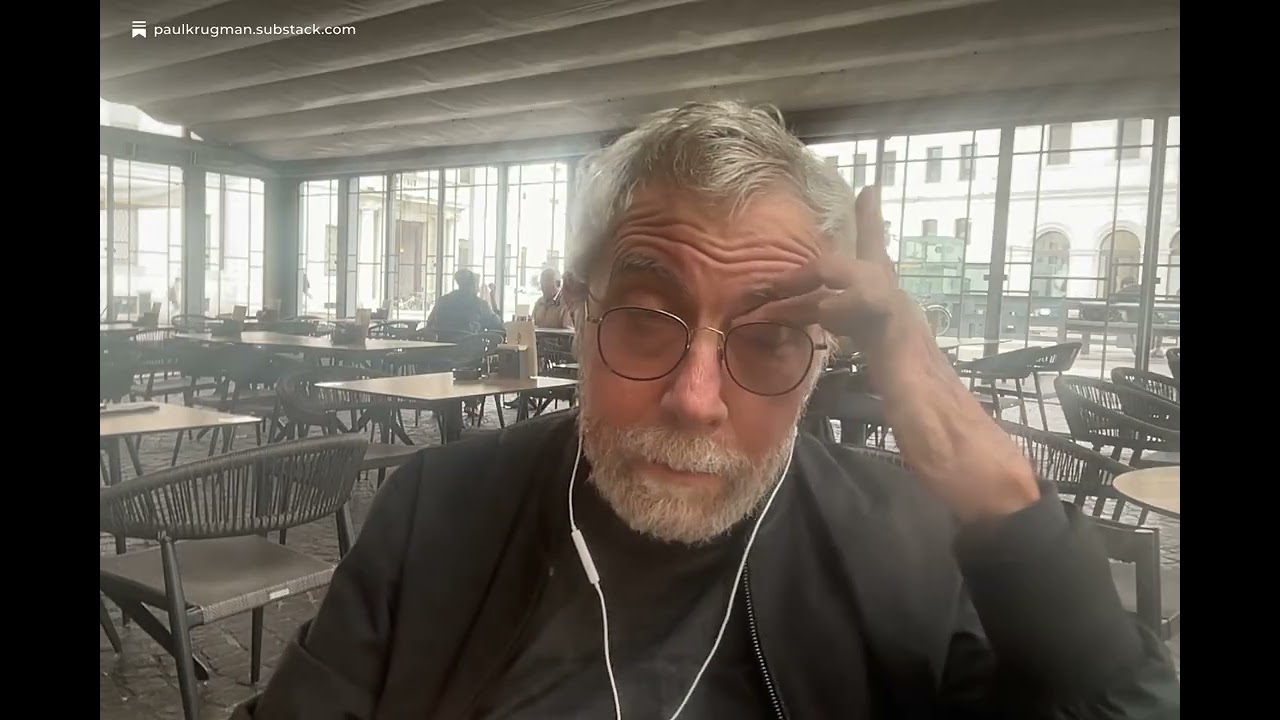
Don't Cry for Jeff Bezos's Yacht

May 5, 2026
He's selling it to avoid attention. Good.https://paulkrugman.substack.com/p/do...
---
---
https://www.alternet.org/alternet-exclusives/billionaire-media-trump/
Billionaires went all in on Trump — and lost big
:{John Stoehr April 08, 2026
It is not conspiratorial to suggest that the Washington press corps chose to help Donald Trump win the 2024 election by preventing most Americans from seeing the degree to which the former president had deteriorated mentally since leaving office.
Virtually all his public appearances and media interviews featured long stretches of incoherence as well as outright gibberish. That itself should have been the news, but it rarely was. Instead a gap formed between the real Trump and the Trump represented by the news media. That gap was so big it had a name: sanewashing.
We are now seeing the consequences of a cognitively impaired president – a democracy in tatters, a country at war, an economy on the brink – but that was the risk that the owners of the country’s most lucrative media properties were willing to take.
The decade leading up to the 2024 election featured social and political progress for women, Black people and people of color. The MeToo movement revealed the ugly reality of sexism. The country was rocked by a reckoning over institutional racism in the wake of George Floyd’s murder by a white cop. The pandemic empowered workers in ways largely unknown. Above all that was a president, Joe Biden, who put the government on the side of labor and the consumers who drive 70 percent of the economy.
These days we might call it a revolution against the Epstein class.
Which is why America’s cultural elites struck a bargain. He might be unfit mentally, and he might be dangerous politically, but it was better to have a second term for Donald Trump than a second term for a liberal administration that threatened to deepen gains made in the pursuit of liberty and justice for all.
America’s cultural elites needed a tool to smash the left.
Sure, he was deranged. Sure, he was a criminal and traitor. But the consequences of his reelection were unlikely to touch the elites while the consequences of the alternative very much would. So his liabilities were sanewashed and after he won, the press corps manufactured a consensus in which everything was going to be fine. The economy was good. Wokeism was defeated.
But here’s the odd thing. America’s cultural elites seem to actually believe their own propaganda. They seem to believe the reelection of Donald Trump was a correction, not only for America but for the media as well. They seem to believe that there really is a bias against white people and that once this bias is corrected, the news business will reap a populist windfall.
They’re wrong. There is no bias – anyway, not in the way they believe. That should be evident in the attempts to correct the “error” by the Washington Post, under the ownership of Jeff Bezos, and CBS News, under the leadership of Bari Weiss. Each has conspicuously reoriented their outfit toward the political right. The result has been a veritable bloodbath in lost profits.
That they are wrong is not evident, however, especially not to them. This alone is worth pondering. Many on the political left presume Bezos and Weiss are intentionally sabotaging the Post and CBS News. But, as Noah Berlatsky wrote recently, that’s more conspiracy than fact. They really do want to make money. Weiss in particular, Noah said, isn’t a saboteur. She’s just a losing loser.
I got in touch with Noah to talk about this and more, because I like him and because his newsletter is so insightful. It’s called Everything Is Horrible. Here’s the rest of our conversation.
You say Bezos and the Ellisons believe remaking their outlets in the mold of Fox will make them profitable. Yet they still believe that even after they have failed. In your view, why is that?
I think very wealthy people are surrounded by yes-men and are dazzled by their own success. They think they're brilliant and if their schemes go awry, it's someone else's fault or it's a sign of their willingness to think big, take risks, etc. Admitting they screwed up and are stupid would mean questioning whether they actually deserve all that power. Obviously, they can't do that.
You suggest that Weiss and the billionaires she represents think of themselves as tribunes of an authentic America. Will business failure correct that categorical error or nah?
I think that the wealthy are very reluctant to reassess their screw-ups. However, I do think that others watching them screw up are likely to become more skeptical of the idea that Trump and his billionaire cheering squad are the voice of the people.
You've already seen this I think as institutions have become more willing to fight and less willing to knuckle under, as it's become clear that Trump is not very popular. Disney and Kimmel were one example. More universities have started to push back. Democrats have become more willing to fight, etc.
What’s happening at CBS and others reflects the growing gap between media elites and normal people. It’s to the point now where Trump can claim victory in his war against Iran, and the press corps might choose to believe him, while consumers of the news watch the war burn up their wages. Will there be a correction at some point, as there would be on Wall Street?
The press has actually been pretty skeptical about the Iran war. There's some egregious cheerleading from people like New York Times columnist Bret Stephens and other neoconservative hacks, but it's nothing like with the Iraq War. I don't think the press would just shrug and go along with it if Trump declares victory.
I think this is largely because the public is so against the war. Media elites can be disconnected, but they also do react to what their audience wants, especially when there's a lot of bipartisan consensus. A significant section of the Republican Party and right wing is very angry about the war, and that means that media outlets feel empowered to criticize it – which I think they have done, which makes the war less popular, which makes the media more willing to criticize it and so on. It's a virtuous circle.
After the election, there was a media consensus that believed that Joe Biden was the aberration, not Trump, and that Trump, in coming back, was a restoration of normalcy. That consensus depended on Biden’s economy becoming Trump’s. Now that Trump’s economy is cratering, will the consensus change?
I'm not sure that I agree that the return of Trump was exactly seen as normal. Trump's often seen as an exciting deviation from the norm, and I think a lot of the excitement in elite circles was created by the sense of a definitive break with the past — Trump, they all believed, would crush the left rabble once and for all.
I think that the sense of fascist optimism among the elites has obviously soured. I don't know that it's useful to think of Trump as abnormal or an aberration exactly, though. He's dominated US politics for 11 years. He is the status quo. He's what America has decided to be. I think that we need to grapple seriously with the fact that overturning that status quo is going to require some sweeping changes. We aren't just going to snap back to normal when Trump is gone. This is normal, god help us.
Why do some on the left see conspiracy when Weiss and the oligarchs’ business failures are more easily explained by greed, cowardice, incompetence and the abuse of power?
I take it you mean. Why do some on the left (and not just the left!) believe that Weiss wants CBS to fail? That is, why do they think she's destroying it out of malice rather than incompetence?
I think there's a couple of things. One is that Weiss, Bezos and so forth really do want to kneecap the ability of journalists to criticize the regime. So reducing capacity and immiserating good reporters is a plus from their perspective. They want to destroy the old version of the Washington Post and CBS News, and doing so has been at least a partial win.
Second, I think there's always kind of an impulse to see your enemies as more organized, more effective and more competent than your side is. Republicans do this too. They're always talking about how Democrats are laser-focused and ruthless, etc. It's just one way that negative partisanship works.
Finally, I think people are sometimes afraid to hope? I often think about Bill Paxton in Aliens where he shouts, "Game over, man! Game over!" You wish for the end because then you can check out and don't have to live the painful bits of the end with the aliens catching and eating you. Which is understandable that you would rather miss that part! But of course if you check out and just assume the enemy is unbeatable, you aren't exploiting their weaknesses or doing what you can to defeat them.
So, yeah, I do not think that the struggle for media is over at all. Bezos and CBS have had very significant humiliations and losses. NOTUS is expanding its Washington newsroom with a lot of ex-Post staff; ABC News and NBC News have benefited and their ratings are up. The dream of a popular maga mainstream media bonanza is pretty dead, which I think leaves space open for other dreams and other approaches.
Obviously we're still all living in a nightmare. But Weiss and Ellison getting humiliated is good. Take the win when you can.
---
---
an 4 26
Although Rep. Alexandria Ocasio-Cortez took criticism from some mainstream media pundits after she helped rally public opinion against the construction of Amazon’s HQ2 in Long Island City, new data revealed this week has seemingly vindicated her skepticism of the project.
Virginia Business reported on Thursday that a filing submitted to the Virginia Economic Development Partnership this week showed that Amazon created no jobs at its HQ2 in Arlington County last year, and thus “will not seek a state payment” under the state’s workforce grant incentives.
Last year, reported Virginia Business, Amazon requested more than $6.4 million through the grant program for adding just under 293 jobs in 2024.
“The hiring slowdown follows earlier signs that Amazon’s HQ2 buildout has fallen short of initial expectations,” Virginia Business explained. “The company originally projected it would create 10,000 jobs by 2024, but hiring totals fell well short of that mark. The company currently has nearly 8,500 employees who work out of HQ2.”
In 2018, Ocasio-Cortez (D-NY) joined with local activists to oppose the construction of HQ2 in Long Island City, and they pointed to the billions of dollars in tax incentives offered by New York City and New York state as an example of wasteful corporate welfare being given to one of the world’s richest companies.
Amazon canceled its plans to build HQ2 in New York in February 2019, prompting Ocasio-Cortez to take a victory lap.
“Anything is possible,” the then-freshman congresswoman wrote in a social media post. “Today was the day a group of dedicated, everyday New Yorkers and their neighbors defeated Amazon’s corporate greed, its worker exploitation, and the power of the richest man in the world.”
Amazon would subsequently move construction of HQ2 to Virginia after being offered hundreds of millions in potential tax incentives, but it delayed construction of the facility in 2023, which again led Ocasio-Cortez to declare vindication.
“When I opposed this Amazon project coming to New York because it was a scam of public funds, the whole power establishment came after us,” she wrote. “Billboards went up in Times Square denouncing me. Powerful pols promised revenge. Op-eds and CEOs insulted my intelligence. In the end, we were right.”
---
---
Legacy outlets that bent the knee to Trump haven’t just lost credibility — they’re bleeding readers and viewers
Trumpism is bad for business: CBS News ratings are in a tailspin six months into Bari Weiss’ tenure
Written by Matt Gertz
:{Published 03/25/26
It turns out that there isn’t a ratings bump for MAGA capitulation.
David Ellison, the son of President Donald Trump’s megabillionaire ally Larry Ellison, took control of CBS last year following a corrupt deal that saw its parent company settle a lawsuit with the president and agree to implement a new conservative ombudsman for CBS News. As part of that takeover, he also installed conservative journalist Bari Weiss at the helm, promising that her “entrepreneurial drive and editorial vision” would “invigorate” the network. But six months into Weiss’ rightward makeover of CBS, the fruits of her labors include cheers from Trump and Defense Secretary Pete Hegseth for making the network more palatable to their aims, complaints from the CBS newsroom that she is dismantling its independence — and, it now appears, a viewer exodus.
Status’ Oliver Darcy got ahold of some CBS News ratings data from the first quarter of 2026, and it is brutal. CBS Evening News has lost 7% of viewers year-over-year, placing it “on track for its lowest-rated first quarter of the 21st century in both total viewers and the advertiser-coveted 25-54 demographic,” while CBS Mornings plummeted 13% and “is pacing toward its lowest-rated quarter on record in both total audience and the key demo.” Meanwhile, the audiences of competitor shows at ABC News and NBC News grew over the same period.
The ratings collapse is a devastating indictment of the strategy Ellison and Weiss are executing at CBS — and a blaring warning for CNN if Ellison is able to complete his takeover of that network and let Weiss run the same playbook there.
Meanwhile, new data from the Alliance for Audited Media show that while average daily print circulation among major audited newspapers saw year-over-year declines across the board in the six months running through the end of September 2025, the biggest drops came at The Washington Post, which fell 21.2%, followed by the Los Angeles Times, down 19.8%. Their billionaire owners — Amazon founder Jeff Bezos and biotech mogul Patrick Soon-Shiong, respectively — had responded to Trump’s return to the White House by trying to shift their papers to the right.
None of this should come as a surprise.
Ellison and Weiss have suggested that the core problem for American media is that the public does not trust news outlets, and that the reason for this is that the public perceives those outlets as too far left and too critical of the right. They propose to win over a larger audience by deliberately course-correcting in the opposite direction.
“We are not producing a product that enough people want,” Weiss said at a CBS News staff town hall in January. Weiss attributed this to two factors. “First: Not enough people trust us. Not you. Us. As in: the mainstream media,” she said. “Second: We are not doing enough to meet audiences where they are. So they are leaving us.”
Weiss is correct that trust in traditional media has fallen dramatically in recent decades, particularly among conservatives — indeed, this is a banal truth that everyone remotely connected to the media knows. But her strategy of conceding that potential viewers are correct to distrust journalists and seeking to “meet audiences where they are” by signaling that coverage will now be deliberately shifted to the right has had the obvious result of driving away the existing audience without adding a new one.
CBS News’ viewers either liked what they were already watching or they liked what watching Edward R. Murrow’s old network said about them. When the network’s new ownership and management proposed taking its programming in a dramatically different direction in search of a different audience — as the wildly unpopular president cheered — the existing viewers could see that, and some decided that CBS is no longer worth their patronage.
Weiss’ theory of the case is that these losses could be made up by new viewers with more right-leaning views. But the decline in public trust for traditional media among Republicans stems at least in part from a decades-long strategy pursued deliberately by the GOP and conservative movement. That effort revolves around simultaneously denouncing news outlets as liberal propaganda while encouraging conservatives to instead patronize new, deliberately right-wing news sources. And it’s been taken to another level under Trump, who relentlessly attacks the press while using state power to reduce its influence and lift up the MAGA media operation.
That dynamic makes it wildly implausible that the shift Weiss enacted would win over a sizable new segment of viewers. Her version of CBS may garner praise from Trump, but people who might be swayed by his comments already have — and are likely already patronizing — a plethora of pro-Trump outlets. You could imagine a scenario where some slightly more right-wing viewers of the ABC and NBC news shows switched to watching the new CBS. But instead, the data Darcy cited suggests, CBS appears to be shedding viewers who are instead watching its competitors — or exiting broadcast television altogether as their news source.
As for Bezos’ Post and Soon-Shiong’s Times, when the owners similarly bet on trying to make their outlets more acceptable to Trump, their existing audiences looked for the exits and were not replaced. The efforts may win over the likes of Tucker Carlson or even the president himself, but MAGA isn’t rushing to buy subscriptions.
For Ellison, Bezos, and Soon-Shiong, the declines in their news outlets may be a small price to pay to win over Trump. Each owner has massive business holdings outside of the press and can afford the losses from tearing down their news outlets if it wins the Trump administration’s support for their desired mergers, contracts, or patents.
The journalists facing layoffs from their outlets — and the public who lose access to their reporting — are the ones who will actually suffer from this doomed strategy.
//
02/27/17
02/17/26
12/03/25
---
sw 3 26
Bill Gates has said he had affairs with two Russian women, which Epstein later discovered.
Somewhere along the way, Epstein struck up a relationship with Sergei Belyakov, Russia’s former deputy minister of economic development and a graduate of the FSB – Russian intelligence – academy. Epstein introduced him to contacts like Peter Thiel, the tech billionaire who would go on to give $10 million to the super PAC that helped elect now-Vice President JD Vance to the Senate in 2022.
In 2015, Epstein warned Belyakov that “a Russian girl from Moscow … is attempting to blackmail a group of powerful biznessmen [sic] in New York.” It was, Epstein said, “bad for business for everyone involved.” Belyakov responded back with information about the woman who he said worked in the “sex and escort” business. The FSB academy graduate said he would meet with someone who knows her.
The following year, Belyakov told Epstein that he had a new position at the Russian Direct Investment Fund, the Russian sovereign wealth fund, headed by current Putin envoy Kirill Dmitriev – the same guy who was caught in those friendly leaked phone calls with Steve Witkoff that I mentioned.
Masha Drokova, a former spokesperson for Nashi, the pro-Kremlin youth movement, was in regular touch with Epstein in the last couple of years before his death in prison, ostensibly helping Epstein with his public relations. According to the Washington Post, she was “the subject of the 2011 documentary ‘Putin’s Kiss,’ whose title refers to a widely publicized awards ceremony in which she received a medal from Putin and spontaneously kissed him on the cheek.” In a 2017 email, Drokova asked Epstein to connect her with “adequate Russian oligarchs.” The Post reported in 2022 that her fundraising pitches highlighted her ties to wealthy Russians, although Drokova denied writing those emails and said she did not receive Russian funding. Epstein advised Drokova as she launched her Silicon Valley venture capital firm, and she introduced Epstein to the contacts she had made in the tech world.
In one emailed interaction in 2017, Drokova, after claiming to meet billionaire Jeff Bezos, tells Epstein she is “trying to understand what she is not understanding about him.” Epstein writes back that Bezos is “smart, fun, and visionary. He is a very nice person. Probalty [sic] the best in the valley among the Bs.”
The files also indicate that Epstein had dealings with Oleg Deripaska, a Russian billionaire who the Treasury Department has identified as a money launderer for Putin. Deripaska also cultivated a friendship with Peter Mandelson, a senior figure in Britain’s Labour Party. It appears that Mandelson tried to use Deripaska’s contacts to acquire a last-minute Russian visa for Epstein in 2010. Correspondence also shows Epstein’s assistant trying to set up a meeting for Epstein and Deripaska in Moscow or Paris.
There’s also audio of Epstein advising then-Israel Prime Minister Ehud Barak to have dinner with Putin to line up work after he leaves government.
There is at least one itinerary for a lengthy trip across Russia, and photos of Epstein and Ghislaine in what is believed to be Russia, including with people who appear to be Russian soldiers. Umar Dzhabrailov, a former Russian senator who committed suicide in recent days, described Maxwell as “a soulmate.” Epstein had a series of Russian visas between 2011 and his death in 2019.
---
AN 1 26
Amazon reportedly put its staff in a tough position over its expensive documentary about First Lady Melania Trump,with the New York Times reporting workers were threatened with termination if they refused to work on the film for political reasons.
Sources within Amazon MGM Studios spoke with the Times about the contentious project, claiming that there were major concerns among studio staff and crew members over the political implications of the company's acquisition and release of the film. These concerns were met with a firm response from the company's top brass.
"Some employees in Amazon’s entertainment division had similar concerns, according to three sources with knowledge of discussions inside Amazon," the report explained. "They were told that the project was mandated by the company’s leadership and that employees could not opt out of working on the film for political reasons."
The circumstances surrounding Amazon's release of the documentary have led to persistent accusations that it is trying to curry favor with President Donald Trump's administration. The company acquired the rights to release the film after the president won reelection in 2024, and did so for $40 million, an outlandishly high amount compared to other successful documentaries. That winning bid from Amazon was more than double the second-place bid of $14 million from Disney.
The expenditure from Jeff Bezos's e-commerce giant only grew from there, as $35 million was spent to promote the project for a worldwide theatrical release. For comparison, the Times' report highlighted the "robust" production and release for CNN Films' RBG, a documentary about the late Supreme Court Justice Ruth Bader Ginsburg. That film cost only $1 million to produce and went on to make $14 million.
Given that films need to make roughly double their costs to break even theatrically, Amazon's Melania needs to make $150 million worldwide, a feat matched by only three documentaries in history. One of those films, Grand Canyon: The Hidden Secrets, has only grossed so much because it is an IMAX nature documentary that has played at a National Geographic visitor center since 1984.
The film's opening weekend projections currently sit at just $1-5 million.
“This has to be the most expensive documentary ever made that didn’t involve music licensing,” Ted Hope, an Amazon Studios employee from 2015 to 2020 credited as "instrumental" in building up the film division, told the Times. “How can it not be equated with currying favor or an outright bribe? How can that not be the case?”
===
AN COMMON DR 12 25
As workers face slowing wage growth, a worsening cost-of-living crisis, and rising unemployment, the chief executives of top corporate retailers in the United States are reaping huge gains from the tax cuts that US President Donald Trump and congressional Republicans extended over the summer.
An analysis released Friday by the progressive advocacy group Americans for Tax Fairness (ATF) estimates that the CEOs of Amazon, Best Buy, Costco, Home Depot, Lowe’s, Target, TJX, and Walmart have collectively saved close to $35 million on their individual tax returns in the seven years the Trump tax cuts have been in effect.
Thanks to the Trump-GOP tax law, which took effect in 2018, the companies examined in the analysis paid a tax rate of just 17.5% between 2018 and 2024—roughly half what they paid prior to the law’s enactment.
“While at the same time prices have soared for consumers and retail workers remain stuck in low-wage jobs, big-store CEOs and shareholders have reaped higher profits and lower taxes,” David Kass, ATF’s executive director, said in a statement. “If we want a system that alleviates economic stress on average Americans instead of exacerbating it during the holiday season, we need to raise taxes on corporations and the rich, invest in workers and families with expanded public services.”
Workers at the major retailers haven’t fared nearly as well. ATF noted that “the average worker at the eight stores was paid less than $32,000 in 2024.
“Amazon—the world’s largest retailer—refuses to even sit down with its employees who have formed a labor union for better pay, benefits, and working conditions,” the group observed. “If Lowe’s had used the nearly $50 billion it spent on stock buybacks over the seven-year period to instead raise employee wages, its workers would have each been paid almost $200,000 more.”
Across the US economy, workers are seeing wage growth stagnate amid elevated and still-rising prices, which are forcing many to skip meals and ration their medications to make ends meet.
The Labor Department said earlier this week that wage growth decelerated to 3.5% year over year—the slowest pace since before the Covid-19 pandemic. Unemployment, meanwhile, rose in November to the highest level in four years.
The ATF analysis came days after Trump delivered a lie-filled primetime speech defending his handling of the US economy as his approval ratings tanked, with American voters across party lines increasingly furious over the high costs of housing, groceries, healthcare, and other necessities.
During the speech, Trump vowed that Americans would soon “see the results of the largest tax cuts in American history.”
But the richest people in the country are set to reap disproportionate benefits from the tax cuts. As Bloomberg reported earlier this week, “Many filers—particularly those who could most use the financial boost—may soon be disappointed.”
“Wealthy taxpayers in high-tax states like California, New York, and New Jersey are the biggest winners,” the outlet noted.
---
---
gmail 12 25
Dear MoveOn member,
Shawn from RuralOrganizing.org here. Threats facing the U.S. Postal Service are ramping up. Just this past week, news broke that Amazon—USPS's biggest client—is considering cutting ties and not renewing its partnership, which would be a huge financial blow to the Postal Service and would hurt our communities who rely on the USPS for medications, food, voting, and more.1
And it doesn't stop there. Amazon is also considering launching a rival delivery service that would privatize our mail and put the USPS further in crisis.2 This is exactly what Donald Trump wants to happen—to have our Postal Service dismantled and sold to the highest bidder. Amazon would just be laying the groundwork.
Right now, the USPS has the responsibility to serve every single resident in this country equally, regardless of where they live. But a private company wouldn't have that same obligation, which could drive up costs for everyday Americans—not only in rural communities, but small towns too.3}:
–Shawn Sebastian, RuralOrganizing.org
Sources:
- "Amazon in discussions with USPS about future relationship," Reuters, December 4, 2025
- Ibid.
- "Who Would Pay the Biggest Price for Postal Privatization?" Institute for Policy Studies, April 2025
- "Americans see many federal agencies favorably, but Republicans grow more critical of Justice Department," Pew Research Center, August 12, 2025
- "Trump approval rating ticks up to 41 percent: Survey," The Hill,December 9, 2025
https://thehill.com/homenews/administration/5640218-trump-approval-rating-ticks-up-survey/
- "Millennials trust the postal service more than Amazon," CNBC, January 24, 2020
https://www.cnbc.com/2020/01/24/millennials-trust-usps-more-than-amazon-morning-consult-study.html
- "Exclusive: Amazon targets as many as 30,000 corporate job cuts, sources say," Reuters, October 28, 2025
- "Lawsuit seeks records related to Amazon worker deaths," New Jersey Monitor, November 26, 2024
https://newjerseymonitor.com/briefs/lawsuit-seeks-records-related-to-amazon-worker-deaths/
- "Amazon Prime Day is full of 'fake sales,' lawsuit alleges," USA Today, October 20, 2025
https://www.usatoday.com/story/money/2025/10/16/amazon-lawsuit-fake-prime-day-sales/86728601007/
- "USPS Privatization Would Cost Rural America More Than Mail," Jacobin, February 26, 2025
https://jacobin.com/2025/02/usps-rural-areas-services-privatization
- "USPS strikes deal with Elon Musk's DOGE team for reform help," Reuters, March 14, 2025
---
MMA
The year the media oligarchs bowed to Trump
Written by Matt Gertz
Published 12/03/25
We warned last year that Donald Trump’s second term as president would turbo-charge the political right’s burgeoning media-intimidation complex. Republican officials and right-wing billionaires were already trying to secure their political agenda by using their wealth, lawfare, and government power to silence journalists. And Trump, we wrote, using his authoritarian strategies, would force media moguls to choose between the journalistic integrity of the news outlets they oversee and their broader business interests, with the fate of the free press in the balance.
Twelve months later, it is clear that many of these corporate media owners have made their choice: They are damaging celebrated news outlets like CBS and The Washington Post out of some combination of personal preference and political expedience. While journalists at their outlets are still producing important stories that reveal the corruption and malfeasance of the Trump administration, it’s anyone’s guess how long they will be permitted to do so.
Trump has spent the last decade at war with the press. He has no regard for free speech, treats all dissent as inherently illegitimate, and uses every available tool to curtail critical journalism. The president’s years of anti-media diatribes have achieved their goal of destroying the credibility of potentially damaging reporting among his supporters, and in his second term, he has backed up those verbal attacks with a flurry of actions.
He and his administration have supplemented or even replaced members of the traditional press corps in favor of MAGA influencers and Trumpist outlets; defunded public media outlets in the U.S. and sought to dismantle them abroad; sued reporters and news outlets for publishing content he dislikes; and terminated rules protecting journalists from prosecutorial scrutiny, while targeting them with retaliatory immigration enforcement.
But Trump’s most unnerving assaults on the press involve his administration's use of state power as leverage against oligarchs who control broadcast and cable news operations and major newspapers. For billionaire owners or top executives at massive multimedia companies, news outlets typically represent a tiny fraction of their overall business interests. And those broader holdings create potential vulnerabilities — like regulatory scrutiny of mergers, federal contracting, and criminal investigations — that an authoritarian president can manipulate to encourage media moguls to cudgel their news outlets into line.
Trump’s strategies resemble those of Victor Orban, the Hungarian autocrat many on the American right take as a model, who has dismantled his country’s independent press and forced the sales of outlets to his allies. Trump's desired result is a cowed journalist corps that will produce Fox News-style propaganda venerating his successes and covering up his corruption and failures.
America’s media oligarchs often resisted Trump’s corrupt abuses of power in his first term, either enduring his attacks without constraining their news outlets or beating his administration in federal court. But in his second term, while some media organizations (including Media Matters) have fought to protect the First Amendment against Trump and his administration, certain wealthy magnates have chosen the path of cowardice, submission, and collaboration.
David and Larry Ellison
David Ellison is the son of Larry Ellison, the Oracle co-founder who is one of the richest men alive and a close friend and ally to Trump. The younger Ellison took control of CBS News in July after the Federal Communications Commission approved his Skydance Media’s purchase of CBS parent company Paramount. Trump-appointed FCC Chair Brendan Carr acted only after Paramount agreed to pay $16 million to settle an absurd lawsuit Trump filed over CBS News’ editing of an October interview with then-Democratic presidential nominee Kamala Harris — and after he secured pledges from Skydance to push the network’s coverage to the right.
Ellison followed through on his promise. The new ownership appointed “anti-woke” champion Bari Weiss as CBS News’ editor-in-chief and Kenneth Weinstein, a Trump-supporting right-wing think tanker, as its ombudsman. An October wave of layoffs hit nearly 100 CBS News employees, gutting the network’s teams focused on climate change and race and culture. Trump certainly seems happy with the changes — in a November 2 interview that marked his first appearance on the network since 2020, he praised Weiss as a “great new leader” and “great person” and described David Ellison’s takeover of CBS News as “the greatest thing that’s happened in a long time to a free and open and good press.”
With the CBS News takeover as proof of concept, Ellison and his father are each making moves to seize additional media outlets and move them in a Trumpy direction.
David Ellison is trying to buy Warner Bros. Discovery — and the administration is reportedly signaling that other bidders will face grueling oversight from federal regulators. “Trump wants WBD in the Ellisons’ hands, and insiders say it’s because he wants favorable coverage from its CNN news channel,” wrote the New York Post.
Larry Ellison has even reportedly “engaged in a dialogue” with the White House “about possibly axing some of the CNN hosts whom Donald Trump is said to loathe, including Erin Burnett and Brianna Keilar,” if the sale were to go through.
The Trump White House is also trying to broker a deal in which the social media giant TikTok, a news source for one-fifth of American adults and 43% of those under 30, would be sold to a coalition including companies controlled by Larry Ellison as well as fellow pro-Trump magnate Marc Andreessen.
- ### Jeff Bezos
Bezos owns The Washington Post, but his massive fortune comes from founding Amazon, the online retailing and web service giant, and he also owns the space technology company Blue Origin. During Trump’s first term, Bezos bore numerous potshots at what Trump termed the “Amazon Washington Post,” as well as his administration’s apparent retaliation against Amazon’s operations. But Bezos signaled that things would be different in a second term even before Trump’s election when he barred the Post’s editorial board from endorsing in the 2024 contest, blocking the publication of its piece supporting Harris.
The decision began a deterioration of Bezos’ relationship with the Post, accelerated further by his February demand that the paper’s Opinion section advocate without exception for “personal liberties and free markets.” Opinion editor David Shipley resigned rather than execute that pivot; his replacement, Adam O’Neal, an undistinguished reporter and editor previously at The Economist and The Wall Street Journal, has overseen buyouts and layoffs of the section’s veterans (my wife Alyssa Rosenberg, the section’s former letters and community editor, was among those who took the buyout) and hired several conservative writers, leading one of the paper’s right-wing columnists to boast, “We’re now a conservative opinion page.” The dramatic changes seem to have blown a hole in the Post’s subscriber numbers, with NPR’s David Folkenflik estimating “a net loss of a couple hundred thousand subscribers” at the end of February. With revenue plummeting thanks to Bezos’ decisions and the owner unwilling to eat the losses, more layoffs are reportedly on the way.
But defanging the Post — and finding a way to put money in the Trump family’s pockets — seems to be working out well for Bezos. His rewards include plum seats for Trump’s swearing-in, federal contracts for Blue Origin and Amazon Web Services, and the president publicly applauding him for “trying to do a real job with The Washington Post, and that wasn’t happening before.”
### Patrick Soon-Shiong
Like Bezos, Los Angeles Times owner Soon-Shiong has other business interests that left him vulnerable to Trump’s retaliation; he made his fortune in the biotech industry, and his medical patents and products are subject to federal oversight. Whether due to fear of retribution or a shift in his own political views, Soon-Shiong stepped up his oversight of the Times last year, beginning with the cancellation of a planned endorsement of Harris.
He subsequently shilled for Robert F. Kennedy Jr.’s confirmation as secretary of health and human services; announced a remaking of the editorial board, beginning with the addition of pro-Trump CNN commentator Scott Jennings; killed an editorial that criticized Trump’s Cabinet picks; announced the addition of an AI-powered “bias meter” to the paper’s opinion pieces, which was pulled after it downplayed the Ku Klux Klan; floated a conservative version of The View featuring right-wing actor Rob Schneider; launched “LA Times Studios,” a multimedia studio featuring influencers reading AI-generated scripts; sat for interviews with right-wing commentators including Tucker Carlson and Megyn Kelly; and put forward an ill-starred initial public offering plan which led The Hollywood Reporter to ask, “Does Patrick Soon-Shiong Want to Turn the L.A. Times Into a MAHA Memestock?”
As with Bezos’ actions at the Post, Soon-Shiong’s changes to the Times have resulted in plummeting circulation, an exodus of talent, and the diminishment of the paper’s influence. But his medical patents are still getting approved by the federal government.
- ### Bob Iger
Iger, who as the CEO of Disney oversees its subsidiary ABC, was at the center of two of the most craven media moves since Trump’s reelection.
First, his December 2024 decision to sign off on a $15 million “blood sacrifice to Trump,” settling a defamation lawsuit that ABC News’ lawyers thought they would win, only looks worse over time. The capitulation made clear to ABC staff that Iger would not support them in a stand-off with the president and set a precedent that media companies and other major corporations would knuckle under to his demands.
Second, after Carr threatened Disney and ABC’s affiliates with FCC retribution if they failed to “take actions” against Jimmy Kimmel over one of his monologues in September, Iger folded by suspending Kimmel’s show within hours. Carr’s threats made a mockery of the First Amendment — but Iger wasn’t willing to fight to uphold those rights in court. Iger relented and returned Kimmel to the airwaves only after an outcry by Hollywood talent and a spike in Disney+ cancellations.
What did Iger’s cowardice bring ABC? When ABC News chief White House correspondent Mary Bruce dared to ask Saudi Crown Prince Mohammed bin Salman a question about his role in the brutal murder of the U.S.-based dissident journalist Jamal Khashoggi during a joint Oval Office appearance with Trump, the president became enraged, lashing out at the journalist and calling her outlet “fake news” and “one of the worst in the business.”
“I think the license should be taken away from ABC because your news is so fake and it’s so wrong,” he later added, threatening to shut down a U.S. news outlet for producing reporting he doesn’t like in front of a foreign dictator who represses his own country’s media.
“And we have a great commissioner, a chairman, who should look at that," he added.
---
3X JOB WHAMMY, DOGE CUTS, SHUTDN, TECH CUTS AI 11 25
AN 11 25 badash
'Really hurting': US job cuts surge to decades-high level amid Trump recession fears
Employers have cut over one million jobs so far this year, with announced layoffs surging in October to levels not seen in decades. Some experts have been warning about a possible recession.
“U.S. employers have announced 1.1 million layoffs so far this year — the largest reading since the pandemic recession and on par with 2008 and 2009 job cuts during the Great Recession,” The Washington Post reported on Thursday, pointing to a report from Challenger, Gray & Christmas, which tracks workplace reductions.
Major corporations have cut or are reportedly planning to cut thousands of positions this year:
UPS: 48,000 employees
Amazon: Up to 30,000 employees
Intel: 24,000 employees
Microsoft: 15,000 employees
Target: 1,800 employees
"Employers announced more than 153,000 job cuts last month, a 183 percent increase from the month before, marking the worst October for layoffs since 2003,” the Post reported, citing data from the Challenger report.
“The worst October in 22 years” is how CNN reported the news.
“We’re entering new territory with these layoffs in October,” Challenger CEO John Challenger told the Post. “We haven’t seen mega-layoffs of the size that are being discussed now — 48,000 from UPS, potentially 30,000 from Amazon — since 2020 and before that, since the recession of 2009. When you see companies making cuts of this size, it does signal a real shift in direction.”
Amid the job cuts, the “AI bubble,” President Donald Trump’s massive deportations and tariffs, record-high household debt, climbing automobile payment and consumer loan delinquencies, some believe a recession may be in America’s future.
“Employment has stalled, companies are announcing massive layoffs to appease Wall Street, and car repossessions just reached 2009 (recession) levels,” wrote economics professor and managing director of an economic consulting firm, Hal Singer, just last week. “The GDP numbers mask real suffering in the economy. And the only fiscal tool in the Trump policy kit are tax cuts for the wealthy. This could get ugly.”
Late last month Moody’s Analytics Chief Economist Mark Zandi said 22 U.S. states are already in a recession, Moneywise reported.
"While Zandi did emphasize that the U.S. is not in a recession just yet, he told MarketWatch that ‘we’re on the precipice,’ blaming much of the problem on President Trump’s tariffs and federal job cuts.”
“A growing number of states are struggling, some already in recession, others right on the edge,” Zandi wrote. “Together, they account for nearly a third of U.S. GDP. The national economy isn’t there yet, but it’s clearly losing steam.”
Pointing to a list of ten major corporations’ jobs cuts, U.S. Senator Elizabeth Warren (D-MA) last week declared, “This is Donald Trump’s economy.”
CNN Thursday morning reported that a “brand new report is out … and it shows layoff announcements hit their highest level for October in over 20 years.”
“It’s painting a picture of a job market that is really hurting,” CNN’s Matt Egan noted.
===
---}:
an 8 25
The latest casualty of Trump’s efforts to silence media criticism is Eduardo Porter, one of the most thoughtful and intelligent critics of this heinous regime.
On Tuesday, Porter wrote his last column for The Washington Post. In a widely-circulated email, he explained why he was leaving the Post:
“Jeff Bezos and his new head of Opinion are taking the paper down a path I cannot follow, directed toward the relentless promotion of free markets and personal liberties…. I have no idea to what extent this is driven by Mr. Bezos’ fear of what Donald Trump could do to his various business interests, most of which are more valuable to him than The Post.”
Well, I do have an idea. Bezos stopped the Post from endorsing Kamala Harris. He made a huge contribution to Trump’s inauguration. And he stood directly in front of Trump at Trump’s swearing in.
Why? Because Bezos owns a bunch of mega-corporations, including Amazon, that depend on Trump’s goodwill and could be in deep trouble if Trump decided to retaliate against Bezos.
It’s much the same story with Stephen Colbert, longtime host of CBS’s “The Late Show” and the top-rated late-night talk show host in the United States.
On July 14, Colbert openly criticized CBS’s parent company, Paramount, for its $16 million settlement with Trump of his frivolous lawsuit over the routine editing of a “60 Minutes” interview with Kamala Harris that Trump claimed gave her an unfair advantage in the 2024 election.
Said Colbert in his opening monologue:
“As someone who has always been a proud employee of this network, I am offended. And I don’t know if anything will ever repair my trust in this company…. I believe this kind of complicated financial settlement with a sitting government official has a technical name in legal circles. It’s big fat bribe. Because this all comes as Paramount's owners are trying to get the Trump administration to approve the sale of our network to a new owner, Skydance.”
Three days later, on July 17, Paramount pulled the plug on Colbert’s show, eliciting from Trump a celebratory, “I absolutely love that Colbert was fired.”
(A few days later, Colbert came out swinging, telling Trump to “go f--- yourself,” and joking that it had always been his dream to have a sitting president celebrate the end of his career.)
Yesterday, one week after Colbert’s show was cancelled, Trump’s Federal Communications Commission approved Paramount’s sale to Skydance.
To cinch the deal, Skydance CEO David Ellison promised that he’d eliminate all U.S.-based DEI programs at Paramount and CBS and create a new ombudsman to field complaints of ideological bias in news coverage.
Trump says CBS also agreed to run $20 million worth of public service announcements consistent with his ideological beliefs.
Let’s be clear. Jeff Bezos has silenced any criticism of Trump on the editorial pages of The Washington Post because Bezos fears Trump’s wrath.
CBS and its parent corporation, Paramount, has silenced criticism of Trump on Colbert’s hugely popular “Late Show” because its top corporate brass fears Trump’s wrath.
The new owner of CBS has agreed to some federal interference in the content of what it produces because he fears Trump’s wrath.
The silencing is happening across American media because Trump cannot stand criticism, because he’s vindictive as hell, and because he’s willing and able to use every department and agency of the federal government to punish any media corporations that allow its writers or hosts to criticize him.
It’s the same with American universities, whose professors have often criticized Trump’s illegal and unconstitutional actions and whose research has often yielded conclusions that contradict Trump’s lies (such as that climate change is a “hoax”).
Columbia University, Dartmouth College, and a handful of others have gone out of their way to “cooperate” with the Trump regime in order to avoid Trump’s wrath.
What does “cooperation” entail? Silencing Trump’s potential critics.
Columbia has just agreed to allow the regime to review its admissions and hiring practices in order to receive the federal research grants that the regime had held back.
Friends, this is how democracy dies.
Shame on any media outlet or university that allows Trump to silence it.
Trump is a dangerous despot. America needs its Eduardo Porters, Stephen Colberts, and all others in the media and in academia who have helped the nation understand just how truly dangerous Trump is.
NOW READ:'It is a reckoning': DC insider blasts Baby Boomers — and blames them for Trump
---
AN 8 25
Federal employees at the Department of the Interior are reportedly raising alarms over a weekly video series titled “Inside Interior,” which they describe as "propaganda" — a slick, over‑the‑top portrayal of President Donald Trump and agency leadership, complete with staged scenes and breathless narration.
The Daily Beast reportedWednesday that Interior Secretary Doug Burgum, once tagged “Diva Doug” for requesting political appointees to bake chocolate chip cookies and summoning a U.S. Park Police helicopter for his own personal use, now finds himself at the center of growing backlash within his own department.
Staffers deride the Environment and Natural Resources Agency as “The Department of Propaganda,” a moniker born from their mounting frustration with weekly “Inside Interior” videos, widely criticized for their slick, "Dear Leader"-style presentation and unabashed praise of Trump and Burgum to a lesser extent.
READ MORE:'Let me just stop you there': Wallace cuts off guest who calls for 'nuance' on Trump move
The latest installment, according to the report, touts that “Interior made major moves to strengthen America’s energy future, protect taxpayer interests, and keep our nation’s capital city safe.”
But the true inflection point came with a July 4 special that left many shaken. The clip opens with Trump dancing to the Village People’s YMCA, then cuts to him exiting Air Force One, greeted by cheering construction workers, before returning to more footage of Trump, much to the chagrin of those compelled to watch.
The report further noted that the narration heralds the day with a patriotic fervor likened to authoritarian regimes: “Happy Birthday America!” “Today we celebrate 249 years of American liberty, freedom and strength and we’re doing it under the fearless leadership of President Donald J. Trump, who reminds us every day what true patriotism looks like as he works tirelessly to make America great again.”
Critics among the staff have dubbed the presentation “North Korea‑worthy," according to the report.
READ MORE:(Opinion) Trump's reckoning may be right around the corner — here's why
Meanwhile, many already felt demoralized by deep cuts tied to tech billionaire Elon Musk’s Department of Government Efficiency initiative and a policy shift prioritizing fossil fuel development over conservation.
A National Park Service employee told The Beast: “I have never seen a more blatant and deplorable display of propaganda on behalf of the Trump administration.”
Adding insult to injury, they note, “They even called for the USA to celebrate the 4th ‘the MAGA way!’”
Click here to read the Daily Beast's report in full (subscription required).
READ MORE:'It's a real gut punch': Rural voters 'stunned' by Trump's damage
---
---
NY POST 6 25
---
AN 4 25
'Dangerous dictator': How Trump 'bullied' Bezos to drop plan to display Amazon tariff cost
SPOX: 'Hostile and political act': Analyst says Leavitt just revealed 'Trump’s weakness'
an 4 25
'Sold out the US': MAGA rages against Amazon after report it would display Trump tariff cost
---
==
msnbc dwh ar sorkin bezos think BO will savE humanity
---
an 4 25
Analysts accuse big U.S. tech firms of paying almost $278 billion less corporate income tax in the past decade compared with the statutory rate for U.S. companies making the same profits.
The Guardian reveals Amazon, Meta, Alphabet, Netflix, Apple and Microsoft —the “Silicon Six”— generated a combined $11 trillion in revenue and $2.5 trillion in profits over the last decade. But they paid an average of just 18.8% in combined national and federal corporation taxes, compared with an average 29.7% in the U.S., according to the Fair Tax Foundation (FTF).
“Our analysis would indicate that tax avoidance continues to be hardwired into corporate structures,” Fair Tax Foundation Chief Executive Paul Monaghan told The Guardian. “The Silicon Six’s corporate income tax contributions are, in percentage terms, way below what sectors such as banking and energy are paying in many parts of the world.”
READ MORE:'Don't you see what's happening?' Experts call Trump's latest move 'full blown fascism'
Analysis at FTF also discovered the companies had inflated their stated tax payments by $82 billion over the same period by including contingencies for tax they did not expect to pay. Monaghan added that these companies have "enormous political influence as well as economic power," in that they all spend hundreds of millions of dollars on lobbying government officials on key tax-writing committees to have more say in how the tax system works.
The Guardian reports that Netflix had the lowest rate of tax actually paid compared to profit at 14.7%, while Microsoft paid 20.4%. Amazon, meanwhile, had the worst tax conduct based on factors such as the total amount of tax paid, much if it through “obvious profit shifting” such as booking a sizeable portion of its U.K. income in low-tax Luxembourg. But Amazon’s corporate tax rate was still 19.6% ahead of Netflix and Meta (15.4%) and Apple (18.4%).
The report comes as leaders of many of these same tech companies’ influence genuflect to President Donald Trump. Amazon’s Jeff Bezos, Apple’s Tim Cook and Meta’s Mark Zuckerberg all attended Donald Trump’s second inauguration.
Read the full Guardian story at this link.
MMA
Project 2025 laid a foundation for Trump’s attacks on workplace safety
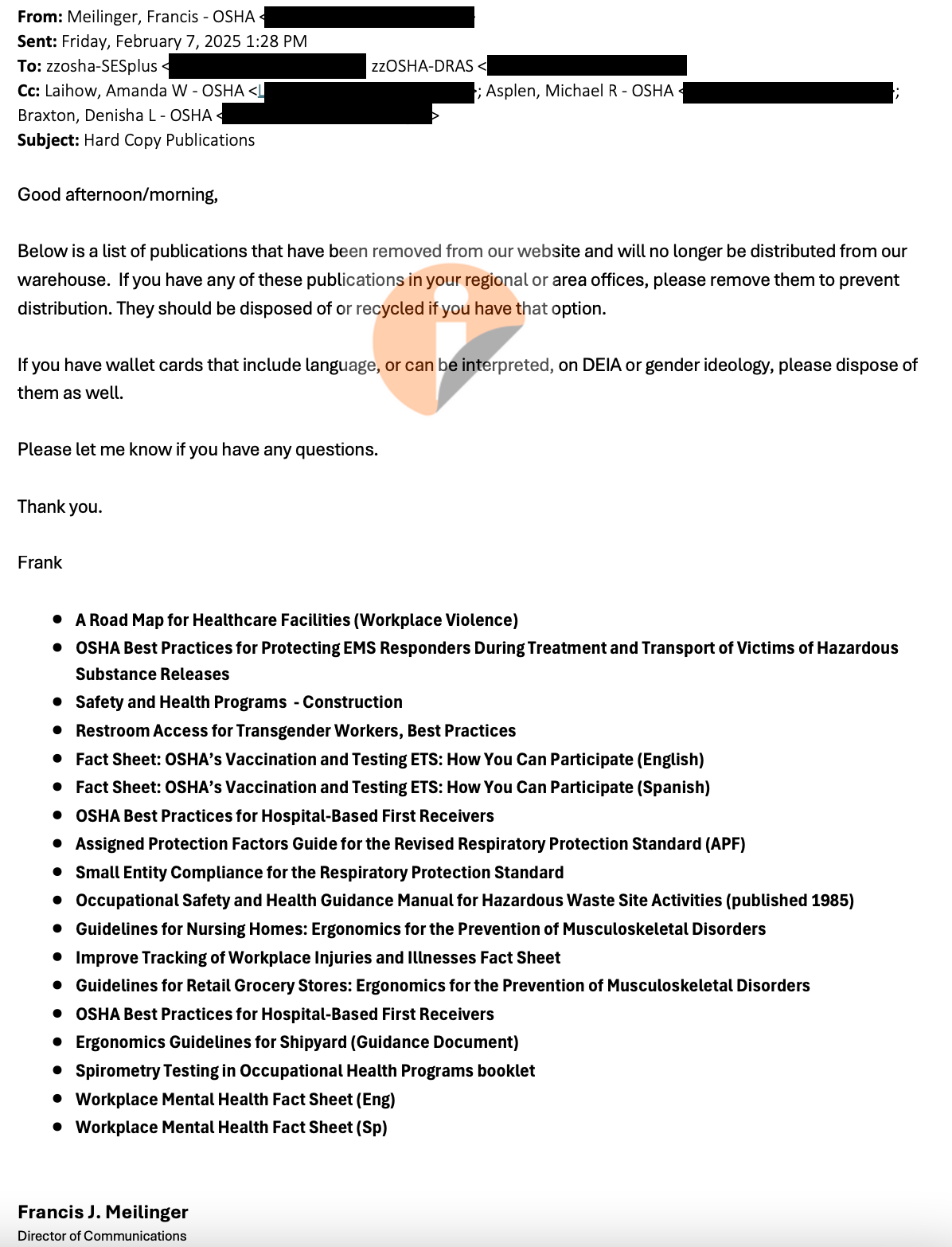
The Trump administration reportedly destroyed 18 publications from the Occupational Safety and Health Administration as part of a larger DEI purge. Most of the guidelines had nothing to do with diversity initiatives.
Written by John Knefel
Published 02/20/25
The Trump administration has reportedly destroyed 18 workplace safety publications as part of a broader attack on diversity initiatives, a development that is largely in line with recommendations made by the sprawling and unpopular presidential transition plan known as Project 2025.
According to Popular Information, 17 of the destroyed workplace guidelines — issued by the Occupational Safety and Health Administration — appeared to have nothing to do with diversity, equity, inclusion, and accessibility programs and instead seem to have been selected because “they include a DEIA-related keyword used in a completely different context.” OSHA is part of the Labor Department and is tasked with making sure U.S. workers “have safe and healthful working conditions free from unlawful retaliation,” according to its official website.
The Trump administration has been targeting diversity programs across the federal government, in some instances using the existence of DEI efforts as a justification for essentially shuttering entire agencies, as in the case of the U.S. Agency for International Development.
The administration’s anti-DEI approach mirrors recommendations made in Project 2025’s nearly 900-page policy book, *Mandate for Leadership*, which called for the elimination of federal DEI programs and for the Department of Justice to investigate private sector programs that promote diversity.
In addition to its direct attacks on DEI, Project 2025 — organized by The Heritage Foundation in collaboration with more than 100 partner groups — proposed drastic rollbacks of labor laws, including dismantling overtime regulations and creating exemptions to the National Labor Relations Act, which protects workers’ rights to collectively bargain and to form a union.
Although the Trump administration’s memo calling for the 18 safety guidelines to be “disposed of or recycled” appears to be a hamfisted and failed attempt to root out DEI programs, it nevertheless fits in with Mandate’s broader approach to dismantling worker protections.
For example, Mandate recommends carve outs to OSHA’s workplace safety regulations, calling on Congress and the Department of Labor to “exempt small business, first-time, non-willful violators from fines issued by the Occupational Safety and Health Administration.”
Mandate further argues that “national employment laws,” like the Occupational Safety and Health Act of 1970, “set out one-size-fits-all ‘floors’ regulating the employment relationship,” and that the protections the law provides could instead be “treated as negotiable defaults rather than non-negotiable floors.” If enacted, this recommendation could allow employers to use safety measures as leverage in contract negotiations, thus increasing the already stark asymmetry in power between workers and bosses. And U.S. workplaces are already deadly; according to the AFL-CIO, in 2022: “344 workers died each day from hazardous working conditions,” and “5,486 workers were killed on the job in the United States.”
The final chapter in Mandate calls on the president to order Cabinet secretaries to “rein in agencies such as the Occupational Safety and Health Administration, which the Biden Administration weaponized to attempt to force COVID-19 vaccine mandates on 84 million Americans through their workplaces.”
That demand built on previous work from The Heritage Foundation, which sued the Biden administration over its Covid-19 workplace vaccine mandate. After the Supreme Court blocked the mandate, Heritage President Kevin Roberts celebrated the decision on former Trump lawyer Jay Sekulow’s radio show. Sekulow is also chief counsel at the American Center for Law and Justice, whose advocacy arm is a partner in Project 2025.
“When it comes to putting government back in the box, it is a series of battles,” Roberts said. “We have won one battle, but we have not won the political and policy war.”
Video
Citation
From the January 14, 2022, edition of Sekulow, streamed on YouTube
Whether the administration adopts the anti-working class OSHA policies in Mandate remains to be seen, but Trump’s pick to head the agency — former Amazon and UPS executive David Keeling — strongly suggests it’s possible. As The New Republic reported, Keeling’s recent job history does not bode well for worker safety:
Both of those companies have been cited for various workplace safety violations by the very agency Keeling is set to control, if confirmed by the Senate. In 2019, OSHA cited UPS for forcing its drivers to work in “excessive heat” with no air conditioning. That same year, UPS was also cited for fire hazards at packaging facilities. Amazon has been cited numerous times for the dangerous, high-pressure environments in its warehouses, as well as the long hours its employees are forced to spend in them. Just last year, Amazon paid a $145,000 settlement over OSHA violations.
Keeling worked as director of safety compliance for UPS from 2011 to 2018 before serving as the vice president of global health and safety from 2018 to 2021, overlapping with OSHA’s 2019 safety citations. The same can be said for Amazon, where he worked from 2021 to 2023—a time when Amazon had one of the highest warehouse injury rates in the country.
Keeling’s nomination hearing has not yet been scheduled, but elsewhere the Trump administration is already waging war on the working class. His pick as general counsel for the National Labor Relations Board just rolled back several major Biden administration policies, including protections for student athletes who want to unionize and guidance that determined most non-compete agreements violate federal labor law.
Many of the Trump administration’s opening salvos against the working class have followed the Project 2025 roadmap and targeted DEI programs. These measures are already making workers’ positions more precarious and less safe, just as Project 2025 recommended.
===
Early Monday morning, January 13, a bombshell announcement came from longtime Washington Post columnist Jennfier Rubin: She is leaving the Post and is starting a new publication with attorney Norm L. Eisen, known for his legal analysis for CNN and his years as ambassador to the Czech Republic under the Obama Administration.
Rubin isn't holding back in on her reasons for leaving the Post. The Never Trumper is highly critical of Post/Amazon owner Jeff Bezos for, she says, trying to curry favor with President-elect Donald Trump — who, Rubin believes, did the Post a huge disservice when he killed an endorsement of Vice President Kamala Harris during the 2024 election.
During a January 13 interview with CNN, Rubin said of The Contrarian — her new media venture with Eisen — "Our goal is to combat, with every fiber of our being, the authoritarian threat that we face."
READ MORE:**Revealed: Allies are grilling career intel staff to ensure total loyalty to Trump**
Rubin told CNN that Bezos and other media figures have "bent the knee" to Trump, lamenting, "the Post, along with most mainstream news outlets, has failed spectacularly at a moment that we most need a robust, aggressive free press."
Rubin was equally biting in an interview with CNBC, arguing that Bezos and others have "scrambled to enlist Trump-friendly voices."
The former Post columnist told CNBC, "Corporate and billionaire owners of major media outlets have betrayed their audiences' loyalty and sabotaged journalism's sacred mission — defending, protecting and advancing democracy."
In an official statement, Rubin complained, "The Washington Post’s billionaire owner and enlisted management are among the offenders. They have undercut the values central to The Post’s mission and that of all journalism: integrity, courage, and independence. I cannot justify remaining at The Post."
Rubin continued, "Jeff Bezos and his cronies accommodate and enable the most acute threat to American democracy — Donald Trump — at a time when a vibrant free press is more essential than ever to democracy’s survival and capacity to survive."
For many years, Rubin, now 62, was known as a conservative and voted GOP in presidential elections. But she has been a blistering critic of Trump, voting Democratic in the presidential elections of 2016, 2020 and 2024. And she has said that she no longer identifies as "conservative" because Trump and the MAGA movement have badly tarnished that word.
---
an 1 25
the progressive advocacy group Public Citizen on Tuesday launched a new project aimed at tracking the incoming Trump administration's approach to corporate crime, an effort the watchdog said is particularly urgent given that many of the companies currently under federal investigation have connections to the president-elect.
Public Citizen found that of 192 individual corporations currently facing federal probes or cases, a third "have known ties with the Trump administration."
"They or their executives have either contributed to his inauguration, or Trump has nominated their former employees, investors, and lobbyists," the group noted.
Public Citizen said its new Corporate Enforcement Tracker will serve as "a resource for watchdogging ongoing federal investigations and cases against alleged corporate wrongdoing that are at risk of being dropped, weakened, or otherwise modified by the incoming Trump administration."
Corporate prosecutions plummeted to a 25-year low during Trump's first term, and Public Citizen's Rick Claypool—who is heading the new project—predicted that "it's likely Trump's second term will see a similar or worse dropoff in enforcement.
"Corporate crime enforcement fell during Trump's first term," Claypool noted, "even as his administration pursued 'tough' policies against immigrants, protestors, and low-level offenders."
"The five corporations with the most federal investigations or cases against them are Tesla (7), Amazon (6), Pfizer (5), Wells Fargo (4), and SpaceX (4)."
Four of the companies listed on Public Citizen's tracker—Tesla, SpaceX, Neuralink, and X—are helmed by billionaire Elon Musk, who donated heavily to Trump's presidential campaign and is set to co-lead a new advisory commission tasked with identifying spending and regulations to eliminate.
Tesla is facing investigations by the Justice Department, Securities and Exchange Commission, Occupational Safety and Health Administration, and other agencies—probes that could be shut down by the incoming administration, which is set to be packed with lobbyists and billionaires.
Reutersreported last week that "Musk's potential to have extraordinary clout with the new administration raises questions about the fate of federal investigations and regulatory actions affecting his business empire, of which at least 20 are ongoing, according to three sources familiar with SpaceX and Tesla operations and the companies' interaction with the U.S. government, as well as five current and former officials who have direct knowledge of individual probes into Musk's companies."
"The inquiries include examinations of the alleged securities violations; questions over the safety of Tesla's Autopilot and Full Self-Driving (FSD) systems; potential animal-welfare violations in Neuralink's brain-chip experiments; and alleged pollution, hiring-discrimination, and licensing problems at SpaceX," the outlet noted.
Public Citizen also highlighted 16 companies that have donated to Trump's inaugural fund as they face federal investigations or enforcement actions: Amazon, Apple, AT&T, Bank of America, Coinbase, Ford, Goldman Sachs, Kraken, Meta, OpenAI, Pfizer, Ripple, Robinhood, Stanley Black & Decker, Toyota, and Uber.
"The five corporations with the most federal investigations or cases against them are Tesla (7), Amazon (6), Pfizer (5), Wells Fargo (4), and SpaceX (4)," the group said in a statement.
Concerns about the fate of investigations into major U.S. companies were amplified by Trump's choice to lead the Justice Department. Public Citizen noted Tuesday that Amazon and Republic Services, two lobbying clients previously represented by Trump attorney general pick Pam Bondi, are among the corporations currently facing federal cases or investigations.
In a separate report published Wednesday, Public Citizen said that Bondi's record as a lobbyist raises "serious questions about potential conflicts of interest" and provides "sufficient grounds for senators to deny her confirmation."
"We depend on the DOJ to vigorously enforce our laws, hold corporate wrongdoers accountable, and protect the rule of law," said Public Citizen co-president Lisa Gilbert. "Pam Bondi is simply inappropriate for this post."
===
===
an 12 24
sucking up to trump and musk
an 12 24
Billionaire Jeff Bezos wants to 'help' Trump gut regulations
===
---
AN 11 24
November 5, 2024 wasn't just a good day for President-elect Donald Trump — it was also a big win for the world's wealthiest men, according to a new report.
CNN reported Thursday that in the immediate aftermath of the election, the net worths of the 10 richest billionaires in the world skyrocketed. The Bloomberg Billionaire Index, which tracks the growth and contraction in net worth of the super-rich in real time, showed that there was a $64 billion jump in the collective wealth of centabillionaires at the top of the list.
The biggest financial boon of the night went to Tesla and SpaceX CEO Elon Musk — who also owns X (formerly Twitter) — with the Bloomberg Billionaires Index pegging the Trump megadonors net worth at $290 billion. That's a $26.5 billion jump from before the election. Amazon founder Jeff Bezos saw his total wealth climb by more than $7.1 billion following the decision. And Oracle co-founder Larry Ellison (who backed Trump) saw his net worth grow by more than $5.5 billion on Wednesday.
READ MORE:GOP rep complains its 'ridiculous' for Harris to ask billionaires to 'pay their fair share'
Other ultra-high net worth individuals who saw their fortunes increase include Microsoft CEOs Bill Gates and Steve Ballmer, who come in at #6 and #10 on the Billionaire Index, respectively. Gates saw his net worth jump nearly $2 billion to $159 billion, and Ballmer got $2.81 billion more after the election, pegging his net worth at $146 billion.
Meanwhile, CNN reported that Google executives Larry Page and Sergey Brin (ranking at #7 and #8 on the index, respectively) also saw a significant bump in their net worths along with Berkshire Hathaway CEO Warren Buffett. None of those men publicly endorsed a candidate in this election cycle.
The spike in net worths of the 10 richest men is likely due to the value of their stock portfolios jumping significantly after Trump's election victory on Tuesday night, with ultra-high net worth individuals holding most of their assets in the form of company stock. According to CNN, the Dow Jones Industrial Average, the Nasdaq Composite and the S&P 500 Index all hit new record highs after Trump was elected to a second term. Investors are likely bullish on a second Trump term bringing about a new round of tax cuts for corporations and the wealthy.
"There is this huge perception of business friendly, tax-friendly regime coming into place, especially with [Republicans] winning the Senate," AgentSmyth chief operating officer Michael block told the network.
READ MORE:Trump raged at billionaire donors during private dinner and called Harris a slur: report
Trump's signature accomplishment in his first term was the Tax Cuts and Jobs Act of 2017, which provided roughly $1.5 trillion in federal income tax cuts — primarily to the richest Americans. The Center on Budget and Policy Priorities (CBPP) wrote in a report earlier this year that the top one percent of income earners will see an average tax cut of approximately $60,000 in 2025.
"As a share of after-tax income, tax cuts at the top — for both households in the top 1 percent and the top 5 percent — are more than triple the total value of the tax cuts received for people with incomes in the bottom 60 percent," CBPP researchers wrote.
Click here to read CNN's report in full.
READ MORE:'Absurd!' US billionaires pay lower tax rate than working class for first time
===
===
BB
Why are Jeff Bezos, Mark Zuckerberg, and Elon Musk are so happy today?
Because with Trump in office, they can realize their dream of becoming trillionaires. Here's what they xitted and threaded today:
- Musk: $285 billion: "It is morning in America again."
- Zuckerberg: $206 billion: "Congratulations to President Trump on a decisive victory. We have great opportunities ahead of us as a country. Looking forward to working with you and your administration."
- Bezos: $222 billion: "Big congratulations to our 45th and now 47th President on an extraordinary political comeback and decisive victory. No nation has bigger opportunities. Wishing @realDonaldTrump all success in leading and uniting the America we all love."`
---
an 10 254 RR
Elon Musk (worth $271 billion) and Jeff Bezos (worth $262 billion) — the richest and second-richest people on the planet — are now showing America why it’s dangerous to have great wealth concentrated in so few hands.
In August 2013, Bezos purchased The Washington Postfor $250 million. On Friday, just as the Postwas preparing to endorse Vice President Kamala Harris for president, Bezos stopped the paper from doing so.
Partly as a result, the Post has already lost 250,000 subscribers, or 10 percent of its subscriber base.
In October 2022, Elon Musk purchased Twitter for $44 billon, turned it into X, and became its biggest user, with 202 million followers.
Musk has endorsed Trump — and weaponized the platform into a supporter of Trump, smeared Harris, and amplified rumors and conspiracy theories.
ALSO READ:[Experts sound alarm over Trump's promise to let RFK Jr. 'control' health agencies
Independent analysts such as Edison Research said in March that X’s usage in the United States dropped 30 percent since last year. Fidelity this month estimated that X’s value has plunged by about 80 percent since Musk’s takeover.
Why have these two oligarchs been willing to take actions that cause so many of their customers to jump ship? What’s the connection between Bezos’s preventing thePostfrom endorsing Harris and Musk’s weaponizing X for Trump?
Here’s a hint:
Just hours after Bezos stopped the Post from endorsing Harris, executives of Blue Origin, Bezos’s private rocket company, met with Trump in Austin.
Although Blue Origin is running far behind Musk’s SpaceX, Bezos is the most likely serious challenger to Musk’s dominance in space because of his personal fortune and his billions of dollars in government contracts with NASA and the Department of Defense.
For years, Bezos has focused on beating Musk for the multibillion-dollar contracts to launch payloads and rockets. “Elon’s real superpower is getting government money,” Bezos said in 2016, according to the Post. “From now on, we go after everything that SpaceX bids on.”
Musk’s company appears so far ahead in the competition that it won a contract to rescue astronauts stuck at the International Space Station.
But that could change. Boeing and Lockheed Martin have been looking to unload their own joint-venture rocket company, United Launch Alliance (ULA), which has billions of dollars in government contracts, extensive infrastructure, and an experienced team.
Bezos’s Blue Origin is reportedly the favorite to take over ULA. Even the head of the U.S. Space Force’s purchases seems to be pushing for the two rocket companies to merge, telling an industry audience that “they need to scale” in order to meet an aggressive launch schedule.
ULA is still a major force in the space industry, competing for dozens of launches over the next four years, which can bring in billions more revenue. Combining with Blue Origin would make a lot of sense. The Wall Street Journal reports that Blue Origin has already submitted a bid to buy ULA.
If that’s the goal, Bezos’s biggest obstacle would be Trump, should Trump get back in the White House.
Trump has been out to get Bezos since 2017, when Trump first started blaming Bezos for poor coverage in The Washington Post — a grievance that has hurt Blue Origin.
In April 2019, then-Vice President Mike Pence’s chief of staff alerted Blue Origin officials to Bezos’s poor reputation in the White House, telling them that they have a “Washington Post problem.”
Trump also said he wanted to “screw Amazon” out of a $10 billion deal to provide cloud computing to the Pentagon, according to a memoir by his Defense Secretary James Mattis. (It’s since been reported that Oracle, led by Larry Ellison — Trump donor, Musk mentor, and Oracle founder, who ranks just behind Musk and Bezos as the third-richest person in America with an estimated $211.2 billion in wealth — had sought to sabotage the deal.)
So Bezos has been courting Trump. After Trump’s ear was grazed by a bullet during an attempted assassination at a July campaign rally, prompting a Musk endorsement of the former president, Bezos called Trump to say how impressed he was that the candidate had raised his fist after coming under fire, according to a person familiar with that conversation.
Soon after Trump formally secured the Republican nomination, Amazon CEO Andy Jassy phoned Trump, introducing himself and outlining the company’s plans for the future. The call concluded with Trump suggesting that the company cut a large check for his presidential efforts, according to two people familiar with the conversation who spoke on the condition of anonymity to recount the private discussion. Trump told Jassy that he was going to win the election and that Amazon should help him because it would be in the company’s best interests.
In this sense, then, both Bezos’s refusal to allowThe Washington Postto endorse Harris and Musk’s weaponizing X for Trump can be seen as moves in a proxy war for dominance in government contracting of spaceflight, where the ultimate prize will be hundreds of billions if not trillions of dollars — thereby distending the fortunes of either Bezos or Musk.
But the casualty in this war is American democracy, for which neither Bezos nor Musk apparently has a scintilla of concern.
America is now in its second Gilded Age, in which a handful of supremely wealthy men are determining the nation’s future. We must not let them. Bezos should never have been able to purchase The Washington Post in the first place; his conflicting business interests should have prevented it.
Nor should Musk have been able to buy Twitter. Antitrust laws should have been used to break Twitter up, or the platform should be deemed a public utility.
Both Bezos and Musk are poster boys for the importance of a wealth tax, which must be enacted to prevent the grotesque accumulations of wealth that have allowed them to wield such extraordinary power.
When the smoke clears from this rancorous presidential campaign and Kamala Harris is president, she must rescue democracy from these and other oligarchs.
As the eminent jurist Louis Brandeis is reputed to have said near the end of America’s first Gilded Age, “America has a choice. We can have great wealth in the hands of a few, or we can have a democracy. But we cannot have both.”
NOW READ:[Legal expert predicts the 'little secret' between Donald Trump and Mike Johnson
*Robert Reich is a professor of public policy at Berkeley and former secretary of labor. His writings can be found at https://robertreich.substack.com/.
===
===
AN 10 24
alternet-NO LNX
Democracy dies in their wallets
Twitter employees respond to new owner Elon Musk’s annihilation of top execs — on Twitter
Thom Hartmann October 28, 2024
Do not obey in advance. Most of the power of authoritarianism is freely given. In times like these, individuals think ahead about what a repressive government will want, and then offer themselves without being asked. A citizen who adapts in this way is teaching power what it can do.—Yale historian Timothy Snyder, On Tyranny
I cancelled my Washington Post subscription Friday evening. Jeff Bezos, Mister “Democracy Dies In Darkness” (the Post’s slogan on their masthead), by blocking his editorial staff from endorsing Harris chose darkness over his nation’s future, and I can’t support that.
The big mistake John D. Rockefeller made back in the day — that Jeff Bezos and Elon Musk appear committed to not repeating — was not buying a media outlet like a newspaper. Had John D. had that sort of a vehicle to mold public opinion, American history may be very different.
By 1880, Rockefeller’s Ohio-based company controlled over 90 percent of the nation’s oil, owned 4000 miles of pipelines, and employed over 100,000 people. As Rockefeller’s oil empire got larger and larger, eating alive hundreds of smaller operations, ruthlessly driving up prices, destroying his competitors, and throwing workers out of a job, public outrage grew.
In 1887, Ohio sued him, arguing that he was operating in ways that were detrimental to the state and its citizens and businesses; in 1892 the Ohio Supreme Court ordered his company dissolved. As I lay out in detail in Unequal Protection: How Corporations Became “People,” this led Rockefeller to move Standard Oil to New Jersey after that state changed its corporation laws to allow for his monopolistic behavior.
Which brought in the federal government; in 1890, Ohio Senator John Sherman introduced and saw passed into law the Sherman Anti-Trust Act which provided not just fines but jail sentences against people like Rockefeller who were committed to destroying competition and owning entire markets. The law was flawed with a few loopholes and ambiguities, so it was amended in 1914 with the Clayton Anti-Trust Act.
Nonetheless, in 1906 progressive Republican Teddy Roosevelt’s administration filed an antitrust action against Rockefeller that went to the Supreme Court in 1911 during the administration of progressive Republican President William Howard Taft. The behemoth was broken up into 34 separate companies, an action that, like the breakup of AT&T by Jimmy Carter and Ronald Reagan, led to an explosion of competition in the marketplace and a dramatic increase in shareholder value.
But back to Jeff Bezos and his 2013 purchase of The Washington Post.
It was reporters and editors for the hundreds of independent newspapers during the First Gilded Age (1880-1900) era that led the crusades against Rockefeller and his fellow monopolists. Investigative journalism was all the rage then, and it fed public demand for a return to competition and the de-throning of that age’s oligarchs.
The vast majority of workers were struggling and they worked for a very small 10 percent of the population who controlled most of the nation’s wealth (a situation we’re at again).
The result was constant strife, strikes, and the murder of labor leaders; entire towns were in arms (and sometimes ablaze) with labor conflict. The “problem of labor”was the number one issue of the day. As President Grover Cleveland — the only Democrat elected during that period — proclaimed in his 1887 State of the Union address:
“As we view the achievements of aggregated capital, we discover the existence of trusts, combinations, and monopolies, while the citizen is struggling far in the rear or is trampled to death beneath an iron heel. Corporations, which should be the carefully restrained creatures of the law and the servants of the people, are fast becoming the people’s masters.”
There was a broad consensus across American society that those “Robber Barons” were feathering their own nests at the expense of the American public, hurting both working class people and small businesses. The Supreme Court endorsed breaking up Standard Oil in 1911, and even broke up the Associated Press in 1944.
The law was so rigorously enforced — so the game of business could be played by all comers, not just the “big boys” — that in the 1960s the Supreme Court barred the merger of the Kinney and Buster Brown shoe companies because the new combined company would control a mere 5 percent of the shoe market.
Back in the ’60s every mall and downtown in America was filled with small, locally-owned businesses; there might be a Sears to anchor the shopping center or a retail part of town, but most shops, restaurants, and hotels were family-owned.
But then Reagan, in 1983, ordered the DOJ, SEC, and FTC to stop enforcing the Sherman Act, which is why today Nike, for example, controls about a fifth of the entire nation’s shoe market. It’s the same across industry after industry, from retail to grocery stores to railroads to computer software to social media to chip manufacturing to airlines to hotels…and on and on. In virtually every industry, a handful of massive companies control 80 percent or more of the market.
The Biden administration is the first to seriously try enforcement of the nation’s anti-trust laws since Carter broke up AT&T, going after Google and blocking mergers in multiple industries. It’s led a bunch of American billionaires to demand that the Federal Trade Commission’s head, Lina Kahn, be fired.
Kahn and her FTC went after Bezos last year, suing Amazon for running a monopoly that price-gouges customers and blocks out competition. The trial is scheduled for 2026 if Kahn keeps her job; a Trump administration would fire her immediately, and pressure from major corporate donors and billionaires is building on Harris to do the same.
Bezos also must remember well when he got on the wrong side of then-President Trump because of the Post’s coverage of the orange oligarch’s lies and crimes; Trump, in a fit of pique, awarded a $10 billion Pentagon contract for cloud computing to Microsoft, shocking analysts across the industry.
Bezos is also working for his Blue Origin spaceship company to get more billions in NASA and Pentagon contracts. He and his companies also own billions in Google and AirBNB stock as well as owning outright almost a hundred other companies.
Might be a good time to own one of the two most influential newspapers in America, eh?
Similarly, billionaire oligarch Elon Musk, in addition to apparently taking orders from Russian President Vladimir Putin, is fighting numerous government efforts to regulate his companies (which exist in large part because Obama bailed out Tesla in 2010 with $465 million, and NASA is now pouring hundreds of millions into SpaceX):
— Tesla is fighting the National Labor Relations Board (NLRB) over union-related issues, with Musk taking a lawsuit to the Supreme Court alleging government protections of unions are unconstitutional.
— SpaceX is battling the NLRB over employee firings.
— The SEC is investigating Musk’s acquisition of Twitter (now X) and his “funding secured” tweets about taking Tesla private.
— The FTC is investigating X’s compliance with a $150 million privacy settlement.
— The Federal Communications Commission recently denied SpaceX’s Starlink a $886 million rural broadband award.
— The Equal Employment Opportunity Commission is suing Tesla over alleged racial harassment.
— The FAA is in conflict with SpaceX over launch licensing and environmental reviews.
— The EPA has fined SpaceX for water-related violations.
— The National Highway Traffic Safety Administration has opened multiple investigations into Tesla’s vehicle safety and Autopilot system.
— SpaceX faces scrutiny over its environmental impact at its Texas launch site.
To avoid the Rockefeller mistake, Musk — with the apparent help of two Russian oligarchs and the leader of Saudi Arabia — purchased Twitter, the online digital equivalent of our nation’s largest newspaper.
And he’s now using it to try to get Trump and Republicans into office, presumably so they can gut the FTC, FCC, SEC, NLRB, and any other regulator that might take him on to protect workers, the public, and the national interest.
We took on the superrich with success during the First Gilded Age, and our enforcement of antitrust laws lasted all the way to 1983, when Reagan blocked them, leading to the “merger mania” of the 1980s and bringing us today’s oligarchic business empires across multiple industries.
Now that we’re in America’s Second Gilded Age — with today’s billionaires vastly richer than Rockefeller’s wildest dreams — we confront a similar crossroads to that of previous generations.
Is it okay, for example, for billionaires to own media properties they can use to manipulate politics and government agencies to amplify their other business interests? Or that five corrupt Republicans on the Supreme Court have ruled that our morbidly rich plutocrats can own judges and politicians? Most Americans would probably say “No” to both.
At some point, America is going to have to confront its oligarch problem. And the sooner the better, if we don’t want darkness to entirely subsume our democracy.
===
an 10 24
With a reported net worth of more than $204 billion (according to Forbes), Amazon CEO and Washington Post owner Jeff Bezos is among the richest men in the world.
Bezos has been drawing a great deal of criticism in response to reports that he blocked an endorsement of Democratic presidential nominee Kamala Harris that the Post's editorial board was planning to publish. The Bulwark's Jonathan V. Last believes that Bezos killed the endorsement because he fears the possibility of retaliation from former President Donald Trump if he wins the election on November 5.
But Bezos, reportedly, isn't the only business leader who is worried about being targeted for revenge if Trump returns to the White House.
READ MORE:**Leaked memo reveals plan for Trump to skip 'traditional background checks' if elected: NYT**
In an article published by the Post on October 28, reporters Jeff Stein, Jacqueline Alemany and Josh Dawsey stress that some business leaders are toning down their criticism of Trump — as they don't want to risk being targeted for revenge.
"With the White House appearing increasingly up for grabs, and especially as polls have tightened, numerous billionaires and other leading executives have taken steps, in recent months, to stay out of the race — even if they had criticized Trump after the Capitol insurrection of January 6, 2021, calling his encouragement of the riot a threat to American democracy," the Post reporters explain. "Others who previously backed Democrats have stayed silent this election, which some critics and Trump supporters alike have interpreted as a peace offering to the GOP presidential nominee."
Brian Riedl, a senior fellow at the Manhattan Institute, finds it disturbing that Trump is able to "intimidate" business leaders.
Riedl told the Post, "Trump has had no issue calling out political enemies by name and threatening to use the force of government for retribution, and apparently, that is intimidating a lot of wealthy targets. It is a very scary sign that government intimidation works."
READ MORE:[Threatening ‘the enemy within’ with force: Military ethicists explain the danger to important American traditions
Former UBS Chairman Robert Wolf, once an economic adviser to former President Barack Obama, said that some business leaders are "nervous" about what Trump will do if he returns to the White House.
Wolf told the Post, "Public company CEOs want to have it both ways: They want to be viewed as the thought leaders of the country, but when it comes to this highly contentious election, they want to hide behind their titles. Many are nervous that if Trump wins, he's going to respond or even retaliate."
READ MORE:[How LGBTQ+ voters in these 4 states could swing the 2024 presidential election
*Read the full Washington Post article at this link (subscription required).
===
AN 10 24
Amazon CEO and Washington Post owner Jeff Bezos has been drawing widespread criticism following reports that he blocked the publication's editorial board from publishing an endorsement of Democratic presidential nominee Kamala Harris.
Bezos reportedly made the decision not because he is pro-Donald Trump, but because he feared retaliation if he published a Harris endorsement and Trump won the election. And Bezos, as he saw it, was protecting his business interests.
In an article published by the conservative website The Bulwark on October 28, Never Trumper Jonathan V. Last describes Bezos' decision as a "catastrophic failure of the rule of law."
READ MORE:**Former WaPo editor reveals 'proof' of Trump’s 'backroom deal' with Amazon founder: report**
"What we witnessed on Friday was not a case of censorship or a failure of the media," Last argues. "It had nothing to do with journalism or the Washington Post. It was something much, much more consequential. It was about oligarchy, the rule of law, and the failure of the democratic order."
Bezos, Last laments, was obviously trying to avoid being targeted for revenge by a possible second Trump Administration.
"When Bezos decreed that the newspaper he owned could not endorse Trump' opponent," Last explains, "it was a transparent act of submission born of an intuitive understanding of the differences between the candidates. Bezos understood that if he antagonized Kamala Harris and Harris became president, he would face no consequences. A Harris Administration would not target his businesses because the Harris Administration would — like all presidential administrations not headed by Trump — adhere to the rule of law."
Last continues, "Bezos likewise understood that the inverse was not true. If he continued to antagonize Trump and Trump became president, his businesses very much would be targeted. So bending the knee to Trump was the smart play. All upside, no downside."
READ MORE:**Leaked memo reveals plan for Trump to skip 'traditional background checks' if elected: NYT**
According to Last, Bezos' "submission" to Trump is a warning to business owners that they will be targeted for revenge if they openly criticize him.
"What Trump understood was that Bezos' submission would be of limited use if it was kept quiet," Last argues. "Because the point of dominating Bezos wasn't just to dominate Bezos. It was to send a message to every other businessman, entrepreneur, and corporation in America: that these are the rules of the game. If you are nice to Trump, the government will be nice to you. If you criticize Trump, the government will be used against you."
READ MORE:[Harris' closing message: Why it must center on anti-elitist economics
*Jonathan V. Last's full article for The Bulwark is available at this link.
===
10 24 ymail judd pop info
owner Jeff Bezos spreads his hands after a ceremonial ribbon cutting during dedication ceremonies for the new Washington Post offices on January, 28, 2016 in Washington, DC. (Photo by Bill O'Leary/The Washington Post via Getty Images)
Jeff Bezos is the second-richest person in the world, with a net worth of approximately $211 billion. Most of Bezos' wealth is derived from his 9% stake in Amazon, the company he founded. Bezos also founded and owns Blue Origin, a private space exploration company worth billions.
Bezos also owns the Washington Post, which he purchased in 2013 for $250 million in cash. Is Bezos now making decisions at the Washington Post to protect and enhance the value of his other enterprises? Many current and former employees of the Washington Post believe so.
The business interests of Amazon and Blue Origin — and, therefore, Bezos — are inextricably linked to the federal government. Consider:
In 2021, Amazon was awarded a $10 billion cloud-computing contract with the National Security Agency. It also has a portion of a $9 billion cloud-computing contract inked in 2022 with the Department of Defense and a multi-billion dollar cloud-computing contract with the CIA.
In 2023, the Federal Trade Commission sued Amazon, alleging "the online retail and technology company is a monopolist that uses a set of interlocking anticompetitive and unfair strategies to illegally maintain its monopoly power." The lawsuit seeks "a permanent injunction in federal court that would prohibit Amazon from engaging in its unlawful conduct and pry loose Amazon’s monopolistic control to restore competition."
> In May 2023, Blue Origin was awarded a $3.4 billion contract to build a lunar lander for NASA. Between 2025 and 2029, the company is expected to compete for $5.6 billion in space launch contracts for the Pentagon.
The Washington Post, unlike Amazon and Blue Origin, has been a money loser for Bezos, reportedly running a deficit of $100 million last year. More importantly, Bezos believes that former President Trump's hostility toward the Washington Post, which produced critical coverage of Trump's presidency, cost his companies billions in government contracts. In 2019, Amazon sued the federal government for awarding a $10 billion cloud-computing contract to Microsoft, alleging that Amazon lost out on the contract based on Bezos' ownership of the Washington Post:
President Trump has made no secret of his personal dislike for Mr. Bezos, Amazon, and the Washington Post, or of his express desire to harm them. The seeds of this animus originate with the Washington Post's coverage of him before he even was elected President. That coverage placed Mr. Bezos, Amazon, and the Washington Post directly in the crosshairs of President Trump's wrath.
…After he assumed office, President Trump grew "obsessed" with Mr. Bezos and determined to "f'*** with him." His new powers expanded his ability to punish Mr. Bezos for the Washington Post's coverage of him
…President Trump has frequently referred to the "Amazon Washington Post" as a single entity, and he has frequently hurled invective against Amazon whenever the Washington Post publishes articles that he believes slight him or his Administration. President Trump has also repeatedly claimed the Washington Post is selling "fake news," and he has called it an "[e]nemy of the [p]eople[.]"
In a few months, it is possible that Trump will be president again. This time, Bezos faces an even more acute threat to his business interests. Elon Musk, who owns Blue Origin's chief rival SpaceX, has aligned himself closely with Trump, spending tens of millions in support of Trump's campaign and making appearances in swing states on Trump's behalf.
On Friday, days before the election, Washington Post publisher William Lewis — installed by Bezos earlier this year — announced that "the Washington Post will not be making an endorsement of a presidential candidate in this election." The announcement, less than 2 weeks before Election Day, was a break from decades of precedent. Bezos made the decision, according to the New York Times, after the Washington Post "editorial board had already drafted an endorsement of Vice President Kamala Harris."
Marty Baron, the former Executive Editor of the Washington Post, slammed Bezos' decision as "cowardice" and linked it to Bezos' desire to appease Trump. Baron said it would backfire, and Trump would "see this as an invitation to further intimidate owner [Bezos]."
Hours after Lewis published the announcement, Trump was seen meeting with Blue Origin CEO David Limp. Steven Cheung, the Trump campaign's chief spokesman, embraced the suggestion that the meeting and the announcement of the non-endorsement were linked.
Robert Kagan, who worked at the Washington Post for two decades and resigned immediately following Lewis' announcement, said the meeting was evidence of a quid pro quo. “Trump waited to make sure that Bezos did what he said he was going to do, and then met with the Blue Origin people,” Kagan told The Daily Beast. “Which tells us that there was an actual deal made, meaning that Bezos communicated, or through his people, communicated directly with Trump, and they set up this quid pro quo.”
According to CNN, "Amazon CEO Andy Jassy also recently reached out to check in" with Trump.
The apparent capitulation to Trump illustrates the danger of billionaires scooping up major media organizations as a side hustle. For nearly everyone, the price Bezos paid for the Washington Post is an unfathomable amount of money. For Bezos, it's less than half the $575 million he paid for his new 417-foot superyacht, Koru, and its 246-foot support yacht, Abeona, which has a helipad, accommodations for staff, and storage for smaller boats and jet skis.
Bezos did not get to the point where he could afford such yachts through his dedication to journalistic integrity. He became the second-wealthiest person in the world by prioritizing the bottom line. And it appears that continues to be his priority.
The Washington Post's incoherent defense
Lewis claims that the decision not to endorse a presidential candidate was based on principle. Specifically, Lewis says the decision was guided by the belief that the Washington Post's mission "is to provide through the newsroom nonpartisan news for all Americans, and thought-provoking, reported views from our opinion team to help our readers make up their own minds."
Lewis doesn't explain why, if that was the case, the Washington Post editorial board endorsed candidates for U.S. Senate and House earlier this month. If it is about the principle that readers should "make up their own minds," why does that principle only apply to presidential candidates?
Further, Lewis tried to insulate Bezos from the fallout. The Washington Post reported that the "decision to no longer publish presidential endorsements was made by The Post’s owner, Amazon founder Jeff Bezos, according to four people who were briefed on the decision."
Lewis attempted to undermine his own paper's reporting, claiming that "[r]eporting around the role of The Washington Post owner and the decision not to publish a presidential endorsement has been inaccurate." But Lewis did not directly dispute that it was Bezos' decision. Instead, he said only that Bezos "was not sent, did not read and did not opine on any draft" — a claim that no one actually made.
Washington Post staff was not buying it. 17 members of the paper's opinion staff signed onto a statement calling the decision not to endorse a "terrible mistake." The Washington Post Guild, the union that represents the paper's reporters, said in a statement that the decision "undercuts the work of our members at a time when we should be building our readers’ trust, not losing it." Legendary Washington Post journalists Carl Bernstein and Bob Woodward called the decision "surprising and disappointing, especially this late in the electoral process."
One could legitimately conclude that newspaper endorsements have outlived their usefulness. It is the timing and context of the Washington Post's change that is raising alarm bells.
The billionaire owner of the LA Times
Patrick Soon-Shiong, the billionaire owner of the LA Times, also abruptly demanded his publication stay neutral in the presidential election. Soon-Shiong bought the paper for $500 million in 2018.
Soon-Shiong is a healthcare and biotech entrepreneur whose companies rely on the federal government. His companies regularly seek FDA approval for new drugs, vaccines and therapies and federal funding for research.
The editorial board had planned to endorse Kamala Harris and publish a series of columns tentatively titled "The Case Against Trump." But in a post on X, Soon-Shiong said he offered the LA Times editorial board "the opportunity to draft a factual analysis of all the POSITIVE AND NEGATIVE policies by EACH candidate during their tenures at the White House, and how these policies affected the nation." Soon-Shiong said that "[i]nstead of adopting this path as suggested, the Editorial Board chose to remain silent and I accepted their decision."
Soon-Shiong did not explain why he did not demand a similar approach for U.S. House and Senate races, state ballot initiatives, and many other contests facing California voters. Beginning in September, the LA Times has endorsed in dozens of races up and down the ballot.
In response to the spiking of the presidential endorsement, 200 LA Times staff members signed an open letter calling on Soon-Shiong to "provide readers with an explanation for not issuing an endorsement, along with clarity about the broader endorsement process."
Three members of the paper's editorial board have resigned. "I am resigning because I want to make it clear that I am not okay with us being silent," Mariel Garza, the LA Times editorials editor, said. "In dangerous times, honest people need to stand up. This is how I’m standing up."
---
YiKES OMG SEE FAscism see pluto
an 10 24
Former Washington Post editor-at-large, Robert Kagan, revealed to The Daily Beast on Saturday that the newspaper's owner — Amazon's Jeff Bezos — and 2024 GOP nominee Donald Trump, allegedly agreed on a plan to "kill" thePost's endorsement of 2024 Democratic nominee, Kamala Harris, the news outlet reports.
The Beast notes:
Bezos knows first hand the consequences of criticizing the former president. The Post’s 2016 endorsement of Hillary Clinton is widely thought to have led to him losing out on a $10 billion cloud computing defense contract awarded by the Trump administration.
Following his Friday resignation from thePost,Kagan told the Beast "that Trump’s meeting with executives of Bezos’ Blue Origin space company the same day that the Amazonfounder killed a plan to support Harris was proof of the backroom deal."
READ MORE:['Bit of a panic': Trump adviser’s attack on bombshell WaPo report fact-checked by expert
The ex-Post editor said, "Trump waited to make sure that Bezos did what he said he was going to do, and then met with the Blue Origin people. Which tells us that there was an actual deal made, meaning that Bezos communicated, or through his people, communicated directly with Trump, and they set up this quid pro quo.”
Per the report, Kagan warned that this kind of "alleged collusion between" the billionaire tech founder and Trump "is just the beginning," and emphasized there will be "a lot of self censorship [in the media] and a lot of changing course just to be sure that they’re not going to be punished," if the MAGA leader wins the White House.
"This is what we have to look forward to," Kagan told the Post. "All Trump has to do is threaten the corporate chiefs who run these organizations with real financial loss, and they will bend the knee."
pro pub 7 24
...“There’s a perceived gap of ‘We aren’t getting the support from big-name, big-dollar donors that we deserve and want and need.’”
That’s where Ziklag comes in.
Speaking late last year to an invitation-only gathering of Ziklaggers, as members are known, Charlie Kirk, who leads the pro-Trump Turning Point USA organization, named left-leaning philanthropists who were, in his view, funding the destruction of the nation: MacKenzie Scott, ex-wife of Amazon founder Jeff Bezos; billionaire investor and liberal philanthropist George Soros; and the two founders of Google, Larry Page and Sergey Brin.
“Why are secular people giving more generously than Christians?” Kirk asked, according to a recording of his remarks. “It would be a tragedy,” he added, “if people who hate life, hate our country, hate beauty and hate God wanted it more than us.”
“Ziklag is the place,” Kirk told the donors. “Ziklag is the counter.”
...
---
amazon-ceo-andy-jassy-broke-federal-law-with-anti-union-statements
~ osha
https://www.alternet.org/economy/amazon-injuries-investigated-workers-safe/
---
an 2 24
:{i:{never believed Jeff Bezos, the second-richest person in America (worth an estimated $114 billion), and Elon Musk, the richest (at $180 billion), would brazenly use their wealth and power to try to eliminate labor unions and thereby suppress the wages of American workers even further.}:
In my naivete, I assumed they wouldn’t reveal themselves as no better (and in many ways worse) than the robber barons of the first Gilded Age, whose riches were unrivaled and who fought with all their might against labor unions.
It’s not that Bezos’s Amazon has exactly hidden its objective. The company has fought off every attempt to organize its workers — holding anti-union meetings, targeting union supporters, challenging union elections, and firing workers who tried to organize.
But in a legal filing last Thursday, Amazon went even further. It argued that the National Labor Relations Board, which supervises and enforces labor law, is unconstitutional because it mixes judicial and executive functions.
Jeff Bezos’s view (I’m assuming Amazon’s filing reflects his view) is the same as that of retrograde Elon Musk, whose SpaceX made an almost identical argument in a lawsuit last month.
The NLRB is the agency that enforces the National Labor Relations Act — the 1935 Act that legitimized labor unions.
Bezos and Musk’s argument was rejected by the Supreme Court 86 years ago in NLRB v. Jones & Laughlin Steel Corp.
In that case, the NLRB found that the giant steel corporation Jones & Laughlin had violated the National Labor Relations Act by firing workers for trying to organize a union. The board ordered the corporation to reinstate them, pay them back wages, and refrain from any further actions to discourage workers from exercising their rights under the Act.
In an opinion by Chief Justice Charles Evans Hughes, the Supreme Court upheld the NLRB’s order, holding that Congress acted within its constitutional authority to pass the National Labor Relations Act of 1935, including the National Labor Relations Board to enforce it.
But modern-day robber barons Jeff Bezos and Elon Musk want the Supreme Court to reverse its 1937 ruling and return America to a time before workers had the right to form unions.
Both of these tycoons hate unions. Both have illegally fired workers for trying to organize them. Bezos’s Amazon — having had one of its warehouses vote to unionize — is actively patrolling its workplaces against any signs of unionizing activity. Musk’s Tesla is the target of organizing efforts by the UAW and a number of European unions.
Evidently, it’s not enough for Bezos and Musk to amass more wealth than any two people on the planet. Not enough for them to monopolize their respective industries (Amazon is now being sued by the Federal Trade Commission, Musk’s SpaceX and his X platform are also monopolies). Not enough for them to fight their workers who want better pay and safer working conditions. Not enough for them to wage a war on the freedom of workers to join labor unions.
No, they want even more wealth and covet even more of the power — and don’t want to share any of it with their workers, or any other American workers.
Evidently, they believe that today’s Supreme Court — packed with right-wing justices who have few scruples about reversing long-held judicial precedents or even taking money from wealthy people with a financial interest in how they rule — will find their argument compelling.
I hope they’re wrong.
*Robert Reich is a professor at Berkeley and was secretary of labor under Bill Clinton. You can find his writing at https://robertreich.substack.com/.*
===
---
heated 1123
when billionaires announce grand philanthropic donations for the planet, they tend to get heaps of positive attention.
Who can forget the wave of press coverage that followed Jeff Bezos’ announcement of the $10 billion Bezos Earth Fund; Elon Musk’s unveiling of a $100 million prize for “best carbon capture;” or Kim Kardashians’ recent announcement that she’s donating a portion of sales from her Skims Ultimate Nipple Bra to an environmental nonprofit.
(On the View, Whoopi Goldberg said she was “so proud of this girl" for donating money to climate change. And we are too, Whoopi. We are too.)
It is always good to see money going toward climate solutions. But one thing we notice about these media cycles is that they tend to miss a critical point: that billionaires should be giving money to fight climate change, because they are doing a lot to cause it.
*Related reading:Billionaires contribute to climate change the most — and determine climate policy.
Not only do billionaires personally emit one million times more greenhouse gases per year than the average person on Earth; their money often comes from high-emitting corporations that foster a global culture of excessive consumerism. (We’re looking at you, Bezos).
In addition, these media cycles also often fail to take into account that billionaires commonly use philanthropy as a way to publicly boost their own reputations, while they privately argue against heightened government regulation. As the*Guardian*reported, philanthropy can provide polluters “with a moral cover to act in quite exploitative and socially damaging ways.”
So when it comes to evaluating the generosity of billionaire philanthropy for the planet, we believe it’s not enough to simply look at the dollar amount being given. We must also ask: are they giving enough to actually offset the harm they cause?
And a new report suggests they are most likely not.
$13 billion—and still nowhere near enough
graf]
According to a philanthropy report released today by the nonprofit ClimateWorks, rich people and foundations around the world donated $8 to $13 billion to climate change mitigation in 2022.
While that number may seem large on its own, it’s actually quite small in the context of how much rich people and foundations usually donate to charitable causes. Specifically, climate-related giving made up less than 2 percent of the $811 billion in philanthropic giving in 2022, according to the report.
Climate giving also slowed in 2022 compared to previous years. “In the face of a challenging global economy,” the report read, “overall climate giving stayed flat, due in part to a 12 percent increase in foundation funding” while funding from individuals fell.
While a 12 percent increase from foundations seems good on its face, the report notes it represents “significantly slower growth than the 45 percent increase in the previous year.”
*(For more specific info on trends within climate giving, check out the press release and entire report)
graf
The level of climate philanthropy in 2022 “is not commensurate with the urgency of the crisis and the scale of the efforts needed to limit global warming to 1.5° C,” wrote the report’s authors, who said philanthropic giving to climate causes has been at “disappointing” numbers since 2015.
“This is not the direction we should be heading if we are going to have a fighting chance at a liveable future,” said ClimateWorks CEO Helen Mountford.
That level of giving is also not commensurate with the impact that many of the givers are having on the planet. Take Jeff Bezos, who has pledged to donate $10 billion over 10 years to climate change solutions. While that number is far larger amount than other billionaires, so is Bezos’ own contribution to climate change:Right now,up to 60 percent of global greenhouse gas emissions can be traced back to the products and services we consume—and Amazon is, by far, the world’s most popular place to consume products and services.
*Further reading: Why we’re taking Jeff Bezos’ $10 billion climate pledge with 10 billion grains of salt
And even though $10 billion is a lot for a billionaire to give to climate change, it’s still small in the grand scheme of philanthropic donations.
Think of it this way: for climate philanthropy to have made up exactly 2 percent of global giving in 2022—not less than 2 percent, as it was—“we would have needed $10 billion more in climate giving,” said Helene Desanlis, one of the report authors and director of climate philanthropy at ClimateWorks. That’s another Bezos Earth Fund, just to reach 2 percent.
“This report should be a wake-up call for philanthropy,” Mountford added. “The intensifying climate crisis demands greater ambition, scale, and urgency to safeguard lives. There has been meaningful climate progress, but maintaining the status quo is not enough, and that includes philanthropy.”
How billionaires can actually help
Before we throw the billionaire out with the bathwater, experts in philanthropic funding say they do have a part to play in solving the climate crisis. But solutions must be "funded like we want them to win," said Mountford. And right now, they’re not.
Here’s how much it’s going to actually cost to solve climate change, according to the Climate Policy Initiative: at least $4.3 trillion per year. So far, the International Monetary Fund reports that the world is only spending $630 billion a year in climate finance—a shortfall in the trillions.
*Related reading:The climate case against Elon Musk
No one person or foundation could cover that amount for a year, let alone the lifetime it will take to help mitigate the climate crisis. Nor should we expect philanthropists to cover it all—particularly because ideally, in a democracy, voters would get to decide how to solve society’s most complex problems.
But the wealthiest people on Earth can certainly afford to give more than 2 percent of their total donations to stop the climate crisis—especially given their role in continuing it.
---
win amazon HQ
https://www.alternet.org/ocasio-cortez-2659498319/
---
judd yahoomail 4 23
amazon is a massive player in online retail. Most of the products sold on Amazon.com, however, are not sold by Amazon. Rather, they are sold by third-party retailers using Amazon's technology. In 2021, according to Amazon, its "U.S. selling partners sold more than 3.9 billion products – an average of 7,500 every minute – in Amazon’s store." These "partners" account for 60% of all sales on Amazon.com. The fees that Amazon charges to third-party retailers make up a significant, and growing, percentage of its overall revenue. The more products Amazon lists in its store — and the fewer humans it employs to review these listings — the more money it makes.
A series of lawsuits filed against Amazon allege that the online retailer facilitated the sale of "veritable suicide kits" to vulnerable teens and young adults. The lawsuits involve the sale of highly concentrated Sodium Nitrite, a lethal industrial chemical, on Amazon's marketplace. According to the plaintiffs, beginning in 2018, Amazon "received notifications from parents of children who died from various brands of Sodium Nitrite" but continued to offer it for sale.
The most recent lawsuit was filed two weeks ago, on March 30, by the families of two teens — 19-year-old Demetrios Viglis (DJ) of Virginia and 18-year-old Ava Passannanti of Arizona. Both teens purchased Sodium Nitrite from Amazon.com in 2020. The "teens never met or knew the other existed, but the two are bound in how identical their deaths were and the role that Amazon played to enable the untimely ends of their lives." They both "purchased Sodium Nitrite for $19.99 plus shipping costs."
The lawsuit alleges that "Amazon bundles Sodium Nitrite with other offerings to create suicide kits." Specifically, Amazon's recommendation engine suggested purchasing Sodium Nitrite with "Tagamet, an acid reduction medicine that online suicide forums recommend to prevent lifesaving vomiting" and the "'Amazon Edition' of Dr. Philip Nitschke's suicide instruction book, The Peaceful Pill Handbook." The book "details instructions for how to use Sodium Nitrite to die." It also "touts how cheap and speedy Sodium Nitrite purchase and delivery is for suicidal readers who purchase it on Amazon, even providing an Amazon link."
 |
Further, Amazon users who "typed in 'sodium nitrite' saw 'sodium nitrite suicide' as the fifth suggested prompt to complete their search." A user searching for "sodium nitrate salt" was prompted with "sodium nitrate suicide" before they could complete the query.
| [screenshot #5] |
Amazon also allegedly took steps to conceal the dangers of Sodium Nitrite. The lawsuit claims "upon learning that families were leaving one-star reviews for Sodium Nitrite relating to the deadliness of the product and its use for suicide, instead of removing the product, Amazon removed comments containing the word 'suicide.'"
Carrie Goldberg is the lead attorney representing the families of DJ, Ava, and four others who died after ordering Sodium Nitrite from Amazon. Goldberg tells Popular Information that she is aware of more than 50 people who have died from Sodium Nitrite obtained from Amazon.
Amazon's defense
The case on behalf of DJ and Ava was just filed recently, and Amazon has not yet responded. But Amazon has responded to a separate case filed by Goldberg in December on behalf of the families of 17-year-old Ethan McCarthy and 16-year-old Kristine Jónsson. Ethan and Kristine died after ordering the same brand of Sodium Nitrite from Amazon as DJ and Ava.
In a motion to dismiss the case, Amazon places the blame squarely on the shoulders of the deceased teens. The company argues that the law does "not impose liability for the sale of a nondefective product to legally competent persons who intentionally misuse that product to commit suicide." Amazon stresses that "Kristine and Ethan formulated plans to commit suicide wholly independent of Amazon."
Highly concentrated Sodium Nitrite has no legitimate consumer use. (In diluted form, Sodium Nitrite can be used to preserve meat.) But Amazon argued that the product "was not unreasonable unsafe," even though it has killed multiple people. Amazon also claims that "the sodium nitrite at issue here was not defective."
In a motion to dismiss a third lawsuit involving sales of Sodium Nitrite, Amazon defends offering customers complementary products that could use with Sodium Nitrite to commit suicide. These "widgets," Amazon says, "simply reflect browsing patterns of other users rather than recommendations by Amazon."
Amazon, represented by the powerful law firm Perkins Coie, also offers an avalanche of technical defenses, including that the claims are precluded by Washington State's product liability law.
Amazon's letter to Congress
In contrast to Amazon, "eBay and Etsy, discontinued Sodium Nitrite sales in 2019 or 2020." In November 2022, Amazon said it was limiting sales of highly-concentrated Sodium Nitrite to business customers, but it is unclear if this is a permanent policy change.
In a February 2022 letter to Congressperson Lori Trahan (D-MA), Amazon Vice President Brian Huseman defended Amazon's decision to offer Sodium Nitrite for sale to the general public. Huseman wrote that "Amazon is unaware of any legal restrictions in the United States on the sale of sodium nitrite, and we have not received any state or federal regulatory takedown requests for these products." According to Huseman, "Amazon makes a wide selection of products available to our customers because we trust that they will use those products as intended by the manufacturers." Huseman claimed that Amazon evaluates "any serious injury or death, regardless of the potential cause, and take[s] appropriate action." At the time, Huseman asserted that Amazon "has not found any teen accounts associated with the purchase of industrial sodium nitrite products."
Huseman's letter ignored dozens of specific questions posed by Trahan, including how much Sodium Nitrite Amazon has sold, how many people have died purchasing Sodium Nitrite from Amazon, and Amazon's policy when it learns a product it sells was used in a customer suicide.
https://theintercept.com/2022/05/18/google-amazon-israel-military-nimbus/
palestine surveil?
see online cookie ad big data
https://theintercept.com/2022/10/01/roe-amazon-google-facebook-independent-womens-forum/
WHEN THE Supreme Court overturned Roe v. Wade, the country’s top internet companies quickly responded with commitments to help employees in states that moved to ban abortion. In an implicit signal of support for abortion rights, the companies said they would help those employees seek abortions in states where the procedure remains legal.
In the years leading up to the seismic reproductive rights decision, however, the tech giants sponsored a controversial group that’s worked tirelessly to put the Supreme Court under conservative control, setting the stage for Roe’s reversal.
The Independent Women’s Forum traces its origins back to the 1991 fight to confirm the Supreme Court nomination of Clarence Thomas. Since then, the group has expanded into promoting a litany of perennial right-wing causes like climate denial, immigration alarmism, and deregulation, but a conservative-dominated Supreme Court remained a focus.
public relations plays a key role in its operation. With savvy self-branding as a pro-woman organization, the group fought for the appointment of conservative justices to the Supreme Court. The IWF couched support for Brett Kavanaugh as good feminism and any opposition to Amy Coney Barrett as sexism — despite well-founded concerns that their ascensions to the court would spell the end of Roe. The IWF wields a skillful mix of media placement, op-eds, television punditry, and other contributions to the conservative content ecosystem.
The group also takes advantage of quieter influence peddling as well. In 2020, IWF chief and Vicks VapoRub heiress Heather Higgins boasted to a closed audience of Virginia conservatives about how instrumental the group was in rallying congressional support for Kavanaugh’s nomination. Higgins told the group that the IWF circulated a confidential strategy memo on the Hill. “Most important,” Higgins said, “Susan Collins told me that without that memo, she would not see how to support him,” referring to the Republican senator from Maine.
Related
The Dark Money-Funded Women’s Group Rallying Behind Amy Coney Barrett
Independent Women’s Forum and its sister organization, Independent Women’s Voice, draw on donations from right-wing financial mainstays like the Koch brothers, but in recent years the groups have enjoyed financial support from Facebook’s parent company, Meta; Google; and Amazon. In 2017, Google sponsored an IWF gala at the “gold” donor level, according to brochures provided to The Intercept by True North Research, a progressive watchdog group. Other brochures show that Meta (which at the time still using the name Facebook) sponsored IWF galas in 2018, alongside Google, and 2019. Honorees at IWF events have included notable anti-abortion figures like Rep. Lynne Cheney, R-Wy.; top Trump administration official Kellyanne Conway; and Vice President Mike Pence.
Corporate disclosures from Amazon show that the company donated undisclosed sums to the IWF in 2018, 2019, and 2020.
Amazon, Google, Meta, and the IWF did not respond to a request for comment.
True North founder Lisa Graves characterized the IWF’s efforts as an attempt to launder conservative ideology. “They act as a distaff,” she said in an interview, “in essence providing a woman’s face for the right wing’s critique or attack on progressives and its advance of this extreme and regressive, repressive agenda.”
DESPITE THE PUBLIC perception of Silicon Valley’s alignment with progressive values and liberal causes, tech companies, particularly those fearing state regulation, have long funneled money to right-wing groups like the IWF. At the same time, the IWF routinely pushes policy positions that are highly favorable to its corporate donors.
The IWF has consistently espoused tech industry-friendly positions on labor, antitrust, and other issues, without disclosing its donors’ interests. Take, for example, an April IWF blog post that warned that antitrust enforcement against Big Tech would prove disastrous. “Tech innovation has been nothing short of miraculous over the past few decades,” wrote Patrice Onwuka,director of IWF’s Center for Economic Opportunity and its go-to defender of powerful tech firms.
Few issues in tech have galvanized the IWF and Onwuka like the bipartisan American Innovation and Choice Online Act, which would block tech companies from leveraging their enormous reach to favor their own services over competitors. In a December 2021 piece titled “Amazon Prime may not be around to save the day next Christmas,” Onwuka claimed, “Senator Amy Klobuchar and others are on a path to end services like Prime’s fast and free shipping and other services that we depend upon.” Onwuka then linked to a blog post by the Amazon-funded Chamber of Progress that claimed, dubiously, that the law would “ban Amazon Prime.”
In June, Onwuka wrote a jeremiad against congressional antitrust efforts:“The conveniences that make life and work easier and faster and save consumers money may disappear.” Later that day, Onwuka appeared on Fox Business, again protesting antitrust enforcement against the tech industry. “I’m more worried about the impact on small business owners and on women and families that rely on some of the benefits that some of these big four tech companies provide,” she said.
While shielding Big Tech from antitrust scrutiny has proven a priority for the IWF, the group also stands up directly for its benefactors. In 2019, Onwuka wrote an entire post dedicated sticking up for Meta CEO Mark Zuckerberg after Politico reported that he had attended dinners with notable conservative commentators and lawmakers. “Zuckerberg is a private citizen who can eat dinner with whomever he wants,” Onwuka wrote. “His dinner has a clear business purpose and that’s part of doing business.”
“Institutionally they have no position on abortion, that’s their stated position. But organizationally, they have backed the most aggressive anti-choice slate of judges we’ve ever seen.”
The cordial treatment of industry giants is of course a linchpin of conservatism, and the IWF would almost certainly be warning that antitrust will bring us back to the Bronze Age even without Google sponsoring its gala dinners. But fueling the right-wing punditry mill is a large, ever-expanding facet of Big Tech’s political strategy.
While there’s no evidence that Zuckerberg or Google CEO Sundar Pichai have any personal opposition to abortion access, their companies no doubt benefit from their support of a broad, thriving conservative discourse ecosystem in which any government regulation is anathema. For tech company leadership, the reality that this ecosystem pushes not just Facebook-friendly laissez-faire economics, but also climate denial and abortion bans is considered a perhaps unfortunate but worthwhile byproduct.
Silicon Valley’s patronage of right-wing think tanks and campaigns is an arrangement in which there is ample plausible deniability to go around. When The Guardian reported in 2019 that Google was donating to some of the nation’s most notorious climate-denial organizations, a company spokesperson retorted, “We’re hardly alone among companies that contribute to organizations while strongly disagreeing with them on climate policy.”
The multitude of topics on which the IWF engages, and its careful avoidance of publicly opposing abortion access have helped it avoid a reputation as an anti-abortion group. “Institutionally they have no position on abortion, that’s their stated position,” explained Graves, of True North. “But organizationally, they have backed the most aggressive anti-choice slate of judges we’ve ever seen.”
its book ratings are gamed by right and // soc media boost amplify, note categories:
what do after view?
The Climate Chronicles: Inconvenient Revelations You Won't Hear From Al Gore--And Others
Joe Bastardi
4.6 out of 5 stars 631
American Marxism
Mark R. Levin
4.9 out of 5 stars 28,026
Hardcover
#1 Best Seller in Communism & Socialism
Laptop from Hell: Hunter Biden, Big Tech, and the Dirty Secrets the President Tried to Hide
Miranda Devine
4.6 out of 5 stars 4,149
Hardcover
#1 Best Seller in Media & Internet in Politics
The Politically Incorrect Guide to Climate Change (The Politically Incorrect Guides)
Marc Morano
4.8 out of 5 stars 843
The Great Reset: Joe Biden and the Rise of Twenty-First-Century Fascism
Glenn Beck
4.8 out of 5 stars 1,839
Hardcover
#1 Best Seller in United States Executive Government
Red-Handed: How American Elites Get Rich Helping China Win
Peter Schweizer
4.8 out of 5 stars 1,466
Hardcover
#1 Best Seller in Political Corruption & Misconduct
an 621
Something I've just learned about Amazon – one of America's most profitable and fastest-growing corporations, headed by the richest man in the world:
According to the Labor Department's Occupational Safety and Health Administration, Amazon warehouse workers sustained nearly double the rate of serious injury incidents last year as did workers in non-Amazon warehouses.
In addition, largely because Amazon failed to provide its workers adequate protective equipment during the pandemic, the corporation admits that nearly 20,000 employees were presumed positive for the coronavirus.
Workers who spoke out about these unsafe workplace conditions were fired.
Amazon boasts of paying its workers at least $15 an hour. But that comes to about $30,000 a year, hardly enough for a family to get by on.
The explosive growth of Amazon's army of poorly-paid and ill-treated hourly workers is emblematic of the long-term decline of America's middle class and levels of economic inequality America hasn't seen since the late nineteenth century's Gilded Age.
This has strained the social fabric of the nation – fueling anger and frustration, a rising tide of drug overdoses and deaths of despair, even tempting some working-class people to embrace Trumpism and white nationalism.
The success of Amazon's "shock and awe" campaign against workers who dared try to bring a union to their Bessemer, Alabama warehouse exemplifies the immense political power the architects of this growing inequality now wield.
It's an alarming omen of the future.
In Amazon warehouses like Bessemer, workers are treated like robots. Algorithms relentlessly impose dangerous production quotas. They get two 30-minute breaks each ten-hour day. Every movement is monitored.
Amazon delivery drivers report being instructed to turn off their safety apps so they can meet their quotas.
Others report having to urinate into bottles because of delivery timing pressures.
Even though public support for unions is as high as it's been in 50 years – 60 million American workers would join a union today if they could – Bessemer workers were outgunned by a behemoth whose market capitalization exceeds Australia's GDP.
The National Labor Relations Act makes it illegal for employers to fire workers for trying to organize a union. But the penalties employees for violating the Act are so laughably small (rehiring the worker and providing back pay) that employers like Amazon routinely do it anyway.
Amazon may be the future of the American economy, but if that future is to have room for the kind of prosperous working families that fifty years ago defined American capitalism, unions are critical.
In March, the House of Representatives passed legislation designed to level the field. It's called the Protect the Right to Organize Act (PRO Act). The Senate version has 47 Democratic co-sponsors. It needs three more to give the PRO Act a fighting chance of getting to Joe Biden's desk.
The PRO Act would end many of the practices Amazon used to defeat the union effort in Bessemer. Real penalties would be imposed on companies and corporate officers who retaliate against union advocates or otherwise violate the National Labor Relations Act.
The PRO Act would make it easier for workers to form a union, with the aim of protecting them from unfair working conditions.
The PRO Act alone won't end economic inequality or return prosperity and opportunity to America's working families. But passage of the PRO Act would help.
It would also send a clear signal that ours is truly a government "of the people" – such as the million people who work for Amazon today, not the one multi-billionaire at the top, and of the vast majority of Americans who are working harder than ever today and getting nowhere, in America's Second Gilded Age.
From Your Site Articles
- How employers punish workers for forming unions - Alternet.org ›
- Here's how Biden can prove he truly is a 'union guy' - Alternet.org ›
- The American left needs to use hardball tactics to win worker ... ›
Related Articles Around the Web
- Pro*Act ›
- PRO Act, Labor's Biggest Goal, Passes House: What's In It : NPR ›
- H.R.842 - Protecting the Right to Organize Act of 2021 ›
https://www.alternet.org/2021/05/louis-dejoy-2652858940
raw dc rept
After the failed union vote at an Amazon warehouse in Alabama, the critical postmortems ignored a reality that may result in another election: Amazon cheated.
And Louis DeJoy, the Trump-era holdover dismantling the U.S. Postal Service, helped.
A May 7 labor board hearing will consider a request for a new vote sought by the Retail, Wholesale and Department Store Union. Its complaint details a campaign of intimidation to pressure employees to reject the union.
The Labor Board has a long history of looking the other way when given evidence of cheating by employers in union elections. But this time may be different because of who helped cheat --- from local on up to national officials.
The Jeff Bezos company installed drop boxes to collect votes on company property. Amazon placed these boxes despite being told by the National Labor Relations Board staff not to do so.
The drop boxes were placed with the connivance ofthe service led by DeJoy. Former President Donald Trump installed this high-rolling donor to worsen mail delivery during the fall presidential election Trump was hellbent to win. Less mail, less votes; less votes, less competition.
Here, we use the pejorative verb connivance because the drop box installed inside Amazon's Bessemer parking lot did not carry any postal insignia.
Amazon can leverage the Postal Service because Amazon has made itself crucial to USPS finances.
The Postal Service generated nearly $4 billion in revenue from Amazon in 2019 and counted an eye-popping $1.6 billion of that in profit. The volume of business Amazon delivered grew bigly last year because of the coronavirus pandemic.
This reliance on Amazon for highly profitable business likely explains why, beyond his well-documented anti-union animus, DeJoy would help Amazon fight the union.
The struggle between American workers and the bosses has been, and continues to be, fantastically lopsided.
A pro-union worker, Jennifer Bates, told reporters last month that colleagues at the Bessemer Fulfillment Center were reluctant to deposit ballots in the mysterious drop box that suddenly appeared in the parking lot.
Workers Feared Amazon
"Some of the people are afraid to put them in there," Bates said. "The 'yes' voters feel that Amazon will probably try to steal their ballots."
Labor lawyer Brandon Magner tweeted: "If Amazon did install these mailboxes, or if they exercise control over the mailboxes, such as having a key to the ballot box, that would clearly merit setting aside the election if the union were to lose."
During the voting, which lasted from Feb. 8 to March 29, Amazon demonstrated just how crucial controlling the Bessemer warehouse parking lot — and what went on inside it — was to the company.
'Coercion and Intimidation'
The union made the following claims:
- Amazon hired police officers to patrol the parking lot and surveil interactions between employees and union organizers. The constant presence, according to the union's protest filing, "created an atmosphere of coercion and intimidation thereby interfering with the right of employees to a free and fair election."
- The company used local government officials to change policies governing employees exiting the workplace.Amazon got the timing on a traffic light located outside the facility changed so union organizers wouldn't have much time to approach departing workers.
- Workers were forced to sit through hours of mandatory indoctrination meetings. These sessions, often used by companies to scare workers into believing their jobs will disappear if they vote for a union, are often effective with workers who have not yet experienced the benefits of collective bargaining.
Without a union, individual workers have no power. And while some who voted against the union told journalists after the vote that Amazon paid them well, the issue is whether it should pay them even better along with improving their benefits and work rules.
Record Profits
Last year, Amazon reported a profit of $24.2 billion before taxes, up from $13.9 billion in 2019 and almost 10 times its 2016 pretax profit.
Amazon pays little in federal income tax. In 2020 its "effective federal income tax rate of just 9.4%, less than half the statutory corporate tax of 21%." So said Mathew Gardner of the Institute on Taxation and Economic Policy earlier this year when Amazon announced its latest financial success.
Amazon has been so successful that a dollar invested when it first sold stock in 1997 has now grown to $2,300, making it one of the most fantastically profitable investments even in this era of high profits in high tech.
While the company doesn't want to share more of its gains with the blue-collar Americans whose labor makes its profits possible by quickly fulfilling orders, it does lavish money on its executives. One reason to favor the top is that the way Amazon pays executives provides a stealth financial and tax subsidy.
Costly Stock Options
The company showered so many valuable stock options on its highest-paid people that the tax savings alone came to more than $600 million last year, Gardner calculated.
Stock options save companies on corporate income tax. The companies get to deduct their value even though the cost is borne by existing stockholders. The stockholders' share of the company is diluted by the new shares given to executives. In other words, it's a tax deduction that costs the company nothing.
Options are also a form of compensation that cost the company nothing, unlike the hard cash it must pay out to rank-and-file workers like those at the Bessemer warehouse.
What's most troubling about this union election is that a federal government corporation worked with management against the workers. That's a troubling sign of authoritarianism.
Remember Amazon worked inconcert with the service to install the dropbox to collect ballots on company property. The service acted after staff at the Labor Board, the federal agency tasked with protecting the rights of American workers in the private sector, told them they couldn't do it. But just as it pressured workers, Amazon pressured the service into pleasing Bezos, the richest person in America.
No Answers
Dave Partenheimer, a postal public relations manager, would not talk about who ultimately gave the go-ahead to install the dropbox in the Amazon warehouse parking lot.
Partenheimer declined to say whether the service knew that the Labor board already denied Amazon's request for such a dropbox. He also declined to identify who ultimately approved installation.
Instead, Partenheimer reiterated an earlier statement about a "Centralized Box Unit [CBU] with a collection compartment" being "suggested by the postal service as a solution to provide an efficient and secure delivery and collection point."
The Labor board isn't talking about the dropbox either, at least not while it considers the 23 separate objections filed by the Retail Store, Wholesale and Department Store Union.
The Labor board spokeswoman, Kayla Blado, declined to comment on whether the Postal Service has the authority to supersede her agency's decisions. She would not even confirm that the agency did, in fact, deny Amazon's request to have a ballot drop box installed on its property.
DeJoy Strikes Again
The persistent controversy about the dropbox and the Bessemer vote overall, however, parallels the madness that surrounded mail-in ballots during the last presidential election. DeJoy ordered the removal of mail sorting machines in the run-up to the vote, while the rest of the Trump administration whined about the supposed inability of the Postal Service to properly deliver ballots.
Trump also complained throughout his four years in office that the Postal Service was subsidizing Amazon. This was to advance his attacks on the aggressive reporting by The Washington Post, which Bezos owns, but whose newsroom he has never influenced according to the top editor and reporters working there.
We now know that the prices Amazon paid generated outsize profits for the Postal Service, exposing yet another Trump lie though only a few Americans, like DCReport readers, know this.
Fought Mail-in Votes, Then Didn't
At first, Amazon fought hard to block mail-in voting. It dismissed the potential dangers of in-person voting during the pandemic. Then it reversed course and challenging the ability of the Postal Service to deliver mail-in ballots in a timely fashion. Taken together it was a classic case of Amazon talking out of both sides of the company's mouth.
Lisa Y. Henderson, the Labor board's acting Region 10 director, dismissed the company's contradictory arguments in January and ordered that balloting be conducted by mail.
How the Labor board rules, and whether the long list of federal rules that hobble union organizing, will be addressed by President Joe Biden's administration. Decisions will be crucial to whether Americans as a whole prosper, or we continue to create inequality through policies that tilt heavily to the side of business owners and investors.
The struggle between American workers and the bosses has been, and continues to be, fantastically lopsided.
The Economic Policy Institute's Unequal Power Project, for instance, notes an "inherent imbalance in bargaining power between employers and employees" that creates "a lack of freedom in the workplace."
Pro-union workers at Amazon's Bessemer Fulfillment Center remained undaunted after losing the initial vote, declaring, "This battle has just begun."
"I'm not discouraged, Linda Burns told reporters after losing the vote by a more than 2-to-1 margin. "This is the beginning. [Jeff] Bezos, you misled a lot of our people. We're going to fight for our rights."
Co-worker Emitt Ashford said if the Labor board does order a new election, "We would see a change in the tide now that people have the information."
"We would win," he said.
FROM YOUR SITE ARTICLES
- 'Fire DeJoy before he burns down USPS': Postmaster general ... ›
- Louis DeJoy is plotting more moves to destroy the Postal Service ... ›
- :{Louis:(style="background-color:#ffffff;"):}::{ DeJoy ordered postal inspectors to monitor Americans' social ... ›:(style="background-color:#ffcc66;"):}:
RELATED ARTICLES AROUND THE WEB
- Biden nominates 3 to postal board as delays persist ›
- Louis DeJoy, New Postmaster General, Is Top GOP Donor : NPR ›
- Who Is Postmaster General Louis DeJoy? - The New York Times ›
https://www.alternet.org/2021/02/amazon-union/
Amazon is fighting hard to stop warehouse workers from unionizing
Sonali Kolhatkar Independent Media Institute
Thousands of warehouse workers at an Amazon plant in Bessemer, Alabama, are at the center of a potentially game-changing union vote taking place right now. On February 8,
aha 221: wage theft, not just farmworkers or indic rest mgr: amazon and other bigs corps do it, algo? max profit /extract built into corp DNA
// gig economy? stole tips for wages; bezos steps down/sideways?
https://www.alternet.org/2021/02/amazon-wage-theft/
covid: hire 100K, up 2 bucks
https://www.alternet.org/2020/12/amazon-ring-2649483764/
aha this is a kind of extraction, pvtize profits, socialize costs; corps are tax dodgers thus leeches
https://www.alternet.org/2020/11/bernie-sanders/
'The Walton family is the real welfare queen': GAO report details how taxpayers subsidize corporate giants' low wages
pinpointing a reality denounced as "morally obscene" by Sen. Bernie Sanders, a new government study shows how some of the nation's largest and most profitable corporations—including Walmart, McDonald's, Dollar General, and Amazon—feast upon taxpayer money by paying their employees such low wages that huge numbers of those workers throughout the year are forced to rely on public assistance programs such as Medicaid and food assistance just to keep themselves and their families afloat.
According to a statement from Sanders' office, the study he commissioned the Government Accountability Office to carry out—titled "Millions of Full-time Workers Rely on Federal Health Care and Food Assistance Programs"—found that an estimated 5.7 million Medicaid enrollees and 4.7 million SNAP(Supplemental Nutrition Assistance Program) recipients who worked full-time for 50 or more weeks in 2018 earned wages so low that they qualified for these federal benefits. In addition, an estimated 12 million wage-earning adults enrolled in Medicaid and 9 million wage-earning adults living in households receiving SNAP benefits worked at some point in 2018.
https://insideclimatenews.org/news/23072020/extinction-rebellion-greenpeace-google-microsoft-apple-tech-oil
When Sam Kern started working at Google four years ago, she believed she could drive change as an insider. If she could just "get the ear" of the right executives, Kern thought, she could convince them to move the company in a new direction on climate and sustainability.
But over time, Kern said she realized, powerful moneyed interests made that impossible.
Kern, a user experience engineer, described company leaders as "putting up a wall between the business interests and human interests," even as they seemed to recognize the severity of the climate crisis, which made conversations with them feel emotionally disconnected.
so Kern turned to more direct activism. After becoming involved with the employee group Googlers for Climate Action, Kern joined thousands of tech workers who walked outof their offices during last September's global climate strike to demand bold climate commitments from their employers. And she didn't stop there.
Kern left Google in May and joined the radical climate activist group Extinction Rebellion, which earlier this month launched a digital campaign, bigtechlovesbigoil.com,targeting tech majors Google, Microsoft and Amazon for providing oil and gas companies with cloud computing services, custom artificial intelligence and machine learning tools.
By then, Greenpeace had also launched an effort to stop Amazon, Google and Microsoft from working with Big Oil in ways that help oil and gas companies extract fossil fuels and cause further global warming.
In May, Greenpeace published "Oil in the Cloud," a report that said the three tech giants had spent years pursuing lucrative deals to supply Chevron, Shell, BP and ExxonMobil with technology to enhance fossil fuel extraction and production. As the paper highlighted, all three tech majors have bold public-facing sustainability commitments, centered around reducing their companies' carbon footprint and investing in renewable energy. ...
an 720
As laid off workers face a financial cliff, Amazon’s Jeff Bezos grows $13 billion richer in one day
Common DreamsJuly 24, 2020
Days before the expiration of federal unemployment benefits is expected to bring about a wave of evictions, food insecurity and widespread economic pain for millions of Americans, Amazon founder Jeff…
note // to ~ union:
https://www.alternet.org/2020/05/some-companies-are-using-bailout-funds-to-make-jobs-permanently-disappear-and-those-human-workers-are-not-coming-back-historian/
HNN singer
The federal Coronavirus bailout contains no restrictions on corporate investment in automation. That may be the most serious long term consequence of the pandemic.
It is widely reported how weak the federal guidelines are for use of Corona virus bailout funds. Most of the restrictions that require businesses to use taxpayer provided bailout dollars to retain their workforces were placed on small and medium sized operations. Enforcement mechanisms are weak, if non-existent. Businesses self-certify they made a good faith effort. Essentially, they expected to operate based on the honor system.
Large corporations are not even required to abide by these considerations. The bailout law is supposed to prevent corporate stock buybacks and excessive dividend payouts, and set limits on executive compensation, but the Secretary of the Treasury can waive these restrictions to protect the national interest, and Donald Trump has announced he has no intention of reporting to Congressional oversight committees. No employee protections are specified in the law and there are no restrictions on corporations using the money to invest in technology that replaces workers.
The almost half a trillion federal dollars targeted to bail out large corporations will be administered by Federal Reserve banks. But Fed officials are backing off from requiring these companies to protect their workers. In addition, direct Federal Reserve loans, which add billions to the corporate honeypot, come with no strings attached at all on how money will be used.
If you think corporations will act honorably to protect workers, you don’t understand American capitalism. Following the 2008 Wall Street and banking collapse, companies used federal bailout dollars to give corporate executives over one and a half billion dollars in salaries, bonuses, stock options, and benefits. Goldman Sachs, which received $10 billion from the federal government, then paid its President and CEO nearly $54 million.
Historically, war-profiteering has always been a particularly lucrative opportunity for corporations to enrich themselves at public expense. During the American Civil War, corporate America sold defective weapons and shoddy uniforms and shoes to the Union Army. During the Spanish-American War it sold spoiled or “embalmed beef” to feed the troops. Cost-plus contracts were introduced during World War I and continued during World War II. United States Major General Smedley Butler estimated that during the first World War, the United States government spent $16,000,000,000 on equipment and supplies that had “no relevant use in the war effort.” During World War II, a Special Senate committeeinvestigating the National Defense Program headed by future President Harry Truman reported that companies with the largest volume of war business increased their profits tenfold. Truman labeled some of the war profiteering as “treason.”
More recently, Pentagon auditors challenged more than a billion dollars in excessive spending and improper billing by Halliburton, which received non-competitive Defense Department contracts during the outsourced war in Iraq.A Congressional oversight committee estimated between $30 and $60 billion in contract fraud during the Afghan and Iraq wars.
In this crisis, stock market analysts celebrate the seeming paradox of stock price recovery while unemployment soars. They expect record unemployment will place pressure on the federal government to provide corporations with even more financial giveaways and low-cost loans.
Wartime corporate profits have frequently been used to mechanize production, increasing corporate wealth at the expense of workers. This happened in bituminous coal mining, my area of study, after both World War I and World War II. While the long-term impact of new technologies on overall employment may be positive, it is definitely negative for displaced workers and their families like 18th century British weavers, 19th century blacksmiths and carriage-makers, and post-World War II longshoreman and typographers, who live, eat, and have to pay rent or mortgages in the short term. Automation today projects as much worse than in past eras, not just threatening specific industries, but the nature of human work itself.
Currently, 15.6 million retail workers and 5.2 million warehouse workers, who together made up almost 15% of the American workforce before the Corona virus pandemic, are at the greatest risk of replacement by robots by corporations using unregulated federal bailout dollars.
Before the Corona virus pandemic, companies were increasingly using robots to replace human workers at call centers, warehouses and grocery stores. The corporate goal: cut labor costs and improve profit. Using the excuse that they are protecting humans from infection, companies are expanding automation. According to one tech company, retailers are now using “autonomous floor care robots” to replace humans doing 8,000 hours of daily work, a 13% increase from two months ago. Once an investment is made in purchasing these machines, human workers are not coming back.
The Giant Eagle supermarket chain, one of the largest privately held corporations in the United States with 32,000 employees, is using robots to keep track of inventory, supposedly freeing its employees to disinfect and sanitize store surfaces and process deliveries. But once the pandemic subsides, shelves won’t need to be disinfected, pressure for deliveries will decline, and the robots will still be there managing inventory.
Walmart employs 1.5 million workers, making it the United States’ largest private employer. It is partnering with Bossa Nova Robotics and researchers at Carnegie Mellon University to design a shelf-scanning robot to use in its stores and warehouses. One prototype operates 365 days a year without lunch breaks, vacations, or sick days, and takes only short time-outs to recharge its batteries. It scans shelves with a high-resolution camera and reports out-of-stock items for reordering.
Amazon employs more than 1.1 million Americans. In 2012, Amazon purchased a robotics company that developed mobile robots that read barcodes and collect and transport products in its huge warehouses. It also sponsors an international contest where robotics teams compete to create the fastest and most efficient robots. InDecember 2019, Amazon had more than 200,000 mobile robots in operation. Human workers are expected to keep pace with the robots if they want to keep their jobs. Injuries have increased along with productivity, but they may decline soon as Amazon introduces a new generation of robots that can pack items for shipping and replace more workers.
A major force in efforts push to replace humans with machines is the McKinsey consulting firm. McKinsey claims grocers could enhance their profits by reducing “the pool of labor hours” by as much as 65% using currently available automation technology. If McKinsey recommends something, it cannot be good for American workers.
According to a McKinsey Global Institute report, retail will not be the only work area dramatically impacted by automation: “currently demonstrated technologies could automate 45 percent of the activities people are paid to perform and.. about 60 percent of all occupations could see 30 percent or more of their constituent activities automated.” This was written before federal Coronavirus funding started to pour billions of dollars into technological research and the corporate acquisition of automated machinery.
Public attention therefore cannot just be about hunkering down and surviving the Corona virus. Democratic Party attempts to extend unemployment insurance during the pandemic, while vitally important, do not address what will happen when companies use bailout funds to make jobs permanently disappear. It is time to get very serious about planning for the post-pandemic world of work.
==
Top Amazon official resigns in disgust over whistleblower rightsJulia Conley / Common Dreamsan 5/20
https://www.alternet.org/2020/04/leaked-memo-amazon-execs-sought-to-tar-fired-employee-who-organized-coronavirus-walkout/
as Amazon grapples with coronavirus infections among workers at a growing number of its facilities, senior leaders sought to discredit the organizer of a walkout in New York this week, according to an internal memo.Amazon general counsel David Zapolsky, in notes from a meeting of top executives circulated within the company and leaked to VICE News, called walkout organizer Chris Smalls — who was fired earlier this week — “not smart, or articulate, and to the extent the press wants to focus on us vs. him, we will be in a much stronger PR position than simply explaining for the umpteenth time ho…
Read More
==
amazon worker smalls fired for protest
amazon and Whole Foods workers move to strike against unjust and unsafe practices
==
https://www.alternet.org/2020/03/essential-frontline-workers-in-open-revolt-over-unsafe-conditions/
no lnx
‘Essential’ frontline workers in open revolt over unsafe conditions
Written by DC Report March 28, 2020
Low-wage earners helping to keep the nation’s top retailers operating during the COVID-19 crisis are balking at the Trump administration’s bid to return to business as usual by Easter.
Frontline retail workers at Amazon and Walmart forced to work without the benefit of face masks, gloves or hand sanitizer are already afraid they are being exposed to COVID-19. They are calling on corporate CEOs to temporarily shutter their workplaces for thorough disinfection.
Earlier this month, Congress exempted large corporations including Walmart and Amazon from legislation mandating businesses provide emergency paid sick and family leave.
“I do understand the need for workers to be in the store in order for people who need medicine; for people who need supplies who have children — but there’s got be something done to help protect us,” 19-year Walmart worker Cyndi Murray told me this week.
‘Walmart hasn’t done anything to protect its employees. I watch people come in and out of our store and I worry what I’m going to do if I get sick.’
“Maybe at a point, shut down — sanitize the registers,” the Hyattsville, Maryland resident added. “Do they realize how many people come into these little self-checkouts? We have 10 registers inside one of our self-checkouts. Do you know how close people are to each other?”
Amazon warehouse worker Monica Moody, 32, told me the coronavirus pandemic has her and her North Carolina co-workers “freaked out.”
Facilities Need Cleaning
“People are probably coming to work sick and not know it,” Moody said. “We all want the same thing — we need to see the facility shut down temporarily, so it can be cleaned. And we need to be paid. Shut down with full pay.”
The last few weeks on the job have been “a blur” for El Paso Walmart employee Sanjuana Arreola.
“Customers have been rushing into the stores to stock up for weeks in isolation — rice, canned goods, and water — I’m scared,” the married mother of three said. “As a Walmart associate, I don’t get to practice social distancing. Walmart hasn’t done anything to protect its employees. I watch people come in and out of our store and I worry what I’m going to do if I get sick.”
Stacy Rowback is a struggling part-time Walmart employee from Upstate New York with a 14-month-old baby girl to care for back at home. The new mom says Walmart has provided the employees where she works with zero training and protection.
Guarding the Toilet Paper
“They’ve not changed anything in my store,” Rowback told me. “The only thing they are doing is guarding toilet paper.”
All the workers quoted above are part of the Paid Leave for All campaign — a broad coalition of organizations urging Congress to pass a stimulus package that closes loopholes exempting both very large enterprises with 500 or more employees and smaller companies with fewer than 50 workers — and extends family sick leave to all American workers.
Forcing People to Work Sick
“Our nation is only as healthy as the most vulnerable among us,” said Wendy Chun-Hoon, executive director of Family Values @ Work and an executive team member of the Paid Leave for All campaign. “We cannot stop a pandemic if we force people to come to work sick. Walmart has gotten away with denying sick leave, artificially keeping [employee] work hours down, for years.”
Despite increasing deaths and more confirmed cases of COVID-19 nationwide — the country’s chief executive, on March 22, sent out a tweet saying, “We cannot let the cure be worse than the problem itself. At the end of the 15 day period, we will make a decision as to which way we want to go!”
Trump has since made further declarations indicating his administration’s eagerness to drop the social distancing Americans have been practicing the last couple of weeks to quell the economic impact of the coronavirus.
“Yeah — no. That’s not gonna work,” Moody said. “You can’t beat this thing without social distancing. If you want to ease back into it and let everybody go back to work — then just be prepared to get right back onto lockdown.”
Neither Walmart or Amazon responded to requests for comment.
‘Sanitize the Registers’
“Shut down,” a frustrated Murray continued. “Sanitize these registers, these keypads where people stick in their debit cards. What about the baskets? Sanitize them.”
According to Moody, three people from the nightshift where she works have already tested positive for COVID-19.
“I understand we’re the frontline and people are depending on us, [but] we’re human, too,” she said. “We need to be safe, too. Shut it down quick for two weeks and I’ll feel a lot safer going to work. I’m not asking for a permanent closing — I’m asking for it to be cleaned and safe for me to go to work.”
At $11.44 an hour, Arreola says she barely earns enough to put food on her table — let alone stock up for an emergency like the patrons who have stripped grocery and drug store shelves across the country.
“We’re making sure Walmart customers have everything they need — but who’s looking out for us,” she said. “We have to do this before it’s too late.”
Joe Maniscalco is a Brooklyn-based journalist who has spent the last decade covering labor unions and workplace justice issues.
==
==
privacy
https://www.fastcompany.com/90464883/amazons-ring-will-let-users-opt-out-of-sharing-data-with-other-companies
amazon ring neighborhood feature?
==
120 ew
Amazon employees who speak out about the climate crisis say they have been threatened with firing.
==
seattle socialist squeak out vic over amazon 1119
==
https://theintercept.com/2019/11/26/amazon-ring-home-security-facial-recognition/
neighborhood watch?
==
https://www.alternet.org/2019/11/welcome-to-amazons-post-truth-society/
no lnx
Welcome to Amazon’s post-truth society
Written by Keith A. Spencer / Salon November 9, 2019
This year’s election for Seattle city council was a referendum — not on any issue or party, but on the ability of Amazon, the 13th largest corporation on Earth, to manipulate public opinion and subvert democracy in order to maintain political control over its hometown.
Among all seven city council seats that were up for election, there was a pro-Amazon candidate and a candidate that favored populist will over the needs of massive corporations. Amazon spent money to support seven different candidates, one for each open seat.As you might expect, all of the candidates Amazon backed were neoliberals — an excellent, general political term to refer to these politicians’ collective belief in social liberalism (as long as it doesn’t interfere with the profit margins of corporations) and economic policy of deferring to the ruling elite and their consultant-class lackeys on such policy matters.
Neoliberalism is an anti-democratic political position; it presupposes that the liberal capitalist democratic order maintains some stable state when the ruling class pulls the levers that govern society, and keeps the pesky masses barred from interfering in their accumulation of capital. “[Neoliberalism] means the dismantling of publicly owned industry and deregulation of capital, especially finance capital; the elimination of public provisions and the idea of public goods; and the most basic submission of everything to markets and to unregulated markets,” scholar Wendy Brown told Salon in 2016.
The votes are still being tallied, but relatively speaking, it seems Amazon’s electioneering was partly successful: three pro-Amazon candidates seem all but certain to win election to city council, three seemed destined to lose, and one race is still very much up in the air, the competition between District 3 incumbent Councilmember Kshama Sawant and her competitor Egan Orion.
Yet three (or four) victories out of seven is a good outcome for Amazon when you consider their bang-to-buck ratio. Amazon’s revenues last year were $232.8 billion; they spent about $1.5 million backing neoliberal candidates in Seattle, by way of donating to an Orwellian-named political action committee (PAC) called Civic Alliance for a Sound Economy. $1.5 million may sound like a lot to you or me, but it is pocket change for Amazon — 0.00064% of the company’s 2018 revenues. This is the equivalent of someone with a $100,000 annual salary donating 64 cents to a political cause.
Vote tallies continue to come in, but as of publication, three-term Councilmember Kshama Sawant is running a few hundred votes behind Amazon-sponsored Egan Orion, and she may well be unseated. That would suit Amazon’s interests nicely: Sawant’s policy platform was that of a left-populist, and she, like Vermont Senator Bernie Sanders, was working to build a democratic coalition to fight for the economic rights of the masses over the “rights” of corporations like Amazon. These include Seattle’s $15-an-hour minimum wage, which Sawant helped usher in; the ongoing fight for comprehensive rent control; and taxes on big corporations to help pay for housing and homelessness services. This kind of people power terrifies corporations and their CEOs, who prefer neoliberal candidates who believe in rule by the elite.
All of this is to say that a corporation’s massive sums of money, when invested in public relations firms to craft a propaganda message, work pretty well. Modern corporations understand that people’s minds are malleable; one only needs the right dosage of industrial-psychological manipulation to sway public opinion.
The fact that the amount of money that Amazon sank into the race spent was a pittance (to them) is important. It means that they know now how much it costs to manipulate public opinion for their own gain. Spending twice as much or even ten times as much on the next city council race would still constitute a rounding error to their accountants — as consequential to Amazon’s bank account as the loss of a single drop of blood is to a blue whale.
Part of the philosophical justification for democracy is that the masses are clever enough to figure out what is best for them and what isn’t. But money is generally the determining factor in who wins an election — or more specifically, the ability of money to pay for propaganda. One of the most important yet under-appreciated academic studies of the past half-decade, a paper by Thomas Ferguson, Paul Jorgensen, and Jie Chen titled “How Money Drives US Congressional Elections,” found a linear correlation between a candidate’s war chest and their probability of victory for all Senate and House elections from 1980 through 2012. In this chart from their paper, the horizontal axis shows the difference between the Democratic and Republican candidates’ campaign money. The vertical axis shows the percentage of votes the Democrat won over their GOP opponent. The correlation is remarkable.
“The conclusion has to be that spending by major political parties is indeed strongly related to the proportion of votes they win and has been for as long as we have data,” the authors write.
This is all to say that propaganda works incredibly well — and the kinds of propaganda that rich people and industry have the capacity to fund can sway people routinely to vote against their best interests. To use a loaded term, “brainwashing” is real, but it doesn’t look like we think it does, creating vortices over our eyes as we gaze at a candidate. It’s just a function of money.
When I was a kid, I remember my liberal family crowing about conservatives “voting against their best interest.” But it’s not merely conservatives that do this. There’s a selection bias for the kinds of liberal candidates that make it past the Democratic primaries, or the parties that we’re “allowed” to vote for; all of this is controlled, more or less, by the money and influence of these rich people. Industrial psychology is so sophisticated, so sinister, that it is not at all difficult (with money) to manipulate the populace en masse such that they vote for the ruling class’s preferred candidates, whether neoliberal liberals or neoliberal conservatives.
This all goes back to a phrase that’s become in vogue lately: post-truth. We are told we are in a new epoch of American civilization, the post-truth society, where many of us deny facts because we have chosen a different social media reality bubble, or because our dear leader tells us so. We often hear that this phenomenon was uniquely created by Trump and his underlings who aspire to be like him, but particularly by his unique ability to confidently fabricate facts, ideas and policies without blinking.
Yet this Trumpian trait, I think, is more a function of being a rich asshole who has been surrounded his entire life by yes-men than it is due to some kind of nascent political transformation. All billionaires and CEOs are uniquely convinced of their godliness and self-righteousness; just look at Jeff Bezos or Elon Musk, who think that they alone have the fortitude and wisdom to lead humanity to the stars; or Mike Bloomberg or Tom Steyer, who feel they are uniquely situated to decide our political fortunes for us. No, the post-truth society precedes Trump, or any of these men who fund (or become) political candidates. It is something innate to capitalism itself.
Democracy and capitalism are incompatible inasmuch as the rich are given free license to employ public relations teams and marketers — propagandists, largely — to manipulate and dictate public opinion, and sway many to vote against their best interest. They, and their think tanks and assistants and firms, tell us what political positions are realistic, and which are impossible; which candidates are viable or not; which future paths are possible for humanity. It is very difficult to think beyond the specter of the future they set out for us through their media. This extends to art, particularly film and video games — but that story is one best saved for a different article.
In certain western democracies, there is marginally more control over the ability of the rich to influence elections. But the impact of said regulations are marginal at best; even when the rich can’t give to candidates, they often own papers or media outlets, and can, in other ways, subtly dictate the political reality of a nation-state. In other words, you can temper the ways in which capitalism and inequality distort and undermine democracy; but you cannot eliminate it completely so long as its innate class antagonisms remain intact. That means the post-truth society is with us now, as it has always been; it is intrinsic to our economic system.
==
==
how is it that good guy bezos goes evil?
https://features.propublica.org/amazon-delivery-crashes/how-amazon-hooked-america-on-fast-delivery-while-avoiding-responsibility-for-crashes/
9191 ICE facial recognition protests
NEW
How Amazon and Silicon Valley Seduced the Pentagon
Tech moguls like Jeff Bezos and Eric Schmidt have gotten unprecedented access to the Pentagon. And one whistleblower who raised flags has paid the price.
by James Bandler, Anjali Tsui and Doris Burke
==
no lnx
https://www.propublica.org/article/how-amazon-and-silicon-valley-seduced-the-pentagon
How Amazon and Silicon Valley Seduced the Pentagon
Tech moguls like Jeff Bezos and Eric Schmidt have gotten unprecedented access to the Pentagon. And one whistleblower who raised flags has paid the price.
by James Bandler, Anjali Tsui and Doris Burke Aug. 22, 5 a.m. EDT
[pix From left: Eric Schmidt, the former chairman of Google’s parent company, James Mattis, the former secretary of defense, and Jeff Bezos, CEO of Amazon. (Nate Kitch, special to ProPublica)
ProPublica is a nonprofit newsroom that investigates abuses of power. Sign up for ProPublica’s Big Story newsletter to receive stories like this one in your inbox as soon as they are published.
This article was co-published with Fortune.
On Aug. 8, 2017, Roma Laster, a Pentagon employee responsible for policing conflicts of interest, emailed an urgent warning to the chief of staff of then-Secretary of Defense James Mattis. Several department employees had arranged for Jeff Bezos, the CEO of Amazon, to be sworn into an influential Pentagon advisory board despite the fact that, in the year since he’d been nominated, Bezos had never completed a required background check to obtain a security clearance.
Mattis was about to fly to the West Coast, where he would personally swear Bezos in at Amazon’s headquarters before moving on to meetings with executives from Google and Apple. Soon phone calls and emails began bouncing around the Pentagon. Security clearances are no trivial matter to defense officials; they exist to ensure that people with access to sensitive information aren’t, say, vulnerable to blackmail and don’t have conflicts of interest. Laster also contended that it was a “noteworthy exception” for Mattis to perform the ceremony. Secretaries of defense, she wrote, don’t hold swearing-in events.
[This site is protected by reCAPTCHA and the Google Privacy Policy and Terms of Service apply.]!]
Laster’s alarms triggered fear among Pentagon brass that Mattis would be seen as doing a special favor for Bezos, which could put him in hot water with President Donald Trump, who has repeatedly proclaimed his antipathy to Bezos, mainly because of his ownership of The Washington Post. The swearing-in was canceled only hours before it was scheduled to occur. (This episode, never previously reported, is based on interviews with six people familiar with the matter. An Amazon spokesperson said the company was told that Bezos did not need a security clearance and that the company provided all requested information.)
Despite the cancellation, Bezos met with Mattis that day. They talked about leadership and military history, then moved on to Amazon’s sales pitch on why the Defense Department should make a radical shift in its computing. Amazon wanted the department to abandon its hodgepodge of 2,215 data centers, located in various Pentagon facilities and run using different systems by an array of different companies, and let Amazon replace that with cloud service: computing power provided over the internet, all of it running on Amazon’s servers.
That vision is now well on its way to becoming a reality. The Pentagon is preparing to award a $10 billion, 10-year contract to move its information technology systems to the cloud. Amazon’s cloud unit, Amazon Web Services, or AWS, is the biggest provider of cloud services in the country and also the company’s profit engine: It accounted for 58.7% of Amazon’s operating income last year. AWS has been the favorite to emerge with the Pentagon contract.
Known as JEDI, for Joint Enterprise Defense Infrastructure, the project has been the subject of accusations of favoritism. Two spurned bidders have launched unsuccessful bid protests and one of them, Oracle, filed and lost a lawsuit. Meanwhile, there’s an ongoing investigation by the Pentagon’s inspector general.
The DOD defends JEDI. The agency’s decision-makers have “always placed the interests of the warfighter first and have acted without bias, prejudice, or self-interest,” DOD spokesperson Elissa Smith said in a statement. “The same cannot be said of all parties to the debate over JEDI.”
What’s happened at the Pentagon extends past the JEDI contract. It’s a story of how some of America’s biggest tech companies used a little-known advisory board, some aggressive advocacy by a few billionaires and some unofficial lobbying to open a backdoor into the Pentagon. And so, no matter who wins the JEDI contract, one winner is already clear: Silicon Valley. The question is no longer whether a technology giant will emerge with the $10 billion prize, but rather which technology giant (or giants) will.
There are certainly benefits. The Pentagon’s technological infrastructure does indeed need to be modernized. But there may also be costs. Silicon Valley has pushed for the Pentagon to adopt its technology and its move-fast-and-break-things ethos. The result, according to interviews with more than three dozen current and former DOD officials and tech executives, has been internal clashes and a tortured process that has combined the hype of tech with the ethical morass of the Washington industry-government revolving door.
Laster did her best to enforce the rules. She would challenge the Pentagon’s cozy relationship not only with Bezos, but with Google’s Eric Schmidt, the chairman of the defense board that Bezos sought to join. The ultimate resolution? Laster was shunted aside. She was removed from the innovation board in November 2017 (but remains at the Defense Department). “Roma was removed because she insisted on them following the rules,” said a former DOD official knowledgeable about her situation.
Laster filed a grievance, which was denied. “I’ve been betrayed by an organization I joined when I was 17 years old,” said Laster, who is 54. “This is an organization built on loyalty, dedication and patriotism. Unfortunately, it is kind of one-way.”
Other criticism, from Amazon’s rivals and the press, has centered on the actions of several DOD workers who had previously worked directly or indirectly for Amazon and have since returned to the private sector. The most important of those employees, Sally Donnelly — a former outside strategist for Amazon who had become one of Mattis’ top aides — helped give Amazon officials access to Mattis in intimate settings, an opportunity that most defense contractors don’t enjoy. Donnelly organized a private dinner, never reported before, for Mattis, Bezos, herself and Amazon’s top government-sales executive at a Washington restaurant, DBGB, on Jan. 17, 2018. The dinner occurred just as the DOD was finalizing draft bid specifications for JEDI. (Asked about the dinner and several others like it, the DOD’s Smith said: “One of the department’s priorities is to reform the way DOD does business. As part of this reform, leaders are expected to engage with industry — in a full and open manner within legal boundaries — to find ways to reform our business practices and build a more lethal force.” A spokesperson for AWS said the dinner “had nothing to do with the JEDI procurement, and those implying otherwise either are misinformed or disappointed competitors trying to distract with innuendo vs competing fairly with their technical capabilities.”)
Such meetings aren’t illegal, but they undermine public trust in defense contracting, said Charles Tiefer, a professor at the University of Baltimore School of Law and one of the nation’s leading experts on government-contracting law. “This is a particularly serious example of the revolving door among Pentagon officials and defense contractors, which has been problematic in recent years and is getting worse under the Trump administration,” he said.
In July, Trump expressed concerns about the process and whether it was skewed in Amazon’s favor. Early this month, his new defense secretary, Mark Esper, announced a fresh review, which will delay the selection of a winner. The judge in the JEDI-related case ruled in favor of the government but nonetheless summed up the process as containing conflict-of-interest allegations that were “certainly sufficient to raise eyebrows” and a “constant gravitational pull on agency employees by technology behemoths.”
The board that Bezos almost joined — called the Defense Innovation Board — was launched in 2016 by Ashton Carter, the last defense secretary in the Obama administration. Carter worried that the Pentagon’s information technology was falling behind. He recruited a collection of tech luminaries, including Schmidt, then the executive chairman of Google’s parent company, and LinkedIn co-founder Reid Hoffman, by appealing to their patriotism and enticing them with the proposition that the DOD needed the insight and culture of Silicon Valley. Of course, the Pentagon also has an annual infotech budget of $38 billion, and what tech CEO could resist offering products and services to solve the department’s problems?
Schmidt, the chairman of the innovation board, embraced the mission. In the spring and summer of 2016, he embarked, with fellow board members, on a series of visits to Pentagon operations around the world. Schmidt visited a submarine base in San Diego, an aircraft carrier off the coast of the United Arab Emirates and Creech Air Force Base, located deep in the Nevada desert near Area 51.
Inside the drone operations center at Creech, according to three people familiar with the trip, Schmidt observed video as a truck in a contested zone somewhere was surveilled by a Predator drone and annihilated. It was a mesmerizing display of the U.S. military’s lethal reach.
Yet as Schmidt and his colleagues studied the control panels and displays, they felt like they were witnessing technology frozen in the 1970s. He began asking questions about the challenges of controlling drones thousands of miles away. One operator complained that he had to use his joystick to toggle quickly between systems and screens, turning off one feed to use another. He had to do all of this while simultaneously flying the drone and trying to keep his attention on a target that was frequently in motion.
A little later, on the operations floor, Schmidt watched as dozens of people monitored video feeds from drones around the globe. One of the visitors noted that computers using recognition software and machine learning could much more efficiently and accurately perform the majority of these tasks.
A little more than a year after Schmidt’s visit, Google won a $17 million subcontract in a project called Maven to help the military use image recognition software to identify drone targets — exactly the kind of function that Schmidt witnessed at Creech. (Schmidt declined to be interviewed. A person close to the innovation board said he was unaware of his company’s involvement in Maven. Google, which has funded ProPublica projects on voting and video journalism in recent years, declined to comment on the record.)
Schmidt’s influence, already strong under Carter, only grew when Mattis arrived as defense secretary. Schmidt’s travel privileges at the DOD, which required painstaking approval from the agency’s chief of staff for each stop of every trip, were suddenly unfettered after Schmidt requested carte blanche, according to three sources knowledgeable about the matter. Mattis granted him and the board permission to travel anywhere they wanted and to talk to anyone at the DOD on all but the most secret programs.
Such access is unheard-of for executives or directors of companies that sell to the government, say three current and former DOD officials, both to prevent opportunities for bribery or improper influence and to ensure that one company does not get advantages over others. “Mattis changed the rules of engagement and the muscularity of the innovation board went from zero to 60,” said a person who has served on Pentagon advisory boards. “There’s a lot of opportunity for mischief.”
In a written statement, the DOD denied that Mattis extended Schmidt’s privileges, characterizing them as “no more and no less” than when Carter was defense secretary. As for Mattis, his former press secretary, Dana White, speaking on his behalf, said: “In order to do their job, all members of the Defense Innovation Board had full access to the department and its entities. Secretary Mattis insisted on it. He fully leveraged their unique experience to ensure DOD adapted and gained maximum advantage over the rising threats of near-peer competitors.”
Over the next months, Schmidt and two other board members with Google ties would continue flying all over the country, visiting Pentagon installations and meeting with DOD officials, sessions that no other company could attend. It’s hard to reconstruct what occurred in many of those meetings, since they were private. On one occasion, Schmidt quizzed a briefer about which cloud service provider was being used for a data project, according to a memo that Laster prepared after the briefing. When the briefer told him that Amazon handled the business, Schmidt asked if they’d considered other cloud providers. Laster’s memo flagged Schmidt’s inquiry as a “point of concern,” given that he was the chairman of a major cloud provider.
The DOD became unusually deferential to Schmidt. He preferred to travel on his personal jet, and he would ferry fellow board members with him. But that created a problem for his handlers: DOD employees are not permitted to ride on private planes. Still, the staff at the board didn’t want to inconvenience Schmidt by making him wait for his department support team to arrive on commercial flights. So, according to a source knowledgeable about the board’s spending, on at least one occasion the department requisitioned military aircraft at a cost of $25,000 an hour to transport its employees to meet Schmidt on his tour. (The DOD’s spokesperson said employees did this because “there were no commercial flights available.”)
The fact that such unusual access was granted to a board member who was a DOD vendor raised alarm, according to current and former Pentagon employees. As she had in the Bezos episode, Laster took action. She was a former Marine who’d been a military police officer in the U.S. force in Somalia in the 1990s. Her official title was designated federal officer for the Defense Innovation Board. Laster’s job was to make sure that members’ conduct was ethical and in accordance with laws, regulations and rules. Blunt and direct, she was hardly a pushover. But Laster had never encountered tech billionaires before, much less ones empowered by the head of her agency.
The trouble started after Laster sought a clarification of how to carry out Mattis’ sweeping travel directive. She was concerned that it could expose the department to accusations of giving vendors an unfair edge. Three members of the board worked directly or indirectly for Google and two for United Technologies, a major defense contractor.
Schmidt responded by threatening to go over her head to Mattis, according to her grievance. She was told to stand down and never again speak to Schmidt. According to the grievance, her boss told her, “Mr. Schmidt was a billionaire and would never accept pushback, warnings or limits.”
The Schmidt episode captured the tension that had emerged inside the department. To one Silicon Valley supporter, it was a “textbook example of the bureaucracy trying to slow down progress and change using rules, rules, rules.” To Michael Bayer, the former chairman of another Pentagon advisory board, where he had worked with Laster, she was a person of “extraordinary character” who was working hard to make sure the board “did the right thing.”
It would be hard to find a purer embodiment of the proverbial revolving door — or a stealth influencer — than Sally Donnelly. For the past dozen years she has shuttled between the DOD and consulting firms, including at least once with Amazon as a client, that seek to influence the department. During her most recent government stint, Donnelly, 59,came to be viewed as the “fairy godmother” of the Big Tech advocates in the department, as one Pentagon official put it to ProPublica.
Donnelly is known as a superb crafter of narratives, a person who can present ideas in persuasive ways. She honed those skills in her first career, as a reporter at Time magazine, where, among other things, she covered the Pentagon and wrote glowingly of Mattis. Donnelly spent 20 years at the newsweekly before moving to the DOD for the first time in 2007. She worked for the then-chairman of the joint chiefs of staff, Adm. Mike Mullen, then later for Mattis, including while he oversaw the wars in Iraq and Afghanistan as the head of Central Command.
In 2012, Donnelly departed and opened her own consulting firm, SBD Advisors. “Our team offers guidance and stealth strategies,” its website boasted, according to a 2014 article in Politico, “ensuring that clients benefit from the results of our campaigns while outwardly they are under-the-radar.” SBD’s clients included Amazon, Uber, Bloomberg, Palantir and others.
Donnelly was a master at quietly cultivating a network, one that straddled the permeable line between government and industry. Carter rented an office at the firm before he became Obama’s defense secretary, and a Politico story listed him as a SBD adviser. (During Carter’s tenure as secretary, Donnelly worked as a DOD consultant.) SBD’s other high-profile generals and defense-connected figures included Mullen, former director of national intelligence Dennis Blair and Michael Flynn, the former Defense Intelligence Agency chief and national security adviser who has since pleaded guilty to lying to the FBI.
By 2015, Donnelly’s business had announced a new focus. SBD now specialized in “bridging the gap between Silicon Valley and Washington, DC,” its website declared, by “facilitating engagements between the technology and defense sectors.” The next year her firm started advising Amazon Web Services on how to land DOD contracts.
In January 2017, Donnelly rejoined the department after successfully shepherding Mattis through the Senate confirmation process. Her title, senior adviser, understated her influence. She emerged as one of the most powerful people in the leadership of the Pentagon, according to numerous DOD staffers. She guided Mattis on politics (which was relatively new terrain for him), relations with the White House and dealing with the press.
Donnelly also helped the defense secretary connect with outside companies. She helped arrange not only the January 2018 dinner between Bezos and Mattis, but also a previously reported private dinner with Mattis and Teresa Carlson, the head of the AWS division that sells services to governments, in March 2017 in London. (A host of that gathering told The Wall Street Journal that cloud computing was not discussed and that the purpose of the dinner was to talk about a charity involving wounded veterans.) The same year, at Donnelly’s behest, AWS’ Carlson met with several of Mattis’ top aides. People familiar with the matter say they discussed a possible job for Carlson at the Pentagon. No offer was made. (A source close to Carlson said such a job “would not have been of interest.”)
A lawyer for Donnelly, Michael Levy, said she “always adhered to all ethical and legal obligations and acted in the best interest of the national security of the United States.” He added that she played no role in the JEDI contract. “To suggest otherwise … reflects an absence of even the most rudimentary understanding of the government contracting process.”
A veteran Marine general, Mattis was initially perceived as skeptical of what Silicon Valley was selling. He knew the flesh-and-blood realities of war and believed in giving autonomy to commanders on the ground. In his mind, anything that reinforced Pentagon leaders’ desire to micromanage events halfway across the globe was problematic. Technology, he believed, could make matters worse.
But Schmidt was an effective advocate for the power of big data, which he argued had become as important a strategic resource as oil. And he emphasized that the need for technological improvement was urgent: China was rapidly improving. In June 2017, at a private lunch in a Pentagon conference room, Schmidt told him Google’s lead over China in artificial intelligence technology had shrunk from five years to six months. “Mr. Secretary, they’re at your heels,” Schmidt said, according to three people familiar with the lunch. “You need to take decisive action now.”
Schmidt wanted the department to adopt a Silicon Valley philosophy that emphasized innovation, taking risks and moving fast. Among his recommendations: embrace cloud computing. In the summer of 2017, Mattis decided to investigate firsthand. He departed on a tour that would include visits to Amazon and Google headquarters and a one-on-one with Apple CEO Tim Cook.
At Amazon, despite the tempest about Bezos joining the innovation board, Mattis and the CEO hit it off. The two talked together for about an hour. Mattis gave a pithy sweep of lessons from military history and expressed his view on the perils of overreliance on technology. He noted how the British Navy, once famous for its derring-do, nearly lost the World War I battle of Jutland when ship captains hesitated, waiting for flag signals from their fleet commander.
Amazon bills itself as “Earth’s most customer-centric company.” Yet its algorithm is hiding the best deal from many customers.
After the meeting, Bezos and Mattis walked to another conference room, where AWS executives made their case that the company’s cloud products offer better security than traditional data centers, according to three people who attended. As evidence, they noted that the Central Intelligence Agency had embarked on a $600 million, 10-year cloud contract with Amazon in 2013 and, they said, it was working.
To ensure that Mattis could visualize the impact Amazon’s technology could have on an actual battlefield, staffers placed on the conference room table a “Snowball Edge,” a suitcase-sized device with lots of storage that allowed soldiers in remote environments to quickly process information.
One of Mattis’ last meetings on the trip seemed to tip him into the camp of the cloud advocates. He met with venture capitalists, including Marc Andreessen, an influential Silicon Valley figure who first made his name as the creator of the Netscape browser a quarter-century ago. Andreessen was a booster of Amazon. “You need to get to the cloud,” he told Mattis. “You’d be stupid not to.”
Something seemed to click inside Mattis. He told his staff to begin preparing a memo laying out how the DOD would shift its computing to the cloud.
The Pentagon’s cloud initiative ultimately ended up being led by Chris Lynch, the head of Defense Digital Service. DDS was no ordinary unit; it was a corps of software engineers hired from Google, Amazon and other tech companies to “challenge the status quo, burdensome policies and established bureaucracies in an effort to streamline DOD’s ability to introduce modern software development, tools and practices,” according to a department spokesperson. And Lynch himself was no ordinary government employee. As a teenager, he had been arrested and expelled from his Ohio high school after he and some friends called in a bomb threat as a joke. But he grew up, earned his high school degree, worked at Microsoft and then ran a series of startups. At 43, he wore hoodies to an office dominated by starched white shirts and still considered himself an insurgent, a point he conveyed by posting a sign reading “The Rebel Alliance” outside the entrance to his group’s office; the name also reflected his obsession with Star Wars. (His team came up with the acronym JEDI for the cloud project.)
Lynch had a vision of how the Pentagon’s cloud initiative should work: a single DOD-wide cloud run by one provider that would allow the agency to shutter all but the most secret of its data centers. Having one cloud would be ultra-efficient, he said. It would allow programmers to deliver instant software fixes to the entire department, rather than multiple divisions needing to wait weeks for an outside contractor to come by in person.
Lynch also believed the department lacked the expertise to manage multiple vendors, each with its own idiosyncrasies. Better to give the entire agency one provider. And as he saw it, only three cloud companies in the U.S. were capable of that mission: Amazon, Microsoft and Google.
Some in the Pentagon believed that Lynch’s plan presented its own risk. They thought that putting all of the agency’s data in one company’s system made it more vulnerable, not less, than having it stored with multiple vendors. They also worried such an approach would stifle competition and create a huge monopoly.
But Lynch had an advantage in the fight: Donnelly.She obtained full access to the Pentagon front office for Lynch and secured a “letter of marque” for him, a written statement of support from Mattis that put the weight of the agency’s chief behind him.
Amazon often seemed to have allies close at hand. For example, the deputy defense secretary sometimes used his chief of staff, Tony DeMartino, as a point man to the key committee on JEDI. DeMartino had been managing director of Donnelly’s consulting firm, where he’d had Amazon as a client. He was warned to be “vigilant and consult” with ethics lawyers before involving himself in matters related to Amazon. But even after the warning, DeMartino repeatedly participated in the cloud-related matters, according to emails submitted by Oracle in its lawsuit against the government, as well as emails obtained by ProPublica and interviews with current and former Pentagon officials. For example, one November 2017 email reviewed by ProPublica, which was copied to Donnelly, shows DeMartino suggested a “huddle” with the new head of the Pentagon’s cloud executive steering group to discuss the man’s responsibilities. Later, after DeMartino was no longer serving the deputy secretary, he asked to remain “linked into” the cloud initiative. A contracting officer who examined DeMartino’s role concluded that his actions hadn’t affected the JEDI process since DeMartino’s role was “ministerial and perfunctory.” (A person in DeMartino’s camp insists that his only activity on JEDI was blocking a “stupid acronym” — C3PO — from being inserted in a larger memo.)
A second former Amazon employee would spark more controversy. Deap Ubhi, a former AWS employee who worked for Lynch, was tasked with gathering marketing information to make the case for a single cloud inside the DOD. Around the same time that he started working on JEDI, Ubhi began talking with AWS about rejoining the company. As his work on JEDI deepened, so did his job negotiations. Six days after he received a formal offer from Amazon, Ubhi recused himself from JEDI, fabricating a story that Amazon had expressed an interest in buying a startup company he owned. A contracting officer who investigated found enough evidence that Ubhi’s conduct violated conflict of interest rules to refer the matter to the inspector general, but concluded that his conduct did not corrupt the process. (Ubhi, who now works in AWS’ commercial division, declined comment through a company spokesperson.)
Ubhi worsened the impression by making ill-advised public statements while still employed by the DOD. In a tweet, he described himself as “once an Amazonian, always an Amazonian.”
By the time the draft JEDI bid was formally unveiled in March 2018, rumors had begun surfacing in trade publications that the specifications had been written with Amazon in mind. For example, the bid required that the JEDI contract could not account for more than half of the provider’s cloud data load. And it required that the provider have at least three physical data centers, each separated by more than 150 miles. Only a tiny handful of companies could fulfill those mandates.
Many tech companies were furious. Indeed, the only major cloud computing company that defended JEDI was Amazon. The harshest reaction came from IBM, Microsoft and Oracle, which would form the nucleus of a coalition that would work to stop JEDI. “This one-size-fits-all idea is, I think, limited to JEDI and promoted by Amazon, because it fits Amazon’s needs,” said Ken Glueck, Oracle’s top Washington executive.
The DOD’s spokesperson said, “The requirements were not designed around any one provider.” An Amazon spokesperson said that “from day one, we’ve competed for JEDI on the breadth and depth of our services, and their corresponding security and operational performance.”
Oracle responded by using its own access. As first reported by Bloomberg, Oracle arranged for its co-CEO, Safra Catz, to attend a private dinner in April 2018 with Trump and Peter Thiel, a founder of defense firm Palantir and a Trump ally. Catz told Trump she thought the JEDI specifications had been written so that only Amazon could win, according to a person familiar with the conversation and Bloomberg.
Only four companies submitted bids for JEDI. Google had already withdrawn from the bidding, citing its belief that the project should be split among multiple providers. The decision came after its own employees protested the company’s participation in Maven, expressing opposition to the idea that their technology would be used to help kill people. Two bidders — IBM and Oracle — were eliminated after they failed to meet the bid requirements. That has left only Amazon and Microsoft still standing in the JEDI competition.
Both IBM and Oracle filed protests. IBM’s protest was dismissed and Oracle’s was denied by the Government Accountability Office. Oracle sued the government in the U.S. Court of Federal Claims, asserting JEDI had been tainted by conflicts of interest. The judge in the case ruled against Oracle. He agreed with the contracting officer that Oracle lost the bid on the merits and that any “errors and omissions” were “not significant and did not give AWS a competitive advantage.”
Oracle did not give up. The company hired former members of the Trump administration and made its case to allies on key congressional committees. Largely as a result, the House Defense Appropriations Subcommittee blocked the DOD from spending money on JEDI until it demonstrated it was using multiple cloud vendors.
Then, in July, Trump himself got involved, saying he was considering intervening in JEDI. Soon after, the new secretary of defense, Mark Esper (a former chief lobbyist for Raytheon), requested another review.
Much of the information that has surfaced in the press about JEDI is the product of investigations performed by Oracle and its lawyers. Meanwhile, PowerPoint presentations and investigative reports containing allegations of all sorts of byzantine chicanery by Amazon began circulating last year. By the spring of 2019, multiple corporate interests had deployed private teams to investigate their rivals and DOD officials.
The Pentagon’s inspector general continues to investigate, according to a spokesperson, including “whether current or former DOD officials committed misconduct relating to the JEDI acquisition, such as whether any had any conflicts of interest related to their involvement in the acquisition process.”
The claims and investigations have left JEDI shrouded in uncertainty. The project might not survive in its current form, according to people knowledgeable about the DOD, but there’s little doubt that the agency will move its computing to the cloud in one form or another.
As for Donnelly, she left government again last year. A going-away party was thrown for her at the Pentagon. Jared Kushner and former White House economic adviser Gary Cohn attended. Today, Cohn is the chairman of the advisory board of a new firm that Donnelly has opened, Pallas Advisors, which she founded along with Tony DeMartino, the former DOD political appointee and ex-strategy consultant for SBD.
Pallas describes itself as a “strategic advisory firm” that provides “insight into how governments think and operate.” According to a person familiar with the matter, one of Pallas’ staffers, Robert Daigle — who had previously worked on the JEDI project at the DOD — turned up in early August in the offices of at least one U.S. senator. Daigle was accompanied by Chris Lynch, who has left the DOD and founded a company, Rebellion Defense, that is seeking defense contracts relating to artificial intelligence. (Rebellion’s board members include Eric Schmidt.)
Lynch and Daigle were pushing a familiar agenda from a new vantage point: They wanted to explain why a single-cloud makes sense for the Defense Department. And if their own companies got some new opportunities as a result, it went without saying, that would be just fine with them.
Claire Perlman contributed to this story.
Filed under: Military Technology
==
==
biz insider
https://www.businessinsider.com/amazon-employees-letter-protest-palantir-ice-camps-2019-7
- Monday, Amazon Web Services employees circulated an internal letter demanding that Amazon stop working with big data company Palantir and that it take a stand against Immigration and Customs Enforcement (ICE).
- On Thursday, immigration rights protesters blocked traffic and interrupted an AWS conference in New York City because ofAWS's ties with ICE.
- Palantir runs its software on Amazon's cloud, and has about $50 million in contracts with ICE.
- A year ago, Amazon faced similar pressure from employees over its sales of facial recognition services to law enforcement, as well as its dealings with Palantir.
- Visit Business Insider's homepage for more stories.
On Monday, a group of Amazon employees sent out an internal email calling on Amazon to stop working with the big data company Palantir, which works with federal agency Immigration and Customs Enforcement (ICE).
This email, sent to employee mailing lists within Amazon Web Services, demanded that Palantir be removed from Amazon's cloud for violating its terms of service. It also called on Amazon to take a stand against ICE by making a statement establishing its position against immigration raids, deportations, and camps for migrants at the border.
ICE is preparing to begin nationwide raids of undocumented families on Sunday, the New York Times reported. This operation had previously been postponed.
"The world is watching the abuses in ICE's concentration camps unfold. We know that our company should, and can, do better," the letter said.
Amazon did not immediately respond to a request for comment.
Palantir, a prominent data analysis startup that counts several government agencies as customers, has about $50 million in contracts with ICE, which reports indicate entails providing software to gather data on undocumented immigrants' employment information, phone records, immigration history, and similar information. Its software is hosted in the AWS cloud.
The letter alleges that this is a violation of the AWS terms of service, which states that "[a]ny activities that are illegal, that violate the rights of others, or that may be harmful to others, our operations or reputation" may be grounds to "suspend or terminate" use of our services.
The letter said that Palantir enables ICE to "violate the rights of others," and working with the company is "harmful to our reputation."
The employees say in the letter that their protest is in the spirit of similar action at companies including Wayfair, Microsoft, and Salesforce, where workers have protested their employers' ties to ICE and US Customs and Border Protection (CBP).
"Workers across industries continue to resist having their labor used to power these abuses and Amazonians are proud to stand with them. Employees at Wayfair have walked out in protest of their company's contract with ICE, while Microsoft and Salesforce employees are organizing to stop their companies' respective border contracts. The time to act is now," the letter said.
"When members of Congress visited a facility recently, they learned that detained women were 'told by agents to drink from the toilets' if they wanted water. This is a horrifying violation of human rights — and it's powered by AWS," the letter said, alluding to Rep. Alexandria Ocasio-Cortez's reports from her tour of a CBP facility in Texas.
A person familiar with the matter tells Business Insider that the letter has sparked fierce debates on the employee mailing lists.
Meanwhile, on Thursday, protesters blocked traffic at an AWS Summit event in New York City and interrupted Amazon CTO Werner Vogels' talk, demanding that the cloud platform cut ties with ICE, ABC7NY reported.
The last letter
The origins of this week's letter date back to June 2018, when a group of Amazon employees sent a letter to Amazon CEO Jeff Bezos and AWS CEO Andy Jassy demanding that the company stop providing its Rekognition facial recognition software to police, and that it stop its dealings with Palantir.
That original letter was signed by 500 employees, according to the new letter circulated this week.
This new letter claims that Jassy responded to these concerns at an all-hands meeting, saying that Amazon had no intention of making changes to its Rekognition business. According to the letter, Jassy later said: "Just because tech could be be misused doesn't mean we should ban it and condemn it."
Just May, protesters demonstrated at Amazon's shareholder meeting over the treatment of its employees and environmental issues.
Read the full letter below:
In June 2018, a group of concerned Amazonians sent a letter to Jeff Bezos and Andy Jassy, demanding that AWS:
- Cease sales of surveillance technology to law enforcement and government agencies
- Stop providing infrastructure to Palantir and any other Amazon partners who enable ICE, and
- Implement strong transparency accountability measures for the sale and user of our services.
Since then, the company has shied away at every opportunity from acknowledging this letter signed by more than 500 employees. When confronted on these questions at a company all hands, Andy Jassy said "we feel really great and really strongly about the value that Amazon Rekognition is providing our custom res of all sizes and types of industries in law enforcement, and out of law enforcement." More recently, he added that "just because tech could be be misused doesn't mean we should ban it and condemn it," comparing Rekognition to a knife: "you could use a knife in a surreptitious way." As Amazonians, we are told to take Ownership for our work, meaning we "never say 'that's not my job.'" Passing the buck on responsibility for the effects of our work is not Ownership.
Our demands have become even more urgent given recent news. The US government has been detaining people, including young children, in concentration camps under horrific conditions. Reports have described extreme overcrowding (one facility was holding 900 people, in a space designed for only 125), freezing temperatures (facilities are regularly referred to as "hieleras" or "iceboxes"), and cruelty from guards at these detention centers. When members of Congress visited a facility recently, they learned that detained women were "told by agents to drink from the toilets" if they wanted water. This is a horrifying violation of human rights -- and it's powered by AWS.
Palantir, which runs on AWS services, provides the technical infrastructure used by ICE to collect and process information about people targeted for deportation. A 2016 court disclosure revealed that Enforcement and Removal Operations (ERO), the primary deportation arm of ICE, uses Palantir's systems to gather information for its cases.
The AWS Acceptable Use Policy states that "[a]ny activities that are illegal, that violate the rights of others, or that may be harmful to others, our operations or reputation" may be grounds to "suspend or terminate" use of our services.
Palantir directly enables ICE to "violate the rights of others" by powering the deportation processes that are rounding up immigrants and putting them in concentration camps. Additionally, hosting Palantir is "harmful to our reputation" because it hurts customer trust and leads to negative publicity. By continuing to host Palantir despite clear documentation of ongoing rights abuses that result from their products, AWS is choosing not to enforce its Terms of Service.
AWS has already kicked other customers off the platform for similar violations. WikiLeaks was kicked off for potentially "putting innocent pe eople in jeopardy." If WikiLeaks crossed a line by posting leaked documents (because AWS felt they might contribute to harm), Palantir has certainly crossed that line by directly collaborating with an agency that is demonstrably putting vulnerable people in jeopardy.
Workers across industries continue to resist having their labor used to power these abuses and Amazonians are proud to stand with them. Employees at Wayfair have walked out in protest of their company's contract with ICE, while Microsoft and Salesforce employees are organizing to stop their companies' respective border contracts. The time to act is now.
We demand that Palantir be removed from AWS for its violation of our terms of service. We call on Amazon to take a public stand against these human rights violations and make a statement establishing their position against the ICE camps, mass raids, and deportations.
The world is watching the abuses in ICE's concentration camps unfold. We know that our company should, and can, do better.
Join us in calling for a stop to our collaboration with ICE by signing onto the We Won't Build It Letter.
==
https://www.aljazeera.com/ajimpact/amazon-role-immigration-crackdown-190716194004183.html
What is Amazon's role in the US immigration crackdown?
Activists blast tech giant's business offering cloud services to ICE, the US government agency conducting raids.
by Ben Piven •  Short Answer
16 Jul 2019
Immigration activists rallied this week in eight cities - including at the New York City residence of Amazon CEO Jeff Bezos, delivering 270,000 petitions to demand that the company cut ties with United States immigration authorities.
As Amazon began its two-day annual shopping holiday on Monday, the country was emerging from a tense night of expected raids in urban areas to round up undocumented immigrants across the nation.
How does Amazon support US immigration enforcement?
Activist group Mijente - which is calling for Amazon to "stop powering ICE" - says the cloud-computing behemoth has contracts with the Department of Homeland Security (DHS). US authorities manage their immigration caseload with Palantir software that facilitates tracking down would-be deportees. Amazon Web Services hosts these databases, while Palantir provides the computer programmes to organise the data. So, Amazon effectively enables Immigrations and Customs Enforcement (ICE) to detain and deport.
"Amazon and Palantir have secured a role as the backbone for the federal government's immigration and law enforcement dragnet, allowing them to pursue multibillion-dollar government contracts in various agencies at every single level of law enforcement," says the petition on Mijente's website.
What is ICE?
ICE is a federal law enforcement agency within DHS that is responsible for managing the federal immigration system. It combats the illegal movement of people and goods and has a division focused solely on deportation: Enforcement and Removal Operations.
What did Trump order ICE to do?
On July 12, US President Donald Trump said that a nationwide wave of raids would happen over the weekend. The arrests were slated to take place in 10 metropolitan areas and net 2,000 migrant parents and children. The goal was to enforce deportation orders against people ineligible to remain in the US, mainly Central Americans who - during the last year - have arrived in significant numbers.
Did the raids succeed?
Publicity around the plans largely stymied ICE raids on Sunday, although Trump on Monday described them as "very successful". Lawyers and advocates assisting immigrants said scattered raids resulted in few actual arrests. However, the government's crackdown is not over. ICE said more arrests will occur later in the week. This is an apparent change of DHS tactics to carry out smaller apprehensions over several days.
The Guardian first reported that Amazon is hoping to broaden its DHS partnership to host biometric data for a federal database. This collaboration was the main focus of a rally on Monday in downtown Seattle at the company headquarters, among the handful taking place nationally to coincide with Prime Day. At that gathering, Jennifer Lee of the American Civil Liberties Union said Amazon was pitching its Rekognition facial identification technology that could result in "deportations without due process" and cause immigrant communities to live in fear. But publicly available procurement data indicate that ICE does not yet have a contract in place with Amazon for facial recognition services, an ICE spokesperson told Al Jazeera.[odd wording?]
What is the role of AI technology?
What does the company say?
A spokesperson for Amazon Web Services told Al Jazeera: "Companies and government organizations need to use existing and new technology responsibly and lawfully. There is clearly a need for more clarity from governments on what is acceptable use of AI and ramifications for its misuse, andwe've provided a proposed legislative framework for this."
"We remain eager for the government to provide this additional clarity and legislation," continued the statement, "and will continue to offer our ideas and specific suggestions".
What do activists think?
In the protest outside Bezos's luxury apartment building in Manhattan on Monday, Anshu Khadka, an activist with Desis Rising Up and Moving, shouted that "there's no doorman there" when ICE comes to immigrant homes and workplaces to detain people and deport family members.
Last week, activists disrupted the Amazon Web Services Summit in New York, playing recordings of immigrant families being split up as Amazon Chief Technology Officer Werner Vogels was giving a keynote speech. New York Communities for Change and Make the Road NY were among the groups demonstrating. Some activists are boycotting everything Amazon, which includes Prime Video, Whole Foods, Kindle, and many other popular services.
:{
Data analytics firm Palantir, based in Palo Alto, California, is best described as a mix between Google and the CIA}:. It receives taxpayer dollars to provide the algorithms for many government agencies, whether related to counterterrorism or immigration enforcement. But activists recently have drawn attention to how the tech firm sells "mission-critical" tools that ICE uses to populate profiles and plan raids. Palantir's ICE contract is worth over $51m, according to the federal government. Palantir did not respond to Al Jazeera's request for comment.What is Palantir's role?
How does ICE operate?
An ICE spokesperson said that the agency's "Fugitive Operations teams target and arrest criminal aliens and other individuals who are in violation of our nation's immigration laws for the safety and security of our communities". The spokesperson added that 90 percent of those arrested by ICE last year "had either a criminal conviction(s), pending criminal charge(s), were an ICE fugitive, or illegally reentered the country after previously being removed". The ICE statement also said such individuals are "subject to immigration arrest, detention and - if found removable by final order - removal from the United States".
Why are activists calling to abolish ICE?
Some members of the US Congress, including Representatives Alexandria Ocasio-Cortez of New York and Pramila Jayapal of Washington state, have proposed that ICE be disbanded. They say a more humane immigration system would be better than Trump's zero-tolerance policy of criminally prosecuting people who entered the US irregularly or without documents.
The US Border Patrol, which secures American borders, is a unit of Customs and Border Protection - a separate, sister agency of ICE that operates many of the detention centres along the southern border
==
new
https://www.thenation.com/article/amazon-doesnt-just-want-to-dominate-the-market-it-wants-to-become-the-market/
Amazon Doesn’t Just Want to Dominate the Market—It Wants to Become the Market
The company is a radically new kind of monopoly with ambitions that dwarf those of earlier empires.
By Stacy Mitchell FEBRUARY 15, 2018
Chris Lampen-Crowell started to feel the undertow four years ago. Gazelle Sports, the running-shoe and apparel business he founded in downtown Kalamazoo, Michigan, in 1985, had grown steadily for decades, adding locations in Grand Rapids and Detroit and swelling to some 170 employees. But then, in 2014, sales took a downward turn. From the outside, at least, it was hard to see why. Gazelle Sports was as beloved as ever by local runners. People continued to flock to its free clinics and community runs. And scores of enthusiastic reviews on Google and Yelp, along with an industry ranking as one of the best running-shoe retailers in the country, gave Gazelle Sports and its e-commerce website plenty of prominence in online searches.
[Listen to Stacy Mitchell on the Start Making Sense podcast.]
The problem wasn’t so much that customers had made a conscious decision to buy their running gear elsewhere, Lampen-Crowell says. Rather, a number were doing more of their overall shopping on Amazon—and as the online giant became a pervasive, almost unconscious habit in their lives, they had started dropping into their Amazon shopping carts some of the items they used to buy from Gazelle Sports. Lampen-Crowell’s initial response was to double down on marketing his company’s own website. But while that helped, there were many potential customers who still had little chance of landing on it.That was because, by 2014, nearly 40 percent of people looking to buy something online were skipping search engines like Google altogether and instead starting their product searches directly on Amazon.
[THE AMAZON EFFECT
The Nation
POSTAL-SERVICE WORKERS ARE SHOULDERING THE BURDEN FOR AMAZON
Jake Bittle]
By the fall of 2016, the share of online shoppers bypassing search engines and heading straight to Amazon had grown to 55 percent. With sales flagging and staff reductions under way, Lampen-Crowell made what seemed like a necessary decision: Gazelle Sports would join Amazon Marketplace, becoming a third-party seller on the digital giant’s platform. “If the customer is on Amazon, as a small business you have to say, ‘That is where I have to go,’” Lampen-Crowell explains. “Otherwise, we are going to close our doors.”
Gazelle Sports isn’t alone. Faced with Amazon’s overwhelming gravitational pull on the Internet’s shopping traffic, thousands of Amazon’s competitors—from small independent retailers to major chains and manufacturing brands—have felt compelled to join its orbit.
Setting up shop on Amazon’s platform has helped Gazelle Sports stabilize its sales. But it’s also put the company on a treacherous footing. Amazon, which did not respond to an interview request, touts its platform as a place where entrepreneurs can “pursue their dreams.” Yet studies indicate that the relationship is often predatory. Harvard Business School researchers found that when third-party sellers post new products, Amazon tracks the transactions and then starts selling many of their most popular items itself. And when it’s not using the information that it gleans from sellers to compete against them, Amazon uses it to extract an ever larger cut of their revenue.
[THE AMAZON EFFECT
The Nation
WHAT HAPPENS TO A TOWN WHEN AMAZON MOVES IN?
Michelle Chen]
To succeed, sellers need to “win the buy-box”—that is, be chosen by Amazon’s algorithms as the default seller for a product. But according to ProPublica, “about three-quarters of the time, Amazon placed its own products and those of companies that pay for its [warehousing and shipping] services in that position even when there were substantially cheaper offers available from others.” As more third-party sellers have agreed to sign up for these services, Amazon has repeatedly raised its fees, with fulfillment fees rising this year by as much as 14 percent for standard-size items (and more for oversize goods), on top of similar increases in 2017.
For now, Lampen-Crowell’s primary suppliers have chosen not to sell directly to Amazon, giving Gazelle Sports and other independent retailers exclusive access to their products and, with it, a measure of insulation from Amazon’s predatory tactics. That could change, however. In 2016, Amazon backed Birkenstock into a corner, threatening to allow a deluge of counterfeit Birkenstocks onto its site—many from overseas sellers—unless the shoe company agreed to sell directly to Amazon the niche products it had previously reserved for specialty retailers. Birkenstock pushed back, but other companies, including Nike, appear to have caved to a similar demand.
Lampen-Crowell tries not to spend time worrying about whether his suppliers will one day be pressured to do the same. An entrepreneur at heart, he keeps his focus on finding ways to succeed and doesn’t let his attention stray too far into questions of Amazon’s market power. “Whether this is monopolization…” he says, and then pauses. “If you take this to the end, Amazon controls the rules.”
It’s easy to mistake Amazon for a retailer. After all, the company, which was founded in 1995, sells more books and toys than any other retailer, and is projected soon to become the top seller of clothing and electronics. It now captures nearly $1 of every $2 that Americans spend online.
To think of Amazon as a retailer, though, is to profoundly misjudge the scope of what its founder and chief executive, Jeff Bezos, has set out to do. It’s not simply that Amazon does so much more than sell stuff—that it also produces hit television shows and movies; publishes books; designs digital devices; underwrites loans; delivers restaurant orders; sells a growing share of the Web’s advertising; manages the data of US intelligence agencies; operates the world’s largest streaming video-game platform; manufactures a growing array of products, from blouses to batteries; and is even venturing into health care.
Instead, it’s that Bezos has designed his company for a far more radical goal than merely dominating markets; he’s built Amazon to replace them. His vision is for Amazon to become the underlying infrastructure that commerce runs on. Already, Amazon’s website is the dominant platform for online retail sales, attracting half of all online US shopping traffic and hosting thousands of third-party sellers. Its Amazon Web Services division provides 34 percent of the world’s cloud-computing capacity, handling the data of a long list of entities, from Netflix to Nordstrom, Comcast to Condé Nast to theCIA. Now, in a challenge to UPS and FedEx, Amazon is building out a vast shipping and delivery operation with the aim of handling both its own packages and those of other companies.
By controlling these essential pieces of infrastructure, Amazon can privilege its own products and services as they move through these pipelines, siphoning off the most lucrative currents of consumer demand for itself. And it can set the terms by which other companies have access to these pipelines, while also levying, through the fees it charges, a tax on their trade. In other words, it’s moving us away from a democratic political economy, in which commerce takes place in open markets governed by public rules, and toward a future in which the exchange of goods occurs in a private arena governed by Amazon. It’s a setup that inevitably transfers wealth to the few—and with it, the power over such crucial questions as which books and ideas get published and promoted, who may ply a trade and on what terms, and whether given communities will succeed or fail.
Amazon is “something radically new in the history of American business,” New Yorker writer George Packer has observed. But it’s not without antecedents. In the 19th century, men like Cornelius Vanderbilt and John D. Rockefeller harnessed a disruptive new technology—the railroad—and used the control that it gave them over market access to weaken their industrial competitors and extort money from farmers and small businesses. Their actions sparked a broad movement against monopolies, which led, over the following decades, to the passage of a robust body of antitrust laws. The central purpose of these laws was to protect liberty and democracy from concentrated economic power, or what Franklin Roosevelt called “industrial dictatorship.”
The God of All Things: Major Amazon acquisitions and investments
By the time Bezos set up his bookselling operation on the Internet, however, these laws were no longer being enforced in accordance with their original purpose. In the 1970s, an ideological revolution swept through the fields of law and economics. Led by the conservative legal scholar and former Nixon solicitor general Robert Bork, among others, this new school of thought dismissed concerns about the impact of monopolies on the rights of citizens and even on competition. Its proponents argued that antitrust law should be reduced to a single, narrow goal: maximizing efficiency. And efficiency, they insisted, was something that big, consolidated corporations could deliver better. These ideas were codified under Ronald Reagan, whose administration left the antitrust laws intact but altered the way that regulators interpreted and enforced them. These changes won support from an ascendant faction of liberals, who made efficiency more appealing by recasting it as the source of lower prices for consumers.
“Antitrust laws have been largely reduced to a technical tool to keep prices low,” notes Lina Khan, director of legal policy at the Open Markets Institute. As a consequence, so long as Amazon has appeared to benefit consumers, it’s been allowed to grow using tactics that would once have drawn antitrust scrutiny. Amazon has an extensive history, for example, of selling goods at a loss in order to wrest market share from competitors that lack the financial backing to sustain similar losses. Bezos, a former hedge-fund executive who has an unparalleled gift for selling his vision to Wall Street, has always been candid with investors about this strategy. In a letter to shareholders after the company went public in 1997, he wrote that he would prioritize “long-term market leadership considerations rather than short-term profitability.” Over the next six years, investors barely winced as Amazon lost $3 billion selling books and other items below cost. The investment paid off: Bookstores shut down in droves, and today nearly half of all books, both print and digital, are sold by Amazon.
Amazon has also used below-cost selling to crush and absorb upstart competitors. In 2009, it acquired the popular shoe retailer Zappos after reportedly losing $150 million selling shoes below cost in order to force the rival company to the altar. Likewise, when Quidsi, the firm behind Diapers.com, emerged as a vigorous competitor, Amazon offered to buy it; when Quidsi’s founders refused, Amazon slashed its diaper prices below cost. Bleeding red ink, Quidsi eventually agreed to Amazon’s offer. Over time, this behavior has had a restraining effect: Start-ups intent on challenging Amazon are unlikely to find investors and so never get off the ground. “When you are small, someone else that is bigger can always come along and take away what you have,” Bezos has said.
Amazon’s many tentacles provide it with novel ways to strong-arm suppliers. Byleveraging the interplay between the different parts of its business—retail, e-commerce, manufacturing—it can amplify its market power over them. For instance, when Amazon began producing its own apparel two years ago, one aim was to erase the only real bargaining chip that fashion brands have: their ability to decline to sell to Amazon. Speaking at a fashion-industry event, Jeff Yurcisin, a vice president of Amazon Fashion, explained that uncooperative designers would now face knockoffs: “When we see gaps, when certain brands have actually decided for their own reasons not to sell with us, our customer still wants a product like that.”
Cornering the Market: A comparative look at Amazon’s market value
Amazon’s dominance has been aided by Bezos’s prescient grasp of how theseemingly wide-open Web could be turned into a winner-take-all environment.In 2005, Amazon launched Prime, a membership program that provides free two-day shipping and other perks for $99 a year. As a stand-alone service, Prime is a money-loser; Forrester Research estimates that Amazon loses $1 billion a year on the shipping alone. The point of getting people to fork over $99 has never been about the money, though—it’s about the psychology. When people pay for Prime, they naturally want to maximize the value in free shipping they derive from it by doing more of their shopping on Amazon. Already, some 80 million Americans, accounting for more than half of the country’s households, are Prime members. Studies show they are less likely to comparison-shop, and they spend almost twice as much with Amazon as non-Prime customers.
With Alexa, Bezos has found a way to lure people even deeper into Amazon’s ecosystem. Alexa is the voice assistant that powers the company’s Echo speaker, and it makes buying from Amazon as effortless as a passing thought. “The fact that it’s always on, you never have to charge it, and it’s there ready in your kitchen or your bedroom or wherever you put it, the fact that you can talk to it in a natural way—removes a lot of barriers, a lot of friction,” Bezos has said of the speaker.One such friction is choice: If you ask Alexa for batteries, you won’t get to choose Duracell or Energizer; Amazon’s brand is the only option. With Alexa, Amazon will “slowly but surely take control of your preferences,” predicts Scott Galloway, a professor of marketing at New York University. The digital giant has already sold at least 20 million of these devices.
Although Amazon continues to earn relatively meager profits compared with rivals like Walmart and Apple, its stock price has soared, almost doubling in value over the past 18 months and making Bezos the wealthiest person in the world.Investors see where this is heading. In 2016, Chamath Palihapitiya, a venture capitalist and owner of the Golden State Warriors, put a name to it:Amazon, he told an audience of fellow investors, “is a multitrillion-dollar monopoly hiding in plain sight.”.
What Amazon’s giddy investors already understand, however, regulators have so far failed to grasp. Last June, Amazon announced its intention to buy Whole Foods. The deal gives Amazon a prominent foothold in the pivotal grocery industry and much else besides. With Whole Foods, Amazon gains new ways to cement its dominance online, including by extending its package-delivery infrastructure to 470 stores nestled among millions of urban consumers. And it allows the company to blur the distinction between online and offline retail, accelerating the spread of digitally driven commerce and, with it, Amazon’s power. Yet, just two months after the deal was announced, the Federal Trade Commission gave it the green light, concluding that the merger did not warrant an in-depth review.
As it grows, Amazon is exposing the deficiencies of the Reagan-era changes in how we think about corporate concentration. By collapsing antitrust enforcement to consider only prices, we have lost sight of what earlier generations knew about monopolies: that they can harm us as producers of value, not merely as consumers of it. And their control over our livelihoods and the fate of our communities is inherently political: It’s a threat to liberty and democracy.
Economists have recently begun to document a link between corporate concentration and rising inequality. Dominant companies, they’re finding, arefunneling the spoils to a small number of people at the top. And by reducing the number of their competitors, these companies are also making it harder for workers to get a fair wage and for producers to get a fair price. A particularly troubling data point in this research is the loss of a long-standing pathway to a middle-class life: starting a business. The number of new firms launched each year has fallen by nearly two-thirds since 1980, and many economists believe that corporate power is to blame. This lack of start-ups is fueling a broader decline in the ranks of small business:Between 2005 and 2015, the number of small retailers fell by 85,000, a drop of 21 percent relative to population.
[THE AMAZON EFFECT
The Nation
WHAT AMAZON TAUGHT THE COPS
Ingrid Burrington]
In this story of concentrated power and wealth, Amazon is a central character. In a 2016 survey, independent retailers ranked competition from Internet retailers like Amazon as the biggest threat to their businesses, more worrisome than big-box stores or rising health-insurance costs. And their decline is having ripple effects up the supply chain. As more of the market shifts to a single gatekeeper, manufacturers say they are having a harder time introducing new products. Local businesses “are in a much better position as small retailers to do that boot-strapping,” says Michael Levins, the founder of Innovative Kids, a book and puzzle producer that’s been in business for 29 years.
At the same time that many communities are seeing local businesses disappear, they’re also losing retail jobs. This past year, more people lost jobs in general-merchandise stores than the total number of workers in the coal industry. Even as Amazon expands its network of warehouses, it isn’t creating enough jobs to make up for the losses it’s causing. The basic math of what’s under way is startling: Retail accounts for about one in 10 American jobs, and Amazon needs only half as many workers to distribute the same volume of goods as traditional stores require. Plus it’s likely to need even fewer workers in the future:Since 2015, Amazon has invited elite engineering teams to compete in an annual robotics challenge. Their mission is to design a robot that can select and grasp assorted items, a task that, for now, only humans can do.
Onward, Upward: Amazon’s share of online retail sales in the United States
This kind of wholesale upending of an industry happens periodically, and, as a rule, we don’t run out of jobs. But today, in the absence of a flush of new businesses creating new opportunities, work for many people has become increasingly precarious—and, in the case of Amazon workers, punishing. People who work inside the company’s warehouses describe the pace as grueling, with “unit-per-hour” rates set so high that failure and exhaustion are routine. Amazon’s approach to work is at once futuristic and a throwback to labor’s distant past. Robots zip around, laden with products, while many of the people they interface with are temporary employees. Amazon calls these workers “seasonal,” but, in fact, it relies on them year-round.[guy got hernia trying to poop faster b/c docked after 90secs?!; suicides? have to aaac't for why productivey driopped for 141 or somesuch secs?! DN 7/17/19]
As it moves into package delivery, Amazon is bringing its labor model along, relying in part on Amazon Flex drivers, who use their own vehicles, take directions from an app, and are paid a piece rate for each batch of boxes they deliver. The impacts are already being felt at the US Postal Service and UPS, whose hundreds of thousands of unionized employees constitute one of the last surviving corners of the working middle class. A few months ago, over the objections of the Teamsters union, UPS began placing ads for drivers who will use their own vehicles.
As a result of the economic shifts that Amazon is helping to propel, the country is being divided into a starkly unequal geography. Only a handful of metro areas are gaining significant numbers of good jobs from Big Tech. And as the formation of new businesses declines, they’re also being consolidated into fewer places: In contrast with previous recoveries, when new firms were widely dispersed, half of all businesses started between 2010 and 2014 were located in just five metro areas. Even winning cities are marked by disparity: In Seattle, where Amazon is headquartered, the median home value now exceeds $700,000, while the unsheltered homeless population doubled over 10 years. It’s not hard to imagine a future in which Amazon’s cashier-less supermarkets and nondescript bookstores populate better-off neighborhoods, while other communities become increasingly barren of commercial activity.
In the left-behind towns and neighborhoods, the despair that has set in stems from more than just economic hardship. There is a pervasive sense of powerlessness that is toxic to democracy. In 1946, the sociologist C. Wright Mills and the economist Melville J. Ulmer published a detailed study of several matched pairs of cities. The cities in each pair were similar in all respects except for one main difference:One city’s economy was composed of many locally owned firms, while the other’s was largely controlled by absentee corporations. The cities that possessed a degree of local economic power had a bigger middle class and a greater variety of jobs, Mills and Ulmer found. But their most important findings had to do with civic health. The cities with a robust local economy invested more in public infrastructure and services, and their residents were involved in community affairs in greater numbers.
The Everything Store: The growing share of online shoppers who start their search on Amazon
Today, using large-scale statistical techniques, sociologists have confirmed Mills and Ulmer’s broad conclusions, finding, for example, that communities that possess more local economic power are better able to solve problems. But these ideas are no longer reflected in policy. Now, instead of actively seeking to disperse economic power, policy-makers encourage its concentration. Many elected officials are as enthralled with Bezos as his investors are, and they’ve been equally willing to fund Amazon’s growth. Congress has repeatedly declined to pass legislation that would allow states to require out-of-state retailers to collect sales taxes. This allowed Amazon to largely avoid collecting sales taxes for nearly two decades, giving it a price advantage that research shows helped drive shoppers to its site. Then, as Amazon’s warehouse expansion began to compel its compliance with sales taxes, the company started angling for local development incentives. It’s raked in more than $1.1 billion through these deals, according to Good Jobs First, and more than half of the warehouses that Amazon built between 2005 and 2015 received public subsidies.
Then, last fall, Amazon set off a frenzied bidding war to land its second headquarters. In the ensuing months, as the leaders of more than 200 cities groveled to attract the company’s eye, they sent a clear message to their constituents: Amazon’s widening reach is something to be wished for fervently. For Amazon, this public-relations windfall—coming at the very moment when some are beginning to question its power, and propelled, in many cases, by leading progressive mayors—may prove even more valuable than the subsidies that elected officials are offering. And those offers have been astonishingly large: Maryland is dangling $5 billion, along with close proximity to Congress. In New Jersey, meanwhile, Senator Cory Booker, former governor Chris Christie, and Newark Mayor Ras Baraka put together an offer worth $7 billion. That’s $2 billion more than Amazon says its new headquarters will cost.
In June of 2016, Senator Elizabeth Warrengave a headline-grabbing speech calling for action to check monopoly power. She singled out several dominant companies, including Amazon, noting that “the platform can become a tool to snuff out competition.” And she argued that we should use antitrust policy to break up concentrations of power and broaden opportunity, presenting a progressive economic vision that has more to offer people than simply an enhanced social safety net.
In recent months, a growing number of political leaders have started to make the case for restoring antitrust policy to its former strength and purpose. The US House of Representatives now hosts the newly formed Antitrust Caucus. Its founders include Congressman Ro Khanna (D-CA), who, interestingly, hails from Silicon Valley, and who urged antitrust enforcers last summer to undertake a much more thorough review of the Amazon–Whole Foods merger than they did. Another member is Congressman David Cicilline (D-RI), who’s been outspoken about the destructive power of dominant tech platforms to manipulate consumers and impede start-ups. The caucus’s first piece of legislation, which would require the antitrust agencies to retrospectively review the effects of mergers they have approved, has been introduced by Congressman Keith Ellison (D-MN), who believes that “massive monopolies are threatening our democracy.”
Democrats aren’t the only ones pushing for a more muscular approach to monopolies. Missouri Attorney General Josh Hawley, a Republican and candidate for the US Senate, has launched an antitrust investigation of Google.
[MONOPOLY’S NEW RULES
SPECIAL INVESTIGATION: THE DIRTY SECRET BEHIND WARREN BUFFETT’S BILLIONS
David Dayen
DOES MONOPOLY POWER EXPLAIN WORKERS’ STAGNANT WAGES?
Bryce Covert
ELIZABETH WARREN’S ‘BIG FIGHT’ AGAINST MONOPOLIES
George Zornick]
How might we use the tools of antitrust law to check Amazon’s power? One approach would break the company into two pieces by spinning off its e-commerce platform from its retail operation, thereby eliminating the conflict inherent in controlling market access for one’s competitors.We could then designate the resulting platform company as a common carrier, obligating it to offer all sellers access on equal terms, just as we did with the railroads. Alongside this, we need to once again police predatory pricing, the practice of selling goods below cost to drive out competition. Antitrust enforcers and the courts dismissed predatory pricing as a concern in the 1980s on the grounds that the tactic rarely succeeds. Amazon has shown otherwise.
Amazon will undoubtedly respond to any effort to rein it in by making its dominance seem like the inevitable outcome of technological progress. When Bezos was asked several years ago about his company’s effect on publishers and booksellers, he responded: “Amazon is not happening to bookselling; the future is happening to bookselling.” Bezos would like us to believe that we shouldn’t expect to enjoy the benefits of the digital revolution without surrendering our markets to Amazon’s control. But history tells a different story: Federal antitrust cases against AT&T, IBM, and Microsoft all produced a surge of innovation and start-up activity in their wake.
Back in Michigan, Lampen-Crowell is eager to compete. He’s added a series of injury-prevention workshops to the calendar, along with a schedule of weekly runs with various goals, from improving speed to helping residents stay active during the state’s long winters. The question now is whether we as citizens will insist that this business, and many others like it, have a fair chance to succeed.
Stacy Mitchell is co-director of the Institute for Local Self-Reliance, where her research focuses on economic concentration and the health of local economies. Her recent reports include “Amazon’s Stranglehold” (co-authored with Olivia LaVecchia) and “Monopoly Power and the Decline of Small Business.”
bak
amazon719
see BEZOS
capt 719
co, but also generic e-commerce
cf netchoice http://netchoice.org/iawful/ corp personhood? alec
==
==
https://truthout.org/video/as-amazon-continues-undercutting-rivals-workers-demand-fair-pay-and-conditions/
[over simple econ 101 invis hand?
... GOODMAN: On Tuesday, Democratic Congressmember David Cicilline of Rhode Island questioned the associate general counsel at Amazon, Nate Sutton.
REP. DAVID CICILLINE: I just want to give you an example of an entrepreneur in Rhode Island who creates a better set of headphones. She sells her product on Amazon, on the Marketplace. Sales soar, which is great for her, great for Amazon, because more people will become Amazon Prime customers to buy this great Rhode Island product.
But instead of seeing the fruits of her success, the next thing that happens is that this hard-working Rhode Islander discovers that Amazon has rolled out a direct replica of her product. And because Amazon controls the platform, Amazon gives itself top billing and demotes the entrepreneur to page three results, which most people will never see.
So, how would anyone — in light of that kind of sequence of events, how would any entrepreneur invest in this kind of environment where that can happen, where there’s no assurance it won’t?
NATE SUTTON: Our incentive is to help the seller succeed, because we rely on them. If we did that, we know they’d go elsewhere. They have many options. So we apply the same criteria to both, and we do not use their individual data when we’re making decisions to launch private brands.
AMY GOODMAN: Nate Sutton, the associate general counsel at Amazon, answering the questions of the Rhode Island Congressmember David Cicilline. Stacy Mitchell, your response?
STACY MITCHELL: Yeah, well, it’s simply not true that merchants have other options. Amazon’s one out of every two dollars spent online and a huge amount of shopping search. You know, the next biggest one is eBay, at about 6%. So it really drops off from there. You know, I interview, for our research, lots of sellers, and they consistently tell me Amazon is the main deal. There is really nowhere else. And increasingly, more and more over time, particularly as Prime memberships grow, as Alexa becomes the voice interface for a lot of homes, people are more and more defaulting to Amazon.
...
==
https://www.wired.com/story/house-antitrust-hearing-amazon-facebook/
TODAY’S YOUNGER, MORE tech-savvy breed of House Democrats may spend a lot of their time online, but that doesn’t mean they’re happy with the tech companies they rely on. In fact, it seems the more testimony they hear from top Silicon Valley executives, the louder their calls to regulate these behemoth technology firms become.
This was starkly on display Tuesday, as senior officials from Amazon, Apple, Facebook, and Google testified in front of a powerful House Judiciary subcommittee as a part of an ongoing investigation into potential antitrust violations from the nation’s tech giants.
All the executives maintained that their companies face fierce competition at every turn, especially now with Chinese competitors like WeChat and TikTok eating into their global market share. But whenever Democrats pressed them about the details that are the foundation of those claims and their business practices, they rebuffed the questions and said they’d have to report back later.
“It is frustrating. It definitely is frustrating, which definitely means that we’re asking the right kinds of questions and that we recognize that this is an ongoing issue,” freshman representative Lucy McBath (D–Georgia) told WIRED as she was exiting the committee room. “We need to always make sure there’s always healthy competition, you know, more choices for consumers.”
While tech companies like Google have been investigated and fined overseas for anticompetitive practices (in fact, the European Union just opened a new investigation into Amazon this week), US lawmakers and regulators have traditionally been more laissez-faire on antitrust. That’s changed over the past few years, however, amid a wider reckoning with the size and power of these companies and their impacts on everything from consumer privacy to American democracy. Congress is watching Silicon Valley closely—three separate tech hearings took place across Capitol Hill on Tuesday alone. Some lawmakers, including presidential candidate Elizabeth Warren of Massachusetts, have even proposed breaking up some of the companies.
At the antitrust hearing, Amazon and Facebook executives faced the brunt of lawmakers’ increasing annoyance with what many feel is Silicon Valley titans’ dismissive treatment of the political class in Washington.
“Is Facebook, in your view, a monopoly?” freshman representative Joe Neguse (D–Colorado) asked Matt Perault, Facebook's public policy director.
“No, congressman, it is not,” Perault replied.
That answer didn’t sit well with Neguse, who went on to press Perault about the scope of a company that also includes Instagram, WhatsApp, and Facebook Messenger—giving Facebook four of the top slots in today’s social media landscape.
“When a company owns four of the largest six entities measured by active users in the world in that industry, we have a word for that,” Neguse said. “And that’s monopoly.”
Still, Perault ended the hearing where he began, claiming Facebook has a number of business rivals in today’s marketplace. “Many of our competitors are sitting at this table with me,” he argued.
The tech firms did find some sympathetic ears on the Subcommittee on Antitrust, Commercial, and Administrative Law, including the top Republican on the panel. “Just because a business is big doesn’t mean it is bad,” representative Jim Sensenbrenner (R–Wisconsin) told his colleagues and the executives at one point.
Democrats weren’t arguing big is bad. They were arguing too big, too powerful, and too unregulated is bad for consumers, which is why a couple of lawmakers pressed Nate Sutton, Amazon’s associate general counsel for competition, about its acquisition policies.
“When people sell products on your site, do you track which products are most successful and then do you sometimes create a product to compete with that product?” representative Pramila Jayapal (D–Washington) asked, a line of questioning she returned to again.
Throughout the hearing. Sutton maintained the company line: “We do not use individual seller data in order to compete with them.”
The chair of the antitrust subcommittee seemed to view that claim with skepticism, reminding Sutton twice that he was under oath. "You do collect enormous data about what products are popular, what’s selling, where they’re selling," representative David Cicilline (D–Rhode Island) told the witness. “You’re saying you don’t use that in any way to promote Amazon products? And I’d remind you, you’re under oath.”
“We use data to serve our customers,” Sutton replied.
That answer isn’t what Jayapal wanted to hear. She has been exploring setting up a board of experts to oversee and regulate these Silicon Valley firms.
“The argument they’re trying to make is: They don’t acquire competition; they acquire businesses that make their business better, and oh, if they happen to be competitors, well oops, that’s not why they acquired them,” she told WIRED after asking her questions. “I think that’s disingenuous.”
After the executives were dismissed, Cicilline vented to reporters outside the hearing room.
“I think we’re going to have to test some of the representations that were at this hearing to facts that we collect during the course of the investigation,” Cicilline said. “I don’t think there’s any question that we cannot expect them to regulate themselves. We’ve seen the total absence of any ability to regulate themselves, so I think it will absolutely require some action by Congress.”
Cicilline says that action could come in the form of new laws, working with the relevant federal agencies to tighten regulations on their own, or through Congress providing more resources to antitrust agencies with the express purpose of keeping these companies on the perpetual hot seat—or even a combination of all three.
“The notion that they all see themselves in fierce competition I think strains credulity,” he said.
This was the antitrust subcommittee’s second hearing into what many call the monopolistic practices of Silicon Valley’s largest firms, and they’re not done.
“This was an important hearing to have, but we have a lot of work to do to continue to understand and collect evidence about the anti-competitive behavior or the absence of competition, about the practices of favoring their own services and products,” Cicilline said. “We have a lot more to do.”
==
medium
https://onezero.medium.com/amazon-is-watching
amazon is watching
Will Oremus in OneZero
==
Amazon Offered Job to Pentagon Official Involved With $10 Billion Contract It Sought
Alex Emmons
https://www.alternet.org/2019/04/the-new-digital-divide-is-between-people-who-opt-out-of-algorithms-and-people-who-dont/
...Researchers have long been concerned about algorithmic fairness. For instance, Amazon’s AI-based recruiting tool turned out to dismiss female candidates. Amazon’s system was selectively extracting implicitly gendered words – words that men are more likely to use in everyday speech, such as “executed” and “captured.”
Other studies have shown that judicial algorithms are racially biased, sentencing poor black defendants for longer than others.
==
==
Amazon employee suicide threats tied to ‘dehumanizing’ workplace conditions at warehouses
==
Amazon, Google, and Microsoft are quietly helping Big Oil destroy the climate
So much for Google's slogan, "Don't be evil."
JOE ROMM
FEB 28, 2019, 11:59 AM
https://thinkprogress.org/amazon-google-microsoft-oil-climate-b8b1dd15f115/
A protest from Microsoft to use clean energy in cloud computing at Tel Aviv, April 22, 2012 . CREDIT: JACK GUEZ/AFP/GettyImages.
A PROTEST FROM MICROSOFT TO USE CLEAN ENERGY IN CLOUD COMPUTING AT TEL AVIV, APRIL 22, 2012 . CREDIT: JACK GUEZ/AFP/GETTYIMAGES.
ExxonMobil and Microsoft announced last week that they are partnering in the “largest-ever oil and gas” deal to use cloud computing, which the corporations say will boost production up to 50,000 barrels of oil per day by 2025.
Microsoft likes to tout how it’s running its operations on 100 percent renewable energy and embracing the Paris climate agreement. The company’s founder, Bill Gates, also portrays himself as a champion of climate action.
But the tech giant is working overtime to close deals with the world’s biggest oil companies to help them boost fossil fuel production using the latest information technology, such as cloud computing, which enables companies to capture, store, and analyze vast amounts of data in real time.
And Microsoft isn’t alone. Many of the most well-known tech giants we think of as green and sustainable — including Amazon and Google — are helping the dirtiest polluters increase production of climate-destroying fossil fuels, as Gizmodo’s Brian Merchant has pointed out.
Lawmakers declare war on the biggest civil rights
problem you’ve probably never heard of
So while these tech giants tout their public support for the Paris climate agreement, they are working to undermine its central achievement — that the world’s nations unanimously agreed to leave most of the world’s fossil fuels in the ground. Preserving a livable climate requires heroic efforts to slash fossil fuel use, not cynical efforts to produce even more.
In Historic Paris Climate Deal, World Unanimously Agrees To Not Burn Most Fossil Fuels]
“These actions by these so-called responsible actors on climate illustrate the futility in relying on corporations to act to address climate change,” environmental sociologist Robert Brulle told ThinkProgress in an email. “Profitability, not any concern about the planet and its future, drives their actions.”
For instance, Google launched a new oil, gas, and energy division in 2018 “to court the oil and gas industry,” the Wall Street Journal reported last summer. It’s headed by Darryl Willis, who worked at BP for nearly three decades. And it has already made deals with oil giants like Anadarko Petroleum and France’s Total, and oilfield services companies like Schlumberger and Baker Hughes.
In September, Google announced a major deal with a Houston energy investment bank. The goal of this partnership is to “cut costs in the wake of the oil bust and remain competitive as electric vehicles and renewable power sources gain market share,” according to The Houston Chronicle.
In short, Google is helping dirty energy compete with clean energy.
“Google’s motto was once ‘Don’t Be Evil,'” leading climatologist Michael Mann told ThinkProgress in an email. “It appears they’ve dropped the ‘Don’t.’ It is time for them to cease and desist in serving as enablers of climate destruction.”
U.S. Companies Publicly Support Climate Action, Privately Fund Deniers
Ironically, when Google was criticized last month by Reps. Alexandria Ocasio-Cortez (D-NY) and Chellie Pingree (D-ME) for supporting a conference promoting climate science denial, a Google spokesperson replied, “Google has long been a leader in sustainability. Since 2007, we have operated as a carbon neutral company and in 2017, we reached 100 percent renewable energy for our global operations.”
Google clearly has a different definition of “leader in sustainability” and “carbon neutral company” if it includes helping Big Oil produce more climate-destroying, carbon-intensive fossil fuels.
Finally, Amazon Web Services, the largest provider of cloud computing in the world, has its own “Oil & Gas” division. Amazon promises it can help Big Oil “unleash innovation to optimize production and profitability.” It already does work with GE’s oil business and oil giants like Royal Dutch Shell and BP.
Those hoping the tech giants would help lead the world into a carbon-free future based on their climate-friendly press releases and renewable energy purchases, will need to look elsewhere for true climate action leadership.
As Brulle put it, these companies care about profits more than the planet — they will never be the answer to our climate crisis. “To have real action on climate change requires strong government action to break our reliance on fossil fuels,” he said.
==
https://www.alternet.org/2019/02/how-a-failing-capitalist-system-is-allowing-amazon-to-cripple-america/
Capitalism is failing in America, and Amazon is both the cause and beneficiary of much of the breakdown.
Jeff Bezos said, “We’ve had three big ideas at Amazon that we’ve stuck with for 18 years, and they’re the reason we’re successful: Put the customer first. Invent. And be patient.” He might have added three capitalist practices familiar to his company: (1) Pay no taxes; (2) Drive competitors out of business; and (3) Exploit workers.
Anarcho-Capitalism: The Sordid Details of Amazon’s Tax Avoidance
In 2018, according to its own SEC filings, Amazon claimed a refund on its $11 billion in U.S. profits. It did the same on nearly $6 billion in profits in 2017. The company has reportedly positioned itself to avoid even more future taxes with unspecified tax credits.
In the most extreme form of capitalism taxes do not exist. This is called “anarcho-capitalism.” Among all corporations, Amazon may be the leading advocate of this philosophy. They haven’t paid federal income tax for the past two years. They set up headquarters in Luxembourg for tax breaks that are now being challenged. They claim minimal profits on hundreds of billions in revenue, resulting in one of the lowest profit margins among major corporations, and thus much less tax. Of course, Amazon claims to be using tax credits from past losses that stemmed from investment in research and development (R&D). But the company appears to overstate and obfuscate the R&D numbers. Its only ‘explanation’ of R&D in its annual report comes in an ambiguously all-encompassing section called “Technology and Content.” Plus, that’s no excuse to dodge taxes. Walmart and Google each spent nearly $12 billion on technology in 2018, almost as much as Amazon, but Walmart paid 28 percent in federal taxes, and Google 14 percent.
We learn much more at the state level. Amazon has played one state against another for tax breaks over the years, most recently negotiating an estimated $3 billion tax credit from the state of New York before residents rebelled — as well they should have. The Economic Policy Institute found that employment levels don’t significantly change in communities with new Amazon warehouses, and a recent study by The Economist concluded that the opening of a fulfillment center in a given community actually depresses warehouse wages. Furthermore, as an indication of the folly of wooing corporations with state subsidies, Upjohn research found that in the great majority of cases incentives are not even a part of a company’s decision to locate in a given area.
Most insidiously, Amazon’s seemingly fair-minded acceptance of state sales taxes likely has a dark side. For years the company fought the state tax as it built a competitive advantage over smaller firms. Now that it’s firmly established, online variety and convenience have replaced price as the primary incentives for most consumers, and so Amazon now supports a sales tax, very likely to discourage competition. Evidence comes from one study that found Walmart 34 percent cheaper than Amazon in four of five product categories.
Monopoly: Amazon and the Killing of Competition
Kiplinger compiled a remarkable list of 49 companies, many of them familiar to almost all Americans, that are in danger of being driven out of business by Amazon. One of them, Toys ‘r’ Us, has already succumbed. Sears is nearly gone. Others include Barnes & Noble, Kroger, Rite Aid, Best Buy, Etsy, Yelp, Pandora, and even stalwarts like Target and Trader Joe’s and UPS and Fedex and Office Depot and Staples. Investopedia agrees, adding Macy’s and even Walgreen’s and CVS and Costco.
In a summary of “The Myth of Capitalism,” by Jonathan Tepper and Denise Hearn, it is argued that “an increase in market concentration across the United States has resulted in a system that is not true capitalism, since freedom is being restricted…Amazon is crushing retailers…It can determine what products can and cannot sell on its platform, and it competes with any customer that encounters success.” Columbia University and UN economist Howard Steven Friedman adds, “Monopolies are one example of capitalism failing. Monopolies have virtually no competition and can dictate prices to their customers unless they are restricted by regulators.”
Of course, along the way Amazon has destroyed or dismantled or discouraged many smaller businesses. Like the jewelry store in New Mexico owned by Candelora Versace, who said her customers have started buying gems online, in part to avoid state taxes, and then visiting her store just for the settings. She considers the far-reaching effects of Amazon’s tax avoidance: “The roads don’t pay themselves. The schools don’t fund themselves…When they don’t want to pay the tax, it cheats us.”
Labor in Decline: The Economic and Physical Abuse of Amazon’s Workers
Amazon warehouse workers make about $13 per hour. That’s not a living wage for a U.S. family of four, and not even for a single person in many areas of the country. So the employees of this super-rich company turn to food stamps, letting U.S. taxpayers take care of them. In Ohio and Pennsylvania, one in ten Amazon workers were recently on SNAP. In Arizona, one in three. Along with the low pay comes intolerable working conditions, with overheated warehouses and employees using water bottles to avoid bathroom breaks in order to meet their schedules. And worse, employees have suffered workplace injuries that leave them homeless, disabled, or unable to earn an income. Employees are also forced to deal with constant surveillance, anti-union pressure, and the threat of losing their jobs. Much of Amazon’s over-hyped R&D spending is focused on the development of robots to replace human workers.
Capitalism has failed workers, and it has caused a surge in inequality that gets worse with each passing year. In Capital in the 21st Century, Thomas Piketty showed that for 40 years, from 1970 to 2010, labor’s share of national income (wages and salaries) has declined. Stanford research reveals that “the declining labor share at the economy level is driven by the growth of large firms.” Like Amazon.
A Good Reason for Democratic Socialism
There may be no better argument for democratic socialism in America than the way individual state leaders have been falling over each other trying to lure corporations to their states with tax subsidies. We Americans have never been able to cooperate in ending this pointless waste of tax money that should be going to education and jobs and infrastructure.
Does Jeff Bezos have any sense of social responsibility for all the societal benefits heaped upon his company? Amazon has arguably benefited more than any other company from what The Economist calls the “game-changing breakthroughs” of the Internet, which was built with our tax money through the National Science Foundation since the 1980s, and before that by the taxpayer-funded Defense Advanced Research Projects Agency (DARPA). Fortune refers to Amazon’s actions as “extracting public money for its own enrichment.”
But perhaps the Amazon boss doesn’t care. According to The Atlantic, “Bezos has argued that there is not enough philanthropic need on earth for him to spend his billions on.” If that truly reflects the man’s attitude, it shows an incomprehensible ignorance or disdain on his part. Bezos himself said, “The only way that I can see to deploy this much financial resource is by converting my Amazon winnings into space travel…I am going to use my financial lottery winnings from Amazon to fund that.”
Good work, Jeff. Benefit from seventy years of public inventiveness and productivity and funding, and then fly off to the skies before you have to pay for it.
AN
A photograph ran in newspapers throughout the U.S. last June portraying three guys in suits and ties shoveling dirt.
The three were Donald Trump, Wisconsin Gov. Scott Walker and Terry Gou, the chairman of Foxconn, a Taiwanese electronics conglomerate. They were in a vacant lot in Mount Pleasant, Wisconsin, doing a PR groundbreaking of a new plant that Foxconn promised would hire thousands of blue-collar workers to make flat-screen televisions.
For Trump, the photo was proof that he was delivering on his campaign promise to ignite a made-in-the-USA manufacturing renaissance in the hard-hit upper Midwest. Actually, the renaissance was being ignited by a huge bundle of cash. Walker, who was up for re-election, was giving away a whopping $4 billion from Wisconsin’s tax fund to lure the wily Foxconn to the Badger State. But picky, picky. This was a day of celebration and self-congratulation among the three jolly guys in ties doing the PR photo-op. With typical modesty, Trump hailed the deal as “the eighth wonder of the world.”
Less than a year later, though, it was revealed that the three had been shoveling BS. Oops. In January, Foxconn quietly backed away from its promise of all those factory jobs, declaring that “the global market environment … has changed.” A top assistant to Chairman Gou conceded: “In terms of TV, we have no place in the U.S. We can’t compete (with cheap-labor Asian Corporations).” Having already pocketed much of Walker’s bribe money, Foxconn said it was downsizing its project from a mass production blue-collar factory to some sort of high-tech operation hiring an unspecified number of engineers and designers.
It turns out that the Taiwanese giant has a history of reneging on its grandiose schemes, including failing to deliver on a Pennsylvania factory it promised in 2013. Meanwhile, Foxconn is right that the environment has changed — Walker was defeated, Wisconsinites are in an uproar over both his extravagant giveaway and the corporation’s sudden back away, the new Democratic governor is asking pointed questions, and Trump’s slaphappy zigzags on tariffs has roiled the whole high-tech market.
When you see a picture of politicians shoveling the people’s tax dollars into corporate coffers, the only sure thing is that the people are being played for suckers.
The undisputed king of shoveling (aka scamming taxpayers) is the digital retail colossus of Amazon. But even the king can sometimes get a comeuppance from determined commoners, and a hardy band in New York is delivering an old-line message to the online power: Don’t count your subsidized chickens before they hatch.
For a couple of decades, CEO Jeff Bezos built Amazon’s monopolistic market might (and a $120 billion personal fortune for himself) by illegally dodging sales taxes that other retailers paid. A few years ago, though, the law was onto Bezos, so he switched from dodging local taxes to demanding that local governments subsidize his coast-to-coast expansion. His big coup was his HQ2 scheme — creating an embarrassing nationwide scramble by local and state officials to throw bundles of their taxpayers’ money at Bezos in hopes he’d choose their town as Amazon’s “second corporate headquarters.”
A “winner” in this corporate shakedown was New York, with the governor and New York City’s mayor promising to give $3 billion in taxpayer subsidies to one of the richest corporations in the world. An absurdly exultant Governor Andrew Cuomo gushed that “I’ll change my name to Amazon Cuomo if that’s what it takes.”
So that was that — except it wasn’t! A grassroots rebellion, backed by key state senators and city council leaders, has dared to talk back to the Amazonians and politicos who cut the sweetheart giveaway, citing the giant retailer’s well-documented abuse of workers. The king was mightily offended to be questioned, dispatching Brian Huseman, the company’s vice president for public policy, to declare haughtily that “we want to invest in a community that wants us.” Hello … you’re asking the community to invest in you, with no promise of fair treatment for the community. Indeed, asked if Amazon would be neutral if its New York employees chose to unionize, the lobbyist barked: “No, sir.”
Billionaire Bezos is now resorting to the last refuge of corporate scoundrels: a PR campaign to convince New Yorkers that his behemoth is a sweetheart. As proof, he’s offering to hire 30 public housing residents to be customer service agents — 30. Out of 400,000 low-income New Yorkers living in public housing.
You can say some negative things about New Yorkers, but generally speaking they’re not going to be suckers for anyone — not even Bezos.
Populist author, public speaker and radio commentator Jim Hightower writes “The Hightower Lowdown,” a monthly newsletter chronicling the ongoing fights by America’s ordinary people against rule by plutocratic elites. Sign up at HightowerLowdown.org.
==
https://www.alternet.org/news-amp-politics/zuckerberg-must-resign-outrage-surges-after-report-reveals-facebook-let-corporate
zuck must resign
Just hours after civil rights groups called on Facebook's top executives to step down from the company's board for allowing "viral propaganda" and "bigoted campaigns" to spread on the platform, demands for CEO Mark Zuckerberg to resign intensified after a bombshell New York Times reportlate Tuesday detailed a "special arrangement" the social media behemoth had with tech corporations that gave them access to users' data and private messages without consent.
"An incredibly damning indictment of Facebook, every single paragraph," Trevor Timm, executive director of the Freedom of the Press Foundation, wroteof the Times report, which is the latest in a long line of recent revelations about Facebook's intrusive—and possibly illegal—data practices.
Citing hundreds of pages of internal company records and interviews with dozens of former employees, the Times reported that "Facebook allowed Microsoft's Bing search engine to see the names of virtually all Facebook users' friends without consent" and "gave Netflix and Spotify the ability to read Facebook users' private messages."
Additionally, the Times found, Facebook "permitted Amazon to obtain users' names and contact information through their friends, and it let Yahoo view streams of friends' posts as recently as this summer, despite public statements that it had stopped that type of sharing years earlier."
"Facebook is a public trust that has broken our trust," wrote author and NBCpolitical analyst Anand Giridharadas in response to the Times report. "Mark Zuckerberg must resign now."
The New Republic's Jeet Heer added, "Facebook is evil, folks."
It’s worse than you thought.
Facebook gave:
-Microsoft names of users’ friends without consent
-Netflix and Spotify got to read users’ private messages
-Amazon got user contact info via friends.
Big story from @gabrieldance @laforgia_@nickconfessorehttps://t.co/GLF60DYaEf
— Edmund Lee (@edmundlee) December 19, 2018
This seems like the most explosive revelation here. People use Facebook messenger for all kinds of things they probably shouldn't, but the reality is that this likely exposed tons of people's super sensitive information. Info that could get people arrested, deported, stalked, etc https://t.co/wYxdW4Opbu
— Evan Greer (@evan_greer) December 19, 2018
In addition to being invasive, former Federal Trade Commission (FTC) officials to the Times that Facebook's data-sharing "partnerships" with other corporate giants may also violate federal law.
"This is just giving third parties permission to harvest data without you being informed of it or giving consent to it," said David Vladeck, former head of the FTC's consumer protection bureau. "I don't understand how this unconsented-to data harvesting can at all be justified under the consent decree."
Roger McNamee, an early investor in Facebook, wholeheartedly agreed, declaring, "I don't believe it is legitimate to enter into data-sharing partnerships where there is not prior informed consent from the user."
"No one should trust Facebook until they change their business model," McNamee concluded.
==
==
https://www.alternet.org/corporate-bribery-lands-amazon-hq2-queens-alexandria-ocasio-cortez-says-new-york-community-outrage
After a year-long race-to-the-bottom competition to determine which city and state lawmakers would most subserviently grovel at its feet and offer the most generous taxpayer-funded gifts, Amazon on Monday reportedly chose Queens, New York and the Northern Virginia suburb of Crystal City as the split locations for its second headquarters, sparking anger among those who believe the online retailer will drive up already soaring housing prices and worsen unsustainable inequality.
"We've been getting calls and outreach from Queens residents all day about this," Rep.-elect Alexandria Ocasio-Cortez (D-N.Y.) wrote in a Twitter thread late Monday. "The community's response? Outrage."
Highlighting Amazon's enormous size and wealth—the company recently reached a trillion dollars in market value—Ocasio-Cortez added that the "idea that it will receive hundreds of millions of dollars in tax breaks at a time when our subway is crumbling and our communities need more investment, not less, is extremely concerning to residents here."
Displacement is not community development. Investing in luxury condos is not the same thing as investing in people and families.
Shuffling working class people out of a community does not improve their quality of life.
— Alexandria Ocasio-Cortez (@Ocasio2018) November 13, 2018
We need to focus on good healthcare, living wages, affordable rent. Corporations that offer none of those things should be met w/ skepticism.
It’s possible to establish economic partnerships w/ real opportunities for working families, instead of a race-to-the-bottom competition.
— Alexandria Ocasio-Cortez (@Ocasio2018) November 13, 2018
Lastly, this isn’t just about one company or one headquarters. It’s about cost of living, corps paying their fair share, etc.
It’s not about picking a fight, either. I was elected to advocate for our community’s interests - & they‘ve requested, clearly, to voice their concerns.
— Alexandria Ocasio-Cortez (@Ocasio2018) November 13, 2018
Amazon's search for a second home (HQ2) on top of its current headquarters in Seattle—where the company has successfully crushed efforts by city lawmakers to impose a small tax to fight homelessness—set off what the New York Times described as a "frenzied bidding war," which produced such debasing stunts as New York Democratic Gov. Andrew Cuomo's suggestion that he would be willing change his name to "Amazon Cuomo" to secure the company's presence in his state.
In addition to the public pronouncements of city and state officials, lawmakers have also been negotiating with Amazon behind closed doors and offering tax incentives that have not faced public scrutiny.
Amazon—which is headed by Jeff Bezos, the world's richest man—is expected to officially announce the HQ2 locations on Tuesday, but it is unclear if any details of the deals with Queens and Crystal City will be made public.
According to one report, Cuomo offered Amazon hundreds of millions of dollars in state subsidies to set up shop in Queens.
"Citizens have no idea what their elected officials have promised to a company headed by the richest person on earth," Greg LeRoy, executive director of Good Jobs First, noted in a statement last week. "We don't know what special new subsidies have been promised that will require state or local enactments. We don't know if gentrification buffers—especially affordable housing—are included. We don't know if clawbacks or other safeguards are included. We don't know the cost per job. But we do know that both deals were negotiated in secret, without any public input."
Some of the taxpayer-funded incentive packages that were made public during the "bidding process" were eye-popping: According to the Washington Post, Maryland offered $8.5 billion and Newark offered $7 billion.
"We shouldn't be giving billions away to one of the biggest companies in the world when our schools are already at capacity and our transit crumbling across the region," Alex Howe of the Metro D.C. branch of the Democratic Socialists of America said in a statement. "We must hold a genuine process of community input and enact strict safeguards, such as a significant annual contribution toward a community land trust, to make sure HQ2 doesn't displace our existing communities and increase already rampant inequality."
It is likely that public education, transit, social services, &/or a variety of other public goods in New York & Virginia will suffer for years to come as a result of the corporate subsidies Democratic governors @andrewcuomo & @RalphNortham have excitedly promised to @amazon.
— Ben Spielberg (@BenSpielberg) November 13, 2018
Derek Thompson, staff writer for The Atlantic, argued on Monday that lawmakers' efforts to lure Amazon to their states constitutes a form of "corporate bribery" that is deeply harmful to the public and should be banned outright by Congress.
"Every year, American cities and states spend up to $90 billion in tax breaks and cash grants to urge companies to move among states. That's more than the federal government spends on housing, education, or infrastructure," Thompson notes. "And since cities and states can't print money or run steep deficits, these deals take scarce resources from everything local governments would otherwise pay for."
"Corporate America is getting all the help it doesn't need," Thompson concluded. "You and I may not like it. But executives such as Jeff Bezos have no reason to care. They are winning by the rules of a broken game."
https://www.commondreams.org/views/2018/04/04/cities-fail-disclose-tax-incentives-bids-amazons-hq2
10/18
45 min training video on early warning signs of union eg hang out, use words livable wage raplh nader radio
==
Amazon’s Minimum Wage Hike Is Not What It Seems AN
$15/hr employees whole food, what about contractors? bernie BEZOS bill
amazon just hit 1 trillion value?
target by djt, drives down stock price; false cliam ripoff PO, same rates a trump biz 3/18
==
https://www.alternet.org/labor/amazon-21st-century-digital-chain-gang
==
pro publ
Just this week, we published an important story about how Amazon—one of the nation’s largest retailers—systematically favors its own interests over that of its customers.
That article, one of a series we are doing this year on the use and abuse of algorithms in our daily lives, took months to execute.
Last year, our reporting helped stem the tide toward big companies opting out of state workers’ comp plans....
==
Your Netflix binges could soon be fueled by solar power, thanks to Amazon
Guilt-free "Orange is the New Black" marathons? Yes, please. 6/15 grist
==
“Amazon.com, the e-commerce company based out of Seattle, Washington, has recently partnered up with the USPS to deliver packages on Sundays to its Amazon Prime customers.”
This rather benign sounding statement has been effusively thrown around the media circuit when discussing the arrangement that’s been made between these two organizations; oftentimes praising the USPS’s bravery in its time of embattlement, while also championing the cornering of another market (Sunday delivery) for Amazon.
But wait! There’s something missing from all these announcements! What has been ignored is the reality of what it means for the workers who are implementing this new, surprising arrangement.
See, I am a member of the USPS “underclass” that was created to help pave the way so deals such as Amazon Sunday delivery could be reached. I am a CCA, City Carrier Assistant, with the United States Postal Service. My hope here is to illuminate exactly what Amazon.com and the USPS’s program means for the cadre of employees who share this title; and more importantly what this means to the postal service as a whole.
Prepped for the Auction Floor
City Carrier Assistants are a brand new classification of employee within the postal ranks; we are the low-wage, non-career, complement workforce at the USPS. On January 11, 2013 this position was created by an arbitration board who settled the stalled labor negotiations between the National Association of Letter Carriers (NALC) and the USPS management. This set the terms for the National Agreement, which is in effect for the years 2011-2016.
CCAs weren’t always considered a low-wage workforce. Before the reclassification we were called Transitional Employees (TE) and made a respectable $23.52 hourly rate, only several dollars per hour less than what the average career employee made. But with the USPS management’s financial woes and the recently concocted, yet unused, Negotiated Service Agreements plan—discussed in the next section— a low-wage workforce was needed to help entice big business into choosing the postal service to partner up with. City Carrier Assistants now perform the same work they did when they were called a TE, but now they get to do that work for 31 percent less pay —TE’s who were reclassified as CCAs now make $16.68 per hour. What’s worse is that newly hired CCAs will make even less —starting at $15 per hour.
The stage was now set for postal management to undercut all other competitors and offer up the postal network —at a drastically reduced rate—to any takers.
Enter the Amazon deal.
The devil is in the details…if we could see them!
With the USPS being financially burdened by congressionally mandated pre-funding for retiree healthcare packages (paying 80 plus years in advance at 100% compensation —a burden no private company has had to nor could endure), it has looked to find different avenues to help increase its profitability and fight to stay viable in this ‘age of digital mail.’ To help combat this huge economic disadvantage —along with the decrease in first-class mail volumes— the USPS management has attempted to implement many different approaches to their problem. They’ve tried ending Saturday delivery, contemplated neighborhood cluster boxes, which would oust door-to-door delivery, and of course, there’s the tried and true elimination of positions, which the USPS has been engaged in since the unprecedented 2006 pre-funding mandate was established. Their latest solution is a relatively new business concept called the negotiated service agreement or NSA.
So what exactly is an NSA?...
==
AlterNet [1] / By Janet Allon [2]
Paul Krugman Divulges Exactly Why Amazon Is So Evil and Dangerous
October 20, 2014 |
Sometimes Paul Krugman eases into his column by writing metaphorically, or giving some valuable background. In Monday's column [3], he just up and blurts out his point: "Amazon.com, the giant online retailer, has too much power, and it uses that power in ways that hurt America."
He spends most of the rest of the column explaining why this is so, and why, while the online retailer is not quite "a monster [4]" intent on eating the whole economy, as some critics portray it to be, it is nonetheless a too-powerful company that is playing a deeply troubling role
It is in some way comparable to Standard Oil, which in its day had "too much power," Krugman writes, "and public action to curb that power was essential."
By way of illustration, Krugman recounts the dispute between Amazon and Hachette [5], a major publishing house, back in May.
Amazon had been demanding a larger cut of the price of Hachette books it sells; when Hachette balked, Amazon began disrupting the publisher’s sales. Hachette books weren’t banned outright from Amazon’s site, but Amazon began delaying their delivery, raising their prices, and/or steering customers to other publishers.
You might be tempted to say that this is just business — no different from Standard Oil, [6] back in the days before it was broken up, refusing to ship oil via railroads that refused to grant it special discounts. But that is, of course, the point: The robber baron era ended when we as a nation decided that some business tactics were out of line. And the question is whether we want to go back on that decision.
Does Amazon really have robber-baron-type market power? When it comes to books, definitely. Amazon overwhelmingly dominates online book sales, with a market share comparable to Standard Oil’s share of the refined oil market when it was broken up in 1911. Even if you look at total book sales, Amazon is by far the largest player.
How Amazon differs from Standard Oil? Instead of being a monopolist, which Krugman defines as "a dominant seller with the power to raise prices," Amazon is being a monopsonist, "a dominant buyer with the power to push prices down." This is why consumers tend to love Amazon, especially when it comes to buying books, but it is very dangerous indeed. Because, Amazon uses its outsize power in some measure to control the conversation. Publishing, like other entertainment businesses, relies in great measure on buzz. "And what Amazon possesses is the power to kill the buzz," Krugman writes. "It’s definitely possible, with some extra effort, to buy a book you’ve heard about even if Amazon doesn’t carry it — but if Amazon doesn’t carry that book, you’re much less likely to hear about it in the first place."
And the Hachette dispute shows unequivocally that Amazon abuses this power.
It's also telling, Krugman points out, how Amazon is using its power to select what Americans read, which may have everything to do with owner Jeff Bezos' politics.
Last month the Times’s Bits blog [7] documented the case of two Hachette books receiving very different treatment. One is Daniel Schulman’s “Sons of Wichita [8],” a profile of the Koch brothers; the other is “The Way Forward [9],” by Paul Ryan, who was Mitt Romney’s running mate and is chairman of the House Budget Committee. Both are listed as eligible for Amazon Prime, and for Mr. Ryan’s book Amazon offers the usual free two-day delivery. What about “Sons of Wichita”? As of Sunday, it “usually ships in 2 to 3 weeks.” Uh-huh.
Ugghh. Fight the power.
==
http://www.hightowerlowdown.org/node/3724#.U-ZRevldUkU
IN HIS CLASSIC 1936 COMEDY, ModernTimes, silent filmmaker Charlie Chaplin depicted the trials and tribulations of a harried factory worker trying to cope with the sprockets, cogs, conveyor belts, and managerial "efficiencies" of the new industrial culture.The poor fellow continuously finds himself caught up (almost literally) in the grinding tyranny of the machine. The movie is hilarious, but it's also a powerful and damning portrayal of the dehumanizing consequences of mass industrialization, including monotonous assembly-line work, ruthless bosses demanding more and faster output, mass unemployment, rank inequality, union busting, and police deployed to enforce the corporate order.
The universe says No to us. We in answer fire a broadside of flesh at it and cry yes!" -- A line from a Ray Bradbury novel that Bezos adopted as his credo in the mid-1980's.
The ultimate indignity for Chaplin's everyman character came when he was put on an assembly line that included a mechanized contraption that force-fed workers as they worked. Not only did this time-management "innovation" eliminate the need for factory owners to provide a lunch break, but it also transformed humans into automatous components of the machine itself. Of course, worker-feeding machines were a comedic exaggeration by the filmmaker, not anything that actually existed in his day, and such an inhuman contrivance would not even be considered in our modern times. Right? Well... if you work for Amazon.com, Inc., you'd swear that Chaplin's masterpiece is Amazon CEO Jeff Bezos' idea of a properly run workplace.
Brave new paradigm
Jeffrey Preston Bezos is the elfish, almost preternatural man of unbounded ambition who founded Amazon, the online retailing colossus that trumpets itself as "Earth's most customer-centric company." At first blush, you might wonder why the Lowdown is digging into a company that has built a strong reputation with millions of consumers and even has a rather hip vibe going for it.
After all, isn't Amazon considered a model of tech wizardry, having totally reinvented retail marketing for our smart-phone, globally-linked age? Yes. And doesn't it peddle a cornucopia of goods through a convenient "1-click" ordering system, rapidly delivering the goods right to your doorstep? Yes, yes, and yes. Also, doesn't it offer irresistibly steep discounts on the price of nearly everything it sells (which is nearly everything)? Yes, again.
However, as an old saying puts it: The higher the monkey climbs the more you see of its ugly side. Amazon certainly has climbed high in a hurry. Not yet 20 years old, it's already a household brand name and America's 10th largest retailer.
Yet, mesmerized by its digital charm and explosive growth in sales, few have looked closely at the Amazon animal. Its media coverage has been more gee-whiz than questioning, generally attributing the retailers' phenomenal rise to Bezos' ceaseless search for ever-greater corporate efficiencies. The press marvels that his obsession with electronic streamlining and systems management allows him to sell everything from books to bicycles, barbeques to Barbies, at cheap-cheap-cheap prices, undercutting all competitors--even Walmart.
But what is the source of those "efficiencies" and the low prices that are so greatly admired by Wall Street and so gratefully accepted by customers? Are they achieved strictly by being a virtual store, selling everything through the World Wide Web, meaning that it doesn't have to build, staff, and maintain any retail outlets? Or is Amazon achieving market dominance the old-fashioned way--by squeezing the life out of its workers and suppliers, by crushing its competitors (from small shops on Main Street to big chain-store rivals) with monopolistic muscle, and by manipulating our national and state tax laws?
Voila! There's the ugly side.
As we've learned in recent years from exposes of the revolting business practices of Walmart, "cheap" can come at a very heavy price. And that price tag is no less revolting because it's asserted by a company that has a cachet of online cool and is based in cosmopolitan Seattle instead of rural Arkansas. Thus, in both this month's issue and September's, the Lowdown will take a hard look at what Amazon is doing to whom--and where that is leading our society.
We're focusing on Bezos/Amazon ("BeZon" would be a more appropriate corporate name, for the man is the corporation and vice-versa), not because this is yet another badly behaving behemoth. Rather, Amazon screams for scrutiny because it, more than any other single entity, has had the infinite hubris to envision a brave new, computer-driven oligarchic order for our society--then has proceeded to assemble it.
For some 30 years, corporate control has steadily (and stealthily) enveloped major elements of our society--workplaces, politics, education, media, upward mobility, etc. This encroachment has even been given a benign name: "The new normal." But it's not normal, and it's not the result of some immutable economic force, marching through history--it is the product of corporate money and power being relentlessly asserted by individuals.
No one has imagined corporate domination more expansively nor pushed it harder or further than Bezos, and his Amazon stands today as the most advanced and the most ambitious model of a future under oligarchic control, including control of markets, work, information, consumerism, media... and beyond. He doesn't merely see himself remaking commerce with his vast electronic networks, algorithms, and metrics--but rebooting America itself, including our society's concept of a job, the definition of community, and even our basic values of fairness and justice. It amounts to a breathtaking aspiration to transform our culture's democratic paradigm into a corporate imperium, led by Amazon.
The birth of Amazon
LEGEND HAS IT that Amazon is a classic story of pulling yourself up by your own bootstraps. In 1994, a bright, young fellow named Bezos heads off to the Seattle ... [read more]
Bezos, an admirer of Walmart's predatory business strategy, didn't just duplicate it--he wired it into his supercomputers, applied the Big Data techniques of the NSA to it, and routed it through the matrix of his own grandiose imagination. Walmart, the "Beast of Bentonville," is now yesterday's model of how far-reaching and destructive corporate power can be. Amazon is the new model, not just of tomorrow's corporate beast, but the day after tomorrow's. Only, it's already here.
Going inside Amazon
The establishment media are unabashedly infatuated with Bezos and have crowned him with numerous laurels, from "Person of the Year" to world's best living CEO. This May, however, the reigning God of TechWorld was awarded a less-coveted prize by the International Trade Union Confederation: "World's Worst Boss."
Even high-rankers in the corporation's hierarchy describe him as a cold, remote, controlling, ungenerous, and often vengeful gnome of a man with no empathy for the people who work for him. As far back as the 1980s, when he was a Wall Street banker, he was perceived as lacking the human touch. "He was not warm," remembers one who knew him then. "It was like he could be a Martian for all I knew."
To witness the full Bezonian disregard for workers, however, one must look beyond the relative comfort of Amazon's expansive cam- pus headquarters and visit any of about 40 of its "fulfillment centers" spread across the country (and about 40 more around the world). These are gated, guarded, and secretive warehouses where most of the corporation's 100,000 employees are engaged in: (1) Unpacking the hundreds of millions of items that Amazon peddles;(2) Coding and storing the items on an immense array of shelves; (3) Picking individual items off the shelves to fill the consumer purchases made online; and (4) Packing and shipping the goods to Amazon's hundreds of millions of customers.....
applied to japan car (?)
==
kpfa 3/31/14 10 am
=
salon: Excerpted from "Mindless: Why Smarter Machines Are Making Dumber Humans"
When I first did research on Walmart’s workplace practices in the early 2000s, I came away convinced that Walmart was the most egregiously ruthless corporation in America. However, ten years later, there is a strong challenger for this dubious distinction—Amazon Corporation. Within the corporate world, Amazon now ranks with Apple as among the United States’ most esteemed businesses. Jeff Bezos, Amazon’s founder and CEO, came in second in the Harvard Business Review’s 2012 world rankings of admired CEOs, and Amazon was third in CNN’s 2012 list of the world’s most admired companies. Amazon is now a leading global seller not only of books but also of music and movie DVDs, video games, gift cards, cell phones, and magazine subscriptions. Like Walmart itself, Amazon combines state-of-the-art CBSs with human resource practices reminiscent of the nineteenth and early twentieth centuries.
Amazon equals Walmart in the use of monitoring technologies to track the minute-by-minute movements and performance of employees and in settings that go beyond the assembly line to include their movement between loading and unloading docks, between packing and unpacking stations, and to and from the miles of shelving at what Amazon calls its “fulfillment centers”—gigantic warehouses where goods ordered by Amazon’s online customers are sent by manufacturers and wholesalers, there to be shelved, packaged, and sent out again to the Amazon customer.
Amazon’s shop-floor processes are an extreme variant of Taylorism that Frederick Winslow Taylor himself, a near century after his death, would have no trouble recognizing. With this twenty-first-century Taylorism, management experts, scientific managers, take the basic workplace tasks at Amazon, such as the movement, shelving, and packaging of goods, and break down these tasks into their subtasks, usually measured in seconds; then rely on time and motion studies to find the fastest way to perform each subtask; and then reassemble the subtasks and make this “one best way” the process that employees must follow.
Amazon is also a truly global corporation in a way that Walmart has never been, and this globalism provides insights into how Amazon responds to workplaces beyond the United States that can follow different rules. In the past three years, the harsh side of Amazon has come to light in the United Kingdom and Germany as well as the United States, and Amazon’s contrasting conduct in America and Britain, on one side, and in Germany, on the other, reveals how the political economy of Germany is employee friendly in a way that those of the other two countries no longer are.
Amazon, like General Electric and Walmart, prides itself as a self-consciously ideological corporation, with Jeff Bezos and his senior executives proclaiming an “Amazon Way” that can illuminate the path forward for less innovative businesses. In December 2009 Mark Onetto, chief of operations and customer relations at Amazon and a close collaborator of Bezos, gave an hourlong lecture on the Amazon Way to master’s of business administration students at the University of Virginia’s Darden School of Business. Onetto is a disconcerting figure, because once he starts talking, style and substance are in sharp contrast. He is French born, and he still speaks with the rather faded insouciance of Maurice Chevalier and “Gay Paree,” and he makes much of this in his lecture. But there was nothing gay (in the traditional sense) or insouciant about the Amazon workplace that Onetto described for UVA’s MBA candidates.
Like most such corporate mission statements, Onetto’s uses a coded language that hides the harshness of his underlying message, which needs translation along with a hefty reality check. As with Walmart so at Amazon, there is a quasi-religious cult of the customer as an object of “trust” and “care”; Amazon “cares about the customer,” and “everything is driven” for him or her. Early in the lecture, Onetto quotes Bezos himself as saying, “I am not selling stuff. I am facilitating for my customers to buy what they need.”
Amazon’s larding of its customer cult with the moral language of “care” and “trust” comes with a strong dose of humbug because Amazon’s customers are principally valued by the corporation as mainstays of the bottom line, and not as vehicles for the fulfillment of personal relationships. There is still more humbug in the air because Amazon treats a second significant grouping of men and women with whom it has dealings—its employees—with the very opposite of care and trust. Amazon’s employees are almost completely absent from Onetto’s lecture, and they make their one major appearance when they too are wheeled in as devotees of the cult of the customer: “We make sure that every associate at Amazon is really a customercentric person, that cares about the customer.”
But as so often in Amazon’s recent history, it has been in Germany that this humbug has been stripped away and the true role of the “cult of the customer” has become clear. In its US and UK fulfillment centers, Amazon management is hegemonic. There is no independent employee voice to contest management’s demands for increased output unmatched by increases in real wages. But in Germany Amazon has to deal with work councils (Betriebsrat); a powerful union, the United Services Union (Vereinte Dienstleistungsgewerkschaft, or Ver.Di), with 2.2 million members; and high officials of the federal and state governments more closely aligned with labor than their counterparts in the United States and the United Kingdom.
When in December 2012 the Ver.Di representatives in Leipzig called on the management of Amazon’s local center to open negotiations on wage rates and an improvement of working conditions, and especially for temporary workers who are badly exploited at Amazon, management refused on the grounds that employees should be “thinking about their customers” and not about their own selfish interests. This was treated with derision on the union side, but at all Amazon’s centers, and especially those in the United States and the United Kingdom, the cult of the customer is a serious matter and provides the rationale for the extreme variant of scientific management whose purpose, as at Walmart, is to keep pushing up employee productivity while keeping hourly wages at or near poverty levels.
As at Walmart, Amazon achieves this with a regime of workplace pressure, in which targets for the unpacking, movement, and repackaging of goods are relentlessly increased to levels where employees have to struggle to meet their targets and where older and less dextrous employees will begin to fail. As at Walmart, there is a pervasive “three strikes and you’re out” culture, and when these marginal employees acquire too many demerits (“points”), they are fired.
Amazon’s system of employee monitoring is the most oppressive I have ever come across and combines state-of-the-art surveillance technology with the system of “functional foreman,” introduced by Taylor in the workshops of the Pennsylvania machine-tool industry in the 1890s. In a fine piece of investigative reporting for the London Financial Times, economics correspondent Sarah O’Connor describes how, at Amazon’s center at Rugeley, England, Amazon tags its employees with personal sat-nav (satellite navigation) computers that tell them the route they must travel to shelve consignments of goods, but also set target times for their warehouse journeys and then measure whether targets are met.
All this information is available to management in real time, and if an employee is behind schedule she will receive a text message pointing this out and telling her to reach her targets or suffer the consequences. At Amazon’s depot in Allentown, Pennsylvania (of which more later), Kate Salasky worked shifts of up to eleven hours a day, mostly spent walking the length and breadth of the warehouse. In March 2011 she received a warning message from her manager, saying that she had been found unproductive during several minutes of her shift, and she was eventually fired. This employee tagging is now in operation at Amazon centers worldwide.
Whereas some Amazon employees are in constant motion across the floors of its enormous centers—the biggest, in Arizona, is the size of twenty-eight football fields—others work on assembly lines packing goods for shipping. An anonymous German student who worked as a temporary packer at Amazon’s depot in Augsburg, southern Germany, has given a revealing account of work on the line at Amazon. Her account appeared in the daily Frankfurter Allgemeine Zeitung, the stern upholder of German financial orthodoxy and not a publication usually given to accounts of workplace abuse by large and powerful corporations. There were six packing lines at Amazon’s Augsburg center, each with two conveyor belts feeding tables where the packers stood and did the packing. The first conveyor belt fed the table with goods stored in boxes, and the second carried the goods away in sealed packages ready for distribution by UPS, FedEx, and their German counterparts.
Machines measured whether the packers were meeting their targets for output per hour and whether the finished packages met their targets for weight and so had been packed “the one best way.” But alongside these digital controls there was a team of Taylor’s “functional foremen,” overseers in the full nineteenth-century sense of the term, watching the employees every second to ensure that there was no “time theft,” in the language of Walmart. On the packing lines there were six such foremen, one known in Amazonspeak as a “coworker” and above him five “leads,” whose collective task was to make sure that the line kept moving. Workers would be reprimanded for speaking to one another or for pausing to catch their breath (Verschnaufpause) after an especially tough packing job.
The functional foreman would record how often the packers went to the bathroom and, if they had not gone to the bathroom nearest the line, why not. The student packer also noticed how, in the manner of Jeremy Bentham’s nineteenth-century panopticon, the architecture of the depot was geared to make surveillance easier, with a bridge positioned at the end of the workstation where an overseer could stand and look down on his wards. However, the task of the depot managers and supervisors was not simply to fight time theft and keep the line moving but also to find ways of making it move still faster. Sometimes this was done using the classic methods of Scientific Management, but at other times higher targets for output were simply proclaimed by management, in the manner of the Soviet workplace during the Stalin era.
Onetto in his lecture describes in detail how Amazon’s present-day scientific managers go about achieving speedup. They observe the line, create a detailed “process map” of its workings, and then return to the line to look for evidence of waste, or Muda, in the language of the Toyota system. They then draw up a new process map, along with a new and faster “time and motion” regime for the employees. Amazon even brings in veterans of lean production from Toyota itself, whom Onetto describes with some relish as “insultants,” not consultants: “They are really not nice. . . . [T]hey’re samurais, the real last samurais, the guys from the Toyota plants.” But as often as not, higher output targets are declared by Amazon management without explanation or warning, and employees who cannot make the cut are fired. At Amazon’s Allentown depot, Mark Zweifel, twenty-two, worked on the receiving line, “unloading inventory boxes, scanning bar codes and loading products into totes.” After working six months at Amazon, he was told, without warning or explanation, that his target rates for packages had doubled from 250 units per hour to 500.
Zweifel was able to make the pace, but he saw older workers who could not and were “getting written up a lot” and most of whom were fired. A temporary employee at the same warehouse, in his fifties, worked ten hours a day as a picker, taking items from bins and delivering them to the shelves. He would walk thirteen to fifteen miles daily. He was told he had to pick 1,200 items in a ten-hour shift, or 1 item every thirty seconds. He had to get down on his hands and knees 250 to 300 times a day to do this. He got written up for not working fast enough, and when he was fired only three of the one hundred temporary workers hired with him had survived.
At the Allentown warehouse, Stephen Dallal, also a “picker,” found that his output targets increased the longer he worked at the warehouse, doubling after six months. “It started with 75 pieces an hour, then 100 pieces an hour. Then 150 pieces an hour. They just got faster and faster.” He too was written up for not meeting his targets and was fired.27 At the Seattle warehouse where the writer Vanessa Veselka worked as an underground union organizer, an American Stakhnovism pervaded the depot. When she was on the line as a packer and her output slipped, the “lead” was on to her with “I need more from you today. We’re trying to hit 14,000 over these next few hours.”
Beyond this poisonous mixture of Taylorism and Stakhnovism, laced with twenty-first-century IT, there is, in Amazon’s treatment of its employees, a pervasive culture of meanness and mistrust that sits ill with its moralizing about care and trust—for customers, but not for the employees. So, for example, the company forces its employees to go through scanning checkpoints when both entering and leaving the depots, to guard against theft, and sets up checkpoints within the depot, which employees must stand in line to clear before entering the cafeteria, leading to what Amazon’s German employees call Pausenklau (break theft), shrinking the employee’s lunch break from thirty to twenty minutes, when they barely have time to eat their meal.
Other examples include providing UK employees with cheap, ill-fitting boots that gave them blisters; relying on employment agencies to hire temporary workers whom Amazon can pay less, avoid paying them benefits, and fire them virtually at will; and, in a notorious case, relying on a security firm with alleged neo-Nazi connections that, hired by an employment agency working for Amazon, intimidated temporary workers lodged in a company dormitory near Amazon’s depot at Bad Hersfeld, Germany, with guards entering their rooms without permission at all times of the day and night. These practices were exposed in a television documentary shown on the German channel ARD in February 2013.
Perhaps the biggest scandal in Amazon’s recent history took place at its Allentown, Pennsylvania, center during the summer of 2011. The scandal was the subject of a prizewinning series in the Allentown newspaper, the Morning Call, by its reporter Spencer Soper. The series revealed the lengths Amazon was prepared to go to keep costs down and output high and yielded a singular image of Amazon’s ruthlessness—ambulances stationed on hot days at the Amazon center to take employees suffering from heat stroke to the hospital. Despite the summer weather, there was no air-conditioning in the depot, and Amazon refused to let fresh air circulate by opening loading doors at either end of the depot—for fear of theft. Inside the plant there was no slackening of the pace, even as temperatures rose to more than 100 degrees.
On June 2, 2011, a warehouse employee contacted the US Occupational Safety and Health Administration to report that the heat index had reached 102 degrees in the warehouse and that fifteen workers had collapsed. On June 10 OSHA received a message on its complaints hotline from an emergency room doctor at the Lehigh Valley Hospital: “I’d like to report an unsafe environment with an Amazon facility in Fogelsville. . . . Several patients have come in the last couple of days with heat related injuries.”
On July 25, with temperatures in the depot reaching 110 degrees, a security guard reported to OSHA that Amazon was refusing to open garage doors to help air circulate and that he had seen two pregnant women taken to a nursing station. Calls to the local ambulance service became so frequent that for five hot days in June and July, ambulances and paramedics were stationed all day at the depot. Commenting on these developments, Vickie Mortimer, general manager of the warehouse, insisted that “the safety and welfare of our employees is our number-one priority at Amazon, and as general manager I take that responsibility seriously.” To this end, “Amazon brought 2,000 cooling bandannas which were given to every employee, and those in the dock/trailer yard received cooling vests.”
* * *
With Walmart’s and Amazon’s business model, the workplace practices that raise employee productivity to very high levels also keep employees off balance and thus ill placed to secure wage increases that match their increased output. The “cult of the customer” preached by both corporations is a scented smoke screen thrown up to hide this fact. Apart from the model’s intensive use of IT, there is not much to distinguish its methods from those of the primitive American and European capitalism of the late nineteenth and early twentieth centuries. On both sides of the Atlantic, these excesses were harbingers of the rise of the labor movement and the political Left, both revolutionary and democratic, with the movements strongly focused on relations between capital and labor as the central issue of politics and society.
In the United States and the United Kingdom, the parties of the center Left, the Democrats and the Labour Party, have today lost this focus, and the labor movements in both countries are in long-term decline. But in Germany the labor movement remains strong, and on workplace issues the mainstream political parties, the Christian Democrats as well as the Social Democrats, are well to the left of their American and British counterparts. This became apparent following the scandal at Amazon’s Bad Hersfeld depot in 2012, when security guards allegedly forced their way into dormitories housing temporary Amazon employees and intimidated them. Amazon faced what Der Spiegel called a Shitstorm and was strongly criticized by the federal minister of labor, the prime minister of the state government of Hesse, the head of the Labor Office in Hesse, as well as the Social Democratic Party opposition in the federal and state parliaments.
Amazon was on the defensive, and in an interview with Spiegel Online that followed the scandal, Amazon’s local CEO, Ralf Kleber, distanced himself from the managerial absolutism of Bezos and Onetto in saying that he would welcome the setting up of more work councils (Betriebsrat) at Amazon depots. The services union, Ver.Di, was also a beneficiary of the Amazon Shitstorm. The union’s goal is to organize the whole Amazon workforce in Germany, negotiate wage increases with Amazon management, improve the working conditions of temporary employees, and blunt Amazon’s more oppressive workplace practices. In a German political and social context, it has a good chance of succeeding. Such success would, however, raise issues of ethics and economics that apply equally in a US and UK setting.
Union success would unquestionably raise Amazon’s costs and slow the growth of employee productivity. Wages would begin increasing in line with employee productivity, and productivity growth itself would slow as the union and the Betriebsrat together blunted Amazon’s practice of pushing employees to the limit and beyond. We can be sure that at this point, Amazon would play the “cult of the customer” for all its worth and would do the same in an American setting if faced with the same challenge. So customers would have to start paying more for their packages and could no longer be absolutely certain of receiving delivery of them the very next day.
But should these marginal benefits to customers really be purchased at the price of a system that treats employees as untrustworthy human robots and relies on intimidation to push them to the limit, while denying them the rewards of their own increased efficiency? This is not a choice to be made solely with the economist’s narrow calculations of monetary costs and benefits. In quantitative, monetary terms, the cost to Amazon customers of a benign reengineering of the company would far outweigh the monetary benefits to employees. But what is the real value of such customer inconvenience when set alongside the value lost with the millions of lives damaged by Walmart, Amazon, and their ilk?
Excerpted with permission from “Mindless: Why Smarter Machines Are Making Dumber Humans” by Simon Head. Available from Basic Books, a member of The Perseus Books Group.
==
July 15, 2011
Amazon referendum creates jobs -- for political strategists
Amazon.com has set off a feeding frenzy in Sacramento, and it has nothing to do with free shipping.
Political consultants have been giddy with the prospect of an expensive ballot war ever since Amazon filed papers this month to overturn a new online tax collection law. If the Seattle-based company can gather enough signatures for a referendum and survive a legal challenge, Amazon ($96 billion market value) would square off against retail giant Wal-Mart ($186 billion) in the June 2012 election.
Other Fortune 500 retailers and labor groups would also join the fray over whether the most populous state in the nation should force online stores to collect taxes on purchases.
"It's very rare that you see so many deep pockets preparing to engage in the same fight," said Dan Schnur, a former GOP strategist and director of the Jesse Unruh Institute of Politics at the University of Southern California.
Under Assembly Bill X1 28, a bill passed by Democratic lawmakers and signed by Gov. Jerry Brown last month, major online retailers would be required to collect sales taxes on purchases by Californians. Democrats believe the proposal would raise $200 million in the first year.
Though 10,000 Amazon affiliates complained about job losses once the company cut off its customer referral program in California in an attempt to avoid collecting taxes, a referendum of the so-called "Amazon tax" would create instant employment for select Capitol insiders.
Not since billionaire Meg Whitman ran for governor has Sacramento seen such a rush to line up political work. Political consultants across town are scrambling to get a piece of the action, and one Republican strategist admitted he was pitching both sides of the measure.
"Usually these fights divide along very predictable ideological lines," Schnur observed. "But because you have factions of the business community in opposition to each other, any consultant can sign up with either side."
Sacramento law firm Nielsen, Merksamer, Parrinello, Gross & Leoni filed the referendum papers and is providing legal counsel to Amazon. A nascent coalition of online retailers has yet to finalize other partners, but Sacramento-based strategist Rick Claussen has been tied to a potential campaign, as has former Department of Finance director Michael Genest.
Genest said he does not yet have an agreement. But he has engaged in talks and said his firm, Capitol Matrix Consulting, "would be an influential voice if someone wants to bring us aboard."
On the other side, Mercury Public Affairs, has worked with brick-and-mortar retailers all year to push for the tax law. The firm's Sacramento office includes Gov. Arnold Schwarzenegger adviser Adam Mendelsohn, former Assembly Speaker Fabian Núñez and former Schwarzenegger aide Becky Warren.
Brian Brokaw, a Democratic strategist who ran Attorney General Kamala Harris' campaign last year, has been responsible for coalition building with retailers, small businesses and labor groups.
Read more here: http://blogs.sacbee.com/capitolalertlatest/2011/07/amazoncom-has-touched-off-a.html#storylink=cpy
amazon pulls out of alec
==
Amazon's Membership Demonstrates Corporate Control of ALEC Agenda
by Brendan Fischer — April 23, 2012 - 11:14am
Topics: Corporations
Projects: ALEC Exposed
Online retail giant Amazon is being criticized for its relationship with the American Legislative Exchange Council (ALEC), and accounts of its participation in ALEC illustrate how ALEC's corporate members and funders drive the ALEC agenda.
The Progressive Change Campaign Committee (PCCC) is asking Amazon to follow the lead of 12 other corporations and drop its association with ALEC. Amazon apparently became an ALEC member in part to oppose new state taxes on online sales, but Amazon's membership dues and sponsorship grants help fund the overall ALEC agenda, which includes bills like "Stand Your Ground / Kill at Will," voter ID, anti-environmental legislation, and more.
In response to growing criticism of ALEC and an exodus of corporate and legislative members, ALEC has published a new set of "Frequently Asked Questions" to present a positive image of the organization. ALEC's claims in those FAQs are contrary to what some participants say actually happens in ALEC meetings, including in those meetings involving Amazon.