Ben Allen sen
==
gmail 10 26
Ben Allen for Insurance Commissioner
Most years in the past, Insurance Commissioner has been kind of a sleeper race. This year, with property insurance premiums through the roof or not available at all, and climate-fueled disasters driving up the number of claims—it should be at the top of everyone's list. Who we elect will make a big difference for California's future because there is a real contrast between the two Democrats running for the office.
Electing Ben Allen as our next Commissioner is Climate Action California's top priority for November. For 12 years in the state Senate, Senator Allen has been a thoughtful, creative, determined, and successful advocate for California's consumers and our environment. As the Senator representing the Palisades, he has first-hand experience with the shortcomings of the insurance market in our state. His agenda for the Department of Insurance explains how he will address the connection between climate change and insurance cost and availability, by both reforming the market and working across sectors to reduce the risk that ultimately drives up premiums. In August, we hosted a conversation between Senator Allen and former California Insurance Commissioner Dave Jones. Watch the video here.
By contrast his opponent, a past member of the San Francisco Board of Supervisors, is advocating structural changes to the insurance industry that are far outside the purview of the Commissioner to effect. Read the San Francisco Chronicle's endorsement of Senator Allen to learn more about the race.
Help elect Ben Allen!
==
https://www.ucsusa.org/about/news/fossil-fuel-new-evidence-sb-1161
New Evidence of Fossil Fuel Industry Climate Science Deception Underscores Need forSB 1161 (Allen), “California Climate Science Truth and Accountability Act”
Statement by Adrienne Alvord, California and Western States Director, Union of Concerned Scientists
Published Apr 13,2016
OAKLAND, Calif. (April 13, 2016)— Atrove of documentsreleased today by the Center for International Environmental Law (CIEL) reveals that the oil industry was well aware of the potential climate risks of fossil fuels decades earlier than was widely believed. The uncovered industry communications, scientific papers and oral histories demonstrate that the petroleum industry was conducting climate research as early as 1957 and knew about the potential for catastrophic climate risks by 1968 at the latest.
The documents include a 1957 study, “Radiocarbon Evidence on the Dilution of Atmospheric and Oceanic Carbon by Carbon from Fossil Fuels,” published by scientists working for Humble Oil, a precursor of ExxonMobil. The study looked at how carbon dioxide from fossil fuel combustion accumulates in the atmosphere and oceans and indicates that scientists affiliated with the fossil fuel industry were not just aware of what happens to the climate when we burn fossil fuels, but were at the leading edge of our understanding of it.
Below is a statement by Adrienne Alvord, California and Western States Director, Union of Concerned Scientists:
“It is shocking and disheartening to see that the fossil fuel industry apparently had knowledge of climate risks from the burning of fossil fuels even earlier than previously believed. Their subsequent public deception campaign in the interest of profit has led to confusion and uncertainty about the consequences of burning oil, gas and coal.
Meanwhile, concentrations of greenhouse gases have doubled over the past three decades, exacerbating the costly, damaging effects of climate change that California already is experiencing. The California Climate Science Truth and Accountability Act would help ensure that California can hold fossil fuel companies fully accountable for their decades of deception and the damages they have caused to public health, property and the environment in California. We need to ensure that fossil fuel companies won’t be let off the hook for their decades-long campaign of intentional deception about the harmful effects of their products.”
==
https://blog.ucsusa.org/jason-barbose/climate-science-truth-and-accountability-act-sb-1161
Five Reasons to Pass the Climate Science Truth and Accountability Act (SB 1161)
JASON BARBOSE, WESTERN STATES POLICY MANAGER | MARCH 29, 2016,
Sometimes the truth hurts. And when it does, it can be tempting to try to cover up the facts. But ultimately it’s better to face them honestly because eventually the facts catch up to you. While I learned that lesson a long time ago, the fossil fuel industry seemingly has not.
After all, they have spent millions over decades to convince the public that consumption of their product would not lead to dire consequences for the planet. To date, they have yet to fully reckon with that, but I’m hopeful that the truth is catching up to the fossil fuel industry and 2016 will be a turning point.
This year there is an opportunity for the California Legislature to help redress this long-standing deception by passing theClimate Science Truth and Accountability Act of 2016 (SB 1161). This legislation, authored by Senator Ben Allen (D-Santa Monica) and sponsored by the Union of Concerned Scientists, help law enforcement hold fossil fuel companies accountable for their actions. Specifically, it would extend the statute of limitations of California’s Unfair Competition Law to 30 years for deceptive behavior relating to the scientific evidence of climate change.
Why should the California legislature pass this bill? Here are my top five reasons:
1) Some fossil fuel companies have long known about the risks of climate change.
Recent reports by *Inside Climate News* and the *Los Angeles Times* show that by the 1980s the fossil fuel industry was well aware of the emerging scientific consensus that emissions from the burning of fossil fuels were increasing global temperature.
In fact, many companies engaged in their own climate change research and shared some of this research with others in the industry. Exxon’s own climate scientists, for example, conducted cutting-edge climate change research in the late 1970s and early 1980s.
There is also evidence that companies began factoring projected climate change into their own business decisions and operations, such as designing new infrastructure to withstand rising sea levels andincreased storm severity. In short, fossil fuel companies have long known about the risks and likely consequences of processing and burning their products.
2) The fossil fuel industry has spent decades deceiving the public about the science of climate change.
The realization that use of your company’s product (i.e., oil, gas and coal) as intended (i.e., burning it) is affecting life on earth in profound and potentially catastrophic ways for centuries to come (i.e., climate change) is about as hard a truth a corporation can be forced to face.
But that is exactly what confronted fossil fuel companies as the science of global warming was gaining wide recognition in the scientific community and making front-page headlines in the late 1980s and the broader public began to seriously consider whether, and how, to respond to climate change.
Here is where things get ugly: rather than owning up to the scientific reality of global warming, fossil fuel companies decided to develop and participate in a concerted campaign to sow confusion in the public about the scientific evidence linking fossil fuel emissions to rising global temperatures.
How do we know? UCS scoured collections of internal company and trade association documents that have been leaked to the public, come to light through lawsuits, or been disclosed through Freedom of Information Act requests andcomplied a report on our findings called *The Climate Deception Dossiers*.
In the report we describe, for example, a memo leaked to the New York Times that shows how the American Petroleum Institute—the country’s largest oil trade association whose member companies include BP, Chevron, ConocoPhillips, ExxonMobil, and Shell—convened a team in 1998 to create a public communications plan with the goal of convincing average citizens that the realities of climate science were uncertain. Other examples are in plain sight, such as a series of newspaper ads that Exxon ran in the late 1990s and early 2000s that overemphasized the scientific uncertainties of climate change.

3) There are real costs to fossil fuel industry deception.
Since 1988—around the time that fossil fuel companies began to systematically undermine the public’s understanding of the scientific evidence of global warming—743 gigatons of carbon dioxide have been emitted to the atmosphere. This represents more than half of all industrial carbon pollution emitted over the last 250 years.
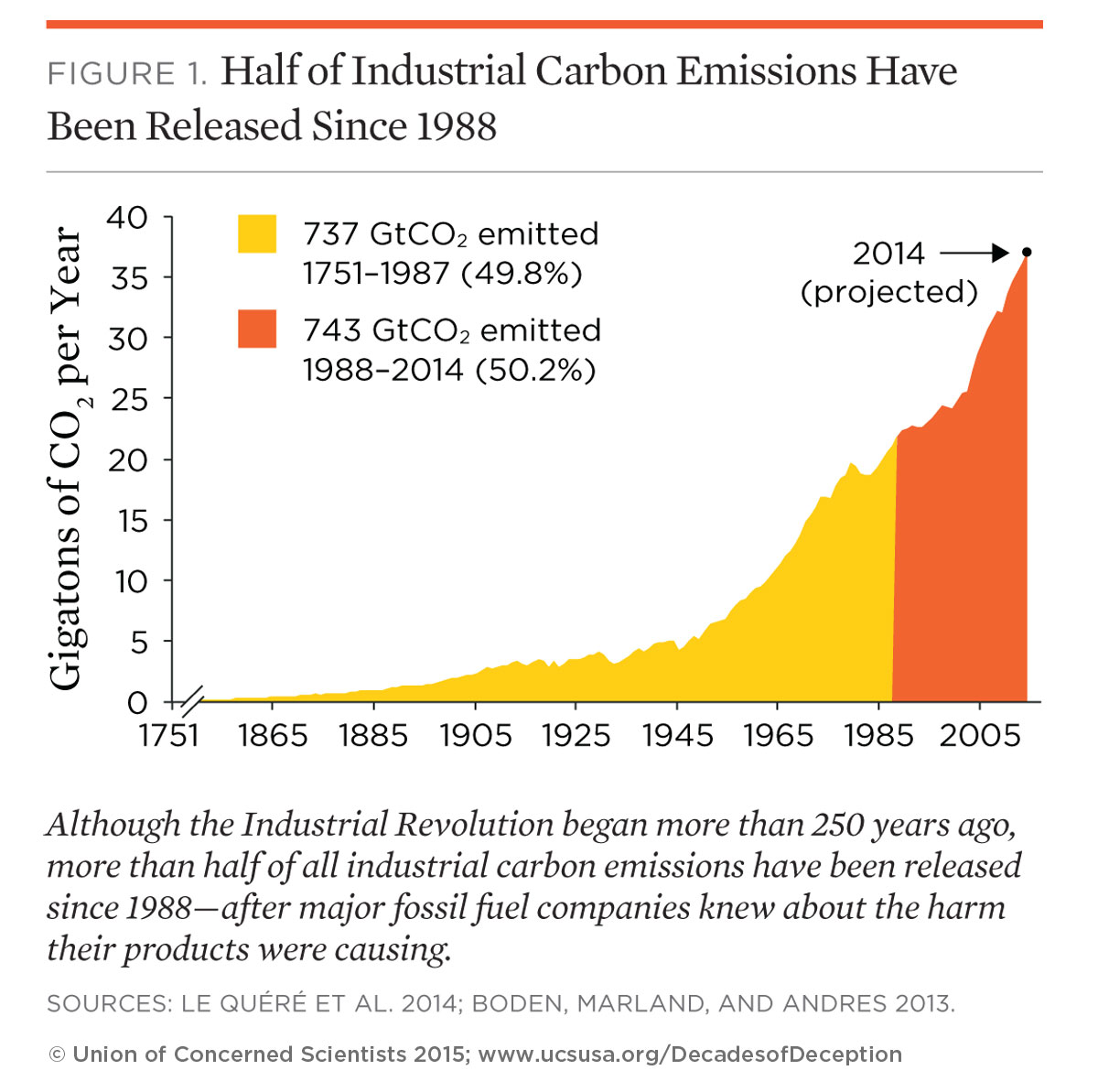
Imagine an alternate world where fossil fuel companies had faced the facts of climate change head on and invested heavily in transforming themselves to provide low carbon sources of energy, leaving most of the fossil fuels consumed over the last two decades in the ground. We would live in a world with a far safer climate and Californians would face fewer threats from wildfires, drought, heat waves, and coastal flooding.
4) Deceiving the public is morally wrong.
Most of us expect businesses to look out for their bottom lines ahead of the public good. But there are limits to acceptable corporate behavior, and there is a difference between being amoral and immoral.
By constructing a decades-long campaign to misinform the public about the scientific realities of climate change, the fossil fuel industry crossed a moral Rubicon. By lying to the public, the industry has distorted the truth, denying the public a complete picture of the risks associated with using their products.
Many others have recognized the fundamental impropriety of this behavior as well. Most recently, the Rockefeller Family Fund announced its intent to divest from fossil fuels, citing ExxonMobil’s “morally reprehensible conduct” to confuse the public about climate change. This action is all the more notable given that John D Rockefeller Sr. was a co-founder of Standard Oil, a precursor to ExxonMobil. And a ruling last week by federal regulators cleared the way for ExxonMobil shareholders to grapple for the first time with the moral and justice implications of climate change as it relates to the company’s business.
There should be consequences any time a company lies to the public, but particularly for deceiving the public systematically for decades about an issue as serious and consequential as global warming. This legislation is an important way to hold them accountable.
5) A movement is building. California can stay at the forefront.
If you have been following this issue in the news, then you know that a movement is building to more fully uncover the truth about the fossil fuel industry’s decades-long effort to deny and deceive the public about climate change—and to hold these companies accountable for their actions.
Following the release of Inside Climate News’ eight-month investigation of Exxon and new reporting from the *Los Angeles Times*, New York Attorney General Eric Schneiderman announced in November that his office was beginning an investigation of ExxonMobil to determine whether the company lied to the public and shareholders. This was quickly followed in January with reports that California Attorney General Kamala Harris was beginning to investigate ExxonMobil as well.
While attention to ExxonMobil’s history of misdeeds is welcome, it is important to remember that they were not alone in fomenting disinformation about climate change—and that the campaign of deception continues today. In light of the evidence that has emerged so far, California congressman Ted Lieu has requested the U.S. Attorney General to launch investigations of both Shell and ExxonMobil.
Whether these companies have actually broken the law is something for the courts to decide—SB 1161 is not making that judgment. What SB 1161 is doing is giving law enforcement the opportunity to ensure that justice is served for the full weight of any violations that may have been committed.
Wherever these investigations lead, it is important that the California legislature—and by extension, the people of California—signal their intent to hold the fossil fuel industry accountable for its many decades of spreading disinformation.
Learn more:
- Background Information on Fossil Fuel Industry Climate Science Deception (PDF)
- :{Background Information on Climate Change and Costly Damages in California:(style="background-color:#ffcc66ff"):}::{(PDF):(style="background-color:#ffffffff"):}:
Update (April 1, 4:15pm):A previous version of this post incorrectly stated that the bill would “give explicit authority to public prosecutors” to bring actions against those who have deceived with regards to climate change. The post has been updated to reflect the fact that the bill only extends the time period for bringing such actions based on existing law. The post also used the word “crimes,” but this is not a criminal statute. Instead, it is related to violations of California’s Unfair Competition Law, which is a civil statute.
Posted in: Global Warming Tags: California, Climate Science Truth and Accountability Act
==
SB 964, authored by Sen. Ben Allen (D-Santa Monica), is a groundbreaking bill that defines "climate-related financial risk" in law, and requires CalPERS and CalSTRS, the two largest public pension funds in the U.S., to take that risk into account when making investment decisions. It also requires the funds to report on climate risk in their portfolios, to the public and the California legislature. This is the first bill of its kind in the nation, and passing it this year—before the Global Climate Action Summit in September—will set an example for other states and other public funds. It's another way California leads on climate.
Fossil Free California will send petition signatures to appropriate Sacramento lawmakers at strategic times during the legislative session, beginning with members of the Senate Appropriations Committee; then to all Senators before a Senate floor vote (the bill must pass by June 1); and then to key Assembly members as the bill moves through the second house.
Some background: Fossil Free California and Environment California are co-sponsoring the bill. It was introduced in 2017 as SB 560, and held in committee; Senator Allen has now brought it back as SB 964. It passed the Senate Public Employment and Retirement Committee on April 9...and its near-term fate will be decided in the Senate Appropriations Committee during the second half of May.
==
UCS may/ 2016?
Six weeks ago I wrote that 2016 could mark a turning point in efforts to force fossil fuel companies to reckon with their record of twisting the facts on climate change. I’ve seen two key developments in the last month that signal momentum is truly building to bring attention—and accountability—to the fossil fuel industry for having misled consumers and the broader public about the risks of global warming.
Last month, the Center for International Environmental Law (CIEL) released a trove of documents revealing that the oil industry has been well aware of the potential climate risks of fossil fuels for decades. The uncovered industry documents show that the petroleum industry was conducting climate research as early as 1957, corroborating evidence that major oil companies had a sophisticated command of climate science by the 1980s.
Meanwhile, in California, the Climate Science Truth and Accountability Act (SB 1161), authored by Senator Ben Allen (Santa Monica), has passed through two senate committees and will soon face a vote before the entire California State Senate. This narrowly targeted bill, which focuses on corporate deception relating to climate change science, has garnered support from more than 30 organizations that recognize the threat of climate change and the importance of defending the public from industry foul play.
New discoveries put public relations campaigns in a new light
The documents unearthed by CIEL are not the only recent discoveries that track the fossil fuel industry’s deep knowledge of climate change back decades.
Recent reporting by *Inside Climate News* and the *Los Angeles Times* has also revealed that for decades many fossil fuel companies were not only aware of climate change, but were at the leading edge of understanding it. Some were even making investments to fortify their own infrastructure from climate change. Meanwhile, other evidence highlights how many fossil fuel companies and their trade groups downplayed the risks of their product to the climate, often by casting doubt on the science of climate change.
The sum of these revelations now makes it clear that the industry’s professed doubt about climate change has not been an honest attempt to discern the facts, but PR spin intended to confuse consumers and fend off competition from lower-carbon energy sources.
SB 1161 ensures potentially unlawful acts do not escape prosecution
Aside from the moral implications of the fossil fuel industry’s deceit, there is a question of whether their behavior was unlawful. It is possible that fossil fuel companies violated California’s Unfair Competition Law, which protects consumers from deceptive, misleading, and fraudulent business practices. This law typically requires legal action within four years. However, a statute of limitations can sometimes be suspended (“tolled,” in legalese) if the unlawful behavior is hidden from the public. Consequently, there is uncertainty about when the statute of limitations runs out in a case like this.
Here is where SB 1161 steps in: the bill says that any cases addressing violations of the Unfair Competition Law that relate to deceiving the public about climate science won’t get caught up in procedural debates about whether the statute of limitations has run—so long as the cases are brought in the next four years. The result is that the state attorney general or a district attorney could fairly litigate any acts of unfair business competition relating to climate science so long as the investigations lead them to file a lawsuit before 2021.
To be clear, SB 1161 does not presume that any fossil fuel company has violated the law. But should the evidence support legal action, SB 1161 will give public prosecutors a more powerful tool to pursue it. It would be an unfortunate contortion of our justice system for a fossil fuel company to escape prosecution for unlawful acts simply because it successfully hid the evidence from public view. SB 1161 protects the public from such a risk.
We should not wait to act
Carbon emissions are now impacting California, contributing to drought, rising sea level, more frequent and intense heat waves, and longer and more damaging wildfire seasons. Since 1988, when fossil fuel companies knew the risks and likely consequences of their products to the climate, industrial carbon emissions have doubled. These emissions will significantly increase the costs and risks to our communities, health, and economy.
As California continues to take important steps to reduce heat-trapping emissions and prepare itself for the unavoidable impacts of climate change, we must also take an honest look at how we have come to find ourselves in ourcurrent predicament.
While responsibility for climate change is certainly spread across society, fossil fuel companies have a unique responsibility, which includes accountability for misleading consumers on climate science in order to block low-carbon alternatives. California’s state senate has a chance to send a powerful signal that misleading people about climate science is unacceptable.
==
https://ballotpedia.org/Ben_Allen
comms
| • Education, Chair |
|---|
| • Elections and Constitutional Amendments |
| • Natural Resources and Water |
| • Transportation and Housing |
| •Arts, Chair |
2014, Allen's endorsements included the following:[5]
- José Serrano, Member of Congress
- Fran Pavley, State Senator
- Zev Yaroslavsky, Los Angeles County Supervisor
- Tom Hayden , State Senator (former)
- Alan Sieroty, State Senator (former)
- Richard Katz , Assemblymember (former)
- Terry B. Friedman , Los Angeles County Superior Court Judge (retired); Assemblymember (former)
- Ed Edelman, LA City Councilmember (former); LA County Supervisor (former)
- Pam O'Connor , Mayor, Santa Monica...
- Profile from the California State Senate
- Official campaign website
- Profile from Open States
- Legislative Profile from Project Vote Smart
- Biography from Project Vote Smart
- Campaign contributions viaFollow the Money
--
---
http://sd26.senate.ca.gov/
- Education Committee (Chair)
- Elections and Constitutional Amendments Committee
- Natural Resources and Water Committee
- Transportation and Housing Committee
- Joint Committee on the Arts (Chair)
- Environmental Caucus, Co-Chair: http://environmental.legislature.ca.gov/
- Jewish Caucus, Vice-Chair
- Select Committee on Defense and Aerospace (Vice Chair)
- Select Committee on California-Mexico Cooperation
- Select Committee on Career Technology and the New Economy
- Select Committee on Student Success
- Select Committee on US Citizen Youth Exiled in Mexico
==
SB-692 Transmission: access charge.(2017-2018)
http://leginfo.legislature.ca.gov/faces/billNavClient.xhtml?bill_id=201720180SB692
692
Introduced by Senator Allen
(Coauthor: Senator Wiener)(Coauthor: Assembly Member Berman)
February 17, 2017
--
SB 560 climate risk pension protection financial
http://leginfo.legislature.ca.gov/faces/billNavClient.xhtml?bill_id=201720180SB560
--
regional transit
150 sb http://leginfo.legislature.ca.gov/faces/billNavClient.xhtml?bill_id=201720180SB150
died 12/16?
http://www.dailykos.com/story/2016/5/18/1527955/-The-fossil-fuel-industry-lied-to-us-about-climate-change-In-California-we-re-fighting-back
6 weeks ago I wrote that 2016 could mark a turning point in efforts to force fossil fuel companies to reckon with their record of twisting the facts on climate change. I’ve seen two key developments in the last month that signal momentum is truly building to bring attention—and accountability—to the fossil fuel industry for having misled consumers and the broader public about the risks of global warming.
Last month, the Center for International Environmental Law (CIEL) released a trove of documents revealing that the oil industry has been well aware of the potential climate risks of fossil fuels for decades. The uncovered industry documents show that the petroleum industry was conducting climate research as early as 1957, corroborating evidence that major oil companies had a sophisticated command of climate science by the 1980s.
Meanwhile, in California, the Climate Science Truth and Accountability Act (SB 1161), authored by Senator Ben Allen (Santa Monica), has passed through two senate committees and will soon face a vote before the entire California State Senate. This narrowly targeted bill, which focuses on corporate deception relating to climate change science, has garnered support from more than 30 organizations that recognize the threat of climate change and the importance of defending the public from industry foul play.
New discoveries put public relations campaigns in a new light
The documents unearthed by CIEL are not the only recent discoveries that track the fossil fuel industry’s deep knowledge of climate change back decades.
Recent reporting by Inside Climate News and the Los Angeles Times has also revealed that for decades many fossil fuel companies were not only aware of climate change, but were at the leading edge of understanding it. Some were even making investments to fortify their own infrastructure from climate change. Meanwhile, other evidence highlights how many fossil fuel companies and their trade groups downplayed the risks of their product to the climate, often by casting doubt on the science of climate change.
The sum of these revelations now makes it clear that the industry’s professed doubt about climate change has not been an honest attempt to discern the facts, but PR spin intended to confuse consumers and fend off competition from lower-carbon energy sources.
SB 1161 ensures potentially unlawful acts do not escape prosecution
Aside from the moral implications of the fossil fuel industry’s deceit, there is a question of whether their behavior was unlawful. It is possible that fossil fuel companies violated California’s Unfair Competition Law, which protects consumers from deceptive, misleading, and fraudulent business practices. This law typically requires legal action within four years. However, a statute of limitations can sometimes be suspended (“tolled,” in legalese) if the unlawful behavior is hidden from the public. Consequently, there is uncertainty about when the statute of limitations runs out in a case like this.
Here is where SB 1161 steps in: the bill says that any cases addressing violations of the Unfair Competition Law that relate to deceiving the public about climate science won’t get caught up in procedural debates about whether the statute of limitations has run—so long as the cases are brought in the next four years. The result is that the state attorney general or a district attorney could fairly litigate any acts of unfair business competition relating to climate science so long as the investigations lead them to file a lawsuit before 2021.
To be clear, SB 1161 does not presume that any fossil fuel company has violated the law. But should the evidence support legal action, SB 1161 will give public prosecutors a more powerful tool to pursue it. It would be an unfortunate contortion of our justice system for a fossil fuel company to escape prosecution for unlawful acts simply because it successfully hid the evidence from public view. SB 1161 protects the public from such a risk.
We should not wait to act
Carbon emissions are now impacting California, contributing to drought, rising sea level, more frequent and intense heat waves, and longer and more damaging wildfire seasons. Since 1988, when fossil fuel companies knew the risks and likely consequences of their products to the climate, industrial carbon emissions have doubled. These emissions will significantly increase the costs and risks to our communities, health, and economy.
As California continues to take important steps to reduce heat-trapping emissions and prepare itself for the unavoidable impacts of climate change, we must also take an honest look at how we have come to find ourselves in our current predicament.
While responsibility for climate change is certainly spread across society, fossil fuel companies have a unique responsibility, which includes accountability for misleading consumers on climate science in order to block low-carbon alternatives. California’s state senate has a chance to send a powerful signal that misleading people about climate science is unacceptable.
bs
nat rev ~
Read more at: http://www.nationalreview.com/corner/436163/climate-change-ever-chillier-free-speech
First define heresy, then punish it. That’s how the script always seems to go. Just the other day, I noted how the Portland (Oregon) Public Schools board had approved a resolution aimed at “eliminating doubt” over climate change. Now, further down the west coast and, for that matter, the slippery slope, we have California Senate Bill 1161, which has cleared committee hearings in recent months. TheUnion of Concerned Scientists(“science for a healthy planet and safer world”), a group with few concerns, it seems, about free speech, will be thrilled at the progress 1161 is making.
Here’s how they described the bill back in March:A California bill introduced today by Sen. Ben Allen (D-Santa Monica) would extend the statute of limitations in state law to enable law enforcement to hold fossil fuel companies accountable for decades of deception and fraud over the scientific evidence about climate change.TheClimate Science Truth and Accountability Act (SB 1161)follows the release of internal corporate memos and other evidence showing that oil, gas and coal companies conspired since the late 1980s to deceive the public about climate change. The bill would extend the statute of limitations under California’s Unfair Competition Law from 4 to 30 years. Extending the statute of limitations in this matter is, effectively, retrospective legislation.
Somehow I don’t think that worries the concerned scientists, who also noted that “fossil fuel companies are facing increased scrutiny about their climate science deception, including investigations of ExxonMobil by California Attorney General Kamala D. Harris and New York Attorney General Eric Schneiderman..” “Increased scrutiny” as a euphemism for the legal harassment of the wrong sort of thinking. Overlawyered’s Walter Olson gives more background: An extraordinary bill in the California legislature, promoted as making it easier to sue fossil fuel companies over their involvements in public debate, would lift the four-year statute of limitations of the state’s already extremely liberal Unfair Competition Law, otherwise known as s. 17200 — and retrospectively, so as to revive decades’ worth of time-lapsed claims “with respect to scientific evidence regarding the existence, extent, or current or future impacts of anthropogenic induced anthropogenic-induced climate change.”
Despite a 2004 round of voter-sponsored reform which curbed some of its worst applications, s. 17200 still enables what a California court called “legal shakedown” operations in which “ridiculously minor” violations serve as the predicate for automatic entitlement to damages, attorneys’ fees, and other relief. Combined with the plans laid by California Attorney General Kamala Harris — part of the alliance of AGs that has sought to investigate not only oil, gas, and coal companies, but private advocacy groups and university scientists who have played a role in what is characterized as “climate denial” — the bill would begin laying the legal groundwork for an astonishingly broad campaign of inquisition and, potentially, expropriation.
The bill was approved by a subcommittee and was further amended May 10 to provide that climate science-related claims of any age would begin a four-year reviver period as of next January….Section 2(b) of the bill declares it the California legislature’s policy to promote “redress for unfair competition practices committed by entities that have deceived, confused, or misled the public on the risks of climate change or financially supported activities that have deceived, confused, or misled the public on those risks”[emphasis added] — a very clear signal that the target is public issue advocacy, and not merely (say) advertising that is directed at consumers in their capacity as buyers of gasoline at the pump.
J. Robert Oppenheimer: There must be no barriers to freedom of inquiry. There is no place for dogma in science. The scientist is free, and must be free to ask any question, to doubt any assertion, to seek for any evidence, to correct any errors. And so, for that matter, should anyone else. Not everyone, it seems, agree
Read more at: http://www.nationalreview.com/corner/436163/climate-change-ever-chillier-free-speech
==
===
http://insideclimatenews.org/news/29032016/climate-change-deception-oil-companies-exxon-california-legislation
Fossil fuel companies in California could face investigation under legislation introduced by a state senator who says the proposed law is designed to hold industry accountable for "many years of public deception" and fraud over the scientific evidence about climate change.
The Climate Science Truth & Accountability Act would extend the statute of limitations under California's Unfair Competition Law from four to 30 years, giving greater leverage to state and local prosecutors to file civil charges in connection with the conduct of fossil fuel companies going back decades.
The legislation, introduced by Sen. Ben Allen (D-Santa Monica), would give prosecutors authority to delve into the issues dating to the heart of the denial era.
The legislation was inspired by investigative news stories, including those by InsideClimate News (ICN), and an investigation by the Union of Concerned Scientists (UCS) that disclosed ExxonMobil and the oil industry were aware of the dangers of global warming from the burning of fossil fuels as far back as the 1970s.
The ICN stories and later articles by the Los Angeles Times in tandem with the Columbia University Journalism School—along with a UCS report last year—revealed that the company went on to spearhead industry efforts in the late 1980s to derail regulation of greenhouse gas emissions and cloud public understanding of climate science.
The bill takes aim at fossil fuel companies over concerns that they have deceived the public for decades about their products' impact on climate change, and seeks to hold them accountable.
Based on his review of the recent disclosures, Allen said there are serious issues that warrant investigation.
"I want to give law enforcement the tools they need to hold people accountable for their actions if that's where the evidence takes them," he said. "Certainly everything we've seen suggests there may be a really strong case."
'Unfair and Deceptive Practices'
Allen said the legislation is not a directive to law enforcement to pursue prosecutions, and he emphasizes the bill does not change the standard of proof or alter legal due process.
Yet a summary of the bill by Allen's office concluded: "Given the environmental, health, and economic impacts that Californians are already paying for as a result of the fossil fuel industry's many years of public deception and their efforts to block action on climate change, it is important to hold the industry responsible.
"Keeping the statute limited to only four years undermines the state's ability to hold fossil fuel companies responsible for their unfair and deceptive practices that extend back well beyond four years, as well as the damages and risks that Californians and everyone else must face for centuries to come."
Extending the deadline for filing environmental cases would expose fossil fuel companies like Exxon to greater liability, said Richard Frank, professor of Environmental Practice and Director of California Environmental Law and Policy Center at the University of California, Davis.
"If the statute of limitations is extended, that means a now powerful environmental prosecutorial tool will become even more powerful," saidFrank, who served nearly 30 years as a deputy in the California attorney general's office.
The unfair competition statute allows the California attorney general, a district attorney, or a city attorney of a city with more than 750,000 people to bring legal action against a business that has committed "unlawful, unfair or fraudulent business act[s] or practice[s] and unfair, deceptive, untrue or misleading advertising," as it relates to climate change.
As the law stands now, it is difficult for prosecutors to file cases involving violations older than four years. That would change if Allen's bill becomes law.
"It would open up a much wider window for companies to be held accountable for their conduct," Frank said.
It could be applied to possible violations by ExxonMobil and other fossil fuel companies for making deceptive public statements about what it knew about climate change and any attempts to obfuscate the truth, Frank said.
Cases brought under the law are civil, not criminal. That means violations can result in hefty fines and court orders to halt the illegal conduct.
The law could also be employed in civil litigation by private citizens who can prove to a court they have sufficient connection to, and harm from, the alleged violations. The proposed law also would also apply to so-called "private party" cases, in which stockholders might sue a company.
The bill must make its way through several senate committees before coming up for a vote in June before the full body. If it passes, the legislation will be forwarded to the assembly for consideration and a vote later in the summer. A final bill, if passed by the Democratic-held senate and assembly, could be on Gov. Jerry Brown's desk by August.
Brown, also a Democrat, and state lawmakers have a history of taking steps to combat climate change and curb toxic carbon pollution. Most recently, Brown signed ambitious legislation to expand renewable energy use to 50 percent and double energy efficiency in buildings by 2030.
Exxon already is the target of an investigation by the New York attorney general's office. Investigators for Attorney General Eric Schneiderman have issued a subpoena demanding Exxon turn over documents related to its climate change studies, and the way the company represented that information to the public. During a press conference Tuesday with five other attorneys general and former Vice President Al Gore, Schneiderman confirmed that California Attorney General Kamala Harris has also launched an Exxon climate probe. The attorneys general of Massachusetts and the Virgin Islands announced their own investigations of the oil giant.
Adrienne Alvord, California and western states director of the Union of Concerned Scientists, said the proposed expansion of California's statute of limitations is vital because the state is already experiencing the costly, damaging effects of climate change.
"We want to ensure that the state has the ability to hold fossil fuel companies legally accountable for the decades of deception and damages they have caused to public health, property and the environment in California," she said.
==
bio official
California State Senator Ben Allen was elected in 2014 to represent the 26th Senate District, which consists of the Westside, Hollywood and coastal South Bay communities of Los Angeles County.
Ben serves as chair of the Senate Education Committee and the legislature's Joint Committee on the Arts. He is a member of the Senate Committees on Elections and Constitutional Amendments, Natural Resources and Water, and Transportation and Housing. He co-chairs the Environmental Caucus and is vice-chair of the Jewish Caucus.
Ben has authored several measures that have become law, including the groundbreaking bill to boost vaccination rates among schoolchildren and a landmark river protection bill. He authored laws that protect veterans from pension scams; improve the diagnosis, treatment and care for persons with Alzheimer’s disease; strengthen the regulation of underground gas wells, and enable HIV-positive persons to donate life-saving organs to other HIV-positive persons.
While serving as chair of the Senate Elections and Constitutional Amendments Committee in 2015-16, he championed campaign reform and transparency issues. He authored a new law that will increase voter turnout and civic engagement by transforming how elections are conducted. This reform, which was praised by the Los Angeles Times editorial page, will allow people to vote in the 10 days preceding an election at conveniently-located vote centers. He also authored the bill that placed an initiative on the statewide ballot urging Congress to overturn the Citizens United ruling, and a measure that allows cities and counties to use binding independent redistricting commissions.
As chair of the Joint Committee on the Arts, Ben authored successful legislation that reinstated teaching credentials for Theatre and Dance educators. He is fighting for increased access to the arts in schools, especially in disadvantaged communities, and is working to keep entertainment industry jobs in California.
Ben coauthored the Senate’s historic climate change legislation, which requires 50% of the state’s energy to come from renewable sources, and doubles energy efficiency in buildings, by 2030. He authored bills to expand the state’s efforts to combat climate change even further, including establishing the first standard to increase the use of renewable gas, and reducing toxic motor oil waste. He is leading the effort to end the use of harmful drift gillnets in commercial fishing off the coast that injure and kill endangered sea turtles and other marine life.
Ben received the Freshman Legislator of the Year award from the California School Boards Association, and was named Legislator of the Year by the County Superintendents’ Educational Services Association, the Alzheimer’s Association and Technet, an association of technology companies that includes Apple, Google and Microsoft.
Ben grew up in the 26th District. He is a former board member, and board President, of the Santa Monica-Malibu Unified School District, where he was a leader on issues of environmental sustainability, financial accountability, and community engagement.He helped pass a $385 million bond measure which upgraded district facilities using environmental best practices and created good local jobs.During his tenure, the district enacted policies to provide all students with high-quality educational opportunities regardless of their background or means. He helped start the Los Angeles Spark Program, a nonprofit organization that connects at-risk middle school students with apprenticeships.
While in law school, Ben served as a voting member of the University of California Board ofRegents,and was ajudicial clerk with the United Nations International Criminal Tribunal for Rwanda.As an attorney, he worked for the law firm of Richardson & Patel LLP, and previously was a litigator with Bryan Cave LLP.
Prior to his law career, Ben worked for the National Democratic Institute for International Affairs, and then as communications director for Congressman Jose Serrano (D-NY). He is a senior fellow with the international human rights organization Humanity in Action, a member of the Pacific Council on International Policy, and a graduate of the Jewish Federation's New Leaders Project. He has a Bachelor of Arts degree from Harvard University, where he graduated magna cum laude inHistory; a Master of Philosophy degree from the University of Cambridge, and a Juris Doctorate from UC Berkeley. He is fluent in Spanish.
For three years prior to his election to the Senate, he was a lecturer at UCLA’s Law School, where he taught education law and policy.
==
- Environmental Caucus, Co-Chair: http://environmental.legislature.ca.gov/
MEMBERS DIRECTORY
==