wlf2 bak
accidental erase 10 23? tag?
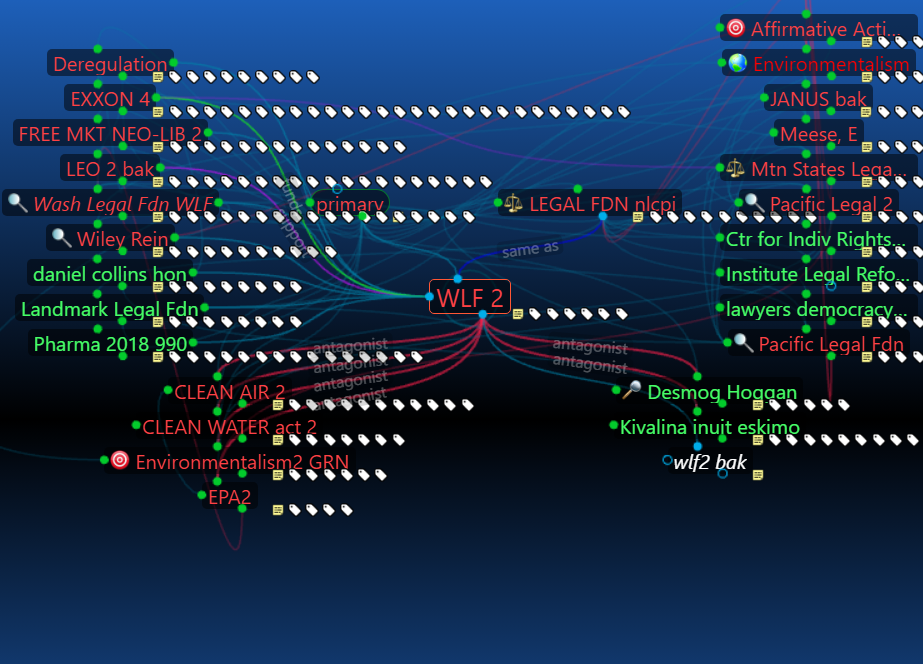
616, see main and tag
http://www.fed-soc.org/experts/detail/richard-a-samp
==
contrib gp:
http://www.forbes.com/sites/wlf/#7c3b914335d5
==
http://www.desmogblog.com/washington-legal-foundation
Washington Legal Foundation (WLF) was founded in 1977 to fight “activist lawyers, regulators, and intrusive government agencies at the federal and state levels, in the courts and regulatory agencies across the country.” WLF is a national non-profit foundation under section 501(c)(3) of the Internal Revenue Code. [1]
The Washington Legal Foundation has repeatedly opposed the EPA and the Clean Air Act, having described it as a “power grab.” In 2014 they supported two cases against the EPA, one regarding the Clean Water Act, and one regarding the Clean Air Act. [2]
The Washington Legal Foundation (WLF) has revised its mission. In 2012, it describes its three essential programs as “shaping public policy through aggressive litigation and advocacy,” “publishing timely legal studies,” and “educating policy-makers and the public through extensive communications outreach.” As of 2015, WLF's new mission statement is “to preserve and defend America’s free enterprise system by litigating, educating, and advocating for free market principles, a limited and accountable government, and individual and business liberties.” [3], [4]
The Washington Legal Foundation has received funding from Koch Family Foundations, oil companyExxonMobil, Scaife Family Foundations, and the tobacco industry as well as numerous other large, conservative foundations. It has represented large oil companies including ExxonMobil, and has worked with large tobacco companies including Phillip Morris — the same companies that provided it millions of dollars in financial contributions.
Stance on Climate Change
“As MIT's Richard Lindzen noted, 'water vapor is a far more powerful greenhouse gas than carbon dioxide… .' “
“Given the continuing uncertainties and disputes regarding the causes and possible effects of increased CO2 concentrations in the atmosphere, and the effectiveness and economic and societal consequences of any chosen response, Congress has held over 200 hearings, enacted at least a half dozen statutes, and taken other actions establishing a measured course of action for the Nation, designed to address concerns about potential global climate change through a greater understanding of the possible problems and solutions.” [5]
“[G]lobal warming 'liability' presents a nonjusticiable political question.” [6]
“Because of its wide impact, climate change regulation could be extremely costly economically, with most cost estimates of the various bills in Congress running to more than a hundred billion dollars each year. [7]
Funding
According to data compiled by theConservative Transparencyproject, the Washington Legal Foundation (WLF) has received funding from the below sources. Note that not all data has been verified by DeSmogBlog for accuracy. [8]
View the attached spreadsheet for additional information on the Washington Legal Foundation's funding by year (.xls).
| The Carthage Foundation | $2,910,000 |
|---|---|
| American Legal Foundation | $2,799,977 |
| John M. Olin Foundation | $2,735,000 |
| U.S. Justice Charitable Foundation | $2,362,440 |
| Claude R. Lambe Charitable Foundation | $1,605,000 |
| Sarah Scaife Foundation | $860,000 |
| The Lynde and Harry Bradley Foundation | $570,500 |
| Dorothy D. and Joseph A. Moller Foundation | $420,625 |
| Exxon Mobil | $410,000 |
| The Samuel Roberts Noble Foundation | $355,000 |
| F.M. Kirby Foundation | $217,500 |
| Armstrong Foundation | $210,000 |
| Allegheny Foundation | $200,000 |
| Sidney A. Swensrud Foundation | $185,000 |
| William H. Donner Foundation | $160,000 |
| Donors Capital Fund | $121,000 |
| The Rodney Fund | $71,000 |
| Ed Uihlein Family Foundation | $70,000 |
| JM Foundation | $60,000 |
| Philip M. McKenna Foundation | $34,000 |
| PhRMA | $29,500 |
| CIGNA Foundation | $25,000 |
| The Weiler Foundation | $25,000 |
| Woodhouse Family Foundation | $19,000 |
| Arthur N. Rupe Foundation | $15,000 |
| William E. Simon Foundation | $10,000 |
| Joyce and Donald Rumsfeld Foundation | $9,000 |
| DonorsTrust | $7,500 |
| Charles G. Koch Charitable Foundation | $2,500 |
| Grand Total | $16,499,542 |
ExxonMobil
According to Greenpeace's ExxonSecrets, Washington Legal Foundation has received at least $375,000 from ExxonMobil since 1998. [9]
Koch Funding
Greenpeace's PolluterWatchproject found that WLF had received at least $1,605,000 from Koch Foundations between 1997 and 2011. [10]
Tobacco Industry Funding
Internal tobacco industry documents reveal that WLF sought and obtained funding from Philip Morris and the now defunct Tobacco Institute:
Philip Morris
- 1995: $250,000 [11]
- 1996: $275,000 [12]
- 1997: $275,000 [13]
- 1998: $250,000 [14]
- 1999: $200,000 (budgeted) [15]
Total: $1,250,000
The Tobacco Institute
Total: $125,000
[990 ]
Legal Policy Advisory Board (2015)
The following is a snapshot of the Washington Legal Foundation's “Legal Policy Advisory Board” as of September, 2015: [20]
CHAIRMAN OF THE BOARD
- Jay B. Stephens —Former Senior Vice President, General Counsel and Secretary, Raytheon Company
CHAIRMEN EMERITUS
- Frank J. Fahrenkopf, Jr., Esq.
- The Honorable Dick Thornburgh— Of Counsel, K&L Gates LLP, Washington, DC
- Richard K. Willard, Esq. —Partner, Steptoe & Johnson LLP, Washington, DC
BOARD MEMBERS
- Mark A. Behrens —Partner, Shook, Hardy & Bacon LLP, Washington, DC
- Gregory A. Brower —Partner, Snell & Wilmer, Las Vegas and Reno, NV
- Carol Elder Bruce —Partner, K&L Gates LLP
- The Honorable James H. Burnley, IV —Partner, Venable LLP, Washington, DC
- Ralph J. Caccia, Esq. —Partner, Wiley Rein LLP, Washington, DC
- Michael A. Carvin, Esq. —Partner, Jones Day, Washington, DC
- Drew Clark —Vice President and General Counsel, McKee Foods Corporation
- Charles Cooper, Esq. —Founding Partner, Cooper & Kirk PLLC, Washington, DC
- Joseph E. diGenova, Esq. —Founding Partner, diGenova & Toensing, Washington, DC
- Professor Viet D. Dinh —Professor of Law, Georgetown University Law Center, Washington, DC
- The Honorable John Engler —President, The Business Roundtable
- The Honorable Tim Fox —Attorney General, State of Montana
- Richard L. Frank —Olsson Frank Weeda Terman Bode Matz PC, Washington, D.C.
- The Honorable Harold Furchtgott-Roth —President, Furchtgott-Roth Economic Enterprises
- Kenneth S. Geller, Esq. —Partner, Managing Partner, Mayer Brown LLP, Washington, DC
- Stuart M. Gerson, Esq. —Member of the Firm, Epstein Becker & Green, P.C., Washington, DC; New York, NY
- Thomas C. Goldstein, Esq.Partner — Goldstein & Russell, P.C., Washington, DC
- Eric Grannon, Esq.Partner — White & Case, Washington, DC
- Professor William F. Harvey —Carl M. Gray Professor of Law Emeritus, Indiana University School of Law, Indianapolis
- Coleen Klasmeier —Partner, Sidley Austin LLP, Washington, D.C.
- Philip A. Lacovara, Esq. — Senior Counsel, Mayer Brown LLP, New York, NY
- Jay P. Lefkowitz —Partner, Kirland & Ellis LLP, New York, New York
- Susan W. Liebeler, Esq. —President, Lexpert Research Services, Los Angeles, CA
- Daniel M. Mandil —Senior Vice President and Deputy General Counsel, Viacom, New York, New York
- Arvin Maskin, Esq. —Litigation Partner, Weil, Gotshal & Manges LLP, New York, NY
- The Honorable Rob McKenna —Partner, Orrick, Herrington & Sutcliffe LLP, Seattle, Washington
- John A. Merrigan, Esq. —DLA Piper
- Professor John Norton Moore —Walter L. Brown Professor of Law, University of Virginia, School of Law
- The Honorable Gerald J. Mossinghoff —Senior Counsel, Oblon, Spivak, McClelland, Maier &Neustadt, Alexandria, VA
- The Honorable Theodore B. Olson —Partner, Gibson, Dunn & Crutcher LLP, Washington, DC
- Carter G. Phillips —Partner, Sidley Austin LLP, Washington, D.C.
- Professor Stephen B. Presser —Raoul Berger Professor of Legal History Emeritus, Northwestern University, School of Law
- Professor George L. Priest —Professor of Law & Economics, Yale University Law School
- Charles F. (Rick) Rule, Esq. —Partner, Cadwalader Wickersham & Taft, Washington, DC
- The Honorable Kenneth W. Starr —President, Baylor University, Waco, Texas
- The Honorable John W. Suthers—Former Attorney General, State of Colorado
- George J. Terwilliger III, Esq. —Partner, McGuire Woods LLP, Washington, DC
- Larry D. Thompson—Former Executive Vice President, Government Affairs, General Counsel and Corporate Secretary, Pepsico
- Daniel E. Troy —Senior Vice President and General Counsel, GlaxoSmithKline
- The Honorable William F. Weld—Partner, Mintz Levin Cohn Ferris Glovsky and Popeo PC, New York,NY
- Joe D. Whitley, Esq. —Partner, Baker Donelson, Washington, DC; Atlanta, GA
Legal Policy Advisory Board (2012)
As of February, 2012, the following additional board members (no longer listed in 2015) were listed on WLF's website: [21]
- Joseph A. Artabane, Esq. — Artabane & Belden, P.C.
- Professor Thomas E. Baker— Professor of Law, Florida International University College of Law.
- Thomas Hale Boggs, Jr., Esq. — Partner, Patton Boggs LLP, Washington, DC.
- Michael K. Brown, Esq. — Partner, Reed Smith, Los Angeles, CA.
- Richard Duesenberg— Former Senior Vice President and General Counsel, Monsanto Company.
- Professor Maurice J. Holland— Professor Emeritus, University of Oregon, School of Law.
- Clarence T. Kipps, Jr., Esq.— Of Counsel, Miller & Chevalier, Washington, DC.
- The Honorable Robert F. McDonnell— Governor, Commonwealth of Virginia.
- Glen D. Nager, Esq. — Partner, Jones Day, Washington, DC.
- The Honorable Mark Shurtleff — Attorney General, State of Utah.
- The Honorable Don Stenberg— Former Attorney General, State of Nebraska.
- Ambassador Robert S. Strauss — Partner, Akin Gump Strauss Hauer & Feld LLP, Washington, DC.
- John Thorne — Senior Vice President and Deputy General Counsel, Verizon Communications, Inc.
- Wayne Withers — Of Counsel, Bryan Cave LLP, St. Louis, MO.
Actions
July 28, 2015
The Washington Legal Foundation filed formal comments with the Environmental Protection agency, “urging the agency to revise its recent draft report on hydraulic fracturing (“fracking”) to make more explicit its findings that fracking poses no threat to drinking water.” [22]
Related docs:
2014
The Washington Legal Foundation was involved in two cases against the Environmental Protection Agency. The following summaries are taken from WLK's 2014 Annual Report (PDF). [2]
Utility Air Regulatory Group v. EPA.
“EPA had sought to expand regulation of greenhouse gases in the wake of the Court’s earlier decision in Massachusetts v. EPA, but WLF’s brief argued that EPA improperly seized on the Court’s narrow earlier ruling to enhance the agency’s regulatory authority
[…] Although WLF would like to have seen the Court cut back even further on EPA’s power grab, the partial victory nonetheless established real constraints on whose emissions EPA may regulate.”
American Farm Bureau Federation v. EPA
“In a brief filed on behalf of 39 Members of Congress challenging EPA’s conduct, WLF argues thatEPA is exceeding powers delegated to it and violating Congress’ desire for state primacy as expressed in the CWA.”
July 7, 2010
The Washington Legal Foundationfiled a brief in the U.S. Court of Appeals for the Ninth Circuit urging it to reject an appeal filed by the Alaskan village of Kivalina, which seeks to revive a lawsuit contending that global warming is destroying the village by melting Arctic sea ice. [6], [23]
The lawsuit was directed at ExxonMobil Corporation among 19 American oil and energy companies.
According to WLF, “allegations are not sufficient to support the imposition of joint and several liability for Kivalina’s alleged damages on this group of Defendants, whose alleged 'contribution' to global warming in 2004, according to Plaintiffs’ own sources, is only approximately 2.68%.”
June 23, 2009
WLF opposed the EPA's proposed endangerment finding which would classify elevated atmospheric concentrations of six GHGs, including carbon dioxide (CO2), as air pollution with the potential to endanger public health and welfare.
Their opposition was on the grounds that it could potentially “encourage a flood of lawsuits against companies that emit greenhouse gases claiming that such activities constitute 'negligence' or a 'nuisance.'”[7]
July 1, 2008
WLF filed comments with the National Highway Traffic Safety Administration (NHTSA) on its proposed Corporate Average Fuel Economy (CAFE) standards which would improve fuel efficiency and reduce carbon dioxide emissions.
WLF warned against any actions that would “impose undue costs to the industry and consumers,” and “urged NHTSA not to effectively force manufacturers to reduce the weight of their vehicles to meet aggressive fuel economy standards, which would make them less crashworthy.” [24]
Related docs:
April 15, 2008
WLF filed a brief in the U.S. Court of Appeals urging the court to reject an appeal filed by the State of California that had described global warming is a public nuisance that has caused California to suffer beach erosion and other environmental impacts.
California listed the General Motors Corporation and five other major automakers as partially responsible for contributing to the global warming.
WLF concluded that “California mischaracterizes global climate change and its highly complex causes as an actionable public nuisance under federal common law and enlists the federal courts into making nationwide energy and economic policy in the guise of a tort suit. Realizing this, the district court properly dismissed California's claims on the grounds that they raise nonjusticiable political questions.” [25]
Related docs:
2007
WLF filed an amicus brief in Massachusetts v. EPA, 127 S. Ct. 1438, declaring that Congress did not give authority to the EPA under the Clean Air Act to regulate carbon dioxide emissions for climate change purposes.
WLF argued that a court ordering the EPA to regulate emissions would constitute a “back door” method of implementing the Kyoto Treaty regulating greenhouse gases, and “cause severe harm to our economy.” [26]
Related docs:
- Amicus Brief (PDF - 11/2/2004)
- Amicus Brief (PDF - 10/24/2006)
- Press Release (PDF - November 3, 2004)
- Press Release (PDF - October 25, 2006)
May 18, 2007
While petitioners were urging the EPA to increase regulation for mercury emissions from power plants WLFargued that no additional regulations were necessary as “mercury emissions from utilities do not pose a hazard to public health.” [27]
Related docs:
- WLF Amicus Brief (PDF - 5/18/2007)
- Press Release: WLF Urges Court to Uphold EPA Ruling on Mercury Emissions (PDF)
June 10, 2001
In a biweekly “In All Fairness” ad in the New York Times, WLF's Daniel Popeo condemned “self-anointed consumer protection groups, working closely with profiteering plaintiff lawyers, […] Naderite food police,” and “no-growth activists,” saying that “in the post-September 11 world we can no longer afford to put the narrow agendas of a 'public interest' elite ahead of our own national interests.” [28]
1990sWLF, which receives funding from thePhilip Morris tobacco company (PM), publicly defended the tobacco industry.
In 1998, the WLF ran an inflammatory, pro-tobacco advertisement titled “In all Fairness: A Constitutional tragedy in the making” in several large papers including the New York Times, the Washington Post, theNational Journal, the CongressDaily AM, and others. [29]
An April 1994 activity report by Philip Morris employee Roy E. Marden states he was “Working with the Washington Legal Foundation (WLF)in the development of a strategy to counteract and attack the efforts of the antis [public health advocates]…” [30]
WLF was listed as a think tank housing “policy analysts sympathetic with our views” in a February 25, 1999 memo from BSMG Worldwide to Philip Morris. The memo describes strategies to “support a full court press to thwart the filing of a federal lawsuit against the tobacco industry in order to force the industry to settlement.”
The objective of the strategy was to “[Enlist] allies and other potential third parties to help provide a “echo chamber” of opinion in local, regional,and national media, consistent with our messages.” [31]
Related Organizations
Washington legal foundation has coordinated on issues with other Washington-based think tanks including the American Enterprise Institute (AEI), the Cato Institute, and the Heritage Foundation. [32]
Resources
- “WLF at-a-glance,” wlf.org. Archived September 2, 2008. Archived .pdf on file at DeSmogBlog.
- WLF 2014 Annual Report (PDF), Washington Legal Foundation. Archived .pdf on file at DeSmogBlog.
- “WLF Mission,” Washington Legal Foundation. Archived September 23, 2015. WebCiteURL: http://www.webcitation.org/6blscljBn
- “WLF Mission,” Washington Legal Foundation. Archived March 7, 2012. Archived .pdf on file at DeSmogBlog.
- “PEOPLE OF THE STATE OF CALIFORNIA, ex rel. EDMUND G. BROWN, JR., ATTORNEY GENERAL, Plaintiff-Appellant, v. GENERAL MOTORS CORPORATION, et al., Defendants-Appellees.” No. 07-16908 (PDF](http://www.wlf.org/upload/WLF%20Amicus%20Br.%20-%20CA%20v.%20GM.pdf). Archived .pdf on file at DeSmogBlog.
- NATIVE VILLAGE OF KIVALINA and CITY OF KIVALINA, Plaintiffs-Appellants, v. EXXONMOBIL CORPORATION *et al*(PDF). Archived .pdf on file at DeSmogBlog.
- COMMENTS Of the WASHINGTON LEGAL FOUNDATION To the ENVIRONMENTAL PROTECTION AGENCYConcerning PROPOSED ENDANGERMENT FINDING AND CAUSE OR CONTRIBUTION FINDING FOR GREENHOUSEGAS EMISSIONS UNDER SECTION 202(a) OF THE CLEAN AIR ACT. Docket No. EPA-HQ-OAR-2009-0171 (PDF). Archived .pdf on File at DeSmogBlog.
- “Washington Legal Foundation,” Conservative Transparency. Accessed September, 2015.
- ExxonSecrets Factsheet: Washington Legal Foundation, WLF. Accessed September 24, 2015.
- “Washington Legal Foundation (WLF),” Greenpeace. Archived September 24, 2015. WebCiteURL: http://www.webcitation.org/6blotuXhd
- “Public Policy Review Committee Meeting,” Document ID: 2073204303/2073204305. Retrieved from PhillipMorris USA Public Document site. Archived .pdf on File at DeSmogBlog.
- PM, PHILIP MORRIS,PARRISH,SC. March 21, 1996. Philip Morris. Retrieved from Truth Tobacco Industry Documents library. Archived .pdf on file at DeSmogBlog.
- “Public Policy Recommendations for 970000 with Paid Status,” Document ID: 2063351196/2063351220. Retrieved from PhillipMorris USA Public Document site. PDFarchived at DeSmogBlog.
- “Public Policy Review Committee Meeting” (1998), Document ID:2073204303/2073204305. Retrieved from PhillipMorris USA Public Document site. PDF archived at DeSmogBlog.
- “Public Policy Review Committee Meeting” (1999), Document ID:2073204303/2073204305. Retrieved from PhillipMorris USA Public Document site. PDF archived at DeSmogBlog.
- “960000 Proposed Budget,” Document ID: 2041212088/2041212216.Retrieved from PhillipMorris USAPublic Document site. PDF archived at DeSmogBlog.
- THE TOBACCO INSTITUTE 970000 PROPOSED BUDGET. 1996 December 11. Lorillard. Bates Number 83615497-83615578. Retrieved from Truth Tobacco Industry Documents library. PDFArchived at DeSmogBlog.
- “THE TOBACCO INSTITUTE 980000 BUDGET,” Document ID: 2063674178/2063674294. Retrieved from PhillipMorris USA Public Document site. PDF archived at DeSmogBlog.
- “THE TOBACCO INSTITUTE 990000 PROPOSED BUDGET,” Document ID: 2063525895/2063526016. Retrieved from PhillipMorris USA Public Document site. PDF archived at DeSmogBlog.
- “Legal Policy Advisory Board,” Washington Legal Foundation. Archived September 24, 2015. WebCiteURL: http://www.webcitation.org/6bmuCuVQu
- “Legal Policy Advisory Board,” Washington Legal Foundation. Archived February 19, 2012.
- “Case Detail: In re EPA Report on Hydraulic Fracturing,” Washington Legal Foundation, July 28, 2015. Archived September 24, 2015.
- Case Detail: Kivalina v. ExxonMobil Corp, Washington Legal Foundation.
- “Case Detail: In re Corporate Average Fuel Economy Standards,” Washington Legal Foundation. Archived September 24, 2015.
- “Case Detail: California v. General Motors,” Washington Legal Foundation. Archived September 24, 2015.
- “Case Detail: Massachusetts v. EPA,” Washington Legal Foundation. Archived September 24, 2015.
- “Case Detail: New Jersey v. EPA,” Washington Legal Foundation. Archived September 24, 2015.
- John Stauber. “Cold War Rhetoric Fuels Global Warming,” Pr Watch, July 9, 2001. WebCiteURL: http://www.webcitation.org/6bmw4xHab
- “IN ALL FAIRNESS A CONSTITUTIONAL TRAGEDY IN THE MAKING,” Legacy Tobacco Documents Library, Bates Number 2060567856.
- “REM MONTHLY REPORT, 940400,” Legacy Tobacco Documents Library. Bates Number 2078212287/2288.
- “COMMUNICATIONS PLAN - SUPERSIZED,” Legacy Tobacco Documents Library. Bates Number 2077085684/5692.
- “Washington Legal Foundation Seminar on Free Enterprise & Criminal Law: Transcript Summary,” White&Case, March 17, 2010. Archived June 25, 2011.
Other Resources
- Alicia Mundy. “Glaxo Braces for Probes, Hires FDA Ex-Litigator,” Wall Street Journal, July 23, 2008. Archived September 24, 2015. WebCite URL: http://www.webcitation.org/6bn0nx9ve
- Greenpeace Investigations on Washington Legal Foundation.
- “Washington Legal Foundation,” SourceWatch profile.
- “Washington Legal Foundation,” Wikipedia entry.
File attachments:
==
CIR is spinoff ~ rico GW
srcwtch
The Washington Legal Foundation (WLF) was established in 1977 to "fight activist lawyers, regulators, and intrusive government agencies at the federal and state levels, in the courts and regulatory agencies across the country" [1]. WLF is classified as a national, non-profit, tax-exempt public foundation under section 501(c)(3) of the Internal Revenue Code.
Contents
1 Mission
2 Income Statement (FYE 12/2007)
3 Funding
4 WLF and Tobacco
5 Attacking IOLTA legal assistance
6 Contact information
7 Articles and Resources
7.1 Sources
7.2 Related SourceWatch Articles
7.3 External Articles
Mission
The foundation states that it has "one goal" which is:
"to defend and promote the principles of freedom and justice." Since it was founded 25 years ago, WLF has developed into the nation's preeminent center for public interest law, advocating free-enterprise principles, responsible government, property rights, a strong national security and defense, and balanced civil and criminal justice system.
Income Statement (FYE 12/2007)
Total Revenue $5,315,75
WLF is a unique institution with three essential cornerstone programs:
shaping public policy through aggressive litigation and advocacy
publishing timely legal studies
educating policy-makers and the public through extensive communications outreach
[...] With this unique approach, litigating precedent-setting issues in the courts and before government agencies, publishing and marketing timely and relevant legal studies, and ensuring maximum exposure for its work with policy-makers and the media, the Washington Legal Foundation is able to shape public policy and work with allies in government and our legal system to strengthen America's free enterprise system."[1]
Funding
The foundation has received donations from the tobacco industry and has run quarter-page ads in the New York Times, opposing what it calls "junk science."
Media Transparency report that between 1985 and 2005 WLF have received 73 grants totalling $8,356,000[2]
EIN: 52-1071570 Washington Legal Foundation (unadjusted for inflation) from a range of foundations including:
Rodney Fund
F.M. Kirby Foundation
Lynde & Harry Bradley Foundation
The Carthage Foundation
John M. Olin Foundation
Claude R. Lambe Foundation
Sarah Scaife Foundation
The foundation has received donations from the tobacco industry and has run quarter-page ads in the New York Times, opposing what it calls "junk science."
Media Transparency report that between 1985 and 2005 WLF have received 73 grants totalling $8,356,000[2]
EIN: 52-1071570 Washington Legal Foundation (unadjusted for inflation) from a range of foundations including:
- Rodney Fund
- F.M. Kirby Foundation
- Lynde & Harry Bradley Foundation
- The Carthage Foundation
- John M. Olin Foundation
- Claude R. Lambe Foundation a Koch Family Foundation
- Sarah Scaife Foundation
WLF and Tobacco
Internal tobacco industry documents also reveal that WLF sought and obtained funding from Philip Morris and the now defunct Tobacco Institute. From documents available to date the funding includes:
Philip Morris
1995: $250,000 [2]
1996: $275,000 [3]
1997: $275,000 [4]
1998: $250,000 [5]
1999: $200,000 (budgeted) [6]
The Tobacco Institute
1995: $35,000 [7]
1996: $35,000 [8]
1997: $35,000 [9]
1998: $20,000 [10]
In 1994, Wisconsin Governor Tommy Thompson(who preceded Mike Leavitt as head of the U.S. Department of Health and Human Services, which oversees the tobacco control functions of federal government) joined the policy advisory board of the Washington Legal Foundation. WLF, which receives funding from the Philip Morris tobacco company (PM), publicly defends the tobacco industry. In 1998, the WLF ran an inflammatory, pro-tobacco advertisement titled "In all Fairness: A Constitutional tragedy in the making" in several large papers including the New York Times, the Washington Post, the National Journal, the CongressDaily AM, and others. Easily recongizeable in the article are many of the tobacco industry's arguments (freedom of speech, the Bill of Rights, "slippery slope" arguments about enacting "prohibition" as well as emotion-laden phrases like "anti-tobacco zealots").[11]
In addition to running this type of ad, the WLF has also repeatedly sued government agencies that oversee public health functions, like the Food and Drug Administration and the Enivronmental Protection Agency, who they sued over workplace smoking policies.
An April 1994 activity report by Philip Morris employee Roy E. Marden states he was "Working with the Washington Legal Foundation (WLF)in the development of a strategy to counteract and attack the efforts of the antis [public health advocates]..."[12]
WLF was listed as a think tank housing "policy analysts sympathetic with our views" in a February 25, 1999 memo from BSMG Worldwide to Philip Morris describing strategies to "support a full court press to thwart the filing of a federal lawsuit against the tobacco industry in order to force the industry to settlement." The objective of the strategy was to "[Enlist] allies and other potential third parties to help provide a "echo chamber" of opinion in local, regional,and national media, consistent with our messages.[13]
Attacking IOLTA legal assistance
Interest On Lawyers' Trust Accounts (IOLTA) legislation is enacted in almost all US states and allows the interest on money held by lawyers on behalf of a third party to go to good causes. The system generated over $148 million dollars in 2002, the funds being used to assist poor people in obtaining legal representation.
The WLF began filing suits in a number of states to prevent IOLTA from receiving the interest on lawyer trust accounts. Among the suits was one persued all the way to the Supreme Court of the United States with a potential recovery of $20. The reasoning behind this was outlined in a fundraising letter by the WLF Chairman Daniel Popeo:
"We are finally in a position we've fought more than a decade to reach...a position where we can deal a death blow to the single most important source of income for radical legal groups all across the country"
Among the foundation's adversaries in the litigation, Popeo continues, are radical left-wing groups purporting to represent the interests of the homeless, minorities, and gay and lesbian activism. In that particular instance, the WFL spent hundreds of thousands of dollars to litigate a $20 case to the Supreme Court of the United States because doing so provided it an opportunity to "deal a death blow" to a program that was inconsistent with its principles.
Contact information
Washington Legal Foundation
2009 Massachusetts Ave., NW
Washington, DC 20036
Phone: 202-588-0302
Email: info AT wlf.org
WebL http://www.wlf.org/
Articles and Resources
Sources
? "Resources: WLF Mission", accessed December 2007.
? "Recipient Grants: Washington Legal Foundation", accessed December 2007.
Related SourceWatch Articles
External Articles
Media Transparency, Washington Legal Foundation
P.L.A. - A Journal of Politics, Law and Autism, "The Outrageous Washington Legal Foundation"
This article may include information from Tobacco Documents Online.
seems to get a lot of coverage on RW? blog: http://lawprofessors.typepad.com/whitecollarcrime_blog/environment/
501(c)(3) nonprofit
Employer Identification Number:52-1071570
The Washington Legal Foundation is a nonprofit legal organization. Founded in 1977, it advocates for free market principles, limited and accountable government, individual rights, business civil liberties, and legal ethics. It carries out its mission through publishing, litigation, and outreach programs.
The Washington Legal Foundation has received significant funding from the tobacco industry, as well as Bradley, Olin, and Scaife foundations. Former and current board members include former Attorney General John Ashcroft, former Sen. George Allen (R-VA), Gov. Haley Barbour (R-MI), and Kenneth Starr.
http://mediamattersaction.org/transparency/organization/Washington_Legal_Foundation
==
FREEDOM HOLDINGS, INC., d/b/a North American Trading Co. and International Tobacco Partners, Ltd., on behalf of themselves and all others similarly situated, Plaintiffs-Appellants,
v.
Eliot SPITZER, in his official capacity as Attorney General of the State of New York and Arthur J. Roth, in his official capacity as Commissioner of Taxation and Finance of the State of New York, Defendants-Appellees.
Docket No. 04-4996-CV.
United States Court of Appeals, Second Circuit.
Argued: February 1, 2005.
Decided: May 18, 2005.
Richard Samp is Chief Counsel of the Washington Legal Foundation, a nonprofit public interest law firm located in Washington, D.C. WLF litigates in support of individual rights and the free-enterprise system and against excessive government regulation. Samp has been with WLF since 1989. He practices regularly before the U.S. Supreme Court and other federal courts, with a speciality in health care law. He regularly represents patients seeking to obtain health care without undue interference from the federal government and filed an amicus curiae brief in Peake v. Sanders in support of the Respondents, on behalf of a coalition of veterans groups.
Samp is a graduate of Harvard College and the University of Michigan Law School. Before joining WLF, he clerked for a[ unnamed] federal judge in Michigan and was a litigator at the Washington, D.C., law firm of Shaw Pittman.
Education
A.B., Harvard College
J.D., University of Michigan
Publications
Restraining Park Doctrine Prosecutions Against Corporate Officials Under the FDCA
Engage Volume 13, Issue 3 October 2012
February 1, 2013
Touching on the Merits When Deciding Class Certification Motions: Ohio's Experience
Class Action Watch Volume 11, Issue 1
May 30, 2012
Ashcroft v. al-Kidd - Post-Decision SCOTUScast
SCOTUScast 07-20-11 featuring Richard A. Samp
July 20, 2011
Graham County Soil & Water Conservation District v. United States ex rel. Wilson - Post-Decision SCOTUScast
SCOTUScast 08-04-10 featuring Richard A. Samp
August 4, 2010
SCOTUScast 3-13-09 featuring Richard Samp
Peake v. Sanders
March 13, 2009
Speech and Privacy Regulation in the World of Drugs and Healthcare
October 1, 2002
==