EXXON 4
25 TAGS?! 3 22
merri ok
plain text recover 7/25/20
see exxonknewS site ccs sunsidy lobby dark $
see FF CEO
SEE CORP BAD ACTOR
SEE REVOLVE DOOR SINEMEA robt levy liar --> doj3
see climate lawsuits legal suppress ctr-suits
SEE CITY NUISANCE LAWSUITS
see CORRPUT 3 FTC BD LINA --> FERGUSON
SEE PLASTIC MICRO-PLASTIC RECYCLE GREENWASH ZELDIN
see shareholder engine no one
see 1st amend BS attack on climate lawsuits
see emission intensity scam
see bak for links/highlight
see mccoy lobbyist busted
evil pending on crypto ~ wetlands which are buffer to protect indig POC from storms/sea level rise
2/18
-=-=
-=-=
TRUMP SAID EXXON AND CHEVRON IN VENEZ?
9 26
President Donald Trump's ongoing trade war with Canada just took a major turn — and it was not in the president's interests.
"In Texas and New York, big oil and big money are placing their bets on the future of the energy industry," reported The Globe and Mail's Andrew Willis on Monday. "Major American oil companies and asset managers are lining up to invest in Canadian infrastructure. They seem to have missed U.S. President Donald Trump’s weekend Truth Social post declaring 'I don’t want Canadian anything.'"
Describing the companies in question as ExxonMobil Holdings Corp., ConocoPhillips, KKR & Co. Inc. and Apollo Global Management Inc., The Globe and Mail added that they are also steering clear of Venezuela, which Trump set his sights on earlier this year.
"The American economy runs on Canadian energy," Willis pointed out. "Last year, the U.S. imported $160-billion of oil, gas and electricity from its northern neighbour. Mr. Trump’s attempt to position Venezuela as a counter to Canada’s strongest suits is a bad bluff."
He continued, "The President’s anti-Canada policies are undermined by the actions of the largest U.S. oil companies and biggest asset managers. They are all investing in a robust long-term Canadian relationship. The larger lesson from Mr. Trump’s recent Truth Social postings on Venezuela and Canada is what they say about the President’s declining relevance."
This is not the first report to indicate that Trump's attempt to bully Canada into winning a trade war against the United States has spectacularly failed.
“As Carney prepared to walk away — a rare example of a foreign leader telling the president ‘enough’ — Trump was retreating on another trade front,” reported The Washington Post's David J. Lynch earlier in August. “On Friday, after insisting for more than a year that tariffs do not affect consumer prices, he lifted tariffs on beef imports, saying the move would lead to lower grocery prices.”
Lynch added, “The two developments, coupled with legal challenges to Trump’s tariffs, leave the president’s signature economic policy in a state of flux.”
Wendy Cutler, a former U.S. trade negotiator and currently senior vice president at the Asia Society Policy Institute, also told the Post that Trump's Canada trade war has reached “a juncture where other countries may be very closely watching how this plays out as they also are becoming increasingly frustrated with the demands the U.S. is placing on them in these largely one-sided trade agreements.”
Trump is also failing on the PR front in his trade war against Canada, most recently in trying to retaliate against Canada by renaming Lake Ontario as Lake America.
"Throughout his political career, Trump’s signature skill has been to drive the conversation where he wanted it to go. He declares victory when things have not been won," wrote Slate's Ben Jacobs on Monday. "He ducks attribution with the rhetorical tic 'many people are saying,' frequently followed by things that people are decidedly not saying. He posts outrageous graphics on social media. And, of course, he renames things: Political opponents get nicknames, buildings get Trump’s name, and bodies of water get America’s name."
Yet that has not worked with the Lake Ontario gambit, indicating that Trump's "superpower" with PR may be waning.
-=-=
-=-=
---
AN 1 26 SEE RETALIATION EXXON CEO
MAGA defender says CEO who rejected Trump was 'speaking the truth'
---
APR 2024 JT REPT RASKIN
...Another shows Exxon tracking social media content, including public posts on Facebook and Twitter discussing ExxonMobil and climate change, including “a review of tweets that use the hashtags #ExxonKnew and #EnergyLiesHere.”266
Internal documents show companies pressuring news outlets pursuing stories that the companies believed were instigated by activists. In a 2016 email, an Exxon Media Relations Manager reacted angrily to questions from a Reuters journalist on Exxon’s relationship with the American Legislative Exchange Council (ALEC), a nonprofit organization that has frequently undertaken political advocacy activities that appear to violate Internal Revenue Service (IRS) rules governing its tax-exempt status.267
Providing a statement that could be used “if Reuters is taking this crap seriously,” the official responded “how tone deaf are these guys for asking the IRS to investigate ALEC – an organization made up of more than 2000 conservative state lawmakers – after the IRS scandal last year? Of course anything passes for news when you slap the ‘climate denier’ label on it.” When the journalist responded, “I hear
you,” the Exxon media relations manager replied, “Don’t hear me. Kill the story.”268
CHAPTER 6: OBSTRUCTION OF THE CONGRESSIONAL INVESTIGATION5 JT REPT RASKIN
...
Big Oil Takeover 'Now Complete,' Watchdog Warns as ...}:

Common Dreams
https://www.commondreams.org › News › big-oil](https://www.commondreams.org/news/big-oil-takeover-now-complete-watchdog-warns-as-exxon-lawyer-joins-trump-doj)
1 day ago — Robert Levy, who worked at Exxon for 17 years, announced in a recent LinkedIn post that he is departing the company, whose profits surged ...Read more
big Oil Takeover ‘Now Complete,’ Watchdog Warns as Exxon Lawyer Joins Trump DOJ
“The Justice Department that should be fighting to protect clean air and water and avert catastrophic climate change will now work on behalf of polluters to advance the poisoning of people and the planet.”
Jul 07, 2026
The executive counsel at the fossil fuel behemoth ExxonMobil is leaving his role to join the Trump Justice Department’s newly renamed Energy and Natural Resources Division, a move one watchdog organization said shows that “Big Oil’s capture of the US government is now complete.”
Robert Levy, who worked at Exxon for 17 years, announced in a recent LinkedIn post that he is departing the company, whose profits surged amid the Trump administration’s illegal war on Iran. Levy will reportedly serve as senior counsel at the DOJ’s Energy and Natural Resources Division, which the Trump Justice Department renamed last month from the Environment and Natural Resources Division.
Robert Weissman, co-president of Public Citizen, said in a statement Monday that “the new so-called Energy and Natural Resources Division at the Justice Department explicitly aims to abuse emergency powers to drive oil and gas production, override state environmental enforcement, and generally serve at the beck and call of Big Oil.”
“Nothing could make that more clear than the naming of Robert Levy, ExxonMobil’s former executive counsel, a position that had him leading the company’s legal strategy on advocacy and civil justice, to run the division,” said Weissman. “The Justice Department that should be fighting to protect clean air and water and avert catastrophic climate change will now work on behalf of polluters to advance the poisoning of people and the planet.”
US President Donald Trump campaigned in 2024 on delivering massive, climate-destroying wins for the oil and gas industry, which spent hundreds of millions of dollars to support the president’s White House bid and the campaigns of his Republican allies.
Fossil fuel giants have received a significant return on their investment. As Owen Bacskai of the Brennan Center for Justice noted, Trump’s “signature legislative package—which one executive deemed ‘positive for us across all of our top priorities’—gives oil and gas firms $18 billion in tax incentives while rolling back incentives for clean energy alternatives.”
Trump has also “placed fossil fuel allies in charge of the agencies that oversee the industry and fast-tracked drilling projects on public lands,” Bacskai wrote. “In just his first 100 days back in office, Trump took at least 145 actions to undo environmental rules—more than he reversed during his entire first term as president. Before Trump even reentered the White House, the industry was reportedly pre-drafting executive orders for him to issue.”
Perhaps the biggest gift to Big Oil was the Environmental Protection Agency’s decision earlier this year to repeal the “endangerment finding” underpinning climate regulations.
Critics expect more of the same industry-friendly actions from the Trump DOJ’s Energy and Natural Resources Division, which last week touted its role in defending “Trump’s executive orders on unleashing American energy, reinvigorating the clean coal industry, and declaring an energy emergency.”
“The Justice Department that should be fighting to protect clean air and water and avert catastrophic climate change will now work on behalf of polluters to advance the poisoning of people and the planet,” said Weissman of Public Citizen.
Last year, Public Citizen and the Revolving Door Project released an analysis showing that the Trump administration has installed dozens of former fossil fuel industry employees, executives, and lawyers across the federal government, positioning Big Oil allies to advance “the massive expansion of polluting energy, the destruction of public lands, and the sabotage and suppression of renewable energy.”
“This is nothing short of a Texas oil industry takeover of the US government at the expense of consumers, the climate, public health, and public lands and waters,” Alan Zibel, a research director at Public Citizen, said at the time of the report’s release. “To execute his extreme, reckless, backward-looking fossil fuel agenda, Trump has stocked his administration with fossil fuel staffers and ideologues.”
---
===
GMAIL HEATED 12 25
ExxonMobil has a new plan to sell more methane gas in a warming world: Frame it as a climate-friendly solution for artificial intelligence.
The fossil fuel giant is proposing to build massive gas-fired data center campuses—complete with power plants and pipeline infrastructure—to power the immensely energy-intensive AI boom. It’s also promising that this will be totally fine for the planet, because Exxon will remove 90 percent of the emissions from those facilities with taxpayer-funded carbon capture.
“We can offer a low-carbon data center where more than 90 percent of the emissions are captured and abated,” Exxon CEO Darren Woods said in an October earnings call.
He repeated the claim a few weeks later in an interview with the Wall Street Journal. “We can provide low-carbon data centers,” Woods said, “removing about 90 percent plus of the carbon to help solve the emissions associated with this short-term need and demand.”
Woods’s claims were not challenged in either venue. But according to energy experts, they should have been, because carbon capture has never been used successfully at a commercial gas-fired power plant in the U.S., and no existing carbon capture facility has ever consistently achieved a 90 percent capture rate.
“I’d like to see a commercial scale facility that runs for a period of time that’s actually capturing that level of CO2,” said Anika Juhn, an energy data analyst at the independent think tank Institute for Energy Economics and Financial Analysis. “But I think we are seeing an example of the great greenwashing that [carbon capture] is, and people jumping on that bandwagon.”
And people are indeed jumping on the bandwagon, despite carbon capture’s shaky track record. Last week, major utility company NextEra Energy told investors it would work with Exxon to build a “carbon-abated” gas-powered facility at a yet-to-be-determined site in the Southeast, where it will be connected to the oil giant’s existing carbon dioxide pipeline network running through Texas, Louisiana, and Mississippi. The companies will then sell the 1.2 gigawatt site to a potential big tech customer that will use the capacity—enough to power 750,000 homes.
It remains to be seen whether Exxon and NextEra will actually be able to capture all the carbon emissions they say they will. But if they can’t, their promise of “low-carbon” AI could easily transform into a sprawling build-out of high-polluting methane gas infrastructure—one with lasting consequences for both the climate and communities nearby.
HEATED is a reader-supported publication. To receive new posts and support my work, consider becoming a free or paid subscriber.
A taxpayer-funded greenwashing campaign
Exxon isn’t the only fossil fuel company powering the AI boom. Other companies including Chevron, Energy Transfer, and Enbridge have made their own forays into directly supplying data centers with gas pipelines and power plants.
But Exxon is one of the only companies explicitly telling investors that it will build “low-carbon data centers” using carbon capture. Woods said that “in the near to medium term, [Exxon is] probably the only realistic game in town” to accomplish that feat.
It’s unclear where Woods’s confidence comes from, as Exxon has never used carbon capture on a commercial-scale gas-fired power plant. Its only major operating carbon capture project, the Shute Creek facility near its gas field in LaBarge, Wyoming, is used to capture emissions from gas processing. But as of 2022, about 95 percent of the carbon captured there was sold for enhanced oil recovery—a process of injecting carbon underground in order to extract more oil. Around 3 percent was sequestered, and the remaining 50 percent was vented into the atmosphere.
As a whole, carbon capture technology has been plagued by a history of failure. Half of the carbon capture projects announced over the past decade have been cancelled or delayed, according to data and analysis firm Wood Mackenzie. And when it has worked, the technology has mostly been used to drill for more oil.
“Everywhere and anywhere it’s been applied, [carbon capture] has been a financial boondoggle,” said Tyson Slocum, director of the energy program at the consumer advocacy group Public Citizen. “There’s nothing sustainable about this proposal.”
Even if they did launch and work as promised, carbon capture projects would likely fall short of companies’ emissions-saving claims. Projections typically exclude emissions produced by the equipment itself,methane leaks during gas extraction and transport, or when the carbon capture system is offline. The EPA also does not independently verify the capture rates companies self-report—and that was before the agency proposed to stop collecting greenhouse gas reporting data altogether.
There’s also ample evidence that oil companies know carbon capture won’t work as promised. Beginning in 2016, Exxon discussed ways to avoid publicly acknowledging that carbon capture was limited in its capacity to reduce emissions, according to internal documents and company whistleblowers. But the company marketed the technology to the public and policymakers as a climate solution anyway.
To make this risky investment, Exxon will have help from taxpayers. Today, companies receive $85 per ton of carbon captured in tax credits under 45Q, a federal tax incentive the company spent years lobbying for under the premise that it would encourage significant emissions reductions.
What, exactly, would happen to the carbon once it’s captured? That’s unclear. While Exxon says it would store the carbon emissions produced at its data center site, there are frequently no details from the company as to where its captured carbon actually wound up. And there are few places to securely store captured carbon, according to a study published in the journal Nature. Typically, the carbon is stored in depleted oil and gas fields or saline aquifers deep underground in sedimentary rock formations. But the majority of those are off limits because they are likely to leak the carbon back into the atmosphere, contaminate groundwater, or trigger earthquakes (among other geographical and practical limitations).
Without federal oversight and often operating in states with lax regulatory enforcement, those details might not matter much to companies. The technology has primarily been used for enhanced oil recovery, which is usually considered storage by industry, even though the process results in more emissions. Enhanced oil recovery is now equally rewarded by tax credits, thanks to restructuring of 45Q by the Trump administration and Congress.
“Once the CO2 gets into that pipeline, we don’t really know where it’s going, what is going to be done with it,” said Juhn.
Exxon did not respond to requests for comment for this story by the time of publication.
What happens if Exxon’s “low-carbon” data centers fail?
The stakes are high if Exxon’s carbon capture promises don’t come to fruition, as has been the fate of some of the company’s other “low-carbon” investments.
Powering AI requires staggering amounts of energy and produces equally staggering emissions. Data centers could make up anywhere from 6.7 to 12 percent of total U.S. electricity consumption by 2028, the Lawrence Berkeley National Laboratory calculated. Another study, published last month by researchers at Cornell University, found that at its current rate of growth and without “substantial reliance on highly uncertain carbon offset” mechanisms, U.S. data centers could annually emit as much carbon dioxide as 10 million cars by 2030.
Energy experts have warned that building new fossil fuel projects is incompatible with preserving a livable climate, and that carbon capture “cannot be used to maintain the status quo.”
At the local level, advocates worry the buildout will come with new and compounded harms to nearby communities. Exxon says its new data center will be sited in Mississippi or Louisiana—close to the company’s expansive carbon dioxide pipeline network, which is used to transport the carbon captured from industrial sources. This year, the Trump administration revoked federal safety regulations over carbon dioxide pipelines, which have caused disastrous ruptures and leaks in both states.
The companies have acquired 2,500 acres of land for the project, according to NextEra, the largest renewable developer in the country (perhaps lesser known for its long list of controversies or for helping fund Trump’s ballroom).
Carbon capture is facing increasing backlash across the political aisle in Louisiana, where the Louisiana Department of Energy and Natural Resources—an agency that has faced scrutiny for failing to enforce regulations on the oil and gas industry—now has regulatory oversight over the state’s CO2 injection wells. Already burdened by pollution from extensive petrochemical development along the Gulf Coast, residents have found themselves battling additional pipelines and “low-carbon” facilities in their backyards.
Now come gargantuan data centers. This year, three new Entergy gas plants were approved in northeast Louisiana to power a $10 billion data center owned by Meta. After the first 15 years, the cost of those plants will fall onto ratepayers.
James Hiatt, a former oil and gas worker and founder of the local advocacy group For A Better Bayou, said communities have had little say in the fate of such projects. “It’s these economic developers and these profiteers from elsewhere that continue to come into our state and promise jobs and prosperity and deliver nothing,” he said, except for “the climate chaos that we are experiencing every day.”
For A Better Bayou was one of more than 230 local and national advocacy groups last week urging Congress to impose a national moratorium on data centers over their massive electricity and water consumption, contributions to climate change, and role in driving up energy prices. Voters inpolitical battlegrounds across the country are also protesting the buildout, which could saddle ratepayers with liabilities if the AI investment bubble bursts.
For Hiatt, the Exxon deal is an ominous sign of things to come. After decades of fossil fuel development in the state, “Louisiana should have streets paved with gold,” he said. “The reality is, we’re subsidizing billion-dollar corporations to cause harm to our own communities.”
---
MMA
Maria Bartiromo omits MAHA calls for EPA Secretary Lee Zeldin’s resignation in interview on the agency’s action on forever chemicals
Special ProgramsClimate & Energy
Written by Ilana Berger
Published 12/10/25
In a December 8 Fox Business segment, host Maria Bartiromo asked EPA Secretary Lee Zeldin about the agency's recent approval of a number of “forever chemical” pesticides but ignored a petition from major “Make America Healthy Again” influencers over the move, citing only concerns from “environmental advocates” that she said the EPA has fact-checked “as misinformation.”
Just a few days earlier, The New York Times reported on a petition spearheaded by MAHA influencers calling for President Donald Trump to oust Zeldin, but Bartiromo did not mention the petition or specify who is involved.
Since Zeldin’s appointment, the EPA has approved pesticides that contain several different pesticides that are classified by many as PFAS, or cancer-linked “forever chemicals,” a move that the petition authors say “has prioritized the interests of chemical corporations over the well-being of American families and children.”
Video
Citation
From the December 8, 2025, edition of Fox Business' Mornings with Maria
The petition represents a boiling point in the ongoing tensions between MAHA champion Health and Human Services Secretary Robert F. Kennedy Jr., members of the movement, and other parts of the Trump administration.
Bartiromo said during the segment, “Environmental advocates and critics are calling these forever chemicals” and warning of “long-term risks like reproductive issues and liver toxicity.” She added, “The EPA fact-checking that as misinformation. … What can you tell us?”
Not only did Bartiromo fail to mention the MAHA component of those “environmental advocates” — a broad public health effort that helped Trump win the election — but she also referred to a November 26 “fact check” on the EPA’s website claiming to debunk “false claims that agency recently approved ‘Forever Chemical’ Pesticides” with PFAS. However, the most widely accepted definition, from the Organisation for Economic Co-operation and Development, which was developed by an international group of scientists, does classify these recently approved substances as PFAS. According to the Natural Resources Defense Council, a similar definition is “already in use in 23 states.”
Zeldin defended the agency, saying, “It’s not forever chemicals. It’s actually better and safer than what it is replacing.” Zeldin continued, “There are some people, though, whenever they see something on the internet, they just take it at its word.”
Earlier in the interview, Bartiromo brought up Michigan Gov. Gretchen Whitmer, saying she’s “leading a charge with six other Democrat governors, urging the EPA to monitor and collect data on microplastics in drinking water by adding them to the unregulated contaminants list under the Safe Drinking Water Act.”
Again, she avoided mentioning MAHA, even though Kennedy has called attention to the issue, and a September strategy report from the “MAHA Commission to President Donald J. Trump” highlighted the need to evaluate “the risks and exposures of microplastics and synthetics, including in common products such as textiles.”
Zeldin dodged the question about microplastics, saying, “This isn’t a new issue,” and then praised an ExxonMobile refinery for “innovation with plastic recycling,” saying it’s “taking a plastic and they are getting it right down to its original raw chemical compound.”
Zeldin was describing chemical recycling, a process that experts say is not an effective way to reduce plastic pollution. The facility he praised, in Baytown, Texas, has faced strong opposition from Texas residents. Environmental groups also sued Exxon for repeated violations of federal air pollution limits at the facility, leading to a $14.25 million civil penalty.
“You’ve been doing a great job there running the EPA,” Bartiromo concluded.
---
~ DAGEN M
---
REV DOOR
gmail 12 25
Who's Funding Kyrsten Sinema's AI Front Group?
Corporate America’s former ace-in-the-hole in the Senate is now lobbying for AI interests including Google, Meta, Microsoft, and ExxonMobil.
when Kyrsten Sinema was a senator, she was corporations’ ace-in-the-hole. Now, she’s their AI lobbyist.
Sinema has been pushing the industry’s interests at the local level in Chandler, Arizona, where she’s tried to bully city officials into approving her client’s AI data center. Using a public records request, Zeteo’s Akshay Gokul obtained documents showing that Sinema has been quietly lobbying politicians in Chandler for months, attempting to sell them on “our AI data center project.”
The former senator has separately launched an AI-industry front group in Washington, DC, called the AI Infrastructure Coalition, where she’s now representing corporate giants like Google, Meta (Facebook’s parent company), Microsoft, and ExxonMobil; the venture capital firm Andreessen Horowitz; and utility firms PG&E, Next Era, and Pinnacle West.
In this must-watch video,Zeteo’s Frank Cappelloreviews Sinema’s lobbying for the AI industry, sharing the mobster-style pitch she made to officials in Chandler, and his own hope that she manages to “cash out before the AI bubble completely bursts.” We’d hate to see her lose the bag.
===
===
ref
https://www.exxonknews.org/p/exxon-uses-free-speech-argument-to
exxon uses free speech argument to fight climate laws
It’s not the first time the oil giant has tried to ward off accountability using the First Amendment.
Oct 29, 2025
ExxonMobil has sued California over a pair of state laws that force big companies to disclose financial climate risks to shareholders and the full greenhouse gas emissions resulting from their businesses — arguing that the measures violate the company’s free speech. It’s the latest example of Exxon, the biggest U.S. oil company, wielding the First Amendment as both a shield and sword in court.
The California Climate Accountability Package, which passed in 2023, would make companies doing business in California disclose emissions that result from the use of their products — also known as “Scope 3” emissions. That category makes up the vast majority of emissions from the oil and gas industry, but companies including Exxon have fought to avoid making them transparent.
Exxon’s new lawsuit argues that by requiring it to account for the entirety of its emissions, the laws would force it to “espouse California’s preferred framing for issues of immense public concern” and to “describe its emissions and climate-related risks in terms the company fundamentally disagrees with.” The lawsuit asks a U.S. District Court to stop California from enforcing the laws.
The case targets the country’s only existing disclosure laws for greenhouse gas emissions, even as the federal government ends emissions reporting and required climate disclosures at the federal level. But it’s also part of a years-long trend of corporations using First Amendment arguments in an attempt to shield themselves from scrutiny and regulation, experts say.
“This is part of a long history of companies including Exxon trying to use the First Amendment to block regulation that they dislike,” said Amanda Shanor, an associate professor of legal studies and business ethics at the Wharton School of the University of Pennsylvania, who has chronicled some of those high-stakes efforts. “That’s not really how the First Amendment works or is supposed to work.”
The fossil fuel industry, in particular, has leveraged First Amendment arguments to repel criticism over their role in the climate crisis. In recent years, oil companies have claimed that lawsuits across the country accusing them of misleading the public about climate change violate their free speech rights. From Oregon to Massachusetts, the District of Columbia to California, Exxon has brought motions to dismiss states’ and municipalities’ climate deception lawsuits under anti-SLAPP (Strategic Lawsuits Against Public Participation) statutes — laws that were developed to protect the free speech of press and civil society groups.
One of those motions, responding to lawsuits filed by the state of California and eight California municipalities, argues that oil companies “have long exercised their rights to participate in the public debate over which policies best balance the challenges posed by a changing climate and the world’s increasing need for energy,” and that “This lawsuit threatens Defendants’ continued participation in those debates.”
The law firm representing Exxon in that motion, O’Melveny and Myers, is the same as in the latest First Amendment lawsuit against California. The argument seeks to cast Exxon’s public statements on climate change as political speech, which concerns public policy and has stringent First Amendment protections, rather than commercial speech, which does not enjoy the same level of protections.
“We’ve seen this movie before,” said Robert Brulle, an environmental sociologist and professor at Brown University and director of research at the Climate Social Science Network, who has co-authored briefs in support of climate deception lawsuits. “Their fallback defense is freedom of speech — ‘nobody ever said we have to be truthful.’”
Mobil Oil, now part of ExxonMobil, helped pioneer the idea of corporations as citizen-like entities with free speech rights in an effort to revive their reputation back in the 1970s. Exxon and Mobil backed other corporations’ First Amendment lawsuits, arguing that companies should be free to express their views on “matters of public concern,” including climate change. In Supreme Court cases like First National Bank v. Bellotti and Citizens United v. FEC, the idea of corporate free speech was expanded to usher in nearly unlimited corporate money in politics.
Still, none of oil companies’ anti-SLAPP arguments has been validated by judges. Under existing First Amendment law, Shanor explained, Exxon’s lawsuit against California’s disclosure laws should be very unlikely to succeed, too.
“Exxon is grasping at straws,” said Maggie Coulter, a senior attorney for the Climate Law Institute at the Center for Biological Diversity. “Courts have already rejected companies’ weak arguments rebranding their greenwashing and misinformation as free speech.”
Exxon and other corporations could be hoping that the U.S. Supreme Court might eventually use such a case to alter the boundaries between political and commercial speech — or “change what the rules are in a way that will favor them,” Shanor said.
“You just keep throwing the same basic core argument up there, wave the flag of the First Amendment and say, ‘leave us alone.’ Kind of like holding up a cross to a vampire,” said Brulle. “Now they’re playing it out in California to try to build a record in the court.”
‘Disproportionate blame’ on Exxon
According to Exxon’s lawyers, California’s disclosure framework would place “disproportionate blame on large companies like ExxonMobil for being large.”
“ExxonMobil understands the very real risks associated with climate change and supports continued efforts to address those risks,” reads the complaint. Such frameworks “send the counterproductive message that large companies are uniquely responsible for climate change no matter how efficiently they satisfy societal demand for energy, goods, and services.”
Michael Gerrard, director of the Sabin Center for Climate Change Law at Columbia University, said that Exxon should “let the readers decide.”
“If Exxon doesn’t like California’s framing, it’s free to supplement it with its own framing and offer an explanation of why it thinks that one is better,” he said.
The company’s own framing hasn’t gone over well so far, at least with climate experts. Exxon is the top investor-owned carbon emitter in the world, according to the latest Carbon Majors database by researchers at the nonprofit think tank InfluenceMap, and one of the most profitable. But Exxon officials have often blamed the company’s emissions largely on the habits of consumers. In an interviewwith Fortune last year, ExxonMobil CEO Darren Woods said that “the people who are generating the emissions need to be aware of and pay the price … for generating those emissions,” and referred to Scope 3 emissions as “essentially the emissions of our customers.”
Just before that interview, Exxon sued its own shareholders in an effort to block a proposal for the oil giant to limit its Scope 3 emissions. The lawsuit was dismissed, but not before shareholders revoked their proposal.
“What Exxon is asking for in this case is to say that shareholders should have no right to question companies on climate-related issues,” Danielle Fugere, president & chief counsel of shareholder advocacy group As You Sow, told ExxonKnewsat the time.
Both that lawsuit and another last year brought by the U.S. Chamber of Commerce against the California Air Resources Board, which also alleged California’s climate disclosure laws violated the First Amendment, were argued by law firm Gibson Dunn — a favorite of fossil fuel companies. The industry has also used the firm to pursue massive legal damages from their opponents, including this year’s nearly $667 million verdict against Greenpeace for its role in the protests against Energy Transfer’s Dakota Access pipeline.
Earlier this year, after California Attorney General Rob Bonta and a group of nonprofits sued Exxon for a “decades-long campaign of deception” about the efficacy of plastic recycling, Exxon sued them back under defamation laws — a clear example of a SLAPP, legal experts said.
Though climate deception lawsuits face growing attacks from fossil fuel allies and the Trump administration in the United States, they have seen recent successes abroad — a Paris Court just ruled that French oil giant Total’s advertising about “net zero” and leading the energy transition was misleading consumers. And over the last week, two new lawsuits have been brought against major polluters in the UK and Germany by victims of climate disasters. “I think that the evidence is pretty solid that Exxon and Mobil and all sorts of other folks knew all about climate damages and lied about it, and it’s just going to get more solid the more information we get,” said Brulle.
California officials said they would fight to uphold the disclosure laws, which could soon show up in other states, too. “These laws are about transparency,” said Christine Lee, a spokesperson for the California Department of Justice, in a statement.“ExxonMobil might want to continue keeping the public in the dark, but we’re ready to litigate vigorously in court to ensure the public’s access to these important facts.”
---
---
gmail 11 25
no lnx pix
Big Oil companies are once again asking the U.S. Supreme Court to help them escape accountability for their climate lies. The justices have rejected five separate requests by Big Oil to take up issues in climate deception cases since 2021 — including earlier this year when they turned down a request virtually identical to the one now before the Court.
Also in this issue:
Plastic is actually costing Americans a lot of money ⬇️
The first wrongful death case against Big Oil is back on track ⬇️
Exxon’s “ugly history” of deception in Latin America ⬇️
Let's dive in.
Here's the Latest
The financial and family ties between Supreme Court justices and oil majors facing climate lawsuits are facing renewed scrutiny. Justice Alito, who owns stock in oil companies and has previously recused himself from several climate deception cases, is drawing criticism for hearing a petition in a case that could have a big impact on Big Oil. Justice Barrett, who as a circuit judge recused from cases involving Shell — where her father was a top lawyer until 2007 — stopped doing so once she reached the Supreme Court. And new details about financial ties between other justices and Big Oil were recently reported in The American Prospect.
An ExxonMobil-funded coalition of think tanks spent years sabotaging support for international climate treaties across the Global South, according to newly unearthed documents reported by DeSmog and the Guardian. In other words, Exxon was “quietly financing climate denial in developing countries.”
“That’s a pretty ugly history. Exxon seemed to think that if you could make developing nations, and all nations, skeptical that climate change was a crisis then you’d never have a global climate treaty.”
CCI Director of Special Investigations Kert Davies on Exxon’s climate denial in the global south.
Plastic is costing Americans $1.1 trillion a year — and that's likely a "significant underestimate," according to a new report by researchers at Duke University. “Fossil fuel subsidies keep plastics relatively inexpensive in the United States. But as our report reveals, the true economic, environmental and health costs to society are far greater,” lead report author Nancy Lauer said.
Dig Deeper
First-ever wrongful death case against Big Oil to proceed in state court
The first-ever lawsuit seeking to hold Big Oil companies accountable for the death of a family member in a climate disaster will continue moving forward in Washington State court, after a judge rejected fossil fuel companies’ arguments to move the case to federal court.
Misti Leon sued ExxonMobil, BP, Chevron, Shell, and other oil and gas companies in May for fueling the extreme heat that killed her mother, Julie Leon, on the hottest day in Washington State history during the 2021 Pacific Northwest heat dome. Scientists found that the heat event would have been “virtually impossible” without climate change.
"This is an important step toward putting these companies on trial and securing accountability for the Leon family," Timothy Bechtold, an attorney representing Misti Leon, said.
READ THE BLOG
On The Record
TAP INTO THE CLIMATE ACCOUNTABILITY CONVERSATION
This is actually a complete catastrophe, and it’s really quite terrifying. And it also just makes me quite angry that it doesn’t have to be this way. This has been caused by the climate crisis, by fossil fuel companies."
Jamaican British climate activist Mikaela Loach, whose family was hit by Hurricane Melissa, on why hurricanes should be named after oil executives.
Legal Action Against Big Oil
Boulder, Colorado, filed a brief on Monday urging the Supreme Court to reject the fossil fuel industry’s requests to review the city and county’s deception lawsuit against ExxonMobil and Suncor Energy. Earlier this year, the Colorado Supreme Court ruled that Boulder’s case could advance toward discovery and trial. The justices rejected a nearly identical Big Oil petition earlier this year in a case from Honolulu, Hawaiʻi. In its brief, Boulder points out that state and local governments “have always had the authority to provide remedies for in-state injuries arising from out-of-state conduct,” comparing their case to those against opioid and asbestos manufacturers that also deceived the public about their harmful products.
A top lawyer for ExxonMobil is vowing to crush climate lawsuits, according to a new E&E story. The comment, made by Exxon’s assistant general counsel for litigation at the Federalist Society’s National Lawyers Convention in Washington, comes while Big Oil is lobbying Congress to pass a liability waiver that would shield Exxon and its fossil fuel peers from dozens of climate accountability lawsuits filed by communities across the country.
In Belgium, frontline communities are taking petrochemical maker INEOS to court over the construction of a new plastics facility. Early projections indicate that the facility could produce three times the amount of emissions the company claims, triggering more pollution-related deaths than facility jobs.
ICYMI
(IN CASE YOU MISSED IT)
🗞️ READ: They survived the hurricane. Their insurance company didn’t.
⛽️ Exxon thinks that disclosing their greenhouse gas emissions violates their right to free speech.
🌎 Research shows oil, gas and coal firms’ unprecedented access to Cop26-29, blocking urgent climate action
⚡️ Big Oil’s Three-Decade Plot to Kill America’s Clean Energy Revolution
lnx
boulder, Colorado, filed a brief on Monday urging the Supreme Court to reject the fossil fuel industry’s requests to review the city and county’s deception lawsuit against ExxonMobil and Suncor Energy. Earlier this year, the Colorado Supreme Court ruled that Boulder’s case could advance toward discovery and trial. The justices rejected a nearly identical Big Oil petition earlier this year in a case from Honolulu, Hawaiʻi. In its _brief_, Boulder points out that state and local governments “have always had the authority to provide remedies for in-state injuries arising from out-of-state conduct,” comparing their case to those against opioid and asbestos manufacturers that also deceived the public about their harmful products.
- A top lawyer for ExxonMobil is vowing to crush climate lawsuits,according to a new E&E story. The comment, made by Exxon’s assistant general counsel for litigation at the Federalist Society’s National Lawyers Convention in Washington, comes while Big Oil is lobbying Congress to pass a liability waiver that would shield Exxon and its fossil fuel peers from dozens of climate accountability lawsuits filed by communities across the country.
paywall
Exxon lawyer vows to crush climate lawsuits
Oil companies are once again pushing the Supreme Court to stop a flood of cases that could force them to pay billions.
Avatar of Lesley Clark
By: Lesley Clark | 11/10/2025
CLIMATEWIRE | A top lawyer for Exxon Mobil says the company — named in more than two dozen lawsuits from local governments seeking compensation for climate change — has no intention of losing the battle against what he called “absolutely relentless” opponents.
The remarks Friday by Justin Anderson, Exxon's assistant general counsel for litigation, come as the oil and gas industry mounts its third effort in a year to persuade the Supreme Court to reject climate lawsuits brought by states and localities across the country.
“I didn't just move my family to Texas from the East Coast to have a bunch of activists and ambitious politicians bankrupt the company,” Anderson said during the Federalist Society’s National Lawyers Convention in Washington. “We are not going to lose this fight.”
Officials in Boulder, Colorado, are scheduled Monday to deliver a rebuttal to the oil industry's Supreme Court push. The justices could decide by the close of the year whether they will get involved.
...
---
AN 10 25 ALSO MSNBC
Former Federal Trade Commission member Alvaro Bedoya told the New Republic that he encountered extensive finagling of government systems and the free market before President Donald Trump fired him this year.
Bedoya, who was confirmed as an FTC member in 2022, says he remains “worried about the money at the top crushing everyone underneath.”
“That sounds grim because it is,” said Bedoya, who spent considerable time fighting to reverse the damage of corporate opportunists tweaking the U.S. health system to their advantage.
He’d worked with an independent pharmacy owner in Appalachia complaining of insurance companies using intermediaries to steer lucrative prescriptions to their ownmail-order pharmacies rather than local businesses. One insurance company had even tried to turn away a West Virginia family from a local pharmacy and force them to wait weeks for their own supplier to mail them life-saving medicine for their cancer-afflicted child.
Corporate middlemen could blow up any agreement at their whim by claiming pharmacists were at default for bogus noncompliance. Bedoya also did battle with corporations who had bought up every vendor for feed, fertilizer, pesticides and then began jacking up prices for local farmers amid the resulting monopoly.
“The companies weren’t focused on research and development,” farmers told Bedoya. “They’re using their wealth to buy their competitors.”
Meat processors had been scuttled down by buyouts to only one processor — who could then pay farmers however little he wanted to buy their cattle. Farmers who used to be able to repair their own tractors now discovered that John Deere had locked down their vehicles software, forcing farmers to take broken tractors to a company dealership.
“It’s like getting picked apart by a chicken,” one farmer complained to him.
During his career Bedoya also helped day laborers whose millionaire employers insisted they work as independent contractors with no benefits, and sometimes with no worksite amenities like drinkable water.
When Trump arrived, he designated as FTC chairman Andrew Ferguson, who announced the FTC would “usher in a new Golden Age for American businesses, workers, and consumers.”
“What has followed has been a Golden Age for the C-suite,” said Bedoya.
The FTC suddenly determined that a ban on noncompete clauses that lock people into dead-end positions were not worth defending in court. Another rule banning companies insisting you unsubscribe from a service over the phone was delayed. And an order barring an oil executive from the board of Exxon was dismantled. Trump’s revamped Consumer Financial Protection Bureau also suddenly didn’t care to fine banks that hit veterans with surprise overdraft fees.
“A lawsuit against a Berkshire Hathaway subsidiary that allegedly tricked people into taking out loans for mobile homes when they had $57.78 in discretionary income? Gone, said Bedoya.
All of this feeds an American misery that can breed new misery, said Bedoya.
“Many liberals remain baffled that America elected Donald Trump. They genuinely have no idea how he could have won the election. I don’t think that Trump won because of ‘wokeism’ or the ‘trans agenda,’ whatever that is,” Bedoya said. “I think he won by speaking to that despair and telling people that he alone could fix it.”
But those soothing words were just an open door, apparently.
Read the full New Republic report at this link.
---
===
see zetero interv bedoyan 8 12? 25
msn 3 mos before aug
trump-wants-to-let-price-fixing-oil-execs-off-the-hook
the Trump administration is giving executives a pass for an alleged price-fixing scheme after they contributed millions to the Republican Party this past election, including the Trump campaign and his inauguration fund.
To reward the oil and gas industry for its political loyalty, Donald Trump’s chair of the Federal Trade Commission (FTC), Andrew Ferguson, took the first steps last month to lift regulatory restrictions imposed on a pair of the sector’s preeminent CEOs and Trump backers. The two were placed under consent orders by the Biden administration for colluding with foreign governments to raise oil prices.
In an op-ed this week, Ferguson made it clear that he intends to fulfill the executives’ petitions to the agency requesting this rollback, so they can rejoin the boards of their companies. “I’m asking my colleagues to undo the onerous and illegal consent decrees put in place by my FTC predecessor against oil and gas companies,” he wrote.
Chevron also submitted a petition to the agency after contributing $2 million to Trump’s inauguration fund.
Under Democratic FTC chair Lina Khan, the agency banned Scott Sheffield, CEO of Pioneer Oil, from joining the board of Exxon, which had recently acquired his company. A few months later, the FTC did the same to block Hess Oil CEO John Hess from taking a board position at Chevron after the two firms merged.
The agency took these actions after finding evidence during their merger reviews that Sheffield and Hess had separately colluded with the Organization of the Petroleum Exporting Countries (OPEC) to manage oil production. OPEC is a cartel of producers from the oil-rich Middle East region and Russia that have an outsize impact on the entire global energy market.
According to a trove of documents and communications obtained by the agency, both execs conspired with OPEC leaders to keep oil supply low and raise prices to capitalize on market volatility following Russia’s invasion of Ukraine in 2022. The FTC referred the case to the Department of Justice for a potential criminal complaint, and Democrats on the Senate Budget Committee opened a wider probe into potential collusion across energy markets. The congressional investigation is still ongoing.
Oil and gas heads were incensed that regulators would take action against two of their most esteemed titans of industry. At a campaign fundraiser last year, Trump personally promised irate oil executives that he’d treat them more favorably after several complained specifically about the FTC’s meddling in their merger and acquisition deals, according to theWashington Post.
Shortly after the FTC imposed the consent orders, campaign contributions from Sheffield and Hess, their family members, business associates, and companies started flowing to the Trump campaign.
Sheffield is a longtime rainmaker in Texas GOP politics, spending a total of $4.2 million in federal and state elections since 2020, including contributions from his family members and his company. His son, Bryan Sheffield — who sold his own oil company to his father in 2021 and went to work for him — gave $413,000 to the Republican National Committee for a fund designated to boost the Trump campaign just weeks after his father was put under consent order by the FTC. The younger Sheffield also maxed out individual contributions to the Trump campaign last year.
Sheffield remains on the board of the Williams Companies, a natural gas producer, which gave $25,000 to the RNC fund last year and $500,000 to other GOP spending vehicles.
Hess, a longtime Trump backer, gave a million to Trump’s first inaugural committee through his oil company and was later named to Trump’s Opening the Country Council in 2020 for post-pandemic economic recovery. Trump received $96 million from fossil fuel interests overall last election cycle, one of his top sources of fundraising.
This article was first published by the*Lever*, an award-winning independent investigative newsroom.
heated 2 25
Earthjustice has filed “the first environmental lawsuit against the Trump administration.”The environmental law firm sued “to stop the Trump administration from opening up vast new areas to offshore oil and gas drilling,” the New York Times reports. “The suit is an opening shot in what is likely to be a series of cases aimed at thwarting the White House’s push for what it calls “energy dominance” by pivoting toward fossil fuels and away from cleaner energy sources like solar and wind.
Minnesota’s lawsuit seeking to hold Big Oil financially responsible for climate change is moving forward. A state judge denied a motion seeking to dismiss Minnesota’s 2020 lawsuit accusing Exxon, the American Petroleum Institute, and Koch Industries of running a “campaign of deception” to mislead consumers about climate change.
===
Sierra Club’s Response to ExxonMobil’s Countersuit
January 7, 2025
Contact
Jonathon Berman, jonathon.berman@sierraclub.org
Beaumont, Texas – On Monday, ExxonMobil filed a countersuit against the Sierra Club, California Attorney General Robert Bonta, and others in the Eastern District of Texas. This comes in response to a lawsuit the groups filed in September against the company, which is the world’s largest producer of single-use plastic polymers. The original complaint, which was filed in San Francisco County Superior Court, alleges violations of California nuisance law and California unfair competition law and alleges ExxonMobil concealed the harms caused by plastics.
In response, Sierra Club spokesperson Jonathon Berman issued the following statement:
“Exxon is clearly confused about the difference between defamation and accountability. This lawsuit is a shameless attempt at intimidation by a multibillion dollar polluter corporation that covered up its climate change denial for decades. The Sierra Club will not sit back as ExxonMobil attempts to use their billions to bully those standing up for the health of working families.”
===
[### Profit Over Planet: Exxon Sued for Hiding the Truth About ...

Sierra Club
https://www.sierraclub.org › press-releases › 2024/09 › p...](https://www.sierraclub.org/press-releases/2024/09/profit-over-planet-exxon-sued-hiding-truth-about-plastic-harms)
Sep 23, 2024 — ... Sierra Club, Surfrider Foundation, Heal the Bay, and San Francisco Baykeeper, filed a lawsuit against ExxonMobil (“Exxon”), the world's ...
Sierra Club's Response to ExxonMobil's Countersuit

Sierra Club
https://www.sierraclub.org › press-releases › 2025/01 › si...](https://www.sierraclub.org/press-releases/2025/01/sierra-club-s-response-exxonmobil-s-countersuit)
Jan 7, 2025 — The Sierra Club will not sit back as ExxonMobil attempts to use their billions to bully those standing up for the health of working families.”.
[### ExxonMobil Lied About Plastics Recycling, Lawsuits Claim

Sierra Club
https://www.sierraclub.org › sierra › exxonmobil-lied-ab...](https://www.sierraclub.org/sierra/exxonmobil-lied-about-plastics-recycling-lawsuits-california-sierra-club-claim)
Sep 24, 2024 — The State of California and environmental groups including the Sierra Club say the petrochemical giant always knew recycling wouldn't work.
[### Sierra Club v. ExxonMobil Corp.

Climate Change Litigation Databases
https://climatecasechart.com › Case Bundles](https://climatecasechart.com/case/sierra-club-v-exxon-mobil-corp/)
Environmental organizations filed a complaint against Exxon Mobil Corporation asserting nuisance and violation of California's Unfair Competition Law in ...
[### Surfrider, the Sierra Club, Heal the Bay, and San Francisco ...

Cotchett, Pitre & McCarthy, LLP
https://www.cpmlegal.com › news-Surfrider-the-Sierra-...](https://www.cpmlegal.com/news-Surfrider-the-Sierra-Club-Heal-the-Bay-and-San-Francisco-Baykeeper-Sue-Exxon-for-Hiding-the-Truth-About-Plastic-Harms)
Sep 23, 2024 — Surfrider, the Sierra Club, Heal the Bay, and San Francisco Baykeeper Sue Exxon for Hiding the Truth About Plastic Harms.
[### Environment Texas, Sierra Club v. ExxonMobil

National Environmental Law Center
https://www.nelc.org › Cases](https://www.nelc.org/cases/environment-texas-sierra-club-v-exxonmobil/)
Following trial and appeal, ExxonMobil ordered to pay record $19.95 million civil penalty; penalty provisionally reduced to $14.25 million, pending final ...
[### CalPERS must hold ExxonMobil accountable

Sierra Club
https://www.sierraclub.org › articles › 2024/03 › calpers-...](https://www.sierraclub.org/articles/2024/03/calpers-must-hold-exxonmobil-accountable)
Mar 22, 2024 — Investors who want to preserve their shareholder rights must hold the oil major accountable. And we need CalPERS to lead the way.
---
12 24 exxonknews
...
in October.}:
ExxonMobil went on the offensive.Executives at Exxon lashed out as the oil giant faced mounting pushback from the public, policymakers, shareholders, and governments.
- Investors and advocates weighed in on Exxon’s effort to sue its own shareholders for proposing the company limit its emissions. Ultimately, the shareholders were forced to drop their proposal.
- ExxonKnews and DeSmog reported on the departure of the first and only climate scientist from Exxon’s board of directors — and what it says about how the company has responded to pressure to change its ways.
- New evidence revealed how Exxon’s present-day campaigns promoting “advanced” or “chemical” recycling are deceptive. That evidence was cited in California’s lawsuit against Exxon accusing it of misleading the public about plastic recycling as a solution to plastic waste (the first such case against a fossil fuel major).
New communities sued Big Oil and others took new fossil fuel defendants to court.More governments sued Exxon and other oil companies for climate damages and fraud.
- New cases were filed by Maine, Chicago, and Pacific coast tribes, and Michigan announced its intent to file suit. We also looked at how oil companies are facing a reckoning for downplaying the ties between extreme weather and climate change — including new cases like Bucks County, Pennsylvania’s, that argue the industry’s deception helped delay climate action and lead to specific, deadly weather events.
- A small county in Kansas filed a class action lawsuit against Exxon and a slew of other chemical and oil company defendants for plastic recycling deception. (Four residents in Kansas, Missouri, California and Florida just followed suit.)
- Multnomah County, Oregon, became the first government to sue a gas utility for climate deception.
- Legal experts weighed in on how Trump 2.0 could affect the U.S. climate cases.
Members of Congress investigated Big Oil and exposed new evidence.
- I spoke with Jamie Raskin about his work on a years-long congressional investigation into Big Oil’s “campaigns of deception, disinformation, and doublespeak” and referral to the Department of Justice, along with the industry’s First Amendment defense in climate cases and how the federal government could protect the public against SLAPPs.
Local lawmakers pushed new legislation aimed at polluters. U.S. governments tested ways to take on Big Oil at the local level.
- A new Pennsylvania bill aims to prevent corporations from engaging in greenwashing, or misleading environmental marketing.
- Experts explained how “superfund” bills and climate accountability lawsuits are “very complementary, parallel tracks.”
===
no lnx tables heated pod 10 24 gmail
For the second time in as many weeks, Florida residents are picking up the pieces from a major hurricane supercharged by the climate crisis. While not as severe as meteorologists feared, Milton has killed at least 11 people, left 3 million without electricity, flooded coastal towns, spawned tornadoes, and caused what will likely be billions in damage.
But even as forecasters were left speechless as Milton became one of the fastest-growing hurricanes in history, there was one group of people that shouldn’t have been surprised—fossil fuel executives.
For at least 45 years, oil company scientists have been privately warning executives that burning fossil fuels would lead to catastrophic storms. Their startlingly accurate warnings are detailed in internal documents and publicly-released films obtained by the Center for Climate Integrity and Dutch news site De Correspondent.
Here’s some of what Big Oil knew about the connection between fossil fuels and catastrophic weather, and when they knew it:
A 1979 memo from Exxon scientists to Exxon managers. Source: Center for Climate Integrity
HEATED
1979: Exxon scientists warn managers that fossil fuels will cause “major shifts in weather patterns." An internal memo distributed to Exxon managers summarized an Exxon scientific study that found that “present trends of fossil fuel combustion with a coal emphasis will lead to dramatic world climate changes within the next 75 years.” Those predicted climate shifts included drought, violent storms, hurricanes, sea level rise, and reduced snowpack—all of which are now startlingly accurate.
To avoid these changes, one Exxon executive concluded, “dramatic changes in patterns of energy use would be required.”
September 1982: Exxon scientist tells top executives there is “unanimous agreement” about weather shifts. A memo from one of Exxon’s top scientists to Exxon management read: “There is unanimous agreement in the scientific community that a temperature increase of this magnitude would bring about significant changes in the earth’s climate, including rainfall distribution and alterations in the biosphere.” The scientist concluded that despite the connection between “Exxon’s major business” and “the increase of atmospheric CO2,” it is Exxon’s “ethical responsibility” to publish its research (the results were later published in scientific journals).
Source: Center for Climate Integrity
November 1982: Exxon manager warns that rising CO2 will lead to potential global catastrophes. In a second memo, sent only a few months later, the head of Exxon’s environmental affairs division warned management that global warming could lead to “potentially catastrophic effects” including sea level rise, melting polar ice caps, drought, and flooding. The Exxon manager summarized an outside scientific study, saying that carbon emissions from fossil fuels could eventually cause “great irreversible harm to our planet.”
1988: Shell scientists predict that fossil fuels will lead to extreme storms. In a confidential report on “The Greenhouse Effect” that summarized five years of internal climate studies, Shell scientists predicted that “increases in CO2 and other greenhouse gases would most likely cause a 2 degree warming by 2040 and a 5 increase by 2100,” which would lead to “dramatic changes in precipitation and storm patterns and a rise in global average sea level.” The report also estimated that there would be an increase in “the frequency of tropical storms, which is again a temperature dependent phenomenon.”
1989: Shell experts project that violent weather could lead to conflicts. A confidential planning document includes projections of the consequences of climate change, including the statement that “there would be more violent weather – more storms, more droughts, more deluges.” The authors warned that people could not escape these extreme weather patterns because “there is no place to go.” The report concluded that the climate crisis could spark multiple conflicts, and that “civilization could prove a fragile thing.”
Source: Center for Climate Integrity
1991: Shell film projects that abnormal weather will become commonplace. In the film “Climate of Concern”, which was made for public viewing but unseen for years, Shell admitted that global warming would likely lead to intense weather events. “What is now considered abnormal weather could become a new norm,” the film said. “It is thought that warmer seas could make destructive [storm] surges more frequent and even more ferocious.”
1991: BP makes a film about the climate crisis’ impact on extreme weather. In another film produced that year, called “This Earth—What Makes Weather?”, BP presciently predicted the exact warming mechanism that made hurricanes like Helene and Milton so powerful. “From warmer seas, more water would evaporate, making storms and the havoc they cause more frequent,” the film said. “Catastrophic floods could become commonplace.” BP added that “the threat of such climatic change is now one of our most urgent concerns. Never has it been more important to understand climate and the seemingly chaotic mechanisms of weather.”
1998: Shell researchers predict that they’ll be blamed for violent storms. In an astonishing series of internal planning scenarios—nicknamed TINA for “There Is No Alternative”—Shell researchers predicted not only that violent hurricanes would become more likely, but that people would blame fossil fuel companies for them. The report said that by 2010, a “series of violent storms [will cause] extensive damage to the eastern coast of the U.S.”
Shell also predicted that in reaction to more destructive storms, “a coalition of environmental NGOs [will bring] a class-action suit against the US government and fossil-fuel companies on the grounds of neglecting what scientists (including their own) have been saying for years: that something must be done.” Shell’s predictions were so eerily accurate that the Climate Investigations Center called them “seemingly clairvoyant.”
An excerpt from Shell’s 1998 planning scenario document. Source: Center for Climate Integrity
At the same time these internal memos were being circulated, fossil fuel executives from the same companies were publicly downplaying their industry’s role in the climate crisis, and its connection to extreme weather.
In 1988, after a particularly hot summer, oil corporations began to plan their public relations strategy for climate change. In an internal memo in August of that year, an Exxon spokesperson advised leadership to “emphasize the uncertainty in scientific conclusions” and work with key government agencies, including the United Nations, the Department of Energy, the Environmental Protection Agency.
In the following decades, fossil fuel companies would run advertising campaigns, write policy, and influence scientific reports to hide the link between fossil fuels and extreme weather. That climate denial is still happening today, as oil giants spend billions delaying any action that will phase out fossil fuels while greenwashing their polluting projects.
As recently as 2015, internal emails obtained by The Wall Street Journal revealed that Exxon executives were still asking scientists to cast doubt on climate science and its connection to natural disasters. Last year, fossil fuel companies sent a record 2,456 lobbyists to the United Nations annual climate summit to influence negotiations. And most recently, the U.S. Senate Budget Committee found that the fossil fuel industry is still misleading the public about its efforts to mitigate the climate crisis, while privately admitting it can’t meet its net zero emissions goals.
These tactics successfully blocked policy over the past 50 years that could have helped prevent climate catastrophes like Milton. Half of U.S. states, including Florida, recently passed laws prohibiting methane gas restrictions, even though it’s a highly-polluting fossil fuel. Fossil fuel lobbyists have also prevented a global resolution ending fossil fuel use, which experts say is necessary to preserve a livable climate.
{===
ymail 9 24
California Attorney General Rob Bonta has announced that the state has filed a lawsuit against oil major ExxonMobil for its alleged engagement in “a decades-long campaign of deception,” which led to and exacerbated the worldwide plastics pollution crisis, a press release from the California Department of Justice said.
The complaint, filed in San Francisco County Superior Court, alleges that over the past half century, ExxonMobil has been misleading Californians through public statements and “slick marketing” that promised recycling would tackle the continuously increasing plastic waste the oil company produces.
The purpose of the lawsuit is to compel ExxonMobil to stop its deceptive practices, which threaten both the public and the environment. ExxonMobil is the largest promoter and producer of polymers — the building blocks of single-use plastics — in California.
“Plastics are everywhere, from the deepest parts of our oceans, the highest peaks on earth, and even in our bodies, causing irreversible damage — in ways known and unknown — to our environment and potentially our health,” Bonta said in the press release.
Bonta is seeking an abatement fund, as well as disgorgement — a legal remedy requiring the relinquishment of profits made by illegal or unethical means — and civil penalties for harm inflicted upon the environment and California communities by plastic pollution.
“For decades, ExxonMobil has been deceiving the public to convince us that plastic recycling could solve the plastic waste and pollution crisis when they clearly knew this wasn’t possible. ExxonMobil lied to further its record-breaking profits at the expense of our planet and possibly jeopardizing our health,” Bonta said in the press release. “Today’s lawsuit shows the fullest picture to date of ExxonMobil’s decades-long deception, and we are asking the court to hold ExxonMobil fully accountable for its role in actively creating and exacerbating the plastics pollution crisis through its campaign of deception.”
Since 1970, the oil company’s trade association adapted and promoted its “chasing arrows” symbol, which has become strongly associated with recycling. It has led consumers to believe items containing the symbol are able to be and will be recycled if placed in a recycling bin. The reality is that just roughly five percent of plastic waste in the United States gets recycled, and the rate of recycling has never been more than nine percent.
“For decades, ExxonMobil, one of the most powerful companies in the world, falsely promoted all plastic as recyclable, when in fact the vast majority of plastic products are not and likely cannot be recycled, either technically or economically. This caused consumers to purchase and use more single-use plastic than they otherwise would have due to the company’s misleading public statements and advertising,” the press release said.
Recently, the company has continued to deceive the public by promoting “advanced recycling,” a plastics industry umbrella term for a variety of solvent- or heat-based technologies that are able to theoretically convert particular kinds of plastic waste to become petrochemical feedstock that is then used in the making of new plastic.
ExxonMobil promotes the “advanced recycling” program as a technological breakthrough that will result in plastics becoming sustainable while concealing important truths regarding technical limitations of the process.
One of these limitations is that most plastic waste — 92 percent — produced through “advanced recycling” technology primarily becomes fuels rather than recycled plastic. The plastics produced through the process are also essentially virgin plastics because they contain such a small amount of plastic waste, but are deceptively marketed as “circular.”
Under the company’s best case scenario, the production of plastics through the “advanced recycling” program will only make up less than a percent of its total production capacity of virgin plastic, which keeps on growing.
The program is also not able to handle large volumes of post-consumer plastics like potato chip bags without equipment safety and performance risks.
“ExxonMobil’s ‘advanced recycling’ program is nothing more than a public relations stunt meant to encourage the public to keep purchasing single-use plastics that are fueling the plastics pollution crisis,” the press release said.
ExxonMobil is the largest producer of plastic waste from single-use plastics. In excess of 26 million pounds of garbage has been collected from waterways and beaches in California since 1985, and roughly 81 percent of this waste is plastic. Most plastics collected yearly on California Coastal Cleanup Day are traceable to the polymer resins produced by ExxonMobil.
“The global plastics waste and pollution crisis has been driven by the fossil fuel and petrochemical industries. Around the world each year, an estimated 12.1 million tons of plastic waste become aquatic pollution, and 19.8 million tons are polluted to land,” the press release said. “Through its deception, ExxonMobil has caused or substantially contributed to plastic pollution that has harmed and continues to harm California’s environment, wildlife, and natural resources.”
Single-use plastics — such as those used to make plastic bags, straws, packaging, disposable utensils and plasticware and other products — make up most plastic waste that pollutes the environment. Plastic is not biodegradable, but breaks down into smaller and smaller pieces called microplastics. These tiny plastic pieces have been found in food, drinking water and the air we breathe. Most recently, they have been found in the blood, lungs and breast milk of the human body.
More From EcoWatch
- California Solar Incentives, Rebates & Tax Credits
- The Best Solar Companies in California
- Who Has the Best Energy Rates in California?
Bonta estimated the lawsuit’s unspecified damages would amount to “multiple billions of dollars,” reported The New York Times.
In an interview, Bonta commented that plastic pollution was “fueled by the myth of recycling, and the leader among them in perpetuating that myth is Exxon Mobil.”
The Surfrider Foundation, Sierra Club, Heal the Bay and Baykeeper have each filed their own lawsuits that raise similar issues regarding the role of ExxonMobil in the world’s plastics pollution crisis.
===
===
exxonknews substack
ymail 8 24
is combating climate disinformation an essential part of the climate fight, or a “condescending,” “cheap hack” of the elite?
A much-discussed piece by academic and author Holly Jean Buck in Jacobin this week argues the latter. Buck laments that “much of the climate movement” — exemplified in her account by lawmakers leading Congressional hearings, academics convening conferences, reporters covering what a UN official said, and nonprofit organizations founded to track and counter disinformation — is “obsessing” over “an information war focused on uncovering what Big Oil knew and policing speech.” In Buck’s opinion, focusing on disinformation is distracting from the real work of engaging with communities empathetically to understand the challenges of a clean energy transition and to implement funds granted by the Biden Administration’s Infrastructure Reduction Act (IRA).
Buck, who previously worked in communications for the Department of Fossil Energy and Carbon Management, relies on the valid trope that D.C.-based writers and pundits often misunderstand the real concerns of many Americans. But she uses it to claim that “When the anti-climate disinformation movement redefines all opposition to green transition efforts as ‘climate denial,’ the effect is to cast reasonable disagreements about the best way forward in terms of disputes over the truth.”
From where I sit — albeit as someone covering fossil fuel industry disinformation for a living — that argument is a misrepresentation. Tackling climate deception isn’t about demeaning the real concerns of people who “understand — often in ways office workers like me don’t — the complexity of building out new systems,” or about labeling those people as having been “programmed by a fossil-fueled conspiracy.” It’s about specifically documenting and calling out the spread of falsehoods when they come from the industry interests working to prevent change — both at the national and local level, and often under cover of front groups and powerful institutions. Would calling out the tobacco industry’s disinformation campaigns have insulted consumers’ ability to choose, or stalled public health efforts?
The idea that combating disinformation is “policing speech” and a distraction from real solutions are talking points often used by the fossil fuel industry itself. And it misses a crucial point: that through disinformation, profit-motivated oil and gas companies are helping determine where public funds are directed — often away from renewables, and toward technologies that will further entrench fossil fuels in the decades to come.
Two recent reports help illustrate those stakes, and why tracking and exposing deception is crucial to climate action on the ground.
The victims of misinformation
Buck writes that “Treating the public as victims of misinformation is condescending and serves to reinforce the idea that coastal elites just want to tell them what to think and how to live.” But as Genevieve Guenther responded on X, “‘the public’ also includes the chattering classes themselves, who often know little about climate science or solutions, and the mainstream liberals and centrists they educate on the topic. It even involves policymakers, who of course are not climate experts.”
In fact, the power policymakers have in determining how public money is spent makes them a prime target of climate disinformation — and one of the most important audiences for accountability reporting and advocacy.
According to a report released today by research and advocacy group Oil Change International, governments in North America and Europe have spent a combined $30 billion in public funds on carbon capture and fossil hydrogen projects to date. That includes $4 billion spent by the United States and Canada to subsidize carbon capture technology used for “enhanced oil recovery,” the process of pumping carbon under the ground to get more oil.
For years, oil companies have worked to sell carbon capture as a solution to climate change that wouldn’t necessitate phasing out oil and gas, even while they knew internally that the technology would barely make a dent in global carbon emissions in the best-case scenario. According to Oil Change International, their ploy worked.
The report documents how ExxonMobil played a major role in lobbying the U.S. Congress for tax credits and subsidies, switching from carbon capture skeptic — acknowledging that the technology was too expensive, polluting, and energy intensive — to supporter after realizing it could make trillions in revenue while shifting the conversation away from renewables.
In 2021, Exxon pushed Congress to fund carbon capture — and the IRA granted $12 billion toward “carbon management research, deployment, and demonstration.” That same year, the company launched its Low Carbon Solutions business. Exxon CEO Darren Woods said on an earnings call that he was “very encouraged” by how the conversation about energy transition was shifting away from “whether or not you're both investing in solar and wind.”
When that wasn’t enough, the company lobbied for higher subsidies — and got some of its demands in segments of a carbon capture bill passed as part of the IRA in August of 2022. In 2023, Exxon told investors it expected “double-digit” returns from its Low Carbon Solutions business. “I am very supportive of the IRA — because as legislated the IRA focuses on carbon intensity and in theory is technology-agnostic,” Woods said at an oil summit this year.
Thanks to the IRA’s changes to the carbon capture tax credit known as 45Q, U.S. taxpayers could spend up to $100 billion on CCS in the coming decade, according to Oil Change International’s analysis. “Exxon and other oil companies worked the U.S. Congress like a well-oiled machine,” the report reads. “They used the American public’s increasing concern about the climate crisis to deliver a massive transfer of taxpayers’ money to corporate coffers.”
Not just NIMBY
In her piece, Buck argues that “We shouldn’t confuse cheap discursive battles with the actual work of climate action, which, at the end of the day, is remaking physical systems to replace the 80 percent of fossil energy that now powers our lives with clean energy.”
But it’s hard to imagine how that actual work will get done when the transition to wind and solar energy is being undermined on the ground — not by individual concerned residents speaking on their own behalf, but by fossil fuel interests with a major stake in the game.
In July, the watchdog group Energy and Policy Institute published a report compiling more than a decade of research showing how the fossil fuel industry uses dark money front groups, political operatives, and prominent anti-renewable activists to spread disinformation about clean energy — all “at a time when many of these same opponents are escalating their attacks and seeking to derail the Inflation Reduction Act’s historic investment in renewables.”
The sources of funding EPI identified include major industry players like Exxon, Koch, and the American Fuel and Petrochemical Manufacturers. But there’s also a wide network of local efforts such as Citizens for Local Choice, a ballot campaign opposing streamlined renewable energy siting in Michigan, which has received funding from an Ohio gas industry executive. Or the Empowerment Alliance, a dark money group that attacks wind and solar power and has fought to redefine gas as “green energy” in Ohio. Just this week, Energy Network News reported funding ties between the Empowerment Alliance and an Ohio anti-solar energy group posing as a “grassroots” advocate for local farmers.
Dave Anderson, who authored the report, said there is a big difference between community members with valid reasons for questioning renewable energy projects and fossil-fuel-backed campaigns or anti-renewables activists who became paid consultants for the industry. “You start looking into these key actors who've become known for traveling state to state, through vast regions of the country, doing these presentations, attacking wind and solar farms,” Anderson said. “If you push them hard enough, you'll find that they're not just NIMBY activists trying to block a wind farm in their town, they're literally going place to place fighting wind and solar farms all over the country and sometimes world with the support of these outside groups.”
The report was spurred in part by a recent announcement by the State Policy Network, a national nonprofit network of think tanks and advocacy groups funded by fossil fuel interests, that it will work with state lawmakers this year to oppose wind and solar power.
“There's an unprecedented amount of public funding that's going to support wind and solar projects all over the country right now,” Anderson said. “So it's not surprising that you're seeing groups like the State Policy Network saying our specific goal legislatively is now to just block the deployment of wind and solar.”
Where the money goes
Combating climate disinformation isn’t just about tracking how public money is being spent and why — it’s also about deciding who should pay for the damage that disinformation caused.
Because ultimately, your average American isn’t just pondering heat pumps — many are dealing with the aftermath of deadly and devastating floods, fires, heatwaves, hurricanes, and other disasters intensified by the continued burning of fossil fuels. Until and unless fossil fuel companies are held accountable, the damage will continue to get worse — and communities on the front lines will be footing the bill.
It should go without saying that both things are needed. The climate movement can and should expose climate disinformation and work with communities to implement solutions in just and equitable ways. And local journalists can bridge the gap between both, as long as they’re given funding to do so.
Combating deception and pursuing real climate action aren’t mutually exclusive — they’re necessarily intertwined. Who does it serve to frame it any other way?
===
---
cci docu
exxon solar
===
exxon-texas-courts-critics-climate-crimes
guard uk
exxonMobil is attempting to use an unusual Texas law to target and intimidate its critics, claiming that lawsuits against the company over its long history of downplaying and denying the climate crisis violate the US constitution’s guarantees of free speech.
The US’s largest oil firm is asking the Texas supreme court to allow it to use the law, known as rule 202, to pursue legal action against more than a dozen California municipal officials. Exxon claims that in filing lawsuits against the company over its role in the climate crisis, the officials are orchestrating a conspiracy against the firm’s first amendment rights.
A US small-town mayor sued the oil industry. Then Exxon went after him
Read more](https://www.theguardian.com/environment/2021/oct/16/imperial-beach-california-exxon-mobil-climate-crisis)
The oil giant also makes the curious claim that legal action in the California courts is an infringement of the sovereignty of Texas, where the company is headquartered.
Eight California cities and counties have accused Exxon and other oil firms of breaking state laws by misrepresenting and burying evidence, including from its own scientists, of the threat posed by rising temperatures. The municipalities are seeking billions of dollars in compensation for damage caused by wildfires, flooding and other extreme weather events, and to meet the cost of building new infrastructure to prepare for the consequences of rising global temperatures.
Rule 202 in effect allows corporations to go on a fishing expedition for incriminating evidence. They are able to question individuals under oath and demand access to documents even before any legal action is filed against them.
Exxon wants to use the provision to force the California officials to travel to Texas to be questioned by the firm’s lawyers about what the company describes as “lawfare” – the misuse of the legal system for political ends.
Exxon claims in a petition to the Texas supreme court that it is entitled to question the officials in order to collect evidence of “potential violations of ExxonMobil’s rights in Texas to exercise its first amendment privileges” to say what it likes about climate science.
“The potential defendants’ lawfare is aimed at chilling the speech of not just ExxonMobil, but of other prominent members of the Texas energy sector on issues of public debate, in this case, climate change,” the company claims in its petition.
The oil giant’s critics say Exxon’s attempt to use claims of free speech to curtail the first amendment rights of others follows a pattern of harassment toward those who challenge the company’s claims about the climate crisis.
Patrick Parenteau, a law professor and former director of the Environmental Law Center at Vermont law school, has described the company’s move as “intimidation” intended to make “it cost a lot and be painful to take on Exxon” whether or not the company wins its case.
Greg Abbott made the unusual move of writing to the state supreme court to advocate on the behalf of Exxon. Photograph: Bob Daemmrich/Zuma Wire/Rex/Shutterstock
In a highly unusual move, Texas’s governor, Greg Abbott, has written to the all-Republican court – half of whose members he appointed – in support of Exxon. He accused the California litigants of attempting “to suppress the speech of eighteen Texas-based energy companies on the subject of climate and energy policies”.
“When out-of-state officials try to project their power across our border, as respondents have done by broadly targeting the speech of an industry crucial to Texas, they cannot use personal jurisdiction to scamper out of our courts and retreat across state lines,” Abbott wrote.
In backing its claim, Exxon’s petition to the Texas supreme court gives the example of the Oakland city attorney, Barbara Parker, who in 2017 “issued a press release seeking to stifle the speech of the Texas energy sector or, as she likes to refer to it, ‘BIG OIL’”.
The press release said: “It is past time to debate or question the reality of global warming … Just like BIG TOBACCO, BIG OIL knew the truth long ago and peddled misinformation to con their customers and the American public.”
Big oil and gas kept a dirty secret for decades. Now they may pay the price
Read more](https://www.theguardian.com/environment/2021/jun/30/climate-crimes-oil-and-gas-environment)
The company also names the then San Francisco city attorney, Dennis Herrera, because he accused fossil fuel companies of launching a “disinformation campaign to deny and discredit” the reality of global heating, and pledged to hold the companies responsible “to account”.
Exxon has, in addition, targeted an environmental lawyer in Boston, Matthew Pawa, who represents some of the California municipalities. The firm describes him as “an outspoken advocate of misusing government power to limit free speech” and alleges that Pawa “recruited” the California cities and counties to sue Exxon.
“Those lawsuits are an affront to the first amendment,” the company claims.
Naomi Oreskes, a Harvard professor and co-author of Merchants of Doubt: How a Handful of Scientists Obscured the Truth on Issues from Tobacco Smoke to Global Warming, said Exxon had a long history of attempting to bully its critics into silence.
“Now that the arguments have moved into the legal sphere, this feels to me like an extension of the sort of harassment, bullying and intimidation that we’ve seen in the scientific sphere for the last two decades,” she said.
Oreskes said that the legal strategy is also part of a broader public relations campaign to paint the company as a victim of radical environmentalists and opportunistic politicians when Exxon argues that it should be heralded for its efforts to combat the climate crisis.
“Exxon Mobil has for a long time now tried to make themselves out to be the victim, as if somehow they’re the innocent party here,” she said.
The Texas supreme court is considering the case after a lower court backed Exxon’s attempts to use rule 202 against the California officials. The ruling was later overturned on appeal.
The appeal court sympathised with Exxon by acknowledging “an impulse to safeguard an industry that is vital to Texas’s economic well-being” and saying that “lawfare is an ugly tool by which to seek the environmental policy changes” pursued by California municipalities. But the appeal court said the defendants did not have sufficient direct connection to Texas for the case to be heard in the state.
Exxon has ‘a track record of promoting half truths, misrepresentations and in some cases outright lies’
Naomi Oreskes
Exxon has tried to head off climate litigation before with lawsuits claiming that the attorney generals of Massachusetts and New York were violating the company’s rights by investigating it. Those moves were blocked by the Massachusetts supreme court and by a federal court.
If the Texas supreme court allows its rule 202 bid to proceed, Exxon might expect a more sympathetic hearing for its claims in a state court system that has shown deference to big oil.
Exxon is facing a barrage of other lawsuits across the US. A number accuse the company and other fossil fuel firms of breaching consumer protection laws by propagating misinformation about climate science.
Oreskes said Exxon went further than most other oil companies in seeking to hide the evidence of its own scientists collected about global heating and in running a disinformation campaign.
“They’re pushing their freedom of speech as an issue because more than any other company, it’s been proven by people like me and others that they have a track record of promoting half truths, misrepresentations and in some cases outright lies in the public sphere,” she said.
“This is so well documented that unless they can come up with some strategy to defend it, they’re in potentially pretty serious trouble.”
This story is published as part of Covering Climate Now, a global collaboration of news outlets strengthening coverage of the climate story
REF
a US small-town mayor sued the oil industry. Then Exxon went after him
This article is more than 2 years old
The mayor of Imperial Beach, California, says big oil wants him to drop the lawsuit demanding the industry pay for the climate crisis
Chris McGreal in Imperial Beach, California
Sat 16 Oct 2021
Serge Dedina is a surfer, environmentalist and mayor of Imperial Beach, a small working-class city on the California coast.
He is also, if the fossil fuel industry is to be believed, at the heart of a conspiracy to shake down big oil for hundreds of millions of dollars.
ExxonMobil and its allies have accused Dedina of colluding with other public officials across California to extort money from the fossil-fuel industry. Lawyers even searched his phone and computer for evidence he plotted with officials from Santa Cruz, a city located nearly 500 miles north of Imperial Beach.
The problem is, Dedina had never heard of a Santa Cruz conspiracy. Few people had.
“The only thing from Santa Cruz on my phone was videos of my kids surfing there,” Dedina said. “I love the fact that some lawyer in a really expensive suit, sitting in some horrible office trying to find evidence that we were in some kind of conspiracy with Santa Cruz, had to look at videos of my kids surfing.”
That’s where the laughter stopped.
The lawyers found no evidence to back up their claim. But that did not stop the industry from continuing to use its legal muscle to try to intimidate Dedina, who leads one of the poorest small cities in the region.
The mayor became a target after Imperial Beach filed a lawsuit against ExxonMobil, Chevron, BP and more than 30 other fossil-fuel companies demanding they pay the huge costs of defending the city from rising seas caused by the climate crisis.
Homes along the final stretch of Imperial Beach coast before reaching the border with Mexico. Photograph: John Francis Peters/The Guardian
Imperial Beach’s lawsuit alleges the oil giants committed fraud by covering up research showing that burning fossil fuels destroys the environment. The industry then lied about the evidence for climate change for decades, deliberately delaying efforts to curb carbon emissions.
The city’s lawsuit was among the first of a wave of litigation filed by two dozen municipalities and states across the US that could cost the fossil-fuel industry billions of dollars in compensation for the environmental devastation and the deception.
Dedina says his minority majority community of about 27,000 cannot begin to afford the tens of millions of dollars it will cost to keep at bay the waters bordering three sides of his financially strapped city. Th.. have turned Imperial Beach into an island.
One assessment calculated that, without expensive mitigation measures, rising sea levels will eventually swamp some of the city’s neighbourhoods, routinely flood its two schools and overwhelm its drainage system.
Imperial Beach’s annual budget is $20m. Exxon’s chief executive, Darren Woods, was paid more than $15m last year.
“We don’t have a pot to piss in in this city. So why not go after the oil companies?” he said. “The lawsuit is a pragmatic approach to making the people that caused sea level rise pay for the impacts it has on our city.”
That’s not how Exxon, the US’s largest oil company, saw it. Its lawyers noted that Imperial Beach filed its case in July 2017, at the same time as two California counties, Marin and San Mateo. The county and city of Santa Cruz followed six months later with similar suits seeking compensation to cope with increasing wildfires and drought caused by global heating.
Exxon alleged that the sudden burst of litigation, and the fact that the municipalities shared a law firm specialising in environmental cases, Sher Edling, was evidence of collusion.
Exxon filed lawsuits claiming the municipalities conspired to extort money from the company by following a strategy developed during an environmental conference at the Scripps Institution of Oceanography in La Jolla, 25 miles north of Imperial Beach, nine years ago.
The meeting, organised by the Climate Accountability Institute and the Union of Concerned Scientists, produceda report outlining how legal strategies used by US states against the tobacco industry in the 1990s could be applied to cases against fossil fuel companies.
Dedina was also targeted by one of the US’s biggest business groups at the forefront of industry resistance to increased regulation to reduce greenhouse gases, the National Association of Manufacturers, and a rightwing thinktank, the Energy & Environment Legal Institute.

Mayor Dedina looks out to sea. Photograph: John Francis Peters/The Guardian
The manufacturing trade group was behind the efforts to obtain data from Dedina’s phone and documents in 2018. In its public disclosure request to the mayor’s office, NAM called Imperial Beach’s lawsuit “litigation based on political or ideological objections more appropriately addressed through the political process”.
Exxon is attempting to use a Texas law that allows corporations to go on a fishing expedition for incriminating evidence by questioning individuals under oath even before any legal action is filed against them. The company is trying to force Dedina, two other members of Imperial Beach’s government, and officials from other jurisdictions, to submit to questioning on the grounds they were joined in a conspiracy against the oil industry.
“A collection of special interests and opportunistic politicians are abusing law enforcement authority and legal process to impose their viewpoint on climate change,”the oil firm claimed. “ExxonMobil finds itself directly in that conspiracy’s crosshairs.”
[
How cities and states could finally hold fossil fuel companies accountable
Read more](https://www.theguardian.com/environment/ng-interactive/2021/jun/30/climate-crimes-fossil-fuels-cities-states-interactive)
A Texas district judge approved the request to depose Dedina, but then a court of appeals overturned the decision last year. The state supreme court is considering whether to take up the case.
The target on Dedina is part of a wider pattern of retaliation against those suing Exxon and other oil companies.
In an unusual move in 2016, Exxon persuaded a Texas judge to order the attorney general of Massachusetts, Maura Healey, to travel to Dallas to be deposed about her motives for investigating the company for alleged fraud for suppressing evidence on climate change. The judge also ordered that New York’s attorney general, Eric Schneiderman, be “available” in Dallas on the same day in case Exxon wanted to question him about a similar investigation.
Healey accused Exxon of trying to “squash the prerogative of state attorneys general to do their jobs”. The judge reversed the deposition order a month later and Healey filed a lawsuit against the company in 2019, which is still awaiting trial.
But similar tactics persuaded the US Virgin Islands attorney general to shut down his investigation of the oil giant.
Patrick Parenteau, a law professor and former director of the Environmental Law Center at Vermont law school, said the attempt to question Dedina and other officials is part of a broader strategy by the oil industry to counter lawsuits with its own litigation.
“These cases are frivolous and vexatious. Intimidation is the goal. Just making it cost a lot and be painful to take on Exxon. They think that if they make the case painful enough, Imperial Beach will quit,” he said.
The city’s lawsuit claims it faces a ‘significant and dangerous sea-level rise’. Photograph: John Francis Peters/The Guardian
If the intent is to kill off the litigation against the oil industry, it’s not working. Officials from other municipalities have called Exxon’s move “repugnant”, “a sham” and “outrageous”, and have vowed to press on with their lawsuits.
Dedina described the action as a “bullying tactic” by the oil industry to avoid accountability.
“The only conspiracy is [that] a bunch of suits and fossil-fuel companies decided to pollute the earth and make climate change worse, and then lie about it,” he said. “They make more money than our entire city has in a year.”
The city’s lawsuit claims it faces a “significant and dangerous sea-level rise” through the rest of this century that threatens its existence. Imperial Beachcommissioned an analysis of its vulnerability to rising sea levels which concluded that nearly 700 homes and businesses were threatened at a cost of more than $100m. It said that flooding will hit about 40% of the city’s roads, including some that will be under water for long periods. Two elementary schools will have to be moved. The city’s beach, regarded as one of the best sites for surfing on the California coast, is being eroded by about a foot a year.
Imperial Beach sits at the southern end of San Diego bay. Under one worst-case scenario, the bay could merge with the Tijuana River estuary to the south and permanently submerge much of the city’s housing and roads.
A view of the Tijuana River estuary. Photograph: John Francis Peters/The Guardian
The city has received some help with creating natural climate barriers. The Fish and Wildlife Service restored 400 acres of wetland next to the city as a national wildlife refuge which also acts as a barrier to flooding, and is expected to restore other wetlands together with the Port of San Diego. A grant is paying for improved equipment to warn of floods.
But that still leaves the huge costs of building new schools and drainage systems, and adapting other infrastructure. Dedina said that without the oil companies stumping up, it won’t happen.
“People ask, how did you go against the world’s largest fossil fuel companies? Isn’t that scary? No. What’s scary is coastal flooding and the idea that whole cities would be under water,” said the mayor.
“Honestly, bring it on. I can’t wait to make our case. I can’t wait to take the fight to them because we have nothing to lose.”
===
===
JUNE 2020 CCI
Exxon can’t depose California communities suing them, Texas Court of Appeals rules
On the heels of a major victory for California communities that can now advance their lawsuits to hold Exxon and other Big Oil companies accountable for their share of the billions of dollars in climate change costs, a Texas appeals court last week handed the world’s largest oil company yet another defeat in its efforts to escape accountability.
Exxon’s request, that it be allowed to leaf through documents from officials of the California cities and counties taking the company to court, was reviewed by a court on its home turf in Texas, where the company says its constitutional rights were violated.
Three justices of the Second Appellate District of Texas concluded that despite their personal inclinations, the law was clear and Texas courts do not have jurisdiction over the California communities: "We confess to an impulse to safeguard an industry that is vital to Texas's economic well-being … [but] our reading of the law simply does not permit us to agree with Exxon’s contention.”
The justices overturned a lower court’s decision that would have given Exxon the green light to demand records and files from municipalities it claims have targeted them in a “conspiracy” to scapegoat them for climate change. The only real conspiracy, of course, is found in the hundreds of internal industry documents that clearly demonstrate a multi-billion dollar campaign to deceive the public on climate change — the basis upon which communities across the country have sued the industry to recover immense climate damages.
This defeat of Exxon’s latest ploy to stall, intimidate and harass those who seek to bring it to justice is not the first, and it certainly won’t be the last. In 2016, the company attempted to depose Massachusetts Attorney General Maura Healey after she launched an investigation into whether the company had defrauded consumers and investors; that deposition was nixed by a Texas federal judge after Healey filed an appeal.
It is especially telling that even judges who are politically aligned with Big Oil can be a bulwark against the industry’s overreach. The message is clear: not even Exxon is above the law — and soon, it will have to reckon with the cost of its misdeeds.
===
How Exxon Uses The Courts To Silence Opponents
3 years agoSteve Hanley78 Comments
CleanTechnica
---
This is a simple story. Imperial Beach, California, is a small, working class community near San Diego that is experiencing more frequent flooding as sea levels rise and more powerful storms push ocean water inland. According to The Guardian, without extensive mitigation measures that will cost tens of millions of dollars, rising sea levels will eventually swamp some of the city’s neighborhoods, routinely flood its two schools, and overwhelm its drainage system.
An analysis of the city’s vulnerability to rising sea levels has determined that nearly 700 homes and businesses valued at more than $100 million in Imperial City are threatened. It said that flooding will hit about 40% of the city’s roads, including some that will be under water for long periods. Two elementary schools will have to be moved. The city’s beach, regarded as one of the best sites for surfing on the California coast, is being eroded by about a foot a year.
The mayor of Imperial City is Serge Dedina, a laid back surfer dude who looks like he could have played a part in the movie The Big Lebowski. But he is no pushover. In July, 2017, Imperial City sued Exxon and 30 other oil companies seeking compensation that would help it pay to protect itself from rising sea levels. The city’s suit alleges the oil giants committed fraud by covering up research showing that burning fossil fuels destroys the environment. The industry then lied about the evidence for climate change for decades, deliberately delaying efforts to curb carbon emissions.
Imperial City’s annual budget is $20 million. It doesn’t have the money to prepare for the ravages of a warming planet. “We don’t have a pot to piss in in this city. So why not go after the oil companies?” Dedina says. “The lawsuit is a pragmatic approach to making the people that caused sea level rise pay for the impacts it has on our city.”
The Empire Strikes Back
Exxon has responded to the suit by unleashing an infestation of Gucci shod lawyers upon the city. It claims Imperial Beach and several other communities are engaging in a giant conspiracy to extort money from it and its fossil fuel buddies. The root of the conspiracy is a meeting that took place 9 years ago at the Scripps Institution of Oceanography in La Jolla that was organised by the Climate Accountability Institute and the Union of Concerned Scientists. That meeting produced a report outlining how legal strategies used by US states against the tobacco industry thirty years earlier could be used to bring lawsuits against fossil fuel companies.
“A collection of special interests and opportunistic politicians are abusing law enforcement authority and legal process to impose their viewpoint on climate change. ExxonMobil finds itself directly in that conspiracy’s cross hairs,” Exxon says.
Exxon is attempting to use a Texas law that allows corporations to go on a phishing expedition for incriminating evidence before any legal action is filed against them. The company is trying to force Dedina, two other members of Imperial Beach’s government, and officials from other jurisdictions to submit to questioning on the grounds they had joined in a conspiracy against the oil industry.
Chutzpah
Chutzpah is a Hebrew word that is used to describe someone who has overstepped the boundaries of accepted behavior. According to Wikipedia, “in traditional usage, the word expresses a strong sense of disapproval, condemnation and outrage.” In legal circles, they like to describe chutzpah as a person who murders both parents and then begs the court for mercy because he is an orphan. No matter how you define it, Exxon and its fellow climate killing comrades have it in abundance.
The conspiracy, if there is one, is the agreement made between the oil companies 40 or more years ago when their own scientists warned them that rising carbon emissions would lead to a warming planet. The industry took those warnings and shoved them under the rug, telling the public there was nothing to worry about while keeping the truth a secret. They have engaged in a massive conspiracy to convince the public *they* are responsible for global heating, not the oil industry.
Pipeline Protests
Exxon’s tactics are a mirror of those used by Energy Transfer Partners to harass protesters involved in the Standing Rock movement. ETF filed a lawsuit alleging Greenpeace and its partners are engaged in a criminal network of fraud and misinformation. The complaint includes references to “wolfpacks of corrupt” environmental nongovernmental organizations.
Here’s where it gets really weird. The suit is based on the Racketeer Influenced and Corrupt Organizations act of 1070 that targeted organized crime. It also relies on defamation law to wage a scorched earth campaign against nonprofits that dared spoke out against the pipeline’s construction near the Standing Rock Sioux Reservation in North Dakota according to the ACLU.
More recently, hundreds of people were arrested in Minnesota for daring to protest the Line 3 pipeline being built by Enbridge. A report by The Guardian reveals that Enbridge paid police $2.4 million to arrest and conduct surveillance on hundreds of those demonstrators. If there are conspiracies afoot, it is fossil fuel companies who are engaging in them.
How is this any different that Andrew Carnegie sending the Pinkertons to beat and murder workers who dared try to organize a union at his Homestead Mill in 1892? The people who should be arrested are not the protesters who are trying to stop the destruction of the environment but the corporate leaders who are engaging in a concerted, coordinated campaign to commit crimes against humanity for personal gain.
Keep On Keepin’ On
Serge Dedina is not intimidated by the legal guns trained upon him by Big Oil. “The only conspiracy is [that] a bunch of suits and fossil fuel companies decided to pollute the earth and make climate change worse, and then lie about it,” he says. “People ask, how did you go against the world’s largest fossil fuel companies? Isn’t that scary? No. What’s scary is coastal flooding and the idea that whole cities would be under water. Honestly, bring it on. I can’t wait to make our case. I can’t wait to take the fight to them because we have nothing to lose.”
In the words of Haile Sellasie, “Throughout history, it has been the inaction of those who could have acted, the indifference of those who should have known better, the silence of the voice of justice when it mattered most, that has made it possible for evil to triumph.”
We as a society owe a debt of gratitude to people like Serge Dedina, and the protesters at Standing Rock and in Minnesota who refuse to be intimated by the oil barons and their highly paid legal prostitutes. We should all have such courage.
===
===
yahoo 5 24 exxonknews
susan Avery, the first climate scientist on ExxonMobil's board, is stepping down. Credit: Tess Abbot/WHOItn (CC BY-SA 4.0)
When Susan Avery was first nominated to ExxonMobil’s board in 2017 after pressure from shareholder advocates to bring on a climate scientist, many hoped that her expertise could help steer the oil major in a new direction. Avery — a physicist and atmospheric scientist — had spoken during her extensive career of the need to “get off fossil fuels as much as possible."
More than seven years later, Avery is set to exit her role as chair of Exxon’s Environment, Safety, and Public Policy Committee with those hopes seemingly dashed. Evidence continues to mount that the oil giant is still spreading climate disinformation to delay action on fossil fuels, and it recently sued shareholders who proposed that it pursue emissions cuts.
Avery’s decision not to stand for re-election to the board was “for reasons unrelated to the company,” according to a February filing with the U.S. Securities and Exchange Commission. Avery, 74, is just shy of Exxon’s mandatory retirement age, though that was not cited in the filing — directors can run for re-election until they’re 75.
The end of her tenure has reignited debate about the role of a scientist on the board of a major oil company with a legacy of spreading science denial and ignoring internal expertise.
“People wanted to give her an opportunity to change things from within, and I think there was an expectation that she would take that responsibility seriously,” said Kathy Mulvey, accountability campaign director for the Union of Concerned Scientists, a nonprofit advocacy organization that supported Avery’s nomination at the time. But Avery’s ability or willingness to change the company “certainly has not borne out in reality,” Mulvey said.
Avery’s selection came after a shareholder proposal requested that Exxon nominate someone with a “high level of climate change expertise” for its board. The company’s unusual lawsuit against other shareholders could chill further attempts to sway its business model that way. Avery’s last day will be May 29, overlapping with the company’s annual shareholder meeting, where a growing number of outraged shareholder groups and state pension funds now plan to vote against prominent members of the board, including CEO Darren Woods.
With climate lawsuits against the company moving closer to trial, a growing number of states exploring legislation to make companies like Exxon pay for climate damages, and tensions with investors so high, “serving on ExxonMobil's board is a high-stakes poker game,” Mulvey said. As Avery closes out her tenure with more than $3.8 million in compensation and stock value from the company, Mulvey said, “it's not surprising” if Avery “decided to cash in her chips and go home.”
Neither Avery nor Exxon responded to requests for an interview.
Business as Usual During Avery’s Tenure
|
Exxon is expanding its investments in fossil fuels.
Avery, the former president of the Woods Hole Oceanographic Institution in Massachusetts and professor emeritus at the University of Colorado Boulder, was brought onto the board during Woods’ first month as CEO. “Avery’s leadership experience in multiple academic and scientific organizations, coupled with her breadth of scientific and research expertise, reinforce the corporation’s long-standing technical and scientific foundation,” the company said as it announced her appointment.
At the time, Exxon was battling subpoenas from attorneys general in New York and Massachusetts, both investigating the company for concealing its knowledge about the dangers of burning fossil fuels. The oil giant was just beginning to experience the fallout of early revelations about its historic climate deception; the tip of that iceberg was unearthed by Inside Climate News, the Los Angeles Times, and Columbia Journalism School in 2015.
Behind the scenes, Exxon was taking a far less amenable tone in response to criticism of its climate approach.
“Kill the story,” Exxon media relations manager Alan Jeffers told Reuters’ Houston bureau chief in a 2016 email, responding to a request for comment on a Center for Media and Democracy press release accusing the American Legislative Exchange Council of abusing its nonprofit status by lobbying against climate action on behalf of Exxon.
In the years to follow, Exxon would become the target of lawsuits from state and local governments alleging the company defrauded consumers, lawmakers, and the public in order to delay climate action and protect its oil and gas profits. Evidence shows the oil giant continued to spread anti-science disinformation and internally strategize to manipulate the public’s understanding of its role in the climate crisis well into Avery’s time on the board.
A congressional report released last month following a years-long investigation found that Exxon and other oil majors’ campaigns of deception “evolved from denying climate science to spreading disinformation and perpetuating doublespeak.” Avery is mentioned in more than a dozen of the documents that members of Congress obtained from Exxon — but they’re almost entirely redacted.
The investigation found that while Exxon publicly touted its support for the Paris Agreement “since its adoption in 2015,” executives privately admitted that the company did not actually intend to meet the agreement’s goals. The oil giant’s plans are far afield from allowing it to hit those targets, according to a March analysis by think tank Carbon Tracker, which placed Exxon among the five lowest-ranking companies on its scorecard. Exxon’s climate pledges don't align with its actions, according to one peer-reviewed study, and are “misleading at best, dishonest at worst,” according to Carly Phillips, a research scientist at the Union of Concerned Scientists.
During Avery’s tenure, the company also used advertising firms and funded partnerships with academic institutions to lend credibility to its climate pledges and promotion of “low-carbon solutions” like algae biofuels, which the company abandoned after spending millions advertising that as a climate fix. And Exxon worked to shift blame for its role in the climate crisis to consumers, according to a study of the company’s public communications by climate disinformation experts Naomi Oreskes and Geoffrey Supran.
“The people who are generating those emissions need to be aware of and pay the price for generating those emissions,” Exxon’s Woods said in a recent Fortune interview.
A November report from the International Energy Agency found that oil and gas companies account for less than 1% of clean energy investment globally. “‘When the energy world changes, so will we’ is not an adequate response to the immense challenges at hand,” the report concludes.
But Exxon has vastly expanded its investments in fossil fuels, more than doubling its oil production in the Permian Basin after sealing a $60 billion deal to acquire Pioneer Natural Resources last year. Exxon and two other oil companies told Guyana that they plan to spend more than $12.9 billion on an offshore oil project there, the country said last summer. The company’s 2023 Global Outlook predicts an increase in methane gas use of more than 20% by midcentury.
In a 2021 hearing as part of a House Oversight Committee investigation, Woods refused to pledge that the company would stop funding disinformation and lobbying against climate action.
‘Like a Cancer Doctor on the Board of a Tobacco Company’
The same committee asked Avery to testify at a later hearing, but she never did. Instead, Avery appeared to use her expertise and position to lend credibility to Exxon’s claims of climate leadership.
“I’m proud to work on key issues related to climate risk at ExxonMobil,” she said in Exxon’s 2023 “Advancing Climate Solutions” report. “With my experience as an atmospheric scientist and a leader at a global research organization, I am committed to helping to advise the Board on public issues of significance. … The members of the [Environment, Safety and Public Policy] Committee are united in our commitment to position ExxonMobil as an industry leader in pursuing sustainable solutions that improve quality of life and meet society’s evolving needs.”
Sarah Myhre, another climate scientist and program director for climate advocacy and democracy reform at the Glaser Progress Foundation, contends that Avery compromised her scientific integrity to “performatively greenwash one of the most horrifically damaging, nefarious, and fraudulent corporations that has ever existed.”
“It's like a cancer doctor on the board of a tobacco company [promoting] tobacco as a health product, something that is helping people live healthier, more vibrant lives. They're taking all of their scientific bona fides and accreditation, and they're using it for this outcome, which ultimately protects the tobacco company [as it] continues to kill people or damage their lives irrevocably,” Myhre said.
Michael Mann, a climate scientist who was subject to years of attacks from climate denialists funded by Exxon, described Avery’s service to the company as a “betrayal.”
Avery’s decision “comes across as entirely transactional: climate scientist lends their imprimatur to the world’s largest publicly-traded fossil fuel company, under fire for their history of promoting disinformation and delay tactics, for seven years, and gets 4 million dollars in return,” Mann said in an email. “What is there that doesn’t look bad here?”
Silencing Dissent at Exxon
What’s not known is whether Avery ever advised Exxon to change course. The company has a history of concealing the warnings of its own scientists and retaliating against whistleblowers — even recently.
“The ability of a board member to move a company forward partially depends on the multiple stakeholder voices that the company is hearing and whether they’re willing to listen to them,” said Timothy Smith, senior policy advisor at Interfaith Center on Corporate Responsibility, an organization that coordinates the work of shareholder groups.
Exxon’s lawsuit against two shareholder groups, filed in January, came in response to the shareholders’ proposal asking the company to limit its Scope 3 emissions, which arise from the use of its products and make up about 85% of its total greenhouse gas emissions. (Exxon’s “net zero” ambitions and emissions reduction plans don’t account for Scope 3 emissions at all.)
Shareholder resolutions such as these are intended for a vote by a company’s stockholders. When firms want to keep proposals off the ballot, the established process is to appeal to the Securities and Exchange Commission. Exxon, which sued instead, claimed the groups were driven by an “extreme agenda” that is “calculated to diminish the company’s existing business.”
That claim was “really duplicitous because they know full well that this same agenda has been raised with them by other investors over the decade,” said Smith, arguing that the company has “become more confrontational and defensive rather than be a leader in this space.”
The shareholders, Arjuna Capital and Follow This, withdrew their proposal. But Exxon continued with its lawsuit, defending the decision in its 2024 proxy statement and arguing that the “proposal process is being abused by those who treat shareholder democracy as a venue for activism.” A judge ruled Wednesday that the case can proceed against one of the shareholders, U.S.-based Arjuna Capital, but not the Netherlands-based Follow This.
Mulvey, of the Union of Concerned Scientists, said Exxon would rather battle its own investors than consider transparency about or a change to its fossil fuel business.
“Not only do they continue to fight back against mandatory climate disclosure and public policies that would hold them accountable, but it is also trying to undermine the notion that those who own the company should have a say over its direction,” she said.
Tensions could come to a head at Exxon’s annual shareholder meeting as Avery steps aside. Shareholder advocacy groups like Majority Action have urged other investors to vote against the company’s entire board of directors, which CalPERS, America’s largest pension fund, has announced it will do. The Illinois State Treasurer and California State Treasurer have made similar recommendations to their state pension funds, and the New York state pension fund plans to vote against all but two of the board members.
“The [International Energy Agency] has laid out a plan to transform our energy system in line with the 1.5°C pathway. We're at a critical juncture of how this is going to occur — and Exxon appears to be hellbent on foreclosing on that urgent and necessary discussion,” said Majority Action’s senior research analyst, Bryant Sewell. “These directors have to be held accountable.”
===
3 24
exxonknewS
y mail
Shell announced this week that it will once again scale back its stated climate targets. The oil giant now plans to lower the “carbon intensity” of its fossil fuel emissions from 20% to a less strict 15-20% by 2030, after reaping billions in profits last year and defending its intention to keep doubling down on oil and gas production.
As fossil fuel companies steadily backslide on their already-questionable climate and clean energy promises, governments, shareholders, and international agencies have continued to plead with the industry to step up its investments in a renewable energy transition. “What we need are company chief executives, looking to the future and investing in that future and accelerating the transition to that future," former U.S. climate envoy John Kerry said in July when oil majors dropped their climate plans in favor of more fossil fuels.
But if you ask Dario Kenner, a Visiting Research Fellow at the University of Sussex, governments and advocates should be looking at why our economies are so heavily dependent on fossil fuels — not pressuring oil companies to be part of the transition or debating the details of their climate plans. In new research first reported by The Guardianlast week, Kenner documented a trove of evidence showing that the fossil fuel industry has systematically lobbied to block the transition to clean energy.
Trying to get the industry to change its business model is “ridiculous” and “very likely to be a massive waste of time,” said Kenner. “They are the same industry that’s clearly tried to kill green technology for decades.”
Kenner combed through public statements from the American Petroleum Institute (API) and European oil and gas trade association FuelsEurope dating back to the 1960s and found a pattern of industry trade associations battling government support of wind, solar, and EV technologies on both sides of the Atlantic.
That dossier of evidence, reviewed by ExxonKnews, included repeated instances of the trade groups lobbying against tax credits and other forms of support for electric vehicles, wind, and solar panels, clean air and auto emissions standards, and government backing of research into green technologies.
In 1973, API — along with staff from member companies Shell and Exxon — pressured Congress to weaken auto emission standards that would have favored electric vehicles, arguing that it would impact “the oil industry’s continuing ability to meet its share of the Nation’s growing energy needs, not only for gasoline, but also for other petroleum products.”
Nearly a half a century later in 2018, the largest U.S. oil and gas trade group lobbied against tax credits for electric vehicles, claiming government support for EVs would “distort the free market and ultimately increase consumer costs,” and maintaining that “API opposes government intervention in the markets to pick winners and losers because it creates an un-level playing field.” API still uses free market talking points to fight clean energy today.
*Posted on X.
As The Guardian points out, fossil fuel companies have benefited from hundreds of billions of dollars in subsidies each year while fighting action to address climate change.
“The market’s already rigged in favor of fossil fuels,” said Kenner, yet the industry embarked on a longstanding effort to “destroy the conditions under which renewables would have flourished.”
Today, the fossil fuel industry claims that renewable energy simply can’t supply the world’s energy needs on its own. Wind, solar, and electric vehicles are “not sufficient” to meet society’s energy demand despite climate concerns, said Exxon CEO Darren Woods in his recent interview with Fortune, claiming that society has “waited too long” to fund technology that would reduce greenhouse gas emissions and “today’s technology will not solve this problem.” API chief executive Mike Sommers recently said he rejects the term “energy transition” because it “suggests we’re going to be moving from one thing to another — and very rarely has that happened in the history of energy.”
Those comments intentionally “hide the decades of lobbying they’ve done to shape the consumption options for the majority of the population and shape society’s needs to be based around fossil fuels,” said Kenner.
At the same time, major oil companies are promoting themselves as capable of leading the development of “low-carbon technologies” — as long as they don’t challenge the continued production of fossil fuels. “At our heart, we’re a technology company,” Woods told Fortune before touting the company’s carbon capture projects.
Exxon and other oil companies have invested heavily in carbon capture projects and expansion plans, claiming they’ll reduce carbon emissions without necessitating a shift away from their core business in fossil fuels. But experts and advocates have called CCS a “dangerous distraction” that’s eating up tax dollars (like Exxon’s 2021 ask of the federal government to help fund its $100 billion carbon capture hub in Texas) and heading us down the path of more oil and gas. According to a 2021 analysis by the Center for International Environmental Law, more than 80% of existing carbon capture technology has been used for “enhanced oil recovery” — or using captured carbon to extract otherwise inaccessible crude oil.
“Carbon capture and storage is, at its core, a technology for producing more oil,” wrote former Exxon scientist and whistleblower Lindsey Gulden in a recent LinkedIn post. “It requires more carbon to be expended to inject #co2 at pressure than it keeps out of the atmosphere. It is not and will not be a viable solution to climate change.”
Documents obtained by a House Oversight Committee investigation in 2022 show that major oil companies view carbon capture as a way to help them maintain their existing business models and social license to operate — and thus support government help in getting the technology off the ground. “API supports policy reforms to infrastructure permitting and development for CCUS [carbon capture use and storage] as well as research, development, and deployment funding to support technology breakthrough,” according to one internal document. “API also supports federal tax provisions incentivizing CCUS investment and deployment.”
“They’re against technology and progress when it’s a rival technology, and very happy to be leading technology companies in their own fossil fuel technologies,” said Kenner. “They’d like time to stop, and [for society] to just carry on using oil and gas. But you can’t stop time.”
---
exxonknewS
y mail 12 23
:{:{no lnx see below}:
exxon crashes COP28 to “fight for its life”
ExxonMobil CEO Darren Woods is on a mission to defend fossil fuels and deny science during his debut at the UN climate conference.
EXXONKNEWS
DEC 6
Emily Sanders is the Center for Climate Integrity’s editorial lead.
:{:{Will COP28 be a climate denial superspreader event, or the death knell for Big Oil? The fossil fuel industry is doing all it can to ensure the former and prevent the latter. At least 2,456 fossil fuel lobbyists were granted access to the conference — nearly four times more than any previous year.}:
COP President and Abu Dhabi National Oil Company (ADNOC) CEO Sultan Al Jaber proclaimed that there is “no science” to back up the need to phase out fossil fuels in order to keep warming within the 1.5 degree threshold, accused his interviewer (Mary Robinson, former president of Ireland) of lying about ADNOC’s increasing investments in oil, and insisted that ending fossil fuels would “take the world back into caves.” He then launched yet another “net zero” emissions commitment, joined by about 50 major oil companies, which the UN secretary-general swiftly condemned as greenwashing.}:
https://twitter.com/PriceofOil/status/1731025554789318713
All in all, it’s shaping up to be the worst takeover of COP by fossil fuel interests yet, with oil and gas representatives boring like hungry termites into policy discussions concerning their companies’ profits — just the kind of thing ExxonMobil wouldn’t miss for the world.
A debut of desperation
This year is Exxon’s CEO Darren Woods’ first at COP, and he has been on quite the press tour. Woods’ mission is like those of other major oil company representatives at the conference: to defend the continued expansion of fossil fuel production against the irrefutable scientific consensus calling for its end.
“This is a desperate attempt to prolong his company’s destructive, fossil fuel-dependent business model,” said Kathy Mulvey, accountability campaign director for the Climate & Energy Team at the Union of Concerned Scientists.
“The unprecedented nature of an Exxon CEO’s appearance at a U.N. climate talk seems consistent with the unprecedented nature of this year’s talks themselves,” said Geoffrey Supran, a Professor of Environmental Science & Policy at University of Miami and researcher of Exxon’s disinformation campaigns.
This particular COP is a “potential watershed moment, where Big Oil’s products finally become the target of international climate policy. That’s got to have oil executives up at night,” he said.
In conversations with multiple major media outlets, the oil executive said that policymakers were focusing too much on reducing fossil fuels and not enough on their emissions.
The talks in Dubai have “put way too much emphasis on getting rid of fossil fuels, oil and gas, and not . . . on dealing with the emissions associated with them,” Woods told the Financial Times in one interview.
“I actually think that part of the thing that has slowed us down is this focus on making a step change and getting out of our existing energy system and starting something brand new,” he told CNBC in another. “I think what society ought to focus on is the true problem here, which is emissions.”
Woods’ approach “appears to be an attempt to delay the urgent phase out of fossil fuels,” said William J. Ripple, a Distinguished Professor of Ecology at the University of Oregon and Director of the Alliance of World Scientists. Ripple was lead author on a report signed by more than 15,000 scientists last month that concluded that “the significance of immediately curbing fossil fuel use and preventing every further 0.1°C increase in future global heating cannot be overstated.”
International scientific bodies agree. “The uncomfortable truth that the industry needs to come to terms with is that successful clean energy transitions require much lower demand for oil and gas, which means scaling back oil and gas operations over time – not expanding them,” International Energy Agency executive director Fatih Birol wrote in the foreword to a report the agency published just before COP.
As has been its pattern for decades, Exxon is well aware of the science demanding the phase-out of its products — it’s just doing everything in its power to stop that science from leading to action, critics say.
“This is what they do: confuse and corrupt, deny and delay,” said Supran.
Confuse and corrupt, deny and delay
https://twitter.com/ClimateUCS/status/1731723555207876633
“The idea of taking advice on climate action from an oil boss is like inviting an unrepentant con artist to lead a fraud protection bureau,” said Mulvey, of UCS.
Woods, who just sealed a $60 billion deal to acquire Pioneer Natural Resources and produce more oil — a merger that is now being investigated by the Federal Trade Commission — has no plans to transition away from fossil fuels. Exxon was one of the 50 oil companies to sign on to Sultan Al Jaber’s voluntary emissions reduction pledge, called the “Oil and Gas Decarbonisation Charter,” which critics say rehashes old commitments and would do nothing to curb fossil fuel production. A letter from more than 300 advocacy groups called the pledge a “smokescreen to hide the reality that we need to phase out oil, gas and coal.”
“Oil and gas companies are under pressure, desperately trying to preserve their social license through recycled pledges,” said David Tong, Global Industry Campaign Manager at Oil Change International, which last year published a report finding that Exxon’s climate commitments are “grossly insufficient” to meet the goals of the Paris Agreement.
Woods and his fellow oil company representatives are also using COP to push for unproven technologies that will prolong the lifespan of climate-wrecking fossil fuels. In an interview with Bloomberg at COP, Woods said the energy transition would require an assortment of “solutions” — including hydrogen and carbon capture — and “we need big companies to help with that.”
Woods rejected the IEA’s recent assessment of carbon capture as an “illusion,” telling Reuters that “you could say that about electric vehicles, about wind, about solar.” But according to the IEA, “The key actions required to bend the emissions curve sharply downwards by 2030 are well understood, most often cost effective and are taking place at an accelerating rate. The scaling up of clean energy is the main factor behind a decline of fossil fuel demand of over 25% this decade.”
Yet unlike the billions it invests in carbon capture, Exxon is spending almost nothing on renewable sources of energy, while lobbying against the transition away from its core products.
“It’s no surprise that Exxon is pushing for the continued use of fossil fuels,” said Jessica Green, Professor of Political Science at the University of Toronto. “Exxon is in a fight for its life. Real progress on climate change isn’t about more carbon markets or net zero pledges, it’s about putting the oil and gas industry out of business.”
A larger strategy
Woods’ deflections at COP are part of a larger strategy of “corporate issues management,” said Supran, which “the fossil fuel industry has been pioneering for decades.”
“It means having your fingers in all the pies, anticipating future threats to your business and neutralizing them through decades of 360-degree public affairs strategies,” he said.
Exxon has been working to shift the narrative outside of COP, too. “On November 30, the first day of COP 28, The New York Times included a full-page greenwashing ad from ExxonMobil,” Brad Johnson documented in Hill Heat on Monday. “Reuters coverage of Al Gore’s criticism of ExxonMobil’s presence at COP 28 was smothered by greenwashing ads from ExxonMobil. The Punchbowl News political newsletter today is Presented by ExxonMobil.” Yesterday’s Power Switch newsletter from Politico was Presented by ExxonMobil, too.
While the oil giant’s greenwashing may have ramped up around COP, it’s also a years-long affair — aided in large part by many of the same media outlets interviewing Woods at the conference. A major analysis of Big Oil’s advertising between October 2020 and October 2023 found that “many of the world’s most trusted English-language news publications help fossil fuel companies mislead readers about topics like the promise of carbon capture, the potential of ‘renewable biogas,’ and how much the industry contributes to the energy transition,” according to Amy Westervelt and Matthew Green.
The analysis, published by Drilled and DeSmog this week, found that Bloomberg Media Studios last year created a video for Exxon promoting carbon capture and hydrogen; Politico organized 37 e-mail campaigns for Exxon; and Exxon sponsored more than 100 editions of Washington Post newsletters in 2022 alone, as just a few examples.:}:
Ultimately, it’s up to the media, policymakers, and other major institutions to determine whether the oil companies still responsible for fueling climate catastrophe are allowed to have a platform to stand on — or whether, like Big Tobacco, their time to influence the debate about their products’ harm is finally up.
ICYMI: If you want to learn more about the language being used by oil companies at COP this year, here’s a helpful guide from NPR.
---==
{---}:
an 2 24
built in 1910, James Elementary is a three-story brick school in Kansas City, Missouri’s historic Northeast neighborhood, with a bright blue front door framed by a sand-colored stone arch adorned with a gargoyle. As bustling students and teachers negotiate a maze of gray stairs with worn wooden handrails, Marjorie Mayes, the school’s principal, escorts a visitor across uneven blue tile floors on the ground floor to a classroom with exposed brick walls and pipes. Bubbling paint mars some walls, evidence of the water leaks spreading inside the aging building.
“It’s living history,” said Mayes during a mid-September tour of the building. “Not the kind of living history we want.”
The district would like to tackle the US$400 million in deferred maintenance needed to create a 21st century learning environment at its 35 schools – including James Elementary – but it can’t. It doesn’t have the money.
Property tax redirect
The lack of funds is a direct result of the property tax breaks that Kansas City lavishes on companies and developers that do business there. The program is supposed to bring in new jobs and business but instead has ended up draining civic coffers and starving schools. Between 2017 and 2023, the Kansas City school district lost $237.3 million through tax abatements.
Kansas City is hardly an anomaly. An estimated 95% of U.S. cities provide economic development tax incentives to woo corporate investors. The upshot is that billions have been diverted from large urban school districts and from a growing number of small suburban and rural districts. The impact is seen in districts as diverse as Chicago and Cleveland, Hillsboro, Oregon, and Storey County, Nevada.
The result? A 2021 review of 2,498 financial statements from school districts across 27 states revealed that, in 2019 alone, at least $2.4 billion was diverted to fund tax incentives. Yet that substantial figure still downplays the magnitude of the problem, because three-quarters of the 10,370 districts analyzed did not provide any information on tax abatement agreements.
Tax abatement programs have long been controversial, pitting states and communities against one another in beggar-thy-neighbor contests. Their economic value is also, at best, unclear: Studies show most companies would have made the same location decision without taxpayer subsidies. Meanwhile, schools make up the largest cost item in these communities, meaning they suffer most when companies are granted breaks in property taxes.
A three-month investigation by The Conversation and three scholars with expertise in economic development, tax laws and education policy shows that the cash drain from these programs is not equally shared by schools in the same communities. At the local level, tax abatements and exemptions often come at the cost of critical funding for school districts that students from low-income households and who are racial minorities.
In Missouri, for example, in 2022 nearly $1,700 per student was redirected from Kansas City public and charter schools, while between $500 and $900 was redirected from wealthier, whiter Northland schools on the north side of the river in Kansas City and in the suburbs beyond. Other studies have found similar demographic trends elsewhere, including New York state, South Carolina and Columbus, Ohio.
The funding gaps produced by abated money often force schools to delay needed maintenance, increase class sizes, lay off teachers and support staff and even close outright. Schools also struggle to update or replace outdated technology, books and other educational resources. And, amid a nationwide teacher shortage, schools under financial pressures sometimes turn to inexperienced teachers who are not fully certified or rely too heavily on recruits from overseas who have been given special visa status.
Lost funding also prevents teachers and staff, who often feed, clothe and otherwise go above and beyond to help students in need, from earning a living wage. All told, tax abatements can end up harming a community’s value, with constant funding shortfalls creating a cycle of decline.
Incentives, payoffs and guarantees
Perversely, some of the largest beneficiaries of tax abatements are the politicians who publicly boast of handing out the breaks despite the harm to poorer communities. Incumbent governors have used the incentives as a means of taking credit for job creation, even when the jobs were coming anyway.
“We know that subsidies don’t work,” said Elizabeth Marcello, a doctoral lecturer at Hunter College who studies governmental planning and policy and the interactions between state and local governments. “But they are good political stories, and I think that’s why politicians love them so much.”
Academic research shows that economic development incentives are ineffective most of the time – and harm school systems.
While some voters may celebrate abatements, parents can recognize the disparities between school districts that are created by the tax breaks. Fairleigh Jackson pointed out that her daughter’s East Baton Rouge third grade class lacks access to playground equipment.
The class is attending school in a temporary building while their elementary school undergoes a two-year renovation.
The temporary site has some grass and a cement slab where kids can play, but no playground equipment, Jackson said. And parents needed to set up an Amazon wish list to purchase basic equipment such as balls, jump ropes and chalk for students to use. The district told parents there would be no playground equipment due to a lack of funds, then promised to install equipment, Jackson said, but months later, there is none.
The temporary site where Fairleigh Jackson’s daughter goes to school in East Baton Rouge Parish lacks playground equipment.
Fairleigh Jackson, CC BY-ND
Jackson said it’s hard to complain when other schools in the district don’t even have needed security measures in place. “When I think about playground equipment, I think that’s a necessary piece of child development,” Jackson said. “Do we even advocate for something that should be a daily part of our kids’ experience when kids’ safety isn’t being funded?”
Meanwhile, the challenges facing administrators 500-odd miles away at Atlanta Public Schools are nothing if not formidable: The district is dealing with chronic absenteeism among half of its Black students, many students are experiencing homelessness, and it’s facing a teacher shortage.
At the same time, Atlanta is showering corporations with tax breaks. The city has two bodies that dole them out: the Development Authority of Fulton County, or DAFC, and Invest Atlanta, the city’s economic development agency. The deals handed out by the two agencies have drained $103.8 million from schools from fiscal 2017 to 2022, according to Atlanta school system financial statements.
What exactly Atlanta and other cities and states are accomplishing with tax abatement programs is hard to discern. Fewer than a quarter of companies that receive breaks in the U.S. needed an incentive to invest, according to a 2018 study by the Upjohn Institute for Employment Research, a nonprofit research organization.
This means that at least 75% of companies received tax abatements when they’re not needed – with communities paying a heavy price for economic development that sometimes provides little benefit.
In Kansas City, for example, there’s no guarantee that the businesses that do set up shop after receiving a tax abatement will remain there long term. That’s significant considering the historic border war between the Missouri and Kansas sides of Kansas City – a competition to be the most generous to the businesses, said Jason Roberts, president of the Kansas City Federation of Teachers and School-Related Personnel. Kansas City, Missouri, has a 1% income tax on people who work in the city, so it competes for as many workers as possible to secure that earnings tax, Roberts said.
Under city and state tax abatement programs, companies that used to be in Kansas City have since relocated. The AMC Theaters headquarters, for example, moved from the city’s downtown to Leawood, Kansas, about a decade ago, garnering some $40 million in Promoting Employment Across Kansas tax incentives.
Roberts said that when one side’s financial largesse runs out, companies often move across the state line – until both states decided in 2019 that enough was enough and declared a cease-fire.
But tax breaks for other businesses continue. “Our mission is to grow the economy of Kansas City, and application of tools such as tax exemptions are vital to achieving that mission, said Jon Stephens, president and CEO of Port KC, the Kansas City Port Authority. The incentives speed development, and providing them "has resulted in growth choosing KC versus other markets,” he added.
In Atlanta, those tax breaks are not going to projects in neighborhoods that need help attracting development. They have largely been handed out to projects that are in high demand areas of the city, said Julian Bene, who served on Invest Atlanta’s board from 2010 to 2018. In 2019, for instance, the Fulton County development authority approved a 10-year, $16 million tax abatement for a 410-foot-tall, 27,000-square-foot tower in Atlanta’s vibrant Midtown business district. The project included hotel space, retail space and office space that is now occupied by Google and Invesco.
In 2021, a developer in Atlanta pulled its request for an $8 million tax break to expand its new massive, mixed-use Ponce City Market development in the trendy Beltline neighborhood with an office tower and apartment building. Because of community pushback, the developer knew it likely did not have enough votes from the commission for approval, Bene said. After a second try for $5 million in lower taxes was also rejected, the developer went ahead and built the project anyway.
Invest Atlanta has also turned down projects in the past, Bene said. Oftentimes, after getting rejected, the developer goes back to the landowner and asks for a better price to buy the property to make their numbers work, because it was overvalued at the start.
Trouble in Philadelphia
On Thursday, Oct. 26, 2023, an environmental team was preparing Southwark School in Philadelphia for the winter cold. While checking an attic fan, members of the team saw loose dust on top of flooring that contained asbestos. The dust that certainly was blowing into the floors below could contain the cancer-causing agent. Within a day, Southwark was closed – the seventh Philadelphia school temporarily shuttered since the previous academic year because of possible asbestos contamination.
A 2019 inspection of the John L Kinsey school in Philadelphia found asbestos in plaster walls, floor tiles, radiator insulation and electrical panels. Asbestos is a major problem for Philadelphia’s public schools. The district needs $430 million to clean up the asbestos, lead, and other environmental hazards that place the health of students, teachers and staff at risk. And that is on top of an additional $2.4 billion to fix failing and damaged buildings.
Yet the money is not available. Matthew Stem, a former district official, testified in a 2023 lawsuit about financing of Pennsylvania schools that the environmental health risks cannot be addressed until an emergency like at Southwark because “existing funding sources are not sufficient to remediate those types of issues.”
Meanwhile, the city keeps doling out abatements, draining money that could have gone toward making Philadelphia schools safer. In the fiscal year ending June 2022, such tax breaks cost the school district $118 million – more than 25% of the total amount needed to remove the asbestos and other health dangers. These abatements take 31 years to break even, according to the city’s own scenario impact analyses.
Huge subsets of the community – primarily Black, Brown, poor or a combination – are being “drastically impacted” by the exemptions and funding shortfalls for the school district, said Kendra Brooks, a Philadelphia City Council member. Schools and students are affected by mold, asbestos and lead, and crumbling infrastructure, as well as teacher and staffing shortages – including support staff, social workers and psychologists.
More than half the district’s schools that lacked adequate air conditioning – 87 schools – had to go to half days during the first week of the 2023 school year because of extreme heat. Poor heating systems also leave the schools cold in the winter. And some schools are overcrowded, resulting in large class sizes, she said.
Horace Furness High School in Philadelphia, where hot summers have temporarily closed schools that lack air conditioning.
Nick-philly/Wikimedia, CC BY-SA

Teachers and researchers agree that a lack of adequate funding undermines educational opportunities and outcomes. That’s especially true for children living in poverty. A 2016 study found that a 10% increase in per-pupil spending each year for all 12 years of public schooling results in nearly one-third of a year of more education, 7.7% higher wages and a 3.2% reduction in annual incidence of adult poverty. The study estimated that a 21.7% increase could eliminate the high school graduation gap faced by children from low-income families.
More money for schools leads to more education resources for students and their teachers. The same researchers found that spending increases were associated with reductions in student-to-teacher ratios, increases in teacher salaries and longer school years. Other studies yielded similar results: School funding matters, especially for children already suffering the harms of poverty.
While tax abatements themselves are generally linked to rising property values, the benefits are not evenly distributed. In fact, any expansion of the tax base due to new property construction tends to be outside of the county granting the tax abatement. For families in school districts with the lost tax revenues, their neighbors’ good fortune likely comes as little solace. Meanwhile, a poorly funded education system is less likely to yield a skilled and competitive workforce, creating longer-term economic costs that make the region less attractive for businesses and residents.
“There’s a head-on collision here between private gain and the future quality of America’s workforce,” said Greg LeRoy, executive director at Good Jobs First, a Washington, D.C., advocacy group that’s critical of tax abatement and tracks the use of economic development subsidies.
Roxborough High School in Philadelphia.
As funding dwindles and educational quality declines, additional families with means often opt for alternative educational avenues such as private schooling, home-schooling or moving to a different school district, further weakening the public school system.
Throughout the U.S., parents with the power to do so demand special arrangements, such as selective schools or high-track enclaves that hire experienced, fully prepared teachers. If demands aren’t met, they leave the district’s public schools for private schools or for the suburbs. Some parents even organize to splinter their more advantaged, and generally whiter, neighborhoods away from the larger urban school districts.
Those parental demands – known among scholars as “opportunity hoarding” – may seem unreasonable from the outside, but scarcity breeds very real fears about educational harms inflicted on one’s own children. Regardless of who’s to blame, the children who bear the heaviest burden of the nation’s concentrated poverty and racialized poverty again lose out.
Rethinking in Philadelphia and Riverhead
Americans also ask public schools to accomplish Herculean tasks that go far beyond the education basics, as many parents discovered at the onset of the pandemic when schools closed and their support for families largely disappeared.
A school serving students who endure housing and food insecurity must dedicate resources toward children’s basic needs and trauma. But districts serving more low-income students spend less per student on average, and almost half the states have regressive funding structures.
Facing dwindling resources for schools, several cities have begun to rethink their tax exemption programs.
The Philadelphia City Council recently passed a scale-back on a 10-year property tax abatement by decreasing the percentage of the subsidy over that time. But even with that change, millions will be lost to tax exemptions that could instead be invested in cash-depleted schools. “We could make major changes in our schools’ infrastructure, curriculum, staffing, staffing ratios, support staff, social workers, school psychologists – take your pick,” Brooks said.
Other cities looking to reform tax abatement programs are taking a different approach. In Riverhead, New York, on Long Island, developers or project owners can be granted exemptions on their property tax and allowed instead to shell out a far smaller “payment in lieu of taxes,” or PILOT. When the abatement ends, most commonly after 10 years, the businesses then will pay full property taxes.
At least, that’s the idea, but the system is far from perfect. Beneficiaries of the PILOT program have failed to pay on time, leaving the school board struggling to fill a budget hole. Also, the payments are not equal to the amount they would receive for property taxes, with millions of dollars in potential revenue over a decade being cut to as little as a few hundred thousand. On the back end, if a business that’s subsidized with tax breaks fails after 10 years, the projected benefits never emerge.
And when the time came to start paying taxes, developers have returned to the city’s Industrial Development Agency with hat in hand, asking for more tax breaks. A local for-profit aquarium, for example, was granted a 10-year PILOT program break by Riverhead in 1999; it has received so many extensions that it is not scheduled to start paying full taxes until 2031 – 22 years after originally planned.
Kansas City border politics
Like many cities, Kansas City has a long history of segregation, white flight and racial redlining, said Kathleen Pointer, senior policy strategist for Kansas City Public Schools.
James Elementary in Kansas City, Mo.
Troost Avenue, where the Kansas City Public Schools administrative office is located, serves as the city’s historic racial dividing line, with wealthier white families living in the west and more economically disadvantaged people of color in the east. Most of the district’s schools are located east of Troost, not west.
Students on the west side “pretty much automatically funnel into the college preparatory middle school and high schools,” said The Federation of Teachers’ Roberts. Those schools are considered signature schools that are selective and are better taken care of than the typical neighborhood schools, he added.
The school district’s tax levy was set by voters in 1969 at 3.75%. But successive attempts over the next few decades to increase the levy at the ballot box failed. During a decadeslong desegregation lawsuit that was eventually resolved through a settlement agreement in the 1990s, a court raised the district’s levy rate to 4.96% without voter approval. The levy has remained at the same 4.96% rate since.
Meanwhile, Kansas City is still distributing 20-year tax abatements to companies and developers for projects. The district calculated that about 92% of the money that was abated within the school district’s boundaries was for projects within the whiter west side of the city, Pointer said.
“Unfortunately, we can’t pick or choose where developers build,” said Meredith Hoenes, director of communications for Port KC. “We aren’t planning and zoning. Developers typically have plans in place when they knock on our door.”
In Kansas City, several agencies administer tax incentives, allowing developers to shop around to different bodies to receive one. Pointer said he believes the Port Authority is popular because they don’t do a third-party financial analysis to prove that the developers need the amount that they say they do.
With 20-year abatements, a child will start pre-K and graduate high school before seeing the benefits of a property being fully on the tax rolls, Pointer said. Developers, meanwhile, routinely threaten to build somewhere else if they don’t get the incentive, she said.
In 2020, BlueScope Construction, a company that had received tax incentives for nearly 20 years and was about to roll off its abatement, asked for another 13 years and threatened to move to another state if it didn’t get it. At the time, the U.S. was grappling with a racial reckoning following the murder of George Floyd, who was killed by a Minneapolis police officer.
“That was a moment for Kansas City Public Schools where we really drew a line in the sand and talked about incentives as an equity issue,” Pointer said.
After the district raised the issue – tying the incentives to systemic racism – the City Council rejected BlueScope’s bid and, three years later, it’s still in Kansas City, fully on the tax rolls, she said. BlueScope did not return multiple requests for comment.
Recently, a multifamily housing project was approved for a 20-year tax abatement by the Port Authority of Kansas City at Country Club Plaza, an outdoor shopping center in an affluent part of the city. The housing project included no affordable units. “This project was approved without any independent financial analysis proving that it needed that subsidy,” Pointer said.
All told, the Kansas City Public Schools district faces several shortfalls beyond the $400 million in deferred maintenance, Superintendent Jennifer Collier said. There are staffing shortages at all positions: teachers, paraprofessionals and support staff. As in much of the U.S., the cost of housing is surging. New developments that are being built do not include affordable housing, or when they do, the units are still out of reach for teachers.
That’s making it harder for a district that already loses about 1 in 5 of its teachers each year to keep or recruit new ones, who earn an average of only $46,150 their first year on the job, Collier said.
East Baton Rouge and the industrial corridor
It’s impossible to miss the tanks, towers, pipes and industrial structures that incongruously line Baton Rouge’s Scenic Highway landscape. They’re part of Exxon Mobil Corp.’s campus, home of the oil giant’s refinery in addition to chemical and plastics plants.
Exxon Mobil Corp.’s Baton Rouge campus occupies 3.28 square miles.
Sitting along the Mississippi River, the campus has been a staple of Louisiana’s capital for over 100 years. It’s where 6,000 employees and contractors who collectively earn over $400 million annually produce 522,000 barrels of crude oil per day when at full capacity, as well as the annual production and manufacture of 3 billion pounds of high-density polyethylene and polypropylene and 6.6 billion pounds of petrochemical products. The company posted a record-breaking $55.7 billion in profits in 2022 and $36 billion in 2023.
Across the street are empty fields and roads leading into neighborhoods that have been designated by the U.S. Department of Agriculture as a low-income food desert. A mile drive down the street to Route 67 is a Dollar General, fast-food restaurants, and tiny, rundown food stores. A Hi Nabor Supermarket is 4 miles away.
East Baton Rouge Parish’s McKinley High School, a 12-minute drive from the refinery, serves a student body that is about 80% Black and 85% poor. The school, which boasts famous alums such as rapper Kevin Gates, former NBA player Tyrus Thomas and Presidential Medal of Freedom recipient Gardner C. Taylor, holds a special place in the community, but it has been beset by violence and tragedy lately. Its football team quarterback, who was killed days before graduation in 2017, was among at least four of McKinley’s students who have been shot or murdered over the past six years.
The experience is starkly different at some of the district’s more advantaged schools, including its magnet programs open to high-performing students.

East Baton Rouge Parish, marked in red, includes an Exxon Mobil Corp. campus and the city of Baton Rouge.
Baton Rouge is a tale of two cities, with some of the worst outcomes in the state for education, income and mortality, and some of the best outcomes. “It was only separated by sometimes a few blocks,” said Edgar Cage, the lead organizer for the advocacy group Together Baton Rouge. Cage, who grew up in the city when it was segregated by Jim Crow laws, said the root cause of that disparity was racism.
“Underserved kids don’t have a path forward” in East Baton Rouge public schools, Cage said.
A 2019 report from the Urban League of Louisiana found that economically disadvantaged African American and Hispanic students are not provided equitable access to high-quality education opportunities. That has contributed to those students underperforming on standardized state assessments, such as the LEAP exam, being unprepared to advance to higher grades and being excluded from high-quality curricula and instruction, as well as the highest-performing schools and magnet schools.
“Baton Rouge is home to some of the highest performing schools in the state,” according to the report. “Yet the highest performing schools and schools that have selective admissions policies often exclude disadvantaged students and African American and Hispanic students.”
Dawn Collins, who served on the district’s school board from 2016 to 2022, said that with more funding, the district could provide more targeted interventions for students who were struggling academically or additional support to staff so they can better assist students with greater needs.
But for decades, Louisiana’s Industrial Ad Valorem Tax Exemption Program, or ITEP, allowed for 100% property tax exemptions for industrial manufacturing facilities, said Erin Hansen, the statewide policy analyst at Together Louisiana, a network of 250 religious and civic organizations across the state that advocates for grassroots issues, including tax fairness.
The ITEP program was created in the 1930s through a state constitutional amendment, allowing companies to bypass a public vote and get approval for the exemption through the governor-appointed Board of Commerce and Industry, Hansen said. For over 80 years, that board approved nearly all applications that it received, she said.
Since 2000, Louisiana has granted a total of $35 billion in corporate property tax breaks for 12,590 projects.
Louisiana’s executive order
A few efforts to reform the program over the years have largely failed. But in 2016, Gov. John Bel Edwards signed an executive order that slightly but importantly tweaked the system. On top of the state board vote, the order gave local taxing bodies – such as school boards, sheriffs and parish or city councils – the ability to vote on their own individual portions of the tax exemptions. And in 2019 the East Baton Rouge Parish School Board exercised its power to vote down an abatement.
Throughout the U.S., school boards’ power over the tax abatements that affect their budgets vary, and in some states, including Georgia, Kansas, Nevada, New Jersey and South Carolina, school boards lack any formal ability to vote or comment on tax abatement deals that affect them.
Edwards’ executive order also capped the maximum exemption at 80% and tightened the rules so routine capital investments and maintenance were no longer eligible, Hansen said. A requirement concerning job creation was also put in place.
Concerned residents and activists, led by Together Louisiana and sister group Together Baton Rouge, rallied around the new rules and pushed back against the billion-dollar corporation taking more tax money from the schools. In 2019, the campaign worked: the school board rejected a $2.9 million property tax break bid by Exxon Mobil.
After the decision, Exxon Mobil reportedly described the city as “unpredictable.”
However, members of the business community have continued to lobby for the tax breaks, and they have pushed back against further rejections. In fact, according to Hansen, loopholes were created during the rulemaking process around the governor’s executive order that allowed companies to weaken its effectiveness.
In total, 223 Exxon Mobil projects worth nearly $580 million in tax abatements have been granted in the state of Louisiana under the ITEP program since 2000.
“ITEP is needed to compete with other states – and, in ExxonMobil’s case, other countries,” according to Exxon Mobil spokesperson Lauren Kight.
She pointed out that Exxon Mobil is the largest property taxpayer for the EBR school system, paying more than $46 million in property taxes in EBR parish in 2022 and another $34 million in sales taxes.
A new ITEP contract won’t decrease this existing tax revenue, Kight added. “Losing out on future projects absolutely will.”
The East Baton Rouge Parish School Board has continued to approve Exxon Mobil abatements, passing $46.9 million between 2020 and 2022. Between 2017 and 2023, the school district has lost $96.3 million.
Taxes are highest when industrial buildings are first built. Industrial property comes onto the tax rolls at 40% to 50% of its original value in Louisiana after the initial 10-year exemption, according to the Ascension Economic Development Corp.
Exxon Mobil received its latest tax exemption, $8.6 million over 10 years – an 80% break – in October 2023 for $250 million to install facilities at the Baton Rouge complex that purify isopropyl alcohol for microchip production and that create a new advanced recycling facility, allowing the company to address plastic waste. The project created zero new jobs.
The school board[ ] vid]
(https://youtu.be/k-Ry-veRlM4) after a long and occasionally contentious board meeting.
“Does it make sense for Louisiana and other economically disadvantaged states to kind of compete with each other by providing tax incentives to mega corporations like Exxon Mobil?” said EBR School Board Vice President Patrick Martin, who voted for the abatement. “Probably, in a macro sense, it does not make a lot of sense. But it is the program that we have.”
Obviously, Exxon Mobil benefits, he said. “The company gets a benefit in reducing the property taxes that they would otherwise pay on their industrial activity that adds value to that property.” But the community benefits from the 20% of the property taxes that are not exempted, he said.
“I believe if we don’t pass it, over time the investments will not come and our district as a whole will have less money,” he added.
In 2022, a year when Exxon Mobil made a record $55.7 billion, the company asked for a 10-year, 80% property tax break from the cash-starved East Baton Rouge Parish school district. A lively debate ensued.
Meanwhile, the district’s budgetary woes are coming to a head. Bus drivers staged a sickout at the start of the school year, refusing to pick up students – in protest of low pay and not having buses equipped with air conditioning amid a heat wave. The district was forced to release students early, leaving kids stranded without a ride to school, before it acquiesced and provided the drivers and other staff one-time stipends and purchased new buses with air conditioning.
The district also agreed to reestablish transfer points as a temporary response to the shortages. But that transfer-point plan has historically resulted in students riding on the bus for hours and occasionally missing breakfast when the bus arrives late, according to Angela Reams-Brown, president of the East Baton Rouge Federation of Teachers. The district plans to purchase or lease over 160 buses and solve its bus driver shortage next year, but the plan could lead to a budget crisis.
A teacher shortage looms as well, because the district is paying teachers below the regional average. At the school board meeting, ,
vid]
an ELL specialist at East Baton Rouge’s Woodlawn Elementary, said she was informed that her job was not guaranteed next year since she’s being paid through federal COVID-19 relief funds. By receiving tax exemptions, Exxon Mobil was taking money from her salary to deepen their pockets, she said.
A young student in the district told the school board that the money could provide better internet access or be used to hire someone to pick up the glass and barbed wire in the playground. But at least they have a playground – Hayden Crockett, a seventh grader at Sherwood Middle Academic Magnet School, noted that his sister’s elementary school lacked one.
“If it wasn’t in the budget to fund playground equipment, how can it also be in the budget to give one of the most powerful corporations in the world a tax break?” Crockett said. “The math just ain’t mathing.”
Christine Wen, Assistant Professor of Landscape Architecture & Urban Planning, Texas A&M University; Danielle McLean, Freelance Reporter and Editor, The Conversation; Kevin Welner, Professor of Education Policy & Law; Director of the National Education Policy Center, University of Colorado Boulder, and Nathan Jensen, Professor of Government, *The University of Texas at Austin
This article is republished from The Conversation under a Creative Commons license. Read the original article.
---
---
kert WSJ inside exxon strat many docs in discovery finder 1988 frank sprow
https://www.wsj.com/business/energy-oil/exxon-climate-change-documents-e2e9e6af
"Inside Exxon’s Strategy to Downplay Climate Change" | SEJ
no lnx
WSJ NEWS EXCLUSIVE
Inside Exxon’s Strategy to Downplay Climate Change
Internal documents show what the oil giant said publicly was very different from how it approached the issue privately in the Tillerson era
By Christopher M. Matthews
and Collin Eaton
Sept. 14, 2023
2487 RESPONSES
Exxon Mobil issued its first public statement that burning fossil fuels contributes to climate change in 2006, following years of denial. In public forums, the company argued that the risk of serious impact on the environment justified global action.
Yet behind closed doors, Exxon took a very different tack: Its executives strategized over how to diminish concerns about warming temperatures, and they sought to muddle scientific findings that might hurt its oil-and-gas business, according to internal Exxon documents reviewed by The Wall Street Journal and interviews with former executives.
Exxon’s public acceptance in 2006 of the risks posed by climate change was an early act of Rex Tillerson, an Exxon lifer who became CEO that year. Some viewed him as a moderating force who brought Exxon in line with the scientific consensus.
The documents reviewed by the Journal, which haven’t been previously reported, cast Tillerson’s decadelong tenure in a different light. They show that Tillerson, as well as some of Exxon’s board directors and other top executives, sought to cast doubt on the severity of climate change’s impacts. Exxon scientists supported research that questioned the findings of mainstream climate science, even after the company said it would stop funding think tanks and others that promoted climate-change denial.
Exxon is now a defendant in dozens of lawsuits around the U.S. that accuse it and other oil companies of deception over climate change and that aim to collect billions of dollars in damages. Prosecutors and attorneys involved in some of the cases are seeking some of the documents reviewed by the Journal, which were part of a previous investigation by New York’s attorney general but never made public.
One of the lawsuits is from Hawaii’s Maui County, where wildfires killed more than 100 people in August. The lawsuit, filed in 2020, alleged the island faced increased climate-related risks, including more dangerous wildfires, caused by fossil-fuel companies. Some of the lawsuits may go to trial as soon as next year.
“I know how this information looks—when taken out of context, it seems bad,” Exxon CEO Darren Woods said in response to the Journal’s inquiry about the documents. “But having worked with some of these colleagues earlier in my career, I have the benefit of knowing they are people of good intent. None of these old emails and notes matter though. All that does is that we’re building an entire business dedicated to reducing emissions—both our own and others—and spending billions of dollars on solutions that have a real, sustainable impact.”
Under Woods, who became CEO in 2017, Exxon has committed to spend $17 billion over five years on emissions-reducing technologies. Exxon didn’t address detailed questions sent by the Journal.
WHAT’S NEWS
Exclusive: Exxon’s Strategy to Downplay Climate Change
Tillerson declined to comment through a representative.
Exxon turned millions of pages of documents over to the New York attorney general during that office’s yearslong investigation, announced in 2015, into whether the company misled investors about the impact of climate regulation on its business. The Journal reviewed summaries of the documents that Exxon’s lawyers had determined were the most significant. After the attorney general narrowed the focus of the case, the documents weren’t made public.
The documents summarize emails between top executives, board meetings and Tillerson’s edits of speeches, among other things.
After a nearly three-week trial in 2019, Justice Barry Ostrager of the New York State Supreme Court ruled the New York attorney general failed to prove its case.
“Nothing in this opinion is intended to absolve Exxon Mobil from responsibility for contributing to climate change,” Ostrager wrote.
Throughout Tillerson’s tenure between 2006 and 2016, Exxon executives in their internal communications attempted to push back against the notion that humans needed to curtail oil and gas use to help the planet—despite the company’s public statements that action was needed.
In 2012, after the pre-eminent scientific authority on climate change warned of global calamity if carbon emissions continued unabated, Tillerson disagreed and directed Exxon researchers to “influence” the group.
As pressure mounted to stop drilling in the Arctic due to rapid glacial melting and other environmental impacts, Exxon fretted about a key project in Russia’s far north and worked to “de-couple climate change and the Arctic.”
July 2013
Exxon’s deal to explore the Arctic with Russia’s Rosneft came amid
growing public concern about melting polar ice caps. In an email discussion
with other executives about how to protect the project, a corporate issues
adviser wrote:
“
As this shapes up, part of the moral argument for leaving the Arctic alone
will be based on this notion that it is fundamentally unjust for the people
who prompted the ice melt to then profit from development. It’s one reason
I think we will need to push back hard- albeit in a nuanced way- against this
notion that the whole area is ‘pristine’ and untouched by the hand of man.”
“The general perception is that Tillerson was softer and stopped funding the bad guys” that were espousing climate change denial, said Lee Wasserman, the director of the Rockefeller Family Fund, a charity that partly focuses on environmental issues. “This is the first X-ray into Tillerson’s head and shows he wanted to throw climate mitigation off the rails. It’s obituary-changing.”
The fund has issued grants financing litigation and other support for around two dozen cases against Exxon, whose predecessor, Standard Oil, was founded by family patriarch John D. Rockefeller. The fund has invested millions of dollars in a broader campaign against big oil companies.
Seminal warning
A study published earlier this year in the journal Science determined Exxon’s climate modelers had predicted warming temperatures with precision since the 1970s, in line with the scientific consensus. The study was funded, in part, by a grant from the Rockefeller Family Fund.
In the summer of 1988, NASA scientist James Hansen issued what’s now seen as a seminal warning on climate change when he testified before Congress that Earth was warming dangerously and humans were causing it.
Frank Sprow, then Exxon’s head of corporate research, sent a memo to colleagues a few months later articulating what would become a central pillar of Exxon’s strategy.
“If a worldwide consensus emerges that action is needed to mitigate against Greenhouse gas effects, substantial negative impacts on Exxon could occur,” wrote Sprow. “Any additional R&D efforts within Corporate Research on Greenhouse should have two primary purposes: 1. Protect the value of our resources (oil, gas, coal). 2. Preserve Exxon’s business options.”
Sprow’s memo was adopted by Exxon as policy, he said in a recent interview.
Exxon stopped most internal climate research, instead funding it through university and research organizations, Sprow said. Exxon’s corporate research division was redirected from broader scientific study to focus on “science to support our business.”
Sprow said he and former Exxon CEO Lee Raymond acknowledged the climate was changing but questioned to what extent human activity was causing it and how serious and rapid the impacts would be. The January study in Science said that Exxon’s climate modelers mostly attributed the changes to humans.
Martin Hoffert, who worked as a consultant to Exxon on climate science in the 1980s, said Sprow’s memo sent another message: “It’s an oblique way of saying we’re in the oil business and we’re not going to get out of the oil business, and we’ll do everything we can to make money on the oil business.”
By the time Tillerson became CEO in 2006, Exxon’s positions on climate change had become a public-relations nightmare, according to Sprow, who retired from the company in 2005.
Public shift
Exxon’s public shift on climate change came after the Royal Society, a British scientific academy, criticized the company for spreading “inaccurate and misleading” views on climate science in 2006. Exxon responded in a letter that it recognized “the accumulation of greenhouse gases in the Earth’s atmosphere poses risks that may prove significant for society and ecosystems.”
An Eagle Scout and a civil engineer by training, Tillerson spent his entire career at Exxon before becoming CEO in 2006. He left in 2017 to become then-President Trump’s Secretary of State.
His views on climate change were influenced by the previous generation of Exxon executives, said former company executives who worked with him. During his tenure, Tillerson took little action to curb the company’s emissions and instead believed the onus was on governments to push companies to address climate change, they said.
In 2011, scientists working for the Intergovernmental Panel on Climate Change, convened by the United Nations, warned of global calamity if carbon emissions caused temperatures to rise more than 4 degrees Celsius above preindustrial levels by 2100, its worst-case scenario.
Tillerson told a top Exxon climate researcher the scenario was “not credible,” the documents show. Tillerson was “dissatisfied with media coverage,” the researcher, Haroon Kheshgi, told colleagues in a 2012 email about the findings. Further, Tillerson wanted to engage with IPCC “to influence [the group], in addition to gathering info.”
Chris Field was the co-chair of an IPCC working group during Tillerson’s tenure at Exxon. He rejected Tillerson’s criticism that the worst-case scenario laid out by the group wasn’t credible. Though emissions reductions are preventing the worst case, Field said, the science has held up over time.
“I’m honestly flattered that he thought IPCC was consequential enough to want to influence it,” said Field, who is now director of the Stanford Woods Institute for the Environment. He added that the IPCC process is structured to prevent undue influence from individual businesses or other entities and that the Exxon scientists he’d dealt with were professional.
While Tillerson and others played down the risks posed by climate change, Exxon’s scientists were themselves modeling alarming increases in carbon emissions without dramatic reductions in fossil-fuel consumption.
“It’s almost reluctantly that we address C02 emissions,” Scott Nauman, a corporate planning manager, wrote in a January 2009 email as the company was preparing its annual energy outlook. “It is not a positive story. Global emissions continue to rise throughout the outlook timeframe – that’s clearly a cause for concern.”
Exxon routinely pushed back against the idea that dramatic curtailment of fossil-fuel consumption was necessary. Instead, it suggested that technological solutions, including making cars and other machines more efficient, were the most effective measure to halt global warming. Fossil fuels are responsible for more than 75% of the world’s greenhouse gas emissions, according to the IPCC.
Before giving a speech at an event hosted by Stanford University’s Global Climate & Energy Project in February 2009, Tillerson appeared to make edits to avoid embracing positions that would hurt Exxon’s business.
In one part of the draft speech he crossed out “oil, natural gas and coal will not meet all of the world’s needs to the year 2030.” Later, he added, “the most cost effective steps we can take to address this energy and environmental challenge is to extend our energy efficiency gains.”
Weeks earlier, Nauman had concluded in his January email that emissions would increase through 2030 despite such gains.
“We would like them to be lower, but given the state of technology, given the need for energy, given the practical choices for energy, emissions rise despite aggressive efficiency gains,” Nauman wrote.
‘Skeptic arguments’
In 2008, Exxon announced it would stop funding think tanks and other groups that questioned climate science, saying their positions “could divert attention from the important discussion on how the world will secure the energy required for economic growth in an environmentally responsible manner.”
Exxon researchers continued to support scientific research that cast doubt on climate science and its impacts, documents show.
Later in 2008, Gene Tunison, a manager of global regulatory affairs and research planning, said Exxon should direct a scientist to help the American Petroleum Institute, the industry’s influential lobbying group, write a paper about climate science uncertainty.
“I support [Exxon] co-authoring a paper on uncertainty in measuring GHGs,” Tunison wrote in an email.
May 2012
Exxon researchers met regularly about developments in climate science
but continued to discuss doubts about the scientific consensus. Ahead of
a meeting dubbed ‘Friday climate overview’ among Exxon’s top climate
scientists, one researcher said:
“Under ‘some skeptic arguments disproven’ - my question is, are there any
‘skeptic’ arguments that we consider to be not yet disproven, or credible
and worthy of further investigation?”
Tillerson also pushed back against some of the dire consequences of rising temperatures predicted by climate scientists. After a 2011 meeting, Tillerson’s chief of staff, William Colton, emailed colleagues about the CEO’s feedback on a draft disclosure about carbon emissions. Tillerson wanted the words “weather extremes and storms” deleted.
“His view was that even mentioning a possible connection between climate change and weather was possibly giving the notion more credibility than he would like,” Colton wrote.
During a 2012 board meeting about “Developments in Climate Science and Policy,” Exxon board member Peter Brabeck-Letmathe said there was “still uncertainty in predicting future climate changes and impacts.”
“Money and effort spent on climate change is misplaced,” said Brabeck-Letmathe, the former CEO of Nestlé.
In December 2015, Exxon publicly stated its support of the just-signed Paris climate agreement, a nonbinding United Nations treaty that commits countries to work to limit global warming to well below 2 degrees Celsius. Climate scientists have warned that if Earth warms more than 2 degrees it could cross irreversible climate tipping points. During his Senate confirmation hearing to become Secretary of State in 2017, Tillerson said he supported staying in the agreement.
Months before the treaty was signed, Tillerson had expressed skepticism about its aims.
Following a presentation on climate science to Exxon’s board of directors in April 2015, Tillerson called the 2 degrees target “something magical,” according to a summary of the meeting.
“Who is to say 2.5 is not good enough,” said Tillerson, noting that it was “very expensive” to cut the emissions needed to meet such a target.
June 2015
Tillerson received regular updates on climate science from Exxon’s chief
researchers and in some instances asked about uncertainty in
climate-change modeling. An Exxon executive wrote Kheshgi:
“Rex called this afternoon with a couple of pretty detailed questions on
climate science: [1] Do climate scientists understand and are they able to
quantify the radiative forcing/GHG/climate impacts of events like
volcanos and forest fires. If so, how and how well? Is there differentiation
between major events like Mt Pinatubo and other much smaller events?
[2] Does the climate modeling community include these events and
effects in their climate models and projections of future temperatures and
impacts? If so, how and how well? Are these types of events/impacts a
major or minor source of uncertainty?”
“When people like Tillerson argue that 2 degrees is magical, it’s in the context of how you try,” said Field, the former IPCC co-chair. “Two degrees can be affordable with the right costs and benefits globally, even if it is not the right costs and benefits for Exxon.”
Last week, the United Nations warned countries are far from meeting the Paris agreement’s goals. Exxon said in August that the world isn’t currently on track to reach the targets of the agreement, which it continues to support publicly.
Shortly after replacing Tillerson in 2017, Darren Woods spread the word that he was in search of transformative new ideas. A plan to invest in offshore wind projects made its way to the most senior levels of the company, according to people familiar with the proposal. Karen Hughes, a former top official in the George W. Bush administration and an adviser to Exxon, said she counseled that investing in renewable energy would be good for the environment and improve the company’s reputation.
To date, Woods hasn’t invested in renewable energy, arguing it’s a low-return business outside Exxon’s skill set. Instead the company has vowed to spend about $3.4 billion a year on average through 2027 curbing its emissions and helping other companies do the same, and investing in areas including carbon capture, biofuels and lithium mining. It also recently struck a deal to buy Denbury, which operates a large network of pipelines that move carbon dioxide, for about $5 billion.
Exxon currently plans to spend as much as $25 billion a year in capital expenditures through 2027, mostly on oil and gas.
Write to Christopher M. Matthews at christopher.matthews@wsj.com and Collin Eaton at collin.eaton@wsj.com
: 87990cbe856818d5eddac44c7b1cdeb8}:
Appeared in the September 15, 2023, print edition as 'Inside Exxon’s Climate Two-Step'.
---
===
cop 28 exxonknewS 12 23
exxon crashes COP28 to “fight for its life”
ExxonMobil CEO Darren Woods is on a mission to defend fossil fuels and deny science during his debut at the UN climate conference.
*Emily Sanders is the Center for Climate Integrity’s editorial lead.
Will COP28 be a climate denial superspreader event, or the death knell for Big Oil? The fossil fuel industry is doing all it can to ensure the former and prevent the latter. At least 2,456 fossil fuel lobbyists were granted access to the conference — nearly four times more than any previous year. COP President and Abu Dhabi National Oil Company (ADNOC) CEO Sultan Al Jaber proclaimed that there is “no science” to back up the need to phase out fossil fuels in order to keep warming within the 1.5 degree threshold, accused his interviewer (Mary Robinson, former president of Ireland) of lying about ADNOC’s increasing investments in oil, and insisted that ending fossil fuels would “take the world back into caves.” He then launched yet another “net zero” emissions commitment, joined by about 50 major oil companies, which the UN secretary-general swiftly condemned as greenwashing.
...
All in all, it’s shaping up to be the worst takeover of COP by fossil fuel interests yet, with oil and gas representatives boring like hungry termites into policy discussions concerning their companies’ profits — just the kind of thing ExxonMobil wouldn’t miss for the world.
A debut of desperation
This year is Exxon’s CEO Darren Woods’ first at COP, and he has been on quite the press tour. Woods’ mission is like those of other major oil company representatives at the conference: to defend the continued expansion of fossil fuel production against the irrefutable scientific consensus calling for its end.
“This is a desperate attempt to prolong his company’s destructive, fossil fuel-dependent business model,” said Kathy Mulvey, accountability campaign director for the Climate & Energy Team at the Union of Concerned Scientists.
“The unprecedented nature of an Exxon CEO’s appearance at a U.N. climate talk seems consistent with the unprecedented nature of this year’s talks themselves,” said Geoffrey Supran, a Professor of Environmental Science & Policy at University of Miami and researcher of Exxon’s disinformation campaigns.
This particular COP is a “potential watershed moment, where Big Oil’s products finally become the target of international climate policy. That’s got to have oil executives up at night,” he said.
In conversations with multiple major media outlets, the oil executive said that policymakers were focusing too much on reducing fossil fuels and not enough on their emissions.
The talks in Dubai have “put way too much emphasis on getting rid of fossil fuels, oil and gas, and not . . . on dealing with the emissions associated with them,” Woods told the Financial Times in one interview.
“I actually think that part of the thing that has slowed us down is this focus on making a step change and getting out of our existing energy system and starting something brand new,” he told CNBC in another. “I think what society ought to focus on is the true problem here, which is emissions.”
Woods’ approach “appears to be an attempt to delay the urgent phase out of fossil fuels,” said William J. Ripple, a Distinguished Professor of Ecology at the University of Oregon and Director of the Alliance of World Scientists. Ripple was lead author on a report signed by more than 15,000 scientists last month that concluded that “the significance of immediately curbing fossil fuel use and preventing every further 0.1°C increase in future global heating cannot be overstated.”
International scientific bodies agree. “The uncomfortable truth that the industry needs to come to terms with is that successful clean energy transitions require much lower demand for oil and gas, which means scaling back oil and gas operations over time – not expanding them,” International Energy Agency executive director Fatih Birol wrote in the foreword to a report the agency published just before COP.
As has been its pattern for decades, Exxon is well aware of the science demanding the phase-out of its products — it’s just doing everything in its power to stop that science from leading to action, critics say.
“This is what they do: confuse and corrupt, deny and delay,” said Supran.
Confuse and corrupt, deny and delay
[twt?]
https://twitter.com/ClimateUCS/status/1731723555207876633
“The idea of taking advice on climate action from an oil boss is like inviting an unrepentant con artist to lead a fraud protection bureau,” said Mulvey, of UCS.
Woods, who just sealed a $60 billion deal to acquire Pioneer Natural Resources and produce more oil — a merger that is now being investigated by the Federal Trade Commission — has no plans to transition away from fossil fuels. Exxon was one of the 50 oil companies to sign on to Sultan Al Jaber’s voluntary emissions reduction pledge, called the “Oil and Gas Decarbonisation Charter,” which critics say rehashes old commitments and would do nothing to curb fossil fuel production. A letter from more than 300 advocacy groups called the pledge a “smokescreen to hide the reality that we need to phase out oil, gas and coal.”
“Oil and gas companies are under pressure, desperately trying to preserve their social license through recycled pledges,” said David Tong, Global Industry Campaign Manager at Oil Change International, which last year published a report finding that Exxon’s climate commitments are “grossly insufficient” to meet the goals of the Paris Agreement.
Woods and his fellow oil company representatives are also using COP to push for unproven technologies that will prolong the lifespan of climate-wrecking fossil fuels. In an interview with Bloomberg at COP, Woods said the energy transition would require an assortment of “solutions” — including hydrogen and carbon capture — and “we need big companies to help with that.”
Woods rejected the IEA’s recent assessment of carbon capture as an “illusion,” telling Reuters that “you could say that about electric vehicles, about wind, about solar.” But according to the IEA, “The key actions required to bend the emissions curve sharply downwards by 2030 are well understood, most often cost effective and are taking place at an accelerating rate. The scaling up of clean energy is the main factor behind a decline of fossil fuel demand of over 25% this decade.”
Yet unlike the billions it invests in carbon capture, Exxon is spending almost nothing on renewable sources of energy, while lobbying against the transition away from its core products.
“It’s no surprise that Exxon is pushing for the continued use of fossil fuels,” said Jessica Green, Professor of Political Science at the University of Toronto. “Exxon is in a fight for its life. Real progress on climate change isn’t about more carbon markets or net zero pledges, it’s about putting the oil and gas industry out of business.”
A larger strategy
Woods’ deflections at COP are part of a larger strategy of “corporate issues management,” said Supran, which “the fossil fuel industry has been pioneering for decades.”
“It means having your fingers in all the pies, anticipating future threats to your business and neutralizing them through decades of 360-degree public affairs strategies,” he said.
Exxon has been working to shift the narrative outside of COP, too. “On November 30, the first day of COP 28, The New York Times included a full-page greenwashing ad from ExxonMobil,” Brad Johnson documented in Hill Heat on Monday. “Reuters coverage of Al Gore’s criticism of ExxonMobil’s presence at COP 28 was smothered by greenwashing ads from ExxonMobil. The Punchbowl News political newsletter today is Presented by ExxonMobil.” Yesterday’s Power Switch newsletter from Politico was Presented by ExxonMobil, too.
While the oil giant’s greenwashing may have ramped up around COP, it’s also a years-long affair — aided in large part by many of the same media outlets interviewing Woods at the conference. A major analysis of Big Oil’s advertising between October 2020 and October 2023 found that “many of the world’s most trusted English-language news publications help fossil fuel companies mislead readers about topics like the promise of carbon capture, the potential of ‘renewable biogas,’ and how much the industry contributes to the energy transition,” according to Amy Westervelt and Matthew Green. The analysis, published by Drilled and DeSmog this week, found that Bloomberg Media Studios last year created a video for Exxon promoting carbon capture and hydrogen;Politico organized 37 e-mail campaigns for Exxon; and Exxon sponsored more than 100 editions of Washington Post newsletters in 2022 alone, as just a few examples.
Ultimately, it’s up to the media, policymakers, and other major institutions to determine whether the oil companies still responsible for fueling climate catastrophe are allowed to have a platform to stand on — or whether, like Big Tobacco, their time to influence the debate about their products’ harm is finally up.
ICYMI:If you want to learn more about the language being used by oil companies at COP this year, here’s a helpful guide from NPR.
===
---
cbi 10 23
In the span of two weeks, ExxonMobil made its largest oil acquisition in two decades, Chevron increased its oil production capacityby 10%, and Shell cut 200 clean energy jobs. It’s clearer than ever that Big Oil companies are doubling down on the fossil fuels driving the climate crisis, while they continue to mislead the public about the harm they are causing. Communities around the nation are seeing the industry’s ongoing deception for what it is and taking Big Oil companies to court to make them pay for their climate lies.
In a $60 billion deal, Exxon acquired Pioneer Natural Resources, an oil producer in the Permian Basin. The massive merger — which more than doubles the company’s Permian production to 1.3 million barrels of oil per day — comes after Exxon spent years claiming to support taking action to limit global warming per the Paris Agreement. The oil giant, however, just made a $60 billion bet that it will be able to continue business as usual despite the urgent calls for energy transition.
The greenwashing and deception isn’t surprising; Exxon and other major oil companies are being sued by communities across the country for knowingly lying to the public about their product’s role in advancing climate change and launching a climate science denial campaign to avoid public scrutiny.
Chevron is also doubling down on its oil production, acquiring competitor Hess for $53 billion — a consolidation that will increase Chevron’s existing daily oil production of three million barrels by 10%. Meanwhile, Shell — after one of its most profitable years on record — is reducing its low-carbon workforce by 200 positions just one month after Shell employees penned an open letter to CEO Wael Sawan expressing their concern with the company’s movement away from renewable energy investments.
There is overwhelming scientific consensus that the world needs to urgently pivot to renewable fuels in order to avoid worsening impacts of the climate crisis. In 2021, the International Energy Agency declared that all oil and gas infrastructure development must stop immediately in order for the world to meet its goal of net zero emissions by 2050. Earlier this year, the United Nations report on climate change concluded the planet will be pushed past the point of catastrophic warming in the next 10 years without an immediate transition away from fossil fuels.
Despite those warnings, oil giants continue to put profit over public safety and double down on fossil fuel investments — just like they have done for decades. It’s clearer than ever that Big Oil will only continue to act in its own self interest; it’s time to hold these companies accountable for their climate destruction.
---
---
10 23 random wsj
===
Exxon CEO’s $60 Billion Vindication
Darren Woods didn’t waver in his full-throttled belief in oil. Now his one-time doubters back his $60 billion deal for shale giant Pioneer.
Collin Eaton and Emily Glazer
October 14, 2023 12:05 am ET
BUSINESS
Pioneer CEO Signs Off With One Final Act: A Mega-Sale to Exxon
Scott Sheffield’s $60 billion sale of Pioneer to Exxon hints at an uncertain future for U.S. frackers.
Benoît Morenne
October 19, 2023 11:00 am ET
Appeared in the Oct 20, 2023 , print edition as 'Permian Fracking Trailblazer Cashes In'
BUSINESS
Exxon to Buy Pioneer for $60 Billion to Create Shale Giant
The deal is Exxon’s largest since its merger with Mobil in the late 1990s and is the biggest corporate transaction so far this year.
Collin Eaton and Benoît Morenne
October 11, 2023 04:48 pm ET
Appeared in the Oct 12, 2023 , print edition as 'Exxon to Buy Pioneer In $60 Billion Deal'
---
BUSINESS
Climate Advocates Fighting Exxon Were Hacked, Prosecutors Say
Private documents stolen during an extensive scheme appear to have been used to undermine investigations into the oil giant’s knowledge of climate change, prosecutors say.
Erin Mulvaney
:{:{October 12, 2023 }:
Appeared in the Oct 13, 2023 , print edition as 'Climate Advocates Fighting Exxon Hacked'
:{federal prosecutors said private documents stolen during an extensive hacking-for-hire scheme appear to have been used to undermine investigations into:{Exxon Mobil’s knowledge of climate change.}:
The documents, taken from people involved in climate change advocacy, were among the intelligence collected as part of a five-year hacking campaign targeting thousands of individual victims and companies, according to sentencing documents filed Thursday by the Justice Department.
An Israeli private detective, Aviram Azari, who prosecutors say played a critical role, pleaded guilty in April 2022 to participating in the conspiracy. He is due to face sentencing in a New York federal court next week.
The Manhattan U.S. attorney’s office says clients hired Azari to manage various projects that were characterized as intelligence gathering, but were instead hacking efforts, stealing user credentials through spear-phishing messages that appeared to targets to have come from a trusted source. They say Azari was paid $4.8 million between November 2014 and September 2019 for his role in the scheme.
Prosecutors didn’t accuse anyone of hiring Azari in the court filing. In a court filing last year, prosecutors said his clients “included Israeli, European, and U.S. companies.” His lawyer didn’t immediately respond to a request for comment.
The Wall Street Journal previously reportedthat hackers hired by Azari had successfully gained access to accounts belonging to environmentalists and others seeking to hold Exxon and other big oil companies accountable for their alleged deceptions about climate change.
“It was intimidating,” Kert Davies, a climate advocate identified by prosecutors as a target of the scheme, said in an interview. He now works for the Center for Climate Integrity, but at the time worked for the Climate Investigations Center, both supporting campaigns to hold the fossil fuel industry accountable for climate change.
“Exxon is not named as a culprit, but their interests were served by this criminal,” he said.
Exxon didn’t immediately respond to a request for comment on Thursday.
An Exxon spokeswoman told the Journal in a March statement that the company “has no knowledge of Azari, had no involvement in any hacking activities and has not been accused of any wrongdoing. To be clear, Exxon Mobil has done nothing wrong.”
The prosecutors said the scheme successfully hacked at least 100 victims, including a climate scientist involved in “a climate accountability campaign that sought to spotlight the role of major fossil fuel companies such as Exxon Mobil.”
Other victims include individuals and companies critical of the now defunct German payment processor
., Mexican politicians, African government officials, and others, prosecutors said. They say the true volume of individuals and entities, however, have yet to be identified, are likely in the thousands and span the globe.
Hacked documents were stolen from victims that were related to New York and Massachusetts attorneys general’s investigations into Exxon’s knowledge about climate change and subsequently leaked to the press, according to prosecutors.
The state investigations alleged the fossil fuel industry lied about climate change and should be held accountable for their role in it. Dozens of lawsuitsare moving forward in state court against the largest players in the industry, and are supported by some nonprofits linked to the hacking scheme.
Prosecutors say the news articles about hacked documents “appeared designed to undermine the integrity” of the investigations.
The Journal previously reported that the Rockefeller Family Fund was among the targets. The charity, created by heirs of John D. Rockefeller, who founded Exxon’s forebear Standard Oil, has been involved in the efforts that argue Exxon hid the extent of what it knew about the effects of climate change. The Journal also reported Greenpeace, 350.org and Public Citizen were targets.
According to the court filing, climate scientist Peter Frumhoff’s work email account was successfully hacked and received repeated deceptive emails. He told prosecutors, “the spearphishing campaign had an inevitable chilling effect” on efforts to combat climate change.
Another target was Bradley Campbell, president of the Conservation Law Foundation, who according to the court filing said a private email from January 2016 was leaked to the press that included an agenda and attendees of a meeting held at the Rockefeller Family Fund office in Manhattan. The email indicated that the meeting was meant to discuss how to sway public opinion against Exxon.
After the meeting was described in a news article, Exxon cited it in its court filings defending itself against lawsuits brought by the attorneys general.
Write to Erin Mulvaney at erin.mulvaney@wsj.com
87990cbe856818d5eddac44c7b1cdeb8
Appeared in the October 13, 2023, print edition as 'Climate Advocates Fighting Exxon Hacked'.
ref
Exxon’s Climate Opponents Were Infiltrated by Massive Hacking-for-Hire Operation - WSJ
In the midst of perpetrating what federal prosecutors say was a massive corporate hacking campaign, Israeli private detective Aviram Azari in 2017 received welcome news.
A group of hackers in India wrote him to say they had successfully infiltrated the email and social-media accounts of a group of environmental activists campaigning against
“On a happy note I would like to report some success below: Project Name Rainbow,” the hackers wrote in electronic messages that were viewed by The Wall Street Journal.
The messages included evidence of the successful intrusions, including screenshots of compromised email inboxes.
The messages along with court records reveal new details about the hacking campaign, including that thousands of individuals and companies were targeted and at least some of the attacks resulted in the hackers successfully gaining access to the private accounts of the victims and obtaining their passwords.
Among the targets was the Rockefeller Family Fund, a charity created by some of the heirs of John D. Rockefeller, who founded Exxon’s forebear Standard Oil. The fund has for years been involved in campaigns arguing that Exxon hid from the public the full extent of what it knew internally about climate change and the role fossil fuels played in causing it.
Exxon has long denied those allegations.
An Exxon spokeswoman said in a statement that the company “has no knowledge of Azari, had no involvement in any hacking activities and has not been accused of any wrongdoing. To be clear, ExxonMobil has done nothing wrong.”
Mr. Azari pleaded guilty in April 2022 to participating in a hacking conspiracy, wire fraud and identity theft. After several delays, his sentencing was set for late March in federal court in New York, but was delayed once more last week at his request.
Federal agents arrested Mr. Azari in 2019 while he was on a family vacation in Florida. Since then, he has been held in a federal detention center in Brooklyn and the mystery has lingered about who Mr. Azari’s clients were.
Prosecutors in the U.S. attorney’s office in Manhattan haven’t accused anyone of hiring Mr. Azari to hack the environmentalists and no one else has been charged publicly in connection with the case. In a court filing last year, prosecutors said his clients “included Israeli, European, and U.S. companies.”
Last year, prosecutors notified some of the activist groups, including the Rockefeller Family Fund, that they were targeted or successfully infiltrated, according to documents viewed by the Journal and people familiar with the matter.
It couldn’t be determined if the fund was successfully hacked. The hackers were able to access accounts belonging to employees of other groups that have also campaigned against Exxon, including Greenpeace, Public Citizen and 350.org, among others, according to the documents.
Mr. Azari’s attorney, Barry Zone, said his client isn’t cooperating with the investigation. The probe is ongoing, according to people familiar with the matter.
:{:{ Ted Wells}:
“My client accepted responsibility for what he did and he’s sorry for the people who were affected,” Mr. Zone said. “In terms of the level of magnitude of hacking, I consider my client to be a very small player in that realm.”
Lee Wasserman, director of the Rockefeller Family Fund, said he hoped Mr. Azari would disclose who hired him. “This defendant did not decide on his own to follow and target climate advocates in the U.S. from halfway around the world. He was clearly working for corporate actors in this country,” Mr. Wasserman said.
According to court documents, Mr. Azari would provide the Indian hackers with information on the main targets for each hacking project as well as on individuals who were connected to the main targets, such as family, friends or co-workers.
The hackers would then send Mr. Azari periodic updates on their efforts. Through target lists and emails related to successful hacks obtained by investigators, prosecutors say they have determined Mr. Azari targeted thousands of individuals and entities.
In addition to climate-change activists, Mr. Azari also targeted hedge funds and other financial institutions.
:{Mr. Azari has admitted to prosecutors that one of his clients was the now-insolvent German payments company:{Wirecard}:
, according to a person familiar with the case. The Citizen Lab, a cybersecurity group at the University of Toronto, said it found that hackers engaged in sustained targeting of short sellers, journalists and investigators working on topics related to Wirecard. In a previous statement, Wirecard said it “has at no time been in direct or indirect contact with a hacker group from India.”
The government “does not know whether its information is complete,” prosecutors wrote in a court filing. “Indeed, there are likely to be thousands of additional individuals and entities who were targeted during the course of the spearphishing and hacking scheme.”
A common tactic of hackers, spear phishing is the use of phony messages designed to solicit personal information that can then be used to access private accounts.
The Manhattan U.S. attorney’s office has focused some of its investigation on how a private email from Jan. 5, 2016, from one of the activists to other members of environmental groups, was eventually posted online, according to people familiar with the matter.
The email was sent to 16 people about a meeting that was to be hosted on Jan. 8, 2016, by the Rockefeller Family Fund to discuss efforts to sway the public that “Exxon is a corrupt institution that has pushed humanity (and all creation) toward climate chaos and grave harm.”
The gathering was held as some of the groups were advising the New York attorney general on a lawsuit it later filed against Exxon in 2018 accusing the oil giant of misleading investors about the risks that climate-change regulations posed to its business.
Others who attended the meeting included climate activist and author Bill McKibben, a co-founder of 350.org, and representatives of Greenpeace and Public Citizen.
According to Citizen Lab, all of the email recipients were the target of spear phishing attempts shortly after the January meeting. The hacking attempts were conducted by an Indian company called BellTroX, according to Citizen Lab. BellTroX was also the firm hired by Mr. Azari, people familiar with the matter said.
The meeting was subsequently described in media reports, including in a Journal article in April 2016. The Washington Free Beacon, a conservative media outlet, later published a copy of the private email about the January meeting on its website.
Recipients of the email told the Journal that they believed it was obtained through hacking and that everyone on the email had attested they didn’t share it with a wider audience.
“We were pretty strict on who was joining and what we were sharing,” said Jamie Henn, a co-founder and former communications director for 350.org who received the email and attended the January meeting. “We knew this was explosive material.”
Eliana Johnson, the Washington Free Beacon’s editor in chief, said in an email that the outlet stood by its reporting.
Exxon eventually cited the email on its website as evidence of “a coordinated campaign perpetuated by activist groups with the aim of stigmatizing ExxonMobil.” Exxon’s lawyers have also cited the email in briefings in court cases, arguing it demonstrated improper influence by the campaigners on prosecutors pursuing investigations into Exxon.
In his opening statement in the trial stemming from the New York attorney general’s lawsuit, Exxon lawyer Ted Wells quoted the email and said it was part of a “vilification agenda.”
“They want to talk about how they can get [activist groups] involved to advance that false agenda to try to perpetrate something false,” said Mr. Wells, a partner at Paul, Weiss, Rifkind, Wharton & Garrison LLP, during the 2019 trial, in which a New York state judge cleared Exxon of fraud claims. “It’s almost like the Russians, trying to interfere with the election.”
Mr. Wasserman, the Rockefeller Family Fund director, said Exxon has repeatedly used the email “to develop a convoluted and completely false story about how citizens working together to address climate change are somehow conspirators—a fairytale meant to deflect attention from Exxon’s internal corporate documents about the climate catastrophe they knowingly helped cause. It’s like the arsonists trying to pin blame on the firefighters.”
Exxon called Mr. Wasserman’s statement “completely false.”
Write to Christopher M. Matthews at christopher.matthews@wsj.com
Reserved. 87990cbe856818d5eddac44c7b1cdeb8}:
Appeared in the March 30, 2023, print edition as 'Hackers Infiltrated Exxon Critics'.
---ref1
Exxon Fires Back at Climate-Change Probe - WSJ
exxon Mobil Corp.went to court Wednesday to challenge a government investigation of whether the company conspired to cover up its understanding of climate change, a sign the energy company is gearing up for a drawn-out legal battle with environmentalists and officials on the politically charged issue.
The company filed court papers in Texas seeking to block a subpoena issued in March by the attorney general of the U.S. Virgin Islands, one of several government officials pursuing Exxon. Wednesday’s filing argues that the subpoena is an unwarranted fishing expedition into Exxon’s internal records that violates its constitutional rights.
“The chilling effect of this inquiry, which discriminates based on viewpoint to target one side of an ongoing policy debate, strikes at protected speech at the core of the First Amendment,” the filing says.
Exxon also dismisses the notion that there is any suggestion of a crime, saying Attorney General Claude Earl Walker “issued the subpoena without the reasonable suspicion required by law and based on an ulterior motive to silence those who express views on climate change with which they disagree.”
A request for comment to the U.S. Virgin Islands’ attorney general’s office wasn’t immediately returned.
EARLIER
- Calpers Pushes Exxon to Outline Potential Effects of Climate-Change Initiatives (April 12)
- Think Tank Calls Subpoena an ‘Affront to First Amendment Rights’ (April 8)
- Church of England and New York State Fund to Press Exxon on Climate Change (Jan. 15)
- Carbon-Tax Debate Brings Together Unusual Allies (Nov. 30)
- Exxon Gets Subpoena From N.Y. Regarding Climate-Change Research(Nov. 5)
In the subpoena, the U.S. Virgin Islands told Exxon it could be violating two state laws, by purportedly obtaining money under false pretenses and conspiring to do so.
Both sides see this as a pivotal moment in a growing campaign by environmentalists to deploy a legal strategy used against tobacco companies in the 1990s by arguing that oil companies have long hidden what they know about climate change. Tobacco firms’ finances and credibility were badly damaged by lawsuits accusing them of hiding the truth about their products.
A key meeting in the new push unfolded in January behind closed doors at a Manhattan office building. The session brought together about a dozen people, including Kenny Bruno, a veteran of environmental campaigns, and Bill McKibben, founder of 350.org, two activists who helped lead the successful fight to block the Keystone XL pipeline.
The new campaign’s goals include “to establish in public’s mind that Exxon is a corrupt institution that has pushed humanity (and all creation) toward climate chaos and grave harm,” according to an agenda of the meeting viewed by The Wall Street Journal.
This new legal strategy stems in part from environmentalists’ frustration at what they see as the inadequacy of recent climate deals. Their hope is to encourage state attorneys general and the U.S. Justice Department to launch investigations and lawsuits that ultimately will change Exxon’s behavior, force it to pay big damages and drive public attention to climate change.
“It’s about helping the larger public understand the urgencies of finding climate solutions,” said Lee Wasserman, director of the *:{:{, which hosted the January meeting. “It’s not really about Exxon.”}:
Exxon and its supporters dismiss the comparison with tobacco. Cigarettes are a harmful, addictive product used by a portion of the public, they say, while fossil fuels are fundamental to the world economy.
In Wednesday’s filing, Exxon’s lawyers say the company has confirmed for more than a decade that it sees the risks of climate change, and that it has publicly advocated for a carbon tax as the best way to regulate carbon emissions.
A key part of the activists’ strategy is to seek documents that show otherwise: that Exxon, despite knowing the dangers of climate change, has sought to challenge the scientific consensus. Such revelations would help “delegitimize [Exxon] as a political actor,” the January agenda said.
In a twist, the initiative is set to be bankrolled partly by the heirs of John D. Rockefeller, the founder of Exxon’s forebear, Standard Oil. The Rockefeller Family Fund has signaled it will help fund the campaign through its existing backing of 350.org, though it hasn’t provided a figure.
Wednesday’s filing is Exxon’s first legal salvo in what could be a long war, since at least four state attorneys general have launched investigations and a dozen others have signaled they might.
:{:{ New York Attorney General Eric Schneiderman at a March 29 news conference in Manhattan with other state attorneys general to announce a state-based effort to combat climate change. ]}:
None has been as aggressive as New York Attorney General Eric Schneiderman, who subpoenaed Exxon in November seeking information about the company’s research on climate change over several decades. Exxon hasn’t challenged that subpoena, partly because a New York law called the Martin Act gives Mr. Schneiderman wide latitude to investigate businesses for possible fraud or misrepresentation.
The new legal theory has yet to gain momentum within the Justice Department, according to officials familiar with internal discussions. But after prodding by lawmakers, the Federal Bureau of Investigation is conducting a preliminary review.
The issue also has seeped into the political arena. Democratic presidential front-runner Hillary Clinton has called for an investigation of Exxon, and Sen. Sheldon Whitehouse (D., R.I.), pressed U.S. Attorney General Loretta Lynch on the matter at a recent congressional hearing.
The activists are focusing on internal Exxon documents that have surfaced in news outlets—including in publications or investigative projects that were funded partly by the Rockefeller Brothers Fund and Rockefeller Family Fund, which favor strong climate action. The media outlets involved—the Los Angeles Times and InsideClimate News—have said the reporting was done without influence by the funding sources.
The activists’ biggest challenge may be to establish clear culpability for global warming. Millions of individuals contribute with their use of fossil fuels, while national governments have done little despite knowing the risks, said David Uhlmann, a University of Michigan law professor and former federal environmental crimes prosecutor.
“Exxon should have been far more forthright about the risks associated with climate change, but all of us are culpable for our collective failure to change,” Mr. Uhlmann said. “The likelihood that these investigations will lead to significant damages are small.”
But Sharon Eubanks, who led the tobacco litigation during the Clinton and Bush administrations and attended the January meeting, said she believes a lawsuit by the government against Exxon is viable under the Racketeer Influenced and Corrupt Organizations Act. RICO allows the government to pursue civil lawsuits against a people or entities working in concert to violate the law.
Write toAmy Harder at amy.harder@wsj.com, Devlin Barrett at devlin.barrett@wsj.com and Bradley Olson at Bradley.Olson@wsj.com}:
87990cbe856818d5eddac44c7b1cdeb8
Appeared in the April 14, 2016, print edition as 'Exxon Fires Back in Court Over U.S.’s Climate Probe'.
---
ref 2
Secret Coordination Against ExxonMobil by Climate Activists
alana Goodman](https://freebeacon.com/author/alana-goodman/)
April 14, 2016
A small coalition of prominent climate change activists and political operatives huddled on Jan. 8 for a closed-door meeting at the Rockefeller Family Fund in Manhattan. Their agenda: taking down oil giant ExxonMobil through a coordinated campaign of legal action, divestment efforts, and political pressure.
The meeting—which included top officials at GreenPeace, the Working Families Party, and the Rockefeller Family Fund—took place as climate change groups have pushed for a federal criminal probe of ExxonMobil’s environmental impact, similar to the 1990s racketeering case against Big Tobacco.
A copy of the meeting’s agenda, obtained by the Washington Free Beacon, provides a rare glimpse inside the anti-ExxonMobil crusade, which has already spurred investigations into the oil giant by Democratic attorneys general in several states.
According to the memo, the coalition’s goals are to "delegitimize [ExxonMobil] as a political actor," "force officials to disassociate themselves from Exxon," and "drive divestment from Exxon." The memo also proposed "creating scandal" by using lawsuits and state prosecutors to obtain internal documents from ExxonMobil through judicial discovery.
The secret meeting was first reported by the Wall Street Journal on Wednesday, but the group’s agenda was not posted in full until now.
The agenda was drafted by Kenny Bruno, an activist with the New Venture Fund. Bruno emailed the memo to a small group of around a dozen attendees, including Naomi Ages at GreenPeace; Dan Cantor, executive director of the New York Working Families Party; Jamie Henn, co-founder at 350.org; and Rob Weissman, president at Public Citizen.
According to the agenda, the meeting would be opened by Lee Wasserman, director of the Rockefeller Family Fund. The organization funds many environmental groups and hosted the meeting at its Manhattan office.
"If you are receiving this message then we believe you are attending the meeting this coming Friday Jan 8 regarding Exxon," wrote Bruno. "The meeting will take place at: Rockefeller Family Fund."
The email included a "DRAFT Agenda" for "Exxon: Revelations & Opportunities."
Under a section headlined "goals," the agenda listed: "To establish in the public’s mind that Exxon is a corrupt institution"; "To delegitimize them as a political actor; and "To drive Exxon & climate into center of 2016 election."
The agenda also outlined "the main avenues for legal actions & related campaigns," including state attorneys general, the Department of Justice, international litigation, and tort lawsuits.
"Which of these has the best prospects for successful action? For getting discovery? For creating scandal?" said the memo.
The Rockefeller Family Fund did not immediately return request for comment.
California announced an investigation into ExxonMobil’s statements on climate change in January, shortly after the meeting took place.
Several other states attorneys general, including New York’s Eric Schneiderman and Massachusetts’ Maura Healey, have also launched investigations into whether ExxonMobil broke the law by allegedly covering up internal conclusions on climate change and misleading investors.
ExxonMobil filed court papers on Wednesday challenging another investigation by the U.S. Virgin Island’s attorney general’s office, the Wall Street Journal reported.
In the filing, the oil company denounced the "chilling effect of this inquiry, which discriminates based on viewpoint to target one side of an ongoing policy debate" and "strikes at protected speech at the core of the First Amendment."
Published under: Climate Change
---
ref 3
Environment | Sustainability generic? BS PR
---
ref 4 last
Exxon Is Cleared in Climate-Change Accounting Case - WSJ
a New York state judge clearedExxon Mobil Corp.of fraud claims, saying New York’s attorney general had failed to establish that the oil giant had deceived investors about how it accounted for the cost of future climate-change regulation.
The verdict Tuesday capped anearly three-week civil trialbetween the state and Exxon, which had spent several years fighting the case. The company is battling similar accusations in other state and federal courts.
In his 55-page ruling, New York State Supreme Court Justice Barry Ostrager said the attorney general’s office didn’t prove that the company had violated the Martin Act, a broad antifraud statute commonly used to pursue financial crime, or other similar laws.
“The Office of the Attorney General failed to prove, by a preponderance of the evidence, that Exxon Mobil made any material misstatements or omissions about its practices and procedures that misled any reasonable investor,” Justice Ostrager wrote.
Still, he noted that the case and his ruling centered on allegations of securities fraud. “Nothing in this opinion is intended to absolve Exxon Mobil from responsibility for contributing to climate change through the emission of greenhouse gases in the production of its fossil fuel products,” the judge wrote.
During the trial, the office of Attorney General Letitia James, a Democrat, accused the company of using two different accounting methods—one public, and one internal—to project its business costs in countries that were expected to implement policies to combat climate change.
How Exxon planned for these costs and their potential impact on the company’s health mattered to investors, the office said, with the omission of the information resulting in an inflated stock price.
The attorney general estimated the damage to shareholders to be as much as $1.6 billion.
Lawyers for Exxon said the company, while acknowledging the existence of internal calculations, had done nothing wrong and that a reasonable investor wouldn’t expect to have access to the information.
The company had also accused the attorney general’s office of being motivated by politics in bringing the case.
A spokesman for Exxon said the ruling affirmed the company’s position that it had provided investors with accurate information.
“The court agreed that the attorney general failed to make a case, even with the extremely low threshold of the Martin Act in its favor,” the spokesman said.
Ms. James said in a statement that investors are entitled to the truth. “Despite this decision, we will continue to fight to ensure companies are held responsible for actions that undermine and jeopardize the financial health and safety of Americans across our country, and we will continue to fight to end climate change,” she said.
During the trial’s closing arguments, the attorney general’s office dropped two of the four fraud counts from its case.
Lawyers for Exxon argued the office shouldn’t be allowed to drop those counts and that the company deserved a ruling.
Justice Ostrager said by finding the attorney general hadn’t proved the Martin Act-related counts, his ruling also established the company wasn’t liable on the other fraud counts, which carry a higher burden of proof.
Exxon faces a similar lawsuit in state court in Massachusetts, whose attorney general’s office has accused the company of deceiving investors about climate-change costs.
The Massachusetts suit also accuses Exxon of violating a state consumer-protection law by conducting a deceptive marketing campaign.
The company also faces shareholder lawsuits in federal courts in Texas and New Jersey that allege violations of federal securities law and accuse the company of deceiving investors.
In all those cases, Exxon has denied wrongdoing.
Write toCorinne Ramey at Corinne.Ramey@wsj.com
87990cbe856818d5eddac44c7b1cdeb8
Appeared in the December 11, 2019, print edition.
---
---
The Wall Street Journal
October 11, 2023 06:04 pm ET
REVIEW & OUTLOOK
Opinion: Exxon’s Pioneer Shale Play
The oil and gas giant protects itself from Biden leasing rules.
The Editorial Board
October 11, 2023 06:20 pm ET
Appeared in the Oct 12, 2023 , print edition as 'Exxon’s Pioneer Shale Play'
Exxon's Stock Drops After It Strikes $60 Billion Deal for Pioneer
Collin EatonBenoît Morenne
October 11, 2023 10:27 am ET
CARD
Exxon’s Pioneer Deal Is Already a Winner
Spencer Jakab
October 11, 2023 10:12 am ET
CORRECTIONS
Corrections & Amplifications
Amplifications
October 15, 2023 10:04 pm ET
Appeared in the Oct 16, 2023 , print edition as 'Corrections & Amplifications'
DEALS
Exxon Mobil Closing In on Megadeal With Shale Driller Pioneer
A deal could be sealed as soon as in the coming days, though it is still possible there won’t be one, people familiar with the matter said.
Lauren Thomas, Laura Cooper and Collin Eaton
October 5, 2023 09:31 pm ET
Appeared in the Oct 06, 2023 , print edition as 'Exxon Nears Deal for Driller'
D.E. Shaw Taps Investor for Executive Committee
Juliet Chung
October 11, 2023 03:01 pm ET
---
https://www.cbsnews.com/news/exxon-chevron-shell-conocophillips-record-profits-earnings-oil-companies-most-profitable-year/
see sen hearing 6 23 kickass
global oil companies have rebounded since the pandemic to post their highest ever profits since people started using petroleum.
Chevron, ConocoPhillips, Exxon and Shell all reported record profits in 2022 — a year in which Russia's war on Ukraine collided with the post-pandemic economic recovery to drive oil prices to their highest levels in history.
Together, the four companies saw $1 trillion in sales last year, a sum greater than the total economic output of Colombia, South Africa or Switzerland. TotalEnergies and BP are set to report their 2022 financial results next week.
The record profits come after a year of skyrocketing gas prices. After slumping hard in 2020, global consumption of oil and gasoline bounced back far slower than production, putting pressure on gas prices. Russia's invasion of Ukraine a year ago further shrank the world's oil supplies, bringing the average price of gas in the U.S. above $5 a gallon in the spring and summer. [graph]
shell on Thursday reported a nearly $40 billion profit for last year. That's more than double the prior year's results and the most money Shell has ever made in its 115 years of existence. Chevron, the second-largest oil company in the U.S., posted record earnings of $36.5 billion last year, while refiner ConocoPhillips doubled its profits to $18.7 billion, the highest in the 10 years since it spun off its refining business.
Exxon, the largest U.S. oil producer, this week reported an epic $55 billion in profits for 2022. The oil giant's bottom line "clearly benefited from a favorable market," CEO Darren Woods told investors. He also touted Exxon's investments before and during the pandemic, which allowed it to increase production as demand was ramping up.
"We leaned in when others leaned out, bucking conventional wisdom," Woods said.
The windfall makes Exxon the third-most-profitable company of 2022, behind only Apple and Microsoft, according to the Wall Street Journal.
In addition to high prices for crude oil, elevated natural-gas prices and high margins in the refining business also pushed up oil company profit, said Peter McNally, industrial and energy analyst at Third Bridge.
"Windfall" profits
The White House and environmentalists have condemned oil companies' ballooning profits. The White House has criticized fossil-fuel companies for not increasing production to help bring down gas prices, and last year floated a tax on oil and gas profits.
A White House spokesperson called Exxon's record profit "outrageous" in a statement to the BBC. The spokesperson, Abdullah Hasan, also blasted Chevron's announcement that it would spend $75 billion on buying back stock from investors.
"Companies clearly have everything they need — record profits and thousands of approved permits — to increase production. The only thing getting in the way is their own decision to keep plowing windfall profits into the pockets of executives," Hasan tweeted.
"A windfall tax on oil and gas profits is needed more than ever, to free up money that's desperately needed to help those struggling with the cost of energy, and as economies around the world face recession," Jonathan Noronha-Gant, senior campaigner with Global Witness, told the Associated Press.
Some jurisdictions, including the European Union and the U.K., have imposed such taxes on surplus energy-company profits, putting the proceeds toward covering citizens' skyrocketing energy costs. In December,Exxon sued to stop the EU's tax.
"We looked at what happened in the EU and said it both is not legal and it's the opposite of what is needed," Woods said Tuesday, calling the tax "a penalty on the broad energy sector."
Dramatic turnaround
Oil companies have seen a remarkable turnaround from 2020, a year when travel ground to a halt, demand for fuel evaporated, dozens of oil and gas companies filed for bankruptcy protection, and thousands of industry workers were laid off. Exxon lost $22 billion that year — the first year in decades that it had lost money.
In addition to oil-extracting operations that were taken offline in 2020, refining capacity also fell, contributing to higher gas prices and refinery profit margins.
"The refining business, particularly in the U.S., soared to record levels," McNally, the Third Bridge analyst, said. "The price of crude oil went up but the prices of refined products like gasoline and diesel went up even more. The largest U.S. independent refiner, Marathon Petroleum, delivered record profits, but ExxonMobil and Chevron also compete in refining."
---
---
https://www.alternet.org/big-oil-colonized-college-campuses/
no lnx
environmentalists are not hard to find on college campuses, and many of them are sounding the alarm about the dangers of climate change. Terms like "green energy" and "carbon footprint" are not uncommon at universities.
But not everyone who lectures about climate change on campus has a plan for fighting it. In an article published by The Guardian on March 27, journalist Oliver Milman details the fossil fuel industry's efforts to promote its agenda on college campuses.
:{:{}:
Milman cites Tim Barckholtz as an example. Barckholtz has lectured extensively at Princeton University in New Jersey about the challenges of moving away from fossil fuels, but he is a scientific adviser for ExxonMobil.}:
READ MORE:'You've got to be kidding me': MSNBC host spooked by revelation that climate change is making fungus deadlier
"Dozens of U.S. universities…. retain links with the fossil fuel industry in a variety of ways, despite the growing pressure on them to cut them," Milman explains. "Several host Exxon representatives on campus and even provide them with office space, similar to Princeton's previous arrangement, a Guardian investigation has found."
Princeton student Claire Kaufman told The Guardian she was "quite shocked" to find out that Barckholtz worked for ExxonMobil.
According to Kaufman, "The fact there was an Exxon employee in this undergrad class blew my mind. It's weird and problematic. He then took the class, but the biggest issue is that public opinion is against Exxon. So, they are looking to install themselves as impartial-looking bodies in classrooms."
The student added, "This is not a neutral industry. It has an agenda; it wants to shape the conversation around climate change and energy. They aren't putting people in classrooms for fun."
READ MORE:'Inequality kills': Author Naomi Klein explains why climate change is an 'economic justice' issue
:{:{According to Georgia Tech student Evan Montoya, ExxonMobil has a presence on that campus as well.}:
Montoya told The Guardian, "I see something with Exxon on it once a week, at least. They have a very evident presence on campus. They definitely have a substantial influence here."}:
For decades, the late far-right radio host Rush Limbaugh claimed that climate change was a myth and was a cheerleader for fossil fuels (Limbaugh also claimed that there was no link between cigarettes and lung cancer, which was the cause of his death in 2021). But these days, allies of the fossil fuel industry don't necessarily claim that climate change doesn't exist; instead, they might acknowledge that it's a reality but say that fossil fuels aren’t a major cause.
Milman reports, "Even as elite American universes such as Harvard have bowed to pressure to divest their multibillion-dollar endowments from fossil fuels, and student activists take recalcitrant holdouts to court, oil and gas companies continue to exert a grip upon campus life, through funded research and the physical presence of oil and gas industry employees in lectures and meetings with faculty.Fossil-fuel firms have purposely sought to 'colonize' academia with industry-friendly science, rather than seed overt climate denial, according to Ben Franta, a senior research fellow at the University of Oxford who has studied industry's influence over universities."
READ MORE:Texas agriculture agency: Climate change threatening state's food supply
Read The Guardian's full report at this link.
FROM YOUR SITE ARTICLES
Alexandria Ocasio-Cortez has the perfect response to centrists dragging their feet on climate change action ›
Green energy companies encouraged to sue Tucker Carlson over lie that Texas power grid is 'totally reliant on windmills' ›
Offloading climate responsibility on the victims of climate change ›
RELATED ARTICLES AROUND THE WEB
How Is Climate Change Affecting Floods? - The New York Times ›
How climate change drives floods : NPR ›
What is the 'Green New Deal,' and how would it work? ›
---
ref guk
https://yyy.theguardian.com/education/2023/mar/27/fossil-fuel-firms-us-universities-colonize-academia
students at Princeton describe unease that Exxon employee had an office on campus, while dozens of universities have big oil links
:{:{Mon 27 Mar 2023}:
the lecturer looked, and sounded, the part. Sporting a pale blue shirt and Princeton University ID badge, he had his own office on campus, a short stroll from the room where several dozen students were gathered to hear him confidently talk about the challenges in moving away from fossil fuels.}:
Tim Barckholtz is not a Princeton professor, however. He is a senior scientific adviser at ExxonMobil, the oil giant that has done so much to both perpetuate and downplay the climate crisis. Barckholtz, an affable figure who has touting its emissions reduction research, spent around six months sitting in and contributing to lectures and research groups, based in his own office space at the elite university.
In September, with the university poised to cut its extensive ties with certain fossil-fuel companies including Exxon, Barckholtz even taught a class of engineering students on “negative emissions technologies”, during which, over pizza and soda, he criticized the divestment decision, warned that the transition away from oil and gas will be “very difficult” and that the unfolding climate emergency was “not our fault”.
“It’s hard for me to figure out who wins [from divestment],” Barckholtz told the class, a recording of it shows. “There are, like, 10 people who win. They are sleeping better at night, but technology is the loser.” Barckholtz then noted that Exxon makes the type of rubber that goes into most car tires. “Are all of the Princeton security cars going to go back to the Flintstones and have no tires?” he asked. “There are some parts of this they didn’t think through completely.”
Asked by a student about the Paris climate agreement, Barckholtz expressed doubt that it could be met, as it was too hard to ditch fossil fuels. “I’m not optimistic, I’m going to call it the way I see it,” he said. “The system is just too big to be flipped.”
“A few of the students thought it was weird he was in the class and that he then taught the class,” said Claire Kaufman, a second year master’s student in public affairs who said she started talking to Barckholtz during one of the first negative emissions technology classes and was “quite shocked” to discover he was an Exxon employee.
Dozens of US universities, however, retain links with the fossil-fuel industry in a variety of ways, despite the growing pressure on them to cut them. Several host Exxon representatives on campus and even provide them with office space, similar to Princeton’s previous arrangement, a Guardian investigation has found.
According to Kaufman, Barckholtz told her Exxon had no interest in renewable energy – aside from, perhaps, offshore wind – beyond using it as a public relations exercise, and that he was looking to fund the work of the professor whose class he sat in. He showed her his Princeton office space, which included a list of a dozen Exxon-funded research projects on a whiteboard.
He later told the class that he was there to “scout out” useful things for Exxon’s nearby research center in New Jersey, and that the company has had someone, like him, monitoring Princeton classes for the previous five years. (In 2015, Princeton said it was “delighted” to forge a new “e-filliates” partnership with Exxon). Barckholtz did not respond to questions from the Guardian over his role at Princeton.
“The fact there was an Exxon employee in this undergrad class blew my mind,” said Kaufman, who is also an organizer at the Divest Princeton group. “It’s weird and problematic he then took the class, but the biggest issue is that public opinion is against Exxon so they are looking to install themselves as impartial-looking bodies in classrooms.
“This is not a neutral industry. It has an agenda, it wants to shape the conversation around climate change and energy. They aren’t putting people in classrooms for fun.”
Barckholtz has since vacated his office, following Princeton’s announcement on 29 September that 90 companies, including Exxon, would not only be divested from its endowment but also would have research funding ties cut, following years of pressure from students for Princeton to follow other major universities in dropping fossil-fuel investments.
But Exxon, which is among a group of oil and gas companies that have funneled more than $700m into research partnerships with leading US universities since 2010, still maintains close ties to dozens of universities, and has a regular on-campus presence at a clutch of prestigious colleges.
At MIT, Exxon is provided office space through its funding of the MIT Energy Initiative research collaboration, and company representatives “come to campus from time to time to meet with principal investigators who are doing sponsored research and student fellows they sponsor”, a university spokesperson said.
Ellie Rabenold, an engineering student and part of the MIT Divest group, said she was unaware that Exxon had office space at her university, and that divestment is a “touchy subject” for members of the faculty that have been bankrolled by various fossil-fuel-funded initiatives. In 2019, an auditorium at MIT was set to be named after Shell, another oil company, until a student and faculty backlash forced a rethink.
Exxon researchers do not have their own office space at Stanford, a university Exxon has given $120m to over the past two decades for climate and energy research, although the company’s researchers are often seen on campus. At other universities, Exxon employees are present at jobs fairs, or as guest speakers or to treat students to meals.
“I see something with Exxon on it once a week, at least.They have a very evident presence on campus,” said Evan Montoya, a third-year student at Georgia Tech. “They definitely have a substantial influence here.”
Even as elite American universes such as Harvard have bowed to pressure to divest their multibillion-dollar endowments from fossil fuels, and student activists take recalcitrant holdouts to court, oil and gas companies continue to exert a grip upon campus life, through funded research and the physical presence of oil and gas industry employees in lectures and meetings with faculty.
Fossil-fuel firms have purposely sought to “colonize” academia with industry-friendly science, rather than seed overt climate denial, according to Ben Franta, a senior research fellow at the University of Oxford who has studied industry’s influence over universities.
Their research dollars, he said, had effectively discouraged academic endeavors that challenge the core business model of burning oil and gas, instead shifting the focus to favored topics such as capturing carbon emissions from polluting facilities, a still niche technology that would allow industry to continue business as usual.
[pix Barckholtz at Princeton in an office and in a university class. Photograph: Divest Princeton
“When you have these companies in class and on campus, it’s like an audition for academics to get research grants,” Franta said. “Sometimes a researcher who’s funded by industry does drift into an anti-industry posture, and then they just cut off their funding. You have professors who will quietly say: ‘I think divestment is a great idea, but I can’t support it because I’ll lose my research funding from oil companies.’
“A standard strategy that industries under threat try is to influence what gets studied and what doesn’t get studied, and how the problem is framed. The tobacco industry did the same thing. For Exxon to have someone with an office at Princeton, and for that person to teach a class, is a shocking example of this.”
The reach of fossil fuels into academia “never ceases to amaze me”, said Robert Brulle, an environmental sociologist at Brown University. “You can barely study climate change at elite universities and not be funded by fossil-fuel companies,” he added. “They drive all this study into carbon capture, so that influences policy and becomes a part of the Biden administration’s agenda. The influence is profound, and the students are right to be wondering what kind of education they are getting here.”
Researchers have stressed that proper academic guardrails ensure no funder dictates outcomes they desire and that important, scientifically sound studies have come from work backed by arm’s-length fossil-fuel interests. Exxon has financed studies and research groups into areas such as carbon capture and dangerous chemical exposures, often alongside other independent researchers.
princeton denies Exxon has had an undue influence over the university’s Andlinger Center for Energy and the Environment,which has received fossil-fuel funding and has produced annual reports in which Exxon expresses gratitude for “access to extraordinary talent and facilities”. Barckholtz sat in some class meetings but “did not play a role in developing the course or its learning objectives”, a Princeton spokesperson said.
Barckholtz was a “fun and productive collaborator” on a project to burn biomass such as forests for energy and capture and bury the resulting emissions, said Eric Larson, a senior researcher at the Andlinger Center. More than a dozen Exxon-funded research projects at Princeton, including work on technologies to offset or capture carbon emissions, will have to be funded by other means itself following the disassociation, a move that Larson considers unnecessary and potentially counterproductive.
“We chose the project, and Exxon was interested enough to support it. My research agenda isn’t impacted at all by who is funding it,” Larson said. “I’m OK with taking Exxon stock out from the Princeton endowment – that’s a way to make a statement – but this was taking research money away from work designed to decarbonize our society as rapidly as possible. We need everyone inside the tent to solve this problem, including the fossil-fuel industry.”
An Exxon spokesperson said that the company “enjoyed a long and fruitful relationship with Princeton, but it has become clear that there are individuals associated with the university who are choosing to put their individual views above the opportunity to accelerate the energy transition we all seek”
Exxon, which has provided more than $10.7m in research funding to Princeton over the past 10 years, had more than 25 research projects with the university, the company spokesperson added.
But even Princeton has not jettisoned all fossil-fuel partners. Its Carbon Mitigation Initiative will continue to be financed by BP, which has given $26.4m to the university over the past decade and does not fall under the precise terms of the divestment, which was only aimed at companies with coal or tar sands assets, rather than all oil firms.
Other oil and gas companies, such as Shell, may even join as partners under these terms in a new “energy research fund”. Princeton’s ties to the industry are deep and historical – letters buried in the university’s library archive show its leadership aggressively courted Exxon in the 1970s, complaining in one instance it has “not received its fair share from Exxon”.One PhD student told the Guardian she was almost certain her work was being funded by fossil fuels, but that she had not received a straight answer from the university over this.
Michael Oppenheimer, a Princeton climate scientist, said he was disappointed the university’s trustees did not enact a divestment broad enough to also evict businesses such as BP, but that it is difficult to criticize researchers for getting funding where they can.
"They have to live with whatever decisions they make. I try to not judge others,” he said. “Personally, I would never take a penny from Exxon due to their disinformation on climate change. You can talk to the devil sometimes, but you don’t have to take to take money from the devil, and the devil is Exxon.”
The presence of carbon-intensive industries in Princeton classrooms has not dissipated, either. Two weeks ago, a class called Oil, Energy and the Middle East featured a guest appearance from Sheikh Nawaf Saud Al Sabah, chief executive of the Kuwait Petroleum Corporation, who told the gathered students that “we are never going to get out of fossil fuels: we need them for plastics and medicine … we are too reliant upon them”, according to Frida Ruiz, a sophomore in mechanical engineering who took the class.
Just before the class, Ruiz was perusing the shared class materials on a Princeton phone app, and saw a professor had posted a cartoon mocking supporters of fossil-fuel divestment, showing them near-naked and befuddled without any of the modern appliances that require fossil fuels.
“I thought, ‘Huh, I guess I now have a sense of what this class is going to be like,’” Ruiz said, adding she heard later it was meant as an example of industry propaganda.
:{:{}:
Are you a student at a US university where fossil fuels industry staffers have an on campus presence? If so we would like to hear from you. Contact oliver.milman@theguardian.com
}:
Topics
===
boing 3 23
Darth Vader sends a "message of love and admiration" to one of the biggest bad boys of big oil, Exxon CEO Darren Woods. The message is delivered by Hyperobject Industries, Adam McKay's production company. That's the same Adam McKay of Don't Look Up. has Darth recounting Exxon's history of hiding data and sowing doubt about climate change, and he singles out Woods for "cashing checks and murdering life 24/7."
Visit ExxonKnew.org for the full message:
A long time ago, in our own galaxy, ExxonMobil knew that their product would destroy our planet. But instead of warning the public, they lied about the climate crisis so they could make trillions in profits.
Previously from Hyperobject Industries: This is not a Chevron ad (but it should be)
===
an 3 23
discrim harrass of AA
https://www.axios.com/2023/01/18/davos-guterres-exxon-fossil-fuels-climate-change
United Nations Secretary-General António Guterres slammed fossil fuel companies, singling out ExxonMobil, in a grim table-setting speech at the World Economic Forum in Davos Wednesday morning.
Why it matters:Addressing the world's elite, Guterres elevated the findings of a study published last week in the journal Science, which showed that Exxon's own climate research accurately predicted the pace and severity of global warming. (Exxon disputed the findings.)
- Despite that information, the study found, the company chose to publicly cast doubt on climate science findings, including UN-sponsored research, for decades.
What they're saying:"The science has been clear for decades. I’m not talking only about UN scientists, I’m talking even about fossil fuel scientists," Guterres said.
- “We learned last week that certain fossil fuel producers were fully aware in the 1970s that their core product was baking our planet. And just like the tobacco industry, they rode roughshod over their own science."
- "Some in big oil peddled the big lie.”
The big picture:Guterres' speech comes at a fraught time of simmering conflicts and a deadly pandemic.
- Powerful divides are getting harder to bridge, Guterres warned, and tackling climate change is caught up in this maelstrom.
The bottom line:Guterres implored political and business leaders to speed the transition away from fossil fuels and reject plans to expand fossil fuel production.
===
===
New study puts a number on what 'Exxon knew' decades ago about climate science
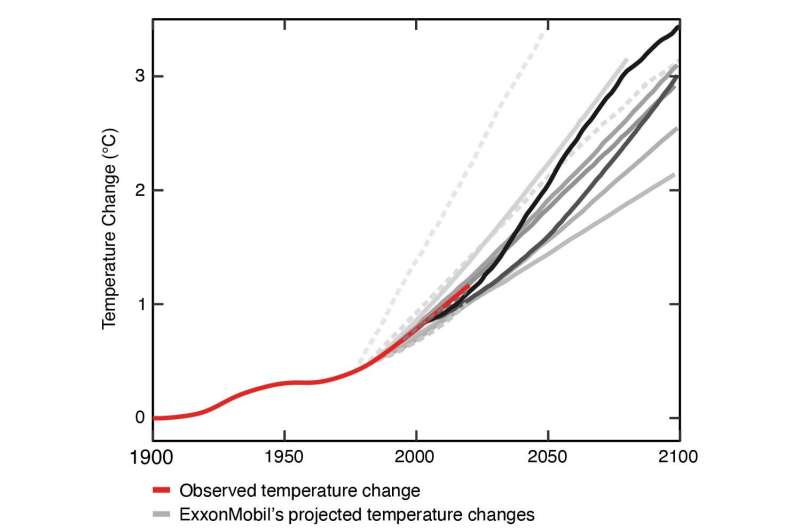 Summary of all global warming projections reported by ExxonMobil scientists in internal documents and peer-reviewed publications between 1977 and 2003 (gray lines), superimposed on historically observed temperature change (red). Solid gray lines indicate global warming projections modeled by ExxonMobil scientists themselves; dashed gray lines indicate projections internally reproduced by ExxonMobil scientists from third-party sources. Shades of gray scale with model start dates, from earliest (1977: lightest) to latest (2003: darkest). Credit: Geoffrey Supran
Climate projections reported by ExxonMobil scientists between 1977 and 2003 were accurate and skillful in predicting subsequent global warming and contradicted the company's public claims, a new Harvard study shows.
In the first ever systematic assessment of the fossil fuel industry's climate projections, researchers at Harvard University and the Potsdam Institute for Climate Impact Research have put a number on what 'Exxon knew' decades ago about climate science: that fossil fuel burning would lead to 0.20 ± 0.04 degrees Celsius of global warming per decade.
The findings, published in the peer-reviewed journalScienceand summarized by a single chart displaying every global warming projection reported by Exxon and ExxonMobil Corp scientists between 1977 and 2003, are based on statistical analyses of never-previously reported data buried in the company's own documents.
Although it has been widely reported that Exxon has known about the threat of global warming since the 1970s, this study is the first quantitative review of the company's early climate science. Previous research focused on Exxon's inconsistent internal and external rhetoric on climate change. This report dives into company data revealing that the company knew how much warming would occur with startling accuracy.
"We find that most of their projections accurately forecast warming consistent with subsequent observations," the report concludes. "Their projections were also consistent with, and at least as skillful as, those of independent academic and government models."
Using established IPCC statistical techniques, the study finds that 63-83% of global warming projections reported by ExxonMobil scientists were consistent with subsequently observed temperatures. Moreover, projections modeled by ExxonMobil scientists had an average 'skill score' of 72 ± 6 %, with the highest scoring 99%. For comparison, NASA scientist Dr. James Hansen's global warming predictions presented to the U.S. Congress in 1988 had skill scores ranging from 38% to 66%. (When we account for differences between forecast and observed atmospheric CO2 levels, the 'skill score' of projections modeled by ExxonMobil scientists was 75 ± 5%, with seven projections scoring 85% or above. Again, for comparison, Hansen's 1988 projections had corresponding skill scores of 28 to 81%.)
The study finds that "Exxon and ExxonMobil Corp also correctly rejected the prospect of a coming ice age, accurately predicted when human-caused global warming would first be detected, and reasonably estimated the 'carbon budget' for holding warming below 2°C. On each of these points, however, the company's public statements about climate science contradicted its own scientific data."
The study adds weight to ongoing legal and political investigations into ExxonMobil.
"These findings corroborate and add quantitative precision," the authors write, "to assertions by scholars, journalists, lawyers, politicians, and others that ExxonMobil accurately foresaw the threat of human-caused global warming, both prior and parallel to orchestrating lobbying and propaganda campaigns to delay climate action, and refute claims by ExxonMobil Corp and its defenders that these assertions are incorrect."
"This is the nail-in-the-coffin of ExxonMobil's claims that it has been falsely accused of climate malfeasance," commented lead author and Harvard University Research Associate Geoffrey Supran (Supran began as an Associate Professor of Environmental Science and Policy at the University of Miami's Rosenstiel School of Marine, Atmospheric, and Earth Science Jan 2023). "Our analysis shows that ExxonMobil's own data contradicted its public statements, which included exaggerating uncertainties, criticizing climate models, mythologizing global cooling, and feigning ignorance about when—or if—human-caused global warming would be measurable, all while staying silent on the threat of stranded fossil fuel assets."
The paper's Acknowledgments state that this research was supported by Harvard University Faculty Development Funds and by the Rockefeller Family Fund.
More information: G. Supran, Assessing ExxonMobil's global warming projections, Science (2023). DOI: 10.1126/science.abk0063. https://www.science.org/doi/10.1126/science.abk0063
Journal information: Science
===
1 23 why reboot? supran quant
Exxon was aware of climate change, as early as 1977, 11 years before it became a public issue, according to a recent investigation from InsideClimate News. This knowledge did not prevent the company (now ExxonMobil and the world’s largest oil and gas company) from spending decades refusing to publicly acknowledge climate change and even promoting climate misinformation—an approach many have likened to the lies spread by the tobacco industry regarding the health risks of smoking. Both industries were conscious that their products wouldn’t stay profitable once the world understood the risks, so much so that they used the same consultants to develop strategies on how to communicate with the public.
Experts, however, aren’t terribly surprised. “It’s never been remotely plausible that they did not understand the science,” says Naomi Oreskes, a history of science professor at Harvard University. But as it turns out, Exxon didn’t just understand the science, the company actively engaged with it. In the 1970s and 1980s it employed top scientists to look into the issue and launched its own ambitious research program that empirically sampled carbon dioxide and built rigorous climate models. Exxon even spent more than $1 million on a tanker project that would tackle how much CO2 is absorbed by the oceans. It was one of the biggest scientific questions of the time, meaning that Exxon was truly conducting unprecedented research.
In their eight-month-long investigation, reporters at InsideClimate News interviewed former Exxon employees, scientists and federal officials and analyzed hundreds of pages of internal documents. They found that the company’s knowledge of climate change dates back to July 1977, when its senior scientist James Black delivered a sobering message on the topic. “In the first place, there is general scientific agreement that the most likely manner in which mankind is influencing the global climate is through carbon dioxide release from the burning of fossil fuels," Black told Exxon’s management committee. A year later he warned Exxon that doubling CO2 gases in the atmosphere would increase average global temperatures by two or three degrees—a number that is consistent with the scientific consensus today. He continued to warn that “present thinking holds that man has a time window of five to 10 years before the need for hard decisions regarding changes in energy strategies might become critical." In other words, Exxon needed to act.
But ExxonMobil disagrees that any of its early statements were so stark, let alone conclusive at all. “We didn’t reach those conclusions, nor did we try to bury it like they suggest,” ExxonMobil spokesperson Allan Jeffers tells Scientific American. “The thing that shocks me the most is that we’ve been saying this for years, that we have been involved in climate research. These guys go down and pull some documents that we made available publicly in the archives and portray them as some kind of bombshell whistle-blower exposé because of the loaded language and the selective use of materials.”
One thing is certain: in June 1988, when NASA scientist James Hansen told a congressional hearing that the planet was already warming, Exxon remained publicly convinced that the science was still controversial. Furthermore, experts agree that Exxon became a leader in campaigns of confusion. By 1989 the company had helped create the Global Climate Coalition (disbanded in 2002) to question the scientific basis for concern about climate change. It also helped to prevent the U.S. from signing the international treaty on climate known as the Kyoto Protocol in 1998 to control greenhouse gases. Exxon’s tactic not only worked on the U.S. but also stopped other countries, such as China and India, from signing the treaty. At that point, “a lot of things unraveled,” Oreskes says.
But experts are still piecing together Exxon’s misconception puzzle. Last summer the Union of Concerned Scientists released a complementary investigation to the one by InsideClimate News, known as the Climate Deception Dossiers (pdf). “We included a memo of a coalition of fossil-fuel companies where they pledge basically to launch a big communications effort to sow doubt,” says union president Kenneth Kimmel. “There’s even a quote in it that says something like ‘Victory will be achieved when the average person is uncertain about climate science.’ So it’s pretty stark.”
Since then, Exxon has spent more than $30 million on think tanks that promote climate denial, according to Greenpeace. Although experts will never be able to quantify the damage Exxon’s misinformation has caused, “one thing for certain is we’ve lost a lot of ground,” Kimmell says. Half of the greenhouse gas emissions in our atmosphere were released after 1988. “I have to think if the fossil-fuel companies had been upfront about this and had been part of the solution instead of the problem, we would have made a lot of progress [today] instead of doubling our greenhouse gas emissions.”
Experts agree that the damage is huge, which is why they are likening Exxon’s deception to the lies spread by the tobacco industry. “I think there are a lot of parallels,” Kimmell says. Both sowed doubt about the science for their own means, and both worked with the same consultants to help develop a communications strategy. He notes, however, that the two diverge in the type of harm done. Tobacco companies threatened human health, but the oil companies threatened the planet’s health. “It’s a harm that is global in its reach,” Kimmel says.
To prove this, Bob Ward—who on behalf of the U.K.’s Royal Academy sent a letter to Exxon in 2006 claiming its science was “inaccurate and misleading”—thinks a thorough investigation is necessary. “Because frankly the episode with tobacco was probably the most disgraceful episode one could ever imagine,” Ward says. Kimmell agrees. These reasons “really highlight the responsibility that these companies have to come clean, acknowledge this, and work with everyone else to cut out emissions and pay for some of the cost we're going to bear as soon as possible,” Kimmell says.
It doesn’t appear, however, that Kimmell will get his retribution. Jeffers claims the investigation’s finds are “just patently untrue, misleading, and we reject them completely”—words that match Ward’s claims against them nearly a decade ago.
omg
jj comm dr an 12 22
Fresh off posting the highest quarterly profit in its history, the U.S.-based fossil fuel giant ExxonMobil sued the European Union on Wednesday in an attempt to stop the bloc from imposing its recently approved windfall tax targeting major oil and gas companies.
The Financial Times, which first reported the new lawsuit, noted that the challenge takes aim at the European Council's "legal authority to impose the new tax—a power historically reserved for sovereign countries—and its use of emergency powers to secure member states' approval for the measure."
:{:{"The new tax is due to take effect from December 31 and will apply a levy of at least 33% on any taxable profits in 2022-23 that are 20% or more above average profits between 2018 and 2021," the newspaper explained.}:
}:
In a statement, Exxon spokesperson Casey Norton insisted the company recognizes that sky-high energy costs are "weighing heavily on families and businesses" but claimed the tax would "undermine investor confidence, discourage investment and increase reliance on imported energy."
:{*:{Reuters reported Wednesday that Exxon's chief financial officer has estimated the E.U.'s windfall tax could cost the corporation around $2 billion through the end of next year—a fraction of the company's 2022 profits.}:
Approved in late September amid a mounting cost-of-living crisis across Europe, the windfall tax was presented as an effort to generate additional revenue to "provide financial support to households and companies" struggling with high energy costs.Oil and gas companies like Exxon have been accused of exploiting global energy market chaos spurred by Russia's war on Ukraine to hike prices and pad their bottom lines.
In late October, Exxon announced it brought in $19.7 billion in profits from July to September, its largest-ever quarterly haul. The company also announced it would raise its dividend and expand its share buyback program, rewarding wealthy investors as consumers continue to face elevated prices at the pump.
According to a recent filing, Exxon has also been rewarding its top executives, boosting the annual salary of CEO Darren Woods from $1.70 million to $1.88 million for the coming year.
===
yahoo mail 11 22
shortly after he took office, President Biden announced a goal of building 30 gigawatts (GW) of offshore wind by 2030, enough clean energy to power 10 million homes. For the administration, the offshore wind target was a part of a larger strategy of reducing carbon pollution and putting the country on track for net-zero greenhouse gas emissions by 2050. But, like many clean energy plans, this one was met with immediate resistance.
In August 2021, CBS News reported that Nantucket Residents Against Turbines — or ACK Rats — launched a lawsuit against the administration's offshore wind plans. The Massachusetts-based resident group argued that offshore wind development “poses a threat to the critically endangered North Atlantic Right Whale.”
A few months later, a resident group in New Jersey launched another lawsuit against the Biden administration. Bob Stern, president of Save Long Beach Island, told Reuters that he and his fellow residents worried that the wind turbines would destroy their local tourism economy.
Within a year of announcing the goal, the Biden administration faced lawsuits from resident groups in every coastal state from Maine to North Carolina. Some groups sued over endangered whales. Others argued that the turbines would hurt their property values or the local fishing industry.
If you only read the news stories about these lawsuits, you might think this was yet another example of wealthy residents blocking clean energy development. Or you might see a familiar story of environmentalists getting in the way of environmental progress. But you’d be missing the most important part of the story. Nearly every story neglects to mention these groups are being funded by a far-right think tank that receives funding from fossil fuel companies and billionaires.
Who’s behind the offshore wind lawsuits?
According to their website, Protect Our Coast NJ — one of the groups opposing Biden’s offshore wind plans — is a group of “residents, homeowners, business owners, fishermen and visitors of the New Jersey coastal communities.” Media reports accept this description at face value.
In May 2022, Ashbury Park Press — the third largest newspaper in New Jersey — ran a story about Protect Our Coast NJ with the headline, “Could offshore wind turbines blow away Long Beach Island tourism?” The story positions Protect Our Coast NJ as a group of residents and features many of the talking points and studies on the nonprofit’s website:
Ric Bertsch, an Ocean City resident and member of the group Protect Our Coast NJ, which opposes the wind projects as they are currently designed, said he worries about the impacts to communities like his own.
He said the county will suffer the consequences of New Jersey's new experiment with offshore wind turbines, which will harm the tourist experience and block large swaths of ocean from commercial fishing
"The only brand (in Ocean City) that we have to offer the world is our old-fashioned values, our quiet, our peaceful place to be," said Suzanne Hornick, also of Ocean City and leading member of Protect Our Coast NJ. "This (wind turbine project) really screws with our brand."
As of this writing, the “Donate” button on the Protect Our Coast NJ website redirects to a PayPal link that reads “Donate to Caesar Rodney Institute.”
| [grift gfx] |
Caesar Rodney Institute (CRI)is one of more than 50 think tanks in the State Policy Network (SPN). As The Intercept’s Lee Fang reported, CRI receives funding from fossil fuel trade groups like the American Fuel & Petrochemical Association. The think tank also receives funding from Donors Trust, the “dark money ATM of the conservative movement.”
In September 2021, CRI’s David Stevenson — a former member of President Trump’s EPA transition team — held a press conference in front of the Massachusetts State House where he announced a legal fund for groups fighting Biden’s offshore wind plans. By that point, Stevenson had raised $75,000 from his network of donors, and said he hoped to raise $500,000 for the effort.
When asked by E&E’s Ben Storrow who was funding the campaign, Stevenson said, “So far there is no Koch money, not that we wouldn’t take it.”
CRI’s efforts quickly attracted the attention of much larger conservative groups like theHeartland Institute and Committee For A Constructive Tomorrow (CFACT). In September 2022, one year after the press conference, both organizations announced a partnership with CRI to sue an offshore wind project in Virginia.
According to the Union for Concerned Scientists, the Heartland Institute and CFACT have both received about $500,000 in funding from ExxonMobil.The Heartland Institute has been called “a leading force in climate change denial.” Media Matters for America named CFACT Founder Marc Morano its climate denier of the year in 2012. Marano, who began his career working for Rush Limbaugh, has said climate scientists “deserve to be publicly flogged.”
In a press release, CFACT President Craig Rucker said, “We are not only very concerned about the future of the right whale, which extensively uses the ocean waters affected by the wind-power project, but also concerned as to how [the federal government] will address the fact that this project, despite its alleged benefits regarding carbon dioxide and climate change, will actually cause the release of more carbon dioxide into the atmosphere than it will consume.” This, like most of CFACT’s statements about climate change, is false.
Reporters consistently tell a misleading story
None of these connections to the country’s infamous climate denial network are mentioned in the Ashbury Park Press news story about Protect Our Coast NJ. And the local New Jersey newspaper isn’t alone. According to a Popular Information analysis, 11 media outlets have covered Protect Our Coast NJ. None of them mention CRI, its donors, or the legal fund.
Popular Information found that reporters routinely failed to mention connections to CRI when writing about Save Our Beach View, Save Long Beach Island, and Nantucket Residents Against Turbines, three of the other resident groups in the coalition. Instead, these articles spread many of the resident groups’ misleading claims about clean energy.
In January, Reuters wrote a story about Save Long Beach Island’s lawsuit against the federal government. The article did not mention the group's ties to CRI.
Bob Stern, president of Save Long Beach Island, told Reuters that they are concerned by the aesthetic impacts of the turbines, and potential lost tourism due to their interference with Long Beach Island's current unobstructed seascape. The group says tourism is the community's "economic lifeblood."
In 2019, researchers at the University of Rhode Island published a paper analyzing the impacts of offshore wind farms on tourism. They used empirical data based on the United States’ only offshore wind farm off the coast of Block Island, Rhode Island. The researchers concluded that the wind farm resulted in more tourism, not less. This study isn’t mentioned in the Reuters story.
Another frequent concern mentioned by resident groups is the risk to endangered species. CBS covered this last year when they wrote:
The "ACK Residents Against Turbines" who filed the lawsuit said the proposed Vineyard Wind project poses a threat to the critically endangered North Atlantic Right Whale.
Jessica Redfern, a senior scientist at Anderson Cabot Center for Ocean Life, told Cape Cod Times that the greatest threat to the North Atlantic Right Whale’s continued existence “comes from collision with vessels and entanglement in fishing gear, particularly lobster pot buoy lines.” She added, “Another big factor is climate change and one of the ways we can minimize that is adopting clean energy (policies) and offshore wind is a great source of that.” She said she had never heard of Save Long Beach Island.
In addition to misleading readers, this poor coverage creates more opposition to offshore wind projects and funnels local residents to the nonprofits’ websites and Facebook pages, which routinely share misinformation about clean energy.
Decarbonizing America’s electric grid and economy will require support from people in every community in the country. But, letting fossil fuel companies and climate deniers control the narrative is a sure way to turn communities of supporters into groups of passionate opponents.
===
https://www.alternet.org/2022/11/fossil-fuel-giants-reckless-expansion/
not BP?
an comm dr 11 22
Despite repeated warnings that new fossil fuel projects are incompatible with averting climate disaster, oil and gas corporations "are on a massive expansion course" to increase dirty energy production in the coming years, according to an analysis released Thursday at the United Nations COP27 meeting in Egypt.
The new report by the German nonprofit Urgewald and 50 NGO partners, which denounces "an industry willing to sacrifice a livable planet," found that the vast majority of the world's oil and gas companies intend to scale up the extraction of fossil fuels in the years ahead, having collectively dumped $160 billion into exploration since 2020.
None of this investment is consistent with the International Energy Agency's (IEA) blueprint for achieving net-zero emissions by 2050, a key component of meeting the Paris agreement's goal of limiting global warming to 1.5°C above preindustrial levels—beyond which impacts will grow increasingly deadly for millions of people, particularly those residing in poor nations that have done the least to cause the crisis.
The IEA made clear in its May 2021 report that no new oil and gas fields can be exploited if the world is to avoid climate catastrophe. But according to Urgewald, 96% of upstream fossil fuel companies (655 out of 685) are planning to expand their operations, and short-term expansion plans have increased by 20% since last year.
According to Urgewald, 512 of these companies are currently "taking active steps to bring 230 billion barrels of oil equivalent (bboe) of untapped resources into production before 2030."
If these fossil fuels are removed from the ground and burned, an additional 115 billion tonnes of heat-trapping carbon dioxide equivalent will be pumped into the atmosphere by the end of the decade. That's 30 times more greenhouse gas pollution than Europe generates each year.
Urgewald's report comes one day after Climate Trace revealed in a separate analysis that global emissions from oil and gas production are up to three times higher than reported.
"The outcome of our calculations is truly frightening," Fiona Hauke, senior oil and gas researcher at Urgewald, said in a statement. "Oil and gas companies' short-term expansion plans are not in line with the net-zero emissions course put forward by the IEA. Keeping these oil and gas resources in the ground is the bare minimum of what is needed to keep 1.5°C attainable."
As the report points out, even "if the oil and gas industry simply maintained its 2021 production level of 56.3 bboe, it alone would exhaust our remaining carbon budget within 15.5 years."
Just over a dozen corporations—including Saudi Aramco, ExxonMobil, TotalEnergies, Chevron, and Shell—are responsible for more than half of the industry's short-term expansion efforts, Urgewald found....
===
https://oversight.house.gov/sites/democrats.oversight.house.gov/files/2022.09.14%20FINAL%20COR%20Supplemental%20Memo.pdf
p 13
[CCS] underperformed or failed.48Exxon recently announced ten potential new facilities around the
world. 49
Exxon spent $86 million in 2010 to expand its carbon capture facility in Wyoming and
plans to spend another $400 million on a further expansion of the facility. 50 Exxon claimed $240
million in carbon capture tax credits over the last decade of the facility’s use. However, experts
estimate that Exxon may only be capturing less than 1% of its total emissions through carbon
capture technology.51
In a May 2018 email exchange, Exxon CEO Darren Woods and Exxon’s Vice President
of Corporate Strategic Planning, Mr. Wojnar, discussed “emissions avoided” through carbon
capture technology. Mr. Wojnar wrote to Mr. Woods that he was “[c]oming back on your
question on GHG emissions avoided,” including through carbon capture technology, and
provided “options for how to respond to a query” on this topic. Mr. Wojnar suggested that Mr.
Woods say that “over the last decade, ExxonMobil has taken action to reduce GHG emissions by
approximately 75 million tons.”52 In reality, nearly all the carbon dioxide Exxon has captured
through CCS has been sold to other fossil fuel companies to inject into their depleted oil fields to
help extract even more oil. As a result, the carbon captured by Exxon through CCS technology
likely has not meaningfully reduced total carbon emissions.53
Exxon has heavily advertised its efforts to develop carbon capture technology. Three
carbon capture television ads from 2016 through 2019 aired 9,058 times nationally, generated 4.1
billion impressions, and are estimated to have cost Exxon over $68 million to run. 54 Draft ...
Chevron’s and Exxon’s Attempt to Use OGCI to Greenwash Big Oil
The Oil and Gas Climate Initiative (OGCI) is a voluntary organization co-led by
members from the oil and gas industry and environmental groups. Its stated intent is “to deliver
tangible, transparent and integrated contributions to climate change solutions.”76
Documents obtained by the Committee show that in 2019, employees from Exxon and
Chevron edited a messaging document from OGCI ahead of the annual Conference of Parties to
the United Nations Framework Convention on Climate Change. The document was meant to
“serve as the basis for communication & press release as well as talking points for the CEO
event.” The documents suggest that despite several attempts to weaken the language, OGCI
pushed back,saying that Exxon’s and Chevron’s CEOs already committed to the stronger
language. The edits from Exxon and Chevron attempted to weaken OGCI’s ambition on targets
for achieving net-zero emissions, methane emissions, carbon intensity, carbon capture
implementation, among other things. 77
In particular, a memorandum from Peter Trelenberg, Exxon’s Manager of Environmental
Policy & Planning, to CEO Darren Woods highlighted “critical edits” proposed by Exxon and
noted that “Chevron has expressed that they are generally aligned with these edits.” Among
other issues, the memo to Exxon’s CEO addresses the following:
• Avoiding a commitment to advocate for the Paris Agreement. Regarding OGCI’s
“Statement on responding to the climate challenge,” Mr. Trelenberg wrote:
“Need to remove reference to Paris Agreement as support for the Paris
Agreement goals and member company advocacy are separate concepts and not
directly related. Creating a tie between our advocacy/engagements and the Paris
Agreement could create a potential commitment to advocate on the Paris
Agreement goals.”
• Avoiding a commitment to advocate for climate policies that Exxon and Chevron
claim to support. The memo raised a concern that one OGCI annual report
“includes explicit commitment for OGCI companies to align their advocacy with
their climate related positions. We have raised concerns with this linkage
through previous comments.”
• Refusing to commit to enhanced climate-related governance.The memo
continued, “Need to remove language that potentially commits members to
enhanced climate-related governance, strategy, risk management, and
performance metrics and targets.” ESG?!
• Concern about a commitment to reduce downstream emissions. Discussing an
OGCI “September Announcement package,” the memo states: “The carbon
...
---
===
https://www.alternet.org/2022/07/billionaires-gop-congress/
no lnx table grfx
Just 27 billionaires have spent $90 million to buy GOP congress: report
[ brk windows london? ]
Rupert Murdoch receiving the 2015 Global Leadership Award, Wikimedia Commons
Kenny Stancil and Common Dreams July 19, 2022
A few dozen billionaires are spending tens of millions of dollars on the 2022 midterm elections—mostly to support Republican candidates, including many who have parroted the dangerous lie that the 2020 presidential election was stolen—in a bid to ensure that Congress is full of lawmakers willing "to make their wealthy benefactors even richer," according to a fresh analysis.
Titled Billionaires Buying Elections, the report from Americans for Tax Fairness (ATF) details how "billionaires are increasingly using their personal fortunes and the profits of connected corporations to drown out regular voters' voices and elect hand-picked candidates who further rig the nation's economy—especially the tax system."
A pair of super PACs tasked with securing Republican majorities in the House and Senate—the Congressional Leadership Fund (CLF) and the [cnp?] Senate Leadership Fund (SLF)—raised a combined $188.3 million through the first 16 months of the 2022 campaign cycle, according to ATF. Nearly half—$89.4 million, or 48%—came from just 27 billionaires. A whopping 86% of the GOP's billionaire money came from "Wall Street tycoons" who are arguably the biggest beneficiaries of glaring loopholes in the tax code.
The Democratic counterparts of those two super PACs—the House Majority PAC and the Senate Majority PAC—raised a combined $154 million over the same time period. A smaller share—$25.8 million, or 17%—came from 19 billionaires. A majority of billionaire contributions to Democratic candidates also came from the finance and investment sector (35%), but other industries were also well-represented, including cryptocurrency (26%), and tech (18%).
"Unlike candidates and party committees, super PACs can raise unlimited donations from individuals and corporations," ATF explained. "In return they are not supposed to coordinate activities with the campaigns they support but instead act independently, though that rule is often flouted."
Top billionaire donors to congressional super PACs include hedge fund magnate Ken Griffin, who has given more than $28.5 million to CLF and SLF, and private equity mogul Stephen Schwarzman, who has pumped $20 million into the GOP's two super PACs.
"Anti-democratic vote-buying," ATF wrote, "has been facilitated by—and is facilitating—the accelerating wealth growth of the billionaire class and the record profits of the corporations they own."
The combined net worth of the nation's roughly 750 billionaires surged by $2 trillion, or 70%, during the first two years of the Covid-19 pandemic. The collective wealth of the 27 billionaires bankrolling the GOP's super PACs alone soared by $82.4 billion over that time period, meaning that the $89.4 million they have donated to CLF and SLF constitutes less than 0.1% of their overall pandemic-era gains.
Meanwhile, the return on that modest investment could amount to billions of dollars if Republicans take back Congress in November and preserve their 2017 tax cuts or further slash taxes on superrich people and the corporations they own.
Over a recent nine-year period, the 400 wealthiest people in the U.S. paid an average effective federal income tax rate of just 8.2% when the increased value of their stock holdings is included in their income. That is a lower rate than the nationwide average of 13.3% in 2019.
As ATF explained, focusing on contributions to congressional super PACs fails "to capture the full political influence of billionaires, who in addition to personal donations also steer money to favored candidates from related corporations and organizations."
Billionaires are among the ultrawealthy Americans who control corporations through their extensive stock holdings. Many corporate giants have been distorting the upcoming midterms, ATF pointed out, by spending tens of millions to help GOP candidates who have vowed to defend special tax breaks for the top 1% get elected, including 144 far-right members of Congress who voted to overturn President Joe Biden's electoral victory.
According to the report, seven powerful corporations—AT&T,Chevron, ExxonMobil,FedEx, GM, Merck, and UPS—have collectively given nearly $1.5 million to dozens of election deniers and various Republican PACs and election committees this campaign cycle.The companies' demonstrated lack of concern for democracy, ATF noted, likely stems from their desire to keep dodging taxes. In 2021, these firms paid an average federal income tax rate of just 2.7% on a combined $78.4 billion in profits.
Notably, Peter Thiel, the co-founder of PayPal who is worth about $5 billion and openly opposed to democracy, has been spending big on his preferred Republican candidates but not through the GOP's congressional super PACs.
Thiel "has so far spent almost $30 million through super PACs supporting the 2022 senatorial bids of two former employees who share his anti-democratic and anti-tax beliefs," ATF found. "J.D. Vance won the Ohio Republican U.S. Senate primary thanks in part to Thiel's $15 million in spending. Blake Masters has a fighting chance in Arizona's GOP U.S. Senate primary in August due to Thiel's $13.5 million in contributions."
Another source of "billionaire dominance of campaign financing, especially on the Republican side," wrote ATF, are so-called "dark money" groups, which are not required to disclose the identity of their donors. Some dark money groups—including Club for Growth, which has received $32 million from billionaire Wall Street trader Jeffrey Yass over the years—are "notorious for having bankrolled insurrectionist members of Congress" like Sen. Josh Hawley (R-Mo.) and Lauren Boebert (R-Colo.), ATF noted.
According to the report:
Politically active billionaire Charles Koch has not personally donated to either GOP super PAC this cycle, but his corporation—Koch Industries—has so far given them a total of $1.75 million.
Two of the biggest "dark money" groups, which do not disclose their donors, are essentially sister groups to thetwo congressional GOP super PACs. American Action Networkgave at least $26 million to CLF in the 2020 cycle and $18.7 million so far this cycle.One Nation donated $77.5 million to SLF last cycle and has given $16.5 million so far this cycle.
The ability of the nation's wealthiest individuals to translate their disproportionate economic power into political clout has increased exponentially since the U.S. Supreme Court's 2010 Citizens United decision eliminated effective limits on campaign contributions.
According to the report:
Billionaires pumped $1.2 billion into the 2020 elections, almost 40 times more than the $31 million they donated in 2010, when the Citizens United rules were first in effect. In the 2020 election cycle, billionaires contributed nearly $1 out of every $10, while making up just 0.01% of all donors contributing more than $200.
Billionaires donated almost $240 million to the combined campaign efforts of Donald Trump's two runs for president. Over half came from just one billionaire household, that of casino magnate Sheldon Adelson (who has since died).
"Billionaires, who are used to buying whatever they want, have increasingly dedicated their almost unlimited resources to buying American elections," Frank Clemente, executive director of ATF, said in a statement.
"The problem is what's good for billionaires—including cutting taxes on the rich and corporations—is bad for working families," said Clemente. "We need to rein in billionaire political and economic power through campaign finance reforms and tax reforms such as a billionaires income tax."
Several legislative proposals have emerged to tax the increased value of assets owned by the nation's wealthiest households each year regardless of whether they sell or keep them, which would ensure that income derived from wealth is taxed more like income earned from work.
:{:{}:
}:
Biden's plan would raise an estimated $360 billion over 10 years, while Sen. Ron Wyden's (D-Ore.) plan would raise an estimated $550 billion over a decade, and Rep. Jamaal Bowman's (D-N.Y.) proposal possibly even more.
:{:{}:
}:
Billionaire-backed Democratic Sen. Joe Manchin (W.Va.), however, has joined Senate Republicans in opposing such a measure.
===
===
https://www.motherjones.com/politics/2022/05/guardian-investigation-fossil-fuel-oil-gas-industry-plans-exploration-climate-disaster/
no lnx gfs
...The money
When BPreported its quarterly earnings in a presentation to financial institutions in February, one analyst said he “really enjoyed the camaraderie and the positivity that you’re generating,” before asking about the company’s cash position.
“We’ve given you a lovely little chart,” said Murray Auchincloss, BP’s chief financial officer. “Certainly, it’s possible that we’re getting more cash than we know what to do with. For now, I’m going to be conservative and manage the company as if it’s $40 [a barrel] oil. Anything we could get above that just helps, obviously.” At the time, the oil price exceeded $90; today it is $106.
The oil industry is awash with cash. The money companies have belongs to shareholders, including pension funds, or in the case of national oil companies, to governments and, in theory at least, citizens. But the investment plans of the biggest oil companies are sharply at odds with the goal of halting the climate crisis.
Data obtained by the Guardian from the think tank Carbon Tracker shows a dozen of the world’s biggest companies are on track to commit a collective $387 million dollars a day of capital expenditure to exploiting oil and gas fields through to 2030.
A significant portion of this is for maintaining production at existing projects—some oil and gas will still be needed as the world weans itself off fossil fuels—but the exact amount is not publicly available. Nonetheless, it is clear that at least a quarter of this investment—$103 million a day—is for oil and gas that cannot be burned if the worst impacts of the climate crisis are to be avoided, money that could instead be spent ramping up clean energy.
Even more worryingly, the companies have developed further project options that might lead them to spend an additional $84m a day that would not even be compatible with a devastating 2.7C of global heating.
The world’s governments agreed in the Paris climate accord to limit global heating to well below 2C, and pursue efforts to limit the temperature rise to 1.5C. For the latter, stricter goal, no new oil and gas projects are possible.
The Carbon Tracker data, compiled in September, uses a temperature of 1.65C to represent the well below 2C target and finds that 27 percent of the companies’ projected investments are incompatible with this.
ExxonMobil has the largest of these climate-busting investment plans at $21 million a day through to 2030, followed by Petrobras ($15 million), Chevron and ConocoPhillips (both $12 million), and Shell ($8 million).
In terms of the most dangerous investments—those that could help drive temperatures beyond 2.7C—Gazpromaccounts for $17 million a day of this, ExxonMobil $12 million, Shell $11 million and PetroChina $9 million.
“Companies that continue to develop projects based on business-as-usual demand are betting on the failure of policy action on climate.”
If governments act on the scientific advice to rapidly reduce carbon emissions by boosting clean energy and cutting fossil fuel burning, the companies would have to write off these colossal sums as losses, hitting shareholders, pension funds and public finances. If governments do not act, the companies could cash in as the world burns.
Overall, the international oil companies are making the biggest bets, with almost 40 percent of their projected investments incompatible with 1.65C. ExxonMobil is particularly high, at 56 percent.The national oil company average is 17 percent,although 56 percent of Petrobras’s planned capital expenditure is incompatible with 1.65C.
“Companies that continue to develop projects based on business-as-usual demand are betting on the failure of policy action on climate and underestimating the disruptive potential of new technologies, such as renewables and battery storage,” said Mike Coffin at Carbon Tracker. “Such projects are either not needed or they lead to warming well in excess of Paris goals.”
A separate recent analysis based on Rystad Energy data fromApril, after Russia’s invasion of Ukraine, found that 20 of the world’s biggest oil and gas companies remained on course to spend huge sums—$932 billion—by the end of 2030 developing new oil and gas fields.
Freeing the world from the grip of fossil fuels is made far harder by huge ongoing subsidies for the fuels, making them far cheaper than their true cost when the damage they cause is included—especially air pollution, which kills 7 million people a year. The G20 group of leading economies pledged in 2009 to phase out the subsidies but little has been achieved.
Hundreds of billions of dollars in direct financial supportis received by the producers and consumers of fossil fuels every year—but they benefit from far larger subsidies by not paying for the harm burning fossil fuels causes. When the damage from the climate crisis and air pollution is accounted for, the fossil fuel subsidies reach $6 trillion a year, according to the International Monetary Fund (IMF).The Guardian analysis shows this is equivalent to $11 million a minute globally, $4 million a minute in China and more than $1 million in the US.
The Guardian analysis of more detailed IMF data shows drivers in the US, Canada, and Australia, along with Saudi Arabia, are the world’s biggest beneficiaries of subsidies for road fuels, with some governments under pressure to increase these during the current energy crisis.
The per capita-subsidy for petrol and diesel across the population of Saudi Arabia was more than $1,000 a year in 2020. In the US, the road fuel subsidy per capita is $644 and about $500 in both Canada and Australia.
Japan and Germany also appear in the top 10 of the road fuel analysis, which focused on the 54 large countries with more than 25 million people and that account for 90 percent of global population and subsidies. The UK per capita subsidy for road fuels was only $10 a year, indicating taxes on petrol and diesel in 2020 were close to the level of the damage burning the fuels causes.
The US is also high on the list of the biggest per capita subsidies for all fossil fuels with $2,000 a year, behind only Saudi Arabia ($4,550) and Russia ($3,560). After these countries, only Iran ($1,815) is ahead of Australia ($1,730) and Canada ($1,690).
“Taking the Paris agreement seriously requires a rapid shift away from fossil fuels,” said Simon Black, a climate economist at the IMF. “Getting fossil fuel prices right will help enormously in accelerating this transition.”
The transition
The shift from burning oil and gas cannot happen overnight, and a declining amount will still need to be burned during the transition to a net zero emissions global economy in 2050. The question is whether companies and governments are moving fast enough.
The Guardian wrote to the oil and gas companies named in its analysis and asked for their response.
“Under the IEA net zero emissions scenario, and all Paris-aligned scenarios, all energy sources remain important through 2050, and oil and natural gas remain essential components of the energy mix,” said a spokesperson for ExxonMobil.
However, the role of oil and gas would be vastly reduced in 2050, and the IEA said: “Beyond projects already committed as of 2021, there are no new oil and gas fields approved for development [in our net zero scenario].”
ExxonMobilplanned to invest more than $15 billion on initiatives to lower greenhouse gas emissions over the next six years, the spokesperson said, including carbon capture and storage, hydrogen and biofuels. The company aimed to achieve net zero emissions by 2050 but only from its own operations, not the fuels it sold, therefore covering only a small fraction of the emissions from the oil and gas it sells.
A spokesperson for Shell cited recent company statements: “As a result of [our] planned level of capital investment, we expect a gradual decline of about 1-2 percent a year in total oil production through to 2030, including divestments.
“By 2025,Shellexpects its expenditure on [low and zero-carbon] products and services across its businesses will have increased to around 50 percent of its total expenditure,” a recent report by the firm states. In 2022, the proportion is expected to be more than 35 percent. In 2021, “Shell achieved its annual investment targets in renewables and energy solutions of $2bn-3bn,” the report says.
“Our goal is to support an orderly transition that matches supply to demand and focuses on [financial] returns.”
ConocoPhillips also cited a recently published net zero emissions plan:“Our goal is to support an orderly transition that matches supply to demand and focuses on returns on, and of, capital while safely and responsibly delivering affordable energy.”
The document states that profits from oil and gas projects are significantly higher than from investments in renewable energy.
ConocoPhillips has allocated $200 million in 2022 to reduce emissions from its operations. To reduce emissions from the burning of the fossil fuels it supplies, the company advocates an “economy-wide price on carbon that would help shift consumer demand from high-carbon to low-carbon energy sources”.
“Petrobras plans its investments considering that the Paris agreement will be successful and global temperature will be kept below 2°C,” a spokesperson for the company said. “Oil will remain important in the coming decades, even in accelerated transition scenarios.”
The spokesperson said the IEA’s scenario for 1.65C indicated some investment in upstream projects was needed. “We are planning for highly resilient assets competitive in scenarios aligned with Paris due to their low production cost and low emissions. Petrobras is following its strategy of maximizing the value of its portfolio, [with 99 percent of the investment on exploration] focusing on deepwater and ultra-deepwater assets.”
TotalEnergies pointed to its recent sustainability report, which it said “showed our stakeholders that we are already on the right track.” The company has a target of a 30 percent cut in emissions from oil and gas sales by 2030 and to increase the proportion of its energy sales that are renewable from 9 percent in 2021 to 20 percent in 2030.
Saudi Aramco and Eni responded to the Guardian but declined to comment. The other companies did not respond to the Guardian’s request....
===
===
https://www.dailykos.com/stories/2020/11/13/1995473/-NYTimes-Reveals-FTI-Exxon-Mobil-As-The-Man-Behind-The-Man-Behind-The-Curtain
no lnx
thirteen years ago, the Union of Concerned Scientists published a report detailing the millions of dollars ExxonMobil pumped into climate denial groups, and in response, it pledged to discontinue, as of 2008, its contributions “to several public policy research groups whose positions on climate change could divert attention from the important discussion…” about environmentally responsible energy.
And that year, they did indeed cut off some of the biggest groups, like Cato, CEI and Heartland. But, as Elliott Negin recounted a couple years ago, they never actually stopped funding disinformation, even after coming under fire for it when investigators revealed the depth of their understanding of the issue that prompted these disinformation campaigns. (And they’re still at it, as Negin recently showed, with hundreds of thousands given to at least eight climate denial groups in 2019.)
One of the groups ExxonMobil continued paying to oppose climate action is FTI Consulting, a PR group whose shady efforts have been brought further into the light by Hiroko Tabuchi in the New York Times.
Through an investigation of filings, archived websites and registration info, and interviews with a dozen former employees, Tabuchi reports that “FTI has been involved in the operations of at least 15 current and past influence campaigns promoting fossil-fuel interests in addition to its direct work for oil and gas clients.”
Among them is ExxonMobil. It’s a key backer of Energy in Depth, and although it discloses that it’s a project of the Independent Petroleum Association of America, it doesn’t disclose that, Tabuchi reports, “the site’s content had direction from Exxon Mobil, one of the major clients of the FTI division that worked on these oil and gas campaigns.” Now the difference between Exxon Mobil and IPAA may seem arbitrary, but given that one of Energy in Depth’s most consistent topics is defending Exxon Mobil against the allegations that it funded front groups to spread disinformation, it’s actually kind of important!
Similarly, anyone who might have seen something from the Arctic Energy Center might have wanted to know that the information there was funded by Exxon, who was paying FTI to run a social-media campaign around the now-offline website.
And that’s the sort of thing that recurs throughout Tabuchi’s reporting. Time and again, FTI set up self-proclaimed “grass-roots” groups, circulated petitions, wrote misleading reports, placed op-eds in local papers, and created other messaging products. Despite charging top dollar, it seems they often include sloppy give-aways, like using stock photos to accompany "testimonials" that, even now, they insist are totally real.
Tabuchi's breakdown of TCI's online sockpuppet accounts is particularly enlightening for anyone who’s been confused about the belligerence often on display in online conversations about energy. In essence, FTI strategically pollutes comment sections and floods otherwise productive conversations about climate and energy with messages designed to make people disengage.
Because not only did they set up fake accounts to spy on Dakota Access protesters, feeding pipeline clients information as granular as how much food and supplies protesters were gathering as a way to infer the size of their camp, but they also “studied and developed strategies designed to influence public discourse,” as seen in a 2015 document obtained and published by the Times.
It includes eight archetypes of comment-clutterers, from “the drunken conspiracy theorist uncle” who “agrees with the Negative Commenter but conflates other unrelated and offensive issues into it, lumping it all together into an unpalatable whole.”
Or there’s the “semantic nitpicker” who “asks an endless series of questions,” the “patronizing voice of reason,” and “The concern hipster (new archetype!)” who “says that the issue raised by Negative Commenter is not as important as another issue they feel very passionately about.”
So if you ever notice a pattern of these sorts of accounts talking to each other, complete with “Dog typing on a keyboard” user who “chimes in with very poor grammar, spelling and punctuation and posts frequently to clutter up the thread and make it hard to read,” just remember: It’s definitely not some ExxonMobil-hired FTI flack deliberately trying to distract people from climate solutions, because ExxonMobil totally promised it’d stop doing that way back in 2007.
---
some lnx
:{:{}:
}:
Thirteen years ago, the Union of Concerned Scientists published a report detailing the millions of dollars ExxonMobil pumped into climate denial groups, and in response, it pledged to discontinue, as of 2008, its contributions “to several public policy research groups whose positions on climate change could divert attention from the important discussion…” about environmentally responsible energy.
And that year, they did indeed cut off some of the biggest groups, like Cato, CEI and Heartland. But, _{as Elliott Negin recounted a couple years ago}_, they never actually stopped funding disinformation, even after coming under fire for it when investigators revealed the depth of their understanding of the issue that prompted these disinformation campaigns. (And they’re still at it, as Negin recently showed, with hundreds of thousands given to at least eight climate denial groups in 2019.)
---
ref
===
https://www.energyindepth.org/tag/exxon-knew/
EXXON KNEW TAG
NATIONAL Oct 26, 2020
Everyone Knew:Story On Automakers Reaffirms Broad Understanding Of Climate Change
NATIONAL Sep 14, 2020
Echoes Of New York’s Failure: Connecticut Files Climate Lawsuit
NATIONAL Jan 13, 2020
It’s Official: New York’s Case Against ExxonMobil Is Over
NATIONAL Dec 16, 2019
Rockefeller Director Disappointed That theRockefeller-FundedExxon Investigation Failed
NATIONAL Nov 08, 2019
Exxon Attorney Calls New York’s Lawsuit a ‘Cruel Joke’ in Defiant Closing Statement
NATIONAL Nov 07, 2019
New York Attorney General Cuts and Runs on Half of its Bogus Claims Against Exxon at the 11th Hour
NATIONAL Nov 06, 2019
The Seinfeld Trial (Trial about Nothing): Six Questions for the NYAG as Closing Statements Begin
NATIONAL Oct 29, 2019
Rex Tillerson to Testify in NY AG Case
NATIONAL Oct 29, 2019
NY AG’s Expert Witnesses Employ Flawed Methodology and Are Scientifically Unreliable
NATIONAL Oct 27, 2019
The New York Attorney General’s Terrible, Horrible, No Good, Very Bad Week
NATIONAL Oct 22, 2019
Rockefeller Echo Chamber Activated Ahead of ExxonMobil New York Attorney General Trial – 5 Things to Know
NATIONAL Oct 21, 2019
’Exxon Knew’ Desperation Continues: Activists Publish ‘Report’ Ahead of NY Trial
Jan 09, 2018
Did Calif. Municipalities Suing Energy Companies Over Climate Commit Securities Fraud?
Aug 22, 2017 3
Bombshell: Activists Admit #ExxonKnew Is About Attacking Free Speech
Jul 27, 2017 1
Did The Onion Predict the #ExxonKnew Campaign?
Jul 25, 2017 3
Serious Question: If #UtilitiesKnew about Climate Change in the 70s, And Everyone Else Did Too, Why Are We Still Using Hashtags?
===
===
no lnx
wASHINGTON, April 28 (Reuters) - California's attorney general announced on Thursday he issued a subpoena to ExxonMobil (XOM.N) for information on its role in causing the global plastic waste crisis.
The subpoena is part of a broader investigation led by California Attorney General Rob Bonta into the fossil fuel and petrochemical industries' role in "causing and exacerbating the global plastics pollution crisis."
"For more than half a century, the plastics industry has engaged in an aggressive campaign to deceive the public, perpetuating a myth that recycling can solve the plastics crisis. The truth is: The vast majority of plastic cannot be recycled," Bonta said in a statement.
The investigation will resemble ones launched by several state attorneys general into the role that fossil fuel companies played in causing and exacerbating climate change, which focused on what the industry knew decades ago and how companies misled the public about their role.
In this investigation, the attorney general will focus on the "half-century campaign of deception and the ongoing harm caused to the State of California" by companies that produce plastics, a petroleum-based product, and how they perpetuate "myths around recycling". Exxon is the first company to receive a subpoena, but officials said they will also target other companies in the industry.
A spokesperson for Exxon was not immediately available to comment.
Matthew Kastner, a spokesperson for the American Chemistry Council, which represents the plastics and petrochemical industry, said in response to the investigation that "America’s plastic makers are committed to a more sustainable future and have proposed comprehensive and bold actions at the state, federal, and international levels."
More than 90% of plastic waste globally ends up in landfills or is incinerated, according to a landmark study in Science Advances. The U.S. recycling rate has never gone higher than 9%, according to the Environmental Protection Agency.
There is growing momentum to tamp down plastic production as a way to address plastic waste. The UN in February outlined the blueprint of a future treaty that could seek restrictions on production. read more
Bonta said that the petrochemical industry has been aware for decades that recycling was infeasible at scale, even as plastic production skyrocketed and has pushed back against state, local and national efforts to issue plastic bans and other measures.
The industry has promoted "advanced recycling" - a method of burning plastic to convert it into fuel or other products - as a solution to the plastic waste crisis but a Reuters investigation showed that the leading projects have had little to no success.
Carroll Muffett, president of the Center for International Environmental Law, said the investigation is significant.
"Companies like Exxon have been instrumental in persuading the public we can recycle our way out of the plastic crisis even when evidence suggestions they know it is not the case," he said, adding that states bear the brunt of costs associated with plastic waste cleanup.
California has passed several bills in the last few years aimed at curbing plastic waste and attempting to crack down on deceptive recycling claims.
Last December, the California Statewide Commission on Recycling Markets and Curbside Recycling asked Bonta to crack down on what it claims is illegal labeling that is undermining the state’s efforts to tackle plastic pollution. read more
Reporting by Valerie Volcovici Editing by Diane Craft
===
===
grn vs blue hydrogen?
https://cleantechnica.com/2020/05/18/bp-smacks-exxon-upside-head-with-new-green-hydrogen-scheme/
no lnx
CLEAN POWERBP Smacks Exxon Upside Head With New Green Hydrogen Scheme
Lightsource BP is looking to make a quick detour into the field of green hydrogen, which could rain all kinds of hurt on natural gas stakeholders.
ByTina Casey PublishedMay 18, 2020
Why, it seems like only yesterday that ExxonMobil was forecasting a rosy scenario for fossil gas in the sparkling green economy of the future. Now along comes rival BP with a deep dive into green hydrogen. Renewable energy is already threatening gas in the power generation market, and if all goes according to plan renewable H2 will push gas out of the coveted industrial energy marketplace, too.
The Lightsource BP solar partnership appears to be making a quick segue into green hydrogen (Kansas solar farm via Lightsource BP).
The Fossil Gas & Hydrogen Connection
For those of you new to the topic, the huge global market for hydrogen overlaps with fossil gas, aka natural gas. Hydrogen doesn’t just pop up out of nowhere. It has to be produced, and right now the main source of hydrogen is fossil gas.
All sorts of hydrogen-reliant industrial activities, from fertilizer and food to fuel and pharmaceuticals, have been pushing the market for gas.
Gas is also being touted as a cleaner alternative to coal, for steel-making, and for other industrial processes that require heat. This is all on top of the electricity generation sector, in which low cost fossil gas has successfully squeezed coal to second-rate status while laying dubious claim to the “cleaner” title.
No wonder ExxonMobil has continued to envision a strong position for fossil gas. In a report dated August 28, 2019, the company’s energy demand forecast for 2040 leaned on growth in both the industrial and electricity sectors to conclude that “natural gas grows the most of any energy type, reaching a quarter of all demand” by 2040.
From Fossil Gas to Green Hydrogen
Dream on, Klingon. Even before the COVID-19 crisis upended the global economy, the threat of green hydrogen was already looming on the horizon
Green hydrogen, also referred to as renewable hydrogen, can be produced from water by applying an electrical current. Source the electricity from renewable energy, and there you have sustainable hydrogen from renewable resources.
Green hydrogen has yet to plant its feet in the commercial market, but the technology has been improving and costs have been coming, partly because the cost of renewable energy has been dropping.
Back in 2017, BP revived its once-dormant interest in solar power by forming a 50/50 partnership with the solar company Lightsource to form Lightsource BP, and it seems that the partners are already looking beyond clean power to dip into the renewable hydrogen field.
Last week BP Australia announced that it has been greenlighted to explore the idea of producing ammonia with renewable hydrogen at a facility in Geraldton.
Ammonia is currently made from fossil gas and other gassified fossils. It is mainly used as a fertilizer but it has many other applications in manufacturing as well as refrigeration and water purification. Cutting fossils out of that market would be a big deal — and the Geraldton project is aimed at the global market as well as sales in Australia.
The water-splitting part of the equation would be handled by a new 1.5 gigawatt renewable energy project, which is where Lightsource BP comes in. In addition to solar, the feasibility study may also include wind.
How Now, Brown Coal?
As for that global market, BP is eyeballing Western Australia because of its renewable energy resources and its existing port infrastructure, but plenty of other locations have similar qualities.
The main difference is location, location, location. Western Australia is just a hop away from leading global markets in Asia including China, Japan, and South Korea.
In a press statement, BP emphasized Geraldton’s “proximity to large, long-term markets for green hydrogen.”
Interesting! That could mean a few different things, including markets for renewable hydrogen, markets for green ammonia, and markets where it would make sense to produce green ammonia in one place, transport it to another, and then extract the hydrogen.
If that last item doesn’t seem to make sense, it might. Depending on the situation, it may be less costly to deploy ammonia as a hydrogen carrier rather than trying to ship large quantities of hydrogen.
In any case, all of this means more trouble for Australia’s brown coal stakeholders, who have been weirdly banking on a coal-to-hydrogen export project for salvation.
It also helps pull the rug out from ExxonMobil, which has been clinging to fossil gas even while BP and other legacy oil and gas stakeholders hedge their bets with a sharp pivot into renewable energy and clean technology.
If the Geraldton project pans out, it will help spark interest in other sectors. Several hydrogen demonstration projects are already taking shape in the metals industry, and there is also some interesting activity under way in the trucking and energy storage fields, to name a few.
===
===
ref clc
https://www.climatedocket.com/**2018/10**/09/exxon-carbon-tax-climate-liability/
Savage
Exxon has announced it will pledge $1 million to Americans for Carbon Dividends, an advocacy campaign that backs a carbon tax plan, but one that would be coupled with rollbacks to environmental regulations and:{ ending climate liability suits}:.
The Baker-Schultz Plan—named for its lead authors, former secretaries of state James A. Baker III and George P. Shultz—:{proposes}: a gradually rising carbon tax, with 100 percent of the proceeds paid to Americans in a monthly dividend. It was unveiled last year by the:{Climate Leadership Council}:, a nonprofit policy institute founded by author and policy entrepreneur Ted Halstead.
The council’s founding members include Exxon and other oil and corporate giants—among them, BP, Shell, Johnson & Johnson—as well as former New York Mayor Michael Bloomberg and former fed chairmanBen Bernanke.Greg Bertelsen, the council’s senior vice president, called Exxon’s donation a significant step in U.S. climate policy.
“It represents the first time an oil and gas oil major has made a significant contribution in support of a campaign to put a price on carbon,” said Bertelsen, who formerly served as senior director for energy and resources policy for theNational Association of Manufacturers.
In return for what is a modest tax, the Baker-Schultz plan also calls for the rollback of greenhouse gas emissions regulations and an “end to federal and state tort liability for emitters.” That means the federal government would no longer have the ability to regulate climate pollutants and courts would have no role in determining whether industry should pay for impacts already caused by fossil fuel-driven global warming.
Kert Davies, director of the Climate Investigations Center, said it’s significant that when the plan was launched, no corporate members were involved publically.
“The most interesting thing to me is how Exxon has been behind this the whole way but was intentionally hidden from view,” Davies said.
“Are they shy? No, they know the optics,” he added.
Americans For Carbon Dividends is:{co-chaired}: by former Senators Trent Lott (R-Miss.) and John Breaux (D-La.), whose lobbying firm**:{was hired}:**to promote the plan.And according to its:{website}:, its communications is being led by Richard Keil, a former senior media relations advisor for Exxon.Keil is listed as a managing director for Hill+Knowlton, the firm that once represented tobacco companies as they tried to escape liability for the devastating health effects of smoking.
Exxon’s announcement came a day after the United Nations’ Intergovernmental Panel on Climate Change issued:{ a landmark report}: warning that climate change is a much more dire and immediate problem than previously thought. In the report, scientists call for “unprecedented” action that would be needed to combat the effects of climate change.
To prevent catastrophic climate change, carbon emissions must be reduced by 45 percent from 2010 levels by 2030 and 100 percent by 2050, the report says. The use of renewable energy to generate electricity must increase from about 20 percent today to about 67 percent by 2050. It also calls for a robust carbon tax, large enough to raise the cost of fossil fuels to drive down their use and raise enough money to offset their detrimental impact on the climate.
“A price on carbon is central to prompt mitigation,” said the report’s authors. They estimate that to achieve needed emissions reductions, the price per ton of carbon dioxide pollution must range from $135 to $5,500 in 2030, and from $690 to $27,000 per ton by 2100.
:{A recent study:(style="box-sizing:border-box"):}: by the University of Massachusetts found a carbon tax would have to reach $200 a ton to change consumer behavior and to keep low-income consumers from absorbing a disproportionately high amount of the costs.
The Baker-Schulz Plan starts the tax at $40 per metric ton, far below what the studies say would significantly reduce emissions. The plan does not specify how much it will rise or how the increases will be determined.
Bertelsen said that’s a detail that will be worked out over time by the council’s founding members, which in addition to the oil giants includes corporate giants P & G, Johnson & Johnson, Pepsico, and Exelon. Bernanke, Bloomberg and former EPA administrator Christine Todd Whitman are also founding members, along with the environmental organization The Nature Conservancy.
When asked repeatedly whether founding members would reconsider their stance on climate litigation, Bertelsen would only say that the Council is focused on solving the climate problem and transitioning to a low-carbon economy.
Exxon spokesman Scott Silvestri :{told Bloomberg}: that applying a uniform cost across the economy is consistent with Exxon’s principles on how to manage the risk of climate change. He said the company has consistently backed a carbon tax that returns proceeds to the public and not the government, but Exxon :{has also long supported organizations}: like the American Legislative Exchange Council that have lobbied vigorously against carbon taxes of any kind.
Under the plan, U.S. taxpayers would benefit from monthly dividend payments, but none of the proceeds would help cities and states pay the skyrocketing costs of climate mitigation and adaptation.
Peter Frumhoff, director of science and policy and chief climate scientist at the Union of Concerned Scientists, said he remains skeptical and suggested the oil giant lay out a plan for bringing company-wide carbon emissions to net-zero by mid-century. That would be consistent with the Paris Climate Agreement that Exxon also says it supports.
“I’ll take ExxonMobil claims of support for a carbon dividend seriously when it stops providing far larger sums to the U.S. Chamber of Commerce and other lobbying groups that oppose the same climate policies,” Frumhoff said.
===
an 4 22
not so much about corp homophobia as fear of troll wacko attack on woke corp? desantis vs disney took away status?
Exxon Mobil Corp. is prohibiting flag displays in support of LGBTQ and Black Lives Matter at its headquarters in Houston, Texas. The move has led to heightened backlash from some of the corporation's Houston employees.
According to The Houston Chronicle, Bloomberg has reviewed the corporation's updated policy and it reportedly outlines "guidance on what flags can be displayed outside its offices, banning 'external position flags' such as PRIDE and Black Lives Matter."
That update is now facing backlash from the Exxon PRIDE Houston chapter which is comprised of LGBTQ+ employees of the corporation. On Thursday, April 21, the group emailed a statement to Bloomberg and outlined its frustrations with the new rule.
"It is difficult to reconcile how ExxonMobil recognizes the value of promoting our corporation as supportive of the LGBTQ+ community externally (e.g. advertisements, Pride parades, social media posts) but now believes it inappropriate to visibly show support for our LGBTQ+ employees at the workplace," the workers’ organization said its email.
In wake of the negative reactions, Exxon has released a statement in defense of its decision. According to the statement, Exxon does not believe its directive will diminish the diversity and professional support of employees within the corporation.
Tracey Gunnlaugsson, vice president of human resources at Exxon Mobil, has said the "updated flag protocol is intended to clarify theuse of the ExxonMobil branded company flag and not intended to diminish our commitment to diversity and support for employee resource groups."
“Corporate leadership took exception to a rainbow flag being flown at our facilities” last year, Exxon’s PRIDE Houston employee group wrote in the email Thursday. “PRIDE was informed the justification was centered on the need for the corporation to maintain ‘neutrality.’”
=
https://www.expressnews.com/business/eagle-ford-energy/article/Inside-Exxon-Mobil-s-fight-to-stop-climate-12994450.php
BUSINESS
Inside Exxon Mobil’s fight to stop climate change litigation in its tracks
James Osborne
Staff Writer
June 15, 2018
[FILE - In this May 31, 2006 file photo, an ice sculpture fashioned by protesters, to demonstrate their view of how the company's policies are affecting the environment, slowly melts outside the Exxon Mobil shareholders meeting in Dallas. The Massachusetts Supreme Judicial Court ruled Friday, April 13, 2018, that Exxon Mobil must hand over documents for Attorney General Maura Healey's probe into whether the company misled investors and consumers about what it knew about the link between fossil fuels and climate change. (AP Photo/LM Otero, File)]
WASHINGTON — Imagine this storyline: One of the largest oil companies in the world becomes the victim of a left-wing conspiracy, funded by wealthy liberals who convince Democratic attorneys general across the nation to sue the company to stop it from offering different views about climate change.
What sounds like the stuff of a bad Hollywood thriller is, in fact, the narrative Exxon Mobil’s attorneys are telling as they seek to defend the company from mryiad lawsuits and investigations into what oil companies knew about climate change and when they knew it. With a surprising procedural victory in a Texas court recently, Exxon is attempting to gain greater latitude in what it and other oil companies can say — or not say — about climate change and the impact on their businesses, seeking to build on legal rulings that have expanded corporations’ rights of free speech in recent years, legal scholars say.
The U.S. government has long limited First Amendment protections for corporations, prohibiting them from making false statements to further business interests — a staple of U.S. consumer protection laws going back to the days of snake-oil salesmen peddling so-called magic elixirs. But Exxon’s case could test how far the courts are willing to go to uphold governments’ ability to regulate commercial speech.
Exxon is arguing that the state and local governments suing the company have gone too far, trying to impose an Orwellian code of conduct to drown out those who call attention to uncertainties about how climate change will play out over the long term and affect the global economy.
“Exxon is framing (climate change) as a legitimate political debate in which they are a participant, rather than a for-profit company trying to make a buck,” said Tamara Piety, a law professor at University of Tulsa. “There has been a growing movement (among corporations) to raise the First Amendment. If something can be proven to be unconstitutional it’s completely off the table”
Over the past two decades, companies have successfully used the free speech strategy to challenge government regulations on everything from the placement of workplace signs explaining employee rights to the distribution of patients’ medical data. A key win for corporate America came in 2010 Citizens United case, when the Supreme Court ruled that limits on corporate spending in political campaigns violated companies’ free speech rights.
Now Exxon is seeking to expand corporate rights one step further, arguing that the government legal action, based on the company’s past statements, is little more than leverage to get oil companies to agree to a wide-arching climate change deal that would restrict what they can say about the issue — in violation of “of Exxon Mobil’s constitutional rights.” That includes investigations launched by the New York and Massachusetts attorneys general into whether Exxon lied to shareholders and consumers about the risks of climate change to the environment and its business, and lawsuits filed by cities and counties in California and Colorado, which are seeking damages from Exxon and other oil companies for the costs of rising sea levels and increased wildfires.
Exxon in January asked a state court in Fort Worth to order more than a dozen city and county officials from California to sit for depositions by Exxon’s attorneys to determine whether they are conspiring with plaintiffs’ attorneys and environmentalist activists to force Exxon into accepting a deal. A New York federal judge in March dismissed a similar request by Exxon to depose the New York and Massachusetts attorneys general, ruling it was based on “extremely thin allegations and speculative inference,” but the Texas judge, R.H. Wallace Jr., decided to give the company more room to prove its claim, ruling in April that Exxon could begin making requests to depose specific officials.
Exxon declined to comment. But James Coleman, a law professor at Southern Methodist University in Dallas and a contributor to the conservative Federalist Society, said Exxon, which has come out in support of the Paris climate accords and a national carbon tax, is simply protecting its First Amendment rightsto communicate about climate change and the effects on its finances as it sees fit.
“It’s an unusual claim (by Exxon) but it doesn’t mean it’s wrong,” he said. “The government can make you give accurate information, but the government can’t force you to say things you disagree with. For instance, the government couldn’t make Exxon say climate change is the defining challenge of our time, even if they consider it a fact.”
San Francisco and other California communities are challenging Wallace’s ruling in the Texas 2nd Circuit Court of Appeals, potentially setting the case on a path to the Texas Supreme Court. And considering the political makeup of the state’s high court, Exxon stands a good chance of winning its argument, said Tom McGarity, a law professor at the University of Texas, who sits on an advisory board to the California plaintiffs.
“It presents a very sympathetic venue,” he said. “It’s a pro-business Supreme Court.”
Conspiracy
The case in Texas comes three years into a legal campaign against Exxon and other oil companies. In Exxon’s telling, it all stems from meeting of environmental activists in the beach town ofLa Jolla, California, in 2012.
Activists and attorneys discussed a strategy for addressing climate change based on the tobacco lawsuits of the 1990s, which successfully argued tobacco companies were liable for smokers’ deaths because executives knew the risks but still claimed publicly they did not, according to an account of the meeting published by the Union of Concerned Scientists, an environmental group that helped organize the event
If Exxon and other oil companies could be shown to have known the risks to health and safety of climate change but did nothing to warn the public and investors, then perhaps activists could create a groundswell of public outrage to change the political and economic landscape for oil companies, much as they had for tobacco companies.
“We wrote up a report so other lawyers and policymakers could pick up on those lessons (from tobacco) and use them, like you would any science you would hope is actionable,” said Peter Frumhoff, head of policy and science at the Union of Concerned Scientists. “The first tenet of good science is being transparent.”
But the activists also gave Exxon a potential weapon to counterattack.
The company’s lawyers have focused on one line in the Union of Concerned Scientists account, in which activists describe how they could could use litigation for “maintaining pressure on the industry that could eventually lead to its support for legislative and regulatory responses to global warming.” That game plan, Exxon lawyers said, was then adopted by government prosecutors, including former New York Attorney General Eric Schneiderman, who recently resigned amid allegations of sexual abuse.
Wallace, the Texas judge, agreed with the company lawyers, writing that environmentalists who attended the La Jolla meeting “aimed to chill and suppress Exxon Mobil’s speech.”
California and Colorado officials dismiss Exxon’s legal maneuvers as little more than intimidation tactics aimed at frightening and bogging them down in paperwork. A spokesman for the New York Attorney General’s Office called Exxon’s strategy an attempt to “distract and deflect from the facts at hand.”
Public opinion
Within conservative circles, Exxon’s conspiracy message seems to be gaining traction.
:{:{}:
}:
Earlier this year, David Bookbinder, an attorney with the libertarian Niskanen Center, filed suit against Exxon and the Canadian oil company Suncor,claiming they were responsible for the costs sustained by Colorado local governments in fighting wildfires and other effects of climate change.
:{:{}:
}:
A few weeks later, he began seeing his name pop up on conservative websites, including theDaily Caller and one owned by the U.S. Chamber of Commerce. Articles suggested Bookbinder and his colleagues were part of a conspiracy funded by the Rockefeller Brothers Fund, a New York charity with more than $800 million in assets that is overseen by the descendants of the late oil tycoon John D. Rockefeller, whose Standard Oil was the precursor to Exxon Mobil.
The claim was based on a $200,000 grant the Niskanen Center received shortly before the Colorado lawsuit was filed. Bookbinder said the grant had nothing to do with the lawsuit and scoffed at the idea his plaintiffs were part of a conspiracy to damage Exxon.
:{:{}:
}:
“My clients don’t want Exxon out of business,” he said. “Then they don’t get paid.”
The Rockefeller Brothers Fund said in a statement that it does consider a willingness to take oil companies to court in awarding grants to climate activists. “Litigation is one tool that can help to level the playing field by leaning into legal standards that are meant to serve the common good,” the statement said.
In its legal filings, Exxon maintains that the Rockefellers and the hedge fund billionaireTom Steyer, who is funding a campaign to impeach President Donald Trump, are behind the wave of litigation. Exxon lawyers cited a $30,000 campaign donation Steyer made to a former mayor of San Francisco shortly before that city filed suit, as well as a Columbia Journalism School investigation into how Exxon’s past statements questioning climate science conflicted with what its scientists were saying internally.
The Rockefeller Family Fund, another charity controlled by Rockefeller descendants, funded the Columbia investigation.
There’s nothing illegal about using money to try to influence a company’s behavior. But that’s besides the point for Exxon. Just as climate activists succeeded in convincing more Americans that climate change is a large and growing threat, Exxon wants to promote the idea of a liberal conspiracy to undermine a fossil fuel industry that employs hundreds of thousands of people and literally fuels the U.S. and global economies.
Exxon is now considering an appeal of a ruling by the Massachusetts Supreme Judicial Court that found the state’s attorney general’s office had not violated the company’s constitutional rights when it demanded the company turn over documents. Such an appeal would go to the U.S. Supreme Court, where Exxon’s success in convincing the public of its liberal conspiracy narrative could make the difference between winning and losing.
“I don’t think the Supreme Court is completely oblivious to public opinion,” said Piety, the Tulsa law professor, “and the more Exxon can marshal public opinion, the better chance they have of convincing the courts.”
===
huge ccs shut down last yr?
ENERGY
Exxon plans to build nation’s largest carbon capture project in Baytown
Shelby Webb Staff writer
March 1, 2022
Exxon Mobil will build one of the world’s largest carbon capture and storage projects, as well as a new hydrogen production plant, at its refining and petrochemical site in Baytown.
The company made the announcement Tuesday, though key details are still unkown, such as a timeline and cost. Officials also are still deciding where they will inject the carbon dioxide into geologic formations beneath the Texas coast, said Ed Graham, vice president of ventures for Exxon Mobil Low Carbon Solutions.
The goal is for the project to transport and store up to 10 million metric tons of carbon dioxide a year, which would make it the largest project of its type in the United States, according to business data company Statista.
BIG MONEY: Exxon posts $23B profit last year, highest since 2014
The hydrogen plant, meanwhile, would produce up to 1 billion cubic feet a day of hydrogen by using natural gas as a feed stock. That hydrogen would be used in Exxon’s olefins plant in Baytown, reducing on-site emissions by up to 30 percent.
“It will be a game-changer for Houston to help kickstart both the hydrogen and (carbon capture and storage) industries,” Graham said. “This will help us more broadly decarbonize our businesses across Houston.”
Houston companies and local officials have pitched Houston as the ideal proving ground for the hydrogen industry. The city is already the largest hydrogen producer in the country, producing one-third of the annual U.S. output. There are 48 hydrogen production plants across the region and more than 900 miles of pipelines designed specifically for hydrogen — about one-third of all hydrogen pipelines globally.
In late January, Texas Sen. John Cornyn pitched a bipartisan Hydrogen Infrastructure Initiative. If passed, it would create grant programs to encourage construction of hydrogen infrastructure at ports and heavy-industry facilities and provide financing to support hydrogen transport infrastructure.
The Exxon Mobil plant would use natural gas [METHANE?!] to produce what’s known as blue hydrogen. Graham said the carbon dioxide produced from turning the natural gas into hydrogen would be captured and sequestered as part of the new carbon capture project.
Exxon Mobil’s plans to reach net-zero greenhouse gas emissions from its operations by 2050 relies heavily on carbon capture and sequestration. Last spring, executives said they were looking to build a $100 billion carbon capture project along the Ship Channel [HURRICANES] . Also last year, Exxon’s low-carbon solutions venture said it would invest $3 billion in a portfolio of 20 carbon capture projects.
Graham said Exxon already injects more carbon dioxide into the earth than any other company. He said the projects are part of “world-scale efforts.”
“Houston and Baytown are important to us as a company, and it's important that we help lead the way and to help Houston and its efforts to be a leader in the energy transition,” Graham said. “And we think these (carbon capture) technologies and hydrogen are really critical to make that happen.”
shelby.webb@chron.com
===
===
11 21 30 min
engine 1
darren Woods the chairman and chief executive of the country’s biggest oil producer defends his company’s commitment to reducing carbon emissions, and addresses the pressure to take more drastic steps to confront climate change head on at the 2021 DealBook Online Summit.
:{:{}:
}:
supports mod life 2x lots of ppl don't have what we take for granted [eng pvty]; we have long been engaged in discussion [saying what vs doing] hydrogen, biofuel... Hosted by Andrew Ross Sorkin. told to cancel interv by emails; cop26 Watch the full conversation: https://nyti.ms/3qgUpsP#DealBook
https://www.youtube.com/watch?v=tKMCq7VF7hI
comment: typical greenwashing playbook: deny, delay and deflect to protect oil revenues and CEO compensations.
---
biz rndtable ~ BBB:
innovation BS
15b$ invest 15 yrs
decarbonize ccs, biofuels, h2
transparent price on carbon
https://www.youtube.com/watch?v=tKMCq7VF7hI
mar 2020
no lnx
Exxon Mobil dismissed long-term pledges by some of its Big Oil rivals to reduce carbon dioxide emissions as nothing more than a “beauty competition” that would do little to halt climate change.
Energy companies need to focus on global, systemic efforts to reduce greenhouse gases, rather than just replacing their own emissions-heavy assets with cleaner ones to make themselves look good, Chief Executive Officer Darren Woods said in New York on Thursday.
“Individual companies setting targets and then selling assets to another company so that their portfolio has a different carbon intensity has not solved the problem for the world,” Woods said at Exxon’s analyst day. Exxon is focused on “taking steps to solve the problem for society as a whole and not try and get into a beauty competition.”
Woods’ remarks, which echo those made by Chevron Corp. CEO Mike Wirth earlier this week, underscore the divide between U.S. and European oil explorers in their approach to addressing climate change. Both American companies see oil and gas demand growing for decades and refuse to compete in a crowded market for renewables where they have little expertise.
Much-derided plastic even came in for some praise, with Exxon Senior Vice President Jack Williams arguing that it’s “a net benefit to society and to the environment.”
ALSO READ: Climate crisis: CEOs beware, shareholders want you to go green fast
By contrast Royal Dutch Shell Plc, Repsol SA and Eni SpA have pledged to make large reductions in carbon emissions over the long term, while last month BP Plc went a step further with a target to become carbon neutral by 2050.
Companies changing their production mix “doesn’t change the demand” for oil and gas, Woods said. “If you don’t have a viable alternative set, all you’re doing is moving out from one company or one country to someplace else. It doesn’t solve the problem.”
Exxon sees world demand for oil and gas growing substantially out to 2040, even under the goals of the Paris Agreement, which seeks to limit temperature rise to 2 degrees Celsius above pre-industrial levels.Renewables such as wind and solar won’t be enough to meet demand growth on their own, according to Exxon.
In any case, it remains to be seen whether oil giants can generate big profits by producing carbon-free energy. Solar, wind and battery storage projects haven’t shown they can fund the huge dividends that underpins the industry’s investment case. To underscore his point, Woods said that global emissions have risen 4 per cent since the Paris Agreement was signed four years ago and energy demand is up 6 per cent.
For the energy industry to truly address climate change, Woods believes major technological breakthroughs are needed in the fields of carbon capture, alternative fuels in transport and re-thinking industrial processes. The company is investing in all of these fields but admits that progress will take time.
Exxon is also taking steps to reduce emissions from its own operations including reducing methane emissions and gas flaring.
:{:{}:
}:
aLSO READ
World leaders come up short at UN summit as millions demand climate action
With 2081 deaths last year, India 5th most vulnerable to climate change
India among top 10 nations on climate change performance: Report
10 things that reminded us in 2019 it was time we acted on climate change
New York judge sides with Exxon Mobil in environmental fraud case
===
darren woods business roundtable BBB better
https://www.dailykos.com/stories/2021/10/7/2056681/-In-these-last-precious-moments-for-climate-action-we-have-been-betrayed-by-Amazon-Apple-and-Disney
no lnx
In these last precious moments for climate action, we have been betrayed by Amazon, Apple and Disney
===
mandy gunaserka
SEE LIFE:POWERED TPPF exxon $100K
===
BS on paris
===
===
https://www.dailykos.com/stories/2017/9/20/1700089/-27-companies-publicly-supporting-Paris-climate-accord-donated-millions-to-GOP-group-undermining-it
Twenty-seven companies that urged the Trump regime to stick with the Paris Climate Accord also contributed a total of $3.3 million to the Republican Attorneys General Association (RAGA) that has worked assiduously to dump President Obama’s signature Clean Power Plan. That plan was designed specifically to reduce greenhouse emissions from U.S. power plants in 2030 by 32 percent over 2005. It’s the key U.S. government effort to help meet the emissions goals of the nonbinding Paris accord. And it’s in limbo.
[table list]
companies supporting Republican Attorney Generals Association who also say they support Paris Climate Accord.
This is how the 27 companies that urged the Trump regime not to withdraw from the Paris Climate Accord divided their donations to the Republican and Democratic attorney generals associations.The Republican group has been highly active in trying to dump the Obama administration’s Clean Power Plan that would cut greenhouse emissions. [[While Daniel Weiner at the Brennan Center may not doubt the companies’ sincerity in the matter of climate change, it should not be forgotten that long before the Clean Power Plan was around to be bashed by the group now getting their cash, many of these companies were not exactly on the cutting edge in dealing with climate change. In fact, as we have learned over the recent past, Exxon Mobil—which gave $210,000 to RAGA and none to its Democratic counterparts—donated a hell of a lot more money to help engineer decades of climate science denial when they full well knew that this disinformation was contributing to a global disaster.]]
===
https://corporate.exxonmobil.com/-/media/Global/Files/worldwide-giving/2020-Worldwide-Giving-Report.pdf
[greenwash solar sisters?]
American Enterprise Institutefor Public Policy Research, Washington, D.C.
General Support 100,000
Bipartisan Policy Center, Inc., Washington, D.C.
General Support 200,000
Brookings Institution, Washington, D.C.
Corporate Council 100,000
Center for Strategic and International Studies, Washington, D.C.
General Support 175,000
Securing our Future Capital Campaign 500,000
Colorado School of Mines Foundation Inc., Golden, Colo.
Payne Institute Energy & Development Fund 100,000
Columbia University, New York, N.Y.
Center on Global Energy Policy 250,000
Congressional Black Caucus Foundation, Inc., Washington, D.C.
Annual Legislative Conference 100,000
Council on Foreign Relations, Inc., New York, N.Y.
Corporate Program 100,000
George Washington University, Washington, D.C.
Regulatory Studies Center 140,000
Massachusetts Institute of Technology, Cambridge, Mass.
Energy Policy Studies 100,000
Tax Foundation, Washington, D.C.
General Support 200,000
U.S. Chamber of Commerce Foundation, Washington, D.C.
Capital Campaign 250,000
ContributionsBenefiting Communities in the United States $ 3,819,975
Contributions Benefiting Communities outside the United States $ 41,620
===
exxon 2019
https://corporate.exxonmobil.com/-/media/Global/Files/worldwide-giving/2019-Worldwide-Giving-Report.pdf
Africa-America Institute*, New York, N.Y.
Awards Gala 15,000
American Australian Association*, New York, N.Y.
Annual Dinner 25,000
American Enterprise Institute for Public Policy Research*, Washington, D.C.
Annual Dinner 10,000
General Support 100,000
:{:{}:
}:
Arthur W. Page Society*, New York, N.Y.
Membership 10,000
Asia Society Texas Center*, Houston, Texas
Tiger Ball 10,000
Atlantic Council of the United States*, Washington, D.C.
Annual Energy & Economic Summit 70,000
:{:{}:
}:
Baker Institute For Public Policy - Rice University*, Houston, Texas
Energy Forum 50,000
Bipartisan Policy Center Inc.*, Washington, D.C.
Corporate Governance Project 100,000
Forum 50,000
General Support 50,000
Brookings Institution*, Washington, D.C.
Corporate Council 250,000
Business Council for International Understanding*, New York, N.Y.
Membership 18,000
Carnegie Endowment for International Peace*, Washington, D.C.
Carnegie-Tsinghua Corporate Council Membership 25,000
Center for a New American Security*, Washington, D.C.
Energy, Environmental and Security Program 25,000
Membership 25,000
Center for American and International Law*, Plano, Texas
Technology Workshop 5,000
Center for Democracy and Technology*, Washington, D.C. 10,000
Center for Strategic and International Studies*, Washington, D.C.
Africa Initiative 10,000
Americas Initiative 15,000
General Support 175,000
Securing our Future Capital Campaign ($5 million: 2015-2021) 500,000
Center for U.S. Global Leadership*, Washington, D.C. 50,000
Concordia Summit Inc.*, New York, N.Y.
Membership 20,000
Conference Board Inc.*, New York, N.Y.
Membership 60,000
Congressional Black Caucus Foundation Inc.*, Washington, D.C. 150,000
Congressional Hispanic Caucus Institute*, Washington, D.C. 100,000
Corporate Council on Africa*, Washington, D.C.
Biennial Summit (Mozambique) 100,000
Board Summit 25,000
Membership 25,000
Council of State Governments*, Lexington, Ky. 10,000
Council on Foreign RelationsInc.*, New York, N.Y.
Corporate Program 100,000
Council on Foreign Relations*, Washington, D.C.
Africa Initiative 20,000
Economic Club*, Washington, D.C.
Sponsorship 12,500
Everybody Wins*, Washington, D.C.
Annual Gala 10,000
Federalist Society for Law and Public Policy Studies*, Washington, D.C. 10,000
Financial Executives Research Foundation Inc.*, Morristown, N.J.
Research Program 40,000
Future 500*, San Francisco, Calif.
EnergySolutionsProgram 25,000
George W. Bush Presidential Center*, Dallas, Texas
Leadership Forum 200,000
George Washington University*, Washington, D.C.
General Support 40,000
Middle East Policy Forum 25,000
Georgetown University, Center for Contemporary Arab Studies*, Washington, D.C.
Center for Contemporary Arabic Studies 20,000
German Marshall Fund of the U.S.*, Washington, D.C. 20,000
Harvard University*, Cambridge, Mass.
Corporate Responsibility Initiative (External Sustainability Advisory Panel) 20,000
Hoover Institution*, Stanford, Calif. 15,000
Institute for Human Rights and Business*, United Kingdom
General Support (External Sustainability Advisory Panel) 19,500
Institute of Internal Auditors Research Foundation*, Lake Mary, Fla.
Research Program 5,000
Institute of the Americas*, La Jolla, Calif.
Geopolitics of Energy Workshop 25,000
Membership 25,000
Intellectual Property Owners Education Foundation*, Washington, D.C. 10,000
Inter-American Dialogue*, Washington, D.C.
Membership 25,000
International Conservation Caucus Foundation*, Washington, D.C. 25,000
International Republican Institute*, Washington, D.C.
Freedom Dinner 5,000
International Research Center for Energy and Economic Development*, Boulder, Colo.
Event Support 5,000
Johns Hopkins University*, Washington, D.C.
School of Advanced International Studies Regional Energy Programs 30,000
Joint Center for Political and Economic Studies*, Washington, D.C.
Annual Gala 5,000
Manhattan Institute for Policy Research*, New York, N.Y. 90,000
Massachusetts Institute of Technology*, Cambridge, Mass.
EnergyPolicyStudies 100,000
Meridian International Center*, Washington, D.C. 25,000
Mexican Cultural Institute*, Washington, D.C. 5,000
Middle East Institute*, Washington, D.C. 40,000
Middle East Policy Council*, Washington, D.C. 10,000
Midwestern Governors Association*, Washington, D.C. 7,500
Mountain States Legal Foundation*, Lakewood, Colo. 5,000
National Bureau of Economic Research*, Cambridge, Mass. 30,000
National Center for State Courts*, Williamsburg, Va. 25,000
National Conference of State Legislatures Foundation*, Denver, Colo. 7,500
National Council on US-Arab Relations*, Washington, D.C. 30,000
National Energy Resources Organization Inc.*, Washington, D.C. 9,000
National Foreign Trade Council Foundation Inc.*, Washington, D.C.
World Trade Dinner 6,500
National Judicial College*, Reno, Nev. 25,000
National Woman’s Party*, Washington, D.C.
Centennial Reception of 19th Amendment 5,000
Oxford Institute for Energy Studies*, United Kingdom
Institute for Energy Studies 25,000
Peterson Institute for International Economics*, Washington, D.C. 25,000
Public Affairs Research Council of Louisiana Inc.*, Baton Rouge, La.
Membership 5,000
Rand Institute for Civil Justice*, Santa Monica, Calif. 85,000
Regents of the University of California*, Berkeley, Calif.
Lawrence Berkley Laboratory 35,000
Regents of the University of California*, Davis, Calif.
Institute for Transportation Studies 40,000
Resources for the Future*, Washington, D.C.
General Support (External Sustainability Advisory Panel) 10,000
Stanford University*, Stanford, Calif.
Center on Global Poverty and Development 35,000
Institute for Economic Policy Research 10,000
Switch Energy Alliance*, Austin, Texas
Energy Education 250,000
:{:{}:
}:
Tax Council Policy Institute*, Washington, D.C. 20,000
Tax Foundation*, Washington, D.C.
General Support 40,000
Taxes and Growth Project 70,000
:{:{}:
}:
Texas Access to Justice Foundation*, Austin, Texas
Champions of Justice Gala 30,000
Texas Appleseed*, Austin, Texas
Good Apple Dinner 10,000
Third Way Foundation*, Washington, D.C.
Progressive Policy Institute 50,000
:{:{}:
}:
U.S. Chamber of Commerce Foundation*, Washington, D.C.
Capital Campaign ($5 million: 2015-2021) 400,000
:{:{}:
}:
Corporate Citizenship Center 15,000
United States-Indonesia Society*, Washington, D.C.
Gala 10,000
University of Denver*, Denver, Colo.
Institute for the Advancement of the AmericanLegal System 20,000
University of Texas at Dallas*, Richardson, Texas
Corporate Governance Conference 5,000
University of TexasLaw School Foundation*, Austin, Texas
Center for Women in Law Luncheon 10,000
Washington Legal Foundation*, Washington, D.C. 40,000
Western Caucus Foundation*, Washington, D.C. 12,000
Western Governors' Foundation*, Denver, Colo. 50,000
===
https://gizmodo.com/what-happens-to-exxon-now-1846984417
no lnx
What Happens to Exxon Now?
ByMolly Taft
5/27/21
An activist investor that staged a coup at Exxon on Wednesday over the company’s mishandling of climate change and got two new board members elected has generated headlines around the world.
But that coup is a little more complex than it seems at first glance. Wednesday’s win was, in part, a victory because of just how terrible Exxon has been up until now at planning for its future, and demonstrates how far we have to go in terms of making real change at the world’s major fossil fuel companies.
First, there’s the issue of who, exactly, investors chose to put on the board from the list of four candidates proposed by activist investor Engine No. 1. Reading the new board members’ bios may make any climate activist’s eyebrows shoot up—ecosocialists, they definitely are not. Gregory Goff is a former vice president at Marathon Petroleum, while Kaisa Hietala transitioned from upstream oil gas exploration to biofuels at oil refining giant Neste. Both Goff and Hietala, in fact, have lots of experience in oil refining, and perhaps not coincidentally, Exxon posted a $1.1 billion loss last year in its refined products division. Goff in particular, one analyst told Reuters, will be “far more concerned with Exxon Mobil’s management structure and lack of entrepreneurship than some misguided attempt to target net-zero.”
Even the big investors who made yesterday’s coup possible don’t really deserve green kudos; they basically did the absolute bare minimum to keep Exxon functioning in a modern business landscape. It’s notable that the only Engine No. 1 board candidate BlackRock didn’t decide to vote for was Anders Runevad, the former CEO of Vestas Wind System and the only board candidate with renewable energy experience.BlackRock also voted against a separate motion that would have mandated Exxon provide a report to its shareholders on the environmental and health impacts of their products. Writing in its guide for how shareholders should vote, BlackRock said it “believes that efforts already undertaken by Exxon to protect public health and the environment have been genuine and produced actual benefits to shareholders and to society.” (Sure, Jan.)
Related Stories
Exxon and Chevron Got Their Teeth Kicked In, But Shareholders Won’t Finish the Job]
But Wednesday, still, was a big deal. It shows that investors are sick of losing money and view the prospect of rampant oil production is untenable financially in a world finally starting to get real about addressing climate change.
“This was a moment where investors decided they were fed up with Exxon digging its heels in and acting like they could ignore their stakeholders and society as a whole—they were acting like they were untouchable,” said Ben Cushing, the financial advocacy campaign manager at the Sierra Club. “This was a moment where investors flipped the table on them and said, ‘we’re done playing nice, we’re coming for actual leadership change.’”
Even though they have roots in managing oil and gas companies, Cushing said the the Engine No. 1 candidates “ran on a platform that the company’s attitude of ‘drill, baby, drill, forever’ is not going to cut it.”
To contextualize the symbolic importance of getting some people who have thought for two seconds about climate change on Exxon’s board, it’s worth reiterating just how miserably behind the eight ball Exxon is, even in oil and gas land. The company has no net zero commitment at all, which its competitors like BP, Shell, and Total have all at least put a little thought into. Unlike BP, which has aggressively upped its investments in renewable energy, Exxon has barely dipped a toe into renewables at all, instead pouring almost all of its investment into carbon capture and storage and biofuels. And Exxon has basically seemed to convince itself that, despite mounting evidence to the contrary, oil and gas is going to keep being a thing.
“Under most third-party scenarios that meet the objectives of the Paris Agreement, oil and natural gas continue to play a significant role for decades,” the company’s website reads. Exxon’s vice president for Africa and Asia Pacific said as recently as March that continued oil and gas exploration was “very important” when considering a green energy future (sorry… what?).
It’s not hard to see how investors, who might still believe in the short-term profitability of oil and gas or in a long-term survival strategy for fossil fuel companies using aggressive carbon capture technology, are frustrated with Exxon. A report published by Oil Change International last fall compares and contrasts details of the climate plans for eight major international oil companies.While no one company scored high marks, Exxon was only one of two companies to get a “grossly insufficient” ranking in all categories. The other company that scored that low was Chevron, which faced its own investor insurrection yesterday after two-thirds of its shareholders bucked the company’s wishes and voted to mandate it provide more thorough accounting for its downstream emissions.
So what’s next? An International Energy Agency report published earlier this month said oil and gas production should basically end ASAP to keep the world on track to reach Paris Agreement targets. It also makes it pretty clear what needs to happen at Exxon and its ilk.
“For starters, no new investment in oil and gas exploration projects,” said Cushing. “Then we can turn to the question of how to phase out existing projects in a timely manner.”
But that’s a tall order for such a drilling-addicted company. It may hinge on whether shareholders, especially the big investors like BlackRock and Vanguard who have made net zero commitments for their investment portfolios, will keep up the pressure on the company.
“Let’s be clear: Exxon is still Exxon,” said Cushing. “There’s certainly hope that the new board members who get in there will be able to lay down new markers and have more conversations about change. I think we will see fig-leaf commitments from Exxon. They’re definitely going to come out with, ‘oh we’re going to set some targets, that kind of stuff’ because not doing that would invite shareholder backlash. The question now for investors is, are you looking for symbolic leadership change or are you looking for concrete changes that align with the long-term targets you want to hit?”
Ultimately, yesterday’s other one-two punches—along with the Chevron vote, Shell got its ass handed to it in court in the Netherlands after a judge mandated it needed to cut emissions 45% by 2030—may create a narrative that is more powerful than the board election alone. Two lone board members added to the leadership of an oil company can’t do too much, but Wednesday was a dark day for oil and gas companies (and a bright one for the climate). Big Oil should take what happened as a warning that major change is needed.
“It’s a huge narrative win and a symbolic victory,” said Cushing. “Time will tell how much of a material impact it actually makes on Exxon’s business plan.”
===
ltr
https://oversight.house.gov/sites/democrats.oversight.house.gov/files/2022-01-20.CBM%20Khanna%20to%20Avery-Exxon%20re%20Witness%20Invitation.pdf
2017
https://www.huffpost.com/entry/exxon-mobil-susan-avery_n_588a409be4b061cf898d6e35?v4gl092spw0v5z5mi=
huffpo
exxon Mobil Corp. has added an atmospheric scientist to its board, likely in a move to counter its image as a hard-line skeptic of climate change research.
Susan Avery, 67, the former president of the Massachusetts-based Woods Hole Oceanographic Institution, was elected Wednesday to become the company’s 13th director on the board. A respected scientist who spent years researching atmospheric variability, she starts on Feb. 1
her election could mark a turning point for the Texas-based oil giant, which spent more than a decade funding a Big Tobacco-style disinformation campaign to undermine the growing scientific consensus on global warming.
When that failed, Exxon Mobil scaled back funding for the most egregious climate science deniers and acknowledged that the climate is changing. It even publicly backed a tax on carbon in 2009 and the Paris climate accord last year. But the company continued to pay millions to proxy groups and lawmakers who fought regulations on carbon emissions. It scored below all its U.S. and European rivals in a recent ranking of oil majors’ readiness to deal with global warming. It also refused to disclose risks to its business posed by climate change, despite a high-profile shareholder revolt last May in which investors demanded more detailed financial reports.
Appointing Avery to the board may help appease some dissident shareholders, including institutional investors like the California Public Employees Retirement System, New York City’s pension funds and the Church of England’s endowment.
===
cookie wall
https://corporate.exxonmobil.com/Sustainability/Emissions-and-climate
SUSTAINABILITY
Emissions and climate
Our plan to drive meaningful near-term emission reductions
Builds on success of existing efforts to reduce methane emissions and flaring, and is consistent with the goals of the Paris Agreement
Dec. 2020 release: ExxonMobil announces emission reduction plans
Delivering real results to address the risks of climate change
With a longstanding commitment to investments in technology and the ingenuity of our people, ExxonMobil is well positioned to continue to provide the energy that is essential to improving lives around the world, while managing the risks of climate change.
Image Delivering real results to address the risks of climate change
Learn more in our Energy & Carbon summary
We respect and support society’s ambition to achieve net zero emissions by 2050, and continue to advocate for policies that promote cost-effective, market-based solutions to address the risks of climate change.
Darren Woods
Darren W. Woods
ExxonMobil Chairman and Chief Executive Officer
FAQs
Why is ExxonMobil focusing on intensity in addition to absolute emissions?
We believe GHG intensity is the best way to measure progress toward the goals of the Paris Agreement, because it is the truest reflection of how manufacturing companies like ExxonMobil are reducing the GHGs associated with each unit they produce.
Read more
Is ExxonMobil making a Net Zero pledge?
We respect and support society’s ambition to achieve net zero emissions by 2050. Rather than setting aspirational 2050 pledges, we will continue to take defined actions to reduce our emissions in achievable time periods, while developing and deploying technology solutions that will be necessary to achieve this ambitious and challenging goal.
Read more
What is ExxonMobil’s approach to renewables like wind and solar?
Renewable energies like wind and solar will play an important role in the transition to lower-carbon energy sources. ExxonMobil uses renewable energy to help power its operations. Overall we are the second largest buyer of wind and solar power in the oil and gas industry.
Read more
ExxonMobil’s plans to reduce greenhouse gas emissions are projected to be consistent with the goals of the Paris Agreement.
ExxonMobil’s support for the Paris Agreement
In December 2015, after more than two decades of international effort, nations convened in Paris and drafted an agreement that for the first time signaled that both developed and developing nations will strive to undertake action on climate change and report on related progress.
The Paris Agreement “aims to strengthen the global response to the threat of climate change … by: Holding the increase in the global average temperature to well below 2°C above pre-industrial levels.”
The company has supported the Paris Agreement from its inception and continues to support U.S. government participation in the framework. ExxonMobil assesses its business strategy and plans against a range of scenarios, including those that meet the objectives of the Paris Agreement, which assume progress in technologies, infrastructure and government policies related to climate change.
Reaffirming our commitment to the Paris Agreement
Climate change Energy Factor
Expressing support for the Paris Accord
Climate change
Scope 3 GHG emissions
ExxonMobil is providing Scope 3 greenhouse gas emissions – those emissions associated with consumers’ use of our products – on an annual basis. Reducing these indirect emissions will require changes in society's energy choices and the development and deployment of affordable, lower-emission technologies.
For the full picture of ExxonMobil’s current emissions reporting, please view our Energy & Carbon Summary.
Investing to reduce emissions
Image Investing to reduce emissions
Reducing methane emissions by leveraging terabytes
Effectively managing methane and reducing flaring
ExxonMobil exceeded its goals announced in 2018 to reduce methane emissions by 15 percent and flaring by 25 percent by 2020, compared with 2016 levels.
Learn more about ExxonMobil’s steps to curb methane emissions
Offering a model regulatory framework for industry to reduce emissions
Reducing flaring in the Permian
Learn more about
Energy & Carbon Summary
ExxonMobil has a long history of responsibly meeting society‘s evolving need for energy in a reliable and sustainable manner. With a longstanding commitment to investments in technology and the ingenuity of our people, we are well positioned to continue to provide the energy that is essential to improving lives around the world, while managing the risks of climate change.
Energy and Carbon Summary
ExxonMobil public engagement on climate policy
There are few challenges more important than meeting the world’s growing demand for energy while reducing environmental impacts and the risks of climate change. ExxonMobil supports the 2015 Paris Agreement and believes the company has a constructive role to play in developing solutions.
Sustainability
Innovating lower-emission energy solutions: R&D highlights
R&D has been part of ExxonMobil’s DNA since our company began more than 135 years ago. Our innovations have helped provide the energy fundamental to modern life – from the clean, efficient fuels that power today’s transportation to the natural gas that provides light and heat to homes and businesses.
Energy and innovation
Carbon capture and storage
Carbon capture and storage (CCS) is the process of capturing and injecting CO2 into underground geological formations for permanent storage.
Carbon capture
Algae and advanced biofuels
Scientists at ExxonMobil are working to transform algae and plant waste into biofuels that could one day be used for transportation. These advanced biofuels offer the possibility of achieving significant greenhouse gas reductions compared to today’s transportation fuels.
Energy and innovation
LOAD MORE
Careers Newsroom Investors Contact us Energy Factor
===
BP api exxon funded astro front crypto wetlands orgs to punk congress into paying for gulf spill cleanup but also derg ~ wetlands
// awf
Wikipedia, the free encyclopedia
Jump to navigationJump to search
The National Wetlands Coalition, founded in 1989,[1] has opposed U.S. wetlands policy, saying "the federal government, while seeking to protect wetlands, casts a wide net and imposes burdensome and ineffective regulations on private property that does not function as or provide the ecosystem benefits of high-value wetlands".[2] Time Magazine called it "a big-biz coalition against wetlands".[3]
In 1995, the organization consisted of about 60 municipal associations, utilities and major industrial companies, such as Exxon, Texaco and Kerr-McGee.[4]
The National Wetlands Coalition has been characterized as the quintessential astroturf organization, which is an organization that presents itself as a grassroots organization, but was actually founded by (and is largely funded by) a separate commercial or political organization in order to promote its own agenda, while keeping its relationship to the new organization hidden.
A study by the University of Oklahoma used the National Wetlands Coalition as a specific example to examine the influence of corporate front-group stealth campaigns, in which corporations form associations that, in turn, adopt names that are designed to misrepresent their true intentions.[5] The results of the study indicated that front-group stealth campaigns were effective in enhancing public perceptions of the front group itself. The National Wetlands Coalition campaigns successfully undermined perceptions of the targeted attitude object, eroding support for any federal efforts to restrict wetlands’ development or regulate developers.
The organization has been relatively inactive since around the late 1990s.[6] The website was being "reworked" from February 2001 through November 2005;[7] it went offline in December 2005.[8]
===
===
https://www.greenpeace.org/usa/wp-content/uploads/2015/11/exxon-denial-and-deception.pdf
may 200247 pp GCC Kyoto
p6
Thisreport, Denial and Deception: A Chronicle of ExxonMobil’s Efforts to Corrupt the Global Warming Debate, details more than a decade of deliberate and persistent efforts by ExxonMobil and its front groups to derail the evolving global warming treaty and the scientific consensus that urgently supports the international agreement. The report also delves into emerging ties between the ExxonMobil agenda and the damaging global warming legacy of the Bush administration. Since the early 1990s, Exxon and Mobil have taken leading roles in industry efforts to cast doubt over climate science. With the now defunct Global Climate Coalition front group and others, ExxonMobil has claimed that the scientists are getting it wrong on global warming and the role of fossil fuels. This ongoing effort was spawned by the revelations of the first report of the Intergovernmental Panel on Climate Change (IPCC) in 1990, which pointed to strong and growing evidence of temperature rise, sea level rise and other changes resulting from rising emissions of carbon dioxide (CO2) and other greenhouse gases. That report stressed the need for a 60 to 80 percent cut in CO2 emissions just to stabilize rising atmospheric concentrations of this greenhouse gas. This call for emission cuts was received by Exxon, Mobil and others as a direct attack on their core business.
ExxonMobil’s campaign to slow the progress of scientific validation of global warming started with the use of paid skeptic scientists to publicly rebut scientific advances. Exxon has also actively engaged in manipulation of international scientific assessments. In 1998, Exxon was involved in developing a $6 million American Petroleum Institute communications plan for a two-year campaign intended to reshape the climate debate – where the ultimate victory was the defeat of the Kyoto Protocol, and making those promoting it appear ‘out of touch with reality’.iii The latest attack on climate science was revealed this year in a secret ExxonMobil memo to President Bush. The memo asked for the removal of Dr. Robert Watson, the Chair of IPCC.
The Bush administration climate team and its allies executed ExxonMobil’s will in mid-April of 2002. In addition to this latest tale of the working relationship between ExxonMobil and Bush, this report delves into some of what is known of the company’s close history with George W. Bush dating back to Bush’s days as Governor of Texas. In 1997, then Governor Bush consulted Exxon and Marathon oil to draft a proposal to deal with Texas’s debilitating air pollution problem from so called “grandfathered” facilities, those that do not pass modern pollution regulations, but are allowed to continue to operate. Rather like asking the fox to design the chicken coop, the resulting proposed regulations were not surprisingly voluntary and full of loopholes. Eventually the secret consultations between Exxon and Governor Bush were revealed and the plan was thrown out. This report also tracks ExxonMobil’s broad array of political dirty tricks aimed at slowing the progress of global warming policy agreements. From the funding and dissemination of “chicken little” economic scare reports on global warming policy to anti-global warming treaty advertising on television and in newspapers, ExxonMobil has carried this war on the climate treaty from international negotiations to Capitol Hill—around the world and back again. ExxonMobil’s use of divisive tactical rhetoric is best exemplified by its two faced argument on the role of developing countries in the climate treaty. While arguing in the U.S. policy arena that America should reject a treaty that does not conscript developing countries to act, Exxon simultaneously has lobbied developing countries not to support the treaty saying that they will be economically harmed by it. In the lead up to 1997 Kyoto climate negotiations, Exxon and Mobil, through the Global Climate Coalition and other front groups, were heavily pushing the message in the United States that developing countries were..
p10 [bogus accuweather study]
, drawing its data from only three U.S. cities. Although the study was unsupportable scientifically, it gained considerable media and public attention when it was heavily promoted by the GCC. The IPCC Second Assessment Reportwas released in December of 1995. It concluded that “the balance of evidence suggests a discernible human influence on the global climate” and that “significant reductions in net greenhouse gas emissions are technically possible and can be economically feasible.”15
The president of the American Petroleum Instituteat the time, Charles DiBona, called the IPCC’s Second Assessment Report “inflammatory,” because it stated that “the balance of evidence suggests that there is a discernible human influence on global climate.”16 It is notable that oil producing countries such as Kuwait and Saudi Arabia tried to delay the report’s release because of this “strong language”, and argued against the use of the words “appreciable,” “notable,” “measurable,” and “detectable” in place of “discernable.”17 Also in 1995, the GCC attempted to orchestrate a character assassination of an IPCC scientist, Dr. Benjamin Santer. It accused Santer of “scientific cleansing” – claiming in the press that he had secretly and substantially altered the 1995 IPCC report. Other scientists came to Santer’s defense and confirmed that the allegations were false.18 1997: In the lead up to the negotiations in Kyoto, Japan Mobil ran a series of advertisements in major U.S. newspapers regarding climate change. One of the most extreme appeared in The Washington Post one month before Kyoto: “Science: What We Know and Don’t Know.” It featured a large pie chart purporting to show that human activities are responsible for only 3 to 4 percent of total CO2 emissions in the Earth’s atmosphere. While this is true, it is highly misleading as it conceals the fact that overall CO2 levels have increased about 30 percent due mainly to the burning of fossil fuels and deforestation. British Petroleum withdrew from the Global Climate Coalition in 1997, distancing itself from Exxon, Mobil and other corporations that continued to refute the
p11
This would be achieved by recruiting and training five “independent” scientists – “new faces… without a long history of visibility in the climate debate” to participate in media outreach. The American Petroleum Institute aimed to “maximize the impact of scientific views consistent with ours,with Congress, the media and other key audiences” and admitted shamelessly that it would target teachers and students, in order to “begin to erect a barrier against further efforts to impose Kyoto-like measures in the future.”21 (See appendix for full text of memo.) On 25 April 1998, The New York Times reported that the American Petroleum Institute intended to “spend millions of dollars to convince the public that the [Kyoto Protocol] is based on shaky science…” and to give global warming skeptics “the logistical and moral support they have been lacking.”
...In June 1998, prior to the climate negotiations session in Bonn, Germany, theGlobal Climate Coalition (GCC) distributed a pamphlet to diplomats, entitled “Climate Change: The Case Against Scientific Certainty.” In this document, the GCC argued that: “While it is certain that the Protocol would impose enormous burdens on America’s economy, there is no scientific certainty that human activity affects global climate.” Perennial skeptic, TV journalist John Stossel, is named in the strategy document to get a major national story run “examining the scientific underpinnings of the Kyoto treaty.” Potential funding sources for the strategy were identified as the American Petroleum Institute, U.S. Business Roundtable, Edison Electric Institute, and the National Mining Association and all of its corporate members. Among the potential “fund allocators” were Competitive Enterprise Institute (CEI), the Committee for a Constructive Tomorrow (CFACT), Frontiers for Freedom and the George C. Marshall Institute.23 It is clear that the disclosure of this plan by The New York Times did not impede its progress.
...
p13
On 11 March 2002, in a speech given at Stanford University, Sir John Browne, Chairman and CEO of British Petroleum,explained why his company broke ranks with other oil corporations in 1997 and decided to face up to climate change: First, it was clear that reputable science could not be ignored. The science wasn’t complete – but science is never complete…. But they knew enough to say that there were long-term risks and that precautionary action was necessary if we were to avoid the greater risk - of the evidence mounting to the point where draconian action was unavoidable.46...
p15
ExxonMobil - Funding the Skeptics One of the most high profile skeptics in the climate change debate, S. Fred Singer, has recently denied receiving any oil company money, and claimed that his consulting for oil companies was solely “on the subject of oil pricing, some 20 years ago….”59 Yet Exxon’s own documents60 show that in 1998, the company gave a grant of $10,000 to the Science and Environmental Policy Project (SEPP), of which Singer is the founding president, and another $65,000 to the Atlas Economic Research Foundation, which promotes and supports Singer’s work.61 In addition, in the past Singer has acknowledged receiving funding from Exxon.62 According to the Wall Street Journal63,
ExxonMobil also funds the ultra-conservative and anti-environmentalist Frontiers of Freedom Institute, of which Singer is a staff member. Frontiers of Freedom was cited in the American Petroleum Institute (API) 1998 Global Science Communications Action Plan as a possible organization to help operationalize their anti-Kyoto strategy, to be funded by API and others in the fossil fuel industry.64 Singer has a history of public attacks on the integrity of the IPCC process.65
He has fabricated quotes from the former chair of the IPCC, Dr. Bert Bolin, in an attempt to suggest that Dr. Bolin had changed his mind about climate change.66 Singer was also the mastermind behind a Committee for a Constructive Tomorrow (CFACT) project that took fifty Republican students from the United States, trained in the skeptics’ arguments, to the climate negotiations in Bonn in 2001, to demonstrate in favor of Bush’s abandonment of the Kyoto Protocol.67 CFACT was also listed in the 1998 API plan mentioned above. Throughout the years, Singer, a seemingly professional generic skeptic, has argued against an international treaty to ban whaling, and against action on acid rain, ozone depletion and clean air. He has stated that most people would survive a nuclear war and that resultant climatic changes would be minor and short-lived. He has also argued that the lung cancer risk from second-hand smoke was statistically insignificant.68 (See appendix for details.) However, aside from one technical comment, Singer has been unable to publish his work in any peer-reviewed scientific journals for at least 15 years.69
...
Sallie Baliunas has published several reports which attempt to show that human activities such as the burning of fossil fuels play no role in global warming, that science does not support the prospect of dangerous climate change70, and that scientific findings do not support federal regulation of emissions.71 The Global Climate Coalition (of which Exxon and Mobil were prominent members) hired her to go on a media tour in 1994 to refute the science of global climate change.72 She was also a “co-author” of the paper which imitated the National Academy of Sciences format, and was the basis for the 1998 “Oregon Petition” with signatures from “17,000 scientists” dismissing the scientific consensus on climate change.73 Other prominent skeptics funded by Exxon include Patrick Michaels, Robert Balling, and Sherwood Idso. 74
All are veterans of the 1991 coal-industry funded skeptic campaign coordinated by the Information Council on the Environment (ICE). According to strategy papers developed for the campaign, the ICE campaign sought to “re-position global warming as theory (not fact)” and attempted to target “older, less educated males from larger households who are not typically information seekers” and “younger, lower income women.”75 In 1998, Exxon gave a grant of $15,000 to The Cato Institute’s Environment and Natural Resources program, of which Patrick Michaels is a senior fellow. Michaels argues in four directions: global warming is not happening, science that detects global warming is flawed, industry-funded science is viable and objective, and global warming will be good for the planet and humankind. Contradicting his claims that global warming is not occurring, in 1998 Michaels wrote that: “The earth’s climate is not necessarily changing in a deleterious fashion…. These changes may bear, at least in part, a fingerprint of human activity.”76 Exxon also funds the Pacific Research Institute for Public Policy, which published Robert Balling’s 1992 book on climate change, The Heated Debate. 77 Balling has argued that climate change, when or if it occurs, will be beneficial, particularly for the United States. “Do something to stimulate plant growth in areas prone to degradation of graze lands: burn fossil fuels and help to increase atmospheric CO2 levels....
The pastures of the world, along with the animals (and people) depending on those ecosystems, will be in your debt!”78 Sherwood Idso is the scientific advisor for the Center for the Study of Carbon Dioxide and Global Change in Arizona, which received a $10,000 grant from Exxon in 1998. Idso’s past contribution to the climate debate was a 1991 coal industry funded video The Greening of Planet Earth – which claims that global warming is good for humanity. It was the subject of congressional hearings in the early 1990s.79
p19 Kytoto
...Administration.” The op-ed stated that “the unrealistic and economically damaging Kyoto process needs to be rethought.”99 Meanwhile, ExxonMobil and its oil industry colleagues were lobbying Capitol Hill and the White House as well. Following Bush’s March 2001 statement regarding his formal opposition to the Kyoto Protocol, the Chief Executive of the American Petroleum Institute wrote a letter of support and congratulations to the Chair of the Energy and Air Quality Subcommittee, Congressman Joe Barton, thanking him for the “strong leadership” he had demonstrated on the issue. The letter indicated that Barton had asked the API for its view on the status of the international negotiations to implement the Kyoto Protocol on 26 March 2001, days before Bush’s rejection of the treaty. The letter re-stated the usual skeptic’s arguments against Kyoto (the economic implications and lack of developing countries participation), much of the language echoing that of both Bush (“the Kyoto Protocol represents a fundamentally flawed approach…”) and of Exxon’s statements (“the long term challenge of potential climate change”) (emphases added). Like ExxonMobil, theAPI still calls for more research to reduce “the scientific gaps and uncertainties surrounding the potential of human impacts on the climate.”100 The U.S. Council on International Business (USCIB), of which ExxonMobil is a member, wrote to Bush on 11 April 2001, after his withdrawal from the Kyoto Protocol, suggesting that “the U.S. should move quickly to chart a path forward that will avoid the Kyoto protocol’s unrealistic targets, timetables and lack of developing country participation.”101...
p21
Influencing U.S. Energy Policy
Documents obtained by the National Resources Defense Council110 thus far, through the Freedom of Information Act, regarding the Bush-Cheney Energy Task Force indicate that there were many conversations with industry, including ExxonMobil, regarding the formulation of U.S. energy policy in early 2001. Because numerous documents have been withheld to date, the extent to which ExxonMobil influenced the Bush-Cheney energy plan has yet to be determined. The American Petroleum Institute was the lead organization in the energy task force brought together by Vice President Dick Cheney to formulate an energy plan. Lee Raymond, CEO and Chairman of ExxonMobil, was a member of the API board at the time.. Under pressure from the U.S. media, ExxonMobil admitted that it was involved in the drafting of the Bush-Cheney energy plan, and at least one direct consultation between Raymond and Cheney’s office has been disclosed.111
The resultant plan calls for increasing domestic supplies of oil and gas, and opening federal lands for drilling, thus giving renewed support to the coal and nuclear power industries. Bush Echoes ExxonMobil The similarities between ExxonMobil’s statements and the words coming out of Bush’s mouth are uncanny and likely not coincidental.In April 2001, ExxonMobil paid for advertisements that described the Kyoto Protocol as “fundamentally flawed” and “fatally politicized.” After Bush rejected the treaty, he described the Kyoto Protocol as “fatally flawed in fundamental ways.”112 Bush’s reasons for withdrawing the United States from the Kyoto Protocol reflected ExxonMobil’s arguments of the past decade. Bush rejected the treaty because113: • The emissions targets set forth in the protocol are not scientifically justified; • The Kyoto Protocol is “fatally flawed” and “ineffective;” • It would hurt the U.S. economy and mean massive job losses; • The largest developing countries are exempt – even though his father approved their initial exemption in the 1992 UN Framework Convention on Climate Change at the Rio Earth Summit. Despite Dahan’s claim that “It is ridiculous to suggest that our contributions could buy influence on U.S. government policy,”114 immediately following his speech in London (October 2001), Dahan boasted to the Financial Times that the Bush alternative to the Kyoto Protocol “will not be very different from what you are hearing from us.”115 In fact, he was right. Below are ExxonMobil’s recommendations for a “sounder climate policy,” followed by the Bush plan as announced on 14 February 2002....
p23
Political Dirty Tricks
On the One Hand: Developing Country Commitments and the Byrd-Hagel Resolution Although developing countries emit only a fraction of global greenhouse gases, and the historical burden for emissions rests on the industrialized world, ExxonMobil continues to argue that the Kyoto Protocol excludes developing countries such as China and India, and that developing countries should make the same binding commitments to immediate reductions in emissions as the industrialized world. However, the Kyoto Protocol is a crucial and significant first step towards tackling global warming, which does include developing countries. Under the Kyoto Protocol, developing countries are allowed some increases in emissions in the short term, and more time to bring their emissions under control, in keeping with an international treaty signed in 1992, that included the United States. At the Earth Summit in Rio in 1992, all nations agreed to the United Nations Framework Convention on Climate Change (UNFCCC). The first President Bush signed this convention, and the U.S. Senate ratified it, making it U.S. law. Under the UNFCCC, all parties agreed that the developed countries – those responsible for the vast majority of greenhouse gas (GHG) emissions since the dawn of the industrial age – would take the lead in reducing emissions. Once developed countries, such as the United States, have made progress on reducing their own emissions, developing countries will be required to reduce emissions as well. However, until the United States takes the lead and starts to set an example, we cannot expect developing nations to make commitments to reduce emissions.
[mobil ad]
That is why it is incumbent on all nations to participate in the solution even in the short term.”126 • After the vote, Mobil took out further advertisements expressing support for the concerns raised by the Senate vote over the equity of a climate treaty that excluded developing countries and might result in “serious harm to the economy of the United States.” It suggested that “when the Congress speaks this forcefully, the American public as well as the administration should take notice.”127 •
In the run up to the Senate vote, the American Petroleum Institute signed a U.S. newspaper advertisement on 23 June 1997, addressed to President Clinton and stating API’s support for the anti-Kyoto resolution by Byrd and Hagel.128 Hagel had close links with the API at this time; he spoke at its conference in November that year, just prior to Lee Raymond, who quoted Hagel’s resolution in his speech.129 •
The U.S. Business Roundtable (BRT) ran a $1 million advertising campaign on climate change in June 1997, urging the Clinton administration not to rush into policy commitments without fully understanding the consequences. This campaign included full-page advertisements in The Wall Street Journal and The Washington Post, signed by both Exxon and Mobil.130 The BRT also sent a letter to Senator Hagel on 8 July 1997, supporting his upcoming senate resolution, on the basis that “the science is less than compelling.”131 On the Other Hand, Developing Countries Should Not Commit In October 1997, just prior to the international climate negotiations in Kyoto, Japan, Exxon CEO Lee Raymond urged Asian governments at the World Petroleum Congress in Beijing to continue to fight emissions regulations for at least the next two decades. Having previously argued that the lack of developing country participation was unfair to the United States, he now threatened that developing countries would lose foreign investment if binding targets were agreed upon at Kyoto:...
p28
ExxonMobil Behind the Curve In addition to these voices, other fossil fuel companies have called for the ratification of the Kyoto Protocol. On 7November 2001, Greg Bourne, the President of British Petroleum for South Australia and Australasia, called on the Australian government to ratify the Kyoto Protocol. He said that the Australian economy would suffer if the nation did not commit to ratification.158 Bourne said that “the world is going to have to change its energy use pattern” and that postponing this change will make the transition more difficult, and “cause too much social upheaval.” Further, in contrast to ExxonMobil’s charge that the Kyoto Protocol will bring massive unemployment, Bourne’s “own belief is that there will be many more jobs created by changes into a newer economy than there will be lost.”159...
[in in early December 2001, Robert A.G. Monks, founder of the leading U.S. corporate-governance consulting firm, Institutional Shareholder Services, Inc., announced the introduction of a shareholder resolution calling for ExxonMobil’s board to rein in Lee Raymond, charging that Raymond’s “increasingly extreme position on global warming and other environmental and social issues was harming the company’s reputation and share values.”162 In March 2002, ExxonMobil shareholders gained an important victory when the Securities and Exchange Commission (SEC) ruled in support of two shareholder resolutions in the corporation’s proxy for 2002. The resolutions, which were filed by 56 investor groups which are concerned about ExxonMobil’s position on climate change, call for executive compensation to be linked to the company’s social and environmental performance, and for the publication of a report on the company’s efforts to develop renewable energy technologies. ExxonMobil had challenged the resolutions at the SEC.163]
p30
Global Climate Coalition (GCC) “Over the past decade, the Global Climate Coalition has spent millions of dollars to defuse the global warming issue, lobbying members of Congress to thwart any corrective action, conducting economic studies that conclude that any such measures would irreparably harm the economy, and sponsoring skeptics on speaking tours to question whether global warming is the crisis other scientists say it is.”173 The GCC was established in 1989 and, for more than a decade, was the most outspoken and confrontational lobby group battling emissions reduction commitments. It invested enormous resources into fullscale attacks on international climate agreement, waging extensive, multi-million dollar dis-information campaigns.174
Both Exxon and Mobil were board members of the GCC and supported the organization.175 It was recently reported that during the 1990s, Exxon and Mobil spent approximately $1 billion financing the GCC, though accurate figures may never be known.176In 1997, British Petroleum (BP) left the GCCafter admitting that climate change required action. During the period 1999-2000, there was a large-scale defection of companies such as Ford, Texaco and General Motors, but ExxonMobil remained. ExxonMobil was the last to leave the GCC, and left only because the coalition stopped listing corporations as member, accepting only trade associations.177 The GCC folded in early 2002, declaring that President Bush and the Senate were enacting their agenda and thus it had achieved its goals.178
American Petroleum Institute (API)
ExxonMobil is a financial supporter of the API and sits on the board. Lee Raymond, CEO of ExxonMobil, was the chair of the API from 1995-1997.179 U.S. Vice President Dick Cheney has been a member of its board of directors, and the API remained a member of the Global Climate Coalition until the GCC folded in early 2002.
International Chamber of Commerce (ICC) The ICC is an industry lobby group that has active at many sessions of the Kyoto negotiations. At the 6th Conference of the Parties (COP 6) in The Hague, Netherlands, in November 2000, ExxonMobil’s Chief Scientific Advisor, Brian Flannery, was registered as a representative of the ICC and was one of the group’s main spokespeople.
International Petroleum Industry Environmental Conservation Association (IPIECA) Exxon and Mobil were both members of the IPIECA in 1996 when it attempted to influence the December climate talks with dire economic forecasts resulting from emissions reductions. ExxonMobil remains a member. U.S. Business Round Table (BRT) The BRT is made up of CEOs from more than 200 large corporations, including ExxonMobil. The climate agenda it pushes calls for global agreements that include developing countries, voluntary agreements for industry, “flexible policies,” and tradable emissions permits between countries. Tax and regulatory measures are strongly opposed. Its 1997 position statement proposed that “a climate policy which fails to include all nations should be opposed,” despite the fact that in 1992, parties to the UN Framework Convention on Climate Change, including the United States, agreed that developed countries should act first.180
Global Climate Information Project (GCIP) In the run up to the international climate change negotiations in Kyoto, Japan in 1997, this industry coalition ran a $13 million advertising campaign in the U.S. press, and U.S. national and local television and radio stations that opposed U.S. commitments to the upcoming global warming agreement, claiming that developing countries were not included and the treaty would harm the U.S. economy.181 It was sponsored by the GCC and by API while Lee Raymond was chair. U.S. Council on International Business (USCIB) ExxonMobil is a member of this corporate lobby group which actively lobbied for President George W. Bush’s rejection of the Kyoto Protocol.
...Pushing ExxonMobil’s Economic Agenda 1996:
In 1996, the American Petroleum Institute commissioned and funded an economic model to predict the costs of reducing carbon emissions. The model – produced by U.S. consulting firm Charles River Associates – predicted that any commitment to legally binding emissions targets within the next decade would entail large costs.182 This model failed to compare these potential Kyoto Protocol implementation costs with economic costs of inaction or delay on climate protection, nor the costs of past and future climate change impacts on humans and the environment. Furthermore, it did not incorporate the economic benefits that would result from new markets and jobs created through emissions reduction policies and the development and use of renewable energy and more energy efficient technologies. The author of the model, David Montgomery, spoke at a briefing organized by the U.S. Council for International Business and chaired by the head of the International Chamber of Commerce (ExxonMobil is a member of both organizations) at the UN climate negotiations in Geneva, December 1996. He was quoted widely in the media throughout that year.183
At the December 1996 climate talks, the IPIECA circulated a briefing paper which concluded that: “Current proposals for near term (10-20 years) emissions reductions in developed countries, which imply curbs on fossil fuel based energy use, would result in substantial costs that would inhibit economic growth and negatively affect trade, investment, competitiveness, employment and lifestyles.”184 Exxon and Mobil were both members of the IPIECA at the time.185 1997: In February of 1997, 2000 top economists (including six Nobel Laureates) signed a statement affirming that many potential climate protection policies “would slow climate change without harming American living standards, and these measures may in fact improve U.S. productivity in the long run.” They urged the United States to play a leadership role at the Kyoto negotiations.186...
p35
However, experience in the United States, Europe, Japan and elsewhere has demonstrated that government policy is the most important factor in determining the success of renewable energy technologies. Furthermore, policies that create a market for these technologies encourage private investment in renewables research and development (R&D) and production capability, and enable the experience in installation, operation and maintenance, and the economies of scale that can significantly reduce the costs of renewable energy.209 If a corporation of ExxonMobil’s size – one of the world’s largest – were to shift significant investment out of fossil fuels and into renewable energy, it could play an important role in further reducing the costs of renewable energy.
Unfortunately, ExxonMobil dismisses non-fossil fuel sources of energy such as renewables, despite the growing investments in these technologies by other major international oil companies including British Petroleum (BP) and Royal Dutch/Shell. But, rather than investing in renewable energy, ExxonMobil is investing more and more money in oil and gas. ExxonMobil is not interested in developing renewables, but in finding alternative ways to use fossil fuels. Its “solutions” to climate change range from “cleaner fuels,” to advanced drilling techniques, to increased energy efficiency of their operations, to tree planting. None of these actions will reduce carbon dioxide emissions. “Cleaner fuels” such as low-sulfur diesel reduce some airborne pollutants, but do not reduce the emissions that cause global warming. Hydrogen fuelcell vehicles offer great future potential – but the energy generated will be carbon-free only if the hydrogen fuel is produced with renewable energy. It is no surprise then that the fuel cell vehicle ExxonMobil is working to develop, in coordination with auto manufacturers, will use gasoline to produce the hydrogen fuel. In 2001, ExxonMobil earned $15.3 billion in profits...
By contrast, BP and Shell have both agreed to spend hundreds of millions of dollars each on their renewable energy divisions.Both companies have stressed that they want to turn what could be a regulatory burden into an eventual profit. “The element of profit stems from our belief that commercial mechanisms, such as those included in the [Kyoto] protocol, are the way to solve problems like global warming,” says BP spokesman Roddy Kennedy.212 BP and Shell spend a fraction on renewables of what they spend exploring and developing fossil fuels, and a mere fraction of what they could spend on renewables. Yet the divide between these companies and ExxonMobil is enormous.
...
16 “Petroleum Group Disputes that Burning Fossil Fuels Warms Planet,” Thomson Energy Report, 18 March 1996
===
===
negin imi
https://www.alternet.org/2021/10/exxonmobil-climate-science-denial/
lnx: The US Chamber of Commerce
Since 2014, ExxonMobil has given more than $5 million on top of its annual dues to the US Chamber of Commerce — a major player in blocking action on climate change for decades.
A few years after becoming an ExxonMobil grantee, the Chamber gained some unwanted notoriety by financing a widely debunked report that then-President Trump cited as a primary rationale for pulling the United States out of the Paris climate agreement.
in 2019, however, the Chamber appeared to flip 180 degrees, declaring on its website, “Our climate is changing and humans are contributing to these changes. Inaction is simply not an option.”
The assertion that human activity is merelycontributing to climate change is inaccurate, given that burning fossil fuels is the primary cause, but the statement did represent a quantum leap from when the association spuriously maintained in comments submitted to the Environmental Protection Agency in 2009 that “a warming of even 3 [degrees Celsius] in the next 100 years would, on balance, be beneficial to humans.”
That said, the Chamber vowed in an August 24 press release to “do everything [it] can to prevent” the proposed $3.5 trillion reconciliation bill — which would slash carbon emissions from the electric power and transportation sectors — “from becoming law.”
And in a section on its website addressing climate change, the Chamber calls for “the increased use of natural gas” to make “further progress.”
Increase the use of natural gas?! That runs counter to what climate science says about the need to swiftly decarbonise the energy sector, essentially trading one major carbon pollution source — coal — for another — methane, which is 86 times more potent than carbon dioxide in warming the planet.
Moreover, according to a December 2019 study in the scientific journal Environmental Research Letters, the carbon dioxide emissions attributable to the boom in natural gas use over the last decade alone have now surpassed the emissions avoided by closing coal-fired power plants....
---
ref
http://www.climatedevlab.brown.edu/home/new-cdl-reports-chamber-of-obstruction
chamber of Obstruction: The U.S. Chamber of Commerce's Shifting Discourses on Climate Change, 1989-2009
By Cole Triedman, with support from Profs. Rachel Wetts & Timmons Roberts
A new CDL report examines key patterns of climate affirmation, uncertainty, denial and delay from several dozen historical U.S. Chamber of Commerce documents spanning the 1989-2009 period. The report finds that:
- After acknowledging potential adverse climate impacts predicted by climate science in 1989, the Chamber shifted to discourses of climate uncertainty and denial.
- After a decade of articulating a fundamental conflict between climate action and economic prosperity, the Chamber began suggesting that a long- term, non-transformative strategy for climate progress could combine formerly competing objectives.
- After delaying addressing whether or not climate change was a solvable challenge, the Chamber introduced 'surrender' discourses that discredited the possibility of remedying climate change.
- The Chamber framed non-transformative visions for climate governance when significant opportunities for climate progress were absent, while directly discrediting those policies and regulatory action when opportunities were present.
- Bill Kovacs pushed the Chamber to more extreme and dramatic positions on climate change.
The findings suggest that, while the U.S. Chamber in 2019 adopted an "inaction is not an option" climate message and support for market-based climate policies, the shifts should be viewed with a heightened level of scrutiny.
Contact the lead author: cole_triedman@brown.edu
===
https://ucs-documents.s3.amazonaws.com/global-warming/ExxonMobil-grants-2020.pdf
ExxonMobil Foundation and Corporate Grants to Climate Science Denier and Obstructionist Organizations
Organization 2020 Total Years
Acton Institute $365,000 1998–2007
Advancement of Sound Science Center $50,000 2000–2004
American Conservative Union Foundation $90,000 2005–2008
American Council for Capital Formation
Center for Policy Research
$1,779,523 1998–2015
American Council on Science and Health $345,000 2000–2018
American Enterprise Institute $100,000 $4,860,000 1998–2020
American Legislative Exchange Council $1,928,200 1998–2017
American Spectator Foundation $115,000 2005–2009
Annapolis Center $1,153,500 1998–2009
Atlas Economic Research Foundation $1,082,500 1998–2009
Capital Research Center / Greenwatch $265,000 2000–2007
Cato Institute$125,000 1998–2006
Center for a New Europe-USA $170,000 2003–2005
Center for American and International Law
(formerly Southwestern Legal Foundation)
$560,650 1998–2019
Center for Defense of Free Enterprise $230,000 2003–2005
Center for the Study of CO2 and Global Change$100,000 1998–2006
Chemical Education Foundation $155,000 2001–2007
Committee for a Constructive Tomorrow $582,000 1998–2007
Communications Institute $515,000 2004–2011
Competitive Enterprise Institute $2,005,000 1998–2005
Congress of Racial Equality $325,0002003–2008
Consumer Alert $70,000 1998–2004
Environmental Literacy Council $100,000 2005–2007
Federal Focus $125,000 2005
Federalist Society $280,000 2000–2019
Foundation for Research on Economics and the
Environment
$450,000 1998–2012
Fraser Institute $120,000 2003–2004
Free Enterprise Action Institute $50,000 2003
Free Enterprise Education Institute $80,000 2004–2005
FreedomWorks (formerly Citizens for a
Sound Economy)
$380,250 1998–2001
Frontiers of Freedom $1,272,000 2000–2007
George C. Marshall Institute $865,0001999–2011
Heartland Institute $676,500 1998–2006
Heritage Foundation $830,000 1998–2013
Hoover Institution (Stanford University) $430,000 1998–2019
ExxonMobil Foundation and Corporate Grants
to Climate Science Denier and Obstructionist Organizations
Organization 2020 Total Years
Hudson Institute$40,000 2000–2015
Independent Institute $85,000 1998–2007
Independent Women's Forum $65,000 2002–2013
Institute for Energy Research /
American Energy Alliance
$337,000 2002–2007
Institute for Senior Studies $30,000 2005
Institute for Study of Earth and Man $76,500 2000–2005
International Policy Network - North America $390,0002003–2006
International Republican Institute $115,000 1998–2005
Landmark Legal Foundation $90,000 2002–2010
Law and Economics Center
(George Mason University)
$475,000 1998–2015
Lexington Institute $10,000 2002
Lindenwood University $40,000 2004–2008
Manhattan Institute $1,415,200 1998–2019
Media Institute $120,000 1998–2005
Media Research Center / Cybercast News Service $362,500 2003–2009
Mercatus Center (George Mason University) $415,000 2003–2016
Mountain States Legal Foundation $90,000 2008–2019
National Association of Neighborhoods $225,000 2002–2010
National Black Chamber of Commerce $1,195,0002002–2018
National Center for Policy Analysis $645,900 1998–2008
National Center for Public Policy Research $445,000 1998–2008
National Legal Center for the Public Interest $216,500 1998–2006
National Taxpayers Union Foundation $865,000 2006–2017
Pacific Legal Foundation $285,0001998–2015
Pacific Research Institute for Public Policy $665,000 1998–2009
Property and Environment Research Center
(formerly Political Economy Research Center)
$155,000 1998–2007
Reason Foundation / Reason Public Policy Institute $321,000 1998–2005
Regulatory Checkbook $50,000 2006
Regulatory Studies Center
(George Washington University)
$140,000 $1,207,000 2013–2020
Science and Environmental Policy Project $20,000 1998–2000
Smithsonian Astrophysical Observatory $417,212 2005–2009SOON
Tech Central Science Foundation $95,000 2003
Texas Public Policy Foundation $80,0001998–2011
U.S. Chamber of Commerce $250,000 $5,045,0002014–2020
Washington Legal Foundation $655,000 1998–2019
Totals $490,000$39,273,935 1998-2020
===
===
staffer rev dr
https://www.alternet.org/2021/11/joe-manchin-2655486530/
no lnx
Joe Manchin’s former aides are lobbying Congress for oil, gas, tobacco and pharma companies
Meaghan Ellis November 03, 2021
As Sen. Joe Manchin (D-W.Va.) works tirelessly to roll back President Joe Biden's Build Back Better agenda, several of his former aides are lobbying Congress on behalf of their corporate clients.
According to CNBC, dozens of filings to Congress indicate "at least six former aides and advisors lobbying members of Congress, including senators, for power players in industries such as coal, pharmaceuticals, oil and gas, tobacco, and finance, according to more than two dozen filings to Congress."
CNBC highlighted the current work of Jonathan Kott, Manchin's former senior advisor who now works for Capitol Counsel and is lobbying for ExxonMobil.
"Kott, Manchin's senior advisor, and communications director for seven years, now works for lobbying giant Capitol Counsel.Kott started lobbying for gas giant ExxonMobil in the third quarter after he was hired by Capitol Counsel in June 2021, according to lobbying disclosures.
"Kott and his colleagues at the firm were paid $10,000 by Exxon to lobby the House and Senate, which included activities such as 'monitoring legislation impacting energy development and production" and lobbying on 'issues related to tax reform, energy taxes and taxation of U.S. multinational corporations.'"
Third-quarter lobbying disclosures also indicate that Kott received a total of $50,000 from the American Fuel & Petrochemical Manufacturers.Per the company's website, they are described as "a trade association 'representing the makers of the fuels that keep Americans moving and the petrochemicals that are the essential building blocks for modern life.'"
The group's board consists of high-ranking representatives from some of the country's largest oil and gas corporations, including ExxonMobil, Chevron, Badische Anilin- und SodaFabrik (BASF), and Dow Chemicals, Inc.
Patrick Hayes, Manchin's former chief of staff and current partner at Kountoupes Denham Carr & Reid, has been lobbying Congress for "mix of clean energy companies and the Industrial Minerals Association, which according to its website is a 'premier trade association representing the interests of North American companies that mine or process the industrial minerals.'"
Read the full report at CNBC.
FROM YOUR SITE ARTICLES
Manchin threatening key climate provision - Alternet.org ›
'Trapped and defensive': Trump aides reportedly warned he's on a ... ›
Bannon is defying Jan. 6 committee subpoena — but other former ... ›
RELATED ARTICLES AROUND THE WEB
Centrist Democrats flex muscles, create headaches for Biden ›
Progressive PAC kick-starts search for challengers to Manchin ... ›
Former Top Aide to Coons, Manchin Heads to Capitol Counsel ... ›
https://exxonknews.substack.com/ on substack/twt
substack no lnx
2x?
Exxon’s new emissions targets are more smoke and mirrors
Earthworks campaigner Josh Eisenfeld discusses the company’s latest pledge.
EXXONKNEWS
Dec 8, 2021
Emily Sanders is editorial lead for the Center for Climate Integrity. You can catch up with her on Twitter here.
Last week, oil giant ExxonMobil announced a new emissions reduction pledge — its latest attempt to placate growing calls to hold the company accountable for its immense contributions to the climate crisis.
The new targets are technically Exxon’s most ambitious to date — a comically low bar, if you take a closer look at the details.
Exxon is now aiming to reduce its 2016-level greenhouse gas emissions by 20% by 2030 — a goal that relies on “measuring the intensity of its emissions,” which could leave room for an overall increase in pollution if the company’s oil production increases.
:{:{}:
}:
The pledge also takes into account pollution from only its operations, otherwise known as Scope 1 and 2 emissions, which comprise an estimated 17% of Exxon’s total 2020 emissions. The other 83% — the Scope 3 emissions released when consumers use the industry’s fossil fuel products — are completely unaccounted for in Exxon’s announcement.
Jamie Henn
@jamieclimate
This is like PhilipMorris pledging that the production of their cigarettes won’t cause cancer.
Offsetting a drilling operation does absolutely nothing for the climate when you’re still selling the gas.
Bloomberg - Are you a robot?
bloom.bg
December 7th 2021
13 Retweets34 Likes
Once again, Exxon is shifting responsibility for addressing climate change to consumers — even as the company continues to lobby against alternatives to fossil fuels, greenwash their dangerous products, and refuse to significantly change their business model to respond to the crisis.
Twitter avatar for @jeffbradynews
Jeff Brady
@jeffbradynews
This announcement does not include emissions from the oil and gas the company produces. ExxonMobil leaves responsibility for limiting those climate-warming gases to its customers.
ExxonMobil @exxonmobil
Today we announced one of the most ambitious emission-reduction plans in the Permian Basin: net-zero Scope 1 & 2 greenhouse gas emissions by 2030. It’s a big step, as the Permian is home to over 40% of our net U.S. oil and gas production. Learn more. https://t.co/T7WKspJGbG https://t.co/nA4JA4jK5m
December 6th 2021
I spoke with Josh Eisenfeld, Corporate Accountability Communications Campaigner at the nonprofit Earthworks, for his take on Exxon’s latest greenwashing. Our interview, edited for length and clarity, is below.
EK: Exxon’s latest targets rely on emissions intensity metrics. Can you explain what that means?
JE: Reducing carbon emissions intensity doesn't mean reducing total carbon emissions. It means reducing the emissions associated with getting a barrel of oil to market. So things like leaking less of their product out or switching from diesel engines to pump oil out of the ground to solar powered engines. If they reduce that intensity metric while increasing their total production of oil and natural gas — which Exxon has indicated they plan to do — they will still increase their overall carbon footprint. We have seen other companies, like Chevron, do exactly that. Between 2016 and 2020 they reduced all of their intensity metrics and still drastically increased their overall carbon emissions because they increased their drilling and production.
Exxon is also promoting a heavy reliance on unproven technology like carbon capture and storage. This allows them to continue to produce fossil fuels under the guise of “we’ll be able to take the carbon out of the atmosphere, so you don’t have to worry.” It’s 100% designed to make the company look good while continuing their bad behavior.
Exxon has known about climate change for half a century. I think this is just more of the same. They denied climate change. Now they’re delaying climate action, and this is just another example of that.
How has Exxon performed on previous pledges?
The data that we’re going off of is the data they’re providing us. There’s no watchdog checking to make sure that their numbers are correct. There is no standardized reporting in the United States. Until we open up the data to be more transparent, there’s no way for any person to know for sure whether they’re hitting these goals.
:{:{}:
}:
The numbers they do account for, like methane numbers, are extremely underreported. What they say is coming out of their oil and gas wells is far, far lower than what is actually coming out based on satellite imagery and scientific studies. When you factor that in too, it’s really hard to know whether any company has hit their mark.
What’s the difference between a pledge and a commitment?
All of these terms mean whatever the industry says they want it to mean.There’s nothing that binds them by law to define or deliver on their promises. It’s one reason a lot of NGOs and activists are pushing on the FTC to create reporting protocols. History shows us that when there is obscurity in rules, companies take advantage of that. That's what’s happening right now.
These pledges come about a month after ExxonMobil CEO Darren Woods faced questions before Congress about the company’s efforts to spread climate disinformation. Exxon also faces lawsuits from communities across the country seeking to hold it accountable for those lies.
What do you say to the idea that this pledge demonstrates that the company is at least taking steps in the right direction?
History tells us that the words that come out of the mouth of the CEO of ExxonMobil are not gonna be the truth. They come with an asterisk: these words are designed to increase Exxon’s profits, and that’s it. What they do is all that should matter. It is good that communities are stepping in and fighting back, but ultimately I don't think it’s reasonable to expect a company like ExxonMobil to just fold over and succumb to that pressure. It’s going to take a reigning in of the industry as a whole by government, geopolitical forces, and investors pulling their money out.
These pledges are doing a lot of things for the industry, and that’s why they continue to put them out. They’re fighting a battle for their social license to operate, and they’ve been losing ground. These pledges are a way to remedy that — for their consumers, for politicians who have to answer to their constituencies when they hand out more tax breaks to fossil fuel companies, and for investors who have to justify their complicity in this. It gives them the disguise of change without any pressure to actually act on that change. As we’ve seen, even the investor pressure applied from Engine No. 1 hasn’t really amounted to any real change in Exxon.
This is the first pledge that’s come out since activist hedge fund Engine No. 1 members, who intended to push Exxon to significantly reduce its emissions, were elected. Why hasn’t there been more change?
Two reasons: they only got three board members, and that’s not a majority. These three are gonna come in with an image that others are probably not going to be too warm to in the boardroom. They’re going to have a tough time explaining why doing the right thing is doing the right thing financially. The idea of being able to change a company from within has good intentions, but I don’t see it playing out in a way under the given rules that actually makes change happen fast enough.
---
===
SUBSTX --> NYT
Emily Sanders is the Center for Climate Integrity’s editorial lead. Catch up with
...Just days after the Big Oil hearing, the Center for Countering Digital Hate, an international nonprofit that “seeks to disrupt the architecture of online hate and misinformation,” released areport finding that posts linking to content from just ten publishers account for 69 percent of Facebook users’ interactions with climate denial content.
Dubbed the “Toxic Ten,” those publishers are:
- Breitbart
- The Western Journal
- Newsmax
- Townhall Media
- Media Research Center
- The Washington Times
- The Federalist
- The Daily Wire
- Russian State Media
- The Patriot Post
Examples of viral climate denial content included aWashington Times article claiming there is a “cult of ‘climate change’” whose “worship” is based on unproven science, a Breitbart piece promoting conspiracy theories that climate legislation involves “lockdown decrees,” and a Newsmax article telling readers not to “worry too much about CO2 baking the planet.”
This type of content didn’t emerge on its own. CCDH’s CEO, Imran Ahmed, said the fossil fuel industry has “shown its willingness to embrace new technologies and every tool available to it to create harm — and climate denial is harm.” Social media, he says, is the last frontier for Big Oil to cultivate opposition against climate action that might threaten their bottom line.
“If they can’t win the battle on legislation, they’re going to seek to undermine the consensus, the self-preservatory consensus that underpins the push for legislation. They know that you can’t possibly get political agreement if we can’t even agree on the basic facts,” Ahmed said. “And all they have to do is simulate the appearance of dissent, of debate.”
According to the report, Facebook and Google, which have portrayed themselves as “green” and allies in the fight for climate action, are doing business with denial. CCDH’s research found that Facebook failed to label 92 percent of the Toxic Ten’s climate disinformation, despite the company’s pledge to start placing information labels on posts about climate change. It found that eight of the Toxic Ten have received a combined $5.3 million in revenue from Google ads in the last six months alone. Google promised to stop attaching ads to climate denial content in October, setting its own deadline of November 9 — but it hasn’t acted on that promise yet.
[twt]
...CCDH isn’t alone in calling this out: online climate disinformation has been identified as an urgent and emerging issue in pieces published in The New York Times, The Conversation, and The Nation within the past week.
CCDH’s research was released during COP26, this year’s United Nations climate summit, where at least 503 fossil fuel lobbyists — more than any country’s delegation — were present, according to an analysis by Corporate Accountability and other advocacy groups.
Go figure: the industry’s attempts to halt climate action through third parties have been simultaneously occurring online, where, thanks to internet trolls, right-wing publications, and the cooperation of social media platforms, they can now reach exponentially more members of the public. At least two of the Toxic Ten have historic ties to funding from ExxonMobil:
- Media Research Center, a self-described watchdog against “leftist bias in the news media and popular culture,” received at least $50,000 from ExxonMobil directly in between 2000 and 2003, and another $50,000 in 2009, along with more than $4.5 million from the Scaife Foundations, which themselves are financed in large part by the oil industry.
- Townhall, a right-wing media group originally founded by the Heritage Foundation, a conservative think tank that has received at least $870,000 in grants from ExxonMobil, according to the Climate Investigations Center.
Digital platforms make that particularly easy through frequency bias — a fundamental psychological characteristic that causes humans to believe that something must be true or at least popular if we see it frequently enough. And disinformation, whether about vaccinations or climate change or electoral processes, is “sticky,” or “chewy,” in Ahmed’s words — it gets people talking.
Ben Decker, CEO of Memetica, a firm that works to investigate disinformation across digital media platforms, called climate disinformation “the legacy disinformation narrative plaguing America,” and fossil fuel companies the “historical purveyors” of that disinformation.
“The content itself becomes a space where fossil fuel companies can advertise themselves,” said Decker, who says policies to address climate change, not necessarily the science itself, are now the greatest target for these kinds of attacks.
Both Decker and Ahmed referred to the “asymmetry” of these so-called debates, which are manufactured with the help of the fossil fuel industry’s immense resources, and enabled by social media platforms that profit from publishers who advertise climate denial content on their sites.
So how do we tackle the climate disinformation crisis?
CCDH’s report calls on social media companies to stop monetizing and profiting from climate denial, and to comprehensively label climate disinformation on their websites. “It is amazing that the regulatory framework for a bodega in Manhattan is more onerous than that for a company like Facebook, which has literally caused at least one genocide,” Ahmed said, in reference to the violence in Myanmar.
In Decker’s view, it’s important for social media companies to codify exactly what images and words constitute climate disinformation if they’re going to prevent its spread. “They’re coy and smart around the words that they use,” he said of publishers and bad actors that facilitate harm over these platforms.
Growing wells of academic and journalistic research on evolving climate disinformation, and now the ongoing House Oversight investigation, could help define and identify harmful content. But if you ask Ahmed, the problem goes deeper than a lack of consensus or standards.
“We get too tied up in the technology of algorithms, automated moderation, AI and machine learning,” Ahmed said. “It’s a moral choice to gaslight the earth, and that’s what social media companies are doing. They’re making a moral choice to do business with climate denial. These are rapacious companies willing to sell out their communities, nations, and the planet, for their own wealth.”
---
ICYMI News Roundup
- The forgotten oil ads that told us climate change was nothing
- Biden Highlights Electric Vehicles While Asking for Inquiry Into High Gas Prices
- How Exxon duped "The Daily"
- How 'Low Carbon' Energy Became the New 'Low Tar' Cigarette
- US auctions off oil and gas drilling leases in Gulf of Mexico after climate talks
- Top Gas Exporters Say They're Victims of 'Cancel Culture'
---
ref
substx-->
https://www.nytimes.com/2021/11/12/opinion/climate-change-facebook-glasgow.html
GREG BENSINGER
Social Media Is Polluted With Climate Denialism
Nov. 12, 2021
Greg Bensinger
Mr. Bensinger is a member of the editorial board.
:{:{}:
}:
This fall, Exxon Mobil started targeting New Yorkers with Facebook advertisements that warned about a proposed law that would require electric-only appliances in some buildings. “If your household was required to go full electric, it could cost you more than $25,600 to replace major appliances,” one ad reads.
:{:{}:
}:
But the ad doesn’t tell the whole story: The law would apply only to new buildings, making Exxon’s cost claims specious at best. Other advertisements, among roughly 1,200 placed by the fossil fuel giant found by the artificial intelligence outfit Eco-Bot.Netthis year, claimed oil pipelines are necessary to keep “energy affordable and accessible” and that natural gas helps customers “meet their environmental goals.”
These are examples of so-called greenwashing, or corporate attempts to underplay companies’ true impact on the environment. Along with other climate misinformation on social media, such ads have become a potent threat to efforts to combat global warming.Researchers for the environmental group Stop Funding Heat found that climate misinformation is viewed as often as 1.36 million times daily on Facebook.
Social media companies simply aren’t rising to the challenge of rising sea levels. Climate change is an urgent threat, but the companies are treating misinformation around it with far less urgency than other issues like political conspiracy theories, hate speech and lies about Covid vaccines. Climate content can be considered opinion and is therefore exempt from standard fact-checking procedures, which climate change deniers have seized on to push misleading information onto the sites.
The largest social media firms demonstrated in last year’s presidential election that they can effectively combat some misinformation by appending warning labels, using algorithmic suppression and adding links to more reliable news sources. But such work requires sustained effort, and Facebook, for one, dismantled its well-intentioned civic integrity group overseeing election misinformation shortly after the 2020 presidential vote.
“The results from the American presidential election show that the social media companies have the capacity to address misinformation on a broad scale,” said John Cook, a postdoctoral research fellow at the Climate Change Communication Research Hub at Monash University who is advising Facebook on its climate misinformation efforts. “But they’ve not put the resources or effort behind this that are necessary.”
Even with the rapid shift in public opinion and the outward signs of global warming in recent years, social media companies have been slow to adapt, allowing sometimes blatant disinformation to flourish unchecked on their sites. Under Facebook company guidelines, climate content may be categorized as opinion and subject to no more scrutiny than peer-reviewed scientific research.
Social media companies have a standard playbook for addressing many online falsehoods: add warning labels, push them lower in an algorithmically driven news feed, remove them or penalize their creators by suspending or barring them from using the site. But often misleading posts, such as one that claims combating climate change “involves Americans giving up their freedom and way of life,” carry an incongruous and wishy-washy Facebook label about local average temperatures. Compare that to the labels appended to former President Donald Trump’s voting misinformation posts, which Facebook called “disputed” or “misleading.”
Posts featuring conspiracy theories around Texas’ February power grid failure that left many residents freezing in the dark racked up millions of views on YouTube, Facebook and Twitter, particularly ones falsely suggesting that frozen wind turbines or President Biden’s energy policies were to blame. The companies did little to intervene. Representative Lauren Boebert, Republican of Colorado, falsely alleged in a tweet that Mr. Biden’s energy policies were “leaving millions of Texans freezing to death.” Twitter never appended a clarifying label.
Employees at Facebook have wrestled internally with how to approach climate change misinformation since at least 2019, according to documents released by the former Facebook employee Frances Haugen. According to one exchange, an employee seemed flummoxed by the company’s refusal to remove posts featuring climate change denial, because global warming is not a matter of opinion. Another employee said Facebook removes posts when “content may lead to imminent harm against people offline.”
[Opinion Conversation The climate, and the world, are changing. What challenges will the future bring, and how should we respond to them?
What does climate change look like around the world?
From “Postcards From a World on Fire,” these 193 stories show how climate change is reshaping reality.
What should our leaders be doing?
Al Gore, the 45th vice president of the United States, finds reasons for optimism in the Biden presidency.
What are the worst climate risks in your country?
Select a country, and we'll break down the climate hazards it faces.
Where are Americans suffering most?
Our maps, developed with experts, show where extreme heat is causing the most deaths in the U.S.]
Facebook said its policy of not fact-checking or labeling posts from politicians was justified because the company doesn’t “want to limit political speech on the platform” — despite evidence it has that politicians are more likely to be believed than regular users and their posts are more widely shared.
:{:{}:
}:
Facebook, which has called climate change the “greatest threat we all face,” has established only a sparsely visited section on its main site, known as the Climate Science Center, with occasional articles addressing rising global temperatures.
Climate skeptics are simply altering tactics from outright climate change denial to discrediting evidence and shifting blame from corporations to individuals, said Michael Mann, the author of “The New Climate War.”
On YouTube, the nonprofit Heartland Institute, known for attacking climate science, has backed the German influencer Naomi Seibt, who has posted videos denying climate change “hysteria” and encouraging viewers to live carefree lives. But YouTube rarely appends warning labels directing users to more reliable information, even as her videos garner thousands of views.
YouTube says it uses software to make debunked climate content less likely to show up in people’s recommendation feeds, but the climate activism nonprofit Avaaz found last year that the algorithm still prompted millions of views of questionable videos. The group also found that YouTube was selling ads to run alongside them.
As a result, Google, YouTube’s parent company, recently took a baby step, announcing it will no longer allow websites and YouTube creators to make money off advertising that denies humans’ contributions to climate change or denies global warming. Similarly, Facebook said climate change and global warming were on a list of topics that could no longer be used by marketers to target advertising, starting next year.
But spreading false information on the sites remains as easy as making a few keystrokes.
With the public shifting toward acceptance of climate change, corporate strategies are also evolving, including companies’ use of paid influencers on Instagram and TikTok who embark on idyllic road trips to Joshua Tree National Park using Shell gasoline or who snack on chips from Phillips 66 stations.In an effort to combat legislation to ban natural gas hookups, the fossil fuel industry also is paying Instagram stars to post videos of anodyne tasks like cooking tacos over gas stoves. The aim is to conjure good feelings about the brands, known to be significant contributors to carbon emissions, and perhaps even to convince consumers that they are stylish.
Elsewhere on the web, pages have sprung up with names like Climate Change Is Crap and Climate Change Is Natural to spew denialism on social media — no targeted ads needed. One headline from Climate Realism: “Evidence Indicates Climate Change Doesn’t Threaten Human Health.”
Social media could be a forum f or healthy debate about climate action, but the companies’ flimsy policies around policing climate change misinformation stand in the way. Automated software systems are simply not enough to combat misinformation about an unalterably changing Earth.
Facebook, YouTube and other companies have shown they have the power to amplify facts and suppress lies — will they use that to help protect Earth from its most dire threat?
The Times is committed to publishing a diversity of letters to the editor. We’d like to hear what you think about this or any of our articles. Here are some tips. And here’s our email: letters@nytimes.com.
Follow The New York Times Opinion section on Facebook, Twitter (@NYTopinion) and Instagram.
===
==
substx --> no lnx
wapo
Climate & Environment
COP26
COP26 FAQ
Climate Solutions
Invisible project
2C project
Climate and Environment
Exxon lobbyist questions urgency of climate’s catastrophic risks
Speaking on panel, ExxonMobil lobbyist highlights carbon capture’s potential and says of global warming: ‘Is it catastrophic inevitable risk? Not in my mind.’
Listen to article
6 min
Erik Oswald, a vice president and registered lobbyist for Exxon, emphasized the profit opportunity in addressing global warming during a panel in Santa Fe, N.M.
By Desmond Butler
November 24, 2021|Updated November 24, 2021 at 9:43 a.m. EST
Just last month, ExxonMobil CEO Darren Woods assured lawmakers his company neither disputed the scientific consensus on climate change nor lobbied against efforts to cut carbon pollution. But a lobbyist for the oil giant struck a different tone less than two weeks later, according to a recording obtained by The Washington Post, suggesting global warming might not be so dire.
---
https://thehill.com/policy/energy-environment/583061-exxon-lobbyist-suggests-climate-change-not-catastrophic-inevitable
lobbyist for Exxon expressed doubt that climate change carries “catastrophic, inevitable risk” in remarks made earlier this month, which were obtained by the watchdog group Documented.
In the Nov. 9 remarks to the Interstate Oil and Gas Compact Commission, lobbyist Erik Oswald states, “The way I look at it as a scientist is, all's I need to think about is, is there, is there a risk? Yes, there's risk. Is it catastrophic, inevitable risk? Not in my mind. But there's risk.”
“And so if we're going to work on this, you know, as a, as a society, if we're going to work on this risk, then my only ask is, let's do it as efficiently as possible,” Oswald continues in the recording.“Findme the cheapest way to put the most CO2 in the ground,” he says in reference to carbon-capture technology. “And that's what I'm willing to engage in a conversation on.”
In the recording, first reported by The Washington Post, Oswald says the company thinks of such technology “not as the crusaders who are going to be the climate fix” but rather “looking at markets,” comparing the business opportunities of a "green premium” to consumers’ willingness to buy sugar-free foods.
"The statements lack appropriate context and are not representative of the company’s positions on important issues, including climate change and carbon capture," Casey Norton, a spokesman for ExxonMobil, said in a statement to The Hill. "ExxonMobil has long acknowledged that climate change is real and poses serious risks. In addition to our substantial investments in next generation technologies, ExxonMobil also advocates for responsible climate-related policies."
===
negin imi
https://www.alternet.org/2021/10/exxonmobil-climate-science-denial/
===
no lnx
The truth about ExxonMobil's campaign to fund climate science denial
Elliott Negin and Independent Media Institute October 26, 2021
In a secret video recording made public in late June, a top ExxonMobil lobbyist—Keith McCoy, who was fired soon afterward—not only conceded that the oil giant's support for a carbon tax is a sham, but he also admitted that the company quietly financed climate science denier groups to stave off government action and maximize its profits—a fact that my organization, the Union of Concerned Scientists, and others revealed more than a decade ago.
"Did we aggressively fight against some of the science? Yes," McCoy, then ExxonMobil's senior director of federal relations, said during the interview. "Did we join some of these 'shadow groups' to work against some of the early efforts? Yes, that's true. But there's nothing illegal about that. We were looking out for our investments. We were looking out for our shareholders."
For all his candor, McCoy got at least one thing wrong. ExxonMobil did "join"—in other words, pay—denier groups to spread disinformation to blunt initial government attempts to curb carbon emissions. But McCoy inaccurately used the past tense. In fact, the company continues to fund them.
That videotaped interview caused some major heartburn for McCoy's boss, ExxonMobil CEO Darren Woods, especially since theHouse Committee on Oversight and Reform has invited Woods—as well as top executives from the American Petroleum Institute, BP America, Chevron, Shell Oil and the U.S. Chamber of Commerce—to testify at a hearing on October 28 on the "long-running, industry-wide campaign to spread disinformation about the role of fossil fuels in causing global warming."
ExxonMobil has been at the heart of that campaign. Since 1998, the company has paid a network of seemingly independent think tanks and advocacy groups more than $39 million to manufacture doubt about climate science and stymie government action. Only Charles Koch and his late brother David, owners of the coal, oil and gas conglomerate Koch Industries, are known to have spent more.
In 2020, according to ExxonMobil's most recent corporate grantmaking report, the company spent $490,000 on three grantees—the American Enterprise Institute ($100,000), the Regulatory Studies Center at George Washington University ($140,000), and the U.S. Chamber of Commerce ($250,000). That amount is down from the $790,000 the company reported it spent on nine climate science denier groups in 2019 and a fraction of what it spent in the past, but there's a catch.
True, the company lost more than $22 billion in 2020 and cut back its grants across the board. But another factor for this decline is that ExxonMobil changed how it reports grants. As first reported by Salon, the company only listed grants of $100,000 or more in its 2020 annual giving report. In previous years, it included grants of $5,000 or more. The change reduces transparency and ultimately means there is no way to tell how much the company spent in smaller donations to support climate disinformation in 2020 or compare the grants it made in 2020 with previous years.
Only three denier groups—the same three named in the 2020 grantmaking report—received $100,000 or more from ExxonMobil in 2019. That year, their grants collectively amounted to $625,000. The other six denier groups the company funded in 2019—the Center for American and International Law ($5,000), the Federalist Society ($10,000), the Hoover Institution ($15,000), the Manhattan Institute ($90,000), Mountain States Legal Foundation ($5,000) and the Washington Legal Foundation ($40,000)—collectively received $165,000. None of those grants, even if ExxonMobil continued them, would wind up in the 2020 report, given the company's new threshold.
Still, it's worth taking a closer look at where the bulk of ExxonMobil's self-reported climate disinformation budget did go in 2020.
The U.S. Chamber of Commerce
Since 2014, ExxonMobil has given more than $5 million on top of its annual dues to the U.S. Chamber of Commerce—a major player in blocking action on climate change for decades. A few years after becoming an ExxonMobil grantee, the Chamber gained some unwanted notoriety by financing a widely debunked report that then-President Trump cited as a primary rationale for pulling the United States out of the Paris climate agreement.
:{:{}:
}:
In 2019, however, the Chamber appeared to flip 180 degrees, declaring on its website, "Our climate is changing and humans are contributing to these changes. Inaction is simply not an option." The assertion that human activity is merely contributing to climate change is inaccurate, given that burning fossil fuels is the primary cause, but the statement did represent a quantum leap from when the association spuriously maintained in comments submitted to the Environmental Protection Agency in 2009 that "a warming of even 3 [degrees Celsius] in the next 100 years would, on balance, be beneficial to humans."
That said, the Chamber vowed in an August 24 press release to "do everything [it] can to prevent" the proposed $3.5 trillion reconciliation bill—which would slash carbon emissions from the electric power and transportation sectors—"from becoming law." And in a section on its website addressing climate change, the Chamber calls for "the increased use of natural gas" to make "further progress."
Increase the use of natural gas?! That runs counter to what climate science says about the need to swiftly decarbonize the energy sector, essentially trading one major carbon pollution source—coal—for another—methane, which is 86 times more potent than carbon dioxide in warming the planet. Moreover, according to a December 2019 study in the scientific journal Environmental Research Letters, the carbon dioxide emissions attributable to the boom in natural gas use over the last decade alone have now surpassed the emissions avoided by closing coal-fired power plants.
The American Enterprise Institute
:{:{}:
}:
Economist Benjamin Zycher might be considered the climate science denier in residence at the American Enterprise Institute (AEI), which has received $4.86 million from ExxonMobil since 1998. Zycher insists that a carbon tax would be "ineffective," has called the Paris climate agreement an "absurdity," and rejects the scientific consensus about the causes and seriousness of global warming.
Zycher published his most recent broadside against climate science in the Summer 2021 issue ofNational Affairs, a formerly independent conservative policy quarterly that AEI brought in-house in 2019. In his essay, "The Case for Climate-Change Realism," he falsely argued that the "available science" does not support the notion that human activity is "the single most significant cause of climate change" and the "available data" undercut the assessment that extreme weather events are "evidence of an ongoing climate crisis."
As he has in previous articles, Zycher cited roundly debunked hypotheses for the primary causes of climate change, including a shift in northern Pacific Ocean circulation patterns called the Pacific Decadal Oscillation, which scientists have determined is incapable of causing a long-term warming trend, and "changes insolar activity," when, in fact, the sun's energy has declined since the 1980s while average global temperatures have continued to climb.
This summer was not a fortuitous time to be peddling discredited theories. On August 9, less than two months after Zycher posted his essay, the UN Intergovernmental Panel on Climate Change (IPCC) released a landmark, nearly 4,000-page "code red for humanity" report warning that the climate crisis is close to spiraling out of control and human activity is "unequivocally" to blame.
Zycher's main objective? To make a case, no matter how specious, for continued reliance on fossil fuels, which he falsely claimed are less expensive than renewables. Proposals to cut carbon emissions, including the Paris agreement, would have little real impact, he argued, and could "be accomplished only by substituting expensive energy for cheaper energy." In fact, according to a recent analysis by Bloomberg, it is "now cheaper to build and operate new large-scale wind or solar plants in nearly half the world than it would be to run an existing coal or [natural] gas-fired power plant." To be sure, no one would confuse Zycher for a scientist or National Affairs for a peer-reviewed journal. But he serves ExxonMobil's interests as a seemingly independent expert who continues to express doubt about climate science and the viability of renewable energy, thereby providing cover for climate science deniers in Congress.
George Washington University's Regulatory Studies Center
The relatively unknown Regulatory Studies Center at George Washington (GW) University received $140,000 from ExxonMobil in 2020 and $1.2 million from the company since 2013.Director Susan Dudley founded the center in 2009 after serving as President George W. Bush's "regulatory czar" at the Office of Management and Budget and, before that, running the Regulatory Studies Program at Koch-financed Mercatus Center at George Mason University. She currently serves in various capacities for other longtime climate science disinformation groups, including the Koch-founded Cato Institute, the Federalist Society, and the U.S. Chamber of Commerce.
The Regulatory Studies Center portrays itself as an "objective, unbiased" policy shop, but—like the Mercatus Center—its primary raison d'être is to weaken and quash government regulations, according to a 2019 analysis by the consumer advocacy organization Public Citizen. The GW center's main tools are reports and public comments it submits to Congress, and although it does not get much mainstream news media attention,it has found a receptive audience on Capitol Hill—and in the previous administration. Much of the Trump administration's deregulatory agenda, Public Citizen found, echoed the center's recommendations, including "dramatically reducing the cost that the government attributes to carbon emissions."
But should the Regulatory Studies Center be lumped in with climate science disinformation groups? In response to the Public Citizen report, as well as criticism from UnKoch My Campus and GW student groups, the center issued a statement in February disputing the charge that it rejects climate science. "Contrary to unsubstantiated claims, no one in the Regulatory Studies Center questions climate science," it said. "In fact, most of the Center's scholars do not focus on environmental or energy issues at all. Those who have written on climate issues address economic and legal questions, not the science."
Whether or not the center directly disputes climate science is beside the point. In the face of incontrovertible scientific evidence, most ExxonMobil-funded disinformation groups have revised their position on the reality of climate change. Instead of challenging the science, their efforts now tend to focus on denigrating renewable energy, overstating the costs of transitioning to a clean energy economy while ignoring the benefits, and preventing government action. That is exactly what the Regulatory Studies Center does.In recent years, for example, it has published papers and filed public comments opposing stronger efficiency standards for home appliances and vehicles that would dramatically reduce carbon emissions.
The center also has enlisted the help of unabashed climate science deniers. In the fall of 2018, for example, it tapped Julian Morris to file a public comment supporting the Trump administration's proposed rollback of Obama-era standards for cars and light trucks designed to increase fuel economy and, for the first time, substantially reduce tailpipe carbon emissions.Morris, president and founder of the International Policy Network and vice president of research at the Reason Foundation—two libertarian, climate science denier organizations—falsely declared in a paper published in March 2018 that the "effects of climate change are unknown—but the benefits may well be greater than the costs for the foreseeable future."
Millions More for Disinformation
The money ExxonMobil donated in 2020 to AEI, the GW Regulatory Studies Center and the U.S. Chamber of Commerce represents only a small percentage of the company's recent outlays to sway public opinion and blunt government climate action. It is difficult to document all of the company's related expenditures, but they include:
More than $5 million on Facebook ads in 2020, which is more than half of the $9.6 million that the U.S. oil and gas industry spent on the ads, according to an analysis by the think tank InfluenceMap that reviewed more than 25,000 ads on Facebook's U.S. platform. Many of the ads described natural gas as a "green" fuel source and argued that cutting carbon emissions would drive up energy costs.
:{:{}:
}:
An estimated $10 million in annual dues to the American Petroleum Institute (API) (based on how much Shell Oil recently revealed it paid). The U.S. oil and gas industry's oldest and largest trade association, API is working overtime to block stricter methane emissions standards. McCoy indirectly referenced API during the secretly taped interview when he said ExxonMobil relied on third parties to publicly represent its interests in Congress. "We don't want it to be us, to have these conversations, especially in a hearing," he said. "It's getting our associations to step in and have those conversations and answer those tough questions and be, for the lack of a better term, the whipping boy for some of these members of Congress."
At least $100,000 in annual dues to trade associations (based on what it reported it spent in 2019) that have a long track record of peddling climate disinformation, including the National Association of Manufacturers and the U.S. Chamber of Commerce.[ipaa]
Nearly $834,000 during the 2018 and 2020 election cycles to 118 of the 139 climate science deniers currently in Congress. Over that same time period, the company reportedly spent nearly$41 million to lobby in Washington, but neither McCoy nor ExxonMobil's other in-house lobbyists have broached the topic of a carbon tax—the company's avowed top priority—with legislators since 2018, according to its quarterly lobbying reports.
So while ExxonMobil CEO Darren Woods and his colleagues proclaim that they fully understand the threat posed by climate change and are "committed to being part of the solution," the evidence shows they continue to spend tens of millions of dollars every year to promote gridlock in Congress on the issue.The future of the planet as we know it hangs in the balance, but as McCoy acknowledged in his interview, ExxonMobil was—and still is—looking out for its investments and its shareholders' short-term interests, regardless of the long-term consequences.
Elliott Negin is a senior writer at the Union of Concerned Scientists in Washington, D.C.
FROM YOUR SITE ARTICLES
'It looked like an atomic bomb': Welcome to our very own not-so-slow ... ›
How Trump Ally Myron Ebell Spread Misinformation for Big Tobacco ... ›
The truth behind ExxonMobil's claims to support a carbon tax ... ›
RELATED ARTICLES AROUND THE WEB
ExxonMobil Claims Shift on Climate But Continues to Fund Climate ... ›
Big oil's 'wokewashing' is the new climate science denialism ... ›
Exxon Knew about Climate Change Almost 40 Years Ago - Scientific ... ›
https://www.alternet.org/2021/10/exxonmobil-climate-tax/
no lnx
The truth behind ExxonMobil’s claims to support a carbon tax
Elliott Negin and Independent Media Institute October 13, 2021
When then-ExxonMobil lobbyist Keith McCoy conceded in a secretly recorded video in May that the oil giant voiced support for a carbon tax only because it assumed it would never happen, ExxonMobil CEO Darren Woods said the company was "shocked by these interviews" and stood by its "commitments to working on finding solutions to climate change."
Wood's reaction was reminiscent of Captain Louis Renault feigning surprise to discover gambling at Rick's Café in the 1942 film "Casablanca." After quietly pocketing his winnings, Renault justifies closing down the nightclub by exclaiming, "I'm shocked, shocked to find that gambling is going on in here!"
Woods was shocked? Really? Just one look at his company's financial records would show that despite claiming to endorse a carbon tax—initially in a cynical attempt to derail a cap-and-trade bill that was under consideration in 2009—ExxonMobil has funneled millions of dollars over the last decade to lawmakers who staunchly oppose the idea.
Backing Climate Science Deniers
One tried-and-true way corporations ensure access to Congress is by making campaign contributions. Although there may not be a verifiable quid pro quo, donations guarantee access, and access guarantees influence.
So, given ExxonMobil's professed support for a carbon tax, one might reasonably assume that the company's political action committee (PAC) and employees would back lawmakers who sponsor such legislation and, over time, withdraw their funding for senators and representatives who stand in the way.
In fact, the opposite is true.
During the video interview, McCoy—who at the time was ExxonMobil's senior director of federal relations—compared lobbying Congress with fishing.
"When you have an opportunity to talk to a member of Congress," he said, "I liken it to fishing, right? You know you have bait, you throw that bait out…. And… [then you start to] reel them in…. They're a captive audience. They know they need you. And I need them."
The goal, he explained, is to develop a close relationship with legislative staff. "You want to be able to go to the chief… and say, look, we've got this issue, we need Congressman So-and-So to be able to either introduce this bill, we need him to make a floor statement, we need him to send a letter," he said. "You name it, we've asked for everything."
:{:{}:
}:
Not quite everything. ExxonMobil apparently has not asked for a carbon tax, notwithstanding the fact that the company was one of the founding members of the Climate Leadership Council (CLC), a bipartisan, industry-supported group, which was formed in 2017 to promote a carbon tax, and a year later, the company pledged to give $1 million over a two-year period to Americans for Carbon Dividends(AFCD), the council's lobbying arm. Over the last decade, members of both houses have voted on a handful of carbon tax-related amendments and nonbinding resolutions. In every case, a sizable majority who received donations from ExxonMobil's PAC and employees rejected the idea. For example:
In March 2015, the Senate voted 58 to 42 to pass a budget amendment prohibiting a carbon tax. Thirty of the 40 senators who had received ExxonMobil campaign contributions since 2010, including amendment sponsor Roy Blunt (R-MO), voted in favor of the prohibition.
In June 2016, the House passed a resolution introduced by Steve Scalise (R-LA) stating that a carbon tax "would be detrimental to American families and businesses" by a 237 to 163 margin. Eighty-five percent of the House members who voted for the resolution had received ExxonMobil political donationssince 2013. By contrast, only 26 of the representatives who voted against the resolution—16 percent—had received ExxonMobil money.
:{:{}:
}:
In July 2018, the House passed another Scalise-sponsored resolution asserting that "a carbon tax would be detrimental to the United States economy," this time by a 229 to 180 vote. During the 2018 election cycle, 75 percent of the representatives who gave the resolution a thumbs up received ExxonMobil donations. Only 23 percent of the 180 who voted against it got ExxonMobil funding.
:{:{}:
}:
The disparity between ExxonMobil's PAC donations to supporters of the July 2018 Scalise resolution and its opponents is even more telling, given that PACs—which can contribute as much as $10,000 to a candidate per two-year cycle—more accurately represent a company's agenda than that of individual employees. The ExxonMobil PAC contributed more than $935,000 to 74 percent of the resolution's supporters, but only $109,500 to opponents during the 2018 election cycle. Scalise, the resolution's sponsor, and 37 of his 48 resolution cosponsors received ExxonMobil PAC contributions.
:{:{}:
}:
The most recent congressional carbon tax vote took place in the Senate in February during a round of votes on the pandemic relief bill. John Hoeven (R-ND) sponsored an amendment that would have prohibited such a tax. It was rejected on a strict party-line vote: All 50 Republican senators voted for the amendment; all 50 Democratic senators voted no.
ExxonMobil PAC donations to those senators are mostly party-line, too. Twenty-seven of the 50 Republicans collectively have received $233,000 during the 2018 and 2020 election cycles. Over that same time frame, the PAC contributed just $62,000 to 11 of the Democrats.
Snubbing Carbon Tax Proponents
In January 2018, ExxonMobil Vice President of Public and Government Affairs Suzanne McCarron reaffirmed the company's support for a carbon tax, the Paris climate agreement and other related climate policies in a blog post on the company's website. ExxonMobil, she maintained, is "committed to being part of the solution."
Nevertheless, during the 2018 and 2020 election cycles, ExxonMobil employees and its PAC donated nearly $834,000 to 28 of the 30 senators and 90 of the 109 representatives currently in Congress who, according to the Center for American Progress, still reject the scientific consensus that global temperatures are rising and that burning fossil fuels is largely to blame. The company's PAC funded 16 of the climate science deniers in the Senate and 81 in the House.
Lawmakers sponsoring carbon tax legislation, meanwhile, have enjoyed considerably less support. Over the last two election cycles, climate science deniers in the 117th Congress received six and a half times more from ExxonMobil than carbon tax proponents.
Two carbon tax bills have been introduced in the Senate this session, both byDemocrats: one sponsored by Rhode Island Sen. Sheldon Whitehouse, which has nine cosponsors, the other by Illinois Sen. Dick Durbin. Three carbon tax bills have been introduced in the House: one sponsored by Pennsylvania's Republican Rep. Brian Fitzpatrick with one cosponsor, another by Connecticut's Democratic Rep. John Larson with two cosponsors, and a third by Florida's Democratic Rep. Theodore Deutch with 84 cosponsors.
:{:{}:
}:
Since 2017, ExxonMobil employees and the company PAC have donated only $127,692 to these carbon tax proponents: $35,486 to eight of the 11 sponsors and cosponsors in the Senate and $92,206 to 33 of the 90 sponsors and cosponsors in the House. The PAC contributed to only three of the senators and 12 of the representatives.
Despite this decidedly lopsided funding pattern, McCoy insisted during the interview that ExxonMobil wants to work with lawmakers on carbon tax legislation. "Put forth a bill and we'll show you that we'll support that bill, we'll help you work on that bill," he said. But, he added, "Nobody wants to do that because it's not politically expedient to put forth a tax for people, it just isn't."
In fact, a number of lawmakers have "put forth a bill" to establish a carbon tax in successive congressional sessions, but the company has shown no support, and neither McCoy nor ExxonMobil's other in-house lobbyists have broached the topic with members of Congress since 2018—the same year it announced its $1 million donation to the Climate Leadership Council's lobbying arm, AFCD—according to ExxonMobil's quarterly lobbying reports.
Staffers working for Rep. Larson and Sen. Whitehouse, who both have been sponsoring carbon tax legislation for years, recently verified that ExxonMobil has not expressed support for their respective proposals. Larson introduced a bill in 2009, the same year that ExxonMobil announced that it favored the policy, while Whitehouse first sponsored one in 2014 and has reintroduced a version of it in every session since.
Out of frustration, Whitehouse and his fellow bill sponsor, Sen. Brian Schatz of Hawaii, sent a letter to ExxonMobil in August 2016 criticizing the company for its indifference.
"Regarding ExxonMobil's alleged seven years of support for a carbon fee, we've seen no meaningful evidence of that," the senators wrote. "None of the top executives that make up ExxonMobil's management team has expressed interest in meeting with any of us to discuss the Whitehouse-Schatz proposal or any carbon fee legislation."
Five years later, nothing has changed on that front. A Whitehouse spokesperson says his office is not aware of ExxonMobil supporting any carbon pricing legislation, let alone the senator's.
But McCoy's revelations did have consequences: The Climate Leadership Council kicked ExxonMobil out of the organization in August; the Union of Concerned Scientists and other public interest groups cited McCoy's comments in a "friend of the court" brief filed in Minnesota's climate science deception lawsuit against ExxonMobil; and the House Committee on Oversight and Reform asked McCoy to testify about his company's campaign to mislead the public "about the dangers of fossil fuels and their role in causing global climate change."
As for McCoy's job status, an ExxonMobil spokesperson told E&E News in late September that "McCoy no longer works for the company."
If McCoy does wind up testifying before Congress, he would serve as the opening act for a hearing that the Oversight Committee plans to hold on October 28 featuring his former boss Darren Woods and top executives from other major oil and gas companies. Finally, under oath, Woods and his colleagues will have to answer questions about their decades-long effort to block government action on climate.
Elliott Negin is a senior writer at the Union of Concerned Scientists.
FROM YOUR SITE ARTICLES
McConnell 'prays' for Manchin and Sinema to help him defeat Biden ... ›
New report details a 'massive lobbying blitz' against Biden's agenda ... ›
'We've asked for everything': Top oil lobbyist caught on tape ... ›
RELATED ARTICLES AROUND THE WEB
ExxonMobil gives $1 million to promote a carbon tax-and-dividend ... ›
Exxon's carbon tax proposal: there's a big catch - Vox ›
ExxonMobil lobbyists filmed saying oil giant's support for carbon tax ... ›
===
ari b did not ask tester about exxon 7/28
===
ABA legend of the law
- S. Jack Balagia, Jr., Vice President & General Counsel, ExxonMobil Corporation
off BS
...After graduating from the University of Texas Law School and clerking for a U.S. district court judge, he joined the Austin, firm of McGinnis, Lochridge and Kilgore in 1977 and began representing Exxon. He joined Exxon's litigation section in 1998 and served as its coordinator of upstream litigation until 2004, when he was named assistant general counsel. In 2010, he became the company’s vice president and general counsel and served in that capacity until his retirement in November 2016.
Balagia has been listed in The Best Lawyers in America and has been named a “Texas Super Lawyer” by Texas Monthly magazine. He has served as president of the University of Texas Law School Alumni Association Executive Committee and as a vice chair of the UT Law School Foundation Board. His civic contributions include board positions with the Salvation Army, the U.S. Chamber, the Houston Bar Foundation and committees of the State Bar of Texas....
===
In 2017, Geoffrey Supran published the first peer-reviewed analysis of ExxonMobil’s 40-year history of climate change communications, demonstrating that the company has long misled the public about climate change and its implications. He is currently Director of Climate Accountability Communication at the Climate Social Science Network at Brown University, and a Research Associate in the Department of the History of Science at Harvard, working and publishing with Prof. Naomi Oreskes. He is a frequent contributor and media commentator for the New York Times, the Los Angeles Times, the Financial Times, the Guardian, and the PBS Newshour.
With a J.D. from Stanford Law School and a PhD in Applied Physics from Harvard, Benjamin Franta is currently a PhD Candidate in History at Stanford, studying the history of fossil fuel producers and climate change politics. He collaborates with Geoffrey Supran at the Climate Social Science Network at Brown University, which he co-founded and where he is Director of Accountability Research. Ben's research and writing on the politics of climate change has appeared in Nature Climate Change, The Guardian, and Project Syndicate.
===
==
https://www.sciencedirect.com/science/article/pii/S2590332221002335
One Earth
Volume 4, Issue 5, 21 May 2021, Pages 696-719
Journal home page for One Earth
Article
Rhetoric and frame analysis of ExxonMobil's climate change communications
Author links open overlay panelGeoffreySupran12NaomiOreskes1
highlights
exxonMobil's public climate change messaging mimics tobacco industry propaganda
•
Rhetoric of climate “risk” downplays the reality and seriousness of climate change
•
Rhetoric of consumer “demand” (versus fossil fuel supply) individualizes responsibility
•
Fossil Fuel Savior frame uses “risk” and “demand” to justify fossil fuels, blame customers
Science for society
A dominant public narrative about climate change is that “we are all to blame.” Another is that society must inevitably rely on fossil fuels for the foreseeable future. How did these become conventional wisdom? We show that one source of these arguments is fossil fuel industry propaganda. ExxonMobil advertisements worked to shift responsibility for global warming away from the fossil fuel industry and onto consumers. They also said that climate change was a “risk,” rather than a reality, that renewable energy is unreliable, and that the fossil fuel industry offered meaningful leadership on climate change. We show that much of this rhetoric is similar to that used by the tobacco industry. Our research suggests warning signs that the fossil fuel industry is using the subtle micro-politics of language to downplay its role in the climate crisis and to continue to undermine climate litigation, regulation, and activism.
Summary
This paper investigates how ExxonMobil uses rhetoric and framing to shape public discourse on climate change. We present an algorithmic corpus comparison and machine-learning topic model of 180 ExxonMobil climate change communications, including peer-reviewed publications, internal company documents, and advertorials in The New York Times. We also investigate advertorials using inductive frame analysis. We find that the company has publicly overemphasized some terms and topics while avoiding others. Most notably, they have used rhetoric of climate “risk” and consumer energy “demand” to construct a “Fossil Fuel Savior” (FFS) frame that downplays the reality and seriousness of climate change, normalizes fossil fuel lock-in, and individualizes responsibility. These patterns mimic the tobacco industry's documented strategy of shifting responsibility away from corporations—which knowingly sold a deadly product while denying its harms—and onto consumers. This historical parallel foreshadows the fossil fuel industry's use of demand-as-blame arguments to oppose litigation, regulation, and activism.
Graphical abstract..
===
===
omfg
msnbc? calls it rommney exxn bill, not the bipart infra
https://www.alternet.org/2021/07/senior-exxonmobil-lobbyist/
raw story
Channel 4 in the U.K. published a startling expose on ExxonMobil's lobbyists who revealed the top most important U.S. Senators who are the ones behind any legislation that might hurt the oil industry.
While many oil companies are diversifying with natural gas, it appears ExxonMobil is going all-in battling to keep "big oil" alive and well.
"Keith McCoy is a senior ExxonMobil lobbyist on Capitol Hill and has represented the company in its liaison with the U.S. Congress for the last eight years," explained the report.
"Did we aggressively fight against some of the science? Yes. Did we hide our science? Absolutely not," said McCoy on camera. "Did we join some of these shadow groups to work against some of the early efforts? Yes, that's true. But there's nothing, there's nothing illegal about that. We were looking out for our investments. We were looking out for our shareholders."
McCoy compared his work with elected officials to fishing with ExxonMobil who supplies the "bait" before it "reels in" the official on issues like a carbon tax, electric cars, taxation and infrastructure.
"When you have an opportunity to talk to a member of Congress, I liken it to fishing, right? You know you have bait, you throw that bait out. And they say: 'Oh, you want to talk about infrastructure, yeah,'" McCoy continued. "And then you start to reel them in and you start to have these conversations about federal leasing programs, you start to have these conversations about a carbon tax.You know, it's all these opportunities that you use and to use the fishing analogy again just to kind of reel them in."
"I make sure I get them the right information that they need so they look good. And then they help me out. They're a captive audience. They know they need you. And I need them," McCoy also said.
He went on to explain that lobbyists aim to have close relationships with officials.
"You want to be able to go to the chief… and say we need congressman so and so to be able to either introduce this bill, we need him to make a floor statement, we need him to send a letter. You name it, we've asked for everything," he said.
But it was the shocking revelation that he has 11 U.S. Senators on the hook.
"Senator Shelley Moore Capito, Senator Joe Manchin, Senator Kyrsten Sinema, Senator Jon Tester, Senator Maggie Hassan, Senator John Barrasso, Senator John Cornyn, Senator Steve Daines, Senator Chris Coons, Senator Mark Kelly and Senator Marco Rubio," were all cited.
He went on to explain that the last thing they want is to appear in a public hearing before Congress where the American people can see.
"We don't want it to be us, to have these conversations, especially in a hearing. It's getting our associations to step in and have those conversations and answer those tough questions and be for, the lack of a better term, the whipping boy for some of these members of congress," McCoy confessed.
"There was something we were working on earlier this week where we, where our CEO was invited to a hearing from a member of congress who we know is just going to rip him to shreds when he goes there. So, we look at it and we say: well, why us?" he asked.
See the video below and read the full story at Channel 4:
===
https://www.independent.co.uk/climate-change/exxonmobil-joe-biden-infrastructure-democrats-b1875785.html
no lnx
Climate
Undercover investigation reveals ExxonMobil ‘working with’ Democrats to kneecap Biden’s infrastructure bill
The DC lobbyist says that Exxon is talking with Senator Joe Manchin’s office ‘every week’
Louise Boyle
Senior Climate Correspondent, New York
@LouiseB_NY
ExxonMobil is working to kneecap President Joe Biden’s landmark initiative to tackle the climate crisis, according to company executives captured on camera in an undercover investigation.
Over Zoom calls, Keith McCoy, a senior lobbyist for the oil giant, told an undercover reporter with Greenpeace that it is using key Democrats to achieve its goal of weakening the president’s American Jobs Plan, the faltering $973bn bipartisan package which faces a rocky road in Congress.
Last week, after weeks of bipartisan talks, Mr Biden conditionally endorsed a scaled-back version of his original $2 trillion infrastructure plan, culling hundreds of billions of dollars of proposed support for climate initiatives.
Mr McCoy, who is a senior director in Exxon’s Washington DC government affairs team, said on video that he is speaking to the office of Democratic senator Joe Manchin on a weekly basis with the goal of removing “negative stuff” from the legislation with regards to rules limiting greenhouse gas emissions.
“He’s not shy about sort of staking his claim early and completely changing the debate,” the oil executive said.
[Recommended
Biden increases federal firefighter pay to $15 an hour after admitting ‘ridiculously low’ rates
Protesters form blockade in front of White House to demand bolder action on climate crisis
Protesters form blockade in front of White House to demand bolder action on climate crisis
Biden administration appears to renege on campaign pledge to end new oil and gas extraction on public lands]
Senator Manchin, a moderate Democrat from West Virginia, is a crucial 50th vote for Democrats on Mr Biden’s proposals. The Independent has reached out to Senator Manchin’s office for comment.
During the video meeting, which took place in May according to Greenpeace, Mr McCoy also said that Exxon was targeting other moderate Democrats including Arizona Senator Kyrsten Sinema and Senator Jon Tester of Montana.
Surprisingly, the Exxon executive also claimed that the fossil fuel company had gained traction with Delaware Senator Chris Coons, a Democrat and close ally of the president from his home state, who has championed climate action.
“We’ve been working with his office. As a matter of fact our CEO is talking to him next Tuesday,” the Exxon staffer said.
The Independent has contacted Senator Coons’ office for comment.
He also said that Exxon would then look to Democratic senators who were up for re-election in 2022 such as New Hampshire Senator Maggie Hassan and Arizona Senator Mark Kelly.
The executive also lauded the oil corporation’s “great relationships” with Republicans. “We have great relationships with the Senators where we have assets.” he said.
He then added that those Republicans who were not up for re-election until 2026 weren’t worth targeting.
“The 2022 class is focused on re-election so I know I have them,” he said, name-checking Florida Senator Marco Rubio, Louisiana Senator John Kennedy and Montana Senator Steve Daines, calling them a “captive audience”.
“They know they need you and I need them,” Mr McCoy added.
On the video, Mr McCoy described the president’s plan to slash greenhouse gas emissions as “insane” and admitted that the company had aggressively fought early climate science through “shadow groups” to protect its business.
Greenpeace says that no serving Exxon executive has ever before admitted that the company fought climate science to protect its financial interests.
Mr McCoy also suggested that Exxon’s public pledge of support for a carbon tax to tackle the climate crisis is just an “advocacy tool” and “great talking point” but won’t happen.
Greenpeace said that reporters with their UnEarthed team posed as recruitment consultants looking to hire a DC lobbyist for a major client and approached Mr McCoy and a second Exxon lobbyist, Dan Easley, for a meeting. During the meeting reporters asked questions about Exxon’s current and historical lobbying on environmental issues.
Mr Easley left the company in January to join a clean tech firm but was chief White House lobbyist throughout the Trump administration. He burst out laughing on a Zoom call when asked by the undercover reporter if Exxon, which publicly claims it supports the Paris climate agreement, had achieved many policy wins under Trump.
“The wins are such that it would be difficult to categorise them all,” he said.
He went on to say that the former president’s slashing of the corporate tax rate was the biggest boon and “probably worth billions to Exxon.”
Greenpeace UK’s senior climate campaigner Charlie Kronick said: “The mask has slipped. No matter how much Exxon wants you to think they care about the climate crisis, this shows as clear as day that thetiger hasn’t changed its stripes.”
He added: “As a record-breaking heatwave engulfs the Pacific Northwest, people will remember President Biden’s big promises about transforming the US economy to avoid catastrophic climate change. If he wants to succeed, he can’t allow Exxon to undermine his flagship climate legislation. Either the White House stands firm on key measures about electric cars and clean energy, or this may go down in history as the Exxon bill.”
In a statement to The Independent, Darren Woods, chairman and CEO of Exxon Mobil Corporation, said: “Comments made by the individuals in no way represent the company’s position on a variety of issues, including climate policy and our firm commitment that carbon pricing is important to addressing climate change. The individuals interviewed were never involved in developing the company’s policy positions on the issues discussed.
“We condemn the statements and are deeply apologetic for them, including comments regarding interactions with elected officials. They are entirely inconsistent with the way we expect our people to conduct themselves. We were shocked by these interviews and stand by our commitments to working on finding solutions to climate change.”
More aboutJoe BidenExxonMobilDemocratsGreenpeaceOil Giant
===
===
not much info, but this is just 2019
https://www.opensecrets.org/federal-lobbying/lobbyists/summary?cycle=2019&id=Y0000045819L
Issues Lobbied by Keith Mccoy, 2019
| Issue | Number of Reports |
|---|---|
| Environment & Superfund | 4 |
| Foreign Relations | 4 |
| Taxes | 4 |
| Trade | 4 |
| Energy & Nuclear Power | 3 |
| Fuel, Gas & Oil | 1 |
| Chemical Industry | 1 |
| Defense | 1 |
---
| Bill Name | Bill Title | Congress Number | No. of Reports & Specific Issues* |
|---|---|---|---|
| S.617 | Tax Extender and Disaster Relief Act of 2019 | 116 | 4 |
| S.1201 | Enhancing Fossil Fuel Energy Carbon Technology Act of 2019 | 116 | 3 |
| S.1441 | Protecting Europe’s Energy Security Act of 2019 | 116 | 3 |
| S.1685 | Launching Energy Advancement and Development through Innovations for Natural Gas Act of 2019 | 116 | 3 |
| S.1763 | Carbon Capture Improvement Act of 2019 | 116 | 3 |
| S.1790 | United States Space Force Act | 116 | 3 |
| S.1830 | Energy Security Cooperation with Allied Partners in Europe Act of 2019 | 116 | 3 |
| S.370 | NOPEC | 116 | 3 |
| S.383 | Utilizing Significant Emissions with Innovative Technologies Act | 116 | 3 |
| S.482 | International Cybercrime Prevention Act | 116 | 3 |
| S.1840 | A bill to establish certain requirements for the small refineries exemption of the renewable fuels provisions under the Clean Air Act, and for other purposes. | 116 | 2 |
| S.1982 | Save Our Seas 2.0 Act | 116 | 2 |
| S.2137 | Energy Savings and Industrial Competitiveness Act of 2019 | 116 | 2 |
| S.2263 | CO2 Regulatory Certainty Act | 116 | 2 |
| S.2300 | Clean Industrial Technology Act of 2019 | 116 | 2 |
| S.2364 | Save Our Seas 2.0: Enhancing the Domestic Marine Debris Response Act | 116 | 2 |
| S.2372 | Save Our Seas 2.0: Enhanced Global Engagement to Combat Marine Debris Act | 116 | 2 |
| S.2418 | Conservation Of America’s Shoreline Terrain and Aquatic Life Act | 116 | 2 |
| S.2447 | American Energy Opportunity Act of 2019 | 116 | 2 |
| S.638 | PFAS Action Act of 2019 | 116 | 2 |
| H.R.1 | Tax Cuts and Jobs Act | 115 | 1 |
| H.R.5430 | Puerto Rico Real Estate Exchange Fairness Act of 2018 | 115 | 1 |
| S.2662 | Handgun Purchaser Licensing Act | 115 | 1 |
| H.R.1865 | White Horse Hill National Game Preserve Designation Act | 116 | 1 |
| H.R.2500 | Military Construction Authorization Act for Fiscal Year 2020 | 116 | 1 |
Showing 1 to 25 of 35 entries
===
https://theconversation.com/engine-no-1s-big-win-over-exxon-shows-activist-hedge-funds-joining-fight-against-climate-change-159983
desjardins
One of the most expensive Wall Street shareholder battles on record could signal a big shift in how hedge funds and other investors view sustainability.
Exxon Mobil Corp. has been fending off a so-called proxy fight from a hedge fund known as Engine No. 1, which blames the energy giant’s poor performance in recent years on its failure to transition to a “decarbonizing world.” In a May 26, 2021 vote, Exxon shareholders approved at least two of the four board members Engine No. 1 nominated, dealing a major blow to the oil company. The vote is ongoing, and more of the hedge fund’s nominees may also soon be appointed.
While its focus has been on shareholder value, Engine No. 1 says it was also doing this to save the planet from the ravages of climate change. It has been pushing for a commitment from Exxon to carbon neutrality by 2050.
As business sustainability scholars, we can’t recall another time that an energy company’s shareholder – particularly a hedge fund – has been so effective and forceful in showing how a company’s failure to take on climate change has eroded shareholder value. That’s why we believe this vote marks a turning point for investors, who are well placed to nudge companies toward more sustainable business practices.
Hedge funds to the rescue?
Climate strategies aimed at saving the planet are an odd play for a hedge fund. Such investment firms are better known for getting companies to stop investing in this type of thing so they can collect quick profits.
Recent research undertaken by one of us found that activist hedge funds tend to target companies that spend more of their resources on these types of sustainability initiatives. That is, they buy shares of a company to gain influence and then convince other investors to join them in demanding efficiency enhancements and cost-cutting protocols to return more cash to shareholders. A follow-up study found that companies cut spending on sustainability initiatives within five years of a hedge fund getting involved.
In other words, hedge funds focus on short-term returns – not long-term concerns such as climate change or even a company’s own future profitability. And this is because of how hedge funds fundamentally operate.
Hedge funds usually charge their investors – often wealthy individuals and institutional investors – a 1% to 2% management fee in addition to a 20% cut of any gain in their investments. In return, these clients expect quick and substantial returns that substantially outperform the market.
Engine No. 1, a new type of hedge fund?
This is what makes Engine No. 1’s fight so interesting.
It began in early December 2020, shortly after tech investor Chris James launched Engine No. 1 with two other hedge fund industry veterans. The firm said it was “purpose-built to create long-term value by harnessing the power of capitalism.”
Engine No. 1’s first order of business was to pick a fight with one of the world’s largest energy companies, Exxon Mobil. It sent a letter to the company’s board on Dec. 7, 2020, urging it to focus on clean energy and shake up its board of directors – a bold move for an upstart investment firm with just a 0.02% stake in the nearly US$250 billion company.
But Exxon was an obvious target for this strategy. It has been a laggard on developing low-carbon fuels for years and has promoted misinformation about the human impact on climate change for decades.
After Exxon refused to commit to a transition to carbon neutrality, Engine No. 1 formally launched its proxy battle in March to force a change of strategy at the company, which traces its history back to 1870, when**John D. Rockefeller founded the Standard Oil Compan**y.
A proxy battle is when a group of shareholders tries to garner enough support from other investors – in the form of votes – to force a company to do what it wants, whether it’s to cut costs or change strategy.
Exxon said it expected to spend $35 million more than its usual costs to deal with the proxy battle; unfortunately, by increasing Exxon’s expenses, these are costs that are actually footed by investors. Engine No. 1 put its expenses at $30 million. The total cost, by some estimates, has exceeded $100 million.
Engine No. 1 was hoping to replace a third of the oil giant’s board of directors with four individuals who have more clean energy experience. The hedge fund was also seeking corporate governance reforms, a review of Exxon’s climate action plan – and its impact on the company’s finances – and greater public disclosure of its environmental and lobbying activities.
Even before the vote, the campaign was already changing the way Exxon does business. In the past few months, Exxon has proposed a $100 billion carbon capture project in Houston and committed $3 billion to low-emission technologies through a new venture.
Though Exxon denies any of these investments were due to pressure from Engine No. 1, it’s hard to believe the hedge fund wasn’t a catalyst. These are some of the biggest investments Exxon has proposed in sustainability in recent years, and they came right after pressure from the hedge fund – as well as the election of a new U.S. president who has made fighting climate change a priority.
Another likely reason for the new initiatives is that Engine No. 1’s campaign was enlisting significant support from other major Exxon investors, such as the California Public Employees’ Retirement System and the New York State Common Retirement Fund, which laid additional pressure on Exxon to do something about its lagging sustainability strategy.
So despite its pushback against Engine No. 1 and its proposed climate plan, clearly Exxon Mobil’s attention to its sustainability plans has been piqued.
What it all means
So why is Engine No. 1 really doing this – and do its motives matter?
While the firm is pushing hard for more investment in sustainability and clean energy, the focus in its statements on what’s driving this fight is mostly about shareholder value. And many of its demands, such as better long-term capital allocation strategy, a plan to enhance shareholder value and a “misaligned” management compensation, are straight out of a typical hedge fund’s playbook.
What we see as fundamentally different here is the emphasis the hedge fund is putting on the connection between sustainability and long-term profits. It makes a strong case that the reason Exxon’s financial position has been deteriorating is because of its failure to invest in low-carbon technologies.
Or, like a hedge fund, Exxon has been focusing on the short-term gains from fossil fuels at the expense of its long-term future in a global economy that puts a premium on sustainability and a penalty on carbon-intensive activities.
Moreover, the readiness of so many major investors – including the three largest U.S. pension funds and BlackRock, the world’s biggest investment manager with $7.4 trillion in assets under management – in joining Engine No. 1 shows which way the winds are blowing, which Exxon seems to now also realize.
So the vote itself isn’t the story here. It’s that the weight of activist hedge funds – the most potent form of shareholder activism – seems to be shifting in favor of sustainability. As we see it, this means companies and executives that don’t invest in the transition low-carbon energy will increasingly risk incurring their wrath.
===
spox flak no bio? mckibben 350 mass subpoena?
https://www.linkedin.com/in/alan-jeffers-139b1b5/
angola?
===
https://truthout.org/articles/exxonmobils-shift-on-climate-change-belies-its-contributions-to-climate-deniers/
elliot negin
:{:{}:
}:
after decades of public denial, ExxonMobil now :{acknowledge:(style="box-sizing:inherit"):}:s that “the risk of climate change is real” and says it is “committed to being part of the solution,” at least according to the company’s website and statements. To that end, the largest investor-owned oil company in the world claims it supports a federal carbon tax and the Paris climate agreement.
But the company’s recently released grantmaking report shows that it has not ended its two-decade-long campaign to stymie government efforts to address climate change. By ExxonMobil’s own accounting, it gave $690,000 to eight climate science denier groups in 2019, a 10 percent drop from 2018. In addition, it continued to fund federal lawmakers who oppose a carbon tax, despite its supposed longtime support for the idea. Forty percent of the nearly $1 million it has contributed so far to congressional incumbent campaigns during the 2019-20 election cycle has gone to 115 of the 150 climate science deniers still in office.
Sixty percent of ExxonMobil’s 2019 donations to climate obstructionist groups for “public information and policy research” went to the U.S. Chamber of Commerce, while another 30 percent was split between the American Enterprise Institute and the Manhattan Institute, which have been receiving annual grants from the company since it began financing climate disinformation 22 years ago. All told, ExxonMobil has spent more than $37 million on climate science denier organizations from 1998 through 2019, more than any individual funder besides Charles Koch and his brother, the late David Koch, the billionaire owners of the coal, oil and gas conglomerate Koch Industries. Koch-controlled foundations spent more than $145 million on many of the same groups over roughly the same time period.
did the top three recipients of ExxonMobil grants for climate science denier groups in 2019 toe the company’s publicly stated line on climate? The short answer is no. If actions speak louder than words, the donations call into question ExxonMobil’s commitment to seriously address the climate crisis and deserve a closer look.
The U.S. Chamber Still Opposes Carbon Pollution Standards
The U.S. Chamber of Commerce has been a major player in blocking action on climate change going back to the 1990s, when the business lobby and Exxon were members of the Global Climate Coalition, a consortium of corporations and trade associations opposed to government policies that would cut carbon emissions.
But in 2009 — the same year ExxonMobil first announced its support for a carbon tax in a cynical attempt to derail cap-and-trade climate legislation — the Chamber’s united front began to crack. A handful of Fortune 500 companies — including Apple, Exelon Corporation and Pacific Gas & Electric — quit the Chamber over its opposition to the cap-and-trade billwhile two other high-profile companies — Nike and Johnson & Johnson — retained their membership but rebuked the business lobby for the same reason. Since then, at least a dozen Chamber members, including Hewlett-Packard, General Mills, Mars, Nestlé and Unilever, have headed for the exits.
By contrast, ExxonMobil not only retained its Chamber membership, but it also pledged $5 million in annual installments to help pay for the Chamber’s $250-million renovation of its Washington, D.C., headquarters. In 2019, the company donated $400,000 for the buildingrehabilitationand another $15,000to the Chamber’sCorporate Citizenship Center,bringing its total contributions since 2014 to $4.8 million.[table graf]
What does ExxonMobil get for its money? Among other things, the business lobby goes to bat for it in court by filing lawsuits against the Environmental Protection Agency (EPA) and in the court of public opinion by funding misleading climate-related reports.A prime example is the Chamber’s widely debunked 2017 report that grossly exaggerated the cost to the U.S. economy of complying with the Paris climate agreement. President Donald Trump cited that report as his primary rationale for ignoring the U.S. commitment to the accord,and he has vowed to officially pull the United States out in early November.
However, in 2019, the Chamber seemed to take a 180-degree turn, declaring on its website: “Our climate is changing and humans are contributing to these changes. Inaction is simply not an option.” [CF FALLBACK] Although one could quibble with the assertion that human activity is merely contributing to climate change when in fact burning fossil fuels is the main cause, it was a far cry from when the organization maintained in comments submitted to the EPA in 2009 that “a warming of even 3 [degrees Celsius] in the next 100 years would, on balance, be beneficial to humans.”
But the Chamber’s turnabout was not complete.Although it now concedes the reality of human-caused climate change, it is still pushing private-sector innovation as the solution to the climate crisis rather than much-needed government regulation, which historically has driven technological advances.
So, while the Chamber supports government funding for research and development of advanced nuclear reactors, utility-scale batteries, and carbon capture and storage technology, it backed the Trump administration’s rollbacks of the Obama administration’s 2015 Clean Power Plan, which would have reduced power plant carbon emissions and its 2015 “Waters of the United States” rule, which would have protected small streams, wetlands and groundwater from toxic chemicals.
More recently, the Chamber supported the Trump administration’s weakening of the 50-year-old National Environmental Policy Act by limiting public input in the infrastructure project approval processand rescinding a requirement that federal agencies consider a proposed project’s impact on the climate.
Unlike ExxonMobil’s professed support for a carbon tax, the Chamber has no official position, but if carbon tax legislation ever made it to the Senate or House floor, it presumably would oppose it given its dim view of government regulation.
Likewise, the Chamber’s avowed support for U.S. compliance with the Paris climate accord includes a major caveat. Dan Byers, vice president for policy at the Chamber’s Global Energy Institute, told Politico in August 2019 that it is “absolutely important for the U.S. to remain in the Paris climate agreement” but added that the “Obama administration’s pledge was unrealistic, [and] was going to have a negative impact on our economy. And so we’d like to see that revisited.” In other words, the Chamber would like the United States to remain a party to the agreement so that it could lobby to weaken the U.S. commitment to it.
American Enterprise Institute Still Downplays the Climate Threat
In 2019, ExxonMobil gave the American Enterprise Institute (AEI) $110,000, bringing its total since 1998 to $4.76 million — more than any other of its climate science denier grantees.The 82-year-old, free market think tank also receives generous funding from other climate disinformation network supporters, including the Lynde and Harry Bradley Foundation and the Charles Koch Foundation.
What does ExxonMobil get for its money from AEI? A cheerleader for fossil fuels, economist Benjamin Zycher, who — contrary to the company’s professed climate positions — argues that a carbon tax would be “ineffective” and has called the Paris agreement an “absurdity.”
In March, Zycher published a report arguing that “any plausible policy” to curb carbon emissions “would yield trivial effects while imposing large costs.” Instead, he recommended the federal government adopt a policy of “watchful waiting, adaptation over time, and ongoing investment in resilience against the future effects of climactic [sic] changes.
How could Zycher recommend “watchful waiting” given the large costs climate change is already imposing right now? Granted, he published his report before this summer, when heat waves and wildfires burned up the West Coast and hurricanes slammed the Southeast. But last summer was not that different, and climate change-related disasters have been racking up considerable damage over the last few years. From 2017 through 2019, there were 44 unique extreme weather and climate-linked events across the country causing damages of $1 billion or more, collectively costing more than $460 billion.
Nevertheless, Zycher insists fossil fuels are indispensable. “Opposition to fossil fuels implies a reduction in policies — education, training, health care, and the like — that add to human capital and so increase incomes and the demand for conventional energy,” he wrote. “Therefore, opposition to fossil fuels is fundamentally antihuman.”
Zycher made the same argument in a May 7 column in the Financial Times, ranting that environmentalists who aim to deprive the world of fossil fuels “hate humanity, and the planet too.”
Putting aside Zycher’s ad hominem attack on the “environmental left,” he deliberately confuses the societal benefits of energy with how it is generated. At several junctures in history, humans switched from wood to coal to natural gas to warm their homes. Likewise, they switched from whale oil to kerosene to incandescents to LEDs to illuminate their homes.
Opposition to coal and kerosene in the past or fossil fuels today is not “fundamentally antihuman” when there are better, cleaner alternatives. And it turns out the alternatives — solar and wind, specifically — are now the cheapest sources of electricity, and they could have been more widely available years ago if ExxonMobil and other fossil fuel companies had not stood in the way.
The Manhattan Institute Is Still in Love With Fossil Fuels
The Manhattan Institute, a New York City-based libertarian think tank, received $90,000 from ExxonMobil in 2019. Since 1998, the company has given the organization more than $1.4 million.
For the last decade, the institute’s go-to energy expert has been Robert Bryce, who, like AEI’s Zycher, is no fan of a carbon tax, ExxonMobil’s supposed pet climate solution. Before he left the think tank at the end of 2019, Bryce spent much of his time bashing renewable energy and extolling fossil fuels in reports and in the pages of the *National Review*, *New York Post*, *Wall Street Journal* and other publications.
Bryce routinely disparages renewables without providing context. In an August 2019 column on the conservative website RealClearEnergy, for example, he maintained that the wind industry is “facing increasing opposition” at least partly because of what he insists is the major threat it poses to eagles and other birds, an assertion he has been making ad nauseum for years. In fact, the top human-caused threats to birds are climate change, buildings, power lines, misapplied pesticides, communications towers, and oil and gas industry fluid waste pits — not wind turbines.
As for wind energy’s specific threat to eagles, Dan Ashe, a former director of the U.S. Fish and Wildlife Service, debunked Bryce’s fallacious claim in a December 2016 HuffPost column. “Public attention on eagle loss in recent years has focused almost exclusively on wind energy,” Ashe wrote. “In truth, wind turbine collisions comprise a fraction of human-caused eagle losses. Most result from intentional and accidental poisoning and purposeful shooting. The majority of non-intentional loss occurs when eagles collide with cars or ingest lead shot or bullet fragments in remains and gut piles left by hunters. Others collide with or are electrocuted on power lines. Disproportionately and solely focusing on wind energy distorts public perceptions at a time when we desperately need to reduce greenhouse gas emissions.”
Cutting carbon pollution is hardly a goal that Bryce or any of his Manhattan Institute colleagues would ever publicly endorse. Doing so would certainly not please their other climate science denier benefactors, which include the Lynde and Harry Bradley Foundation, Charles Koch Foundation, hedge fund billionaire Robert Mercer’s Mercer Family Foundation, and Mercer’s daughter, Rebekah, a Manhattan Institute trustee. All have donated considerably more money to the think tank than ExxonMobil in recent years and, unlike the oil company, do not pretend to care about the climate crisis.
Maintaining the Status Quo in Congress
The New York Timesrecently ran a story pointing out that European and U.S. oil companies are heading in very different directions when it comes to climate change. While BP, Royal Dutch Shell, and other European-based companies are beginning to sell their oil fields and invest in renewable energy, their U.S. counterparts Chevron and ExxonMobil are betting that oil and gas will continue to make up at least 50 percent of the energy market for at least the next 20 years.
Instead of transitioning to solar and wind, the two U.S. oil giants are spending relatively trivial amounts on unproven technologies, such as :{modular fusion nuclear reactors (Chevron}::{)}:, algae-based biofuel (ExxonMobil), and carbon capture and storage schemes (both), which so far have been costly failures. If those pipe dreams were ever demonstrated to work at the necessary scale, it would still take decades to commercialize them.
The main reason European oil and gas companies are taking baby steps to embrace renewables? Government pressure. The European Union has set a goal of net-zero carbon emissions by 2050, and seven EU countries plan to phase out vehicles powered by gasoline and diesel over the next few decades. Austria, with the most aggressive timetable, will ban internal-combustion-engine vehicle sales after 2020.
Although California recently announced it would ban the sale of new gasoline-powered cars by 2035 and most diesel-powered trucks by 2045, the Trump administration has taken the opposite tack, gutting landmark Obama-era rules curbing vehicle and power plant carbon emissions, rolling back methane emission and coal ash storage regulations, and lifting bans on oil and gas drilling on public land. Congress, meanwhile, has declined to consider climate bills that have been introduced since the beginning of the 2019-20 session.
A September 21 New York Times story cited unnamed energy analysts who excused Chevron and ExxonMobil for not changing their business models. “U.S. lawmakers,” the analysts told the Times, “have simply not given them enough incentives to make a radical break.”
A major reason Congress has not given the U.S. oil industry enough incentives to change course is because oil and gas companies have been giving a critical mass of U.S. lawmakers enough incentives to do nothing.As mentioned above,$401,198 of the $991,329 ExxonMobil has spent so far on congressional incumbent campaigns during the current election cycle has gone to 115 of the 150 climate science deniers on Capitol Hill. Likewise, Chevron has spent $936,489 on incumbent campaigns so far. A little more than $433,000 — 46 percent — has gone to 82 climate science deniers.
Besides making campaign contributions, oil companies spend a lot of money to keep tabs on their friends in Washington. So far, the top :{three oil and gas }::{lobbyists}: during the 2019-20 cycle are Koch Industries, which has spent $30.72 million; Chevron, which has spent $28.54 million; and ExxonMobil, which has spent $28.36 million.
Why does ExxonMobil still support so many climate science deniers in Congress while contending to be so keen on a carbon tax? After all, just two years ago the company announced it would donate $1 million over two years to Americans for Carbon Dividends, a political action group created to promote a revenue-neutral carbon tax.
Some lawmakers are bullish on a carbon tax, but ExxonMobil largely ignores them. Since January 2019, eight representatives, two Republicans and six Democrats — and nine senators, all Democrats — have introduced 10 carbon tax bills and one cap-and-trade bill. But only one of the eight representatives and four of the nine senators received a campaign contribution from ExxonMobil during this election cycle. The total amount the company donated to the five lawmakers was $15,000 — a measly 4 percent of what it gave climate science deniers.
To be sure, ExxonMobil’s spending on climate disinformation has shrunk dramatically in recent years. The company’s 2019 outlay was less than half of what it spent in 2017 and the lowest amount since 1999, when Exxon was going through its merger with Mobil. Likewise, its campaign contributions to climate science deniers in Congress dropped from $1.1 million during the 2017-18 election cycle to only $400,000, this cycle.
But the fact remains that, while the company is saying all the right things publicly about the need to address climate change, it is continuing to fund think tanks and lawmakers who dispute the science and oppose government action. That suggests that its professed support for a carbon tax is no more than a disingenuous public relations ploy to delay government action.
The tobacco industry used the very same tactic to hold off regulations for decades, and it worked well until it didn’t, when the industry lost in court and agreed to pay $246 billion in fines to states over 25 years.
Author’s note: Besides the U.S. Chamber of Commerce ($415,000), American Enterprise Institute ($110,000) and Manhattan Institute ($90,000), ExxonMobil :{gave grants in 2019:(style="box-sizing:inherit"):}: to five other climate science denier groups: Center for American and International Law ($5,000), Federalist Society ($10,000), Hoover Institution ($15,000), Mountain States Legal Foundation ($5,000) and the Washington Legal Foundation ($40,000).
This article was produced by :{Earth | Food | Life:(style="box-sizing:inherit"):}:, a project of the Independent Media Institute.
===
1020up 17% co2
==
https://www.crediblecarbon.com/news-and-info/news/fossildespite-emergency-belligerent-exxon-refuses-to-act-on-climate-at-agm-oil-change-international/
Despite Emergency, Belligerent Exxon Refuses to Act on Climate at AGM – Oil Change International
Despite Emergency, Belligerent Exxon Refuses to Act on Climate at AGM MAY 28, 2020
BY ANDY ROWELL BLOG POST C: 350.org
Yesterday, Big Oil behemoth Exxon held its Annual General Meeting, where the company and its shareholders once again fundamentally flunked the climate test.
For years, activists and progressive shareholders have been trying to get the company to act on climate and divest from oil and gas and transition swiftly into renewables.
They have pointed to the fact that Exxon has known for decades about climate change but still carried on drilling, whilst funding a huge network of right-wing groups to deny the science over climate.
But Exxon is an oil company to its black core.:{ Other oil majors, such as Shell and BP :{, may be trying at least make the symbolic gesture of going carbon neutral by 2050, even though critics say the plans are flawed and not ambitious enough. But no so Exxon, it cannot be bothered to even do that.}:
The company is still blinded by a “*drill, baby, drill”* mentality that is hurtling us toward climate catastrophe. It is also losing its shareholders billions in investments as the company’s share price has plummeted due to COVID-19.}:
Exxon still has the most radical expansion plan of any oil major, despite a longstanding campaign of investor groups to bring the company in line with climate goals.
And that campaign intensified in the run up to yesterday’s AGM, when 160 climate, human rights, faith, and indigenous groups released what they called theFinance Climate Challenge.
The Challenge establishes a clear “climate-safe” boundary for any financing to the fossil fuel industry. It outlines simply how companies such as Exxon should only be eligible for investment if they commit to stop expansion of fossil fuels and release a detailed plan for a phase out.
One of the organizations signing on was Oil Change International (OCI). Hannah McKinnon , the Energy Transitions and Futures Program Director from OCI, said: “Maintaining a safe climate requires an ambitious just transition away from fossil fuel production starting now.” McKinnon added that “New production is not Paris-compatible and investors should plan a fast exit from any company that says otherwise.”
The disinvestment campaign has been joined by BlackRock, the world’s largest fund manager, often seen as a climate villain itself, which is one of the company’s largest shareholders. The investment company, which owns about 5 per cent of Exxon, lodged multiple votes against the oil giant over the oil company’s failure to make progress on its climate change targets.
BlackRockalso voted in favor of a shareholder motion that proposes splitting the role of chief executive and chairman, something campaigners have been calling for decades trying to make the oil company more accountable for its disastrous climate policy.
However, according to *Reuters* under CEO Darren Woods, the company “blocked six climate resolutions from this year’s ballot.” Moreover, only a third of shareholders backed the proposal to split the CEO and Chairman.
This means that Exxon, which has been bruised, battered, and bloodied by a catastrophic collapse in the oil price, and is hemorrhaging money, wants us all to drive over a climate cliff too. It is reckless corporate behavior, which the executives must know will cost lives.
Indeed with a timing that is deeply ironic, the morning of the AGM, the UK Met Office’s Hadley Centre, one of the leading climate research institutes in the world, concluded that the “human fingerprint on the climate is now unmistakable” after 30 years of tracking the impact of humans on our changing climate.
Peter Stott, a Professor and expert on climate attribution science at the Hadley Centre, told the *Guardian* : “The climate now is completely different from what we had 30 years ago. It is completely outside the bounds of possibility in natural variation.”
He added “Reality has proven that what we were saying 20 to 30 years ago was right. As scientists, that is vindication… The worry is that we are now taking risks globally that we don’t fully understand… there will be no winners of climate change if we continue.”
And more than most it is Exxon’s dirty fingerprints all over our climate catastrophe. By the time the Hadley Centre was set up in 1990, Exxon knew that its emissions were causing climate change. It could have acted. But it did not. Instead it did the opposite and funded decades of denial. By doing so its finger have slowly tightened around our collective necks. It is time to break their dangerous grip before it is too late.
==
https://insideclimatenews.org/news/26082020/exxon-mobil-dow-jones-industrial-wall-street-coronavirus-big-oil
in case anyone doubted the existential threats bearing down on the oil industry, Wall Street delivered another sign that oil and gas companies are in deep trouble this week, with the announcement that ExxonMobil was falling off the Dow Jones Industrial Average stock index. While the decisive blow might have come from the novel coronavirus, which has sent oil demand plummeting, it's becoming harder to dispute that the industry may be in irreversible decline, as governments accelerate efforts to tackle climate change and move away from fossil fuels.
The companies included in the Dow Jones index are meant to represent the might of American commerce, and Exxon and its predecessor Standard Oil of New Jersey had held a secure place on the list since 1928, the longest run of any company.
On Monday, however, the keeper of the list announced Exxon would be replaced by Salesforce.com, the software company, as part of a shakeup prompted by a stock split by Apple. It's hard to imagine a more symbolic end to Exxon's tenure.
in 2007, when oil prices were sky high, Exxon was perched atop the corporate pyramid as one of the most profitable companies on the planet, a behemoth with a market value of more than $500 billion. But as the world emerged from the Great Recession, the oil industry—and Exxon in particular—seemed stuck, as the rest of society, including Wall Street, charted a different course.
The industry's success, ironically enough, presented its first problem, as the explosive growth of fracking in the United States helped to push down global oil prices, by flooding the market with a glut of crude. Exxon placed a multi-billion dollar bet on this boom that some analysts now say never paid off.
In the following years, as governments began stepping up efforts to reduce greenhouse gas emissions, renewable energy sources were quickly becoming competitive with fossil fuels in power markets, and electric vehicles looked to finally be catching on. Technological innovations and a global drive for efficiency started to bend down the growth curve of oil demand. The industry was facing something entirely new—competition.
The results can be charted in Exxon's stock price, which despite some zigs and zags remained stubbornly flat during the 2010s, before succumbing to a precipitous decline beginning in January, as the coronavirus took hold in China. The Dow Jones, meanwhile, has climbed inexorably higher. More broadly, the energy sector's share of the other major stock index, the S&P 500, has fallen from about 12 percent a decade ago to 3 percent today.
By the time the pandemic locked down much of the world in early spring, some analysts and even executives of European oil giants like Shell and BP were saying that a global peak in oil demand was marching closer, or perhaps had already passed.
By the summer, the oil industry was facing its worst financial crisis in decades. Exxon reported two consecutive quarterly losses, to the tune of $1.7 billion, despite dramatic cuts in spending. The company even announced it would suspend its contributions to its employees' retirement savings accounts.
Some of Exxon's peers have responded to the crisis by trying to adapt, or at least giving the appearance of doing so. The European giants have all announced goals for cutting their emissions and ramping up investments in renewable energy. In recent months, they have rejiggered their portfolios, wiping billions in value from oil and gas assets that are now less profitable amid a hastening shift from oil and gas.Earlier this month, BP became the first major oil company to say it would cut its oil and gas production by the end of the decade, beginning a true shift, it said, from an oil company to an energy company.
An Exxon spokesman, Casey Norton, said in a statement that the company's fall from the Dow Jones will not affect its business.
Some of Exxon's troubles may come down to poor management, and to its massive spending programs. Chevron, for example, has performed comparatively well—it remains as the only oil company on the Dow Jones index—despite maintaining a similar course of largely eschewing renewable energy and bold emissions pledges.
But executives at Exxon have also remained uniquely defiant of a global energy transition that appears to be accelerating, even as the company's financial problems mount. During Exxon's most recent earnings announcement, when it reported a loss of $1.1 billion over just three months, one analyst inquired about the clear divergence between the company's performance and the broader market, asking, "What's the market missing?"
Senior Vice President Neil Chapman laughed, and said, "Look, in terms of how do we think about this business, we don't think the long-term has changed." Global population continues to grow, he said, and there's no sign that oil and gas demand won't continue to grow with it. The winner would be the company best positioned for that path, he said, and Exxon is that company.
So far, at least, the market doesn't seem to be listening.
PUBLISHED UNDER:
==
http://books.insideclimatenews.org/exxons25years
~ shareholder timeline
A narrative chronology and detailed spreadsheet examine Exxon's refusal to support dozens of shareholder resolutions on climate change since 1990.
By Elizabeth Douglass, InsideClimate News
==
TheFracking Files: Stratfor Provided Energy Industry with Intel on ProPublica, Environmental Groups
Industry’s 2009 fears of a muscular fracking opposition have come to pass
:{:{ADAM FEDERMAN}:
DECEMBER 10, 2013
}:
Long before the first anti-fracking bans were passed in North America, the oil and gas industry was taking stock of its adversaries through profiles and briefings produced by Stratfor, the Austin-based global intelligence company. The company is known for its investigations into activist groups on behalf of some of the world’s largest corporations and government agencies. The documents – part of a massive cache of emails, reports, and communiques published by Wikileaks beginning in early 2012 – reveal an industry concerned about an impending grassroots backlash to the fracking boom. In hindsight, it appears the industry was right to be worried: Today, opposition to oil and gas fracking is one of the most vigorous strands of the larger environmental movement.
proPublica – which was launched in 2008, just as fracking was becoming a public health issue – led the way on the first reporting about the environmental impacts of gas drilling.In 2009 its leading energy reporter, Abrahm Lustgarten, won a Polk Award for his work “documenting the deadly side effects of hydraulic fracturing.” To date the website has published more than 150 fracking-related articles.The Wikileaks revelations show that the oil and gas industry was especially worried about the first hints of negative publicity.
In December 2009 Stratfor drafted a profile of ProPublica, detailing its organizational structure, partnerships with other well-established media outlets like The Washington Post and New York Times, and sources of funding. Stratfor argues that ProPublica’s work has helped to galvanize public opposition to drilling in the Marcellus Shale. “The growth of the Marcellus shale was not a controversial issue until ProPublica stories given to the Albany Times-Union carried the message that, according to ProPublica’s editor in chief, New York was about to ‘put legislative and regulatory protocols into place to give the industry carte blanche to drill wherever it chose.’ Out of this series of articles came the backlash and delays that continue to beset operations in the region."
The Stratfor document, which was sent to at least one corporate client, The American Petroleum Institute (API), describes ProPublica as a “realist organization,” but one that is “reflexively anti-corporate.” The authors write: “ProPublica appears to view major corporations and much of government as decidedly opposed to the ‘public interest.’” They also describe the website’s model of partnering with larger media outlets and distributing stories free of charge. Because of the organization’s critical view of corporations, the Stratfor analysts write, “the net effect of these free stories is to tilt coverage of certain issues, especially in local newspapers.”
(The document goes on to explain that ProPublica has covered natural gas drilling more closely than just about any other issue, with the possible exception of the financial crisis. Of Lustgarten they write, “Each of the stories he writes contends that the practice [fracking] is far more dangerous to neighbors and the environment than both corporations and government admit. Lustgarten portrays the industry as knowingly misleading the public and using political influence to win beneficial responses from regulators.”)
The impetus for the report appears to have come from Walt Retzsch, a senior policy advisor with API. In an internal email, Bart Mongoven, Stratfor’s then-vice president, wrote: “Walt needs to know about ProPublica. He needs whatever we can put together by 5:00. Then by COB Friday, he needs another profile in line with other profiles we have done. I have no context as to why this is coming up now.” In another email Mongoven describes the American Petroleum Institute as “our biggest client.”
Around the same time that the ProPublica profile was written, Stratfor also prepared a background brief on shale gas activism for ExxonMobil. Dated December 15, 2009 it warns that shale gas activism is “likely to soon become an important element of the no Dirty Energy Campaign.” Several months later ExxonMobil announced its acquisition of XTO Energy, which had obtained millions of acres of lease holdings in the Marcellus Shale. As if unsure of its own decision – a $40 billion investment – ExxonMobil demanded the inclusion of an unusual escape clause that allows the company to back out of the deal if Congress regulates hydraulic fracturing to the point that it becomes “illegal or commercially impracticable.”
According to Stratfor, however, such an outcome would be unlikely because environmental organizations were divided over the potential benefits of natural gas. At the time, the Sierra Club’s Carl Pope was working with Chesapeake Energy, one of the largest natural gas producers in the US, on a “Clean Skies” initiative. A Stratfor analyst wrote: “Some environmental groups feel pressed to find a way to accept (albeit tacitly) hydraulic fracturing and new shale gas projects generally.” But most local chapters of the Sierra Club and smaller grassroots organizations were opposed.Stratfor picked up on this nascent rift within the environmental community between those who view natural gas as a clean alternative to coal and oil and those who see it as just another dirty fossil fuel. Stratfor underlined the potential for driving a wedge between moderates and radicals within the environmental movement.
(The Sierra Club has since reversed its policy on natural gas and now has a Beyond Gas campaign, but the issue of gas extraction continues to divide environmentalists.)
A similar strategy was outlined in a 2010 presentation on tar sands activism. Titled “Oil Sands Market Campaigns,” the document, first reported by Steve Horn at Mint Press News, divides tar sands activists into four categories–radicals, idealists, realists and opportunists. It essentially offers a blueprint on how to neutralize the opposition.
==
recall exxon busted (UK?) and promised to stop funding denial so shift to buffer/front/trade:
https://climateinvestigations.org/exxon-and-friends-still-funding-climate-denial-and-obstruction-through-ipaa-fti-energy-in-depth
many docs grafs
Internal documents and conversations from the fracking lobby, revealed this week in HuffPost, shine new light on a ten year old public relations campaign front group called Energy In Depth. Documents show this front group is designed explicitly to exist without the fingerprints of its fossil fuel funders, giving the oil industry the “ability to say, do and write things that individual company employees cannot and should not.”
This reporting reveals how climate denial remains a key oil industry strategy in spite of their efforts to clean up their image. These shrouded attacks on climate science and solutions, attacks on lawmakers, scientists, lawyers and advocates stand in stark contrast to the seemingly desperate efforts of Exxon and their brethren to retain ‘social license’, gain credibility on climate change and distance themselves from their legacy of climate science denial.
Let’s define “climate denial” up front, as we did years ago in a Guardian interview for a story about Edelman PR: “Our definition of denial is anyone who is obstructing, delaying or trying to derail policy steps that are in line with the scientific consensus that says we need to take rapid steps to decarbonize the economy.” Simple enough. It goes beyond just denying that global warming exists.
HuffPost’s reporting shows that Exxon is a member of the Independent Petroleum Association of America (IPAA), an oil and gas industry trade association whose online assets include “news” sites like Energy In Depth (EID) that spew climate denial and attacks on scientists, journalists, advocates, and lawyers. IPAA acts as a pass through, bundling corporate members’ cash that’s funneled to the firm FTI Consulting, which created and manages sites like EID. An ExxonMobil spokesperson, responding to questions from the HuffPost reporter, tried valiantly to keep the veil in place, saying, “Your questions are better addressed to EID or IPAA.”
IPAA’s long history of denial
The IPAA has a long history of funding and proliferating misinformation on climate change, a legacy that continues to the this day. IPAA was named as a potential funder of the infamous multi-million dollar “uncertainty” campaign detailed in the 1998 Global Climate Science Communications Plan, an effort organized by API, Exxon, Chevron, Southern Company and assorted libertarian extremists. You can find that file and others in our ClimateFiles collection.
POTENTIAL FUNDING FOR GLOBAL CLIMATE SCIENCE COMMUNICATIONS (p. 8)
Potential funding sources were identified as American Petroleum Institute (API) and its members; Business Round Table (BRT) and its members, Edison Electric Institute (EEI) and its members; Independent Petroleum Association of America (IPAA) and its members; and the National Mining Association (NMA) and its members. - Potential fund allocators were identified as the American Legislative Exchange Council (ALEC), Committee for a Constructive Tomorrow (CFACT), Competitive Enterprise Institute, Frontiers of Freedom and the Marshall Institute.
[View entire document on DocumentCloud]
The IPAA fact sheet on Climate Change released that same year has some pretty alarming climate denial claims — some even more extreme than the Global Climate Coalition was pushing at the time, and includes references to Fred Singer’s Leipzig Declaration and theImperial Oil DRI/McGraw Hill study on carbon taxes. IPAA also blame termites and volcanoes — basically everything but fossil fuels — for altering the atmosphere more than fossil fuels:
“Consider this: the largest source of greenhouse gas may be termites, whose digestive activities are responsible for 10 times more production of CO2 than burning fossil fuels.”
“So, since human-related CO2 is only a small portion of total atmospheric CO2, measures taken to limit it will have little or no measurable effect on overall emissions into the atmosphere. More importantly, there is still no evidence that CO2 emissions are warming the earth’s atmosphere. And we have no proof that man’s impact makes a difference at all.”
By 2008, the IPAA had a more nuanced fact sheet on climate change, but still emphasized uncertainty and denial,
“…no climate change policy action should discard the question of science. Too often, recent arguments for action discard the uncertainties of today’s understanding of global climate science. Global climate science is an emerging field, one that changes as the tools to model it improve.”
They know better…
The Washington Post revealed that in a June, 2019 presentation at an IPAA meeting, influential energy lawyer Mark Barron said the “ship has sailed” on using climate science denial as the first line of defense. Instead, Barron advocated lobbying Congress for climate legislation that benefits the oil and gas industry. He drew a sharp contrast between the industry’s former attacks on climate science and a more recent nuanced approach. He told the oil and gas executives and lobbyists gathered at the meeting sponsored by fracking giants Halliburton, Schlumberger and Oxy that they should be ready to talk about global warming, as long as they position fossil fuels as the solution. Despite this, HuffPost reporting shows that Barron’s audience, the IPAA and its members, are still deploying on climate denial and attacks on scientists through projects like EID and other web organs.
Funding Front Groups – FTI and Energy In Depth
IPAA describes Energy in Depth as the industry’s lead “rapid response platform” for the fracking industry. IPAA created Energy in Depth (EID) shortly after the environmental impacts from the fracking boom began to make national headlines. IPAA member Exxon/XTO was one of EID’s first funders.
Internal IPAA Board documents, published by HuffPost, describe the purpose of the project:
“The main focus of EID has evolved into addressing the “Keep It In The Ground” movement.” (Keep it In The Ground refers to activists and scientists working to keep new fossil fuels from being extracted and burned, commensurate with the conclusion by international scientists that we simply cannot burn even a percentage of known and potential fossil fuel reserves if we want to keep global temperatures from rising to dangerous levels.)
...
Funding for EID comes directly from unnamed oil and gas corporations like Exxon, Halliburton, Schlumberger, Oxy, Marathon Oil, and is funneled through IPAA, which funds the Energy in Depth project on an annual basis.
According IPAA budget documents, the EID campaign costs more than $2 million dollars per year, representing about one fifth of IPAA’s total budget, second only to “Salaries and Benefits” in scale.
BIG QUESTION: What puzzles us is how IPAA is classifying this expense to the IRS.This $2M plus annual payment to FTI does not appear, as required by law, on the IRS 990 form filed by IPAA under “Independent Contractors” “that received more than $100,000 in compensation from the organization.” (see Part VII Section B on page 8 of 2017 990). Perhaps IPAA can provide an explanation.
IPAA 2017 990 Independent Contractors Page 8
The real story of Energy In Depth
Colleagues at DeSmog have been watching Energy in Depth from the beginning, when it was launched to blunt attention to the rapid spread of fracking ten years ago and concerns from community members, lawmakers, journalists and activists.
IPAA’s Jeff Eshelman, described the genesis and purpose of the group in a 2017 IPAA retreat:
The IPAA funding of over $2M a year to FTI/Energy in Depth is spent on five sub-campaigns, meant to undermine the public’s understanding and support of climate and environmental protections:
EID Climate exists “to counteract the “Keep it in the Ground” movement’s newsiest strategy to use climate change as a weapon to silence dissent and shut down American energy production”. The website pushes back on litigation against oil and gas companies.
EID Health is a “rapid response program” to counter studies linking oil and gas drilling and production to health impacts.
Endangered Species Watch is meant to blunt the Federal Endangered Species Actand is described as “disseminating news, regulations and issue alerts to member companies, affiliated industries and policy makers.”
Energy Tax Facts defends tax subsidies for the fossil fuel industry
Fossil Fuel Divestment Campaign advocates against movements asking Universities and pension funds to divest from fossil fuels.
FTI has carved out a specialty in aggressive attacks on foes of the oil and gas industry, doing the dirty work that oil corporations would not want their brands tied to in public. An FTI “Techical Paper” report presented at a 2014 Brazilian oil industry conference describes Energy in Depth’s purpose pretty bluntly, stating that the web asset provides the “ability to say, do and write things that individual company employees cannot and should not.” (emphasis added)
The actual work of running EID is contracted out by IPAA to FTI Consulting, a massive global PR and consulting firm. Here are a few individuals we know are connected to the Energy In Depth project and have written themselves into the wrong side of history:
Matt Dempsey, a Managing Director at FTI, manages Energy in Depth and lists himself as an editorial editor WesternWire, another front group run for Western Energy Alliance, another oil trade association like IPAA. Dempsey and a colleague were recently recorded by a lawyer for EarthRights International who called them out for being agents of Exxon, and pretending to be journalists. Exxon is a defendant in the Boulder Colorado lawsuit that EID and WesternWire have tried hard to malign. Dempsey used to work for Senator James Inhofe.
Steve Everley, is an FTI Managing Director of Strategic Communications and a senior advisor on the Energy In Depth project. Inside Climate News ran a lengthy rebuttal to the work Everley did to trash their actual journalism on fracking in 2014.
Spencer Walrath, who is actually an FTI employee (Director, Energy & Natural Resources at FTI Consulting Inc) but pretends to be an journalist on Energy In Depth. He graduated University of Northern Iowa in 2012. Spencer’s FTI job was announced in his college newsletter.
Katie Brown, PhD, who now works for FTI out of Belgium was a major part of Energy in Depth while working for FTI in Washington DC until a couple years ago. This archived 45 slide Powerpoint presentation from 2014 by Brown lays out the IPAA-FTI-EID connection and details all their work to undermine regulations on ozone, groundwater protection, methane emissions and more. (Brown’s PhD is in English, btw and she is or was working on a book on James Joyce…congratulations, but how does that PhD apply to an energy front group website besides using good grammar?)
More EID denial
FTI’s Energy in Depth Climate front group spends most of its pixels trying to trash climate lawsuits, promoting natural gas as a climate solution, and attacking science implicating methane’s role in climate change. Methane, a super greenhouse gas and the main component of “natural gas”, leaks from fracking fields in vast quantities making the current natural gas supply much dirtier fuel than it used to be before fracking became a thing. This point was recently illustrated nicely with FLIR images by the New York Times, and news of this Exxon gas well leak which released more methane in a few weeks than many countries emit in a year.
Each of the EID sub-campaigns employ tactics common to climate deniers, like attacking climate models, denying the impact of methane from fracking, repeating debunked myths about a global pause in warming, and claiming that “one in six climate and earth scientists” think human’s impact on climate change is “little or none.”
Most recently, Spencer Walrath wrote a piece in EID going after a peer reviewed scientific study on ocean acidification and the companies connected to the carbon dioxide that has acidified the ocean, the science of which is even harder to deny than climate change.
And this post by Katie Brown, PhD at EID uses sham science and Wikipedia links to attack calls for accountability for companies like Exxon.
EID “Experts”
:{:{}:
}:
On the EID Climate website, the list of experts includes people like Craig Richardson, president of the coal-funded, climate-denying Energy and Environment Legal Institute. Richardson has called climate change a communist plot.
Other experts include Horace Cooper, who is listed as a senior fellow the National Center for Public Policy Research an organization that has received $445,000 in grants from Exxon over the past two decades including several grants earmarked for climate work.
NCPPR CLIMATE GRANT (p. 44)
View entire document on DocumentCloud]
Cooper is also a Fellow with the preeminent climate science denial group the Heartland Institute. Heartland has held a number of gatherings dedicated to outright climate science denial. Heartland was also heavily funded by Exxon until they dropped them after 2006. The Mercer Family stepped in in 2008 and has given Heartland upwards of $6.7M from 2008-2017. In 2018, this grant appears to have been moved through Donors Trust.
FTI work for other industries with legal and political problems
In 2019, court documents revealed FTI was running opportunities for Monsanto on RoundUp and GMO fights, alternately posing as journalists and attacking journalists, complete with an FTI campaign spreadsheet of steps taken to undermine and intimidate journalist Carey Gillam.
Most recently, FTI produced a report on health care for a front group attacking “Medicare for All” proposals by politicians.
IPAA Lobbying With Climate Denial Under Trump
IPAA is a significant lobbying arm of the oil industry, spending 1.4 million on lobbying in 2018. Freedom of Information Act requests have revealed emails from IPAA lobbyists to key political appointees in the Department of Interior, showing an ignorance of basic climate change information and a willingness to disregard climate science when it gets in the way of oil and gas production.
In one set of emails,IPAA lobbyist Samantha McDonald asked DOI appointees to reduce protections on an endangered species of beetle. A key reason IPAA protested the beetle’s protected status? – because its projected decline was based in part on climate change science. McDonald directly questioned the viability of climate change models, but not before admitting she is “not too familiar” with the 30 year old UN Intergovernmental Panel on Climate Change (IPCC). As proof that the preeminent scientific body studying climate change in the world could not be trusted, she cited a Google search and a random Forbes article. MacDonald wrote to DOI appointee Vincent DeVito in 2017:
“All modeling is done using the Fifth Assessment Report of the Intergovernmental Panel on Climate Change. While I am not too familiar with this organization or their work, I did some searching and found this Forbes article discrediting the IPCC, citing irresponsible science practices (intentionally manipulating data, suppressing legitimate opposing arguments, etc.). This may be something to look into and push back on, since most of the climate changes threat analysis in the SSA is based on this work.”
IPAA ON IPCC (p. 214)
View entire document on DocumentCloud]
In spite of her lack of science background, IPAA’s McDonald would go on to testify on endangered species law, and the beetle would eventually be “downlisted” by the Trump administration as reported by the Washington Post.
In sum, the Energy In Depth project is entirely consistent with the 30 year campaign (or back to the 1940s…see CIEL’s Smoke and Fumes) by the oil industry to avoid being regulated for environmental harm caused by their products – climate change, air and water pollution. This covert effort contradicts oil industry leaders’ anxious attempts to portray a greener, climate friendly business model in recent years.
We can see right through it, but the aim is clear. Between Barron, the lawyer’s comments and IPAA’s front group Energy In Depth, the fossil fuel industry clearly is trying to play it both ways – opposing climate action while pushing natural gas as a solution and trying to benefit from whatever climate policies do come to pass and keep drilling away unchecked. All the while refusing to treat the global climate crisis like the real and present danger that it is. While IPAA lobbyists may try to play good cop in meetings on the Hill, they are actually leaning on old fashioned attacks on science to delay and distort any serious attempt to address climate change.
===
https://www.bloomberg.com/news/articles/2020-01-10/exxon-climate-trial-loss-won-t-be-appealed-n-y-a-g-says
New York won’t appeal a ruling by a judge who rejected the state’s claim that Exxon Mobil Corp. misled investors for years about the oil giant’s internal planning for risks associated with climate change.
New York Attorney General Letitia James, a Democrat who took office after the suit was filed, announced the decision late Friday without giving a reason. James nevertheless hailed the trial in state court as a landmark -- “the first time in history” Exxon was forced to answer publicly for its messaging around climate change.
“As we have done for the last year, my office will continue to fight to ensure companies are held responsible for actions that undermine and jeopardize the financial health and safety of Americans across our country,” James said in a statement.
Read More: Exxon Says N.Y. Used Fraud Claims to Score Political Points
James’s defiance belies the decision by New York Supreme Court Justice Barry Ostrager, who rejected all the state’s claims.Exxon has never taken the economic impact of climate change on its business seriously, “and that truth was laid bare at trial,” she said.
In its securities fraud suit, filed in October 2018, New York accused Exxon of lying to shareholders about its use of a “proxy cost” for carbon in its internal accounting to prepare for future climate change regulations. That alleged lie suggested to the public that Exxon was being more prudent about climate risks than it really was, the state said.
Ostrager, in a 55-page ruling in December, said the attorney general’s office “failed to prove, by a preponderance of the evidence, that Exxon Mobil made any material misstatements or omissions about its practices and procedures that misled any reasonable investor.”
Read More: Former Exxon CEO Says Climate Change ‘With Us Forever’
Irving, Texas-based Exxon previously accused New York of filing the lawsuit in a politically motivated attempt to target the company. That argument was bolstered on the final day of the trial when the state dropped its two most serious fraud claims against the company after failing to back them up with any evidence during the trial.
On Friday, a non-profit energy industry organization filed a motion to intervene in the case in an effort to unseal communications between the Attorney General’s office and a well-known plaintiffs lawyer who is involved in various lawsuits against the energy industry.
Energy Policy Advocates, based in Washington state, said in its filing that the lawyer, Matt Pawa, shopped around anti-Exxon litigation strategies in pitches to various AG’s office, including Massachusetts, which has also sued Exxon.
“Documents filed in this matter will shed light on the important ongoing debate about the propriety of the New York Attorney General’s actions in this matter,” the group said in its filing. “Regardless, they will show how such costly if failed litigation came to pass, or at least key influences.”
Neither the New York Attorney General’s office nor Pawa immediately responded to requests for comment on Saturday.
===
===
https://www.drillednews.com/post/alleging-consumer-fraud-minnesota-sues-exxon-koch-and-api-for-climate-change-deception
june 24
Minnesota on Wednesday joined the growing number of states and municipalities seeking damages from the fossil fuel industry for knowingly deceiving consumers about climate change and its impacts. But Attorney General Keith Ellison is charting a different and potentially groundbreaking legal course from those lawsuits, by suing ExxonMobil, Koch Industries, and the American Petroleum Institute under state laws that prohibit lying to consumers.
To date the majority of this generation of climate suits are nuisance cases. They allege that fossil fuel companies’ efforts to misinform the public on climate change successfully delayed for decades any regulations and other actions to slow or stop it, creating the need for billions of dollars in mitigation costs that municipal and state governments could otherwise have avoided. In those cases, which include among others suits filed by the cities of Oakland and San Francisco, Calif., and Boulder, Colo.,, the plaintiffs are seeking damages: They want fossil fuel companies to pay their fair share of the cost of climate adaptation.
The Minnesota case is different in a few key ways:
First, there are two of the defendants, Koch Industries and the American Petroleum Institute, or API, the largest fossil fuel industry trade group. The nuisance suits have concentrated on companies with refineries and pipelines, such as Exxon. This suit, however, focuses on knowingly and actively deceiving the public— it is targeting the refiners and distributors not just of fossil fuel products, but of climate change denial, an arena where both API and Koch have been major players.
In 1998, API convened a group of industry stakeholders to draft the blueprint of the industry’s climate disinformation strategy in an effort to keep the U.S. from committing to binding emissions reductions targets under the first international climate agreement, the Kyoto Protocol. Ten years later, ahead of the pivotal 2008 climate conference in Copenhagen where nations hoped to agree on a strong successor to the Kyoto pact, API spent at least $75 million with one PR firm alone, Edelman, to work against climate action. And that was just one contract in one year.
Koch Industries, along with co-owners and brothers Charles and the late David Koch themselves, have for decades funneled hundreds of millions of dollars into think tanks and front groups that spread climate disinformation. The long list of examples ranges from the work of Patrick Michaels, the Cato Institute’s director of the Center for the Study of Science to the “documentary” Green Tyranny (which originally aired on Fox News), as well as one of the earliest convenings of climate deniers, “Global Environmental Crises: Science or Politics?” which the Cato Institute hosted in 1991.
Which brings us to the second key difference: The claim itself. It’s not a nuisance claim, but a consumer protection suit that combines Minnesota statutory and common laws centered on false advertising, deceptive trade practices, and consumer fraud. In that way, it’s closer to the Massachusetts fraud case against ExxonMobil, than to the dozen or so climate liability cases making their way through the country’s state and federal district courts.
“This complaint does not seek to hold these companies accountable for climate change. It seeks to hold them accountable for violating Minnesota’s consumer protections,” said Leigh Currie, Minnesota’s assistant attorney general at a press conference announcing the suit. This is significant because, the complaint’s reliance on state consumer protection laws may help it avoid some of the jurisdictional issues that the nuisance cases have faced.
And then there’s the injunctive relief part, which makes this case unique, and a really interesting one to watch moving forward. Injunctive relief is legalese for a court order that forces some person or entity to stop doing something. In this case, Ellison has asked for injunctive relief to stop deception, a corrective public education campaign in Minnesota on climate change, and full disclosure of all internal research the three defendants have conducted on the issue of climate change.
“This was a 30-year effort to defraud consumers in Minnesota about climate change and the role of fossil fuel products in it,” Ellison said at the press conference, illustrating his point with a series of images of internal industry documents revealing what they knew and when.
Several other speakers at the press event connected the fossil fuel industry’s climate denial efforts to the tobacco industry’s deception of the public about the harms of smoking, including Doug Blanke, a former state prosecutor who now directs the Public Health Law Center at Mitchell Hammond School of Law. When he worked in the Attorney General’s office, Blanke spent much of his time on lawsuits holding Big Tobacco accountable. “We were combatting the lies of the tobacco industry — lies that echo through every page of today's lawsuit,” he said. “These strategies are ripped straight from the pages of tobacco’s playbook.”
Minnesota’s suit is also seeking restitution and disgorgement of profits, essentially a handing over of ill-gotten gains. The complaint does not request a specific amount, but it compares the billions of dollars in profits earned by oil companies from the 1980s to the early 2000s, with the billions of dollars of climate-related costs borne by Minnesota residents, stating, “If Defendants had not misled the public to pad their own pockets, Minnesota would not have already incurred such large costs because of climate change and would not be facing such dramatic future costs.”
Flooding has increased dramatically in Minnesota over the past decade. According to the Environmental Protection Agency, over the last half century, average annual precipitation in most of the Midwest increasing by 5 to 10% with rainfall during the four wettest days of the year has increased about 35%. The Minnesota Pollution Control Agency notes that temperatures have increased by 1 to 3 degrees Fahrenheit statewide, and that more frequent heavy rains have been causing low areas to flood, resulting in crop, home, and business damages.
Minnesotans are also grappling with immediate impacts of the oil and gas industry on public health and the environment, including air pollution and pipeline-related water pollution. Environmental activist and author Winona LaDuke, a member of the Chippewa White Earth Nation in north-central Minnesota, spoke about the Enbridge pipeline. “I never expected to be spending years fighting Enbridge, but this pipeline company brings more than 70% of the tar sands oil into this country,” she said.
Sam Grant, director of the climate action group Minnesota 350, connected the lawsuit to the nationwide Black Lives Matter protests spurred by the police killing of George Floyd in Minneapolis. “We have a choice between freedom to profit or freedom to breathe,” he said. “It ought to be a no brainer that freedom to breathe comes first, because we have to be alive for anything else to happen.”
Grant described low-income Black and Brown neighborhoods in northern Minneapolis where air pollution from fossil fuel facilities has shortened lifespans by at least 11 years compared to the national average. And in a first for climate lawsuits, the complaint itself highlights climate justice, too, right up top on the first page, where it notes, "Warming will continue with devastating economic and public-health consequences across the state and, in particular, disproportionately impact people living in poverty and people of color."
While oil companies don’t like to lose money, especially now when the oil and gas market is turned upside down, it’s possible the “disclosure of all internal research” piece of the Minnesota suit is the thing they’ll fight hardest. A full disclosure of the Koch, API, and ExxonMobil files on climate change could hurt its chances of winning all the other climate cases, and send the industry hurtling down the Big Tobacco pathway towards a multi-hundreds of billions of dollars settlement with states.
Juwaria Jama, co-leader of the Minnesota Youth Climate Strike, spoke about the fossil fuel industry “infringing on Indigenous and low-income communities to build pipelines and refineries that harm those communities.”
“Because of the deception of these companies, as teenagers we are spending our time fighting for a future that could be stolen,” said Jama, “a last-minute battle to preserve a livable world for myself and subsequent generations. And the most heartbreaking thing is that it could have been prevented.
“These corporations knew the impacts of climate change long before now, and they could have sounded the alarm. Instead they covered up the damage,” she said. “These corporations have gone far too long without being held accountable for our globe and our future.”
==
===
https://desmog.co.uk/2020/05/20/exxon-sued-misleading-advertising-beyond-pesticides
exxonMobil is facing yet another lawsuit challenging the corporation’s allegedly deceptive behavior related to climate change. The latest suit, filed May 15 in the D.C. Superior Court, claims the oil major is misleading consumers with “false and deceptive” advertising about its investments in “clean” fuels and technology.
The Washington, D.C.-based environmental nonprofit Beyond Pesticides alleges that Exxon’s deceptive marketing and advertising violates the District of Columbia Consumer Protection Procedures Act. According to the organization, Exxon portrays itself as an environmentally friendly company in ads without revealing the true extent of its business that remains overwhelmingly invested in exploiting fossil fuels to the detriment of the environment and the climate.
“ExxonMobil’s advertising and marketing mislead the public by presenting ExxonMobil’s clean energy activities as a significant proportion of its overall business,” the complaint states. “In contrast to ExxonMobil’s representations, its investments and activities in clean energy constitute only a very small percentage of its total business, the majority of which continues to be based in traditional fossil fuels and in petrochemicals, including those used in environmentally harmful pesticides.”
“The claims are baseless and without merit,” Exxon spokesperson Casey Norton told DeSmog. “We will defend the company in court.”...[pix twt}:
The lawsuit points to Exxon’s own numbers depicting the company’s investments in cleaner alternatives and compares them with the company’s total capital expenditures.
For example, over the last 20 years Exxon says it invested over $9 billion in what it calls “lower-emission solutions,” while its total capital expenditures during that time were over $465 billion. That equates to less than 2 percent spending on these technologies in the past two decades. Another figure Exxon touts is investing up to $100 million in lower-emissions technologies over 10 years, or an average of $10 million a year. This comes out to annual investments of only 0.03 percent of the company’s total annual spending, which in 2019 was $31.1 billion.
“Nowhere in its advertisements touting clean energy production does ExxonMobil state what percentage of the company’s investment is in oil and gas compared to how much is invested in clean energy,” the complaint argues....
The “clean” solutions that Exxon portrays in marketing and advertising include carbon capture and storage, next-generation biofuels such as algae, and natural gas. But as the lawsuit explains, these technologies and fuels have their own limitations and problems. This is particularly true for gas, a fossil fuel comprised almost entirely of the potent greenhouse gas methane, which consistently leaks into the atmosphere during production and delivery.
Exxon and Shell, as part owners of a Dutch petroleum company, have already faced censure in the Netherlands for advertising natural gas as climate friendly. The Dutch Advertising Code Authority previously ordered Shell to withdraw a misleading ad claiming the company’s greenhouse gas emissions were being recycled and used to grow flowers in greenhouses. Major oil companies have been reprimanded for misleading greenwashing advertising elsewhere in Europe as well.
In December last year, the UK-based environmental law organization ClientEarth filed a legal complaint against BP over the company’s recent ad campaigns, claiming the ads misled consumers over BP’s investments in and commitment to clean energy. That was the first known complaint filed with the Organization for Economic Cooperation and Development (OECD) for deceptive advertising by a fossil fuel company. Earlier this year, as part of the company’s net zero announcement, BP withdrew one of the ad campaigns, which was targeted in the complaint and which represented the oil major's first global marketing blitz since before the 2010 Deepwater Horizon oil disaster.
Exxon Facing Multiple Lawsuits Over 'Deceptive' Behavior
States, municipalities, and shareholders have all sued Exxon in recent years alleging deceptive behavior in communicating climate risks. Exxon is a defendant along with other fossil fuel companies in climate liability suits filed by over a dozen local governments seeking monetary damages to help pay for climate adaptation costs. But Exxon alone has also faced lawsuits from its own shareholders and from the states of New York and Massachusetts, claiming the oil giant misled investors over its accounting of climate risks to its business.
A judge dismissed New York’s lawsuit last fall following a high-profile trial. Massachusetts’ case, filed last October, is proceeding. That case also includes claims of deceptive marketing and advertising, alleging Exxon misled consumers in violation of the Massachusetts Consumer Protection Act. According to the Massachusetts complaint, Exxon’s deceptive behavior has gone on for decades and continues to this day.
[twt] maura h
An illuminating 2017 study by Harvard researchers Naomi Oreskes and Geoffrey Supran examined Exxon’s internal and external communications on climate change between 1977 and 2014. The pair of researchers found that the more public the company’s communications were, the more they expressed doubt about the climate crisis. The study concluded that Exxon had misled the public.
Lawsuits like the Massachusetts attorney general’s case against Exxon and the new Beyond Pesticides suit argue that Exxon’s alleged deception is ongoing and is unlawful under consumer protection laws.
“We cannot afford to be misled by corporations that are tinkering with solutions to the environmental crises of climate change and biodiversity devastation, which threaten our future over an ever-shortening time horizon,” said Jay Feldman, executive director of Beyond Pesticides. “Deceiving the public into believing that one of the largest petroleum companies in the world is committed to solving the climate crisis, while it continues to devastate the planet, is dangerous and inexcusable, especially given what’s at stake.”
==
https://www.desmogblog.com/2020/03/16/exxon-write-rules-regulating-methane-emissions
no lnx many
exxon Now Wants to Write the Rules for Regulating Methane Emissions
By Justin Mikulka • Monday, March 16, 2020 - 12:13
A compressor station along newly constructed pipeline in Loving County, Texas.
ExxonMobil is a company capable of contradictions. It has been lobbying against government efforts to address climate change while running ads touting its own efforts to do so.
And while the oil giant has been responsible for massive methane releases, Exxon has now proposed a new regulatory framework for cutting emissions of this powerful greenhouse gas that it hopes regulators and industry will adopt. As Exxon put it, the goal is to achieve “cost-effective and reasonable methane-emission regulations.”
So, why is Exxon asking to be regulated?
The answer may be simply that Exxon is very good at public relations. As industry publication Natural Gas Intelligence reported, this announcement “comes as energy operators face increasing pressure from lenders and shareholders to engage in decarbonization by following environmental, social, and governance standards.”
Exxon's proposed regulations have three main objectives: finding and detecting leaks, minimizing the direct venting of methane as part of oil and gas operations, and record keeping and reporting.
Casey Norton, Exxon's Corporate Media Relations Manager, explained to DeSmog that Exxon's proposal was not expected to be adopted as-is by regulatory agencies. “This is a starting point for conversations with policy makers and other regulators,” he said. “For example, New Mexico, Argentina, the EU, who are all considering new regulations for methane emissions.”
Under President Trump, the federal government last year rolled back Obama-era rules for oil and gas companies to report methane emissions and for restricting these emissions during drilling on public lands.
This isn’t Exxon’s first foray into voluntary regulations of methane. The corporation's natural gas subsidiary XTO started a voluntary methane emissions program in 2017. In June 2018, XTO noted that the voluntary program, which was mostly about replacing leaking valves, had reduced methane emissions by 7,200 metric tons since 2016.
However, leaking valves are not the biggest source of methane emissions. In February 2018, four months before XTO was touting the success of its methane reduction program, the company experienced the second largest methane leak in U.S. history. A gas well it operated in Ohio suffered a blowout, releasing huge amounts of the heat-trapping gas.
Did XTO’s voluntary program accurately report this? As The New York Times reported, “XTO Energy said it could not immediately determine how much gas had leaked.”
But a group of scientists using satellite data eventually did pin down the amount released — 120 metric tons an hour for 20 days. That adds up to roughly 50,000 metric tons more released than the 7,200 metric tons in reductions XTO was claiming months later. That one leak was estimated to be more than the methane emissions of the total oil and gas industry of countries like Norway.
As DeSmog reported, XTO is also flaring the most natural gas of any company in the Permian oil field (natural gas is almost 90 percent methane). While flaring isn't as bad for the climate as directly venting the methane into the atmosphere, it is increasing the levels of carbon dioxide and toxic air pollutants and is another problem the industry is saying it will address even as the practice continues on a large scale.
Flare in Loving County, Texas.
A gas flare in Loving County, Texas. Credit: Justin Hamel © 2020
And now the same company is recommending that the rest of the industry and regulators adopt their approach to regulating methane emissions.
“It is not target-based, it is not volume-based,” Exxon's Norton said. “Again, it's starting a conversation, saying these are things that you can look at.”
Robert Howarth, a biogeochemist at Cornell University whose work focuses on methane emmissions in the oil and gas industry, drew attention to areas of Exxon's framework he thought were lacking. For starters, he pointed out that the proposed framework does not mention emissions from “imperfect well casings and from abandoned wells,” which Howarth says “can be significant.” He also noted that the proposal does not describe “a methodology for characterizing any of these emissions; there are techniques for doing so, but there is not much demonstrated use of these techniques by industry.”
Finally — and this is the real danger with any sort of industry self-regulation — Howarth said there must be some type of independent oversight to assess actual emissions instead of relying on the industry to self-report. XTO's well blowout in Ohio is an excellent example of why this third-party verification is critical. Without oversight, the “system is ripe for abuse,” according to Howarth.
Sharon Wilson of environmental advocacy group Earthworks documents the oil and gas industry's current widespread practices of flaring and venting methane. Sharing her concerns about Exxon's methane emissions proposal, she told DeSmog,”Exxon’s recent announcement is too little too late when it comes to the climate crisis they’ve help cause and are still making worse. Reducing methane emissions by any percentage is not enough when Exxon continues to expand sources of the same climate pollution.”
Wilson called for the company to support federal and state rules to cut methane.
Trump Administration Reversed Existing Methane Regulations
Methane emissions have become a much bigger issue in the last decade since the U.S. boom in shale oil and gas produced by fracking. Despite overseeing a huge rise in oil and gas production, the Obama administration acknowledged the methane problem and proposed and adopted new methane emissions regulations, which the Trump administration has since repealed.
The Trump administration has staffed regulatory agencies with former industry executives and lobbyists who have been quite successful at rolling back environmental, health, and safety rules.
Last August former coal lobbyist and current administrator of the Environmental Protection Agency (EPA) Andrew Wheeler explained the reasoning for removing the Obama methane rules.
“EPA’s proposal delivers on President Trump’s executive order and removes unnecessary and duplicative regulatory burdens from the oil and gas industry,” Wheeler said. “The Trump administration recognizes that methane is valuable, and the industry has an incentive to minimize leaks and maximize its use.”
The problem with this free-market assumption is that Wheeler is wrong about the industry's financial incentive to limit methane emissions.
There is too much natural gas, aka methane, flooding world energy markets right now. Current prices to buy it are lower than the costs to produce it. The methane currently produced in Texas' Permian Basin spent a good portion of last year at negative prices. There is no financial incentive for producers in the Permian to voluntarily cut methane emissions in the current market environment.
That is why Permian producers are flaring (openly burning) it at record levels as well as directly releasing (venting) methane into the rapidly warming atmosphere. So much for letting the free market address the issue.
Even the Remaining Regulations Are Controlled by Industry
While the Trump administration has rolled back many regulations for the oil and gas industry, the regulatory system in the U.S. was already designed to protect industry profits — not the public or environment. When the federal government creates regulations, the process can be heavily influenced by industry lobbyists, and if they don’t agree with the regulations, there are many ways they can get them revised to favor their companies.
While Exxon did publicly say in 2018 that it didn't support repealing the existing methane regulations, the company also wrote to the EPA voicing support for certain aspects of the American Petroleum Institute's (API) comments on the issue, and the API approved removing the regulations. In that letter Exxon used the same language it is now using with its propsed regulations, saying any rules need to be “cost-effective” and “reasonable.” But if the regulations are cost-effective, will they actually be effective in reducing methane emissions in a meaningful way?
Excerpt from Exxon letter to EPA about methane regulations. Source: ExxonMobil
The Wall Street Journal recently highlighted the influence that the oil and gas industry and its major U.S. trade group the American Petroleum Institute can have over regulations. After the deadly 2010 Deepwater Horizon explosion and oil spill in the Gulf of Mexico, the federal government put into place new safeguards known as the “well control rule” in order to prevent another disaster during deepwater offshore drilling.
In 2019, the Trump administration revised the rule, weakening it, even though, as the Journal reported, federal regulatory staff did not agree “that an industry-crafted protocol for managing well pressure was sufficient in all situations, the records show.” The staff was ignored. (And the move is undergoing a legal challenge.)
Industry crafted protocol. Just the thing Exxon is now proposing.
This type of industry control over the regulatory process was also brought to light after two Boeing 737 MAX planes crashed and killed 346 people. Boeing had fought to make sure that pilots weren’t required to undergo expensive and lengthy training to navigate the new plane.
Reuters reported on internal communications at Boeing which revealed the airplane maker simply would not let simulator training be required by regulators:
“I want to stress the importance of holding firm that there will not be any type of simulator training required to transition from NG to MAX,” Boeing’s 737 chief technical pilot said in a March 2017 email.
“Boeing will not allow that to happen. We’ll go face to face with any regulator who tries to make that a requirement.”
Boeing got its way. And 346 people died.
For the past six years, I have reported on the failed regulatory process governing the moving of dangerous crude oil by rail (and even wrote a book about it). The only meaningful safety regulation that resulted from a multi-year process was requiring oil trains to have modern electronically controlled pneumatic brakes.
As I reported, shortly after this regulation was enacted, Matthew Rose, CEO of the largest oil-by-rail company BNSF, told an industry conference that “the only thing we don’t like about [the new regulation] is the electronic braking” and “this rule will have to be changed in the future.” As per the wishes of Matthew Rose, that rule was repealed despite the substantial evidence clearly showing this modern braking system greatly increases train safety.
A recent op-ed from an editor at the trade publication Railway Age referred to these oil trains as a “clear and present danger.” Nevertheless, these trains hauling volatile oil through North American communities are still operating with braking systems engineered in the late 1800s.
Exxon Touts 'Sound Science' Despite Its History
Exxon’s methane proposal states that any regulations should be based on “sound science.” This statement is coming from a company whose scientists accurately predicted the impacts of burning fossil fuels on the climate decades ago and yet has spent the time since then misleading the public about that science.
The current regulatory system in America does not protect the public interest. Letting Exxon take the lead in the place of regulators doesn't seem like it's going to help.
Megan Milliken Biven is a former federal analyst for the U.S. Bureau of Ocean Energy Management, the federal agency that regulates the oil industry’s offshore activity. Milliken Biven explained to DeSmog what she saw as the root cause of the regulatory process's failure.
“Regulatory capture isn't really the problem,” Milliken Biven said. “The system was designed to work for industry so regulatory capture isn't even required.”
===
https://books.google.com/books?id=APDGDwAAQBAJ&printsec=frontcover#v=onepage&q&f=false
after oreskes, kocks, darren wood ceo exxon promised 180 eboy trump
defectors
fear of lawsuits (B/c of discovery eg tobacco files?)
https://www.c-span.org/video/?469372-1/the-triumph-doubt
The Triumph of Doubt
Former Obama and Clinton administrations official David Michaels talks about the use of “science for hire” in the creation of public policy.
oxford up oct 2020
==
https://www.ecowatch.com/european-green-deal-exxon-lobbyists-2645438998.html
The European commission's effort to transition the 27-country economic bloc from a high-carbon to a low-carbon emitter in a few decades received input from the fossil fuel giant ExxonMobil in the weeks prior to its passage, according to a watchdog that monitors lobbying activity, as The Guardian guk] reported.
As Common Dreams reported, a report released last week by InfluenceMap revealed that Exxon lobbyists met with commission officials in November to request an extension of the Green Deal's carbon pricing policy, known as the EU Emissions Trading Scheme (ETS), to tailpipe emissions.
The report revealed that just ahead of the December announcement of the Green Deal, Exxon lobbyists met with Frans Timmermans, a member of the commission's cabinet, after the company avoided penalties for failing to attend a hearing on climate denial, as the EU Observer reported.
As InfluenceMap wrote in its report:
"In the meeting, the lobbyist for ExxonMobil tried to stall an overhaul of the transportation sector. ExxonMobil representatives pushed for the EU Commission to change its approach to climate regulation in the transport sector, including removing the EU's strict CO2 vehicle tailpipe standards, in what appears to have been an effort to stall a push towards electric vehicles. A direct extract from the meeting notes indicate the un-named ExxonMobil officials argued that the EU should: 'Give serious consideration to extending ETS (Emissions Trading Scheme) beyond stationary sources. Tail pipe emission legislation should be substituted with power plant to wheel emission regulation.'"
According to The Guardian, the maneuver aimed to tamp down knowledge about the carbon footprint of driving a combustion engine running on fossil fuels. And the lobbying effort seems to have worked, since the European Commission did not include plans to phase out combustion engines. It also did not include cars running on fossil fuels in its carbon-pricing plan.
Furthermore, the move aims to create unrest that would be politically unfeasible. The only way for a carbon-pricing plan for tailpipe emissions to be influential is for it to make greenhouse gas emissions very expensive. Yet, that type of action that transfers costs to consumers has been the bedrock of protests like the Yellow Vests protests in France, which stemmed from a proposed tax on diesel and gasoline, as the EU Observer reported.
Edward Collins, a director at InfluenceMap, said the document "represents yet another evidence piece" of ExxonMobil's efforts to protect its profits by thwarting meaningful regulatory action and shifting the focus to long-term technical solutions, as The Guardian reported.
The lack of decisive and meaningful regulatory actions that would change the transportation sector and the energy infrastructure of Europe in the immediate future drew the ire of climate activists, as EcoWatch reported. The Green Deal requires that European countries reach net zero carbon emissions by 2050, which many scientists say is too late to stop the climate crisis.
"Net zero emissions by 2050' for the EU equals surrender. It means giving up," Greta Thunberg and 33 other youth climate activists wrote in an open letter published Tuesday and reported by Reuters. "We don't just need goals for just 2030 or 2050. We, above all, need them for 2020 and every following month and year to come."
As Common Dreams pointed out:
"Exxon's attempt to further weaken the European Green Deal represents 'a shift from the propagation of climate science denial towards a range of more subtle tactics and narratives to distract policymakers and the public away from an urgent and robust policy intervention on climate on the scale recommended by the IPCC's 2018 special report on 1.5 [degrees Celsius] warming,' said InfluenceMap."
==
320 heated
...Exxon’s Universe of Energy Center was at Epcot from 1982 through 1996. That’s fascinating, because that’s the exact time span that Exxon went from researching climate change to explicitly denying it. (Exxon’s denial started in the late 80s and picked up steam throughout the 90s).
And this exhibit touting fossil fuels—which again, was to KIDS AT DISNEYWORLD—opened in the same year that Exxon’s manager of environmental affairs, M.B. Glaser, sent a memo out to company executives about the greenhouse effect. This memo noted that fossil fuel combustion, along with clearing of virgin forests, were the primary contributions to the warming trend.
The memo added: “Our best estimate is that doubling of the current concentration could increase average global temperature by about 1.3 degrees celsius to 3.1 degrees celsius.”
Despite that knowledge, the comics and Epcot center explicitly promote fossil fuels as a method of environmental conservation, noted Carroll Muffet, the president and CEO of the Center for International Environmental Law.
“[Exxon] put out these in conjunction with Disney to teach kids about renewable energy and energy conservation and environmental concerns,” she said. “And it's perhaps unsurprising that what children learn from Mickey and Goofy about energy conservation and environmental concerns was we really need gas, we really need fracking, we win. Nuclear energy is fine. There are a lot of problems with wind and solar. It may work out eventually, but thank goodness for this bountiful resource of oil, gas and tar sands.”
Exxon wasn’t the only one using comic books to reach the youths. In the 1970s, Amoco put out a wildly racist comic book about “The Mochans,” a “primitive” people who wanted to do unseemly things like use renewable energy. The comic was released as part of a study guide for 7th to 12th graders studying economics—which Amoco graciously provided 40,000 copies of to Indiana public schools.
“The industry was teaching kids to be skeptical of regulation, skeptical of the agendas of environmentalists or people who were socially concerned, from their very earliest ages,” Muffett said, “and [they were] constantly emphasizing that anyone who talks about the environment, who talks about human health, should immediately be weighing that and defending it against the economic costs.”
Sound familiar? It should. These are the same refrains the industry uses today in its various attempts to shape the minds of young people, both in schools and in the media. And it’s reflected in the way most political pundits seem to think about what’s possible for climate action. You want to preserve a livable world? Well, how much will it cost?
Here’s one more example of the oil industry getting into teaching economics: Phillips’ Petroleum’s American Enterprise educational film series—hosted by none other than William Shatner. (I got my hands on the VHS but it hasn’t arrived yet—it’s taking forever!)
The subtitle is: How Did this America, in its 200 Years on Independence, Become a Nation of Supermarkets, Stock Markets, Skyscrapers and Split Levels; A Country With the Greatest Economic Output in the World? ...
==
https://theintercept.com/2019/10/31/exxon-mobil-massachusetts-climate-change-lawsuit-greenwashing/
eXXON MOBIL’S RELATIONSHIP with the New York Times is a case study in how the fossil fuel industry’s climate denialism has evolved over the past 20 years. Beginning in the 1970s, Exxon Mobil published an “advertorial” every Thursday on the New York Times editorial page. The quarter-page, essay-style ads were designed to mimic a Times op-ed. Starting in the 1980s, doubt about the seriousness of human-driven climate change was a repeated theme. The ads came with titles including “Apocalypse no,” “Reset the alarm,” “Less heat, more light on climate change,” and “Climate change: a degree of uncertainty.”
According to a lawsuit Massachusetts Attorney General Maura Healey filed against Exxon Mobil last week, the oil company’s use of the New York Times editorial section “to shift public perception was among the most significant and longest regular — in this case, weekly — uses of media to influence public and stakeholder opinion in modern U.S. history.”
The ads failed to mention that Exxon’s products’ emissions risked effects that would be “catastrophic (at least for a substantial proportion of the earth’s population),” as an Exxon scientist advised in 1981.
Related
How the Media Launders Fossil Fuel Industry Propaganda Through Branded Content
Today, the message has changed, but the method is the same. Exxon Mobil’s contemporary equivalent is native ads produced by T Brand Studio, which sells “the New York Times’s proven recipe for storytelling” created by “talent that’s drawn from media, marketing and journalistic backgrounds.”
A recent Exxon ad published on the New York Times website was titled “The Future of Energy? It May Come From Where You Least Expect.” The heavily designed, article-style ad focused on Exxon’s biofuels research. “We’re aiming to have the technical ability to produce 10,000 barrels of algae-based biofuel a day by 2025,” Rob Brown, an algae researcher, is quoted as saying.
The ad does not mention that the goal only equates to 0.2 percent of the corporation’s current refinery capacity, nor does it note Exxon’s plans for fossil fuel production in the years to come. Last March, the company estimated that by 2024, it would produce 1 million barrels per day of oil and gas in the Permian Basin of West Texas and New Mexico — five times more than what it produces today. And it certainly doesn’t mention scientists’ assertion that governments and corporations need to cut carbon emissions by 45 percent before 2030 to have a shot at avoiding catastrophic climate impacts.
According to Healey, Exxon ads like the one by T Brand Studios are “false and misleading” and violate the Massachusetts Consumer Protection Act.
[A native advertisement for Exxon on the New York Times website, which focuses on Exxon’s biofuels research. Screenshot: The Intercept
Exxon’s Evolving Denialism
On October 24, Healey became the second state attorney general to file a climate liability lawsuit against Exxon Mobil. The suit is broader than similar litigation in New York, where a trial began last week, centered on alleged Exxon securities fraud. Healey alleges that, in addition to the Times ads, the corporation’s marketing of “green” petroleum products under brands like Mobil 1 and Synergy illegally deceives consumers into believing that Exxon’s products can protect the world against the ravages of carbon emissions, without disclosing that the corporations’ products are an existential threat to humanity.
Like the New York case, the Massachusetts case highlights the way the corporation has deceived investors by using a misleading proxy cost of carbon. The cost of carbon is a price meant to account for the regulatory expense of carbon emissions. Exxon told investors it was deciding which projects to invest in according to one carbon price, while it actually used a different, lower price. In effect, investors believed that Exxon was taking climate change more seriously than it actually was, as it invested in some of the most carbon-emitting projects in the world.
Exxon’s history of denialism is key to the two climate liability cases. The corporation’s predecessor conducted serious climate research as early as the 1950s, and by the late 1970s, Exxon was well aware of coming crisis and its cause. In fact, in 1982, the corporation predicted with incredible accuracy 2019’s disturbingly high atmospheric carbon dioxide concentration and the 1 degree Celsius temperature rise we’ve already met. Yet by the 1990s, its CEO was making statements that flew in the face of that research, sowing doubt about whether climate change was real and funding a wide network of politicians and institutions meant to challenge regulatory regimes that might have prevented extinctions, cultural collapses, hydrological crises, and generations of death and suffering.
The suits center on a more insidious form of modern-day denialism, though. Today, corporations like Exxon spend vast amounts of resources dressing up as climate realists, while at the same time obstructing climate policy behind the scenes and accelerating the crisis by continuing to pull oil out of the tar sands of Canada, the shale formations of Texas, and the deep-water oil deposits of the Gulf of Mexico. The Massachusetts complaint describes Exxon Mobil’s evolving deception playbook.
The “green” Mobil 1 brand — a motor oil dyed a garish green — is a case in point. In 2018, Exxon Mobil was part of a coalition that fought and killed federal policy that would have increased car fuel efficiency and significantly cut down on fossil fuel emissions from the transportation sector. Meanwhile, the corporation has promoted its Mobil 1 product as key to increasing fuel efficiency, by using a new low-viscosity formula. Exxon says another brand, Synergy, which includes an additive to all gasoline in Massachusetts, can “help customers reduce their emissions and improve their energy efficiency” in part by reducing engine deposits.
According to Sharon Eubanks, who led the Justice Department’s racketeering litigation against Big Tobacco, the moment is reflective of Tobacco’s turn to “light” or “mild” cigarettes. “After they realized there was this huge scare, they thought their product was going to become extinct,” Eubanks said. “They were afraid people would quit.”
Greenwashing Petroleum Products
The five largest publicly traded oil majors — Exxon Mobil, Shell, BP, Total, and Chevron — together invested more than $1 billion in climate branding and lobbying in the three years after the landmark Paris climate agreement was signed, according to a study by the British nonprofit InfluenceMap. Exxon spent at least $56 million on climate messaging.
“The Paris Climate Accord was a watershed in terms of corporate engagement and investor engagement,” said Ed Collins, the report’s author. Many shareholders began pressuring the corporations to account for their climate impact, and it became increasingly unviable to explicitly advertise climate doubt.
Exxon Mobil began touting its support for a carbon tax (but only under a very specific set of circumstances), and in 2018, it joined the Oil and Gas Climate Initiative, a coalition of oil and gas CEOs who promote climate solutions like voluntary methane reductions, carbon capture and storage, and energy efficiency — all approaches that would allow them to continue producing oil and gas.
Ultimately, behind the new branding is the same deadly advocacy for deregulation that the corporations have always carried out. In a new InfluenceMap report on advertising by the oil majors on Facebook, Exxon Mobil was far and away the biggest spender, investing $9.6 million, 10 times more than any other oil company, in political ads. A large proportion was spent to defeat state ballot initiatives in the 2018 midterm elections, including a carbon tax in Washington and limits to oil and gas development in Colorado.
Collins argues that deceptive climate messaging matters. “It mixes up the public knowledge and conversation enough to have a detrimental impact on the overall efforts to try to tackle climate change,” he said.
In the federal racketeering case against Big Tobacco, Justice Department lawyers were able to prove that the corporations knew that light cigarettes offered no clear health benefit compared to regular cigarettes. A judge agreed in 2006 that they were designed to “keep smokers smoking; to stop smokers from quitting; to encourage people, especially young people, to start smoking; and to maintain or increase corporate profits.” She forced tobacco companies to publish corrective statements in newspapers and on TV stating that “there is no safe cigarette” and the corporations had “deliberately deceived the American public.” She also ordered companies to stop branding their products as light, mild, or low tar. Corresponding legislation finally went into effect in 2010, banning the labels.
Prior to the federal lawsuit, the four largest tobacco companies signed a massive settlement agreement with state attorneys general. Eubanks is optimistic about the Exxon cases. “If they’re not prepared to come to the table at all, this will go on for quite some time, and I think you’re going to see success in some of these state cases,” she said. “We’re not going to have to wait 50 years to see one of these companies lose.”
Of course, Big Tobacco ultimately survived the litigation. There’s far less room for the oil industry to do the same. Tobacco companies may have continued to cause users to develop cancer, but continued oil production at anywhere near today’s rates will mean, as the lawsuit puts it, “a substantial increase in deadly extreme weather events, coastal property damage, disruptions of fisheries, the spread of vector-borne diseases, large-scale ecosystem disruption, and other unprecedented threats to human populations.”
==
===
https://theintercept.com/2019/11/12/climate-exxon-mobil-new-york-court/
...THE NEW YORK State Supreme Court building is a granite-faced behemoth with wide steps, towering columns, and an ornate rotunda. It is a place where critical legal battles have been fought for nearly a century. Yet, as proceedings began in a modest second-floor courtroom on a gray, unseasonably warm afternoon late last month, the storied building somehow felt outmatched by the gravity of the matter at hand.
Two legal teams were crammed shoulder to shoulder around wooden tables. Spectators and curious out-of-state attorneys filled the benches behind them. Reporters hunched over their laptops. A tattooed court officer strolled the periphery of the room looking for rule-breakers. If you squinted, it could be any of the many high-profile trials that come through New York City and not — as many hope it will be — a historic test of whether the industry responsible for setting humanity on a path to immolation can be held to account before it’s too late.
“The failure of the international community to strongly grapple with climate change and the rollbacks under the Trump administration are leaving advocates of strong climate action desperate for whatever tools they can use.”
The case was the People of the State of New York v. Exxon Mobil Corp., which concluded last week. It is part of a wave of litigation directed at the titans of the fossil fuel industry making its way through courts across the country. “It’s only the second climate-change case ever to go to trial in the United States,”
===
rex
https://insideclimatenews.org/news/08112019/exxon-trial-closing-arguments-climate-investor-fraud-new-york-ostrager
==
===
https://insideclimatenews.org/news/16102019/exxon-oil-sands-trial-climate-change-fraud-new-york-rex-tillerson
very long, many grfx
neW YORK, New York — In late 2013, ExxonMobil faced increasing pressure from investors to disclose more about the risks the company faced as governments began limiting greenhouse gas emissions. Of the many costs climate change will impose, oil companies face a particularly acute one: the demand for their product will have to shrink.
For years, Exxon had been using something called a proxy cost of carbon to estimate what stricter climate policies might mean for its bottom line. But as pressure from shareholders grew, a problem came sharply into focus: An internal presentation warned top executives that the way the company had been applying this proxy cost was potentially misleading. That's because Exxon didn't have one projected cost of carbon. It had two.
The contents of that presentation are at the heart of a trial set to start next week in a civil case brought against the company by the New York attorney general. Exxon is accused of disclosing one set of these projected carbon costs to investors while planners used an entirely different set internally for evaluating investments. The public set was more conservative and projected that climate policies would be more stringent, while the internal one assumed more modest attempts to limit emissions. The effect of using these dueling estimates, the attorney general says, was that Exxon hid tens of billions of dollars in potential costs, downplaying the risk to investors and inflating the company's value.
If the company is found guilty of defrauding stockholders, the penalties it faces could be substantial. Exxon's stock is among the most widely held in the country, nestled in pension funds, 401Ks and IRAs.
While Exxon has denied any wrongdoing, it does not dispute the core fact of the case: that for years it disclosed a public proxy cost that was higher than what it applied to its investment decisions. Its lawyers have argued these different sets of figures did not mislead investors and had distinct and legitimate purposes. But this only highlights another side of the case.
The energy Exxon produces today is more polluting, according to the attorney general's complaint, because the company took the potential costs of climate change less seriously than it represented to investors.
Applying a lower estimate for carbon costs made high-polluting projects look more financially attractive, and it undermined the investment case for any project that would reduce emissions. Nowhere is this clearer than in Exxon's tremendous investments in Canada's oil sands, a vast expanse of low-grade hydrocarbons that now make up about 30 percent of the company's oil reserves.
"The oil sands crystallizes, at least from my perspective, everything about this issue that is concerning with Exxon," said Andrew Logan, who runs the oil and gas program at Ceres, a nonprofit that works with investors to push for more sustainable business practices. "Oil sands tick all the boxes when it comes to a carbon-risky asset."
[grf]
Because they require enormous amounts of energy to exploit, the oil sands are among the world's most expensive and carbon-polluting sources of oil. Exxon is one of the top producers there, and the company has continued to commit billions of dollars to the resource even as much of the rest of the global industry has fled the region, puzzling some investors who have tried to square this with Exxon's lip service to climate risk, Logan said.
"The oil sands are this very concrete, specific example — and very big example — of the kind of asset you wouldn't invest in," he said, "if you actually believed the rhetoric of Exxon and others about climate risk."
But the trial may prove to be about much more than Exxon's risky investments. Climate change has abruptly shifted in the public consciousness from a future threat to a present danger, and many people and even local and national governments have begun demanding that courts step in to assign liability for the enormous costs they are facing. In the United States alone, more than a dozen local and state governments have sued energy companies seeking damages. Exxon is a defendant in many of these cases.
"Any one of them presents a real risk," said Lisa Hamilton, an attorney who until recently led the climate and energy program at the Center for International Environmental Law. She said she expects to see more of these cases enter the courts, and that some companies are now reporting that the lawsuits could have a material impact on their financial health.
Of all the lawsuits seeking to hold industry accountable for climate damage, the New York attorney general's case against Exxon would be the first to go to trial. What happens in the New York courtroom will reverberate in the climate cases yet to come.
===
https://insideclimatenews.org/news/22102019/exxon-climate-fraud-trial-starts-new-york-letitia-james-tar-sands
ExxonMobil went on trial Tuesday in a packed courtroom in New York, where the oil giant stands accused of defrauding investors by misleading them about the risks it faces from future climate regulations.
The civil case is the first major climate change lawsuit to reach trial in the United States, and it is the culmination of four years of investigation by the New York state attorney general's office.
The central allegation is that Exxon fraudulently used two sets of books to estimate the risks it faces as governments take steps to cut greenhouse gas emissions: one that was shared with investors and another that was used only internally. The public estimate was higher, suggesting a future with stricter limits on emissions, while the internal figures were lower, reflecting more lenient regulations.
Lawyers for Attorney General Letitia James, who took office this year, a few months after the lawsuit was filed, have argued that this practice exposed investors to greater risks than Exxon had disclosed and inflated the company's value.
...
The
==
https://www.alternet.org/2019/10/exxonmobil-is-still-bankrolling-climate-science-deniers/
no lnx
ExxonMobil is still bankrolling climate science deniers
Written by Elliott Negin / Independent Media Institute October 23, 2019
ExxonMobil says it believes “the risk of climate change is real,” and it is “committed to being part of the solution.” The largest investor-owned oil company in the world also says it supports a federal carbon tax and the Paris climate agreement.
Then why, after all these years, is the company still financing advocacy groups, think tanks, and business associations that reject the reality and seriousness of the climate crisis, as well as members of Congress who deny the science and oppose efforts to rein in carbon emissions?
According to the company’s latest grantmaking report, it gave $772,500 to 10 such groups in 2018, which does not include its annual dues to trade groups such as the American Petroleum Institute, which opposes a carbon tax. In addition, ExxonMobil continued to promote gridlock directly on Capitol Hill. Two-thirds of the $1.65 million it spent on congressional election campaigns during the 2017-18 election cycle went to climate science deniers.
Nearly half of ExxonMobil’s 2018 donations to nonprofit denier groups went to the U.S. Chamber of Commerce. Another 30 percent went to the American Enterprise Institute and the Manhattan Institute, which have been ExxonMobil grantees for 20 years. All told, the company has spent some $37 million since 1998 on a network of denier organizations—a sorry record of support that ranks second only to Charles Koch and his brother, the late David Koch, owners of the coal, oil and gas conglomerate Koch Industries.
The shred of good news here is that ExxonMobil’s 2018 denier grant budget was half of what it spent in 2017 and the lowest amount since 2012. But if the company were truly serious about addressing climate change, it would cut off such funding completely. Likewise, it would support federal lawmakers who want to curb carbon emissions, not those standing in the way of government action.
So what did ExxonMobil get for its money in 2018?
Underwriting Climate Denial at the U.S. Chamber
In 2014, ExxonMobil pledged $5 million to the U.S. Chamber of Commerce’s Capital Campaign over a five-year period on top of its annual dues, despite the lobby group’s history of misrepresenting climate science and the economics of transitioning to clean energy. Last year, the company kicked in $350,000 for the Capital Campaign and another $15,000 for the Chamber’s Corporate Citizenship Center, bringing its total 2018 donation to $365,000.
Two years ago, the Chamber sponsored a widely debunked report that wildly inflated the cost of adhering to the Paris climate agreement to the U.S. economy. President Trump used that report as his primary rationale for refusing to honor the U.S. commitment to the accord.
Earlier this year, however, the Chamber posted a new statement on its website that suggested that the business lobby is softening its position. “We stand with every American seeking a cleaner, stronger environment—for today and tomorrow,” the Chamber now asserts. “Our climate is changing and humans are contributing to these changes. Inaction is simply not an option.” The website also features the Chamber’s definition of an effective climate policy, which it says should include, among other things, “large-scale renewables, energy storage and batteries,” and should “encourage international cooperation.”
Does that mean the Chamber has finally come to its senses? Not quite. It opposed the Obama administration’s Clean Power Plan, which would have reduced coal power plant carbon emissions, and supports the Trump administration’s move to repeal it. And although a Chamber spokesman told Politico in August that it is “absolutely important for the U.S. to remain in the Paris climate agreement,” he added that the “Obama administration’s pledge was unrealistic [and] was going to have a negative impact on our economy. And so we’d like to see that revisited.” In other words, the Chamber would like the United States to remain a party to the agreement so that it can try to weaken the U.S. commitment to it.
Backing Denial at the American Enterprise Institute
The American Enterprise Institute, an 80-year-old, free market think tank in Washington, D.C., has received more money from ExxonMobil than any other climate science denier organization. In 2018, ExxonMobil gave the organization $160,000, bringing its total to $4.65 million since 1998.
Economist Benjamin Zycher, an Enterprise Institute staff member who writes regularly about climate issues, argues that a carbon tax would be “ineffective” and has called the Paris agreement an “absurdity.” He also routinely cites largely debunked papers by John Christy, Judith Curry and other outlier scientists to buttress his attacks on what he calls “climate alarmism.”
Last fall, for example, Zycher took aim at the second volume of the Fourth National Climate Assessment—a periodic, congressionally mandated analysis of peer-reviewed climate science by 13 federal agencies. The report warned that by the end of this century, unchecked climate change could cause tens of thousands of deaths and hundreds of billions of dollars in damage. The Trump administration issued it the day after Thanksgiving in the hope that it would receive limited attention.
Zycher took issue with the report’s conclusions in a blog post on the think tank’s website, citing “systematic evidence on climate phenomena” that he says the report ignored. His “evidence” included half-truths, cherry-picked facts and fabrications. Contrary to Zycher’s claims, human activity is responsible for more than half of the increase in average global temperatures since 1950; sea level rise has accelerated due to climate change; and although there has been little change in the frequency of hurricanes globally, research suggests there has been an increase in hurricane intensity over the past 40 years.
Zycher also posted a column belittling a lawsuit brought by New York Attorney General Barbara Underwood that charges ExxonMobil with defrauding investors by publicly claiming to incorporate climate risks in its business decisions while downplaying or ignoring them for internal planning purposes. The lawsuit, which went to trial on October 22, alleges that ExxonMobil inflated its value, falsely assuring investors that its oil and gas reserves would not become “stranded assets” that would have to be left in the ground. Zycher accused Underwood of “picking an unpopular target and then trying to find a way to convict it of something,” and suggested that she filed the suit to advance her career.
Financing the Manhattan Institute’s Specious Case Against Renewables
The Manhattan Institute, a New York City-based think tank, received $75,000 from ExxonMobil last year for its Center for Energy Policy. Since 1998, the company has given the Libertarian policy shop more than $1.3 million.
Like the Enterprise Institute, the Manhattan Institute opposes the Paris climate accord. Senior Fellow Oren Cass, who regularly testified before Congress against Obama administration climate efforts, alleges the international agreement is “somewhere between a farce and a fraud.” The think tank is also an outspoken opponent of renewable energy, routinely calling for an end to federal subsidies for wind, solar and electric vehicles. At the same time, it is mum about the significantly bigger subsidies the oil and gas industry has been receiving over the last 100 years.
Cass’s colleague, Senior Fellow Robert Bryce, has been bashing wind power for years and, like President Trump, he wildly overstates its threat to birds. In fact, the top human-caused threats to birds are climate change, buildings, power lines, misapplied pesticides, communications towers, and oil and gas industry fluid waste pits. Bryce never mentions that. It would undermine his bogus argument.
Still another Manhattan Institute senior fellow, Mark P. Mills, wrote an opinion piece for The Wall Street Journal in May titled “What if Green Energy Isn’t the Future?” In it, he maintained that, “using wind, solar and batteries as the primary sources of a nation’s energy supply remains far too expensive.” In fact, renewables are now the cheapest type of new electricity generation for more than two-thirds of the world, according to a June report by Bloomberg New Energy Finance. By 2030, Bloomberg researchers project, wind and solar will “undercut existing coal and [natural] gas almost everywhere.” Mills also failed to factor in the cost of doing nothing to curb carbon pollution. The top 10 largest climate change-related disasters in 2018 alone cost at least $85 billion in damages.
Aiding and Abetting Congressional Gridlock
On top of the hundreds of thousands of dollars ExxonMobil gave to climate science denier groups last year, the company continued to fund deniers on Capitol Hill. As noted above, 67 percent of the $1.65 million it spent during the 2017-18 election cycle—roughly $1.1 million—went to the campaigns of 189 climate science deniers. It then spent $11.15 million in 2018 to lobby lawmakers, more than any other oil and gas company.
One of the most talked-about climate proposals in Congress today is a carbon tax, and despite ExxonMobil’s professed decade-long support for one, it has consistently funded senators and representatives who oppose the idea. Since 2013, there have been at least five nonbinding resolutions in Congress on such a tax. Each time, a majority of ExxonMobil-funded legislators, ranging from 75 percent to 93 percent, voted against it. The most recent example of the company’s upside-down funding priorities is the outcome of a July 2018 nonbinding resolution in the House stating such a tax would be “detrimental” to the U.S. economy. Once again, a majority of ExxonMobil-funded lawmakers favored the resolution, which passed by a 229-to-180 vote. This time, 78 percent of the 174 House members who had received ExxonMobil campaign contributions since 2013 voted for it.
ExxonMobil first announced its support for a carbon tax in 2009 in a cynical attempt to derail a cap-and-trade bill in Congress, and last year, the company announced it would give $1 million over two years to Americans for Carbon Dividends, a political action group created to promote a revenue-neutral carbon tax. The proposal—developed by the Climate Leadership Council, a coalition of corporations, environmental groups and former government officials—would levy a carbon fee starting at $40 a ton in exchange for dropping all “stationary source” (non-transportation) carbon pollution regulations and granting the fossil fuel industry immunity from climate lawsuits.
In a surprise move, however, the Climate Leadership Council and Americans for Carbon Dividends recently deleted the provision shielding the fossil fuel industry from liability, apparently abandoning coalition co-founders BP, ConocoPhillips, Royal Dutch Shell and ExxonMobil, which are facing more than a dozen lawsuits for billions of dollars in climate change-related damages. It remains to be seen what ExxonMobil will do now, but based on past experience, the company likely will continue to finance lawmakers who cite fraudulent reports by the groups it funds to make their bogus case that climate change is not a threat. In other words, ExxonMobil will keep bankrolling climate science denial to make sure nothing happens on Capitol Hill.
Author’s note: Besides the U.S. Chamber of Commerce ($365,000), American Enterprise Institute ($160,000) and Manhattan Institute ($75,000), ExxonMobil gave grants in 2018 to the following seven climate science denier groups: American Council on Science and Health ($60,000), Center for American and International Law ($12,500), Federalist Society ($10,000), Hoover Institution ($15,000), Mountain States Legal Foundation ($5,000), National Black Chamber of Commerce ($30,000) and the Washington Legal Foundation ($40,000).
Elliott Negin is a senior writer at the Union of Concerned Scientists.
This article first appeared on Truthout and was produced in partnership with Earth | Food | Life, a project of the Independent Media Institute.
==
https://www.desmog.co.uk/2019/09/16/fossil-fuel-ad-campaigns-climate-science-denial-pr-exxon-lawsuits
no lnx pix twt
Fossil Fuel Ad Campaigns Emphasize 'Positives' After Climate Science Denial PR Lands Industry in Hot Seat
By Sharon Kelly • Monday, September 16, 2019 - 19:09
This story is part of Covering Climate Now, a global collaboration of more than 250 news outlets to strengthen coverage of the climate story.
Public relations experts keep a careful eye on the multitude of ways that PR can go wrong: tracking the year’s biggest “PR blunders,” assessing flopped ads for lessons learned, and noting when to remain silent and when to circulate a particular point of view.
PR blunders have been blamed for causing stock prices to dip, powerful executives to lose jobs, and occasionally even forced public apologies from PR representatives themselves.
But it takes a special kind of PR nightmare — a particularly unusual kind in the U.S., with its broad protections for free speech — to prompt investigations by state attorneys general into whether a company’s public messaging was so misleading and harmful that it should be considered illegal.
That is the situation facing one of the world’s most powerful industries, on one of the most consequential issues of our time, climate change. The subject of these investigations isn’t the direct harm from the fossil fuel industry’s actions, it’s the ways that companies communicated about their actions, and how that misled investors or the public.
And right on cue, the fossil fuel industry's PR professionals have been stepping in to help reshape the narratives propping up their bottom lines.
What #ExxonKnew
Exxon Knew billboard
Sign about what Exxon knew about climate change. Credit: John Duffy, CC BY 2.0
ExxonMobil, for example, currently faces investigations by multiple state attorneys general centering on how the oil giant communicated about climate change and the risk of climate regulation to investors and to the public.
In 2015, the New York state attorney general subpoenaed ExxonMobil and Peabody Energy, following an InsideClimate News investigative series, eight months in the making, that was one of three finalists for the 2016 Pulitzer Prize for Public Service.
Last year, New York’s investigation ripened into a lawsuit, still pending.
“Investors put their money and their trust in Exxon — which assured them of the long-term value of their shares, as the company claimed to be factoring the risk of increasing climate change regulation into its business decisions,” New York Attorney General Barbara Underwood said in a statement roughly a year ago, when her investigation turned into a lawsuit that claims ExxonMobil defrauded its investors. “Instead, Exxon built a facade to deceive investors into believing that the company was managing the risks of climate change regulation to its business when, in fact, it was intentionally and systematically underestimating or ignoring them, contrary to its public representations.”
In January, the U.S. Supreme Court declined to block a different investigation into ExxonMobil’s climate communications, this one by Massachusetts Attorney General Maura Healey.
Alexander Kaufman
?
@AlexCKaufman
Big news: SCOTUS just rejected Exxon Mobil's appeal to stop Massachusetts' attorney general from forcing the oil giant to turn over documents detailing what and when it knew about burning fossil fuels causing climate change. http://news.trust.org/item/20190107143238-u421z/ …
U.S. top court rejects Exxon in climate change document dispute
Ruling clears the way for Massachusetts attorney general to obtain records from Exxon Mobil to probe whether it concealed its knowledge of the role fossil fuels play in climate change
news.trust.org
In March, a report by the Climate Investigations Center tallied $1.4 billion worth of public relations, advertising, and communications contracts signed by energy and business trade associations from 2008 to 2017. One organization, the American Petroleum Institute (API), accounted for nearly half of that sum.
The Evolution of Fossil Fuel Messaging — and Climate Science Denial
Amid the investigations into their communications on climate change, many fossil fuel companies have been slowly re-tooling their messaging.
Some have acknowledged a need to transition away from fossil fuels — but at what critics respond would be a very slow pace.
Others have continued to push natural gas as a climate-friendly fossil fuel, despite the industry’s severe climate-changing methane problems. API, for example, has placed ads claiming natural gas can “help meet the growing global demand for sustainable energy” under the Washington Post’s “branded content platform,” as The Intercept’s Sharon Lerner reported in April.
Other campaigns ditch mention of climate change and pollution all together, instead focusing on the benefits of products made from fossil fuels.
During the Super Bowl in 2017, the American Petroleum Institute released an ad campaign called Power Past Impossible, touting the many uses of oil and natural gas and highlighting how dependent modern life is on the byproducts of these fossil fuels.
“Oil majors are projecting themselves as key players in the energy transition while lobbying to delay, weaken, or oppose meaningful climate policy,” Edward Collins of the UK-based think tank InfluenceMap said in a March statement accompanying a report he authored on public relations campaigns by oil and gas giants. “They advocate gradual implementation of market-based and technological climate solutions, but the latest [United Nations Intergovernmental Panel on Climate Change] report makes clear that urgent policy action and limitations on fossil fuel use are needed to avoid dangerous climate change.”
The shift doesn’t spell the end of climate science denial — DeSmog’s database of individuals and organizations that seek to cast doubt on climate science or oppose action to prevent some of the worst effects of warming the world includes roughly 225 organizations — and that list continues to grow.
Climate sciences deniers, many with ties to the oil, gas, and coal industries, have also climbed to dizzying heights within the Trump administration, placing them in positions where they can wield power directly and also communicate doubt to the public. Vice President Mike Pence is closely tied to the Koch network and in 2016 said, regarding climate change, “I don't know that that is a resolved issue in science today.”
And of course, there's President Trump himself, who in June responded, “I believe that there’s a change in weather and I think it changes both ways,” when asked by Good Morning Britain if he believed in climate change.
Donald J. Trump
?
@realDonaldTrump
Any and all weather events are used by the GLOBAL WARMING HOAXSTERS to justify higher taxes to save our planet! They don't believe it !
But some of the organizations and think tanks in DeSmog's database have gotten a lot quieter when it comes to questioning climate science, even during the Trump administration — and a handful have dissolved entirely.
Take, for instance, the National Center for Policy Analysis (NCPA), a free market think tank that co-authored a 1991 report that read: “Currently, scientists disagree on whether global warming has already occurred, whether significant global warming will occur in the future, whether warming would be harmful or somewhat beneficial to humans and whether, if harmful, it is better to adjust to the warming or try to prevent it.”
A quarter century later, the organization carried a very different message to an industry conference. “It is no secret that the oil and gas industry has an image problem,” Jacki Pick of the NCPA reportedly told the Tyler Area Energy Summit in Texas in March 2017. “We don't do a very good job of explaining the value of the industry.”
Later that year, the NCPA folded, citing “significant financial challenges over the last three years.”
'A Crisis of Perception'
This year, the state-owned oil company Saudi Aramco’s chief executive similarly warned of the oil and gas industry’s image problem.
“My encounters in Davos showed me that fewer and fewer of our stakeholders accept logic and facts, least of all from us. We are therefore facing what I would call a crisis of perception,” Amin Nasser told an industry audience in February, according to The Guardian. “Because it threatens our industry’s very relevance, it puts our ability to supply ample, reliable, and affordable energy to billions around the world at risk, which in turn risks their energy security.”
Ethical oil ad
The oil industry has had image problems before. The “Ethical Oil” ad campaign pitted Canadian oil [peacekeeper un cdn soldier?!] against Middle Eastern oil producers. Credit: EthicalOil.org
In August, a top Chevron executive hinted that a group of major oil and gas companies plans to launch a new branding campaign, which she suggested would be modeled after the “Got Milk?” ad campaigns that launched in 1993.
“I think as an industry, we have an image that we need to change, where people equate what we do to their everyday life,” Kimberly S. McHugh, a Chevron vice president, said at the Summer NAPE Expo in Houston.
“What we do is noble,” she added, “we help humankind.”
That's a message that the fossil fuel industry, particularly as investigations into their past communications continue, may be trumpeting a lot more loudly in coming days.
Or, in the words of McHugh at the NAPE Expo: “The world needs what we have.”
==
gizmodo?
TargetPoint and Causeway, the two firms employed by the RNC in addition to Deep Root, apparently layered their own analytics atop the information provided by Data Trust. TargetPoint conducted thousands of surveys per week in 22 states, according to AdAge, gauging voter sentiment on a variety of topics. While Causeway helped manage the data, Deep Root used it to perfect its TV advertising targets—producing voter turnout estimates by county and using that intelligence to target its ad buys.
A source with years of experience working on political campaign data operations told Gizmodo that the data exposed by Deep Root appeared to be customized for the RNC and had apparently been used to create models for turnout and voter preferences. Metadata in the files suggested that the database wasn’t Deep Root’s working copy, but rather a post-election version of its data, the source said, adding that it was somewhat surprising the files hadn’t been discarded.
Because the data from the 2008 and 2012 elections is outdated—the source compared it to the kind of address and phone data one could find on a “lousy internet lookup site”—it’s not very valuable. Even the 2016 data is quickly becoming stale. “This is a proprietary dataset based on a mix of public records, data from commercial providers, and a variety of predictive models of uncertain provenance and quality,” the source said, adding: “Undoubtedly it took millions of dollars to produce.”
Although basic voter information is public record, Deep Root’s dataset contains a swirl of proprietary information from the RNC’s data firms. Many of the filenames indicate that they potentially contain market research on Democratic candidates and the independent expenditure committees that support them. (Up to two terabytes of data contained on the server was protected by permission settings.)
One exposed folder is labeled “Exxon-Mobile” [sic] and contains spreadsheets apparently used to predict which voters support the oil and gas industry. Divided by state, the files include the voters’ names and addresses, along with a unique RNC identification number assigned to every US citizen registered to vote. Each row indicates where voters likely fall on issues of interest to ExxonMobil, the country’s biggest natural gas producer.
The data evaluates, for example, whether or not a specific voter believes drilling for fossil fuels is vital to US security. It also predicts if the voter thinks the US should be moving away from fossil-fuel use. The ExxonMobil “national score” document alone contains data on 182,746,897 Americans spread across 19 fields.]
==
yikes
https://theintercept.com/2019/09/06/exxon-mobil-progressive-policy-institute-climate/
kate a
PROGRESSIVE POLICY Institute, a centrist Democratic think tank that grew out of the party’s pro-business wing in the 1980s and ’90s, received $50,000 from Exxon Mobil in 2018 via its parent organization, the Third Way Foundation, according to the oil giant’s 2018 Worldwide Giving Report.
Exxon Mobil did not return The Intercept’s multiple requests for comment. In an email, PPI Executive Director Lindsay Lewis said the money was used for general support and that “we only accept general support funding from corporate interests, we do not do paid for work/research or have any donor run programs.”
Lewis also confirmed that this is the first time Exxon Mobil has donated to the Third Way Foundation.
Though it’s a first, PPI’s new donor isn’t so dramatic a shift from its fundraising record. The Intercept’s Akela Lacy has also found that PhRMA — the Pharmaceutical Research and Manufacturers of America — has annually donated between $25,000 and $75,000 to the Third Way Foundation since 2009, upping its donation to $265,000 in 2016 — the same year that Medicare for All, which the trade group and PPI both oppose, entered the national spotlight. Donations dipped back to normal levels in 2017, although documents were not yet available for 2018 when the piece was published in late April.
Related
PhRMA Is Funding a Democratic Think Tank Trying to Derail Medicare for All
In the last couple years, Exxon has taken up softer messaging on climate than either the Koch brothers or the Mercer family. With business all over the world, Exxon — like every other multinational oil company — is well-accustomed to operating in environments where denying the reality of the climate emergency outright is politically unthinkable. As climate concerns spike around the U.S., the company is still plenty opposed to environmental regulations and the lawsuits being lobbed its way from climate-vulnerable communities and attorneys general, who are each calling into question Exxon’s rule in fueling both the climate crisis and misinformation campaigns about it. Rather than paying people to say that there’s no problem at all, it can rebrand as a good-faith actor in the climate fight with paeans to carbon capture technology, low-carbon fuels (algae!), and carbon taxes that also conveniently exempt it from some of the lawsuits and regulations it’s most worried about. The decades of climate denial Exxon helped fund — and now the Trump administration — have dragged the national debate on climate change so far into the gutter that there are influential liberals willing to give the company credit simply for not denying the science.
This all dovetails well with a centrist approach to climate politics that’s long sought common ground with industry and harbors both temperamental and ideological opposition to big, confrontational proposals like the Green New Deal. The upshot is that they’ve started to sound a lot alike. Carbon capture, R&D, and carbon pricing — while not mutually exclusive with the Green New Deal framework that the Sunrise Movement, Rep. Alexandria Ocasio-Cortez, and others have begun to flesh out — have reliably been wielded as a cudgel by establishment types against calls for more sweeping action.
Kert Davies, founder and director of the Climate Investigations Center, noted that the report indicates the money PPI received was through a “corporate” grant, rather than through the ExxonMobil Foundation. “We have never sussed how these two black boxes of money are managed or dolled out. So if you grab the ExxonMobil Foundation 990s, there are sometimes different descriptions or breakdowns of the funding, but this grant won’t be there,” he wrote in an email. “There is no need for public accounting of such grants. No obligation. But they have seemed compelled to disclosed them through the years.”
Of course, $50,000 is not an enormous amount of money either for PPI or Exxon Mobil. But it may well signal a shift in the fossil fuel industry’s relationship to climate politics.
In March, [who?] Goldberg co-authored a report for the industry front group Grow America’s Infrastructure Now on how to bring legal action against anti-pipeline organizers. “Allowing vigilante regulation to go unchecked undermines our democracy. We honor civil protests in this country, but we should not have to accept improper efforts to overturn the rule of law,” Goldberg said in a press release. “People who violate the law by improperly interfering with legitimate business activities, even to advance a political or public policy preference, can be held accountable for their actions through civil litigation.”
While not disclosed on the group’s website, GAIN spokesperson Craig Stevens is a partner at the DCI Group, which specializes in astroturf campaigns that have fought everything from anti-smoking laws to climate legislation. From 2005 through 2016, Exxon Mobil was a DCI client. In another detail not mentioned on the GAIN site, the group’s strategic adviser is James “Spider” Marks, who as of 2017 was the advisory board chair of the security firm TigerSwan, which — as The Intercept has documented extensively — engaged in “military-style counterterrorism measures” against anti-pipeline protesters.
For years, Exxon Mobil prolifically funded climate denier groups like the Heartland Institute and Competitive Enterprise Institute. Under pressure, the company pledged to stop funding deniers in 2007, although it kept bankrolling politicians who deny the reality of the climate crisis. Exxon also still support right-wing think tanks like the Manhattan Institute, which received $970,200 from Exxon between 2008 and 2018. As recently as 2011, MI Senior Fellow Robert Bryce said “the science is not settled” on climate change. Another MI Senior Fellow, Oren Cass, last year — the year after three of the five most expensive hurricanes to have ever hit the Atlantic — authored a report arguing that the potential costs of climate change are overblown, suggesting that many people prefer warmer temperatures and could adapt easily to global warming. In addition to Exxon, MI is — like other flagrant denier groups — funded by the Mercer Family Foundation; Rebekah Mercer, a key financier of Donald Trump’s 2016 campaign, runs the foundation and sits on the MI board. Exxon also continues to give large donations the U.S. Chamber of Commerce and remains a member of the American Petroleum Institute, each of which has fought hard against environmental regulations and climate measures. The oil company only left the Koch-funded American Legislative Exchange Council in 2017, four years after it pushed model legislation in Oklahoma, Colorado, and Arizona that described global warming as a “theory.”
Itai Vardi reported at DeSmog this summer that Phil Goldberg, director of PPI’s Center for Civil Justice, has come out swinging against climate lawsuits being brought by cities and states against fossil fuel companies. The law firm at which Goldberg is a partner — Shook, Hardy & Bacon — defended the tobacco industry for decades and was the inspiration for the fictional firm Smoot, Hawking in the 2005 film “Thank You For Smoking.” As a slew of lawsuits has begun to call into question fossil fuel companies’ role in fueling and spreading misinformation about the climate crisis, the industry has stepped into high gear to fight off litigation.
Goldberg is a former lobbyist for the coal company Peabody Energy who was brought on as special counsel by the National Association of Manufacturers in January as part of its Manufacturers Accountability Project, founded in 2017 to take on “activist litigation” against big oil companies; Exxon Mobil is a NAM member, and the MAP project has been among the most active bodies fighting off climate-related legal action. Both Peabody and NAM have also donated generously to climate denial groups over the years. Both, for instance, were members of the now-defunct Global Climate Coalition, which through the 1990s sought to undermine U.N. climate negotiations and the Intergovernmental Panel on Climate Change. Goldberg has also been an adviser for ALEC’s Civil Justice Task Force. In addition to the model legislation on global warming, ALEC has vigorously opposed climate and clean energy legislation around the country.
Lewis said that Goldberg works with PPI in a volunteer capacity and is not employed by the Third Way Foundation, despite his lofty title. Evidently, he’s vocally defending fossil fuel companies out of the goodness of his heart.
Asked whether Goldberg’s positions on climate litigation were also PPI’s, Lewis replied, “PPI, which has long advocated for cap and trade, a carbon tax, and other polices to combat climate change, believes such policies should be made in representative legislatures, not the courts.” In short, yes.
Throughout the 2020 campaign cycle, PPI strategic adviser and Clinton White House insider Paul Bledsoe has commented frequently about the dangers of candidates being too hard on fossil fuels. “[Joe] Biden and other moderate candidates must emphasize that the market is already phasing out coal over time, but that their climate policies still allow a role for natural gas as a low-carbon transition fuel for some time,” he told the Washington Examiner in August. “This distinction is crucial to success in swing states like Pennsylvania, Ohio, and Michigan.” In a New York Times piece about Biden’s critics on the left, Bledsoe said, “Indulging in ideological purity is great until you actually want to solve the problem.”
“Happily,” he wrote in a February Forbes op-ed attacking the Green New Deal, “there is no need to eliminate fossil fuels in the next decade or require only renewable energy or guarantee public sector jobs to meet our climate goals.” We might never find out what Exxon Mobil’s money got up to at PPI last year. If its experts keep sounding like Bledsoe and Goldberg, though, it’ll probably keep coming.
===
===
https://blog.ucsusa.org/elliott-negin/exxonmobil-still-funding-climate-science-denier-groups
2x?
Why is ExxonMobil Still Funding Climate Science Denier Groups?
ELLIOTT NEGIN, SENIOR WRITER | AUGUST 31, 2018, 12:42 PM EDT
A decade after pledging to end its support for climate science deniers, ExxonMobil gave $1.5 million last year to 11 think tanks and lobby groups that reject established climate science and openly oppose the oil and gas giant’s professed climate policy preferences, according to the company’s annual charitable giving report released this week.
Nearly 90 percent of ExxonMobil’s 2017 donations to climate science denier groups went to the US Chamber of Commerce and three organizations that have been receiving funds from the company since it started bankrolling climate disinformation 20 years ago: the American Enterprise Institute, Manhattan Institute and American Legislative Exchange Council, which — in a surprise move — ExxonMobil recently quit. (More on that later.)
The other ExxonMobil denier grantees last year were the Center for American and International Law ($23,000), Federalist Society ($10,000), Hoover Institution ($15,000), Mountain States Legal Foundation ($5,000), National Black Chamber of Commerce ($30,000), National Taxpayers Union Foundation ($40,000), and Washington Legal Foundation ($40,000).
ExxonMobil’s funding priorities belie the company’s purported support for a carbon tax, the Paris climate agreement and other related policies, which it reaffirmed in a January blog post by its public affairs director, Suzanne McCarron. If, as McCarron claims, ExxonMobil is “committed to being part of the solution,” why is the company still spending millions of dollars a year on groups that are a major part of the problem?
ExxonMobil’s history of deceit
There is ample evidence that Exxon was fully aware of the danger its products pose to the planet since the 1980s and likely even earlier. Nonetheless, the company helped initiate a fossil fuel industry-backed climate disinformation campaign in 1998, a year before it merged with Mobil.
The company’s behind-the-scenes role went largely unnoticed for nearly a decade, but in early 2007, a report by the Union of Concerned Scientists revealed that it had spent at least $16 million between 1998 and 2005 to fund a network of more than 40 think tanks and advocacy groups to manufacture doubt about climate science under the guise of being neutral, independent analysts.
In response to the negative press generated by the UCS report, ExxonMobil vowed in its “2007 Corporate Citizenship Report” to “discontinue contributions [in 2008] to several public policy research groups whose positions on climate change could divert attention from the important discussion on how the world will secure the energy required for economic growth in an environmentally responsible manner.”
Note that the company only promised to stop funding several policy groups, not all, and it did in fact drop some high-profile grantees, including the Cato Institute, Competitive Enterprise Institute, Heartland Institute and Institute for Energy Research. But it never completely ended its support for the disinformation network. From 1998 to 2007 — the year of the pledge — it spent nearly $23 million on it. From 2008 through last year, it spent another $13.17 million, for a total of $36.13 million over the last 20 years. As far as anyone has been able to determine from publicly available data, only Charles and David Koch, the multibillionaire owners of Koch Industries, have spent more to deceive the public about climate science and block government action on climate change.
Last year, $1.35 million of the $1.5 million ExxonMobil spent went to the following four organizations:
US Chamber of Commerce: Sponsoring slanted studies
In 2014, ExxonMobil committed to give $5 million to the US Chamber of Commerce’s Capital Campaign in $1 million-a-year increments on top of its annual dues, despite the lobby group’s history of misrepresenting climate science and the economics of transitioning to clean energy. Last year, the company kicked in another $15,000 for the Chamber’s Corporate Citizenship Center, bringing its total donation to $1,015,000.
If one takes ExxonMobil’s climate policy claims at face value, the Chamber’s positions are polar opposite.
ExxonMobil has been very vocal about its support for the Paris climate agreement, for example, and during its former CEO Rex Tillerson’s brief stint as US secretary of state, he reportedly implored President Trump to keep the United States in it. What did Trump cite last year when he announced he was pulling out of the accord? A widely debunked report from the US Chamber of Commerce.
Cosponsored by a former ExxonMobil grantee — the American Council for Capital Formation (ACCF) — the report maintained that the Paris accord would cost the US economy nearly $3 trillion over the next several decades and eliminate 6.5 million industrial sector jobs by 2040.
According to analyses by the Associated Press (AP), Politifact and The Washington Post, however, the Chamber and ACCF cooked the books. As the AP put it: “The study makes worst-case assumptions that may inflate the cost of meeting US targets under the Paris accord while largely ignoring the economic benefits to US businesses from building and operating renewable energy projects.”
American Enterprise Institute: Undue faith in the market
The American Enterprise Institute (AEI), an 80-year-old free-market think tank in Washington, D.C., has received more from ExxonMobil than any other climate science denier organization. In 2017, ExxonMobil gave AEI $160,000, bringing its total to $4.49 million since 1998.
Economist Benjamin Zycher, the only AEI staff member who writes regularly about climate issues, rejects mainstream climate science, insists a carbon tax would be “ineffective,” and has called the Paris agreement an “absurdity.” He not only disagrees with ExxonMobil’s professed climate policy positions, he has attacked the company for taking them.
Zycher’s colleague Mark Thiessen, a regular contributor to The Washington Post, also dismisses the Paris accord, maintaining that “free enterprise, technology, and innovation—not pieces of parchment signed in Paris and Kyoto — will revolutionize how we produce and consume energy.” Never mind that it often takes regulations to drive innovation and force corporations to adopt cleaner technology. Without federally mandated air pollution controls, for example, power plants and other industrial facilities would be emitting considerably more toxic pollution than they do today.
Manhattan Institute: Propaganda masquerading as news
Another free-market think tank, the Manhattan Institute, received $115,200 from ExxonMobil last year for its Center for Energy Policy. Since 1998, it has received $1.25 million. Like Zycher and Thiessen at AEI, Manhattan Institute fellows oppose a carbon tax and the Paris accord.
Earlier this year, the New York City-based organization hired longtime TV newsman John Stossel, former host of Fox Business Network’s “Stossel” and ABC’s “20/20,” to interview Manhattan Institute Senior Fellow Oren Cass for a slickly produced, 4-minute YouTube segment titled “The Overheated Costs of Climate Change.”
Cass, who regularly testified before Congress against Obama administration climate efforts, told Stossel that the Paris climate agreement “was somewhere between a farce and a fraud.” Stossel wholeheartedly agreed. “The Earth is warming,” Stossel intoned in his wrap-up. “Man may well be increasing that. But the solution isn’t to waste billions by forcing emissions cuts here while other countries do nothing. Well, pretend to make cuts. Trump was right to repudiate this phony treaty.”
Waste billions while other countries do nothing? Besides the fact that it is now cheaper to produce electricity from utility-scale solar and wind energy in the United States than nuclear, coal and even natural gas, as of last November — a year after the Paris agreement officially went into effect — China, India and other major carbon emitters were already making significant progress in meeting their Paris accord commitments.
The other glaring problem with the segment is it’s a prime example of fake news. With a former network news show host playing anchor, viewers could easily mistake the piece as a clip from of a legitimate newscast. At least one member of the conservative echo chamber treated it that way. The Washington Free Beacon, an online news organization funded by GOP megadonor Paul Singer, ran a news story about the Stossel-Cass interview on March 19.
American Legislative Exchange Council: Fossil fuel industry ‘bill mill’
On July 12, ExxonMobil announced it had ended its longtime membership in the American Legislative Exchange Council after a disagreement over the corporate lobby group’s climate policy. From 1998 through last year — when Exxon Mobil reported it gave the group $60,000 — ALEC received $1.93 million from the oil company.
Over the last two decades, ALEC has routinely featured climate science deniers at its conferences and supplied state lawmakers with a range of fossil fuel industry-drafted sample legislation, including bills that would restrict investment in renewables, eliminate incentives for electric vehicles, and hamper the solar industry from selling electricity directly to residential and business customers.
Since 2012, more than 100 corporations, including BP, ConocoPhillips, Royal Dutch Shell and electric utilities Entergy, Pacific Gas & Electric and Xcel Energy, have severed ties with ALEC, in many cases because of its regressive policy positions.
ExxonMobil’s exit from ALEC came just months after the company fought to defeat a draft resolution sponsored by the Heartland Institute — an ExxonMobil grantee from 1998 through 2006 — calling on the Environmental Protection Agency to “reopen and review” its “flawed” conclusion that climate change poses a threat to human health. The EPA’s “endangerment finding” requires the agency to regulate carbon dioxide and other global warming emissions as hazardous pollutants under the Clean Air Act.
After ExxonMobil and the Edison Electric Institute (EEI), a utility trade group, objected to the resolution, the Heartland Institute withdrew it and accused the two of being in league with the likes of Greenpeace and the Sierra Club.
“Big corporations like ExxonMobil and trade groups like EEI have long been members of the discredited and anti-energy global warming movement,” Heartland’s president, Tim Huelskamp, said in a December 7 press release. “They’ve put their profits and ‘green’ virtue signaling above sound science and the interests of their customers.”
Huelskamp’s ludicrous assertion notwithstanding, some might construe ExxonMobil’s exit from ALEC as a welcome change in direction. The company’s money trail, however, clearly shows that it is still financing climate science denier groups that denigrate any and all climate policy options and provide cover for Congress and the current administration to do nothing. Until ExxonMobil stops funding these groups, its avowed support for a carbon tax, the Paris agreement and other climate initiatives can’t be seen as anything more than a cynical PR ploy.
Posted in: Energy, Global Warming Tags: carbon tax, Climate Denier, Climate Science, ExxonMobil, fossil fuel, Global warming
==
===
https://insideclimatenews.org/news/06082019/exxon-climate-fraud-investigation-witness-pressure-investors-new-york-attorney-general
Prosecutors in New York are accusing ExxonMobil of trying to discourage potential witnesses from testifying about whether the oil giant misled investors over the costs it may face from future climate regulations. They asked a judge to block Exxon from making what they describe as "unreasonable" and extensive requests for documents from the witnesses.
On Thursday, Justice Barry Ostrager of the New York Supreme Court sided with the prosecutors, saying that Exxon "can't go on a gigantic, burdensome fishing expedition to exhume hundreds or thousands of documents that have no relevance to the issues in this case."
Court filings show that Exxon sent letters to a group of investment advisers and shareholder activists who prosecutors want to put on the stand, informing them they will be subject to subpoenas from the company seeking documents relevant to the case if they choose to testify.
Because of their roles investing in and engaging with Exxon over climate change, these witnesses' testimony could prove critical to the state's case.
With opening statements scheduled to begin Oct. 23, a lawyer in New York Attorney General Letitia James's office wrote that the request would "impose disproportionate burdens on these witnesses in a transparent attempt to discourage them from testifying voluntarily, and threatening to upend the trial schedule."
While prosecutors had agreed to allow Exxon to interview the witnesses before the trial, the company went further by sending at least one witness what the attorney general described as an expansive request for documents and communications, including "all documents concerning your oil and gas holdings" and more. Exxon wrote on July 30 that it planned to send documents requests to seven witnesses.
James issued a statement after Ostrager's ruling on Thursday saying, "We appreciate the court's very reasonable decision to deny Exxon's over burdensome fishing expedition, and look forward to making our case in court this fall."
Aaron Caplan, a law professor at Loyola Law School in Los Angeles and expert in legal ethics, said the letter from Exxon included in the court filing was unusually aggressive and tested ethical bounds, though he said Exxon could argue that it is simply being thorough in its defense.
"It tiptoes right up to the line of impropriety," he said. "And whether it crosses that line is up to interpretation."
Prosecutors argued that the requests would set off lengthy negotiations between the parties and onerous demands for document searches on the witnesses and their employers, with less than three months before a scheduled trial.
Exxon did not reply to requests for comment. But a lawyer representing the company wrote in a filing that the request for documents and communications "goes hand-in-hand" with pre-trial interviews of the witnesses, a step prosecutors had agreed to.
Why New York Is Suing
New York prosecutors filed the case against Exxon last year, accusing it of defrauding investors by downplaying the costs it could face as governments try to cut greenhouse gas emissions.
At the heart of the case is the revelation that the company essentially kept two sets of books for how it estimated these costs, one that it shared with the public, and another that it used internally when assessing its investments.
The result, prosecutors allege, was that Exxon led investors to believe that it was being far more conservative about these future costs than it really was, thereby exposing the investors to greater risks.
The company has said the two figures were used for separate, legitimate purposes, and that it never misled anyone.
Exxon's Letters to the Witnesses
The latest tussle in court was prompted by a set of letters that Exxon sent to witnesses in early July, saying that if they decided to testify, Exxon would use a subpoena to seek documents from them.
The letter from Exxon that was included in the court filings says that the witnesses cannot be compelled to testify, but "nonetheless may be willing to testify." It says "please let us know" if you choose not to testify, and adds that if the witness does testify, "ExxonMobil is entitled to discovery concerning her relevant knowledge."
At least one witness, Danielle Fugere, president of As You Sow, an advocacy group dedicated to increasing corporate sustainability through shareholder engagement, received the specific document request. It asked for any documents related to the witness's investments in ExxonMobil or other oil and gas companies, as well as documents related to the investment criteria for these holdings.
Exxon also asked for copies of communications with the attorney general's office discussing the case or climate change, and any communications with a list of lawyers, academics, advocacy groups and foundations that have supported climate change lawsuits against the oil and gas industry.
It's unclear how many witnesses have received the specific document request. Other witnesses either declined to answer specific questions about the requests or did not reply to inquiries.
Fugere said she expects to testify if she's called as a witness, though she declined to talk about her potential testimony or Exxon's demands for documents.
Attorney: 'It's Pretty Unorthodox'
Caplan said the wording of Exxon's letter to the witnesses would have been less questionable had Exxon simply issued subpoenas without the suggestion that the matter would disappear if witnesses chose not to testify.
"You can see where it could be interpreted as Exxon using a carrot and stick approach," Caplan said. "If you're not going to be a witness, we don't need anything from you."
Annika Martin, a New York attorney who has squared off with BP over the Deepwater Horizon oil spill but is not associated with the Exxon case, said Exxon's letter appeared to be "aggressive and carefully calculated not to step over the line."
"It's pretty unorthodox to send a letter like that," she said. "I can't pin it on any rule it violates, but it is pretty clear what the intention is."
Published Aug. 6, 2019
PUBLISHED UNDER:
BUSINESS AND ACCOUNTABILITY OIL/TAR SANDS
EXXON CLIMATE LITIGATION
==
Law360 breaking news.
Exxon Hit With New Stock-Drop Suit Over Climate Disclosures
...
"Internal documents show that Exxon's executives knew the company's disclosures regarding the impact of climate change related risks on its
---
previous
https://www.climateliabilitynews.org/2019/05/07/exxon-shareholder-lawsuit-climate-change/
An ExxonMobil shareholder has filed a lawsuit against the oil giant and some of its executives alleging they misled investors by understating how much risk climate change poses to the company’s assets.
Sarah Von Colditz filed the suit Thursday in U.S. District Court for the Northern District of Texas. Defendants include current and former Exxon executives and board members, including current chief executive Darren Woods and his predecessor, Rex Tillerson. The complaint accuses the company and executives of violating federal securities law, breaching fiduciary duties and wasting corporate assets.
Exxon is already facing two lawsuits over the company’s alleged misrepresentation of asset values to investors. The state of New York filed a lawsuit in October following a three-year investigation that showed Exxon had used two different sets of numbers to calculate climate risk—one disclosed publicly while the other was used internally. The public numbers indicated that Exxon was using higher costs of potential greenhouse gas regulations, or proxy costs, for internal planning than it was using in its business decisions.
Von Colditz cited this alleged misrepresentation in her complaint. “Exxon’s failure to employ carbon proxy cost policies that actually corresponded to its public statements violated generally accepted accounting principles,” the complaint said.
The complaint also says that Exxon’s behavior and resulting litigation has damaged the company’s credibility and reputation. It calls for stronger oversight of the company’s proxy cost and climate risk considerations.
Another shareholder climate suit against Exxon is moving forward, also in the Northern District of Texas. Exxon recently requested the court deny class certification to that suit, filed as a class action by the Greater Pennsylvania Carpenters Pension Fund.
Exxon has also been opposing efforts by investors to push the company to deal more transparently with climate issues. The Securities and Exchange Commission allowed Exxon to block a proposal requesting it set targets for reducing greenhouse gas emissions. The New York State Common Retirement Fund and the Church of England submitted that proposal for consideration to be included in the materials that shareholders will vote on at the upcoming annual meeting. On Friday, the two institutions filed a notice indicating they would vote against re-election of current Exxon board members and would vote in favor of establishing an independent board chairman.
“The Fund and the Church Commissioners believe that ExxonMobil’s inadequate responses to climate change and to engagement with Climate Action 100+ participants reflect in significant part a board that is not functioning effectively in the absence of an Independent Chairman,” the proposal says. Climate Action 100+ is an investor initiative that works to push the largest corporate emitters to curb emissions and strengthen climate-related financial disclosures.
The notice also said Exxon’s intransigence stands in contrast to other oil majors, such as Shell, that have agreed to set emissions reduction targets.
==
https://gas2.org/2016/10/08/exxon-father-toyota-prius-hybrid/
Was Exxon The Father Of The Toyota Prius Hybrid?
October 8, 2016 Steve Hanley
AC electric motor, Chrysler Cordoba Hybrid, exxon, first hybrid car, inverter,lithiim ion battery, Toyota Cressida Hybrid
It started with the first Arab oil embargo in 1973. Suddenly, America didn’t have access to cheap gasoline any more and the term “gas guzzler” first began appearing in news reports. Signs that said “NO GAS” became a regular part of the landscape as drivers fought to get a few precious drops of gasoline. The federal government imposed the first ever fuel economy standards on automakers. From then on, ads for new cars would focus on miles per gallon instead of cubic inches.
After that first oil embargo, Exxon created a research division under the umbrella of its venture capital group known as Exxon Enterprises, Inc, or EEI. The goal was to find an alternative to the gasoline engine. For a brief moment in time, Exxon — soon to become the largest oil company in history — was at the forefront of automotive research. Its goal was to create the world’s first hybrid car, a vehicle that would couple an electric motor with a small gasoline engine to get fuel economy unheard of until that time.
The goal was to enable a large American car like the Chrysler Cordoba (older readers will remember it as the car that featured “fine Corinthian leather”) to get 27 miles per gallon — approximately double what the regular production car was capable of.
New Technology Needed
But before a hybrid could become a reality, it needed a battery and a newfangled gizmo called an inverter. Exxon became a leader in lithium-ion battery research. That quest formed the foundation for the batteries that powered the first portable digital devices like the iPhone.
Today, lithium-ion battery cells are the basis for almost every hybrid and electric car in the world, including the Tesla Model S. Breakthroughs in chemistry and manufacturing techniques have made today’s lithium-ion batteries possible, but the basic research that started it all can largely be traced back to the pioneering work done at Exxon.
The AC Motor Idea
The automotive team at Exxon, called ELVECS, soon decided to concentrate on AC motors for their proposed hybrid powertrain because they are smaller and lighter than DC motors. They are also significantly less expensive to manufacture. The biggest issue was that inverter thing. A battery stores electricity as direct current. The motors the team wanted to use required alternating current. The inverter is the device that converts DC to AC.
In November 1976, ELVECS hired Richard Baker, a former MIT electronics researcher, as a full-time consultant. Baker had developed an alternating current synthesizer, or ACS, that could converted DC to AC. Equally important, it could vary the frequency and voltage of electricity to change the speed of the electric motor. Baker had invented the electronic equivalent of the accelerator pedal.
The Exxon automotive team (L-R John Corcoran, David McCalvin, Luciano Forte and Bernard Dennison) stands in front of the Toyota Cressida that was delivered to Japan. (Courtesy: Keith Dennison)
Other labs had built similar devices, called variable speed drives, but they were too large, inefficient and expensive to be practical. Baker’s inverter was small enough to fit in a car’s trunk. Today, inverters are the size of a glove box, but in the 70s, anything small enough to fit in the trunk was thought of as “compact.”
Building The First Hybrid
The team realized that the research on lithium-ion batteries was going to take years to bear fruit. They wanted to get their prototype on the road as soon as possible so they could pitch it to various car companies. That’s when they outfitted a Chrysler Cordoba with their rudimentary hybrid powertrain plus 10 conventional lead-acid batteries and Baker’s inverter. The car averaged 27 miles a gallon, which just happened to be the target the EPA had set for 1985 model year cars.
The powertrain the team came up with included a 50 horsepower diesel engine from Volkswagen and a 100 horsepower AC electric motor normally used in aircraft. It was one of the earliest uses of an AC motor in an automotive application. “We were young and naïve for the most part. We sort of didn’t know what we didn’t know,” say Kevin White, a member of the team.
Pitching The Hybrid To Detroit
At that time, the Big Three in Detroit were focused on meeting fuel economy targets by building smaller cars. Ford had its Falcon, Chevrolet had the Chevette, and Chrysler had the forgettable Alpine. The Exxon team put together a brochure for the car companies with the bold title, “Detroit, your future can be both as big and as small as America wants it to be” and set off in search of customers.
Interest from the car companies was tepid at best. Detroit suffered from what was known as “Not Invented Here” syndrome. Each of the Big 3 had nothing but disdain for any ideas that didn’t come from within their hermetically sealed fiefdoms. The Exxon team found little interest from the American car industry.
Enter Toyota
But they did from Toyota. “We discussed back and forth with Toyota what they wanted to do,” says team member John Corcoran. Toyota wasn’t that interested in gas mileage at the time, he says. Their focus was on driveability. “We kept talking about fuel economy but Toyota wasn’t interested in that yet. They felt that problem would get resolved. They were more interested in whether it would drive the same as a regular car.”
In autumn 1979, Toyota and Exxon signed a joint technology agreement. A small group of engineers from Toyota’s research facility in Susono, Japan, visited the Exxon Enterprises automotive group in New Jersey to see the Cordoba. Toyota decided to have Exxon outfit a Cressida sedan with the new technology. In early 1980, a white Cressida arrived in New Jersey where the Exxon automotive team installed, tested, and refined its hybrid technology over more than 18 months.
A Hybrid Goes To Japan
In September 1981, Corcoran and the team delivered the electric hybrid to the Toyota research facility in Susono, Japan. They spent two weeks installing and testing the Cressida’s hybrid system. Their Toyota counterparts seemed pleased. The project the two companies had embarked on nearly 3 years earlier produced the roomy, driveable hybrid that Toyota was looking for.
Toyota began selling its Prius hybrid 16 years later. It was developed in part by a team in Susono and equipped with a gasoline engine and a 40 horsepower AC motor. “We shouldn’t overstate Exxon’s role in hybrid vehicles in the long term,” says Corcoran. “But if we planted any seed at all with anyone, it was that the electric motor in a hybrid could be an AC motor.”
Exxon As Innovator
For a while, Exxon was one of the leading technology innovators in the world. But as time went along, oil prices declined and the senior management of the company elected to shut down any activities that did not have to do with pumping and selling oil. Today, the company is accused of deliberately lying about what it knew about carbon emissions and climate change 40 years ago.
But for those decisions in the boardroom, Exxon could have been then what Tesla Motors is today — a vibrant, exciting place to work and a company at the cutting edge of change in the world of transportation. Exxon chose to put profits ahead of people, a decision that could come back to haunt it as it faces civil and criminal legal actions in the courts.
Today, John Corcoran drives a Toyota Prius, a car he may have helped create 40 years ago. “The gates of history turn on tiny hinges,” they say. Corcoran’s team may have been one of those hinges.
Source: Inside Climate News | Photo credit: National Archives
==
==
Exxon Uses Governments’ Financial Reports Against Them
ExxonMobil countersued California municipalities this week -- using the governments’ own bond documents as evidence.
The move is in response to a September suit filed by a handful of local governments against Exxon and 17 other energy companies. The governments are seeking billions of dollars in damages to pay for infrastructure to protect coastal cities from potential damages caused by rising sea levels, which studies have linked to the burning of fossil fuels and rising global temperatures.
Exxon alleges that the municipalities’ own bond documents don’t back up their claims that combating the effects of climate change will be a drain on their finances because the issue isn't included as part of their fiscal pictures. So, Exxon argues, municipalities have either committed securities fraud by keeping this information from investors, or adapting to climate change isn't really the big fiscal albatross the governments claim it is.
The Takeaway: Increasingly, governments’ financial statements -- even verbal ones -- have been used against them. In 2013, the Securities and Exchange Commission (SEC) charged the state of Illinois with securities fraud for not divulging the severity of its underfunded pensions to investors. It also suedHarrisburg, Pa., for securities fraud, citing a former mayor’s State of the City address, which called the debts of the city’s waste treatment facility an “issue that can be resolved.”
For what it's worth, Moody’s Investors Service warns in a recent report that climate change could increasingly stress the credit of localities, particularly for coastal cities. "While we anticipate states and municipalities will adopt mitigation strategies for these events, costs to employ them could also become an ongoing credit challenge," says Michael Wertz, a Moody's vice president.
==
719 desmog
ExxonMobil will retain its ability to lobby the European Parliament after MEPs refused to take away their badges.
The ability of the oil major to meet with Brussels decisionmakers was under question after the company refused to attend a hearing on their history of climate denial, citing ongoing litigation in the US.
Party presidents within the European Parliament decided against banning ExxonMobil in a meeting last week. Instead, they pushed the decision to a smaller group of MEPs, known as ‘quaestors’, and to Klaus Welle, the Secretary General of the European Parliament.
The quaestors declined to revoke ExxonMobil’s access badge on a technicality, according to parliamentary aides tracking the meeting. The company was not sent an official letter of invitation by the administration of the European Parliament, and therefore could not be formally excluded, the quaestors ruled, following a proposal from Welle.
“I’m deeply disappointed that ExxonMobil will continue to have the right the haunt the corridors of the Parliament, spreading their disinformation about climate change and blocking the action we need to take to protect the planet for future generations,” said Molly Scott Cato, a Green Party MEP in the South West, in a statement.
“If we want a real democracy in Europe, the Parliament needs to show that it is serious when it organises public hearings on important issues — especially on issues as important as climate denialism. We need to produce a legally watertight official invitation, issue it to Exxon, and let them make a choice being accountable and keeping out of the Parliament.”
Lobbying
Academics and non-governmental organisations tracking the hearing believe that the refusal to revoke ExxonMobil’s access badges could have been politically motivated.
“All the way from the committee itself, it felt as though the main parties — ALDE, S&D and the EPP — were not here to see Exxon being punished for this. I don't know if this is a genuine fear for jobs and investment, or the ramifications of lobby groups,” says Pascoe Sabido, a researcher at Corporate Europe Observatory.
“There has been a lot of pressure around this, and an awareness among some fossil fuel groups that this could be a slippery slope.”
As parliamentarians weighed up the issue, the fossil fuel industry was lobbying in favour of the company.
Two days before MEPs were due to take the decision, FuelsEurope — a lobby group for the oil industry, of which ExxonMobil is a member — emailed the heads of the parliamentary groups, warning that debadging the company would send a “very worrying warning signal” to investors in the low-carbon economy across Europe.
In a leaked email, FuelsEurope CEO John Cooper wrote that the “hundreds of billions of Euros per year in energy technologies” required to reduce emissions across Europe could be at risk if MEPs decided to revoke ExxonMobil’s access badges.
“The Parliamentary Hearing and the proposed action at the Conference of the Presidents, even before the decision, sends the worst possible message to the global investment community; that despite making very substantial investments already, having thousands of employees, and tens of thousands of customers every day for their products, a company can be at risk of being excluded from the stakeholder engagement around the very enabling policies required to deliver the energy and industrial transition,” he wrote.
“This is likely to be a very worrying warning signal to a wide range of investors and potential investors in Europe.”
Exxon weighs in
Ahead of the hearing, ExxonMobil sent a letter to MEPs attempting to undermine the research of Harvard academics Geoffrey Supran and Naomi Oreskes, who have tracked the company’s history of misleading the public on climate change. Supran was included on the parliamentary panel examining Exxon’s behaviour. Citing a report commissioned by ExxonMobil, the letter alleges Supran’s study contains “fundamental errors”.
“They don’t need to win this debate; they just need to make it seem like there is one,” Supran told DeSmog.
“This whole thing is very ironic and predictable — the fact they are not only employing the same tactics towards me and Naomi as I described in my testimony, but also just around the hearing in general, they’re employing the same kind of denial and delay that were the very basis on which the hearing was convened. In some sort of ironic way, they’re laying bare here, for the public and MEPs to see, their corporate capture strategies.”
Supran responded with his own letter to the European Parliament, criticising ExxonMobil for shunning peer review in their own report. He also expresses his shock at the extent to which the company’s interventions actively influenced the parliamentary hearing, with one MEP citing the accusations laid out in Exxon’s letter and accusing Supran of “villifying” and “trying to kill” ExxonMobil.
While the current process was unsuccessful, Cato sees an opportunity for parliamentarians to think about the wider process of tackling corporate lobbying within the EU.
“As we crack down on lobbying that works against the interests of European citizens we need to streamline this process [to] remove lobby accreditation, and other corporations can also be expecting to hear from us,” she said.
==
desmog
guest post by Zorka Milin, Senior Legal Advisor for Global Witness.
The world was recently stunned to see the highest ever recorded concentration of carbon dioxide in our planet’s atmosphere: 415 parts per million, and rising. This figure, the highest in the millions of years that humans have existed, is unthinkably ominous to most of us. Yet it was no surprise for the company responsible for emitting a good share of that CO2: Exxon’s own scientists predicted this grim milestone with eerie accuracy way back in 1982.
If Exxon knew back then, what is the company doing to tackle the growing greenhouse gas emissions that are already causing a climate and extinction crisis? ExxonMobil investors, and the public, deserve to know. The company’s response has been to bury its head in the sand and continue with business as usual. But that is not cutting it, and this week’s annual general meeting (AGM) is a major test, with the company facing a push by some of its investors such as New York state pension fund to oust the entire board.
READ MOR
==
https://www.exposedbycmd.org/2019/04/18/sec-rules-exxon-must-allow-shareholder-votes-on-dark-money-climate-policies
In a victory for environmental and shareholder activists, the Security and Exchange Commission (SEC) has denied ExxonMobil’s request to prevent a shareholder vote on a resolution requiring the oil giant to disclose its political spending, including “dark money” contributions to advocacy groups and trade associations.
The SEC ruling comes on a shareholder proposal brought by the Unitarian Universalist Association (UUA) that would require Exxon to compile a semiannual report on its “political contributions and expenditures (direct and indirect) with corporate funds,” as well as related company policies, and post it on the company’s website.
The SEC also rejected Exxon’s attempt to prevent a vote on a resolution brought by an activist shareholder to create a board-level committee to review and oversee the company’s strategy on climate change.
The SEC rulings were first reported by Climate Liability News.
Dark Money
Dark money is money used to influence elections that is passed through trade associations and advocacy groups in a way that obscures its true source. These groups can take money from corporations, unions, and individuals, and, for example, air TV ads to influence elections, without disclosing where the money came from.
In trying to deny the resolution’s place on the shareholder ballot, to be voted at its May 29 annual meeting, Exxon claimed that it did disclose its policies having to do with political contributions. UUA correctly noted, however, that Exxon only discloses direct contributions to candidates, candidate committees, PACs and party committees. Money run through other nonprofit groups is not disclosed.
According to the Climate Investigation Center, fossil fuel and corporate trade groups spent $1.4 billion on PR firms and ad buys between 2007 and 2018. How much of that money is Exxon’s is unknown.
Taking Climate Change Seriously
The climate shareholder proposal, brought by Arjuna Capital, calls for Exxon to create a new board committee to “assess the company’s responses to climate related risks and opportunities, including the potential impacts of climate change on business, strategy, financial planning, and the environment.”
Exxon claimed that it already considers climate change through a committee with a broad mandate to evaluate the company’s health and safety and environmental performance.
According to Climate Liability News, Arjuna Capital argued that Exxon “has no specific mention of climate change in its charter and while it may address climate change to an extent, the wide array of issues under its jurisdiction do not provide the specialized focus necessary to address the ‘more strategic climate change issues concerning investors, including the emissions associated with burning the company’s product.'”
Most people would think that Exxon has a committee at the board of director level to tackle climate change by itself, but it does not.
Arjuna Capital noted that with only one climate expert on its board, the company is ill-prepared to deal with the biggest threat to its business and shareholders in this century.
The shareholder meeting is May 29 in Dallas. Stay tuned.
About Don Wiener
==
ExxonMobil could be the second company after Monsanto to lose lobbying access to members of European Parliament after it failed to turn up to a hearing Thursday into whether or not the oil giant knowingly spread false information about climate change.
The call to ban the company was submitted by Green Member of European Parliament (MEP) Molly Scott Cato and should be decided in a vote in late April, The Guardian reported.
desmog
==
With millions of students taking to the streets and oil majors increasingly facing litigation, the fossil fuel industry is finally being held to account for its contribution to the climate crisis.
This week, the EU is taking this accountability up a notch, with ExxonMobil’s decades-long denial of climate science facing the scrutiny of MEPs and the public at a hearing at the European Parliament in Brussels on Thursday.
During the two-hour session, scientists, campaigners and a historian will examine the history of climate denial and in particular the misinformation spread by Exxon, with MEPs able to ask questions about the role and behaviour of the oil major.
The hearing is being held jointly by the petitions committee and the environment, public health and food safety committee. It was arranged following a petition by Food & Water Europe, a Brussels-based non-governmental organisation, which gained 732 signatures.
“To my knowledge, this is the first major body of lawmakers, certainly at the national or international level, to hear on record expert testimony about the history of climate denial today,” says Geoffrey Supran, a postdoctoral fellow at Harvard who has examined Exxon’s history of obfuscation on climate change, and who will testify at Thursday’s hearing. “There’s a general momentum here, that investigative bodies are starting to formalise this enquiry.”
Representatives from the oil company itself won’t attend the hearing, due to “ongoing climate change related litigation in the US”, according to leaked notes from the coordinators of the hearing. Exxon did not respond to requests for comment at the time of publication.[twt]
Political Access
One issue MEPs will be asked to consider is the easy access to policymakers that Exxon enjoys, which contrasts sharply with that afforded to members of civil society.
In a five-minute speech that Frida Kieninger, campaigns officer at Food & Water Europe, will make at the hearing on Thursday, she plans to highlight the lengths to which young people have recently gone to gain the attention of lawmakers, compared to the access that Exxon has to the corridors of power.
“We have the young people marching on the streets, while at the same time Exxon is sitting within the European institutions; it's basically on the table helping to draft climate and energy laws, and has a big influence and a lot of money to do so. It's not proportionate to what civil society organisations have,” says Kieninger .
“At the same time they have lied for decades to us about the importance of climate change that they are actually causing with their activities.”
Exxon came under fire in 2015 when investigations by various publications, including DeSmog, InsideClimate News and the Los Angeles Times, revealed that the oil company had known about the causes and impacts of climate change since the 1970s. But instead of acting to reduce emissions, financed efforts to sow seeds of doubt about the science, and lobbied to block federal and international efforts to tackle the problem.
“The overwhelming consensus of experts studying the history of fossil fuel interests is essentially that the fossil fuel industry has known about the basic dangers of global warming caused by their products for 60 years, yet instead of taking action and warning the public, it orchestrated and funded decades of denial,” says Supran.
“A key actor in that history is ExxonMobil. But I also plan to give the committees a broader perspective, to point out that I’m only showing them the tip of the iceberg. We have now thousands of pages of documented evidence and it all points one way, and that’s that Big Oil is the new Big Tobacco. [I’m helping] them understand that I’m just talking about one cog in this web of denial machine.”
EU Lobbying
As well as examining Exxon’s history of climate science denial, Thursday’s hearing will also focus on the extent of Exxon’s lobbying within the EU itself, and on its efforts to delay climate action.
“In the US, I think the political climate is far friendlier towards climate denialism, and in the EU I think it has not been possible,” says Pascoe Sabido, a researcher at Corporate Europe Observatory.
“Publicly in Europe, it's been a lot harder for Exxon and others to really downplay the reality of climate change, so instead they're spending millions and millions on lobbying to delay climate action and distract us with false solutions. This hearing is a chance to explore Exxon's climate denialism, which is well documented, but we're also hoping to hold them to account for scuppering much needed climate action.”
DeSmog UK has previously revealed how Exxon funneled millions of Euros to corporations, lobby groups, and academic institutions in the EU.
According to a new report by Corporate Europe Observatory, citing the EU Transparency Register, ExxonMobil spent up to €3.5 million on lobbying in 2018. The company declares 12 lobbyists, six of whom have badges that give them direct access to the European Parliament.
Campaigners hope that MEPs will punish Exxon for spreading climate disinformation by revoking its lobbyist access badges to the European Parliament, similar to its decision to revoke access to lobbyists from Monsanto, the US seed company, in 2017, following its refusal to participate in a hearing in Parliament on the ‘Monsanto Papers’.
the decision to revoke Exxon’s lobby badges would not be taken by the hearing, but rather by the leaders of the parliamentary groupings. Even so, given that the oil company has various means by which to access decisionmakers, any action taken to ban the group from parliament itself would be partially symbolic, says Kieninger.
“It's really affecting only the European Parliament. We know it's a very strong symbolic move, but we are aware of the fact that Exxon have other institutions that they can access, and we also want to make aware of the fact that they have many other channels to influence decision makers, even within the European Parliament, even without the lobby badges,” says Kieninger.
“It's a strong way of parliamentarians to show publicly what they think about Exxon lobbyists, and we can much more easily put pressure on those who are still engaging with Exxon or still showing up to events that Exxon are organising and so on.”
The European Commission has already proved reluctant to censure Exxon for its climate science denial, or to limit its lobbying power. Following the submission of the petition, asking for action against Exxon, the Commission refused to hold a hearing.
“Misinformation about climate change, while deplorable, is not in itself a breach of EU law,” the Commission responded in May 2017. “The best response to climate scepticism is to pursue the current actions and ensure the reduction of global greenhouse gas emissions.”
In a subsequent 2018 hearing, the Commission refused to hold a hearing on the grounds that everyone, including climate science deniers, have the right to freedom of speech.
While the potency of the hearing may be weakened by the absence of Exxon itself, the company’s refusal to cooperate could be what ends up making an impression on the MEPs in attendance, says Kieninger.
“I think it's losing some of its strength by Exxon not being there. On the other hand, it gives a chance for MEPs to really consider if they want to keep cooperating with Exxon who's obviously not cooperating with them once they invite them,” she says.
Sabido agrees that Exxon should have its lobbying privileges stripped for its refusal to show up before the committees, suggesting that their absence means the company doesn’t believe the Parliament will hold them to account.
“Exxon not showing up shows the disregard they have for democracy, and for European institutions. What's happening in Brussels is not a court case – it's a political hearing,” says Sabido, adding that their excuse of the ongoing litigation in the USdoesn’t hold much water as a result.
“If Exxon is not going to show up to be held to account, then they shouldn't be able to show up to lobby the Parliament.”
===
see energy corps 2 for grafs and lnx
https://www.desmog.co.uk/2019/03/22/paris-oil-exxon-chevron-bp-total-shell-billion-climate-lobbying-advertising-influencemap
all rhet
A new report by a British think tank estimates that since the 2015 Paris Agreement, the world’s five largest listed oil and gas companies spent more than $1 billion lobbying to prevent climate change regulations while also running public relations campaigns aimed at maintaining public support for climate action.
Combined, the companies spend roughly $200 million a year pushing to delay or alter climate and energy rules, particularly in the U.S. — while spending $195 million a year “on branding campaigns that suggest they support an ambitious climate agenda,” according to InfluenceMap, a UK-based non-profit that researches how corporations influence climate policy.
InfluenceMap cites as an example ExxonMobil’s heavily-touted algae-biofuels research, which the oil giant says “offers some of the greatest promise for next-generation biofuels” with significant climate benefits and has made it the focus of its “The Tiny Organism” ad campaign.
InfluenceMap notes that “detailed disclosures from the company show its goal of 10,000 barrels of bio-fuel a day would equate to only 0.2 percent of its current refinery capacity.
"
[algae tiny vid]
Oil majors are projecting themselves as key players in the energy transition while lobbying to delay, weaken, or oppose meaningful climate policy,” Edward Collins, author of the new report, said in a statement. “They advocate gradual implementation of market-based and technological climate solutions, but the latest [United Nations Intergovernmental Panel on Climate Change] report makes clear that urgent policy action and limitations on fossil fuel use are needed to avoid dangerous climate change.”
Today’s report updates the group’s 2016 report that estimated these companies spent $115 million a year lobbying against climate regulations — even policies companies said they supported.
“Say one thing,” said Senator Sheldon Whitehouse, as he described InfluenceMap’s 2016 research on the floor of the U.S.Senate, “do another.”
The new estimates suggest that spending to influence climate policy by the five oil giants has increased sharply over the last two years.
It also comes as global banks are investing more in fossil fuel projects since the Paris Agreement. In addition, the five oil companies are spending heavily on finding and producing more fossil fuels — and putting only a tiny fraction of their budgets into efforts to transition away from climate-altering fuels.
“This spending accompanies the expansion of the companies’ operations with combined annual sales of over $1 [trillion] and profits of $55 [billion in] 2018, the vast majority of which is oil and gas related,” InfluenceMap wrote. “Combined capital investment will increase to $115 [billion] in 2019 but only about 3 percent of this will go to low carbon investments, according to company disclosures.”
Lobbying One Message While Advertising Another
The report focuses on the world’s five largest listed oil and gas companies, ExxonMobil, Shell, BP, Total, and Chevron, leaving out state-controlled oil giants like Saudi Aramco and China’s Sinopec.
InfluenceMap examined the extent to which each company’s branding efforts and advertising campaigns focused on climate change.
Shell's branded content about its emissions scenario in The New York Times
Shell's branded content about its “Sky” emissions scenario in The New York Times.
“The research suggests that Total maintains the highest proportion of its branding activities on climate (29 percent),” the new report finds. “Following this, ExxonMobil, which has faced significant negative media attention in 2018, allocates 19 percent. Shell and BP followed with 16 percent and 14 percent respectively. Chevron appears far less concerned, using approximately 2 percent of its branding budget on climate issues in 2018.”
The think tank's research also looked at what the companies were saying to government regulators, either directly or through industry groups funded by the oil majors.
“Since Paris, Chevron, BP and ExxonMobil have led in opposition to a range of climate-motivated policy stands,” InfluenceMap wrote. “For example, in 2018 both BP and Chevron have directly lobbied U.S. policymakers for a rollback on U.S. methane requirements.” (Methane is a powerful greenhouse gas and the major constituent in natural gas.)
The report credits Shell and Total for becoming “more positive on a number of climate policy issues” since 2015, but adds that they “continue to support policies that will extend the role for fossil fuels in the energy mix and remain part of highly climate-oppositional trade associations.”
Mixed Messages and Industry Trade Groups
At times, the public stances of a corporation’s leadership stand starkly at odds with the messages from industry groups funded by that same corporation.
For example, on electric vehicles, Shell’s CEO Ben Van Beurden had a very direct and simple message in July 2018. “We need battery electric vehicles,” he said. And a year earlier, at the oil industry conference, CERAWeek, in 2017, he expressed support for “regulations that speed up investment in low carbon technologies and ? at the same time ? move consumer demand.”
Oil and gas lobbying on climate policies through trade associations. Credit: InfluenceMap, 2019
In May 2018, the American Petroleum Institute, the largest U.S. trade group for oil and gas, pushed the U.S. Congress to move in the opposite direction by rolling back incentives for electric vehicles.
“American Petroleum Institute (API) opposes mandates and subsidies,” API testified before the U.S. House of Representatives, according to InfluenceMap’s new report. The fossil fuel trade group voiced its opposition for subsidies for electric vehicles, adding that “the level of market penetration achieved by electric vehicles should not rely on government interference.”
The report also notes the difficulty in tracking corporate lobbying in the U.S. given the rise of so-called “dark money” groups and the lack of transparency surrounding political contributions in the U.S. “Political contributions that were made without full disclosure of their ultimate source totaled $539 [million] in the 2018 election cycle according to OpenSecrets.org,” the report says.
Social Influencers
InfluenceMap also dives deep into how companies used social media to influence Americans during the mid-term elections last year.
“During this time ExxonMobil was by far the most prolific spender, racking up over $400K in four weeks on over 360 individual political ads,” InfluenceMap wrote. “The ads urge rejecting specific ballot initiatives whilst promoting the benefits of increased fossil fuel production. Facebook’s data indicates that ExxonMobil’s ads made over 10 million ‘impressions’ in this time with users in Colorado, Texas, and Louisiana.”
graf:
Oil industry spending on Facebook and Instagram ads leading up to the 2018 U.S. midterm elections. Credit: InfluenceMap, 2019
All of this spending has implications for shareholders, InfluenceMap observed — and some shareholder groups appear to be listening.
“InfluenceMap’s research confirms a widely held suspicion that Big Oil’s glossy sustainability reports and shiny climate statements are all rhetoric and no action,” Catherine Howarth, Chief Executive of ShareAction, a UK charity focused on responsible investment, said in a statement accompanying the report. “These companies have mastered the art of corporate doublespeak — by boasting about their climate credentials while quietly using their lobbying firepower to sabotage the implementation of sensible climate policy and pouring millions into groups that engage in dirty lobbying on their behalf.”
DeSmog has reached out to ExxonMobil, Shell, BP, Total, and Chevron for comment.
“We firmly reject the premise of this report. We are very clear about our support for the Paris agreement, and the steps that we are taking to help meet society’s needs for more and cleaner energy,” Shell said in a statement provided to The Guardian. “We make no apology for talking to policymakers and regulators around the world to make our voice heard on crucial topics such as climate change and how to address it.”
“We have not been afforded the opportunity to review the data but we disagree with the assertion that Chevron has engaged in ‘climate-related branding and lobbying’ that is ‘overwhelmingly in conflict’ with the Paris Agreement,” Chevron said in a statement provided to DeSmog, adding that the company was taking “prudent, cost-effective actions” and seeking “balanced and transparent” policies to reduce greenhouse gas pollution. “We believe climate change is real and human activity contributes to it. We accept the findings of the Intergovernmental Panel on Climate Change.”
Updated: This article has been updated on March 22, 2019 to reflect a statement from Chevron.
===
==
https://www.motherjones.com/environment/2019/03/the-us-is-accused-of-blocking-global-action-against-plastic-pollution/
Environmental groups involved in talks at a United Nations conference in Kenya have accused the US of blocking an ambitious global response to plastic pollution.
Representatives of countries at the UN environment conference in Nairobi this week agreed to significantly reduce single-use plastics over the next decade but the voluntary pledges fell far short of what was required, according to green groups.
Norway, Japan and Sri Lanka had put forward proposals for a legally binding agreement for nations to coordinate action against plastic litter in the oceans and microplastics. India also suggested strong action with a resolution to phase out single-use plastic across the world.
But a coalition of environmental groups at the conference condemned the US for blocking the ambitious attempts to tackle plastic pollution at source as well as downstream.
An initial ministerial statement at the beginning of the event had proposed a commitment to “phase out single-use plastics … by 2025”, a far stronger promise than the compromise nations reached.
On Friday, a series of non-binding proposals were agreed, including the adoption of an action plan by the International Maritime Organization’s marine environment protection committee to reduce plastic litter from ships, and suggestions for better global management of data on plastic pollution. A final statement said countries would “address the damage to our ecosystems caused by the unsustainable use and disposal of plastic products, including by significantly reducing single-use plastic by 2030”.
In response, environmental groups including Break Free From Plastic, IPEN, Plastic Change, No Waste Louisiana and Coare said the proposals did not go far enough.
“Despite sweeping agreement by the majority of countries that urgent, ambitious and global action is needed to address plastic across its lifecycle, from production to use to disposal, a small minority led by the United States blocked ambitious text and delayed negotiations,” they said in a statement.
Countries most affected by plastic pollution including the Philippines, Malaysia and Senegal were against the resolution being watered down.
Large oil firms in the US are investing billions of dollars in petrochemical production over the next decade, particularly shale gas.
The new facilities, which are being built by ExxonMobile Chemical and Shell Chemical, among others, will help fuel a 40% rise in plastic production in the next decade, according to industry experts.
The world already produces more than 300m tonnes of plastic a year.
“It’s hard to find one solution for all member states,” Siim Kiisler, the president of the UN environment assembly, told Agence France-Presse before the final decision. “The environment is at a turning point. We don’t need verbose documents, we need concrete commitments.”
When asked whether the US had pushed to have the commitments watered down during the week’s negotiations, Kiisler said: “I will not answer that question.”
David Azoulay, from the Center for International Environmental Law, condemned the weakening of the commitment.
He said: “The vast majority of countries came together to develop a vision for the future of global plastic governance. Seeing the US, guided by the interests of the fracking and petrochemical industry, leading efforts to sabotage that vision is disheartening.”
==
==
Amazon, Google, and Microsoft are quietly helping Big Oil destroy the climate
So much for Google's slogan, "Don't be evil."
JOE ROMM
FEB 28, 2019, 11:59 AM
https://thinkprogress.org/amazon-google-microsoft-oil-climate-b8b1dd15f115/
A protest from Microsoft to use clean energy in cloud computing at Tel Aviv, April 22, 2012 . CREDIT: JACK GUEZ/AFP/GettyImages.
A PROTEST FROM MICROSOFT TO USE CLEAN ENERGY IN CLOUD COMPUTING AT TEL AVIV, APRIL 22, 2012 . CREDIT: JACK GUEZ/AFP/GETTYIMAGES.
ExxonMobil and Microsoft announced last week that they are partnering in the “largest-ever oil and gas” deal to use cloud computing, which the corporations say will boost production up to 50,000 barrels of oil per day by 2025.
Microsoft likes to tout how it’s running its operations on 100 percent renewable energy and embracing the Paris climate agreement. The company’s founder, Bill Gates, also portrays himself as a champion of climate action.
But the tech giant is working overtime to close deals with the world’s biggest oil companies to help them boost fossil fuel production using the latest information technology, such as cloud computing, which enables companies to capture, store, and analyze vast amounts of data in real time.
And Microsoft isn’t alone. Many of the most well-known tech giants we think of as green and sustainable — including Amazon and Google — are helping the dirtiest polluters increase production of climate-destroying fossil fuels, as Gizmodo’s Brian Merchant has pointed out.
Lawmakers declare war on the biggest civil rights
problem you’ve probably never heard of
So while these tech giants tout their public support for the Paris climate agreement, they are working to undermine its central achievement — that the world’s nations unanimously agreed to leave most of the world’s fossil fuels in the ground. Preserving a livable climate requires heroic efforts to slash fossil fuel use, not cynical efforts to produce even more.
In Historic Paris Climate Deal, World Unanimously Agrees To Not Burn Most Fossil Fuels]
“These actions by these so-called responsible actors on climate illustrate the futility in relying on corporations to act to address climate change,” environmental sociologist Robert Brulle told ThinkProgress in an email. “Profitability, not any concern about the planet and its future, drives their actions.”
For instance, Google launched a new oil, gas, and energy division in 2018 “to court the oil and gas industry,” the Wall Street Journal reported last summer. It’s headed by Darryl Willis, who worked at BP for nearly three decades. And it has already made deals with oil giants like Anadarko Petroleum and France’s Total, and oilfield services companies like Schlumberger and Baker Hughes.
In September, Google announced a major deal with a Houston energy investment bank. The goal of this partnership is to “cut costs in the wake of the oil bust and remain competitive as electric vehicles and renewable power sources gain market share,” according to The Houston Chronicle.
In short, Google is helping dirty energy compete with clean energy.
“Google’s motto was once ‘Don’t Be Evil,'” leading climatologist Michael Mann told ThinkProgress in an email. “It appears they’ve dropped the ‘Don’t.’ It is time for them to cease and desist in serving as enablers of climate destruction.”
U.S. Companies Publicly Support Climate Action, Privately Fund Deniers
Ironically, when Google was criticized last month by Reps. Alexandria Ocasio-Cortez (D-NY) and Chellie Pingree (D-ME) for supporting a conference promoting climate science denial, a Google spokesperson replied, “Google has long been a leader in sustainability. Since 2007, we have operated as a carbon neutral company and in 2017, we reached 100 percent renewable energy for our global operations.”
Google clearly has a different definition of “leader in sustainability” and “carbon neutral company” if it includes helping Big Oil produce more climate-destroying, carbon-intensive fossil fuels.
Finally, Amazon Web Services, the largest provider of cloud computing in the world, has its own “Oil & Gas” division. Amazon promises it can help Big Oil “unleash innovation to optimize production and profitability.” It already does work with GE’s oil business and oil giants like Royal Dutch Shell and BP.
Those hoping the tech giants would help lead the world into a carbon-free future based on their climate-friendly press releases and renewable energy purchases, will need to look elsewhere for true climate action leadership.
As Brulle put it, these companies care about profits more than the planet — they will never be the answer to our climate crisis. “To have real action on climate change requires strong government action to break our reliance on fossil fuels,” he said.
===
Netflix charges more per month for you to use its service than it paid in income taxes all last year
"Netflix posted its largest-ever U.S. profit in 2018—$845 million—on which it didn't pay a dime in federal or state income taxes," writes ITEP senior fellow Matthew Gardner. In fact, the streaming giant received a $22 million return.
==
==
no lnx cnbc
UPDATE 2-U.S. top court rejects Exxon in climate change document dispute
Nate Raymond
Jan 7 (Reuters) - The U.S. Supreme Court on Monday cleared the way for the attorney general of Massachusetts to obtain records from Exxon Mobil Corp to probe whether the oil company for decades concealed its knowledge of the role fossil fuels play in climate change.
The justices declined to hear Exxon's appeal of a ruling by the top court in Massachusetts holding that state Attorney General Maura Healey, a Democrat, had jurisdiction to seek records to probe whether the company misled consumers and investors.
The high court's action marked the latest setback for Exxon in its efforts to halt the Massachusetts investigation and a similar one by New York's attorney general, who in October filed a lawsuit against the company.
New York's lawsuit accused Exxon of engaging in a systematic scheme to deceive investors about the impact that future climate change regulations could have on its business. Exxon has called the claims "meritless."
The Massachusetts and New York investigations were launched following 2015 news reports that Exxon's own scientists had determined that fossil fuel combustion must be reduced to mitigate the impact of climate change.
Those news reports, by InsideClimate News and the Los Angeles Times, were based on documents from the 1970s and 1980s. Exxon said the documents were not inconsistent with its public positions.
Healey in 2016 issued a civil investigative demand to Exxon seeking documents to investigate whether it had violated the state's consumer-protection law through its marketing and sale of fossil fuel products.
Exxon said that because it is incorporated in Texas and New Jersey, Healey had no basis to seek documents to conduct a Massachusetts-based investigation.
The Massachusetts Supreme Judicial Court in April held that jurisdiction existed because of Exxon's control over advertising conducted for about 300 franchise gas stations operating under the Exxon and Mobil brands in Massachusetts.
Exxon has called the Massachusetts and New York investigations politically motivated.
(Reporting by Nate Raymond and Lawrence Hurley; Editing by Will Dunham)
===
https://www.ecowatch.com/argentina-fracking-indigenous-lawsuit-2623742584.html
A major indigenous group in the Argentine Patagonia is suing some of world's biggest oil and gas companies over illegal fracking waste dumps that put the "sensitive Patagonian environment," local wildlife and communities at risk, according to Greenpeace.
The Mapuche Confederation of Neuquén filed a lawsuit against Exxon, French company Total and the Argentina-based Pan American Energy (which is partially owned by BP), AFP reported. Provincial authorities and a local fracking waste treatment company called Treater Neuquén S.A. were also named in the suit.
The Mapuche accused the companies of contaminating the environment with "dangerous waste" due to "deficient treatment" close to the town of Añelo, according to AFP.
The waste comes from operations in the Vaca Muerta field, one of the largest deposits of shale oil and gas in the world that lies in the Neuquén province.
...
==
===
no lnx many
https://www.ecowatch.com/exxonmobil-and-chevron-distorting-climate-science-2614802732.html
Yes, ExxonMobil and Chevron Are Still Distorting Climate Science
By Brenda Ekwurzel
If you look at headlines from the last year, ExxonMobil, Chevron and other major fossil fuel companies have seemingly turned a new page on climate change. Recently, ExxonMobil received major kudos for giving $1 million to Americans for Carbon Dividends, a lobbying offshoot of the industry-backed Climate Leadership Council. Shortly before that, ExxonMobil, Chevron and Occidental Petroleum got good press for each pledging $100 million to the Oil and Gas Climate Initiative, which amounts to less than one percent of their capital and exploration budget for 2018 (ExxonMobil's is $28 billion while Chevron's is $15.8 billion). Companies have also touted their support for the Paris climate agreement as well as their research and investments in renewables.
But, as I and my colleagues have analyzed, this "support" is a PR distraction when these companies are keeping up business-as-usual. They intend to continue producing, marketing and selling fossil fuels at current levels for the foreseeable future, which runs counter to the steep reductions in carbon dioxide and methane emissions needed to limit global temperature increase to 1.5 degrees Celsius to 2 degrees Celsius above pre-industrial levels.
Tuesday the Union of Concerned Scientists (UCS) released a scorecard, which analyzed what eight major fossil fuel companies are saying they're doing about climate change, and just how much these companies are doing to drastically lower their emissions.
What did we find? Contrary to media reports and shiny company press releases, most of these major fossil fuel companies continue to mischaracterize climate science.
Why is this important? Any company that makes, markets and sells a product that is the primary cause of climate change has a responsibility to stay on top of and clearly communicate with the public scientific developments regarding their product. Misrepresenting climate science and underplaying the urgency of action allows companies to justify their business as usual practices all while climate impacts, including increasingly frequent and severe weather events such as Hurricanes Harvey and Florence, get worse and costlier. Releasing inaccurate statements allows companies to "check the box" for voicing belief in climate change, while continuing to funnel tens of tens of millions of dollars to climate-denying politicians, trade associations and other industry groups that do the dirty work of opposing climate policies.
Major Fossil Fuel Companies Fail to Accurately Represent Climate Science
We measured whether companies consistently and accurately acknowledged the scientific evidence of climate change in their public platforms. Overall, they didn't do great.
We found that five of the eight companies we studied had made public statements on climate change that underplayed the need to urgently reduce emissions, emphasized scientific uncertainty and/or were blatantly incorrect. Only BP amended its statement after UCS and Barnard College called the company out for its deceptive language.
These statements are surprising since these companies have known about climate change for at least four decades now, which would be plenty of time to figure how to make it a priority to accurately convey the latest developments in climate science. Since 1990, the Intergovernmental Panel on Climate Change (IPCC) has issued climate assessments which companies can rely on. The IPCC's Fifth Assessment (2014) represents the latest* mainstream scientific consensus on climate change and it clearly states that "It is extremely likely that human influence has been the dominant cause of the observed warming since the mid-20th century." The primary human influence is through the burning of fossil fuels.
*(Earlier this month, this group released a special report detailing the impacts of a global average temperature increase of 1.5C relative to 2C above pre-industrial levels, and pathways to limit temperature increase to that level. See my colleagues' blog series about what the report means for us and for climate policy).
Let's see how oil and gas company statements on climate change stacked up.
ExxonMobil
ExxonMobil employs a dedicated climate change team and boasts about leading research around cutting-edge technology, such as carbon capture and storage. Yet the company's statements on climate change, including the one above, do not consistently reflect the current scientific consensus around the issue.
Contrary to ExxonMobil's claims, scientific understanding of the likelihood, magnitude and time frame of climate impacts as tied to human-caused climate change has advanced greatly. Research has over the last decade developed to the point where scientists can identify and quantify the part human-caused climate change plays in many types of extreme weather and other climate impacts. For many impacts, the likelihood is high; the magnitude is severe; and the timeframe is now. Scientists have shown, for example, that the likelihood of heat wave similar in magnitude to the one that hit Europe in 2003—during which over 30,000 people died—has doubled. Scientists have also shown that human-caused climate change made the record rainfall that hit Houston during Hurricane Harvey roughly three times more likely and 15 percent more intense.
No matter how much ExxonMobil talks about using oil to lubricate wind turbines, the company knows that most of its oil and gas are being burnt by cars, by energy generation, by human activity—which is the primary cause of climate change.
Chevron
Chevron's statement misrepresents the IPCC Fifth Assessment's conclusions, as mentioned earlier, that human activity is "extremely likely" to be the dominant driver of warming since the 1950s, not simply one possible cause of many possible causes, as is implied by Chevron's phrase "due in part." Chevron's seemingly subtle shift in wording is significant because the report shows that the overwhelming majority of the world's top researchers agree that burning fossil fuels is by far and away the largest contributor to climate change. Injecting any doubt or uncertainty into that conclusion is disingenuous at best, and outright deceiving at worst.
Above: Chevron Corporation. 2018. Climate change resilience: A framework for decision making. Online here, accessed Oct. 15.
If Chevron is going to quote the IPCC, the company should, at the very least, cut-and-paste from the panel's report.
ConocoPhillips
ConocoPhillips's statement on climate science suggests the last decade-worth of climate research, including the most recent IPCC report, simply doesn't exist.
Above: ConocoPhillips. No date. Climate change position. Online here, accessed Oct. 15.
There are three major issues with the company's statement: 1) the claim that increasing atmospheric concentrations of heat-trapping gases "can lead" rather than "are leading" to climate change, as has been established since at least the IPCC third assessment report, is followed by 2) highlighting uncertainties on the first point, when there are none and 3) proposing that it is sufficient for the company to "manage" global warming emissions rather than reducing them. Alone, each of these statements is problematic and inaccurately represents the mainstream scientific consensus. Together, they subvert the public's understanding of climate science and supply the company with an alibi for continuing to extract, sell and profit off of fossil fuels.
BP – Old and New
When we analyzed BP's statements from 2018 we found similarly misinforming language. But when we pointed the problematic language out to company representatives (as we did with all eight companies studied), BP promptly made changes that brought its statement back in line with climate science. As you can see in the first attempt, BP emphasizes scientific uncertainty by referring to atmospheric carbon's "possible" climate impact. Svante Arrhenius, more than a century ago, published the fundamental scientific principle that changes in atmospheric carbon dioxide concentration results in changes to Earth's temperature.
Above: BP PLC. 2018a. Energy and the environment. Online here, accessed May 22.
BP's new statement, on the other hand, is an excellent example of an accurate copy-and-paste. The company's new statement mentions the IPCC 5th Assessment and, unlike Chevron, gets its facts right in stating that human activity, including the burning of fossil fuels, is extremely likely to be the primary driver of climate change.
Above: BP PLC. No date. Energy and the environment. Online here, accessed Oct. 15.
Shell
Above: First quote: Royal Dutch Shell Corporation. No date. Climate change and energy transitions. Online here, accessed, Oct. 15. Second quote: Royal Dutch Shell Corporation. 2018c. Energy Transition. Online here, accessed July 10.
Shell's PR machine has gone into overdrive recently in an effort to paint the company as a climate leader. While Shell falls short in a number of areas, its statements on climate science and the need to reach net-zero emissions are accurate and consistent. There's no equivocating, no hedging, no backsliding, no prevaricating and no hiding inaccurate climate statements on less popular pages of its website. Climate change is real, it's caused by human activity, primarily the burning of fossil fuels, and we need to make changes immediately. Check, check and check.
Additional Studies on the Language of Climate Deception
Several peer-reviewed academic papers have documented how fossil fuel companies have used public communications to mislead the public about the state of climate science and its implications. A University of Reading study published this year showed that up until the mid-2000s, climate change was discussed as a problem with a solution; more recently fossil fuel company language has portrayed climate change as unpredictable and unknowable. Last year, Geoffrey Supran and Naomi Oreskes analyzed 187 climate change communications by ExxonMobil and found that while company's scientists were quietly contributing to climate science and writing reports about it to company executives, the company was paying for advertisements that told a different story.
Watchdogging Matters
Whether through outright climate denial, sowing public confusion on climate science, or funding of third-party groups that spread climate disinformation, each of these companies has tried to obscure climate science. But, as we saw with BP, the threat of public exposure and pressure apparently pushed the company to correct its website. As with most companies, major fossil fuel companies want to avoid the reputational risk of being branded climate deniers. This is why public watchdogging really matters.
Fossil fuel companies need to acknowledge scientific evidence that shows
- The extraction and burning of their product is the main driver of climate change and,
- avoiding the worst climate impacts requires dramatic cuts to carbon emissions immediately.
UCS and members of our science network and supporters will continue to hold these companies accountable for what they (and their trade groups) say and do on climate change.
Brenda Ekwurzel is a senior climate scientist and the director of climate science at UCS.
RELATED ARTICLES AROUND THE WEB
ExxonMobil's Support for a Carbon Tax Is a Sham ›
Why Is ExxonMobil Still Funding Climate Science Denier Groups? ›
==
==
https://insideclimatenews.org/news/29082018/exxon-investor-fraud-investigation-climate-change-accounting-new-york-attorney-general-smoking-gun
New York state judge ordered ExxonMobil on Wednesday to quickly turn over some of the documents sought by the state attorney general's office, which is investigating whether the oil giant misled investors about the risks posed by climate change.
But Justice Barry R. Ostrager allowed the company to withhold one batch of the financial records, saying Exxon could instead respond to questions from the attorney general's investigators about their contents.
Exxon agreed to turn over other records that it had provided to the U.S. Securities and Exchange Commission, which earlier this month ended its own investigation into the company's climate accounting practices without taking action.
The mixed instructions came at a hearing in New York Supreme Court in Manhattan, where Ostrager began by urging prosecutors to quickly wrap up their investigation and decide whether to press charges against Exxon or move on.
"This cannot go on interminably," he said. The company has provided millions of pages of documents and answered questions over some three years of investigation, Ostrager said. "It's not my place to tell you when an investigation ends, but it is my place to put an end date on the requests for information and the filing of a complaint."
Manisha M. Sheth, New York's executive deputy attorney general for economic justice, responded that her office is in the final phases of the investigation. She said the office already had found "smoking guns" showing that Exxon had misled investors, but that it needed access to a list of internal spreadsheets.
Ostrager said Exxon must provide some of the spreadsheets within 30 days, and must answer prosecutors' interrogatories—a set of questions about the remaining documents—within 35 days. Exxon had told the prosecutors that some of the data was readily available but that it would be burdensome to produce it all.
Calculating Climate Risk: What Exxon Told Investors
At the heart of the dispute are business records that the attorney general's office said would show how Exxon calculated the financial impact of future climate regulations on its business.
Attorney General Barbara Underwood's office wants Exxon to turn over cash flow spreadsheets that would reflect how the company incorporates proxy costs—a way of projecting the expected future costs of greenhouse gas emissions from regulations or carbon taxes—into its business planning.
Last year, the attorney general's office filed documents accusing Exxon of using two sets of numbers for those proxy costs. The result, it said, was that Exxon misstated the risks and potential rewards of its energy projects.
"Exxon has repeatedly assured investors that it is taking active steps to protect the company's value from the risk that climate change regulation poses to its business," Underwood's office wrote in a 30-page motion filed with the court in June.
Exxon has maintained that its use of different costs was not deceptive and was consistent with the company's public statements. In one case, the company has said, it used an actual carbon tax enacted in Alberta, Canada, rather than the higher figures in its corporate proxy costs.
"We didn't tell people we use $60 a ton or $40 a ton, we said we use costs where appropriate," said Daniel J. Toal, a lawyer representing the company at the hearing on Wednesday. He said the degree to which the company complied with its own internal policies had no bearing on the investigation.
Judge Pressures Both Sides to Wrap It Up
Michael Gerrard, director of Columbia University's Sabin Center for Climate Change Law, said after nearly three years of sparring in court it's a practical matter for the judge to look for the finish line.
"The pressure is on both sides," he said, adding that while Ostrager is urging investigators to end their work, he's also requiring Exxon to provide additional documents and answers within a month to move the case along.
New York investigators, under the direction of then-Attorney General Eric Schneiderman, hit Exxon with the first subpoena in 2015. A second subpoena was issued in 2017. The two parties have been battling ever since, through filings and in hearings, about which documents specifically have to be produced. The Massachusetts Attorney General's Office has a similar investigation underway.
On Wednesday, Ostrager left no doubt that he wants the New York investigation to conclude shortly, either by prosecutors bringing charges or dropping the case. "If you choose to bring a formal complaint," he told the state's lawyers, "this is going to be a 2019 trial."
PUBLISHED UNDER:
BUSINESS AND ACCOUNTABILITY OIL/TAR SANDS
EXXON CLIMATE
==
made two promises to stop $ to BS?
and yet:
https://www.alternet.org/environment/worlds-largest-publicly-traded-oil-company-continues-fund-climate-deniers
A decade after pledging to end its support for climate science deniers, ExxonMobil gave $1.5 million last year to 11 think tanks and lobby groups that reject established climate science and openly oppose the oil and gas giant’s professed climate policy preferences, according to the company’s annual charitable giving report released this week.
Nearly 90 percent of ExxonMobil’s 2017 donations to climate science denier groups went to the U.S. Chamber of Commerce and three organizations that have been receiving funds from the company since it started bankrolling climate disinformation 20 years ago: the American Enterprise Institute, Manhattan Institute and American Legislative Exchange Council, which—in a surprise move—ExxonMobil recently quit. (More on that later.)
The other ExxonMobil denier grantees last year were the Center for American and International Law ($23,000), Federalist Society ($10,000), Hoover Institution ($15,000), Mountain States Legal Foundation ($5,000), National Black Chamber of Commerce ($30,000), National Taxpayers Union Foundation ($40,000) and Washington Legal Foundation ($40,000).
ExxonMobil’s funding priorities belie the company’s purported support for a carbon tax, the Paris climate agreement and other related policies, which it reaffirmed in a January blog post by its public affairs director, Suzanne McCarron. If, as McCarron claims, ExxonMobil is “committed to being part of the solution,” why is the company still spending millions of dollars a year on groups that are a major part of the problem?
ExxonMobil’s history of deceit
There is ample evidence that Exxon was fully aware of the danger its products pose to the planet since the 1980s and likely even earlier. Nonetheless, the company helped initiate a fossil fuel industry-backed climate disinformation campaign in 1998, a year before it merged with Mobil.
The company’s behind-the-scenes role went largely unnoticed for nearly a decade, but in early 2007, a report by the Union of Concerned Scientists revealed that it had spent at least $16 million between 1998 and 2005 to fund a network of more than 40 think tanks and advocacy groups to manufacture doubt about climate science under the guise of being neutral, independent analysts.
In response to the negative press generated by the UCS report, ExxonMobil vowed in its “2007 Corporate Citizenship Report” to “discontinue contributions [in 2008] to several public policy research groups whose positions on climate change could divert attention from the important discussion on how the world will secure the energy required for economic growth in an environmentally responsible manner.”
Note that the company only promised to stop funding several policy groups, not all, and it did, in fact, drop some high-profile grantees, including the Cato Institute, Competitive Enterprise Institute, Heartland Institute and Institute for Energy Research. But it never completely ended its support for the disinformation network. From 1998 to 2007—the year of the pledge—it spent nearly $23 million on it. From 2008 through last year, it spent another $13.17 million, for a total of $36.13 million over the last 20 years. As far an anyone has been able to determine from publicly available data, only Charles and David Koch, the multibillionaire owners of Koch Industries, have spent more to deceive the public about climate science and block government action on climate change.
Last year, $1.35 million of the $1.5 million ExxonMobil spent went to the following four organizations:
- US Chamber of Commerce: Sponsoring slanted studies
In 2014, ExxonMobil committed to give $5 million to the US Chamber of Commerce’s Capital Campaign in $1 million-a-year increments on top of its annual dues, despite the lobby group’s history of misrepresenting climate science and the economics of transitioning to clean energy. Last year, the company kicked in another $15,000 for the Chamber’s Corporate Citizenship Center, bringing its total donation to $1,015,000.
If one takes ExxonMobil’s climate policy claims at face value, the Chamber’s positions are polar opposite.
ExxonMobil has been very vocal about its support for the Paris climate agreement, for example, and during its former CEO Rex Tillerson’s brief stint as US secretary of state, he reportedly implored President Trump to keep the United States in it. What did Trump cite last year when he announced he was pulling out of the accord? A widely debunked report from the US Chamber of Commerce.
Cosponsored by a former ExxonMobil grantee—the American Council for Capital Formation (ACCF)—the report maintained that the Paris accord would cost the US economy nearly $3 trillion over the next several decades and eliminate 6.5 million industrial sector jobs by 2040.
According to analyses by the Associated Press (AP), Politifact and The Washington Post, however, the Chamber and ACCF cooked the books. As the AP put it: “The study makes worst-case assumptions that may inflate the cost of meeting US targets under the Paris accord while largely ignoring the economic benefits to US businesses from building and operating renewable energy projects.”
- American Enterprise Institute: Undue faith in the market
The American Enterprise Institute (AEI), an 80-year-old free-market think tank in Washington, D.C., has received more from ExxonMobil than any other climate science denier organization. In 2017, ExxonMobil gave AEI $160,000, bringing its total to $4.49 million since 1998.
Economist Benjamin Zycher, the only AEI staff member who writes regularly about climate issues, rejects mainstream climate science, insists a carbon tax would be “ineffective,” and has called the Paris agreement an “absurdity.” He not only disagrees with ExxonMobil’s professed climate policy positions, he has attacked the company for taking them.
Zycher’s colleague Mark Thiessen, a regular contributor to The Washington Post, also dismisses the Paris accord, maintaining that “free enterprise, technology, and innovation—not pieces of parchment signed in Paris and Kyoto—will revolutionize how we produce and consume energy.” Never mind that it often takes regulations to drive innovation and force corporations to adopt cleaner technology. Without federally mandated air pollution controls, for example, power plants and other industrial facilities would be emitting considerably more toxic pollution than they do today.
- Manhattan Institute: Propaganda masquerading as news
Another free-market think tank, the Manhattan Institute, received $115,200 from ExxonMobil last year for its Center for Energy Policy. Since 1998, it has received $1.25 million. Like Zycher and Thiessen at AEI, Manhattan Institute fellows oppose a carbon tax and the Paris accord.
Earlier this year, the New York City-based organization hired longtime TV newsman John Stossel, former host of Fox Business Network’s “Stossel” and ABC’s “20/20,” to interview Manhattan Institute Senior Fellow Oren Cass for a slickly produced, 4-minute YouTube segment titled “The Overheated Costs of Climate Change.”
Cass, who regularly testified before Congress against Obama administration climate efforts, told Stossel that the Paris climate agreement “was somewhere between a farce and a fraud.” Stossel wholeheartedly agreed. “The Earth is warming,” Stossel intoned in his wrap-up. “Man may well be increasing that. But the solution isn’t to waste billions by forcing emissions cuts here while other countries do nothing. Well, pretend to make cuts. Trump was right to repudiate this phony treaty.”
Waste billions while other countries do nothing? Besides the fact that it is now cheaper to produce electricity from utility-scale solar and wind energy in the United States than nuclear, coal and even natural gas, as of last November—a year after the Paris agreement officially went into effect—China, India and other major carbon emitters were already making significant progress in meeting their Paris accord commitments.
The other glaring problem with the segment is it’s a prime example of fake news. With a former network news show host playing anchor, viewers could easily mistake the piece as a clip from of a legitimate newscast. At least one member of the conservative echo chamber treated it that way. The Washington Free Beacon, an online news organization funded by GOP megadonor Paul Singer, ran a news story about the Stossel-Cass interview on March 19.
- American Legislative Exchange Council: Fossil fuel industry ‘bill mill’
On July 12, ExxonMobil announced it had ended its longtime membership in the American Legislative Exchange Council after a disagreement over the corporate lobby group’s climate policy. From 1998 through last year—when Exxon Mobil reported it gave the group $60,000—ALEC received a $1.93 million from the oil company.
Over the last two decades, ALEC has routinely featured climate science deniers at its conferences and supplied state lawmakers with a range of fossil fuel industry-drafted sample legislation, including bills that would restrict investment in renewables, eliminate incentives for electric vehicles, and hamper the solar industry from selling electricity directly to residential and business customers.
Since 2012, more than 100 corporations, including BP, ConocoPhillips, Royal Dutch Shell and electric utilities Entergy, Pacific Gas & Electric and Xcel Energy, have severed ties with ALEC, in many cases because of its regressive policy positions.
ExxonMobil’s exit from ALEC came just months after the company fought to defeat a draft resolution sponsored by the Heartland Institute—an ExxonMobil grantee from 1998 through 2006—calling on the Environmental Protection Agency to “reopen and review” its “flawed” conclusion that climate change poses a threat to human health. The EPA’s “endangerment finding” requires the agency to regulate carbon dioxide and other global warming emissions as hazardous pollutants under the Clean Air Act.
After ExxonMobil and the Edison Electric Institute (EEI), a utility trade group, objected to the resolution, the Heartland Institute withdrew it and accused the two of being in league with the likes of Greenpeace and the Sierra Club.
“Big corporations like ExxonMobil and trade groups like EEI have long been members of the discredited and anti-energy global warming movement,” Heartland’s president, Tim Huelskamp, said in a December 7 press release. “They’ve put their profits and ‘green’ virtue signaling above sound science and the interests of their customers.”
Huelskamp’s ludicrous assertion notwithstanding, some might construe ExxonMobil’s exit from ALEC as a welcome change in direction. The company’s money trail, however, clearly shows that it is still financing climate science denier groups that denigrate any and all climate policy options and provide cover for Congress and the current administration to do nothing. Until ExxonMobil stops funding these groups, its avowed support for a carbon tax, the Paris agreement and other climate initiatives can’t be seen as anything more than a cynical PR ploy.
This article is part of a content partnership between Earth | Food | Life, a project of the Independent Media Institute, and the Union of Concerned Scientists.
==
https://www.alternet.org/environment/exxonmobils-support-carbon-tax-total-sham
ExxonMobil executives just had another opportunity to convince skeptics that their support for a carbon tax is genuine.
They blew it.
On July 23, Rep. Carlos Curbelo (R-FL-26) introduced a bill that would place a $24 per ton tax on carbon emissions and dedicate 70 percent of the revenue to rebuilding U.S. infrastructure. ExxonMobil’s reaction? “We appreciate Rep. Curbelo’s effort to help generate a constructive discussion on this important issue” was all a company spokesman was willing to say.
ExxonMobil’s reluctance to seriously engage, however, should not come as a surprise.
Yes, the company has consistently paid lip service to a carbon tax since 2009. And yes, it is a founding member of the Climate Leadership Council—which supports a $40 per ton carbon tax—and it recently endorsed Americans for Carbon Dividends, a new bipartisan lobby group promoting a carbon tax that would return revenues to taxpayers.
But more telling is the fact that the oil giant has never publicly supported a carbon tax bill and consistently funds members of Congress who oppose a carbon tax.
How does that square with the company’s avowed position?
Just say no
It doesn’t.
Curbelo’s bill is hardly the first carbon tax legislation that ExxonMobil has snubbed. When Rep. Ted Lieu (D-CA-33) asked ExxonMobil lobbyists to support a carbon tax bill in 2015, they refused. And when Sens. Sheldon Whitehouse (D-RI) and Brian Schatz (D-HI) introduced the “American Opportunity Carbon Fee Act” in 2016, the company would not endorse their bill or lobby on its behalf.
“Regarding ExxonMobil’s alleged seven years of support for a carbon fee, we’ve seen no meaningful evidence of that,” the senators wrote in a letter they sent to the company in August 2016. “None of the top executives that make up ExxonMobil’s management team has expressed interest in meeting with any of us to discuss the Whitehouse-Schatz proposal or any carbon fee legislation.”
Besides ExxonMobil’s unwillingness to support actual legislation, it rewards members of Congress who oppose a carbon tax by consistently funding their reelection campaigns.
Scalise has introduced similarly worded measures before—with similar results. In March 2013, 156 House members cosponsored his resolution stating that “a carbon tax…is not in the best interest of the United States.” Ninety-three percent of the cosponsors, including Scalise, were funded by ExxonMobil. Three years later, the House passed a Scalise resolution with the same wording as the one earlier this month. Eighty-five percent of the 237 House members who voted for the resolution received ExxonMobil funding since 2013. The day before that vote, a reporter asked an ExxonMobil spokesman for the company’s opinion. Given its supposed support for a carbon tax, surely it would encourage the House to vote no. His response? “We’re not commenting on the resolution.”The most recent example of ExxonMobil’s upside-down funding priorities was a nonbinding carbon tax resolution in the House, which stated that such a tax would be “detrimental” to the U.S. economy. The measure, which Majority Whip Steve Scalise (R-LA-1) sponsored just days before Curbelo introduced his carbon tax bill, passed by a 229 to 180 vote, and a majority of ExxonMobil-funded lawmakers lined up in favor of it. All told, 78 percent of the 174 House members who have received ExxonMobil campaign contributions since 2013 voted for the resolution.
Most of ExxonMobil’s beneficiaries in the Senate also oppose a carbon tax. In March 2013, for example, Whitehouse offered a budget resolution amendment that would ensure that “all revenue from a fee on carbon pollution is returned to the American people.” That’s exactly what ExxonMobil claims to support: a revenue-neutral carbon tax. Regardless, 39 of the 48 senators on the floor that day who had received contributions from ExxonMobil between 2010 and 2014 opposed the amendment, which was defeated by a 58 to 41 vote. Two years later, the Senate voted 58 to 42 in favor of a budget resolution amendment introduced by Sen. Roy Blunt (R-MO) prohibiting a carbon tax. Thirty of the 40 senators who received ExxonMobil campaign contributions, including Blunt, voted in favor of the amendment.
The $130-million question
A few years ago, a top ExxonMobil official claimed that since 2009, his company had been vigorously promoting a carbon tax with federal lawmakers as the most viable way to curb carbon emissions. “ExxonMobil executives,” he wrote, “have echoed that message in countless private briefings with members of Congress on carbon tax policy options.”
Since 2009, ExxonMobil has spent nearly $130 million on its Washington lobbying operation—more than any other oil and gas company—and another $9.6 million on federal campaigns. The $130-million question: What have ExxonMobil executives been saying during those countless private briefings?
To be sure, ExxonMobil is not the only fossil fuel company plying the halls of Congress, and Koch Industries and Murray Energy are definitely not trying to sell a carbon tax to anyone, so perhaps ExxonMobil lobbyists—no matter how hard they try—are overmatched. That said, the voting record compiled by ExxonMobil-funded lawmakers, the company’s refusal to back a bona fide carbon tax bill, and the fact that it continues to finance a climate disinformation campaign all suggest that the company is deliberately misleading the public while it sabotages federal efforts to address climate change.
This article is part of a content partnership between the Union of Concerned Scientists and Earth | Food | Life, a project of the Independent Media inst
==
==
2x? ca offshore drill!
https://www.desmogblog.com/2018/03/06/california-trump-offshore-drilling-exxon-koch
Public officials throughout the state of California have made headlines for loudly opposing Secretary of the Interior Ryan Zinke's decision to approve offshore drilling in California and throughout the Pacific Outer Continental Shelf region.
This move is part of the Trump administration's broader plans to lease record amounts of offshore areas in the Gulf of Mexico and open up the Atlantic Ocean for drilling. Many city governments, county governments, the California Assembly, California Attorney General Xavier Becerra, and Governor Jerry Brown have all come out against Zinke's plan. Less discussed, though, is the fact that companies are already drilling offshore in southern California, an area perhaps better known for its popular beaches and oceanside resort cities.
Some of those offshore platforms are visible during a trip along Highway 1, the famed Pacific Coast Highway. More of those lease holdings are owned by ExxonMobil than any other company, according to a review of U.S. Bureau of Ocean Energy Management leasing data for the Pacific region. However, Koch Industries is also already a player in drilling off the California coast.
In all, some 188,869 acres of offshore land are dedicated to drilling in the Golden State. Production occurs on 38 different lease holdings. All of these leasings were put in place before the federal government enacted a moratorium on new drilling in California in 1982. The ban arrived in the aftermath of a massive offshore oil spill near Santa Barbara in 1969. That spill, resulting from a well blowout under Union Oil Company's Platform A, spewed as much as 4.2 million gallons of crude into the Pacific Ocean.
After that oil spill, the California State Lands Commission, which has also come out against the Trump proposal, imposed a state ban on new leases in 1994 through the California Coastal Sanctuary Act. Drilling agreements on the books before 1982, however, have been allowed to continue, and that's where ExxonMobil, Koch, and other companies come into play.
Of the 38 leases, ExxonMobil is the lead designated operator on 16 of those. Koch, by comparison, is more of a minor player. The company owns a 10.4 percent stake in one offshore drilling operation run by Beta Offshore Company and a 3.7 percent stake in another operated by Freeport McMoran, both of which sit off the coast of Santa Barbara County.
...
===
WHOOHOO
https://www.exposedbycmd.org/2018/07/12/alec-extreme-exxon-long-term-alec-board-member-dumps-alec-climate-denial-policy
armiak mb
ExxonMobil, the largest oil and gas company in the world, will not renew its membership in the American Legislative Exchange Council (ALEC) after a split within the corporate lobbying group over how to address climate change, Bloomberg reported earlier today.
Exxon’s exit follows a disagreement over a resolution introduced in December by the Heartland Institute, a Chicago-based think tank that denies climate change, that would have asked the federal government to reconsider its findings that greenhouse gasses are harmful to human health.
The EPA did its spadework and laid out the scientific foundation of the endangerment findings in over 200 pages of technical documentation in 2009. Former EPA Administrator Scott Pruitt failed to reconsider those findings, much to the disappointment of the Koch crowd.
Although large companies like Ford, Google, Microsoft, Coca-Cola and many others have cut ties with ALEC, few have given and supported ALEC as much as Exxon has. Exxon was listed as a “major contributor” to ALEC as far back as 1981 and has given ALEC millions over the years to promote its corporate agenda. Exxon has also consistently served on ALEC’s Private Enterprise Board.
REACTION TO THE ANNOUNCEMENT
“This is a major loss for ALEC. It’s not just the financial support that Exxon provides, which has been significant over the years. This also represents a growing split between oil and gas majors that are increasingly concerned about their public image, and groups like ALEC that still regularly promote debates about climate science on their agenda,” said Nick Surgey, co-director of Documented.
“Exxon’s departure should send a strong message to ALEC that it’s extreme agenda and undemocratic, secretive operations have no place in American politics,” said Jay Riestenberg, campaigns & media strategist at Common Cause.
“It’s very significant when a giant of the fossil fuels world thinks that ALEC ‘s denial of the existence of climate change is intolerable. I hope that other responsible corporations that are still members of ALEC will follow suit,” said Wisconsin State Rep. Chris Taylor, who has attended ALEC events and written about its climate denial positions.
With regard to ALEC and the Koch brothers’ hostility to renewable energy and public transportation, Taylor said, “Their positions belong in the dinosaur age. We need to be investing in transit and renewables, and they just keep throwing up road block after road block.”
“Other major oil companies, including BP, Royal Dutch Shell and ConocoPhillips, left ALEC years ago. It’s about time ExxonMobil finally did, too,” said Kathy Mulvey, fossil fuel accountability campaign director at the Union of Concerned Scientists, in a formal statement. “But the company has a lot more to do to set things straight.” Exxon continues to fund the U.S. Chamber of Commerce and the National Association of Manufacturers, both of which continue to do battle with groups and regulators attempting to address climate change, Mulvey said.
EXXON USED ALEC TO PROMOTE CLIMATE CHANGE DENIAL FOR DECADES
In October 2016, the Center for Media and Democracy (CMD) and Common Cause filed additional evidence for their 2012 IRS whistleblower complaint against ALEC detailing how Exxon had pumped $1.7 million into the front group “to promote the oil giant’s climate denial policies and legislative agenda, in gross violation of ALEC’s 501(c)(3) charitable status.”
ALEC claims to spend zero dollars on lobbying but the complaint showed that Exxon had deliberately used ALEC over two decades as its lobbying arm to advance its position on cap-and-trade policies, the Keystone Pipeline, the Obama Clean Power Plan, and fracking.
CMD brought this concern to the attention of the Senate Committee on Foreign Relations in January 2017 when ExxonMobil’s former CEO, Rex Tillerson, was nominated to be President Trump’s Secretary of State.
“For years, Exxon used ALEC as a key asset in a fossil fuel industry campaign to sow uncertainty about climate science, undermine international climate treaties and block legislation to reduce emissions,” said Arn Pearson, executive director of the Center for Media and Democracy, who drafted the 2016 IRS complaint. “And New York and other states have been investigating Exxon for its role in hiding evidence of its climate impact from shareholders and the public. So it is ironic that ALEC’s anti-science stance has apparently become too extreme even for Exxon.”
Exxon did not respond to CMD requests for comment.
==
==
ExxonMobil
While CRC publications identify corporate funding of what they perceive as liberal non-profit groups, they do not disclose their own corporate sponsors. However, voluntary disclosures and documents revealed as a result of court actions provide a small window into how CRC interacts with corporations. In 2002, ExxonMobil donated $25,000 to the CRC for the Green Watch project with another $25,000 in 2003, according to corporate giving reports no longer available on Exxon's website, but still available via ExxonSecrets.org. "Capital Research Center and Greenwatch has received $215,000 from ExxonMobil since 1998," and up to 2006, according to ExxonSecrets. [11] According to Exxon's website, the oil company gave another $50,000 in 2007, for "public information and policy research." [12]
===
https://www.alternet.org/news-amp-politics/corporations-may-take-credit-environmental-action-their-lobbying-shows-true-story
Today most large companies like Exxon Mobil, Ford and GM issue slick reports extolling their efforts to conserve resources, use renewable energy or fund clean water supplies in developing countries. This emphasis on efforts to curb environmental harm while benefiting society is called corporate sustainability.
Once uncommon but now mainstream, this show of support for a greener and kinder business model might seem like a clear step forward. But many of these same companies are quietly using their political clout, often through industry trade associations, to block or reverse policies that would make the economy more sustainable. And because public policy raises the bar for entire industries, requiring that all businesses meet minimum standards, lobbying to block sound public policies can outweigh the positive impact from internal company initiatives.
This kind of corporate hypocrisy – what we call talking green while lobbying brown – is a form of greenwashing, in which companies trumpet their good deeds while hiding their efforts to block progress. As the past and present presidents of the Alliance for Research on Corporate Sustainability, we are concerned that this greenwashing may delay by years or even decades steps that might solve sustainability problems, such as slowing the pace of climate change or ending the ocean plastic pollution crisis.
Sounding good yet lacking impact
We and our colleagues in the alliance have documented many business initiatives that fall short of the impact they claim. One of the best known was the chemical industry’s Responsible Care program, created after an explosion at Union Carbide’s plant in Bhopal, India, killed thousands of people in 1984. Strategy professors Andy King and Mike Lenox showed that participants actually made less progress in reducing their emissions of toxic chemicals than did nonparticipants. That prompted the industry to overhaul the program.
Or consider the Climate Challenge program. The Energy Department created this now-defunct partnership between business and government to encourage electric utilities to voluntarily reduce their greenhouse gas emissions. When one of us teamed up with Management Professor Maria Montes-Sancho to evaluate its track record, we found that there was no difference overall between participants and non-participants in their emissions reductions.
Both of these voluntary initiatives failed to solve environmental problems, so why were they created?
In the case of Responsible Care, chemical industry documents show that one of the program’s main goals was preempting tighter regulations. Likewise, public statements the electric utility industry and the Energy Department made indicate that they formed Climate Challenge to stave off new regulations.
Even though these and other voluntary initiatives accomplish little of substance, they help call attention to the good steps industries appear to be taking instead of the environmental damage they are causing – which is exactly how greenwashing works.And following the Trump administration’s plan to spike the Clean Power Plan, a federal rule that would have limited air pollution from power, utilities have essentially avoided federal climate regulation to date.
Talking green while lobbying brown
As we and our colleagues explain in an upcoming article in the business journal California Management Review, it is easy to get away with greenwashing in part because it’s hard to detect what companies lobby for in the U.S., as there is no requirement to disclose the positions they espouse.
“Despite the statements emitted from oil companies’ executive suites about taking climate change seriously and supporting a price on carbon, their lobbying presence in Congress is 100 percent opposed to any action,” Sen. Sheldon Whitehouse, a Rhode Island Democrat, lamented in Harvard Business Review.
Exxon Mobil’s hypocrisy may not be surprising given the company’s long history of funding climate deniers. However, it is far from alone in talking green while lobbying brown. Indeed, even companies with much stronger records on sustainability than Exxon do this, often through industry trade groups.Exxon Mobil has clearly engaged in this doubletalk. The corporation declared in its 2016 Corporate Citizenship Report that “climate change risks warrant action by businesses, governments and consumers, and we support the Paris Agreement as an effective framework for addressing this global challenge.” Yet the nonprofit group InfluenceMap recently found that Exxon was one of the top three global corporations in lobbying against effective climate policy.
carbon top 50:
https://influencemap.org/report/Corporate-Carbon-Policy-Footprint-4274a464677481802bd502ffff008d74
New research from UK think tank InfluenceMap identifies the 50 companies most influential in shaping climate and energy policy around the world. Some of these (like ExxonMobil) are in opposition while others (like Apple and Unilever) are championing ambitious national-level policy to support their decarbonization plans. All, as major corporations, play a major role in policy-making globally both directly and through their trade associations, the research finds.
Estimating the impact a company has on climate change purely based on its greenhouse gas emissions may be incomplete, according to research. For some companies an equally, if not more, important impact could be their influencing of climate-related public discourse and policy from governments around the world. This may be the case for the politically powerful oil majors. For example, last month Harvard researchers found that ExxonMobil has misled the public over multiple decades on climate, a factor not currently reflected in mainstream financial climate metrics 35 of these of the 50 most influential are actively lobbying against climate policy. They include companies in the fossil fuel value chain, heavy energy users, electric utilities with large amounts of coal generating capacity.
On the other side, 15 of the 50 most influential are pushing for an ambitious climate policy agenda, favouring renewable power and electric vehicles. They include signatories to the RE100 initiative committing to buying 100% renewable power and renewable energy generators.
InfluenceMap's research shows the group of active and pro-climate companies has expanded noticeably in the last two years since the Paris Accord and the 2016 US election. This trend will likely continue as more large corporations around the world make the case to governments for an ambitious and consistent climate-related policy pathway to help them meet their decarbonisation goals cost effectively.]
For example, Ford said in its 2017 sustainability report that “we know climate change is real, and we remain committed to doing our part to address it by delivering on CO2 reductions consistent with the Paris Climate Accord.” stated that “General Motors is the only automaker on the 2017 Dow Jones Sustainability Index for North America, and is also on the World Index.”
Yet as Alliance for Automotive Manufacturers members, Ford and GM both lobbied the Trump administration to weaken fuel economy standards – a strong tool for reducing vehicle emissions.
More political transparency needed...
===
ref
http://iopscience.iop.org/article/10.1088/1748-9326/aa815f/meta
Assessing ExxonMobil's climate change communications (1977–2014)
Geoffrey Supran1 and Naomi Oreskes
Published 23 August 2017 • © 2017 The Author(s). Published by IOP Publishing Ltd
Environmental Research Letters, Volume 12, Number 8
Abstract
This paper assesses whether ExxonMobil Corporation has in the past misled the general public about climate change. We present an empirical document-by-document textual content analysis and comparison of 187 climate change communications from ExxonMobil, including peer-reviewed and non-peer-reviewed publications, internal company documents, and paid, editorial-style advertisements ('advertorials') in The New York Times. We examine whether these communications sent consistent messages about the state of climate science and its implications—specifically, we compare their positions on climate change as real, human-caused, serious, and solvable. In all four cases, we find that as documents become more publicly accessible, they increasingly communicate doubt. This discrepancy is most pronounced between advertorials and all other documents. For example, accounting for expressions of reasonable doubt, 83% of peer-reviewed papers and 80% of internal documents acknowledge that climate change is real and human-caused, yet only 12% of advertorials do so, with 81% instead expressing doubt. We conclude that ExxonMobil contributed to advancing climate science—by way of its scientists' academic publications—but promoted doubt about it in advertorials. Given this discrepancy, we conclude that ExxonMobil misled the public. Our content analysis also examines ExxonMobil's discussion of the risks of stranded fossil fuel assets. We find the topic discussed and sometimes quantified in 24 documents of various types, but absent from advertorials. Finally, based on the available documents, we outline ExxonMobil's strategic approach to climate change research and communication, which helps to contextualize our findings.
....
- Introduction
In 2016, Attorneys General (AGs) of 17 US states and territories announced that they 'are exploring working together on key climate change-related initiatives, such as ongoing and potential investigations' into whether ExxonMobil Corporation and other fossil fuel companies may have violated, variously, racketeering, consumer protection, or investor protection statutes through their communications regarding anthropogenic global warming (AGW) [1, 2]. (Unless specified otherwise, we refer to ExxonMobil Corporation, Exxon Corporation, and Mobil Oil Corporation as 'ExxonMobil'.) As part of a probe that began in 2015, New York Attorney General Eric Schneiderman has issued multiple subpoenas to ExxonMobil under the state's Martin Act and alleged that the company's accounting of climate risk 'may be a sham' [3–6]. Massachusetts Attorney General Maura Healey is simultaneously investigating ExxonMobil, stating, 'Fossil fuel companies that deceived investors and consumers about the dangers of climate change should be held accountable' [7, 8]. US Virgin Islands Attorney General Claude Walker has said that he is investigating ExxonMobil for potentially violating the territory's anti-racketeering law [9]. Also in 2016, the US Securities and Exchange Commission (SEC) began a federal investigation into whether ExxonMobil appropriately discloses the business risks of AGW, and how it values its assets and reserves [10]. We offer no view on the legal issues raised by ongoing investigations.
ExxonMobil has responded stating, 'We unequivocally reject allegations that ExxonMobil suppressed climate change research contained in media reports that are inaccurate distortions of ExxonMobil's nearly 40 year history of climate research. We understand that climate risks are real. The company has continuously, publicly and openly researched and discussed the risks of climate change, carbon life cycle analysis and emissions reductions' [11]. In particular, ExxonMobil's website and statements offer a '10 page document listing the over 50 peer-reviewed articles on climate research and related policy analysis from ExxonMobil scientists from 1983 to the present' [11–15]. ExxonMobil argues that this list, entitled 'Exxon Mobil Contributed Publications', 'undercuts the allegation...that ExxonMobil sought to hide our research.' The company has also published some of its internal company documents, originally made public by journalists at InsideClimate News (ICN) [16, 17] (and simultaneously reported by Columbia University's Graduate School of Journalism and the Los Angeles Times [18]), to demonstrate that 'allegations are based on deliberately cherry-picked statements' [14]. 'Read all of these documents and make up your own mind,' ExxonMobil has challenged [14].
This paper takes up that challenge by analyzing the materials highlighted by the company, and comparing them with other publicly available ExxonMobil communications on AGW. The issue at stake is whether the corporation misled consumers, shareholders and/or the general public by making public statements that cast doubt on climate science and its implications, and which were at odds with available scientific information and with what the company knew. We stress that the question is not whether ExxonMobil 'suppressed climate change research,' but rather how they communicated about it [11].
Our analysis covers the publication period of the documents made available by ExxonMobil: 1977–2014. These documents include peer-reviewed and non-peer-reviewed publications (academic papers, conference proceedings, reports, company pamphlets, etc) and internal documents. Our analysis compares these documents with ExxonMobil's public outreach in the form of paid, editorial-style advertisements—known as 'advertorials'—published on the Op-Ed page of The New York Times(NYT) [19]. We focus on advertorials because they come directly from ExxonMobil and are an unequivocally public form of communication 'designed to affect public opinion or official opinion' [20]. Kollman has found that advertorializing is second only to mobilizing group members as the most commonly used outside lobbying technique [20, 21]. We examine whether these communications sent consistent messages about the state of climate science and its implications, or whether there is a discernable discrepancy between the company's public and private communications.
Our study offers the first empirical assessment and intercomparison of ExxonMobil's private and public statements on AGW2....
3.1.4. Advertorials
The predominant stance taken in ExxonMobil's advertorials is 'Doubt'. In essence, these public statements reflect only the 'Doubt' side of ExxonMobil's mixed internal dialogue. Figures 1(a) and 2(a) show that of the 72% (26/36) of climate change advertorials that take a position, 81% (21/26) take the position of 'Doubt', with the remainder split between 'Acknowledge' (3/26?=?11.5%) and 'Acknowledge and Doubt' (2/26?=?7.5%). A characteristic example is a 1997 Mobil advertorial (table 3), which stated: 'Let's face it: The science of climate change is too uncertain to mandate a plan of action that could plunge economies into turmoil...Scientists cannot predict with certainty if temperatures will increase, by how much and where changes will occur. We still don't know what role man-made greenhouse gases might play in warming the planet' [92]. Another, also from 1997, referred to a 'high degree of uncertainty,' 'debate,' and a 'knowledge gap,' and the need for further 'fact-finding' and 'additional knowledge' before UN negotiators in Kyoto could make decisions [94]. The advertorial stressed the goal 'of achieving a consensus view,' two years after the IPCC had presented one.
Our analysis is limited to advertorials in the NYT because those pertaining to climate change have already been compiled and are readily available. Brown et al report that ExxonMobil also ran advertorials in eight other major newspapers [19]. Some of these appear to have been the same or similar to those in the NYT. For example, in an advertorial in The Washington Post in 2000, ExxonMobil criticized a US National Assessment report on climate change as putting the 'political cart before a scientific horse' and being based 'on unreliable models' [101]. The advertorial was condemned by the former director of the National Assessment Coordination Office: 'To call ExxonMobil's position out of the mainstream is...a gross understatement' [102].
3.1.5. Contrast between advertorials and other documents
Our analysis shows that ExxonMobil's scientists and executives were, for the most part, aware and accepting of the evolving climate science from the 1970s onwards, but they painted a different picture in advertorials. The majority of ExxonMobil's peer-reviewed publications acknowledge that climate change is real and human-caused, and internal documents reflect this scientific framework. Uncertainties are mentioned or even highlighted, but usually in the context of broader scientific understandings and broadly consistent with the evolving science. In contrast, ExxonMobil's advertorials overwhelmingly focus on the uncertainties, casting doubt on the growing scientific consensus (e.g. peer-reviewed publications versus advertorials: p = 4.1?×?10-13, FET).
The contrast between advertorials and other documents is particularly evident in their accompanying figures. For instance, in a chapter of a 1985 US Department of Energy report co-authored by Exxon scientist Brian Flannery [103], a graph (see https://perma.cc/A5WN-LKLS) presents the results of future warming modeled for different CO2 scenarios. 'The foregoing results, with all their caveats,' the report summarizes, 'can be construed as an approximate bracketing of the consensus of transient model predictions for the next century's CO2 greenhouse effect. In this restricted sense, they are consistent with the EPA's estimate of a 2?°C warming from fossil fuel CO2 and other greenhouse gases by the middle of the next century.' Their conclusion is entitled 'Consensus CO2 Warming.' Compare this with figures from ExxonMobil advertorials in 1997 and 2000 (see https://perma.cc/39CC-JTESand https://perma.cc/74BL-KL8A, respectively), which downplay the human contribution to AGW and emphasize natural variability instead [104, 105]. Featured in an advertorial entitled 'Unsettled Science' in the NYT and The Wall Street Journal, the latter figure was taken from an article in Scienceby Lloyd Keigwin of the Woods Hole Oceanographic Institution [105–107]. Keigwin called the use of his data 'very misleading' [106]. They were a historical reconstruction of sea-surface temperatures in the Sargasso Sea and, in his words, 'not representative of the planet as a whole [as the advertorial could be taken to imply]. To jump from the western North Atlantic Ocean to the globe is something no responsible scientist would do...There's really no way those results bear on the question of human-induced climate warming....'
The contrast across document categories is also clear when analyzed at a year-to-year scale (figure 1(a)). The majority of advertorials promoting doubt follow a decade of numerous acknowledgments in the other three document categories. Between 1977 and 1996, of all peer-reviewed, non-peer-reviewed, and internal documents that take a position, 83% fully or partly (81% and 2%, respectively) acknowledge that AGW is real and human-caused (if we remove our filter for reasonable doubt, still 83% fully or partly (43% and 40%, respectively) acknowledge this). Thereafter, in 1997 alone, we see nine advertorials promoting 'Doubt'. Significantly, throughout the late 1990s and early 2000s, ExxonMobil peer-reviewed publications and advertorials in the same years contradict one another (figure 1(a)).
3.2. Impact levels (ILs)—AGW as serious
Figure 1(b) is a timeline of the overall positions of all 187 documents on AGW as serious. For each category of document and for all documents that express a position, figure 2(b) shows the cumulative fraction of documents that take that position. Positions on AGW as serious vary significantly across document categories (p = 0.11, FET).
3.2.1. Peer-reviewed publications
===
https://insideclimatenews.org/news/26062018/california-cities-climate-change-lawsuits-dismissed-fossil-fuels-industry-rising-sea-levels
==
6/25
https://insideclimatenews.org/news/04042018/climate-change-fossil-fuel-company-lawsuits-timeline-exxon-children-california-cities-attorney-general
==
https://insideclimatenews.org/news/22062018/exxon-climate-investor-fraud-investigation-new-york-attorney-general-proxy-costs-subpoena
ExxonMobil has yet to turn over key financial records subpoenaed by state investigators over a year ago in a climate fraud inquiry, New York's attorney general told a judge in new court filings.
New York Attorney General Barbara Underwood asked Judge Barry Ostrager to order the oil giant to obey the state's subpoenas, saying that company employees had told investigators that the records are readily accessible.
At issue are records that document the company's estimates of how future limits on global warming pollution would affect its sales of oil and gas.
Known as "proxy costs," these estimates are thought to be laid out in the cash flow spreadsheets that Underwood's office is seeking. They could be crucial to understanding whether the assets that underlie Exxon's value as a company might be stranded if fossil fuels have to be left in the ground to stave off climate change
Exxon has steadfastly insisted in public documents and statements, including its filings with the U.S. Securities and Exchange Commission, that none of its oil and gas reserves will become stranded. The Exxon investigation in New York and a similar investigation underway in Massachusetts seek to determine if the company misled investors and the public about risks related to climate change.
"Exxon has repeatedly assured investors that it is taking active steps to protect the company's value from the risk that climate change regulation poses to its business," the attorney general says in the 30-page motion filed in the Supreme Court of New York in Manhattan.
Two Sets of Numbers?
State investigators suspect that the company used one set of numbers in describing risks to investors but used a secret set internally to calculate the impact of greenhouse gas regulations. The internal estimates are the ones the investigators want to see.
The evidence lies in records related to 26 of Exxon's largest projects, the investigators say.
"Cash flow spreadsheets likely provide the most direct evidence of what proxy costs, if any, Exxon used, as well as the financial impact of any failure to abide by the company's public representations," the motion, some of which was redacted, states.
Exxon has said that searching through hundreds of thousands of documents for the spreadsheets is too much of a burden to find what investigators are seeking. But the attorney general's office says that argument has been undermined by the testimony of Exxon's employees, who have said the company has the spreadsheets stored in an organized and readily accessible manner.
Exxon Says It's Taking Steps on Climate Risk
Underwood, who inherited the investigation after the abrupt resignation of former Attorney General Eric Schneiderman, asserts that the basis for the state's investigation has only grown stronger because the company continues to maintain it is taking steps to protect the company's value from climate change risks.
Exxon claims that it safeguards the company's assets, and consequently its investors, by considering a proxy cost for greenhouse gas emissions in the company's long-term projections that form the foundation of it internal planning.
The investigators say they doubt that the same information was presented to investors as required by law.
"The evidence obtained in the course of the OAG's investigation provides substantial reason to believe Exxon's representations were false and misleading," according to the motion.
The attorney general's office issued its first subpoena in 2015, three months after InsideClimate News published an investigative series of stories disclosing Exxon's early understanding of the link between burning fossil fuels and global warming in the late 1970s. The Los Angeles Times later published similar stories.
New York investigators later subpoenaed Exxon records held by company auditor PricewaterhouseCoopers, seeking internal records the company may have provided its accountants.
Exxon has faced a series of legal setbacks in the last few months. The company was rebuffed in New York federal court in its attempt to block investigations by both the New York Attorney General's office and the Massachusetts Attorney General's office. The company also failed to halt the Massachusetts investigation in that state's highest court.
===
https://www.democracynow.org/2018/4/20/earth_day_2018_ending_plastic_pollution
We speak to Marcus Eriksen of the 5 Gyres Institute, who has led 20 expeditions around the world to research plastic marine pollution, and Priscilla Villa of the #BreakFreeFromPlastics movement.
cracker EJ houston and gulf exxon
==
==
knew 3/18 update
https://www.desmogblog.com/2016/04/26/there-no-doubt-exxon-knew-co2-pollution-was-global-threat-late-1970s
===
https://www.desmogblog.com/2018/03/10/exxon-accuses-california-cities-misleading-investors-climate-change
In January, ExxonMobil filed a legal petition seeking to depose more than a dozen city and county government officials in California, claiming that the municipal officials are defrauding investors by not fully disclosing the risks posed by climate change.
You read that right. Exxon is legally challenging cities and counties for not talking up the risks of climate change enough to the investors who purchase municipal bonds for those localities. Has Exxon had a change of heart and now become concerned about transparency and the impacts of climate change?
Let's take a closer look.
Exxon is responding to the municipalities which have filed lawsuits seeking to hold Exxon and other oil companies accountable for the damages to their cities from sea level rise. Exxon's legal petition is calling those lawsuits a “conspiracy” because — according to its petition — “A collection of special interests and opportunistic politicians are abusing law enforcement authority and legal process to impose their viewpoint on climate change.”
The oil giant goes on to say: “ExxonMobil finds itself directly in that conspiracy’s crosshairs. Even though it has long acknowledged the risks presented by climate change …”
You have to give Exxon’s lawyers credit for the sheer audacity of this legal maneuver and the claims that Exxon “has long acknowledged the risks presented by climate change.”
According to its legal filing, Exxon just wants to be able to talk about climate change but claims its First Amendment rights are being taken away by the lawsuits the various municipalities have filed:
“Through abusive law enforcement tactics and litigation in California, Respondents and others are attempting to stifle ExxonMobil’s exercise, in Texas, of its First Amendment right to participate in the national dialogue about climate change and climate policy.”
How the lawsuits have stifled Exxon’s free speech is not clear from the legal document, but law experts say it certainly looks like an attempt to intimidate anyone considering holding Exxon and the industry accountable for the impacts of climate change.
“It’s an aggressive move,” Howard Erichson, a law professor at Fordham with expertise in the procedure and ethics of complex litigation, explained to Bloomberg. “Does Exxon really need these depositions or is Exxon seeking the depositions to harass mayors and city attorneys into dropping their lawsuits?”
Misleading Investors — Pot Meet Kettle
Exxon’s claim that these municipalities are misleading investors on climate change is interesting because that is — of course — exactly what Exxon has been accused of in multiple lawsuits and in the national dialogue over climate liability.
One recent example of Exxon’s failure to disclose the risks of climate change to investors is its 2018 Energy and Carbon Summary. This is the report in which Exxon says none of its oil and gas reserves are at risk of becoming stranded assets due to climate action and that all of those reserves can be produced and consumed as the world pursues efforts to limit global warming to 2°C (3.6°F).
Kathy Mulvey of the Union of Concerned Scientists highlighted how she believes Exxon is misleading investors in a recent statement:
“Already facing liability from a rising number of climate-related lawsuits, the company has chosen to add another layer of risk by failing to disclose the challenges to its business model posed by assets that may not be profitable to extract in a carbon-constrained world, costly litigation, and climate impacts to its operations. ExxonMobil is leaving its shareholders in the dark as climate change barrels down the tracks.”
In an interesting turn of events, Exxon is using the tactic of accusing its opponents of what it appears to be guilty of when it comes to climate risks.
Panic in San Francisco
San Francisco is one of the cities targeted in Exxon's latest legal effort. The company makes the following claim:
“The San Francisco Complaint contains panicked allegations about the 'imminent threat of catastrophic storm surge flooding' that global warming purportedly poses to San Francisco.”
Yet earlier in the same legal document, Exxon said it had “long acknowledged the risks presented by climate change.” Bit of a change of tone.
As for the “panicked allegations” about the threat of flooding in San Francisco, a brand new peer-reviewed study from UCBerkeley and Arizona State University appears to give San Francisco reason to panic. The study notes that San Francisco is even more vulnerable to sea level rise than previously thought because — unfortunately — the city is sinking. When combined with rising seas, concern about the city's future seems to be warranted.
Considering sea level rise alone, models show that, on the low end, 20 square miles could be inundated by 2100. But factor in subsiding land and that estimate jumps to almost 50 square miles. The high end? The San Francisco Bay Area is looking at 165 square miles lost.
The image below shows various scenarios for San Francisco’s future. The colored sections represent areas that would be experiencing “significant inundation by 2100.” SFO is the city's main airport.
[maps]
Scenarios for local land subsidence only (top), sea level rise in 2100 under a business-as-usual emissions pathway (middle), and a combination of the two (bottom) for Foster City, Union City, and San Francisco International Airport (SFO). Credit: Shirzaei and Bürgmann 2018, Science Advances
Exxon Sticking to its Playbook
Exxon has known about the reality of climate change and its contribution to it for decades and actively worked to mislead the public, both directly and by funding climate science-denying groups, about that reality ever since. However, 40 years ago when Exxon realized the impact its business was having on the world’s climate, it was much easier to deny the scientific evidence.
The idea of regular flooding in downtown Boston probably seemed like science fiction at the time. In all likelihood, no one used the phrase “sunny day flooding” back then. Major prosperous cities weren’t running out of water. No one was sailing through the Arctic without an icebreaker. Those were different times.
The stakes have been raised as today the very real impacts of climate change are much more difficult to deny. But after committing to decades of climate science denial, it appears that Exxon intends to continue that approach and is even upping the ante with aggressive legal actions.
Because even though Exxon fails to mention the company’s exposure to climate liability to its investors, the possibility remains that international efforts to address climate change could seriously cut into Exxon’s profits. It should be expected that as the impacts of climate change continue to intensify, Exxon’s attacks on those looking to hold them accountable will ramp up as well.
==
==
reined in alec ~ htland:
===
https://insideclimatenews.org/news/22122017/big-oil-heartland-climate-science-misinformation-campaign-koch-api-trump-infographic
How Big Oil Lost Control of Its Climate Misinformation Machine
One of the longest and most consequential campaigns against science in modern history is becoming more extreme—and turning against its originators.
By Neela Banerjee
DEC 22, 2017
The Heartland Institute, a conservative think tank, launched a billboard campaign in 2012 to compare believers in global warming to "murderers and madmen" such as the Unabomber, Charles Manson and Osama bin Laden. The backlash was so severe that Heartland pulled the plug within 24 hours, but it still lost major donors and political allies and faced criticism that its fight against climate science was beyond extreme.
Five years later, on June 1, 2017, the group's chief executive, Joseph Bast, was a guest of Donald Trump in the White House Rose Garden as the president announced the withdrawal of the United States from the Paris climate agreement.
"We are winning in the global warming war," Bast declared later in an email to supporters.
Heartland's rebound is striking. Its ascent into the Trump administration's orbit, where it now advises the Environmental Protection Agency on climate change issues, marks the most dramatic success yet in a decades-long crusade, first funded by fossil fuel money, against the mainstream scientific conclusion that human activity is warming the planet and inviting disastrous consequences.
Choke Hold Series
Hundreds of millions of dollars from corporations such as ExxonMobil and wealthy individuals such as the billionaires Charles and David Koch have supported the development of a sprawling network, which includes Heartland and other think tanks, advocacy groups and political operatives. They have cast doubt on consensus science, confused public opinion and forestalled passage of laws and regulations that would address the global environmental crisis. It is one of the largest, longest and most consequential misinformation efforts mounted against mainstream science by an industry. Climate denial, thanks to the network's influence, has become a core message of the Republican Party, now in control of the White House and Congress.
"This didn't come out of nowhere. Trump was taught to say these things on climate by Heartland, the Competitive Enterprise Institute and other think tanks. They maintained this denial space in public policy dialogue," said Kert Davies, director of the Climate Investigations Center, a watchdog group. "And you can definitely credit Exxon and Koch brothers' money for giving the think tanks the megaphone to keep climate science denial in the world."
But now, just like the Republican upstarts that threaten the party establishment, Heartland is taking climate denial farther than many fossil fuel companies can support. While ExxonMobil today publicly accepts the reality of human-caused climate change and the need to address the problem, Heartland argues for the benefits of a warming world. The group is pushing the EPA to overturn its official conclusion—known as the endangerment finding—that excessive carbon dioxide is a danger to human health and welfare. The finding, affirmed by the Supreme Court, is what empowers the agency to regulate carbon dioxide and other greenhouse gases.
Climate Denial: The Long Campaign of Misinformation
This rift was on display at a recent meeting of the American Legislative Exchange Council, a group that influences state governments to adopt conservative priorities. Heartland wanted ALEC to approve a resolution calling on the EPA to withdraw the endangerment finding. But ExxonMobil, once at the forefront of climate denial, was among several corporations and utilities that convinced ALEC to shelve a vote on the resolution.
ExxonMobil had become just another member of "the discredited and anti-energy global warming movement," complained Heartland's president, Tim Huelskamp, a former Republican congressman from Kansas. "They've put their profits and 'green' virtue signaling above sound science."
ExxonMobil is among an early group of donors that slowed or ended its funding of climate denial. But the misinformation apparatus the corporations helped create is now so independent and robust, it no longer needs—or trusts—them.
Jerry Taylor bio
"Robespierre beheading Danton is pretty apt here," said Jerry Taylor, president of the bipartisan, pro-climate action think tank Niskanen Center, referring to French revolutionaries executing the moderates among them during the Reign of Terror. "There used to be some degree of interest in projecting an image of seriousness, of expertise and evenhandedness on climate, and there isn't anymore."
The new goal is making sure that denial is "part of the ideological catechism of the conservative base," Taylor said. "They are trying to keep the hard Right animated."
Taylor knows this universe from the inside. Once a prominent climate skeptic, he worked at ALEC as staff director for energy and environment issues early in his career. From 1991 to 2014, he was a vice president at the Cato Institute, focusing on energy and climate issues. And, his brother, James Taylor, is a senior environmental fellow at Heartland.
Whatever their differences today, corporations such as ExxonMobil were crucial to getting the denial network up and running.
According to climate watchdogs Greenpeace/ExxonSecrets, ExxonMobil led corporate donations to think tanks, giving nearly $31 million between 1998 and 2014 to 69 groups that spread climate misinformation. The Koch brothers, whose conservative ideology dovetails with their petrochemical business interests, led giving among individual magnates, donating more than $100 million since 1997 to 84 groups.
The Heartland Institute rejects suggestions that it was ever part of any group fostered by corporations. "Heartland has long supported and promoted scientists skeptical of man-caused global warming on principle," Jim Lakely, the organization's spokesman, told InsideClimate News.
Data from Greenpeace/ExxonSecrets shows the organization received $650,000 from ExxonMobil between 1998 and 2006. Heartland points out that it ramped up its work on climate after its Exxon funding ended, and that the only Koch-connected contribution it received in the past 15 years, of $25,000, supported its work on health care issues.
ExxonMobil and Koch Industries did not respond to requests for comment.
As Money Flowed, Strategies Passed Like a Baton
Social scientists are still trying to gauge the full breadth of spending on climate denial because of the large number of players involved, the growth of money from secretive sources, and the wide range of public relations tactics fossil fuel companies use to delay action, according to Robert Brulle, professor of sociology at Drexel University.
Brulle mined IRS and other public filings to show that between 2003 and 2010, 91 groups promulgating climate denial received more than a half-billion dollars from 140 foundations. Corporations such as ExxonMobil pared back their funding in that decade; most of the money came from financial vehicles such as Donors' Trust, which shields funders' identities.
As the money flowed through and nurtured the network over the decades, its misinformation strategies passed like a baton to a shifting array of coalitions and initiatives that protected fossil fuel interests in the climate debate. Some groups produced reports that cast doubt on the accumulating evidence of manmade climate change, and others amplified the alternative findings. Think tanks in the network held conferences, sponsored panels, wrote op-eds and letters, and created an echo chamber loud enough to command equal time in the mainstream media.
U.S. Secretary of State Rex Tillerson was Exxon's CEO from 2006 to 2016, after working his way up in the oil company. Credit: Eric Piermont/AFP/Getty Images
U.S. Secretary of State Rex Tillerson was Exxon's CEO from 2006 to 2016, after working his way up in the oil company. According to climate watchdogs Greenpeace/ExxonSecrets, ExxonMobil gave nearly $31 million between 1998 and 2014 to 69 groups that spread climate misinformation. Credit: Eric Piermont/AFP/Getty Images
Still, in 2007, under pressure from its shareholders, ExxonMobil announced in its Corporate Citizenship report that it would stop funding a number of climate denial groups. The following year, the presidential nominees of both major political parties felt safe promising voters they would address the threat of climate change if elected.
Then in 2010 the equilibrium changed. The Supreme Court's decision in Citizens United vs. FEC removed caps on corporate and nonprofit political donations and opened the floodgates on campaign spending. Billionaires such as the Kochs moved millions of dollars to support the rise of the Tea Party movement and ultra-conservative candidates who saw climate denial as the bedrock of party orthodoxy. Soon, few Republicans running for federal office would admit to accepting the reality of manmade climate change. After conservative populism put Donald Trump in office, the hard-right's social media ecosystem, empowered by a president eager to tweet, has accelerated the spread of false climate narratives, making them more difficult to counter, much less uproot.
"They decided that if they have to choose between an argument that is solid and serious and one that is dodgy but easily understandable by the base, they'll go with the latter," Taylor said. "Anything that moves the needle for the Fox News or Breitbart reader."
The machinery of climate misinformation has gone global and now runs itself. A false story that appeared last February in the Daily Mail, a British tabloid, got pushed by right-wing outlets and social media deep into the halls of Congress. "Exposed: How world leaders were duped into investing billions over manipulated global warming data," its headline said. The story claimed that American government scientists had manipulated climate research to advance the Paris accord.
Ten days later, Texas Republican Lamar Smith, a fossil fuel champion and chair of the powerful House Committee on Science and Technology, pressed the government to release the data the scientists had allegedly misused. The story of scientific deception was fake news. A British media oversight body forced the Daily Mail to retract the story, but that was six months after it was published.
'Delay and Defeat': A Strategy Evolves
Oil companies began developing strategies to sow doubt about science that could lead to regulation long before global warming became an issue.
Caltech scientist Arie Haagen-Smit discovered in the early 1950s that oil was the cause of dangerous smog shrouding Los Angeles. The industry then conducted its own research to try to discredit his findings. Credit: California Institute of Technology
Biochemist Arie Haagen-Smit discovered in the early 1950s that oil was the cause of dangerous smog shrouding Los Angeles. The industry tried to discredit his findings. Credit: California Institute of Technology
Beginning in the 1940s, smog routinely choked Los Angeles, fueling a public health crisis. The city hired Arie Haagen-Smit, a biochemist from the California Institute of Technology, to investigate the cause. He quickly identified oil as the culprit, showing that nitrogen oxide emissions and uncombusted hydrocarbons from car tailpipes and refineries formed smog when exposed to sunlight.
The Smoke and Fumes committee at the American Petroleum Institute (API), the industry's main lobbyist, counter-attacked. It funded scientists who rebutted Haagen-Smit and disparaged him personally. The industry asserted that the science of smog was too uncertain to justify new laws or expensive pollution-control equipment.
By the mid-1950s, industry's own researchers confirmed Haagen-Smit's findings. And the first Clean Air Act, in 1963, soon put industry in the crosshairs of federal regulators. Oil companies began campaigns claiming smog controls would cripple the economy.
Smoggy L.A. day in 1955. Credit: Los Angeles Public Library Photo Collection
A smoggy day in Los Angeles in 1955. Credit: Los Angeles Public Library Photo Collection
API has continued the decades-long fight against stricter smog limits, with new rules delayed along the way by Republican and Democratic administrations alike. The 1970 Clean Air Act, meanwhile, has provided trillions of dollars in health and economic benefits, far exceeding the cost of regulations. One Environmental Protection Agency study calculated that the benefits of the 1990 amendments to the law would amount to $2 trillion a year by 2020.
Louis McCabe, Los Angeles's first smog regulator, summarized in 1949 what would become an enduring industry strategy: "Why have we generally failed in our efforts to control air pollution?" he asked. "We have failed because industry believed that air pollution control cost too much. Smoke and dusts were the wages of a prosperous industrial community...There were 'cooperative' programs with the dual objectives of delay and defeat."
The Corporate Pivot to Uncertainty
As the oil industry bolstered its own research into air pollution in the 1950s, some of its scientists began conducting basic research into carbon dioxide emissions from fossil fuels, following work published by leading academics. In 1968, the industry's main pollution-control consultants warned API that it should pay close attention to carbon dioxide emissions.
By the mid-1970s, Exxon began to take carbon pollution seriously. In July 1977, James Black, a senior scientist at Exxon, told top executives that carbon dioxide emissions from burning fossil fuels would warm the atmosphere and endanger human life. Company leaders knew that if fossil fuel emissions made the planet hotter, politicians would likely take steps to cut pollution. So Exxon launched its own sampling of carbon dioxide in the air and oceans and conducted rigorous climate modeling to better understand how the planet was warming, when temperatures might rise, and the effect on human life. Exxon believed that its own peer-reviewed research would give it a credible voice in policymaking if the government decided to regulate emissions. Other fossil fuel companies followed Exxon's lead.
Exxon scientists measure carbon dioxide in the oceans and atmosphere from aboard the tanker Esso Atlantic. Credit: Richard Werthamer
Exxon scientists led research into carbon dioxide changes in the oceans and atmosphere in the early 1980s, but then the corporate tone shifted. Credit: Richard Werthamer
But the industry's forthright approach started to shift toward denial after landmark events in 1988. NASA's James Hansen, a leading climate expert, raised alarm bells in Congress with his testimony that the warming trend was driven by carbon dioxide emissions. The United Nations that year established the Intergovernmental Panel on Climate Change (IPCC) to provide assessments of evolving climate science. More than 300 scientists and policymakers met at a climate conference in Toronto, declaring, "it is imperative to act now." They called for cutting greenhouse gas emissions 20 percent over two decades. Regulation of carbon pollution went from a distant possibility to an imminent threat to fossil fuel businesses.
In December 1988, API helped sponsor a conference on preparing for climate change. And the oil industry and utility companies began to pivot to a new narrative: There was uncertainty and, thus, no urgency to heed the emerging science. In late 1995, Leonard S. Bernstein, a scientist for Mobil Oil Corp., drafted a primer about climate science for the industry's Global Climate Coalition (GCC). In it, Bernstein wrote: "the potential for human impact on climate is based on well-established scientific fact, and should not be denied." But he later added, "It is still not possible to accurately predict the magnitude (if any), timing or impact of climate change."
Lee Raymond bio
As the international community moved in 1997 to curb emissions with the Kyoto Protocol, Exxon's Chairman and CEO Lee Raymond focused on amplifying scientific doubt.
"Let's agree there's a lot we really don't know about how climate will change in the 21st century and beyond," Raymond said in a 1997 speech. "We need to understand the issue better, and fortunately, we have time."
Doubts about climate change were echoed by think tanks that the corporations nurtured with donations starting in the 1990s. Boosted by a grant from Exxon, the Competitive Enterprise Institute organized the Cooler Heads Coalition in 1998, which over time has brought together more than 30 conservative groups into an influential echo chamber of climate denial. The group still exists.
Halting climate action has been a leading priority of this coalition and its allies, not reluctant to promote questionable information if it supports their cause.
In one instance, the Spanish economist Gabriel Calzada Alvarez published a study in 2009 that said Spain's push to develop renewable energy had hurt employment, costing 2.2 jobs for every clean energy job created. The Spanish government and the U.S. National Renewable Energy Laboratory showed that Calzada's methodology was flawed. But this did not stop deniers from embracing his narrative.
Calzada was a fellow at the Center for the New Europe, a free-market think tank funded in part by ExxonMobil and the Koch brothers. Koch-supported advocacy organizations spread Calzada's findings through blog posts and friendly media. Calzada delivered testimony to the U.S. House of Representatives. Three years later, Kenneth Green of the American Enterprise Institute for Public Policy Research (AEI), another conservative think tank, cited the Spanish study in House testimony against federal support of green jobs. AEI received nearly $5 million from the Kochs and ExxonMobil from 1998 to 2012.
Fossil Fuel Fingerprints on Contrarian Research
Think tanks needed support from science, which proved tricky to get, because 97 percent of peer-reviewed articles published about climate change show that it is driven by human activity. So, industry directly funded the work of contrarians within the climate science community.
Among the best known is Willie Soon, a proponent of the theory that solar cycles drive climate change. His notion has been discredited by mainstream science, which determined that the influence of solar fluctuations has been too small to account for the magnitude of modern warming. Yet deniers and politicians cite his papers as evidence that scientists are divided about what causes climate change.
In 2015, it emerged that Soon's research had received hundreds of thousands of dollars in grants from 2003 to 2015 from API, ExxonMobil, the Charles Koch Foundation and the Southern Company, one of the country's largest coal-burning electric utilities. He called his papers "deliverables" in return for the funding.
"I have a big super-duper paper soon to be accepted on how the sun affects the climate system," Soon wrote in a 2009 email to a research specialist with Southern.
Willie Soon, In His Own Words
Denialist think tanks and politicians convinced many Americans that scientists such as Soon are as numerous as those whose work shows fossil fuel consumption to be the main driver of climate change. A 2016 survey by the Pew Research Center quantified the success of their effort. Fewer than 30 percent of Americans know that the vast majority of climate scientists and the peer-reviewed literature support the conclusion that global warming is manmade.
'The Earth Is Greening'
The Heartland Institute's rise to policy prominence marks a break from previous brokers of climate denial, because it promotes a narrative that was once rejected as too extreme and divorced from accepted climate science.
Kathleen Hartnett White bio
The narrative—that excessive carbon dioxide is beneficial for the Earth—is now backed by some in the EPA and the White House and is deployed as a weapon against the endangerment finding. One of Heartland's policy experts, Kathleen Hartnett White, who has called carbon dioxide "the gas of life," was nominated by the administration to lead the White House Council on Environmental Quality.
The EPA and the White House did not respond to requests for comment.
In his email to supporters, dated Oct. 12, 2017, and leaked to E&E News, Heartland's CEO Bast detailed plans for how to "market" the positive narrative about excessive carbon dioxide. For instance, he suggests convincing the EPA and the courts that doubling atmospheric CO2 would increase crop yields, and suing companies for not increasing emissions.
Surveys show "we are winning the public opinion battle, since most Americans don't believe global warming is a problem that merits the attention being given to it by the media and politicians," Bast wrote. "The best messages are positive: CO2 increases crop yields, the earth is greening."
Heartland rejects claims that it "denies science." Rather, it asserts that the idea of a scientific consensus that climate change is human-caused is without merit. "The scientists we work with have looked at the data and have concluded climate change is not driven by human activity," Lakely told InsideClimate News. "And the consequences of our uncontrollable warming world are not universally bad, but have a lot of positives, according to the scientists and other experts Heartland communicates and work with."
When the Global Climate Coalition disbanded in early 2002, its members said their work was done because they had succeeded in keeping the United States out of the Kyoto Protocol, the first global climate treaty that paved the way for the Paris Agreement. Now, a dozen years later, climate misinformation is emanating directly from the White House. The administration has orchestrated a rollback of regulatory measures on climate change adopted during the Obama years, and the exit from the Paris accord that President Trump announced with much fanfare from the Rose Garden.
"The basic parameters of the long-term threat posed by climate change were well described and known by 1979," Brulle of Drexel said, referring to a major report on climate change issued by the National Academy of Sciences. "But here we are, coming up on nearly 40 years, and there still is confusion and a lack of willingness to act. So I guess in that sense, the effort to stop climate action has won, as if this is a winning position in any sense of the term."
Read more about the Heartland Institute's outreach to educators.
===
==
https://insideclimatenews.org/news/05022018/exxon-climate-risk-report-oil-reserves-paris-climate-goals-electric-vehicles
In a new climate risk report that had been requested by its investors, ExxonMobil writes that keeping global warming below 2 degrees Celsius might mean cutting the use of oil by 20 percent between now and the year 2040.
But the oil giant also makes clear that it doesn't expect anything of the kind to happen.
Instead, Exxon's climate risk report and its annual Energy Outlook for 2018 maintain the company's long-standing view that both the use of its products and the resulting emissions of carbon dioxide will continue to rise until reaching a peak in 2040. It doesn't address what happens after that date.
The climate report—"2018 Energy and Carbon Summary: Positioning for a Lower-Carbon Energy Future"—ostensibly describes the risks to the oil giant's business plan in a world where governments impose restrictions on the use of fossil fuels in line with the targets of the Paris climate agreement, signed in 2015.
"We believe society will continue moving towards a lower carbon energy system," Exxon avows, saying that "the beginnings of a shift" can already be observed.
But even under "daunting" scenarios that would make it possible to meet the Paris targets—implying a clean energy revolution in the next few decades—Exxon insists it would be able to produce all the oil in its existing fields and to keep investing in new reserves, while also benefiting from growing use of natural gas. It says it would also seek to profit from novel approaches, like capturing carbon dioxide for storage, or producing biofuels from algae. And it would try to make its own plants more efficient, lowering its internal carbon footprint.
But nothing suggests the end of fossil fuels, Exxon argues.
Even if every car in the world's fleet were electric by the year 2040, which the company doesn't expect, Exxon says liquid fuel demand in 2040 would be as high as it was in 2013, largely due to commercial transporation. (Exxon reckons that for every 100 million additional electric vehicles on the road, demand for fuel would drop by 1.2 million barrels a day.)
Neither the energy efficiency of the global economy, nor the carbon intensity of the energy produced to drive that growth, is likely to improve fast enough to stop emissions from rising steadily until 2040, the company says.
At that point, emissions would be 10 percent higher than they are today.
At that rate, the world would soon bust its carbon budget, the amount of additional emissions scientists say can go into the atmosphere without driving temperatures beyond the 2 degree threshold by the end of the century. Keeping emissions below that mark, and even trying to stay within 1.5 degrees of warming, is the goal of the Paris agreement, which Exxon has said it supports.
Patrick Doherty, co-director for corporate governance for New York State Comptroller Thomas P. DiNapoli, a leader of the shareholder call for climate risk reporting, said that the report was lacking and that his office would discuss Exxon's response with company officials.
"The company offers too many generalizations and too few specifics on how it plans to participate in a low carbon economy," Doherty said. "The reports rely on optimistic assumptions of undiminished growth in demand for fossil fuels in certain economic sectors, and lack a discussion of the company's goals for reducing greenhouse gas emissions."
Adam Scott, a policy adviser to the green advocacy group Oil Change International, said the doubletalk is just the latest shade of climate denial. "They are predicting a future where we would have a global climate catastrophe, and saying, 'We are OK with that—deal with it,' " he said. (The group last year published a report, Forecasting Failure, that dissected the prognostications of Exxon, Shell and BP.)
Already, average global surface temperatures have gone up about 1 degree Celsius since the start of the industrial era, and they are expected to pass the 1.5 degree benchmark before long.
What If the World Meets Its Paris Pledges?
But what if the world did step up and enforce the Paris goals—including the United States, which under President Trump is the only country to abandon its pledge, but also other major economies like Europe's and China's, and developing nations as well?
Even then, Exxon says, it would be able to stay on a profitable financial track, continuing to produce essentially all of its current fossil fuel reserves and to invest heavily in replacing them. Oil and gas use would not fall off a cliff, it says, although there would be a pronounced shift toward gas. Refineries might emphasize other products in place of gasoline and diesel fuel.
Oil demand might decline from 95 million barrels a day in 2016 to 78 million barrels a day in 2040, Exxon says—maybe, under the most bearish of scenarios, dropping even to 53 million barrels a day. Demand for natural gas is harder to predict—it might go up or down significantly, but the likeliest outlook presents "even less risk" to reserves, and hence to Exxon's fortune.
"The more than 90 percent of our proved reserves that are projected to be produced by 2040 are clearly supported by ample demand," Exxon says.
In other words, forget about leaving it in the ground—the prescription favored over the long run by climate hawks, who say that the world needs to move rapidly to bring emissions from energy down to zero by 2060 or so to meet the 2 degree goal, let alone the even more ambitious aspiration of keeping warming to 1.5 degrees.
'A Significant Gap'
For its "what-if" exercise, Exxon adopted modeling done by an accomplished international team of experts who gathered at Stanford University and published their results in 2014. They published an ensemble of illustrative pathways depicting how the world might get warming down to below 2 degrees. As is well understood by climate experts, that implies reducing net emissions of greenhouse gases to zero some time in the latter half of this century.
Despite the urgency, Exxon doesn't suggest that this is likely or even prudent. Indeed, it makes no attempt to predict energy trends or global temperatures beyond the year 2040.
"The long-term objective of effective policy should be to reduce the risks of climate change at the lowest societal cost, in balance with other priorities such as meeting increased demand for affordable energy and better addressing poverty," it says—reciting a formula it has adopted for the past decade or so.
Exxon describes the Stanford project's pathways as "a stark and fairly rapid transition" toward zero emissions.
The difference between Exxon's own projections and the 2 degree scenarios in the Stanford work are spelled out in a section of Exxon's 2018 Energy Outlook that focuses on the climate challenge: "There remains a significant gap," the company says.
To hit the Paris target, that report says, emissions would have to peak soon enough and fall steadily, coming close to the 1980 level by 2040. Instead, Exxon's outlook is for emissions to peak at twice the level of 1980 by 2040.
PUBLISHED UNDER:
FACE="TIMES NEW ROMAN">BUSINESS AND ACCOUNTABILITY NATURAL GAS AND FRACKING OIL/TAR SANDS
==
---