corp acctability
ntbcw cits for corp acc't, crypto
MERRI OK
CORP CHALK OF SHAME?
The Chalk Protests: Pro-choice activists used sidewalk chalk to write messages on the pavement outside the personal residences of conservative justices like Samuel Alito, Brett Kavanaugh, and John Roberts. [1]
site/tool
https://www.corporateaccountability.org/water/}:}:
We campaigned as part of the No Shutoffs Coalition to demand a federal moratorium on water, broadband, and electricity shut-offs. We worked closely with members of Congress to push for legislation that would keep the water, lights, and internet on, as well as secure debt forgiveness on utility bills and long-term public investment in utility infrastructure. As part of this work, the coalition supported the development of a series of videos to highlight the need to end shutoffs, including this conversation between Sen. Elizabeth Warren and ally Maria-Belen Power from Chelsea Greenroots.
===
VERY GOOD HISTORYOVERVIEW TO TRUMP 2
The image on the cover of TIME Magazine was striking: Elon Musk sits behind the desk meant only for the president of the United States, staring into the camera lens, a half frown-smirk playing across his lips.

For TIME, the image was meant to illustrate a “War on Washington” waged by Musk—the wealthiest person in the world, at the helm of billion-dollar corporations like X and Tesla.
But it signifies much more than that: the image is a tidy encapsulation of how the corporate drive to reshape the U.S. government has reached a new high water mark, even as Musk himself steps back.
Corporations are no longer simply interfering in, influencing, or lobbying the government; corporations have taken over the government.
How did we get here?
When you think about the corporate takeover of democracy, what comes to mind first?
Perhaps it’s the Koch Brothers and their shadowy network of well-funded, pro-corporate, anti-democracy think tanks and PACs.
Perhaps it’s the moment in 2017 when Trump chose the CEO of ExxonMobil as his Secretary of State, all but saying the quiet part out loud: that the U.S. government prioritizes Big Oil’s interests over all others abroad.
Or perhaps it’s Citizens United v. FEC, the notorious Supreme Court decision in which the justices ruled 5 – 4 that spending money is a form of speech and that corporations can’t be limited in “independent” political spending—meaning corporations can spend unlimited amounts of money to influence elections.
There’s no question that all of these are manifestations of an increasingly brazen corporate coup. But the roots of corporate power over our democracy were planted much farther back—not years, not decades, but centuries ago.
The United States of Corporate Profits
Jamestown, Virginia was the first permanent English settlement in what is today the United States. It’s most commonly known for its fort, famine, and relations with the Indigenous Powhatan people, including the real-life Pocahontas.
What’s less known: The colonists of Jamestown were acting on behalf of the Virginia Company of London, which had been granted a charter—essentially, an exclusive contract—by King James I to snatch up gold, silver, and other profitable natural resources of the so-called New World. In fact, Virginia’s first governor and captain-general for life, Thomas West, Lord de la Warr (from whom the name Delaware is derived), was the Virginia Company’s largest company officer investor.
And those coming from Europe in the decade after the Virginia Company landed? At least half were indentured servants, required to work for years, under harsh conditions and little pay. They were soon followed by the first enslaved people from Africa in North America, setting the stage for centuries of horror, abuse, and an economy based on chattel slavery. And in Jamestown, that labor happened largely in fields of tobacco—which became a profitable commodity crop, planting roots that evolved into one of the most abusive and deceptive industries today.
Similar stories played out elsewhere in the future U.S. and around the world. Many colonial projects were in fact groups of investors with monopolistic charters that prioritized, above all, returning profits to shareholders back home. The Virginia Company was dissolved in 1624 and the colony’s administration turned over to the British Crown, and, later, an elected assembly. But it’s no exaggeration to say that what we know as the United States today began as a corporate profit-seeking project.
The slow creep of corporate rule
Upon independence, the founders of the new republic laid out lofty ideals that initially only applied to a narrow slice of the population: wealthy, land-owning, white men—usually the men that controlled the corporations. Nevertheless, in contrast to the corporate charters that had launched the first boats from Europe to the shores of the Americas, they intended for the government of their fledgling nation to serve goals beyond corporate profits.
But where there’s profit to be made, corporations find a way.
Up to the 1800s, corporations in the U.S. were formed through legislature-approved charters. Like the Virginia Company, these charters were established by the government to carry out specific purposes—from transportation to banking to insurance.
But then corporations started agitating for the government to loosen the reins—and state legislatures obliged. In 1837, Connecticut began allowing corporations to engage in any “lawful business.” By 1896, New Jersey had passed a new law allowing corporations to set the terms of their charters themselves.
started agitating TEXAS LAW REV
Meanwhile, in 1844, the Supreme Court had ruled that a corporation was a “person” and could be treated as a citizen of the state where it incorporated. A few years later, the court clarified that corporations were “citizens” only for the purpose of determining which courts had jurisdiction to rule on cases related to them. They didn’t have the constitutional rights of actual people—that would be ridiculous, right?
But throughout the late 1800s and early 1900s, the Supreme Court gradually ruled that various rights that applied to people also applied to corporations:
- the rights to equal protection and due process under the 14th amendment;
- the right to unreasonable searches and seizures under the 4th amendment;
- the right to be tried only once for the same crime.
At the same time, corporations were growing, and growing, and growing. With little oversight or regulation, corporations like the Standard Oil Company grew bigger and bigger, gobbling up their competition and forming monopolies. Laws like the Sherman Antitrust Act of 1890 made feeble attempts to stem the tide, but corporations continued to get bigger and more powerful throughout the 1900s.
And then came the “Powell memo.” In 1971, then-corporate lawyer and board member for Philip Morris and future Supreme Court Justice Lewis Powell laid out a broad strategy for corporate America to take an “aggressive attitude” on college campuses, in the media, in scholarly journals, in the courts, and more. It was, as Greenpeace has called it, a “corporate blueprint to dominate democracy.” Think: a corporate Project 2025, but developed 50 years ago and implemented ever since.
The stage was set for the notorious Citizens United case in 2010, for ExxonMobil in the State Department in 2017, and for Elon Musk at the Resolute Desk in 2025.
Corporate power today: the blatant and the subtle
Most people—no matter where we shop or how much money is in our wallets—want food that nourishes us and our families, and healthcare for when we get sick. Most people want their kids to attend safe, gun-free schools, whether those schools are in a busy city or rural countryside. And most people want clean air, green spaces to enjoy, and a climate that will sustain us for generations.
But behind whatever matters to you most, today, there are powerful transnational corporations interfering in our government and our democracy—all to protect their own profits.
It’s not just about lobbying or political donations. Consider just a few of the other ways corporations flex their power:
- Funding pro-corporate policy development: Long before Musk sat in the Oval Office, corporations found ways to literally write public policy to rob us of our rights and protections. For example, The American Legislative Exchange Council (ALEC), which represents corporations like Altria/Philip Morris U.S., drafts state-level legislation which attacks the voting rights of people of color and Black people particularly, dismantle worker protections, slash social programs, and ravage the environment with impunity.
- Dumping the costs of their business onto the rest of us: Corporations externalize their costs onto people and the environment. For example, the healthcare costs from smoking, diet-related diseases, or polluted air are not paid by Philip Morris, McDonald’s, or ExxonMobil—they’re paid by individuals and the collective taxes we pay.
- Forging unholy alliances to take away people’s rights: Corporate forces have teamed up with and supported the white Christian nationalist movement (which has its own power-driven agenda) to divide us and to try to suppress the rights and power of Black, Indigenous, and other people of color; immigrants; trans and nonbinary people; LGBTQIA+ people; women; and poor and working-class people.
And, of course, corporations have worked to undermine the foundations of government of, by, and above all for the people.
A network of think tanks and academics—funded by corporate dollars—has pushed an ideology that says that governments, accountable to people, are inherently inefficient and can’t be trusted, compared to the “efficiency” of corporations. But what does it mean to run the government like a huge corporation? Authoritarian hierarchy. Externalized costs that exploit people and the planet. The pursuit of profit above all. And accountability to the wealthy few, not everyday people.
That’s why corporations, and the politicians in their pockets, work to undermine our faith in government to provide the services for which it exists. They convince the public those services aren’t worth investing in. Then, those services stop working well, and corporations seize the opportunity to profit—by privatizing them, or by “fixing” the crises they helped create. (The classic example? The private water industry and our public water systems.)
Why does any of this matter? Because when corporations make our democracy work for them, real people suffer.
And that’s exactly what we see happening under the regime in the White House today: cutting funding for public services, blaming the consequences of those cuts on the government itself, and opening the doors for privatizers to “fix” the manufactured crises.
The robbers are on the loose
Today, the robbers are in the house. Figuratively, in that corporations have unprecedented power within the government. And literally, in that 21st century robber barons like Elon Musk (despite his recent high-profile departure and feud) and many others are inside the White House all the time—and their logos are outside it, too. They’re ensuring the corporate agenda is the government’s agenda.
But it’s not just about Musk, or any one corporate CEO or billionaire.
It’s not even just about the corporate Cabinet, or the army of tech bros accessing millions of people’s data through the so-called Department of Government Efficiency.
It’s not just about how the guy now in the White House asked a fancy steak dinner full of fossil fuel executives for a billion dollars last April to help him get there; it’s not just about the $75 million they came through with, or how he’s now repaying the favor.
It’s about all of it.
This is the high-water mark of a deliberate, all-out corporate coup. The receipts are right there in Project 2025, the blueprint for an authoritarian takeover that blends the far right, pro-corporate-power, white Christian nationalist agenda. And despite his disavowal, this corporate-backed administration is advancing this agenda at breakneck speed.
The path forward for people power
Here’s the thing: Part of the story and the history of the United States has always been the push and pull between those who want to give unfettered power to corporations—vehicles for enriching the few at the expense of the many—and those agitating for a democracy that prioritizes all people.
Authoritarian rulers are fundamentally weak, care only about their power, and must use force to rule. The greed of this regime and the greed of its billionaire and CEO backers is a core weakness. We can ensure that their greed is their downfall.
This is why corporate campaigning is essential. To disentangle the corporate tentacles that are strangling society, yes, we must challenge them legislatively and politically. But we also must strategically target these corporations directly.
Now is the time for everyone who values liberty and justice to unite and fiercely defend all our freedoms, communities, and shared resources. Across time and around the world, people have come together to challenge authoritarians successfully. Ordinary people have changed the course of history by starting with small actions, then growing into mass movements.
Now, Musk’s time behind the president’s desk—whether literal or figurative—seems to be coming to a close. Make no mistake: feud or no feud, this is the result of organizing, and it’s a huge people-powered victory. There can be many more to come.
There’s no doubt we’ve reached a new high-water mark for corporate power in the U.S. But tides that come in go back out. We can make sure that future history books describe this as the moment when corporate power peaked—then collapsed.
Right now in the U.S., people are rising for freedom, uniting to oppose dangerous corporations and the government that they’ve bought and paid for. And at Corporate Accountability, we’ve got an almost fifty-year track record of challenging corporate power—and winning.
To win, it’s going to take all of us. If you’re ready to join in, you can sign up for the People Over Profit Corps.
The History and Revival of the Corporate Purpose Clause
Article - by Elizabeth Pollman - Issue 7
The corporate purpose debate is experiencing a renaissance. The contours of the modern debate are relatively well developed and typically focus on whether corporations should pursue shareholder value maximization or broader social aims. A related subject that has received much less scholarly attention, however, is the formal legal mechanism by which a corporation expresses its purpose—the purpose clause of the corporate charter. This Article examines corporate purpose through the evolution of corporate charters. Starting with historical examples ranging from the Dutch East India Company to early American corporations and their modern twenty-first century parallels, the discussion illuminates how corporate purpose has been expressed within the charter in a changing series of practices.*
Examining this evolution reveals that throughout history, the sovereign state has firmly held the reins on the legal statement of corporate purpose by determining it as a matter of special grant or by requiring its articulation in the constitutional document establishing the corporation. Early corporate charters included provisions for self-governance and purpose that served as a coordinating mechanism for long-term ventures and associations, often serving public and private interests. Over the nineteenth century, as state legislatures looked to solve their corruption problem and powerful business players pressed for greater operational freedom, the purpose clause of the corporate charter lost its specificity, and awareness of its public-tinged character diminished.
Corporations increasingly relied on private documents and intangible, branded personas to create corporate identity, capture philosophies of corporate mission, and express social-minded aims. Throughout this long history, however, and despite waning attention paid to corporate purpose clauses at times, they have remained an important reflection of the public–private collaboration at the heart of the corporate enterprise. Further, the longstanding requirement of stating a purpose in the corporate charter has laid the groundwork for a contemporary revival in understanding its relevance to the corporate law doctrine of good faith and its utility as a mechanism for creating and coordinating commitments for the benefit corporation. The purpose clause has enduring relevance even as new practices and understandings of corporate purpose have emerged in business and law.*
Introduction...
...
---
REF 2
a-brief-history-of-the-corporate-form-and-why-it-matters
NJ 1/3 DOWN #:~:text=Throughout%20the%201800s,of%20the%20government
Emergence of Truly Private Corporations: Throughout the 1800s, and particularly in the late 1800s, corporations began to shift away from the strict limitations of their legislature-approved charters.[[26]](https://news.law.fordham.edu/jcfl/2018/11/18/a-brief-history-of-the-corporate-form-and-why-it-matters/#_edn26) This shift was illustrated in 1896 when New Jersey passed a statute allowing corporations to define the scope of their charters themselves, independent of the government.[[27]](https://news.law.fordham.edu/jcfl/2018/11/18/a-brief-history-of-the-corporate-form-and-why-it-matters/#_edn27) Many of the benefits of the corporate form discussed above quickly came to be abused in the late 1800s.[[28]](https://news.law.fordham.edu/jcfl/2018/11/18/a-brief-history-of-the-corporate-form-and-why-it-matters/#_edn28) For example, John D. Rockefeller’s Standard Oil Company came to control 90-95% of oil refineries in the U.S..[[29]](https://news.law.fordham.edu/jcfl/2018/11/18/a-brief-history-of-the-corporate-form-and-why-it-matters/#_edn29) Journalists, such as Ida Tarbell, exposed the nefarious methods used by John D. Rockefeller to push out honest competitors.[[30]](https://news.law.fordham.edu/jcfl/2018/11/18/a-brief-history-of-the-corporate-form-and-why-it-matters/#_edn30)
Federal Regulation of Privately-Owned Corporations: The government responded to harmful corporate behavior through the passage of the Sherman Antitrust Act, which sought to limit large corporations’ ability to fix prices and exclude competition.[[31]
https://news.law.fordham.edu/jcfl/2018/11/18/a-brief-history-of-the-corporate-form-and-why-it-matters/#_edn31
Under the administration of Theodore Roosevelt, the Sherman Act was vigorously enforced through over 40 antitrust suits.[[32]
](https://news.law.fordham.edu/jcfl/2018/11/18/a-brief-history-of-the-corporate-form-and-why-it-matters/#_edn32)
The most famous of these cases, Northern Securities Company v. United States, resulted in a 5-4 decision where the Supreme Court ordered the dissolution[[33]
https://news.law.fordham.edu/jcfl/2018/11/18/a-brief-history-of-the-corporate-form-and-why-it-matters/#_edn33) of J.P. Morgan’s Northern Securities Trust.[[34]](https://news.law.fordham.edu/jcfl/2018/11/18/a-brief-history-of-the-corporate-form-and-why-it-matters/#_edn34)
Justice Harlan, writing for the Court, stated that “the court may make any order necessary to bring about the dissolution or suppression of an illegal combination that restrains interstate commerce.”[[35]](https://news.law.fordham.edu/jcfl/2018/11/18/a-brief-history-of-the-corporate-form-and-why-it-matters/#_edn35)
For the Benefit of Shareholders: Traditionally, directors of
...
---
REF 3 MOJO 2014
10 Supreme Court Rulings—Before Hobby Lobby—That Turned Corporations Into People – Mother Jones
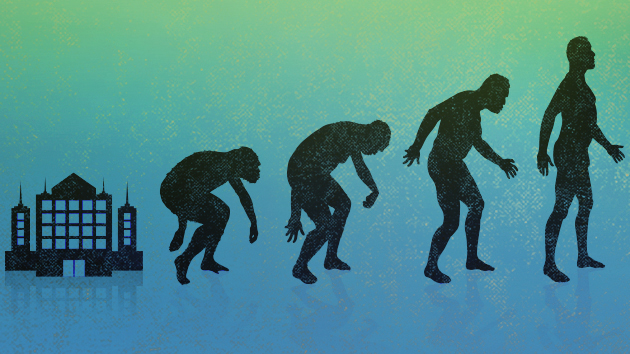
Evolution of the corporate manMuymuy/Thinkstock; <a href="http://www.shutterstock.com/pic-128819524/stock-vector-evolution-of-man.html">Jorgen Mcleman</a>/Shutterstock
Get your news from a source that’s not owned and controlled by oligarchs. Sign up for the free *Mother Jones Daily*.
Last week’s Hobby Lobbyruling charted new legal territory by granting corporations the same religious rights as real people. The rationale behind the decision—that expanding constitutional rights to businesses is necessary to “protect the rights of people associated with the corporation”—is far from novel. A line of Supreme Court rulings stretching back 200 years has blurred the distinction between flesh-and-blood citizens and the businesses they own, laying the groundwork for Hobby Lobbyand the equally contentious Citizens Unitedruling. Here’s a timeline of the corporation’s human evolution:
1809 (*Bank of the United States v. Deveaux*): In the early days of the republic, when state and federal courts were still working out their jurisdictions, the Bank of the United States—a precursor to the US Treasury—sued a Georgia tax collector named Peter Deveaux for property he had seized when the bank failed to pay state taxes. Deveaux argued that, because corporations weren’t people, they couldn’t sue in federal court. Chief Justice John Marshall agreed. This meant businesses could only sue or be sued in federal court if all the shareholders, and at least one member of the opposing party, lived in the same state. According to Burt Neuborne, a corporate law professor at New York University, Wall Street banks hated this decision because it restricted suits to state courts where judges were partial to the banks’ local clients—typically Midwestern farmers.
1844 (Louisville, Cincinnati, and Charleston Railroad v. Letson): It soon became apparent that Marshall’s decision in Bank of the United Stateswas unworkable because it put corporations outside the reach of the federal courts. Thirty-five years later, after hearing the *Louisville, Cincinnati, and Charleston Railroad*case, the Supreme Court shifted course, ruling that corporations were “citizens” of the states where they incorporated. Still, it was difficult for a corporation to sue or be sued in federal court unless all its shareholders lived in the same state.
1853 (*Marshall v. Baltimore and Ohio Railroad*): The Supreme Court later upheld the notion that corporations were citizens, but only for the purposes of court jurisdiction; they did not have the same constitutional rights as actual people. The court also ruled that, for litigation purposes, shareholders would be considered citizens of their company’s home state. This made it easier for corporations to sue or be sued in federal court by eliminating jurisdictional conflicts.
1886 (County of Santa Clara v. Southern Pacific Railroad*): Now that corporations were legally citizens, corporate attorneys worked to expand their rights. When California officials levied a special tax on the Southern Pacific Railroad, the railroad sued, arguing that singling out the company violated its rights to equal protection under the 14th Amendment, which was intended to protect freed slaves. In a strange twist, the court reporter—a former railroad man—wrote in the published notes on the case that the 14th Amendment did, in fact, apply to the company. Even though this notion appeared nowhere in the high court’s actual ruling, 11 years later the court declared it was “well settled” that “corporations are persons within the provisions of the Fourteenth Amendment,” citing* Santa Clara*.
1898 (Smyth v. Ames): Building on the* Santa Clara*decision, the court voided a Nebraska railroad tax, ruling that it was akin to the government taking a corporation’s property without due process—a violation of its 14th Amendment rights. (The decision was overturned in the 1944Federal Power Commission v. Hope Natural Gas*decision.)
1906 (*Hale v. Henkel*):Having blocked unlawful seizures of corporate property, the court went on to shield companies from other kinds of intrusion. Writing for the majority, Justice Henry Billings Brown found that corporations, like people, are protected from unreasonable searches and seizures under the Fourth Amendment (although the Fifth Amendment protection against self-incrimination did not apply).
1931(Russian Volunteer Fleet v. United States): A Russian shipbuilder, Russian Volunteer Fleet, sued the US government, claiming that government officials had unlawfully seized property worth more than $4 million. The high court sided with the company, ruling that even foreign corporations are protected from unlawful government seizures under the Fifth Amendment, which ensures fair treatment by the legal system.
1977 (*United States v. Martin Linen Supply Co.*): After a criminal trial for two linen companies and their owner was dismissed due to jury deadlock, federal prosecutors appealed the decision. The Supreme Court ruled that a second trial violated the companies’ rights to be tried only once, expanding the double jeopardy rule to include both humans and corporations.
2010 (Citizens United v. FEC*):In the run up to the 2008 election, the Federal Elections Commission blocked the conservative nonprofit Citizens United from airing a film about Hillary Clinton based on a law barring companies from using their funds for “electioneering communications” within 30 days of a primary or 60 days of a general election. The organization sued, arguing that, because people’s campaign donations are a protected form of speech (see *Buckley v. Valeo) and corporations and people enjoy the same legal rights, the government can’t limit a corporation’s independent political donations. The Supreme Court agreed. The Citizens United* ruling may be the most sweeping expansion of corporate personhood to date.
2014 (*Burwell v. Hobby Lobby*): Corporations are legally people with the right to free speech, but do they have religious rights? Apparently, they do. In 2012, Hobby Lobby, an Oklahoma-based craft store chain, sued the federal government, arguing that a provision in the Affordable Care Act requiring it to provide contraception coverage for employees violated shareholders’ constitutional rights to freedom of religion. The Supreme Court sided with Hobby Lobby and found that corporations can assert the religious rights of their owners, greatly expanding the power of shareholders while creating a world of confusion for corporate attorneys.
The Future: If a corporation has First Amendment rights, could it also claim Second Amendment protections? Amazingly, this is a question some scholars are seriously pondering. As Darrell A.H. Miller wrote in his 2011 article “Guns, Inc.” in the NYU Law Review, “If Citizens United is taken seriously, the Second Amendment, like the First Amendment and like many other provisions of the Bill of Rights, guarantees liberties to natural and corporate persons alike.” Bang!*
---
REF 4
A brief history of the evolution of corporate power This article is derived from, but not a synopsis of "Beyond Public/Private: Understanding Excessive Corporate Prerogative" by john a. powell and Stephen Menendian, which makes the case that corporations have overstepped their appropriate role in diverse democracies.
...
THE MODERN ERA: EXCESSIVE CORPORATE POWER IMPEDES DEMOCRACY AND BLOCKS EFFORTS TOWARDS SOCIAL & RACIAL JUSTICE
:{:{In its 2010 Citizens United v. FEC decision, the Supreme Court held that corporations enjoy First Amendmentrights to spend money on political campaigns. As explored in prior pages, this decision represents more than several decades of expansion of corporate speech rights, and the culmination of nearly two centuries of jurisprudence that decoupled corporations from the public good. For all of the power and individual rights accumulated over the past century, corporations still cannot vote, but rather must persuade voters to overturn laws and regulations that impinge on their profits.}:
:{ :{Their ability to "persuade," of course, has increased exponentially since Citizens United, a basic strategy of which is to argue that these laws and regulations harm ordinary people, that they are a product of an overbearing, interventionist state. In each case, it is implied, the government is infringing the liberties and rights of private citizens, not corporations, even if the opposite may, in fact, be true}:. In Ohio, for example, corporations have sought and achieved legislative victories that preempt local communities from passing ordinances outlawing risky horizontal hydraulic drilling for natural gas (known as “fracking”), while in California, Amazon sponsored a 2011 ballot initiative asking state voters to overturn a law that would tax its online sales.
More recently, in 2021, gig economy companies like Uber and Lyft spent $224 million on Prop. 22, which exempted these companies from following laborlaw and from paying certain taxes in CA.
In pursuit of ever greater profits, corporations can further threaten both local government and government agencies with divestment orinvestment elsewhere unless they receive tax concessions, incentives, subsidized utilities, regulatory exemptions, and other benefits, forcing local and even state governments to compete in bidding wars to offer maximum incentives.}:
:{:{ Unless local politicians bend to their demands, major corporations can threaten to close a factory and move jobs to another state, harming both workers and the local governments that depends on basic tax revenue to enact public good activities, including those that seek to protect and uplift marginalized and minority groups.}:
Ultimately, unchecked corporate power not only contributes to high levels of wealth inequality—leading to inequality in education, housing, health, and opportunity— but also stands in the way of achieving social and racial justice, which relies on the protection of workers'rights, the collection & fair redistribution of public funds, and the just consideration of the needs of those with less power.}:}:
...
---
---
corp aCCtability 12 25
In recent years, we’ve seen some of the biggest cities in the U.S. mobilize against water privatizing corporations. Most recently, thousands of residents in Pittsburgh voted to ban water privatization in their city — keeping their water system in public hands for generations to come.1
Pittsburgh’s story proves that through community organizing and collective action, we can take on some of the most powerful corporations and, most importantly, win. From Houston, Texas, to Lagos, Nigeria, we and our allies are making sure that water remains under local, public control. But we can’t do it without your support
---
---
comic lewis black fundraise 12 24
Write to us at info@corporateaccountability.org or call us at +1-800-688-8797 (U.S.).
Corporate Accountability
10 Milk St, Suite 610, Boston, MA 02108
===
===
2 24 ymail
We’re excited to announce a few victories in the water justice movement that have been years in the making. Last year Secretary of the Interior Deb Haaland issued an order to phase out single-use plastics, like bottled water, in national parks by 2032. This will mean a significant reduction in plastic waste littering some of the wildest places in the U.S. More recently, Governor Maura Healey issued an order that ensures the state of Massachusetts will no longer purchase single-use plastic bottles. And finally, the California State Water Board ordered the owner of Arrowhead brand bottled water (formerly owned by Nestlé) to drastically reduce its extraction of water from the San Bernardino National Forest. Read more about these movement victories on our blog.
===
===
A recently released exposé shows that Chevron’s supposed commitments to climate action seem to be nothing more than an attempt to greenwash the corporation’s wrongdoing and further polluting, while they continue spurring further harm to communities, ravaging the planet, and risking Indigenous lands, territories, and ways of life -- all in the name of profit.
That’s why we’re joining the global Anti-Chevron week of action by demanding one of its biggest investors and shareholders, BlackRock, divest from Chevron. And we’re doing it publicly so that BlackRock feels the pressure.
net zero BS rept
https://corporateaccountability.org/resources/chevrons-junk-agenda-report/
https://corporateaccountability.org/
https://corporateaccountability.org/2023-corporate-hall-of-shame-ol/
===
===
y mail 6 23
Corporate Accountability released a hard-hitting exposé calling out Chevron’s junk climate action and how its purported green actions are likely intensifying global harm. It was released alongside an exclusive in The Guardian GUK, which wrote an incredible piece about the report and the actions taking place this week. And with thousands of members like you taking action, we also called on BlackRock, one of Chevron’s biggest investors, to divest from Chevron.
===
https://www.corporateaccountability.org/annualreport2021/
https://www.corporateaccountability.org/wp-content/uploads/2021/11/CA_AnnualReport_2021_poster.pdf
dl
And the successes we achieved were remarkable. As you browse this report, I hope you’ll feel the power that your support fueled. We organized to keep corporations out of policymaking, to hold them liable for the harms they have caused, and to disrupt their ability to rebrand themselves when their abuses were exposed. From employing innovative solutions to hold a regional strategy meeting on challenging water privatization in Africa, to co-launching the Liability Roadmap to make Big Polluters pay, to meeting with hundreds of members like you, we built connections, went deep, and creatively leveraged technology toward impact. We’ve captured just a snapshot of all our work last year in this graphic.
7/20 vote https://www.corporateaccountability.org/2021-corporate-hall-of-shame/
ADDITIONAL SPONSORS
Daily Kos
LeftNet
Washington, DC
Feed the Truth
Washington, DC
Acre2small
Action Center on Race and the Economy
198 methods
Courage California
920 providence RI AA. Lagos?
hall of shame vote:
Veolia was hired to manage Pittsburgh’s water system, claiming it could improve it and save the struggling utility money. Instead, Veolia prioritized cost-cutting measures to boost its own bottom line and walked away with over $11 million.
Under Veolia’s management, the staff of the Pittsburgh Water and Sewer Authority’s (PWSA) laboratory was cut in half. Additionally, the corrosion control chemical used to prevent lead contamination was switched to a cheaper alternative without the required approval, violating state regulations. What followed was a health crisis that endangered residents throughout the city.
Veolia also held a contract in Flint, MI months into the water crisis there. It not only failed to publicly sound the alarm despite internal emails expressing concern about the potential for lead in the water, but also told the city its water was safe.
We nominate Veolia for this year’s Corporate Hall of Shame ballot for its role in lead crises in Flint and Pittsburgh, and continuing to threaten the human right to water by pushing privatization schemes that have led to rate hikes, labor cuts and abuses, and dangerous cost cutting.
===