NWF
i assume this is nat'l wildlife federation
COLORADU U BOULDER
===
Inside the Trump admin's favorite conservation coalition - E&E News by POLITICO
Inside the Trump admin’s favorite conservation coalition
By Corbin Hiar | 03/24/2017
A little-known consortium of sportsmen’s groups is poised to wield considerable influence in the Interior Department in the coming years.
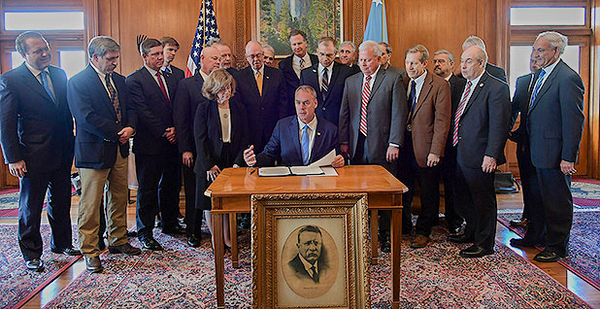
Ryan Zinke's first public meeting as Interior secretary included 15 members of the little-known American Wildlife Conservation Partnership. Photo by Tami A. Heilemann/Department of the Interior, courtesy of Flickr.
On Ryan Zinke’s first full day leading the Interior Department, he hosted top officials from more than a dozen sportsmen’s groups — some of which were returning to the secretary’s wood-paneled suite for the first time in years.
The gathering provided a glimpse of both how Zinke’s conservation priorities will differ from his predecessor’s and which organizations he’s most likely to consult.
All but four of the 19 groups represented that day had one thing in common: They are part of American Wildlife Conservation Partners (AWCP), a little-known consortium of sportsmen’s groups that is poised to wield considerable influence at Interior in the coming years.
Some of the partner groups that sent executives to the meeting have deep ties to President Trump and Zinke.
The National Rifle Association, which had little high-level contact with Interior during the Obama era, spent more $30.3 million during the 2016 race in support of Trump or targeting Democratic presidential nominee Hillary Clinton. That was more than any other outside group, according to the Center for Responsive Politics, a money in politics watchdog organization.
During the same election cycle, the Safari Club International donated $10,000 to the campaign of Zinke, who until earlier this month was Montana’s lone Republican House member.
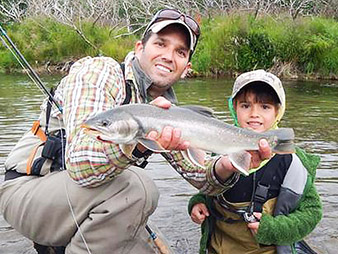 Donald Trump Jr., who often tweets photos of himself fishing with “D3,” is a member of several AWCP groups. | Photo courtesy of @DonaldJTrumpJr via Twitter.
Other partner groups, such as the Theodore Roosevelt Conservation Partnership (TRCP), count Donald Trump Jr. as an active member.
Along with the rest of AWCP, they will be pushing Interior to support overhauling the Endangered Species Act, reining in environmental litigation and streamlining environmental reviews of timber projects. Those were among the policy recommendations to "conserve our fish, wildlife, and habitat resources long into the 21st century" that the consortium’s 47 partner organizations sent to presidential candidates last year.
Though all the groups — from the Association of Fish & Wildlife Agencies to Ducks Unlimited — signed on to AWCP’s "Wildlife for the 21st Century" report, some may push particular policies included in it, while others may stay silent.
"Not every group feels strong enough about [the recommendations] that they’re going to put their name behind them," said Joel Pedersen, the director of conservation programs for the National Wild Turkey Federation and author of the report. "They’re basically just not going to oppose them."
Pedersen wasn’t able to attend the meeting with Zinke, which culminated in the signing of secretarial orders to expand access to public lands and revoke restrictions on lead ammunition and fishing tackle. But his Edgefield, S.C.-based group sent a consultant to represent NWTF’s interests.
The consortium has no budget and no dedicated staff. While it is mentioned on the websites of many partner groups, AWCP itself doesn’t have much of a presence online. A blog started by the consortium in 2012 has just two entries, the second of which leads to a now-defunct website.
The consortium’s low public profile is no accident, according to Pedersen. AWCP is mainly a discussion forum intended to amplify the advocacy efforts of its partner groups, not overshadow them.
"Part of the rules of engagement, if you will, for us is that AWCP does not take a position on behalf of any organization, and no other organization takes a position on behalf of any other organization," he said. "So everybody pretty much speaks for themselves."
Room for disagreement
That arrangement allows the National Wildlife Federation — one of the more conservation-minded AWCP groups — to distance itself from the consortium’s more controversial environmental recommendations. NWF only joined AWCP late last year.
"We tend to have concerns about more extractive industries than maybe some of the other groups, given some of the habitat impacts," said Collin O’Mara, the president and CEO of NWF. "That’s just one example."
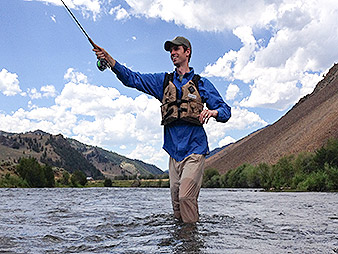 Collin O’Mara, president and CEO of the National Wildlife Federation. | Photo courtesy of NWF.
The energy section of the AWCP report, which features an image of moose running past an oil jack pump, doesn’t mention climate change and seems to equate concerns about all energy sources. At the same time, it says "energy self-sufficiency" is a "high national priority" and urges federal and state wildlife agencies to "start integrating energy development considerations into their overall management plans on both public and private lands."
NWF supports phasing out the use of wildlife-poisoning lead bullets and ammunition. That put O’Mara in an awkward position when Interior turned AWCP’s meet-and-greet with Zinke into a photo op for the secretarial order signings (E&E News PM, March 2).
"We were there to support the secretary on his first day, not endorsing any of the individual actions," he said. "But we do think that having a science-based collaborative process to try to reduce lead, an approach that’s going to last across administrations, … is critical."
The phaseout of lead ammunition and fishing lures was quietly implemented by former Fish and Wildlife Service Director Dan Ashe on his last full day in office (E&E News PM, Jan. 23).
Yet O’Mara emphasized that "we generally support the overall agenda" of AWCP, as represented in the report. "I think what you see in this document is an acknowledgment of the wildlife crisis that we’re facing and that we can’t simply just regulate our way to recovering wildlife populations," he added.
The sportsmen’s coalition also has bipartisan appeal for NWF, which has a network of affiliate organizations in blue states as well as the red ones where most hunters and anglers tend to be found.
"We look more like the country in terms of political identity … than any of the other [conservation] groups," O’Mara said. "So to not be engaged with the leading sportsmen’s groups that are most engaged in wildlife issues was something that we needed to fix."
The consortium has been meeting regularly to share information about issues affecting the sportsmen’s community since 2000.
NWF attended the most recent AWCP gathering earlier this month in Spokane, Wash., on the sidelines of the North American Wildlife and Natural Resources Conference. About two-thirds of the partner organizations were present. AWCP’s next meeting is scheduled for August.
Funding fears
Even more than in the last eight years, the traditional hook-and-bullet crowd is ready and willing to work with the new administration.
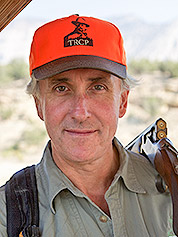 Whit Fosburgh, president and CEO of the Theodore Roosevelt Conservation Partnership. | Photo courtesy of TRCP.
"It’s pretty clear that Trump and Don Trump Jr. and Zinke all value the importance of the sportsmen community," said TRCP President and CEO Whit Fosburgh, who was also in the room with Zinke on his first full day in office. "We have access, and we’re in a good position to make our voices heard in this administration."
Fosburgh, however, still sees cause for concern in the White House’s initial budget proposal.
"Conservation programs have basically been starved since the 1970s," he said. "A lot of that foments the anger — legitimate anger — you see in a lot of the Western states about poor management of our public lands. To get around that, we have to have strong investment."
But the budget blueprint the White House released earlier this month would provide Interior with $11.6 billion next year, a decrease of $1.5 billion from current levels for the already squeezed agency (Greenwire, March 20).
"You can’t have the Department of the Interior taking a 10 percent cut and expect to be a successful secretary of the Interior," Fosburgh warned. "So Zinke will be judged by how well he can elevate that department within the broader fight on the budget in that administration. I think that’s going to be his first and perhaps biggest test that he has."
AWCP groups wrote Trump in February asking him to increase "investments in natural infrastructure." The letter specifically called for the administration to dedicate 5 percent of its promised $1 trillion infrastructure package to "conservation investments that will grow America’s outdoor economy" and to invest "a portion of the Abandoned Mine Reclamation Fund in habitat restoration."
While the White House hasn’t yet detailed its infrastructure plans, the budget blueprint called for the elimination of some Abandoned Mine Land grants.
Greens shut out
Other AWCP groups that sent officials to meet with Zinke on day one include the Congressional Sportsmen’s Foundation, the National Shooting Sports Foundation, the Boone and Crockett Club, the Wild Sheep Foundation, the Archery Trade Association, the Mule Deer Foundation, Pheasants Forever and the Wildlife Management Institute.
Unaffiliated representatives from the American Recreation Coalition, Sportsmen for Fish and Wildlife, the American Sportfishing Association and the National Marine Manufacturers Association also attended.
Notably absent from that gathering was anyone from environmental groups such as Defenders of Wildlife, which had deep ties to the Obama and Clinton administrations (Greenwire, May 1, 2015).
"I would suspect that the traditional greens are not going to have nearly as much influence with this Department of the Interior as they did with the previous one," said Eric Washburn, the president and CEO of Windward Strategies, an energy and environment lobby shop.
"Sportsmen’s groups tend to be politically more conservative than green groups and, I think, methodologically more conservative than green groups," said Washburn, a former adviser to Senate Majority Leaders Harry Reid (D-Nev.) and Tom Daschle (D-S.D.). "They’re less histrionic, they’re less vocal, they’re more sort of seeking balance, and I suspect that’s where Zinke is going to be on many issues — more of a conservationist seeking balance and accommodation and less of a preservationist."
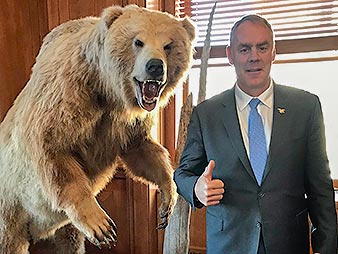 Secretary Zinke asked the University of Montana’s athletic department, which has the grizzly as its mascot, to suggest names for the bear in his office. | Photo courtesy of @SecretaryZinke via Twitter.
Since meeting with representatives from AWCP, Zinke has taken a couple of symbolic steps to bolster his sportsman’s cred. His office now features Ron, an elk trophy he bagged in Montana; Rosie the bison; and an as-yet-unnamed grizzly bear.
Even if environmental groups wanted to partner with the sportsmen’s community, it’s unlikely many of the AWCP groups would welcome them into the newly ascendant consortium.
"The animal rights groups, the anti-groups, no, they’re not really in that circle," said Pedersen of NWTF. "I’m not sure what it’s going to take to bring them into the fold."
Traditional environmental outfits "are more prone to litigation and fighting about things," he said. "I know it will be hard for the NWTF to work with those groups, and I think it will be difficult for many of the groups that are a part of AWCP. It’s a difference in philosophy in how we approach trying to get things done."
==
https://www.ecowatch.com/land-and-water-conservation-fund-2604912470.html
Is the United States About to Lose Its Best Conservation Program?
By Tara Lohan
Time is running out for one of the U.S.' most successful—and least-known—conservation programs.
Virtually every county in the U.S. has benefited from the Land and Water Conservation Fund, signed into law in 1964 with the goal of protecting natural areas and cultural resources and increasing recreational opportunities. In its more than 50-year history, the fund has helped 42,000 projects across the country, ranging from wilderness areas and historic battlefields to local tennis courts and trails.
"It's an amazingly unknown program for all that it has accomplished," said Kathy DeCoster, director of federal affairs at the Trust for Public Land, a nonprofit that helps acquire and protect natural spaces.
The Land and Water Conservation Fund was originally authorized for 25 years and then extended another 25 years. When expiration loomed again in September 2015, Congress gave it a short three-year extension, which is now about to expire. If legislators fail to reauthorize the program before Sept. 30, the fund will immediately run dry and will no longer be able to dole out money, which in recent years has averaged about $450 million annually.
Proponents of the fund like to highlight that it does not rely on taxpayer dollars. Virtually all of the money for the fund comes from revenue generated by offshore oil and gas leases on the Outer Continental Shelf. A small fraction of the money comes from a tax on motorboat fuel and sales of surplus federal property.
"It's a balance, if you will," said DeCoster, "an asset-for-asset arrangement when you deplete one natural resource, then take some of those revenues and make sure the American people get something permanent back from that."
But if the fund isn't reauthorized and that dedicated source of funding is no longer available, it could have both ecological and economic impacts affecting local, state and national parks, as well the outdoor industry, an economic driver in many communities.
"It would be a threat to some of the major ways that people engage everyday with the outdoors and wildlife," said Mike Saccone, associate vice president for communications at the nonprofit National Wildlife Federation.
Far-Reaching Impacts
Even ardent supporters of the fund have a hard time pointing out their favorite projects, because there are so many and they're so varied.
The money from the fund serves two main purposes. The first is to enable federal agencies such as the National Park Service, Bureau of Land Management, Fish and Wildlife Service and Forest Service to acquire more public lands for recreation.
One of the big things these acquisitions accomplish is to secure "inholdings." These are areas of privately held lands that are within or adjacent to federal public lands and have high conservation or recreation value. The fund is used to protect these areas from development when there's a willing seller.
It's helped to bolster projects all across the country, including in the Allagash Wilderness Waterway in Maine, the Minnesota Valley National Wildlife Refuge, Everglades National Park and Everglades Headwaters National Wildlife Refuge in Florida, Great Sand Dunes National Park and Preserve in Colorado and California Coastal National Monument, to name just a few.
Shorebirds at Cape May National Wildlife Refuge. The Land and Water Conservation Fund protected 5,486 acres of this important bird habitat.USFWS
The second aspect of the fund is a matching-grant program that helps states enhance their recreation facilities and planning. Local recreational opportunities have gotten a big boost from the fund, helping to support new hiking and biking trails, baseball and soccer fields, tennis courts and parks in urban communities and underserved neighborhoods.
"People think getting outdoors and engaging kids with nature always involves wilderness, when in fact, for the vast majority of families it's urban parks, trails, etc.—and those are the things that the Land and Water Conservation Fund supports," said Saccone.
Since 1998 some funds from the program have also gone to related federal programs, including the Forest Service's Forest Legacy program, which helps to preserve lands through conservation easements, and the Cooperative Endangered Species Conservation Fund of the Fish and Wildlife Service, which helps to protect vital habitat for critical wildlife.
It also has helped acquire and protect areas of historical importance like the Women's Rights National Historical Park in New York, the Brown v. Board of Education National Historic Site in Kansas and the Martin Luther King. Jr. National Historic Site in Georgia, as well as battlefields in Gettysburg and Vicksburg.
"The Flight 93 Memorial was also funded through the Land and Water Conservation Fund," said DeCoster. "History doesn't stop being made, and the fund is the premier source of funding for that kind of work."
Legislative Hopes
...