Carbon Sequestration ccs
==
see FF CEO greenwash
see phase 4 delayism // methane net zero BS
see exxon 4 darren wood
see clean coal ccs
SEE EOR enhanced oil recovery
includes natural processes
see kemper cty, Southern co defunct
bak 4 24
===
co2 pipeline leak 4 24 zombies
===
Join us on Wednesday, Aug. 13 for an online screening of "Under Pressure: A Carbon Capture Land Grab Threatens Rural America," the new short film documentary produced by Bold Alliance -- followed by a Q&A with participants interviewed in the film.
 "Under Pressure" juxtaposes interviews with victims and first responders of a 2020 CO2 pipeline rupture in Satartia, Mississippi with interviews of Midwestern landowners, where a multi-billion dollar corporation is poised to seize farmland from hundreds of families via eminent domain for the world's largest CO2 pipeline.
ymail 4 24
In 2021, Congressional Democrats subpoenaed Big Oil for internal documents detailing the industry’s role in worsening the climate crisis.
Some of the documents have already been released. But today, we got some more.
The internal materials are from Exxon, Chevron, Shell, BP, the American Petroleum Institute, and the Chamber of Commerce. They’re being released today as part of the Senate Budget Committee’s upcoming hearing on Wednesday morning, titled “Denial, Disinformation, and Doublespeak: Big Oil’s Evolving Efforts to Avoid Accountability for Climate Change.”
 Source: X
Both the hearing and the documents mark the revival of the House Oversight Committee’s two-year investigation into the fossil fuel industry, and its role in misleading Americans about climate change. That investigation was put on ice when Republicans won back control of the chamber in late 2022.
Democrats say their new findings provide “a rare glimpse into the extensive efforts undertaken by fossil fuel companies to deceive the public and investors about their knowledge of the effects of their products on climate change and to undermine efforts to curb greenhouse gas emissions.”
HEATED got a chance to review the new documents prior to their publication today. And while we don’t think the revelations are necessarily all that “rare,” here are five things we found notable.
1. BP really, really loves Princeton
To influence academia, fossil fuel companies have spent at least $700 million on partnerships with U.S. universities. The longest-running of these partnerships is between BP and Princeton.
The new documents provide some insight into why: because Princeton gives BP unprecedented access to discussions about research. In 2016 emails, BP officials discussed cutting funding to Harvard and Tufts and boosting it for Princeton, because research discussions at Harvard and Tufts “are directed by the universities and much less relevant to BP.” They said “personality and structural issues” at Harvard and Tufts made it “difficult to achieve the same BP focus.”
Achieving a “BP focus” meant two things: pushing research about the benefits of carbon capture and methane gas. And that’s what Princeton’s Carbon Mitigation Initiative did.
In 2018, an internal BP presentation marked “confidential” recommended Princeton CMI director Stephen Pacala as a preferred expert in defending methane gas as a climate solution. And in a 2020 email, BP officials discussed an upcoming call with Pacala, in which BP would recommend developing a net zero plan “with emphasis on CCUS [carbon capture utilization and storage] — building ‘backbone’ of pipelines to transport carbon from emitters to the Permian and Gulf Coast sites.”
CMI did eventually develop a net zero study with an emphasis on carbon capture. BP officials celebrated, writing, “Princeton’s net zero study is expected to be a guide for the Biden Administration.”
Today, sure enough, the Biden Administration is making massive investments in carbon capture—just as BP’s vice president of U.S. policy and regulatory affairs predicted. In a 2020 email, he said BP’s relationship with Princeton was “becoming increasingly synergistic.” If Biden won, the VP said, “I would not be surprised to see some of our friends in senior government policymaking roles, as well!”
2. Oil companies know they can’t meet their public climate goals
While they publicly tout their efforts to fight climate change, oil companies privately say they don’t believe the world could ever reach a safe, livable climate.
For example: Exxon first publicly supported the Paris Agreement in 2015, but internally the company revealed that it did not believe the climate treaty’s goals were realistic. “We don’t yet see the world even approaching a 2°C pathway … let alone a 1.5°C pathway,” Exxon’s former manager of environmental policy and planning Peter Trelenberg wrote in a 2018 email. “Both 2°C and 1.5°C would require unprecedented changes to the global energy system and economy, at a rate and scale never before demonstrated, and with technologies not yet available and affordable.”...
===
===
4 24 yahoo
carbon dioxide pipeline rupture in the small village of Satartia, Mississippi, sent nearly 50 people to the hospital with “zombie”-like conditions in 2020, and now another major leak from a pipeline in Sulphur, Louisiana, has once again exposed the risks carbon dioxide pipelines pose to communities in their path.
Soon, pipelines like this could be coming to cities and towns throughout the country. Spurred by federal tax incentives from the Biden Administration, the fossil fuel industry is planning to build tens of thousands of miles of carbon dioxide (CO2) pipelines across the United States for experimental carbon capture and storage — a process aimed at sequestering carbon emissions from power plants, sending it through pipelines, and injecting it underground.
While regulators are working to craft updated safety rules for these pipelines, major fossil fuel companies and their trade groups — including Chevron, ConocoPhillips, the American Petroleum Institute, and the Liquid Energy Pipeline Association — have launched a lobbying blitz to scale back regulations and target the regulators themselves so they can construct new pipelines as quickly as possible.
Carbon dioxide is an asphyxiant. Upon entering the atmosphere during a pipeline leak or rupture, it can travel long distances, shut down vehicles, and sicken, suffocate, or even kill people and wildlife.
Only about 5,000 miles of carbon dioxide pipelines currently exist across the country, largely operating in states across the Midwest and Gulf Coast. Many communities, landowners,and environmental and public health groups have staunchly opposed and, in some cases, successfully prevented their build-out, such as eliminating the proposed 1,300-mile Navigator pipeline that would have crossed through five Midwestern states.
But now, this pipeline network could be greatly expanded. According to the U.S. Department of Energy and financial industry estimates, it could take up to 96,000 miles of new carbon dioxide pipelines — enough to wrap around the earth four times — to transport just 15 percent of U.S. greenhouse gas emissions.
The Pipeline and Hazardous Materials Safety Administration, the federal agency tasked with pipeline safety, announced in 2022 that it would update rules for carbon dioxide pipelines.
The agency, which is overseen by Transportation Secretary Pete Buttigieg and was implicated in the train derailment in East Palestine, Ohio, is itself up for reauthorization, meaning Congress will reconsider its lawmaking mandates and funding. Now the pipeline industry, represented by its main lobbying group, the Liquid Energy Pipeline Association, is using both the rule-making and reauthorization processes to push its agenda forward.
“There is no need for adding a host of punitive provisions on the pipeline industry,” reads written January testimony from Andrew Black, the lobbying group’s president and CEO, to the House Energy and Commerce Committee, which has proposed a bill on the pipeline safety agency’s reauthorization. “The data just does not support those who wish to impose harsh new mandates or penalties on pipeline operators.”
On March 6, the Liquid Energy Pipeline Association arranged a meeting with the White House Office of Management and Budget, which is currently reviewing the draft carbon dioxide safety rules. Also present at the meeting were representatives from ExxonMobil, BP, Chevron, Marathon, TC Energy, Kinder Morgan, Phillips 66, and Valero, along with representatives from the Department of Transportation.
“THE ADMINSTRATION [sic] SHOULD AVOID AN OVERLY BROAD OR UNSUBSTANTIATED CO2 PIPELINES RULEMAKING THAT RISKS DELAY AND IMPERILS FINALIZATION,” reads the all-caps intro to the lobbying group’s talking points for that meeting.
In response to a request for comment, Liquid Energy Pipeline Association’s president and CEO Andy Black offered several reasons “why we think a measured approach to pipeline safety legislation is appropriate.” According to Black, federal data shows “the number of CO2 pipeline incidents is flat over the last 5 years,” and “Federal regulation imposes dozens of safety requirements on interstate CO2 pipelines on everything from design and construction to inspection, maintenance, and emergency response.”
Robin Rorick, one of the American Petroleum Institute's vice presidents, said in an email, “The safe use and development of CO2 pipelines will be critical as our industry and the nation as a whole advances its emissions reduction efforts. API will continue to work with [Pipeline and Hazardous Materials Safety Administration] and industry experts to safely accelerate the widescale, responsible deployment of CO2 pipelines while protecting the environment and communities where we live and work.”
An Invisible Menace
The urgency of this issue reemerged this month after a carbon dioxide leak from a pipeline in Sulphur, Louisiana, co-owned by ExxonMobil and Denbury, a carbon capture developer that owns the country's largest carbon dioxide pipeline network.
Residents within a quarter mile of the leak received a phone notification to shelter in place. But others only received the news from a Facebook post by local officials, citing a “bust” in Exxon’s high-pressure carbon dioxide pipeline in Sulphur and warning residents to shut their doors and windows, turn off any ventilation, and wait.
While the proper procedure is to evacuate, local fire chief Todd Parker said changing winds near the leak made that impossible. “For the homes that were affected, they had to drive through the release to be able to get out, so we couldn’t evacuate them,” Parker explained. He said it took more than two hours for pipeline operators to stop the leak, which was called in by a resident who reported seeing “white clouds” coming from the pipeline.
In the meantime, Roishetta Ozane, a Sulphur resident and local environmental justice organizer, began fielding calls from panicked residents.
“People were reaching out asking me about what CO2 is,” Ozane said. But as a mom of six children, she was also scared and confused. “We know that this is colorless and odorless, so I just kept my children inside and made sure they were OK,” said Ozane. “Pipelines leak, CO2 leaks, and you don’t know it’s happened until tragedy has struck.”
She remembered the incident in Satartia, where another Denbury carbon dioxide pipeline rupture caused mass asphyxiation, turning people into dazed and unresponsive “zombies,” with some losing consciousness. As hundreds rushed to evacuate, vehicles became paralyzed, since cars need oxygen to burn fuel. Some residents still face serious health issues years later.
The Pipeline and Hazardous Materials Safety Administration slapped Denbury with the second-largest fine in its history after the Satartia disaster for neglecting to address hazards to its pipeline system and notify emergency responders of the leak or train them to address such an accident before it happened.
The leak in Sulphur is “a very sobering introduction to how the companies will probably try to handle similar incidents,” said journalist Dan Zegart, who reported in depth on the Satartia disaster. “I say ‘similar incidents’ not even really knowing what [kind of leak] we’re talking about here, which is a perfect example of what we’re worried about in the future.”
No injuries have been reported so far in Sulphur — regulators are still investigating the leak and the local municipality said it did not have records to provide — but the bewildering incident highlights the uncertain future for residents in the path of the carbon dioxide pipeline build-out.
“It is alarming that we have been organizing, educating the community, educating ourselves, and trying to get answers from the government on [carbon capture and storage] in Louisiana for three years now, and we still did not have the information or frankly relationships necessary to get real-time information on what was happening [in Sulphur],” said Jane Patton, a campaign manager at the nonprofit advocacy group, the Center for International Environmental Law.
“[The Liquid Energy Pipeline Association] supports Congress mandating and [Pipeline and Hazardous Materials Safety Administration] imposing new safety requirements on CO2 pipelines reflecting the lessons learned from the Satartia, MS pipeline incident,” said Black, the lobbying group’s president, in his email to The Lever. He added that the organization “looks forward to the results of Sulphur, LA pipeline incident review and any recommendations it produces for how to improve CO2 pipeline safety further.”
A Carbon Capture Future?
ExxonMobil — which purchased Denbury last year — is planning to build carbon capture infrastructure throughout Louisiana, where about a third of the nation’s carbon capture projects have been proposed.
Exxon did not respond to requests for comment.
“We’ve got plans to grow our carbon capture business and really focus on emitters all along that Denbury pipeline,” Exxon CEO Darren Woods told Louisiana newspaperThe Advocatein February. “What we’re doing is taking advantage of the ability to pump carbon dioxide back into the ground, and store it very safely. It’s isolated from the rest of the community.”
Patton says that such statements are just “another lie that we're being sold” by the fossil fuel industry.
“Louisiana is magic, and I want to be able to pass this magic onto the next generation behind me,” she said. “We deserve a future here and that future is not in carbon capture.”
Scientists have been sounding the alarm that carbon capture and sequestration is not an effective way to reduce emissions and is most often used for enhanced oil recovery, which means accessing more fossil fuels to be burned. The Department of Energy just announced it would invest $23 million in two projects to evaluate the potential for enhanced oil recovery using captured carbon dioxide.
In internal company documents, the oil and gas industry has privately admitted that though CCS is “complex, costly, and will require additional power,” it will “enable the use of petroleum and natural gas” well into the future.
But thanks to the Inflation Reduction Act, which ratcheted up tax credits available for carbon capture technology, the race is on to build out carbon dioxide pipelines.
Meanwhile, advocates say their concerns are being ignored. “You’ve got communities, NGOs on pipeline safety, governmental experts on pipeline safety all raising alarm about the hazards of what is being planned,” said Monique Harden, director of Law and Policy at the Deep South Center for Environmental Justice. “What you don’t have is the response of protection or response that validates those concerns. Instead, what you have is silence.”
Last week, U.S. Department of Energy Assistant Secretary Brad Crabtree told the Illinois newspaper The Springfield State-Journal Register, “I would argue that our electric transmission and distribution infrastructure, it’s essential to modern life, but it also results in injuries and fatalities… But as a result of those risks, we do not have people saying we shouldn’t have electric transmission and distribution… CO2 pipelines are no different in that regard.”
Many of the proposed pipeline projects would run through communities like Sulphur — low-income communities of color already burdened by polluting petrochemical and fossil fuel facilities. These communities often have minimal resources to respond to worsening extreme weather events, like a tornado that destroyed the office of Ozane’s disaster-relief and environmental justice nonprofit not far from Sulphur just days after the leak.
“On top of the fact that this is taking public money, it is essentially a program where the federal government pays the oil and gas industry to deal with its own waste product in a way that burdens communities and makes us demonstrably less safe,” said Patton. “Accidents that happen along CO2 pipeline routes are going to become more common and much more dangerous if this program is allowed to move forward.”
While significant public resources are being deployed to develop this technology, understanding of carbon dioxide pipeline leaks — how they happen, the extent of their damage, and how they should be addressed — lags far behind.
“Often you need the knowledge gaps to be filled before you can fully fill the regulatory gaps,” said Bill Caram, executive director of Pipeline Safety Trust, an organization that advocates for stronger regulations on pipeline safety. “Right now, CO2 pipelines are relatively rare and relatively rural, and we’re moving toward building a lot more CO2 pipelines closer to communities. I don't think we are ready to do that safely.”
Current carbon dioxide pipelines are largely located in small communities with underpaid or volunteer fire departments, many of which lack equipment to respond to and monitor for carbon dioxide leaks. In Sulphur’s case, the fire chief said he had not seen an emergency response protocol from the company until after the leak occurred.
Environmental and public health groups are pushing federal regulators for additional pipeline safety provisions, including updated “dispersion modeling” requirements, which show how carbon dioxide moves and would help emergency personnel respond to accidents, and adding odorants to the carbon dioxide to warn community members of a leak.
Groups are also advocating for new limits on contaminants in the pipelines that can lead to corrosion; mandates for training and coordination between pipeline operators and first responders; and additional rules for transporting gaseous and liquid carbon dioxide, which are currently unregulated.
Pipeline Pushback
But companies, and the lobbying groups that represent them, are pushing back. Since the Pipeline and Hazardous Materials Safety Administration announced its intention to make new rules on carbon dioxide pipelines in 2022, records show that Chevron, ConocoPhillips, Enbridge, Marathon, Shell, and Targa, along with trade associations like Liquid Energy Pipeline Association, American Fuel & Petrochemical Manufacturers, the American Petroleum Institute, have been lobbying the agency on pipeline infrastructure, rule-making, and safety, and/or lobbying on the agency’s reauthorization, among other issues.
During their March meeting at the White House Office of Management and Budget, fossil fuel interests appeared to push for rulemaking that prioritizes secrecy and expediency over safety and transparency.
“Any emergency response requirements should ensure the protection of sensitive information and be aligned with industry current best practices,” reads API’s talking points from the meeting. “The rule must be technically feasible and set realistic timelines for implementation to ensure it supports rather than hinders the build-out of this additional CO2 pipeline infrastructure.”
Maggie Coulter, senior attorney at the Center for Biological Diversity’s Climate Law Institute, said advocacy groups are particularly concerned about the industry’s attempts to keep data about potential pipeline leaks hidden from the public. One of the bills being considered for Pipeline and Hazardous Materials Safety Administration’s safety reauthorization, which has received broad support from industry trade groups, contains a provision for the “protection of sensitive information in responding to a public request for information regarding carbon dioxide dispersion modeling.”
“There’s an additional cost in doing things safely, and increased public scrutiny when you’re affirmatively tasked with informing first responders and members of the public,” said Coulter. “Right now we just have to trust the company.”
Black, president of the Liquid Energy Pipeline Association, said in his comment to The Lever that his organization “supports operators sharing the results of pipeline modeling with state and local emergency planning officials and first responders,” but advocates for “limiting general public sharing of security sensitive information, as is the current approach for crude oil pipelines, to prevent bad actors from misusing this information to harm surrounding communities.”
Black did not respond directly to questions about evidence showing that pipeline operators have failed to communicate with first responders ahead of and properly respond to CO2 pipeline disasters in the past.
Caram of Pipeline Safety Trust said that given the risks that carbon dioxide pipelines pose to communities across the country, the companies involved shouldn’t be allowed to dictate their own safety standards.
“It's like the difference between a speed limit of 55 MPH as opposed to a sign saying ‘please drive safely,’” Caram said. “We need something specific to hold them to.”
---
exxonknewS
y mail 12 23
no lnx see exxon 4
exxon crashes COP28 to “fight for its life”
ExxonMobil CEO Darren Woods is on a mission to defend fossil fuels and deny science during his debut at the UN climate conference.
EXXONKNEWS
DEC 6
Emily Sanders is the Center for Climate Integrity’s editorial lead.
:{:{Will COP28 be a climate denial superspreader event, or the death knell for Big Oil? The fossil fuel industry is doing all it can to ensure the former and prevent the latter. At least 2,456 fossil fuel lobbyists were granted access to the conference — nearly four times more than any previous year.}:
COP President and Abu Dhabi National Oil Company (ADNOC) CEO Sultan Al Jaber proclaimed that there is “no science” to back up the need to phase out fossil fuels in order to keep warming within the 1.5 degree threshold, accused his interviewer (Mary Robinson, former president of Ireland) of lying about ADNOC’s increasing investments in oil, and insisted that ending fossil fuels would “take the world back into caves.” He then launched yet another “net zero” emissions commitment, joined by about 50 major oil companies, which the UN secretary-general swiftly condemned as greenwashing.}:
https://twitter.com/PriceofOil/status/1731025554789318713
All in all, it’s shaping up to be the worst takeover of COP by fossil fuel interests yet, with oil and gas representatives boring like hungry termites into policy discussions concerning their companies’ profits — just the kind of thing ExxonMobil wouldn’t miss for the world.
A debut of desperation
This year is Exxon’s CEO Darren Woods’ first at COP, and he has been on quite the press tour. Woods’ mission is like those of other major oil company representatives at the conference: to defend the continued expansion of fossil fuel production against the irrefutable scientific consensus calling for its end.
“This is a desperate attempt to prolong his company’s destructive, fossil fuel-dependent business model,” said Kathy Mulvey, accountability campaign director for the Climate & Energy Team at the Union of Concerned Scientists.
“The unprecedented nature of an Exxon CEO’s appearance at a U.N. climate talk seems consistent with the unprecedented nature of this year’s talks themselves,” said Geoffrey Supran, a Professor of Environmental Science & Policy at University of Miami and researcher of Exxon’s disinformation campaigns.
This particular COP is a “potential watershed moment, where Big Oil’s products finally become the target of international climate policy. That’s got to have oil executives up at night,” he said.
In conversations with multiple major media outlets, the oil executive said that policymakers were focusing too much on reducing fossil fuels and not enough on their emissions.
The talks in Dubai have “put way too much emphasis on getting rid of fossil fuels, oil and gas, and not . . . on dealing with the emissions associated with them,” Woods told the Financial Times in one interview.
“I actually think that part of the thing that has slowed us down is this focus on making a step change and getting out of our existing energy system and starting something brand new,” he told CNBC in another. “I think what society ought to focus on is the true problem here, which is emissions.”
Woods’ approach “appears to be an attempt to delay the urgent phase out of fossil fuels,” said William J. Ripple, a Distinguished Professor of Ecology at the University of Oregon and Director of the Alliance of World Scientists. Ripple was lead author on a report signed by more than 15,000 scientists last month that concluded that “the significance of immediately curbing fossil fuel use and preventing every further 0.1°C increase in future global heating cannot be overstated.”
International scientific bodies agree. “The uncomfortable truth that the industry needs to come to terms with is that successful clean energy transitions require much lower demand for oil and gas, which means scaling back oil and gas operations over time – not expanding them,” International Energy Agency executive director Fatih Birol wrote in the foreword to a report the agency published just before COP.
As has been its pattern for decades, Exxon is well aware of the science demanding the phase-out of its products — it’s just doing everything in its power to stop that science from leading to action, critics say.
“This is what they do: confuse and corrupt, deny and delay,” said Supran.
Confuse and corrupt, deny and delay
https://twitter.com/ClimateUCS/status/1731723555207876633
“The idea of taking advice on climate action from an oil boss is like inviting an unrepentant con artist to lead a fraud protection bureau,” said Mulvey, of UCS.
Woods, who just sealed a $60 billion deal to acquire Pioneer Natural Resources and produce more oil — a merger that is now being investigated by the Federal Trade Commission — has no plans to transition away from fossil fuels. Exxon was one of the 50 oil companies to sign on to Sultan Al Jaber’s voluntary emissions reduction pledge, called the “Oil and Gas Decarbonisation Charter,” which critics say rehashes old commitments and would do nothing to curb fossil fuel production. A letter from more than 300 advocacy groups called the pledge a “smokescreen to hide the reality that we need to phase out oil, gas and coal.”
“Oil and gas companies are under pressure, desperately trying to preserve their social license through recycled pledges,” said David Tong, Global Industry Campaign Manager at Oil Change International, which last year published a report finding that Exxon’s climate commitments are “grossly insufficient” to meet the goals of the Paris Agreement.
Woods and his fellow oil company representatives are also using COP to push for unproven technologies that will prolong the lifespan of climate-wrecking fossil fuels. In an interview with Bloomberg at COP, Woods said the energy transition would require an assortment of “solutions” — including hydrogen and carbon capture — and “we need big companies to help with that.”
Woods rejected the IEA’s recent assessment of carbon capture as an “illusion,” telling Reuters that “you could say that about electric vehicles, about wind, about solar.” But according to the IEA, “The key actions required to bend the emissions curve sharply downwards by 2030 are well understood, most often cost effective and are taking place at an accelerating rate. The scaling up of clean energy is the main factor behind a decline of fossil fuel demand of over 25% this decade.”
Yet unlike the billions it invests in carbon capture, Exxon is spending almost nothing on renewable sources of energy, while lobbying against the transition away from its core products.
“It’s no surprise that Exxon is pushing for the continued use of fossil fuels,” said Jessica Green, Professor of Political Science at the University of Toronto. “Exxon is in a fight for its life. Real progress on climate change isn’t about more carbon markets or net zero pledges, it’s about putting the oil and gas industry out of business.”
A larger strategy
Woods’ deflections at COP are part of a larger strategy of “corporate issues management,” said Supran, which “the fossil fuel industry has been pioneering for decades.”
“It means having your fingers in all the pies, anticipating future threats to your business and neutralizing them through decades of 360-degree public affairs strategies,” he said.
Exxon has been working to shift the narrative outside of COP, too. “On November 30, the first day of COP 28, The New York Times included a full-page greenwashing ad from ExxonMobil,” Brad Johnson documented in Hill Heat on Monday. “Reuters coverage of Al Gore’s criticism of ExxonMobil’s presence at COP 28 was smothered by greenwashing ads from ExxonMobil. The Punchbowl News political newsletter today is Presented by ExxonMobil.” Yesterday’s Power Switch newsletter from Politico was Presented by ExxonMobil, too.
While the oil giant’s greenwashing may have ramped up around COP, it’s also a years-long affair — aided in large part by many of the same media outlets interviewing Woods at the conference. A major analysis of Big Oil’s advertising between October 2020 and October 2023 found that “many of the world’s most trusted English-language news publications help fossil fuel companies mislead readers about topics like the promise of carbon capture, the potential of ‘renewable biogas,’ and how much the industry contributes to the energy transition,” according to Amy Westervelt and Matthew Green.
The analysis, published by Drilled and DeSmog this week, found that Bloomberg Media Studios last year created a video for Exxon promoting carbon capture and hydrogen; Politico organized 37 e-mail campaigns for Exxon; and Exxon sponsored more than 100 editions of Washington Post newsletters in 2022 alone, as just a few examples.:}:
Ultimately, it’s up to the media, policymakers, and other major institutions to determine whether the oil companies still responsible for fueling climate catastrophe are allowed to have a platform to stand on — or whether, like Big Tobacco, their time to influence the debate about their products’ harm is finally up.
ICYMI: If you want to learn more about the language being used by oil companies at COP this year, here’s a helpful guide from NPR.
---
---
Carbon removal looks more promising by the day. Is methane next?
BY Chelsea Harvey | 10/19/2023
---
8 23 y mail
Tell Your Legislators to support public safety—not CCS!
Both the White House and state legislators are placing their bets on Carbon Capture and Sequestration (CCS) to rescue us from the climate crisis. The Biden Administration has invested massive amounts of money in this technology, and states are eager to cash in. But CCS will not solve the climate crisis: it will make it worse.
Tell the Administration to declare a moratorium on rolling out CCS infrastructure until, at a minimum, the federal Pipeline and Hazardous Materials Safety Administration (PHMSA) has issued regulations governing pipeline safety.
Please email the White House:https://www.whitehouse.gov/contact/
Congress members Omar and Garcia have drafted a letter to President Biden requesting such a moratorium and are asking other Congress members to join them. Tell your member of Congress to sign the letter!
Find your House Member Here:
https://www.house.gov/representatives/find-your-representative
Find your Senator Here:
https://www.senate.gov/senators/senators-contact.htm
Thank you for emailing the White House
Why CCS Is a Bad Idea
The Fossil Fuel Industry is pitching CCS as a way to “solve the climate crisis” AND keep the industry in business.
A critical component of CCS requires building millions of pipelines across the U.S. to carry carbon dioxide (C02) under pressure to sites where it is supposed to be stored underground permanently. It is massively expensive, requires new and special technology, will take years to roll out, and has never worked as advertised. Many CCS projects have been abandoned because they were both ineffective and too costly. See https://www.foodandwaterwatch.org/the-carbon-capture-scam/.
CCS Pipelines Are Dangerous
CCS pipelines and transport are also potentially very dangerous and a public health risk. Carbon dioxide is colorless, odorless and tasteless. It is heavier than air and if leaked will displace oxygen in the atmosphere, causing people on the ground to suffocate. A CCS pipeline leak has already happened: In February of 2020, a pipeline carrying CO2 ruptured in the small rural community of Satartia, MS. Because carbon dioxide displaces oxygen, gasoline-powered vehicles like ambulances become stalled, making it nearly impossible for emergency personnel to respond. Luckily no one was killed in Satartia, though some were severely injured. See https://www.npr.org/2023/05/21/1172679786/carbon-capture-carbon-dioxide-pipeline.
Learn More About How CCS May Impact California!
JOIN OUR LEGISLATIVE MEETING ON SEPTEMBER 10th at 3:00 PM
Victoria Bogdan Tejeda, Staff Attorney with the Center for Biological Diversity, will talk about the proposed Contra Costa and Solano Montezuma Carbon Capture and Storage project that proposes to collect CO2 from four Bay Area refineries (Chevron, Valero, PBF and Marathon), two hydrogen plants, and four fossil gas-fueled power plants, and run the compressed carbon dioxide (CO2) via barges and pipeline under Suisun Bay to the injection site under the 3,200 acre Montezuma wetlands.
Victoria works as part of the Center for Biological Diversity's Climate Law Institute to fight false climate solutions such as carbon capture and storage, as well as polluting industries involved with petrochemicals and biomass energy. In addition to her work on the Montezuma project, she is a participant in the lawsuit against Contra Costa County for approving the EIRs for the Phillips 66 and Marathon refineries conversion to biofuel production.
---
https://www.desmog.com/2023/02/13/exxon-shell-bp-api-concerns-carbon-capture/
Last February, ExxonMobil announced it would further expand its only active carbon capture and storage (CCS) operation in the United States, located at a gas processing facility in LaBarge, Wyoming. Shute Creek is the world’s largest CCS project and has been operational for over 30 years. Although the oil giant publicly touts carbon capture as a “proven” climate solution, its own early foray reveals just how flimsy of a fix the technology really is — and how expensive, both for taxpayers and the climate.
For starters, at Exxon’s Shute Creek, nearly all of the CO2 separated from the extracted fossil gas either has been sold, for a profit, to other drillers to use for squeezing out hard-to-recover oil elsewhere (a process called enhanced oil recovery) or vented back into the atmosphere. Only 3 percent of the Wyoming project’s CO2 has been geologically stored in the same formation from which the original gas was extracted, according to estimates from the Institute for Energy Economics and Financial Analysis (IEEFA).
While Exxon has already spent millions on this project — and plans to invest up to $400 million more to expand it — Shute Creek has consistently fallen short of its carbon capture goals. Still, the company plans to double-down on CCS, making the underperforming technology an essential part of its billion-dollar blue hydrogen plans, which rely on fossil gas. Yet American taxpayers have been subsidizing the oil company’s purported climate endeavors through a federal tax credit for CCS, to the tune of perhaps $240 million claimed already. And as a trove of industry documents reveals, Exxon is far from the only fossil fuel company selling carbon capture as its golden ticket to continue pumping its products, despite internal concerns about the technology’s feasibility.
[twt]
During a landmark congressional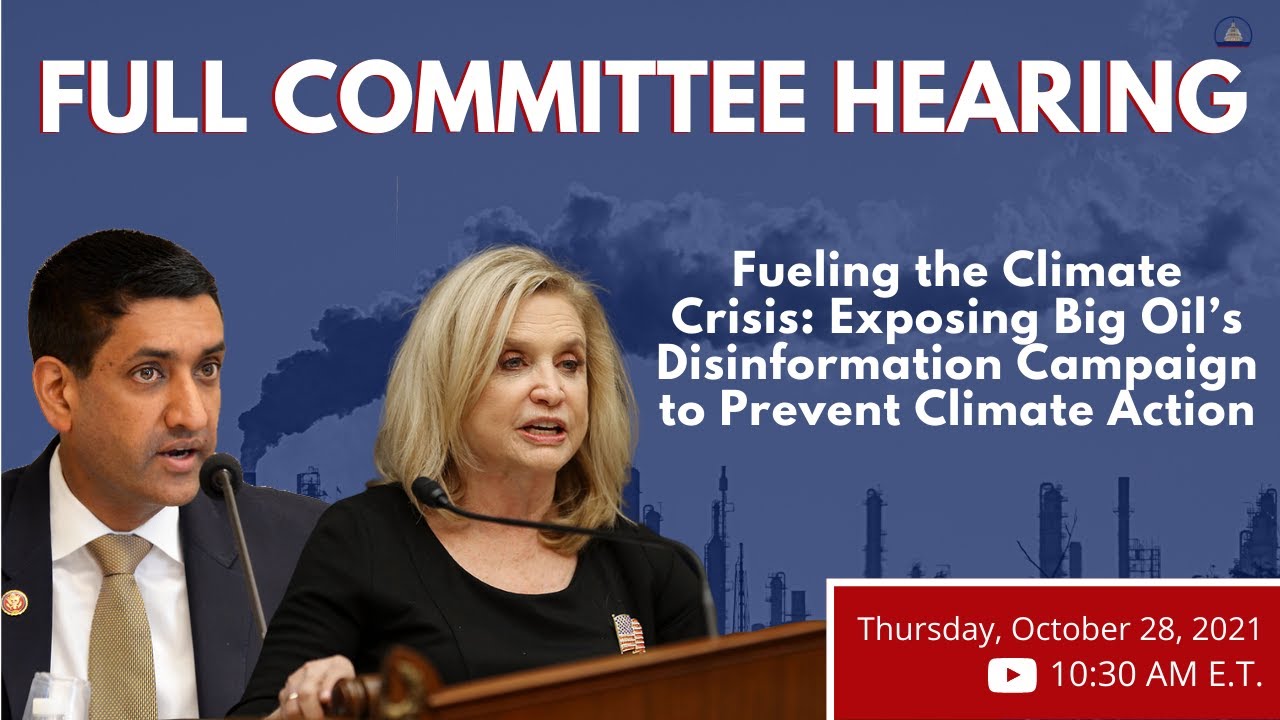 in October 2021, Democratic Rep. Mondaire Jones called out the Shute Creek project in questions posed to ExxonMobil CEO Darren Woods. “Exxon and others are using captured CO2 to extract more oil and calling this a climate mitigation strategy,” Jones said. The hearing, which featured testimony from the CEOs of ExxonMobil, BP, Shell, Chevron, and the American Petroleum Institute, was part of the U.S. House Oversight Committee’s “historic” investigation into Big Oil and climate disinformation. The Democrat-led committee wrapped up the investigation in December, before Republicans took control of the House, and concluded, based on hearings and subpoenaed documents, that the oil and gas industry is continuing to mislead the public about its climate commitments. A central part of the industry’s strategy to portray itself as an essential partner in climate action, it seems, is to go all in on carbon capture and storage.
CCS and the related carbon capture, utilization, and storage (CCUS), are a set of technologies designed to trap some of the carbon pollution produced from industrial facilities. The carbon dioxide then is compressed and transported to sites where it is either stored underground, injected into oil and gas deposits for enhanced oil recovery, or used for a limited number of other applications such as beverage carbonation. ...
==
EJ
https://www.desmog.com/2023/02/03/rio-grande-lng-carbon-capture-greenwash-brownsville-texas-nextdecade/
---
ff ceo memo, not just br fuel
...examples.”57
API’s publicly released Climate Action Framework does not state that it is intended to promote natural gas.
API’s inconsistent internal and external messaging is common in the oil and gas industry, which advocates for government financial support for carbon capture technologies as a climate mitigation initiative—without public acknowledgement that the support entrenches reliance on fossil fuels, thereby directly benefiting the companies’ business-as-usual operation and delaying the transition to clean energy.58 An October 9, 2018, letter to members of the National Petroleum Council (NPC) from John Mingé, BP America President and Chairman of the NPC Committee on Carbon Capture, Use, and Storage (CCUS), highlights the disconnect between the industry’s public and private rhetoric.
The letter highlights an NPC carbon capture study finding that incorporating CCUS into “U.S. energy and environment plans would deliver benefits,” including “[i]ncreased usage of existing US fossil fuel resources, protecting state and federal revenue sources and supporting the license to operate.”59 Those self-interested benefits to the fossil fuel industry are only noted internally to work group members, and are not mentioned in the NPC’s 2019 public report.Instead, the public report is presented as an altruistic effort to help the world provide “affordable, reliable energy.”60 Other internal documents refer to industry’s need for financial help from the government to develop a carbon capture industry in support of the license to continue to pump fossil fuels.61
B. Presenting Natural Gas as a Bridge Fuel to Secure its Future as a Destination Fuel
In 2021, natural gas contributed to 34% of U.S. energy-related emissions and 22% of emissions globally. 62 Documents obtained by the Committee show fossil fuel companies and lobbying groups seek to publicly position natural gas as a clean source of energy and part of the transition to renewables, even as the industry is privately planning for expanded natural gas production over the long term. In November 2017, a group of major oil companies, including Exxon, Shell, and BP, announced “Methane Guiding Principles.” The group acknowledged, “Since natural gas consists mainly of methane, a potent greenhouse gas, its part in the transition to a low-carbon future will be influenced by the extent to which the oil and gas industry reduces it methane emissions.” 63 Yet internal Shell documents suggest that the companies initially intended this document to serve as a defense of the long-term use of natural gas well beyond a mere “transition.”
In a September 29, 2017, email, Dick Francis, Manager of Regulatory Policy for Shell Exploration & Production Company, distributed the first draft of the Guiding Principles document to his Shell colleagues, writing: Also included in the document is an important preamble that clearly makes the case for natural gas and identifies the need to address methane emissions. Linking the natural gas preamble to the principles is an important element. Because supporting the principles will also signal acknowledgment of natural gas’s place in a low carbon future. Internal BP documents from 2017 and 2018 reveal that the company engaged a public relations firm—the Brunswick Group—to develop an advocacy campaign for gas and methane.64
A PowerPoint presentation prepared by Phil Drew, a Partner at the Brunswick Group, was presented to Robert Stout,BP’s Vice President & Head of Regulatory Affairs, and Mary Streett, BP’s Senior Vice President, U.S. Communications and External Affairs, describing the campaign that the Brunswick Group developed for BP. The overall goal of the campaign was to “Advance and protect the role of gas—and BP—in the future of energy conversation.”
62 Energy Information Administration, Where Greenhouse Gases Come From (online at www.eia.gov/energyexplained/energy-and-the-environment/where-greenhouse-gases-come-from.php) (accessed Nov. 9, 2022).
63 Climate and Clean Air Coalition, Reducing Methane Emissions Across the Natural Gas Value Chain – Guiding Principles (Nov. 2017) (online at www.ccacoalition.org/en/resources/reducing-methane-emissions-acrossnatural-gas-value-chain-guiding-principles). 64 BPA_HCOR_000246
---
---
https://oversight.house.gov/news/press-releases/ahead-of-hearing-committee-releases-memo-showing-fossil-fuel-industry-is
Ahead of Hearing, Committee Releases Memo Showing Fossil Fuel Industry is Misleading the Public About Commitment to Reduce Emissions
Sep 14, 2022
Press Release
Documents Show Big Oil Is Devoted to a Long-Term Fossil Fuel Future and ‘Greenwashing’ Its Record Through Deceptive Advertising and Climate Pledges
Washington, D.C. (Sept. 14, 2022)—Today, Rep. Carolyn B. Maloney, the Chairwoman of the Committee on Oversight and Reform, and Rep. Ro Khanna, the Chairman of the Subcommittee on Environment, released a new memo of initial findings of the Committee’s year-long investigation into the fossil fuel industry’s campaign to mislead the American people about the industry’s role in climate change. The findings come ahead of tomorrow’s full Committee hearing at 9:30 a.m. ET, to hear firsthand accounts from survivors of severe weather events fueled by the climate crisis, and examine fossil fuel industry profits and the adequacy of their climate pledges.
“As we face more deadly, extreme weather around the globe, fossil fuel companies are reaping record profits and ramping up their misleading PR tacticsto distract from their central role in fueling the climate crisis,” said Chairwoman Maloney. “My Committee’s investigation leaves no doubt that, in the words of one company official, Big Oil is ‘gaslighting’ the public. These companies claim they are part of the solution to climate change, but internal documents reveal that they are continuing with business as usual. I call on the big fossil fuel companies to stop their deception and cut their emissions now—before it is too late.”
“The documents I released today as part of my investigation into Big Oil’s efforts to deceive the American public about the climate crisis are explosive,” said Subcommittee Chair Khanna. “Internal emails and messaging guidance show that Big Oil’s climate pledges rely on unproven technology, accounting gimmicks and misleading language to hide the reality. The documents also show a culture of intense disrespect towards leading climate activists like Bill McKibben and influential climate groups like the Sunrise Movement. Big Oil executives are laughing at the people trying to protect our planet while they knowingly work to destroy it.”
The Committee’s memo found:
- Contrary to their pledges, fossil fuel companies have not organized their businesses around becoming low-emissions, renewable energy companies. They are devoted to a long-term fossil fuel future.
- Despite BP previously rebranding itself as “Beyond Petroleum,” internal documents highlighted how carbon capture and storage (CCS), one of the energy technologies touted by the company, could “enable the full use of fossil fuels across the energy transition and beyond.”
- An internal Shell email discussingcarbon capture, utilization, and storage (CCUS) warned an executive, “We want to be careful to not talk about CCUS as prolonging the life of oil, gas or fossil fuels writ large.”
- Chevron pays lip service to a “just transition” to cleaner fuels but provided talking points to an executive asserting that “[o]il and gas” are the “lower carbon solutions that ensures a just transition.”
- Big Oil’s climate pledges and green advertising focus on unproven technologies the companies admit are decades away from implementation.
- Although Exxon spent at least $68 million advertising its research into algae-based biofuels, notes from an investor presentation obtained by the Committee show this technology is “[s]till decades away from the scale we need.”
- One Exxon public affairs manager warned that implying in an advertisement that algae can be deployed on a mass scale would be misleading, and “might create some angst with the research folks who know that.”
- Oil and gas companies have tried to create the impression that they are taking ambitious steps to reduce emissions—without actually doing so.
- Internal documents show that Exxon and Chevron sought to water down statements by the industry-led Oil and Gas Climate Initiative (OGCI) to “remove language that potentially commits members to enhanced climate-related governance, strategy, risk management, and performance metrics and targets” and to avoid any “explicit commitment for OGCI companies to align their advocacy with their climate related positions”—including advocacy for the Paris Agreement.
- Shell has touted its “Sky scenario” as an ambitious path to achieve net-zero emissions, but internal emails emphasize this is “not a Shell business plan” and has “nothing to do with our business plans.”
- Internal Shell messaging guidance—which was developed to “insulate Shell” from lawsuits about “greenwashing” and “misleading investors” on climate change—calls on employees to emphasize that net-zero emissions is “a collective ambition for the world” rather than a “Shell goal or target.” The guidance urges Shell employees, “Please do not give the impression that Shell is willing to reduce carbon dioxide emissions to levels that do not make business sense.”
- Big Oil relies on accounting gimmicks, tricky language, and delay tactics to claim the mantle of climate leadership while continuing to be a primary cause of an ongoing climate catastrophe.
- Internal documents show that in 2019, Exxon scrubbed a public statement about an executive’s speech at a private conference to remove a reference to a plan to increase production in the Permian basin by “1000% within 5 years.”
- After Shell posted on Twitter asking others what they would do to reduce emissions, a communications executive wrote privately that he agreed this could be seen as “gaslighting” the public, explaining: “We are, after all, in a tweet like this implying others need to sacrifice without focusing on ourselves.”
Click here to read the Committee memo.
Click here to read selected investigation documents.
Click here to watch the Committee hearing tomorrow at 9:30 a.m. ET.
---
---
much on greenwash ccs and algae
https://oversight.house.gov/sites/democrats.oversight.house.gov/files/2022.09.14%20FINAL%20COR%20Supplemental%20Memo.pdf
p 13
[CCS] underperformed or failed.48Exxon recently announced ten potential new facilities around the
world. 49
Exxon spent $86 million in 2010 to expand its carbon capture facility in Wyoming and
plans to spend another $400 million on a further expansion of the facility. 50 Exxon claimed $240
million in carbon capture tax credits over the last decade of the facility’s use. However, experts
estimate that Exxon may only be capturing less than 1% of its total emissions through carbon
capture technology.51
In a May 2018 email exchange, Exxon CEO Darren Woods and Exxon’s Vice President
of Corporate Strategic Planning, Mr. Wojnar, discussed “emissions avoided” through carbon
capture technology. Mr. Wojnar wrote to Mr. Woods that he was “[c]oming back on your
question on GHG emissions avoided,” including through carbon capture technology, and
provided “options for how to respond to a query” on this topic. Mr. Wojnar suggested that Mr.
Woods say that “over the last decade, ExxonMobil has taken action to reduce GHG emissions by
approximately 75 million tons.”52 In reality, nearly all the carbon dioxide Exxon has captured
through CCS has been sold to other fossil fuel companies to inject into their depleted oil fields to
help extract even more oil. As a result, the carbon captured by Exxon through CCS technology
likely has not meaningfully reduced total carbon emissions.53
Exxon has heavily advertised its efforts to develop carbon capture technology. Three
carbon capture television ads from 2016 through 2019 aired 9,058 times nationally, generated 4.1
billion impressions, and are estimated to have cost Exxon over $68 million to run. 54 Draft ...
Chevron’s and Exxon’s Attempt to Use OGCI to Greenwash Big Oil
The Oil and Gas Climate Initiative (OGCI) is a voluntary organization co-led by
members from the oil and gas industry and environmental groups. Its stated intent is “to deliver
tangible, transparent and integrated contributions to climate change solutions.”76
Documents obtained by the Committee show that in 2019, employees from Exxon and
Chevron edited a messaging document from OGCI ahead of the annual Conference of Parties to
the United Nations Framework Convention on Climate Change. The document was meant to
“serve as the basis for communication & press release as well as talking points for the CEO
event.” The documents suggest that despite several attempts to weaken the language, OGCI
pushed back, saying that Exxon’s and Chevron’s CEOs already committed to the stronger
language. The edits from Exxon and Chevron attempted to weaken OGCI’s ambition on targets
for achieving net-zero emissions, methane emissions, carbon intensity, carbon capture
implementation, among other things. 77
In particular, a memorandum from Peter Trelenberg, Exxon’s Manager of Environmental
Policy & Planning, to CEO Darren Woods highlighted “critical edits” proposed by Exxon and
noted that “Chevron has expressed that they are generally aligned with these edits.” Among
other issues, the memo to Exxon’s CEO addresses the following:
• Avoiding a commitment to advocate for the Paris Agreement. Regarding OGCI’s
“Statement on responding to the climate challenge,” Mr. Trelenberg wrote:
“Need to remove reference to Paris Agreement as support for the Paris
Agreement goals and member company advocacy are separate concepts and not
directly related. Creating a tie between our advocacy/engagements and the Paris
Agreement could create a potential commitment to advocate on the Paris
Agreement goals.”
• Avoiding a commitment to advocate for climate policies that Exxon and Chevron
claim to support. The memo raised a concern that one OGCI annual report
“includes explicit commitment for OGCI companies to align their advocacy with
their climate related positions. We have raised concerns with this linkage
through previous comments.”
• Refusing to commit to enhanced climate-related governance.The memo
continued, “Need to remove language that potentially commits members to
enhanced climate-related governance, strategy, risk management, and
performance metrics and targets.” ESG?!
• Concern about a commitment to reduce downstream emissions. Discussing an
OGCI “September Announcement package,” the memo states: “The carbon
...
---
---
caller energy eg
carbon dioxide removal is the process of removing carbon pollution from the atmosphere via natural and technological methods, and will be an important tool for restoring a safe climate — once we’ve pretty much stopped sending more carbon dioxide into the atmosphere.
:{:{}:
}:
Carbon capture and storage/sequestration (CCS), on the other hand, refers to scrubbing the carbon dioxide out of the emissions from fossil fuel plants, and is essentially a pipe dream that the fossil fuel industry invokes to pretend its continued existence is compatible with a stable climate, which it’s not. CCS is also a major part of the policy platforms of conservatives who want you to think they care about climate change (but not enough to actually reduce fossil fuel extraction or pollution).
Late last year, the Government Accountability Office published a report showing the $1.1 billion spent on CCS by the Department of Energy since 2009 was largely wasted. That money was for 11 projects, of which only three were built (the other eight were cancelled). And because managers at the DOE waived some cost controls, the government spent an additional and unnecessary $300 million on four of the unbuilt CCS projects. The single CCS project at a coal-fired plant that actually got built was the US’s only real CCS facility — and it shut down in May of 2020.
“Federal investments for CCS are greenwashing – they are simply fossil fuel subsidies by another name,” Grassroots Global Justice Alliance policy director Adrien Salazar told The Verge.
Nevertheless, CCS still enjoys ample support from conservatives who want to pretend like they care about climate change, and Democratic coal barons like Joe Manchin (D-ALEC).
In response to the GAO report detailing how the conservative-loved program is rife with government waste, the Carbon Capture Coalition tried to do some damage control, and apparently sent out a press release the conservative Washington Examiner ran with, about how they’re trying to “correct the record” and insist the technology is still worthwhile.
Over at the Daily Caller, though, Energy and Environment reporter Thomas Catenacci apparently hasn’t gotten the full memo on CCS being the climate policy conservatives pretend to support, and instead just covered last month’s GAO report just this week, with a frame of government waste for trying to reduce carbon emissions!
Now to be fair, the government should be investing tons of money in viable climate solutions as well as risky ones the private sector won’t yet risk investment in (Hi, Solyndra, we haven’t forgotten you!) because government support for emerging technologies can yield massive benefits. But when things like CCS fail, as they have over, and over, and over, and over, and over, and over, and over, and over, that should be a sign to stop burning coal mine dump trucks full of money chasing them.
Those billions of dollars, instead of getting wasted on unbuilt CCS plants meant to keep coal hobbling along, could have paid for something like 50,000 home solar systems, which tend to be much more costly than utility-scale renewables. And on that, for example, Biden’s DOE in 2021 announced just $128 million in funding to cut the cost of solar by 60%. Think of what ten times that much money could accomplish!
For another comparison, in 2020, a billion dollar deal got BP a 50% stake in two offshore wind projects big enough to power two million homes — a much better deal than getting a bunch of failed projects that (had they not failed) would have just continued to allow coal plants to pollute anyway.
A billion dollars is also how much MidAmerican Energy planned to spend in Iowa to replace old wind turbines and add a thousand new ones, adding up with the rest of their fleet to generate enough clean energy to power 95% of MidAmerican Energy customers’ needs.
Unfortunately, the bipartisan infrastructure package passed last year shells out another $3.5 billion on even more carbon capture demonstration projects.
CCS has had plenty of time for demonstration projects, and all they’ve demonstrated is how to waste billions of dollars on useless technology.
But yay, bipartisanship, right?
---
---
huge ccs shut down last yr? (kemper cty, Southern co?]
ENERGY
Exxon plans to build nation’s largest carbon capture project in Baytown
Shelby Webb Staff writer
March 1, 2022
Exxon Mobil will build one of the world’s largest carbon capture and storage projects, as well as a new hydrogen production plant, at its refining and petrochemical site in Baytown.
The company made the announcement Tuesday, though key details are still unkown, such as a timeline and cost. Officials also are still deciding where they will inject the carbon dioxide into geologic formations beneath the Texas coast, said Ed Graham, vice president of ventures for Exxon Mobil Low Carbon Solutions.
The goal is for the project to transport and store up to 10 million metric tons of carbon dioxide a year, which would make it the largest project of its type in the United States, according to business data company Statista.
BIG MONEY: Exxon posts $23B profit last year, highest since 2014
The hydrogen plant, meanwhile, would produce up to 1 billion cubic feet a day of hydrogen by using natural gas as a feed stock. That hydrogen would be used in Exxon’s olefins plant in Baytown, reducing on-site emissions by up to 30 percent.
“It will be a game-changer for Houston to help kickstart both the hydrogen and (carbon capture and storage) industries,” Graham said. “This will help us more broadly decarbonize our businesses across Houston.”
Houston companies and local officials have pitched Houston as the ideal proving ground for the hydrogen industry. The city is already the largest hydrogen producer in the country, producing one-third of the annual U.S. output. There are 48 hydrogen production plants across the region and more than 900 miles of pipelines designed specifically for hydrogen — about one-third of all hydrogen pipelines globally.
In late January, Texas Sen. John Cornyn pitched a bipartisan Hydrogen Infrastructure Initiative. If passed, it would create grant programs to encourage construction of hydrogen infrastructure at ports and heavy-industry facilities and provide financing to support hydrogen transport infrastructure.
The Exxon Mobil plant would use natural gas [METHANE?!] to produce what’s known as blue hydrogen. Graham said the carbon dioxide produced from turning the natural gas into hydrogen would be captured and sequestered as part of the new carbon capture project.
Exxon Mobil’s plans to reach net-zero greenhouse gas emissions from its operations by 2050 relies heavily on carbon capture and sequestration. Last spring, executives said they were looking to build a $100 billion carbon capture project along the Ship Channel [HURRICANES] . Also last year, Exxon’s low-carbon solutions venture said it would invest $3 billion in a portfolio of 20 carbon capture projects.
Graham said Exxon already injects more carbon dioxide into the earth than any other company. He said the projects are part of “world-scale efforts.”
“Houston and Baytown are important to us as a company, and it's important that we help lead the way and to help Houston and its efforts to be a leader in the energy transition,” Graham said. “And we think these (carbon capture) technologies and hydrogen are really critical to make that happen.”
shelby.webb@chron.com
---
axios
hOUSTON — CEOs of multinational oil-and-gas giants Exxon and TotalEnergies gave remarks at a major industry gathering here that underscore Big Oil's differing diversification strategies across the Atlantic.
What they're saying: Exxon CEO Darren Woods touted Exxon's emphasis on carbon capture, hydrogen and biofuels.
- "We are a company that has a real long history in frankly, manipulating hydrocarbon molecules to make products that the world needs," Woods said at the CERAWeek by S&P Global conference.
- "Andif you think about the technology that we have been using and will use in this space, it's is continuing to manage hydrocarbon molecules and leveraging the skills that we've developed over the years," he said.
The other side: Patrick Pouyanné cited TotalEnergies' moves into areas including renewable power, electricity services, batteries and EV charging that TotalEnergies and other European majors like BP and Shell are increasingly pursuing.
- "The transition is a matter of two types of new products: new molecules, on which obviously an oil-and-gas company, some DNA, it's biofuels, biogas, hydrogen, and the strategic move we have decided that we will become an electricity and renewable producer and supplier," he said.
Of note: Traditional fossil fuels remain the dominant business lines of all the majors.=
---
https://www.sciencedirect.com/science/article/pii/S1876610211008101
Abstract
Production of natural gas from theLaBarge field in southwest Wyoming began in 1986.This gas contains high concentrations of carbon dioxide (CO2), and from the very beginning, ExxonMobil has successfully implemented several technologies and approaches to effectively manage the substantial volumes of CO2 associated with its production. Many of the technologies and approaches used for managing CO2 at LaBarge are examples of technologies and approaches being proposed for use in carbon capture and storage (CCS) by other industries.
The Shute Creek Treating Facility (SCTF) processes the gas produced from the LaBarge field. The SCTF handles the lowest hydrocarbon content natural gas commercially produced in the world. The gas composition entering Shute Creek is 65% CO2, 21% methane, 7% nitrogen, 5% hydrogen sulfide (H2S) and 0.6% helium. The SCTF separates CO2, methane, and helium for sale and removes hydrogen sulfide for disposal.
Most of the CO2 captured at Shute Creek is used for enhanced oil recovery (EOR). EOR is consistently cited as one of the most viable early opportunities for large scale implementation of CCS. ExxonMobil’s LaBarge operation is the largest deployment of this approach to CCS in the world today. Currently ExxonMobil provides 4 to 5 million tonnes per year of CO2 for EOR. Ongoing facility expansion will increase this capacity to over 7 million tonnes per year in 2010.
A concentrated acid gas stream of about 60% hydrogen sulfide and 40% CO2 is injected into a carefully selected section of the same reservoir from which it was produced, safely disposing of the hydrogen sulfide along with approximately 400,000 tonnes of CO2 per year. Other technologies and approaches that have reduced CO2 emissions include the ExxonMobil patented low BTU fuel co-generation system that substantially reduces CO2 emissions when compared to emissions from purchased power.
Cumulatively, through the application of these technologies at LaBarge, ExxonMobil will have the capacity to capture and manage over 75% of the CO2 produced from the LaBarge field.
Additionally, new technologies are being developed that may provide additional reductions in emissions, either at this site or at others with similarly challenged production streams. Construction of a commercial demonstration facility for ExxonMobil’s Controlled Freeze ZoneTM (CFZ) gas treatment technology has been completed at Shute Creek and operations are about to begin. The CFZTM technology allows the single step separation of CO2 and other contaminants from a natural gas stream without the use of solvents or absorbents. Its successful commercial demonstration would enable the development of increasingly sour gas resources around the world by substantially reducing gas treatment and geo-sequestration costs from these sources
---
---
https://insideclimatenews.org/news/09032022/carbon-capture-and-storage-fossil-fuels-climate-change/
no lnx many grfx
Fossil Fuels
Carbon Capture Takes Center Stage, But Is Its Promise an Illusion?
The oil industry, Biden administration and even some environmentalists see sucking carbon dioxide from smokestacks and the atmosphere as critical to solving the climate crisis. But the IPCC says relying on it presents a “major risk.”
By Nicholas Kusnetz
March 9, 2022
[Related
Fossil Fuel Companies Stand to Make Billions From Tax Break in Democrats’ Build Back Better Bill]
Biggest “Direct Air Capture” Plant Starts Pulling in Carbon, But Involves a Fraction of the Gas in the Atmosphere
Fossil Fuel Companies Are Quietly Scoring Big Money for Their Preferred Climate Solution: Carbon Capture and Storage
]
Equipment installed as part of the Petra Nova Carbon Capture Project stands at the NRG Energy Inc. WA Parish generating station in Thompsons, Texas, on Thursday, Feb. 16, 2017. The project has since ceased operations indefinitely. ]
Pipe Dreams: First of a continuing series on whether capturing carbon is a climate solution or a dangerous distraction.
With his climate agenda stalled in Congress, President Joe Biden has managed to win billions in federal spending for one pillar of his platform that is gaining increased attention globally: carbon capture.
In a major win for oil, coal, utilities and other industries, the federal government is poised to make its largest investment ever—more than $12 billion from last year’s infrastructure bill—in technologies that capture carbon dioxide from smokestack emissions or straight from the air.
ExxonMobil, Southern Company and other oil fossil fuel giants have promoted carbon capture and storage as a tool for cutting emissions for more than a decade, with little to show for it.
Still, carbon capture is gaining traction with politicians in both parties, policy experts, scientists and even some environmentalists who say that the threat of climate change is so dire that it requires every possible solution.
Supporters including Sen. Sheldon Whitehouse, a Rhode Island Democrat and one of the Senate’s most outspoken champions of climate action, point to modeling by academics and others that show the technologies could play a critical role in curbing emissions, particularly from hard-to-tackle sectors like heavy industry and shipping.
Their arguments have won unprecedented spending on carbon capture over the past year, with governments in Europe, Canada and Australia also committing billions in subsidies. Proponents say all this funding could prove transformative and, within a decade, could help cut hundreds of millions of metric tons of pollution annually.
But many progressive climate groups like Greenpeace and 350.org say oil companies are promoting the technologies as a distraction to avoid phasing out their products. At best, they argue, carbon capture and removal will play a marginal role in limiting emissions. At worst, they warn, subsidies for the technologies will prolong demand for fossil fuels, squandering money that would be better spent on replacing coal, oil and gas altogether.
While the Intergovernmental Panel on Climate Change said in 2018 that carbon capture and removal technologies may be critical to limiting warming to 1.5 degrees Celsius (2.7 degrees Fahrenheit), it also said that carbon removal in particular remains unproven and that relying on it posed “a major risk” to meeting climate targets. Carbon capture prevents emissions, by pulling them out of smokestacks, while carbon removal refers to processes that suck the gas from the atmosphere.
In 2020, U.S. greenhouse gas emissions totalled nearly 6 billion metric tons of carbon dioxide equivalent, including other pollutants like methane. Even optimistic projections say that carbon capture and removal technologies will be able to cut only about 250 million metric tons annually by 2035, or about4 percent of 2020 emissions.
“The Biden administration is really doubling down on the fossil economy and the false solutions that are entrenching that fossil economy in the name of addressing the climate crisis,” saidCarroll Muffett, chief executive of the Center for International Environmental Law, a nonprofit advocacy group. “I think that is a really significant failure of vision and failure of leadership.”
The infrastructure bill, for example, will direct billions of dollars to producing electricity and hydrogen from fossil fuels paired with carbon capture and storage. Yet Muffett and others point out that wind and solar are already cheaper sources of electricity than fossil fuels, even without the added expense of operating carbon capture equipment.
The White House declined to comment for this article, but a spokesperson for its Council on Environmental Quality pointed to a report it issued last year, which said that in order to reach net-zero emissions by mid-century, “the United States will likely have to capture, transport, and permanently sequester significant quantities of carbon dioxide.”
Big Money for Carbon Capture and Removal
Last month, the council attempted to square carbon capture with another pillar of Biden’s climate plan, environmental justice, issuing guidance that recommended including community input during the planning and approval of all carbon capture projects.
Environmental justice advocates have been among the harshest critics of carbon capture, saying it won’t address the many other forms of toxic pollution from producing and burning fossil fuels. The White House’s own Environmental Justice Advisory Council included carbon capture and carbon removal in a list of the kinds of projects that would not benefit communities at all.
With the first batches of federal spending set to start flowing this year, these competing arguments are about to see their biggest tests yet.
A Flood of Investment
The last year has seen a wave of new carbon capture, storage and removal projects announced, with at least 55 in the United States alone since the beginning of 2021, according to the Clean Air Task Force, an environmental group. Some are highly speculative, such as a proposal by Exxon to build a $100 billion carbon capture “hub” in the Houston area.Exxon announced the first proposed project for the hub on Wednesday, a plan to attach carbon capture to its refinery complex in Baytown, Texas, to produce low-emissions hydrogen.
:{:{}:
}:
The company has said the hub can proceed only with substantial government funding and tax incentives worth $100 per ton of carbon dioxide removed, twice the current rate.
In North Dakota, an energy company bought a coal power plant slated for closure and said it would revive it by attaching carbon capture technology.
Other projects are further along, particularly in sectors including ethanol and fertilizer production, where the costs of capturing carbon dioxide are lower because of the emissions’ high concentrations of the greenhouse gas.
In the Midwest, companies want to build a network of carbon dioxide pipelines to connect corn ethanol plants and distribute the gas for injection underground. These proposals are being driven by a federal tax credit that was increased in 2018 and gives companies up to $50 per metric ton for capturing and storing carbon dioxide.
The Biden administration has promised its support. Its roadmap for reaching net-zero emissions by mid-century, released last year, included a significant role for carbon capture and storage. It has also said it wants to further increase the value of the carbon capture tax credit. The Build Back Better legislation would have raised the value to up to $85 per ton for carbon dioxide removed from smokestacks, and up to $180 per ton when the gas is removed directly from the air.
:{:{}:
}:
While the bill failed, the expanded tax credit enjoys support from lawmakers in both parties, includingSen. Joe Manchin (D-W. Va.), the powerful chairman of the Energy and Natural Resource Committee.
The promise of a bigger payout has helped spur a wave of entrepreneurial activity and corporate investment in carbon removal. Microsoft, Stripe, United Airlines and other companies have announced millions of dollars in investments in carbon removal, and some have even bought carbon offsets from the first commercial “direct air capture” plant, which began operating last year in Iceland. Technology giants—and billionaire executives including Bill Gates and Jeff Bezos—have been pouring money into start-ups. Elon Musk’s foundation is funding a $100 million competition for efforts to pull carbon from the atmosphere, including direct air capture, nature-based and other approaches.
Occidental Petroleum has said it plans to begin construction this year on a direct air capture plant in Texas that will initially pull up to 500,000 metric tons of carbon dioxide from the air. The company could then pump the gas into depleted oil reservoirs to increase their production, a process that can also store most of the carbon dioxide underground.
The International Energy Agency last year said that the most “cost-effective and economically productive pathway” to reaching net-zero emissions by mid-century required not only the rapid phase-out of coal power plants and an end to the sale of gas and diesel cars by 2035, but also substantial amounts of carbon capture and storage, with a more than 40-fold increase in the technology’s capacity by 2030, to nearly 1.7 billion metric tons.
That tremendous leap would still represent less than 5 percent of global carbon dioxide emissions in 2021. Direct air capture capacity, it said, would need to reach 90 million metric tons by 2030 from essentially zero today.
“We’re at a point when dealing with climate that we just have to look at all the options now,” said Shannon Heyck-Williams, senior director of climate and energy policy for the National Wildlife Federation. Her organization is part of the Carbon Capture Coalition, which includes fossil fuel producers, utilities and unions and has pressed for more federal funding for the technologies.
John Thompson is the technology and markets director at the Clean Air Task Force, which is also a member of the Carbon Capture Coalition, and he said that while the United States may be closing most of its coal plants, China is building more. Deploying the technology domestically, he said, could help China adopt it on a larger scale.
“If our retrofits in the United States shave five, 10 years off the time China takes to decarbonize, that’s globally significant,” he said. “We can’t bet the planet that those coal plants are going to close.”
Direct air capture is particularly alluring because it could draw carbon dioxide out of the atmosphere. Such “negative emissions” will be necessary to meet climate targets, scientists say. Restoring natural habitats also pulls carbon from the air, is far cheaper, and has many other benefits. But many scientists say the capacity of that method is limited, and planting new forests will face competing demands for land from agriculture. Storing carbon dioxide underground could also be more durable than storing it in trees, which are vulnerable to fires and droughts.
Supporters of pursuing direct air capture say that, by pulling carbon dioxide from the air, the technology could achieve something that even the most aggressive measures to avoid emissions could not.
“Carbon removal offers a way for those of us who have caused and benefited the most from climate change to clean up our mess, and that’s one of the things that to me makes it particularly attractive,” said David Morrow, director of research at the Institute for Carbon Removal Law and Policy at American University, though he added that direct air capture is only one of several approaches to removing carbon dioxide from the air. “Emissions abatement can’t do that. We can get to zero and the mess is still there.”
Expensive and Energy-Intensive
If these arguments sound convincing—who wouldn’t want to lock away emissions for good?—many environmental advocates say they gloss over an important detail. Despite decades of research and development, and billions of dollars spent, carbon capture and removal remain extremely expensive and energy-intensive, even as the costs of alternatives have plummeted.
Building new renewable energy projects is cheaper than building new fossil fuel power plants in much of the world, and in some cases is even cheaper than continuing to operate coal or natural gas plants. Adding hundreds of millions or billions of dollars to build and operate a carbon capture system only worsens the math.
A December report by the Government Accountability Office said the Department of Energy gave nearly $684 million to six coal plants for carbon capture projects from 2010 through 2017, but that only one of those projects was built and it ceased operations in 2020, citing high costs.
In the industrial sector, critics say, other technologies such as electrification or the use of hydrogen made with renewable electricity may be more cost effective than carbon capture equipment.
Direct air capture is even more expensive. The only commercial operation captures 4,000 tons of carbon dioxide per year, an insignificant number when it comes to reducing greenhouse gases. It was built in Iceland partly because of access to abundant geothermal, emissions-free energy to run the project.
The technology generally requires large amounts of power, heat or both, so scaling it would consume vast quantities of energy and money. Skeptics argue that it would be cheaper and better to simply feed this carbon-free energy into the grid to electrify the economy.
Large-scale carbon capture would require pipeline networks that would rival the scale of existing oil pipelines. They would come with their own set of safety risks associated with leaks and ruptures—in large volumes, carbon dioxide is an asphyxiant.
Then there is all the other pollution associated with producing, transporting and burning fossil fuels, much of which would remain unaddressed by carbon capture equipment.
“That entire fossil fuel life-cycle pollution remains in place,” said Basav Sen, climate justice project director at the Institute for Policy Studies, a progressive think tank. “You are in a sense losing an opportunity to deal with multiple environmental problems in the way you tackle greenhouse gas emissions.”
Just a Down Payment?
Carbon capture has failed to catch on commercially—there are only a few dozen plants operating globally, most of them in the United States. But both supporters and critics say that might be changing, thanks largely to government support.
The funding in the infrastructure bill was the culmination of years of lobbying by industry and unions. One carbon capture bill, which was later included in the infrastructure law,drew lobbying from dozens of corporations and industry groups in the coal, oil and power sectors, as well as from labor unions, according to OpenSecrets, which tracks money in politics. In Exxon’s lobbying disclosures, carbon capture and storage was the only issue tied to the infrastructure law it reported discussing. In fact, Exxon reported lobbying on carbon capture more than on any other issue last year, according to an Inside Climate News analysis.
The result was more than $12 billion dollars that will fund large scale demonstration projects to capture and store carbon dioxide, as well as funding for the pipelines and infrastructure that would tie it all together. The Department of Energy, which will oversee most of the money, is required to fund at least one demonstration project each for coal and natural gas power plants and an industrial application. The bill directed an additional $8 billion to “clean hydrogen” projects. Some of that funding, too, is earmarked for using fossil fuels paired with carbon capture to produce hydrogen. Today, hydrogen is commonly produced from natural gas, but the process emits carbon dioxide.
Thompson, of the Clean Air Task Force, said the funding is important to help demonstrate the technologies at commercial scale in different applications. But he said carbon capture will need far more government support in the form of tax incentives, or a price on carbon emissions, to play a larger role.
“You could see enormous growth, something like 200 million tons of CO2 captured every year in the 2030s” if the tax incentives were increased to the levels included in the Build Back Better Act, he said.
Put another way, $12 billion may be only a down payment.
Nicholas Kusnetz
Reporter, New York City
Nicholas Kusnetz is a reporter for Inside Climate News. Before joining ICN, he worked at the Center for Public Integrity and ProPublica. His work has won numerous awards, including from the American Association for the Advancement of Science and the Society of American Business Editors and Writers, and has appeared in more than a dozen publications, including The Washington Post, Businessweek, The Nation, Fast Company and The New York Times. You can reach Nicholas at nicholas.kusnetz@insideclimatenews.org and securely at nicholas.kusnetz@protonmail.com.
---
interesting ~ to myth of gubmint scientist paid
https://yyy.theguardian.com/science/2022/mar/21/universities-must-reject-fossil-fuel-cash-for-climate-research-say-academics
no lnx many
Universities must reject fossil fuel cash for climate research, say academics
Open letter from 500 academics likens fossil-energy funding of climate solutions to tobacco industry disinformation
Michael Mann, director of the Earth System Science Center at Pennsylvania State University, speaks to media before a Climate Emergency Summit in Melbourne
Michael Mann, director of the Earth System Science Center at Pennsylvania State University, said fossil-fuel funding ‘has been used to compromise leading academic institutions’. Photo]
Fiona Harvey environment correspondent
Mon 21 Mar 2022
Universities must stop accepting funding from fossil fuel companies to conduct climate research, even if the research is aimed at developing green and low-carbon technology, an influential group of distinguished academics has said.
Rowan Williams, the former archbishop of Canterbury, the Nasa data scientist Peter Kalmus, and prominent US climate scientist Michael Mann are among close to 500 academics from the US and the UK who have written an open letter addressed to all university leaders in the two countries, calling on them to reject all funding from fossil fuel companies.
Accepting money from fossil fuel companies represented “an inherent conflict of interest” and could “taint” essential research and “compromise” academic freedom, they wrote. For the companies, it was a chance to “greenwash” their reputations and skew the findings of research in a way favourable to them.
The letter draws a comparison to the tobacco industry and its disinformation campaigns, noting that numerous public heath and research institutions reject tobacco funding for these reasons and calling on fossil fuel cash to be treated similarly.
“Universities and the research they produce are vital to delivering a rapid, just transition away from fossil fuels. However, such efforts are undermined by fossil fuel industry funding. Academics should not be forced to choose between researching climate solutions and inadvertently aiding corporate greenwashing,” the signatories wrote.
Michael Mann, director of the Earth System Science Center at Pennsylvania State University, told the Guardian: “This sort of funding has been used to compromise leading academic institutions.It’s a two-for for polluters: they purchase the imprimatur of these institutions and their presumed authority and objectivity, while funding research that often translates into advocacy for false solutions and ‘kick the can down the road’ prescriptions likemassive carbon capture, which is unproven at scale, and geoengineering, which is downright dangerous. That is entirely the wrong path forward.”
Genevieve Guenther, founder and director of the End Climate Silence campaign, and an affiliate at the New School university in New York, said: “Funding research enables oil and gas companies to ground their promotional statements in enough truth to give substance to the green shadows in which they hide their most polluting and deadly activities. We must remove fossil-energy interests from our institutions so that our children can have a chance at a liveable future.”
Universities have been under pressure from their students and some academics for several years to divest their investments, such as pension funds and endowments, away from fossil fuels, and many have done so. However, this is the first major call from senior academics for them to go further and cut all research ties with fossil fuel companies.
There is no clear estimate for how much money universities accept from fossil fuel companies, as most do not publish their sources. An investigation for the Observer last year found UK universities alone had taken at least £89m from oil companies in the previous four years.
Some scientists disagree with the letter. James Hansen, former chief scientist at Nasa and one of the first scientists to warn governments of the impending climate crisis, told the Guardian: “It’s the wrong focus, causing young people to waste their energy on unproductive activities, while they actually have the potential to lead a solution.”
Bob Ward, policy director at the Grantham Research Institute on Climate Change and the Environment at the London School of Economics, said it was reasonable for universities to accept funding from fossil fuel companies if those businesses showed genuine commitment to transforming themselves. “Fossil fuel companies that are genuinely committed to the transition [to a low-carbon economy], including net zero emissions, can and should receive help from university researchers, particularly with the development of technologies for carbon capture and storage, renewables and emissions reductions. However, universities should be careful about accepting funding directly or indirectly from oil, gas and coal companies that are not genuinely committed to the clean energy transition and which are attempting to greenwash their reputations.”
A spokesperson for Imperial College London, which the Observer found last year had accepted £54m from oil companies since 2017, said: “Decarbonisation is our top priority when working with energy companies. This goal requires a radical shift in industrial systems, technologies and business models in the energy sector. We are using our influence and expertise to accelerate this transition and actively engage with energy companies to push them to meet the Paris Agreement targets. We will monitor progress and only continue to work with companies who demonstrate commitment and credible action to achieving these targets.”
Some academics argue that fossil fuel funding is needed to develop the technologies necessary for a low-carbon economy, and that if western universities reject such funding it will be accepted in other countries around the world.
Guenther disagreed: “It’s a myth that fossil-energy companies are spending large sums to aid the green transition. According to the IEA’s 2021 World Energy Investment report, a mere 1% of fossil-energy companies’ capital expenditure is devoted to research, development or deployment of technologies that either abate or do not produce greenhouse gas emissions.”
At the end of this month, the Intergovernmental Panel on Climate Change will publish the third part of its comprehensive review of climate science, examining the potential ways of cutting greenhouse gas emissions. This will include technology such as renewable energy and nuclear power, and novel ideas such as sucking carbon dioxide out of the air.
The report will throw the spotlight on the potential technological solutions to the climate crisis, which will require tens or hundreds of billions of pounds in funding to be brought to market and deployed widely around the world.
Jason Hickel, an economic anthropologist who is signatory to the letter, said the funding should come from governments. “The US and UK are among the richest countries on Earth, and their governments enjoy total monetary sovereignty. They have the capacity to finance the necessary research many times over, at the touch of a button. Most of the major innovations and public projects that have changed history over the past century have relied on public funding for research,” said Hickel, who is professor of environmental science at the Autonomous University of Barcelona and a fellow of the LSE.
The letter did not specify whether companies with interests in fossil fuels amid a broader portfolio should be included in the ban. Ilana Cohen, a Harvard student who led the organisation of the letter, said it was directed at the top 200 fossil fuel companies.
Cohen said the organisers had confined the call to US and UK universities for now as these are where many fossil fuel companies are concentrating their funding, but that it could be widened in future to a global effort.
---
no lnx pix
https://www.japantimes.co.jp/news/2020/12/09/world/exxon-mobil-climate-change-tech/
The Japan Times
Why Exxon Mobil is holding back on technology that could slow climate change
BY KEVIN CROWLEY AND AKSHAT RATHI
BLOOMBERG
Dec 9, 2020
Elk and pronghorn antelope migrate each fall through southern Wyoming, where the sparsely vegetated landscape slowly gives way to the foothills of the Rocky Mountains. Interrupting this serene vista is a dense web of steel pipes, tanks and pumps owned by Exxon Mobil Corp.
The industrial complex provides a clue about what lies beneath: an ancient sea of coral and marine life, petrified by time and pressure into a thick layer of rock. Known as the Madison formation, this geologic structure is kilometers wide and reaches more than 10 Empire State Buildings below the ground. It contains natural gas, helium, and carbon dioxide. Two of these gases are consistently valuable to Exxon’s business. The third is not — and that’s a problem for everyone on the planet.
For three decades, the American oil titan has been pumping up these gases, separating them, selling some, and dumping the remainder into the atmosphere. Exxon produces more carbon dioxide than it can sell or use, so the company lets a lot float away — as much as 300,000 cars’ worth of emissions a year.
Exxon was set to embark on a project to do the reverse: pump the unwanted gas back down where it came from. The plan was technically and strategically straightforward. By capturing carbon dioxide, transporting it to an injection site, and burying it, Exxon would have locked away enough of the planet-warming gas to almost eliminate the climate harm caused by the facility. The captured carbon may not have made much money for Exxon on its own, but a recent change to the U.S. tax code would help overcome that hurdle with lucrative credits for safe storage. The company put the total cost of construction at about $260 million, 1% of its capital budget for 2020.
LaBarge, as the gas operation is known, would have become one of the world’s foremost examples of carbon capture and sequestration (CCS), a technology most climate-modeling experts view as essential to slowing down global warming and, eventually, reversing it. The project would also help Exxon clean up its image as one of the foremost corporate climate polluters.
Construction was set to begin over the summer. But in April, Exxon told Wyoming officials that the project would be delayed indefinitely, because of fallout from COVID-19. The company’s share price at one point during the pandemic dropped to an 18-year low, as oil prices cratered, throwing many plans across the industry for this year and beyond into turmoil.
Some traditional oil and gas projects are continuing. In September, for example, Exxon announced plans to expand crude operations off the coast of Guyana at a cost of $9 billion — 35 times the cost of implementing CCS at LaBarge. Guyana is just one of the growth projects that would have fueled a sharp increase in the company’s carbon emissions, according to internal projections from before the pandemic reviewed by Bloomberg Green. If LaBarge had gone ahead, on the other hand, it would have been one of the largest carbon-capture projects operated solely by Exxon, making up almost 20% of the company’s new emission-reduction efforts out to 2025, according to the documents.
LaBarge "remains in our capital plans, and the permitting process and necessary design work continue,” says Exxon spokesman Casey Norton. Spending cuts "have impacted projects across all business lines.” Exxon has said estimates in the planning documents are preliminary and do not include additional measures to cut emissions.
The decision to pause things in Wyoming won’t stop development of CCS, but it will slow down worldwide deployment. There are now 26 large-scale carbon-capture projects, according to the Global CCS Institute. Exxon also has a stake in a large facility in Australia as well as others in Qatar and the Netherlands, and Norton says the company has "expanded our interest in carbon capture significantly” over the past two years.
Taken together, all the world’s existing capture facilities can zero out more than 38 million metric tons of CO2 a year. That number, about 0.1% of all global emissions, would have to rise 100 to 200 times by 2050 to meet climate goals, according to the International Energy Agency.
Most of these carbon-capture projects are run by fossil fuel companies. Big Oil likes to celebrate the technology: By putting carbon back in the ground, the industry can provide consumers with the benefits of fossil fuel without the full climate impact.
"If you’re going to ask somebody to actually do carbon capture, oil companies have all the experience,” says David Use, a former Chevron Corp. engineer who purchased some of the gases from LaBarge for use at the Rangely oil field in Colorado. "They’ve got the pocketbooks and the credentials to do the big projects.”
And therein lies the paradox. As Exxon and its peers look into a carbon-constrained future, CCS seems to offer a golden opportunity. Oil companies could develop a tool considered crucial by no less than the scientists with the United Nations-backed Intergovernmental Panel on Climate Change. But in the absence of strong government support or regulation, the oil industry might not have the will to invest enough. Even if Exxon one day completes its plans in Wyoming, the current delay shows that urgent climate projects can sometimes become expendable in a crunch.
Catch and release
Carbon capture wasn’t created to tackle climate change. Oil and gas deposits typically contain large amounts of carbon dioxide, which must be separated out before the fuel can be sold. In its early days, that’s all the technology was used for — catch and release.
As a result, carbon capture didn’t follow the typical clean-energy pathway. Many technologies move from laboratory to mass scale with help from taxpayer money. Research grants support the early phases, followed by subsidies to encourage deployment. A rule of thumb holds that when a new technology doubles its presence in the wider market, the process becomes more efficient and costs fall. Solar panels, wind turbines, and lithium-ion batteries have all followed this trajectory over the past two decades.
:{:{}:
}:
Carbon capture took a more market-oriented route, even though its earnings potential was always slight. The first real commercial application, in the 1930s, came in equipment maintenance. Then the technology became useful in submarines, to collect the breath exhaled by crewmen and keep it from building up to toxic levels.
By the 1970s, petroleum geologists figured out that injecting CO2 into oil reservoirs did something miraculous: produce more oil. Compressed CO2 acts like soap, pulling crude from the tiny sedimentary pores of large underground reservoirs. The industry calls the process enhanced oil recovery, or EOR. "Even today the overwhelming majority of capture and storage projects are associated with EOR,” says Julio Friedmann, senior research scholar at Columbia University’s Center on Global Energy Policy.
Fossil fuels were first discovered in the LaBarge field in 1920, but it was only in the 1980s that Exxon first began selling gases from the site. Once separated from carbon dioxide, natural gas is used for heating and cooking in homes and sold to power plants to generate electricity. Helium is prized for research and medical applications, such as operating MRI machines; it’s also useful in producing fiber-optic cables and semiconductors.
But there was more CO2 coming out of LaBarge than Exxon could sell. After oil prices plunged below $100 per barrel in 2014, enhanced oil recovery lost its allure. The shale boom also sent prices for natural gas into free fall. That left Exxon relying on helium, a relatively rare commodity, to shore up profits.
Meanwhile, the demands on Exxon to reduce its emissions got louder, and the company began to think about a long-term solution for its excess carbon dioxide. LaBarge also produced small amounts of toxic hydrogen sulfide, which the company learned to bury back in the field along with some carbon dioxide. What about injecting all of it back into the Earth on a much larger scale? The Madison formation is capped by a thick layer of impermeable rock, so the carbon dioxide wouldn’t be able to escape. The move could deliver a public relations boost. Most important, LaBarge offered an almost painless way to lower emissions without hurting any moneymaking assets.
The big sticking point, according to people familiar with carbon capture at Exxon, is that the LaBarge expansion would have to be profitable enough for the company to take it seriously. A tool that would benefit the planet needed to first show it could drive revenue for Exxon. Would capturing carbon be worth it?
Exciting prospect
The prospect of building one of the world’s biggest carbon-capture facilities generated excitement within Exxon.
LaBarge had the attention of senior management, and there was even a proposal for Chief Executive Officer Darren Woods himself to reveal the project to Wall Street by the end of 2019, according to people familiar with Exxon’s carbon-capture projects. But the big announcement never came. During an investor presentation on March 5, Woods made only a general statement. "ExxonMobil has cumulatively captured more carbon dioxide than any other company, accounting for more than 40% of all carbon dioxide captured in the world,” he said. "We agree with independent experts. Carbon capture is absolutely necessary if society is going to achieve its aspiration of eliminating carbon dioxide emissions.”
He didn’t mention LaBarge. A few weeks later, faced with global cutbacks due to the pandemic, Exxon notified state regulators in Wyoming that the project would be delayed indefinitely.
The decision to put the project on hold came as a blow to those inside the company who wanted carbon capture to succeed. People familiar with Exxon’s CCS projects described it as a significant setback, because LaBarge was in an advanced state, used proven technology and would have made money. It gave these people the sense that carbon capture wasn’t a serious focus and that the technology’s climate potential had been treated like an unwanted addendum at a corporation devoted to oil and gas.
An Exxon gas station. Exxon produces more carbon dioxide than it can sell or use, so the company lets a lot float away — as much as 300,000 cars’ worth of emissions a year. | REUTERS
]
Alex Doukas of the environmental groupOil Change International sees three motivations shaping the approach fossil fuel companies take to carbon capture. First, they want to use CO2 to increase their overall production. Second, they want to prove they can produce "lower-carbon oil” and thus look more responsible. Third, they want CCS projects to help justify ongoing operations and persuade regulators not to intervene. In the industry this is called the social license to operate, and it’s something Exxon clearly considers.
The company keeps careful internal accounts of its current and future emissions, including what it terms "self-help measures” to lower the total, according to planning documents reviewed by Bloomberg Green. Its self-help projects, which include reducing methane leaks and improving energy efficiency, would have amounted to a reduction of 11 million metric tons per year — less than 10% of Exxon’s current direct emissions. If the climate impact of customers burning Exxon’s fuels is considered, the company’s emissions-lowering measures appear far smaller.
"Exxon is employing a CCS strategy that is focused on using it as a public relations tool and as a narrative tool to allow them to continue polluting,” Doukas says. Exxon says, to the contrary, says that it takes carbon capture seriously.
Public messaging
The company spends large sums of money on all advertising — more than $800 million from 2005 through 2015, according to one estimate from Robert Brulle,a professor of environment and society at Brown University. One of Exxon’s more recent Twitter ads was a 36-second video discussing the potential use of fuel cells in carbon capture. The clip ends by celebrating cooperation between an Italian researcher and Tim Barckholtz, a senior scientific adviser at Exxon.
It’s not the only ad to feature Barckholtz’s interest in fuel cells — another ran on Facebook as recently as 2018. Exxon says a pilot project is advancing, but large-scale use of the technology remains years away. Unlike the tried and tested methods proposed at LaBarge.
The sluggish pace of carbon capture’s development is a sign that it’s not yet a strategic fit for the energy industry, especially with oil and gas prices at historic lows. "Most companies see CCS as a dead-weight economic cost,” says Columbia’s Friedmann. "Market adoption will require either large incentives or serious regulations limiting emissions.”
That’s what did the trick in Norway. Starting in 1991, the government adopted a steep carbon tax. The state-owned oil company, now called Equinor ASA, bore the brunt and found it cheaper to bury carbon dioxide than pay taxes on emissions. Norwegian CCS projects built in the 1990s are continuing to pump down, mitigating some of the climate damage from the country’s large oil and gas sector.
It may seem ironic that U.S. President Donald Trump, famous for boosting coal and doubting climate change, supported something similar. A tax program meant to encourage carbon capture had been on the books since 2008, but the credits amounted to less than a fifth of the typical cost of the process. In 2017 a bipartisan group of lawmakers more than doubled the value of the tax credit, known as 45Q, to as much as $50 per metric ton. Trump signed it into law.
:{:{}:
}:
That likely helped persuade Exxon to be more ambitious about LaBarge. The planning documents show that a first phase of the project was estimated to capture a million metric tons of CO2 annually; a second phase would have doubled that. All that carbon could have been buried in exchange for tax credits, guaranteeing revenue even if there were no other buyers.
Use, the former Chevron employee who bought CO2 from LaBarge, blames the delay on a lack of desire among industry leaders to grab climate opportunities. "There are individuals that truly believe that we need to get on with carbon capture,” Use says of the oil sector. "There’s no leadership that seems to have really taken the baton.”
The pandemic has caught Exxon wrong-footed. The company had begun a $210 billion plan to build a new suite of oil, gas, refining, and chemical operations by 2025. This attempt to upgrade its asset base and maintain the dividend has largely been funded by new debt. Given that spending, Wall Street fell out of love with its stock, which was the largest single component of the S&P 500 as recently as 2012. The carnage of COVID-19, which has wrecked demand for oil, saw Exxon removed from the Dow Jones Industrial Average.
Like many oil CEOs, Woods has been forced to reverse course on his plans. He cut Exxon’s capital budget by a third, and spending will remain $10 billion a year below prior forecasts through 2025. The moves were necessary to save the company’s fabled dividend, which remains the third-highest in the S&P 500 at a cost of about $15 billion a year.
Woods also shed staff. Exxon will lose 14,000 employees and contractors by 2022, joining Chevron and European peers Royal Dutch Shell PLC and BP PLC in enacting deep layoffs. Unlike Exxon and Chevron, which have said they will stick to their oil and gas expertise, the European majors have used the current crisis to cut dividends and pivot toward renewables.
Net-zero emissions
Whether or not oil companies invest enough in carbon capture, demand for the technology is set to grow. The European Union, China, Japan, South Korea, and the U.K. are all among the major economies that have set firm dates to reach net-zero emissions. By 2050, carbon-reduction projects around the world — including nature-based solutions such as reforestation — could bring in as much as $1.4 trillion annually, according to Vivid Economics Ltd., a strategy consultancy. At that level, the total revenue from sucking carbon out of the air would match those generated by the oil and gas industry today.
Decisions such as Exxon’s have prompted carbon-capture advocates to focus on the cement and steel industries, which require immense amounts of energy that so far can’t be supplied by cheap, clean alternatives.Some are focusing outside the U.S. A Norwegian project to capture carbon from a cement plant is backed by Equinor, Shell, and Total. British Prime Minister Boris Johnson announced in November government support for CCS. Exxon and Shell are among companies supporting the Netherlands’ Porthos project to bury CO2 in empty gas fields beneath the North Sea.
There’s also a crop of startups developing a new kind of CCS technology: direct-air capture. Rather than collecting emissions from a power plant or refinery’s chimney, these experimental machines would pull the gas from the air. If direct-air-capture technology is run on renewable energy, it’s capable of delivering "negative emissions.”
Swiss company Climeworks AG already has at least three pilot plants demonstrating that direct-air capture works. Carbon Engineering Ltd., based in Canada, is working with Occidental Petroleum Corp. to build its first large-scale plant. And Exxon is partnering in an effort to deploy direct-air capture with Global Thermostat LLC, a U.S. company founded by a former employee. Exxon says it’s expanded research in the field, but so far the joint project has generated advertising without significant deployment.
No one expects carbon capture to sweep the world overnight, least of all Exxon’s CEO. Back in March, as the pandemic spread, Woods warned investors to be patient. "Transitioning a large, complex, capital-intensive global system — that, by the way, plays an incredibly important role in people’s lives — is going to take time,” he said.
REUTERS
KEYWORDS U.S., OIL, EMISSIONS, CLIMATE CHANGE, ENVIRONMENT, EXXON, CARBON CAPTURE
---
an 720 RIP
...
Even in states long associated with coal production, the plants are closing. At what was once the largest coal powered generating plant in the world, Paradise Steam Plant in western Kentucky, the last of three huge turbines has made the switch to natural gas. That switch means that Paradise will still produce greenhouse gases, but it will no longer generate millions of tons of coal ash for the surrounding communities, or throw out a plume of both mercury and uranium that reaches a thousand miles to the sea.
The declining cost of renewables also means that what coal companies once viewed as the industry’s savior—exported coal—is also in decline. Coal exports were actually down 29% in the first five months of 2020. Companies have actually dropped several of the efforts to build export facilities as overseas markets evaporate even faster than those in the United States.
The industry crash also means that the efforts to save coal through “next generation” plants has completely crumbled. It’s been almost three years since what was supposed to be the nation’s first “clean coal” plant announced that it would not burn coal at all, ending a $6 billion experiment in failure. And on Tuesday, the only remaining commercial scale clean coal project in the United States was cancelled. As Oilprice.com reports, Petra Nova, which was supposed to capture carbon dioxide from a coal-fired power plant near Houston, has been “mothballed.” There is another project out there—North Dakota’s “Project Tundra”—but it exists only on paper and is unlikely to ever move forward.
As with many industries, coal mining employment has fallen sharply during the pandemic, but even before COVID-19 made the news, mining jobs were already in a steep decline.
==
---
https://theconversation.com/the-earth-needs-multiple-methods-for-removing-co2-from-the-air-to-avert-worst-of-climate-change-121479
nice chart columbia u
---
https://theintercept.com/2019/09/20/carbon-capture-technology-unions-labor/
==
icn 320
website comes amid evidence that the clout of Heartland and other groups that have promoted skepticism about climate change may be waning. An increasing number of Republican politicians have sought to distance themselves from climate denial. Last month, House Minority Leader Kevin McCarthy of California, a Republican, introduced a package of bills to promote carbon capture and sequestration technology. Sen. Lisa Murkowski (R-Alaska), in her final year as chair of the Senate Energy and Natural Resources Committee, has been attempting to lead a bipartisan effort to pass energy efficiency and technology investment.
---
619 conf
Department of Energy officials came to talk about research.
They touted a plan to spend as much as $100 million on research and development of a new generation of what they call "near-zero" emission coal-fired power plants, designed to be "flexible, innovative, resilient, small and transformative."
They've dubbed that program "Coal FIRST."
"Carbon-free fossil energy is closer than you think," said Lou Hrkman, an assistant secretary for the department.
These small coal-burning plants could be assembled from modular parts that fit on a flatbed trailer and could be turned on and off quickly, meeting intermittent energy demand, and be equipped with carbon capture, he said.
Traci Rodosta, carbon storage technology manager at the Energy Department's National Energy Technology Laboratory, talked about the government's ongoing research path toward safe, underground storage of utility scale carbon dioxide. A slide in her presentation suggested it would not be ready for broad, commercial-scale adoption for 16 more years.
"Smaller, flexible coal plants? We have those. They're called natural gas plants. That's the problem," said Howard Herzog, a senior research engineer at the Massachusetts Institute of Technology, in an interview before the conference.
Herzog ran an industrial consortium on carbon capture and storage at MIT from 2000 to 2016 and is an expert on the technology.
Carbon capture and storage has so far proven to be too expensive for utilities to be willing to invest in it, at least in the United States, without a federal climate policy that would put a price on carbon, he said.
That all leaves the coal industry in a precarious position.
"Coal depends more on research and development technologies now than any time in the past," said Snavely, the Kentucky regulator.
PUBLISHED UNDER:
COAL REGULATION NATURAL GAS AND FRACKING CLEAN ENERGY BUSINESS AND ACCOUNTABILITY
CLIMATE CHANGE NERN - SOUTHEAST
==
==
- Soaking Up Floodwaters
Wetlands line coasts in many parts of the world. They act as natural sponges that soak up floodwaters and absorb force from storm surges, protecting communities further inland.
Working with Lloyds of London, UC Santa Cruz researchers Siddharth Narayana and Michael Beck sought to quantify the value of these functions. Using insurance industry storm surge models, they calculated that during Hurricane Sandy in 2012, wetlands along the U.S. Atlantic coast prevented more than $625 million in direct property damage by reducing storm surge. They also estimated that marshes in Barnegat Bay, New Jersey reduced annual losses from flooding during smaller storms by an average of 16 percent, and up to 70 percent in some locations.
Narayan and Beck see restoring wetlands as an effective way to make coastal communities more resilient against storms and flooding:
"Across the United States, the Caribbean and Southeast Asia, coastal communities face a crucial question: Can they rebuild in ways that make them better prepared for the next storm, while also conserving the natural resources that make these locations so valuable? Our work shows that the answer is yes."
- Carbon-Rich Mud
Wetlands store large quantities of carbon in plant tissue and soils. But as climate expert Williams Moomaw and wetland scientists Gillian Davies and Max Finlayson point out, no global climate change agreement calls for protecting wetlands as a way to slow climate change. And around the globe, wetlands are constantly being drained, diked and paved over.
Coastal wetlands can extend well inland, transitioning from saltwater to brackish and freshwater.
EPA
In contrast, forest protection gets a special section in the Paris agreement, which offers developing countries incentives to protect and expand tropical forests as carbon sinks. Moomaw, Davies and Finlayson believe wetlands deserve equal attention:
"In our view, instead of draining swamps and weakening protections, governments at all levels should take action immediately to conserve and restore wetlands as a climate strategy. Protecting the climate and avoiding climate-associated damage from storms, flooding and drought is a much higher use for wetlands than altering them for short-term economic gains."
3. 'Blue Carbon' Banks
Mangrove forests, which grow in salt water in tropical regions, are especially effective at locking up "blue carbon"—so called to distinguish it from "green" carbon storage on land. Louisiana State University scientists Robert Twilley and Andre Rovai estimate that "the wood and soil of mangrove forests along the world's coastlines hold 3 billion metric tons of carbon—more than tropical forests."
Coastal development is an enormous threat to mangroves, whether for vacation homes in Florida or aquaculture farms in Asia. Twilley and Rovai wanted to pinpoint what type of mangroves were the most effective at storing carbon. By comparing conditions in different settings where mangroves flourish, they determined that river deltas and estuaries offer the best conditions for mangrove growth and carbon uptake:
"Overall, mangroves in deltaic coasts such as the Mississippi River delta, the Amazon in Brazil and the Sundarbans in India and Bangladesh can sequester more carbon yearly than any other aquatic or terrestrial ecosystem on the globe. These are the world's blue carbon hot spots."
- Mangroves Versus Marshes
==
https://www.alternet.org/environment/carbon-capture-what-we-dont-talk-about-when-we-talk-about-climate-change
==
https://insideclimatenews.org/news/12102018/global-warming-solutions-negative-emissions-carbon-capture-technology-ipcc-climate-change-report
The UN's latest global warming report made it clear that if the world is to avoid the worst impacts of climate change, society urgently needs to move away from fossil fuels completely.
But to keep the planet from warming more than 1.5 degrees Celsius, the report says, we'll also have to figure out how to undo some of the damage that's already been done.
"Given our current knowledge, we can't get to 1.5 degrees without removing carbon from the atmosphere and storing it," said Kelly Levin, a senior associate at the World Resources Institute.
With 1.5°C of warming just around the corner, the UN Intergovernmental Panel on Climate Change (IPCC) considered several solutions for removing CO2 from the air—some as simple as planting more trees, others as complex as using technology to filter CO2 from the air. Their practicality and their risks vary considerably.
...
Some of the most viable options identified by the IPCC are based in the natural world, as opposed to more costly technologies that aren't yet proven on large scales.
Of the options considered, the solution the IPCC found to have both the most potential for reducing CO2 and the lowest costs was what's known as soil carbon sequestration.
How Soil Carbon Sequestration Works
The way soil carbon sequestration works is well understood, explained Deborah Bossio, the lead soil scientist with the Nature Conservancy. When plants grow, photosynthesis absorbs carbon dioxide from the air and converts the carbon to a more stable form under the ground. If farmers use certain practices, such as farming without tilling the soil and leaving the ground covered for longer, more carbon gets stored in the ground.
"You have so many agricultural fields that only have crops during one season, and the rest of the year it's this bare dirt," Bossio said. "We're talking about growing things during those other times to increase the amount of carbon that can be stored."
...
---
NET neg emission tech
==
---
UK Could Become ‘Net Zero by 2050’ Using Negative Emissions
By Daisy Dunne
The UK could cut its emissions to "net-zero" within the next three decades by stepping up investment into technologies that can remove CO2 from the atmosphere, a report finds.
However, such methods, which are known collectively as "negative emissions technologies" (NETs), would only be effective if paired with drastic efforts to cut the UK's current rate of emissions, the findings suggest.
==
---
http://thinkprogress.org/climate/2014/09/04/3478726/futuregen-gets-epa-approval-for-ccs/
Environmental Protection Agency for the first time on Tuesday issued permits to allow a coal-fired power plant to capture its carbon dioxide emissions and inject them deep underground, a process that many hope could help control climate change if it is ultimately successful.
FutureGen Industrial Alliance Inc. received four identical permits to use the process, called carbon capture and storage (CCS), at its long-planned FutureGen 2.0 coal plant in Meredosia, Illinois. The company’s goal is to capture and inject 1.1 million metric tons of carbon dioxide emissions every year for the next 20 years, the yearly equivalent of 232,000 cars, according to EPA.
:{:{:{}:
“The issuance of the permit is a major milestone that will allow FutureGen 2.0 to stay on track to develop the first ever commercial-scale, near-zero emissions coal-fueled power plant with integrated carbon capture and storage,” FutureGen Alliance CEO Ken Humphreys said in a statement.
The permits mean the FutureGen project is one step closer to beginning its long-awaited process of refitting the existing coal-fired power plant in Meredosia, and drilling four, 4,000-foot deep underground wells to inject liquefied carbon dioxide and store it long-term. Drilling those wells could start as soon as October, the EPA said.
The concept of using CCS to achieve a low-emission “clean” coal plant has been talked about for years now, but not without skepticism. On the one hand, U.S. Department of Energy Secretary Ernest Moniz has purported that CCS can help control climate change by allowing the country “to use our abundant fossil fuel resources as cleanly as possible.” According to the DOE, CCS is a “next-generation” clean coal technology, an “all-of-the-above approach to develop clean and affordable sources of American energy.”
On the other hand, as ClimateProgress’ Joe Romm has argued, there is no way to know yet whether CCS will be successful as a strategy to mitigate climate change. He warns against looking at the process as a be-all and end-all to fix the climate problem. The technology requires a “staggering” amount of CO2 injection to make a difference as a climate solution, Romm has said, citing a Businessweek report claiming the emissions from just one coal-fired plant would require an underground storage space the size of a major oil field.
“Pretty much every major CCS project relevant to large-scale deployment at coal plants has been scaled back, delayed, or cancelled entirely,” Romm has written, noting that the NextGen project itself has faced numerous setbacks since it was first announced by President George W. Bush more than a decade ago. The original plan from President Bush — the FutureGen 1.0 project — was scrapped because of massive cost increases, according to Midwest Energy News.
Some have raised issues with the safety of the process. A Duke University study found that if injected CO2 were to begin leaking from the underground wells, it could “bubble up into drinking water aquifers near the surface, driving up levels of contaminants in the water tenfold or more in some places.” In addition, a 2009 Stanford University report warned that the process could “trigger small earthquakes that might breach the storage system, allowing the gas back into the atmosphere.”
Romm notes that none of this is to say we shouldn’t try using CCS. It’s just that as of now, he says, there are too many uncertainties regarding how well it would work and how safe it would be to deem it a “major climate solution.”
Still, CCS could become extremely important in the wake of the EPA’s proposed regulations on greenhouse gas emissions from new and existing coal plants. If the technology is successful, it could become a way for coal plants to keep operating with strict limits on how much carbon they can emit into the atmosphere.
Until a coal plant in the U.S. is actually CCS-functioning, though, there is no way of knowing if the technology could work. To see all the hurdles FutureGen 2.0 still faces, Bloomberg BNA has a good rundown here.
Tags:
}:}:
---