Sinclair Broadcasting
see NEW 2 BAK
619 bak
tag,?
SEE ALSO mma
sinclair has 165? local stations, sends mandatory segments, also bALT SUN PAPER
06/12/24
06/12/24
2x
---
1 24 judd ymail
david D. Smith, the executive chairman of Sinclair Broadcast Group (Sinclair), purchased the Baltimore Sun — the largest newspaper in Maryland — for an undisclosed sum. The acquisition means another powerful media outlet will be under the control of a wealthy conservative businessman with a history of using local media outlets to push an ideological agenda.
Smith is the son of Sinclair founder Julian Sinclair Smith and, along with his brothers, controls the company. Sinclair, a publicly traded company, owns or operates 185 local television stations across 86 markets. A 2018 study published in the American Political Science Review found that stations purchased by Sinclair "coverage of national politics at the expense of local politics" and undergo "a significant rightward shift in the ideological slant of coverage."
Sinclair regularly requires its local affiliates to run segments pushing right-wing talking points. In 2018, Sinclair affiliates were required to have local anchors read a script warning views about "fake stories" being published by other media outlets "to push their own personal bias and agenda." The trend was described as "extremely dangerous to a democracy." The argument, which included no actual examples, matched then-president Donald Trump's rhetoric about the media.
When Sinclair faced criticism for puppeteering its local anchors, Trump defended the company. "So funny to watch Fake News Networks, among the most dishonest groups of people I have ever dealt with, criticize Sinclair Broadcasting for being biased," Trump said. "Sinclair is far superior to CNN and even more Fake NBC, which is a total joke."
Sinclair stations were also required to run political commentary from Boris Epshteyn, who previously served as a Trump advisor and surrogate. Sinclair hired Epshteyn as its chief political analyst. Epshteyn's segments for Sinclair were mostly indistinguishable from his work for the Trump campaign. "The American people demand change, and they demand action, and that’s exactly what they’ll get from this administration going forward," Epshteyn declared in one piece.
Jared Kushner, Trump's son-in-law and advisor, said that in 2016, the Trump campaign provided Sinclair stations with extensive access to Trump in exchange for friendly coverage that did not include fact-checking. "We are here to deliver your message," Smith told Trump in a 2016 meeting. Sinclair executives denied there was anything unusual or unethical about its dealings with the Trump campaign. Sinclair affiliates have also promoted right-wing conspiracy theories, including claims that DNC staffer Seth Rich was murdered by a hitman as payback for sharing sensitive emails to Wikileaks.
The history of using Sinclair-owned stations to push a right-wing agenda predates Trump. In 2004, "Sinclair ordered its stations to broadcast an hour-long documentary — preempting prime-time programming — titled Stolen Honor: Wounds That Never Heal that blamed Democratic nominee John Kerry for the torture of American prisoners of war in Vietnam."
In an interview with the Baltimore Sun, Smith defended Sinclair's news coverage "as balanced and apolitical." According to Smith, Sinclair is "not perfect" but overall is "much better than a lot of folk."
Smith, not Sinclair, is purchasing the Baltimore Sun — although that may be a distinction without a difference. Smith said, "he envisions opportunities for partnerships between The Sun and Sinclair, such as promoting each other’s stories, and other synergies in the future."
The checkered history of Smith's right-hand man
Smith did not purchase the Baltimore Sun alone. He brought along one partner: Armstrong Williams, a right-wing pundit and operative.
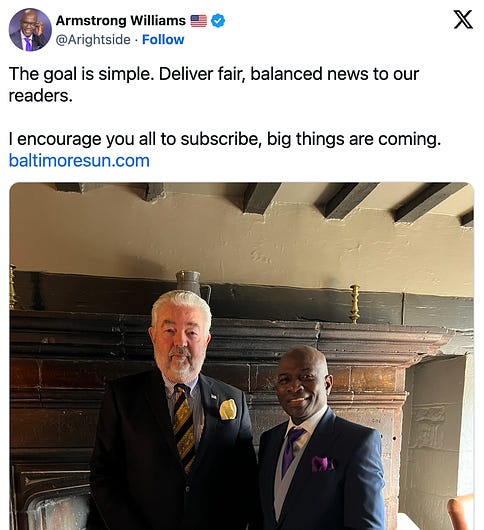 |
:{:{Williams has his own syndicated show on Sinclair stations. His social media accounts are full of incendiary statements about Democrats and liberals. "Each day Joe Biden has sat in office, we have gotten closer and closer to a fascist communist nation," Armstrong wrote on January 10. On January 5, he accused Biden of "destroy[ing] American democracy."}:
On December 19, Armstrong decried "the real time consequences of being infiltrated by radical left-wingers and the acceptance of their insane political agendas." (The issue was the Pope slightly softening his stance on same-sex marriages.) On December 6, Armstrong called Biden "a senile senior citizen" who "barely knows right from left." Armstrong also called the prosecutors pursuing cases against Trump as "terrorists" and promoted false narratives and conspiracy theories about the January 6, 2021 attack on the U.S. Capitol.}:
Armstrong served as an advisor to former presidential candidate and Secretary of Housing and Urban Development Ben Carson. He claims to have paid for Justice Clarence Thomas' wedding reception. In 2005, Armstrong lost his syndicated column after it was revealed that he had been paid $240,000 by the George W. Bush administration to promote their signature education initiative, No Child Left Behind.
Follow the money
Smith has used his vast wealth to support a variety of far-right causes. The Baltimore Banner reports that since 2015, Smith, through his family foundation, has donated large sums to Young Americans for Liberty ($581,000), Project Veritas ($536,000), Turning Point USA ($150,000), and Moms for Liberty ($121,000).
Smith does not support Baltimore Mayor Brandon Scott (D), and has sought to recruit opponents to unseat him. Sinclair stations have provided highly favorable coverage to former Mayor Shelia Dixon (D), who is running against Scott this year. Armstrong conducted an interview with Dixon on a Sinclair affiliate last summer that consisted mostly of "praise for Dixon and criticism of current elected officials."
In 2022, Smith backed a successful ballot initiative to impose term limits on Baltimore's elected officials. Currently, Smith is "underwriting Renew Baltimore, a ballot drive to cap and lower the property tax rate."
Now, Smith has a new tool in his arsenal to shape Baltimore's politics: the city's paper of record.
---
https://www.mediamatters.org/networks-and-outlets/sinclair-broadcast-group-inc
https://www.mediamatters.org/research/2018/07/13/comprehensive-guide-relationship-between-sinclair-broadcast-group-and-trump-administration/220646
https://www.commondreams.org/tag/sinclair-broadcasting
https://www.mediamatters.org/sinclair-broadcast-group/sinclair-broadcast-group-report-people-act-whitewashed-gops-nationwide
Sinclair's national programming is fearmongering about homeless people, and using them to push for Republican policies.
==
https://www.mediamatters.org/blog/2018/11/13/sinclair-already-gearing-trump-2020/222057
Less than one week after the 2018 midterm elections, Sinclair Broadcast Group is already pushing “must-run” segments minimizing Democratic chances in 2020 and boosting President Donald Trump’s re-election bid.
A new “must-run” commentary segment about the 2020 elections began airing on Sinclair’s local stations on November 12. It’s part of Sinclair’s ongoing series called “Bottom Line with Boris,” which features chief political analyst Boris Epshteyn. Epshteyn worked on Trump’s 2016 campaign and may have signed a nondisparagement agreement during that time that would prevent him from criticizing the president.
In the segment, Epshteyn tells viewers that the Democratic Party has “too many competing messages and varying factions” that will prevent “a clear path to victory in their primaries." He cited eight potential 2020 contenders for the Democratic nomination, ranging from party members like Sen. Cory Booker (D-NJ), who supposedly wants to take the party in "a radical direction of open borders and single-payer health care," to "centrist, pro-business old guard" like former Vice President Joe Biden. Epshteyn said that the Republican Party is very united behind Trump, whom he called a “very formidable candidate” and an “active and strong campaigner.”...
==
https://www.alternet.org/2019/06/advertisers-revolt-after-sinclair-owned-tv-station-pulls-truth-telling-meteorologist-off-the-air/
no lnx
Advertisers revolt after Sinclair-owned TV station pulls truth-telling meteorologist off the air
written by Daily Kos June 9, 2019
According to the Springfield (IL) Journal-Register, at least four advertisers have pulled their funding from Sinclair Broadcast Group-owned ABC affiliate WICS-TV, which is licensed to Springfield, Illinois and serves much of central Illinois and, through its full-power rebroadcaster WICD-TV, east-central Illinois. This is in response to Sinclair pulling meteorologist Joe Crain off of WICS/WICD for pointing out how alarmist and confusing Sinclair’s “Code Red” weather alerts, which Sinclair mandates its stations use despite not being official National Weather Service (NWS) alerts of any kind, are to viewers:
At least four local businesses have pulled their advertising from WICS-TV in support of meteorologist Joe Crain, who has been absent from the Springfield station’s broadcasts following his on-air criticism of the “Code Red” weather alert system.
[…]
So far, businesses that have pulled their ads include Sutton’s, Henson Robinson Company, Central Illinois Ace Hardware and Marx Fireplaces & Lighting.
All of these are businesses that operate in or near the Springfield, Illinois area, and all of the businesses are home repair/renovation-related in some form or fashion. A spokesperson for one of the businesses that pulled its advertising from WICS issued a very strongly-worded statement, albeit without mentioning Sinclair by name, strongly criticizing Sinclair’s cavalier attitude as a corporation:
“Corporate executives make irresponsible decisions without taking into account what the local viewers are feeling. That arrogance needs to stop. Joe Crain treated our sponsorship like it was very important. He was out in the community representing WICS-TV with class and dignity. His final act was to engage his viewers and recognize their concerns and he gets cut. That is ridiculous,” Sutton’s marketing director Max Bumgardner told the SJ-R. “Hopefully, the corporate office will see a new type of Code Red when they realize their revenues are affected by colossally bad decisions.”
Also, I will mention that, in addition to WICS, Sinclair operates two other television stations in the Springfield-Champaign, Illinois local television market: WRSP-TV, the Fox affiliate licensed to Springfield, Illinois, and WBUI-TV, the CW affiliate licensed to Decatur, Illinois. However, unlike WICS, which Sinclair operates and owns, Sinclair operates, but does not own, WRSP and WBUI; WRSP and WBUI are actually owned by a company called GoCom Media of Illinois, which appears to be effectively a shell corporation to allow Sinclair to exploit loopholes in what few concentration of ownership limits the FCC puts on over-the-air television stations. However, GoCom Media technically controls the retransmission consent contracts to allow cable and satellite providers to carry WRSP (or, on cable systems in the eastern part of the Springfield-Champaign market, WCCU-TV, which is WRSP’s full-power repeater) and WBUI, and both WRSP and WBUI are not currently available via DirecTV in the Springfield-Champaign, Illinois market due to a retransmission consent dispute, meaning, as I live in the far-eastern part of the market, I currently do not have access to a Fox or CW affiliate as Fox is airing a large percentage of the games of the FIFA Women’s World Cup soccer tournament (notably, this inconvenience did not happen while the men’s World Cup was being played last year).
To summarize this story, Sinclair is losing advertisers in at least one market, not due to Sinclair forcing its stations to air right-wing, pro-Trump political propaganda, but due to Sinclair’s alarmist weather hype machine, and Sinclair’s use of shell companies to exploit loopholes in FCC concentration of ownership regulations is finally coming back to haunt them.
==
619 funny wihnow the other day
(poster of mercer at LA? moive gig px
https://www.alternet.org/2019/06/inoculation-as-a-form-of-propaganda
np lnx
Inoculation as a form of propaganda
written by Nancy LeTourneau / Washington Monthly June 12, 2019
38
Meeting charges with countercharges brings a disease into the body politic that's a prophylactic against accountability.
With so much focus on Fox News providing a propaganda platform for Donald Trump, national news outlets haven’t been paying as much attention to theSinclair Broadcasting Group — which has been trying to take over local broadcast news.
It is worth remembering that a 2018 report from Emory University found that “when Sinclair buys a local station, its news program begin to cover more national and less local politics, the coverage becomes more conservative, and viewership actually falls — suggesting that the rightward tilt isn’t enacted as a strategy to win more viewers but as part of a persuasion effort.” In other words, Sinclair has become the local right-wing propaganda network.
True to form, Eric Bolling’s show on Sinclair recently featured an interview with Peter Schweizer. You might remember him as Steve Bannon’s partnerwho authored the book Clinton Cash, which was weaponized by the Trump campaign in 2016. More recently, Schweizer wrote Secret Empires: How the American Political Class Hides Corruption and Enriches Family and Friends. His discussion with Bolling represents a form of propaganda we’re seeing quite often these days.
“The problem is the corruption is being globalized,” Schweizer said. “What that means is thatforeign governments and foreign oligarchs are looking to recruit the family members of politiciansbecause they believe by striking commercial bargains with them—helping politician families become rich—that they’re going to get favorable treatment.”[CHAO MCCONNELL?!]
“And Joe Biden has been a major recipient of that kind of largesse from them,” Schweizer added.
As he did with Clinton Cash, Schweizer backs up his allegations of corruption with inferences and innuendo, but zero actual evidence. What struck me most was the fact that stories about “globalized corruption” in the form of allegations about countries like Russia, China, and Saudi Arabia have been rampant when it comes to Donald Trump and his family. As a matter of fact, this story broke at about the same time as Schweizer’s interview.
A real estate company part-owned by Jared Kushner has received $90m in foreign funding from an opaque offshore vehicle since he entered the White House as a senior adviser to his father-in-law Donald Trump.
Investment has flowed from overseas to the company, Cadre, while Kushner works as an international envoy for the US, according to corporate filings and interviews. The money came through a vehicle run by Goldman Sachs in the Cayman Islands, a tax haven that guarantees corporate secrecy.
Kushner, who is married to Trump’s elder daughter Ivanka, kept a stake in Cadre after joining the administration, while selling other assets. His holding is now valued at up to $50m, according to his financial disclosure documents.
When right-winger’s like Schweizer level these kind of charges about the Bidens, they are obviously forms of hypocrisy and projection. But it’s also a type of propaganda that we could call “inoculation,” because they introduce the disease into the body politic as a prophylactic against accountability. To mitigate charges of corruption against Trump and his family, similar charges are leveled against their opponents. As we’re seeing now with Attorney General William Barr’s investigation of the investigators, that ultimately leads to charges being met with countercharges in an attempt to confuse the public and ward off accountability.
The reason that kind of propaganda works for Republicans is because low-information voters — spurred by a media obsessed with bothsiderism — tend to respond by saying “they all do it,” which promotes cynicism and a disengagement from the political process. As Barack Obama once wrote:
A polarized electorate that is turned off of politics, and easily dismisses both parties because of the nasty, dishonest tone of the debate, works perfectly well for those who seek to chip away at the very idea of government because, in the end, a cynical electorate is a selfish electorate.
As with all forms of propaganda, this one is not easy to combat. But the first step is to recognize what’s going on. From there, taking personal responsibility for staying grounded in facts and evidence, no matter where they lead, is the only possible antidote.
=
https://thehill.com/homenews/media/432450-gorka-fox-part-ways
hmmn
gorka...parted ways with Fox News and has joined Sinclair Broadcasting.
Gorka, who joined Fox News as a national security strategist in November 2017 following a seven-month stint in President Trump's White House, will serve as a national contributor at Sinclair.
"I'm very excited to be one of Sinclair's national contributors," Gorka told the Hill by email. "Fox News and Fox Business Network have both been very good to be before I joined the Trump Administration and after I left the White House.
"I am especially grateful to Sean Hannity," he continues. "My new nationally syndicated radio show with Salem Radio and position with Sinclairwill allow me to go deeper on the key issues of the Trump era."
The 48-year-old British, Hungarian and U.S. citizen told The Hill that his Fox News contract had expired. A Fox News spokesperson confirmed the exit and said the the parting of ways was mutual.
Gorka launched his syndicated talk radio show, "America First," in November.
==
EPA chief Andrew Wheeler gives his first TV interview to right-wing conglomerate Sinclair
BlogAugust 13, 2018 6:12 PM EDT
mma
==
==
8/18
https://www.alternet.org/sinclair-broadcast-group-tribune-merger-officially-dead
a victory for free and independent journalism, Tribune Media said on Thursday that it is pulling out of its $3.9 billion merger with Sinclair Broadcast Group, putting the final nail in the coffin of a deal that had seemed inevitable when it was first announcedin May of last year.
According to Axios, Tribune is also filing a lawsuit against Sinclair, alleging breach of contract.
Sinclair, a Maryland-based company which is the largest owner of local news stations in the U.S., is notorious for its right-wing, pro-Trump slant, and its unusual system of distributing slanted "must-run" content to its local stations to work into their broadcasts.
...
==
7/18
Sinclair has been producing pro-Trump "must-runs" that air during local news segments across the country. Frequently these segments feature chief political analyst Boris Epshteyn asking softball questions of Trump administration figures like Sarah Huckabee Sanders or Scott Pruitt -- at least when Epshteyn is not giving over the top pro-Trumpcommentary on his own. This week, Epshteyn gave a warm welcome to VP Mike Pence. The first parts of the interview were embarrassingly friendly, with Epsheyn praising Trump's unpopular tax law.
The final segment with Pence really jumped the rails. In the clip, Epshteyn did not even ask a question. Rather, the entire "must-run" was Pence talking about how great the Trump administration has been, followed by Epshteyn saying that the Trump administration "has to focus on continuing to achieve success for the American people."
The obvious goal here is to get audiences to only trust Sinclair -- and Trump.
Also: With Sinclair's merger with Tribune at risk over Sinclair's lying and shady business tactics, Trump himself took to Twitter to complain about the merger being in question -- and in doing so, Trump admitted that Sinclair was conservative.
Lastly: Senior Sinclair executive Frederick Smith donated to disgraced racist Joe Arpaio, who is running for Senate in Arizona as a Republican. Smith has given largely to Republicans this cycle, including Rep. Devin Nunes (R-CA).
==
https://www.alternet.org/news-amp-politics/sinclair-reporters-whine-trumps-endorsement-actually-hurts-them-acknowledging
no lnx
Sinclair Reporters Whine Trump's Endorsement 'Actually Hurts' Them by Acknowledging Company's Conservative Bias
Journalists with Sinclair were baffled by Trump's ineffective advocacy.
By Chris Sosa / AlterNet July 25, 2018, 6:45 AM GMT
President Donald Trump's attempt to support Sinclair Broadcasting Group spectacularly backfired as his partisan description of the organization harmed its public image.
Trump lashed out at his own administration's FCC leadership for refusing to approve an acquisition plan that risked creating an illegal system of control over stations that should be divested from Sinclair Broadcasting.
"So sad and unfair that the FCC wouldn't approve the Sinclair Broadcast merger with Tribune," Trump wrote in a Tuesday tweet. "This would have been a great and much needed Conservative voice for and of the People. Liberal Fake News NBC and Comcast gets approved, much bigger, but not Sinclair. Disgraceful!"
So sad and unfair that the FCC wouldn’t approve the Sinclair Broadcast merger with Tribune. This would have been a great and much needed Conservative voice for and of the People. Liberal Fake News NBC and Comcast gets approved, much bigger, but not Sinclair. Disgraceful!
— Donald J. Trump (@realDonaldTrump) July 25, 2018
Journalists with Sinclair were baffled by Trump's ineffective advocacy.
"Trump's tweet actually hurts us — because of the conservative line," an unnamed Sinclair employee told CNN.
Other journalists echoed this opinion to CNN.
In an interesting twist, Fox News chief Rupert Murdoch benefits from the FCC decision, since Sinclair Broadcasting would have become a major competitor.
==
Sinclair Broadcasting was already putting pro-Trump propaganda into the local news of millions across the country. They were attempting to buy Tribune Media in a deal that would have let Sinclair reach three out of four households. In a sudden reversal, it looks like that deal will not happen. While many others have previously flagged the deal as problematic, it was doubtful that Trump appointees on the FCC would agree. But Trump's FCC Chairman Ajit Pai has now made a move that will likely kill the deal, citing Sinclair's shady business tactics.
Pamela Vogel looked into this. Sinclair, even with this Tribune deal, was limited in how many stations it could own. The company's plan was to sell a number of them to close allies and retain operational control of the stations if not direct ownership (Sinclair does this with 48 stations already). It even wanted to sell some of the stations to a company owned by one of its employees, Armstrong Williams. Another company Sinclair wanted to sell to had its stock recently controlled by the estate of Sinclair's executive chairman. It is all incredibly weird.
And there is still the outstanding issue of the reported investigation by the FCC inspector general into Pai's relationship with Sinclair. Pai's relationship with Sinclair was one reason why the apparent collapse of this deal was so surprising.
Sinclair isn't going away, and neither is the trend of local news being infested with pro-Trump propaganda. Still, though, it's worth taking good news where you can find it.
==
https://gizmodo.com/heres-why-the-sinclair-deal-may-be-too-slimy-for-ajit-p-1827731077
Apparently, even sell-out corporate shills have their breaking point. Ajit Pai’s FCC released documents on Thursday that explain why it’s sending Sinclair Broadcasting’s proposed takeover of local news in the U.S. to a judge for further review. Defying all expectations, the deal now looks like it’s next to dead.
On Wednesday, the Federal Communications Commission unanimously decided that the $3.9 billion merger between Sinclair and Tribune Media contained enough cause for concern that it should be reviewed independently by an administrative judge.This afternoon, it made the related hearing designation order public and explained for the first time why it believes this deal may “not be in the public interest.”
Before today, there was plenty of reason to believe it was a bad idea to let Sinclair skirt regulation with a loophole and have stations available in 72 percent of American households. One reason is, that’s almost twice the reach federal rules allow one company to control (the standard federally mandated limit is 39 percent); another reason is, Sinclair is a brazen conservative propaganda outlet that forces good reporters to debase themselves; on top of that, Pai, the FCC’s chairman, managed to land himself under investigation for allegedly improper coordination with the broadcasting company after he revived the very loophole that would have put Sinclair in two-thirds of Americans’ living rooms.
Those reasons weren’t included in the FCC’s explanation for pumping the brakes on the deal. As was previously hinted at, the legal problem comes down to Sinclair and Tribune agreeing to divest themselves of 23 local stations as part of an agreement to receive regulatory approval. One Sinclair competitor, Newsmax, argued that the deal effectively left Sinclair in control of some of those stations. In today’s filing, the FCC isolated three stations that “raise significant questions as to whether those proposed divestitures were in fact ‘sham’ transactions.”
In the example of WGN-TV-Chicago, a man named Steven Fader was a proposed purchaser for the station. Citing multiple independent challenges to the deal that were sent to the FCC, the filing says that there is reason to believe foul play is involved due to Fader’s close relationship with Sinclair’s executive chairman and controlling shareholder, David Smith. “Specifically, Fader is the CEO of Atlantic Automotive Group (Atlantic), while David Smith has a controlling interest in Atlantic and serves as a member of its board of directors ... and Atlantic is a Sinclair advertiser and tenant,” the order claims. It also states that the $60 million price tag for the station “appeared to be significantly below market value.” Once again, questions were raised over whether Sinclair “attempted to skirt the Commission’s broadcast ownership rules.”
Virtually the same concerns are involved with the examples of stations in Dallas and Houston that were set to be sold off to Cunningham Broadcasting. A Sinclair associate named Michael Anderson allegedly bought $400,000 worth of Cunningham shares at a rate that was allegedly far below market value. I’m just going to run this example of incestuous corporate ownership in the FCC’s own convoluted words: Another point of concern is “the fact that the children of Sinclair’s controlling shareholders are beneficiaries of trusts controlling the non-voting shares of Cunningham with the parents holding options to buy the voting shares in the future.” On top of all this, Sinclair would still retain the right to buy back the stations in the future, according to the FCC.
Sinclair quickly tried to restructure all of this in a less shady manner on Wednesday in the last-minute hope that it could still win the FCC’s favor.
“As a result and in light of the ongoing and constructive dialogue we had with the FCC during the past year, we were shocked that concerns are now being raised, Sinclair said in a statement announcing its amended divestitures in the Dallas, Houston, and Chicago stations. “Nonetheless, we have decided to move forward with these additional changes to satisfy the FCC’s concerns.” It added: “There can be no question regarding misrepresentation or character given that Sinclair has fully disclosed all terms of all aspects of the transactions it has proposed.”
Despite Sinclair’s shock and begrudged effort to appease the FCC, it appears to be too late. The FCC filing states, “Although these three applications were withdrawn today [Wednesday], material questions remain because the real party-in-interest issue, in this case, includes a potential element of misrepresentation or lack of candor that may suggest granting other, related applications by the same party would not be in the public interest.” To put it another way, Sinclair may be too sleazy to even deal with going forward.
We were unable to reach a Sinclair spokesperson by phone for comment on the FCC’s filing, and the company did not immediately respond to an email requesting comment. We will update when we hear back.
Of course, bad actors can oppose other bad actors sometimes, and it’s worth noting that one of the parties that called this deal a “sham” in a complaint to the FCC was the conservative organization Newsmax. That company is a rival of Sinclair, and it also happens to employ one of Donald Trump’s golfing buddies, Christopher Ruddy. According to the New York Post, Ruddy claims he’s discussed his opposition to the merger with the president “a few times.” Throw in Pai’s inspector general investigation for alleged improper coordination with Sinclair, and it’s easy to see why the big-mug-sipping doofus might want to let a judge rule on this whole thing.
==
Featured video
Sinclair is forcing local news stations across the country to air pro-Trump "must-runs" featuring a former top Trump aide. (We've also put together the complete background on the Trump-Sinclair relationship)
https://www.facebook.com/Mediamatters/videos/10155651589431167/
==
https://www.mediamatters.org/research/2018/07/13/comprehensive-guide-relationship-between-sinclair-broadcast-group-and-trump-administration/220646
under the watch of multiple Trump administration agencies, conservative local TV news giant Sinclair Broadcast Group is preparing to finalize its massive acquisition of Tribune Media, which will allow the company to spread pro-Trump propaganda and fearmongering rhetoric even more widely across the country. If the merger is approved, it will be the culmination of a series of handouts from the administration to Sinclair, beginning shortly after Sinclair’s top executive told then-candidate Donald Trump the outlet was there to “deliver [his] message” to America.
Here’s a closer look at the extensive relationship between Sinclair and the Trump camp.
In this post:
- The Trump Federal Communications Commission is under internal investigation for making rule changes to help Sinclair
- Sinclair’s “chief political analyst” is former Trump aide Boris Epshteyn
- Armstrong Williams, a Sinclair-affiliated pundit and Sinclair business partner, has Trump administration ties
- Trump has given exclusive interviews to Sinclair reporters at least 16 times
- Six members of the Trump administration and Trump’s personal lawyer have all made friendly appearances on the Sinclair segment “Bottom Line With Boris”
- Trump, administration officials, and others in the Trump orbit have promoted Sinclair and its content
The Trump Federal Communications Commission is under internal investigation for making rule changes to help Sinclair
In February, The New York Times reported that the Federal Communications Commission (FCC) inspector general has opened an internal investigation into potential improper conduct by Trump-appointed FCC chair Ajit Pai and his aides in advocating for deregulatory measures that specifically benefited Sinclair. The investigation began after lawmakers called on the inspector general to investigate a “disturbing pattern of a three way quid-pro-quo,” which could include the following instances:
- During the 2016 campaign, Sinclair chairman (and then-CEO) David Smith said he told Trump during a meeting, “We are here to deliver your message. Period.” Trump adviser andson-in-law Jared Kushner also bragged about making a deal with Sinclair, agreeing to give Sinclair more access to Trump as long as interviews were aired without commentary.
- Weeks after the election, then-FCC Commissioner Pai met privately with Smith and spoke at a “gathering … of general managers from Sinclair stations.”
- The day before Trump’s inauguration in January 2017, Smith, along with Sinclair President Christopher Ripley and Sinclair business partner Armstrong Williams, again met with Pai to discuss relaxing media rules. Pai was named chair of the commission by Trump several days later.
- In February 2017, Pai relaxed a rule related to the FCC’s oversight of local TV sharing arrangements for facilities, employees, and services. This was the same rule he’d discussed with Sinclair executives weeks earlier, and Sinclair has a well-documented history of relying on these arrangements to skirt ownership caps.
- In April 2017, the FCC reinstated an outdated media ownership rule known as the UHF discount, making room for a new level of local media consolidation at the hands of big media groups like Sinclair. Reinstating this rule means that Sinclair can count the stations it owns and operates in a misleading way so that it technically stays under the designated cap for the number of stations it can own nationwide, even though it far exceeds that cap in practice.
- Weeks later, Sinclair announced it was proposing to acquire Tribune Media, a huge local-news merger that wouldn’t have been allowed without the UHF discount in place. The FCC and Trump’s Department of Justice are now the only agencies that need to approve the deal.
- In October 2017, the FCC voted to eliminate a rule that required local news stations to maintain offices within the communities they serve, making it easier for Sinclair to consolidate and centralize local news resources as it buys up more stations.
- In November 2017, the FCC rolled back rules that limit broadcast station and other media ownership in any given local media market, allowing for Sinclair to more easily own or operate multiple stations -- or merge stations -- in the same local area.
Sinclair’s “chief political analyst” is former Trump aide Boris Epshteyn
In April 2017, Sinclair announced that it had hired Boris Epshteyn to serve as its “chief political analyst,” producing frequent “must-run” commentary segments about political issues that Sinclair requires its local news stations to air. It upped the segments’ frequency months later.
Epshteyn had previously worked in the Trump White House on the communications team, after doing stints on the Trump inaugural committee and on the Trump campaign. Epshteyn also served as a Trump media surrogate throughout the campaign and first days of the Trump presidency. Epshteyn is personal friends with the president’s sons Eric and Donald Jr., and he has been spotted at Trump International Hotel multiple times, including with Don Jr. in June. Epshteyn has returned to the White House several times since his departure, seemingly to attend events as a member of the press. In May 2018, Sinclair hired another Trump campaign and White House alum, Kaelan Dorr, as Epshteyn’s executive political producer. In a June 14 Instagram post, Epshteyn wrote that he and Dorr shared a McDonald’s meal to celebrate Trump’s birthday.
Epshteyn has been producing regular commentary segments, called “Bottom Line With Boris,” for Sinclair for more than a year, and they’re basically pro-Trump propaganda. For a chief political analyst, his takes are notably unoriginal. At best, he regurgitates Trump talking points or touts some vague, imaginary bipartisan ideals that involve being nicer to Trump. At worst, he defends the most absurd, racist things Trump does. Here are some of the more notable arguments Epshteyn has made:
- Media are
 against
 Trump
 .
- The FBI is also extremely biased against Trump.
- The Trump administration’s family separation and child detention policies were overblown by media.
- Trump’s taunts to North Korean dictator Kim Jong Un about a “nuclear button” constitute good foreign policy.
- Trump’s racist comment about “shithole countries” is mere “salty language” that the media are unnecessarily repeating.
- GOP losses in state elections do not reflect poorly on Trump.
- More Americans should be like actor Bryan Cranston, who remarked during an interview that people ought to hope Trump succeeds for the good of the country.
Armstrong Williams, a Sinclair-affiliated pundit and Sinclair business partner, has Trump administration ties
- Conservative pundit Armstrong Williams hosts a weekly show that airs on the Sinclair-owned News Channel 8 in the D.C. area and is syndicated on other Sinclair local TV stations across the country. Williams also owns several local TV stations through his holding company, Howard Stirk Holdings, which in turn sends business back to Sinclair through operations agreements.
- Recently, Politico reported that Sinclair offered to sell three stations to Williams for “just a fraction of the market price.” The stations must be sold in order for Sinclair to nominally comply with current FCC ownership rules. Sinclair will use various legal agreements to skirt the rules and continue operating the stations.
- Williams is a close confidant of Secretary of Housing and Urban Development (HUD) Ben Carson, even doing public relations work on Carson’s behalf while continuing to also work as a media figure. He also served as a Carson presidential campaign adviser while maintaining his weekly hosting duties.
- Since 2016, Carson has
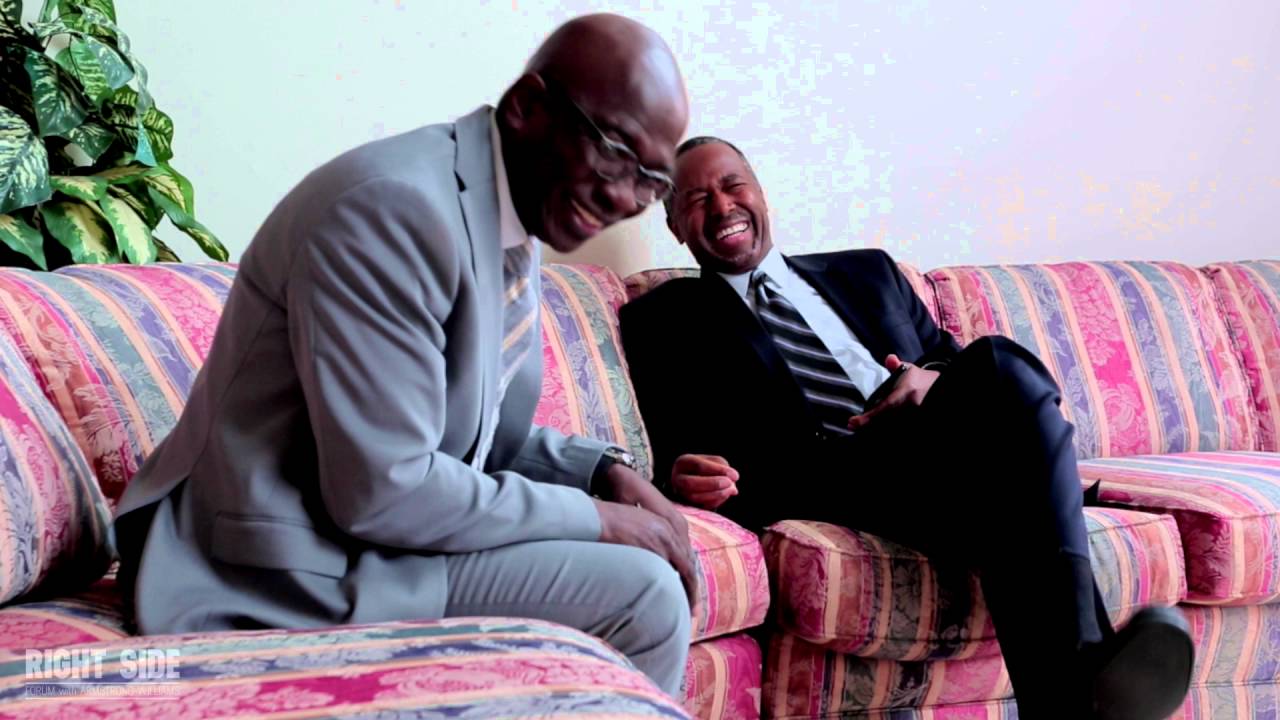 at least twice on Williams’ TV show -- including for his first televised interview since becoming HUD secretary -- and at least twice on his radio show, which is not affiliated with Sinclair.
- About two months after Williams joined Sinclair executives in a meeting with FCC chair Pai in the spring of 2017, Pai made a friendly appearance on Williams’ show.
Trump has given exclusive interviews to Sinclair reporters at least 16 times
- During the campaign season, Trump reportedly gave 15 one-on-one interviews to Sinclair local stations or its national bureau, according to The Washington Post. Eleven took place in the final three months of the campaign, often with stations in swing states. Sinclair reporters also conducted 10 exclusive interviews with his running mate, Vice President Mike Pence, and 10 more with Trump surrogates, “primarily Ben Carson.”
- Trump granted three of these exclusive interviews to Sharyl Attkisson for her weekly national Sinclair show Full Measure. Attkisson is a right-wing conspiracy theorist hired by Sinclair in 2015, and Trump was her first guest when the show premiered. Subsequent interviews aired in April, right before the Wisconsin primaries, and in September.
- In November 2017, Trump again sat down for an interview with Attkisson. In it he made several demonstrably false claims without any challenge and again attacked “fake” media.
Six members of the Trump administration and Trump’s personal lawyer have all made friendly appearances on the Sinclair segment “Bottom Line With Boris”
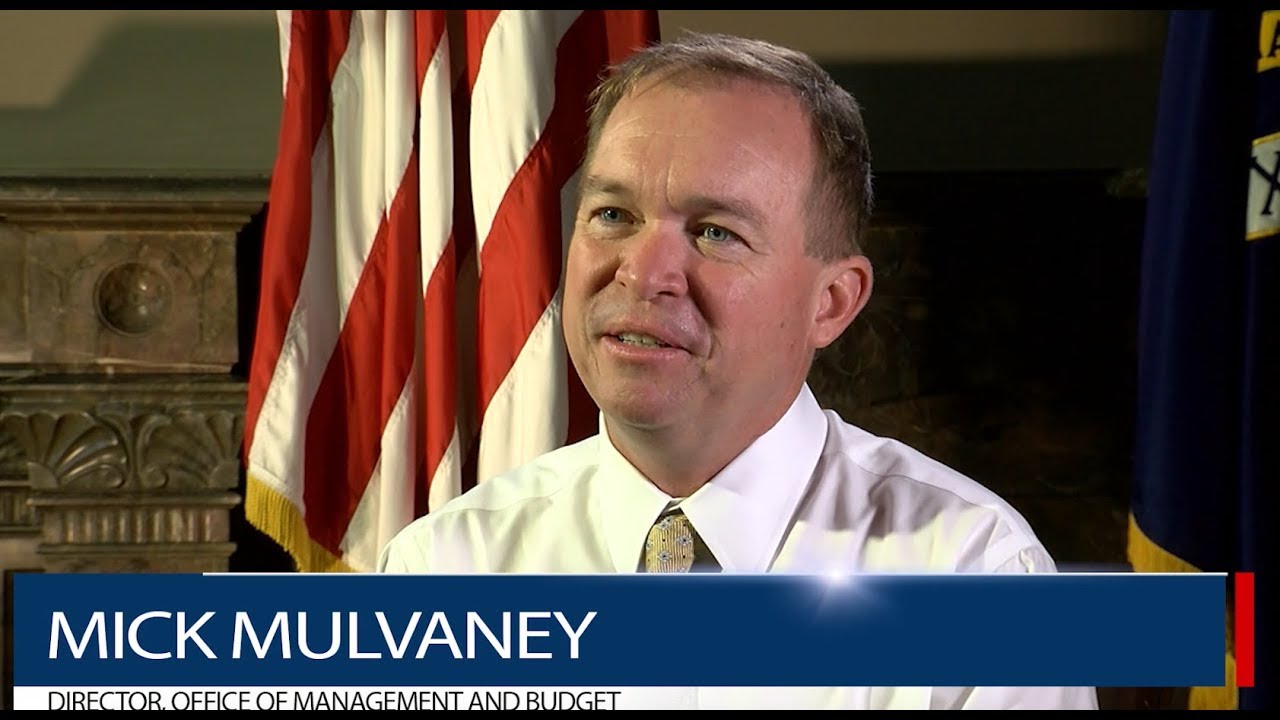
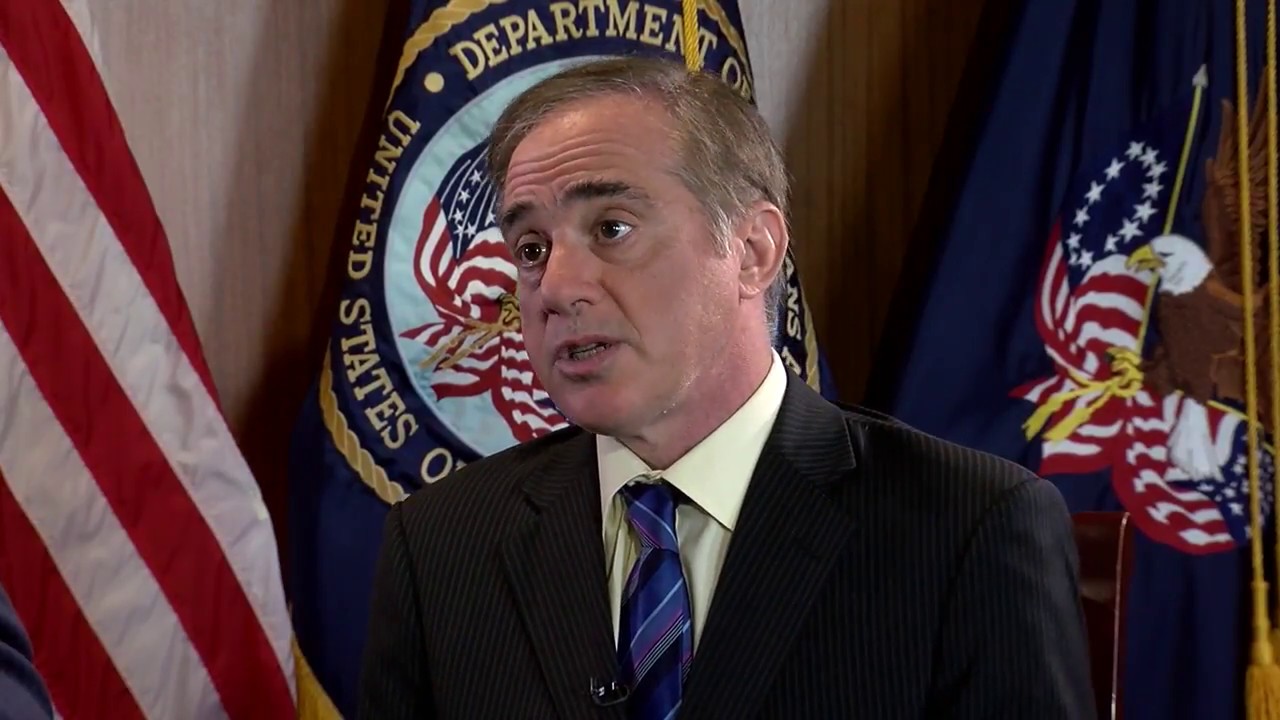
Epshteyn’s “Bottom Line With Boris” segments have also been a frequent media safe space for the Trump inner circle. In addition to a softball interview with Trump lawyer Rudy Giuliani, Sinclair has aired embarrassingly friendly segments with at least six administration officials:
- HUD Secretary Ben Carson
- Press secretary Sarah Huckabee Sanders
- Then-Environmental Protection Agency Administrator Scott Pruitt
- Small Business Administration Administrator Linda McMahon
-
-
Trump, administration officials, and others in the Trump orbit have promoted Sinclair and its content
- Several media figures affiliated with the Trump campaign, Trump administration, or Republican Party have promoted Epshteyn’s must-run content. This includes Trump campaign spokesperson Katrina Pierson, former Trump communications aide Jason Miller (several times), GOP Chairwoman Ronna Romney McDaniel, GOP spokesperson Kayleigh McEnany, former Speaker of the House (and Trump ally) Newt Gingrich, and former President George W. Bush press secretary Ari Fleischer.
- In May, the White House compiled positive news clips touting the nomination of veteran torturer Gina Haspel as CIA director. The press clip list included a quote from Epshteyn’s “Bottom Line” segmentarguing Haspel was “as qualified as it gets.”
- In April, Trump defended Sinclair amid criticism of its decision to mandate that local anchors read scripted promotional segments attacking the “irresponsible, one-sided stories plaguing our country.” The president tweeted that Sinclair was “far superior to CNN and even more Fake NBC.”
==
Are there Sinclair stations near you?
:{
Media Matters has identified communities that will see competitive congressional midterm races and that have Sinclair-owned or -operated news stations. Many Sinclair stations are already airing national news programming with a conservative slant, and they will be ramping up coverage of their local races.
We’ve already tackled Nevada, Tennessee, New York, Florida, Virginia, and Ohio. Now, we’re taking a look at California.
}:
Use Media Matters’ interactive map at FindSinclair.com to learn more.
==
https://www.alternet.org/watch-surreal-sinclair-broadcasting-town-hall-goes-rails-discussion-youth-and-morality
...Sinclair Broadcast Group station WJLA hosted a “town hall” discussion on "youth & morality" featuring morally bankrupt media personality Armstrong Williams, young conservative talking heads Charlie Kirk and Candace Owens, a campus carry activist, and a Daily Caller reporter (among others) -- and Sinclair wants you to believe it’s for the public good.
The town hall was branded as both an episode of Sinclair-linked commentator Armstrong Williams’ show and a part of Sinclair’s ongoing town hall discussion series. The town hall does not appear to have yet aired on WJLA and it’s not clear if it has aired or will air on the WJLA-operated local Washington, D.C., cable channelNews Channel 8, but it’s posted in full on WJLA’s website.
Sinclair touts its “Your Voice, Your Future” local town halls as a public service and an opportunity to “alert, inform, empower and engage our audience.” Here’s a quick clip to give you an idea of how that wen
...
==
https://www.alternet.org/media/reporter-suri-crowe-told-truth-about-climate-change-so-right-wing-sinclair-broadcasting-showed
Buzzfeed has the story of Suri Crowe, a Virginia reporter who dared to tell the truth about the human cause behind climate change. After her report aired, Crowe was criticized by management and ordered to “balance” her reporting.
In one 2015 instance, the former news director of WSET-TV in Lynchburg, Virginia, Len Stevens, criticized reporter Suri Crowe because she “clearly laid out the argument that human activities cause global warming, but had nothing from the side that questions the science behind such claims and points to more natural causes for such warming.”
The truth is that the groups questioning the science behind such claims have no science to back them up. What they have is a network of “institutes” that consist of nothing but publicity offices funded by fossil fuel companies. Many of them from one single source.
Peabody Energy, America’s biggest coal mining company,has funded at least two dozen groups that cast doubt on man made climate change and oppose environment regulations, analysis by the Guardian reveals.
Crowe bravely, and correctly, replied that there was no need to provide balance by including false information in her reporting. Which resulted in a demand that she include the views of that notable expert, Donald Trump, who was not even the Republican nominee at that point.
Crowe told BuzzFeed News that before the October 2015 climate change segment aired, she was ordered by Stevens to include Donald Trump’s opinion on the matter.
Eventually, Crowe was forced to read the “balanced” view on-air, including the Trump-favored lies. And after that, she was fired.
Climate change wasn’t the only reporting done by Crowe were she ruffled the feathers at Sinclair. But in her mind, the story she reported was simply factual, with no reason to inject unsupported opinions.
A veteran reporter who has worked at news stations in Texas and Virginia, Crowe said she viewed the story as environmental — not two-sided or political. “I was always covering the flu. I don’t remember a time when for balance I went out to a group of 20 people who are nutjobs that say flu shots kill,” she told BuzzFeed News. The scientific consensus is that climate change is real and humans are largely to blame, but Crowe ultimately read the updated, “balanced” script on air. “That was the moment where I realized how things were going to go there,” she said.
But Crowe didn’t appreciate the level to which, in Trumplandia, there are no non-political reports. Even reports about the fluare political.Crowe’s real problem was that she wasn’t a beginner. While new reporters rolled over to SInclair’s demands and apparently didn’t know that management handing down edicts on how stories to be reported was unusual, Crowe had worked in multiple markets for several years and had the strange idea that her job was to report the truth.
Crowe, for her part, battled with her bosses over political and nonpolitical issues. Younger reporters counted Lynchburg as a “starter” market, but Crowe’s colleagues said she was an outspoken, experienced journalist who wanted to do nationally minded stories. She clashed with management, former employees said, particularly over what exactly constitutes balanced coverage.
Management came down on Crowe for correctly reporting polls showing that most people in Virginia favored more restrictions on gun sales. But had no objections to a story reporting on new pro-gun legislation. All of the “balance” Crowe was asked to do, involved moving stories to the right.
Because that is what Sinclair, and Fox, and Trump mean by balanced. It’s what used to be known as “skewed.”
==
Sinclair Watch: Impact on the midterms and a show is canceled
We've talked a lot about how pro-Trump media conglomerate Sinclair Broadcast Group is infiltrating local news. This week, we launched a series about how Sinclair is gearing up for the midterms. Pamela Vogel is going to look at key races across the country and look at how Sinclair could affect the outcomes. The first state is Nevada. Sinclair’s political action committee gave $1,500 to Republican Sen. Dean Heller’s re-election campaign. Heller for his part praised Sinclair for how they reacted to the passage of Trump's tax cut bill.
Media Matters also launched a Find Sinclair website this week, where you can use an interactive map to find a Sinclair station near you.
Also: In 2015, a Sinclair station replaced local news programs with a "nontraditional newscast" that consisted of conspiracy theories from a Sean Hannity-esque figure. This week, that show was canceled after the host threatened to sexually assault teenage Parkland shooting survivor David Hogg. And that wasn't the first instance of that host engaging in harassment, either.
Listen up: Vogel talked with FAIR's Janine Jackson about Sinclair and how they are spreading propaganda. Listen to the podcast or read the transcripT.
https://www.commondreams.org/views/2018/04/03/confessions-former-sinclair-news-director
https://www.commondreams.org/news/2018/04/04/internal-memo-shows-sinclair-threatening-employees-keep-mouths-shut-about-must-read
Sinclair Broadcast Group really doesn't want its employees talking to the press about the Trumpian "fake news" script it has recently been forcing local news anchors to recite.
This was made clear by a memo warning staff at the Sinclair-owned station KATU in Portland, Oregon that "giving statements to the media or sharing negative information about the company can have huge implications."
First obtained by FTV Liveand published on Tuesday, the memo was sent amid outrage over the right-wing media giant's efforts to force local anchors to read propaganda railing against "false" and "fake" media—outrage that grew exponentially after Deadspin published a compilation of anchors reading Sinclair's script in unison.
Read the full memo below:

As Deadspin's video of anchors reading Sinclair's script went viral, some local anchors began anonymously and openly criticizing the company's attempts to exert ideological control over smaller stations that many American households rely on for daily news.
"The new scripted 'fake news' segment caused a lot of anguish where I work," one Sinclair journalist told the Huffington Post, which published a report on Tuesday detailing how the company strictly monitors its employees' "editorial activities."
"Sinclair's employee handbook...states that the company 'may monitor, intercept, and review, without further notice, every employee's activities using company's electronic resources and communications systems,'" the Huffington Post reported. "The handbook goes on to state, 'To be very clear: you should not have any expectation of personal privacy in any communication using Company owned equipment.'"
Another employee anonymously told HuffPo that "everything Sinclair gives us or forces upon us is met with uproar, but we have no choice."
This is largely because the costs of quitting Sinclair can be extremely "steep," as Bloomberg has reported.
After reviewing two employment contracts, Bloomberg found that "some Sinclair employees were subject to a liquidated damages clause for leaving before the term of their agreement was up: one that requires they pay as much as 40 percent of their annual compensation to the company."
primer
https://kpfa.org/episode/talkies-april-4-2018/
==
https://www.democracynow.org/2018/4/3/media_giant_sinclair_under_fire_for
While Sinclair Broadcast Group is not a household name, it is one of the most powerful TV companies in the nation. It owns 173 local TV stations across the country, including affiliates of all the major networks. And it’s attempting to grow even larger by purchasing Tribune Media—a $3.9 billion deal currently under regulatory review. Sinclair has been widely criticized for its close ties to the White House. But Sinclair is facing new scrutiny after it ordered news anchors at scores of its affiliate stations to recite nearly identical “must-read” commentaries warning of the dangers of “fake news” in language that echoes President Trump’s rhetoric. The commentaries reached millions of viewers last month and drew widespread attention after the website Deadspin published a video over the weekend showing side-by-side comparisons of the broadcasts from 45 Sinclair-owned stations. We speak to Andy Kroll, senior reporter at Mother Jones magazine.
Transcript
This is a rush transcript. Copy may not be in its final form.
JUAN GONZÁLEZ: We begin today’s show looking at Sinclair Broadcast Group. While it’s not a household name, Sinclair is one of the most powerful TV companies in the nation. It owns 173 local TV stations across the country, including affiliates of all the major networks. And it’s attempting to grow even larger by purchasing Tribune Media—a $3.9 billion deal currently under regulatory review.
Sinclair has been widely criticized for its close ties to the White House. It’s chairman and former CEO, David Smith, is active in Republican politics and supported Donald Trump’s campaign. The network’s chief political analyst, Boris Epshteyn, served as a senior adviser to Trump’s presidential campaign. During the 2016 campaign, Sinclair reportedly struck a deal with the Trump campaign to give it better media coverage.
AMY GOODMAN: Well, Sinclair is coming under new criticism after it ordered news anchors at scores of its affiliate stations around the country to recite nearly identical “must-read” commentaries warning of the dangers of “fake news” in language that echoed President Trump’s rhetoric. The commentaries reached millions of viewers last month and drew widespread attention after the website Deadspin published a video over the weekend showing side-by-side comparisons of the broadcasts from 45 Sinclair-owned stations.
...
==
https://www.alternet.org/news-amp-politics/dan-rather-thoroughly-dismantles-sinclair-broadcastings-orwellian-propaganda
Rather has been very clear and adamant about the need for our country’s news sources to handle the current orange-topped, white supremacist threat to our democracy. Over the weekend, Deadspin released a mashup of the bizarre and deeply disturbingpropaganda campaign (video below) by Sinclair Broadcasting to force their numerous media outlets to read an attack campaign against any and all media that doesn’t fall into line with Trump and his Republican stooges. Dan Rather isn’t having any of this. He penned a powerhouse response to Sinclair Broadcasting on his Facebook page.
Let's be clear, news anchors looking into camera and reading a script handed down by a corporate overlord, a script meant to obscure the truth not elucidate it, isn't journalism. It's propaganda. It's Orwellian. And it is on a slippery slope towards some of history's most destructive forces. These are the means by which despots wrest power, silence dissent, and oppress the masses.
To those who say this rhetoric is hyperbolic, I submit that attacking the press as honest brokers of information has been one of the constants of this Administration and all those who normalize it. But this is not normal. This is not how the freedoms enshrined in our Constitution, that beloved First Amendment, is supposed to operate.
Referencing the video, Rather says he can understand the broadcasters’ rationalizations, their desperations, and the need to feed their families. But the truth must win out. It must or we have nothing.
That is why it is incumbent for Americans of all political persuasions to say this is intolerable. Congress should hold hearings and call the executives of Sinclair to account, but one suspects that is highly unlikely in the current political environment. Will this spur citizens to elect representatives who recognize that this is a clear and present danger? Will enough people be outraged to bombard stations, and advertisors, with letters, phone calls, and tweets to suggest this is unacceptable?
For now, Sinclair is trying to explain away the controversy, and they have a powerful ally in the President. But as we saw with the advertisers bailing en masse from Laura Ingraham's Fox News show after she attacked a Parkland High School student activist in a Tweet, the voice of the people still matters. If enough people speak, they cannot be ignored.
Sinclair Broadcasting is fully backed by this country’s oligarchy right now, and along with Ajit Pai and telecoms, they plan on strengthening their control on what information people can and cannot have access to.
==
https://www.c-span.org/video/?441345-15/panel-discussion-trump-administration
MARCH 10, 2018
Panel Discussion on the Trump Administration A discussion on the Trump administration from the 10th annual Tucson Festival of Books that featured Joshua Green, Devil’s Bargain: Steve Bannon, Donald Trump, and the Storming of the Presidency; David Cay Johnston, It’s Even Worse Than You Think: What the Trump Administration is Doing to America; Katy Tur, Unbelievable: My Front-Row Seat to the Craziest Campaign in American HIstory, and John Nichols, Horsemen of the Trumpocalypse: A Field Guide to the Most Dangerous People in America
sinclair 19 min 2.2 mil households tribune media gp buying
https://www.youtube.com/watch?v=GvtNyOzGogc
mark hyman sends op eds to affiliates, PC, snowflakes,
5% north carolina illegal voters, pants on fire, politico, math wrong BO boris; retractd CNN
circa sends scripts with pkg: was flynn victim of FBI vendetta?
must run mark, boris
aubrey shines bl pastor dems created slavery, so how can blk vote hillary?; fake balance less time, VO undercuts;
polls with leading answers; daily terror alert (must run?)
isis? cut 19 teens in 1/2 (Bbrt at least caveat), segment ends with burkini
https://www.democracynow.org/2017/10/26/fcc_eliminates_rules_preventing_media_consolidation
major decision by the Federal Communications Commission Tuesday eliminated a decades-old rule that ensures community residents can have a say in their local broadcast TV station. This comes as the FCCannounced plans Wednesday to abolish long-standing media ownership rules. Opponents say these changes will accelerate media consolidation, allowing massive corporate media companies, such as the right-wing Sinclair Broadcast Group, to buy up and control even more local stations. We speak with Andy Kroll, senior reporter at Mother Jones magazine, whose story in their new issue is titled “Ready for Trump TV? Inside Sinclair Broadcasting’s Plot to Take Over Your Local News.”
---
major decision by the Federal Communications Commission that eliminates a decades-old rule that ensures community residents can have a say in their local broadcast TV station. The regulation is known as the “main studio rule,” and it requires broadcasters to have a physical studio near where they have a license to transmit.
This comes as the FCC also announced plans, at a hearing Wednesday, to abolish long-standing media-ownership rules, including limits on how many stations or newspapers one company can own in a single market. FCC Chairman Ajit Pai testified Wednesday during a congressional hearing.
AJIT PAI: If you believe, as I do, that the federal government has no business intervening in the news, then we must stop the federal government from intervening in the news business. And that is why, this afternoon, I shared with my fellow commissioners an order that will reform our media ownership rules and help pull the government, once and for all, out of the newsroom. We will vote on this order at our November 16th meeting.
The marketplace today is nothing like it was in 1975. Newspapers are shutting down. Many radio and TV stations are struggling, especially in smaller and rural markets. Online competition for the collection and distribution of news is even greater than it ever was. And just two internet companies claim 100 percent of recent online advertising growth. Indeed, their digital ad revenue alone this year will be greater than the market cap of the entire broadcasting industry. And yet the FCC’s rules still presume that the market is defined entirely by pulp and rabbit ears.
AMY GOODMAN: But opponents say these changes will accelerate media consolidation, allowing massive corporate media companies, such as the right-wing Sinclair Broadcast Group, to buy up and control even more local stations. Earlier this year, Trump’s FCC appointees revived a regulatory loophole that could allow Sinclair to buy 42 TV stations from Tribune Media Company, on top of the more than 170 stations it already owns. The deal means Sinclair stations would reach about 72 percent—almost three-quarters—of U.S. households.
This comes as former Fox News anchor Bill O’Reilly has reportedly been negotiating for a position with Sinclair Broadcast Group. O’Reilly secretly settled a sexual harassment claim for $32 million in January, the sixth and by far the largest such settlement during his tenure at Fox, from which he was fired.
For more, we’re joined in Washington, D.C., by Andy Kroll, senior reporter at Mother Jones magazine, where he’s written extensively about the FCC. His latest story in the current issue is headlined “Ready for Trump TV? Inside Sinclair Broadcasting’s Plot to Take Over Your Local News.”
Andy, welcome back to Democracy Now! You know, a lot of the meme going around is that Trump just can’t get anything done, but it sure doesn’t look that way at the FCC this week. Can you talk about what’s happened?
ANDY KROLL: Well, at the FCC this week, as you described, the commission voted along party lines—three Republicans voting in favor, two voting in opposition—to eliminate the main studio rule, this rule from about 80 years ago saying that a local TV or radio station needs to have its studio, its primary studio, in or near the community it serves. And that served a number of purposes, not only for the community to be able to interact with that station, but also tethering that station to the community in which it’s reporting the news and delivering some value to the people who watch it. That rule has been eliminated.
And then, as we saw in the clip that you just showed, the chairman of the FCC, Ajit Pai, a Republican, former staffer to Jeff Sessions, now the attorney general, has said that there is a whole bunch more deregulation in the works. This comes in a year, since President Trump’s inauguration in January, in which the FCC has consistently knocked down one barrier after another to enabling a massive deal frenzy, a consolidation in the broadcast business, which is exactly what companies like Sinclair want, going forward, so that they can gobble up as many TV stations around the country as they can, and basically dominate the local news business.
NERMEEN SHAIKH: Well, Andy, before we get to Sinclair Broadcasting, I wanted to ask you about the context of this attempt—or, in fact, the overturning of the main studio rule. It’s been in effect, as you said, for several decades. Has any other administration attempted to overturn it?
ANDY KROLL: No. The rule has been tweaked over time, on several occasions, to, what they say, modernize it. But the substance of the rule, having that studio in the community where the viewers, where the people who depend on that TV or radio station is, that has not changed over time. And the supporters of the rule say there’s a very clear reason for that. Yes, it’s true that with email and with social media you can send a message to your TV station, but the rule also gave that sense of locality. It gave that connection in the newsgathering and in the—you know, just the connection to a community that is so vital to local news. And that has been a bedrock of broadcast television for nearly 80 years and has gone unchallenged under Republican administrations and under Democratic administrations. And now, under President Trump and with Commissioner Pai at the FCC, that rule is ancient history.
NERMEEN SHAIKH: Well, Andy, before—could you explain, because—as a result of overturning this rule, all of these different stations, TV stations and radio stations, can be increasingly consolidated. Now, one of the companies under which these stations have been consolidated is Sinclair Broadcasting. But this media organization, very few people know about. So could you tell us about this broadcasting channel?
ANDY KROLL: Yeah. I like to say that Sinclair Broadcast Group is the most influential media organization that most Americans have never heard of. It owns nearly—owns or operates nearly 200 local TV stations around the country. It has a tremendous influence over the local news business.
And it marries that influence, that size, reaching into 40 percent of households right now, with a unabashed conservative and pro-Trump agenda. You see that in the kind of programming that Sinclair produces and sends out to its local stations. These are called “must-run segments.”They take, you know, basically, a shamelessly pro-Trump message, repeating talking points of the administration’s through its commentators, and putting that into the local news.
And as you mentioned earlier, Sinclair is eyeing a deal to acquire 42 new stations around the country, giving it a reach to almost three-quarters of American households. So this is a massive broadcast company, set to get even bigger. And it has a distinct conservative viewpoint that it is intent and bent on projecting out to the millions of people who watch its television channels.
AMY GOODMAN: Explain what you mean when you say “intent and bent on.” Your headline of your piece, “Ready for Trump TV? Inside Sinclair Broadcasting’s Plot to Take Over Your Local News.” What are the edicts being handed down?
ANDY KROLL: Well, Sinclair is a pioneer in what’s known as the “must-run segment.” This is a segment that is produced by Sinclair’s corporate headquarters here in the D.C. area and also in Maryland, that it produces, and then it sends out to its stations around the country—again, almost 200 of them—and says, “You are required to run this 90-second commentary or this two-minute editorial.” That content, that is being distributed out around the country, has a very clear, unequivocal conservative, partisan bent to it and, frankly, a pro-Trump bent to it.
You know, the lead political analyst, if you could call it that, atSinclair is a man named Boris Epshteyn, former Trump campaign aide and a former Trump White House aide, who left the administration and immediately went into this role at Sinclair. His segments are called “Bottom Line with Boris.” They are distributed, and they are required to run every day at Sinclair stations. And these are basically Trump talking points. And, I mean, you can go on YouTube, you can watch all of his clips in a row. They are 100 percent toeing the Trump line. And if they’re not that, they’re softball interviews with Trump administration officials.
AMY GOODMAN: Well, I mean, of course, people might know who Boris Epshteyn is, because during the campaign he was one of his spokespeople, always interviewed on TV. This is one of Boris Epshteyn’s recent commentaries.
BORIS EPSHTEYN: It is important to note that voter fraud goes beyond stealing or miscounting ballots. Intentionally improper voter registration is absolutely a type of voter fraud. The Commission on Election Integrity has gotten to work. … The extent of voter fraud in our elections has been hotly debated between the left and the right. The president’s commission has been established to come up with a factual, impartial answer to that question. The states should do everything within their power to cooperate with the commission. And that’s the bottom line.
AMY GOODMAN: And that is required by every station to run, Andy Kroll?
ANDY KROLL: That’s correct. You are—
AMY GOODMAN: This is—
ANDY KROLL: Yes, that’s right.
AMY GOODMAN: This is another clip from a Sinclair station, featuring former Trump adviser Sebastian Gorka. The show was broadcast earlier this month.
SEBASTIAN GORKA: You do not make legislation out of outliers. Our big issue is black African gun crime against black Africans. It is a tragedy. Go to Chicago. Go to the cities run by Democrats for 40 years. Black young men are murdering each other by the bushel.
AMY GOODMAN: “By the bushel.” That’s former Trump adviser Sebastian Gorka referring to “black African [gun] crime” on “black [Africans],” saying black men are killing each other “by the bushel.” Andy Kroll?
ANDY KROLL: Sebastian Gorka, of course, another alumnus of the Trump White House, who, upon leaving, went immediately to Sinclair and is now a talking head at Sinclair. So you see this trend of Trump officials going to Sinclair Broadcast Group and then them being put on the airwaves and either pushing a completely crazy message, that Sebastian Gorka just did, on a segment that was supposed to be about guns in America—
AMY GOODMAN: I mean, I think “outright racist” is a very—
ANDY KROLL: Outright racist, yeah.
AMY GOODMAN: —more accurate way to describe it.
ANDY KROLL: Yeah, it’s hard to find the words to describe what that was. You have Boris Epshteyn, as well. His segment, that we just listened to, is basically advocacy for the Trump administration in its deeply flawed, inept supposed commission on investigating voter fraud, which, of course, in most cases, doesn’t exist.
So, you have this message, and you have stations around the country that, in a lot of cases, just want to do local news. But as they come under the Sinclair umbrella, they are being told by headquarters, “You will run these segments.” In Boris Epshteyn’s case, Sinclair doubled down and tripled the number of times that Boris Epshteyn was required to be run by its stations. And so, this is the progression we’re seeing this year. So we’re only seeing a more pro-Trump message, at the same time that Sinclair is looking to gobble up more stations and consolidate its control.
NERMEEN SHAIKH: Well, could you talk, Andy, about the founder of Sinclair Broadcasting Group, David Smith?
ANDY KROLL: Yeah. David Smith is a media mogul with an incredible amount of sway over what goes on on the local airwaves. He’s not well known on the level of, say, a Rupert Murdoch, for instance, even though the two men would, I think, consider themselves contemporaries or competitors.
David Smith built a small family company that had three TV stations, starting in the mid-’80s. They were based out of Baltimore. And he—by finding ways around the law and taking advantage of ways that the law was changed—in this case, deregulated—in the past few decades, he has grown Sinclair into this conservative TV behemoth that it is today, and one that stands to get even bigger if the Tribune Media merger goes through.
David Smith, longtime donor to mostly Republicans, though Democrats, as well, who are in a position to help his company. And today, you know, he throws a party for a Supreme Court justice, Clarence Thomas. He travels in a, you know, elite, rarefied group of Republican supporters. He’s even bragged about dining at the White House with the president. So he is right at the top of a Republican-industry-donor pyramid, if you will. But he has managed to avoid the amount of attention that, say, a Rupert Murdoch or some other international media moguls that we do of have attracted.
AMY GOODMAN: And the merging of Sinclair and Tribune? I mean, these are the smaller local stations that dot the United States, you know, crisscross the United States.
ANDY KROLL: That’s right. The deal would give, again, 42 television stations from Sinclair—or from Tribune into Sinclair. It would add more of those dots on the map, as you mentioned. Right now, Sinclair has no presence in Colorado. This would give it a major presence in Colorado. But it would also bring stations in the three largest media markets in the country into the Sinclair company: New York, WPIX; KTLA in Los Angeles; and WGN, one of the most famous broadcast companies in America, in Chicago. So this would really seal Sinclair’s position as the sort of dominant broadcast company—and, of course, given that many more tens of millions of people who would be potentially seeing Boris Epshteyn, Sebastian Gorka, potentially Bill O’Reilly.
AMY GOODMAN: Now, when we were talking about Sebastian Gorka, just to understand, as he’s talking about black African violence here in the United States, who he is, the whole controversy around him wearing that pin at the inauguration, of the Vitézi Rend, the newspaper The Forward reporting members of the Vitézi Rend elite order confirmed Gorka took a lifelong oath of loyalty to the Hungarian far-right-wing group, listed by the U.S. State Department as having been under the direction of the Nazi government of Germany during World War II. I mean, just the significance of what is being required by these local stations to run all over the country?
ANDY KROLL: Yeah. And Gorka is—if you watch that clip, or the roundtable that that clip comes from, which is available on Sinclair’s website, I mean, Sebastian Gorka is more or less given an open mic to say what he thinks about, in this case, quote-unquote, “guns in America.” We see where he took that theme. But he was a foreign policy aide in the Trump White House. He was not a domestic policy expert. He was not someone working on the issue of guns, for all that we know. And yet he is just given this platform, as he has been on several other occasions with Sinclair.
The company seems to have no qualms, given the background that you describe, the fantastic reporting that The Forward has done on his past. They seem to have no problem giving him that platform, just as they reportedly seem to be considering an arrangement with Bill O’Reilly, someone who, as you mentioned, has settled sexual harassment claims for tens of millions of dollars when he was at Fox News, to the point that Fox fired him.
AMY GOODMAN: Well, explain that last part. What do you understand is the state of these negotiations? And have they been stopped by this latest news of his $32 million settlement with a Fox host for sexual harassment?
ANDY KROLL: What I’ve heard and what I’ve seen reported in the past week is that there are negotiations underway between Sinclair and O’Reilly around either—whether it would be bringing him in as a host or a commentator or some kind of arrangement or partnership between O’Reilly having his own—potentially his own program, his own platform, and Sinclair as the megaphone, if you will, projecting that program, projecting O’Reilly out, using its empire of stations. Now, Sinclair has denied that it is talking with O’Reilly, and has repeatedly done that, though the reporting, that doesn’t go for the official comment from Sinclair, would suggest otherwise.
I will say that I, you know, have talked to people in and around Sinclair, and among the rank and file, if you will, there is kind of shock and disgust that—in light of O’Reilly’s sexual harassment settlements and all the allegations at Fox, that Sinclair would be thinking about considering a partnership with him has a lot of people there upset, concerned about their futures, whether they want to work there if Bill O’Reilly joins the company in some capacity.
AMY GOODMAN: Well, Andy Kroll, we want to thank you for being with us. We’ll certainly link to your piece. Andy Kroll, senior reporter at Mother Jones magazine, where he has written extensively about the FCC and Sinclair Broadcasting. His piece published this week, we’ll link to, “Ready for Trump TV? Inside Sinclair Broadcasting’s Plot to Take Over Your Local News.”
ref
http://www.motherjones.com/politics/2017/10/ready-for-trump-tv-inside-sinclair-broadcastings-plot-to-take-over-your-local-news/
out of order:
“The most important force shaping public opinion continues to be local, over-the-air television,” says Andrew Jay Schwartzman, a senior attorney at Georgetown’s Communications and Technology Law Clinic. “That’s the underlying premise of the FCC continuing to regulate broadcast ownership.”
But under the leadership of Ajit Pai, a Republican who joined the commission in 2012 and whom Trump elevated to chairman, the FCC has seemingly gone out of its way to grease the wheels for the Sinclair-Tribune merger, reinstating a rule from the Reagan era that could help the company avoid limits on media consolidation. “The FCC is gaming the rules to directly benefit Sinclair,” says Craig Aaron, the president of the public interest group Free Press.
...
The FCC’s scrutiny caused Smith and his brothers to see the value of friends in Washington. Between 1997 and 2002, the Smith brothers donated nearly $200,000 to Republican candidates and committees in Maryland and at the federal level. The Smiths were also generous with Democrats, when they were in a position to help: One former Sinclair executive told me the company’s political giving “was primarily FCC-driven. Who could be friendly? Who could help them with the FCC?”
Bob Ehrlich, a Republican congressman whose district was home to Sinclair’s headquarters north of Baltimore, received tens of thousands of dollars in campaign donations. The congressman sat on a subcommittee overseeing the commission and sent sharply worded letters to the FCC in 2001 asking after the status of the proposed 1998 acquisitions. The commission ultimately approved every deal but one in Sinclair’s favor.
“The management of WBFF Fox 45 stands behind the president,” the anchor said, “and our nation’s leaders in the vow that terrorism must be stopped. If you agree, make your voice heard.” It was days after the attacks of September 11, 2001, and soon all 62 of Sinclair’s stations would deliver messages like this, to millions of viewers around the country.
But the company followed up with more—and more strident—political content. As the major networks rushed to fill airtime with retired generals after the attacks, Sinclair found its own pundit in Mark Hyman. A former Navy intelligence officer who had worked as a Sinclair lobbyist, Hyman went on WBFF in the weeks after the attacks to cheer on President George W. Bush and scold other media for their unfair and unpatriotic coverage. Sinclair soon elevated Hyman to be its chief commentator and designated his editorials, titled “The Point,” as must-runs. Hyman’s segments were taped near Baltimore and distributed nationwide to Sinclair’s stations, which were required to knit them into their local news broadcasts. For the viewer, the effect could be jarring: one minute, traffic and sports. The next, a centrally recorded, straight-to-camera clip of, say, Hyman visiting Iraq after the 2003 US invasion in search of “good news,” or a Hyman commentary claiming that “terrorist leaders would dearly love to see President Bush replaced with Senator Kerry.”The attacks brought politics into the company’s newsrooms in a new way. “It was a great place to work until 9/11,” says Kirk Clyatt, a former anchor and weather reporter at WBFF in Baltimore. “It was almost like you could feel the wind change.” The on-air editorials were unprecedented for Sinclair. While scripts noted that the messages represented the views of “station management,” there was unrest in Sinclair’s newsrooms among a generation of journalists trained to be neutral and nonpartisan. That wasn’t how Sinclair executives saw it: If they were guilty of anything, one executive said, it was “being patriotic during a time of tragedy.”
Hyman and David Smith both argued that the national networks’ news operations and cable giants like CNN were too liberal, and that Sinclair could balance out the negative, anti-war, anti-Bush bias of its competitors. (Meanwhile, Sinclair pursued buying affiliates of those same networks.) During a deposition in a colleague’s contract dispute, Stuart Zang, a former producer for Hyman, said he was told to read three books of right-wing media criticism after he was hired: Slander by Ann Coulter, Bias by Bernard Goldberg, and a tome called Coloringthe News: How Crusading forDiversityHas Corrupted American Journalism.
That year, Sinclair created a national news desk to produce segments for stations’ local newscasts, and in 2003 it followed up with a Washington bureau. Sinclair’s political leanings gained more widespread attention in 2004 when Ted Koppel planned to spend an episode of Nightline reading the names of soldiers killed in Iraq. Sinclair ordered its ABC affiliates not to run the show, saying it was “motivated by a political agenda.” Sen. John McCain (R-Ariz.) called Sinclair’s move “unpatriotic.” During that year’s presidential campaign, Sinclair sparked a national uproar when it planned to air Stolen Honor, a controversial documentary widely seen as a hit piece on then-Sen. John Kerry (D-Mass.), the Democratic nominee. Amid the backlash, Mark Hyman compared news networks that refused to report Stolen Honor‘s allegations about Kerry’s anti-Vietnam War activism to Holocaust deniers. After Sinclair’s DC bureau chief described the documentary to a Baltimore Sun reporter as “biased political propaganda with clear intentions to sway this election,” the company fired him and sued him for breach of contract.In 2002, Ehrlich, Sinclair’s congressman, took on Kathleen Kennedy Townsend, the state’s Democratic lieutenant governor, in the Maryland governor’s race. As former WBFF political reporter Jon Leiberman later told *GQ*, newsroom staffers at Sinclair’s flagship station were tasked with taking down Townsend. “All of our resources were used to go after her,” he recalled. After she lost the election, the Baltimore Sunreported that Ehrlich had failed to report a series of discounted flights he received during the campaign from a helicopter company controlled by J. Duncan Smith, a potential violation of campaign finance laws. The scandal was dubbed Choppergate, and Ehrlich voluntarily repaid $26,600.
...
But when he stopped the use of the sidecar agreements that Sinclair had pioneered to operate multiple stations in the same market—”a pure scam,” he put it, echoing statements in FCC documents—he ran up against the company’s allies in Congress. One of Maryland’s US senators, Barbara Mikulski, a recipient of almost $20,000 in Smith family donations and a stalwart liberal who was then the chair of the Appropriations Committee, barred the commission from spending any money to enforce Wheeler’s ruling, according to a person familiar with the move.
Sinclair enthusiastically embraced the chance to influence the 2016 election and perhaps sway its viewers to select a president likely to install commissioners favorable to the company’s agenda. “Sinclair sees news first and foremost as a profit center and second as a vehicle for promoting its interests,” warns Schwartzman. “And its political interests promote its business interests.”
The company’s first choice was not Donald Trump, but Dr. Ben Carson, the retired Johns Hopkins neurosurgeon. Carson was something of a celebrity in Baltimore and had appeared at Sinclair-sponsored town hall events in the region. A precampaign hourlong biographical infomercial about Carson was carried on multiple Sinclair stations, and WJLA, the Sinclair station in DC, ran an ad promoting it.
The infomercial was the work of Armstrong Williams, a close friend and political consultant to Carson who was also a broadcaster and a Sinclair business partner. A gadfly of sorts in Republican circles, Williams hosted a talk show in the 2000s carried by Sinclair and interviewed Bush administration officials. Williams later admitted he had received more than $180,000 from Bush’s Education Department to promote its policies—a disclosure he never made on air or in his syndicated columns. The Government Accountability Office eventually concluded that the arrangement violated a federal ban on “covert propaganda.” (Williams admitted no wrongdoing but paid back $34,000.) The scandal did nothing to tarnish Williams in the eyes of Sinclair CEO David Smith—former Sinclair employees who worked with Smith and Williams describe the two as good friends. In 2015, Sinclair sold three stations in cities where it ran the risk of violating the duopoly rule to a company owned by Williams, while inking local management agreements to continue their operations.
...
In August 2015, the company bought the name and technology from the remains of a failed San Francisco startup, Circa News. The new venture’s announcementpromised an “independent digital news site” for readers who “value raw content, differing perspectives, and personalization.” Circa would produce stories for the web and video segments for Sinclair’s stations.
Sinclair’s pick to run Circa was a former Washington Times editor named John Solomon, who has a conservative slant and a history of writing stories damaging to Democratic politicians. Ten current and former Circa staffers told me that Solomon pitched the new venture as a down-the-middle, nonpartisan news organization: “BuzzFeed with a brain,” is how one remembers Solomon putting it. But as the presidential campaign ramped up, staffers, who asked to remain anonymous because they signed nondisclosure agreements or fear retribution, say Circa adopted a notable rightward tilt and an increasingly hostile stance toward Clinton. Solomon hired a former Republican National Committee spokesman named Raffi Williams to be a political reporter, though he previously had little formal journalism experience. Williams, the son of former NPR reporter turned Fox News pundit Juan Williams, is now a spokesman at Secretary Ben Carson’s Department of Housing and Urban Development.
...
Weeks away from the election, Solomon told staffers he had landed a major scoop, one that—as he breathlessly wrote in a draft script—”will make you forever question how politics works.” The scoop, it turned out, came from James O’Keefe, the conservative provocateur best known for undercover sting videosthat toppled the progressive activist group ACORN. (He was later sentenced to three years of probation and 100 hours of community service for entering a US senator’s office under false pretenses.)
O’Keefe had spent six months running a hidden-camera investigation into Scott Foval and Robert Creamer, both Democratic operatives. Solomon brokered a deal to edit O’Keefe’s raw footage into a multipart documentary. An early version of a script Solomon wrote reads like a bad political thriller. “Politics in Washington has always had its dirty trick operatives, both on the Republican and Democratic sides, though none have been chronicled with the level of detail that the undercover journalists captured,” the script says. “It’s the sort of stuff you’d expect to hear from the diabolical Frank Underwood’s mouth during an episode of House of Cards, except this is real life.”
After Creamer learned he’d been targeted by O’Keefe and that Circa was involved, his lawyers warned Sinclair that they believed O’Keefe and his team faced legal liability for the tactics used to infiltrate his firm, and that Circa could be liable for coordinating with O’Keefe. After legal discussions, the Circa series never ran.
O’Keefe eventually released some edited footage on his own site, purportedly showing Foval and Creamer discussing hypothetical ways to stir up violence at Trump rallies. Creamer, then a contractor at the Democratic National Committee, told me he pulled out of the contract to avoid causing any harm to the Clinton campaign. (Foval was laid off.) In June, Creamer and his firm suedO’Keefe and his team, alleging violations of local and federal wiretap laws, among other claims. O’Keefe says the lawsuit is “frivolous.” When I spoke to Creamer in September, he told me his lawyers had been unable to serve one of the defendants, Allison Maass, who had created a fake identity to get an internship and shoot undercover footage at Creamer’s firm. Maass’ Twitter bio doesn’t list her residence, but it does list her current employer: Circa.
David Smith was fired up. On the day after Trump’s election, he spoke at a media conference at the Waldorf Astoria hotel in Manhattan. Trump’s victory, Smith told the audience, was “a really serious opportunity to seek complete deregulation” of broadcasting. “If Donald Trump is as deregulatory as he suggests he is,” he said, “we’re going to be the first industry in line.”
On the day before Trump’s inauguration, Smith, Armstrong Williams, and Sinclair’s new CEO, Chris Ripley, had a meeting in Washington with FCC Commissioner Ajit Pai. In his five years on the commission, the 44-year-old Pai, an ex-Verizon lawyer and staffer to former Sen. Jeff Sessions, developed a reputation as a sharp and well-spoken advocate for the industry, fighting Wheeler’s steps to limit concentration.
When Trump took office, he elevated Pai to serve as chairman. Since then the commission has made one move after another that has benefited Sinclair. Two weeks into the administration, the FCC tossed out what remained of Wheeler’s policy clamping down on sidecar agreements. Then, in April, the FCC voted to bring back the ultra high frequency discount, setting the groundwork for Sinclair’s purchase of Tribune Media’s 42 stations. Without the discount, the combined company is estimated to reach 72 percent of households—far above the 39 percent limit. Sinclair officials note that the new FCC changes benefit many companies, not just Sinclair. At an industry luncheon, Ripley praised the chairman’s work to cut regulation: “Thankfully, we’ve got Chairman Pai.”Pai was no stranger to Sinclair. Just two months before, he had spoken at the company’s annual meeting for general managers at the Four Seasons in Baltimore, taking a short private meeting with Smith afterward. (What he told the managers is unclear: Sinclair declined to comment for this article, and Pai’s office said it couldn’t locate any remarks or notes for the event in response to a Freedom of Information Act request.) In the January meeting, Smith, Williams, and Ripley argued that the sidecar agreements utilized by Sinclair were vital to the industry, and to a minority broadcaster like Williams. (In March, after opening with a brief disclaimer that he owned TV stations regulated by the FCC, Williams hosted Pai for a friendly interview on his show The Right Side, which airs on Sinclair stations.)
...
buy low sell high
https://www.alternet.org/right-wing/sinclair-broadcasting-wants-save-bill-oreilly
Disgraced former Fox News anchor Bill O'Reilly could wind up in 72 percent of American households if he inks a reported deal with Sinclair Broadcast Group.
The right-wing media conglomerate is currently in talks with O'Reilly despite the recent news that O'Reilly received a contract extension from Fox News after he paid $32 million to settle a sexual harassment allegation, according to NBC News.
Sinclair, a conservative news organization that is the largest television-station owner in the country, told NBC that the network had not completed any negotiations with the disgraced former Fox News host.
But sources told NBC that the two parties were "about midway" through their talks, and a second source "explained that Sinclair is considering putting O’Reilly on its local stations."
The former anchor's history, and the recent allegation that he had issued a massive payout for sexual harassment only to be rewarded with a contract extension, apparently didn't play a factor into Sinclair's willingness to court him.
"They took a pause but it didn't really change anything for them," a source told NBC.
O'Reilly has refused to admit any wrongdoing or misconduct and has denied all allegations. Instead, he has said the entire ordeal was a "hit job" and "politically and financially motivated."
On the latest episode of his web series, O'Reilly blamed God for his troubles.
“You know, am I mad at God? Yeah, I’m mad at him.” O’Reilly said. “I wish I had more protection. I wish this stuff didn’t happen. I can’t explain it to you. Yeah, I’m mad at him.”
The news of potential salvation from Sinclair comes as O'Reilly was dropped by United Talent Agency following the news of his $32 million payout. The agency informed him that he would no longer be represented by the company after his agreement with them expires at the end of the year, according to The Hollywood Reporter.
O'Reilly's representative, Mark Fabiani, said the former anchor "has already lined up new representation," THR reported.
While O'Reilly hasn't disappeared entirely, including weekly appearances on Glenn Beck's radio show, a job with Sinclair would almost certainly thrust him into the mainstream, perhaps more than ever before.
Sinclair has also had its fair share of controversy in its news segments and efforts to consolidate newsrooms under a corporate structure. The broadcaster is currently in the process of acquiring Tribune Media for $3.9 billion, largely snubbing the Federal Communication Commission in the process. If the merger goes through, both O'Reilly and Sinclair would fill television screens in 72 percent of American households.
==
http://www.alternet.org/media/173-tv-station-networks-are-defending-trumps-indefensible-statements-race-and-nazism-are-they
Former aide to President Donald Trump and current administration media shill Boris Epshteyn is now using local television news spots across the country to back Trump in his disgraceful “both sides” treatment of violent neo-Nazism and white supremacy in Charlottesville, VA.
Epshteyn is the chief political analyst of Sinclair Broadcast Group, a conservative local TV giant that currently owns and operates 173 stations in 33 states and the District of Columbia. He produces several 90-second commentary videos each week, which Sinclair dictates must be aired on all its stations nationwide. There is apparently no required disclosure Epshteyn must make in the segments he produces to inform viewers across the country that they’re hearing commentary from a former Trump staffer, even as his defenses of Trump’s most indefensible moments grow increasingly embarrassing.
Epshteyn may have reached a new low last night with his take on Trump’s chilling defenses of neo-Nazis and white supremacists who rallied in Charlottesville last weekend.
On August 11, a white supremacist "Unite the Right" rally kicked off with a tiki torch-wielding mob chanting"Jews will not replace us" on the University of Virginia campus in defense of a Confederate statue. The next day, the large gathering turned violent, when a neo-Nazi drove a car into the crowd of ralliers and counter-protesters, murdering anti-racism activist Heather Heyer. On Saturday, Trump issued a short statement refusing to specifically call out the white supremacists and neo-Nazis behind the rally, instead pointing to blame "on many sides." Following two days of intense criticism, Trump issued a low-energy statement Monday nominally condemning the KKK and white supremacists, then completely undermined that statement in an unhinged Tuesday press conference where he returned to pinning blame on "both sides," and claimed that there were "very fine people" included among the white supremacists.
And yet, Epshteyn’s segment begins, “The sky is blue. Does the president have to repeat that fact day-in and day-out for us to believe it? No, he does not.”
The “Bottom Line with Boris” segment completely ignores Trump’s statements on Charlottesville aside from his Teleprompter-dependent, hostage video from the White House on Monday afternoon in which he finally specifically condemned neo-Nazi and white supremacist groups. Epshteyn did not acknowledge Trump’s initial comments about the rally, in which he referred to violence “on many sides,” nor did he acknowledge Trump’s Tuesday press conference in which he gave “white supremacists an unequivocal boost.”
Epshteyn ends the segment with a personal note, explaining that he is Jewish and thus knows that Trump is not anti-Semitic. This analysis, however, does not account for years of Trump’s public footsie with prominent white nationalists and anti-Semites, including former KKK grand wizard David Duke.
Sinclair’s other two right-wing “must-run” commentary segments -- “Behind the Headlines” with Mark Hyman and the “Terrorism Alert Desk” -- have yet to address the terror in Charlottesville. (Here are the “Terrorism Alert Desk” segments that ran on Monday, Tuesday, and Wednesday on Sinclair-owned Virginia station WSET.)
Local TV news viewers from Maine to Utah -- including some in Charlottesville’s backyard -- may have seen this segment last night or this morning as they turned to their local station for the news of the day. Folks in other cities and states across the country are also watching, waiting to hear if Sinclair will soon own their local TV station and extend the reach of its Trump apologism to Chicago or New Orleans, too.
==
http://www.alternet.org/right-wing/forget-breitbart-white-house-has-new-favorite-right-wing-media-outlet
Fox News has such an influence on Donald Trump that US journalists now react to the president’s proclamations on Twitter by searching for the Fox and Friends segment that inspired them.
This intimate feedback loop between the Fox morning show and the president has made it “the most powerful TV show in America”, in the words of a New York Times critic. For Rupert Murdoch, a ruthless player in conservative politics across continents, such influence is striking. But it’s not new.
Liberal critics of the administration, however, are now turning the spotlight on what they see as a troubling new pro-Trump outlet. It’s not Fox News, with its angry anchors and aging audience. It’s Circa, a colorful digital media site aimed at viewers in their teens and 20s.
Circa is owned by the Sinclair Media Broadcast Group, which owns or operates more than 170 television stations across the country and calls itself America’s “leading local news provider”. As Sinclair expands, it has faced speculation that it could become a conservative challenger to Fox News.
For months, Circa has attracted special attention from other news outlets for a series of scoops on the progress of the Russian investigation that many saw as shoring up the administration’s narrative.
The latest scoop came on Thursday, when Circa reported that a high-ranking FBI official, general counsel James A Baker, was “the top suspect in an ongoing leak investigation”, having allegedly leaked “classified national security information to the media”.
The report cited “multiple government officials close to the probe” who spoke “on the condition of anonymity”, and said an FBI spokeswoman declined to comment.
The scoop came at the end of a bruising week for the attorney general, Jeff Sessions, who faced pressure from the president over his decision to recuse himself from the Russia investigation, a move Sessions defended as the only lawful choice. On Twitter, Trump criticized Sessions’ “VERY weak position” on leaks. A day before the Circa scoop, Fox News reported that Sessions would soon announce an investigation into intelligence leaks.
On Thursday night, the MSNBC anchor Rachel Maddow examined the way the story played into the administration’s “counter narrative”. Calling Circa a “pro-Trump conservative media outlet”, she said Sinclair was “emerging as kind of a successor to Breitbart News”.
Before he was fired, Maddow said, the former FBI director James Comey shared information about troubling interactions with the president with a small group of senior FBI officials, including Baker and now acting director Andrew McCabe. The latter has been publicly smeared by the president multiple times, over political donations his wife received from an ally of Hillary Clinton.
Maddow questioned why three FBI officials who might serve as witnesses in any inquiry about whether the president improperly interfered with the Russia investigation when he fired Comey had now either been fired or were coming under public attack.
“Of the six potential witnesses agains the president … three of them are now in the barrel,” she said.
The Circa story was concerning, Maddow said, “whether it’s just a pro-Trump conservative media threat or whether it’s a true report of a real criminal investigation launched by Sessions and the justice department”.
In March, he told the Hill: “We have no point of view and you won’t find any opinion pieces on our website.Sinclair and Circa did not immediately respond to requests for comment on Maddow’s segment. But Circa’s chief operations officer, John Solomon, formerly a reporter at the Associated Press and the Washington Post, has defended the company’s journalistic integrity.
“I think labeling media outlets is not beneficial. There are people at outlets with conservative editorial boards doing great work and reporters at outlets with a liberal bent doing the same.”
The justice department did not immediately respond for a request for comment.
The controversy over Circa’s politics puts it in a spotlight that media observers might once have assumed would be focused on Breitbart, the aggressive, gleefully offensive, misogynistic and occasionally race-baiting far-right site which was once led by Trump adviser Steve Bannon.
Breitbart has had a tempestuous time since Trump’s election win, reflecting infighting between Bannon’s populist, nationalist faction and more centrist Republican advisers. The site has sometimes come out directly against the president, as it did in defending Sessions this week, arguing that his failure to prosecute Clinton was more a sign of weakness on Trump’s part than on Sessions’.
In attacking Sessions, whose justice department has pursued an anti-immigrant, anti-LGBTQ, tough-on-crime agenda, Trump was attacking his own base, Breitbart said.
After new White House communications chief Anthony Scaramucci slammed Bannon in an interview with the New Yorker – accusing him, in the polite translation of one news outlet, of “burnishing his own reputation” – Breitbart attacked Scaramucci too.
Lois Beckett is a ProPublica reporter covering politics, big data and information privacy issues.
==
http://fair.org/home/trump-uses-power-of-fcc-to-pay-back-friends-at-sinclair-broadcasting/
This morning Sinclair Broadcast Group, the conservative media behemoth thatowns more local news stations than any other company in the country, just got even bigger. It announced it was buying Tribune Media for $3.9 billion, creating what Bloomberg (5/8/17) calls a “TV goliath.”
The purchase, which gives Sinclair a staggering reach of nearly 69 percent of the US population (Free Press, 5/8/17), would’ve been in violation of ownership restrictions just weeks ago. But last month, the Trump-appointed FCC chair, Ajit Pai, reinstated the “UHF discount,” an outdated loophole that allowed media conglomerates to exceed the nation’s 39 percent cap on ownership (New York Post,4/20/17). Sinclair made a $420 million deal to buy Bonten Media Group (Baltimore Sun,4/21/17) the very next day.
This sequence of events “sure looks like a quid pro quo,” as Craig Aaron of the media advocacy group Free Press has noted (5/8/17). Months ago, Trump’s son-in-law Jared Kushner told business executives, according to Politico (12/16/16), that “Trump’s campaign struck a deal with Sinclair Broadcast Group during the campaign to try and secure better coverage.” The deal, Politico reported, was that Sinclair would give Trump more (uncritical) coverage (Washington Post, 12/22/16) in exchange for more “access to Trump and the campaign.”
Now, Trump appears to be using the considerable power of the Federal Communications Commission (FCC) as his own personal ATM for political currency—and his Big Media allies at Sinclair are now seeing the return on their investment.
Free Press’ Aaron said in a statement this morning (5/8/17):
It’s a scandal. Sinclair—the Trump-favoring broadcast mega-chain—gets some FCC rules changed and expects others to be erased. All so that Sinclair can air its cookie-cutter newscasts to nearly 70 percent of the country’s population in local markets across the country.
Pai had been meeting with Sinclair executives at Baltimore’s Four Season Hotel in the months preceding these FCC-enabled media buys (Bloomberg, 3/27/17). “The gleaming harbor-front hotel, home to fare including a $32 crab cake sandwich and a $15 ‘Ulterior Motive’ cocktail, offered a memorable perch for impressing Pai,” Bloomberg reported.
Sinclair also recently hired a former Trump spokesperson (CNN,4/17/17), adding to the cozy relationship between company and president. In the press release, they touted the new hire’s former role as “a surrogate and senior advisor to the Trump campaign.”Shareholders for Sinclair, and other broadcasters, had already been profiting from the Trump presidency. “Despite President Donald Trump’s numerous gripes about media coverage of his campaign and presidency, the sector has been on a roll since the New York real estate baron was inaugurated on January 20,” reported The Street (4/26/17):
TV station owners have led the way with Tribune Media, the subject of takeover speculation at the very top with a 27 percent gain. Next in line was Sinclair Broadcasting, known as much for its conservative pro-Republican politics as for owning for more local TV stations than any other US company, having added 25 percent.
The profits are not slowing. Sinclair’s first-quarter profits, released May 3, increased 137 percent compared to a year earlier (Baltimore Business Journal, 5/3/17).
Media Concentration and Local News :{
}:
Media consolidation has long been a detriment to media and democracy with fewer, and increasingly powerful, conglomerates—with vested interests that have nothing to do with the public good—owning the large majority of mass media outlets (FAIR Action Alert, 3/9/03; Truthout, 2/11/16). In recent years, Sinclair has been “emerging as a major broadcasting player,” according to USA Today (9/19/13). In 2003, the station owned 62 television stations (FAIR Action Alert, 10/12/04); today the number of Sinclair-owned channels has escalated rapidly, as the company “owns or helps operate 173 stations” (Bloomberg, 3/29/17).
In some ways, Sinclair offers a unique threat, both in its right-wing bias and its increasing share of the market. Unlike Fox News, which has a brand well-known for its conservative tilt, Sinclair has a more subtle influence. The average person watching a local Sinclair affiliate probably does not think of it as a haven for pro-Trump/right-wing content, but just another local station.
But local news is extremely influential. “Local TV news still manages to reach 9 in 10 American adults, 46 percent of whom watch it ‘often,’” noted a Mother Jones article (4/04/14) about the increasing consolidation of local broadcasting:
Broadcast television still serves as Americans’ main source of news and information. Which is why it matters that hundreds of local TV news stations have been swept up in a massive new wave of media consolidation.
Sinclair is even legally allowed to own numerous channels in the same market, Mother Jones noted, “which is why you’ll see a story on your local station about some awful crime you didn’t need to know about that took place far away.” It’s a textbook illustration of the perils of media concentration at the local level, and it is about to get worse—thanks to the militant opposition to ownership restrictions of the new leaders at the FCC (Truthout, 2/10/17; New York Times, 4/19/17).
Sinclair’s Conservative Ideology
Bad enough that viewers of local news increasingly have to rely on the same companies for media content. It gets worse when that conglomerate, as The Street (4/26/17) noted, is widely known for peddling a right-wing agenda. The Washington Post (10/26/04), citing Sinclair’s ownership of 67 local channels at the time (a fraction of their current reach), described the controversy as having “stoked debate about the ability of large media companies to influence public affairs.”
:{:(style="box-sizing:border-box;margin:0px;padding:0px;border:0px;font-style:inherit;font-variant:inherit;font-stretch:inherit;vertical-align:baseline;font-weight:600 !important"):}::{This has been the case for years. In 2004, as a FAIR Action Alert (:(style="font-style:inherit;font-variant-ligatures:inherit;font-variant-caps:inherit;font-weight:inherit;text-align:center"):}:[10/12/04:{) documented,}::{ }::{Sinclair}::{ }::{“ordered its 62 television stations to preempt regular prime-time broadcasting to air the anti-John Kerry documentary}::{ }::{Stolen Honor: Wounds That Never Heal}::{ }::{just two weeks before the election.” This movie was a clear political advertisement and a piece of (dubiously sourced) opposition research (}::{New York}::{ }::{Times}::{,}::{ }:10/21/04:{) clearly designed to help tilt the 2004 election to George W. Bush—the same election cycle where, FAIR noted, “97 percent of contributions made by}::{ }::{Sinclair}::{ }::{executives went to Republicans.”]}:
The reputation has persisted long past the 2004 election. When the company purchased several channels in Washington state, the Seattle Times (4/12/13) wrote an article warning of its “conservative tilt.”
“The track record of Sinclair suggests that Seattle is about to get a Fox News equivalent in a local television channel,” David Domke, chair of the University of Washington’s Department of Communication, told the paper.
This reaction was mirrored closely in Washington, DC, when the Sinclair empire reached that market. “Under the direction of its ambitious corporate parent, the station’s [WJLA-TV] news operations have taken a subtle but noticeable turn to the right,” the Post reported (9/16/17):
Critiques—which range from warning about the cost of Obamacare to advocating the abolition of the Transportation Security Administration—will be a regular feature on WJLA, just as they are on dozens of stations owned by the Sinclair Broadcast Group, the new owner of ABC 7.
Sinclair’s history of right-wing bias makes its alliance with Trump a natural development: Sinclair just had to advance the right-wing agenda it had promoted for years. Among other rewards, Sinclair got an exclusive interview with the candidate (9/2/16), during an election when Trump coverage caused ratings to skyrocket.
The relationship, it seems, continues to this day. While the Trump administration avoids more traditional media outlets in favor of “friendly” ones (Politico, 2/13/17 ; FAIR.org, 3/31/17), Sinclair has been given plum opportunities for questions. When the president held a joint press conference with Israeli Prime Minister Benjamin Netanyahu, only the second presser of his presidency, a Sinclair affiliate was one of three outlets—all conservative—that got a chance to ask a question.
It is a win/win: Trump and Sinclair both benefited from the deal they made. The only losers are the American public, who depend on a free, diverse and adversarial press for a functioning democracy.
==
Donald Trump’s campaign made a deal with Sinclair Broadcasting Group for more favorable media coverage during the election, adding to the growing lists of conflicts between Trump and the media.
President-elect Donald Trump’s son-in-law Jared Kushner, a key member of his transition team, “struck a deal with Sinclair Broadcast Group during the campaign to try and secure better media coverage” for Trump in exchange for “more access to Trump and the campaign,” according to Politico.
On December 16 Politico reported Sinclair Broadcast Group promised Kushner they “would broadcast their Trump interviews across the country without commentary” using their “television stations across the country in many swing states.” Scott Livingston, vice president of news at Sinclair, claimed the deal was aimed at “hear[ing] more directly from candidate on the issue instead of hearing all the spin and all the rhetoric”:
Donald Trump's campaign struck a deal with Sinclair Broadcast Group during the campaign to try and secure better media coverage, his son-in-law Jared Kushner told business executives Friday in Manhattan.
Kushner said the agreement with Sinclair, which owns television stations across the country in many swing states and often packages news for their affiliates to run, gave them more access to Trump and the campaign, according to six people who heard his remarks.
In exchange, Sinclair would broadcast their Trump interviews across the country without commentary, Kushner said. Kushner highlighted that Sinclair, in states like Ohio, reaches a much wider audience — around 250,000 listeners — than networks like CNN, which reach somewhere around 30,000.
[...]
“Our promise was to give all candidates an opportunity to voice their position share their position with our viewers. Certainly we presented an opportunity so that Mr. Trump could clearly state his position on the key issues,” Livingston said. “Our commitment to our viewers is to go beyond podium, beyond the rhetoric. We’re all about tracking the truth and telling the truth and that’s typically missing in most political coverage.”
A Trump spokesman said the deal included the interviews running across every affiliate but that no money was exchanged between the network and the campaign. The spokesman said the campaign also worked with other media outlets that had affiliates, like Hearst, to try and spread their message.
“It was a standard package, but an extended package, extended story where you’d hear more directly from candidate on the issue instead of hearing all the spin and all the rhetoric,” Livingston said.
[...]
Sinclair, a Maryland based company, has been labeled in some reports as a conservative leaning local news network. Local stations in the past have been directed to air “must run” stories produced by Sinclair’s Washington bureau that were generally critical of the Barack Obama administration and offered perspectives primarily from conservative think tanks, the Washington Post reported in 2014.
During the campaign, Donald Trump’s campaign treated the press with unprecedented hostility. As president-elect, he is using media allies like Fox’s Sean Hannity to build support for keeping the mainstream press outof Trump’s way.
Kushner’s deal with Sinclair Broadcasting Group, an organization with proven right-wing leanings, reveals yet another way the Trump campaign manipulated national and local media to stem the tide of disastrous coverage from Trump’s myriad scandals.
http://mediamatters.org/blog/2016/12/16/trump-campaign-made-deal-media-organization-straighter-coverage-during-election/214853
==
The Sinclair Broadcast Group, Inc. (SBG) is a media company and the single largest operator of 57 local television stations in the United States. According to the company's webpage, Sinclair's television group includes 19 FOX, 17 My Network TV, 8 CW, 8 ABC, 2 CBS, 1 NBC affiliates and reaches approximately 24 percent of all U.S. television households. [1] The company is based in Hunt Valley, Maryland.
SBG has been compared to the radio conglomerate Clear Channel Communications, and programming produced by the group is considered to have a right-wing slant. For example, in April 2004, the company refused to broadcast a special "Nightline" broadcast, produced by the ABC television network, that was devoted to reading the names of soldiers who had died in Operation Iraqi Freedom.
In contrast, SBG directed its stations to air an anti-Kerry program ahead of the 2004 Presidential election. Protests against the directive and the film resulted in a more balanced news program being aired.
Concerns about SBG's conservative bias has led to anti-Sinclair campaigns, including a boycott against advertisers and the ongoing "SinclairAction.com" campaign (see "Activism against Sinclair," below).
Contents
[hide]
http://media.eriposte.com/5-3.htm#5_3_9