TV television
see also Network and Cable TV cats
see climate coverage
see also journalism, jrnlism fail
media consolidation
capt bak 519
---
mma
How broadcast TV networks covered climate change in 2024
Special ProgramsClimate & Energy
Written by Evlondo Cooper
Published 03/06/25
2024 was another year of unprecedented or significant climate impacts, including 27 billion-dollar weather disasters, the second-highest number of billion-dollar weather disasters on record in the U.S. And the Inflation Reduction Act, which passed in 2022 and allocated a historic $369 billion in climate and energy provisions, continued to help transform the clean energy landscape.
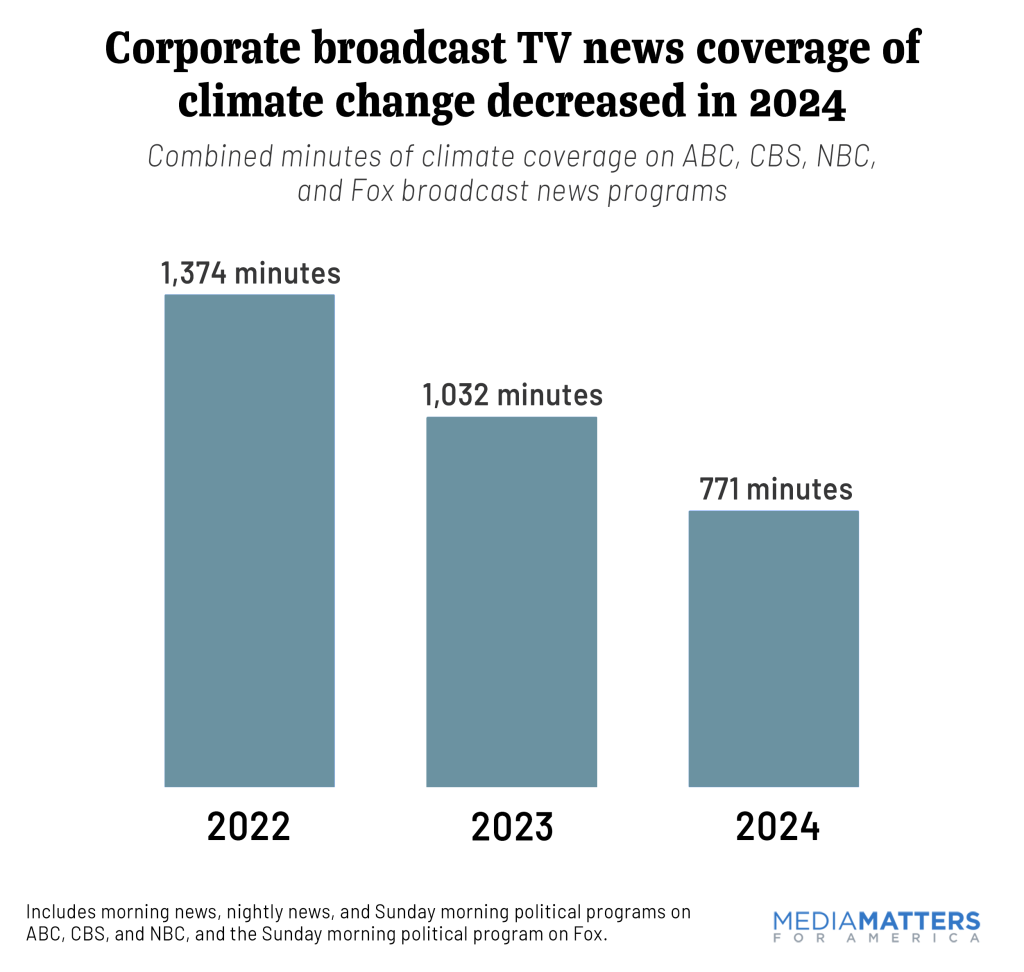
Despite these sweeping investments and the growing urgency of the climate crisis, a Media Matters analysis found that corporate broadcast networks aired 12 hours and 51 minutes of climate coverage in 2024 — a 25% decline in volume of coverage from 2023.
This reduction in climate coverage from ABC, CBS, NBC, and Fox Broadcast Co. (for its Sunday morning political show only) occurred amid significant political events, economic shifts, and global conflicts, which may have diverted attention from climate issues, despite their escalating severity. But it’s still deeply concerning, especially coming just ahead of Donald Trump’s return to the presidency.
As the Trump administration rolls back climate initiatives and expands fossil fuel production, robust news coverage has become more critical than ever. Corporate TV networks must prioritize consistent, substantive climate journalism that amplifies diverse voices, highlights systemic inequities in climate impacts, demands accountability, and clearly communicates both the dangers of an escalating climate crisis and potential solutions.
Key findings
- The volume of climate change coverage on corporate broadcast morning and nightly news programs, as well as Sunday morning political shows, decreased 25% from 2023 to 2024, from 17 hours and 12 minutes (1,032 minutes) to 12 hours and 51 minutes (771 minutes) across 324 segments.
- Only 9% of climate segments on corporate broadcast news – 28 out of 324 segments – mentioned “fossil fuels.” This is a decrease from 2023, when “fossil fuels” were mentioned in 12% of climate segments.
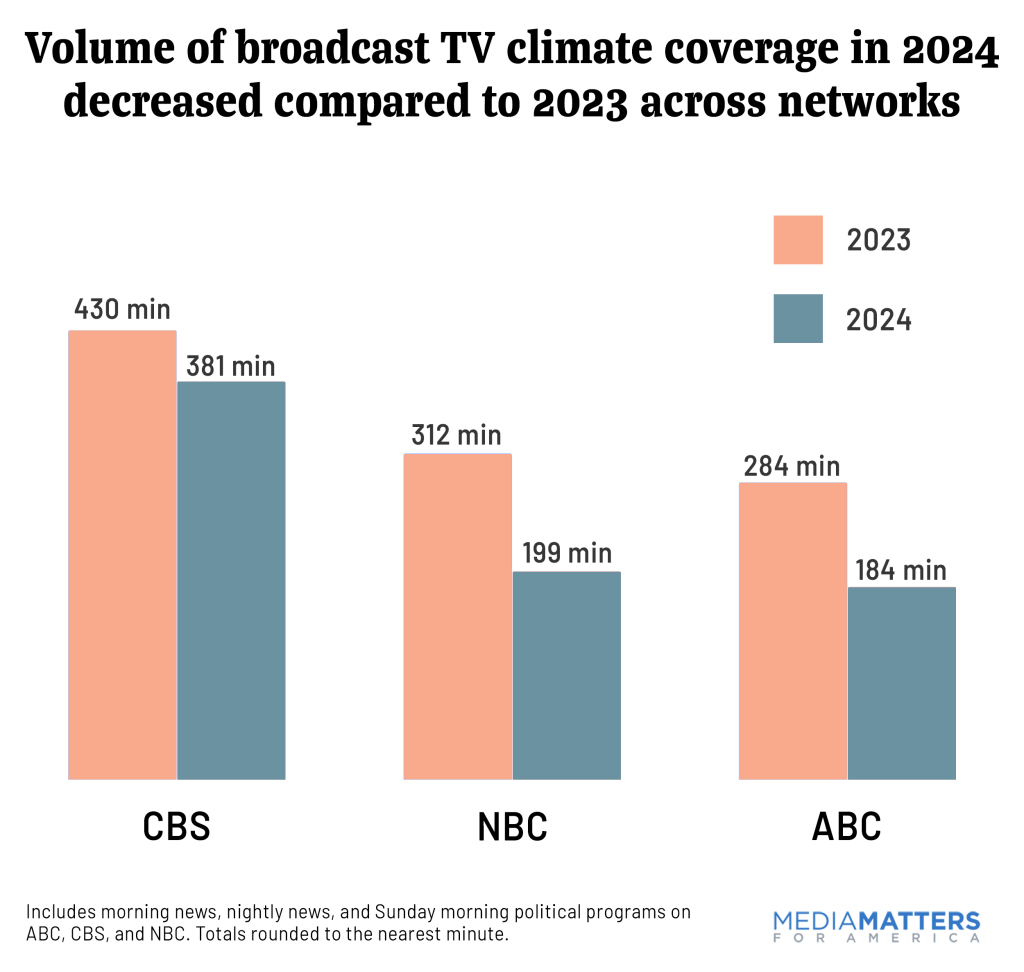
- For the fourth consecutive year, CBS led network climate coverage, accounting for 50% of total broadcast time, airing 381 minutes across 129 segments. Despite ranking third in broadcast minutes with 184, ABC aired the second-highest number of segments (103), while NBC aired 199 minutes across 88 segments.
- On the nightly news programs specifically, the volume of coverage decreased by only 5% from 2023. In 2024, these programs aired 246 minutes across 115 segments. CBS led with 118 minutes across 48 segments, followed by NBC with 92 minutes across 42 segments, and ABC with 36 minutes across 25 segments.
- PBS’ NewsHour aired 88 climate segments in 2024 compared to 122 segments aired in 2023. NewsHour, however, is not included in the full data set, as it is publicly funded and the format of the program is different from that of its corporate network counterparts.
- Climate coverage on corporate broadcast morning news programs decreased by 27% compared to 2023.
- For at least the eighth consecutive year, white men were the largest demographic of guests featured in climate segments. On morning news, nightly news, and Sunday morning political programs, 64% of guests — 190 out of 295 — were white men. Women remained underrepresented, making up 27% of guests. Only 7% of guests — 21 in total — were women of color.
- In 2024, extreme weather events drove a significant portion of broadcast climate coverage, coming up in 31% of total segments (102 of 324). This represents a decrease from 2023, when extreme weather was discussed in 37% of segments (160 out of 435).
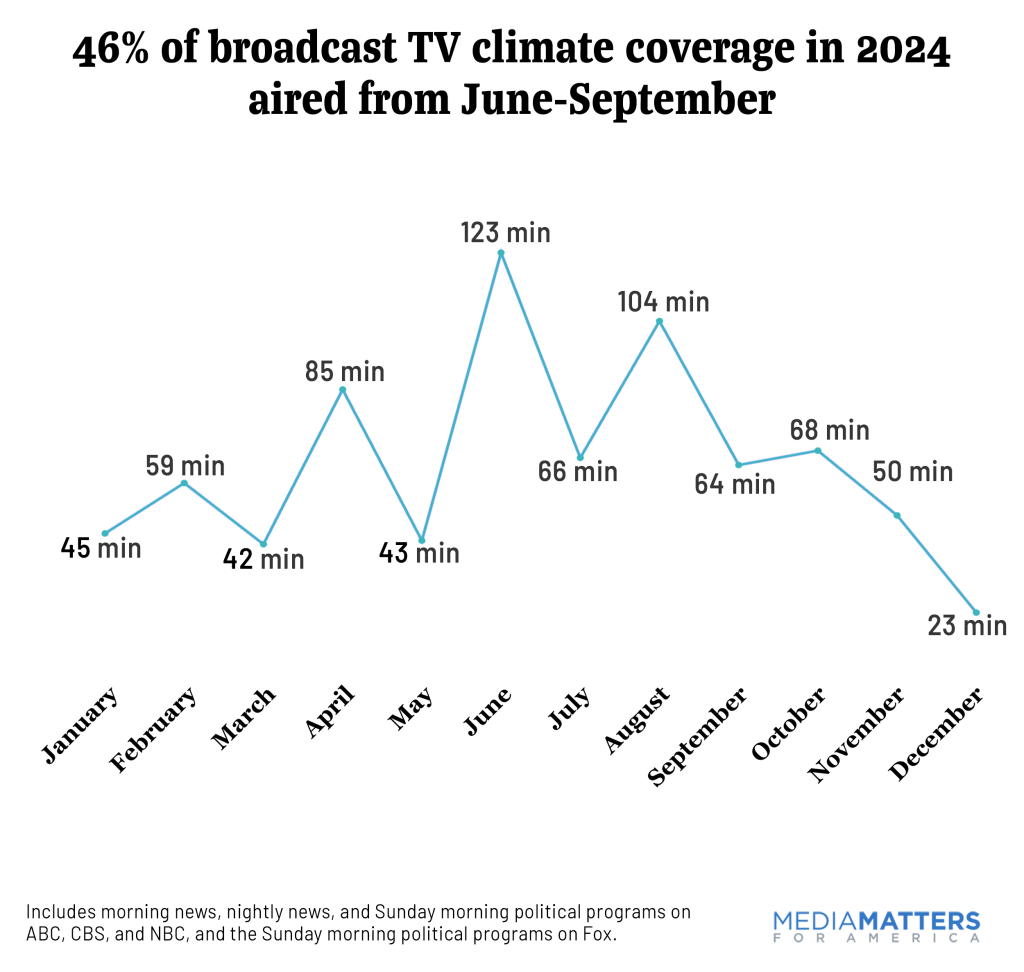
- Coverage peaked during the months of June through September, a period marked by record-breaking temperatures and severe weather events. The networks aired 46% of their total climate segments during this period, with June leading with 50 segments.
- Solutions or actions to address climate change were mentioned in 23% of segments (75 of 324), compared to 22% in 2023.
- Coverage of climate justice and disproportionate climate impacts appeared in 3% of segments (11 of 324) in 2024, down from 5% in 2023.
- ## Corporate broadcast news climate coverage continued to decline in 2024
- The 25% decrease in corporate broadcast news coverage from 2023 to 2024 (1,032 minutes to 771) is striking, especially during a year marked by the second-highest number of billion-dollar weather disasters on record. The decline underscores the persistent challenges of maintaining consistent climate coverage amid competing news priorities, from political events to global conflicts.
- ### 2024 climate coverage overview
- For the fourth year, CBS led in volume of climate coverage with 381 minutes across 129 segments, an 11% decrease from 2023, the smallest decline among networks.
- NBC aired 199 minutes of climate coverage across 88 segments, a 36% decrease from the 312 minutes aired in 2023. This was the largest decrease among the broadcast networks.
- ABC aired 184 minutes of climate coverage, a 35% decrease from the 284 minutes aired in 2023. However, ABC produced 103 climate segments, nearly matching CBS' total number of climate stories. This reflects a consistent effort to incorporate climate coverage across news programming, despite shorter average segment lengths.
- Like in 2023, corporate broadcast news coverage fluctuated significantly throughout 2024, with strong coverage during the summer months. Monthly coverage in 2024 ranged from a peak of 123 minutes in June to a low of 23 minutes in December, reflecting the challenges of maintaining consistent climate reporting.
Morning news programs reduced coverage by 27% from 2023
Morning news programs aired 489 minutes of coverage across 195 segments in 2024, a 27% decrease from the 673 minutes aired in 2023.
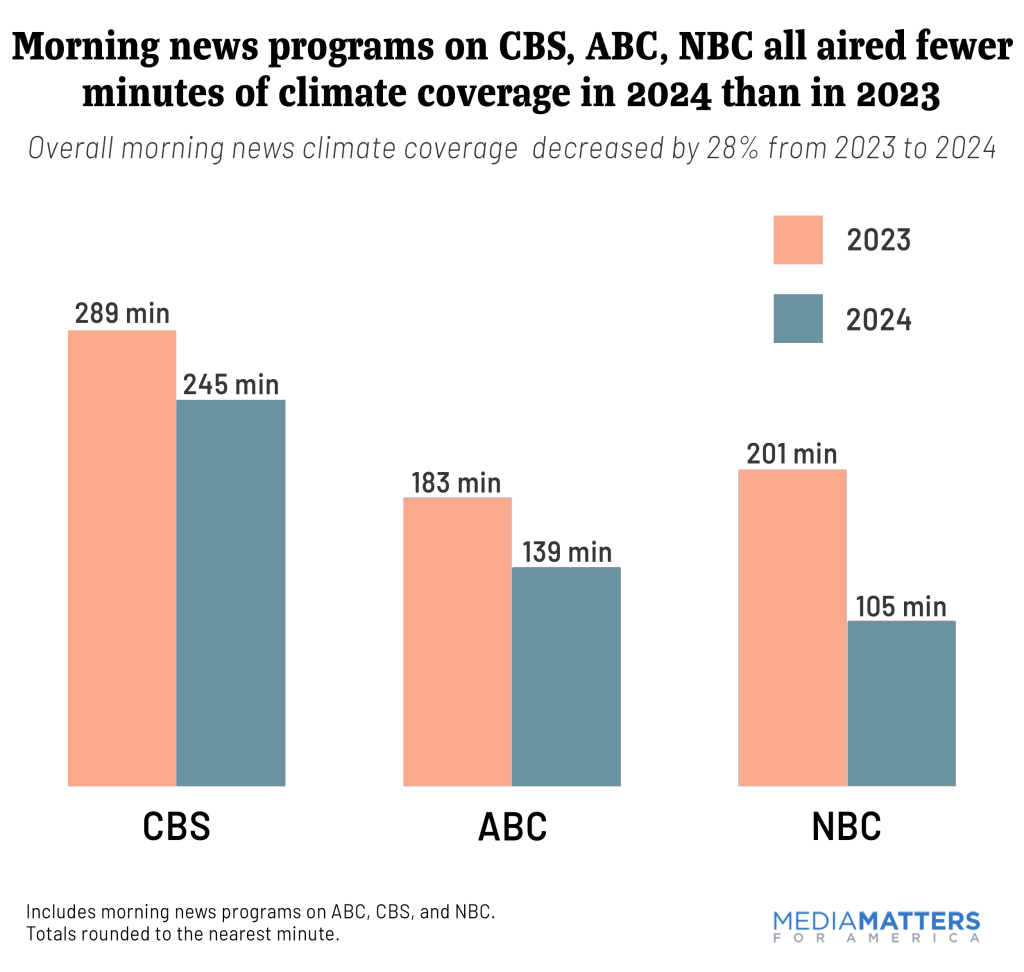
- CBS maintained its lead in morning coverage, airing 245 minutes across 74 segments, a 15% decrease from the 289 minutes aired in 2023.
- ABC's morning news programs aired 139 minutes of climate coverage in 2024, a 24% decrease from the 183 minutes of 2023. However, ABC produced 76 segments, more than both CBS and NBC.
- NBC aired 105 minutes across 45 segments during its morning news programs, a 48% decrease from the 201 minutes of coverage aired in 2023.
For the first time, our study includes ABC's GMA3, which airs for one hour on weekdays. Although it airs during the afternoon, we are categorizing it as a morning show because it follows the same format and branding as ABC's Good Morning America, which airs for two hours Monday through Saturday and for one hour on Sunday.
CBS Mornings airs Monday through Friday for two hours, as does CBS Saturday Morning. CBS News Sunday Morning airs for 90.
NBC's Today airs for four hours on weekdays, but our monitoring includes only the first three hours – the main program (7-9 a.m.) and the third hour (9-10 AM) – because the final hour, Today with Hoda and Jenna, is a lifestyle and entertainment show.
Sunday morning political shows were assessed separately and not included within our categorization of morning news programs.
Nightly news programs' climate coverage decreased slightly in 2024
Corporate broadcast nightly news programs aired 246 minutes of climate coverage across 115 segments in 2024, a 5% decrease from the 259 minutes aired in 2023.
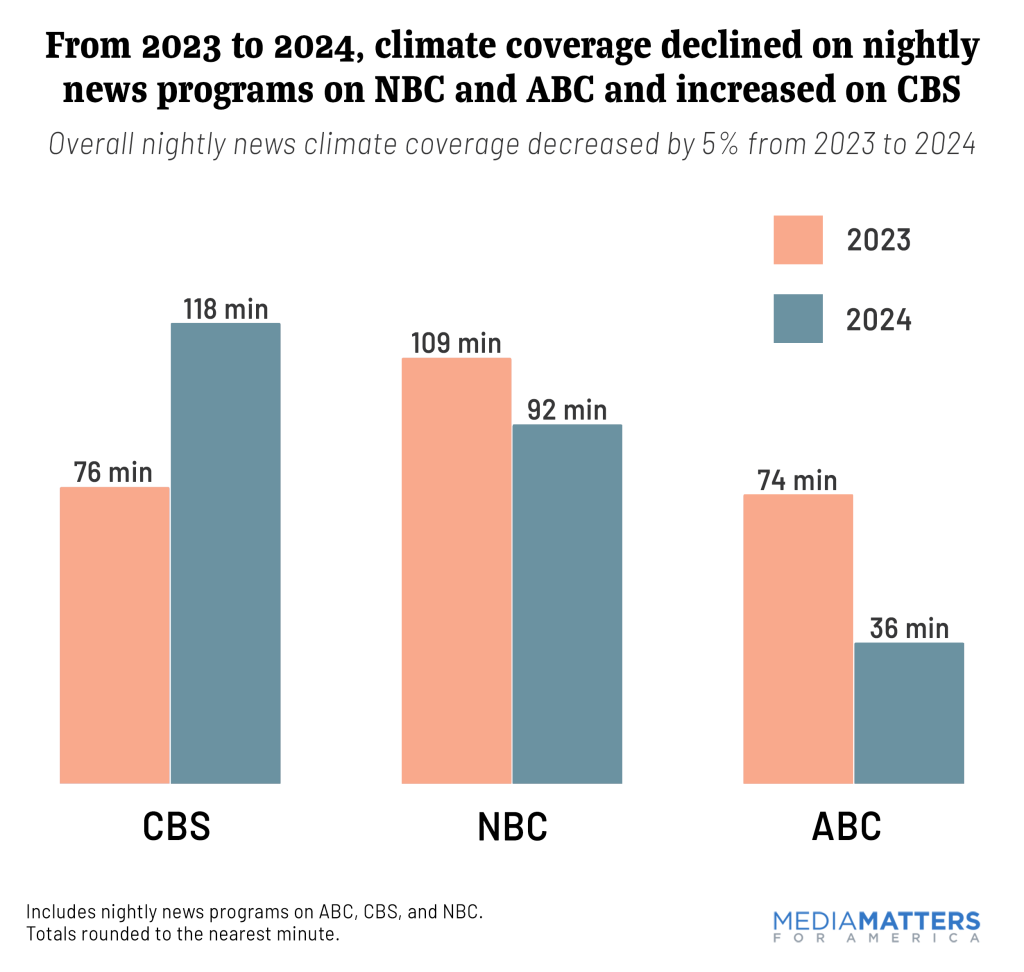
- CBS led evening coverage, airing 118 minutes across 48 segments — a 55% increase from the 76 minutes aired in 2023. CBS was the sole network to increase its evening climate coverage, likely due to its broad team of correspondents, led by Ben Tracy and Jonathan Vigliotti, who covered extreme weather, climate solutions, and recovery efforts, including segments on post-wildfire rebuilding in Palisades and Lahaina.
- NBC aired 92 minutes across 42 segments, a 16% decrease from the 109 minutes aired in 2023.
- ABC aired 36 minutes across 25 segments, a 51% decrease from the 74 minutes aired in 2023.
- For comparison, PBS NewsHour aired 88 segments in 2024, a 27% decrease from its 122 segments aired in 2023.
Sunday morning political shows maintained limited climate coverage
In 2024, Sunday morning political shows on ABC, CBS, NBC, and Fox aired 36 minutes of climate coverage across 14 segments, a 65% decrease from the 102 minutes aired in 2023.
- CBS'Face the Nationled Sunday coverage with 18 minutes across 7 segments, a 73% decrease from the 66 minutes aired in 2023.
- ABC'sThis Weekaired 9 minutes across 2 segments, a 68% decrease from the 28 minutes aired in 2023.
- Fox News Sundayaired 7 minutes across 4 segments in 2024, compared to 6 minutes in 2023.
- NBC'sMeet the Pressaired 2 minutes in a single segment, matching its 2023 coverage level.
Climate coverage peaked in June
In 2024, climate coverage peaked in June, when corporate broadcast networks aired 123 minutes of climate reporting. This peak was driven by extensive coverage of the summer heat wave affecting millions of Americans.
- Morning news programs aired 70 minutes of climate coverage in June, while nightly news programs aired 42 minutes, and Sunday morning political programs aired 10 minutes.
- CBS aired 67 minutes of climate coverage in June, its peak month.
- NBC aired 37 minutes of climate coverage in June, its peak month.
- ABC aired 19 minutes of climate coverage in June, though its peak occurred in April with 26 minutes.
- Morning news programs aired 70 minutes of climate coverage in June, while nightly news programs aired 42 minutes, and Sunday morning political programs aired 10 minutes.
Corporate broadcast networks concentrated their climate coverage in peak extreme weather months (June through September), airing 357 minutes or 46% of the year's total during that period. Coverage peaked in June (123 minutes), followed by August (104 minutes), and July (66 minutes). Although broadcast climate coverage naturally peaks during extreme weather events, networks should strive to maintain sustained coverage that reflects the growing impact of global warming on the economy, public health, agriculture, and even human migration.
- ## Climate coverage reveals ongoing demographic disparities
- In 2024, climate coverage continued to have significant disparities in guest demographics.
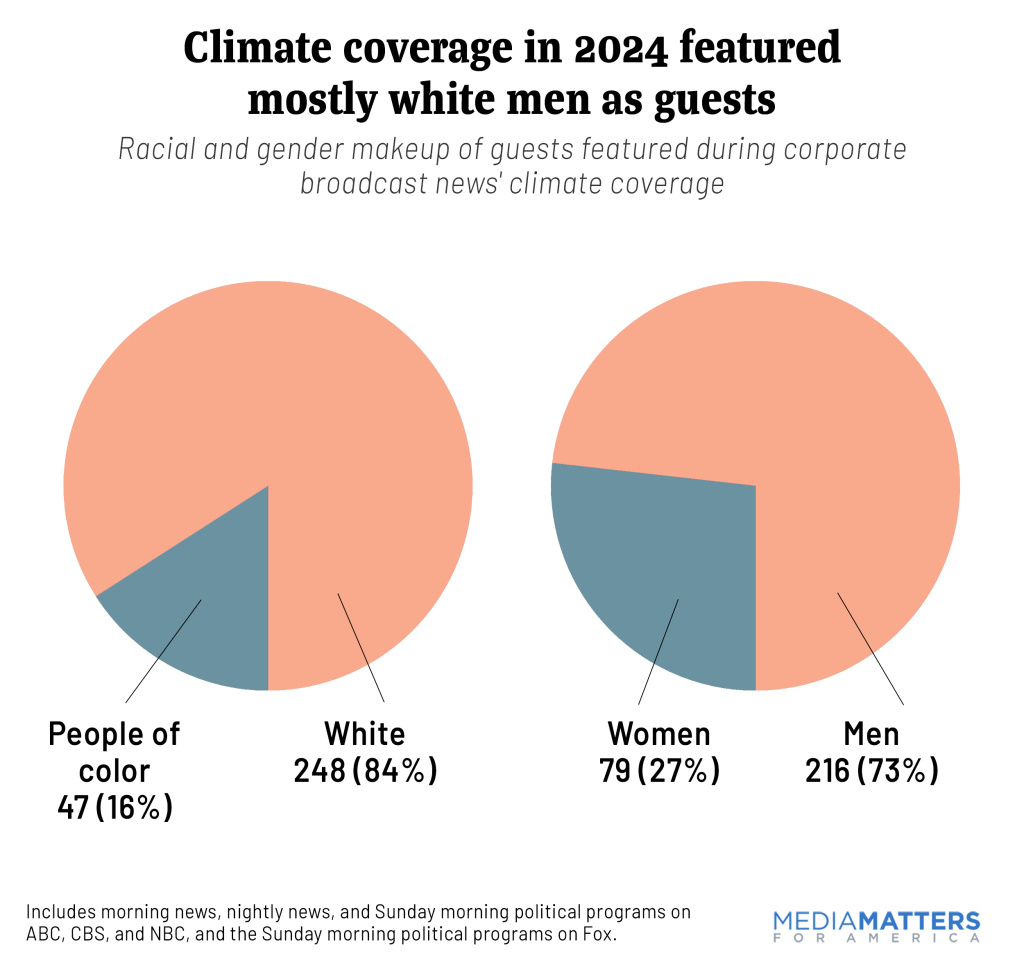
- Among 295 guests, 73% were men (216) and 27% were women (79). White guests made up 84% (248), while people of color accounted for 16% (47), including 16 Black guests, 13 Hispanic guests, and 2 Indigenous guests.
- PBS NewsHour featured 139 named guests in 2024, of whom 90 were men (65%) and 49 were women (35%). 111 guests were white (80%) and 28 were people of color (20%), including 8 Black guests, 13 Hispanic guests, and 1 Indigenous guest.
The underrepresentation of diverse voices in climate coverage — which comes despite the increasing racial/ethnic diversity of the United States — is especially concerning, as climate change disproportionately harms marginalized communities, both domestically and globally. The demographic imbalance also poses a major barrier to fostering inclusive climate discourse that accurately reflects the experiences and perspectives of affected communities.
- ## Frontline and impacted community representation remained limited in 2024
- Media Matters has identified three key groups most affected by climate change: frontline communities, impacted communities, and first responders. Broadcast coverage in 2024 continued to underrepresent these critical voices.
- Of all guests, 25% (75 appearances) across morning, evening, and Sunday news programs were coded as members of frontline communities, impacted communities, or first responders.
- Impacted community members accounted for 52 appearances, defined as those affected by specific climate events or ongoing impacts on their livelihood, homes, infrastructure, and/or local economy.
- First responders accounted for 19 appearances in climate coverage.
- There were only 4 appearances made by frontline community members, defined as those living near fossil fuel infrastructure or uniquely affected by global warming's ongoing impacts on health, livelihood, and/or local economy.
- ## Expert representation remained stable even as climate scientist and advocate appearances decline in 2024
- Climate coverage in 2024 revealed shifts from the previous year. Although overall expert representation remained stable, appearances by climate scientists and advocates decreased.
- In 2024, 24% of guests (70 out of 295) were experts with climate-related knowledge, including researchers, public health professionals, and technical specialists such as atmospheric scientists and engineers, comparable to 24% (100 out of 411) in 2023.
- Climate scientist appearances decreased from 10% (41 out of 411) in 2023 to 5% (14 out of 295) in 2024.
- CBS featured 8 climate scientists.
- NBC featured 6 climate scientists.
- ABC featured no climate scientists.
- Climate advocate appearances decreased from 22 in 2023 to 15 in 2024.
- ## Key drivers of corporate broadcast climate coverage in 2024
- ### Extreme weather
2024 marked a historic year of climate extremes, becoming the first calendar year on record to exceed pre-industrial temperatures by 1.5°C. The United States also experienced 27 separate billion-dollar weather and climate disasters, resulting in 568 fatalities and $182.7 billion in damages — the fourth-costliest year on record. These devastating impacts, from Hurricane Helene's unprecedented North Carolina floods to Hurricane Milton's rapid intensification, provided the backdrop for broadcast climate coverage throughout the year.
The global scope of extreme weather in 2024 was equally severe. Record-breaking floods in Spain claimed more than 200 lives when Valencia received a year's worth of rain in only eight hours. Asia endured multiple devastating typhoons, with Typhoon Yagi causing more than 500 deaths. Brazil experienced severe droughts, with the Paraguay River reaching record lows, while the Sahara witnessed unprecedented floods for the first time in perhaps half a century. These international disasters highlighted the widespread devastation of climate-driven weather events.
Coverage Highlights
- Extreme weather was mentioned in 31% of all climate segments (102 out of 324), a decrease from 2023, when extreme weather was mentioned in 37% of segments (160 out of 435).
- The top 5 most-covered extreme weather events were Hurricane Helene (17 segments), an extreme heat event affecting large swaths of the continental United States in June (17 segments), Hurricane Beryl (8 segments), Hurricane Milton (6 segments), and the July Western U.S. wildfires (4 segments).
- Morning news programs mentioned extreme weather in 46 climate segments.
- CBS led with 18 segments.
- ABC aired 16 segments.
- NBC aired 12 segments.
- Nightly news programs mentioned extreme weather in 53 climate segments.
- NBC led with 24 segments.
- CBS aired 20 segments.
- ABC aired 9 segments.
- Sunday morning political programs provided limited coverage that linked extreme weather to climate change, with 3 total climate segments.
- CBS aired 2 segments.
- ABC aired 1 segment.
- Extreme weather was mentioned in 31% of all climate segments (102 out of 324), a decrease from 2023, when extreme weather was mentioned in 37% of segments (160 out of 435).
Despite extreme weather being a driver of broadcast climate coverage, climate change was only mentioned in a small percent of overall extreme weather reporting in 2024, which suggests a clear opportunity for broadcast networks to increase climate coverage by more consistently connecting the ways our warming planet is influencing extreme weather events.
Only 5% of corporate broadcast segments about Hurricane Milton connected the storm to global warming, while climate was mentioned in 2% of broadcast segments about the July wildfires in the Western U.S. and Canada. Hurricane Beryl saw a similar trend, with 6% of broadcast segments connecting the storm to climate change. The June extreme heat event, which affected large swaths of the continental United States, had the highest climate connection, with 16% of broadcast segments linking the heat wave to climate change.
Trends in extreme weather coverage
Record-breaking climate patterns drive coverage
In 2024, broadcast networks covered unprecedented climate milestones as global temperatures exceeded pre-industrial levels by 1.5°C for the first time. Some coverage emphasized mounting evidence of accelerating climate impacts, from temperature records to extreme weather events, while incorporating scientific analysis to contextualize these developments.
Coverage highlights
- Broadcast networks aired 31 segments on climate trends in 2024, a notable decrease from 2023's 102 segments. Climate trends refer to long-term changes in global temperatures, weather patterns, and extreme weather events driven by climate change.
- ABC led with 12 segments.
- CBS aired 9 segments.
- NBC aired 8 segments.
- During the July 23 episode of ABC's *World News Tonight*, host David Muir reported July 21 as the hottest day on record.
- During the September 23 episode of *CBS Mornings*, meteorologist Stephanie Abrams highlighted how Summer 2024 was the warmest on record globally and projected 2024 to surpass 2023 as the hottest year on record.
- Broadcast networks aired 31 segments on climate trends in 2024, a notable decrease from 2023's 102 segments. Climate trends refer to long-term changes in global temperatures, weather patterns, and extreme weather events driven by climate change.
Integration of scientific research and climate attribution
Climate attribution studies analyze how global warming influences the likelihood and intensity of specific weather events, providing essential scientific evidence that helps audiences understand climate impacts in their daily lives. These studies appeared less frequently in broadcast coverage in 2024 compared to 2023.
- Climate attribution appeared in 7 segments in 2024, compared to 10 segments in 2023.
- CBS featured climate attribution in 4 attribution segments, followed by ABC with 2, and NBC with 1 segment.
- During the October 6 episode of NBC’s *Sunday Today*, correspondent Jesse Kirsch reported on climate attribution and how global warming is driving increasingly dangerous extreme weather events.
- CBS featured climate attribution in 4 attribution segments, followed by ABC with 2, and NBC with 1 segment.
- Climate attribution appeared in 7 segments in 2024, compared to 10 segments in 2023.
Beyond attribution studies, corporate broadcast networks incorporated a range of scientific research into their climate coverage.
- Of the 10 segments featuring scientific reports or studies corporate broadcast networks aired:
- CBS led with 6 segments featuring research from Climate Central, the National Oceanic and Atmospheric Administration, UN environmental reports, and climate impact studies.
- ABC included climate research in 4 segments, drawing on Climate Central data, NOAA forecasts, and National Climate Assessment findings.
- During the March 27 episode of *CBS Evening News*, climate scientist William Anderegg presented Climate Central's findings on climate change's impacts on allergies and season length.
- During the May 23 episode of ABC’s *World News Tonight*, host David Muir reported on NOAA’s forecast of 17 to 25 named storms for the 2024 hurricane season.
- Of the 10 segments featuring scientific reports or studies corporate broadcast networks aired:
Trends in climate impacts coverage
Economic and health impacts led nonweather coverage
Climate impact coverage in 2024 paid particular attention to systemic disruptions, with networks emphasizing long-term challenges to economic systems, public health, and ecosystems. Although insurance market disruption may be statistically underrepresented in the coverage data, it emerged as one of the year's most significant narratives, powerfully illustrating the mounting economic urgency of the climate crisis.
Coverage highlights
- The six most frequently mentioned climate impacts, excluding weather-related coverage, in 2024 were:
- Economic and insurance disruption (35 mentions)
- Public health impacts (31 mentions)
- Natural environment effects (30 mentions)
- Fatalities (19 mentions)
- Infrastructure (14 mentions)
- The six most frequently mentioned climate impacts, excluding weather-related coverage, in 2024 were:
Coverage of climate impacts across major networks included a segment aired during the August 26 episode of ABC's *Good Morning America, where medical correspondent Dr. Darien Sutton linked rising West Nile virus cases to climate change, highlighting how warming temperatures are expanding mosquito populations into new regions. During the September 1 episode of *CBS News Sunday Morning, reporting examined the threat climate change poses to California’s Highway 1, particularly in and around Big Sur. NBC's *Sunday Today* aired a segment on October 13 that featured experts from the Columbia Climate School discussing how climate-driven extreme weather events, including hurricanes Helene and Milton, are reshaping housing and insurance markets.
Solutions
Corporate broadcast networks reduced their climate solutions coverage in 2024, airing 75 segments compared to 95 in 2023. Although solutions coverage maintained a similar proportion of total climate segments (23% in 2024 versus 22% in 2023), it remained well below the 2022 level of 35%.
Coverage Highlights
- Climate solutions were mentioned in 75 segments across corporate broadcast networks in 2024.
- CBS led coverage with 40 segments, followed by ABC with 21 segments, and NBC with 14 segments.
- Morning news programs mentioned solutions in 52 segments.
- CBS led with 26 segments.
- ABC aired 18 segments.
- NBC aired 8 segments.
- Nightly news programs mentioned solutions in 21 segments.
- CBS led with 13 segments.
- NBC aired 6 segments.
- ABC aired 2 segments.
- Sunday morning political programs mentioned solutions in 2 segments, one each from ABC and CBS.
Trends in climate solutions coverage
Adaptation measures led 2024 coverage
Like in 2023, adaptation-focused segments continued to lead climate solutions coverage in 2024, reflecting the ongoing need for communities to build resilience against climate impacts affecting infrastructure, agriculture, and public health.
Coverage highlights
- Adaptation strategies were mentioned in 30 segments, leading all solution categories.
- Transportation solutions were mentioned in 14 segments, an increase from 3 segments in 2023.
- Clean electricity production was mentioned in 10 segments.
Examples of specific adaptation initiatives showcased included architectural innovations for hurricane-resistant buildings on, [vid]experimental technology for protecting workers dealing with extreme heat on NBC Nightly News, and advanced air-quality alert systems on CBS Saturday Morning. The segments featured expert perspectives from architects, researchers, and a meteorologist on how these solutions can help communities adapt to intensifying climate impacts.
2024 Election
Corporate broadcast networks' election coverage touched on climate change, primarily candidate statements and potential administration appointments, with a particular focus on cabinet nominees in late 2024.
Coverage highlights
- Broadcast networks aired 24 segments connecting climate issues to election coverage.
- CBS led with 11 segments, followed by ABC with 9 segments, and NBC with 4 segments.
- Broadcast news shows mentioned Trump administration nominees' anti-climate stances and fossil fuel industry ties in 10 segments.
Broadcast networks focused on Trump administration nominees' climate and environmental positions in November. Coverage centered on then-potential Energy secretary nominee Chris Wright, a fracking executive, examining his climate science skepticism and fossil fuel industry background. Networks also reported on former Rep. Lee Zeldin's then-potential EPA nomination and anticipated environmental policy shifts. The November post-election period marked the year's most sustained attention to climate policy positions in election coverage.
- ## Climate stories that were undercovered in 2024
- ### Biden administration climate actions
During a significant period of climate policy implementation, broadcast networks reduced coverage of the Biden administration's climate actions, focusing primarily on major regulatory actions like vehicle emissions standards and natural gas export decisions. Overall coverage decreased in 2024, with 19 segments compared to 29 in 2023. Despite climate and energy emerging as key campaign issues, networks rarely connected these policy decisions to their election coverage.
Even though the Inflation Reduction Act was the administration’s most significant climate policy, networks rarely framed the solutions from this law as IRA-driven. The lack of coverage and contextualization may have limited public awareness of the law’s climate impact, including its role in expanding clean energy, manufacturing, and community development.
Coverage highlights
- Corporate broadcast networks mentioned Biden administration climate initiatives in 6% of segments in 2024.
- CBS led coverage with 11 segments, while NBC and Fox aired 3 segments each, and ABC aired 2 segments.
- Vehicle emissions standards led coverage with mentions in 9 segments.
- Natural gas export policy decisions were mentioned in 5 segments.
- The Inflation Reduction Act was mentioned in 2 climate segments.
COP29
Corporate broadcast networks mentioned the United Nations climate conference, COP29, in 4 segments in 2024 — a decrease from the 14 segments aired about COP28 in 2023. The Conference of the Parties (COP) is an annual UN climate summit where global leaders, scientists, and activists gather to negotiate climate policy. COP29 focused on advancing climate finance mechanisms and carbon credit frameworks, aiming to help developing nations transition to sustainable energy and adapt to climate impacts. Despite the conference’s critical role in tackling the climate crisis, media coverage was limited, leaving the global negotiations largely out of the public spotlight.
Coverage highlights
- In 2024, corporate broadcast networks mentioned COP29 in 4 segments.
- ABC, CBS, NBC, and Fox each aired a single segment about the climate conference.
- In 2024, corporate broadcast networks mentioned COP29 in 4 segments.
- ## How corporate broadcast covered climate justice and fossil fuel accountability in 2024
- ### Climate justice
Coverage of climate justice decreased in 2024, with networks airing 11 segments, compared to 21 in 2023. Climate justice focuses on the disproportionate effects of climate change on socially marginalized communities and the need for equitable solutions in addressing global warming. Corporate broadcast networks' coverage of these issues could play a vital role in highlighting disparities and informing public understanding of inclusive climate policies.
Coverage highlights
- Corporate broadcast networks mentioned climate justice in 11 segments in 2024.
- ABC mentioned climate justice in 6 segments.
- CBS mentioned climate justice in 4 segments.
- NBC mentioned climate justice in 1 segment.
- Corporate broadcast networks mentioned climate justice in 11 segments in 2024.
Climate justice coverage in 2024 included an ABC *World News Tonight* segment aired on April 22, where Ginger Zee interviewed Brett Isaac, founder and executive chairman of Navajo Power, and Eleanor Paddock, a Navajo Nation resident, about efforts to bring electricity to Navajo communities for the first time. On June 8, a *CBS Saturday Morning*segment examined heat-related disparities, with David Schechter interviewing Ken Rye, who had been personally affected by the lack of air conditioning in marginalized neighborhoods.
Fossil fuel accountability
With an audience of millions, corporate broadcast networks are well-positioned to examine how the fossil fuel industry is driving global warming, helping viewers understand its role in climate disasters, environmental degradation, and public health risks and providing crucial context for climate policy discussions.
Coverage highlights
- In 2024, corporate broadcast networks mentioned “fossil fuels” in the context of climate change in 9% of climate segments, or 28 out of 324. This represents a decrease from 2023, when fossil fuels were mentioned in 12% of climate segments (52 out of 435).
- CBS mentioned fossil fuels in 18 segments.
- ABC mentioned fossil fuels in 8 segments.
- NBC mentioned fossil fuels in 2 segments.
- In 2024, corporate broadcast networks mentioned “fossil fuels” in the context of climate change in 9% of climate segments, or 28 out of 324. This represents a decrease from 2023, when fossil fuels were mentioned in 12% of climate segments (52 out of 435).
Fossil fuel accountability coverage in 2024 included a segment that aired during the March 16 episode of ABC's *Good Morning America, where Will Ganss followed photographers using visual activism to document climate impacts and expose the risks of oil drilling in the Bahamas. Another segment aired during the July 2 episode of *CBS Evening News, with Ben Tracy reporting on the conflict between Louisiana fishermen, environmentalists, and liquefied natural gas producers over the environmental and economic consequences of expanding LNG export terminals.
- ## The road ahead for broadcast climate coverage
- With Trump's return to office in 2025, broadcast networks face a critical moment to strengthen their climate coverage. While networks have made progress connecting climate science to extreme weather events, they must move beyond treating these as seasonal, isolated incidents. The challenge now is reporting on the year-round, globally interconnected patterns that define our new climate normal.
Moving forward, broadcast coverage must thoroughly investigate how both government and industry actions shape climate solutions. Networks must systematically scrutinize fossil fuel industry influence while spotlighting successful climate initiatives and their institutional challenges. This dual focus on accountability and solutions can provide viewers a comprehensive picture of America's climate response.
Networks must also resist the temptation to focus narrowly on Trump's provocative statements instead of on their policy implications and deliver substantive reporting that helps audiences grasp the tangible effects of climate policy decisions. This requires sustained attention on how federal, state, and corporate decisions shape community outcomes across regions.
Through reporting that connects extreme weather to climate change, investigates corporate influence on climate policies, amplifies voices from frontline communities, and holds policymakers accountable for their actions – not just their words – broadcast news can galvanize public demand for bold climate action and ensure accountability at every level of leadership.
- ## Methodology
---
07/11/24 mma
Only 4% of national TV news segments about Hurricane Beryl mentioned climate change
Special PROGRAMSCLIMATE & ENERGY
WRITTEN BY EVLONDO COOPER
PUBLISHED 07/11/24
Hurricane Beryl, the first hurricane of the 2024 Atlantic season, rapidly intensified to a Category 5 storm by July 2, becoming the earliest recorded Category 5 hurricane in an Atlantic hurricane season. Fueled by climate-warmed ocean waters, Beryl caused severe damage and death in the Caribbean before making landfall in Texas on July 8 and causing widespread flooding and power outages. While Beryl's exceptional development and destructive path received extensive media coverage, national TV news largely failed to connect the storm to climate change, missing another opportunity to inform the public about the links between global warming and extreme weather events.
- ## Topline findings
- A Media Matters review of national TV news coverage of Hurricane Beryl from July 1-8 found:
- Corporate broadcast and cable news networks aired a combined 701 minutes across 343 segments about Hurricane Beryl, with only 15 segments (4%) mentioning climate change.
- Cable news networks — CNN, Fox News, and MSNBC — aired a combined 520 minutes across 234 segments about Hurricane Beryl, with 9 mentioning climate change.
- Corporate broadcast TV networks — ABC, CBS, and NBC — aired a combined 181 minutes across 109 segments about Hurricane Beryl, with 6 mentioning climate change.
- 32 segments mentioned rapid intensification, a climate signal.
- ## Researchers directly connect Hurricane Beryl's strength to climate change
- Hurricane Beryl's record-breaking development and devastating impact commanded extensive media attention. Rapidly intensifying from a tropical depression on June 28 to a Category 5 hurricane by July 2, Beryl became the earliest Category 5 storm in Atlantic basin history. The hurricane wreaked havoc across the Caribbean, claiming 11 lives before making landfall in Texas on July 8. There, it caused widespread flooding, left millions without power during a heat wave, and resulted in at least 7 more fatalities.
As is typical for major weather events, national TV news provided robust coverage of Hurricane Beryl, reporting in detail about the storm's path, intensity, and immediate impacts. They consistently highlighted Beryl's record-breaking nature, noting its status as the earliest Category 5 hurricane in Atlantic history. Coverage included timely updates on evacuation orders, emergency responses, and the logistics of disaster management. Reporters and meteorologists emphasized the storm's unprecedented rapid intensification and its potential for catastrophic damage. This comprehensive coverage of the hurricane's progression, its record-setting characteristics, and its immediate effects served as a vital public service.
However, while the coverage excelled in reporting the “what” of Hurricane Beryl, it again largely missed the “why.”
The climate connection to Beryl's intensity is clear, though it remained largely absent from media coverage. A ClimaMeter analysis revealed how “events similar to the low pressure system leading to Hurricane Beryl” have changed compared to similar past events in the region: temperatures have risen by up to 1°C, precipitation has increased by as much as 30%, and wind speeds have intensified by as much as 10%. Crucially, the analysis noted that Beryl was “fueled by exceptionally warm ocean temperatures.” These record-breaking water temperatures are directly attributable to climate change, providing the energy for Beryl's rapid intensification. According to ClimaMeter:
- > According to the IPCC report … anthropogenic climate change has increased observed precipitation, winds, and storm surge associated with some tropical cyclones, and there is evidence for an increase in the annual global proportion of Category 4 or 5 tropical cyclones in recent decades.
- This statement directly links the intensification of hurricanes like Beryl, fueled by warming oceans, to human-caused climate change.
- ## Few segments made climate connection despite clear signs
- Despite the clear climate signals driving the storm's record-breaking nature, the majority of news segments failed to connect Hurricane Beryl to climate change. Out of 343 total segments reviewed during the studied period, only 15 (4%) mentioned climate change.
On cable:
- CNN aired 272 minutes of coverage about Hurricane Beryl across 111 segments, with 7 segments mentioning climate change.
- MSNBC aired 107 minutes of coverage across 46 segments, with 2 segments mentioning climate change.
- Fox News aired 141 minutes across 77 segments. No segments mentioned climate change.
On the corporate broadcast networks:
- ABC aired 63 minutes across 39 segments, with 3 segments mentioning climate change.
- CBS aired 59 minutes across 37 segments, with 2 segments mentioning climate change.
- NBC aired 59 minutes across 33 segments, with 1 segment that mentioned climate change.
The disconnect between Beryl's climate links and national TV news’ coverage of the storm is particularly concerning given the increasing intensity of extreme weather events, including hurricanes. By failing to consistently make these connections, national TV news outlets are leaving their audiences uninformed about the full scope of the climate crisis and its immediate impacts on their lives.
Despite the overall lack of climate coverage, there were a few standout segments that not only effectively connected Hurricane Beryl to climate change but also incorporated key elements necessary for comprehensive extreme weather coverage.
During the July 3 episode of CNN News Central, climate correspondent Bill Weir effectively connected Hurricane Beryl to other seemingly discrete extreme weather events, linking them all to climate change. He quantified atmospheric heat-trapping pollution, explained how it fuels various weather extremes, and emphasized their unprecedented nature. Weir also explicitly tied these climate-driven extreme weather events to greenhouse gas emissions from fossil fuels, illustrating the interconnectedness of global warming’s impacts and their root cause.
- Video
CitationFrom the July 3, 2024, episode of CNN News Central
- The July 6 episode of MSNBC’s The Katie Phang Show featured climate scientist Michael Mann, who connected Hurricane Beryl's rapid intensification to human-caused warming from fossil fuels. Mann also linked Beryl to concurrent wildfires, floods, and heat waves, emphasizing their compound effects on infrastructure, emergency resources, and public health. His analysis demonstrated how these climate-driven extreme weather events drive a complex web of cascading consequences with far-reaching societal impacts.
- Video file
Video
CitationFrom the July 6, 2024, episode of MSNBC's The Katie Phang Show
- ## Extreme weather has already been historic this summer, but national TV news coverage is failing to match the urgency of the crisis
- The coverage of Hurricane Beryl highlights a critical shortcoming in national TV news. National TV news shows have consistently missed opportunities to connect this year’s extreme weather events to the larger climate crisis.
Even a concise statement, inspired by language suggested by Covering Climate Now, could offer broadcasters a quick and effective way to make the climate connection: “Human-caused climate change is intensifying hurricanes by warming ocean waters, increasing atmospheric moisture, and raising sea levels. These factors contribute to more rapid storm intensification, heavier rainfall, and more destructive storm surges.”
Organizations like Covering Climate Now are equipping journalists with tools to enhance their approach to disaster coverage. Their efforts aim to enable news outlets to consistently contextualize extreme weather events within the framework of climate change.
As we confront an increasingly unstable climate future, the role of informed, responsible journalism has never been more critical. It's time for our media coverage to match the urgency of the crisis at hand. Adopting clear, scientifically-grounded language to connect extreme weather to climate change is just the start. To truly improve coverage, national TV news shows must go further: they should provide broader context for these events, linking them to long-term climate trends; connect extreme weather to upcoming elections, highlighting the stakes of our political choices; discuss climate justice, acknowledging the unequal impacts on vulnerable communities; and demand accountability from the fossil fuel industry for its role in driving the climate crisis.
By embracing these practices, news outlets can offer their audiences a more comprehensive understanding of our rapidly changing world and the actions needed to stave off the worst consequences of climate change.
- ## Methodology...
https://www.alternet.org/2020/09/this-is-how-you-normalize-a-madman-scholars-and-press-watchdogs-urge-corporate-media-to-treat-trump-like-the-authoritarian-threat-he-is/
no lnx twt pix
This is how you normalize a madman': Scholars and press watchdogs urge corporate media to treat Trump like the authoritarian threat he is
Lisa Newcomb and Common Dreams September 25, 2020
Major news outlets failed the American people, critics say, when they chose to bury coverage of President Donald Trump's Wednesday comment that he would not commit to a peaceful transition of power—a statement watchdogs say demanded above-the-fold, front-page headlines that simply did not materialize.
"Newsroom leaders made a considered, intentional decision not to panic after Trump was elected," Dan Froomkin, editor of PressWatchers.org, wrote in a scathing rebuke of corporate media's apparent nonchalant attitude towards the president's rhetoric. "This was an epic, obvious mistake, and everything that has happened since was in some sense entirely predictable."
Froomkin continued, "They should have gone on a war footing—and by that I don't mean a partisan war against Trump, I mean a journalistic war against lies, ignorance, and intolerance."
Critics weighed in on the relative non-importance corporate news outlets assigned—in print and online—to Trump's latest suggestion that he may not cede the office of the presidency should he lose in November:
Some observers balked when Peter Baker, chief White House correspondent for the New York Times, attempted to explain away the Times' decision to bury the news by citing print publication deadlines. One pointed to the late-evening news of Supreme Court Justice Ruth Bader Ginsburg's death last week, which was an above-the-fold feature in the next day's Times print edition.
Broadcast media also drew rebukes for its lack of emphasis on Trump's veiled threat at the democratic process.
"Wednesday's network evening newscasts on ABC, CBS, and NBC were no better," Eric Boehlert, founder and editor of PressRun wrote. "Not only did none of them lead with Trump's stunning proclamation, none of the broadcasts even reported on Trump's comments. This is how you normalize a madman. (CNN and MSNBC did a much better job covering the transfer-of-power story.)"
At PressWatchers.org, Froomkin explained how the dynamics in corporate newsrooms have led to complacency among journalists tasked with reporting on Trump's presidency:
One overarching problem is that our major newsrooms have simply gotten so corporate and even-keeled that our top editors value unflappability as a signal virtue. (OK, I admit I take this one a little personally, being a flappable person. A top Washington Post editor once called me "hysterical.") Flappable people don't rise through the ranks. Corporate people do.
Journalism to me is about crusading for the truth. But the notion that a serious, major news organization would pursue a crusade on behalf of its community is considered hippy shit by the people in charge these days. So is consistently standing up to a lawless con man. They've gotten used to printing lies. They barely squawk when Trump calls them the "enemy of the people." They have their algorithms, and they won't give them up no matter what. They just continue to "do the work."
So yeah, their news souls are dead. There, I said it.
Lawmakers and progressive advocates called out the dangerous threat to democracy uttered by the commander-in-chief—and the corporate media for treating it like any other day in Trump's scandal-laden presidency.
"Great (not) to watch journalists reporting Trump's latest direct attacks on the republic as if it's all just a regular press conference," longtime journalist Dan Gillmortweeted Wednesday. "Historians will see Big Journalism's business as usual in this emergency as one of the proximate causes of the American republic's death."
Sen. Bernie Sanders (I-Vt.) gave a speech Thursday denouncing Trump's declared refusal to commit to a peaceful transition of power, saying: "This is not just an election between Donald Trump and Joe Biden. This is an election between Donald Trump and democracy—and democracy must win."
Sanders also outlined steps necessary to prepare the American public and lawmakers for chaos of election night and beyond, calling on the news media specifically to "prepare the American people to understand there is no longer a single election day and that it is very possible that we may not know the results on November 3."
Froomkin pointed out that corporate media's opinion pages are more accurately depicting the real danger of Trump's recent rhetoric than front-page headlines.
"But as usual, to capture the real drama of what's going on, you have to go to the opinion writers—and the editorial cartoonists," he wrote, sharing a link to an op-ed by Washington Post columnist Greg Sargent.
"What really matters here is that Trump is making an actual declaration of intent," Sargent wrote, "not just to refuse to respect the outcome, but rather to try to cancel and override it, if he is able to get away with it."
Boehlert issued a more dire warning:
Trump isn't running for re-election in the sense he's hoping to accumulate more voter support than Biden. (His campaign keeps taking down ads in swing states.)Trump's running to maintain power. He's signaling that he'll refuse to give it up and will not accept his defeat as being legitimate. He's trying to steal an election. In reality, he doesn't care what the results are—he has no intention of abiding by the nation's will, and thinks he can count on the corrupt support of the GOP, the Department of Justice, and the United States Supreme Court to win his lawless battle in the days and weeks after the election.
"Our democracy is at stake," Boehlert concluded. "Trump is trying to steal an election, and the press should say so, every day until Election Day."
==
==
Twenty Years of Advocacy, Not Journalism, on Global Warming
The media has forged a consensus around climate change.
By Rich Noyes
April 23, 2010
wsj BS
From the Media Research Center
For more than two decades, the so-called mainstream media have preached the dangers of manmade global warming, insisting American businesses and consumers must make massive economic sacrifices to ward off a global climate catastrophe. Not even last November's exposure of e-mails from leading scientists on the alarmist sideof the debate — showing them conniving to fudge or suppress data, discredit critics and distort the peer review process — has caused journalists to finally take a skeptical approach to radical environmentalists' doomsaying.:{
}::{:{
}:A new study from the MRC's Business & Media Institute documents how ABC, CBS and NBC have been just as strident in their advocacy in the months following "ClimateGate" as they were in the 20 years that preceded the scandal. At the same time, a review of the Media Research Center's archives going back to the late 1980s shows just how strongly reporters have pushed the liberal line on global warming. Here are just some of the many examples::{
}::{:{
}:• "Global warming could mean economic upheaval. It could bring suffering. It could bring starvation....The causes of global warming are no mystery. The biggest culprit is carbon dioxide, or CO2, a bi-product when man burns fossil fuels to run cars or generate electricity....If we fail to act, there may be hell to pay in a hotter world....Global warming is not a fact, just a widely-held theory. The problem is, if man waits for proof, it may be too late.":{
}:— Host Don Harrison narrating CNN's primetime Climate In Crisis special, August 1, 1989.:{
}::{:{
}:•"As the science editor at Time, I would freely admit that on this issue we have crossed the boundary from news reporting to advocacy.":{
}:— Time's Charles Alexander at a September 16, 1989 global warming conference at the Smithsonian Institute, as quoted in the October 5 Wall Street Journal.:{
}::{:{
}:• "If the world is to head off the risk of global warming, with its danger of massive crop failure, or rising sea levels, or spreading starvation in the poorest countries, then America — the largest producer of the gases that cause global warming — is in the spotlight.":{
}:— ABCreporter Ned Potter on World News Tonight, April 7, 1992.:{
}::{:{
}:• "Environmentalists see catastrophes of biblical proportions, from droughts to melting ice caps that send sea levels rising.":{
}:— Correspondent Barry Petersen on the CBS Evening News, December 1, 1997.:{
}::{:{
}:• Karen Kerrigan, Small Business Survival Committee: "To say that the science is conclusive...is actually bunk.":{
}:Host Ted Koppel: "I was just going to make the observation that there are still some people who believe in the Flat Earth Society, too, but that doesn't mean they're right."}:}:}:}:}:}:
— Exchange on the December 9, 1997 Nightline.
More at WSJ.COM and some of the results from Minnesotans 4 Global Warming: Crazy Hippies Celebrate Earthday:
https://grist.org/climate/major-news-networks-devoted-less-than-four-hours-to-climate-change-in-2019-total/
2/20
When it comes to climate change, television news is covering little more than the tip of the iceberg.
That’s according to a just-released report from Media Matters for America, which found that global warming garnered a tiny sliver — well under 1 percent — of overall broadcast news coverage. The progressive research nonprofit also found that, while these news outlets did cover climate change more often in 2019 than in the year prior, the quality of coverage was “generally shallow.” And when it came to giving voice to those hit first and worst by extreme weather and other climate-related disasters, the networks fell short: People of color were “massively underrepresented” in coverage.
“In spite of the increase in coverage from 2018 to 2019, climate coverage as a whole still made up only 0.6% of overall corporate broadcast TV nightly news in 2019, showing that these programs’ climate coverage does not adequately reflect the urgency and severity of the climate crisis,” the report found.
a study analyzed four nightly news programs and four Sunday morning political shows, focusing both on segments devoted to climate change as well as substantial mentions of the topic in other segments. Yet even with significant year-to-year increases in coverage — for example, a 180 percent increase in climate coverage on nightly news in 2019 compared to 2018 — corporate broadcasters failed to substantially improve the overall quantity and quality of their climate coverage, according to Media Matters.
The analysis focused on four nightly news programs — ABC’s World News Tonight, CBS Evening News, NBC’s Nightly News, and public broadcaster PBS’s NewsHour — as well as four Sunday morning political shows: ABC’s This Week With George Stephanopoulos, CBS’s Face the Nation, NBC’s Meet the Press, and Fox Broadcasting Co.’s Fox News Sunday. Media Matters has produced variations of this analysis annually since at least 2012, including reports in 2018 and 2017.
Among the report’s key findings for 2019:
- Although the volume of climate change coverage on the corporate broadcast nightly and Sunday morning news shows increased 68 percent from 2018 to 2019 (142 minutes to 238 minutes), the report noted that this was not difficult to achieve because the amount of coverage in 2018 was “so pitiful” that news shows had a low bar to meet the following year. This climate coverage represented just .07 percent of the overall broadcast nightly and Sunday morning news shows in 2019.
- [graf]
- When it came to racial and gender diversity in their climate coverage, Media Matters found that broadcast television also failed: People of color were “massively underrepresented” as news guests, even though communities of color are disproportionately impacted by climate change. Just 10 percent of guests interviewed or featured in these news segments were people of color, and 2019 was the third year in a row that representation came in at this percentage or lower.
- Scientists and women were also underrepresented by broadcasters, comprising 22 and 27 percent of guests, respectively. Women of color were featured even less prominently — a troubling reminder that women “typically play second fiddle to white men” in discussions of climate change, according to Media Matters. “A lack of women’s voices in media coverage of climate change is part of a pattern of racism and sexism that these broadcast networks need to address,” the report stated.
- Not all of the findings in Wednesday’s report were grim. In 2019, more than a third of climate segments on ABC, CBS, NBC, and Fox mentioned solutions or actions to address climate change — a significant increase over the previous two years. The broadcasters focused most often on climate adaptation and renewable energy technologies when discussing solutions, but advocacy and direct action, such as youth climate activism, were also featured. The report cited studies showing that media coverage of climate change solutions can help spur collective action from viewers. “Much of this shift in public debate to talking about solutions is being driven by TV weathercasters, who are often trusted and knowledgeable members of local news,” the study added.
- Media Matters praised PBS NewsHour for its climate coverage, noting that it has outpaced its broadcast counterparts in climate reporting for the past six years. PBS Newshour aired 121 climate segments in 2019, an average of 10 segments per month. “This is more coverage than we found from the ABC, CBS and NBC nightly news shows combined,” the report found.
- The analysis also found that climate change coverage last year was driven in large part by reporting on the Green New Deal congressional resolution, extreme weather, climate activism, and the 2020 presidential election. Coverage of climate activism, which comprised about 16 percent of the overall climate coverage from these broadcasters, focused in large part on activist Greta Thunberg and climate strikes, which took place across the globe last year. The report also found that broadcasters did a “pretty poor job overall” covering the connection between climate change and specific extreme weather events.
Media Matters is hardly alone in its withering analysis of major media coverage of climate change — and news outlets’ failure to link global warming to wildfires and other extreme weather events that are becoming the new normal.
Some of those critics are starting to offer solutions. At the University of California, Santa Barbara, Professor Leah C. Stokes and Ph.D. candidate Emily Williams have compiled a concise fact sheet intended to help journalists and citizens understand the scientific evidence linking climate change to wildfires. They are also working on a project with Climate Signals, a science information project from the nonprofit Climate Nexus, to help journalists more easily access academic journal articles on climate change, which are typically behind paywalls, according to a radio interview Stokes gave in September.
As Grist recently reported in a story about how local journalists are tackling climate coverage, a comprehensive approach to covering climate change should include going beyond analyzing the evidence supporting global warming. John Morales, a meteorologist at NBC6 in Miami, Florida, has been covering climate change for decades. He said that local news needs to cover “how fast things are changing, the links between the observed symptoms and causes of rising temperatures, and move on to ‘what do we do about this?’”
As Media Matters made clear on Wednesday, Morales is way ahead of television’s largest news providers.
==
aha: one wonders if this is local tv stations stading up for democracy and free speech, or their refusal to play ref, or more darkly, they just want the massive ad revenue flowing from dark money superpacs
OMG
https://www.alternet.org/2020/03/read-the-letter-trumps-campaign-sent-to-tv-stations-threatening-the-fcc-could-pull-their-licenses-over-coronavirus-ad/
no lnx
Read the letter Trump’s campaign sent to TV stations threatening the FCC could pull their licenses over coronavirus
Written by David Badash / The New Civil Rights Movement March 26, 2020
Lawyers for President Donald Trump’s official Super PAC, America First Action, tried to get TV stations in key battleground states to stop airing an anti-Trump ad that focuses on his horrific mismanagement of the coronavirus crisis. The TV stations refused to pull the ad, placed by the pro-Biden Super PAC Priorities USA (PUSA), which rightly noted that the pro-Trump Super PAC did not even have standing to make the demand.
So President Trump’s official campaign stepped in to do what his Super PAC could not.
Attorneys for the Donald J. Trump for President campaign sent a Cease and Desist letter to those TV stations demanding they stop airing the anti-Trump ad.
Not only did they make that demand, but they threatened that the Federal Communications Commission (FCC), which the President controls in that he appoints its commissioners, could pull their broadcast licenses if they did not comply.
The letter reads in part: “your station has an obligation to cease and desist from airing [the ad] immediately to comply with FCC licensing requirements, to serve the public interest, and to avoid costly and time-consuming litigation.”
It also says “we formally demand that your station refuse to continue airing it to meet your responsibilities not to broadcast false information,” which is ironic given the number of falsehoods and lies Trump tells on a daily basis which are often broadcast by news networks.
It adds, “your station has a responsibility to ‘protect the public from false, misleading or deceptive advertising,’” and threatens that “your failure to remove this deceptive ad … could put your station’s license in jeopardy.”
This is the ad the Trump campaign claims is “patently false, misleading, and deceptive,” says he did not call the coronavirus a “hoax,” and essentially claims the ad says he did.
Trump refused to take the threat of the coronavirus seriously, now he won’t take responsibility as his administration has been totally unprepared for this crisis. pic.twitter.com/Jdh1GY9HHS
— Priorities USA (@prioritiesUSA) March 23, 2020
The letter can be read on the Trump campaign’s website.
===
==
an 220
https://www.alternet.org/2020/02/hunters-showrunner-executives-worried-a-jewish-show-would-alienate-half-of-america/
==
no lnx
https://theconversation.com/how-tv-cultivates-authoritarianism-and-helped-elect-trump-78981
Many gallons of ink (and megabytes of electronic text) have been devoted to explaining the surprise victory of Donald Trump.
Reasons range from white working-class resentment, to FBI Director James Comey’s decision to reopen the Hillary Clinton email investigation, to low turnout. All likely played some role. It would be a mistake to think the election turned on one single factor.
However, a study we conducted during the campaign – just published in the Journal of Communication – suggests an additional factor that should be added into the mix: television.
We’re not talking about cable news or the billions in free media given to Trump or political advertising.
Rather, we’re talking about regular, everyday television – the sitcoms, cop shows, workplace dramas and reality TV series that most heavy viewers consume for at least several hours a day – and the effect this might have on your political leanings.
An authoritarian ethos
Studies from the past 40 years have shown that regular, heavy exposure to television can shape your views on violence, gender, science, health, religion, minorities and more.
Meanwhile, 20 years ago, we conducted studies in the U.S. and Argentina that found that the more you watch television, the more likely you’ll embrace authoritarian tendencies and perspectives. Heavy American and Argentinian television viewers have a greater sense of fear, anxiety and mistrust. They value conformity, see the “other” as a threat and are uncomfortable with diversity.
There’s probably a reason for this. Gender, ethnic and racial stereotypes continue to be prevalent in many shows. Television tends to distill complex issues into simpler forms, while the use of violence as an approach to solving problems is glorified. Many fictional programs, from “Hawaii Five-O” to “The Flash,” feature formulaic violence, with a brave hero who protects people from danger and restores the rightful order of things.
In short, television programs often feature an authoritarian ethos when it comes to how characters are valued and how problems are solved.
Viewing habits and Trump support
Given this, we were intrigued when, during the campaign, we saw studies suggesting that holding authoritarian values was a powerful predictor of support for Trump.
We wondered: If watching television contributes to authoritarianism, and if authoritarianism is a driving force behind support for Trump, then might television viewing – indirectly, by way of cultivating authoritarianism – contribute to support for Trump?
About two months before the party conventions were held, we conducted an online national survey with over 1,000 adults. We asked people about their preferred candidate. (At the time, the candidates in the race were Clinton, Sanders and Trump.)
We then questioned them about their television viewing habits – how they consumed it, and how much time they spent watching.
We also asked a series of questions used by political scientists to measure a person’s authoritarian tendencies – specifically, which qualities are more important for a child to have: independence or respect for their elders; curiosity or good manners; self-reliance or obedience; being considerate or being well-behaved. (In each pair, the second answer is considered to reflect more authoritarian values.)
Confirming our own earlier studies, heavy viewers scored higher on the authoritarian scale. And confirming others’ studies, more authoritarian respondents strongly leaned toward Trump.
More importantly, we also found that authoritarianism “mediated” the effect of watching a lot of television on support for Trump. That is, heavy viewing and authoritarianism, taken together in sequence, had a significant relationship with preference for Trump. This was unaffected by gender, age, education, political ideology, race and news viewing.
We’re not the first to note that entertainment can have political consequences. In a Slate article shortly after the election, writer David Canfield argued that prime-time television is filled with programming that is “xenophobic,” “fearmongering,” “billionaire-boosting” and “science-rejecting.” What we think of “harmless prime-time escapism,” he continued, actually “reinforces the exclusionary agenda put forth by the Trump campaign.” Our data reveal that this was not simply speculation.
None of this means that television played the decisive role in the triumph of Donald Trump. But Trump offered a persona that fit perfectly with the authoritarian mindset nurtured by television.
What we think of as “mere entertainment” can have a very real effect on American politics.
==
https://theconversation.com/liberals-and-conservatives-have-wildly-different-tv-viewing-habits-but-these-5-shows-bring-everyone-together-118898
here’s been a lot of concern about how conservatives and liberals consume their news from sources that merely confirm their preexisting beliefs. The result, supposedly, has been a disintegration of a shared reality and a fracturing of the nation’s political life.
But does this trend extend to the shows we choose to watch on TV to relax and unwind?
Since 2007, the Norman Lear Center at the University of Southern California has been tracking how Americans’ favorite TV shows are connected to their attitudes on a host of hot-button political issues.
In each of these studies – including our most recent one – we found that people with different political beliefs seem to be drawn to different types of TV entertainment.
But in the most recent study, there was also a distinct overlap: certain shows that appealed to everyone across the political spectrum. These programs, we found, tend to have a quality that, at the very least, hints at some shared values in a polarizing age.
Preferences of ‘Blues,’ ‘Purples’ and ‘Reds’
For the study, we surveyed more than 3,000 people using a national sample designed to represent the U.S. population.
Respondents were asked about their entertainment preferences, viewing behaviors and their feelings about specific television shows. They were also asked about their happiness, political beliefs, voting history and personal traits.
Using a statistical clustering analysis, we identified three ideological groups in the United States that share common attitudes and values, regardless of voting history or political party preferences.
Blues, who have liberal attitudes toward abortion, the environment, guns, marriage and immigration, make up 47% of the population. This group has the most women and the largest number of African Americans. They’re also the least satisfied with their lives.
Purples, a swing group comprising 18% of the population, hold positions across the political spectrum. This group has the largest share of Asians and Hispanics, and those in it are the most religious and the most satisfied with their lives.
Reds make up 35% of the country and hold conservative views on most issues. They’re sympathetic toward the police and skeptical about affirmative action, immigrants and Islam. Reds have the highest proportion of senior citizens.
Each group demonstrated its own particular taste in media and entertainment.
Blues like many more TV shows than Reds and are open to viewing foreign films and TV series, as well as content that doesn’t reflect their values. Many Blues enjoy watching “Modern Family,” “The Big Bang Theory,” “The Simpsons,” “South Park” and “Law & Order: SVU.”
Purples are the most voracious TV viewers and enjoy more about the viewing experience than other groups. They appreciate the educational value of TV programming and are the most likely to say they take action based on what they learn about politics and social issues from fictional movies and TV shows. Their favorite shows include “The Voice” and “Dancing with the Stars,” but they also like “Saturday Night Live” – a favorite among Blues as well – and “Duck Dynasty,” which is preferred by Reds.
Reds say they seldom watch entertainment TV, but when they do, many claim they watch for an adrenaline boost. They prefer the Hallmark, History and Ion channels far more than others, while their favorite show is “NCIS.”
The shows that bring everyone together
And yet there was some significant overlap.
Five shows that all three ideological groups watched include “America’s Funniest Home Videos,” “Bones,” “Criminal Minds,” “MythBusters” and “Pawn Stars.” Four of these shows were well-liked, but “Pawn Stars” was actually one of the least-liked shows in our sample of 50. (We concluded that “Pawn Stars” had the dubious distinction of being the most hate-watched show in America.)
But what about those four shows that everyone seems to like? What common elements might they share?
My suspicion, one that we’ll explore in the next iteration of this study, is that all four of these shows – and even “Pawn Stars,” to an extent – value truth.
“Bones” and “Criminal Minds” are classic police procedurals: whodunits that follow a string of clues to arrive at a fact-based conclusion. “MythBusters” is entirely about the delights of scientific skepticism and the quest for truth. And I would argue that the clips seen on “America’s Funniest Home Videos” remain appealing after all these years precisely because they’re so raw and unscripted; we all delight in real human foibles, the stuff that we think we couldn’t make up if we tried. Even in “Pawn Stars,” customers discover the true market value of their treasured items.
In a cultural moment defined by moral panic around fake news and alternative facts, perhaps it shouldn’t come as a surprise that the neutral ground Americans of all political stripes have chosen is storytelling devoted to finding the bad guy, debunking the myth and exposing how silly humans can really be.
==
random mma grab 519
ABC News somehow spent more time on the royal baby in one week than it spent covering the climate crisis in all of 2018. Other networks were not much better.
A House subcommittee held a hearing regarding a recent report that warned that human activity is causing mass extinctions -- and those extinctions in turn threaten humanity's food supply and water. Republicans called two climate change deniers who have frequently appeared on Fox News; the pair used the hearing to attack climate change and accusing the scientists who wrote the report of having a political agenda. Worst of all, the two got more air time during the hearing than the four actual scientists invited by Democrats.
Schoolchildren around the globe walked out to protest climate inaction. Bill McKibben wrote about the need for the protests in The New Yorker: "Unless it’s your town that day that’s being hit by wildfire or a flood, it’s easy to let the day’s more pressing news take precedence. It can be hard to remember that climate change underlies so many daily injustices, from the forced migration of refugees to the spread of disease. Indeed, the people who suffer the most are usually those on the periphery—the iron law of climate change is that the less you did to cause it the more you suffer from it. So we focus on the latest Presidential tweet or trade war instead of on the latest incremental rise in carbon dioxide, even though that, in the end, is the far more critical news. A one-day work stoppage—a decision to spend a day demanding action from governments or building a bike path—is a way to break out of that bad habit."
These kids protesting could have a big impact: A study found that children are effective at changing the minds of parents about climate change.
A new study found that the sea level may rise as much as seven-and-a-half feet by 2100 -- or twice as high by 2100 as predicted by the UN in a 2013 assessment. The study found that such a rise would permanently flood cities like New York, New Orleans, and Miami, as well as numerous other cities around the globe, causing hundreds of millions of refugees. On the bright side, the authors found this horrific sea level rise would only occur if nothing is done to lower emissions in intervening years. (Of course, on the other hand, nothing is being done.)
"What if reporters covered the climate crisis like Edward R. Murrow covered the start of World War II?" That was the question from Bill Moyers as Columbia Journalism Review and The Nation launched a new program to increase coverage of climate change.
The Trump administration moved to silence the head of the CDC's climate and health program -- but he is fighting back.
Sen. Sheldon Whitehouse took to the Senate floor and called for better media coverage of the climate crisis: "I have noticed this trend so I’ve begun keeping an eye on the Sunday shows’ coverage this year. Each month I look at how many substantive segments on climate change each show runs. It’s not good. In April, for instance, there were only two substantive segments on climate change across all five shows. They have basically become Sunday morning political gossip columns."
==
AN
Scientists at the United Nations’ intergovernmental body focusing on biodiversity sounded alarms earlier this month with its report on the looming potential extinction of one million species—but few heard their calls, according to a German newspaper report.
Deutsche Welle reported Thursday that partially because the Intergovernmental Science-Policy Platform on Biodiversity and Ecosystem Services (IPBES) released its report on what it called nature’s “unprecedented” decline on the same day that the Duke and Duchess of Sussex had their first child, news reports on the study’s grave implications were few and far between.
While some international and progressive outlets—including Common Dreams—published high-profile stories on the report when it was released, just two of Britain’s national newspapers included any reporting about biodiversity on their front pages on May 7, the day after the royal baby was born to Meghan Markle and Prince Harry.< ABC, NBC, and MSNBC did not air a single prime-time mention of the major new U.N. biodiversity report warning of ecosystem collapse. The new royal baby got airtime, though. By @theodorejay. https://t.co/EQPe2qnNJx #CoverClimate#CoveringClimate #ClimateCoverage #EndClimateSilence
— Lisa Hymas (@lisahymas) May 8, 2019
Deutsche Welle’sreport was mirrored by revelations in a Media Matters report published earlier this week which showed that ABC News devoted more time to covering the royal baby’s birth in the week after the child was born than it had to stories about the climate crisis in all of 2018—even as organizers like 16-year-old Greta Thunberg led worldwide climate strikes.
“Where [is] the breaking news?” tweeted Thunberg the day after IPBES released its report. “The extra news broadcasts? The front pages? Where are the emergency meetings? The crisis summits? What could be more important?”...
==
https://www.mediamatters.org/research/2019/03/11/How-broadcast-TV-networks-covered-climate-change-in-2018/223076
many graphs
no lnx
How broadcast TV networks covered climate change in 2018
Research ››› March 11, 2019 9:11 AM EDT ››› TED MACDONALD & LISA HYMAS
Broadcast TV news coverage of climate change plummeted 45 percent from 2017 to 2018, even as the climate crisis steadily worsened. The major news programs on the broadcast networks aired a combined total of just 142 minutes of climate coverage in 2018, or less than two and a half hours. Almost three-quarters of that coverage aired in just the last three months of the year. The networks did a particularly poor job of explaining how climate change exacerbates extreme weather; none of the networks' news reports on the major hurricanes of 2018 even mentioned climate change. The networks’ coverage was also lacking in diversity: Only 9 percent of the people featured in climate segments were people of color, and only 19 percent were women.
Melissa Joskow / Media Matters
For this study, Media Matters examined 2018 news coverage of climate change on broadcast TV networks, counting and analyzing segments devoted to climate change and segments in which an employee of the network incorporated climate change. We analyzed coverage on the nightly news programs and Sunday morning political shows on ABC, CBS, and NBC. We also analyzed Fox Broadcasting Co.’s syndicated Sunday morning political show, Fox News Sunday. Fox Broadcasting Co. (which is separate from the Fox News cable channel) does not have a nightly news program, so overall there was far less Fox airtime to analyze.
Top trends from a year of broadcast TV news climate coverage
Key findings:
There was a 45 percent drop in climate change coverage on the broadcast networks’ nightly news and Sunday morning political shows from 2017 to 2018 -- from a total of 260 minutes in 2017 down to just 142 minutes in 2018.
Nearly a third of the time that the networks spent covering climate change in 2018, or 46 minutes, came from a single episode of NBC's Meet the Press on December 30 that was dedicated to discussion of climate change.
NBC was the only network that aired more minutes of climate coverage in 2018 than in 2017 -- an increase of 23 percent. CBS' time spent on climate coverage fell 56 percent from 2017 to 2018, Fox News Sunday's fell by 75 percent, and ABC's fell by 81 percent.
People of color made up only 9 percent of those who were interviewed, featured, or quoted in the networks’ climate coverage, and women made up only 19 percent.
None of the broadcast TV networks' news reports on hurricanes Florence or Michael mentioned climate change. Only nine of their segments reporting on other weather disasters of 2018 mentioned that climate change exacerbates extreme weather.
Almost three-quarters of 2018’s climate coverage occurred in the last three months of the year. Much of it focused on major climate science reports released by the United Nations and the U.S. government.
The links between national security and climate change were discussed only once in 2018, in an NBC segment. ABC and CBS did not mention that climate change poses serious threats to national security.
Solutions or actions offered in response to climate change were mentioned in only a fifth of climate segments aired on ABC, CBS, or NBC.
Climate change coverage fell significantly from 2017 to 2018
Coverage of climate change on the major broadcast networks declined 45 percent from 2017 to 2018. The programs aired a combined 142 minutes of climate coverage in 2018 -- less than two and a half hours. In 2017, the programs spent a combined 260 minutes on climate change. The decline would have been even steeper if not for the December 30 episode of NBC's Meet the Press, which devoted more than 46 minutes to discussing climate change.
This large drop occurred despite 2018 providing plenty of compelling reasons to cover climate change: extreme weather affecting much of the globe; new scientific research raising alarm bells; landmark climate reports being published by both the United Nations and the U.S. government; and the Trump administration continuing to undermine climate protections.
NBC was the only network to air more minutes of climate coverage in 2018 than in 2017 -- an increase of 23 percent. The other broadcast networks each spent less time on climate change in 2018 than they did the year before.
ABC was by far the worst performer. In 2018, the network's nightly news and Sunday morning political shows discussed climate change for less than 11 minutes total, down from 57 minutes in 2017 -- a decline of 81 percent. ABC also aired the fewest number of segments that discussed climate change -- just 12 total for the year. This continues a long trend: ABC has aired less climate coverage than CBS and NBC every year since 2013.
CBS' coverage of climate change fell by 56 percent, from nearly 98 minutes in 2017 to just under 43 minutes in 2018. But CBS did better than the other networks in 2018 on the number of segments in which it addressed climate change -- 33 total on its nightly news and Sunday morning political programs.
NBC outpaced its counterparts in time devoted to climate change, spending 78 minutes on the issue in 2018, up from 63.5 minutes in 2017 -- an increase of 23 percent. But more than half of its 2018 climate coverage -- nearly 46.5 minutes -- came from a single episode of Meet the Press on December 30, which marked the first time that a Sunday morning political show dedicated an entire episode to climate change. Without that episode, NBC would have aired less coverage than in 2017 and lagged behind CBS in the time spent on climate change in 2018. Overall, NBC discussed climate change in 30 segments on its nightly news and Sunday morning political programs in 2018.
Fox News Sunday aired a little more than 10 minutes of climate coverage in 2018, down from almost 42 minutes in 2017 -- a drop of 75 percent. More than seven minutes of its coverage came from one episode on November 25 in which host Chris Wallace and guests discussed the National Climate Assessment. The show aired a total of five climate segments in 2018.
ABC’s two major news programs -- World News Tonight and This Week With George Stephanopoulos, which together air for four and a half hours each week -- spent almost as little time on climate change as Fox News Sunday, which airs for just an hour each week.
For more on Sunday morning political shows' coverage of climate change in 2018, see our recent study.
People of color and women were underrepresented in climate coverage
The four broadcast networks featured 112 people in their news segments on climate change in 2018, excluding the networks' anchors, hosts, and correspondents. The people featured were invited on as guests, shown speaking in video footage, or quoted. The vast majority of them were white men.
Of the 112 people featured in the networks' climate segments, 102 were white, or 91 percent. Only 10 were people of color, or 9 percent. In 2017, 10 out of 222 guests in climate segments were people of color, or 5 percent.
ABC featured the fewest people of color in its climate coverage. The network's nightly news and Sunday morning political programs did not interview any guests of color. The only person of color featured was Los Angeles County Fire Department Chief Daryl Osby, an African-American, who was shown in footage speaking at a press conference in the wake of catastrophic wildfires in California on November 23 on World News Tonight.
Ninety-one of the 112 people featured were men, or 81 percent. Only 21 were women, or 19 percent. In 2017, 34 out of 222 guests were women, or 15 percent.
CBS featured the fewest women in its climate coverage. The network didn't interview any women for its nightly news or Sunday morning climate segments. It only aired brief footage of a speech by German Chancellor Angela Merkel on the January 25 episode of CBS Evening News.
Just one woman of color was interviewed about climate change on any of the networks in 2018. New York Times journalist Helene Cooper, who is African-American, participated in a panel discussion that addressed climate change on NBC's Meet the Press on November 25.
The person featured most often in the networks' climate coverage was President Donald Trump: 10 climate segments included footage of him (and in nine of them, he was dismissive of climate science; more on that below).
The longest interview with a single guest about climate change, running more than nine minutes, went to former New York City Mayor Michael Bloomberg on the December 30 episode of NBC's Meet the Press.
Broadcast news dropped the ball on linking climate change to extreme weather events
2018 was a devastating year for climate change-fueled extreme weather. According to the National Oceanic and Atmospheric Administration, extreme weather and climate disasters caused at least 247 deaths and nearly $100 billion in damage in the United States last year. The disasters included heat waves, wildfires, and hurricanes. It was the second-costliest year for such events in U.S. history, behind only 2017. Extreme weather hit other parts of the world, too: Europe was gripped by deadly summer heat waves, for example, while wildfires raged as far north as the Arctic Circle, India experienced devastating monsoon flooding, and Australia was hit by record drought.
As these extreme weather events were unfolding, many climate scientists explained how climate change can exacerbate events like heat waves, wildfires, and hurricanes. But while the broadcast TV networks’ news programs collectively aired hundreds of segments on extreme weather events that occurred in 2018, only nine of those extreme weather segments mentioned climate change.
None of the networks’ news reports on the hurricanes of 2018 mentioned climate change, even though major hurricanes struck the U.S. and generated extensive coverage. Hurricane Florence, which reached Category 4 status before hitting the Carolinas in September, broke rainfall records. One groundbreaking scientific study connected Florence’s high rainfall to climate change before the storm even reached U.S. shores. Hurricane Michael, which made landfall as a Category 4 storm in the Florida panhandle in October, was unusually intense. Scientists are becoming increasingly confident about the links between climate change and hurricanes, especially climate change’s effects on storm surge, rainfall, and overall storm intensity. But the broadcast networks are still neglecting to incorporate climate change into their hurricane coverage.
Of the extreme weather segments on ABC, CBS, and NBC that did mention climate change, four did so in the context of reporting on wildfires, three in the context of heat waves, one in the context of extreme rainfall, and one in the context of flooding caused by a Nor’easter. Fox News Sunday did not air any segments about extreme weather events that mentioned climate change. Even that low amount of coverage was an increase over the previous year: In 2017, the networks aired a total of only six segments discussing climate change in the context of weather disasters that happened that year.
While the networks rarely mentioned climate change in their segments on specific extreme weather events, they more frequently reported on how climate change affects extreme weather generally, often as part of their coverage of major scientific reports. The nightly news and Sunday morning political programs on ABC, CBS, NBC, and Fox aired a combined 10 segments that discussed climate change as a driver of extreme weather in the context of reporting on two landmark reports that were released in 2018: the U.N. Intergovernmental Panel on Climate Change (IPCC) special report on global warming above 1.5 degrees Celsius, and the U.S. government's fourth National Climate Assessment. Both reports made clear that extreme weather events such as heat waves and droughts are worsening as global temperatures increase. One example of such coverage came from CBS correspondent James Brown on the November 23 episode of CBS Evening News, reporting on the release of the National Climate Assessment:
And severe storms are the new norm according to an alarming government report out today on climate change. The 1,600-page report was written by hundreds of scientists at 13 agencies and departments. It says the impacts of climate change are already being seen with more frequent and severe storms, droughts, floods, and wildfires. The report says extreme weather in the U.S. just in the past three years has cost nearly $400 billion.
Almost three-quarters of 2018’s climate coverage occurred in the last three months of the year
The broadcast TV networks' coverage of climate change was heavily tilted toward the end of the year. More than 73 percent of the time spent covering climate change came in October, November, or December -- 104 of 142 minutes.
Most of the coverage in October and November focused on the release of two landmark scientific reports on climate change -- the IPCC's 1.5 C report, which came out on October 7, and the National Climate Assessment, which came out on November 23. Climate coverage peaked in December, due almost entirely to NBC's Meet the Press climate-focused special episode, which also discussed both major scientific reports.
The relatively high media coverage of the National Climate Assessment was ironic given the circumstances of its release. The Trump administration tried to bury the report by publishing it the Friday after Thanksgiving, but the move backfired and actually drew more attention to its findings.
Every nightly news and Sunday morning political program on ABC, CBS, and NBC covered both reports. Fox News Sunday covered the National Climate Assessment but failed to mention the IPCC report. Altogether, the networks mentioned the National Climate Assessment in 15 segments and the IPCC report in nine. Many of the segments noted that the Trump administration tried to downplay or dispute the reports' findings.
NBC did the best job of covering climate science
NBC featured 16 climate scientists in its coverage in 2018, and it aired 12 segments about climate science research -- more than the other networks on both accounts. NBC also gave the most airtime to a discussion that included a scientist, Kate Marvel of NASA, during the climate-focused special episode of Meet the Press on December 30.
CBS featured 11 scientists in its climate coverage and aired nine segments about climate research. ABC featured just one climate scientist and aired eight segments about climate research. (Fox News Sunday featured no climate scientists and aired two segments about climate research.)
Most of the networks' segments on scientific research either focused on or mentioned the IPCC report or the National Climate Assessment -- 23 out of 31 total. Six segments focused on research about ice loss in the Arctic or Antarctic.
While NBC gave more attention to climate science than the other networks, it also aired the year's most egregious instance of climate science denial on the broadcast networks. On the November 25 episode of Meet the Press, guest Danielle Pletka of the conservative American Enterprise Institute falsely stated that global temperatures have been dropping, and host Chuck Todd did not push back against her statement.
Broadcast news climate coverage focused less on Trump in 2018
In 2017, Trump dominated climate change coverage on the broadcast networks: 71 percent of segments on climate change featured actions or statements by the Trump administration, most frequently the president's announcement that he intended to pull the U.S. out of the Paris climate agreement. In 2018, the percentage of climate segments that mentioned Trump fell markedly, to 33 percent.
Unfortunately, when broadcast news climate coverage in 2018 did involve Trump, it more often focused on his climate denial than on his administration's efforts to roll back climate protections.
Networks' news programs aired a combined 10 climate segments that included footage of Trump, and in nine of them he expressed denial or skepticism about climate science, often by casting doubt on the IPCC report or the National Climate Assessment. One example came on the November 25 episode of Meet the Press:
CHUCK TODD (HOST): The president is also disputing an urgent warning from his own administration on the issue of climate change. The report from 13 federal agencies was intentionally released on Black Friday in order to bury it in the news. The White House dismissed the findings as, quote, “Largely based on the most extreme scenario.”
The report warns that if significant steps aren’t taken to rein in global warming, climate change could slash the U.S. economy by 10 percent by the end of the century. Just this week, the president tweeted about East Coast cold weather, "Whatever happened to global warming?"
[BEGIN VIDEO CLIP]
PRESIDENT DONALD TRUMP: I don’t know that it’s manmade. You have to show me the scientists, because they have a very big political agenda.
[END VIDEO CLIP]
Only two of the segments that featured Trump's climate skepticism rebutted his comments by noting the scientific consensus around climate change.
The networks aired only six segments that mentioned the Trump administration's attempts to undo climate regulations -- four on CBS, one each on ABC and NBC, and none on Fox News Sunday. Three of the segments mentioned efforts to loosen standards for vehicle carbon emissions, and two mentioned the ongoing rollback of the Clean Power Plan, which would have reined in pollution from coal-fired power plants.
CBS was the only network to mention Environmental Protection Agency administrators in the context of climate change. Climate regulations came up during an interview that CBS correspondent Major Garrett conducted with then-EPA Administrator Scott Pruitt on the January 17 episode of CBS Evening News, and on the July 5 episode, Garrett reported on Pruitt’s resignation and noted that his successor, Andrew Wheeler, had previously worked for Sen. Jim Inhofe (R-OK), a “well-known climate change skeptic.”
Broadcast networks gave too little attention to how climate change affects national security and public health
Climate change affects society, human health, and the natural world in many different ways -- some of which got more coverage than others from the broadcast TV networks.
National security threats posed by climate change -- which have been well-documented -- got very little attention in 2018: just one mention on NBC. During a roundtable discussion on the December 30 episode of Meet the Press, former Undersecretary of Defense Michèle Flournoy said, “I think there is a very strong consensus, in the U.S. military and in the national security community, that climate change is real. This is a sort of pragmatic, clear-eyed view. And for the military, they see this as leading to a change in their mission, more humanitarian assistance, disaster-relief missions abroad and at home.” Neither ABC nor CBS aired any segments that mentioned the national security issues related to climate change.
The threats climate change poses to public health also got little attention, despite being highlighted in the National Climate Assessment.
All three networks did give some coverage to the economic effects, often while discussing the National Climate Assessment, which warned that climate change could take a serious toll on the U.S. economy. Economic impacts were covered in a few other segments too, like one on NBC Nightly News on November 10 about warming sea temperatures pushing Maine’s lobsters north toward Canada.
All three networks also mentioned how climate change causes abnormal weather trends like rising global average temperatures, often in the context of reporting on the IPCC report or National Climate Assessment. And all three gave at least some coverage to the impact of climate change on plants and wildlife, such as an October 10 segment on NBC Nightly News linking the warming of the oceans to worsening algae blooms in Florida that kill vast quantities of marine life. ABC alone failed to mention sea-level rise.
Solutions to climate change were mentioned in only a fifth of climate coverage
When the broadcast TV networks' news programs did cover climate change, they rarely mentioned potential solutions to climate-related problems or actions to fight or prepare for climate change. Out of 75 total climate segments aired on ABC, CBS, and NBC in 2018, just 15 of them -- 20 percent -- made any mention of solutions or responses to climate change.
NBC aired eight segments that addressed solutions or action, more than the other two major networks combined. Four of these segments came on Meet the Press’ climate change episode on December 30, including an eight-minute roundtable discussion dedicated to solutions and responses to climate change such as carbon taxes and lawsuits against fossil fuel companies.
CBS aired four segments that included mention of climate solutions, while ABC aired three. (Fox News Sunday did not mention climate solutions or responses in any of its five segments on climate change.)
Still, most of these segments merely mentioned solutions or responses in passing rather than exploring them in any depth.
Research suggests that media coverage of climate solutions can lead to more engagement from the public, as Media Matters noted in a recent study of solutions coverage in 2017 and 2018.
PBS aired far more climate change segments than the corporate broadcast networks
In addition to analyzing climate change coverage on the corporate broadcast networks, we examined coverage on public broadcaster PBS' weekday nightly news show, PBS NewsHour.
PBS NewsHour has traditionally outpaced its broadcast counterparts in climate reporting and in the scope and depth of its coverage. Those trends continued in 2018. PBS NewsHour aired 72 segments that addressed climate change in 2018, up from 69 segments in 2017.
PBS NewsHour did a better job than the corporate networks of covering how climate change drives extreme weather. It aired six segments last year that discussed the links between climate change and the major hurricanes that hit the U.S., Florence and Michael. The show also aired seven segments on the links between climate change and wildfires, and three on climate change affecting extreme weather in other countries, including drought in Afghanistan and Somalia.
PBS NewsHour aired 23 segments that mentioned climate solutions -- more than all of the corporate networks combined. And the show's solutions coverage was typically more in-depth than that of its broadcast counterparts, including segments focusing on local moves to fight climate change and on efforts to adapt to climate change. PBS NewsHour also aired nine segments on the Trump administration's rollbacks of climate protections, again more than the corporate networks combined.
Evlondo Cooper contributed research to this study. Charts by Melissa Joskow.
Methodology
This report analyzes coverage of climate change from January 1, 2018, to December 31, 2018, on four nightly news programs (ABC's World News Tonight, CBS Evening News, NBC Nightly News, and PBS NewsHour) and four Sunday morning political shows (ABC's This Week With George Stephanopoulos, CBS' Face the Nation, NBC's Meet the Press, and Fox Broadcasting Co.'s Fox News Sunday) based on transcripts from the Nexis database.
To identify news segments that discussed climate change, we searched for derivations of the following terms in Nexis: climate change, global warming, changing climate, climate warms, climate warming, warming climate, warmer climate, warming planet, warmer planet, warming globe, warmer globe, global temperatures, rising temperatures, hotter temperatures, climate science, climate scientist, paris climate, climate accord, paris accord, climate agreement, paris agreement, and climate deal. In some instances, Nexis categorized a segment that did not mention one of our search terms as being about climate change, and if the segment provided other clear indications that it was indeed about climate change, it was included.
Our analysis included any segment devoted to climate change, as well as any substantial mention of climate change (more than one paragraph of a news transcript or a definitive statement by a person employed by the network). The study does not include instances in which a guest brought up climate change without being prompted to do so by a network employee unless the network employee subsequently addressed climate change. We defined network employees as hosts, anchors, and correspondents. When counting guests, we included network employees if they appeared as part of a roundtable discussion on a Sunday morning political show, but we excluded Sunday show hosts. We did not include teasers if they were for segments that aired later on the same program. We acquired time stamps from iQ Media. If a significant portion of a segment was not related to climate change, such as a report on a politician giving a speech about climate change, immigration, voting rights, and the economy, only the portions of the segment that discussed climate change were counted. For the Sunday morning political shows, which often feature wide-ranging discussions on multiple topics, we counted only the relevant portion of such conversations. In the text of this report, most time counts have been rounded to the nearest minute.
==
Here’s how confessional morning news shows fail us
Melanie McFarland / SalonFebruary 22, 2019
More often morning news shows are treating celebrity controversies with an Oprah touch. That’s not their role.
not just 80-90's still goes on:
https://www.opensecrets.org/news/2018/12/company-that-owns-your-local-news-might-also-influence-federal-politics/
Dec. 3, it was announced that Tribune Media would be acquired by Nexstar Media Group for over $4 billion. The resulting company will own over 200 television stations, giving it incredible access to American homes across the country through their local news programming.
Although less overtly political than their cousins on cable, local news stations have come under increased scrutiny after the viral controversy aroused in early 2018 by a “must-run” segment on stations owned by Sinclair Media. In the segment, news anchors read from a script decrying “biased and false news” on social media and other news outlets. The script was passed down from Sinclair’s corporate office in Maryland.
“Unfortunately, some members of the media use their platforms to push their own personal bias and agenda to control ‘exactly what people think’” said the script. “This is extremely dangerous to a democracy.”
Many Americans rely on stations owned by companies like Sinclair, Tribune Media and Nexstar Media Group to stay informed on local politics. But, aside from their reporting, these organizations dabble directly in politics and elections more than one might expect.
Nexstar Media Group’s PAC, for instance, has steadily ramped up its spending on political causes from 2014, with $27,100 spent that year, $95,700 spent in 2016 and $196,500 in 2018. The PAC favors Republicans, but only slightly. (They gave $5,000 to Marsha Blackburn (R-Tenn.) in the 2018 cycle, but also gave $2,500 to Tammy Baldwin (D-Wis.))
The PAC gave $10,000 to Sen. Ted Cruz (R-Texas) and the same amount to committees associated with Senate Majority Leader Mitch McConnell (R-K.Y.) and House Majority Leader Kevin McCarthy (R-Calif.) in 2018. They also gave $5,000 to Rep. Nancy Pelosi (D-Calif.) and Sen. Dianne Feinstein (D-Calif.).
As the PAC distributed its funds, stations owned by Nexstar were covering politics and political races across the country. One segment, run by Nexstar-owned WATE in Knoxville, Tennessee, focused on an anti-Phil Bredesen ad that was “censored” by Facebook. (Bredeson was Blackburn’s opponent in the 2018 Tennessee Senate race.) A Memphis station owned by Nexstar also ran a version of this story. Another WATE story featured anti-Blackburn protestors demonstrating during a moment of silence for the Pittsburgh Synagogue shooting victims at a campaign event.
KTSM, an El Paso, Texas station owned by Nexstar, re-ran an article from the Texas Tribune exploring the effect of “Hispanic identity” on the Senatorial race that pitted Beto O’Rourke against Cruz. El Paso is O’Rourke’s hometown.
A July segmentin Centex Proud, a Fox-affiliated, Nexstar owned, Waco-area station, covered a Cruz event saying “(Cruz) is excited to see the current economy and business boom – with the lowest unemployment rate for Hispanics and African-Americans in a decade. He says Texas is prospering because of this, and now says it’s time to complete the jobs underway.”
Yourcentralvalley.com, a Nexstar site affiliated with NBC covering Fresno, California, ran a storyabout Kevin McCarthy’s claims that California Democrats had fallen out of touch with voters. In addition to its station in Fresno, Nexstar owns a station in Bakersfield. Fresno and Bakersfield are a stone’s throw from the 23rd congressional district where McCarthy has his seat.
They also own a station in San Francisco where Nancy Pelosi is the congressperson for the 12th district and where Dianne Feinstein was mayor in the 80s. The San Francisco station, KRON4, has run stories on both Pelosi and Feinstein. Pelosi even gave the station an exclusive interview.
Perry Sook, Nexstar’s CEO, gave $5,000 to the company’s PAC in the 2014, 2016 and 2018 election cycles. Thomas Carter, the CFO, did the same. So did Timothy Busch, the president of the company’s broadcasting subsidy.
The Chief Technology Officer, Brett Jenkins, gave $5,000 to the PAC, but only in 2018. Gregory Raifman, president of Nexstar Digital, gave $2,500 that year. Executive Vice President Elizabeth Ryder gave $2,500 in 2014 and 2016, then beefed up her contribution to $5,000 in 2018.
The company also spent $390,000 lobbying during this period and employed a former chief counsel to Sen. John Cornyn (R-Texas) and a former deputy staff director for Sen. Chuck Schumer (D-N.Y.) as lobbyists.
After its merger with Tribune, Nexstar will be the largest owner of local broadcast stations in the U.S. Nexstar and the Illinois-based media company already have political activism in common.
Political spending at Tribune peaked around 2000 when they gave $123,280, the majority of that to Republicans. Their political giving has since plummeted to $13,034 by 2018, all but $500 of which went to Democrats.
In 2008, Tribune gave $11,450 to then-Senator Barack Obama. (Compare that to Obama’s 2012 re-election campaign when they gave him just $1,475.) Using the Wayback Machine to return to October 2008, one can see Tribune’s official endorsement of Obama for president on the WGN-TV website. The same banner rotates between the endorsement of Obama, a banner advertising Decision 2008 coverage and links to other stories.
Tribune has another connection to Obama in Edward Lazarus, Tribune’s Executive Vice President and Chief Strategy Officer. Lazarus is a former chief of staff to the chairman of the FCC. The FCC Chairman Lazarus served under, Julius Genachowski, was nominated to the position by Obama in March 2009.
By the 2016 cycle, Tribune was throwing $4,963 behind Hillary Clinton’s presidential bid. Another $2,000 went to Sen. Orrin Hatch (R-Utah) and $1000 went to Sen. Kamala Harris (D-Calif.).
Between the 2002 and 2018 cycles, Tribune gave generously to Michigan Republican Rep. Fred Upton, climbing from $1,000 in 2002, to $4,000 in 2008, then spiked again to $5,500 in 2012. Upton represents Michigan’s sixth congressional district in the Southeast of the state. WGN-TV quoted Upton’s criticisms of the Affordable Care Actand its rollout in 2013.
Before Nexstar sealed the deal to acquire Tribune, Sinclair tried to make the same purchase. Their attempt was scuttled by regulators, but Sinclair already owns a huge swath of local television stations, 191 by their count.
After flirting with bankruptcy in 2009, Sinclair was saved in part thanks to Citizens United and the ensuing influx of political ad spending. Their giving has increased dramatically since 2010 when they contributed just $8,100 to political causes. In 2014, they contributed $263,587 and in 2016 they contributed $429,504 before dipping back down to $186,648 in 2018. In each of those cycles since 2010, they gave at least two-thirds of the money to Republicans.
Sinclair is based out of Maryland and owns twelve Baltimore-area television stations. They have given generously to Maryland politicians over the years, including Rep. Andy Harris, Sen. Barbara Mikulskiand Nancy Jacobs, a Republican state Senator who lost a race for Maryland’s second congressional district in 2012.
In 2014, Sinclair gave Mikulski $25,000. They gave another $17,600 to John Boehner and $7,900 to Paul Ryan.
In a 2015 articleon the announcement that then-Senator Mikulski would receive the presidential medal of freedom, the Fox45 site included a transcript of Mikulski’s full reaction from the floor of the Senate. Mikulski also gave the Fox station an interview on receiving the medal.
South Dakota Senator John Thune received the biggest haul from Sinclair in 2016 (over $30,000). Democratic Senator Chris Van Hollen (Md.) meanwhile received $9,100.
Van Hollen gave Fox45 (the first ever Sinclair station) an exclusive interview on gun control and government spending during the same election cycle. In the days before the 2016 election, Van Hollen appeared on a Fox 45 news segment called “Your Voice” where he talked about the ease of early voting and pitched his plans to accelerate job growth in Maryland.
“Good luck on Tuesday!” the host said as he concluded the interview.
“Thanks,” Van Hollen said. “Everyone get out to vote!”
Van Hollen appeared on another Your Voice segment in April 2018. Later that summer, Fox45 covered Van Hollen’s visit to a Texas border patrol processing center.
Sinclair’s top three recipients for 2018 were Republican Senators Roger Wicker (R-Miss.), Deb Fischer(R-Neb.) and Jerry Moran (R-Kan.), all of whom received $15,000 or more. They also gave $5,700 to Rep. Greg Gianforte, who became well known nationally after physically assaulting a reporter. Blackburn got $5,700 and Arizona Senate candidate Joe Arpaio got $2,000. Both Blackburn and Arpaiohave received lavish praise from President Trump.
Sinclair’s name recognition spiked after a Deadspin compilation synchronizing the “biased news” must-run segment went viral, but Sinclair has been distributing corporate speech through local news stations for years. Segments like “News Central” and the “Terrorism Alert Desk” have been aired as must-runs at Sinclair-owned stations. Boris Epshteyn, a former Trump staffer, has a . Sinclair was even accused of trying to influence the 2004 election by airing a documentary (Stolen Honor: Wounds That Never Heal) that accused John Kerry of fabricating parts of his military service.
In the 2000s, Sinclair had a similar a must-run segment called The Point, hosted by a Sinclair lobbyist and ex-Navy intelligence officer. The host would criticize other media outlets for their coverage of then-President Bush, once going so far as to say that “terrorist leaders would dearly love to see President Bush replaced with Senator (John) Kerry.”
Sinclair-affiliated PACs and individuals supported Donald Trump for president in 2016 with $3,804. According to the Washington Post, Sinclair stations ran fifteen exclusive interviews with Trump and did none with Hillary Clinton.
Perhaps the most explicitly pro-Trump company in local television is Minnesota-based Hubbard Broadcasting. Hubbard’s CEO, Stanley Hubbard, is on the advisory board for a pro-Trump Super PAC.
“We ended up with one guy standing. His name is Trump. And I’m a team player,” said Hubbard, who was initially skeptical of the President, in an interview with NPR. “Our country is very important. We got to get rid of all these regulations, give the little guy a chance to get ahead and stop all this government interference in our lives.”
Hubbard Broadcasting gave $350,000 to Freedom Partners Action Fund, a Koch-network Super PAC, in the 2016 election cycle. Of that sum, $200,000 came from the company itself, $150,000 from individuals within the company. In 2014, the Hubbard Broadcasting gave the Super PAC $450,000, $300,000 from the company and $150,000 from individuals.
Hubbard Broadcasting’s political contributions peaked in 2016 when they gave over $1 million to Republicans. That year they gave $18,500 to Rep. Tom Emmer (R-Minn.) and $16,300 to Ted Cruz.
In 2018, their top four recipients were all Minnesota politicians: Republican Senate candidate Karin Housley, Rep. Erik Paulsen, Emmer and Rep. Jason Lewis. Each of the candidates received tens of thousands from Hubbard.
ABC 5, a Hubbard-owned station, reported on 2009 Facebook comments made by Housley in which she likened Michelle Obama to a chimpanzee. The article includes a quote from a political scientist who says, though the statement is distasteful, they “don’t think it shows she’s a virulent racist…”
On the other hand, ABC 5 gave a “D-” to an ad run by Paulsen that attempted to tie his opponent to a sexual assault. The grade was part of a segment called “Truth Test” in which political ads are rated on their factual accuracy.
Hubbard Broadcasting owns the radio station that ran the Jason Lewis Show before Lewis became a congressman. Lewis infamously used the platform to vent his frustrations with modern gender politics.
“It used to be that women were held to a little bit of a higher standard,” Lewis said on the show according to CNN. “We required modesty from women. Now, are we beyond those days where a woman can behave as a slut, but you can’t call her a slut?”
Both Lewis and Paulsen lost their seats in 2018.
Since Americans have a significantly greater level of trust in their local news stations than they do in national news outlets or in web-only publications, this level of political activity from media companies is especially significant.
In most cases, it is difficult to say whether these companies’ political activities cross-pollinate with their journalism and business dealings, but future controversies akin to the Sinclair must-run scandal could continue to increase the visibility of the companies behind these local stations and erode Americans’ faith in yet another source of news.
Note: Due to errors with CRP data obtained from the FEC that triple-counted contributions, it was originally reported that Sen. Chris Van Hollen received $28,000 from Sinclair affiliates and its PAC. That number has been corrected to $9,100.
https://www.desmogblog.com/2018/10/17/60-minutes-trump-says-not-denying-climate-change
Davies, Climate Investigations Center. Originally posted on Climate Investigations Center.
Climate change is coming at Trump even as he tries like hell to avoid the subject. Record-setting hurricanes, Florence and Michael, have caused devastation across the southeast United States. Meanwhile, the grim UN IPCC “1.5 degree” report pushed climate scientists into the headlines last week while Trump was out and about, apparently unleashed, talking to media.
LStahl of 60 Minutes, got the first big sit down interview and went at climate change right off the bat.Pivoting off Hurricane Michael and the IPCC report, Stahl pressed Trump to answer straight questions about climate change.
This is the most Trump has been forced to say on the subject of global warming since his Rose Garden celebration announcing that the U.S. would exit the Paris climate agreement, where he managed to barely mention climate change.
Overall, Trump responds to Stahl’s questions with the typical denier tropes, which he likely learned from Rush Limbaugh, Myron Ebell, Marc Morano, and the Heartland Institute:
“Somethings changing and it’ll change back again.”
“And you don’t know whether or not that would have happened with or without man. You don’t know.”
“We have scientists that disagree with that [anthropogenic climate change].”
“But it [climate change] could very well go back.”
“But I don’t know that it’s [climate change] manmade.”
“They say that we had hurricanes that were far worse than what we just had with Michael.”
“You’d have to show me the scientists because they have a very big political agenda, Lesley.”
Trump also deployed a empty economic argument against taking action, one commonly used by deniers:
“I will say this. I don’t wanna give trillions and trillions of dollars. I don’t wanna lose millions and millions of jobs. I don’t wanna be put at a disadvantage.”
Read the full 60 Minutes interview transcript.
Deniers Would Rather Trump Said Nothing
Trump said a couple of things the deniers don’t really want him to say, including:
“I don’t think it’s a hoax” and “I’m not denying climate change.”
Joe Bast, former CEO of the Heartland Institute, and his climate denier kin are happiest when the President doesn’t talk about it at all. A year ago, Bast provided his reason for applauding the President’s silence, quoted and memorialized in the video below:
“The President has done a great job by not talking about global warming. The less the President talks about it, the less often it appears in news stories and on TV, the less often its going to be an issue. So, this is how big issues disappear.' Trump Questioned on Climate by Reporters in Georgia While Touring Hurricane Damage
Predictions for Hurricane Michael went from a predicted Category 1 on October 7 to making landfall at just below Category 5 three days later, surprising meteorologists and foiling predictive computer models.
While touring areas damaged by the massive storm in Georgia on Monday,reporters continued to press Trump on climate change and he continued trying to change the subject and inform us that he has “the cleanest air on the planet.”
...
==
7/18 fail
heat wave that just swept the United States was no joke. 227 U.S. records were broken for highest temperature in a week alone. The heat wave killed at least five people in the United States and 70 more in Canada. And while the news was happy to talk about the heat wave, there was barely any mention of climate change.
Climate change is exacerbating the frequency and intensity of these heat waves. And yet, it gets almost no mention. ABC and NBC ignored the link to climate change entirely, while both PBS and CBS aired one segment linking the heat wave to climate change. If this sounds familiar, it is because we found a similar problem with heat waves in 2012 and 2017. The link to climate change also regularly gets ignored with wildfires, hurricanes, floods, polar bear deaths, and sea-level rise. Climate change is also ignored during elections and when millions of people march take to the streets. Fox News does cover climate change when it's cold outside, so that's something.
Climate change is getting worse, and yet the media can't connect the obvious dots for how that is affecting the lives of its audiences.
==
National Rifle Association’s news outlet NRATVspun former FBI Director James Comey’s testimony to the Senate intelligence committee to President Donald Trump’s advantage by flatly lying about what Comey said.
Comey testified in an open hearing before the Senate intelligence committee on June 8, almost a month after Trump abruptly fired him. Trump’s public statements on the firing have caused numerous legal experts to warn that Trump may have obstructed justice by improperly interfering with an FBI investigation.
NRATV was quick to jump to Trump’s defense before and during Comey’s appearance. During the 11 a.m. edition of its program Stinchfield, which provides live news updates at the top of the hour from 9 a.m. to 1 p.m. EST, host Grant Stinchfield said the hearing came down to one question: “Did [Trump] ever try to obstruct justice in any way?" He said Comey answered, "No":
[vid]
GRANT STINCHFIELD (HOST): Now as I look and listen to this hearing, what I see is James Comey being questioned. One, being led by the Democrats to try to sink Donald Trump, and two, by the Republicans trying to get to the heart of what this hearing is all about. Did Donald Trump try to obstruct justice when it came to this Russian investigation in any way? A direct quote when he was asked about this by the chairman of the committee, a Republican, “Did Donald Trump ever ask you to stop the Russian investigation?” James Comey’s answer, “No.” “Did he ever try to obstruct justice in any way?” James Comey’s answer, “No.”
In actuality, Sen. Richard Burr (R-NC), chairman of the intelligence committee, asked Comey whether the president was trying to find a way for former national security adviser Mike Flynn to “save face” after having been fired, or whether he was trying to “obstruct justice” when he said he hoped Comey could “let [the investigation] go.” At the time, Flynn was under investigation for his ties to Russia. Comey didn’t respond “no,” but instead said, “I don't think it's for me to say whether the conversation I had with the president was an effort to obstruct. I took it as a very disturbing thing, very concerning, but that's a conclusion I'm sure the special counsel will work towards to try and understand what the intention was there and whether that's an offense”:
bernie DN media ignored his rural rallies?
Now, one of the problems I think we have as a nation, I think media—and, by the way, at the back of the book, one of the important chapters—if you get tired, skip to the back. If you don’t like taxation or immigration reform, go to the back, last chapter, which deals with—it’s entitled "Corporate Media, a Threat to Democracy." And it talks about the role of corporate media in our society and in politics, in particular. But what is going on in this country is that we live in a pretty siloized nation. That’s a kind of a inside-the-Beltway term; I don’t know if it’s expanded to Pennsylvania. But what it means is we all live in our own worlds, basically. We associate with people who think the same as we do. I guess there was somebody who said, "How could Trump have won? Nobody I knew voted for Trump!" Well, you don’t know people in different walks of life than your own. And one of the things that a lot of middle-class people, upper-middle-class people don’t know is that, yes, we are better off economically today than we were eight years ago, when Bush left office—there’s no debate on that—but for 40 years in this country, under Democratic and Republican administrations, we have seen a shrinking of the American middle class, we have seen more and more income and wealth inequality, so that today the top one-tenth of 1 percent now owns almost as much wealth as the bottom 90 percent, and today we have 43 million people living in poverty, some in really dire straits.
Now, one of the things that I did in the campaign—what I wanted to do, and I did—was to go into parts of the country where media very rarely goes, and I wanted to be talking to people, and I wanted to see if we can get some national exposure. And in a sense, I failed. We had media following me all over the place, what they call embedded media, from all the networks and major newspapers, but basically they did not write about what we were seeing in various parts of the country.
And let me just talk a little bit about that. We talked—and again, these are facts; some of you know it, some of you don’t. But I want you to understand the pain and the hurt that millions of people are experiencing. You’re a single mom in Philadelphia...
http://wwwwww.alternet.org/news-amp-politics/bernie-sanders-warns-corporate-media-threatens-democracy
==
==
There was also a heavier dose of conspiracy on the new networks. Newsmax TV has aired "Roswell Top Secret," and it features Dick Morris, author of the 2012 book Here Comes the Black Helicopters!. Fox was no longer the only place for the grassroots right to turn, nor the only channel where would-be conservative personalities could go to make a name for themselves.
==
wow tracking:
http://www.imdb.com/name/nm2015310/
==
The Tyndall Report, a non-partisan media monitoring firm that has been tracking the nightly news broadcasts of ABC, CBS, and NBC, found that Trump is tromp, tromp, tromping over the airtime of everyone else.
From last January through November, these dominant flagship news shows devoted 234 minutes of prime-time coverage to the incessant chirping of the yellow-crested birdbrain, with no other contender getting even a fourth of that.
Take Bernie Sanders, who’s stunning the political establishment with a fiery populist campaign that’s drawing record crowds. Indeed, Sanders’ upstart campaign is commanding a comparable share of support within the Democratic Party’s voting base to what Trump is enjoying from the Republican electorate.
And — get this — polls also show Bernie trouncing The Donald if they face each other in November’s presidential showdown. So surely he’s getting a proportional level of media coverage by the networks on our public airwaves, right?
Ha, just kidding! The big networks’ devotion of 234 minutes to all-things-Trump was “balanced” by less than 10 minutes for Sanders. Most egregious was ABC, the Disney-owned network. ABC’s World News Tonight awarded 81 minutes of national showtime to Trump last year — and for Bernie: 20 seconds.
How self-serving of the media moguls. The one candidate who is effectively rallying large numbers of voters to oppose the rise of corporate oligarchy — including in the media — has the plug pulled on him.
Of course, this only amplifies the truth of what Sanders is saying about the villainy of corporate profiteers, and it fuels a greater determination by his millions of grassroots supporters to end the reign of greed in America.
Jim Hightower is a national radio commentator, writer, public speaker, and author of the new book, "Swim Against the Current: Even a Dead Fish Can Go With the Flow." (Wiley, March 2008) He publishes the monthly "Hightower Lowdown," co-edited by Phillip Frazer.
busted
http://mediamatters.org/research/2015/11/13/network-evening-news-programs-yet-to-address-wh/206839
In recent months, media investigations have revealed that Exxon Mobil peddled climate science denial for years after its scientists recognized that burning fossil fuels causes global warming, prompting New York's Attorney General to issue a subpoena to Exxon and all three Democratic presidential candidates to call for a federal probe of the company. But despite these developments, the nightly news programs of all three major broadcast networks -- ABC, CBS, and NBC -- have failed to air a single segment addressing the evidence that Exxon knowingly deceived its shareholders and the public about climate change.
Media Reports Revealed Exxon's Acceptance Of Climate Science Pre-Dated Its Funding Of Climate Denial, Prompting Calls For Investigations
Media Report: Email Shows"Exxon Knew Of Climate Change In 1981 ... But It Funded Deniers For 27 More Years."On July 8, InsideClimate News and The Guardian reported on an email from a former Exxon employee that was highlighted by the Union of Concerned Scientists. InsideClimate News noted that the email showed "Exxon scientists studied the impact of greenhouse gas emissions on global warming as far back as 1981," and that "company's early awareness of climate change and willingness to factor it into business decisions starkly contrasts with the path it took a decade later, when it led efforts to cloud public understanding of climate science and delay action to reduce emissions of greenhouse gases, such as carbon dioxide." The Guardian similarly reported that ExxonMobil "knew as early as 1981 of climate change -- seven years before it became a public issue, according to a newly discovered email from one of the firm's own scientists. Despite this, the firm spent millions over the next 27 years to promote climate denial." The Guardian further reported:
==
==
As if to prove there are new depths to be plumbed in the world of reality television (because who knew?), CBS just debuted The Briefcase,a show which takes poverty porn, class anxiety, emotional manipulation and exploitation and packages them all neatly into a pretty despicable hour of primetime television. Kicking off each episode with the question, “What would you do with $101,000?” the show then deep-dives into a competition that asks two unwitting, financially strapped families to choose between two no-win options: being financially solvent yet appearing heartless and greedy, or drowning in debt yet having audiences recognize them as selfless and giving.
It’s hard to imagine a network executive didn’t get the idea for this show from the “Button, Button” episode of the Twilight Zone. The Briefcasefocuses on two “middle-class” families—a questionable but highly American take on the phrase, since both are debt saddled, with one primary breadwinner, and essentially living on the edge of financial ruin. Both are told they’ll be participating in a documentary about money. Instead, a producer from the show unexpectedly comes to their house with a suitcase full of cold, hard cash: $101,000 to be exact. That could be a life-changing – and in the case of families so near the financial cliff, nearly life-saving – sum of money. But this being reality TV, instead of just giving them the cash, there’s a major catch.
Both families are informed that somewhere out there, there’s another family “who’s also in need,” and are given a choice: “You can keep all of the money, you can keep some of the money, or you can give it all away.” Neither family knows that the other family also has a suitcase full of cash and is debating how much, if any, they’ll share. And since both families were originally told they were merely going to be the subjects of a documentary, neither of them really signed up for this exercise in televised torture.
What follows, predictably, is a gut-wrenching look at the two families being guilted this way and that over whether to choose charity or financial survival.
Network TV Continues Giving Climate Change Cold Shoulder
By Miles Grant [1] / FAIR [2]
March 10, 2015
In recent weeks, network television news has understandably focused extensively on the extreme cold and snow in the Northeast and upper Midwest. But a new FAIR study shows they’ve almost completely ignored a related and even more dangerous phenomenon out West: record-shattering winter warmth. And they've overwhelmingly failed to discuss what connects the two sets of strange weather phenomena: human-caused climate disruption.

FAIR examined ABC, CBS and NBC transcripts from January 25 (as the Northeast’s first blizzard approached) through March 4, looking at all mentions of cold, snow and ice. Over the same time period, we studied coverage of heat, warmth and drought across the West and Pacific Northwest.
Near-Exclusive Focus on East, Cold
A total of 417 network segments mentioned the extreme cold, but just seven of these included a reference to climate change--barely over 1 percent. That’s even though science is clear that climate disruption is loading the dice for extreme weather events. “Many areas are seeing bigger and more intense snowstorms, especially in the upper Midwest and Northeast,”warned Amanda Staudt [3], National Wildlife Federation climate scientist, back in 2010.
NBC Nightly News (3/2/15) found room for a story about a man selling bottled Boston snow, but had little time to discuss the impact of climate change on extreme weather.
NBC Nightly News (3/2/15) found room for a story about a man selling bottled Boston snow, but had little time to discuss the impact of climate change on extreme weather.
“One of the consequences of a warming ocean near a coastline like the East Coast and Washington, DC, for instance, is that you can get dumped on with more snow partly as a consequence of global warming,” Kevin Trenberth, climate scientist at the National Center for Atmospheric Research in Colorado, told **NPR** [4], also in 2010. A September 2014 study linked a rise in polar vortex cold blasts [5] to Arctic sea ice loss caused by global warming. But not a single climate scientist was quoted by network TV in the entire study period.
On the CBS Evening News (2/19/15), anchor Scott Pelley at least pointed out that cold weather in one region doesn't mean that the world as a whole is cooling. “As cold as it is, a federal climate report out today says that last month was the second warmest January on record for planet Earth,” he said.
Ignoring America’s Warm, Dry West
Only 12 segments mentioned the record-setting warmth and drought out West, and that included weather updates. Just one made the link to global warming, and even that one tried to discredit the connection. “A new study from Stanford University claims the drought in California is being fueled by human-caused climate change,” Amy Robach told viewers of ABC’sGood Morning America (3/3/15). “But some scientists not involved in the study are questioning some of those findings.” What scientists? Were they independent or polluter-funded? Were the concerns valid? The story ended there.
David Muir of ABC’s World News Tonight (2/2/15) reported, “In San Francisco, no measurable rain in the entire month of January, the first time in 165 years since they started keeping records during the Gold Rush.” Was there a reason for the trend? Viewers were left in the dark, part of a pattern of journalists reporting on the effects of the climate crisis while steering clear of the cause (Extra!, 8/11 [6], 12/13 [7]).
Virtually ignored was that more than 20 cities out West, including San Francisco, Seattle, Portland, Salt Lake City, Sacramento and Las Vegas, had their warmest winters on record, while as Weather.com (3/1/15 [8]) pointed out, “few if any cities in the East will have their coldest winters on record despite a series of high-profile blizzards and record cold waves--mainly because December was relatively mild.”
Mild winters may sound pleasant, but there could be a high price to pay come fire season. “Things are much more dry and, frankly, more ready to burn...than in [recent] memory,” Jason Curry, spokesperson for the Utah Division of Forestry, Fire and State Lands, told the Salt Lake Tribune [9].
'Very Serious' or a 'Hot Potato'?
Over the time period studied, just 13 segments mentioned climate change at all. And four of those were about Sen. Jim Inhofe (R-OK) bringing a snowball to the US Senate floor to mock climate science.
The top source of climate talk on the networks came from an unexpected source: actor and activist Rosie Perez of ABC’s The View. “What was very upsetting to me is that a man of his stature, a man of his age, doesn't understand what climate change really means,” lamented Perez on March 2 after Inhofe’s snowball stunt. She mentioned climate change’s effect on extreme weather on February 24.
And back on February 17, Perez did something literally no network journalist did over the study period: She told viewers that the scientific consensus is that manmade carbon pollution is causing global warming:
A lot of politicians, a lot of lobbyists, keep saying that they aren't scientists, but the scientists are saying that climate change is real, and part of the reason why we have so much more rain and snowfall is because what happens is when the temperatures changed in the oceans, the evaporation increases, and so you have all this condensation just held up into the sky. And because of the greenhouse gases, you know, we need the carbon dioxide for photosynthesis, but when we have too much of it, it becomes a dangerous thing. And so that’s why things are changing, and we should be taking this very seriously, especially in an election year, 2016.
Meanwhile, on the February 3 edition of Today, NBC News political director Chuck Todd cited climate change as a “hot potato” politicians should stop discussing altogether. While hostingMeet the Press on March 1, Todd applauded Inhofe’s science-mocking snowball as “a fun little prop,” but declared, “I’m not going to use that to get into a climate change debate.”
Giving Science a Voice
The climate crisis is a clear and present danger to America--from rising sea levels to strengthening storms to more intense wildfires--yet news outlets are clouding the problem in silence and creating uncertainty. Even though 2014 was the hottest year on record [10] and temperatures continue their steady rise, media coverage of climate change remains down, according to both the University of Colorado’s Center for Science and Technology Policy Research’s newspaper tracking [11] and Media Matters’ broadcast analysis [12].
A strong 78 percent of Americans back government action to cut climate-disrupting carbon pollution, according to a January poll [13] by the New York Times, Stanford University and Resources for the Future. But despite the overwhelming scientific evidence showing global warming is clearly manmade, already here and harming America, many citizens remain in the dark. Reticent--or outright ignorant--news coverage isn’t helping.
Some, like Todd, may think they’re avoiding politicization of the issue. But by not covering climate change or its causes, they’re giving a free pass to the huge industrial polluters who are profiting off their ability to dump unlimited amounts of carbon pollution into our atmosphere free of charge.
If reporters feel uncertain about discussing climate science, the solution isn’t to shy away--it’s to get help talking about it. The Society of Environmental Journalism provides the helpfulClimate Change: A Guide to the Information and Disinformation [14]. The Poynter Institute provides 7 Tips for Covering Climate Change [15] and an in-depth, online, self-directed course onCovering Climate Change [16].
Miles Grant is a progressive blogger and environmental communicator in Fairhaven, Massachusetts. He’s senior communications manager for the National Wildlife Federation (though his thoughts here are his own). Read more at The Green Miles [17] and follow him on Twitter [18].
Posted: 01/16/2014 7:30 am EST | Updated: 01/16/2014 2:27 pm EST
WASHINGTON -- Climate change got more coverage on broadcast news in 2013 than in the previous few years, but the issue still didn't get nearly as much attention as it did in 2009, Media Matters found in a new analysis.
ABC, CBS, NBC and Fox together featured more coverage in 2013 than they did in 2012. The amount of airtime granted to climate change on both the Sunday shows and the nightly news was up, too -- to a total of 27 minutes, and an hour and 42 minutes, respectively, for the entire year. The progressive media watchdog group Media Matters totaled the time broadcasters devoted to climate change for a new report released Thursday.
The Media Matters report deemed overall coverage of climate change "tepid," and noted there were many news events in 2013 that created opportunities for coverage, including carbon dioxide levels that exceeded 400 parts per million in May, President Barack Obama'smajor climate policy address in June, and the release of the Intergovernmental Panel on Climate Changeassessment in September.
Coverage peaked in 2009, the year of the Copenhagen climate summit and the release of hundreds emailsstolen from climate scientists. It was much lower for the three years that followed.
CBS won the gold medal for Sunday morning coverage, devoting 16 minutes of "Face the Nation" to climate throughout the year. NBC's "Meet the Press," meanwhile, was cited as "failing to offer a single substantial mention of climate change in all of 2013." Even "Fox News Sunday" gave the subject more air time, at four minutes.
The analysis notes that "Face the Nation" was the first Sunday show in five years to feature scientists discussing climate change, in a May 28 segment with climatologist Heidi Cullen. More often, the report noted, the news programs will feature politicians or media figures discussing climate.
Sens. Bernie Sanders (I-Vt.) and Brian Schatz (D-Hawaii) announced earlier this week that they are launching an effort to pressure television networks to devote more time to covering climate change, citing Media Matters' 2012 report.
The analysis notes that "Face the Nation" was the first Sunday show in five years to feature scientists discussing climate change, in a May 28 segment with climatologist Heidi Cullen. More often, the report noted, the news programs will feature politicians or media figures discussing climate.
Sens. Bernie Sanders (I-Vt.) and Brian Schatz (D-Hawaii) announced earlier this week that they are launching an effort to pressure television networks to devote more time to covering climate change, citing Media Matters' 2012 report. [nice graphs]
http://www.huffingtonpost.com/2014/01/16/climate-change-tv-news_n_4606313.html?view=print&comm_ref=false
huffpo kate s
==
On its first day of broadcasting, Al Jazeera America devoted 30 minutes to climate change—more time than top shows on CNN and Fox News have given to this issue in the past four-and-a-half months, combined. In fact, the full half-hour (24 minutes, plus commercials) of broadcast of Inside Story was equal to about half of the coverage climate change received in 2012 from the nightly news on ABC, CBS, NBC, and Fox, combined.For a network that promised to provide "unbiased, fact-based and in-depth, journalism," this seems like a promising start.
According to *Media Matters*, Al Jazeera's Inside Story had more coverage of climate change "than what was featured by CNN's Erin Burnett OutFront and Anderson Cooper 360and Fox News' The O'Reilly Factorand Hannity combined in the past four and a half months." It was just behind the 32 minutes that MSNBC's Rachel Maddow has devoted over the same time period, though a long way back from Chris Hayes, who has spent a whoppinghour and 42 minutes of his show on the subject since April 1 (not including a two-part documentary).
Inside Story opened by explaining that "for more than 20 years, 97 percent of scientific research has said climate change is happening, and that it is indeed caused by people. But despite the scientific evidence, Americans remain divided on the issue." Which brings us to what might be the biggest difference in how Al Jazeera has decided to cover the issue.
AsMedia Matterswrites:
Perhaps most significantly, Inside Story explored public opinion on climate science, and even presented differing views on climate policy, without once offering marginal contrarian viewpoints as a "counterbalance." Ehab Al Shihabi, Al Jazeera America's acting chief executive, has cited PBS as a model, and it showed. Other cable news channels have sometimes run afoul of this standard…
Al Jazeera America focused on the impacts of climate change, with a complementary discussion of some possible ways of mitigating them through political action. Notably, no politicians were interviewed, as few politicians are credible sources of information on, say, sea level rise. Instead, the guests—Michael Mann, Heidi Cullen and Klaus Jacob—were all scientists familiar with the topic at hand. Television news outlets don't always do this well: in 2012, 89 percent and 12 percent of Sunday and nightly news coverage of climate change, respectively, was driven by politics.
To cut through the haze that has clouded the American debate on climate change, the show started by explaining how the waters have become so muddied. "Over the past ten years," said Michael Mann, the director of the Earth Systems Science Center at Penn State, "[special interests] have literally spent hundred of millions of dollars in a major disinformation campaign—a campaign aimed at confusing the public. And that's why we see this gulf between where the scientists stand…and where the public is." It's easy to think that this will be written off as biased journalism—and more information can actually make people more polarized on climate change—but for a network that's trying to give people a reason to watch, it's a good start.
http://www.motherjones.com/blue-marble/2013/08/al-jazeera-america-climate-change
rushkoff said CNN changed news b/c all the time to be filled, now endless catalogue of disconnected stuff we can't dio anything about (Present Tense) eg katrina and gulf spill; no longer a distillation of the day's event that gatekeeper makes some sense of (and that we all share via nightly network news)
U.S. Climate Change Coverage Declined In 2012 Even As Year Set Major Record
Follow:
Climate Change, Video, 2012 Climate Change Coverage, U.S. Climate Change Coverage, Climate Change 2012, Climate Change Coverage News, Climate Coverage, Tv News Climate Change, Green News
As the country experienced its**warmest year on record**, coverage of climate change on major U.S. television networks and across media outlets dropped in 2012.
Worldwide climate coverage decreased by two percent between 2011 and 2012, according to The Daily Climate, marking the fewest number of published stories since 2009.
Despite the decline, they note, "Stories linking climate change to sea-rise, weird weather and other events showed an all-time high." Newspaper editorial boards also gave more attention to climate change in 2011.
Along with being the warmest year on record, 2012 was also second only to 1998 as the most extreme. Climate Central notes, "In response to global warming, some extreme events, such as heat waves, are already becoming more likely to occur and more intense."
Researchers have shown that further delays in international action will make climate change goals more expensive and then eventually impossible.
According to an analysis by Media Matters, Sunday news talk shows on ABC, CBS, NBC and FOX spent**fewer than 8 minutes on climate change in 2012**. Coverage of climate change has been in decline since 2009, when the topic received over an hour of coverage.
Nightly news programs devoted more time to climate change in 2012 than in the previous two years, but still far less time than in 2009.
2012 saw a presidential election marked by the absence of climate change during the national debates and charges of "climate silence" from activists.
��
The League of Conservation Voters, along with a coalition of 70 environmental organizations, recently penned an open letter to President Obama, urging him to focus on climate change in his second term. The letter read, "Cutting carbon pollution at home and rejecting dirty fuels will establish America’s leadership and credibility, enabling [President Obama] to create clean energy jobs in the United States while forging an effective international coalition to cut global carbon pollution."
Brad Johnson, Campaign Manager for Forecast the Facts and ClimateSilence.org, said in a statement that he hopes the 2012 record, "will convince President Obama and Congress to lay out a plan to tackle carbon pollution and climate change."
GW effect on ocean #2 on censored list (nb also pres debate)
Climate Model Coverage: Far From Model Journalism
Posted: 12/27/2012 1:28 pm
With a less-than-stellar end to the Qatar climate talks, and with all eyes on the U.S. for more ambitious commitments ahead of the next round, it is more important than ever for the American public to be better educated on the dire implications of a rapidly warming world.
Despite a recent shift toward greater beliefin anthropogenic climate change, perception of its risks remains low among the U.S. public.
A study published in the September issue ofNature Climate Change may help explain why. After analyzing climate coverage in major newspapers, and radio and television shows, the authors find a disproportionately large focus on op-ed and editorial topics in favor of actual explanations of science.The article concludes that the media not only provides insufficient scientific coverage, but also significantly undermines the reliability of climate models (in all news sources analyzed, almost two times the coverage of climate models was negative versus positive).
Rather than merely focus on their imprecise nature, the media should take some time to elaborate on the complexity of computer models and shed light on why they are imprecise, describing what we know along with what we don't know.
Reporting should emphasize that simulating the forces that drive climate, such as ocean circulation and heat exchanges between land, air and sea, and their interactions with living ecosystems requires very sophisticated mathematical analysis. Systems of differential equations based on the laws of physics, fluid movement, and atmospheric chemistry take data from satellite observations, ocean buoys and other environmental monitoring equipment, which are then solved on supercomputers.
More importantly, these models entail dividing the Earth's atmosphere into hundreds of thousands of grid points and predicting values for various physical factors, such as temperature, heat transfer, moisture content, and radiation at each grid point. The temperature at a given grid point is predicted five to 20 minutes at a time, until a projection far in the future, say the year 2100, is reached. Because of the short time-step of just a few minutes (which enables greater accuracy), even a one-year simulation would need to process this calculation tens of thousands of times; according to the World Meteorological Organization, for just one year, this would require processing 27,000 times for each of the 2.5 million grid points on Earth.
Climate models are by no means precise. Given their complexity, assumptions and simplifications have to be made to allow even supercomputers to generate projections in a reasonable amount of time. Nonetheless, they are rigorously mathematically tested, and data from past years have reliably been able to recreate the Ice Age and volcanic eruptions from past decades.
If the general public is given an intricate look at the processes that drive climate and the methods used to predict it, anyone with the ability to recall even a basic problem from middle school physics should begin to comprehend the sheer complexity of these projections. This will, perhaps, dispel the notion of climate scientists sitting in their labs and spewing conspiracy theories about a rapidly warming world.
In the aftermath of a political campaign where Republican candidates made a mockery of science, outrightly denying evolution, stem cell research, and human-induced climate change, it is even more important for the media to step up and defend science instead of continuing to insist that there are two sides to this issue.
The fact that theNaturestudy found thatThe Rush Limbaugh Showprovided the most "explanation" of climate models among major news publications and programs should be disconcerting enough. More than a third of the articles and shows explaining models were also seen to be in political commentary outlets.
Previous studies have called for greater transparency on the part of computer modelers in order to increase public trust in modeling. A paper that argues this in the Communications of the ACM aptly quotes the "reasonable person doctrine": "Information givers should provide enough information to takers for reasonable people to make decisions."
Any less information is unacceptable, the authors state, since it does not give users the ability to make informed decisions, and instead forces them to place blind faith in the "black box" that is computer modeling. The general public are users of information with regard to global warming, no doubt, because they make decisions everyday on energy consumption and carbon footprints: reusable versus paper versus plastic bags, energy-efficient versus regular bulbs, cars versus public transportation, and so on and so forth.
While all scientific issues suffer from perfunctory reporting due to lack of time, resources and expertise of journalists, climate change particularly lends itself well to the "two sides to every issue" narrative, since so much of the research is still preliminary. And when the media encounters an event whose conclusion is unknown, it plays a guessing game, trying to predict a possible conclusion and argue for or against it, often based on little factual evidence (think presidential elections).
While this kind of coverage is corrosive anywhere, it's even more so in the case of scientific stories, where it is important to report on the uncertaintyitself rather than using it as a launching pad for pet theories.
Another reason the media gets it wrong is its endless thirst for the sensational, the controversial and the dramatic. Which is why controversies like Climate Gate or Rick Perry's belief that global warming is a hoax make it to the front pages time and again.
Want dramatic?
Consider this reporting from Bloomberg Businessweek, accompanied by this very explicit cover page in the aftermath of Superstorm Sandy, which took nearly 200 lives and left millions without power on the East Coast:
"Sandy featured a scary extra twist implicating climate change. An Atlantic hurricane moving up the East Coast crashed into cold air dipping south from Canada. The collision supercharged the storm's energy level and extended its geographical reach. Pushing that cold air south was an atmospheric pattern, known as a blocking high, above the Arctic Ocean. Climate scientists Charles Greene and Bruce Monger of Cornell University, writing earlier this year in Oceanography, provided evidence that Arctic icemelts linked to global warming contribute to the very atmospheric pattern that sent the frigid burst down across Canada and the eastern U.S."
Since long-form journalism with context and background is now passé, the media should at least take advantage of high-priority events like Sandy to shed light on the big picture. Unfortunately, these types of stories are exceedingly rare, but this is one way to educate audiences on the fact that computer models draw on the same logic that lies behind weather models, which most people rely on for their daily activities, and which are -- unreliable-weatherman jokes aside -- very close to accurate on a day-to-day basis.
��
Reporters could also make use of immersive multimedia technology to explain how models work, says Larry Pryor. Video games that allow people to "play" with real simulations can give them firsthand experience in working with computer models.
Games could be specifically designed to allow users to see causes and effects, and to analyze the impact of various factors that affect global warming.The video game, SimCity, has a**new version**with an additional climate change component to be released next year.
Citizen science and crowdsourcing projects to model and predict climate change can also be great ways to enable the public to not only acquire information, but to also take part in the research. Old Weather, for example, is a crowdsourced effortaimed at gathering meteorological data from naval logs of U.S. ships from as far back as the mid-19th century, which can be used in climate models.
Initiatives like the Yale Project on Climate Change Communication are also great approaches to get citizens interested and involved in the climate debate. By tracking public awareness of climate change, including American attitudes, risk perceptions, and views on policies, the project tests new and effective ways to involve the public in climate science research.
Recent efforts to push for the teaching of climate science in schools, where children could learn the nuances, complexities and multidisciplinary aspects of climate research would make the job of the media easier, even while preparing the next generation of scientists and engineers who will likely address these challenges head on.
Meanwhile, the media should do its job. It's the people's right to know. If there were an impending terrorist attack or dangerous epidemic that could affect millions of people, surely the media would use every channel to communicate that to the public? What about global warming -- a phenomenon that may cause entire coastlines to go under water and whole countries to disappear -- doesn't warrant communication?
This article is re-posted from Scientific American.
CTT:
http://www.huffingtonpost.com/gabe-elsner/fossil-fuel-front-groups-_b_2287167.html
http://checksandbalancesproject.files.wordpress.com/2012/12/fossilfuelsonthefrontpage1.pdf
Our research found that:
• Between 2006 and 2010, fossil fuel interests spent $16.5 million on these 10 organizations.
• The following 10 organizations attacked clean energy, solutions to climate change and other environmental
issues while advocating for fossil fuels:
- American Enterprise Institute
- Cato Institute
- Competitive Enterprise Institute
- Heartland Institute
- Heritage Foundation
- Hudson Institute
- Institute for Energy Research
- Marshall Institute
- Manhattan Institute
- Mercatus Center
• These 10 organizations have garnered 1,010 mentions on energy issues in 58 mainstream newspapers,
as well as the Associated Press and Politico, receiving coverage every other day on average
between 2007-2011.
• Ties to fossil fuel donors were not included in most mentions.
• If these organizations were described, it was usually by the self-professed function of the
organizations (e.g., ���think tank”) or their location (e.g., “Washington, DC-based���).
• Almost all descriptions that alluded to the groups’ motivations referenced the groups���
self-identified ideology (i.e., “conservative,” “free market�� or “libertarian”), not their financial
ties to the fossil fuel lobby.
• Financial ties between the mentioned organizations and fossil fuel interests were noted only 6%
of the time in articles or editorial pieces in which the organizations appeared.
• These organizations disproportionately received coverage in influential newspapers that help
shape the national agenda, including Politico, The Washington Post, USA Today and The New
York Times.
�� Despite being labeled as “free market” or “libertarian,” these organizations focused their criticism
almost exclusively on the costs of clean energy policies, with little to no references to the
far-larger amounts of government money that underwrites fossil fuel use.
���
....In our review of news coverage, most mainstream media reports omitted any mention of the relationship
between the organizations we identified in this analysis and their financial ties to fossil fuel
interests. In fact, our review showed that the media described the link to fossil fuel interests only
six percent (6%) of the time. Several outlets mentioned these organizations repeatedly during the
five-year period, yet never communicated to readers the groups’ financial ties to fossil fuels. Of the
60 publications surveyed, the Houston Chronicle had the highest percentage (15%) of descriptions
informing its readers of the financial ties between the 10 organizations and their fossil fuel funders....
...The frequency of coverage that these organizations received is notable not only for quantity, but also
for the quality of their placement. Nearly one third (31%) of the 1,010 mentions came from six national
outlets: Associated Press, Politico, The New York Times, Washington Post, USA Today and Christian
Science Monitor. The average rate of media coverage for the respective organizations ranged one
every other month to more than once a month between 2007-2011. Table 13 shows that a large majority
of appearances in major national publications included no mention of the organizations’ ties to
fossil fuel interests....
FINDING 7: Despite being labeled as “free market” or “libertarian,”
these organizations focus their criticism almost exclusively on
clean energy policy investments. They make few ��� if any – references
to government support for fossil fuels.
The appellations “conservative,” “libertarian” and “small government” are terms used both by these
organizations themselves, as well as by media outlets, to define the organizations’ motivations. Specifically,
they are used to define the organizations’ rationale for opposing policy investments for clean
energy, legislation to fight climate change and anti-pollution standards.
However, a review of the 1,010 stories surveyed illustrates that these groups’ criticisms almost completely
omit references to far-higher levels of taxpayer support for mature, highly profitable fossil fuel
industries that least need taxpayer money.
Of 75 stories we reviewed that mentioned “subsidies” or “taxes,” more than half (51%) opposed clean
energy policies, 12% opposed all subsidies, 4% opposed all energy subsidies, 5% opposed fossil fuel
subsidies and 1% supported fossil fuel subsidies and clean energy subsidies.
These results stand in contrast to what is actually spent by taxpayers on different energy sources. For
example, a study by the Environmental Law Institute16 found that thefossil fuel industry received
six times more subsidies than clean energy. Earth Track, which has done the most comprehensive
study to date, found that fossil fuels receive up to 20 times more taxpayer money than clean energy.17
Despite the large disparity in fossil fuel support versus clean energy support, these “limited-government��
organizations almost exclusively...
recs:
In our view, the issues discussed in this analysis are due significantly to the:
• Growing influence of the corporate lobbying industry.
• Declining size of the press corps available to fact check and accurately define that industry.
• Drastic cutbacks in the size and depth of the press corps, combined with the acute time pressures
of blogging, iterative reporting and tweeting have led to severely time-impoverished newsrooms.
• Often-technical nature of energy and environmental issues that makes it easy to cloud the debate
and crowd out honest brokers, such as NREL, with authoritative-sounding pronouncements.
In our view, these four factors have enabled the fossil fuel-funded groups to largely avoid having
their ties to fossil fuel donors discussed in any meaningful way with readers and citizens.
But the national conversation about our energy future is vitally important, as is the need for the media��s
vigilance in informing readers on “expert” sources’ possible motivations. If the media does not
demand answers, these organizations certainly will not supply them.
We confirmed that firsthand when, as part of our True Ties campaign, we attempted to pin down
whether Manhattan Institute��s prolific pro-fossil fuel pundit, Robert Bryce, had ties to the fossil fuel
lobby. When asked if he had direct or indirect ties to fossil fuel interests, Mr. Bryce repeatedly refused
to answer the question.18 19
The unwillingness of fossil fuel-funded advocacy groups to report their financial support from fossil
fuel lobbying interests demands the media strengthen its watchdog role on the “expert�� sources they
mention.
Mr. Bryce and fossil fuel-funded organizations have every right to participate in the public debate.
But readers have every right to know that those who are mentioned are financially tied to lobbying
interests that benefit from their point of view.
We have developed the following recommendations, based on guidelines20 put forth by The New
York Times’ Public Editor Arthur Brisbane, on how to ensure that sources are more accurately described
in the future:
- Media outlets should report that sources in news stories receive
funding from industries that stand to benefit from their viewpoints.
- Author lines for op-eds should include the writer’s current paid role.
- Media outlets should require op-ed contributors to provide a
document listing all current paid positions and to publish a link to
the document.
- Media outlets should require op-ed contributors to list donations
to their organizations from companies or foundations within
industries that stand to benefit from their viewpoint.
- Online editions should include links for these organizational
ties so readers can investigate, if they wish.
Major News Outlets Give Fossil-Fuel-Funded Think Tanks a Free Platform
National newspapers publish anti-green-energy articles—without disclosing that the authors work for industry-backed groups, a new study finds.
By Kate Sheppard | Thu Dec. 13, 2012 3:03 AM PST
- * *
The fossil fuel industry has long been a source of talking points and "studies" aimed at spreading doubt about climate change, and over the past few years, it has broadened its scope to undermine support for clean energy, as well. Often, this criticism is published in the form of articles in major media outlets—penned by employees of think tanks who don't disclose their groups' industry funding, a new study [1] finds.
The Checks and Balances Project [2], a pro-clean-energy watchdog group, surveyed stories published over the past five years in 60 news outlets, including national and regional newspapers, the Associated Press, and Politico. Researchers found that only 6 percent of the stories disclosed the funding when they cited "experts" from those think tanks. Typically, the stories referred to the groups as "free-market" or "libertarian," without mentioning the dirty-energy support.
Among the most frequent op-ed contributors is Robert Bryce, a senior fellow with the Manhattan Institute [3], a think tank that has made promoting fossil fuels and downplaying climate change a central focus—and that has received $1.21 million in funding from the likes of ExxonMobil and Claude R. Lambe [4], a Koch-owned charitable organization. Bryce is quite deft at mowing down clean energy, which is probably why he's become a regular in the op-ed pages of theNew York Times and the Wall Street Journal, on TV, and speaking at events.
The Checks and Balances report notes that Manhattan Institute was mentioned 65 times in the papers it surveyed. That count includes pieces like Bryce's April 2010 op-ed in the *Washington Post* [5], "Five Myths About Green Energy," which includes lines like, "[I]n in the electric car's century-long history, failure tailgates failure." The piece describes Bryce as a senior fellow at Manhattan Institute, but doesn't mention the funding. Nor does his Wall Street Journal piece from August 2010, "Wind Power Won't Cool Down the Planet," which claims that increasing the use of wind will actually increase our emissions of carbon dioxide. Bryce also popped up in [6] a Christian Science Monitor piece on lessons from the BP oil spill, arguing that nothing can compete with oil—again, with no indication that his organization has a dog in the fight. (Media Matters also posted a piece in 2011 [7] that noted Bryce had made 39 different media appearances that failed to disclose the fossil fuel ties.)
Fossil-fuel-funded AEI fellow Steven Hayward has penned WSJ op-eds with titles like "No: Alternatives Are Simply Too Expensive."
Other conservative think tanks have jumped in the clean-tech-bashing game, too. Take the American Enterprise Institute, recipient of at least $2.8 million in money from fossil-fuel interests like ExxonMobil since 1998. AEI fellow Steven Hayward has penned Wall Street Journal op-eds with titles like "No: Alternatives Are Simply Too Expensive." [8] Then there's the Institute for Energy Research, an industry aligned [9] nonprofit that has taken money from Exxon and the Claude R. Lambe Charitable Foundation, one of the Koch family foundations. The institute's president, Thomas Pyle, appeared in a January 2010 *Houston Chronicle* article [10] arguing that the government should not provide tax credits to renewable energy, because it's been proven that they are "not economically viable in the marketplace."...http://www.motherjones.com/print/210806
==
3rd try at media consolidation the charm?
==
Time Gives Up on Factchecking: Corporate Media Can't Find a Way to Tell the Truth
by PRW Staff — December 10, 2012 - 9:39am
--by Peter Hart, originally published in FAIR (Fairness & Accuracy In Reporting)
In October, the inevitable was announced: Struggling Newsweek magazine would be finished as a print publication as of the end of the year. But the last mass newsweekly left, Time, also made an announcement of sorts: It was out of the factchecking business.
"Who Is Telling the Truth? The Fact Wars," read Time's October 15 cover. With a setup like that, one might have hoped for a bold break from the campaign pack, an acknowledgment that facts matter, and that politicians who run on a record of resisting reality should be exposed.
Instead Time told a more familiar story, one in which both major parties commit comparable "factual recklessness," because accuracy—and reality—are less important than the appearance of evenhandedness. In the article, and a subsequent response to critics, the magazine essentially waved the white flag in the journalistic war against political deception.
==
Sandy:
mm on Nov 1, 2012 at 10:33 am
[removed image]
The cover of the year goes to Bloomberg Businessweek, ��It’s Global Warming, Stupid.”
Bill Clinton famously campaigned on the slogan, “It’s the economy, stupid.” Upwards of $50 billion damages from the Frankenstorm Sandy — which was made far more destructive by manmade climate change — underscores the point that it will be increasingly difficult to separate the economy from how we respond to (or fail to respond to) global warming.
The story opens:
Yes, yes, it��s unsophisticated to blame any given storm on climate change. Men and women in white lab coats tell us—and they’re right—that many factors contribute to each severe weather episode. Climate deniers exploit scientific complexity to avoid any discussion at all.
Clarity, however, is not beyond reach. Hurricane Sandy demands it: At least 40 U.S. deaths. Economic losses expected to climb as high as $50 billion. Eight million homes without power. Hundreds of thousands of people evacuated. More than 15,000 flights grounded. Factories, stores, and hospitals shut. Lower Manhattan dark, silent, and underwater.
The piece goes on to provide much-needed clarity — and our favorite climate metaphor:
An unscientific survey of the social networking liter moodature on Sandy reveals an illuminating tweet (you read that correctly) from Jonathan Foley, director of the Institute on the Environment at the University of Minnesota. On Oct. 29, Foley thumbed thusly: “Would this kind of storm happen without climate change? Yes. Fueled by many factors. Is storm stronger because of climate change? Yes.” Eric Pooley, senior vice president of the Environmental Defense Fund (and former deputy editor of Bloomberg Businessweek), offers a baseball analogy: “We can’t say that steroids caused any one home run by Barry Bonds, but steroids sure helped him hit more and hit them farther. Now we have weather on steroids.”
In an Oct. 30 blog post, Mark Fischetti of Scientific American took a spin through Ph.D.-land and found more and more credentialed experts willing to shrug off the climate caveats. The broadening consensus: “Climate change amps up other basic factors that contribute to big storms. For example, the oceans have warmed, providing more energy for storms. And the Earth’s atmosphere has warmed, so it retains more moisture, which is drawn into storms and is then dumped on us.” Even those of us who are science-phobic can get the gist of that.
And for those who mistakenly claim there is no data showing an increase in warming-driven extreme weather disasters, BBW has this rejoinder:
If all that doesn’t impress, forget the scientists ostensibly devoted to advancing knowledge and saving lives. Listen instead to corporate insurers committed to compiling statistics for profit.
On Oct. 17 the giant German reinsurance company Munich Re issued a prescient report titledSevere Weather in North America. Globally, the rate of extreme weather events is rising, and “nowhere in the world is the rising number of natural catastrophes more evident than in North America.” From 1980 through 2011, weather disasters caused losses totaling $1.06 trillion. Munich Re found “a nearly quintupled number of weather-related loss events in North America for the past three decades.” By contrast, there was “an increase factor of 4 in Asia, 2.5 in Africa, 2 in Europe, and 1.5 in South America.��� Human-caused climate change “is believed to contribute to this trend,�� the report said, “though it influences various perils in different ways.”
Global warming “particularly affects formation of heat waves, droughts, intense precipitation events, and in the long run most probably also tropical cyclone intensity,” Munich Re said. This July was the hottest month recorded in the U.S. since record-keeping began in 1895, according to the National Oceanic and Atmospheric Administration. The U.S. Drought Monitor reported that two-thirds of the continental U.S. suffered drought conditions this summer.
Kudos toBloomberg Businessweek for their being as blunt as many climate scientists have become (see Lonnie Thompson on why climatologists are speaking out: “Virtually all of us are now convinced that global warming poses a clear and present danger to civilization”).
http://thinkprogress.org/climate/2012/11/01/1122241/bloomberg-businessweek-its-global-warming-stupid/
Lacey on Oct 31, 2012 at 12:35 pm
Coverage of climate change from television news outlets has dropped precipitously since 2009. And during the lead-up and arrival of Superstorm Sandy, the climate connection to extreme weather was conspicuously absent.
But as broadcast journalists transition from tracking Superstorm Sandy to covering its aftermath, some television outlets are starting to explore the role of climate change in more detail. Starting yesterday afternoon, there was an increase in climate-related stories, with extensive segments appearing on Al Jazeera, Current TV, MSNBC, and NBC. (There were also a couple segments on Fox, both of which were used to raise doubts about climate science).
Below are some of the top pieces covering the link between a warming planet and extreme weather events like Superstorm Sandy.
NBC News science reporter Robert Bazell had a terrific piece on yesterday’s Nightly News called, �����Dramatic weather patterns the ‘new normal’ “:
==
Censored Stories of 2013
- [**2. Oceans in Peril**](http://www.projectcensored.org/top-stories/articles/2-oceans-in-peril/)http://www.projectcensored.org/top-stories/articles/2-oceans-in-peril/
- [3**. Fukushima Nuclear Disaster** Worse than Anticipated](http://www.projectcensored.org/top-stories/articles/3-fukushima-nuclear-disaster-worse-than-anticipated/)- [4.**FBI Agents Responsible for Majority of Terrorist Plots in the United States**](http://www.projectcensored.org/top-stories/articles/4-fbi-agents-responsible-for-majority-of-terrorist-plots-in-the-united-states/)- [5. First Federal Reserve Audit Reveals Trillions Loaned to Major Banks](http://www.projectcensored.org/top-stories/articles/5-first-federal-reserve-audit-reveals-trillions-loaned-to-major-banks/) - - [6. Small **Network of Corporations Run the Global** Economy](http://www.projectcensored.org/top-stories/articles/6-small-network-of-corporations-run-the-global-economy/) - - [7. 2012: The International Year of **Cooperative**s](http://www.projectcensored.org/top-stories/articles/7-2012-the-international-year-of-cooperatives/) - - [8. NATO War Crimes in Libya](http://www.projectcensored.org/top-stories/articles/8-nato-war-crimes-in-libya/) - - [9. **Prison Slavery** in Today’s USA](http://www.projectcensored.org/top-stories/articles/9-prison-slavery-in-todays-usa/) - - [10. HR 347 Would Make Many Forms of Nonviolent Protest Illegal](http://www.projectcensored.org/top-stories/articles/10-hr-347-would-make-many-forms-of-nonviolent-protest-illegal/) - - [11. Members of Congress Grow Wealthier Despite Recession](http://www.projectcensored.org/top-stories/articles/11-members-of-congress-grow-wealthier-despite-recession/) - - [12. US Joins Forces with al-Qaeda in Syria](http://www.projectcensored.org/top-stories/articles/12-us-joins-forces-with-al-qaeda-in-syria/) - - [13. Education **“Reform�� a Trojan Horse for Privatiz**ation](http://www.projectcensored.org/top-stories/articles/13-education-reform-a-trojan-horse-for-privatization/) - - [14. Who Are the Top 1 Percent and How Do They Earn a Living?](http://www.projectcensored.org/top-stories/articles/14-who-are-the-top-1-percent-and-how-do-they-earn-a-living/) - - [15. Dangers of Everyday Technology](http://www.projectcensored.org/top-stories/articles/15-dangers-of-everyday-technology/) - - [16. Sexual Violence against Women Soldiers on the Rise and under Wraps](http://www.projectcensored.org/top-stories/articles/16-sexual-violence-against-women-soldiers-on-the-rise-and-under-wraps/) - - [17. Students Crushed By One Trillion Dollars in Student Loans](http://www.projectcensored.org/top-stories/articles/17-students-crushed-by-one-trillion-dollars-in-student-loans/) - - [18. Palestinian Women Prisoners Shackled during Childbirth](http://www.projectcensored.org/top-stories/articles/18-palestinian-women-prisoners-shackled-during-childbirth/) - - [19. New York Police Plant Drugs on Innocent People to Meet Arrest Quotas](http://www.projectcensored.org/top-stories/articles/19-new-york-police-plant-drugs-on-innocent-people-to-meet-arrest-quotas/) - - [20. Stealing from **Public Education to Feed the Prison-Industrial**Complex](http://www.projectcensored.org/top-stories/articles/20-stealing-from-public-education-to-feed-the-prison-industrial-complex/) - - [21. Conservatives Attack US Post Office to Break the Union and Privatize Postal Services](http://www.projectcensored.org/top-stories/articles/21-conservatives-attack-us-post-office-to-break-the-union-and-privatize-postal-services/) - - [22. Wachovia Bank Laundered Money for Latin American Drug Cartels](http://www.projectcensored.org/top-stories/articles/22-wachovia-bank-laundered-money-for-latin-american-drug-cartels/) - - [23. US Covers up Afghan Massacre](http://www.projectcensored.org/top-stories/articles/23-us-covers-up-afghan-massacre/) - - [24. Alabama Farmers Look to Replace **Migrants with Prisoner**s](http://www.projectcensored.org/top-stories/articles/24-alabama-farmers-look-to-replace-migrants-with-prisoners/) - - [25. Evidence Points to Guantánamo Dryboarding](http://www.projectcensored.org/top-stories/articles/25-evidence-points-to-guantanamo-dryboarding/)==
America is unique when it comes to giving a platform to climate deniers and skeptics.
According to a new analysis of data released last year, American newspapers are far more likely to publish uncontested claims from climate deniers, many of whom challenge whether the planet is warming at all and are �����almost exclusively found” in the U.S. media. The study was published in the journal Environmental Research Letters.
The researchers were trying to answer three important questions: Is climate denial and disinformation as prevalent in the newspapers outside America? Is it mostly right-wing papers publishing these pieces? And what types of skeptics are being published in different countries?
In all three categories, the U.S. emerged as a unique leader in promoting climate denial in the press.
The newspapers surveyed were��Folha de São Paulo and Estado de São Paulo in Brazil; People’s Daily����and Beijing Evening News in China; Le Monde and Le Figaro in France; The Hindu and Times of India in India; the Guardian/Observer and the Daily/Sunday Telegraph in the United Kingdom; and the New York Times and Wall Street Journal in America. The researchers looked at stories between 2009 and 2010, when the so-called “climategate” story was unfolding. They also compared their findings to coverage in 2007, when the IPCC released its assessment of climate science.
In both periods, the percentage of articles containing voices questioning human-made global warming in the U.S. were dramatically higher than other countries. Here’s a chart illustrating 2009 coverage:
The US newspapers had the largest number of articles in percentage terms (34%) which contained skeptical voices over the period examined, and nearly double the next country which was the UK at 19%. The Chinese newspapers came next with 7% of all articles, although the figures were taken from a low base. India and France followed with roughly 6%, with Brazil last at 3%. So, despite the high number of articles in the Indian and Brazilian press covering the issue, a very low percentage of these included skeptical voices.
So did the political leaning of a newspaper influence its coverage? It’s actually a very mixed picture. When factoring in non-opinion articles, the researchers actually found slightly more articles quoting climate skeptics or deniers in left-leaning newspapers than in right-leaning papers. But when looking at opinion pages, the articles tend to fall within traditional ideological camps — with far more right-leaning publications featuring “uncontested” skeptical voices than left-leaning ones. While France and the U.K. experienced a similar trend, the U.S. was the leader in this area as well:
In conclusion, we can say that from our sample, there is little evidence for much difference in the percentage of articles containing skeptical voices between left-leaning and right-leaning or centrist newspapers in Brazil, France and India. However, in the USA and the UK, where skeptical voices generally appear in much higher numbers, the differences are more marked. The strongest evidence for a distinction between left-leaning and right-leaning newspapers can be found in the opinion pages in France, the UK and the USA, where right-leaning newspapers are much more likely to include uncontested skeptical voices.
So what kind of voices are being published in these papers? The findings here are also mixed. The researchers break down skeptics into three categories: Those who completely deny the planet is warming (trend skeptics); those who accept that the planet is warming, but question if it’s caused by humans (attribution skeptics); and those who falsely claim that increasing CO2 emissions and a warming planet will be a good thing (impact skeptics).
In Brazil, China, France, India, and the U.K., we see a mix of skeptics in the second and third categories who accept that the planet is warming, but question the cause and impact. In the U.S., we see a different trend: a much greater number of deniers who believe that there is no evidence that the planet is warming. (The researchers attribute this to the prominence of Sen. James Inhofe (R-Okla.), the most outspoken climate denier in Congress, who often appears in news stories).
Such results would support the view that the USA is particularly notable for the presence of skeptics who question the need for strong climate change policy proposals.
The study, while only covering newspapers and only looking at two short time periods, shows that American climate denial is unique and more prevalent than in other countries, and that ideology does influence how the topic is covered. From the report’s conclusion:
There is some evidence for arguing that there is a strong correspondence between the political leaning of a newspaper and its willingness to quote or use uncontested skeptical voices in opinion pieces.��The distinction between news pages and opinion pages is important as much of the skepticism in found in the latter category. In right-leaning newspapers such as the Wall Street Journal and the Telegraph, there is very little uncontested skepticism in their news reporting.
There is also evidence for seeing a greater presence in the US media of the sort of skepticism which strongly attacks the scientific legitimacy of climate change policy proposals compared to all the other five countries (with the notable exception of the U.K.).
Along with the U.K., Australia is another country seeing American-style climate denial in the press. A��recent analysis from the Australian Center for Independent Journalism found that 73 percent of articles and opinion pieces published in 2011 on a proposed carbon price were negative.
����Some of Australia’s leading newspapers have been so negative in their reporting of the Gillard government’s carbon policy it’s fair to say they’ve campaigned against it rather than covered it,” concluded the author of the report.
Stephen Lacey is a reporter with Climate Progress covering clean energy issues. He formerly worked as a producer/editor at RenewableEnergyWorld.com.
http://grist.org/climate-energy/were-no-1-in-climate-denier-coverage/
WSJ does not disclose Rove (col) connections
��
The Wall Street Journal's failure to disclose op-ed columnist Karl Rove's ties to political organizations raising hundreds of millions of dollars to defeat President Obama and other Democratic candidates is drawing harsh criticism from editorial page editors at America's top newspapers.
Even as he writes regular columns on the 2012 election for the Journal, Rove serves as what *Vanity Fair* calls "the defacto leader of the Republican Party." As the co-founder��of the super PAC American Crossroads and its related organization Crossroads GPS, Rove is helping to assemble a massive war chest to run attack ads against Democrats this fall -- an obvious conflict of interest.
��
also
Respected economists like Brad DeLong and Nobel laureate Paul Krugman noted gross factual inaccuracies in Niall Ferguson'sNewsweek cover story. Newsweek took no responsibility for any inaccuracies though, casually admitting that they don't even fact check the articles they publish. Against a backdrop of shrinking newsrooms and layoffs, I explained how the conservative echo chamber exploits such vulnerabilities: http://mm4a.org/RAlguR
...
Meanwhile, Newsweek's avoidance of fact-checking is just one example of a larger erosion of journalism, led by shrinking newsrooms, layoffs, and more. The erosion of the structures of journalism in turn fuels a growing lack of credibility for the media in general, and offers an opportunity for the conservative echo chamber to fill the gap. This trend is incredibly hard to reverse, largely because of what Julian Sanchez has labeled epistemic closure.
fox dan rarher std: http://mediamatters.org/blog/2009/09/16/will-fox-news-hold-beck-to-its-dan-rather-stand/154643
==
Note the irony here that Heartland Institute – one of the major mouthpieces behind the debunked ‘Climategate’ email theft who harped about the suppression of denier voices in peer-reviewed literature – now defending its turf in the unscientific business magazine realm.
-Interesting mentions of Andrew Revkin as a potential ally worth “cultivating,�� along with Judith Curry.[cf cointelpro atrazine flip attempts]
“Efforts might also include cultivating more neutral voices with big audiences (such as Revkin at DotEarth/NYTimes, who has a well-known antipathy for some of the more extreme AGW communicators such as Romm, Trenberth, and Hansen) or Curry (who has become popular with our supporters).”
gore ...
Continuing on our current course would be suicidal for global civilization. But the key question is: How do we drive home that fact in a democratic society when questions of truth have been converted into questions of power? When the distinction between what is true and what is false is being attacked relentlessly, and when the referee in the contest between truth and falsehood has become an entertainer selling tickets to a phony wrestling match?
The "wrestling ring" in this metaphor is the conversation of democracy. It used to be called the "public square." In ancient Athens, it was the Agora. In the Roman Republic, it was the Forum. In the Egypt of the recent Arab Spring, "Tahrir Square" was both real and metaphorical — encompassing Facebook, Twitter, Al-Jazeera and texting.
In the America of the late-18th century, the conversation that led to our own "Spring" took place in printed words: pamphlets, newsprint, books, the "Republic of Letters." It represented the fullest flower of the Enlightenment, during which the oligarchic power of the monarchies, the feudal lords and the Medieval Church was overthrown and replaced with a new sovereign: the Rule of Reason.
The public square that gave birth to the new consciousness of the Enlightenment emerged in the dozen generations following the invention of the printing press — "the Gutenberg Galaxy," the scholar Marshall McLuhan called it — a space in which the conversation of democracy was almost equally accessible to every literate person. Individuals could both find the knowledge that had previously been restricted to elites and contribute their own ideas.
Ideas that found resonance with others rose in prominence much the way Google searches do today, finding an ever larger audience and becoming a source of political power for individuals with neither wealth nor force of arms. Thomas Paine, to take one example, emigrated from England to Philadelphia with no wealth, no family connections and no power other than that which came from his ability to think and write clearly — yet his Common Sense became the Harry Potter of Revolutionary America. The "public interest" mattered, was actively discussed and pursued.
But the "public square" that gave birth to America has been transformed beyond all recognition. The conversation that matters most to the shaping of the "public mind" now takes place on television. Newspapers and magazines are in decline. The Internet, still in its early days, will one day support business models that make true journalism profitable — but up until now, the only successful news websites aggregate content from struggling print publications. Web versions of the newspapers themselves are, with few exceptions, not yet making money. They bring to mind the classic image of Wile E. Coyote running furiously in midair just beyond the edge of the cliff, before plummeting to the desert floor far beneath him.
The average American, meanwhile, is watching television an astonishing five hours a day. In the average household, at least one television set is turned on more than eight hours a day. Moreover, approximately 75 percent of those using the Internet frequently watch television at the same time that they are online.
Unlike access to the "public square" of early America, access to television requires large amounts of money. Thomas Paine could walk out of his front door in Philadelphia and find a dozen competing, low-cost print shops within blocks of his home. Today, if he traveled to the nearest TV station, or to the headquarters of nearby Comcast �� the dominant television provider in America — and tried to deliver his new ideas to the American people, he would be laughed off the premises. The public square that used to be a commons has been refeudalized, and the gatekeepers charge large rents for the privilege of communicating to the American people over the only medium that really affects their thinking. "Citizens" are now referred to more commonly as "consumers" or "the audience."
That is why up to 80 percent of the campaign budgets for candidates in both major political parties is devoted to the purchase of 30-second TV ads. Since the rates charged for these commercials increase each year, the candidates are forced to raise more and more money in each two-year campaign cycle....
In the same way, because the banks had their way with Congress when it came to gambling on unregulated derivatives and recklessly endangering credit markets with subprime mortgages, we still have almost double-digit unemployment, historic deficits, Greece and possibly other European countries teetering on the edge of default, and the threat of a double-dip recession. Even the potential default of the United States of America is now being treated by many politicians and too many in the media as yet another phony wrestling match, a political game. Are the potential economic consequences of a U.S. default "real"? Of course they are! Have we gone completely nuts?
We haven't gone nuts — but the "conversation of democracy" has become so deeply dysfunctional that our ability to make intelligent collective decisions has been seriously impaired. Throughout American history, we relied on the vibrancy of our public square — and the quality of our democratic discourse — to make better decisions than most nations in the history of the world. But we are now routinely making really bad decisions that completely ignore the best available evidence of what is true and what is false. When the distinction between truth and falsehood is systematically attacked without shame or consequence — when a great nation makes crucially important decisions on the basis of completely false information that is no longer adequately filtered through the fact-checking function of a healthy and honest public discussion — the public interest is severely damaged.
That is exactly what is happening with U.S. decisions regarding the climate crisis. The best available evidence demonstrates beyond any reasonable doubt that the reckless spewing of global-warming pollution in obscene quantities into the atmospheric commons is having exactly the consequences long predicted by scientists who have analyzed the known facts according to the laws of physics.
The emergence of the climate crisis seems sudden only because of a relatively recent discontinuity in the relationship between human civilization and the planet's ecological system. In the past century, we have quadrupled global population while relying on the burning of carbon-based fuels — coal, oil and gas — for 85 percent of the world's energy. We are also cutting and burning forests that would otherwise help remove some of the added CO2 from the atmosphere, and have converted agriculture to an industrial model that also runs on carbon-based fuels and strip-mines carbon-rich soils.
��
The cumulative result is a radically new reality — and since human nature makes us vulnerable to confusing the unprecedented with the improbable, it naturally seems difficult to accept. Moreover, since this new reality is painful to contemplate, and requires big changes in policy and behavior that are at the outer limit of our ability, it is all too easy to fall into the psychological state of denial. As with financial issues like subprime mortgages and credit default swaps, the climate crisis can seem too complex to worry about, especially when the shills for the polluters constantly claim it's all a hoax anyway. And since the early impacts of climatic disruption are distributed globally, they masquerade as an abstraction that is safe to ignore.
These vulnerabilities, rooted in our human nature, are being manipulated by the tag-team of Polluters and Ideologues who are trying to deceive us. And the referee — the news media ��� is once again distracted. As with the invasion of Iraq, some are hyperactive cheerleaders for the deception, while others are intimidated into complicity, timidity and silence by the astonishing vitriol heaped upon those who dare to present the best evidence in a professional manner. Just as TV networks who beat the drums of war prior to the Iraq invasion were rewarded with higher ratings, networks now seem reluctant to present the truth about the link between carbon pollution and global warming out of fear that conservative viewers will change the channel — and fear that they will receive a torrent of flame e-mails from deniers.
gore http://www.rollingstone.com/politics/news/climate-of-denial-20110622?print=true
http://mediamatters.org/print/blog/2012/08/06/study-media-begin-to-connect-the-dots-between-c/189144
aug 6 A Media Matters analysis of wildfire coverage in July finds that nearly 14 percent of articles and segments mentioned climate change -- over four times more than in previous months.
twilight of the elites says he learned jrnlism at chic Reader (alt) that now gone; Nation to MSNBC chris hedges
...Instead of covering one of the largest banking scandals in history, American television news outlets have focused on the divorce of Tom Cruise and Katie Holmes, shark sightings, and a chimpanzee attack.
Last week, we documented how television news outlets are practically ignoring an emerging controversy over whether major financial institutions have been manipulating the LIBOR, a key interest rate banks use to borrow money from each other that is "used as a benchmark to set payments on about $800 trillion worth of financial instruments."��MIT professor of finance Andrew Lo told��CNN Money that the LIBOR-manipulation story "dwarfs by orders of magnitude any financial scams in the history of markets."
In the fifteen days after news broke that U.S. and U.K. regulators had fined British multinational bank Barclays $450 million for its role in trying to rig the LIBOR, ABC, CBS, NBC, CNN, Fox News, and MSNBC spent only 12 minutes combined reporting on the story during their evening newscasts and opinion programming.
With few exceptions -- notably MSNBC's Up with Chris Hayes and Current TV's Viewpoint with Eliot Spitzer-- the scandal has been largely relegated to financial outlets. In a post chiding ABC and NBC for ignoring LIBOR entirely during their flagship nightly news programs, Washington Postmedia writer Erik Wemple joked that ABC "[c]an't bump complicated, clunky old LIBOR for fins protruding from the ocean."
Wemple's suggestion that the networks' failure to cover LIBOR was not caused by their preference for other important hard news stories is depressingly accurate. The same outlets that found only 12 minutes of time to report on LIBOR from June 27 to July 12 during their evening programming devoted nearly 65 minutes to stories about sharks during that same time period.
The numbers are even worse when comparing LIBOR coverage to��coverage of the divorce of Tom Cruise and Katie Holmes. ABC, NBC, CNN, Fox News and MSNBC devoted almost 91 minutes to stories related to the celebrity divorce, which is more than seven times longer than they spent on LIBOR��during the same period. Only CBS' Evening News, which was the only network newscast to cover LIBOR during the time of this study, ignored the divorce.
Similarly, a story about chimpanzees attacking an American student at an animal sanctuary in Africa received more than 20 minutes of primetime coverage.
CBS was the only network to devote more coverage to LIBOR than to these trivial stories during the study.
Results
http://mediamatters.org/blog/2012/07/19/report-media-prioritize-animal-attacks-tom-crui/187238
mojo sum of climategate:
But climate scientists don't tend to be adept at politics, and most of them didn't enter the field expecting to land in the middle of a controversy over the future of industrial society. Accustomed to the slow-moving peer-review process, they were utterly unprepared to deal with the real-time, 24/7 news circus.
The press gave the think tanks and pundits a bully pulpit in the form of airtime and headlines—without bothering to dig into the hacked emails and figure out what the fuss was about. While journalists were quick to quote email snippets that were causing a ruckus, it wasn't until December 12—nearly a month after the initial release—that a team of Associated Press reporters finally parsed [23] the entire set of emails and published a more accurate picture of their contents.
Still, you can't completely blame journalists, says Tom Rosenstiel [123], director of the Pew Research Center's Project for Excellence in Journalism [124]. "That's the typical arc of any story," he says. "Allegations and accusations can move more quickly through the media ecosystem than sorting out what's really true." What's more, for years, the press had become accustomed to the refrain that the "science is settled" on global warming, and that it was now time to figure out how to deal with it. The "science is settled" mantra [125] downplayed the many uncertainties that remain about the impacts and implications of climate change and the hard-fought battles over every conclusion. So when the debates about data were laid bare, the scandal was much easier to report than the science.
http://www.motherjones.com/print/106101
2nd try // durban; again press does not come off well:
To read Kate Sheppard's story on the first Climategate scandal, click**here**.
The new round of hacked emails from climate scientists floating around the internet hasn't generated the same buzz as the last iteration—at least not yet. But in certain circles, it's playing out much like the first batch of emails did in 2009. In addition to the tranche of emails, the poster included a list of "greatest hits"—short quotes from the emails taken out of their context that are intended to paint scientists as scheming or lying. The entire batch was quickly posted in searchable format on another site.
As with the first "Climategate," a link to the emails was first noticed on several skeptic blogs, to which their commenters have responded with glee. Climate Depot, the denial site run by Marc Morano, quickly jumped all over it, boasting headlines claiming the emails confirm a "pattern of deception and collusion by alarmists" and a comic that that reads "Same cast, same story, same secrets … Will they survive this time?" Morano's page is also touted over on the National Review's Planet Gore blog, along with a bunch of other coverage of "Climategate 2.0."
It's since also traveled up line to conservative commentators at the UK's *Telegraph* and Hot Air. And of course, it's getting covered at Fox News, which declared that the emails were "certainly eye-opening" before listing some of the quotes selected by the original poster.
More interesting to me is whether mainstream journalists will tread more cautiously this time than they did last in covering the emails. In 2009, most reporters just ignored it, and then, when they did bother writing about it, used the out-of-context quotes without taking the time to read the entire exchange or understand the science discussed therein. So, has the press done better this time? Not quite.
ABC News just rehashed a bunch of he-said, she-said about it, rather than actually reporting. Media Matters took several reporters to task for unquestioningly repeating the out-of-context lines. That includes the Washington Post's story, which mentions an email from Peter Thorne, a scientist now with NOAA's National Climatic Data Center. Thorne expressed concern about the science behind a portion of an Intergovernmental Panel on Climate Change report on temperatures in the lower atmosphere. The Post'soriginal story online Tuesday did not mention that the email is from February 2005 and referred to an early draft of the IPCC report, nor that the final version of that report was changed to reflect Thorne's feedback when it was released in 2007. (I sent an email to Thorne to get more context on the exchange and its resolution, but got an out-of-office message from him.) The Postdid correct the print story to include the dates, but the piece still quotes Morano and Congressional climate skeptic Jim Sensenbrenner (R-Wisc.) gloating over the fact this proves scientists are all a bunch of liars who can't be trusted.
The Associated Press story on the new emails was particularly atrocious, noting that they "threatened to cause similar embarrassment" to the 2009 version which "caught prominent scientists stonewalling skeptics and attacking opponents in vitriolic terms." A longer version of that story that has appeared online also states that, while the reporter hadn't read the full emails, "the excerpts appeared to show climate scientists talking in conspiratorial tones about ways to promote their agenda and freeze out those they disagree with."
The *New York Times* piece dinged scientists for "catty remarks" and included a quote from the well-known Competitive Enterprise Institute skeptic Myron Ebell claiming that these emails are further proof that scientists "engaged in a conspiracy to provide a scientifically misleading assessment." But at least the Times bothered to try to learn the context for some of the emails and talk to the scientists involved, and notes the numerous exonerations of the science and scientists following the first release.
The Guardian probably did the best job, making it clear that the quotes are "cherry-picked." But like the first go-around, a lot of the coverage falls back on the "scientists say this … but skeptics say this" model of coverage that the press is so happy to follow, rather than actual reporting. We'll be following the story as it continues to develop. But given the fact that the subject of climate change is getting less coverage in general these days, I'm guessing it won't get the traction it did two years ago.http://www.motherjones.com/environment/2011/11/climategate-20-will-media-do-its-job-time
----
Network News Coverage of Climate Change Collapsed in 2011
By Joe Romm on Jan 9, 2012 at 12:41 pm
Last week Climate Progress reported on the loss of interest in the story of the century by the major print media — see Silence of the Lambs 2: Media Herd’s Coverage of Climate Change Drops Sharply — Again.
Robert Brulle, a professor of sociology and environmental science at Drexel University in Philadelphia, put together similarly stunning data on the coverage in the past 15 years by NBC, ABC, and CBS on the night news.
Brulle explains in an email what he has to say on what happened and why:
As far as coverage of climate change on the evening broadcast news (NBC, CBS, and ABC), this year there were a total of 14 stories, for a total of 32 minutes and 20 seconds of coverage on the three evening news broadcasts. This is down from 32 stories with 90 minutes and 28 seconds of coverage last year, and way off from the peak in 2007, with 147 stories and over 386 minutes of coverage.�� The nearest year with this low of TV coverage of climate change was 2003, with only 10 stories and 29 minutes and 30 seconds of coverage.
If last year was titled the year coverage fell off the map — then the headline this year might be WHAT COVERAGE?
What drove this? We know that media coverage reacts to political events and elite cues.�� So from that perspective, we can identify three factors:
1) Failure of the political elite to focus on this issue (Elite Cues) The Obama administration has not discussed this issue at all, as you have previously blogged.
2) Crowding out by other issues (unemployment and economic issue – i.e. macro-economic factors), and
3) No significant change in political equation (no big political events).
Actual news on the climate — including record-smashing extreme weather and its severe consequences — simply can’t compete with the silence of essentially the entire progressive political establishment in terms of driving coverage.
As I have written, the continued self-destructive failure of the nation and the world to reverse greenhouse gas emission trends deserves to be the top story pretty much every year — and how boring is that?!
Stories that might be of interest to future generations, though apparently not our own:
    - [Biggest Jump Ever in Global Warming Pollution in 2010, Chinese CO2 Emissions Now Exceed U.S.’s By 50%](http://thinkprogress.org/romm/2011/11/03/361158/biggest-jump-ever-in-global-warming-pollution-in-2010-chinese-co2-emissions-now-exceed-uss-by-50/)
    - [IEA���s Bombshell Warning: We’re Headed Toward 11°F Global Warming and “Delaying Action Is a False Economy”](http://thinkprogress.org/romm/2011/11/09/364895/iea-global-warming-delaying-action-is-a-false-economy/)
    - [An Illustrated Guide to the Science of Global Warming Impacts: How We Know Inaction Is the Gravest Threat Humanity Faces](http://thinkprogress.org/romm/2011/09/28/330109/science-of-global-warming-impacts/)
- [Climate Story of the Year: Warming-Driven Drought and Extreme Weather Emerge as Key Threat to Global Food Security](http://thinkprogress.org/romm/2011/12/21/393127/climate-story-of-the-year-warming-driven-drought-extreme-weather-emerge-as-threat-to-global-food-security/)- [Oxfam: Extreme Weather Has Helped Push Tens of Millions into “Hunger and Poverty” in “Grim Foretaste” of Warmed World](http://thinkprogress.org/romm/2011/11/29/377015/oxfam-extreme-weather-hunger-and-poverty/).http://thinkprogress.org/climate/2012/01/09/400795/network-news-coverage-of-climate-change-collapsed-in-2011/
Climate Coverage Dips Again in 2011
01-06-2012
The Daily Climate
By Douglas Fischer
Media coverage of climate change continued to tumble in 2011, declining roughly 20 percent from 2010′s levels and nearly 42 percent from 2009′s peak, according to analysis of DailyClimate.org’s archive of global media.
The declining coverage came amid bouts of extreme weather across the globe—historic wildfires in Arizona, drought in Texas, famine in the Horn of Africa���and flashes of political frenzy. Australia’s approval of a carbon tax, the U.S. presidential election, a Congressional inquiry into the failed solar startup Solyndra all generated significant coverage within the mainstream press, but it was not enough to stem the larger trend.
“If you thought last year��was the year that media coverage collapsed, the headline this year would be ‘What coverage?’” said Robert Brulle, a professor of sociology and environmental science at Drexel University in Philadelphia.
19,000 stories in 2011
Last year, at least 7,140 journalists and opinion writers published some 19,000 stories on climate change, compared to more than 11,100 reporters who filed 32,400 stories in 2009, according to DailyClimate.org.
The decline was seen across almost all benchmarks measured by the news service—20 percent fewer reporters covered the issue in 2011 than in 2010, 20 percent fewer outlets published stories, and the most prolific reporters on the climate change beat published 20 percent fewer stories.
Particularly noticeable was the silence from the nation’s editorial boards—In 2009, newspapers published 1,229 editorials on the topic. Last year, they published less than 580—half as many, according to DailyClimate.org’s archives.
Broadcast down, too
Other media analysts back up the findings.
The Center for Science and Technology Policy Research at the University of Colorado, which has tracked media coverage of climate change since 2000, finds a similar slide in five major U.S. newspapers during 2011.
��
Drexel’s Brulle has been watching TV coverage on climate change since the late 1980s. The three network news stations broadcast 14 climate change stories with a total air time of 32.5 minutes in 2011, he said, down from 32 stories and 90.5 minutes in 2010 and well below the 2007 peak of 147 segments totaling 386 minutes. ��It’s an enormous drop,” Bruelle added.
��
Despite the downward media trend, public opinion saw a slight uptick on the issue. Last month :{Pew Research Center:(style="background-color:#fff200"):}: reported a “modest increase” over the past two years in the percentage of Americans who say there is solid evidence of global warming. And 38 percent of those polled said they considered global warming a “very serious” problem, up from 32 percent last year but below the 43 percent to 45 percent who said so from 2006 through 2008.
The poll was conducted in mid-November among 2,001 adults. It has a margin of error of plus or minus 3 percent.
Brulle is not surprised that public opinion on climate change has taken a similar dive as the reporting on the topic over the past two years.
“People take their cues about what’s important from what shows up in the headline of the newspaper. It doesn’t matter really what (the articles) say,” he said.
Australia’s coverage jumps
There were some exceptions to the downward trends in media coverage.
In Australia, debate over a carbon tax kept the issue in the news throughout the summer. The Australia Broadcasting Corp. published 60 percent more climate stories in 2011 than it did in 2010, while the Sydney Morning Herald saw a 21 percent jump.
Extreme weather was also increasingly linked to climate change. Hurricane Irene delivered a rare punch to the East Coast, reviving the debate about hurricanes and global warming. Of the 19,000 stories published in 2011, almost a quarter—reported on climate impacts. The 4,250 stories covering the consequences of climate change-represent a 10 percent increase from last year�����s coverage.
But in almost every other category, the numbers were down.
Byline count
Major world outlets gave the issue less ink and air time in 2011 than in 2010—The British Broadcasting Corporation (BBC), for instance, produced some 326 pieces on climate-related issues last year, down 30 percent from 2010. The New York Times found room for 953 stories and blog posts, against 1,116 in 2010 and 1,408 in 2009. Reuters, perennially the most prolific outlet for climate news, was again the top source in 2011. But while Reuters published 1,235 stories in 2011—more than three per day—its output was down 27 percent from last year.
The pool of most-productive climate reporters—those writing at least 30 stories a year, or about a story every 12 days—also dropped. Last year just 55 reporters cleared the bar, against 66 in 2010 and 86 in 2009.
Byline counts are an imprecise—and flawed—way to measure a journalist’s productivity. A ground-breaking investigation often requires weeks or even months of research and reporting. And many journalists post news on blogs, a format DailyClimate.org aggregates sporadically.
But those 55 reporters accounted for 2,903 stories last year—15 percent of the total. Fiona Harvey of the Guardian led the pack, with 132 stories. Andrew Revkin, who runs the DotEarth blog on the New York Times website, was second with 118 posts. New York Times energy and environment reporter Matthew L. Wald was third with 96 stories and posts.
Below is a list of the most prolific reporters in DailyClimate.org’s archives, with affiliation, number of stories published in 2011, and a link to their year’s work in the archives of DailyClimate.org and its sister publication, EHN.org.
Reporter Affiliation 2011 stories Fiona Harvey Guardian 132 Andrew Revkin New York Times 118 Matthew L. Wald New York Times 96 Richard Black BBC 92 Darren Samuelsohn Politico 92 Nina Chestney Reuters 87 Bryan Walsh Time Magazine 84 Lenore Taylor Sydney Morning Herald 79 Alister Doyle Reuters 76 Ariel Schwartz Fast Company 76��� Damian Carrington Guardian 75 John Vidal Guardian 72 Mike De Souza Postmedia News 68 Louise Gray London Daily Telegraph 63 Jeremy Hance Mongabay.com 63 John M. Broder New York Times 59 Juliet Eilperin Washington Post 59 Adam Morton Sydney Morning Herald 58 David Fogarty Reuters 57 Maria Gallucci Inside Climate News 56 Suzanne Goldenberg Guardian 56 Thomas Content Milwaukee Journal Sentinel 54 Gerard Wynn Reuters 54 Timothy Gardner Reuters 53 David Biello Scientific American 52 Bruce Gellerman Living on Earth 47 Alyson Kenward ClimateCentral.org 46 Evan Lehmann E&E News 46 Ben Cubby Sydney Morning Herald 44 Andrew Restuccia Washington Hill 44 Ben Geman Washington Hill 42 Justin Gillis New York Times 40 Elizabeth McGowan Inside Climate News 40 Lauren Morello E&E News 40 Felicity Barringer New York Times 38 Sid Maher Australian 38 David R. Baker San Francisco Chronicle 36 Pilita Clark Financial Times 34 John Collins Rudolf New York Times 34 Michael Marshall New Scientist 34 Arthur Max Associated Press 34 Marlowe Hood Agence France Press 33 Neela Banerjee Los Angeles Times 32 Pete Harrison Reuters 32 Tiffany Hsu Los Angeles Times 32 Fred Pearce Freelance 32 Deborah Zabarenko Reuters 32 Phillip Coorey Sydney Morning Herald 31 Saqib Rahim E&E News 31 Tom Arup Sydney Morning Herald 30 Jean Chemnick E&E News 30 Andrew Freedman ClimateCentral.org 30 Lisa Friedman E&E News 30 Darren Goode Politico 30 Margot Roosevelt Los Angeles Times 30 For more information, click here.
http://ecowatch.org/2012/climate-coverage-dips-again-in-2011/
shirkey editorial: http://www.shirky.com/weblog/2011/12/institutions-confidence-and-the-news-crisis/
��
...
* * *
Institutions reduce the choices available to their members. (This is Ronald Coase’s famous argument about transaction costs.) This reduction allows better focus on the remaining choices they face.
An editorial board meets every afternoon to discuss the front page. They have to decide whether to put the Mayor’s gaffe there or in Metro, whether to run the picture of the accused murderer or the kids running in the fountain, whether to put the Biker Grandma story above or below the fold. Here are some choices they don’t have to make at that meeting: Whether to have headlines. Whether to be a tabloid or a broadsheet. Whether to replace the entire front page with a single ad. Whether to drop the whole news-coverage thing and start selling ice cream.
Every such meeting, in other words, involves a thousand choices, but not a billion, because most of the big choices have already been made. These frozen choices are what gives institutions their vitality — they are in fact what make them institutions. Freed of the twin dangers of navel-gazing and random walks, an institution can concentrate its efforts on some persistent, medium-sized, and tractable problem, working at a scale and longevity unavailable to its individual participants.
Institutions also reduce the choices a society has to make. In the second half of the 20th century, “the news” was whatever was in the newspaper on the morning, or network TV at night. Advertisers knew where to reach shoppers. Politicians knew who to they had to talk to to get their message out (sometimes voluntarily, sometimes not.) Readers understood an Letters page as the obvious way of getting wider circulation for their views.
That dual reduction of choices masks an essential asymmetry, though. Institutions are designed to reduce they choices for their members, but they only happen to reduce the choices in society. A publisher may want reporters at their desks at 10 am, and to be the main source of breaking news for the paper’s readers. The former desire is under the publisher’s control; the latter not.
Now this seems easy enough to describe, but people inside institutions tend to confuse the two, to believe their institution is in control of both their daily routine and their destiny. And of course, the longer any given institution maintains a stable role, the less that role seems like an accident and the more it seems like a robust feature of reality.
* * *
Starkman and I could, I think, agree on this story so far, and indeed, most of the time institutional vitality is a safe bet. The ability of institutions to adapt slowly while preserving continuity of mission and process is exactly what lets them last longer than a single leader or lifespan. When change in the outside world outstrips an institution’s adaptive capabilities, though, the ability to defend the internal organization from outside pressures can become a liability. Stability can tun into rigidity and even institutional blindness.
Newspapers were stable for a really long time. The 1830s saw the rise of the penny press, when advertisers generated enough subsidy for the cover price to be reduced from six cents to one, with an attendant explosion in readership. Improbably enough, that model survived for most of two centuries with little more than tweaks and updates, right up to the sudden increase in freedoms occasioned by the internet, freedoms enjoyed by both advertisers and readers. The erosion of geographic sinecure made every story available everywhere. Casual aggregation from multiple sources delighted readers but eroded loyalty. Competition turned paywalls into cul-de-sacs instead of toll roads. Upstart web services (Yahoo and iVillage, Slate and Salon) first set then compressed a market price for ads that the newspapers never had a chance to alter. Users forwarding stories to one another increased audience size, but destroyed scarcity.
Despite these challenges to newspapers, Starkman believes that we can and must “��find ways to preserve and transfer their most important attributes to a digital era, even as we push them to adapt to new financial, technological, and cultural realities.��� I don’t believe we must do this, because I don’t believe we can do this. That, I think, is the core diference between our views.
There are thousands of papers in the US, all facing simultaneous pressures on their revenues, their organizational form, the loyalty of their readership, the ferocity of the competition, and even their sense of self. If, seeing those challenges, we FONeros still thought it was possible to preserve most papers in something like their current form, we’d adopt Plan A too. You’d only pursue something like Plan B if you’d given up on broad institutional preservation in the first place.
....
Brown's last pick contains the voices of some of the country's most celebrated columnists, including Mike Royko and Jimmy Breslin. Co-edited by Jesse Angelo, Errol Louis and Daily Beast columnist John Avlon, Deadline Artists is a collection of the best newspaper columns from important periods of American history.
http://www.grist.org/article/2010-09-09-the-rights-climate-denialism-is-part-of-something-much-larger


http://mediamatters.org/research/2013/04/05/report-partisanship-and-diversity-on-the-sunday/193482
Republicans And Conservatives Dominate Broadcast Networks' Sunday Show Guest Lineups
Broadcast Networks Hosted Republican And Conservative Guests Most Often. Out of 400 total guests hosted by ABC's This Week, CBS' Face the Nation, NBC's Meet the Press, and Fox's Fox News Sunday during the first three months of 2013, 40 percent were either Republicans or conservatives while only 29 percent were Democrats or progressives. Centrist, nonpartisan, and ideologically neutral guests made up 31 percent.
-Elected Republicans Were Hosted More Often Than Elected Democrats And Obama Administration Officials. Except for Face the Nation, elected Republicans were featured on the Sunday shows significantly more often than elected Democrats and Obama administration officials combined. Again, Fox News Sunday was the worst offender, with 67 percent of guests in this category being Republicans.
gore ...
Continuing on our current course would be suicidal for global civilization. But the key question is: How do we drive home that fact in a democratic society when questions of truth have been converted into questions of power? When the distinction between what is true and what is false is being attacked relentlessly, and when the referee in the contest between truth and falsehood has become an entertainer selling tickets to a phony wrestling match?
The "wrestling ring" in this metaphor is the conversation of democracy. It used to be called the "public square." In ancient Athens, it was the Agora. In the Roman Republic, it was the Forum. In the Egypt of the recent Arab Spring, "Tahrir Square" was both real and metaphorical — encompassing Facebook, Twitter, Al-Jazeera and texting.
In the America of the late-18th century, the conversation that led to our own "Spring" took place in printed words: pamphlets, newsprint, books, the "Republic of Letters." It represented the fullest flower of the Enlightenment, during which the oligarchic power of the monarchies, the feudal lords and the Medieval Church was overthrown and replaced with a new sovereign: the Rule of Reason.
The public square that gave birth to the new consciousness of the Enlightenment emerged in the dozen generations following the invention of the printing press — "the Gutenberg Galaxy," the scholar Marshall McLuhan called it — a space in which the conversation of democracy was almost equally accessible to every literate person. Individuals could both find the knowledge that had previously been restricted to elites and contribute their own ideas.
Ideas that found resonance with others rose in prominence much the way Google searches do today, finding an ever larger audience and becoming a source of political power for individuals with neither wealth nor force of arms. Thomas Paine, to take one example, emigrated from England to Philadelphia with no wealth, no family connections and no power other than that which came from his ability to think and write clearly — yet his Common Sense became the Harry Potter of Revolutionary America. The "public interest" mattered, was actively discussed and pursued.
But the "public square" that gave birth to America has been transformed beyond all recognition. The conversation that matters most to the shaping of the "public mind" now takes place on television. Newspapers and magazines are in decline. The Internet, still in its early days, will one day support business models that make true journalism profitable — but up until now, the only successful news websites aggregate content from struggling print publications. Web versions of the newspapers themselves are, with few exceptions, not yet making money. They bring to mind the classic image of Wile E. Coyote running furiously in midair just beyond the edge of the cliff, before plummeting to the desert floor far beneath him.
The average American, meanwhile, is watching television an astonishing five hours a day. In the average household, at least one television set is turned on more than eight hours a day. Moreover, approximately 75 percent of those using the Internet frequently watch television at the same time that they are online.
Unlike access to the "public square" of early America, access to television requires large amounts of money. Thomas Paine could walk out of his front door in Philadelphia and find a dozen competing, low-cost print shops within blocks of his home. Today, if he traveled to the nearest TV station, or to the headquarters of nearby Comcast — the dominant television provider in America — and tried to deliver his new ideas to the American people, he would be laughed off the premises. The public square that used to be a commons has been refeudalized, and the gatekeepers charge large rents for the privilege of communicating to the American people over the only medium that really affects their thinking. "Citizens" are now referred to more commonly as "consumers" or "the audience."
That is why up to 80 percent of the campaign budgets for candidates in both major political parties is devoted to the purchase of 30-second TV ads. Since the rates charged for these commercials increase each year, the candidates are forced to raise more and more money in each two-year campaign cycle....
Of course, the only reliable sources from which such large sums can be raised continuously are business lobbies. Organized labor, a shadow of its former self, struggles to compete, and individuals are limited by law to making small contributions. During the 2008 campaign, there was a bubble of hope that Internet-based fundraising might even the scales, but in the end, Democrats as well as Republicans relied far more on traditional sources of large contributions. Moreover, the recent deregulation of unlimited — and secret — donations by wealthy corporations has made the imbalance even worse.
In the new ecology of political discourse, special-interest contributors of the large sums of money now required for the privilege of addressing voters on a wholesale basis are not squeamish about asking for the quo they expect in return for their quid. Politicians who don't acquiesce don't get the money they need to be elected and re-elected. And the impact is doubled when special interests make clear — usually bluntly — that the money they are withholding will go instead to opponents who are more than happy to pledge the desired quo. Politicians have been racing to the bottom for some time, and are presently tunneling to new depths. It is now commonplace for congressmen and senators first elected decades ago — as I was — to comment in private that the whole process has become unbelievably crass, degrading and horribly destructive to the core values of American democracy.
Largely as a result, the concerns of the wealthiest individuals and corporations routinely trump the concerns of average Americans and small businesses. There are a ridiculously large number of examples: eliminating the inheritance tax paid by the wealthiest one percent of families is considered a much higher priority than addressing the suffering of the millions of long-term unemployed; Wall Street's interest in legalizing gambling in trillions of dollars of "derivatives" was considered way more important than protecting the integrity of the financial system and the interests of middle-income home buyers. It's a long list.
Almost every group organized to promote and protect the "public interest" has been backpedaling and on the defensive. By sharp contrast, when a coalition of powerful special interests sets out to manipulate U.S. policy, their impact can be startling — and the damage to the true national interest can be devastating.
In 2002, for example, the feverish desire to invade Iraq required convincing the American people that Saddam Hussein was somehow responsible for attacking the United States on September 11th, 2001, and that he was preparing to attack us again, perhaps with nuclear weapons. When the evidence — the "facts" — stood in the way of that effort to shape the public mind, they were ridiculed, maligned and ignored. Behind the scenes, the intelligence was manipulated and the public was intentionally deceived. Allies were pressured to adopt the same approach with their publics. A recent inquiry in the U.K. confirmed this yet again. "We knew at the time that the purpose of the dossier was precisely to make a case for war, rather than setting out the available intelligence," Maj. Gen. Michael Laurie testified. "To make the best out of sparse and inconclusive intelligence, the wording was developed with care." Why? As British intelligence put it, the overthrow of Saddam was "a prize because it could give new security to oil supplies."
That goal — the real goal — could have been debated on its own terms. But as Bush administration officials have acknowledged, a truly candid presentation would not have resulted in sufficient public support for the launching of a new war. They knew that because they had studied it and polled it. So they manipulated the debate, downplayed the real motive for the invasion, and made a different case to the public — one based on falsehoods.
And the "referee" — the news media — looked the other way. Some, like Fox News, were hyperactive cheerleaders. Others were intimidated into going along by the vitriol heaped on any who asked inconvenient questions. (They know it; many now acknowledge it, sheepishly and apologetically.)
Senators themselves fell, with a few honorable exceptions, into the same two camps. A few weeks before the United States invaded Iraq, the late Robert Byrd — God rest his soul — thundered on the Senate floor about the pitiful quality of the debate over the choice between war and peace: "Yet, this Chamber is, for the most part, silent — ominously, dreadfully silent. There is no debate, no discussion, no attempt to lay out for the nation the pros and cons of this particular war. There is nothing."
The chamber was silent, in part, because many senators were somewhere else — attending cocktail parties and receptions, largely with special-interest donors, raising money to buy TV ads for their next campaigns. Nowadays, in fact, the scheduling of many special-interest fundraisers mirrors the schedule of votes pending in the House and Senate.
By the time we invaded Iraq, polls showed, nearly three-quarters of the American people were convinced that the person responsible for the planes flying into the World Trade Center Towers was indeed Saddam Hussein. The rest is history — though, as Faulkner wrote, "The past is never dead. It's not even past." Because of that distortion of the truth in the past, we are still in Iraq; and because the bulk of our troops and intelligence assets were abruptly diverted from Afghanistan to Iraq, we are also still in Afghanistan....
In the same way, because the banks had their way with Congress when it came to gambling on unregulated derivatives and recklessly endangering credit markets with subprime mortgages, we still have almost double-digit unemployment, historic deficits, Greece and possibly other European countries teetering on the edge of default, and the threat of a double-dip recession. Even the potential default of the United States of America is now being treated by many politicians and too many in the media as yet another phony wrestling match, a political game. Are the potential economic consequences of a U.S. default "real"? Of course they are! Have we gone completely nuts?
We haven't gone nuts — but the "conversation of democracy" has become so deeply dysfunctional that our ability to make intelligent collective decisions has been seriously impaired. Throughout American history, we relied on the vibrancy of our public square — and the quality of our democratic discourse — to make better decisions than most nations in the history of the world. But we are now routinely making really bad decisions that completely ignore the best available evidence of what is true and what is false. When the distinction between truth and falsehood is systematically attacked without shame or consequence — when a great nation makes crucially important decisions on the basis of completely false information that is no longer adequately filtered through the fact-checking function of a healthy and honest public discussion — the public interest is severely damaged.
That is exactly what is happening with U.S. decisions regarding the climate crisis. The best available evidence demonstrates beyond any reasonable doubt that the reckless spewing of global-warming pollution in obscene quantities into the atmospheric commons is having exactly the consequences long predicted by scientists who have analyzed the known facts according to the laws of physics.
The emergence of the climate crisis seems sudden only because of a relatively recent discontinuity in the relationship between human civilization and the planet's ecological system. In the past century, we have quadrupled global population while relying on the burning of carbon-based fuels — coal, oil and gas — for 85 percent of the world's energy. We are also cutting and burning forests that would otherwise help remove some of the added CO2 from the atmosphere, and have converted agriculture to an industrial model that also runs on carbon-based fuels and strip-mines carbon-rich soils.
The cumulative result is a radically new reality — and since human nature makes us vulnerable to confusing the unprecedented with the improbable, it naturally seems difficult to accept. Moreover, since this new reality is painful to contemplate, and requires big changes in policy and behavior that are at the outer limit of our ability, it is all too easy to fall into the psychological state of denial. As with financial issues like subprime mortgages and credit default swaps, the climate crisis can seem too complex to worry about, especially when the shills for the polluters constantly claim it's all a hoax anyway. And since the early impacts of climatic disruption are distributed globally, they masquerade as an abstraction that is safe to ignore.
These vulnerabilities, rooted in our human nature, are being manipulated by the tag-team of Polluters and Ideologues who are trying to deceive us. And the referee — the news media — is once again distracted. As with the invasion of Iraq, some are hyperactive cheerleaders for the deception, while others are intimidated into complicity, timidity and silence by the astonishing vitriol heaped upon those who dare to present the best evidence in a professional manner. Just as TV networks who beat the drums of war prior to the Iraq invasion were rewarded with higher ratings, networks now seem reluctant to present the truth about the link between carbon pollution and global warming out of fear that conservative viewers will change the channel — and fear that they will receive a torrent of flame e-mails from deniers.
gore http://www.rollingstone.com/politics/news/climate-of-denial-20110622?print=true

==
http://grist.org/list/why-is-the-discovery-channel-ignoring-climate-change-science/
The Discovery Channel isn’t a climate change denier, but it’s certainly shaping up to be an equally formidable foe — a climate change avoider.
Media outlets and activists are lambasting the network for failing to adequately address climate change in its recent series,Frozen Planet. The seven-part series, which was jointly produced with the BBC, explores life in the North and South poles. The series’ final episode, “On Thin Ice,” depicts how decreasing ice cover impacts polar habitat and wildlife, but fails to acknowledge the fact that human activities are spurring global warming.
--
Coincidentally, Discovery Communications — which owns the Discovery Channel, Animal Planet, the Science Channel and others — announced in early April that it was shutting down Planet Green, a four-year-old channel that featured environmental programming. The channel floundered with low ratings and what executives said were a lack of entertaining eco-themed shows
right wing talk on radio and TV
TV weathermen
700 Club
South Park
"South Park Republican" was a term that first circulated in weblogs and articles on the Internet between the years circa 2001 and 2002, used to describe what some modern authors claimed to be a "new wave" or generation of young adults and teenagers who hold center-right political beliefs that are, in general, aligned with those portrayed in the popular American animated television program South Park.
The phrase was coined by commentator Andrew Sullivan[1] in 2001. Sullivan identified himself as a South Park Republican after hearing that the program's creators had "outed" themselves as Republicans at an awards ceremony.
South Park co-creator Trey Parker is actually a registered member of the Libertarian Party.[2] Fellow co-creator Matt Stone sums up their views with the comment "I hate conservatives, but I really fucking hate liberals."[3]
[edit] Creator's Views
In an online forum (South Park Studios Chat, 10 May 2001)[1], Parker and Stone responded to a participant's question:
Q: Are you two guys liberal or conservative? Me and my friends have had debates about this.TREY: We avoid extremes but we hate liberals more than conservatives and we hate them [conservatives].MATT: I hate conservatives but I really fucking hate liberals.
In August 2006 Parker, Stone and Sullivan headlined a conference in Amsterdam hosted by the libertarian monthly magazine Reason. During an on-stage interview with Reason editors Nick Gillespie and Jesse Walker, Stone and Parker reaffirmed their discomfort with labels while acknowledging that their political views could be described most accurately as libertarian and rejected the direction of the Republican Party that they described as "more government and more Jesus".[4] John Tierney documented the declaration on the pages of The New York Times a few days later in a column called "South Park Refugees".[5] "South Park Libertarians," an edited version of the interview, appeared in the December 2006 issue of Reason.[4][5]
Trey Parker was asked about the term "South Park Republican" in an interview for his feature film Team America: World Police, and what he thought about it:[2]
Q: I don't know if you've heard about this, but there have been essays written about the concept of the "South Park Republican."TREY: Yeah, we have seen that. What we're sick of—and it's getting even worse—is: you either like Michael Moore or you wanna fuckin' go overseas and shoot Iraqis. There can't be a middle ground. Basically, if you think Michael Moore's full of shit, then you are a super-Christian right-wing whatever. And we're both just pretty middle-ground guys. We find just as many things to rip on on the left as we do on the right. People on the far left and the far right are the same exact person to us.
In another exchange from the same interview:
Q: You seem to feel free to roast everybody equally.TREY: Everybody needs a good roasting.MATT: It's been pretty funny on both sides.TREY: And it comes from an honest belief we have, which is... George Bush doesn't know what's going on. Michael Moore does not know what's going on. And Alec Baldwin definitely does not know what's going on. Basically, this shit is gigantically complicated.
[edit] See also
[edit] References
- ^ Anderson, Brian C. (Autumn 2003). *We're Not Losing the Culture Wars Anymore*. http://www.city-journal.org/html/13_4_were_not_losing.html. Retrieved 2007-11-09.
- ^ Winter, Bill. "Trey Parker — Libertarian". Advocates for Self-Government. http://www.theadvocates.org/celebrities/trey-parker.html. Retrieved 2008-04-26.
- ^ Tierney, John (2006-08-29). "South Park Refugees: Republicans can't count on the votes of "Team America"". New York Times. http://www.city-journal.org/html/13_4_were_not_losing.html. Retrieved 2007-11-09.
- ^ a(http://en.wikipedia.org/wiki/South_Park_Republican#cite_ref-Grigoriadis_3-0) b(http://en.wikipedia.org/wiki/South_Park_Republican#cite_ref-Grigoriadis_3-1) Grigoriadis, Vanessa (2007-03-08). "Still Sick, Still Wrong". Rolling Stone. http://www.rollingstone.com/news/coverstory/south_park_still_sick_still_wrong/page/3. Retrieved 2007-11-09. Earlier source where the South Park creators disagree with the term.
- ^ ^a b Nick Gillespie; Jesse Walker (December 2006). "South Park Libertarians: Trey Parker and Matt Stone on liberals, conservatives, censorship, and religion.". Reason magazine. http://reason.com/news/show/36838.html. Retrieved 2007-11-09.