Jim Crow lynching
belated, see uber 1
https://webbrain.com/brainpage/brain/6950F840-FB80-FCB0-D505-8AB1FA685F08#-5140
---
2x?
no lnx
Trump's MAGA America revives a Confederate nightmare
Ku Klux Klan initiation at Stone Mountain near Atlanta, Georgia. June 1949. KKK men in full white masks and gowns lead new members wearing small face masks. Shutterstock/ Everett Collection
Thom Hartmann January 22, 2025
Welcome to your first full day in the new Confederate States of America.
Much like the old CSA, the new CSA (also known as MAGA America) is devoted to:
— Making American as white as possible,
— Stripping women and minorities of political and economic power,
— Gutting workers’ rights,
— Rigging election outcomes,
— Leaders nakedly taking bribes,
— Using a phony veneer of Christianity to justify brutal policies,
— Making queer people invisible,
— Reconfiguring schools for indoctrination,
— Having militias terrorize minorities and their opponents, and,
— Maintaining a government of, by, and for rich white men.
Never in American history has a group of morbidly rich white men this large or with anything close to this net worth sat to watch a president get sworn into office, and never before have so many billionaires been in a president’s cabinet.
Trump has been openly selling legislation; for example, he recently told a group of fossil fuel CEOs that, if they’d give him a billion dollars, he’d gut the nation’s environmental laws that they don’t like.
Seeing the opportunity, the nation’s richest people have flocked to Trump’s side, each presumably hoping for their own desired federal subsidies or an end to regulations, government lawsuits, or anti-trust actions.
And, of course, they all want more tax cuts.
The Immigration Act of 1924 limited people coming into the country based on race; each year’s immigrants must be selected in a way that maintained the racial ratios that existed in 1890 (before the big wave of swarthy southern European immigrants, most Italian and Greek, that came here during the three decades between 1890 and 1924).
In 1965, Congress passed a new immigration law that ended the racial/country quotas, leading to a rapid increase in Black and Brown immigrants entering the country legally. Combined with illegal immigration, Reagan’s amnesty, and birthright citizenship for their children, the browning of American picked up speed to the point where 2014 was the first year when nonwhite children outnumbered white kids in the nation’s public schools.
To end this trend and make America white again, Trump has, at various times, proposed that America no longer allow immigrants from majority Black “shithole countries,” banned immigration from majority-Muslim countries, will harden the southern border, and last night signed an executive order to end birthright citizenship.
The 14th Amendment defines birthright citizenship, saying:
“All persons born or naturalized in the United States, and subject to the jurisdiction thereof, are citizens of the United States and of the State wherein they reside.”
Trump’s lawyers are arguing that people here without documentation are not “subject to the jurisdiction” of American law because they’re not here legally. Therefore, they say, their children born here are also not “born subject to the jurisdiction” of American law and thus not citizens.
They plan to take their argument to the Supreme Court, where it may receive a favorable hearing. If successful, they might even have a case for stripping citizenship from and then deporting tens of millions of mostly Hispanic American citizens whose parents were undocumented.
Our MAGA Supreme Court majority has already succeeded in several steps toward this goal, by ending abortion rights and gutting both civil rights and voting rights laws.
Four GOP-controlled states are considering charging women who get abortions with murder, and Republicans on the Supreme Court have already functionally outlawed affirmative action and given states the power to make voting harder for Black, Hispanic, and Native American people.
Vice President Vance has written to the Justice Department demanding that they begin to enforce the moribund Comstock Act, which would outlaw the mailing of abortion and birth control medications, among other things (including porn).
Meanwhile, DEI programs in both government and the corporate world are being ended to once again allow companies with white leadership to give preference to white men up for jobs or promotions. Looking at the composition of Trump’s incoming administration and cabinet, it’s reasonable to assume that nonwhite people must be willing to play the role Samuel L. Jackson did in Django Unchained if they want a position.
In his last administration, Trump put the virulently anti-union lawyer Eugene Scalia (son of former Supreme Court Justice Antonin Scalia) in charge of the Labor Department. His current nominee, former Congresswoman Lori Chavez-DeRemer, has a more mixed record, but she won’t be setting the administration’s labor policy: Trump will.
The same Trump who told Elon Musk on a live X event:
“You’re the greatest cutter. I look at what you do. You walk in and say, ‘You want to quit?’ I won’t mention the name of the company, but they go on strike and you say, ’That’s OK. You’re all gone.'”
Musk laughed and said, “Yeah.” Bezos is also virulently opposed to unionization of his Amazon workplace, and Trump has a long history of avoiding hiring companies with unions to do work on his properties.
When the plantation oligarchs ended democracy in the Old South during the 1840-1860 era, they continued to allow elections. But white men who voted (they were the only ones allowed to vote) for anybody other than the oligarch’s men often lost work, were beaten, and even sometimes lynched.
Republicans today are a bit more sophisticated, but their ability to rig elections has endured.
In the years immediately following the Republicans on the Supreme Court’s Shelby County decision that eviscerated the Voting Rights Act of 1965, over 1600 polling places were closed by Republican-controlled states, most in Black neighborhoods. GOP-run state after state passed laws making it harder to register to vote, allowing challenges to voters and purges of voting rolls, and making it easier to refuse to count mail-in votes from cities with Democratic majorities by claiming signature mismatches.
Reporter Greg Palast estimates that if this had not happened and every eligible voter was allowed to vote and every vote cast was counted, Kamala Harris would today be president.
Republicans also work hard to select their voters, rather than allowing voters to select their representatives. While Democratic states have largely abandoned gerrymandering — which could have given Democrats a majority in the House today — Republican states have doubled down on the practice year after year.
Donald Trump has rolled out a new meme cybercurrency that will allow any billionaire, company, or foreign country to shovel as much money as they want into his own personal pockets, presumably in exchange for whatever government contract, subsidy, or help they can negotiate with the new president.
The Confederacy, organized and run by a small handful of plantation oligarchs, was also notoriously corrupt, and state governments in the Old South often ran on a naked bribe system.
Slaveholders in the Old South used Christianity to justify their inexecrable practice. Today’s MAGA Confederates are no less hypocritical.
Jesus never once mentioned homosexuality or abortion, although he was explicit that preachers shouldn’t pray in public and that the only way to join Him in heaven was to feed the hungry, heal the sick, welcome the stranger, house the homeless, and visit those in prison.
None of that matters, though, to the sanctimonious hustlers running megachurches and appearing on TV and radio; their only goal is to increase their own wealth and power. And Trump, who didn’t even bother to put his hand on the Bible when he was sworn in, promises to gift them with money and prestige so long as they keep delivering their parishioners to the voting booths for Republicans.
Republicans across the nation have succeeded in banning thousands of books that feature or even contain queer characters or discuss homosexuality or transsexuality from schools and libraries. They’re also launching legal efforts — with the explicit support of Clarence Thomas — to outlaw gay marriage and adoption, with the ultimate goal of sending queer people back into the closet as they were prior to the 1980s.
Trump, meanwhile, promises to only recognize two sexes, essentially outlawing trans people.
Republicans are proposing in their platform to micromanage school curriculum nationwide by “defunding schools that engage in inappropriate political indoctrination.”
This appears to include removing references to our nation’s history of slavery, patriarchy, and white supremacy; rewriting economic and social studies textbooks to make them more billionaire-friendly; and attacking socialism and communism in ways that may cause students to think that Social Security and similar programs are wrong.
In the Old South it was the Ku Klux Klan and the slave patrols.
Today there are dozens of white supremacist groups and independent militias, all devoted to white supremacy and Christian nationalism. Trump’s pardons of the criminals involved in January 6th tells us he’s committed to having the militias that support him rebuild their ranks and get back out onto the streets, but this time on his behalf.
And his continued opposition to gun control signals that, like dictators throughout history and most recently in Hungary and Russia, he wants them armed and dangerous.
The bottom line is that the oligarchy of the old Confederacy never really went away and arguably has just taken over the United States 164 years after they first fired on Fort Sumpter, this time with “Tech Bros” replacing plantation owners.
The big question now is whether they’ll be able to hang onto the wealth and power they’ve managed to seize with this election. Oligarchy, after all, is usually a transitional form of government because people get so angry about the government doing everything for the rich and powerful and little to nothing for them that they demand change.
Popular discontent rises until the oligarchs either slam down an iron fist to crush it with violence and thus flip the country into the type of tyranny you see today in Russia, or citizens overcome the oligarchy and restore democracy, as happened in Ukraine when Paul Manifort’s guy (and Putin’s friend) was deposed by the people in 2019, replacing him with Volodymyr Zelenskyy.
Which way will it go in America? Unless Trump gets really violent really fast (a possibility), we’ll probably know with the results of next year’s midterm elections…
NOW READ: Trump kept his promise — and made some Democrats look like fools
---
https://www.vox.com/2016/6/6/11839620/jasmine-richards-black-lives-matter-lynching
Black Lives Matter activist Jasmine "Abdullah" Richards was released from jail Saturday, less than two weeks after she was sentenced to 90-days in jail minus times served for a controversial felony conviction.
Richards, a 28-year-old black woman and founder of Pasadena's Black Lives Matter chapter, gained national attention earlier this month when she was convicted of felony lynching, a technical term in California penal code referring to "the taking by means of a riot of another person from the lawful custody of a peace officer."
Richards was sentenced on June 7 by Judge Elaine Lu to 90 days in jail, with 18 days served, three years on probation, and one year of anger management. After posting bail for a separate misdemeanor protesting charge, Richards is now free.
On August 29, 2015, police responded to a 911 call after an altercation at a local park. The owner of a restaurant near the park told police an unidentified young black woman allegedly did not pay for her meal. Black Lives Matter supporters, including Richards, were already at the park after a peaceful protest earlier that day for Kendrec McDade, a 19-year-old unarmed black teenager who was killed by Pasadena police in 2012.
Video of the incident shows Black Lives Matter supporters, including Richards, run to the woman's side as police attempt to arrest her. Richards was arrested two days later for trying to physically pull the woman away from police.
Richards was initially charged with inciting a riot, child endangerment, delaying and obstructing peace officers, and felony lynching. When the court announced the June 1 trial date, only the lynching charge remained.
Richards is not the first modern protester to be charged with lynching. Maile Hampton, a 20-year-old black woman, was arrested for "lynching" during a rally against police brutality in Sacramento in April 2015. Occupy Oakland activists Tiffany Tran and Alex Brown were charged in 2011, and Los Angeles Occupy activistSergio Ballesteros was charged in 2012 for lynching while intervening in an arrest at the local Artwalk.
But in other cases, the charges were later dropped. Richards is the first African American convicted of "lynching" in the United States, setting an unsettling precedent in the movement for black lives' fight against police brutality.
"Clearly this is a political prosecution," Richards's attorney, Nana Gyamfi, told Vox. "Its intention is to stop people from organizing, and from speaking out and challenging the system. There's a political message that's been sent by both the prosecutor and the police and, by conviction, the jury."
The history behind California's "lynching" law
Lynching typically refers to a violent Jim Crow–era tactic used to terrorize black communities. However, the language of California's penal code does not speak to this history of racial violence specifically. It's one of the reasons Gov. Jerry Brown removed the term from the state's criminal code in July 2015 following Hampton's arrest.
California's anti-lynching law was enacted in 1933. That year, a vigilante mob of 10,000 people stormed a San Jose jail to seize Thomas Thurmond and John Holmes, two white men, who confessed to kidnapping and murdering of 22-year-old Brooke Hart, the son of a local storeowner. Tear gas did not stop the mob, and police guards were attacked.
After plucking them from the jail, the mob hanged Thurmond and Holmes from trees in a nearby park. According to a 1933 , Thurmond was "yanked to his doom in less time than it takes to tell it."
No one was charged for Thurmond and Holmes's deaths. Gov. James Rolph Jr. was nationally criticized for condoning the vigilante violence. Still, Rolph signed an anti-lynching law, which was one of several passed by state lawmakers during that time.
The law was passed at a time when people were pressuring the federal government to intervene to stop vigilante lynchings of African Americans. In July 1922, the NAACP lobbied for a federal anti-lynching bill that was ultimately filibustered by the Senate. This would continue throughout the 1920s and '30s. The last thorough national anti-lynching bill was introduced in 1937, and was similarly squashed. In fact, the Senate record was so bad that it approved a resolution in 2005 apologizing for its willful failure to act.
In the 1930s, California's anti-lynching law was a sign of progress at a moment when the federal governmental failed to intervene.
Today, when activists like Richards are charged with "lynching," this progressive law appears to be exploited to quell, not encourage, social change as it was originally intended.
There is a growing legal push to intimidate Black Lives Matter activists
People involved with the Black Lives Matter movement have continually faced forms of intimidation that are eerily reminiscent of those used against civil rights activists from Martin Luther King Jr. to author James Baldwin.
Last summer, a cybersecurity firm identified activists Deray McKesson and Johnetta Elzie as "threat actors" during the Baltimore protests. In August, Vice reported that the Department of Homeland Security was monitoring McKesson's activities on social media.
But Richards's conviction sets a troubling legal precedent.
In the 1971 case *People v. Jones*, the definition of lynching was expanded to include a riot of two or more people that leads to their own escape, which has been exploited to intimidate activists who resist their (potentially unlawful) arrests.An Occupy Oakland activist was almost charged with lynching herself for yelling "help" during an encampment raid. But, again, unlike in Richards's case, the charges were later dropped.
Black Lives Matter organizer Melina Abdullah told Democracy Now, "It's really disgusting and ironic that she's charged and convicted with felony lynching, when the real lynching that's carried out is done in the same way it was carried out in the late 19th, early 20th century, where it's supposed to punish those who dare to rise up against a system."
Richards's lawyer said the conviction may have also been due to the jury's makeup: Despite Pasadena's population being 13.4 percent black, none of the jurors were. Instead, Gyamfi noted, half of the jurors were white and the rest were either Latino or Asian/Pacific Islander.
Meanwhile, California law states that interfering with police, as Deputy District Attorney Christine Kee described Richards's actions, is a misdemeanor. By charging and convicting Richards with the "lynching" felony, Gyamfi argues that the deputy district attorney and the local police department are setting a tone that tells activists and organizers that protesting is a criminal activity. If anything, Gyamfi said she thinks her client was used as an example to stop the movement locally, through intimidation.
Nonetheless, Gyamfi is not deterred.
"We're going to continue to fight for freedom," she said, "and continue to push to keep the voices of those who are shining light on what is going on in the dark by the Pasadena police department heard and amplified."
Search Results
Web results
What activist Jasmine Richards's "lynching" conviction means ...
www.vox.com › jasmine-richards-black-lives-matter-ly...
1.
Jun 21, 2016 - Jasmine Richards, a Black Lives Matter Activist, is the first African American convicted of ... California's anti-lynching law was enacted in 1933.
Anti-lynching movement - Wikipedia
en.wikipedia.org › wiki › Anti-lynching_movement
2.
Talbert was a civil rights and anti-lynching activist, preservationist, international human rights proponent, and educator who was born and raised in Oberlin, Ohio.
Missing: blm | Must include: blm
National Association for ... · Women's contributions · Mary Burnett Talbert
The Longue Durée of Black Lives Matter - NCBI
www.ncbi.nlm.nih.gov › pmc › articles › PMC5024410
2.
It should be understood in the context of Ida B. Wells' anti-lynching campaign, ... launched by Black Lives Matter activists that quantifies “police killings”—data ...
by A Nelson - 2016 - Cited by 22 - Related articles
Abstract · DWARF THE SOUL AND ... · PEOPLE'S FREE HEALTH ...
Black Lives Matter Organizer Jasmine Richards Convicted of ...
www.colorlines.com › articles › black-lives-matter-orga...
1.
Jun 3, 2016 - Black Lives Matter Pasadena founder Jasmine Richards was found guilty of a ... When Richards and other activists saw police arresting a Black woman at ... purposes of defending Black people against hangings and torture is now being ... Activist Convicted of “Felony Lynching” https://t.co/7kqS51XsCW via ...
Maryland finally plans to address its disturbing history of lynching
Kelebogile Zvobgo, The Conversation
The first truth commission to research lynchings has been established in Maryland. It has the potential to educate the public about and support racial reconciliation. But it also faces obstacles.
https://www.c-span.org/video/?443628-1/beyond-rope
MARCH 5, 2018
Beyond the Rope
In Beyond the Rope: The Impact of Lynching on Black Culture and Memory, author Karlos Hill examines the history of lynching in America, and how the response of African Americans evolved over time.
==
Honoring Reconstruction's legacy: Empowering local communities
After former Confederate states drafted progressive constitutions that allowed black men to hold office for the first time, there was violent resistance to black power at the local level. During the Jim Crow era, legislatures rewrote those constitutions to give themselves broad power to override local governments. (9/26/2018)
New state constitutions adopted in the South after the Civil War gave black men the right to vote and hold office. People who had been slaves were elected to positions in county governments that were formerly dominated by plantation owners and wealthy elites.
Under the Reconstruction constitutions, black men were elected to more than 1,100 local offices across the South, mostly in rural areas. Black sheriffs, magistrates, and election officials impacted the everyday lives of newly free people and were crucial to securing their rights under new state constitutions. Even in communities where blacks did not control local offices, "the advent of Republican rule on the local level — especially when black votes proved crucial in elections — could make an immense difference to freed inhabitants," according to historian Steven Hahn's Pulitzer Prize-winning book, "A Nation Under Our Feet: Black Political Struggles in the Rural South from Slavery to the Great Migration."
Black politicians at the time noted the intense backlash that black local officials encountered. Georgia state legislator Henry McNeal Turner, for example, said that whites "do not care so much about Congress admitting negroes to their halls … but they do not want the negroes over them at home."
The growth in black political power led to a violent backlash from conservatives and elites who had benefited from the old system. Across the South, the Ku Klux Klan and violent mobs intimidated black voters and assassinated their local leaders. In Graham, North Carolina, a black town commissioner and elected constable named Wyatt Outlaw was lynched outside the Alamance County courthouse "because he was a politician," according to a local KKK member. "There was no other crime alleged."
After the federal government abandoned the South to white supremacists, state legislatures again rewrote constitutions to give themselves sweeping control over local governments, including enclaves of black political power.
Upending an aristocratic system
Some of the Reconstruction constitutions drafted a century-and-a-half ago set up new local government systems to supplant the aristocratic, county-based systems that enforced the harsh rules of slave society. The drafters of the 1868 North Carolina Constitution sought to replace the county system, centered on protecting private property, with "local democratic participation geared toward gathering the community together to make progress together," as Harvard Law professor Daniel Farbman wrote.
Under Article VII of North Carolina's Reconstruction constitution, each county would be divided into townships, which were intended to undermine the county governments dominated by wealthy landowners. Farbman described the theory behind the change: "Townships create political engagement, which forms new political communities, which, in turn, train citizens in the arts of self-government and create the circumstances for economic and cultural progress."
In "A Nation Under Our Feet," Hahn describes the base of black political power that developed in Warren County, North Carolina, and "withstood the full onslaught" of the so-called "redeemers" fighting to maintain the antebellum system. Hahn said this may have set the conditions for economic progress for free black people, noting that one-third of black farmers in the county worked their own land by 1900.
But conservatives opposed the township system and campaigned to end it with appeals to racism and fear of "Negro rule." In 1876, constitutional amendments restored to the North Carolina legislature much of the power it had lost in 1868, including the power to remove and replace elected local governments. In his history of the North Carolina Constitution, John Orth said the amendment allowing the legislature to remove elected local officials was targeted at the counties in the eastern part of the state, where blacks were the majority.
Preempting cities today
A similar story played out in Alabama, where constitutional amendments adopted at the end of Reconstruction severely limited local government authority. An entirely new constitution was adopted in 1901 with the express purpose of "establish[ing] white supremacy in this state," and it gave the legislature virtually unlimited power over municipalities.
A federal appeals court recently took note of this history when it struck down a 2016 Alabama law banning local minimum wage increases for violating the U.S. Constitution's equal protection clause. In 2015, Birmingham enacted an ordinance requiring its workers to be paid at least $10.10 per hour, but the wage increase lasted only one day. The legislature swiftly passed a law preempting local minimum wage ordinances. The NAACP, its allies, and a group of fast food workers filed suit over the preemption law.
In its ruling in the case, the 11th U.S. Circuit Court of Appeals noted the disparate impact of a law that "immediately denied a significant wage increase to roughly 40,000 Birmingham residents, the vast majority of whom were black." The court also pointed to the problematic racial dynamics surrounding the law's passage: The preemption bill was introduced by a legislator from a Birmingham suburb where only 1.5 percent of residents are black; it was cosponsored by 52 legislators, all of them white; and it was enacted despite every black legislator voting against it.
The 11th Circuit rejected the argument that further proof of discriminatory intent was required. "Today, racism is no longer pledged from the portico of the capitol or exclaimed from the floor of the constitutional convention; it hides, abashed, cloaked beneath ostensibly neutral laws," the decision stated.
North Carolina legislators also have constitutional authority to preempt local laws, and in 2015 they exercised this power in House Bill 2, the notorious anti-transgender rights bill. In addition to requiring transgender people to use restrooms that don't conform to their gender identities, H.B. 2 was also a preemption bill that banned local minimum wage and civil rights ordinances.
Today, nearly every Southern state has preempted local minimum wage increases. These laws have been passed in response to recent efforts by big cities, which include more non-white residents, to increase wages for the lowest paid workers.
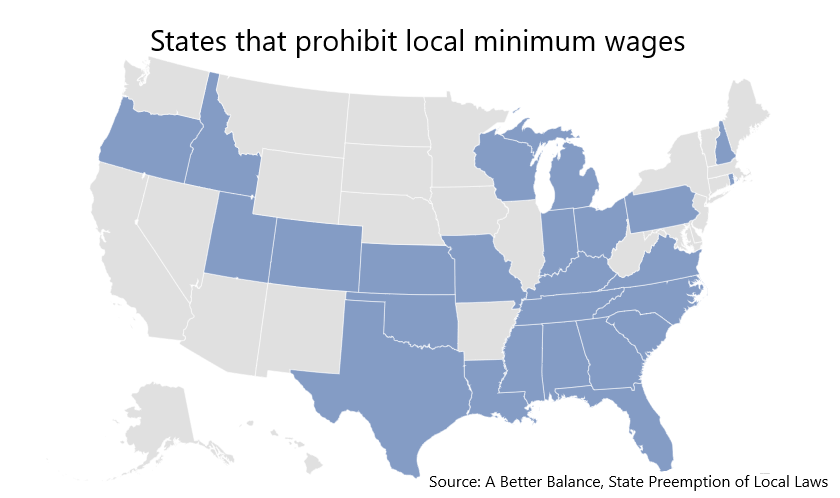 A 2016 article in the American Prospect noted that the rise in laws limiting local authority came "as Republicans have captured an unprecedented number of state legislatures and as cities have become hotbeds for progressive organizing." The American Legislative Exchange Council, which promotes corporate interests in statehouses, even offers model preemption legislation.
Southern state legislatures have preempted local ordinances designed to protect the environment, workers, immigrants, consumers, and others. The Partnership for Working Families, a national network of racial and economic justice advocates, observes that "preemption legislation is often passed by predominantly white legislatures blocking laws benefiting and supported by majority communities of color."
The crucial role of state courts
Though most state constitutions give legislatures broad authority over local governments, laws that limit local government authority can sometimes violate state constitutions. The Florida Supreme Court, for example, will soon hear a lawsuit over a local minimum wage ordinance in Miami Beach.
That state's 1868 constitutional convention was dominated by more conservative factions, and its Reconstruction constitution gave state legislators broad power over local government. The Florida legislature has not hesitated to use this power, such as in 2003, when it passed a law barring cities and counties from increasing the local minimum wage. The following year, voters responded by amending the state constitution to allow local governments to do so.
The city of Miami Beach, where an earlier attempted wage increase had prompted the 2003 preemption law, then increased its minimum wage to $13.31 per hour. The Florida Chamber of Commerce and its allies sued the city, arguing that the preemption law remained in force. A lower court agreed, but the state Supreme Court has decided to hear the case.
As these legal battles between cities and states play out, special interests backed by corporate money have tried to influence who sits on the courts that define the scope of local authority. The Florida Chamber of Commerce, for example, has supported attempts to allow the Republican governor to pack state courts.
And it's not just Florida: In North Carolina, the state Chamber has spent millions of dollars in recent years to elect its preferred legislators and judges. And the Arkansas Supreme Court, whose recent elections have been dominated by national conservative groups that don't disclose their donors, last year struck down a local civil rights law protecting LGBTQ people.
"State officials are trying to overrule the will of the voters, and ban local communities from doing the right thing and protecting their LGBT residents from discrimination," said Holly Dickson, legal director of the ACLU of Arkansas, which defended the ordinance.
(This is the second story in a series on the legacy of progressive Southern constitutions that were rewritten during Radical Reconstruction. To read the first, on the freedom to vote, click here.)
Tags
- CIVIL WAR
- RECONSTRUCTION
- STATE CONSTITUTIONS
- VOTING RIGHTS
- VOTER SUPPRESSION
- WHITE SUPREMACISM
- RACISM
- JIM CROW
- KU KLUX KLAN
- LYNCHING
- STATE LEGISLATURES
- NORTH CAROLINA
- LOCAL CONTROL
- PREEMPTION
- REDEEMERS
- ALABAMA
- MINIMUM WAGE
- NC HOUSE BILL 2
- COURT PACKING
- ARKANSAS
==