LOCAL REGS 2
---
this generic node for local autonomy
no merri
see texas paxton abbott
age of trump
see heat death
note polarization less b/c mayors have to be pothole practical/accountable.
---===
===
an 4 24 stateside
south Dakota state Sen. John Wiik likes to think of himself as a lookout of sorts — keeping an eye on new laws, programs and ideas brewing across the states.
“I don’t bring a ton of legislation,” said Wiik, a Republican. “The main thing I like to do is try and stay ahead of trends and try and prevent bad things from coming into our state.”
This session, that meant sponsoring successful legislation banning cities or counties from creating basic income programs, which provide direct, regular cash payments to low-income residents to help alleviate poverty.
While Wiik isn’t aware of any local governments publicly floating the idea in South Dakota, he describes such programs as “bureaucrats trying to hand out checks to make sure that your party registration matches whoever signed the checks for the rest of your life.”
The economic gut punch of the pandemic and related assistance efforts such as the expanded child tax credit popularized the idea of directly handing cash to people in need. Advocates say the programs can be administered more efficiently than traditional government assistance programs, and research suggests they increase not only financial stability but also mental and physical health.
Still, Wiik and other Republicans argue handing out no-strings-attached cash disincentivizes work — and having fewer workers available is especially worrisome in a state with the nation’s second-lowest unemployment rate.
South Dakota is among at least six states where GOP officials have looked to ban basic income programs.
The basic income concept has been around for decades, but a 2019 experiment in Stockton, California, set off a major expansion. There, 125 individuals received $500 per month with no strings attached for two years. Independent researchers found the program improved financial stability and health, but concluded that the pandemic dampened those effects.
GOP lawmakers like Wiik fear that even experimental programs could set a dangerous precedent.
“What did Ronald Reagan say, ‘The closest thing to eternal life on this planet is a government program’?” Wiik said. “So, if you get people addicted to just getting a check from the government, it’s going to be really hard to take that away.”
The debate over basic income programs is likely to intensify as blue state lawmakers seek to expand pilot programs. Minnesota, for example, could become the nation’s first to fund a statewide program. But elected officials in red states are working to thwart such efforts — not only by fighting statewide efforts but also by preventing local communities from starting their own basic income programs.
Democratic governors in Arizona and Wisconsin recently vetoed Republican legislation banning basic income programs.
Last week, Texas Attorney General Ken Paxton sued Harris County to block a pilot program that would provide $500 per month to 1,900 low-income people in the state’s largest county, home to Houston.
Paxton, a Republican, argued the program is illegal because it violates a state constitutional provision that says local governments cannot grant public money to individuals.
Harris County Attorney Christian Menefee, a Democrat, called Paxton’s move “nothing more than an attack on local government and an attempt to make headlines.”
Meanwhile, several blue states are pushing to expand these programs.
Washington state lawmakers debated a statewide basic income bill during this year’s short session. And Minnesota lawmakers are debating whether to spend $100 million to roll out one of the nation’s first statewide pilot programs.
“We’re definitely seeing that shift from pilot to policy,” said Sukhi Samra, the director of Mayors for a Guaranteed Income, which formed after the Stockton experiment.
So far, that organization has helped launch about 60 pilot programs across the country that will provide $250 million in unconditional aid, she said.
This is an effective policy that helps our families, and this can radically change the way that we address poverty in this country.
– Sukhi Samra, director of Mayors for a Guaranteed Income
Despite pushback in some states, Samra said recent polling commissioned by the group shows broad support of basic income programs. And the programs have shown success in supplementing — not replacing — social safety net programs, she said.
The extra cash gives recipients freedom of choice. People can fix a flat tire, cover school supplies or celebrate a child’s birthday for the first time.
“There’s no social safety net program that allows you to do that.” she said. “ … This is an effective policy that helps our families, and this can radically change the way that we address poverty in this country.”
Basic income experiments
The proliferation of basic income projects has been closely studied by researchers.
Though many feared that free cash would dissuade people from working, that hasn’t been the case, said Sara Kimberlin, the executive director and senior research scholar at Stanford University’s Center on Poverty and Inequality.
Stanford’s Basic Income Lab has tracked more than 150 basic income pilots across the country. Generally, those offer $500 or $1,000 per month over a short period.
“There isn’t anywhere in the United States where you can live off of $500 a month,” she said. “At the same time, $500 a month really makes a tremendous difference for someone who is living really close to the edge.”
Kimberlin said the research on basic income programs has so far been promising, though it’s unclear how long the benefits may persist once programs conclude. Still, she said, plenty of research shows how critical economic stability in childhood is to stability in adulthood — something both the basic income programs and the pandemic-era child tax credit can address.
Over the past five years, basic income experiments have varied across the country.
Last year, California launched the nation’s first state-funded pilot programs targeting former foster youth.
In Colorado, the Denver Basic Income Project aimed to help homeless individuals. After early successes, the Denver City Council awarded funding late last year to extend that program, which provides up to $1,000 per month to hundreds of participants.
Despite pandemic pay boost, low-wage workers still can’t afford basic needs
A 2021 pilot launched in Cambridge, Massachusetts, provided $500 a month over 18 months to 130 single caregivers. Research from the University of Pennsylvania found the Cambridge program increased employment, the ability to cover a $400 emergency expense, and food and housing security among participants.
Children in participating families were more likely to enroll in Advanced Placement courses, earned higher grades and had reduced absenteeism.
“It was really reaffirming to hear that when families are not stressed out, they are able to actually do much better,” said Geeta Pradhan, president of the Cambridge Community Foundation, which worked on the project.
Pradhan said basic income programs are part of a national trend in “trust-based philanthropy,” which empowers individuals rather than imposing top-down solutions to fight poverty.
“There is something that I think it does to people’s sense of empowerment, a sense of agency, the freedom that you feel,” she said. “I think that there’s some very important aspects of humanity that are built into these programs.”
While the pilot concluded, the Cambridge City Council committed $22 million in federal pandemic aid toward a second round of funding. Now, nearly 2,000 families earning at or below 250% of the federal poverty level are receiving $500 monthly payments, said Sumbul Siddiqui, a city council member.
Siddiqui, a Democrat, pushed for the original pilot when she was mayor during the pandemic. While she said the program has proven successful, it’s unclear whether the city can find a sustainable source of funding to keep it going long term.
States look to expand pilots
Tomas Vargas Jr. was among the 125 people who benefited from the Stockton, California, basic income program that launched in 2019.
At the time, he heard plenty of criticism from people who said beneficiaries would blow their funds on drugs and alcohol or quit their jobs.
“Off of $500 a month, which amazed me,” said Vargas, who worked part time at UPS.
Tomas Vargas Jr. was among the 125 people who participated in the 2019 basic income experiment in Stockton, Calif. Vargas, pictured here with his family, said the $500 a month allowed him to be a better father and take off time to pursue a better career. Courtesy of Tomas Vargas Jr.
But he said the cash gave him breathing room. He had felt stuck at his job, but the extra money gave him the freedom to take time off to interview for better jobs.
Unlike other social service programs like food stamps, he didn’t have to worry about losing out if his income went up incrementally. The cash allowed him to be a better father, he said, as well as improved his confidence and mental health.
The experience prompted him to get into the nonprofit sector. Financially stable, he now works at Mayors for a Guaranteed Income.
“The person I was five years ago is not the person that I am now,” he said.
Washington state Sen. Claire Wilson, a Democrat, said basic income is a proactive way to disrupt the status quo maintained by other anti-poverty efforts.
“I have a belief that our systems in our country have never been put in place to get people out of them,” she said. “They kept people right where they are.”
Wilson chairs the Human Services Committee, which considered a basic income bill this session that would have created a pilot program to offer 7,500 people a monthly amount equivalent to the fair market rent for a two-bedroom apartment in their area.
The basic income bill didn’t progress during Washington’s short legislative session this year, but Wilson said lawmakers would reconsider the idea next year. While she champions the concept, she said there’s a lot of work to be done convincing skeptics.
In Minnesota, where lawmakers are considering a $100 million statewide basic income pilot program, some Republicans balked at the concept of free cash and its cost to taxpayers.
“Just the cost alone should be a concern,” Republican state Rep. Jon Koznick said during .
State Rep. Athena Hollins, a Democrat who sponsored the legislation, acknowledged the hefty request, but said backers would support a scaled-down version and “thought it was really important to get this conversation started.”
Much of the conversation in committee centered on local programs in cities such as Minneapolis and St. Paul. St. Paul Mayor Melvin Carter, a Democrat, told lawmakers the city’s 2020 pilot saw “groundbreaking” results.
After scraping by for years, some families were able to put money into savings for the first time, he said. Families experienced less anxiety and depression. And the pilot disproved the “disparaging tropes” from critics about people living in poverty, the mayor said.
Carter told lawmakers that the complex issue of economic insecurity demands statewide solutions.
“I am well aware that the policy we’re proposing today is a departure from what we’re all used to,” he said. “In fact, that’s one of my favorite things about it.”
Florida GOP wants to block heat protection for workers. Good thing it's never hot there
kos jan 2024
fresh off of trying to replaceeducation with child labor, Florida Republicans have another bright idea that’s sure to improve conditions for workers in the Sunshine State. They’re out to ensure that workers don’t have any right to protection when toiling outdoors in the heat.
A bill is advancing through the Florida Senate that would prohibit local officials from passing regulations that would provide heat protection for outdoor workers. Authored by state Sen. Jay Trumbull, SB 1492 has already passed in the state House and cleared the first hurdles in the Senate Commerce and Tourism Committee.
Right now, there aren’t any such local ordinances. That Florida legislators are moving to outlaw something that doesn’t exist might seem odd, even for Florida. But last fall,Miami-Dade County *considered* passing such regulations. So state Republicans are working to beat them to the punch and prevent worker protections statewide—before they ever exist.
As the Florida Phoenix reported in November, Miami-Dade County could have been the first local government in the nation to pass regulations protecting outdoor workers from extreme heat. The ordinance first proposed last summer would have required that construction and agriculture workers have access to water and 10-minute breaks in the shade every two hours on days when the heat index exceeds 90 degrees. It would have also required employers to provide training on dealing with signs of heat-induced illness and calling for help in the case of an emergency.
That proposal was watered down after input from “industry groups.” The final version upped the temperature to 95 degrees. That may seem like a small difference, but as the Phoenix notes, “... over the past fifty years, Miami has had an average of just 4.1 days per year with a high temperature of 95 degrees. That’s compared to an average of 163 days per year when the heat index hits 90 degrees Fahrenheit, according to University of Miami climate researcher Brian McNoldy.”
But even after being stretched to the point where it would only require companies to provide workers with 10-minute shade breaks on the four hottest days of the year, the legislation failed to pass. As The Washington Post reported at the time, “No states in the South, where workplace heat deaths are most common, have created their own heat safety rules.”
The federal Occupational Safety and Health Administration provides voluntary heat safety rules, but doesn’t enforce them. Three states—California, Washington, and Oregon—have rules of their own. No other state or local government has passed rules to protect workers from extreme heat, even though heat waves have been increasing in both intensity and duration.
Legislation was being considered in Miami-Dade County because record heat in Florida resulted in the deaths of at least two farm workers in 2023. It was voted down by the Board of County Commissioners after industry lobbyists warned that the bill would be “creating a new government agency” (which it didn’t) and imposing “duplicative regulations” (even though no current regulations exist).
The proposed bill preventing local governments from passing regulations to protect workers from extreme heat is just one of several ways the Republican-dominated Florida Legislature has been stripping local power. WLRN Public Radio in South Florida calls it the “systemic draining of local control” and warns that it’s about both politics and money.
The state legislature has passed laws to overturn local ordinances designed to address the climate crisis, overturned efforts to boost clean energy, and created a bill that allows businesses to sue if any local government passes regulations that have “adverse impacts on their companies,” even if that ordinance has overwhelming local support.
Why are Republicans so set on passing sweeping laws at the state level rather than letting local governments do what they have always done? In a word: lobbyists.
Lobbyists find it much more convenient to deal with legislators at the state level rather than work with county or local officials. Thanks to the wide variety of preemption laws passed by Florida Republicans, lobbyists can hunker down in Tallahassee and not have to worry about sitting in boring meetings around the state. In return, Florida legislators get all the perks (read: donations) of being on a short leash for those lobbyists. In the case of this bill, that includes lobbyists for Associated Industries of Florida and Duke Energy. Presumably, Duke is worried it might have to allow its line workers to get out of the sun and rest for a few minutes while dealing with high-voltage lines.
So, there is no legislation to help protect workers from the heat in South Florida—and if Florida Republicans get their bill passed, there never will be.
Because 10 minutes in the shade every two hours on the four hottest days of the year is just asking for too much. Heat-related deaths are only up 95%, and when this set of workers is dead, they can always be replaced by kids.
---
---
an 7 23
as the heatwave currently plaguing Texas prevails, San Antonio Mayor Mark Nirenberg's frustration with Texas state lawmakers grows, Politico reports.
According to Reuters, President Joe Biden recently "instructed the Department of Labor to ramp up enforcement of on-the-job heat hazards" in states like Texas "by increasing inspections at construction and agriculture sites, and to issue Hazard Alerts that inform employers of their responsibilities and employees of their rights during extreme heat."
Last month, Texas Public Radio (TPR) reportedTexas Republican Governor Greg Abbott passed a bill — which opponents call the "Death Star Bill" — that "poses serious health risks" to construction workers, "bars cities and counties from passing regulations that are stricter than state ones," and "overturns local rules such as ordinances in Austin and Dallas that mandate rest breaks for construction workers."
READ MORE:Texas 'Death Star Bill' could leave construction workers 'fatigued, disoriented, dehydrated': report
Politico reports Nirenberg, on Sunday's segment of CBS' Face the Nation, said, "We're certainly grateful for a president now that's treating this heatwave with the urgency that I think is necessary. Especially given the fact that one of the challenges that we have is, cities in Texas are fighting our legislature and our state government for local control. We're trying to protect residents and workers, and they are doing everything they can to prevent that from happening."
READ MORE: 'No end in sight' for massive heat wave plaguing Texas, New Mexico: NWS
Politico's full report is available at this link. Reuters' report is here (subscription required).
---
---
see PROPOSITION INITIATIVES
EG
Noble Energy Gives Millions To Fund Astroturf Campaigns
Noble Energy Funnelled Over $7 Million Into An Astroturf Group To Oppose An Initiated Measure That Would Regulate Fracking On Public Lands In Colorado. “In a last-ditch attempt to defeat one of the mostfar-reaching environmental measures on the 2018 ballot, a fossil-fuel giant is blanketing Colorado television with election-focused political ads that it now claims are outside the purview of all state campaign-finance laws. The maneuver — which pioneers a novel way for corporations to circumvent disclosure statutes and inject money directly into elections — has been blessed by the office ofColorado Secretary of State Wayne Williams, who has led a Republican political group bankrolled by the same fossil-fuel corporation that is airing the ads. At issue is Proposition 112, a landmark measure that would force fossil-fuel companies to set their drilling and fracking operations further away from hospitals, schools, child-care centers and residential neighborhoods. Natural gas colossus Noble Energy and its subsidiaries have been among the most prominent opponents of the initiative, disclosing $7.1 million in contributions to Protect Colorado,:{ the issue committee opposing the initiative.” Westword, :(style="background-color:#faf8f5ff"):}:[10/18/18:{]}:
---
---
an 6 23
texas Republican Governor Greg Abbott signed legislation earlier this week that "poses serious health risks" to construction workers, Texas Public Radio (TPR) reports.
Per TPR, HB 2127 — known as the Texas Regulatory Consistency Act — "bars cities and counties from passing regulations that are stricter than state ones. It also overturns local rules such as ordinances in Austin and Dallas that mandate rest breaks for construction workers."
Republican State Rep. Dustin Burrows, who proposed the "Death Star Bill," insisted "the law is needed to end 'the current hodgepodge of onerous and burdensome regulations,'" but TPR notes "for construction workers in two of the state's fastest-growing cities, advocates say, it poses serious health risks."
READ MORE: Neither 'compassion' nor 'leadership': Greg Abbott blasted for calling shooting victims 'illegal immigrants'
Mario Ontiveros told TPR "he once saw a co-worker lose consciousness and fall from a ladder," and due to his previous "safety training," the Texas construction worker "was the only one on the job site who knew how to help — performing CPR and asking his co-worker basic questions to keep him conscious — until paramedics arrived, he said."
The Texas Tribune reports:
Texas is the state where the most workers die from high temperatures, government data shows. At least 42 workers died in Texas between 2011 and 2021 from environmental heat exposure, according to the U.S. Bureau of Labor Statistics. Workers’ unions claim this data doesn’t fully reflect the magnitude of the problem because heat-related deaths are often recorded under a different primary cause of injury.
Furthermore, according to TPR, "Research published in 2018 — eight years after Austin passed its rest-break ordinance — found that construction workers were 35% more likely to get a break because of the rule."
Daniela Hernandez, state legislative coordinator for Texas advocacy group Workers Defense Action Fund, said, "We know that workers do pass out and experience heat stress and different types of heat illnesses."
READ MORE: Gov. Greg Abbott leaves experts stunned as he injects politics into Texas' criminal justice system
Paul Puente, executive secretary of the Houston Gulf Coast Building and Construction Trades Council, said the "Death Star Bill" is expected to "strike down construction-worker protections in southeast Texas," and "negatively impact construction safety as a whole," even though "labor unions can still negotiate for rest breaks."
He emphasized "Science has already shown that individuals need to have time to take a break, collect their thoughts, and then return back to work to ensure a safe working environment," and "Without allotted rest breaks in extreme heat," he told TPR "workers can easily become fatigued, disoriented, dehydrated — effects that endanger their lives."
Calling the state "unsafe" for construction workers, Puente added, "when you're trying to encourage businesses to come to your state, this is not a good look."
TPR reports the law is set to go into effect Sept. 1.
READ MORE: 'Absolutely insane': Texas Governor Greg Abbott seeks pardon for man convicted of murdering BLM protester
Texas Public Radio's full report is available at this link. The Texas Tribune's report is here.
FROM YOUR SITE ARTICLES
'Bald-faced lie': Houston Chronicle torches Texas gov’s 'bankrupt conscience' and 'cowardice' after Uvalde mass shooting ›
Texas Democrat: Greg Abbott 'can’t explain away' allowing easy access to weapons ›
Greg Abbott implicates 'the government' in Saturday’s mass shooting ›
RELATED ARTICLES AROUND THE WEB
Greg Abbott tells state agencies to stop considering diversity in ... ›
Tesla's construction workers at Texas gigafactory allege labor ... ›
Texas governor calls on citizens to report parents of transgender ... ›
---
==
9 22
2. Third-Party Mobilization
The general public is less likely to be convinced by a narrative that appears only to serve a special
interest, especially one with significant reputational liabilities, such as the oil and gas industry. PR
firms consequently work to make the industry’s positions seem widely supported by a range of
ostensibly unrelated groups, manufacturing the appearance of representing the broader public
interest.32 This tactic can take the form of third-party spokespersons, “generating favorable media
coverage, attributing advertisements to [a] third-party group instead of to the organization, creating
supportive social media, and mobilizing “astroturf” groupsof public supporters.”33 Oil and gas
companies have also created and funded nonprofit entities, which they used to organize opposition
to climate policies.
34 Through these front groups, the industry has funneled tens of millions of
dollars to public relations firms to manage media campaigns.35
A prominent example of such an approach is the successful defeat of a 2016 effort to put on the
Colorado ballot two initiatives that would have altered Colorado’s constitution to (1) give local
municipalities the ability to ban fracking, and (2) prevent oil and gas development within a 2,500-
foot buffer zone from occupied buildings and parks, waterways, playgrounds, and other “areas of
special concern.”36 Seeing an existential threat to its “license to operate,” Noble Energy, a major
natural gas company operating in Colorado (later bought by Chevron), hired PR firm Story
Partners to help it prevent these safeguards from becoming law.
The Committee has obtained documents that reveal, in the PR firm’s own words, howStory
Partners successfully designed and executed its multipronged plan to defeat the initiatives at the
signature-gathering stage (Appendix 5). Story Partnersachieved this through tactics including
astroturfing and careful analysis of which kind of message was most likely to persuade people that
the ballot measure would economically harm not only Noble Energy and “the industry at large,”
but the general public as well.37 This campaign and its techniques are discussed in greater detail in
the final section of this memorandum.
Third-party mobilization can also directly reach policymakers and their staff. Following the
Russian invasion of Ukraine, House Natural Resources Committee staff received a series of seven
...p 11
Staff from “HBW Resources” sent the emails and identified themselves as representatives of CEA,
describing it as “a nationwide grassroots organization that supports energy policies ensuring
abundant, affordable, reliable, and sustainable domestic energy supplies.”CEA claims to have
more than 550,000 individual members and to represent “a broad list of organizations that include
farmers, academia, conservation groups, truck drivers, laborers, trades-people, energy producers,
manufacturers, business owners to so much more.”51
Watchdog organization Energy and Policy Institute calls CEA an industry front group, and its
positions align closely with fossil fuel interests. CEA has been accused of engaging in astroturfing
on behalf of the major extractive energy industries.52 The organization received a score of “E-”
from LobbyMap (on an “A+” to “F” scale) on their climate policy’s alignment with the goals of
the Paris Agreement, reflecting CEA’s work to obstruct climate policy and energy transition at the
state and national level.53
HBW Resources, a self-described “government affairs, advocacy, public relations, and
communications firm,”54 appears to run CEA. The organization is run out of HBW’s Houston-based office.
55 IRS forms indicate that CEA has no paid staff and its chief officers include HBW
employees, such as CEA President and Director—David Holt—and Vice President—Michael
Whatley.
56 Since 2010, HBW Resources has been CEA’s highest paid contract by far. Over this
time, 53% of all of CEA’s expenses were paid to HBW, totaling nearly $17 million.57
Large sums
were also paid to two PR firms currently under investigation by this Committee, FTI Consulting
and Story Partners.58
p 12
The source of CEA’s funding is unclear. Since 2010, CEA has reported revenues of over $34.7 million made up almost entirely of contributions and grants.59 As a registered 501(c)(4) organization, CEA is not required to disclose its donors. 60 However, CEA’s members include major oil corporations such as Chevron, ExxonMobil, and Shell USA.61
3. Delegitimization of OppositionDelegitimizing competing narratives is the final major strategy PR firms use to shore up the fossil fuel industry’s messages.62 PR firms use a range of tactics to undermine other narratives and their messengers, from disputing the facts to attacking individuals and organizations’ “reliability and reputations.”63 The following case study illustrates the extreme and unethical methods some PR firms use. Industry Defeat of Colorado Anti-Fracking Ballot Measures
...
P 14
...reaffirmedNoble Energy as a strong partner in the community.”74 Meanwhile, print and digital
advertisements “creatively told the story of the unintended consequences of the proposed ballot
measures,” and “informed voters of the products and services dependent on oil and natural gas,
both from a funding point of view and from a resources perspective.”75 These narratives position
Noble as a socially responsible member of the community, while eliding the full environmental
and public health burden the fossil fuel industry creates in Colorado.
These advertisements against proposed fracking restrictions ran “under the brand of the South
Metro Denver Chamber of Commerce (SMDC),” and “concurrently under the banner of the
Consumer Energy Alliance (CEA),” creating the illusion of third-party mobilization.
76 Notably,
“guerilla marketing teams attended dozens of Colorado events and engaged hundreds of thousands
of citizens.”77Story Partners’ budget for this campaign is not public information, but CEA’s tax
filings show that the organization paid the PR firm $535,442 in 2016 for “communications,”
presumably for this effort.
78
Story Partners called the campaign a “huge success,” and “an enormous, measurable achievement
for Noble Energy.”79 The PR firm noted that a survey, “after just two months of campaign activity,
indicated that support for the specific ballot measures dropped to its lowest point in our research,
and opposition to the measures had increased. For the first time, support for the measures was
under 51 percent, and it was clear the campaign messages were working and recalled.”80The PR
campaign had successfully stopped climate legislation.
Two years later, there was an effort to revive the buffer zone ballot measure. Proposition 112(aka
initiative 97) was a 2018 Colorado ballot initiative designed to mandate that new oil and gas
development, including fracking, be sited a minimum distance of 2,500 feet from occupied
buildings such as homes, schools, hospitals, and other areas designated as vulnerable. The measure
was brought by grassroots environmental groupColorado Rising.81
Industry pushback was coordinated, sophisticated, and heavily funded. Oil and gas firms funneled
millions of dollars into coordinated PR campaigns to defeat Proposition 112.82 Oil and gas industry
[CRED protect colo]
P18
attempted to end their contract while demanding additional payments.96,97 When Colorado Rising
contracted with another signature-gathering firm, the firm broke the contract several days later. In
a recorded conversation shared with the Committee, a subcontractor admitted to taking a bribe of
“a lot” of money to stop working with Colorado Rising. He also stated the people who paid him
off had asked him to give them the signatures he had gathered for Proposition 112, but he did not
confirm or deny that the request came from Protect Colorado, the Pac/West front group. (Appendix
7(a))
98
Volunteers for Colorado Rising also experienced harassment in their volunteer and personal
capacities. Members of the opposition attempted to infiltrate their campaign trainings, showed up
repeatedly at their press conferences and outside their campaign office to monitor them, and
monitored the campaign’s delivery of signatures to the Secretary of State’s office. In her personal
life, the witness was followed around town by unidentified men – who also showed up to record
Colorado Rising press conferences – and received unsolicited texts from one of the people who
attempted to infiltrate their campaign (Appendix 7(b)).
99 Another lead volunteer received
harassing mail at her home address (Appendix 7(c)).[gun in waistband?]
100
CONCLUSION
For decades, the oil and gas industry denied or downplayed climate change and its role in causing
it. Now that fossil fuel companies and trade groups can no longer get away with outright denial,
they pay millions to PR firms to wage sophisticated and varied campaigns that go far beyond mere
marketing. These efforts include falsely depicting industry as joining the fight against climate
change, engineering astroturf “citizen” groups to advocate for industry interests and defeat
legislative proposals, and using unscrupulous tactics to sabotage genuine policy solutions and
attack community advocates. These modern techniques are arguably far more insidious than the
denialism of the past, thanks to the pivotal involvement of PR firms.[long appendix rich st'd CEA, threat ltr]
==
no lnx many
https://www.desmog.com/2014/11/06/bush-family-inner-circle-office-denton-texas-fracking-ban-lawsuits/
Bush Family and Its Inner Circle Play Central Role in Lawsuits Against Denton, Texas Fracking Ban
BySteve Horn onNov 6, 2014
On November 4, Denton, Texas, became the first city in the state to ban the process of hydraulic fracturing (“fracking”) when 59 percent of voters cast ballots in favor of the initiative. It did so in the heart of theBarnett Shale basin, where George Mitchell — the “father of fracking” — drilled the first sample wells for his company Mitchell Energy.
As promised by the oil and gas industry and by Texas Railroad Commission commissioner David Porter, the vote was met with immediate legal backlash. Both the Texas General Land Office and the Texas Oil and Gas Association (TXOGA) filed lawsuits in Texas courts within roughly 12 hours of the vote taking place, the latest actions in the aggressive months-long campaign by the industry and the Texas state government to fend off the ban.
The Land Office and TXOGA lawsuits, besides making similar legal arguments about state law preempting local law under the Texas Constitution, share something else in common: ties to former President George W. Bush and the Bush family at large.
In the Land Office legal case, though current land commissioner Jerry Patterson signed off on the lawsuit, he will soon depart from office. And George Prescott Bush — son of former Florida Governor and prospective 2016 Republican Party presidential nominee Jeb Bush and nephew of former President George W. Bush — will take his place.
George P. Bush won his land commissioner race in a landslide, gaining 61 percent of the vote. Given the cumbersome and lengthy nature of litigation in the U.S., it appears the Land Office case will have only just begun by the time Bush assumes the office.
The TXOGA legal complaint was filed by a powerful team of attorneys working at the firm Baker Botts, the international law firm named after the familial descendants of James A. Baker III, a partner at the firm.
Baker III served as chief-of-staff under both President Ronald Reagan and President George H.W. Bush, Secretary of State under George H.W. Bush and as a close advisor to President George W. Bush on the U.S. occupation of Iraq. He gave George P. Bush a $10,000 donation for his campaign for his race for land commissioner.
James A. Baker III Campaign Contribution George P. Bush]
The Energy Policy Act of 2005, which exempts the oil and gas industry from the Safe Drinking Water Act, the Clean Water Act and the National Environmental Policy Act for fracking, is seen by critics as the legacy of ashes left behind by the George W. Bush Administration.
Yet almost a decade later, the two lawsuits filed against Denton show the Bush oil and gas legacy clearly lives on and stretches from the state where the fracking industry was born all the way to Iraq and back again.
Jeb and George P. Bush: Fracking Investors
Besides sharing blood as father and son, Jeb Bush and George P. Bush also operate inside the world of fracking finance.
Jeb works at the firm Britton Hill Holdings LLC, while George Prescott works at St. Augustine Capital Partners and served a short-lived stint on the board of directors of the Midland, Texas-based fracking exploration and production company, Arbella Exploration from February through September.
“Its first investments have been tied to the exploitation of shale oil and gas in the U.S.,” explained an article in Bloomberg. “Britton Hill raised more than $40 million for its first fund in May 2013, according to a private placement notice filed with the SEC at the time.”
Britton Hill has investments in a company fracking in the Marcellus Shale basin and another that owns a fleet of gas carriers seeking to export U.S. propane to Asia. Mitch Jones, common resources director for Food and Water Watch, wrote a blog post critical of Jeb Bush and Britton Hill the day the Bloomberg article came out.
“These relationships, where politicians move between Washington and Wall Street, between government and finance and resource exploitation, is another reason why we need to get money out of politics,” wrote Jones. “It’s these sorts of relationships that corrupt our system and provide the permanent political-business elite with their hold on our government.”
The critique promulgated by Jones about Jeb Bush could just as easily apply to his son, who recently said his father is “more than likely” to run for president in 2016.
According to multiple press accounts and an independent DeSmogBlog review of Texas campaign finance data, George P. Bush took hundreds of thousands of dollars from the oil and gas industry in his land commissioner electoral race. He also received the endorsement of the Texas Oil and Gas Association’s political action committee, the plaintiff for the other lawsuit.
“George P. Bush fully appreciates the role a strong domestic energy industry plays in ensuring our state and our nation’s prosperity and security,” Robert L. Looney, president of the Texas Oil and Gas PAC stated in endorsing him. “Mr. Bush is committed to advancing public policy that ensures Texas oil and gas producers can power our state forward and create good-paying jobs.”
Like Britton Hill Holdings, St. Augustine Capital Partners also invests in fracking, according to its website.
“St. Augustine has participated in partnerships with seasoned operators to develop drilling programs in the Marcellus and Permian Basins, in addition to offering financial advisory services for those opportunities,” St. Augustine explains.
“St. Augustine provides business development for dynamic middle-market service companies ranging from liquid storage construction to logistical operations,” the firm further details. “Additionally, St. Augustine has participated as a general partner for numerous oil and gas exploration and production related projects in a variety of geological formations.”
The firm also “has worked closely with” the Texas Railroad Commission, according to its website.
In the months leading up to the Denton vote, the Railroad Commission situated itself as the industry’s go-to spin machine in the attempt to discredit activists fighting for a fracking ban. Railroad commissioner David Porter, who formerly worked as an oil and gas industry accountant, was also one of the first entities out of the block to say an affirmative ban vote in Denton would receive ruthless contestation by the Texas government.
Serving as land commissioner in Texas is often a resume padder before running for governor, an article about George P. Bush published in GreenWire explained.
“[The] Texas land commissioner [is] a powerful post that controls the state’s oil and gas contracts,” the article explains. “Every land commissioner in the past three decades has gone on to run for lieutenant governor or governor.”
Baker Botts: From Texas to Iraq and Back
One of the co-counsel for Baker Botts in its lawsuit against the City of Denton is Evan Young, part of a powerful legal cadre that includes former Texas Supreme Court Justice Thomas Phillips. Phillips testified in front of the Denton City Council in July in opposition to the Denton fracking ban proposal on behalf of TXOGA.
Phillips also concurrently works on the legal defense team for former Texas Republican Governor Rick Perry — 2012 Republican Party presidential nominee and former chair of the powerful Interstate Oil and Gas Compact Commission — who faces state-level felony charges in Travis County for abuse of power.
According to his Baker Botts biography, Young formerly clerked for the conservative U.S. Supreme Court Justice Antonin Scalia and worked as legal counsel in the Office of the Attorney General under Attorneys General Alberto R. Gonzales and Michael B. Mukasey from 2006 through the end of the presidency of George W. Bush.
“While on the Attorney General’s staff, he accepted a detail to the U.S. Embassy in Baghdad, Iraq,” explains his Baker Botts biographical sketch, “where he was the Deputy Rule of Law Coordinator. In that position he worked to assist the Iraqi government in its efforts to strengthen its legal regime.”
Among the legal regimes Baker Botts helped create while Young was still working for the U.S. Department of Justice was one helping oil flow out of the ground in occupied Iraq and into the U.S. As of 2012, the U.S. is one of the world’s biggest importers of Iraqi crude, according to the U.S. Energy Information Agency (EIA).
Table Credit: U.S. Energy Information Agency
An article published by American Lawyer in 2007 explains that Baker Botts helped cut a controversial legal deal between Hunt Oil and the Kurdish Regional Government (KRG).
That deal gave Hunt the right to explore oil in Kurdistan, the first U.S. company given the green light to do so. The Iraqi Constitution that the U.S. helped write says making such a move is illegal.
“Not only was the deal made in a war zone, but Iraq is still working on oil resources legislation,” wrote American Lawyer. “Under the October 2005 Iraqi Constitution, local oil is owned by ‘the Iraqi people.’ “
Ray Hunt, CEO of Hunt Oil Company, gave George P. Bush $25,000 for his campaign according to Texas campaign finance data. And the Baker Botts Amicus Fund gave him $2,000 worth of donations, with Young and Phillips each donating $500 to get George P. Bush elected.
Ray Hunt Hunt Oil Campaign Contribution George P. Bush
Image Credit: Texas Ethics Commission
In late July, Iraq’s Oil Ministry launched a lawsuit against the Kurdish Regional Government in a U.S. District Court in Houston for what it says is a million barrels of illegally stolen oil exported out of Kurdistan — which is still sitting on a tanker called the United Kalyvryta 60 miles off the coast of Texas in Galveston Bay.
The Oil Ministry pointed to the Iraqi Constitution in its lawsuit as the legal precedent.
In March 2014, just months before the Iraqi government brought the lawsuit, Baker Botts published a legal memo on the legal and geopolitical ramifications of Kurdish oil exports.
Constitutional, “Big Government” Double Standards?
Though Baker Botts cited the Texas Constitution in its lawsuit against the City of Denton, the Iraqi Constitution was disposable for the firm and its client Hunt Oil when it came to procuring oil exploration and exportation rights in Kurdistan.
Baker Botts’ counsel also seems to have brushed aside concerns by both the U.S. and Iraqi government that the extra legal maneuvering for oil exploration and production rights in the area would create regional instability, the blowback of which is now visible in the form of the ascendant and lethal Islamic State.
Further, Sharon Wilson, an organizer for Earthworks — an environmental group that campaigned for the fracking ban in Denton — pointed to a quote from George P. Bush back in October. “Enough…big government solutions to our problems,” George P. Bush said at an October event his father Jeb Bush also spoke at.
“Denton residents, not politicians, directly spoke in overwhelming numbers that they don’t want fracking in their city,” Wilson told DeSmogBlog. “Overturning the will of the people by government fiat is the very definition of big government. George P. is going to have to put his money where his mouth is or decide if his mouth is where his money comes from.”
Bush Family and Its Inner Circle Play Central Role in Lawsuits Against Denton, Texas Fracking Ban
Steve Horn is a former Research Fellow and writer for DeSmog and a freelance investigative journalist based in San Diego, CA. He currently works as a climate reporter and producer for The Real News Network.
10/19
https://truenorthresearch.org/report/report-one/
Juul Deploying Big Tobacco Playbook to Preempt Local Control
October 7, 2019
In a new white paper by Local Solutions Support Center (LSSC) and Illumination Investigations, Evan Vorpahl and Lisa Graves document how Juul has flooded statehouses
https://www.ucsusa.org/sites/default/files/2021-10/Colorado-Targeted-by-Fossil-Fuel-Industry-Disinformation-Playbook.pdf
40 pp
Colorado Targeted by
Fossil Fuel Industry’s
Disinformation
Playbook
Climate Deception Harms Communities’ Health
and Safety
www.ucsusa.org/resources/colorado-fossil-fuel-industry-disinformation
https://doi.org/10.47923/2021.14291
CONTENTS
Chapter 1 Deceiving the Public: The Disinformation Playbook 4
The Disinformation Playbook and Colorado Oil and Gas Operations 5
Chapter 2 Disinformation Tactic: The Fix 7
Lobbying to Weaken Public Health and Safety Protections and Enhance Fossil Fuel Profits 8
Overwhelming Public Voices to Thwart Ballot Initiatives 9
Table 1. An Example of How Industry Spending Overwhelms Health and Safety 10
Pitting Local Leaders Against the Health and Safety of Their Constituents 11
Influencing Public Policy Positions from Inside and Out 11
Using Proxy Groups to Confuse the Public and Undermine Support for Climate
Accountability Lawsuits 12
Chapter 3 Disinformation Tactic: The Diversion 13
Elevating Industry Interests Above Community Voices 13
Fabricating the Appearance of Local Support 14
Figure 1. Colorado’s Climate Disinformation Complex 15
Greenwashing Your Screens 16
Chapter 4 Disinformation Tactic: The Screen 18
Building Credibility by Hiding Behind Trusted State Institutions 18
Burnishing Industry’s Reputation through Association with Respected Nonprofits 19
Chapter 5 Disinformation Tactic: The Fake 21
Chapter 6 A Litany of Harms: Health and Safety 23
Cancer-Causing and Other Dangerous Chemicals in the Air and Water 24
Poor Air Quality 24
New Research Identifies Even More Dangerous Ozone Problems 25
Figure 2. Fossil Fuel Industry Emissions are Higher in High Racial-Minority Census
Tracts 26
Dangerous Inactive Wells 26
Climate Change Impacts 27
Chapter 7 A Litany of Harms: Economic 28
Bogus Complaints about High Taxes 28
Inflated Jobs Claims 28
Union of Concerned Scientists | 3
Figure 3. Oil and Gas Extraction’s Boom-and-Bust Contribution to the Colorado
Economy 29
Other Harms, Some Difficult To Monetize 29
Chapter 8 Recommendations 31
Acknowledgments 32
...For more than a decade, Colorado oil and gas exploration and development have intensified, often putting dangerous and polluting industrial activities in close proximity to homes, schools, playgrounds, and other public spaces. This report exposes how the fossil fuel industry positions itself as the backbone of the state economy, often framing any community opposition to this industry’s dangerous operations as a fight against local interest in the form of tax revenue, school funding, and jobs. The industry largely glosses over evidence it causes health, economic, or environmental damage, and its clout enables oil and gas extraction and expansion to continue with little regard for those facing the adverse health and economic impacts. In Colorado, the oil and gas industry is comprised of powerful transnational corporations, including ExxonMobil and Chevron, along with companies such as Noble Energy (now owned by Chevron), Anadarko (now owned by Occidental Petroleum), and Suncor (a large Canadian tar-sands operation with close ties to ExxonMobil and Royal Dutch Shell).
The industry’s interests are represented by heavyweight national lobbying outfits like the American Petroleum Institute (API), as well as local trade associations, like the Colorado Oil and Gas Association (COGA). A proliferation of industry-created and backed front groups includes several with ties to the private multinational conglomerate Koch Industries.They often all work together to run the same Disinformation Playbook. Of course, the fossil fuel industry uses similar tactics and wields considerable political clout in other oil- and gas-producing states and at the federal level. Consider its success in stalling any meaningful climate action for more than two decades and its ability to despoil public and Native lands and waters with drilling and pipelines. Or consider the API’s nationwide TV and digital ad campaign, launched ahead of the 2020 elections and targeting not only Colorado, New Mexico, Pennsylvania, and other key oil- and gas-producing states but also Wisconsin, Michigan, and other political swing states (API 2020a; API 2020b)....
Lobbying to Weaken Public Health and Safety Protections and Enhance Fossil Fuel Profits
In the early years of fracking in Colorado, API and its local division, the Colorado Petroleum Council (CPC), pushed the state legislature to enact the little-known ad valorem tax credit, which allows oil and gas companies to deduct local property taxes from the severance tax that fossil fuel companies must pay to the state. As local property taxes have increased, particularly for oil and gas operations, the state’s pool of severance taxes, based on production and profits, has shrunk—even though severance-tax revenues are needed to remediate abandoned and orphaned wells. Such wells are often underground pathways through which toxic fluids and gases migrate upward into air, water, and homes. These wells are also a significant source of leaked methane, a heat-trapping pollutant that has 80 times the warming power of carbon dioxide during the first 20 years after it reaches the atmosphere (Bushkin-Bedient et al. 2020).
Thanks to the ad valorem tax credit, some oil and gas operations have paid nothing to the state in recent years, leaving old wells unremediated and dangerous to residents (Eason 2020; Legislative Council Staff, n.d.; Silbaugh 2020). In April 2017, a house in Firestone, Colorado blew up, killing two residents and seriously injuring a third. The explosion was traced to gas leaking from an old well that had not been disconnected from the wellhead or properly capped (Markus 2018; Osher 2017; Svaldi and Finley 2017).In direct response to the explosion, the legislature took up a science-based bill to require regulators to map oil and gas pipelines throughout the state; a filibuster in the Republican-controlled state Senate killed the proposal. Lobbying disclosure reports and campaign-finance records showed that Anadarko and Noble Energy, both of which opposed the bill, spent significantly in support of Senate Republican candidates in the 2016 election as well as to directly lobby against the bill (Osher 2017; Sirota 2017).
Also in April 2017, the legislature considered a bill mandating that new oil and gas facilities be set back a certain distance from school property. Such a policy is intended to reduce children’s exposure to toxic releases by keeping them a safer distance from potential explosions. By a one-vote margin along party lines, a Senate committee killed the bill to establish a buffer zone separating oil and gas wells and associated facilities from occupied buildings and property lines. COGA, CPC, and other industry representatives led the opposition, arguing that “energy is the cornerstone of [the state’s] prosperity” (Glick and Ray 2017)—overstating the industry’s economic importance while ignoring the value of keeping children safe. An investigative report put oil and gas industry clout into some perspective: “Most of the people who testified in favor of the school setback bill were residents. . . . Virtually all who opposed it were paid lobbyists, most from industry associations” (Glick and Ray 2017).
:{
}:
With the passage of Senate Bill 181 in 2019, the state got serious about tightening health and safety controls on the oil and gas industry. The industry, which aggressively opposed the bill, lobbied successfully for a late language change that weakened the ability of local governments to protect public health and safety. At the behest of industry lobbyists, the terms “necessary Union of Concerned Scientists | 9 and reasonable” were added as qualifiers to the bill’s text, potentially limiting the ability of cities and counties to require new protective measures (Bloom 2019)....
Overwhelming Public Voices to Thwart Ballot Initiatives
In 2016, aggressive campaigns by Protect Colorado and Coloradans for Responsible Energy Development (CRED)—front groups funded by API, CPC, Noble Energy, and Occidental Petroleum—prevented two grassroots-driven ballot measures from getting in front of voters (Dyer 2016a). One measure would have increased local control over oil and gas expansion, with the aim of putting science at the forefront of decision-making on siting, reporting, and safety requirements designed to protect the communities.
The other measure would have improved community health and safety by requiring fracking operations be set back 2,500 feet from any occupied structure (homes, schools, businesses) or “areas of concern” (drinking water sources, lakes, parks). The current scientific consensus is that a setback of 2,000 to 2,500 feet is needed to protect health and safety, especially that of children (Lewis, Greiner, and Union of Concerned Scientists | 10 Brown 2018; Milton et al. 2014; McKenzie et al. 2012). The setback would have reduced exposure to air and water pollution, lessened noise pollution, and kept children further from potential explosions. Opponents outraised proponents by a ratio of 24–1, with 99.9 percent of the opponents’ nearly $17 million total coming from energy industry companies or front groups; their campaign drowned out the public health and safety arguments at the heart of initiative (Table 1) (Blake 2016; Claypool 2016)....
,,,Protect Colorado repeated the play again two years later, in 2018, spending almost $40 million to oppose Proposition 112 (Sirota and Woodruff 2018b), which would have required new oil and gas development projects to be set back 2,500 feet from occupied buildings and other areas of concern. In addition to donating millions of dollars to Protect Colorado PAC to oppose Proposition 112, Noble Energy directly funded spots on at least 12 TV stations in the month before the election (Sirota and Woodruff 2018b). One ad explicitly told voters: “When you vote, we need your support to stop Proposition 112, so we can continue producing the natural gas and oil that power our daily lives.”
This ad ignored the initiative’s health and safety intent, instead advancing a bogus economic argument that stronger protective measures would put the industry out of business (Sirota and Woodruff 2018a). In 2020, the industry poured money into ad campaigns even with no initiatives on the ballot or legislation in the works. Protect Colorado spent hundreds of thousands of dollars on a statewide online and TV ad campaign aimed at Governor Polis and the COGCC, threatening to challenge any new regulations, particularly on siting setbacks, that the industry deemed unreasonable(Bunch 2020). The industry promoted 500-foot setbacks—about one-fourth the distance that scientists say is best to protect communities, especially vulnerable populations (Lewis, Greiner, and Brown 2018; Milton et al. 2014)....
[rev dr]
Using Proxy Groups to Confuse the Public and Undermine Support for Climate Accountability Lawsuits
In 2018, Boulder and San Miguel counties and the city of Boulder sued ExxonMobil and Suncor, arguing that the companies violated state law by deceiving the public about the dangers of their fossil fuel products. These local governments are demanding that the companies pay their fair share of remediating climate damages accruing in their communities (Boulder County, n.d.; City of Boulder, n.d.; EarthRights International, n.d.; San Miguel County, n.d.).
Almost immediately, ExxonMobil and Suncor launched a counteroffensive, using proxy groups to distort the public’s understanding of the case.The defendants, falsely suggesting that the local governments were seeking a back-door path to achieve legislative goals, attempted to redirect attention away from the on-the-ground reality that communities face budget-busting expenses due to climate change-related fires, flooding, bad air quality, and extreme heat.Industry PR companies, particularly Western Wire (an ExxonMobil executive serves on its board of directors) and Energy In Depth (a project of the Independent Petroleum Association of America), ramped up their substantial media buys to discredit the legal strategy (EarthRights International 2018).
Industry groups also attacked and attempted to discredit a public forum at the University of Colorado Law School on holding fossil fuel companies liable for climate change harms in the state (MAP 2019; University of Colorado Law School 2019). Further, their representatives posed as journalists to try to interview plaintiff’s attorneys outside of appropriate court channels (EarthRights International 2018; EarthRights International 2019). For more than three years, the defendants have used procedural tactics to keep this case—like other recent climate accountability complaints against fossil fuel companies—from being considered on its merits....
Chapter 3 Disinformation Tactic:
The Diversion Manufacture uncertainty about science (including economics) and facts where little or no uncertainty exists
In an infamous 1969 memorandum, a tobacco executive captured the Diversion tactic well: “Doubt is our product, since it is the best means of competing with the ‘body of fact’ that exists in the minds of the general public” (Mulvey and Shulman 2015).
To create doubt, undermine science, influence public opinion, and gain access to policymakers while maintaining the illusion of independence, fossil fuel companies in Colorado have deployed trade associations, front groups with innocuous-sounding names, and “greenwashing” advertising campaigns that paint oil and gas as sources of clean energy and central to climate solutions. Corporate interests even create, fund, and control so-called “astroturf” groups that falsely portray themselves as grassroots.
To rig the system in its favor, Colorado’s fossil fuel industry uses “The Diversion” to exert political power over crucial legislative, regulatory, and grassroots-led initiatives, commonly engaging in a variety of activities, including: • Elevating industry interests above community voices; • Fabricating the appearance of local support; and • Greenwashing your screens. Elevating Industry Interests Above Community Voices
At least three oil and gas industry trade associations operate aggressively in Colorado: the American Petroleum Institute, the Colorado Petroleum Council (the API’s local affiliate), and the Colorado Oil and Gas Association. Also active are the Colorado Petroleum Association, the Western Energy Alliance, the Independent Petroleum Association of America (IPAA), and the CO-WYO Petroleum Marketers Association.
Wielding its wealth and political power, the industry is able to supercharge its advocacy and drown out community voices. Sometimes visibly and sometimes behind the scenes, these trade associations engage in extensive Union of Concerned Scientists | 14 legislative and regulatory lobbying and pour hundreds of thousands of dollars into campaigns to sway public opinion, especially investing in large-scale TV, radio, and social-media advertising. Fossil fuel trade associations use their clout to spread disinformation. For example, their lobbyists routinely exaggerate the industry’s economic benefits while downplaying the health and safety risks to community members. In 2017 testimony to a state Senate committee hearing on the proposed legislation on setbacks from school properties, COGA’s president claimed that protective setback extensions would undermine oil and gas as “the cornerstone of prosperity” in the state (Glick and Ray 2017).
The industry has peddled that exaggeration for years, even though the oil and gas sector is a notoriously unstable, “boom and bust” enterprise that accounts for roughly 1 percent of Colorado jobs. At the same time, it offloads onto the state and its communities innumerable externalities, such as air pollution, fouled waters, and abandoned mines (PwC 2017; API 2017; BEA, n.d.b). The industry also downplays, even denies, the health risks from contaminants released during oil and gas exploration and extraction. During the 2017 setback hearing, CPC’s executive director told the press that the idea of protecting school children “was based on the presumption that being near oil and gas facilities is dangerous,” adding that CPC “absolutely rejects that notion” (Glick and Ray 2017).
Yet current oil and gas production releases a host of dangerous chemicals into the air and water—including those that cause cancer and disrupt the endocrine system—and it creates significant noise and light pollution. Science shows that children are particularly sensitive to those dangerous chemicals (Bushkin-Bedient et al. 2020, 60, 86; Glick and Ray 2017, McKenzie et al. 2017). An API TV ad opposing a 2019 package of oil and gas reforms in the legislature is another example of how industry advertising spreads falsehoods and misrepresentations. The ad claimed that the measures would “shut down energy production in Colorado”—a claim with no economic basis (API 2019). The ad suggested that lawmakers, acting in bad faith, had snuck the bill out of committee “in the middle of the night.”
In reality, the relevant committee voted at 2:00 a.m. only after hearing more than 12 hours of testimony from both supporters and opponents (Woodruff 2019).
Fabricating the Appearance of Local Support
A plethora of oil and gas industry front groups litters the political landscape in Colorado, often with ambiguous or purposely confusing names, sometimes using dirty-trick tactics, and rarely disclosing ties to the industry (Yowell 2018). To conceal its lobbying activities, the industry hides behind astroturf organizations, created to falsely appear as grassroots in their opposition to forward-looking climate and energy policy ( see Figure 1)....
In 2019, the industry ran an aggressive and misleading campaign in opposition to Senate Bill 181. In addition to TV and radio ads, it invested in social-media advertising. Using the Facebook Ad Library, an investigative reporter identified “dozens of sponsored posts from astroturf groups like ‘Energy Citizens’ and ‘Energy Nation’ opposing SB181,” paid for with tens of thousands of dollars from the API. The ads recorded millions of impressions (Woodruff 2019; Davies 2011).
Perhaps the most ubiquitous of the front groups is Coloradoans for Responsible Energy Development. Created and generously funded by Anadarko Petroleum and Noble Energy, CRED describes itself as an educational organization, yet it engages deeply in overt political activities. Mark Truax,in his presentation to the Interstate Oil and Gas Compact Commission in 2015, described these activities. As CRED’s director of operations and coalitions, he also boasted about the vast amount of money the organization invested in those activities (Dyer 2016a; Glick and Ray 2016).
The trade associations and front groups create astroturf groups that are industry-funded and led by industry representatives and political operatives. CRED created its political arm, Protect Colorado, for the purpose of defeating grassroots-led anti-fracking ballot initiatives Union of Concerned Scientists | 16 (Protect Colorado, n.d.). For example, to defeat the 2016 setback and local control initiatives, Protect Colorado initiated a “decline to sign” campaign, discouraging Coloradans from signing a petition to get the initiatives on the ballot; it used various grassroots organizing techniques funded with nearly $17 million by CRED, Anadarko Petroleum,Noble Energy, and several other oil and gas companies (Blake 2016; Claypool 2016).
As tracked byPublic Citizen,“The widest disparity between spending by corporate-backed groups and their mostly noncorporate opposition was found in the race for Colorado’s Mandatory Setback from Oil and Gas Development Amendment” (Claypool 2016). Also as part of 2016 efforts to keep setback and local-control initiatives off the statewide ballot, Protect Colorado hired people to carry signs saying “decline to sign #75 and #78” (Evans 2016; Glick and Ray 2016; KGNU 2016).
Protect Colorado was similarly behind efforts to harass signature gatherers and petition signers. Protesters followed a Denver mom out gathering signatures, screaming in her face, “You’re taking our jobs!” No one answered when she asked her harassers questions about the “jobs” they had in the industry (Glick and Ray 2016). These dirty tricks continued and even expanded in 2018. The industry again hired protesters who followed petition-signature gatherers, sometimes harassing and threatening them, in an effort to keep the setback initiative off the ballot(Yowell, 2018). An undisclosed pro-industry group paid a signature-gathering firm to stop its work on the initiative; the contractor admitted on tape to initiative organizers: “Nobody threatened me. You know what they’re doing. They’re going around and buying people” (Olabi 2018). The industry also created new astroturf organizations with names strikingly similar to those of initiative supporters, apparently attempting to confuse voters about who was behind the campaigns (Yowell 2018).
berman longwell ABA CA hostage prop
Today, Pertschuk’s “Preemption Watch” project tracks efforts that step on local democracy.
roots
from newbook ggl doc:
Tom Corbett, AG of Pennsylvania under Tom Ridge (he later became governor, the third in a row in the pockets of fossil fuel): Packer Township passed an ordinance to prevent toxic sewage sludge from being used on farmland after two teenage boys died from staph infections. Sludge is what's left over when a sewage treatment has done the job it's designed to do, which is to break down organic matter to the point that it's no longer smelly and dangerous. The problem is that non-organic toxic materials get dumped into drains from factories, hospitals and even households, and those get concentrated in the sludge. So there are two problems, it's toxic and there's quite a lot of it. “ contains PCBs, pesticides, dioxins, heavy metals, bacteria, asbestos, petroleum products and industrial solvents, to name a few of the more than 60,000 contaminants. “ ( cite celdf). Until the Eighties the common practice was to dump barges twelve miles offshore, and then 106 but only four years later the practice was so dangerous that it was banned by Congress (“the solution to pollution is dilution”) The “economic” solution (estimated at 11 billion dollars a year) is to give it away to farmers use as fertilizer, but when it gets sprayed the pathogens get airborne (presumably if too much is used over too long it contaminates streams and aquifers as well).
Given the dangers, and the reluctance of Federal (“biosolids are exempt from Clean Water Act) and the state to protect them (sixteen states have laws that prevent cities from enacting stricter rules, probably all based on ALEC model “Right to Farm” model bills, backed by agribiz such as Cargill, ADM and Du Pont, as well as Koch brothers, CAFO).
(they may have been asking for trouble in declaring corporations do not have the same Constitutional rights of people in the township). EPA says they can't be sure it's safe, and for a long time relied on dubious studies from the Eighties; even now they only look at nine contaminates.. In 2007, prompted by corporate farmers, Corbett sued another township with a similar ordinance, but then they decided to only regulate it a bit, restricting the hours it can be spread and requiring notification, so Corbett sued them again for passing rules more stringent than the state's; they settled, so now the township can prevent application on certain days, for example major holidays. He sued half a dozen or so other townships on related issues. Corbett became governor. with a wholesale sellout to fracking.
A poster boy for this "escalator effect" is Tim Griffin (or maybe better, the incubator, as he was not AG but US Attorney (aka federal prosecutor), head law enforcement officer for a given district part of the Department of Justice. Appointed by the president and confirmed by Senate, for a century, this was amended by Strom Thurmond under Reagan, and again amended by the USA PATRIOT Act in 2007.
Griffin, Tulane FedSoc, got in by working his way up as a political operative in 1999 joining RNC to do opposition research under Barbara Comstock [one of three, one married to Ted Olsen and died on Flight 93], Nailed Cisneros (an upcoming and charismatic Latino Democrat)
[aside, sordid little tale, interesting to compare and contrast to Whitewater and Bimbogate: multiple MA's from JFK School at harvard and MIT, PhD GWU 1976, infantry officer in the Army. Cisneros was an effective mayor of San Antonio, tapped by Clinton for HUD during vetting he told the FBI he'd had an affair with a married woman, and had agreed to help support her and her daughter (not his?). When he curtailed payments, she sold the story to Fox news for $15,000. Clinton initially refused to accept his resignation in 1997, but he resigned later that year. Caving under pressure, in 1995 Janet Reno appointed a special prosecutor, assisted by Griffin). The investigation meandered on for four years , costing nearly ten million taxpayer dollars (23 million?) until Congress refused to continue; however, in 1999 with two children in college and another with considerable medical expenses, Cisneros could no longer afford to fight and settled for a single misdemeanor count of lying to the FBI (about the amount of money) and a 10,000 dollar fine. The mistress committed bank fraud with some of the money she got rom Cisneros, and he went into real estate and Univision.
Hired by RNC 1999 with a specialty in opposition research, for Barbara Comstock (had worked for Burton on clinton attacks, Gore dossier)
Helped out in Florida recount by challenging the votes of blacks
but then worked for Bush, Rove and Cheney in the White House OPA, notably shepherding confirmation of Chief Justice John Roberts;
2004 caging votes (eg Jacksonville base). Smears On Kerry
In 2006 he was rewarded by Rove with a US Attorney job in Alabama even though he had little actual prosecutorial experience (he had only been assisted on three cases, none of which went to trial) [seems like a demotion, but Rove had been working for a while to flip state, often reworking the state legal system; if you control the courts, you can change districts and voting procedures]. he managed to leverage that into being elected to the House, even though he had tearfully resigned (day after BBC story on caging appeared) after it became clear he got the job only after his predecessors had been fired for no reason (as opposed to Iglesias who refused to prosecute non-existent voter fraud, or Carolyn sp Lam who was fired for being too aggressive in going after GOP corruption, e.g. Duke Cunningham who had a bribery menu on his website). Odd to get Ways and Means committee so soon? Considerable Koch money, cheerleading for XL Pipeline, which hansen says will be “game over” for the planet.
Tim Griffin:
FedSoc leader Tulane
Cisneros
1999 RNC opps res 30 staff Comstock?
Bush-Cheney 2000 Recount
Bush rewarded Griffin in March 2001 with the job of special assistant to Michael Chertoff
US Atty office Little Rock 2001
RNC 2002
2005 OPA Roberts nom
2006 US Atty Eastern Distr AK
House ways and means: oil, finance. Koch, CFG, TP?
COOCH
But even more relevant to climate in Ken “Cooch” Cucinnelli. His father was an energy executive, and he attended GMU (Koch funded). energy lobbyist?
end ggl
==
https://insideclimatenews.org/news/02082020/california-big-oil-environmental-health
aug 2020
ARVIN, California—In September 2018, Estela Escoto sat down with a team of lawyers and community organizers and weighed her options.
Escoto's town—Arvin, California—had just granted an oil drilling and well-servicing company, Petro-Lud, a permit to drill four new wells near a neighborhood densely packed with young families and a park where children played soccer.
Escoto, president of an environmental justice group called the Committee for a Better Arvin, was frustrated, but not surprised. For years, she and the committee had been struggling to keep oil and gas development out of their neighborhoods....
==
==
desmog 5/20
gas industry union leader and chair of a group funded by California’s largest gas utilitythreatened to protest with “no social distancing” a vote last month on a city policy in San Luis Obispo that would support electrification in new buildings, according to emails obtained by Climate Investigations Center andfirst reported in the Los Angeles Times. That threat to bus in hundreds of protesters, “potentially adding to this pandemic,” apparently worked as San Luis Obispo city officials have postponed the April 7 vote on its Clean Energy Choice Program indefinitely.
And while the March 16 protest threat preceded right-wing reopen groups protesting stay-at-home orders across the country, both have something in common — an appearance of grassroots organizing with underlying ties to big funders including fossil fuel interests.
==
omfg
COVID COVER BS?
proposal to Change Rule on Nuclear Waste DisposalA proposal from the Nuclear Regulatory Commission would allow for the disposal of some nuclear waste in municipal landfills, rather than a licensed nuclear waste facility. Status: Proposed rule change published March 6, 2020; public comment period closes April 20, 2020.
:{
}:
Proposal to Change Rule on Nuclear Waste Disposal
A proposal from the Nuclear Regulatory Commission would allow for the disposal of some nuclear waste in municipal landfills, rather than a licensed nuclear waste facility.
Status: Proposed rule change published March 6, 2020; public comment period closes April 20, 2020.
https://www.alternet.org/2020/01/a-hyperconservative-state-attorney-general-wants-unprecedented-control-over-local-prosecutions/
no lnx
A hyperconservative state attorney general wants unprecedented control over local prosecutions
Written by Filter January 31, 2020
by Rory Fleming
One might think Indiana has better things to do than police marijuana. According to US News and World Reports rankings, the state has the third-worst environmental quality, the 11th worst healthcare system, and the 14th worst roads and highways in the US. Until 2019, more people had been moving away from the state than moving to it for years.
But that’s not the way Republican Attorney General Curtis Hill sees things. He is supporting a bill introduced by Indiana State Senator Mike Young that would permit the AG to take over cases from county prosecutors when he believes there is a general declination policy for a certain charge—even when it’s a case of “don’t ask, don’t tell.”
The legislation is reportedly a reaction to new Marion County (Indianapolis) Prosecutor Ryan Mears’ declaration that he will no longer prosecute marijuana possession cases. Such a sweeping law would be the first in the nation, with prior attempts to rein in prosecutors being limited to specific cases and counties (like Philadelphia’s gun cases).
According to AG Hill’s spokeswoman Parvani Stover, his support is a result of a more general reaction to announced non-prosecution policies by chief local prosecutors around the country, like Rachael Rollins in Boston and Chesa Boudin in San Francisco. National pushback against reform prosecutors has recently been embodied by US Attorney General William Barr’s new presidential criminal justice commission and its woeful composition.
The Indiana Prosecuting Attorneys Association (IPAA) is one of the most conservative in the nation, and that says a lot.It published a shocking letter back in 2017, declaring “ both medicinal and recreational marijuana legalization are wrong for Indiana” and that medical marijuana is, in their profoundly non-medical opinions, “not medicine.”
But even the IPAA is not standing for this attack on its legal mandate to utilize prosecutorial discretion, according to WIBC reporter Eric Berman. In an argument at the Indiana Senate’s Corrections and Criminal Law Committee hearing on January 28, the IPAA described discretion as “essential” to carrying out its duties. In this instance, the IPAA seems to be prioritizing principle over its political persuasions.
In contrast, after Aramis Ayala, the chief prosecutor of Orlando, Florida, announced in 2017 that she would never seek the death penalty, the Florida Prosecuting Attorneys Association (FPAA) showed its willingness to get decidedly wishy-washy regarding uses of prosecutorial discretion that its members happen to dislike. (In fact, the association’s chief lobbyist Buddy Jacobs, who narrowly avoided white collar crime convictions twice, was so desperate to swiftly decry Ayala’s move that he plagiarized a private defense attorney’s blog in writing a friend-of-the-court brief to the Florida Supreme Court on the issue.)
People who keep track of legislative assaults on prosecutorial discretion should not be surprised if Indiana’s bill passes anyway, however. Attorney General Hill remains an influential and hyperconservative presence in Indiana’s state government (despite being credibly accused of sexually assaulting several women at the height of the #MeToo movement). The bill passed the aforementioned Committee by a 6-3 vote, with only one Republican joining the Democrats in dissent.
If the bill does indeed become law, law professors and criminal justice scholars ought to track how the Attorney General uses this newfound power. Giving the AG the ability to snatch cases away from local court systems on the mere suspicion of a non-declination policy, especially given the dearth of charging decision data from virtually every single county prosecutor office nationwide, would be a worrying departure.
==
==
intercept
...Banning Plastic Bans
Matt Seaholm, the executive director of the American Progressive Bag Alliance,seemed to relish his part in the fight. While others at the plastics industry conference tended toward hand-wringing and at least some acknowledgment of the problem of plastic waste, Seaholm was unapologetic in his antagonism of environmental groups that have been calling attention to it. In Texas, Seaholm, the former national director of the Koch brothers-led Americans for Prosperity, positioned himself as the enemy of environmentalists.
“They hate what we’re doing,” Seaholm told his plastics industry colleagues at the conference with a mischievous grin. “We wear this as a badge of honor.” The fact that environmental groups oppose the APBA’s tactics, Seaholm added, is evidence that his lobbying group “must be doing something right.”
The APBA began pushing back against plastics restrictions around the country in 2011. Around 2015, the industry group upped its game. Rather than just opposing individual bans, the APBA began lobbying for state preemption laws. The approach, which another Koch brothers-affliated group, the American Legislative Exchange Council, has used to fight local action on other issues, including pesticide restrictions and living wage laws, prevents cities and towns from passing local plastic bans. In the past eight years, the American Chemistry Council has helped pass preemption bills based on ALEC’s model in 13 states. According to Seaholm, who joined the group in 2016, 42 percent of Americans now live in states where they can’t pass local bans on plastics.
Other plastics industry lobbying groups, including ALEC’s American City County Exchange and the National Federation of Independent Business, have also argued for preemption, or “uniformity” as they call it, on the grounds that bans hurt businesses that use plastic. While presenting bans as bad for both businesses and poor people, who they claim will be disproportionately affected, the industry has also used campaign donations to make its case. Over the past year, the Flexible Packaging Association, whose members include Dow, Exxon Mobil Chemical, SABIC, Chevron Phillips Chemical, and LyondellBasell, more than doubled its spending nationwide. The group significantly upped its contributions to Tennessee lawmakers, for instance, in the year leading up to the passage of the bag preemption bill there.
While the APBA is fighting hard to push plastics preemption, the group’s national spending is unclear because as a wholly owned entity of the Plastics Industry Association, there’s no federal requirement to make its expenditures public.But state lobbying disclosures show that it has spent millions fighting bag bans. This advocacy of plastic bans puts Plastics Industry Associations members, including PepsiCo, Walmart, and the Carlyle Group, in an uncomfortable situation. All these brands have made public sustainability pledges that appear to be at odds with the group’s fights against local laws limiting plastic.
Asked about the apparent dissonance between its sustainability pledge and participation in the Plastics Industry Association, Walmart provided an emailed statement saying that “Walmart’s aspiration is to achieve zero plastic waste. We are taking actions across our business to use less plastic, recycle more and support innovations to improve plastic waste reduction systems.” The statement also said that Walmart has “asked our suppliers to reduce unnecessary plastic packaging, increase packaging recyclability and increase recycled content, and to help us educate customers on reducing, reusing and recycling plastic.”
PepsiCo and the Carlyle Group did not respond to requests for comment.
...
https://www.alternet.org/2019/12/the-extraordinary-way-red-states-are-steamrolling-blue-cities
no lnx
The extraordinary way red states are steamrolling blue cities
Written by Maresa Strano, Lydia Bean / Washington Monthly December 4, 2019
The Florida Legislature is strongly opposed to gun control. Even in the aftermath of the shooting in Parkland, state legislators opposed strict restrictions on the sale and use of firearms. But there’s another kind of control that they do believe in: the control of gun control.
In 1987, Florida passed a bill that prohibits localities from enacting their own gun ordinances. This was an act of “preemption”—the name for when a higher level of government, like a state, withdraws or limits the authority of a lower level government, like a city or town.
For a while, the bill was not fully enforced. Cities like Miami and Tallahassee created and maintained additional gun regulations, designed to minimize violence in their more urban communities. But that, like so much about America’s political landscape, changed in 2011. That year, the legislature passed an updated version of the law, backed by the National Rifle Association, that imposed harshpenalties on local officials who enacted or enforced gun ordinances, including a $5,000 fine and up to $100,000in damages.
Three years later, two gun-rights organizations sued the city of Tallahassee, its mayor, and several city commissioners for not purging a pair of inherited ordinances that outlawed firing guns in public parks, one of which had been on the books since 1957. Because the law also forbids the use of public funds in gun ordinance cases, the defendants (including eventual Democratic gubernatorial nominee Andrew Gillum) had to secure pro-bono legal representation. This summer, a circuit court judge struck down the fine, and Governor Ron DeSantis, who narrowly bested Gillum for the office in 2018, appealed the decision.
The escalation of state preemption laws is happening everywhere. For the last decade, preemption has spread to all states and across virtually every salient policy area—from environmental and labor protections to immigration and housing rights. The vast majority of preemption bills stem from special interests and industry groups with anti-regulatory agendas.
These laws are extraordinarily damaging to our society. They result in increased racial and gender inequality. They correlate with lower life expectancy. They inhibit citizens from meaningfully engaging in politics. Like gerrymandering and dark money, we should consider preemption to be a serious threat to democracy.
The seeds of modern preemption were planted in the 1980s, when the tobacco industry began to push for state laws barring tobacco taxes and smoke-free ordinances. Over the next two decades, other industry groups and special interests adopted big tobacco’s strategy. During the crime wave of the 1990s, for example, the National Rifle Association aggressively lobbied states to stop American cities from enacting local firearms regulations.
The tobacco industry and the NRA are members of the modern conservative coalition, comprised of industry groups and trade associations, small-government libertarians, and social conservatives. These groups were the first to recognize state preemption as a powerful mechanism to rein in progressive cities and spread conservative policies. To wield it effectively, however, they had to gain control of state governments. In 2010, as the Republican Party swept into power in statehouses across the country, conservatives gained newfound ability to preempt localities.
As a result, the last decade has seen an unprecedented swell in the number of preemption bills introduced and passed by state legislatures. As of 2019, twenty-five states have passed laws preempting local minimum wage ordinances (up from ten states in 2010). Twenty-three states have banned ordinances requiring paid sick days (up from one state in 2010). Between 2014 and 2019, an astounding forty-four states removed or prevented employment and labor protections for Uber and Lyft drivers.
Some of these laws are notorious. North Carolina’s House Bill 2, or “the Bathroom Bill,” famously mandated that individuals use the bathroom corresponding to the gender assigned to them at birth. A direct attack on the transgender community, HB 2 was passed to stop the City of Charlotte from increasing its anti-discrimination protections. The same bill also explicitly preempted local regulation of employment standards, such as increasing the minimum wage and mandatory paid sick days.
But other preemption bills have targeted issues that, to the average American, appear to have no political salience. These include regulations of wireless alarm systems, Styrofoam products, milk and frozen desserts, and even beekeeping. Sixteen states have preempted local regulation of residential fire sprinklers in the last decade.
Why sprinklers? By 2009, a national, nonpartisan grassroots movement led by members of the fire service had successfully fought to get nearly 400 localities to require that new residential buildings have fire sprinklers. In response, the National Association of Home Builders, the group that represents large developers, turned to preemption. The developers saw such ordinances as pricey nuisances and, determined to avoid any additional profit loss (however negligible), successfully pressured many state legislatures to thwart the firefighter’s movement.
The increase in volume, sweep, and frequency of preemption laws is hardly driven by grassroots concerns. Instead, it reflects a pattern in which industries have used preemption to promote their putatively pro-business, anti-regulation agendas with no regard for public health and safety, nor the public will. They have found happy advocates in the American Legislative Exchange Council (ALEC), an organization bankrolled by industry lobbyists that drafts conservative state legislation and shares it across the nation.ALEC provides the templates for many of the preemption bills circulating today. A recent report from the Local Solutions Support Center and State Innovation Exchange noted thataboutone in five of the over 1,000 ALEC bills introduced each year are signed into law.
Still, this is not an exclusively red state problem. In Democratic strongholds like California, special interests use preemption just as aggressively to hamper local policy innovations. Last year, the California Legislature passed a bill prohibiting local governments from imposing taxes on sugary drinks. The decision undercut local lawmakers, who had passed soda taxes in a variety of jurisdictions to curb type 2 diabetes and obesity and to raise funds for schools and other public services.
Why would California’s democratic-controlled legislature pass such a regressive law? In short, they were blackmailed. To gain leverage over an unsympathetic legislature, the beverage industry mounted a lavishly funded ballot initiative campaign that would have changed the vote threshold for localities to approve tax increases from fifty-one percent to two-thirds. If passed, the resulting logjams would have hindered funding for vital public services, including fire, transit, and law enforcement. When beverage companies offered to scrap the initiative in exchange for the preemption bill, legislators accepted.
Old preemption gave deference to judicial determination. It respected citizen initiative and the role of local governance. It allowed municipalities to work with states in pursuit of the right regional policies. That has all vanished. Now, preemption “is being used as a blunt instrument to destroy local democracy,” said Mark Pertschuk, director of Grassroots Change and Preemption Watch.
In many states, aggressive preemption is dismantling any illusion of cooperation between state and local government. In 2016, Arizona passed Senate Bill 1487, known as “the mother of all local preemption bills,” which allows the state to strip funding from localities that pass any regulations that deviate from state law. Texas’ 2017 law banning sanctuary cities, like Florida’s law banning gun control, threatened officials who “adopt, enforce, or endorse” a sanctuary city policy with fines of up to $25,500 per day and removal from office (the law has since been struck down).
Punishing local officials and governments for flouting preemption may seem harsh, but fair. In most cases, localities are still treated as creatures of the state. They cannot violate its laws. But preemption laws have produced a“chilling effect” on local policymaking and innovation, particularly in large, diverse cities in red states, where local action and creative problem solving is needed most. As Andrew Gillum told the New York Times: “It is intended to put everyone across this state and across this country where these efforts are taking place on notice: Don’t come near it…And if you do, we’ll come after you personally, we’ll come after your government, we’ll come after the very survivability of your community by cutting off resources to you.”
Such an aggressive approach to preemption might still be justified if preemption were advancing the public’s interest. Defenders argue that is indeed the case: preemption is necessary to prevent regulatory patchworks, which hinder economic prosperity.“A statewide company has to follow so many different ordinances that they end up choosing to leave those communities due to lack of uniformity,” said one Georgia lawmaker.
But what preemption is being used for shows such arguments are, at best, disingenuous and, at worst, patently untrue. The Arizona legislature’s decision to preempt Tempe’s ordinance regulating dark money in local politics has no real relationship to economic growth. It does not cut red tape. And today’s preemption is making life economically worse for the vulnerable. Nationwide, preemption presents one of the greatest barriers to raising wages and living standards for low-wage workers. More than 60 percent of U.S. workers now live in states where minimum wage ordinances are preempted, and more than 40 percent of workers live in states where paid sick time ordinances are preempted. In 2000, those percentages were less than 2 percent and 0 percent, respectively.
Many preemption laws specifically target large, racially diverse cities, places where racial and ethnic minorities can have the most say on the problems that affect their lives. For example, when Birmingham passed a minimum wage law, the city was acting on the values of its black and progressive majority, whose voices were ignored by a disproportionately white and conservative state legislature. But the Alabama Legislature soon preempted it out of existence.
It is not just Alabama. Analyzing preemption across issue areas, political scientists Patrick Flavin and Gregory Shufeldt found that American states passed more preemption laws when they had higher African-American populations, combined with the most politically conservative citizens, where Republicans controlled both legislative chambers and the governorship (“Republican trifectas”), and a stronger conservative interest group presence. An interactive mapping tool set up by the Partnership for Working Families to track preemption shows that “state preemption follows a pattern of mostly white, male legislatures ignoring or overriding concerns of the women and people of color.”
Preemption has skyrocketed under Republican state dominance. But now that the genie is out of the bottle, it’s reasonable to expect Democrats to use it. So how do we judge in a transpartisan fashion what constitutes bad preemption?
Richard Briffault, a Columbia law professor and expert on local governance, identifies two areas of potential political consensus: the idea that localism has democratic merits but should not be unlimited, and that strong cooperation between different levels of government produces better outcomes. Preemption, then, can be labeled “bad” when it threatens a local government’s ability to make effective policies that align with their constituents’ needs and values, when the preempted policies present no threat to the wider regulating community, and when the policies respect fundamental rights and constitutional norms. Preemption can be labeled good when it overrides or blocks policies that would otherwise harm public health, economic growth, and racial and gender equity.
On that basis, recent attempts by the Texas Legislature to preempt paid sick days in Austin, San Antonio, and Dallas can be classified as bad preemption. Local control of economic issues is broadly popular in Texas. Roughly two-thirds of the state’s Republican voters support a city’s right to pass paid sick time and believe that local government most accurately expresses the values and needs of local residents. There was no good reason for the state to preempt these changes. It was plainly undemocratic.
Fighting this kind of preemption is hard but not impossible.In addition to pursuing legal strategies, advocates can build coalitions for local democracy across issues. They can educate public officials, judges, and city attorneys about preemption. Even in Republican-controlled states, advocates have won by bringing the fight against preemption into the public square—defeating, for example, North Carolina’s bathroom bill—and engaging voters about preemption to hold elected officials accountable.
But ultimately, the best solution is to elect state officials who respect local authority. As we head into the 2020 state legislative election cycle, remember that redistricting is not the only reason to pay attention to state politics. Preemption is also on the ballot.
Maresa Strano is a policy analyst and Lydia Bean is a fellow with the Political Reform program at New America.
==
819 TX
some of the key findings from the report:
- ALEC has been influential on a wide range of legislation in Texas including:
- The “Critical Infrastructure Protection” law enacted this year to criminalize protest;
- Expansion of the state’s preemption of local gun safety regulations;
- A 2019 attempt to preempt local paid sick-leave ordinances;
- Controversial “Stand your Ground” and Voter ID laws; and
- A law establishing a system of “high-risk insurance pools.”
- BNSFRailway, Energy Future Holdings, McLane Company, and VISTRA Energy are some of the known Texas-based funders of ALEC.
- Both Common Cause and the Center for Media and Democracy have filed complaints with the IRS against ALEC for claiming501(c)(3) charity status despite extensive lobbying for the benefit of its corporate backers.
- The Texas Public Policy Foundation (TPPF), a right-wing “think tank” and a member of ALEC’s sister organization the State Policy Network, is ALEC’s closest partner in the state. TPPF is a funder and member of ALEC, serving on several of ALEC’s task forces.
==
dereg nation
| bad: the EPA plans to end community pollution permit appeals"Fear is in the house. But Fear doesn't get the master bedroom." |
bad: new EPA plan will gut pollution permit appeals …for the public. Not for industry.
- The Environmental Protection Agency sets legal limits, called permits, on how much a particular power plant or factory can pollute.
- When a person or community wants to challenge that permit for being too spew-friendly, they can appeal it to the EPA’s “Environmental Appeals Board.”
- The permit holders, meaning the operators of factories or power plants, can also appeal to increase the legally allowed pollution limit.
- Under a plan being developed by the Trump EPA, exactly half of this process would change:
- The public would lose the ability to challenge a pollution permit.
- Permit-holders would still be able to appeal to increase in their pollution.
- “Three people familiar with the plan” leaked it to The New York Times, which notes that it would be finalized following President Trump’s speech last week “in which he sought to frame himself as a conservationist and protector of public land.”
- As I wrote last week, Trump’s pushing this particular Big Lie to try and blunt Republican voter discontent with his actual record of giving polluting industries, including petroleum, coal, minerals mining, chemical, and energy companies, the keys to the agencies that regulate them.
- Environmental law experts tell the Times that “the propose rule change would not only grant industry a broader role in influencing the EPA to issue more lenient pollution permits, but could disproportionately harm poor and minority communities, which are statistically more likely to be located near polluting sites.”
- The plan is just about ready to be released, and EPA must by law allow the public to comment on it before it’s finalized.
- So far this administration seldom halts or changes an environmental rollback in response to public opposition.
- Read all about it in The New York Times, where veteran environmental reporter Coral Davenport broke this story last week.
==
https://www.nytimes.com/2018/06/27/upshot/california-banning-soda-taxes-a-new-industry-strategy-is-stunning-some-lawmakers.html
June 27, 2018
For years, the soda industry had an ironclad strategy when a city wanted to enact a soda tax:
Spend a lot of money, rally local businesses, and shoot it down.
That strategy worked again and again, until it didn’t. In 2014, Berkeley, Calif., passed the nation’s first tax on sugary drinks, which have been linked to heart disease, obesity and tooth decay. Since then, eight communities, including three more cities in California, enacted similar bills.
Now the beverage industry has a new approach. Instead of fighting the ordinances city by city, it is turning to states, trying to pass laws preventing any local governments from taxing their products.
In California, the legislature passed a bill Thursday that will pre-empt any new local beverage or food taxes for 12 years.Arizona and Michigan have passed similar laws. In Oregon, the state’s grocers have collected enough signatures to bring a ballot initiative barring any taxes on grocery items. And legislators are considering pre-emption bills in other states, including Pennsylvania, New Mexico and Washington.
“It’s a little bit like, instead of playing a game of whack-a-mole, you could just put a sheet of plywood over all the holes,” said Franco Ripple, a spokesman for the Campaign to Defend Local Solutions, a group that was founded last year to oppose state laws that limit local autonomy.
The beverage industry says the statewide measures are an appropriate way to protect local businesses and consumers from higher taxes. “People across the country are taxed enough, and they can’t afford new taxes on what they eat and drink,” said William Dermody, the vice president for media and public affairs at the American Beverage Association, an industry trade group.
In California, the arrival of the bill to pre-empt soda taxes, which was championed by the soda industry and introduced over the weekend, came as a shock to public health advocates and many state lawmakers. The state has passed more soda taxes than any other, shepherded by progressive lawmakers who see them as a source of revenue for schools and public services and a tool to fight obesity and diabetes. Scott Wiener, a state senator who represents San Francisco and parts of San Mateo County, said the beverage industry had successfully held California “hostage.”
Bill Monning, the Senate majority leader, was one of a handful of Democrats who voted against the bill. He called its passage “unprecedented” and said it would stop cities and counties “from being able to take steps to protect the health of their residents.” But he also said that state lawmakers would redouble their efforts to curb consumption of sugary drinks. He pointed out that the Senate health committee had just voted in favor of a bill that would require warning labels on sugary drinks indicating that they contribute to various health problems.
“It’s a sad day for democracy in California,” he said. “But ever the optimist I think that the outrage of Big Soda blackmailing the state legislature and the people of California is going to boomerang.”
Beverage companies spent at least $7 million to get an initiative on the ballot this November that would have prevented local communities from raising taxes without approval from two-thirds of voters or an elected body, rather than a simple majority. Such a change would have made it much more difficult for localities to pay for police, fire, transit and other public services.
According to several state senators, the industry then went to lawmakers in Sacramento with a proposal: Pass a bill banning soda and food taxes, and the industry would drop its November ballot initiative.
“They sent us a ransom note that they will drop this horrible ballot measure if we put a 12-year moratorium on local soda taxes,” said Mr. Wiener, who has long supported soda taxes and voted against the bill that now bars them. “It’s a classic case of picking your poison. The soda industry has gone completely rogue.”
Several top lawmakers said they opposed the measure banning soft drink taxes, known as Senate Bill 872, but many felt obliged to support it because they were so worried about the effects of the broader ballot initiative.
Nancy Skinner, a state senator who represents Richmond, Calif., as well as three cities that passed soda taxes in 2016, voted against the measure but said she recognized that her colleagues who supported it were in a bind. The law will not overturn soda taxes enacted before 2018, but it will prevent any new ones, including a soda tax on the ballot later this year in Richmond. “It is totally wrong to deny the residents of Richmond a vote,” she said.
Gov. Jerry Brown avoided taking a position on the bill until Thursday but has now signed it into law. Critics of the bill pointed to a photo that shows him posing with executives from Coca-Cola, PepsiCo and the American Beverage Association at a recent private dinner at the governor’s mansion. The governor’s spokesman said the meeting was unrelated to the soda tax measure.
The push for the pre-emption law began to materialize this year when an industry-financed group, the California Business Roundtable, started collecting signatures for the ballot initiative making local tax increases harder. The American Beverage Association California PAC contributed heavily to the effort, raising $6 million from Coke and Pepsi, $1 million from Dr Pepper Snapple and $100,000 from Red Bull.
The deal, reported by The Sacramento Bee on Sunday, which called it “a shakedown,” provoked a fierce outcry across the state and the country. The American Heart Association, the American Diabetes Association, the American Cancer Society and more than 20 other groups issued a joint statement on Tuesday calling on Mr. Brown to oppose it and chiding the soda industry for “resorting to backroom deals and underhanded efforts to preserve its profits.”
The beverage association, which supported the California legislation, said its turn to pre-emption simply reflected its view that taxes on drinks represented an unfair burden — not just on them, but on retailers, bottlers, shipping companies and consumers.
Mr. Dermody noted that, in several states, the pre-emption bills are backed by a coalition of business interests, including grocery stores, and, in some cases, labor unions.
The California measure is part of a broader national strategy by the beverage industry to head off local soda taxes, which have passed in eight communities. Berkeley’s passage of a major soda tax paved the way for other cities to act. Philadelphia, San Francisco, Oakland, Calif., and the county that includes Chicago imposed their own such measures in 2016, followed by Seattle in 2017. The soda industry spent at least $38 million fighting the taxesin 2016, which were backed by public health advocates and the billionaires Laura and John Arnold and Michael R. Bloomberg, former mayor of New York, who contributed $20 million to the Bay Area soda tax campaign.
The experience of the places that adopted soda taxes has been mixed. Research in Berkeley, Philadelphia and Mexico, which has a similar tax, shows that the measures appear to increase beverage prices and reduce sugary drink sales.
But there has been backlash. Cook County in Illinois repealed its tax in the face of voter complaints and industry pressure. And Mayor Jim Kenney of Philadelphia has had to back away from his initial claims that beverage tax revenue would provide enough money to pay for a universal prekindergarten program for the city, as revenue has come in below projections. Definitive evidence about public health effects of the bills is still a long way off.
The beverage companies have borrowed a tactic from the tobacco industry, which used state pre-emption laws in the 1980s to ban cigarette taxes and other municipal antismoking ordinances. Republican-controlled state legislatures have also increasingly used state pre-emption laws to prevent cities and towns from adopting a wide range of local measures, including anti-discrimination laws, bans on natural gas fracking, higher minimum wages, and restrictions on the use of plastic bags.
“The irony is that the soda companies screamed very loudly about government overreach when soda taxes began to get passed,” said Kelly Brownell, the dean of the Sanford School of Public Policy at Duke University. “But now they are looking for the ultimate government overreach when it works in their favor.”
Anahad O’Connor is a staff reporter covering health, science, nutrition and other topics. He is also a bestselling author of consumer health books such as “Never Shower in a Thunderstorm” and “The 10 Things You Need to Eat.”
Margot Sanger-Katz is a domestic correspondent and writes about health care for The Upshot. She was previously a reporter at National Journal and...
==
==
619 am promise
home state of Minnesota reminded me why I joined American Promise to fight for the 28th Amendment. While visiting the Twin Cities area to launch four new American Promise Associations—an exciting growth spurt!—I learned how big money had become a factor in a rural county election.
Last year two incumbent members of the Wright County Commission were up for re-election. But within the county is a landfill owned by an out-of-state company looking to expand its operations there. The landfill company supported two candidates running against the incumbents, spending a total of $45,000 on these two campaigns—far above the norm of around $2,000 per campaign and yet another example of an influx of corporate cash being spent to eclipse citizen voices.
local adaptation efforts hurt by suppression by djt nca nat cli assessment
==
Honoring Reconstruction's legacy: Empowering local communities
After former Confederate states drafted progressive constitutions that allowed black men to hold office for the first time, there was violent resistance to black power at the local level. During the Jim Crow era, legislatures rewrote those constitutions to give themselves broad power to override local governments. (9/26/2018)
New state constitutions adopted in the South after the Civil War gave black men the right to vote and hold office. People who had been slaves were elected to positions in county governments that were formerly dominated by plantation owners and wealthy elites.
Under the Reconstruction constitutions, black men were elected to more than 1,100 local offices across the South, mostly in rural areas. Black sheriffs, magistrates, and election officials impacted the everyday lives of newly free people and were crucial to securing their rights under new state constitutions. Even in communities where blacks did not control local offices, "the advent of Republican rule on the local level — especially when black votes proved crucial in elections — could make an immense difference to freed inhabitants," according to historian Steven Hahn's Pulitzer Prize-winning book, "A Nation Under Our Feet: Black Political Struggles in the Rural South from Slavery to the Great Migration."
Black politicians at the time noted the intense backlash that black local officials encountered. Georgia state legislator Henry McNeal Turner, for example, said that whites "do not care so much about Congress admitting negroes to their halls … but they do not want the negroes over them at home."
The growth in black political power led to a violent backlash from conservatives and elites who had benefited from the old system. Across the South, the Ku Klux Klan and violent mobs intimidated black voters and assassinated their local leaders. In Graham, North Carolina, a black town commissioner and elected constable named Wyatt Outlaw was lynched outside the Alamance County courthouse "because he was a politician," according to a local KKK member. "There was no other crime alleged."
After the federal government abandoned the South to white supremacists, state legislatures again rewrote constitutions to give themselves sweeping control over local governments, including enclaves of black political power.
Upending an aristocratic system
Some of the Reconstruction constitutions drafted a century-and-a-half ago set up new local government systems to supplant the aristocratic, county-based systems that enforced the harsh rules of slave society. The drafters of the 1868 North Carolina Constitution sought to replace the county system, centered on protecting private property, with "local democratic participation geared toward gathering the community together to make progress together," as Harvard Law professor Daniel Farbman wrote.
Under Article VII of North Carolina's Reconstruction constitution, each county would be divided into townships, which were intended to undermine the county governments dominated by wealthy landowners. Farbman described the theory behind the change: "Townships create political engagement, which forms new political communities, which, in turn, train citizens in the arts of self-government and create the circumstances for economic and cultural progress."
In "A Nation Under Our Feet," Hahn describes the base of black political power that developed in Warren County, North Carolina, and "withstood the full onslaught" of the so-called "redeemers" fighting to maintain the antebellum system. Hahn said this may have set the conditions for economic progress for free black people, noting that one-third of black farmers in the county worked their own land by 1900.
But conservatives opposed the township system and campaigned to end it with appeals to racism and fear of "Negro rule." In 1876, constitutional amendments restored to the North Carolina legislature much of the power it had lost in 1868, including the power to remove and replace elected local governments. In his history of the North Carolina Constitution, John Orth said the amendment allowing the legislature to remove elected local officials was targeted at the counties in the eastern part of the state, where blacks were the majority.
Preempting cities today
A similar story played out in Alabama, where constitutional amendments adopted at the end of Reconstruction severely limited local government authority. An entirely new constitution was adopted in 1901 with the express purpose of "establish[ing] white supremacy in this state," and it gave the legislature virtually unlimited power over municipalities.
A federal appeals court recently took note of this history when it struck down a 2016 Alabama law banning local minimum wage increases for violating the U.S. Constitution's equal protection clause. In 2015, Birmingham enacted an ordinance requiring its workers to be paid at least $10.10 per hour, but the wage increase lasted only one day. The legislature swiftly passed a law preempting local minimum wage ordinances. The NAACP, its allies, and a group of fast food workers filed suit over the preemption law.
In its ruling in the case, the 11th U.S. Circuit Court of Appeals noted the disparate impact of a law that "immediately denied a significant wage increase to roughly 40,000 Birmingham residents, the vast majority of whom were black." The court also pointed to the problematic racial dynamics surrounding the law's passage: The preemption bill was introduced by a legislator from a Birmingham suburb where only 1.5 percent of residents are black; it was cosponsored by 52 legislators, all of them white; and it was enacted despite every black legislator voting against it.
The 11th Circuit rejected the argument that further proof of discriminatory intent was required. "Today, racism is no longer pledged from the portico of the capitol or exclaimed from the floor of the constitutional convention; it hides, abashed, cloaked beneath ostensibly neutral laws," the decision stated.
North Carolina legislators also have constitutional authority to preempt local laws, and in 2015 they exercised this power in House Bill 2, the notorious anti-transgender rights bill. In addition to requiring transgender people to use restrooms that don't conform to their gender identities, H.B. 2 was also a preemption bill that banned local minimum wage and civil rights ordinances.
Today, nearly every Southern state has preempted local minimum wage increases. These laws have been passed in response to recent efforts by big cities, which include more non-white residents, to increase wages for the lowest paid workers.
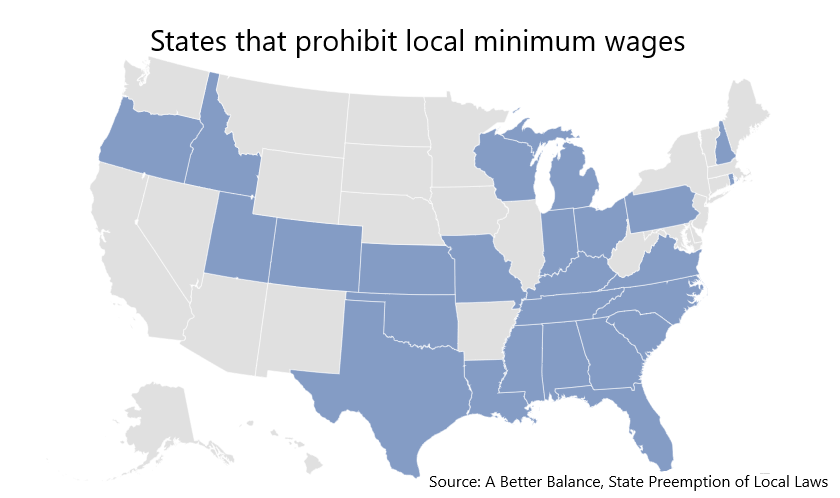 A 2016 article in the American Prospect noted that the rise in laws limiting local authority came "as Republicans have captured an unprecedented number of state legislatures and as cities have become hotbeds for progressive organizing." The American Legislative Exchange Council, which promotes corporate interests in statehouses, even offers model preemption legislation.
Southern state legislatures have preempted local ordinances designed to protect the environment, workers, immigrants, consumers, and others. The Partnership for Working Families, a national network of racial and economic justice advocates, observes that "preemption legislation is often passed by predominantly white legislatures blocking laws benefiting and supported by majority communities of color."
The crucial role of state courts
Though most state constitutions give legislatures broad authority over local governments, laws that limit local government authority can sometimes violate state constitutions. The Florida Supreme Court, for example, will soon hear a lawsuit over a local minimum wage ordinance in Miami Beach.
That state's 1868 constitutional convention was dominated by more conservative factions, and its Reconstruction constitution gave state legislators broad power over local government. The Florida legislature has not hesitated to use this power, such as in 2003, when it passed a law barring cities and counties from increasing the local minimum wage. The following year, voters responded by amending the state constitution to allow local governments to do so.
The city of Miami Beach, where an earlier attempted wage increase had prompted the 2003 preemption law, then increased its minimum wage to $13.31 per hour. The Florida Chamber of Commerce and its allies sued the city, arguing that the preemption law remained in force. A lower court agreed, but the state Supreme Court has decided to hear the case.
As these legal battles between cities and states play out, special interests backed by corporate money have tried to influence who sits on the courts that define the scope of local authority. The Florida Chamber of Commerce, for example, has supported attempts to allow the Republican governor to pack state courts.
And it's not just Florida: In North Carolina, the state Chamber has spent millions of dollars in recent years to elect its preferred legislators and judges. And the Arkansas Supreme Court, whose recent elections have been dominated by national conservative groups that don't disclose their donors, last year struck down a local civil rights law protecting LGBTQ people.
"State officials are trying to overrule the will of the voters, and ban local communities from doing the right thing and protecting their LGBT residents from discrimination," said Holly Dickson, legal director of the ACLU of Arkansas, which defended the ordinance.
(This is the second story in a series on the legacy of progressive Southern constitutions that were rewritten during Radical Reconstruction. To read the first, on the freedom to vote, click here.)
Tags
- CIVIL WAR
- RECONSTRUCTION
- STATE CONSTITUTIONS
- VOTING RIGHTS
- VOTER SUPPRESSION
- WHITE SUPREMACISM
- RACISM
- JIM CROW
- KU KLUX KLAN
- LYNCHING
- STATE LEGISLATURES
- NORTH CAROLINA
- LOCAL CONTROL
- PREEMPTION
- REDEEMERS
- ALABAMA
- MINIMUM WAGE
- NC HOUSE BILL 2
- COURT PACKING
- ARKANSAS
==
==
https://www.alternet.org/local-peace-economy/can-community-rights-save-great-lakes
Imagine for a moment, putting the rights of nature into public policy: Your town charter, your state constitution, or even federal law.
Imagine, for a moment, giving the Great Lakes—the world’s largest source of fresh water—the right to exist and evolve naturally, to be free from pollutants that could contaminate and harm the lives that rely on it.
Imagine that we, as Americans, have the right to lawfully stop anything that violated the rights of the Great Lakes. That means the right to stop anything that would cause harm to the ecosystem.
That ecosystem provides tens of millions of people with the fresh water they use to drink, bathe, cook, and farm.
The idea is called community rights, and it’s popping up around the world and across the country, and it is meant to stop anything causing an adverse effect on the ecosystem.
Ecuador has it enshrined in their constitution. Here in the U.S., when the community can see the harm being caused by, for example, fracking, the community can say, “this is harmful, and the polluting company doesn’t have the right to do that.” Pittsburgh did just that.
A company might have a permit to allow them to emit, dump, or otherwise pollute, but with community rights, the community has the right to protect themselves from legalized harm.
And it’s not just fracking waste that it can stop. Dumping from farms, oil drilling, and factories too—basically anything causing an adverse effect on the ecosystem and life, the community can say, “this is harmful, and they don’t have the right to do that.”
It’s about communities passing laws to create a society you want your children and grandchildren and great-grandchildren to live in.
And that is exactly what activists in Toledo, Ohio, are seeking to do. The western basin of Lake Erie has experienced extreme toxic algae blooms that have contaminated the drinking water of nearly half a million people in the region, sometimes causing citizens of the Midwestern city to go days without fresh water. The algae blooms are attributed to nutrient runoff in agriculture and sewage.
Of course, agriculture is permitted to use nutrients. There are “harms we allow, and they are within the allowable limits. Even with all these permits and permissions, we are still seeing the harmful effects,” says Markie Miller, an organizer with Toledoans for Safe Water. “Something’s not working.”
In August, Toledoans for Safe Water turned in petitions to put a community rights-based initiative on the ballot, with over 10,000 signatures. It’s called the Lake Erie Bill of Rights, and if implemented, would recognize the right of Lake Erie “to be healthy and free from pollution that today is killing the Lake and depriving surrounding communities of safe water.”
Miller says she studied environmental studies and environmental science in college. The emphasis in those programs was on getting a job working on regulations, or in companies to comply with regulations. That seemed to sidestep the real issues of environmental justice, so Miller turned to the community rights movement.
Miller is tired of the messaging around environmental disasters. “We don’t want to put up with allowable harm,” she continues. “We don’t just want to be prepared for algae.” That mentality, Miller explains, is reactive. “We want something proactive.”
She and fellow activists connected with the Community Environmental Legal Defense Fund, CELDF, a public interest law firm operating with communities across the U.S. and rights of nature work in other countries. Together they drafted the Lake Erie Bill of Rights and started collecting signatures and talking about it.
Tish O’Dell, Ohio Community Organizer for CELDF, initially got involved in the movement because her community of Broadview Heights, Ohio, was threatened by oil and gas drilling.
It was here she and her fellow community members passed a Bill of Rights in 2012. Despite the Bill of Rights being appealed, the community sued by the company, and ultimately losing, the company hasn’t drilled since the bill was originally passed.
“They started drilling and getting people to sign leases, promising wealth beyond imagine,” O’Dell explains. “Oil spilled in a creek outside people’s homes. The fire department would evacuate people. We had an elementary school, and something broke on a well next door, and it spilled oil on the playground at recess. That woke people up. Then when people started going to city council and saying, ‘This is BS. Stop this,’ they said, ‘we can’t do anything, the state has control over this.’ Then the obedient citizens we are, we went to the state.”
O’Dell says the state sent them to EPA, and then to the state Department of Public Health. “No one would take responsibility. It was like the scarecrow pointing in different directions.”
O’Dell says they were told the drilling was safe and that it would bring jobs.
CELDF helped them draft a bill of rights, for clean air, water, and soil. It passed. Then, it became, “Our law says your permit violates our law, so we’re not going to recognize your permit in our community,” she says.
“We don’t have the kind of government we thought we did,” says O’Dell of the lost court battles that ensued.
Now, the local board of elections in Ohio has the right to keep citizen initiatives off the ballot based on content, “which shouldn’t be happening,” says Miller, “whether or not someone agrees with the content. We have a city charter, and we should be able to take it to the people and let them decide. Our local board of election should not be the gatekeeper for something like that.”
And yet, it is. The local BOE kept the Lake Erie Bill of Rights initiative off the ballot, and the Ohio Supreme Court blocked the initiative on appeal. Toledoans for Safe Water said they are filing a motion to reconsider.
“It was devastating to be without water for 3 days in 2014. This is worse,” Crystal Jankowski, an organizer for the Lake Erie Bill of Rights, said in a press release. “To know that the Lake and my children are at risk because it is legalfor the polluters to pollute us, while our own government makes it illegal for us to propose a law to protect the Lake and our children, is beyond devastating. It is the realization that we not only have a water crisis, but we also have a democracy crisis.”
“We the people are following laws written by corporations for their benefit. It’s greed,” says O’Dell.
“They’re using our communities as resource colonies,” she added.
No matter what happens, the battle over local control of the natural environment won’t end here in the Ohio Supreme Court. The health of future generations—the very water they drink—depends on what communities can do today to protect themselves and those to come in the future.
Learn more about community rights, Ohio community rights, and CELDF.
This article was produced by Local Peace Economy, a project of the Independent Media Institute.
const local regs maine
https://insideclimatenews.org/news/28082018/tar-sands-pipeline-court-ruling-south-portland-ban-public-health-constitutional-big-oil-maine
A federal judge has ruled that the coastal city of South Portland, Maine, did not violate the U.S. Constitution when it passed an ordinance that blocked a local pipeline company from bringing tar sands oil through its port.
For the city of 25,000, the ruling was a surprise victory after years of fighting what felt like an impossible battle against some of the world's biggest oil companies, which lined up to support the Portland Pipe Line Corporation (PPLC).
Provided the ruling survives an appeal, it slams the door on a significant plan to ship Canadian tar sands oil, one of the most carbon-intensive fuels on the planet, to the East Coast for export to international markets, and it could offer a guide for other communities hoping to block energy projects.
"For other communities looking at opposing fossil fuel infrastructure, this case is a blueprint for how you should do it," said Patrick Parenteau, an environmental law professor at the Vermont Law School. "It's a strong opinion, and it could result in a really significant precedent for local control on petroleum-based industries." The pipeline company's plan involved a 70-year-old pipeline system that currently carries conventional crude oil in the opposite direction, from a tanker facility in South Portland to refineries in Montreal. After Canada's tar sands oil boom crippled the market for oil travelling from Maine to Montreal, PPLC saw its business dwindle.
A plan to reverse the flow and provide a route for tar sands oil to reach global markets through the port at South Portland represented a golden egg for the company—a way to redefine its business model, provide jobs and become a linchpin for oil exports.
But it also would have come at a steep price, the grassroots group Protect South Portland argued.
The plan called for the construction of a pair of 70-foot-high smokestacks next to a beloved waterfront park to burn off volatile compounds from the tar sands oil before it could be loaded into tankers. Concerns about emissions from those smokestacks led to the creation of the so-called Clear Skies Ordinance, which banned the bulk loading of crude oil onto tankers.
When the City Council passed the ordinance in 2014, it sought to protect South Portland citizens from air pollution. The ordinance's foundation lay in Maine's "home rule authority," a stipulation of thestate Constitution that allows municipalities to create regulations that go beyond state rules to protect public health and welfare.
[map]
The pipeline company filed its lawsuit in 2015, and a lengthy, expensive legal battle ensued. Late last year, a federal district court judge threw out all but one of the industry's claims against the city, but left open the key question of whether the ordinance violated the Constitution.
In his 92-page decision issued on Friday, Judge John A Woodcock, Jr., found it did not.
The decision "gives communities a powerful tool," said Ken Rumelt, a Vermont Law School professor who led students at its environmental law clinic in advising groups involved in the case. "It says that a community, assuming there isno state law preempting what they're trying to do, can say no, we don't want to suffer these impacts."
A Tale of Two Portlands
The Maine decision echoes one issued earlier this month in the other Portland—Oregon.
There, a group of industry and business groups had sued over a 2016 ordinance that banned the construction of new fossil fuel infrastructure. As in Maine, the petitioners argued that the ordinance violated the Commerce Clause of the Constitution, which regulates commerce with foreign nations, among states and with Native American tribes.
After years of volleying through the courts, the Oregon Supreme Court opted not to hear a challenge to the ordinance.
"The two Portlands are setting the stage for lots of other communities in between the two coasts," said Sean Mahoney of the Conservation Law Foundation, who has advised South Portland. "The lesson is that communities have the right and the obligation to protect the public health of the people who live in them, whether that is from air pollution or water pollution or lead in drinking water or housing."
As Goes Maine?
In the Maine case, the local pipeline company enlisted powerful allies as it opposed the ordinance. The American Petroleum Institute, whose members include most major oil and gas companies, spent hundreds of thousands of dollars to defeat a 2013 ballot measure that would have blocked the project. After the ordinance was passed, API and the U.S. Chamber of Commerce both supported PPLC in its lawsuit.
Josh Axelrod, a policy analyst with Natural Resources Defense Council, said that support laid bare just how much the industry wanted to use the PPLC pipelines to gain access to the East Coast for exporting tar sands. "This is a huge win to stop that from happening," he said.
One by one, viable options to export the tar sands via pipeline have run into challenges. TransCanada abandoned its plans for the Energy East Pipeline in 2017, announcing it was uneconomical. Earlier this month, a federal judge ordered a new environmental review of the Keystone XL project. And later this week, a Canadian court will ruleon whether First Nations groups were adequately consulted in the plans for the Trans Mountain pipeline—a decision that could delay or cancel the plans for that pipeline.
These challenges "put some upper limit on where the industry would like to go," Axelrod said. "Back almost 10 years ago, they would talk about growing to 9 million barrels of oil per day of [tar sands] production. Their most optimistic projections now are less than 4.5 million barrels of oil per day."
And that's premised on the construction of at least two new pipelines, Axelrod said—a prospect that's seeming less likely given the opposition and court rulings.
'Committed Citizens Can Change the World'
The South Portland case will most likely be appealed. But for now, the decision is being met with surprise, and relief.
Mayor Linda Cohen praised the ruling in a written statement, saying, "Faced with the prospect of hundreds of thousands of barrels of crude oil being loaded onto marine tank vessels in the City and threatening the health of the residents and preventing redevelopment of the waterfront, the City Council prohibited this new activity. We are pleased that the Court upheld the ordinance."
Rachel Burger, the co-founder and president of Protect South Portland, said she was overjoyed. "I didn't count on this happening, necessarily. I thought the ruling was more likely to be negative," she said. "I'm just amazed that a group of people can do something like this."
Thinking back on years of canvassing, fundraisers, marches and grassroots organizing, Burger said she keeps coming back to a Margaret Mead quote: "Never doubt that a small group of thoughtful, committed citizens can change the world; indeed, it's the only thing that ever has."
PUBLISHED UNDER:
==
==
One West Virginia County Tried to Break Its Dependence on the Energy Industry. It Was Overruled.
After seeing the scars of coal, Fayette County banned the disposal of natural gas drilling waste. Industry fought back, arguing the community doesn’t get a say
...
==
A new frontier in the soda tax war is emerging along the west coast. Industry-funded committees have drawn up ballot measures to preempt voters’ local soda tax initiatives in California, Oregon, and Washington state.
Starting with Berkeley, California in 2014, public health campaigners have succeeded in getting eight localities to enact taxes on sodas and other sugary beverages as a way to crack down on sugar consumption and battle obesity. Four of those localities are in California, and Seattle, Washington passed a tax that became effective at the beginning of 2018.
Now big soda manufactures are fighting back, putting big money behind statewide initiatives that would stop these local democracy efforts in their tracks.
The name of the game is preemption: banning, with a piece of legislation at the state level, cities and counties from democratically enacting soda taxes. The technique was wielded as a weapon by Big Tobacco in the ’80s and ’90s to stop communities from regulating their deadly product by creating smoke-free workplaces. Now 12 states ban smoke-free ordinances and experts say preemption itself is the public health threat.
In a June 2017 article in the American Journal of Public Health, Jennifer Pomeranz of New York University’s College of Global Public Health and Mark Pertschuk of Grassroots Change in Oakland, California called preemption “a significant and quiet threat to public health in the United States” because it leaves municipalities “increasingly unable to address acute public health issues that will have lasting consequences for the health of communities.”
SODA TAXES TACKLE PUBLIC HEALTH CHALLENGES
Rising levels of obesity, diabetes, heart disease, and other serious public health challenges related to the consumption of sugary beverages have galvanized grassroots public health leaders. One tool they can use to address these challenges is a modest sales tax on sodas and sweetened beverages, with revenues going to support public health and education programs. New data show that consuming sugar in liquid form increases risks of serious health conditions such as heart disease, type 2 diabetes, nonalcoholic fatty liver disease, and obesity in a much more significant way than was previously known.
Soda taxes work. Researchers at Drexel University surveyed consumers before and after the implementation of Philadelphia’s tax and found that daily consumption of soda decreased by 40 percent and energy drinks by 64 percent while consumption of bottled water increased by 58 percent. Researchers at UC Berkeley’s School of Public Health found that sugary beverage consumption fell 21 percent in Berkeley after that city’s tax was implemented, while water consumption increased by 63 percent over comparison cities.
There’s a lot at stake for America’s biggest soda companies. Carbonated soft drinks–such as Coke, Fanta, Sprite, and Fresca–make up two-thirds of Coca-Cola’s production, and U.S. soda sales earned the company more than $10 billion in 2015. And PepsiCo’s soda sales – including Pepsi, 7Up, and Mountain Dew – still account for one-quarter of the company’s $38 billion in North American sales, despite a shift toward healthier products. But soda consumption fell to its lowest point in 31 years in the U.S. in 2016, according to Fortune, andCoca-Cola concedes that sweetened beverage taxes “are hurting Coke’s business.”
As cities and counties across the county introduce taxes on sodas and sweetened beverages to counter the public health risks, they are facing sophisticated opposition campaigns funded by these soda giants operating through their deep-pocketed trade group, the American Beverage Association (ABA). The ABA has launched big-dollar TV ad campaigns to fight soda taxes, spent heavily on lobbying state legislatures, sued to block soda taxes, and now is launching massive statewide ballot initiatives to roll back local soda taxes.
The soda industry uses the blandly named trade association to shelter its own brand names from controversy and condemnation, taps small business owners to champion their cause, and spins the tax as a “grocery tax” that will impact all consumers, not just those loading up the shopping cart with Coke and Snapple.
BIG SODA TURNS TO THE BALLOT TO BLOCK LOCAL HEALTH LAWS
Now the industry has latched on to statewide preemption ballot measures up and down the west coast as a way to halt local momentum on soda taxes. California and Washington’s preemption initiatives are seeking enough signatures to get on the ballot and must finish that process by July in order to go before voters in November 2018. Oregon’s initiative has already qualified for the November 2018 ballot.
Coca-Cola Co, PepsiCo, Dr. Pepper Snapple Group, and Red Bull have thrown a combined $3 million at overriding voters’ will in Washington state (proposed initiative 1634), and the ABA has spent more than $7 million so far in the effort to override Californians’ local votes (Attorney General Tracking #17-0050).
California’s proposed initiative would stack the deck for the likes of Coca-Cola and PepsiCo by preventing cities and counties from raising any taxes without the approval of two-thirds of either voters or an elected body. That explains why the industry is throwing so much cash at the current California override attempt, making it potentially the most expensive political contest in the country in 2018.
The American Beverage Association California PAC is by far the largest contributor to the ballot committee (“Californians for Accountability and Transparency in Government Spending, Sponsored by California Businesses”) spearheading the industry’s preemption measure, accounting for nearly 85 percent ($7 million) of its total reported revenues ($8.3 million) as of June 22, 2018. The largest contributors to the ABA CA PAC in 2017 and 2018 are Coca-Cola ($3.4million), PepsiCo ($2.6 million), Dr. Pepper Snapple Group ($1.1 million), and Red Bull ($97,312), as of June 22, 2018.
Similarly, all but less than one percent of the $3 million contributed to Washington’s anti-soda tax “Yes! to Affordable Groceries” initiative committee as of June 18, 2018 was contributed by the soda industry: 47 percent from Coca-Cola, 36 percent from PepsiCo, 15 percent from Dr. Pepper Snapple, and 1 percent from Red Bull. But the committee’s website prominently features the logos of “supporters” such as Teamsters No. 28, the Washington Food Industry Association, and the Washington Farm Bureau.
InOregon, the similarly-named “Yes! Keep Our Groceries Tax Free!” initiative committee has raised over $5.2 million, apparently from retail grocery chains and their regional trade group the Northwest Grocery Association.
Industry efforts in these west-coast states are a “fantastic assault on local democracy, but also on the ability of cities and countries to function,” Pertschuk said. Pertschuk added that California’s initiative in particular “would be so devastating to communities, so far beyond soda taxes, it really would starve communities.”
First published by Salon. a pearson
==
==
https://www.ecowatch.com/texas-plastic-bag-ban-2580367535.html
Texas Supreme Court Rules Cities Cannot Ban Plastic Bags
The Texas Supreme Court struck down the city of Laredo's plastic bag ban—a decision that will likely overturn similar bans in about a dozen other cities, including Austin, Fort Stockton and Port Aransas.
The court ruled Friday that only the state has the authority to regulate solid waste disposal in Texas. In the 19-page opinion, Chief Justice Nathan Hecht wrote that the Texas Constitution prohibits city ordinances from conflicting with state law.
"Both sides of the debate ... assert public-policy arguments raising economic, environmental and uniformity concerns," Hecht said. "We must take statutes as they are written, and the one before us is written quite clearly. Its limitation on local control encompasses the ordinance."
The Laredo Merchants Association sued the city in March 2015 to overturn the ordinance, arguing that state law pre-empts the bag ban. The move was supported by 20 state senators and representatives, all Republicans, that filed an amicus brief in support of the merchants for an earlier appeal of the case.
Texas Attorney General Ken Paxton also backed the merchants. A press release from his office states that the ruling "effectively invalidates unlawful bag bans across Texas."
"I hope that Laredo, Austin, and any other jurisdictions that have enacted illegal bag bans will take note and voluntarily bring their ordinances into compliance with state law," Paxton said in a statement. "Should they decline to do so, I expect the ruling will be used to invalidate any other illegal bag bans statewide."
In a statement after today's ruling, Laredo mayor Pete Saenz called the decision a "major blow to all Texans who want to see a cleaner, healthier and more beautiful state."
He said that banning plastic bags helped protect the environment, reduced clean-up costs and "beautified" the city. He also said that Laredoans quickly adapted to bringing their own bags to stores.
"Single use plastic bags have contributed to flooding, mosquitoes, costly clean up for local governments, and disruption of sensitive ecosystems and wildlife," Saenz said. "Laredo's ordinance helped reduce clean up and repair costs to our storm water, sewage and water utilities systems. It also beautified our city and helped wildlife with it."
He encouraged residents and all Texans to continue bringing reusable bags, straws, cups and containers to stores.
Environmental groups were disappointed by the court's decision.
"Plastic pollution is harming wildlife, marring the beauty of our cities, and threatening our health, safety and economy," said Environment Texas executive director Luke Metzger in a statement. "Nothing we use for five minutes should pollute our environment for hundreds of years. We call on major retailers, like HEB and Walmart, to continue observing the ban in these cities and ask the Legislature to remove the preemption statute."
==
tool on health effects
https://grassrootschange.net/preemption-watch/
no lnx
How Enbridge Helped Write Minnesota Pipeline Laws, Aiding Its Line 3 Battle Today
By Logan Carroll
The Minnesota section of Enbridge's Line 3 pipeline accounts for nearly 300 miles of the longest crude oil transport system in the world, and it is failing. The multi-billion-dollar transnational corporation has applied for a permit to replace it. Opposition from tribes in the region and environmental groups is slowing the project, but the process at times appears so tilted in Enbridge's favor that, watching the court battles and utility commission meetings, it almost feels like Enbridge wrote the rules.
At one point in its application to build the new Line 3, Enbridge listed all the federal and state laws that regulate the permitting and construction of pipelines. Nearly all the Minnesota laws originated in one 1987 Senate bill: S.F. 90.
This bill was accompanied by unprecedented pipeline industry lobbying—led in spending by Enbridge—and included subtle but major handouts to pipeline companies. One such provision imposes a sweeping limit on the public's ability to oppose new pipelines, including the Line 3 replacement project.
On May 18, 2018, about 100 people gathered at the Minnesota capitol in protest of the Line 3 project.
Industry-Friendly Language
According to environmental lawyer Paul Blackburn, one of the largest barriers to pipeline regulation is actually the federal Pipeline Safety Act, which preempts most state regulations. He called the law "a beautiful example of how to appear to regulate something without actually regulating it at all."
Still, Blackburn said there are ways for states to regulate pipelines, with some of the most powerful being zoning, permitting, and routing laws. However, S.F. 90 includes industry-friendly language that undercuts these and other potential regulations.
The bill allowed pipeline operators to classify their own data after a spill, making it inaccessible to the public. It instituted stiff civil and criminal penalties for pipeline company employees who failed to alert the authorities or destroyed evidence after a spill, but the companies were subject only to relatively small fines.
Perhaps S.F. 90's largest handout was the overhaul of Minnesota's routing and permitting process. Before 1987, counties and towns could use zoning to exert some control over the routing and permitting of pipelines (how and where they were built), but S.F. 90 preempted local zoning of pipelines, a measure with implications for the Line 3 battle today. Instead, a new pipeline would require only a single routing permit, issued by the Environmental Quality Board, an authority which shifted to the Public Utilities Commission in 2005.
This is the commission that will decide the fate of Enbridge's Line 3 replacement project, a decision expected in June.
The bill's strongest provision established the call-before-you-dig system, requiring pipeline operators to register the locations of their lines. However, the system is overseen by a nonprofit run by pipeline and excavation industry representatives, and while excavators who don't comply are fined, there is no punishment for pipeline operators who don't register their lines.
Hidden Pipelines, Hidden Influence?
In 1986, in Mounds View, Minnesota, a gasoline pipeline exploded, leveling an entire city block and killing two: a woman and her daughter. After the explosion, the governor convened a commission to study how to better regulate the industry. The commission was co-chaired by state Senator Steve Novak, who was also S.F. 90's primary sponsor.
He describes the bill as a compromise between three sides: industry, government and environmentalists. Before S.F. 90, Novak said, "You'd be living in your neighborhood, going to a school, at a park—some damn pipeline was going right underneath you and you didn't know it."
The next legislative session, while S.F. 90 was being drafted in early 1987, Enbridge Energy Partners (then Lakehead Pipe Line Company) spent more than $15,000 lobbying the Minnesota Legislature. This might seem modest post-Citizens United, but it was more than the company would spend in the state in the next 18 years combined.
The petroleum and natural gas industry spent $47,101 in the first six months of that year, nearly all of it by pipeline companies, a figure that would drop to only $17,479 in the year that followed this period. Although not required to disclose how they spent this money, typical lobbying expenses include wining and dining public officials, advertising, or preparing and distributing lobbying materials.
Novak doesn't recall many specifics of how the bill was drafted, except that nothing was controversial at the time and everything was unanimous, including the preemption of local zoning. One of the problems S.F. 90 addressed was that no one—including counties and cities—was regulating pipelines at all. The routing and permitting provision wasn't meant to limit regulation, but to expand it by clearly identifying who was responsible for these decisions.
For his part, Novak doesn't recall the industry manipulating the process, though he admits the possibility. "If there were things that occurred in the seams and along the edges that, possibly, 30 years later, appear to be a manipulation, we didn't know it at the time," Novak said.
Novak's explanation echoes the conclusion of a 2014 Suffolk University study of the effectiveness of state-level lobbying: "By showing a willingness to work with a bill that an interest group opposes in its current form, the lobbyist reassures legislators who might otherwise worry about the intent of the lobbyist and the veracity of the information the lobbyist is providing." When using this approach, the study found, lobbyists were able to insert industry-friendly language into 65 percent of state legislation.
"There may be conspiracies," Novak laughed a little, "going on today that we didn't think of in those days … I would recommend you find some legislators to fix it."
Trying to Fix It
In 2013, state Rep. Frank Hornstein introduced a modest oil transport safety bill in response to the Lac-Mégantic, Canada, oil train disaster that killed 47 people and an oil train derailment in Minnesota that released 30,000 gallons.
The bill would have required pipeline and railroad companies to pay into a first responder safety fund and conform to some standards for responding to spills.
Early on, rail companies opposed the bill but quickly accepted many of the provisions. The pipeline industry was silent until the very end. "Out of nowhere, they almost literally parachuted into town," Hornstein said. They poured in from Washington, DC; Oklahoma; the Gulf Coast: "All these lobbyists descended on the capital and started lobbying against my bill."
Hornstein sat down with the lobbyists, who represented the American Petroleum Institute and pipeline companies, including Enbridge. He described a tense meeting which culminated in one lobbyist demanding to know his "philosophy of oil."
"I don't know," he said. "There's a lot of it and it causes climate change."
After that, things moved quickly. While Hornstein worked to get his bill through the House, industry lobbyists worked to get all references to pipelines removed from the Senate version. A small war erupted when reconciling the two versions, requiring the governor's intervention. In the end, the bill regulated only oil trains; pipeline operators would pay into the safety fund but all other references to them were removed.
New Line 3, Same Old Story
In the last several years, most of Enbridge's lobbying efforts in the state have been directed at the Minnesota Public Utilities Commission (PUC). Last year, Enbridge spent more than $5 million to influence the PUC, including lawyers' fees to argue before the commission. However, the company now spends more than $200,000 a year lobbying the legislature. Perhaps not coincidentally, the legislature passed a bill last week that would have allowed Line 3 to bypass the PUC altogether. This week, the governor vetoed that bill.
Sections of pipe destined for Enbridge's Line 3 replacement project, in Hardisty, Alberta, August 10, 2016.
Most developments in the bureaucratic war over Line 3 happen at the state capital, politically and geographically removed from those the pipeline would affect most. The wording was subtle, but if S.F. 90 hadn't preempted local zoning, those opposing Line 3 could work with local officials to erect additional barriers.
For better or worse, S.F. 90 was an historic piece of legislation. Just last summer, Novak met with others who helped craft S.F.90 to celebrate the 30th anniversary of its passage. He's proud of the bill and points out that call-before-you-dig has likely prevented another catastrophe. On the other hand, S.F. 90 continues to benefit oil and pipeline companies and limit public participation in decisions about pipelines.
"Maybe times have changed," Novak said of the law, "and it's time to revisit it."
Enbridge did not respond to requests for comment.
https://www.ecowatch.com/colorado-sues-exxonmobil-2560966559.html
Colorado Communities Sue ExxonMobil and Suncor for Climate Damages
By Elliott Negin
Two Colorado counties and the city of Boulder are suing ExxonMobil and Suncor Energy, Canada's largest oil company, to hold them responsible for climate change-related damage to their communities.
The lawsuit, filed Tuesday in a state district court by Boulder, Boulder County and San Miguel County, is seeking compensation for damage and adaptation costs resulting from extreme weather events.
New York City and eight coastal California cities and counties, including San Francisco and Oakland, have filed similar lawsuits against ExxonMobil and other oil and gas companies, charging that they have injured their communities under common law. The Colorado suit is the first by an inland county or municipality.
"Climate change is not just about sea level rise. It affects all of us in the middle of the country as well," said Boulder County Commissioner Elise Jones. "In fact, Colorado is one of the fastest warming states in the nation."
Oil Industry Knew About Threat 50 Years Ago
The 1,300-square-mile San Miguel County sits in the southwest corner of the state on the Utah border. About a third of the county's 8,000 residents live in Telluride, a well-known ski resort town. Boulder, 25 miles northwest of Denver, is the county seat of the 740-square-mile Boulder County and home to nearly a third of the county's 319,000 residents. The three communities have been ravaged by costly climate-related extreme weather events, including wildfires and flash floods, according to the 100-page complaint. Likewise, each community has launched initiatives to curb carbon emissions and adapt to a changing climate.
The Colorado communities contend that ExxonMobil and Suncor were aware that their products caused global warming as early as 1968, when a report commissioned by the American Petroleum Institute (API), the U.S oil and gas industry's premier trade association, warned of the threat burning fossil fuels posed to the climate. Subsequent reports and memos prepared for API and its member companies came to similar conclusions. Regardless, ExxonMobil and Suncor not only continued to produce and market fossil fuel products without disclosing their risks, the complaint charges, they also engaged in a decades-long disinformation campaign to manufacture public doubt and confusion about the reality and seriousness of climate change.
The plaintiffs want the two oil giants to "pay their share of the damage" caused by their "intentional, reckless and negligent conduct." That share could amount to tens of millions, if not billions, of dollars to help cover the cost of more heat waves, wildfires, droughts, intense precipitation, and floods.
==
https://www.exposedbycmd.org/2018/03/28/bills-ban-local-soda-taxes-moving-states-coke-pepsi-borrow-tobacco-playbook
Watch out public health advocates – as soda tax campaigns are bubbling up in cities across the nation to combat obesity, diabetes and other serious health conditions – the beverage industry is working to choke off this expression of local democracy.
A state bill banning localities from taxing food and beverages came out of nowhere in Michigan and was signed into law by Governor Rick Snyder within weeks. Last week, Governor Doug Ducey in Arizona signed a similarly fast tracked bill. These are clear instances of corporate special interests convincing legislators to block local laws that would hurt their profitability.
In Washington State, the soda industry is going a step further. After watching Seattle’s soda tax take effect last month, industry started a state wide ballot initiative campaign that would prevent other cities in the state from implementing a similar tax.
The name of the campaign is not “Coke and Pepsi For Obesity and Diabetes,” it’s “Yes! To Affordable Groceries.” The discrepancy is not just laughable it reveals a key industry tactic in the soda wars – change the topic and talk about anything except the devastating public health impact of sugary beverages.
NEW DATA SHOWS PUBLIC HEALTH IMPACTS OF SUGARY DRINKS
The public health community – pediatricians, dentists, the American Heart Association and more – are energized to take action as never before on soda and other sugary drinks because new data is showing that consuming sugar in liquid form increases risks of serious health conditions, such as heart disease, Type 2 diabetes, nonalcoholic fatty liver disease, and obesity in a much more significant way than was previously known.
If you are a Mountain Dew addict, get ready for this statistic. One study found that consuming just one to two sugary drinks a day increases your risk of developing diabetes a whopping 26 percent. Another study showed that men averaging one can a day of a sugary drink had a 20 percent increased risk of heart attack. Further, more than three-quarters of American adults are considered overweight or obese, and 30 percent of children.
Statistics like these and skyrocketing rates of obesity in Mexico City inspired public health advocates there to champion a soda tax in 2012 that has led to a significant fall in consumption – a 6% drop in the first year after the tax was introduced was followed by a 12% decline the second year.
Berkeley, California was the first U.S. city to follow Mexico’s lead uniting physicians, dentists, school board members, Latino leaders, the NAACP, black churches, teachers unions, farm and food advocates, moms and dads behind a grassroots effort to crack down on “big soda” in 2014. They won a landslide victory, and early data shows that consumption of sugary drinks is down 21% and healthy water consumption is way up.
But as cities and counties in the United States utilize the tools of local democracy to introduce modest tax increases on soda, they are facing sophisticated opposition spearheaded by the American Beverage Association (ABA) the blandly named trade association representing Coke, Pepsi, Dr. Pepper Snapple Group and other producers of sugary drinks.
BIG DOLLAR AD BUYS IN LOCAL INITIATIVE CAMPAIGNS
When they are up to no good, brand name companies like to hide behind their trade association. The American Beverage Association is a 501(c)(6) trade association and a $79 million lobbying powerhouse bankrolled by the largest players in the soft drink industry. Coke brands including, Fanta, Sprite, Fresca, Desani, Honest Tea and Minute Maid represent a $32 billion market. PepsiCo brands including, Gatorade, 7Up, Tropicana, and Mountain Dew represent an $18 billion market.
In every locality that has introduced a soda tax in recent years, the beverage industry has responded with the techniques of a industry that knows it has a big public relations problem. The ABA has set up grassroots-sounding front groups and has blanketed the neighborhood with flyers and messaging. In Richmond in 2012, for instance, the ABA group fighting a soda tax referendum on the ballot was called “Community Coalition Against Beverage Taxes.” In El Monte, the front group was called “El Monte Citizens Against Beverage Taxes.”
The ABA has worked to rebrand the issue and shift the terms of the debate. It doesn’t want to debate a soda tax, so it spins it as a “grocery tax” that harms everyone not just those who drink soda. It doesn’t want to talk about the rising rates of obesity, it would rather talk about the “high cost of living.” Recent campaign names have included “Enough is Enough: Don’t Tax Our Groceries” in San Francisco to “Keep Seattle Livable for All.”
In TV and internet ads produced by the trade association, you don’t see the CEOs of Coke and Pepsi making the case against the soda tax. Rather, the ABA puts up a diversity of spokespeople to carry its preferred messaging. San Francisco grocery store owner Abdul Taleb tells the camera “politicians say it is a soda tax, they are lying. This is a tax on groceries.” In Chicago, a professional-looking African American woman tells the camera “we’re being taxed out of Cook County, I’m a single mom. I can’t afford this tax.” In Philadelphia, a hoagie shop owner says “we try to offer the best food at the best price…with that tax the working man can’t afford it anymore.”
The soda industry spent $48.9 million on recent soda tax opposition campaigns in Cook County, IL; Philadelphia, PA; Boulder, CO; San Francisco, CA; Oakland, CA; Seattle, WA, Santa Fe, NM; and Albany, California, according to a November 2017 report by the watchdog group Center for Science in the Public Interest. The ABA does not engage in absolute concealment of their sponsorship, but it does work to shield its brand name companies from responsibility and culpability.
The ABA has won some of these battles, rolling back a soda tax in Chicago and defeating one in Sante Fe, but it has lost more than it has won, so it is shifting the battle ground to state legislatures. In doing so it is following a timeworn path utilized by other industries that are hazardous to public health.
FOLLOWING IN THE FOOTSTEPS OF THE NRA AND BIG TOBACCO
Cities and counties have long played a valuable role as “laboratories of democracy” for important public policy innovations, including public health policies. When U.S. cities led the way regulating guns in the 1970s, the NRA responded with a raft of bills that prohibit localities from adopting reasonable gun laws tailored to local conditions. Faced with local ordinances to regulate tobacco products or create “tobacco free” work environments in the 1980s, the industry jumped into action.
“We could never win at the local level… So the Tobacco Institute and tobacco companies’ first priority has always been to preempt the field,” said a tobacco lobbyist. Today, the majority of states have some type of tobacco preemption, twelve states preempt local smoke-free ordinances and eight states have recently moved to ban local regulation of E-cigarettes.
“In 1988, it was Phillip Morris’ Smokers’ Alliance. In 2018, it’s Big Soda’s YES! TO AFFORDABLE GROCERIES. Both are front groups, then the tobacco industry’s and today the American Beverage Association’s,” said Mark Pertschuk. Pertschuk is the Director of a small advocacy organization called Grassroots Change. He is the former President of American for Nonsmokers’ Rights, which battled the tobacco industry for smoke-free workplaces.
Today, Pertschuk’s “Preemption Watch” project tracks effortsthat step on local democracy. There has already been preemption of local ordinances related to nutrition in 11 states, this applies not just to a soda tax, but to menu labelling and other policies. More preemption bills (or statewide referendums) are likely to be introduced in 2018.
In working to “preempt the field” the ABA is getting help from many of the usual suspects. Affiliates of the U.S. Chamber of Commerce have been active in local fights along with restaurant and grocers associations. Front group propagator and master propagandist Richard Berman cut ads in Sante Fe for a State Policy Network “think tank,” prompting an ethics complaint. Other State Policy Network groups have been producing and promoting questionable research saying that the soda tax harms the economy. An ALEC legislator successfully preempted local food and nutrition policies with an ALEC “model bill” in Kansas. And the National Federation of Independent Businesses, which has been battling paid sick leave ordinances, lobbied in favor of soda tax preemption in Michigan.
Grassroots activists know they are up against big institutions and big money, but they also know they have the people on their side. While Congress is universally reviled, local government is almost universally supported. In a recent pollin Pennsylvania conducted by the American Heart Association, 71% of likely voters agreed that “…government closest to the people governs best” and a preemption law that takes away the ability of local governments to solve their own problems is a bad idea.
“The reason we got to 76% of the popular vote in Berkeley is because people believed in this policy. It came from the ground up,” said Sara Soka who was the campaign manager for the Berkeley Healthy Child Coalition.
And that’s why grassroots public health campaigners can still win on this issue and many more.
https://www.exposedbycmd.org/2018/03/29/alec-legislator-fast-tracks-bill-block-local-campaign-finance-ordinances-arizona/
A state bill that would ban cities and counties from requiring dark money groups to disclose their donors is moving rapidly through the Arizona state legislature. HB 2153 would make it illegal for localities to require tax exempt organizations to disclose donors and register as political action committees. The bill introduced by Rep. Vince Leach (R-11) was approved by the House and is waiting a final roll-call vote in the Senate.
This state interference in local democracy initiatives is a response to a Tempe ballot measure that passed earlier this month by a 9-to-1 margin which creates an ordinance that requires groups that make more than $1,000 in independent expenditures in municipal elections to disclose its financial supporters and details of the organization. The city of Phoenix is considering revising its charter to curb dark money in a similar fashion.
HB 2153 is based on an American Legislative Exchange Council (ALEC) resolution that was adopted last year which spins campaign finance disclosure as an attack on “donor privacy.” ALEC is a corporate-funded organization that brings lobbyists and state politicians together behind closed doors to rewrite state laws.
Rep. Leach is a GOP legislative member of ALEC, and 22 other Arizona representatives and 8 senators have ties to the group.
ALEC and its sister organization, the State Policy Network (SPN), have made fighting campaign finance disclosure a central goal. ALEC founded the misnamed “Center to Protect Free Speech,” which produced a Donor Disclosure Toolkit for legislatures that details how lawmakers should respond to donor disclosure laws.
ALEC’s toolkit lifts whole sections from an SPN Donor Privacy Toolkit published on its United for Privacy campaign website. Both toolkits are partially written by Jon Riches, Director of National Litigation and General Counsel for the Goldwater Institute, Arizona’s SPN affiliate. Goldwater is lobbying for the passage of HB 2153 and sent its vice president for litigation to testify in support of the bill in front of a House committee.
If the preemption bill passes by roll-call vote in the Senate, it will head to Gov. Doug Ducey’s desk. Ducey has written for ALEC and at ALEC meetings, so the measure trampling local democracy is likely to get his signature.
not exactly regs
3/18 update
https://insideclimatenews.org/news/04042018/climate-change-fossil-fuel-company-lawsuits-timeline-exxon-children-california-cities-attorney-general
...
Cities Sue Over Sea Level Rise
Faced with the possibility of devastating consequences brought by rising sea levels, six cities and three counties in California, along with New York City, filed civil lawsuits against several oil and gas companies.
The lawsuits make a public nuisance claim and, in some cases, allege negligence. Essentially the lawsuits say the oil and gas companies have known for decades that burning fossil fuels is one of the biggest contributors to global warming. Instead of acting to reduce harm, the cities charge, companies attempted to undermine climate science and mislead the public by downplaying the risk posed by fossil fuels.
The lawsuits seek billions of dollars to pay for mitigation measures such as sea walls to protect coastal property. The oil and gas companies responded by seeking to move the cases to federal courts, where nuisance claims are less likely to succeed. That jurisdictional battle rages on, with the cases divided between state and federal courts.
Key Events:
July 17, 2017: San Mateo County, Marin County and Imperial Beach file separate lawsuits in California Superior Court seeking damages from 37 fossil fuel companies over sea level rise.
Sept. 19, 2017: San Francisco and Oakland file lawsuits in California Superior Court seeking damages from five fossil fuel companies over sea level rise.
Dec. 20, 2017: Santa Cruz and Santa Cruz County file lawsuits in California Superior Court against 29 fossil fuel companies, seeking compensation for climate change-related damage.
Jan. 8, 2018: Exxon asks a Texas court to grant a discovery order allowing the company to question officials in counties and cities suing.
Jan. 9, 2018: New York City files suit in federal court against five fossil fuel companies over climate change-related costs.
Jan. 22, 2018: City of Richmond files lawsuit in California Superior Court against 29 fossil fuel companies.
March 16, 2018: Federal judge rules some of the cases should be tried in state court, creating a conflict with another judge who ruled similar cases belong in federal court.
March 21, 2018: Federal judge overseeing the San Francisco and Oakland cases hosts a climate change tutorial for the court.
https://www.alternet.org/environment/big-oil-sets-its-sights-drilling-local-parks
==
https://www.desmogblog.com/2018/03/10/exxon-accuses-california-cities-misleading-investors-climate-change
In January, ExxonMobil filed a legal petition seeking to depose more than a dozen city and county government officials in California, claiming that the municipal officials are defrauding investors by not fully disclosing the risks posed by climate change.
You read that right. Exxon is legally challenging cities and counties for not talking up the risks of climate change enough to the investors who purchase municipal bonds for those localities. Has Exxon had a change of heart and now become concerned about transparency and the impacts of climate change?
Let's take a closer look.
Exxon is responding to the municipalities which have filed lawsuitsseeking to hold Exxon and other oil companies accountable for the damages to their cities from sea level rise. Exxon's legal petition is calling those lawsuits a “conspiracy” because — according to its petition — “A collection of special interests and opportunistic politicians are abusing law enforcement authority and legal process to impose their viewpoint on climate change.”
The oil giant goes on to say: “ExxonMobil finds itself directly in that conspiracy’s crosshairs. Even though it has long acknowledged the risks presented by climate change …”
You have to give Exxon’s lawyers credit for the sheer audacity of this legal maneuver and the claims that Exxon “has long acknowledged the risks presented by climate change.”
According to its legal filing, Exxon just wants to be able to talk about climate change but claims its First Amendment rights are being taken away by the lawsuits the various municipalities have filed:
“Through abusive law enforcement tactics and litigation in California, Respondents and others are attempting to stifle ExxonMobil’s exercise, in Texas, of its First Amendment right to participate in the national dialogue about climate change and climate policy.”
How the lawsuits have stifled Exxon’s free speech is not clear from the legal document, but law experts say it certainly looks like an attempt to intimidate anyone considering holding Exxon and the industry accountable for the impacts of climate change.
“It’s an aggressive move,” Howard Erichson, a law professor at Fordham with expertise in the procedure and ethics of complex litigation, explained to Bloomberg. “Does Exxon really need these depositions or is Exxon seeking the depositions to harass mayors and city attorneys into dropping their lawsuits?”
Misleading Investors — Pot Meet Kettle
Exxon’s claim that these municipalities are misleading investors on climate change is interesting because that is — of course — exactly what Exxon has been accused of in multiple lawsuits and in the national dialogue over climate liability.
One recent example of Exxon’s failure to disclose the risks of climate change to investors is its 2018 Energy and Carbon Summary. This is the report in which Exxon says none of its oil and gas reserves are at risk of becoming stranded assets due to climate action and that all of those reserves can be produced and consumed as the world pursues efforts to limit global warming to 2°C (3.6°F).
Kathy Mulvey of the Union of Concerned Scientistshighlighted how she believes Exxon is misleading investors in a recent statement:
“Already facing liability from a rising number of climate-related lawsuits, the company has chosen to add another layer of risk by failing to disclose the challenges to its business model posed by assets that may not be profitable to extract in a carbon-constrained world, costly litigation, and climate impacts to its operations. ExxonMobil is leaving its shareholders in the dark as climate change barrels down the tracks.”
In an interesting turn of events, Exxon is using the tactic of accusing its opponents of what it appears to be guilty of when it comes to climate risks.
Panic in San Francisco
San Francisco is one of the cities targeted in Exxon's latest legal effort. The company makes the following claim:
“The San Francisco Complaint contains panicked allegations about the 'imminent threat of catastrophic storm surge flooding' that global warming purportedly poses to San Francisco.”
Yet earlier in the same legal document, Exxon said it had “long acknowledged the risks presented by climate change.” Bit of a change of tone.
As for the “panicked allegations” about the threat of flooding in San Francisco, a brand new peer-reviewed study from UCBerkeley and Arizona State University appears to give San Francisco reason to panic. The study notes that San Francisco is even more vulnerable to sea level rise than previously thought because — unfortunately — the city is sinking. When combined with rising seas, concern about the city's future seems to be warranted.
Considering sea level rise alone, models show that, on the low end, 20 square miles could be inundated by 2100. But factor in subsiding land and that estimate jumps to almost 50 square miles. The high end? The San Francisco Bay Area is looking at 165 square miles lost.
The image below shows various scenarios for San Francisco’s future. The colored sections represent areas that would be experiencing “significant inundation by 2100.” SFO is the city's main airport.
[maps]
Scenarios for local land subsidence only (top), sea level rise in 2100 under a business-as-usual emissions pathway (middle), and a combination of the two (bottom) for Foster City, Union City, and San Francisco International Airport (SFO). Credit: Shirzaei and Bürgmann 2018, Science Advances
Exxon Sticking to its Playbook
Exxon has known about the reality of climate change and its contribution to it for decadesand actively worked to mislead the public, both directly and by funding climate science-denying groups, about that reality ever since. However, 40 years ago when Exxon realized the impact its business was having on the world’s climate, it was much easier to deny the scientific evidence.
The idea of regular flooding in downtown Bostonprobably seemed like science fiction at the time. In all likelihood, no one used the phrase “sunny day flooding” back then. Major prosperous cities weren’t running out of water. No one was sailing through the Arcticwithout an icebreaker. Those were different times.
The stakes have been raised as today the very real impacts of climate change are much more difficult to deny. But after committing to decades of climate science denial, it appears that Exxon intends to continue that approach and is even upping the ante with aggressive legal actions.
Because even though Exxon fails to mention the company’s exposure to climate liability to its investors, the possibility remains that international efforts to address climate change could seriously cut into Exxon’s profits. It should be expected that as the impacts of climate change continue to intensify, Exxon’s attacks on those looking to hold them accountable will ramp up as well.
==
https://www.desmogblog.com/2018/01/17/community-environmental-legal-defense-fund-pennsylvania-grant-township-fracking-waste-ban
In early January, a federal judge ordered the nonprofit law firm Community Environmental Legal Defense Fund (CELDF) to pay $52,000 to an oil and gas exploration company for defending a rural Pennsylvania township’s ban on underground injections of frack waste.
This sanction comes at the request of Pennsylvania General Energy Company (PGE) and the Pennsylvania Independent Oil &Gas Association, but is part of a growing trend to prevent municipalities across the nation from pushing back against state and federal attempts to overrule them.
Starting in 2012, PGE proposed an injection well which, according to Grant Township’s Board of Supervisors, “would receive 30,000 barrels [1.26 million gallons] of frack wastewater per month for 10 years.” The board of supervisors for this small community near Pittsburgh warns that the injection well “threatens to subject every resident of Grant Township to a slow poisoning, and threatens thousands more who depend on Grant Township’s watershed for clean water.”
The community’s law, they go on, bans the injection well “as a violation of our basic civil rights.” PGE operates multiple gas-extraction wells in the township.
Rights of Nature, Local Governance
CELDF, which has defended Grant’s efforts to prevent waste injection wells for over three years, has worked with some 200 municipalities in the United States to defend local laws challenging similar corporate projects. The group aims to drive state constitutional change to bolster the rights of local residents and ecosystems against what it calls regressive state preemption and corporate personhood.
Grant Township, for example, is elevating a “right of self-government,” rights “to clean air, water, and soil” and “ecosystem rights” above corporations’ “rights” to inject waste from oil and gas extraction in the township.
These types of local laws often face substantial legal pushback from private corporations and states which claim authority over issues such as fossil fuel production. Along with the sanctions against CELDF,PGE is suing Grant Township itself, population 741, for damages that would likely be in the hundreds of thousands of dollars. Among its claims: The injection well ban violates the corporation’s rights as a “person” under the First, Fourth, and Fifth Amendments; the Equal Protection Clause of the Fourteenth Amendment; and the Contract Clause and Supremacy Clause of the U.S. Constitution.
Grant Township is the fourth local government CELDF has defended in federal court.
‘Frivolous’ Legal Arguments
At the heart of the court’s decision awarding PGE sanctions against the legal nonprofit (the company originally asked for $500,000) is an argument that the sanctions are justified because CELDF’s legal arguments are contrary to “settled” law and therefore “frivolous.” This reasoning asserts that corporate personhood and Pennsylvania’s authority over municipalities on issues affecting drinking water and fossil fuel development is settled, and therefore CELDF’s defense of Grant’s claim to the contrary is “clearly unreasonable.”
Grant Township, the court writes, “seeks to disavow constitutional rights afforded corporations so as to prevent PGE from the lawful exercise of its right to pursue gas extraction related activities within its borders.” On top of all this, Grant’s law recognized legal rights for a local ecosystem. CELDF’s attempt to represent that ecosystem in court, the judge ruled, violates the Federal Rules of Civil Procedure, a set of rules that govern how legal proceedings take place in United States district courts.
Local Governments Sanctioned Across US
CELDF is not alone in facing sanctions for challenging so-called settled law on similar issues. Defend Local Solutions is a campaign led by Tallahassee’s Mayor Andrew Gillum which is aimed at expanding the powers of municipalities in Florida. The campaign says at least seven states have “super preemption” bills on the books that sanction local officials who dare challenge specific state preemption bills that rescind powers from municipalities.
In Florida, for example, Gillum personally faced the threat of sanctions after he refused to repeal a local law that banned fire arms in public parks (even though the ordinance wasn’t being enforced).
New bills, such as Texas’s highly controversial “show me your papers” and sanctuary city preemption bill (SB4), also include punitive language for municipalities pushing back against state and federal authority.
Texas’s bill would fine local officials and employees $25,000 per day or even remove them from office if they defy the law, according to the Mexican American Legal Defense and Education Fund. Parts of this section of the law, however, are hung up in court. However, the court ruled that local officials can be sanctioned if they outright ban police from asking for people’s immigration papers, and other sections of the bill are in effect, including a section that threatens punishment for local jail officers. The concept of economic retribution for noncompliance is spreading.
Georgia’s 2017 bill, HB37, removes funding from any private college that “prohibits or restricts officials or employees … from communicating or cooperating with federal officials or law enforcement officers with regard to reporting [immigration] status information.” And in 2016 Arizona passed a bill which withholds state funds from localities that enact policy that challenges the state’s claimed supremacy.
In CELDF’s sanction case, the court acknowledges that sanctions can have the effect of “chilling novel legal or factual arguments.”
Thomas Linzey, CELDF’s director and one of the two attorneys being personally sanctioned, says “that’s exactly the point. For years, the oil and gas corporations believed that they could stop the community rights movement by suing municipalities to overturn their local laws; but having failed to do so, they’re now coming after the lawyers who are helping those communities to stop drilling. In many ways, the industry’s filing for sanctions against us is just proof of how strong the community rights movement is becoming.”
In court records, CELDF points to Brown v. Board of Education (which overturned “separate but equal” schools for Black and White students, 1954), courts striking down bans on gay marriage, and other novel legal arguments as evidence that sanctions against lawyers who challenge “settled” law could set a dangerous precedent.
“We understand that the real problem isn’t the injection well, but the system of law that keeps trying to shut us down,” the Grant Township Board of Supervisors said in a statement. “We’re not going anywhere.”
==
Osceola Township’s fight to protect its water from Nestlé’s greed. Over and over again SumOfUs members answered the call to support this tiny township in its David and Goliath battle with Nestlé.
When a judge ruled in favour of Nestlé, Osceola Township decided to appeal and continue to protect its water. And thanks to caring members like you, we were able to give them another $20,000 USD to fund the appeal. This makes a massive $50,000 total that we were able to give to this township to allow them fight Nestlé to protect their water.
The people of Osceola Township are everyday heroes. Without their hard work and dedication, Nestlé would be sucking Michigan dry. We want to say a huge thank you to the people on the ground, doing the incredible work of fighting Nestlé.
https://insideclimatenews.org/news/21022018/clean-power-plan-repeal-cities-climate-change-epa-emissions-rules
Hundreds of U.S. mayors, representing one in seven Americans, have told EPA Administrator Scott Pruitt that they need the Clean Power Plan's emissions rules in order to fight climate change and protect their cities.
In a letter released on Tuesday, 236 mayors from 47 states urged Pruitt not to repeal the plan, which was a centerpiece of President Obama's effort to tackle climate change by cracking down on emissions from electric power plants. The rule has been in limbo during litigation, and President Trump wants it revoked, as Pruitt has proposed to do.
"We strongly oppose the repeal of the Clean Power Plan, which would put our citizens at risk and undermine our efforts to prepare for and protect against the worst impacts of climate change," the mayors wrote.
The group included the mayors of cities like Orlando, Houston and New Orleans that have suffered the ravages of storms and floods linked to a warming climate. It also included the mayor of Kansas City, Missouri, who was hosting Pruitt's latest hearing on the rules Wednesday.
On Twitter, Kansas City Mayor Sly James said the Clean Power Plan "benefits communities across the country."
The rules, which were imposed in 2015, aimed to reduce carbon dioxide emissions from power plants by 32 percent by 2030. Pruitt, who had fought the proposal in court for years, began working to overturn it shortly after being confirmed as EPA administrator. The EPA is collecting public comment until April 26 about how and whether to replace the regulations.
...
city ord
https://freespeechforpeople.org/st-petersburg-city-council-votes-abolish-super-pacs-limit-foreign-corporate-money-local-elections/
==
https://www.ecowatch.com/climate-change-new-hampshire-2531879372.html
How One State Bridged the Cultural Divide on Climate Change
By Cameron Wake
The year 2017 painted a grim picture of coastal storms in the eastern U.S. Hurricanes Harvey, Irma and Mariawere deadly and destructive harbingers of how climate change contributes to bigger storms with stronger winds, greater extreme precipitation, and higher storm surge due to rising seas.
Unfortunately, there's a long-standing cultural divide around climate change. On a political level, this has made it difficult for coastal states to act on—or even acknowledge—the growing risk of coastal flooding from climate change.
New Hampshire, however, is an exception. The state has passed legislation and made rule changes designed to better prepare the state for the damage from storm surge and rising seas. And several municipalities in coastal New Hampshire are integrating preparations for rising seas in their long-term master plans.
This progress occurred despite divisive political views on climate change in New Hampshire. As one of the scientists involved in reviewing the science related to coastal flooding, I discovered that this seemingly intractable cultural divide over climate change can be bridged—if scientists show up and build relationships with local decision-makers.
Challenge for Municipalities
Some large coastal cities, including Boston, New York, Norfolk and Miami, have decided to act now to build resilience to current and future coastal flooding. Upgrades include installing flood walls, elevating roads, improving stormwater systems and expanding open space.
Small coastal communities, meanwhile, tend to lack the financial and personnel resources to address the challenges presented by a changing climate, all while dealing with the cultural divide around the issue.
...
=-
omg slapp // greenpeace
https://www.ecowatch.com/fracking-waste-laws-2526588629.html
Fracking Waste Lawsuit Highlights Dangerous Trend of Corporations Targeting Community Rights Defenders
By Simon Davis-Cohen
In early January, a federal judge ordered the nonprofit law firmCommunity Environmental Legal Defense Fund (CELDF) to pay $52,000 to an oil and gas exploration company for defending a rural Pennsylvania township's ban on underground injections of fracking waste.
This sanction comes at the request of Pennsylvania General Energy Company (PGE) and the Pennsylvania Independent Oil & Gas Association, but is part of a growing trend to prevent municipalities across the nation from pushing back against state and federal attempts to overrule them.
Starting in 2012, PGE proposed an injection well which, according to Grant Township's Board of Supervisors, "would receive 30,000 barrels [1.26 million gallons] of frack wastewater per month for 10 years." The board of supervisors for this small community near Pittsburgh warned that the injection well "threatens to subject every resident of Grant Township to a slow poisoning, and threatens thousands more who depend on Grant Township's watershed for clean water."
The community's law, they added, bans the injection well "as a violation of our basic civil rights." PGE operates multiple gas-extraction wells in the township.
Rights of Nature, Local Governance
CELDF, which has defended Grant's efforts to prevent waste injection wells for over three years, has worked with some 200 municipalities in the U.S. to defend local laws challenging similar corporate projects. The group aims to drive state constitutional change to bolster the rights of local residents and ecosystems against what it calls regressive state preemption and corporate personhood.
Grant Township, for example, is elevating a "right of self-government," rights "to clean air, water, and soil" and "ecosystem rights" above corporations' "rights" to inject waste from oil and gas extraction in the township.
These types of local laws often face substantial legal pushback from private corporations and states which claim authority over issues such as fossil fuel production. Along with the sanctions against CELDF, PGE is suing Grant Township itself, population 741, for damages that would likely be in the hundreds of thousands of dollars. Among its claims: The injection well ban violates the corporation's rights as a "person" under the First, Fourth, and Fifth Amendments; the Equal Protection Clause of the Fourteenth Amendment; and the Contract Clause and Supremacy Clause of the U.S. Constitution.
Grant Township is the fourth local government CELDF has defended in federal court.
'Frivolous' Legal Arguments
At the heart of the court's decision awarding PGE sanctions against the legal nonprofit (the company originally asked for $500,000) is an argument that the sanctions are justified because CELDF's legal arguments are contrary to "settled" law and therefore "frivolous." This reasoning asserts that corporate personhood and Pennsylvania's authority over municipalities on issues affecting drinking water and fossil fuel development is settled, and therefore CELDF's defense of Grant's claim to the contrary is "clearly unreasonable."
Grant Township, the court wrote, "seeks to disavow constitutional rights afforded corporations so as to prevent PGE from the lawful exercise of its right to pursue gas extraction related activities within its borders." On top of all this, Grant's law recognized legal rights for a local ecosystem. CELDF's attempt to represent that ecosystem in court, the judge ruled, violates the Federal Rules of Civil Procedure, a set of rules that govern how legal proceedings take place in U.S. district courts.
Local Governments Sanctioned Across U.S.
CELDF is not alone in facing sanctions for challenging so-called settled law on similar issues. Defend Local Solutions is a campaign led byTallahassee's Mayor Andrew Gillum which is aimed at expanding the powers of municipalities in Florida. The campaign said at least seven states have "super preemption" bills on the books that sanction local officials who dare challenge specific state preemption bills that rescind powers from municipalities.
In Florida, for example, Gillum personally faced the threat of sanctions after he refused to repeal a local law that banned fire arms in public parks (even though the ordinance wasn't being enforced).
New bills, such as Texas's highly controversial "show me your papers" and sanctuary city preemption bill (SB4), also include punitive language for municipalities pushing back against state and federal authority.
Texas's bill would fine local officials and employees $25,000 per day or even remove them from office if they defy the law, according to the Mexican American Legal Defense and Education Fund. Parts of this section of the law, however, are hung up in court. However, the court ruled that local officials can be sanctioned if they outright ban police from asking for people's immigration papers, and other sections of the bill are in effect, including a section that threatens punishment for local jail officers. The concept of economic retribution for noncompliance is spreading.
Georgia's 2017 bill, HB37, removes funding from any private college that "prohibits or restricts officials or employees … from communicating or cooperating with federal officials or law enforcement officers with regard toreporting [immigration] status information." And in 2016Arizona passed a bill which withholds state funds from localities that enact policy that challenges the state's claimed supremacy.
In CELDF's sanction case, the court acknowledges that sanctions can have the effect of "chilling novel legal or factual arguments."
Thomas Linzey, CELDF's director and one of the two attorneys being personally sanctioned, said "that's exactly the point. For years, the oil and gas corporations believed that they could stop the community rights movement by suing municipalities to overturn their local laws; but having failed to do so, they're now coming after the lawyers who are helping those communities to stop drilling. In many ways, the industry's filing for sanctions against us is just proof of how strong the community rights movement is becoming."
In court records, CELDF pointed to Brown v. Board of Education (which overturned "separate but equal" schools for Black and White students, 1954), courts striking down bans on gay marriage, and other novel legal arguments as evidence that sanctions against lawyers who challenge "settled" law could set a dangerous precedent.
"We understand that the real problem isn't the injection well, but the system of law that keeps trying to shut us down," the Grant Township Board of Supervisors said in a statement. "We're not going anywhere."
Reposted with permission from our media associate DeSmogBlog.
RELATED ARTICLES AROUND THE WEB
- Massive Fracking on Nevada Public Lands Sought by Trump ... ›
- Trump Re-Examines Regulations Regarding Fracking, Oil Drilling ... ›
==
https://www.alternet.org/local-peace-economy/how-cities-are-guaranteeing-net-neutrality-creating-their-own-broadband-systems
Fort Collins, Colorado is planning to build its own internet service utility, trumping the Federal Communications Commission’s move last month to extinguish net neutrality.
Fort Collins joins a growing list of cities opting in to their own internet, and opting out of big telecom, much to the disdain of giants like Comcast. All told, big telecom and anti-net neutrality agencies spent nearly a million dollars trying to defeat the Fort Collins move.
In contrast, according to Christopher Mitchell, director of Community Broadband Networks at the Institute for Local Self-Reliance, concerned citizens of Fort Collins organized on social media and coordinated “broadband and brews” events at local beer hot spots, spending a total of about $15,000.
Telecom spent an “unprecedented amount of money,” Mitchell says, “but the voters were not scared by the cable and telephone companies. The reason that’s important for the rest of the country is that local government needs to be more aggressive in creating local internet choice.”
Early this year, the Fort Collins City Council voted 7-0 to move forward with a broadband plan, in light of a strong message voters sent when they approved ballot measure 2B in support of a municipal internet utility by nearly 60%. Citizens had previously opted the town out of a 2005 law (promoted by telecom companies), prohibiting municipalities from building their own broadband networks. However, the law gives citizens the right to opt out, and that’s exactly what Fort Collins and nearly 100 other municipalities in Colorado have done.
In rural communities nationwide, where there are smaller towns and greater distance between towns, cooperatives are installing high-speed broadband, often through local co-op electric companies, says Mitchell. For example, most of North Dakota has fiber in the home. Mitchell says people in western North Dakota have faster internet than most of the people in San Francisco, where big telecom rules.
“When people tell you you can’t have fiber in rural areas, it’s because they have no idea what they are talking about,” Mitchell adds, pointing out nearly half of the U.S.—geographically—gets electricity from co-ops. However, that’s only about 2% of the U.S. population.
“What that means is rural America has a better hope for broadband than urban America, because co-ops are building it,” he says.
Fort Collins’s $150 million plan should see broadband citywide completed within three to four years.
Nationwide, there are 95 municipal broadband networks similar to the Fort Collins plan that might encompass surrounding areas, such as in Chattanooga, Tennessee.
“The thing about Fort Collins that is exciting is the organizing,” Mitchell says, stressing they only raised “about $15,000 and took down professional PR people to build a municipal network. To me that suggests there is hope anywhere—where people want to organize around this issue, they have a good chance of success.”
According to the city’s official website, “Fort Collins is committed to the principles of Net Neutrality….The City Broadband Plan does not call for any restrictions on access including uploads, downloads, delivery methods or providers (email, Skype, Netflix, etc.) … Net Neutrality, or Open Internet, means there are no restrictions of any kind on access to content on the Web, no limit on downloads and uploads, or no restrictions on delivery methods or providers. The key principle is access to the internet is not blocked, slowed down, or sped up depending on who or where that access occurs. In essence, Net Neutrality means the internet is open to everyone.”
As Fort Collins implements a plan to ensure that to its citizens, other cities nationwide are implementing and exploring their own options, too.
==
https://insideclimatenews.org/news/02112017/oil-pipeline-tar-sands-banned-south-portland-maine-industry-lawsuit-home-rule
osceloa mich sued by nestle b/c tried to limit 400 gal per minute extraction
==
==
tagami suing, could go scotus, ~ local regs (even state?!)
refurbish rotunda bldg; boycott;
kty ($50 mil pledge, montreal guy wants pension for 250) and utah need export term; thin green line ecotpia cascadia oil and coal exports
10 microns, even 2.5 (2x any other rr freight)
ted franklin erin revin sp and __ No coal in Oakland
https://kpfa.org/episode/talkies-december-26-2017/
tagami said no coal, but was talking to kinder secret?
Bowie co
rich lawyers 20 min in; gorsuch and __ want to reverse commerce clause/interstate commerce b/c of pipelines?!
amicus by becerra, cbd, cbe
vs earth justice; could be summary judgment w/o trial jan 10 2018
==
==
https://www.commondreams.org/views/2017/07/19/partisan-use-preemption-surging
jim h
We the People are being burgled. Again.
The latest hit is just the latest in a long string of political robberies, a nationwide crime wave being pulled off by moneyed elites and their political henchmen. With each heist, they haul off a little more of our democratic power: the ability of the working majority to have any real say in the corporate and governmental decisions that affect us.
The elites are master thieves, often plucking pieces of our power without us realizing it, until we try to use it and — phhttt — it's gone. And yet another democracy-stealing tool has recently been fabricated and quietly distributed to profiteering corporations and right-wing ideologues throughout the country: PREEMPTION.
This concept has been around since Day One of our nation, contained in the Supremacy Clause of the U.S. Constitution and in similar clauses in state constitutions. It allows higher levels of government to intervene and overrule lower levels - the Feds can legally preempt state and local laws, and states can preempt city and county ordinances.
Obviously, this extreme power is fraught with danger, so it's meant to be used sparingly and only to advance a very big public purpose like, for example, overriding state and local laws that officially sanction rank racial discrimination.
In just the past half-dozen years, some of the greediest corporations and grubbiest of politicos have colluded to take preemption into their own hands. Discarding the concept's core principle of serving the public interest, they're presently wielding its nullifying power as a cudgel to clobber democratic rule and impose special interest policies against the will of the people.
As you might expect, Trump & Co. are big on federal preemption. They're targeting a multitude of state and local laws for extinction, including popular and effective provisions enacted to ensure workplace safety, provide consumer protection, establish sanctuary cities, expand voting rights, prevent air and water pollution, reduce gun violence, maintain public oversight of for-profit charter schools, improve children's health and mitigate climate change.
It's at the state level, however, that the intrusive and abusive power of preemption is exploding, as today's right-wing governors and legislators rapidly escalate a state war to quash progressive actions by local governments and grassroots movements. Democracy be damned.
Far from advancing any big public goals, preemption is now being used to advance corporate agendas. A February report by the National League of Cities found:
—24 states preempt local authorities from increasing the minimum wage;
—17 preempt local ordinances providing paid-leave benefits for workers;
>
—3 preempt city regulation of home-sharing networks such as Airbnb;
—37 preempt the authority of local officials to set safety standards for ride-sharing corporations such as Uber;
—17 preempt municipalities from providinglow-cost broadbandservice to residents (who otherwise get no internet service at all or are stuck with monopolies like Comcast);
—42 preempt local officials' authority to increase taxes to meet local needs.
And there's much more. States are also dropping the preemption bomb on communities trying to regulate damage from factory farms, Big Oil frackers, coal-fired utilities, pesticide spewers, gun manufacturers, plastic bag makers, e-cigarette peddlers, pipeline builders, et al. According to the Center for Media and Democracy, 36 states introduced laws preempting cities in 2016, up from 29 states in 2015. State lawmakers are on a pace to exceed those numbers in 2017.
The legal theory behind states' authority to overrule local governments was first articulated by Judge John Forrest Dillon. In an 1872 opinion, he ruled that municipalities have only the powers state legislators expressly grant them. "Dillon's Rule" has subsequently been cited and adopted by the US Supreme Court and other courts, but the theory is not without its critics. Other judges have made eloquent arguments for the principle of "home rule," noting that unlimited state power imposes unreasonable constraints on the ability of local communities to govern themselves. Notably, Supreme Court rulings do not prevent states from passing legislation or amending their constitutions to expressly allow home rule, and today a new Home Rule movement is taking root to re-assert the rights of local people for self-governance. To learn how to get involved, look into Campaign to Defend Local Solutions. It's a "nonpartisan and people-powered" coalition of local leaders focused on defending communities' rights to local solutions.
==
https://movetoamend.org/29-states-just-banned-laws-about-seeds
29 States Just Banned Laws About Seeds
August 22, 2017
Kristina Johnson
With little notice, more than two dozen state legislatures have passed “seed-preemption laws” designed to block counties and cities from adopting their own rules on the use of seeds, including bans on GMOs. Opponents say that there’s nothing more fundamental than a seed, and that now, in many parts of the country, decisions about what can be grown have been taken out of local control and put solely in the hands of the state.
“This bill should be viewed for what it is — a gag order on public debate,” says Kristina Hubbard, director of advocacy and communications at theOrganic Seed Alliance, a national advocacy group, and a resident of Montana, which along with Texas passed a seed-preemption bill this year. “This thinly disguised attack on local democracy can be easily traced to out-of-state, corporate interests that want to quash local autonomy.”
Seed-preemption laws are part of a spate of legislative initiatives by industrial agriculture, including ag-gag laws passed in several states that legally prohibit outsiders from photographing farms, and “right-to-farm” laws that make it easier to snuff out complaints about animal welfare. The seed laws, critics say, are a related thrust meant to protect the interests of agro-chemical companies.
Nearly every seed-preemption law in the country borrows language from a2013 model bill drafted by the American Legislative Exchange Council (ALEC). The council is “a pay-to-play operation where corporations buy a seat and a vote on ‘task forces’ to advance their legislative wish lists,” essentially “voting as equals” with state legislators on bills, according to The Center for Media and Democracy. ALEC’s corporate members include the Koch brothers as well as some of the largest seed-chemical companies — Monsanto, Bayer, and DuPont — which want to make sure GMO bans, like those enacted in Jackson County, Oregon, and Boulder County, Colorado, don’t become a trend.
Seed-preemption laws have been adopted in 29 states, including Oregon — one of the world’s top five seed-producing regions — California, Iowa, and Colorado. In Oregon, the bill was greenlighted in 2014 after Monsanto and Syngenta spent nearly $500,000 fighting a GMO ban in Jackson County. Monsanto, Dow AgroSciences, and Syngenta also spent more than$6.9 million opposing anti-GMO rules in three Hawaiian counties, and thousands more incampaign donations. (These companies are also involved in mergers that, if approved, would create three seed-agrochemical giants.)
Montana and Texas were the latest states to join the seed-preemption club. Farming is the largest industry in Montana, and Texas is thethird-largest agricultural state in terms of production, behind California and Iowa.
Language in the Texas version of the bill preempts not only local laws that affect seeds but also local laws that deal with “cultivating plants grown from seed.” In theory, that could extend to almost anything: what kinds of manure or fertilizer can be used, or whether a county can limit irrigation during a drought, says Judith McGeary, executive director of the Farm and Ranch Freedom Alliance. Along with other activists, her organization was able to force an amendment to the Texas bill guaranteeing the right to impose local water restrictions. Still, the law’s wording remains uncomfortably open to interpretation, she says.
In both Montana and Texas, the laws passed with support from the state chapter of the Farm Bureau Federation — the nation’s largest farm-lobbying group — and other major ag groups, including the Montana Stockgrowers Association and the Texas Seed Trade Alliance. In Texas, DuPont and Dow Chemical also joined the fight, publicly registering their support for the bill.
Echoing President Trump’s anti-regulatory rhetoric, preemption proponents argue that, fundamentally, seed-preemption laws are about cutting the red tape from around farmers’ throats. Supporters also contend that counties and cities don’t have the expertise or the resources to make sound scientific decisions about the safety or quality of seeds.
“We don’t believe the locals have the science that the state of Texas has,” said Jim Reaves, legislative director of theTexas Farm Bureau. “So we think it’s better held in the state’s hands. It will basically tell cities that if you have a problem with a certain seed, the state can ban it, but you can’t.”
Other preemption proponents claim that local seed rules would simply get too complicated, forcing growers to navigate conflicting laws in different counties. “Many of us farm fields in more than one county,” said Don Steinbeisser Jr., a Sidney, Montana, farmer who testified in support of his state’s bill at a legislative hearing this spring. “Having different rules in each county would make management a nightmare and add costs to the crops that we simply do not need and cannot afford.”
But critics of preemption laws, including farmers (organic and conventional) and some independent seed companies, are afraid of losing their legislative rights. They claim something far more serious than a single farmer’s crop is at stake.
“There is no looming threat that warrants forfeiting the independence of local agricultural communities in the form of sweeping language that eliminates all local authority governing one of our most valuable national resources,” says Hubbard of the Organic Seed Alliance.
Organic farmers can lose their crop if it becomes contaminated with genetically modified material. Even conventional farmers who rely on exports to Asia, where GMOs are banned by some countries, face risks from contamination. There are currently no plans to push for a GMO ban anywhere in Texas or Montana, and neither state requires companies to disclose the use of GMOs. (In Montana, at least, Gov. Steve Bullock, a Democrat, added an amendment to the preemption bill when he signed it, preserving the right of local governments to require that farmers notify their neighbors if they’re planting GMO seeds.) Yet critics of the preemption laws fear that they tie the hands of local governments, which will make it harder for communities to respond to problems in the future.
Still, the fight isn’t just about GMOs, says Judith McGeary, noting that seeds coated with neonicotinoids — a class of pesticides linked to colony collapse disorder in bees — are also at issue. Under the Texas bill, a local government can’t ban neonic seeds in order to protect pollinator insects, and in the current political climate, it’s hard to imagine that such a ban would happen on the state level.
“We have an extremely large state with an incredible diversity of agricultural practices and ecological conditions, and you’ve now hobbled any ability to address a problem that’s found in one local area,” says McGeary. “Until it’s a big enough issue for a state of 23 million to pay attention to through the state legislature, nothing is going to happen,” she says.
Topic(s):
- Community Organizing
- Community Rights
- Congress
- Corporate Culture
- Corporate Personhood/Corporate Constitutional Rights
- Corporate Rule
- Democracy Movement
- Environment
- Local Democracy
- Local Organizing
http://www.alternet.org/environment/meet-rural-pennsylvania-town-forefront-environmental-law
...A small town in rural Pennsylvania is doing precisely that.
In 2012, Grant Township became a target for fracking waste. Oil and gas producer Pennsylvania General Energy (PGE) applied for a permit to pump toxic chemicals used in drilling operations into an injection well beneath the community. Residents were alarmed. Injections can induce earthquakes, and wells can leak, contaminating water supplies. The chemicals used in fracking have been linked to cancer, infertility and birth defects.
“We live in an area that doesn’t have public water. We all live off springs and private wells,” said Judy Wanchism, 74-year-old native of Grant Township. “You ruin our water, our home is no good anymore. Nothing. You have to have water in order to live, to water your plants, to drink, to bathe, everything… I don’t know how else to say it. Water is life, and without water, you don’t have a life.”
Wanchism and her neighbors shared their concerns with officials from the Environmental Protection Agency (EPA) to no avail. Regulators must listen to the public, but they don’t have to take those concerns into account. The EPA issued the permit to PGE. The people of Grant Township couldn’t win. “We thought they would protect us. They wouldn’t,” said Wanchism. “You have to figure out ways to protect yourself, and that is basically what we did.”
Wanchism enlisted the help of Chad Nicholson, an organizer with the Community-Environmental Legal Defense Fund (CELDF), a public interest nonprofit law firm based in Pennsylvania. “It’s called a ‘regulatory system’ for a reason. They don’t actually stop the harm from being inflicted on the environment. They regulate the rate or the flow of the harm,” said Nicholson. “Why are we left arguing over the terms of the permit and how much harm we are going to get? Why can’t we just say ‘no’?”
Rather than accept that a certain amount of pollution was inevitable, Wanchism and her neighbors worked with CELDF to craft an ordinance that asserted the “residents of Grant Township, along with natural communities and ecosystems within the Township, possess the right to clean air, water and soil.” They then banned activities — including the operation of injection wells — that infringed on those rights.
Major environmental laws like the Clean Air Act and Clean Water Act protect human health and property, but they don’t recognize the intrinsic value of ecosystems. “If you want to try to protect a river from pollution upstream, you have to say that you own property on the river and your property values are being decreased,” said Nicholson. “If you don’t have an immediate property interest or economic interest that’s being harmed, it’s very difficult for you to try to use those other laws.”
Asserting the rights of “natural communities and ecosystems” — a controversial idea, to say the least — allowed Grant Township to target a broad set of environmental threats. The town drafted laws that prohibit pollution “not based on how many trucks per day, not based on how much impact it’s going to have on the waterway or things like that — but prohibit it as a violation of the rights of the people that live in the community,” said Nicholson.
“They have rights to clean air and clean water. They have rights to self-government. They have rights to a sustainable future,” he said.
In 2015, a federal judge overturned the part of the ordinance blocking the operation of an injection well. Grant Township, she said, had exceeded its authority as a second-class township. Residents responded by adopting a home-rule charter, which gave the community more legal authority.
In an ironic twist, the Pennsylvania Department of Environmental Protection (DEP) is now suing Grant Township, arguing its home-rule charter violates state law. “We shouldn’t be fighting the DEP,” said Wanchism. “The DEP should be protecting us and helping us.”
Grant Township is now countersuing the DEP for failing to protect the community. A state court will hear oral arguments this fall. Residents are also dealing with legal fallout of the original ordinance. PGE claims Grant Township owes the company for damages incurred by blocking the injection well.
At the root of the conflict is a question of rights. Corporations are protected by state and federal laws. They are legally permitted to pollute. But, Nicholson contends that laws protecting polluters are not legitimate because they violate citizens’ right to clean air and water. International law recognizes the right to a healthy environment. And, while the U.S. Constitution does not explicitly afford this right, the Pennsylvania Constitution does.“Sometimes, I talk about it as sustainability actually being illegal,” said Nicholson. “If you try to put into place sustainable energy policies for your community, you can be sued by the industry that would be aggrieved by these sustainable policies.”
“We draw a distinction between legal and legitimate,” he said. “If the state or federal government is implementing policies that would allow corporations or other actors to engage in activities that violate rights, then those policies are illegitimate.”
This argument appears to be gaining traction. A group of young Americans is currently suing the federal government for failing to address climate change, which threatens the rights of U.S. citizens. “This intergenerational injustice violates the rights of young people and future generations to life, liberty and the pursuit of happiness and property, without due process of law,” said , one the plaintiffs.
Polluters can only operate with the consent of the government, but Grant Township isn’t playing along. Civic leaders are now using every available tool to stop polluters. Last year, they legalized nonviolent direct action. Residents can now prevent trucks full of fracking waste from accessing the injection well. The town is nowhere near ready to back down from this fight.
“This requires an exhaustive amount of time and energy, mostly on the computer doing research, just trying to figure out who do I call, where do I get help,” said Wanchism. “You have to just keep going, because what you allow will continue if you don’t try to stop it.”
https://www.ecowatch.com/santa-barbara-offshore-drilling-2465777011.html
Santa Barbara Becomes First California City to Pass Resolution Against Offshore Oil and Gas Drilling
The Santa Barbara City Council approved a resolution Tuesday opposing new drilling off the California coast and fracking in existing offshore oil and gas wells. The resolution is the first in a new statewide campaign to rally local governments against proposals to expand offshore fossil fuel extraction in federal waters.
The vote—which makes Santa Barbara the first California city to oppose both fracking and new offshore drilling—follows President Trump's April 28 executive order urging federal agencies to expand oil and gas leasing in federal waters. The order could expose the Pacific Ocean to new oil leasing for the first time in more than 30 years.
"I'm thrilled to be part of this community effort to protect natural resources, the water supply and community health," said Santa Barbara City Council member Jason Dominguez, who sponsored the resolution. "At the same time, we can improve our economy, develop green markets, and bring quality jobs and living wages to the area."
....
==
http://www.exposedbycmd.org/2017/06/28/reagan-vs-cities-battle-south-african-apartheid-lessons-trump-era
With the Trump administration threatening to withhold federal funds from cities and states offering protections to undocumented immigrants, a new report details similar tactics used by the Reagan administration to pressure cities and states to abandon anti-apartheid sanctions and divestment legislation.
The report “Reagan vs. Cities: The 20th Century Battle Over South African Apartheid & Lessons For The Trump Era” provides historical examples of how cities and states can wield power in the face of threats of retaliation for local policies that defy a president’s political agenda.
Between December 2016 and June 2017, researchers from Jobs to Move America combed through thousands of pages of declassified documents from the Ronald Reagan Presidential Library — legal memos, policy guides, court briefings, and correspondence between companies and the Reagan administration.
“Reagan Vs. Cities and States: The 20th Century Battle over South African Apartheid” tells the story of how cities and states joined the fight against apartheid in South Africa and won even as the Reagan administration and special interest groups like the American Legislative Exchange Council (ALEC) sought to suppress those efforts.
ALEC was an early opponent of divestment efforts, distributing a report against divestment to federal, state, and local officials. As this new report details, ALEC was imbedded in the Reagan Administration’s push back on the sanctions movement and was considered by White House insiders to be crucial to providing the intellectual “firepower” for the push back in cities and states. ALEC opposed divestment throughout Reagan’s entire term and up until the dismantling of the apartheid regime, applauding Oregon for rolling back divestment in 1991.
ALEC has never apologized for those activities. ALEC has also long opposed socially responsible investing by states and cities, and to this day has been opposing shareholder responsibility efforts.
Now, the Trump administration is borrowing an idea from the ALEC playbook, threatening “sanctuary cities” with the removal of federal funds if they continue to aid immigrants. ALEC has long had a “model bill” condemning sanctuary cities.
From the report:
By 1991, 28 states, 1 territory, and 92 cities had imposed sanctions, divestment, or other measures on companies doing business in South Africa, costing U.S. corporations substantial sums — in order to stand up for the human rights of black South Africans repressed by a white supremacist regime. The Reagan administration continued to oppose these local efforts, as it had in the case of the New York City law, by implementing measures to undercut cities and states including the threat to withdraw federal funding for many local initiatives.
Notwithstanding the Reagan administration’s efforts, sustained opposition to the apartheid system caused its downfall in 1991. The sanctions and divestment movement is credited for playing a critical role in apartheid’s demise.
In 2017, President Donald Trump’s advisors have revisited the Reagan playbook to advance his bid to engage in mass deportations of undocumented immigrants working in the U.S. A few days after assuming office, Trump signed Executive Order 13768, “Enhancing Public Safety in the Interior of the United States.” The Order requires state and local officials to share information about individuals’ immigration status with federal immigration officials. Trump threatened to withhold federal funding from cities that provide “sanctuary” to undocumented immigrants and do not abide by the Order. Although San Francisco and several other U.S. cities brought legal challenges to the order, the Trump administration continues to look for ways to implement their policies.
In the Trump era, as cities and states around the country prepare to challenge the White House, they can look to the example of the anti-apartheid movement, when grassroots groups and activists joined together with cities and states to fight the federal government’s threats and together helped the movement of black South Africans triumph over a repressive regime.
The report was written by Jobs to Move America, a national organization uniting community, labor, faith, civil rights, philanthropic, academic and environmental groups and the Center for Media and Democracy. CMD’s Executive Director, Lisa Graves, JMA’s Madeline Janis, and Dr. Mary Frances Berry, a leader of the Anti-Apartheid movement, participated in a call to announce the findings of the report this week.