Energycorps2 Bak
11 25
see main 1/16
43 tags 3 22
merri ok
SEE CORRPUT 3 CHEV EXXON INAUG FTC BD MEMBER OPEC FUCKERY
see SLAPP legal suppression
see fossil fuel CEOs
SEE SUBSIDY FF
see tax dodge ceo pay
see corp bad actors
see trade gp fronts
see lobbyist
see dark money bribery firstenergy ohio
see big 4 ff
===
---
-----
tools lil sis
mapping-the-billionaire-winners-of-the-2024-election
December 12, 2024
Author(s): Derek Seidman
Issues: Billionaires, Money in Politics
This is the first in a new series of LittleSis posts mapping out billionaire power in current U.S. politics, including the new Trump administration. To see the latest posts in this LittleSis series, sign up for our newsletter and follow us onX,Bluesky,Facebook, and[Instagram
no charts
It’s nothing new that, in 2024, billionaires once again plowed massive amounts of cash into the presidential and congressional elections. Dozens upon dozens of billionaires backed Trump and Harris with huge donations. According to one study, billionaire families spent a mind-boggling $2 billionon the recents elections.
That said, the sheer amount of cash flowing from just a tiny handful of billionaire donors — with $994 million from the top ten contributors alone, measured beforefinal-quarter contributions of 2024 were even disclosed — is astronomical. Moreover, the crassness of Trump’s open embrace of the ultra-wealthy feels shocking even by the standards of U.S. billionaire rule. Trump’s transition is refusing to disclose donors, and Trump’s authoritarian style and total disdain for any ethics around conflicts of interests, will give billionaires even more unchecked power.
The extent of directbillionaire influence within the administration is seen in the very make-up of Trump’s transition team and top appointees, whose ranks include multiple billionaires. Two of those billionaires — Linda McMahon and Howard Lutnick — are co-chairing Trump’s transition team, and thus overseeing the set-up of his incoming administration. Trump has further nominated McMahon for Education secretary and Lutnick for Commerce Secretary. Meanwhile, billionaire Scott Bessent is set to become Treasury Secretary, meaning two billionaires — Lutnick and Bessant — will occupy core positions overseeing financial and economic policy.
Trump has also appointed two billionaires, Vivek Ramaswamy and Elon Musk, as co-chairs of the new Department of Government Efficiency, which is tasked with advising the administration on government cuts and austerity. Musk, of course, is the wealthiest person alive, and Musk, Lutnick, and McMahon are known to be especially close with Trump.
All told, according to a November 2024 Americans for Tax Fairness report, “the combined wealth of President-elect Trump’s wealthiest nominees and transition team officials,” amounts to $313 billion — and this number has since climbed well over $400 billion with Elon Musk’s net worth skyrocketing. As former labor secretary Robert Reich has said, Trump’s regime “will be a billionaires’ ball.”
This post looks at some of the billionaires and billionaire groups — Wall Street elites to crypto tycoons, fossil fuel barons to Elon Musk — that are set to benefit from the incoming Trump administration.
Wall Street Billionaires
A host of powerful Wall Street billionaires lined up behind Trump as major donors and fundraisers toward his reelection and as donors to his GOP allies.
These Wall Street billionaires, concentrated in private equity and hedge funds, included Stephen Schwarzman of Blackstone (worth $53.8 billion), Ken Griffin of Citadel (worth$47 billion), Paul Singer of Elliott Management (worth $6.2 billion), John Paulson of Paulson & Co. (worth $3.8 billion), and Nelson Peltz of Trian Partners (worth $1.7 billion).
Two Wall Street billionaires — Howard Lutnick and Scott Bessant — are also set to become Commerce Secretary and Treasury Secretary, respectively. Other financial billionaires, like JPMorgan CEO Jamie Dimon, have reportedly been serving as a “sounding board” for Trump.
All told, according to Sludge, “[d]onors from the securities and investment industry contributed a total of $193.8 million to the Trump campaign and outside spending groups supporting him, more than any other industry,” as of September 22, 2024.
Wall Street’s support for Trump has not been entirely smooth. Some billionaires like Schwarzman, Peltz, Griffin and others had previously disavowed Trump, especially after the January 6, 2021 capitol insurrection, before crawling back.
Moreover, there are tensions between Wall Street and Trump over issues like tariffs (which Wall Street opposes) and mass deportations (which Wall Street also opposes, but for purely economic reasons, not any humanitarian grounds). Overall, the financial industry is not a fan of the volatility and unpredictability that can come with a Trump regime.
But all this is rivalled — and indeed, for most Wall Street barons, outweighed — by the enormous potential to enrich themselves under Trump.
Trump has promised to reduce the corporate tax rate and to weaken regulatory bodies like the Securities and Exchange Commission (SEC) and Consumer Financial Protection Bureau (CFPB), and Wall Street is salivating over a potential mergers and acquisitions boom under Trump.
There’s also the potential for Wall Street to cash in on the privatization of public assets. For example, Trump backers John Paulson and Bill Ackman are big investors in the federal government’s housing finance companies, Freddie Mac and Fannie Mae, which, theNew York Times reports, could be privatized under Trump and deliver huge windfalls to investors.
One private equity executive, commenting before the election, summed up Wall Street’s perspective on Trump: “We’ll get richer if he wins.”
To be sure, many Wall Street barons, from Michael Bloomberg to Jonathan Gray, backed Kamala Harris. But they will not be hurting under the new Trump administration (Gray, in fact, is President and Chief Operating Officer of Blackstone, where he’s second-in-line to the Trump-backing Schwarzman).
*Crypto Billionaires
The 2024 election cycle signaled the clear emergence of the crypto elite as a major political player. Prominent crypto billionaires — such as Cameron and Tyler Winklevoss (worth $2.7 billion each), Coinbase’s Brian Armstrong (worth $13.7 billion), investor Marc Andreessen (worth $1.9 billion), Ripple Labs’ Brad Garlinghouse, and others — plowed millions towards pro-crypto PACs while crypto billionaires donated and fundraised for Trump.
All told, a triad of crypto-led PACs — Fairshake, Project Progress, and Defend American Jobs — spent more than $265.5 million dollars during the 2024 election cycle, according to the Lever,who declared that “the cryptocurrency industry is perhaps the biggest winner of the 2024 election cycle.”
The crypto industry has been volatile and faced fines, with growing calls, including from the Biden administration, for stronger regulation. Many crypto billionaires backed Trump, who courted the industry and said he’d be the first “crypto president,” betting that he’d stem these regulatory calls and also replace current SEC head Gary Gensler.
It appears the Trump-backing crypto barons will now get their wish, with top Trump cabinet appointees and power players who are very friendly to the industry. Howard Lutnick, the billionaire Trump ally who Trump nominated as Commerce Secretary, is deeply pro-crypto and personally tied to the industry. Trump also tapped pro-crypto billionaire Scott Bessent as Treasury Secretary, who one crypto executive called the “perfect pick” who will be “most pro-innovation, pro-crypto Treasury [secretary] we’ve ever seen.”
Many crypto leaders want the Commodity Futures Trading Commission (CFTC), rather than the more powerful SEC, to supervise the industry, and Trump has signaled support for this. Trump has also nominated the crypto-allied Paul Atkins to head the SEC, fulfilling the crypto billionaire bloc’s wish to ditch Gary Gensler, who it sees as an ardent foe.
The denizens of Trump World are adamantly pro-crypto, with numerous figures — JD Vance, Howard Lutnick, Elon Musk, Robert Kennedy Jr., Pete Hegseth, Tulsi Gabbard, and others — tied to or invested in the industry. Trump’s own media company, Trump Media and Technology Group, which operates Truth Social, and which Trump has a 53% stake in that he says he’ll retain, is in talks to buy Bakkt, a cryptocurrency trading venue, while the Trump family has a newly-created crypto project called World Liberty Financial. The former CEO of Bakkt is Kelly Loeffler, who Trump has nominated to head the Small Business Administration, and Loeffler’s husband still runs Bakkt’s parent company.
Crypto saw a major downturn in 2022, and one of its shining stars, Sam Bankman-Fried, was arrested on fraud charges and subsequently found guilty and sentenced to 25 years in prison. But the industry’s started to bounce back, with Bitcoin hitting record highs and surging more after Trump’s victory. The industry and its billionaires have also attained cultural cachet in the Trumpian conservative universe as edgy, rule-breaking, and futuristic.
Another tech and crypto billionaire investor, David Sacks, publicly flipped toward supporting Trump during the election and helped line up Silicon Valley donors behind him with a fundraiser Sacks’ personally hosted. Now, Trump has named Sacks his artificial intelligence and cryptocurrency czar.
All told, crypto’s massive backing of Trump is reaping major rewards for industry billionaires, who will have pro-crypto regulators and close access to the administration, and who are set to see their wealth bloom even higher.
The rise of an aggressive, anti-regulatory pro-Trump donor bloc deeply overlaps with a split in Silicon Valley that turned some tech billionaires toward Trump. The Guardianestimates that the tech industry spent at least $394.1 million on the election, with the bulk of that coming from Elon Musk.
Tech’s Trump backers are already getting one top demand from their wishlist: Trump is replacing Federal Trade Commission chair Lina Khan, a tough regulator of AI and corporate mergers, with a more industry-friendly chair.
But to be sure, Kamala Harris and the Democrats had their own massive bench of Silicon Valley billionaire donors, including Reid Hoffman, Eric Schmidt, Bill Gates, Sheryl Sandberg, Ben Horwitz, and Laurene Powell Jobs. And while they wanted Harris to win, as Hoffman made clear in a somewhat conciliatory post-election Financial Times op-ed, his ilk will try to find a way to do just fine under a Trump administration.
*Elon Musk
Among Trump’s billionaire backers, Elon Musk is in a class of his own. Musk is worth over $433 billion. He is, by far, the world’s richest person. He owns and runs a constellation of influential, omnipresent corporations, including X (formerly Twitter), Tesla, and SpaceX. Few people in the world are more famous — or more powerful and wealthy — than Elon Musk.
When Musk endorsed Trump and threw himself into Trump’s election, it represented more than a mere endorsement. Musk is fusing the vast business operation, influence machine, and popular following that runs through him with the MAGA movement and Trump himself. Through this, he stands to benefit financially, but also attain higher heights of influence for his reactionary conspiracy-peddling and hyper-libertarian ideology. In short, Musk is fomenting true oligarchic power.
Musk spent at least $264 million to reelect Trump, according to investigative news outlet Sludge. He plowed the money into his very own America PAC, which focused on new voter turnout for Trump in swing states. Musk oversaw the PAC’s day-to-day operations. He even offered a $1 million daily giveaway to voters (for this, he’s being sued for fraud) and workers for America PAC have complained of horrible treatment.
Musk has now emerged as a close confidant of Trump and his family. And with Trump’s reelection, Musk stands to benefit as much as anyone. Since Trump was elected, Musk’s net worth has skyrocketed by around $130 billion.
There are several ways that Musk stands to benefit from the Trump administration. Musk oversees a truly massive business empire of electric vehicles, space satellites and space rockets, social media, artificial intelligence, and more. All these business interests are deeply impacted by government regulations and government contracts.
Though Musk pushes a hard libertarian ideology, he benefits from vast government subsidies. “Mr. Musk’s rocket company, SpaceX, effectively dictates NASA’s rocket launch schedule,” notes the New York Times. “The Defense Department relies on him to get most of its satellites to orbit. His companies were promised $3 billion across nearly 100 different contracts last year with 17 federal agencies.”
The New York Timesalso notes Musk’s “numerous and adversarial” entanglements with federal regulators. “His companies have been targeted in at least 20 recent investigations or reviews, including over the safety of his Tesla cars and the environmental damage caused by his rockets,” they write.
As the premier Trump insider, Musk will now have direct influence within, and allies overseeing, the government agencies — from the Securities and Exchange Commission (SEC) and the Federal Communications Commission (FCC) to Office of Management and Budget (OMB) and the Consumer Financial Protection Bureau (CFPB, which Musk wants to “delete”) — that carry out regulation, oversee investigations, and reward government contracts.
All this, of course, poses enormous conflicts of interest, with Musk openly influencing the very government entities that impact his own business operations and wealth.
Musk’s influence and cultural cachet also stand to grow further. His social media platform, X, which Musk dominates as a user and content shaper, will likely deepen as basic communications and media infrastructure for the MAGA movement.
Moreover, Trump has appointed Musk to head up the new Department of Government Efficiency (DOGE) with billionaire Vivek Ramaswamy. It’s an advisory body, not an official government agency, and it remains to be seen how much power and influence DOGE will actually have. It could be a lever for implementing hyper-austerity, or it could be a plaything for two libertarian billionaire bros. But the precedent of awarding a huge donor, and the world’s wealthiest person, with their own “department,” is ominous.
It’s worth noting that while Musk also has discrete interests tied to specific companies, his vast business empire gives him a larger, generalized power and set of interests located at the very heart of U.S. capitalism and its future. Space technology, electric vehicles, AI, social media: this is all at the center of research and development and hardening geopolitical rivalries. Like Amazon and Jeff Bezos, Musk business operations dominate, and are even synonymous with, the very infrastructure that billions of people and governments worldwide depend on.
Fossil Fuel Billionaires
Trump rode to reelection promising to “drill, baby drill” and achieve U.S. “energy dominance” in the world. He sought $1 billion from the fossil fuel industry in exchange for advancing its interests. While the $1 billion mark fell short, Trump was strongly backed by oil and gas billionaires, and the fossil fuel industry will benefit from an ultra-friendly administration.
The industry gave more than $75 million to Trump and his allies in 2024, with $15 million of this coming from three oil billionaires who own private companies: Harold Hamm (Continental Resources), Kelcy Warren (Energy Transfer) and Jeffery Hildebrand (Hilcorp Energy).
Other billionaire fossil fuel donors included George Bishop of GeoSouthern Energy and coal magnate Joseph Craft III, as well as fossil fuel-tied “mine operators, shipbuilders, engineering firms, hedge funds and little-known oil producers,” said theNew York Times.
Trump has promised to ramp up fossil fuel production in the U.S., reapprove the Keystone XL oil pipeline, pull the U.S. out of the Paris Agreement, reauthorize oil drilling in Alaska’s Arctic National Wildlife Refuge in Alaska, and weaken EPA regulations, among other things.
Trump has signaled his clear intention to follow through with these promises by making industry-friendly appointments tied to top energy and environment positions. These include fracking executive (and drinker of fracking fluid) Chris Wright as Energy Secretary, Lee Zeldin as Environmental Protection Agency head, and Doug Burgum as Interior Secretary.
Wright is a fossil fuel zealot who, as Energy Secretary, will run the department with huge influence over U.S. energy, environmental and nuclear policies. The American Petroleum Institute, the industry group for Big Oil, praised the appointment of Wright and congratulated Trump on his victory.
Lee Zeldin is a Chair of America First Policy Institute (AFPI), a policy group backed by Christian Nationalist oil baron Tim Dunn, a major Trump donor who has publicly stated he wants to end the classification of CO2 as a pollutant.
But Doug Burgum, who served as governor of the fracking powerhouse state of North Dakota and has deep ties to the fossil fuel industry, stands to be the major player directing Trump’s energy policy. As Interior Secretary, he’ll oversee hundreds of millions of acres of federal land that oil companies are itching to drill on. But even more, he’ll be coordinating the administration’s “energy dominance” agenda as Trump’s “energy czar,” heading up Trump’s National Energy Council and occupying a seat on the National Security Council.
All told, oil billionaires like Hamm stand to benefit greatly from a new Trump administration that promises to be a close ally of fossil fuel interests, even if this means intensifying the climate chaos that’s destabilizing the world and causing massive human dislocation and suffering.
*Potential Fractures in Billionaire Rule?
There are other billionaire and corporate blocs set to benefit from Trump’s rule, such as private prison and detention companies like CoreCivic and GEO (who Trump Attorney General nominee Pam Biondi lobbied for). And there are a slew of massive individual billionaire donors, from the railroad heir magnate Timothy Mellon to ultra-right shipping barrons Richard and Elizabeth Uihlein, who gave enormous sums to Trump and other Republicans.
While we face daunting challenges in a period of intensified direct billionaire rule, it’s also worth remembering that there is potential for fissures within the billionaire class. Trump’s cabinet contains blocs that are in tension with each other: neocons versus isolationists, austerity backers who also want vast government subsidies for corporate elites, and people who want to calm markets versus people who want to impose tariffs or just seek political revenge. Trump is notoriously capricious and volatile and is quick to turn on those who were once insiders.
And of course, there’s the fundamental conflict between Trump’s mere rhetoric of populism and his true agenda of billionaire rule that will further immiserate the working class. This will be a challenging period for progressive forces, but the left should seek to monitor and, to the extent possible, exploit divisions among billionaires.
Note: Maps in this post may be updated as new information comes along
This is the first in a new series of LittleSis posts mapping out billionaire power in current U.S. politics, including the new Trump administration. To see the latest posts in this LittleSis series, sign up for our newsletter and follow us on X, Bluesky, Facebook, and Instagram.
---
9 25
ICYMI: Trump’s Big Oil Donors Are Cashing In | Climate Power
Washington, D.C. – Yesterday, the Wall Street Journal published a piece highlighting the Trump administration’s closeness with oil and gas executives — who donated tens of millions of dollars to re-elect the president — and the fulfillment of their wishlist. This comes after Republicans voted to kill clean energy jobs and raise utility rates for millions of Americans.
The administration is not only capitulating to the requests of the executives by opening wilderness land and federal waters to drilling and axing environmental protections, but also has installed at least a dozen former Big Oil executives and lobbyists across the administration. Industry CEOs now enjoy direct phone calls and personal access to the Oval Office, while American families are left with higher prices, dirtier air, and a future mortgaged to Big Oil’s profits.
The Wall Street Journal: Oil Tycoons Bet Big on Trump. It’s Paying Off.*
{“Oil billionaire Harold Hamm high-fivedDonald Trumpon election night as results trickled in at the Mar-a-Lago watch party.*}:
Hamm, founder of family-owned oil-and-gas company Continental Resources, had good reason to celebrate. He and other oilmen haddonated tens of millions of dollarsto help re-elect Trump, betting that his pro-fossil-fuel agenda would stave off a long-term shift away from fossil fuels and keep the country hooked on gasoline.
That wager is paying off. The Trump administration is opening swaths of wilderness land and federal waters to drilling, approving new terminals to export natural gas and proposing to ax environmental regulations, including an Obama-era rule used to curb emissions from power plants, tailpipes and oil-and-gas production. His One Big Beautiful Bill is expected tohobble renewable-energy projectsandstunt the adoption of electric vehicles.
Oil executives now enjoy extraordinary access to the White House. Trump has taken to phoning oil bosses whose TV appearances he enjoys, such asChevronCEO Mike Wirth, according to White House and industry officials.
“No doubt, this administration understands how important energy is,” said Toby Rice, CEO of natural-gas producerEQT. Rice andExxon MobilCEO Darren Woods sat at Trump’s table during a Julyenergy summit in Pittsburgh.
So far, however, the industry’s policy wins haven’t flowed through to the companies’ bottom lines. Trump’s shifting positions on trade, coupled with an increase in crude supplies globally, have depressed oil prices,cost energy firms billions of dollars in stock-market valueand contributed to layoffs across the industry. And new tariffs on steel and aluminum are making drilling more expensive.
U.S. oil prices are hovering near $62 a barrel—below the break-even point for many of the industry’s smaller players—down from about $76 the week Trump took office. Yet some oil bosses see the turbulence as a price worth paying to see the president implement their agenda.
White House spokeswoman Karoline Leavitt said the oil-and-gas industry is the backbone of the American economy and the source of “millions of good-paying jobs,” and that the president is delivering on his promise to “make America energy dominant again.”
Trump’s unabashed support for the industry has left environmentalists aghast. They contend the administration’s moves will translate into higher energy prices for consumers, fuel climate change and make the U.S. less competitive with other nations that are embracing renewable energy….. (Read the resthere)*”*
===
see zetero interv bedoyan 8 12? 25
msn 3 mos before aug
trump-wants-to-let-price-fixing-oil-execs-off-the-hook
the Trump administration is giving executives a pass for an alleged price-fixing scheme after they contributed millions to the Republican Party this past election, including the Trump campaign and his inauguration fund.
To reward the oil and gas industry for its political loyalty, Donald Trump’s chair of the Federal Trade Commission (FTC), Andrew Ferguson, took the first steps last month to lift regulatory restrictions imposed on a pair of the sector’s preeminent CEOs and Trump backers. The two were placed under consent orders by the Biden administration for colluding with foreign governments to raise oil prices.
In an op-ed this week, Ferguson made it clear that he intends to fulfill the executives’ petitions to the agency requesting this rollback, so they can rejoin the boards of their companies. “I’m asking my colleagues to undo the onerous and illegal consent decrees put in place by my FTC predecessor against oil and gas companies,” he wrote.
Chevron also submitted a petition to the agency after contributing $2 million to Trump’s inauguration fund.
Under Democratic FTC chair Lina Khan, the agency banned Scott Sheffield, CEO of Pioneer Oil, from joining the board of Exxon, which had recently acquired his company. A few months later, the FTC did the same to block Hess Oil CEO John Hess from taking a board position at Chevron after the two firms merged.
The agency took these actions after finding evidence during their merger reviews that Sheffield and Hess had separately colluded with the Organization of the Petroleum Exporting Countries (OPEC) to manage oil production. OPEC is a cartel of producers from the oil-rich Middle East region and Russia that have an outsize impact on the entire global energy market.
According to a trove of documents and communications obtained by the agency, both execs conspired with OPEC leaders to keep oil supply low and raise prices to capitalize on market volatility following Russia’s invasion of Ukraine in 2022. The FTC referred the case to the Department of Justice for a potential criminal complaint, and Democrats on the Senate Budget Committee opened a wider probe into potential collusion across energy markets. The congressional investigation is still ongoing.
Oil and gas heads were incensed that regulators would take action against two of their most esteemed titans of industry. At a campaign fundraiser last year, Trump personally promised irate oil executives that he’d treat them more favorably after several complained specifically about the FTC’s meddling in their merger and acquisition deals, according to theWashington Post.
Shortly after the FTC imposed the consent orders, campaign contributions from Sheffield and Hess, their family members, business associates, and companies started flowing to the Trump campaign.
Sheffield is a longtime rainmaker in Texas GOP politics, spending a total of $4.2 million in federal and state elections since 2020, including contributions from his family members and his company. His son, Bryan Sheffield — who sold his own oil company to his father in 2021 and went to work for him — gave $413,000 to the Republican National Committee for a fund designated to boost the Trump campaign just weeks after his father was put under consent order by the FTC. The younger Sheffield also maxed out individual contributions to the Trump campaign last year.
Sheffield remains on the board of the Williams Companies, a natural gas producer, which gave $25,000 to the RNC fund last year and $500,000 to other GOP spending vehicles.
Hess, a longtime Trump backer, gave a million to Trump’s first inaugural committee through his oil company and was later named to Trump’s Opening the Country Council in 2020 for post-pandemic economic recovery. Trump received $96 million from fossil fuel interests overall last election cycle, one of his top sources of fundraising.
This article was first published by the*Lever*, an award-winning independent investigative newsroom.
---
---
alternet
It's not just social media that's giving violent white supremacists a pass
Thom Hartmann January 11, 2025
:{:{— The fossil fuel industry is apparently paying off Republicans — in a practice legalized by Republicans on the Supreme Court — to make sure Congress never passes legislation to hold them accountable for all the death and destruction they’ve caused by lying about climate change for the past 50 years.}:
Here, for example, are the biggest recipients of their largesse, according to OpenSecrets: Romney, Mitt (R-UT) $8,291,262; Cornyn, John (R-TX) $4,678,062; Cruz, Ted (R-TX) $4,138,421; McConnell, Mitch (R-KY) $2,852,107; McCarthy, Kevin (R-CA) $2,581,832; Hutchison, Kay Bailey (R-TX) $2,332,021; Inhofe, James M (R-OK) $2,320,139; Pearce, Steve (R-NM) $2,236,714; Barton, Joe (R-TX) $2,211,987; Brady, Kevin (R-TX) $2,087,396; Scalise, Steve (R-LA) $1,847,013; Murkowski, Lisa (R-AK) $1,792,602. If you haven’t yet noticed the trend, just check out the party affiliation of each…}:
— Convicted Felon Trump now has the “Scarlet F”: Our first felon President. There was a time that many of us remember when America — for all our faults, history, and stupid international meddling — was seen around the world as a beacon of morality and the staunchest defender of democratic values. Now, we’re the laughingstock — or the terror — of the developed world, since a grifting adjudicated sexual abuser, Putin lackey, and chronic liar is about to become president again. Alexander Hamilton warned us, but our media was far too busy fluffing Trump’s ego and sanewashing his BS to remind us that our first Secretary of the Treasury and the main author of the Federalist Papers wrote, in 1792:
“Those then, who resist a confirmation of public order, are the true Artificers of monarchy... When a man unprincipled in private life, desperate in his fortune, bold in his temper, possessed of considerable talents, having the advantage of military habits—despotic in his ordinary demeanour—known to have scoffed in private at the principles of liberty—when such a man is seen to mount the hobby horse of popularity—to join in the cry of danger to liberty—to take every opportunity of embarrassing the General Government & bringing it under suspicion—to flatter and fall in with all the non sense of the zealots of the day—It may justly be suspected that his object is to throw things into confusion that he may ‘ride the storm and direct the whirlwind.’” (Emphasis added)
And “directing the whirlwind” of racial hate, fear, and bigotry — as I regularly point out here on Hartmann Report— is exactly what Trump thinks he can do to reverse the Civil Rights movement and the New Deal (I’m skeptical he can pull it off). The Founders — and FDR and LBJ — must be rolling in their graves…
— It's not just social media that's giving violent white supremacists a pass... Without telling us, so far as I can tell, Bloomberg is reporting that the FBI (and the DHS more generally) stopped seriously monitoring and infiltrating violent white supremacist groups two years ago, around the time they were being trashed for such investigations by sedition-, Putin-, and Trump-loving Republicans in the House. The pressure seems to have worked.
“In 2022, DHS closed its Disinformation Governance Board, designed to offer best practices in countering viral conspiracies,” reports Bloomberg, adding that, “DHS also recently shuttered a unit that swept the internet for threatening materials in public posts, social media messages and online forums…”
Putin’s internet trolls, operating with huge budgets and the resources of the Russian state behind them, have since become a major force on the top social media sites, and both X and Meta are no longer suppressing their lies and attacks on democracy. Is it fossil fuel billionaires or social media billionaires who are the greatest threat to the future of world peace and democracy? Hard to choose…
by TaboolaSponsored Links
You May Like
A professional engineer designed this nail clipper for seniors all over
Only Needs a Super-light Touch to Instantly Cut Ingrown and Thick Nails
Outfany
— Greedy insurer interrupts cancer surgery in shocking mid-procedure call... Dr. Elisabeth Potter was in the middle of surgery on a breast cancer patient when a nurse ran into the operating theater to say that UnitedHealthcare was on the phone demanding to speak with her. She interrupted the surgery, leaving the unconscious patient whose chest was cut open on the table, to take the call. Here’s her story in her own words, as she told it on Instagram and later confirmed with Newsweek:
“So, I scrubbed out of my case and I called UnitedHealthcare, and the gentleman said he needed some information about her. Wanted to know her diagnosis and whether her inpatient stay should be justified. And I was like, ‘Do you understand this? She's asleep right now and she has breast cancer?’ And the gentleman said, ‘Actually, I don’t — that’s a different department that would know that information.’ And I was like, ‘Well, she does need to stay overnight tonight, and you have all the information with you because I got approval for this surgery, and I need to go back and be with my patient now.’ But, yeah, it’s out of control. Insurance is out of control. I have no other words.”
I can think of a few words: Parasitic, thief, malefic, heinous, flagitious, depraved, monstrous, mephistophelean, godless, loathsome, psychopathic, cruel, sadistic, maleficient, and vile for a start… Feel free to add your nouns or adjectives in the comments below.
— Indiana Republicans want to threaten rape victims with felonies if they try to get an abortion. Over at her brilliant “Abortion Every Day” substack newsletter, Jessica Valenti tells us that Indiana State Senator Mike Young has proposed legislation that would subject a woman in that state to 2.5 years in prison if she were to claim rape to get an abortion (about the only way to get an abortion in Indiana, unless your life is in danger) and then can’t subsequently prove to the satisfaction of the state’s GOP that she was actually raped. The bill also makes it a crime to possess the abortion drug mifepristone, evoking the possibility of midnight raids with Indiana police kicking in the doors of women who Indiana Republicans think may have purchased the drug from an online telehealth physician. Freedumb!!
— Wondering why Trump is on a jeremiad against Panama? Some suggest his rant was timed to coincide with Jimmy Carter’s funeral to give rightwing media an excuse to trash Carter’s signing the Panama Canal Treaty that Nixon first started negotiating. But consider this story from Newsweek titled “Trump Organization Accused of Tax Evasion in Panama.” Just like the way he scammed New York State out of tax dollars (for which he was adjudicated and sentenced last year) his failed hotel in Panama hadn’t been paying its taxes either. Trump’s involved in a huge lawsuit down their right now, and some speculate that toppling the Panamanian government might work out well for his personal interests. Keep an eye on this one!
— James Carville suggests Jeff Bezos is trying to buy Trump via Melania. Amazon has just announced that they’re going to spend $40 million on a documentary about Melania Trump, who got her legal status in the US with a “genius visa” that’s typically reserved for the world’s top scientists and Nobel Prize winners (there are only around 3,000 issued every year). Carville, who was himself the subject of a recent Netflix documentary, implies that this number stinks of a payoff:
“This is something I’m going to claim some expertise in, the subject of documentaries because I’ve been the subject of two and I’ve been the subject of a recent one… You can produce a world class documentary for $2 million. I know it. You couldn’t spend $40 million on a documentary if you tried 10 times harder to do it, so where’s the money going? Well, we know where the money is going.”
Why? Well, the Federal Trade Commission (FTC) and 17 state attorneys general are suing Amazon for allegedly maintaining a monopoly through anticompetitive practices, and Bezos apparently hates unions and might want help stopping them in his warehouses…
— Crazy Alert! Greenlanders really hate Trump, so Don Jr. had to hire homeless people to make it look like somebody was welcoming him. Danish Radio (which once loaned me a studio for two weeks to do my show: great people!) is reporting that after having Greenlanders give him the finger in the airport and post “Yankee go home” on Facebook, Don Jr. had to hire a few local “homeless and socially disadvantaged” people to pretend to be Trump supporters for his recent stunt visiting that country. As one local, Tom Amtof of the town of Nuuk, told DR News: “All they have to do is put on a cap and be in the Trump staff’s videos. They are being bribed, and it is deeply distasteful.” Yeah, distasteful. Again, there are other words…
NOW READ: Trump and his minions attempt to make America small, stupid and mean
---
---
ymail 6 24
exxonknews
:{:{big Oil wants to increase federal criminal penalties for pipeline protests}:
https://substack.com/app-link/post?publication_id=20607&post_id=145728083&utm_source=post-email-title&utm_campaign=email-post-title&isFreemail=true&r=7ymjw&token=eyJ1c2VyX2lkIjoxMzM3Mjg0NCwicG9zdF9pZCI6MTQ1NzI4MDgzLCJpYXQiOjE3MTg2NDM3MDksImV4cCI6MTcyMTIzNTcwOSwiaXNzIjoicHViLTIwNjA3Iiwic3ViIjoicG9zdC1yZWFjdGlvbiJ9.C6F6cpGna7T-ycibrfO161934vAmtCaOa22mHk4zGDo)
Fossil fuel companies and trade groups are using essential pipeline safety legislation to further criminalize pipeline protests.
Emily Sanders is senior reporter for ExxonKnews.
*This story is being co-published with The Lever.
At the urging of their fossil fuel donors, lawmakers are quietly working to massively expand criminal penalties against people who protest pipelines as part of negotiations over essential new federal pipeline safety regulations.
Congress is negotiating the pipeline safety legislation, a reauthorization of the Pipeline Hazardous Materials and Safety Administration program, in the wake of disastrous carbon dioxide pipeline leaks that have endangered nearby communities, stumped emergency responders, and left residents with health issues for years to come. In total, 124 new oil, gas, hydrogen, and carbon dioxide pipelines have been announced or are in the preconstruction or construction phase in the U.S., according to data from fossil fuel infrastructure tracker Oil and Gas Watch.
The federal penalty for damaging or destroying interstate pipelines is already a felony charge mandating up to 20 years in prison. But the industry’s proposed additions, described in executives’ congressional testimony and policy briefs posted online, would widen the definition of and punishment for “attacks” on pipelines using vague language that could implicate a far broader set of activities used to protest fossil fuel infrastructure. Such language has already begun to make its way into the legislative effort to reauthorize the pipeline safety administration as Congress decides the agency’s funding and legislative mandates for the next few years.
According to a policy brief on “2023 Pipeline Safety Reauthorization Legislative Priorities” published last year by the American Petroleum Institute — a major trade group representing oil and gas companies — new pipeline safety legislation should “fill gaps in current law” with “additional measures covering disruption of service and attacks on construction sites.”
The House Energy and Commerce Committee’s draft reauthorization bill, approved in March, would add “impairing the operation of” interstate pipelines, “damaging or destroying such a facility under construction,” and even “attempting or conspiring” to do so as felony activities punishable by up to 20 years in prison.
It’s unclear what “impairing the operation of” a pipeline could entail. If interpreted broadly, climate advocates say such provisions could send activists to prison for exercising their free speech rights.
The Energy and Commerce Committee’s chair, Rep. Cathy McMorris Rodgers (R-Wash..), has received nearly $289,000 from the oil and gas industry for the 2024 election cycle and is currently number 12 on a list of the top 20 recipients from the industry this year. Rep. August Pfluger (R-Texas), who is also on the committee, is the top recipient on that list, having received more than $579,000.
The expanded criminal-penalty language in the pipeline safety agency’s reauthorization bill comes on the heels of another committee’s version of the legislation, which would also increase penalties for pipeline disruptions.
The pipeline safety agency’s reauthorization accompanies new safety rules now being considered as a long-awaited federal agency response to a devastating carbon dioxide pipeline rupture in the village of Satartia, Mississippi, which sent nearly 50 people to the hospital with “zombie-like” conditions in 2020. That disaster, along with a leak at an Exxon-owned carbon dioxide pipeline in Sulphur, Louisiana, this April, has rekindled concerns over the risks that pipelines can pose to public health and safety.
As The Lever and ExxonKnews reported in April, Big Oil is lobbying to limit the scope of those rules in order to expedite the construction of carbon capture and storage infrastructure, since it stands to benefit from the work thanks to incentives passed under the Biden administration.
Now, advocates fear, the industry is trying to capitalize on the effort to increase pipeline safety protections in order to criminalize the actions of those who speak out against its plans to build more pipeline infrastructure.
“What rights do these corporations have to come through our communities and wreak havoc and not be held accountable for anything they do?” said Anne White Hat, a member of the Sicangu Lakota tribe who helped lead Indigenous resistance to the Bayou Bridge oil pipeline in Louisiana. By criminalizing protest, she said, “they are able to work with impunity.”
In written testimony from a January hearing by the committee overseeing the pipeline safety program reauthorization, American Petroleum Institute lobbyists commended the reauthorization bill for “strengthen[ing] protections for pipeline infrastructure by criminalizing activities that impair the operation or construction of facilities, or cause damage that could result in harm to people, the environment and the pipeline itself.”
The American Petroleum Institute donated $7,500 to Rodgers, and thousands more to other Energy and Commerce Committee members including Reps Pfluger, Jeff Duncan (R-S.C.), Marc Veasey (D-Texas), and Richard Hudson (R-N.C.), this year. The lawmakers' offices and the American Petroleum Institute did not respond to requests for comment.
Tim Donaghy, senior research specialist at the environmental activist group Greenpeace, said his organization is concerned that “vague and flawed language that increases criminal penalties could be abused to crack down on peaceful, constitutionally-protected protest,” which has “long been instrumental to climate, environmental justice, and civil rights victories in the United States and globally.”
Pipeline protests can look like sit-ins, banner drops, marches, a Willie Nelson concert, or planting sacred corn in the path of construction.
“Are they talking about people in a region where they don’t want the pipeline coming through their property doing a sit-in or something like that?” Donaghy asked. “Would that be considered an attack on a construction site by a prosecutor who wanted to stretch the definition a little bit?”
“A Game Of Safety Theater”
Advocates say the move is meant to cut off any remaining avenues for dissent. In recent years, fossil fuel companies have pushed for bills to criminalize pipeline protests at the state level; worked with police, private security firms, and the FBI to surveil and crack down on activists; and even filed multimillion-dollar lawsuits against protesters accusing them of defamation and conspiracy.
Mark Hefflinger, communications and digital director at Bold Nebraska, an advocacy group that works with Tribal Nations, farmers, and ranchers to protect land and water rights, said the industry’s response to public outcry about the real safety concerns caused by fossil fuel infrastructure has been to play “a game of safety theater.” That means using “fear tactics” to paint protesters as dangerous criminals, making it easier for them to rush their projects through construction without community consent.
“I think these companies are looking to stack the deck as much as they can,” he said. “Having seen these projects first hand, it’s very distressing and alarming.”
It’s not the first time the fossil fuel industry has tried to pass anti-protest policies through Pipeline Hazardous Materials and Safety Administration reauthorization bills. In 2019, the Association of Oil Pipelines — a lobbying group now known as the Liquid Energy Pipeline Association — provided similar proposed language to legislators that was reportedly considered by members of the House Transportation and Infrastructure Committee.
Those provisions didn’t pass, but the effort has reemerged. Since 2020, oil, gas, and utility trade associations and companies, including the American Gas Association, Black Hills, CMS Energy, and Puget Sound Energy, have disclosed lobbying on both “Attacks and Physical Threats to Pipeline Infrastructure” and the Pipeline Hazardous Materials and Safety Administration reauthorization bills.
In a March 2023 hearing of the Transportation and Infrastructure Committee, the CEO of the Liquid Energy Pipeline Association, Andrew Black, testified that “Congress should close [the] loophole in criminal penalties for pipeline attacks that are dangerous but do not result in damage.” The group gave $2,500 to the committee’s chairman, Rep. Sam Graves (R-Mo.), this year. Graves’ office did not respond to a request for comment.
That committee’s draft bill, approved in December, would add a prison sentence of up to 10 years for “causing a defect in or disrupting operation of pipeline infrastructure” by manipulating valves or otherwise physically damaging the pipeline. The bill would also add “carbon dioxide facilit[ies]” to infrastructure whose damage or destruction could result in a 20-year prison sentence.
“Current federal pipeline safety law does not penalize violent attacks on pipeline construction sites or dangerous but not damaging tampering with operating pipeline equipment, such as valve turning,” said John Stoody, vice president of government and public relations at the Liquid Energy Pipeline Association, in an email. “LEPA supports 1st amendment rights to protest, but opposes dangerous or violent activities that can harm protesters and the surrounding public.”
The House is now working to reconcile reauthorization bills from the two committees before passing draft legislation to the Senate.
“It’s a little frustrating to see the industry focus on this particular issue as a cause of failures when nearly all failures on pipelines are preventable failures under the operators’ control,” said Bill Caram, executive director of advocacy group Pipeline Safety Trust. While he emphasized that his organization does not support any activity that could compromise the integrity of a pipeline and endanger communities, including valve turning, Caram noted that “damaging equipment is already illegal, so I’m not sure what the need is.”
A Larger Strategy To Silence Critics
The industry has backed a legislative push to punish and silence its critics since major resistance to the Keystone XL pipeline from 2011 through 2014 and to the Dakota Access pipeline in 2016 and 2017 united communities across political and cultural divides and spurred an indigenous-led movement of water protectors.
“They moved to pass these bills to basically prevent it from happening again,” Donaghy said.
Since 2017, oil and gas companies including ExxonMobil, Marathon Petroleum Corporation, Koch Industries, and Enbridge have spent millions of dollars on lobbying and campaign donations to state legislators to push laws criminalizing protest of fossil fuel infrastructure. Those laws now apply to about 60 percent of all U.S. oil and gas operations, a report from Greenpeace found. Much of the legislation, primarily based on a model bill crafted by the oil- and gas-funded American Legislative Exchange Council, made it a felony to trespass on the industry’s so-called “critical infrastructure.”
Anne White Hat found herself facing up to 10 years in prison after she was arrested for two counts of felony trespassing in September 2018 under one such law, which had just taken effect in Louisiana following pressure from oil and gas lobbyists.
She was one of four Native women who founded a resistance camp called L’eau Est La Vie, which was organizing nonviolent direct actions in protest of the Bayou Bridge Pipeline — a now-operating 163-mile pipeline owned by Energy Transfer that transports crude oil throughout the state. The protests ranged from a rendition of “Crawfish the Musical” on the construction site to protesters locking themselves to pipeline equipment to tree sits in the centuries-old cypresses the company planned to tear down.
The Bayou Bridge pipeline is the tail end of the Dakota Access route — White Hat had already joined her relatives to participate in the resistance camp at Standing Rock in North Dakota. “I felt like it was a righteous cause, not to let them comfortably continue to threaten the waters of Indigenous First Nations,” she said. “I was inspired from the work up North and just couldn’t let them continue down here unanswered and unchecked.”
White Hat had just finished leading a prayer ceremony when she was arrested at a boat ramp miles from the pipeline construction site. She was hauled into a sheriff deputy’s car with two other women and driven through tall sugar cane fields on the way to jail.
“It was terrifying,” said White Hat. “We’re way out in the middle of nowhere. I was like, ‘Is this the point where I actually disappear?’”
Investigative journalist Karen Savage was arrested that day, too — her second arrest under felony trespass charges as she reported on the Bayou Bridge protests. She was one of the only reporters to travel to the Atchafalaya Basin swamp, where the pipeline was being constructed.
By the time the water protectors got to the swamp, Savage said, they “had done everything — they went to public meetings, they had petitions, they wrote letters, they tried to meet with the governor — they did everything they tell you in school, to participate and use your civil obligation in your community.” Despite their best efforts in one of the most oil- and gas-friendly states in the country, said Savage, “nobody was listening.”
As Savage’s reporting revealed, the off-duty Louisiana law enforcement who began violently arresting protesters after the new law was enforced were working side jobs for the pipeline company.
“I would’ve similarly documented whatever the sheriff’s deputies and Energy Transfer had planned that day — had I not been handcuffed in the back of a deputy’s squad car,” Savage wrote about her arrest.
While Energy Transfer paid local officials to arrest protesters, it was quietly breaking the law itself. Energy Transfer was later found guilty of trespassing on private property by working on land it didn’t have permission to build on, but it was allowed to continue construction with only a $450 fine. The sixteen water protectors who were arrested and charged with felonies under the state’s new law had permission from some landowners to protest — and were even asked to help them defend their land.
In 2021, a local district attorney dropped the water protectors’ charges, along with Savage’s.
Like the proposed measures oil companies are now pushing at the federal level, Louisiana’s state law was “so vaguely written that [officials] have no idea when they should arrest somebody or when someone is trespassing,” Savage said. “With everything so loosely open to individual interpretation, it just really really opens people up to abuses of their First Amendment rights.”
In 2019, Savage, White Hat, other water protectors, and two advocacy groups filed a lawsuit against the sheriff, district attorney, and state attorney general, arguing Louisiana’s critical infrastructure law violates their First Amendment rights. That lawsuit was dismissed by a U.S. district judge in March; litigants who were directly affected by the law, including Savage and White Hat, have appealed the district court’s decision.
White Hat said she never intended to get arrested, and essentially stopped protesting after it happened.
“I have children to take care of,” she said. “I couldn’t risk it.”
“The Writing On the Wall”
According to the International Center for Not-For-Profit Law, more than 300 anti-protest bills have been introduced in 45 states since 2017, and 21 states have passed such bills into law.
Since then, pipeline protests have seen massive waves of arrests; during the construction of Enbridge’s Line 3 pipeline between December 2020 and September 2021, more than a thousand people in Minnesota were arrested for protest. Some were charged with felonies — like a 54-year-old protesterwho blockaded an Enbridge pump station and was convicted with felony obstruction in 2023. Like Energy Transfer, Enbridge paid Minnesota police millions of dollars to respond to the protests.
The resistance to pipeline infrastructure continues nonetheless. Just last week, Indigenous campaigners led a rally outside the White House calling on the President and Army Corps of Engineers to shut down the Dakota Access pipeline, which carries 600,000 barrels of oil per day and still lacks a permit to cross land beneath Lake Oahe, where the Standing Rock Sioux Tribe gets its drinking water.
Protestors are also still fighting construction of the Mountain Valley Pipeline, which is being built from northwest West Virginia to southern Virginia and was greenlit through the passage of Biden’s Inflation Reduction Act. But one of the states it runs through, West Virginia — home base of coal baron Sen. Joe Manchin (D-W.Va.), who has long championed the pipeline — is considering a bill that would classify trespassing on fossil fuel infrastructure as an act of terrorism.
“Over the last several years, a historic level of protest and demonstration has taken place across the country, including protests against pipeline construction,” said Vera Eidelman, Staff Attorney with the ACLU’s Speech, Privacy, and Technology Project, in an email. “Rather than add tools to the government’s tool kit for silencing dissent” that would “only make it harder, costlier, and more dangerous to protest,” she wrote, “legislators should be making an effort to listen to protester’s voices, even if, and perhaps especially when, they disagree with them.”
Now, as the oil and gas industry plans a new influx of carbon dioxide pipelines for carbon capture and storage, a controversial experiment that would allow it to continue burning fossil fuels under the guise of climate solutions, advocates could be silenced when the stakes are at their highest.
“We are scraping together pennies to be able to hold a public meeting, get people to the legislature, or get people into the offices of our elected Congress people,” said Jane Patton, a Louisiana-based campaign manager at nonprofit advocacy group the Center for International Environmental Law who is fighting carbon capture plans in the state. “Yet these industries that have a ton of money are able to get this access and have their questions answered and their request fulfilled.”
Hefflinger, of Bold Nebraska, said the industry is “doing their best to try and make the standards as low as possible for operation and safety — and because of regulatory capture, it becomes a foregone conclusion.”
“You start to lose opportunities to make your voice heard in the ‘proper’ channels,” he said.
In April, the Supreme Court effectively abolished the right to organize a mass protest in Louisiana, Texas, and Mississippi — three states facing a massive influx of new oil and gas infrastructure, including carbon dioxide pipelines. More than 900 miles of Exxon’s newly acquired network of Denbury carbon dioxide pipelines runs through those three states.
Still, the industry will have a steep road to climb as the projects face major resistance in states nationwide — even before construction begins. In October, Texas-based Navigator CO2 Ventures canceled its plans for a 1,300-mile carbon dioxide pipeline that would have run across five midwestern states after coordinated opposition from landowners and environmentalists. The cancellation, said Hefflinger, was a “gigantic wake-up call” for the industry.
Now, said Hefflinger, they’re doubling down to silence dissent because “they’re seeing the writing on the wall.”
---
---
jake an 5 24
A top U.S. House Democrat announced Tuesday that he is demanding answers from fossil fuel executives after Washington Post reporting revealed last week that former Republican President Donald Trump recently told industry leaders he would gut climate regulations if they raised $1 billion for his 2024 presidential campaign.
Maryland Congressman Jamie Raskin, ranking member of the Committee on Oversight and Accountability, on Monday wrote to the heads of the American Petroleum Institute (API) and eight companies: Cheniere Energy, Chesapeake Energy, Chevron, Continental Resources, EQT Corporation, ExxonMobil, Occidental Petroleum, and Venture Global LNG.
Raskin's letters note that the executives "appear to have attended" Trump's fundraising dinner at Mar-a-Lago in Florida last month and "media reports raise significant potential ethical, campaign finance, and legal issues that would flow from the effective sale of American energy and regulatory policy to commercial interests in return for large campaign contributions."
"Mr. Trump's unvarnished quid pro quo offer is especially troubling evidence in light of recent accounts that the 'U.S. oil industry is drawing up ready-to-sign executive orders for Donald Trump aimed at pushing natural gas exports, cutting drilling costs, and increasing offshore oil leases in case he wins a second term,'" he wrote, citing Politico. "These preparatory actions suggest that certain oil and gas companies, which have a track record of using deceitful tactics to undermine effective climate policy, may have already accepted or facilitated Mr. Trump's explicit corrupt bargain."
...
Raskin also highlighted findings from a January Oversight Committee Democrats staff report, which shows that "when Mr. Trump was in office, he accepted at least $7.8 million from kings, princes, and foreign states, including the People's Republic of China and Saudi Arabia, in blatant violation of the Constitution's foreign emoluments clause, and rendered a sequence of foreign policy favors to his patrons."
The congressman—and constitutional scholar—asked the executives to respond to questions and document requests by May 27. He is seeking the names of employees who attended the April 11 fundraiser, copies of materials distributed during the event, descriptions of all policy proposals and related campaign contributions discussed, and draft executive orders or policy paperwork prepared by members of the companies.
"The Committee on Oversight and Accountability is the principal oversight committee of the House of Representatives and has broad authority to investigate 'any matter' at 'any time,'" Raskin explained. "The requested information is needed to investigate and legislate on matters related to presidential and presidential-candidate ethics and to continue to address the major ethics crisis created by Donald Trump's efforts to profit off the presidency."
As Raskin released the letters on Tuesday, Media Matters for America's Allison Fisher pointed out that "unfortunately, over a four-day period, TV news broadcast and cable networks—with the exception of MSNBC—did not cover Trump's proposition to oil executives."
However, Trump has made his policy plans clear. Even before the fundraiser, he publicly pledged to "drill, baby, drill" if he beats Democratic President Joe Biden in November. One March analysis found that a second Trump term would lead to the release of 4 billion more tons of planet-heating carbon dioxide—the combined annual emissions of the European Union and Japan—by 2030 than if Biden were reelected.
The letters aren't the first time Raskin has taken aim at the fossil fuel industry this month. At the beginning of May, he testified before the U.S. Senate Budget Committee about a nearly three-year investigation into "Big Oil's campaign of deception and distraction," which he said "undermines the efforts we need to mobilize our people and government to save our climate, our habitat, and our species."
"Unless the deception ends, and until the industry is held accountable," the congressman warned, "we are unlikely ever to be able to muster the national political will to effectively tackle climate change."
=
---
3/24 an common dreams
Exposed: 35 corporations that pay their execs more than they pay in taxes - Alternet.org
top executives at dozens of major, profitable U.S. businesses received more in total compensation in recent years than their companies paid in federal taxes, underscoring the twin outrages of skyrocketing CEO pay and rampant corporate tax dodging.
A report published Wednesday by Americans for Tax Fairness (ATF) and the Institute for Policy Studies (IPS) identifies 35 profitable U.S. corporations that paid their top executives more than they paid the federal government in taxes between 2018 and 2022. The list of companies includes Ford, Netflix, NextEra Energy, and Tesla—whose CEO, Elon Musk, is the second richest man in the world.
ATF and IPS found 64 companies that paid their top five executives more than they paid in taxes in at least two of the five years examined.
Tesla, which has received hundreds of millions of dollars in federal subsidies and loans, paid nothing in federal taxes during the period examined by the new report, as the electric car company carried forward losses from previous years to offset the $4.4 billion in U.S. profits it made between 2018 and 2022—the first five years of the Trump-GOP tax law that slashed rates for the rich and corporations.
Additionally, the report points to Tesla's apparent use of "accounting schemes" such as "shifting American profits to offshore tax havens."
Meanwhile, in 2018, Tesla's board gave Musk a staggering $2.28 billion pay package, which was at the time "the largest compensation plan in public corporate history." (In 2021, the ratio of Musk's compensation and that of the median Tesla employee was roughly 18,000 to 1.)
"In the intervening years, with the rise in the price of Tesla shares, the value of those options has grown to an eye-watering $56 billion. It became so outlandish as compensation for a single individual that a court in corporate-friendly Delaware struck it down," the new report notes. "Even if that decision survives appeal, whatever Tesla winds up paying Musk will still be more than it pays Uncle Sam."
The other profitable companies that paid their top executives more than they paid in taxes during the five-year study period were T-Mobile, American International Group, Duke Energy, DISH Network, Principal Financial, Metlife, American Electric Power, Kinder Morgan, Dominion Energy, Oneok, Williams, Xcel Energy, FirstEnergy, NRG Energy, Salesforce, DTE Energy, Ameren, Sempra Energy, United States Steel, Entergy, AmerisourceBergen, PPL, CMS Energy, Evergy, Voya Financial, Darden Restaurants, Atmos Energy, Alliant Energy, Match Group, UGI, and Agilent Technologies.
"America's working families are cheated twice when major corporations pay too little to the federal government in taxes while paying too much to their top executives."
The new report argues it is "no coincidence" that companies notorious for paying little to nothing in federal taxes despite massive profits also grant their executives huge pay packages.
"Executives are rewarded for 'tax efficiency'—the euphemism for corporate tax dodging—which is often an easier way to raise profits than by creating goods and services more customers want to buy," the report notes. "And compliant corporate boards have more money to throw around the executive suite when their firms pay less in taxes."
CEOs are often able to make use of so-called "top hat" plans that allow them to set aside unlimited sums, tax-free, for retirement.
David Kass, ATF's executive director, said that "both kinds of corporate misbehavior—underpaying taxes and overpaying executives—ultimately make working families the victim through smaller paychecks and diminished public services."
Thanks to cuts to the corporate tax rate and persistent loopholes, the effective U.S. corporate tax rate has declined sharply in recent decades, falling from around 50% in the 1950s to 17% in 2022—depriving the government of revenue that could be used for key domestic priorities, from healthcare to housing to environmental protection.
"America's working families are cheated twice when major corporations pay too little to the federal government in taxes while paying too much to their top executives in lavish compensation packages," the study argues.
The report estimates that hiking the corporate tax rate from 21% to 28% would bring in $1.3 trillion in federal revenue over the next decade.
ATF and IPS also point to the "wealth of proposals" in Congress aimed at reining in out-of-control CEO pay. Earlier this year, progressive lawmakers in the House and Senate introduced legislation that would hike taxes on corporations that pay their top executives over 50 times more than their median workers.
The bill's supporters estimate that it could raise up to $150 billion over 10 years.
"For corporations to reward a handful of top executives more than they are contributing to the cost of all the public services needed for our economy to thrive reflects the deep flaws in our public regulation of corporations," said ATF and IPS. "Rather than more tax breaks, Congress should focus on addressing these deficiencies by cracking down on the use of tax havens, eliminating wasteful corporate subsidies, and closing loopholes that further enrich wealthy corporate executives."
---
---
am 7 23
fossil fuel lobbyists are acting as "double agents" by also working for institutions that support progressive causes, including but not limited to fighting climate change, The Guardian's Oliver Milmanexclusively reported on Wednesday. GUK
Milman revealed that those individuals are at the "same time representing hundreds of liberal-run cities, universities, technology companies, and environmental groups" and that they "are also employed by a vast sweep of institutions, ranging from the city governments of Los Angeles, Chicago, and Philadelphia; tech giants such as Apple and Google; more than 150 universities; some of the country's leading environmental groups – and even ski resorts seeing their snow melted by global heating."
Milman gathered his information from FMinus.org, a newly released database that catalogued "more than 1,500 state-level lobbyists who are playing both sides of the climate crisis by working for the fossil fuel industry at the same time they are working for people, communities, schools, businesses, nonprofit organizations and others being harmed by the crisis."
READ MORE: Monday was the hottest day ever recorded on Earth: report
FMinus.org founder James Browning told Milman that "many of these cities and counties face severe costs from climate change and yet elected officials are selling their residents out. It's extraordinary."
Milman further noted that "the vast scale of the use of fossil fuel lobbyists by organizations that advocate for climate action underlines the deeply embedded influence of oil, gas, and coal interests, according to Timmons Roberts, an environmental sociologist at Brown University."
Milman quoted Roberts as having said that "the fossil fuel industry is very good at getting what it wants because they get the lobbyists best at playing the game" and that "they have the best staff, huge legal departments, and the ability to funnel dark money to lobbying and influence channels. "
roberts also stressed that FMinus.org "really makes it apparent that when you hire these insider lobbyists, you are basically working with double agents. They are guns for hire. The information you share with them is probably going to the opposition.”
READ MORE: https://www.alternet.org/canadian-wildfire-smoke-until-september/" ...: Canadian wildfire smoke could choke North America 'until September': report"...Canadian wildfire smoke could choke North America 'until September': report zzz Milman's full exposé continues,,,
bad AN code]
---
ref
guk
exclusive: new database shows 1,500 US lobbyists working for fossil-fuel firms while representing universities and green groups
guardian.org
Oliver Milman
@olliemilman
Wed 5 Jul 2023
More than 1,500 lobbyists in the US are working on behalf of fossil-fuel companies while at the same time representing hundreds of liberal-run cities, universities, technology companies and environmental groups that say they are tackling the climate crisis, the Guardian can reveal.
Lobbyists for oil, gas and coal interests are also employed by a vast sweep of institutions, ranging from the city governments of Los Angeles, Chicago and Philadelphia; tech giants such as Apple and Google; more than 150 universities; some of the country’s leading environmental groups – and even ski resorts seeing their snow melted by global heating.
The breadth of fossil fuel lobbyists’ work for other clients is captured in a new database of their lobbying interests which was published online on Wednesday.
State Farm stopped insuring California homes due to climate risks. But it shares lobbyists with big oil
Read more
It shows the reach of state-level fossil fuel lobbyists into almost every aspect of American life, spanning local governments, large corporations, cultural institutions such as museums and film festivals, and advocacy groups, grouping together clients with starkly contradictory aims.
For instance, State Farm, the insurance company that announced in May it would halt new homeowner policies in California due to the “catastrophic” risk of wildfires worsened by the climate crisis, employs lobbyists that also advocate for fossil fuel interests to lawmakers in 18 states.
Meanwhile, Baltimore, which is suing big oil firms for their role in causing climate-related damages, has shared a lobbyist with ExxonMobil, one of the named defendants in the case. Syracuse University, a pioneer in the fossil fuel divestment movement, has a lobbyist with 14 separate oil and gas clients.
When you hire these insider lobbyists, you are basically working with double agents. They are guns for hire
Timmons Roberts of Brown University
“It’s incredible that this has gone under the radar for so long, as these lobbyists help the fossil fuel industry wield extraordinary power,” said James Browning, a former Common Cause lobbyist who put together the database for a new venture called F Minus. “Many of these cities and counties face severe costs from climate change and yet elected officials are selling their residents out. It’s extraordinary.
“The worst thing about hiring these lobbyists is that it legitimizes the fossil fuel industry,” Browning added. “They can cloak their radical agenda in respectability when their lobbyists also have clients in the arts, or city government, or with conservation groups. It normalizes something that is very dangerous.”
The searchable database, created by compiling the public disclosure records of lobbyists up to 2022 reveals:
Some of the most progressive-minded cities in the US employ fossil fuel lobbyists. Chicago shares a lobbyist with BP. Philadelphia’s lobbyist also works for the Koch Industries network. Los Angeles has a lobbyist contracted to the gas plant firm Tenaska. Even cities that are suing fossil fuel companies for climate damages, such as Baltimore, have fossil fuel-aligned lobbyists.
Collage of big tech companies
Big tech vows to fight climate crisis but employs fossil fuel-linked lobbyists
Read more
Environmental groups that push for action on climate change also, incongruously, use lobbyists employed by the fossil fuel industry. The Environmental Defense Fund shares lobbyists with ExxonMobil, Calpine and Duke Energy, all major gas producers. A lobbyist for the Natural Resources Defense Council Action Fund also works on behalf of the mining company BHP.
Large tech companies have repeatedly touted their climate credentials but many also use fossil fuel-aligned lobbyists. Amazon employs fossil fuel lobbyists in 27 states. Apple shares a lobbyist with the Koch network. Microsoft’s lobbyist also lobbies on behalf of Exxon. Google has a lobbyist who has seven different fossil fuel companies as clients.
More than 150 universities have ties to lobbyists who also push the interests of fossil fuel companies. These include colleges that have vowed to divest from fossil fuels under pressure from students concerned about the climate crisis, such asCalifornia State University, the University of Washington, Johns Hopkins University and Syracuse University. Scores of school districts, from Washington state to Florida, have lobbyists who also work for fossil fuel interests.
A constellation of cultural and recreational bodies also use fossil fuel lobbyists, despite in many cases calling for action on the climate crisis. The New Museum in New York City, the Los Angeles County Museumof Art and the Sundance Film Institute in Utah all share lobbyists with fossil fuel interests, as does the Cincinnati Symphony Orchestra and the Florida Aquarium. Even top ski resorts such as Jackson Hole and Vail, which face the prospect of dwindling snow on slopes due to rising temperatures, use fossil fuel lobbyists.
Cities, companies, universities and green groups that use fossil fuel-linked lobbyists said this work didn’t conflict with their own climate goals and in some cases was even beneficial. “It is common for lobbyists to work for a variety of clients,” said a spokesperson for the University of Washington.
A spokesperson for the Los Angeles County Museum of Art said it had retained a lobbyist on the F Minus database “for a period during the pandemic … We are not currently working with the company.”
The Los Angeles County Museum of Art said it no longer works with the lobbying company that F Minus linked to fossil fuel interests. Photograph: robertharding/Alamy
A spokesperson for the Environmental Defense Fund said that working for big oil is “not, in itself, an automatic disqualification. In some cases it can actually help us find productive alignment in unexpected places.” Microsoft said despite its lobbying arrangements there is “no ambiguity or doubt about Microsoft’s commitment to the aggressive steps needed to address the world’s carbon crisis”.
But the vast scale of the use of fossil fuel lobbyists by organizations that advocate for climate action underlines the deeply embedded influence of oil, gas and coal interests, according to Timmons Roberts, an environmental sociologist at Brown University.
“The fossil fuel industry is very good at getting what it wants because they get the lobbyists best at playing the game,” Roberts said. “They have the best staff, huge legal departments, and the ability to funnel dark money to lobbying and influence channels.
“This database really makes it apparent that when you hire these insider lobbyists, you are basically working with double agents. They are guns for hire. The information you share with them is probably going to the opposition.”
Roberts said that climate-concerned organizations may get a “short term” benefit by gaining access to politicians close to the fossil fuel lobbyists they use but that the enduring impact is to simply reinforce the status of polluting industries. “It would make a big difference if all of these institutions cut all ties with fossil fuel lobbyists, even if they lose some access to insider decisions,” he said. “It would be taking one more step to removing the social license from an industry that’s making the planet uninhabitable.”
Nearly all states require lobbyists to register and submit periodic disclosure reports, and lobbyists tend not to advocate for both sides of the same piece of legislation. Beyond that, the laws around lobbying are scant. There is no bar to lobbyists working for clients with seemingly diametrically opposing aims, and there are few guardrails to ensure sensitive information isn’t shared with the other side.
This has led to lobbyists with client lists that are jarring in their juxtapositions. Hinman Straub, a New York-based advisory firm, lobbies on behalf of Koch Industries, known for its history of climate denial and muscular efforts to block action to cut emissions, as well as Bard College, one of the most liberal institutions in the US.
Seth McKeel, a former Republican state legislator in Florida, is lobbyist to both Apple, which has vowed to completely decarbonize its supply chain by 2030, and Kinder Morgan, which has more than 140 oil and gas terminals.
Syracuse University’s lobbyist, the Brown & Weinraub outfit, also has 14 fossil fuel clients, including Koch Industries companies, Shell and the American Petroleum Institute, a situation that Alex Scrivner, a Syracuse PhD student and campus climate advocate, described as “disheartening”. The Koch Industries network itself shares lobbyists with a broad range of institutions, from the Pittsburgh Ballet Theatre to Google.
The practice of political lobbying has grown significantly since the 1970s, with the fossil fuel industry among the most prolific users of paid operatives to help shape favourable government policies. A study released in May found that not only is the industry more likely to lobby than others, its lobbying expenditures have jumped when faced with potential climate-linked threats to its business model.
This morass of fossil fuel lobbying now touches all flavours of political persuasion. Lobbying contracts can involve a range of different tasks that do not necessarily directly clash with the stated aims of another client, and some environmental groups feel that having fossil fuel-aligned lobbyists can open up pathways to Republican lawmakers who might otherwise not be amenable to them.
Microsoft says there’s ‘no ambiguity or doubt’ about its climate commitment despite its lobbying arrangements. Photograph: Christophe Morin/IP3/Getty Images
Denis Dison, director of communications for the National Resources Defense Council Action Fund, said the environmental group “as a rule” doesn’t use people who also work with the fossil fuel industry. But he added that “at times we retain vendors that specialize in engagement that can help build support for climate and equity progress across both sides of the aisle”.
Browning said his advice would be to avoid “cynical calculations”. He said: “We got into this mess on climate by groups seeking short-term wins but empowering the fossil fuel industry and giving them credibility.” State capitols can act as a sort of “alternate reality” where existential issues like the climate crisis are overshadowed by the desire to cultivate alliances and bolster influence, he added.
“People just assume there is no alternative to the status quo, but it’s time to take a side. It’s all about who is in the room when decisions are made, and the only way to force change is to get these fossil fuel companies and their lobbyists out of the room.”
Lobbyists, like lawyers, aren’t required to hold the same worldview as their clients, according to Sarah Bryner, director of research at OpenSecrets, a nonprofit that tracks lobbying. “But you could see it would be problematic to represent clients with radically opposed views to other clients,” she said.
“The money thing matters, too. These environmental groups, and even cities, can’t pay lobbyists as much as huge multinational fossil fuel companies can, so there is an imbalance there. Loyalties would be split.”
You shouldn’t be funding the person who is poisoning you
Former Culver City, California, mayor Meghan Sahli-Wells
Meghan Sahli-Wells saw the pressure exerted by fossil fuel lobbying first-hand while she was mayor of Culver City, California, where she spearheaded a move to ban oil drilling near homes and schools. Culver City, part of Los Angeles county, overlaps with the Inglewood oilfield, and the close proximity of oilwells to residences has been blamed for worsening health problems, such as asthma, as well as fueling the climate crisis.
“It takes so much community effort and political lift to pass policies and then these lobbying firms come in and try to undo them overnight,” said Sahli-Wells, who ended her second mayoral term in 2020. Oil and gas interests, which spent $34m across California lobbying lawmakers and state agencies last year, mobilised against the ban, arguing it would be economically harmful and cause gasoline prices to spike.
“There was just a huge push from the fossil fuel industry,” Sahli-Wells said. “It’s not a good look to be funding lobbyists for fossil fuels, especially with public money.
“I hope that many people just don’t know they share lobbyists with fossil fuel companies and that this database will bring transparency and allow leaders to better vet these companies,” she added. “You shouldn’t be funding the person who is poisoning you.”
---
fossil fuel executives have funded a massive, 50-year-long campaign to lie to the American people, cloud the science, and buy off Republican politicians. Untold millions will die and suffer as a result, but will their ever be one iota of accountability?
If somebody had set your house on fire, killing your child and pets, and then your city demanded that you give that somebody hundreds of dollars a year for the next decade, how would you feel?
That’s pretty much the situation of families across America who’ve lost their homes, family members, and livelihoods to wildfires, floods, extreme heat and cold, mile-wide tornadoes, bomb cyclones, heat domes, hurricanes, and drought caused by today’s climate emergency, but nonetheless have to pay taxes that subsidize the fossil fuel industry executives who helped caused it all.
For over 50 years, the top executives of that industry have known their products would produce this exact result: a crisis that is killing an average of around 7,500 Americans a year (and over a million worldwide) and promises to kill hundreds of millions within a decade or two.
But instead of doing anything of consequence to mitigate the damage of their operations, they instead funded a massive, 50-year-long campaign to lie to the American people, cloud the science, and buy off Republican politicians.
President Biden, as part of his negotiations with Kevin McCarthy, has proposed reducing the budget deficit by $31 billion through cutting about five percent of the subsidies you and I give to the fossil fuel industry every year through our tax dollars. McCarthy, in the pocket of Big Oil, has said he won’t even consider the proposal.
Famed climate scientist James Hansen is working on a paper outlining the dimensions of the disaster facing humanity at the hands of the fossil fuel industry, and it’s shocking. My friend and colleague Thomas Neuburger did a deep dive into it this week in his excellent God’s Spies Substack newsletter that’s well worth the read.
In essence, Hansen is proposing that the world will soon see both a collapse of the Gulf Stream that keeps Europe’s climate capable of growing crops and a worldwide 60-meter rise in sea levels. Possibly in our children’s or grandchildren’s lifetimes. As Thomas dryly notes in God’s Spies: “For Americans, 60 meters is about 200 feet.”
Deaths worldwide both directly from such an outcome — and from the wars that will result in the destruction of entire civilizations — will be measured in billions; here in America it’ll certainly be in the millions, and probably the tens of millions. Not to mention it speeding up the ongoing species collapse often referred as the Sixth Mass Extinction.
This is what the fossil fuel industry has brought to us, and to this day is aggressively trying to continue to sell to us. Fully aware of what they are doing.
:{:{}:
}:
Last week, the World Meteorological Organization published an in-depth reportwith the top-line conclusion summarizing the damage these fossil fuel executives have already inflicted on our planet and our lives, all while funding climate denial and paying off politicians worldwide:
:{:{}:
}:
“Between 1970 and 2021, there were 11,778 reported disasters [worldwide] attributed to weather, climate, and water extremes. They caused 2,087,229 deaths and US$ 4.3 trillion in economic losses.”
:{:{}:
}:
The week before that, One Earth published a peer-reviewed analysis of the cost of all this damage, quantifying it by the 21 largest fossil fuel companies around the world. They concluded that those decision-making executives of the fossil fuel industry have inflicted over $5.4 trillion in identifiable economic damages on the rest of us which, instead of paying for, they have greedily converted to their own profit.
The report notes:
The “costs of anthropogenic climate change are chiefly borne by states that compensate their own citizens harmed by climate impacts or contribute to international adaptation finance, by insurance companies with regard to their insureds, and by uncompensated victims of climate change.”
In other words, the fossil fuel companies produced the global warming and cancer-causing emissions, but when people are damaged by them or the weather they are changing, government and insurance companies pay the cost.
The fossil fuel companies and their executives pay nothing, and never have. If they can keep the GOP in their pocket, they hope they never will.
Therefore, Earth One is calling for specific reparations, paid for by those companies:
“We argue that other agents bear substantial responsibility for the cost of redressing climate harm: the companies that engage in the exploration, production, refining, and distribution of oil, gas, and coal.
“The recent progress in climate attribution science makes it evident that these companies have played a major role in the accumulation and escalation of such costs by providing gigatonnes of carbon fuels to the global economy while willfully ignoring foreseeable climate harm.
“All the while they successfully shaped the public narrative on climate change through disinformation, misleading ‘advertorials,’ lobbying, and political donations to delay action directly or through trade associations and other surrogates.” (emphasis mine)
So, what can we do?
I see two possibilities, the first involving the law, and the second using the marketplace and, if that doesn’t work fast enough, the Fifth Amendment’s eminent domain provision.
First, the law:
:{:{}:
}:
Article 16 of the 1992 Rio Declaration explicitly calls for fossil fuel producers to pay for the damage their products and extraction processes produce. Thus, Earth One argues, Saudi Aramco (as the largest example) has cost the world so much that they should pay $43 billion a year in reparations for the next 25 years. While that seems like a lot of money, Saudi Aramco’s revenue in 2022 was $604 billion, spinning off $161 billion in pure profit.
Most of it’s executives and stockholders are already morbidly rich; this will put nobody in the poorhouse.
But isn’t the impact of this industry on our planet so consequential that — instead of just reducing their most senior executives’ income/revenue from billions to hundreds of millions — we should actually be holding the decision makers to account?
The legislature of New York State is considering a superfund bill that would move financially in this direction against domestic fossil fuel producers; other states will probably soon follow, although none are yet law.
None, though, yet target decision making senior executives as was done after World War II with the senior executives of the manufacturer of Zyklon B and the bosses and owners of the companies that ran medical experiments in concentration camps.
:{:{}:
}:
The discussion isn’t limited to the United States. The Canadian Broadcasting Corporation (CBC) reported this week:
:{:{}:
}:
“As fires blaze in Alberta, Saskatchewan and B.C., new research has drawn a direct and measurable link between carbon emissions traced back to the world’s major fossil fuel producers and the increase in extreme wildfires across western Canada and the United States.”
They based that reporting on a new peer-reviewed study published the week before in Environmental Research Letters that, the CBC noted:
“[F]ound that 37 per cent of the total burned forest area in Western Canada and the United States between 1986-2021 can be traced back to 88 major fossil fuel producers and cement manufacturers.”
But these companies have not stopped buying off politicians, making it clear that extracting money from the ones causing all this damage and death worldwide may not be enough to provoke real change from the billionaire and multi-millionaire investors and executives making the decisions. Instead, we must motivate those executives themselves.
:{:{}:
}:
Another remedy, therefore, comes from the Nuremberg principles that were created in 1950 by the United Nations after World War II. While their original goal was to prosecute Nazis and deter future genocidal actions by dictatorial regimes, they could arguably apply to today’s intentional mass murder at the hands of the world’s fossil fuel executives.
:{:{}:
}:
More specifically, the International Criminal Court (ICC) at the Hague was created by the Rome Statute on July 17, 1998. It goes beyond the “war crimes” and “crimes of aggression” defined by the Nuremberg principles and specifies both those two along with “the crime of genocide” and “crimes against humanity.”
:{:{}:
}:
That last category is clarified as including:
:{:{}:
}:
“[I]nhumane acts of a similar character intentionally causing great suffering, or serious injury to body or to mental or physical health.”
The United States has never signed onto the ICC, but actions against fossil fuel executives based in the US can be brought by other signatory nations. If the effort were started outside the United States, for example, Royal Dutch Shell is based in the Netherlands, a full signatory to the Rome Statute.
As of three years ago, two US states had launched fraud investigations into ExxonMobil, although the one lawsuit by New York failed to bring a conviction (it was based on a charge that they had committed fraud against their investors).
Multiple US cities have sued fossil fuel companies for climate change damages, although there has not yet been a “breakthrough” case that could establish a precedent for others. But as damages continue to pile up and our weather becomes increasingly violent, expect more to come.
Fossil fuel companies have been following a business model since their early years in the 19th century of internalizing profits while externalizing (dumping on the public) their costs and damages.
Which brings us to a second possible solution to this crisis: nationalize the companies themselves, so their profits can be used to remedy their harms.
If ever there was an industry that merited nationalization, the fossil fuel industry is it. They manipulate prices to both enhance profits and swing elections, bribe their way through the halls of Congress, and pump out a steady stream of lies about climate change. All while pouring hundreds of billions into the money bins of their morbidly rich CEOs, shareholders, and senior executives.
America has a long and proud history of taking on companies that put profits over the public good during a time of crisis. And we could acquire controlling interest of the nation’s three largest fossil fuel players — ExxonMobil, Chevron, and ConocoPhillips — for, according to Robert Pollin writing at The American Prospect, fewer than a half-trillion dollars.
For less than a quarter of the cost of Trump’s billionaire tax cuts we could rapidly move a long way toward saving our nation and the world from climate destruction.
All the American government would have to do is to go into the public marketplace and start purchasing the stock of each of these companies at a premium to buy majority shares in each of them. Again, the cost would be less than 1/4th of Donald Trump‘s tax cut. It could probably be done in a matter of months, possibly even weeks.
But is it even possible? Turns out that history says an emphatic, “Yes!”
During the crisis of World War I, President Woodrow Wilson nationalized the country’s railroads, phone companies, and telegraph operators. He did the same with the nation’s radio networks and radio stations. All were returned to private ownership after the war, but that temporary nationalization helped get America through the crisis.
President Franklin D. Roosevelt did the same during World War II, nationalizing airplane manufacturers, gun manufacturers, over 3,300 mines, the nation’s railroads, dozens of oil companies, Western Electric Co., Hughes Tool Co., Goodyear Tire and Rubber, and even one of the nation’s largest retail outlets, Montgomery Ward. He also nationalized 17 foreign companies doing business in the US.
After FDR died, President Harry Truman continued seizing companies that were using the war as an excuse to jack up profits to the detriment of the nation. He nationalized meatpacking facilities across the country, the Monongahela Railroad Company, the nation’s steel mills, and hundreds of railroad companies.
Like with Wilson’s nationalizations, nearly all were returned to the private sector after the war was over, although it took until 1965 before all were privatized. Many had had their boards of directors and senior management replaced with people who’d put the interests of the nation ahead of their greed for profits.
In the 1970s, in the wake of the collapse of the Penn Central Railroad, President Richard Nixon oversaw the nationalization and transfer of 20 railroads into the newly created National Rail Passenger Corporation, now known as Amtrak.
In 1974 Congress created another nationalized entity to deal with freight rail, the Consolidated Rail Corporation (Conrail), which absorbed dozens of failing rail companies. Conrail was government held until 1987, when it was privatized in the then-largest IPO in American history.
In 1984, when the Continental Illinois National Bank and Trust Company was in a crisis, President Ronald Reagan’s administration oversaw the FDIC, nationalizing it by acquiring an 80 percent ownership share in the company; it wasn’t re-privatized until 1991, and was bought by Bank of America in 1994.
Also in the 1980s, after Reagan recklessly deregulated the Savings & Loan industry, banksters made off with billions leaving the wreckage of crushed S&Ls all across the nation.
When the government agency that insured them, FSLIC, went bankrupt itself in 1987, Reagan and Congress created an umbrella agency — the Resolution Trust Corporation (RTC) — to nationalize 747 of America’s S&Ls with assets of over $400 billion. Their assets were sold back into the private market in 1995 as the RTC shut itself down, having averted a 1929-style banking crisis through temporary nationalization.
When George W. Bush was handed the White House by 5 Republican appointees on the Supreme Court, the nation’s airline security system was entirely in private hands.
They failed miserably on 9/11, so Bush didn’t even bother with the normal acquisition process that would protect the hundreds of small contractors running security at airports across the nation: he simply nationalized the entire system and created a government agency, the Transportation Security Administration (TSA) to take over airport and airline security.
President Bush also partially nationalized the nation’s airlines, creating the Air Transportation Stabilization Board that traded around $10 billion in loans to airlines in crisis (air traffic collapsed after 9/11) in exchange for company stock. We (through our government) ended up holding 7.64 million shares in US Airways, 18.7 million shares of America West Airlines, 3.45 million shares in Frontier Airlines, 1.47 million shares in American TransAir, and 2.38 million shares in World Airways.
Congress had deregulated the nation’s banks in 1999 when Republicans pushed through an end to the Glass-Steagall Act and Bill Clinton signed it into law. The resulting banking system crash in 2008 forced the Bush administration to nationalize the country’s two largest mortgage lenders (they held about 40% of all US mortgages), Freddie Mac and Fannie Mae.
The Bush administration then additionally nationalized a 77.9% share in AIG, a 36% share of Citigroup, and a 73.5% share of GMAC, forcing out GM’s CEO Rick Wagoner, who’d been a particularly terrible manager of that company and was actively lobbying against what Bush thought were America’s interests.
As President Barack Obama came into office in 2009, GM and Chrysler were on the brink of collapse. His administration created a new company, NGMCO, Inc., that nationalized the assets of GM and was 60.8% owned by the federal government.
GM was finally fully re-privatized by the Obama administration in 2013. Chrysler went through a similar process, although both the UAW and the Canadian government were part owners when it was temporarily nationalized.
Thomas M. Hanna, Director of Research at The Democracy Collaborative and author of Our Common Wealth: The Return of Public Ownership in the United States, compiled most of the data above in a brilliant paper titled “A History of Nationalization in the United States 1917-2009.”
Toward its end, he summarizes brilliantly the case for nationalizing — perhaps only temporarily — America’s largest oil and gas companies:
“In such times of political and economic crisis, policymakers of all ideological persuasions in the United States have never been hesitant to use one of the most powerful tools at their disposal: nationalization of private enterprises and assets.
“This included the Democrat Woodrow Wilson, who nationalized railroads, and the telephone, telegraph, and radio industries (among others), and the Republican Ronald Reagan, who nationalized a major national bank; the Democrat Franklin D. Roosevelt, who nationalized dozens of mining and manufacturing facilities, and the Republican George W. Bush, who nationalized airport security and various major financial institutions; the Democrat Barack Obama, who nationalized auto manufacturers, and the Republican Richard Nixon, who nationalized all passenger rail service.”
Today’s climate crisis dwarfs the threat of Nazism in the 1940s, Bin Laden’s 9/11 attack, or the massive bank robberies that took place during the Reagan and Bush administrations.
It literally threatens all life on Earth.
Yet the fossil fuel industry continues to fund climate denial and lobby against any meaningful solutions, as we saw when every Republican in the Senate along with coal baron Joe Manchin killed the $500 billion investment in clean energy the Biden administration proposed in their 2021 Build Back Better legislation.
Squeals of “socialism!” and “Venezuela!” aside, we know how to nationalize industries that are working against our nation’s interests and have done it before, repeatedly.
And this time it’s not just about saving our banks or fighting a war. This time, it’s literally about saving the world.
FROM YOUR SITE ARTICLES
'Direct threat to action': How climate misinformation plagues Twitter under Elon Musk's leadership ›
Progressives slam Kyrsten Sinema for infrastructure package 'watered down' by Exxon lobbying influence ›
Federal judges say Minnesota climate suit belongs in state court upsetting Koch and Exxon ›
RELATED ARTICLES AROUND THE WEB
World's biggest investment fund takes on Exxon and Chevron over ... ›
Exxon Knew about Climate Change Almost 40 Years Ago - Scientific ... ›
Exxon scientists predicted global warming with 'shocking skill and ... ›
===
===
===
https://www.alternet.org/2022/10/gavin-newsom-windfall-tax-oil/
===
https://www.alternet.org/2022/06/progressives-push-oil-windfall-tax/
===
nice overview
https://www.opensecrets.org/news/**2021/02**/biden-climate-change-actions-anger-big-oil/
President Joe Biden signed executive actions last week prioritizing solutions to the “existential threat” of climate change, drawing the ire of many key players in the politically powerful oil and gas industry.
Biden’s actions pressed pause on the leasing of federal lands and waters for oil drilling, set a goal of keeping 30 percent of federal lands for conservation purposes and announced the electrification of the federal government’s fleet of vehicles. The move comes a week after Biden revoked the permits for the controversial Keystone XL pipeline just hours after his inauguration, following through on a campaign-trail promise.
Leading up to the 2020 election, the oil and gas industry contributed around $1.6 million more to former President Donald Trump than to Biden. Trump painted himself as an ally to the industry on the stump and throughout his presidency — though industry insiders told Politico in 2020 that the Trump administration was “a mixed bag” and “more like ‘meh’” than the windfall they had hoped for in 2016.
The oil industry spent millions in 2020 to try to keep a GOP majority in the Senate. Valero, Chevron and ConocoPhillips, among the few corporations that give to super PACs, gave at least $1 million each this election cycle to the Senate Leadership Fund, a conservative super PAC that spent $271 million to campaign against Democrats vying for the Senate.
Pausing land and water leases ‘to the extent possible’
Biden’s decision to halt future leases of federal land, pending a comprehensive review of the climate impact, caused an uproar among oil and gas companies and trade associations. Just hours after Biden formalized the order, theWestern Energy Alliance announced it would sue the Biden administration, alleging the move violates existing law.
Most drilling occurs on private land, rather than federal property. In 2017, approximately 24 percent of oil and 13 percent of natural gas extracted in the United States came from federal lands. According to analysis by the U.S. Geological Survey, around a quarter of U.S. emissions come from the combustion and extraction of resources from federal lands.
Oil and gas companies rushed to stockpile drilling permits during Trump’s lameduck period — doubling the number of permit requests over the same period in 2019, according to an AP report.Under Biden’s order, oil and gas companies can continue to obtain new permits to drill on land that has already been leased.
Experts say the executive action likely won’t immediately impact rates of oil extraction in the U.S. As of 2019, there were 38,294 leases active across the country, concentrated mostly in the American West. Once a lease has been issued, companies have 10 years to begin production on the land before the lease terminates.
The oil and gas industry’s leading trade association, the American Petroleum Institute, came out against the order. API President Mike Sommers criticized Biden’s suspension of federal agencies’ authority to issue leases of federal land to drilling companies in a Jan. 21 statement.
“Restricting development on federal lands and waters is nothing more than an ‘import more oil’ policy. Energy demand will continue to rise—especially as the economy recovers—and we can choose to produce that energy here in the United States or rely on foreign countries hostile to American interests,” Sommers said.
In 2020, API’s PAC spent $88,200 to support Republican candidates, giving $5,000 to the Great America PAC, a Trump-aligned Carey committee. API also dropped $5.3 million to employ 40 lobbyists, reporting lobbying 66 individual bills. The institute’s lobbying spending fell during Trump’s administration after trending upward throughout former President Barack Obama’s two terms in office.
Another leading oil and gas industry association, the Independent Petroleum Association of America, has also come out in opposition to the action.
“We think it was really misguided,” Senior Vice President for Government Relations Dan Naatz told an Arkansas TV news team. “It impacts jobs and economies through the inner-Mountain West, all the way through the country.”
In 2020, the organization’s PAC spent $215,300 in campaign contributions, giving $10,000 each to Sens. Steve Daines (R-Mont.), Thom Tillis (R-N.C.), and former Sens. Cory Gardner (R-Colo.) and Martha McSally (R-Ariz.).
Biden framed the executive action as a jobs package,remarking, “today is climate day in the White House which means today is jobs day at the White House,” just before he signed the executive actions. Labor leaders say they are waiting to hear how exactly Biden will replace jobs lost in energy sectors.
“It’s too glib and easy to say someone working in the mines can get a solar job. That is too simplistic,” Jason Walsh, executive director of the BlueGreen Alliance, told the Washington Examiner. “There is a mismatch between where energy jobs are getting lost and where they are created. We have to close that gap, but we also have to be real and help economies diversify their economies in ways based on their own assets.”
Oil corporations emphasize that gap. The Global Energy Institute, a subsidiary of the U.S. Chamber of Commerce, came out against some of Biden’s climate actions, claiming it would lead to widespread unemployment.
“Without the prospect of future leases, investment and planning will begin to dry up immediately, thwarting job creation and the economic growth at the worst possible time,” the Institute’s President Marty Durbin said in a statement.
The Chamber of Commerce perennially favors Republicans and dropped $5.7 million in outside spending in 2020.
Keystone canceled, frustrating some oil companies
The Chamber of Commerce also condemned Biden’s action to cancel the Keystone XL pipeline, a project widely opposed by environmental advocates, indigenous communities and scientists.
“This is a politically motivated decision that is not grounded in science. It will harm consumers and put thousands of Americans in the building trades out of work,” Durbin said.
The Keystone XL pipeline was proposed in 2008, vetoed by Obama in 2015 and promptly re-initiated by Trump in 2016 along with another controversial project, the Dakota Access Pipeline. Environmental and indigenous rights advocates are now calling on Biden to cancel the latter pipeline, which abuts the Standing Rock Indian Reservation.
That pipeline is owned by Energy Transfer Partners, an oil and gas conglomerate that gave more in campaign contributions than any other company in the industry. Ninety-nine percent of its donations went to Republican candidates and committees. In 2020, the company’s co-founder and board chair, Kelcy Warren, donated a whopping $10 million to America First Action, a Trump-affiliated super PAC.
Biden’s climate actions are also drawing criticism from Republican lawmakers from oil-rich states who have benefited from industry contributions. Sens. Jerry Moran (R-Kan.), Steve Daines (R-Mont.), Mike Crapo (R-Idaho), Jim Risch (R-Idaho), John Barrasso (R-Wyo.), Jim Inhofe (R-Okla.), Roger Marshall (R-Kan.) and John Hoeven (R-N.D.) announced Jan. 22 that they would introduce legislation to overturn Biden’s executive action and re-issue permits to the Keystone XL Pipeline, which was slated to pass through Montana, North Dakota, South Dakota and Nebraska before connecting to an existing pipeline in Kansas.
“We came so far during the last administration – from prioritizing American energy development to ending the far-left’s war on fossil fuels,” said Inhofe in a statement announcing the legislation.
Throughout his career, Inhofe has received in excess of $2.2 million in campaign contributions from oil and gas companies. Daines and Barrasso have each received $1.2 million from the industry.
The group’s bill is a symbolic gesture to the industry and its supporters without any real hope of passing the Senate, where Democrats wield a majority, albeit narrowly. The oil and gas industry spent heavily to prevent the upper chamber from swinging blue, giving around $600,000 each to Republican Senate candidates in Georgia Kelly Loeffler and David Perdue, who both lost narrowly to Democratic challengers in January runoffs. The American Petroleum Institute donated $5 million to the Senate Leadership Fund in late November, after every Senate campaign had concluded save the two ultra-expensive Georgia races.
Faced with pressure from Washington, other corporations look to adapt
Some energy companies are taking a different tact, announcing plans to adapt their business model to thrive in a Biden administration that prioritizes conservation and climate action.
Industry giant Exxon Mobil announced Feb. 1, just days after Biden’s executive order, that it would initiate massive investments in carbon capture technology aimed at reducing greenhouse gas emissions. The company, whose employees favored Biden over Trump in 2020 campaign contributions, will spend $3 billion over the next five years to build up a new subsidiary business: ExxonMobil Low Carbon Solutions.
General Motors has committed to only manufacturing zero-emissions vehicles by the year 2035, inline with Biden’s commitment to electrifying the government’s fleet. Ford’s new CEO has also pledged to restructure production plans, prioritizing the addition of electric vehicles to its portfolio, which currently features only one fully-electric model.
The American Fuel and Petrochemical Manufacturers, an oil-refining trade association that spent $3.2 to lobby the government in 2019, responded to that provision by reaching out to an unlikely ally: biofuel manufacturers. AFPM reportedly hopes to create an alliance with the competitor industry to lobby Biden to revise his fleet electrification plans in order to include cars powered by low-emission gasoline made from a mix of gasoline and ethanol.
===
===
https://www.opensecrets.org/industries./recips.php?ind=E01++
5 22
2022
1 Manchin, Joe (D-WV) Senate $735,245
2 McCarthy, Kevin (R-CA) House $414,824
3 Lankford, James (R-OK) Senate $277,128
4 Kennedy, John (R-LA) Senate $276,336
5 Pfluger, August (R-TX) House $276,281
6 Murkowski, Lisa (R-AK) Senate $263,358
7 Sinema, Kyrsten (D-AZ) Senate $232,185
8 Hunt, Wesley (R-TX) $228,027
9 Scott, Tim (R-SC) Senate $201,920
10 Cuellar, Henry (D-TX) House $198,650
11 Fletcher, Lizzie (D-TX) House $192,665
12 Scalise, Steve (R-LA) House $186,026
13 Herrell, Yvette (R-NM) House $183,335
14 Gonzales, Tony (R-TX) House $177,493
15 Crenshaw, Dan (R-TX) House $172,693
16 Rubio, Marco (R-FL) Senate $163,552
17 Rodgers, Cathy McMorris (R-WA) House $158,961
18 Hoeven, John (R-ND) Senate $143,860
19 Crapo, Mike (R-ID) Senate $139,965
20 Mullin, Markwayne (R-OK) House $133,770
---
2020
1 Trump, Donald (R) $3,818,380
2 Biden, Joe (D) $1,632,446
3 Perdue, David (R-GA) Senate $1,230,792
4 Cornyn, John (R-TX) Senate $1,012,298
5 Loeffler, Kelly (R-GA) Senate $907,357
6 Gardner, Cory (R-CO) Senate $726,744
7 Daines, Steven (R-MT) Senate $561,038
8 McConnell, Mitch (R-KY) Senate $555,587
9 McCarthy, Kevin (R-CA) House $551,698
10 McSally, Martha (R-AZ) Senate $511,392
11 Scalise, Steve (R-LA) House $499,986
12 Pfluger, August (R-TX) House $479,680
13 Crenshaw, Dan (R-TX) House $464,043
14 Graham, Lindsey (R-SC) Senate $438,674
15 Hunt, Wesley (R-TX) $437,264
16 Tillis, Thom (R-NC) Senate $404,799
17 Collins, Susan M (R-ME) Senate $363,143
18 Inhofe, James M (R-OK) Senate $348,466
19 Cassidy, Bill (R-LA) Senate $317,049
20 Sanders, Bernie (I-VT) Senate $312,149
---
2018
1 Cruz, Ted (R-TX) Senate $845,772
2 O'Rourke, Beto (D-TX) House $609,935
3 Cramer, Kevin (R-ND) Senate $499,530
4 McCarthy, Kevin (R-CA) House $475,050
5 Hurd, Will (R-TX) House $450,244
6 Barrasso, John A (R-WY) Senate $446,250
7 Heitkamp, Heidi (D-ND) Senate $405,097
8 Ryan, Paul (R-WI) House $388,628
9 Scalise, Steve (R-LA) House $387,830
10 Brady, Kevin (R-TX) House $372,234
11 Cornyn, John (R-TX) Senate $351,059
12 McSally, Martha (R-AZ) Senate $344,509
13 Heller, Dean (R-NV) Senate $342,929
14 Blackburn, Marsha (R-TN) Senate $316,869
15 Culberson, John (R-TX) House $308,127
16 Walden, Greg (R-OR) House $290,750
17 Trump, Donald (R) $282,259
18 Denham, Jeff (R-CA) House $266,341
19 Hawley, Josh (R-MO) Senate $261,720
20 Sessions, Pete (R-TX) House $257,075
===
zach e forbes
big oil companies contributed $383,000 in support of the lawmakers questioning their executives at a committee hearing on Wednesday, 97% of which went to Republicans, according to data from the Federal Election Commission.
Executives from six oil companies are scheduled to testify about gas prices before the House Committee on Energy and Commerce’s sub panel on oversight. PACs for BP America, Chevron, Devon Energy, ExxonMobil, Pioneer Natural Resources, Shell and the American Petroleum Institute, a trade association, have supported 10 of the committee’s 19 members.
Rep. Cathy McMorris Rodgers (R-Wash.) the largest recipient on the subcommittee, hauled in contributions of $134,000. PACs for all six firms and API have backed her campaign. The senior Republican on the panel, Rep. Morgan Griffith of Virginia, comes in second with $97,000.
Subcommittee Chair Diana DeGette (D-Colo.) and Rep. Frank Pallone (D-N.J.), chair of the entire committee, have each reported accepting $3,500 from the firms.
The breakdown of the donations to other committee members:
Michael Burgess (R-Texas), $97,000
David McKinley (R-W.V.), $58,000
Billy Long (R-Mo.), $32,000
John Joyce (R-Pa.), $7,500
Scott Peters (D-Calif.), $5,500
Gary Palmer (R-Ala.), $4,500
Going back to 1975, the PACs for the six companies and the industry trade group have made $46.8 million in political contributions.
===
https://www.motherjones.com/politics/2022/05/guardian-investigation-fossil-fuel-oil-gas-industry-plans-exploration-climate-disaster/
no lnx grf
The world’s biggest fossil fuel firms are quietly planning scores of “carbon bomb” oil and gas projects that would drive the climate past internationally agreed temperature limits with catastrophic global impacts, a Guardian investigation shows.
The exclusive data shows these firms are in effect placing multibillion-dollar bets against humanity halting global heating. Their huge investments in new fossil fuel production could pay off only if countries fail to rapidly slash carbon emissions, which scientists say is vital.
The oil and gas industry is extremely volatile but extraordinarily profitable, particularly when prices are high, as they are at present. ExxonMobil, Shell, BP, and Chevron have made almost $2 trillion in profits in the past three decades, while recent price rises led BP’s boss to describe the company as a “cash machine.”
The lure of colossal payouts in the years to come appears to be irresistible to the oil companies, despite the world’s climate scientists stating in February that further delay in cutting fossil fuel use would mean missing our last chance “to secure a liveable and sustainable future for all.” As the UN secretary general, António Guterres, warned world leaders in April: “Our addiction to fossil fuels is killing us.”
Details of the projects being planned are not easily accessible but an investigation published in the Guardian shows:
The fossil fuel industry’s short-term expansion plans involve the start of oil and gas projects that will produce greenhouse gases equivalent to a decade of CO2 emissions from China, the world’s biggest polluter.
These plans include 195 carbon bombs, gigantic oil and gas projects that would each result in at least a billion metric tons of CO2 emissions over their lifetimes, in total equivalent to about 18 years of current global CO2 emissions. About 60 percent of these have already started pumping.
The dozen biggest oil companies are on track to spend $103 million a day for the rest of the decade exploiting new fields of oil and gas that cannot be burned if global heating is to be limited to well under 2C.
The Middle East and Russia often attract the most attention in relation to future oil and gas production but the US, Canada, and Australia are among the countries with the biggest expansion plans and the highest number of carbon bombs. The US, Canada, and Australia also give some of the world’s biggest subsidies for fossil fuels per capita.
[All told, the dozen biggest oil companies are on track to spend $103 million per day for the rest of the decade to exploit new reserves.
At the UN’s Cop26 climate summit in November, after a quarter-century of annual negotiations that as yet have failed to deliver a fall in global emissions, countries around the world finally included the word “coal” in their concluding decision.
Even this belated mention of the dirtiest fossil fuel was fraught, leaving a “deeply sorry” Cop president, Alok Sharma, fighting back tears on the podium after India announced a last-minute softening of the need to “phase out coal” to “phase down coal.”
Nonetheless, the world agreed coal power was history—the question now was how quickly cheaper renewables could replace it, and how fair the transition would be for the small number of developing countries that still relied on it.
But there was no mention of oil and gas in the Cop26 final deal, despite these being responsible for almost 60 percent of fossil fuel emissions.
Furthermore, many of the rich countries, such as the US, that dominate international climate diplomacy and positioned themselves as climate leaders at the conference, are big players in new oil and gas projects. But unlike India, they avoided criticism.
That lack of scrutiny prompted the Guardian to spend the months since Cop26 piecing together the clearest picture possible of forthcoming oil and gas exploration and production.
Code Red
The world’s scientists agree the planet is in deep trouble. In August, Guterres reacted strongly to a stark report by the Intergovernmental Panel on Climate Change, the world’s leading authority on climate science.“[This report] is a code red for humanity,” he said.
The IPCC states carbon emissions must fall by half by 2030 to preserve the chance of a liveable future, yet they show no sign of declining.
Experts have been warning since at least 2011 that most of the world’s fossil fuel reserves could not be burned without causing catastrophic global heating.
In 2015, a high-profile analysis found that to limit global temperature below 2C, half of known oil reserves and a third of gas had to stay in the ground, along with 80 percent of coal.
“Simply put, [companies and governments] are lying, and the results will be catastrophic.”
Today, the problem is even more acute. A better understanding of the devastating impacts of the climate crisis has led to the internationally agreed limit for global heating being lowered to 1.5C, to cut the risks of extreme heatwaves, droughts, and floods.
In May 2021, a report from the International Energy Agency, previously seen as a conservative body, concluded there could be no new oil or gas fields or coalmines if the world was to reach net zero by 2050.
More warnings soon followed. An updated scientific analysis found the proportion of fossil fuel reserves that would need to stay in the ground for 1.5C jumped to 60 percent for oil and gas and 90 percent for coal, while the UN warned that planned fossil fuel production “vastly exceeds” the limit needed for 1.5C.
In April, shocked by the latest IPCC report that said it was “now or never” to start slashing emissions, Guterres launched an outspoken attack on companies and governments whose climate actions did not match their words.
“Simply put, they are lying, and the results will be catastrophic,” he said. “Investing in new fossil fuels infrastructure is moral and economic madness.”
“Climate activists are sometimes depicted as dangerous radicals. But the truly dangerous radicals are the countries that are increasing the production of fossil fuels.”
The reaction to Russia’s war in Ukraine has pushed oil and gas prices even higher, further incentivizing bets on new fields and infrastructure that would last decades.
The failure of countries to “build back greener” after the Covid-19 pandemic or the 2008 financial crash was not a good omen, and Guterres said: “Fossil fuel interests are now cynically using the war in Ukraine to lock in a high-carbon future.”
Assessing future oil and gas developments is challenging: the sector is complex and often secretive, public information is scarce and hard to find and assess. But a global team of Guardian environment reporters has worked with leading thinktanks, analysts and academics across the world over the past five months and now we can answer a series of questions that reveal the scale of the sector’s plans.
First, how much production is due to come from the projects that are likely to start drilling before the end of this crucial decade?
Next, where exactly are the biggest projects around the world, the so-called carbon bombs that would explode the climate?
We also followed the money: how much is going to be spent on oil and gas that cannot be burned safely, rather than invested in clean energy? And who benefits most from the fossil fuel subsidies that hide the true damage they cause?
The answers to these key questions lead to an inescapable conclusion: if the projects go ahead, they will blow the world’s rapidly shrinking cap on emissions that must be kept to enable a liveable future—known as the carbon budget.
For all the promises made by many oil companies, the data shows they remain committed to their core business despite the consequences.
Expansion plans
The short-term expansion plans of oil and gas companies, such as ExxonMobil and Gazprom, are colossal. The Guardian’s investigation has found that in the next seven or so years, they are likely to start producing oil and gas from projects that would ultimately deliver 192 billion barrels, the equivalent of a decade of today’s emissions from China.
This estimate was provided by analysts at Urgewald, who used data from Rystad Energy, the industry standard source but not publicly available. Their Gogel database includes 887 companies that explore for and produce oil and gas, and covers 97 percent of short-term expansion plans.
The companies have made a final financial commitment to projects that will deliver 116 billion barrels, more than half of the 192 billion barrel total.
They have also invested heavily in the rest, including final development, engineering and operation plans. Such investment makes these projects likely to go ahead, barring drastic government action, Urgewald says.
Companies are already fully committed financially to new projects that will deliver 116 billion barrels of oil.
A third of the short-term expansion plans of oil and gas would come from “unconventional” and riskier sources. These include fracking and ultra-deep offshore drilling, which are inherently more dangerous—as the oil and gas companies drill deeper, the number of spills, injuries, and blowouts increase.
The 192 billion barrels are split roughly 50:50 between liquids, including crude oil, and gas. Burning this would produce 73 billion metric tons of CO2. But methane routinely leaks from gas operations and is a powerful greenhouse gas, trapping 86 times more heat than CO2 over 20 years. Including this impact, at a standard supply-chain leak rate of 2.3 percent, means the equivalent of 97 billion metric tons of CO2 added to the atmosphere and driving us faster towards climate hell.
State oil companies lead the Urgewald short-term expansion list, with Qatar Energy, Russia’s Gazprom and Saudi Aramco the top three. Half of Gazprom’s projected expansion is in the fragile Arctic, though the long-term implications of Russia’s war in Ukraine on its fossil fuel plans remain to be seen.
The listed oil majors ExxonMobil, Total, Chevron, Shell, and BP are all in the top 10. Unconventional and risky oil and gas production accounts for about 70 percent of the US majors’ totals, while the proportion of fracking and ultra-deep water ranges from 30 percent to 60 percent for the European companies.
“Most oil and gas companies are just proceeding with business as usual,” Nils Bartsch at Urgewald said. “Some just do not care. Some do not see their responsibility because governments around the world let them proceed, although of course these governments are often influenced by the industry.”
Two-thirds of the 116 billion barrels of oil and gas projects companies are financially committed to are in the Middle East, Russia and North America, according to data provided by Rystad Energy.
Australia is anticipated to be a big contributor with 3.4 billion barrels, more than from the whole of Europe, where fields are relatively depleted.
A separate analysis for the Guardian by Urgewald on the average annual investment in oil and gas exploration over the past three years shows that,along with Shell, three large but rarely scrutinized Chinese companies occupy the top four slots: PetroChina, China National Offshore Oil Corporation, and Sinopec. Seven of the top 10 of these explorers are relying on fracking, ultra-deep water Arctic, and tar sands developments for more than half of their expansion.
Carbon bombs
Daniel Ribeiro has been fighting plans for a massive offshore pipeline and liquefied natural gas plant in Cabo Delgado province, Mozambique, since it was mooted more than 15 years ago.
The scheme, which would lead to a huge increase in carbon emissions in one of the poorest and most climate-vulnerable countries, is backed by more than £1 billion ($1.2 billion) from the UK government and has some of the biggest oil and gas corporations circling, scenting another huge payday.
“It is already creating a massive amount of disruption for the local fishing and subsistence farmers who are being moved off their land,” said Ribeiro, from the local Justiça Ambiental campaign group. “But if it goes ahead and countries like Mozambique are set off on a fossil fuel track, it will be a global disaster. We can forget tackling the climate crisis…we will all suffer.”
Research shared exclusively with the Guardian has identified the Cabo Delgado development as one of 195 carbon bombs, which—unless stopped—will drive catastrophic climate breakdown around the world.
“These countries are single-handedly undermining efforts to curtail global emissions and ignoring their responsibility to phase out fossil fuels.”
The term carbon bomb has been widely used in climate circles for the past decade to describe large fossil fuel projects or other big sources of carbon. The new research sets a specific definition: projects capable of pumping at least 1 billion metric tons of CO2 emissions over their lifetimes.
Projects identified include the new drilling wells springing up in the Canadian wilderness as part of the vast Montney Play oil and gas development, and the huge North Field gas fields in Qatar—named in the study as the biggest new oil and gas carbon bomb in the world.
The study, led by Kjell Kühne from the University of Leeds in the UK and due to be published in the journal Energy Policy, found that just a few months after many of the world’s politicians positioned themselves as climate leaders during the Cop26 conference in Glasgow, they were giving the green light to a massive global expansion of oil and gas production that scientists warn would push civilization to the brink.
Asad Rehman, a leading climate justice activist in the UK who was at the forefront of a global network of indigenous activists and civil society campaigners in Glasgow, accused the US, Canada and Australia of “rank hypocrisy.”
“These countries are single-handedly undermining efforts to curtail global emissions and ignoring their responsibility to phase out fossil fuels rapidly and justly.” He said it was the poorest and most vulnerable who were suffering.
“Only the colonial mindset of political leaders in rich countries can make the brutal calculation that the interest of fossil fuel giants and their billions in profit is more important than the lives of people who are overwhelmingly black, brown and poor.”
Together these projects would produce 646 billion metric tons (or gigatonnes) of CO2 emissions, the study says, swallowing the world’s entire carbon budget. More than 60 percent of these schemes are already operating.
Kühne, the director of the Leave it in the Ground Initiative, said in the first instance, the 40 percent of projects that had not yet started production must be stopped if the world was to avoid sliding ever more quickly towards catastrophe, adding they should be a prominent focus of the global climate protest movement in the months and years ahead.
“The oil and gas industry is continuing to plan these huge projects, even in the face of a burning planet. The ambitious targets of the Paris agreement were apparently not enough to make them question their business case. These carbon bombs are the single biggest indicator that we are not trying hard enough.”
The study is based on data from Rystad Energy but, rather than focusing on total barrels, it identifies the mega projects potentially responsible for the biggest emissions.
According to the research, the US is the leading source of potential emissions. Its 22 carbon bombs include conventional drilling and fracking, and span the deep waters of the Gulf of Mexico to the foothills of the Front Range in Colorado to the Permian basin. Together they have the potential to emit 140 billion metric tons of CO2, almost four times more than the entire world emits each year.
Saudi Arabia is the second biggest potential emitter after the US, with 107 billion metric tons, followed by Russia, Qatar, Iraq, Canada, China and Brazil.
Australia, widely condemned by international leaders as a laggard in addressing the climate crisis, ranks 16th.
Robyn Churnside, a Ngarluma elder on the Burrup peninsula in remote north-west Australia, has been fighting fossil fuel and mining developments since the 1970s. She is part of a campaign trying to stop Woodside’s $12 billion Scarborough gas project, one of the biggest fossil fuel developments in the country in a decade.
Churnside said dissenting Indigenous voices were too often ignored when decisions were made about new oil and gas infrastructure that could lock in emissions for decades and desecrate culturally significant sites, which in some cases had stood for tens of thousands of years. “It’s about time the world listened to First Nations people because we have been here a long, long time,” she said. “Our spirit in this land will never rest. It needs protection.”
Prof Kevin Anderson, from the Tyndall Centre of Climate Research, University of Manchester and Uppsala University, Sweden, said the scale of planned production in the face of all the evidence suggested big oil and its political supporters either did not believe the climate science or thought their extreme wealth could somehow protect them and their children from the devastating consequences.
“Either the scientists have spent 30 years working on this issue and have got it all wrong—the big oil CEOs know better—or, behind a veil of concern, they have complete disregard for the more climate vulnerable communities, typically poor, people of color and far away from their lives. Equally worrying, they are disinterested in their own children’s future.”
The money
When BP reported its quarterly earnings in a presentation to financial institutions in February, one analyst said he “really enjoyed the camaraderie and the positivity that you’re generating,” before asking about the company’s cash position.
“We’ve given you a lovely little chart,” said Murray Auchincloss, BP’s chief financial officer. “Certainly, it’s possible that we’re getting more cash than we know what to do with. For now, I’m going to be conservative and manage the company as if it’s $40 [a barrel] oil. Anything we could get above that just helps, obviously.” At the time, the oil price exceeded $90; today it is $106.
The oil industry is awash with cash. The money companies have belongs to shareholders, including pension funds, or in the case of national oil companies, to governments and, in theory at least, citizens. But the investment plans of the biggest oil companies are sharply at odds with the goal of halting the climate crisis.
Data obtained by the Guardian from the think tank Carbon Tracker shows a dozen of the world’s biggest companies are on track to commit a collective $387 million dollars a day of capital expenditure to exploiting oil and gas fields through to 2030.
A significant portion of this is for maintaining production at existing projects—some oil and gas will still be needed as the world weans itself off fossil fuels—but the exact amount is not publicly available. Nonetheless, it is clear that at least a quarter of this investment—$103 million a day—is for oil and gas that cannot be burned if the worst impacts of the climate crisis are to be avoided, money that could instead be spent ramping up clean energy.
Even more worryingly, the companies have developed further project options that might lead them to spend an additional $84m a day that would not even be compatible with a devastating 2.7C of global heating.
The world’s governments agreed in the Paris climate accord to limit global heating to well below 2C, and pursue efforts to limit the temperature rise to 1.5C. For the latter, stricter goal, no new oil and gas projects are possible.
The Carbon Tracker data, compiled in September, uses a temperature of 1.65C to represent the well below 2C target and finds that 27 percent of the companies’ projected investments are incompatible with this.
ExxonMobil has the largest of these climate-busting investment plans at $21 million a day through to 2030, followed by Petrobras ($15 million), Chevron and ConocoPhillips (both $12 million), and Shell ($8 million).
In terms of the most dangerous investments—those that could help drive temperatures beyond 2.7C—Gazpromaccounts for $17 million a day of this, ExxonMobil $12 million, Shell $11 million and PetroChina $9 million.
“Companies that continue to develop projects based on business-as-usual demand are betting on the failure of policy action on climate.”
If governments act on the scientific advice to rapidly reduce carbon emissions by boosting clean energy and cutting fossil fuel burning, the companies would have to write off these colossal sums as losses, hitting shareholders, pension funds and public finances. If governments do not act, the companies could cash in as the world burns.
Overall, the international oil companies are making the biggest bets, with almost 40 percent of their projected investments incompatible with 1.65C. ExxonMobil is particularly high, at 56 percent.The national oil company average is 17 percent,although 56 percent of Petrobras’s planned capital expenditure is incompatible with 1.65C.
“Companies that continue to develop projects based on business-as-usual demand are betting on the failure of policy action on climate and underestimating the disruptive potential of new technologies, such as renewables and battery storage,” said Mike Coffin at Carbon Tracker. “Such projects are either not needed or they lead to warming well in excess of Paris goals.”
A separate recent analysis based on Rystad Energy data fromApril, after Russia’s invasion of Ukraine, found that 20 of the world’s biggest oil and gas companies remained on course to spend huge sums—$932 billion—by the end of 2030 developing new oil and gas fields.
Freeing the world from the grip of fossil fuels is made far harder by huge ongoing subsidies for the fuels, making them far cheaper than their true cost when the damage they cause is included—especially air pollution, which kills 7 million people a year. The G20 group of leading economies pledged in 2009 to phase out the subsidies but little has been achieved.
Hundreds of billions of dollars in direct financial supportis received by the producers and consumers of fossil fuels every year—but they benefit from far larger subsidies by not paying for the harm burning fossil fuels causes. When the damage from the climate crisis and air pollution is accounted for, the fossil fuel subsidies reach $6 trillion a year, according to the International Monetary Fund (IMF).The Guardian analysis shows this is equivalent to $11 million a minute globally, $4 million a minute in China and more than $1 million in the US.
The Guardian analysis of more detailed IMF data shows drivers in the US, Canada, and Australia, along with Saudi Arabia, are the world’s biggest beneficiaries of subsidies for road fuels, with some governments under pressure to increase these during the current energy crisis.
The per capita-subsidy for petrol and diesel across the population of Saudi Arabia was more than $1,000 a year in 2020. In the US, the road fuel subsidy per capita is $644 and about $500 in both Canada and Australia.
Japan and Germany also appear in the top 10 of the road fuel analysis, which focused on the 54 large countries with more than 25 million people and that account for 90 percent of global population and subsidies. The UK per capita subsidy for road fuels was only $10 a year, indicating taxes on petrol and diesel in 2020 were close to the level of the damage burning the fuels causes.
The US is also high on the list of the biggest per capita subsidies for all fossil fuels with $2,000 a year, behind only Saudi Arabia ($4,550) and Russia ($3,560). After these countries, only Iran ($1,815) is ahead of Australia ($1,730) and Canada ($1,690).
“Taking the Paris agreement seriously requires a rapid shift away from fossil fuels,” said Simon Black, a climate economist at the IMF. “Getting fossil fuel prices right will help enormously in accelerating this transition.”
The transition
The shift from burning oil and gas cannot happen overnight, and a declining amount will still need to be burned during the transition to a net zero emissions global economy in 2050. The question is whether companies and governments are moving fast enough.
The Guardian wrote to the oil and gas companies named in its analysis and asked for their response.
“Under the IEA net zero emissions scenario, and all Paris-aligned scenarios, all energy sources remain important through 2050, and oil and natural gas remain essential components of the energy mix,” said a spokesperson for ExxonMobil.
However, the role of oil and gas would be vastly reduced in 2050, and the IEA said: “Beyond projects already committed as of 2021, there are no new oil and gas fields approved for development [in our net zero scenario].”
ExxonMobilplanned to invest more than $15 billion on initiatives to lower greenhouse gas emissions over the next six years, the spokesperson said, including carbon capture and storage, hydrogen and biofuels. The company aimed to achieve net zero emissions by 2050 but only from its own operations, not the fuels it sold, therefore covering only a small fraction of the emissions from the oil and gas it sells.
A spokesperson for Shell cited recent company statements: “As a result of [our] planned level of capital investment, we expect a gradual decline of about 1-2 percent a year in total oil production through to 2030, including divestments.
“By 2025,Shellexpects its expenditure on [low and zero-carbon] products and services across its businesses will have increased to around 50 percent of its total expenditure,” a recent report by the firm states. In 2022, the proportion is expected to be more than 35 percent. In 2021, “Shell achieved its annual investment targets in renewables and energy solutions of $2bn-3bn,” the report says.
“Our goal is to support an orderly transition that matches supply to demand and focuses on [financial] returns.”
ConocoPhillips also cited a recently published net zero emissions plan:“Our goal is to support an orderly transition that matches supply to demand and focuses on returns on, and of, capital while safely and responsibly delivering affordable energy.”
The document states that profits from oil and gas projects are significantly higher than from investments in renewable energy.
ConocoPhillips has allocated $200 million in 2022 to reduce emissions from its operations. To reduce emissions from the burning of the fossil fuels it supplies, the company advocates an “economy-wide price on carbon that would help shift consumer demand from high-carbon to low-carbon energy sources”.
“Petrobras plans its investments considering that the Paris agreement will be successful and global temperature will be kept below 2°C,” a spokesperson for the company said. “Oil will remain important in the coming decades, even in accelerated transition scenarios.”
The spokesperson said the IEA’s scenario for 1.65C indicated some investment in upstream projects was needed. “We are planning for highly resilient assets competitive in scenarios aligned with Paris due to their low production cost and low emissions. Petrobras is following its strategy of maximizing the value of its portfolio, [with 99 percent of the investment on exploration] focusing on deepwater and ultra-deepwater assets.”
TotalEnergies pointed to its recent sustainability report, which it said “showed our stakeholders that we are already on the right track.” The company has a target of a 30 percent cut in emissions from oil and gas sales by 2030 and to increase the proportion of its energy sales that are renewable from 9 percent in 2021 to 20 percent in 2030.
Saudi Aramco and Eni responded to the Guardian but declined to comment. The other companies did not respond to the Guardian’s request.
Race against time
The Guardian’s investigation has provided an answer to the question of how great a danger the plans of oil and gas companies pose to the climate. But there is another set of questions, those for politicians and governments, that will ultimately affect the course of the climate emergency.
Will the world’s governments act to close the book on the oil companies’ giant climate gamble? Will richer countries, historically most responsible for emissions, support a just transition for developing countries on the frontline of the escalating crisis?
Would strong, immediate action lead to a financial crash, as billions of dollars are wiped off the value of some of the world’s biggest companies? Or will more steady but concerted action wean us off fossil fuels rapidly, close the oil companies’ cash machine and lead us into a clean energy future with a liveable climate? Only time will tell. But, unlike oil and gas, time is in very short supply.
“The world is in a race against time,” said Guterres. “It is time to end fossil fuel subsidies and stop the expansion of oil and gas exploration.”
Reflecting on the war in Ukraine, he said: “Countries could become so consumed by the immediate fossil fuel supply gap that they neglect or knee-cap policies to cut fossil fuel use. This is madness. Addiction to fossil fuels is mutually assured destruction.”
[Additional reporting by Jillian Ambrose, Adam Morton, Nina Lakhani, Oliver Milman, and Chris McGreal.
==
3/15
Over the years, critics of clean energy have learned a few things about dirty politics. In their latest attempt to protect fossil fuel special interests—and stop the progress of renewable energy dead in its tracks—they have turned to a tried-and-true tactic: someone in Congress asks for a half-baked study on energy subsidies, designed to leave skewed results and certain to draw the interest of government watchdog groups. Then, a front group for the Koch brothers steps in and starts trashing clean energy, and Americans find themselves confused.
Welcome to Washington, Mr. Smith. As Mark Twain once mused, “A lie can travel half way around the world while the truth is putting on its shoes.”
This latest dustup started with a new report by the Energy Information Administration (EIA), which offers a snapshot in time of the different incentives for various energy sources, and was requested by several Republican members of Congress. Predictably, Watchdog.org then picked up the report and posted a story with the less-than-flattering headline, “Solar and wind energy pack a wallop—in federal subsidies.” While Watchdog.org did a good job of seeking comment from both the solar and wind industries, the real truth about clean energy incentives was consistently clouded by an organization known as The Institute for Energy Research,which—surprise, surprise—was founded by Charles Koch and former Enron executive Robert Bradley, who wrote speeches for disgraced Enron CEO—and I should add, corporate crook—Ken Lay.
For its part, EIA did what it was asked to do, but the request was narrowly defined to only include subsidies with clear identifiable impacts on the U.S. Treasury and that are provisions specific to energy. This restrictive definition leaves out some of the largest fossil and nuclear subsidies, which results in a skewed, apples-to-oranges comparison. For example, the EIA report omits:
- Price-Anderson nuclear insurance liability limitations (because it has no identifiable impact on the Treasury), even though American taxpayers are on the hook for an unlimited amount of money in insurance costs in the event of a catastrophic accident.
- It does not account for royalties on foreign crude oil being classified as income taxes, which makes these royalties eligible for the foreign income tax credit. Huh? If they were accurately classified as royalties they would be treated as expenses and would only be eligible for a deduction, instead of a tax credit. This distinction is likely worth billions of dollars a year to Big Oil.
- It does not count the externalities of pollution from fossil-fueled power plants as subsidies (which they are).
Additionally, EIA did not include any loan guarantees in the subsidy numbers because guarantees, or outlays, were not made in 2013. This goes for nuclear, renewables and others. But it’s important to point out, nuclear did get a disproportionate share of the loan guarantees in prior years.
To put this in some perspective, DBL Investors looked at the historical incentives given to fossil fuels, nuclear and renewables—and the numbers weren’t even close: $447 billion for fossil fuels; $185.5 billion for nuclear; and less than $6 billion for renewables—less than 1 percent of the total amount given to fossil fuels and nuclear.
In a previous iteration of this report, EIA refused a request to display subsidies per unit of energy, or per unit of capacity, because it is an invalid/misleading metric for judging subsidies. Because most subsidies are frontloaded, traditional generation—such as coal, nuclear and hydro—received their government support years or decades ago, and the plants built with that support continued to exist and generate energy in 2013—even if their support did not include substantial outlays in 2013. This is one of the key points of the widely-respected Baker Center study.
The Baker Center study also shows that solar incentives are in line with those given to other energy industries. What’s more, solar is following a similar curve in development as traditional energy sources (coal, gas, oil), which received substantial subsidies during their growth period and are still getting many of them today.
Even the nonpartisan Congressional Research Service has explained, “For more than a half a century, federal energy tax policy focused almost exclusively on increasing domestic oil and gas reserves and production. There was no major tax incentive promoting renewable energy or energy efficiency.” In other words, the Koch brothers and fossil fuel interests were given a stranglehold on the marketplace—thanks, in large part, to preferential tax treatment and federal subsidies—and now they want to freeze everyone else out.
For example, by its own figures, the oil and gas industry will receive nearly $100 billion over the next 10 years in special tax breaks, including: expensing of intangible drilling costs; the domestic manufacturers tax deduction; use of the “last-in, first-out,” or LIFO, accounting method; exemption from Superfund waste cleanup taxes; and preferential treatment that reduces taxes for master limited partnerships. And the list goes on.
In truth, the oil and gas industry has been getting substantial tax breaks since 1913, while solar has only been receiving the 30 percent Investment Tax Credit (ITC) since 2006.
Most troubling, the EIA report only looks at the “costs” to the U.S. Treasury of solar subsidies—without considering a single dime of economic benefits—or return on investment—created by one of the fastest-growing industries in America. Today, solar employs nearly 175,000 Americans—with 140,000 of those jobs created since the ITC was implemented—and we pump nearly $20 billion a year into the U.S. economy. We’re also providing enough clean electricity to power 4 million homes.
Similarly, the report does not take into account the huge amount of income taxes paid by solar developers, distributors, installers, manufacturers and employees, as well as the taxes paid by support industries including engineering, financing and legal. Nor does the report include any indirect, or induced, benefits from widespread solar development.
From an environmental prospective, the EIA report does not take into account the staggering costs from harmful carbon pollution to the health and well-being of Americans.Today, the solar industry is helping to displace an estimated 20 million metric tons of damaging carbon emissions, which is the equivalent of removing 4 million cars off U.S. highways and roads. So, through this omission, the report mistakenly dismisses the real health care costs of “dirty air,” which is associated with asthma, lung disease, heart disease and even cancer.
And finally, the report also fails to include the benefits that solar provides when it comes to national security, emergency preparedness, grid reliability, America’s clean energy future and on and on.
We’re very proud of the progress made by the solar industry in a very short period of time—and we appreciate the faith put in us by both Republicans and Democrats in Congress, by both President Obama and President Bush, and by 9 out of 10 Americans who want to see an expanded use of solar nationwide. By any measurement, the solar ITC is paying huge benefits to the U.S. and to American taxpayers, and we believe it should be extended to maintain a level playing field with long-time, entrenched energy sources.
Unfortunately, you would never know any of this by reading the EIA report, or listening to the subsequent scathing attacks on solar and wind by the Koch brothers’ cronies. But before getting all worked up by their nonsense, I’m reminded of something else Mark Twain once said: “Never argue with stupid people. They will drag you down to their level and then beat you with experience.”
==
===
https://www.commondreams.org/news/2022/03/29/us-oil-companies-set-reap-126-billion-extra-profits-amid-war-ukraine
new analysis released Tuesday estimates that U.S. oil and gas corporations are poised to rake in windfall profits of up to $126 billion this year as they exploit Russia's deadly assault on Ukraine to raise prices at the pump.
Conducted by Oil Change International, Greenpeace USA, and Global Witness, the analysis uses a database that tracks the fossil fuel industry's production economics to assess how much money the industry is set to make as a result of high global oil prices.
The higher-end profit estimate is dependent on oil prices spiking to $120 per barrel this summer and remaining elevated as the West moves to restrict Russian oil imports—a major opportunity for U.S. fossil fuel companies, particularly as the Biden administration looks to ramp up gas exports to Europe. "Under conservative estimates, we find the U.S. upstream oil and gas industry will collect a windfall of $37 to $126 billion in 2022 alone," the groups' report states.
If oil prices average $88 per barrel, the new analysis finds, the U.S. oil and gas industry would reap $37 billion in additional profits in 2022.
The report notes that the top beneficiaries of the windfall would be industry giants ConocoPhillips, Chevron, Occidental Petroleum, and ExxonMobil.
"It is unconscionable that U.S. upstream companies like Chevron, Occidental, and ExxonMobil, who receive federal tax subsidies totaling millions of dollars every year, are now set to make billions of dollars more from these high wartime gas prices," Tim Donaghy, the research manager at Greenpeace USA, said in a statement Tuesday.
"American consumers don't get a break from high prices just because we drill more here at home," added Donaghy. "Instead, we get more air and water pollution and higher public health risks. The only way to achieve true energy independence is to cut our ties with fossil fuels entirely."
Collin Rees, the U.S. program manager at Oil Change International, argued that the new findings bolster the case for a windfall profits tax of the kind congressional Democrats introduced earlier this month.
"From lobbying against climate solutions to actively spreading misinformation, the oil and gas industry has spent decades doing everything in its power to deepen our dependence on dirty fossil fuels," said Rees. "Now, Big Oil and Gas executives are rolling in cash while working families suffer."
"It's high time for Congress to pass a windfall profits tax and prevent the fossil fuel industry from harnessing a war to make billions," Rees continued. "This can be a clear step toward a fossil-free future if paired with real investments in a renewable energy future."
The Big Oil Windfall Profits Tax, led by Rep. Ro Khanna (D-Calif.) in the House and Sen. Sheldon Whitehouse (D-R.I.) in the Senate, would hit large fossil fuel companies with a quarterly tax equal to 50% of the difference between the current per-barrel price of oil and the average pre-pandemic price between 2015 and 2019.
"At $120 per barrel of oil, the levy would raise approximately $45 billion per year," according to a summary released by Khanna's office. The bill would use the new revenue to pay out a quarterly rebate to consumers.
A recent survey by the League of Conservation Voters found that 80% of U.S. voters—including 73% of Republicans—would support "placing a windfall profits tax on the extra profits oil companies are making from the higher gasoline prices they are charging because of the Russia-Ukraine situation."
Cassidy DiPaola, a spokesperson for the Stop the Oil Profiteering campaign at Fossil Free Media, said Tuesday that "while Americans are struggling to keep up with high prices at the pump and on their utility bills, Big Oil is profiting off of the war in Ukraine, driving up gas prices and raking in record profits."
"Fortunately, there's a simple way to stop this profiteering: put a tax on the excess profits oil companies are making because of this crisis and use the money to send a check to the people who need it," said DiPaola. "Making Big Oil pay for their greedy war profiteering is a win-win for our families and the climate."
===
===
https://www.commondreams.org/news/2022/03/29/us-oil-companies-set-reap-126-billion-extra-profits-amid-war-ukraine
new analysis released Tuesday estimates that U.S. oil and gas corporations are poised to rake in windfall profits of up to $126 billion this year as they exploit Russia's deadly assault on Ukraine to raise prices at the pump.
Conducted by Oil Change International, Greenpeace USA, and Global Witness, the analysis uses a database that tracks the fossil fuel industry's production economics to assess how much money the industry is set to make as a result of high global oil prices.
The higher-end profit estimate is dependent on oil prices spiking to $120 per barrel this summer and remaining elevated as the West moves to restrict Russian oil imports—a major opportunity for U.S. fossil fuel companies, particularly as the Biden administration looks to ramp up gas exports to Europe. "Under conservative estimates, we find the U.S. upstream oil and gas industry will collect a windfall of $37 to $126 billion in 2022 alone," the groups' report states.
If oil prices average $88 per barrel, the new analysis finds, the U.S. oil and gas industry would reap $37 billion in additional profits in 2022.
The report notes that the top beneficiaries of the windfall would be industry giants ConocoPhillips, Chevron, Occidental Petroleum, and ExxonMobil.
"It is unconscionable that U.S. upstream companies like Chevron, Occidental, and ExxonMobil, who receive federal tax subsidies totaling millions of dollars every year, are now set to make billions of dollars more from these high wartime gas prices," Tim Donaghy, the research manager at Greenpeace USA, said in a statement Tuesday.
"American consumers don't get a break from high prices just because we drill more here at home," added Donaghy. "Instead, we get more air and water pollution and higher public health risks. The only way to achieve true energy independence is to cut our ties with fossil fuels entirely."
Collin Rees, the U.S. program manager at Oil Change International, argued that the new findings bolster the case for a windfall profits tax of the kind congressional Democrats introduced earlier this month.
"From lobbying against climate solutions to actively spreading misinformation, the oil and gas industry has spent decades doing everything in its power to deepen our dependence on dirty fossil fuels," said Rees. "Now, Big Oil and Gas executives are rolling in cash while working families suffer."
"It's high time for Congress to pass a windfall profits tax and prevent the fossil fuel industry from harnessing a war to make billions," Rees continued. "This can be a clear step toward a fossil-free future if paired with real investments in a renewable energy future."
The Big Oil Windfall Profits Tax, led by Rep. Ro Khanna (D-Calif.) in the House and Sen. Sheldon Whitehouse (D-R.I.) in the Senate, would hit large fossil fuel companies with a quarterly tax equal to 50% of the difference between the current per-barrel price of oil and the average pre-pandemic price between 2015 and 2019.
"At $120 per barrel of oil, the levy would raise approximately $45 billion per year," according to a summary released by Khanna's office. The bill would use the new revenue to pay out a quarterly rebate to consumers.
A recent survey by the League of Conservation Voters found that 80% of U.S. voters—including 73% of Republicans—would support "placing a windfall profits tax on the extra profits oil companies are making from the higher gasoline prices they are charging because of the Russia-Ukraine situation."
Cassidy DiPaola, a spokesperson for the Stop the Oil Profiteering campaign at Fossil Free Media, said Tuesday that "while Americans are struggling to keep up with high prices at the pump and on their utility bills, Big Oil is profiting off of the war in Ukraine, driving up gas prices and raking in record profits."
"Fortunately, there's a simple way to stop this profiteering: put a tax on the excess profits oil companies are making because of this crisis and use the money to send a check to the people who need it," said DiPaola. "Making Big Oil pay for their greedy war profiteering is a win-win for our families and the climate."
===
the fossil fuel industry has been using the ongoing Russian war against Ukraine as a pretext to call for continued, and deepened, reliance on its dirty and dangerous products. Fox News’ coverage throughout the crisis has largely echoed the industry’s talking points, specifically the idea that America needs to drill and produce more oil. Critiques from President Joe Biden and his administration related to the industry's untapped leases and record profits have also prompted Fox and guests to leap to Big Oil’s defense in recent weeks.
In the face of another onslaught of fossil fuel talking points from Fox News, other cable news networks have not held the industry accountable by reporting on its role in driving the climate crisis, polluting the environment, and exacerbating geopolitical conflicts. In pivotal moments like this, viewers deserve to learn how our reliance on fossil fuels is leaving us more vulnerable to crises ranging from climate change to foreign wars.
Fox News has absolved Big Oil of any responsibility for energy price increases, while accusing the Biden administration of scapegoating
The fossil fuel industry has waged a billion-dollar campaign to erode the public consensus on climate change, fool the public about its commitment to addressing the climate crisis, and thwart any climate action that could impact its bottom line. The industry’s spin campaign has continued as the crisis in Ukraine escalated, causing economic disruption around the world. Faced with public majorities that are outraged at Russian aggression against Ukraine and “favor developing alternative energy, including wind and solar, over increasing production of fossil fuels like oil, coal and natural gas,” the industry has instead chosen to obfuscate its refusal to produce more oil and gas, pad its record 2021 profits via anti-consumerist practices, and move to deepen the world’s reliance on its products.
And one of its biggest media cheerleaders has been Fox News.
As tensions between Russia and Ukraine ratcheted up, Fox has been nearly unrelenting in pushing a narrative that the Biden administration’s climate policies emboldened Russian President Vladmir Putin to invade. This push includesFox figures mentioning the canceled Keystone pipeline approximately 141 times in segments about the Ukraine crisis from February 22-28 and mentioning“energy independence” or “energy security” – industry talking points to promote more domestic drilling for oil and gas – at least 329 times from February 24 through March 9.
After Biden’s March 8 announcement that the United States was banning Russian fossil fuel imports, Fox News hosts and guests blamed him for instituting the same policy that they had previously demanded – all while praising oil and gas companies as “the greatest industry around the world,” deflecting criticism of them as “unpatriotic,” and arguing they are “basically our national defense.”
On the March 8 episode of **:{America’s Newsroom,* for example, anchor Sandra Smithparroted the American Petroleum Institute’s (API) debunked talking point about the Biden administration discouraging fossil fuel investment.Fox host and former Trump adviser Larry Kudlowattacked the Biden administration for criticizing the industry’s price gouging and record profits on the March 8 episode of **America Reports. }:*
Later that evening on Hannity, host Sean Hannity amplified API talking points that the Biden administration is making it hard to produce more oil; allowed fossil fuel shillDaniel Turner to claim that the Biden administration “wants to send a message to the environmental left” by attacking the industry; and gave energy analyst Phil Flynn a platform to claim that “there’s absolutely no gouging” in gas prices and that the Federal Reserve has been “weaponized” against oil and gas companies. [vid 8th]
the drumbeat of Big Oil talking points continued in the ensuing days.
On the March 9 episode of **The Faulkner Focus, anchor Harris Faulkner hosted *API President Mike Sommersto blame Biden for high energy prices: “Some of the policies that are being pursued right now by this administration are putting us on a road to more dependence – not independence.”*
Similarly, Fox host Jesse Watters hosted oil company CEO Dan Eberhart on the March 10 episode ofJesse Watters Primetimeto push for more domestic drilling and complained that the Biden administration has been treating the industry as “war profiteers.”
The narrative was still being pushed into this new week. On the March 15 episode of The Story with Martha MacCallum, Fox News anchor Sandra Smith suggested that the Biden administration should decrease energy prices for “the American family, the American consumer who is suffering right now” in part by taking a “friendlier approach to the oil and gas industry." Smith repeated this and other arguments to “increase and incentivize drilling” on the March 15 episode of **The Five, citing *API’s claim that the Biden administration should demonstrate it's not out to “demonize oil companies.” *
Fox personality Charles Payne echoed the idea that the Biden administration was “demonizing” oil companies during the March 16 episode of America Reports. [vid]
there is a desperate need for cable news to ramp up its accountability journalism
Despite not promoting these false narratives during the Ukraine crisis as much as Fox News, CNN and MSNBC have largely failed to hold the fossil fuel industry accountable for exploiting geopolitical conflicts for profit while driving the climate crisis and degrading the environment for billions of people. The networks have also featured very little coverage about the myriad benefits of clean energy, which include economic stability and energy security (clean energy generation is more price stable and politically stable than fossil fuels).
There is a very clear story that needs to be told about the fossil fuel industry, especially in this moment of rising gas prices and wartime sanctions. As explained by the nonprofit environmental law organizationEarthjustice: “Gas prices are not dictated by White House policy, and the industry’s argument that federal leasing and permitting policies are the source of high gas prices is a flat-out lie crafted to deceive the American public.”
Chasing more fossil fuel leases on public lands and waters would increase industry profits but wouldn’t do anything to decrease today’s gas prices at the pump. It also would keep sending us down the same road of fossil fuel production that is the main driver of the worsening climate crisis. The industry gets the profits, and the American people get handed the resulting wildfires, droughts, hurricanes, and coastal flooding caused and exacerbated by climate change. There’s a better road to go down, and it’s the road of clean energy. For as long as we’re addicted to oil for energy, Americans will be subject to big cost increases when a foreign dictator decides to invade another country or there is a change in the world economy.
As a key cog in the fossil fuel industry’sdisinformation network, Fox News will never cover this reality. But CNN and MSNBC can no longer afford to miss opportunities to hold the fossil fuel industry accountable in favor of echoing and **amplifyingBig Oil talking pointswhile the window for meaningful climate action is rapidly closing.
https://www.mediamatters.org/fox-news/fox-news-heaps-praise-fossil-fuel-industry-russian-war-ukraine-rages
===
3 22 [recall how fast renege on sedition caucus pledges]
https://www.alternet.org/2022/03/fossil-fuel-giants-ditching-russia/
Major international oil companies began dumping their investments in Russian oil and gas this week following the country’s invasion into Ukraine. But experts say it’s unlikely these decisions will mean anything good for the transition to clean energy, and could actually set the companies back with their plans to achieve net-zero emissions.
This story was originally published by Grist. You can subscribe to its weekly newsletter here.
It started with BP. Last weekend, under pressure from the U.K. government, the British oil giant decided to exit it’s nearly 20 percent stake in the Russian company Rosneft. Russian crude makes up about a third of BP’s oil production, and the company said it would take a financial hit of as much as $25 billion. In a statement, BP Chair Helge Lund said, “The Rosneft holding is no longer aligned with BP’s business and strategy.”
Shell, Exxon, and the Norwegian oil company Equinor have since followed,withdrawing from various joint ventures in oil and gas projects in Russia. While abandoning oil and gas production is exactly what climate advocates want these companies to do, the moves do not represent a shift in strategy for Big Oil.
For one thing, when BP first announced its plans to achieve net-zero emissions in 2020, the company made it clear that the plan did not apply to its stake in Rosneft.Now, the exit from Russia might actually hurt that plan, according to Jonathan Elkind, a senior research scholar at Columbia University’s Center on Global Energy Policy.
Both BP and Shell have said they planned to fund their forays into clean energy with profits from the fossil fuel side of their businesses. “So this creates, at a minimum, a crosswind that they have to figure out a way to manage,” said Elkind, referring to the two companies’ exit from Russia. “That may translate into a need to rethink some of what their priorities had been.”
In other words, the situation in Russia won’t stop demand for fossil fuels, and major oil companies may decide to replace their Russian investments with new oil and gas ventures elsewhere. According to the International Energy Agency, Russian oil and gas production is not the most carbon-intensive in the world, but it’s also not the cleanest. If this leads BP, Shell, or Exxon to move into parts of the world with dirtier production, their emissions could increase.
It’s also unclear whether oil companies will be able to sell off their Russian assets or if they’ll be forced to walk away from them. Even if they are able to sell assets, the proceeds may not be put toward clean energy. When Shell sold off its assets in the U.S. Permian Basin last year for $9.4 billion, itsaid that it would spend some of the cash for the energy transition, but returned $7 billion of the proceeds to shareholders. “There’s not generally a straight line you can draw from oil majors selling out of oil and gas plays to buying into clean energy,” said Lorne Stockman, research co-director at the advocacy organization Oil Change International.
Stockman also takes issue with the idea that BP and Shell need oil and gas funds to transition to clean energy. “Companies that are in the clean energy business don’t need to run that business off of fossil fuel profits. There’s a thing called credit markets. You can get loans. You could issue shares. There are many ways to raise money to invest in clean energy,” he said.
Another question is whether Big Oil’s withdrawal of capital, and the technical expertise that comes with it, will have consequences for Russia’s plans to expand oil and gas development in the Arctic Circle— development that has been made possible due to climate change’s rapid warming of the area.
For example, Rosneft is building a multi-billion dollar oil production and export hub called the Vostok Oil project on the Taymyr peninsula, threatening a fragile ecosystem and the Indigenous communities that depend on it. On Wednesday, a key international investor in the project, Trafigura, said it was reviewing its stake.
Elkind said it’s hard to tell whether the withdrawal of investment and trade ties with Russian companies will be a short-term phenomenon or more enduring. But another factor is whether Russia can complete a project like Vostok without technological support from the West.
“All of this would create headwinds for Vostok,” he said. “Whether they can be overcome by Rosneft, it is too early to tell.”
===
1 22 an hartmann
[list of damage]...Those who perpetrated the lies that led to this must be held to account, both financially and with the force of criminal law.
On top of that, now that climate change is here and walloping us, we must harden our nation’s infrastructure and relocate both vulnerable people and those who lost their homes and communities to wild weather, drought, and floods.
Shouldn’t the fossil fuel companies and the millionaires and billionaires they’ve created pick up that bill, too?...>We’ve been having a similar conversation around other 20th century corporate crime for decades, and generally we’ve screwed it up....America is pock-marked with mansions and estates owned by families enjoying multi-generational wealth that came from their ancestors or parents lying to the American government and the public in ways that killed people....For example, in 1943 Samac Laboratory told the nation’s largest asbestos producer, Johns-Manville, that caused the excruciatingly painful and always-fatal lung cancer called mesothelioma. The company’s executives made the corporate decision to cover the science up and then lied about it to their employees, customers and the government for two generations.
That was eight years before my father dropped out of college in 1950 and went to work in a Grand Rapids steel mill because Mom got pregnant with me; he was surrounded every day with a cloud of asbestos dust that his bosses told him was “safe.” Dad died of mesothelioma in 2006.
One of the best known of the many fabulously rich heirs to the Manville fortune was Tommy Manville, who became famous for marrying eleven blonde 20-something showgirls thirteen times. Seriously. The first paragraph of his obituary in The New York Times reads: “Tommy Manville, who took 11 wives in 13 marriages and was heir to the Johns-Manville asbestos fortune, died of a heart attack yesterday at his estate in Chappaqua, N.Y. He was 73 years old.”
To this day, no asbestos fortunes have been attached and none of the criminal liars went to prison: we missed that opportunity a generation ago.
Similarly, thousands of million-dollar estates across our country are owned by heirs or current executives of the tobacco industry, which also knew their product killed Americans and lied to us. We missed that chance to do right, too: none of these wealthy executives have ever gone to prison, even though their product continues to kill hundreds of thousands of Americans every year.
When it finally came out a few years ago that Roundup causes cancer, none of the multimillionaire heirs to the Monsanto fortune lost their mansions and none of Monsanto’s executives went to jail.
Neither did the owners of chemical companies that left behind deadly Superfund sites like the one that caused birth defects and stillbirths at Love Canal; others do so to this day across the nation.
When it came out that the Sackler family decided to lie that their new Oxycontin drug was less addictive than normal opioids they walked away with billions; none have seen the inside of a jail cell for even an hour.
Owners and operators of mining operations across the country lied to communities for generations that they’d clean up their poisonous waste: instead, they routinely bankrupt their companies and walk away with millions, leaving behind moonscape-like devastation.
Even banksters like “Foreclosure King” Steve Mnuchin, who reveled in “earning” around $200 million by throwing over 36,000 of California families out of their homes while his Wall Street buddies stole trillions of dollars, continues to troll us with his twitter pontifications like he’s some kind of elder statesman worthy of our respect.
As Honoré de Balzac noted in 1834 (in slightly less compressed language), “Behind every great fortune lies a great crime”:
- Americans are quick to forget about the families of the thousands of small businessmen John D. Rockefeller destroyed before Congress outlawed and Teddy Roosevelt broke up his predatory monopoly.
- Seven tobacco CEOs lied to Congress and took home millions in bonuses; their families are still morbidly rich and their children and grandchildren are the toast of high society.
- take over half of our Pentagon budget and steal billions from us every year; their mansions, complete with servants’ quarters and riding stables, still ring Washington, DC. and we haven’t literally never been able to successfully audit them.
Historically, the only corporate criminals we hold to account are those who rip off rich people: Ken Lay, for example, defrauding his Enron investors, and Bernie Madoff scammed millions from Wall Street oligarchs.
On the other hand, if you can make billions exploiting, poisoning, misinforming, or ripping off working-class Americans you’re generally guaranteed a soft landing.
We have to change the rules.
We’re now confronted with a crisis that goes far beyond this routine orgy of corrupted capitalism: climate change isn’t just killing a few Americans; it’s threatening civilization itself and perhaps even the future of the human race.
Fossil fuel companies have known for two generations that their products would at the least disrupt society and at worst produce a great extinction on the order of what killed off the dinosaurs.
Not only did they cover it up: they actively funded climate change “disinformation” campaigns with front groups and bought-off scientists openly lying in the press and before Congress.
And now, like with asbestos, tobacco, and dozens of other known-as-deadly products, the bill is coming due.
In the face of this fossil-fueled climate change we need immediate and expensive action: America needs to harden its infrastructure, and fast.
If high-tension power lines had been buried underground in California and Colorado, for example, the worst of the wildfires would have been avoided, as they were caused by wind-downed wires.
Cities from Miami to New York are regularly crippled by sea-level-rise flooding and therefore must spend hundreds of billions on levees, pumps and reconfiguring water, power, mass transit, and sewage systems.
So many American homes have been destroyed by global-warming-worsened fires and freezes (see: “Texas”) that building materials have exploded in price and fireproof “intumescent” house paint is the hot new product.
The bad guys should be paying for this. We’ve certainly established a legal framework for it.
Before my dad died, he joined an asbestos lawsuit that, after lawyer fees, got his estate around $40,000 which eased life for my mom. Similarly, states have received compensation from tobacco companies for their costs treating lung cancers and the federal government steps in to remediate old mines and superfund sites.
While the majority of people injured by the kind of raw capitalism we practice in this country never see a penny, there is precedent for holding lying industries responsible for the harms they intentionally and knowingly cause.
At the very least, this could take the form of a carbon tax, with the revenue going to reimburse victims and harden our infrastructure.
But given how egregious these companies have behaved — and how many are still, to this day, funding climate denial and lobbying against green energy — Congress should extract restitution and recompense from the companies and punish the psychopathic executives who oversaw their campaigns of deadly lies.
This goes way beyond garden variety crime, even dwarfing the damage caused by asbestos or tobacco. These are quite literally crimes against the American people and crimes against our larger humanity.
It’s time to hold the perpetrators to account and make them pay.
===
gizmodo bad code
gop have a, shall we say,...relationship. But that relationship went from snuggly to downright NSFW on Thursday at a hearing ostensibly about...The House Oversight Committee welcomed executives from four fossil companies and two trade groups as well as a pipeline welder to probe decades of campaigns to confuse the public. There’s plenty of fodder. The past few years have seen...$59,956 in oil and gas money in the 2020 election cycle) said, thanking the company for increasing production. “I want to thank those companies that are actually increasing production,” Jordan later added.
“These companies being villainized,” said Rep. Jody Hice (recipient of $5,000 from the oil and gas industry in 2020, which talk about getting your money’s worth). Hice did not ask a question.
“It’s just people who don’t have anything better to do than type on their keyboards,” Rep. Byron Donalds ($18,110 from oil and gas interests so far this cycle) said of climate activists before turning to the oil CEOs. “Let’s be very clear, you need an apology. What I witnessed today is rank intimidation by the chair of this committee. ... It is disgusting, it is absolutely disgusting. Somebody better call Merrick Garland, tell him to get in here, and watch the intimidation that came from this very panel today. It’s not about defending Big Oil. ... I’m sorry for you. And I’m sorry for the people in our country who have to witness shenanigans like this.”
“While this committee may not like you because you’re executives, because your companies have been successful, I just want to apologize for the decorum. Because thank you for what you’ve done,” said Rep. Yvette Herrell ($115,126 from the industry she was overseeing, making her the second-biggest oil and gas recipient in the House so far this cycle). “There are people here who believe in you. Thank you. ... In fact, I would just submit to saving anybody who has gotten a vaccination or who is going to get tone, thank you to the oil and gas industry because I would bet that almost every single one of the syringes has been touched by a petroleum product. ... I just want to thank all of you for being here today.”
“You guys all have a good story to tell. Don’t be afraid to tell people how much cleaner things are than in the past. It doesn’t do any good for you any good to get all woke on us,” Rep. Glenn Grothman ($30,576 from oil and gas in 2020 and $3,570 so far this year.)
“It’s been very shameful how the other side wants to demonize our oil and gas industry. I’m very proud of our oil and gas industry, the innovators that adopt new tech, provide a higher standard of living, and jobs throughout our country,” said Rep. Bob Gibbs, the $28,558 oil and gas man in 2020. He later added, “I’m disappointed the chair failed to recognize that and demonize them on that.”
“I apologize to our witnesses that were called and asked to take part in this today,” said Rep. Pete Sessions, who has so far received $11,400 from oil and gas interests and raked in $237,375 in 2018. (2020 data was unavailable.)
“There is a moral case to be made for the fossil fuel industry and fossil fuels as a whole,” Rep. Pat Fallon, who has taken in $5,600 in oil and gas money. “If we want more abundant and inexpensive and cleaner energy—which we all should do—these witnesses here should be the ones that we are supporting and applauding and not demonizing.”
“These very important energy companies and the [American] Petroleum Institute understand you’ve got yourself here, you’ve seen the attitude of the folks on the left of this committee. When you get asked this morning that, aren’t you embarrassed, that’s really an irrational question to ask CEOs about their company,” said Rep. Andy Biggs, the receiver of $27,253 in oil and gas money in 2020.
“My, my, my. Good lord help us to be protected from this threat from within. American patriots are so done with career politicians and Democratic socialist insanity... We are nauseated by the continuous attacks on working Americans and American industry. This entire debacle of a hearing today of why my colleagues across the aisle will lose their majority status very soon,” Rep. Clay Higgins predicted. (Higgins has received $10,426 in fossil fuel cash so far this cycle and $40,773 in 2020.)
“Did President Biden or anyone from the White House apologize to you?” Rep. James Comer, who received $18,500 in fossil fuel cash in 2020, asked the welder Republicans invited. (For the record, he did not....
a United Nations report out this week warns the world as a whole is facing a “production gap,” with more fossil fuels on tap to be produced than is compatible with a safe climate. Other reports have warned that new fossil fuel exploration must stop next year, emissions must fall at unprecedented rates over the next decade, and that cutting fossil fuel production and use is the most surefire way to do that. The reason we’re at this precipice is because the fossil fuel industry pursued a misinformation campaign while further entrenching their product with the global economy, fully aware that it would cause major climate damage.
It is also because Republicans (and a handful of Democrats) have blocked climate action, and have maintained a grip on power in no small part thanks to millions of dollars from the fossil fuel industry. The industry has directed roughly 85% of its donations in 2020 to Republicans, and is on track to do the same this year (and has done the same in past years, too). Those same Republicans who apologized to the industry and thanked it on Thursday.
Anyways, this is all very cool and very legal.
===
bbc
Climate change: Five things we have learned from the IPCC report
By Matt McGrath
Environment correspondent
Published 9 August
The UN report on the science of climate change is set to make a huge impact. Our environment correspondent Matt McGrath considers some of the key lessons from it.
Climate change is widespread, rapid and intensifying - and it's down to us
For those who live in the West, the dangers of warming our planet are no longer something distant, impacting people in faraway places.
"Climate change is not a problem of the future, it's here and now and affecting every region in the world," said Dr Friederike Otto from the University of Oxford, and one of the many authors on the UN's Intergovernmental Panel on Climate Change (IPCC) report.
It is the confidence of the assertions that the scientists are now making that is the real strength of this new publication.
The phrase "very likely" appears 42 times in the 40-odd pages of the Summary for Policymakers. In scientific terms, that's 90-100% certain that something is real.
Infographic
"I think there's not one single kind of new surprise that comes out, it's the over-arching solidness that makes this the strongest IPCC report ever made," Prof Arthur Petersen, from University College London (UCL), told BBC News.
Prof Petersen is a former Dutch government representative at the IPCC, and was an observer at the approval session that produced this report.
"It's understated, it's cool, it's not accusing, it's just bang, bang, bang, one clear point after the other."
The clearest of these points is about the responsibility of humanity for climate change.
There's no longer any equivocating - it's us.
[More than 100 people were killed in floods that ravaged parts of Europe in July 2021]
The 1.5C temperature limit is on life support
When the last IPCC report on the science of climate change was published in 2013, the idea of 1.5C being the safe global limit for warming was barely considered.
:{:{}:
}:
But in the political negotiations leading up to the Paris climate agreement in 2015, many developing countries and island states pushed for this lower temperature limit, arguing that it was a matter of survival for them.
:{:{}:
}:
A special report on 1.5C in 2018 showed the advantages of staying under the limit were massive compared to a 2C world. Getting there would require carbon emissions to be cut in half, essentially, by 2030 and net zero emissions reached by 2050. Otherwise, the limit would be reached between 2030 and 2052.
:{:{}:
}:
This new report re-affirms this finding. Under all scenarios, the threshold is reached by 2040. If emissions aren't reined in, 1.5C could be gone in around a decade.
Reaching net zero involves reducing greenhouse gas emissions as much as possible using clean technology, then absorbing any remaining ones by, for example, planting trees.
While the situation is very serious, it is not a sudden drop into calamity.
"The 1.5C threshold is an important threshold politically, of course, but from a climatic point of view, it is not a cliff edge - that once we go over 1.5C, suddenly everything will become very catastrophic," explained Dr Amanda Maycock, from the University of Leeds, and one of the authors of the new report.
"The very lowest emissions scenario that we assess in this report shows that the warming level does stabilise around or below 1.5C later on in the century. If that were the pathway that we would follow, then the the impacts would be significantly avoided."
Infographic
The bad news: No matter what we do, the seas will continue to rise
In the past, the IPCC has been criticised for being way too conservative when it came to assessing the risk of sea-level rise. A lack of clear research saw previous reports exclude the potential impacts of the melting of the Greenland and Antarctic ice sheets.
Not this time.
The report shows that under current scenarios, the seas could rise above the likely range, going up to 2m by the end of this century and up to 5m by 2150. While these are unlikely figures, they can't be ruled out under a very high greenhouse gas emissions scenario.
That's bad enough - but even if we get a handle on emissions and keep temperatures around 1.5C by 2100, the waters will continue to rise long into the future.
Infographic
"The gorilla that looms large in the background is these very scary sea-level rise numbers in the long term," said Prof Malte Meinshausen from the University of Melbourne and an IPCC author.
"In the paper it shows that even with 1.5C warming we're looking at the long-term of two to three metres. And under the highest scenarios, we could be looking at multi-metre sea-level rise by 2150. That is just scary, because it's maybe not at the end of our lifetime, but it is around the corner and it will be committing this planet to a big legacy."
Even if the sea-level rise is relatively mild, it will have knock-on effects that we cannot avoid.
"With gradual sea-level rise, those extreme sea-level events that have occurred in the past, just once per century, will occur more and more frequently in the future," said Valérie Masson-Delmotte, co-chair of the IPCC working group that prepared the new report.
"Those that occurred only once per century in the past are expected to occur once or twice per decade by mid-century. The information we provide in this report is extremely important to take into account and prepare for these events."
The good news: Scientists are more certain about what will work
The warnings are clearer and more dire - but there is an important thread of hope running through this report.
Scientists have long been worried that the climate could be more sensitive to carbon dioxide than they thought.
They use a phrase - equilibrium climate sensitivity - to capture the range of warming that could occur if CO2 levels were doubled.
In the last report, in 2013, this ranged from 1.5C to 4.5C, with no best estimate.
This time round, the range has narrowed and the authors opt for 3C as their most likely figure.
Why is this important?
"We are now able to constrain that with a good degree of certainty and then we employ that to really make far more accurate predictions," said Prof Piers Forster from the University of Leeds, and an author on the report.
"So, that way, we know that net zero will really deliver."
Infographic
Another big surprise in the report is the role of methane, another warming gas.
According to the IPCC, around 0.3C of the 1.1C that the world has already warmed by comes from methane.
Tackling those emissions, from the oil and gas industry, agriculture and rice cultivation, could be a big win in the short-term.
"The report quashes any remaining debate about the urgent need to slash methane pollution, especially from sectors such as oil and gas, where the available reductions are fastest and cheapest," said Fred Krupp, from the US Environmental Defense Fund.
"When it comes to our overheating planet, every fraction of a degree matters - and there is no faster, more achievable way to slow the rate of warming than by cutting human-caused methane emissions."
Politicians will be nervous, the courts will be busy
The timing of this report, coming just a couple of months before the critical COP26 climate conference in Glasgow, means that it will likely be the bedrock of the negotiations. The IPCC has some form here: their previous assessment in 2013 and 2014 paved the way for the Paris climate agreement.
This new study is far stronger, clearer and more confident about what will happen if politicians don't act.
If they don't act quickly enough and COP26 ends in an unsatisfactory fudge, then the courts might become more involved.
Four maps showing how world could get warmer
In recent years, in Ireland and the Netherlands, environmental campaigners have successfully gone to court to force governments and companies to act on the science of climate change.
"We're not going to let this report be shelved by further inaction. Instead, we'll be taking it with us to the courts," said Kaisa Kosonen, senior political adviser at Greenpeace Nordic.
"By strengthening the scientific evidence between human emissions and extreme weather, the IPCC has provided new, powerful means for everyone everywhere to hold the fossil fuel industry and governments directly responsible for the climate emergency.
"One only needs to look at the recent court victory secured by NGOs against Shell to realise how powerful IPCC science can be."
no lnx grafix
---
==
https://www.cnbc.com/2021/03/24/14-states-sue-biden-administration-over-oil-and-gas-leasing-moratorium.html
no lnx
POLITICS
14 GOP state attorneys general sue Biden administration over oil and gas leasing moratorium
PUBLISHED WED, MAR 24 20211:56 PM EDTUPDATED WED, MAR 24 20212
Emma Newburger
@EMMA_NEWBURGER
KEY POINTS
Fourteen states including Louisiana and Wyoming filed suit on Wednesday against President Joe Biden’s moratorium on new oil and natural gas leases on public lands and waters.
Biden’s order on Jan. 27 to pause new leasing was part of a series of executive actions to address climate change and curb planet-warming carbon emissions.
The president also directed the secretary of the Interior Department to begin a thorough review of existing permits for fossil fuel development.
Jeff Landry, Louisiana attorney general, speaks during a news conference outside the Supreme Court in Washington, D.C., on Monday, Sept. 9, 2019.
Jeff Landry, Louisiana attorney general, speaks during a news conference outside the Supreme Court in Washington, D.C., on Monday, Sept. 9, 2019.
Andrew Harrer | Bloomberg | Getty Images
Fourteen states filed suit on Wednesday against President Joe Biden’s moratorium on new oil and natural gas leases on public lands and waters.
A coalition of 13 states, led by Louisiana, filed one lawsuit on Wednesday. Wyoming filed a separate lawsuit. The states in Louisiana’s suit are Alabama, Alaska, Arkansas, Georgia, Mississippi, Missouri, Montana, Nebraska, Oklahoma, Texas, Utah and West Virginia. All 14 states have Republican attorneys general.
“This moratorium might make for a nice headline about fighting climate change, but the real consequences of the action are far from certain and far from uniformly environmentally friendly,” the Wyoming lawsuit said.
Biden’s order on Jan. 27 to pause new leasing was part of a series of executive actions to address climate change and transition the economy away from fossil fuel production and toward clean energy.
In a statement Wednesday, Louisiana Attorney General Jeff Landry called Biden’s order an “aggressive, reckless abuse of Presidential power.”
CNBC Politics
Read more of CNBC’s politics coverage:
[California Gov. Gavin Newsom is facing a recall — here’s what to know and why he’ll likely win
Biden and Merkel to discuss Afghanistan, cybersecurity and Nord Stream pipeline this week
Police arrest 4 on various weapons and drug charges at Denver hotel near Coors Field
Biden also directed the secretary of the Interior Department to begin a thorough review of existing permits for fossil fuel development and ordered the federal government to conserve 30% of public lands and water by 2030.]
The suits also come as the Biden administration prepares to unveil its proposal for overhauling the nation’s infrastructure, which is expected to include an ambitious set of climate-related proposals.
The Louisiana lawsuit argued that the president’s executive order would hurt communities dependent on oil and gas drilling and drive up energy prices. The lawsuit also requested the Bureau of Land Management be allowed to restart quarterly oil and gas lease sales.
The Interior Department declined to comment on the lawsuits.
The oil and gas leasing moratorium would not end fossil fuel extraction since the industry still holds undeveloped leases.
Drilling on federal lands contributes to roughly a quarter of U.S. greenhouse gas emissions and generates billions of dollars in revenue.
===
----
omfg
msnbc? calls it rommney exxn bill, not the bipart infra
https://www.alternet.org/2021/07/senior-exxonmobil-lobbyist/
raw story
Channel 4 in the U.K. published a startling expose on ExxonMobil's lobbyists who revealed the top most important U.S. Senators who are the ones behind any legislation that might hurt the oil industry.
While many oil companies are diversifying with natural gas, it appears ExxonMobil is going all-in battling to keep "big oil" alive and well.
"Keith McCoy is a senior ExxonMobil lobbyist on Capitol Hill and has represented the company in its liaison with the U.S. Congress for the last eight years," explained the report.
"Did we aggressively fight against some of the science? Yes. Did we hide our science? Absolutely not," said McCoy on camera. "Did we join some of these shadow groups to work against some of the early efforts? Yes, that's true. But there's nothing, there's nothing illegal about that. We were looking out for our investments. We were looking out for our shareholders."
McCoy compared his work with elected officials to fishing with ExxonMobil who supplies the "bait" before it "reels in" the official on issues like a carbon tax, electric cars, taxation and infrastructure.
"When you have an opportunity to talk to a member of Congress, I liken it to fishing, right? You know you have bait, you throw that bait out. And they say: 'Oh, you want to talk about infrastructure, yeah,'" McCoy continued. "And then you start to reel them in and you start to have these conversations about federal leasing programs, you start to have these conversations about a carbon tax.You know, it's all these opportunities that you use and to use the fishing analogy again just to kind of reel them in."
"I make sure I get them the right information that they need so they look good. And then they help me out. They're a captive audience. They know they need you. And I need them," McCoy also said.
He went on to explain that lobbyists aim to have close relationships with officials.
"You want to be able to go to the chief… and say we need congressman so and so to be able to either introduce this bill, we need him to make a floor statement, we need him to send a letter. You name it, we've asked for everything," he said.
But it was the shocking revelation that he has 11 U.S. Senators on the hook.
"Senator Shelley Moore Capito, Senator Joe Manchin, Senator Kyrsten Sinema, Senator Jon Tester, Senator Maggie Hassan, Senator John Barrasso, Senator John Cornyn, Senator Steve Daines, Senator Chris Coons, Senator Mark Kelly and Senator Marco Rubio," were all cited.
He went on to explain that the last thing they want is to appear in a public hearing before Congress where the American people can see.
"We don't want it to be us, to have these conversations, especially in a hearing. It's getting our associations to step in and have those conversations and answer those tough questions and be for, the lack of a better term, the whipping boy for some of these members of congress," McCoy confessed.
"There was something we were working on earlier this week where we, where our CEO was invited to a hearing from a member of congress who we know is just going to rip him to shreds when he goes there. So, we look at it and we say: well, why us?" he asked.
See the video below and read the full story at Channel 4:
===
https://www.mediamatters.org/cable-news/good-bad-and-ugly-tv-news-coverage-big-oils-consequential-day
ted
my 26 was a historic day in the energy industry, with a win for climate activists (and our planet) and a “very bad day” for Big Oil, and though the media coverage of the news excelled in quality, it lacked quantity, with broadcast and cable news channels airing just 14 segments in total. Additionally, cable news channels allowed oil giant Chevron to run dozens of ads on their airwaves greenwashing its awful climate record.
A Dutch court ruled on May 26 that Shell must cut its emissions by 45% by 2030, relative to 2019 levels. The lawsuit, filed in 2019, marked “a first in which environmentalists have turned to the courts to try to force a major energy firm to change strategy.” There were also huge developments at ExxonMobil and Chevron shareholder meetings: Two activist investors won seats on Exxon’s board with the goal of steering the oil giant to a cleaner energy future, while a majority of Chevron shareholders voted in favor of a resolution to curtail Chevron’s emissions.
Numerous climate and energy commentators hailed the groundbreaking Big Oil news. Bill McKibben called it an “utterly crushing day for Big Oil.” Clark Williams-Derry of the Institute for Energy Economics and Financial Analysis called it “the start of a new era for Big Oil,” while the energy editor of the Financial Times called it a “nightmare day for Big Oil.” Climate activist Al Gore also jumped in, stating, “Today, fossil fuel companies got a big wake up call! The time to change is now. Keep up the pressure. It's working!”
Media Matters analyzed Big Oil news segments across the seven major TV news networks -- ABC, CBS, CNN, Fox, MSNBC, NBC, and PBS -- from May 26 through June 1 and found that the quality of coverage regarding Big Oil’s events was excellent, and it should be a model for climate and energy news coverage going forward. What was not good, however, was that the quantity of coverage was lacking -- with 14 segments in total, 8 of which aired on MSNBC -- and Chevron greenwashing ads on cable news networks remained a huge problem throughout the week.
The Good: Many Big Oil segments were in-depth and contextualized the news within a climate lens
Guests invited to discuss the Big Oil news were knowledgeable and experienced in climate politics
Not every Big Oil news segment featured a guest, but those that did were highly knowledgeable about the confluence of climate issues and the history of Big Oil.
Leah Stokes, an assistant professor at the University of California, Santa Barbara, was featured in two segments -- one on the May 27 edition of PBS NewsHour, and the other on the May 28 edition of MSNBC's MTP Daily. Stokes, who focuses on climate and environmental issues, is also a fierce advocate for more and better media coverage of climate change.
The three other guests brought on to discuss the Big Oil news were all on MSNBC: Bill McKibben, who appeared on the May 26 edition of The Rachel Maddow Show; Robinson Meyer, who appeared on the May 28 edition of MTP Daily; and Donald Pols, who appeared on the May 28 edition of Ayman Mohyeldin Reports. McKibben is one of the leading figures in the American environmentalist movement. Meyer writes the climate newsletter The Weekly Planet for The Atlantic, while Pols is the director of the Dutch environmental group Milieudefensie and has previously helped file lawsuits against Shell.
Several segments discussed the significant role oil companies have played in heating our planet
Big Oil has played a central role in driving climate change by burning fossil fuels, deliberately spreading climate denial, blocking climate action, and aggressively lobbying Congress. In segments related to the May 26 Big Oil news, many news programs (particularly on MSNBC) did a good job of conveying these facts.
On the May 26 edition of MSNBC’s The Rachel Maddow Show, host Rachel Maddow began her Big Oil news coverage with a chyron noting that just 100 companies are responsible for over 70% of global emissions. Later in the episode, she referred to Exxon as “the flagship American oil and gas giant … who has led the way so long in funding and promoting climate denial and conspiracy theories."[vid]
in a segment on the May 28 edition of MSNBC’s MTP Daily about the Big Oil news and its implications, The Atlantic’s Robinson Meyer referenced the long history of oil companies knowing that their product contributed to global warming. He stated, “There's been a lot of documentation that indicates … that the oil companies, like the tobacco companies, were aware of climate change as they were selling their product, and they were not disclosing it to customers.” Later that afternoon on MSNBC’s Ayman Mohyeldin Reports, guest Donald Pols spoke about the impacts of the Shell court ruling and Shell’s history of predatory delay when it comes to climate change: “25 companies, amongst them Shell, represent more than half of the global greenhouse gas emissions, and they are not regulated. They are not part of the Paris Climate Accord. They are not part of any national climate regulation. And that of course is the main reason why we as a global community did not manage to address climate change.”
And at the end of his segment on the Big Oil news on the May 29 edition of MSNBC’s Velshi, host Ali Velshi stated, “After this week, it’s clear that the status quo for big oil companies will no longer be accepted. The science is clear. The verdict is in. Climate change is real. Fossil fuels are a big part of the problem.”
Several segments mentioned the enormous significance of the May 26 news
The May 26 Big Oil news was really a watershed moment for the climate and energy industry as a whole, and segments drove this point home to the viewers.
On the May 26 edition of The Rachel Maddow Show, environmentalist and author Bill McKibben stated, “10 years ago, Exxon was the biggest company on planet Earth. … Exxon is still powerful. But it's now on the ropes in all kinds of ways. And remember, it's not just that they have to cut emissions, it's that as of tomorrow, they're that much less powerful on Capitol Hill.” On the May 27 edition of PBS NewsHour, anchor Judy Woodruff began the Big Oil segment by stating, “It was a day like no other recently for several of the world's biggest oil and gas companies.” PBS correspondent William Brangham called it “a stunning day.”
On May 27, CNN’s Early Start called the Dutch court ruling “highly significant.” Later that evening, MSNBC’s Chris Hayes spoke about the ruling on his show, stating, “There are carrots out there, but we've got a real lack of sticks. And now an EU court has busted out a stick.” Later that night on MSNBC’s The 11th Hour with Brian Williams, senior national correspondent Brian Sullivan stated “The wakeup call loud and clear for Big Oil from both shareholders and the courts: Change your business model to better combat climate change.”
The Bad: The number of segments regarding such important news was lacking, with several major news outlets barely covering the issue or not covering it at all
News shows on three major broadcast networks (CBS, NBC, and PBS) and three major cable networks (CNN, Fox, and MSNBC) aired just 14 segments in total on the Big Oil news between May 26 and June 1. More than half -- or eight segments -- aired on MSNBC and nearly a quarter -- or three segments -- appeared on just one program, The Rachel Maddow Show.
ABC news programs did not air a single segment on the Big Oil news. CNN aired only two segments on the Big Oil news, during both the 4 a.m. and 5 a.m. hours of its programming on May 27. Four other networks aired one segment each on the Big Oil news -- Fox News’ Your World with Neil Cavuto on May 26, PBS NewsHour on May 27, NBC’s NBC Nightly News on May 27, and CBS’ CBS This Morning on May 28.
In an era of worsening climate change and more calls for unified action to fight it, it is incredibly disappointing that a 24-hour news channel like CNN would devote such little time to this monumental news and broadcast outlet ABC would fail to cover the news at all.
It is also notable that Fox was conspicuously silent about the Big Oil news, airing just one brief segment on the developments. Fox, of course, never misses an opportunity to promote fossil fuels and demonize climate action.
There was only one mention of a recent UN climate report during this timeframe
On May 27, a report released by the World Meteorological Organization (WMO) found that there is a 44% chance of the Earth temporarily hitting 1.5 degrees Celsius warming at some point in the next five years. WMO Secretary-General Petteri Taalas called this “yet another wakeup call that the world needs to fast-track commitments to slash greenhouse gas emissions and achieve carbon neutrality.”
Although the Big Oil news and the WMO report are not directly related, their link to each other is undeniable. TV networks had the opportunity to cover the WMO report, either separately or alongside the Big Oil news to highlight the increasing importance of climate action. Unfortunately, there was only one segment -- during the May 28 edition of CBS This Morning -- that linked these two stories together and the only one to cover the WMO report at all. CBS News meteorologist and climate specialist Jeff Berardelli did an excellent job of explaining the WMO report, saying, “Humanity isn’t doing very well in managing our global greenhouse emissions.”
The Ugly: Tons of Chevron greenwashing ads ran on cable news networks throughout this time period
Chevron ran commercials highlighting their supposed commitment to fighting complete change at least 70 times across CNN, Fox, and MSNBC during all hours from May 26 to June 1. In fact, at least 50 of these came on CNN, while the network aired only two segments that even mentioned Chevron’s consequential day on May 26.
As the nonprofit climate advocacy group End Climate Silence first pointed out, many of these Chevron ads ran during prime-time programs on CNN, including The Lead with Jake Tapper and Anderson Cooper 360, and neither of these two programs ran any segments on the May 26 Big Oil news. End Climate Silence further explained why the Chevron ads were misleading, noting, “Fossil fuel advertising is as fraudulent as tobacco PR—and as deadly.”
Chevron, and Big Oil in general, is claiming that it is committed to fighting climate change and that it can be a key part of the transition to a low carbon economy. Despite these claims, Chevron is doubling down on its commitment to fossil fuels; furthermore, despite its talk of wanting to increase its renewable energy usage and invest in carbon capture solutions, only 1% of the company’s capital and exploration budget is actually devoted to these issues.
Chevron’s recent ads are really just another form of greenwashing, which the company has a long record of. (It’s telling, also, that Chevron is currently facing a greenwashing lawsuit).
Until network news stations stop running fossil fuel ads, they are still a platform for industry greenwashing -- made worse by the fact that TV news rarely connects Big Oil to the climate crisis.
We must see more quality and quantity of climate coverage on major TV news stations
The quality of segments regarding the Big Oil news is unique because rarely is the fossil fuel industry taken to task on TV news programs for its contributions to environmental degradation and climate change and subsequent efforts to delay climate action. For example, while TV news shows aggressively covered the recent Colonial Pipeline hack and its implications for national security, they were completely silent on how the pipeline is under investigation for a massive spill that is affecting nearby communities along the pipeline. Additionally, the leadup to the 2020 presidential election saw cable news discuss the issue of fracking and a transition to fossil fuels with a pro-Big Oil, conservative framing that didn’t quite reflect how voters actually felt about those issues.
As we see with the Chevron ads, Big Oil is actively trying to influence the way cable news audiences view its brand. That’s why it's critical that these news shows cover stories that challenge industry greenwashing and use them as an opportunity to inform viewers about Big Oil’s outsized contributions to climate change and ways that we can limit their political power. And as the fallout around these major actions against Big Oil continues -- network news has an opportunity to increase the quantity of this coverage as well.
Methodology
Media Matters searched transcripts in the SnapStream and Kinetiq video databases for all original programming on CNN, Fox News, and MSNBC; the national morning and nightly news shows on ABC, CBS, and NBC; and PBS’ NewsHour for segments about either Big Oil news or the World Meteorological Organization (WMO) climate report from May 26 through June 1, 2021....
===
frente de def
- Chevron’s SLAPP suit against Ecuadorians: corporate intimidation (Greenpeace blog post) - May 11, 2018
- Chevron Accused of $2 Million Witness Bribery Plot in Ecuador Pollution Case (AlterNet) - January 31, 2018
- Chevron's Amazon Chernobyl Case moves to Canada (Greenpeace blog post) - September 15, 2017
- Chevron’s Payments to RICO Witness Are Not Just Ugly—They’re Criminal (HuffPost News) - June 2, 2017
- Chevron’s RICO Fraud: An Abuse of Indigenous Peoples, the Environment, and U.S. Courts - May 2017
- Chevron's Star Witness Admits to Lying in the Amazon Pollution Case (VICE News) - October 26, 2015
- Ecuador’s Battle for Environmental Justice Against Chevron (The Nation) - June 2, 2015
- Chevron’s “Amazon Chernobyl” in Ecuador: The Real Irrefutable Truths About the Company’s Toxic Dumping and Fraud (HuffPost) - May 27, 2015
- Sludge Match: Inside Chevron's $9 Billion Legal Battle With Ecuadorean Villagers (Rolling Stone) - August 28, 2014
- The Unnecessary Truth: Reflections on What Wasn't Told in the Chevron Ecuador RICO Case (EarthRights International) - April 15, 2014
===
most dangerous, energy
https://www.alternet.org/2021/05/jp-morgan/
The International Energy Agency (IEA) is the world's most influential energy forecaster. Providing in-depth policy advice to dozens of national governments, the IEA has long been a friend of fossil fuel executives, regularly encouraging evermore fossil fuel development, even in the face of evermore dire climate warnings. But all that started to change last week.
The IEA released a special report that represents the agency's first attempt at modeling an energy pathway that is compatible with limiting global warming to 1.5°C, the aspirational goal of the Paris Agreement.
Perhaps the single most important sentence in the 224-page report is this one: "There is no need for investment in new fossil fuel supply in our net zero pathway." In other words, if we want to curtail global warming to 1.5°C―and thus slow the rate of species extinction and prevent millions of early deaths―we cannot invest a single dollar more in expanding the fossil fuel industry.
:{:{}:
Compare this with JPMorgan Chase. In October of last year, Chase, the world's largest funder of fossil fuels, announced that it was going to align its business model with the Paris Agreement. The pledge came only after years of campaigning by activists and was widely welcomed. The most exciting part of the announcement was Chase's promise to release 2030 climate targets.
}:
:{:{}:
Well, Chase just released those targets―and they are worse than even the most pessimistic among us feared.
}:
:{:{}:
Rather than actually reducing the overall greenhouse gas emissions associated with its lending, Chase has created a convoluted accounting trick known as "carbon intensity", pledging that by 2030, it will achieve a 15% reduction in the "carbon intensity" of the oil and gas firms it finances.
}:
:{:{}:
The most important thing to know here is that reductions in "carbon intensity" and reductions in "actual greenhouse gas emissions" are two very different things.
}:
:{:{}:
Imagine you are the CEO of an oil firm. Your company owns 1,000 oil wells; it doesn't own any windmills. Now Chase gives you a $10 billion loan. You use that loan to buy 400 new oil wells and 200 windmills. You now own 400 additional oil wells. This means you are digging up and burning more oil than ever before; your overall contributions to climate change have gone up significantly. But because you are now also profiting from wind power, the "carbon intensity" of your company has gone down―an accounting trick that enables your oil company to both expand oil production and meet Chase's callow climate targets.
}:
:{:{}:
What it boils down to is this: While the IEA states that there can be no new investment in the expansion of fossil fuels, Chase doesn't plan to reduce its investments in new fossil fuel supply at all within the next decade.
}:
:{:{}:
This is concerning (not to mention deeply immoral) for a number of reasons: Chase is the first major US bank to commit to 2030 climate targets; by setting the bar so devastatingly low they have made it easier for other Wall Street banks to engage in similar acts of greenwashing. Just 100 fossil fuel companies are responsible for 71% of all history's climate pollution; if Wall Street is willing to give them a pass, it is basically passing on climate action of any sort.
}:
The fact that the media has largely fallen for Chase's big climate lie is also of concern. "JPMorgan Chase Pledges to Cut Carbon Emissions in Lending Portfolios," read one uncritical Bloomberg headline. Even the normally rigorous Guardian recently fawned about how Wall Street is acting on the climate crisis.After years of the media's failure to accurately report on the climate crisis, it is upsetting to see major media outlets fail like this.
:{:{}:
All of this would, of course, be less alarming if the White House understood that companies like JPMorgan are a major part of the problem―and that regulating them is a major part of the solution. But that is far from the case."No government is going to solve this problem," said US Special Climate Envoy, John Kerry in arecent interview. "The solutions are going to come from the private sector."
}:
:{:{}:
Kerry's words are especially alarming. Whether it's sustainable investing funds that are riddled with fossil fuels, insurance companies building coal mines, or banks making empty climate pledges, it's clear that Wall Street cannot be counted on to solve the climate crisis for us.
}:
:{:{}:
We need a government that is willing to step in, stop the money pipeline to climate chaos, and force Wall Street to treat global warming like the crisis it is. As the IEA has made abundantly clear that starts with ensuring that not a single dollar more goes toward expanding the fossil fuel industry.
}:
Alec Connon is the coordinator of the Stop the Money Pipeline coalition, a coalition of over 160 organizations working to stop the flow of money from Wall Street to the fossil fuel industry. He is also a writer. His first novel, The Activist, was published in 2016. Follow him on Twitter: @alecconnon
FROM YOUR SITE ARTICLES
- Meet the American Hedge Fund Billionaire Who Could Start a 'Holy ... ›
- Biden's agenda on China needs a reality check - Alternet.org ›
- New report shows how the GOP tax scam could destabilize the ... ›
RELATED ARTICLES AROUND THE WEB
==
==
https://www.ucsusa.org/about/news/fossil-fuel-new-evidence-sb-1161
New Evidence of Fossil Fuel Industry Climate Science Deception Underscores Need for SB 1161 (Allen), “California Climate Science Truth and Accountability Act”
Statement by Adrienne Alvord, California and Western States Director, Union of Concerned Scientists
Published Apr 13, 2016
OAKLAND, Calif. (April 13, 2016)— A trove of documents released today by the Center for International Environmental Law (CIEL) reveals that the oil industry was well aware of the potential climate risks of fossil fuels decades earlier than was widely believed. The uncovered industry communications, scientific papers and oral histories demonstrate that the petroleum industry was conducting climate research as early as 1957 and knew about the potential for catastrophic climate risks by 1968 at the latest.
The documents include a 1957 study, “Radiocarbon Evidence on the Dilution of Atmospheric and Oceanic Carbon by Carbon from Fossil Fuels,” published by scientists working for Humble Oil, a precursor of ExxonMobil. The study looked at how carbon dioxide from fossil fuel combustion accumulates in the atmosphere and oceans and indicates that scientists affiliated with the fossil fuel industry were not just aware of what happens to the climate when we burn fossil fuels, but were at the leading edge of our understanding of it.
Below is a statement by Adrienne Alvord, California and Western States Director, Union of Concerned Scientists:
“It is shocking and disheartening to see that the fossil fuel industry apparently had knowledge of climate risks from the burning of fossil fuels even earlier than previously believed. Their subsequent public deception campaign in the interest of profit has led to confusion and uncertainty about the consequences of burning oil, gas and coal.
Meanwhile, concentrations of greenhouse gases have doubled over the past three decades, exacerbating the costly, damaging effects of climate change that California already is experiencing. The California Climate Science Truth and Accountability Act would help ensure that California can hold fossil fuel companies fully accountable for their decades of deception and the damages they have caused to public health, property and the environment in California. We need to ensure that fossil fuel companies won’t be let off the hook for their decades-long campaign of intentional deception about the harmful effects of their products.”
==
https://blog.ucsusa.org/jason-barbose/climate-science-truth-and-accountability-act-sb-1161
Five Reasons to Pass the Climate Science Truth and Accountability Act (SB 1161)
JASON BARBOSE, WESTERN STATES POLICY MANAGER | MARCH 29, 2016,
Sometimes the truth hurts. And when it does, it can be tempting to try to cover up the facts. But ultimately it’s better to face them honestly because eventually the facts catch up to you. While I learned that lesson a long time ago, the fossil fuel industry seemingly has not.
After all, they have spent millions over decades to convince the public that consumption of their product would not lead to dire consequences for the planet. To date, they have yet to fully reckon with that, but I’m hopeful that the truth is catching up to the fossil fuel industry and 2016 will be a turning point.
This year there is an opportunity for the California Legislature to help redress this long-standing deception by passing the Climate Science Truth and Accountability Act of 2016 (SB 1161). This legislation, authored by Senator Ben Allen (D-Santa Monica) and sponsored by the Union of Concerned Scientists, help law enforcement hold fossil fuel companies accountable for their actions. Specifically, it would extend the statute of limitations of California’s Unfair Competition Law to 30 years for deceptive behavior relating to the scientific evidence of climate change.
Why should the California legislature pass this bill? Here are my top five reasons:
1) Some fossil fuel companies have long known about the risks of climate change.
Recent reports by Inside Climate News and the Los Angeles Times show that by the 1980s the fossil fuel industry was well aware of the emerging scientific consensus that emissions from the burning of fossil fuels were increasing global temperature.
In fact, many companies engaged in their own climate change research and shared some of this research with others in the industry. Exxon’s own climate scientists, for example, conducted cutting-edge climate change research in the late 1970s and early 1980s.
There is also evidence that companies began factoring projected climate change into their own business decisions and operations, such as designing new infrastructure to withstand rising sea levels and increased storm severity. In short, fossil fuel companies have long known about the risks and likely consequences of processing and burning their products.
2) The fossil fuel industry has spent decades deceiving the public about the science of climate change.
The realization that use of your company’s product (i.e., oil, gas and coal) as intended (i.e., burning it) is affecting life on earth in profound and potentially catastrophic ways for centuries to come (i.e., climate change) is about as hard a truth a corporation can be forced to face.
But that is exactly what confronted fossil fuel companies as the science of global warming was gaining wide recognition in the scientific community and making front-page headlines in the late 1980s and the broader public began to seriously consider whether, and how, to respond to climate change.
Here is where things get ugly: rather than owning up to the scientific reality of global warming, fossil fuel companies decided to develop and participate in a concerted campaign to sow confusion in the public about the scientific evidence linking fossil fuel emissions to rising global temperatures.
How do we know? UCS scoured collections of internal company and trade association documents that have been leaked to the public, come to light through lawsuits, or been disclosed through Freedom of Information Act requests and complied a report on our findings called *The Climate Deception Dossiers.*
In the report we describe, for example, a memo leaked to the New York Times that shows how the American Petroleum Institute—the country’s largest oil trade association whose member companies include BP, Chevron, ConocoPhillips, ExxonMobil, and Shell—convened a team in 1998 to create a public communications plan with the goal of convincing average citizens that the realities of climate science were uncertain. Other examples are in plain sight, such as a series of newspaper ads that Exxon ran in the late 1990s and early 2000s that overemphasized the scientific uncertainties of climate change.

3) There are real costs to fossil fuel industry deception.
Since 1988—around the time that fossil fuel companies began to systematically undermine the public’s understanding of the scientific evidence of global warming—743 gigatons of carbon dioxide have been emitted to the atmosphere. This represents more than half of all industrial carbon pollution emitted over the last 250 years.
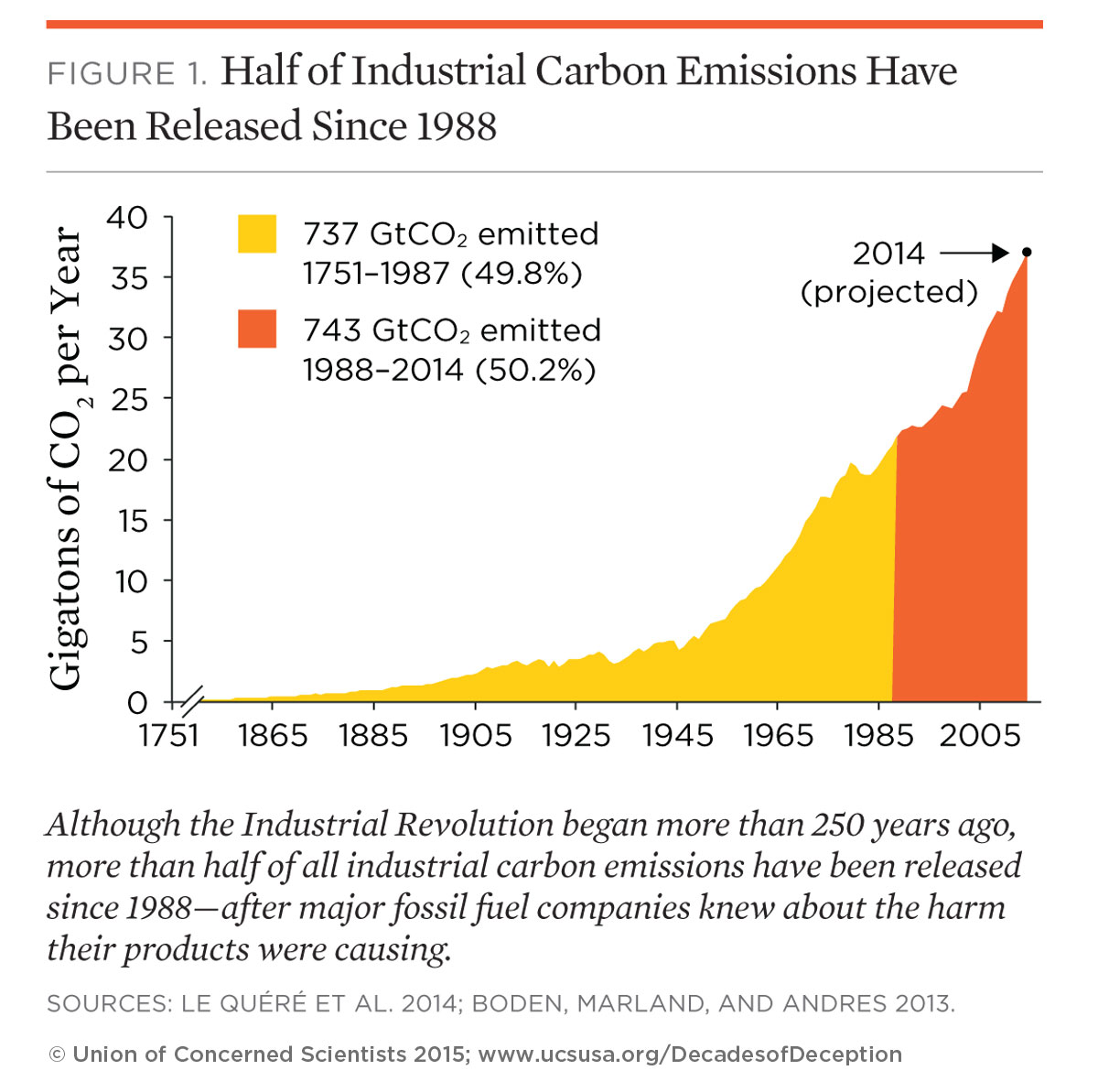
Imagine an alternate world where fossil fuel companies had faced the facts of climate change head on and invested heavily in transforming themselves to provide low carbon sources of energy, leaving most of the fossil fuels consumed over the last two decades in the ground. We would live in a world with a far safer climate and Californians would face fewer threats from wildfires, drought, heat waves, and coastal flooding.
4) Deceiving the public is morally wrong.
Most of us expect businesses to look out for their bottom lines ahead of the public good. But there are limits to acceptable corporate behavior, and there is a difference between being amoral and immoral.
By constructing a decades-long campaign to misinform the public about the scientific realities of climate change, the fossil fuel industry crossed a moral Rubicon. By lying to the public, the industry has distorted the truth, denying the public a complete picture of the risks associated with using their products.
Many others have recognized the fundamental impropriety of this behavior as well. Most recently, the Rockefeller Family Fund announced its intent to divest from fossil fuels, citing ExxonMobil’s “morally reprehensible conduct” to confuse the public about climate change. This action is all the more notable given that John D Rockefeller Sr. was a co-founder of Standard Oil, a precursor to ExxonMobil. And a ruling last week by federal regulators cleared the way for ExxonMobil shareholders to grapple for the first time with the moral and justice implications of climate change as it relates to the company’s business.
There should be consequences any time a company lies to the public, but particularly for deceiving the public systematically for decades about an issue as serious and consequential as global warming. This legislation is an important way to hold them accountable.
5) A movement is building. California can stay at the forefront.
If you have been following this issue in the news, then you know that a movement is building to more fully uncover the truth about the fossil fuel industry’s decades-long effort to deny and deceive the public about climate change—and to hold these companies accountable for their actions.
Following the release of Inside Climate News’ eight-month investigation of Exxon and new reporting from the Los Angeles Times, New York Attorney General Eric Schneiderman announced in November that his office was beginning an investigation of ExxonMobil to determine whether the company lied to the public and shareholders. This was quickly followed in January with reports that California Attorney General Kamala Harris was beginning to investigate ExxonMobil as well.
While attention to ExxonMobil’s history of misdeeds is welcome, it is important to remember that they were not alone in fomenting disinformation about climate change—and that the campaign of deception continues today. In light of the evidence that has emerged so far, California congressman Ted Lieu has requested the U.S. Attorney General to launch investigations of both Shell and ExxonMobil.
Whether these companies have actually broken the law is something for the courts to decide—SB 1161 is not making that judgment. What SB 1161 is doing is giving law enforcement the opportunity to ensure that justice is served for the full weight of any violations that may have been committed.
Wherever these investigations lead, it is important that the California legislature—and by extension, the people of California—signal their intent to hold the fossil fuel industry accountable for its many decades of spreading disinformation.
Learn more:
- Background Information on Fossil Fuel Industry Climate Science Deception (PDF)
- Background Information on Climate Change and Costly Damages in California (PDF)
Update (April 1, 4:15pm): A previous version of this post incorrectly stated that the bill would “give explicit authority to public prosecutors” to bring actions against those who have deceived with regards to climate change. The post has been updated to reflect the fact that the bill only extends the time period for bringing such actions based on existing law. The post also used the word “crimes,” but this is not a criminal statute. Instead, it is related to violations of California’s Unfair Competition Law, which is a civil statute.
Posted in: Global Warming Tags: California, Climate Science Truth and Accountability Act
==
===
EJ report coalition cbe , covid
https://fuelingthefire.org/wp-content/uploads/2020/10/PWF_fossilfuelreport_WEB.pdf
===
---
https://www.alternet.org/2020/09/the-end-of-oil-adds-to-fossil-fuel-glut-but-19-relief-money-flows-to-oil-industry/
as the coronavirus pandemic contributes to a glut of fossil fuels, groups like Greenpeace are calling on Democratic presidential candidate Joe Biden to ban fossil fuel interests from his campaign and administration, if he wins, even as he recently declared at a campaign stop that he “will not ban fracking.” We discuss the politics of fossil fuels with reporter Antonia Juhasz, who says the end of oil could be near, and look at how the industry has profited from the COVID bailout. “The pandemic has taken essentially every weakness that already existed in the oil industry and then made each of them much, much worse, leaving the oil industry in a situation where I would argue it is at its weakest since its inception,” she says.
GOODMAN: Longtime Massachusetts senator and Green New Deal champion Ed Markey won his primary against challenger Congressmember Joe Kennedy III Tuesday, marking a victory for progressives and the first time a Kennedy has lost an election in the state of Massachusetts. Senator Markey secured 54% of the vote in a primary race seen by many as a showdown between the Democratic establishment and its new and growing progressive wing. House Speaker Nancy Pelosi endorsed Kennedy, while Markey had the support of New York Congressmember Alexandria Ocasio-Cortez and the youth-led Sunrise Movement. The Sunrise Movement tweeted in response to the victory, quote, “After winning elections across the country, you think we’re gonna stop now? They wish. We will protest outside the halls of Congress while our allies on the inside negotiate the Green New Deal,” they said.
This comes as Democratic presidential candidate Joe Biden said he would not ban fracking during a speech in Pittsburgh. A group of 145 organizations, including Sunrise Movement and Greenpeace, have released a letter calling on Biden to ban fossil fuel interests from his campaign and administration, if he wins. The letter reads, quote, “To advance environmental justice, you must stand up to fossil fuel CEOs, stop the expansion of oil, gas and coal production, and rapidly transition us away from fossil fuels,” unquote.
This comes as the global oil industry is in crisis with falling demand and crashing prices exacerbated by the coronavirus pandemic. Despite this, fossil fuel companies continue to pump out an excess of oil, much of it stored on tankers in the ocean. In May, as 390 million barrels of oil and gas sat in storage on the world’s oceans, Greenpeace activists sailed out along the San Francisco Bay, unfurling a banner saying “Oil Is Over! The Future Is Up to You.”
GREENPEACE ACTIVIST: I’m here in San Francisco Bay, where floating oil storage tankers are now idling, storing oil that no one wants and where we have nowhere to put.
AMY GOODMAN: Despite this, Congress has poured billions of dollars of COVID relief funds into bailing out the fossil fuel industry.
We go now to Boulder, Colorado, where we’re joined by Antonia Juhasz, an oil and energy reporter, a Bertha fellow in investigative journalism. And her recent cover story for Sierra magazine is “The End of Oil Is Near,” along with another report, “Bailout: Billions of Dollars of Federal COVID-19 Relief Money Flow to the Oil Industry.” She’s the author of several books, most recently, Black Tide: The Devastating Impact of the Gulf Oil Spill.
Antonia, welcome back to Democracy Now! Let’s start with the pandemic and this glut of oil. I don’t know if people realize that — some call them armadas of oil tankers, are docked off coasts, everywhere from the United States to Africa to Asia. Explain what the pandemic — how it relates to the oil industry.
ANTONIA JUHASZ: Well, I think the most important place to start — and thanks for having me on this morning — is that the problems that have been plaguing the oil industry, that have led to the glut in oil that we’re experiencing right now, well precede the COVID-19 pandemic, that the pandemic has taken essentially every weakness that already existed in the oil industry and then made each of them much, much worse, leaving the oil industry in a situation where it is right now, where I would argue it is at its weakest since its inception, and, essentially, public policy and public will will now determine the fate of the oil industry, period.
And how we got to this place, where the height of this problem was in June with just oil tankers stacked up — anyone who lived on a coast would have seen pretty much these armadas of oil tankers that were holding oil. How we got to that place was, essentially, years of the oil industry obsessively overproducing a product of shrinking value and shrinking demand. So, starting in 2015, the growth in demand for oil worldwide started to fall, and it fell precipitously from 2017 to 2019. The price of oil was falling, but the companies and the countries just kept producing more and more and more and more, with the United States one of the leading countries.
At the same time, you’ve got movements that are successfully weakening demand, desperately trying to get off this product, increasing the value and accessibility of alternatives, reducing the political payoff for supporting the oil industry, and the economic payoffs just dwindling, the companies falling in profits, falling in share value, investors not wanting to put money backing these companies’ plays, and a worse and worse and worse and worse financial situation for the companies and the countries producing it. But they kept producing, so you have this glut of buildup.
Then comes COVID-19. COVID-19 happens. We’re all in lockdown. Demand for oil products just craters into the ground. And at the same time, the companies and the countries keep producing more oil, which led to an even greater glut, which led to the oil being stored offshore in tankers.
AMY GOODMAN: And yet you have COVID-19 money, with how many tens of millions of people out of work, people desperate for support, small businesses. So much of that COVID money is going to bail out the largest corporations, oil corporations.
ANTONIA JUHASZ: Yeah. So, you had — first you had the Trump administration say, and Trump himself say, “We’re going to design a ballot specifically for the oil and gas industry.” And there was tremendous pushback against that in the public, and Democrats in Congress said, “No, that’s not going to happen.” So, instead, what we ended up getting is three, essentially, stealth mechanisms that have really heavily tried to prop up this industry, that, left without that support, we would see a much greater shrinkage than we’re seeing right now, although we’re already seeing a good deal of shrinkage.
But so, these three mechanisms were, first, in the CARES Act, the Paycheck Protection Program, documented — a research organization did research for me for my Sierra magazine articles, that found 7,000 oil and gas companies receiving as much as $7 billion in Paycheck Protection Program money. Because the oil and gas industry is dominated by white men, globally and nationally — those are the people that own the companies, and in the U.S. a good deal of the workforce is white men — that also contributed to the overall bias of the PPP program towards white male-owned businesses, so they got Paycheck Protection Program money, which has propped up a lot of companies that wouldn’t — certainly wouldn’t have made it on their own.
Then you had tax loopholes snuck into the CARES Act, which Democrats are trying to close in this next version of the CARES Act, that allowed over $3 billion to go to at least 50 publicly traded oil and gas companies, and probably many, many more, because we only know about the publicly traded ones because they have to report it in their reports to the Security Exchange Commission, and private companies don’t have to do that.
But I would say the most problematic pot is this unprecedented move to have the Federal Reserve, for the first time — so, excuse me, the American taxpayer, through the Federal Reserve, for the first time, now become owners in oil company debt. So, the Federal Reserve set up, through BlackRock, several different mechanisms to try to prop up the economy. And through two measures, the oil industry has received inordinate support. And the research group InfluenceMap looked at one of these mechanisms and found that the Federal Reserve’s funding is overweighted in fossil fuels. So, through BlackRock, you and I, the American taxpayer, are now owners in debt, through the Fed, of Exxon, of Chevron, of Energy Transfer Partners, of Phillips 66, of Schlumberger,which is a company that just moved itself out of U.S. fracking altogether, after we bought up their debt.
So we are literally, through the Federal Reserve, propping up the oil industry at a time when, you know, for a huge host of reasons — climate crisis, environmental justice, the lives of people who live next to oil and gas facilities — that we need to allow this industry to do what it would be doing on its own anyway, which is going away, because the world is trying — and succeeding — in moving away from this resource....
==
sorta context for fusion ctr war games below:
7/20 triggered by secret police violence and surveillance in the name of protecting buildings from grafitti
but see pvt prop rights used by anti-greens for years, w/ legal fdns
in bill of rights, my property cannot be taken or searched
right calls burning trash in street or breaking a window violence.
corp person says a corp = person/human; "violence" equates stuff w/ ppl [slavery ppl = property]
material goods are how i demonstrate i am a winner (smart and hard work/virtue god's favor) vs those poor POC lazy sinful losers, so OK to use FORCE to protect (gets?!) stuff, and call destruction of stuff violence
now secret spy and police justified by protecting fed property (or even a rebel statue not owned by feds):
==
kyle in kenosha goes to defend PROPERTY
==
https://theintercept.com/2020/08/24/fbi-fusion-center-environmental-wind/
fEDERAL AND STATE law enforcement officers gathered in the Midwest in February 2019 to practice their responses to a fictional threat: wind farm sabotage. They divided into four teams and pretended to be the bad guys, environmental saboteurs targeting the large grids of turbines that turn the wind into electric power. The Federal Bureau of Investigation’s Omaha, Nebraska, field office and the Iowa Division of Intelligence and Fusion Center had organized the “red hat” exercise, meant to provide insight into the minds of environmental activist adversaries that didn’t exist.
:{*:{}:
*}:
Each team developed an attack plan. One proposed ramming wind turbine infrastructure with a vehicle. Another sought to plant explosives on electrical transformers. And — although U.S. environmental saboteurs tend to not use guns — two of the teams suggested using firearms to attack electrical substations from a distance. The fact that cops themselves planned the attacks may have created a “bias toward the use of firearms,” the FBI later acknowledged in a pair of reports on the exercise obtained by The Intercept. However, the federal agents also concluded that “Environmental Extremists Likely Would Use Firearms To Circumvent Perceived Electrical Infrastructure Site Security Measures.”
The exercise was not conducted due to any imminent threat — a carefully noted fact included in the December 2019 and March 2020 reports. “Neither FBI Omaha nor the Iowa DOI/FC has intelligence suggesting environmental extremists intend to attack wind farms in Iowa,” both reports repeatedly state.
Why, then, spend public dollars on FBI role-playing?Because the energy industry wanted it. The exercise came “at the request of an USBUS private energy sector partner, following 14 environmental extremist attacks against transportation infrastructure in Iowa that services the energy sector, particularly oil pipelines,” said one of the documents about the exercise. Privately owned and operated companies and industry groups — none of which were named in the reports — were intimately involved in the exercise: An Iowa utility company and a wind energy lobbyist group provided information to help judge the fake attack plans and assess the fake “threat environment,” and an industry representative joined two of the teams, posing as an insider accomplice.
Though there was no indication an attack on wind power sites would occur, the report went on to say, if one hypothetically did, it could proliferate into many, with each set of attackers becoming more skilled in evading security and capture. “As attack methods become more sophisticated,” the report warned, “the chance for large-scale failure of the electrical grid becomes more likely.” Law enforcement ought to be on the lookout for activists undergoing gun training, activists in rural locations with large infrastructure, and activists casing wind power sites, the report advised. Neither the FBI, the Iowa Division of Intelligence and Fusion Center, nor the federal Department of Homeland Security, which helps coordinate regional fusion centers, responded to the Intercept’s questions about the documents...
German sees the fusion centers as captured by corporate PR campaigns seeking to portray themselves as victims of extremist violence. “Many of these are multinational corporations —they’re not even necessarily U.S. corporations — yet law enforcement seems to favor protecting them over their own communities,” German pointed out. “How many fusion center reports have we seen that document environmental damage done by criminal actions or negligent actions of corporations? Those are also criminal — those are within the jurisdiction of these law enforcement agencies — and arguably cost a whole lot more in economic damage to these communities than somebody turning a valve on a pipeline. Yet that’s not where we see law enforcement resources being spent.”
Law Enforcement Goes Don Quixote...
Over 5,600 fossil fuel companies have taken at least $3bn in US Covid-19 aid
guk 720
===
The Smithsonian has asked its inspector general to review Soon's ethical conduct. In addition, three U.S. senators -- Edward Markey (D-Mass.), Barbara Boxer (D-Calif.) and Sheldon Whitehouse (D-R.I.) -- sent 100 letters to fossil fuel companies including Southern, trade groups and other industry organizations seeking to unearth the extent of what they call "climate denial-for-hire programs."
"We've known for many years that the tobacco industry supported phony science claiming that smoking does not cause cancer," said Boxer, ranking member of the Environment and Public Works Committee. "Now it's time for the fossil fuel industry to come clean about funding climate change deniers."
===
ref ltr
WASHINGTON (February 25, 2015) – Senators Edward J. Markey (D-Mass.), Barbara Boxer (D-Calif.) and Sheldon Whitehouse (D-R.I.) today sent letters to 100 fossil fuel companies, trade groups, and other organizations to determine whether they are funding scientific studies designed to confuse the public and avoid taking action to cut carbon pollution, and whether the funded scientists fail to disclose the sources of their funding in scientific publications or in testimony to legislators.
This investigation follows the revelations regarding one of the chief climate denial researchers, Wei-Hock “Willie” Soon, from documents released by Greenpeace showing that Soon received more than $1 million from ExxonMobil, Southern Company, and others to produce what he termed “deliverables” to push back on climate science or carbon-cutting policies in papers or Congressional testimony. Soon did not disclose this funding to peer-reviewed scientific journals that require such disclosure.
...The news about Willie Soon is further confirmation that the fossil fuel industry has taken a page out of the tobacco playbook by bankrolling scientists to cast false doubt on the existence of climate change,” said Senator Whitehouse, Ranking Member of the Fisheries, Wildlife and Water Subcommittee on the Environment and Public Works Committee. “The American people deserve to know more about this self-serving effort to distort the facts and prevent action on this issue, and I hope these letters will help.”
Full list of recipients:
ACCCE (American Coalition for Clean Coal Electricity)
Alliance Resource Operating Partners LP
Alliance to Save Energy
Alpha Natural Resources LLC
Ameren
American Coal Foundation
American Electric
American Energy Alliance
American Enterprise Institute
American Fuel & Petrochemical Manufacturers
American Gas Association
American Legislative Exchange Council
Americans for Prosperity Foundation
America’s Natural Gas Alliance: ANGA
Anadarko Petroleum Corporation
Apache Corporation
API (American Petroleum Institute)
Arch Coal Inc.
Armstrong Energy Inc.
Atlas Network (previously Atlas Economic Research Foundation)
Boich Group LLC
Bowie Resource Holdings LLC
BP
Cato Institute
Chamber of Commerce of the USA
Charles G. Koch Charitable Foundation
Chesapeake Energy Corporation
Chevron Corporation
Cloud Peak Energy
CNOOC (Nexen Petroleum U.S.A. Inc.)
Competitive Enterprise Institute
ConocoPhillips
CONSOL Energy Inc.
Consolidated Edison
Continental Resources Inc.
Denbury Resources, Inc.
Devon Energy Corporation
Dominion Resources
Donors Capital
Donors Trust
DTE Energy
Duke Energy
Ecopetrol America Inc
Edison Electric Institute
Edison International
Energy Future Holdings Corp
Eni U.S. Operating Co.
Entergy
EOG Resources, Inc.
Eversource
Exelon
Exxon Mobil Corporation
FirstEnergy
George C Marshall Institute
Hallador Energy Co
Hess Corporation
Hoover Institution
Hudson Institute
Independent Petroleum Association of America
Institute for Energy Research (IER)
John Locke Foundation
John Williams Pope Foundation
Koch Industries
Linn Energy, LLC
Lynde and Harry Bradley Foundation
Manhattan Institute for Policy Research
Marathon Oil Corporation
Murphy Oil Corporation
Murray Energy Corp
NACCO Industries Inc.
National Association of Manufacturers
National Mining Association
National Ocean Industries Association (NOIA)
National Rural Electric Cooperative Association
NextEra Energy
Noble Energy Inc.
NRG Energy
Occidental Petroleum Corporation
PacifiCorp
Patriot Coal Corp
Peabody Energy Corp
Peter Kiewit Sons Inc.
Petrobras America Inc.
PG&E
Pioneer Natural Resources Company
PPL
PSEG Public Service Enterprise
Rio Tinto Group
Searle Freedom Trust
Shell
Southern Company
Statoil
The Heartland Institute
The Heritage Foundation
Valero Energy
Walter Energy Inc.
Western Fuels Association Inc.
Westmoreland Coal Co
Wisconsin Energy
Xcel Energy
==
===
https://www.desmog.co.uk/2020/07/06/big-oil-forest-fever
Elon Musk, Greta Thunberg, Rishi Sunak, Donald Trump — trees suddenly have an eclectic mix of fans, all drawn to the apparent simplicity of their carbon-locking power. Now Big Oil has joined the party, in a big way.
Over the past year, BP, Total, Eni, Equinor and ConocoPhillipshave invested millions of dollars in forest projects to offset their greenhouse gas emissions. Shell, in particular, has taken a lead, promising to spend $300 million on “natural ecosystems” as part of its market-leading net-zero emissions plan.
The recent surge in corporate pledges gives the impression that nature-based solutions (NBS) provide the key to a decarbonised future. But given oil companies’ status as some of the world’s largest emitters, and the industry’s long history of lobbying against climate action, Big Oil’s push for more trees has been met with scepticism.
There is little doubt that planting trees — often cited as a cheaper and more readily available complement to carbon capture technology — must form part of the solution to climate change. But are trees really the answer to Big Oil’s climate conundrum? Or are schemes that rely on preserving and planting millions, billions or trillions of trees (depending on who you ask) just an excuse to continue drilling for more fossil fuels?
A close inspection suggests that as the projects and regulations currently stand, the trees that Big Oil plans to plant simply can’t live up to the hype. Planting trees may be part of the solution, but not at the expense of widespread systemic change in the energy sector.
This investigation reveals:
- The details of Big Oil’s tree planting plans, and the NGO partners they are cooperating with;
- How Shell has been gaming the voluntary carbon credit market, claiming credits that may be double counted, or that may not qualify to be counted towards their climate goals;
- How renewed interest in nature-based projects has reignited debates around the effectiveness of forestry projects to reduce global emissions;
- And how national agencies, including the Dutch Forestry Commission (Staatsbosbeheer) and Forestry and Land Scotland (FLS) continue to partner with Shell, despite concerns they are helping the company greenwash its image.
Investing in nature
Nature-based solutions (NBS) can be anything that involves the use of the natural world — such as forests, grasslands and wetlands — to remove harmful emissions from the atmosphere. The creation and preservation of these lands is enabled by big polluters purchasing credits to offset their emissions.
Corporations’ forest offset fever was in part sparked by the 2015 Paris Agreement, the global climate treaty that committed nations to curbing warming to at most 2°C above pre-industrial levels. The agreement made clear that natural carbon sinks would be vital for countries to hit the goal.
Alongside the Paris Agreement, a joint study co-authored by NGO The Nature Conservancy (TNC) in 2017 was particularly influential in shaping the NBS narrative. It claimed natural solutions could mitigate 37 percent of emissions (or 11 billion tonnes of carbon dioxide) by 2030 to reduce warming to well below 2°C. The report is frequently cited by corporate-friendly global organisations, from the World Economic Forum (WEF) to the World Business Council for Sustainable Development (WBCSD).
But the TNC study came under fire from critics of projects that fall under the umbrella of ‘Redd+’ (reducing emissions from deforestation and forest degradation, plus conservation). They claimed that it ignored the major social and environmental implications of such extensive land use, and is fundamentally infeasible.
Such concerns did little to stem the rising popularity of nature offsets, however, which is most evident in the recent upswing of the voluntary credits market.
Between 2016-2018, sales of Forestry and Land Use (FALU) and Redd+ offsets soared by 264 percent — compared to a 21 percent increase in all other categories. Airlines and oil companies have helped fuel this trend, according to the report by EcoSystem Marketplace (ESM), which singles out the “emergence of major voluntary buyers, such as Shell”.
Significantly, in the past year, Shell, BP and Total updated their climate plans to include ‘Scope 3’ emissions — a major shift.
Historically, polluters have only reported output from their own operations (Scope 1) and from the electricity purchased and used by the company (Scope 2). But these two categories account for just five to 10 percent of emissions. Scope 3, however, includes all harmful gases from fossil fuel products sold to customers.
Without a rapid transition away from fossil fuels, these energy companies will have to rely heavily on carbon offsets to fulfil these expanded targets. That’s where forests come in.
Big Oil investments
Many of the NGOs that partner with Big Oil to deliver the companies’ much-needed forest projects say the corporate partnerships are vital to provide the necessary investment for nature-based emissions programmes. The projects cost money and Big Oil has it, the argument goes.
But these investments should be treated with extreme caution, and only be accepted once all other avenues have been explored, campaigners argue.
TNC, which works with Shell and a number of other corporations on climate strategies, told DeSmog, “many of these nature-based solutions are available for support and investment now, but there is not enough public investment.”.
“Big businesses have an opportunity to scale these environmental benefits on a global scale,”, a spokesperson said, though they acknowledges this must be “with dual investment in natural climate solutions and through ambitious and immediate changes in energy systems, transportation and other activities.”
[graf]
Big Oil has certainly suddenly become committed to the NBS cause.
A long-term Redd+ investor, Shell appears to be going further in how it presents its natural climate solutions to the public than any other company. Shell’s newly updated 1.5°C climate strategy – to be fully mapped out later this year – will rely heavily on NBS, following last year’s $300 million investment in natural ecosystems.
Meanwhile, rival BP has donated $5m to US carbon company Finite Carbon to generate its own voluntary carbon market for businesses. BP, which has also previously invested in Redd+ projects, is also set to unveil its net-zero plans in late-2020.
Of all the oil majors, Italian giant Eni appears the most committed to the traditional Redd+ model, with investments planned in Zambia, Mozambique, Ghana, Angola, the Democratic Republic of Congo (DRC), Vietnam and Mexico. To help reduce the energy intensity of its products by 80 percent by 2050, Eni plans to store 20 million tonnes per year of carbon dioxide equivalent in forests and wetlands by 2030.
France’s Total has also launched a new fund to invest $100 million a year in NBS, but has estimated these will provide only five million tonnes per year in greenhouse gas reductions by 2030 – just 12 percent of its current Scope 1 emissions.
Taking a different approach, state-owned Equinor in Norway has indicated it is “readying” itself to buy the equivalent of one million tonnes of carbon dioxide per year from Emergent, a “catalyst” that claims it is “priming the market pump that will drive capital toward forest protection on a global scale”.
Norway has long invested in Redd+ projects to offset carbon from its North Sea oil cash cow. But Equinor’s move signals that companies increasingly have an interest in controlling how future offsets are processed.
In contrast, Spanish major Repsol is focusing on investing in carbon capture and storage technology (CCS) — an expensive technology that has been around for decades but is yet to be proven at-scale, and which campaigners regularly reference as a false solution to climate change — to meet its ambitious 2050 net zero target. Repsol has indicated it would additionally offset emissions through reforestation and other natural climate sinks “if necessary”.
European majors’ pledges are far more significant than their US and international counterparts, where NBS barely register in investor reports.
Spokespeople for ExxonMobil and Chevron told DeSmog they had no current plans to invest in NBS, with both companies heavily funding CCS to attempt to align with the Paris Agreement’s goals. Meanwhile, Saudi Aramco, the biggest fossil fuel polluter in the world, announced the planting of one million trees at home, but has not clarified whether these will go towards creating offsets.
Tracey Cameron from sustainability NGO Ceres, which works with the world’s biggest polluters to cut emissions through the Climate Action 100+ initiative, says a nuanced approach is important when it comes to using nature for offsetting.
“NBS should definitely be part of the solution. It should be thoughtful, but also judicious in where it’s used,” she told DeSmog.
However, “it should be used in those areas where there are no alternatives, or where the final mile can’t be hit. It’s part of the strategy but not the strategy. That has to be that the fundamental business has to change,” she argues.
Right now, there’s little evidence that fundamental business model is shifting. Big Oil’s NBS investments are tiny when compared to their fossil fuel business.
Before the coronavirus pandemic, Shell alone planned more than 35 new oil and gas projects by 2025. And the company invested just £2 billion in renewables last year, compared to £30 billion in oil and gas.
So far Total and Eni are the only companies to have declared their nature-based targets in full. Together these equate to just 25 million tonnes of carbon dioxide equivalent by 2030, only 60 percent of their respective Scope 1 emissions, and less than half of Shell’s.
New pastures
Shell more than any other has leapt at the possibility of forestry offsets helping it meet its ambitious climate targets. While continuing to buy credits from tropical forests in Peru and Indonesia, Shell is the first energy company to explore creating carbon credits within Europe.
Its $300 million investment in “natural ecosystems” includes two forestry projects in Spain and the Netherlands. The projects highlight a key problem with the current system — it is still unclear who gets credit for the emissions offsets created by forestry projects (or even who can legally claim them).
In 2019, Shell paid the Dutch Forestry Commission (Staatsbosbeheer) €17.4 million to plant five million trees over the next 12 years, in areas where an aggressive fungal disease had destroyed the ash tree population. Shell’s press release clearly stated that both projects are “expected to generate carbon credits within five years”.
This appears to be speculation, however, as a Dutch Forestry Commission spokesman acknowledged that the plan was “a work in progress and credits are not yet possible”. That’s because the EU’s Land Use, Land Use Change and Forestry (LULUCF) regulation means all emissions savings from forestry and land use (FALU) projects in the EU are channelled into meeting national climate targets (NDCs), and cannot be counted towards corporate goals.
The EU regulation has been implemented since the Kyoto Protocol (first adopted in 1997), but will be enshrined into national targets under the Paris Agreement from next year until 2030 — making Shell’s initial promise to generate credits by 2024 implausible.
...[grafs]
==
==
https://www.alternet.org/2020/05/pathological-trump-slaps-wind-and-solar-industry-with-50-million-in-old-rent-bills-while-pushing-big-oil-bailouts/
==
==
https://www.alternet.org/2020/05/stealth-bailout-big-oil-taking-1-9-billion-in-cares-act-tax-breaks-aimed-at-helping-small-businesses/
5/17 common dr
bno lnx twt
en. Bernie Sanders was among critics outraged that the fossil fuel industry is using tax breaks in the CARES Act meant to help businesses keep workers employed to avoid paying millions of dollars in taxes—and then delivering that money to executives.
“Good thing President Trump is looking out for the real victims of the coronavirus: fossil fuel executives,” Sanders tweeted sarcastically Friday.
Bernie Sanders
?
@SenSanders
Coronavirus has killed more than 85,000 people. Some 36 million workers have lost their jobs. Good thing President Trump is looking out for the real victims of the coronavirus: fossil fuel executives. https://www.bloomberg.com/news/articles/2020-05-15/-stealth-bailout-shovels-millions-of-dollars-to-oil-companies …
‘Stealth Bailout’ Shovels Millions of Dollars to Oil Companies
As it headed toward bankruptcy, Diamond Offshore Drilling Inc. took advantage of a little-noticed provision in the stimulus bill Congress passed in March to get a $9.7 million tax refund. Then, it...
bloomberg.com
6,049
10:52 AM - May 15, 2020
Twitter Ads info and privacy
2,232 people are talking about this
Reporting Friday from Bloomberg News showed that “$1.9 billion in CARES Act tax benefits are being claimed by at least 37 oil companies, service firms, and contractors”—what watchdog group Documented senior researcher Jesse Coleman described as a “stealth bailout” of the climate-killing industry.
AD REMOVED FOR SUBSCRIBED USER
“In the name of ‘small business,’ we’re shoveling out billions of dollars to big corporations and rich guys,” Steve Rosenthal, a senior fellow with the Urban-Brookings Tax Policy Center, told Bloomberg.
Bloomberg used the example of how Diamond Offshore Drilling Inc. manipulated the bailout to explain the tax scheme:
As it headed toward bankruptcy, Diamond Offshore Drilling Inc. took advantage of a little-noticed provision in the stimulus bill Congress passed in March to get a $9.7 million tax refund. Then, it asked a bankruptcy judge to authorize the same amount as bonuses to nine executives.
According to Bloomberg’s reporting, Diamond’s refund pales in comparison to some of its larger competitors, “including $55 million for Denver-based Antero Midstream Corp., $41.2 million for supplier Oil States International Inc. and $96 million for Oklahoma-based producer Devon Energy Corp.”
Kevin Crowley
@CrowleyKev
OIL CAPITALISM -- Diamond Offshore takes $9.7m from American taxpayers, then earmarks the same amount to execs as bankruptcy bonuses. @jendlouhyhc
- Marathon gets $411m
- Oxy $195m
- Valero $110m
- Devon $96mhttps://www.bloomberg.com/news/articles/2020-05-15/-stealth-bailout-shovels-millions-of-dollars-to-oil-companies …
‘Stealth Bailout’ Shovels Millions of Dollars to Oil Companies
As it headed toward bankruptcy, Diamond Offshore Drilling Inc. took advantage of a little-noticed provision in the stimulus bill Congress passed in March to get a $9.7 million tax refund. Then, it...
bloomberg.com
132
6:54 AM - May 15, 2020
Twitter Ads info and privacy
137 people are talking about this
The fossil fuel industry was already in financial trouble before the outbreak, which has effectively crippled Big Oil’s ability to make money—even with the generous subsidies given by the federal government. Access to bailout tax break funding is helping fossil fuel companies prosper, along with other climate-destroying industries like mining companies, which have also reaped millions from coronavirus relief legislation.
“The Trump administration’s favor factory hasn’t stopped with a global pandemic,” Accountable.US spokesperson Jayson O’Neill said in a statement Friday. “As millions of jobs disappear week after week, the Trump administration is prioritizing aid for wealthy, well-connected corporations before small businesses.”
===
==
oil policy frack bust mbs
https://www.alternet.org/2020/04/why-the-oil-and-gas-industry-will-never-be-the-same/
===
==
https://www.ecowatch.com/big-oil-bailout-2645732416.html
Jessica Corbett
As calls for a People's Bailout in response to the coronavirus pandemic continue to grow across the United States, a new analysis warns that the country's Big Oil companies "stand to reap yet another billion dollar bailout" thanks to the Federal Reserve's plans to buy up to $750 billion in corporate debt.
The analysis (pdf), released Wednesday by the advocacy groupFriends of the Earth (FOE), explains that this expected bailout for polluters relates to a controversial $500 billion corporate slush fund included in the Coronavirus Aid, Relief, and Economic Security (CARES) Act that Congress passed in March....
===
===
https://www.npr.org/2020/03/14/815039722/trump-steps-in-to-help-oil-industry-facing-its-own-coronavirus-crisis
he tired to play it like shrew bottom feed strat but actually bailout to frakkers?
npr 3/14?
...Oil prices bounced back a bit after President Trump said the Department of Energy would buy crude for the nation's strategic petroleum reserve.
"We're going to fill it right to the top," Trump said Friday in a wide-ranging news conference at the White House. He said it will save taxpayers "billions and billions of dollars" while helping an industry that's been reeling.
While oil prices increased nearly 5% after Friday's announcement, that was just a fraction of the amount they lost earlier in the week.
In South Texas, Rudy Martinez immediately experienced the effects of the past week's collapse in crude oil prices.
"I actually have a little man camp and these guys are on the way out because they lost contracts," says Martinez, who has eight rooms he rents to out-of-town oilfield workers in Karnes City, Texas.
"The workers get their per-diem and I charge them $100 a person [per week]. Actually I'd like to charge them a little more than that, but now that it's tapered off, it's hard to charge them that because they can't pay it," he says.
The Coronavirus Crisis
Back when the oil business was really booming in Karnes City, Martinez says he could charge up to $2000 a week per person.
This is one small example of what declining oil prices mean for the rural communities that depend on the oil business. And there's a lot at stake for the U.S., the world's largest producer of crude oil.
Oil prices had been falling out of fears the coronavirus epidemic threatened world economic growth. Demand was also down as large gatherings were canceled and people started staying home to avoid getting sick.
Then prices plunged after Saudi Arabia and Russia failed to agree on production cuts and instead entered a price war last Sunday. In a stunning reversal, Saudi Arabia said it would actually boost oil production and offer a massive discount for its customers.
U.S. oil companies, especially smaller ones, are now looking to make deep cuts. Industry analysts warn of possible bankruptcies, especially if oil remains where it's fallen to, in the $30 per barrel range. Companies operating in Texas's Eagle Ford Shale need prices between $40 to $60 a barrel to remain profitable....
==
==
220 mojo
Oil and Gas Firms “Have Had Far Worse Climate Impact Than Thought”
===
==
guts NEPA xl
1/9/20 NEPA rollback
omfg
Trump is proposing changing the nation’s oldest environmental law to exempt large infrastructure projects, such as pipelines and power plants, from environmental review. If enacted, the changes would exempt agencies from considering the cumulative environmental impacts of projects, which could include studying the climate crisis.
==
==
icn 1219
What’s Behind Big Oil’s Promises of Emissions Cuts? Lots of Wiggle Room.
===
https://www.alternet.org/2019/12/new-analysis-of-trump-and-republican-tax-breaks-shows-tons-of-massive-corporations-pay-nothing-in-taxes/
no lnx
New analysis of Trump and Republican tax breaks shows tons of massive corporations pay nothing in taxes
Written by Walter Einenkel / Daily Kos December 26, 2019
The Institute on Taxation and Economic Policy (ITEP.ORG) has done an analysis of 379 corporations and their tax burdens since the Republican Party and Donald Trump gave them the enormous tax cuts that most Americans were dead-set against.
“Corporate Tax Avoidance In The First Year of The Trump Tax Law” is available here for viewing or downloading.The findings are what we have come to expect: Big companies got big returns from the tax cuts, and on top of that, most corporations still couldn’t resist exploiting loopholes allowing them to pay even less than the meager amount set out by the Republican Party.
The 379 profitable corporations identified in this study paid an effective federal income tax rate of 11.3 percent on their 2018 income, slightly more than half the statutory 21 percent tax
91 corporations did not pay federal income taxes on their 2018 U.S. income. These corporations include Amazon, Chevron, Halliburton and IBM. An ITEP study released in April 2019 examined 2018 Fortune 500 filings released to date and found 60 companies paid zero in federal income taxes. Now, all companies have released their 2018 financial filings, and this report reflects that.
Another 56 companies paid effective tax rates between 0 percent and 5 percent on their 2018 income. Their average effective tax rate was 2 percent.
They are supposed to pay out 21 percent, but by hiding money offshore and by tucking it into CEO “stock options” allowing them to claim lower total profits, most too-big-to-fail businesses continue to pay half of what is already not a fair share of anything. The review found that even the 57 companies that paid slightly higher rates than the statutory 21 percent were frequently paying out previously deferred tax debt. That already owed the government and were catching up on that money while not actually paying what, by law, they should be paying now.
Of the 91 corporations not paying anything in federal income taxes, here are the top 10 most profitable:
Amazon.com
Delta Air Lines
Starbucks
Chevron
General Motors
EOG Resources
Occidental Petroleum
Duke Energy
Dominion Resources
Honeywell International
In all 10 of those examples, their effective tax rates are negative. Poor, poor corporations. No wonder they keep cutting jobs while recording record profits and C-suite executive salaries. How’d you like that deal?
In total, the 379 corporations enjoyed $73.9 billion dollars in corporate welfare. Of course, like all acute inequalities, only a handful of the biggest companies received the lions share of that sweet public money. ITEP says that 25 of the largest corporations made up half—$37.1 billion—of those pocketed tax dollars.
Going through the years in “effective tax rates,” from President Ronald Reagan until now, ITEP says that “the 11.3 percent effective tax rate found in this study is likely the lowest effective tax rate in the last 40 years, well below the 14.1 percent effective tax rate that shocked President Reagan into supporting loophole closing reforms.” Keep in mind, even Reagan Republicans needed to do something about how egregious their low effective tax rate was in 1986, for optics’ sake. The current crew couldn’t care less, because they are all in on undemocratic rule of law.
===
==
https://www.opensecrets.org/industries/recips.php?cycle=2020&ind=E01
12/19 top 20
Top 20 Recipients
Rank Candidate Office Amount
1 Cornyn, John (R-TX) Senate $388,670
2 McCarthy, Kevin (R-CA) House $299,095
3 Gardner, Cory (R-CO) Senate $298,241
4 Scalise, Steve (R-LA) House $245,230
5 Daines, Steven (R-MT) Senate $192,586
6 McConnell, Mitch (R-KY) Senate $177,155
7 Pfluger, August (R-TX) $170,550
8 Cassidy, Bill (R-LA) Senate $164,675
9 Trump, Donald (R) $160,257
10 Inhofe, James M (R-OK) Senate $143,450
11 Brady, Kevin (R-TX) House $141,050
12 Crenshaw, Dan (R-TX) House $140,421
13 O'Rourke, Beto (D) $130,645
14 Collins, Susan M (R-ME) Senate $119,550
15 Cuellar, Henry (D-TX) House $115,032
16 Sullivan, Dan (R-AK) Senate $111,850
17 Tillis, Thom (R-NC) Senate $102,934
18 Fletcher, Lizzie (D-TX) House $94,128
19 McSally, Martha (R-AZ) Senate $91,416
20 Cheney, Liz (R-WY) House $88,200
----
2020
1 Marathon Petroleum $1,986,829 $986,789 5.1% 94.9% $1,000,000
2 Koch Industries $1,855,133 $605,133 1.7% 98.3% $1,250,000
3 Chevron Corp $1,620,646 $607,916 25.0% 75.0% $1,012,600
4 Parman Capital Group $1,504,877 $1,504,877 0% 100.0% $0
5 Midland Energy $1,349,778 $599,778 0.0% 100.0% $750,000
6 Energy Transfer Partners $1,194,308 $1,194,308 0.1% 99.9% $0
7 Energy Transfer Equity $1,100,000 $0 0% 0% $1,100,000
8 Walter Oil & Gas $1,074,200 $74,200 0% 100.0% $1,000,000
9 Otis Eastern $716,147 $691,147 0.1% 99.9% $25,000
10 Red Apple Group $696,196 $696,196 2.0% 98.0% $0
11 Exxon Mobil $635,492 $634,847 37.9% 61.2% $575
12 Occidental Petroleum $569,268 $569,268 0.5% 99.5% $0
13 Berexco Inc $516,650 $506,650 0% 100.0% $10,000
14 Valero Services $500,351 $101 0% 100.0% $500,250
15 Petroplex Energy $500,000 $0 0% 0% $500,000
16 Hilcorp Energy $499,339 $249,339 0.2% 99.8% $250,000
17 Hunt Companies $420,566 $420,566 2.2% 97.8% $0
18 Stewart & Stevenson $375,450 $375,450 0.0% 100.0% $0
19 Devon Energy $305,542 $305,517 1.5% 98.5% $0
20 Valero Energy $297,934 $297,934 9.6% 90.4% $0
----
2108
1 Koch Industries $10,559,990 $2,899,965 0.6% 99.4% $7,660,000
2 Marathon Petroleum $6,243,128 $2,092,463 11.5% 88.5% $4,150,500
3 Chevron Corp $5,109,538 $1,442,643 19.4% 80.6% $3,666,695
4 Stewart & Stevenson $3,475,609 $1,725,609 0.0% 100.0% $1,750,000
5 Crownquest Operating $2,636,000 $305,000 0% 100.0% $2,331,000
6 Exxon Mobil $2,268,396 $2,253,763 33.0% 66.9% $3,755
7 Magnolia Oil & Gas $2,179,878 $889,878 0% 100.0% $1,290,000
8 Energy Transfer Equity $2,130,676 $2,030,676 1.1% 98.8% $100,000
9 Pilot Corp $2,041,080 $691,080 0.0% 100.0% $1,350,000
10 UOP Russell $1,720,570 $970,570 0.0% 100.0% $750,000
11 ConocoPhillips $1,671,505 $419,615 30.8% 68.9% $1,251,800
12 Occidental Petroleum $1,519,836 $369,836 16.2% 83.8% $1,150,000
13 Berexco Inc $1,517,905 $1,447,905 0% 100.0% $70,000
14 Valero Energy $1,506,195 $881,195 7.3% 92.7% $625,000
15 Valero Services $1,504,514 $4,264 39.9% 60.1% $1,500,250
16 Continental Resources $1,442,060 $364,400 1.3% 98.7% $1,077,660
17 Otis Eastern $1,099,729 $964,729 2.1% 97.9% $135,000
18 Red Apple Group $1,047,354 $942,354 8.1% 91.9% $105,000
19 Geosouthern Energy $1,032,743 $32,743 1.6% 98.4% $1,000,000
20 Parman Capital Group $968,118 $718,118 0% 100.0% $250,000
==
https://www.desmogblog.com/2019/11/29/climate-low-carbon-transition-disrupting-fossil-fuel-politics
As the Trump administration works to weaken regulations on fossil fuel production and use, a larger struggle is playing out across multiple industries. Until recently, oil companies and their defenders generally reacted to calls for regulating carbon emissions by spreading doubt and promoting climate denialism. However, I believe this approach is becoming less effective as climate change effects worsen and public demands for action intensify worldwide.
As a scholar who focuses on the politics of energy and the environment, I see growing anxiety among corporate elites. Some fossil fuel defenders are embracing a new strategy that I callclimate defiance. With a transition to a low-carbon economy looming, they are accelerating investments in fossil fuel extraction while pressuring governments to delay climate action.
Climate defiance is leading to some surprising clashes between the Trump Administration, bent on extreme deregulation and extraction, and many other companies who recognize that the fossil fuel economy is unsustainable, even if they have not embarked upon a green transition. Climate change is sparking this self-reflection, which is writing a new chapter in global warming politics.
Car Wars
One high-profile example is the Trump administration’s effort to weaken corporate average fuel economy, or CAFE, standards negotiated by the Obama administration, which were projected to reduce U.S. oil consumption by an estimated two million barrels per day. Early in the Trump presidency, both an auto industry consortium and fossil fuel producers lobbied hard for the Trump administration to weaken the emissions standards.
But when it became clear that the Trump administration planned to go further than simply weakening the standards, and to freeze them altogether in 2020, some automakers balked. California and more than a dozen other states insisted on the right to keep higher standards, and four major automakers — Ford, Honda, Volkswagen and BMW — joined them.
Those companies, who represent about 30% of the U.S. market, have now agreed to adhere to stricter emissions standards similar to the Obama plan, citing the need for more regulatory certainty. In retaliation, the Justice Department recently opened an antitrust investigation into the pact.
Meanwhile, Toyota, General Motors and Fiat Chrysler are siding with the Trump administration. Their decision surprised many industry watchers, particularly given Toyota’s leadership in designing low-emissions vehicles.
Methane Capture
Another divisive issue is the Trump administration’s plan to ease regulations curbing methane emissions from natural gas production. Energy companies tout natural gas as a cleaner fossil fuel because it generates fewer carbon dioxide emissions than coal or oil.
However, methane — the main component of natural gas — is a greenhouse gas that contributes significantly to global warming. According to some studies, methane leaks from natural gas extraction and production, known as fugitive emissions, may make natural gas extracted from shale rock worse than coal in terms of its greenhouse gas footprint.
Several major oil companies, including BP and Royal Dutch Shell, oppose Trump’s plan to further deregulate methane. Why? They have invested heavily in natural gas as a way to extend their fossil fuel business, and methane leaks pose a serious threat to the notion that natural gas should play a prominent role in a green transition, especially as renewable energy costs continue to decline.
In contrast, the American Petroleum Institute and smaller oil and gas companies support the rollback, claiming that methane control is too expensive.
[vid]
Shades of Green
Beyond these specific controversies, many companies in the energy sector and beyond have voiced support for moving to a lower-carbon economy.
For example, in August 2019 the Business Roundtable, a corporate advocacy group comprised of almost 200 CEOs from major American corporations, declared that corporate responsibility meant more than just serving shareholders. Instead they adopted a broader definition that includes serving customers, employees, suppliers, communities and shareholders, and pledged to “protect the environment by embracing sustainable practices across our businesses.”
Such declarations are easy to dismiss as corporate greenwashing. Corporate responses to climate change have largely touted market-based reforms, like pricing carbon emissions, which would not jeopardize ongoing fossil fuel extraction and profits.
Indeed, global fossil fuel and overall energy consumption are still rising. And while banks may highlight their support for renewable energy projects, they also have provided at least US$1.9 trillion in fossil fuel financing since the 2016 Paris Agreement entered into force.
Meanwhile, recent climate change assessments warn that avoiding warming on a catastrophic scale will require “rapid and far-reaching transitions in energy, land, urban and infrastructure (including transport and buildings), and industrial systems.” Many experts assert that change on this scale will ultimately require countries to stop burning fossil fuels altogether.
Others assert that investments in renewable energy alone will not stave off drastic warming. Historically, they argue, new renewable energy additions have mostly increased overall energy consumption, rather than displacing fossil fuels. From this perspective, phasing out fossil fuels will require political action.
Such a shift poses an existential threat to major oil companies. Big Oil touts its green projects, but renewable energy accounts for only 1% to 4% of its new investments. In the view of energy scholars Daniel Sperling and Lewis Fulton, Big Oil has “no clear road map” for a green transition.
An Existential Choice
In my view, struggles between the Trump administration and major corporations over environmental deregulation signal an awareness that the fossil fuel economy’s days are numbered. Although climate deniers occupy prominent positions in the White House, Congress and the Environmental Protection Agency today, recent polls show that two-thirds of Americans are worried about climate change and believe it will harm them.
As I argue in my recent book, our fossil fuel system was set up to put the world to work for the benefit of European and American powers. Its profits come from undervaluing the labor and resources that feed it, which I believe has led not only to climate change but to extreme global wealth inequality.
A green transition is therefore not only a technical project. As global interest in Green New Deals suggests, climate change calls fossil fuel capitalism itself into question.
I see corporations beginning to sense this challenge. Some companies, especially those built upon fossil fuels, will continue to resist moving toward a lower-carbon future. Others will promote market reforms rather than broader systemic changes. I believe, however, that the most forward-looking must begin to imagine how they will fit into a just and decarbonized economy.
Get the best of The Conversation, every weekend. [Sign up for our weekly newsletter. ]
Cara Daggett is Assistant Professor of Political Science at Virginia Tech.
===
https://www.desmog.co.uk/2019/11/04/analysis-why-it-s-risky-invest-saudi-aramco-s-climate-wreckage-sale
board of the state-owned oil company of Saudi Arabia, known as Saudi Aramco, has given its final approval to proceed with its long awaited part privatization, otherwise known as an “Initial Public Offering” or IPO. It is predicted to be the biggest IPO in history.
The sale is of oil, a large proportion of which we cannot afford to burn if we want a livable future. Read more...
Andy Rowell for Oil Change International
The board of the state-owned oil company of Saudi Arabia, known as Saudi Aramco, has given its final approval to proceed with its long awaited part privatization, otherwise known as an “Initial Public Offering” or IPO. It is predicted to the biggest IPO in history.
According to Bloomberg, the oil giant has been gauging market conditions and assessing feedback from potential key investors. The Saudi government is reportedly courting powerful anchor investors, including wealthy Gulf families, domestic pension funds, and regional sovereign wealth funds.
Bloomberg notes that: “People involved in the deal say about two percent of Aramco may be sold, which could raise $40 billion. The firm is targeting a valuation of at least $2 trillion – more than double that of Apple Inc.”
Excitement is rising in the Kingdom, with everyone being encouraged to invest in the kingdom’s most important asset, argues Bloomberg. “Many Saudis see the IPO as a demonstration of loyalty”.
On the one hand, one could argue that there is a positive to the sale, in that some see the sale as an attempt by Crown Prince Mohammed bin Salman to kickstart the diversification of the OPEC nation’s economy away from oil.
But that is only a small positive. The Kingdom is awash with oil money. And essentially the sale is of oil, a large proportion of which we cannot afford to burn if we want a livable future.
Climate contradiction
Whereas some see profit. Others see pollution. Whereas some investors see quick cash, others see a climate emergency. Whereas some see strategic assets other see stranded assets.
Often when we talk about our climate crisis and climate emergency, we write about privately owned oil companies, such as Exxon, Shell and BP. We often forget about the state owned ones, and the biggest state oil company of them all, Saudi Aramco.
Last week the Guardian newspaper published details of the 20 fossil fuel companies whose “relentless exploitation of the world’s oil, gas and coal reserves can be directly linked to more than one-third of all greenhouse gas emissions in the modern era.”
Twelve of the top 20 companies were state-owned. The top company “driving the climate emergency that threatens the future of humanity” was Saudi Aramco, which is behind 4.38 percent of all carbon dioxide and methane emissions since 1965.
But Saudi Aramco was not just the worse polluter historically over the last 50 years. It is also the big climate villain moving forward. According to the Guardian, between “2018 and 2030 Saudi Aramco plans to produce oil and gas equivalent to 27bn tonnes of carbon dioxide. That’s 4.7 percent of the 1.5°C carbon budget.”
Those who invest in Saudi Aramco will be investing in oil production, just at a time when fossil fuel disinvestment increases apace. And rightly so, as CNN points out, one of the risks to the sale is “the potential for reduced oil consumption due to concerns about climate change.”
Financial risk
In 2017, an analysis by Oil Change International which examined the policies needed to meet the Paris climate goals of limiting global warming to “well below” 2°C estimated that these could reduce the value of Saudi Aramco by about 40 percent.
At the time, Greg Muttitt from OCI told the Financial Times, that “New York and London have been competing hard to get the Aramco listing, but I don’t think they have been paying enough attention to how much it would increase oil price risk and climate risk for investors.”
That climate risk has gotten worse over the last eighteen months. This month, Mark Carney, the Governor of the Bank of England, warned that companies and industries that are not moving towards zero-carbon emissions will be punished by investors and go bankrupt.
Indeed, a survey published this week of around 100 investors plan to move $920 billion (£725.9bn) out of fossil fuel investments in the next ten years. The survey was published by the Octopus group. Matt Setchell, Co-head of Octopus Renewables, said: “Our children’s futures will be shaped by decisions that are made now by the global investment industry.”
He added: “Given the scale of the challenge and the limited time we have to make a change, the guardians of trillions of dollars of capital have a crucial role to play in averting a climate crisis.”
For this reason, the guardians of trillions of dollars should not be investing in Saudi Aramco’s climate wreckage sale.
==
ref
https://yyy.theguardian.com/environment/2019/oct/09/revealed-20-firms-third-carbon-emissions
no lnx
guk
Revealed: the 20 firms behind a third of all carbon emissions
Chevron’s Kern River oil field in Bakersfield, California. Photograph: Guardian Design
New data shows how fossil fuel companies have driven climate crisis despite industry knowing dangers
Half a century of dither and denial – a climate crisis timeline
Why we need political action to tackle the oil, coal and gas companies - video explainer
by Matthew Taylor and Jonathan Watts
Wed 9 Oct 2019 07.00 EDTLast modified on Thu 10 Oct 2019 09.18 EDT
The Guardian today reveals the 20 fossil fuel companies whose relentless exploitation of the world’s oil, gas and coal reserves can be directly linked to more than one-third of all greenhouse gas emissions in the modern era.
New data from world-renowned researchers reveals how this cohort of state-owned and multinational firms are driving the climate emergency that threatens the future of humanity, and details how they have continued to expand their operations despite being aware of the industry’s devastating impact on the planet.
The analysis, by Richard Heede at the Climate Accountability Institute in the US, the world’s leading authority on big oil’s role in the escalating climate emergency, evaluates what the global corporations have extracted from the ground, and the subsequent emissions these fossil fuels are responsible for since 1965 – the point at which experts say the environmental impact of fossil fuels was known by both industry leaders and politicians.
The top 20 companies on the list have contributed to 35% of all energy-related carbon dioxide and methane worldwide, totalling 480bn tonnes of carbon dioxide equivalent (GtCO2e) since 1965.
Q&A
What is the polluters project?
Those identified range from investor-owned firms – household names such as Chevron, Exxon, BP and Shell – to state-owned companies including Saudi Aramco and Gazprom.
Chevron topped the list of the eight investor-owned corporations, followed closely by Exxon, BP and Shell. Together these four global businesses are behind more than 10% of the world’s carbon emissions since 1965.
Why we need political action to tackle the oil, coal and gas companies - video explainer]
Twelve of the top 20 companies are state-owned and together their extractions are responsible for 20% of total emissions in the same period. The leading state-owned polluter is Saudi Aramco, which has produced 4.38% of the global total on its own.
Michael Mann, one of the world’s leading climate scientists, said the findings shone a light on the role of fossil fuel companies and called on politicians at the forthcoming climate talks in Chile in December to take urgent measures to rein in their activities.
“The great tragedy of the climate crisis is that seven and a half billion people must pay the price – in the form of a degraded planet – so that a couple of dozen polluting interests can continue to make record profits. It is a great moral failing of our political system that we have allowed this to happen.”
The global polluters list uses company-reported annual production of oil, natural gas, and coal and then calculates how much of the carbon and methane in the produced fuels is emitted to the atmosphere throughout the supply chain, from extraction to end use.
It found that 90% of the emissions attributed to the top 20 climate culprits was from use of their products, such as petrol, jet fuel, natural gas, and thermal coal. One-tenth came from extracting, refining, and delivering the finished fuels.
The Guardian approached the 20 companies named in the polluters list. Eight of them have replied. Some argued that they were not directly responsible for how the oil, gas or coal they extracted were used by consumers. Several disputed claims that the environmental impact of fossil fuels was known as far back as the late 1950s or that the industry collectively had worked to delay action.
Most explicitly said they accepted the climate science and some claimed to support the targets set out in the Paris agreement to reduce emissions and keep global temperature rises to 1.5C above pre-industrial levels.
All pointed out efforts they were making to invest in renewable or low carbon energy sources and said fossil fuel companies had an important role to play in addressing the climate crisis. PetroChina said it was a separate company from its predecessor, China National Petroleum, so had no influence over, or responsibility for, its historical emissions. The companies’ replies can be read in full here.
The latest study builds on previous work by Heede and his team that has looked at the historical role of fossil fuel companies in the escalating climate crisis.
The impact of emissions from coal, oil and gas produced by fossil fuel companies has been huge. According to research published in 2017 by Peter Frumhoff at the Union of Concerned Scientists in the US and colleagues, CO2 and methane emissions from the 90 biggest industrial carbon producers were responsible for almost half the rise in global temperature and close to a third of the sea level rise between 1880 and 2010. The scientists said such work furthered the “consideration of [companies’] historical responsibilities for climate change”.
Heede said: “These companies and their products are substantially responsible for the climate emergency, have collectively delayed national and global action for decades, and can no longer hide behind the smokescreen that consumers are the responsible parties.
“Oil, gas, and coal executives derail progress and offer platitudes when their vast capital, technical expertise, and moral obligation should enable rather than thwart the shift to a low-carbon future.”
Heede said 1965 was chosen as the start point for this new data because recent research had revealed that by that stage the environmental impact of fossil fuels was known by industry leaders and politicians, particularly in the US.
In November 1965, the president, Lyndon Johnson, released a report authored by the Environmental Pollution Panel of the President’s Science Advisory Committee, which set out the likely impact of continued fossil fuel production on global heating.
In the same year, the president of the American Petroleum Institute told its annual gathering: “One of the most important predictions of the [president’s report] is that carbon dioxide is being added to the Earth’s atmosphere by the burning of coal, oil and natural gas at such a rate by the year 2000 the heat balance will be so modified as possibly to cause marked changes in climate beyond local or even national efforts.”
Heede added: “Leading companies and industry associations were aware of, or wilfully ignored, the threat of climate change from continued use of their products since the late 1950s.”
The research aims to hold to account those companies most responsible for carbon emissions, and shift public and political debate away from a focus just on individual responsibility. It follows a warning from the UN in 2018 that the world has just 12 years to avoid the worst consequences of runaway global heating and restrict temperature rises to 1.5C above pre-industrial levels.
An activist outside the Houses of Parliament in London, 2015.
An activist outside the Houses of Parliament in London, 2015. Photograph: Leon Neal/AFP/Getty
The study shows that many of the worst offenders are investor-owned companies that are household names around the world and spend billions of pounds on lobbying governments and portraying themselves as environmentally responsible.
A study earlier this year found that the largest five stock-market-listed oil and gas companies spend nearly $200m each year lobbying to delay, control or block policies to tackle climate change.
Heede said the companies had a “significant moral, financial, and legal responsibility for the climate crisis, and a commensurate burden to help address the problem”.
He added: “Even though global consumers from individuals to corporations are the ultimate emitters of carbon dioxide, the Climate Accountability Institute focuses its work on the fossil fuel companies that, in our view, have their collective hand on the throttle and the tiller determining the rate of carbon emissions and the shift to non-carbon fuels.”
==
https://theconversation.com/oil-companies-are-thinking-about-a-low-carbon-future-but-arent-making-big-investments-in-it-yet-122365
The global oil industry stands at a crossroads. Corporate leaders are weighing how closely to stay wedded to their legacy business – finding, extracting and refining fossil energy – versus preparing for an uncertain low-carbon future.
There are signs of an impending pivot. Most of the largest multinational oil companies have formally supported the Paris climate agreement. Total has purchased electric power company DirectEnergie and charging solutions provider G2Mobility. Shell has acquired e-mobility company NewMotion; its CEO, Ben van Beurden, has expressed support for a zero-carbon world target.
The companies least willing to shift focus today tend to be national companies and nationally owned firms, such as those in Kuwait and Venezuela. Such companies control nearly 90% of all the oil in the world. However, some, such as Saudi Aramco, are looking at a range of green projects including solar, carbon capture and hydrogen.
As transportation/energy scholars, we are most interested in decisions by major private oil companies that are subject to greater public pressure. What should shareholders expect from these companies? And what can policymakers do to encourage further investment in more sustainable options? Oil companies clearly are thinking about a low-carbon future, but many are still exploring ways to get there.
Opportunities in transportation and renewables
Discussions about Big Oil’s interest in sustainability center on continued global demand for petroleum. Industry and independent scenarios anticipate rising oil use until at least 2040, though at a slowing pace.
These predictions contrast starkly with calls to limit climate change to a 1.5 degrees Celsius (2.7 degrees Farenheit) increase above pre-industrial levels. As the Intergovernmental Panel on Climate Change and other expert analyses have shown, to reach that goal, oil use will likely have to peak around 2030, then decline to much lower levels by 2050.
However, large oil companies also have a leg up on the competition when it comes to creating infrastructure for some low-carbon fuels. Since they are essentially massive engineering companies, they have an advantage in the areas of hydrogen fuels and carbon capture and sequestration, which offer new uses for existing fossil fuel infrastructure. For example, hydrogen can be made from natural gas and transported along traditional pipelines and shipping routes.
In contrast, solar generation, batteries, onshore wind and nuclear power do not offer oil companies the same structural or expertise advantages. Thus shifting into these new areas may be seen as problematic.
Any pivot will take time
Oil companies cannot change course overnight, even if policymakers want them to. They must be responsive to shareholders in making such moves.
An analysis by the Carbon Disclosure Project shows that investor-owned oil companies currently are spending 1% to 4% of their capital investment on low-carbon energy sources, while national oil companies average a mere 1%. These numbers must increase significantly for the industry to claim any real pivot is occurring.
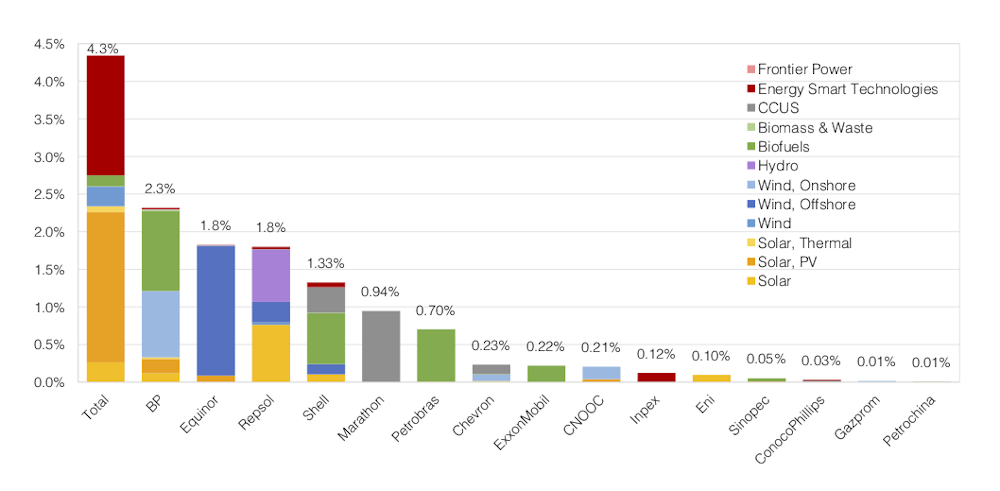
Fletcher et al., Beyond the cycle (London: CDP, 2018)., CC BY-ND
Shareholders speak up
Numerous reports have described climate-related shareholder resolutions at oil and gas companies. But many such resolutions initiated in the last five years have failed a vote, and the number of actions declined from 2016 to 2018.
Still, these efforts led to increased discussion of climate-related concerns between shareholders and management. The recent uptick in corporate climate strategy and investments undoubtedly reflects investor interest, societal pressure, the public policy environment and the growing competitiveness of other technologies. The question is how much change can emerge without much stronger signals from one or more of these sources.
Action and inaction both have risks
Big Oil must consider not only the economic advantages of investing in clean energy, but also the financial risk of pursuing a fossil energy source strategy rather than diversifying.
Several scientific studies have shown that nearly 85% of remaining fossil fuel reserves must remain in the ground to keep global temperatures from rising more than 2 degrees C (3.6 degrees F) above pre-industrial levels. When the first peer-reviewed article making this case was published in a major journal in 2009, oil company stock values fell by more than 2% over the next two weeks. This amounted to a shareholder loss of US$16.5 billion.
Fossil fuel companies have underperformed the broader S&P index in recent years. This trend is led by U.S. coal companies, which have lost 80% of their value since 2007.
[twt]
Each oil company will address climate change pressures in its own way. Some with resources to develop in-house renewable energy expertise will do so. More likely, however, we expect that large companies like Total and Shell will continue to purchase smaller companies that have the strategic know-how to help them make the switch.
On a positive note, oil companies are increasing their low-carbon investments each year. While they are starting from a low baseline, rapid growth rates suggest that with sustained commitment, they could be quite large within a decade. For example, Total and BP each are prepared to spend $500 million per year on renewables over the next several decades. Total expects to grow its low-carbon business to 20% of its asset base over the next 20 years.
Ultimately, however, investment strategy will always be driven by expected returns. If available oil and gas investments have an expected return of 15% and low-carbon investments are only expected to make 7%, money will likely continue to flow towards fossil fuels. Changing this reality will require major market and pricing shifts, which may have to be driven by government policies such as carbon taxes.
A pale-green forecast
Our discussions suggest that companies are interested and feel compelled to explore their options, but there is no clear road map for transforming them into low-carbon energy providers.
Some observers might conclude that oil and gas companies’ limited investments to date in low-carbon technology and business ventures are hindering this transition. Others may view any such investments as a plus, so long as these investments grow and companies don’t simultaneously advocate against policies to reduce emissions.
We believe it is vital for the energy industry and climate stakeholders to continue this conversation, and to identify policy changes that can make it economically advantageous for oil companies to pursue low-carbon futures.
==
https://www.desmog.co.uk/2019/09/16/fossil-fuel-ad-campaigns-climate-science-denial-pr-exxon-lawsuits
no lnx pix twt
Fossil Fuel Ad Campaigns Emphasize 'Positives' After Climate Science Denial PR Lands Industry in Hot Seat
By Sharon Kelly • Monday, September 16, 2019 - 19:09
This story is part of Covering Climate Now, a global collaboration of more than 250 news outlets to strengthen coverage of the climate story.
Public relations experts keep a careful eye on the multitude of ways that PR can go wrong: tracking the year’s biggest “PR blunders,” assessing flopped ads for lessons learned, and noting when to remain silent and when to circulate a particular point of view.
PR blunders have been blamed for causing stock prices to dip, powerful executives to lose jobs, and occasionally even forced public apologies from PR representatives themselves.
But it takes a special kind of PR nightmare — a particularly unusual kind in the U.S., with its broad protections for free speech — to prompt investigations by state attorneys general into whether a company’s public messaging was so misleading and harmful that it should be considered illegal.
That is the situation facing one of the world’s most powerful industries, on one of the most consequential issues of our time, climate change. The subject of these investigations isn’t the direct harm from the fossil fuel industry’s actions, it’s the ways that companies communicated about their actions, and how that misled investors or the public.
And right on cue, the fossil fuel industry's PR professionals have been stepping in to help reshape the narratives propping up their bottom lines.
What #ExxonKnew
Exxon Knew billboard
Sign about what Exxon knew about climate change. Credit: John Duffy, CC BY 2.0
ExxonMobil, for example, currently faces investigations by multiple state attorneys general centering on how the oil giant communicated about climate change and the risk of climate regulation to investors and to the public.
In 2015, the New York state attorney general subpoenaed ExxonMobil and Peabody Energy, following an InsideClimate News investigative series, eight months in the making, that was one of three finalists for the 2016 Pulitzer Prize for Public Service.
Last year, New York’s investigation ripened into a lawsuit, still pending.
“Investors put their money and their trust in Exxon — which assured them of the long-term value of their shares, as the company claimed to be factoring the risk of increasing climate change regulation into its business decisions,” New York Attorney General Barbara Underwood said in a statement roughly a year ago, when her investigation turned into a lawsuit that claims ExxonMobil defrauded its investors. “Instead, Exxon built a facade to deceive investors into believing that the company was managing the risks of climate change regulation to its business when, in fact, it was intentionally and systematically underestimating or ignoring them, contrary to its public representations.”
In January, the U.S. Supreme Court declined to block a different investigation into ExxonMobil’s climate communications, this one by Massachusetts Attorney General Maura Healey.
Alexander Kaufman
?
@AlexCKaufman
Big news: SCOTUS just rejected Exxon Mobil's appeal to stop Massachusetts' attorney general from forcing the oil giant to turn over documents detailing what and when it knew about burning fossil fuels causing climate change. http://news.trust.org/item/20190107143238-u421z/ …
U.S. top court rejects Exxon in climate change document dispute
Ruling clears the way for Massachusetts attorney general to obtain records from Exxon Mobil to probe whether it concealed its knowledge of the role fossil fuels play in climate change
news.trust.org
In March, a report by the Climate Investigations Center tallied $1.4 billion worth of public relations, advertising, and communications contracts signed by energy and business trade associations from 2008 to 2017. One organization, the American Petroleum Institute (API), accounted for nearly half of that sum.
The Evolution of Fossil Fuel Messaging — and Climate Science Denial
Amid the investigations into their communications on climate change, many fossil fuel companies have been slowly re-tooling their messaging.
Some have acknowledged a need to transition away from fossil fuels — but at what critics respond would be a very slow pace.
Others have continued to push natural gas as a climate-friendly fossil fuel, despite the industry’s severe climate-changing methane problems. API, for example, has placed ads claiming natural gas can “help meet the growing global demand for sustainable energy” under the Washington Post’s “branded content platform,” as The Intercept’s Sharon Lerner reported in April.
Other campaigns ditch mention of climate change and pollution all together, instead focusing on the benefits of products made from fossil fuels.
During the Super Bowl in 2017, the American Petroleum Institute released an ad campaign called Power Past Impossible, touting the many uses of oil and natural gas and highlighting how dependent modern life is on the byproducts of these fossil fuels.
“Oil majors are projecting themselves as key players in the energy transition while lobbying to delay, weaken, or oppose meaningful climate policy,” Edward Collins of the UK-based think tank InfluenceMap said in a March statement accompanying a report he authored on public relations campaigns by oil and gas giants. “They advocate gradual implementation of market-based and technological climate solutions, but the latest [United Nations Intergovernmental Panel on Climate Change] report makes clear that urgent policy action and limitations on fossil fuel use are needed to avoid dangerous climate change.”
The shift doesn’t spell the end of climate science denial — DeSmog’s database of individuals and organizations that seek to cast doubt on climate science or oppose action to prevent some of the worst effects of warming the world includes roughly 225 organizations — and that list continues to grow.
Climate sciences deniers, many with ties to the oil, gas, and coal industries, have also climbed to dizzying heights within the Trump administration, placing them in positions where they can wield power directly and also communicate doubt to the public. Vice President Mike Pence is closely tied to the Koch network and in 2016 said, regarding climate change, “I don't know that that is a resolved issue in science today.”
And of course, there's President Trump himself, who in June responded, “I believe that there’s a change in weather and I think it changes both ways,” when asked by Good Morning Britain if he believed in climate change.
Donald J. Trump
?
@realDonaldTrump
Any and all weather events are used by the GLOBAL WARMING HOAXSTERS to justify higher taxes to save our planet! They don't believe it !
But some of the organizations and think tanks in DeSmog's database have gotten a lot quieter when it comes to questioning climate science, even during the Trump administration — and a handful have dissolved entirely.
Take, for instance, the National Center for Policy Analysis (NCPA), a free market think tank that co-authored a 1991 report that read: “Currently, scientists disagree on whether global warming has already occurred, whether significant global warming will occur in the future, whether warming would be harmful or somewhat beneficial to humans and whether, if harmful, it is better to adjust to the warming or try to prevent it.”
A quarter century later, the organization carried a very different message to an industry conference. “It is no secret that the oil and gas industry has an image problem,” Jacki Pick of the NCPA reportedly told the Tyler Area Energy Summit in Texas in March 2017. “We don't do a very good job of explaining the value of the industry.”
Later that year, the NCPA folded,citing “significant financial challenges over the last three years.”
'A Crisis of Perception'
This year, the state-owned oil company Saudi Aramco’s chief executive similarly warned of the oil and gas industry’s image problem.
“My encounters in Davos showed me that fewer and fewer of our stakeholders accept logic and facts, least of all from us. We are therefore facing what I would call a crisis of perception,” Amin Nasser told an industry audience in February, according to The Guardian. “Because it threatens our industry’s very relevance, it puts our ability to supply ample, reliable, and affordable energy to billions around the world at risk, which in turn risks their energy security.”
Ethical oil ad
The oil industry has had image problems before. The “Ethical Oil” ad campaign pitted Canadian oil [peacekeeper un cdn soldier?!] against Middle Eastern oil producers. Credit: EthicalOil.org
In August, a top Chevron executive hinted that a group of major oil and gas companies plans to launch a new branding campaign, which she suggested would be modeled after the “Got Milk?” ad campaigns that launched in 1993.
“I think as an industry, we have an image that we need to change, where people equate what we do to their everyday life,” Kimberly S. McHugh, a Chevron vice president, said at the Summer NAPE Expo in Houston.
“What we do is noble,” she added, “we help humankind.”
That's a message that the fossil fuel industry, particularly as investigations into their past communications continue, may be trumpeting a lot more loudly in coming days.
Or, in the words of McHugh at the NAPE Expo: “The world needs what we have.”
==
===
opensecrets
democrats’ rejection of fossil fuel money marks shift from previous presidential races
The oil and gas industry has always favored Republican candidates over their Democratic opponents. Now, Democrats are pledging to break away from fossil fuel money for good. As climate change takes center stage at political debates, a Democrat-controlled House is pushing for legislation to combat the crisis and reach net-zero carbon emissions by 2050. Read More
==
==
https://insideclimatenews.org/news/06092019/oil-stranded-asset-investment-risk-climate-change-paris-agreement-analysis-carbon-tracker
The world's leading oil companies increasingly have argued that they must be part of the world's transition to a low-carbon future. But a new report shows that despite their rhetoric, they continue to spend their money as if that transition may never come.
In just the past year, the biggest global companies committed billions of dollars to projects that will likely lose money if the world slashes fossil fuel use fast enough to meet the Paris climate accord goals, the report, released Thursday night, shows. That poses serious risks to investors.
"While they may say they support the Paris Agreement, whatever that means, it's not reflected in their behavior," said Andrew Grant, a senior analyst at Carbon Tracker Initiative, a financial think tank focused on energy transition.
In effect, oil companies are giving the world—and their investors—an either-or proposition: Either their balance sheets go bust when oil demand plummets, or the world does as warming soars past 2 degrees Celsius (3.6°F). It's one or the other, the report says.
The oil and gas industry has come under increased pressure from investors who want to know that the companies they finance are navigating a future of dropping fossil fuel demand. Those investors include a broad swath of society, from large financial institutions to public pension funds.
In response, some companies have been trying to show they are taking the issue seriously. Many have committed to lowering the emissions associated with producing and refining oil and gas. Some have been spending significant sumson renewable energy and electric car charging infrastructure (though that spending still represented only about 1 percent of the industry's budget last year, according to one report). And several are pushing for a carbon tax.
The new analysis by Carbon Tracker looks much deeper, examining specific projects that energy companies are planning, and trying to determine whether or not they actually fit with the Paris goals. Carbon Tracker did not examine the emissions associated with the projects, but instead focused entirely on their finances: "The logic we use is that of the market," Grant said.
Cost of Oil Under Each Scenario
Grant and his team determined what the cost of oil would be under various scenarios in which governments take increasingly strict actions to limit global warming. Their analysis used data from the International Energy Agency that estimates global energy demand under the various scenarios. Then, the team examined the economics of specific oil projects, determining which ones would be too costly to pay-off under each scenario, and which would remain profitable even in a world of dwindling oil demand.
They found that billions of dollars in new projects that were greenlit last year would lose money if the world succeeds in limiting warming to below 2°C.
Not a single tar sands project is likely to pay back investors under a 2°C scenario. In fact, they found that because of the great expense of extracting oil from Canada's tar sands, or oil sands, the projects wouldn't even pay off under a higher scenario that would lead to nearly 3°C of warming. That scenario assumes countries will enact the commitments they've made under the Paris Agreement but take no more action.
Essentially, Carbon Tracker found that either the days of profitable new oil sands projects are over or we are headed to a future of dangerous warming. Despite this, last year ExxonMobil sanctioned a new $2.6 billion project, the first major new oil sands project in years, though it's already been delayed.
Fracking May Also Be in Trouble
Much of the U.S. fracking potential may also prove too expensive to exploit in a low-carbon world, according to the report.
A $13 billion Canadian liquid natural gas project, funded by Shell and several Asian companies, also would prove to be a money-loser in scenarios limiting warming to less than 2°C. In all, the industry would have to slash future spending at least 60 percent to comply with the Paris Agreement goals, compared with the higher scenario of announced policies.
Carbon Tracker found that, already, existing projects will produce more than enough oil to send the world past 1.5°C of warming, even with some carbon capture and storage technology in place. Put another way, limiting warming to 1.5°Celsius would mean oil companies shouldn't break ground on any new projects, and that some of their current investments would be "stranded" and lose money.
"Ultimately it comes down to the planet's finite limits," Grant said. In order to limit warming, only a certain amount of carbon can be emitted, and therefore only certain amounts of oil and other fuels can be burned. Meeting the Paris goals will require steep cuts in the use of oil, and that would necessarily drive down oil prices.
"It pays to consider the implication of those finite limits," Grant said. "At the moment, I don't see any oil and gas company that includes those limits in its investment processes."
Published Sept. 6, 2019
PUBLISHED UNDER:
==
maddow
https://www.c-span.org/video/?461371-2/fall-books-2019-preview-author-discussion
my new book. which is called blowout.some of you may know, i have this t.v. show where i get to -- you guys still have tvs! [laughter] for most of you very soon it will be a phone show. but right now it's a t.v. show where i get to cover the news in my own way and is my choice as to which stories i cover and how and at what length. for that show, i read several thousand words a day. and as long as there are no swearwords among them and as long as i abide by nbc news rules and standards are pretty much can say all the words i write on my own terms on t.v. every night. which means i have the greatest job on earth. but that may also make you wonder why on top of that, i would be so greedy as to want an additional outlet. yet to further express myself and give my take on what i think is going on in the world. in the abstract, i don't. but in 2012 and i wrote my first book, drift, and this past year when i started working on blowout, i really felt like i ended up book rating almost despite myself because in the course of my day job, i found myself repeatedly getting stuck. just in doing my regular work trying to explain the days news, trying to make sense of larger dynamic in which the new cycle was unfolding. both in 2012 and this past year.
i kept feeling like i was getting caught in an intellectual bottleneck. there was this process that i could see at work in the world. a dynamic that came to think was pretty important for explaining the news on any given day. but it is an idea that's a couple of hundred pages long idea.
although i took incessantly a couple of hundred page long idea does not fit into my daily work. it is the same thing for me that happens in 2012. if any of you remember drift also the book when it came out it was about the use of american military power becoming unmoored from democratic decision-making. wars that never end and that the public never notices. and congress never votes on. i felt compelled to write drift because i felt that it was a tellable story about where it all came from. a fairly recent story and i felt it was a way to point out over a couple hundred pages why it didn't have to be that way forever. that was my first book.
my new book, blowout, came from a realization i had that sort of had me in the same way. which is that there is a fairly simple that i think uniquely destructive dynamic at work behind a bunch of news that we are living through right now. and it has to do with the oil and gas industry. it is a couple hundred pages long so it had to be a book. but the basic idea is that the democratic system of government and competent governance overall, both at home and abroad, they have a really potent and unrelenting enemy and not one industry. and oil and gas industry is a rich and dangerous sector of the business world but i think it also ought to be recognized as a political entity.
one has a track record of gobbling down even seemingly strong government and spitting out the bumps. part of the books subtitle is the phrase, rogue state russia. you may know that in my day job i have spent a -- amount of time on the russian attack on the 2016 election and its implications and aftermath. this book is not a book about that attack per se. but it does let me get off my chest a thing that i hope americans could better understand about why russia would have wanted to do a thing like that. and why they chose those weird methods. i think russia mounted the attack on our election from a position of profound economic and strategic weakness. for me, coming to understand that has been revelatory in terms of thinking about what they did but also what they've done since the attack and why and what makes for success in their own eyes when they mount these kinds of operations.
just one last point. i recognize that the oil and gas industry is a big bold committed thing. it is made up of many companies that are run by many executives that have many employees and many shareholders. each of whom is a person like who came from a mother. it is very nice. [laughter] i don't think the oil and gas industry is bad because it is made up of bad people. i think the story here is that it is a uniquely destructive entity particularly to our democracy and democracies abroad because of its inherent purpose and because of the profoundly cynical but rational expectations that industry has built for itself in terms of the way it does business. as you know, when used as directed, this is an industry whose products are in the process of ending the world. and sooner than we were really say expecting. but even before we get to the climate apocalypse, that's a ministry in the meantime really is doing its best to undermine our ability to govern ourselves effectively. and to make good group decisions about how to handle all of our challenges, including the ones that we get from them. so, i know, cheery, right?
there's a lot of oklahoma city, there are some siberia and equatorial guinea. there's a very talented -- there seats in hell -- there is a little bit of xena the warrior princess. some radioactive milk, and a comically terribly failed spy ring it up of terrible, terrible spies. and i know the cover, under the covers a little apocalyptic. actually briefly lobbied for the statute -- the statue of liberty to have a clown nose. my mother told me based on the cover she is afraid to read it. i will admit it is sort of about the end of the world. but i also think it is kind of a funny story. [laughter] so, in any case i hope that you like it. i want to thank you for this time. i want to thank you in advance. free interest, as i say it comes out on october 1.
==
desmog 719
Thanks to recent analysis, we now know how much of global greenhouse gas emissions big oil companies like Exxon and Shell are responsible for. But it’s easy to forget that behind these corporate behemoths are powerful individuals, making decisions about where the companies should drill next.
And thanks to a new database, we can now pinpoint how much of the companies’ pollution each executive is accountable for.
==
dem pledge no FF $ then cave 180, now 5/19
https://www.alternet.org/2019/05/beto-orourke-signs-no-fossil-fuel-money-pledge-after-weeks-of-pressure/
---
industry consolidation?!
https://www.cnbc.com/2019/04/26/chevrons-share-buyback-increase-depends-on-battle-for-anadarko.html
bid war with occidental
--
---
==
omfg
https://www.ecowatch.com/trump-fossil-fuel-deregulation-2634118702.html
Jake Johnson
Just a week after a chemical plant explosion killed one worker and spewed thousands of pounds of dangerous pollutants into the airin Crosby, Texas, President Donald Trump is reportedly planning to visit that city Wednesday to sign executive orders to speed up approval of pipelines and other fossil fuel projects.
In coming to the location of a deadly fossil fuel-related explosion to sign an order that would gut states' power to protect residents from the hazards of oil and gas pipelines, Trump is adding tasteless insult to the injury he is inflicting on our planet," Wenonah Hauter, executive director of Food & Water Watch, said in a statement.
"Trump's support for the fossil fuel industry reflects a real disdain for public safety and a livable climate for generations to come," Hauter continued. "Expediting pipelines means more petrochemical buildout in places like Appalachia, and more disasters waiting in the wings — not to mention climate catastrophe."
According to the Houston Chronicle, Trump will appear at the International Union of Operating Engineers International Training and Education Center in Crosby, where he will deliver a speech about "how he plans to aid the United States' booming domestic oil and gas production."
While the full details of Trump's forthcoming executive orders have not yet been made public, a White House official told the Chronicle they will be geared toward helping oil and gas companies avoid "red tape."
"With oil industry cronies and swamp monsters filling the ranks of his administration, it's no surprise that Trump is once again taking an action championed by climate deniers and fossil fuel companies," Rachel Rye Butler, climate campaigner with Greenpeace USA, said in a statement. "This executive order is nothing but an attempt to trample people's rights to protect their air, water, and climate from polluting oil and gas pipelines."
"This is particularly appalling given that many parts of the country are reeling from climate disasters—like the historic flooding in the Midwest that has much of the Keystone XL pipeline route underwater," Butler added. "Instead of creating jobs in the rapidly growing green energy economy, Trump is putting fossil fuels on life support at the expense of our climate and communities."
The president's move to expand fossil fuel production in Texas and across the nation — including TransCanada's Keystone pipeline — comes as the international scientific community warns carbon emissions must be slashed drastically and quickly to avert planet-wide climate catastrophe.
Oil Change International (OCI) estimated in a report published earlier this year that Trump's Big Oil-friendly agenda has put the U.S. on track to account for 60 percent of global growth in fossil fuel production between 2019 and 2030.
"If not curtailed, U.S. oil and gas expansion will impede the rest of the world's ability to manage a climate-safe, equitable decline of oil and gas production," OCI's report warned.
TRUMP EPA WITHDRAWS CLEAN AIR POLICY OPPOSED BY FOSSIL FUEL ... ›
- Trump rollbacks for fossil fuel industries carry steep cost ›
- The growing gap between the energy sector and the Trump ... ›
- Trump's Executive Order: More Fossil Fuels, Regardless of Climate ... ›
---
---
https://insideclimatenews.org/news/28032019/pipeline-protest-crackdown-state-law-legislation-south-dakota-conspirators-riot-boosting
This story was updated with a lawsuit filed March 28 over the South Dakota law.
Bills to clamp down on pipeline protests have spread to at least nine new states this year, part of an industry-backed push that began two years ago to heighten penalties for activists who try to block fossil fuel infrastructure projects.
Several of the bills also allow prosecutors to go after people or organizations as "conspirators" or "riot boosters" for merely supporting or coordinating with others who violate the law.
Civil liberties advocates argue that these vague and far-reaching provisions risk violating free speech protections under the First Amendment, and they have already started launching legal challenges.
The latest government move came on Wednesday in South Dakota—one of the states the planned Keystone XL pipeline is slated to cross—whenRepublican Gov. Kristi Noem signed a law that enables state and local governments, as well as "third parties," to seek civil damages from people or organizations that engage in "riot boosting."
Lawmakers in North Dakota, a hub of oil and gas development, also passed a bill this week that stiffens penalties for anyone who interferes with the construction or operation of pipelines and other "critical infrastructure." Once the Senate approves some minor changes, it heads to Republican Gov. Doug Burgum, who has not said whether he will sign it.
The North Dakota bill was based on a law that was enacted in Oklahoma in 2017 and then circulated by the industry-backed American Legislative Exchange Council (ALEC). Versions of that legislation have now been introduced in at least 15 states, three of which have enacted it: Oklahoma, Louisiana and Iowa. A version of the bill passed the Indiana legislature this week, too, though the Senate there must also approve some amendments before sending it to the governor.
While the details vary from state to state, the bills generally increase penalties for trespassing on or tampering with a range of facilities, including pipelines, oil storage tanks, railroads and utility infrastructure. Several of them, including North Dakota's, also include language assigning higher penalties—up to $1 million in some cases—for any group found to be a conspirator in violating the law.
The South Dakota law is different. Rather than imposing new penalties for interfering in pipeline construction, the bill enables state or local governments—or a third party working with government—to seek compensation from anyone who engages in "riot boosting," which includes encouraging or directing someone to engage in a riot, defined by the state as the use of force or violence by three or more people acting together.
Someone can qualify as a "riot booster" even if they reside out of state and act indirectly "through any employee, agent or subsidiary." Anyone found liable would be responsible for three times the ordinary penalty.
The bill was introduced at the end of the legislative session and approved over the course of four days, with only one hearing.
Environmental and civil liberties advocates, as well as many Native American tribes, say the bills are an attempt to stifle legitimate protest by creating harsh penalties for minor infractions and by trying to scare off advocacy groups. An organization that holds a nonviolence training, for example, might be targeted under the law if attendees are later part of a protest that ends in a clash with private security forces or police.
"'Riot boosting' is an unusual and new term. You might be asking yourself what that means, and I think protesters will too," said Vera Eidelman, an attorney with the American Civil Liberties Unionwho has tracked the bills. "I think it poses a unique threat to speech and appears to be targeted at protests. It uses words like 'encouraging' and 'advising' that are very broad and refer to a category of protected speech."
On Thursday, the ACLU sued South Dakota officials in federal court on behalf of indigenous and environmental groups, arguing that the new law and two related statutes violate the Constitution by suppressing free speech and failing to describe what actions could qualify as violations. In a statement, the group said "such vague and broad language invites arbitrary enforcement, will chill protected speech, and will result in indiscriminate targeting of peaceful organizers."
Industry-Backed Group's 'Model Legislation'
The legislation is part of a wave of state bills introduced across the country since President Donald Trump's election in response to high-profile protests like those against the Dakota Access Pipeline on the Standing Rock Reservation in North Dakota in 2016 and 2017.
Oklahoma state Rep. Scott Biggs said he was responding to those protests when he introduced a bill in 2017 to impose harsh penalties on people or groups who interfere with "critical infrastructure." After ALEC adopted the bill as model legislation, versions quickly spread across several states with active pipeline projects.
The bills' supporters have said they make it easier for prosecutors to go after protesters or vandals who violate the law, and that they do not target free speech.
Advocates have pointed out that the actions in question—trespassing, vandalism—are already covered by existing laws. Instead, they say, the aim of the bills is to intimidate protesters who draw attention to their concerns through civil disobedience, including minor infractions like blocking the gates of construction sites. Advocates say these protests are part of a long tradition of American civil disobedience dating back to the Boston Tea Party.
"Even where these bills are simply introduced, even if they do not move, even if they do not become law, they have potential to chill free speech and curtail activism," said Maggie Ellinger-Locke, a staff attorney with Greenpeace. "We're hearing from people on the frontlines of activism in these states that these bills frighten them."
Pipeline Companies Register Their Support
Energy companies and associations have supported the bills and have continued to push the legislation this year, according to documents compiled by Greenpeace.
TransCanada, the Canadian company behind the Keystone XL pipeline, registered its support for the bill this year in Missouri along with the American Fuel and Petrochemical Manufacturers and other industry groups. In Illinois, TransCanada was joined by Enbridge and Energy Transfer, two other leading pipeline developers, as well as the American Petroleum Institute.
Sen. Janne Myrdal, who sponsored the North Dakota bill this year and is a member of ALEC's energy task force,did not respond to requests for comment. But she told the Associated Press that she introduced the bill in response to a protester who in 2016 broke into a control site for the existing Keystone pipeline that cuts through the state and manually closed one of the valves.
"There was frustration from law enforcement and residents that there wasn't enough teeth in current law to go after these people and the organizations that support them," she said.[pix]
The protester, Michael Foster, was convicted and sentenced to three years in prison, though two of those years were suspended. He ended up serving about half a year.
In South Dakota, Gov. Noem's office did not answer emailed questions about TransCanada's role in drafting the bill, but Noem said in February that she had met with representatives of the company to discuss her legislative package, which also includes a bill that requires pipeline developers to contribute to a fund that would help pay for government costs associated with construction.
"I fully support the freedoms of speech and assembly, but we must also have clear expectations and the rule of law," Noem said in a statement issued Wednesday. "My pipeline bills make clear that we will not let rioters control our economic development."
Terry Cunha, a spokesman for TransCanada, said in an email that "we appreciate the efforts of Governor Noem and her administration to help advance Keystone XL construction and other pipelines," adding that "any legislation that deters unlawful activities and encourages the advancement of critical infrastructure projects is a positive step."
Is It Stifling Dissent?
Some activists say the bills are part of a wider effort by the oil and gas industry and its allies in government—through lawsuits, public relations campaigns and legislation—to paint protesters as criminals and even terrorists.
"All of these things I think incorrectly mischaracterize protesters and respond to a powerful pushback against pipelines and other protests, not by trying to engage on the issues but by trying to stifle dissent," Eidelman said. "I think this is really part of a broader trend."
Last year, the ACLU sued the federal government, accusing several agencies of withholding documents detailing preparations for the potential construction of the Keystone XL pipeline. The group had submitted records requests seeking information about the preparations, and the documents that did emerge, mostly from state agencies, showed that law enforcement agencies were conducting trainings for potential protests. The ACLU said the activities risked treating activists as criminals even before protests broke out. State officials have said they are simply doing their jobs.
In January, The Intercept reported on similar concerns in Minnesota, where police had been preparing for a year and a half for protests against Enbridge's proposed Line 3 pipeline expansion project by identifying groups opposed to construction and monitoring some activists.
The ACLU and other civil liberties groups said they are continuing to evaluate the state bills and considering whether they may challenge them as unconstitutional. So far,Louisiana is the only state where protesters have been arrested under the new laws. Bill Quigley, a lawyer who is representing several of the activists, said prosecutors have two years to press charges and have yet to do so.
PUBLISHED UNDER:
==
==
https://www.desmog.co.uk/2019/03/22/paris-oil-exxon-chevron-bp-total-shell-billion-climate-lobbying-advertising-influencemap
all rhet
A new report by a British think tank estimates that since the 2015 Paris Agreement, the world’s five largest listed oil and gas companies spent more than $1 billion lobbying to prevent climate change regulations while also running public relations campaigns aimed at maintaining public support for climate action.
Combined, the companies spend roughly $200 million a year pushing to delay or alter climate and energy rules, particularly in the U.S. — while spending $195 million a year “on branding campaigns that suggest they support an ambitious climate agenda,” according to InfluenceMap, a UK-based non-profit that researches how corporations influence climate policy.
InfluenceMap cites as an example ExxonMobil’s heavily-touted algae-biofuels research, which the oil giant says “offers some of the greatest promise for next-generation biofuels” with significant climate benefits and has made it the focus of its “The Tiny Organism” ad campaign.
InfluenceMap notes that “detailed disclosures from the company show its goal of 10,000 barrels of bio-fuel a day would equate to only 0.2 percent of its current refinery capacity.
"
[algae tiny vid]
Oil majors are projecting themselves as key players in the energy transition while lobbying to delay, weaken, or oppose meaningful climate policy,” Edward Collins, author of the new report, said in a statement. “They advocate gradual implementation of market-based and technological climate solutions, but the latest [United Nations Intergovernmental Panel on Climate Change] report makes clear that urgent policy action and limitations on fossil fuel use are needed to avoid dangerous climate change.”
Today’s report updates the group’s 2016 report that estimated these companies spent $115 million a year lobbying against climate regulations — even policies companies said they supported.
“Say one thing,” said Senator Sheldon Whitehouse, as he InfluenceMap’s 2016 research on the floor of the U.S.Senate, “do another.”
The new estimates suggest that spending to influence climate policy by the five oil giants has increased sharply over the last two years.
It also comes as global banks are investing more in fossil fuel projects since the Paris Agreement. In addition, the five oil companies are spending heavily on finding and producing more fossil fuels — and putting only a tiny fraction of their budgets into efforts to transition away from climate-altering fuels.
“This spending accompanies the expansion of the companies’ operations with combined annual sales of over $1 [trillion] and profits of $55 [billion in] 2018, the vast majority of which is oil and gas related,” InfluenceMap wrote. “Combined capital investment will increase to $115 [billion] in 2019 but only about 3 percent of this will go to low carbon investments, according to company disclosures.”
Lobbying One Message While Advertising Another
The report focuses on the world’s five largest listed oil and gas companies, ExxonMobil, Shell, BP, Total, and Chevron, leaving out state-controlled oil giants like Saudi Aramco and China’s Sinopec.
InfluenceMap examined the extent to which each company’s branding efforts and advertising campaigns focused on climate change.

Shell's branded content about its “Sky” emissions scenario in The New York Times.
“The research suggests that Total maintains the highest proportion of its branding activities on climate (29 percent),” the new report finds. “Following this, ExxonMobil, which has faced significant negative media attention in 2018, allocates 19 percent. Shell and BP followed with 16 percent and 14 percent respectively. Chevron appears far less concerned, using approximately 2 percent of its branding budget on climate issues in 2018.”
The think tank's research also looked at what the companies were saying to government regulators, either directly or through industry groups funded by the oil majors.
“Since Paris, Chevron, BP and ExxonMobil have led in opposition to a range of climate-motivated policy stands,” InfluenceMap wrote. “For example, in 2018 both BP and Chevron have directly lobbied U.S. policymakers for a rollback on U.S. methane requirements.” (Methane is a powerful greenhouse gas and the major constituent in natural gas.)
The report credits Shell and Total for becoming “more positive on a number of climate policy issues” since 2015, but adds that they “continue to support policies that will extend the role for fossil fuels in the energy mix and remain part of highly climate-oppositional trade associations.”
Mixed Messages and Industry Trade Groups
At times, the public stances of a corporation’s leadership stand starkly at odds with the messages from industry groups funded by that same corporation.
For example, on electric vehicles, Shell’s CEO Ben Van Beurden had a very direct and simple message in July 2018. “We need battery electric vehicles,” he said. And a year earlier, at the oil industry conference, CERAWeek, in 2017, he expressed support for “regulations that speed up investment in low carbon technologies and ― at the same time ― move consumer demand.”

Oil and gas lobbying on climate policies through trade associations. Credit: InfluenceMap, 2019
In May 2018, the American Petroleum Institute, the largest U.S. trade group for oil and gas, pushed the U.S. Congress to move in the opposite direction by rolling back incentives for electric vehicles.
“American Petroleum Institute (API) opposes mandates and subsidies,” API testified before the U.S. House of Representatives, according to InfluenceMap’s new report. The fossil fuel trade group voiced its opposition for subsidies for electric vehicles, adding that “the level of market penetration achieved by electric vehicles should not rely on government interference.”
The report also notes the difficulty in tracking corporate lobbying in the U.S. given the rise of so-called “dark money” groups and the lack of transparency surrounding political contributions in the U.S. “Political contributions that were made without full disclosure of their ultimate source totaled $539 [million] in the 2018 election cycle according to OpenSecrets.org,” the report says.
Social Influencers
InfluenceMap also dives deep into how companies used social media to influence Americans during the mid-term elections last year.
“During this time ExxonMobil was by far the most prolific spender, racking up over $400K in four weeks on over 360 individual political ads,” InfluenceMap wrote. “The ads urge rejecting specific ballot initiatives whilst promoting the benefits of increased fossil fuel production. Facebook’s data indicates that ExxonMobil’s ads made over 10 million ‘impressions’ in this time with users in Colorado, Texas, and Louisiana.”

Oil industry spending on Facebook and Instagram ads leading up to the 2018 U.S. midterm elections. Credit: InfluenceMap, 2019
All of this spending has implications for shareholders, InfluenceMap observed — and some shareholder groups appear to be listening.
“InfluenceMap’s research confirms a widely held suspicion that Big Oil’s glossy sustainability reports and shiny climate statements are all rhetoric and no action,” Catherine Howarth, Chief Executive of ShareAction, a UK charity focused on responsible investment, said in a statement accompanying the report. “These companies have mastered the art of corporate doublespeak — by boasting about their climate credentials while quietly using their lobbying firepower to sabotage the implementation of sensible climate policy and pouring millions into groups that engage in dirty lobbying on their behalf.”
DeSmog has reached out to ExxonMobil, Shell, BP, Total, and Chevron for comment.
“We firmly reject the premise of this report. We are very clear about our support for the Paris agreement, and the steps that we are taking to help meet society’s needs for more and cleaner energy,” Shell said in a statement provided to The Guardian. “We make no apology for talking to policymakers and regulators around the world to make our voice heard on crucial topics such as climate change and how to address it.”
“We have not been afforded the opportunity to review the data but we disagree with the assertion that Chevron has engaged in ‘climate-related branding and lobbying’ that is ‘overwhelmingly in conflict’ with the Paris Agreement,” Chevron said in a statement provided to DeSmog, adding that the company was taking “prudent, cost-effective actions” and seeking “balanced and transparent” policies to reduce greenhouse gas pollution. “We believe climate change is real and human activity contributes to it. We accept the findings of the Intergovernmental Panel on Climate Change.”
Updated: This article has been updated on March 22, 2019 to reflect a statement from Chevron.
---
https://www.ecowatch.com/dirty-scheme-americans-buy-more-gasoline-2623764478.html
12/18
The Dirty Scheme to Make Americans Buy More Gasoline
By Rhea Suh
It's not often that an industry chieftain brags to investors about picking the pockets of American families with help from the White House.
That's what happened, though, after Big Oil schemed with the Trump administration last summer to ensure higher gasoline consumption—to the tune of $16 billion a year—and more climate-disrupting carbon pollution from our cars, vans and pickup trucks.
An important investigative story by the New York Times lays bare this craven sellout of the public interest and details the hammerlock the oil industry has on domestic policy under President Trump. The article details how the Trump administration bowed to the major oil companies to try and gut commonsense rules that were already saving consumers billions of dollars a year at the pump and helping clean up our dirty tailpipe emissions.
In a cynical confession, Gary Heminger, chairman of Marathon Petroleum, boasted to analysts last week that weakening the clean car rules would boost gasoline sales by up to 16.8 million gallons a day.
At $2.65 a gallon, the national November average, that comes to $44.5 million a day, or more than $16 billion a year, money that American workers won't be able to spend on their families' needs because it will go, instead, to the oil industry. "However," Heminger warned investors, "you have another side who doesn't want to pivot away" from the fuel savings and pollution reductions the rules support. "So we have a lot of work to do to keep this momentum going."
That so-called "work" doesn't come cheap. In the national elections of 2016 and 2018, campaign contributions from the oil and gas industry totaled $176 million, with 87 cents of every dollar going to Trump's party.
It's paying off for the industry—at the country's expense.
In 2012, with the endorsement of the major automakers, the U.S. Environmental Protection Agency and the U.S. Department of Transportation teamed up on a pair of rules that cut tailpipe pollutionfrom our cars, vans, SUVs and pickup trucks. The rules had the industry on track to double gas mileage by 2025, cutting the nation's oil consumption by a staggering 2.4 million barrels per day by 2030.
It's one of the most important steps we've taken, as a country, to protect future generations from the growing dangers of climate change. That's because our cars and light trucks account for about 17 percent of U.S. emissions of carbon dioxide and other greenhouse gases contributing to the problem. Mile for mile, the 2012 rules cut the carbon footprint of driving in half.
The measures have supported a surge in manufacturing jobs, with nearly 300,000 Americans hard at work helping us to get more miles from a gallon of gas or moving us closer to the electric cars and hybrid vehicles of the future. Some 70,000 of those jobs are in Michigan alone, where more than 224 facilities are turning out materials or components to help make our cars run cleaner and more efficiently.
Last August, though, the Trump administration proposed gutting the rules, throwing national support for clean car progress into reverse. Automakers wanted flexibility in meeting the clean car standards. On balance, though, the rules complemented tens of billions of dollars in industry investment in a new generation of automobiles.
So it was something of a mystery as to why the administration turned away from standards that save our families billions of dollars a year at the pump, fight the central environmental challenge of our time, and help create scores of thousands of well-paying jobs. The Times article provides the answer: it's not the automakers but, rather, the oil companies that see the road ahead through the rearview mirror.
We're not going to stand by and watch Donald Trump put our future at risk to pump up oil profits. We're fighting this proposal. We'll make our case in court, if necessary, and we've joined other groups in calling on the EPA and the Transportation Department to come clean about how the administration sold out our environment and our pocketbooks in its fealty to fossil fuels.
As my NRDC colleague Luke Tonachel testified in a federal hearing on the proposed changes last September, "We Americans pay taxes so that the government will serve and protect us, not Big Oil."
Rhea Suh is the president of the Natural Resources Defense Council.
---
ref
no lnx nyt
The Oil Industry’s Covert Campaign to Rewrite American Car Emissions Rules
Marathon, the country’s largest oil refiner, has backed the Trump administration proposal to roll back car efficiency standards.CreditCreditErin Kirkland for The New York Times
Hiroko Tabuchi
By Hiroko Tabuchi
Dec. 13, 2018
Want climate news in your inbox? Sign up here for Climate Fwd:, our email newsletter.
When the Trump administration laid out a plan this year that would eventually allow cars to emit more pollution, automakers, the obvious winners from the proposal, balked. The changes, they said, went too far even for them.
But it turns out that there was a hidden beneficiary of the plan that was pushing for the changes all along: the nation’s oil industry.
In Congress, on Facebook and in statehouses nationwide, Marathon Petroleum, the country’s largest refiner, worked with powerful oil-industry groups and a conservative policy network financed by the billionaire industrialist Charles G. Koch to run a stealth campaign to roll back car emissions standards, a New York Times investigation has found.
The campaign’s main argument for significantly easing fuel efficiency standards — that the United States is so awash in oil it no longer needs to worry about energy conservation — clashed with decades of federal energy and environmental policy.
“With oil scarcity no longer a concern,” Americans should be given a “choice in vehicles that best fit their needs,” read a draft of a letter that Marathon helped to circulate to members of Congress over the summer. Official correspondence later sent to regulators by more than a dozen lawmakers included phrases or sentences from the industry talking points, and the Trump administration’s proposed rules incorporate similar logic.
The industry had reason to urge the rollback of higher fuel efficiency standards proposed by former President Barack Obama. A quarter of the world’s oil is used to power cars, and less-thirsty vehicles mean lower gasoline sales.
In recent months, Marathon Petroleum also teamed up with the American Legislative Exchange Council, a secretive policy group financed by corporations as well as the Koch network, to draft legislation for states supporting the industry’s position. Its proposed resolution, dated Sept. 18, describes current fuel-efficiency rules as “a relic of a disproven narrative of resource scarcity” and says “unelected bureaucrats” shouldn’t dictate the cars Americans drive.
A separate industry campaign on Facebook, covertly run by an oil-industry lobby representing Exxon Mobil, Chevron, Phillips 66 and other oil giants, urged people to write to regulators to support the rollback.
The Facebook ads linked to a website with a picture of a grinning Mr. Obama. It asked, “Would YOU buy a used car from this man?” The site appears to have been so effective that a quarter of the 12,000 public comments received by the Department of Transportation can be traced to the petition, according to a Times analysis.
Gary R. Heminger, Marathon’s chairman and chief executive, said in a statement that the company supported “sound fuel economy standards” and wanted to “help ensure they are achievable and based on existing technology.”
He added, “We appreciate the administration’s willingness to conduct a thorough review in order to ensure future standards are achievable and will actually benefit American consumers.”
Image
Marathon’s chief executive, Gary Heminger, third from right, at the New York Stock Exchange on Dec. 3 to note an acquisition that made the company the nation’s largest refiner.CreditRichard Drew/Associated Press
A spokesman for Koch Industries, the energy conglomerate led by Mr. Koch, said the company had “a long, consistent track record of opposing all forms of corporate welfare, including all subsidies, mandates and other handouts that rig the system.”
The oil industry’s campaign, the details of which have not been previously reported, illuminates why the rollbacks have gone further than the more modest changes automakers originally lobbied for.
The standards that the Trump administration seeks to weaken required automakers to roughly double the fuel economy of new cars, SUVs and pickup trucks by 2025. Instead, the Trump plan would freeze the standards at 2020 levels. Carmakers, for their part, had sought more flexibility in meeting the original 2025 standards, not a categorical rollback.
The Trump plan, if finalized, would increase greenhouse gas emissions in the United States by more than the amount many midsize countries put out in a year and reverse a major effort by the Obama administration to fight climate change.
The energy industry’s efforts also help explain the Trump administration’s confrontational stance toward California, which, under federal law, has a unique authority to write its own clean-air rules and to mandate more zero-emissions vehicles.
California has pledged to stick to the stricter standards, together with 13 other states that follow its lead. But President Trump’s plan challenges California’s rule-writing power, setting up a legal battle that threatens to split the American auto market in two.
That is a prospect automakers desperately want to avoid.
But for gasoline producers like Marathon, a shift toward more efficient vehicles poses a grave threat to the bottom line. In October, the company acquired a rival, Andeavor, making it the biggest refiner in the United States, with sales of 16 billion gallons of fuel a year.
Even while doubling down on gasoline, Marathon has projected an environmentally friendly public image. “We have invested billions of dollars to make our operations more energy efficient,” Marathon said in a recent report. The company’s Twitter account recently highlighted a gardening project and the creation of a duck pond at one of its refineries.
On a conference call with investors last week, Mr. Heminger, the Marathon chief executive, was already counting the extra barrels of fuel a Trump rollback would mean for the industry: 350,000 to 400,000 barrels of gasoline per day, he said.
“However, you have another side who doesn’t want to pivot away” from the stricter rules, Mr. Heminger said. “So we have a lot of work to do to keep this momentum going.”
Marathon’s Early Start
Marathon began its outreach to the Trump administration early, asking to meet with Scott Pruitt at the Environmental Protection Agency soon after he became its administrator in early 2017. Marathon had been a top donor to Mr. Pruitt in Oklahoma, a state where oil is so prominent that a well stands on the grounds of the capitol building.
“Our CEO, Gary Heminger, would be very glad for an opportunity to visit with the Administrator,” a Marathon lobbyist wrote in an email to Mr. Trump’s transition team on May 8, 2017. “I believe this would be a constructive dialogue.” The E.P.A. helps oversee fuel economy rules along with the Transportation Department.
Mr. Pruitt was scheduled to meet with the Marathon chief at least twice — once in June 2017 as part of a meeting with the board of a powerful fuel-industry group, American Fuel and Petrochemical Manufacturers, and again in September for a more private talk, according to emails and schedules released in a lawsuit filed by the Sierra Club.
A Marathon spokesman, Chuck Rice, said Mr. Heminger did not discuss auto-efficiency rollbacks with Mr. Pruitt. An E.P.A. official did not respond to a question about whether the auto rules were discussed.
Marathon then turned its focus to Congress, hiring the firm Ogilvy Government Relations to lobby legislators in Washington on fuel-economy standards, according to Ogilvy’s disclosure forms. The firm did not respond to a request for comment.
Over the summer, Marathon representatives also approached legislators about an industry talking-points letter, according to six people familiar with that effort. The file properties of a Microsoft Word version of one letter, provided by a Congressional delegation, show that it was last edited by a Marathon lobbyist, Michael J. Birsic, on June 11, 2018.
Mr. Rice of Marathon said the company did not write the letter, and the company declined to say who did. It did not offer an explanation for Mr. Birsic’s digital fingerprint on the document file.
Nineteen lawmakers from the delegations of Indiana, West Virginia and Pennsylvania sent letters to the Transportation Department that included exact phrases and reasoning from the industry letter. The lawmakers’ letters, sent in June and July, all make the point that oil scarcity is no longer a concern.
Image
A portion of a letter detailing pro-industry talking points that was later echoed in letters written by lawmakers to regulators, such as the example below.
Image
A letter sent by Pennsylvania’s congressional delegation to regulators used language similar to the industry talking-points note, excerpted above.
The Trump administration’s proposed rollback echoes the post-conservation theme. While energy conservation is significant, the proposal says, the downside of additional petroleum consumption would be dwarfed by the rollback’s benefits.
Representatives from the three state delegations either declined to comment or did not respond to requests.
Senator Tom Carper of Delaware, the top Democrat on the Senate Environment and Public Works Committee, criticized the industry’s campaign. “It appears as though oil interests are cynically trying to gin up support in Congress for the weakest possible standards to ensure that cars and SUVs have to rely on even more oil,” he said.
“If this attempt is successful, the outcome will be a blow to the auto industry, consumers, and our environment.”
The Facebook Campaign
The Facebook ads, featuring Mr. Trump waving alongside the message, “SUPPORT OUR PRESIDENT’S CAR FREEDOM AGENDA!,” appeared the week after the administration made public its fuel economy plan in August. At least 10 times during the two-month public comment period on the plan, the ads, which did not state their oil industry origins, asked people to write to the government to back weaker emissions standards.
Public comments matter in federal rule-making. The law requires that citizens’ views be taken into account before a rule is finalized.
“File an official comment to SUPPORT our President’s plan for safer, cheaper cars that WE get to choose,” read one ad, which ran for seven days in early October. The ad leads to a page that provides basic language to submit.
Image
Facebook ads by Energy4Us prompted more than 3,300 of the 12,000 public comments on the administration’s rollback proposal, a Times analysis showed.
Credit
More than 3,300 of the 12,000 public comments that D.O.T. has made public contain language identical to that petition, an analysis of the files showed.
The campaign was a product of the fuel and petrochemical manufacturers trade group, widely known as AFPM. However, neither the Facebook ads nor the site identified the industry group. Instead they name a group called Energy4US, which describes itself as “a coalition of consumers, businesses and workers” promoting affordable energy.
Energy4US has close ties to the industry group. According to internet domain records, Victor Adams, listed as an AFPM web manager, registered Energy4Us.org in 2015 using his work email address. Energy4US lists the group as a coalition member, along with about 50 other groups including energy interests, labor groups, a sheriff’s association and even a recreational fishing alliance.
The AFPM board includes representatives from Exxon, Chevron, Phillips 66, Marathon and Koch Industries. The companies all referred queries to the group.
Derrick Morgan, a senior vice president at AFPM, said the group “regularly works with policymakers, coalition groups and individuals to promote shared goals,” and also will “lead and join groups like Energy4US.”
The Department of Transportation said it was “generally aware” that there were groups urging the public to make comments through online campaigns, but said it does not regulate them.
Image
Transportation Secretary Elaine Chao at the White House this year.CreditTom Brenner/The New York Times
Taking the Fight On the Road
House bill 1593 is just eight words long: “To repeal the corporate average fuel economy standards.” Koch Industries, a petroleum empire with interests as diverse as gasoline, pipelines, fertilizer and Stainmaster carpets, is the bill’s sole corporate backer.
The measure, which would eliminate fuel standards altogether, is not expected to go far. But it underscores the company’s stance on the matter. And Koch interests are fighting that battle not only in Washington but increasingly in statehouses and even local policy meetings nationwide.
Earlier Investigative Reporting
Taking the fight over climate change to local communities
How the Koch Brothers Are Killing Public Transit Projects Around the CountryJune 19, 2018
In Dearborn, Mich., at a September meeting on the Trump fuel-efficiency rollbacks, Annie Patnaude of Americans for Prosperity, a Koch-funded group, spoke in favor. “This is a step in the right direction to protect consumers and workers against government mandates that would limit choice,” she said.
In Iowa, Americans for Prosperity joined the fight over whether to make it easier for gas stations to install chargers for electric vehicles. In Illinois, it discouraged state officials from considering subsidies for electric vehicles.
And last month an Americans for Prosperity representative trekked to a public hearing in Colorado, where regulators were thinking about becoming the 13th state to follow California’s stricter standards. The representative, Shari Shiffer-Krieger, a field director for the group, argued that people in the rugged state wanted SUVs, not tighter emissions rules. “Coloradans deserve much better,” she said.
The oil industry lost that fight. Colorado allied itself with California.
But Americans for Prosperity said fights like these get to the heart of its free-market philosophy. “We believe in a level playing field so all Americans have the equal opportunity to succeed,” said Bill Riggs, a spokesman for the group, in a statement. The organization will keep fighting “mandates that unfairly pick winners and losers in any industry,” he said.
Drafting Pro-Oil State Legislation
On August 6, a Marathon lobbyist, Stephen D. Higley, emailed a Wisconsin state representative an explainer of American fuel economy law. The memo didn’t mince words.
“It’s a relic,” the memo said, particularly at a time when the United States was “poised to become the largest oil producer in the world.”
The Wisconsin representative, Mike Kuglitsch, participates in the American Legislative Exchange Council, a Koch-funded group that helps companies write model legislation for state lawmakers to use as a basis for their own laws.
Emails obtained by the Times show that Marathon has been working with members of the legislative exchange council to build support for the Trump fuel-efficiency rollback in state legislatures and to denounce California’s power to write its own rules for cars. The emails were made public under Wisconsin’s open records law to Documented, a watchdog group that tracks corporate influence in public policy.
California’s special authority could effectively split the American auto market in two, since 13 other states — representing roughly 35 percent of nationwide car sales — have agreed to follow California’s stricter rules. That means automakers might find themselves making cars to two competing standards.
“Who should decide what cars and trucks consumers should buy, consumers themselves or unelected bureaucrats in Sacramento, California or Washington, D.C.?” the memo sent by Marathon said.
In a statement, Bill Meierling of the legislative exchange council said that mandating fuel economy was a rule that “many state legislators believe doesn’t make sense for working Americans.”
Just days after the emails between Marathon and the Wisconsin lawmaker, some 1,500 state legislators and other officials from across the country gathered in New Orleans to cheer on Elaine Chao, the Secretary of Transportation, at the legislative exchange council’s annual convention. Marathon sponsored the event.
The Transportation Department was determined to cut government regulations, said Ms. Chao, a former fellow at the Heritage Foundation, which has received Koch funding and has long opposed the fuel economy rules.
Mr. Trump’s proposed rollback, she said, “ranks as one of the most significant regulatory reforms that this administration is undertaking.” The room erupted in applause.
Image
Rush hour traffic near Detroit, the nation’s auto capital, on a recent late afternoon.CreditErin Kirkland for The New York Times
For more news on climate and the environment, follow @NYTClimate on Twitter.
Hiroko Tabuchi is a climate reporter. She joined The Times in 2008, and was part of the team awarded the 2013 Pulitzer Prize for Explanatory Reporting. She previously wrote about Japanese economics, business and technology from Tokyo. @HirokoTabuchi • Facebook
A version of this article appears in print on , on Page A1 of the New York edition with the headline: Big Oil Angles, Quietly, to Ease Emissions Cuts
==
icn 11/18
Crab Fishers Sue the Fossil Fuel Industry Over Climate Change as the Ocean Warms
BY: DAVID HASEMYER
:{:{}:
The West Coast's largest commercial fishing association is the latest group seeking to hold fossil fuel companies accountable for climate change as it damages lives and livelihoods.
}:
---
no lnx many
https://www.ecowatch.com/exxonmobil-and-chevron-distorting-climate-science-2614802732.html
Yes, ExxonMobil and Chevron Are Still Distorting Climate Science
By Brenda Ekwurzel
If you look at headlines from the last year, ExxonMobil, Chevron and other major fossil fuel companies have seemingly turned a new page on climate change. Recently, ExxonMobil received major kudos for giving $1 million to Americans for Carbon Dividends, a lobbying offshoot of the industry-backed Climate Leadership Council. Shortly before that, ExxonMobil, Chevron and Occidental Petroleum got good press for each pledging $100 million to the Oil and Gas Climate Initiative, which amounts to less than one percent of their capital and exploration budget for 2018 (ExxonMobil's is $28 billion while Chevron's is $15.8 billion). Companies have also touted their support for the Paris climate agreement as well as their research and investments in renewables.
:{:{}:
}:
But, as I and my colleagues have analyzed, this "support" is a PR distraction when these companies are keeping up business-as-usual. They intend to continue producing, marketing and selling fossil fuels at current levels for the foreseeable future, which runs counter to the steep reductions in carbon dioxide and methane emissions needed to limit global temperature increase to 1.5 degrees Celsius to 2 degrees Celsius above pre-industrial levels.
Tuesday the Union of Concerned Scientists (UCS) released a scorecard, which analyzed what eight major fossil fuel companies are saying they're doing about climate change, and just how much these companies are doing to drastically lower their emissions.
What did we find? Contrary to media reports and shiny company press releases, most of these major fossil fuel companies continue to mischaracterize climate science.
Why is this important? Any company that makes, markets and sells a product that is the primary cause of climate change has a responsibility to stay on top of and clearly communicate with the public scientific developments regarding their product. Misrepresenting climate science and underplaying the urgency of action allows companies to justify their business as usual practices all while climate impacts, including increasingly frequent and severe weather events such as Hurricanes Harvey and Florence, get worse and costlier. Releasing inaccurate statements allows companies to "check the box" for voicing belief in climate change, while continuing to funnel tens of tens of millions of dollars to climate-denying politicians, trade associations and other industry groups that do the dirty work of opposing climate policies.
Major Fossil Fuel Companies Fail to Accurately Represent Climate Science
We measured whether companies consistently and accurately acknowledged the scientific evidence of climate change in their public platforms. Overall, they didn't do great.
We found that five of the eight companies we studied had made public statements on climate change that underplayed the need to urgently reduce emissions, emphasized scientific uncertainty and/or were blatantly incorrect. Only BP amended its statement after UCS and Barnard College called the company out for its deceptive language.
These statements are surprising since these companies have known about climate change for at least four decades now, which would be plenty of time to figure how to make it a priority to accurately convey the latest developments in climate science. Since 1990, the Intergovernmental Panel on Climate Change (IPCC) has issued climate assessments which companies can rely on. The IPCC's Fifth Assessment (2014) represents the latest* mainstream scientific consensus on climate change and it clearly states that "It is extremely likely that human influence has been the dominant cause of the observed warming since the mid-20th century." The primary human influence is through the burning of fossil fuels.
*(Earlier this month, this group released a special report detailing the impacts of a global average temperature increase of 1.5C relative to 2C above pre-industrial levels, and pathways to limit temperature increase to that level. See my colleagues' blog series about what the report means for us and for climate policy).
Let's see how oil and gas company statements on climate change stacked up.
ExxonMobil
ExxonMobil employs a dedicated climate change team and boasts about leading research around cutting-edge technology, such as carbon capture and storage. Yet the company's statements on climate change, including the one above, do not consistently reflect the current scientific consensus around the issue.
Contrary to ExxonMobil's claims, scientific understanding of the likelihood, magnitude and time frame of climate impacts as tied to human-caused climate change has advanced greatly. Research has over the last decade developed to the point where scientists can identify and quantify the part human-caused climate change plays in many types of extreme weather and other climate impacts. For many impacts, the likelihood is high; the magnitude is severe; and the timeframe is now. Scientists have shown, for example, that the likelihood of heat wave similar in magnitude to the one that hit Europe in 2003—during which over 30,000 people died—has doubled. Scientists have also shown that human-caused climate change made the record rainfall that hit Houston during Hurricane Harvey roughly three times more likely and 15 percent more intense.
No matter how much ExxonMobil talks about using oil to lubricate wind turbines, the company knows that most of its oil and gas are being burnt by cars, by energy generation, by human activity—which is the primary cause of climate change.
Chevron
Chevron's statement misrepresents the IPCC Fifth Assessment's conclusions, as mentioned earlier, that human activity is "extremely likely" to be the dominant driver of warming since the 1950s, not simply one possible cause of many possible causes, as is implied by Chevron's phrase "due in part." Chevron's seemingly subtle shift in wording is significant because the report shows that the overwhelming majority of the world's top researchers agree that burning fossil fuels is by far and away the largest contributor to climate change. Injecting any doubt or uncertainty into that conclusion is disingenuous at best, and outright deceiving at worst.
Above: Chevron Corporation. 2018. Climate change resilience: A framework for decision making. Online here, accessed Oct. 15.
If Chevron is going to quote the IPCC, the company should, at the very least, cut-and-paste from the panel's report.
ConocoPhillips
ConocoPhillips's statement on climate science suggests the last decade-worth of climate research, including the most recent IPCC report, simply doesn't exist.
Above: ConocoPhillips. No date. Climate change position. Online here, accessed Oct. 15.
There are three major issues with the company's statement: 1) the claim that increasing atmospheric concentrations of heat-trapping gases "can lead" rather than "are leading" to climate change, as has been established since at least the IPCC third assessment report, is followed by 2) highlighting uncertainties on the first point, when there are none and 3) proposing that it is sufficient for the company to "manage" global warming emissions rather than reducing them. Alone, each of these statements is problematic and inaccurately represents the mainstream scientific consensus. Together, they subvert the public's understanding of climate science and supply the company with an alibi for continuing to extract, sell and profit off of fossil fuels.
BP – Old and New
When we analyzed BP's statements from 2018 we found similarly misinforming language. But when we pointed the problematic language out to company representatives (as we did with all eight companies studied), BP promptly made changes that brought its statement back in line with climate science. As you can see in the first attempt, BP emphasizes scientific uncertainty by referring to atmospheric carbon's "possible" climate impact. Svante Arrhenius, more than a century ago, published the fundamental scientific principle that changes in atmospheric carbon dioxide concentration results in changes to Earth's temperature.
Above: BP PLC. 2018a. Energy and the environment. Online here, accessed May 22.
BP's new statement, on the other hand, is an excellent example of an accurate copy-and-paste. The company's new statement mentions the IPCC 5th Assessment and, unlike Chevron, gets its facts right in stating that human activity, including the burning of fossil fuels, is extremely likely to be the primary driver of climate change.
Above: BP PLC. No date. Energy and the environment. Online here, accessed Oct. 15.
Shell
Above: First quote: Royal Dutch Shell Corporation. No date. Climate change and energy transitions. Online here, accessed, Oct. 15. Second quote: Royal Dutch Shell Corporation. 2018c. Energy Transition. Online here, accessed July 10.
Shell's PR machine has gone into overdrive recently in an effort to paint the company as a climate leader.While Shell falls short in a number of areas, its statements on climate science and the need to reach net-zero emissions are accurate and consistent. There's no equivocating, no hedging, no backsliding, no prevaricating and no hiding inaccurate climate statements on less popular pages of its website. Climate change is real, it's caused by human activity, primarily the burning of fossil fuels, and we need to make changes immediately. Check, check and check.
Additional Studies on the Language of Climate Deception
Several peer-reviewed academic papers have documented how fossil fuel companies have used public communications to mislead the public about the state of climate science and its implications. A University of Reading study published this year showed that up until the mid-2000s, climate change was discussed as a problem with a solution; more recently fossil fuel company language has portrayed climate change as unpredictable and unknowable. Last year, Geoffrey Supran and Naomi Oreskes analyzed 187 climate change communications by ExxonMobil and found that while company's scientists were quietly contributing to climate science and writing reports about it to company executives, the company was paying for advertisements that told a different story.
Watchdogging Matters
Whether through outright climate denial, sowing public confusion on climate science, or funding of third-party groups that spread climate disinformation, each of these companies has tried to obscure climate science. But, as we saw with BP, the threat of public exposure and pressure apparently pushed the company to correct its website. As with most companies, major fossil fuel companies want to avoid the reputational risk of being branded climate deniers. This is why public watchdogging really matters.
Fossil fuel companies need to acknowledge scientific evidence that shows
- The extraction and burning of their product is the main driver of climate change and,
- avoiding the worst climate impacts requires dramatic cuts to carbon emissions immediately.
UCS and members of our science network and supporters will continue to hold these companies accountable for what they (and their trade groups) say and do on climate change.
Brenda Ekwurzel is a senior climate scientist and the director of climate science at UCS.
RELATED ARTICLES AROUND THE WEB
ExxonMobil's Support for a Carbon Tax Is a Sham ›
Why Is ExxonMobil Still Funding Climate Science Denier Groups? ›
==
==
New Carbon Tax Bill Suggests a Future Republican Shift on Climate Change
On Thursday, July 19 The Hill reported that the Republican controlled Congress passed a non-binding resolution saying a tax on carbon-dioxide emissions "would be detrimental to American families and businesses, and is not in the best interest of the United States."
But the next Monday, a Republican duo introduced and co-sponsored the MARKET CHOICE Act (H.R. 6463) that would implement a carbon tax and funnel the proceeds towards improving infrastructure.
The two approaches, Time Magazine reported Thursday, could represent the past and future of the Republican party.
"The pendulum will swing," former Republican South Carolina congressman Bob Inglis, who heads the non-profit RepublicEn, which promotes conservative solutions for environmental problems, told Time. "And when that pendulum swings…it may just be the solution you don't want on climate."
The two congressmen who introduced and co-sponsored the carbon tax bill could be the beginning of that swing.
Carlos Curbelo, the Florida Representative who introduced the bill, represents a district stretching from Key West to outside Miami.
He has been a unique Republican voice on the reality and threat of climate change since he was first elected in 2014, according to Grist.
"I tell my skeptical colleagues: When my district is underwater, I'll move to their district and run against them," he told Grist. "That usually breaks the ice."
He formed the bipartisan Climate Solutions Caucus with fellow Floridian and Democratic Congressperson Ted Deutch, which is designed to have an even number of Republican and Democrat members.
As of now, Time reports it has 43 Republican members, even though many still vote against climate action despite claiming to believe in its necessity.
"We're seeing trends in the House that should give us all hope," Curbelo told Time.
The bill's co-sponsor, Brian Fitzpatrick of Pennsylvania, voted in line with the environment 71 percent of the time in 2017 according to the League of Conservation Voters' scorecard, the highest percentage of any Congressional Republican, Grist reported.
One reason a carbon tax might be a gateway climate proposal for Republicans is that it is actually favored by companies who see climate policy as inevitable, and prefer a tax to more complicated regulations, Time explained.
On Wednesday, 34 major companies includingBP America, Shell and General Motors wrote a letter to Curbelo thanking him for introducing the bill, though they did not endorse it outright.
"We believe that an economy-wide, market-based approach to valuing or pricing carbon, when carefully crafted, can both strengthen our economy and reduce carbon emissions by encouraging technological innovation and stimulating new investments in infrastructure, products, and services," the letter said.
Curbelo's current bill is not likely to pass, given the opinions of the rest of the Republican majority in Congress, but it might model a way forward for the party in the future. Time reported two polls by the Alliance of Market Solutions and the Pew Research Center respectively that showed that more than half of younger Republicans care about climate change and that almost 25 percent of people under 30 who identified as Republican in 2015 had since left the party.
However, Emilie Prattico, director of development at We Mean Business, a private-sector climate mobilization non-profit, cautioned in a Huffington Post opinion piece that carbon tax supporters could do better than Curbelo's bill.
While it would reduce greenhouse gas emissions 27 to 32 percent by 2025 and 30 to 40 percent by 2030, its other provisions would not go far enough to adequately address climate change.
It would devote as much as 70 percent of generated revenue to updating existing fossil-fuel-based transportation infrastructure and only a small percent to developing carbon-free transport options and it would allow emitters a chance to perform their way out of having to obey Clean Air Act regulations if they followed the law.
"A successful carbon tax bill, whether it is proposed by Democrats, Republicans or both, would not only impose a levy on fossil fuels but steer the economy toward innovation, less-polluting alternatives for high-emitting sectors, and fairness to consumers and citizens," Prattico wrote.
==
==
https://www.ecowatch.com/fossil-fuel-lobbying-2588126755.html
Fossil Fuel Industry Outspent Environmentalists and Renewables by 10:1 on Climate Lobbying, New Study Finds
By Itai Vardi ...published Wednesday in the journal Climatic Change, Drexel University sociologist Robert Brulle shows that between 2000 and 2016, lobbyists spent more than $2 billion trying to influence climate legislation in the U.S. Congress.
Analyzing data from lobbying reports made available on the website OpenSecrets.org, Brulle found thatelectric utilities spent the largest sums during this timeframe followed by the oil, gas and coal industries, and transportation sector,respectively. Overall, lobbying by corporate sectors involved in the production or use of fossil fuels overshadowed that of environmental organizations and the renewable energy sector by a ratio of approximately 10 to 1.
Brulle acknowledges that the leading spenders do not take monolithic approaches and at times lobby in support of climate legislation.
"Different corporations typically push for whatever positions are advantageous to their economic well-being," writes Brulle. He says that further research is required to parse out the effect of such variable lobbying positions on climate legislation.
Though climate lobbying only accounted for 3.9 percent of the total amount spent on legislative lobbying between 2000 to 2016, its rates fluctuated considerably. Early on, relatively little money—only about $50 million, or 2 percent of all lobbying—was spent trying to sway federal legislators' opinions during the years leading up to and including 2006.
But in the years that followed, climate lobbying expenditures shot up, reaching a high point of $362 million in 2009, which accounted for 9 percent of all lobbying that year alone. The next year, 2010, saw only a slight drop, before climate lobbying efforts plunged, eventually reaching about 3 percent of total lobbying after 2011.
Of course, 2009 marked the year that the House of Representatives narrowly passed the landmark climate legislation, the American Clean Energy and Security Act, also known as the Waxman-Markey bill. However, that effort died on the floor of the Senate just over a year later.
To explain these fluctuations, Brulle argues that climate lobbying grows as the potential to enact climate legislation increases. This is especially true when one party, that has campaigned on passing climate legislation, controls government—findings that have troubling implications for American democracy.
"What we have is a group of unelected lobbyists representing special interests negotiating with Congressional Representatives on climate legislation," Brulle told DeSmog via email. "The minimal representation of environmental groups means that arguments for climate action to protect the common interest will be marginal considerations. Instead, special interests dominate the conversation, all working for a particular advantage for their industry. The common good is not represented."
According to Brulle, this has important implications for the fate, outcome, and nature of future climate legislation, which is largely determined by intra-sector and inter-industry competition. He says that the activities of environmental and nonprofit organizations often constitute one-time, short-term mobilization efforts. This is a clear disadvantage, given the vast expenditures and continuous and established presence of professional lobbyists in DC.
"Lobbying is conducted away from the public eye. There is no open debate or refutation of viewpoints offered by professional lobbyists meeting in private with government officials," writes Brulle. "Control over the nature and flow of information to government decision-makers can be significantly altered by the lobbying process and creates a situation of systematically distorted communication."
Brulle told DeSmog his findings partially explain the lack of forceful action on the climate crisis in the U.S. "For over 30 years, the science of climate change has been well understood," he said. "But no meaningful action has been taken by the U.S. Lobbying by special interests has played a role in this outcome."
RELATED ARTICLES AROUND THE WEB
- Report Uncovers 88 Revolving Door Cases Between European ... ›
- Fossil fuel lobby could be forced to declare interests at UN talks ... ›
- Fossil fuel lobbies cripple UN climate talks, report says ... ›
- Lobbying Spending Database Oil & Gas, 2018 | OpenSecrets ›
==
https://www.ecowatch.com/big-oil-divestment-2553608299.html
By Andy Rowell
New Golden Age for Big Oil or a Golden Goodbye?
Goldman Sachs, the investment bank at the heart of the global economy still doesn't get it.
The bank, once famously described as "a great vampire squid wrapped around the face of humanity," has a blinkered and fundamentally flawed vision when it comes to the future of the oil industry.
Monday, Bloomberg reported that the hugely influential investment bank had issued a report on the "Seven Sisters," the world's largest oil companies and the bank argues that having "survived a life-changing crisis," the companies are "now poised to reap the rewards."
Having shed costs as prices plummeted, Big Oil is now "in a sweet spot with rising oil prices and low operating costs, leaving them with the biggest cash-flow growth in two decades and boosting earnings," according to Goldman's report.
Goldman's Michele Della Vigna told Bloomberg: "We see this as the start of a new golden age for Big Oil's reborn Seven Sisters," with a "favorable environment for returns in the commodity."
This analysis is dangerously defective in that it seems to envisage a world where Big Oil can carry on drilling unimpeded for decades. But the bank has forgotten about climate change, stranded assets, shareholder actions and the growing number of lawsuits against Big Oil for their role in climate change, widely seen as the #Exxonknew scandal. Indeed, recently Arnold Schwarzenegger said he was planning on suing the companies for "murder."
Furthermore, the website Business Green reported last week about another report, produced jointly by the environmental think tank E3G and the Oxford Sustainable Finance Programme. The top line says it all: "New research released today suggests the only commercially viable future for oil majors in a carbon constrained world is a gradual winding down of their operations or a quick sell off of assets."
The report had simulated a scenario under which the Seven Sisters had to shift their business models in line with what was agreed in Paris—a 2 C warming—which could put a whopping $2.3 trillion of oil and gas industry projects at risk as they are "incompatible" with a 2 C world.
As Business Green reported "It found that oil firms' best chance of commercial survival is to rapidly diversify from fossil fuels into alternative technologies such as renewable energy, and gradually retire upstream fossil fuel assets."
This is far from a new dawn as you can get. "Out of five possible strategies, only 'managed decline' and 'first one out' are commercially viable options for International Oil Corporations," said Business Green.
Indeed, Monday one of the Seven Sisters,Royal Dutch Shell, produced its annual "Sky scenario" report which outlined how we might collectively achieve the Paris agreement emission targets.
"Introducing Sky—an ambitious scenario to hold the increase in the global average temperature to well below 2 C. This requires a complex combination of mutually reinforcing drivers being rapidly accelerated by society, markets and governments," said Shell.
Shell outlines, amongst others, "a change in consumer mindset means that people preferentially choose low-carbon, high-efficiency options to meet their energy service needs," a "step-change in the efficiency of energy use," plus carbon pricing, a massive increase in renewables, and unprecedented expansion of Carbon, Capture and Storage and vast reforestation.
No doubt others will pick apart Shell's plans for being unrealistic and flawed, especially around its own continuing investment in fossil fuels and issues such as carbon pricing and Carbon, Capture and Storage, but the main point is that the company's own analysts believe that the days of Big Oil are numbered.
And pressure is building day by day for the companies to divest: Monday, the Financial Times reported that shareholders are "preparing a renewed push" for Shell to "adopt more ambitious goals for tackling climate change." The company is expected to face a shareholder resolution at its AGM calling for a "radical shift" away from fossil fuels.
Mark Van Baal of Follow This, who is leading the shareholder action, told the Financial Times: "More and more institutional investors want companies they invest in to commit to Paris. Because they foresee that they cannot make a decent return on their capital in a world economy disrupted by devastated climate change."
Maybe someone should tell the Goldman Sachs vampire squid that too, before they advise too many investors about this wonderful new golden era for Big Oil. Because that era is now history.
Reposted with permission from our media associate Oil Change International.
RELATED ARTICLES AROUND THE WEB
- Chevron Director Questions Future of Oil Industry in Tweet ... ›
- U.S. Bank Becomes First Major Bank to Stop Financing Pipeline ... ›
- Empire State Building Shines Green After NYC's Decision to Take ... ›
---
https://www.ecowatch.com/air-pollution-startups-shutdowns-2534981679.html
Air Pollution From Industrial Shutdowns and Startups a Grave Danger to Public Health
:{:{}:
:{:{}:
By Nikolaos Zirogiannis, Alex J. Hollingsworth and David Konisky
When Hurricane Harvey struck the Texas coast in August 2017, many industrial facilities had to shut down their operations before the storm arrived and restart once rainfall and flooding had subsided.
These shutdowns and startups, as well as accidents caused by the hurricane, led to a significant release of air pollutants. Over a period of about two weeks, data we compiled from the Texas' Air Emission Event Report Database indicates these sites released 2,000 tons of sulfur dioxide, carbon monoxide, nitrogen oxides, volatile organic compounds and other pollutants.
...
}:
}:
---
==
corney keep subsidies in voodoo tax bill
The Senate voted early Saturday to approve a major overhaul of the U.S. tax code that critics say would decimate clean energy investments while continuing to hand out tax breaks to the oil and gas industries.
The sweeping tax system overhaul bill—which represents the biggest corporate tax cut in the country's history and would reach into many areas of American lives—also contains language that would open the door for oil and gas companies to drill in the Arctic National Wildlife Refuge.
While the Senate proposal preserves tax credits that have spurred huge growth in the wind and solar industries, it contains an obscure provision that could undercut investment in renewables.
Larger challenges for clean energy lie in the House of Representatives' tax proposal, which passed in mid-November. That version takes a whack at a bundle of clean energy tax credits that were extended in 2015 in exchange for lifting a decades-old ban on crude oil exports.
Now, as the two chambers begin work on reconciling their versions of the bill, the clean energy industry is bracing for a fight.
Here's what the two tax bills, as currently written, would do.
New Hits to Clean Energy Investments
The Senate bill contains a provision that has raised alarm across the clean energy industry: The Base Erosion Anti-Abuse Tax (BEAT) provision would subject tax credits given to companies with operations overseas to a new, 100 percent tax. That provision, according to a letter sent to the Senate by clean energy groups this week, would send investors fleeing and put $12 billion in clean-energy investments at risk. It says the impact would be "devastating."
"The tax equity marketplace would collapse under these provisions, leading to a dramatic reduction in wind and solar energy investment and development," the letter states.
Another last-minute change in the Senate bill, which was still being written just hours before the chamber voted on Dec. 2, could push more corporations to the Alternative Minimum Tax. The change could mean that certain clean energy tax credits could no longer be used and that depreciation for wind and solar projects would be calculated at a lower rate.
"If these provisions are retained, they will result in broad instability and uncertainty for businesses and investors across many sectors, including the clean energy sector," said a coalition of clean energy groups led by the American Council on Renewable Energy.
Solar Power
The Senate proposal says nothing about solar credits, so it would effectively maintain the current timeline on phasing out the Investment Tax Credit for solar developers and homeowners, which remains at 30 percent through 2019, then lowers every year until 2022, when it stays at 10 percent indefinitely. Congress approved this timetable in 2015, with the industry's support.
The House version maintains the current phase-down timetable, but at the end of 2021, the credit for homeowners drops to zero and the credit for developers drops to 10 percent. The 10 percent credit terminates altogether in 2027.
The House proposal also would retroactively change how solar developers qualify for credits, a provision that could stall or halt investments that have already been made. (This applies to wind, too. See below.)
Wind Power
The Senate proposal, which says nothing about wind credits, would effectively maintain the current timeline for phasing out the Production Tax Credit for wind developers, which is currently 2.3 cents per kilowatt-hour and extends through 2019, but begins phasing down in 2017.
The House version maintains the timeline but removes an inflation adjustment, a move that would drop the value of the credit by 40 percent to 1.5 cents per kilowatt-hour.
The House proposal would also retroactively change the rules that dictate how wind developers qualify for credits. This change would mean that developers who started on wind projects that depended on the credits would, in effect, have to eat the costs or abandon the work. The American Wind Energy Association estimates this threatens 60,000 jobs and $50 billion in private investment.
Together, the inflation adjustment and eligibility rule change would mean $12.3 billion less in incentives over 10 years, according to an analysis by Congress's Joint Committee on Taxation.
Electric Vehicles
The Senate bill is silent on electric vehicle tax credits.
The House bill would eliminate the current $7,500 tax credit for purchases of electric vehicles, starting after the 2017 tax year.
Oil and Gas
The House and Senate bills maintain tax provisions for the oil industry, including deductions for drilling costs and preferential accounting rulesthat allow oil companies to reduce their tax burden.
In the Senate bill, an amendment offered by Sen. John Cornyn (R-Texas) and approved by the chamber would also allow some income from oil and gas companies to be taxed at a significantly lower rate. It would let energy companies classified as "master limited partnerships"—many based in Texas—qualify for the reduced rate under the "pass-through" benefit. (The New York Times points out that much of President Donald Trump's income has been taxed in this way.)
The House bill would kill tax breaks for the oil industry on marginal wells—a provision the Joint Committee on Taxation says will have no effect on revenue—and for "enhanced oil recovery," a process designed to extract more oil from old reservoirs, which the committee says will have a $200 million impact.
Drilling in the Arctic National Wildlife Refuge
The Senate bill would allow oil and gas companies to drill in a 1.5 million-acre area of Alaska's nearly 20-million acre Arctic National Wildlife Refuge. Drilling in this pristine wilderness has been a longtime goal of Republicans, and the Senate voted down an amendment on Saturday that would have removed it from the tax bill.
The House bill contains similar language, but environmental groups are hopeful that, with some House Republicans expressing concern, it could be changed as the chambers negotiate the final legislation.
What's Next?
As lawmakers now work to settle differences between the two bills, environmental and clean energy groups are watching closely.
"The fight's not over," said Evan Vaughan, a spokesman for the American Wind Energy Association.
Members of the Senate Finance Committee, which writes tax legislation, have signaled they could also make changes to clean energy tax credits later using spending measures—as they did in 2015.
It's clear, though, that neither chamber is likely to scale back provisions in the tax code that boost the fossil fuel industry.
"If you're actually trying to address the challenges we're facing with the deficit, and how to offset these cuts, the first place you might cut is the $14 billion in subsidies for the oil and gas industry," said Elizabeth Noll, a legislative director with the Natural Resources Defense Council. "Neither the House or Senate did."
---
https://www.ecowatch.com/biggest-attack-marine-mammals-2509135255.html
Congress: Biggest Attack on Marine Mammals in Decades
By Michael Jasny
On Thursday, the House Natural Resources Committee passed a bill, called the "SECURE American Energy Act" (H.R. 4239), that can only be described as an oil industry wish-list. The bill's purpose is to mow down environmental concerns that stand in the way of the complete exploitation of fossil fuels in this country. For the oceans, this would mean an end to national monument designation and to some of those pesky safety regulations that were put in place after the Deepwater spill, among other things. And although it hasn't received much attention—yet—one late addition to the bill targets marine mammals in a very big way.
H.R. 4239 would eviscerate one of the core provisions of the Marine Mammal Protection Act (MMPA), the law that for more than 45 years has been the bulwark of conservation for many of our most iconic ocean species. The Protection Act works by placing safeguards on human activities, like offshore oil exploration, that harm whales, dolphins and other marine mammals. Simply put, H.R. 4239 would gut a whole lot of those safeguards.
What would this mean for marine mammal protection? For starters:
- H.R. 4239 would allow industry to harm huge numbers of marine mammals, by killing the safeguard limiting its impacts to "small numbers."
- It would eliminate the requirement that activities have the "least practicable impact" on marine mammals, allowing industry to proceed without attempting to minimize harm.
- It would prevent the wildlife agencies from requiring industry to monitor the long-term consequences of its actions.
- It would establish an impossibly short timeline for the wildlife agencies to review industry activities for their marine mammal impacts, and automatically permit those activities if the agencies fail to meet it.
- And, having turned much of our marine mammal law into a dead letter, it would exempt industry from having to comply with Endangered Species Act protections for marine mammals as well.
Destroying the Marine Mammal Protection Act would pave the way for seismic blasting—the first big step in oil and gas development—off the East Coast. As my colleagues and I have written, the industry's blasting is known to seriously compromise marine life from zooplankton to fish to the great baleen whales, and scientists have warned of "significant, long-lasting and widespread impacts" on entire species and populations if the oil industry gets the green light. Blasting the Atlantic is broadly opposed by more than 120 coastal communities from southern New Jersey to Florida, by more than 40,000 coastal businesses, by fishing associations, Chambers of Commerce, and more. But the oil industry doesn't care what the coast thinks.
Nor, of course, does it care about the love that people in this country have for whales and other marine mammals. In a recent poll, some 76 percent of Americans said they want to protect marine mammals from threats, including from offshore oil and gas exploration, and 73 percent said they support the Marine Mammal Protection Act. When the Committee released its bill, there was no mention of its bid to gut the Act in its press release, and that's not surprising. If I were them, I wouldn't want to let folks know what I was doing here either.
The "SECURE American Energy Act" (H.R. 4239) may come to a vote on the House floor this week. Please demand that your representatives strongly oppose this legislation and its attack on marine mammals. You can sign our petition here; and you can go here to find the office number of your Congressional representative and give them a call.
==
==
It's been a summer of catastrophic weather events: monsoons in India and Bangladesh, hurricanes in the Caribbean and the U.S. Southeast, and wildfires across the U.S. West. The impacts of climate change are killing people and destroying communities, and we need bold action on climate policy, now. But as delegates from around the world head to COP23, the annual meeting of the U.N. climate treaty, Corporate Accountability's new report exposes just how big a threat corporate capture poses to securing bold and visionary climate policy.
"Polluting Paris: How Big Polluters are Undermining Global Climate Policy" is a first-of-its-kind assessment of corporate capture in the history of the U.N. climate treaty (formally known as the U.N. Framework Convention on Climate Change). It finds that transnational corporations, and the governments in their pockets, are pushing a pro-industry, anti-regulation agenda. As a result, a menu of false solutions are front and center in the treaty negotiations where delegates hope to hammer out the details in implementing the Paris Agreement over the next weeks.
For example, corporate influence has tilted the negotiations toward market-oriented trading mechanisms that benefit the industry groups and corporations supporting them. Meanwhile, non-market solutions like direct finance and binding emissions reductions—solutions backed by evidence proving their effectiveness—have been pushed to the back burner.
The release of this report provides support for and bolsters the work of government delegates from across the Global South who are advocating for true, people-centered solutions to climate change. It was written in collaboration with the Asian Peoples' Movement on Debt and Development, Corporate Europe Observatory, Action Group on Erosion, Technology and Concentration (ETC Group) and ActionAid International.
U.S., EU and trade associations push fossil fuel agenda
In an unsurprising twist, the report also reveals that many global north governments—with Donald Trump and the U. S. front and center—are acting at the behest of the fossil fuel and other polluting industries to undermine progress. The Trump administration has unprecedented ties to the fossil fuel industry. Many of Trump's appointees used to work on behalf of oil, coal and gas industries, while many more are either deeply invested in the industry or claim to doubt the settled science of climate change.
Indeed, “Polluting Paris” is the latest report in a growing body of evidence that clearly shows corporate interference—often orchestrated by corporate lobbyists, industry groups, and Global North governments—is one of the primary obstacles to climate progress.
Additionally, the report exposes the influence of trade associations like the International Emissions Trading Association (IETA). IETA's members include oil giants BP and Chevron, and coal corporations BHP Biliton, Duke Energy and Rio Tinto. The trade group has insinuated itself so far into the talks, one of its own board members negotiates on behalf of Panama and is a co-coordinator on market mechanisms for the largest negotiating bloc at the U.N. climate treaty.
"If we don’t put an end to it now, lobbyists and delegates representing industry interests will ensure the Paris Agreement promotes—rather than protects against—the money-making schemes of the world’s biggest polluters," said Tamar Lawrence-Samuel, international policy director at Corporate Accountability.
Kicking big polluters out
Corporate Accountability is organizing to put an end to it. A team of organizers and experts from Corporate Accountability are at the negotiations to support governments committed to curbing corporate capture of global climate policy. People across the U.S. can also take action to support this call.
Corporate Accountability's climate campaign builds on a 40-year history of successfully moving transnational corporations to end their abuses. In the early 2000s, we supported governments and allies in the Global South to protect the World Health Organization’s global tobacco treaty from Big Tobacco’s influence and remove the industry from public health policymaking.
The initiative to kick Big Polluters out of climate policy builds on the precedence set by that treaty.
Download the full report. Read the executive summary.
And it's gaining great traction globally. In May 2017, the issue of corporate influence in the climate talks captured international attention at the treaty meetings. The meeting culminated in calls from governments for a conflict of interest policy. And just last month, the European Parliament called for its negotiators to prioritize addressing the harmful influence of polluting industry interests at COP23. While the European Council ultimately overlooked that call, we expect governments to take up the issue again at the next intersessional talks in May 2018.
Kelle Louaillier is the president of Corporate Accountability.
---
https://www.alternet.org/environment/scott-pruitt-declares-war-wind-and-solar-energy-while-fossil-fuels-get-billions
negin
E:{PA Administrator Scott Pruitt recently proposed eliminating federal tax credits for wind and solar power, } :{ that they should “stand on their own and compete against coal and natural gas and other sources” as opposed to “being propped up by tax incentives and other types of credits....”}:
Stand on their own?
Pruitt surely must be aware that fossil fuels have been feasting at the government trough for at least 100 years. Renewables, by comparison, have received support only since the mid-1990s and, until recently, have had to subsist on scraps.
Perhaps a review of the facts can set Administrator Pruitt straight. There’s a strong case to be made that Congress should terminate subsidies for fossil fuels and extend them for renewables, not the other way around.
A Century (or Two) of Subsidies
To promote domestic energy production, the federal government has been serving the oil and gas industry a smorgasbord of subsidies since the early days of the 20th Century. Companies can deduct the cost of drilling wells, for example, as well as the cost of exploring for and developing oil shale deposits. They even get a domestic manufacturing deduction, which is intended to keep U.S. industries from moving abroad, even though—by the very nature of their business—they can’t move overseas. All told, from 1918 through 2009, the industry’s tax breaks and other subsidies amounted to an average of $4.86 billion annually (in 2010 dollars), according to a 2011 study by DBL Investors, a venture capital firm. Accounting for inflation, that would be $5.53 billion a year today.
The DBL study didn’t include coal due to the lack of data for subsidies going back to the early 1800s, but the federal government has lavished considerably more on the coal industry than on renewables. In 2008 alone, coal received between $3.2 billion and $5.4 billion in subsidies, according to a 2011 Harvard Medical School study in the Annals of the New York Academy of Sciences.
Meanwhile, wind and other renewable energy technologies, DBL found, averaged only $370 million a year in subsidies between 1994 and 2009, the equivalent of $421 million a year today. The 2009 economic stimulus package did provide $21 billion for renewables, but that support barely began to level the playing field that has tilted in favor of oil and gas for 100 years and coal for more than 200.
A 2009 study by the Environmental Law Institute looked at U.S. energy subsidies since the turn of this century. It found that between 2002 and 2008, the federal government gave fossil fuels six times more than what it gave solar, wind and other renewables. Coal, natural gas and oil benefited from $72.5 billion in subsidies (in 2007 dollars) over that seven-year period, while “traditional” renewable energy sources—mainly wind and solar—received only $12.2 billion. A pie chart from the report shows that 71 percent of federal subsidies went to coal, natural gas and oil, 17 percent—$16.8 billion—went to corn ethanol, and the remaining 12 percent went to traditional renewables.
A new study by Oil Change International brings us up-to-date. Published earlier this month, it found that federal subsidies in 2015 and 2016 averaged $10.9 billion a year for the oil and gas industry and $3.8 billion for the coal industry. By contrast, the wind industry’s so-called production tax credit, renewed by Congress in December 2015, amounted to $3.3 billion last year, according to a Congress Joint Committee on Taxation (JCT) estimate. Unlike the fossil fuel industry’s permanent subsidies, Congress has allowed the wind tax credit to expire six times in the last 20 years, and it is now set to decline incrementally until ending in 2020. Similarly, Congress fixed the solar industry’s investment tax credit at 30 percent of a project’s cost through 2019, but reduced it to 10 percent for commercial projects and zeroed it out for residences by the end of 2021. The JCT estimates that the solar credit amounted to a $2.4-billion tax break last year. Totaling it up, fossil fuels — at $14.7 billion — still received two-and-a-half times more in federal support than solar and wind in 2016.
The Costs of Pollution
Subsidy numbers tell only part of the story. Besides a century or two of support, the federal government has allowed fossil fuel companies and electric utilities to “externalize” their costs of production and foist them on the public.
Although coal now only generates 30 percent of U.S. electricity, down from 50 percent in 2008, it is still responsible for two-thirds of the electric utility sector’s carbon emissions and is a leading source of toxic pollutants linked to cancer; cardiovascular, respiratory and neurological diseases; and premature death. The 2011 Harvard Medical School study cited above estimatedcoal’s “life cycle” cost to the country—including its impact on miners, public health, the environment and the climate—at $345 billion a year.
But that was last year. Since taking office, the Trump administration has been working overtime to bolster coal, which can no longer competeeconomically with natural gas or renewables. Earlier this year, it rescinded a rule that would have protected waterways from mining waste, and a few months ago it filed a repeal of another Obama-era measure that would have increased mineral royalties on federal lands. More recently, Energy Secretary Rick Perry asked the Federal Energy Regulatory Commission to ensure that coal plants can recover all of their costs, whether those plants are needed or not.In July 2016, the federal government finally began regulating the more than 1,400 coal ash ponds across the country containing billions of gallons of heavy metals and other byproducts from burning coal. Coal ash, which has been leaching and spilling into local groundwater, wetlands, creeks and rivers, can cause cancer, heart and lung disease, birth defects and neurological damage in humans, and can devastate bird, fish and frog populations.
Natural gas burns more cleanly than coal, but its drilling sites, processing plants and pipelines leak methane, and its production technique—hydraulic fracturing—can contaminate water supplies and trigger earthquakes. Currently the fuel is responsible for nearly a third of the electric utility sector’s carbon emissions. Meanwhile, the U.S. transportation —whose oil-powered engine exhaust exacerbates asthma and likely causes other respiratory problems and heart disease—is now the nation’s largest carbon polluter, edging out the electric utility sector last year for the first time since the late 1970s.
Like the coal industry, the oil and gas industry has friends in high places.Thanks to friendly lawmakers and administrations, natural gas developers are exempt from key provisions of seven major environmental lawsthat protect air and water from toxic chemicals. Permitting them to flout these critical safeguards forces taxpayers to shoulder the cost of monitoring, remediation and cleanup—if they happen at all.
The Benefits of Clean Energy
Unlike fossil fuels, wind and solar energy do not emit toxic pollutants or greenhouse gases. They also are not subject to price volatility: wind gusts and solar rays are free, so more renewables would help stabilize energy prices. And they are becoming less expensive, more productive, and more reliable every year. According to a recent Department of Energy (DOE) report, power from new wind farms last year cost a third of wind’s price in 2010 and was cheaper than electricity from natural gas plants.
Perhaps the biggest bonus of transitioning to a clean energy system, however, is the fact that the benefits of improved air quality and climate change mitigation far outweigh the cost of implementation,according to a January 2016 DOE study. Conducted by researchers at the DOE’s Lawrence Berkeley National Laboratory and National Renewable Energy Laboratory, the study assessed the impact of standards in 29 states and the District of Columbia that require utilities to increase their use of renewables by a certain percentage by a specific year. Called renewable electricity (or portfolio) standards, they range from California and New York’s ambitious goals of 50 percent by 2030 to Wisconsin’s modest target of 10 percent by 2015.
It turns out that it cost utilities nationwide approximately $1 billion a year between 2010 and 2013—generally the equivalent of less than 2 percent of average statewide retail electricity rates—to comply with the state standards. On the benefit side of the equation, however, standards-spawned renewable technologies in 2013 alone generated $7.4 billion in public health and other societal benefits by reducing carbon dioxide, sulfur dioxide, nitrogen oxide and particulate matter emissions. They also saved consumers as much as $1.2 billion by lowering wholesale electricity prices and as much as $3.7 billion by reducing natural gas prices, because more renewable energy on the grid cuts demand—and lowers the price—of natural gas and other power sources that have higher operating costs.
Take Fossil Fuels Off the Dole
If the initial rationale for subsidizing fossil fuels was to encourage their growth, that time has long since passed. The Center for American Progress (CAP), a liberal think tank, published a fact sheet in May 2016 identifying nine unnecessary oil and gas tax breaks that should be terminated. Repealing the subsidies, according to CAP, would save the U.S. Treasury a minimum of $37.7 billion over the next 10 years.
An August 2016 report for the Council on Foreign Relations by Gilbert Metcalf, an economics professor at Tufts University, concluded that eliminating the three major federal tax incentives for oil and gas production would have a relatively small impact on production and consumption. The three provisions—deductions for “intangible” drilling costs, deductions for oil and gas deposit depletion, and deductions for domestic manufacturing—account for 90 percent of the cost of the subsidies. Ending these tax breaks, Metcalf says, would save the Treasury roughly $4 billion a year and would not appreciably raise oil and gas prices.
At the same time, the relatively new, burgeoning clean energy sector deserves federal support as it gains a foothold in the marketplace. Steve Clemmer, energy research director at the Union of Concerned Scientists, made the case in testimony before a House subcommittee last March that Congress should preserve wind and solar tax incentives beyond 2020.
“Until we can transition to national policies that provide more stable, long-term support for clean, low-carbon energy,” he said, “Congress should extend federal tax credits by at least five more years to maintain the sustained orderly growth of the industry and provide more parity and predictability for renewables in the tax code.” Clemmer also recommended new tax credits for investments in low- and zero-carbon technologies and energy storage technologies.
Despite the steady barrage of through-the-looking-glass statements by Trump administration officials, scientific and economic facts still matter. Administrator Pruitt would do well to examine them. Congress should, too, when it considers its tax overhaul bill, which is now being drafted behind closed doors. If they did, perhaps they would recognize that—economically and environmentally—it would be far better for the future of the planet to phase out fossil fuel subsidies and provide more incentives for clean energy.
---
==
ICN portal
https://insideclimatenews.org/content/choke-hold
This yearlong investigation explores the ways the fossil fuel industry has fought to protect its central role in providing America's energy. Each Choke Hold article examines one particular front in the industry's battle to block stronger environmental regulation and action on climate change—its litigation fights, campaign contributions, public relations, control over science and more. Together these articles tell the story of the fossil fuel industry's inordinate influence across society.
---
https://www.ecowatch.com/trump-fossil-fuel-subsidies-2492371087.html
Taxpayers on Hook for $20 Billion in Dirty Energy Subsidies Annually, New Study Finds
By Andy Rowell
Millions of Americans may be struggling to pay routine household bills, but still U.S. taxpayers are handing out a whopping $20 billion in fossil fuel subsidies a year.
This is the major finding of a new report Dirty Energy Dominance: Dependent on Denial published by Oil Change International Tuesday.
Subsidies are where the government gives financial incentives to artificially lower the cost of production or consumption of fossil fuels to encourage more drilling or oil, gas or coal use.
The report is published on the day that President Donald Trump is due to visit the island of Puerto Rico, which was recently devastated by Hurricane Maria. Millions of people on the island remain without power and basic sanitation.
Many leading climate scientists believe the recent destructive hurricane season is being driven by warmer waters fueled by our warming climate.
So there is something deeply ironic about the Trump administration subsidizing an industry with billions of dollars which is causing climate change which is costing billions to America and Caribbean nations from hurricane-related damage.
But the irony gets worse. There is something morally wrong with a billionaire-led administration handing out money to rich executives, when this money could help America's poorest and most at need.
The cost of the subsidies to American taxpayers is equivalent to the projected 2018 budget cuts from Trump's proposals to slash 10 public programs and services, including supports for America's most vulnerable children and families.
The report lays out a comprehensive analysis of federal and state subsidies supporting the production of oil, gas and coal. It concludes that:
- The U.S. federal and state governments gave away $20.5 billion a year on average in 2015 and 2016 in production subsidies to the oil, gas and coal industries, including $14.7 billion in federal subsidies and $5.8 billion through state-level incentives. And this is likely to be a conservative estimate at the state level, due to limited data.
- Repeated proposals by the Obama administration to remove some of the most damaging federal subsidies were thwarted in large part due to the cozy relationship between Congress and the fossil fuel industry. In the 2015-2016 election cycle, members of Congress received $350 million in campaign contributions and lobbying expenditures from the fossil fuel industry—which equates to a 8,200 percent return on investment.
- The U.S. spent on average $2.5 billion annually subsidizing the exploration of new fossil fuel resources in 2015 and 2016, even though the science clearly shows that fossil fuel expansion must stop immediately in order to meet internationally recognized climate goals.
- Government giveaways in the form of permanent tax breaks to the fossil fuel industry—one of which is over a century old—are seven times larger than those to the renewable energy sector.
"Every taxpayer dollar wasted subsidizing this industry takes us further from a stable climate and protecting our families from disasters made worse by climate change," said Janet Redman, U.S. Policy Director of Oil Change International and principal author of the report. "No tax plan that leaves in place a 20 billion-dollar transfer of wealth from American taxpayers to one of the country's most profitable and polluting industries can be considered credible."
Redman added: "While the rest of the world moves toward a renewable energy future, dirty energy defenders in the Trump administration are using our taxpayer dollars to promote dangerous new fossil fuel development. Until we separate oil and state, the dirty energy money cycle of fossil fuel contributions going into Congress and oil, gas and coal subsidies coming out will stymie our chances at transitioning the energy sector and staving off worsening climate disasters."
---
==
got their # literally:
Will New Scientific Breakthroughs Pave the Way for More Climate-Related Lawsuits?
https://www.ecowatch.com/scientific-breakthroughs-climate-lawsuits-2482945732.html
By Elliott Negin
What can you do when the president of the U.S. says climate change is a hoax and Congress is gridlocked by fossil fuel industry-funded climate science deniers?
Look to the courts for redress—with a major assist from science.
Using sophisticated computer analyses, scientists can now determine what percentage of an extreme weatherevent can be attributed to climate change. This emerging field of "climate attribution" science offers courts a powerful new tool for apportioning responsibility in cases brought by victims of extreme weather events—Hurricane Harveycomes to mind—or other climate-induced damages, such as sea level rise, against municipalities and private real estate developers for failing to protect them from foreseeable damages.
Likewise, companies responsible for producing and marketing fossil fuels—BP, Chevron, ExxonMobil and the like—may find themselves in legal crosshairs thanks to a first-of-its-kind study definitively linking global climate changes to carbon emissions directly associated with them.
Published Thursday in the journal Climatic Change, the study calculated the amount of sea level rise and global temperature increase resulting from carbon dioxide and methane emissions from products marketed by the largest coal, gas and oil producers and cement manufacturers as well as their extraction and production processes.
"We've known for a long time that fossil fuels are the largest contributor to climate change," said Brenda Ekwurzel, lead author and climate science director at the Union of Concerned Scientists (UCS). "What's new here is that we've verified just how much specific companies' products have caused the Earth to warm and the seas to rise."
Ekwurzel's study builds on a groundbreaking study one of her co-authors, geographer Richard Heede, published in Climatic Change in 2014. Closely tracking the oil, gas and coal extracted since the Industrial Revolution, Heede found that just 90 private and state-owned companies are responsible for two-thirds of human-caused carbon emissions since then. What's more, Heede's research showed that more than half of these carbon emissions occurred since 1988, when NASA scientist James Hansen sounded the alarm about climate change in well-publicized congressional testimony.
https://link.springer.com/journal/10584
Ekwurzel et al.'s study quantified climate change impacts of each company's carbon and methane emissions during two time periods: from 1880 to 2010 and from 1980 to 2010, because internal industry documents show fossil fuel companies were well aware of the threat posed by global warming at least 25 years ago.
According to the new study, emissions traced to the 90 largest carbon producers contributed approximately 57 percent of the upsurge in atmospheric carbon dioxide, nearly 50 percent of the increase in global average temperatures, and about 30 percent of global sea level rise since 1880. Meanwhile, emissions attributed to just the 50 investor-owned carbon producers, including BP, Chevron, ConocoPhillips, ExxonMobil, Peabody and Shell, were responsible for roughly 16 percent of the global average temperature increase and around 11 percent of the global sea level rise from 1880 to 2010. Between 1980 and 2010, the same 50 companies contributed approximately 10 percent of the global average temperature increase and about 4 percent of the sea level rise.
State-owned companies also have played a significant role. Emissions linked to 31 majority state-owned companies, including Coal India, Russia's Gazprom, Kuwait Petroleum, Mexico's Pemex, Petroleos de Venezuela, National Iranian Oil Company and Saudi Aramco, were responsible for about 15 percent of the global temperature increase and approximately 7 percent of sea level rise from 1880 to 2010.
"Until a decade or two ago, no corporation could be held accountable for the consequences of their products' emissions because we simply didn't know enough about what their impacts were," explained Myles Allen, a study co-author and professor of geosystem science at the University of Oxford in England. "Our study provides a framework for linking fossil fuel companies' product-related emissions to a range of impacts, including increases in ocean acidification and deaths caused by heat waves, wildfires, and other extreme weather-related events. We hope the results of this study will inform the debate over how best to hold major carbon producers accountable for their contributions to the problem."...
---
Energy companies and their executives donated at least $7 million to President Trump’s inauguration committee, according to newly released inaugural committee reports.
Companies and executives in oil, natural gas and coal were some of the largest donors to Trump’s inauguration, which raised a total of $106.7 million, according to the committee's Federal Elections Commission filing.
Hess Corp. CEO John Hess, massive chemical manufacturer Dow Chemical Corp. and Nebraska-based ethanol producer Green Plains Renewable Energy were among the biggest donors to the inauguration, each giving $1 million.
Numerous international oil companies were also big inauguration donors. Chevron Corp. donated $525,000, while Exxon Mobil Corp., BP and Citgo each contributed $500,000.
Murray Energy Corp., a major coal mining company whose head, Bob Murray, has close ties to Trump, donated $300,000.
Fuel refiner Valero Energy Corp., natural gas exporter Cheniere Energy Inc., oil and gas drillers Anadarko Petroleum Corp. and Continental Resources Inc. each donated $100,000.
Kelcy Warren, the CEO of Dakota Access oil pipeline developer Energy Transfer Partners, contributed $250,000.
Other big energy companies that chipped in include Southern Co., White Stallion Energy, NextEra Energy Inc. and Clean Energy California.
==
The global oil industry has trillions of dollars at risk from climate regulation, money that could be lost if governments clamp down on emissions, according to a report released today.
The London think tank Carbon Tracker says its analysis marks the first time that oil industry assets have been ranked by the amount of their exposure to loss from public climate policies. The group studied 69 publicly traded oil and gas companies.
The report found that $2.3 trillion in investments planned through 2025 "should not be deployed" if the world is to meet the goal of preventing more than 2 degrees Celsius of warming.
"There are clear signs that oil demand could peak in the early 2020s," James Leaton, research director at Carbon Tracker, said in a statement. He added that companies should consider shelving projects, in part to protect their investors.
The report is part of a growing chorus from financial analysts who warn of economic risks from climate change and regulations to address it.
The Group of 20 nations has commissioned a panel to study how climate change could fuel financial crisis. Central banks in China and in the United Kingdom are also studying the topic, and bank regulators in Canada and Australia are paying attention, too (E&E News PM, Feb. 17).
The Carbon Tracker report identifies six supermajors — BP PLC, Chevron Corp., Exxon Mobil Corp., Total SA, Eni SpA and Royal Dutch Shell PLC — that have at least 20 percent of their planning exposed to a 2 C scenario. That level of risk translates to billions of dollars in possible loss, the group says.
The report's authors say that some drilling projects don't make sense economically when climate regulations are considered. They point to the Bonga North and the Bonga Southwest projects in Nigeria. Oil prices would have to reach $90 a barrel or more for those projects to break even, according to the authors.
"Sticking with the growth-at-all-costs scenario just doesn't add up for shareholder value when the policy and technology momentum is heading in the opposite direction," Leaton said.
The Paris climate agreement encourages nations to ratchet down emissions to meet the 2 C goal.
The Principles for Responsible Investment, a U.N. group, and a handful of European investment companies also worked on the report.
==
https://www.ecowatch.com/koch-brothers-paris-agreement-2430226599.html
Paris Exit Was 'Victory Paid and Carried Out' by Republican Party for the Koch Brothers
nolink
The 22 Republican senators who sent a letter to President Donald Trump last week urging the United States' withdrawal from the Paris climate agreement received more than $10 million dollars in campaign funds from fossil fuel interests.
The two-page letter was signed by a number of Republican heavyweights from coal/gas/oil-rich states, including Senate Majority Leader Mitch McConnell of Kentucky, Jim Inhofe of Oklahoma and Ted Cruz of Texas.
The Guardian calculated that the 22 senators received a total of $10,694,284 from oil, gas and coal money in just five years. (See the breakdown below.
However, that sum does not even come close to the amount of undisclosed funds coming from the deep pockets of Charles and David Koch's coal, oil and gas conglomerate, Koch Industries, and other outside groups.
As the Guardian explains:
"Visible donations to Republicans from those industries exceeded donations to Democrats in the 2016 election cycle by a ratio of 15-to-1, according to the Center for Responsive Politics. And that does not include so-called dark money passed from oil interests such as Koch industries to general slush funds to re-elect Republicans such as the Senate leadership fund.
"At least $90m in untraceable money has been funneled to Republican candidates from oil, gas and coal interests in the past three election cycles, according to Federal Election Commission disclosures analyzed by the Center for Responsive Politics."
Jeffrey Sachs, professor of economics and director of the Earth Institute at Columbia University, shared recently his views on Trump's climate walkout.In an interview with Bloomberg Surveillance, Sachs referenced the senators' letter and specifically cast blame on the billionaire oil barons for pulling the strings of Republican party leaders such as McConnell and House Speaker Paul Ryan, who both supported exiting the Paris accord.
"This is the victory paid and carried out for 20 years by two people, David and Charles Koch," Sachs said. "They have bought and purchased the top of the Republican party. Trump is a tool in this."
Notably, most of the Republican signatories of the letter do not support the belief that human activity contributes to climate change.
During an appearance on MSNBC, Democratic Sen. Edward J. Markey of Massachusetts explained why he thinks his Republican colleagues do not believe in the science of climate change.
"This Conservative party in the United States is funded by the Koch brothers [and] it's funded by the coal industry," Markey said. "[They] insist that Scott Pruitt—the Attorney General of Oklahoma that actually sued the EPA 19 times on clean air, clean water, soot, mercury issues—becomes the head of the EPA in our country."
The 22 Republican signatories' funding from Big Oil, Gas and Coal in the past three election cycles (2012, 2014 and 2016):
James Inhofe, Oklahoma
Oil & gas: $465,950 + Coal: $63,600 = $529,550
John Barrasso, Wyoming
Oil & gas: $458,466 + Coal: $127,356 = $585,822
Mitch McConnell, Kentucky
Oil & gas: $1,180,384 + Coal: $361,700 = $1,542,084
John Cornyn, Texas
Oil & gas: $1,101,456 + Coal: $33,050 = $1,134,506
Roy Blunt, Missouri
Oil & gas: $353,864 + Coal: $96,000 = $449,864
Roger Wicker, Mississippi
Oil & gas: $198,816 + Coal: $25,376 = $224,192
Michael Enzi, Wyoming
Oil & gas: $211,083 + Coal: $63,300 = $274,383
Mike Crapo, Idaho
Oil & gas: $110,250 + Coal: $26,756 = $137,006
Jim Risch, Idaho
Oil & gas: $123,850 + Coal: $25,680 = $149,530
Thad Cochran, Mississippi
Oil & gas: $276,905 + Coal: $15,000 = $291,905
Mike Rounds, South Dakota
Oil & gas: $201,900 + Coal: none = $201,900
Rand Paul, Kentucky
Oil & gas: $170,215 + Coal: $82,571 = $252,786
John Boozman, Arkansas
Oil & gas: $147,930 + Coal: $2,000 = $149,930
Richard Shelby, Alabama
Oil & gas: $60,150 + $2,500 = $62,650
Luther Strange, Alabama (Appointed in 2017, running in 2017 special election)
Total: NA
Orrin Hatch, Utah
Oil & gas: $446,250 + Coal: $25,000 = $471,250
Mike Lee, Utah
Oil & gas: $231,520 + Coal: $21,895 = $253,415
Ted Cruz, Texas
Oil & gas: $2,465,910 + Coal: $103,900 = $2,569,810
David Perdue, Georgia
Oil & gas: $184,250 + Coal: $0 = $184,250
Thom Tillis, North Carolina
Oil & gas: $263,400 + Coal: $0 = $263,400
Tim Scott, South Carolina
Oil & gas: $490,076 + Coal: $58,200 = $548,276
Pat Roberts, Kansas
Oil & gas: $388,950 + Coal: $28,825 = $417,775
---
---
https://www.stopcorporateabuse.org/
Even just two years ago, it was almost unimaginable that the conflicts of interest posed by the presence of fossil fuel corporations would be a primary topic at any U.N. climate treaty meeting. But our steady campaigning has paid off in a big way: During the last two weeks, practically everyone involved in and covering the treaty meetings in Bonn, Germany, had something to say about the fossil fuel industry's conflicts of interest.
A few days before the meeting, we released a report, Inside Job, which exposed how groups representing industry interests are allowed access to climate treaty negotiations despite a hefty track record of undermining climate action. Media outlets from the Financial Times, to NPR, to Mother Jones, to mainstream German outlets, to the French Le Monde covered the report. And when our team arrived in Germany, it was clear many government delegates had already read the exposé.
Big polluters and governments that represent their interests (namely the U.S., Australia, and the European Union) quickly shifted from doubting this issue would gain traction to spending the first day and a half of the meetings intensifying their attempts to keep the issue from being discussed.
You know you are doing something right when one of the most powerful industry front groups feels compelled to respond to your research. The Chamber of Commerce, which was featured in Inside Job and has received millions of dollars from Exxon Mobil, wrote an unconvincing blog post about why fossil fuel corporations need to be at the negotiating table.
But despite the attempts by the industry to put the kibosh on discussions of conflicts of interests, we successfully made it the centerpiece topic during a workshop about the participation of non-Parties (read: all entities that are not government delegates). During the workshop, governments and civil society representatives demanded the U.N. treaty body address the irreconcilable conflicts of interest between the fossil fuel industry and the policies that must be made to slow and address the effects of climate change. International Policy Director Tamar Lawrence-Samuel reminded everyone that weeding out vested interests through conflict of interest policies is not the exception, but the norm, in governments and similar forums around the globe.
For the first time, parties officially discussed conflicts of interest at UNFCCC meetings during #SB46. Learn more: https://t.co/OFQF92NJ6O pic.twitter.com/4Ha5iFn4On
— Road Thru Paris (@RoadThruParis) May 10, 2017
Predictably, business groups and the governments that represent their interests intervened in defense of corporate inclusion. At one point, a delegate from Australia even went so far as to call Exxon Mobil a corporation that was leading on climate action!
We followed the workshop with a packed press conference, and continued to keep this issue front and center throughout the rest of the meetings.
With this success under our belts, we will continue to organize governments and allies to support the adoption of a policy that kicks big polluters out of the U.N. climate treaty for good. We know it's ambitious, and we also know it's possible. Most importantly, we know it must be done to save people and our planet from climate catastrophe.
Kelle Louaillier is the president of Corporate Accountability International.
---
---
oil and gas industry is quickly amassing power in Trump’s Washington
By Juliet Eilperin, Steven Mufson and Philip Rucker December 14
wapo
After eight years of being banished and sometimes vilified by the Obama administration, the fossil fuel industry is enjoying a remarkable resurgence as its executives and lobbyists shape President-elect Donald Trump’s policy agenda and staff his administration.
The oil, gas and coal industries are amassing power throughout Washington — from Foggy Bottom, where ExxonMobil chief executive Rex Tillerson is Trump’s nominee to be secretary of state, to domestic regulatory agencies including the departments of Energy and Interior as well as the Environmental Protection Agency.
“It feels like the grizzly bear in ‘The Revenant’ has been suddenly pulled off our chest,” said Luke Popovich, a spokesman for the National Mining Association.
The energy sector is no stranger to political influence. The oil industry once claimed a president as its own: George H.W. Bush, who co-founded and ran Zapata Oil before becoming the nation’s 41st commander in chief.
But the industry’s breathtaking power grab during the first month of Trump’s transition is palpably different — and has alarmed environmentalists, who fear the new administration will undo what they see as a decade of progress in combating climate change.
What a Trump presidency means for climate change Embed Share Play Video2:19
Donald Trump will enter the White House with an environmental policy agenda opposed to that of the Obama administration and many other nations that have pledged support to the Paris climate agreement
. The Washington Post's Chris Mooney breaks down what a Donald Trump presidency will mean when it comes to climate change. (Daron Taylor/The Washington Post)
“I think there’s a level to which the puppeteers have become the actors, a change unprecedented in its breadth,” said Dan Becker, director of the Safe Climate Campaign, a nongovernmental organization that focuses on automobile fuel efficiency. “The ship of state is about to be turned into the Exxon Valdez.”
A slew of Obama administration policies on fossil fuels are expected to be reversed after Trump is sworn into office on Jan. 20. Eliminating these regulations — which limit carbon emissions on power plants and restrict oil, gas and coal extraction — would represent major gains for the industry.
At a rally Tuesday night in West Allis, Wis., Trump vowed to “eliminate all wasteful job-killing regulations. On energy, we will cancel the restrictions on the production of American energy, including shale, oil, natural gas and clean beautiful coal.”
Oil and gas favorites have been nominated to lead the Cabinet agencies that regulate the industry: former Texas governor Rick Perry as energy secretary, Oklahoma Attorney General Scott Pruitt as EPA administrator and Rep. Ryan Zinke (R-Mont.) as interior secretary.
Energy executives are advising Trump in more informal ways, including Harold Hamm, a billionaire who heads the major oil producer Continental Resources, and Carl Icahn, a billionaire investor who owns a pair of oil refineries. Both men are friends of Trump’s and helped him devise energy and economic policies during the campaign.
[From Icahn’s lips to Trump’s economic policy plan (at least the first version)]
Other industry officials and allies, who have been sidelined and stigmatized during the Obama years, are working on Trump’s transition team to shape the next administration’s agenda and look to enjoy ready access to the Republican White House.
Here’s a look at Trump’s administration so far
View Photos The men and women the president-elect has selected for his Cabinet and White House team.
On Capitol Hill, Democrats plan to use whatever power they have in the minority of both chambers to serve as an aggressive check on the executive branch’s power, especially on energy and environmental policies.
Incoming Senate Minority Leader Charles E. Schumer (D-N.Y.) said Trump “is rigging the Cabinet top to bottom with allies of the oil industry.”
“It’s pretty clear that the bottom line of oil companies is going to take precedence over clean air and water protections for American families,” Schumer said in an email. “We’re going to fight hard to make sure that the Senate is a bulwark against those who want to undo environmental protections next year.”
Trump transition officials did not respond to several requests for comment.
While Trump’s energy and environment picks have already come under sharp criticism from the left, Ben Bulis, president of the American Fly Fishing Trade Association, said he was hopeful Zinke would compromise when it comes to wildlife protection.
“He’s going to come with a balanced approach to it,” Bulis said. “As an industry, we’re not opposed to responsible oil and gas development.”
Registered lobbyists are banned from serving on Trump’s transition team, but some energy lobbyists are serving as informal liaisons between transition staffers and the industry.
For instance, Michael McKenna — a lobbyist who represents the utility giant Southern Co. — recently accompanied the head of Trump’s Energy Department transition team, Thomas Pyle, to an official meeting on the nation’s security grid with representatives from President Obama’s Energy Department and utility executives.
McKenna, who had to quit Trump’s transition team because he did not want to relinquish his lobbying work, said he made a brief appearance at Washington’s Mandarin Oriental hotel, where the Electricity Subsector Coordinating Council was meeting Nov. 29, to introduce Pyle to Southern’s chief executive, Thomas A. Fanning. After doing so, he left, he said.
Pyle is not a paid lobbyist, but he once was one for Koch Industries, the oil and gas company owned by Charles and David Koch, who have funded a wide array of libertarian groups and think tanks. Pyle also has worked for American Energy Alliance and its sister group, the Institute for Energy Research, both with strong ties to the oil industry.
[Scientists are frantically copying U.S. climate data, fearing it might vanish under Trump]
Paul Bledsoe, an energy consultant who served as a climate change adviser in the Clinton White House, said the permeation of “big oil” in the emerging Trump administration reflects the president-elect’s vision of geopolitics.
:{:{}:
}:
“Trump seems to view fossil fuels as at the center of U.S. economic power at home and abroad, providing cheap energy for the dream of increased domestic manufacturing and also lucrative export markets for U.S. oil, natural gas and coal,” Bledsoe said. “Overseas, he appears stuck in a ’70s-era world view of oil and gas power plays, where flows of energy are the key to global geopolitics — perhaps because Russia and other traditional foes are so dependent on oil and gas revenues.”
Trump’s posture represents a turnabout from the Obama years, when fossil fuel industries and the White House navigated tense relations.
While it is not clear whether these policies can revive the sagging U.S. industry, which faces significant global market pressures, it could boost domestic energy production broadly and translate into higher carbon emissions.
Jack Gerard, president of the American Petroleum Institute, said it was not just a matter of policy. It was, he said in his own energy-centric state of the union talk in January, because the Obama administration “continues to adhere to last century’s thinking that pits increased energy production against climate goals.” Obama, he said, had a “tendency to place ideology over experience.”
Yet the oil and gas industry fared reasonably well. Obama did not move to curtail shale oil and gas drilling and lifted the 40-year-old oil export ban. And industry executives have had ready entree. Tillerson, for example, met with half a dozen or more of the most senior White House officials early in the administration, and he continued to meet others later.
The energy industry has ambitious plans to overhaul energy and environmental policies almost immediately after Trump’s inauguration.
:{:{}:
}:
Pyle mapped out an agenda that he described as “a big change” in a Nov. 15 email to supporters, which was obtained by the Center for Media and Democracy. In it, Pyle predicted that the Trump administration would withdraw from or stop participating in the Paris climate accord, lease more federal lands for drilling, lift the moratorium on coal leases on federal lands, push a “reset” button on the Obama administration’s Clean Power Plan for reducing carbon dioxide emissions and give states greater say in managing federal lands.
:{:{}:
}:
Pyle’s note also said the new administration would stop using the “social cost of carbon,” a method the EPA uses in calculating the cost and benefits of climate change. It added that Trump’s government would relitigate the 2007 Supreme Court ruling that carbon dioxide was a pollutant under the Clean Air Act and that the EPA was obligated to regulate it as a result.
:{:{}:
}:
Michael Catanzaro, a lobbyist with CGCN Group who had recused himself from the Trump DOE transition team, recently spoke on behalf of the transition at a meeting in Washington of the Edison Electric Institute, the utility industry’s main trade group.
:{:{}:
}:
During that session, Catanzaro identified himself as a member of Trump’s “policy implementation team” and outlined some of the legal tools the new administration would use to undo Obama policies, according to multiple individuals who spoke on the condition of anonymity because the meeting was private. Catanzaro said the incoming administration has a “100-day plan” and “200-day plan” to roll back policies, including the Clean Power Plan and social cost of carbon.
Catanzaro could not be reached for comment Wednesday.
In the final months of Obama’s presidency, his administration has finalized several rules designed to bolster and protect his environmental legacy. They include an Interior Department restriction on the flaring of methane, a powerful greenhouse gas, during oil and gas operations on federal land. The department also issued a five-year leasing plan that bars drilling in the Chukchi and Beaufort seas off Alaska, as well as in waters off the southeast Atlantic coast.
And the Army Corps of Engineers recently denied Energy Transfer Partners — on whose board Perry sits — a crucial permit to complete the controversial Dakota Access pipeline on the Great Plains.
All of these measures could be overturned, either through the Congressional Review Act, which allows a congressional majority to vacate a regulation within 60 legislative days of it being issued, or through other means.
The industry may expect favorable treatment from the Trump administration and congressional Republicans after heavily supporting their campaigns.
Under Tillerson, ExxonMobil’s PAC gave $1.8 million this election cycle, according to the Center for Responsive Politics, with 91 percent of donations to federal candidates going to Republicans.
:{:{}:
}:
The three politicians Trump has appointed to relevant Cabinet positions have taken in large campaign contributions from the energy sector.
:{:{}:
}:
In Oklahoma, Pruitt received more than $318,000 from fossil fuel companies since 2002, and his 2013 reelection campaign was chaired by Hamm, federal campaign finance filings show.
:{:{}:
}:
:{:{}:
}:
Nearly half of the donations made over the past two years to Pruitt’s affiliated super PAC, Liberty 2.0, came from the energy sector.
:{:{}:
}:
The oil and gas industry gave more than $2.6 million to Perry’s two presidential campaigns, according to the Center for Responsive Politics, while Kelcy Warren, the chief executive of Energy Transfer Partners, donated $5 million to a pro-Perry super PAC in the 2016 race. After his White House run ended, Perry joined the company’s board.
:{:{}:
}:
In Montana, the oil and gas industry is Zinke’s largest-single industry contributor, giving him $345,136 for his campaigns, according to an analysis by the Center for Responsive Politics.
:{:{}:
}:
Zinke has been a vocal proponent of coal extraction, representing a region, the Powder River Basin, where much of the federal government’s coal is leased.
:{:{}:
}:
Popovich, the mining industry spokesman, said that given Zinke’s roots “he obviously understands the importance of natural resources like coal — too important to be ‘kept in the ground,’ as [the Obama] administration proposes to do.”
==
---
---
http://www.alternet.org/environment/8-fossil-fuel-companies-responsible-15-global-carbon-emissions-1850s
When assessing responsibility for global warming, politicians, journalists and others tend to think in terms of nations. China, as we all know, is the world’s largest carbon emitter; the United States—the top emitter until 2006—is number two, and so on.
Some researchers, however, are now focusing on the role played by fossil fuel producers. After all, nations do not emit carbon dioxide and methane. Hydrocarbon fuels, which are extracted and marketed by companies, do.
Thanks to the groundbreaking work of geographer Richard Heede, we also know that a relatively small number of investor- and government-owned companies are responsible for two-thirds of human-caused carbon emissions since the beginning of the Industrial Revolution. Heede’s 2014 study found that just 90 companies accounted for 65 percent of worldwide carbon emissions between 1854 and 2013. What’s more, half of those companies’ total emissions have occurred since 1988—long after the scientific community and the public became aware of the threat posed by global warming.
In light of Heede’s findings, what responsibility do these fossil fuel giants bear for climate change? And what role should they play now, given that the December 2015 Paris climate accord has committed nearly 200 nations to move to a low-carbon future?
The Union of Concerned Scientists recently compiled a scorecard to help answer these questions. In its new analysis, UCS rated the business practices of the top eight U.S. investor-owned fossil fuel companies on Heede’s list that are U.S.-based or have a North American affiliate. In order of emissions magnitude, they are:
- Chevron
- ExxonMobil
- BP
- Royal Dutch Shell
- ConocoPhillips
- Peabody Energy
- Consol Energy
- Arch Coal
Together, these eight companies are responsible for nearly 15 percent of worldwide industrial carbon emissions since the 1850s and have spent tens of millions of dollars over the last two decades to deceive the public about the reality of climate change.
UCS graded the companies on a five-point scale—ranging from “advanced” to “egregious”—in four broad categories, including the accuracy of their public statements about climate science; their support for trade associations, think tanks and advocacy groups that spread disinformation about climate science and try to block government action on climate; their position on proposed government climate policies; and their willingness to disclose the risks climate change poses to their business as required by the U.S. Securities and Exchange Commission.
The overall finding? The companies in the UCS survey all rate below averag...
---
nyt
http://www.nytimes.com/2015/08/04/opinion/a-climate-plan-businesses-can-like.html?
A Climate Plan Businesses Can Like
By JODY FREEMAN and KATE KONSCHNIK AUG. 3, 2015
WITH the release of President Obama’s Clean Power Plan, a flood of legal challenges will begin. Already, opponents have denounced the new rule limiting carbon pollution as unconstitutional. Behind the rattling sabers, however, there’s a quieter story worth noticing. Many big players in the electric power industry will gain more with the rule in place than if the courts strike it down.
In fact, many power companies have worked with the administration to get the best possible deal, and with states to discuss compliance strategies. Given their financial interests, some of these utilities may even wind up helping the government defend the rule.
The plan sends a clear market signal that low-carbon energy will be profitable. Many of the country’s most powerful investor-owned utilities, including MidAmerican, Southern Company and Exelon, have made big investments in low carbon sources like wind, solar or nuclear power. Their decision to do so was driven by a mix of market opportunities, investor preferences, tax credits and state and federal air pollution standards.
In the last several years, utilities also have begun shifting away from coal toward cheaper natural gas. What they want now is a clear and predictable federal plan that will help them profit from these investments, and reward them for making more.
The president’s plan does just that. It limits carbon pollution at the nation’s oldest and dirtiest power plants and allows them to meet those limits in a variety of ways; for example, by becoming more efficient, operating less often or investing in cleaner energy sources.
Incentives in the plan will encourage the development of renewable energy. States can award credits to companies that buy or build renewable projects, and these companies can bank them even before the compliance period for meeting emissions limits begins. The federal government will match these state credits, which will help businesses comply with those limits.With these incentives, it pays to produce clean energy.
Any utility that already owns cleaner forms of energy, or hopes to build them, can profit — whether it isSouthern Company constructing new nuclear reactors and steadily expanding its portfolio of renewables, or MidAmerican, a national leader in installed wind power that may look to expand its market.
Stand-alone solar and wind companies are expected to publicly back the plan because the demand for their renewable power will only increase.
In an era of flat electricity demand, utilities have been hard-pressed to get approval from state regulators to build new power projects. But the plan’s clean-energy incentives offer utilities the opportunity to make investments that will enable state utility commissions to justify rates so utilities can recover their costs.
What’s more, knowing there will be new demand for wind and solar energy will encourage investors to build new transmission lines. Meanwhile, utilities like Calpine, which own efficient natural gas plants, will be winners because the plan creates financial incentives to switch from coal to less-polluting gas.
Finally, utilities like Pacific Gas and Electric that design innovative ways to reduce energy demand, or offer energy retrofit and appliance rebate programs, also stand to gain, because energy efficiency now will be a valuable commodity.
Understanding these behind-the-scenes dynamics makes it clear that much of industry opposition to the rule is really just posturing. In any case, the legal jockeying is only part of the story.
Many power companies are fully prepared to implement the rule. And they are well positioned to press their states to help them, for instance by adopting statewide caps on carbon pollution, and allowing polluters to trade credits to let them cut emissions in the most economically efficient way. States could enlarge these markets to lower costs by joining regional trading schemes. Similar trading programs have already proved highly successful in addressing other pollution, like acid rain.
The question is whether some utilities will vocally support a rule that is in their financial interest, or remain on the sidelines. Clearly, it would bolster the government’s legal defense for major power companies to reinforce the argument that the new carbon standards are achievable at a reasonable cost without jeopardizing the electricity system’s reliability.
And just as it will be important to have supportive states on the government side to counter states that challenge the plan, it will also be crucial to have some industry players there. For conservative judges who may be skeptical of regulation, industry voices can make a big difference.
In any event, even companies that oppose the rule will continue to work quietly with the Environmental Protection Agency and the states on implementation. The legal challenges will drag on, and politicians will take their stands. The coal industry will say the sky is falling. But behind the scenes, real work is being done and progress is being made toward a lower carbon future....
==
http://ecowatch.com/2016/04/28/end-of-the-old-oil-order/
---
https://www.americanprogress.org/press/release/2015/04/15/111169/release-cap-analysis-shows-anti-environmental-priorities-dominate-first-100-days-of-new-congress-but-no-results-to-show/
april 2015
D.C. — According to a Center for American Progress analysis of roll call votes, the 114th Congress has cast more roll call votes on energy and environmental issues in its first 100 days than on any other legislative issue, with none of the energy and environmental proposals voted on becoming law.
Thirty percent of the votes cast in the 114th Congress were on energy- and environment-related topics, more than any other legislative area. The Senate alone cast more than 44 percent of its votes on fossil-fuel and anti-environmental priorities, including approving the Keystone XL tar sands pipeline, blocking action to address climate change, and selling America’s public lands.
“With close to three-quarters of a billion dollars from coal, oil, and gas companies behind them, the new Congress spent its first 100 days pushing divisive and unpopular proposals that have gone nowhere,” said Matt Lee-Ashley, Senior Fellow and the Director of Public Lands at CAP. “Congressional leaders must now choose whether to drive their anti-environment agenda deeper into a ditch or whether to align their priorities with American families who want more renewable energy and better protections for public lands, public health, and clean drinking water.”
CAP’s analysis found that on 74 percent of the energy and environmental votes, a majority of senators supported the anti-environment position. Public opinion research commissioned by CAP shows that the majority of Americans widely oppose many of the proposals that Senate leaders have chosen to prioritize, including efforts to remove key protections for land, water, and wildlife and to block the creation of new national parks.
An earlier CAP analysis found that fossil-fuel interests spent more than $721 million to help elect and influence the agenda of the 114th Congress.
Click here to read the column.
For more information on this topic or to speak with an expert, contact Tom Caiazza at tcaiazza@americanprogress.org or 202.481.7141.
==
==