becket fund relig lib
why anti- union?
---
opus dei university
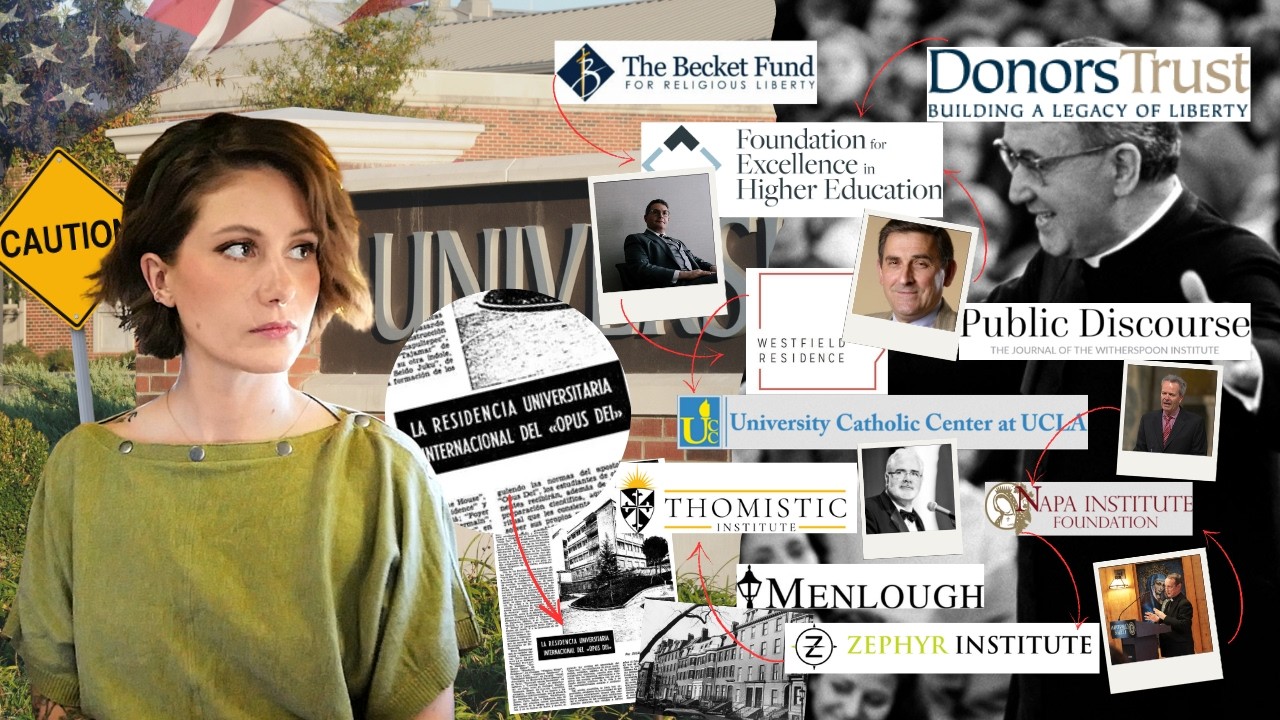
Premiered Jun 20, 2026 UNITED STATES
This particular branch of the rabbit hole goes quite deep and extends across the entire United States. I think I just barely scratched the surface with this. Another heartfelt thank you to Jennifer and Samantha for sharing your experiences with me. If you enjoy my work and have found it educational, entertaining, or transformational and would like to support me monetarily, you can buy me a coffee for $5 (thank you to everyone who has thoughtfully supported my work thus far): https://buymeacoffee.com/thedeepdivep... SOURCE DOCUMENT: https://drive.proton.me/urls/VC3FS0QZ...TRANSCRIPT: https://drive.proton.me/urls/W9SC7B1N...CHAPTERS: - Intr - Disclaimers and advisor
 - How it all bega
 - Samantha's stor
 - Jennifer's stor
 - The devil's in the (financial) detail
 - The Becket Fun
 - University Catholic Cente
 - The Zephyr Institut
 - The Thomistic Institut
 - Closing thought
 - Outro RELEVANT NEXT WATCHES:
- Misinformation, lies, and abuse - is a CULT after your kids?
 • Misinformation, Lies, and Abuse - Is a CUL...
- Opus Dei: the CULT of dark money w/Gareth Gore: [
 • Opus Dei: the CULT of dark money - a conve...](https://www.youtube.com/watch?v=-d7d2hyEWbo)
-Exposing Opus Dei's FASCIST plan w/Shannon vavich:  • EXPOSING Opus Dei's fascist plan for theoc...-The ATTACK on the church-state separation:
 • The ATTACK on the CHURCH-STATE separation ...
---
---
an 3 24
the impeachment trial of Homeland Security Secretary Alejandro Mayorkas is likely to begin in the US Senate this week. It is expected to be quickly tabled or dismissed by Democrats, who hold the majority and have criticized House Republicans for bringing the case to trial despite a lack of "high crimes and misdemeanors" the Constitution requires to necessitate impeachment.
Both Senate Democrats and Republicans have criticized the Mayorkas impeachment as a political stunt. Sen. Kevin Cramer (R-North Dakota) said his Republican counterparts in the House of Representatives were engaging in the "worst, dumbest exercise and use of time" for an impeachment that was "obviously dead on arrival." Sen. Elizabeth Warren (D-Massachusetts) dismissed it as "political theater from a Republican Party that can't do any real legislative work."
And as if to underscore that point, one journalist has exposed the staffers who authored the articles of impeachment as seasoned veterans of far-right, Christian nationalist groups.
READ MORE:'Dumbest exercise': Pro-Trump senator blasts House GOP's impeachment of Mayorkas
In a thread on X (formerly Twitter), Jonathan Larsen — who most recently worked for The Young Turks and MSNBC — tweeted multiple pieces of evidence tying the staffers who steered impeachment efforts to several prominent Christian right groups he described as having a "theocratic" agenda. He noted that the leaders of these groups have "used lies to dispatch political foes," like Mayorkas.
Stephen Siao, who is the staff director of the GOP-controlled House Homeland Security Committee, is also the chief of staff for Rep. Mark Green (R-Tennessee), who chairs the committee. Larsen found that Siao is the former grassroots director of Heritage Action (the political arm of the far-right Heritage Foundation, which is behind the controversial Project 2025 campaign). He has additional experience with Hillsdale College — led by board chairman Pat Sajak of Wheel of Fortune fame — which is one of the leading organizations behind the evangelical right's crusade against LGBTQ+ rights. Siao also began his DC career at the Becket Fund for Religious Liberty, which has played an influential role in numerous Supreme Court decisions benefiting the religious right — like the 2014 Burwell v. Hobby Lobby Stores case in which corporations were given a "religious exemption" for denying employees' contraception care.
Siao is also a member of the Council for National Policy (CNP). As Larsen reported, CNP executive director Bob McEwen is a member of the secretive far-right organization The Family (also known as The Fellowship), which is the primary organizer of the annual National Prayer Breakfast. That organization was notably a prominent backer of Uganda's legislation to implement the death penalty for members of the LGBTQ+ community.
According to Larsen, both Siao and his own deputy recently attended educational sessions hosted by the Faith & Law Project. Larsen tweeted a description of the Faith & Law's 2022 conference, in which the organization sought to help "thought leaders and policymakers" apply a "Biblical worldview" to their "public square vocation." That conference was entitled "Christian Faithfulness in Public Service: Essential characteristics of a Christ-follower on Capitol Hill." Larsen also tweeted a statement from a female staffer on Green's committee, who wrote that she "frequently ask[s]" how her "personal faith should influence" her legislative work, and that the Faith & Law retreat would help her "answer that question."
The ideology of Christian nationalism asserts that the United States was founded as a Christian nation (many of the founding fathers were actually Deists) and that public policy should be crafted for the explicit promotion of Christianity. A 2023 survey by the Public Religion Research Institute and the Brookings Institution found that more than half of Republicans polled said they wanted the US to be an explicitly Christian nation.
After he was officially elected as Speaker of the House, Rep. Mike Johnson (R-Louisiana) invited anyone curious about his politics to "go pick up a Bible." He also said that the separation of church and state was a "misnomer" in a CNBC interview.
READ MORE:Mike Johnson's 'Christian nationalism' is 'a greater threat to America than al-Qaida': strategist
---
https://www.opensecrets.org/news/2019/05/an-influential-dark-money-group-turns-off-the-lights-for-the-last-time/
One of the most influential “dark money” groups you’ve probably never heard of has officially shut its doors.
The Wellspring Committee’s existence has come to an apparent end, according to state incorporation records showing the dark money group’s termination. Wellspring was just shy of eleven years old.
The group died as it lived, surreptitiously. Officially shutting down in December 2018, its fate was not discovered until May 19, 2019.
The name Wellspring Committee may already be forgotten — or entirely unknown — to most, but its life’s efforts were certainly not in vain.
Many of the facets of modern-day society that we now take for granted, such as the multi-million dollar price tag on each Supreme Court confirmation fight, can be traced back to Wellspring’s efforts. What Wellspring lacked in name recognition, it made up in largesse. Operating behind the scenes, Wellspring leaves behind countless dark money groups it helped sire and judges now on the bench thanks in part to its anonymous financiers’ generosity.
Wellspring is survived by Judicial Crisis Network (JCN), another 501(c)(4) nonprofit that has established itself the preeminent vehicle for deep-pocketed donors to funnel millions of dollars behind or against judicial nominees in Supreme Court confirmation fights, largely bankrolled by Wellspring.
Since Wellspring’s birth from a short-lived union of the Koch network and GOP political operatives leading up to the 2008 election, it has accounted for more than 90 percent of JCN’s total funding.
Wellspring’s delivery into the world came at the hands of Republican operative Ann Corkery while her husband Neil took the reigns of the more publicly visible JCN and an allied 501(c)(3) “charitable” nonprofit, Judicial Education Project. Like JCN, it’s sister “charity” has received considerable funding from Wellspring and other closely-tied dark money groups like DonorsTrust, a pass-through vessel managing the money flow from wealthy donors to conservative and libertarian groups — including other groups in Corkery’s network — while allowing the donors to remain anonymous that has earned it the reputation of being a Koch-linked “dark money ATM.”
Wearing multiple hats for various groups in the network, Neil Corkery worked impossibly hard. At one point tax returns showed him working a combined 100 hours a week between his various nonprofits.
JCN’s existence has not always hinged entirely on Wellspring. For its first three years in operation under the Judicial Confirmation Network moniker before rebranding following Obama’s 2008 election, JCN received initial support from California “foreclosure king” Robin Arkley II and raked in seed money from the American Center for Law and Justice under Jay Sekulow, President Donald Trump’s personal attorney and a member of the Federalist Society, the influential conservative and libertarian lawyers network that does disclose its donors in annual reports.
Since then, the organizations had been inseparable. Sitting at the crux a powerful network of dark money groups, Wellspring and JCN have existed in this symbiotic relationship for over a decade, with JCN operating as the operation’s public-facing mouthpiece and Wellspring as its money bag.
After all that, years of investigations and speculation about the identity of donors bankrolling the operation have yet to produce a definitive answer about the ultimate source of the operations funds.
Tax returns have revealed the groups behind a few hundred thousand in grants from other dark money groups like American Democracy Alliance and Rosebush. But that accounts for a drop in the bucket — less than a percent — of Wellspring’s overall earnings and, even then, the ultimate financier behind those groups remains a secret.
A central player in orchestrating Wellspring’s dark money network has been Leonard Leo, Trump’s judicial adviser and a longtime executive at the Federalist Society.
While the identity of their donors remains a secret, dark money groups like JCN and Wellspring are required to disclose the amount received from different donors. In their most recent tax returns, JCN received most of its funds from two multi-million dollar donors, with roughly 90 percent of that accounted for by Wellspring and the remainder for a mystery donor. Most of Wellspring’s funds came from three multi-million dollar secret donors, a shift from prior years in which the biggest amount the group received from a single mystery donor increased with each passing year. Wellspring’s largest donor in their most recent tax return accounted for $8.9 million, another gave $5.5 million and a third provided $2 million. All of their identities remain hidden.
Financial information for Wellspring’s final year of operation is not required to be reported until months following the end of their final fiscal year, long after the group’s official termination.
While much of its money has ended up in the judicial advocacy space, Wellspring helped seed a number of other politically active nonprofits that took on a life other their own and went on to have other significant impacts. A few that gained particular notoriety in recent years include American Job Security, the pro-Trump 45Committee and the American Dream Initiative, which was later rebranded as the pro-Trump Great America Alliance.
[https://cdn1.opensecrets.org/news/wp-content/uploads/2019/05/23113231/WellspringsWeb1-1024x670.png

map graf]
Conservative activists have continued honoring the memory of the recently deceased group by doing what it loved best: creating opaque vehicles to secretly funnel millions of dollars into groups aiming to reshape the legal system.
At least one new group has already risen from Wellspring’s ashes: the Article III Project (A3P).
Formed to “fight to confirm President Trump’s judicial nominees” and defend sitting judges, A3P was launched as a 501(c)(4) nonprofit May 18, indicating it will not disclose its donors. Any money funneled to A3P through another nonprofit organization is not required to be disclosed until tax returns are due months after the end of the fiscal year when that payment took place, and other funding from individuals or opaque entities like limited-liability companies may remain hidden from the public.
A3P was sculpted in the mold of its predecessors and plans to work closely with JCN. “Excited to work hand-in-glove with @JCNSeverino,my other longtime friends at JCN, and many others on the outside who understand the critical importance of the judicial fight,” A3P president Mike Davis tweeted.
Davis was chief counsel for Senate Judiciary Committee during the most recent Supreme Court confirmation battles and Justice Neil Gorsuch’s former law clerk. His talks at Federalist Society events have earned the distinction of being included in the congressional record at the request of his former employer, Sen. Chuck Grassley (R-Iowa). During Davis’ time at the Senate, he played a pivotal role in securing votes for Justices Neil Gorsuch and Brett Kavanaugh.
Dubbed the Kavanaugh confirmation fight’s “warrior” and the “general” of the Gorsuch confirmation battle, Davis has differentiated A3P from other groups with a more militant approach, promising to “punch back” with a “brass knuckles approach.”
According to Davis, these punches are warranted. A3P was launched partly in response to Demand Justice, a liberal dark money group launched in 2018 as the left’s counterweight to Wellspring and JCN. Demand Justice’s arrival on the scene brought with it a significant shift to the judicial money race, which has traditionally been one-sided with the vast majority of funds from the right, most of which can be traced to JCN and Wellspring.
Indeed, Wellspring’s legacy lives on not only in the conservative dark money infrastructure it helped build but also in the inspiration it provided to their equivalent on the left.
Wellspring may be gone, but its indelible impact on the American legal landscape will long be remembered.
In addition to its enduring judicial legacy through attempts to reshape the legal system, Wellspring and the operatives behind it have reshaped the way the game is played. By helping shepherd in their chosen judges onto the Supreme court and across the federal judiciary, Wellspring and its operatives ushered in a new era of increasingly expensive judicial battles largely fueled by deep-pocketed donors whose identities remain secret.
As groups on the left put the same clandestine tactics and big money traditionally characteristic of more conservative judicial advocacy groups into play, those battles across the country may have given way to a full-blown war for the future of the judiciary.
But conservative judicial activists are not just building a covert network anymore, they’re building an army.
==
https://www.thenation.com/article/the-anti-catholic-playbook/ no lnx
CAMPAIGNS AND ELECTIONS
CORRUPTIONPODCASTS OPP-ART: DISPATCHES FROM THE RESISTANCE
The Nation
SUPREME COURT The ‘Anti-Catholic’ Playbook
SUPREME COURTRELIGIONBRETT KAVANAUGH
The ‘Anti-Catholic’ Playbook
Does Brett Kavanaugh think abortion should be illegal? A secret network of right-wing activists has spent millions attacking such questions as anti-religious bigotry.
By Sarah PosnerTwitter SEPTEMBER 5, 2018
Confirmation hearings for President Donald Trump’s Supreme Court pick, Brett Kavanaugh, began yesterday with a sustained uproar from Democrats on the Senate Judiciary Committee, who protested Republican efforts to barrel through the process. From the opening moments, Democrats prevailed on committee chair Charles Grassley to postpone the hearings—or entertain their motion to adjourn—because so many of Kavanaugh’s records as associate White House counsel, and all of his records as staff secretary to President George W. Bush, have yet to be released.
This article was reported in partnership with The Investigative Fund at The Nation Institute, where Sarah Posner is a reporting fellow. Additional research by Eli Clifton, Richard Salame and Maia Hibbett.
Committee Republicans, undaunted by this breach of transparency, turned to laying the groundwork for the questioning of Kavanaugh, set to begin this morning, by sowing fear in the Republican base about what Democrats would do if he were not confirmed and they gained more control of the confirmation process after the midterms. Senator Ted Cruz reminded the public of litigation brought by religious groups, including Catholic nuns, against the Obama administration, claiming that employer-provided contraception coverage under the Affordable Care Act violated their religious freedom. Democrats, Cruz charged, “want justices who will further that assault on religious liberty.”
The hearings were fast-tracked by Senate majority leader Mitch McConnell, who is pressing the Senate to confirm Kavanaugh by October 1. The rushed timeline is just the latest maneuver in an aggressive Republican campaign to make sweeping, long-lasting changes to the federal judiciary by packing it with judges hostile to civil rights, reproductive freedom, LGBTQ equality, and church-state separation—while at the same time taking extreme measures to block Democratic nominees. If he is confirmed, the 53-year-old Kavanaugh could tip the balance of the high court for decades, potentially overturning the right to an abortion and dramatically expanding religious exemptions to civil-rights laws and reproductive-health services. He could play a pivotal role in matters that could decide the future of the Trump presidency, from the scope of executive power, which Kavanaugh has argued is vast, to whether or not a sitting president may be subpoenaed or charged with a crime. On a wide range of issues with a profound impact on the daily lives of Americans, a Justice Kavanaugh could prove the decisive vote that cements conservative gains, while wiping out past civil-rights advances.
In the coming days, the 21 senators on the judiciary committee will have an opportunity to ask Kavanaugh tough questions about his legal philosophy on abortion, LGBTQ rights, executive power, and, as the point person on government faith-based initiatives while in the White House counsel’s office of George W. Bush, the proper role of government in the face of faith-based discrimination. Civil-rights advocates say these are precisely the questions that must be posed, given the stakes in choosing a successor to Anthony Kennedy, long the Court’s crucial swing vote on many of these issues. But if a tight-knit network of conservative activists has its way, these senators will instead pull their punches, fearing ferocious, well-funded attacks that deliberately misrepresent such scrutiny as signs of anti-religious bias.
Conservatives, including Kavanaugh himself, have long awaited and carefully prepared for this moment. In the wake of the crushing defeat of conservative legal hero Robert Bork, nominated to the Supreme Court in 1987, and deep disappointment that subsequent, more-moderate Republican appointees Kennedy and David Souter failed to adjudicate as conservative ideologues, right-wing political operatives began building a new strategy for the courts. The Federalist Society continued to build a pipeline of conservative nominees, but strategists bruised from the Bork fight knew they also would need a hard-hitting public-relations campaign to press for their confirmation. They would have to successfully portray rigid ideologues as mainstream, while intimidating lawmakers from grilling them on their more extreme views.
A key tactic would be to shut down questioning on how the nominee would approach cases on abortion or LGBTQ rights by accusing Democratic senators probing these issues of being anti-religious—even anti-Catholic—bigots.
That campaign, honed over more than a decade, has been fueled by tens of millions of dollars in dark-money donations, designed by conservative political consultants and PR firms, disseminated byadvocacy groups such as the Catholic League and the Judicial Crisis Network, and validated by GOP senators such as Orrin Hatch,who in past confirmation battles has accused “the left” of “trying to enforce an anti-religious litmus test.” The network also includes Federalist Society executive Leonard Leo, who famously delivered a list of judicial nominees to then-candidate Trump, and has continued to closely advise him on his picks as president.
In his East Room speech accepting Trump’s nomination in July, Kavanaugh spoke often about his faith. He recalled his Jesuit education at Georgetown Preparatory School, in the suburbs of Washington, DC, which taught him the motto “men for others,” a creed Kavanaugh said had inspired a lifelong dedication to public service. He highlighted his standing in “the vibrant Catholic community” in Washington, noting that “the members of that community disagree about many things, but we are united by a commitment to serve.” He hit the same notes yesterday in his opening remarks, referencing his Jesuit education and his volunteer work with Catholic Charities.
In emphasizing his Catholic faith, Kavanaugh had perfectly teed up conservative activists to launch a preemptive attack on anyone who might question his views on abortion, LGBTQ issues, and religious liberty.Within hours of his nomination, one conservative Catholic advocacy organization, Catholic Vote, which claims nearly half a million lay Catholics as members, declared Catholic voters to be “thrilled” with the pick, but warned that they would be vigilant for “any whiff of anti-Catholic bigotry” in the confirmation process. “The experience of past judicial confirmation battles suggest attacks on a nominee’s personal religious views are inevitable,” the group’s president, Brian Burch, said. Op-eds warned of “another explosion of public anti-Catholicism” and predicted the “ugly insinuation” of “the same ‘dual loyalties’ chestnut that bigots have smeared Catholic candidates for public office for going on 200 years in this country.”
Kavanaugh’s nomination was not even a day old, yet Burch was already issuing a warning: “CatholicVote.org is prepared to defend Judge Kavanaugh from any such personal smear campaign by anti-Catholic zealots. We intend to hold every Senator, of both parties, accountable. Any whiff of anti-Catholic bigotry must be met with universal condemnation by every senator. This is especially true for those senators seeking re-election in states won by President Trump.” These senators include North Dakota’s Heidi Heitkamp, Indiana’s Joe Donnelly, and West Virginia’s Joe Manchin—all Democrats in close races. All three are Catholic, and all three have been targeted with ads over the Kavanaugh nomination by Catholic Vote and the Judicial Crisis Network.
It’s unlikely that anyone on the Senate Judiciary Committee missed Burch’s meaning. The network had bludgeoned Dianne Feinstein of California, the committee’s ranking Democrat, for a year over a single sentence she uttered during confirmation hearings last September for Amy Coney Barrett,a Notre Dame Law School professor and conservative Catholic whom Trump had nominated to serve on the US Court of Appeals for the Seventh Circuit. After Barrett insisted that as a judge she would follow Supreme Court precedent, Feinstein asked how Barrett would resolve conflicts between her religious beliefs and the law as a judge. “Dogma and law are two different things,” Feinstein told Barrett. “I think whatever a religion is, it has its own dogma. The law is totally different. And I think in your case, professor, when you read your speeches, the conclusion one draws is that the dogma lives loudly within you. And that’s of concern when you come to big issues that large numbers of people have fought for for years in this country.”
The clip caused an immediate uproar among conservatives. Catholic Vote published a piece on its website, “Dear Anti-Catholic Left: Bigotry Lives Loudly Within You.” The Judicial Crisis Network, the dark-money group at the center of the conservative march to stack the courts, leapt to Barrett’s defense with an inflammatory, six-figure ad campaign, titled “Catholics Need Not Apply.” It accused Feinstein and fellow Judiciary Committee Democrat Dick Durbin of Illinois, himself a Catholic, of having “mocked” Barrett’s faith. “Their hypocrisy knows no limits,” the ad charged. “They attack a woman for her Catholic faith, make it a religious test, while they are afraid to call radical Islam, radical Islam.”
The Senate confirmed Barrett, who became an instant celebrity to Trump’s Christian-right base, a standing that soon landed her on Trump’s short list for the Supreme Court. Meanwhile a variation on Feinstein’s phrase—“the dogma lives loudly within me”—became a right-wing meme, appearing on T-shirts and coffee mugs sold on conservative websites, and her quote continues to provide fodder for right-wing pundits.
But while conservative Catholic activists have succeeded in claiming loudly that they have been oppressed, many liberal Catholic leaders argue that their views don’t represent all Catholics. “The religious right, including ultraconservative Catholic special-interest groups, are the squeaky wheel in American politics,” said Jon O’Brien, President of Catholics for Choice. “They get heard and privileged above the majority of Americans of faith or no faith. We are incredibly concerned that Kavanaugh and the special interests he is backed by will radically redefine religious freedom in America to mean religious privilege for a few at the expense of everyone else, including women and LGBT individuals.”
Indeed, yesterday, as Kavanaugh’s hearings got underway, 1,550 Catholic nuns, priests, deacons, and other leaders wrote to the Senate raising concerns about Kavanaugh’s views on health care, immigration, workers’ rights, voting rights, and the death penalty. “As Catholics,” they wrote, “we believe that any government official—including a Supreme Court Justice—must be concerned with the needs of people who are marginalized, not just the rich and powerful or a member of one’s own political party.”
Kavanaugh, it turns out, is deeply familiar with this playbook built around allegations of bias, as it dates back to his days as a top adviser in the George W. Bush White House during the religion wars over Bush’s judicial nominees, some of whom had out-of-the-mainstream views on abortion, gender, and LGBTQ rights.
From 2001 through the middle of 2003, Kavanaugh served as associate White House counsel, helping Bush shepherd his judicial nominations through the Senate. In mid-2003, Bush named Kavanaugh his special adviser and staff secretary; shortly afterward, he nominated Kavanaugh to be a judge on the powerful US Court of Appeals for the District of Columbia Circuit. Throughout this period, Bush’s judicial nominees—many of whom, like Trump’s nominees, had been cultivated and vetted by the Federalist Society—provoked pitched confrontations in a narrowly divided Senate.
In 2003, while Kavanaugh was still in the White House counsel’s office, conservatives accused Democrats of anti-Catholic bias during confirmation hearings for James Leon Holmes, whom Bush had nominated to be a federal trial judge in Arkansas. Holmes had a history of misogynist writing in which he had argued, with his wife, that “the woman is to place herself under the authority of the man” and insisted that an abortion ban would not violate the rights of women who had been sexually assaulted. “Concern for rape victims is a red herring,” he wrote in a letter to a local newspaper, “because conceptions from rape occur with approximately the same frequency as snowfall in Miami.”
The “controversy around Leon Holmes,” according to an account by conservative Catholic political operative Deal Hudson, provided a “perfect opening” for Republicans to accuse Democrats of being anti-Catholic. According to documents related to Kavanaugh’s White House tenure released by the George W. Bush Presidential Library, Manuel Miranda, at the time counsel to Senate majority leader Bill Frist, circulated an e-mail blast to White House staff, including Kavanaugh, from the arch-conservative Catholic League. “catholicism on trial: religious test applied to judicial nominee,” it read, going on to describe Holmes as “a man of deep religious conviction” and accuse Democrats of having “unfairly tagged him a misogynist, misunderstanding what the pope, the U.S. bishops and Holmes have said regarding this matter.”
“It does not get better than this,” Miranda enthused in his cover note. Miranda later left his post over a scandal in which he was implicated in secretly accessing and leaking Democratic computer files about judicial nominations. Holmes was confirmed.
The religion wars only intensified when Bush nominated William Pryor to serve on the US Court of Appeals for the 11th Circuit.Because he was up for an appellate seat, Pryor generated more adamant Democratic opposition than had Holmes. Senators probed his hard-line beliefs on abortion, church-state separation, and LGBTQ rights, including questioning him about his rescheduling of a family vacation to Disney World because it coincided with “Gay Day,”and an amicus brief he authored as Alabama attorney general in the landmark Supreme Court case Lawrence v. Texas, in which he argued that gay sex should remain criminalized because the Court had “never recognized a fundamental right to engage in sexual activity outside of monogamous heterosexual marriage, let alone to engage in homosexual sodomy.” Pryor supporters, again, portrayed legitimate questions about a nominee’s position on abortion—a constitutional right that enjoys majority support among not only Americans as a whole but also among Catholics—as a de facto litmus test against Catholics.
“Their intention is smearing senators as anti-religious for asking questions,” said Peter Montgomery, senior fellow at People for the American Way, which has been in the thick of judicial nominations for decades. “In doing that they’re hoping to intimidate the senator somehow. They raise these questions when senators are asking the nominees about important issues like Roe v. Wade.”
Throughout this entire period, Kavanaugh was specifically enlisted by the Bush White House to engage the Catholic community, including about judges. He was asked, along with Karl Rove, to address supporters of the Catholic magazine Crisis. He also spoke about judicial nominations to a Pro-Life Pilgrimage from Legatus, a conservative Catholic network created by Domino’s Pizza founder Thomas Monaghan, for Catholic business leaders who have “committed themselves to study, live and spread the Catholic faith in their business and personal lives.” And he volunteered to be the office’s specialist on faith-based initiatives, “given my general interest and my previous religious liberty work in my pre-WH days.” Kavanaugh had served on the Religious Liberty Practice Group at the Federalist Society; in private practice he authored an amicus brief in a school-prayer case, arguing that student-delivered prayers at football games were constitutional (the Supreme Court held that they were not).
It was during the Pryor nomination fight that conservative advocacy groups first aggressively advanced the claim that Catholics were being excluded from the bench by the left. The Committee for Justice, led by former George H.W. Bush White House Counsel C. Boyden Gray, and the Ave Maria List, a political-action committee funded by Monaghan, ran newspaper ads in support of Pryor that targeted moderate and swing-state Democratic senators. The ads featured a picture of a closed courtroom door with a sign over it reading, “Catholics Need Not Apply”—the first of the phrase’s many appearances in confirmation campaigns.
Senate Republicans helped press the charge that Democrats were anti-religion. Hatch, then the chair of the Senate Judiciary Committee, told reporters, “It appears that nominees who openly adhere to Catholic and Baptist doctrines, as a matter of personal faith, are unqualified for the federal bench in the eyes of the liberal Washington interest groups. Period.”
But the Committee for Justice ads drew condemnation from other quarters, including from the Anti-Defamation League, which protested that they were “misleading and inflammatory.” A Washington Post editorial described them as “beyond the pale.” Senate Democrats mounted a filibuster, consigning Pryor to a recess appointment, but he was eventually confirmed in 2005 in a bipartisan deal.
The political battle, however, turned out to be far more damaging to the senators who had opposed Pryor’s confirmation.As the 2004 election season got underway, it became clear that an attack machine sounding the alarm about anti-Catholic bias was perfectly comfortable with harsh assaults on Catholic Democrats. Then–Senate minority leader Tom Daschle of South Dakota and Patrick Leahy of Vermont, both Catholics themselves, had denounced the Committee for Justice ads on the Senate floor. Daschle, declaring himself “proud of my Catholic faith,” said, “I know about the bias against immigrants and against Catholics. That was real discrimination. What is being spread this week is a falsehood uttered for partisan political purposes.”
Despite his public declaration of pride in his Catholic faith, Daschle would become a target of conservatives—including conservative Catholics—who sought to oust him from the Senate in order to pave a clear path for confirmation of Bush’s judicial picks. The 2004 elections, with John Kerry, another liberal Catholic at the top of the presidential ticket, featured brutal attacks on both men’s faith.
The Republican National Committee attacked Kerry’s Catholicism, launching a website, KerryWrongforCatholics.com, critical of his positions on abortion, same-sex marriage, and judicial nominations, noting that as senator he had pledged to “filibuster any Supreme Court nominee who would turn back the clock on the right to choose, on civil rights and individual liberties, on the laws protecting workers and the environment.” Kerry was also being Swift Boated, a campaign conceived in part by a PR firm, Creative Response Concepts, that would go on to become a player in the Catholic judicial-nominations network. The Committee for Justice launched a website and ad campaign called “Kerry’s Scary” to attack his views on abortion, same-sex marriage and the pope, as well as his judicial philosophy, calling the latter issue urgent because “Court watchers believe as many as four Justices might retire in the next four years.”
Conservatives also raised questions about Daschle’s Catholicism during his 2004 reelection bid, attacking him in ads over his stance on the judiciary, abortion, and LGBTQ rights. The stakes were high for those who dreamed of a conservative takeover of the courts: If Democrats reversed Republicans’ razor-thin margin in the Senate, they would control the chamber, giving them the ability to block Bush’s nominees, including for anticipated Supreme Court vacancies, or push through those nominated by a potential president Kerry.
Even before the campaign got underway, conservative magazines spread stories that Daschle’s bishop was denying him communion because he was divorced. Then the ads started. The Ave Maria List PAC spent $100,000 running ads accusing Daschle of misinforming South Dakota voters that he was against abortion. One ad said Daschle had once called abortion “an abhorrent practice,” but had later supported pro-choice groups as senator. “Tom Daschle tries to claim he’s pro-life even though his voting record and actions in Washington prove he’s not,” the ad charged. “Tom Daschle has changed and it’s time for South Dakota voters to make a change of their own.”
Another anti-Daschle ad campaign, titled “You’re Fired”—modeled on Trump’s reality-television show The Apprentice—was produced by the You’re Fired PAC and funded by Robin P.Arkley II, a California real-estate magnate. Arkley donated over half a million dollars to the effort.
“The people of South Dakota want to protect traditional marriage,” an affiliated website declared. “You’re Fired Inc. believes the Federal Marriage Amendment is the only way to prevent liberal, activist judges from imposing same sex marriage as they have in Massachusetts—on the rest of American society.” The site depicted a boardroom meeting, during which an executive concluded, “We have one too many Democrats around here and that’s not a good thing,” punctuating his statement with the trademark “You’re fired.” Another Arkley ad charged that Daschle “refused to protect marriage” and “would let liberal, activist judges redefine it.”
Daschle lost his reelection bid, the Republicans retained control of the Senate, and Bush beat Kerry, winning reelection to a second term during which he put John Roberts and Samuel Alito on the Supreme Court.
With the White House and Senate in Republican hands, and with the GOP riding high on passing same-sex marriage bans at the ballot box in 11 states, conservative activists set to work on getting Bush’s conservative judicial nominees confirmed. After the 2004 election, one of Arkley’s top aides, Ann Corkery, who had directed philanthropy at his loan-servicing firm, founded the Judicial Confirmation Network. The group blandly described itself as “an organization of citizens joined together to support the confirmation of highly qualified individuals to the Supreme Court of the United States.” Yet Corkery and her husband Neil would soon become pivotal figures in a broadening coalition of conservatives as they prepared for the confirmation battles ahead.
That coalition, according to a 2006 account in Crisis magazine, was directed by a “war room” of activists “acquainted with each other through Catholic and conservative public causes.” Among them were major players from the Bush reelection campaign, including Gary Marx, who had led the campaign’s outreach to social conservatives, and Greg Mueller, described by Crisis as “the group’s public-relations maestro,” whose public relations firm, Creative Response Concepts, had advised Swift Boat Veterans for Truth. Today, CRC represents the Judicial Crisis Network as well as the Catholic Association, another advocacy group the Corkerys helped launch in 2007, to influence policy-makers on issues concerning “the family, Catholic institutions, religious liberty, and cultural values.” CRC did not respond to repeated requests to interview representatives of JCN and the Catholic Association.
According to Crisis, “Mueller, Leo, and their colleagues would provide the main talking points, media training, rapid response to any attacks on the nominees, assistance with ad buys, and ongoing legal analysis.”
“Our most important goals were to support the idea of judicial restraint, to define the character of the nominee within the first 24 hours, and to continue to provide support as the process wended its way,” Leo told Crisis, reflecting on the war room’s role in the successful confirmation of both Roberts and Alito. “To accomplish this, we engaged in a variety of approaches—an aggressive paid media effort, rapid response activity, and positive messages.”
Mueller described the war room in far more political terms. “We tried to take the approach of corporate crisis management, along with the daily political communications that go on in a political campaign.” It fell to Marx, fresh off the Bush-Cheney campaign and newly appointed as JCN’s first executive director, as Crisis wrote, to develop “a state-based strategy that would target the political pressure points—an organization that would make Democratic senators in Republican states feel the political heat.”
During Bush’s second term—as Kavanaugh’s nomination to the DC Circuit was held up over a period of years, with Democrats arguing that his role in drafting the Starr Report and in the investigation of the suicide of Clinton aide Vince Foster had marked him as too partisan to warrant his confirmation as a judge—the war room kicked in. JCN openly threatened Democratic senators with the Daschle treatment. If lawmakers filibuster Kavanaugh, JCN warned in 2006, a midterm-election year, “Americans in key states will react just as they did when former Senate Democrat leader Tom Daschle did the same thing. Americans care about judges and the role of the courts in our society.” The Senate confirmed Kavanaugh two weeks later, by a vote of 57-36.
Today, thepresident of JCN is not a public figure like Marx but a player so behind-the-scenes as to barely leave a public trace. But Daniel Casey, a public-relations, political, and “crisis” consultant, is a veteran of the Bork confirmation battle—a fight that conservatives painfully lost, triggering the scorched-earth organizing JCN spearheads today.
Then the executive director of the American Conservative Union, Casey was “a crucial player” in the Bork fight, said Patrick McGuigan, who worked then for the Free Congress Foundation, a political advocacy group founded by religious-right architect Paul Weyrich that helped push the GOP to the right. The dust jacket of Ninth Justice, a book McGuigan wrote with Weyrich’s daughter Dawn, detailing each move and countermove in the Bork fight, describes McGuigan and Casey as “intensely Republican, devout Catholics, ardent admirers of the nominee—who understood from the first moment of the battle that they were involved in the most significant political confrontation of their lives.”
McGuigan, who now works as a journalist in Oklahoma, described his relationship with Casey as “co-captains” in the Bork battle, in which conservatives were heavily outspent and outmaneuvered by the liberal opposition. He said that at the time, there was “insufficient organization of ideas and messaging on the conservative side of things compared to the left side.” Casey’s forte, said McGuigan, was “neighborhood by neighborhood, precinct by precinct, household by household organization patterned after the labor unions, but on the conservative end of the spectrum instead. I think that’s what Dan was good at.” (Casey declined to be interviewed for this article, referring interview requests to Peter Robbio at CRC, who did not respond.) In the years after the failure of the Bork nomination, conservatives saw the appointment of Kennedy, and then of Bill Clinton’s nominees Ruth Bader Ginsburg and Stephen Breyer. Although Kennedy was nominated by a Republican, he proved a bitter disappointment to conservatives, particularly for his majority opinion in Lawrence in 2003, ruling anti-sodomy laws unconstitutional—a ruling that led, 12 years later, to the legalization of same-sex marriage nationwide.
During the Bork hearings, Casey argued that “the American people should be outraged that the liberals are spending millions of dollars to try to buy a Supreme Court seat.” Three decades later, Casey is the president of the moneyed advocacy organizations JCN and the related Judicial Education Project, as well as of Catholic Voices. He is also treasurer and director of the Catholic Association Foundation and the Catholic Association. Together, they are part of a multimillion-dollar dark-money campaign backing a relentless drive by Trump and his Republican allies in the Senate to reshape the federal judiciary for generations, from federal trial courts all the way to the Supreme Court, and to shape public opinion about Catholicism and religious liberty.
JCN does not disclose the identity of its donors. But the group has said it anticipates spending at least $10 million advocating for Kavanaugh’s nomination. While many of the early ads focused on promoting Kavanaugh as a mainstream, impartial jurist admired by former clerks of all political stripes, the most recent ads touted him a “grand slam for conservatives” and warned Democrats against succumbing to “pressure from East Coast liberals.”
After 2008, the Judicial Confirmation Network changed tacks, from battering the opponents of Bush’s court nominees to blocking President Barack Obama’s. JCN, now renamed theJudicial Crisis Network, was the first conservative organization to blast Obama’s selection of Sonia Sotomayor—a Catholic—as “a liberal judicial activist of the first order who thinks her own personal political agenda is more important that the law as written.” Although JCN had repeatedly claimed that liberal Democrats had unfairly attacked conservative Catholics, it again did not hesitate to attack a liberal Catholic.
John Gehring, Catholic program director at Faith in Public Life, a liberal group that advocates for progressive expressions of faith in politics, said that for conservative Catholics, Obama’s presidency “was very formative to the idea that Catholic identity was under siege by an administration that had elitist contempt for what the church believes.” The University of Notre Dame’s invitation to the pro-choice Obama to deliver a commencement speech in 2009, said Gehring, triggered “a huge divide” and “an earthquake in Catholic political conversation.” The Obama administration’s policies, particularly the contraception benefit written into the Affordable Care Act, which became the core target of conservatives’ legal strategy on religious freedom, further inflamed the world of conservative Catholicism.
But Gehring argues that this “well-funded, deep network” has “had disproportionate influence on what Catholic identity is in the public square and in politics.” He said the network has helped to create the distorted impression that Catholic priorities are limited to opposing abortion and LGBTQ rights, when traditional Catholic social-justice teaching includes a range of issues such as immigration, poverty, and the environment. Gehring pointed out, as an example, that conservative Catholics ignore the 1891 papal encyclical, “Rights and Duties of Capital and Labor,” written in support of workers rights, including the right to unionize.
What’s more, the conservative network’s position on abortion doesn’t represent the majority of Catholics. According to the Pew Research Center, 53 percent of Catholics say abortion should be legal in all or most cases. O’Brien, of Catholics for Choice, also points out that “Catholic women have abortions at the same rate as women of other faiths or no faith.” Kavanaugh’s decisions as an appellate judge on reproductive rights and the role of religion in politics, O’Brien added, “underscore just how out of touch he is with the majority of Catholics who are pro-choice and who support a healthy separation between church and state.”
During the Obama era, the dark money ramped up. The Wellspring Committee, a nonprofit formed in 2008 where both Corkerys have served as president, became the chief funder of JCN, bankrolling its campaigns to block Merrick Garland’s confirmation, and, under Trump, to support the nomination of Neil Gorsuch and other nominees to federal courts. According to an investigation last year by the Center for Responsive Politics, “most of Wellspring’s funds, in turn, came from a single mysterious donor who gave the organization almost $28.5 million—nearly 90 percent of its $32.2 million in revenues” in 2016. According to this report, Wellspring gave more than $23 million to JCN in 2016, quadrupling its 2015 donation to the group of $5.8 million.
Wellspringalso donated money to the Catholic Association, another nonprofit the Corkerys helped found, this one to advocate on behalf of “religious liberty,” and to the Federalist Society. In yet another sign of the intimacy of this network, the association paid Leo, known as Trump’s Supreme Court whisperer, $120,000 for “management consulting.” (Leo also earned $435,000 from the Federalist Society that year, according to its tax return.) Neither Leo nor the Corkerys responded to requests for comment.
Another mysterious Corkery-linked company, BH Group LLC, created in 2016, donated $1 million to Trump’s inaugural committee. Not much is known about what BH Group does, or who its principals are, but in 2016, the Corkerys’ Wellspring Committee paid BH Group $750,000 for “public relations,” according to its tax return, and JCN paid the firm $947,000 for “consulting services.” And Leo later identified BH Group as his employer in an FEC filing.
In early May 2017, about a month after Gorsuch was confirmed to the Supreme Court, Leo was awarded the prestigious Canterbury Medal from the Becket Fundfor Religious Liberty, billed by the organization as “religious liberty’s highest honor.” A major Christian-right legal firm, the Becket Fund is best known for its victory in 2014’s landmark Hobby Lobby case, in which the Supreme Court ruled that the Affordable Care Act’s requirement of contraceptive coverage violated the company’s religious freedom. In his acceptance speech at a gala held at The Pierre, a New York luxury hotel overlooking Central Park, Leo, in white tie, could barely conceal his elation that Trump had beaten the odds to win the White House. Looking back on the campaign, Leo recalled the “fear that permeated every day in that countdown to November 8” and rejoiced at the “amazing turn of events, thanks to our 45th president.”
With Trump as president, Leo is, for all practical purposes, on the inside, as a handsomely compensated guide to judicial nominees who will satisfy religious conservatives. JCN runs the outside game,spending its mounds of dark money to promote the president’s—or rather, Leo’s—judicial nominees.
But even as the Trump administration was already well on its way to stacking the judiciary, including the Supreme Court, with judges inclined to expand the reach of Hobby Lobby, Leo had not quite let go of the urgency of the Obama years—or what he’d seen as the threat of a potential Hillary Clinton presidency suppressing religious freedom. “As government policy becomes more grudging toward religious freedom, that attitude spreads in the broader culture. A hostile stance in Washington creates space for groups with kindred ideological designs,” Leo said, going on to warn of even more dire consequences. “A government that suffocates something so elemental as freedom of religion is not likely to be respectful of any other right.”
At one point, he released the tension with a joke at Clinton’s expense. “Of course everyone thought they knew how the election was going to go,” Leo said. “The Democratic nominee looked so confident, so relaxed, so content. With just days remaining, what could possibly go wrong?” And then, “Well, not everyone had access to Rebekah Mercer’s crystal ball.”
At the time Leo spoke, Mercer’s family’s data-analytics firm, Cambridge Analytica, was not yet under federal investigation for harvesting private Facebook data and potentially violating US election laws. But even so, it was striking that he referenced the Mercer family—whose political giving is led by Rebekah and her father Robert, the reclusive, Trump-supporting, Republican financier—at a celebration of religious freedom, given that one of the family’s pet projects, Breitbart News, has long been a hotbed of Islamophobia and anti-Semitism. It turns out that Mercer had also long been a generous funder of an array of organizations in Leo’s orbit—the conservative legal and Christian organizations that claim to represent ordinary citizens fed up with Democrat-appointed “judicial activists” and Democratic “gridlock” in holding up Republican nominees.
Charity filings show that between 2013 and 2016, the Mercer Family Foundation gave a million dollars to the Becket Fund, on whose board Leo has served since 2014. Between 2013 and 2015, the foundation donated nearly $6 million to the Federalist Society. In fact, Rebekah Mercer’s ties with Leo go even deeper.
In 2014, Leo joined the board of a new group called Reclaim New York, led by Mercer and Steve Bannon, then ensconced at Breitbart. The group claims to provide citizen trainings to “empower citizens to engage their state and local government,” but critics call it an astroturf organization dedicated instead to sowing distrust in state and local government and laying the groundwork for far-right Republican candidates to win elections. In 2015, Reclaim New York shared office space with Cambridge Analytica in midtown Manhattan and paid the firm for data-analytic services. (Reclaim New York did not respond to a request for comment about Leo’s role.) In 2016, Leo, along with Mercer and Kellyanne Conway, now a top adviser to President Trump, incorporated a related lobbying organization, the Reclaim New York Initiative.
A core element of Leo’s strategy, throughout the Bush and Obama years, was to portray religious freedom, a treasured American virtue, as under siege by supposed government overreach and disdainful, elite liberal culture. In another May 2017 speech, this one before the ActonInstitute, a conservative think tank, Leo placed the blame on the left for making confirmation battles “so intense.” Liberals, he said, want to invest the Supreme Court with “something close to absolute power,” including the“creation of rights found nowhere in the text or structure of the Constitution,” citing Griswold v. Connecticut, from 1965, which struck down laws criminalizing the sale of contraception; Roe v. Wade, from 1973, which legalized abortion; and Obergefell v. Hodges, from 2015, which legalized same-sex marriage.
But now, he said, thanks to Trump, liberals were finally losing control of the courts. “For constitutionalists,” Leo told the Acton Institute, “our improbable 45th president has turned out to be, to borrow a phrase from his predecessor, the change we’ve been waiting for.”
Sarah PosnerTWITTERSarah Posner is a Reporting Fellow with the Investigative Fund and expert on the intersection of religion and politics.
==