UNION 3
see union 2 for earlier, this est 519
also labor tag
see UAW big wins Biden picket
SEE REAGAN NEOLIBERAL REGIME
see thom on collective bargain ~ inequality red blue state}:
scotus keeps kicking in nads
SEE DEFUND THE LEFT
defends soc safe net?
see public sector /teachers
see Janus
SEE WORKING CLASS PRECARIATE
---
-=-=
GUK 8 26
US conducted ‘mass spying campaign’ against leftwing groups and anti-ICE protesters, records reveal
Newly disclosed records reveal the US government extensively spied on prominent leftwing organizations and on protesters as part of a vast operation into groups opposing the immigration crackdown in Minnesota earlier this year.
Internal investigative reports show the Department of Homeland Security (DHS) sent undercover agents to community meetings in the Twin Cities and New York City, infiltrated Signal chats and obtained financial records of mainstream unions and left-leaning non-profit groups.
Nearly 30 internal law enforcement reports were released on Thursday as part of a criminal case the Department of Justice has filed against 15 Minneapolis protesters. The defendants are accused of a “conspiracy” to “impede” US immigration officers during the Trump administration’s surge in the region.
Protesters marching during a Nationwide Shutdown demonstration against ICE enforcement in Minneapolis on 30 January. Photograph: Stephen Maturen/Getty Images
The DHS investigative reports were disclosed by the government and submitted to the court by an attorney for one of the defendants. The records show that in January, DHS launched an inquiry called “Operation Puppet Master” to identify a “network of conspirators” organizing against US Immigration and Customs Enforcement (ICE). The operation came as community organizing against ICE was swelling in the region in response to the killings of Renee Good and Alex Pretti.
A DHS report from February said the agency was looking into people who were “providing material support to violent opportunists and agitators”. The records suggest agents launched elaborate spying efforts targeting activists, protesters and mainstream progressive organizations opposing the Trump administration’s immigration policies.
“I was shocked at the scope and the apparent lack of investigative discipline involved, but not totally surprised,” said Kevin Riach, an attorney for one of the indicted protesters, who filed the tranche of records in federal court.
A DHS spokesperson said that Homeland Security Investigations, its branch that carried out the investigations, “does not comment on the existence or status of specific on-going investigations, nor on investigative methods”. The agency referred questions to the justice department in Minnesota, which declined to comment.
A memorial to Alex Pretti in Minneapolis. Pretti was shot and killed by federal officers while recording them in January. Photograph: Bridget Bennett/The Guardian
The records indicate that the investigations followed the directive of Trump’s executive order last year that designated “antifa” a “domestic terrorist organization” responsible for “riots” against ICE. The investigations led to the criminal case filed in June against 15 protesters, which focused on Direct Action Minnesota, a loose coalition of organizers that the government says was part of a “conspiracy” opposing ICE’s surge in the region.
The documents show that the government alleged major groups were connected to the criminal conspiracy, including the national labor unions AFL-CIO and Service Employees International Union; the local unions Minneapolis Federation of Educators and the Minnesota Association of Professional Employees; and several large left-leaning groups, including the Democratic Socialists of America (DSA) and Showing Up for Racial Justice (SURJ).
None of those organizations have been charged with any crimes.
The records have added fuel to the concerns of civil rights groups, who have argued that the federal government was criminalizing lawful protest activity under the guise of targeting leftwing “terrorism”.
A man dressed up as a pickle shouts at counter-protesters through a megaphone during a protest against a new ICE detention center in the small town of Appleton, Minnesota, in August. Photograph: Tim Evans/Reuters
The documents show that DHS investigators obtained financial records of unions and non-profits, as part of an inquiry into “domestic terrorist financing”. One investigative record showed the DHS used administrative subpoenas to obtain “wire transfers from various financial institutions to and from” SEIU, one of the largest unions in the US. Investigators also requested that the Federal Reserve Bank of New York provide financial data from the Communications Workers of America, an international union, the records showed.
The DHS further obtained financial records related to the Sunrise Movement, a national non-profit focused on the climate crisis.
Federal agents hold a person down, two weeks after the fatal ICE shooting of Renee Nicole Good on 7 January during an immigration raid. Photograph: Leah Millis/Reuters
The records also provided detailed documentation of spying operations conducted by undercover agents who posed as activists and surveilled community activities.
One DHS report documented “undercover agent activity” on 31 January at a Sunrise Movement “resistance skills training” at the Minneapolis public library. An agent described activists discussing recruitment and “de-escalation” at protests, with speakers suggesting having a “police liaison” and “safety marshal” at events. The report said: “It was clear that the Sunrise Movement organization focused on ‘peaceful’ protests.”
The undercover agent actively engaged participants, according to the report. At one point, the agent told someone in attendance that he “works in construction and could build items that might assist other groups with more ‘direct-action’ protests”. That agent told the individual that “going to jail did not bother him” and gave out his phone number.
A protester kneels in front of state troopers outside the Bishop Henry Whipple Federal Building during a protest opposing ICE operations in Minneapolis in March. Photograph: Kerem Yücel/AFP/Getty Images
The records documented the operations of another undercover agent who joined Signal groups of activists involved in protests.
The records also showed undercover agents surveilling a virtual meeting at Hunter College in New York focused on “ICE brutality” and “responding to state violence”; a meeting at a labor center in Minneapolis during which activists discussed a wide range of political issues; a meeting in a Minneapolis public park about protest tactics; and a Direct Action Minnesota meeting at a church.
The documents indicate that agents made audio recordings of the events.
One undercover agent attended a “training” event at a gymnasium in a church and participated in “boxing/sparring practice”, according to a DHS report. The report noted that the agent was surreptitiously recording audio of the event, but that at one point the recorder “erroneously fell to the floor” and the agent had to return to the gym to retrieve the device.
Rev Edward Ford Jr, from Shiloh Christian church in Middletown, speaks at a protest demanding justice for Renee Nicole Good. Photograph: Connecticut Post/Hearst Newspapers/CT Post/Getty Images
At one anti-ICE event at a church, agents documented the license plate information of attenders, the records showed. When two agents were approached by a man who “asked if they were ICE”, the agent responded, falsely, that they were not.
Riach, the defense attorney, filed the records as part of a motion urging the court to compel the government to release additional records. In his filing, Riach accused the government of presenting “wild conspiracy allegations … born from the fantasies of political retribution that animate the Trump Administration”.
He also alleged that DHS’s investigations were part of a “mass spying campaign” and said undercover agents “participated in organizing and directing the groups they were surveilling, at times working to entice people into discussing or committing crimes”.
The records relate to activities that extend far beyond the allegations of the 15 defendants facing prosecution. That case alleges a vast conspiracy to organize against ICE, but across a 94-page indictment, there are no allegations of injuries to specific ICE officers caused by any defendants and no charges of serious violence.
Emilia Gonzalez Avalos is the executive director of Unidos MN, a Minneapolis social justice non-profit group, whose activities were mentioned in the files.
“I believe that this is a clear attempt to intimidate us, to punish and politically repress disagreement and difference,” she said. “And that is not the America that we have built through hundreds of years. And it’s definitely not the America that we are organizing for.”
A detained woman sits inside a vehicle surrounded by federal agents in January, two weeks after the shooting of Renee Nicole Good. Photograph: Leah Millis/Reuters
During trainings, organizers asked people not to record the sessions, Gonzalez Avalos said. But organizers would also say if there were any immigration agents or officers in the room, they were welcome to stay because the group had nothing to hide, because their work was “entirely grounded in the United States constitution”.
Mike German, a former FBI agent and civil liberties advocate, said it was striking that the DHS was leading the investigations when typically the FBI would spearhead operations targeting potential “terrorist” activity. He said it was also notable that the DHS was using administrative subpoenas, which don’t require judicial authorization, to obtain records.
The government, German said, also appeared to be relying on theories of “guilt by association” to justify surveillance instead of narrower investigations focused on specific alleged criminal activity. German, who previously served as an undercover agent, further scoffed at the notion of undercover agents spying on what appeared to be accessible, community events.
An ‘ICE out’ sign in the window of a home in Minneapolis. Photograph: UCG/Universal Images Group/Getty Images
“You’re talking about meetings that are open to the public, where they are recruiting among the public, saying: ‘Please come to this protest,’” he said. “It’s hardly a challenge to ‘infiltrate’ this kind of meeting, and that should be a clue this isn’t a criminal group. It’s very rare for criminals to [publicize] discussion of their criminal activities.”
The investigations, he added, fit patterns in US history of the government targeting leftwing activist and labor organizing. After 9/11, he said, those powers to spy on communities were greatly expanded.
“Nobody should be surprised that the government would use these authorities to target political opposition rather than target criminals, particularly so under this administration,” he said.
-=-=
ken k 7 26
rubio cuba rept 7 26
chris smalls amzn union
---
nspm 7
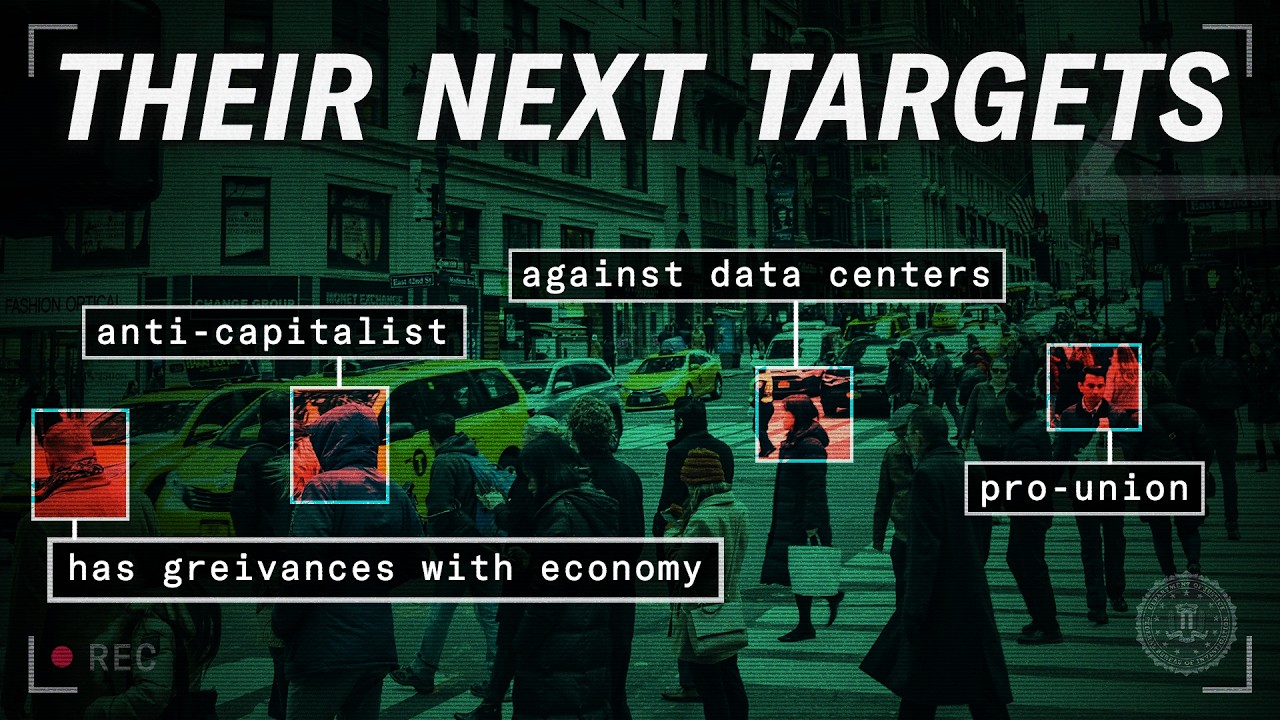
Jun 25, 2026 MPU
We Uncovered A New Government Watchlist. Are You Their Next Target?
And DHS spent a lot of time monitoring those protesters, the intelligence offices.
11:41
11 minutes, 41 seconds
To showcase what corporations working hand in hand with the government looks like.
11:44
11 minutes, 44 seconds
Let's go back to 2015, when workers at Walmart, the largest retailer in the world, launched a campaign for living wages and benefits.
11:53
11 minutes, 53 seconds
Internal Walmart documents obtained by Bloomberg showed that after the mega retailer hired a Lockheed Martin contractor to monitor union activists and protesters, the internal tracking and monitoring wasn't enough.
12:06
12 minutes, 6 seconds
They also contacted one of the FBI's Joint Terrorism Task Forces, when union activists planned to protest the annual shareholder meeting.
12:14
12 minutes, 14 seconds
But while the FBI is one of the most well-known offenders when it comes to violating constitutional rights, a different agency, one that was created for the very purpose of protecting workers, is now going after them.
12:26
12 minutes, 26 seconds
The Department of Labor doesn't have an official intelligence component, but its office of the Inspector General holds powerful investigative capabilities and liaisons with the FBI and other intelligence agencies, including DHS.
12:39
12 minutes, 39 seconds
It has also shown up on the Department of Homeland Security's joint task forces across the country. DOL’s top cop is literally a former cop.
12:47
12 minutes, 47 seconds
Inspector General Anthony D’Esposito, who previously served as an NYPD officer.
12:52
12 minutes, 52 seconds
And he was accused of stealing a golden chain from an arrestee and then lying to put a different guy in jail. The NYPD later paid out a six figure settlement to that guy.
13:01
13 minutes, 1 second
But even more concerning than D’Esposito is the top DOL lawyer, Jonathan Berry, the Solicitor General.
13:07
13 minutes, 7 seconds
While working as a corporate lawyer, Berry penned the chapter on the Department of Labor in the Policy Manual developed by the anti-worker Heritage Foundation, known as Project 2025.
13:19
13 minutes, 19 seconds
In the chapter, Berry calls for the transformation of the Department of Labor from a watchdog to ensure workers are protected from predatory corporations to an investigative arm targeting workers and unions.
13:30
13 minutes, 30 seconds
The chapter calls for using the office of the Inspector General to look into worker centers across the country, but it also calls for investigating unions
13:38
13 minutes, 38 seconds
without any initiating complaint, meaning investigations into workers and their unions could be undertaken without probable cause—at any time, and at any location across the country.
While Jonathan Berry's playbook takes shape, Spencer told me there's another element from the Department of Labor already in play.
We talk about these Homeland Security task forces and the Department of Labor, through its Office of Inspector General, participates in those task forces.
14:05
14 minutes, 5 seconds
When you look at the press releases touting DOJ successes, they often include Department of Labor there, and it's usually through the Office of Inspector General.
It's concerning, because I think there is that risk to investigate workers. In other words, the Department of Labor has found a way to inject itself into the dirty business of intelligence work.
---
unions --> M class
SEE VOTER REGISTRATION VS SUPPRESSION RETALIATE
AN 7 25 -->
REF PPL WORLD
NEW YORK—The Trump administration and its radical right foot-soldiers in the federal government and in the states are undertaking a comprehensive scheme to undermine future state and federal elections, in effect rigging the rolls to keep themselves in power no matter what the voters decide.
So far, other than the report itself, by the Brennan Center for Law and Justice at New York University, there’s been little—or little-noticed—response.
The comprehensive scheme is detailed in a combination of a Trump executive order on March 25 and the notorious SAVE Act, a GOP voter repression law that would disenfranchise at least 21 million people, most of them women—the voters most likely to oppose the Trump-right-wing-corporate agenda.
Detailed and footnoted protests were aired by the Citizens for Responsibility and Ethics in Washington (CREW) to the GOP-run House Administration Committee and by the Leadership Conference on Civil and Human Rights—whose members include the AFL-CIO—to the GOP-run Senate Rules and Administration Committee.
And states have gone to court to try to block Trump, the Brennan Center adds.
“A president has no right to rewrite the country’s election rules or regulate federal elections on his own,” the center’s report says.
“As a federal court recently put it, ‘The Constitution vests none of these powers in the president.’ In issuing the order, the president claimed extraordinary unilateral authority to regulate federal elections and usurp the powers of Congress, the states, and the (U.S.) Elections Administration Commission, an independent, bipartisan federal agency.”
Protecting U.S. elections, at all levels, from partisan manipulation, is now and has been for more than a century, important to workers, union, and non-union.
One, as AFL-CIO President Liz Shuler often points out, is that the GOP Trump regime views organized labor as a key roadblock to its partisan and repressive agenda. And the best way to crush labor is to crush workers’ right to vote.
And, second, and just as important, restricting who can vote, and who cannot, centralizes power in the hands not just of Trump but of the corporate interests that back him and who turn a blind eye—or worse–to repression both at the workplace and at the ballot box.
After all, paraphrasing the late UAW President Walter Reuther, what is won at the bargaining table can be taken away by the stroke of a pen.
The elements in the right wing’s coordinated attempt to entrench itself in power go far beyond what Trump tried in the aftermath of the 2020 presidential election. Trump lost it to Democratic nominee Joe Biden, and knew it. But he tried to overturn the results in lawsuits and other intimidation in selected swing states—and went 0-for-62 in court cases.
When that failed, he turned to aiding and abetting the Jan. 6, 2021, Trumpite invasion, insurrection, and attempted coup d’etat at the U.S. Capitol.
But now the Trump right-wing playbook to undermine and rig coming elections is much more extensive and much more under the radar, the Brennan Center reports. It includes:
- Attempting to rewrite election rules to burden voters and usurp control of election systems.
- Targeting or threatening to target election officials and others who keep elections free and fair.
- Federal officials, at the Justice Department, had an important role in countering disinformation and combating racial discrimination. This federal protection for fair elections may no longer exist.
- Supporting people who undermine election administration by putting them on state and local elections boards.
- Retreating from the federal role of protecting voters and the election process by defunding agencies Congress established to safeguard the vote and ensuring the Federal Elections Commission, already hobbled by a years-long deadlock, remains toothless.
- Giving a “go” signal to future violence to overturn elections, by Trump’s pardons of the January 6 insurrectionists.
Leaves out one key tactic
The Brennan report leaves out one tactic of Trump, the MAGAites and the right-wing: Stacking state and local elections boards. An attempt occurred in Nevada, a swing state in 2020 and 2024. And after the four-member, evenly split Wayne County, Mich. (Detroit) elections board voted 3-1 to certify Democratic presidential nominee Joe Biden’s margin there in 2020, Michigan MAGAites forced the Republican commissioner who voted for certification out of office.
“Why do we conclude this represents a concerted strategy? Among other things, President Trump tried to do this before,” the Brennan Center points out. “He was the first president to try to overturn the results of a presidential election and used federal power to do so.
“Institutions and key officials blocked him. These internal checks, however, are now gone, and many public officials will likely carry out the president’s will.
“This campaign to undermine elections runs afoul of the U.S. Constitution. Only Congress and the states can set election rules. The executive branch, especially the Department of Justice (DOJ), is charged with enforcing federal laws. But neither the president nor the DOJ has the authority to set rules governing elections or to supervise” state elections procedures.
Yet Trump is trying just that. And, as CREW and the Brennan Center point out, the misnamed SAVE Act, a key goal of the House’s ruling right-wing Republicans, would aid and abet that campaign. Other specifics include:
- Attempting to impose a “Show Your Papers” requirement on voters.
Trump, in a March 25 executive order, and the GOP congressional majority, in the SAVE Act, say doing so would prevent “voter fraud,” which even Trump’s last Attorney General in his first term, Bill Barr, called non-existent. But “show your papers” mandates, using a citizenship document to even register to vote, “would undermine voting and disrupt election administration in multiple respects.”
Estimates are that the mandate, the SAVE Act, or both, would disenfranchise at least 21 million voters nationwide. Most of them would be women, whose names on their initial voter registrations are different from the name they now use.
- Force the states to re-certify all their voting machines, buy new ones, or both. That would cost billions of dollars. It’s also one step removed from Trump’s demand for hand counts of all elections. The certification would be done by federally approved firms and methods, and only one has been OKd by the federal Elections Administration Commission, on July 7, 2025.
There are also bans on unauthorized access to voting machines and equipment. The result of violating them is to toss the machines—and the votes they count—out. Tina Peters, former county clerk in rural “red” Mesa County, Colo., is now serving a 9-year term in prison for allowing Trumpite election deniers access to her county’s machines after the 2020 balloting. She was convicted last year.
- Retaliation against opponents of the right-wing’s voter rigging. The targets include state and local elections officials, non-partisan groups such as the League of Women Voters, civic groups that mobilize voters “and other individuals and entities that protect elections and the rule of law,” the Brennan Center reports.
That kind of retaliation could target both unions and their get-out-the-vote drives and groups such as the Poor People’s Campaign, which registers and mobilizes poor and low-wealth people—the very voters least likely to participate, but also the most likely to oppose the Trumpite, right-wing and corporate hegemony.
Reports likely targets
The Brennan Center reports likely targets for “law enforcement” type retaliation would include individual voters, election officials, “perceived political adversaries, and journalists.” The last two groups of targets have been GOP targets before: On Richard Nixon’s enemies list. Labor leaders—AFSCME President Jerry Wurf and UAW President Leonard Woodcock—were on it, too.
Trump’s FBI Director Kash Patel “stated ‘We’re going to come after the people in the media who lied about American citizens, who helped Joe Biden rig presidential elections–we’re going to come after you,’” the Brennan Center adds.
The Brennan Center reports three active task forces leading that retaliation: The Justice Department’s “Weaponization Working Group, the New Jersey U.S. Attorney’s Office Election Integrity Task Force, and the Washington, D.C., Attorney’s Office Special Unit.
- Letting DOGE—Trump’s so-called Department of Government Efficiency–access sensitive private and personal voter registration files, just as it did with other agencies, including the Labor Department and the National Labor Relations Board. And the threat isn’t only from DOGE’s misuse of the files. The Brennan Center adds that when DOGE grabbed the NLRB’s files, its security was so lax that foreign hackers immediately invaded them.
“The administration could abuse voter file access to claim fraud and erode public trust in elections,” the Brennan Center warns. “It could also pressure state officials to target groups of voters and carry out unwarranted voter purges. Any disclosure of sensitive personal information puts individuals and groups at risk of being intimidated or doxed. And mishandling voter file data could expose U.S. elections to political and foreign interference.”
- Intimidating election officials. After what happened in 2020 to the two African-American women in Georgia at the hands of Trump consigliere Rudy Giuliani—one a ballot counter, the other her mother—local elections officials are scared and defecting in droves.
“Criminal investigations and prosecutions would impose a severe personal and financial toll on election officials or nonprofit employees for simply doing their jobs to help keep elections free and fair. But beyond that, the harms that stem from targeting the officials and civil society groups that make our elections work are manifold,” the Brennan Center report says.
“Even if the administration never charges any officials, the threat alone of criminal investigation or prosecution will likely exacerbate the exodus of election officials. In 2024 33% of local election officials knew at least one colleague who resigned at least in part due to fear for their safety, of increased threats, or of intimidation; 21% stated they were unlikely to continue serving in their role for the 2026 midterms. In 2025, 59% of officials reported fear of political interference in their ability to do their jobs. And 46% were very or somewhat concerned about potential politically motivated investigations of themselves and their families.”
One solution: Sue for damages. The Brennan Center reports “federal and state law prohibit anyone, including federal officials, from intimidating voters and those, like election officials or civic engagement organizations, who assist or encourage them to vote. And though voters rarely do so, they are able to sue DOJ officials under anti-intimidation law in federal court.”
“The Constitution establishes a system of checks and balances to ensure free and fair elections. The power to regulate elections lies in the hands of states and Congress. Courts and advocates complement this system to uphold the Constitution and federal law,” the Brennan Center declares.
“U.S. election infrastructure leaves no room for the president to insert himself. Yet that is exactly what he purports to do.”
---
---
:REALLY GOOD ANALYSIS
AN 10 25
A grim-faced President Donald J. Trump looks out at the reader, under the headline “LAW AND ORDER.” Graffiti pictured in the corner of the White House Facebook post reads “Death to ICE.” Beneath that, a photo of protesters, choking on tear gas. And underneath it all, a smaller headline: “President Trump Deploys 2,000 National Guard After ICE Agents Attacked, No Mercy for Lawless Riots and Looters.”
The official communication from the White House appeared on Facebook in June 2025, after Trump sent in troops to quell protests against Immigration and Customs Enforcement agents in Los Angeles. Visually, it is melodramatic, almost campy, resembling a TV promotion.
The post is not an outlier.
In the Trump administration, White House social media posts often blur the lines between politics and entertainment, and between reality and illusion.
The White House has released AI images of Trump as the Pope, as Superman and as a Star Wars Jedi, ready to do battle with “Radical Left Lunatics” who would bring “Murderers, Drug Lords … & well-known MS-13 Gang Members” into the country.
Most recently, on the weekend of the No Kings protests, both Trump and the White House released a video of the president wearing a crown and piloting a fighter jet, from which he dispenses feces onto a crowd of protesters below.
Underpinning it all is a calculated political strategy: an appeal to Trump’s political base – largely white, working-class, rural or small-town, evangelical and culturally conservative.
As scholars who study communication in politics and the media, we believe the White House’s rhetoric and style is part of a broader global change often found in countries experiencing increased polarization and democratic backsliding.
White House style
In the past, national leaders generally favored a professional tone, whether on social or traditional media. Their language was neutral and polished, laced with political jargon.
While populist political communication has become more common along with the proliferation of social media, the communication norms are further altered in Trump White House social media posts.
They are partisan, theatrical and exaggerated. Their tone is almost circuslike. The process of governing is portrayed as a reality TV show, in which political roles are performed with little regard for real-world consequences. Vivid color schemes and stylized imagery convert political messaging into visual spectacle. The language is colloquial, down-to-earth.
Just as other influencers in a variety of domains might create an emotional bond by tailoring social media messages, content, products and services to the needs and likes of individual customers, the White House tailors its content to the beliefs, language and worldview of Trump’s political base.
In doing so, the White House echoes a broad, growing trend in political communication, portraying Trump as “a champion of the people” and using direct and informal communication that appeals to fear and resentment.
Trump White House social media makes no effort to promote social unity or constructive dialogue, or reduce polarization – and often heightens it. Undocumented immigrants, for example, are often portrayed as inherently evil. White House social media amplifies dramatic, emotionally charged content.
In one video, Trump recites a poem about a kind woman who takes in a snake, a stand-in for an immigrant who in reality is a dangerous serpent. “Instead of saying thanks, that snake gave her a vicious bite,” Trump recites.
Talking to the base
While some scholars have called the White House social media style “amateurish,” that hasn’t resulted in change.
The lack of response to negative feedback is partially explained by the strategic goal of these communications: to appeal to the frustrations of Trump’s deeply disaffected political base, which seems to revel in the White House social media style.
Scholars identify a large number of these voters as “the precariat,” a group whose once-stable, union-protected jobs have been outsourced or replaced with low-wage, insecure service work. These workers, many former Democrats, can no longer count on a regular paycheck, benefits or work they can identify with.
As a result, they are more likely to support political candidates whom they believe will respond to their economic instability.
In addition, many of these voters blame a breakdown in what they perceive as the racial pecking order for a loss of social status, especially when compared with more highly educated workers. Many of these workers distrust the media and other elite institutions they feel have failed them. Research shows that they are highly receptive to messages that confirm their grievances and that many regard Trump as their champion.
Trump and the White House social media play to this audience.
On social media, the president is free to violate norms that anger his critics but have little effect on his supporters, who view the current political system as flawed. One example: A White House Valentine’s Day communication that said “Roses are red, violets are blue, come here illegally, and we’ll deport you.”
In addition, Trump and the White House social media use the president’s status as a celebrity, coupled with comedy and spectacle, to immunize the administration from fallout, even among some of its critics.
Trump’s exaggerated gestures, over-the-top language, his lampooning of opponents and his use of caricature to ridicule whole categories of people – including Democrats, the disabled, Muslims, Mexicans and women – is read by his political base as a playful and entertaining take down of political correctness. It may form a sturdy pillar of his support.
But prioritizing entertainment over facts has long-term significance.
Trump’s communication strategies are already setting a global precedent, encouraging other politicians to adopt similar theatrical and polarizing tactics that distort or deny facts.
These methods may energize some audiences but risk alienating others. Informed political engagement is reduced, and democratic backsliding is increasingly a reality.
Although the communication style of the White House is playful and irreverent, it has a serious goal: the diffusion of ideological messages whose intent is to create a sense of strength and righteousness among its supporters.
In simple terms, this is propaganda designed to persuade citizens that the government is strong, its enemies evil and that fellow citizens – “real Americans” – think the same way.
Scholars observe that the White House projection of the often comical images of authority echoes the visual style of authoritarian governments. Both seek to be seen as in control of the social and political order and thereby to discourage dissent.
The chief difference between the two is that in a deeply polarized democracy such as the U.S., citizens interpret these displays of authority in sharply different ways: They build opposition among Trump opponents but support among supporters.
The rising intolerance that results erodes social cohesion, undermines support for democratic norms and weakens trust in institutions. And that opens the door to democratic backsliding.
Andrew Rojecki, Professor of Communication, University of Illinois Chicago and Tanja Aitamurto, Associate Professor of Communication, *University of Illinois Chicago
This article is republished from The Conversation under a Creative Commons license. Read the original article.
---
===
an 12 24
When Teamsters President Sean O'Brien spoke at the 2024 Republican National Convention in Milwaukee, some right-wing media outlets painted the speech as an example of unions moving from the Democratic Party to the GOP.
But O'Brien didn't endorse Donald Trump during his speech. The Teamsters president, rather, kept his speech nonpartisan, making general comments about the struggles of the American working class.
In an interview with Capitol & Maine's Kalena Thomhave, former AFL-CIO Political Director Steve Rosenthal debunked the claim that unions are abandoning the Democratic Party for the GOP in huge numbers. This "long-term conservative shift," according to Rosenthal, is a myth.
READ MORE:**Bombshell report details 'dangerous' new allegations against Trump Cabinet nominee**
Rosenthal, during the interview, stressed that Vice President Kamala Harris received more union support than Trump.
"First off, union members voted for Harris in pretty strong numbers," Rosenthal told Capitol & Maine. "Across the three Blue Wall states, (there was a) significant performance by union members. In Pennsylvania, union members made up 18 percent of the electorate. So, almost one out of five votes cast came from union households, and they voted 52 to 47 for Harris, which is better than the (Joe) Biden vote was in 2020, (when) Biden lost union households to Trump 49 to 50 in Pennsylvania. So, she actually did better."
Rosenthal elaborated, "In Wisconsin, Kamala Harris won union voters 53 to 46 — better than (Hillary) Clinton did in 2016 and not quite as good as Biden did in 2020, but still a nine-point margin among union voters in the state. In Michigan, Harris won (union voters) 55 to 44 — not quite as good as Biden did in 2020, but much better than Clinton in 2016."
According to Rosenthal, Trump has "eroded the union vote a little bit" but "not in substantial numbers."
READ MORE:**Mehdi Hasan rips Nikki Haley over Biden jab: 'You hated Trump'**
However, the former AFL-CIO political director emphasized that Democrats will need to articulate a strong economic message in future elections.
Rosenthal told Capitol & Maine, "There's an element there about the message and the messenger. It's not that the (Democratic) Party doesn't stand for workers anymore; it's that the party leadership is not getting in the trenches with workers anymore. Their accomplishments are partially paid short shrift because there's a huge degree of cynicism overall about both parties and politics in general…. There's a distinction between what the party is doing and fighting for and what people feel and see and understand."
Rosenthal continued, "Biden was, by all accounts, the most pro-union president in our lifetimes. It must be incredibly insulting to President Biden, Vice President Harris (and others in the administration), who have done so much over the last few years for unions and workers, to be hearing that the party has abandoned them."
READ MORE:[Data shows dire election postmortems could soon be in store for GOP: columnist
Read Capitol & Maine's full interview withSteve Rosenthal at this link.
an 12 24
The United States is currently displaying several characteristics that have historically been seen by empires in decline, according to one social scientist.
Peter Turchin is one of the pioneers of "cliodynamics," which is the field of study concerning statistical analysis of historical dynamics of societies around the world. In a recent essay for the Guardian, Turchin wrote that he and his fellow researchers have noticed the U.S. having three key traits in common with past global hegemons just before a period of decline. Those three factors are "popular immiseration, elite overproduction and state breakdown."
Turchin explained that "popular immiseration" describes a breakdown of the social contract between workers, the private sector and the public sector, which he said began after the Republican assault in the New Deal that happened around the time former President Ronald Reagan took power. He noted that as "the power of unions was undermined," taxes on the richest Americans were "cut back," which was followed by stagnating wages and a decline in life expectancy.
READ MORE:['Not good enough anymore': Union leader explains why Dems lost economic argument to Trump
"With the incomes of workers effectively stuck, the fruits of economic growth were reaped by the elites instead. A perverse 'wealth pump' came into being, siphoning money from the poor and channelling it to the rich," he wrote. "In many ways, the last four decades call to mind what happened in the United States between 1870 and 1900 – the time of railroad fortunes and robber barons. If the postwar period was a golden age of broad-based prosperity, after 1980 we could be said to have entered a Second Gilded Age."
The second trait, which Turchin called "elite overproduction," involves a growing population of the "uber-rich," (which he defined as "those with fortunes greater than $10 million") and their influence in the public sphere. He noted that when adjusting for inflation, this population grew by tenfold over the last four decades. This has led to rich elites either running for office, like President-elect Donald Trump, or funding candidates for office, like many billionaires have done in recent cycles. He also pointed out that "counter-elites" will emerge who oppose the existing political establishment.
"The more members of this elite class there are, the more aspirants for political power a society contains," he wrote. "By the 2010s the social pyramid in the US had grown exceptionally top-heavy: there were too many wannabe leaders and moguls competing for a fixed number of positions in the upper echelons of politics and business."
"As battles between the ruling elites and counter-elites heat up, the norms governing public discourse unravel and trust in institutions declines," he continued. "The result is a loss of civic cohesiveness and sense of national cooperation – without which states quickly rot from within."
READ MORE:[Watch: JD Vance booed by room full of firefighters as he calls himself 'pro-worker'
Finally, Turchin opined that "state breakdown" will inevitably follow popular immiseration and elite overproduction. He argued that Democrats' loss in the November election "represents one battle in an ongoing revolutionary war," but that the goal of the new order is "far from assured" given that "opponents are pretty well entrenched in the bureaucracy and can effectively resist change."
"Popular discontent in the US has been building up for more than four decades. Many years of real prosperity would be needed to persuade the public that the country is back on the right track," he wrote. "So, for now, we can expect a lasting age of discord. Let’s hope that it won’t spill over into a hot civil war."
Click here to read Turchin's full essay in the Guardian.
READ MORE:['A corporate CEO's dream': Labor unions blast Trump-Vance ticket
---
an 10 24
Union petitions in Michigan have more than doubled since 2021, labor board says
===
ymail 10 24
one of the enduring mysteries of America is why the citizens of Red states are generally poorer, less educated, and sicker than the citizens of Blue states. To that question, I step up as your hierophant with an answer to this deep mystery that you may not have previously considered.
First, that generalization is broadly true:
— Blue states account for about 71 percent of America’s GDP, whereas Red states only produce 29 percent of our income and wealth.
— The median family income in Blue states is $74,243. In Red states it’s $63,553. Individual states highlight the disparity: New Jersey’s median income is $89,703, while Mississippi’s is $49,111.
— Counties that voted for Biden in 2020 are more diverse, being 35 percent nonwhite compared to 16 percent nonwhite populations in counties that voted for Trump.
— Counties that voted for Biden in 2020 are better educated, with 36 percent of their population having some college education compared to Trump’s counties at 25 percent.
— Residents of Blue states live 2.2 years longer, on average, than residents of Red states.
And, second, it’s undeniably true (and documented with each hotlink below) that Republican-controlled Red states, almost across the board, have higher rates of:
— Spousal abuse
— Teen pregnancy
— Sexually transmitted diseases
— Abortion (at least before Dobbs; now it would be “forced births”)
— Bankruptcies and poverty
— Homicide and suicide
— Infant mortality
— Maternal mortality
— Forcible rape —**Robbery and aggravated assault
— Dropouts from high school
— Divorce
— Contaminated air and water
— Opiate addiction and deaths
— Unskilled workers
— Parasitic infections
— Income and wealth inequality
— Covid deaths and unvaccinated people
— Federal subsidies to states (“Red State Welfare”)
— People on welfare
— Child poverty —**Homelessness
— Spousal murder
— Deaths from auto accidents
— People living on disability
— Gun deaths
But are all these things happening because Republicans simply hate their citizens and explicitly want high levels of poverty, ignorance, death, and disease?
Turns out there’s a much simpler answer.
The problem for Red states is that Republicans worship cheap labor, because it drives up profits for the fat-cats who own American businesses — and having a steady and reliable supply of cheap labor to maintain high profitsrequireswidespread poverty, ignorance, death, and disease.
That poverty, of course, brings along with it the long list of social ills above, but Republicans are more than willing to tolerate massive, desperate levels of human suffering to make sure there’s a steady supply of cheap labor. In fact, they intentionally run their states that way to produce those results.
If you have any doubts about this, if that sounds like hyperbole, simply look at the policies the GOP has promoted for the past century:
— Republicans hate unions, because unions raise wages and benefits for workers, shifting them from poverty into the middle class. Once thus empowered, those uppity middle-class people then start to demand “unreasonable” things like overtime pay (Project 2025 would functionally end it), healthcare, paid vacations, paid sick leave, and paid family leave.
— Republicans hate Social Security and have worked to gut, privatize, or outright end it ever since FDR signed it into law in 1935. They do this because elderly workers in poverty are a great source of compliant, cheap labor. Reagan’s changes in Social Security benefits have led to millions of Boomers having to take gigs as greeters, waiters, etc., for low wages; prior to Reagan’s changes in the Cost of Living Adjustments (COLAs) and his raising the retirement age to 67, you could safely retire on Social Security in most parts of America. Now, Republicans want to raise that age to 69 or 70.
— Republicans hate universal or inexpensive healthcare (and real Medicare for the elderly) because having massive medical debt provides a large pool of desperate workers willing to work crappy jobs for pathetic wages to pay it off. It’s why the ten states that refuse to expand Medicaid for low-income workers are all Republican-controlled. Medical debt is a non-issue in every other developed country in the world, but here in America 79 million people are struggling to pay off doctors’ or hospital bills (7 million of those debtors are elderly, many the victims of the Medicare Advantage scam).
— Republicans hate the minimum wage because it cuts into profits. That’s why the minimum wage in Blue states can be more than twice that of Red states (Washington State is $17/hr versus Texas’ $7.25/hr). When most families are barely earning enough to get by, employers have their pick of distraught, panicked workers willing to work for subsistence wages.
— Republicans hate empowered women because forced pregnancies create more potential workers and unwanted children exacerbate poverty. Thus their 50+ years of opposition to the Equal Rights Amendment and their embrace of abortion bans.
— Republicans promote hatred of racial, religious, and gender minorities because when Americans are at each other’s throats they’re not organizing to throw off the GOP/corporate yoke. It’s hard to remember that the billionaires have stolen fully $50 trillion from the middle class over the past 43 years of the Reagan Revolution when you’re constantly distracted with hysteria about Black Haitians, Brown Mexicans, and trans students who just want to use the damn bathroom.
— Republicans hate education because it’s the main tool for people to lift themselves out of poverty and thus demand higher wages and better benefits. Before the Reagan Revolution, every American who wanted to and could pass the entrance exams could go to college; many universities (like the entire University of California system) were free, and you could pay your tuition at most other colleges like I did in the 1960s working weekends as a dishwasher at Bob’s Big Boy in East Lansing, Michigan and pumping gas at the Esso station across the street. This is also why so many Red states are gutting their public education systems with private school vouchers. Less education, more poverty; more poverty, more cheap labor.
— Republicans hate atheism and embrace a neofascist form of Protestant Christianity and a bizarre, rightwing version of Catholicism that goes by a Latin name because both are hierarchical and male-dominated, just like corporate culture. It’s why the Confederacy was explicitly Christian. “Don’t worry about how much you’re paid, boy, or bother organizing into a union; just keep picking that cotton and you’ll get your reward in heaven when you die.” After all, according to the Bible your fate was preordained “before the foundation of the world,” as was that of your boss, who must have been selected for particular grace by God or he wouldn’t be so rich.
— Republicans hate food stamps, housing supports, aid to women and dependent children, and every other form of what they call “welfare” because these programs slightly reduce the desperation of people who might otherwise be easily forced to work for a pittance.
— Republicans hate environmental protectionsbecause they cut into profits; who cares if the lack of them create things like the “Cancer Alley” — which hits children particularly hard — that runs through Texas and Louisiana?
— Republicans hate unemployment insurance because it reduces the privation people can experience when they lose a job. It’s why all the Blue states offer at least 26 weeks of benefits, but Red states often radically reduce that (Florida, North Carolina, Kentucky 12 weeks; Alabama 14 weeks; Oklahoma, Kansas, Arkansas, Missouri 16 weeks).
So, the next time somebody asks why people living in Red states have it so rough, just tell them, “It’s all because of the cheap-labor Republicans.”
===
Fox networks falsely accused striking dockworkers of holding up hurricane relief
10/04/24 mma
===
---
Trump is facing fierce backlash from a California firefighters union three days after the ex-president threatened to withhold fire rescue aid from the state as the number of wildfires are expected to increase in the coming years, East Bay Times reports.
"As of today, thousands of firefighters are on the front lines responding to wildfires throughout the state, and countless Californians are in harm's way as they heed evacuation orders," California Professional Firefighters President Brian K. Rice wrote in a statement posted to X on Friday, September 13. The union, according to the report, "represents around 35,000 career firefighters and emergency medical service" professionals.
"Nevertheless, former President Trump expressed that he would play with their lives and their homes if he doesn't get what he wants," Rice continued. "He would rather watch our state burn in the name of his political games, than to send help if he were to become president again."
READ MORE:Brutal fact-check exposes gaping holes in Trump’s California helicopter ride anecdote
Axios reports that Trump threatened during a Friday press conference to "withhold fire rescue aid from California" if the state’s Democratic Governor Gavin Newsom refused to back the MAGA leader’s policies.
East Bay Times notes the former president "repeatedly referred to Newsom as 'Newscum'" during the presser.
"If he doesn’t sign those papers, we won’t give him money to put out all his fires," the MAGA leader said, referring to the governor. “And if we don’t give him all the money to put out the fires, he’s got problems."
In response to Trump's comment, Axios reports that Newsom warned via X that the 2024 GOP nominee "admitted he will block emergency disaster funds to settle political vendettas."
It wasn't long before Rice shot back at Trump, writing, "It is shocking that we have a presidential candidate who is threatening our public safety and doesn’t even care what the consequences are to firefighters and the public. This has now become a serious public safety issue for our members and the public we serve."
READ MORE:Fox News forced to censor Trump as he rants about Gavin Newsom and Michelle Obama
*The East Bay TImes' full report is available at this link. Axios' report is here. an 9 24
===
jdv booed by firefighters, youngkin boo
an 9 24
a Republican state representative in Kentucky is proposing a bill that, if passed, would repeal the requirement that employers provide workers with lunch breaks. It also includes language that would result in a reduction in net pay for many workers.
The Kentucky Center for Economic Policy (KCEP) — a fiscal policy think tank in the commonwealth — recently broke down House Bill 500, which was sponsored by Republican Rep. Phillip Pratt. Aside from its language allowing companies to avoid having to provide lunch breaks to workers, it would also eliminate mandatory rest breaks and end the requirement to pay time-and-a-half wages to employees who work seven days a week. HB 500 also removes any liability for employers who don't pay workers for time on the clock traveling between jobs, and allows companies to not pay workers for tasks associated with starting and ending a job.
Additionally, the bill reduces the amount of time workers have to report labor violations from five years to three years, and blocks plaintiffs from being paid punitive damages for suffering emotional distress, humiliation or embarrassment over wrongful termination.
READ MORE:**(Opinion) Republicans are trying to flood the labor market with cheap child labor**
"Collectively, these provisions weaken multiple common sense protections for safe working conditions and fair pay that have been a part of Kentucky’s safeguards for more than half a century," the KCEP wrote in its analysis of the bill. "HB 500 will make work more dangerous by depriving workers of food and rest, incentivizing them to travel too quickly to get to their job site, and discouraging them from taking proper precautions at the start of shifts. And it will take pay away from workers when they are moving between job locations, working excessive weeks, and engaging in necessary tasks at the beginning and end of the work day."
Should the bill pass, Rep. Pratt would stand to reap a financial benefit, as he is the owner of a lawn care and landscaping business in Georgetown, Kentucky. Outdoor workers like landscapers typically have to take frequent breaks throughout the day due to the physically demanding nature of their jobs — particularly in hot summer months. In Texas, for example, the City of Dallas mandates that construction workers have a 10-minute break every four hours (a bill Gov. Greg Abbott signed into law last year eliminated mandatory water breaks).
Even if the bill passes the Kentucky legislature, Democratic Governor Andy Beshear is unlikely to sign it into law. But Kentucky Republicans have the ability to override him due to their veto-proof majorities in both chambers. The Kentucky legislature's official website shows that HB 500 has not yet received a full floor vote.
Rep. Pratt announced in late 2023 he will not seek a fifth term in office, and will serve out the rest of his term, which ends on December 31.
===
mma
Delayed book by The Heritage Foundation president echoes Project 2025's attacks on unions. JD Vance wrote the foreword.
08/08/24
===
==
'Moment of shame': Teamsters president ripped for GOP convention speech an 7 24
===
new rt jdv and hawley some pro union? but no PRO Acts?
---
---
The GOP pretends it's pro-union
Robert Reich
The Republican Party began its national convention last night, with a bow to … (wait for it) … organized labor. You read that correctly.
A few days ago, the Republican National Committee sent out an email with this remarkably ironic headline:
“RNC STATEMENT ON FAILED BIDEN’S ANTI-UNION, PRO-CHINA POLICIES”
This was followed by an even more absurd RNC statement:
Joe Biden is not pro-union, he is pro-CCP—forcing EV mandates to please Communist China while making gas prices soar and killing auto industry jobs. If Biden really cared about working class Americans, he would stop caving to China, unleash our energy, and make life affordable again for working families. President Trump put hard-working Americans first once, and he will do it again when he’s back in the White House.
As my friend Harold Meyerson, writing for The American Prospect, notes, the RNC statement didn’t address the Republicans’ enduring and ongoing opposition to unions, or the officials Trump appointed when president (Labor Secretary Eugene Scalia, NLRB General Counsel Peter Robb, et al.) who devoted themselves to crippling unions in every way they could.
It ignored the assessments of dispassionate historians that Biden is either the most pro-union president since FDR or the most pro-union president ever.
Harold went on to explain that the RNC email was intended as something of a tease, laying a bit of groundwork for the opening night of the Republican convention last night, when the prime-time 10 p.m. speaking slot was awarded to Sean O’Brien, president of the Teamsters.
Despite the misgivings and stunned disbelief of numerous Teamster officials, O’Brien has been playing footsie with Trump for a number of months, donating $45,000 of the members’ money to help fund the Republican convention (he gave an equal amount to the Democrats), inviting Trump in to speak to his executive board, and now, effectively kicking off the televised portion of the Republican convention.
O’Brien’s openness to Trump overlooks a Biden record that includes bailing out the union’s multi-employer pension fund and jump-starting a manufacturing and infrastructure renaissance with hiring stipulations favoring union workers, Teamsters very much included. For which reason, among many others, a number of Teamster officers have taken issue with O’Brien’s Trumpian tilt.
As Jonathan Weisman has reported in The New York Times, the Teamsters national office has come down hard on those critics, including filing suit against a member discussion website for using the word “Teamster” in its title.
Why didn’t O’Brien use his allotted speaking time to ask the Republicans to adopt the pro-union initiatives that Democrats support and that Republican members of Congress have to a person opposed — like the PRO Act, which would enable workers to unionize without fear of being fired, or raising the national minimum wage from its current $7.25?
Why didn’t O’Brien ask them to endorse the recent ruling from Biden’s OSHA that requires employers to provide heat breaks to workers in weather like the kind the nation is currently experiencing?
Or ask that Republicans on the NLRB not continue to work to destroy unions, or that Republicans, should Trump win, not scuttle the antitrust suit that Biden’s FTC has brought against Amazon, which the union is seeking to organize?
If O’Brien really wanted to do the nation a service, he would have spoken forcefully against Trump’s commitment to deporting undocumented immigrants.
Harold notes, in his years covering labor, he’s met a number of Teamsters who are themselves undocumented — the very workers and their families whom Trump has continually vowed to arrest, lock up, and deport. It’s atop Trump’s to-do list. It’s hard to see how this would be good for the Teamsters.
***
A breakdown of the 2020 presidential election exit poll showed that working-class (i.e., with no college degree) union members actually favored Trump over Biden by 6 percentage points (those with college degrees favored Biden over Trump by 48 percentage points).
Trump’s rants at enemies, real and imagined, can stir some of the same fuck-’em-all sensibilities that the legendary Jimmy Hoffa’s rants once stirred, though Hoffa put his rants in the service of building a powerful union that genuinely bettered members’ lives, while Trump puts his rants in the service of solely benefiting Donald Trump.
*Robert Reich is a professor of public policy at Berkeley and former secretary of labor. His writings can be found athttps://robertreich.substack.com/
---
//
Labor reporter disputes Trump 'unity' push as GOP runs 'voter suppression campaign that dwarfs' 2020
'Moment of shame': Teamsters president ripped for GOP convention speech
recall fake union rally ~ UAW picket line (also jdv?) ~ Scranton Joe
'A corporate CEO’s dream': Labor unions blast Trump-Vance ticket
---
amazon-ceo-andy-jassy-broke-federal-law-with-anti-union-statements
ga gov kemp bill 3 24 kpfa
---
an 2 24
:{i:{never believed Jeff Bezos, the second-richest person in America (worth an estimated $114 billion), and Elon Musk, the richest (at $180 billion), would brazenly use their wealth and power to try to eliminate labor unions and thereby suppress the wages of American workers even further.}:
In my naivete, I assumed they wouldn’t reveal themselves as no better (and in many ways worse) than the robber barons of the first Gilded Age, whose riches were unrivaled and who fought with all their might against labor unions.
It’s not that Bezos’s Amazon has exactly hidden its objective. The company has fought off every attempt to organize its workers — holding anti-union meetings, targeting union supporters, challenging union elections, and firing workers who tried to organize.
But in a legal filing last Thursday, Amazon went even further. It argued that the National Labor Relations Board, which supervises and enforces labor law, is unconstitutional because it mixes judicial and executive functions.
Jeff Bezos’s view (I’m assuming Amazon’s filing reflects his view) is the same as that of retrograde Elon Musk, whose SpaceX made an almost identical argument in a lawsuit last month.
The NLRB is the agency that enforces the National Labor Relations Act — the 1935 Act that legitimized labor unions.
Bezos and Musk’s argument was rejected by the Supreme Court 86 years ago in NLRB v. Jones & Laughlin Steel Corp.
In that case, the NLRB found that the giant steel corporation Jones & Laughlin had violated the National Labor Relations Act by firing workers for trying to organize a union. The board ordered the corporation to reinstate them, pay them back wages, and refrain from any further actions to discourage workers from exercising their rights under the Act.
In an opinion by Chief Justice Charles Evans Hughes, the Supreme Court upheld the NLRB’s order, holding that Congress acted within its constitutional authority to pass the National Labor Relations Act of 1935, including the National Labor Relations Board to enforce it.
But modern-day robber barons Jeff Bezos and Elon Musk want the Supreme Court to reverse its 1937 ruling and return America to a time before workers had the right to form unions.
Both of these tycoons hate unions. Both have illegally fired workers for trying to organize them. Bezos’s Amazon — having had one of its warehouses vote to unionize — is actively patrolling its workplaces against any signs of unionizing activity. Musk’s Tesla is the target of organizing efforts by the UAW and a number of European unions.
Evidently, it’s not enough for Bezos and Musk to amass more wealth than any two people on the planet. Not enough for them to monopolize their respective industries (Amazon is now being sued by the Federal Trade Commission, Musk’s SpaceX and his X platform are also monopolies). Not enough for them to fight their workers who want better pay and safer working conditions. Not enough for them to wage a war on the freedom of workers to join labor unions.
No, they want even more wealth and covet even more of the power — and don’t want to share any of it with their workers, or any other American workers.
Evidently, they believe that today’s Supreme Court — packed with right-wing justices who have few scruples about reversing long-held judicial precedents or even taking money from wealthy people with a financial interest in how they rule — will find their argument compelling.
I hope they’re wrong.
*Robert Reich is a professor at Berkeley and was secretary of labor under Bill Clinton. You can find his writing at https://robertreich.substack.com/.*
===
---
ymail 1 24
Starbucks shouldn’t be allowed to get away with union busting.
The Supreme Court has agreed to hear Starbucks’ appeal of a federal district court decision which ordered seven wrongfully terminated workers in Memphis to be reinstated after being fired for union organizing.1
Starbucks wants a bailout for its record-breaking, illegal union busting campaign from a conservative Supreme Court. Despite a district court ruling that Starbucks broke federal law by firing workers for union organizing, Starbucks is trying to weaken federal labor law that officials use to grant injunctive relief, including ordering the rehiring of workers affected by their employer’s labor law violations.2
Corporations like Starbucks will use every trick in the book, including going to SCOTUS, to legitimize their illegal worker intimidation tactics. Sign the petition to hold corporations accountable to the law!
Even the Department of Justice has urged the Supreme Court to not take the case, affirming that Starbucks’ argument is flimsy and does not warrant SCOTUS review.3
SCOTUS agreeing to take this case endangers the rights of all U.S. workers. Their decision could weaken the National Labor Relations Board’s power to hold guilty corporations accountable for breaking federal labor law.4
It’s clear that corporations like Starbucks care only about their bottom line—they’ll even go to the highest court in the country to protect their profits while attacking the working class.
Thanks for all you do.
–Mia, Soraya, Nakia, Thad, and the rest of the team
Sources:
- “Supreme Court steps into Starbucks union fight,” The Hill, January 12, 2024
https://act.moveon.org/go/186068?t=6&akid=374171%2E20164584%2EESn7-Q
- Ibid.
- Ibid.
- “SCOTUS Will Hear Starbucks Case Arguing Against Key Labor Law Enforcement Tool,” Truthout, January 16, 2024
https://act.moveon.org/go/186069?t=8&akid=374171%2E20164584%2EESn7-Q
---
---
an 12 23
no lnx
republican Scott Walker went down in history as one of the most anti-union governors in Wisconsin history. Act 10, aggressively pushed by Walker through the Wisconsin State Legislature, attacked collective bargaining for public-sector unions and required public workers to pay more for health care.
Act 10's critics challenged Act 10 in the courts. But in 2014, the Wisconsin Supreme Court, in a 5-2 vote, upheld the law as constitutional.
Since then, there has been a major change in the state's highest judicial body. Liberal Janet Protasiewicz, in April, enjoyed a double-digit victory in a Wisconsin Supreme Court race — giving liberals a majority.
In an article published on December 5, The Nation's John Nichols reports that Act 10's future may be in jeopardy given the Wisconsin High Court's new makeup.
"With the April 2023 election win by Justice Janet Protasiewicz," Nichols explains, "the (Wisconsin Supreme) Court now has a 4-3 majority that could well be inclined to reconsider the constitutionality of Act 10. And they will likely get a chance to do so."
Nichols elaborates, "Last week, a coalition of unions, including several affiliates of the Wisconsin Education Association Council, AFSCME, and the Teamsters, as well as SEIU Wisconsin and the Teaching Assistants Association (TAA/AFT) — which represents graduate student workers on the University of Wisconsin-Madison campus and is the oldest graduate students union in the world — filed a lawsuit demanding that Act 10 be struck down."
In an official statement, union members cited "low pay, staffing shortages and worsening working conditions" as some of their reasons for filing their anti-Act 10 lawsuit.
READ MORE: Wisconsin court case could end 'virtually impenetrable' GOP 'near-supermajorities' in state legislature
The Nation's full report is available at this link.
---
---
https://www.alternet.org/corporate-bullying/
an 8 23
no vid
...Starbucks is a multibillion dollar company. Its new CEO will start with a pay packageestimated to be worth over $28 million dollars. That’s roughly 800x the pay of the workers who actually brew and serve the coffee the business is built on — and who barely earn a living wage.
That’s why those workers have begun to unionize.
Since December 2021, Starbucks Workers United has won union elections in more than 300 Starbucks stores, covering more than 8,000 workers and counting.
And most of the union campaigns in individual stores won by overwhelming margins,gaining more than 70% of the total votes — and in parts of the country where private sector unions rarely win.
The Starbucks union campaign has inspired young workers across the country and breathed life into a U.S. labor movement that has been stagnantfor decades.
It’s been so successful that Starbucks briefly brought its former CEO, billionaire Howard Schultz, out of retirement to bust the union, and still refusesto even sit down at the bargaining table.
That’s why I’ve been boycotting Starbucks.
As part of its campaign to tamp down further unionization, Starbucks corporate has fired scores of pro-union workers, closed stores that have unionized, threatened to withhold wage and benefit improvements from stores considering unionizing, and packed stores with outside managers to undermine organizing efforts.
The National Labor Relations Board, which oversees all union elections in the U.S., has issued more than 93 complaints covering 328 unfair labor practice charges against Starbucks — and ordered reinstatement of at least 23 fired workers so far.
Yet Starbucks is unwilling to change its anti-union ways — even though Schultz was grilled in front of Congress
Starbucks claims to be a “progressive” company.
But based on the way it’sbroken labor law and put unionized workers in the percolator, that couldn’t be further from the truth.
Now is an opportunity for all of us to make our voices heard and to tell Starbucks to stop UNION BUSTING and bargain in good faith with Starbucks Workers United.
And it’s time for Joe Biden, who calls himself the “most pro-union president in American history,” to send a powerful message: we won’t tolerate union-busting by Starbucks or any other corporation — including Elon Musk’s Tesla and Jeff Bezos’s Amazon.
Otherwise, my boycott will continue — and perhaps you’ll consider joining me.
If we want to brew a future where workers have power and dignity, then we need to show solidarity with unions…
And stand up to corporate bullying.
---
---
https://www.mediamatters.org/labor-unions-and-workers-rights/blockbuster-year-labor-cable-news-coverage-large-strikes-has
---
---
3/23 rtw?
https://www.alternet.org/michigan-repeal-anti-union-labor/
yay!
---
---
https://www.alternet.org/union-workers-defense-social-security/
---
imi an 2 23
Joe Oliveira and his coworkers relied greatly on donations of food and gift cards after going on an unfair labor practice strike against multibillion-dollar specialty steelmaker ATI in 2021.
They cut household expenses to the bone, burned through their savings despite the public’s generous support of their cause, and held fundraisers to help one another cover mortgages and car payments during three and a half months on the picket line.
As much as the strike tested workers, however, it pressured ATI even more and ultimately enabled Oliveira and more than 1,300 other members of the United Steelworkers (USW) to secure long-overdue raises and stave off the company’s attempt to gut benefits.
Corporations so fear this kind of worker power that they’re asking the U.S. Supreme Court to rig the scales and help them kill future strikes before they even begin.
Glacier Northwest, a company in the state of Washington, sued the International Brotherhood of Teamsters seeking compensation for ready-mix concrete that went to waste amid a weeklong drivers’ strike in 2017.
The Washington Supreme Court threw out the case, but Glacier Northwest appealed to the U.S. Supreme Court, betting a right-wing majority that’s already proven its animosity toward unions would seize the opportunity to kick working people once again.
Corporations anticipate that a ruling in favor of Glacier Northwest will encourage a frenzy of similarly frivolous claims against unions nationwide, bleeding precious resources and eviscerating workers’ right to strike.
The justices held arguments on the case on January 10, 2023, but it’s not known when the court will rule.
“That’s our greatest strength,” said Oliveira, vice president of USW Local 1357 in New Bedford, Massachusetts, pointing out that the right to strike helped working people over many decades win not only fair wages but also retirement security, safer working conditions, and fairness on the job.
“It’s rotten when it comes to that point,” he said. “It’s very hard on families. It’s not any fun. But I think it’s probably the greatest weapon we have in our arsenal.”
And it’s sometimes the only way to force employers like ATI to bargain in good faith.
The USW made progress toward a new contract with ATI before COVID-19 hit in 2020. But when negotiations resumed in 2021, the company demanded unnecessary concessions that not only failed to recognize the sacrifices workers made during the pandemic but also would have compounded the harm ATI inflicted on the union members with a months-long illegal lockout that began in 2015.
“There was absolutely no way we were going to go for that,” recalled Oliveira, noting his coworkers and USW members at several other ATI locations overwhelmingly authorized the strike and then stood strong together until ATI came to its senses and began bargaining in earnest.
The shared struggle brought workers even closer together.
Oliveira could scarcely believe his eyes when striking USW members from ATI locations in Ohio and Pennsylvania showed up unannounced at one of his own local’s fundraisers. They drove hundreds of miles to support their USW family.
And Oliveira recalled how his heart swelled when the president of a large Pennsylvania local—one with hundreds of members—stood up at a meeting and vowed to continue fighting until ATI agreed to job security language that the 60 union members in New Bedford urgently needed.
“He was adamant about that. It was an unbelievable moment for me. Being a small local, it meant a whole lot to us,” explained Oliveira, adding that the New Bedford representatives also “showed our integrity” by going to bat for language that workers in other locations wanted just as much. “I couldn’t be more proud to be a USW member.”
That’s exactly the kind of strength that Glacier Northwest and its pro-corporate allies hope to decimate with a Supreme Court ruling giving companies free rein to try to divide workers and suppress strikes, creating a sword that will hang over every union when its members are left with no choice but to consider striking.
Glacier Northwest failed to make adequate preparations for the strike, leaving it unable to deliver the concrete that remained in drivers’ trucks at the start of the walkout. The company now wants the union to pay for the undelivered concrete—an outrageous demand when the very purpose of a strike is to put economic pressure on unreasonable employers.
When planning a strike, unions often meet with management to discuss an orderly shutdown of operations because the workers, who care about returning to a safe plant when their strike ends, want to avoid damage to the furnaces, smelters, and other equipment where they work.
“If you’re worried about losing product, don’t be a jerk. Sit down with the union,” Oliveira said, stressing that unions strike only as a last resort.
While Glacier Northwest’s suit seeks to punish workers for striking, it’s increasingly common for employers to throw workers into the street withlockouts, refusing to let them do their jobs in an attempt to force concessions.
And Glacier Northwest’s alleged losses pale next to the harm companies intentionally inflict on workers, families, and communities during labor disputes.
After locking out about 1,200 USW members in Massachusetts in 2018, for example, National Grid brought in less experienced managers and scabs to perform the highly dangerous work of maintaining natural gas lines.
Besides depriving workers of their paychecks, National Grid callously cut off their health coverage, leaving families scrambling to care for grievously ill children.
“You’re basically just a number to them,” said one union member, explaining how National Grid ripped away his health insurance shortly after doctors found cancer in his young son’s kidney and lymph nodes.
The option to strike remains as crucial as ever, Oliveira observed, noting that employers are doubling down on union-busting efforts as more and more Americans seek to join unions in the wake of the pandemic.
An adverse decision in this case will be just another weapon that American companies will use to force their workers into less favorable contracts.
“We can’t afford to go backward,” Oliveira said. “We need to go forward. We need more rights, not less.”
---
roughrider pc
In 2019, RPC was part of a 60 group coalition, led by Americans for Tax Reform, that sent a letter to Congress urging them to vote against the Protecting the Right to Organize (PRO) Act, labor legislation that would functionally repeal the Taft-Hartley Act to increase union coercive power. The coalition claims that the PRO Act would harm American workers by codifying rules that lead to higher unemployment, violate worker privacy, and overturn right-to-work laws, while supporting union bosses and their campaign contributors. Other members of the coalition include Heritage Action for America, the Thomas Jefferson Institute for Public Policy, and the Public Service Research Council. [14]
---
---
biden meh
https://www.alternet.org/2022/12/manchin/
sick days railroad nay
Surprising no one, the fossil fuel industry wants to see the pending rail strike blocked. As Kate Aronoff pointed out in The New Republic this week, Biden's stand with bosses against workers placed him on the same side as the American Petroleum Institute and the American Chemistry Council, both of which were among the 400 groups that called on Congress to stop the strike. amy w
---
---
an 12 22
The Congressional decision to prohibit railroad workers from going on strike and force them to accept a contract that meets few of their demands is part of the class war that has defined American politics for decades. The two ruling political parties differ only in rhetoric. They are bonded in their determination to reduce wages; dismantle social programs, which the Bill Clinton administration did with welfare; and thwart unions and prohibit strikes, the only tool workers have to pressure employers. This latest move against the railroad unions, where working conditions have descended into a special kind of hell with massive layoffs, the denial of even a single day of paid sick leave, and punishing work schedules that include being forced to “always be on call,” is one more blow to the working class and our anemic democracy.
The rage by workers towards the Democratic Party, which once defended their interests, is legitimate, even if, at times, it is expressed by embracing proto-fascists and Donald Trump-like demagogues. Dating back to the Clinton administration with NAFTA, the greatest betrayal of the working class since the 1947 Taft-Hartley Act, the Democratic Party has become a full partner in the corporate assault on workers. The cloying feel-your-pain rhetoric, a staple of the Joe Biden White House, is offset by a hypocritical subservience to the billionaire class.
In 1926, the havoc wreaked by rail strikes led to the federal government passing the Railway Labor Act to give itself the power to impose labor settlements on the rail industry. The Biden administration used this authority to broker a tentative labor agreement that would ensure a 24 percent pay increase by 2024, annual $1,000 bonuses and a freeze on rising health care costs. But workers would be permitted only one paid personal day and no paid sick leave. Of 12 unions voting on the deal, four of them — representing 56 percent of union membership in the industry — refused to ratify it. Biden signed the legislation into law on Friday.
The railroad barons refuse to permit sick days because they have stripped the railroads down to skeleton crews in a process known as precision scheduled railroading, or PSR. In essence, no spare labor is available, which is why the reduced labor force is subjected to such punishingly short periods of time off and onerous working conditions.
Class struggle defines human history. We are dominated by a seemingly omnipotent corporate elite. Hostile to our most basic rights, this elite is disemboweling the nation; destroying basic institutions that foster the common good, including public schools, the postal service and health care; and is incapable of reforming itself. The only weapon left to thwart this ongoing pillage is the strike. Workers have the collective power to slash profits and cripple industry, which is why the ruling class has gone to such lengths to defang unions and outlaw strikes. A rail freight strike, it is estimated, would cost the U.S. economy $2 billion a day, with daily losses increasing the longer a strike continued.
The few unions that remain — only 10.7 percent of the workforce is unionized — have been largely domesticated, demoted into obsequious junior partners in the capitalist system. As of January 2022, private-sector unionization stood at its lowest point since the passage of the National Labor Relations Act of 1935. And yet, 48 percent of U.S. workers say they would like to belong to a union.
Railroad workers have been especially hard hit. The workforce has shrunk from nearly 540,000 in 1980 to some 130,000 today. The consolidation of the rail industry means there are only seven Class I freight companies, with four of those companies controlling 83 percent of rail traffic. Service on the nation’s rail lines, along with working conditions and wages, has deteriorated as Wall Street squeezes the big railroad conglomerates for greater and greater profits. Indeed, the fragility of the rail system led to huge backlogs and delays during the pandemic.
The Democrats insist they are the party of the working class. Joe Biden calls himself “a proud pro-labor president.” But they pile up one empty promise after another. In 2020, they promised, for example, that with control of the White House and both branches of Congress, they would pass a law to strengthen collective bargaining. Instead, they revoked the collective bargaining power of one of the few unionized industries that retains it.
They promised to raise the minimum wage. They failed. They promised a national paid family and medical leave program allowing all employees to take up to 12 weeks of paid time off. It never happened. They promised to impose a federal tax rate on corporations ranging from 21 percent to 28 percent, so that “wealthy Americans and big corporations pay their fair share.” The proposed tax increase was scuttled. They promised to pass legislation to ensure that super PACs “are wholly independent of campaigns and political parties.” It went nowhere. They then mounted a midterm election campaign, which cost both parties a staggering $16.7 billion and was funded by massive infusions of PAC money.
The Democrats routinely say the right thing and do the wrong thing, and this is true for its tiny progressive minority, which dutifully votes to funnel billions to the war industry, including the war in Ukraine. Alexandria Ocasio-Cortez and most other progressive House members voted for the anti-union legislation while also voting for a separate resolution that would have given rail workers seven days of paid sick leave. The unions were demanding 14. The second resolution died in the Senate, as they knew it would, leaving workers with a woefully inadequate, pro-management deal that over half of them had already rejected. To his credit, Bernie Sanders voted against the bill when the sick leave amendment from the House, which he backed, was rejected in the Senate.
Why does any legislator believe railroad workers should be forced to use what few vacation days they may have if they fall sick and request permission to be absent days in advance, as if illnesses are scheduled events? Congress members and their staff do not work under these conditions.
“In a statement that perfectly captured the yawning gap between Democratic Party rhetoric and behavior,” Binyamin Appelbaum, the lead writer on economics and business for the New York Times editorial board, wrote in the newspaper, “House Speaker Nancy Pelosi denounced railroad companies as rapacious profiteers who ‘have been selling out to Wall Street to boost their bottom lines, making obscene profits while demanding more and more from railroad workers.’ Then, just one sentence later, she announced that House Democrats would stand with the profiteers.”
What are we to make of a Congress that refuses to support a single day of paid sick leave for 115,000 freight railroad workers, while the combined net income of the railroad industry is $27 billion — double what it was in 2013?
What are we to make of a Congress that in its latest military policy legislation sets the appropriation at $45 billion above the Pentagon’s request?
What are we to make of a Congress that refuses to pass gun control legislation despite 600 mass shootings this year, more than one per day?
What are we to make of a Congress that defunds the Internal Revenue Service, making it only practical to investigate those earning middle and lower incomes and near impossible to investigate tens of billions of dollars in tax evasion by corporations and the rich?
What are we to make of a Congress that rewrites the tax code on behalf of lobbyists so 55 of the largest corporations that collectively made over $40 billion in pre-tax income in 2020 – paid no federal income tax and received $3.5 billion in tax rebates.
What are we to make of a Congress, more than half of whose members are millionaires, who flagrantly use their committee assignments, inside knowledge of proposed legislation and classified intelligence reports to carry out insider trading to increase their wealth? House Speaker Nancy Pelosi’s husband invested millions of dollars in computer-chip stocks as the Democratic leadership was formulating a plan to subsidize the chip-manufacturing industry.
Most political theorists, including Aristotle, Niccolò Machiavelli, Alexis de Tocqueville, Adam Smith, Karl Marx, Karl Polanyi and Max Weber, started from the premise that there is a natural antagonism between owners and workers. They understood that if the oligarchs shook off all restraints to the accumulation of wealth, it would destroy the political order. The ruling class masks its greed behind ideologies — in our nation’s case, free market capitalism and neoliberal globalization. Neoliberalism never made any economic sense. But it was disseminated by compliant academics, the media and political theorists because, to quote Marx, it allowed “the dominant material relationships” to be “grasped as ideas.”
“We Americans are not usually thought to be a submissive people, but of course we are,”Wendell Berry wrote. “Why else would we allow our country to be destroyed? Why else would we be rewarding its destroyers? Why else would we all — by proxies we have given to greedy corporations and corrupt politicians — be participating in its destruction? Most of us are still too sane to piss in our own cistern, but we allow others to do so, and we reward them for it. We reward them so well, in fact, that those who piss in our cistern are wealthier than the rest of us. How do we submit? By not being radical enough. Or by not being thorough enough, which is the same thing.”
All the advances we made in the early 20th century through union strikes, government regulation, the New Deal, a fair tax code, the courts, an alternative press and mass movements have been reversed. The oligarchs are turning American workers — as they did in the 19th-century steel and textile factories — into serfs, kept in check by onerous anti-union laws, militarized police, the world’s largest prison system, an electoral system dominated by corporate money and the most pervasive security and surveillance apparatus in human history.
The rich, throughout history, have subjugated and re-subjugated the populations they control. And the public, throughout history, has awakened to the class war waged by the oligarchs and plutocrats and revolted. Let us hope that defying Congress, freight railroad workers carry out a strike. A strike will at least expose the fangs of the ruling class, the courts, law enforcement and the National Guard, much as they did during labor unrest in the 20th century, and broadcast a very public message about whose interests they serve. Besides, a strike might work. Nothing else will.
---
---
https://www.mediamatters.org/stuart-varney/fox-business-unionizing-amazon-workers-are-driven-anger-and-jealousy-about-ceo-pay
starbuck amazon in south?
---
---
wow
https://www.alternet.org/2022/11/starbucks-union/
jake j cmn dr
Starbucks announced late Monday that it will soon shutter yet another unionized location—this time the Seattle shop that was the first to unionize in the coffee giant's home city.
While Starbucks said in a statement that the planned closure is due to "safety and security" concerns, workers and union representatives characterized the decision as clearly retaliatorygiven the Broadway East and Denny Way's status as the first organized shop in the city where Starbucks was founded and is currently headquartered.
"Starbucks and [billionaire CEO] Howard Schultz believe they are above the law. They believe they can do whatever they want and get away with it," Starbucks Workers United wrote on Twitter. "This is unacceptable and will not stand."
December 9 is the final day before the store will be closed to the public. As Starbucks Workers United Seattle pointed out, that is the one-year anniversary of the first-ever Starbucks union victory in Buffalo, New York last year.
The Broadway and Denny location is one of several unionized stores in Seattle that Starbucks has moved to shut down in recent months as the company continues its relentless anti-union campaign across the country, drawing accusations of mass labor law violations and legal action from the National Labor Relations Board (NLRB).
"On the average month between April and September, the union filed 43 [unfair labor practice] charges, more than one per day," Matt Bruenig of the People's Policy Project noted earlier this month. "The charges generally allege that Starbucks has engaged in retaliation against workers attempting to unionize."
More than 260 Starbucks locations have voted to unionize since last year, but not a single store has secured a contract as management and its anti-union Littler Mendelson attorneys engage in common stalling tactics and abruptly walk out of sessions before any real bargaining can begin.
Last week, thousands of unionized Starbucks workers from hundreds of stores across the country walked off the job to protest management's refusal to bargain in good faith and ongoing punishment of union organizers, which has led the NLRB to ask a federal court for a nationwide cease-and-desist order against the company.
Casey Moore, a Buffalo barista and a member of the National Starbucks Workers United Communications Committee, tweeted late Monday that "what Howard Schultz fundamentally misunderstands about this movement is that we are a fucking hydra."
"Cut down one of us, and there's five new workers to take their place," Moore wrote. "They can fire us, shut down our stores, send whatever messages they want to us, but WE'RE NOT GOING ANYWHERE. Nowhere. Not until we win a goddamn contract and hold this company accountable for every last worker they fired and every last store they closed."
Starbucks denies that its recent store closures had anything to do with unionization, but workers say a significant percentage of the stores shuttered were in the process of organizing. In August, Starbucks Workers United said that 42% of the stores the company closed in the preceding months were engaged in union activity.
Last month, Starbucks shut down the first unionized store in Colorado Springs a day before the date that the union had requested for the first bargaining session.
Earlier this month, Starbucks announced the closure of a Portland, Maine location that was the second store to unionize in the state.
---
---
dejoy
10b$ coastal fleet non-union mfg tenn?
might as well use hummers DN 2/24
---
---
note ayn libtard free mkt BS: 200K dead is NOT A MKT FAIL?
https://www.rollingstone.com/politics/politics-news/trump-covid-positive-test-hospital-plane-train-mask-mandate-transportation-1070629/
RS andy kroll
OCTOBER 3, 2020
:{:{}:
}:
no lnx many
wASHINGTON —In a little-noticed ruling on Friday evening, the Trump administration rejected a petition by a coalition of labor unions that had asked the federal government to require passengers to wear masks on airplanes, trains, and other major forms of transportation.
The Department of Transportation told the Transportation Trades Department of the AFL-CIO labor federation that the agency would not proceed with a regulation to mandate that passengers wear masks on modes of major commercial transportation used by tens of millions of Americans. Right now in the U.S., a patchwork of airport authorities, cities, counties, and states are deciding whether to require people to wear masks on mass transit, in airports, and on planes. France, Spain, Switzerland, the United Kingdom, and other major countries have enacted national mask mandates for people using public transit.
[RELATED
The Omicron Olympics: Behind the Scenes of a Covid 'S--tshow' China Doesn't Want You to See
RS Recommends: Here's How to Find Covid Testing Kits on Amazon]
“It is unfathomable that in the midst of a global pandemic which has killed more than 209,000 Americans, and left millions more sick and potentially facing lifelong side effects — including the president of the United States — that the U.S. Department of Transportation would outright reject such a simple, science-backed, lifesaving measure,” Transportation Trades Department president Larry Willis said in a statement. “The DOT’s decision is heartbreaking, and in light of yesterday’s news, frankly, shocking.”
Deregulation is one of the hallmarks of the Trump administration, even amid the Covid-19 pandemic. Many of the biggest backers of Trump’s 2016 campaign were corporate executives who pushed then-candidate Trump to embrace a full-on deregulatory agenda. Since taking office, the Trump administration has sought to weaken or reverse hundreds of existing policies and regulations related to energy, the environment, labor rights, health care, manufacturing, transportation, and agriculture.
What makes the Transportation Department’s mask-mandate rejection so telling is that it happened only hours after the White House revealed that President Trump and First Lady Melania Trump had tested positive for Covid-19.Other White House and senior GOP officials who have tested positive in recent days include senior aide Hope Hicks, adviser Kellyanne Conway, reelection campaign manager Bill Stepien, Republican National Committee Chairwoman Ronna Romney McDaniel, and Senators Mike Lee (R-Utah), Thom Tillis (R-N.C.), andRon Johnson (R-Wisc.).
In a July letter to Transportation Secretary Elaine Chao, Larry Willis, the president of the Transportation Trades Department, a coalition of 33 labor unions, said many of its workers — which include bus drivers, ferry operators, pilots, flight attendants, TSA employees, and more — were on the front lines of the Covid-19 pandemic. “Regrettably, these employees have not been spared the effects of the disease, and each TTD union involved in passenger transportation has reported infections and deaths among their frontline workers,” Willis wrote to Chao.
Willis wrote that the “patchwork of state or local mandates,” combined with “a deeply inadequate federal response,” had left those frontline transportation workers vulnerable to the virus in their workplaces. The transportation union coalition formally petitioned Chao, who is the wife of Senate Majority Leader Mitch McConnell, and the Transportation Department to create a legal requirement for passengers to wear masks. So far, the agency has voiced support for the Centers for Disease Control and Prevention’s guidance that passengers wear masks and has distributed more than 100 million masks, but has stopped short of mandating mask-wearing on a national scale.
:{:{}:
}:
Wearing a mask is one of the most effective ways to slow the spread of Covid-19.Dr. Robert Redfield, the director of the Centers for Disease Control and Prevention, testified last month that a mask was “the most important, powerful public health tool we have.” Redfield told Congress that a mask might be even more effective than a vaccine because no vaccine has a 100 percent effectiveness rate.
“I will continue to appeal [to] all Americans, all individuals in our country, to embrace these face coverings,” Redfield said. “I’ve said it: If we did it for six, eight, 10, 12 weeks, we’d bring this pandemic under control. We have clear scientific evidence. They work, and they are our best defense.”
President Trump was asked at an ABC News town hall last month why he had not called for a national mask mandate. He replied with a long-winded answer that blamed former Vice President Joe Biden, who does hold elected office right now, for not calling for a mask mandate. Trump added that “By the way, a lot of people don’t want to wear masks. There are a lot of peoplethat think the masks are not good.”
:{:{}:
}:
In its denial letter, the Transportation Department said it shared the transportation union’s concerns about the potential health impact of the pandemic on transportation workers, but said the need to avoid creating new regulations overrode those public-health concerns.
“The Department also embraces the notion that there should be no more regulations than necessary,” the agency’s general counsel, Steven Bradbury,writes. “We emphasize consideration of or regulatory solutions and have rigorous processes in place for optimal reassessment of existing regulations to ensure they remain cost justifiedand narrowly tailored to address an identified market failure.”
The letter continues, “At this time, the Departments view is that the measures discussed above, along with the ongoing efforts of key transportation stakeholders, are adequate to address the concerns identified in the petitionwithout the intention of a rule-making process.”
Read the Transportation Department’s rejection letter here.
---
---
https://www.alternet.org/2021/11/infrastructure-bill-unions/
BBB
---
aha note gop sez ppl lazy and moral hazard of soc safe net but at same time quash vax mask andate EVEN WHEN LOCAL PPL /REPS VOTE FOR THEM, THEN PPL QUIT CRAPPY LOW WAGE DANGEROUS JOBS
https://www.alternet.org/2021/10/unemployment-2655355131/
The business owners whose blood, sweat, and tears—or at least their fancy, high-priced educations, family connections and access to venture capital—built this country, dammitwere hellbent and determined to show American workers who was boss. This COVID-19 nonsense was not going to interfere with their profits any longer. It was time totake a stand.
So they all had their administrative assistants conference in their favorite state legislators, the same ones who helpfully passed legislation a few years back, keeping pesky unions out of their states. They called in their chits for all those campaign contributions to the governor. They called their Republican House reps and senators. Damn that Fauci, they complained. My business is hurting. No more lockdowns, no more of this "social distancing "crap. This state is going to open for business and I don't want to hear another word about body counts or stressed hospitals. I need workers and I need them now. I paid for your damn campaigns, so do something!
And those state representatives and senators leapt into action. In a matter of a few weeks we saw state after state brimming with self-appointed medical experts in their legislatures, railing about the tyrannical mask mandates and business lockdowns. CEOs and white-collar professionals cracked their whips—many still from the comfort of their fine second homes and pools. And thus the support staff, the retail clerks and the service workers, many of whom who had once been adoringly lionized as "essential" at the outset of the COVID-19 pandemic, were told it was time to return to work. And for added good measure, Republican governors in those statescut offtheir unemployment aid. That'll show them, they thought ...
But strangely enough, not all of those workers heeded the call. In fact, a good many of them quit.
As reported by Alyssa Fowers and Eli Rosenberg, writing for The Washington Post:
Kentucky, Idaho, South Dakota and Iowa reported the highest increases in the rates of workers who quit their jobs in August, according to a new glimpse of quit rates in the labor market released Friday.
The largest increase in the number of quitters happened in Georgia, with 35,000 more people leaving their jobs. Overall, the states with the highest rates of workers quitting their jobs were Georgia, Kentucky and Idaho.
As The Post points out, the interesting thing about this data is that service-sector jobs are most highly concentrated in urban areas. So why would people be quitting their jobs at such astronomical rates in such relatively rural states as Kentucky, South Dakota, Iowa and Idaho?
Fowers and Rosenberg offer a clue:
Employees quit or were hired at rates matching or exceeding the national average in the ten states with the highest rates of new infections that month: Alabama, Arkansas, Florida, Georgia, Kentucky, Louisiana, Mississippi, Oklahoma, South Carolina and Tennessee.
So the highest rate of turnover in August—employees quitting or getting hired—was found in the states which had the highest rate of COVID-19 infection for that month. Logically, that seems to make sense. Workers who live in one of those states were also likely to have a governor or, in the case of Kentucky, a Republican-dominated legislaturewho opposed business closures, even while the delta variant ravaged the state's population. Such workers were essentially forced by these states policies to return to work if they could not work from home.
Those people forced back to work in an unsafe environment simply decided to quit—many of them likely before ever venturing back into their workspace. After all, they saw a job the other day that was offering more money. Or their next-door neighbor's cousin got a job that pays more and allows them to work from home. The Post article quotes Nick Bunker, an economist for the job search portal Indeed, who notes that the high quit rate in these red and rural states "may be a sign there's more competition in those parts of the country than other parts."
The other interesting point aboutallof the states having both the highest level of turnover and the highest infection rates? They are all so-called"right to work" states, where legislatures passed legislation to disincentivize and discourage unions.So these workers have essentially no protection, no one to turn to for help remedying unsafe conditions, and no collective bargaining power; they can, for the most part, be terminated at will. That's what "right-to work"has always been about.
As one commenter to The Post story points out:
So, when you have a crappy job, for crappy wages, and a crappy employer who doesn't value you at all, and all of a sudden you find yourself in a labor market situation that actually encourages you to look for work elsewhere--what do you think is going to happen? The 'Great Resignation' is largely about working class people attempting to use what little leverage they have in order to make a moderately better wage for themselves in a mostly hostile, oppressive national work environment.
For employers, the downside of "right to work"— one they never saw coming—was the fact that workers in those states had little, if any, incentive to stay, especially when once-in-a lifetime opportunities arose for them to leave, while competition for higher wages and better working conditions further drove that exodus.
Some employers are responding by antagonizing would-be applicants.
In Missouri, a group of businesses, still frustrated by labor shortages more than three months after the state cut off the $300-a-week federal jobless checks, paid for billboards in Springfield that said: "Get Off Your Butt!" and "Get. To. Work."
The state has seen no growth in its workforce since ending emergency benefits.
"We don't know where people are," said Brad Parke, general manager of Greek Corner Screen Printing and Embroidery, who helped pay for the billboards. "Obviously, they're not at work. Apparently, they're at home."
The attempt to force workers back to dangerous, unsafe pandemic working conditions—brought on by short-sighted Republican policymakers for political ends—has collided with a culture where workplace protections and the ability to bargain have been completely devalued (also by Republican politicians), leaving workers as essentially dispensable commodities.
No wonder they're quitting for greener pastures in those states. Republican elected officials and their business donors in those same states have no one to blame but themselves. They created this environment, and now they're going to have to cope and adjust with workers who want more out of their jobs … and know they can get it. They have to keep up and do better, or see their businesses go under.
Funny how that worked out.
---
---
labor ranks 12th in lobbying, 2x lawyers/lobbyist?
https://www.opensecrets.org/federal-lobbying/ranked-sectors?cycle=a
---
an 721
Biden applauded for executive order targeting 'insidious' anti-worker practices
Among the 72 initiatives packed into the far-reaching executive order President Joe Biden signed Friday are steps that labor advocates welcomed as important victories for U.S. workers, including a provision calling for the limitation of noncompete clauses that drive down wages by preventing employees from quitting for better-paying jobs.
Presented as an effort to promote competition in a...
---
---
https://www.npr.org/2021/06/24/1009750949/supreme-court-justices-hand-farmworkers-union-a-loss
sTEVE INSKEEP, HOST:
:{:{}:
}:
The Supreme Court has once again tightened the leash on labor unions and their ability to organize workers. The spotlight was on the United Farm Workers and a California law which allowed union organizers to enter farms to speak to workers during non-working hours for a limited number of days each year. Here's NPR legal affairs correspondent Nina Totenberg.
NINA TOTENBERG, BYLINE: By a 6-3 vote along ideological lines, the conservative court majority gutted a California regulation enacted nearly 50 years ago after a campaign by famed union organizer Cesar Chavez. The court said that the law unconstitutionally appropriated private land by allowing union organizers to go on to farm property to drum up union support. The decision, however, stopped short of imposing similar restrictions on the federal labor law, and the court said its decision did not apply to government health and safety inspectors and their access to private property. Federal protections for union access to the worksite were first enacted in the 1930s, but farmworkers were excluded from the law, an exclusion that California sought to make up for nearly a half-century ago.
But after the Supreme Court's decision on Wednesday, California's regulation is, for all practical purposes, gone. Mario Martinez, general counsel for the United Farm Workers Union, contends that in the 1930s, race was the motivating factor in excluding farmworkers from the original federal law protecting union access to the workplace. And now, he says, migrant workers, some of the poorest laborers in the country, are again being left out.
MARIO MARTINEZ: You double down on that exclusion and discrimination by saying that a state law that's been in existence for almost 50 years is not respectful of the growers' rights. But, obviously, there was no discussion of the workers who are essential workers to feed America. There was no discussion of their rights at all.
TOTENBERG: Other union leaders echoed that sentiment. Nicole Berner, general counsel for theService Employees International Union, says if workers learned anything during the pandemic, it was that they needed a union to defend their rights.
NICOLE BERNER: Farmworkers kept working to keep food on all of our tables, and now, because of today's ruling, they'll face even greater obstacles in their efforts to improve their working conditions.
TOTENBERG: Wednesday's decision, written by Chief Justice John Roberts, said that California's regulation amounted to an appropriation of the growers' property, an unconstitutional physical taking of their land without the just compensation required by the Constitution. Joshua Thompson of the Pacific Legal Foundation, which represented the growers, said the court gave them exactly what they asked for.
JOSHUA THOMPSON: When the property rights are infringed by denying farms the right to choose who can come inand cannot come into their property, constitution demands that the government pay for that right.
TOTENBERG: Thompson noted accurately that some of the protections for union organizers' access enacted into the federal law in the 1930s have been eroded by the Supreme Court over time. But Wednesday's decision was only the latest in a series of decisions over the last 16 years that have aimed directly at the heart of organized labor in the United States. The culmination came in 2018, when the court hamstrung public-sector union efforts to collect partial dues from non-union members to cover the costs of collective bargaining. In that decision, the court, by a 5-4 majority, overturned a 40-year-old precedent that had allowed unions to collect limited so-called fair share fees from workers who were not in the union but who benefited from the terms of the contract that the union negotiated.
Wednesday's decision was a potentially mortal blow to the farmworkers in particular. But Mario Martinez, the union's counsel, says there are ways to fight back, from organizing boycotts through social media against particular growers to other measures, including strikes that could make it painful for the growers. UCLA law professor Katherine Stone has written multiple books on labor and employment law.
KATHERINE STONE: Whether it's going to happen within the context of the labor law or whether we're going to have a whole new era of labor warfare is an open question. If you don't have orderly mechanisms to deal with worker organizing and to deal with collective action of workers, then you get disorderly mechanisms.
TOTENBERG: Joining Chief Justice Roberts' opinion yesterday were the court's five other conservatives.Justice Stephen Breyer wrote the dissent for himself and the court's two other liberals.They said that allowing temporary access to an employer's property in non-working hours is not the same thing as a physical taking of property that would require compensation. Nina Totenberg, NPR News, Washington.
---
raga pacific legal? takings? david bacon kpfa
https://calmatters.org/california-divide/2021/06/supreme-court-california-farmworker-unions-property-rights/
no lnx
Supreme Court limits California union recruiting in favor of property rights
BY KATE CIMINI JUNE 23, 2021UPDATED JUNE 24, 2021
Crew workers carry picking ladders over unsold citrus in a field near Rocky Hill Drive and Spruce Road in Exeter on Monday, June 14, 2021. Ron Holman / Visalia Times-Delta
IN SUMMARY
Commercial growers celebrated the Supreme Court’s decision in Cedar Point Nursery v Hassid, but farmworker unions say this will make it harder for them to access workers and advocate for their rights.
In a blow to labor, the U.S. Supreme Court invalidated a decades-old California rule inspired by César Chávez that allowed union organizers to meet with farmworkers at their place of work. Commercial growers applauded the conservative court’s ruling to uphold property rights while union representatives vowed not to be deterred.
Two agricultural producers filed suit after organizers with the United Farm Workers sought to access their property to speak with farmworkers. The plaintiffs in Cedar Point Nursery v Hassid, Cedar Point Nursery and Fowler Packing Company, argued the California regulation requiring them to provide access up to three hours a day, 120 days a year was unconstitutional and unnecessary.
Dorris-based Cedar Point Nursery grows strawberry plants for commercial growers near the Oregon border; Fowler Packing Company in Fresno ships grapes and citrus.
Today’s 6-3 ruling fell along ideological lines, with the U.S. Supreme Court’s conservative majority agreeing with the growers. They held that the access regulations allowed “physical invasion” of the land without compensation.
While growers celebrated the decision, labor activists say it will now be harder to access workers and advocate for their rights. As the decision was announced they vowed it won’t stop them from growing their ranks.
Win for property rights, loss for farmworker unions
Monterey County Farm Bureau Executive Director Norm Groot, who runs the private nonprofit association of farmers and ranchers on California’s Central Coast, characterized the court’s decision as a big win for ag, landowners and farm operations.
Groot said the decision championed property rights while prioritizing private farm operation security and food safety.
“It’s good for food safety that you don’t have visitors making incursions into fields to talk to employees while they’re on break, at lunch or working,” he said.
The Western Growers’ Association, a private organizationthat advocates for produce farmers in California, Arizona, Colorado and New Mexico, also applauded the decision, calling it a “simple property rights case” and union organizers “trespassers.”
Not all California farmers are impacted by the decision.
John D’Arrigo, CEO of D’Arrigo Brothers in Salinas, said the Supreme Court decision wouldn’t change the way he works with the United Farm Workers (UFW). The company sells produce under the brand name Andy Boy.
His workers have been unionized through the organization for about 40 years. The contracts explicitly allow union reps access to the property and the farmworkers.
“We haven’t really had a problem at all because we’re used to it,” D’Arrigo said. “We’ve got a system, everybody understands the rules, and, quite frankly, we’ve been getting along famously with the UFW for many years, now.
“If you don’t have a contract and aren’t used to (organizers accessing your property), I could see it upsetting people. But for us, it’s a way of life,” he said.
Labor organizers absorbed the blow and said that the decision wouldn’t stop them from working with farmworkers.
UFW Vice President Lauro Barajas was disappointed to hear the Supreme Court had ruled against labor, but not frustrated.
“There’s always something that inspires or pushes us to continue our work,” he said. “The frustration is like giving up, and we can’t give up.”
Barajas said the Supreme Court decision favored growers, who he said historically have had all the power in the employer-worker relationship. The recent ruling, he said, gives growers even more power.
“It’s not good news, but normally we don’t live with good news,” Barajas said.
Union rule stems back to farm labor movement
Agricultural employees working on farms have been excluded from federal labor law since 1935.
Following efforts by Chávez and other farm labor leaders, California created the 1975 California Agricultural Labor Relations Act. Among other things, the regulation allowed organizers to access farmer property a maximum of three hours a day, 120 days a year, in order to speak with their employees and drum up support for unionization.
Businesses are supposed to be notified before organizers arrive, and organizers are then allowed to come during nonwork times such as lunch and before and after work. It is rare that organizers use the regulation –– California said organizers took advantage of it just five times in the 2019-2020 budget year and 24 times the prior year.
Cedar Point Nursery and Fowler Packing Company challenged the regulation as unconstitutional and outdated, given that unions can now reach workers in many ways, including smartphones and radio.
The UFW told the justices that the regulation is more necessary now than ever. The union said farmworkers are increasingly indigenous workers from Mexico and the only effective way to communicate with them is in-person, at their job sites, as many don’t have cell phones and speak only indigenous languages.
“A lot of these workers are living in labor camps owned by the employer, are transported to and from their worksites and these folks are isolated,” UFW Director of Strategic Campaigns Elizabeth Strater said. “They never leave their employers’ property. In some instances, they are isolated by design.”
Implications of Supreme Court ruling for property rights
The access regulation is unique to California. But unions and others had argued that ruling for the businesses could threaten regulations that allow the government to access private property to conduct workplace health and safety inspections, among other things.
Calling the farm labor system racist and unequal, Strater said she found it ironic “that Supreme Court justices who pride themselves on supporting local and state rules over federal rules have decided that farmworkers should lose under both.
“The Supreme Court has failed to balance a farmer’s property rights with a farmworker’s human rights,” she said.
During March court arguments heard by telephone, the Associated Press reported Justice Brett Kavanaugh said the court had decades ago considered how to balance the rights of unions and property owners. The court concluded that there could be “no access unless you can show that there are no alternative means of communication that exists,” he said.
The ruling is the latest hit to unions by the court under Roberts.
In 2018, the court’s conservative majority overturned a 41-year-old pro-union decision that allowed states to require that public employees pay some fees to unions that represent them, even if the workers choose not to join.
Still, it’s unclear how much will change as a result of the court’s ruling.
Michael Droke, a senior partner at law firm Dorsey & Whitney in its Food and Agriculture group, advises California agriculture corporations and co-ops. He suggested agricultural employers review policies and practices regarding on-farm access, and clearly mark their property, in order to ensure they can establish property lines for purposes of union access.
“Unions are still allowed to contact employers off the grower’s premises,” he said. “It is often easy to see where the grower’s employees are located, because employee cars are parked at the side of the field. However, bussing workers to the job site may create wage and hour risk under generally-applicable California law.”
For the record, this story has been updated to correct Norm Groot’s title with the Monterey County Farm Bureau.
This article is part of the California Divide, a collaboration among newsrooms examining income inequality and economic survival in California.
---
---
sponsor?
an 621
Something I've just learned about Amazon – one of America's most profitable and fastest-growing corporations, headed by the richest man in the world:
According to the Labor Department's Occupational Safety and Health Administration, Amazon warehouse workers sustained nearly double the rate of serious injury incidents last year as did workers in non-Amazon warehouses.
In addition, largely because Amazon failed to provide its workers adequate protective equipment during the pandemic, the corporation admits that nearly 20,000 employees were presumed positive for the coronavirus.
Workers who spoke out about these unsafe workplace conditions were fired.
Amazon boasts of paying its workers at least $15 an hour. But that comes to about $30,000 a year, hardly enough for a family to get by on.
The explosive growth of Amazon's army of poorly-paid and ill-treated hourly workers is emblematic of the long-term decline of America's middle class and levels of economic inequality America hasn't seen since the late nineteenth century's Gilded Age.
This has strained the social fabric of the nation – fueling anger and frustration, a rising tide of drug overdoses and deaths of despair, even tempting some working-class people to embrace Trumpism and white nationalism.
The success of Amazon's "shock and awe" campaign against workers who dared try to bring a union to their Bessemer, Alabama warehouse exemplifies the immense political power the architects of this growing inequality now wield.
It's an alarming omen of the future.
In Amazon warehouses like Bessemer, workers are treated like robots. Algorithms relentlessly impose dangerous production quotas. They get two 30-minute breaks each ten-hour day. Every movement is monitored.
Amazon delivery drivers report being instructed to turn off their safety apps so they can meet their quotas.
Others report having to urinate into bottles because of delivery timing pressures.
Even though public support for unions is as high as it's been in 50 years – 60 million American workers would join a union today if they could – Bessemer workers were outgunned by a behemoth whose market capitalization exceeds Australia's GDP.
The National Labor Relations Act makes it illegal for employers to fire workers for trying to organize a union. But the penalties employees for violating the Act are so laughably small (rehiring the worker and providing back pay) that employers like Amazon routinely do it anyway.
Amazon may be the future of the American economy, but if that future is to have room for the kind of prosperous working families that fifty years ago defined American capitalism, unions are critical.
In March, the House of Representatives passed legislation designed to level the field. It's called the Protect the Right to Organize Act (PRO Act). The Senate version has 47 Democratic co-sponsors. It needs three more to give the PRO Act a fighting chance of getting to Joe Biden's desk.
The PRO Act would end many of the practices Amazon used to defeat the union effort in Bessemer. Real penalties would be imposed on companies and corporate officers who retaliate against union advocates or otherwise violate the National Labor Relations Act.
The PRO Act would make it easier for workers to form a union, with the aim of protecting them from unfair working conditions.
The PRO Act alone won't end economic inequality or return prosperity and opportunity to America's working families. But passage of the PRO Act would help.
It would also send a clear signal that ours is truly a government "of the people" – such as the million people who work for Amazon today, not the one multi-billionaire at the top, and of the vast majority of Americans who are working harder than ever today and getting nowhere, in America's Second Gilded Age.
From Your Site Articles
- How employers punish workers for forming unions - Alternet.org ›
- Here's how Biden can prove he truly is a 'union guy' - Alternet.org ›
- The American left needs to use hardball tactics to win worker ... ›
Related Articles Around the Web
- Pro*Act ›
- PRO Act, Labor's Biggest Goal, Passes House: What's In It : NPR ›
- H.R.842 - Protecting the Right to Organize Act of 2021 ›
---
---
litmus, video endorse
https://www.alternet.org/2021/03/biden-pro-act/
---
==
an 221
Amazon is fighting hard to stop warehouse workers from unionizing
Sonali Kolhatkar Independent Media Institute
Thousands of warehouse workers at an Amazon plant in Bessemer, Alabama, are at the center of a potentially game-changing union vote taking place right now. On February 8,
---
https://www.alternet.org/2021/02/joe-biden/
boots ~ union trumpistas
---
https://www.alternet.org/2020/11/joe-biden-union/
---
https://www.alternet.org/2020/11/a-vote-for-trump-and-the-gop-is-a-vote-to-destroy-unions
The Republican Party and President Trump have declared war on unions. The two prongs of their crusade include stacking the deck against unions by selecting anti-union/pro-corporate ideologues to key positions in each branch of government and, second, revamping federal laws, rules and regulations to rig the system in favor of corporations and against unions. A second Trump term would be like the first term – except on steroids. The administration will fully subvert the rights of workers to organize; bargain collectively; improve their wages, benefits and working conditions; and improve the quality of life of all workers. Conversely, the power of corporations will be expanded. The ability of unions to represent the interests of workers may never recover from such an onslaught. Union supporters and leaders must do all they can to ensure that Trump and the Republicans running for the Senate are defeated in the coming election and prepare a massive mobilization response to any attempt by Trump to steal a close election.
PART ONE: STACKING THE DECK - ANTI-UNION REPUBLICANS DOMINATE ALL THREE BRANCHES OF GOVERNMENT
The famous saying "personnel is policy" is quite relevant to the Trump administration. Trump and the Republican majorities in the Senate and Supreme Court have combined to stack the deck against unions and rig the system in favor of Big Business. Anti-union appointees now dominate all three branches of the federal government: the executive branch (the White House and federal administrative agencies); the legislative branch (Senate); and the judicial branch including majorities on the Supreme Court and federal appellate courts.
EXECUTIVE BRANCH – Anti-Union/Pro-Corporate Appointees Are in Charge
All the major executive branch agencies dealing with labor related issues are led by appointees who had proven anti-union/pro-corporate records as illustrated below.
White House Staff. Chief of Staff Mark Meadows was a member of Congress from 2013-2020. He was given an 8% lifetime rating by the AFL-CIO and 0% by the Communications Workers of America. Conversely, Meadows was given a lifetime rating of 77% by the US Chamber of Commerce and 95% by Freedom Works (a notoriously conservative, libertarian and anti-union group that was associated with the Tea Party and later Donald Trump).
Department of Labor (DOL) The DOL enforces 180 federal laws and thousands of regulations covering 10 million employers and 150 million workers.
- Secretary of Labor. Eugene Scalia had a 20-year history of working for Gibson, Dunn and Crutcher, a prominent corporate law firm, where he fought against worker protections such as health and safety, retirement security and collective bargaining rights.
- Occupational Safety and Health Administration. OSHA is being temporarily run by Loren Sweatt who has dutifully implemented the administration's anti-worker policies and expressed the desire to stay in her position if there is a second Trump term.
- Wage and Hour Division head administrator, Cheryl Stanton, spent her career defending employers in wage and hour cases.
- Mine Safety and Health Administration is headed by David Zatezalo who was chief executive of Rhino Resources, a coal company that had numerous clashes with MSHA officials during the Obama administration over many health and safety violations which he is now responsible for enforcing.
National Labor Relations Board. The NLRB is a New Deal agency established to enforce the National Labor Relations Act which gave most private sector workers the right to join a union and take action to protect and improve their wages, benefits and working conditions.
- Chair and Board Member John Ring previously served as a partner with the notoriously anti-union law firm of Jackson, Lewis whose website stated that he specialized in representing management interests, "most notably in the context of workforce restructuring [layoffs] and multiemployer bargaining."
- Board member William Emanuel was a partner at the union-busting law firm of Little, Mendelson.
- Board Member Marvin Kaplan was a government lawyer working for anti-union members of Congress helping them draft legislation to weaken worker protections.
- General Counsel Peter Robb spent much of his career as a management-side labor and employment lawyer. Robb was a key figure at the NLRB under President Reagan defending the administration's 1981 firing of more than 11,000 striking air traffic controllers and legitimizing the "permanent replacement" of striking workers.
Environmental Protection Agency. The EPA's regulation of pollutants directly impacts workers in the workplace and in their communities.
- EPA Administrator Andrew Wheeler. According to opensecrets.org, Andrew Wheeler was a former energy industry lobbyist where he lobbied against mine safety regulations, opposed the Obama administration's attempt to reduce carbon emissions from power plants, and fought for federal subsidies for coal plants.
- Susan Bodine, the EPA's assistant administrator, formerly worked for Barnes & Thornburg, a law and lobbying firm that represented the American Forest & Paper Association. Many other EPA appointees at EPA have corporate ties.
United States Postal Service. The Trump administration has chosen clearly anti-union, pro-corporate individuals to key positions.
- USPS Board of Governors is dominated by Trump appointed pro-corporate members. The board chair Robert Duncan was CEO of Inez Deposit Bank; CEO of the American Coalition for Clean Coal Electricity (a lobbying group representing coal and utility corporations infamous for its denial of the climate crisis); and former chair of the Republican National Committee.
- Postmaster General Louis DeJoy was CEO and is still a major investor in XPO Logistics, a company that does business with USPS. DeJoy received $1.7 to $7 million from the company last year. USPS has increased its business with XPO since DeJoy became Postmaster General.
Department of Education. Secretary Betsy DeVos is a very rich and prolific Republican party funder. Her father was a billionaire industrialist and her husband was the billionaire founder and CEO of Amway. She has a long history of supporting, funding and founding anti-union and pro-privatization groups.
LEGISLATIVE BRANCH: Anti-Union/Pro Corporate Republicans Control the Senate
Anti-union/pro-corporate Republicans dominate the Senate. The Senate Majority Leader Mitch McConnell (R-KY) has enormous power. For example, he alone determines whether bills can even be considered and what amendments can be offered in the Senate. McConnell has a lifetime AFL-CIO rating of just 12% and a US Chamber of Commerce rating of 91%. The Senate Health, Education, Labor and Pensions (HELP) Committee has significant power over labor related issues. The HELP committee is chaired by Lamar Alexander (R-TN). Alexander has a lifetime AFL-CIO rating of 19% and a US Chamber of Commerce rating of 93%.
The core of the Republican Party strength is concentrated in the 27 Right to Work states. As discussed in a previous article, Right to Work laws are designed to weaken unions by cutting their revenue and membership. Unions represent just 7.5% of the workforce in right to work states but almost 16% in "fair share" states. The 27 "right to work" states account for 83% of the currently seated Republican Senators and 70% of their Representatives. In 2016, Trump carried 25 of the 27 these states.
JUDICIAL BRANCH – Anti-Union/Pro Business Judges Dominate the Supreme Court and Appellate Courts
The Republican Party has worked for a long time to ensure that the federal court system is dominated by conservative, pro-business/anti-union judges over the long term. Indeed, Republicans basically packed the court system when Senate Majority Leader McConnell refused to allow the Senate to vote on 105 judicial vacancies during the Obama administration which were later filled by Trump appointees.
Supreme Court. The Supreme Court now has 6 Republican appointed justices and 3 Democratic Justices. Each of the three Trump appointees had a proven anti-union/pro-corporate bias before being nominated.
- Amy Coney Barrett. During her term on the 7th Circuit Court of Appeals, Barrett ruled in favor of corporate interest more than 75% of the time. She ruled that corporations are entitled to set job requirements that exclude older workers and that they may segregate workers at different locations by race. She has also expressed support for striking the entire Affordable Care Act which would deprive health insurance for 20 million people and end protections for 100 million people with pre-existing conditions.
- Neil Gorsuch. During his term on the 10th Circuit Court of Appeals, Gorsuch repeatedly ruled against workers and in favor of corporations. For example, Gorsuch dissented from a majority ruling upholding a National Labor Relations Board decision that an employer must give full back pay to workers it illegally fired for union activity. Gorsuch dissented in cases in which the circuit court majority supported pro-worker NLRB decisions stating that the NLRB exceeded the scope of its authority. However, Gorsuch made no such dissent when the court ruled in favor of NLRB decisions that supported management.
- Brett Kavanaugh. Kavanaugh served on the extremely important US District Court of Appeals for the District of Columbia Circuit. This court is second only to the Supreme Court in terms of prestige and power because it has jurisdiction over Congress and most federal regulations and agencies. The People for the American Way compiled a list of rulings showing that Kavanaugh consistently ruled against workers and for corporations during his 12½ years on the DC Circuit Court. Examples include Kavanaugh's opinions that would "entirely eviscerate collective bargaining;" his support for corporations seeking criminal citations for lawful union protests; and support for corporations that failed to protect workers health and safety.
Other Federal Courts. In almost 4 years Trump and the Republican Senate have appointed 24% of all active federal judges (194 of 792). There are 35 more nominations currently pending. Trump has appointed 30% of all active federal appeals court judges (54 of 179). This is more than any other president over the last 40 years. Overall, Republican appointees now account for 54% of all federal circuit court judges. The circuit courts are especially powerful because they function as final arbiter for the vast majority of cases since the Supreme Court accepts fewer than 2% of the 7-8,000 cases filed with it annually. These courts ultimately determine what the federal government can and cannot regulate – this is especially important to unions in relation to the right to organize and collectively bargain for wages, benefits and working conditions as well as the relative power of unions and corporations.
PART TWO: REPUBLICANS & TRUMP RIG THE RULES AGAINST UNIONS AND FOR CORPORATIONS
The Republican dominated executive, legislative and judicial branches have conspired to rig the laws, rules and regulations governing our political economy against unions and for corporations. The Brookings Institute maintains an up-to-date compilation of the Trump administration's deregulatory actions in a number of areas including labor, health, covid-19, education and environment. The Economic Policy Institute has itemized 50 anti-union actions taken by these branches of government against workers and provided an even more detailed analysis in another article. Here are some of the highlights.
- Dismantling the Right to Join a Union and Collectively Bargain
- Stripping the right to organize a union and collectively bargain from millions of workers at companies like Uber and Lyft (NLRB), graduate students (NLRB) and federal government workers including the determination that unionizing 750,000 Department of Defense workers would be a threat to national security.
- Expanded management rights to undermine unions by granting management the power to determine which group of workers will be eligible to vote in an organizing election and be covered by a negotiated contract (NLRB).
- Defunded unions by preventing public sector unions from requiring workers to help pay for the costs the union incurs for representing them in collective bargaining, arbitration and grievance procedures (Supreme Court)
- Initiated the process to privatize government services that are heavily unionized including the US Postal Service (USPS) and public schools (Department of Education).
- Reduced Good Paying Union Jobs. Trump's policies that were supposed to create jobs, actually eliminated jobs.
- His 2017 tax cut provided incentives for corporations to offshore jobs by applying a 21% corporate tax rate for income earned domestically, but a 10.5% tax rate for profits earned offshore.
- His China trade policy led to a 21% increase in our trade deficit with China and a resulting loss or displacement of 700,000 US jobs.
- Reduced Wages. The Trump NLRB pushed through rules that prevented 8.2 million workers from obtaining overtime and cut $1 billion in wages by ruling that Lyft and Uber workers are individual contractors not subject to federal protections. The Republican Senate refused to consider a bill passed by the House to establish a $15 an hour minimum wage which would have increased wages for 33 million workers. The Trump administration stated that it would veto such a bill even if passed by the Senate.
- Eroding Pension Security by Defunding Social Security. President Trump issued an executive order permitting companies to stop withholding payroll taxes. Trump also promised that "If I'm victorious on Nov 3, I plan to forgive these taxes and make permanent cuts to the payroll tax." The Social Security Administration stated that the Trump plan would deplete the Social Security retirement trust by 2023 at which time it would stop paying out benefits.
- Denying and Reducing Health Insurance. Congressional Republicans and Trump have repeatedly attempted to pass legislation to eliminate Obamacare. The Trump administration also joined Republican state officials in suits contending that Obamacare is unconstitutional (a contention upheld by a Republican dominated appeals court). More than twenty million people will lose health insurance if these attempts are successful and 100 million would lose protections for previous conditions.
- Eroded Workplace Safety and Health. Examples include OSHA's refusal to issue any required measures—via an emergency temporary infectious disease standard—to protect workers from the coronavirus; the Department of Labor's exclusion of millions of workers from paid leave provisions in the Families First Coronavirus Relief Act (FFCRA), including 9 million health care workers and 4.4 million first responders; and significant reductions in OSHA and Mine Safety inspections.
PART THREE: TRUMP MUST BE DEFEATED TO SAVE UNIONS AND BLUNT THE ANTI-UNION REPUBLICAN OFFENSIVE
A vote for Trump, a 3rd party candidate or not voting at all is a vote to irredeemably harm unions. This is not to say that Biden and the Democratic Party are the second coming of FDR and the New Deal. However, Biden and the Democrats are not out to destroy unions and, at the very least, will blunt the corporate/Republican anti-union crusade. And, at best, Biden and the Democrats will enact pro-worker legislation to the degree that unions and progressive groups are mobilized and activated. While the Democrats represent the possibility of pro-worker legislation especially if pushed by mass mobilization, Trump and the Republicans are out to destroy unions no matter what we do.
Progressives must ensure that Trump is not reelected: A second Trump term would be like his first term but on steroids – unions may not recover. If Trump is reelected, he will take all the anti-union policies of his first term to a new level. He will do this especially because a second Trump term will be characterized by its vindictiveness. Trump has an established pattern of viciously attacking any of his supporters who he considered to have been disloyal. And it is even worse for any groups and individuals he perceives as enemies – and he definitely perceives unions as enemies because they have almost universally endorsed Biden. Thus, Trump and the Republicans will extend, expand and institutionalize their efforts to eviscerate workers' rights to organize and collectively bargain and erode wages, benefits and working conditions for millions of Americans. In addition, they will expand management rights and further increase the inequitable concentration of income, wealth and power in the hands of the corporate and billionaire elite. A second Trump term will irreversibly debilitate unions and their ability to countervail the power of corporations.
Trump will be able to implement his anti-union crusade even if the Democrats maintain control of the House and obtain a majority in the Senate. He has proven that Congress is basically toothless when confronted by a president who does not play by the established rules and norms of government. He has proven that he can effectively rule by executive order – and that the anti-union judiciary will sustain his policies. The big business/Republican party attack on unions will be even worse if the Republicans continue to control the Senate and, thus, the court system.
Mass mobilization and civil disobedience must defeat any attempt by Trump and the Republicans to steal the election. All progressive groups should be prepared to engage in mass civil disobedience in response to any attempt by Trump and Republicans to steal the election if Biden wins. There are many articles that examine such scenarios including Vox, Washington Post, The Atlantic, and many more. Possibilities include lawsuits that wind their way to the Supreme Court where a 6-3 Republican majority hands Trump a victory. Another scenario is for Republican controlled state governments to use their power to override voters in a narrow election. There could be significant attempts to invalidate mail-in votes. Yet another strategy is to delay results, create chaos in the electoral college and then throw the election to the House of Representatives where Republicans control more state delegations. We must be prepared for any of these possibilities. The stakes are too high. Unions – and the entire progressive movement - may not survive another Trump term. All progressive groups should call for mass civil disobedience. Unions – and progressive groups in general – should call for and implement a a range of mass action including a general strike, a range of rolling strikes or a mass slowdown. A number of local/regional labor councils have already passed resolutions supporting mass worker mobilizations. Such a strategy would entail a vast amount of educating, organizing and resources in a short period of time. It would also be risky – what if most workers failed to heed the call? Wouldn't that reveal a basic weakness in the labor movement and make its leaders unpopular with their membership? These are risks that pale in comparison to the gutting of unions that would occur with a second Trump term. Major crises call for significant and courageous actions.
Kenneth R. Peres retired as chief economist of the Communications Workers of America. Formerly, he served as economist for the Northern Cheyenne Tribe, the Montana House Select Committee on Economic Development, and the Montana Alliance for Progressive Policy. Ken has held teaching positions at the University of Montana, St. John's University, Chief Dull Knife College, and the City University of New York. He obtained a PhD in economics from the New School in New York City.
---
---
in these times on Janus
....
DEGRADATION OF CRITICAL SERVICES
The Democratic Party is not the only loser in this scenario; real harm will be done to U.S. workers and their families. Following World War II, unions expanded dramatically, representing 35 percent of the workforce at their peak in the mid-1950s and helping to usher in an era of shared prosperity. According to the Economic Policy Institute, unionized workers make 20 percent more, on average, than other workers, but their ranks have shrunk to 6.5 percent of private-sector workers and 34.4 percent of public-sector workers in 2017.This decline has exactly tracked the decline of the American middle class.
The attack on public-sector workers is also an attack on women and African Americans, groups disproportionally represented in public-sector unions. According to a National Women’s Law Center analysis, women make up 55 percent of union-represented public-sector workers, and a 2010 analysis from the Center for Economic and Policy Research shows that African Americans are 30 percent more likely than the overall workforce to hold public-sector jobs.
One silver-lining argument contends that an adverse Janus ruling presents an opportunity for unions to simply do their job better: Talk to every member, innovate on services and benefits, and do the kind of “deep organizing” needed to outmaneuver wealthier opponents. The data from Wisconsin, however, is not encouraging. Five years after Walker’s draconian Act 10 bill, Wisconsin’s union membership rate had dropped from 14.2 percent to 8.3 percent of the workforce. The impact of Janus would be less immediate but would snowball over time: Weaker, less effective unions have a harder time attracting members.
“If fair share fees are struck down, it simply won’t be possible to provide the expertise to bargain with employers to increase wages and benefits,” says John Matthews, the retired executive director of Madison Teachers Inc., a National Education Association affiliate in Wisconsin.
The erosion of public-sector unions means that public-sector jobs will pay less and become less attractive, degrading not just a source of good jobs but the critical public functions these workers serve. [THE COMMONS] The average annual salary and benefits for teachers in Wisconsin dropped by $10,843 after Act 10 was passed, a 12.6 percent reduction. The result has been a staggering shortage of teachers, including an “extreme” shortage in math and science,forcing the state’s independent Department of Education to reluctantly issue “emergency” teacher’s licenses.
For the most part, the right-wing machine’s deeply financed, organized and focused attack on workers has rolled its agenda through without meaningful resistance from Democrats. To be sure, in Wisconsin, the union-busting plan was met with one of the largest sustained mass protests in labor history and a 16-day occupation of the Capitol. Fourteen Democratic state senators even fled to Illinois to block a vote on Act 10. But too often, the Democratic Party has been asleep at the switch. First Jimmy Carter, then Bill Clinton, then Barack Obama failed to pass a national “card check” program—a measure that would have made forming a union as easy as signing a postcard—while their party controlled both houses of Congress.
If the Janus verdict goes against public-sector unions, the great challenge for Democrats will not merely be one of funding, but one of leadership. Who will step up to push for the renewal of trade unions, not just for the party’s political future, but for a country that cannot progress toward economic and social justice without a prosperous and muscular labor movement?
MARY BOTTARI is the deputy director of the Center for Media and Democracy (CMD). She helped launch CMD’s award-winning ALEC Exposed investigation in 2011 and is a recipient of the Hillman Prize for investigative journalism.
---
---
an 1020
https://www.alternet.org/2020/10/expert-uber-funded-ballot-measure-in-california-would-create-permanent-underclass-of-workers/
no lnx (bad code?)
Expert: Uber-funded ballot measure in California would create 'permanent underclass of workers'
Angry young man driver, pissed off shaking hands and shrugging shoulders, has problems with the car. Displeased perplexed guy has a road accident. Traffic jam rush hour.
Nicole Karlis October 03, 2020
Those who took high school civics may recall that our democracies lives on fractions. A majority vote — one-half plus one — is what it takes to pass a bill in most legislative bodies. The constitution requires a "supermajority," meaning two-thirds of a governing body, for only the most important and crucial matters: to override a presidential veto, or remove an officer via impeachment, say.
If two-thirds seems like a high threshold for a congressional body, what about seven-eighths? That's the super-duper-majority that would be required to overturn Proposition 22 — the Uber- and Lyft-funded ballot measure that will appear on California ballots this November — should it pass this fall.
You read that right: the astroturf ballot measure written by some of Silicon Valley's biggest corporations, which is written to keep these companies' contractors from achieving benefits or a stable, salaried job, would require a seven-eighths majority of state legislators in both state chambers in order to be overturned — such a difficult threshold to meet that experts say it would be effectively permanent.
:{:{}:
}:
The origin of Proposition 22
:{:{}:
}:
It all goes back to California's Assembly Bill 5, which went into effect on January 1, 2020. The impetus for AB5 was to make gig economy work into more stable and reliable work, and reduce worker exploitation; currently, driver-contractors like those who work for Uber or Lyft are not guaranteed health care of any other benefits if they work more than 40 hours a week, as they are legally contractors rather than employees.
Likewise, such drivers and deliverypersons often make less than minimum wage after their own expenses are accounted for. AB5, which put into place a "test" to determine whether someone is a contractor or employee, was designed to lift these kinds of workers out of poverty.
Yet since AB5 passed through California's state legislature, Uber and Lyft have refused to comply; instead, they chose to pour over $180 million into the astroturf campaign for Proposition 22. Similar gig worker-reliant companies have chipped into the campaign, too. DoorDash has donated $47.5 million; Instacart has donated $27.5 million, and Postmates has contributed a little over $10 million.
According to Ballotpedia, Proposition 22 is the most expensive ballot measure contest in California, and the United States — and if it passes, it will set an example for the corporations that funded it that they could use as a model in other states. Indeed, the companies are funneling so much money into this campaign because there's a lot at stake. For example,Los Angeles and San Francisco are two of the five largest markets for Uber, which has stated in financial disclosures that new regulations in major metro areas could negatively affect their financials. Many of their workers have criticized these companies for pouring so much money into a campaign as they struggle to receive basic support, like personal protective equipment and hand sanitizer, from their employers during the pandemic.
Proposition 22 is more than just a determination of classification, though. Labor experts fear it will be a major setback for labor rights, the community at large, and that it will send the wrong signal to other states who have been exploring ways to regulate these companies.
"They have basically operated as though the law does not apply to them," Ken Jacobs, the chair of the UC Berkeley Center for Labor Research and Education, told Salon. "And I think that signals to other states around the country, 'Don't try to enforce your laws because we have the political power and resources to defeat you if you do.'"
We spoke to experts about the fine print of Proposition 22, and how it will affect Uber and Lyft drivers in the state of California if passed.
1. Very few drivers will actually qualify for health insurance benefits
Uber and Lyft have positioned Proposition 22 as a "third way" solution to provide more benefits to drivers. The campaign states on its website that voting "yes" on Proposition 22 will provide drivers with "new benefits and protections in these tough economic times including a minimum earnings guarantee, access to health care benefits and insurance against illnesses and injuries acquired on the job."
Yet this depends on a driver's "engaged time," according to the proposition, meaning the time between accepting a ride and completing the ride. This doesn't factor the time a driver is waiting in between drives. For drivers who average 25 hour per week of engaged time during a calendar quarter, Uber and Lyft will provide "subsidies equal to 82% the average California Covered (CC) premium for each month." For those who average between 15 and 25 hours of "engaged time" each quarter, the companies will provide healthcare subsidies equal to 41 percent the average CC premium for each month.
"They purport to have a healthcare reimbursement piece here, but it's very weak and very few drivers would qualify, or at least qualify for the larger amount of it," Jacobs said.
Rey Fuentes,Skadden Fellow at the Partnership for Working Families, told Salon that drivers would essentially have to drive 40 hours a week to get that 25 hours of engaged time to qualify for the best offer. In a report Fuentes co-authored, he notes a second way in which drivers will be essentially cheated of quality healthcare options. "By using the definitions section to ensure that the maximum benefit is actually 82 percent of an average premium payment for the lowest-cost healthcare plan on the Covered California insurance exchange, not a worker's actual premium expenses," the report states.
2. Drivers won't be guaranteed paid leave or paid sick days
Under the current California state and federal law, app-based workers are required to have a minimum of eight weeks of paid family leave, and three days of paid leave for illness or care of a family member. None of this is part of Proposition 22. In the report Fuentes co-authored, the researchers call this omission "glaring," especially in the pandemic, in which many rideshare and delivery drivers are considered to be "essential workers."
"Although some app-based companies have created limited sick leave benefits to respond to this crisis, these plans are voluntary and temporary, and cannot be added to this initiative before voters can weigh in on the ballot measure," the authors write.
Fuentes says there are many drivers who drive to make money to help support a sick family member.
"They're doing it because they're caring for individuals who have illnesses and families, or they have an illness themselves that they can't have traditional employment because your work arrangements are precarious," Fuentes said. "That's why it's actually more important that those workers get things like paid sick leave or paid family leave."
Since drivers have to work at least 40 hours a week to reach 25 hours of "engaged time," taking a vacation will likely affect whether they qualify for healthcare benefits.
3. Drivers won't be able to unionize
This year, more drivers have been organizing to protest unfair labor practices and the lack of protections during the pandemic. However, if Proposition 22 passes, drivers won't be able to unionize and leverage the power of collective bargaining. Under federal law, according to the National Labor Relations Board (NLRB), app-based drivers are said to lack benefits of collective bargaining because they're more like "entrepreneurs," legally speaking. While the legality of this is disputed by various labor organizations, Fuentes said this leaves an opening for states to "establish a separate organizing statute that gives workers the lawful ability to form a union under state law."
"The ballot initiative, however, would prevent the state legislature from ever considering a collective bargaining regime unless it gets a 7/8ths vote of the state legislature, which is an impossible threshold," Fuentes said.
4. Proposition 22 reverses key worker benefit if there's a car accident
"From a driver's perspective this is actually one of the things we think is so harmful about the ballot initiatives," Fuentes said. "California provides workers compensation protection to drivers injured on the job, and that benefit is covered through what is called no-fault coverage."
Even if they are at fault for the accident or contributed to it, all workers in California are covered by the workers compensation statute. Fuentes said Proposition 22 "reverses that."
"This suggests to us very clearly that workers could be denied coverage if they're even partially at fault, which is not something that should ever happen with a workers compensation scheme," Fuentes said. "And the broader part is that workers who are seriously injured and partially disabled or permanently disabled, you can access that up to a lifetime benefit through California's Workers Compensations Temporary Disability Program, but the ballot initiative capped at two years."
5. These reversals and precedents will be most likely permanent
Most astonishing is that Proposition 22, if passed, will be very difficult to amend, since that would require a seven-eighths (87.5%) vote in each chamber of the California State Legislature. Fuentes said this will "lock in" a "permanent underclass of workers."
"All the historic workplace safety protections that California has enacted to protect workers, all of those things are still vitally necessary and even more so now during COVID-19," Fuentes said. "From an abstract perspective, the idea that some of the richest companies in the world are passing a ballot initiative that would exempt their workers from basic labor protections is just, I think beyond the pale."
==
---
https://www.alternet.org/2020/09/house-republicans-paint-a-labor-vision-thats-straight-out-of-the-19th-century-robber-barons-era/
dcj dcr
Ten House Republicans who fashion themselves policy wonks are out with their diagnosis of what ails the American worker. Their proposed cure is a future that would be brutish, nasty and short.
The Hobbesian, dog-eat-dog policies the Republican Study Group proposes would enhance the power of those born to privilege, just so long as nothing knocks them off their comfortable perch.
The report proposes:
- No forgiveness of student loanseven though our federal government authorized students to borrow huge sums to attend worthless commercial schools that went bankrupt, leaving them with no degree, just debt. The Republican plan lacks even the mercy provisions for debtors written into Hammurabi's Code almost 4,000 years ago, which wiped away debts when storms, war or corruption ruined a borrower's finances.
- A turn away from comprehensive higher education, especially liberal arts, to focus on technical skills and employability.Forget about developing the rigorous and thoughtful minds that enable young people to become informed citizens.
- Throughout, the report makes recommendations that would require a larger federal government workforce to police workers, students, poor people and immigrants.
- Empower workers by further weakening, if not eliminating, unions. TheRepublican Study Group report calls for workers to have more freedom to negotiate directly with their employers, a solution in search of a problem. "Our approach would unleash the full potential of the American people by refocusing labor policy to provide workers more control over their own future," [SEE CA PROP 22 BS ADS I HAVE TIME/FREEDONM TO TAKE CARE OF MY AA GPA]the report states. Given that individual workers are mostly commodities, that's the equivalent of urging that each grain of wheat in a silo be free to negotiate whether it goes into the grist mill first or last.
- Get tough on the poor and immigrants, who are portrayed as greedy thieves who shirk work, especially during the coronavirus pandemic. The poor and hungry get the blame for high levels of what the report artfully calls "improper payments" despite evidence that mostly these are screwups by federal agencies, not applicants. Not a word, by the way, is said about thieving defense contractors, farmers and other business operators even though a link in the report is full of examples where such businesses benefit from fraud, waste and abuse.
The 66-page report, Reclaiming the American Dream: Proposals to Empower the Workers of Today and Tomorrow, is amazingly slipshod. Frankly, the study group, lead byRep. Mike Johnson (R-La.) and its staff should be ashamed that they published such low-quality work.
Many hypertext links in the End Notes don't work, including the first. Others point to web pages that generate a "404" page missing response. While some End Notes refer to official data, many point to ideological marketing organizations like the Heritage Foundation and polemics based on a priori assumptions.
Anti-Unions Claim
Bizarrely, the report characterizes unions as holding down the compensation of members. That's absurd since the whole point of collective bargaining is to ensure that workers get fairly paid for their contribution to their employer's financial success.
Consider this lie on Page 32: "Under current law, union contracts set both a wage floor and a wage ceiling. As a result, individual workers cannot be given raises, including performance-based raises, by their employer."
No law is cited because none exists. And not one example of a contract that prohibits merit pay is cited in the report or in the right-wing newspaper article to which it links. I've negotiated a labor contract and I've read countless such collective bargaining agreements, none of which had prohibition of merit pay or bonuses. It's possible they exist, but the Study Group fails to show any evidence.
How revealing, though, that the Republican Study Group describes its imaginary prohibition on merit pay and bonuses as entirely a problem with unions rather than employers. The incentive to hold down pay lies with companies, not unions.
The report's attacks on labor unions as a detriment to members comes right out of the Donald Trump playbook in which making stuff up or distorting it without any respect for facts is the name of the game. Just make the claim and damn reality.
Contradictory Approach
Throughout, the report makes recommendations that would require a larger federal government workforce to police workers, students, poor people and immigrants. Many more auditors and investigators would be needed to investigate anyone who relies on what remains of America's tattered social safety net.
Implementing the proposed changes also would require massive investments in technology, primarily computers to both operate federal programs and to find people who abuse these benefits.
Neglecting to propose these expansions of investigative staff and computer systems makes the study group report empty rhetoric that reveals its members' mindset, favoring much more top-down power and punishment.
Attacking Working-Class Leisure
The report attacks not working, something a wealthy nation could reasonably aspire to achieve. "Among the civilian labor force, less than half of those who fail to complete high school are participating in the labor force," the report states, accurately.
Heaven forbid that people not work. This is on a theme with Trump, who throughout his 2016 campaign complained that too many Americans were not working.
Of course, there are many reasons people don't work, especially the "poorly educated" whom Trump often says he loves.
Those reasons include staying home to raise children, which Republicans used to hail as a virtue. Then there's caring for elderly parents or a disabled spouse or just enjoying leisure instead of chasing every last buck.
Unmentioned in the report are government policies that have driven down wages for the "poorly educated," an issue examined in my 2014 anthology DIVIDED: The Perils of Our Growing Inequality. For the many people whom nature or education made fit only for unskilled work, wages are now so low that it doesn't pay to get a job and can actually make you worse off.
We would have more people working if we moved to the shorter workweeks and mandatory paid vacations found in, say, Germany. That's anathema to the Study Group's perspective.
Tough Luck for Scammed Students
Another bizarre claim is that forgiving the debt of students swindled by corrupt fake colleges "would actually drive up the cost of college tuition and send the message that students who make irresponsible borrowing decisions will ultimately be bailed out by the federal government."
What of the responsibility of Congress, under both Democratic and Republican majorities, and presidents from both parties who enabled fake colleges and who put in place the harsh student loan rules that are also examined in my 2014 anthology DIVIDED. My 2008 bestseller Free Lunch tells of a student loan company that bought a Gulfstream jet to ferry members of Congress around gratis, the kind of institutional bribery that can distort the priorities of lawmakers.
Nowhere does the Republican Study Group propose the most obvious answer to America's higher education affordability issues. To prepare our young for the increasingly complex world of the future, we could simply restore the mid-20th century policies of making public higher education tuition-free or nearly so, an investment of tax dollars to build a prosperous and durable future.
Not everything in the report is without merit. The federal government operates, the study group says, 90 social welfare programs. Consolidating and simplifying those programs is a worthy goal. The report, though, is antagonistic to such programs, making any reader reasonably suspicious of changes the Study Group would seek.
This misunderstanding of the American students' and workers' needs should come as no surprise considering the signatories of this report. Nine are male. All ten are white.
---
https://www.alternet.org/2020/09/heres-the-real-problem-with-elon-musk-a-modern-day-robber-baron/
robt r
the problem isn’t only that Elon Musk has a net worth of about $100 billion when tens of millions of Americans are barely getting by. It’s that he’s made this money while treating his workers so badly. His wealth quadrupled during the 4 months Tesla forced all workers to take a 10 percent pay cut.
Musk initially dismissed worries about the coronavirus as “dumb” and speculated there would be “probably close to zero new cases” in the United States by the end of April. He was obviously wrong. But even in April, Musk was still at it, tweeting “FREE AMERICA NOW” in response to stay-at-home orders. The next day, on the company’s earnings call, he called quarantine measures “fascist” and demanded that officials return people’s “freedom.”
In May, Musk reopened the company’s factory in Fremont, California – which employs about 12,000 people – in direct defiance of county orders. His defiance won the support of President Trump. Workers on the production line piled into cars they were building, standing and sitting next to each other as they installed components. Employees say equipment was not wiped down between shifts.
Just days later, the first Tesla workers tested positive for Covid-19.
musk did tell workers that if they had reservations about working during a pandemic, they could remain home and take unpaid leave. But after county officials finally agreed to allow Tesla to officially reopen, Tesla fired workers who continued to take unpaid leave – even as Covid-19 cases continued to rise.
For years, Tesla workers have complained about high injury rates as a result of the company making them work long hours on machinery that isn’t safe. They’ve also complained about low wages: Tesla employees are paid less than other employees in the auto industry. Not incidentally, Tesla is the only large US automaker without a unionized workforce.
Last year, a California judge ruled that Musk and other company executives were illegally sabotaging employee efforts to form a union – harassing workers passing out union pamphlets in the parking lot, banning employees from wearing pro-union T-shirts and buttons, repeatedly interrogating union organizers and eventually firing one of them, and distributing anti-union messages in tweets from Musk himself.
These are all unfair labor practices but there’s no financial penalty for them. Tesla merely had to agree to stop it, hire back the fired employee, and pay lost wages. In other words, a slap on the wrist.
Musk makes a big deal about giving workers shares of stock in the firm. What he doesn’t say is he’s threatened to take away the stock if workers exercise their legal right to form a union – which is itself an unfair labor practice.
At least forty other workers’ rights cases are pending against Musk and Tesla. Two former Tesla security employees have filed whistleblower complaints charging, among other things, that Tesla spied on workers. Another former employee alleges the company ignored black employees’ reports of rampant racism. And on and on.
We’re back to the excesses of the Gilded Age, and Elon Musk is a modern-day robber baron.
---
---
https://www.alternet.org/2020/08/the-federal-agency-for-protecting-workers-is-targeting-unions-and-weakening-labor-rights
when Dan Hoskins tried to organize colleagues at an Oregon plant in 2019, vindictive managers marched him past as many workers as possible en route to a disciplinary meeting in the human resources office.
The company wanted to create a climate of fear, Hoskins recalled, not only by threatening his job but ensuring others saw “Mr. Leader Pants getting written up.”
From trumped-up disciplinary charges to threats of layoffs and other scare tactics, corporations wage ferocious wars of intimidation to sabotage organizing campaigns and torment union supporters.
“You’re in a war zone,” explained Hoskins, who willingly shouldered the mistreatment because he understands the benefits unions bring to a workplace. “The tension is thick, and you know it’s going to be that way for months."
sadly, abused workers can expect no help from the Trump administration, which is busy trying to exterminate labor unions.
Even as the COVID-19 pandemic revealed the urgent need for stronger workplace protections, Trump’s National Labor Relations Board (NLRB) ramped up a scorched-earth campaign aimed at annihilating organized labor and subjugating American workers.
The string of NLRB rulings amounts to death by a thousand cuts, each one chipping away at the long-established rights and practices enabling working people to join together to build better lives.
For example, theNLRB—run by Trump’s handpicked corporate cronies—imposed additional, unnecessary steps to the union election procedure solely to drag out the process and give employers more time to thwart organizing efforts.
And the agency went further, empowering employers to begin withholding email addresses and other information unions need merely to contact prospective voters.
The board also ruled that employers may discipline a worker just for mentioning a union drive to a colleague during work hours. In a decision rooted in spite, rather than logic, it concluded the mere reference to an organizing effort—even an offhand remark—constituted an illegal solicitation of a colleague’s vote.
The NLRB is ostensibly responsible for protecting workers’ rights. But under Trump, it’s stacking the deck in favor of greedy corporations desperate to silence workers’ voices and bust unions at any cost.
Hoskins said the several organizing efforts he helped to lead all fell short amid unfair rules that restricted his activities yet gave his employers free rein to viciously bully workers and paper the plant—even the cupboards and tables in the cafeteria—with anti-union propaganda.
He likened the uneven playing field facing unions to a political campaign in which only one candidate gets to use social media or a fight in which one person gets only one punch to an opponent’s 10.
“Then we’re supposed to win the boxing match?” asked Hoskins, who supports unions because they give workers a voice in the workplace and force corporations to share more of their profits with the people who actually create them.
The Trump administration continually seeks new ways to rig the system against working people.
In one of its biggest gifts to corporations yet, the NLRB went to court to overturn an Oregon law that affords workers a degree of protection from the pernicious anti-union meetings that employers across the country regularly hold to belittle union supporters, lie about labor and kill organizing campaigns.
In Oregon, employers may hold anti-union meetings.But they cannot force workers to attend them. The NLRB filed suit to change that, arguing the law violates employers’ free-speech rights.
That’s right. The Trump administration wants to further free employers to lie, bully and fearmonger during organizing drives, even as it empowers the same companies to discipline workers for so much as mentioning a union.
Hoskins attended anti-union meetings over the years where managers falsely claimed that a union could undercut a company’s competitiveness and force it to cut jobs.
“The number one emotion they manipulate is fear,” Hoskins said, noting one panicked co-worker threatened him for leading the union drive.
If the NLRB overturns Oregon’s law, employers will ramp up the coercion and launch anti-union campaigns every bit as brutal as the one Kumho Tire waged against workers in Macon, Georgia, in 2016-2017.
After workers began an organizing drive with the United Steelworkers (USW), Kumho forced them into daily anti-union meetings—each lasting up to 90 minutes—in which the company repeatedly threatened to close the plant, haul away the equipment and eliminate their jobs.
Kumho augmented that torture with shop-floor conversations in which supervisors continually bullied workers and demanded to know how they planned to vote. The pressure tactics began the moment workers began their shifts each day, creating an atmosphere of pure hell inside the plant.
Yet workers are persevering in their efforts to organize—just like a growing number of other Americans.
The NLRB’s assault on organized labor and workers’ rights comes as more workers—at companies ranging from Trader Joe’s and Whole Foods to FedEx and multi-billionaire Warren Buffett’s Cort Furniture—seek the protection of unions.
The pandemic further widened America’s rampant income inequality and underscored corporations’ indifference to workplace safety, as workers at Cort Furniture and Orlando International Airport discovered when their bosses herded them into anti-union meetings despite the need for social distancing.
These and other exploited workers realize that only by organizing can they win family-sustaining wages, decent benefits and safe working conditions.
However, building better lives for millions of ordinary Americans will require an NLRB committed to vigorously enforcing labor rights.
The president nominates NLRB members as well as the agency’s powerful general counsel, and the Senate confirms them. So only the election of federal officials committed to workers’ rights can truly put the agency back on course.
Trump and his Senate allies not only installed corporate lawyer Peter Robb as general counsel but put former GOP congressional staffer Marvin Kaplan and corporate lawyers John Ring and William Emanuel on the five-person board—appointments that deliberately set in motion the war on unions and workers.
In a recent letter, the USW urged senators to reject Trump’s renomination of Kaplan, whose term expires in August, because of the unprecedented damage he helped inflict on Americans like Hoskins, who only want fair treatment on the job. The Senate voted to confirm him for another term anyway....
==
buffer in good sense of resilience
https://www.alternet.org/2020/07/why-a-strengthened-labor-movement-is-essential-to-fixing-americas-unjust-economy/
no lnx
Thrown out of work by the COVID-19 recession, hundreds of thousands of unemployed North Carolina residents now risk losing their lights and air-conditioning as well.
Because their wages failed to both cover regular expenses and let them save for emergencies, these workers had no financial cushion to soften the blow of sudden unemployment.
They simply cannot pay mounting household bills. And if North Carolina’s moratorium on electricity shutoffs expires on September 1, enabling utilities to terminate service for overdue customers, their plight will get that much grimmer.
Although the pandemic pushed these workers to the financial brink, it was the nation’s unjust and dysfunctional economy that left them vulnerable to disaster in the first place.
Only a revitalized labor movement can fix thissystem, which now works solely for the rich.
Decades of soaring income inequality rendered tens of millions of Americans just one or two missed paychecks away from financial calamity.
While CEO and shareholder income skyrocketed over the past four decades, ordinary Americans’ wages stagnated. Even those juggling multiple jobs struggle to feed their families, leaving them unable to save for retirement or squirrel away money for emergencies.
But it doesn’t have to be this way.
Labor unions force corporations to provide workers with family-sustaining wages, affordable health insurance, viable retirement plans, safe working conditions and other benefits that help workers survive crises like the pandemic.
And only the growth of unions—along with a much-needed strengthening of U.S. labor rights—can restore fairness to the cruel economic system laid bare by COVID-19.
In addition to the 149,000 Americans killed by the coronavirus, the recession triggered by the pandemic pushed unemployment to the highest levels since the Great Depression.
Across the country, legions of newly unemployed workers labor not only to pay electricity bills but also to put food on the table and pay rent.
As many as 23 million people—about 20 percent of the nation’s 110 million renters—face eviction by fall because they lost their jobs to the pandemic and never made the decent wages that would have enabled them to build cash reserves.
The pandemic made the nation’s rampant income inequality even worse, both by further shrinking the middle class and widening the gap between the haves and have-nots. Workers facing the threat of electricity shutoffs or worse, eviction, will have an even more difficult time finding new jobs and getting back on their feet.
The crisis highlights the chasm between stagnant wages and soaring household expenses—and it shows why underpaid, exploited workers desperately need the bargaining power that unions provide.
Corporate greed pushed millions of workers into a daily battle for survival.
The richest 1 percent of Americans own 40 percent of the nation’s wealth.
These CEOs, shareholders and tycoons care little about whether average Americans have roofs over their heads or other basic necessities. The financial elite only want to hold down wages so they can pocket more and more for themselves.
That’s why workers at Kumho Tire in Macon, Georgia, in 2017 launched an organizing campaign with the United Steelworkers (USW): to stand up to the multi-billion-dollar corporation that paid them low wages, denied them a voice in the workplace and forced them to labor in unsafe working conditions.
Determined to continue oppressing its workers, the company waged a campaign of harassment in an attempt to derail the effort. But workers persevere to this day.
Because when workers join unions, they gain control over their own destiny, even during crises.
Organized workers earn significantly higher wages—as much as 20 percent more—than their non-union counterparts, allowing them to accumulate savings they can tap during emergencies like the pandemic.
And in pursuing fair treatment for workers, unions put a halt to the discriminatory pay practices that some employers use to cheat women and people of color.
But higher wages aren’t the only difference unions make.
Union workers enjoy greater job security and a voice in the workplace that other Americans lack. And union members are more likely to have paid sick days and affordable, quality health insurance as well as retirement plans that enable them to confidently face the future.
Organized labor also fights to keep workers safe on the job.
Unions investigate hazards and identify life-saving changes. They fight for stronger state and federal workplace safety laws. They ensure workers have the appropriate training and equipment for their jobs—essentials that the Kumho workers lacked, putting their safety at risk.
And throughout the pandemic, unions pushed employers to implement safeguards for preventing the spread of COVID-19.
By ensuring family-sustaining wages, health care and retirement security, unions anchor workers in the middle class—and give them a better shot at weathering upheavals caused by emergencies like the pandemic.
Unions force employers to share profits with the people who actually create them, and as more workers join unions, the stronger they become in their fight against corporate avarice and economic inequality.
Employers are so desperate to keep unions out that they break the law in more than a third of all organizing campaigns. They bully and fire pro-union workers, like Kumho did. They spy on organizers, question workers about their labor views or threaten to close plants if they vote for representation.
As if illegal tactics weren’t reprehensible enough, the nation’s outdated labor laws permit employers to hold mandatory “town hall” meetings where they subject workers to hours-long anti-union tirades intended to sabotage organizing efforts.
Before the 2017 election, for example, Kumho’s ugly warfare included not only mandatory anti-union meetings but also putting up posters and showing videos denigrating the USW in break rooms, in the cafeteria and throughout the plant.
It was so extreme that Administrative Law Judge Arthur J. Amchan even wrote that the company’s illegal conduct warranted not only a second election, because the first one had been tainted, but also the “extraordinary remedy of requiring company officials to read a notice to employees outlining all of the violations.”
Yet despite the decision, America’s notoriously weak labor laws allowed Kumho to persist in its illegal conduct for years while facing very few consequences.
The Protecting the Right to Organize (PRO) Act would finally end these abuses and provide a more level playing field for workers, who will need support more than ever as the nation looks to an uncertain future in the wake of the pandemic. Among other improvements, the bill will make it easier for workers to form unions, impose hefty fines on employers who violate labor rights, ban mandatory anti-union meetings and protect workers from retaliation.
The House already passed this crucial legislation, and Democratic presidential candidate Joe Biden made the PRO Act a crucial part of his Build Back Better economic plan.
But the Republicans who control the Senate—staunch allies of corporate America—refuse to consider it.
Although corporations and their GOP sidekicks will continue their campaign of oppression against workers, the economic catastrophe wrought by COVID-19 presents a unique moment for change.
The pandemic not only exposed the inequality tearing at U.S. society but also highlighted the essential work unions do to make the economy fairer for everyone.
Only by exercising collective power will more Americans put themselves on the path to financial stability—and help the nation emerge from the COVID-19 crisis stronger than before.
Tom Conway is the international president of the United Steelworkers Union (USW).
This article was produced by the Independent Media Institute.
===
https://theintercept.com/2020/05/06/coronavirus-hca-healthcare-nurse-union-busting
===
==
aha-let: any number of smart ppl say we need to resotre unions are ctr-balance to corp power, but teachers are often women and not terribly well paid, so trad workers w/o power/leverage but Red for Ed; teacher union longtime target; workers MOST in danger of covid are undoc immigrant meatpackers
https://www.mediamatters.org/fox-news/mark-levin-likens-teachers-unions-want-covid-19-protections-schools-segregationists-orval
trump threatened pull fed $ from schools if not reopen
==
==
https://www.alternet.org/2020/04/we-had-a-better-social-safety-net-then-we-busted-unions/
...1935 act...
Unions became a lynchpin to a robust social welfare system during World War II. They built on what they had won at the bargaining table, and began to accept employer-provided benefits in lieu of wage increases, which were restricted by the National War Labor Board. After the war, it was not clear whether the country would increase or decrease the government’s role in the safety net. Many unions demanded a more robust state presence and pushed (unsuccessfully) for universal health coverage, full employment legislation that would guarantee all workers a job, and even legislation that would link wages to prices. When they lost these legislative battles, the United Mine Workers of America (UMW), the United Auto Workers (UAW), and other unions began to push for employer-provided health care and retirement plans in labor contracts. Workers and employers struggled over the developing employer-provided social safety net. In the early 1950s, up to three-quarters of strikes were over health and welfare issues....
==
NLRB suspends unionizing amid COVID-19 crisis
Just as delivery personnel, medical staffers and just about everyone who has to be out in first-responder roles is raising serious questions about lacking proper protections, the federal government has…
---
amazon worker smalls fired for protest
amazon and Whole Foods workers move to strike against unjust and unsafe practices
==
https://www.alternet.org/2020/03/erik-prince-recruited-ex-spies-to-help-infiltrate-activist-groups-hostile-to-trump-agenda-report/
OMFG
no lnx
Erik Prince recruited ex-spies to help infiltrate activist groups ‘hostile’ to Trump agenda: report
Written by Common Dreams March 8, 2020
An explosive New York Times report revealed Saturday thatnotorious war profiteer Erik Prince recruited former American and British spies to work with the right-wing group Project Veritas to infiltrate at least one Democratic congressional campaign and organizations “considered hostile” to President Donald Trump’s agenda.
“Secretary DeVos’ brother was directly involved in a spying scheme in her home state against a teachers’ union she’s been hostile with for years. If this doesn’t clear the bar for an immediate Congressional investigation, nothing does.”
—Derek Martin, Allied Progress
Prince is the brother of Education Secretary Betsy DeVos and founder of the mercenary firm Blackwater. Through a spokesperson, he declined the Times‘ request for comment on the piece, which is based on interviews and documents obtained by the newspaper, including internal Project Veritas emails.
“Both Project Veritas and Mr. Prince have ties to President Trump’s aides and family,” the Times noted. “Whether any Trump administration officials or advisers to the president were involved in the operations, even tacitly, is unclear. But the effort is a glimpse of a vigorous private campaign to try to undermine political groups or individuals perceived to be in opposition to Mr. Trump’s agenda.”
The results of the Times‘ investigation were described by readers on social media as “chilling,” “stunning,” and “insane.” Jacobin magazine assistant editor Alex Press declared, “My paranoid fantasies are all true!” In response to a tweet about the reporting, author and activist Naomi Klein simply wrote, “Read.”
The consumer watchdog group Allied Progressresponded with a statement Saturday night, calling on the House Oversight Committee to conduct an immediate investigation into what DeVos knew about Prince’s activities.
“There’s not a lot of dots to connect here,” said Allied Progress director Derek Martin. “Secretary DeVos’ brother was directly involved in a spying scheme in her home state against a teachers’ union she’s been hostile with for years. If this doesn’t clear the bar for an immediate Congressional investigation, nothing does.”
“We already know Secretary DeVos is no friend of public education, but if she gave the go-ahead to enlist former intelligence officers to steal documents from public education advocates that she disagrees with, it steps well beyond policy disagreement and into criminal territory,” Martin added. “If Secretary DeVos was in any way involved, it will confirm that she stops at nothing to undermine public schools.”
According to the Times:
One of the former spies, an ex-MI6 officer named Richard Seddon, helped run a 2017 operation to copy files and record conversations in a Michigan office of the American Federation of Teachers, one of the largest teachers’ unions in the nation. Mr. Seddon directed an undercover operative to secretly tape the union’s local leaders and try to gather information that could be made public to damage the organization, documents show.
Using a different alias the next year, the same undercover operative infiltrated the congressional campaign of Abigail Spanberger, then a former CIA officer who went on to win an important House seat in Virginia as a Democrat. The campaign discovered the operative and fired her.
Both operations were run by Project Veritas, a conservative group that has gained attention using hidden cameras and microphones for sting operations on news organizations, Democratic politicians, and liberal advocacy groups. Mr. Seddon’s role in the teachers’ union operation—detailed in internal Project Veritas emails that have emerged from the discovery process of a court battle between the group and the union—has not previously been reported, nor has Mr. Prince’s role in recruiting Mr. Seddon for the group’s activities.
The Times reported that it is unclear whether Seddon was involved in the Spanberger operation and the former British intelligence officer—who is married to American diplomat Alice Seddon—did not respond to the newspaper’s request for comment.
James O’Keefe of Project Veritas told the Times that his group is a “proud independent news organization” and “no one tells Project Veritas who or what to investigate.” Although he declined to discuss the details of the report, he also claimed that various sources are “providing confidential documents, insights into internal processes, and wearing hidden cameras to expose corruption and misconduct.”
Past targets of Project Veritas have included the nonprofit healthcare organization Planned Parenthood, the political group Disrupt J20, and recently, David Wright, a 20-year veteran political correspondent at ABC News. Project Veritas has also recorded undercover video of a Times editor and approached the Washington Post with a false story about Roy Moore, a Republican Senate candidate in Alabama.
The Project Veritas operative inside AFT Michigan was Liberty University graduate Marisa Jorge, according to the Times. O’Keefe and Seddon used the code name “LibertyU” for Jorge when discussing the operation over email. Jorge, who also reportedly infiltrated the Spanberger campaign by posing as a volunteer, did not respond to the newspaper’s request for comment. The federal lawsuit that AFT Michigan brought against Project Veritas is scheduled to go to trial later this year.
In a statement to the Times, AFT president Randi Weingartensaid: “Let’s be clear who the wrongdoer is here: Project Veritas used a fake intern to lie her way into our Michigan office, to steal documents and to spy—and they got caught. We’re just trying to hold them accountable for this industrial espionage.”
Weingarten added on Twitter Saturday, “They didn’t succeed in their attempt to hurt our union but note what the right wing will do to try to eliminate workers’ voice.”
The Intercept co-founder Jeremy Scahill—who released the book Blackwater: The Rise of the World’s Most Powerful Mercenary Army in 2007—wrote on Twitter Saturday that with this piece, the Times “pushes the 2017 story from [The Intercept‘s Matthew Cole]? forward about Erik Prince attempts to infiltrate liberal groups via Project Veritas.”
Last year, Cole published an article for The Intercept titled “The Complete Mercenary: How Erik Prince Used the Rise of Trump to Make an Improbable Comeback.”
Noting that Trump gave Project Veritas thousands of dollars through his foundation and met with O’Keefe shortly after announcing his run for president, Cole reported:
It is unclear if Trump’s support of Project Veritas spurred Prince’s interest in the group, but in late 2015 or early 2016, Prince arranged for O’Keefe and Project Veritas to receive training in intelligence and elicitation techniques from a retired military intelligence operative named Euripides Rubio Jr. According to a former Trump White House official who discussed the Veritas training with Rubio, the former special operative quit after several weeks of training, complaining that the Veritas group wasn’t capable of learning. Rubio did not respond to requests for comment.
In the winter of 2017, Prince arranged for a former British MI6 officer to provide more surveillance and elicitation training for Veritas at his family’s Wyoming ranch, according to a person with direct knowledge of the effort. Prince was trying to turn O’Keefe and his group into domestic spies. For his part, O’Keefe posted photos on Instagram and Twitter from the Prince family ranch of himself holding a handgun with a silencer attached and wearing pseudo-military clothing. He described the ranch as a “classified location” where he was learning “spying and self-defense,” in an effort to make Project Veritas “the next great intelligence agency.”
“Erik was weaponizing a group that had close ties to the Trump White House,” said the former White House official familiar with Prince’s relationship with O’Keefe and Project Veritas.
Cole acknowledged the Times reporting on Twitter Saturday and highlighted a summary of it tweeted by The Atlantic‘s Adam Serwer:
Currently, the Times noted, “Prince is under investigation by the Justice Department over whether he lied to a congressional committee examining Russian interference in the 2016 election, and for possible violations of American export laws.”
Former FBI assistant director and current NBC News national security contributor Frank Figliuzzi shared the Times report on Twitter Saturday and commented that “there are likely numerous criminal violations here.”
---
---
https://www.alternet.org/2020/02/a-travesty-and-a-disgrace-trump-quietly-issues-memo-that-could-abolish-union-rights-for-750000-federal-workers
no lnx
‘A travesty and a disgrace’: Trump quietly issues memo that could abolish union rights for 750,000 federal workers
Union workers and supporters cheer at a "Build it Here" rally Monday, Nov. 18, 2013, in downtown Seattle. The Washington State Labor Council called for the rally, saying it wanted to show Boeing and state leaders it supports Machinists union members who voted last week to reject contract concessions Boeing said it needed to build the new 777X in Washington. (AP Photo/Elaine Thompson)
Written by Common Dreams February 22, 2020
“This administration will not stop until it takes away all workers’ rights to form and join a union.”
President Donald Trump on Thursday quietly issued a memo granting Defense Secretary Mark Esper the power to abolish collective bargaining rights for the Defense Department’s 750,000 civilian workers, a move unions decried as part of the administration’s far-reaching assault on organized labor.
The American Federation of Government Employees (AFGE) condemned the memo, which was published in the Federal Register (pdf) Thursday, as “a travesty and a disgrace.”
“The administration’s divide-and-conquer strategy with respect to organized labor is as disgusting as it is shameful.”
—American Federation of Government Employees
The memo argues that a unionized Defense Department workforce could pose a threat to “national security” and that, if necessary, collective bargaining rights at the department should be scrapped in the interest of “protecting the American people.”...
==
---
https://www.alternet.org/2020/01/silicon-valley-is-primed-for-a-worker-uprising/
no lnx
Silicon Valley is primed for a worker uprising
Written by Nicole Karlis / Salon January 6, 2020
Only ten years ago, the public perception of Silicon Valley was far more optimistic. Time magazine named Facebook CEO Mark Zuckerberg their person of the year in 2010, after Aaron Sorkin’s film “The Social Network” became a blockbuster hit. In part due to the popularity of the iPhone 4, 2010 was also the beginning of the mobile app boom. App developers were becoming overnight millionaires. And Uber was then known as “UberCab,” a small San Francisco startup trying to get its rideshare app to stand out from the noise. Startups were still considered a desirable place to work, and the general public was enamored by quirky tech office perks like ball pits and office kegs.
Oh, how the mighty have fallen. Unless Zuckerberg repents and becomes a Luddite, it is unlikely he will ever be perceived as anything more than a robotic boy-CEO. Sorkin, who was once captivated by Zuckerberg’s story enough to make a movie out of it, has described Facebook’s policy on allowing politicians to lie on its platform as “assaulting the truth.” Uber is now a multi-billion company whose rise has been tainted by sexism scandals, sexual assaults, and obscene exploitation of their workers. Working at a startup is no longer as novel as it used to be. Rather, workers at Silicon Valley companies, big and small, white collar and blue collar, have started to feel less coddled and more exploited, an energy they have channeled into an uprising — and one that has only just begun.
“Major tech companies lost their positive sheen and tech workers found their voice” in the 2010s, Ken Jacobs, the chair UC Berkeley Center for Labor Research and Education Institute, told Salon in an email. “Tech workers discovered that their companies were engaged in business activities that conflicted with their expressed values.”
As my colleague Keith A. Spencer and I wrote in 2019, that shift in Silicon Valley really gained steam at the end of the decade. The industry, once a bastion of corporate-friendly libertarianism, has seen its politics change as tech workers become cognizant of the often subtle ways that their employers take advantage of them. Meanwhile, many tech companies took contracts from the defense industry and oil and gas, industries that most in the Valley see as irredeemable. In the case of Google parent company Alphabet, Jacobs notes that the company belied its motto, “do no evil,” by “working on robotic military systems, assisting censorship in China and ignoring sexual harassment by executives — all of which became the focus of worker protests.”
In 2018, after the New York Times published a report claiming that Google paid out $90 million to one of its executives after he faced sexual assault allegations, workers organized a massive walkout. An estimated 20,000 Google employees walked off the job in protest in November 2018. Meanwhile, in San Francisco, tech workers helped organize for Proposition C which would raise the gross receipts tax by an average of 0.5 percent for businesses that earn more than $50 million a year. As a result, nearly $300 million would go toward homelessness initiatives. Many supporters of the proposition worked at companies whose top executives opposed the measure, signaling tensions between the average worker and the C-suite. At the time, one tech worker told Salon she was supporting the proposition despite working at a company that was advocating against it. “I’m being well compensated now, but how long will that last?” she said. “I have a sense I’m closer to homelessness than a jackpot liquidation.”
Jacobs added that wealth accumulated by a small number of investors and owners of tech companies contrasts sharply with growing homelessness in places like the Bay Area. Even well-heeled tech workers felt distanced from being part of such wealth, in part thanks to the high cost of living in the Bay Area.
“We also saw growing solidarity across the tech companies’ workforce,” Jacobs said of the labor pains of the 2010s. “Highly paid engineers supported the successful efforts by contracted cafeteria workers, janitors and bus drivers to organize into unions and push the tech companies to agree to higher wages.”
The popularity of social media platform Facebook has declined in part due to its role in serving as unwitting propagandist in grave political and economic matters. To wit: Facebook ennobling far-right groups promoting violence; being complicit in spreading conspiracy theories about the Sandy Hook massacre, which resulted in some parents of Sandy Hook victims receiving death threats; the platform’s role in foreign manipulation of the 2016 U.S. election; and Myanmar military personnel who used the social network to incite genocide, to name a few. Many Facebook workers have felt ethically compromised by their company’s wrongdoing, leading some to execute exit strategies.
“Social media went from democratizing information to become a major channel for disinformation from autocratic regimes, and the ‘sharing economy’ turned out to be a strategy to avoid labor rights and evade taxes,” Jacobs told Salon.
This is all to say the next decade is primed for a vast uprising among tech workers, nearly all of whom are not unionized and ripe for organizing. Many historic unionization efforts were just getting started at the end of the 2010s. In September 2019, a group of 73 contract tech workers for Google in Pittsburgh voted to join the United Steelworkers. That marked one of the few cases of white collar tech employees organizing and winning the right to bargain collectively. Employees at Kickstarter, a crowdfunding platform, signed union cards but are still working toward reognition, an effort that has not been free of tension or retaliation from the company. Instacart workers ended the year with a series of actions and a strike to demand higher wages. California will be the first state to classify gig workers as full-time employees. And despite threats from Amazon, a coalition of their workers are speaking out publicly about the company’s role in climate change. Meanwhile, the regulation of Big Tech is a major talking point for presidential candidates.
At the dawn of the 2020s, the foundation has been laid.
==
---
djt appointees hand McDonald’s a win in labor case, this week in the war on workers
---
---
https://theintercept.com/2019/12/02/nancy-pelosi-usmca-pro-act-unions/
it's not great dan
---
==
Four union organizers fired from GoogleCORY DOCTOROW
==
https://kpfa.org/episode/upfront-november-25-2019/
history , now and fut
steven greenhouse book: Beaten down and ---up
==
https://www.alternet.org/2019/10/big-union-victory-in-anti-union-texas-minimum-wage-workers-in-houston-show-how-to-win-better-pay
... Service Employees International Union organized the Houston workers. Workers in Denver earlier won $15 an hour by 2021. A new ordinance proposed in Minneapolis would require $15 an hour by 2022.
The federal minimum wage is worth only $6.10 an hour when adjusted for inflation since 2009 when the $7.25 floor was established. The contract workers get lower pay for longer hours as the airlines dodge their responsibility for the employees who make their businesses run and bring in their profits.”
That a local government in Texas is raising wages for mostly minority workers shows how organized efforts can win improved pay despite how Trump has turned the Labor Department into “the Department of Management Rights,”as Los Angeles Times business columnist Michael Hiltzik put it....
==
djt
https://www.alternet.org/2019/10/trump-seems-to-have-no-problem-undermining-independent-unions/
bd libtard
==
trump twt ~ trumpka coal union?
---
https://www.alternet.org/2019/09/robert-reich-here-are-the-5-biggest-corporate-lies-about-unions/
no lnx vid
Robert Reich: Here are the 5 biggest corporate lies about unions
Written by Robert Reich / Robert Reich's Blog September 3, 2019
Wealthy corporations and their enablers have spread 5 big lies about unions in order to stop workers from organizing and to protect their own bottom-lines. Know the truth and spread the truth.
Lie #1: Labor unions are bad for workers. Wrong. Unions are good for all workers – even those who are not unionized. In the mid-1950s, when a third of all workers in the United States were unionized, wages grew in tandem with the economy. That’s because workers across America – even those who were not unionized – had significant power to demand and get better wages, hours, benefits, and working conditions. Since then, as union membership has declined, the middle class has shrunk as well.
Lie #2: Unions hurt the economy. Wrong again. When workers are unionized they can negotiate better wages, which in turn spreads the economic gains more evenly and strengthens the middle class. This creates a virtuous cycle: Wages increase, workers have more to spend in their communities, businesses thrive, and the economy grows. Since the 1970s, the decline in unionization accounts for one-third of the increase in income inequality. Without unions, wealth becomes concentrated at the top and the gains don’t trickle down to workers.
Lie #3: Labor unions are as powerful as big business. No way. Labor union membership in 2018 accounted for 10.5 percent of the American workforce, while large corporations account for almost three-quarters of the entire American economy. And when it comes to political power, it’s big business and small labor. In the 2018 midterms, labor unions contributed less than 70 million dollars to parties and candidates, while big corporations and their political action committees contributed 1.6 billion dollars. This enormous gulf between business and labor is a huge problem. It explains why most economic gains have been going to executives and shareholders rather than workers. But this doesn’t have to be the case.
Lie #4: Most unionized workers are in industries like steel and auto manufacturing. Untrue. Although industrial unions are still vitally important to workers, the largest part of the unionized workforce is workers in the professional and service sectors – retail, restaurant, hotel, hospital, teachers–which comprise 59% of all workers represented by a union. And these workers benefit from being in a union. In 2018, unionized service workers earned a median wage of 802 dollars a week. Non-unionized service workers made on average, $261 less. That’s almost a third less.
Lie #5: Most unionized workers are white, male, and middle-aged. Some unionized workers are, of course, but most newly-unionized workers are not. They’re women, they’re young, and a growing portion are black and brown.In fact, it’s through the power of unions that people who had been historically marginalized in the American economy because of their race, ethnicity, or gender are now gaining economic ground. In 2018, women who were in unions earned 21 percent more than non-unionized women. And African-Americans who were unionized earned nearly 20 percent more than African-Americans who were non-unionized.
Don’t believe the corporate lies. Today’s unions are growing, expanding, and boosting the wages and economic prospects of those who need them most. They’re good for workers and good for America.
==
...AMY GOODMAN: Arrigo Boito from Mefistofele. This is Democracy Now!, democracynow.org, The War and Peace Report. David Koch died last week of prostate cancer, well-known right-wing donor, major climate change denier, along with his brother Charles Koch. They are the subject of a new book that was written by Christopher Leonard, our guest today, called Kochland: The Secret History of Koch Industries and Corporate Power in America. So, let’s go to that chapter on workers and how the Kochs tracked the workers.
CHRISTOPHER LEONARD: Yes. You know, one of the big questions I wanted to explore going into this book is: Why have middle-class Americans been treading water economically for so long? We live in a country now where the economy can grow for 10 years, as it has over the last decade, but most middle-class Americans haven’t advanced economically. They haven’t kept the gains of their hard work. And I’m so curious as to why that is the case.
And you just can’t ignore the fact that labor unions in this country have gone from, you know, 33% of employees down to 7%. And the book shows labor unions sure as heck were not perfect. There were problems back in the ’70s. Some union bosses were corrupt. They used violence and intimidation. But when you fast-forward to today and see what the world looks like when labor unions have become truly broken and marginalized, you see this picture that I think is, frankly, disturbing.
I spent years reporting on a Koch Industries distribution center in Portland, Oregon, which is operated by Koch’s Georgia-Pacific division. And I interviewed many of these warehouse workers, who had been there since the ’70s, and they described a working life that is increasingly grueling and increasingly difficult.
After Koch bought this distribution in 2005, it used this software system called the Labor Management System, that tracks the warehouse workersevery second of the day. So they show up at work. They log in. The computer tells them where to go and what to do for the 10 hours they’re on the shift, at least, until they’re done. And not only that, but it tracks how quickly they are doing their job. And what Koch Industries would do for years is that it would publicly post these rankings of the employees, with a green tier doing the best, yellow tier kind of in the middle, and the red tier doing the worst. And if you performed at the bottom of your co-workers, you would be disciplined or even fired. And what this did was it sort of systematically divided workers and made them compete against each other, which went directly against the strength of a labor union, which is everybody bargaining together, you know, and having solidarity.
And by the year 2016, you just see kind of a grim picture in this warehouse. I interviewed a woman named Debra Roberts, who was forced to work 30 days in a row without a day off. And on the 30th day, when she was told she would finally get a day off, she broke down in tears. She was so exhausted. And I obtained the labor contracts of these employees, going back to the 1970s. I had an outside compensation expert look at these labor contracts. And what he told me is that these employees are earning less money today than they did back in the 1980s, when you adjust for inflation. So, you really see this picture of American workers being swamped by this pressure to increase productivity and increase profits, and having less and less control over their working life.
AMY GOODMAN: Christopher Leonard, how they made their wealth, in many cases, it was off the backs of Native American tribes. Explain their business model and why Native American reservations were so important to them.
==
Democratic presidential candidates declare war on anti-union ‘right-to-work’ laws
---
https://theconversation.com/how-organized-labor-can-reverse-decades-of-decline-119722
Collective bargaining has long been one of organized labor’s most attractive selling points.
In its simplest form, collective bargaining involves an organized body of employees negotiating wages and other conditions of employment. In other words, unions are saying: Join us, and we’ll bargain with your boss for better pay.
Unfortunately, traditional collective bargaining is no longer an effective strategy for labor union growth. That’s because employers and many states have made it incredibly hard for workers to form a union, which is necessary for workers to bargain collectively.
My own research suggests unions should pursue alternative ways to organize, such as by focusing on more forceful worker advocacy and offering benefits like health care. Doing so would help unions swell in size, putting them in a stronger position to secure and defend the collective bargaining rights that helped build America’s middle class.
Why unions still matter
Unions reached their pinnacle in the mid-1950s when a third of American workers belonged to one. Today, that figure stands at just 10.5%.
A big part of the problem is that employers have used heavy-handed legal and managerial tactics to block organizing and the elections necessary to form a union. And more than half of U.S. states have passed so-called right to work laws, which allow workers at a unionized company to avoid paying dues.
The stakes of this challenge are high – not just for unions but for most workers in the U.S. That’s because weaker unions correlate with lower wages, reduced benefits and greater economic inequality.
Millions stand to gain from a strengthened labor movement, from Uber and Lyft drivers in the gig economy to low-wage employees in retail and hospitality. And surveys show nearly half of nonunion workers in the U.S. say they would join one if they could.
I believe there are three models traditional unions could pursue to add members without relying on workplace certification and collective bargaining.
Organizations like Fight for $15 could offer a clue on what unions should do. [Reuters/Brian Snyder
Advocating for workers
One approach is to build on the success of worker advocacy groups like Fight for $15 and the National Domestic Workers Alliance.
Fight for $15, for example, played a leading role advocating increases in the minimum wage in several states, most recently Connecticut, while the National Domestic Workers Alliance helped secure the passage of the domestic workers bill of rights in New York.
What they all have in common is that they engage in protests and strikes to call public attention to the plight of exploited workers while advocating for economic and social justice. Unions, which used to engage in more of this kind of activism, need to recapture some of that militant spirit.
Establishing minimum standards
A second model involves pushing employers to agree to a minimum set of standards for benefits and pay to provide workers.
The Writers Guild of America, which represent screenwriters and others in television, theater and Hollywood, exemplify this model. For example, they establish minimum levels of compensation for specific jobs and duties and then require members – both employers and workers – to adhere to them. It’s a collective bargaining agreement with a potentially much wider reach.
That’s because these agreements are negotiated with employers but also cover independent contractors who sign on as well. Their strength comes from the aggressive organizing and advocacy plus the strategic importance of the workers they represent, which puts pressure on employers to take part and meet the minimum standards.
Other unions could expand this approach to encourage workers throughout industries that have little or no labor representation to join their ranks as affiliated members, which should pressure employers to follow suit.
Unions peaked in the 1950s. [AP Photo/Sam Myers
Unions with benefits
Another approach involves focusing on offering special benefits to independent workers in exchange for fees.
Some labor groups already do this, but the workers would benefit from unions combining their collective power to offer more heavily discounted goods and services, such as health care, disability benefits and legal representation.
For example, although the 375,000-strong Freelancers Union can’t negotiate over pay, it offers independent contractors these sorts of discounted benefits. Instead of charging dues, it charges fees for its benefits, essentially operating as its own insurance company. It also advocates for public policy changes that safeguard freelancers from exploitation, such as New York’s Freelance Wage Protection Act of 2010.
This model is probably the approach most likely to succeed in attracting large numbers of new members. The growing gig economy and low-wage industries like fast food are two areas that could receive benefits from these types of collective entities.
The endgame
Ideally, unions would embrace all three of these models, offering discounted benefits to any worker interested in signing on, fighting for minimum standards across industries and putting worker advocacy front and center. By broadening the ways in which workers can join and what they offer, unions will become stronger and closer to the people and communities that they are meant to represent.
But by no means are these models meant to supplant organized labor’s traditional collective bargaining role. My point is that unions should break the straightjacket fixation on traditional bargaining and use alternative models as intermediate steps to the ultimate goal of unionizing more workplaces in order to negotiate collective bargaining agreements on behalf of workers.
To get there, though, unions must mobilize a critical mass of workers. Only then will they break the dynamic of labor’s decline.
---
https://www.alternet.org/2019/07/corporations-want-to-own-your-soul-heres-how-we-can-fight-back/
no lnx
...So they took it out on me. You have to be prepared for that if you are going to be an activist. They made me rake rocks that had fallen off the mine trucks onto the road. They made me pick up trash in the parking lot. They tried to humiliate me. But I always found a way to comply without bowing to them.
The advantage we had in those days was that they thought they were smarter than us. They didn’t understand that we were a team and we stuck together, so there was no way they were going to own us.
That was the 1960s, a different time. Union membership in the United States rose through 1965, when nearly one in three workers belonged. In Canada, the rise continued through 1985, when the rate was 38 percent. The drop-off in the United States was fairly slow until 1980, when it plummeted to 23.2 percent. It has now fallen to 10.5 percent. In Canada, the decline was steady, but much slower. The rate there remains 30.1 percent, close to the all-time high in the United States.
The difference is that in the United States, corporations and conservatives engaged in a successful campaign, beginning in 1971, to seize power from workers and propagandize for what they euphemistically called free enterprise. Really, it’s cutthroat capitalism. The upshot is that U.S. workers have more difficulty forming unions than Canadians, and U.S. corporations can more easily lock workers out of their jobs and hire strikebreakers. The intent is to enable corporations to own their workers, lock, stock and soul.
Lewis Powell, the late U.S. Supreme Court justice, launched this drive to crush labor, the left and environmentalists in the United States with a memo he wrote in 1971 for the U.S. Chamber of Commerce and distributed to corporate leaders.
Powell told the Chamber that it had to organize businesses into a political force because, he claimed, corporations and the free market system were “under broad attack,” and in “deep trouble.” He inveighed against regulations sought by car safety activist Ralph Nader, by environmentalists petitioning for clean air and water and by unions demanding less deadly mines and manufacturing. He castigated those on the left pursuing a fairer, safer and more humane society.
Businesses must cultivate political power, and wield it, Powell said, to secure “free market” advantages, such as tax breaks and loopholes specifically for corporations and the rich.
Powell also told the Chamber: “Strength lies in organization, in careful long-range planning and implementation, in consistency of action over an indefinite period of years, in the scale of financing available only through joint effort, and in the political power available only through united action and national organizations.”
That is exactly what the Chamber achieved. It catalyzed a business movement, funded by wealthy conservative family and corporate foundations, including those of Coors, Olin, Scaife and Koch, to name a few. The foundations sponsored conservative professors at universities and right-wing “non-profits” such as the Heritage Foundation, the Cato Institute, Americans for Prosperity, and the American Legislative Exchange Council (ALEC), which provides junkets for right-wing lawmakers at which it encourages them to champion anti-union and anti-worker legislation. These groups bankrolled conservative candidates and secured appointments of conservative judges.
Between the end of World War II and 1970, during the rise of unions, workers’ incomes rose with productivity. Income inequality declined, and North America became home to the largest middle class in history. After 1970 and the Chamber effort to implement the Powell manifesto, unions declined and workers’ wages stagnated. Virtually all new income and profits went to CEOs, stockholders and the already rich. The middle class dwindled as income inequality rose to Gilded Age levels.
This occurred at the same time that corporations expanded, becoming massive multinationals, with facilities sprawled across the world and without allegiance to any country. This happened to Inco. Vale, a Brazilian corporation, bought it in 2006, and now Vale is a true multinational with facilities worldwide.
Multinationals spurned their obligation to serve workers, consumers, communities and shareholders. Instead, they focused only on shareholders, the rest be damned. They closed factories in the United States and Canada and moved them to places like Mexico and China, with low wages and lax environmental laws. They exploited foreign workers and destroyed North American workers’ lives and communities.
:{:{}:
}:
As far back as the 1970s, the USW, the AFL-CIO, as well as the textile, shoe, steel and other industry leaders, warned Congress about what this trend, combined with increasing imports, meant for American workers and their neighborhoods. In 1973, after the United States experienced its first two years of trade deficits in a century, I.W. Abel, then president of the USW, urged Congress “to slow the massive flood of imports that are sweeping away jobs and industries in wholesale lots.”
Congress’ failure to heed this alarm resulted in the collapse of the U.S. textile and shoe industries and many others. It very nearly killed the steel industry, which has suffered tsunami after tsunami of bankruptcies, gunpoint mergers and mill closures. Tens of thousands of family-supporting jobs were lost and communities across both the United States and Canada hollowed out. In 1971 and 1972, the trade deficit totaled $8.4 billion. Last year it was $621 billion. Every imported toy, shoe, bolt of cloth and ingot of steel means fewer U.S. factories and jobs and more struggling towns.
The USW presidents who followed Abel—Lloyd McBride and Lynn R. Williams—escalated the battle against offshored factories and unfairly traded imports. The USW even filed suit to try to stop the North American Free Trade Agreement (NAFTA) because Williams, like independent presidential candidate Ross Perot, saw that it would suck Canadian and U.S. factories and jobs south of the Mexican border.
The late USW President George Becker and I agitated for change, confronting and cajoling presidents and prime ministers and members of Congress and Parliament. The USW martialed all of its forces, including activists in its Women of Steel and NextGen programs, the Steelworkers Organization of Active Retirees, and its Rapid Response coordinators. Tens of thousands of workers rallied, camped out in Washington, D.C., harangued lawmakers and sent postcards.
Working with allies in the community, such as environmental and human rights groups, faith and food safety organizations, together we have won some short-term relief measures. These include the tariffs on imported steel and aluminum imposed last year and the defeat of the proposed new trade deal, the Trans-Pacific Partnership that would have extended NAFTA problems across Pacific Rim countries.
In the decades that the USW battled bad trade, I moved through the ranks, from staff representative, to District Director to Canadian National Director to USW Secretary-Treasurer. Among my goals was to forge international workers’ alliances to combat the corporate cabals that always got seats at the table to write the trade deals that worked against workers. When I was elected USW president in 2001, one of my top priorities was expanding the union’s coalitions.
Now the USW participates in three global unions, which together represent more than 82 million workers in more than 150 countries worldwide. The USW and partner unions also created more than two dozen global councils of workers, including those for workers at ArcelorMittal, BASF, Bridgestone, DowDuPont and Gerdau. These employers quickly learned that taking on workers at one factory meant taking on workers at all of their workplaces internationally.
In 2005, the USW and the Mexican miners’ union known as Los Mineros formed a strategic alliance. And the USW gave Los Mineros General Secretary Napoleon Gomez sanctuary in Canada when he was unjustly accused of wrongdoing by a Mexican government intent on shutting him up after a mine disaster.
In 2008, the USW joined with Unite the Union, the second largest union in the UK and Ireland, forming Workers Uniting to fight exploitation and injustice globally. And the USW formed alliances with union federations in Australia and Brazil, where the organization is known as the CUT.
This international brotherhood and sisterhood stood with Canadian mine and smelter workers for a year beginning in July 2009.
During its first negotiations with the USW, Vale, the Brazilian corporation that bought Inco, demanded harsh concessions from its thousands of Canadian workers. Though Vale was highly profitable, it said it wouldn’t even bargain with the USW unless the workers first accepted the cuts. That forced them out on strike....
---
https://thehill.com/policy/energy-environment/447330-major-union-endorses-green-new-deal
The Service Employees International Union (SEIU) on Thursday endorsed the Green New Deal, putting it at odds with other unions that have been critical of the ambitious environmental agenda.
SEIU’s International Executive Board passed a resolution in support of the sweeping environmental proposal at its board meeting in Minneapolis.
“We’ve been inspired by the fearlessness and courage of the climate change activists whose direct action and bold demands for change have put this issue front and center in the national conversation,” said Mary Kay Henry, the international president of SEIU. “The Green New Deal makes unions central to accomplishing the ambitious goal of an environmentally responsible and economically just society.”
SEIU called the Green New Deal vitally important for people of color, saying their communities are most impacted by the environmental issues the proposal is intended to address. The union added that its members support “immediate, bold action” on climate change.
SEIU said it is the first national union to endorse the Green New Deal.
Other union leaders have been skeptical of the environmental proposal introduced earlier this year by Rep. Alexandria Ocasio-Cortez (D-N.Y.) and and Sen. Ed Markey (D-Mass.).
Terry O’Sullivan, general president of the Laborers’ International Union of North America called the Green New Deal “exactly how not to enact a progressive agenda to address our nation’s dangerous income inequality” and “exactly how not to win support for critical measures to curb climate change."
Separately, seven unions told House Energy and Commerce Committee Chairman Frank Pallone Jr. (D-N.J.) that they had “grave concerns about unrealistic solutions such as those advocated” by the Green New Deal.
==
this applies to all worker actions
strike before $92bill est IPO (112% tax proposed by SF?)
Uber drivers strike and the future of labor: 4 essential reads
Bryan Keogh, The Conversation
The Uber driver walkout raises questions about how workers can fight for better pay and benefits in the age of the gig economy – a topic frequently on the minds of Conversation scholars.
:{:{}:
}:
:{:{}:
Uber drivers across the globe logged out of their company’s app for several hours on May 8 to protest its compensation policies.
Strikes occurred in at least eight U.S. cities including New York and San Francisco as well as places as far-flung as London and Melbourne. They were timed to precede Uber’s huge initial public offering.
Drivers are demanding better job security and higher wages. Their status as independent contractors often denies them some employee rights. And studies show many drivers earn less than $10 an hour after expenses.
The walkout raises questions about the future of worker mobilization in the age of the gig economy. Here are four stories from The Conversation archive that offer lessons for today’s worker activists.
1. 1919 Seattle strike offers hope
A century ago, 35,000 shipyard workers and 25,000 other union members – roughly a fifth of Seattle’s population – walked off their jobs to demand higher wages.
The Seattle General Strike of 1919 shut down a major U.S. city, inspired a rock opera, provoked fears Russian Bolsheviks were trying to overthrow American capitalism and, ultimately, was an abject failure in achieving its ends, wrote University of Oregon history professor Steven C. Beda. Yet the incident offers “surprisingly hopeful” lessons for today’s striking teachers, Uber drivers and others, he argued.
“It had proven to workers, both in Seattle and elsewhere, that there was power in unity, however fleeting,” Beda recalled. “For five days, workers had shut down the city and then run it themselves.
"For today’s workers tired of decades of wage stagnation and fleeting benefits in the gig economy, the Seattle General Strike offers an important lesson about the power of organized laborers: When united, workers can take on the most powerful foes,” he wrote.
2. Google and the power of customers
Late last year, thousands of Google employees staged a walkout to demand changes to the way their company handles sexual harassment complaints. The company pledged to overhaul its policies.
The grievances that motivated the protest, the first of its kind by well-paid and benefit-rich high-tech workers, were “emblematic of what’s prompting millions of American workers to feel they have lost their voice,” argued Thomas Kochan, a professor of management at MIT.
To find it again, they should look to a similar walkout by employees of Massachusetts-based Market Basket in 2014, which Kochan called the “most successful strike of the 21st century.” The employees won their battle because of strong customer support, a strategy Google workers should follow, he wrote.
“Although labor law won’t protect them, they might be able to use the hundreds of millions of Google’s customers – of its search engine, email program or mobile phone software – to pressure executives to negotiate in good faith,” he wrote. They “could not only end up changing their company’s policy on harassment, but become the vanguard that could help disrupt U.S. labor law in the process.”
3. Teachers fighting for social justice
Teachers in several cities in the U.S., including Oakland, California, also went on strike last year.
While low teacher pay was one of the motivations, they were also protesting the lack of funding for student resources. And in the process, they enlisted the help of student and community groups and focused on racial justice, explained Rebecca Tarlau, an assistant professor of education and of labor and employment relations at Pennsylvania State University.
“All these actions have transformed the Oakland Education Association – and many other teachers’ unions across the country – into leaders of a social movement that has the potential of redefining public education, the labor movement and American politics,” she wrote.
4. Risks of inaction
Despite some success, the power of unions to represent workers has plummeted in recent decades as their ranks have dwindled.
MIT’s Kochan, a frequent contributor to The Conversation on the future of labor, also wrote about three key questions that need to be answered by all American workers, from high-tech Googlers and gig economy drivers and “taskers” to underpaid teachers. But he also warned of risks.
“Unless talk leads to actions to change the course of the economy and labor market, the next generation of workers is destined to experience a lower standard of living than their parents – the opposite of the American Dream,” Kochan argued.
}:
==
VOICES: Tennessee governor and Volkswagen give middle finger to workers
Tennessee Gov. Bill Lee recently led an anti-union meeting at Chattanooga's Volkswagen plant, where last month workers petitioned for an election to join the United Auto Workers. The public and journalists were shut out of the event, which showed how government officials and corporations in the South work together to bust unions. (5/3/2019)
==
http://www.rightwingwatch.org/post/that-grifty-thing-stephen-moore-did-with-herman-cain-and-the-koch-brothers-blessing/
That Grifty Thing Stephen Moore Did With Herman Cain—and the Koch Brothers’ Blessing
ByAdele M. Stan | April 30, 2019 7:58 pm
:{:{}:
}:
In 2010, longtime GOP political operative Mark Block, together with strategist Linda Hansen, approached Herman Cain, then a retired pizza-chain magnate, with an idea for a for-profit enterprise designed to scare employees of privately-held companies into voting for their employers’ favored candidates: Herd them into the break room, give them a seminar about the evils of government, social services and labor unions, and then register them to vote.
According to Hansen, “when Herman [Cain] first heard the concept here, he said, ‘You’ve come up with the answer to ACORN!’” She was referring, of course, to the now-defunct organizing group that was felled by dirty trickster James O’Keefe, whose Project Veritas receives much of its fundingthrough the network of donors built by the billionaire brothers Charles and David Koch. For gravitas of a certain fashion, Stephen Moore, then on the editorial board of the Wall Street Journal, was pulled in.
Today, Moore awaits his nomination to the Federal Reserve by President Donald Trump, who really wanted to get the band back together when he mentioned both Moore and Cain as his picks to the central bank. But if Moore passes muster—which is looking less likely by the hour—he’ll have to go on without his sideman, seeing as new sexual harassment allegations against Cain led to a rare rebuke of the president by Republican senators, four of whom said they would not confirm Cain if he were nominated. It remains to be seen whether Moore will survive to confirmation after a litany of misogynist comments surfaced in his past writings for National Review.
[chart from Stephen Moore’s chapter in Prosperity 101™, the textbook for workplace seminars he presented with Herman Cain.
In 2011, I broke the story ofProsperity 101, as Hansen called her enterprise, for AlterNet and The Investigative Fund at The Nation Institute. Here’s a synopsis of my findings.
At the time, Block was racking up points with the Kochs as he built the Wisconsin chapter of their flagship group, Americans for Prosperity, into a political powerhouse that would go on to create the momentum that brought former Gov. Scott Walker and current U.S. Sen. Ron Johnson to power. Hansen, meanwhile, was executive director of an umbrella group of right-wing non-profits conceived by Block, the Wisconsin Prosperity Network. (Block and Hansen went on to manage Cain’s presidential campaign, with Block starring in the Cain campaign’s famous
After recruiting Cain as a pitchman, Block and Hansen sought a more establishment sort of frontman to join him on the hustings, someone who would be perceived to have real economic expertise. They found one in Stephen Moore, an editorial writer at the nation’s premiere financial newspaper.
Moore was already a regular on the Koch-group speaking circuit, appearing regularly at Americans for Prosperity Foundation events—for which he was paid handsomely. At the time I reported the story, Moore confirmed that he had been paid somewhere between $180,000 – $200,000 for (as tallied at the time of my 2011 report) his 24 appearances at Americans for Prosperity events.
Long before Donald Trump paraphrased it, Moore was uttering a refrain that was music to his benefactors’ ears: Global warming, he said, “was the greatest hoax of the last 100 years.”
Although both Hansen and Moore contended at the time of my report that Moore was not compensated for his appearances at their Prosperity 101 workplace seminars, it bears noting that Hansen was permitted to trade on the Americans for Prosperity name with her for-profit business, and was given a breakout session at an Americans for Prosperity Foundation conference to sell it. And Moore likely wanted to please his paymasters–both the Kochs and Rupert Murdoch, whose News Corporation owns the Wall Street Journal. (News Corp. outlets frequently march in lockstep with the political enterprises of the Kochs.)
It worked like this: For a fee, Moore or Cain would come to a workplace you owned to put on a “voluntary” employee seminar on what was ostensibly good for workers economically—which coincidentally happened to be what was far better for very rich people who didn’t want to pay taxes, observe environmental protections or engage in collective bargaining. I found that all of the businesses involved were privately-owned companies whose principals belonged to the Koch donor network.
The most notorious among them was Menards, a chain of home-improvement stores based in the Midwest, whose owner, John Menard, is known for abusing his workers and putting toxic waste, including chromium and arsenic, from his businesses out for pickup with his own household trash. That little trick earned him a $1.7 million fine. (More about the horrors of Menards here.)
But even if you lay aside the grifting, the misogyny and his contempt for government—and please don’t!—Moore’s lack of expertise in, well anything, but especially economics, along with his propensity to just make stuff up (a Trump man through and through), should be disqualification enough.
Here’s an excerpt from my 2011 report, highlighting Moore’s contribution to the “Prosperity 101™” textbook:
In “The Keys to Prosperity,” Moore’s chapter in the Prosperity 101™ textbook, he offers up a series of charts, some of them indecipherable, including a pie chart called “Where Your Federal Tax Dollar Goes.” (It’s apparently derived from an earlier presentation Moore made at an AFP Foundation event, the same charts can be found here; scroll to slide no. 16 for this one.) Citing such official sources as the Internal Revenue Service, the Government Accountability Office, and the Bureau of Labor Statistics, it features eight slices labeled “Flushed Down a Toilet, ”Pissed Away,“ ”Down a Rat Hole,“ ”Sleaze,“ ”Corruption,“ ”Given to ‘Supporters,’“ ”Tossed Down the Drain,“ and ”Postage Stamps.“ (The latter, Moore baselessly contends, accounts for 6 percent of your tax dollars — which is, incidentally, six times the allotment for non-military foreign aid.)
So, there’s your Stephen Moore, economist, right there. We know what happened to Herman Cain. Linda Hansen, meanwhile, is still selling her “Prosperity 101™” books on Amazon. And Mark Block? According to Carole Cadwalladr, writing for The Guardian, he’s the guy who introduced Steve Bannon to SCL Group, which became Cambridge Analytica, thanks to a major investment by Bannon patron Robert Mercer, who installed Bannon as executive vice president. After a beta test pushing the United Kingdom’s Brexit referendum, Cambridge Analytica, armed with a cache of ill-gotten Facebook data, surreptitiously entered the 2016 presidential campaign. And the rest is history.
The band may not be quite back together, but its former members are all singing the same song.
Tags: Charles kochDavid KochHerman CainKoch brothersLinda HansenMark BlockRupert MurdochStephen MooreAmericans for ProsperityAmericans for Prosperity FoundationProsperity 101Wall Street JournalWisconsin Prosperity Network
==
==
google out on May Day?
Software engineers at prominent tech firm say they were fired for trying to unionize
---