Pwll memo back
dell recover 5/17
merri ok
not sure how much lost
txt file 2016
full text below
(nader mention 3x, marcuse 2x? greening of am
leaked to jack anderson --> publication as defense, plot 86d by watergate crisis?
leeja
23:08
to implement his suggestions in the Powell Memo, and he kept in touch with Sydnor for years into his tenure on the Supreme Court. A conservative radio broadcast in 1973 called the Powell Memo
23:18
“The most important single document regarding the free enterprise system ever written.” As an aside, Jack Anderson, remember that pioneering investigative journalist who
23:27
first leaked the Powell Memo? He was also a thorn in the side of Nixon, exposing virtually every Nixon scandal since he first entered politics, and doubling down once he became President. And Nixon
23:36
and his cronies did everything they could think of to try to discredit him. They planted a spy
23:42
in his newsroom, but his secretary discovered him snooping. He was given forged documents posing as a major leak, but Anderson figured out they were bogus. The CIA wiretapped and planted spies at his
23:51
home, but he had nine children and a wife, and a house that full of activity easily discovered the spies sitting outside their house, and Anderson openly mocked the CIA in his column. Nixon is
24:02
even said to have ordered a smear campaign against Anderson to out him as gay, but that went nowhere because it was false and also he was happily married with NINE CHILDREN. Then in March 1972,
24:12
White House special Counsel Charles Colson met with Nixon in his secret hideaway office. Afterwards, he contacted White House operatives E. Howard Hunt and G. Gordon Liddy,
24:22
and proposed to assassinate Anderson. According to official testimony after the fact, Colson told Hunt that he was “authorized to do whatever was necessary” to eliminate Anderson. The group
24:31
brainstormed various means of assassination, from untraceable poison, a high dose of LSD
24:37
while he was driving, administered via slathering his steering wheel with a thin layer of it,
24:44
planting poisoned aspirin in his home, staging a car crash, or just offing him in the street
24:49
and hoping it would be pegged as just a product of the high street crime rate in Washington at the time. A few days after the brainstorming session, however, the hit was called off. The
24:58
White House had more urgent work for them to do: breaking into and bugging the Democratic National Committee headquarters in the Watergate office building. All three would later go to prison for
25:07
crimes related to the Watergate scandal. After the leak of the Powell Memo, the business community sprung into action, galvanized by this document that so clearly laid out a path to their...
0:32
saying to his clerks at the time that he had never met a gay person. One of those clerks was a
30:38
closeted gay man. And Paul M. Smith, the attorney who successfully argued in favor of overturning
30:44
Bowers v. Hardwick and making sodomy laws unconstitutional in Lawrence v. Texas in 2003,
30:49
was a gay man and former clerk for Justice Powell. In fact, Powell unknowingly hired more gay clerks
30:57
than any other Justice on record. Today, the Powell Memo is the single most requested document in the Washington and Lee archive of Lews F. Powell Jr papers. The US
31:06
Chamber of Commerce is the largest lobbying group in the United States. It spent $81 million dollars last year on lobbying and a record $103 million during the 2016 election. It also has
31:18
a powerful litigation center that wins 7 out of every 10 cases it brings before the Supreme
31:24
Court. The calls from the far right to dismantle regulatory bodies and police what is taught in our schools are louder than ever. Entire media networks, colleges, and legal organizations are
31:34
dedicated to promoting pro-business causes. Big business has fewer regulations, pays less taxes,
31:40
hires more lobbyists, and implants more business people in government than ever, and has nearly
31:45
complete ability to halt any litigation that is contrary to business interests. And listen, one caveat to this is I’m not trying to promote a conspiracy theory that Lewis F.
...
---
34 min segregation; tobacco 1st amend rights bc bad pr cancer?
transcript
...:37
and environmentalist rhetoric. Out of this grew new regulations like the Clean Air Act of 1963,
7:43
the Truth in Lending Act of 1968, the National Environmental Policy Act of 1970,
7:48
and the Fair Credit Reporting Act in 1970. If you asked a businessman, by 1971, he would tell
7:54
you they were weakened and under threat from all sides. According to them, they were just honest folks doing an honest days work and contributing to the community. They saw their work being taken
8:04
out of context and misinformation being spread to the public about all the good they were doing, you know while also killing their customers and ruining the environment. But think of the
8:12
economy!! Basically, this was a period where, very briefly, everyday Americans were having a greater influence on public policy. Things like civil rights and women’s rights were
8:21
responses to popular movements that made their way into the courts and public policy. Federal
8:26
and state governments were, for a short period, more responsive to the interests of ordinary
8:31
people. But this was intolerable to people like Lewis Powell who was primarily concerned with the interests of corporations and the free market. You know, non-human entities.
8:42
But despite all of this, it’s important to note that it’s not like government was standing on the neck of big business and they were this weak victim in all of this. They still had influence,
8:51
they still wielded the power of the economy. Cabinet members and congresspeople were still
8:56
ex-businessmen who used their governmental power in favor of big business and conservative interests. It just wasn’t as outsized as it had once been, in the glory days when...
8:26
and state governments were, for a short period, more responsive to the interests of ordinary
8:31
people. But this was intolerable to people like Lewis Powell who was primarily concerned with the interests of corporations and the free market. You know, non-human entities.
8:42
But despite all of this, it’s important to note that it’s not like government was standing on the neck of big business and they were this weak victim in all of this. They still had influence,
8:51
they still wielded the power of the economy. Cabinet members and congresspeople were still
8:56
ex-businessmen who used their governmental power in favor of big business and conservative interests. It just wasn’t as outsized as it had once been, in the glory days when
9:06
railroad tycoons could create monopolies and mistreat their workers. You know, the good old days. And to Powell that apparently wasn’t enough. At least according to this memo.
9:14
So let’s dive into what this thing actually says. The memo is titled Attack on American Free Enterprise System. He begins by laying out what we just talked about, the sources of these attacks on
9:24
free enterprise, aka free market capitalism. But he says that while the threat obviously comes from
9:30
communists and new leftists, there is another, more insidious source. “The most disquieting
9:35
voices joining the chorus of criticism, come from perfectly respectable elements of society:
9:40
from the college campus, the pulpit, the media, the intellectual and literary journals, the arts
9:46
and sciences, and from politicians. In most of these groups the movement against the system is participated in only by minorities. Yet, these often are the most articulate, the most vocal, the
9:56
most prolific in their writing and speaking.” He blames the media as especially dangerous in their outsized publication of these voices, saying “Moreover, much of the media - for varying motives
10:06
and in varying degrees - either voluntarily accords unique publicity to these ‘attackers’, or at least allows them to exploit the media for their purposes.”
10:14
He pays special attention to the role of college campuses in the dissemination of this leftist dogma. He accuses leftist academics and lawyers of encouraging the youth to become
...
0:30
business wasn’t so oppressed as he made it out to be in his memo, Sydnor sent Powell a congratulatory letter and informing him that the Chamber of Commerce would be meeting to discuss
20:39
his memo. Sydnor expressed his hope that Powell would continue to give the Chamber advice on how to proceed with the plans laid out in the memo. What had originally been marked Confidential had
20:48
now been seen by a couple handful of people, but the memo was still unknown generally, and was not a subject of the Senate’s review of Powell during his confirmation hearings.
20:57
Then, one year later, in late September 1972, investigative journalist and general thorn in the side of big business Jack Anderson received a leaked copy of the Powell Memo, highlighting in
21:07
a series of columns the various more provocative quotes from the memo. To counteract the incendiary
21:12
narrative of Jack Anderson’s columns, the Chamber of Commerce published the memo in full, making it available to anyone requesting it from the Chamber. This leak led to major public
21:20
outcry. A Supreme Court Justice advocating vigorously for the rights of big business,
21:27
in secret with the most powerful business association in the country, including using a line like “Under our constitutional system, especially with an activist-minded Supreme Court,
...
18:07
the interests of business still came into play in things like the Taft Hartley Act, which limited the conduct of unions in response to pushback from the business sector. Businesses weren’t
18:16
the “forgotten man”, it’s just that for the past few decades, regulations on rampant capitalism
18:22
and its effects on the environment and protections for classes of people who have been historically marginalized, made people like Powell, white, powerful men who believed in free market
18:32
capitalism feel oppressed. Because equality feels like oppression when you’re the one benefitting
18:39
from historical inequalities. And we see that clearly manifested in this memo and the perceived
18:44
victimization of businessmen and conservatives generally that continues to this day. And it’s not just the legislative branch that he claims is oppressing businessmen. It’s also
18:52
the courts. He wrote, “Under our constitutional system, especially with an activist-minded Supreme
18:58
Court, the judiciary maybe the most important instrument for social, economic and political
19:03
change.” Again, he takes from the playbooks of activist groups like the ACLU and the NAACP,
19:09
recommending that the US Chamber of Commerce hire a staff of lawyer to go to court to fight
19:14
for the rights of business. “There should be not the slightest hesitation to press vigorously in
19:19
all political arenas for support of the enterprise system. Nor should there be reluctance to penalize
19:25
politically those who oppose it.” To him, whether genuinely or otherwise is hard to say, the plight of the business community had implications for the very freedom of citizens
/...
The Secret Memo That Ruined Democracy

Website: https://www.leejamiller.com📧 E-mail: contact@tablerock.com 💌 Snail Mail: 40 S 7th Street Suite 212 # 136 Minneapolis, MN 55403 (don't forget the # 136!)
---
8 25
:{:{Friends,}:
:{:{Today marks the start of the slide that ended in the catastrophe of Trump.}:
On August 23, 1971, fewer than two months before he was nominated to serve as an Associate Justice of the Supreme Court of the United States, Lewis F. Powell, Jr. wrote a memo to the U.S. Chamber of Commerce.
:{:{It was titled “Attack On American Free Enterprise System” and it outlined ways in which corporate America should defend and counter attack against "disquieting voices” — environmentalists, consumer advocates, and labor unions. Powell warned that their voices were growing louder and their influence was gaining in the halls of Congress.}:
:{:{I remember the time very well. The nation was witnessing a flowering of reform. Just as the “muckrakers” of the first years of the twentieth century had spawned the Progressive Era in response to the wide inequalities and corruption of the first Gilded Age and its “robber barons,” the reformers of the 1960s were on the verge of spawning another progressive era that would rebalance the American economy in favor of all its stakeholders.}:
Louis Powell thought so, too, but he was deeply alarmed by it. He told corporate America that businesses must pour money into political campaigns, public relations campaigns, and litigation all aimed at putting an end to this wave of reform.{}_{}_
Corporate America duly followed Powell’s’ advice. An entire corporate-political complex was born, including tens of thousands of lobbyists, lawyers, political operatives, and public relations flacks.{}_{}_
Within a few decades, big corporations became the largest political force in Washington and in most state capitals. The number of corporate political action committees (PACs) mushroomed from under 300 in 1976 to over 1,200 four years later. Between the late 1970s and the late 1980s, corporate PACs increased their expenditures on congressional races nearly fivefold.Labor union PAC spending rose only about half as fast.{}_{}_
I saw Washington change. When I arrived there in 1974 to work in the Ford administration, it was a rather seedy town. By the time I returned as secretary of labor in 1993, it had been transformed into a glittering center of corporate America — replete with elegant office buildings, fancy restaurants, pricy bistros, five-star hotels, major conference centers, beautiful town houses, and a booming real estate market that pushed Washington’s poor, most of whom were Black, out of the increasingly upscale Northwest portion of the city and made two of Washington’s adjoining counties among the wealthiest in the nation.{}_{}_
By that time, corporations employed some 61,000 people to lobby for them, including registered lobbyists and lawyers. That came to more than a hundred lobbyists for each member of Congress.{}_{}_
That tsunami of big money from giant corporations, their CEOs, top executives, and major investors, was engulfing American politics. It not only sunk reform; it began to rig the entire system in favor of the moneyed interests and against average working people.{}_{}_
In subsequent years, the Supreme Court opened the floodgates, ruling absurdly that money was speech under the First Amendment and corporations were people.{}_{}_
And America is in a second Gilded Age of near-record inequality and corruption, featuring robber barons like Musk, Bezos, Zuckerberg, and the biggest robber of them all — Trump.{}_{}_
:{:{What’s the answer? No easy one, of course, but we have to get big money out of politics. Start with campaign finance reform — public funds matching small-donor contributions to candidates that agree to limit their campaign spending.}:
Here’s a video I and my talented team did about all this.
5 min pwl memo
15 WAYS BETTER FUTURE
{===}:
==
DARK BRANDON
7? 25
 From the Powell Memo to Project 2025 The Right’s 50 Year Plan
9 24 the lever podcast series
RR promo for pacific legal
trailer: Master Plan | Listen Now
ep 3 ken sTARR, BOPP AND ABRAMS BELOTTI AND BUCKLEY
ep 4
3 mtg orlando dallas and --- same time? jerry ford vp
white of US steel
devos amway pal, joe coors/ AILES
In this episode, we definitely answer that question for the very first time. Master Plan lead producer Jared Jacang Maher has uncovered troves of never-before-reported evidence that proves corporate executives and politicians didn’t just read Powell’s memo — they acted on it.
This includes three secret meetings of a “Powell Memo Task Force” — including one at Disney World. These gatherings drew together America’s most powerful businessmen, a future president, and an ambitious young media consultant named Roger Ailes.
By the end of 1974, the Powell Memo had transformed from a set of ideas into an actual master plan — and the pieces were in place to carry out a decades-long assault on American democracy.
---
nat mag 9 24
sep 2024
The Powell Memo Helped Create Project 2025
A new investigative podcast shows the toxic legacy of the founding father of modern American plutocracy.
Jeet Heer
When Supreme Court Justice Lewis Powell died in 1998, The New York Times’ obituary hailed him as a judge “who brought a voice of moderation and civility to an increasingly polarized Court during his 15-year tenure.” The newspaper added, “He was the balancer and compromiser, a political moderate with an aversion to heated rhetoric and doctrinal rigidity.”
As so often, the Times was distilling the elite consensus, a view that had an element of truth only if one accepted a very narrow meaning of “moderation.” Powell’s reputation as an avatar of middle-of-the-road sanity rested largely on his social liberalism. Powell joined the Supreme Court in 1972 after a long career as one of the nation’s top corporate lawyers, known particularly for his long association with the tobacco company Philip Morris. Powell’s reputation for moderation rested largely on his personal style as an old-school Southern gentleman and his liberalism on social matters. He was part of the 7-2 majority that affirmed a constitutional right to abortion in Roe v. Wade and helped protect affirmative action in Regents of the University of California v. Bakke (1978). Both decisions have been overturned by subsequent right-wing courts.
Powell also benefited from the contrast between his social liberalism and the increasingly strident conservatism of more recent Republican appointees to the Supreme Court. When Powell resigned in 1987, Ronald Reagan tried to replace him with Robert Bork, a rebarbative reactionary who was seen as the antithesis of Powell. Bork’s nomination failed, but subsequent Supreme Court justices such as Clarence Thomas and Samuel Alito have made many centrist liberals nostalgic for the age of Lewis Powell.
Yet Powell’s moderation was highly selective, coming into play only on issues where the power of big business was not at stake. On economic matters—which make up the bulk of cases that come before the Supreme Court—Powell was no compromiser but an open partisan of unchecked corporate domination of society.
Part of the strength of the excellent new documentary podcast series Master Plan (created by the journalist David Sirota and his team at The Lever) is that it thoroughly debunks the bland image of Powell as a moderate and instead shows that he was one of the founding fathers of modern American plutocracy.
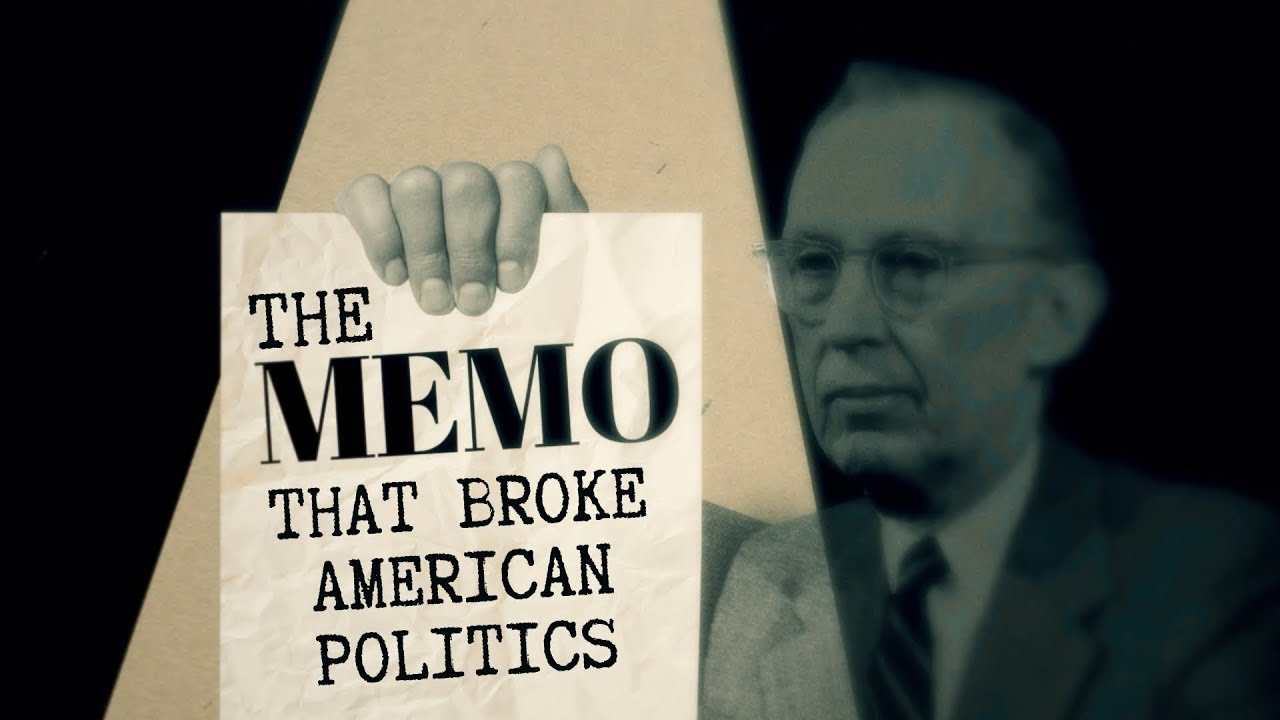
Powell earns particular pride of place in the show because of his authorship of a notorious 1971 memo (prepared for the US Chamber of Commerce) that laid out a strategy for a corporate counterrevolution against the emerging social movements of the 1960s and early ’70s (notably the Black Power movement, environmentalism, and consumer protection). The memo was a call to arms for corporate America to use its economic power to push back against the left, with particular emphasis on the importance of gaining sway over the courts, the academy, and the media.
The Powell Memo was the Project 2025 of the Nixon era—a detailed program for establishing and entrenching right-wing power over the commanding heights of American government and society.
On the left, there’s been much dispute over the actual impact of the Powell Memo: Was it really the blueprint for the conservative counterrevolution against liberalism that has remade America—or just the little-read grousing of an angry corporate lawyer?
Writing in The American Prospect in 2005, policy analyst Mark Schmitt decried the “myth” that the memo was influential. Schmitt claimed: “The memo was circulated within Chamber of Commerce circles and became public after Powell’s confirmation to the court, when journalist Jack Anderson unearthed it to question Powell’s judicial temperament. After that, it seems to have been forgotten.”
To its credit, Master Plan forthrightly addresses Schmitt’s reasonable argument, and uses fresh investigative reporting to document that the Powell Memo, far from having been “forgotten” after Jack Anderson’s reporting, was in fact the seedbed for high-level right-wing organizing that undergirds the conservative counterrevolution.
To illuminate both the Powell Memo and its legacy, Master Plan highlights Powell’s formation during his career as a corporate lawyer. He was no mere legal-gun-for-hire for Philip Morris but a full-fledged wartime consigliere, deeply involved in strategizing the firm’s long campaign of disinformation to discredit the science proving that smoking causes cancer. This campaign included pioneering the creation of astroturf groups that both lied about the science and pretended to be independent grassroots voices—a technique later picked up by fossil fuel firms promoting climate change denial.
This opposition to mainstream medical science grew out of a belief that nothing should stand in the way of corporate profit, certainly not any concern for the health of individuals or collective concern for environmental costs. Part of the spark for the Powell Memo was Powell’s anger that consumer advocate Ralph Nader was becoming a popular hero, subject to glowing profiles even in pro-business journals such as Fortune.
This pro-capitalist attitude went hand-in-hand with rabid anti-communism and a willingness to attack any radical movement as subversive. During his years as a corporate lawyer, Powell was a close confidant of FBI director J. Edgar Hoover and an informant to the FBI. The Powell Memo compares the Black Panther Party and New Left groups to Nazis.
The Powell Memo was written at a time when corporate America felt under siege by the rising demands of new social movements. It helped galvanize the counterrevolutionary reaction to progressive politics that encompassed not just Midwestern manufacturers and petite bourgeoisie (who had long formed the backbone of the American right) but also new allies among country club Republicans and corporate America (in other words, the sort of people Powell worked with at Philip Morris). These groups had been at odds since the start of the Cold War—which divided the isolationists from the internationalists—but the Powell Memo figured out a way to unite them against a common enemy.
The Powell Memo offered the business world an approach to politics that Powell had already seen work in Philip Morris’s campaign against medical science: a flexing of lobbying power through astroturf groups and a two-fisted opposition to any attempt to limit corporate spending in politics.
Master Plan opens with a remarkable scene that took place after Powell was elevated to the Supreme Court. Philip Morris threw a lavish party, hiring none other than legendary CBS News anchor Walter Cronkite to emcee a show highlighting key moments in Powell’s life. Powell was also presented with a gift: a judicial gown with the Phillip Morris logo stitched on—as if he were a race car driver advertising his sponsor. There’s not much of a leap from that gown to the expensive gifts Clarence Thomas and Samuel Alito have accepted from their billionaire pals.
Far from being forgotten, the Powell Memo was an underground bestseller in business circles. The Chamber of Commerce made copies easily available in the many thousands. Readers of the memo include a veritable pantheon of right-wing donors: the Koch brothers, Richard Mellon Scaife, and Joe Coors.
In 1973, the Chamber of Commerce organized two Powell Memo Task Force meetings. One was held in Disney World and was attended by Republican House minority leader Gerald Ford (who would soon to ascend to the presidency). Other members of the task force, as David Sirota notes, “included CBS president Richard Jenks, ABC executive James Hagerty, Ad Council chairman Barton Cummings, Metromedia executive Mark Evans, Hill & Knowlton president James Cassidy, and newspaper magnate Edward Scripps II.”
A concurrent Powell Memo Task Force met in Dallas and featured a speech by a young television producer, Roger Ailes—later the founder of Fox News. According to a report by attendee John Howard (president of Rockford College), Ailes “outlined the power which advertisers would be able to exert upon TV programming if they were moved to do so.” Ailes advised guests on “where and how they can apply leverage and be given the tools to exert the leverage.”
In 1974, CBS president Arthur Taylor in correspondence wrote about how the Powell Memo Task Force spurred him to push journalists at this network to be friendlier to big business. Taylor wrote, “I’ve been attempting as persuasively as possible for the last year to correct the situation at CBS News with some results, but I’m afraid it’s going to take a long time.”
Given the evidence presented in Master Plan, the Powell Memo had a very clear real-world impact. It wasn’t a distant shooting star. It was a massive asteroid that smashed the earth. It provided the theoretical program for right-wing think tanks in the coming decades of ideological war, and gave corporate donors a strategy for maximizing the impact of their spending in politics. More broadly, it can be fairly seen as the inspiration for such institutions as Fox News and the Federalist Society.
From the vantage point of the present, the Powell Memo was the precursor to Project 2025. The question that should haunt us is: If the Powell Memo achieved so much, how much more might Project 2025 accomplish?
===
---
12 22 an sadly no 28th
The corporate takeover of American politics started with a man and a memo you’ve probably never heard of.
In 1971, the U.S. Chamber of Commerce asked Lewis Powell, a corporate attorney who would go on to become a Supreme Court justice, to draft a memo on the state of the country.
Powell’s memo argued that the American economic system was “under broad attack” from consumer, labor, and environmental groups.
In reality, these groups were doing nothing more than enforcing the implicit social contract that had emerged at the end of the Second World War. They wanted to ensure corporations were responsive to all their stakeholders — workers, consumers, and the environment — not just their shareholders.
But Powell and the Chamber saw it differently. In his memo, Powell urged businesses to mobilize for political combat, and stressed that the critical ingredients for success were joint organizing and funding.
The Chamber distributed the memo to leading CEOs, large businesses, and trade associations — hoping to persuade them that Big Business could dominate American politics in ways not seen since the Gilded Age.
It worked.
The Chamber’s call for a business crusade birthed a new corporate-political industry practically overnight. Tens of thousands of corporate lobbyists and political operatives descended on Washington and state capitals across the country.
I should know — I saw it happen with my own eyes.
In 1976, I worked at the Federal Trade Commission. Jimmy Carter had appointed consumer advocates to battle big corporations that for years had been deluding or injuring consumers.
Yet almost everything we initiated at the FTC was met by unexpectedly fierce political resistance from Congress. At one point, when we began examining advertising directed at children, Congress stopped funding the agency altogether, shutting it down for weeks.
I was dumbfounded. What had happened?
In three words, The Powell Memo.
Lobbyists and their allies in Congress, and eventually the Reagan administration, worked to defang agencies like the FTC — and to staff them with officials who would overlook corporate misbehavior.
Their influence led the FTC to stop seriously enforcing antitrust laws — among other things — allowing massive corporations to merge and concentrate their power even further.
Washington was transformed from a sleepy government town into a glittering center of corporate America — replete with elegant office buildings, fancy restaurants, and five-star hotels.
Meanwhile, Justice Lewis Powell used the Court to chip away at restrictions on corporate power in politics. His opinions in the 1970s and 80s laid the foundation for corporations to claim free speech rights in the form of financial contributions to political campaigns.
Put another way — without Lewis Powell, there would probably be no Citizens United — the case that threw out limits on corporate campaign spending as a violation of the “free speech” of corporations.
These actions have transformed our political system. Corporate money supports platoons of lawyers, often outgunning any state or federal attorneys who dare to stand in their way. Lobbying has become a $3.7 billion dollar industry.
Corporations regularly outspend labor unions and public interest groups during election years. And too many politicians in Washington represent the interests of corporations — not their constituents. As a result, corporate taxes have been cut, loopholes widened, and regulations gutted.
Corporate consolidation has also given companies unprecedented market power, allowing them to raise prices on everything from baby formula to gasoline. Their profits have jumped into the stratosphere — the highest in 70 years.
But despite the success of the Powell Memo, Big Business has not yet won. The people are beginning to fight back.
First, antitrust is making a comeback. Both at the Federal Trade Commission and the Justice Department, we're seeing a new willingness to take on corporate power.
Second, working people are standing up. Across the country workers are unionizing at a faster rate than we’ve seen in decades — including at some of the biggest corporations in the world — and they’re winning.
Third, campaign finance reform is within reach. Millions of Americans are intent on limiting corporate money in politics – and politicians are starting to listen.
All of these tell me that now is our best opportunity in decades to take on corporate power — at the ballot box, in the workplace, and in Washington.
Let’s get it done.
---
---
main
---
https://en.wikipedia.org/wiki/Lewis_F._Powell_Jr.
lewis Franklin Powell Jr. (September 19, 1907 – August 25, 1998) was an American lawyer and jurist who served as an Associate Justice of the Supreme Court of the United States from 1971 to 1987. Powell compiled a generally conservative and business-aligned record on the Court.[citation ^needed]
Born in Suffolk, Virginia, he graduated from both Washington and Lee Law School and Harvard Law School and served in the United States Army Air Forces during World War II. He worked for Hunton & Williams, a large law firm in Richmond, Virginia, focusing on corporate law and representing clients such as the Tobacco Institute. In 1971, PresidentRichard Nixon appointed Powell to succeed Associate Justice Hugo Black.He retired from the Court during the administration of President Ronald Reagan, and was eventually succeeded by Anthony Kennedy.
His tenure largely overlapped with that of Chief Justice Warren Burger, and Powell was often a key swing vote on the Burger Court. His majority opinions include First National Bank of Boston v. Bellotti and McCleskey v. Kemp, and he wrote an influential opinion in Regents of the University of California v. Bakke. He notably joined the majority in cases such as United States v. Nixon, Roe v. Wade, Plyler v. Doe, and Bowers v. Hardwick.
- Early life and education
- 2Career
- 3Retirement and death, 1987–1998
- 4Legacy
- 5See also
- 6References
- 7External links
Early life and education[
Powell was born in Suffolk, Virginia, the son of Mary Lewis (Gwathmey) and Louis Franklin Powell.[3] Powell set out to attend Washington and Lee University where he became president of his fraternity, managing editor of the student newspaper, and a member of the yearbook staff. His major was in commerce, but he also studied law. Powell had always planned on becoming a lawyer because he viewed their roles as shaping history. He graduated in 1929 with a B.A. magna cum laude and Phi Beta Kappa. He also was named recipient of the Algernon Sydney Sullivan Award for "generous service to others".
Powell then attended Washington and Lee University School of Law and in 1931 graduated first in his class. He received a Master of Laws degree from Harvard Law School in 1932,[4] wrote a LL.M. thesis, entitled "Relation between the Virginia Court of Appeals and the State Corporation Commission",[5] and was one of two U.S. Supreme Court justices to have earned an LL.M. degree.[6]
He was elected president of the student body as an undergraduate with the help of Mosby Perrow Jr., and the two served together on the Virginia State Board of Education in the 1960s.[7] Powell was a member of Phi Kappa Sigma fraternity and the Sigma Society.[8] At a leadership conference, he met Edward R. Murrow, and they became close friends.[9]
In 1936, he married Josephine Pierce Rucker with whom he had three daughters and one son. She died in 1996.
Career[
Military service, 1939–1945[
During World War II, he first tried to join the United States Navy but was rejected because of poor eyesight, so he joined the US Army Air Forces as an Intelligence officer. After receiving his commission as a first lieutenant in 1942, he completed training at bases near Miami, Florida and Harrisburg, Pennsylvania. He was assigned to the 319th Bombardment Group, which moved to England later that year. He served in North Africa during Operation Torch and was later assigned to the Headquarters of the Northwest African Air Forces. There, Powell served in Sicily during the Allied invasion of Sicily.
In August 1943, he was assigned to the Intelligence staff of the Army Air Forces in Washington, D.C. Slated for assignment as an instructor at the facility near Harrisburg, he worked instead on several special projects for the AAF headquarters until February 1944. He was then assigned to the Intelligence staff of the Department of War and then the Intelligence staff of United States Strategic Air Forces in Europe. Powell was assigned to the Ultra project, as one of the officers designated to monitor the use of intercepted Axis communications. He worked in England and in the Mediterranean Theater and ensured that the use of Ultra information was in compliance with the laws of war, and that the use of such information did not reveal the source, which would have alerted that the code had been broken. He advanced through the ranks to colonel, and received the Legion of Merit, Bronze Star Medal, and French Croix de Guerre with bronze palm. He was discharged in October 1945.[10]
Legal career[
In 1941, Powell served as Chairman of the American Bar Association's Young Lawyers Division.[11]
Powell was a partner for over a quarter of a century atHunton, Williams, Gay, Powell and Gibson, a large Virginia law firm, with its primary office in Richmond, now known asHunton Andrews Kurth. Powell practiced primarily in the areas of corporate law, especially in the fields of mergers and acquisitions and railroad litigation.
From 1961 to 1962 Powell served as Chair of the American Bar Association's Standing Committee on the Economics of Law Practice, which later evolved into the ABA Law Practice Division. During his tenure as Chair of the Committee, The Lawyers Handbook was first published and distributed to all attorneys who joined the ABA that year. In its preface, Powell wrote, "The basic concept of freedom under law, which underlies our entire structure of government, can only be sustained by a strong and independent bar. It is plainly in the public interest that the economic health of the legal profession be safeguarded. One of the means toward this end is to improve the efficiency and productivity of lawyers."[12]
From 1964 to 1965 he was elected President of the ABA. Powell led the way in attempting to provide legal services to the poor, and he made a key decision to cooperate with the federal government's Legal Services Program. Powell was also involved in the development of Colonial Williamsburg, where he was both a trustee and general counsel. From 1964 until his court appointment in 1971 he was a board member of Philip Morris and acted as a contact point for the tobacco industry with Virginia Commonwealth University. Through his law firm, Powell represented the Tobacco Institute and various tobacco companies in numerous cases.
Virginia government, 1951–1970[
Powell played an important role in local community affairs. From 1951 he served on the Richmond School Board and was its Chairman from 1952 to 1961. Powell presided over the school board at a time when the Commonwealth of Virginia was locked in a campaign of defiance against the Supreme Court's decision in Brown v. Board of Education (1954), which desegregated public schools. Powell's law firm, although not Powell himself, represented one of the defendant school districts in Davis v. County School Board of Prince Edward County, which was consolidated later into Brown.
The Richmond School Board had no authority at the time to force integration, however, as control over attendance policies had been transferred to the state government. Powell, like most white Southern leaders of his day, did not speak out against the state's defiance, but fostered a close relationship with many black leaders, such as civil rights lawyer Oliver Hill, some of whom offered key support for Powell's Supreme Court nomination. In 1990, Powell swore in Virginia's first black governor, Douglas Wilder.
From 1961 to 1969, Powell served on the Virginia Board of Education; he was Chairman from 1968 to 1969.[13]
Powell Memorandum, 1971[
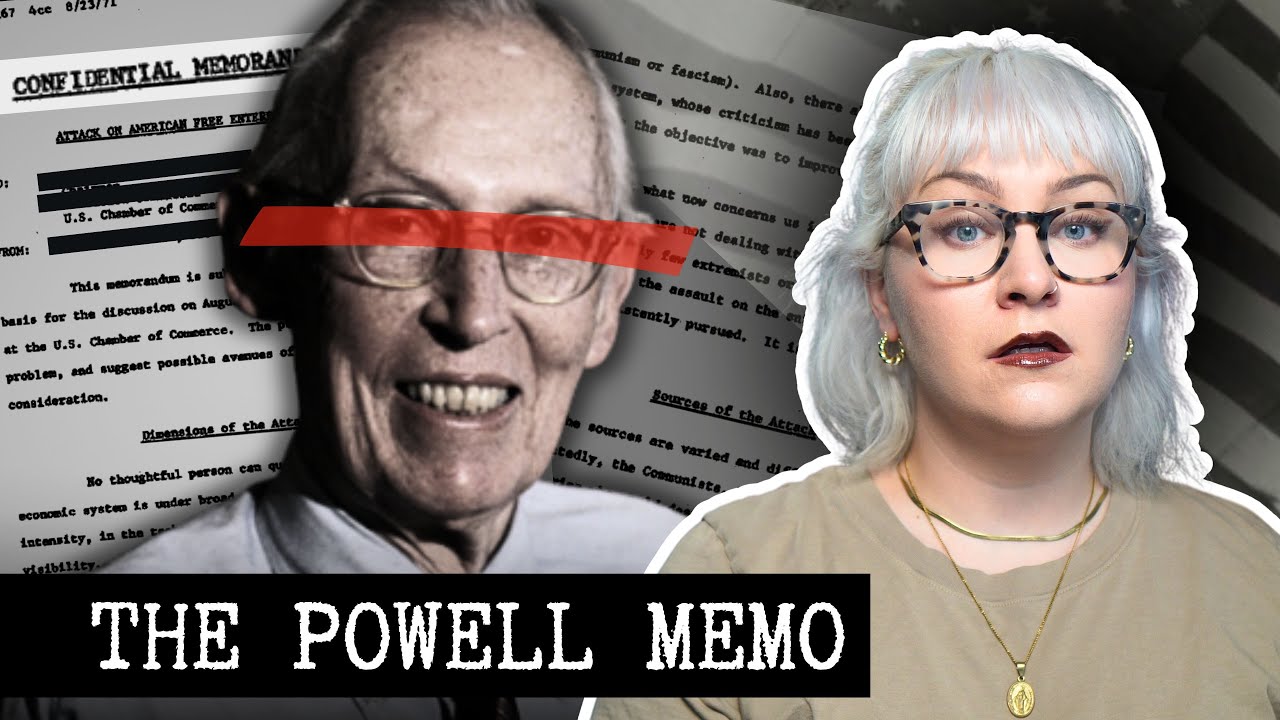
On August 23, 1971, prior to accepting Nixon's nomination to the Supreme Court, Powell was commissioned by his neighbor, Eugene B. Sydnor Jr., a close friend and education director of the US Chamber of Commerce, to write a confidential memorandum for the chamber entitled "Attack on the American Free Enterprise System," an anti-Communist and anti-New Deal blueprint for conservative business interests to retake America.[14][15] It was based in part on Powell's reaction to the work of activist Ralph Nader, whose 1965 exposé on General Motors, Unsafe at Any Speed, put a focus on the auto industry putting profit ahead of safety, which triggered the American consumer movement. Powell saw it as an undermining of the power of private business and a step towards socialism.[14] His experiences as a corporate lawyer and a director on the board of Phillip Morris from 1964 until his appointment to the Supreme Court made him a champion of the tobacco industry who railed against the growing scientific evidence linking smoking to cancer deaths.[14] He argued, unsuccessfully, that tobacco companies' First Amendment rights were being infringed when news organizations were not giving credence to the cancer denials of the industry.[14]
The memo called for corporate America to become more aggressive in molding society's thinking about business, government, politics and law in the US. It inspired wealthy heirs of earlier American industrialists, the Earhart Foundation (whose money came from an oil fortune), and the Smith Richardson Foundation (from the cough medicine dynasty)[14] to use their private charitable foundations−which did not have to report their political activities−to join the Carthage Foundation, founded by Richard Mellon Scaife in 1964.[14] The Carthage Foundation pursued Powell's vision of a pro-business, anti-socialist, minimally government-regulated America based on what he thought America had been in the heyday of early American industrialism, before the Great Depression and the rise of Franklin Roosevelt's New Deal.
The Powell Memorandum thus became the blueprint for the rise of the American conservative movement and the formation of a network of influential right-wing think tanks and lobbying organizations, such as The Heritage Foundation and the American Legislative Exchange Council (ALEC) as well as inspiring the US Chamber of Commerce to become far more politically active.[16][17] CUNY professor David Harvey traces the rise of neoliberalism in the US to this memo.[18][19]
Powell argued, "The most disquieting voices joining the chorus of criticism came from perfectly respectable elements of society: from the college campus, the pulpit, the media, the intellectual and literary journals, the arts and sciences, and from politicians." In the memorandum, Powell advocated "constant surveillance" of textbook and television content, as well as a purge of left-wing elements. He named consumer advocate Nader as the chief antagonist of American business. Powell urged conservatives to undertake a sustained media-outreach program, including funding neoliberal scholars, publishing books, papers, popular magazines, and scholarly journals, and influencing public opinion.[20][21]
This memo foreshadowed a number of Powell's court opinions, especially First National Bank of Boston v. Bellotti, which shifted the direction of First Amendment law by declaring that corporate financial influence of elections by independent expenditures should be protected with the same vigor as individual political speech. Much of the future Court opinion in Citizens United v. Federal Election Commission relied on the same arguments raised in Bellotti.
Though written confidentially for Sydnor at the Chamber of Commerce, it was discovered by Washington Post columnist Jack Anderson, who reported on its content a year later (after Powell had joined the Supreme Court). Anderson alleged that Powell was trying to undermine the democratic system; however, in terms of business's view of itself in relation to government and public interest groups, the memo could be alternatively read to simply convey conventional thinking among businessmen at the time. Interpreted in this way, the primary contribution of the memo could instead be read to emphasize institution-building, particularly updating the Chamber's efforts to influence federal policy. Here, it was a major force in motivating the Chamber and other groups to modernize their efforts to lobby the federal government. Following the memo's directives, conservative foundations greatly increased, pouring money into think-tanks. This rise of conservative philanthropy led to the conservative intellectual movement and its increasing influence over mainstream political discourse, starting in the 1970s and '80s, and due chiefly to the works of the American Enterprise Institute and the Heritage Foundation.[22]
Supreme Court tenure, 1971–1987[
In 1969, Nixon asked him to join the Supreme Court, but Powell turned him down. In 1971, Nixon asked him again. Powell was unsure, but Nixon and his Attorney General, John N. Mitchell, persuaded him that joining the Court was his duty to the nation.[23] One of the primary concerns that Powell had was the effect leaving his law firm and joining the high court would have on his personal financial status, as he enjoyed a very lucrative private practice at his law firm. Another of Powell's major concerns was that as a corporate attorney, he would be unfamiliar with many of the issues that would come before the Supreme Court, which, like now, heard very few corporate law cases. Powell feared that would place him at a disadvantage and make it unlikely that he would be able to influence his colleagues.
Nixon nominated Powell and William Rehnquist to the Court on the same day, October 21, 1971.[24] Powell took over the seat of Hugo Black after being confirmed by the Senate 89-1 on December 7, 1971 (the lone "nay" came from Oklahoma Democrat Fred R. Harris). On the day of Powell's swearing-in, when Rehnquist's wife Nan asked Josephine Powell if this was the most exciting day of her life, Josephine said, "No, it is the worst day of my life. I am about to cry."[25]
Lewis Powell served from January 7, 1972 until June 26, 1987, when he retired from the Court.[26]
Powell was among the 7–2 majority who legalized abortion in the United States in Roe v. Wade (1973). Powell's pro-choice stance on abortion stemmed from an incident during his tenure at his Richmond law firm, when the girlfriend of one of Powell's office staff bled to death from an illegal self-induced abortion.[27]
Powell, who dissented in the case of Furman v. Georgia (1972), striking down capital punishment statutes, was a key mover behind the Court's compromise opinion in Gregg v. Georgia (1976), which allowed the return of capital punishment but only with procedural safeguards. In Coker v. Georgia (1977), a convicted murderer escaped from prison and, in the course of committing an armed robbery and other offenses, raped an adult woman. The State of Georgia sentenced the rapist to death. Justice Powell, acknowledging that the woman had been raped, expressed the view that "the victim [did not] sustain serious or lasting injury"[28] and voted to set the death penalty aside. In that same case, Powell also wrote to rebuke the plurality's statement that "for the rape victim, life may not be nearly so happy as it was, but it is not over and normally is not beyond repair,"[29] instead stating that "[s]ome victims are so grievously injured physically or psychologically that life is beyond repair."[29]
His opinion in Regents of the University of California v. Bakke (1978), joined by no other justice in full, represented a compromise between the opinions of Justice William J. Brennan, who, joined by three other justices, would have upheld affirmative action programs under a lenient judicial test, and the opinion of John Paul Stevens, joined by three other justices, who would have struck down the affirmative action program at issue in the case under the Civil Rights Act of 1964. Powell's opinion striking down the law urged "strict scrutiny" to be applied to affirmative action programs but hinted that some affirmative action programs might pass Constitutional muster.
In the controversial case of Snepp v. U.S. (1980), the Court issued a per curiam upholding the lower court's imposition of a constructive trust upon former CIA agent Frank Snepp and its requirement for preclearance of all his published writings with the CIA for the rest of his life. In 1997, Snepp gained access to the files of Justices Thurgood Marshall (who had already died) and William J. Brennan Jr. (who voluntarily granted Snepp access) and confirmed his suspicion that Powell had been the author of the per curiam opinion. Snepp later pointed out that Powell had misstated the factual record and had not reviewed the actual case file (Powell was in the habit of writing opinions based on the briefs alone) and that the only justice who even looked at the case file was John Paul Stevens, who relied upon it in composing his dissent.[30] From his days in counterintelligence during World War II, Powell believed in the need for government secrecy and urged the same position on his colleagues during the Court's consideration of 1974's United States v. Nixon.
Powell wrote the majority opinion in First National Bank of Boston v. Bellotti (1978), which overturned a Massachusetts law restricting corporate contributions to referendum campaigns not directly related to their business.[31]
Powell joined the 5–4 majority opinion in Plyler v. Doe, holding that a Texas law forbidding undocumented immigrant children from public education was unconstitutional.[32] Powell had a fairly conservative record in deciding cases, but joined the Court's four liberal Justices to declare the law unconstitutional.
Powell was the swing vote in Bowers v. Hardwick, 478 U.S. 186 (1986), in which the Court upheld Georgia's sodomy laws. He was reportedly conflicted over how to vote. A conservative clerk, Michael W. Mosman, advised him to uphold the ban, and Powell, who believed he had never met a gay person, not realizing that one of his own clerks was a closeted homosexual, voted to uphold Georgia's sodomy law. However, he, in a concurring opinion, expressed concern at the length of the prison terms prescribed by the law.[33] The Court, 17 years later, expressly overruled Bowers in Lawrence v. Texas, 539 U.S. 558 (2003). In 1990, after his retirement from the Court, he said, "I think I made a mistake in the Hardwick case," marking one of the few times a justice expressed regret for one of his previous votes.[34]
Powell also expressed post-retirement regret over his majority opinion in McCleskey v. Kemp (1987), where he voted to uphold the death penalty against a study that demonstrated that, except as punishment for the most violent of crimes, murderers sentenced for killing white victims were up to forty times more likely to receive the death penalty than people who killed black victims. In an interview with his biographer, he even stated that he would abolish the death penalty altogether.[35]
Retirement and death, 1987–1998[
Powell was nearly 80 years old when he retired from his position as Supreme Court justice in June 1987.[1] His career on the bench was summed up by Gerald Gunther, a professor of constitutional law at Stanford Law School, as "truly distinguished" because of his "qualities of temperament and character," which "made it possible for him, more than any contemporary, to perform his tasks in accordance with the modest, restrained, yet creative model of judging."[36]
He was succeeded by Anthony Kennedy. Kennedy was the third nominee for his position. The first, Robert Bork, was not confirmed by the United States Senate. The second, Douglas H. Ginsburg, withdrew his name from consideration after admitting to having smoked marijuana both as a college undergraduate and with his students while a law professor.
Following his retirement from the high court, he sat regularly on various United States Courts of Appeals around the country.
In 1990, Douglas Wilder asked Powell to swear him in as governor of Virginia, and the first elected African-American governor in the United States.[37]
Powell died at his home in the Windsor Farms area of Richmond, Virginia, of pneumonia, at 4:30 in the morning of August 25, 1998, at the age of 90. He is buried in Richmond's Hollywood Cemetery.
Legacy[
In her 2002 book, The Majesty of the Law, Justice Sandra Day O'Connor wrote, "For those who seek a model of human kindness, decency, exemplary behavior, and integrity, there will never be a better man."
Powell's personal and official papers were donated to his alma mater, Washington and Lee University School of Law, where they are open for research, subject to certain restrictions. A wing at Sydney Lewis Hall, home of W&L Law, which houses his papers, is named for him.
J. Harvie Wilkinson, a judge on the Fourth Circuit, and former law clerk for Justice Powell, wrote a book titled Serving Justice: A Supreme Court Clerk's View describing the experience.
In 1993, President Bill Clinton signed into law an act of Congress renaming the Federal courthouse at Richmond, Virginia, in his honor, the Lewis F. Powell Jr. United States Courthouse.
See also[edit]
- List of justices of the Supreme Court of the United States
- List of law clerks of the Supreme Court of the United States (Seat 1)
- List of United States Supreme Court justices by time in office
- United States Supreme Court cases during the Burger Court
- United States Supreme Court cases during the Rehnquist Court
References
...
---
[https://web.archive.org/web/20120207182858/https://www.alternet.org/story/153345/
the_real_history_of_'corporate_personhood':_meet_the_man_to_blame_for_corporations_having_more_rights_than_you/ ]
Jeffrey Clement's Corporations Are Not People: Why They Have More Rights Than You Do and What You Can Do About It.)
https://www.theusconstitution.org/blog/new-book-tells-the-back-story-behind-the-powell-memo/
Readers of CAC’s report, A Capitalist Joker, know that we traced the aggressive advocacy of the idea that corporations should have the same rights as individuals to a memorandum written by Lewis Powell for the Chamber of Commerce shortly before Justice Powell was nominated by President Richard Nixon for a seat on the United States Supreme Court. This fascinating and somewhat disturbing excerpt of a new book by Jeff Clement fills in many new details of this story. It is well known, as Clement details, that Lewis Powell, just a matter of months before joining the Court, played the lead role in pushing corporations to exploit what he called “an neglected opportunity in the courts,” and that the for the last forty years, the Chamber of Commerce and other corporations have successfully pursued this strategy, aided by Justice Powell, in a line of cases that culminated with the 2010 ruling in Citizens United v. FEC.
Clement explains that Powell first developed the notion that corporations have the same constitutional rights as “We the People” in the process of spreading false information about the health of cigarettes for Phillip Morris. From 1964 until he joined the Court in 1971, Powell served as a director and member of the executive committee of Phillip Morris, and in that role, according to Clement, Powell played a critical role in trying to discredit the facts about the health of cigarettes and developing constitutional arguments against government regulation of the tobacco industry. For example, as Clements observes, Powell promoted the idea that Phillip Morris had a First Amendment right to equal time to respond to public service announcements that warned the public of the hazards of smoking, an idea with no basis in law. The story Clements tells — how Powell’s campaign to bend the Constitution to serve the interests of corporations culminated in Citizens United —is an important one for anyone concerned about the negative impact of Citizens United on our democracy and everyone working to overturn the ruling.
==
NEW
In 1971, Lewis Powell, then a corporate lawyer and member of the boards of 11 corporations, wrote a memo to his friend Eugene Sydnor, Jr., the Director of the U.S. Chamber of Commerce. The memorandum was dated August 23, 1971, two months prior to Powell's nomination by President Nixon to the U.S. Supreme Court. ...In 1971, Lewis Powell, then a corporate lawyer and member of the boards of 11 corporations, wrote a memo to his friend Eugene Sydnor, Jr., the Director of the U.S. Chamber of Commerce. The memorandum was dated August 23, 1971, two months prior to Powell’s nomination by President Nixon to the U.S. Supreme Court.
The Powell Memo did not become available to the public until long after his confirmation to the Court. It was leaked to Jack Anderson, a liberal syndicated columnist, who stirred interest in the document when he cited it as reason to doubt Powell’s legal objectivity. Anderson cautioned that Powell “might use his position on the Supreme Court to put his ideas into practice…in behalf of business interests.”
Though Powell’s memo was not the sole influence, the Chamber and corporate activists took his advice to heart and began building a powerful array of institutions designed to shift public attitudes and beliefs over the course of years and decades. The memo influenced or inspired the creation of the Heritage Foundation, the Manhattan Institute, the Cato Institute, Citizens for a Sound Economy, Accuracy in Academe, and other powerful organizations. Their long-term focus began paying off handsomely in the 1980s, in coordination with the Reagan Administration’s “hands-off business” philosophy.
Most notable about these institutions was their focus on education, shifting values, and movement-building — a focus we share, though often with sharply contrasting goals.* (See our endnote for more on this.)
So did Powell’s political views influence his judicial decisions? The evidence is mixed. Powell did embrace expansion of corporate privilege and wrote the majority opinion in First National Bank of Boston v. Bellotti, a 1978 decision that effectively invented a First Amendment “right” for corporations to influence ballot questions. On social issues, he was a moderate, whose votes often surprised his backers.
Confidential Memorandum: Attack of American Free Enterprise System
DATE: August 23, 1971
TO: Mr. Eugene B. Sydnor, Jr., Chairman, Education Committee, U.S. Chamber of Commerce
FROM: Lewis F. Powell, Jr.
...
==
http://www.organizedwealth.us/funding/powell-memo.html
chip berlet:
The Powell Memo
Why Conservatives Use Strategic Funding to Smash Progressive Policies and Labor Unions
In 1971 corporate attorney Lewis F. Powell, Jr. wrote an influential memo claiming that there was an organized “Attack [on the] American Free Enterprise System.” To counter this Powell suggested a coordinated campaign to reshape the ideological debate on college campuses, in the media, and in the political and legal arenas. On campus, Powell complained about the leftward drift of education and college students:
"We have seen the civil rights movement insist on re-writing many of the textbooks in our universities and schools. The labor unions likewise insist that textbooks be fair to the viewpoints of organized labor. Other interested citizens groups have not hesitated to review, analyze and criticize textbooks and teaching materials…."
"Social science faculties (the political scientist, economist, sociologist and many of the historians) tend to be liberally oriented, even when leftists are not present."
Powell urged corporate America to fund coordinated and overlapping campaigns to take back America from the liberals and the New Left. Prefiguring the tropes of the Tea Party movement, Powell suggested the "threat to the enterprise system is not merely a matter of economics. It also is a threat to individual freedom." He claimed: "inequitable taxation" was part of a trend that, as "the experience of the socialist and totalitarian states demonstrates," greased a slippery slope whereby "the contraction and denial of economic freedom is followed inevitably by governmental restrictions on other cherished rights."
The Powell memo was widely circulated among business and political leaders and reached the White House. Within a few months, Powell was named by President Richard Nixon to a seat on the U.S. Supreme Court. [[i]](http://www.organizedwealth.us/funding/powell-memo.html#_edn1)
The 1971 Powell memo picked up on longstanding conservative and libertarian complaints about statism, collectivism, and big government; as well as a defense of a Laissez Fairemodel of political economy. All of this had previously been aired in conservative publications including the Freeman and National Review. This time, however, a number of wealthy ultraconservatives such as Richard Mellon Scaife, Joseph Coors and others began funding right-wing organizations and institutions in a strategic manner to help build a national and state network of think tanks, training centers, watchdog groups, opposition research groups, magazines, and endowed chairs for professors at universities.[[ii]](http://www.organizedwealth.us/funding/powell-memo.html#_edn2)
William Simon,an ultraconservative ideologue, chose election year 1978 to renew the call to bolster public support to defend the “Free Enterprise” system against what he termed the liberal onslaught. Simon had served as Secretary of the Treasury under Presidents Nixon and Ford from 1974 to 1977. Simon urged that money “generated by business (by which I mean profits, funds in business foundations and contributions from individual businessmen) must rush by multimillions to the aid of liberty…to funnel desperately needed funds to scholars, social scientists, writers, and journalists who understand the relationship between political and economic liberty.”[[iii]](http://www.organizedwealth.us/funding/powell-memo.html#_edn3)
Many of the claims that democracy and liberty require particular nineteenth century "neoclassical" Free Market economics came from ultraconservative ideologues at the University of Chicago.[[iv]](http://www.organizedwealth.us/funding/powell-memo.html#_edn4) Whether or not Strauss was the progenitor of neoconservatism, the Chicago School of political economy became popular across various sectors of the Political Right. Corporate conservatives such as Powell and neoconservatives such as Simon can agree on some underlying economic policy matters, while fiercely debating other issues.
In 1971 Karl Rove (who is now key Republican strategy adviser), became the executive director of the national College Republicans. That was the same year Powell wrote his memo that would unlock the flow of hundreds of millions of dollars from conservatives to roll back the New Deal and the New Left and create a New Right. This marked a lurch to the Right by the young Republicans. It also saw theexpansion of a significant number of programs to identify and train conservative students on college campuses. As Pam Chamberlain found in 2005:
"A list of conservative alumni of campus supportive programs reads like a Who's Who of current Right strategists and spokespeople….Sen. Rick Santorum, (R-PA), Grover Norquist, head of Americans for Tax Relief, and Ralph Reed, the former director of the Christian Coalition and current Georgia political candidate, have all been associated with the College Republicans or their National Committee. Edwin Feulner, President of the Heritage Foundation, and Richard Allen, Senior Fellow at the Hoover Institution, were involved with the Intercollegiate Studies Institute as students.[[v]](http://www.organizedwealth.us/funding/powell-memo.html#_edn5)
The concerted effort to fund a counter-offensive aimed at restoring conservative and traditional curricula and program on college campuses was effective.[[vi]](http://www.organizedwealth.us/funding/powell-memo.html#_edn6) This has continued to today. Between the 1971 Powell Memo and the rise of the Tea Party movement and the attack on President Obama as a socialist totalitarian,more than $1 billion was spent by conservative organizations on conducting a war on progressive ideas.
Browse the right-wing funding web chart
==
http://www.greenpeace.org/usa/the-lewis-powell-memo-corporate-blueprint-to-dominate-democracy/
alt https://web.archive.org/web/20141114110600/http://www.greenpeace.org/usa/en/campaigns/global-warming-and-energy/polluterwatch/The-Lewis-Powell-Memo/
Written in 1971 to the U.S. Chamber of Commerce, the Lewis Powell Memo was a blueprint for corporate domination of American Democracy.
- Greenpeace has the full text of the Lewis Powell Memo available for review, as well as analyses of how Lewis Powell’s suggestions have impacted the realms of politics, judicial law, communications and education.
- 404 so https://web.archive.org/web/20141114120632/http://www.greenpeace.org/usa/en/campaigns/global-warming-and-energy/polluterwatch/The-Lewis-Powell-Memo/communications/
Forty years ago today, on August 23, 1971,Justice Lewis F. Powell, Jr., an attorney from Richmond, Virginia, drafted a confidential memorandum for the U.S. Chamber of Commerce that describes a strategy for the corporate takeover of the dominant public institutions of American society.
Powell and his friend Eugene Sydnor, then-chairman of the Chamber’s education committee, believed the Chamber had to transform itself from a passive business group into a powerful political force capable of taking on what Powell described as a major ongoing “attack on the American free enterprise system.”
An astute observer of the business community and broader social trends, Powell was a former president of the American Bar Association and a board member of tobacco giant Philip Morris and other companies. In his memo, he detailed a series of possible “avenues of action” that the Chamber and the broader business community should take in response to fierce criticism in the media, campus-based protests, and new consumer and environmental laws.
Environmental awareness and pressure on corporate polluters had reached a new peak in the months before the Powell memo was written. In January 1970, President Nixon signed the National EnvironmentalPolicy Act, which formally recognized the environment’s importance by establishing the White House Council on Environmental Quality. Massive Earth Day events took place all over the country just a few months later and by early July, Nixon signed an executive order that created the Environmental Protection Agency (EPA). Tough new amendments to the Clean Air Act followed in December 1970 and by April 1971, EPA announced the first air pollution standards. Lead paint was soon regulated for the first time, and the awareness of the impacts of pesticides and other pollutants– made famous by Rachel Carson in her 1962 book, Silent Spring was recognized when DDT was finally banned for agricultural use in 1972.
The overall tone of Powell’s memo reflected a widespread sense of crisis among elites in the business and political communities. “No thoughtful person can question that the American economic system is under broad attack,” he suggested, adding that the attacks were not coming just from a few “extremists of the left,” but also and most alarmingly — from “perfectly respectable elements of society,” including leading intellectuals, the media, and politicians.
To meet the challenge, business leaders would have to first recognize the severity of the crisis, and begin marshalling their resources to influence prominent institutions of public opinion and political power — especially the universities, the media and the courts. The memo emphasized the importance of education, values, and movement-building. Corporations had to reshape the political debate, organize speakers’ bureaus and keep television programs under “constant surveillance.” Most importantly, business needed to recognize that political power must be “assiduously cultivated; and that when necessary, it must be used aggressively and with determination without embarrassment and without the reluctance which has been so characteristic of American business.”
Powell emphasized the importance of strengthening institutions like the U.S. Chamber— which represented the interests of the broader business community, and therefore key to creating a united front. While individual corporations could represent their interests more aggressively, the responsibility of conducting an enduring campaign would necessarily fall upon the Chamber and allied foundations. Since business executives had “little stomach for hard-nosed contest with their critics” and “little skill in effective intellectual and philosophical debate,” it was important to create new think tanks, legal foundations, front groups and other organizations. The ability to align such groups into a united front would only come about through “careful long-range planning and implementation, in consistency of action over an indefinite period of years, in the scale of financing available only through joint effort, and in the political power available only through united action and united organizations.”
Before he was appointed by Richard Nixon to the U.S. Supreme Court Powell circulated his call for a business crusade not only to the Chamber, but also to executives at corporations including General Motors. The memo did not become available to the public until after Powell’s confirmation to the Court, when it was leaked toJack Anderson,a syndicated columnist and investigative reporter, who cited it as reason to doubt Powell’s legal objectivity.
Anderson’s report spread business leaders’ interest in the memo even further. Soon thereafter, the Chamber’s board of directors formed a task force of 40 business executives(from U.S. Steel, GE, ABC, GM, CBS, 3M, Phillips Petroleum, Amway and numerous other companies) to review Powell’s memo and draft a list of specific proposals to “improve understanding of business and the private enterprise system,” which the board adopted on November 8, 1973.
Kim Phillips-Fein, Invisible Hands: The Making of the Conservative Movement from the New Deal to Reagan. New York: W.W. Norton, 2009
Historian Kim Phillips-Fein describes how “many who read the memo cited it afterward as inspiration for their political choices.” In fact, Powell’s Memo is widely credited for having helped catalyze a new business activist movement, with numerous conservative family and corporate foundations (e.g. Coors, Olin, Bradley, Scaife, Koch and others) thereafter creating and sustaining powerful new voices to help push the corporate agenda, including theBusiness Roundtable (1972), the American Legislative Exchange Council (ALEC– 1973), Heritage Foundation (1973), the Cato Institute (1977), the Manhattan Institute (1978), Citizens for a Sound Economy (1984 – now Americans for Prosperity), Accuracy in Academe (1985), and others.
Because it signaled the beginning of a major shift in American business culture, political power and law, the Powell memo essentially marks the beginning of the business community’s multi-decade collective takeover of the most important institutions of public opinion and democratic decision-making. At the very least, it is the first place where this broad agenda was compiled in one document.
That shift continues today, with corporate influence over policy and politics reaching unprecedented new dimensions. The decades-long drive to rethink legal doctrines and ultimately strike down the edifice of campaign finance laws breaking radical new ground with the Roberts Court’s decision in Citizens Unitedv. the Federal Election Commission continues apace.
Although many new voices have emerged in the 40 years since it circulated Powell’s memo, the U.S. Chamberhas expanded its leadership position within the corporate power movement, leading dozens of judicial, legislative and regulatory fights each year. Measured in terms of money spent, the Chamber is by far the most powerful lobby in Washington, DC, spending $770.6 million since 1998, over three times the amount spent by General Electric, the second-largest spender. At the same time, the Chamber has reinforced its lobbying power by becoming one of the largest conduits of election-related “independent expenditures,” spending over $32.8 million on Federal elections in 2010. The Chamber sponsors the Institute for Legal Reform, which has spearheaded the campaign for tort “reform,” making it more difficult for average people who have been injured, assaulted, or harmed to sue the responsible corporations. Along with well over a dozen legal foundations, the Chamber has also helped shape the powerful “business civil liberties” movement that has been a driving force behind the Citizens United decision and other judicial actions that have handcuffed regulators and prevented Congress from putting common-sense checks on corporate power.
Cited Sources:
Jack Anderson,Washington Report, Volume 12, No. 24, November 26, 1973. Available at: http://research.greenpeaceusa.org/?a=view&d=5972.
Kim Phillips-Fein, Invisible Hands: The Making of the Conservative Movement from the New Deal to Reagan. New York: W.W. Norton, 2009
Jeff Krehely, Meaghan House and Emily Kernan, “Axis of Ideology: Conservative Foundations and Policy,” National Committee for Responsive Philanthropy, 2004
Michael Waldman, Executive Director of the Brennan Center for Justice at NYU School of Law cites the Powell memo as the inspiration for the ideological war waged on behalf of the “free market” approach to the First Amendment that has elevated the rights of corporate speakers. See Waldman’s introduction to “Money, Politics and the Constitution: Beyond Citizens United,” by Monica Youn (ed.), New York: Century Foundation Press, 2011
Additional References:
Lewis F. Powell, Jr. Papers, Powell Archives, Washington and Lee University School of Law. More information available at: http://law.wlu.edu/powellarchives/
Nan Aron, “Justice for Sale: Shortchanging The Public Interest for Private Gain.” Washington, DC: Alliance for Justice, 1993
Oliver A. Houck, “With Charity for All.” New Haven, CT: Yale Law Journal, Volume 93, No. 8, July 1984.
Jean Stefancic and Richard Delgado, “No Mercy: How Conservative Think Tanks and Foundations Changed America’s Social Agenda,” Temple University Press, 1996.
---
law:
https://web.archive.org/web/20141114114235/http://www.greenpeace.org/usa/en/campaigns/global-warming-and-energy/polluterwatch/The-Lewis-Powell-Memo/judicial/
Powell saw that corporate interests could gain greatly by using the judicial system to their advantage, yet to make the judiciary more sympathetic to business interests, he knew corporations would have to plan and engage in a long-term, multi-dimensional strategy.
The Powell Memo on Judicial Influence:
"[T]he judiciary may be the most important instrument for social, economic and political change. [...] This is a vast area of opportunity for the Chamber, if it is willing to undertake the role of spokesman for American business and if, in turn, business is willing to provide the funds. As with respect to scholars and speakers, the Chamber would need a highly competent staff of lawyers. In special situations it should be authorized to engage, to appear as counsel amicus in the Supreme Court, lawyers of national standing and reputation. The greatest care should be exercised in selecting the cases in which to participate, or the suits to institute. But the opportunity merits the necessary effort."
(Direct link to this quote in the Powell Memo)
The big business reaction to Lewis Powell’s judicial and legal strategy was swift. Within a few years, nearly a dozen corporate-funded legal foundations were created. The Pacific Legal Foundation (PLF) was formed in California in 1973 to counter public-interest law firmsand represent the interests of business and private property holders against environmental regulations. PLF’s prospectus quoted the Powell memo at length. (Kim Phillips-Fein, “Invisible Hands,” p. 162).
When asked for his opinion of the “most critical” area of public interest law, PLF’s then-executive legal director replied, “environmental law,” citing the firm’s support for the use of DDT, the construction of a dam and reservoir project, the use of herbicides in national forests and the use of public grazing lands without environmental impact review. The early cases established a clear pattern for PLF and its followers at the Mountain States Legal Foundation and other regionally named corporate defenders. Environmental cases would be a priority and the foundations’ positions in such cases would invariably be those of their business benefactors, including Monsanto, Weyerhaeuser, Gulf Oil, ARCO, Ford and other companies (Houck, "With Charity for All," pp. 1461-1462). The work of these groups also supported the Wise Use movement; radical property rights activists and corporate front groups that attacked environmental laws and regulations on behalf of landowners, ranchers and the oil industry (Helvarg, The War Against the Greens).
The conservative backlash against alleged liberal influence over the law went well beyond the corporate agenda that grew directly out of Powell’s analysis, but there were also tensions between the two. Corporate legal campaigns were primarily self-interested, practical and designed to get both immediate and longer-term results. The conservative legal movement that got its start in the 1970s was more ideologically driven; its greatest successes would take decades, and sometimes came about through indirect means (Teles, The Rise of the Conservative Legal Movement).
At the juncture between these two was the “law and economics” school, with leading proponents such as Richard Posner at the University of Chicago and George Mason University’s Henry Manne. Manne organized seminars for federal judges through his Law and Economics Center, with support from the Olin Foundation, which also backed some of the leading “second generation” conservative public policy law firms, like the Center for Individual Rights. The foundation’s chairman, John M Olin, was inspired by Powell’s memo to write to William Baroody at the American Enterprise Institute: “The Powell Memorandum gives a reason for a well organized effort to re-establish the validity and importance of the American free enterprise system.” (“Invisible Hands,” Kim Phillips-Fein)
For its part, the U.S. Chamber of Commerce also eventually followed Powell’s advice by creating two legal groupsthat have carried out a multi-decade legal strategy -- the National Chamber Litigation Center (NCLC) and the Institute for Legal Reform (ILR). NCLC served as the Chamber’s law firm, using aggressive and strategic litigation to challenge regulations and laws. Entering 134 new cases of significance to the business community in 2009, for example, the NCLC helped to secure 52 victories.
The Institute for Legal Reform (ILR) coordinated one of the Chamber’s flagship priorities in the post-Powell era -- the push for “tort reform.” The tort 'reform' campaign was so successful that by 2006, the American Lawyer proclaimed, “It’s Over,” explaining that “the power of the plaintiffs bar is on the wane in this country, and will be for a long time to come.” ILR, along with the American Tort Reform Association (funded by the tobacco, chemical and drug industries, along with the American Medical Association), created a “public relations masterpiece” that demonized trial lawyers, replaced state judges hostile to business interests, and mobilized popular support for business-friendly laws. (See Frankel, “It’s Over”) The campaign erected a variety of judicial and regulatory barriers against plaintiff attorneys and their clients – i.e., the victims of corporate crime and malfeasance -- including caps on punitive and non-economic damages, the abolition of “joint and several liability,” and limits on class action lawsuits.
This push fortort 'reform'has also been a legal priority for various industries. According to a document produced by one corporate law firm, for instance, the tobacco industry’s tort reform budget for 1995 alone was $21.8 million (see Covington & Burling Tort Reform Project Budget).
The U.S. Chamber has used the momentum built by decades of successful tort reform to brazenly argue for policies that would shield corporations from having to pay when they are responsible for cases of massive damage. For instance, after the 2010 BP Horizon disaster the Chamber arguedthat the $75 million liability cap should not be lifted retroactively to make BP pay for damages from the oil gusher. This position drew criticism from a variety of expert observers, including Ken Feinberg, the manager of BP’s oil spill compensation fund.
Some of the landmark changes in the law that have come about through support from business and conservative interests in recent decades have been used to bolster other strategies outlined by Powell in his memo. An example is the dismantling of the Fairness Doctrine for media, which was introduced to ensure public interest voices would balance commercial interests as part of the bargain for corporate broadcasters' free license to use the People’s airwaves.
Another significant shift in the law since Powell’s memo was circulated has been the gradual expansion of corporate constitutional rights (referred to by some business groups as “business civil liberties”), especially in the realms of commercial and political speech. The most infamous example is the Supreme Court’s 2010 decision in Citizens United v. Federal Election Commission. In the commercial sphere, companies have similarly used corporate speech doctrines to challenge various restrictions on corporate advertising (e.g. direct-to-consumer advertising of prescription drugs for off-label uses), limits on media ownership, and product safety labeling requirements (e.g. cigarettes and genetically modified foods).
Corporate constitutional rights are regularly claimed (with the implicit threat of litigation) in opposition to new or proposed regulations. One recent example came during recent attacks on regulations created by the Dodd-Frank financial reform package, which contained a provision requiring that companies report their use of tin, gold and other minerals that can be traced back to the conflict-ridden Democratic Republic of the Congo. In its comments to the SEC, Tiffany & Co. claimed the SEC rules would “compel speech in a manner that violates the First Amendment.”
References and More Information:
Oliver A. Houck, “With Charity for All,” Yale Law Journal, Volume 93, No. 8, July 1984. More information available at:http://research.greenpeaceusa.org/?a=view&d=6000.
Steven M. Teles, The Rise of the Conservative Legal Movement: The Battle for Control of the Law. Princeton University Press, 2008. More information available at:http://books.google.com/books/about/The_Rise_of_the_Conservative_Legal_Movem.html?id=MTps-NK20jAC.
Alison Frankel, “It’s Over: Tort reformers, business interests, and plaintiffs lawyers themselves have helped kill the mass torts bonanza.” The American Lawyer, December 1, 2006. Available at:http://www.law.com/jsp/PubArticle.jsp?id=1165320496651.
Kim Phillips-Fein, Invisible Hands: The Making of the Conservative Movement from the New Deal to Reagan. New York: Norton, 2009. More information available at:http://books.google.com/books/about/Invisible_hands.html?id=CcU7z9jLqXcC.
David Helvarg, The War Against the Greens. San Francisco: Sierra Club Books, 1994. More information available at:http://www.amazon.com/War-Against-Greens-Wise-Use-Movement/dp/1555663281.
Covington & Burling Tort Reform Project Budget, Budget, October 3, 1995, available in the Tobacco Legacy Documents’ online archive at:http://legacy.library.ucsf.edu/tid/khu28d00.
Robert Weissman, “First Amendment Follies,” Multinational Monitor, May, 1998. Available at:http://www.multinationalmonitor.org/mm1998/98may/corp3.html.
Patrick Dorsey, Sr. VP and General Counsel of Tiffany & Co., comments to the SEC, dated February 22, 2011. Available at:http://www.sec.gov/comments/df-title-xv/specialized-disclosures/specializeddisclosures-17.pdf.
Robert L Kerr, The Rights of Corporate Speech: Mobil Oil and the Legal Development of the Voice of Big Business, LFB Scholarly Publishing, 2005. More information available at:http://www.amazon.com/Rights-Corporate-Speech-Development-Scholarship/dp/1593320701.
Robert L Kerr, The Corporate Free-Speech Movement: Cognitive Feudalism and the Endangered Marketplace of Ideas, LFB Scholarly Publishing, 2008. More information available at:http://www.amazon.com/Corporate-Free-speech-Movement-Endangered-Marketplace/dp/1593322933.
Stephanie Mencimer,Blocking the Courthouse Door: How the Republican Party and Its Corporate Allies are Taking Away Your Right to Sue. NY: Free Press, 2011. More information available at:http://www.amazon.com/Blocking-Courthouse-Door-Republican-Corporate/dp/0743277007.
Chris Young, "Corporations, pro-business nonprofits foot bill for judicial seminars," Center for Public Integrity, March 28, 2013.
People for the American Way, "The Rise of the Corporate Court." (2010)
Community Rights Counsel, "Using Federal Courts to Attack Community and Environmental Protections"
Commonweal Institute: "Conservative Movement" web site.
The American Constitution Societyand the Alliance for Justice are two groups that organize lawyers, students and others to push back against the pro-corporate conservative legal movement that has undermined community and environmental rights. Be sure to read Senator Elizabeth Warren (D-MA) speech to the ACS 2013 annual convention, "Corporate Capture of The Federal Courts"
To understand how far the courts have moved away from environmental protections, we recommend Christopher's Stone's book "Should Trees Have Standing" or the law review it is based upon, which was cited by Justice William O. Douglas in his famous dissenting opinion in the Mineral King decision -- Sierra Club v. Morton 405 U.S. 727. Douglas argued that natural resources ought to have standing to pursue their own protection.
---
politics:
https://web.archive.org/web/20141114121918/http://www.greenpeace.org/usa/en/campaigns/global-warming-and-energy/polluterwatch/The-Lewis-Powell-Memo/political/
Powell Memo emphasized the importance of political leverage in its objectives. With particular focus on the role of the U.S. Chamber of Commerce, Lewis Powell detailed a long-term political strategy that has been implemented and expanded over the last four decades.
The Powell Memo on Political Influence:
"Yet, as every business executive knows, few elements of American society today have as little influence in government as the American businessman, the corporation, or even the millions of corporate stockholders. If one doubts this, let him undertake the role of "lobbyist" for the business point of view before Congressional committees. The same situation obtains in the legislative halls of most states and major cities. One does not exaggerate to say that, in terms of political influence with respect to the course of legislation and government action, the American business executive is truly the 'forgotten man'..."
(Direct link to quote in the Powell Memo)
The business community answered Powell's political call to arms with gusto, as evidenced by the explosive growth of corporate political action committees and lobbying operations.
Registered corporate PACs grew from 89 (out of a total 608) in 1974 to 1,262 by 1980 (out of a total 2,551). In 2008, there were 1,578 corporate committees out of a total 4,292 registered PACs. Corporate PACs have consistently outnumbered other registered PACs since the mid-seventies. Corporate campaign contributions have remained a steady strategic point of influence for elections and legislation, although continued increases in federal lobbying expenditures greatly outweigh corporate investments in candidates.
Corporations reported spending over $3.5 billion to lobby Congress and various federal agencies in 2010, according to the Center for Responsive Politics. A total of over 11,000 registered corporate lobbyists swarm the halls of government each year, not counting the many corporate lawyers, executives and public relations consultants who work behind the scenes. The corporate capture of Congress is reinforced by the members who themselves turn to more lucrative lobbying posts once they retire or are turned out of office. "Once considered a distasteful post-government vocation, big-bucks lobbying is luring nearly half of all lawmakers who return to the private sector when they leave Congress," the Washington Post reported in 2005, citing a study by Public Citizen. The going rate to hire a veteran Hill staffer as a full-time lobbyist was about $300,000 a year -- a price that few, apart from big business, can afford.
Immediately after the Supreme Court's Citizens United decision, corporate groups began raising and channeling enormous amounts of cash and channeling it through trade associations and Super PACs. Roger Nicholson, senior vice president and general counsel at International Coal Group wrote other coal industry executives to solicit their participation in creating a new group "with the purpose of attempting to defeat anti-coal incumbents in selected races."
The Powell Memo on the U.S. Chamber's Role:
"As unwelcome as it may be to the Chamber, it should consider assuming a broader and more vigorous role in the political arena."
(Direct link to quote in the Powell Memo)
The U.S. Chamber of Commerce does not disclose its members and donors, thus serving as a conduit for corporate executives who wish to secretly spend their company's money on candidates that support the Chamber's pro-corporate agenda. Trends in lobbying expenditures provide a crude indication of how the U.S. Chamber has embraced Powell's call for increased influence in government.
Lobbying expenditures reported by the Chamber, not adjusted for inflation, increased from $17 million in 1998 (the year Tom Donohue became CEO) to a 2009 peak of over $144 million, followed by over $132 million in 2010, almost three times that of the next highest lobbying spender. In fact, the immense expenditures of the U.S. Chamber since 1998—over $770 million—vastly overshadow all other lobbying organizations. General Electric ranks a distant second place--252.9 million--in lobbying expenditures over the same time frame. The number of lobbyists representing the U.S. Chamber has swelled from 44 in 1998 to about 180 lobbyists each year from 2007-2010.
The Chamber's position as one of the nation's top lobbying forces gives it direct influence on the Hill and before virtually any federal regulatory agency. Yet its power and ability to shape the nation's political agenda stems not only from its size and tremendous resources, but also as a result of its position as the leading corporate trade association, which empowers the Chamber to mobilize other large institutional networks around top priorities. And while the Chamber is more clearly aligned with Republicans on many specific issues, its ability to distribute information across many layers of government and society (including small business members across the country whose interests are often undermined) allows the Chamber to rally bi-partisan support for key legislation and regulations. Its enduring presence and consistency on the issues has effectively made the Chamber a key member of a 'permanent government' in Washington that has managed to ring-fence the limits of acceptable debate and shrink the differences between the two major political parties on most key issues.
Corporations utilize the U.S. Chamber of Commerce as a central point to aggregate money for increased political influence. [[EXPLAIN IN SYSTEMS TERMS, AMPLIFYING, CONCENTRATION]Although it claims to represent all types of business, large and small, the Chamber appears to have drastically exaggerated its membership statistics, jumping from200,000 to three million business members as Tom Donohue became CEO. The U.S. Chamber's 2008 income amounted to $140 million, half of which came from just 45 large donors. Similarly, the Chamber's income in 2009 exceeded $214 million, 83% of which came from donors whocontributed at least $100,000. One grant to fight health care reform was worth $86 million, 42% of the U.S. Chamber's total revenue.
Although corporations that belong to the Chamber agree on most of its agenda, several members have split from the Chamber over its virulent opposition to certain proposals to address climate change, including regulation of greenhouse gas emissions by the EPA. General Electric and several other companies have publicly stated that the Chamber did not represent all the viewpoints of its members in the climate change debate, while Exelon, Pacific Gas and Electric, Apple and others left the Chamber in 2009 because of significant disagreement with the Chamber's extremist climate-denialism. Similarly, Nike resigned from the Chamber's board even though it remains a member.
In recent years the Chamber has assembled a sizeable astroturf**political network called Friends of the U.S. Chamber, an operation that rivals the size and reach of those managed by the two major political parties. The Chamber's lobbying and astroturf organizing operation was fueled by a $144 million budget in 2009, largely aimed at opposing the Democratic healthcare plan.
Recently, the U.S. Chamber's "Institute for 21st Century Energy" has pushed the Obama administration to approve construction permits for the Keystone XL pipeline, a project of the Canadian pipeline company TransCanada. The Keystone XL pipeline has been the focus of mass protests and arrests at the White House due to the detrimental ecological impacts and human rights abuses inherent to tar sands extraction, the source of crude oil that would be shipped from Alberta, Canada to Texas through Keystone XL.
The Powell Memo on U.S. Chamber Governance:
"It is possible that the organization of the Chamber itself would benefit from restructuring. For example, as suggested by union experience, the office of President of the Chamber might well be a full-time career position. To assure maximum effectiveness and continuity, the chief executive officer of the Chamber should not be changed each year."
(Direct link to quote in the Powell Memo)
This suggestion was taken very seriously by the Chamber, which radically altered its internal hierarchy soon after the memo was released. In 1973, Edward B. Rust, president and CEO of State Farm Insurance Companies, was chosen as U.S. Chamber president from 1973–1974. This was the last time the chief elected officer of the Chamber was limited to a one-year term. The next president, Richard Lesher, served from 1975 to 1997 and became the first President and CEO to rule the Chamber as his sole occupation. Lesher preceded Tom Donohue, who has been president and CEO of the chamber from 1998 to present.
The Chamber's restructuring corresponds to Powell's hierarchical corporate model, which allows for swift action under the control of a dominant ideologue.
The Powell Memo on Uniting Corporate Power:
"But independent and uncoordinated activity by individual corporations, as important as this is, will not be sufficient.Strength lies in organization, in careful long-range planning and implementation, in consistency of action over an indefinite period of years, in the scale of financing available only through joint effort, and in the political power available only through united action and national organizations."
(Direct link to quote in the Powell Memo)
An established network of ideological grant making foundations, including the Bradley Foundation, the Smith Richardson Foundation, the John M. Olin foundation, and foundations associated with the Scaife and Koch families, have leveraged private fortunes in order to influence public policy (Krehely et al., "Axis of Ideology," 2004). Corporate think tanks, like the Cato Institute, the American Enterprise Institute and dozens of other groups were created or redesigned to directly advocate for legislation that prioritizes big business profit over public safeguards and programs. The Heritage Foundation was established with $250,000 in 1973 from Joseph Coors in direct response to the suggestions of Lewis Powell's memorandum (Lewis H. Lapham, "Tentacles of Rage," 2004; Jerry Landay, "The Powell Manifesto," 2002).
As the public's ability to recognize corporate interest groups has become keener, these front groups have evolved to make their objectives less transparent. Notable examples include the Koch brothers' Citizens for a Sound Economy (CSE), which directed an environmental project that had "no citizen membership," and Americans for Prosperity, an astroturf group that rose from the ashes of CSE to advance the Koch Brothers' libertarian ideology under Koch funding and governance.
Evidence that Lewis Powell's ideas have extended beyond his explicit instructions is apparent in the role of trade associations. Today's industry-specific trade associations ally among themselves and in cooperation with the broader business mission of the U.S. Chamber to magnify their influence. The American Petroleum Institute is one such trade group and has coordinated fake grassroots efforts against climate legislation. A leaked memo written by API CEO Jack Gerard in August, 2009 revealed that API, in cooperation with the U.S. Chamber of Commerce, the National Association of Manufacturers, and other trade associations, coordinated "Energy Citizens" rallies in key Congressional districts as a way to increase political pressure against climate and energy legislation. This effort to create a network of seemingly pro-oil and gas grassroots activists was directly funded and organized by API and member companies. Oil lobbyists coordinated local rallies, while oil companies like Chevron provided support by bussing their employees to the events. In addition to these newer tactics, API has announced it will also begin using its financial weight to increase its direct influence on political elections.
Lewis Powell's political vision has been further propelled by the U.S. Supreme Court's decision in Citizens United v. Federal Election Commission, which radically changed electioneering advertisement restrictions. Because of the Citizens United decision, groups like Karl Rove's American Crossroads and the U.S. Chamber of Commerce can spend and coordinate unlimited amounts of money on political ads that support corporate-approved candidates. Voters in key districts are now bombarded with campaign ads that support industry apologists and attack the Chamber's political opponents.
References and More Information:
Lewis H. Lapham, "Tentacles of Rage: The Republican propaganda mill, a brief history," Harpers Magazine, Vol. 309, No. 1852, September, 2004. Available at:http://www.mindfully.org/Reform/2004/Republican-Propaganda1sep04.htm.
Jeff Krehely et al., "Axis of Ideology: Conservative Foundations and Public Policy," National Committee for Responsive Philanthropy, March 2004. Available for purchase at:http://www.ncrp.org/publications?p=product&id=3.
Jean Stefancic and Richard Delgado, No Mercy: How Conservative Think Tanks and Foundations Changed America's Social Agenda. Philadelphia: Temple University Press, 1996. More information available at: http://books.google.com/books/about/No_mercy.html?id=ZYZiQgAACAAJ.
Kim Phillips-Fein, Invisible Hands: The Making of the Conservative Movement from the New Deal to Reagan. New York: Norton, 2009. More information available at:http://books.google.com/books/about/Invisible_hands.html?id=CcU7z9jLqXcC.
Jerry Landay, "The Powell Manifesto: How A Prominent Lawyer's Attack Memo Changed America," Media Transparency, August 20, 2002. Available at: http://old.mediatransparency.org/story.php?storyID=21.
"The Strategic Philanthropy of Conservative Foundations: Moving a Public Policy Agenda," Media Transparency, reprinted from a 1997 report by the National Committee on Responsive Philanthropy. Available at: http://old.mediatransparency.org/conservativephilanthropy.php.
Jeffrey H. Birnbaum, "The Road to Riches is Called K Street," Washington Post, June 22, 2005. Available at: http://www.washingtonpost.com/wp-dyn/content/article/2005/06/21/AR2005062101632_pf.html.
Marc Ambinder, "The Corporations Already Outspend the Parties," Atlantic Monthly, February 1, 2010. Available at: http://www.theatlantic.com/politics/archive/2010/02/the-corporations-already-outspend-the-parties/35113/.
John J. Miller, A Gift of Freedom: How the John M. Olin Foundation Changed America. San Francisco: Encounter Books, 2006. More information available at: http://www.amazon.com/Gift-Freedom-Foundation-Changed-America/dp/1594031177.
U.S. Chamber Institute for Legal Reform: http://www.instituteforlegalreform.com/
Emily Gottlieb, "Chamber of Horrors: The U.S. Chamber of Commerce Leads the Campaign to Eviscerate Victims' Right to Sue," Multinational Monitor, Mar/April 2005. Available at:http://www.multinationalmonitor.org/mm2005/032005/gottlieb.html.
James Verini, "Show Him the Money," Washington Monthly, July/August, 2010. Available at:http://www.washingtonmonthly.com/features/2010/1007.verini.html.
People for the American Way, "Buying a Movement: Right-Wing Foundations and American Politics," 1996. Available at: http://www.pfaw.org/media-center/publications/buying-movement.
People for the American Way, "Citizens Blindsided: Secret Corporate Money in the 2010 Elections and America's New Shadow Democracy," 2010. Available at:
People for the American Way, "After Citizens United: A Look Into the Pro-Corporate Players in American Politics," 2010. Available at:
=---
education
https://web.archive.org/web/20141114110914/http://www.greenpeace.org/usa/en/campaigns/global-warming-and-energy/polluterwatch/The-Lewis-Powell-Memo/education/
Expanding corporate influence over the U.S. educational system was one of the crucial themes of Powell's memo to the U.S. Chamber of Commerce. Corporate power in society gained longevity from influencing the opinions of educated young adults about to enter the workforce and helped reshape institutions of higher learning to prioritize commercial interests.
The Powell Memo on University Faculty:
"Perhaps the most fundamental problem is the imbalance of many faculties. Correcting this is indeed a long-range and difficult project. Yet, it should be undertaken as a part of an overall program. This would mean the urging of the need for faculty balance upon university administrators and boards of trustees. The methods to be employed require careful thought, and the obvious pitfalls must be avoided. Improper pressure would be counterproductive. But the basic concepts of balance, fairness and truth are difficult to resist..."
(Direct link to this quote in the Powell Memo)
Modern corporations continue to follow Powell's advice, although at times some have seemed ham-fisted in their approach, just as Powell warned:
The St. Petersburg Times reported in May 2011 that the Charles G Koch Foundation has taken control over new hires at the Florida State University economics department through a $1.5 million dollar grant. The grant allows an advisory committee assembled by the Koch foundation to provide the final approval of applicants nominated by FSU faculty. Think Progress reported similar Koch grant connections with West Virginia University, Brown, Troy, and Utah State University.
While the network of Koch Industries and other companies directly manipulate university faculty rosters, other corporations have employed academics directly to support their agendas. Following the 2010 BP Deepwater Horizon disaster that killed eleven offshore oil rig workers and sent an estimated 4.9 million barrels of crude oil into the Gulf of Mexico over three months, BP hired scientists from numerous Gulf Coast universities to bolster its legal defense strategy and neutralize potential critics.
Lucrative contract deals like those offered by BP often prohibit scientists from discussing or publishing their research for a defined period of time, or give the sponsoring corporation authority over whether the results will even be published. As the Center for Science in the Public Interest reported in its 2008 “Big Oil U” report, “Since 1991, the major oil companies have committed to investing more than $792 million in at least nine major universities in the United States.” Many of these contracts are written to give corporate sponsors a right of review before publication. In a $500 million grant spanning over ten years, BP retains veto authority over projects taking place at the University of California at Berkeley, the University of Illinois and the Lawrence Berkeley Laboratories.
Corporate influence on “independent” researchers is not limited to university-based research. Pharmaceuticalcorporations have buried studies that do not yield the desired results. A registry of clinical trials has been created to address the issue, but the problem of corporate censorship continues. (For more information, see Melody Petersen's Our Daily Meds.)
Industries can also obtain influence through academic conferences hosted by schools. The Global Energy Management (GEM) Program at the University of Colorado Denver Business School, which runs an annual energy forum, is sponsored by the oil and gas corporation Encana. The 2011 keynote address at the annual GEM conference is aimed to “debunk many of the myths about ‘green' energy and explain why the fuels of the future can be summarized as N2N: natural gas to nuclear.”
The Powell Memo on Secondary Education:
“While the first priority should be at the college level, the trends mentioned above are increasingly evidenced in the high schools. Action programs, tailored to the high schools and similar to those mentioned, should be considered...the control and direction − especially the quality control − should be retained by the National Chamber.”
(Direct link to this quote in the Powell Memo)
Lewis Powell considered college and university faculties as the most high value target, but did not neglect the old tobacco maxim, "get 'em while they're young."
The U.S. Chamber's Institute for a Competitive Workforce partners with large corporate members to build K-12 educational material through its STEM (science, technology, engineering, and math) program series. STEM programs include an online math program for elementary students financed by ExxonMobil:{:{, 4th grade career recruitment by a }:subsidiary of Southern Company:{, and science teacher workshops }:courtesy of Northrop Grumman:{, a military contractor. The Institute for a Competitive Workforce also has programs for }:preschool:{ children and }:postsecondary:{ education students.}:
The U.S. Chamber partnered with Scholastic for their “Shedding a Light on Energy” program out of the Institute for 21st Century Energy. Six million students were expected to be influenced by the program. In a similar deal, the American Coal Foundation partnered with Scholastic to create “The United States of Energy”, a set of lessons aimed at 4th graders. Scholastic was forced to pull the material off their website after the program was criticized for ignoring the destructive consequences of coal mining and burning.}:
:{:{:{:{:{}:
}:}:}:}:
References and More Information:
Corporate influence over colleges and universities:
Jennifer Washburn, University, Inc.: The Corporate Corruption of Higher Education. New York, NY: Basic Books, 2006. More information available at:http://books.google.com/books/about/University_Inc.html?id=_l6mLQgzhT8C.
Geoffrey White (ed.), Campus Inc.: Corporate Power in the Ivory Tower. Prometheus Books, 2000. More information available at: http://www.amazon.com/Campus-Inc-Corporate-Power-Ivory/dp/1573928100.
Martin Kenney, Biotechnology: The University-Industrial Complex. New Haven: Yale University Press, 1988. More information available at: http://books.google.com/books/about/Biotechnology.html?id=1I-HNRT7YKoC.
Noam Chomsky, “Academic Freedom and the Corporatization of Universities,” speech to University of Toronto Scarborough, April 6, 2011. Available at: http://www.youtube.com/watch?v=nwjt5cxFtvg&feature=player_embedded#!.
Melody Petersen, Our Daily Meds: How the Pharmaceutical Companies Transformed Themselves into Slick Marketing Machines and Hooked the Nation on Prescription Drugs. Picador, 2009. More information available at:http://www.amazon.com/Our-Daily-Meds-Pharmaceutical-Prescription/dp/0312428251.
"Pill Pushers: Pharmaceutical Marketing in an Overmedicated Nation," interview with Melody Petersen, Multinational Monitor, Vol. 30, No. 1, Jul/Aug 2008. Available at:http://www.multinationalmonitor.org/mm2008/072008/interview-petersen.html.
Henry A. Giroux, The University in Chains: Confronting the Military-Industrial Academic Complex. Boulder, CO: Paradigm (2007). More information available at: http://www.amazon.com/University-Chains-Confronting-Military-Industrial-Academic-Imagination/dp/1594514232.
Henry A. Giroux, "Beyond the Swindle of the Corporate University: Higher Education in the Service of Democracy," Op-Ed, Truthout, January 18, 2011. Available at: http://www.truth-out.org/beyond-swindle-corporate-university-higher-education-service-democracy66945.
Amy J. Binder & Kate Wood, "Becoming Right: How Campuses Shape Young Conservatives," Princeton U. Press, 2013.
Corporate Targeting of Children:
Joel Bakan, Childhood Under Siege: How Business Targets Children. New York: Free Press, 2011. More information available at: http://www.joelbakan.com/childhoodundersiegebook.htm.
Alex Molnar, Giving Kids the Business: The Commercialization of America's Schools. Westview Press, 2001. More information available at:http://books.google.ms/books/about/Giving_kids_the_business.html?id=sG3c-VU0TLgC.
Susan Linn, Consuming Kids: Protecting Our Children from the Onslaught of Commercialism and Marketing. Anchor, 2005. More information available at: http://www.consumingkids.com/.
Campaign for Commercial-Free Childhood:
http://www.commercialfreechildhood.org/
Corporations and Health Watch:
http://www.corporationsandhealth.org/
Rethinking Schools:
http://rethinkingschools.org/index.shtml
Topics
==
media:
Lewis Powell recognized the significance of favorable public opinion as fuel for policies that benefit large corporations over people. The Powell Memo outlined how corporate ownership and influence in the media could be leveraged to craft a favorable image of big business and its ambitions.
The Powell Memo on Television:
"Moreover, much of the media − for varying motives and in varying degrees − either voluntarily accords unique publicity to these "attackers," or at least allows them to exploit the media for their purposes. This is especially true of television, which now plays such a predominant role in shaping the thinking, attitudes and emotions of our people."
(Direct link to this quote in the Powell Memo)
Powell believed that the media of his day abetted and promoted anti-business views. He recognized that if the largest companies were going to influence the trajectory of American politics, they would have to improve their standing in society by deflecting popular criticism, especially on television. Powell supported an increase in media presence of pro-corporate ideologues who could label viewpoints critical of corporations as biased. Yet rather than focus on how corporations could enhance their image on TV, Powell endorsed the notion of attacking the media's alleged liberal bias, directly or through surrogates. Since Powell’s memo, right wing groups like Accuracy in Media (AIM) have obsessed for decades over creating a "liberal media" bogeyman, accusing mainstream news broadcasters of a left-leaning bias, thereby threatening their claim of objectivity (and possibly undermine their support among corporate advertisers) and effectively shifting the news frame in a conservative direction. (See more on AIM in the "Complaints" section below).
The media landscape is significantly more conservative and partisan today than it was in Lewis Powell's day in part due to the decades-long campaigns waged by AIM and others (see Fairness and Accuray in Reporting). Top-level news programs like Fox News regularly accuse other mainstream media outlets of a "liberal bias," though studies on the subject repeatedly show no basis for the claims. A recent study by Media Matters of Sean Hannity's hour-long show about liberal bias, for instance, concluded that his claims were based on selectively edited quotes from media personalities to make them appear more opinionated.
The Powell Memo on Media Ownership:
"Most of the media, including the national TV systems, are owned and theoretically controlled by corporations which depend upon profits, and the enterprise system to survive."
(Direct link to this quote in the Powell Memo)
In spite of his complaints about the news media's bias, Powell pointed out the leverage that companies had (even then) over media outlets they owned or advertised through. Powell insinuated that such leverage can be used to promote or restrict certain content. Corporations have since tightened their ownership grip over the broadcast media while funding groups that succeeded in destroying the Fairness Doctrine (see below) and attacking independent media.
According to author Ben Bagdikian's 1983 edition of "The Media Monopoly," fifty companiescontrolled the majority of the U.S. news media. Now, just six major companies dominate the U.S. media--General Electric, Walt Disney, News Corporation, Time Warner, Viacom and CBS. In particular, News Corporation's Fox News channel has become infamous for its ideological bent and repeated factual distortions. Polls by the Pew Research Center, the Program on International Policy Attitudes at the University of Maryland, and NBC/Wall Street Journal have correlated greater levels of misinformation among Fox News viewers when compared to other mainstream media outlets.
Major damage to the media's willingness to balance commercial and public interests resulted from the removal of the Fairness Doctrine, which was designed to ensure that broadcasters present opposing viewpoints about public issues. (The Fairness Doctrine should not be confused with the equal-time rule, which requires TV and radio stations to provide equal coverage to any opposing political candidate that asks for it.) Although Ronald Reagan abolished the Fairness Doctrine in 1987, saying it violated the broadcasters' free speech rights, members of Congress have recently proposed to reinstitute the rules as a check on the increasingly partisan bias of cable news programs. The FCC has since declared the doctrine and some 80 rules that go along with it "outdated and obsolete."
The Powell Memo on Media Complaints:
"Complaints − to the media and to the Federal Communications Commission − should be made promptly and strongly when programs are unfair or inaccurate."
(Direct link to this quote in the Powell Memo)
Despite the increased concentration of corporate ownership over major news media, conservative activists continue to follow Powell's advice by complaining to the Federal Communications Commission (FCC) about biased coverage against the political right wing.
According to a new FCC estimate obtained by Mediaweek, nearly all indecency complaints in 2003—99.8 percent—were filed by the Parents Television Council (PTC), a conservative activist group founded in 2001 by L. Brent Bozell III. Bozell is a leading right-wing media watchdog and President of the Media Research Center (MRC), a $13 million/year operation (2010) that "educates and mobilizes the general public against runaway liberal media bias." Funding for MRC and the PTC come from dozens of conservative and family foundations, including Scaife, Koch, Bradley, Olin, Castle Rock (Coors), and others. (See page 24 of MRC's annual report, Media Matters and ExxonSecrets).
While corporate front groups and right-wing ideologues label and attack "liberal media bias," many companies directly counter specific instances of unfavorable media coverage. Koch Industries has invested considerable resources into attacking stories and reporters and promoting selected articles and blogs through a public relations website called KochFacts.com. Staff from Koch Industries directly pressure journalists and writers through publicized letters of criticism, enforcing a fabricated narrative of victimization that closely matches the rhetoric of Lewis Powell.
Other corporations have invested in different strategies to influence public perception. The public relations industry has grown to a size ($3.36 billion in 2010 according to Ad Age) and level of sophistication that might have been unimaginable to Powell. Today it is common for reporters to be outnumbered by public relations professionals in important hearings by three to one, as was the case in hearings regarding the BP oil spill.
Although heavily influenced by Lewis Powell's ideas, the development of public relations experts and organizations began before the Powell Memo. Founded in 1969 by Reed Irvine, Accuracy in Media (AIM) was built to provide "fairness, balance, and accuracy in news reporting." In his memo, Lewis Powell recommended that pro-corporate propaganda be promoted in the interests of "balance, fairness and truth." Soon after the Powell memo was written, AIM (which started as an all volunteer group) began receiving significant funding from major conservative donors like Richard Mellon Scaife's foundations, whose finances come from Scaife's industrial business fortune.
In 1972 AIM started publishing the AIM Report, a newsletter dedicated to "correcting" serious media errors. AIM began buying stock in major media corporations in 1975, which enabled its representatives to attend news companies' annual shareholder meetings and exert direct pressure on media executives. (Powell addressed this tactic specifically in a section of the memo titled "Neglected Stockholder Power.") By 1984, Accuracy In Media was powerful enough to bully PBS into showing a pro-war documentary AIM produced attacking PBS' coverage of the Vietnam War.
Recently AIM has pushed to cease funding for public broadcasting and has questioned the "validity of concerns about global warming."
An overall shift in the mainstream media's ideological tone was already apparent in the mid 1980's. As Lewis Lapham wrote in Harper Magazine's 2004 "Tentacles of Rage" article:
"By 1985 the Wall Street Journal had become the newspaper of record most widely read by the people who made the decisions about the country's economic policy; the leading editorialists in the New York Times (A. M. Rosenthal, William Safire) as well as in the Washington Post (George Will, Richard Harwood, Meg Greenfield) ably defended the interests of the status quo; the vast bulk of the nation's radio talk shows (reaching roughly 80 percent of the audience) reflected a conservative bias, as did all but one or two of the television talk shows permitted to engage political topics on PBS."
The Powell Memo on Aggressive Tactics:
"While neither responsible business interests, nor the United States Chamber of Commerce, would engage in the irresponsible tactics of some pressure groups, it is essential that spokesmen for the enterprise system − at all levels and at every opportunity − be far more aggressive than in the past."
(Direct link to this quote in the Powell Memo)
Whether or not Justice Powell would have supported the specific tactics that the Chamber and other corporate front groups use today, he would certainly have been delighted by the Chamber's aggressive style.
The Chamber's use of "irresponsible tactics" has been heavily scrutinized following the hacking of emails and website material from the security firm HBGary Federal by the online activist group, Anonymous. Anonymous' hacks revealed a project being planned for the U.S. Chamber of Commerce with the explicit purpose of targeting progressive groups that stand in their way. Namely: Think Progress, U.S. Chamber Watch (a project of the Change to Win labor coalition), and other progressive watchdog groups and employees. The U.S. Chamber has since attempted to distance itself from HBGary Federal.
A trio of companies (includingHB Gary Federal) known as Team Themis, named after the Greek Goddess of "divine justice," was assembled by Hunton and Williams, a law firm working for the U.S. Chamber. The specific purpose of the group was to create a Corporate Information Reconnaissance Cell (CIRC). The CIRC would use a combination of online search technology to compile Internet data on a specific individual or group, supplemented by off-line techniques including infiltration.
Using one of Hunton and Williams' own attorneys as an example, HBGary Federal demonstrated Team Themis' ability to cross-reference multiple online resources in seconds, ranging from Facebook to background checks. The result was a document that not only contained phone numbers and other basic information, but also dug into deeper levels, displaying a target's (or their spouse's) driving and court records, their political contributions and other personal information. Internal documents released from the hack showed that HBGary Federal was also planning to engage beyond Internet research in what they call "Influence Operations," "Vulnerability Research," and "Exploit Development."
While less dramatically devious than the hacking scandal, the U.S. Chamber demonstrated Powell's preference for "aggressive" action in its stance against global warming science and associated policy solutions. The Chamber's unapologetic obstruction of scientific-based global warming policy led Nike to drop off the Chamber's board, while three utility companies (Pacific Gas & Electric, Exelon and PNM Resources) and Apple resigned from the Chamber altogether. Apple's resignation letterexpressed frustration that the U.S. Chamber would not "play a constructive role in addressing climate change."
The Powell Memo on Corporate Speakers:
"In addition to full-time staff personnel, the Chamber should have a Speaker's Bureau which should include the ablest and most effective advocates from the top echelons of American business."
"The two essential ingredients are (i) to have attractive, articulate and well-informed speakers; and (ii) to exert whatever degree of pressure – publicly and privately – may be necessary to assure opportunities to speak. The objective always must be to inform and enlighten, and not merely to propagandize."
(Direct link to this quote in the Powell Memo)
While Lewis Powell focused on building a cadre of speakers within the U.S. Chamber, the business community's network has evolved into a broad array of pundits, academic allies, think-tank policy experts and ideological attack dogs. "Issue experts" and "scholars" at groups like the American Enterprise Institute (AEI) and the Cato Institute are constantly pushing the corporate agenda -- deregulation, tax cuts, subsidies, and other programs that benefit large companies rather than taxpaying citizens. Some, such as AEI's "F. K. Weyerhaeuser Fellow" Steven F. Hayward, hold positions that are openly identified with their corporate sponsors.
Some corporate front groups, including the Competitive Enterprise Institute (CEI), promote their ideological agenda by offering expertise on "important issues" like "Regulatory Reform" and the "Nanny State," presenting business as the underdog against an oppressive, overreaching government. New media sources with pro-corporate slants, such as BigGovernment.com, Powerline blog, TownHall.com and others serve to amplify perspectives favorable to industry by cross-posting the same material on multiple sites.
References and More Information:
Polluter Watch -- http://www.polluterwatch.com
Source Watch -- http://www.sourcewatch.org
Exxon Secrets -- http://www.exxonsecrets.org
DeSmogBlog -- http://www.desmogblog.com
Media Matters -- http://www.mediamatters.org
Free Press -- http://www.freepress.net
Multinational Monitor's list of corporate front groups:
http://www.multinationalmonitor.org/links/scat.php?scat_id=14
American Rights at Works' analysis of "The Anti-Union Network":http://www.americanrightsatwork.org/the-anti-union-network/home/
Sheldon Rampton and John Stauber, Trust Us, We're Experts: How Industry Manipulates Science and Gambles with Your Future. Tarcher, 2002. More information available at:http://www.prwatch.org/books/experts.html.
C. Edwin Baker, Media Concentration and Democracy: Why Ownership Matters. Cambridge U. Press, 2006. More information available at: http://books.google.com/books?id=yxA1Cc8pB3UC&dq=Baker,+Media+Concentration+and+Democracy:+Why+Ownership+Matters&lr=&source=gbs_navlinks_s.
David Brock, The Republican Noise Machine: Right-Wing Media and How it Corrupts Democracy. New York: Crown, 2004. http://books.google.com/books/about/The_Republican_Noise_Machine.html?id=j6tefbeatiMC.
Robert W. McChesney et al., The Future of Media: Resistance and Reform in the 21st Century. New York: Seven Stories Press, 2007. More information available at: http://www.amazon.com/Future-Media-Resistance-Reform-Century/dp/1583226796.
Andre Schiffrin, The Business of Books: How the International Conglomerates Took Over Publishing and Changed the Way we Read. New York: Verso, 2001. More information available at:http://www.amazon.com/Business-Books-International-Conglomerates-Publishing/dp/1859847633.
Topics
Tags
---
The following is an excerpt of Jeffrey Clement’s Corporations Are Not People: Why They Have More Rights Than You Do and What You Can Do About It.
---
The first Earth Day was April 22, 1970; Clean Air Act of 1970, the Clean Water Act of 1972, and the Endangered Species Act of 1973
note he accepts collective bargaining as freedom so he joins RR goldwater etc who could not pass muster now
http://reclaimdemocracy.org/corporate_accountability/powell_memo_lewis.html
The Powell Memo
(also known as the Powell Manifesto)
Print-friendly Page
Powell Memo published August 23, 1971
This page and our introduction were published April 3, 2004
Introduction
In 1971, Lewis F. Powell, then acorporate lawyer and member of the boards of 11 corporations, wrote a memo to his friend Eugene Sydnor, Jr., the Director of the U.S. Chamber of Commerce.The memorandum was dated August 23, 1971, two months prior to Powell's nomination by President Nixon to the U.S. Supreme Court.
The Powell Memo did not become available to the public until long after his confirmation to the Court. It was leaked to Jack Anderson, a liberal syndicated columnist, who stirred interest in the document when he cited it as reason to doubt Powell's legal objectivity. Anderson cautioned that Powell "might use his position on the Supreme Court to put his ideas into practice...in behalf of business interests."
Though Powell's memo was not the sole influence, the Chamber and corporate activists took his advice to heart and began building a powerful array of institutions designed to shift public attitudes and beliefs over the course of years and decades. The memo influenced or inspired the creation of the Heritage Foundation, the Manhattan Institute, the Cato Institute, Citizens for a Sound Economy, Accuracy in Academe, and other powerful organizations. Their long-term focus began paying off handsomely in the 1980s, in coordination with the Reagan Administration's "hands-off business" philosophy.
Most notable about these institutions was their focus on education, shifting values, and movement-building - a focus we share, though usually with contrasting goals. One of our great frustrations is that "progressive" foundations and funders have failed to learn from the success of these corporate institutions and decline to fund the Democracy Movement that we and a number of similarly-focused organizations are attempting to build. Instead, they overwhelmingly focus on damage control, band-aids and short-term results which provide little hope of the systemic change we so desperately need to reverse the trend of growing corporate dominance.
We see depressingly little sign of change. Progressive institutions eagerly embrace tools like the web and e-mail as hopes for turning the nation in a progressive direction. They will not. They are tools that can and must be used to raise funds and mobilize people more effectively (and we rely on them heavily), but tools and tactics are no substitute for long-term vision and strategy.
So did Powell's political views influence his judicial decisions? The evidence is mixed. Powell did embrace expansion of corporate privilege and wrote the majority opinion inFirst National Bank of Boston v. Bellotti, a 1978 decision that effectively invented a First Amendment "right" for corporations to influence ballot questions. On social issues, he was a moderate, whose votes often surprised his backers.
:{:{Confidential Memorandum:}:
Attack of American Free Enterprise System}:
DATE: August 23, 1971
TO: Mr. Eugene B. Sydnor, Jr., Chairman, Education Committee, U.S. Chamber of Commerce
FROM: Lewis F. Powell, Jr.
This memorandum is submitted at your request as a basis for the discussion on August 24 with Mr. Booth (executive vice president) and others at the U.S. Chamber of Commerce. The purpose is to identify the problem, and suggest possible avenues of action for further consideration.
Dimensions of the Attack
No thoughtful person can question that the American economic system is under broad attack.1 This varies in scope, intensity, in the techniques employed, and in the level of visibility.
There always have been some who opposed the American system, and preferred socialism or some form of statism (communism or fascism). Also, there always have been critics of the system, whose criticism has been wholesome and constructive so long as the objective was to improve rather than to subvert or destroy.
But what now concerns us is quite new in the history of America. We are not dealing with sporadic or isolated attacks from a relatively few extremists or even from the minority socialist cadre. Rather, the assault on the enterprise system is broadly based and consistently pursued. It is gaining momentum and converts.
Sources of the Attack
The sources are varied and diffused. They include, not unexpectedly, the Communists, New Leftists and other revolutionaries who would destroy the entire system, both political and economic. These extremistsof the left are far more numerous, better financed, and increasingly are more welcomed and encouraged by other elements of society, than ever before in our history. But they remain a small minority, and are not yet the principal cause for concern.
The most disquieting voices joining the chorus of criticism come from perfectly respectable elements of society: from the college campus, the pulpit, the media, the intellectual and literary journals, the arts and sciences, and from politicians.In most of these groups the movement against the system is participated in only by minorities. Yet, these often are the most articulate, the most vocal, the most prolific in their writing and speaking.
Moreover, much of the media--for varying motives and in varying degrees--either voluntarily accords unique publicity to these "attackers," or at least allows them to exploit the media for their purposes. This is especially true of television, which now plays such a predominant role in shaping the thinking, attitudes and emotions of our people.
One of the bewildering paradoxes of our time is the extent to which the enterprise system tolerates, if not participates in, its own destruction.
The campuses from which much of the criticism emanates are supported by (i) tax funds generated largely from American business, and (ii) contributions from capital funds controlled or generated by American business. The boards of trustees of our universities overwhelmingly are composed of men and women who are leaders in the system.
Most of the media, including the national TV systems, are owned and theoretically controlled by corporations which depend upon profits, and the enterprise system to survive.
Tone of the Attack
This memorandum is not the place to document in detail the tone, character, or intensity of the attack. The following quotations will suffice to give one a general idea:
William Kunstler, [target for hurt kill by rmn with daniel ellsberg may 3]warmly welcomed on campuses and listed in a recent student poll as the "Americanlawyermost admired," incites audiences as follows:
"You must learn to fight in the streets, to revolt, to shoot guns. We will learn to do all of the things that property owners fear."2 The New Leftists who heed Kunstler's advice increasingly are beginning to act -- not just against military recruiting offices and manufacturers of munitions, but against a variety of businesses: "Since February, 1970, branches (ofBank of America)have been attacked 39 times, 22 times with explosive devices and 17 times with fire bombs or by arsonists."3 Although New Leftist spokesmen are succeeding in radicalizing thousands of the young, the greater cause for concern is the hostility of respectable liberals and social reformers. It is the sum total of their views and influence which could indeed fatally weaken or destroy the system.
A chilling description of what is being taught on many of our campuses was written by Stewart Alsop:
"Yale, like every other major college, is graduating scores of bright young men who are practitioners of 'the politics of despair.' These young men despise the American political and economic system . . . (their) minds seem to be wholly closed. They live, not by rational discussion, but by mindless slogans."4 A recent poll of students on 12 representative campuses reported that: "Almost half the students favoredsocialization of basic U.S. industries."5
A visiting professor from England at Rockford College gave a series of lectures entitled "The Ideological War Against Western Society," in which he documents the extent to which members of the intellectual community are waging ideological warfare against the enterprise system and the values of western society. In a foreword to these lectures, famed Dr. Milton Friedman of Chicago warned: "It (is) crystal clear that the foundations of our free society are under wide-ranging and powerful attack-- not by Communist or any other conspiracy but by misguided individuals parroting one another and unwittingly serving ends they would never intentionally promote."6
Perhaps the single most effective antagonist of American business is Ralph Nader, who -- thanks largely to the media -- has become a legend in his own time and an idol of millions of Americans. A recent article in Fortune speaks of Nader as follows:
"The passion that rules in him -- and he is a passionate man -- is aimed at smashing utterly the target of his hatred, which is corporate power. He thinks, and says quite bluntly, that a great many corporate executives belong in prison -- for defrauding the consumer with shoddy merchandise, poisoning the food supply with chemical additives, and willfully manufacturing unsafe products that will maim or kill the buyer.He emphasizes that he is not talking just about 'fly-by-night hucksters' but the top management of blue chip business."7 [is he saying this is not happening/ or that it is exaggerated or accidental?]
A frontal assault was made on our government, our system of justice, and the free enterprise system byYale Professor Charles Reichin his widely publicized book: "The Greening of America," published last winter.
The foregoing references illustrate the broad, shotgun attack on the system itself. There are countless examples of rifle shots which undermine confidence and confuse the public. Favorite current targets are proposals for tax incentives through changes in depreciation rates and investment credits. These are usually described in the media as"tax breaks," "loop holes" or "tax benefits" for the benefit of business. * As viewed by a columnist in the Post, such tax measures would benefit "only the rich, the owners of big companies."8
It is dismaying that many politicians make the same argument that tax measures of this kind benefit only "business," without benefit to "the poor." The fact that this is either political demagoguery or economic illiteracy is of slight comfort. This setting of the "rich" against the "poor," of business against the people, is the cheapest and most dangerous kind of politics.
The Apathy and Default of Business
What has been the response of business to this massive assault upon its fundamental economics, upon its philosophy, upon its right to continue to manage its own affairs, and indeed upon its integrity?
The painfully sad truth is that business, including the boards of directors' and the top executives of corporations great and small and business organizations at all levels, often have responded -- if at all -- by appeasement, ineptitude and ignoring the problem. There are, of course, many exceptions to this sweeping generalization. But the net effect of such response as has been made is scarcely visible.
In all fairness, it must be recognized that businessmen have not been trained or equipped to conduct guerrilla warfare with those who propagandize against the system, seeking insidiously and constantly to sabotage it. The traditional role of business executives has been to manage, to produce, to sell, to create jobs, to make profits, to improve the standard of living,to be community leaders, to serve on charitable and educational boards, and generally to be good citizens. They have performed these tasks very well indeed.
But they have shown little stomach for hard-nose contest with their critics, and little skill in effective intellectual and philosophical debate.
A column recently carried by the Wall Street Journal was entitled: "Memo to GM: Why Not Fight Back?"9 Although addressed to GM by name, the article was a warning to all American business. Columnist St. John said:
"General Motors, like American business in general, is 'plainly in trouble' because intellectual bromides have been substituted for a sound intellectual exposition of its point of view." Mr. St. John then commented on the tendency of business leaders to compromise with and appease critics. He cited the concessions which Nader wins from management, and spoke of "the fallacious view many businessmen take toward their critics." He drew a parallel to the mistaken tactics of many college administrators: "College administrators learned too late that such appeasement serves to destroy free speech, academic freedom and genuine scholarship. One campus radical demand was conceded by university heads only to be followed by a fresh crop which soon escalated to what amounted to a demand for outright surrender."
One need not agree entirely with Mr. St. John's analysis. But most observers of the American scene will agree that the essence of his message is sound. American business "plainly in trouble"; the response to the wide range of critics has been ineffective, and has included appeasement; the time has come -- indeed, it is long overdue -- for the wisdom, ingenuity and resources of American business to be marshalled against those who would destroy it.
Responsibility of Business Executives
What specifically should be done? The first essential -- a prerequisite to any effective action -- is for businessmen to confront this problemas a primary responsibility of corporate management.
The overriding first need is for businessmen to recognize that theultimate issue may be survival -- survival of what we call the free enterprise system, and all that this means for the strength and prosperity of America and the freedom of our people.[apocalypse]
The day is long past when the chief executive officer of a major corporation discharges his responsibility by maintaining a satisfactory growth of profits, with due regard to the corporation's public and social responsibilities. If our system is to survive, top management must be equally concerned with protecting and preserving the system itself. This involves far more than an increased emphasis on "public relations" or "governmental affairs" -- two areas in which corporations long have invested substantial sums.
A significant first step by individual corporations could well be the designation of an executive vice president (ranking with other executive VP's) whose responsibility is to counter-on the broadest front-the attack on the enterprise system. The public relations department could be one of the foundations assigned to this executive, but his responsibilities should encompass some of the types of activities referred to subsequently in this memorandum. His budget and staff should be adequate to the task.
Possible Role of the Chamber of Commerce
But independent and uncoordinated activity by individual corporations, as important as this is, will not be sufficient. Strength lies in organization, in careful long-range planning and implementation, in consistency of action over an indefinite period of years, in the scale of financing available only through joint effort, and in the political power available only through united action and national organizations.
Moreover, there is the quite understandable reluctance on the part of any one corporation to get too far out in front and to make itself too visible a target. [BUFFER
The role of the National Chamber of Commerce is therefore vital.Other national organizations (especially those of various industrial and commercial groups) should join in the effort, but no other organizations appear to be as well situated as the Chamber. It enjoys a strategic position, with a fine reputation and a broad base of support. Also -- and this is of immeasurable merit -- there are hundreds of local Chambers of Commerce which can play a vital supportive role.[human captial/network gets zombied/co-oped, sold out]
It hardly need be said that before embarking upon any program, the Chamber should study and analyze possible courses of action and activities, weighing risks against probable effectiveness and feasibility of each. Considerations of cost, the assurance of financial and other support from members, adequacy of staffing and similar problems will all require the most thoughtful consideration.
The Campus
:{:{}:
The assault on the enterprise system was not mounted in a few months. It has gradually evolved over the past two decades, barely perceptible in its origins and benefiting (sic) from a gradualism that provoked little awareness much less any real reaction.[frog in water]}:
Although origins, sources and causes are complex and interrelated, and obviously difficult to identify without careful qualification, there is reason to believe that the campus is the single most dynamic source. The social science faculties usually include members who are unsympathetic to the enterprise system. They may range from a Herbert Marcuse, Marxist faculty member at the University of Californiaat San Diego, and convinced socialists, to the ambivalent liberal critic who finds more to condemn than to commend. Such faculty members need not be in a majority. They are often personally attractive and magnetic; they are stimulating teachers, and their controversy attracts student following; they are prolific writers and lecturers; they author many of the textbooks, and they exert enormous influence -- far out of proportion to their numbers -- on their colleagues and in the academic world.
Social science faculties (the political scientist, economist, sociologist and many of the historians) tend to be liberally oriented, [ie think in nuanced comlex systems vs reductionistic free mkt BS?] even when leftists are not present. This is not a criticism per se, as the need for liberal thought is essential to a balanced viewpoint. The difficulty is that"balance" is conspicuous by its absence on many campuses, with relatively few members being of conservatives or moderate persuasion and even the relatively few often being less articulate and aggressive than their crusading colleagues.
This situation extending back many years and with the imbalance gradually worsening, has had an enormous impact on millions of young American students. In an article in Barron's Weekly, seeking an answer to why so many young people are disaffected even to the point of being revolutionaries, it was said: "Because they were taught that way."10 Or, as noted by columnist Stewart Alsop, writing about his alma mater:"Yale,like every other major college, is graduating scores' of bright young men ... who despise the American political and economic system."
As these "bright young men," from campuses across the country, seek opportunities to change a system which they have been taught to distrust -- if not, indeed "despise" -- they seek employment in the centers of the real power and influence in our country, namely: (i) with the news media, especially television; (ii) in government, as "staffers" and consultants at various levels; (iii) in elective politics; (iv) as lecturers and writers, and (v) on the faculties at various levels of education.[fdr brain trust? JFK best and brightest]
Many do enter the enterprise system -- in business and the professions -- and for the most part they quickly discover the fallacies of what they have been taught. But those who eschew the mainstream of the system often remain in key positions of influence where they mold public opinion and often shape governmental action.In many instances, these "intellectuals" end up in regulatory agencies or governmental departments with large authority over the business system they do not believe in.
If the foregoing analysis is approximately sound, a priority task of business -- and organizations such as the Chamber -- is to address the campus origin of this hostility. Few things are more sanctified in American life than academic freedom. It would be fatal to attack this as a principle. But if academic freedom is to retain the qualities of "openness," "fairness" and "balance" -- which are essential to its intellectual significance -- there is a great opportunity for constructive action. The thrust of such action must be to restore the qualities just mentioned to the academic communities.
What Can Be Done About the CampusThe ultimate responsibility for intellectual integrity on the campus must remain on the administrations and faculties of our colleges and universities. But organizations such as the Chamber can assist and activate constructive change in many ways, including the following:
Staff of Scholars NAS
The Chamber should consider establishing a staff of highly qualified scholars in the social sciences who do believe in the system. It should include several of national reputation whose authorship would be widely respected -- even when disagreed with.
Staff of Speakers
There also should be a staff of speakers of the highest competency. These might include the scholars, and certainly those who speak for the Chamber would have to articulate the product of the scholars. HACKS
Speaker's BureauIn addition to full-time staff personnel, the Chamber should have a Speaker's Bureau which should include the ablest and most effective advocates from the top echelons of American business.
Evaluation of Textbooks [SEE TEXAS etc K12; freedom to teach doubt and creationism)
The staff of scholars (or preferably a panel of independent scholars) should evaluate social science textbooks, especially in economics, political science and sociology. This should be a continuing program.
The objective of such evaluation should be oriented toward restoring the balance essential to genuine academic freedom. This would include assurance of fair and factual treatment of our system of government and our enterprise system, its accomplishments, its basic relationship to individual rights and freedoms, and comparisons with the systems of socialism, fascism and communism. Most of the existing textbooks have some sort of comparisons, but many are superficial, biased and unfair.
We have seen the civil rights movement insist on re-writing many of the textbooks in our universities and schools. The labor unions likewise insist that textbooks be fair to the viewpoints of organized labor. Other interested citizens groups have not hesitated to review, analyze and criticize textbooks and teaching materials. In a democratic society, this can be a constructive process and should be regarded as an aid to genuine academic freedom and not as an intrusion upon it.
If the authors, publishers and users of textbooks know that they will be subjected -- honestly, fairly and thoroughly -- to review and critique by eminent scholars who believe in the American system, a return to a more rational balance can be expected.
Equal Time on the Campus
The Chamber should insist upon equal time on the college speaking circuit. The FBI publishes each year a list of speeches made on college campuses by avowed Communists. The number in 1970 exceeded 100. There were, of course, many hundreds of appearances by leftists and ultra liberals who urge the types of viewpoints indicated earlier in this memorandum. There was no corresponding representation of American business, or indeed by individuals or organizations who appeared in support of the American system of government and business.
Every campus has its formal and informal groups which invite speakers. Each law school does the same thing. Many universities and colleges officially sponsor lecture and speaking programs. We all know the inadequacy of the representation of business in the programs.
It will be said that few invitations would be extended to Chamber speakers.11 This undoubtedly would be true unless the Chamber aggressively insisted upon the right to be heard -- in effect, insisted upon "equal time." University administrators and the great majority of student groups and committees would not welcome being put in the position publicly of refusing a forum to diverse views, indeed, this is the classic excuse for allowing Communists to speak.
The two essential ingredients are (i) to have attractive, articulate and well-informed speakers; and (ii) to exert whatever degree of pressure -- publicly and privately -- may be necessary to assure opportunities to speak. The objective always must be to inform and enlighten, and not merely to propagandize.
Balancingof Faculties(never really happened? thus the neo-cons did an endrun on academia, CTT & _xian colleges_)
Perhaps the most fundamental problem is the imbalance of many faculties. Correcting this is indeed a long-range and difficult project. Yet, it should be undertaken as a part of an overall program. This would mean the urging of the need for faculty balance upon university administrators and boards of trustees.
The methods to be employed require careful thought, and the obvious pitfalls must be avoided. Improper pressure would be counterproductive. But the basic concepts of balance, fairness and truth are difficult to resist, if properly presented to boards of trustees, by writing and speaking, and by appeals to alumni associations and groups.
This is a long road and not one for the fainthearted. But if pursued with integrity and conviction it could lead to a strengthening of both academic freedom on the campus and of the values which have made America the most productive of all societies.[koch just buys chairs; graham grows own]
Graduate Schools of Business (80's MBA? RR 80's greed is good; 2007 gt recession ~ glass-steagall)
The Chamber should enjoy a particular rapport with the increasingly influential graduate schools of business. Much that has been suggested above applies to such schools.
Should not the Chamber also request specific courses in such schools dealing with the entire scope of the problem addressed by this memorandum? This is now essential training for the executives of the future.
Secondary EducationWhile the first priority should be at the college level, the trends mentioned above are increasingly evidenced in the high schools. Action programs, tailored to the high schools and similar to those mentioned, should be considered. The implementation thereof could become a major program for local chambers of commerce, although the control and direction -- especially the quality control -- should be retained by the National Chamber.
What Can Be Done About the Public?Reaching the campus and the secondary schools is vital for the long-term. Reaching the public generally may be more important for the shorter term. The first essential is to establish the staffs of eminent scholars, writers and speakers, who will do the thinking, the analysis, the writing and the speaking. It will also be essential to have staff personnel who are thoroughly familiar with the media, and how most effectively to communicate with the public. Among the more obvious means are the following:
Television [ MRC
The national television networks should be monitored in the same way that textbooks should be kept under constant surveillance. This applies not merely to so-called educational programs (such as "Selling of the Pentagon"), but to the daily "news analysis" which so often includes the most insidious type of criticism of the enterprise system.12
Whether this criticism results from hostility or economic ignorance, the result is the gradual erosion of confidence in "business" and free enterprise.
This monitoring, to be effective, would require constant examination of the texts of adequate samples of programs.Complaints -- to the media and to the Federal Communications Commission -- should be made promptly and strongly when programs are unfair or inaccurate.fairness doc?
Equal time should be demanded when appropriate. Effort should be made to see that the forum-type programs (the Today Show, Meet the Press, etc.) afford at least as much opportunity for supporters of the American system to participate as these programs do for those who attack it. (mission accomplished? see stats on NewsHr?)
Other MediaRadio and the pressare also important, and every available means should be employed to challenge and refute unfair attacks, as well as to present the affirmative case through these media.
The Scholarly Journals
:{:{}:
It is especially important for the Chamber's "faculty of scholars" to publish. One of the keys to the success of the liberal and leftist faculty members has been their passion for "publication" and "lecturing." A similar passion must exist among the Chamber's scholars.}:
Incentives might be devised to induce more "publishing" by independent scholars who do believe in the system.
There should be a fairly steady flow of scholarly articles presented to a broad spectrum of magazines and periodicals -- ranging from the popular magazines (Life, Look, Reader's Digest, etc.) to the more intellectual ones (Atlantic, Harper's, Saturday Review, New York, etc.)13 and to the various professional journals.
Books, Paperbacks and Pamphlets
The news stands -- at airports, drugstores, and elsewhere -- are filled with paperbacks and pamphlets advocating everything from revolution to erotic free love. One finds almost no attractive, well-written paperbacks or pamphlets on "our side." It will be difficult to compete with anEldridge Cleaver or even a Charles Reich for reader attention, but unless the effort is made -- on a large enough scale and with appropriate imagination to assure some success -- this opportunity for educating the public will be irretrievably lost. Michael Crichton? tons of cold war spy tom Clancey hunt red october; ayn rand)
Paid Advertisements
Business pays hundreds of millions of dollars to the media for advertisements. Most of this supports specific products; much of it supports institutional image making; and some fraction of it does support the system. But the latter has been more or less tangential, and rarely part of a sustained, major effort to inform and enlighten the American people.
If American business devoted only 10% of its total annual advertising budget to this overall purpose, it would be a statesman-like expenditure. (Wendy's fashion show? all ads say this buy will make you happy, respected; sports praise competition)
The Neglected Political Arena
In the final analysis, the payoff -- short-of revolution -- is what government does. Business has been the favorite whipping-boy of many politicians for many years. But the measure of how far this has gone is perhaps best found in the anti-business views now being expressed by several leading candidates for President of the United States.[1968? 1972? mcgovern eagleton
- George McGovern, Senator from South Dakota
- Hubert Humphrey, Senator from Minnesota and former Vice President, presidential nominee in 1968
- George Wallace, Governor of Alabama
- Edmund:{Muskie, Senator from Maine}:
- Eugene J. McCarthy, former Senator from Minnesota
- Henry M. Jackson, Senator from Washington
- Shirley Chisholm, Representative of New York's 12th congressional district
It is still Marxist doctrine that the "capitalist" countries are controlled by big business. This doctrine, consistently a part of leftist propaganda all over the world, has a wide public following among Americans.
Yet, as every business executive knows, few elements of American society today have as little influence in government as the American businessman, the corporation, or even the millions of corporate stockholders. If one doubts this, let him undertake the role of "lobbyist" (ah how the fallen have mightied)for the business point of view before Congressional committees. The same situation obtains in the legislative halls of most states and major cities. One does not exaggerate to say that, in terms of political influence with respect to the course of legislation and government action, the American business executive is truly the "forgotten man."
Current examples of the impotency of business, and of the near-contempt with which businessmen's views are held, are the stampedes by politicians to support almost anylegislation related to "consumerism" or to the "environment." [EARTH DAY led to 6 plus safeseats gone, all major green bills in 4 years? Clean Air Act of 1970, the Clean Water Act of 1972, and the Endangered Species Act of 1973
Politicians reflect what they believe to be majority views of their constituents. It is thus evident that most politicians are making the judgment that the public has little sympathy for the businessman or his viewpoint.
The educational programs suggested above would be designed to enlighten public thinking -- not so much about the businessman and his individual role as about the system which he administers, and which provides the goods, services and jobs on which our country depends.
But one should not postpone more direct political action, while awaiting the gradual change in public opinion to be effected through education and information.Business must learn the lesson, long ago learned by labor and other self-interest groups. This is the lesson that political power is necessary; that such power must be assidously (sic) cultivated; and that when necessary, it must be used aggressively and with determination -- without embarrassment and without the reluctance which has been so characteristic of American business.[mirror]
As unwelcome as it may be to the Chamber, it should consider assuming a broader and more vigorous role in the political arena.
Neglected Opportunity in the Courts
American business and the enterprise system have been affected as much by the courts as by the executive and legislative branches of government. Under our constitutional system, especially with an activist-minded Supreme Court, the judiciary may be the most important instrument for social, economic and political change.
Other organizations and groups, recognizing this, have been far more astute in exploiting judicial action than American business. Perhaps the most active exploiters of the judicial system have been groups ranging in political orientation from "liberal" to the far left.
The American Civil Liberties Union is one example. It initiates or intervenes in scores of cases each year, and it files briefs amicus curiae in the Supreme Court in a number of cases during each term of that court. Labor unions, civil rights groups and now the public interest law firms are extremely active in the judicial arena.Their success, often at business' expense, has not been inconsequential.[greens later in 80's?]
This is a vast area of opportunity for the Chamber, if it is willing to undertake the role of spokesman for American business and if, in turn, business is willing to provide the funds.
As with respect to scholars and speakers, the Chamber would need a highly competent staff of lawyers. In special situations it should be authorized to engage, to appear as counsel amicus in the Supreme Court, lawyers of national standing and reputation. The greatest care should be exercised in selecting the cases in which to participate, or the suits to institute. But the opportunity merits the necessary effort. [ backfire how?
Neglected Stockholder Power(left mirror ju jitsu now?)
The average member of the public thinks of "business" as an impersonal corporate entity, owned by the very rich and managed by over-paid executives. [1%] There is an almost total failure to appreciate that "business" actually embraces -- in one way or another -- most Americans. Those for whom business provides jobs, constitute a fairly obvious class. But the 20 million stockholders -- most of whom are of modest means -- are the real owners, the real entrepreneurs, the real capitalists under our system. They provide the capital which fuels the economic system which has produced the highest standard of living in all history. Yet, stockholders have been as ineffectual as business executives in promoting a genuine understanding of our system or in exercising political influence.
The question which merits the most thorough examination is how can the weight and influence of stockholders -- 20 million voters -- be mobilized to support (i) an educational program and (ii) a political action program.
Individual corporations are now required to make numerous reports to shareholders. Many corporations also have expensive "news" magazines which go to employees and stockholders. These opportunities to communicate can be used far more effectively as educational media. intersting: NOT to infl boards, b/c they do right thing for max profits, he's talking about astroturf
The corporation itself must exercise restraint in undertaking political action and must, of course, comply with applicable laws. But is it not feasible -- through an affiliate of the Chamber or otherwise -- to establish a national organization of American stockholders and give it enough muscle to be influential?
A More Aggressive Attitude
Business interests -- especially big business and their national trade organizations -- have tried to maintain low profiles, especially with respect to political action.
As suggested in the Wall Street Journal article, it has been fairly characteristic of the average business executive to be tolerant -- at least in public -- of those who attack his corporation and the system. Very few businessmen or business organizations respond in kind. There has been a disposition to appease; to regard the opposition as willing to compromise, or as likely to fade away in due time.
Business has shunted confrontation politics. Business, quite understandably, has been repelled by the multiplicity of non-negotiable "demands" made constantly by self-interest groups of all kinds.
While neither responsible business interests, nor the United States Chamber of Commerce, would engage in the irresponsible tactics of some pressure groups, it is essential that spokesmen for the enterprise system -- at all levels and at every opportunity -- be far more aggressive than in the past.
There should be no hesitation to attack the Naders, the Marcuses and others who openly seek destruction of the system. There should not be the slightest hesitation to press vigorously in all political arenas for support of the enterprise system. Nor should there be reluctance to penalize politically those who oppose it.
Lessons can be learned from organized labor in this respect. The head of the AFL-CIO may not appeal to businessmen as the most endearing or public-minded of citizens. Yet, over many years the heads of national labor organizations have done what they were paid to do very effectively. They may not have been beloved, but they have been respected [machiavelli?]--where it counts the most -- by politicians, on the campus, and among the media.
It is time for American business -- which has demonstrated the greatest capacity in all history to produce and to influence consumer decisions -- to apply their great talents vigorously to the preservation of the system itself.
The Cost
The type of program described above (which includes a broadly based combination of education and political action), if undertaken long term and adequately staffed, would require far more generous financial support from American corporations than the Chamber has ever received in the past. High level management participation in Chamber affairs also would be required.
The staff of the Chamber would have to be significantly increased, with the highest quality established and maintained. Salaries would have to be at levels fully comparable to those paid key business executives and the most prestigious faculty members. Professionals of the great skill in advertising and in working with the media, speakers, lawyers and other specialists would have to be recruited.
It is possible that the organization of the Chamber itself would benefit fromrestructuring. For example, as suggested by union experience, the office of President of the Chamber might well be a full-time career position.To assure maximum effectiveness and continuity, the chief executive officer of the Chamber should not be changed each year. The functions now largely performed by the President could be transferred to a Chairman of the Board, annually elected by the membership. The Board, of course, would continue to exercise policy control.
Quality Control is Essential
Essential ingredients of the entire program must be responsibility and "quality control." The publications, the articles, the speeches, the media programs, the advertising, the briefs filed in courts, and the appearances before legislative committees -- all must meet the most exacting standards of accuracy and professional excellence. (or else ineffective or even humiliating? They must merit respect for their level of public responsibility and scholarship,whether one agrees with the viewpoints expressed or not. huh? reasonable ppl can disagree on tactics or minor matters of pol?
Relationship to Freedom
The threat to the enterprise system is not merely a matter of economics. It also is a threat to individual freedom.
It is this great truth -- now so submerged by the rhetoric of the New Left and of many liberals -- that must be re-affirmed if this program is to be meaningful.
There seems to be little awareness that the only alternatives to free enterprise are varying degrees of bureaucratic regulation of individual freedom -- ranging from that under moderate socialism to the iron heel of the leftist or rightist dictatorship.
We in America already have moved very far indeed toward some aspects of state socialism, as the needs and complexities of a vast urban society require types of regulation and control that were quite unnecessary in earlier times. In some areas, such regulation and control already have seriously impaired the freedom of both business and labor, [?] and indeed of the public generally. But most of the essential freedoms remain: private ownership, private profit, labor unions, collective bargaining, consumer choice, and a market economy in which competition largely determines price, quality and variety of the goods and services provided the consumer.
In addition to the ideological attack on the system itself (discussed in this memorandum), its essentials also are threatened by inequitable taxation, and -- more recently -- by an inflation which has seemed uncontrollable.14 But whatever the causes of diminishing economic freedom may be, the truth is that freedom as a concept is indivisible. As the experience of the socialist and totalitarian states demonstrates, the contraction and denial of economic freedom is followed inevitably by governmental restrictions on other cherished rights. [hayek?]It is this message, above all others, that must be carried home to the American people.
ConclusionIt hardly need be said that the views expressed above are tentative and suggestive. The first step should be a thorough study. But this would be an exercise in futility unless the Board of Directors of the Chamber accepts the fundamental premise of this paper, namely, that business and the enterprise system are in deep trouble, and the hour is late.
Footnotes
1. Variously called: the "free enterprise system," "capitalism," and the "profit system." The American political system of democracy under the rule of law is also under attack, often by the same individuals and organizations who seek to undermine the enterprise system.
2. Richmond News Leader, June 8, 1970. Column of William F. Buckley, Jr.
3. N.Y. Times Service article, reprinted Richmond Times-Dispatch, May 17, 1971.
4. Stewart Alsop, Yale and the Deadly Danger, Newsweek, May 18. 1970.
5. Editorial, Richmond Times-Dispatch, July 7, 1971.
6. Dr. Milton Friedman, Prof. of Economics, U. of Chicago, writing a foreword to Dr. Arthur A. Shenfield's Rockford College lectures entitled "The Ideological War Against Western Society," copyrighted 1970 by Rockford College.
7. Fortune. May, 1971, p. 145. This Fortune analysis of the Nader influence includes a reference to Nader's visit to a college where he was paid a lecture fee of $2,500 for "denouncing America's big corporations in venomous language . . . bringing (rousing and spontaneous) bursts of applause" when he was asked when he planned to run for President.
8. The Washington Post, Column of William Raspberry, June 28, 1971.
9. Jeffrey St. John, The Wall Street Journal, May 21, 1971.
*. Italic emphasis added by Mr. Powell.
10. Barron's National Business and Financial Weekly, "The Total Break with America, The Fifth Annual Conference of Socialist Scholars," Sept. 15, 1969.
11. On many campuses freedom of speech has been denied to all who express moderate or conservative viewpoints.
12. It has been estimated that the evening half-hour news programs of the networks reach daily some 50,000,000 Americans.
13. One illustration of the type of article which should not go unanswered appeared in the popular "The New York" of July 19, 1971. This was entitled "A Populist Manifesto" by ultra liberal Jack Newfield -- who argued that "the root need in our country is 'to redistribute wealth'."
14. The recent "freeze" of prices and wages may well be justified by the current inflationary crisis. But if imposed as a permanent measure the enterprise system will have sustained a near fatal blow.
ReclaimDemocracy.org focuses on long-term movement-building and systemic change, striving to shift energy and funding from reactive work against individual harms caused by corporations to proactive efforts that seek to revoke corporate power systemically. Our ultimate goals involve Constitution-level change.
---
http://old.mediatransparency.org/storyprinterfriendly.php?storyID=21
Jerry Landay
August 20, 2002
The Powell Manifesto
How A Prominent Lawyer's Attack Memo Changed America
America's Second Gilded Age has been scoured of its glitter, along with the platitudes that its town criers preached -- "too much government," "market infallibility," and "prosperity forever." The policies and ethical failures that sprang from this gospel are under intense scrutiny. After 30 years, the self-serving creed of a right-wing coalition of wealth and power -- ideologues, promoters, corporate executives, and the American aristocracy of money - is under assault, its system failures increasingly apparent. Their ideology tantalized millions with the promise of "getting the government off our backs!"
The consequences of this readily marketable guff have led us to drastically altered economic circumstances -- a ruinous drop in both stock values and ethical standards that has weakened the economy; far worse, a global loss of confidence in the American economic system, and in a pro-market administration that is squandering America's good name and credibility among allies and friends
The troubadours of market fundamentalism argued that free markets work better than governments. In fact, the underlying problem was the absence of effective oversight by a government responsive to its people. The market was never "free," instead it was/is the tool of insiders who tilt the rules in favor of themselves. The current financial cost of this economic fraud runs to $8 trillion. Numbers cannot, however, measure the incalculable sums in pain and suffering sustained by the real victims -- small investors, pensioners, fired workers, and their families.
The Idea Apparat
The house that so-called New Conservatism built has operated on the principle that "ideas have consequences." The principal "ideas" they marketed were individual gain over public good, deregulation, big tax cuts, and privatization. For two decades, since the installation of Ronald Reagan in 1980, the radical right has run a tightly coordinated campaign to seal its hold on the organs of power, ranging from the highest law courts to the largest corporations, from the White House to Capitol Hill, from television tubes to editorial pages, and across college campuses.
They have constructed a well-paid activist apparatus of idea merchants and marketeers -- scholars, writers, journalists, publishers, and critics - to sell policies whose intent was to ratchet wealth upward. They have intimidated the mainstream media, and filled the vacuum with editors, columnists, talk-show hosts, and pundits who have turned conservatism into a career tool. They have waged a culture war to reduce the rich social heritage of liberalism to a pejorative. And they have propagated a mythic set of faux-economic values that have largely served those who financed the movement in the first place.
The Greatest Power Grab
Beginning in the early 1970s, a new conservative establishment set a counter-movement in motion to replace the institutions and expunge the ideas of American liberalism, which had dominated public thought and social policy since the New Deal. A new breed of conservatives sought to roll back a set of social gains going back to FDR, Truman, Johnson, and Kennedy.
They shifted the nation rightward; tilted the distribution of the nation's assets away from the middle class and the poor, the elderly, and the young; they red-penciled laws and legal precedents at the heart of American justice. They aimed to corporatize Medicare and Social Security. They marketed class values while accusing their opponents of "class warfare." They loosened or repealed the rights and protections of organized labor and the poor, voters, and minorities. They slashed the taxes of corporations and the rich, and rolled back the economic gains of the rest. They came to dominate or heavily influence centers of scholarship, law, and politics, education, and governance - or put new ones in their place. Their litigation teams nearly overthrew an elected President. And, to maintain power, proclaimed Constitutionalists on the right, to this day, wage a concerted counter- revolution against such Constitutional guarantees as free speech and separation of church and state.
Movement conservatism was a power tool formulated by scholars such as Irving Kristol, political organizers like the late Treasury Secretary William Simon, opinion molders and popularizers such as William F. Buckley, and a phalanx of think-tank operatives including Edwin Feulner and Paul Weyrich. A highly integrated front of activist organizations has been generously funded by the banking and oil money of the Mellon-Scaifes of Pittsburgh, the manufacturing fortunes of Lynde and Harry Bradley of Milwaukee, the energy revenues of the Koch family of Kansas, the chemical profits of John M. Olin of New York, the Vicks patent-medicine empire of the Smith Richardson family of Greensboro, N.C., and the brewing assets of the Coors dynasty of Colorado, and others.
Their grants have paid for a veritable constellation of think tanks, pressure groups, special-interest foundations, litigation centers, scholarly research and funding endowments, publishing and TV production houses, media attack operations, political consultancies, polling mills, and public-relations operations. The concerted campaigns they run, also underwritten by such self-interested corporations as those in healthcare, pharmaceuticals, and finance, have weakened the AARP, the Food and Drug Administration, Head Start, Medicare, and welfare programs.
This has amounted to the greatest organized power grab in American political history. Astonishingly, it goes largely unreported on television, radio, and most newspapers because of the applied political muscle of what Sidney Blumenthal, in his important history of the movement, has dubbed the "counter-establishment."
Its media-attack tactics have largely silenced the critical attention of the mainstream press. Americans, therefore, remain largely unaware of the sweeping changes movement conservatism has wrought.
Mobilizing Big Business
One of the early goals of movement-conservative leaders was to enlist the support and funding of senior business executives. Corporation heads had withdrawn to the political sidelines since their repudiation in the aftermath of the Great Depression. They had formed uneasy alliances with the Roosevelt Administration to rebuild the economy, and to defeat Nazi Germany and Japan. CEOs had only paid lip service to the mythic rhetoric of free marketry. The business of America was business, and its Washington activities were largely limited to promoting policies that directly affected bottom lines and dividends: bigger defense budgets, favorable taxation and tariff policies. But, a new generation, which had never experienced history's downside, was coming to power. Its members had been repelled by the liberal activism of the '60s. New-conservative strategists wanted their support.
Enter Lewis Powell
Few are aware of the critical role played in the political power shift rightward by a prominent Richmond attorney and community leader, Lewis F. Powell, Jr., at the very threshold of a distinguished career on Lewis F. Powell, Jr.the U.S. Supreme Court. Powell was to be a leading catalyst in politicizing key sectors of the business establishment; and, he would make a major, if perhaps inadvertent, contribution to the strategy and tactics of the emerging new right.
Powell, a prominent corporation lawyer, had found the social turmoil and anti-business mood of the country abhorrent and alarming. He had achieved national prominence as president of the American Bar Association. A Democrat of southern conservative stripe, he was a member of the boards of 11 corporations, and clearly viewed the world as that culture did.
On September 13, 1971, a month before President Nixon was to nominate him to the Supreme Court to fill the seat vacated by Hugo Black, Powell wrote a letter to a law-school friend, Ross L. Malone, general counsel of the General Motors Corporation. Powell wanted Malone's help -- to alert "top management" of the company to the "contentious time in which we live" and the "plight of the [free] enterprise system." A massive propaganda campaign, he wrote, was being waged against business. "[M]anagement has been unwilling to make a massive effort to protect itself and the system it represents." Unless the business community acted, Powell warned, the capitalist system was "not likely to survive."
That 1971 letter, now stored in the Powell archives at Washington and Lee University, Lexington, Virginia, carried two enclosures. One was a copy of a memorandum that Powell had written at the invitation of Eugene Sydnor, Jr., a Richmond friend and department store owner, as well as chairman of the education committee of the U.S. Chamber of Commerce in Washington. Senior officials of the Chamber, including Arch Booth, its executive vice-president, decided to circulate it to privately to members. It was less a memo than a militant manifesto of political action, outlining in detail Powell's ideas on how business should go about responding to the assault against it. He urged the Chamber, which represented America's major businesses and trade associations, to take the lead in an aggressive "education" campaign in defense of free enterprise.
Waging a Culture War
The second enclosure was a newspaper column published earlier that month in the Richmond Times-Dispatch by journalist John Chamberlain. It detailed some of the trends that had so alarmed Powell, and mirrored his feelings as well: a purported, pro-liberal tilt by network television news, the Vietnamese war, "the kids," "racism, the black militants, and the WASPS." The trouble lay with a "liberal ethos," Chamberlain complained, that was leading America astray. Powell had underlined a section of the Chamberlain column. It summarized an analysis by conservative writer Edith Ephron of TV network political content: "Liberals emerge from [her] tabulations...as good people without race prejudice. Conservatives, on the other hand, are bad, and crawl with anti-Negro phobias."
Liberal critics were denouncing the growing power of big business; especially, its trend toward corporate gigantism and conglomeration. Big was not beautiful, they argued. It was dangerous. Corporations had to be regulated and reined in by the federal government. They warned that the growing market power of big corporations would permit big business to manipulate the American economic machine, to the disadvantage of consumers as well as the democratic political system. Powell believed that the free market was self-correcting, and that business ought to be left alone. What corporations needed was not more federal control but less. His point of view was certainly influenced by a successful career as a much sought-after attorney for business clients. He was vehemently against any reforms that impinged on the power of corporations to operate freely. But he seemed an unlikely leader of the emerging culture war into which his manifesto would inject him.
Youth-driven populism
The early 1970s was an age of youth-driven populism. Young rebels had stirred up a wave of campus unrest, which spread to the body politic. They had awakened public opinion to the soaring social costs the American economic system had been accumulating, and to the increasingly visible environmental degradation, air and water pollution, joblessness, and race-based neglect of the poor. Liberals pointed to the detrimental impact galloping consumerism had on the public health and its pocketbooks. There was also, of course, fierce opposition to America's involvement in the war in Vietnam.
Powell had underlined and filed an editorial in Look Magazine by its publisher, Thomas Shepard. "If things are all that bad," Shepard had written, then why had a taxi driver asked him rhetorically, "How come I feel so good?" Having supplied the question, Shepard went on to provide an answer. "Things aren't that bad." He attributed liberal faultfinding to a brand of pessimism indulged in by what he labelled "the Disaster Lobby." The new government regulations this "lobby" demanded were "dangerous not only to the institutions they seek to destroy but to the consumers they are supposed to protect."
Powell agreed. It was the power of media and campus institutions, not business, that had to be controlled - especially the potency of commercial television. Powell had complained to a friend of "the massive propaganda being waged in the press against [the free enterprise system] from the campus, media, pulpit, and elsewhere."
Nader and his Raiders
The bete noire of the conservative establishment was reformer Ralph Nader and his "Raiders." Powell had read and filed away a lengthy profile in Fortune magazine of May 1971, entitled The Passion that Rules Ralph Nader. The Fortune article itemized Cover of a 1972 paperback book on Ralph Nader titled 'A Man and A Movement' the legislative accomplishments of the consumer movement for which Nader was standard-bearer: "...imposing new federal safety standards on automobiles, meat and poultry products, gas pipelines, coal mining, and radiation emissions from electronic devices." Nader's movement had "invigorated" the Federal Trade Commission and the Food and Drug Administration. The article reported that Nader's book exposing the poor design of American cars, Unsafe at Any Speed was responsible for a significant drop-off in auto deaths in 1970.
But the Fortune writer was far from pleased. He wrote that Nader's real purpose had nothing to do with protecting consumers. Powell had underlined these words:
"The passion that rules in him [Nader] - and he is a passionate man - is aimed at smashing utterly the target of his hatred, which is corporate power."
Nader believed that the corporate executives who had defrauded consumers with shoddy merchandise and poisoned them with chemical additives belonged in jail. Worst of all, Nader had gained Presidential potential. He threatened to "sweep away the shattered market system" with "eccentric" ideas. To its readers, these apocalyptic warnings spelled "Socialism."
The "Attack" Memorandum
Powell was convinced that Nader and the anti-business rebellion he personified had to be turned back. He met with his Richmond friend Eugene Sydnor, and they agreed that a national campaign was needed. Powell proposed that the U.S. Chamber of Commerce, expanded and well-endowed for the purpose, lead it. The espoused purpose would be to encourage "a more balanced view of the country's economic system." Powell was invited to outline his recommendations on the direction the project ought to take. The result was the manifesto.
As leaders of the Chamber pondered whether to take up the lead role he recommended, they agreed to circulate the full text to members. It was distributed in the Chamber's periodical Washington Report, dated August 31, 1971, which went to influential business leaders and managers. It carried the headline: "ATTACK ON AMERICAN FREE ENTERPRISE SYSTEM," and the stamp "THE POWELL MEM0RANDUM." The document ran to eight pages in two tightly-packaged columns, and was packaged as a "CONFIDENTIAL MEMORANDUM."
A System Under Assault
"The American economic system is under broad attack," the manifesto began. The assault was "gaining momentum and converts" in centers of influence -- "perfectly respectable elements of society who shaped opinion: from the college campus, the pulpit, the media, the intellectual community...and from politicians."
Powell's language was baldly militant. American business had to use "confrontational politics"..."to stop suffering in impotent silence, and launch a counter-attack." Business had to learn, he wrote, "that political power is necessary; that such power must be assiduously cultivated; and that, when necessary, it must be used aggressively..." As for Ralph Nader and his ilk, "There should be no reluctance to penalize politically those who oppose [thesystem]."
Powell singled out commercial television, "which now plays such a predominant role in shaping the thinking, attitudes, and emotions of our people." Despite this, in a "bewildering paradox," he complained, the "enterprise system tolerates, if not participates in, its own destruction." Powell emphasized the financial leverage that business interests held over universities, media, churches, and other power centers. After all, he suggested, business itself carries a big stick. It was a principal funder of these civic, religious institutions and mass communications enterprises. The threat of de-funding, Powell implied, could be used to achieve "balanced" re-education efforts. But the import of what he was suggesting, in terms of its implicit threat to academic freedom and Constitutional rights, is clear.
The Chamber leadership eventually decided against getting out in front. Powell's ideas were deemed too ambitious and costly. But they were taken up as organizing principles by others who found the suggested use of naked power, hard-nosed partisanship, litigation, and pressure particularly appealing.
A Program of Action
Campuses, Powell's manifesto asserted, were greatly dependent on funds "generated largely from American business." The media, which had made Nader "a legend in his own time," was, after all, dependent on the advertising revenues of sponsoring corporations.
This leverage went unused, he wrote, while Nader exacted concessions from management, and indulgent college administrators appeased rebellious students. Businessmen had been trained to manage and produce and be good citizens, wrote Powell; they were ill-equipped "to conduct guerilla war" with those who would "propagandize" against and "sabotage" the system.
Powell exhorted his readers: "The time has come - indeed, it is long overdue - for the wisdom, ingenuity and resources of American business to be marshaled against those who would destroy it." What was at stake, Powell wrote, was the very "survival" of the free enterprise system.
Powell's blueprint focused on four broad targets of attack: institutions of higher education, especially students and faculties in the social sciences; the media; the political establishment -- centers where public opinion, legislation and government policies and agendas were shaped -- and the court system, which codifed and interpreted American law.
1. Academe: on campuses, liberal professors and their agendas were wielding "enormous influence far out of proportion to their numbers," radicalizing their students "to the point of being revolutionaries," wrote Powell. Balance had to be restored. A counter-culture had to be created, with staffs of scholars, lecturers, public speakers, and speakers' bureaus. The scholars would "evaluate social science textbooks" to assure "fair and factual treatment of our system." They would subject authors and publishers of textbooks to "review and critique."
Universities would be persuaded to provide "equal time" on the college speaking circuit" for "moderate or conservative viewpoints" to adequately represent the views of American business. These same pressures would be applied to "administrators and boards of trustees" to correct the "imbalance of many faculties." The first priority was to establish "staffs of eminent scholars, writers, and speakers, who will do the thinking, the analysis, the writing and the speaking" for the whole movement. They would insist on the "right" of conservatives to be heard.
2. Television and other media: These staffs of experts would reach public opinion, and effectively communicate with them. They had to be "thoroughly familiar with the media." Television networks were to be "monitored," not simply the daily "news analysis," with its "insidious criticism of the enterprise system," but such documentaries as CBS-News' The Selling of the Pentagon [It had documented the large sums of taxpayer dollars the military establishment was spending to stage spectacular war games and other events to promote itself, the Vietnamese conflict, and the glories of combat].
Powell called for "constant examination of the texts of adequate samples" of television programs, scholarly journals, books of all kinds, and pamphlets. "Incentives" were to be applied to "induce" them to publish and air more writings by the "faculty of scholars." Businesses were to devote more of the many millions they spent on advertising to "inform and enlighten the American people" to "support the system." Powell made no reference to the fact that the broadcast media were obliged, under an FCC rule called "the fairness doctrine," to cover all major points of view on controversial public issues. The Reagan Administration would abolish the rule in 1987, the year Powell retired from the bench.
3. Politics: Powell noted that Presidential candidates were daring to express "anti-business views." Lawmakers were being "stampeded" to support the agendas of consumerists and environmentalists. The American busnessman had lost his influence within the government. He was "truly the forgotten man." Powell proposed an intensive campaign to "enlighten public thinking" about business. Even more directly, business had to take "direct" steps to regain decisive political power within government. Influence had to be "assiduously cultivated," "used aggressively," and "without embarrassment." That included broadening the "role of lobbyist for the business point of view." Powell concluded that there should be no "reluctance to penalize politically those who oppose it."
4. The court system: Powell's recommendations were to prove especially compelling to movement conservatives, and would later be applied with forceful effect. He observed that "the judiciary may be the most important instrument for social, economic, and political change," and took as his model the American Civil Liberties Union, which "initiated or intervenes in scores of cases each year." As an experienced attorney, he well understood that changes in policy that could not readily be achieved by legislative or bureaucratic means might more easily be won in court.
Powell urged the Chamber to set up a business-sponsored legal center. It would be modeled on the lines of liberal legal organizations, and would have "a highly competent staff of lawyers" to "undertake the role of spokesman" in the courts on business's behalf. Its litigators would lead the counter-attack against zealous environmentalists, consumer activists, and others such as Nader "who seek the destruction of the system."
The manifesto concluded: "Business and the enterprise system are in deep trouble, and the hour is late."
It was to be Powell's last public statement on a burning issue before the jurisprudential cloak of impartiality was settled on his shoulders. In October, President Nixon nominated him to the high court, and Powell withdrew behind the supreme lamina of juridical dispassion.
The Manifesto Reverberates
But he left behind a document with unmistakably authoritarian overtones that were to reverberate throughout the business community. In his book The Power of Ideas, Lee Edwards, professor of politics at the Catholic University of America, and the official historian of the Heritage Foundation, reports an account of his interview with the late Joseph Coors, head of the largest brewery west of the Mississippi; specifically, that Coors was "stirred up" after reading it.
Coors told Edwards that Powell's manifesto had "convinced" him that American business was "ignoring a crisis." Coors was moved to act. He "invested" the first $250,000 to fund the 1971-72 operations of the Analysis and Research Association (ARA) in Washington, D.C., the original name of the foundation. Other wealthy contributors followed Coors' lead. Their aim was to counter liberal power in Washington, and aggressively market policies and legislative proposals to Congress and the President that reflected the conservative agenda. Heritage became the trend-setting model for scores of policy institutes and lobbying operations that compose the radical-right apparat. Heritage has been a major beneficiary of the Coors' Castle Rock Foundation ever since.
In her recent book Slanting the Story, journalist-critic Trudy Lieberman cites the Powell manifesto's call for a focal attack on Ralph Nader. She suggests that as a result of such concerted assaults, the right wing is "well on its way" to victory in the "broad philosophical argument" between liberals and conservatives.
In its 1993 paper Justice for Sale, the Alliance for Justice detailed how Powell'slegalrecommendations inspired "a multi-faceted, comprehensive, and integrated campaign" coordinated and funded by large corporations and rightwing foundations "to create taxpayer subsidized law firms...to rewrite American jurisprudence...advanc[e] their agenda before judges, lawyers, legal scholars, and government policy makers...[and] sought to assure control over the future direction of the law" by installing ideologically friendly faculty in law schools, as well as organizing and rewarding students with scholarships and clerkships under conservative judges, and placing those judges on the bench.
The Alliance document reported that the California Chamber of Commerce picked up on Powell and proposed what became in 1973 the Pacific Legal Foundation, the first of eight regional litigation centers. The seed money for establishing these centers was provided that year by J. Simon Fluor, founder of the global engineering company that bears his name. The Olin, Scaife, Bradley, Smith Richardson, and Coors' Castle Rock foundations, and others, continue to underwrite these operations. They have wrought great changes in the law - such as weakening affirmative action, and curbing access to courtrooms by death-row prisoners, the handicapped, minorities, and the elderly - to appeal, to sue, to vote. Cases argued up the judicial ladder by radical litigators have often reached the Supreme Court. They tried unsuccessfully to roll back the Miranda rights of prisoners placed under arrest, and to limit the right of states to enforce certain environmental protections. But they have won decisions in Federal courtrooms that endanger public school systems, the rights of women, the separation of church and state, and clean air and water regulations.
The Federalist Societyis the legal think tank for these conservative litigators. It has promulgated theories that have been applied by litigators to weaken the powers of the federal government, reverse legal precedents encoded by the Warren court, and to propound counter-Constitutional principles on states' rights and property rights whose roots can be traced back to the Confederacy. The Federalists are particularly effective on campus, with active student chapters in most American law schools.
Since 1972 and continuing to the present, conservative foundations also heavily underwrite scores of institutes and policy centers that operate along the general lines proposed in the Powell memo. These agitprop operations are modeled on the Heritage Foundation, and include the Manhattan Institute, the Cato Institute, and Citizens for a Sound Economy, the National Association of Scholars and Accuracy in Academe, Brent Bozell's Media Research Center, and Reed Irvine's Accuracy in Media. For sheer scale and mass, the action front of the radical right is unprecedented in American history.
The Manifesto Goes Public
The Powell memo remained "confidential" for more than a year after Powell composed it. But months after his Senate confirmation to the Supreme Court, the confidential memo was leaked to Jack Anderson, the liberal syndicated columnist. He wrote two columns about it in September 1972, which stirred nationwide interest in the manifesto. Anderson wrote that the memo raised serious jurisprudential questions about Powell's legal objectivity and "fitness." He "might use his position on the Supreme Court to put his ideas into practice...in behalf of business interests."
Powell actually once conceded to a biographer that he had doubted the Senate would confirm him because of his close links to business. But no senator raised questions about his "assault by big business on its critics," in Anderson's phrase, during his confirmation hearings. The FBI, which had looked into the background of the nominee, had failed to bring the memo to senators' attention.
Anderson complained that Powell had come off "the model of a moderate, reasonable, judicious legalist." A conservative columnist, James J. Kilpatrick, fired back. "The effect of Anderson's attack on Powell," he wrote, "has been to give the memorandum publicity" it could never have otherwise received. Businessmen were besieging the Chamber with requests for copies. Due to Anderson, Powell's cri de coeur had been promoted and nailed on the bronzed portals of the American business and political establishments from coast to coast.
Dubious Heritage for a Considered Moderate
Powell had never been considered an ideological extremist. He displayed deft leadership both in Richmond and as President of the ABA, for instance, in such sensitive social arenas as civil rights. His confirmation for the US Supreme Court sailed through. On the bench from 1972 to 1987, Powell would prove a disappointment to President Nixon, who had nominated him in the hope that his presence would help drive the court rightward toward "strict construction." Instead, Powell staked out the moderate center between his four liberal and four conservative colleagues, often casting the "balancing" vote on crucial decisions. A former law clerk described him as "too liberal to please the conservatives, and too conservative to please the liberals."
This difficult straddle caused him to change his views on a number of important cases in which he had cast decisive votes. In a 1977 decision defining the line between church and state, he voted with the conservative bloc to uphold an Ohio law sanctioning state aid to parochial schools. Powell reasoned that "the risk of continuing political strife" on the issue was "remote." But he reversed himself eight years later, providing the fifth vote to strike down parochial aid programs in New York City and Grand Rapids, Michigan. He explained that the "potential for such divisiveness was now "strong."
In the mid-1980s, Powell voted with conservatives to uphold the death penalty, despite hard evidence that its application was all too often influenced by race. But in 1991, no longer on the court, he reflected and shifted again, telling his biographer: "I have come to think that capital punishment should be abolished" because it "brings discredit on the whole legal system" and "cannot be enforced fairly." At the end of his career, he conceded that he had remained "troubled to this day" by his vote to uphold Georgia's anti-gay sodomy law.
Powell died in 1998. Were he alive to reflect on today's corporate excesses and scandals, the resurfacing of Wall Street avarice, the extremist fervor of radical conservatism, the singularly wide gulf between rich and poor, and the policies that exacerbate it, would he have questioned the harshness of his 1971 "attack" manifesto? His principal biographer never mentioned it. His moderation on the bench certainly surprised many. But would it have led Powell to reconsider and, perhaps, repudiate a memorandum written in the white heat of a stormy historical moment?
Might Powell have conceded on reflection that he'd been wrong, and that Nader and his Raiders were right - that corporations have grown much too powerful for the public good? We have had the benefit of hindsight. Justice Powell apparently did not.
Copyright 2002 Jerry M. Landay.
The writer wishes to thank John Jacob, curator of the Powell Papers at Washington and Lee University, and James Deakin, White House correspondent for the St. Louis Post-Dispatch from Eisenhower to Reagan, for their assistance.
==
http://www.ratical.org/corporations/Justice4sale.html
back to corporations | rat haus | Index | Search | tree
The Workbook, Vol. 18, No. 3 Fall 1993
Review and Commentary
by Richard L. Grossman
Justice For Sale: Shortchanging the Public Interest for Private Gain
Washington, D.C.: Alliance for Justice, 1993
93 pp. $15, paper
Justice For Sale describes a "multi-faceted, comprehensive, and integrated campaign" coordinated over the past 20 years by large corporations and "ideologically-compatible foundations" to create tax-payer subsidized law firms, to change the civil justice system, to shape law school curriculum, to organize and reward law students, to affect the minds and decisions of sitting judges.
The goal of this "relatively quite but significant effort" was "to rewrite American jurisprudence. . . advanc[e] their agenda before judges, lawyers, legal scholars, and government policy makers. In addition, by focussing extensively on law schools and the next generation of lawyers, they have sought to assure control over the future direction of the law."

In 1971, Virginia attorney (later Supreme Court Justice) Lewis Powell wrote a memorandum for the United States Chamber of Commerce. As Justice For Sale describes it, Powell warned against zealous environmentalists, consumer activists and others who "propagandize against the system, seeking insidiously and constantly to sabotage it." It was time, Powell said, "for the wisdom, ingenuity and resources of American business to be marshalled against those who would destroy it."
A successful corporate counterattack, in Powell's view, would require broad-based and coordinated activism on campuses, in the media, in political arenas and -- most importantly -- in the courts: "Under our constitutional system, especially with an activist-minded Supreme Court, the judiciary may be the most important instrument for social, economic and political change," Powell wrote.
Among Powell's recommendations, Justice For Sale notes, was to establish a business-sponsored legal center that would promote business interests and not hesitate to "attack the Naders" and others who "seek destruction of the system."
Soon the California Chamber of Commerce would propose what would become in 1973 the Pacific Legal Foundation, a nonprofit set up in Sacramento, California, from seed money raised by J. Simon Fluor of the Fluor Corporation. And in 1975, the National Legal Center for the Public Interest (NLCPI) was formed "to assist in the establishment of independent regional litigation foundations dedicated to a balanced view of the role of law in achieving economic and social progress."
NLCPI helped create seven more such firms around the country, six of which operate today with money from the Olin, Scaife, Bradley, and Smith Richardson Foundations. In courts around the nation, they are challenging Superfund/hazardous waste programs, environmental regulations. and rent control statutes -- all of which they regard as grave challenges to economic freedom. They are also designing litigation around "takings" -- the doctrine that some government regulations constitute takings of private property without due process and just compensation, thereby violating the Fifth Amendment. With this tactic, they are seeking not merely to invalidate specific laws or to argue interpretations of laws. Rather, they are seeking to eradicate categories of laws by changing prevailing legal theory and establishing new precedents.
These legal foundations claim they are expanding the property rights and resource access rights of persons. But because the corporation under law is considered to be a person, with every victory they actually expand the property and resource access rights of corporations.
Olin Foundation president William Simon, a former Treasury Secretary, has been a major player in these efforts. He is quoted in Justice For Sale: "Funds generated by business . . . must rush by multimillions to the aid of liberty . . . to funnel desperately needed funds to scholars, social scientists, writers and journalists who understand the relationship between political and economic liberty."
Simon and many others have orchestrated and coordinated "sophisticated media offensives, academic research, and advocacy efforts" with lavish funding from Aetna Life And Casualty Corporation, Exxon Corporation, Pfizer Corporation, RJR Nabisco Corporation, General Electric Corporation, Dow Corporation, Monsanto Corporation and other legal fictions chartered in our names in our several states.
Corporate money has also been rushed by multimillions to corporate fronts such as the American Enterprise Institute, the Heritage Foundation, the Manhattan Institute for Policy Research, the Insurance Information Institute, the Product Liability Coordinating Committee, and the American Tort Reform Association (ATRA). (The ATRA is made up of corporation trade groups such as the National Association of Manufacturers, the Chemical Manufacturers Association, the Pharmaceutical Manufacturers Association -- thus giving corporations a decoy and accomplice group two full steps removed from their board rooms.) Judge Robert Bork, Irving Kristol, and law schools at Stanford, Yale, Columbia, George Mason, Chicago and Virginia universities have also been beneficiaries of this corporate largess.
Corporate money created the Federalist Society in 1982, helping it to gather 10,000 members at 120 law schools. "Dedicated to purging law schools and the legal system of the `orthodox liberal ideology which advocates a centralized and uniform society,'" declares Justice For Sale,
the Society is now the principal organization for recruiting, educating and mobilizing conservative students on law school campuses and showcasing conservative legal scholarship. . . . The group's influence is perhaps best exemplified by the success of its three co-founders. As a member of the White House Office of Legal Counsel, Lee Liberman was considered the "ideological gatekeeper for the Bush Administration's process for selecting judges." David McIntosh served as Executive Director of Vice President Quayle's Council on Competitiveness, and Steven Calabresi, now a professor at Northwestern University School of Law, was a special assistant to Reagan Attorney General Ed Meese.[also spencer abraham?]
In sum, paying for and orchestrating law and economics professors and curricula at the nation's elite schools, sponsoring conferences, Continuing Legal Education workshops, legal research and theoretical writing, as well as for massive advertising and strategic litigation, these corporation initiatives "to make conservative economic theory the cornerstone of legal decision making," documents Justice For Sale, have set up an "institutional network that will advance and sustain their cause well into the future. Integrated and intergenerational, this infrastructure includes representatives from all segments of the legal establishment -- judges, scholars, practitioners, and young apprentices hailing from the Federalist Society."
Justice For Sale is a frightening report, meticulously documented with references to the professors, theorists, and foundations behind this campaign. "Intended to provoke debate" and "instigate true reform of the legal system," it should be a catalyst for public debate and strategizing. Read it.
Readers, however, should consider this report in a broader political and historical context than the one the Alliance establishes for its hue and cry.
For example, as former Supreme Court Justice FelixFrankfurter pointed out decades ago, the history of constitutional law is "the history of the impact of the modern corporation upon the American scene." But Justice For Sale interprets current corporate efforts as seeking "to shift the law from its traditional foundations of public justice and equity . . . to elevate corporate profits and private wealth over social justice and individual rights as the cornerstones of our legal process." Alas, such shifts and elevations were engineered by the forbears of today's corporations over a century ago and steadily extended ever since.
Justice For Sale also posits as our public policy choices only government regulation, on the one hand, and unregulated markets on the other. It makes no mention of alternatives to private corporations -- public ownership of enterprises, cooperatives or worker- and municipally- owned businesses -- well within American traditions.
The report does not discuss how corporations shaped and dominated the operations of (to cite only a few) the Interstate Commerce Commission, the Employment Act of 1946, the Taft-Hartley Act, the Wilderness Act of 1964, the Atomic Energy/Nuclear Regulatory Commission, and the latest Clean Air Act Amendments. We must therefore inquire, after Morton J. Horwitz (The Transformation of American Law, 1780-1860[1977]): what evidence is there for this report "characterizing most forms of government activity as a promotion of the public interest?"
Lastly, this report stops far short of where its own internal logic clearly points: the need for major, coordinated, well-funded citizen counter strategies directed at the public, law schools and the courts, and for strategies that challenge the legitimacy and existence of today's corporations.
From a strategic perspective, it is vital to understand that Justice Powell wasn't just whistling Dixie when he counseled the Chamber of Commerce in 1971 that "the judiciary may be the most important instrument for social, economic and political change." As Professor Horwitz has observed in his book on legal history from the ratification of the Constitution to the Civil War:
A major transformation of the legal system took place . . . it enabled emergent entrepreneurial and commercial groups to win a disproportionate share of wealth and power in American society. . . . [T]he law had come simply to ratify those forms of inequality that the market system produced. . . . [T]he American judiciary -- especially aggressively procommercial [and not-elected -- RG] federal judges -- managed to overthrow earlier economic commercial legal rules. . . . [A]s political and economic power shifted to merchant and entrepreneurial groups . . . they began to forge an alliance with the legal profession to advance their own interests through a transformation of the legal system . . . to create legal doctrines that simply mirrored the market.
Despite such accomplishments, the judiciary did not rest from its labors. Throughout the rest of the nineteenth and well into the twentieth centuries, appointed judges gave privilege after privilege to corporations. They invented new doctrines such as freedom of contract, substantive due process and managerial prerogative, which they used to overturn state laws asserting even limited citizen sovereignty over corporations, and to bestow upon corporations constitutional authority over investment, production, and the organization of work.
According to Professor Martin J. Sklar, by establishing "new trends in legal doctrine and political-economic theory" allowing "the corporate reorganization of the property-production system," the Supreme Court helped to sabotage blossoming social protest movements against corporate power and corporate harms. [See The Corporate Reconstruction of American Capitalism, 1890-1916: The Market, The Law and Politics(Cambridge University Press 1988).]
So the law had already been stacked on behalf of corporations when attorney Lewis Powell penned his memorandum to the Chamber of Commerce in 1971 and when former Treasury Secretary William Simon started soliciting corporate millions. Justice For Sale describes what is only the latest in a long history of corporate efforts to use judges and the law to shape legal doctrines governing investment, production, natural resources, the rights of workers, the rights of stockholders, the liabilities of corporations and their executives. Simon's initiative is but another corporate campaign to limit citizens' constitutional rights, to close off the courts as a means of redress against concentrations of capital.
By virtue of their claimed right to influence the electoral process (upheld by the courts under the doctrine of "commercial free speech"), corporations have been major opponents of citizen referenda and initiatives to stop corporate harms, and major proponents of referenda and initiatives to shape government intervention in the economy. Via contributions to House and Senate candidates, they have bought the best Congress money can buy. Via campaign contributions to state legislators and with help from the American Bar Association and state bar associations, they have been rewriting corporation, tort, contract, property and liability laws. Never known for thinking small, they are today unabashedly writing such laws for former Soviet Union and Eastern European countries -- places where these same corporations are seeking natural resources, cheap labor and vast markets.
Justice For Sale has correctly identified a major strategy of large and powerful corporations to undermine citizen efforts to protect worker rights, community rights, constitutional rights, biological diversity, and the earth itself. But if we intend to "instigate true reform of the legal system and a return to a process that seeks to secure justice for all," we must go well beyond this report's recommendations.
Three hundred years ago, the corporation was understood to be a convenience devised by monarchs. merchants, explorers and men of wealth. It was a legal device to gather up resources and hold property, to exploit and dominate people. After the American Revolution, it was generally understood that the people were -- and desired to remain -- sovereign over corporations. Accordingly, Americans limited corporate existence to a set number of years and spelled out rules each corporation had to follow.
Today, the 15 largest global corporations have gross incomes greater than the gross domestic products of over 120 countries.
The 100 largest global corporations have incomes greater than half the member nations of the United Nations.
The havoc such corporations cause -- documented in every issue of The Workbook, combined with the research reported in Justice For Sale -- make clear that people must again extend our inquiries, political debates and active citizenship beyond "government regulation," on the one hand, and "the free market" on the other.
We can challenge the legitimacy -- and the existence -- of large corporations doing harm. As Paul Hawken, a founder of Smith and Hawken Corporation, recently offered as a first step toward a sustainable world economy [Utne Reader, Sept/ Oct 1993]:
Take Back The Charter. . . . Although corporate charters may seem to have little to do with sustainability, they are critical to any long-term movement toward restoration of the planet. . . . Corporations are chartered by, and exist at the behest of, citizens. Incorporation is not a right but a privilege granted by the state that includes certain considerations such as limited liability. Corporations are supposed to be under our ultimate authority, not the other way around. The charter of incorporation is a revocable dispensation that was supposed to ensure accountability of the corporation to the society as a whole. . . . We should remember that citizens of this country originally envisioned corporations to be part of a public-private partnership, which is why the relationship between the chartering authority of state legislatures and the corporation was kept alive and active. They had it right.
Justice For Sale concludes by reiterating that the direction in which the legal system is moving and the corporate forces propelling it raise "troubling and provocative concerns." In order to protect academic freedom, as well as our system of justice, the book's authors maintain, there must be "informed debate within law schools" and "full disclosure." Further, legislators, judges, and juries must "apply exacting scrutiny to the message and messengers of the so-called `civil justice reform' movement," and any "fine-tuning" of the civil justice system must depend on "accurate. relevant data." Finally,
the litigation strategy pursued by the business-funded
public interest law firms,' complemented by the scholarship flowing from law schools and think tanks . . . mandate a corresponding vigilance of their actions in the courts, injudicial seminars,' in the law schools and in the legislatures.Troubling and provocative concerns? Full disclosure and informed debate? Exacting scrutiny? Fine-tuning? Accurate, relevant data? Corresponding vigilance? Well, yes, of course.
But fantastically wealthy and powerful corporations have a 20-year head start on expanding the legal rights and powers they usurped over the previous 150 years. So we the people need ambitious, well-planned, coordinated, public counter strategies in each of the realms the report details, plus the real money to extend and expand these strategies over several decades.
We need law professors, law students, tacticians and organizers, unions and environmental groups, civil rights and consumer groups, garden clubs, students and enlightened business people, plus the growing locally based movement for environmental and economic justice here and around the world, to organize an array of coordinated short- and long- term efforts.
The Alliance For Justice and other organizations should convene meetings to plan for more than fine-tuning the law, for more than restoring the legal system to what it was in 1970. Starting with denying the corporation personhood under the Constitution and reformulating managerial prerogative and liability, we need to reverse the transformation of the law that corporations accomplished over a century ago.
These counter-strategies also need to redesign the corporations -- which throughout U.S. history have been rewriting the rules of their own existence -- to redefine in fundamental ways those legal fictions that Thomas Hobbes labeled, "worms in the body politic."
[Order Justice for Sale from Alliance For Justice, 1601 Connecticut Ave., N.W., Suite 600, Washington, DC 20009.]
Richard L. Grossman was director of Environmentalists for Full Employment from 1976-1984. He, is the co-author, with Frank T. Adams, of the recent pamphlet, Taking Care of Business: Citizenship and the Charter of Incorporation, which may be ordered for $4, plus 52 postage (bulk rates available), from Charter Ink./CSPP, P.O. Box 806, Cambridge, MA 02140.
---
Pacific Legal Foundation was a participant or observer in the following events:
August 23, 1971 and After: ’Powell Memo’ Leads to Massive Pro-Business Efforts to Influence Political, Social Discourse
Lewis Powell, a corporate lawyer who sits on the boards of 11 corporations, writes a memo to his friend Eugene Sydnor Jr., the director of the US Chamber of Commerce. The memo, titled “Attack of American Free Enterprise System,” posits that the US business culture “is under broad attack” from a number of venues.[RECLAIM DEMOCRACY, 4/3/2004] Powell is a conservative Southern Democrat and former American Bar Association president who turned down a 1969 offer to sit on the Supreme Court. [MEDIA TRANSPARENCY, 8/20/2002]
Corporate Capitalism under Broad Attack - Powell is worried about “attacks” from left-wing political and social interests and organizations, whom he says want to institutionalize “socialism or some form of statism (communism or fascism)” in the stead of US capitalism, but is more concerned with a few “extremist” critics who strive for many of the same goals as the “statists.” “We are not dealing with sporadic or isolated attacks from a relatively few extremists or even from the minority socialist cadre,” he writes. “Rather, the assault on the enterprise system is broadly based and consistently pursued. It is gaining momentum and converts.”
Powell points to a “varied and diffused” number of attackers, including “not unexpectedly, the Communists, New Leftists, and other revolutionaries who would destroy the entire system, both political and economic. These extremists of the left are far more numerous, better financed, and increasingly are more welcomed and encouraged by other elements of society than ever before in our history. But they remain a small minority and are not yet the principal cause for concern. The most disquieting voices joining the chorus of criticism come from perfectly respectable elements of society: from the college campus, the pulpit, the media, the intellectual and literary journals, the arts and sciences, and from politicians. In most of these groups the movement against the system is participated in only by minorities.
Yet, these often are the most articulate, the most vocal, the most prolific in their writing and speaking.” Television gives these voices a prominence that their numbers and ideologies should not have, he says. Powell cites university campuses and the national news media as the most troublesome and “dangerous” sources of anti-business sentiment. He cites consumer advocateRalph Naderas “[p]erhaps the single most effective antagonist of American business,” a “legend in his own time” who, Powell writes, wants to “smash… utterly the target of his hatred, which is corporate power.” Nader and his colleagues want to radically revamp the corporate tax system, Powell says, to gut tax loopholes and “incentives” that keep corporate profits high and tax burdens relatively low; the same tax revisions would harshly impact America’s wealthy. Powell calls these effots “either political demagoguery or economic illiteracy,” and warns, “This setting of the ‘rich’ against the ‘poor,’ of business against the people, is the cheapest and most dangerous kind of politics.” Most corporate entities and personnel have paid little to no attention to these attacks, Powell says; he acknowledges that “businessmen have not been trained or equipped to conduct guerrilla warfare with those who propagandize against the system, seeking insidiously and constantly to sabotage it.” But, he says, this training must commence, for the survival of America’s corporate business culture.
Fighting Back - Individual businesses must designate senior executives “whose responsibility is to counter—on the broadest front—the attack on the enterprise system,” perhaps through the various corporations’ public relations departments. The Chamber of Commerce, both the national entity and its local affiliates, must take a leadership role in organizing, streamlining, and effecting these countering activities.
Countering University Opposition - American college campuses must be targeted, Powell writes, with a particular eye to social science departments, whose members “tend to be liberally oriented, even when leftists are not present. This is not a criticism per se, as the need for liberal thought is essential to a balanced viewpoint. The difficulty is that ‘balance’ is conspicuous by its absence on many campuses, with relatively few members being of conservatives or moderate persuasion and even the relatively few often being less articulate and aggressive than their crusading colleagues.” Attacking academic freedom itself would be a “fatal” mistake, Powell notes, but the “liberal” and “anti-business” voices on university faculties must be “balanced” by Chamber of Commerce speakers and scholars who challenge the rhetoric coming from the universities.
College textbooks must be “evaluated” by these Chamber-employed scholars to ensure that they reflect “balance,” in many instances challenging what Powell calls the rewriting of textbooks by scholars affiliated with the civil rights movement. “If the authors, publishers, and users of textbooks know that they will be subjected—honestly, fairly, and thoroughly—to review and critique by eminent scholars who believe in the American system, a return to a more rational balance can be expected,” he writes. Powell says that “avowed Communists” make a large number of speeches and presentations on college campuses every year—over 100 in 1970 alone—and are augmented by “many hundreds of appearances by leftists and ultra-liberals who urge the types of viewpoints indicated earlier in this memorandum.”
Such presentations must be “balanced” by pro-business, pro-conservative speakers, put forth “aggressively” by the Chamber and other organizations. College faculties must be “balanced” by the hiring of pro-business professors. One venue that entities such as the Chamber could successfully work through is a university’s graduate school of business. And the Chamber scholars must publish in academic journals and consumer publications such as Life and Reader’s Digest.
High School Efforts - Such efforts must be tailored and implemented on a high school level also, Powell writes.
Public Outreach - The public must be reeducated, Powell writes, to see business and corporate interests as inherently good for America. The obvious and most effective venue, he says, should be through the means of television, using educational programs, paid news analysts, and advertising as much as possible—“[i]f American business devoted only 10 percent of its total annual advertising budget to this overall purpose, it would be a statesman-like expenditure,” he writes. News forums such as Meet the Press should be constantly urged to provide “equal time” for pro-business analysts. Radio and newspaper outlets are also important for promulgating the message. Books and pamphlets made widely available are quite necessary, Powell notes.
Political Arena - Only “Marxists” insist that “capitalist” countries such as the US are controlled by big business. Indeed, Powell says, “leftist” and “socialist” interests control much of American politics, particularly in the area of messaging. “One does not exaggerate to say that, in terms of political influence with respect to the course of legislation and government action, the American business executive is truly the ‘forgotten man,’” he writes. Advocates of “consumerism” or the “environment” dominate the political discussion, Powell states. This dominance must be challenged, and Americans must be “enlightened” as to the positive role of a powerful business culture in US politics. Business must adopt some of the more direct tactics now used by US labor groups.
The Judiciary - The US judicial system, he writes, “may be the most important instrument for social, economic, and political change.” Left-wing groups have long “exploited” the judiciary for their own ends, he says; it is time for business to exert some of the same influence in the courts and fight for its own prerogatives. “This is a vast area of opportunity for the Chamber, if it is willing to undertake the role of spokesman for American business and if, in turn, business is willing to provide the funds,” he says. A large and competent cadre of lawyers is necessary to this end, trained to argue pro-business viewpoints in front of “activist” judges, and carefully selected cases should be advanced in the judicial system.
Neglected Stockholder Power - Powell continues: “The average member of the public thinks of ‘business’ as an impersonal corporate entity, owned by the very rich and managed by over-paid executives. There is an almost total failure to appreciate that ‘business’ actually embraces—in one way or another—most Americans. Those for whom business provides jobs, constitute a fairly obvious class. But the 20 million stockholders—most of whom are of modest means—are the real owners, the real entrepreneurs, the real capitalists under our system. They provide the capital which fuels the economic system which has produced the highest standard of living in all history. Yet, stockholders have been as ineffectual as business executives in promoting a genuine understanding of our system or in exercising political influence.”
The Influence of the Stockholder - Twenty million voters are stockholders, Powell says. These people can be a powerful force for pro-business change, if educated and mobilized. Individual corporations can reach out to their stockholders through their stock reports and news publications.
A New Aggression - Corporate interests must, Powell says, “attack [those] who openly seek destruction of the system. There should not be the slightest hesitation to press vigorously in all political arenas for support of the enterprise system. Nor should there be reluctance to penalize politically those who oppose it.” The AFL-CIO labor union is a past master of using this kind of political pressure, Powell writes. Its practices and techniques can be adapted to serve business ends.
Relationship to Freedom - All of this must be characterized as an essential “return” to the fundamental tenets of American freedom, Powell writes. “The threat to the enterprise system is not merely a matter of economics. It also is a threat to individual freedom. It is this great truth—now so submerged by the rhetoric of the New Left and of many liberals—that must be re-affirmed if this program is to be meaningful. There seems to be little awareness that the only alternatives to free enterprise are varying degrees of bureaucratic regulation of individual freedom—ranging from that under moderate socialism to the iron heel of the leftist or rightist dictatorship.” America is well on its way to institutionalized socialism, Powell warns. It is up to American business interests to counter that shift. [POWELL, 8/23/1971]
Effects - Powell’s memo triggers a seismic shift in the way business and corporate interests function, though the Chamber of Commerce proceeds more cautiously than Powell may hope. As a result of Powell’s memo and other influences, the Chamber, wealthy businessmen such as beer magnate Joseph Coors and Richard Mellon Scaife, and an array of corporate activists create, among other entities: the Heritage Foundation, the Manhattan Institute, the Cato Institute, Citizens for a Sound Economy, the Analysis and Research Association (ARA), Accuracy in Academe, the Pacific Legal Foundation, and other powerful organizations. When Ronald Reagan takes the presidency in 1981, they will begin to solidfy and extend the reach of their efforts. In 2002, progressive journalist Jerry Landay will write that Powell’s memo will spawn “a well-paid activist apparatus of idea merchants and marketeers—scholars, writers, journalists, publishers, and critics—to sell policies whose intent was to ratchet wealth upward. They have intimidated the mainstream media, and filled the vacuum with editors, columnists, talk-show hosts, and pundits who have turned conservatism into a career tool. They have waged a culture war to reduce the rich social heritage of liberalism to a pejorative. And they have propagated a mythic set of faux-economic values that have largely served those who financed the movement in the first place.” Landay calls Powell’s language and proposals “baldly militant” with “authoritarian overtones.”
Powell Joins Supreme Court - In January 1972, Powell will join the Supreme Court, where he will become regarded as a moderate-to-conservative justice, sympathetic to business interests but not unwilling to consider other points of view. (Though the press will subsequently publish leaked copies of the memo, no senator will ask Powell about his memo or his business interests in his confirmation hearings.) One of his most pro-business decisions is his majority opinion in 1978’s First National Bank of Boston v. Bellotti, in which Powell will create a First Amendment “right” for corporations to influence ballot questions.
[MEDIA TRANSPARENCY, 8/20/2002; RECLAIM DEMOCRACY, 4/3/2004]
Entity Tags: Citizens for a Sound Economy, AFL-CIO, Analysis and Research Association,Accuracy in Academe, Cato Institute, Ronald Reagan, Richard Mellon Scaife, US Chamber of Commerce, Pacific Legal Foundation, Eugene Sydnor, Jr, Ralph Nader,Jerry Landay, Heritage Foundation, Lewis Powell, Joseph Coors, Manhattan Institute
Timeline Tags: Domestic Propaganda
http://www.historycommons.org/entity.jsp?entity=pacific_legal_foundation_1
---
Published on Commonweal Institute (http://www.commonwealinstitute.org)
---
The Powell Memo and the Teaching Machines of Right-Wing Extremists
Paul Krugman, the Nobel Prize-winning economist, echoing the feelings of many progressives, recently wrote in The New York Times about how dismayed he was over the success right-wing ideologues have had not only in undercutting Obama's health care bill, but also in mobilizing enormous public support against almost any reform aimed at rolling back the economic, political, and social conditions that have created the economic recession and the legacy of enormous suffering and hardship for millions of Americans over the last 30 years.[1]
Krugman is somewhat astonished that after almost three decades the political scene is still under the sway of what he calls the "zombie doctrine of Reaganism," - the notion that any action by government is bad, except when it benefits corporations and the rich. Clearly, for Krugman, zombie Reaganism appears once again to be shaping policies under the Obama regime. And yet, not only did Reaganism with its hatred of the social state, celebration of unbridled self-interest, its endless quest to privatize everything, and support for deregulation of the economic system eventually bring the country to near economic collapse, it also produced enormous suffering for those who never benefited from the excesses of the second Gilded Age, especially workers, the poor, disadvantaged minorities and eventually large segments of the middle class. And yet, zombie market politics is back rejecting the public option in Obama's health plan, fighting efforts to strengthen bank regulations, resisting caps on CEO bonuses, preventing climate-control legislation, and refusing to limit military spending. Unlike other pundits, Krugman does not merely puzzle over how zombie politics can keep turning up on the political scene - a return not unlike the endless corpses who keep coming back to life in George Romero's 1968 classic film, "Night of the Living Dead" (think of Bill Kristol who seems to be wrong about everything but just keeps coming back). For Krugman, a wacky and discredited right-wing politics is far from dead and, in fact, one of the great challenges of the current moment is to try to understand the conditions that allow it to once again shape American politics and culture, given the enormous problems it has produced at all levels of American society, including the current recession.
Part of the answer to the enduring quality of such a destructive politics can be found in the lethal combination of money, power and education that the right wing has had a stranglehold on since the early 1970's and how it has used its influence to develop an institutional infrastructure and ideological apparatus to produce its own intellectuals, disseminate ideas, and eventually control most of the commanding heights and institutions in which knowledge is produced, circulated and legitimated. This is not simply a story about the rise of mean-spirited buffoons such as Glenn Beck, Bill O'Reilly and Michael Savage. Nor is it simply a story about the loss of language, a growing anti-intellectualism in the larger culture, or the spread of what some have called a new illiteracy endlessly being produced in popular culture. As important as these tendencies are, there is something more at stake here which points to a combination of power, money and education in the service of creating an almost lethal restriction of what can be heard, said, learned and debated in the public sphere. And one starting point for understanding this problem is what has been called the Powell Memo, released on August 23, 1971, and written by Lewis F. Powell, who would later be appointed as a member of the Supreme Court of the United States. Powell sent the memo to the US Chamber of Commerce with the title "Attack on the American Free Enterprise System."
The memo is important because it reveals the power that conservatives attributed to the political nature of education and the significance this view had in shaping the long-term strategy they put into place in the 1960's and 1970's to win an ideological war against liberal intellectuals, who argued for holding government and corporate power accountable as a precondition for extending and expanding the promise of an inclusive democracy. The current concerted assault on government and any other institutions not dominated by free-market principles represents the high point of afifty-year strategy that was first put into place by conservative ideologues such as Frank Chodorov, founder of the Intercollegiate Studies Institute; publisher and author William F. Buckley; former Nixon Treasury Secretary William Simon, and Michael Joyce, the former head of both the Olin Foundation and the Lynde and Harry Bradley Foundation. The Powell Memo is important because it is the most succinct statement, if not the founding document, for establishing a theoretical framework and political blueprint for the current assault on any vestige of democratic public life that does not subordinate itself to the logic of the alleged free market.
Initially, Powell identified the American college campus "as the single most dynamic source" for producing and housing intellectuals "who are unsympathetic to the [free] enterprise system."[2] He was particularly concerned about the lack of conservatives on social sciences faculties and urged his supporters to use an appeal to academic freedom as an opportunity to argue for "political balance" on university campuses. Powell recognized that one crucial strategy in changing the political composition of higher education was to convince university administrators and boards of trustees that the most fundamental problem facing universities was "the imbalance of many faculties."[3] Powell insisted that "the basic concepts of balance, fairness and truth are difficult to resist, if properly presented to boards of trustees, by writing and speaking, and by appeals to alumni associations and groups."[4]
But Powell was not merely concerned about what he perceived as the need to enlist higher education as a bastion of conservative, free market ideology. The Powell Memo was designed to develop a broad-based strategy not only to counter dissent, but also to develop a material and ideological infrastructure with the capability to transform the American public consciousness through a conservative pedagogical commitment to reproduce the knowledge, values, ideology and social relations of the corporate state.
For Powell, the war against liberalism and a substantive democracy was primarily a pedagogical and political struggle designed both to win the hearts and minds of the general public and to build a power base capable of eliminating those public spaces, spheres and institutions that nourish and sustain whatSamuel Huntingtonwould later call (in a 1975 study on the "governability of democracies" by the Trilateral Commission) an "excess of democracy."[5] Central to such efforts was Powell's insistence that conservatives nourish a new generation of scholars who would inhabit the university and function as public intellectuals actively shaping the direction of policy issues.
He also advocated the creation of a conservative speakers bureau, staffed by scholars capable of evaluating "textbooks, especially in economics, political science and sociology."[6] In addition, he advocated organizing a corps of conservative public intellectuals who would monitor the dominant media, publish their own scholarly journals, books and pamphlets, and invest in advertising campaigns to enlighten the American people on conservative issues and policies. The Powell Memo, while not the only influence, played an important role in convincing a "cadre of ultraconservative and self-mythologizing millionaires bent on rescuing the country from the hideous grasp of Satanic liberalism"[7] to match their ideological fervor with their pocketbooks by "disbursing the collective sum of roughly $3 billion over a period of thirty years in order to build a network of public intellectuals, think tanks, advocacy groups, foundations, media outlets, and powerful lobbying interests."[8] As Dave Johnson points out, the initial effort was slow but effective:
In 1973, in response to the Powell Memo,Joseph Coors and Christian-right leader Paul Weyrich founded the Heritage Foundation.Coors told Lee Edwards, historian of the Heritage Foundation, that the Powell Memo persuaded him that American business was "ignoring a crisis." In response, Coors decided to help provide the seed funding for the creation of what was to become the Heritage Foundation, giving $250,000. Subsequently, the Olin Foundation, under the direction of its president, former Treasury Secretary William Simon (author of the influential 1979 book "A Time for Truth"), began funding similar organizations in concert with "the Four Sisters" - Richard Mellon Scaife's various foundations, the Lynde and Harry Bradley Foundation, the Olin Foundation and the Smith Richardson Foundation - along with Coors's foundations, foundations associated with the Koch oil family, and a group of large corporations[9].
The most powerful members of this group were Joseph Coors in Denver, Richard Mellon Scaife in Pittsburgh, John Olin in New York City, David and Charles Koch in Wichita, the Smith Richardson family in North Carolina, and Harry Bradley in Milwaukee - all of whom agreed to finance a number of right-wing think tanks, which over the past thirty years have come to include the Lynde and Harry Bradley Foundation, the Koch Foundation, the Castle Rock Foundation and the Sarah Scaife Foundation. This formidable alliance of far-right-wing foundations deployed their resources in building and strategically linking "an impressive array of almost 500 think tanks, centers, institutes and concerned citizens groups both within and outside of the academy.... A small sampling of these entities includes the Cato Institute, the Heritage Foundation, the American Enterprise Institute, the Manhattan Institute, the Hoover Institution, the Claremont Institute, the American Council of Trustees and Alumni, [the] Middle East Forum, Accuracy in Media, and the National Association of Scholars, as well as [David] Horowitz's Center for the Study of Popular Culture."[10]
For several decades, right-wing extremists have labored to put into place an ultra-conservative re-education machine - an apparatus for producing and disseminating a public pedagogy in which everything tainted with the stamp of liberal origin and the word "public" would be contested and destroyed. Commenting on the rise of this vast right-wing propaganda machine organized to promote the ideal that democracy needs less critical thought and more citizens whose only role is to consume, well-known author Lewis Lapham writes:
The quickening construction of Santa's workshops outside the walls of government and the academy resulted in the increased production of pamphlets, histories, monographs and background briefings intended to bring about the ruin of the liberal idea in all its institutionalized forms - the demonization of the liberal press, the disparagement of liberal sentiment, the destruction of liberal education - and by the time Ronald Reagan arrived in triumph at the White House in 1980 the assembly lines were operating at full capacity.[11]
Any attempt to understand and engage the current right-wing assault on all vestiges of the social contract, the social state and democracy itself will have to begin with challenging this massive infrastructure, which functions as one of the most powerful teaching machines we have seen in the United States, a teaching machine that produces a culture that is increasingly poisonous and detrimental not just to liberalism, but to the formative culture that makes an aspiring democracy possible. This presence of this ideological infrastructure extending from the media to other sites of popular education suggests the need for a new kind of debate, one that is not limited to isolated issues such as health care, but is more broad-based and fundamental, a debate about how power, inequality and money constrict the educational, economic and political conditions that make democracy possible. The screaming harpies and mindless public relations "intellectuals" that dominate the media today are not the problem; it is the conditions that give rise to the institutions that put them in place, finance them and drown out other voices. What must be clear is that this threat to creating a critically informed citizenry is not merely a crisis of communication and language, but about the ways in which money and power create the educational conditions that make a mockery out of debate while hijacking any vestige of democracy.
Notes:
[1] Paul Krugman, "All the President's Zombies," The New York Times (August 24, 2009), p. A17.
[2] Lewis F. Powell Jr., "The Powell Memo," ReclaimDemocracy.org (August 23, 1971), available online at http://reclaimdemocracy.org/corporate_accountability/powell_memo_lewis.html [1].
[3] Ibid.
[4] Ibid.
[5] See Michael P. Crozier, Samuel. J. Huntington and J. Watanuki, "The Crisis of Democracy: Report on the Governability of Democracies to the Trilateral Commission" (New York: New York University Press, 1975).
[6] Powell, "The Powell Memo."
[7] Lewis H. Lapham, "Tentacles of Rage - The Republican Propaganda Mill, a Brief History," Harper's Magazine (September 2004), p. 32.
[8] Dave Johnson, "Who's Behind the Attack on Liberal Professors?" History News Network, (February 10, 2005), available online at http://hnn.us/articles/printfriendly/1244.html [2].
[9] Ibid.
[10] Alan Jones, "Connecting the Dots," Inside Higher Ed (June 16, 2006), available online at http://insidehighered.com/views/2006/06/16/jones [3].
[11] Lapham, "Tentacles of Rage," p. 38.
Original article at: http://www.truthout.org/100109A?n [4]
- 10/01/2009
- Henry A. Giroux
- Cultural Commentary
- Article
- Truthout
- conservative infrastructure
- conservative movement
- culture change
- Lewis Powell
- liberalism
- Paul Krugman
- social contract
- threats to democracy
---
Source URL: http://www.commonwealinstitute.org/archive/the-powell-memo-and-the-teaching-machines-of-right-wing-extremists
Links:
[1] http://reclaimdemocracy.org/corporate_accountability/powell_memo_lewis.html
[2] http://hnn.us/articles/printfriendly/1244.html
[3] http://insidehighered.com/views/2006/06/16/jones
[4] mhtml://{33439AB0-2D1F-4C09-9609-72459139B569}mid//00000965/!x-usc:http://www.truthout.org/100109A?n
==
inside higher ed
https://www.insidehighered.com/views/2006/06/16/jones
Connecting the Dots
Submitted by Alan Jones on June 16, 2006 -
By all objective measures, the dawning of the 21st century should be a golden era for American higher education. A recent issue of The Economist described America’s system of higher education as “the best in the world” and provided convincing documentation for its claim. A recent review article [1] by Jonathan Cole, provost at Columbia University, meticulously documents the preeminence of U.S. higher education in the world today as an established fact.
Perhaps sensing the current domestic political climate, however, Cole uses his analysis as the basis for sounding a strong cautionary note. “The United States paid a heavy price when the leaders of its research universities in the 1950’s failed to defend the leader of the Manhattan Project J. Robert Oppenheimer; the double Nobel Prize chemist Linus Pauling; and the China expert Owen Lattimore. But a wave of repression in American universities today is apt to have even more dramatic consequences for the nation than the repression of the Cold War.”
This broad-based and even global acclaim for higher education in the United States isstrangely at odds with the concentrated political attacks that Cole warns us about and that the academy is currently experiencing. It is particularly out of step with the dark and dysfunctional picture of the academy painted by David Horowitz and his Center for the Study of Popular Culture. [2] If Horowitz were simply a disaffected political crank, as many have hitherto regarded him, then his views on the academy could be easily dismissed. Such dismissal would seem to be all the more in order following his disastrous testimony before the legislative subcommittee in Pennsylvania in which he was forced to recant as unsubstantiated [3] several of the cases that he had been widely circulating as documentation of alleged malfeasance in the academy.
Oddly, however, his campaign goes on. Horowitz, with assistance from Karl Rove and the former House majority whip, Tom DeLay, has briefed Republican members of Congress on his Academic Bill of Rights campaign and DeLay has even distributed copies [4] of Horowitz’s political primer The Art of Political Warfare: How Republicans Can Fight to Win to all Republican members of Congress. Rove refers to Horowitz’s pamphlet as “a perfect pocket guide to winning on the political battlefield."
:{:{In a more recent development, last fall, Secretary of Education Margaret Spellings appointed a Commission on Higher Education. Spellings, described as a protégé of Rove, [5] gained considerable attention as the principal architect of President Bush’s controversial “No Child Left Behind” initiative.}: Among the proposals being discussed by:{ Spellings’s new commission is one that calls for scrapping the current system of accreditation:(style="background-color:#ffff66ff"):}:, [6] which is done by independent regional bodies, in favor of a National Accreditation Foundation that would be created by Congress and the president.}:
The current system of institutional review through independent accreditation boards is one of the hallmarks of American higher education and is one of the most important structural safeguards of the academy’s ability to ensure academic quality and intellectual excellence. The introduction of oversight by an inherently partisan political body in lieu of the currently independent accreditation process is a peculiar remedy if the perceived ailment in the academy is political bias. Carol Geary Schneider, president of the American Association of Colleges and Universities, has said [7] that “the commission is sending out firebolts, one after another." To chair this extraordinary committee Secretary Spellings chose Charles Miller, a former chairman of the University of Texas Board of Regents and, historically, a large contributor to the President’s election campaigns.
The question of why the academy is under such focused and persistent attack by individuals like David Horowitz and his political supporters despite the fact that it appears to be an extraordinarily successful enterprise and an unrivaled resource for the nation is a question that many Americans are asking. In understanding the origins, scope and staying power of this attack it is crucial to understand not only the political relationships that Horowitz enjoys, but the sources of funding that created and sustain his Center for the Study of Popular Culture and its Academic Bill of Rights campaign.It is also critical to understand that the same funding sources that brought Horowitz’s organization into being, also created and sustain a large and integrated network of ideologically defined think tanks and centers both outside of and within the higher education establishment.
When Michael S. Joyce died in February 24, his death received scant attention in the mainstream press. Although very few people in academic circles are familiar with his name, he was, nonetheless, one of the foundational pillars of the current ideological attacks on the academy. A tribute to him [8] by Peter Collier was published in FrontPage, Horowitz’s Web site. Joyce and his intellectual muse -- the late University of Chicago political philosopher Leo Strauss [9] -- would have been pleased by the level of anonymity that he maintained during his lifetime. Joyce's ability to maintain such anonymity despite the enormous influence that he wielded in shaping and developing the infrastructure of the neoconservative movement in this country is quite remarkable.
Although The Atlantic Monthly, as early as 1986, was describing Joyce as "one of the three individuals most responsible for the triumph of the conservative political movement," he nevertheless adhered rigorously to the secretive and profoundly antidemocratic principles advocated by the enigmatic Strauss. As characterized by Jeet Heer in The Boston Globe, [10] Strauss held that "the best regime is one in which the leaders govern moderately and prudently, curbing the passions of the mob while allowing a small philosophical elite to pursue the contemplative life of the mind. Such a philosophical elite may discover truths that are not fit for public consumption.... For Strauss the art of concealment and secrecy was among the greatest legacies of antiquity."
In 1979, Michael Joyce entered the world of large-scale philanthropy with assistance from his mentor Irving Kristol, when he assumed the reins of the John M. Olin Foundation from the retiring president, William Simon. At Olin, one of Joyce’s first projects was to organize support for the launching of the Federalist Society. [11] Joyce’s work in creating and fostering the development of the Federalist Society is instructive and foreshadows the role that he has played in current efforts by neoconservatives to restructure American higher education. The Federalist Society, with Joyce’s ongoing support, not only fostered the development of ultra-conservative legal scholars and politicians such as Antonin Scalia, Clarence Thomas, Robert Bork, Samuel Alito, John Ashcroft, Alberto Gonzales and Kenneth Starr (all of whom are members) but organized them into a powerful force for reshaping American jurisprudence in support of a larger neoconservative agenda.
Also significant in this regard is a report by Jerome Shestack, [12] former president of the American Bar Association,that the Federalist Society is being increasingly being used as a platform from which to launch ideological attacks on the mainstream legal community. Through the device of the Federalist Society publication, ABA Watch, the society has launched a vicious attack on the ABA. In a special edition of the Watch, U.S. Sen. Orrin Hatch (R-Utah), co-chair of the society, announced that he would no longer invite the ABA to participate on a pro forma basis in the Senate judicial confirmation process. Employing rhetoric eerily parallel to that being used in the current attacks on the academy, Justice Clarence Thomas openly denounced the ABA, declaring “I am doubtful that the ABA can ever reform itself.”
In her testimony [13] before Pennsylvania's Select Committee on Academic Freedom in Higher Education, which convened in Philadelphia, Anne Neal, president of the American Council of Trustees and Alumni, expressed a similar sentiment as to the ability of the academy to reform itself. “Faced with growing legislative pressure on this issue, the higher education establishment issued the American Council on Education statement, figured it would pretend to have a quick conversion, endorse intellectual diversity, get those yahoo legislators off their backs and go back to business as usual. DO NOT LET THEM GET AWAY WITH THIS CHARADE.”
In 1985, Michael Joyce left the Olin Foundation to assume the presidency of the Lynde and Harry Bradley Foundation, in Milwaukee. During this time, he not only built the Bradley Foundation into the largest and most influential right-wing foundation in the country, he also forged a formidable alliance among a small group of the nation’s largest, far right-wing foundations so that their resources could be more strategically deployed in support of the developing neoconservative agenda. Included in this alliance are the Koch Foundation (either directly or through its subsidiary the Claude Lambe Foundation), the Castle Rock Foundation (Coors) and the Sarah Scaife Foundations (either directly or through its subsidiaries the Carthage Foundation and the Alleghany Foundation) which, together with Olin and Bradley, have collectively financed the rise of the neoconservative movement in this country and have done so with an impressive display tactical precision.
It is a telling marker of the ideological cohesiveness and extremism of this core group of philanthropies that three of the five founding members, Joseph Coors, David Koch and Harry Bradley, were members and financial supporters [14] of the John Birch Society. The Scaife foundations, headed by Richard Mellon Scaife, are also involved, [15] albeit in less direct ways.
In the past 20 years this core group of funders has, by many reports, built and strategically linked an impressive array of almost 500 think tanks, centers, institutes and "concerned citizens groups" both within and outside of the academy. It is particularly telling to observe the funding sources of these organizations during the first 10-15 years of their existence, when their ideological identities were being established. A small sampling of these entities include the Cato Institute, [16] the Heritage Foundation, [17] the American Enterprise Institute, [18] the Manhattan Institute, [19] the Hoover Institution,[20] the Claremont Institute, [21] the American Council of Trustees and Alumni,[22] Middle East Forum,[23]Accuracy in Media, [24] and the National Association of Scholars, [25] as well as Horowitz's Center of the Study of Popular Culture. [26]
The absence of formal organizational linkages between the entities within these networks creates an illusion of independent analytical voices reaching similar conclusions about strategic policy issues, a technique known in the public relations industry as “astroturfing.” This network has developed an enormous capacity to generate “data” consistent with the targeted political agenda and world views of its core group of funders to quickly and redundantly represent these issues in the mainstream press by what appear to be the voices of independent analysts and to translate these viewpoints into public policy that serves the focused ideological agenda of this core group of funders. The Bradley Foundation under Michael Joyce's leadership has even established a publishing house, Encounter Books, [27] to ensure that grantees like Horowitz have a quasi-academic outlet for their viewpoints.
The degree of interconnectedness within this network of organizations is considerable but almost invisible to the casual observer. For example, when ACTA’s president, Anne Neal, introduced herself to the Select Committee on Academic Freedom in Higher Education in the Pennsylvania House of Representatives, she presented ACTA as “a bipartisan network of college and university trustees and alumni across the country dedicated to academic freedom.”
Full disclosure should have required some mention of the fact that ACTA (see funding sources above), which changed its name from the National Alumni Forum [28] in 1998, was established by the Intercollegiate Studies Institute [29] in 1994. The Intercollegiate Studies Institute in turn evolved from William Bennett’s Madison Center for Educational Affairs [30] and the Institute for Educational Affairs founded by Irving Kristol, Michael Joyce’s mentor, and William Simon, the first president of the John M. Olin Foundation. Bennett and Kristol also sit on ACTA’s Board of Directors. The remarkably consistent record of funding across all of the incarnations of this organization and the high degree of redundancy with Horowitz’s own, highly partisan Center for the Study of Popular Culture is not consistent with Neal’s definition of ACTA as an independent, non-partisan organization.
Another example illustrative of the quietly incestuous nature of this network is presented by an article by the Boston Globe columnist Cathy Young. The article is entitled “Liberal bias in the ivory tower” [31]and by all appearances is an independent opinion piece written by a regular Globe columnist. At the end of the article Young identifies herself as “a contributing editor at Reason Magazine.” What is undisclosed in the article is that Reason Magazine is the publication of the Reason Foundation, whose funding sources [32] are virtually the same as those funding Horowitz’s "Academic Bill of Rights" project and Neal’s ACTA.
Young’s premise for the article is stated in her opening sentence: “Yet another studyhas come out documenting what most conservatives consider to be blindingly obvious: the leftwing tilt of the American professoriate.” The study that she references [33] was conducted by Stanley Rothman, now emeritus professor at Smith College; S. Robert Lichter, emeritus professor at George Mason University; and Neil Nevitte of the University of Toronto, and was published in the online journal Forum. This study was also cited by Neal in her testimony in Pennsylvania. Young does not inform her readers that Rothman is director of the Center for the Study of Social and Political Change, [34] a center with funding sources that are remarkably redundant with Horowitz’s Center for the Study of Popular Culture. Lichter is also president of the Center for Media and Public Affairs, [35] which again has funding sources that are redundant with those referenced earlier.
In addition, a recent article in Fairness and Accuracy in Reporting [36] is highly critical of Lichter’s research methodology. Another example of such conflicted interests is provided by Professor Thomas Reeves. When Reeves writes in strong support of Horowitz’s proposals on the History News Network,[37] he fails to note that he is a spokesman for the California Association of Scholars, a branch of the National Association of Scholars (see funding sources above) and that he is director of the Wisconsin Policy Research Institute, [38] which was, again, brought into being by the Olin and Bradley Foundations.
This manufactured drumbeat against “academic bias” is amplified by Stanley Kurtz [39] of the Hoover Institution (see funding sources above), Heather MacDonald, [40] a John M. Olin fellow at the Manhattan Institute (see funding sources above), and Brian C. Anderson, [41] editor of the Manhattan Institute’s City Journal and a former research fellow at the American Enterprise Institute (see funding sources above).
The relentlessness with which columnists and experts with direct funding relationships with Olin, Scaife, Bradley, Koch and Coors level charges of academic bias and assert the need for legislative reform of higher education is remarkable.The goal of this narrowly focused and ideologically driven public relations campaign can only be understood in terms of its fostering of a political climate in which federal regulatory “reform” of what is universally recognized as the finest system of higher education in the world, will be tolerated.
Indeed, as has been discussed, such regulatory oversight may already be in the offing. The academy stands today as one of the last spaces in America where the democratic ideas that shape the social, economic and political fabric of the nation can be openly and independently debated on the basis of their merits and without coercion or distortion from vested economic and political interests. It is certainly in the national interest that it remain such.
Author/s:
Alan Jones
Author's email:
info@insidehighered.com
Alan Jones is dean of the faculty and professor of psychology and neuroscience at Pitzer College.
---
Source URL: https://www.insidehighered.com/views/2006/06/16/jones?width=775&height=500&iframe=true
Links:
[1] http://www.findarticles.com/p/articles/mi_qa3671/is_200504/ai_n13641838
[2] http://www.frontpagemagazine.com/Articles/ReadArticle.asp?ID=21302
[3] http://insidehighered.com/news/2006/01/11/retract
[4] http://www.commondreams.org/views05/0106-30.htm
[5] http://www.washingtonpost.com/wp-dyn/content/article/2006/01/25/AR2006012501891.html
[6] http://www.insidehighered.com/news/2006/03/31/accredit
[7] http://insidehighered.com/news/2005/09/20/spellings
[8] http://www.frontpagemag.com/Articles/ReadArticle.asp?ID=21456
[9] http://www.alternet.org/story/15935/
[10] http://www.boston.com/news/globe/ideas/articles/2003/05/11/the_philosopher/
[11] http://www.nationalreview.com/miller/miller200602270759.asp
[12] http://www.institutefordemocracy.org/pub3.html
[13] http://www.goacta.org/whats_new/IDTestimony1-10-06.pdf
[14] http://www.commonwealinstitute.org/reports/tort/Section1.html
[15] http://www.mediatransparency.org/recipientgrants.php?recipientID=1385
[16] http://www.mediatransparency.org/recipientgrants.php?recipientID=51
[17] http://www.mediatransparency.org/recipientgrants.php?recipientID=153
[18] http://www.mediatransparency.org/recipientgrants.php?recipientID=19
[19] http://www.mediatransparency.org/recipientgrants.php?recipientID=198
[20] http://www.mediatransparency.org/recipientgrants.php?recipientID=311
[21] http://www.mediatransparency.org/recipientgrants.php?recipientID=72
[22] http://www.mediatransparency.org/recipientgrants.php?recipientID=16
[23] http://www.mediatransparency.org/recipientgrants.php?recipientID=207
[24] http://www.mediatransparency.org/recipientgrants.php?recipientID=1374
[25] http://www.mediatransparency.org/recipientgrants.php?recipientID=242
[26] http://www.mediatransparency.org/recipientgrants.php?recipientID=63
[27] http://www.mediatransparency.org/recipientgrants.php?recipientID=98
[28] http://www.mediatransparency.org/recipientgrants.php?recipientID=434
[29] http://www.mediatransparency.org/recipientgrants.php?recipientID=177
[30] http://www.mediatransparency.org/recipientgrants.php?recipientID=525
[32] http://www.mediatransparency.org/recipientgrants.php?recipientID=286
[33] http://www.insidehighered.com/news/2005/03/30/politics
[34] http://www.mediatransparency.org/recipientgrants.php?recipientID=1012
[35] http://www.mediatransparency.org/recipientgrants.php?recipientID=573
[36] http://www.fair.org/index.php?page=2515
[37] http://hnn.us/articles/1731.html
[38] http://www.mediatransparency.org/recipientgrants.php?recipientID=368
[39] http://www.nationalreview.com/kurtz/kurtz200310140905.asp
[40] http://www.city-journal.org/html/15_3_college_follies.html
[41] http://www.opinionjournal.com/extra/?id=110006149
---